

Vitality and Challenging Commitment in Times of Digital Intensification: Evidence for Healthy Educational Organizations Based on Teacher Engagement in Chile

 ,
,  , ,
, ,  ,
,  and
and
Abstract
1. Introduction
2. Materials and Methods
3. Results
3.1. Univariate Item Analysis
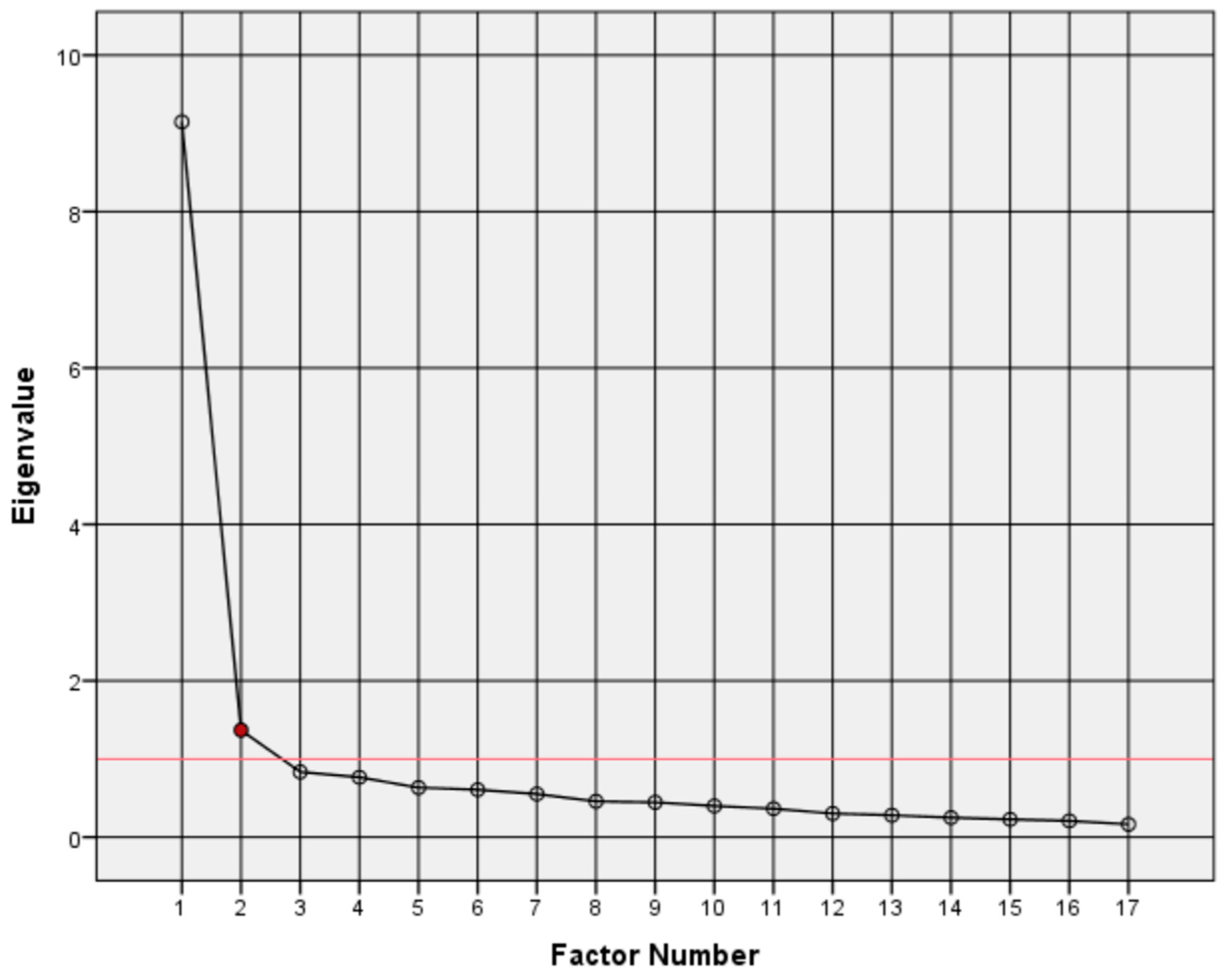
3.2. Exploratory Factor Analysis
3.3. Confirmatory Factor Analysis
3.4. Associations with Sociodemographic Variables
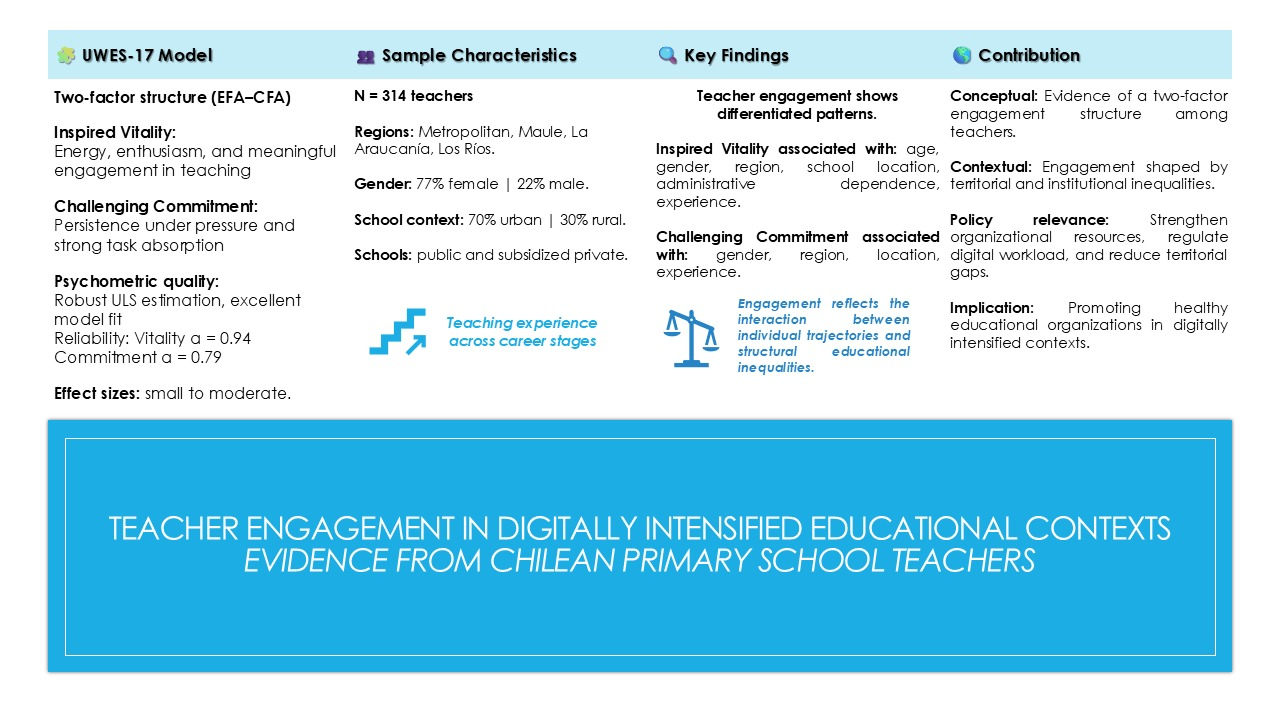
- Inspired Vitality showed significant associations with age, gender, region, location, administrative dependence, and professional experience, but not with educational level.
- Challenging Commitment was significantly associated with gender, region, location, and experience, but not with age, administrative dependence, or educational level.
- The total UWES-17 score showed significant associations with all variables except educational level.
4. Discussion
4.1. Limitations
4.2. Organizational and Socio-Pedagogical Implications
5. Conclusions
Supplementary Materials
Author Contributions
Funding
Institutional Review Board Statement
Informed Consent Statement
Data Availability Statement
Conflicts of Interest
Abbreviations
| AGFI | Adjusted Goodness of Fit Index |
| AGL | Age Level |
| CFA | Confirmatory Factor Analysis |
| CFI | Comparative Fit Index |
| df | Degrees of Freedom |
| EDL | Educational Level |
| EFA | Exploratory Factor Analysis |
| F1 | Factor One |
| F2 | Factor Two |
| FT | Factor Total |
| GFI | Goodness of Fit Index |
| GND | Gender |
| KMO | Kaiser–Meyer–Olkin |
| MIF | Minimal Number of Items per Factor |
| MSA | Measurement of Sampling Adequacy |
| MSA | Measure of Sampling Adequacy |
| NNFI | Non-Normed Fit Index |
| RMSEA | Root Mean Square Error of Approximation |
| RMSR | Root Mean Square of Residuals |
| RULS | Robust Unweighted Least Squares |
| SPSS | Statistical Package for the Social Sciences |
| TLI | Tucker & Lewis Index |
| ULS | Unweighted Least Squares |
| UWES | Utrecht Work Engagement Scale |
References
- Ahiaku, P. K. A., Uleanya, C., & Muyambi, G. C. (2025). Rural schools and tech use for sustainability: The challenge of disconnection. Education and Information Technologies, 30(9), 12557–12571. [Google Scholar] [CrossRef]
- Akour, M., & Alenezi, M. (2022). Higher education future in the era of digital transformation. Education Sciences, 12(11), 784. [Google Scholar] [CrossRef]
- Bacova, D., & Turner, A. (2023). Teacher vulnerability in teacher identity in times of unexpected social change. Research in Post-Compulsory Education, 28(3), 349–372. [Google Scholar] [CrossRef]
- Bitar, N., & Davidovich, N. (2024). Transforming pedagogy: The digital revolution in higher education. Education Sciences, 14(8), 811. [Google Scholar] [CrossRef]
- Bonett, D. G., & Wright, T. A. (2015). Cronbach’s alpha reliability: Interval estimation, hypothesis testing, and sample size planning. Journal of Organizational Behavior, 36(1), 3–15. [Google Scholar] [CrossRef]
- Bredehorst, J., Krautter, K., Meuris, J., & Jachimowicz, J. M. (2024). The challenge of maintaining passion for work over time: A daily perspective on passion and emotional exhaustion. Organization Science, 35(1), 364–386. [Google Scholar] [CrossRef]
- Bruggeman, B., Garone, A., Struyven, K., Pynoo, B., & Tondeur, J. (2022). Exploring university teachers’ online education during COVID-19: Tensions between enthusiasm and stress. Computers and Education Open, 3, 100095. [Google Scholar] [CrossRef] [PubMed]
- Cai, Y., Wang, L., Bi, Y., & Tang, R. (2022). How can the professional community influence teachers’ work engagement? The mediating role of teacher self-efficacy. Sustainability, 14(16), 10029. [Google Scholar] [CrossRef]
- Collie, R. J. (2023). Job demands and resources, teachers’ subjective vitality, and turnover intentions: An examination during COVID-19. Educational Psychology, 43(5), 452–471. [Google Scholar] [CrossRef]
- Cone, L., Brøgger, K., Berghmans, M., Decuypere, M., Förschler, A., Grimaldi, E., Hartong, S., Hillman, T., Ideland, M., Landri, P., Van De Oudeweetering, K., Player-Koro, C., Bergviken Rensfeldt, A., Rönnberg, L., Taglietti, D., & Vanermen, L. (2022). Pandemic Acceleration: Covid-19 and the emergency digitalization of European education. European Educational Research Journal, 21(5), 845–868. [Google Scholar] [CrossRef]
- Contreras-Cristán, A., & González-Barrios, J. M. (2009). A nonparametric test for symmetry based on freeman and halton’s ideas on contingency tables. Communications in Statistics—Simulation and Computation, 38(9), 1856–1869. [Google Scholar] [CrossRef]
- Delgado-Galindo, P., García-Jiménez, J., Torres-Gordillo, J.-J., & Rodríguez-Santero, J. (2025). School climate and academic performance: Key factors for sustainable education in high-efficacy schools and low-efficacy schools. Sustainability, 17(14), 6497. [Google Scholar] [CrossRef]
- Deng, J., Heydarnejad, T., Farhangi, F., & Farid Khafaga, A. (2022). Delving into the relationship between teacher emotion regulation, self-efficacy, engagement, and anger: A focus on English as a foreign language teachers. Frontiers in Psychology, 13, 1019984. [Google Scholar] [CrossRef]
- Deroncele-Acosta, A., Palacios-Núñez, M. L., & Toribio-López, A. (2023). Digital transformation and technological innovation on higher education post-COVID-19. Sustainability, 15(3), 2466. [Google Scholar] [CrossRef]
- Digón-Regueiro, P., Gewerc-Barujel, A., & Pérez-Crego, C. (2023). Dilemas en la integración de tecnologías en el aula de primaria: El diálogo entre la agencia docente, el currículo y las tecnologías digitales. Pedagogías: Revista Internacional, 18(3), 333–351. [Google Scholar] [CrossRef]
- Ferrando, P. J., & Lorenzo-Seva, U. (2017). Program FACTOR at 10: Origins, development and future directions. Psicothema, 29(2), 236–240. [Google Scholar] [CrossRef]
- Ferrando, P. J., Lorenzo-Seva, U., Hernández-Dorado, A., & Muñiz, J. (2022). Decalogue for the factor analysis of test items. Psicothema, 34(1), 7–17. [Google Scholar] [CrossRef] [PubMed]
- Fiore, B., & Decataldo, A. (2022). Digital-insecurity and overload: The role of technostress in lecturers’ work-family balance. Italian Journal of Sociology of Education, 14(10/2022), 75–102. [Google Scholar] [CrossRef]
- Freeman, G. H., & Halton, J. H. (1951). Note on an exact treatment of contingency, goodness of fit and other problems of significance. Biometrika, 38(1/2), 141–149. [Google Scholar] [CrossRef]
- Fujikawa, H., Aoki, T., Ando, T., & Haruta, J. (2024). Associations of clinical context-specific ambiguity tolerance with burnout and work engagement among Japanese physicians: A nationwide cross-sectional study. BMC Medical Education, 24(1), 660. [Google Scholar] [CrossRef]
- Greenier, V., Derakhshan, A., & Fathi, J. (2021). Emotion regulation and psychological well-being in teacher work engagement: A case of British and Iranian English language teachers. System, 97, 102446. [Google Scholar] [CrossRef]
- Gulliksen, J., Lilliesköld, J., & Stenbom, S. (2023). The ‘New’ new normal—Digitalization and hybridization of work and education before, during and after the COVID-19 pandemic. Interacting with Computers, 35(5), 691–706. [Google Scholar] [CrossRef]
- Hameli, K., Ukaj, L., & Çollaku, L. (2025). The role of self-efficacy and psychological empowerment in explaining the relationship between emotional intelligence and work engagement. EuroMed Journal of Business, 20(2), 378–398. [Google Scholar] [CrossRef]
- Harper-Hill, K., Beamish, W., Hay, S., Whelan, M., Kerr, J., Zelenko, O., & Villalba, C. (2022). Teacher engagement in professional learning: What makes the difference to teacher practice? Studies in Continuing Education, 44(1), 105–118. [Google Scholar] [CrossRef]
- Ho, A. D., & Yu, C. C. (2015). Descriptive statistics for modern test score distributions: Skewness, kurtosis, dis-creteness, and ceiling effects. Educational and Psychological Measurement, 75(3), 365–388. [Google Scholar] [CrossRef] [PubMed]
- Holst, J., Brock, A., Grund, J., Schlieszus, A.-K., & Singer-Brodowski, M. (2025). Whole-school sustainability at the core of quality education: Wished for by principals but requiring collective and structural action. Journal of Cleaner Production, 519, 145897. [Google Scholar] [CrossRef]
- Holzer, J., & Spiel, C. (2025). Teachers’ occupational strain and subjective well-being: Digital teaching makes a difference. Teacher Development, 29(3), 593–606. [Google Scholar] [CrossRef]
- Hussain, Z., Chenmei, C., Saeed, M., Hassan, N., & Chiragh, F. (2024). Personality and teachers’ burnout stress: Exploring the digital competence as personal job resource in allied health institutions. Frontiers in Psychology, 15, 1334371. [Google Scholar] [CrossRef] [PubMed]
- Iturra, V., & Gallardo, M. (2022). Schools, circumstances and inequality of opportunities in Chile. International Journal of Educational Development, 95, 102668. [Google Scholar] [CrossRef]
- Jamal, A., Yaqoob, S., Hussain, T., & Alam, H. (2023). Impact of perceived organizational support on innovative work behavior and burn out in teachers: Thriving at work as the mediator (2020). Journal of Education and Educational Development, 10(2), 288–307. [Google Scholar] [CrossRef]
- Jin, M., Ji, Y., Ding, S., & Wu, X. (2025). The effects of dual job demands on primary and secondary school teachers’ subjective well-being: A moderated mediation model. Current Psychology, 44(13), 13154–13166. [Google Scholar] [CrossRef]
- Kaiser, H. F., & Cerny, B. A. (1979). Factor analysis of the image correlation matrix. Educational and Psy-Chological Measurement, 39(4), 711–714. [Google Scholar] [CrossRef]
- Kalkan, Ö. K., & Kelecioğlu, H. (2016). The effect of sample size on parametric and nonparametric factor analytical methods. Educational Sciences: Theory & Practice, 16(1), 153–171. [Google Scholar] [CrossRef]
- Kanaki, K., & Kalogiannakis, M. (2023). Sample design challenges: An educational research paradigm. International Journal of Technology Enhanced Learning, 15(3), 266–285. [Google Scholar] [CrossRef]
- Krijnen, W. P. (1996). Algorithms for unweighted least-squares factor analysis. Computational Statistics & Data Analysis, 21(2), 133–147. [Google Scholar] [CrossRef]
- Li, C.-H. (2016). The performance of ML, DWLS, and ULS estimation with robust corrections in structural equation models with ordinal variables. Psychological Methods, 21(3), 369–387. [Google Scholar] [CrossRef]
- Lillelien, K., & Jensen, M. T. (2025). Digital and digitized interventions for teachers’ professional well-being: A systematic review of work engagement and burnout using the job demands–resources theory. Education Sciences, 15(7), 799. [Google Scholar] [CrossRef]
- Lorenzo-Seva, U., Timmerman, M. E., & Kiers, H. A. L. (2011). The hull method for selecting the number of common factors. Multivariate Behavioral Research, 46(2), 340–364. [Google Scholar] [CrossRef] [PubMed]
- Luo, H., Zuo, M., & Wang, J. (2022). Promise and reality: Using ICTs to bridge China’s rural–urban divide in education. Educational Technology Research and Development, 70(3), 1125–1147. [Google Scholar] [CrossRef]
- Lynch, J., Auld, G., O’Mara, J., & Cloonan, A. (2024). Teachers’ everyday work-for-change: Implementing curriculum policy in ‘disadvantaged’ schools. Journal of Education Policy, 39(4), 564–582. [Google Scholar] [CrossRef]
- Ma, Y., & Pongpisanu, S. (2025). Resilience in the digital age: Technostress and its impact on university lecturers in China. Journal of Cultural Analysis and Social Change, 10(4), 1544–1551. [Google Scholar] [CrossRef]
- Martin, E. M., & Benedetti, C. (2025). Teacher retention in high-poverty urban schools: The role of empowerment, leadership, and collaboration. Education and Urban Society, 57(5), 423–443. [Google Scholar] [CrossRef]
- Mexhuani, B. (2025). Adopting digital tools in higher education: Opportunities, challenges and theoretical insights. European Journal of Education, 60(1), e12819. [Google Scholar] [CrossRef]
- Morata-Ramírez, M. A., Holgado-Tello, F. P., Barbero-García, I., & Méndez, G. (2015). Confirmatory factor analysis: Recommendations for underweighted least squares method related to chi-square and RMSEA type I error. Ac-Ción Psicológica, 12(1), 79–90. [Google Scholar] [CrossRef]
- Moravec, J. W., & Martínez-Bravo, M. C. (2023). Global trends in disruptive technological change: Social and policy implications for education. On the Horizon: The International Journal of Learning Futures, 31(3/4), 147–173. [Google Scholar] [CrossRef]
- Muasya, G. (2024). The influence of family and work support in moderating work family conflict and emotional exhaustion among female urban public school teachers with young children in Kenya. Africa Education Review, 20(1–2), 75–91. [Google Scholar] [CrossRef]
- Occupational Health Psychology Unit Utrecht University. (2011). Available online: https://www.wilmarschaufeli.nl/publications/Schaufeli/Test%20Manuals/Test_manual_UWES_Espanol.pdf (accessed on 8 November 2025).
- Pavez, I., Novoa-Echaurren, A., & Salinas-Layana, A. (2024). Teachers’ situated knowledge: Addressing digital exclusion in rural contexts. Digital Education Review, 45, 171–178. [Google Scholar] [CrossRef]
- Perrotta, C. (2013). Do school-level factors influence the educational benefits of digital technology? A critical analysis of teachers’ perceptions. British Journal of Educational Technology, 44(2), 314–327. [Google Scholar] [CrossRef]
- Polatbekova, K., Yergubekova, Z., Bostanova, A., Shektibayev, N., & Abdigapbarova, U. (2025). Development of the scientific and innovative potential of future teachers. Scientific Reports, 15(1), 38665. [Google Scholar] [CrossRef]
- Provido, G., Quicho, R. F., Ibarra, F., Collantes, L., Ibañez, E., & Mukminin, A. (2025). Teachers motivation and work-family conflict: Perceptions of Fil-Am teachers. Acta Scientiarum. Education, 47, e68792. [Google Scholar] [CrossRef]
- Rahmi, K. H., Fahrudin, A., Supriyadi, T., Herlina, E., Rosilawati, R., & Ningrum, S. R. (2025). Technostress and cognitive fatigue: Reducing digital strain for improved employee well-being: A literature review. Multidisciplinary Reviews, 8(12), 2025380. [Google Scholar] [CrossRef]
- Rathan, R., Kassab, S. E., Schmidt, H. G., Nederhand, M., & Woltman, A. (2025). Teacher engagement in health profession education: A scoping review. BMC Medical Education, 25(1), 1752. [Google Scholar] [CrossRef]
- Rennstich, J. K. (2023). Learning hybrid by doing hybrid: Teaching critical digital skills in a safe learning space. In M. Arnold (Ed.), Handbook of applied teaching and learning in social work management education (pp. 243–264). Springer International Publishing. [Google Scholar] [CrossRef]
- Røe, Y., Wojniusz, S., & Bjerke, A. H. (2022). The digital transformation of higher education teaching: Four pedagogical prescritions to move active learning pedagogy forward. Frontiers in Education, 6, 784701. [Google Scholar] [CrossRef]
- Ruxton, G. D., & Neuhäuser, M. (2010). Good practice in testing for an association in contingency tables. Behavioral Ecology and Sociobiology, 64, 1505–1513. [Google Scholar] [CrossRef]
- Saks, K., Hunt, P., Leijen, Ä., & Lepp, L. (2022). To stay or not to stay: An empirical model for predicting teacher persistence. British Journal of Educational Studies, 70(6), 693–717. [Google Scholar] [CrossRef]
- Samala, A. D., Rawas, S., Criollo-C, S., Bojic, L., Prasetya, F., Ranuharja, F., & Marta, R. (2024). Emerging technologies for global education: A comprehensive exploration of trends, innovations, challenges, and future horizons. SN Computer Science, 5(8), 1175. [Google Scholar] [CrossRef]
- Sandoval-Obando, E., Barros-Osorio, C., Castellanos-Alvarenga, L., Villalta Paucar, M., & Vega-Muñoz, A. (2025). Generativity and psychological well-being in primary and secondary teachers: A systematic review. Societies, 15(11), 320. [Google Scholar] [CrossRef]
- Sandoval-Obando, E. E., Pareja-Arellano, N., Hernández-Mosqueira, C., & Riquelme-Brevis, H. (2023). What do we know about rural teaching identity? An exploratory study based on the generative-narrative approach. Journal of Pedagogy, 14(2), 97–122. [Google Scholar] [CrossRef]
- Schaufeli, W. (2021). Engaging leadership: How to promote work engagement? Frontiers in Psychology, 12, 754556. [Google Scholar] [CrossRef]
- Schaufeli, W., & Bakker, A. (2003). Utrecht work engagement scale. Occupational Health Psychology Unit. Utrecht University. [Google Scholar]
- Schaufeli, W. B. (2016). Heavy work investment, personality and organizational climate. Journal of Managerial Psychology, 31(6), 1057–1073. [Google Scholar] [CrossRef]
- Schaufeli, W. B., Bakker, A. B., & Van Rhenen, W. (2009). How changes in job demands and resources predict burnout, work engagement, and sickness absenteeism. Journal of Organizational Behavior, 30(7), 893–917. [Google Scholar] [CrossRef]
- Schaufeli, W. B., & Taris, T. W. (2014). A critical review of the job demands-resources model: Implications for improving work and health. In G. F. Bauer, & O. Hämmig (Eds.), Bridging occupational, organizational and public health (pp. 43–68). Springer Netherlands. [Google Scholar] [CrossRef]
- Schermelleh-Engel, K., Moosbrugger, H., & Müller, H. (2003). Evaluating the fit of structural equation models: Tests of significance and descriptive goodness-of-fit measures. Methods of Psychological Research, 8(2), 23–74. [Google Scholar] [CrossRef]
- Sharif, R. (2025). Beyond burnout: A counterintuitive analysis of how strain-based work-family interference strengthens affective, continuance, and normative commitment in Pakistan’s academia. Saudi Journal of Humanities and Social Sciences, 10(09), 476–487. [Google Scholar] [CrossRef]
- Shu, K. (2022). Teachers’ commitment and self-efficacy as predictors of work engagement and well-being. Frontiers in Psychology, 13, 850204. [Google Scholar] [CrossRef] [PubMed]
- Siddiqui, S., Arif, I., & Hinduja, P. (2023). Technostress: A catalyst to leave the teaching profession—A survey designed to measure technostress among teachers in Pakistan during COVID-19 pandemic. E-Learning and Digital Media, 20(1), 53–79. [Google Scholar] [CrossRef]
- Siegrist, J., & Li, J. (2016). Associations of extrinsic and intrinsic components of work stress with health: A systematic review of evidence on the effort-reward imbalance model. International Journal of Environmental Research and Public Health, 13(4), 432. [Google Scholar] [CrossRef] [PubMed]
- Sobral, F., Dias-Oliveira, E., Morais, C., & Hodgson, J. (2025). Blurred boundaries: Exploring the influence of work-life and life-work conflicts on university teachers’ health, work results, and willingness to teleworking. Frontiers in Education, 9, 1512536. [Google Scholar] [CrossRef]
- Song, C., & Kawai, R. (2023). Adaptive stratified sampling for structural reliability analysis. Structural Safety, 101, 102292. [Google Scholar] [CrossRef]
- Tabak, F., Tziner, A., Shkoler, O., & Rabenu, E. (2021). The complexity of Heavy Work Investment (HWI): A conceptual integration and review of antecedents, dimensions, and outcomes. Sustainability, 13(14), 7803. [Google Scholar] [CrossRef]
- Timotheou, S., Miliou, O., Dimitriadis, Y., Sobrino, S. V., Giannoutsou, N., Cachia, R., Monés, A. M., & Ioannou, A. (2023). Impacts of digital technologies on education and factors influencing schools’ digital capacity and transformation: A literature review. Education and Information Technologies, 28(6), 6695–6726. [Google Scholar] [CrossRef]
- Tomczyk, Ł., & Majkut, A. (2025). Integrating AI in education: An analysis of factors influencing the acceptance, concerns, attitudes, competencies and use of generative artificial intelligence among Polish teachers. Human Behavior and Emerging Technologies, 2025(1), 5599169. [Google Scholar] [CrossRef]
- Torres-Rivera, A. D., Rendón Peña, A. A., Díaz-Torres, S. T., & Díaz-Torres, L. A. (2025). Ethical integration of AI and STEAM pedagogies in higher education: A sustainable learning model for society 5.0. Sustainability, 17(19), 8525. [Google Scholar] [CrossRef]
- Ubal Camacho, M., Tambasco, P., Martínez, S., & García Correa, M. (2023). El impacto de la inteligencia artificial en la educación. Riesgos y potencialidades de la IA en el aula. RiiTE Revista Interuniversitaria De investigación En Tecnología Educativa, (15), 41–57. [Google Scholar] [CrossRef]
- Uzuntiryaki-Kondakci, E., Kirbulut, Z. D., Sarici, E., & Oktay, O. (2022). Emotion regulation as a mediator of the influence of science teacher emotions on teacher efficacy beliefs. Educational Studies, 48(5), 583–601. [Google Scholar] [CrossRef]
- Van De Werfhorst, H. G., Kessenich, E., & Geven, S. (2022). The digital divide in online education: Inequality in digital readiness of students and schools. Computers and Education Open, 3, 100100. [Google Scholar] [CrossRef]
- Wang, C., Chen, X., Yu, T., Liu, Y., & Jing, Y. (2024). Education reform and change driven by digital technology: A bibliometric study from a global perspective. Humanities and Social Sciences Communications, 11(1), 256. [Google Scholar] [CrossRef]
- Wang, K., Ye, Z., Li, Z., Li, S., & Yuan, X. (2025). Predicting teachers’ continuance intention to teach online: The role of technostress, intrapersonal and school environmental factors. Sage Open, 15(3), 21582440251359832. [Google Scholar] [CrossRef]
- Weber, P. M., Kammerl, R., & Schiefner-Rohs, M. (2025). What does digital well-being mean for school development? A theoretical review with perspectives on digital inequality. Education Sciences, 15(8), 948. [Google Scholar] [CrossRef]
- Wettstein, A., Schneider, S., Jenni, G., Holtforth, M. G., Tschacher, W., & La Marca, R. (2022). Association between workaholism, vital exhaustion, and hair cortisol concentrations among teachers: A longitudinal study testing the moderation effect of neuroticism. Frontiers in Psychology, 13, 1046573. [Google Scholar] [CrossRef]
- Willermark, S., Högberg, K., & Nilsson, P. (2023). Exploring technostress in disruptive teaching practices. International Journal of Workplace Health Management, 16(4), 328–343. [Google Scholar] [CrossRef]
- Xiao, Y., Fathi, J., & Mohammaddokht, F. (2022). Exploring a structural model of teaching enjoyment, teacher self-efficacy, and work engagement. Frontiers in Psychology, 13, 918488. [Google Scholar] [CrossRef]
- Ximénez, M. C., & García, A. G. (2005). Comparison of maximum likelihood and unweighted least squares estimation methods in confirmatory factor analysis by Monte Carlo simulation. Psicothema, 17(3), 528–535. [Google Scholar]
- Xing, Z. (2022). English as a foreign language teachers’ work engagement, burnout, and their professional identity. Frontiers in Psychology, 13, 916079. [Google Scholar] [CrossRef] [PubMed]
- Yan, L., Suleman Abdullah Alwabel, A., & Mohamad, U. H. (2025). AI-powered education: Transforming teacher-student interactions and advancing sustainable learning practices. European Journal of Education, 60(4), e70351. [Google Scholar] [CrossRef]
- Yang, X., Zhu, X., & Chen, D. (2023). Discourses regarding education governance in the digital age at K-12 level: Possibilities, risks, and strategies. Teaching and Teacher Education, 132, 104261. [Google Scholar] [CrossRef]
- Yuan, H., Yan, Z., Zhao, Y., & Lei, J. (2025). The relationship of rural kindergarten teachers’ emotional intelligence and work engagement in China: The chain mediation role of emotional labor strategies and general self-efficacy. BMC Psychology, 13(1), 154. [Google Scholar] [CrossRef]
- Zhai, X. (2025). Transforming teachers’ roles and agencies in the era of generative AI: Perceptions, acceptance, knowledge, and practices. Journal of Science Education and Technology, 34(6), 1323–1333. [Google Scholar] [CrossRef]
- Zhang, A., & Yang, Y. (2021). Toward the association between EFL/ESL teachers’ work engagement and their students’ academic engagement. Frontiers in Psychology, 12, 739827. [Google Scholar] [CrossRef]
- Zhang, H., & Cao, J. (2025). From digital disruption to mental health: The impact of AI-induced educational anxiety on teacher well-being in the era of smart education. BMC Public Health, 25(1), 4010. [Google Scholar] [CrossRef]
- Zhong, Y., & Rosli, M. S. B. (2025). Multidimensional analysis of teachers’ technostress: Sources, impacts, and mitigation strategies. International Journal of Academic Research in Progressive Education and Development, 14(3), 313–323. [Google Scholar] [CrossRef] [PubMed]
- Zorde, O., & Lapidot-Lefler, N. (2025). Sustainable educational infrastructure: Professional learning communities as catalysts for lasting inclusive practices and human well-being. Sustainability, 17(7), 3106. [Google Scholar] [CrossRef]


| Sociodemographic Variables | Level (Number Code) | n | n% |
|---|---|---|---|
| Gender (GND) | Female (1) * | 242 | 77.1% |
| Male (2) | 70 | 22.3% | |
| No binary (3) | 2 | 0.6% | |
| Age level (AGE) (in years) | AGL < 30 (1) | 47 | 15.0% |
| 30 ≤ AGL ≤ 39 (2) | 104 | 33.1% | |
| 40 ≤ AGL ≤ 49 (3) | 100 | 31.8% | |
| 50 ≤ AGL ≤ 59 (4) | 41 | 13.1% | |
| 60 ≤ AGL (5) | 22 | 7.0% | |
| Region (REG) | La Araucanía (LAR) | 102 | 32.5% |
| Los Ríos (LRI) | 70 | 22.3% | |
| Maule (MAU) | 80 | 25.5% | |
| Metropolitan (MET) | 62 | 19.7% | |
| Location (LOC) | Rural (1) | 94 | 29.9% |
| Urban (2) | 220 | 70.1% | |
| Dependence (DEP) | Public (1) | 121 | 38.5% |
| Mixed funding (2) | 193 | 61.5% | |
| Experience level (EXP) (in years) | EXP < 5 (1) | 41 | 13.1% |
| 5 ≤ EXP ≤ 10 (2) | 100 | 31.8% | |
| 11 ≤ EXP ≤ 15 (3) | 85 | 27.1% | |
| 16 ≤ EXP ≤ 20 (4) | 39 | 12.4% | |
| 21 ≤ EXP (5) | 49 | 15.6% | |
| Education level (EDU) | Ungraduated (1) ** | 227 | 72.3% |
| Qualification (2) *** | 33 | 10.5% | |
| Advanced qualification (3) | 5 | 1.6% | |
| Master (4) | 49 | 15.6% |
| Variables | N | Mean | Variance | Skewness | Kurtosis | ||
|---|---|---|---|---|---|---|---|
| Statistic | Statistic | Statistic | Statistic | Std. Error | Statistic | Std. Error | |
| WBW1 * | 314 | 4.10 | 2.188 | −0.630 | 0.138 | −0.454 | 0.274 |
| WBW2 * | 314 | 4.58 | 2.027 | −0.901 | 0.138 | 0.141 | 0.274 |
| WBW3 * | 314 | 4.49 | 2.136 | −0.899 | 0.138 | 0.044 | 0.274 |
| WBW4 * | 314 | 4.31 | 2.171 | −0.762 | 0.138 | −0.262 | 0.274 |
| WBW5 * | 314 | 4.43 | 2.323 | −1.013 | 0.138 | 0.428 | 0.274 |
| WBW6 * | 314 | 3.91 | 2.972 | −0.673 | 0.138 | −0.411 | 0.274 |
| WBW7 * | 314 | 4.54 | 2.147 | −0.992 | 0.138 | 0.322 | 0.274 |
| WBW8 * | 314 | 3.90 | 2.884 | −0.588 | 0.138 | −0.594 | 0.274 |
| WBW9 * | 314 | 4.06 | 2.645 | −0.645 | 0.138 | −0.498 | 0.274 |
| WBW10 * | 314 | 4.74 | 1.975 | −1.188 | 0.138 | 0.883 | 0.274 |
| WBW11 * | 314 | 4.49 | 1.803 | −0.748 | 0.138 | −0.156 | 0.274 |
| WBW12 * | 314 | 3.99 | 2.377 | −0.600 | 0.138 | −0.369 | 0.274 |
| WBW13 * | 314 | 4.68 | 1.855 | −1.350 | 0.138 | 1.835 | 0.274 |
| WBW14 * | 314 | 4.08 | 2.316 | −0.797 | 0.138 | 0.325 | 0.274 |
| WBW15 * | 314 | 4.69 | 1.890 | −1.236 | 0.138 | 1.359 | 0.274 |
| WBW16 * | 314 | 4.03 | 2.763 | −0.752 | 0.138 | −0.305 | 0.274 |
| WBW17 * | 314 | 4.40 | 2.491 | −1.050 | 0.138 | 0.485 | 0.274 |
| Valid N (listwise) | 314 | ||||||
| KMO and Bartlett’s Test | ||||
|---|---|---|---|---|
| Kaiser–Meyer–Olkin Measure of Sampling Adequacy | 0.945 | |||
| Bartlett’s Test of Sphericity | Approx. Chi-Square | 3590.706 | ||
| Degree of freedom | 136 | |||
| Significance | 0.000 | |||
| Pattern Matrix a | ||||
| ID | Factor 1 (F1) | Factor 2 (F2) | ||
| WBW1 | 0.792 | |||
| WBW2 | 0.780 | |||
| WBW3 | 0.699 | |||
| WBW4 | 0.703 | |||
| WBW5 | 0.847 | |||
| WBW6 | 0.471 | |||
| WBW7 | 0.942 | |||
| WBW8 | 0.870 | |||
| WBW9 | 0.827 | |||
| WBW10 | 0.696 | |||
| WBW11 | 0.508 | |||
| WBW12 | 0.510 | |||
| WBW13 | 0.450 | |||
| WBW14 | 0.490 | |||
| WBW15 | 0.519 | |||
| WBW16 | 0.634 | |||
| WBW17 | 0.691 | |||
| Eigenvalue | 8.746 | 0.878 | ||
| % of Variance | 51.450 | 5.162 | ||
| Cumulative % | 51.450 | 56.611 | ||
| Factor Correlation Matrix b | ||||
| Factor | 1 | 2 | ||
| 1 | 1.000 | 0.618 | ||
| 2 | 0.618 | 1.000 | ||
| KMO and Bartlett’s Test | |||
|---|---|---|---|
| Kaiser–Meyer–Olkin Measure of Sampling Adequacy (confidence interval 90%) | 0.944 (0.855; 0.933) | ||
| Bartlett’s Test of Sphericity | Approx. Chi-Square | 3528.7 | |
| Degree of freedom | 136 | ||
| Significance | 0.000010 | ||
| Rotated Loading Matrix | |||
| Variable (Item) | Factor 1 (F1) | Factor 2 (F2) | |
| WBW1 | 0.850 | ||
| WBW2 | 0.831 | ||
| WBW3 | 0.734 | ||
| WBW4 | 0.762 | ||
| WBW5 | 0.936 | ||
| WBW6 | 0.554 | ||
| WBW7 | 0.969 | ||
| WBW8 | 0.879 | ||
| WBW9 | 0.810 | ||
| WBW10 | 0.663 | ||
| WBW11 | 0.470 | ||
| WBW12 | 0.506 | ||
| WBW13 | 0.548 | ||
| WBW14 | 0.598 | ||
| WBW15 | 0.576 | ||
| WBW16 | 0.721 | ||
| WBW17 | 0.723 | ||
| Explained Variance | 0.602 | 0.081 | |
| Cumulative Variance | 0.602 | 0.683 | |
| Eigenvalue | 10.234 | 1.368 | |
| Inter Factor Correlation Matrix | |||
| Factor | F1 | F2 | |
| F1 | 1.000 | ||
| F2 | 0.665 | 1.000 | |
| Scale | Variance | Skewness | Kurtosis | Valid Cases | Number of Items | Cronbach’s Alpha |
|---|---|---|---|---|---|---|
| Factor 1 | 1.567 | −0.431 | −0.704 | 314 | 12 | 0.942 ci (0.936 0.948) ** |
| Factor 2 | 1.380 | −0.332 | −0.683 | 314 | 5 | 0.795 ci (0.772 0.818) * |
| Factor Total | 1.341 | −0.377 | −0.626 | 314 | 17 | 0.942 ci (0.936 0.948) ** |
| Model | Sample | Level | Cronbach’s Alpha | MIF | χ2/df | RMSEA | AGFI | GFI | CFI | NNFI | RMSR |
|---|---|---|---|---|---|---|---|---|---|---|---|
| Proposed (Two-factor model) | 314 | - | 0.934 ** | 5 | 0.54 **,+ | 0.000 ** ci (could not be computed) | 0.996 ** ci (0.996 0.997) | 0.997 ** ci (0.997 0.998) | 0.999 ** ci (0.998 1.001) | 1.000 ** ci (1.001 1.002) | 0.036 ** ci (0.033 0.035) |
| Contrast (One-factor model) | 314 | - | 0.934 ** | 17 | 1.52 ** + | 0.072 * ci (0.057 0.078) | 0.988 ** ci (0.986 0.992) | 0.989 ** ci (0.987 0.993) | 0.987 ** ci (0.983 0.993) | 0.985 ** ci (0.980 0.992) | 0.065 ** ci (0.057 0.069) |
| Adopted thresholds | ≥200 | ** | [0.80, 0.95) | NR | [0, 2] | [0.00, 0.05] | [0.90, 1.00] | [0.95, 1.00] | [0.97, 1.00] | [0.97, 1.00] | [0.00, 0.05) ++ |
| * | [0.70, 0.80) | ≥3 | (2, 3] | (0.05, 0.08] | [0.85, 0.90) | [0.90, 0.95) | [0.95, 0.97) | [0.95, 0.97) | [0.05, 0.08] ++ |
| Variable 1 | Variable 2 | N of Valid Cases | Value F-H + | Significance (2-Sided) + | Correlation Evidence | Cramer’s V | Effect Size |
|---|---|---|---|---|---|---|---|
| F1 | AGE | 314 | 53.203 | 0.000 ci (0.000 0.000) ** | Yes | 0.213 | small–moderate |
| GND | 314 | 26.024 | 0.001 ci (0.000 0.002) ** | Yes | 0.210 | small–moderate | |
| REG | 314 | 49.511 | 0.000 ci (0.000 0.000) ** | Yes | 0.242 | small–moderate | |
| LOC | 314 | 24.231 | 0.000 ci (0.000 0.000) ** | Yes | 0.280 | small–moderate (close to medium) | |
| DEP | 314 | 12.145 | 0.025 ci (0.021 0.029) * | Yes | 0.197 | small | |
| EXP | 314 | 37.204 | 0.005 ci (0.003 0.006) ** | Yes | 0.172 | small | |
| EDU | 314 | 19.136 | 0.172 ci (0.162 0.182) | No | 0.139 | small | |
| F2 | AGE | 314 | 26.833 | 0.109 ci (0.101 0.117) | No | 0.145 | small |
| GND | 314 | 26.762 | 0.001 ci (0.000 0.001) ** | Yes | 0.192 | small | |
| REG | 314 | 46.122 | 0.000 ci (0.000 0.000) ** | Yes | 0.227 | small–moderate | |
| LOC | 314 | 12.869 | 0.018 ci (0.014 0.021) * | Yes | 0.207 | small–moderate | |
| DEP | 314 | 9.931 | 0.062 ci (0.055 0.068) | No | 0.180 | small | |
| EXP | 314 | 36.296 | 0.006 ci (0.004 0.008) ** | Yes | 0.170 | small | |
| EDU | 314 | 15.148 | 0.526 ci (0.513 0.539) | No | 0.115 | small | |
| FT | AGE | 314 | 49.420 | 0.000 ci (0.000 0.000) ** | Yes | 0.201 | small–moderate |
| GND | 314 | 27.007 | 0.001 ci (0.000 0.002) ** | Yes | 0.208 | small–moderate | |
| REG | 314 | 57.286 | 0.000 ci (0.000 0.000) ** | Yes | 0.255 | small–moderate | |
| LOC | 314 | 24.679 | 0.000 ci (0.000 0.000) ** | Yes | 0.288 | small–moderate (close to medium) | |
| DEP | 314 | 24.722 | 0.000 ci (0.000 0.000) ** | Yes | 0.283 | small–moderate (close to medium) | |
| EXP | 314 | 39.784 | 0.002 ci (0.001 0.003) ** | Yes | 0.179 | small | |
| EDU | 314 | 22.624 | 0.081 ci (0.074 0.088) | No | 0.147 | small |
Disclaimer/Publisher’s Note: The statements, opinions and data contained in all publications are solely those of the individual author(s) and contributor(s) and not of MDPI and/or the editor(s). MDPI and/or the editor(s) disclaim responsibility for any injury to people or property resulting from any ideas, methods, instructions or products referred to in the content. |
© 2026 by the authors. Published by MDPI on behalf of the University Association of Education and Psychology. Licensee MDPI, Basel, Switzerland. This article is an open access article distributed under the terms and conditions of the Creative Commons Attribution (CC BY) license.
Share and Cite
Sandoval-Obando, E.; Armstrong-Gallegos, S.; Véliz-Campos, M.; Salazar-Sepúlveda, G.; Vega-Muñoz, A.; Salazar-Muñoz, M. Vitality and Challenging Commitment in Times of Digital Intensification: Evidence for Healthy Educational Organizations Based on Teacher Engagement in Chile. Eur. J. Investig. Health Psychol. Educ. 2026, 16, 44. https://doi.org/10.3390/ejihpe16030044
Sandoval-Obando E, Armstrong-Gallegos S, Véliz-Campos M, Salazar-Sepúlveda G, Vega-Muñoz A, Salazar-Muñoz M. Vitality and Challenging Commitment in Times of Digital Intensification: Evidence for Healthy Educational Organizations Based on Teacher Engagement in Chile. European Journal of Investigation in Health, Psychology and Education. 2026; 16(3):44. https://doi.org/10.3390/ejihpe16030044
Chicago/Turabian StyleSandoval-Obando, Eduardo, Stephanie Armstrong-Gallegos, Mauricio Véliz-Campos, Guido Salazar-Sepúlveda, Alejandro Vega-Muñoz, and Miguel Salazar-Muñoz. 2026. "Vitality and Challenging Commitment in Times of Digital Intensification: Evidence for Healthy Educational Organizations Based on Teacher Engagement in Chile" European Journal of Investigation in Health, Psychology and Education 16, no. 3: 44. https://doi.org/10.3390/ejihpe16030044
APA StyleSandoval-Obando, E., Armstrong-Gallegos, S., Véliz-Campos, M., Salazar-Sepúlveda, G., Vega-Muñoz, A., & Salazar-Muñoz, M. (2026). Vitality and Challenging Commitment in Times of Digital Intensification: Evidence for Healthy Educational Organizations Based on Teacher Engagement in Chile. European Journal of Investigation in Health, Psychology and Education, 16(3), 44. https://doi.org/10.3390/ejihpe16030044