
Cognitive Profile of Autism and Intellectual Disorder in Wechsler’s Scales: Meta-Analysis

 ,
,  ,
,  , , , , ,
  and
and
Abstract
1. Introduction
1.1. The Role of Wechsler Scales in ASD and ID Psychometric Evaluation
1.2. ASD and ID Cognitive Profile
1.3. Meta-Analytic Framework for Cognitive Profiles in ASD, ID, and ASD+ID
- Examine cognitive differences among individuals with ASD, ID, and ASD+ID, considering performance across indices and test types.
- Compare the results obtained for these diagnoses against expected normative performance on the tests.
- Compare the performance across different indices within each disorder.
- Investigate moderators that may influence changes in cognitive profiles across distinct conditions.
- Assess heterogeneity to better delineate the expressive variations found in ASD and ID.
2. Materials and Methods
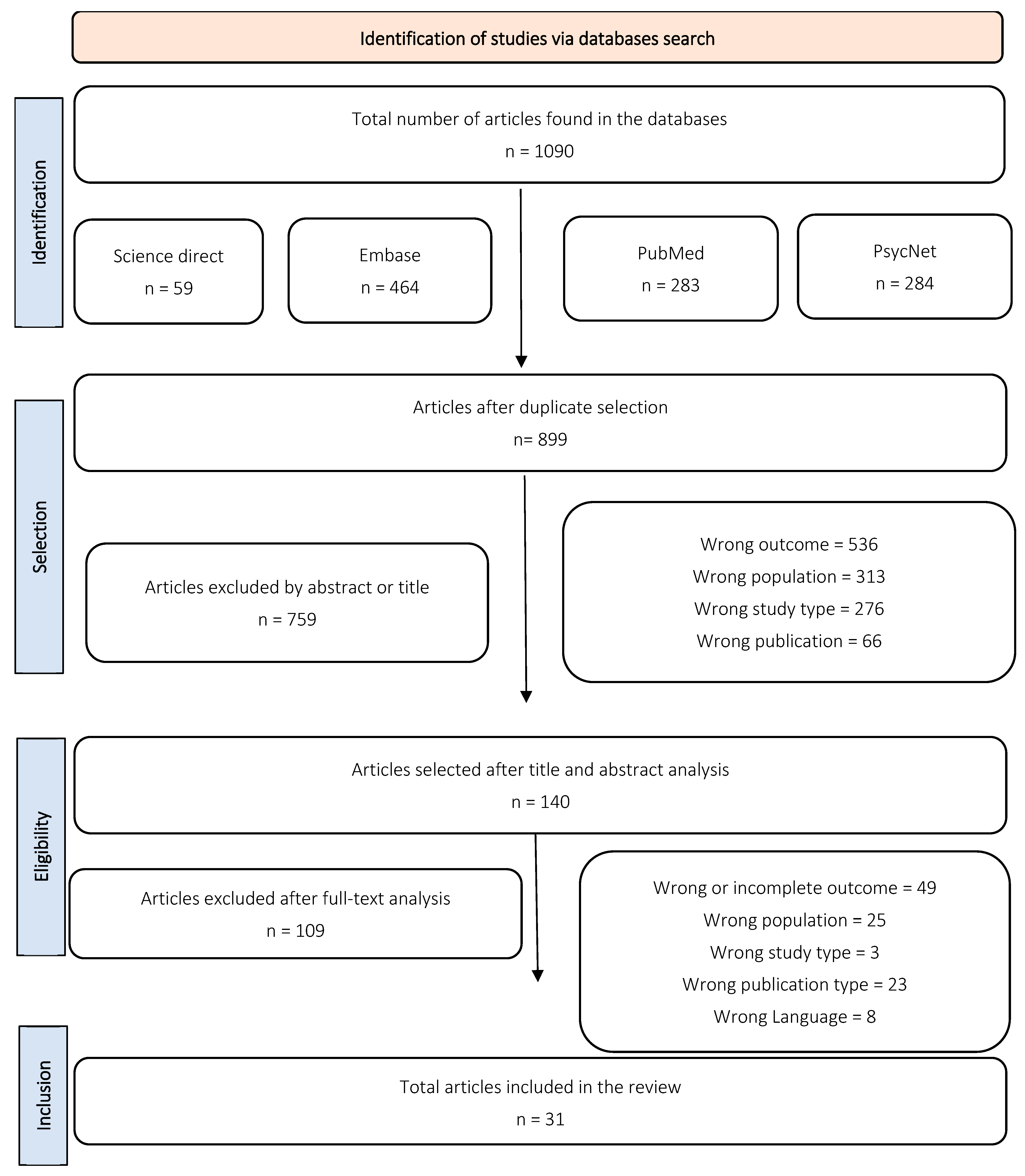
2.1. Study Selection and Search Strategy
- Participants (P): The study included individuals diagnosed with autism spectrum disorder (ASD) or Intellectual and Developmental Disabilities (IDD), including variations such as intellectual disability (ID) or Asperger’s Syndrome, as defined by the DSM-IV, DSM-V, or DSM-V-TR criteria. Articles involving ASD with FSIQ < 70 or those focusing on individuals with ASD and intellectual impairment were categorized as ASD+ID.
- Interventions (I): The focused intervention was the application of Wechsler’s scales, specifically WISC-IV, WISC-V, WAIS-III, or WAIS-IV. The studies were required to report FSIQ and cognitive index data explicitly.
- Comparison (C): Eligible studies included those that compared results using the instrument’s own normative data, a control group, or another mental health condition.
- Outcome (O): The primary outcomes were the cognitive indices derived from the tests. Inclusion in this phase required the presentation of all index scores from the respective test (FSIQ, VCI, PRI, WMI, and PSI, or FSIQ, VCI, FRI, VPI, and WMI in WISC-V).
2.2. Data Extraction, Synthesis and Bias Assessment
2.3. Data Synthesis
2.4. Data Analysis
3. Results
3.1. Population Characteristics
3.2. Descriptive Data
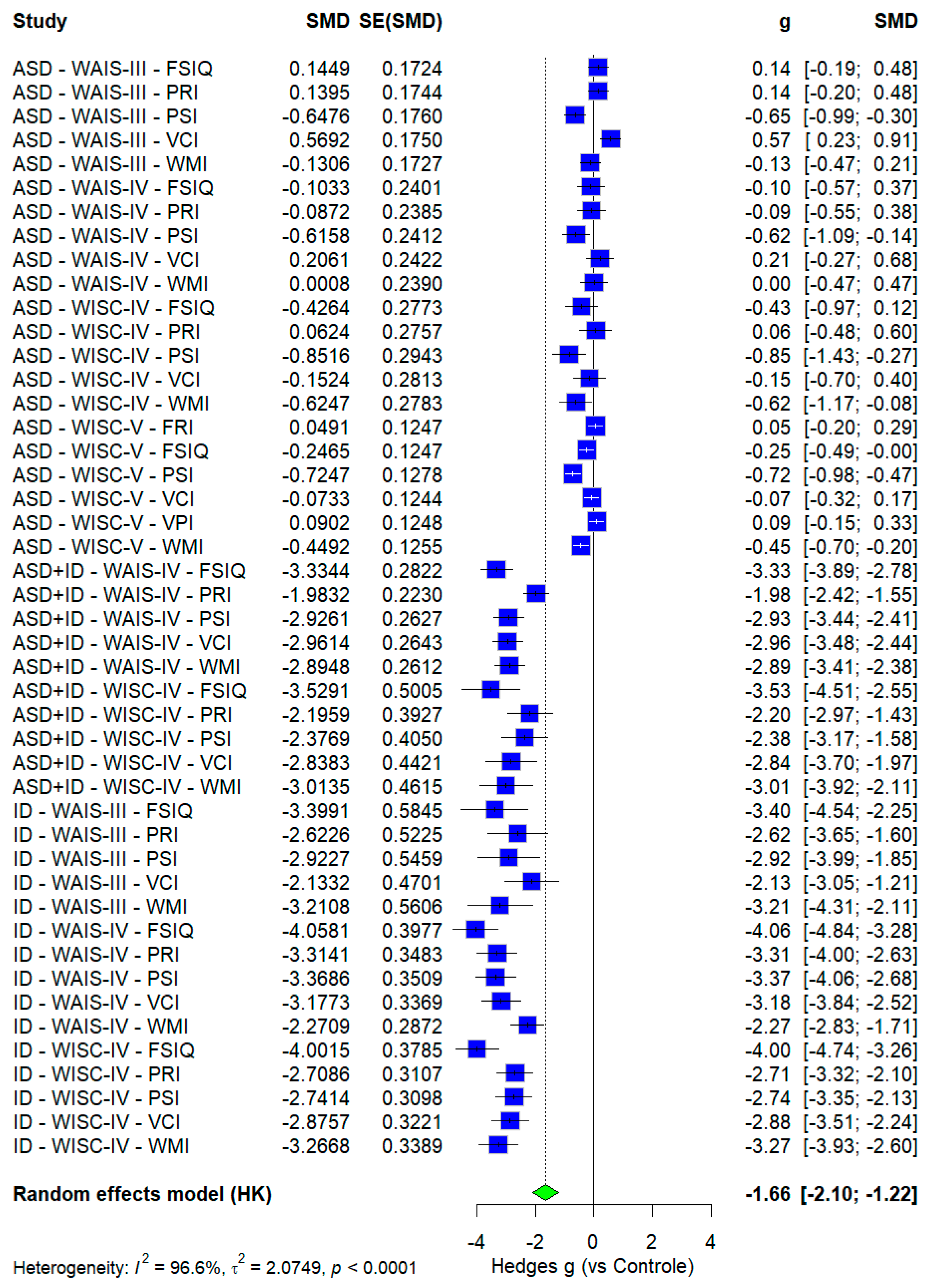
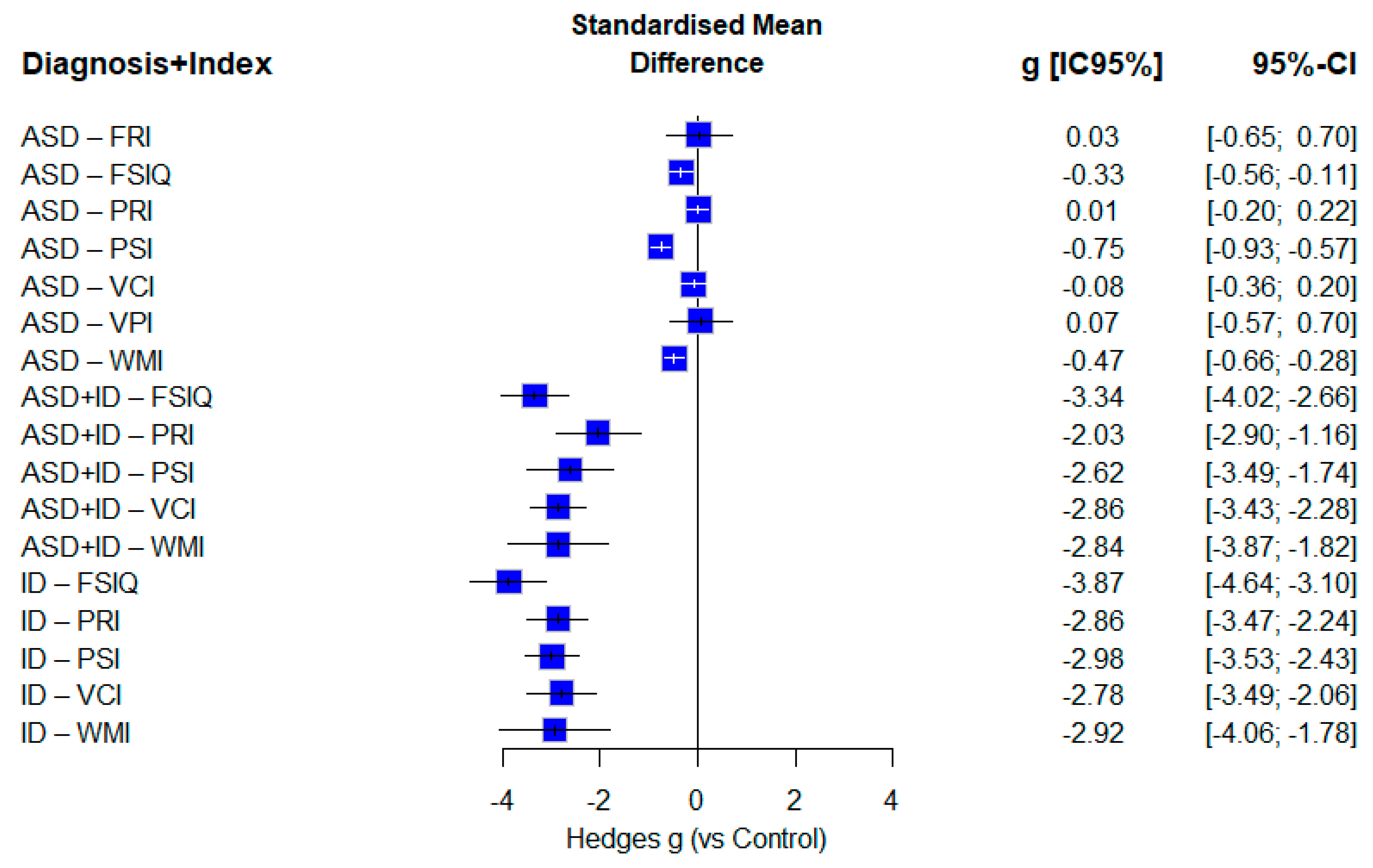
3.3. Comparisons Between Tests and Diagnosis
3.4. Meta-Regressions
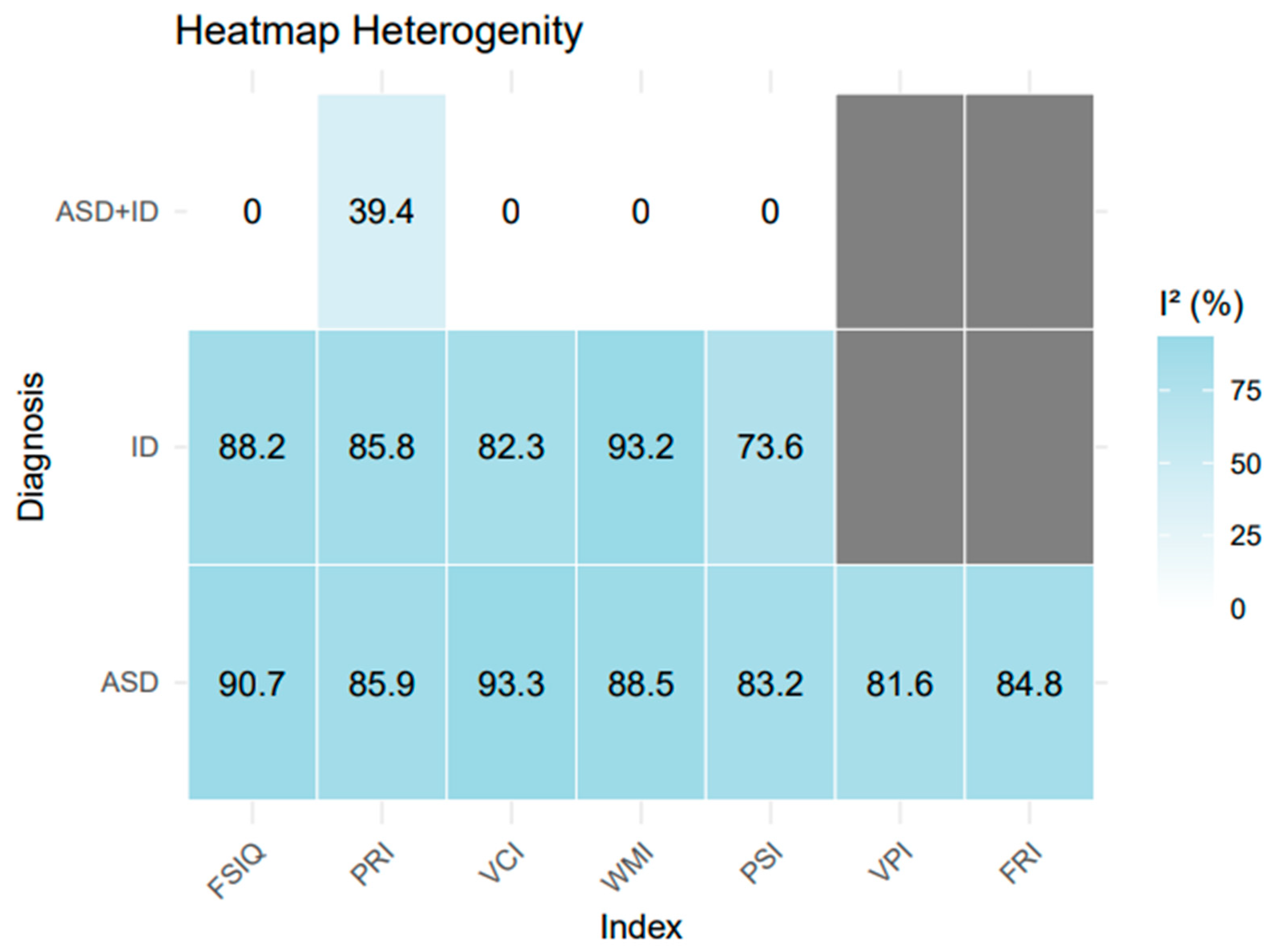
3.5. Heterogeneity
4. Discussion
4.1. Categorization and Description
4.2. Analysis Between Diagnoses and Tests
4.2.1. Analysis Between Diagnoses
4.2.2. Analysis Between Tests
4.3. Heterogeneity and Bias
4.4. Clinical Relevance
4.5. Limitations
5. Conclusions
Supplementary Materials
Author Contributions
Funding
Informed Consent Statement
Data Availability Statement
Conflicts of Interest
Abbreviations
| FSIQ | Full Scale IQ |
| VCI | Vocabulary Comprehension Index |
| PRI | Perceptual Reasoning Index |
| PSI | Processing Speed Index |
| WMI | Working Memory Index |
| FRI | Fluid Reasoning Index |
| VPI | Visual Processing Index |
| ASD | Autism Spectrum Disorder |
| ID | Intellectual Disability |
| IDD | Intellectual Development Disorder |
| ASD+ID | Autism Spectrum disorder comorbid with Intellectual Development Disorder |
References
- Audras-Torrent, L., Miniarikova, E., Couty, F., Dellapiazza, F., Berard, M., Michelon, C., Picot, M. C., & Baghdadli, A. (2021). WISC-V profiles and their correlates in children with autism spectrum disorder without intellectual developmental disorder: Report from the ELENA cohort. Autism Research, 14(5), 997–1006. [Google Scholar] [CrossRef] [PubMed]
- Barnard, H. (2023). A systematic review of literature and meta-analysis of the cognitive performance of children with autism spectrum disorder using the wechsler intelligence scale for children [Master’s thesis, University of the Witwatersrand]. [Google Scholar]
- Baum, K. T., Shear, P. K., Howe, S. R., & Bishop, S. L. (2015). A comparison of WISC-IV and SB-5 intelligence scores in adolescents with autism spectrum disorder. Autism, 19(6), 736–745. [Google Scholar] [CrossRef] [PubMed]
- Bojda, A., Srebnicki, T., Konowałek, Ł., & Bryńska, A. (2021). Weak central coherence–construct conception, development, research methods. Psychiatria Polska, 55(6), 1373–1386. [Google Scholar] [CrossRef]
- Bougeard, C., Picarel-Blanchot, F., Schmid, R., Campbell, R., & Buitelaar, J. (2021). Prevalence of autism spectrum disorder and co-morbidities in children and adolescents: A systematic literature review. Front Psychiatry, 12, 744709. [Google Scholar] [CrossRef]
- Braconnier, M. L., & Siper, P. M. (2021). Neuropsychological assessment in autism spectrum disorder. Current Psychiatry Reports, 23(10), 1–9. [Google Scholar] [CrossRef]
- Bucaille, A., Grandgeorge, M., Degrez, C., Mallégol, C., Cam, P., Botbol, M., & Planche, P. (2016). Cognitive profile in adults with Asperger syndrome using WAIS-IV: Comparison to typical adults. Research in Autism Spectrum Disorders, 21, 1–9. [Google Scholar] [CrossRef]
- Calderoni, S. (2023). Sex/gender differences in children with autism spectrum disorder: A brief overview on epidemiology, symptom profile, and neuroanatomy. Journal of Neuroscience Research, 101(5), 739–750. [Google Scholar] [CrossRef]
- Calero, M. D., Mata, S., Bonete, S., Molinero, C., & Mar Gómez-Pérez, M. (2015). Relations between learning potential, cognitive and interpersonal skills in asperger children. Learning and Individual Differences, 44, 53–60. [Google Scholar] [CrossRef]
- Carreiro, L., Marino, R., Siqueira, A., & Ribeiro, A. (2017). Avaliação da inteligência em crianças com transtorno no espectro autista. In Autismo: Avaliação psicológica e neuropsicológica (Vol. 1). Hogrefe CETEEPP. [Google Scholar]
- Ceruti, C., Mingozzi, A., Scionti, N., & Marzocchi, G. M. (2024). Comparing executive functions in children and adolescents with autism and ADHD—A systematic review and meta-analysis. Children, 11(4), 473. [Google Scholar] [CrossRef]
- Chua, A. C. K., & Xie, G. H. (2022). Diagnostic profiling of cognitive strengths and weaknesses in autism spectrum disorder: What the Cattell-Horn-Carroll theory tells us. Journal of Early Years Research, 2(2), 16–22. [Google Scholar]
- Cicinelli, G., Nobile, E., Brighenti, S., Bari, S., Tonella, E., Aresi, A., Attanasio, M., Mazza, M., Valenti, M., & Keller, R. (2022). Wechsler intelligence scale for adults—Fourth edition profiles of adults with autism spectrum disorder. Epidemiology and Psychiatric Sciences, 31, e67. [Google Scholar] [CrossRef] [PubMed]
- Cohen, J. (1988). Statistical power analysis for the behavioral sciences. Psychology Press, Taylor & Francis Group. [Google Scholar]
- Cohen, J. (1992). Statical power analysis. Current Direction in Psychological Science, 1, 98–101. [Google Scholar] [CrossRef]
- Crippa, J. A. d. S., Osório, F. d. L., & de Souza, J. D. R. (Eds.). (2023). American Psychiatric Association manual diagnóstico e estatístico de transtornos mentais (5th ed., Vol. 1). Artmed. [Google Scholar]
- Cuschieri, S. (2019). The STROBE guidelines. Saudi Journal of Anaesthesia, 13, S31–S34. [Google Scholar] [CrossRef]
- Dakopolos, A., Condy, E., Smith, E., Harvey, D., Kaat, A. J., Coleman, J., Riley, K., Berry-Kravis, E., & Hessl, D. (2024). Developmental associations between cognition and adaptive behavior in intellectual and developmental disability. Journal of Neurodevelopmental Disorders, 16(1), 31. [Google Scholar] [CrossRef]
- Dale, B. A., Finch, W. H., Shellabarger, K. A. R., & Davis, A. (2021). Wechsler intelligence scale for children, fifth edition profiles of children with autism spectrum disorder using a classification and regression trees analysis. Journal of Psychoeducational Assessment, 39(7), 783–799. [Google Scholar] [CrossRef]
- Dale, B. A., Finch, W. H., Shellabarger, K. A. R., & Davis, A. (2022). Comparison of verbal performance of children with autism spectrum disorder on the WISC-V. Journal of Psychoeducational Assessment, 40(7), 811–824. [Google Scholar] [CrossRef]
- Delbruck, E., Yang, M., Yassine, A., & Grossman, E. D. (2019). Functional connectivity in ASD: Atypical pathways in brain networks supporting action observation and joint attention. Brain Research, 1706, 157–165. [Google Scholar] [CrossRef]
- Demetriou, E. A., Lampit, A., Quintana, D. S., Naismith, S. L., Song, Y. J. C., Pye, J. E., Hickie, I., & Guastella, A. J. (2018). Autism spectrum disorders: A meta-analysis of executive function. Molecular Psychiatry, 23(5), 1198–1204. [Google Scholar] [CrossRef]
- Di Salvo, M. (2024). Autism research between psychology and neuroscience: From leo kanner to new frontiers. Springer Nature. [Google Scholar]
- Eckstein, J., Phillips, C. A., & Hart, W. E. (2001). Pico: An object-oriented framework for parallel branch and bound. In Studies in computational mathematics (Vol. 8, pp. 219–265). Elsevier. [Google Scholar]
- Erickson, S. L., Salekin, K. L., Johnson, L. N., & Doran, S. C. (2020). The predictive power of intelligence: Miranda abilities of individuals with intellectual disability. Law and Human Behavior, 44(1), 60–70. [Google Scholar] [CrossRef]
- Erostarbe-Pérez, M., Reparaz-Abaitua, C., Martínez-Pérez, L., & Magallón-Recalde, S. (2022). Executive functions and their relationship with intellectual capacity and age in schoolchildren with intellectual disability. Journal of Intellectual Disability Research, 66(1–2), 50–67. [Google Scholar] [CrossRef]
- Eyler, L. T. (2018). Brain connections and social connections in autism spectrum disorders. Brain, 141(12), 3280–3289. [Google Scholar] [CrossRef]
- Genovese, A., & Butler, M. G. (2023). The Autism Spectrum: Behavioral, Psychiatric and Genetic Associations. Genes, 14(3), 677. [Google Scholar] [CrossRef]
- Giofrè, D., Lievore, R., Allen, K., Tonizzi, I., Mammarella, I. C., & Toffalini, E. (2024). Understanding sex/gender differences in intelligence profiles of children with Autism: A comprehensive WISC meta-analysis. Research in Developmental Disabilities, 154, 104854. [Google Scholar] [CrossRef]
- Giofrè, D., Provazza, S., Angione, D., Cini, A., Menazza, C., Oppi, F., & Cornoldi, C. (2019). The intellectual profile of children with autism spectrum disorders may be underestimated: A comparison between two different batteries in an Italian sample. Research in Developmental Disabilities, 90, 72–79. [Google Scholar] [CrossRef]
- Girianelli, V. R., Tomazelli, J., da Silva, C. M. F. P., & Fernandes, C. S. (2023). Early diagnosis of autism and other developmental disorders, Brazil, 2013–2019. Revista de Saúde Pública, 57(1), 21. [Google Scholar] [CrossRef] [PubMed]
- Higgins, J., Thompson, S., Deeks, J., & Altman, D. (2002). Statistical heterogeneity in systematic reviews of clinical trials: A critical appraisal of guidelines and practice. Journal of Health Services Research & Policy, 7(1), 51–61. [Google Scholar] [CrossRef]
- Higgins, J. P. T., & Li, T. (2022). Exploring heterogeneity. In Systematic reviews in health research: Meta-analysis in context: Third edition (pp. 185–203). Wiley. [Google Scholar]
- Higgins, J. P. T., Thomas, J., Chandler, J., Cumpston, M., Li, T., Page, M. J., & Welch, V. A. (2020). Cochrane handbook for systematic reviews of interventions. Wiley-Blackwell. [Google Scholar]
- Huang, Y., Arnold, S. R. C., Foley, K. R., & Trollor, J. N. (2020). Diagnosis of autism in adulthood: A scoping review. Autism, 24(6), 1311–1327. [Google Scholar] [CrossRef]
- Jin, W. Y., Wu, L. L., Hu, L. F., Li, W. H., Song, C., Wang, Y. Y., Liu, X. L., & Zhu, Z. W. (2023). Intelligence profiles and adaptive behaviors of high-functioning autism spectrum disorder and developmental speech and language disorders. Frontiers in Pediatrics, 10, 972643. [Google Scholar] [CrossRef] [PubMed]
- Kanai, C., Hashimoto, R., Itahashi, T., Tani, M., Yamada, T., Ota, H., Iwanami, A., & Kato, N. (2017). Cognitive profiles of adults with high-functioning autism spectrum disorder and those with attention-deficit/hyperactivity disorder based on the WAIS-III. Research in Developmental Disabilities, 61, 108–115. [Google Scholar] [CrossRef] [PubMed]
- Kim, H., & Song, D. H. (2020). Comparison of the K-WISC-IV profiles of boys with autism spectrum disorder and attention-deficit/hyperactivity disorder. Research in Developmental Disabilities, 97, 103539. [Google Scholar] [CrossRef]
- Kuehnel, C. A., Castro, R., & Furey, W. M. (2019). A comparison of WISC-IV and WISC-V verbal comprehension index scores for children with autism spectrum disorder. The Clinical Neuropsychologist, 33(6), 1127–1137. [Google Scholar] [CrossRef] [PubMed]
- Lakens, D. (2022). Sample size justification. Collabra: Psychology, 8(1), 33267. [Google Scholar] [CrossRef]
- Leung, C. N. W., Chan, R. W. S., Fan, J. T. C., Lam, C. H. Y., & Yau, S. S. W. (2019). IQ profiling, autistic traits and social competence in Chinese adults with high-functioning ASD: A comparison between self- and parent-report. The European Journal of Psychiatry, 33(1), 24–31. [Google Scholar] [CrossRef]
- Levine, M. A., Chen, H., Wodka, E. L., Caffo, B. S., & Ewen, J. B. (2024). Autism symptom presentation and hierarchical models of intelligence. Journal of Autism and Developmental Disorders, 1–8. [Google Scholar] [CrossRef]
- Li, G., Jiang, W., Du, Y., & Rossbach, K. (2017). Intelligence profiles of Chinese school-aged boys with high-functioning ASD and ADHD. Neuropsychiatric Disease and Treatment, 13, 1541–1549. [Google Scholar] [CrossRef]
- Li, W., Song, C., Hu, L., Wu, L., & Zhu, Z. (2024). Influence of parental education on the intelligence quotient profiles and socially adaptive behavior of school-age children with autism spectrum disorder in eastern China. Journal of Zhejiang University-Science B, 25(11), 1009–1019. [Google Scholar] [CrossRef]
- Lian, X., Hong, W. C. H., Gao, F., Kolletar-Zhu, K., Wang, J., Cai, C., Yang, F., Chen, X., Wang, Z., & Gao, H. (2023). The effect of background elements of pictures on the visual attention among ASD children with intellectual disabilities, children with intellectual disabilities and typical development: Evidence from eye-tracking and fMRI. Research in Developmental Disabilities, 141, 104602. [Google Scholar] [CrossRef] [PubMed]
- Lifshitz, H., Verkuilen, J., Shnitzer-Meirovich, S., & Altman, C. (2018). Crystallized and fluid intelligence of university students with intellectual disability who are fully integrated versus those who studied in adapted enrichment courses. PLoS ONE, 13(4), e0193351. [Google Scholar] [CrossRef]
- Linnenbank, M., Feldmann, R., Schulte-Körne, G., Beimdiek, S., & Strittmatter, E. (2022). Children with autism spectrum disorder of all ages, levels of symptom severity and general cognitive ability display low processing speed index scores warranting special educational assistance. Journal of Autism and Developmental Disorders, 52(8), 3668–3675. [Google Scholar] [CrossRef]
- Litman, A., Sauerwald, N., Snyder, L. G., Foss-Feig, J., Park, C. Y., Hao, Y., Dinstein, I., Theesfeld, C. L., & Troyanskaya, O. G. (2025). Decomposition of phenotypic heterogeneity in autism reveals underlying genetic programs. Nature Genetics, 57(7), 1611–1619. [Google Scholar] [CrossRef]
- Ma, X., Tan, J., Jiang, L., Wang, X., Cheng, B., Xie, P., Li, Y., Wang, J., & Li, S. (2021). Aberrant structural and functional developmental trajectories in children with intellectual disability. Frontiers in Psychiatry, 12, 634170. [Google Scholar] [CrossRef]
- Marinopoulou, M., Lugnegård, T., Hallerbäck, M. U., Gillberg, C., & Billstedt, E. (2016). Asperger syndrome and schizophrenia: A comparative neuropsychological study. Journal of Autism and Developmental Disorders, 46(7), 2292–2304. [Google Scholar] [CrossRef]
- Masi, A., DeMayo, M. M., Glozier, N., & Guastella, A. J. (2017). An overview of autism spectrum disorder, heterogeneity and treatment options. Neuroscience Bulletin, 33(2), 183–193. [Google Scholar] [CrossRef] [PubMed]
- McQuaid, G. A., Pelphrey, K. A., Bookheimer, S. Y., Dapretto, M., Webb, S. J., Bernier, R. A., McPartland, J. C., Van Horn, J. D., & Wallace, G. L. (2021). The gap between IQ and adaptive functioning in autism spectrum disorder: Disentangling diagnostic and sex differences. Autism, 25(6), 1565–1579. [Google Scholar] [CrossRef]
- Möde, L., Borgolte, A., Ghaneirad, E., Roy, M., Sinke, C., Szycik, G. R., Bleich, S., & Wiswede, D. (2023). Cognitive control in adults with high-functioning autism spectrum disorder: A study with event-related potentials. Frontiers in Psychiatry, 14, 1180827. [Google Scholar] [CrossRef] [PubMed]
- Mungkhetklang, C., Crewther, S. G., Bavin, E. L., Goharpey, N., & Parsons, C. (2016). Comparison of measures of ability in adolescents with intellectual disability. Frontiers in Psychology, 7, 683. [Google Scholar] [CrossRef]
- Nader, A.-M., Courchesne, V., Dawson, M., & Soulières, I. (2016). Does WISC-IV underestimate the intelligence of autistic children? Journal of Autism and Developmental Disorders, 46(5), 1582–1589. [Google Scholar] [CrossRef] [PubMed]
- Nader, A. M., Jelenic, P., & Soulières, I. (2015). Discrepancy between WISC-III and WISC-IV cognitive profile in autism spectrum: What does it reveal about autistic cognition? PLoS ONE, 10(12), e0144645. [Google Scholar] [CrossRef]
- Noordzij, M., Dekker, F. W., Zoccali, C., & Jager, K. J. (2011). Sample size calculations. Nephron Clinical Practice, 118(4), c319–c323. [Google Scholar] [CrossRef]
- Operto, F. F., Smirni, D., Scuoppo, C., Padovano, C., Vivenzio, V., Quatrosi, G., Carotenuto, M., Precenzano, F., & Pastorino, G. M. G. (2021). Neuropsychological profile, emotional/behavioral problems, and parental stress in children with neurodevelopmental disorders. Brain Sciences, 11(5), 584. [Google Scholar] [CrossRef]
- Peñuelas-Calvo, I., Sareen, A., Porras-Segovia, A., Cegla-Schvatzman, F. B., & Fernandez-Berrocal, P. (2021). The association between reading the mind in the eyes test performance and intelligence quotient in children and adolescents with asperger syndrome. Frontiers in Psychiatry, 12, 642799. [Google Scholar] [CrossRef]
- Rabiee, A., Samadi, S. A., Vasaghi-Gharamaleki, B., Hosseini, S., Seyedin, S., Keyhani, M., Mahmoodizadeh, A., & Kermani, F. R. (2019). The cognitive profile of people with high-functioning autism spectrum disorders. Behavioral Sciences, 9(2), 20. [Google Scholar] [CrossRef]
- Rommelse, N., Luman, M., & Kievit, R. (2020). Slow processing speed: A cross-disorder phenomenon with significant clinical value, and in need of further methodological scrutiny. European Child & Adolescent Psychiatry, 29(10), 1325–1327. [Google Scholar] [CrossRef] [PubMed]
- Rosen, N. E., Lord, C., & Volkmar, F. R. (2021). The diagnosis of autism: From kanner to DSM-III to DSM-5 and beyond. Journal of autismautism and Developmental Disorders, 51(12), 4253–4270. [Google Scholar] [CrossRef] [PubMed]
- Röver, C., Knapp, G., & Friede, T. (2015). Hartung-Knapp-Sidik-Jonkman approach and its modification for random-effects meta-analysis with few studies. BMC Medical Research Methodology, 15(1), 99. [Google Scholar] [CrossRef]
- Sacco, R., Gabriele, S., & Persico, A. M. (2015). Head circumference and brain size in autism spectrum disorder: A systematic review and meta-analysis. Psychiatry Research, 234(2), 239–251. [Google Scholar] [CrossRef] [PubMed]
- Santambrogio, J., Bertelli, M. O., Terrevazzi, S., De Carolis, L., Francia, E., Boldoni, C., Calascibetta, M., Cudazzo, E., Lucca, C., Viganò, V., Danese, M., Minazzi, G. A., Santarone, A., Bianco, A., Hassiotis, A., & Clerici, M. (2023). Cognitive dysfunction and psychopathology: A cohort study of adults with intellectual developmental disorder. Journal of Intellectual Disability Research, 67(10), 1029–1045. [Google Scholar] [CrossRef]
- Santegoeds, E., van der Schoot, E., Roording-Ragetlie, S., Klip, H., & Rommelse, N. (2022). Neurocognitive functioning of children with mild to borderline intellectual disabilities and psychiatric disorders: Profile characteristics and predictors of behavioural problems. Journal of Intellectual Disability Research, 66(1–2), 162–177. [Google Scholar] [CrossRef]
- Sánchez-Izquierdo, M., Fernández-Ballesteros, R., Valeriano-Lorenzo, E. L., & Botella, J. (2023). Intelligence and life expectancy in late adulthood: A meta-analysis. Intelligence, 98, 101738. [Google Scholar] [CrossRef]
- Spaniol, M., & Danielsson, H. (2022). A meta-analysis of the executive function components inhibition, shifting, and attention in intellectual disabilities. Journal of Intellectual Disability Research, 66(1–2), 9–31. [Google Scholar] [CrossRef]
- Stephenson, K. G., Beck, J. S., South, M., Norris, M., & Butter, E. (2021). Validity of the WISC-V in youth with autism spectrum disorder: Factor structure and measurement invariance. Journal of Clinical Child & Adolescent Psychology, 50(5), 669–681. [Google Scholar] [CrossRef]
- Sukiennik, R., Marchezan, J., & Scornavacca, F. (2022). Challenges on diagnoses and assessments related to autism spectrum disorder in Brazil: A systematic review. Frontiers in Neurology, 12, 598073. [Google Scholar] [CrossRef]
- Tamm, L., Day, H. A., & Duncan, A. (2022). Comparison of adaptive functioning measures in adolescents with autism spectrum disorder without intellectual disability. Journal of Autism and Developmental Disorders, 52(3), 1247–1256. [Google Scholar] [CrossRef]
- Tassé, M. J., & Kim, M. (2023). Examining the relationship between adaptive behavior and intelligence. Behavioral Sciences, 13(3), 252. [Google Scholar] [CrossRef]
- Toffalini, E., Buono, S., Zagaria, T., Calcagnì, A., & Cornoldi, C. (2019). Using Z and age-equivalent scores to address WISC-IV floor effects for children with intellectual disability. Journal of Intellectual Disability Research, 63(6), 528–538. [Google Scholar] [CrossRef] [PubMed]
- Tse, V. W. S., Crabtree, J., Islam, S., & Stott, J. (2019). Comparing intellectual and memory abilities of older autistic adults with typically developing older adults using WAIS-IV and WMS-IV. Journal of Autism and Developmental Disorders, 49(10), 4123–4133. [Google Scholar] [CrossRef] [PubMed]
- Tuon, L., Tramontin, N. S., Custódio, I., Comim, V. H., Costa, B., Tietbohl, L. T. W., & Muller, A. P. (2023). Serum biomarkers to mild cognitive deficits in children and adolescents. Molecular Neurobiology, 60(12), 7080–7087. [Google Scholar] [CrossRef]
- Valenti, M., Pino, M. C., Mazza, M., Panzarino, G., Di Paolantonio, C., & Verrotti, A. (2020). Abnormal structural and functional connectivity of the corpus callosum in autism spectrum disorders: A review. Review Journal of Autism and Developmental Disorders, 7(1), 46–62. [Google Scholar] [CrossRef]
- Wechsler, D., & do Nascimento, E. (2004). Escala wechsler de inteligência para adultos—WAIS III (1st ed., Vol. 3). Hogrefe CETEPP. [Google Scholar]
- Wilson, A. C. (2024). Cognitive profile in autism and ADHD: A meta-analysis of performance on the WAIS-IV and WISC-V. Archives of Clinical Neuropsychology, 39(4), 498–515. [Google Scholar] [CrossRef] [PubMed]
- Wu, H., White, S., Rees, G., & Burgess, P. W. (2018). Executive function in high-functioning autism: Decision-making consistency as a characteristic gambling behaviour. Cortex, 107, 21–36. [Google Scholar] [CrossRef]
- Yu, Y., Ozonoff, S., & Miller, M. (2024). Assessment of autism spectrum disorder. Assessment, 31(1), 24–41. [Google Scholar] [CrossRef]
- Zapata-Fonseca, L., Froese, T., Schilbach, L., Vogeley, K., & Timmermans, B. (2018). Sensitivity to social contingency in adults with high-functioning autism during computer-mediated embodied interaction. Behavioral Sciences, 8(2), 22. [Google Scholar] [CrossRef] [PubMed]
- Zapparrata, N. M., Brooks, P. J., & Ober, T. M. (2023). Slower processing speed in autism spectrum disorder: A meta-analytic investigation of time-based tasks. Journal of Autism and Developmental Disorders, 53(12), 4618–4640. [Google Scholar] [CrossRef] [PubMed]
- Zemach, M., Vakil, E., & Lifshitz, H. (2023). Brain reserve theory: Are adults with intellectual disability more vulnerable to age than peers with typical development? Journal of Applied Research in Intellectual Disabilities, 36(4), 796–811. [Google Scholar] [CrossRef] [PubMed]


| ID | Author (Year) | Country | Diagnosis | Test | N | Mean Age (SD) | Sex (%M) | Diagnostic Criteria | Research Groups | Research Type | Exclusions/Additional Criteria |
|---|---|---|---|---|---|---|---|---|---|---|---|
| 1 | Baum et al. (2015) | USA | ASD | WISC-IV | 40 | 12.91 (1.91) | 87.50% | ADOS, multidisciplinary clinical assessment | ASD (WISC-IV or SB-5) | Observational | Unable to meet test, genetic or metabolic disorder, substance use |
| 2 | Calero et al. (2015) | Spain | AS | WISC-IV | 45 | 9.61 (1.45) | 89% | Previous diagnosis | AS (High Scores, Non Leaners, Leaners) | Observational | Other disorders; unconfirmed diagnosis |
| 3 | Jin et al. (2023) | China | HFASD | WISC-IV | 128 | 6.8 | 88.30% | DSM-5, ABC, medical evaluation | HFASD, DSLDs, TD | Transversal | FSIQ > 70, other neurological disease |
| 4 | Kim and Song (2020) | South Korea | ASD | K-WISC-IV | 49 | 8.47 (2.95) | 100% | K-WISC-IV, interviews, scales (SRS, CARS) | ASD, ADHD | Retrospective | FSIQ < 70; neurological comorbidities |
| 5 | Levine et al. (2024) | USA | ASD | WISC-IV/V | 214 | 9.8 (1.55) | 82.44% | ADOS-2, ADOS-G, K-SADS | ASD (WISC IV/V), TD | Transversal | FSIQ ≥ 80; no genetic comorbidities |
| 6 | G. Li et al. (2017) | China | HFASD | WISC-IV | 32 | 10.31 (3.34) | 100% | DSM-5 (supervised MD/PhD) | HFASD, ADHD, TD | Transversal | FSIQ > 7 0 |
| 7 | W. Li et al. (2024) | China | ASD | WISC-IV | 257 | 7.55 (1.59) | 85.21% | DSM-5 (medical team) | ASD (school/non-school) | Transversal | Native Mandarin speakers |
| 8 | Linnenbank et al. (2022) | Germany | ASD | WISC-IV | 101 | 10.63 (2.72) | 90.10% | DSM-5 (specialized team) | ASD FSIQ ≥ 100, FSIQ ≤99 | Transversal | FSIQ > 70; fluent language, achieve ADOS and ADI-R |
| 9 | A. M. Nader et al. (2015) | Canada | ASD/AS | WISC-IV | 66 | 10.6 (2.7) and 11.5 (3.2) | 96% and 80 (ASD/AS) | ADI-R/ADOS-G, DSM-IV | ASD, AS, TD | Transversal | FSIQ < 70; genetic syndromes |
| 10 | A.-M. Nader et al. (2016) | Canada | ASD | WISC-IV | 25 | 11.0 (2.8) | 96% | DSM-IV-TR, ADI-R/ADOS-G | ASD vs. TD | Comparative | No genetic/neurological comorbidities |
| 11 | Operto et al. (2021) | Italy | HF-ASD | WISC-IV | 19 | 8.84 (2.36) | 68% | ADOS-2, ADI-R | HF-ASD, ADHD, SLD, TD | Transversal | FSIQ < 70; neurological comorbidities |
| 12 | Peñuelas-Calvo et al. (2021) | Spain | AS | WISC-IV | 84 | 11.64 | 92.90% | DSM-IV + ADI-R/ADOS-G | AS | Transversal | FSIQ ≥ 70 |
| 13 | Rabiee et al. (2019) | Iran | ASD | WISC-IV | 43 | 11 | 90% | DSM-5 + ADI-R/ADOS-G + GARS-2 | ASD (IQ matched/non-matched), TD | Transversal | No neurological/sensory comorbidities |
| 14 | Toffalini et al. (2019) | Italy | ID | WISC-IV | 198 | 12.47 (2.56) | 68% | DSM-5 + Vineland-II/ABAS-II | ID Mild (FSIQ < 70), Moderate (FSIQ < 55) | Transversal | FSIQ < 70 |
| 15 | Tuon et al. (2023) | Brazil | ID | WISC-IV | 16 | 10.76 | 55.90% | FSIQ < 75 + clinical evaluation | ID vs. TD | Case–control | 6–16 years; no neurological diagnoses |
| 16 | Mungkhetklang et al. (2016) | Australia | ID | WISC-IV | 8 | 14 | 65.20% | DSM-IV | ID without ASD (n = 15), ID+ASD (n = 8) | Transversal | FSIQ ≤ 70 |
| 17 | Erostarbe-Pérez et al. (2022) | Spain | IDD | WISC-IV | 83 | 15 | 55.40% | WISC-IV (TIQ 45–84) | DI, FIL | Transversal | FSIQ 45–84; 11–18 years |
| 18 | Audras-Torrent et al. (2021) | France | ASD | WISC-V | 121 | 10.7 | 84.30% | ADOS-2, ADI-R, WISC-V, VABS-II | Subgroups by cognitive profile | Transversal | FSIQ > 70; no sensory impairments |
| 19 | Stephenson et al. (2021) | USA | ASD | WISC-V | 349 | 10.5 | 82.80% | Clinical evaluation | ASD | Factor validation | No additional criteria |
| 20 | Kanai et al. (2017) | Japan | ASD | WAIS-III | 120 | 29.6 (8.3) | 78.30% | DSM-IV-TR, ADOS-2, PARS, DISCO | ASD, ADHD | Transversal | IQ ≥ 70; no psychiatric comorbidities |
| 21 | Marinopoulou et al. (2016) | Sweden | ASD | WAIS-III | 50 | 27.7 (3.9) | 50% | DSM-IV (psychiatrists/psychologists) | Asperger’s, Schizophrenia | Transversal | No explicit criteria |
| 22 | Zemach et al. (2023) | Israel | IDD | WAIS-III | 100 | 34.53–63.47 * | Variable | Previous diagnosis | IDD (by age group: 30–69 years) | Transversal | No additional criteria |
| 23 | Lifshitz et al. (2018) | USA | IDD | WAIS-III | 31 | 31.14 (5.84) | N/A | DSM-5, WAIS-III, verbal tests | ID (full inclusion/adapted course) | Transversal | No severe maladaptive behaviors |
| 24 | Cicinelli et al. (2022) | Italy | ASD | WAIS-IV | 229 | 26.3 (9.35) | 75% | DSM-5, ADI-R, ADOS-4, RAADS | ASD Level 1 and 2 | Transversal | No additional criteria |
| 25 | Eyler (2018) | France | ASD | WAIS-IV | 27 | 28 (9.4) | 100% | DSM-5, ADI-R, ADOS | ASD and TD | Transversal | FSIQ > 70 |
| 26 | Erickson et al. (2020) | USA | ID | WAIS-IV | 62 | 35.27 (12.22) | 54.80% | DSM-5 | ID | Observational | Previous diagnosis |
| 27 | Leung et al. (2019) | Hong Kong | ASD | WAIS-IV | 23 | 20.09 (3.32) | 87% | DSM-IV-TR/5 (psychiatrists/psychologists) | ASD | Transversal | FSIQ > 70; native speakers |
| 28 | Tse et al. (2019) | United Kingdom | ASD | WAIS-IV | 28 | 61 | 78.60% | Self-report + clinical confirmation | ASD | Transversal | Age ≥ 50 years; IQ ≥ 70 |
| 29 | Bucaille et al. (2016) | France | ASD | WAIS-IV | 16 | 26.6 | 68.75% | ICD-10, ADI-R | AS and TD | Comparative | FSIQ > 70; diagnosis in adulthood |
| 30 | Santambrogio et al. (2023) | Italy | IDD | WAIS-IV | 120 | 57 | 75% | SPAIDD-G, STA-DI, clinical records | IDD | Transversal | DSM-5-TR |
| 31 | Giofrè et al. (2019) | Italy | ASD | WISC-IV | 50 | 12.9 | 82% | Clinical information, Qi test | ASD and ASD+ID | Transversal | Diagnóstico prévio |
| ASD | n | k | M (SD) | SMD |
| FRI | 553 | 3 | 100.7 (4.29) | 0.03 |
| FSIQ | 2024 | 28 | 95.00 (9.94) | −0.34 |
| PRI | 2024 | 25 | 100.2 (8.71) | 0.01 |
| PSI | 2024 | 28 | 88.14 (8.57) | −0.75 |
| VCI | 2024 | 28 | 98.66 (12.27) | −0.17 |
| VPI | 553 | 3 | 101.4 (4.02) | 0.07 |
| WMI | 2024 | 28 | 92.29 (8.76) | −0.53 |
| ID | n | k | M | SMD |
| FSIQ | 335 | 7 | 55.41 | −3.34 |
| PRI | 335 | 7 | 64.53 | −2.03 |
| PSI | 335 | 7 | 62.95 | −2.61 |
| VCI | 335 | 7 | 66.00 | −2.85 |
| WMI | 335 | 7 | 59.98 | −2.84 |
| ASD+ID | n | k | M | SMD |
| FSIQ | 102 | 3 | 53.35 (1.93) | −3.87 |
| PRI | 102 | 3 | 66.98 (5.33) | −2.86 |
| PSI | 102 | 3 | 64.71 (1.85) | −2.98 |
| VCI | 102 | 3 | 61.18 (0.64) | −2.78 |
| WMI | 102 | 3 | 59.81 (3.39) | −2.92 |
| Group | β | SE | Z | p | IC |
|---|---|---|---|---|---|
| ID (intercept) | 67.50 | 2.29 | 29.40 | 5.17 × 10−190 | 63.00, 72.0 |
| ASD ** | 26.01 | 2.55 | 10.20 | 1.9762 × 10⁻²⁴ | 21.01, 31.0 |
| ASD+ID 1 | −4.67 | 2.66 | −1.75 | 0.07963222 | −9.89, 0.55 |
| Group | β | SE | Z | p | IC |
|---|---|---|---|---|---|
| WAIS-III (intercept) | 82.88 | 3.36 | 24.63 | 5.410 | 76.28, 89.47 |
| WAIS-IV 1 | −1.21 | 4.33 | −0.27 | 0.780 | −9.70, 7.28 |
| WISC-IV 1 | 5.95 | 3.69 | 1.61 | 0.107 | −1.28, 13.19 |
| WISC-V 1 | 4.38 | 3.81 | 1.14 | 0.250 | −3.08, 11.85 |
| Index | β | SE | Z | p | IC_Inf |
| ASD − FRI (intercept) | 0.006 | 0.12 | 0.05 | 0.95647192 | −0.22, 0.24 |
| ASD − FSIQ ** | −0.315 | 0.07 | −4.36 | 1.321 × 10⁻⁵ | −0.46, −0.17 |
| ASD − PRI | 0.034 | 0.08 | 0.44 | 0.66280273 | −0.12, 0.19 |
| ASD − PSI ** | −0.718 | 0.07 | −9.86 | 5.9153 × 10⁻²³ | −0.86, −0.58 |
| ASD − VCI | −0.082 | 0.07 | −1.13 | 0.25805923 | −0.22, 0.06 |
| ASD − VPI | 0.051 | 0.09 | 0.60 | 0.55104041 | −0.12, 0.22 |
| ASD − WMI ** | −0.452 | 0.07 | −6.24 | 4.3727 × 10⁻¹⁰ | −0.59, −0.31 |
| Index | β | SE | Z | p | IC_Inf |
| ASD+ID − FSIQ (intercept) | −3.341 | 0.22 | −15.40 | 1.7456 × 10−53 | −3.77, −2.96 |
| ASD+ID − PRI ** | 1.307 | 0.28 | 4.71 | 2.4829 × 10⁻⁶ | 0.76, 1.85 |
| ASD+ID − PSI | 0.700 | 0.29 | 2.41 | 0.01577728 | 0.13, 1.27 |
| ASD+ID − VCI | 0.486 | 0.29 | 1.65 | 0.0987186 | −0.09, 1.06 |
| ASD+ID − WMI | 0.496 | 0.29 | 1.68 | 0.09221989 | −0.081, 1.07 |
| Index | β | SE | Z | p | IC_Inf |
| ID − FSIQ (intercept) | −3.720 | 0.29 | −12.99 | 1.4744 × 10−38 | −4.28, −3.15 |
| ID − PRI ** | 1.149 | 0.17 | 6.61 | 3.8313 × 10⁻¹¹ | 0.80, 1.49 |
| ID − PSI ** | 0.989 | 0.17 | 5.63 | 1.7757 × 10⁻⁸ | 0.65, 1.33 |
| ID − VCI ** | 1.080 | 0.17 | 6.19 | 6.1056 × 10⁻¹⁰ | 0.74, 1.42 |
| ID − WMI ** | 0.965 | 0.17 | 5.43 | 5.5995 × 10⁻⁸ | 0.62, 1.31 |
Disclaimer/Publisher’s Note: The statements, opinions and data contained in all publications are solely those of the individual author(s) and contributor(s) and not of MDPI and/or the editor(s). MDPI and/or the editor(s) disclaim responsibility for any injury to people or property resulting from any ideas, methods, instructions or products referred to in the content. |
© 2026 by the authors. Published by MDPI on behalf of the University Association of Education and Psychology. Licensee MDPI, Basel, Switzerland. This article is an open access article distributed under the terms and conditions of the Creative Commons Attribution (CC BY) license.
Share and Cite
Mortari Ferreira, G.; de Souza Silva, C.M.; Sampaio Rodrigues Pereira, A.; Sousa Silva Bonasser, L.; do Nascimento Araújo, M.G.; de Oliveira Barros, M.; Sousa Damasceno, R.; Negreiros, F.; Rodrigues da Silva, I.C. Cognitive Profile of Autism and Intellectual Disorder in Wechsler’s Scales: Meta-Analysis. Eur. J. Investig. Health Psychol. Educ. 2026, 16, 12. https://doi.org/10.3390/ejihpe16010012
Mortari Ferreira G, de Souza Silva CM, Sampaio Rodrigues Pereira A, Sousa Silva Bonasser L, do Nascimento Araújo MG, de Oliveira Barros M, Sousa Damasceno R, Negreiros F, Rodrigues da Silva IC. Cognitive Profile of Autism and Intellectual Disorder in Wechsler’s Scales: Meta-Analysis. European Journal of Investigation in Health, Psychology and Education. 2026; 16(1):12. https://doi.org/10.3390/ejihpe16010012
Chicago/Turabian StyleMortari Ferreira, Gustavo, Calliandra Maria de Souza Silva, Alexandre Sampaio Rodrigues Pereira, Larissa Sousa Silva Bonasser, Maria Gabriela do Nascimento Araújo, Marcelly de Oliveira Barros, Roniel Sousa Damasceno, Fauston Negreiros, and Izabel Cristina Rodrigues da Silva. 2026. "Cognitive Profile of Autism and Intellectual Disorder in Wechsler’s Scales: Meta-Analysis" European Journal of Investigation in Health, Psychology and Education 16, no. 1: 12. https://doi.org/10.3390/ejihpe16010012
APA StyleMortari Ferreira, G., de Souza Silva, C. M., Sampaio Rodrigues Pereira, A., Sousa Silva Bonasser, L., do Nascimento Araújo, M. G., de Oliveira Barros, M., Sousa Damasceno, R., Negreiros, F., & Rodrigues da Silva, I. C. (2026). Cognitive Profile of Autism and Intellectual Disorder in Wechsler’s Scales: Meta-Analysis. European Journal of Investigation in Health, Psychology and Education, 16(1), 12. https://doi.org/10.3390/ejihpe16010012