Machine Learning Based Optimization Model for Energy Management of Energy Storage System for Large Industrial Park
Abstract
1. Introduction
- (1)
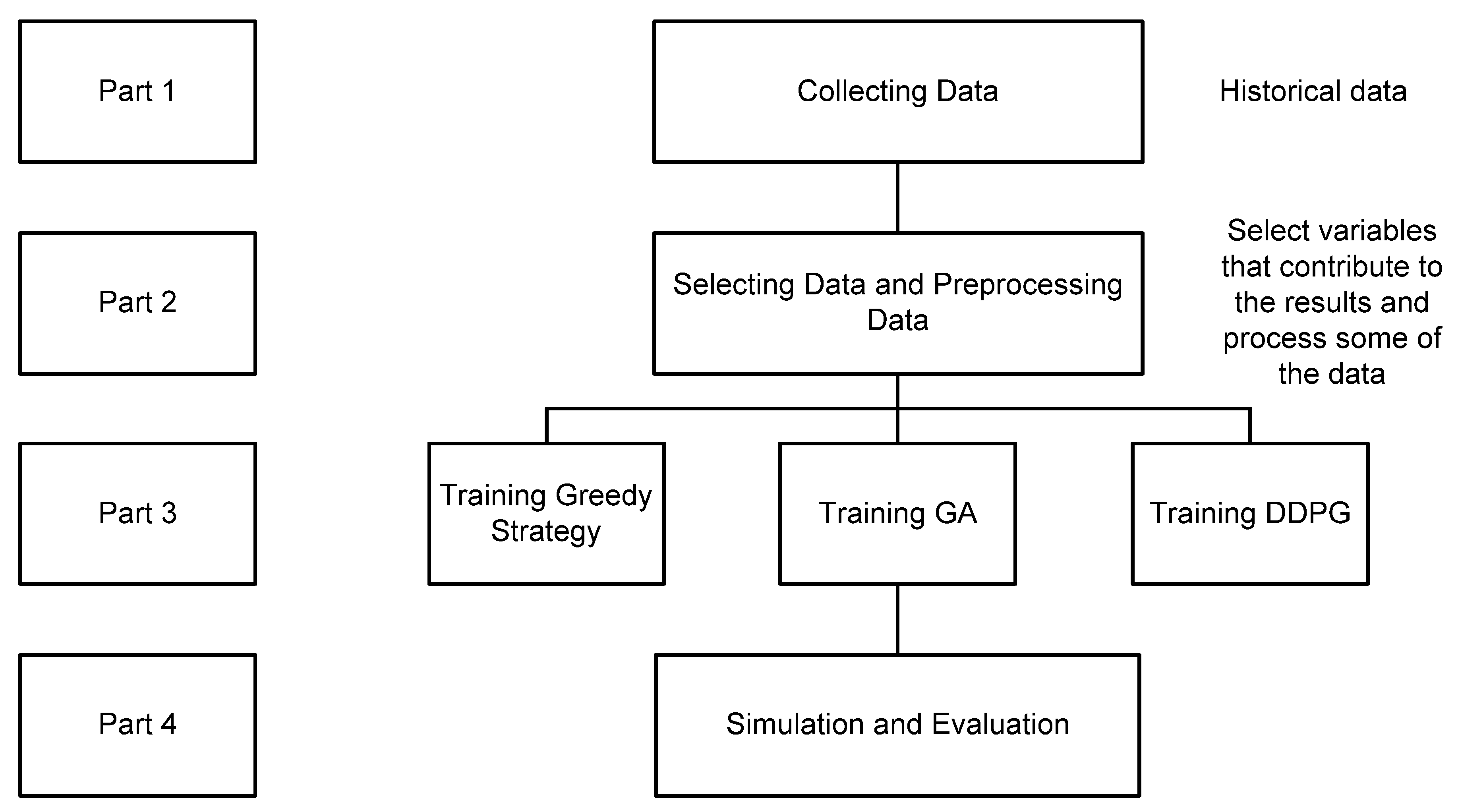
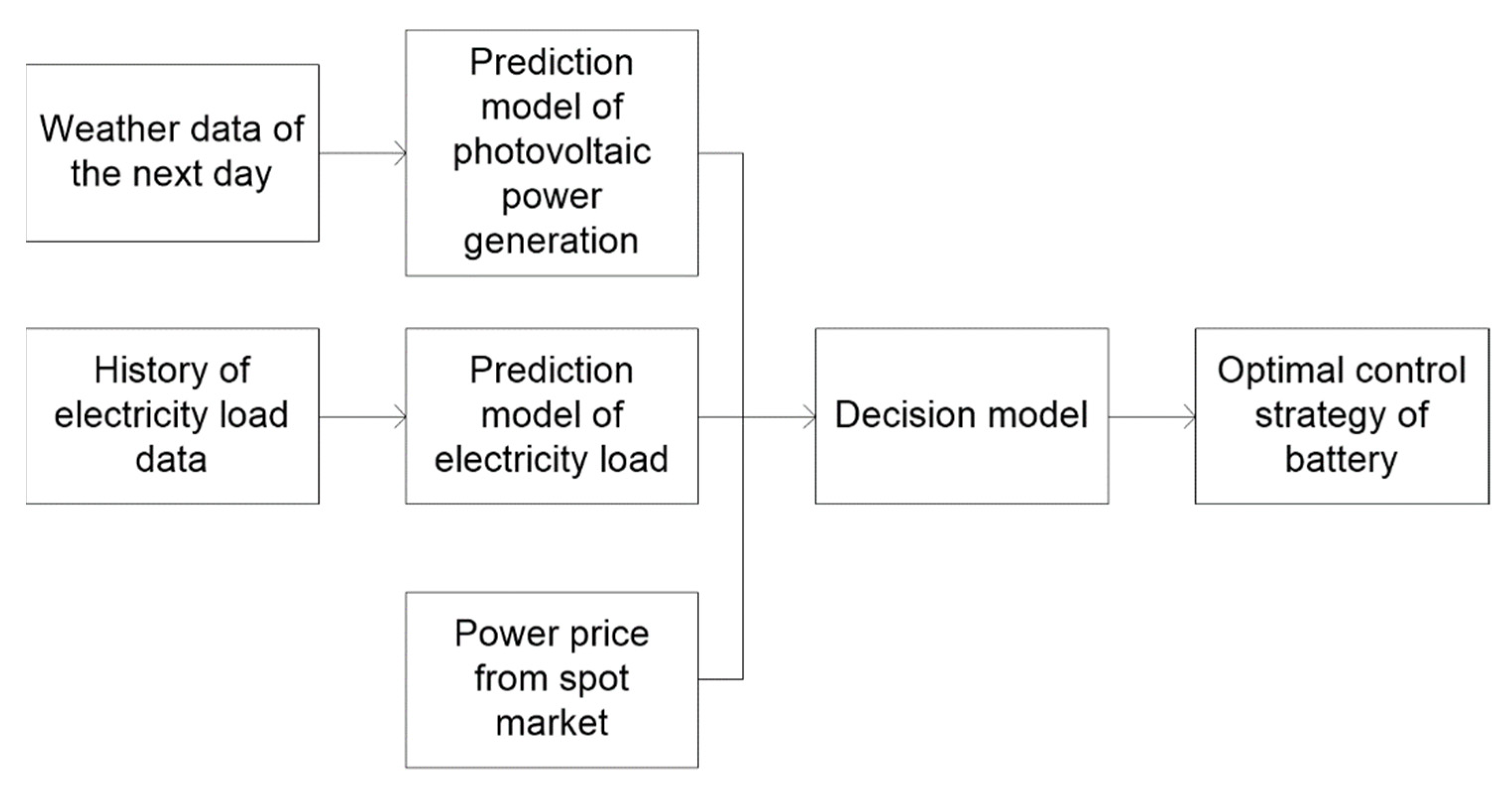
- The energy management system aimed to reduce power cost and optimize battery capacity.
- (2)
- The integrity of the energy management system was realized by combining prediction and decision-making.
- (3)
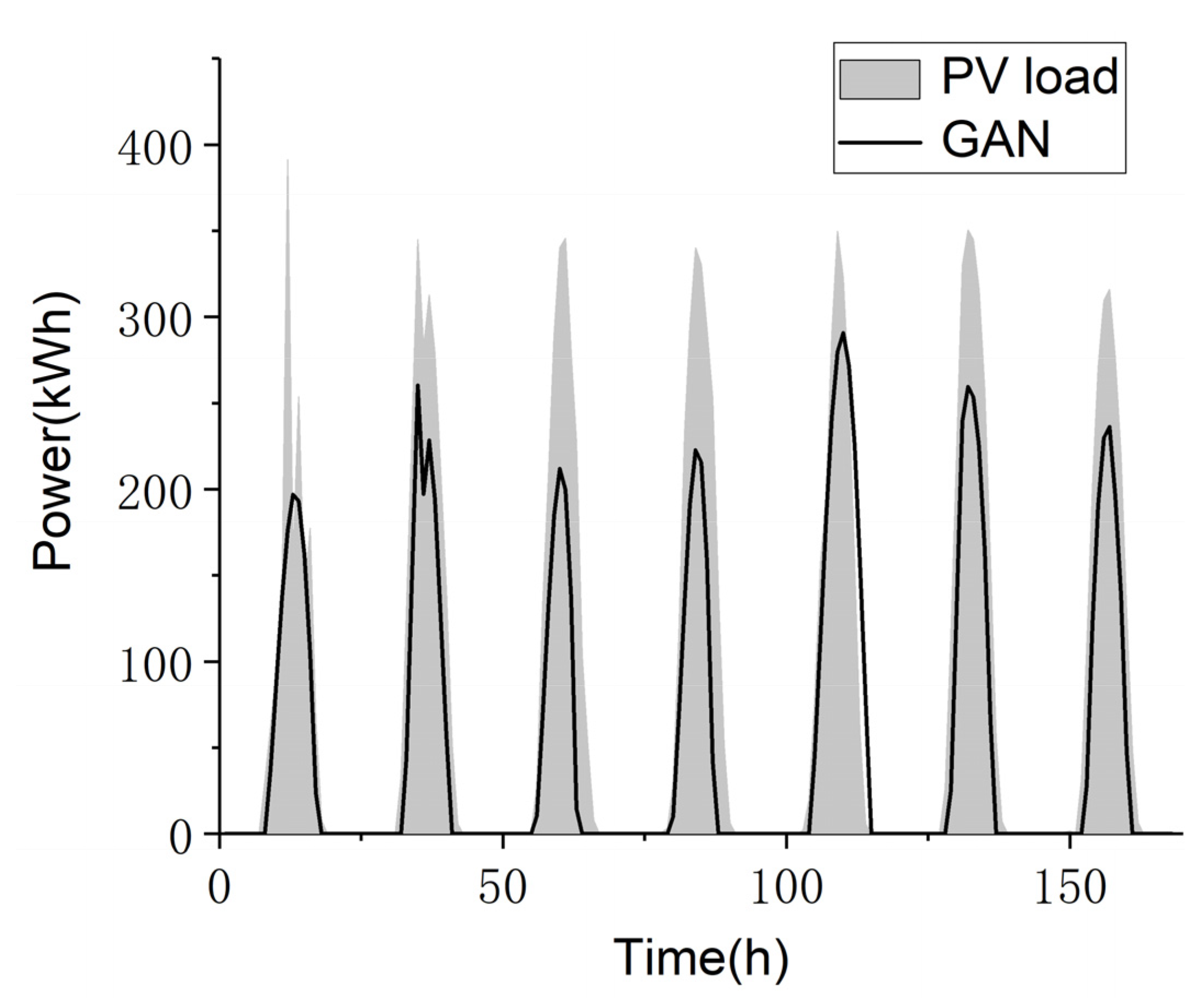
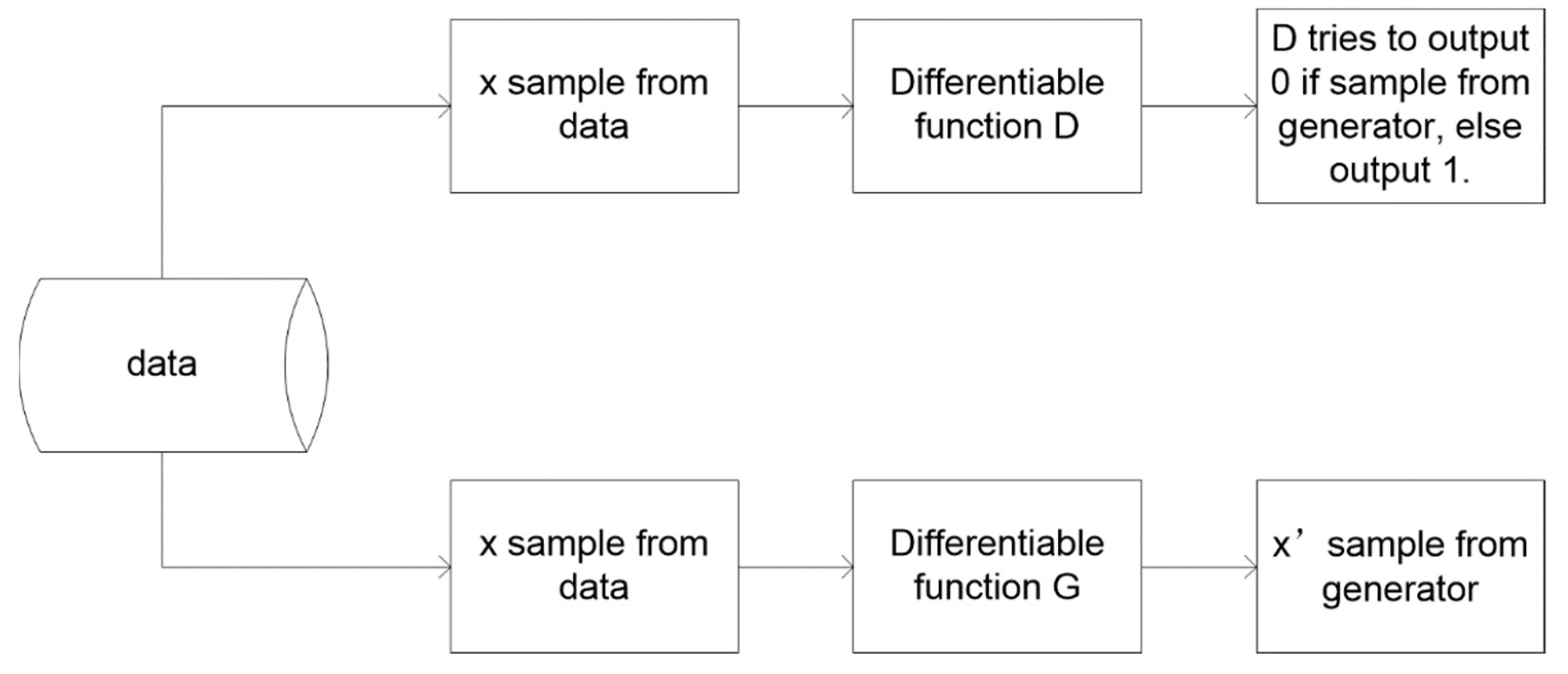
- Prediction of renewable energy generation curve with GAN method gave preliminary feedback to the market.
- (4)
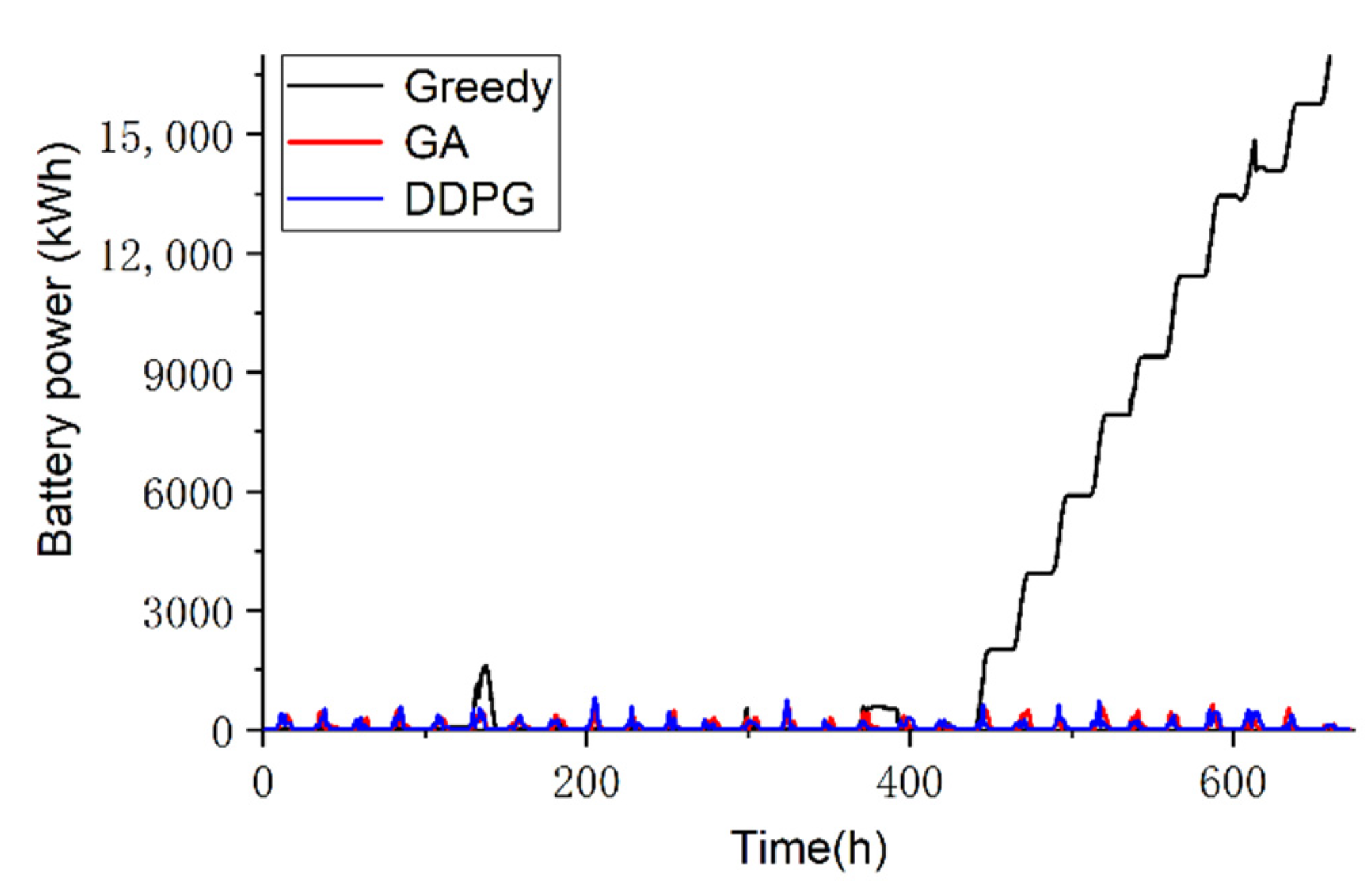
- According to decision model based on DDPG method, the system can manage the decision of energy in time.
- (5)
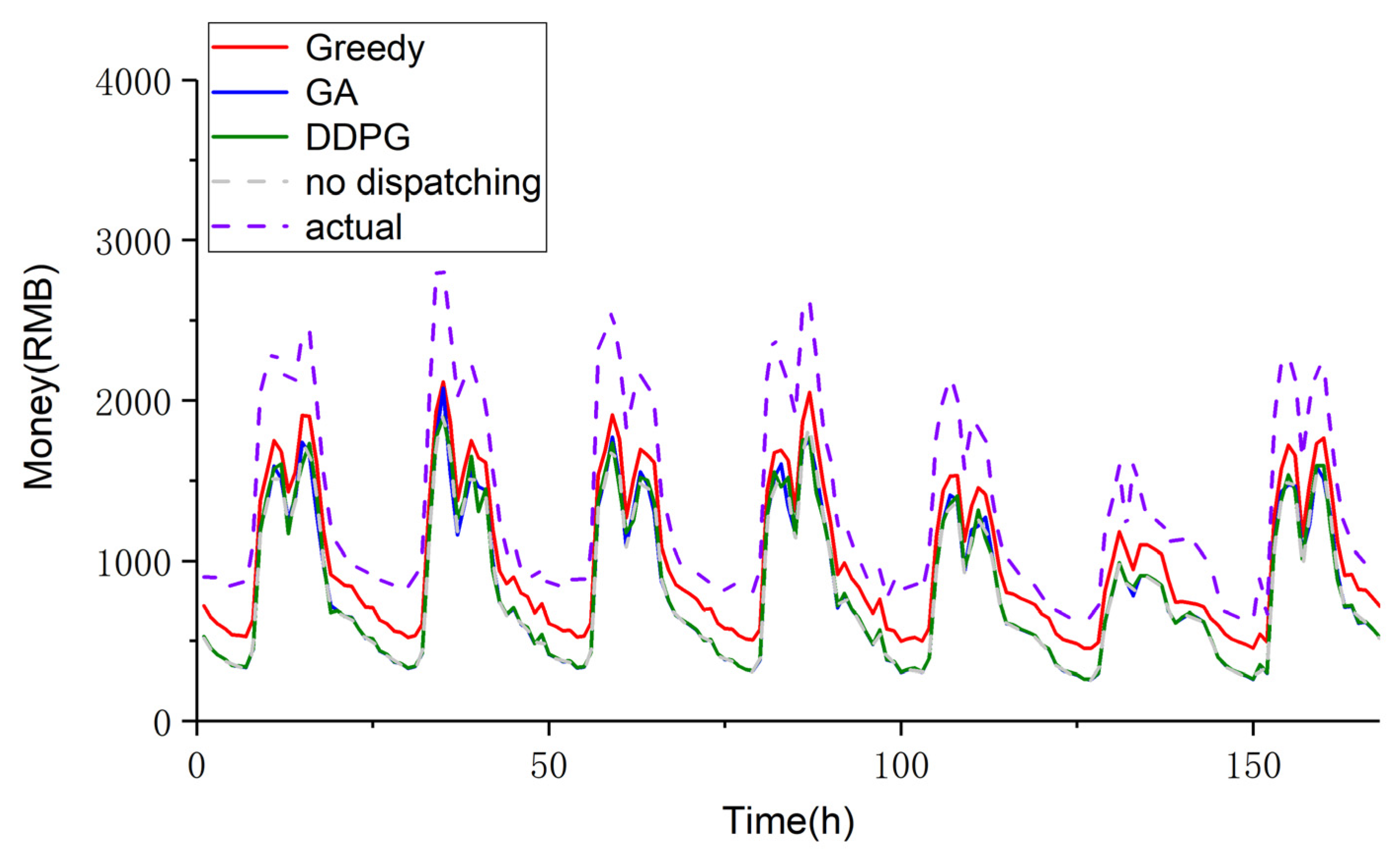
- The energy management framework is estimated by comparing the cost of electricity consumption.
2. Energy Management Framework
2.1. Energy Management System
2.2. The Description of Power System of Industrial Park
- (1)
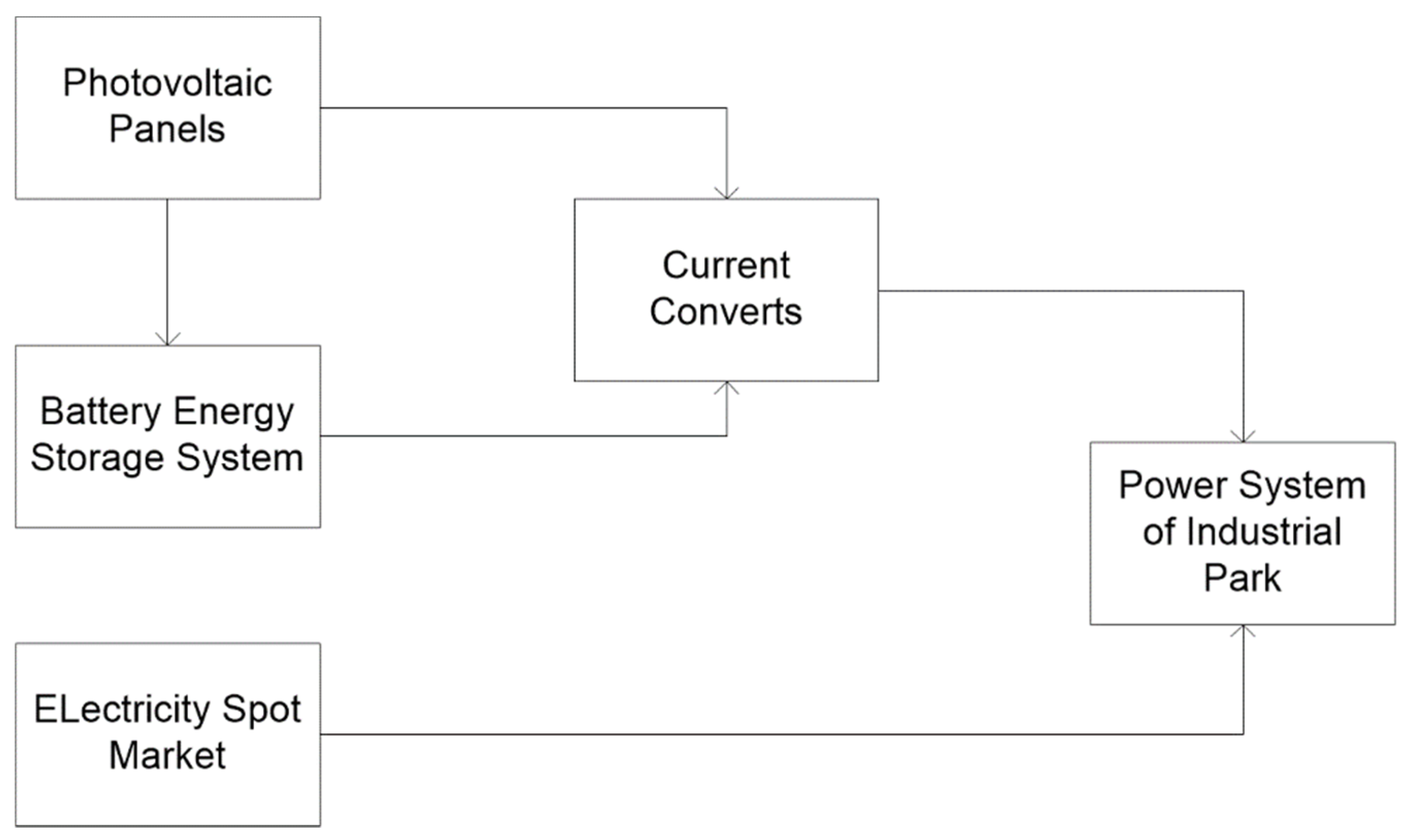
- The pre-purchased electricity has been able to meet the needs of the park. The photovoltaic power can be stored, and the surplus electricity can be sold to other users in spot market.
- (2)
- The electricity purchased a few days ago cannot meet the needs of the park, so it is necessary to use photovoltaic power or battery discharge or purchase real-time electricity from the spot market to meet the production needs.
- (3)
- The PV produces more electricity than the sum of the battery charge and the load used, and the excess energy is discarded.
2.3. Problem Formulation
2.3.1. The Declaration Deviation Rate of Electric Power Spot Market
2.3.2. Photovoltaic Constraint
2.3.3. Battery Constraint
2.3.4. Load Constraint
3. Methodology
3.1. Operating Cost Model
3.1.1. Construction of System Operating Cost Model
3.1.2. Optimization Objectives and Constraints
- (1)
- Output power constraint
- (2)
- Charge constraint
- (3)
- Discharge constraint
3.2. Optimization for Capacity of ESS and Dispatch Strategy
3.2.1. Energy Management Based on Greedy Rules
- (1)
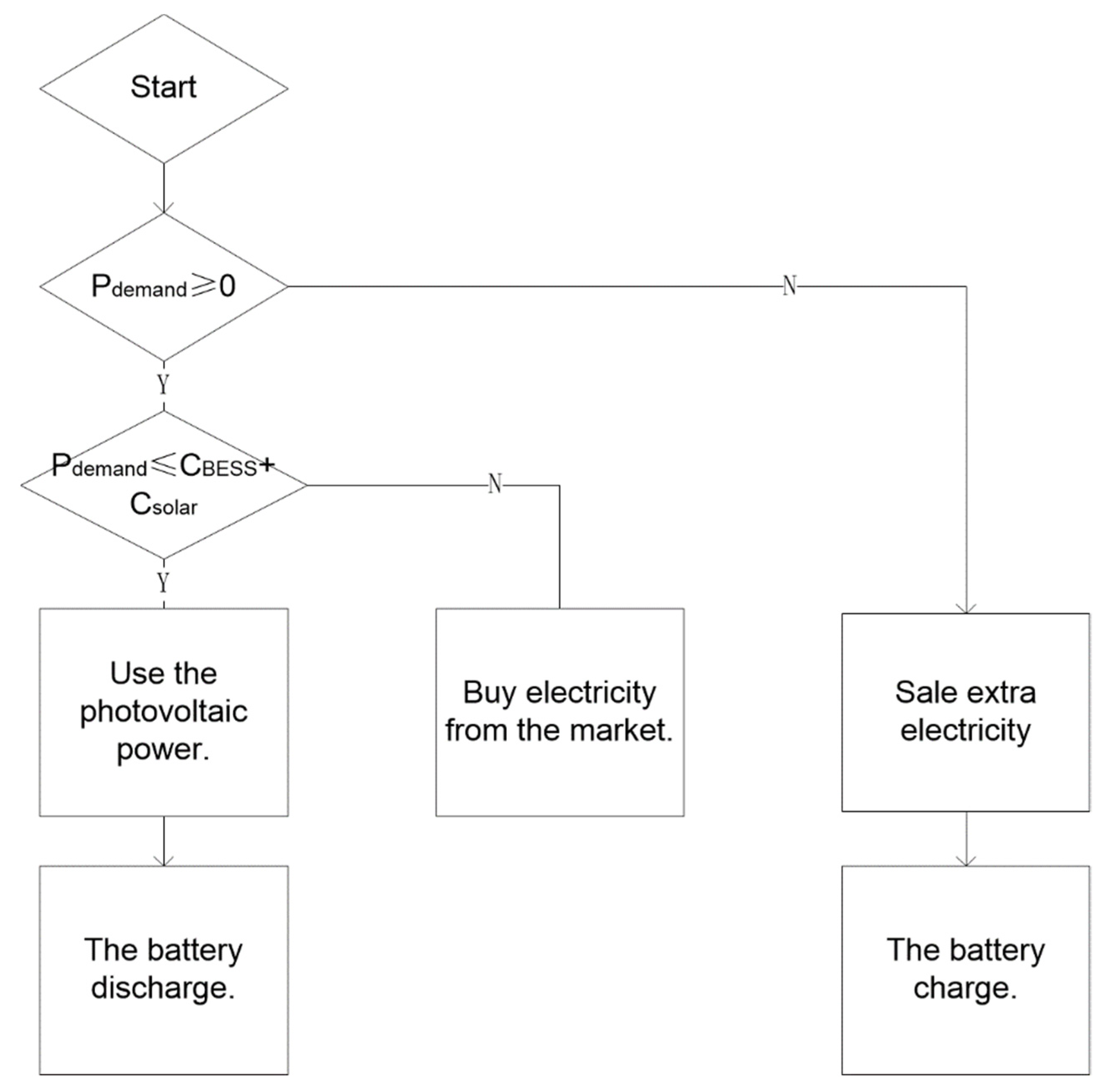
- When Pdemand ≥ 0, the day-ahead purchase has met the demand and the excess energy needs to be sold to other users and the ESS charge.
- (2)
- When Pdemand < 0, the available storage energy of the ESS and energy generated by photovoltaic plants can meet Pdemand, consumed the energy generated by photovoltaic plants first and then the ESS discharge.
- (3)
- When Pdemand < 0 and the available storage energy of the ESS and energy generated by photovoltaic plants cannot meet Pdemand, the system needed to buy additional power from market to meet the demand of the industrial park.
3.2.2. Energy Management Based on Genetic Algorithm
3.2.3. Energy Management Based on Deep Deterministic Policy Gradient
- (1)
- Determine the time interval for model calculation: select 1 h as the time interval.
- (2)
- Determine which state variables were selected: The problem is represented at each stage by a set of different states, including purchased electricity, day-ahead price, real-time electricity price, actual electricity consumption, photovoltaic power generation quantity, and ESS capacity.
- (3)
- Determine decision variables and transition equations: State transitions are determined by states and actions based on previous state. In this work, the decision variable is ESS discharge. The state transfer equation of ESS capacity variable is:where SOC(t) is the proportion of electric energy in the battery’s capacity at time t, Pbat(t − 1) is the charge or discharge at time t.
- (4)
- Determine the objective function applicable to the DDPG algorithm: the objective function is set as follows:
- (1)
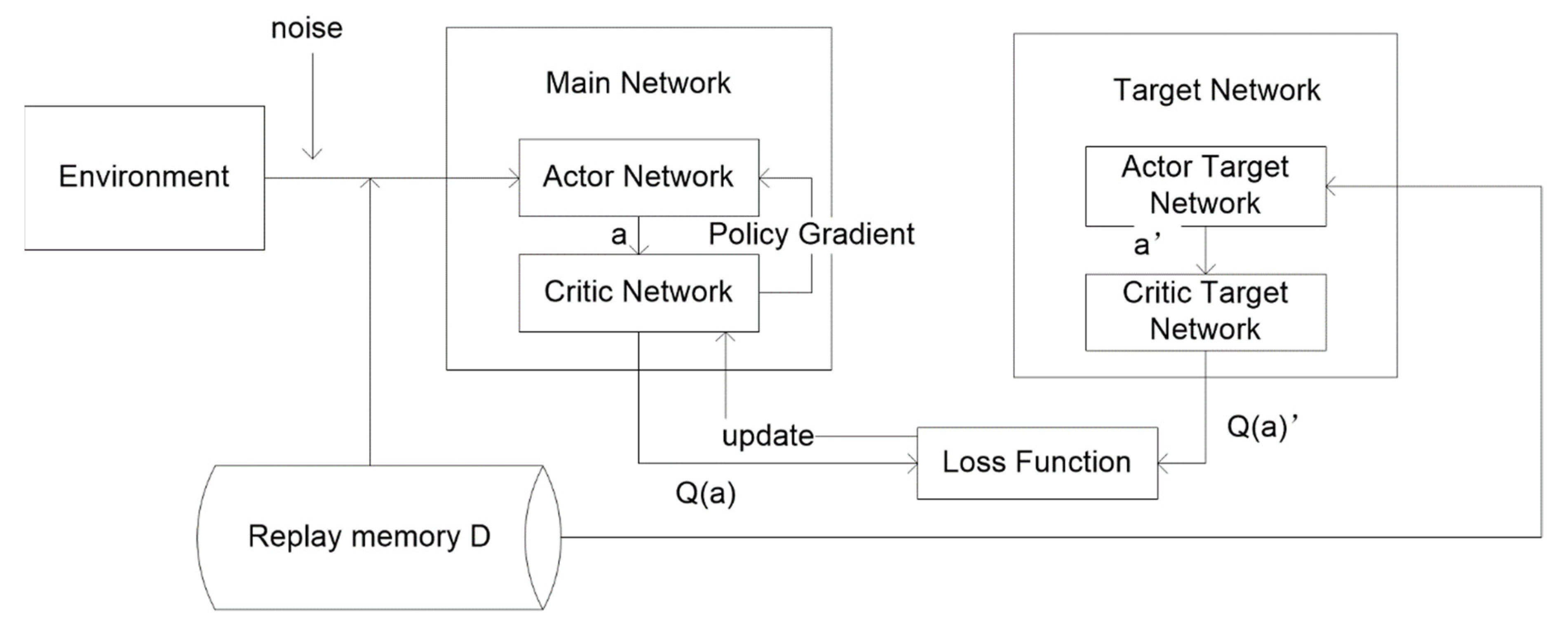
- Randomly initializes the parameter θ, θ′, w, w′, thereinto, θ = θ′, w = w′. Clear set of experience playback.
- (2)
- For i from 1 to T:
- Initialization S for the sequence of the current state of the first state, get its eigenvector ϕ (S).
- Based on actor network, use ϕ(S) as input, action A as output, get new state S′ and feedback R. Judge it is terminated or not (is_end is true or false).
- Store {ϕ(S), A, R, ϕ(S′), is_end} in the experience playback set D.
- S = S′
- Sampling m samples from the playback experience set D, {ϕ (Sj), Aj, Rj, ϕ (S′j), is_endj}, j = 1, 2, …, m, calculating Q value yj.
- The mean square error loss function is used for the gradient update of the parameter W of the critic network.
- Update Actor network parameter θ.
- If T%C = 5, update the critic target network and actor target network parameters.
- If is_end is true, the current iteration completes, otherwise go to step b.
3.3. Prediction Model of PV Generation and User Load Power
3.3.1. PV Generation Prediction
3.3.2. User Load Power Prediction
4. Case Studies
4.1. Data and Assumptions Required
4.2. Case Studies
5. Conclusions
Author Contributions
Funding
Institutional Review Board Statement
Informed Consent Statement
Data Availability Statement
Conflicts of Interest
References
- Kuzemko, C.; Bradshaw, M.; Bridge, G. Covid-19 and the politics of sustainable energy transitions. Energy Res. Soc. Sci. 2020, 68, 101685. [Google Scholar] [CrossRef]
- Tschopp, D.; Tian, Z.Y.; Berberich, M. Large-scale solar thermal systems in leading countries: A review and comparative study of Denmark, China, Germany and Austria. Appl. Energy 2020, 270, 114997. [Google Scholar] [CrossRef]
- Mehrjerdi, H. Simultaneous load leveling and voltage profile improvement in distribution networks by optimal battery storage planning. Energy 2019, 181, 916–926. [Google Scholar] [CrossRef]
- Sakti, A.; Gallagher, K.G.; Botterud, A. Enhanced representations of lithium-ion batteries in power systems models and their effect on the valuation of energy arbitrage applications. J. Power Sources 2016, 342, 279–291. [Google Scholar] [CrossRef]
- Pierpoint, L.M. Harnessing electricity storage for systems with intermittent sources of power: Policy and R&D needs. Energy Policy 2016, 96, 751–757. [Google Scholar]
- Liu, Y.; Wu, X.G.; Du, J.Y. Optimal sizing of a wind-energy storage system considering battery life. Renew. Energy 2019, 147, 2470–2483. [Google Scholar] [CrossRef]
- Elsied, M.; Oukaour, A.; Gualous, H. Optimal economic and environment operation of micro-grid power systems. Energy Convers. Manag. 2016, 122, 182–194. [Google Scholar] [CrossRef]
- Gitizadeh, M.; Fakharzadegan, H. Battery capacity determination with respect to optimized energy dispatch schedule in grid-connected photovoltaic (PV) systems. Energy 2014, 65, 665–674. [Google Scholar] [CrossRef]
- Ke, B.R.; Ku, T.T.; Ke, Y.L. Sizing the battery energy storage system on a university campus with prediction of load and photovoltaic generation. IEEE Trans. Ind. Appl. 2016, 52, 1136–1147. [Google Scholar]
- Prasatsap, U.; Kiravittaya, S.; Polprasert, J. Determination of Optimal Energy Storage System for Peak Shaving to Reduce Electricity Cost in a University. Energy Procedia 2017, 138, 967–972. [Google Scholar] [CrossRef]
- Liu, W.; Luo, F.M.; Liu, Y.L. Optimal siting and sizing of distributed generation based on improved nondominated sorting genetic Algorithm II. Processes 2019, 7, 955. [Google Scholar] [CrossRef]
- Setlhaolo, D.; Xia, X.H. Optimal scheduling of household appliances with a battery storage system and coordination. Energy Build. 2015, 94, 61–70. [Google Scholar] [CrossRef]
- Wang, Y.L.; Qi, C.Y.; Dong, H.R. Optimal design of integrated energy system considering different battery operation strategy. Energy 2020, 212, 118537. [Google Scholar] [CrossRef]
- Duman, A.C.; Erden, H.S.; Gönül, O. A home energy management system with an integrated smart thermostat for demand response in smart grids. Sustain. Cities Soc. 2020, 65, 102639. [Google Scholar] [CrossRef]
- Mehrjerdi, H.; Rakhshani, E.; Iqbal, A. Substation expansion deferral by multi-objective battery storage scheduling ensuring minimum cost. J. Energy Storage 2019, 27, 101119. [Google Scholar] [CrossRef]
- Han, Z.H.; Han, C.; Lin, S. Flexible flow shop scheduling method with public buffer. flexible flow shop scheduling method with public buffer. Processes 2019, 7, 681. [Google Scholar] [CrossRef]
- Lian, R.Z.; Peng, J.K.; Wu, Y.K. Rule-interposing deep reinforcement learning based energy management strategy for power-split hybrid electric vehicle. Energy 2020, 197, 117297. [Google Scholar] [CrossRef]
- Chen, P.Z.; Liu, M.C.; Chen, C.X. A battery management strategy in microgrid for personalized customer requirements. Energy 2019, 189, 116245. [Google Scholar] [CrossRef]
- Ei-Sayed, W.T.; EI-Saadany, E.F.; Zeineldin, H.H. Fast initialization methods for the nonconvex economic dispatch problem. Energy 2020, 201, 117635. [Google Scholar] [CrossRef]
- Perera, A.T.D.; Kamalaruban, P. Applications of reinforcement learning in energy systems. Renew. Sustain. Energy Rev. 2020, 137, 110618. [Google Scholar] [CrossRef]
- Yang, T.; Zhao, L.Y.; Li, W. Reinforcement learning in sustainable energy and electric systems: A survey. Annu. Rev. Control 2020, 49, 145–163. [Google Scholar] [CrossRef]
- Liu, S.Q.; Yang, Q.; Cai, H.X. Market reform of Yunnan electricity in southwestern China: Practice, challenges and implications. Renew. Sustain. Energy Rev. 2019, 113, 109265. [Google Scholar] [CrossRef]
- Zakeri, B.; Syri, S. Electrical energy storage systems: A comparative life cycle cost analysis. Renew. Sustain. Energy Rev. 2015, 42, 569–596. [Google Scholar] [CrossRef]
- Sun, L.; Li, G.R.; You, F.Q. Combined internal resistance and state-of-charge estimation of lithium-ion battery based on extended state observer. Renew. Sustain. Energy Rev. 2020, 131, 109994. [Google Scholar] [CrossRef]
- Wang, J.; Liu, P.; Hicks-Garner, J. Cycle-life model for graphite-LiFePO4 cells. J. Power Sources 2011, 196, 3942–3948. [Google Scholar] [CrossRef]
- Beltran, H.; Cardo-Miota, J.; Segarra-Tamarit, J. Battery size determination for photovoltaic capacity firming using deep learning irradiance forecasts. J. Energy Storage 2020, 33, 102036. [Google Scholar] [CrossRef]
- Li, J.H.; Zhang, Z.S.; Shen, B.X. The capacity allocation method of photovoltaic and energy storage hybrid system considering the whole life cycle. J. Clean. Prod. 2020, 275, 122902. [Google Scholar] [CrossRef]
- Rafati, A.; Joorabian, M.; Mashhour, E. High dimensional very short-term solar power forecasting based on a data-driven heuristic method. Energy 2020, 219, 119647. [Google Scholar] [CrossRef]
- Wood, D.A. Hourly-averaged solar plus wind power generation for Germany 2016: Long-term prediction, short-term forecasting, data mining and outlier analysis. Sustain. Cities Soc. 2020, 60, 102227. [Google Scholar] [CrossRef]
- Lupangu, C.; Bansal, R.C. A review of technical issues on the development of solar photovoltaic systems. Renew. Sustain. Energy Rev. 2017, 73, 950–965. [Google Scholar] [CrossRef]
- Lu, X.H.; Zhou, K.L.; Zhang, X.L. A systematic review of supply and demand side optimal load scheduling in a smart grid environment. J. Clean. Prod. 2018, 203, 757–768. [Google Scholar] [CrossRef]
- Wu, T.; Wang, J.H. Artificial intelligence for operation and control: The case of microgrids. Electr. J. 2021, 34, 106890. [Google Scholar]
- Hao, R.; Lu, T.G.; Ai, Q. Distributed online learning and dynamic robust standby dispatch for networked microgrids. Appl. Energy 2020, 274, 115256. [Google Scholar] [CrossRef]
- Liu, Y.N.; Guan, X.; Sun, D. Evaluating smart grid renewable energy accommodation capability with uncertain generation using deep reinforcement learning. Future Gener. Comput. Syst. 2020, 110, 647–657. [Google Scholar] [CrossRef]
- Blanc, S.M.; Setzer, T. When to choose the simple average in forecast combination. J. Bus. Res. 2016, 69, 3951–3962. [Google Scholar] [CrossRef]
- Jiang, H.; Jin, Y.M.; Ye, X. Review of China’s PV industry in 2019 and prospect in 2020. Sol. Energy 2020, 3, 14–23. [Google Scholar]
- Zhang, Y.X.; Li, Z.D. A comparative analysis of the price changes of lithium-ion battery for electric vehicles in China and Japan based on the learning curve model. Energy China 2020, 8, 32–35. [Google Scholar]






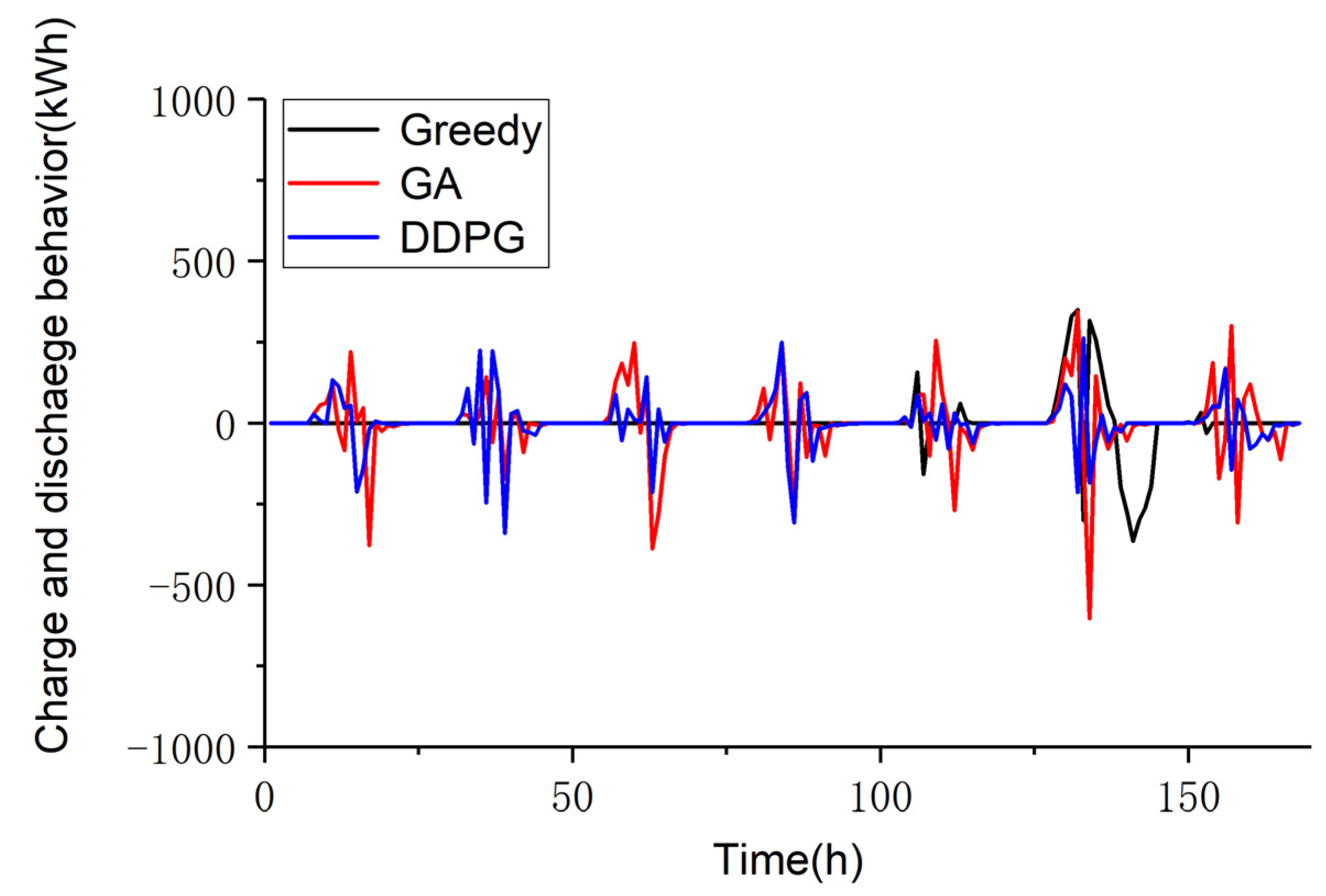
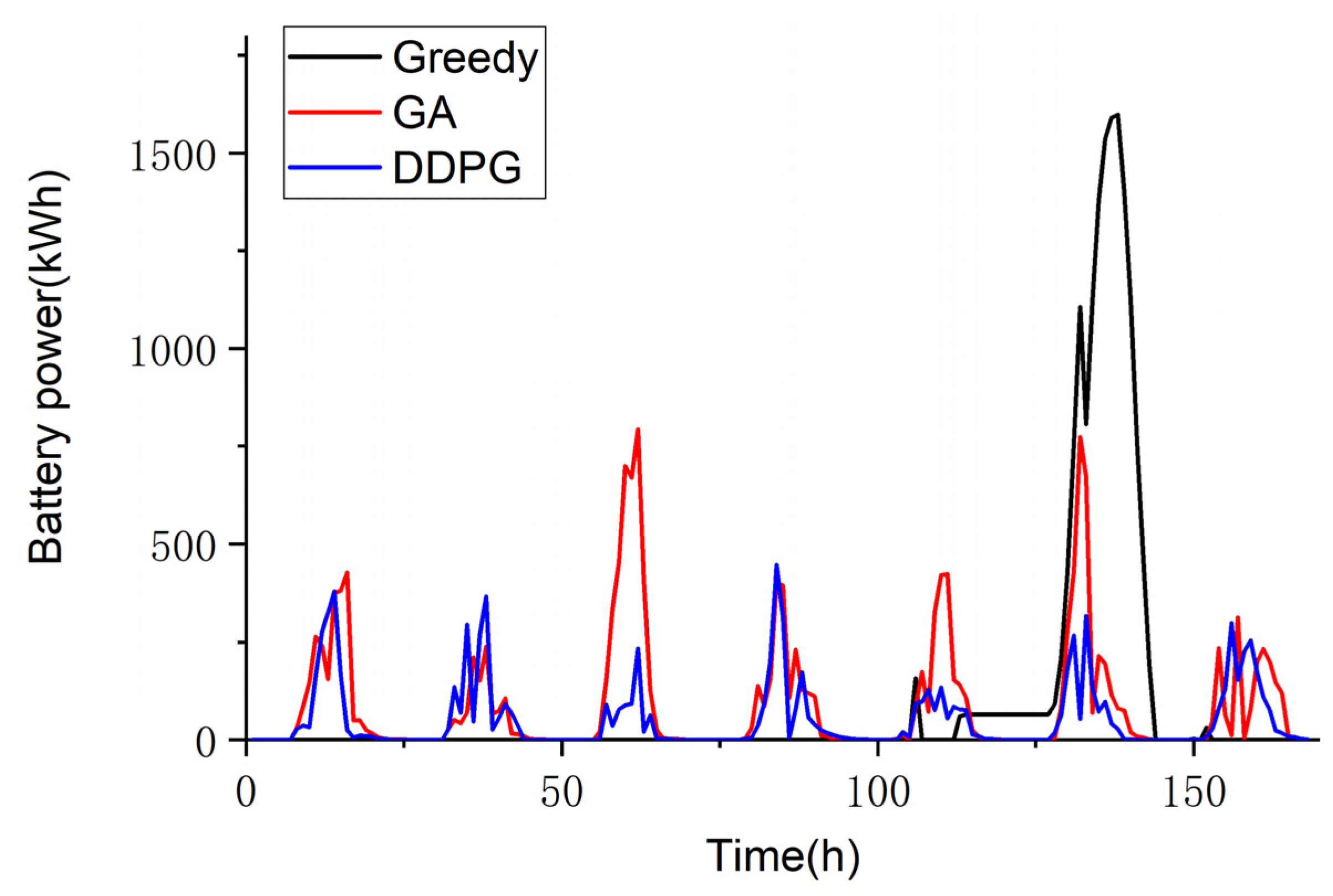



| Parameter (Unit) | Value |
|---|---|
| B | 30,330 |
| Ea (J/mol) | 31,500 |
| z | 0.552 |
| R (J/(mol×K)) | 8.314 |
| T (K) | 298 |
| Parameter | Value |
|---|---|
| Population size | 500 |
| Crossover fraction | 0.9 |
| Migration fraction | 0.1 |
| generation | 2000 |
| Parameter | Value |
|---|---|
| Train episode | 1000 |
| State characteristic dimension | 7 |
| Gamma attenuation factor | 1.0 |
| Soft update coefficient | 0.001 |
| Batch gradient descent sample number | 128 |
| Target Q parameter update frequency | 5 |
| Variance of random noise | 0.05 |
| Cases | MAE | MAPE | RMSE |
|---|---|---|---|
| GAN for PV | 28.603 | 0.709 | 57.156 |
| SA for electricity consumption | 245.583 | 0.183 | 543.95 |
Publisher’s Note: MDPI stays neutral with regard to jurisdictional claims in published maps and institutional affiliations. |
© 2021 by the authors. Licensee MDPI, Basel, Switzerland. This article is an open access article distributed under the terms and conditions of the Creative Commons Attribution (CC BY) license (https://creativecommons.org/licenses/by/4.0/).
Share and Cite
Gao, Y.; Li, J.; Hong, M. Machine Learning Based Optimization Model for Energy Management of Energy Storage System for Large Industrial Park. Processes 2021, 9, 825. https://doi.org/10.3390/pr9050825
Gao Y, Li J, Hong M. Machine Learning Based Optimization Model for Energy Management of Energy Storage System for Large Industrial Park. Processes. 2021; 9(5):825. https://doi.org/10.3390/pr9050825
Chicago/Turabian StyleGao, Ying, Jigeng Li, and Mengna Hong. 2021. "Machine Learning Based Optimization Model for Energy Management of Energy Storage System for Large Industrial Park" Processes 9, no. 5: 825. https://doi.org/10.3390/pr9050825
APA StyleGao, Y., Li, J., & Hong, M. (2021). Machine Learning Based Optimization Model for Energy Management of Energy Storage System for Large Industrial Park. Processes, 9(5), 825. https://doi.org/10.3390/pr9050825