Article

Study on the Mechanical Behaviors of Conglomerate, Considering Stress State and Gravel Content

1
R&D Center for Ultra-Deep Complex Reservoir Exploration and Development, CNPC, Korla 841000, China
2
Engineering Research Center for Ultra-Deep Complex Reservoir Exploration and Development, Korla 841000, China
3
Xinjiang Key Laboratory of Ultra-Deep Oil and Gas, Korla 841000, China
4
Petrochina Tarim Oilfield Company, Korla 841000, China
5
School of Petroleum Engineering and Environmental Engineering, Yan’an University, Yan’an 716000, China
*
Author to whom correspondence should be addressed.
Processes 2026, 14(9), 1403; https://doi.org/10.3390/pr14091403
Submission received: 17 March 2026 / Revised: 20 April 2026 / Accepted: 21 April 2026 / Published: 27 April 2026

Abstract

Gravel particles are widely developed and randomly distributed in deep reservoirs of the Tarim Oilfield, western China. The mechanical behavior of conglomerate, the main component of the gravel layer, under varying confining pressure and different gravel content, remains poorly understood, especially in terms of the microscopic aspect, which limits the analysis of the variation patterns of underground engineering parameters. This study conducts triaxial compression tests on outcrop specimens from various stress levels to analyze the effects of stress state and stress differences on the mechanical parameters and failure modes. After that, a kind of numerical modeling method based on the discrete element method (DEM) is proposed, which considers the random distribution of gravel particles, to study the microscopic observation of mechanical characteristics and crack propagation of conglomerate under different stress state conditions. The experimental and numerical simulation results indicate that the horizontal strain before failure remains nearly constant in the axial direction while increasing linearly for the horizontal stress. And, it was observed that the volumetric failure was accompanied by gravel fragmentation, sliding, and falling. Numerical simulations reveal that cementation strength and gravel content significantly influence mechanical properties and failure modes, which are the main factors. This study provides some useful references for further understanding of the mechanical behavior and failure mechanisms of rocks in the gravel layer, in particular, the numerical modeling method for heterogeneous materials.

1. Introduction

Gravel particles are widely developed while drilling in the deep reservoir in the Tarim oilfield, western China, especially in the Bozi block and KeS block [1,2,3]. The average thickness of the gravel layer is up to 5300 m within the formation of 500~6500 m Bozi block [4,5,6], where the gravel particles are widely developed and randomly distributed with a strong heterogeneity. The high strength and strong heterogeneity of rocks in the gravel layer make it challenging to perform coring in the bottom hole, resulting in a paucity of standard specimens suitable for rock mechanics experiments. However, the mechanical properties, failure mode of conglomerate, and the main components of the gravel layer under the condition of high confining pressure are still unclear due to the strong heterogeneity and variations in gravel content and cementation states [7,8,9]. The peculiarity and the intricacy of the mechanical properties of conglomerate can be related to the variety of the complex distribution characteristics of gravel particles [10], mainly manifested in the highly random features in the size, shape, content, and the distributed location of gravel. In addition, the cementation state of the conglomerate between the gravel particles and the matrix varies with the buried depth of the gravel layer, which results in a large and significant difference in the engineering parameters.
Currently, experimental and numerical methods dominate the study of conglomerate’s mechanical properties [11]. Wang [12] conducted triaxial mechanical tests on cylindrical outcrop specimens, and the gravel content of gravel particles was defined as the area ratio of gravel particles on the outer cylindrical surface. Li [13] conducted uniaxial and triaxial compression tests with outcrop specimens, finding that as confining pressure increases, the failure mode of conglomerate transitions from tension to shear or cataclastic flow, accompanied by volume expansion, and the deformation mode shifts from brittle to ductile, with shear fractures and cataclastic flow acting as transitional regimes in brittle–ductile transitions. Khanlari [14] utilized thin sections to obtain petrographic features and structural and mineralogical parameters of samples and conducted physical mechanical tests, and a statistical model was developed to establish relationships between petrographic features and mechanical properties. Some of the authors in the previous study [15,16] analyzed the static and dynamic triaxial experiments of conglomerate using GCTS and a 3D SHPB device to reveal macroscopic damage characteristics under various load conditions, and examined the effects of stress levels and strain rates on dynamic loads. Yan & Li [17] established a discrete element method (DEM) model based on CT-scanned digital images, simulating three-point bending of semicircular specimens with pre-fabricated cracks to analyze the effects of meso-structure on failure behavior. Luo [18] simulated the influence of cementation strength, gravel content, and inner shape of specimens on deformation characteristics and failure modes through uniaxial compression tests with a DEM model. Sakram [19], Satoru [20] and Hou [21] conducted experiments and numerical simulations to investigate the effects of gravel size and content on the mechanical properties of conglomerate. Feng [22] concluded that the strength of rock is closely related to the failure mechanism among the minimum principal stress, under the action of triaxial compressive loads, which plays a significant role in controlling the failure mode. The above studies aim to comprehensively understand the relationship between the mechanical characteristics of conglomerate and its constituent factors, providing valuable insights for rock mechanics and failure modes.
The conventional experimental studies on the mechanical properties and failure modes of conglomerate are primarily conducted using cylindrical specimens, wherein the triaxial stress state and its intermediate principal stress in the borehole of the deep gravel layer are not adequately considered. Therefore, this study aims to perform triaxial compression experiments using cuboid outcrop specimens to investigate the effects of different stress states on the mechanical properties and deformation behaviors of conglomerate. Furthermore, the discrete element method was employed to study the influence of cementation strength and gravel content on the triaxial mechanical properties of conglomerate, and the random distribution of gravel particles was taken into account in the self-programmed DEM model. This research provides a foundation for understanding the mechanical behavior of rock in a deep gravel layer under high triaxial stress states and considering the effects of gravel content, particularly in the numerical modeling method for heterogeneous materials.

2. Experimental Instruments and Procedure

2.1. Materials

In this study, physical specimens of conglomerate were prepared for testing triaxial mechanical properties, with samples sourced from natural outcrops that exhibited relatively low weathering. To satisfy the requirements of the triaxial testing system, the cuboid specimens were machined from the outcrop materials, sized at 50 mm × 50 mm × 100 mm with smooth, polished external faces to minimize surface effects. Additionally, a series of indoor experiments was conducted using the same batch of outcrop materials to further investigate the mechanical properties of conglomerate, yielding results of approximately 103.48 MPa for uniaxial compression strength (UCS), 7.19 MPa for the uniaxial tensile strength, and an elastic modulus ranging from 35.36 to 41.63 GPa with corresponding Poisson’s ratios varying from 0.38 to 0.43.
As one of the basic properties of sedimentary rock, conglomerate is assembled by its main components, gravel particles, and matrix, under the influence of stratigraphic, tectonic stress. According to the definition, the diameter of gravel particles is greater than 2 mm, which are bonded by cementation materials, such as calcite, various solid particles, and/or mixed with silt [16,18]. In addition, the physical and mechanical properties of the rock within the gravel layer exhibit significant differences due to variations in the characteristics of gravel particles and the cementation materials. To figure out the gravel content within the physical specimen used in this study, the CT scanning method was adopted, and the results indicate that the volume fraction or content of the gravel particles is about 55%~65%.

2.2. Testing Apparatus

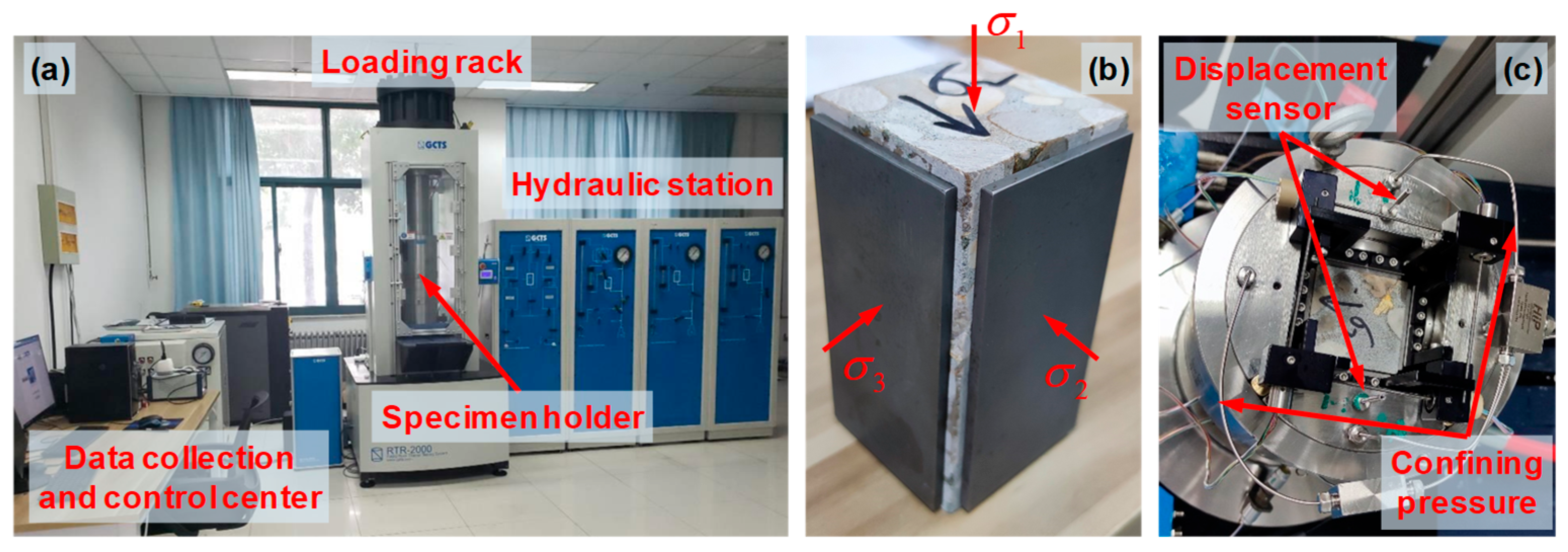
The triaxial mechanical properties of the conglomerate were tested using the GCTS system, shown in Figure 1, which consists of the data collection and control center, the hydraulic station, axial loading rack, and specimen clamping part. Figure 1b illustrates the triaxial stress applied to the cuboid specimen before testing, which includes two horizontal stresses (σ2 and σ3) and a vertical load (σ1), applied by the external vertical load (which can be transformed into axial stress) via the hydraulic servo system. The stress and strain in each direction of the specimen can be recorded separately to analyze its mechanical properties. The axial load can be applied to the tested specimen in the σ1 direction (axial direction) through either displacement control or stress control, allowing the stress loading path and control method to be considered.

2.3. Experimental Setup

The overall loading process in the tests is composed mainly of three steps: Step 1, triaxial static pre-stress was applied on the specimen using servo-controlled loading, increasing from 0 to a preset minimum hydrostatic stress state of (σ3, σ3, σ3, assuming that σ3σ2 < σ1). Step 2, the minimum horizontal stress σ3 was maintained unchanged, while the other two stresses incrementally increased to the preset intermediate horizontal stress level σ2. Step 3, increasing the axial load until the specimen was crushed and destroyed.
It is worth noting that, due to the inconsistent dimensions of the specimens in the three directions, stress control was employed in the first two steps to ensure uniform deformation during the loading process, and in the third step, axial stress was applied using displacement-controlled loading. To study the triaxial mechanical properties of conglomerate, different levels of horizontal stresses and horizontal stress differences were tested. The experimental conditions can be found in Table 1.

3. Experimental Results and Analysis

3.1. Deformation Behaviors

The stress loading process in the triaxial tests, as schematically shown in Figure 2, consists of three main steps: First, the application of triaxial static pre-stress using servo-controlled loading, increasing from 0 to a preset minimum hydrostatic stress state of (σ3, σ3, σ3, assuming σ3 ≤ σ2 < σ1), and then maintaining 2 min to allow complete redistribution of internal stress within the specimen. Second, σ3 was kept constant, while σ2 incrementally increased to the preset intermediate horizontal stress. After 2 min of stabilization for the testing system, axial loading was continuously increased in the third step until the specimen was crushed and destroyed.
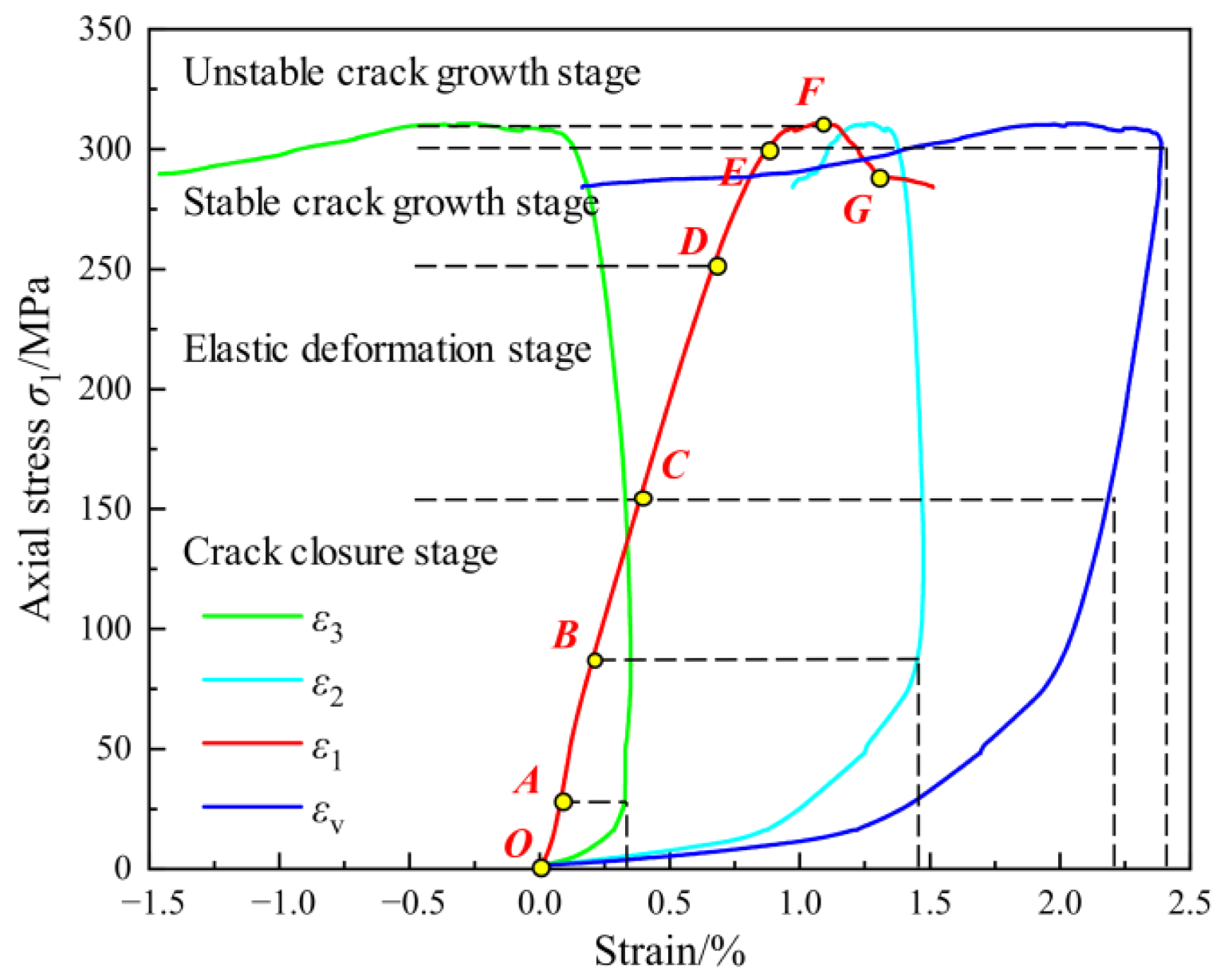
As illustrated in Figure 2, a typical stress–strain curve for conglomerate under triaxial compression loading (σ3 = 20 MPa, σ2 = 60 MPa) reveals essential mechanical properties. The curve characterizes the rock’s response to deformation and failure under compression loads [23]. Strains, ε1, ε2, and ε3, correspond to the maximum, intermediate, and minimum stress directions, respectively. The testing process can be divided into three distinct stages based on the loading sequence. During deformation, brittle failure occurs due to the presence of original microcracks or pores within the physical specimen [24]. The failure process is closely related to crack development, involving three primary stages: (1) initial microcrack closure before point C; (2) linear elastic deformation during section CD; and (3) unstable fracture growth during section EF.
Based on the stress–strain curve in Figure 2, the progressive failure process of conglomerate after horizontal stress application can be divided into six stages: (1) compression to the initial microcrack closure stage before point C; (2) the elastic deformation stage with linear axial stress and strain increase during section CD; (3) the stage of crack initiation and stable fracturing during section DE; (4) unstable fracturing growth during section EF; (5) the post-peak failure stage during section FG; and (6) the plastic deformation stage at residual stress following point G. Fluctuations around peak stress are attributed to particle splitting within the specimen during testing.
The crack initiation stress (σD), the axial stress at the end of the elastic deformation (σE), the damage stress (σF), and the peak stress (σP) are the key parameters for characterizing the mechanical properties of rock-like materials. Additionally, the strains corresponding to these stress stages (including εD, εE, and εP) are critical mechanical parameters for understanding the failure process of rock-like materials. The crack initiation stress (σD) can be determined using the acoustic emission method, which has been widely utilized in previous studies [25,26].
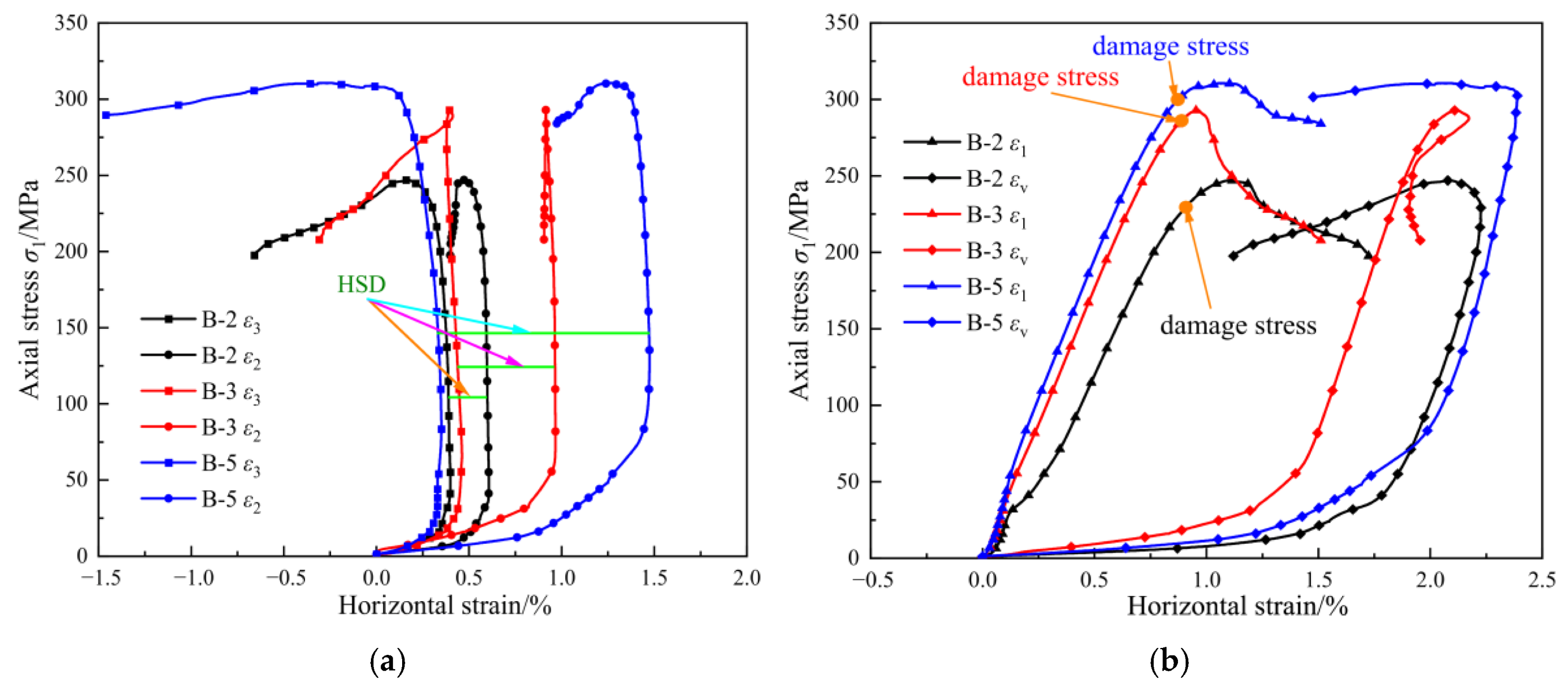
In this study, damage stresses under different levels of horizontal stress were derived from the stress–strain curves. The curves, axial stress versus horizontal strain, axial strain, and volumetric strain, under varying horizontal stress differences (while the minimum horizontal stress is fixed at 20 MPa), are presented in Figure 3. Specifically, Figure 3a gives the results that the horizontal strain curves exhibit distinct stages of vertical growth, which is because of the servo-controlled application of horizontal stresses. During the initial stage of the third loading step, when the horizontal stresses are strictly controlled by the servo system, the deformation in the horizontal direction of the specimen remains constant as compression is applied axially. Consequently, the higher the horizontal stress difference is, the greater the corresponding horizontal strain difference (ε2–ε3). Notably, when the minimum horizontal stress is fixed at 20 MPa, the corresponding strains in that direction remain nearly constant (the vertical stage) under different horizontal stress differences.
The experimental results reveal that as the horizontal stress difference rises from 10 MPa to 50 MPa in intervals of 10 MPa, the corresponding horizontal strain differences are 0.21%, 0.54%, 0.76%, 1.14%, and 1.29%, respectively. This indicates a linear increasing tendency between the strain difference and the horizontal stress difference, with a fitting coefficient of 0.9843, demonstrating a high degree of reliability for the fitting results.
In addition, Figure 3 reveals a short period of strain hardening phenomenon for the conglomerate specimen labeled B-3 during the peak stress stage, resulting in minimal strain changes in the horizontal directions. Consequently, the increase in axial strain leads to an increase in the volumetric strain as the axial load is continuously applied. As the volumetric strain increases to a certain extent, the specimen expands in the minimum horizontal stress direction due to the influence of Poisson’s effect. This expansion causes a decrease in the volumetric strain. The underlying reason for this behavior can be related to the fact that the macroscopic cracks propagate to the interface between the gravel particles and the matrix, leading to stress accumulation and the shear failure of individual gravel particles.
Importantly, the consistent trending of the axial stress–strain curves in Figure 3b indicates that the ability of the testing specimen under triaxial compressive loading appears to remain unaffected by these variations despite the individual variations or discrepancies in the physical specimen.

3.2. Mechanical Properties

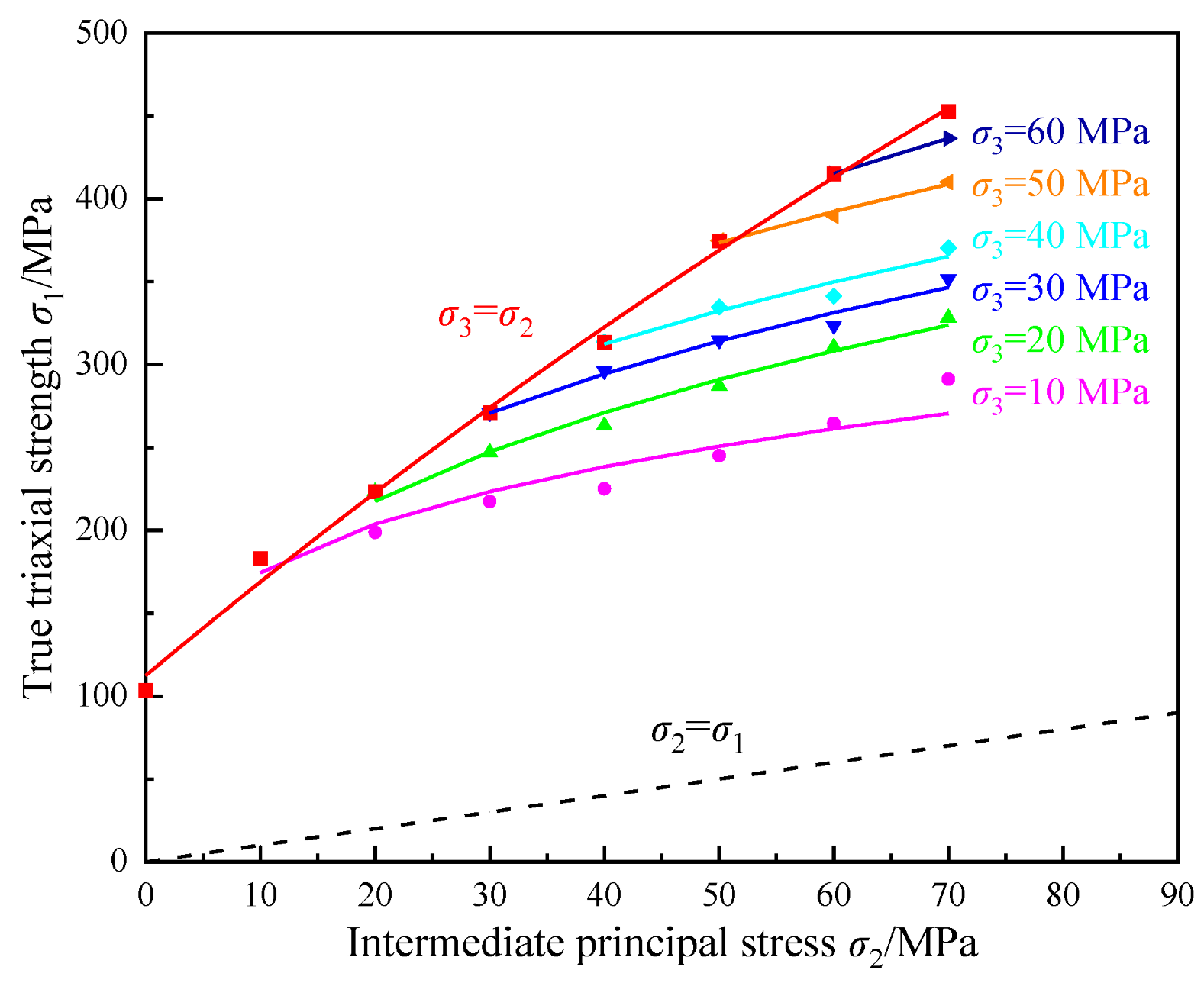
Figure 4 illustrates the triaxial compressive strength of the conglomerate under different horizontal stress states, which shows that the compressive strength of the conglomerate increases with the rise in the minimum and intermediate stresses with a strong dependence on the horizontal stresses.
It can be observed from Figure 4 that as the horizontal stress difference increases under the condition of the same minimum principal stress, the triaxial compressive strength of the conglomerate exhibits an increasing tendency. However, the growth rate decreases gradually. Moreover, as there is a higher intermediate principal stress, the triaxial compressive strength of the conglomerate shows a rapidly increasing trend with an increase in the minimum principal stress (corresponding to a decrease in the horizontal stress difference). This suggests that while increasing burial depth in the gravel layer, the in situ stress increases, leading to an increase in the horizontal stresses and then resulting in a rapid increase in the strength of the conglomerate, further enhancing the difficulty of drilling in the deep gravel layer.
To describe the strength and failure characteristics of rock, ISRM recommends using the failure criteria to calculate shear strength parameters, including the cohesion and the internal friction angle, which indicate the rock’s ability to resist shear failure under various compressive loads. A triaxial failure criterion based on the Mogi empirical assumption was proposed with the triaxial experiments [27], which assumes that the octahedral shear stress, τ o c t , is a function of the mean effective normal stress, σ m , 2 .
τ o c t = f σ m , 2
where the octahedral shear stress is τ o c t = 1 3 σ 1 σ 2 2 + σ 2 σ 3 2 + σ 3 σ 1 2 , and the mean effective normal stress is σ m , 2 = σ 1 + σ 3 2 .
The function in Equation (1) can be linear, a power, or a second-order polynomial. Al-Ajmi and Zimmerman [28,29] considered that the linear function can do well in describing the relationship between the octahedral shear stress and the mean effective normal stress; the function, described in Equation (2), is named the Mogi–Coulomb criterion (Mg-C criterion).
τ o c t = a + b σ m , 2
where a and b are the material parameters, and a = 2 2 3 c cos ϕ , b = 2 2 3 sin ϕ , and σ1, σ2 and σ3 indicate the maximum, intermediate and minimum principal stress, respectively.
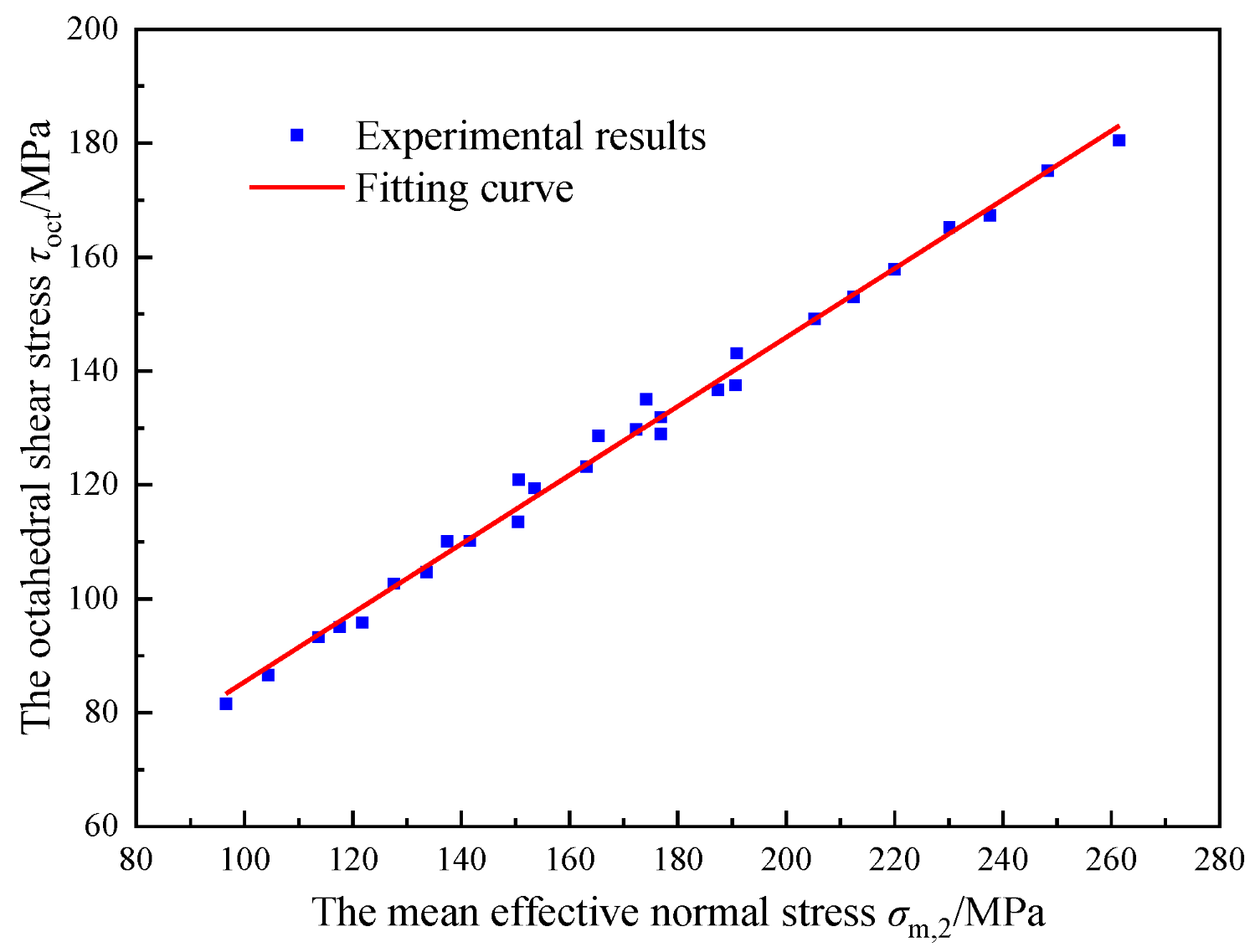
To achieve a comprehensive understanding of the strength and failure characteristics of conglomerate under triaxial compressive conditions, a linear regression analysis was conducted to describe the relationship between the octahedral shear stress and the mean normal stress, illustrated in Figure 5, which demonstrates a good correspondence with the testing results obtained using the Mg-C criterion [30,31,32]. The average deviation of octahedral stress, calculated as follows, was employed to characterize the fitting error.
τ ¯ = A B S τ o c t τ o c t T / N × 100 %
where τ o c t and τ o c t T are the fitting results and the testing results, respectively; and N is the number of all tests.
The fitting function is denoted as τ o c t = 24.968 + 0.6047 σ m , 2 , and the corresponding fitting coefficient is 0.9937. The cohesion and internal friction angle are 34.52 MPa and 38.89°, respectively. The average deviation of octahedral stress is 2.02 MPa, calculated with Equation (3), which indicates that the fitting result is reliable and credible. According to the shear theory of Mohr, the shear failure angle θ of a rock-like specimen subjected to compressive stress is the angle between the maximum principal stress surface and the sliding failure surface. The relationship between the shear failure angle and the internal friction angle can be described as θ = π 4 + φ 2 . Accordingly, the shear failure angle of conglomerate tested in this study is 64.95°.

4. Numerical Simulation Considering the Distribution of Gravel Particles

Since the triaxial mechanical experiments on conglomerate were conducted with physical specimens in this study, direct observation and quantitative characterization of internal gravel content are constrained by the experimental limitations. Nevertheless, gravel content and the cementation characteristics between gravel particles and the surrounding matrix exert a decisive influence on the mechanical behavior of conglomerate, particularly under high confining pressure. A thorough understanding of these factors is therefore essential for elucidating its failure mechanisms.
The discrete element method (DEM) models granular materials as assemblies of discrete, rigid particles that interact through contact forces and bonded interactions. This approach enables explicit simulation of microscale deformation, damage evolution, and macroscopic failure processes in rock-like materials under external loading [33,34,35]. To bridge experimental constraints and mechanistic insight, we developed a calibrated DEM-based triaxial compression model to replicate the mechanical testing of conglomerate under combined confining and axial stresses. Within this model, gravel particle size, volume fraction, shape, and spatial distribution are stochastically generated via a custom-developed algorithm to faithfully capture material heterogeneity. Subsequently, parametric analyses were conducted to quantify how variations in cementation strength and gravel content govern macroscopic stress–strain response, peak strength, and underlying micrmechanical mechanisms—including force chain evolution and localized shear banding. Finally, an empirically informed strength prediction model was formulated, explicitly incorporating gravel content as a key predictive variable.
These simulations yield valuable insights into the mechanical behavior of conglomerate. However, the inherent limitations must be explicitly acknowledged. Notably, DEM-based approaches are best suited for idealized, quasi-static, and mechanically homogeneous systems, and do not inherently capture time-dependent geochemical processes, such as particle dissolution, ion exchange, or diagenetic cementation, that significantly influence rock evolution in natural settings. This underscores the importance of integrating complementary methodologies, including micromechanically informed continuum modeling and reactive transport geochemistry, in future studies to improve predictive fidelity. Furthermore, systematic investigation of the effects of particle size distribution, initial packing density, and interparticle friction angle on macroscopic strength and deformation characteristics remains essential for model validation and refinement.

4.1. Model Setup and Parameters Calibration

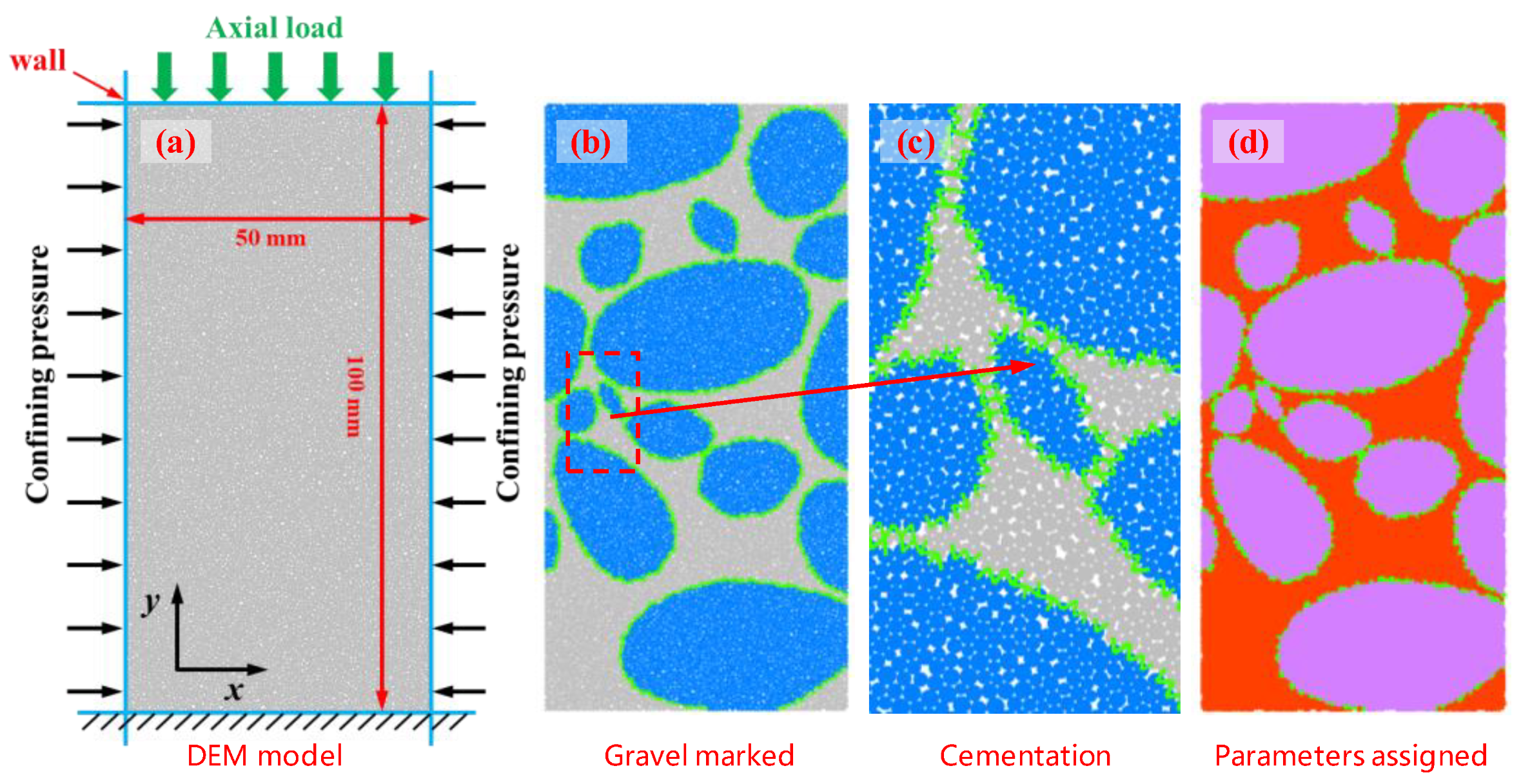
As shown in Figure 6a, the DEM model of conglomerate comprises a total number of 12,417 rigid grains with sizes ranging from 0.25 to 0.4 mm, generated within the dimensions of 50 mm × 100 mm to form the DEM model of the conglomerate. The radius of all grains follows a uniform probability distribution, and the assembly is confined by four rigid, frictionless walls. The two lateral walls apply constant confining pressure via a built-in servo-control algorithm, and the top wall serves as the loading platen, moving downward at a controlled velocity of 0.025 m/s to impose axial compression. This quasi-static loading protocol balances computational efficiency with numerical stability and ensures physically meaningful stress–strain responses.
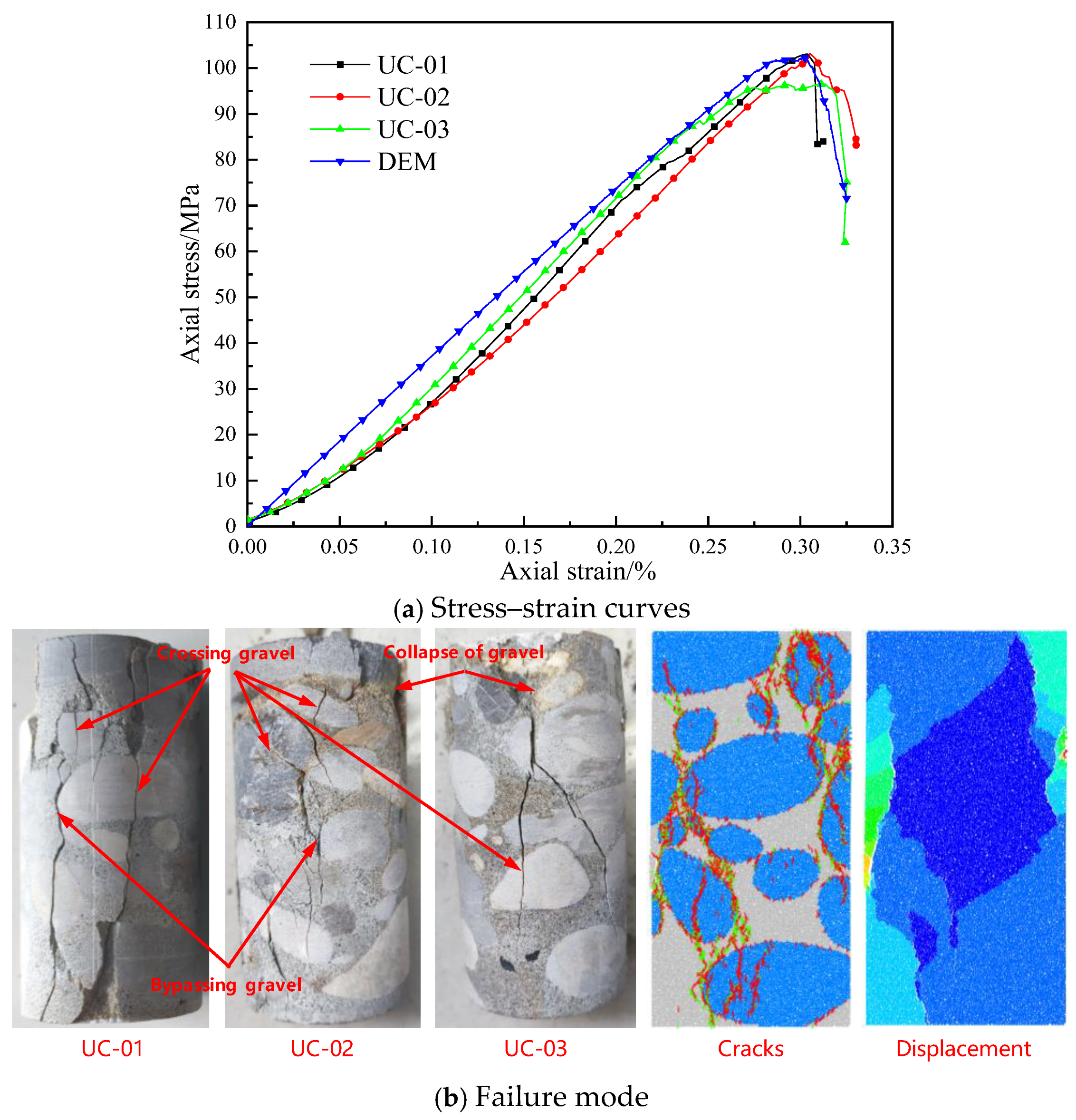
The parallel bond model (PBM), commonly used to simulate the micromechanical properties of rock-like materials, addresses the contact forces and moments between each pair of rigid grains in accordance with Newton’s laws of motion (Newton’s second law) [36,37]. To simplify the highly heterogeneous conglomerate in the DEM model, complex components were abstracted, and the specimen was represented as a composite of a matrix and gravel particles. Although the micromechanical parameters of PBM do not directly correlate with the macroscopic mechanical properties of the physical specimen, these parameters must be pre-determined before simulation. The trial-and-error method is typically employed for this calibration process. Consequently, three groups of uniaxial compression experiments (labeled UC-01, UC-02, and UC-03, shown in Figure 7) were conducted initially. Using the physical specimen in UC-01, a specified region of the cylindrical surface was marked to document the gravel particle characteristics, including the shape, size, and distribution of gravel particles. This information is illustrated in Figure 6b.
The cementation state and microparameters governing the interface between the matrix and gravel particles are illustrated in Figure 6c,d. Using a calibrated trial-and-error approach and comparing the simulation results and the experimental data, the microparameters of the parallel bond model (PBM) in the DEM model of conglomerate were successfully determined and are summarized in Table 2. Furthermore, Figure 7 presents a comparative analysis of the stress–strain responses and failure morphologies observed in both physical specimens and the corresponding numerical specimen, which shows that the specimens consistently developed dominant vertical fractures, accompanied by localized gravel fragmentation, rotation, and interlocking collapse under uniaxial compressive loading. With regard to crack propagation behavior, two distinct interaction mechanisms were identified when propagating cracks encountered gravel particles: (i) crack crossing (i.e., fracture through the gravel) and (ii) crack deflection (i.e., crack arrest and path deviation around the gravel). The DEM simulation results—including crack evolution sequences, displacement fields, and mechanical response curves—exhibit strong qualitative and quantitative agreement with experimental observations across both the elastic and nonlinear deformation stages.
The uniaxial mechanical properties of conglomerate, including the uniaxial compression strength (UCS), elastic modulus, Poisson’s ratio, and the strain corresponding to peak stress (peak strain), are listed in Table 3. Further experimental details and supporting data are available in the author’s previous publication [38]. The simulation results are in close agreement with the experimental values, indicating that the selected microparameters in Table 2 are both physically justified and numerically robust for capturing the macroscopic deformation and failure behavior of the conglomerate under uniaxial compression.

4.2. Effect of the Cementation Strength

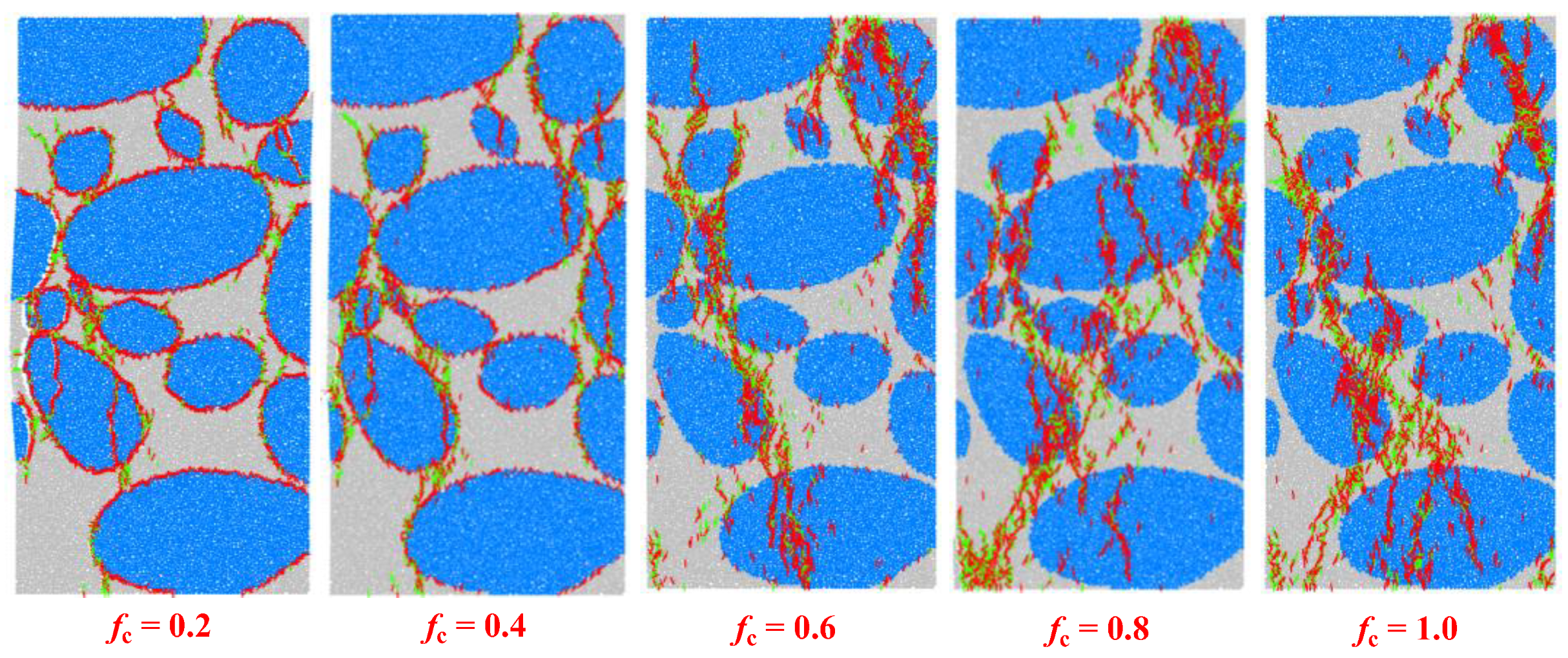
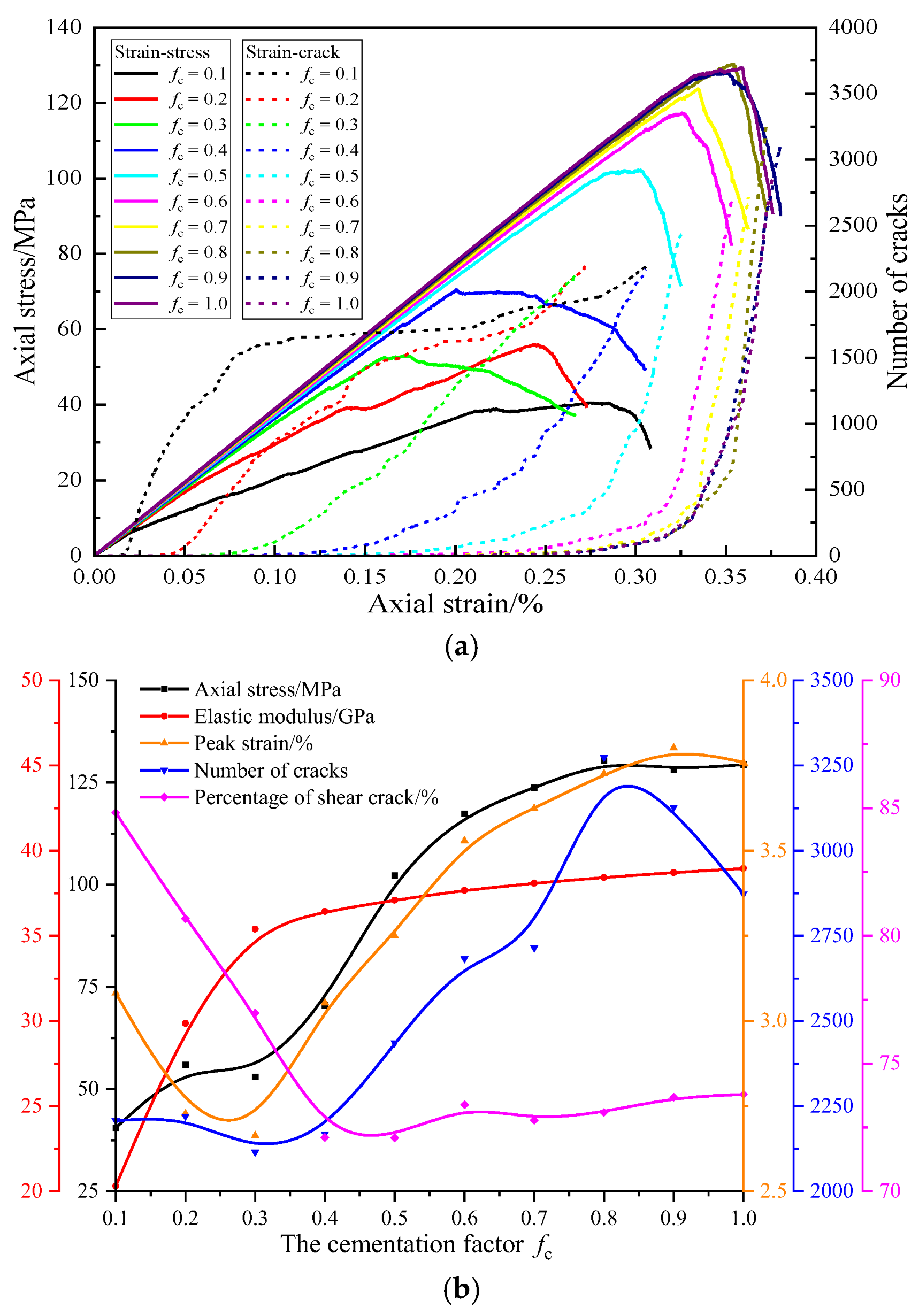
During calibrating the meso-parameters of conglomerate, the cementation factor (fc) was defined as a dimensionless scaling ratio applied to the micromechanical properties of gravel particles, systematically varied from 0.1 to ~1. Then, 10 groups of uniaxial compression simulated tests were subsequently conducted. The simulation results revealed that the stress–strain curve and the key mechanical parameters exhibit optimal agreement with the experimental measurements when fc = 0.5, refer to Figure 7 and Table 3. To systematically investigate the uniaxial compressive failure mode and mechanical characteristic parameters of conglomerate under varying cementation factors, the simulated results are presented in Figure 8 and Figure 9.
As shown in Figure 8, the uniaxial compressive failure behavior of conglomerate is strongly governed by the interfacial cementation strength between gravel particles and the surrounding matrix, directly modulating crack initiation thresholds, propagation pathways, and macroscopic failure modes. In the case of a lower cementation factor (fc = 0.3) for the conglomerate under uniaxial compression loading, there is mainly cementation failure forming within the cracks, developing by passing gravel particles, leading to the detachment of gravel particles, resulting in pronounced oscillatory hardening in the stress–strain curves and a relatively low cumulative crack growth rate. On the other hand, in scenarios with a higher cementation factor (fc ≥ 0.5), the failure mode shifts toward intragranular tensile and shear fracturing, with cracks penetrating or embedding into the gravel particles, triggering particle rotation, sliding, and localized matrix shearing. Consequently, the stress–strain curves exhibit distinct accelerated softening stages following peak stress. Additionally, the dominant crack type is named shear-cracks. Quantitative fracture analysis reveals that the percentage of shear cracks decreases and stabilizes at approximately 72.1% as the cementation factor increases. And, an interesting observation is that the crack growth curve exhibits convex and concave shapes and undergoes a clear inflection at a cementation factor of 0.3. This transition reflects a fundamental shift in dominant deformation mechanisms, from matrix-dominated viscoelastic deformation and gradual interfacial decohesion at low cementation factors, to brittle, shear-localized failure triggered by enhanced load transfer across stiffer interfaces. Collectively, when the cementation factor reaches a critical value, the transition to shear failure leads to a rapid increase in the number of cracks within a relatively short period of time. The cementation factor serves as a key microstructural control parameter, to some extent, of the failure process for the conglomerate under external loading. The higher the cementation factor corresponds to a greater energy dissipation capacity and a greater difficulty in the failure process, leading to higher strength and resistance to failure for the conglomerate.

4.3. Modeling Method for Gravels Distributed Randomly

There are lots of gravel particles exhibiting irregular, non-convex geometries within the physical conglomerate specimen. The size, volumetric fractions (gravel content) and location of these gravel particles are inherently stochastic. To enable precise representation and assembly of these heterogeneous gravel aggregates within the discrete element model, a custom-developed computational framework was implemented. It is known that any special-shaped large particle can be considered as a composite of several regular-shaped small particles. And, an ellipse is adopted with different sizes in each direction in geometric space, which was used as the fundamental geometry to describe the special-shaped gravel particles in the form of single or composite in this study. The implicit equation governing the ellipse is as below:
a x x 0 2 + b y y 0 2 r 2
where (x0, y0) illustrate the centroid coordinates of an ellipse, with x0 ∈ [0, 50] mm and y0 ∈ [0, 100] mm; r is considered to be a dimensional scaling factor indicating the maximum characteristic length of the ellipse; and a and b are the shape parameters of an ellipse representing the dimensions on the X-axes and Y-axes, respectively, directly governing the ellipse’s aspect ratio, curvature distribution, and geometric anisotropy.
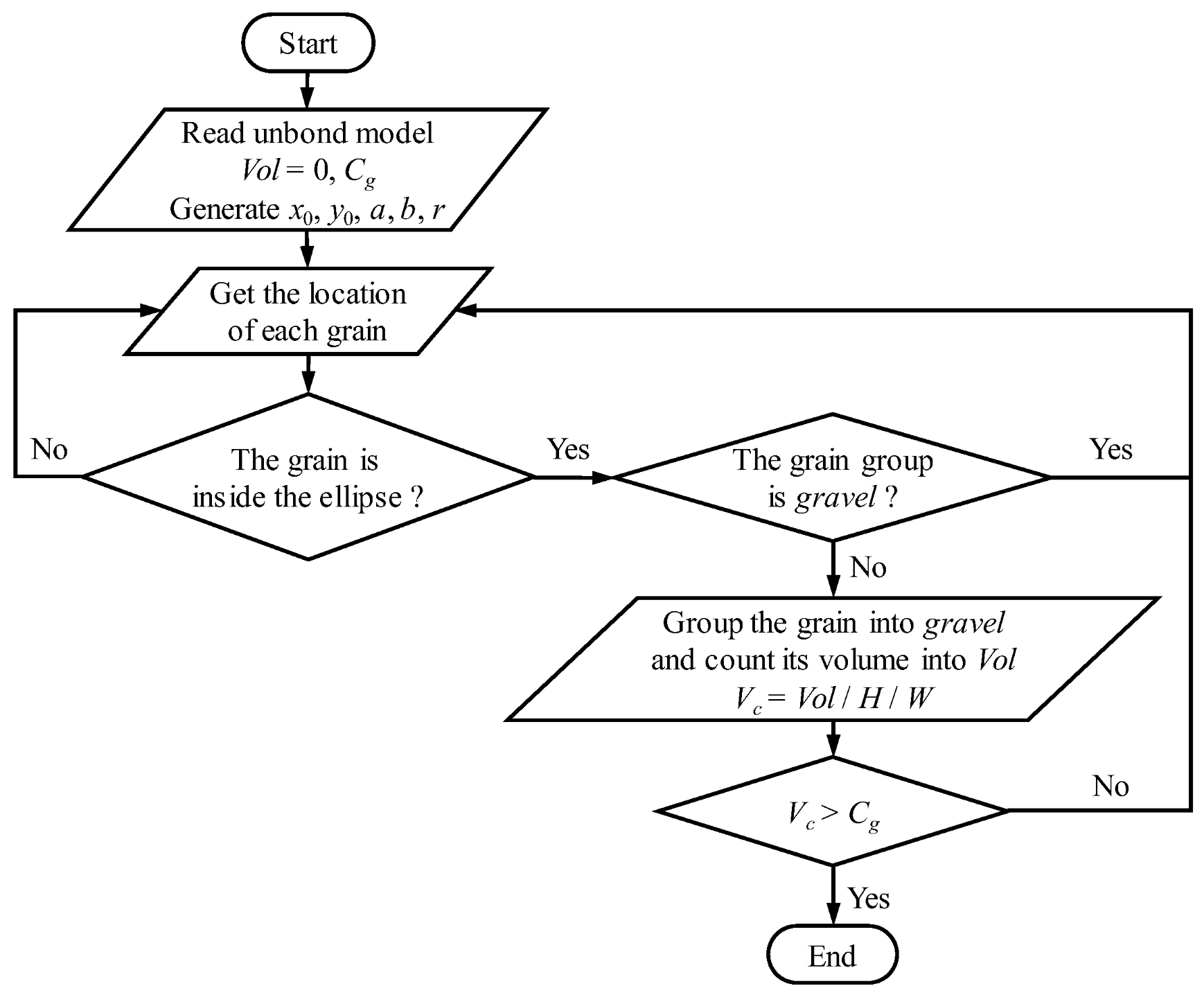
Given that the distribution of the size of gravel particles follows a Gaussian (normal) governing function [7,39] and the random positioning of each gravel particle, the centroid coordinates (x0, y0), semi-axis lengths (a, b), and scaling factor r of the ellipse were generated independently using a combination Gaussian function and uniform function in the custom computational framework while marking gravels. Figure 10 gives the algorithmic workflow of the programming process, comprising four sequential and logically interdependent steps:
Step 1: Specify the target gravel volumetric fraction Cg. Initialize the unbonded discrete element assembly by classifying all grains as matrix material, consistent with the configuration shown in Figure 6a. Subsequently, define an elliptical region using randomly sampled parameters, x0, y0, a, b and r.
Step 2: Loop through each grain in the assembly to compute its position vector and evaluate whether it lies strictly inside the elliptical boundary using the implicit ellipse equation.
Step 3: If the grain is currently assigned to the matrix group, retain its classification; otherwise, reassign it to the gravel group and increment the cumulative gravel volume Vol by its individual grain volume.
Step 4: Compute the current volumetric fraction Vc of gravel particles and compare it with the target value Cg. If Vc > Cg, terminate the algorithm; otherwise, return to Step 2 to continue stochastic reassignment.
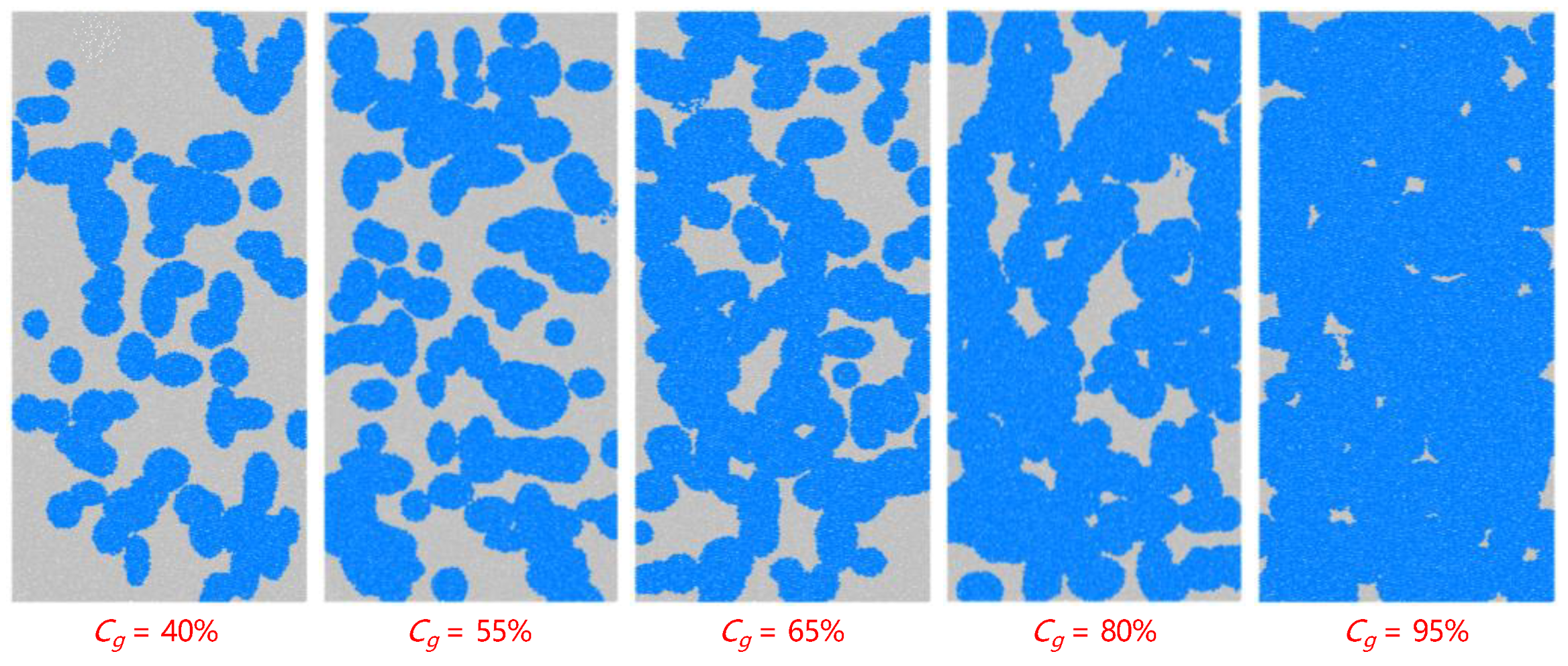
Upon completion of the above procedure, all of the grains in the unbonded DEM assembly are classified into two distinct material phases: matrix and gravel. As shown in Figure 11, the geometric attributes of the gravel phase, including particle shape (approximated by ellipses), size distribution (Gaussian), and spatial arrangement (stochastic), are fully randomized in accordance with the statistical characteristics derived from physical characterization. Subsequently, the parallel bond model (PBM) parameters were calibrated against experimental uniaxial compression data to ensure mechanical fidelity in subsequent numerical simulations.

4.4. Triaxial Testing Results Under Different Gravel Content

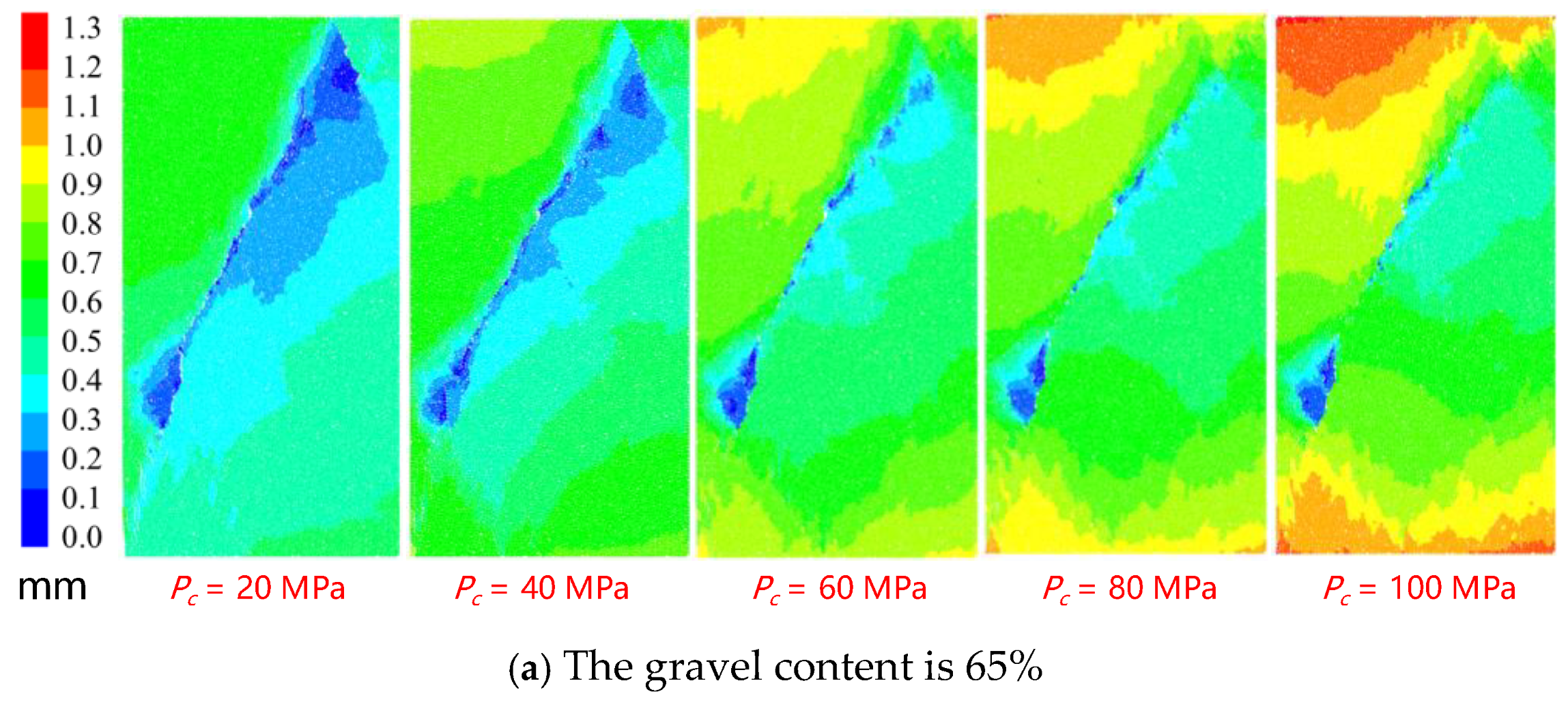
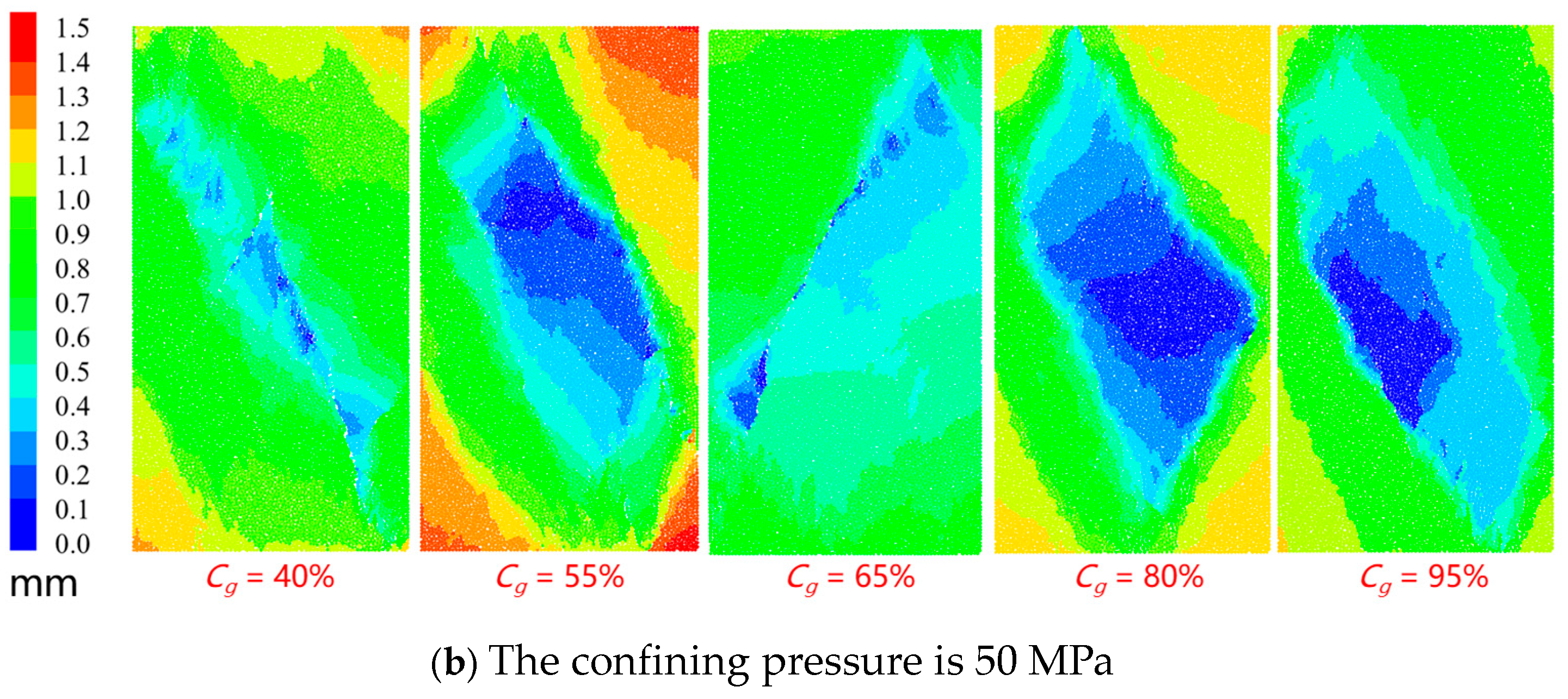
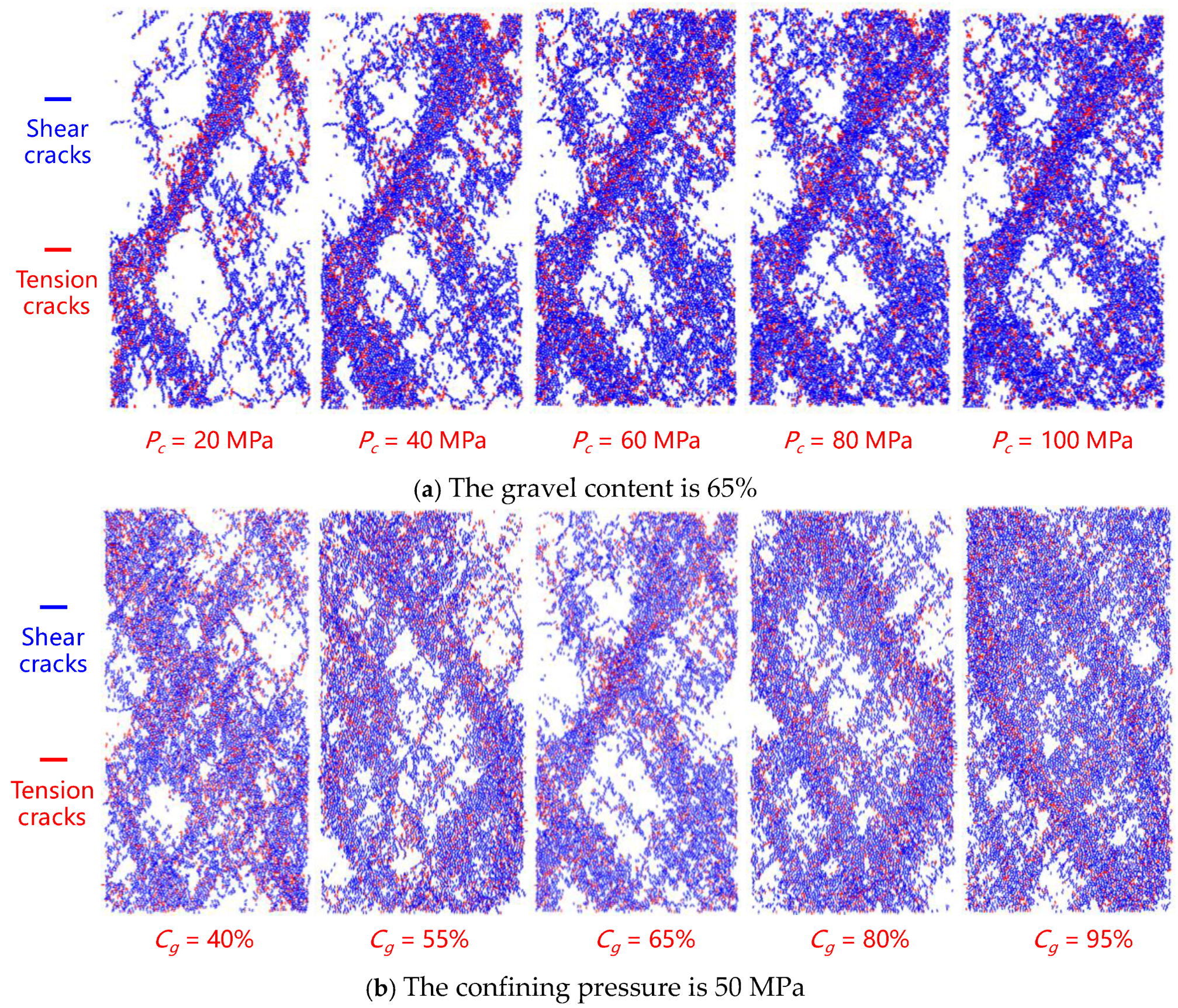
Based on the above modeling methodology, a parametric series of 21 DEM assemblies of conglomerates was generated, with the gravel volumetric fraction systematically varied from 0% to 100% in 5% increments. And the uniaxial and triaxial compressive numerical simulations were carried out by applying confining pressures ranging from 0 to 100 MPa in steps of 10 MPa incrementally. The DEM simulation results, mainly failure morphologies and crack propagation characteristics, are shown in Figure 12, Figure 13 and Figure 14.
The simulated stress–strain curves exhibit consistent macroscopic behavior across the full parameter space of the confining pressure and gravel content. Initially, during the simulation, the stress–strain curves exhibit a linear elastic regime followed by progressive microcrack nucleation and coalescence, marking the onset of nonlinear deformation. As damage accumulates, intergranular interactions intensify, leading to strain localization and deviation from linearity. Post-peak softening is characterized by pronounced stress oscillations, attributable to the mechanical contrast between the high-strength gravel particles and the relatively weaker matrix, inducing intermittent load redistribution, particle rotation, and localized interface debonding. Under high confining pressures (≥60 MPa), a sharp stress drop emerges near the end of the softening branch, reflecting catastrophic shear band formation and macroscopic specimen collapse. This failure mode arises from large-scale grain rearrangement and rotational motion under sustained lateral confinement, which generates significant bending moments on embedded gravel particles and trigger system-wide shear localization.
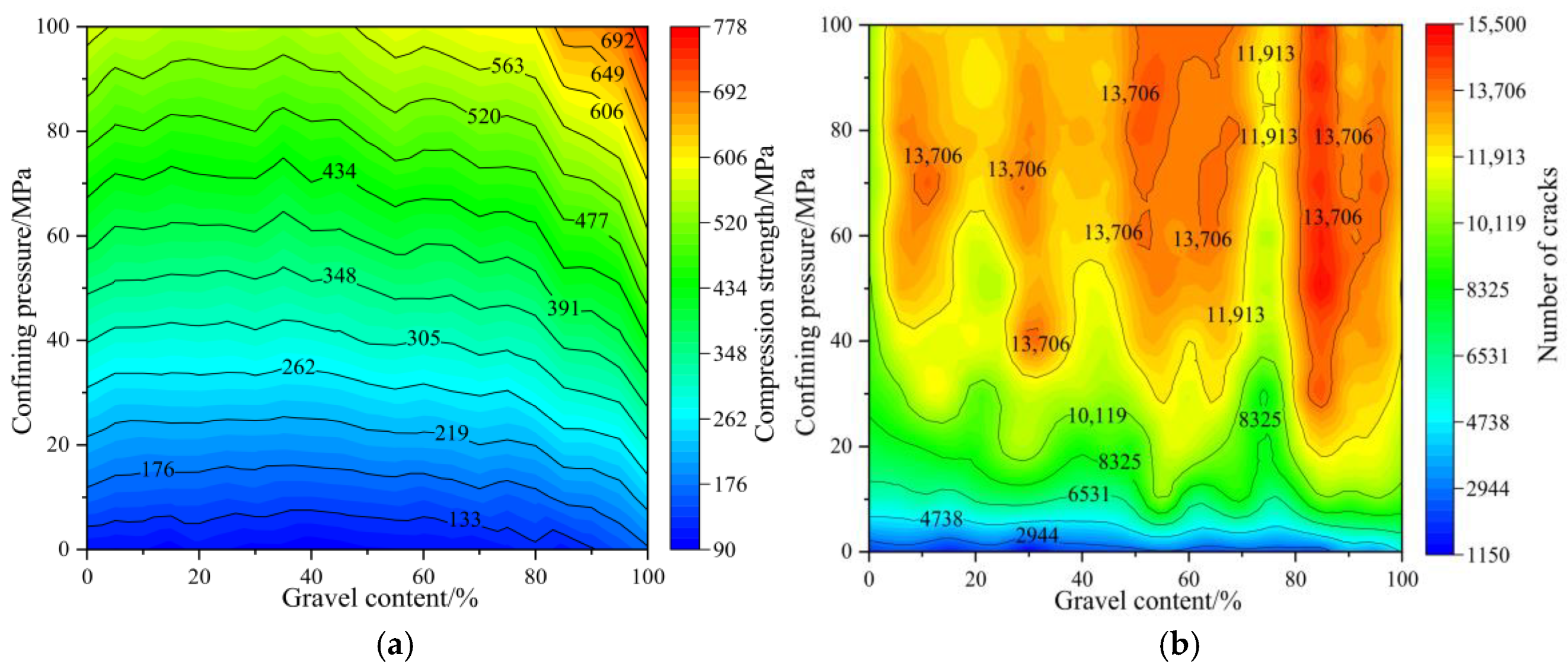
While simulating, the microcracks are defined as localized bond failures occurring at intergranular contacts, the nucleation and propagation of which are explicitly tracked. Regions exhibiting sustained and spatially concentrated microcrack activity, characterized by cumulative bond breakage exceeding a critical threshold, are identified as incipient fracture zones, where progressive grain detachment and fragmentation ensue. Figure 12 and Figure 13 illustrate the displacement magnitude contours and spatiotemporal crack evolution patterns for the DEM specimens subjected to triaxial compression, across a full range of gravel volumetric fractions (0–100%). Figure 14 depicts the corresponding triaxial compressive strength and statistically quantified crack populations. These results indicate that, at a constant gravel content, both grain-scale displacement magnitudes and macroscopic triaxial strength increase monotonically with confining pressure. Furthermore, the total crack count exhibits a positive correlation with both confining pressure and gravel content. More importantly, shear cracks predominate throughout all simulations, constituting approximately 57.7–87.4% of the total crack population. Notably, when the gravel content exceeds 80%, the proportion of shear cracks in the damaged conglomerate exceeds 80%, suggesting a decisive transition toward shear-dominated macroscopic failure under triaxial loading.
Figure 14 illustrates the triaxial compressive strength and statistically quantified crack populations under various triaxial compression loads and different gravel contents. It is noted that a confining pressure of 0 in Figure 14 represents a stress state with no lateral restraint, corresponding to uniaxial compression. As shown in Figure 14a, the triaxial strength remains relatively insensitive to gravel content below 50%. However, a pronounced strengthening effect emerges beyond 80% gravel content; the triaxial strength increases significantly with rising gravel content. Figure 14b shows that as the confining pressure increases, the number of cracks shows slight variations for the same gravel content, and cracks do not increase significantly when the confining pressure surpasses a certain threshold. In contrast, crack population exhibits a strong positive dependence on gravel content across all confining pressure levels: higher gravel fractions consistently yield substantially greater total crack numbers under triaxial loading, reflecting intensified stress heterogeneity and interfacial debonding activity.

5. Conclusions

(1) The deformation process of conglomerate is significantly influenced by the horizontal stress states. The triaxial compressive strength of conglomerate rises with an increase in the minimum or intermediate principal stress. However, the growth rate of this strength decreases gradually with the increase in the horizontal stress difference.
(2) The failure characteristics of conglomerate and gravel particles’ inner physical specimens are mainly influenced by the horizontal stress level. The initiation and propagation of macrocracks exhibit the characteristics of surrounding and penetrating gravel, the tendency of gravel particles to rotate or slip, damage and fragmentation of the matrix and gravel during compression, leading to various types of failure modes observed in the physical specimens.
(3) The triaxial compressive strength of conglomerate is primarily affected by the cementation properties between the matrix and gravel particles, and so is the gravel content. The simulation results indicate that the failure mode includes either cementation failure or shearing failure, which is mainly influenced by the development of cracks.

Author Contributions

Conceptualization, Q.Z., J.W., N.L., K.C., H.Y., L.W., F.S. and T.S.; Methodology, Q.Z., J.W. and Y.Y.; Software, J.W., T.S. and Y.Y.; Validation, Q.Z., J.W., K.C., H.Y., L.W., F.S., T.S. and Y.Y.; Formal analysis, J.W. and F.S.; Investigation, Q.Z., J.W., N.L., K.C., L.W., F.S. and Y.Y.; Resources, Q.Z., J.W., N.L., K.C., H.Y., L.W., F.S., T.S. and Y.Y.; Data curation, Q.Z., J.W., N.L., L.W., T.S. and Y.Y.; Writing—original draft, Q.Z., J.W. and K.C.; Writing—review and editing, J.W. and H.Y.; Visualization, N.L., K.C., H.Y., L.W., F.S., T.S. and Y.Y.; Supervision, N.L. All authors have read and agreed to the published version of the manuscript.

Funding

This study is jointly supported by the National Key Science and Technology Major Special Project for New Oil and Gas Exploration and Development of China (No. 2025ZD1402404).

Data Availability Statement

The original contributions presented in this study are included in the article. Further inquiries can be directed to the corresponding author.

Conflicts of Interest

Quan Zhang, Jun Wei, Ning Li, Kaifeng Chen, Hui Yan, and Liang Wen were employed by the R&D Center for Ultra Deep Complex Reservoir Exploration and Development, CNPC. Quan Zhang, Jun Wei, Ning Li, Kaifeng Chen, Hui Yan, Liang Wen, Fang Shi, and Tonglin Song were employed by the Petrochina Tarim Oilfield Company. The remaining authors declare that the research was conducted in the absence of any commercial or financial relationships that could be construed as a potential conflict of interest.

References

  1. Tian, J.; Liu, H.T.; Teng, X.Q.; Cai, Z.; Zhang, H.; Cao, L. Geology-engineering integration practices throughout well lifecycle in ultradeep complex gas reservoirs of Kelasu tectonic belt Tarim Basin. China Pet. Explor. 2019, 24, 165–173. (In Chinese) [Google Scholar]
  2. Teng, W.-W.; Wang, J.-B.; Liu, J.-T.; Ge, H.-K.; Li, X.-D.; Zhang, Y.-K.; Zhao, T.-F. Study of micromechanical characteristics and failure mechanism of conglomerate reservoirs. Pet. Sci. 2025, 22, 3709–3728. [Google Scholar] [CrossRef]
  3. Zheng, Z.D. ROP Enhancement Techniques in Ultradeep Exploratory Wells in the Piedmont Area of Tarim Basin. Master’s Thesis, Northeast Petroleum University, Daqing, China, 2016. (In Chinese) [Google Scholar]
  4. Teng, X.Q.; Chen, M.; Yang, P.; Li, N.; Zhou, B. Whole well ROP enhancement technology for super-deep wells in Kuqa foreland basin. China Pet. Explor. 2016, 21, 76–88. (In Chinese) [Google Scholar]
  5. Zhang, D.R.; Wen, T.; Pu, L.; Chi, J.; Zhou, X.J.; Liang, H.J.; Zhao, C.T. Pilot test on the ROP improvement BHA of vertical drilling tool & screw rod with equal wall thickness: A case study on Well Keshen A in the high-steep structure of Kuqa piedmont area. Oil Drill. Prod. Technol. 2020, 42, 684–690. (In Chinese) [Google Scholar]
  6. Li, W.; Liao, J. Microscopic Analysis of Flow Resistance of Oil Displacement Fluid in Reservoir Fractures. Reserv. Sci. 2026, 2, 16–33. [Google Scholar] [CrossRef]
  7. Hou, B.; Jin, Y.; Li, S.; Zeng, C. Failure mechanisms of borehole wall rocks in gravel beds with different grain sizes. Nat. Gas Ind. 2015, 35, 66–70. (In Chinese) [Google Scholar]
  8. Yan, Q.; Lei, H.Y.; Xian, B.Z.; Wang, J.; Luo, Z.J.; Yang, Z.; He, J.; Niu, J.; Pu, Q.; Tian, R.H. Influence of Source Rock Properties on the Development of Authigenic Chlorite in Conglomerate Reservoirs and Its Significance for Oil and Gas Reservoirs, A case study from the Lower Urhe Formation in the Mahu Depression, Junggar Basin. ACTA Sedimentol. Sin. 2020, 38, 367–378. [Google Scholar]
  9. Bai, S. Kuqa Piedmont Region Drilling Resistance Characteristics and Bit Drilling Optimization Technology Research. Master’s Thesis, Yangtze University, Jingzhou, China, 2015. (In Chinese) [Google Scholar]
  10. Chang, K.-T.; Kang, Y.M.; Ge, L.; Cheng, M.-C. Mechanical Properties of Gravel Deposits Evaluated by Nonconventional Methods. J. Mater. Civ. Eng. 2015, 27, 04015032. [Google Scholar] [CrossRef]
  11. Wei, J.; Liao, H.L.; Li, N.; Liang, H.; Chen, K.; Yan, H.; Fan, Y.; Zhao, X. Effect of the three-dimensional static pre-stress on the dynamic behaviours of conglomerate: True triaxial Hopkinson pressure bar tests. Geoenergy Sci. Eng. 2023, 227, 211810. [Google Scholar] [CrossRef]
  12. Wang, J.; Ge, H.; Liu, J.; Shen, Y.; Zhang, Z.; Luo, S.; Liu, D. Effects of Gravel Size and Content on the Mechanical Properties of Conglomerate. Rock Mech. Rock Eng. 2022, 55, 2493–2502. [Google Scholar] [CrossRef]
  13. Li, J.; Duan, K.; Meng, H.; Wang, J.; Zhang, Q.; Wang, L. On the Mechanical Properties and Failure Mechanism of Conglomerate Specimens Subjected to Triaxial Compression Tests. Rock Mech. Rock Eng. 2022, 56, 973–995. [Google Scholar] [CrossRef]
  14. Khanlari, G.R.; Heidari, M.; Noori, M.; Momeni, A. The Effect of Petrographic Characteristics on Engineering Properties of Conglomerates from Famenin Region, Northeast of Hamedan, Iran. Rock Mech. Rock Eng. 2016, 49, 2609–2621. [Google Scholar] [CrossRef]
  15. Wei, J.; Liao, H.L.; Wang, H.J.; Chen, J.; Li, N.; Liang, H.; Liu, C.; Zhang, D.; Teng, Z. Experimental investigation on the dynamic tensile characteristics of conglomerate based on 3D SHPB system. J. Pet. Sci. Eng. 2022, 213, 110350. [Google Scholar] [CrossRef]
  16. Wei, J.; Liao, H.L.; Li, N.; Wang, H.; Chen, J.; Liang, H.; Zhang, D.; Liu, C.; Teng, Z. Experiment on mechanical properties of conglomerate rocks under true triaxial loading. J. China Univ. Pet. (Ed. Nat. Sci.) 2022, 46, 81–89. [Google Scholar]
  17. Yan, Y.; Li, S. A Study on the Influence of the Conglomerate Mesostructure on Fracture Failure Behavior Based on Discrete Element Method. Geofluids 2021, 2021, 8828265. [Google Scholar] [CrossRef]
  18. Luo, S.L.; Ge, H.K.; Wang, J.B.; Zhou, W.; Shen, Y.; Liu, P.; Liu, J. Numerical simulation study on the crack propagation of conglomerate. R. Soc. Open Sci. 2021, 8, 202178. [Google Scholar] [CrossRef]
  19. Sakram, M.S. Physical and Numerical Investigation of Conglomeratic Rocks. Ph.D. Thesis, University of New South Wales, Kensington, NSW, Australia, 2010. [Google Scholar]
  20. Satoru, K.; Hiroshi, I.; Kazuhiro, K. Evaluation on scale effect of conglomerate core sample and disturbance by core sampling. J. Jpn. Soc. Eng. Geol. 2010, 39, 391–400. [Google Scholar]
  21. Hou, B.; Zeng, C.; Chen, D.; Fan, M.; Chen, M. Prediction of Wellbore Stability in Conglomerate Formation Using Discrete Element Method. Arab. J. Sci. Eng. 2016, 42, 1609–1619. [Google Scholar] [CrossRef]
  22. Feng, X.T.; Kong, R.; Zhang, X.W.; Yang, C. Experimental Study of Failure Differences in Hard Rock Under True Triaxial Compression. Rock Mech. Rock Eng. 2019, 52, 2109–2122. [Google Scholar] [CrossRef]
  23. Li, Z.L.; Wang, L.G.; Lu, Y.L.; Li, W.; Wang, K.; Fan, H. Experimental investigation on True Triaxial Deformation and Progressive Damage Behaviour of Sandstone. Sci. Rep. 2019, 9, 3386. [Google Scholar] [CrossRef]
  24. Martin, C.D.; Chandler, N.A. The progressive fracture of Lac du Bonnet granite. Int. J. Rock Mech. Min. Sci. Geomech. Abstr. 1994, 31, 643–659. [Google Scholar] [CrossRef]
  25. Nicksiar, M.; Martin, C. Evaluation of Methods for Determining Crack Initiation in Compression Tests on Low-Porosity Rocks. Rock Mech. Rock Eng. 2012, 45, 607–617. [Google Scholar] [CrossRef]
  26. Wen, T.; Tang, H.M.; Ma, J.W.; Wang, Y. Evaluation of methods for determining crack initiation stress under compression. Eng. Geol. 2018, 235, 81–97. [Google Scholar] [CrossRef]
  27. Chang, C.; Haimson, B. A failure criterion for rocks based on true triaxial testing. Rock Mech. Rock Eng. 2012, 45, 1007–1010. [Google Scholar] [CrossRef]
  28. Al-ajmi, A.M.; Zimmerman, R.W. Relation between the Mogi and the coulomb failure criteria. Int. J. Rock Mech. Min. Sci. 2005, 42, 431–439. [Google Scholar] [CrossRef]
  29. Al-ajmi, A.M.; Zimmerman, R.W. A new well path optimization model for increased mechanical borehole stability. J. Pet. Sci. Eng. 2009, 69, 53–62. [Google Scholar] [CrossRef]
  30. Fan, X.; Zhang, M.; Zhao, P.; Yao, B.; Zhou, Y. Investigation of failure region around the wellbore based on the extended Mogi-Coulomb criterion for rock matrix. Geomech. Geoengin. 2020, 17, 372–383. [Google Scholar] [CrossRef]
  31. Yang, Y.; Huang, F.; Kang, S. Mechanism of Penetration Rate Improvement in Hot Dry Rock Under the Coupling of Impact Load and Confining Pressure Release. Reserv. Sci. 2026, 2, 52–64. [Google Scholar] [CrossRef]
  32. Gholami, R.; Moradzadeh, A.; Rasouli, V.; Hanachi, J. Practical application of failure criteria in determining safe mud weight windows in drilling operations. J. Rock Mech. Geotech. Eng. Engl. Ed. 2014, 6, 13–25. [Google Scholar] [CrossRef]
  33. Yin, P.-F.; Yang, S.-Q.; Gao, F.; Tian, W.-L. Experiment and DEM simulation study on mechanical behaviors of shale under triaxial cyclic loading and unloading conditions. Geomech. Geophys. Geo-Energy Geo-Resour. 2023, 9, 10. [Google Scholar] [CrossRef]
  34. Zhang, H.; Ni, H.; Wang, Z.; Huang, B.; Liu, S.; Xu, X.; Liu, C. Discrete element modeling and simulation study on cutting rock behavior under spring-mass-damper system loading. J. Pet. Sci. Eng. 2022, 209, 109872. [Google Scholar] [CrossRef]
  35. Fu, Z.; Tergeist, M.; Kueck, A. Investigation of the cutting force response to a PDC cutter in rock using the discrete element method. J. Pet. Sci. Eng. 2022, 213, 110330. [Google Scholar] [CrossRef]
  36. Yang, W.-M.; Geng, Y.; Zhou, Z.-Q.; Li, L.-P.; Gao, C.-L.; Wang, M.-X.; Zhang, D.-S. DEM numerical simulation study on fracture propagation of synchronous fracturing in a double fracture rock mass. Geomech. Geophys. Geo-Energy Geo-Resour. 2020, 6, 39. [Google Scholar] [CrossRef]
  37. Jin, L.; Zeng, Y.; Xia, L.; Ye, Y. Experimental and Numerical Investigation of Mechanical Behaviors of Cemented Soil–Rock Mixture. Geotech. Geol. Eng. 2017, 35, 337–354. [Google Scholar] [CrossRef]
  38. Wei, J.; Liao, H.; Huang, B.; Li, N.; Liang, H.; Zhou, B.; Zhang, Q.; Chen, L.; Feng, H. Effect of the random distribution of gravel particles on the mechanical behaviors of conglomerate. Arab. J. Geosci. 2023, 16, 485. [Google Scholar] [CrossRef]
  39. Liu, H.; Jiang, Z.X.; Zhang, R.F.; Zhou, H. Gravels in the Daxing conglomerate and their effect on reservoirs in the Oligocene Langgu depression of the Bohai Bay Basin. Mar. Pet. Geol. 2012, 29, 192–203. [Google Scholar] [CrossRef]
Figure 1. GCTS system. (a) the whole system; (b) stress loading states; (c) specimen clamping.
Processes 14 01403 g001
Figure 2. Stress–strain diagram, indicating the crack development state (the horizontal stresses loaded before the test are 20 MPa and 60 MPa respectively).
Processes 14 01403 g002
Figure 3. Stress–strain curves under different horizontal stress differences (σ3 = 20 MPa). (a) The axial stress and horizontal strain; (b) the axial stress and axial strain, volumetric strain.
Processes 14 01403 g003
Figure 4. Triaxial strength of conglomerate.
Processes 14 01403 g004
Figure 5. The strength characteristics of conglomerate under triaxial compressive stress.
Processes 14 01403 g005
Figure 6. Construction of the DEM model of conglomerate. Notes: the blue particles represent the assembly of gravels, and the gray indicates the matrix in (ac), similarly hereinafter. The green lines indicate the cementation between the gravel particles and matrix in (d), and the red color in (d) indicate the cementation between the matrix, the purple color indicate the cementation between all gravel particles.
Processes 14 01403 g006
Figure 7. Comparison of the experimental and numerical results for conglomerate under uniaxial compression.
Processes 14 01403 g007
Figure 8. Failure characteristics of conglomerate under different cementation strengths. The red and green lines given in the above figure indicate the shear cracks and tensile crack respectively.
Processes 14 01403 g008
Figure 9. Effect of the cementation factor on the macro-mechanical parameters of conglomerate. (a) Stress–strain and cumulative crack curves of the conglomerate under different cementation strengths, (b) Mechanical properties of conglomerate under different cementation strengths.
Processes 14 01403 g009
Figure 10. Flow chart of gravel particles generated randomly.
Processes 14 01403 g010
Figure 11. DEM model of conglomerate with different gravel content.
Processes 14 01403 g011
Figure 12. Displacement contours of the DEM specimen under different confining pressure and gravel content.
Processes 14 01403 g012aProcesses 14 01403 g012b
Figure 13. Failure patterns and crack distribution of the DEM specimen.
Processes 14 01403 g013
Figure 14. Triaxial strength and number of cracks considering gravel content. (a) Triaxial strength of conglomerate, and (b) number of cracks at failure.
Processes 14 01403 g014
Table 1. Experimental conditions of the triaxial compression tests of conglomerate.
GroupSpecimen IDDimension/mmDensity/g·cm−3Mass/gPrincipal Stress σ3/MPaPrincipal Stress σ2/MPa
Group AA-150.23 × 50.35 × 100.332.62663.71010
A-250.61 × 50.60 × 100.522.62674.120
A-350.53 × 50.17 × 100.652.63671.530
A-450.45 × 50.36 × 100.072.63669.940
A-550.57 × 50.59 × 100.312.6467750
A-650.48 × 49.92 × 100.222.63663.660
A-750.45 × 50.47 × 99.622.65671.170
Group BB-150.50 × 50.62 × 99.912.64674.42020
B-250.46 × 50.39 × 100.782.63674.630
B-350.59 × 50.57 × 100.422.63675.140
B-450.31 × 50.35 × 100.702.64672.250
B-550.49 × 50.45 × 100.992.63677.760
B-650.71 × 50.70 × 100.672.65685.270
Group CC-150.71 × 50.81 × 100.322.62677.53030
C-250.35 × 50.41 × 99.802.64669.240
C-350.35 × 50.45 × 100.032.63667.950
C-450.47 × 50.41 × 100.342.64673.660
C-550.65 × 50.71 × 100.182.64678.370
Group DD-150.73 × 50.88 × 100.192.62678.64040
D-250.48 × 50.48 × 100.022.63670.350
D-350.55 × 50.45 × 100.152.64675.560
D-450.37 × 50.30 × 100.212.65673.670
Group EE-150.42 × 50.49 × 100.292.61667.15050
E-250.16 × 50.43 × 99.382.64663.760
E-350.47 × 50.45 × 100.182.62668.170
Group FF-150.39 × 50.35 × 100.752.66679.76060
F-250.23 × 50.63 × 99.952.62665.270
Group GG-150.79 × 50.73 × 100.742.626807070
Table 2. The micromechanical parameters of conglomerate.
MicroparametersMatrixGravelCement
Density/kg·m−325002875/
Contact modulus/GPa11.425.212.6
Stiffness ratio2.211.520.76
Parallel-bond Young’s modulus/GPa11.425.212.6
Parallel-bond normal strength/MPa31.145.422.7
Parallel-bond cohesion/MPa31.145.422.7
Parallel-bond frictional angle/°384924.5
Friction coefficient0.310.240.12
Table 3. The uniaxial compression results of physical and simulation tests.
SpecimenUCS/MPaElastic Modulus/GPaPoisson’s RatioPeak Strain/%
UC-01103.0739.0710.380.3039
UC-02103.1438.730.410.3051
UC-0396.4841.060.430.3134
DEM model102.261237.090.410.3026
Disclaimer/Publisher’s Note: The statements, opinions and data contained in all publications are solely those of the individual author(s) and contributor(s) and not of MDPI and/or the editor(s). MDPI and/or the editor(s) disclaim responsibility for any injury to people or property resulting from any ideas, methods, instructions or products referred to in the content.