Article

Analysis of the Potential for Thermochemical Utilization of Post-Production Maize Waste Through the Production of Coal Substitutes in the Pyrolysis Process

1
APS-Ekoinnowacje Sp. z o.o., Brzozowskiego 7/12, 93-552 Łódź, Poland
2
Faculty of Process and Environmental Engineering, Lodz University of Technology, Wolczanska 213, 90-924 Łódź, Poland
3
Chemical Faculty, Gdansk University of Technology, Str. G. Narutowicza 11/12, 80-233 Gdansk, Poland
4
Institute of Mechanics and Machine Design, Faculty of Mechanical Engineering and Ship Technology, Gdansk University of Technology, Str. G. Narutowicza 11/12, 80-233 Gdansk, Poland
*
Author to whom correspondence should be addressed.
Processes 2026, 14(8), 1319; https://doi.org/10.3390/pr14081319
Submission received: 6 March 2026 / Revised: 13 April 2026 / Accepted: 15 April 2026 / Published: 21 April 2026
(This article belongs to the Special Issue Biomass Pyrolysis Characterization and Energy Utilization)

Abstract

The dynamic growth of global maize production results in the generation of large amounts of residues originating from both cultivation and processing, creating a need to develop efficient and sustainable management pathways. The aim of this study was to evaluate the feasibility of utilizing selected maize-derived residues (straw, cobs, technical maize, and post-fermentation DDGS) for the production of densified solid fuels based on biochar obtained through pyrolysis at 500 °C. The study included analyses of the mineral composition of biomass and biochar, determination of biochar yield, ash content, and higher heating value (HHV). The biochar yield ranged from 30.19% to 42.49%, with the highest values obtained for DDGS (dried distillers grains with solubles). The pyrolysis process led to an increase in HHV to 25.3–32.14 MJ/kg. These values are comparable to the calorific values of hard coal. The results indicate that biochar derived from maize residues may represent a promising feedstock for the production of solid fuels with increased energy density, while the ashes generated during their combustion show potential for agricultural applications.

1. Introduction

Large amounts of maize residues encourage researchers to analyze the possibilities for managing and utilizing these residues. Analyses indicate that since the 1960s, the area under maize cultivation has been steadily increasing. This growth has been observed on all continents; however, particularly large increases have been recorded in Africa [1]. In addition to the expansion of cultivated area, the intensity of agriculture has also increased, which significantly affects yields and, consequently, the amount of waste generated. Currently, global maize production is approximately 1.1 × 10⁶ tons per year [2]. The yield index for maize fluctuates around 50%, which means that for every kilogram of grain, there is approximately 1 kilogram of leaves and stalks [3]. The amount of maize DDGS is strongly linked to bioethanol production, with the largest quantities produced in the US, Brazil, and China, but the European market is also significant. Global production has been growing significantly year on year [4]. One ton of maize produces 378 L of ethanol and 309 kg of DDGS during the fermentation process [5]. The amount of maize bran is relatively small and accounts for less than 8% of the grain’s weight [6,7]. Pyrolysis testing of all major types of waste is part of circular waste management [8].
There are several pathways for the utilization of these waste forms, resulting from their versatility. The main directions include energy recovery, agricultural applications, the production of bioethanol and bio-oil, and carbon sequestration. The study in [9] investigated the potential for bio-oil production via fast pyrolysis using maize stover and maize cobs. The authors presented pyrolysis carried out in various types of reactors, such as a fluidized bed reactor, a microwave reactor [10], or a flue gas stream [11]. Pyrolysis was conducted at different temperatures, most commonly in the range of 300–600 °C [12].
Post-distillation residues also exhibit feed potential, as described in studies [13,14], which presented valorization techniques aimed at improving their properties as animal feed. The process of carbon sequestration in soil through the incorporation of carbonized material into the soil is also being analyzed [15]. In the literature, numerous studies can be found confirming the beneficial properties of biochar in agricultural applications, such as increased water retention [16,17], as well as its use as a sorbent for contaminants [18,19]. The enhanced sorption capacity of biochar is associated with the increase in specific surface area and the development of porous structure, as well as the presence of surface functional groups that act as active sites with high affinity toward metal ions [18,20,21,22]. The sorption properties of biochar depend on its characteristics, and one of the main parameters influencing them is the temperature at which the biochar is produced [23], as well as the activation of biochar to improve its properties [24,25].
Several studies were conducted by Polish researchers on the thermochemical conversion process using a steam atmosphere in order to transform maize straw into torrefied material as a fuel for co-firing with coal [26,27,28], as well as classical torrefaction under nitrogen to produce biochar as an additive and carbon carrier for fertilizers [29,30]. Straw from maize has a huge potential for countries like Poland in terms of producing either biofuel for direct heating or serving as a material with high porosity, which can be useful for farmers, as a rich-in-carbon additive for soil enhancement.
Maize residues can be used in several sectors. Undoubtedly, in the energy and agriculture sectors, maize residues can have the greatest impact—either for direct heating, as additives for fertilizers, or as adsorption materials [31,32,33]. In the energy sector, they can be used either for biogas production or as biomass for direct heating. Cob cores and stems are an excellent substrate in biogas plants, increasing methane yield. After processing, they are used to produce electricity and heat. Waste is also used to produce high-quality agro-pellets, which are used in power boilers. In the agriculture sector, farmers usually use maize residues in fertilization and to improve soil—as soil conditioners. Crop residues (mulch) left in the field are humified, increasing humus levels, which improve soil structure and water retention. Digestate from biogas plants, a residue from waste processing, is a rich organic fertilizer (N-P-K). Maize residues have applications as animal feed, as well as in the industry. Cob cores can be used to produce feed. This waste is also used as animal bedding or as a material for biochar production. Maize waste, including crop residues (stalks, leaves) and cob cores, is a valuable energy and organic resource. It is primarily used to produce biogas, fuel pellets [34,35,36], and feed [37,38], as well as a natural fertilizer that improves soil structure. A total of 17–20 tons of dry matter per hectare provides nutrients equivalent to a large dose of fertilizer.
The contribution of this study to advancing knowledge in the field of waste management lies in its comprehensive approach to the utilization of maize-derived residues. The authors analyzed various existing approaches to waste valorization and, based on this assessment, designed research addressing identified gaps in the current scientific knowledge. A key strength of the study is the integration of five different maize waste streams within a single experimental framework. By compiling and investigating all major maize industry residues in one place and under identical process conditions, the study provides results that are consistent and easily comparable for other researchers. The experimental work was carried out using a batch reactor with a relatively simple design, which offers strong potential for future industrial application. Additionally, the process was conducted at a larger scale compared to most studies reported in the literature, enhancing its relevance as preliminary research for industrial implementation. Together, these aspects make the study a valuable contribution, both from a scientific and practical perspective, supporting the development of scalable waste-to-fuel conversion technologies.

2. Materials and Methods

Biomass samples, including straw, digestate residues, maize cobs, and technical-grade grain, were pyrolyzed in a batch reactor. The reactor (Figure 1), in the form of a steel cylinder with a diameter of 200 mm and a height of 300 mm, was loaded with biomass and then sealed using a flange connection. The reactor prepared for pyrolysis was placed inside a Kanthal heating element socket. The heater was controlled by a temperature controller equipped with a PID regulator. After reaching the target temperature, it was maintained until the completion of the pyrolysis process.
The pyrolysis time varied depending on the sample mass and the thermal conductivity of the material. The feedstock mass depended on the bulk density. In each case, the reactor was filled completely, i.e., a constant feedstock volume was maintained. During the pyrolysis process, the produced gas and pyrolytic oil were combusted in a gas flare, as the experiments were focused on biochar analysis. After the completion of the pyrolysis, the reactor was removed from the heater socket, and, once cooled, the carbonized material was extracted and subjected to further analyses.
The feedstock used in the study consisted of four types of materials from industries related to maize cultivation and processing: post-harvest residues (stalks and leaves), maize cobs (without kernels), post-fermentation residues (DDGS), maize bran, and technical maize, i.e., maize grain that, for various reasons, was not approved for food or feed production, such as imports from countries where plant protection products prohibited in the European Union are permitted, grain that failed to meet quality standards, grain that was improperly stored, etc. All raw materials originated from Poland and were supplied by local farmers (Ekopasz, Hajnówka).
Chemical analyses of the substrates and pyrolysis products were carried out using a NETZSCH TG 209 F3 thermogravimeter (Selb, Germany), a Bruker (Billerica, MA, USA) XRF spectrometer, and an EKOTECHLAB calorimeter (Straszyn, Poland). The pyrolysis experiments were conducted in a self-designed and self-constructed pyrolytic reactor.

3. Results

The analysis of the mineral fraction (Table 1) of the investigated maize residues indicates a clear differentiation in elemental composition, resulting from both the plant part and the degree of technological processing. In all samples, the dominant mineral components are potassium and calcium, and, to a lesser extent silicon, accompanied by the presence of fertilizer macronutrients (P, S) [39,40,41], as well as micronutrients (Cu, Fe, Zn) [42].
The highest potassium content was observed in maize cobs (88.79%). Similar results were observed for technical maize (72.89%) and maize bran (72.94%), while lower values were recorded for DDGS (64.44%) and maize straw (60.25%). The mineral composition was consistent with the findings of other researchers [4]. High potassium concentration is typical for plant biomass and has important implications from an energy perspective. Potassium promotes a reduction in ash melting temperature, increasing the risk of sintering and slagging during combustion processes, as well as high-temperature corrosion of installation components.
Calcium is present only in maize straw (33.82%) and DDGS (8,22%). The presence of calcium in biomass and ash has a beneficial fuel-related effect, as Ca increases the ash melting temperature and can partially neutralize the negative influence of potassium. In this context, maize straw, despite its high ash content, exhibits more stable ash behavior than maize cobs. From an agricultural perspective, high calcium content may be advantageous, and ash from straw and DDGS may be used for soil deacidification.
Silicon occurs in the analyzed biomasses in relatively small amounts compared to typical cereal straw; its share is the highest in technical maize (10.47%) and cobs (7.72%), and it is the lowest in straw (3.76%). Silicon contributes to the formation of silicate phases in ash, which, in combination with potassium, may lead to the formation of low-melting compounds. From a fuel perspective, this implies a potential risk of sintering.
Phosphorus and sulfur are present in highly variable amounts. Particularly high phosphorus content is observed in DDGS (12.00%), while, in straw, the P content is negligible (0.005%). Sulfur reaches its highest levels in DDGS (12.07%) and technical maize (4.32%). In an energy context, the presence of sulfur may lead to SO2 emissions; however, its content in biomass is generally lower than in fossil fuels. Moreover, sulfur contained in biomass is not subject to emission limits. From an agricultural point of view, both phosphorus and sulfur significantly increase the fertilizer value of ash, making it a potential source of these nutrients for nutrient-poor soils. An interesting correlation is the occurrence of high phosphorus concentrations in waste containing high concentrations of sulfur.
Additional XRF analyses were performed. Biochar derived from DDGS was selected for testing because this biomass exhibited the highest sulfur content in order to determine whether the mineral composition of the inorganic fraction changes during the transition from biomass to biochar. The results indicate that part of the sulfur present in the biomass is removed along with volatile components during pyrolysis. The sulfur content in the DDGS-derived biochar was 5.03%. This effect further confirms that pyrolysis is an effective method for biomass conversion aimed at producing high-value fuels. The general trend reported in the literature is a decrease in sulfur content in biochar compared to the original biomass [43]. However, when pyrolysis is conducted at increasing temperatures, an opposite effect can be observed—namely, an increase in sulfur concentration in biochars produced at higher temperatures [44]. These findings indicate that, for the production of coal substitutes, excessively high pyrolysis temperatures are not advantageous—not only due to increased ash content and higher process costs but also because of the increasing sulfur content in the resulting biochar. Leng et al. [45], in the paper “An overview of sulfur-functional groups in biochar from pyrolysis of biomass,” highlight that sulfur present in biochar, particularly in the form of sulfur-containing functional groups, may be beneficial—especially for soil applications. Sulfur-containing functional groups such as thiols (–SH), sulfides (–S–), and sulfonic groups (–SO3H) play a key role in heavy metal adsorption due to their strong affinity for metal ions. Another important aspect related to sulfur in fuels is its environmental impact, particularly the emission of sulfur oxides during combustion. In contrast to hard coal [46], which typically contains relatively low amounts of calcium (up to a few percent), some of the waste types analyzed in this study (Maize DDGS and straw) contain significant amounts of calcium compounds. Calcium is highly effective in binding sulfur oxides during combustion, provided that the process is conducted at appropriately low temperatures—not exceeding 900 °C. Studies show that desulfurization using calcium-based compounds does not necessarily need to be performed post-combustion in scrubbers but can instead occur in situ during the combustion process [47].
The contents of microelements (Cu, Fe, and Zn) are relatively low in all analyzed samples, although the highest concentrations occur in technical maize and DDGS. These levels fall within the ranges typical for agricultural biomass and do not indicate an environmental risk. From a fertilization perspective, ash derived from these biomasses may serve as a supplementary source of micronutrients essential for plant growth.
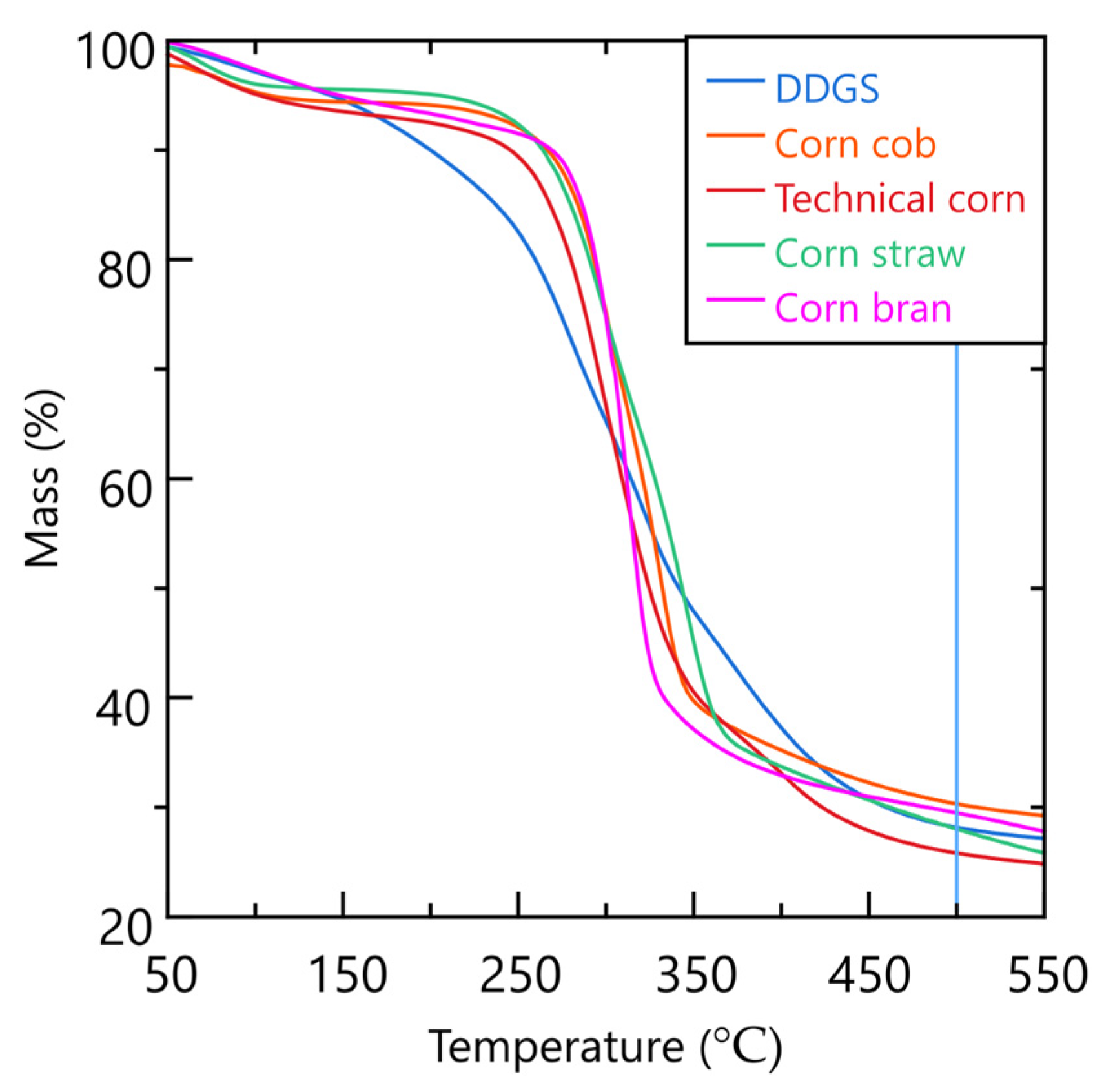
Figure 2 presents TG curves showing the mass loss as a function of temperature for five biomass materials: DDGS, maize cob, technical grain, maize bran, and straw. All samples exhibit a gradual decrease in mass with increasing temperature, reflecting successive stages of thermal decomposition. Mass loss is observed in the initial temperature range up to approximately 150 °C, and only minor mass loss is observed, which is mainly associated with moisture evaporation. The main decomposition stage occurs between about 250 °C and 350 °C, where a rapid decline in mass is visible for all materials. This region corresponds primarily to the degradation of hemicellulose and cellulose, which constitute the major organic components of biomass. Maize cob and bran show a relatively sharp mass drop, indicating intensive and fast thermal decomposition within a narrow temperature interval. Technical maize grain and straw display a slightly smoother decrease, suggesting a more gradual degradation process related to their structural composition. DDGS exhibits the broadest transition region, which reflects its complex composition containing proteins, lipids, and residual carbohydrates. Above approximately 350 °C, the rate of mass loss decreases, and the curves gradually approach a stable residual mass, associated mainly with lignin decomposition and char formation. At the final stage of heating, all materials retain a solid residue of roughly 25–30%, indicating the differences in char yield and thermal stability among the analyzed biomasses.
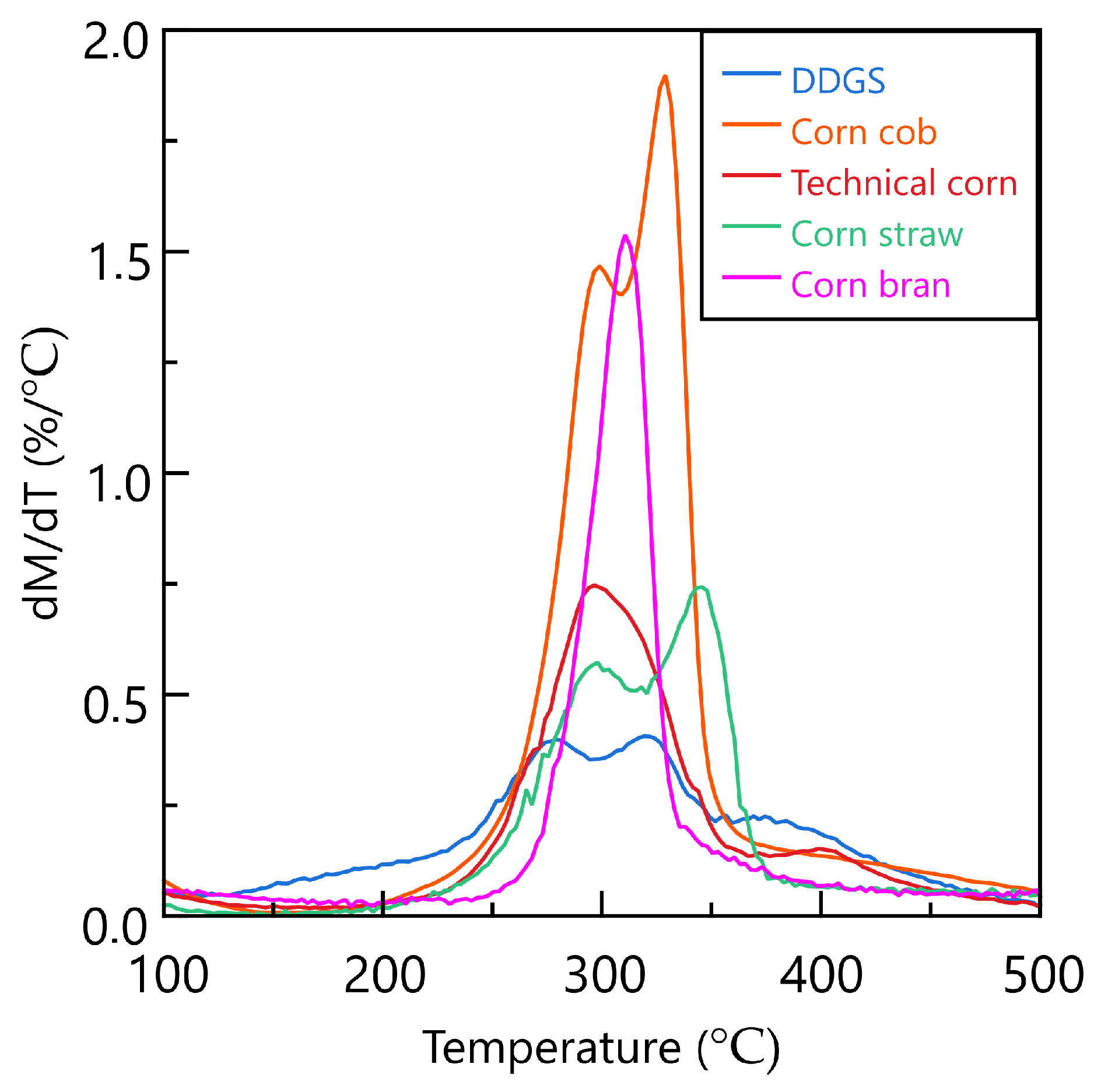
Figure 3 presents DTG curves, i.e., the derivative of mass loss with respect to temperature, for five biomass materials: DDGS, maize cob, technical maize grain, maize bran, and maize straw. The horizontal axis shows temperature in the range of approximately 100–500 °C, while the vertical axis represents the rate of mass loss. The analysis of the curve profiles indicates characteristic stages of thermal decomposition associated with the degradation of the main structural and non-structural components of biomass.
For all materials, the most intensive thermal transformations occur in the temperature range of approximately 270–340 °C. This region corresponds primarily to the decomposition of hemicellulose and cellulose, as well as the initial degradation of lignin. Distinct maxima are observed in this range, with their intensity, width, and position strongly dependent on the chemical composition and structural characteristics of each biomass type.
Maize cob exhibits the highest and most pronounced DTG peak, with a maximum located at around 320–330 °C. The narrow and sharp character of this peak indicates rapid and intensive mass loss occurring within a relatively limited temperature interval, which is typical for lignocellulosic materials rich in cellulose. Such behavior reflects high thermal reactivity and a relatively homogeneous structural composition.
Technical grain shows a single, moderate-intensity peak with a maximum near 300 °C. The decomposition process appears more uniform than that observed for cob, suggesting a more homogeneous chemical structure with a higher contribution of starch and a lower fraction of structural lignocellulosic components. As a result, thermal degradation proceeds in a smoother and less abrupt manner.
Maize bran is characterized by a distinct and relatively sharp peak located at approximately 300–315 °C, with an intensity comparable to or slightly lower than that of maize cob. The narrow decomposition interval indicates high reactivity, likely related to the presence of easily degradable carbohydrates and residual starch, combined with fibrous components. The DTG profile suggests that maize bran undergoes rapid thermal decomposition once the main degradation temperature is reached.
Maize straw exhibits a broader and less intense curve compared to maize cob and maize bran. The main peak occurs in the range of about 300–340 °C, but the profile is wider and slightly asymmetric, indicating overlapping degradation processes of hemicellulose, cellulose, and lignin. This behavior is characteristic of agricultural residues with a more heterogeneous lignocellulosic structure and varying proportions of structural polymers.
In contrast, DDGS shows the broadest and least intense DTG profile among all analyzed materials. The curve displays gradual and extended maxima, indicating a multi-stage decomposition process. This behavior results from the complex composition of DDGS, which contains proteins, lipids, fiber, and residual starch. The coexistence of various organic fractions leads to progressive degradation over a wider temperature range rather than a single, well-defined decomposition step.
Above approximately 350 °C, all DTG curves gradually decline, forming extended tails that continue up to about 500 °C. This stage is mainly associated with the further decomposition of lignin and secondary transformations of the remaining solid residue, ultimately leading to char formation. The comparison of peak intensities indicates that maize cob exhibits the highest rate of mass loss, followed by maize bran and technical grain, whereas straw shows moderate decomposition intensity. DDGS demonstrates the lowest peak intensity but the most complex and distributed degradation pattern, reflecting its heterogeneous chemical composition.
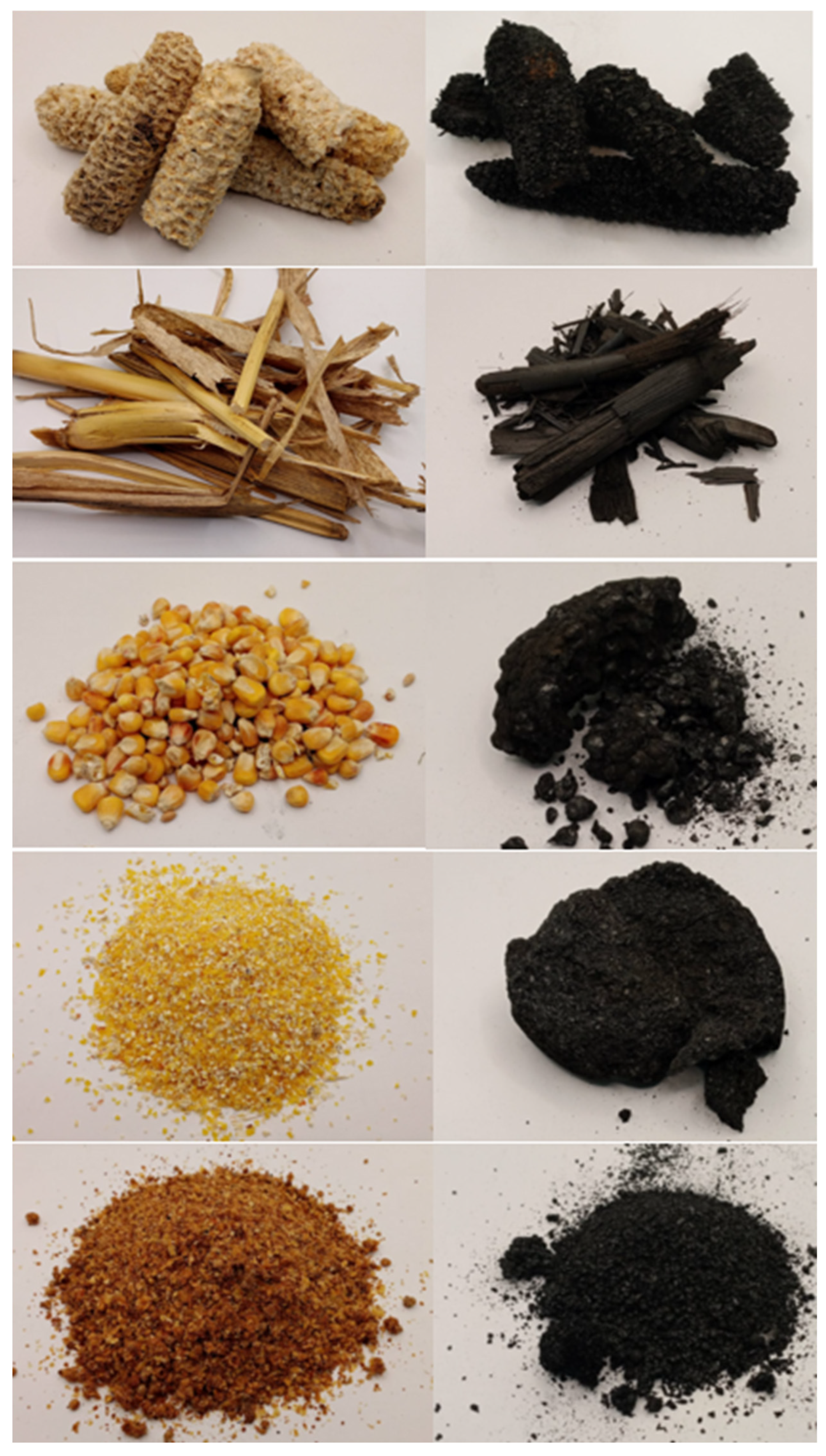
Figure 4 below presents the biomasses and biochar obtained during the pyrolysis process conducted at 500 °C.
The presented results for biochars yield obtained during the pyrolysis of maize residues at a temperature of 500 °C indicate a clear differentiation in the amount of solid residue depending on the type of feedstock. The biochar yield ranges from 34.58 to 42.49%, which is typical for the pyrolysis of lignocellulosic biomass conducted at this temperature. The tests were carried out on biomass on a dry basis.
The highest biochar yield was obtained for maize DDGS (42.49%), which can be directly attributed to the removal of simple sugars during the fermentation process. These fractions, in the case of raw biomass, undergo intensive thermal decomposition with the formation of volatile gaseous and liquid products; their absence, therefore, favors an increased share of solid residue after pyrolysis. In addition, DDGS is characterized by an elevated content of lignin, proteins, and mineral components, which are more resistant to thermal degradation and promote the formation of a stable biochar structure.
Lower, yet relatively similar, biochar yields were obtained for the remaining maize residues. Pyrolysis of maize straw resulted in a biochar yield of 39.27%, indicating a significant contribution of lignin and mineral components that favor the formation of a durable solid phase. This yield is consistent with other studies on this feedstock; for example, slightly lower values were reported in [48], although a smaller feedstock charge was used, which typically results in a lower percentage yield of biochar due to the absence of secondary reactions of pyrolytic tars within the reactor.
In the case of maize cobs, the biochar yield was 31.14%, which can be explained by a higher proportion of volatile fractions and a lower ash content compared to maize straw and DDGS. A similar biochar yield was observed for technical maize (31.55%), suggesting a comparable chemical composition and similar mechanisms of thermal decomposition under pyrolysis conditions.
The observed differences in biochar yield reflect the influence of feedstock composition, particularly the content of lignin, ash, and protein fractions, during the course of the pyrolysis process. Materials with higher contents of inorganic components and low-volatility compounds generate greater amounts of solid residue, whereas feedstock richer in structural carbohydrates undergoes more intensive decomposition into gaseous and liquid fractions.
Ash content is one of the key parameters characterizing biomass and the products of its thermal conversion, as it reflects the proportion of the inorganic fraction and significantly affects the fuel’s energy properties, combustion behavior, and the potential utilization of solid residues. The data presented in Table 2 indicate clear differences in ash content between raw maize residues and the corresponding biochars obtained as a result of pyrolysis.
In the case of raw biomass, the ash content ranges from 1.27 to 5.07%. The lowest ash content is observed for technical maize (1.27%), which is typical of biomass with a relatively low mineral content. Slightly higher values were recorded for maize cobs (1.56%), maize bran (1.38%), and maize straw (3.58%), while the highest ash content is observed in maize DDGS (5.07%). The elevated ash content in DDGS results from the nature of this material as a post-fermentation residue, in which part of the organic fraction has been removed during the fermentation process, leading to the concentration of mineral components.
For biochar, comparison with the literature shows that biochars produced from woody biomass at temperatures around 500 °C typically contain 1–5% ash [49,50], whereas biochar derived from agricultural biomass and post-fermentation residues reach significantly higher values, often in the range of 5–20% [51]. The increase in the ash content of biochar compared to biomass is evident and has been widely documented in the literature [52,53,54]. The ash contents obtained in the present study in relation to maize residue biochars fall within this range, with the DDGS-derived biochar located closer to the upper limit, which is typical for mineral-rich waste materials.
The higher heating value (HHV) is one of the fundamental parameters defining the energy potential of solid fuels [55], as it reflects the total amount of energy that can be recovered during combustion, including the heat of condensation of water vapor. The data presented in the table indicate significant differences in HHV between raw maize residue biomass and the corresponding biochars obtained via pyrolysis at 500 °C.
In the case of raw biomass, HHV values fall within a relatively narrow range of approximately 16.87 to 19.14 MJ/kg. The highest heating value is exhibited by maize DDGS (19.14 MJ/kg), which is associated with its elevated protein and fat content and a lower proportion of volatile fractions compared to other maize residues. Technical maize, cobs, and straw show similar HHV values of 17, 17.8, and 17 MJ/kg, respectively, which is typical for lignocellulosic biomass and consistent with the literature data for agricultural residues [56].
The pyrolysis process leads to a pronounced increase in the heating value of the resulting biochars [57,58]. The HHV of the biochar ranges from 25.43 to 32.14 MJ/kg, representing an increase of approximately 25–72% compared to the original biomass. The highest HHV was obtained for the biochar derived from technical maize (32.14 MJ/kg), indicating a high concentration of elemental carbon and effective removal of oxygen and hydrogen in the form of volatile products. The biochar from DDGS reached an HHV of 27.92 MJ/kg, while the biochars from maize residues (cobs, bran, and straw) exhibited values of 25.43, 30.49, and 26.12 MJ/kg, respectively. These differences reflect the varied chemical composition of the feedstocks and their susceptibility to aromatic carbon structure formation during pyrolysis.
When comparing the obtained values with other common fuels, it should be emphasized that raw maize biomass has an HHV comparable to that of firewood, which typically ranges from 18 to 20 MJ/kg (dry basis) [59]. However, it is clearly lower than the values characteristic of fossil fuels such as lignite (15–20 MJ/kg) and hard coal (24–30 MJ/kg). In the case of biochars, the HHV reaches levels comparable to those of hard coal. The use of maize-derived biochar as a substitute for coal should be considered a niche and region-specific solution rather than a global alternative due to limitations such as infrastructure availability and technological constraints. However, in selected regions and industrial sectors, it may represent a viable option from both economic and environmental perspectives.
The data presented in Table 3 summarize the energy-related parameters characterizing the biochars obtained from the pyrolysis of different maize residues feedstocks at 500 °C. The energy density ratio (EDR), defined as the ratio of the higher heating value (HHV) of the biochar to the HHV of the corresponding raw biomass, provides a measure of the degree of energy densification achieved during the pyrolysis process. The EDR values range from 1.41 for maize DDGS to 1.89 for technical maize, indicating that pyrolysis resulted in a 41–89% increase in energy density relative to the original biomass.
The highest EDR was obtained for technical maize (1.72), reflecting the most effective conversion of chemical energy into a carbon-rich solid phase and confirming its high suitability for applications where energy density is a key parameter. Maize straw and DDGS exhibited intermediate EDR values of 1.39 and 1.27, respectively, while maize cobs showed the lowest energy densification (1.26) among the analyzed feedstocks, which can be attributed to its higher mineral content and lower susceptibility to structural carbon enrichment during pyrolysis.
Energy efficiency, expressed as the fraction of the original biomass energy retained in the biochar, ranged from 44.26 to 59.64%. This parameter reflects the combined effect of biochar yield and energy densification. The highest energy efficiency was observed for technical maize (59.64%), indicating that nearly 60% of the initial energy content of the biomass was concentrated in the solid product. Maize straw and maize DDGS showed similarly high energy efficiencies of 57.17% and 53.76%, respectively, while maize cobs exhibited the lowest value (44.26%), which is consistent with their lower biochar yield and higher proportion of volatile compounds released during pyrolysis.
The ash content expressed per unit of energy further highlights differences in fuel quality between the analyzed materials. Technical maize biochar exhibits the lowest ash content per MJ of energy (1.14), making it the most favorable feedstock from a combustion and co-firing perspective. In contrast, DDGS and maize straw biochars show higher ash load per unit of energy (4.27 and 3.30 MJ−1, respectively), which may limit their applicability in conventional combustion systems but enhance their potential for material or agricultural utilization. Maize cobs represent an intermediate case, with moderate ash content per MJ and balanced energy properties.
Overall, the combined analysis of EDR, energy efficiency, and ash content per unit of energy provides a comprehensive assessment of the suitability of maize residues for energy-oriented pyrolysis pathways. While technical maize offers the most advantageous profile for solid fuel applications, other feedstocks such as DDGS and maize straw may be better suited for integrated energy–material utilization strategies, where both energy recovery and ash valorization are considered.
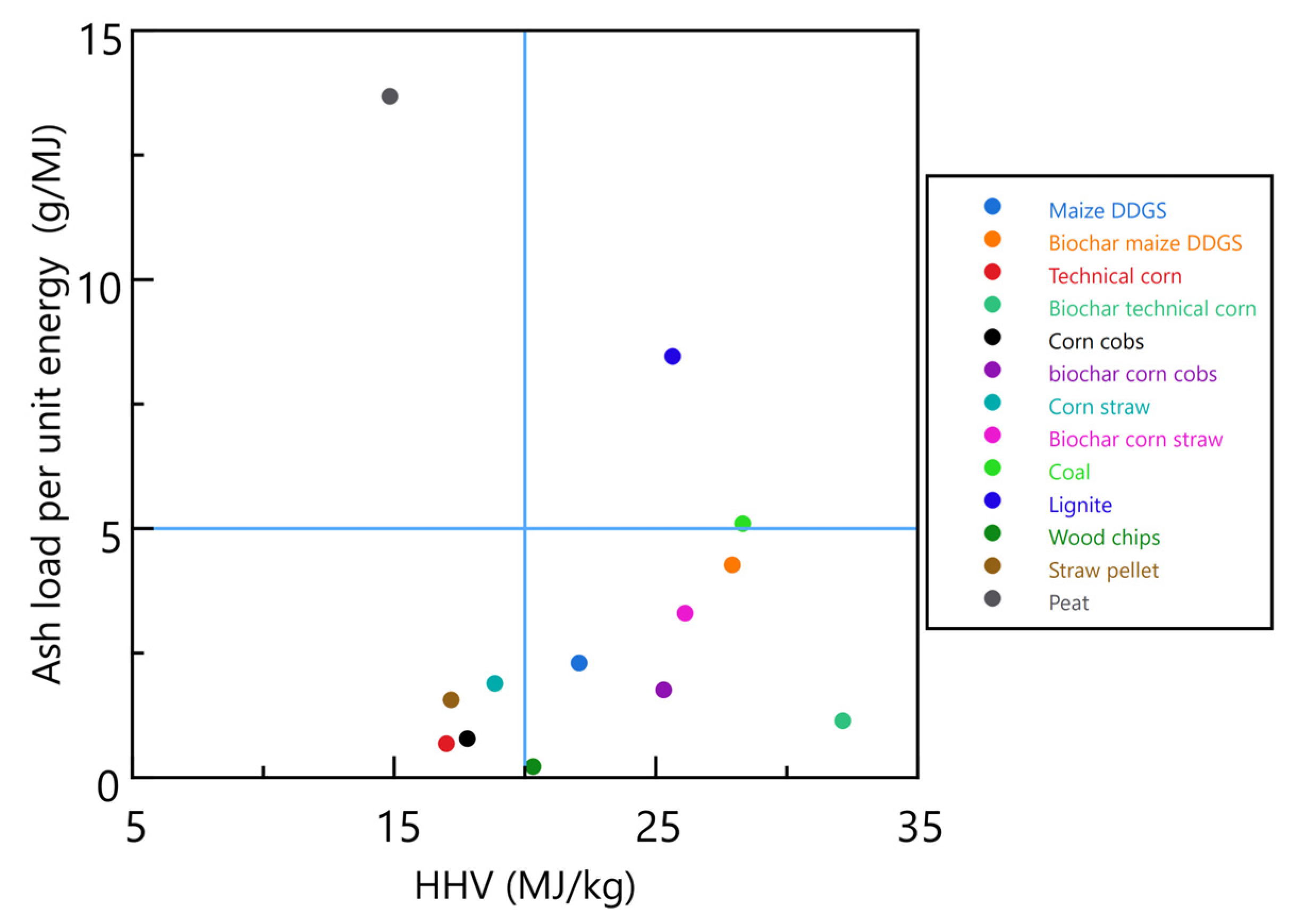
Based on the analysis of the relationship between the higher heating value (HHV) and ash content, using isolines (blue lines in Figure 5) defined at HHV = 20 MJ/kg and ash load per MJ = 5 g, the investigated solid fuels were classified into four groups differing in their energetic and operational suitability.
The upper-left region of the diagram, representing fuels with low HHV and high ash content, includes fuels with the poorest overall quality, such as peat and lignite. These fuels are characterized by low energy density and a significant mineral fraction, which results in reduced combustion efficiency and numerous operational issues, including slagging, fouling, and increased ash production. Consequently, fuels in this region are considered the least favorable and require advanced technological solutions or co-firing strategies to mitigate their negative impacts.
The lower-left region of the diagram comprises fuels with relatively low HHV but very low ash content, such as wood chips and straw pellets. Despite their moderate energy content, these fuels exhibit very good operational behavior due to the limited amount of ash generated during combustion. This makes them particularly suitable for installations sensitive to ash-related problems, ensuring stable operation and reduced maintenance requirements.
The lower-right region of the diagram is regarded as the most advantageous and contains fuels with high HHV and low ash content. This group includes technical maize biochar and maize cob biochar, which combine high energy density with limited ash production. These fuels offer high thermal efficiency, stable combustion, and minimal operational issues, making them the most desirable from both the energetic and technological perspectives.
In contrast, the upper-right region (Figure 5) of the diagram represents fuels with high HHV but elevated ash content, such as hard coal and maize DDGS. While these fuels provide high energy output, their increased ash content may lead to operational challenges, including enhanced fouling and slagging tendencies higher loads on ash handling systems, and the need for more careful control of combustion conditions. Thus, these fuels are energetically attractive but may require optimized operating strategies or blending with low-ash fuels.
In conclusion, the HHV–ash content analysis clearly demonstrates that fuels located in the lower-right region of the diagram exhibit the most favorable overall performance, whereas high ash content, regardless of the energy value, significantly increases the risk of operational problems and limits technological suitability.

4. Discussion

In summary, the biochar yield at 500 °C is strongly dependent on the type of processed maize residues material. DDGS exhibits the highest potential for biochar production, which may be advantageous in the context of material or sorption applications, whereas maize cobs and technical maize generate smaller amounts of solid product, favoring processes oriented toward the production of liquid and gaseous fractions.
Compared with fossil fuels, biomass and its biochar generally show a lower ash content than hard coal, whose ash content typically ranges from 5 to 15% and in the case of low-quality coals may exceed 20%. This indicates that raw maize residue biomass is a much “cleaner” fuel in terms of mineral residue content than coal while biochar—especially those derived from DDGS and maize straw—exhibit ash contents comparable to the lower range typical of hard coal. Researchers in [60] have proved that fly ashes modified by adding a fine biosorbent from pyrolysis process can significantly remove mercury from flue gases and can be a cheaper and more sustainable alternatives to activated carbon derived from fossil fuels.
Overall, the pyrolysis process leads to a significant concentration of mineral components and an increase in ash content in biochar relative to raw biomass. This phenomenon limits their applicability as fuels in conventional combustion installations; however, it simultaneously increases the potential for utilizing the ash as a mineral raw material; for example, in agriculture or as a component of building materials.
Pyrolysis at 500 °C results in a substantial increase in the concentration of chemical energy in the solid fuel. Raw maize biomass exhibits a moderate energy potential typical of renewable fuels, whereas the obtained biochars are characterized by a significantly increased heating value, making them competitive with conventional fossil fuels. At the same time, the higher ash content of biochar compared with both biomass and coal may restrict their direct use in conventional combustion systems. Nevertheless, from the perspective of energy density and co-combustion potential, their applicability remains very high.
The mineral fraction of the investigated maize biomasses plays a crucial role in determining both their fuel suitability and the potential utilization of the resulting ashes. Biomasses with very high potassium content such as maize cobs and technical maize exhibit an increased risk of operational problems during combustion, whereas materials richer in calcium, such as maize straw and DDGS, may display more favorable ash behavior. At the same time, ashes from the combustion of all analyzed biomasses, due to their high contents of potassium calcium and phosphorus, as well as the presence of micronutrients, show significant potential for agricultural applications, provided that their chemical composition is controlled and application rates are adjusted to soil requirements.
In terms of fuel properties—specifically high calorific value and low ash content per unit of energy—maize biochar, biochar from maize bran, and cob biochar proved to be the most effective among the maize residue materials tested. Some scientists in [61] have proven that maize straw biochar can be used for heavy metal removal and concluded that the pyrolysis temperature has a strong influence on biochar properties. The sorption of Pb2+ and Hg2+ onto maize straw biochar followed the mechanisms of surface precipitation of carbonates and phosphates and complexation with oxygenated functional groups and delocalized π electrons. The produced biochar contents of microelements like Cu, Fe, and Zn and all produced biochars were characterized with low concentrations of above minerals. Nevertheless, the highest concentrations occur in technical maize, as well as in DDGS. These levels fall within ranges typical for agricultural biomass and do not indicate an environmental risk. If we were to apply produced by us biochars as a carbon carrier of fertilizers, then we could use the ash derived from these maize residues, which is a valuable source of micronutrients essential for plant growth of, for example, duckweeds [62]. Additionally, another group of researchers [63] has conducted research on hydrothermal carbonization of maize straw.

5. Conclusions

The pyrolysis process leads to a significant increase in the ash fraction in the resulting biochar, which is a direct consequence of the removal of a substantial portion of organic matter in the form of volatile and liquid products. The ash content in the biochar ranges from 3.68 to 11.94%, i.e., it is approximately two to three times higher than in the corresponding raw biomasses. This behavior is characteristic of most biomass materials. The lowest ash content is observed in biochar derived from technical maize (3.68%), while the highest ash content is found in biochar from DDGS (11.94%). Biochar obtained from maize straw, bran, and cobs exhibits intermediate values of 9.12%, 4.57%, and 4.46%, respectively. This trend confirms that materials with a higher initial ash content generate biochar with a substantially increased proportion of the mineral fraction.
When comparing the obtained values with other types of biomass, it should be noted that raw woody biomass (both softwood and hardwood) is typically characterized by very low ash contents [64], most often in the range of 0.3–1.0%. This indicates that even the least ash-forming maize residues, such as technical maize or cobs, contain higher amounts of mineral components than typical woody fuels. In contrast, agricultural biomass, including cereal straw and post-harvest residues, usually exhibits ash contents in the range of 2–6%, which corresponds well with the values obtained for maize straw and DDGS.
In this research, we have provided solid experimental studies of converting selected maize-derived residues (straw, cobs, technical maize, and post-fermentation DDGS) into renewable carbonized solid fuels based on thermochemical processes obtained through pyrolysis at 500 °C. This work included analyses of the mineral content of biomass and biochars, evaluation of biochar yield, ash content, and higher heating value (HHV) [65], with the values obtained corresponding to the results of other researchers [66,67]. The main conclusions from this work indicate that biochars derived from maize residues may be used as renewable fuels, which can directly replace coal in redistributed energy systems (direct combustion) with increased energy density. Ashes produced from this biochar combustion can be directly applied in new fertilizers for the agricultural sector. Future work will include research on using hydrogels for the slow release of maize biochars, in order to increase the time during which minerals leak to plants roots, resulting in strong growth stimulation and a longer effect compared to direct applications of ashes and/or biochars in the soil.

Author Contributions

Conceptualization. S.S., P.P., P.K. and K.P.; methodology. S.S. and P.K.; software. O.S. and P.K.; validation S.S., P.P., P.K. and K.P.; formal analysis. S.S. and P.K.; investigation. O.S., S.S., P.P. and P.K.; resources. S.S., P.P., P.K. and K.P.; data curation. S.S., P.P., P.K. and K.P.; writing—original draft preparation. O.S., S.S., P.P., P.K. and K.P.; writing—review and editing. S.S., P.P., P.K. and K.P.; visualization. O.S. and P.K.; supervision. S.S. and P.K.; project administration. S.S., P.P. and K.P.; funding acquisition. S.S., P.P. and K.P. All authors have read and agreed to the published version of the manuscript.

Funding

Authors acknowledge the support received from BioTrainValue (BIOmass Valorisation via Superheated Steam Torrefaction. Pyrolysis. Gasification Amplifed by Multidisciplinary Researchers TRAINing for Multiple Energy and Products’ AddedVALUEs), project number: 101086411, funded under Horizon Europe’s Maria Skłodowska-Curie Staff Exchange program.

Data Availability Statement

The original contributions presented in this study are included in the article. Further inquiries can be directed to the corresponding author.

Conflicts of Interest

Authors Piotr Piersa, Katarzyna Piersa were employed by the company APS-Ekoinnowacje Sp. z o.o. The remaining authors declare that the research was conducted in the absence of any commercial or financial relationships that could be construed as a potential conflict of interest. The company had no role in the design of the study; in the collection, analyses, or interpretation of data; in the writing of the manuscript, or in the decision to publish the results.

References

  1. Vieira, R.; Uhdre, R.; Scapim, C.; Becelaere, G. Global Corn Area from 1960 to 2030: Patterns, Trends, and Implications. J. Agric. Sci. 2025, 163, 295–306. [Google Scholar] [CrossRef]
  2. Erenstein, O.; Jaleta, M.; Sonder, K.; Mottaleb, K.; Prasanna, B.M. Global Maize Production, Consumption and Trade: Trends and R&D Implications. Food Secur. 2022, 14, 1295–1319. [Google Scholar] [CrossRef]
  3. Ruan, Z.; Wang, X.; Liu, Y.; Liao, W. Chapter 3—Corn. In Integrated Processing Technologies for Food and Agricultural By-Products; Pan, Z., Zhang, R., Zicari, S., Eds.; Academic Press: Cambridge, MA, USA, 2019; pp. 59–72. [Google Scholar]
  4. Wang, X.; Yuan, Z.; Gao, Y.; Zhang, H.; Tao, X.; Li, X. Research Hotspots and Trends in the Comprehensive Utilization of Distillers’ Grains: A Bibliometric Analysis. Ecotoxicol. Environ. Saf. 2025, 306, 119326. [Google Scholar] [CrossRef]
  5. Hristakieva, P.; Mincheva, N.; Ivanova, I.; Oblakova, M.; Ivanov, N.; Slavov, I. Use of Distiller’s Dried Grains with Solubles (DDGS) from Corn or Wheat in Broiler Diets. Bulg. J. Anim. Husb. 2023, 60, 22–34. [Google Scholar] [CrossRef]
  6. Saeed, F.; Hussain, M.; Arshad, M.S.; Afzaal, M.; Munir, H.; Imran, M.; Tufail, T.; Anjum, F. Functional and Nutraceutical Properties of Maize Bran Cell Wall Non-Starch Polysaccharides. Int. J. Food Prop. 2021, 24, 233–248. [Google Scholar] [CrossRef]
  7. Rose, D.; Inglett, G. Production of Feruloylated Arabinoxylo-Oligosaccharides from Maize (Zea mays) Bran by Microwave-Assisted Autohydrolysis. Food Chem. 2010, 119, 1613–1618. [Google Scholar] [CrossRef]
  8. Wrzesińska-Jędrusiak, E.; Czarnecki, M.; Kazimierski, P.; Bandrów, P.; Szufa, S. The Circular Economy in the Management of Waste from Leather Processing. Energies 2023, 16, 564. [Google Scholar] [CrossRef]
  9. Mullen, C.; Boateng, A.; Goldberg, N.; Lima, I.; Laird, D.; Hicks, K. Bio-Oil and Bio-Char Production from Corn Cobs and Stover by Fast Pyrolysis. Biomass Bioenergy 2010, 34, 67–74. [Google Scholar] [CrossRef]
  10. Lei, H.; Ren, S.; Wang, L.; Bu, Q.; Julson, J.; Holladay, J.; Ruan, R. Microwave Pyrolysis of Distillers Dried Grain with Solubles (DDGS) for Biofuel Production. Bioresour. Technol. 2011, 102, 6208–6213. [Google Scholar] [CrossRef]
  11. Onsree, T.; Tippayawong, N.; Williams, T.; McCullough, K.; Barrow, E.; Pogaku, R.; Lauterbach, J. Torrefaction of Pelletized Corn Residues with Wet Flue Gas. Bioresour. Technol. 2019, 285, 121330. [Google Scholar] [CrossRef] [PubMed]
  12. Liu, X.; Zhang, Y.; Li, Z.; Feng, R.; Zhang, Y. Characterization of Corncob-Derived Biochar and Pyrolysis Kinetics in Comparison with Corn Stalk and Sawdust. Bioresour. Technol. 2014, 170, 76–82. [Google Scholar] [CrossRef]
  13. Sharma, S.; Pradhan, R.; Manickavasagan, A.; Thimmanagari, M.; Dutta, A. Valorization and Potential of Condensed Corn Distillers Solubles Fractions from Selective Milling Technology. Biomass Conv. Bioref. 2023, 13, 5885–5901. [Google Scholar] [CrossRef]
  14. Böttger, C.; Südekum, K.-H. Review: Protein Value of Distillers Dried Grains with Solubles (DDGS) in Animal Nutrition as Affected by the Ethanol Production Process. Anim. Feed Sci. Technol. 2018, 244, 11–17. [Google Scholar] [CrossRef]
  15. Laird, D. The Charcoal Vision: A Win–Win–Win Scenario for Simultaneously Producing Bioenergy, Permanently Sequestering Carbon, While Improving Soil and Water Quality. Agron. J. 2008, 100, 178–181. [Google Scholar] [CrossRef]
  16. Zhang, H.; Cheng, Y.; Zhong, Y.; Ni, J.; Wei, R.; Chen, W. Roles of Biochars’ Properties in Their Water-Holding Capacity and Bound Water Evaporation: Quantitative Importance and Controlling Mechanism. Biochar 2024, 6, 30. [Google Scholar] [CrossRef]
  17. Sharma, A.; Ghodke, P.; Goyal, N.; Bobde, P.; Kwon, E.; Lin, A.; Chen, W.-H. A Critical Review on Biochar Production from Pine Wastes, Upgradation Techniques, Environmental Sustainability, and Challenges. Bioresour. Technol. 2023, 387, 129632. [Google Scholar] [CrossRef]
  18. Leng, L.; Xiong, Q.; Yang, L.; Li, H.; Zhou, Y.; Zhang, W.; Jiang, S.; Li, H.; Huang, H. An Overview on Engineering the Surface Area and Porosity of Biochar. Sci. Total Environ. 2021, 763, 144204. [Google Scholar] [CrossRef]
  19. Mierzwa-Hersztek, M.; Gondek, K.; Jewiarz, M.; Dziedzic, K. Assessment of Energy Parameters of Biomass and Biochars, Leachability of Heavy Metals and Phytotoxicity of Their Ashes. J. Mater. Cycles Waste Manag. 2019, 21, 786–800. [Google Scholar] [CrossRef]
  20. Li, H.; Dong, X.; da Silva, E.B.; de Oliveira, L.M.; Chen, Y.; Ma, L.Q. Mechanisms of Metal Sorption by Biochars: Biochar Characteristics and Modifications. Chemosphere 2017, 178, 466–478. [Google Scholar] [CrossRef] [PubMed]
  21. Lin, H.; Xie, J.; Dong, Y.; Liu, J.; Meng, K.; Jin, Q. A Complete Review on the Surface Functional Groups in Pyrolyzed Biochar and Its Interaction Mechanism with Heavy Metal in Water. J. Environ. Chem. Eng. 2025, 13, 116681. [Google Scholar] [CrossRef]
  22. Mei, Y.; Zhuang, S.; Wang, J. Adsorption of Heavy Metals by Biochar in Aqueous Solution: A Review. Sci. Total Environ. 2025, 968, 178898. [Google Scholar] [CrossRef]
  23. Yaseen, Z.M.; Alhalimi, F.L. Heavy Metal Adsorption Efficiency Prediction Using Biochar Properties: A Comparative Analysis for Ensemble Machine Learning Models. Sci. Rep. 2025, 15, 13434. [Google Scholar] [CrossRef]
  24. Pathy, A.; Pokharel, P.; Chen, X.; Balasubramanian, P.; Chang, S.X. Activation Methods Increase Biochar’s Potential for Heavy-Metal Adsorption and Environmental Remediation: A Global Meta-Analysis. Sci. Total Environ. 2023, 865, 161252. [Google Scholar] [CrossRef] [PubMed]
  25. Tian, L.; Zhu, H.; Hao, Y.; Tong, Y.; Chang, Z.; Yang, D.; Du, W.; Yu, Y.; Pan, B. Environmental Aging Enhanced the Ability of Biochar to Remediate Heavy Metal-Contaminated Soil through Combined Adsorption and Microbial Community Regulation: A Mechanistic Analysis. Ind. Crops Prod. 2026, 239, 122477. [Google Scholar] [CrossRef]
  26. Szufa, S.; Piersa, P.; Junga, R.; Błaszczuk, A.; Modliński, N.; Sobek, S.; Marczak-Grzesik, M.; Adrian, Ł.; Dzikuć, M. Numerical Modeling of the Co-Firing Process of an in Situ Steam-Torrefied Biomass with Coal in a 230 MW Industrial-Scale Boiler. Energy 2023, 263, 125918. [Google Scholar] [CrossRef]
  27. Szufa, S.; Wielgosinski, G.; Piersa, P.; Czerwińska, J.; Dzikuć, M.; Adrian, L.; Lewandowska, W.; Marczak-Grzesik, M. Torrefaction of Straw from Oats and Maize for Use as A Fuel and Additive to Organic Fertilizers—TGA Analysis, Kinetics as Products for Agricultural Purposes. Energies 2020, 13, 2064. [Google Scholar] [CrossRef]
  28. Szufa, S. Zastosowanie przegrzanej pary w procesie toryfikacji biomasy. Przem. Chem. 2020, 1, 123–127. [Google Scholar] [CrossRef]
  29. Szufa, S.; Dzikuć, M.; Adrian, L.; Piersa, P.; Romanowska-Duda, Z.; Lewandowska, W.; Marczak-Grzesik, M.; Blaszczuk, A.; Piwowar, A. Torrefaction of Oat Straw to Use as Solid Biofuel, an Additive to Organic Fertilizers for Agriculture Purposes and Activated Carbon—TGA Analysis, Kinetics. E3S Web Conf. 2020, 154, 02004. [Google Scholar] [CrossRef]
  30. Unyay, H.; Piersa, P.; Zabochnicka, M.; Romanowska-Duda, Z.; Kuryło, P.; Kuligowski, K.; Kazimierski, P.; Hutsol, T.; Dyjakon, A.; Wrzesińska-Jędrusiak, E.; et al. Torrefaction of Willow in Batch Reactor and Co-Firing of Torrefied Willow with Coal. Energies 2023, 16, 8083. [Google Scholar] [CrossRef]
  31. Jiang, T.-Y.; Jiang, J.; Xu, R.-K.; Zhou, L.; Wang, S.-M. Effects of Different Temperatures Biochar on Adsorption of Pb(II) on Variable Charge Soils. Huan Jing Ke Xue 2013, 34, 1598–1604. [Google Scholar]
  32. Liu, Y.; Xu, X.; Qu, B.; Liu, X.; Yi, W.; Zhang, H. Study on Adsorption Properties of Modified Corn Cob Activated Carbon for Mercury Ion. Energies 2021, 14, 4483. [Google Scholar] [CrossRef]
  33. Antal, M.J.; Grønli, M. The Art, Science, and Technology of Charcoal Production. Ind. Eng. Chem. Res. 2003, 42, 1619–1640. [Google Scholar] [CrossRef]
  34. Miranda, M.T.; Sepúlveda, F.J.; Arranz, J.I.; Montero, I.; Rojas, C.V. Analysis of Pelletizing from Corn Cob Waste. J. Environ. Manag. 2018, 228, 303–311. [Google Scholar] [CrossRef]
  35. Maj, G.; Krzaczek, P.; Gołębiowski, W.; Słowik, T.; Szyszlak-Bargłowicz, J.; Zając, G. Energy Consumption and Quality of Pellets Made of Waste from Corn Grain Drying Process. Sustainability 2022, 14, 8129. [Google Scholar] [CrossRef]
  36. Djatkov, D.; Martinov, M.; Kaltschmitt, M. Influencing Parameters on Mechanical–Physical Properties of Pellet Fuel Made from Corn Harvest Residues. Biomass Bioenergy 2018, 119, 418–428. [Google Scholar] [CrossRef]
  37. Lin, B.; Yan, J.; Zhong, Z.; Zheng, X. A Study on the Preparation of Microbial and Nonstarch Polysaccharide Enzyme Synergistic Fermented Maize Cob Feed and Its Feeding Efficiency in Finishing Pigs. BioMed Res. Int. 2020, 2020, 8839148. [Google Scholar] [CrossRef]
  38. Ojediran, T.K.; Olorunlowu, S. Corn and Cob Meal: Nutrient Composition and Nutritive Value. J. Microbiol. Biotechnol. Food Sci. 2025, 15, e10412. [Google Scholar] [CrossRef]
  39. Glaser, B.; Lehr, V.-I. Biochar Effects on Phosphorus Availability in Agricultural Soils: A Meta-Analysis. Sci. Rep. 2019, 9, 9338. [Google Scholar] [CrossRef] [PubMed]
  40. Qi, S.; Yang, S.; Lin, X.; Hu, J.; Jiang, Z.; Xu, Y. The Long-Term Effectiveness of Biochar in Increasing Phosphorus Availability and Reducing Its Release Risk to the Environment in Water-Saving Irrigated Paddy Fields. Agric. Water Manag. 2023, 282, 108295. [Google Scholar] [CrossRef]
  41. Zhang, L.; Chang, L.; Liu, H.; de Jesús Puy Alquiza, M.; Li, Y. Biochar Application to Soils Can Regulate Soil Phosphorus Availability: A Review. Biochar 2025, 7, 13. [Google Scholar] [CrossRef]
  42. Rodríguez-Vila, A.; Atuah, L.; Abubakari, A.H.; Atorqui, D.W.; Abdul-Karim, A.; Coole, S.; Hammond, J.; Robinson, S.; Sizmur, T. Effect of Biochar on Micronutrient Availability and Uptake Into Leafy Greens in Two Urban Tropical Soils with Contrasting Soil pH. Front. Sustain. Food Syst. 2022, 6, 821397. [Google Scholar] [CrossRef]
  43. Đukanović, N.; Apostolović, T.; Anojčić, J.; Mutić, S.; Srebro, T.M.; Kozma, G.; Deák, C.; Maletić, S.; Beljin, J. Comparative Study of Biochar from Different Biomass Feedstocks: Toward Sustainable Resource Utilization and Environmental Applications. Molecules 2025, 31, 37. [Google Scholar] [CrossRef]
  44. Khater, E.-S.; Bahnasawy, A.; Hamouda, R.; Sabahy, A.; Abbas, W.; Morsy, O.M. Biochar Production under Different Pyrolysis Temperatures with Different Types of Agricultural Wastes. Sci. Rep. 2024, 14, 2625. [Google Scholar] [CrossRef]
  45. Leng, L.; Liu, R.; Xu, S.; Mohamed, B.A.; Yang, Z.; Hu, Y.; Chen, J.; Zhao, S.; Wu, Z.; Peng, H.; et al. An Overview of Sulfur-Functional Groups in Biochar from Pyrolysis of Biomass. J. Environ. Chem. Eng. 2022, 10, 107185. [Google Scholar] [CrossRef]
  46. Catalfamo, P.; Di Pasquale, S.; Corigliano, F.; Mavilia, L. Influence of the Calcium Content on the Coal Fly Ash Features in Some Innovative Applications. Resour. Conserv. Recycl. 1997, 20, 119–125. [Google Scholar] [CrossRef]
  47. Zacharczuk, W.; Andruszkiewicz, A.; Tatarek, A.; Alahmer, A.; Alsaqoor, S. Effect of Ca-Based Additives on the Capture of SO2 during Combustion of Pulverized Lignite. Energy 2021, 231, 120988. [Google Scholar] [CrossRef]
  48. Rafiq, M.K.; Bachmann, R.T.; Rafiq, M.T.; Shang, Z.; Joseph, S.; Long, R. Influence of Pyrolysis Temperature on Physico-Chemical Properties of Corn Stover (Zea mays L.) Biochar and Feasibility for Carbon Capture and Energy Balance. PLoS ONE 2016, 11, e0156894. [Google Scholar] [CrossRef]
  49. Kazimierski, P.; Hercel, P.; Suchocki, T.; Smoliński, J.; Pladzyk, A.; Kardaś, D.; Łuczak, J.; Januszewicz, K. Pyrolysis of Pruning Residues from Various Types of Orchards and Pretreatment for Energetic Use of Biochar. Materials 2021, 14, 2969. [Google Scholar] [CrossRef] [PubMed]
  50. Kazimierski, P.; Kardaś, D. Influence of Temperature on Composition of Wood Pyrolysis Products. Drv. Ind. 2017, 68, 307–313. [Google Scholar] [CrossRef][Green Version]
  51. Intani, K.; Latif, S.; Cao, Z.; Müller, J. Characterisation of Biochar from Maize Residues Produced in a Self-Purging Pyrolysis Reactor. Bioresour. Technol. 2018, 265, 224–235. [Google Scholar] [CrossRef]
  52. Allen, J.A.; Downie, A.E. Predicting Slow Pyrolysis Process Outcomes with Simplified Empirical Correlations for a Consistent Higher Heating Temperature: Biochar Yield and Ash Content. Energy Fuels 2020, 34, 14223–14231. [Google Scholar] [CrossRef]
  53. Nair, R.R.; Kißling, P.A.; Marchanka, A.; Lecinski, J.; Turcios, A.E.; Shamsuyeva, M.; Rajendiran, N.; Ganesan, S.; Srinivasan, S.V.; Papenbrock, J.; et al. Biochar Synthesis from Mineral and Ash-Rich Waste Biomass, Part 2: Characterization of Biochar and Co-Pyrolysis Mechanism for Carbon Sequestration. Sustain. Environ. Res. 2023, 33, 14. [Google Scholar] [CrossRef]
  54. Saletnik, B.; Zagula, G.; Bajcar, M.; Czernicka, M.; Puchalski, C. Biochar and Biomass Ash as a Soil Ameliorant: The Effect on Selected Soil Properties and Yield of Giant Miscanthus (Miscanthus × Giganteus). Energies 2018, 11, 2535. [Google Scholar] [CrossRef]
  55. Fatih, G.; Pekaslan, D.; Williams, O.; Lester, E. Predictability of Higher Heating Value of Biomass Feedstocks via Proximate and Ultimate Analyses -A Comprehensive Study of Artificial Neural Network Applications. Fuel 2022, 320, 123944. [Google Scholar] [CrossRef]
  56. Kazimierski, P.; Januszewicz, K.; Godlewski, W.; Fijuk, A.; Suchocki, T.; Chaja, P.; Barczak, B.; Kardaś, D. The Course and the Effects of Agricultural Biomass Pyrolysis in the Production of High-Calorific Biochar. Materials 2022, 15, 1038. [Google Scholar] [CrossRef] [PubMed]
  57. Park, J.E.; Lee, G.B.; Jeong, C.J.; Kim, H.; Kim, C.G. Determination of Relationship between Higher Heating Value and Atomic Ratio of Hydrogen to Carbon in Spent Coffee Grounds by Hydrothermal Carbonization. Energies 2021, 14, 6551. [Google Scholar] [CrossRef]
  58. Bitencourt, G.F.; Romeiro, G.A.; da Cunha Veloso, M.C.; Peixoto, B.S.; de Oliveira, P.C.O. Evaluation of Higher Heating Value Correlations for Lignocellulosic Biomass and Biochars Obtained Through Slow Pyrolysis. Preprint 2021. SSRN 3824335. [Google Scholar] [CrossRef]
  59. Ige, A.R.; Łaska, G.; Świderski, G.; Zając, G. Optimizing Agricultural Biomass Selection for Biochar Production Using Multicriteria Decision-Making. Sci. Rep. 2025, 15, 29140. [Google Scholar] [CrossRef]
  60. Marczak-Grzesik, M.; Piersa, P.; Karczewski, M.; Szufa, S.; Ünyay, H.; Kędzierska-Sar, A.; Bochenek, P. Modified Fly Ash-Based Adsorbents (MFA) for Mercury and Carbon Dioxide Removal from Coal-Fired Flue Gases. Energies 2021, 14, 7101. [Google Scholar] [CrossRef]
  61. Hu, X.; Zhang, R.; Xia, B.; Ying, R.; Hu, Z.; Tao, X.; Yu, H.; Xiao, F.; Chu, Q.; Chen, H.; et al. Effect of Pyrolysis Temperature on Removal Efficiency and Mechanisms of Hg(II), Cd(II), and Pb (II) by Maize Straw Biochar. Sustainability 2022, 14, 9022. [Google Scholar] [CrossRef]
  62. Oláh, V.; Appenroth, K.-J.; Sree, K.S. Duckweed: Research Meets Applications. Plants 2023, 12, 3307. [Google Scholar] [CrossRef]
  63. Sobek, S.; Tran, K.-Q.; Junga, R.; Werle, S. Hydrothermal Carbonization of the Waste Straw: A Study of the Biomass Transient Heating Behavior and Solid Products Combustion Kinetics. Fuel 2021, 314, 122725. [Google Scholar] [CrossRef]
  64. Filipe dos Santos Viana, H.; Martins Rodrigues, A.; Godina, R.; Carlos de Oliveira Matias, J.; Jorge Ribeiro Nunes, L. Evaluation of the Physical, Chemical and Thermal Properties of Portuguese Maritime Pine Biomass. Sustainability 2018, 10, 2877. [Google Scholar] [CrossRef]
  65. Sampaolesi, S.; Musci, J.J.; Toledo, M.V.; Briand, L.E.; Lick, I.D.; Casella, M.L. Pyrolysis of Lignocellulosic Based Waste: Comparison of Brewer’s Spent Grain, Tree Pruning and Woody Biomass. Biomass Bioenergy 2026, 210, 109059. [Google Scholar] [CrossRef]
  66. Williams, L.; Westover, T.; Emerson, R.; Tumuluru, J.S.; Li, C. Sources of Biomass Feedstock Variability and the Potential Impact on Biofuels Production. BioEnergy Res. 2016, 9, 1–14. [Google Scholar] [CrossRef]
  67. Capunitan, J.; Capareda, S. Assessing the Potential for Biofuel Production of Corn Stover Pyrolysis Using a Pressurized Batch Reactor. Fuel 2012, 95, 563–572. [Google Scholar] [CrossRef]
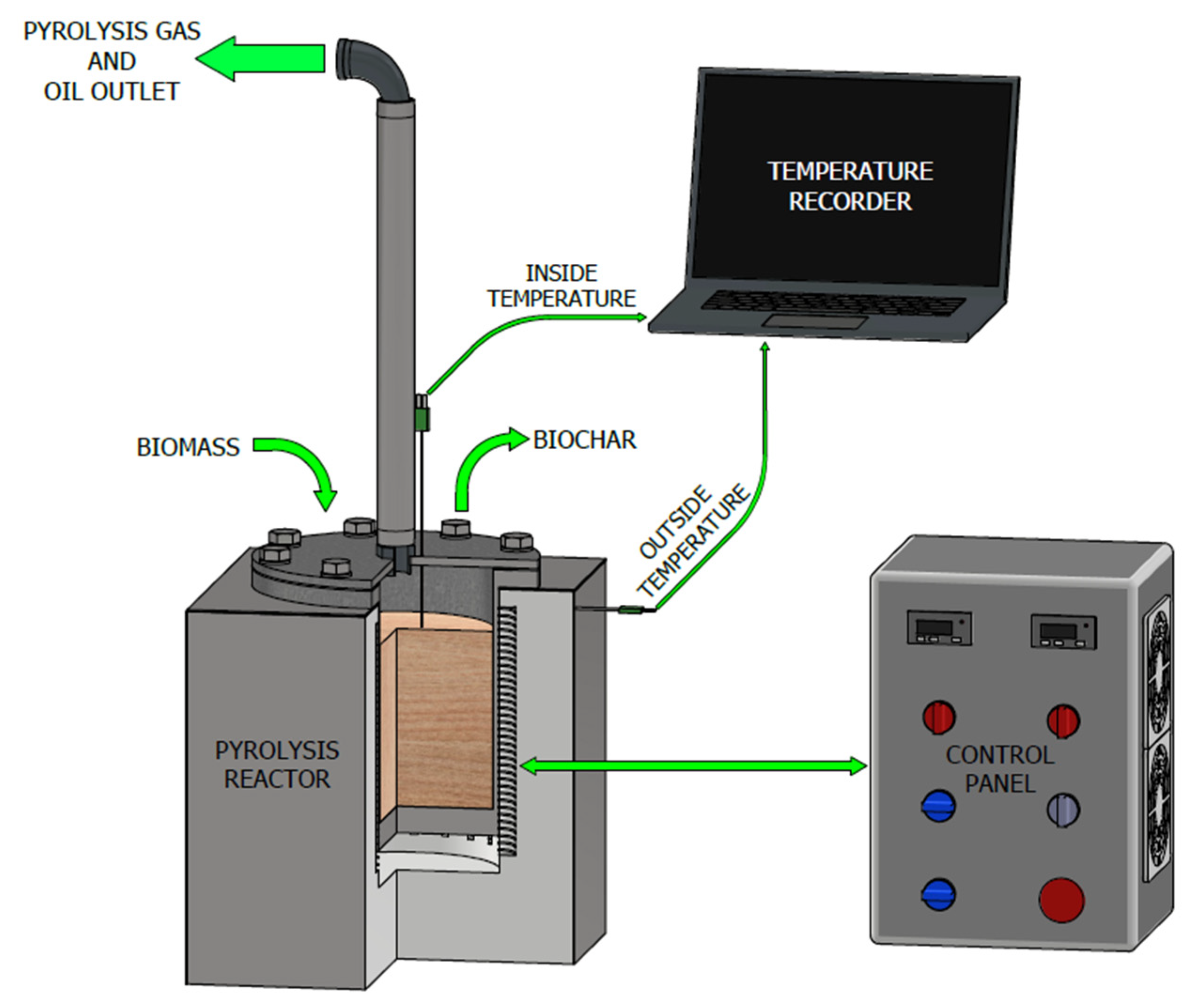
Figure 1. Research station diagram.
Processes 14 01319 g001
Figure 2. Thermogravimetric analysis of the mass loss of maize waste as a function of temperature.
Processes 14 01319 g002
Figure 3. Thermogravimetric analysis of the mass loss derivative as a function of temperature for maize waste.
Processes 14 01319 g003
Figure 4. Biomass and biochars from waste, (from the top) maize cob, maize straw, technical maize, maize bran, and DDGS.
Processes 14 01319 g004
Figure 5. A diagram illustrating fuel quality based on HHV and ash content.
Processes 14 01319 g005
Table 1. Elemental composition of mineral fractions of individual waste streams. Values are reported as mean ± standard deviation.
Si [%]K [%]Ca [%]S [%]P [%]Cu [%]Fe [%]Zn [%]
Maize DDGS-64.442 ± 0.1368.22 ± 0.21312.074 ± 0.06812.004 ± 0.0420.584 ± 0.0571.634 ± 0.0411.042 ± 0.024
Technical maize10.466 ±0.93972.89 ± 1.804-4.323 ± 0.9132.725 ± 0.2842.539 ± 0.3474.743 ± 0.2082.314 ± 0.633
Maize cobs7.721± 0.20788.794 ± 0.198-0.964 ± 0.0130.587 ± 0.0320.689 ± 0.0130.67 ± 0.0190.574 ± 0.015
Maize straw3.757 ±0.78960.247 ± 2.24833.822 ± 1.4610.741 ± 0.0490.005 ± 0.0080.561 ± 0.0980.867 ± 0.176-
Maize bran-72.938 ± 5.255-9.671 ± 3.41510.201 ± 2.7292.715 ± 0.0632605 ± 0.6971.873 ± 0.131
Table 2. Fuel properties of biomass and biochar. Values are reported as mean ± standard deviation.
Biochar [%]Ash in Biomass [%]Ash in Biochar [%]Biomass HHV [MJ/kg]Biochar HHV [MJ/kg]
Maize DDGS42.495.0810.6819.14 ± 0.5127.92 ± 0.27
Technical maize34.581.273.351732.14
Maize cobs35.001.563.9717.825.43 ± 0.18
Maize straw39.273.588.2217 ± 2.1826.12 ± 0.81
Maize bran30.191.384.5716.87 ± 0.2630.49 ± 0.13
Table 3. Energy analysis of biochars fuels.
EDREnergy EfficiencyAsh Biomass per MJAsh Biochar per MJ
Maize DDGS1.4153.762.34.27
Technical maize1.8959.640.681.14
Maize cobs1.4244.260.781.76
Maize straw1.6157.171.893.3
Maize bran1.7054.360.771.50
Disclaimer/Publisher’s Note: The statements, opinions and data contained in all publications are solely those of the individual author(s) and contributor(s) and not of MDPI and/or the editor(s). MDPI and/or the editor(s) disclaim responsibility for any injury to people or property resulting from any ideas, methods, instructions or products referred to in the content.