Article

Study on Corrosion in Wet Gas Pipelines Under the Influence of Gas Composition and Geometric Configuration


1
Northeast Sichuan Gas Mining District of Southwest Oil and Gas Field, Dazhou 653000, China
2
School of Safety Science and Engineering, Chongqing University of Science and Technology, Chongqing 401331, China
3
School of Petroleum Engineering, Chongqing University of Science and Technology, Chongqing 401331, China
*
Authors to whom correspondence should be addressed.
Processes 2026, 14(8), 1320; https://doi.org/10.3390/pr14081320
Submission received: 9 March 2026 / Revised: 8 April 2026 / Accepted: 15 April 2026 / Published: 21 April 2026
(This article belongs to the Section Chemical Processes and Systems)

Abstract

In response to corrosion challenges encountered during the gathering and transportation of wet natural gas, this study systematically investigates the corrosion behavior of L245NCS steel in environments containing O2, H2S, CO2 and simulated oilfield-produced water. The research employs a combined approach involving high-pressure autoclave experiments and transparent flow loop simulations. Autoclave tests reproduce gas phase, liquid phase, and gas–liquid interface conditions under a controlled O2-H2S-CO2 mixture, while a visual flow loop equipped with elbows and undulating sections is used to examine liquid accumulation behavior and flow characteristics under dynamic, real-world operating conditions. Results indicate that corrosion is most severe at the gas–liquid interface. H2S is identified as the primary corrosive agent, exerting a stronger influence than CO2 or O2. Liquid accumulation is the main factor leading to non-uniform corrosion distribution, and its formation is influenced by water content, pressure, temperature difference, and pipeline shutdown and restart operations. Critical areas such as low-lying sections, downhill bottoms, and the beginning of uphill sections exhibit localized corrosion rates up to 61.4% higher than areas without liquid accumulation. This integrated methodology bridges mechanistic understanding with engineering practice, providing a basis for corrosion risk assessment, optimal monitoring point placement, and integrity management of wet gas pipelines.

1. Introduction

During the processes of oil and gas gathering and transportation, pipeline steels are long-term exposed to complex wet gas or dense-phase flow environments containing multiple corrosive media such as CO2, H2S, and O2. They are confronted with severe risks of localized corrosion and uniform corrosion failure, which seriously threaten the safety of energy transportation and may lead to significant economic losses and environmental pollution accidents [1,2,3]. To scientifically evaluate the service life of pipelines and formulate effective integrity management strategies, laboratory simulation research is a key means of revealing corrosion mechanisms and predicting corrosion rates.
Traditional corrosion research highly relies on high-pressure autoclaves, which can accurately control thermodynamic parameters such as temperature, pressure, and gas partial pressure, and which have achieved substantial results in exploring the formation mechanism and reaction path of corrosion products [4,5]. However, the static or uniformly stirred flow state in the autoclave is essentially different from the complex flow state in industrial pipelines. Hydrodynamic factors, such as flow velocity, flow pattern, wall shear stress, turbulence intensity, and interphase interaction, have been proven to have a decisive impact on the mass transfer process, the stability of corrosion product films, and the initiation and development of localized corrosion. This phenomenon is often referred to as Flow-Accelerated Corrosion (FAC) or erosion corrosion [6,7,8,9]. Recent studies have further emphasized the importance of accurate numerical modeling of FAC [10] and the significant effect of pipeline geometry on FAC-induced wall thinning [11]. Therefore, in order to obtain corrosion data that is closer to engineering practice, it is crucial to construct an experimental loop system that can accurately simulate the multiphase fluid flow state, geometric characteristics, and phase transition process in pipelines for research so as to bridge the gap between autoclave experiments and flow conditions [12,13].
The corrosion of carbon steel by CO2 and H2S is a core issue in the oil and gas industry, and its research is often distinguished according to the phase state of the corrosive medium. A large number of studies have focused on clear gas-phase and liquid phase environments. In the liquid phase environment, such as the liquid accumulation area at the bottom of the pipeline, CO2 and H2S dissolve and ionize, and the corrosion process is controlled by mass transfer and reaction steps. Their synergistic and competitive relationship is often determined by the partial pressure ratio (PCO2/PH2S), and the corrosion products may be FeCO3, FeS, or a mixture of the two [4,14,15]. In contrast, in the gas-phase environment, such as the top of wet gas pipelines, corrosion only occurs in extremely thin liquid films or discrete droplets formed by water vapor condensation, which is called Top of the Line Corrosion (TLC). Studies have shown that due to the small volume of droplets and the relatively high solubility of corrosive gases such as H2S, the dissolution concentration is high, and the corrosion product film tends to form faster and more densely. However, the corrosion morphology under the film may form a unique trajectory due to the flow of droplets [4,16].
In addition, in the context of Carbon Capture, Utilization, and Storage (CCUS), the captured CO2 stream often entrains trace oxidizing impurities such as O2. The presence of O2 can not only act as a strong cathodic depolarizer but also undergo complex chemical reactions with other impurities to generate strong acids, thereby fundamentally changing the corrosion environment [17,18,19]. Recent reviews have systematically analyzed the synergistic corrosion mechanisms of impurity gases including O2, H2S, and CO2, highlighting that their combined effects can be significantly more damaging than individual effects [20,21]. However, most current studies analyze the gas phase and liquid phase as two independent corrosion scenarios, and the attention to the corrosion behavior in the dynamic transition region of the gas–liquid interface is relatively insufficient. This interface region has the characteristics of high mass transfer of gas-phase medium and liquid phase electrochemical reaction. The formation, stability, and destruction mechanism of its corrosion product film may be different from those in the gas-phase or liquid phase environment, which is crucial for a complete understanding of the continuous corrosion distribution of wet gas pipelines from the top to the bottom. At present, the comparative research on the corrosion micromorphology, kinetics, and interface processes of L245NCS steel under the coexistence of O2, H2S, and CO2, especially in a clearly simulated gas–liquid interface environment, is still insufficient.
Actual gathering and transportation pipelines often traverse complex terrains, with a large number of elbows and undulating sections. These geometric changes will drastically disturb the multiphase flow pattern, leading to liquid precipitation, accumulation, and even slug flow in low-lying areas, the outer side of elbows, and uphill sections, resulting in severe localized corrosion acceleration [22,23,24]. Specifically, liquid accumulation in wet gas pipelines has been identified as a critical factor influencing localized corrosion, with its formation and distribution closely related to water content, pressure, temperature differences, and shutdown/restart operations [25]. At the same time, any protrusions or attachments inside the pipeline, such as corrosion monitoring coupons or temperature and pressure probes, will disturb the local flow field and change the flow velocity distribution, wall shear force, and turbulent kinetic energy, thereby affecting the adhesion, peeling, and redeposition processes of corrosion products, resulting in a significant deviation between the corrosion rate at the monitoring point and that of the adjacent real pipe wall [11,26]. Both Computational Fluid Dynamics (CFD) simulations and experimental studies have confirmed that the localized corrosion acceleration effect caused by flow disturbance is very obvious [11,27]. However, a large number of existing corrosion mechanism studies are based on simplified geometries or single corrosion environments, and our understanding of the liquid separation law, the flow pattern transition, and their influence on the spatial distribution of corrosion of CO2 wet gas in pipeline systems that simulate real terrain undulations and contain complex geometric characteristics is still insufficient. In view of the high toxicity and safety risks of H2S, which limit its wide application in large-scale open experimental loops, and considering that CO2 is the most common and key acidic gas component in such corrosive environments, an experimental loop in employed that can accurately simulate flow and geometric conditions, focusing on the corrosion research of the CO2-H2O basic system, which is of important theoretical and engineering significance for deeply understanding the coupling mechanism of hydrodynamics and electrochemistry, providing a basic model for inferring the corrosion behavior of more complex H2S-containing environments [28,29].
In summary, while previous studies have primarily focused on either static autoclave tests or simplified flow conditions, the present study offers a systematic investigation of L245NCS steel corrosion in an O2-H2S-CO2 multi-component system by integrating high-pressure autoclave experiments with a transparent flow loop that simulates undulating pipeline geometry and liquid accumulation. This integrated approach bridges fundamental corrosion mechanisms with engineering practice, providing a practical basis for identifying high-risk pipeline sections and optimizing corrosion management strategies for wet gas pipelines. Based on the above research status and analysis, this paper aims to systematically reveal the corrosion behavior of L245NCS steel in complex media containing O2, H2S, and CO2, focusing on investigating the influence of pipeline geometric configuration. First, a high-pressure autoclave is used to accurately control the environment to simulate three typical phase states, namely, gas phase, liquid phase, and gas–liquid interface, and the corrosion behavior under the coexistence of O2-H2S-CO2 mixed gas is studied. By comparing and analyzing the corrosion rates in different phase regions and the micromorphology of corrosion coupons, the interaction mechanism of each gas component is clarified, and the sensitive phase region where corrosion occurs and the dominant control factors are determined. Second, to be close to engineering practice, a visual acrylic experimental loop is independently built. The loop is specially designed to include typical elbows and a series of continuous uphill and downhill sections with different inclination angles (0–15°), aiming to intuitively study the flow characteristics, liquid film/droplet formation, and liquid accumulation distribution law of CO2 wet gas in pipelines simulating real terrain so as to provide hydrodynamic basis for the spatial positioning of corrosion occurrence. Finally, in the above loop with complex geometric characteristics, by installing standard corrosion coupons and connecting the L245NCS steel experimental section, and under the condition of safely excluding H2S, the spatial distribution law of corrosion rate at different pipeline positions in the CO2-H2O system is studied, and the influence of geometric factors on the uniformity and locality of corrosion is explored. This study is expected to provide a more comprehensive and solid experimental and theoretical basis for the accurate evaluation of corrosion risk, the optimal arrangement of monitoring points, and the integrity management of wet gas transportation pipelines.

2. Materials and Methods

2.1. Experimental Materials

The material, operating conditions, and gas–water composition of the wet gas pipeline are shown in Table 1. Accordingly, L245NCS steel was used for corrosion coupons, with specimen dimensions of 30 mm × 10 mm × 3 mm. The chemical composition of L245NCS steel consisted of 0.12 wt.% C, 0.18 wt.% Si, 1.05 wt.% Mn, 0.011 wt.% P, 0.003 wt.% S, 0.02 wt.% Ni, 0.02 wt.% Cr, 0.01 wt.% Cu, and Fe as the balance. Prior to testing, the samples were ground with 1000-grit silicon carbide sandpaper, cleaned with petroleum ether and alcohol, dried in an oven at 60 °C for 30 min and then cooled to room temperature in an ambient-pressure desiccator containing silica gel. They were weighed using an analytical balance, with the weight recorded as the initial mass. Preliminary tests (weigh–dry–reweigh) confirmed that 30 min was sufficient to reach constant mass, as the mass change after an additional 10 min of drying was less than 0.1 mg. The simulated oilfield-produced water was prepared using analytical grade (AR) NaCl (purity ≥ 99.5%, Xilong Scientific Co., Ltd., Shantou, China) dissolved in deionized water at a concentration of 1000 mg/L. This concentration was determined based on the total dissolved solids measurement results of actual oilfield-produced water from the field, ensuring that the experimental conditions reflect the real application environment. The operating parameters of the pipeline are listed in Table 1. Commercially available high-pressure cylinder gases of CO2, H2S, and O2 were used to simulate the corrosive gases, while high-pressure N2 was employed to simulate air.

2.2. Experimental Device and Method

2.2.1. Autoclave

A schematic diagram of the high-pressure dynamic autoclave used in the experiment is shown in Figure 1. The setup consists of the main body, an agitator, and a gas supply system. The main body is rated for a pressure of 15 MPa. The apparatus uses electric heating for temperature control, with a maximum adjustable temperature of 150 °C. The system temperature and pressure are measured by sensors, with an accuracy of 0.01 °C. Before the experiment, the airtightness of the device should be checked with high-pressure nitrogen. Add 1/3 water into the autoclave, fill in high-pressure nitrogen to 3 MPa, and seal the reactor for 24 h. If the pressure is stable, the airtightness of the device is good. The autoclave has a volume of 500 mL, and the simulated water was added to fill 1/3 of the vessel’s capacity. L245NCS coupons were immersed in the water, placed near the water surface, and suspended 4 cm above the water surface to simulate corrosion under conditions of complete liquid immersion, at the gas–water interface, and in the gas phase. After sealing the lid, CO2 was repeatedly introduced and vented to thoroughly purge air from the autoclave. Gases were then introduced sequentially according to the partial pressures of CO2, H2S, and O2. Finally, N2 was injected to reach a total pressure of 0.8 MPa. The coupons were retrieved after 72 h. For each group, three coupons were used for corrosion rate calculation, and the corrosion rate was calculated as the average value of the three parallel samples. One coupon was reserved for corrosion morphology observation. The experimental settings are listed in Table 2. The 29 autoclave conditions cover partial pressure ranges of H2S (0–70 kPa), CO2 (0–100 kPa), and O2 (0–25 kPa). For all experiments, the agitation speed was set at 1200 rad/min (equivalent to a linear flow velocity of 5 m/s), and the system temperature was maintained at 50 °C. These experimental parameters, including gas partial pressures, temperature, pressure, and water content, were determined based on the actual field conditions of the target oilfield to ensure the relevance of the experimental results to real engineering applications.
The corrosion rate is calculated by Equation (1).
v = 365000 Δ W ρ t S
where v is the average corrosion rate, in mm/a; ΔW is the weight loss, g; ρ is the material density, g/cm3; S is the total exposed surface area of the specimen, mm2; and t is the test duration, days.

2.2.2. Flow Loop

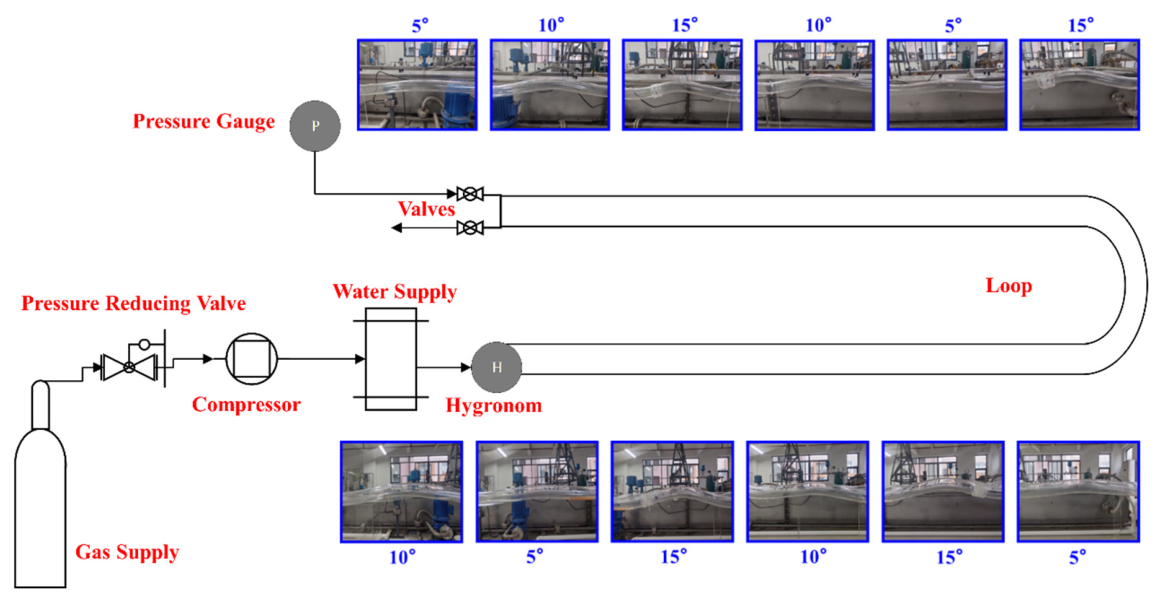
To effectively identify high-risk sections of field pipelines, a typical flow loop for wet gas pipelines was constructed based on operational field parameters, incorporating field pipeline elevation data and characteristics of internal moisture corrosion. The flow loop consists of a gas supply unit, compressor, water supply unit, hygronom, visual pipeline sections, temperature and pressure gauges, and valves. According to the elevation variations along the pipeline, the inclination angle of the pipeline ranges between 0° and 15°. Therefore, a segmented design was adopted, with pipeline sections designed at three inclination angles, namely, 5°, 10°, and 15°, connected to form an undulating visual pipeline. To conserve space, the loop was assembled using elbow fittings. Acrylic was selected as the pipe material to allow visual observation. The visual undulating simulation pipeline was designed based on actual field pipeline elevation variations, with a specification of D60 × 5 mm and a total length of 11 m. The maximum design pressure is 1.0 MPa, and the maximum design temperature is 80 °C. The designed experimental visual pipeline can accommodate corrosion tests with various wet gases under pressures up to 1.0 MPa and temperatures not exceeding 80 °C. The assembled visual simulation experimental pipeline is shown in Figure 2.
Both the inlet and outlet of the pipeline adopt a tee design. At the inlet, one port is connected to the gas cylinder or compressor, while the other is reserved for spare. The outlet has two connections: one linked to a pressure gauge and the other to the pipeline discharge. For experimental convenience, some pipe segment connections use threaded fittings to facilitate disassembly and installation of metal coupons. Rubber sealing rings are applied at threaded connections to ensure pipeline airtightness. The constructed pipeline corrosion simulation setup not only allows for direct observation of liquid accumulation, aggregation, and dissipation under different operating conditions; it also enables the placement of corrosion coupons at various pipeline locations. By analyzing coupon corrosion under different pipeline operating conditions and comparing the results with sealed dynamic weight-loss experiments, high-risk sections of the pipeline can be more accurately identified.
First, utilizing the constructed visual evaluation loop system, a study was conducted on factors influencing liquid accumulation in wet gas pipelines, including water content, temperature, pressure, and flow conditions, to analyze the distribution patterns of liquid accumulation in the pipeline. Based on the pipe inner diameter of 50 mm and typical wet gas pipeline velocities (5–10 m/s), the Reynolds number is estimated to be on the order of 100,000, indicating fully turbulent flow. This turbulent condition is representative of actual field operations and is critical for understanding liquid accumulation and mass transfer effects on corrosion. The experimental plan is shown in Table 3. The experimental procedure is described as follows:
(1)
Prior to the experiment, purge the pipeline to remove debris and impurities, and dry it thoroughly.
(2)
Before the experiment, determine and mark the locations for corrosion testing. Label the prepared corrosion coupons (corresponding to the pipeline test positions) and string them sequentially with high-strength nylon thread. Fix them according to the marked positions and record the setup.
(3)
Purge the pipeline again with dry nitrogen for 30 min.
(4)
Prepare gas cylinders according to the field gas composition and prepare water according to the field water quality. Connect the gas cylinder to the prepared water container and then to the pipeline. Allow the gas to pass through the prepared water tank (temperature controlled to the required experimental level) to humidify the gas. Install a gas humidity tester at the gas inlet to determine the moisture content in the gas. Adjust the gas residence time in the water to achieve the required humidity level for the experiment. Use a pressure regulator valve to adjust the pressure to the experimental value.
(5)
Direct the exhaust gas from the experiment into a sodium hydroxide solution for absorption.
(6)
After the experiment, clean and dry the pipeline section by section for future use. Maintain the order of the corrosion coupons and analyze them promptly (processed in accordance with GB/T 16545 [30]).
Throughout the experiment, ensure that the experimental setup is leak-proof and well-ventilated. To guarantee the effectiveness of the experiment, the duration should not be less than 7 days. In this study, the experimental period was set to 7 days.
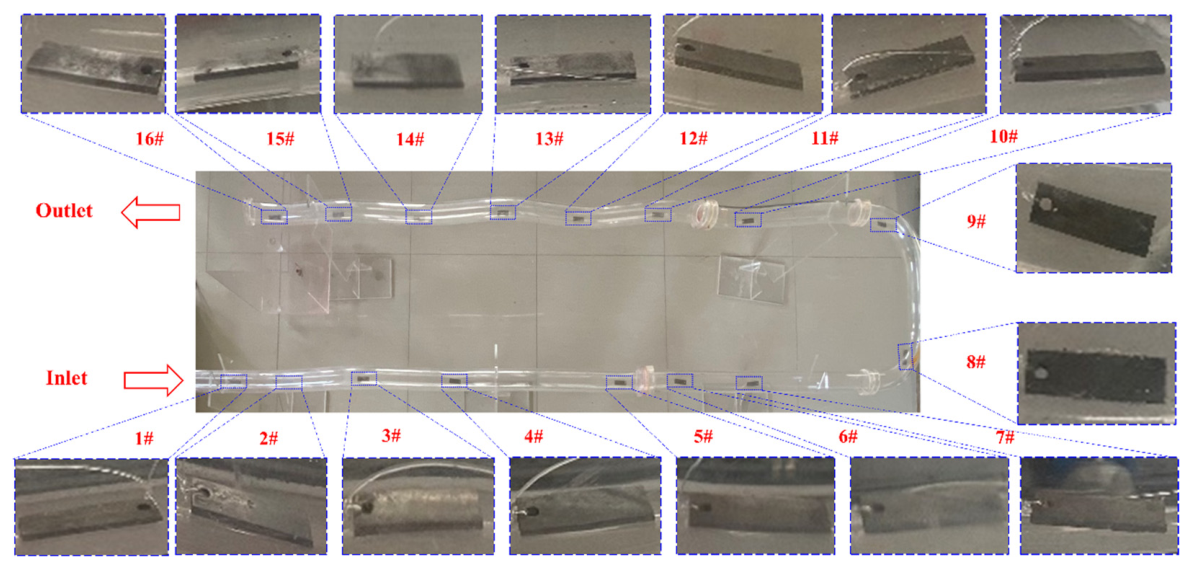
Furthermore, corrosion simulation was conducted based on this setup, with the sole distinction being the placement of corrosion coupons. A simulated solution was prepared according to the ionic composition test results of water samples provided from the field, to investigate the corrosion patterns under actual operating conditions with varying influencing factors. The test coupons were made of L245NCS steel. Prior to each experiment, the entire flow loop was subjected to a leak test by pressurizing with high-purity nitrogen to 0.8 MPa and monitoring the pressure for 24 h using a pressure gauge; a stable pressure reading confirmed no leaks at the pipe connections. The experimental conditions are listed in Table 4, including a pressure of 0.8 MPa, gas temperature of 60 °C, water content of 5%, a temperature difference of 43 °C between the pipeline and the ambient environment, and an experimental duration of 7 days. The gas mixture consisted of 6 vol% CO2 and 2 vol% O2, with the balance being nitrogen, supplied from high-pressure gas cylinders. The distribution of coupons within the pipeline is shown in Figure 3. The coupons were fixed with fine nylon threads at various locations along the undulating pipeline, including low points at different inclination angles, uphill sections, downhill sections, and the highest points, to examine the corrosion behavior at different positions of the pipeline profile. The coupons were threaded onto a fine nylon string. The string was then pulled through the pipeline and fixed at both the inlet and outlet ends, pressing the coupons against the inner pipe wall. The longitudinal axis of each coupon was aligned parallel to the main flow direction to ensure consistent flow-accelerated corrosion conditions. This alignment was verified before each experiment. Visual observation confirmed no visible disturbance to the gas–liquid flow or droplet behavior. Due to the small thread-to-pipe diameter ratio (approximately 1%), any local flow perturbation is considered negligible. It should be noted that the nylon thread may locally disturb the near-wall flow; however, the same mounting method was applied to all coupons, so the relative trends are considered reliable.

3. Result and Discussion

3.1. Discrimination of Locations with High Risk of Corrosion

3.1.1. Single Gas Components

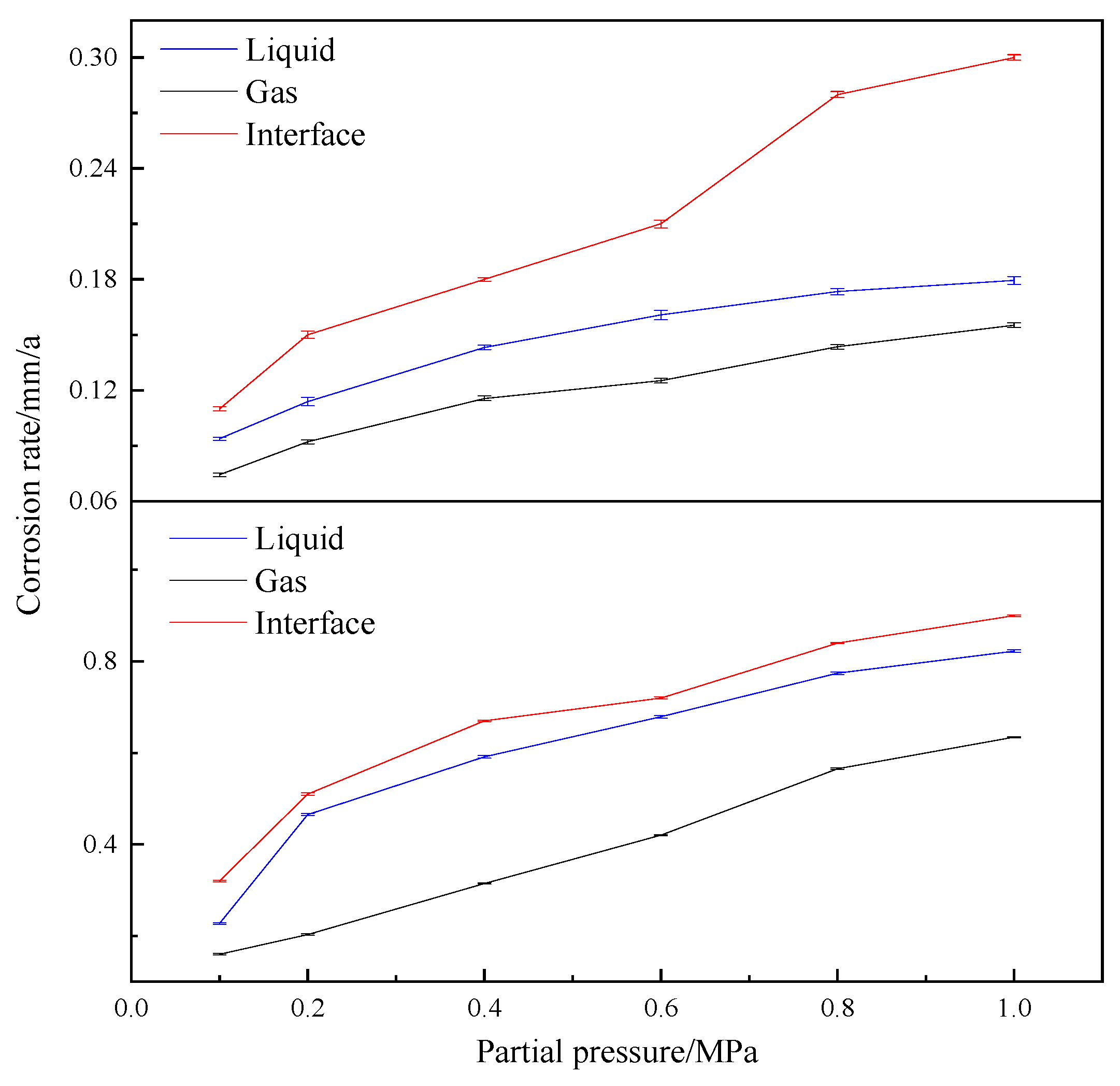
Figure 4 illustrates the effect of partial pressure variations in H2S and CO2, when present individually, on the corrosion rate of L245NCS steel. In Figure 4, the error bars representing the standard deviation of three parallel measurements are very small due to the low variability among replicate samples; thus, they are not easily distinguishable at the current scale. The same applies to Figure 5, Figure 6 and Figure 7. Statistical significance tests were not performed. The corrosion coupons have since been exposed to air and cannot be re-measured. Therefore, only average corrosion rates are reported. Analysis of the figure reveals that as the partial pressure of hydrogen sulfide increases, the corrosion rate of the test coupons rises in all three zones—the liquid phase zone, the water–gas interface, and the gas phase zone. When the H2S partial pressure exceeds 0.05 MPa, the rate of increase in corrosion slows down. At the same H2S partial pressure, the corrosion rate is highest at the water–gas interface, followed by that in the liquid phase zone, while the gas phase zone shows the lowest rate. It indicates that under identical conditions, pipeline sections experiencing alternating wet and dry conditions suffer the most severe corrosion, primarily in the form of localized corrosion.
As the CO2 concentration increases, the corrosion rate of the coupons rises relatively slowly. Among the three zones, the water–gas interface exhibits the highest corrosion rate under the same conditions, while the gas phase zone shows the lowest. When the CO2 partial pressure exceeds 0.06 MPa, the corrosion rate at the water–gas interface increases markedly, before slowing again. This suggests that in pipelines where liquid accumulation, alternating wet–dry conditions, and gas phase coexist, corrosion remains most severe at the interface, followed by areas with liquid accumulation. Overall, under comparable conditions, corrosion caused by H2S is significantly more severe than that caused by CO2.

3.1.2. Gas Mixture

(1)
Partial pressure of H2S
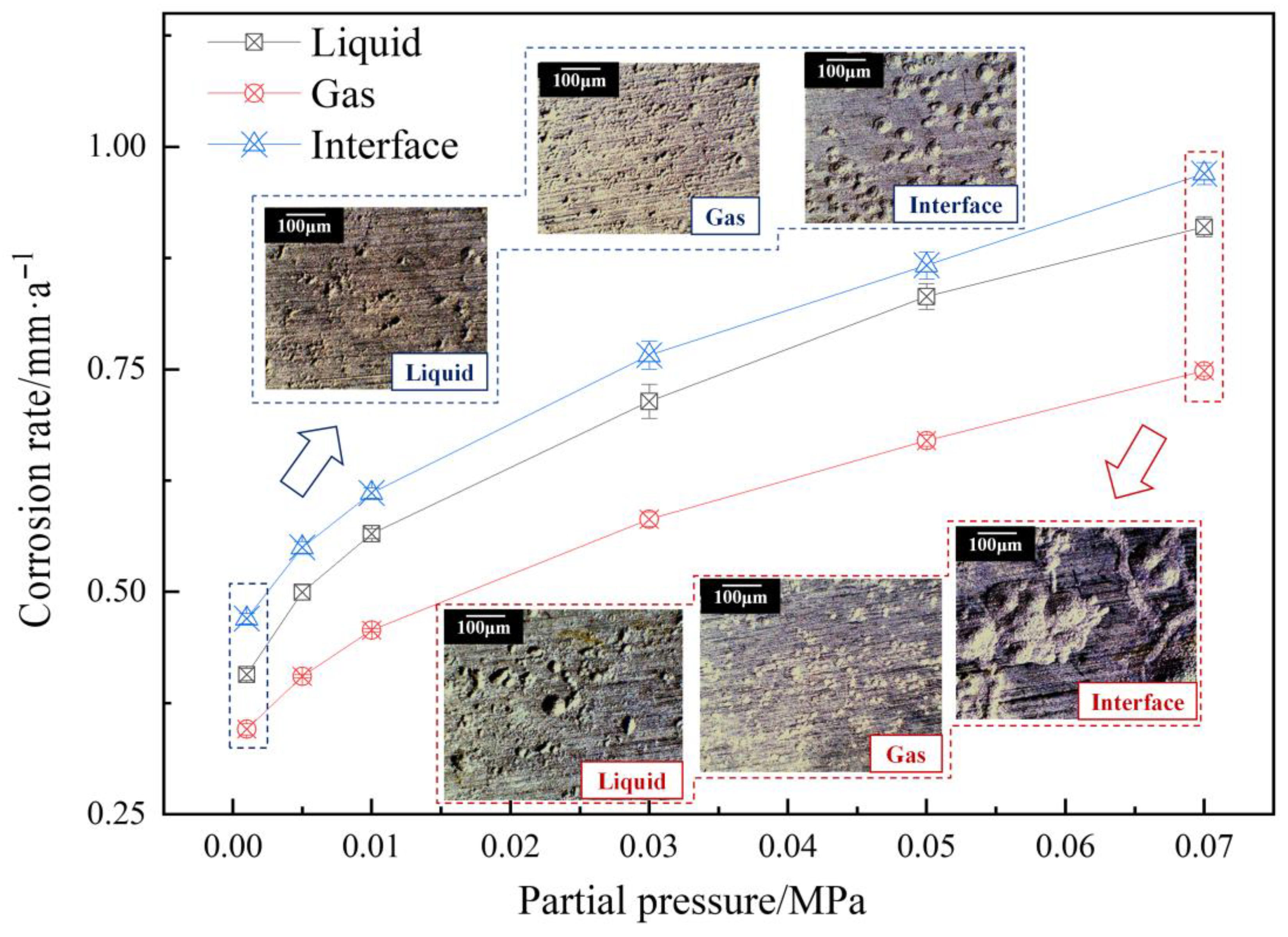
Figure 5 shows the effect of H2S partial pressure variation on the corrosion rate of L245NCS steel in a mixed H2S-O2-CO2 system. It indicates that, in the presence of O2 and CO2, the influence of H2S concentration changes on the corrosion rate of the specimens is generally similar to that in a pure H2S environment, with corrosion rates in all three zones showing an increase. Similarly, the corrosion rate remains highest at the gas–water interface and lowest in the gas phase region. As the concentration of H2S increases from 0.001 MPa to 0.07 MPa, the corrosion rates in the gas, liquid, and interface zones rise by 123.5%, 115.8%, and 106.4%, respectively, demonstrating that variations in H2S concentration have a pronounced effect on corrosion.
In terms of corrosion morphology, corrosion is relatively severe in the liquid phase, gas–water interface, and gas phase regions, with H2S corrosion mainly manifesting as pitting and localized pitting. The liquid phase and gas–liquid interface regions are predominantly characterized by pitting, whereas the gas phase region exhibits more densely distributed pitting. The most severe localized corrosion occurs at the gas–water interface.
Optical microscopy images were used to observe and analyze the corrosion morphology. Optical microscopy images were used to observe and analyze the corrosion morphology. The images were captured using an Olympus GX71 metallographic microscope with a 50× objective and a 10× eyepiece, giving a total magnification of 500× and an optical resolution of approximately 0.42 μm. Analysis of pit dimensions shows that at an H2S partial pressure of 0.01 MPa, the microscopic corrosion morphology on the liquid phase coupons consists of both elongated and circular pits. Excluding very small shallow pits, a total of 49 corrosion pits were identified, with the longest pit measuring 40.68 μm, the shortest 7.02 μm, and an average length of 20.33 μm. The gas-phase coupon corrosion morphology is band-shaped, with 76 pits identified, the longest measuring 46.30 μm, the shortest 5.53 μm, and an average of 22.60 μm. The corrosion at the gas–liquid interface is characterized by circular pits, with the longest measuring 53.82 μm, the shortest 18.50 μm, and an average of 32.66 μm. This ranking of pit sizes (liquid < gas < interface) is consistent with the order of corrosion rates (interface > liquid > gas), indicating a positive correlation between pit dimensions and corrosion kinetics. Overall, based on morphological analysis, the ranking of both maximum pit size and average pit size from smallest to largest is: liquid phase < gas phase < interface. Although gas-phase pits are longer in length, their width is smaller; thus, from a microscopic perspective, this order is consistent with the ranking of corrosion rates.
When the H2S partial pressure increases to 0.07 MPa, the overall corrosion severity intensifies. Corrosion in both the liquid and gas phases shifts to a circular pit morphology, while the originally circular pits at the gas–liquid interface coalesce to form larger pits. The maximum pit lengths in the liquid, gas, and interface regions become 96.88 μm, 28.17 μm, and 197.62 μm, respectively, with average lengths of 25.90 μm, 17.49 μm, and 107.09 μm, respectively. The significant increase in average pit size at the interface (from 32.66 μm to 107.09 μm) corresponds to the highest corrosion rate observed, further confirming the link between pit growth and corrosion severity. Although the diameter of circular pits is smaller than the length of elongated pits, the corrosion is more severe.
(2)
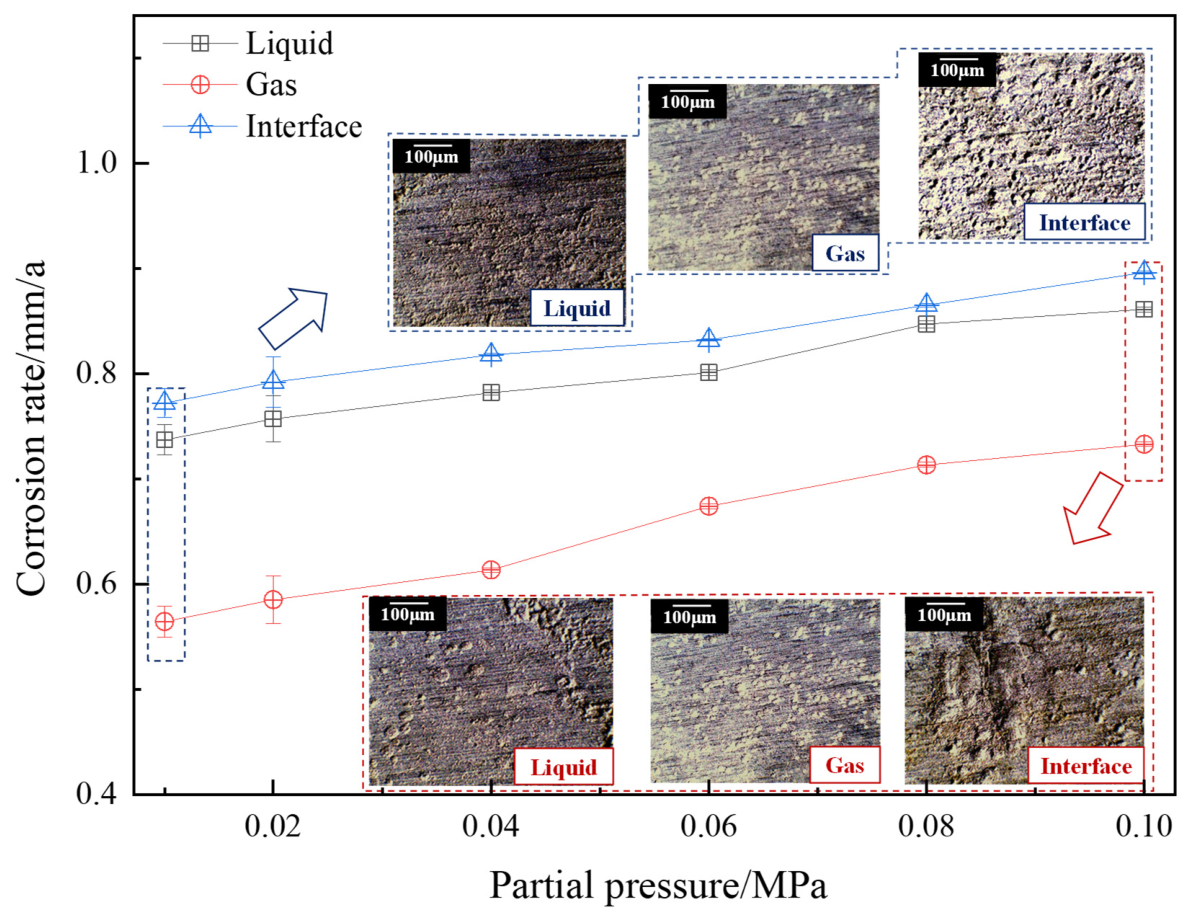
Partial pressure of CO2
The influence of CO2 partial pressure variations on the corrosion rate of L245NCS steel in a mixed H2S-O2-CO2 system is shown in Figure 6. Analysis of Figure 6 indicates that in the H2S-O2-CO2 mixed system, the corrosion rate increases as the CO2 partial pressure rises, though the extent of increase is relatively small. This suggests that under conditions of relatively low CO2 partial pressure, CO2 has a minor effect on corrosion in the H2S-O2-CO2 mixed system and does not alter the order of corrosion rates among the liquid phase, gas–water interface, and gas phase regions. The microscopic morphology of the corrosion coupons in each region remains similar to that observed when the hydrogen sulfide partial pressure is varied. When the CO2 partial pressure increases from 0.01 MPa to 0.10 MPa, the corrosion rates in the gas, liquid, and interface zones rise by 16.8%, 29.8%, and 16.1%, respectively. This indicates that higher CO2 partial pressure intensifies corrosion, although its effect is less pronounced compared to H2S.
(3)
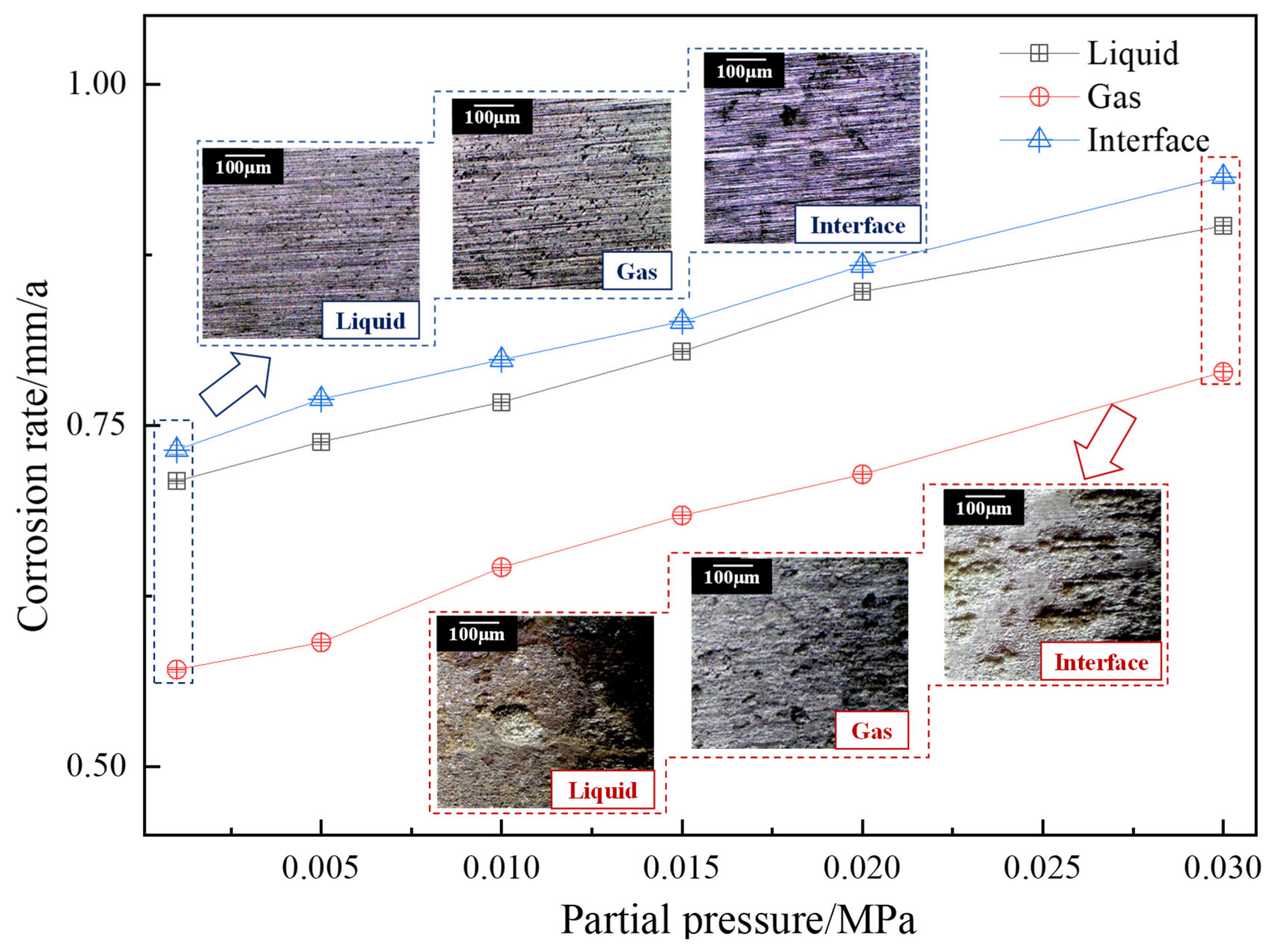
Partial pressure of O2
The effect of O2 partial pressure variation on the corrosion rate of L245NCS steel in a mixed H2S-O2-CO2 system is shown in Figure 7. Analysis of Figure 7 indicates that as the O2 content increases, the corrosion rates in all three regions show a clear upward trend, though the magnitude of the increase is relatively small. The specific increases in localized corrosion rates are 26.3%, 38.2%, and 27.3% for the liquid phase region, gas–liquid interface, and gas phase region, respectively, with the increases in the liquid phase and gas–liquid interface being close in magnitude. However, the relative order of corrosion rates—with the gas–water interface being the highest, followed by the liquid phase region and then the gas phase region—remains unchanged. The microscopic morphology of the corrosion coupons in each region is similar to that observed when the hydrogen sulfide partial pressure is varied.
In a H2S-CO2-O2 multi-component environment, the corrosion behavior of L245NCS steel exhibits a distinct phase-zone dependence. The corrosion severity follows the order: gas–liquid interface > liquid phase zone > gas phase zone. This indicates that the alternating wet–dry interface region, due to liquid film formation, differences in oxygen diffusion, and reactant enrichment, suffers the most severe corrosion. H2S is the key dominating factor, as an increase in its partial pressure significantly accelerates both general corrosion and pitting corrosion, particularly leading to the formation of large-sized pits at the interface. In contrast, the influence of CO2 is relatively weaker. Although an increase in CO2 partial pressure elevates the corrosion rate, the extent of increase is limited and does not alter the aforementioned order of corrosion severity among the different phase zones. The presence of O2 exacerbates corrosion through cathodic depolarization and the promotion of oxidative product formation; however, the rate of increase caused by O2 alone is slower compared to that induced by H2S.
To provide deeper theoretical support for the corrosion mechanisms, the key electrochemical and chemical reactions involved are summarized as follows. The anodic dissolution of iron proceeds as:
F e F e 2 + + 2 e
For H2S, the cathodic reaction and iron sulfide formation are:
H 2 S + 2 e H 2 + S 2
F e 2 + + S 2 F e S
In the presence of CO2, carbonic acid forms and participates in the cathodic process:
C O 2 + H 2 O H 2 C O 3
H 2 C O 3 + 2 e H 2 + C O 3 2
F e 2 + + C O 3 2 F e C O 3
The introduction of O2 adds an additional cathodic reaction:
O 2 + 2 H 2 O + 4 e 4 O H
F e 2 + + 2 O H F e ( O H ) 2
4 F e ( O H ) 2 + O 2 2 F e 2 O 3 H 2 O ( F e O O H ) + 2 H 2 O
The corrosion product films formed under these conditions play a critical role in determining the overall corrosion behavior. FeS, as the primary product in H2S-dominated environments, can form a partially protective layer, but its stability is compromised in the presence of O2, which promotes the oxidation of FeS to elemental sulfur or sulfate, leading to localized acidification and film breakdown. FeCO3, typically formed under CO2-rich conditions, tends to precipitate as a dense layer when conditions are favorable, yet its formation is often suppressed by the competitive adsorption of H2S. The oxidation products such as FeOOH and Fe3O4 are generally porous and non-protective, allowing aggressive species to penetrate and sustain localized attacks. Within this multi-impurity system, H2S promotes the formation of sulfides such as FeS and FeS2, CO2 contributes to the formation of FeCO3, and O2 facilitates the generation of oxides like FeOOH and Fe3O4. Synergistic reactions among the impurities can significantly enhance the corrosiveness of the medium [2]. Relevant studies have confirmed that the multi-layered structure of corrosion products contains components such as FeCO3, FeS, FeOOH, and FeSO4 [31]. In summary, the corrosion mechanism in this environment is constituted by the combined effects of H2S-dominated sulfide corrosion, CO2-involved carbonic acid corrosion, and O2-accelerated oxidation. Chemical interactions among the multiple impurities further lead to the generation of strongly acidic media, thereby accelerating both general and localized corrosion failure of the steel. The possible corrosion products (FeS, FeCO3, FeOOH) are inferred from optical morphology and gas composition, based on previous studies [25,26]. Direct composition analysis was not performed. The mechanistic interpretation is based on established theories in the literature; direct electrochemical evidence was not obtained in this study.
Autoclave experiments established the fundamental mechanism that the most severe corrosion occurs at the gas–liquid interface in H2S-CO2-O2 coexistence systems due to the oxygen concentration cell effect and localized concentration of corrosive species. However, these systems cannot replicate the complex coupling between multiphase flow and corrosion processes that occurs in actual industrial pipelines. Therefore, subsequent loop experiments were introduced with the primary objective of revealing the influence of flow parameters on the spatial distribution and evolution of corrosion rates under simulated realistic hydrodynamic conditions. By systematically analyzing liquid accumulation behavior in wet gas flow within the loop, the geometric location and morphological characteristics of the high-risk gas–liquid interface under pipeline flow conditions can be identified. Furthermore, by placing corrosion coupons at different characteristic locations, the modulating effects of hydrodynamic factors—such as fluid shear stress and enhanced mass transfer—on the interfacial corrosion mechanism can be quantitatively characterized. This approach allows for the validation and refinement of conclusions drawn from static experiments to ensure their applicability in engineering contexts.

3.2. Analysis of Fluid Accumulation in Fluctuating Pipeline

3.2.1. Influence of Water Content

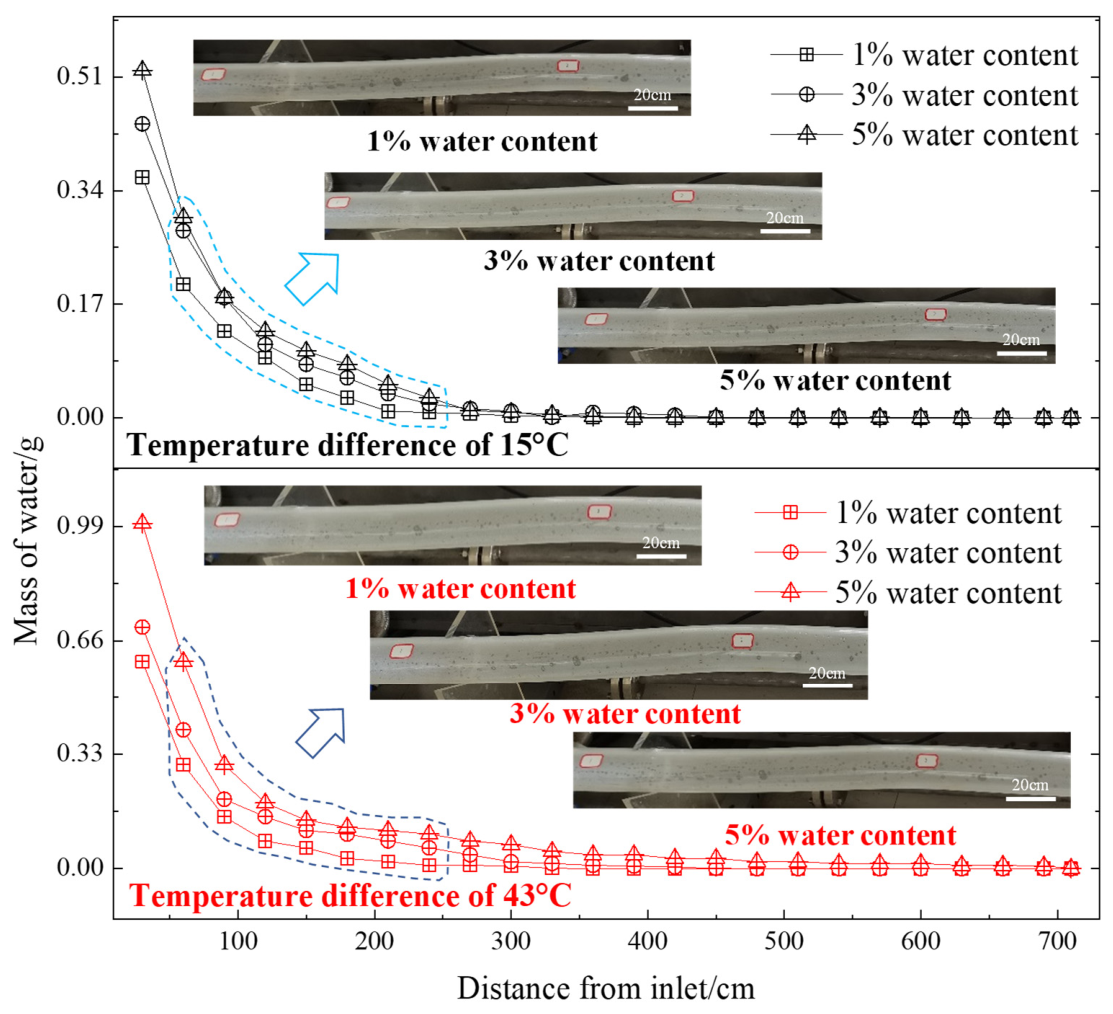
The condensation of gas moisture depends not only on the amount of water vapor present but also on the ambient temperature of the pipeline. In the simulation setup, no temperature regulation measures were applied to control the ambient temperature, as installing such equipment would affect the visibility inside the pipeline. Therefore, the ambient temperature was primarily simulated at room temperature, specifically 17 °C (winter indoor temperature) and 25 °C (spring indoor temperature), to represent winter and summer pipeline conditions. The temperature of the medium inside the pipeline was regulated via the water supply system. Under the conditions of temperature differences of 43 °C and 15 °C between the gas and the environment, and a pressure of 0.8 MPa, tests were conducted with gas containing 1%, 3%, and 5% water to examine the trend of liquid accumulation and its variation along the pipeline. Based on the experimental results, after 7 days of testing under a temperature difference of 43 °C, the liquid accumulation in the first 50 cm section at the inlet for gases with different water contents is shown in Figure 8. As shown in Figure 8, under the same pressure and temperature conditions, the amount of condensed water in the pipeline increases with higher gas moisture content. Regardless of the moisture level, under a temperature difference of 43 °C, moisture in the gas condenses into fog on the pipe wall shortly after entering the pipeline, with water droplets first appearing on the inner wall near the inlet. As operating time extends, these droplets grow, flow downward along the pipe wall, and eventually accumulate at the bottom to form liquid pooling. With further operation, the water film on the wall advances further downstream. The higher the moisture content, the farther the water film propagates.
The amounts of precipitated water and the corresponding lengths of pipe where precipitation occurs under temperature differences of 43 °C and 15 °C between the gas pipeline and the environment are shown in Table 5. As can be seen from the table, measurements of condensed water, including fog, indicate that at 1% gas moisture content, the precipitated water is 1.8 g; at 3% moisture, it is 2.9 g; and at 5% moisture, it is 4.7 g. The pipe length exhibiting water fog is 300 cm at 1% moisture, 450 cm at 3% moisture, and 710 cm at 5% moisture. This shows that higher gas moisture content results in a longer section of pipe where water precipitation occurs, while the amount of accumulated liquid decreases with increasing distance from the inlet. Under a temperature difference of 15 °C, the precipitated water amounts to 0.91 g at 1% moisture, 1.8 g at 3% moisture, and 3.0 g at 5% moisture. The distances along the pipe where a water film forms are 231 cm at 1% moisture, 387 cm at 3% moisture, and 498 cm at 5% moisture. This demonstrates that, under otherwise identical conditions, a greater temperature difference between the pipeline and its environment leads to more condensed water and a longer pipe section where water precipitates.
For a given temperature difference, with all other conditions remaining constant, the water precipitation in the pipeline is related to the moisture content of the transported medium. The higher the moisture content of the medium, the longer the pipe section where water precipitates and the greater the amount of accumulated liquid. At the same moisture content, a lower ambient temperature around the pipeline leads to a longer section where water precipitates and a larger volume of accumulated liquid. This indicates that the temperature of the transported medium and the ambient temperature significantly influence both the amount of precipitated water and the length of pipe over which precipitation occurs.

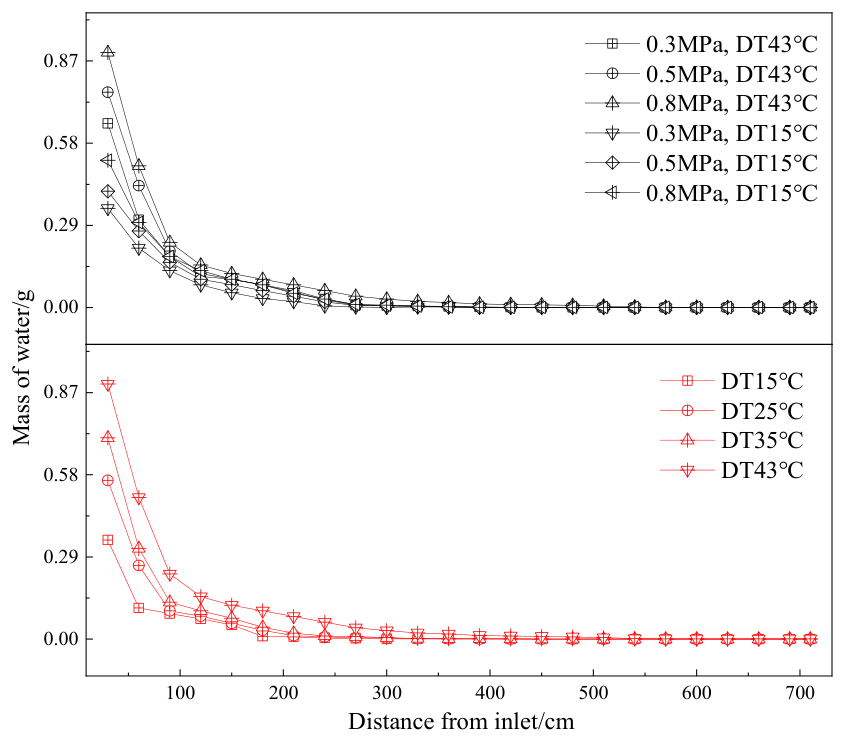
3.2.2. Influence of Temperature Difference and Pressure

Figure 9 and Table 6 present the condensate water under different temperature differences and pressures. The total condensate volume was determined by measuring the weight difference in the pipeline before and after the experiment, with the mass difference representing the amount of accumulated condensate. It can be seen that a larger temperature difference between the gas transmission temperature and the ambient environment leads to more pronounced condensation and a greater amount of condensate water. At a temperature difference of 43 °C, the volume of condensate water is 123.8% higher than that at a temperature difference of 15 °C, and the liquid accumulation length is 42.6% longer. Under the same ambient temperature, a higher pipeline operating temperature results in a longer section of pipeline where condensation occurs. Similarly, at the same operating temperature, a lower ambient temperature leads to a longer pipeline segment with condensate formation. This indicates that the amount of condensate water in the pipeline is related to both the ambient temperature and the operating temperature of the pipeline. At a temperature difference of 43 °C between the pipeline and the environment, higher pressure leads to more severe condensate formation in the pipeline. At a pressure of 0.8 MPa, both the number and size of water droplets on the pipe wall are significantly greater than those at 0.3 MPa. Under the same ambient and operating temperatures, the condensate formation in pipelines operating at different pressures shows a trend similar to that observed with water vapor content and operating temperature. This suggests that operating pressure also has a significant impact on condensation in the pipeline. Under the same conditions, at a temperature difference of 43 °C, the liquid accumulation volume at a gas transmission pressure of 0.8 MPa is 147.4% higher than that at 0.3 MPa, and the accumulation length increases by 26.6%. The higher the pressure, the earlier condensate appears, the greater the amount of condensate water, and the more extensive its distribution within the pipeline.

3.2.3. Influence of Pipeline Restart

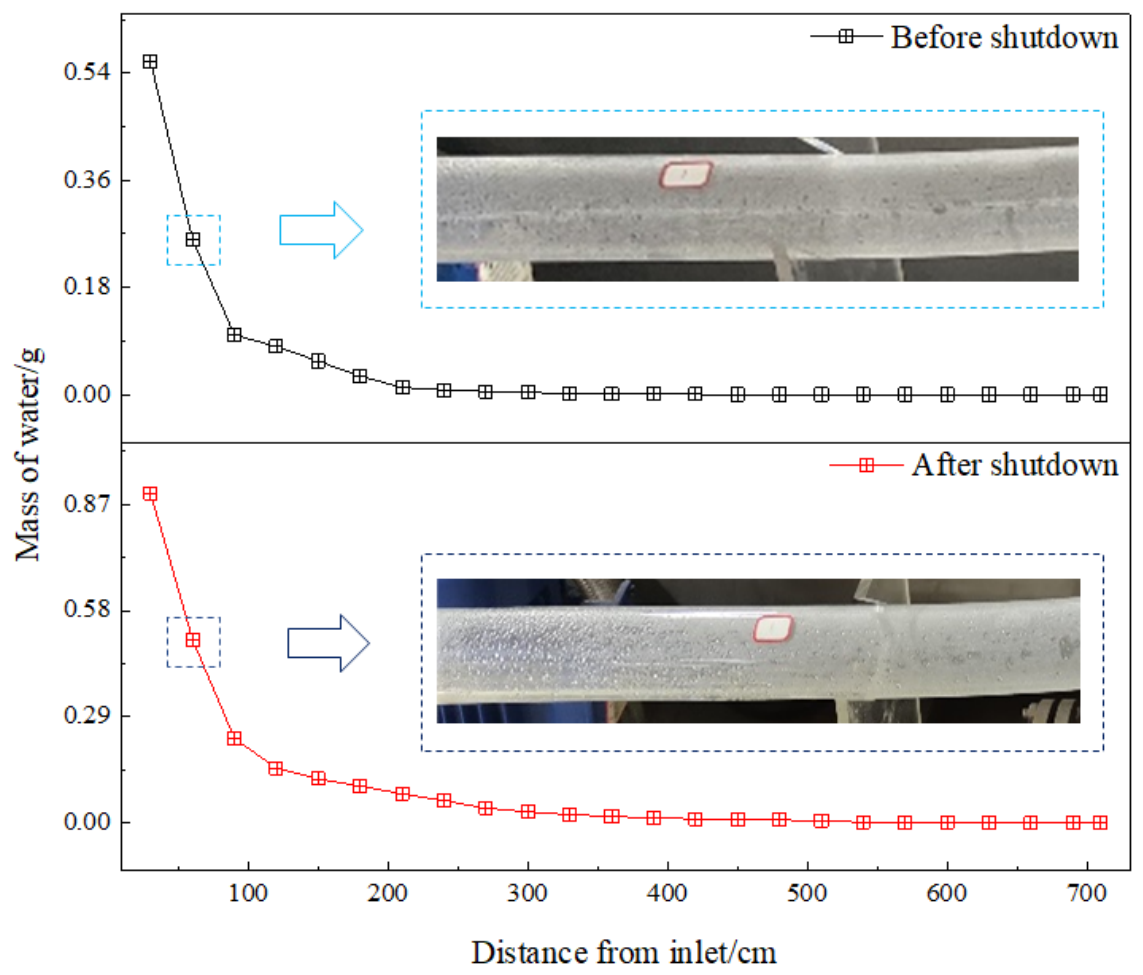
After the pipeline has been in operation for 7 days, it was shut down for 8 h, and the changes in the produced water and the length of the water-producing section in the pipeline were analyzed. Figure 10 shows the water production situation after the pipeline was shut down for 8 h after 24 h of operation. Analysis of Figure 10 shows that after the pipeline was shut down, the water mist on the pipe wall condensed into small water droplets, which coalesced and merged with each other to become larger, and there was an obvious trend of water droplets depositing toward the bottom of the pipeline, and an obvious trend of liquid accumulation forming at the bottom. The measurement results show that the amount of condensed water was 4.3 g before the shutdown and 5.1 g after the shutdown, an increase of 18.6% after the shutdown compared with that before the shutdown; the length of the water-producing pipe section was 721 cm before the shutdown and 734 cm after the shutdown, an increase of 1.8% after the shutdown compared with that before the shutdown. This indicates that the shutdown of the pipeline is conducive to the formation of liquid accumulation. When the pipeline was restarted and operated for 5 h, the maximum length of the water-producing section was 738 cm, an increase of 4 cm compared with that after the shutdown. This shows that the length of the water-producing pipe section increases when the pipeline is restarted. Therefore, the shutdown of the pipeline is conducive to the formation of liquid accumulation in the pipeline, which is mainly reflected in the further condensation of the already formed water mist and water droplets. During restart, the condensation of water is aggravated due to temperature changes, resulting in a certain increase in the overall liquid accumulation in the pipeline. From the entire experiment, the water condensation in the pipeline is closely related to the water content of the transported medium, the ambient temperature and pressure (flow rate) of the pipeline, and the operation mode of the pipeline. The higher the water content and pressure, the lower the ambient temperature of the pipeline, and the more times the pipeline is shut down, the more the amount of condensed water in the pipeline and the longer the length of the pipe section with condensed water. It was found from the experiment that condensed water first appeared in the initial section of the pipeline, and gradually developed toward the end section with the extension of time. During the experimental period, no obvious condensed water was observed in the part near the end section of the pipeline.
This section experimentally investigates the formation mechanism of liquid accumulation in fluctuating pipelines and its primary influencing factors. The results indicate that the amount and distribution of condensate in pipelines are closely related to the water content of the transported medium, the operating pressure, the temperature difference between the gas and the environment, and the operational status of the pipeline. Under specific temperature and pressure conditions, a higher water content leads to a greater volume of condensate and a significantly longer pipeline section experiencing water precipitation. Furthermore, an increase in the temperature difference between the gas and the ambient environment intensifies condensation, resulting in a simultaneous increase in both the amount and the extent of liquid accumulation. Similarly, higher operating pressure promotes condensation, manifesting as earlier condensate formation, increased condensate volume, and broader distribution along the pipeline. Additionally, during pipeline shutdown, existing water mist and droplets further coalesce and merge, leading to a noticeable increase in liquid accumulation. Upon restart, temperature fluctuations exacerbate the condensation process, causing a slight expansion in the range of accumulation. Overall, condensation initially occurs near the pipeline inlet and gradually propagates downstream over time, with no significant condensate observed near the outlet section within the experimental period. This study systematically elucidates the dynamic characteristics of liquid accumulation under the coupled influence of multiple factors, providing a theoretical foundation for subsequent research on corrosion.

3.3. Experimental Analysis on Corrosion of Simulated Associated Gas Pipeline

3.3.1. Test Piece Method for Testing Pipeline Corrosion Distribution

Previous studies have indicated that the main factor affecting the local corrosion of associated gas pipelines is the liquid accumulation and its distribution [22,24]. Therefore, after clarifying the changes in liquid accumulation, the corrosion law was further analyzed by means of hanging test pieces at different parts of the simulated pipeline and the access pipe section method.
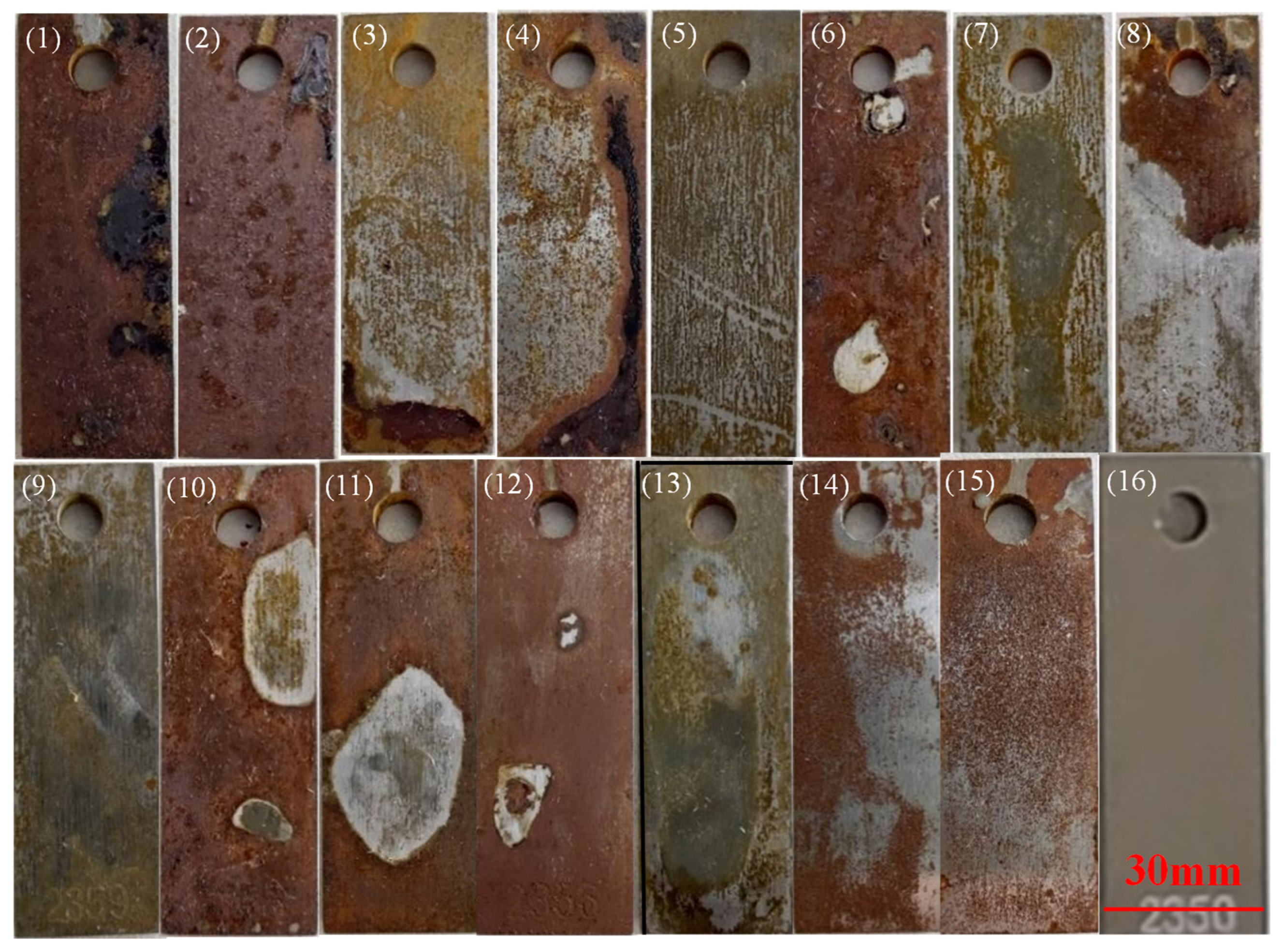
The liquid accumulation at different parts of the pipeline and the corrosion of test pieces after the experiment are shown in Table 7. The corrosion appearance of different parts of the pipeline obtained by the test piece method is shown in Figure 11. It can be seen that with the extension of the pipeline, the corrosion degree of the test pieces is significantly different. The closer to the pipeline inlet, the more serious the corrosion, and the parts with frequent changes between dry and wet conditions suffer from severe local corrosion. Under the condition of very little condensed water, the surface of the test piece is smooth, and no obvious corrosion phenomenon is observed. This further indicates that the local corrosion of the pipeline is closely related to liquid accumulation. The test pieces hung near the inlet position are completely immersed in the liquid accumulation, resulting in severe uniform corrosion, while the test pieces in the parts in a semi-immersed state or with changes in the amount of liquid accumulation (these parts are usually the downhill and uphill sections of low-lying parts and lower flat sections) suffer from the most severe local corrosion. This type of local corrosion is the main cause of pipeline perforation. On the whole, regardless of the fluctuation, the corrosion in the first half of the pipeline is more serious than that in the second half, and the parts with severe local corrosion are mainly located at the edge parts with a large amount of liquid accumulation or the parts where the boundary of liquid accumulation amount changes frequently.
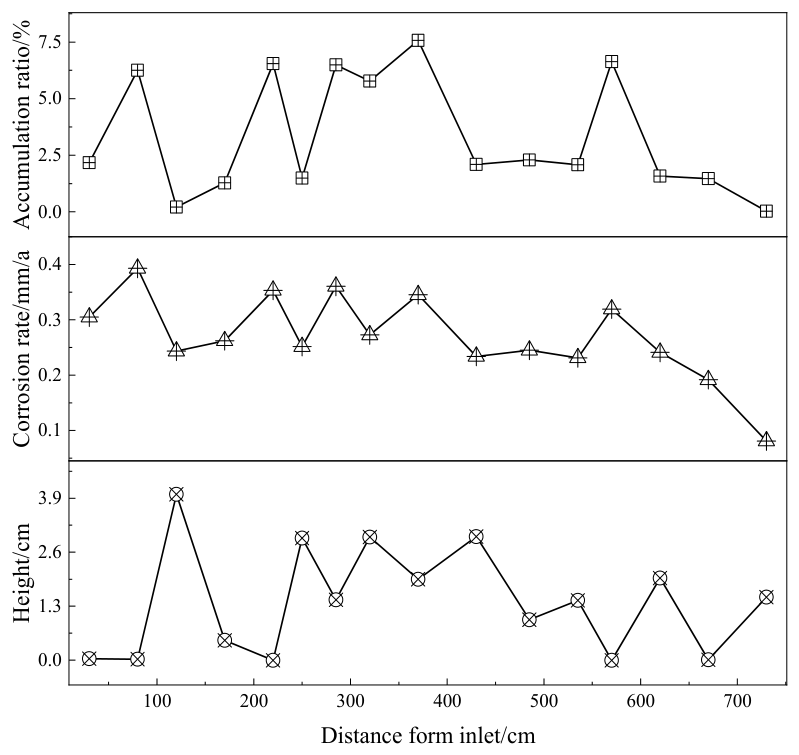
Figure 12 shows the relationships between pipeline corrosion rate, elevation, and liquid accumulation. It can be seen that the magnitude of pipeline corrosion rate basically corresponds to the amount of liquid accumulation. The corrosion rate is high in the low-lying parts of the pipeline and the areas adjacent to the low-lying parts, while the corrosion rate is low in the upper-middle section of the uphill section, the hilltop, and the area from the starting point to the middle position of the downhill section, with the maximum difference between the two reaching 61.4%. Therefore, it can be concluded that when other conditions remain unchanged, liquid accumulation is the main factor causing local corrosion of the pipeline.

3.3.2. Analysis of Corrosion Experiment by Access Pipe Section Method

In view of the problem that the test piece method has a poor combination with the bottom of the experimental pipeline, which cannot well evaluate the relationship between liquid accumulation and corrosion in wet gas pipelines, the access pipe section method was adopted to further evaluate pipeline corrosion so as to simulate the corrosion on the inner wall of wet gas pipelines more accurately.
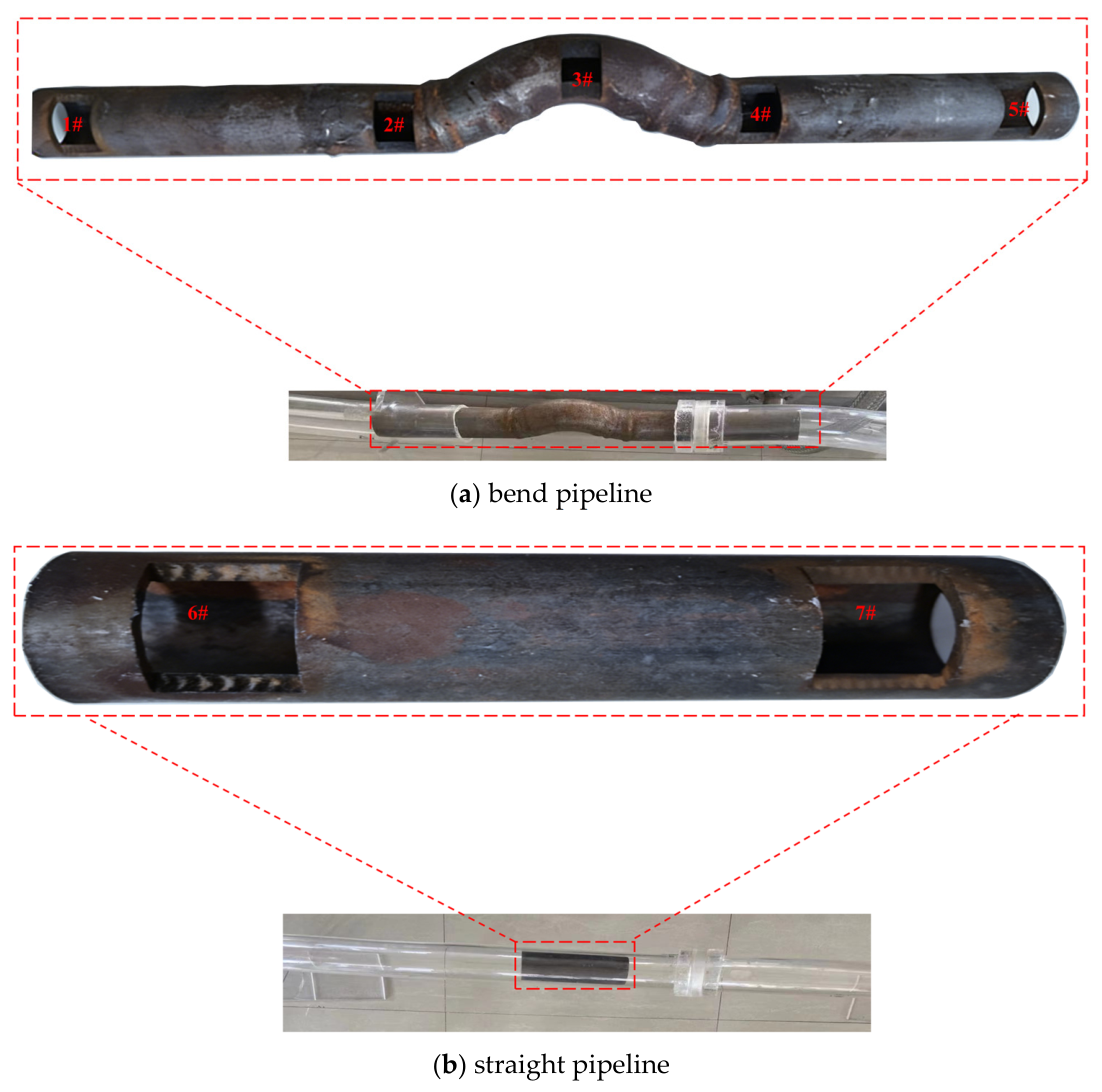
A derusted L245NCS straight pipe section with a length of about 30 cm was connected to the pipeline (see Figure 13a). In addition, an undulating pipe section (with an angle of about 15°) with a length of about 70 cm was connected to other parts of the pipeline (see Figure 13b). The metal straight pipe sections for the experiment were installed at positions about 300 cm and 500 cm away from the pipeline inlet. The experimental conditions were the same as those of the test piece method. After the experiment, the experimental pipe sections were sampled, numbered and analyzed according to the pre-pasted positions. The sampling positions and numbers of the undulating L245NCS pipe section are shown in Figure 13a, and the sampling positions and numbers of the straight L245NCS pipe section are shown in Figure 13b.
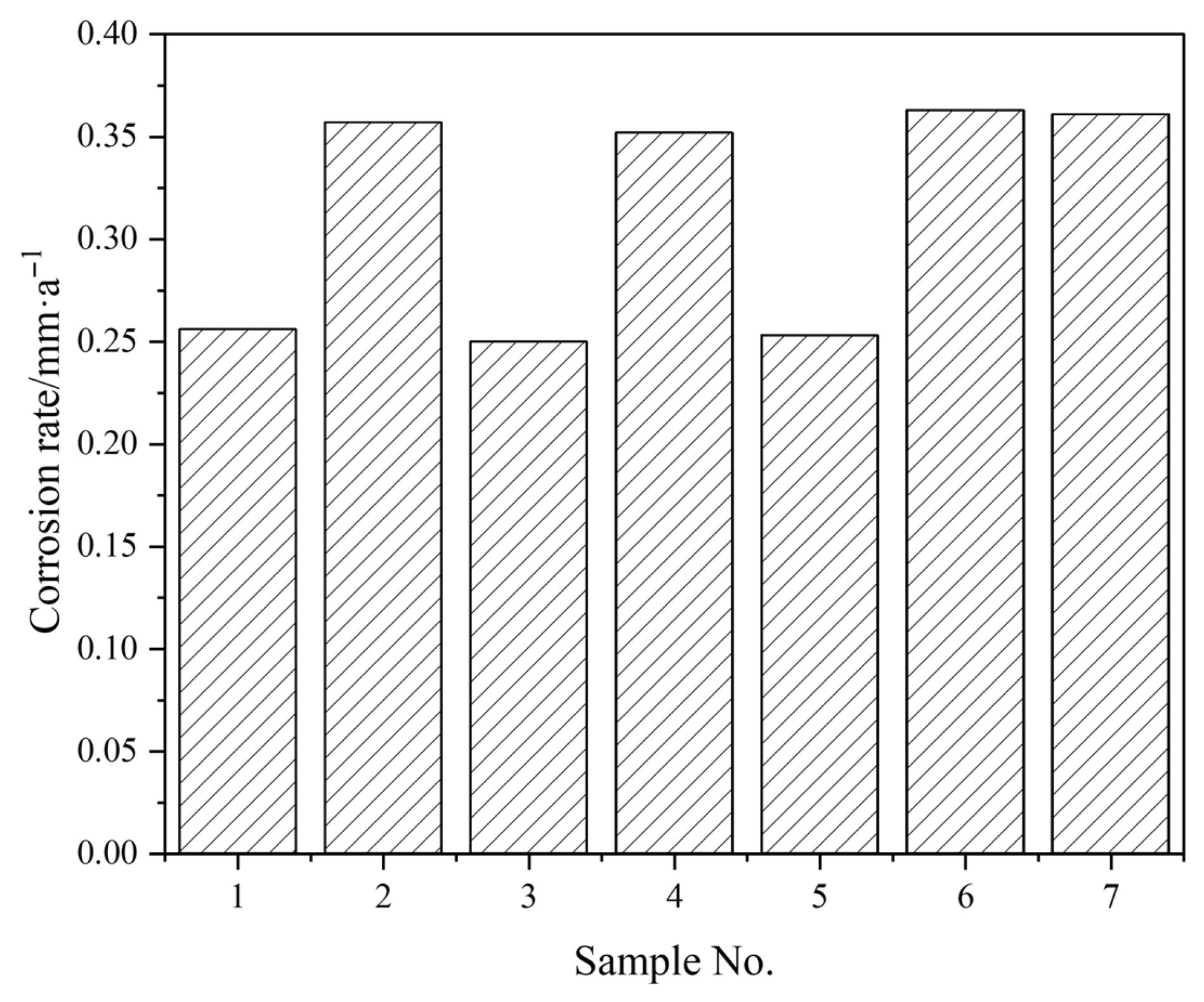
The sampling mainly focused on the lower side, mainly analyzing the position of the liquid accumulation boundary and the corrosion condition of the liquid accumulation on the lower side. The corrosion condition and analysis of the samples are shown in Table 8. It can be seen from Table 8 that the corrosion rates of the samples at different parts are different. The highest point of the pipeline fluctuation shows general corrosion, there are traces of liquid accumulation on the lower side of the pipeline, and the local corrosion is severe. The parts marked with green frames (No. 2, No. 4, No. 6, and No. 7) are the traces of liquid accumulation, and their corrosion rates are significantly higher than those of the samples without liquid accumulation.
Figure 14 shows the corrosion rates at different parts of the pipe section. Analysis of Figure 14 shows that the corrosion rate of the parts with liquid accumulation is 45.2% higher than that of the highest point (without liquid accumulation). The difference in corrosion rates between different parts without liquid accumulation is within 1.18%, and the corrosion degrees are similar.
In summary, the combined effects of high water content in the transported medium, high pressure and low-temperature conditions during pipeline operation, as well as frequent shutdown and restart procedures, collectively exacerbate the condensation and liquid accumulation processes within the pipeline. The resulting liquid accumulation, particularly when in a dynamically changing state, serves as the critical precondition and dominant factor inducing severe localized corrosion in wet gas pipelines. This study establishes a correlation between the mechanism of liquid accumulation formation and corrosion failure modes, providing essential experimental evidence and theoretical support for predicting high-corrosion-risk pipeline sections and formulating targeted corrosion prevention and control strategies.

4. Conclusions

This study systematically investigates the corrosion behavior of L245NCS steel in a simulated oilfield-produced water environment containing O2, H2S, and CO2, as well as the influence of pipeline geometry. Through the integration of high-pressure autoclave experiments with visual flow loop simulations, the research effectively establishes connections between fundamental corrosion mechanisms and complex field conditions. The findings offer valuable experimental data and theoretical support for identifying high-risk corrosion sections, optimizing corrosion monitoring point placement, and developing targeted integrity management strategies for wet gas transmission pipelines. The main conclusions from each component are summarized below.
(1)
Corrosion mechanism studies based on autoclave experiments demonstrate that in O2, H2S, and CO2 coexisting systems, regardless of variations in the partial pressures of individual gases, corrosion severity consistently follows the order of gas–liquid interface, which is greater than liquid phase, which is greater than gas phase. Severe localized corrosion at the interface is primarily driven by oxygen concentration cell effects and local enrichment of corrosive species. H2S is identified as the dominant corrosive medium, exerting a significantly greater influence on corrosion rates compared to CO2 or O2, and promoting pitting and localized corrosion, with the most severe pitting observed at the gas–liquid interface.
(2)
Analysis of liquid accumulation behavior in the flow loop indicates that condensate formation and distribution are significantly influenced by gas water content, temperature differences between the pipeline and the environment, operating pressure, and shutdown and restart operations. Higher water content, elevated pressure, lower ambient temperature, and frequent shutdowns exacerbate both the quantity and spatial distribution range of liquid accumulation within the pipeline. Condensation initiates near the inlet and propagates downstream over time, with no significant condensate observed near the outlet during the experimental period.
(3)
Corrosion distribution experiments in the simulated pipeline confirm that liquid accumulation serves as the primary factor contributing to non-uniform corrosion distribution. Areas prone to liquid accumulation or frequent wet–dry cycling, including low-lying sections, the bottom of downhill slopes, and the start of uphill sections, experience the most severe corrosion. The corrosion rates at these locations can be up to 61.4% higher than those in areas without accumulation or with stable liquid layers, highlighting these regions as critical zones for localized perforation risk.

Author Contributions

Conceptualization, X.H. and Q.H.; methodology, X.H. and Y.R.; software, H.Y.; validation, D.D. and L.W.; formal analysis, J.G.; investigation, X.H. and J.G.; resources, X.L.; data curation, Y.R. and D.D.; writing—original draft preparation, X.H. and J.G.; writing—review and editing, Y.R., D.D. and L.W.; visualization, H.Y.; supervision, X.L.; project administration, Q.H.; funding acquisition, Q.H. All authors have read and agreed to the published version of the manuscript.

Funding

This research was funded by the Natural Science Foundation of Chongqing (No. CSTB2024NSCQ-MSX1103).

Data Availability Statement

Data available on request due to restrictions (Due to laboratory confidentiality policies and the fact that this data is reserved for future research).

Conflicts of Interest

Authors Xuesong Huang, Jianhua Gong, Yanhui Ren, Defei Du and Linling Wang were employed by the company Northeast Sichuan Gas Mining District of Southwest Oil and Gas Field. The remaining authors declare that the research was conducted in the absence of any commercial or financial relationships that could be construed as a potential conflict of interest.

References

  1. Liu, H.; Cheng, Y.F. Mechanistic aspects of microbially influenced corrosion of X52 pipeline steel in a thin layer of soil solution containing sulphate-reducing bacteria under various gassing conditions. Corros. Sci. 2018, 133, 178–189. [Google Scholar] [CrossRef]
  2. Ding, T.; Chen, Y.; Sun, C.; Zhang, Z.; Sun, J.; Li, G. Corrosion dominant factor and corrosion prediction model for X52 pipeline steel in high-pressure CO2 streams with multiple impurities of H2O, O2, SO2, H2S and NO2. Eng. Fail. Anal. 2025, 179, 109789. [Google Scholar] [CrossRef]
  3. Zhou, Y.; Xie, F.; Wang, D.; Wang, Y.; Wu, M. Carbon capture, utilization and storage (CCUS) pipeline steel corrosion failure analysis: A review. Eng. Fail. Anal. 2024, 155, 107745. [Google Scholar] [CrossRef]
  4. Qin, M.; Liao, K.; He, G.; Zou, Q.; Zhao, S.; Zhang, S. Corrosion mechanism of X65 steel exposed to H2S/CO2 brine and H2S/CO2 vapor corrosion environments. J. Nat. Gas Sci. Eng. 2022, 106, 104774. [Google Scholar] [CrossRef]
  5. De Motte, R.; Basilico, E.; Mingant, R.; Kittel, J.; Ropital, F.; Combrade, P.; Necib, S.; Deydier, V.; Crusset, D.; Marcelin, S. A study by electrochemical impedance spectroscopy and surface analysis of corrosion product layers formed during CO2 corrosion of low alloy steel. Corros. Sci. 2020, 172, 108666. [Google Scholar] [CrossRef]
  6. Xu, Y.; Tan, M.Y. Probing the initiation and propagation processes of flow accelerated corrosion and erosion corrosion under simulated turbulent flow conditions. Corros. Sci. 2019, 151, 163–174. [Google Scholar] [CrossRef]
  7. Satoh, T.; Shao, Y.; Cook, W.G.; Lister, D.H.; Uchida, S. Flow-assisted corrosion of carbon steel under neutral water conditions. Corrosion 2007, 63, 770–780. [Google Scholar] [CrossRef]
  8. Yang, Y.; Cheng, Y.F. Parametric effects on the erosion-corrosion rate and mechanism of carbon steel pipes in oil sands slurry. Wear 2012, 276–277, 141–148. [Google Scholar] [CrossRef]
  9. Wang, Y.; Wang, B.; Xing, X.; He, S.; Zhang, L.; Lu, M. Effects of flow velocity on the corrosion behaviour of super 13Cr stainless steel in ultra-HTHP CO2-H2S coexistence environment. Corros. Sci. 2022, 200, 110248. [Google Scholar] [CrossRef]
  10. Meri, Y.; Siddiqui, O.; Toor, I.U.; Shams, A. A detailed review of numerical modeling of flow accelerated corrosion: Challenges and opportunities for the future. Mater. Corros. 2025, 76, 368–385. [Google Scholar] [CrossRef]
  11. Fujisawa, N. Review: Pipeline Layout Effect on the Wall Thinning of Mihama Nuclear Power Plants. J. Nucl. Eng. 2025, 6, 19. [Google Scholar] [CrossRef]
  12. Kairy, S.K.; Zhou, S.; Turnbull, A.; Hinds, G. Corrosion of pipeline steel in dense phase CO2 containing impurities: A critical review of test methodologies. Corros. Sci. 2023, 214, 110986. [Google Scholar] [CrossRef]
  13. Liao, K.; Qin, M.; Wang, M.; Zhang, S.; Wu, L.; Yang, N. Probing pipe flow impact corrosion monitoring effectiveness under corrosion monitor coupons conditions. Fuel 2023, 353, 129288. [Google Scholar] [CrossRef]
  14. Zhang, G.A.; Zeng, Y.; Guo, X.P.; Jiang, L.; Shi, D.Y.; Chen, Z.Y. Electrochemical corrosion behavior of carbon steel under dynamic high pressure H2S/CO2 environment. Corros. Sci. 2012, 65, 37–47. [Google Scholar] [CrossRef]
  15. Dong, B.; Liu, W.; Zhang, Y.; Banthukul, W.; Zhao, Y.; Zhang, T.; Fan, Y.; Li, X. Comparison of the characteristics of corrosion scales occurring 5Cr steel and X60 Steel in CO2-H2S coexistence environment. J. Nat. Gas Sci. Eng. 2020, 80, 103394. [Google Scholar] [CrossRef]
  16. Gualtun, Y.M.; Larrey, D. Correlation of cases of top of line corrosion with calculated water condensation rates. In Proceedings of the CORROSION 2000, Orlando, FL, USA, 26–31 March 2000; pp. 1–15. [Google Scholar]
  17. Morland, B.H.; Tjelta, M.; Norby, T.; Svenningsen, G. Effect of SO2, O2, NO2, and H2O concentrations on chemical reactions and corrosion of carbon steel in dense phase CO2. Corrosion 2019, 75, 1327–1338. [Google Scholar] [CrossRef]
  18. Sun, C.; Sun, J.; Liu, S.; Wang, Y. Effect of water content on the corrosion behavior of X65 pipeline steel in supercritical CO2-H2O-O2-H2S-SO2 environment as relevant to CCS application. Corros. Sci. 2018, 137, 151–162. [Google Scholar] [CrossRef]
  19. Cole, I.S.; Paterson, D.A.; Corrigan, P.; Sim, S.; Birbilis, N. State of the aqueous phase in liquid and supercritical CO2 as relevant to CCS pipelines. Int. J. Greenh. Gas Control 2012, 7, 82–88. [Google Scholar] [CrossRef]
  20. Yan, Y.; Lyu, W.; Yu, H.; Lv, W.; Wei, K.; Jiang, L. Advances in Synergistic Corrosion Mechanisms of and Management Strategies for Impurity Gases During Supercritical CO2 Pipeline Transportation. Molecules 2025, 30, 4094. [Google Scholar] [CrossRef]
  21. Liu, Z.; Gao, Q.; Zhou, Y.; Pan, R. Research Progress on Major Influencing Factors of Corrosion Behavior of Pipeline Steel in Supercritical CO2 Environment. Materials 2025, 18, 2424. [Google Scholar] [CrossRef]
  22. Javidi, M.; Bekhrad, S. Failure analysis of a wet gas pipeline due to localised CO2 corrosion. Eng. Fail. Anal. 2018, 89, 46–56. [Google Scholar] [CrossRef]
  23. Liao, K.; Qin, M.; Chen, S.; He, G.; Zhang, S. Numerical simulation of gas-liquid flow in inclined shale gas pipelines. Chem. Eng. Res. Des. 2023, 190, 605–618. [Google Scholar] [CrossRef]
  24. Bissor, E.H.; Ullmann, A.; Brauner, N. Liquid displacement from lower section of hilly-terrain natural gas pipelines. J. Nat. Gas Sci. Eng. 2020, 73, 103046. [Google Scholar] [CrossRef]
  25. Hao, B.; Bian, Z.; Bu, L.; Yang, X.; Gao, L.; Wang, T. Research on the accumulation law and treatment measures of low-pressure wet gas pipeline network in a certain gas field. J. Phys. Conf. Ser. 2024, 2834, 012008. [Google Scholar] [CrossRef]
  26. Zhang, C.A.; Zeng, L.; Huang, H.L.; Guo, X.P. A study of flow-accelerated corrosion at elbow of carbon steel pipeline by array electrode and computational fluid dynamics simulation. Corros. Sci. 2013, 77, 334–341. [Google Scholar] [CrossRef]
  27. Ajmal, T.S.; Arya, S.B.; Udupa, K.R. Effect of hydrodynamics on the flow accelerated corrosion (FAC) and electrochemical impedance behavior of line pipe steel for petroleum industry. Int. J. Press. Vessel. Pip. 2019, 171, 103–111. [Google Scholar] [CrossRef]
  28. Hua, Y.; Barker, R.; Neville, A. The effect of O2 content on the corrosion behaviour of X65 and 5Cr in water-containing supercritical CO2 environments. Appl. Surf. Sci. 2015, 356, 499–511. [Google Scholar] [CrossRef]
  29. Qin, M.; Liao, K.; He, G.; Huang, Y.; Wang, M.; Zhang, S. Main Control Factors and Prediction Model of Flow-accelerated CO2/H2S Synergistic Corrosion for X65 Steel. Process Saf. Environ. Prot. 2022, 160, 749–762. [Google Scholar] [CrossRef]
  30. GB/T 16545-2025; Corrosion of Metals and Alloys—Removal of Corrosion Products from Corrosion Test Specimens. Standards Press of China: Beijing, China, 2025.
  31. Liao, K.X.; Leng, J.H.; Cheng, Y.F.; Zou, Q.; He, T.; Chen, L.; Qin, M.; Liu, X.; Zhao, S. Investigation into main controlling factors and prediction model of L245NS steel corrosion rate in CO2-O2-SO2-H2S-H2O environment. Mater. Chem. Phys. 2023, 309, 128414. [Google Scholar] [CrossRef]
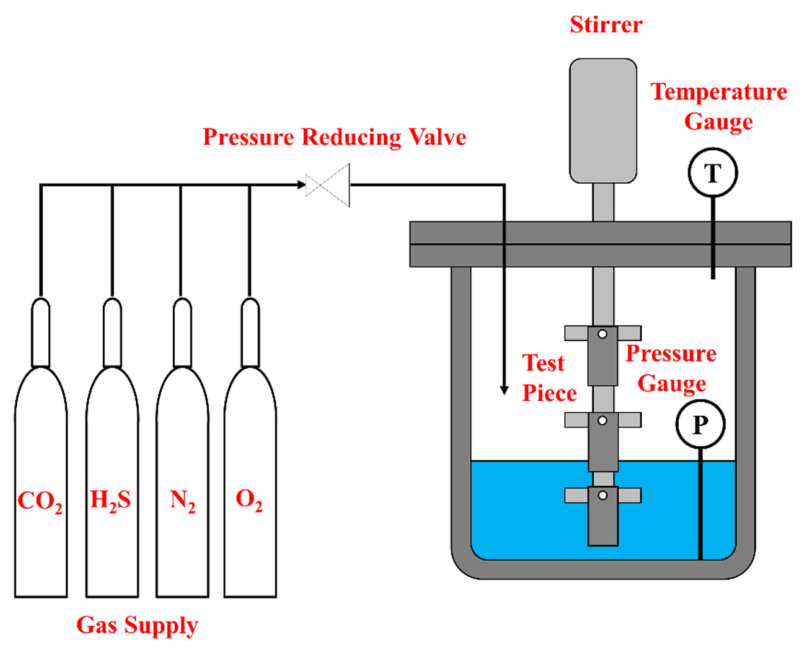
Figure 1. Schematic diagram of high-temperature autoclave.
Processes 14 01320 g001
Figure 2. Schematic diagram of flow loop.
Processes 14 01320 g002
Figure 3. Placement of test pieces in flow loop (1#~16# are test piece numbers).
Processes 14 01320 g003
Figure 4. Corrosion rate of L245NCS steel under the action of single component gas (Exp. No. Autoclave-1~12).
Processes 14 01320 g004
Figure 5. Corrosion rate under H2S pressure variation in H2S-CO2-O2 containing system (Exp. No. Autoclave-13~18).
Processes 14 01320 g005
Figure 6. Corrosion rate under CO2 pressure variation in H2S-CO2-O2 containing system (Exp. No. Autoclave-17, 19~23).
Processes 14 01320 g006
Figure 7. Corrosion rate under O2 pressure variation in H2S-CO2-O2 containing system (Exp. No. Autoclave-24~29).
Processes 14 01320 g007
Figure 8. Accumulation measurement affected by water content and temperature difference (Exp. No. Accumulation-1~6).
Processes 14 01320 g008
Figure 9. Accumulation measurement affected by pressure and temperature difference (Exp. No. Accumulation-3, 6~12).
Processes 14 01320 g009
Figure 10. Accumulation measurement affected by shutdown and restart (Exp. No. Accumulation-12~13).
Processes 14 01320 g010
Figure 11. Corrosion morphology of test pieces after 7 days (Exp. No. Corrosion-1; the picture is marked as a test piece number of (1)~(16)).
Processes 14 01320 g011
Figure 12. The relationship between corrosion rate, elevation, and fluid accumulation.
Processes 14 01320 g012
Figure 13. Sampling location and numbering after testing of undulating and straight steel pipelines.
Processes 14 01320 g013
Figure 14. Corrosion rate of different parts of the pipeline segment.
Processes 14 01320 g014
Table 1. Operational parameters of pipelines.
Pipe No.MaterialTemperature
(°C)
Pressure
(MPa)
Velocity
(m/s)
Water Content
(%)
CO2
(%)
H2S
(g/m3)
O2
(%)
1~4L245NCS23~530.8~1.02~51~53.5~11.12580~31020.18~0.27
Table 2. Partial pressure setting of experimental gas in reactor.
Exp. No.Partial Pressure (kPa)
H2SCO2O2
Autoclave-1100
Autoclave-2500
Autoclave-31000
Autoclave-43000
Autoclave-55000
Autoclave-67000
Autoclave-70100
Autoclave-80200
Autoclave-90400
Autoclave-100600
Autoclave-110800
Autoclave-1201000
Autoclave-1318020
Autoclave-1458020
Autoclave-15108020
Autoclave-16308020
Autoclave-17508020
Autoclave-18708020
Autoclave-19501020
Autoclave-20502020
Autoclave-21504020
Autoclave-22506020
Autoclave-235010020
Autoclave-2460801
Autoclave-2560805
Autoclave-26608010
Autoclave-27608015
Autoclave-28608020
Autoclave-29608025
Table 3. Conditions of effusion experiments in flow loop.
Exp. No.Water
Content (vol%)
Pressure
(MPa)
Temperature
Difference (°C)
Conveying StatusGas Phase
Composition
Accumulation-110.843ContinuousN2
Accumulation-230.843ContinuousN2
Accumulation-350.843ContinuousN2
Accumulation-410.815ContinuousN2
Accumulation-530.815ContinuousN2
Accumulation-650.815ContinuousN2
Accumulation-750.343ContinuousN2
Accumulation-850.543ContinuousN2
Accumulation-950.315ContinuousN2
Accumulation-1050.515ContinuousN2
Accumulation-1150.835ContinuousN2
Accumulation-1250.825ContinuousN2
Accumulation-1350.825Run for 7 days, shutdown for 8 h and restart 5 hN2
Table 4. Corrosion experimental conditions in flow loop.
Exp. No.Water
Content (vol%)
Pressure
(MPa)
Temperature
Difference (°C)
Conveying StatusGas Phase Composition
Corrosion-1
(Test piece)
50.825Continuous8 vol% CO2 + 2 vol% O2 + 90 vol% N2
Corrosion-2
(Test tube)
50.825Continuous8 vol% CO2 + 2 vol% O2 + 90 vol% N2
Table 5. Maximum length of condensate under different water contents.
Exp. No.Water
Content (vol%)
Pressure
(MPa)
Temperature
Difference (°C)
Total Condensate
(g)
Maximum Length of
Condensate (cm)
Accumulation-110.8431.8300
Accumulation-230.8432.9450
Accumulation-350.8434.7710
Accumulation-410.8150.91231
Accumulation-530.8151.5387
Accumulation-650.8152.1498
Table 6. Maximum length of condensate under different temperature differences and pressures.
Exp. No.Water Content (vol%)Pressure
(MPa)
Temperature
Difference (°C)
Total
Condensate (g)
Maximum Length of
Condensate (cm)
Accumulation-350.8434.7710
Accumulation-650.8152.1498
Accumulation-750.3431.9561
Accumulation-850.5432.6622
Accumulation-950.3151.1481
Accumulation-1050.5151.5592
Accumulation-1150.8353.6680
Accumulation-1250.8252.6501
Table 7. Liquid accumulation and corrosion of test pieces at different pipe positions after the experiment.
Test Piece No.Inclination of Test Piece PositionTest Piece PositionFluid AccumulationCorrosion Morphology
1#10°Low lying slope2.2%Local corrosion at the edge of immersed liquid
2#15°Low lying6.3%Uniform corrosion
3#15°Highest0.5%Severe local corrosion at the contact part with effusion
4#Middle of downhill1.3%Severe local corrosion at the contact part with effusion
5#10°Low lying6.6%All immersed in liquid, uniform corrosion
6#10°Highest1.5%Uniform corrosion
7#Low lying6.5%Uniform corrosion
8#90° elbow5.8%Serious corrosion at the contact part with effusion
9#90° elbow7.6%Uniform corrosion
10#10°Climbing close to low-lying1.1%Equivalent to uniform corrosion
11#Climbing2.3%Equivalent to uniform corrosion
12#10°Climbing2.1%Equivalent to uniform corrosion
13#10°Low lying6.7%Uniform corrosion
14#15°Position in climbing1.6%Local corrosion in contact with flowing liquid
15#10°Low lying0.4%Localized corrosion
16#10°Climbing0Slight corrosion
Table 8. Corrosion and analysis of samples obtained after the test of undulating steel pipe section and straight pipe section.
No.Sample PositionFluid AccumulationSample AppearanceCorrosion Morphology
1#2–5 o’clock direction of straight pipe at inlet of the fluctuating sectionNoneProcesses 14 01320 i001Uniform corrosion
2#3.5~6.5 o’clock direction at the starting point of the upslope in the undulating sectionWith effusionProcesses 14 01320 i002Uniform corrosion
3#2–5 o’clock direction of the highest point of the undulating sectionNoneProcesses 14 01320 i003Uniform corrosion
4#3.5~6.5 o’clock direction at the lowest downhill point in the undulating sectionWith effusionProcesses 14 01320 i004Localized corrosion
5#2–5 o’clock direction at the horizontal outlet of the fluctuating sectionNoneProcesses 14 01320 i005Uniform corrosion
6#3.5~6.5 o’clock direction at the inlet of the straight pipe sectionWith effusionProcesses 14 01320 i006Localized corrosion
7#3.5~6.5 o’clock direction at the outlet of the straight pipe sectionWith effusionProcesses 14 01320 i007Localized corrosion
Disclaimer/Publisher’s Note: The statements, opinions and data contained in all publications are solely those of the individual author(s) and contributor(s) and not of MDPI and/or the editor(s). MDPI and/or the editor(s) disclaim responsibility for any injury to people or property resulting from any ideas, methods, instructions or products referred to in the content.