Review

Catalytic Technologies for Arsenic Remediation: A Comprehensive Review of Advanced Oxidation Processes, Bifunctional Materials, and Field Applications
by
Vanina Soledad Aghemo
1,
Fernanda Miranda Zoppas
1,*,
Jose Sureda
1,
Tatiane Benvenuti
2,
Andrea Moura Bernardes
3 and
Fernanda Albana Marchesini
1,*
1
Instituto de Investigaciones en Catalisis y Petroquimica (INCAPE), Edifício Gollan, Santiago del Estero 2829, Santa Fe 3000, Argentina
2
Ministério da Ciência, Tecnologia e Inovação (MCTI), Esplanada dos Ministérios, Brasília 70067-900, Brazil
3
Universidade Federal do Rio Grande do Sul (UFRGS), Campus do Vale. Avenida Bento Gonçalves, 9500, Setor 4, Porto Alegre 91501-970, Brazil
*
Authors to whom correspondence should be addressed.
Processes 2026, 14(8), 1293; https://doi.org/10.3390/pr14081293
Submission received: 5 March 2026 / Revised: 10 April 2026 / Accepted: 14 April 2026 / Published: 17 April 2026

Abstract

Arsenic contamination in groundwater is a severe and widespread environmental and public health challenge. Recent years have witnessed rapid advances in catalytic remediation technologies, particularly those integrating advanced oxidation processes (AOPs), bifunctional materials, and field-scale applications. This comprehensive review synthesizes recent developments, emphasizing the synergy between catalytic oxidation and adsorption, the design of innovative and recyclable materials, and the practical translation of laboratory findings to real-world remediation scenarios. Key breakthroughs include dual-function catalysts for combined contaminant removal, scalable systems compatible with renewable energy, and hybrid strategies integrating conventional and catalytic routes. Case studies from arsenic hotspots worldwide demonstrate not only technological feasibility but also highlight knowledge gaps and sustainability challenges. By evaluating catalytic mechanisms, operational performance, and environmental impact, this review identifies promising directions for the next generation of arsenic remediation and offers a critical roadmap to guide future research and practice.

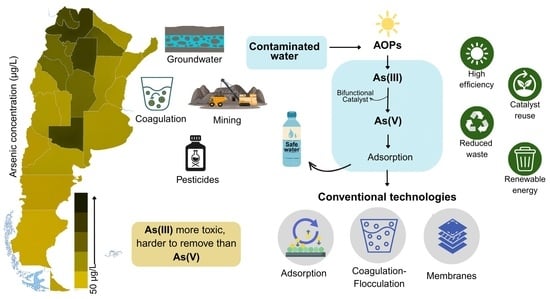
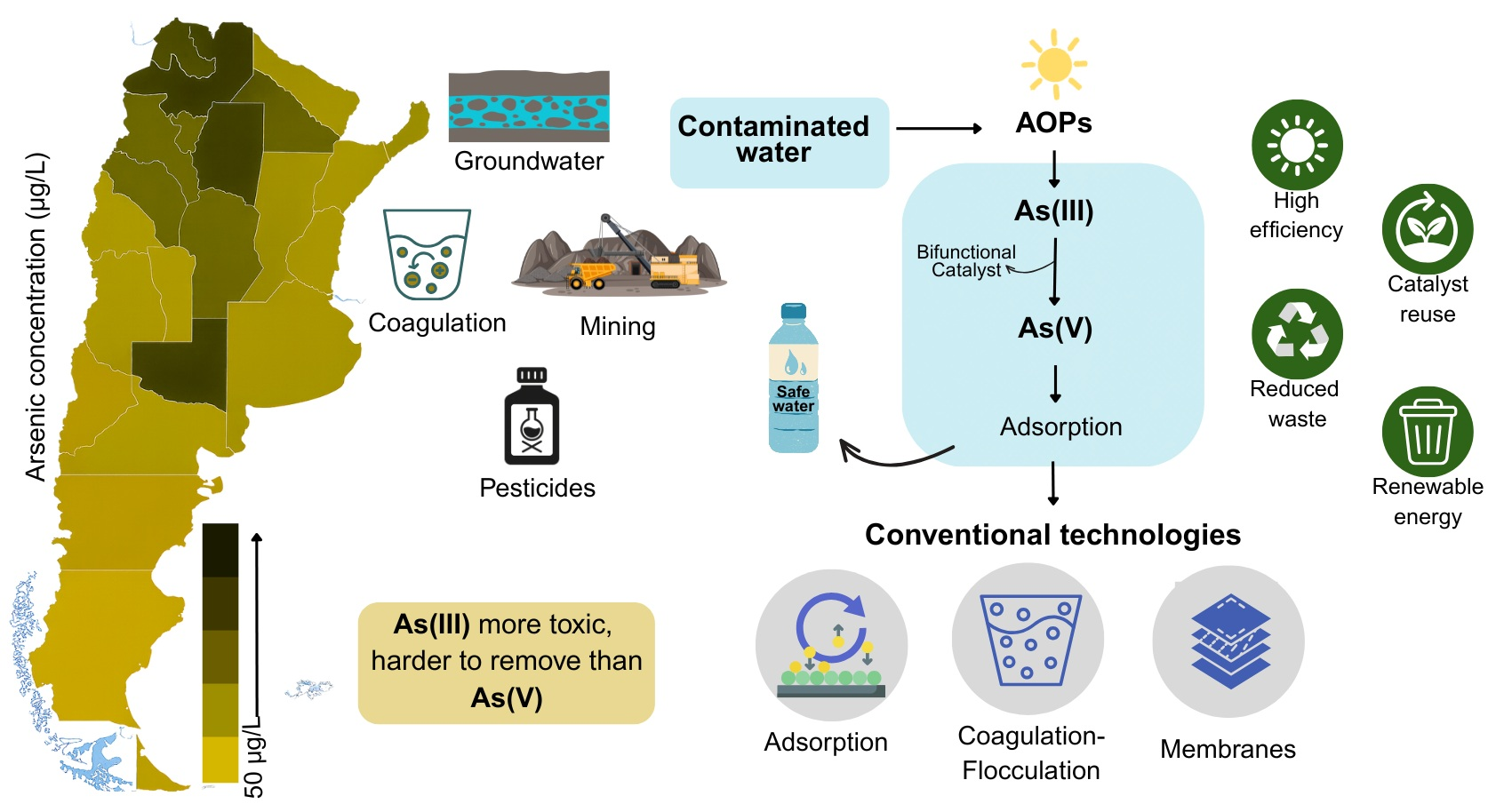
Graphical Abstract

1. Introduction

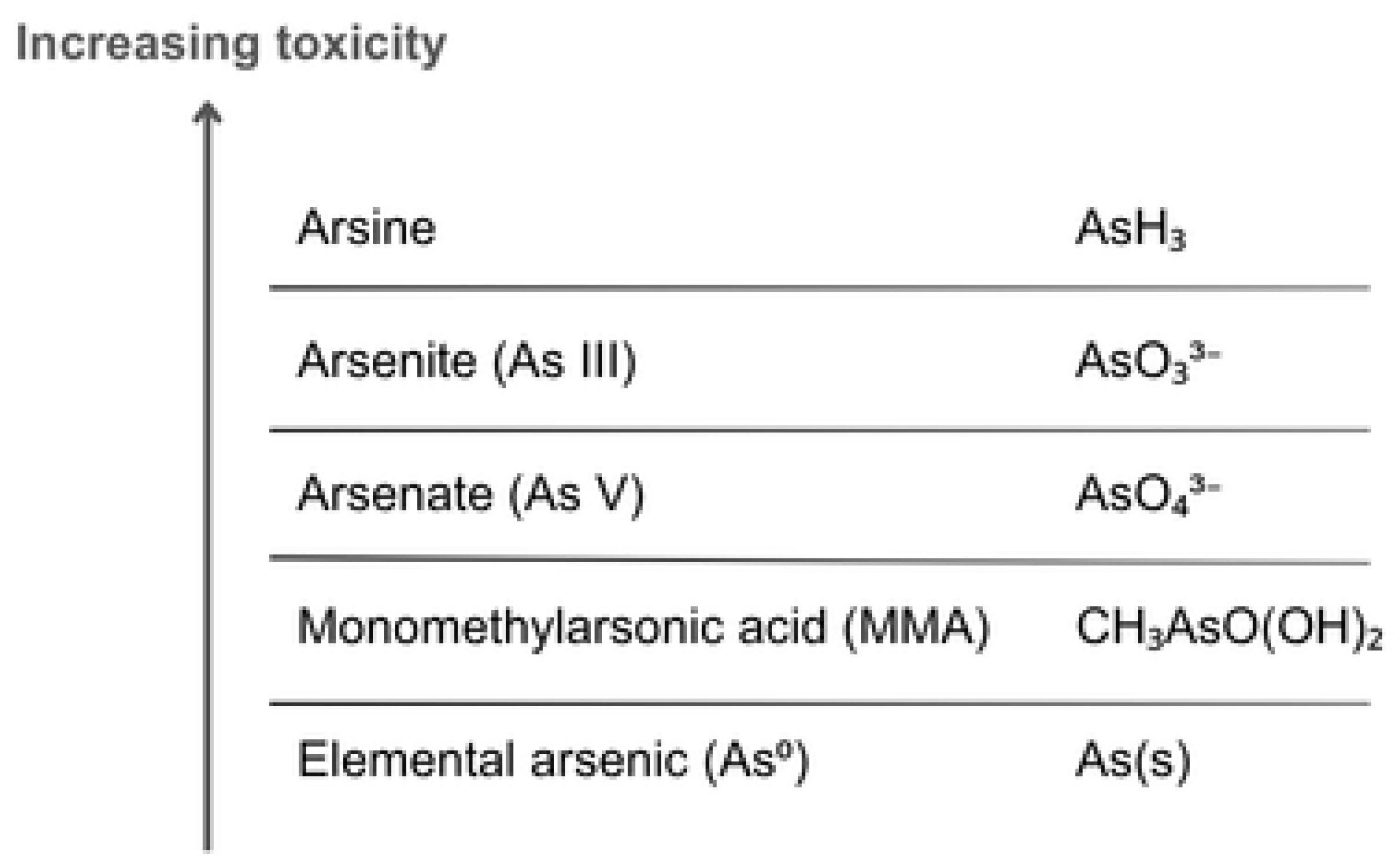
Arsenic is a naturally occurring metalloid widely distributed in soil, water, and sediments. Its mobilization into groundwater occurs through both natural processes (e.g., rock weathering, geothermal and volcanic activity) and anthropogenic sources such as mining, metallurgy, and pesticide application. In addition to its widespread occurrence, arsenic is a highly toxic and carcinogenic metalloid that exists in various chemical forms with differing toxicities The most common forms are inorganic species such as elemental arsenic (As0), arsenite As(III), and arsenate As(V), as well as organic species such as monomethylarsonic acid (MMA), and the gaseous form arsine (AsH3). Among these, the inorganic forms, particularly arsenite and arsenate, are of greatest concern in water sources, with arsenite being up to 60 times more toxic than arsenate and commonly present in groundwater intended for human consumption [1]. Although organic arsenic compounds are generally less toxic, arsine gas represents the most hazardous form, with inhalation levels above 10 ppm being lethal [2,3,4]. To contextualize these differences, Figure 1 summarizes the main inorganic and organic arsenic species, highlighting their relative toxicity and environmental relevance.
Arsenic contamination in water represents a global challenge of alarming dimensions, affecting both developed and developing countries. According to the World Health Organization (WHO), the maximum contaminant level in drinking water (MCL) is 10 µg L−1 [5]. However, studies have shown that in regions of Latin America, Asia, and Africa, arsenic concentrations often far exceed this threshold, increasing risks to public health and the environment. These regions typically share geological and socioeconomic characteristics that make them particularly vulnerable, such as arsenic-rich natural aquifers, limited technological resources for treatment, and insufficient enforcement of effective regulatory policies. Recent investigations continue to document alarming arsenic levels in drinking water sources across diverse geographical regions. In groundwater supplies from Hamedan province, Iran, simultaneous contamination with arsenic (20–100 μg L−1) and nitrate (50–150 mg L−1) poses compounded health risks, underscoring the need for technologies capable of multi-contaminant removal [6]. Concurrently, metal–organic frameworks (MOFs) have emerged as a leading material class for arsenic sequestration in regions with complex water matrices, offering tunable selectivity for both As(III) and As(V) species [7]. These persistent contamination hotspots—from Southeast Asia to the Middle East—reinforce the urgent demand for adaptable, cost-effective remediation solutions suitable for both developed and resource-limited settings.
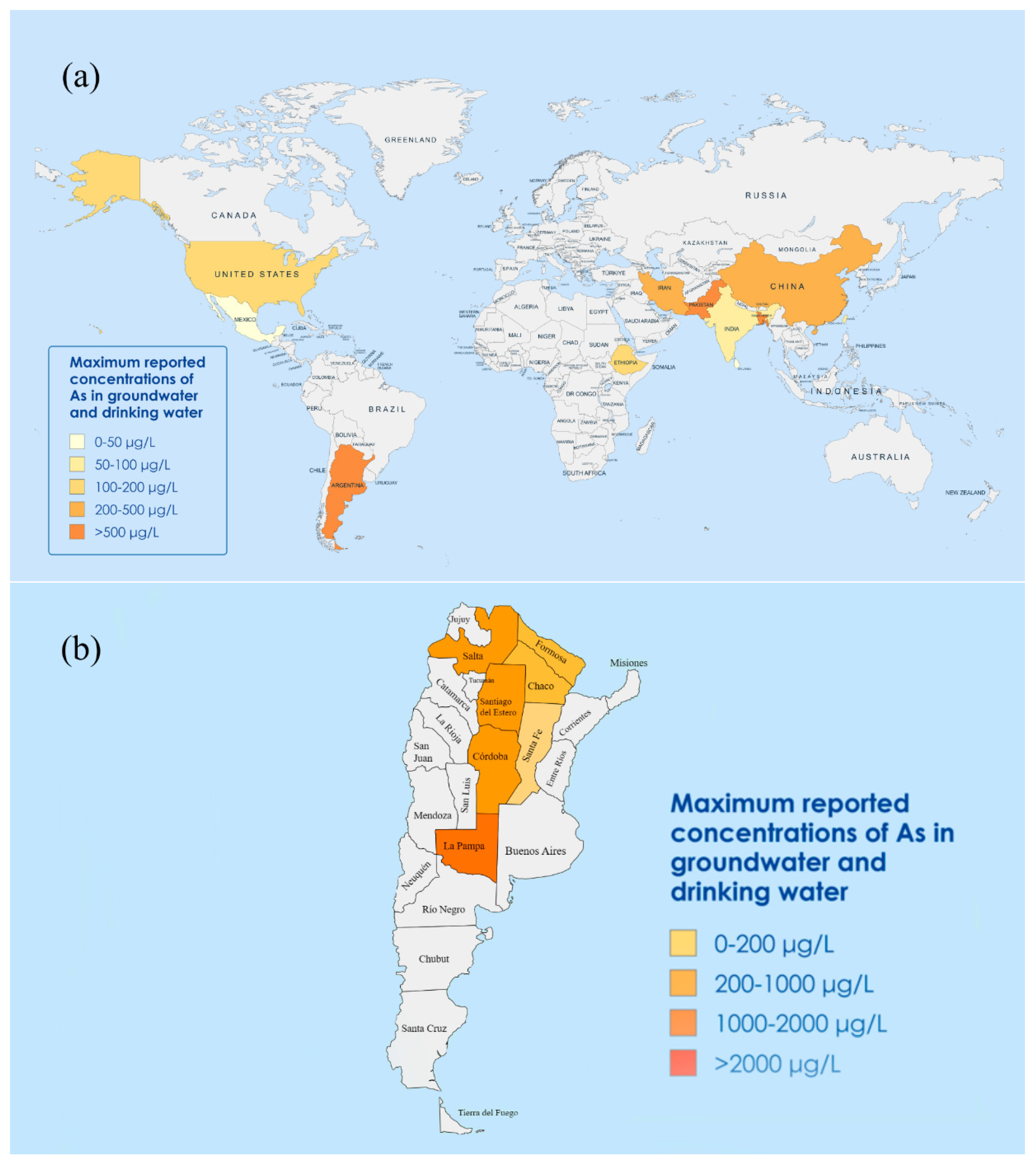
To illustrate the magnitude of this issue, Figure 2a maps the global distribution of arsenic in groundwater, while Figure 2b focuses specifically on the Argentine territory, where the Chaco-Pampean Plain, the Humid Pampas and northwestern provinces show some of the world’s highest concentrations. These areas exhibit concentrations exceeding the 10 μg L−1 limit established by the WHO, sometimes reaching extremely high levels that pose significant risks to public health and sustainable development. In the Chaco-Pampean Plain, encompassing provinces such as Córdoba, Santiago del Estero, Chaco, Salta, Tucumán, Santa Fe, and La Pampa, recorded levels are alarming. In central-western Chaco, mean concentrations reach 110 μg L−1 in deep water, with maximum levels of up to 778 μg L−1, while shallow water reports values as high as 1073 μg L−1 [8]. In Santa Fe, departments such as Castellanos and Las Colonias report concentrations ranging from 14 to 113 μg L−1, with an average of 75 μg L−1, while levels in the western region exceed 100 μg L−1 [9].
Particularly severe cases are found in La Pampa, where shallow groundwater exceeds 5000 μg L−1, and in Santiago del Estero, with areas like Santos Lugares surpassing 2000 μg L−1. In Salta, regions such as San Antonio de los Cobres have reported similar concentrations, solidifying it as one of the most critical areas nationally [10,11]. This phenomenon is more evident in arid and semi-arid regions, where geochemical conditions such as water pH and alkalinity facilitate the mobilization of arsenic transport from sediments into groundwater.
The risks associated with prolonged arsenic exposure are numerous and well-documented. Health issues such as chronic regional endemic hydroarsenicism (HACRE), cancers of the skin, lungs, and bladder, keratosis, and cardiovascular and neurological disorders are common in affected communities [12]. These health impacts are particularly severe in rural and vulnerable areas, where access to advanced water treatment technologies is limited, and institutional response capacity is inadequate [4,9,13,14,15,16].
The objectives of this comprehensive review are as follows: (i) to provide a thorough analysis of the recent advances in catalytic technologies for arsenic remediation, with special emphasis on advanced oxidation processes, bifunctional materials, and field applications; (ii) to discuss key catalytic mechanisms, operational efficiency, technical limitations, and environmental impacts of the principal systems studied; (iii) to compare conventional and catalytic strategies in order to contextualize the advantages of hybrid approaches; (iv) to compile and analyze case studies from both laboratory and real-world settings that demonstrate the transition from research to practical solutions; and (v) to identify knowledge gaps, sustainability challenges, and future priorities for the development of catalytic arsenic remediation systems.

2. Overview and Comparative Analysis of Technologies for Arsenic Remediation

Arsenic remediation in water has been extensively studied due to the high toxicity of this contaminant and its impact on human and environmental health [17]. Among the available strategies, conventional methods have historically been the most utilized [18]. However, their limitations have driven the development of advanced alternatives, such as catalytic methods.

2.1. Traditional Techniques

Traditional arsenic remediation techniques, including adsorption, membrane filtration, and coagulation–flocculation, have been widely used due to their simplicity and cost-effectiveness. These methods rely on chemical and physical principles to separate or transform arsenic into less harmful forms.

2.1.1. Adsorption Mechanisms

Adsorption remains one of the most widely applied techniques for arsenic removal due to its simplicity and cost-effectiveness [19]. The process works on the principle of adhesion, where arsenic molecules adhere to the surface of a solid material (adsorbent). Materials such as activated carbon, iron oxides, and zeolites [20,21,22,23,24] have large surface areas and functional groups that enhance their affinity for arsenic. The process is particularly effective for arsenate, As(V), as it forms stable complexes on the adsorbent surface. Adsorption involves specific interactions between arsenic species and the surface of the adsorbent, driven by chemical and physical forces. For arsenate, the adsorption process on iron oxides is characterized by the formation of inner-sphere complexes through ligand exchange, replacing hydroxyl groups on the surface [25] (see Equations (1) and (2)).
F e O H + H 2 A s O 4 F e H 2 A s O 4 + O H
F e O H + H A s O 4 2 F e H A s O 4 + O H
Arsenite (As(III)), being uncharged at neutral pH, adsorbs through hydrogen bonding and weak van der Waals interactions, forming less stable complexes (see Equation (3))
F e O H + H 3 A s O 3 F e H 3 A s O 3
Similarly, activated carbon and zeolites facilitate arsenic adsorption through interactions with surface functional groups, such as carboxylic and hydroxyl groups (Equation (4))
C O H + H 2 A s O 4 C H 2 A s O 4 + O H
Zeolites, through ion exchange and hydrogen bonding, also play a role in arsenic removal (Equation (5))
N a Z e o l i t e + H 2 A s O 3 Z e o l i t e H 2 A s O 3 + N a +
However, the presence of competing ions, such as phosphate or silicate, significantly reduces arsenic adsorption efficiency [26]. For example, phosphate competes with arsenate for adsorption sites (Equation (6)):
F e O H + H 2 P O 4 + H 2 A s O 4 F e H 2 P O 4 + A s O 4 3
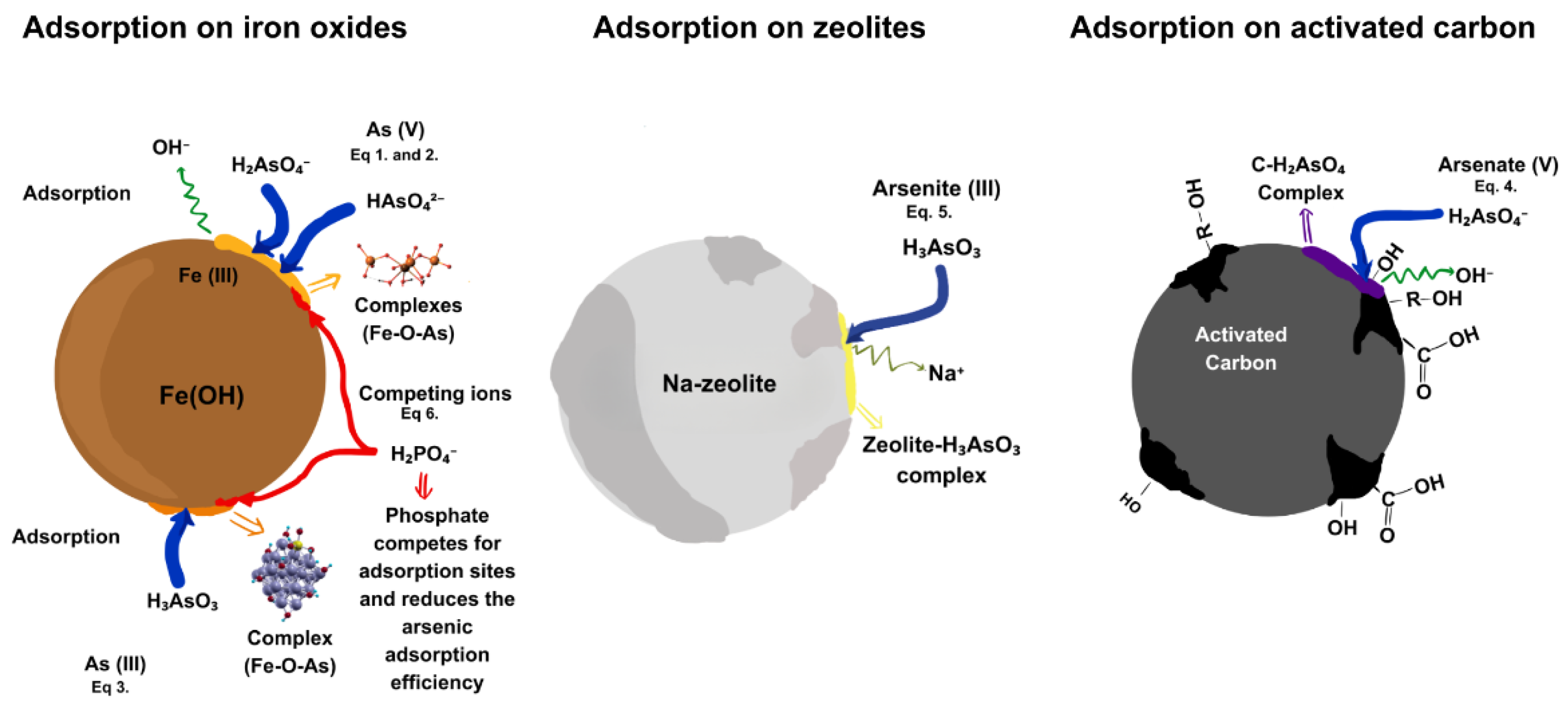
Adsorption mechanisms depend strongly on surface chemistry, pH, competing ions and the oxidation state of arsenic [27]. As shown in Figure 3, arsenate (As(V)) is mainly adsorbed on iron oxides through inner-sphere complexation (Fe-O-As), whereas arsenite (As(III)) interacts more weakly and is less efficiently retained under similar conditions. This difference explains why oxidation of As(III) to As(V) is often required to improve removal efficiency. These differences are illustrated schematically in Figure 3, which summarizes the predominant adsorption pathways for both species on common adsorbent materials.
Figure 3 also highlights the role of competing anions such as phosphate and silicate, which significantly decrease adsorption capacity by occupying or competing for surface sites. In particular, phosphate shows strong competition due to its similar structure to arsenate, reducing adsorption efficiency on Fe-based materials.
Despite its effectiveness, adsorption is limited by several operational factors. Performance strongly depends on pH, surface properties, and the presence of competing ions [26,33,34,35]. Among the main drawbacks are the sensitivity to pH (which controls arsenic speciation and surface charge), the interference of competing anions such as phosphate (PO43−) and carbonate (CO32−), and the production of potentially toxic solid waste during adsorbent saturation and regeneration [36]. The regeneration step can generate secondary effluents that require further treatment to avoid recontamination of the environment [37]. Additionally, certain adsorbents—such as those based on iron or aluminum—may suffer from issues like particle agglomeration, corrosion, or thermodynamic instability, further reducing their adsorption efficiency and complicating post-treatment recovery [19]. Recent studies also show that adsorption mechanisms can involve ion exchange and physisorption, especially in composite materials, and are highly dependent on solution chemistry and desorption processes [38,39].
To overcome these limitations, new adsorbent materials with controlled surface chemistry have been developed. MOFs have attracted significant attention due to their ultra-high surface area (exceeding 7000 m2 g−1 for materials like MU-110), tunable pore architecture, and versatile coordination chemistry that enables both electrostatic attraction and inner-sphere complexation mechanisms [7]. In particular, recent work on Ce-based MOFs shows that adsorption is governed by ligand exchange and the presence of unsaturated metal sites, with performance strongly influenced by competing ions and surface functional groups [40]. Zr-based MOFs (UiO-66, UiO-67, MOF-808) exhibit exceptional As(V) affinity through strong Lewis acid interactions, while Fe-based frameworks (MIL-100, MIL-101, MIL-88) provide inherent redox activity for simultaneous As(III) oxidation. In addition, hybrid and nanostructured materials, such as silica–iron oxide composites, have shown high adsorption capacities (up to ~575 µg As(III)/g), combining ion exchange and physisorption mechanisms, with performance strongly dependent on pH and regeneration conditions [38].
These next-generation adsorbents demonstrate promising performance in arsenic removal, particularly due to their enhanced tolerance to pH fluctuations and the presence of competing anions [41,42]. Recent advances highlight the importance of tailoring surface chemistry and structural features to effectively control adsorption mechanisms under realistic water conditions, where pH and coexisting ions play a critical role [34,38,40].
To further illustrate the significant progress in this field, Table 1 presents a comparative overview of recent MOFs developed for arsenic sequestration, emphasizing their adsorption capacities, dominant mechanisms, and key operational characteristics.
The analysis of Table 1 reveals critical trends in the development of MOF-based adsorbents for arsenic remediation. Zirconium-based MOFs, particularly the UiO-66 family, stand out due to their exceptional stability and high adsorption capacities. The parent UiO-66 shows a remarkable capacity for As(V) (up to 303 mg g−1) at low pH (2), which is attributed to strong inner-sphere complexation between arsenate and the Zr–OH groups on the Zr6O4(OH)4 nodes [43]. However, its performance at neutral pH, relevant for natural waters, is somewhat lower, prompting strategies for enhancement.
Functionalization and defect engineering have proven highly effective. The introduction of amino groups (-NH2) in UiO-66-NH2 maintains high capacity at neutral pH (161.3 mg g−1 for As(V)) by providing electrostatic attraction through protonated -NH3+ groups [45]. In contrast, thiolated versions (-SH) offer selectivity for the softer As(III) species through Lewis acid-base interactions, though they are susceptible to oxidation over time [46].
The most significant capacity enhancements are achieved through modulator-induced defect engineering. Creating missing-linker or missing-cluster defects, for example with trifluoroacetic acid (TFA) or acetic acid (AA), introduces mesoporosity and coordinatively unsaturated Zr sites. This not only improves mass transfer kinetics but also increases the number of accessible active sites, leading to record-high capacities such as up to 200 mg g−1 for As(V) at neutral pH [47] and 204 mg g−1 for As(III) [48].
Cerium-based MOFs, structural analogs of UiO-66, have recently emerged with even higher capacities, particularly for As(III) (up to 402 mg g−1 in Ce-MOF-808) [40]. This suggests that the choice of the metal node is a powerful lever for tuning affinity. Furthermore, the integration of MOFs with functional nanoparticles, such as Fe3O4 for magnetic separability [49] or nanoscale zero-valent iron (nZVI) for combined oxidation and adsorption [50], creates truly multifunctional materials that address practical challenges of recovery and multi-contaminant removal.
Despite these impressive laboratory-scale performances, the data in Table 1 must be interpreted with caution. Most capacities are derived from ideal, single-contaminant solutions. In real water matrices, the presence of competing anions like phosphate and silicate can reduce adsorption by 20–50% by occupying the same binding sites [51]. Furthermore, the conventional synthesis of many high-performing MOFs relies on toxic solvents like dimethylformamide (DMF), posing a challenge for sustainable, large-scale production. This has spurred research into greener synthesis routes using water or renewable solvents like γ-valerolactone (GVL) [52].
When compared to conventional adsorbents such as activated carbon or iron oxides (with capacities typically below 50 mg g−1), MOFs offer capacities that are one to two orders of magnitude higher. However, this superior performance comes with significantly higher synthesis costs and scalability challenges. Therefore, the selection of an optimal adsorbent is not merely a quest for the highest capacity but a strategic balance between performance, cost, stability, and environmental sustainability for a given application context.

2.1.2. Coagulation–Flocculation

This technique is based on the principle of destabilizing and aggregating colloidal particles to form larger flocs that can settle or be filtered out. Coagulants such as ferric chloride or aluminum sulfate [1].
F e C l 3 + 3 H 2 O F e ( O H ) 3 + 3 H C l
A l 2 ( S O 4 ) 3 + 6 H 2 O 2 A l ( O H ) 3 + 3 H 2 S O 4
These metal hydroxides act as adsorbents, neutralizing the charge on arsenate by forming stable complexes (Equations (9) and (10))
F e ( O H ) 3 + H 2 A s O 4 F e A s O 4 + O H + 2 H 2 O
A l ( O H ) 3 + H 2 A s O 4 A l A s O 4 + O H + 2 H 2 O
While this method is effective for arsenate (As(V)), arsenite (As(III)) requires pre-oxidation to As(V) due to its lower reactivity with coagulants. This reaction typically occurs in the presence of an oxidizing agent like oxygen (O2, Equation (11)), but in water treatment, stronger oxidants like chlorine (Cl2, Equation (12)), potassium permanganate (KMnO4, Equation (13)), and ozone (O3, Equation (14)) may act.
H 3 A s O 3 + 1 2 O 2 H 3 A s O 4
Chlorine is widely favored used due to its dual role as a disinfectant and oxidant, effectively converting As(III) to As(V) under typical water treatment conditions [53].
H 3 A s O 3 + C l 2 + H 2 O H 2 A s O 4 + 3 H + + 2 C l
Potassium permanganate is another strong oxidant that ensures rapid oxidation of arsenite with high concentrations, especially in groundwater applications where manganese removal is also desired [54]. In this reaction, KMnO4 oxidizes arsenite to arsenate, while itself being reduced to manganese dioxide (MnO2), an insoluble solid. The MnO2 precipitate, along with the newly formed arsenate, can be effectively removed from the water through coagulation and filtration processes. Studies have demonstrated that the use of KMnO4 in combination with coagulants like ferric chloride (FeCl3) enhances the removal efficiency of arsenic [55]. The process typically involves adjusting the pH to an optimal range (around 7.0 to 7.5), adding KMnO4 to oxidize As(III) to As(V), and then introducing FeCl3 to facilitate coagulation. The resulting flocs, containing arsenic and iron compounds, are then removed through sedimentation and filtration. The sludge generated from this process, primarily composed of ferrihydrite with adsorbed arsenate, has been found to pass the Toxicity Characteristic Leaching Procedure (TCLP) test, indicating that it does not pose significant environmental hazards when disposed of properly This method has been successfully implemented in field trials, achieving arsenic concentrations below 10 μg L−1, which meets the WHO guidelines for drinking water quality [5].
3 H 3 A s O 3 + 2 K M n O 4 + H 2 O 3 H 3 A s O 4 + 2 M n O 2 + 2 K O H
Ozone, a powerful oxidant, is effective at lower doses and offers rapid conversion [56]. One of the major limitations of ozone treatment is its high operational cost. Ozone must be produced on-site using ozone generators that consume significant energy, and the system requires precise control and maintenance. Its efficiency can be affected by the presence of natural organic matter, competing ions (e.g., Fe2+, Mn2+, NO2), and carbonate species that may consume ozone and reduce its availability for oxidizing arsenic. Additionally, ozone decomposes in water, forming hydroxyl radicals (•OH), which are even more reactive and can further enhance oxidation processes, though this also contributes to higher ozone demand. Although, care must be taken to avoid the formation of undesired by-products such as bromate (BrO3), which can occur if bromide ions are present in the source water [57].
The selection of the oxidant depends on factors like pH, reaction kinetics, and the presence of other contaminants in the water. During the process, neutralized particles aggregate into larger flocs, aided by mixing and flocculants such as polymers, which enhance settling and removal efficiency. Despite its effectiveness, the process generates significant amounts of toxic sludge, composed of metal hydroxides and adsorbed arsenic, presenting challenges for safe disposal [58,59].

2.1.3. Membrane Technologies

Membrane filtration utilizes a physical barrier to separate arsenic from water based on size exclusion or charge interactions. Technologies such as reverse osmosis (RO) and nanofiltration (NF) operate by applying high pressure to force water through semi-permeable membranes, leaving behind arsenic and other contaminants [1]. RO is highly effective for the removal of both As(III) and As(V), while NF shows greater selectivity for charged species such as arsenate (As(V)) due to electrostatic exclusion mechanisms.
Membranes applied to arsenic removal can be broadly classified into polymeric, ceramic, and nanocomposite membranes. Polymeric membranes, commonly based on polyamide, polysulfone (PSF), polyethersulfone (PES), or cellulose derivatives, are the most widely used NF and RO due to their relatively low cost, good water permeability, and commercial availability. Ceramic membranes, typically fabricated from alumina, titania, zirconia, or silica-based materials, offer superior chemical, thermal, and mechanical stability, as well as greater resistance to fouling, although at a higher production cost. More recently, nanocomposite membranes have been developed by incorporating metal oxides, carbon-based nanomaterials, or functional nanoparticles into polymeric or ceramic matrices to improve permeability, selectivity, antifouling behavior, and, in some cases, arsenic affinity.
The separation mechanism depends on membrane structure and operating regime. In microfiltration (MF) and ultrafiltration (UF), arsenic removal is generally limited unless arsenic is previously associated with suspended solids or iron flocs, because dissolved arsenic species are much smaller than the membrane pores. By contrast, NF and RO are more effective for dissolved arsenic removal, combining steric hindrance and electrostatic exclusion. As(V), which is negatively charged under most environmental pH conditions, is usually removed more efficiently than neutral As(III), unless a pre-oxidation step is applied. For this reason, membrane processes are frequently integrated with oxidation or coagulation stages to improve overall removal performance and reduce the passage of As(III) through the membrane [37].
Table 2 summarizes the main membrane processes used for arsenic removal, including typical materials, pore size, operating pressure, and removal efficiency for As(III) and As(V).
The data summarized in Table 2 reveal a clear evolution in catalytic strategies for arsenic remediation, with a strong trend toward multifunctional systems that integrate oxidation and adsorption within a single material. Catalysts such as CuFe2O4 + PMS (peroxymonosulfate), Ce–Mn oxide biochar, and MnFe2O4-based systems demonstrate that coupling reactive oxygen species (ROS) generation with surface adsorption significantly enhances removal efficiency, particularly for As(III). Additionally, the emergence of photo-assisted and visible-light-driven processes highlights a shift toward more sustainable approaches, aiming to reduce reliance on chemical oxidants and external energy inputs. However, despite these advances, several recurring limitations persist across the systems evaluated, including dependence on oxidants such as PMS or NaOCl, sensitivity to operational parameters (e.g., pH and light availability), and limited validation under real water matrices. These findings indicate that future research should prioritize the development of cost-effective, scalable, and robust catalytic systems capable of maintaining high performance in complex environmental conditions, while minimizing secondary by-products and operational constraints.
However, it is energy-intensive and susceptible to fouling, necessitating frequent maintenance [42]. Despite these challenges, membrane separation processes can produce high-quality water and are therefore considered viable for drinking water production in certain regions. However, all membrane processes generate a concentrated stream in which the retained ions, including arsenic, accumulate. This concentrate requires further treatment for arsenic removal, where its higher concentration can facilitate the use of oxidation or adsorption-based treatments.

2.1.4. Chemical Oxidation

Chemical oxidation converts the more toxic and mobile arsenite (As(III)) into arsenate (As(V)) through electron transfer reactions. In this process, As(III) loses two electrons to form As(V), while the oxidizing agent is reduced. The overall transformation can be represented as:
H 3 A s O 3 + H 2 O H 3 A s O 4 + 2 H + + 2 e
The electrons are captured by an oxidant. Typical reactions with chlorine, permanganate, and ozone are shown in Equations (11)–(13) of Section 2.1.2. For hydrogen peroxide, the reaction is:
H 3 A s O 3 + H 2 O 2 H 2 A s O 4 + H + + H 2 O
After oxidation, the resulting As(V) is more readily removed by adsorption or coagulation–flocculation. However, the use of strong oxidants may generate harmful by-products (e.g., chlorinated compounds, bromate) if not properly controlled, especially in waters containing organic matter or bromide ions [58,65].

2.2. Advanced Oxidation Processes (AOPs)

Advanced Oxidation Processes (AOPs) represent a versatile set of chemical treatments designed to address water contamination through the generation of highly reactive oxygen species (ROS), such as hydroxyl radicals (•OH) and sulfate radicals (SO4) [66,67,68,69]. These species, characterized by their high redox potential, facilitate the oxidation and degradation of organic and inorganic pollutants [70,71,72], including arsenic, converting arsenite (As(III)—the more toxic and mobile form) into arsenate (As(V)—the less toxic and more easily removable form). AOPs can be classified based on the mechanisms of ROS generation, including light-driven processes, electrochemical oxidation, and oxidant-based methods.

2.2.1. Light-Driven AOPs (Photocatalysis)

Photocatalysis is a prominent example of a light-driven AOP, where UV or visible light activates semiconductor materials like TiO2 to produce ROS. These species react with arsenite (As(III)), oxidizing it into arsenate (As(V)) while enabling simultaneous adsorption of arsenic onto the photocatalyst’s surface. TiO2-based photocatalysts, particularly those integrated with biochar, have shown significant promise in coupling adsorption with light-induced oxidation. For example, Yang et al. [73] demonstrated the effectiveness of TiO2-loaded biochar derived from medicinal dregs, achieving an adsorption capacity of 58.46 mg g−1 under UV light. Enhanced materials, such as TiO2 doped with noble metals or combined with other semiconductors, further improve light utilization efficiency and ROS production. However, dependence on UV light and the need for reactor optimization remain challenges for practical application.
Similarly, Raturi et al. [74] highlighted the potential of nanotechnology in improving the efficiency of arsenic remediation processes, particularly through the development of advanced nanocomposites and tailored surface modifications. However, here also, the dependence on UV light and the need for reactor optimization remain challenges for practical application. Addressing this limitation, Li et al. [75] developed a bead-type TiO2-polyacrylonitrile composite (TiO2-PAN) that achieves efficient arsenic removal under neutral pH conditions without requiring UV irradiation, relying instead on chemisorption-driven inner-sphere complexation with monolayer capacities of 63.3 mg g−1 for As(III) and 43.9 mg g−1 for As(V).

2.2.2. Electrochemical AOPs

Electrochemical processes generate ROS directly through the application of electrical currents or indirectly by activating oxidants like persulfates. These methods oxidize arsenic efficiently, leveraging electrodes as catalysts to enhance reaction kinetics. For instance, Liu et al. [76] highlighted the use of electrochemically activated persulfates, which produce sulfate radicals capable of rapidly oxidizing arsenite in complex water matrices. Electrochemical systems offer the advantage of flexibility, as they can adapt to varying arsenic concentrations and water compositions, but energy consumption and electrode fouling require further optimization for large-scale deployment.

2.2.3. Oxidant-Based AOPs

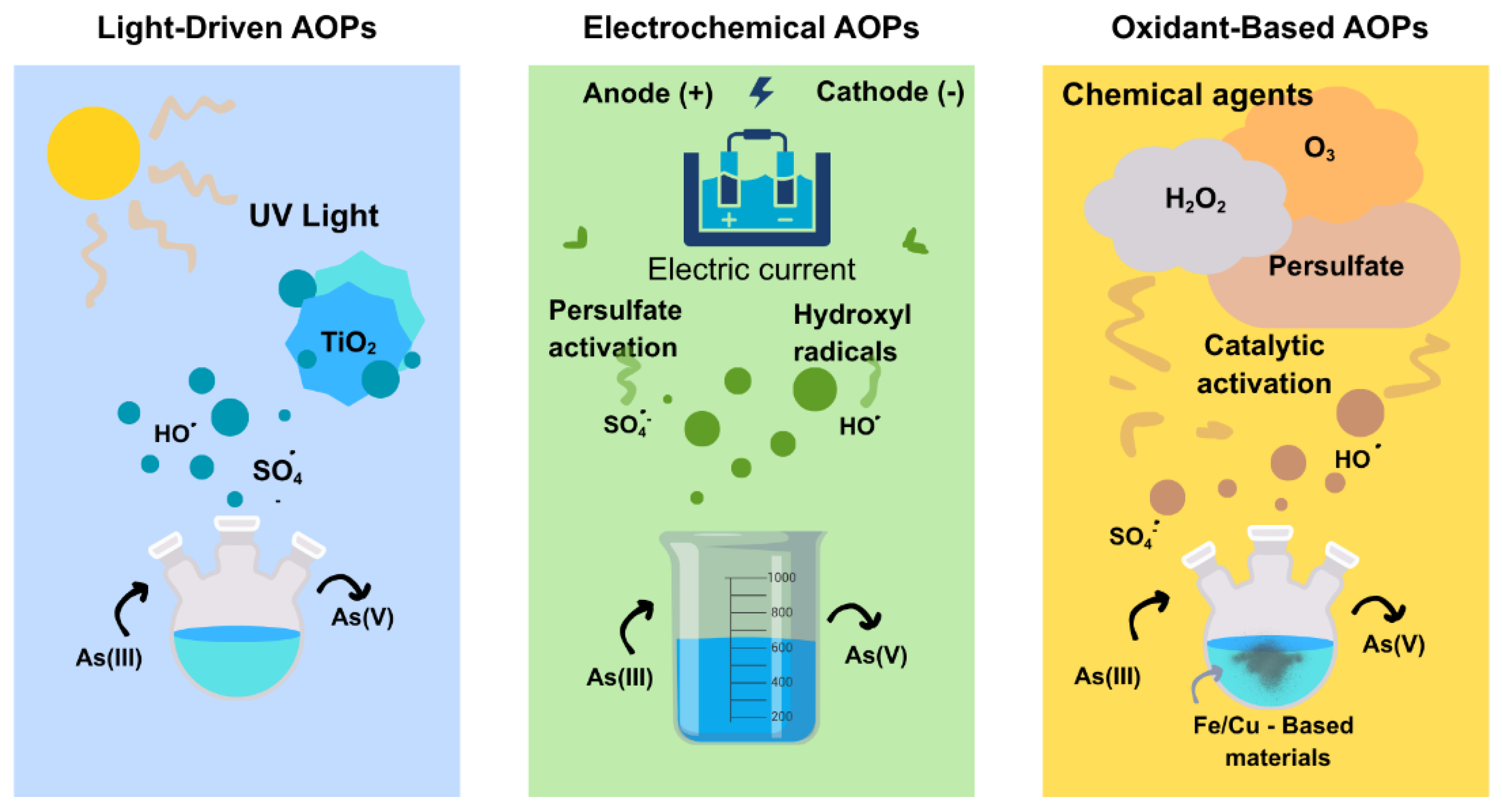
Oxidant-based AOPs utilize chemical agents such as hydrogen peroxide (H2O2), ozone (O3), or persulfates, which are activated by catalysts to enhance ROS production. Catalysts like Fe-based materials (e.g., Fenton or Fenton-like systems) or Cu-based systems significantly boost the generation of hydroxyl and sulfate radicals [68]. Zhang et al. [77] and Babu et al. [78] explored the combination of oxidants and catalysts, showing high arsenic oxidation efficiency across diverse pH levels. Additionally, combining Fenton’s reagent with UV light further accelerated the oxidation process, demonstrating synergistic effects that could be harnessed for improved treatment outcomes. However, challenges such as secondary by-product formation and the cost of oxidants remain concerns that must be addressed for sustainable implementation. To provide a general overview, Figure 4 summarizes the main AOP routes applied to arsenic remediation, the ROS involved, and the corresponding transformation pathways from As(III) to As(V).
The conceptual scheme highlights how heterogeneous catalysts, UV irradiation, persulfate activation, or Fenton-type systems converge toward the same fundamental goal: fast, efficient oxidation of As(III) under a wide range of water conditions.

2.2.4. Hybrid Systems

Hybrid systems that integrate multiple advanced oxidation processes are emerging as a promising approach for arsenic remediation. For instance, a study by Liu et al. [79] explored a combined photocatalytic-electrochemical system that utilized TiO2 under UV light while simultaneously applying an electric current. This approach not only enhanced the oxidation kinetics but also facilitated the regeneration of the photocatalyst, achieving over 95% arsenic removal efficiency in synthetic wastewater. Such hybrid systems could provide a more robust solution for complex contaminated water matrices.
Arsenic remediation technologies vary significantly in their mechanisms, efficiencies, and practical applications [80]. Table 3 provides a comparative overview of key technologies, summarizing their main features, advantages and limitations.
The data in Table 3 highlights the diverse array of arsenic remediation technologies, each with distinct strengths and weaknesses. While traditional methods such as adsorption and coagulation–flocculation remain effective in specific scenarios, they face significant challenges, such as sludge management, sensitivity to competing ions, and limited scalability [12]. To overcome these limitations, advanced catalytic approaches—including heterogeneous catalysis, photocatalysis, and AOPs—have emerged as superior alternatives [85,86]. These methods excel in arsenic removal by effectively oxidizing As(III) to As(V), which can then be more efficiently removed through adsorption. However, since As(V) remains a contaminant, complementary adsorption strategies are still required for its final removal. In this context, bifunctional systems that integrate oxidation and adsorption in a single process have received increasing attention, showing substantial improvements in efficiency and reusability [81,84].

3. Innovative Materials for Arsenic Removal

Recent studies have explored the development of novel adsorbents to improve arsenic removal efficiency, moving beyond conventional materials such as activated alumina and iron oxides. Among them, granular ferric hydroxide (GFH) has been extensively investigated due to its high surface area and affinity for both As(III) and As(V). Kinetic and thermodynamic analyses confirmed that GFH adsorption follows a pseudo-first-order model, with endothermic and spontaneous behavior, achieving removal efficiencies close to 95–99% under optimized conditions [25].
To facilitate discussion, recent advances in materials for arsenic removal are classified into three main categories: (i) sustainable and bio-based materials, (ii) nanostructured materials and MOFs, and (iii) bifunctional catalysts and hybrid systems.

3.1. Sustainable and Bio-Based Materials

Beyond GFH, a wide range of advanced adsorbents have been investigated. Biochar-based composites, functionalized zeolites, offer enhanced performance due to their high surface area, tunable porosity, and synergistic adsorption mechanisms [35,87]. Magnetized biochar has gained particular attention for combining sustainability with facilitated recovery and regeneration, aligning with green chemistry principles [88].
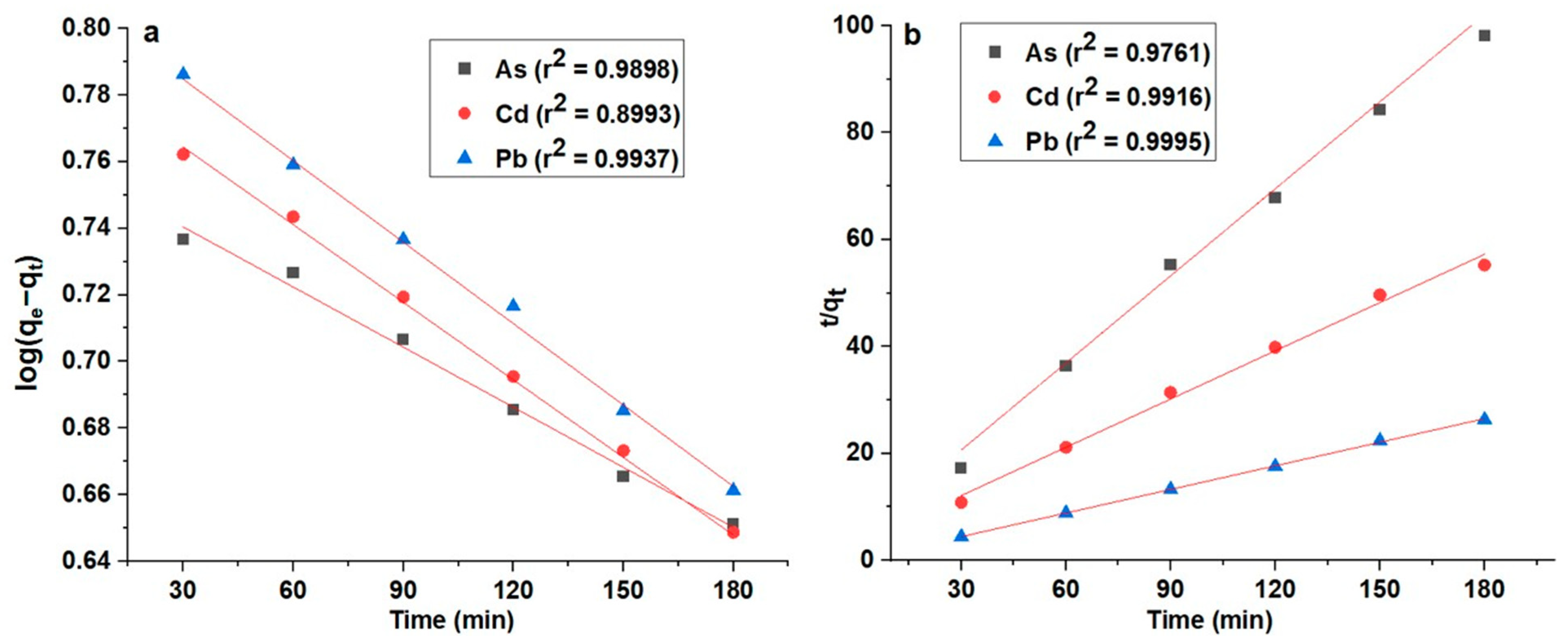
A new generation of sustainable adsorbents has emerged from agricultural waste valorization strategies, addressing both waste management challenges and water treatment needs [21,22,39,89]. Pineapple leaf cellulose (PLC), for example, contains 41.15% cellulose, 21.02% hemicellulose, and 13.05% lignin, providing abundant hydroxyl, carboxyl, and amide functional groups that facilitate heavy metal binding through ion exchange, surface complexation, and electrostatic interactions [90]. Scanning electron microscopy coupled with energy-dispersive X-ray spectroscopy (SEM-EDS) confirms uniform distribution of adsorbed metal ions on the PLC surface, while Fourier transform infrared (FT-IR) analysis reveals the active involvement of oxygen-containing functional groups in the adsorption process. Batch adsorption studies demonstrate that PLC achieves equilibrium within 120 min, with removal efficiencies following the order Pb2+ (99.53%/63.45 mg g−1) > Cd2+ (98.44%/37.23 mg g−1) > As5+ (42.40%/16.27 mg g−1) at pH 6.0. The material’s regenerative capacity—maintaining consistent performance through multiple cycles—positions it as a promising candidate for low-cost, eco-friendly wastewater treatment applications, particularly in developing regions where agricultural residues are abundant and centralized treatment infrastructure may be limited [35,91]. The adsorption kinetics of PLC for As(V), Cd(II), and Pb(II) are compared in Figure 5.
In comparison with other agricultural waste-derived biosorbents, such as green-synthesized nanoscale zero-valent iron supported on pineapple crown nanocellulose (G-nZVI/NCC), which achieved 5.49 mg g−1 for As(V) [92], PLC demonstrates superior capacity (16.27 mg g−1), highlighting the potential of cellulose-based materials. However, both materials require further functionalization to compete with synthetic adsorbents.

3.2. Nanostructured Materials and Metal–Organic Frameworks

Novel strategies such as MOFs and molecularly imprinted polymers (MIPs) have further improved selectivity and reusability, maintaining adsorption capacities above 100 mg g−1 even in the presence of competing anions like phosphates and sulfates [93].
Nanostructured materials have revolutionized arsenic remediation by offering high surface-to-volume ratios, tunable surface chemistry, and enhanced reactivity [94,95]. This category encompasses a diverse range of materials, including MOFs, metal oxides, layered double hydroxides (LDHs), and carbon-based nanomaterials.
MOFs, as extensively detailed in Section 2.1.1 (Table 1), represent a paradigm shift in adsorbent design due to their ultra-high surface areas (typically 1000–7000 m2 g−1), crystalline structures, and chemically tunable pores. Their exceptional performance arises from the synergy between inorganic metal nodes (e.g., Zr6 clusters in UiO-66) and organic linkers, which can be functionalized with groups such as -NH2, -SH, or -COOH to enhance selectivity for specific arsenic species [7,43]. Zirconium-based MOFs (UiO-66, UiO-67, MOF-808) exhibit outstanding stability and As(V) affinity through inner-sphere complexation, while iron-based frameworks (MIL-100, MIL-101) offer inherent redox activity for simultaneous As(III) oxidation [7,44]. Cerium-based analogs (Ce-MOF-66, Ce-MOF-808) have recently demonstrated even higher capacities, particularly for As(III) (up to 402 mg g−1), suggesting that the choice of metal node is a powerful handle for tuning affinity [40].
Beyond MOFs, a wide array of other nanostructured adsorbents has been investigated. Metal oxide nanoparticles, such as nano-TiO2, nano-Fe2O3, and nano-Al2O3, leverage surface hydroxyl groups for arsenic binding through ligand exchange mechanisms [58]. For instance, nanostructured iron-copper binary oxides achieved As(V) capacities of 82.7 mg g−1 at pH 7, with the synergistic effect of Fe and Cu enhancing both adsorption and oxidation [58]. Magnetite (Fe3O4) nanoparticles offer the additional advantage of magnetic separability, enabling facile recovery and reuse; functionalization with amino or thiol groups further improves selectivity in complex water matrices [59].
LDHs, also known as anionic clays, have gained attention due to their high anion exchange capacity and “memory effect”—the ability to reconstruct their layered structure after calcination. Zn-Al and Mg-Al LDHs modified with Fe or Mn have shown enhanced affinity for both As(III) and As(V), with adsorption capacities reaching 80–120 mg g−1 under optimized conditions [59,96]. The interlayer space can be tailored to accommodate arsenate anions, and the positive layer charge facilitates electrostatic attraction.
Carbon-based nanomaterials, including graphene oxide (GO), reduced graphene oxide (rGO), and carbon nanotubes (CNTs), offer unique advantages such as high surface area, excellent mechanical strength, and the ability to be functionalized with oxygen-containing groups (carboxyl, hydroxyl, epoxy) that serve as binding sites for arsenic [97,98] GO-based composites, particularly those combined with iron oxides or zirconium, have demonstrated enhanced performance due to synergistic effects between the carbon matrix and metal oxide nanoparticles [99,100,101].
When comparing these different classes of nanomaterials, several key trade-offs emerge. MOFs offer the highest adsorption capacities (often >200 mg g−1) and unparalleled tunability, but face challenges related to hydrothermal stability and synthesis costs. Metal oxides are more robust and easier to synthesize, but typically have lower capacities (<100 mg g−1) and may suffer from aggregation. Carbon-based materials provide excellent conductivity and mechanical properties, making them ideal for electrochemical applications, but their arsenic affinity is often lower unless functionalized. LDHs strike a balance between capacity and stability, but their performance is highly pH-dependent.
The choice of nanomaterial for a given application therefore depends on multiple factors: the target arsenic species (As(III) vs. As(V)), water chemistry (pH, competing ions), required capacity and kinetics, regeneration needs, and economic constraints. For point-of-use systems in resource-limited settings, low-cost materials such as iron oxide nanoparticles or functionalized biochars may be preferable, while for industrial wastewater treatment with high arsenic loads, high-capacity MOFs may justify their higher cost.

3.3. Bifunctional Catalysts and Hybrid Systems

In parallel, hybrid systems that integrate adsorption with catalytic processes have shown significant promise. Photocatalyst–biochar composites, such as TiO2-loaded biochar, achieve simultaneous adsorption and light-driven oxidation of As(III), resulting in higher overall efficiency [73]. This dual functionality not only enhances the adsorption capacity but also positions photocatalytic oxidation as one of the most attractive strategies, since it utilizes UV or visible light to activate catalysts and generate oxidizing species directly from water and oxygen, eliminating the need for external chemical oxidants. This reduces the environmental footprint of the process and creates opportunities for integration with other catalytic strategies to maximize arsenic removal efficiency. Recent advances, including doping TiO2 with metals or combining it with other semiconductors, have further improved light utilization and ROS production, though challenges related to dependence on UV light and reactor optimization remain [102,103].
Advanced catalytic materials further expand the toolkit for arsenic remediation. Heterogeneous catalysts such as CuFe2O4 activate peroxymonosulfate (PMS), enabling simultaneous oxidation and adsorption of As(III) [68,83]. Although PMS-based systems achieve nearly complete arsenic removal in short reaction times, their scalability is limited by oxidant cost and potential by-product formation. Electrochemical AOPs are also emerging as flexible alternatives, as they can adapt to varying arsenic concentrations and complex water compositions. By generating sulfate radicals from persulfates, these systems efficiently oxidize As(III) across a broad pH range, though energy demand and electrode fouling remain challenges for large-scale deployment [78]. In parallel, oxidant-based systems like Fenton and Fenton-like reactions utilize Fe-based catalysts to boost hydroxyl radical production, offering high reactivity but also requiring careful control to avoid secondary by-products.
Bifunctional catalysts that combine oxidation and adsorption in a single step have also gained momentum, providing higher efficiency and reduced sludge generation [84]. A compelling example of this integrated approach is catalytic ozonation using zero-valent iron nanoparticles (nZVI), which has proven effective for concurrent removal of arsenic and nitrate from actual drinking water sources. Abdipour et al. [6] demonstrated that nZVI serves a dual role as both a reducing agent and a catalyst for ozone decomposition, generating hydroxyl radicals (•OH) that oxidize As(III) to the more readily adsorbable As(V), while simultaneously reducing nitrate to nitrogen gas or ammonium. Under optimized conditions (pH 7.4, nZVI dose 0.75 g L−1, contact time 15 min), the system achieved 81.9% simultaneous removal efficiency at an estimated cost of $0.05 per liter of treated water. The nanoparticles, characterized by XRD, FESEM, and BET analysis, exhibited a surface area of 33.95 m2 g−1 and maintained over 90% of their initial performance after eight regeneration cycles, demonstrating the feasibility of sustainable, long-term operation. This bifunctional catalytic approach is particularly relevant for regions where arsenic and nitrate co-contamination is prevalent, such as agricultural areas with intensive fertilizer use.
Photocatalytic systems using visible light, including FeS2 nanoplates and plasmonic–magnetic nanosystems, further highlight the potential of green energy integration for sustainable remediation [86,104]. Finally, while the role of microplastics as environmental pollutants is well recognized, emerging studies have suggested their possible functionalization as sorbents. Their high surface area and tunable chemistry could enable arsenic binding, though their dual nature as contaminants and potential materials requires careful evaluation [105]. Overall, these advances underscore a clear trend toward multifunctional, hybrid, and catalytic materials that not only enhance arsenic removal efficiency but also address key challenges related to reusability, sustainability, and field applicability. The combination of adsorption and catalytic oxidation represents a promising path forward, particularly for regions heavily affected by arsenic contamination, such as Argentina’s Chaco-Pampean Plain [106]. Beyond these approaches, emerging strategies such as catalytic electrocoagulation and bimetallic nanostructures provide innovative alternatives that further expand the scope of arsenic remediation technologies.
Recent advances have introduced catalytic electrocoagulation, a hybrid process that simultaneously promotes oxidation and coagulation by applying an electrical current. This technique generates coagulants in situ, such as Fe or Al species, which facilitate both As(III) oxidation and As(V) removal. Compared to conventional coagulation, it achieves higher efficiency while reducing sludge generation and avoiding toxic by-products, making it an attractive and sustainable alternative [83]. In addition, heterogeneous catalytic systems are being expanded to address not only inorganic arsenic but also organic arsenic compounds. Magnetite-based catalysts, for example, activate PMS to degrade arsenic–organic contaminants while simultaneously enabling adsorption processes [82]. Similarly, bimetallic nanostructures have been engineered to enhance catalytic activity. The Co–Fe@C catalyst has shown remarkable efficiency in activating persulfate for the degradation of p-arsanilic acid, achieving rapid conversion under controlled conditions and offering reusability potential [81].
Looking forward, the convergence of three complementary research directions—catalytic advanced oxidation processes, nanostructured functional materials, and bio-based adsorbents—promises to deliver integrated solutions that are simultaneously efficient, sustainable, and economically viable. Recent contributions highlight three promising pathways: (i) the exceptional selectivity and tunability of MOFs for targeted arsenic binding across varying pH conditions [7]; (ii) the scalability and circular economy alignment of agricultural waste-derived biosorbents such as pineapple leaf cellulose [90]; and (iii) the field applicability of catalytic systems like nZVI-ozonation for simultaneous multi-contaminant removal in real water matrices [6]. Synthesizing these advances into a coherent technological roadmap is essential for translating laboratory innovations into tangible public health impacts, particularly in arsenic-affected regions of Latin America, Asia, and Africa where geological vulnerability intersects with limited treatment infrastructure. These emerging strategies—along with other catalytic innovations developed recently—are systematically compared in Table 4, which highlights their mechanisms, key results, advantages, and limitations.
The comparative analysis presented in Table 4 underscores the diversity and technological advancements in catalytic processes developed for arsenic remediation. These methods exhibit distinct advantages, such as high efficiency, environmental compatibility, and adaptability to various water matrices, but they also face significant challenges that hinder their widespread adoption. Key barriers include high operational costs, scalability issues, and technical complexities that must be addressed for scaling up these technologies to transition from laboratory research to practical applications. Among the catalytic systems evaluated, CuFe2O4 + PMS demonstrated exceptional performance, achieving nearly complete removal of As(III) in a remarkably short time frame. This efficiency makes it particularly suitable for treating low-concentration waters. However, the reliance on PMS as a reactive agent raises several concerns. From an economic perspective, the use of PMS increases treatment costs, which may limit its feasibility in large-scale or low-budget operations. Environmentally, the process also raises red flags due to the potential formation of by-products, which could negatively impact ecosystems if not properly managed.
In parallel, the ZnAl-LDH + UVC/NaOCl combination showcased impressive results, achieving 99% oxidation and significant adsorption efficiency. This underscores the effectiveness of homogeneous photo-driven oxidation processes in arsenic remediation. However, despite its high efficiency, the dependence on UV light presents a critical scalability challenge. The requirement for controlled light conditions limits its applicability in regions where access to reliable UV sources may be limited or where operational costs for artificial UV generation are prohibitive.
Cost-effective options like AC and Magnetized Biochar remain viable alternatives due to their broad availability and ease of implementation. Despite these benefits, challenges such as rapid saturation and reduced performance in complex matrices hinder their overall efficiency. Magnetized biochar, however, offers an advantage through facilitated regeneration, enhancing its sustainability. On the other hand, high-efficiency catalysts like Pt/SiO2 + Fe(III) and Transition Metal Catalysts demonstrate remarkable performance but come with increased operational costs linked to expensive materials and complex surface modifications.
The integration of methods, such as combining photocatalysis (e.g., TW-3 Photocatalyst) with adsorption, shows promise for optimizing arsenic removal while reducing environmental impact. Novel catalysts, such as Co–Fe@C + PDS (peroxydisulfate), emphasize advancements in addressing arsenic–organic contaminants, leveraging dual mechanisms of oxidation and adsorption. Processes involving magnetized biochar and LDH materials stand out for their alignment with green chemistry principles, while PMS-based methods offer unmatched efficiency but at a higher economic and environmental cost. Photocatalysts are particularly promising for future applications due to their reduced reliance on chemical inputs and compatibility with renewable energy sources.
The novel approach of FeS2 Nanoplates + PMS integrates visible-light-driven catalysis with PMS activation, achieving over 90% oxidation of As(III) while simultaneously degrading organic dyes [104]. The dual functionality of FeS2 as both an oxidant and adsorbent is particularly advantageous for complex wastewater scenarios. However, its reliance on controlled light conditions could limit scalability.
Lanthanum-doped MnFe2O4 catalysts demonstrated nearly 95% arsenic removal efficiency, leveraging PMS activation for oxidation and enhanced adsorption [103]. These catalysts are particularly suited for treating multi-contaminant water systems. Their stability under operational conditions makes them a strong candidate for real-world applications, though potential fouling over time remains a challenge.
Ce-Mn oxide-modified biochar showed rapid and complete oxidation of As(III) in under 60 min [102]. The dual-function design combines high adsorption capacity with effective oxidation, offering a sustainable and high-performance solution. The scalability of this method has yet to be fully explored, but its alignment with green chemistry principles positions it as a key contender for future research.
The work by Kim et al. [88] demonstrated the efficacy of magnetic biochar derived from Spirulina platensis in arsenic remediation, achieving up to 95% removal efficiency for As(III) under optimized conditions. This approach stands out for its sustainability, leveraging magnetic nanoparticles to facilitate recovery and regeneration, making it highly suitable for practical applications in water treatment. Meanwhile, Yin et al. [110] presented an innovative plasma regeneration technique for V2O5-based catalysts, maintaining arsenic removal efficiencies above 90% over multiple cycles. This breakthrough highlights the potential for long-term catalyst sustainability and cost-effectiveness, addressing key challenges in operational durability while minimizing waste generation. Both studies emphasize advancements in green chemistry principles and practical scalability for arsenic remediation technologies.
These advancements underscore the necessity of continued research and innovation in catalytic technologies. The integration of these methods with sustainable practices holds the potential to bridge the gap between laboratory-scale success and real-world implementation. The three classes of materials examined in this section reveal a clear evolutionary trajectory in arsenic remediation strategies. Sustainable and bio-based materials, such as pineapple leaf cellulose (PLC), offer low-cost, circular economy-aligned solutions that are particularly well-suited for resource-limited settings where affordability and local availability are paramount. At the next level, nanostructured materials, particularly MOFs, deliver exceptional adsorption capacities and unparalleled chemical tunability, though their synthesis costs and long-term stability under real-world conditions remain challenges for large-scale deployment. At the forefront, bifunctional catalysts and hybrid systems integrate oxidation and adsorption into a single platform, achieving synergistic effects that enhance removal efficiency while reducing operational complexity and waste generation. The strategic combination of these complementary material classes—leveraging the sustainability of bio-based adsorbents, the high performance of nanostructured platforms, and the multifunctionality of hybrid catalysts—holds the key to developing robust, scalable, and context-appropriate remediation technologies. With this foundation established, the following section pivots to the mechanistic drivers of catalytic processes, exploring the fundamental interactions that govern arsenic binding, reactive oxygen species generation, and the synergistic interplay between catalytic and adsorptive functions.

4. Mechanistic Drivers of Arsenic Oxidation

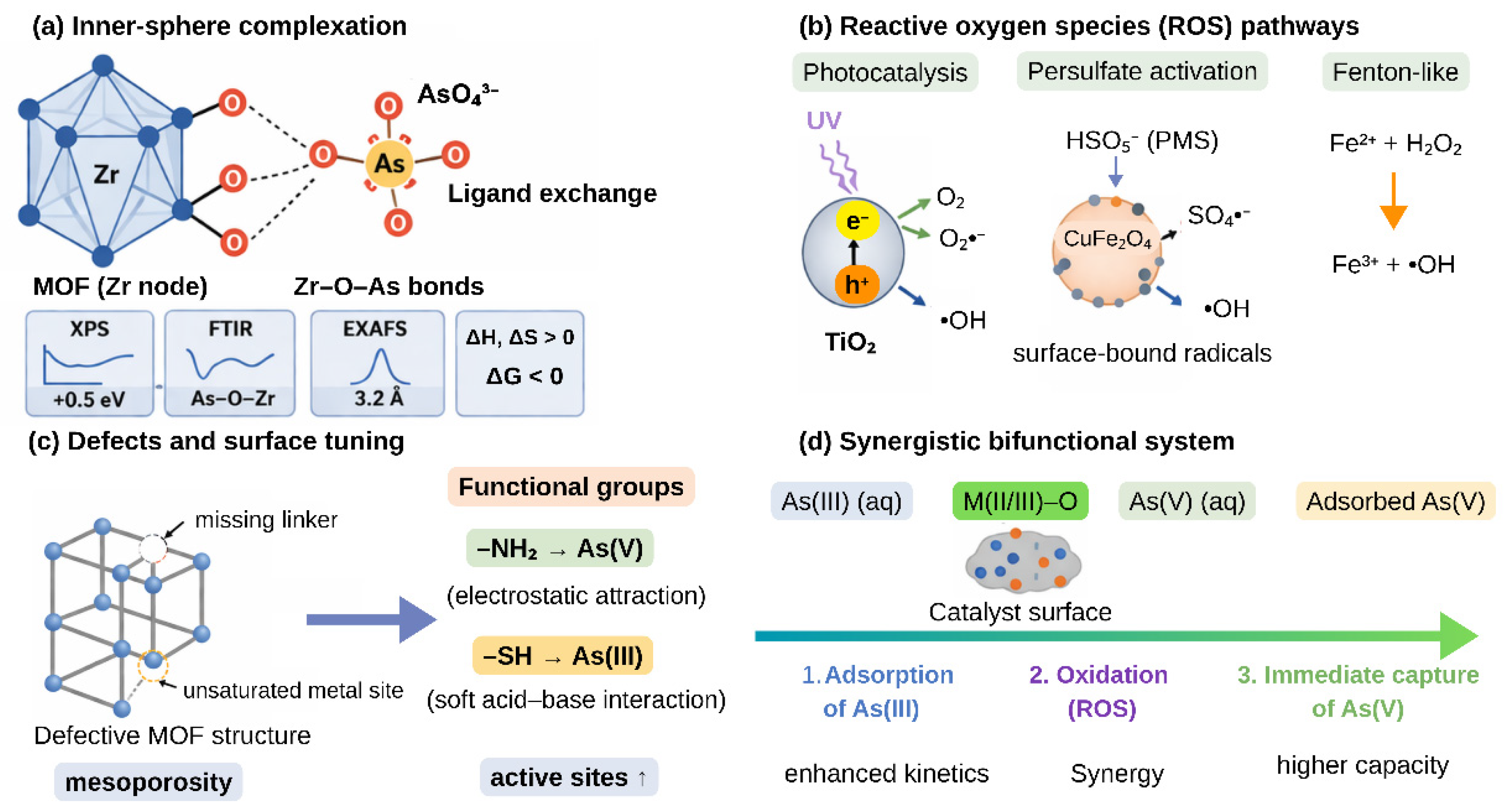
Understanding the molecular-level mechanisms that govern arsenic removal is essential for the rational design of efficient and durable catalytic materials. This section critically examines the fundamental interactions that drive arsenic oxidation and adsorption, focusing on (i) direct spectroscopic and thermodynamic evidence for surface binding, (ii) the generation pathways of reactive oxygen species (ROS) in advanced oxidation processes (AOPs), (iii) the role of structural defects and surface functionalization in tuning reactivity, and (iv) the synergistic effects that arise when oxidation and adsorption are combined in bifunctional systems. Collectively, these mechanistic insights explain why certain materials outperform others and provide a roadmap for future developments.

4.1. Molecular-Level Evidence for Arsenic Binding Mechanisms

Distinguishing between physisorption and chemisorption is crucial for predicting the reversibility, selectivity, and long-term stability of an adsorbent. While kinetic models—such as pseudo-second-order kinetics—often suggest chemisorption as the rate-limiting step [73], definitive mechanistic assignment requires a combination of spectroscopic and thermodynamic techniques [27,98].
X-ray Photoelectron Spectroscopy (XPS) provides direct evidence of chemical bonding through binding energy shifts. For arsenate adsorbed on UiO-66, the As 3d spectrum exhibits a shift of approximately 0.5 eV relative to free arsenate, confirming the formation of covalent Zr–O–As bonds [43,46]. In the case of CuFe2O4-based systems, XPS revealed that 58% of the adsorbed arsenic was present as As(V), proving in situ oxidation concurrent with adsorption [50].
Fourier Transform Infrared Spectroscopy (FTIR) identifies specific vibrational modes. After arsenic adsorption on UiO-66, a new band appears at 830–860 cm−1, assigned to the asymmetric stretching of As–O–Zr bonds, while the intensity of the Zr–OH band at 1055 cm−1 decreases, indicating ligand exchange [43,47]. For the NZVI@UiO-66 composite, FTIR shows additional bands at 570 and 630 cm−1 (Fe–O stretching in magnetite and maghemite) and a peak at 812 cm−1 (Zr–O–As), confirming that both Fe and Zr sites participate in arsenic capture [50].
Extended X-ray Absorption Fine Structure (EXAFS) offers the most detailed structural information. For arsenate on UiO-66, EXAFS gives an As-Zr distance of 3.2–3.3 Å and a coordination number of 2.1, characteristic of bidentate binuclear inner-sphere complexes [44,47]. In contrast, physisorption-dominated materials such as unmodified activated carbon show no defined As–metal scattering [27].
Thermodynamic parameters provide complementary evidence [35,95]. Chemisorption typically exhibits higher enthalpy changes (ΔH > 40 kJ mol−1) due to covalent bond formation, whereas physisorption shows ΔH values between 5 and 40 kJ mol−1 [98]. For UiO-66, ΔH values of 14–20 kJ mol−1 suggest a mixed mechanism, with defect sites enabling stronger chemisorption [47]. Positive entropy changes (ΔS > 0) observed for most adsorbents indicate increased disorder at the solid–liquid interface upon arsenic binding—a hallmark of inner-sphere complexation [47,111].
A clear progression from first-generation to third-generation adsorbents illustrates the shift from physisorption-dominated to chemisorption-dominated mechanisms. Agricultural waste-derived biosorbents, such as pineapple leaf cellulose (PLC), rely primarily on ion exchange and electrostatic interactions; FTIR confirms the involvement of hydroxyl and carboxyl groups but no new covalent bond formation [90]. In contrast, functionalized MOFs like UiO-66-NH2 employ a dual mechanism: initial electrostatic attraction of As(V) oxyanions by protonated -NH3+ groups at neutral pH, followed by inner-sphere complexation at Zr sites, as evidenced by XPS and EXAFS [45,112]. Iron-based systems such as NZVI@UiO-66 integrate two steps: oxidation of As(III) to As(V) by reactive oxygen species generated from NZVI and iron oxyhydroxides (γ-FeOOH, α-FeOOH, Fe3O4, γ-Fe2O3), followed by chemisorption of As(V) onto both Zr and Fe sites [50]. This multifunctional mechanism, combining oxidation, chemisorption, and magnetic separability, exemplifies the trend toward integrated remediation platforms.

4.2. Reactive Oxygen Species (ROS) Generation Pathways in AOPs

The efficiency of AOPs relies on the generation of highly reactive species capable of oxidizing As(III) to As(V). The most common oxidants are hydroxyl radicals (•OH) and sulfate radicals (SO4), whose formation pathways depend on the activation mechanism [113].
Photocatalytic generation involves excitation of a semiconductor (e.g., TiO2) by UV/visible light, producing electron–hole pairs. Holes oxidize water or surface hydroxyls to •OH, while electrons reduce O2 to superoxide (O2), which can further yield H2O2 and additional •OH [73,114]. These radicals oxidize As(III) rapidly, with rate constants near the diffusion limit (∼109 M−1 s−1) [113]. The facet dependence of this process has been demonstrated for anatase TiO2, where {001} facets exhibit stronger •OH generation due to higher surface energy and oxygen vacancy concentration [115].
In persulfate-based AOPs, PMS, (HSO5) or PDS, (S2O82−) are activated by heat, UV, or transition metals. For CuFe2O4, both Cu and Fe sites participate in a surface-catalyzed redox cycle. XPS analysis after reaction reveals partial reduction in Cu(II) to Cu(I) and Fe(III) to Fe(II), confirming electron transfer from the surface to PMS [83]. The coexistence of •OH and SO4 was confirmed by electron paramagnetic resonance (EPR) using DMPO (5,5-dimethyl-1-pyrroline N-oxide) as a spin trap, with characteristic 1:2:2:1 quartet signals (DMPO-•OH) and weaker signals attributed to DMPO-SO4 adducts appearing within minutes [83,116].
The relative contribution of free vs. surface-bound radicals was assessed by radical scavengers. Methanol rapidly reacts with both •OH and SO4, whereas tert-butanol (TBA) selectively quenches •OH. In the CuFe2O4/PMS system, the addition of methanol or TBA at concentrations sufficient to scavenge free radicals does not completely inhibit As(III) oxidation, indicating that surface-bound radicals remain active [117]. Furthermore, methylene blue (MB)—a probe for bulk-phase radicals—is barely decolorized in CuFe2O4/PMS, whereas Co2+/PMS (which produces free radicals) rapidly bleaches MB [83,117]. This evidence supports that the dominant oxidants are radicals adsorbed on the catalyst surface rather than freely diffusing species.
A distinct mechanism has been proposed for diatomite-supported CuFe2O4, where singlet oxygen (1O2) plays a dominant role. In this system, 1O2 is generated via the sequence PMS → O21O2, with oxygen vacancies facilitating electron transfer and O2 formation [102]. Radical quenching experiments confirmed that 1O2 contributed significantly to pollutant degradation, while the system remained largely independent of dissolved oxygen [102].
Fenton and Fenton-like reactions operate through a different pathway: Fe2+ (or Cu+) decomposes H2O2 to •OH (Equation (1)), while Fe3+ can be reduced back by H2O2 or by photochemical processes [58].
The high reactivity of •OH makes these systems effective even at near-neutral pH, but they are sensitive to radical scavengers and may produce iron sludge [58].
F e 2 + + H 2 O 2 F e 3 + + O H + O H
In all AOPs, the overall oxidation of As(III) follows pseudo-first-order kinetics when radical generation is rate-limiting. For example, in the CuFe2O4/PMS system, the apparent rate constant for As(III) disappearance was 0.927 min−1, an order of magnitude higher than with PMS alone [116]. The synergy between adsorption and oxidation is reflected in the enhanced capacity of CuFe2O4/PMS (63.9 mg g−1) compared to CuFe2O4 alone (36.9 mg g−1).

4.3. Role of Defects and Surface Functionalization

Defect engineering and surface functionalization have emerged as powerful strategies to tailor the adsorption and catalytic properties of materials for arsenic remediation. In Zr-based MOFs, particularly UiO-66, the deliberate introduction of missing-linker or missing-cluster defects creates coordinatively unsaturated metal sites that serve as additional Lewis acid centers, enhancing the affinity for arsenate oxyanions [47,48].
The addition of monocarboxylic acid modulators (e.g., acetic acid, AA; trifluoroacetic acid, TFA) during synthesis controls defect density. For UiO-66-TFA/AA, the BET surface area increased from 1041 to 1690 m2 g−1, and As(V) adsorption capacity rose from 89 to 200 mg g−1 at neutral pH [47]. Mesopore formation (2–50 nm) due to missing-linker defects facilitates faster intraparticle diffusion, shortening equilibrium times from several hours to less than one hour [47]. Thermogravimetric analysis (TGA) and proton NMR confirmed missing linkers, while EXAFS revealed that defect sites favor bidentate binuclear coordination of As(V) with Zr clusters [47,48].
Surface functionalization further modulates selectivity and binding strength. Amino groups (-NH2) in UiO-66-NH2 protonate to -NH3+ under mildly acidic conditions, providing electrostatic attraction for H2AsO4 anions, which explains the high As(V) capacity (161 mg g−1) at pH 7 [45]. Thiolated UiO-66-(SH)2 exhibits preferential binding to As(III) through soft Lewis acid–base interactions (40 mg g−1), with XPS and DRIFTS confirming S–As bond formation [46,118]. Defect-rich UiO-66-NH2 combines open Zr sites and amino groups for superior performance across a wide pH range [44]. Similarly, oxygen vacancies in transition metal oxides (e.g., Ce–Mn oxide biochar) enhance As(III) adsorption by providing electron-rich sites that promote both surface complexation and oxidation [102].
Defects influence not only the number of active sites but also the thermodynamics of adsorption. In UiO-66-TFA/AA, positive enthalpy changes (ΔH = 14–20 kJ mol−1) and positive entropy changes (ΔS = 50–60 J mol−1 K−1) are consistent with an endothermic ligand-exchange process where water molecules are released upon complex formation. The more negative Gibbs free energy values observed for defected samples compared to ideal UiO-66 confirm that defect creation makes the adsorption more spontaneous [47].
Overall, the rational combination of defect engineering and surface functionalization enables the design of adsorbents with tailored capacity, selectivity, and kinetics. Future work should focus on optimizing defect density to balance enhanced activity with structural stability, and on developing scalable, environmentally friendly synthetic routes [51,52].

4.4. Synergistic Effects in Bifunctional Systems

The integration of oxidation and adsorption into a single material or process represents a significant advance in arsenic remediation, as it eliminates the need for separate pre-oxidation steps and reduces the overall treatment footprint. Bifunctional systems leverage complementary mechanisms—typically a redox-active component that converts As(III) to As(V) and a high-affinity adsorbent that sequesters the resulting As(V)—to achieve faster kinetics and higher capacities than either function alone.
A paradigmatic example is the combination of CuFe2O4 with PMS. In this system, CuFe2O4 acts both as a heterogeneous catalyst for PMS activation and as an adsorbent for arsenic species. XPS analysis of CuFe2O4 after reaction revealed that approximately 58% of adsorbed arsenic was present as As(V), confirming in situ oxidation [116]. The adsorption capacity for total arsenic increased from 36.9 mg g−1 (As(III) alone) to 63.9 mg g−1 in the presence of PMS, with complete removal of 1.4 mg L−1 As(III) achieved within 15 min [116]. The synergy arises from two effects: (i) PMS activation generates surface-bound •OH and SO4 radicals that rapidly oxidize As(III) adsorbed on the catalyst surface, and (ii) the oxidation step modifies the surface chemistry, creating additional adsorption sites for As(V) [116,119]. Electron paramagnetic resonance (EPR) experiments confirmed the generation of both radical species, while radical quenching experiments with tert-butanol and methanol indicated that surface-bound radicals play a dominant role [116,119]. Importantly, the material’s magnetic properties (saturation magnetization ∼14.7 emu g−1) enable facile separation and reuse, with over 96% removal efficiency maintained after four cycles [116].
More recently, Gao et al. (2025) [120] developed a CuFe2O4-carbon nanotube (CNT) filter integrated with electrochemical activation of PMS [32]. This hybrid system achieved 97% degradation of phenylarsonic acid (PAA) and 94% removal of total arsenic. Mechanistic studies combining DFT (density functional theory) calculations and HPLC-MS (high-performance liquid chromatography-mass spectrometry) revealed that different crystal planes of CuFe2O4 play distinct roles: the (100) plane primarily activates PMS to generate ROS, while the (211) plane provides strong adsorption sites for As(V). The CNT network enhances electron transfer and prevents catalyst aggregation. This work illustrates how bifunctionality can be scaled to flow-through systems suitable for practical water treatment.
Another compelling bifunctional approach is the use of nanoscale zero-valent iron (nZVI) in catalytic ozonation [120]. Here, nZVI serves a dual role: it catalyzes ozone decomposition to generate •OH radicals, which oxidize As(III) to As(V), while simultaneously reducing nitrate to nitrogen gas or ammonium. In real groundwater from Hamedan province, Iran (initial As = 20–100 μg L−1, NO3 = 50–150 mg L−1), the nZVI/O3 system achieved 81.9% simultaneous removal of both contaminants under optimized conditions (pH 7.4, nZVI dose 0.75 g L−1, contact time 15 min). The estimated treatment cost was 0.05 US$ L−1, and the catalyst maintained over 90% of its initial performance after eight regeneration cycles [6]. This system exemplifies how bifunctional catalysts can address co-contamination scenarios prevalent in agricultural and industrial areas.
A distinct synergy arises when oxidation and adsorption are combined through composite materials that pair a photocatalyst with a high-capacity adsorbent. For example, TiO2-loaded biochar (TBC) simultaneously adsorbs As(III) via its carbon matrix and oxidizes it to As(V) under UV irradiation, with the As(V) then bound to the TiO2 surface [73]. The maximum adsorption capacity of TBC for As(III) was 58.5 mg g−1 at 25 °C, significantly higher than that of the pristine biochar. Kinetic analysis revealed that the process follows a multistage intraparticle diffusion model, with chemisorption confirmed by the Elovich model fit [73]. Similar principles apply to FeS2 nanoplates activated by visible light and PMS, where the material oxidizes As(III) to As(V) while simultaneously degrading organic dyes, demonstrating that bifunctionality can extend to complex wastewater matrices [104].
In all these systems, the key to enhanced performance is the spatial proximity of oxidation and adsorption sites. When oxidation occurs on or very near the adsorption surface, the newly formed As(V) is captured before it can diffuse into the bulk solution, avoiding the need for a separate post-oxidation adsorption step. This “capture-then-oxidize” or “oxidize-then-capture” sequence is more efficient than a two-stage process, as evidenced by the higher capacities and faster kinetics observed for bifunctional catalysts compared to their individual components [73,116]. Given the diversity of mechanisms reported across different catalytic systems, a unified mechanistic representation is essential to better understand their synergistic effects. Figure 6 integrates the four key mechanistic drivers discussed in this section.
Collectively, these mechanistic insights demonstrate that the rational design of bifunctional catalysts—combining oxidation and adsorption—is key to achieving high-performance arsenic remediation. The development of bifunctional systems also opens avenues for simultaneous removal of multiple contaminants, as demonstrated by the nZVI/O3 system [6]. Future research should focus on elucidating the detailed mechanisms of site-specific synergy (e.g., through operando spectroscopy) and on translating these laboratory successes into scalable, cost-effective technologies for arsenic-affected regions.

5. Challenges in Arsenic Remediation

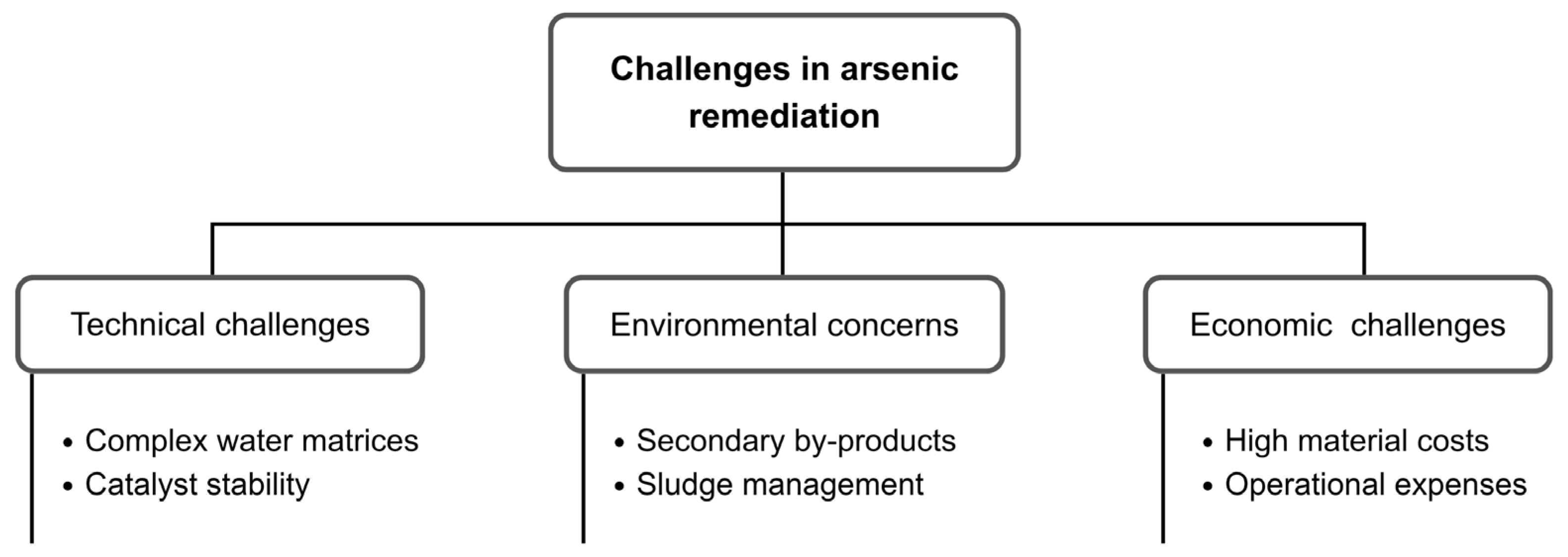
Despite significant advancements in catalytic technologies for arsenic remediation, several barriers still limit their widespread adoption, particularly in real-world applications. These barriers can be grouped into three main dimensions—technical, economic, and environmental—which are summarized in Figure 7.
From a technical perspective, the presence of co-contaminants such as phosphates, silicates, and natural organic matter can significantly reduce the efficiency of catalysts by competing for active sites or inhibiting oxidation processes. For example, studies have demonstrated that phosphates strongly interfere with arsenic adsorption in TiO2-based systems [73]. Another important challenge is catalyst stability and regeneration. While heterogeneous catalysts such as Pt/SiO2 and CuFe2O4 are effective, their performance tends to decline over long-term operation, as repeated use may lead to structural degradation or loss of activity [58]. Additionally, many advanced processes, particularly photocatalysis and electrochemical oxidation, require external energy inputs such as UV light or electricity. This reliance on energy can be cost-prohibitive in regions with limited infrastructure or high electricity costs.
Economic barriers also pose a substantial limitation to the scalability of catalytic technologies [69,87,91]. The use of noble metals, such as platinum, results in catalysts with high material costs, which hinders their application at large scale [12,84]. Furthermore, advanced oxidation processes (AOPs) that depend on recurring inputs, such as persulfates or hydrogen peroxide, generate operational expenses that may not be sustainable for long-term or resource-limited contexts [65,121].
Environmental concerns must also be considered when evaluating arsenic remediation technologies. Some AOPs have been shown to produce undesirable secondary by-products, such as chlorinated compounds, when applied in waters containing organics or salts [59]. Moreover, conventional adsorption, coagulation–flocculation, and hybrid processes often generate substantial volumes of arsenic-laden sludge. The safe disposal of this sludge represents a logistical and environmental challenge, as improper management could lead to secondary contamination.
To address these barriers, ongoing research and innovation are focusing on several key strategies: Materials such as doped TiO2, biochar composites, and magnetized nanomaterials are being explored for their affordability, high activity, and ease of regeneration. For example, magnetized biochar derived from agricultural waste offers dual functionality with lower environmental burden [59]. Coupling photocatalytic systems with solar energy can significantly reduce operational costs and make these technologies viable in remote or resource-limited settings [69,73,121]. Advanced methods, such as thermal and chemical regeneration, are being developed to restore catalytic activity without significant material loss [23]. Additionally, magnetic recovery systems for biochar have shown promise in improving the reusability of adsorbents [106]. Combining AOPs with adsorption or filtration technologies can enhance overall efficiency while reducing waste generation [87]. Hybrid systems that target multiple contaminants simultaneously are especially useful for addressing complex water matrices [78].

6. Case Studies Highlighting Regional Applications

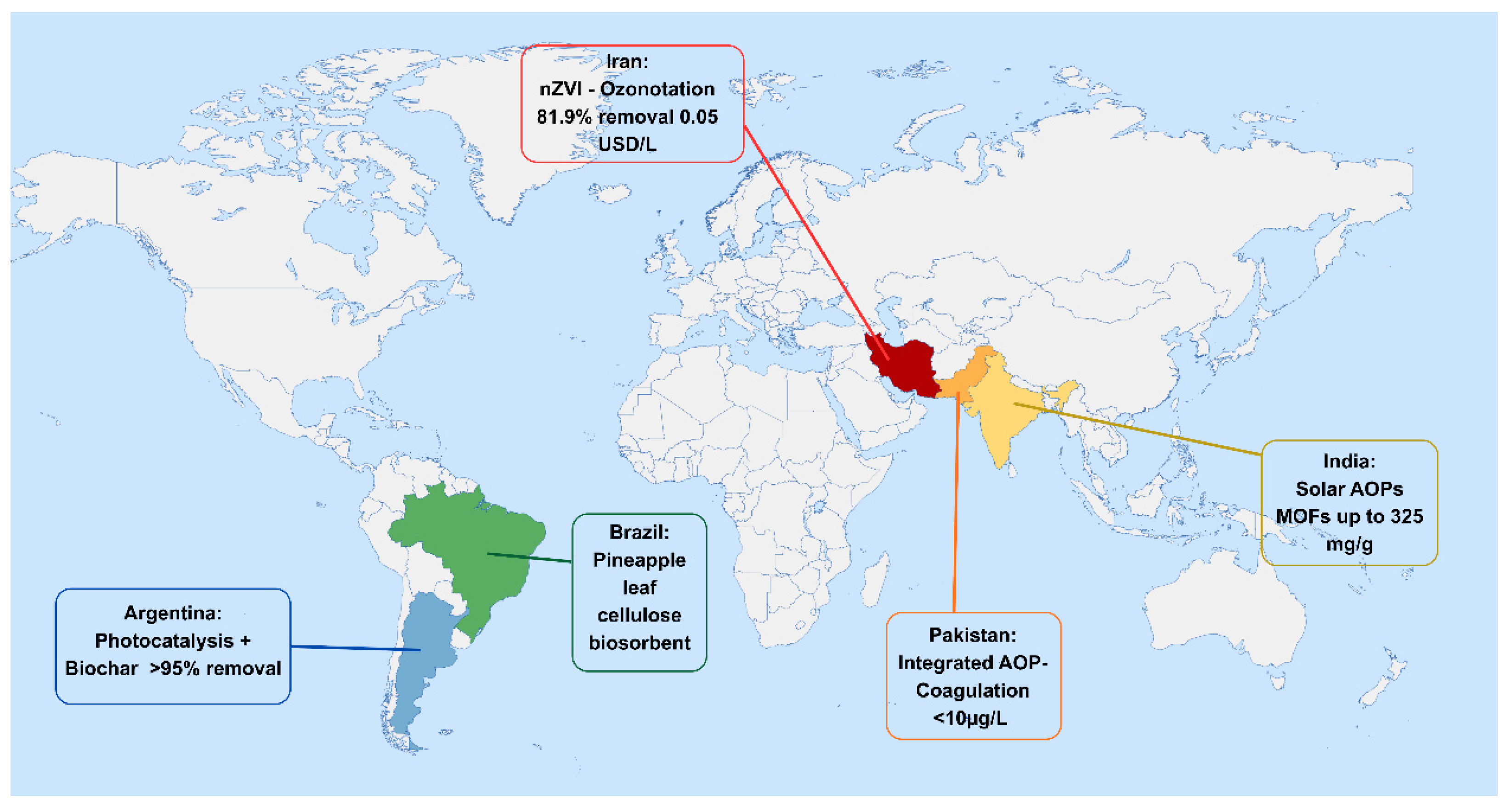
Several case studies illustrate how arsenic remediation technologies are being implemented under different environmental and socioeconomic contexts (see Figure 8). In Argentina, particularly in the Chaco-Pampean Plain, hybrid strategies combining photocatalysis with adsorption have been piloted to tackle high arsenic concentrations in groundwater. Field trials using biochar composites tailored to local conditions achieved more than 95% arsenic removal, demonstrating both efficiency and adaptability to regional needs [106]. This approach is part of a broader Latin American effort to develop context-specific solutions. For instance, research in Brazil has focused on valorizing agricultural waste, such as pineapple leaves, to produce low-cost biosorbents (pineapple leaf cellulose—PLC). Although primarily tested for wastewater, materials like PLC [90] represent a sustainable and circular economy-aligned strategy that could potentially be adapted for groundwater pretreatment in rural communities across the continent, highlighting the regional synergy in developing affordable remediation technologies.
In India, rural areas of West Bengal—where centralized water treatment infrastructure is often lacking—have adopted electrochemical AOPs [122]. These systems, powered by solar panels, proved effective in oxidizing arsenite to arsenate, achieving compliance with the World Health Organization (WHO) standards for drinking water [84]. Concurrently, cutting-edge research on materials like MOFs is paving the way for next-generation adsorbents. As reviewed by Ganesamoorthy et al. [7], MOFs such as MIL-100(Fe) and MOF-74(Zn) exhibit exceptionally high adsorption capacities for both As(III) and As(V) (up to 325 mg g−1), offering a potential future pathway for developing highly efficient and regenerable point-of-use filters in arsenic-affected communities throughout South Asia.
A compelling example from the Middle East is provided by Abdipour et al. [6], who conducted a study in Hamedan province, Iran, using real arsenic and nitrate-contaminated drinking water sources. They employed a catalytic ozonation process with zero-valent iron nanoparticles (nZVI) to achieve simultaneous removal of both contaminants. Using the Taguchi method for optimization, the system achieved an 81.9% simultaneous removal efficiency under optimal conditions (pH 7.4, 0.75 g L−1 nZVI, 15 min contact time). Critically, the study included a cost analysis, estimating the treatment cost at approximately $0.05 per liter, demonstrating the process’s economic viability. Furthermore, the nZVI catalyst maintained over 90% of its initial performance after eight regeneration cycles, underscoring its potential for sustainable, long-term application in regions facing co-contamination challenges.
In Pakistan, studies carried out in the industrial suburbs of Punjab tested oxidant-based AOPs integrated with coagulation processes to address waters co-contaminated with fluoride and heavy metals. The results demonstrated that arsenic concentrations could be reduced to below 10 µg L−1, while simultaneously minimizing sludge generation, highlighting the feasibility of scaling up this approach for complex water matrices [78].

7. Conclusions

Arsenic contamination in groundwater remains a pressing global health and environmental issue, particularly acute in vulnerable regions such as Latin America’s Chaco-Pampean Plain. Conventional techniques—including adsorption, coagulation–flocculation, and membrane filtration—have provided important foundations but face persistent limitations related to sludge generation, high operational costs, and restricted scalability.
Recent advances in catalytic technologies offer transformative potential by combining oxidation and adsorption processes, thereby enhancing removal efficiency and sustainability. Heterogeneous catalysis, photocatalysis, and advanced oxidation processes (AOPs) have consistently demonstrated high effectiveness in oxidizing As(III) to As(V), the more easily removable species. The emergence of bifunctional and magnetic catalysts, as well as the integration of photocatalysis with biochar and electrochemical or oxidant-based AOPs, highlights a clear trend toward multifunctional, recyclable, and environmentally compatible systems.
Key breakthroughs reported in recent years include the development of FeS2 nanoplates for dual arsenic–organic contaminant removal, lanthanum-doped MnFe2O4 for multi-contaminant water matrices, Ce–Mn oxide biochar for rapid As(III) oxidation, and plasma-regenerated catalysts for long-term operational stability. These innovations demonstrate that high efficiency (>90% removal under optimized conditions) can be achieved while aligning with green chemistry principles.
Nevertheless, significant barriers remain. The reliance on costly reagents (e.g., persulfates), energy-intensive activation methods (UV, electrochemical systems), and the generation of secondary by-products limit large-scale deployment. Catalyst stability and regeneration under complex water matrices are also unresolved challenges. Addressing these issues will require advances in material design, low-cost regeneration strategies, and the coupling of catalytic processes with renewable energy inputs.
Future efforts should prioritize three directions: (i) scaling promising laboratory systems to field conditions through pilot demonstrations, especially in highly affected regions such as Argentina, India, and Pakistan; (ii) integrating catalytic processes with conventional methods to balance efficiency, cost, and waste management; and (iii) fostering collaborations between academia, industry, and policy-makers to accelerate the adoption of context-specific, sustainable technologies.
By bridging mechanistic innovation with socio-environmental applicability, catalytic arsenic remediation can move beyond proof-of-concept, but several knowledge gaps remain—including the long-term stability of bifunctional catalysts under real water matrices, the ecological fate of spent adsorbents, and the lack of standardized protocols for field-scale validation. Addressing these gaps will require interdisciplinary collaborations and life-cycle assessments to ensure that these technologies are not only efficient but also environmentally sustainable and socially viable, ultimately turning them into a practical solution for safe drinking water worldwide.

Author Contributions

Conceptualization, F.M.Z. and V.S.A.; methodology, F.M.Z. and V.S.A.; validation, F.M.Z.; formal analysis, F.M.Z.; investigation, F.M.Z., V.S.A. and J.S.; resources, A.M.B. and F.A.M.; data curation, F.M.Z. and J.S.; writing—original draft preparation, F.M.Z. and V.S.A.; writing—review and editing, A.M.B., F.A.M. and T.B.; visualization, J.S. and F.M.Z.; supervision, A.M.B. and F.A.M.; project administration, A.M.B.; funding acquisition, A.M.B. and F.A.M. All authors have read and agreed to the published version of the manuscript.

Funding

This work was supported by CYTED (323RT0143—RECIRCULA) and Universidad Nacional del Litoral (CAID 2024, Project 85520240100123LI), CNPq (Conselho Nacional de Desenvolvimento Científico e Tecnológico, Brazil): 310199/2021-2, FAPERGS (Fundação de Amparo à Pesquisa do Estado do Rio Grande do Sul, Brazil): 22/2551-0000833-0 and 25/2551-0003110-9.

Data Availability Statement

Not applicable.

Acknowledgments

The authors gratefully acknowledge the support of Instituto de Investigaciones en Catálisis y Petroquímica (INCAPE, CONICET–UNL), Universidad Nacional del Litoral (UNL, Argentina), Universidade Federal do Rio Grande do Sul (UFRGS, Brazil), CNPq (Conselho Nacional de Desenvolvimento Científico e Tecnológico, Brazil, FAPERGS (Fundação de Amparo à Pesquisa do Estado do Rio Grande do Sul, Brazil), and the CYTED Ibero-American Program for their institutional contributions that made this work possible. During the preparation of this manuscript, the authors used DeepSeek (V3.2) and ChatGPT (GPT-5.2) for the purposes of language polishing, including grammar correction and improvement of sentence clarity, between March and April 2026. The authors have reviewed and edited the output and take fully responsible for the content of this publication.

Conflicts of Interest

The authors declare that they have no known competing financial interests or personal relationships that could have appeared to influence the work reported in this paper.

Abbreviations

AAacetic acid
AOPsadvanced oxidation processes
BETBrunauer–Emmett–Teller
CNTscarbon nanotubes
DFTdensity functional theory
DMFdimethylformamide
DMPO5,5-dimethyl-1-pyrroline N-oxide
DRIFTSdiffuse reflectance infrared Fourier transform spectroscopy
EPRelectron paramagnetic resonance
EXAFSextended X-ray absorption fine structure
FESEMfield emission scanning electron microscopy
FTIRFourier transform infrared spectroscopy
GFHgranular ferric hydroxide
GOgraphene oxide
GVLγ-valerolactone
HACREchronic regional endemic hydroarsenicism
HPLC-MShigh-performance liquid chromatography-mass spectrometry
LDHslayered double hydroxides
MBmethylene blue
MCLmaximum contaminant level
MFmicrofiltration
MIPsmolecularly imprinted polymers
MOFsmetal–organic frameworks
NFnanofiltration
NMRnuclear magnetic resonance
nZVInanoscale zero-valent iron
PDSperoxydisulfate
PLCpineapple leaf cellulose
PMSperoxymonosulfate
PPpolypropylene
PSFpolysulfone
PESpolyethersulfone
PVDFpoly(vinylidene fluoride)
rGOreduced graphene oxide
ROreverse osmosis
ROSreactive oxygen species
SEM-EDSscanning electron microscopy with energy-dispersive X-ray spectroscopy
TBAtert-butanol
TBCTiO2-loaded biochar
TCLPToxicity Characteristic Leaching Procedure
TFAtrifluoroacetic acid
TGAthermogravimetric analysis
UFultrafiltration
WHOWorld Health Organization
XPSX-ray photoelectron spectroscopy
XRDX-ray diffraction

References

  1. Kumar, N.; Hashmi, M.Z.; Wang, S. Emerging Contaminants and Associated Treatment Technologies Arsenic Toxicity Remediation Sustainable Nexus Approach; Kumar, N., Hashmi, M.Z., Wang, S., Eds.; Springer: Cham, Switzerland, 2024. [Google Scholar]
  2. Ratnaike, R.N. Acute and Chronic Arsenic Toxicity. Postgrad. Med. J. 2003, 79, 391–396. [Google Scholar] [CrossRef] [Scilit]
  3. Tsuji, J.S.; Chang, E.T.; Gentry, P.R.; Clewell, H.J.; Boffetta, P.; Cohen, S.M. Dose-Response for Assessing the Cancer Risk of Inorganic Arsenic in Drinking Water: The Scientific Basis for Use of a Threshold Approach. Crit. Rev. Toxicol. 2019, 49, 36–84. [Google Scholar] [CrossRef] [Scilit]
  4. Shahid, M.; Niazi, N.K.; Dumat, C.; Naidu, R.; Khalid, S.; Rahman, M.M.; Bibi, I. A Meta-Analysis of the Distribution, Sources and Health Risks of Arsenic-Contaminated Groundwater in Pakistan. Environ. Pollut. 2018, 242, 307–319. [Google Scholar] [CrossRef] [Scilit] [PubMed]
  5. World Health Organization Guidelines for Drinking-Water Quality: Fourth Edition Incorporating the First and Second Addenda, 4th ed.; World Health Organization: Geneva, Switzerland, 2022; Volume 21.
  6. Abdipour, H.; Asgari, G.; Seid-Mohammadi, A.; Rahmani, A.; Shokoohi, R. Simultaneous Removal of Arsenic and Nitrate from Actual Water by Catalytic Ozonation Process with Nanoparticles of Zero-Valent Iron/Optimization via Taguchi Model. Appl. Water Sci. 2026, 16, 12. [Google Scholar] [CrossRef] [Scilit]
  7. Ganesamoorthy, R.; Balaji, S.; Senthil Pandian, M.; Gomathi, R.; Parameswari, R.; Thirugnanasambandham, K. Metal-Organic Frameworks for Sustainable Aquatic Arsenic Remediation: A Review. Environ. Funct. Mater. 2026. [Google Scholar] [CrossRef] [Scilit]
  8. Blanes, P.S.; Buchhamer, E.E.; Giménez, M.C. Natural Contamination with Arsenic and Other Trace Elements in Groundwater of the Central-West Region of Chaco, Argentina. J. Environ. Sci. Health A Tox. Hazard. Subst. Environ. Eng. 2011, 46, 1197–1206. [Google Scholar] [CrossRef] [Scilit]
  9. Quiroga, A.M.; Colussi, C.L.; Odetti, L.M.; Loteste, A.E.; Paonessa, A.M.; Mastandrea, C.R.; Grigolato, R.A.; Poletta, G.L.; Sigrist, M.; Fernanda Simoniello, M. Evaluation of Oxidative Damage and Genotoxicity in Populations Exposed to Arsenic in Drinking Water from Santa Fe Province, Argentina. Mutat. Res. Genet. Toxicol. Environ. Mutagen. 2024, 897, 503787. [Google Scholar] [CrossRef] [Scilit]
  10. Barranquero, R.S.; Varni, M.; Vega, M.; Pardo, R.; Ruiz De Galarreta, A. Arsenic, Fluoride and Other Trace Elements in the Argentina Pampean Plain. Geol. Acta 2017, 15, 187–200. [Google Scholar] [CrossRef] [Scilit]
  11. Nicolli, H.B.; Bundschuh, J.; Blanco, M.C.; Tujchneider, O.C.; Panarello, H.O.; Dapeña, C.; Rusansky, J.E. Arsenic and Associated Trace-Elements in Groundwater from the Chaco-Pampean Plain, Argentina: Results from 100years of Research. Sci. Total Environ. 2012, 429, 36–56. [Google Scholar] [CrossRef] [Scilit]
  12. Yadav, M.K.; Saidulu, D.; Gupta, A.K.; Ghosal, P.S.; Mukherjee, A. Status and Management of Arsenic Pollution in Groundwater: A Comprehensive Appraisal of Recent Global Scenario, Human Health Impacts, Sustainable Field-Scale Treatment Technologies. J. Environ. Chem. Eng. 2021, 9, 105203. [Google Scholar] [CrossRef] [Scilit]
  13. Dilpazeer, F.; Munir, M.; Baloch, M.Y.J.; Shafiq, I.; Iqbal, J.; Saeed, M.; Abbas, M.M.; Shafique, S.; Aziz, K.H.H.; Mustafa, A.; et al. A Comprehensive Review of the Latest Advancements in Controlling Arsenic Contaminants in Groundwater. Water 2023, 15, 478. [Google Scholar] [CrossRef] [Scilit]
  14. Sodhi, K.K.; Kumar, M.; Agrawal, P.K.; Singh, D.K. Perspectives on Arsenic Toxicity, Carcinogenicity and Its Systemic Remediation Strategies. Environ. Technol. Innov. 2019, 16, 100462. [Google Scholar] [CrossRef] [Scilit]
  15. Tchounwou, P.B.; Yedjou, C.G.; Udensi, U.K.; Pacurari, M.; Stevens, J.J.; Patlolla, A.K.; Noubissi, F.; Kumar, S. State of the Science Review of the Health Effects of Inorganic Arsenic: Perspectives for Future Research. Environ. Toxicol. 2019, 34, 188–202. [Google Scholar] [CrossRef] [Scilit]
  16. Farooqi, A.; Sultana, J.; Masood, N. Arsenic and Fluoride Co-Contamination in Shallow Aquifers from Agricultural Suburbs and an Industrial Area of Punjab, Pakistan: Spatial Trends, Sources and Human Health Implications. Toxicol. Ind. Health 2017, 33, 655–672. [Google Scholar] [CrossRef] [Scilit] [PubMed]
  17. Sadee, B.A.; Zebari, S.M.S.; Galali, Y.; Saleem, M.F. A Review on Arsenic Contamination in Drinking Water: Sources, Health Impacts, and Remediation Approaches. RSC Adv. 2025, 15, 2684–2703. [Google Scholar] [CrossRef] [Scilit]
  18. Nicomel, N.R.; Leus, K.; Folens, K.; Van Der Voort, P.; Du Laing, G. Technologies for Arsenic Removal from Water: Current Status and Future Perspectives. Int. J. Environ. Res. Public Health 2015, 13, 62. [Google Scholar] [CrossRef] [Scilit]
  19. Kanel, S.R.; Das, T.K.; Varma, R.S.; Kurwadkar, S.; Chakraborty, S.; Joshi, T.P.; Bezbaruah, A.N.; Nadagouda, M.N. Arsenic Contamination in Groundwater: Geochemical Basis of Treatment Technologies. ACS Environ. Au 2023, 3, 135–152. [Google Scholar] [CrossRef] [Scilit]
  20. Kumar, N.; Hashmi, M.Z.; Wang, S. Arsenic Toxicity Remediation: Biotechnological Approaches; Kumar, N., Hashmi, M.Z., Wang, S., Eds.; Springer: Berlin/Heidelberg, Germany, 2023. [Google Scholar]
  21. Mohan, D.; Pittman, C.U. Arsenic Removal from Water/Wastewater Using Adsorbents—A Critical Review. J. Hazard. Mater. 2007, 142, 1–53. [Google Scholar] [CrossRef] [Scilit] [PubMed]
  22. Babel, S.; Kurniawan, T.A. Low-Cost Adsorbents for Heavy Metals Uptake from Contaminated Water: A Review. J. Hazard. Mater. 2003, 97, 219–243. [Google Scholar] [CrossRef] [Scilit] [PubMed]
  23. Poorkhalil, A.; Tayefehseyfi, E.; Farrokhzad, H.; Mohsenzadeh, A. Natural and Synthetic Zeolites for Arsenic Removal from Water: A Comprehensive Review of Mechanisms, Performance, and Future Perspectives. J. Hazard. Mater. Adv. 2025, 19, 100866. [Google Scholar] [CrossRef] [Scilit]
  24. Motloung, M.T.; Magagula, S.I.; Kaleni, A.; Sikhosana, T.S.; Lebelo, K.; Mochane, M.J. Recent Advances on Chemically Functionalized Cellulose-Based Materials for Arsenic Removal in Wastewater: A Review. Water 2023, 15, 793. [Google Scholar] [CrossRef] [Scilit]
  25. Banerjee, K.; Amy, G.L.; Prevost, M.; Nour, S.; Jekel, M.; Gallagher, P.M.; Blumenschein, C.D. Kinetic and Thermodynamic Aspects of Adsorption of Arsenic onto Granular Ferric Hydroxide (GFH). Water Res. 2008, 42, 3371–3378. [Google Scholar] [CrossRef] [Scilit]
  26. Yeo, K.F.H.; Li, C.; Zhang, H.; Chen, J.; Wang, W.; Dong, Y. Arsenic Removal from Contaminated Water Using Natural Adsorbents: A Review. Coatings 2021, 11, 1407. [Google Scholar] [CrossRef] [Scilit]
  27. Sanna Angotzi, M.; Mameli, V.; Fantasia, A.; Cara, C.; Secci, F.; Enzo, S.; Gerina, M.; Cannas, C. As(III, V) Uptake from Nanostructured Iron Oxides and Oxyhydroxides: The Complex Interplay between Sorbent Surface Chemistry and Arsenic Equilibria. Nanomaterials 2022, 12, 326. [Google Scholar] [CrossRef] [Scilit]
  28. Peng, Y.; Azeem, M.; Li, R.; Xing, L.; Li, Y.; Zhang, Y.; Guo, Z.; Wang, Q.; Ngo, H.H.; Qu, G.; et al. Zirconium Hydroxide Nanoparticle Encapsulated Magnetic Biochar Composite Derived from Rice Residue: Application for As(III) and As(V) Polluted Water Purification. J. Hazard. Mater. 2022, 423, 127081. [Google Scholar] [CrossRef] [Scilit] [PubMed]
  29. Wang, Y.; Guo, C.; Zhang, L.; Liu, Y.; Wang, Y.; Li, X. Comparison of Arsenate and Arsenite Removal Behaviours and Mechanisms from Water by Fe La Binary Composite (Hydr)Oxides. J. Water Process Eng. 2024, 57, 104603. [Google Scholar] [CrossRef] [Scilit]
  30. Liu, H.; Xie, X.; Cao, H.; Wang, Y. Insights into the Selectivity of Metallic Oxides for Arsenic and Phosphate from EXAFS and DFT Calculations. Chemosphere 2023, 336, 139276. [Google Scholar] [CrossRef] [Scilit] [PubMed]
  31. Gustafsson, J.P.; Antelo, J. Competitive Arsenate and Phosphate Adsorption on Ferrihydrite as Described by the CD-MUSIC Model. ACS Earth Space Chem. 2022, 6, 1397–1406. [Google Scholar] [CrossRef] [Scilit]
  32. Liu, R.; Qu, J. Review on Heterogeneous Oxidation and Adsorption for Arsenic Removal from Drinking Water. J. Environ. Sci. 2021, 110, 178–188. [Google Scholar] [CrossRef] [Scilit]
  33. Anh Nguyen, D.; Viet Nguyen, D.; Jeong, G.; Asghar, N.; Jang, A. Critical Evaluation of Hybrid Metal–Organic Framework Composites for Efficient Treatment of Arsenic–Contaminated Solutions by Adsorption and Membrane–Separation Process. Chem. Eng. J. 2023, 461, 141789. [Google Scholar] [CrossRef] [Scilit]
  34. Alam, E. Exploring Recent Progress in Adsorbent Technologies for As3+ and As5+ Removal from Water: A Brief Overview. Environ. Technol. Rev. 2024, 13, 814–848. [Google Scholar] [CrossRef] [Scilit]
  35. Sharma, G.; Verma, Y.; Lai, C.W.; Naushad, M.; Iqbal, J.; Kumar, A.; Dhiman, P. Biochar and Biosorbents Derived from Biomass for Arsenic Remediation. Heliyon 2024, 10, e36288. [Google Scholar] [CrossRef] [Scilit] [PubMed]
  36. Nyamunda, B.; Chigondo, F.; Moyo, M.; Guyo, U.; Shumba, M.; Nharingo, T. Hydrogen Peroxide as an Oxidant for Organic Reactions. J. At. Mol. 2013, 3, 23–44. [Google Scholar]
  37. Moreira, V.R.; Lebron, Y.A.R.; Santos, L.V.S.; Coutinho de Paula, E.; Amaral, M.C.S. Arsenic Contamination, Effects and Remediation Techniques: A Special Look onto Membrane Separation Processes. Process Saf. Environ. Prot. 2021, 148, 604–623. [Google Scholar] [CrossRef] [Scilit]
  38. Mladin, G.; Ciopec, M.; Negrea, A.; Duteanu, N.; Negrea, P.; Ianasi, P.; Ianași, C. Silica- Iron Oxide Nanocomposite Enhanced with Porogen Agent Used for Arsenic Removal. Materials 2022, 15, 5366. [Google Scholar] [CrossRef] [Scilit]
  39. El Messaoudi, N.; Miyah, Y.; Şenol, Z.M.; Ciğeroğlu, Z.; Kazan-Kaya, E.S.; Gubernat, S.; Georgin, J.; Franco, D.S.P. Comprehensive Analytical Review of Heavy Metal Removal Efficiency Using Agricultural Solid Waste-Based Bionanocomposites. Nano-Struct. Nano-Objects 2024, 38, 101220. [Google Scholar] [CrossRef] [Scilit]
  40. Pervez, M.N.; Chen, C.; Li, Z.; Naddeo, V.; Zhao, Y. Tuning the Structure of Cerium-Based Metal-Organic Frameworks for Efficient Removal of Arsenic Species: The Role of Organic Ligands. Chemosphere 2022, 303, 134934. [Google Scholar] [CrossRef] [Scilit] [PubMed]
  41. Nhu Nguyet, P.; Luu, T.L.; Le, A.; Ngan, N.T.K.; Trang, N.T.H. Groundwater Arsenic Pollution in Vietnam: Current Opinion on the Mobilization and Remediation. Curr. Opin. Environ. Sci. Health 2025, 44, 100596. [Google Scholar] [CrossRef] [Scilit]
  42. Li, J.; Wu, Y.; Li, Z.; Zhang, B.; Zhu, M.; Hu, X.; Zhang, Y.; Li, F. Zeolitic Imidazolate Framework-8 with High Efficiency in Trace Arsenate Adsorption and Removal from Water. J. Phys. Chem. C 2014, 118, 27382–27387. [Google Scholar] [CrossRef] [Scilit]
  43. Wang, C.; Liu, X.; Chen, J.P.; Li, K. Superior Removal of Arsenic from Water with Zirconium Metal-Organic Framework UiO-66. Sci. Rep. 2015, 5, 16613. [Google Scholar] [CrossRef] [Scilit]
  44. He, X.; Deng, F.; Shen, T.; Yang, L.; Chen, D.; Luo, J.; Luo, X.; Min, X.; Wang, F. Exceptional Adsorption of Arsenic by Zirconium Metal-Organic Frameworks: Engineering Exploration and Mechanism Insight. J. Colloid Interface Sci. 2019, 539, 223–234. [Google Scholar] [CrossRef] [Scilit]
  45. Chang, Z.-W.; Lee, Y.-J.; Lee, D.-J. Adsorption of Hydrogen Arsenate and Dihydrogen Arsenate Ions from Neutral Water by UiO-66-NH2. J. Environ. Manag. 2019, 247, 263–268. [Google Scholar] [CrossRef] [Scilit] [PubMed]
  46. Audu, C.O.; Nguyen, H.G.T.; Chang, C.Y.; Katz, M.J.; Mao, L.; Farha, O.K.; Hupp, J.T.; Nguyen, S.T. The Dual Capture of AsV and AsIII by UiO-66 and Analogues. Chem. Sci. 2016, 7, 6492–6498. [Google Scholar] [CrossRef] [Scilit]
  47. Assaad, N.; Sabeh, G.; Hmadeh, M. Defect Control in Zr-Based Metal-Organic Framework Nanoparticles for Arsenic Removal from Water. ACS Appl. Nano Mater. 2020, 3, 8997–9008. [Google Scholar] [CrossRef] [Scilit]
  48. Somjit, V.; Thinsoongnoen, P.; Pila, T.; Boekfa, B.; Wannapaiboon, S.; Kongpatpanich, K. Hydroxylation of UiO-66 Metal–Organic Frameworks for High Arsenic(III) Removal Efficiency. Inorg. Chem. 2022, 61, 11342–11348. [Google Scholar] [CrossRef] [Scilit]
  49. Huo, J.B.; Xu, L.; Chen, X.; Zhang, Y.; Yang, J.C.E.; Yuan, B.; Fu, M.L. Direct Epitaxial Synthesis of Magnetic Fe3O4@UiO-66 Composite for Efficient Removal of Arsenate from Water. Microporous Mesoporous Mater. 2019, 276, 68–75. [Google Scholar] [CrossRef] [Scilit]
  50. Liu, T.; Zhang, Z.; Wang, Z.; Wang, Z.L.; Bush, R. Highly Efficient and Rapid Removal of Arsenic(Iii) from Aqueous Solutions by Nanoscale Zero-Valent Iron Supported on a Zirconium 1,4-Dicarboxybenzene Metal-Organic Framework (UiO-66 MOF). RSC Adv. 2019, 9, 39475–39487. [Google Scholar] [CrossRef] [Scilit]
  51. Zhang, X.; Wang, B.; Alsalme, A.; Xiang, S.; Zhang, Z.; Chen, B. Design and Applications of Water-Stable Metal-Organic Frameworks: Status and Challenges. Coord. Chem. Rev. 2020, 423, 213507. [Google Scholar] [CrossRef] [Scilit]
  52. Venturi, D.M.; Campana, F.; Marmottini, F.; Costantino, F.; Vaccaro, L. Extensive Screening of Green Solvents for Safe and Sustainable UiO-66 Synthesis. ACS Sustain. Chem. Eng. 2020, 8, 17154–17164. [Google Scholar] [CrossRef] [Scilit]
  53. Hug, S.J.; Leupin, O. Iron-Catalyzed Oxidation of Arsenic(III) by Oxygen and by Hydrogen Peroxide: PH-Dependent Formation of Oxidants in the Fenton Reaction. Environ. Sci. Technol. 2003, 37, 2734–2742. [Google Scholar] [CrossRef] [Scilit]
  54. Ghurye, G.L.; Clifford, D.A.; Tripp, A.R. Combined Arsenic and Nitrate Removal by Ion Exchange. J. AWWA 1999, 91, 85–96. [Google Scholar] [CrossRef] [Scilit]
  55. Ahmad, A.; Cornelissen, E.; van de Wetering, S.; van Dijk, T.; van Genuchten, C.; Bundschuh, J.; van der Wal, A.; Bhattacharya, P. Arsenite Removal in Groundwater Treatment Plants by Sequential Permanganate―Ferric Treatment. J. Water Process Eng. 2018, 26, 221–229. [Google Scholar] [CrossRef] [Scilit]
  56. Mahmoodi, M.; Pishbin, E. Ozone-Based Advanced Oxidation Processes in Water Treatment: Recent Advances, Challenges, and Perspective. Environ. Sci. Pollut. Res. 2025, 32, 3531–3570. [Google Scholar] [CrossRef] [Scilit] [PubMed]
  57. Kim, M.-J.; Nriagu, J. Oxidation of Arsenite in Groundwater Using Ozone and Oxygen. Sci. Total Environ. 2000, 247, 71–79. [Google Scholar] [CrossRef] [Scilit]
  58. Oshima, K.; Kondo, H.; Konishi, E.; Yamamoto, T.; Tsuge, Y.; Watanabe, T.; Kishida, M. As(Iii) Removal through Catalytic Oxidation and Fe(Iii) Precipitation. RSC Adv. 2022, 12, 16843–16846. [Google Scholar] [CrossRef] [Scilit]
  59. Jain, R. Recent Advances of Magnetite Nanomaterials to Remove Arsenic from Water. RSC Adv. 2022, 12, 32197–32209. [Google Scholar] [CrossRef] [Scilit] [PubMed]
  60. Alonso, E.; Sanchez-Huerta, C.; Ali, Z.; Wang, Y.; Fortunato, L.; Pinnau, I. Evaluation of Nanofiltration and Reverse Osmosis Membranes for Efficient Rejection of Organic Micropollutants. J. Memb. Sci. 2024, 693, 122357. [Google Scholar] [CrossRef] [Scilit]
  61. Pezeshki, H.; Hashemi, M.; Rajabi, S. Removal of Arsenic as a Potentially Toxic Element from Drinking Water by Filtration: A Mini Review of Nanofiltration and Reverse Osmosis Techniques. Heliyon 2023, 9, e14246. [Google Scholar] [CrossRef] [Scilit] [PubMed]
  62. Chen, M.; Heijman, S.G.J.; Luiten-Olieman, M.W.J.; Rietveld, L.C. Oil-in-Water Emulsion Separation: Fouling of Alumina Membranes with and without a Silicon Carbide Deposition in Constant Flux Filtration Mode. Water Res. 2022, 216, 118267. [Google Scholar] [CrossRef] [Scilit]
  63. Al Harby, N.F.; El-Batouti, M.; Elewa, M.M. Prospects of Polymeric Nanocomposite Membranes for Water Purification and Scalability and Their Health and Environmental Impacts: A Review. Nanomaterials 2022, 12, 3637. [Google Scholar] [CrossRef] [Scilit]
  64. Kolya, H.; Kang, C.-W. Next-Generation Water Treatment: Exploring the Potential of Biopolymer-Based Nanocomposites in Adsorption and Membrane Filtration. Polymers 2023, 15, 3421. [Google Scholar] [CrossRef] [Scilit]
  65. Mahamallik, P.; Swain, R. A Mini-Review on Arsenic Remediation Techniques from Water and Future Trends. Water Sci. Technol. 2023, 87, 3108–3123. [Google Scholar] [CrossRef] [Scilit] [PubMed]
  66. Duan, X.; Niu, X.; Gao, J.; Wacławek, S.; Tang, L.; Dionysiou, D.D. Comparison of Sulfate Radical with Other Reactive Species. Curr. Opin. Chem. Eng. 2022, 38, 100867. [Google Scholar] [CrossRef] [Scilit]
  67. da Silva, S.W.; do Prado, J.M.; Heberle, A.N.A.; Schneider, D.E.; Rodrigues, M.A.S.; Bernardes, A.M. Electrochemical Advanced Oxidation of Atenolol at Nb/BDD Thin Film Anode. J. Electroanal. Chem. 2019, 844, 27–33. [Google Scholar] [CrossRef] [Scilit]
  68. Bouzayani, B.; Elaoud, S.C.; Sanromán, M.Á. Current Progress in Advanced Oxidation Processes for the Removal of Contaminants of Emerging Concern Using Peracetic Acid as an Effective Oxidant. Catalysts 2025, 15, 469. [Google Scholar] [CrossRef] [Scilit]
  69. Silva, J.A. Advanced Oxidation Process in the Sustainable Treatment of Refractory Wastewater: A Systematic Literature Review. Sustainability 2025, 17, 3439. [Google Scholar] [CrossRef] [Scilit]
  70. Zoppas, F.M.; Da Silva, S.W.; Beltrame, T.F.; Marchesini, F.A.; Bernardes, A.M.; Miró, E. Mineralization of Formic Acid from Catalytic Nitrate Reduction Effluent by UV-Based and Electrochemical Processes. J. Environ. Chem. Eng. 2020, 8, 104127. [Google Scholar] [CrossRef] [Scilit]
  71. da Silva, S.W.; Klauck, C.R.; Siqueira, M.A.; Bernardes, A.M. Degradation of the Commercial Surfactant Nonylphenol Ethoxylate by Advanced Oxidation Processes. J. Hazard. Mater. 2015, 282, 241–248. [Google Scholar] [CrossRef] [Scilit] [PubMed]
  72. Battauz, F.D.; Zoppas, F.M.; Sacco, N.A.; Marchesini, F.A. Resins-Supported Cu Catalysts for the Fenton-like Oxidation of Phenol from Water. Desalination Water Treat. 2025, 321, 101009. [Google Scholar] [CrossRef] [Scilit]
  73. Yang, Y.; Zhang, R.; Chen, S.; Zhu, J.; Wu, P.; Huang, J.; Qi, S. Arsenic(III) Removal from Aqueous Solution Using TiO2-Loaded Biochar Prepared by Waste Chinese Traditional Medicine Dregs. RSC Adv. 2022, 12, 7720–7734. [Google Scholar] [CrossRef] [Scilit]
  74. Raturi, S.; Kumari, S.; András, K.; Khargotra, R.; Sebestyén, V.; Singh, T. Advancements of Nanotechnological Strategies as Conventional Approach for Heavy Metal Removal from Industrial Wastewater: Start-of-the-Art Review. Curr. Res. Green Sustain. Chem. 2024, 9, 100428. [Google Scholar] [CrossRef] [Scilit]
  75. Li, X.; Park, H.; Na, C.-K. Enhanced Arsenic Removal from Groundwater Using Synthesized TiO2-PAN Composite Bead. Sep. Sci. Technol. 2026, 61, 1454–1477. [Google Scholar] [CrossRef] [Scilit]
  76. Liu, J.; Peng, C.; Shi, X. Preparation, Characterization, and Applications of Fe-Based Catalysts in Advanced Oxidation Processes for Organics Removal: A Review. Environ. Pollut. 2022, 293, 118565. [Google Scholar] [CrossRef] [Scilit]
  77. Zhang, Y.; Shaad, K.; Vollmer, D.; Ma, C. Treatment of Textile Wastewater Using Advanced Oxidation Processes—A Critical Review. Water 2021, 13, 3515. [Google Scholar] [CrossRef] [Scilit]
  78. Babu, D.S.; Nidheesh, P.V. Treatment of Arsenite Contaminated Water by Electrochemically Activated Persulfate Oxidation Process. Sep. Purif. Technol. 2022, 282, 119999. [Google Scholar] [CrossRef] [Scilit]
  79. Liu, N.; Gao, R.; Xiao, S.; Xue, B. Visualizing the Bibliometrics of Biochar Research for Remediation of Arsenic Pollution. J. Environ. Manag. 2024, 349, 119513. [Google Scholar] [CrossRef] [Scilit] [PubMed]
  80. Rahidul Hassan, H. A Review on Different Arsenic Removal Techniques Used for Decontamination of Drinking Water. Environ. Pollut. Bioavailab. 2023, 35, 2165964. [Google Scholar] [CrossRef] [Scilit]
  81. Bhattacharya, S.; Talukdar, A.; Sengupta, S.; Das, T.; Dey, A.; Gupta, K.; Dutta, N. Arsenic Contaminated Water Remediation: A State-of-the-Art Review in Synchrony with Sustainable Development Goals. Groundw. Sustain. Dev. 2023, 23, 101000. [Google Scholar] [CrossRef] [Scilit]
  82. Hamid, N.H.A.; Rushdan, A.I.; Nordin, A.H.; Norrrahim, M.N.F.; Muhamad, S.N.H.; Tahir, M.I.H.M.; Rosli, N.S.B.; Pakrudin, N.H.M.; Roslee, A.S.; Asyraf, M.R.M.; et al. A Review: The State-of-the-Art of Arsenic Removal in Wastewater. Water Reuse 2024, 14, 279–311. [Google Scholar] [CrossRef] [Scilit]
  83. Liu, F.; Wu, J.F.; Zhao, G.C. Synchronous Oxidation and Sequestration for As(Iii) from Aqueous Solution by Modified CuFe2O4coupled with Peroxymonosulfate: A Fast and Stable Heterogeneous Process. RSC Adv. 2021, 11, 4598–4609. [Google Scholar] [CrossRef] [Scilit]
  84. Su, J.; Lyu, T.; Cooper, M.; Mortimer, R.J.G.; Pan, G. Efficient Arsenic Removal by a Bifunctional Heterogeneous Catalyst through Simultaneous Hydrogen Peroxide (H2O2) Catalytic Oxidation and Adsorption. J. Clean. Prod. 2021, 325, 129329. [Google Scholar] [CrossRef] [Scilit]
  85. Silerio-Vázquez, F.; Nájera, J.B.P.; Bundschuh, J.; Alarcon-Herrera, M.T. Photocatalysis for Arsenic Removal from Water: Considerations for Solar Photocatalytic Reactors. Environ. Sci. Pollut. Res. 2022, 29, 61594–61607. [Google Scholar] [CrossRef] [Scilit]
  86. Paredes, M.Y.; Martinez, L.P.; Barja, B.C.; Marchi, M.C.; Herran, M.; Grinblat, G.; Bragas, A.V.; Cortés, E.; Scarpettini, A.F. Efficient Method of Arsenic Removal from Water Based on Photocatalytic Oxidation by a Plasmonic–Magnetic Nanosystem. Environ. Sci. Nano 2023, 10, 166–177. [Google Scholar] [CrossRef] [Scilit]
  87. Ortiz-Martínez, M.; Restori-Corona, B.; Hernández-García, L.; Alonso-Segura, D. Polysaccharides and Composite Adsorbents in the Spotlight for Effective Agrochemical Residue Removal from Water. Macromol 2024, 4, 785–804. [Google Scholar] [CrossRef] [Scilit]
  88. Kim, H.; Myung, E.; Choi, N.; Cho, K. Removal of Arsenic from Aqueous Solution Using Magnetic Biochar Derived from Spirulina Platensis. J. Hazard. Mater. Adv. 2024, 16, 100490. [Google Scholar] [CrossRef] [Scilit]
  89. Zoppas, F.M.; Benvenuti, T.; Maffessoni, D. Advances and Perspectives on Valorization of Grape Pomace into Functional Materials for Water and Wastewater Purification. Agriengineering 2026, 8, 126. [Google Scholar] [CrossRef] [Scilit]
  90. Rahman, A. Remediation of Heavy Metals (Arsenic, Cadmium, and Lead) from Wastewater Utilizing Cellulose from Pineapple Leaves. Processes 2026, 14, 159. [Google Scholar] [CrossRef] [Scilit]
  91. Neisan, R.S.; Saady, N.M.C.; Bazan, C.; Zendehboudi, S.; Al-nayili, A.; Abbassi, B.; Chatterjee, P. Arsenic Removal by Adsorbents from Water for Small Communities’ Decentralized Systems: Performance, Characterization, and Effective Parameters. Clean Technol. 2023, 5, 352–402. [Google Scholar] [CrossRef] [Scilit]
  92. Deewan, R.; Tanboonchuy, V.; Khamdahsag, P.; Yan, D.Y.-S. Utilization of Agricultural Waste: Mango Peels and Pineapple Crown Leaves as Precursors for Nanomaterial Production for Arsenate Remediation. Environ. Sci. Pollut. Res. 2025, 32, 14508–14526. [Google Scholar] [CrossRef] [Scilit]
  93. Tolkou, A.K.; Rada, E.C.; Torretta, V.; Xanthopoulou, M.; Kyzas, G.Z.; Katsoyiannis, I.A. Removal of Arsenic(III) from Water with a Combination of Graphene Oxide (GO) and Granular Ferric Hydroxide (GFH) at the Optimum Molecular Ratio. C-J. Carbon Res. 2023, 9, 10. [Google Scholar] [CrossRef] [Scilit]
  94. Rahman, M.M.; Uddin, M.N.; Parvez, M.M.H.; Mohotadi, M.A.; Ferdush, J. Bio-Based Nanomaterials for Groundwater Arsenic Remediation: Mechanisms, Challenges, and Future Perspectives. Nanomaterials 2025, 15, 933. [Google Scholar] [CrossRef] [Scilit]
  95. Chauhan, K.; Singh, P.; Sen, K.; Singhal, R.K.; Thakur, V.K. Recent Advancements in the Field of Chitosan/Cellulose-Based Nanocomposites for Maximizing Arsenic Removal from Aqueous Environment. ACS Omega 2024, 9, 27766–27788. [Google Scholar] [CrossRef] [Scilit]
  96. Melnikova, A.; Faggiano, A.; Visconti, M.; Cucciniello, R.; Iannece, P.; Kostryukova, N.; Proto, A.; Fiorentino, A.; Rizzo, L. Photo Driven Homogeneous Advanced Oxidation Coupled to Adsorption Process for an Effective Arsenic Removal from Drinking Water. J. Environ. Manag. 2024, 349, 119568. [Google Scholar] [CrossRef] [Scilit] [PubMed]
  97. Zhang, G.; Ren, Z.; Zhang, X.; Chen, J. Nanostructured Iron(III)-Copper(II) Binary Oxide: A Novel Adsorbent for Enhanced Arsenic Removal from Aqueous Solutions. Water Res. 2013, 47, 4022–4031. [Google Scholar] [CrossRef] [Scilit] [PubMed]
  98. Elmakki, M.A.E.; Ghosh, S.; Motente, M.; Ajiboye, T.O.; Venter, J.; Adetunji, A.I. The Removal of Arsenic from Contaminated Water: A Critical Review of Adsorbent Materials from Agricultural Wastes to Advanced Metal–Organic Frameworks. Minerals 2025, 15, 1037. [Google Scholar] [CrossRef] [Scilit]
  99. Su, H.; Ye, Z.; Hmidi, N.; Subramanian, R. Carbon Nanosphere-Iron Oxide Nanocomposites as High-Capacity Adsorbents for Arsenic Removal. RSC Adv. 2017, 7, 36138–36148. [Google Scholar] [CrossRef] [Scilit]
  100. Andjelkovic, I.; Tran, D.N.H.; Kabiri, S.; Azari, S.; Markovic, M.; Losic, D. Graphene Aerogels Decorated with α-FeOOH Nanoparticles for Efficient Adsorption of Arsenic from Contaminated Waters. ACS Appl. Mater. Interfaces 2015, 7, 9758–9766. [Google Scholar] [CrossRef] [Scilit]
  101. Moreno-Bárcenas, A.; Sepulveda-Ortiz, P.; Aguilera-del-Toro, R.H.; Aguilera-Granja, F.; Garcia-Garcia, A. Synergistic Effects of FeNPs@GO on Arsenic Adsorption: Insights from Experimental and Theoretical Studies. Colloids Surf. A Physicochem. Eng. Asp. 2025, 727, 138310. [Google Scholar] [CrossRef] [Scilit]
  102. Han, Y.; Chen, M.; Wang, J.; Sun, C.; Zang, S.; Shao, X. Selective and Efficient Removal of As(III) from Water by Ce-Mn Oxide-Modified Biochar: Synergetic Role of Rapid Oxidation and Enhanced Adsorption. Process Saf. Environ. Prot. 2024, 186, 1543–1554. [Google Scholar] [CrossRef] [Scilit]
  103. Si, Y.; Wang, D.; Han, Y.; Sun, C.; Xu, L.; Chen, M. Modulating Fe Sites by La in Porous MnFe2O4 for Enhanced Removal of ROX: Synergy of Efficient Adsorption and PMS Activation. J. Hazard. Mater. 2025, 483, 136600. [Google Scholar] [CrossRef] [Scilit]
  104. Huang, Y.; Chen, Y.; Zhu, K.; Li, P.; Wu, X.; Yan, K. Visible-Light-Driven Peroxymonosulfate Activation by FeS2 Nanoplates for Simultaneous Oxidation of Arsenite and Organic Dyes. Results Eng. 2024, 23, 102453. [Google Scholar] [CrossRef] [Scilit]
  105. Kumar, M.; Ngasepam, J.; Dhangar, K.; Mahlknecht, J.; Manna, S. Critical Review on Negative Emerging Contaminant Removal Efficiency of Wastewater Treatment Systems: Concept, Consistency and Consequences. Bioresour. Technol. 2022, 352, 127054. [Google Scholar] [CrossRef] [Scilit]
  106. Kumar, N.; Hashmi, M.Z.; Wang, S. Arsenic Toxicity Remediation: Sustainable Nexus Approach; Kumar, N., Hashmi, M.Z., Wang, S., Eds.; Springer: Berlin/Heidelberg, Germany, 2023. [Google Scholar]
  107. Tang, X.; He, Y. An Arsenic Removal Technology and Its Application in Arsenic-Containing Copper. ChemEngineering 2024, 8, 56. [Google Scholar] [CrossRef] [Scilit]
  108. Yu, Z.; Ma, J.; Dai, J.; He, S.; Huang, X.; Lv, Y.; Liu, Y.; Lin, C.; Chen, J.; Liu, M. Rapid Degradation of P-Arsanilic Acid and Simultaneous Removal of the Released Arsenic Species by Co–Fe@C Activated Peroxydisulfate Process. Environ. Res. 2022, 207, 112184. [Google Scholar] [CrossRef] [Scilit]
  109. Farhan, A.; Zulfiqar, M.; Samiah; Rashid, E.U.; Nawaz, S.; Iqbal, H.M.N.; Jesionowski, T.; Bilal, M.; Zdarta, J. Removal of Toxic Metals from Water by Nanocomposites through Advanced Remediation Processes and Photocatalytic Oxidation. Curr. Pollut. Rep. 2023, 9, 338–358. [Google Scholar] [CrossRef] [Scilit]
  110. Yin, Y.; Li, K.; Jiang, S.; Peng, Y.; Zhu, T.; Sun, Y.; Li, J.; Li, X. An Efficient Plasma Regeneration of As-Poisoned V2O5-Based Catalyst for Simultaneous Poison Removal and Activity Enhancement. Chem. Eng. J. 2024, 499, 156141. [Google Scholar] [CrossRef] [Scilit]
  111. Bharti, M.; Das, P.P.; Purkait, M.K. Arsenic Removal Technologies: A Critical Review of Environmental Impacts, Economic Viability, and Scale-Up Challenges. ACS ES T Water 2026, 6, 1403–1422. [Google Scholar] [CrossRef] [Scilit]
  112. Ji, S.; Abdel-Fattah, T.M. Advancing Arsenic Water Treatment Using UiO-66 and Its Functionalized Metal–Organic Framework Analogs. Nanomaterials 2025, 15, 1621. [Google Scholar] [CrossRef] [Scilit]
  113. Gligorovski, S.; Strekowski, R.; Barbati, S.; Vione, D. Environmental Implications of Hydroxyl Radicals (•OH). Chem. Rev. 2015, 115, 13051–13092. [Google Scholar] [CrossRef] [Scilit] [PubMed]
  114. Giannakis, S.; Lin, K.Y.A.; Ghanbari, F. A Review of the Recent Advances on the Treatment of Industrial Wastewaters by Sulfate Radical-Based Advanced Oxidation Processes (SR-AOPs). Chem. Eng. J. 2021, 406, 127083. [Google Scholar] [CrossRef] [Scilit]
  115. Yan, L.; Du, J.; Jing, C. How TiO2 Facets Determine Arsenic Adsorption and Photooxidation: Spectroscopic and DFT Studies. Catal. Sci. Technol. 2016, 6, 2419–2426. [Google Scholar] [CrossRef] [Scilit]
  116. Wei, Y.; Liu, H.; Liu, C.; Luo, S.; Liu, Y.; Yu, X.; Ma, J.; Yin, K.; Feng, H. Fast and Efficient Removal of As(III) from Water by CuFe2O4 with Peroxymonosulfate: Effects of Oxidation and Adsorption. Water Res. 2019, 150, 182–190. [Google Scholar] [CrossRef] [Scilit]
  117. Xu, P.; Wei, R.; Wang, P.; Li, X.; Yang, C.; Shen, T.; Zheng, T.; Zhang, G. CuFe2O4/Diatomite Actuates Peroxymonosulfate Activation Process: Mechanism for Active Species Transformation and Pesticide Degradation. Water Res. 2023, 235, 119843. [Google Scholar] [CrossRef] [Scilit] [PubMed]
  118. Shao, P.; Ding, L.; Luo, J.; Luo, Y.; You, D.; Zhang, Q.; Luo, X. Lattice-Defect-Enhanced Adsorption of Arsenic on Zirconia Nanospheres: A Combined Experimental and Theoretical Study. ACS Appl. Mater. Interfaces 2019, 11, 29736–29745. [Google Scholar] [CrossRef] [Scilit]
  119. Xu, Y.; Ai, J.; Zhang, H. The Mechanism of Degradation of Bisphenol A Using the Magnetically Separable CuFe2O4/Peroxymonosulfate Heterogeneous Oxidation Process. J. Hazard. Mater. 2016, 309, 87–96. [Google Scholar] [CrossRef] [Scilit]
  120. Gao, X.; Li, W.; Liu, Y.; Sun, H.; Wang, H.; Wang, Y. Simultaneous Degradation of Organoarsenic and Immobilization of Arsenate by an Electroactive CuFe2O4-CNT/Peroxymonosulfate Platform: Insights into the Distinct Roles of the Cu and Fe Sites. J. Hazard. Mater. 2025, 486, 136952. [Google Scholar] [CrossRef] [Scilit]
  121. Da’ana, D.A.; Zouari, N.; Ashfaq, M.Y.; Abu-Dieyeh, M.; Khraisheh, M.; Hijji, Y.M.; Al-Ghouti, M.A. Removal of Toxic Elements and Microbial Contaminants from Groundwater Using Low-Cost Treatment Options. Curr. Pollut. Rep. 2021, 7, 300–324. [Google Scholar] [CrossRef] [Scilit]
  122. Yadav, A.K.; Yadav, H.K.; Naz, A.; Koul, M.; Chowdhury, A.; Shekhar, S. Arsenic Removal Technologies for Middle- and Low-Income Countries to Achieve the SDG-3 and SDG-6 Targets: A Review. Environ. Adv. 2022, 9, 100262. [Google Scholar] [CrossRef] [Scilit]
Figure 1. Relative toxicity of arsenic species based on their chemical form.
Processes 14 01293 g001
Figure 2. Global (a) and regional (b) arsenic occurrence in groundwater and drinking water. Data adapted from WHO [5]; Quiroga et al. [9]; Barranquero et al. [10]. Maps from MapChart version 7.2.0 (a) and PaintMaps (https://paintmaps.com. Accessed: 10 January 2026) (b).
Processes 14 01293 g002
Figure 3. Schematic representation of arsenic adsorption mechanisms on common adsorbents, including metal oxides, activated carbon and zeolites (elaboration based on literature [28,29,30,31,32]).
Processes 14 01293 g003
Figure 4. Overview of advanced oxidation processes for arsenic oxidation, associated ROS generation mechanisms, and resulting transformations.
Processes 14 01293 g004
Figure 5. Arsenic adsorption kinetics using pineapple leaf cellulose (PLC) under different experimental conditions (a,b). Comparative adsorption kinetics for As(V), Cd(II), and Pb(II) at pH 6.0 (adapted from [90], Figure 12). Source: Adapted from Rahman (2026), published by MDPI under Creative Commons Attribution License (CC BY 4.0). The original content can be accessed at https://doi.org/10.3390/pr14010159.
Processes 14 01293 g005
Figure 6. Main mechanisms of catalytic arsenic remediation. (a) Evidence of chemisorption via inner-sphere complexation (XPS, FTIR, EXAFS, ΔH/ΔS). (b) ROS generation in AOPs: photocatalysis (•OH, O2), persulfate activation (surface-bound radicals on CuFe2O4/PMS), and Fenton reaction. (c) Defects (mesoporosity, unsaturated Zr sites) and functional groups (-NH2 for As(V), -SH for As(III)) in MOFs. (d) Synergy in bifunctional systems: adsorption of As(III), oxidation to As(V) by ROS, and immediate sequestration on the same surface, enhancing capacity and kinetics.
Processes 14 01293 g006
Figure 7. Main challenges in arsenic remediation grouped into technical, economic, and environmental barriers.
Processes 14 01293 g007
Figure 8. Global overview of regional case studies on arsenic remediation technologies. Map from MapChart version 7.7.1.
Processes 14 01293 g008
Table 1. Comparative adsorption capacities and key features of various MOFs for arsenic removal.
MOF MaterialTarget SpeciesQmax
(mg g−1)
Optimal pHKey Mechanism/Active SitesTest Conditions (C0, Dosage)Key Advantages/LimitationsReference
MIL-100(Fe)As(III)1205Fe–O inner-sphere complexation10–50 mg L−1,
0.5 g L−1
High capacity; redox-active Fe.[7]
MOF-74(Zn)As(V)325Coordination with unsaturated Zn2+Exceptional capacity; moisture sensitive.[7]
ZIF-8As(V)76.5Zn–N bonding, ion exchangeWater-table; microporous.[7,42]
UiO-66 (Zr)As(V)3032Zr–OH, bidentate inner-sphere complex100 mg L−1,
0.2 g L−1
Exceptional chemical and water stability.[43]
UiO-66As(III)/As(V)205/717Zr–O–As inner-sphere complexation50 mg L−1,
0.2 g L−1
Good performance at neutral pH.[44]
UiO-66-NH2As(V)161.37-NH3+ attraction for H2AsO4; Zr–OH50 mg L−1,
0.5 g L−1
Enhanced kinetics; stable up to pH 10.[45]
UiO-66-(SH)2As(III)/As(V)40/105–9Soft S–As interactionSelective for As(III); -SH prone to oxidation.[46]
UiO-66-TFA/AA
(modulated)
As(V)2002–8Defect sites, mesoporosity, accessible Zr–OHRecord capacity; fast kinetics.[47]
Defected UiO-66
(DU)
As(III)2041–4Hydroxylated Zr–OH sitesExcellent performance in acidic pH.[48]
Ce-MOF-66As(V)355.7Ce–O analogous to UiO-66Zr → Ce substitution enhances affinity.[40]
Ce-MOF-808As(III)/As(V)402/218BTC linker, Ce4+ nodesUltra-high capacity, especially for As(III).[40]
Fe3O4@UiO-66As(V)73.2Zr–O–As + magnetic separationEasy recovery; synergistic effect.[49]
nZVI@UiO-66As(III)60.2 mg/g3–12ZVI oxidation + adsorption on Zr sites20–100 mg L−1Wide pH range; fast kinetics.[50]
Table 2. Comparative overview of membrane technologies applied to arsenic removal, including membrane materials, pore size range, operating pressure, separation mechanisms, and removal performance for As(III) and As(V).
Membrane TypeTypical MaterialsPore Size/MWCOOperating PressureSeparation MechanismAs(III) RemovalAs(V) RemovalRef.
Microfiltration (MF)Polymeric (PVDF 1, PP 2), ceramic (Al2O3)0.1–10 µm<2 barSize exclusion (particles)LowLow[37]
Ultrafiltration (UF)PSF, PES, ceramic0.01–0.1 µm1–5 barColloid removal/partial exclusionLowLow–Moderate *[37]
NanofiltrationPolyamide
(thin-film composite)
~1 nm (200–1000 Da)5–20 barSteric + electrostatic exclusionModerateHigh[60]
Reverse osmosis Dense polyamide<1 nm (non-porous)10–70 barSolution–diffusionHighVery high[61]
Ceramic membranesAl2O3, TiO2, ZrO2VariableModerate–highSize + surface charge effectsModerateHigh[62]
Nanocomposite membranesPolymer + nanoparticles (metal oxides, GO, CNTs)TunableVariableCombined (steric +
adsorption + charge)
Moderate–HighHigh[63,64]
* Requires pre-treatment (e.g., oxidation or coagulation). 1 poly(vinylidene fluoride); 2 polypropylene.
Table 3. Comparative Analysis of Arsenic Remediation Technologies.
TechnologyEfficiencyCostScalabilityEnvironmental ImpactReferences
AdsorptionHigh for As(V); moderate for As(III)LowHigh for small systemsToxic sludge generation; saturation issues[81,82]
Coagulation–FlocculationModerate to high for As(V)Low to moderateHighLarge sludge volumes[58,59]
Membrane FiltrationVery highHighModerateEnergy-intensive; membrane fouling[83]
Chemical OxidationHigh conversion of As(III) to As(V)ModerateModeratePotential by-product formation[58,65]
Heterogeneous CatalysisHigh for As(III) and As(V)HighModerateMinimal waste; high initial cost[58,84]
PhotocatalysisHigh for As(III) under UV lightModerateModerate to highRenewable energy potential[85]
AOPsVery high for As(III) and As(V)Moderate to highModerateSecondary by-products[59,65]
Table 4. Catalytic Technologies for Arsenic Remediation: Mechanisms, Results, Advantages, and Limitations.
Material/ProcessMain MechanismKey ResultsAdvantagesLimitationsReferences
CuFe2O4 + PMSSimultaneous oxidation and adsorption of As(III); activated via hydrothermal synthesis.Nearly 100% removal of As(III) in 180 min (<1 mg L−1).Combines oxidation and adsorption in a single step.High PMS costs; potential toxic by-products.[82,83,84]
Activated CarbonEnhanced adsorption due to large surface area (500–3000 m2 g−1); chemical modifications improve affinity.Adsorption capacity: 10.9 mg g−1 (As(III)) and 16.0 mg g−1 (As(V)).Economical, versatile, widely available.Rapid saturation; frequent regeneration needed.[81,84,107]
Pt/SiO2 + Fe(III)Catalytic oxidation mediated by Pt/SiO2 with synergistic precipitation by Fe(III).High As(III) conversion at various temperatures.Combines oxidation and precipitation for improved efficiency.High costs due to platinum; reduced efficiency in complex waters.[58,82]
ZnAl-LDH + UVC/NaOClHomogeneous photo-driven oxidation followed by adsorption on LDH.99% As(III) oxidation and 88% As(V) removal.High efficiency under low oxidant doses and short treatment times.Dependence on UV light for activation.[59,84]
Co–Fe@C + PDS *Catalytic activation of persulfate for p-arsanilic acid degradation.Significant removal of arsenic–organic contaminants.Efficient catalyst reuse; dual oxidation and degradation.Sensitive to operational conditions (e.g., pH).[108]
Magnetized BiocharEnhanced adsorption and facilitated regeneration with magnetic nanoparticlesUp to 95% removal of As(III) under optimized conditions.Compatible with regeneration methods; sustainable.Reduced effectiveness in waters with multiple contaminants.[79,82,88]
TW-3 PhotocatalystPhotocatalysis of As(III) using visible light and low-energy systems.Efficient removal of As(III) in 150 min (80% conversion).Utilizes visible light; reduced environmental impact.Limited by visible light availability for real-scale applications.[82,109]
FeS2 Nanoplates + PMSVisible-light-assisted PMS activation for dual arsenic and dye removal.>90% As(III) oxidation; simultaneous dye degradation.Combines oxidation and contaminant degradation.Requires controlled light conditions.[104]
MnFe2O4 + La + PMSEnhanced adsorption and catalytic oxidation with La-doped MnFe2O4.~95% arsenic removal; efficient PMS activation.High efficiency; suitable for multi-contaminant systems.Sensitive to catalyst fouling over time.[103]
Ce–Mn Oxide BiocharDual-function oxidation and adsorption for rapid arsenic removal.Complete As(III) oxidation in <60 min.High adsorption and oxidation capacity.Limited scale-up studies.[102]
Plasma-Regenerated CatalystsPlasma-enhanced catalyst regeneration for sustained activity.Maintains >90% efficiency over multiple cycles.Cost-effective for long-term use.Requires specialized plasma equipment.[110]
nZVI + O3•OH radicals via O3 decomposition; As(III) oxidation; NO3 reduction81.9% simultaneous removal; $0.05/L; >90% after 8 cyclesSimultaneous removal; real water application; regenerableNanoparticle passivation; pH control required[6]
Pineapple leaf cellulose (PLC)Ion exchange; complexation via OH/COOH groupsAs5+: 16.27 mg g−1; equilibrium: 120 min; pH 6.0Biodegradable; low cost; agricultural waste; renewableLower efficiency for As5+; requires chemical modification[90]
Zr/Fe/Zn-MOFsInner-sphere coordination; redox activity; ligand exchangeMIL-100(Fe): 120 mg g−1 (AsIII); MOF-74(Zn): 325 mg g−1 (AsV); ZIF-8: 76.5 mg g−1 (AsV)High surface area; tunable selectivity; reusableSynthesis cost; limited stability at extreme pH; metal leaching[7]
* PDS: peroxydisulfate.
Disclaimer/Publisher’s Note: The statements, opinions and data contained in all publications are solely those of the individual author(s) and contributor(s) and not of MDPI and/or the editor(s). MDPI and/or the editor(s) disclaim responsibility for any injury to people or property resulting from any ideas, methods, instructions or products referred to in the content.