Article

Production History Matching and Multi-Objective Collaborative Optimization of Shale Gas Horizontal Wells Based on an Equivalent Fractal Fracture Model

1
School of Oil and Natural Gas Engineering, Southwest Petroleum University, Chengdu 610500, China
2
Puguang Branch, Zhongyuan Oilfield Company, SINOPEC, Dazhou 635000, China
3
School of Physical Education, Southwest Petroleum University, Chengdu 610500, China
*
Authors to whom correspondence should be addressed.
Processes 2026, 14(8), 1294; https://doi.org/10.3390/pr14081294
Submission received: 4 March 2026 / Revised: 10 April 2026 / Accepted: 16 April 2026 / Published: 18 April 2026

Abstract

Characterizing multiscale fracture networks in shale gas reservoirs remains challenging, while the limited applicability of conventional continuum-based models and insufficient multi-objective coordination often lead to low efficiency in development optimization. To address these issues, this study proposes a production history matching and multi-objective collaborative optimization framework for shale gas horizontal wells based on an equivalent fractal fracture (EFF) model. By integrating fractal theory with intelligent optimization techniques, a multiscale equivalent fractal permeability tensor is constructed, forming a hybrid machine-learning framework that combines physics-based fractal constraints with data-driven learning for efficient representation of complex fracture networks. Microseismic event clouds were converted into continuous fracture-density and fractal-geometry descriptors through denoising, temporal alignment, and spatial interpolation, and these descriptors were mapped to the equivalent fractal fracture model to dynamically update key flow parameters for history matching and parameter inversion. On this basis, a multi-objective collaborative optimization strategy is developed to achieve simultaneous time-varying fracture characterization and dynamic regulation of development parameters. Comparative results indicate that the EFF-based approach yields a production prediction error of 6.8%, slightly higher than the 4.2% obtained using discrete fracture network (DFN) models, while requiring only one-eighteenth of the computational time. Using the net present value (NPV) as the unified objective function, constraints are imposed on bottom-hole flowing pressure, flowback rate and system switching time for optimization. With the optimized pressure drop being more uniform and the gas saturation distribution being more balanced, it is verified that “EFF + NPV” can achieve the coordinated optimization of “production capacity—decline—cost” and enhance the development efficiency.

1. Introduction

In recent years, with breakthroughs in key technologies such as horizontal drilling, multistage hydraulic fracturing, and microseismic monitoring, shale gas development has gradually formed a relatively mature technical system; however, significant challenges remain [1]. Shale reservoirs are characterized by strong heterogeneity, with substantial variations in natural fracture distribution, in situ stress orientation, and rock mechanical properties across micro- to macro-scales [2]. Conventional fracture modeling approaches, such as parallel-plate models and discrete fracture network (DFN) models, are typically based on simplified geometric assumptions or statistical equivalent-continuum theories. These methods represent fracture systems as regularly arranged discrete elements, neglecting scale dependence and spatial self-similarity of fractures. As a result, they fail to effectively capture the fractal topological structures formed by the combined effects of natural and hydraulic fractures in shale reservoirs, leading to significant deviations in the characterization of key parameters such as permeability fields. Moreover, conventional history-matching procedures rely heavily on trial-and-error adjustments, resulting in low computational efficiency and a high risk of convergence to local optima. This ultimately compromises the accuracy of production prediction [3], limiting their capability to support subsequent history matching and production optimization in engineering practice.
To address the high complexity of fracture networks, the lack of efficient solution algorithms for strongly coupled multi-physical processes, and the limited extrapolation capability of purely data-driven models caused by their decoupling from physical mechanisms, researchers have introduced fractal theory as an effective tool for describing complex and irregular geometries [4,5]. This approach significantly enhances the characterization of multiscale features of fracture networks.
Hu [6] employed a fractal tree-like network model to represent fractures as branching structures characterized by fractal dimensions, in which parameters such as branching angle, hierarchical level, and length ratio were incorporated to analytically derive permeability and subsequently validated through numerical simulations. Liu et al. [7] developed a multiscale transport-based fractal network model, embedding fractal fracture networks into Multiphysics coupling frameworks for CO2 sequestration and enhanced recovery, enabling production prediction and evaluation of fracture–pore coupling effects. Liu [8] further introduced fractal dimensions into conventional hydro-mechanical-damage coupling frameworks to characterize the heterogeneity of fracture propagation and multiscale damage evolution. Overall, fractal-based models have achieved significant progress in incorporating self-similar geometries, tree-like network representations, and multi-parameter coupling. However, critical challenges remain, including parameter calibration, scale coupling, dynamic response characterization, and the availability of reliable validation data. Addressing these bottlenecks requires the integration of high-resolution experimental observations, machine-learning-assisted parameter calibration, and multiscale numerical simulation platforms.
To address the aforementioned challenges, this study proposes an equivalent fracture modeling approach that integrates fractal theory with physical mechanisms. First, the non-Euclidean characteristics of fracture networks are described using fractal geometry, establishing scale-invariant relationships among fracture length, density, and spatial distribution, and thereby constructing an equivalent fracture model constrained by fractal dimensions. On this basis, governing equations of flow in porous media are incorporated to derive the equivalent permeability tensor field and porosity field of the fracture–matrix coupled system, enabling cross-scale mapping from microscopic fractal structures to macroscopic flow parameters. Furthermore, machine-learning algorithms are introduced to achieve multiphysics coupling among geomechanical parameters, hydraulic fracturing operational data, and dynamic production responses, significantly enhancing the convergence efficiency of production history matching and the accuracy of parameter inversion [2,6,7,8,9].
This study innovatively integrates fractal theory with flow physics by employing fractal dimensions to quantitatively characterize the self-similar structure of fracture networks. A fractal-modified permeability formulation is derived and embedded into a physics-informed neural network framework to enable intelligent parameter inversion. This approach overcomes the excessive simplification of fracture morphology inherent in conventional models and provides effective support for hydraulic fracturing performance evaluation, production history matching, and development strategy optimization of shale gas horizontal wells.

2. Fracture Analysis of Shale Gas Reservoirs Based on an Equivalent Fractal Model

2.1. Equivalent Characterization of Hydraulic Fractures in Shale Gas Reservoirs

The distribution of shale gas reservoirs is strongly controlled by the spatial extent of organic-rich dark shale formations and is characterized by complex structural settings, complicated preservation conditions, and heterogeneous in situ stress fields. After hydraulic fracturing, induced fractures are significantly influenced by pre-existing natural fractures, resulting in highly complex and irregular fracture network distributions [10], which makes accurate fracture characterization particularly challenging.
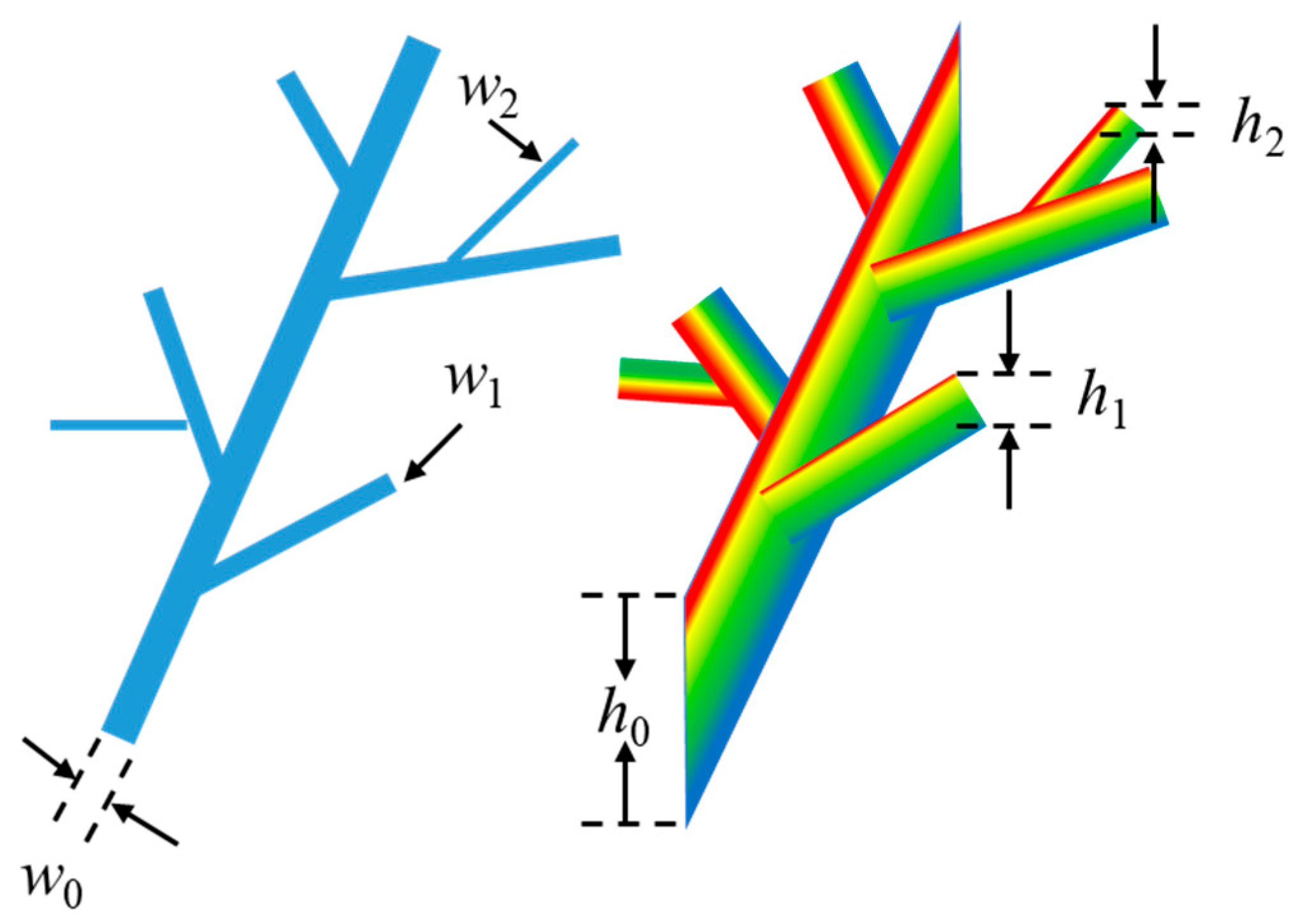
Natural fractures in shale reservoirs exhibit the characteristics of a discrete fracture medium. At present, discrete fracture network (DFN) models are widely employed to represent fractures as fracture elements with different scales and geometries. These models typically rely on stochastic simulation approaches, in which ant-tracking algorithms combined with well and seismic data are used to reconstruct realistic fracture networks. However, DFN models are inherently constrained by the limitations of stochastic simulation, leading to significant uncertainty in key characterization parameters [11]. The schematic diagram of the fractal model is shown in Figure 1.
Complex artificial fracture networks generated by hydraulic fracturing exhibit pronounced fractal characteristics. Inversion analyses based on microseismic monitoring data indicate that the fractal dimension of hydraulic fractures shows a nonlinear relationship with key operational parameters, such as injection rate and proppant concentration (sand ratio) [12]. Meanwhile, the settling and transport behavior of proppants within fractures exhibits distinct fractal aggregation characteristics [13,14].
Because the geometric configuration of fractures exhibits fractal characteristics—namely, fracture attributes can be regarded as statistical probability fields governed by fractal dimensions—fractal geometry provides a more suitable theoretical framework than the uniform random assumptions underlying conventional discrete fracture network (DFN) models. By employing fractional dimensions to describe random and irregular fracture systems that exhibit statistical self-similarity, fractal-based discrete fracture models can more accurately capture fracture heterogeneity and geometric complexity. For a given set of fractal parameters, fracture systems may display different spatial distributions and geometric patterns; however, they can possess nearly identical reservoir flow capacities, characterized by the same equivalent fracture-network permeability, and consequently exhibit consistent pressure transient responses. The inherent self-similarity and scale invariance of natural fracture systems allow fractal parameters to effectively control the global distribution of fractures, thereby improving characterization accuracy while preserving the essential mathematical information governing flow behavior.
The fractal dimension ( D f ) of natural fracture networks has become a key parameter for evaluating fracture complexity [15]. Previous studies indicate that the fractal dimension of natural fractures in shale reservoirs generally ranges from 1.2 to 1.8 and shows a significant positive correlation with fracture density and connectivity. Using calculation methods such as the box-counting dimension and correlation dimension, statistical relationships between fractal dimension and reservoir properties, including permeability and porosity, have been established, providing a quantitative basis for reservoir quality evaluation [16]. To account for the power-law characteristics of fracture size distributions, multifractal models have been proposed [17,18,19,20]. By jointly analyzing local and global fractal dimensions, these models reveal the self-similar nature of fracture networks across multiple scales. Applications in the L Formation shale of the Sichuan Basin demonstrate that the fractal dimension difference between microfractures (<1 mm) and microfractures (>1 cm) can reach 0.3–0.5, reflecting the hierarchical heterogeneity of shale reservoirs [8].

2.2. Fractal Evaluation of SRV (Stimulated Reservoir Volume)

Compared with the conventional stimulated reservoir volume (SRV), which is typically represented by a regular geometric volume, the fractal stimulated reservoir volume (F-SRV) incorporates the three-dimensional reservoir space effectively stimulated by fracture networks [21,22,23]. By explicitly accounting for the irregularity, multiscale nature, and self-similarity of fracture geometries, F-SRV provides a more realistic representation of the complex fracture networks generated by hydraulic fracturing in shale reservoirs and offers a closer approximation to the true conductive reservoir volume.
The fractal dimension ( D f ) is calculated using the box-counting method. Here, N δ , θ i denotes the number of cubes with side length A required to cover the fracture network, ω i = L i L i is the directional weighting factor of fractures, and θ i represents the fracture orientation angle:
D f = i = 1 N ω i log N ( δ , θ i ) i = 1 N ω i log ( 1 / δ )
The overall fractal dimension ( D f total ) is determined by jointly considering the fractal dimensions of microfractures ( D f micro ) and macro fractures ( D f macro ), together with the maximum and minimum fracture lengths ( L max / L min ):
D f total = D f macro log L max + D f micro log ( 1 / L min ) log ( L max / L min )
In Equation (2), Lmax and Lmin are defined as the upper and lower truncation lengths of the fracture-size distribution within the representative elementary volume (REV), rather than empirical fitting constants. Lmax is constrained by the effective outer scale of the stimulated fracture system identified from microseismic event-cloud geometry and well–seismic integrated fracture interpretation. By contrast, Lmin is taken as the minimum fracture scale retained in the equivalent model according to the lower bound of observable fractures and the REV/grid-resolution requirement. This treatment ensures that the calculation of the total fractal dimension is bounded by physically observable fracture scales and remains consistent with the equivalent upscaling framework.
For laminar flow between two parallel plates, the cubic law is well known. By matching it with Darcy’s form, the intrinsic permeability associated with an individual fracture is
k 0 = b h 2 12
where k 0 is the intrinsic permeability of an individual fracture (m2); b h is the hydraulic aperture (m);
For a fracture population, the hydraulic aperture is replaced by a representative (effective) aperture parameter σ f , i.e., b h σ f , yielding
k 0 = σ f 2 12
where σ f is the representative hydraulic aperture of the fracture population (m).
Equation (4) is directly obtained from Equation (3) by replacing the hydraulic aperture of a single fracture with the representative aperture of the fracture population; therefore, the same cubic-law factor is retained.
Assuming the fracture length scale L follows a self-similar fractal distribution with fractal dimension Df, the number density can be expressed as a power law n ( L ) L ( D f + 1 ) . The cumulative conductive contribution over scales is represented by a geometric-weighted integration. Using L2 as the scale weight to reflect that larger fractures provide proportionally larger effective flow pathways, the scale amplification factor can be written as
S L L min L max L 2 n ( L ) d L S L L max L min 2 D f
For the shale-fracture systems considered in this study, the fractal dimension Df is within the range 1 < Df < 2. Therefore, in Equation (5), the exponent term (2 − Df) remains positive, and the scale amplification factor reflects the enhanced conductive contribution of larger fractures within the multiscale fracture network.
Where S L is the dimensionless multiscale amplification factor (−) after normalization; Lmin and Lmax are the minimum and maximum fracture length cutoffs within the representative elementary volume (REV) (m); and Df is the fractal dimension of the fracture-size distribution (−).
To incorporate the degree of fracture development and connectivity, a porosity-based enhancement is introduced. With a 3D normalization, it is expressed as
S ϕ = ϕ f D f / 3
where S ϕ is the connectivity enhancement factor (−); ϕ f is fracture porosity (dimensionless, m3/m3). In this study, fracture porosity ϕ f is defined as an equivalent fracture-volume ratio within the representative elementary volume (REV), rather than a direct laboratory porosity measurement. It is estimated from the interpreted fracture space reconstructed from microseismic-derived fracture-density fields, well–seismic integrated fracture geometry, and the representative fracture aperture adopted in the equivalent fracture model, i.e., ϕ f = V f / V R E V . Accordingly, ϕ f characterizes the volumetric development and connectivity of the fracture system at the upscaled REV level and is introduced as the porosity-based enhancement term in Equations (6) and (8).
In the principal coordinate system aligned with the dominant fracture set, anisotropy is represented by a diagonal matrix Λ . Mapping to the global coordinate system is achieved through the standard orthogonal tensor transformation
K ani = R ( θ ) Λ R T ( θ )
where K ani is the dimensionless anisotropy/orientation mapping tensor (−); R ( θ ) is an orthogonal rotation matrix defined by fracture orientation angle(s) θ (−); Λ is a diagonal anisotropy weight matrix in the principal system (−).
Combining the single-fracture permeability scale (Equation (4)), the fractal multiscale amplification (Equation (5)), the porosity-based connectivity enhancement (Equation (6)), and the anisotropy/orientation mapping (Equation (7)) yields
K f = ϕ f D f / 3 σ f 2 12 L max L min 2 D f R ( θ ) Λ R T ( θ )
where K f is the equivalent permeability tensor of the fractal fracture network (m2).
By embedding the fractal fracture network into a continuous medium, an equivalent flow governing equation is established, where c t denotes the total compressibility and q represents the source–sink term:
( K f p ) = ϕ f c t p t + Q
The equivalent dynamic parameters are calculated as follows:
Considering fracture closure and proppant embedment during production [24,25,26,27], the fracture conductivity ( C f ) is modified as:
C f ( t ) = C f 0 exp ( α 0 t σ eff ( τ ) d τ ) ( D f ( t ) D f 0 ) β
Here, Cf0 represents the initial fracture conductivity in SI units (m3), i.e., permeability multiplied by effective fracture width; α is the stress-sensitivity coefficient, with unit MPa−1·d−1, where d denotes day. β is a dimensionless exponent describing the time-dependent attenuation associated with fracture closure. The shale gas adsorption capacity ( V abs ) can be transformed into a correlation function describing the roughness of the fractal surface [28,29]:
V abs = V L p p + p L ( D s 2 ) γ
Here, VL and pL denote the Langmuir volume and Langmuir pressure, respectively. Ds is the dimensionless surface fractal dimension and is constrained to 2.1–2.4 in this study. γ is a positive dimensionless fitting coefficient. In this study, α and β were determined by deterministic fitting under fracture-conductivity attenuation and production-history-matching constraints, whereas γ and Ds were calibrated from adsorption-related data fitting under physically admissible bounds. In the coupled seepage–stress equation, the equivalent elastic modulus E eq is formulated as a function dependent on the fractal dimension:
E eq = E m 1 + D f D f 0 D fc D f 0 n
where E m represents the elastic modulus of the matrix, D fc denotes the critical fractal dimension (1.65), and n is the nonlinear index with a value of 2.3.

3. Model Construction

3.1. Construction of a Production Prediction Model Driven by Hybrid Physical Mechanisms

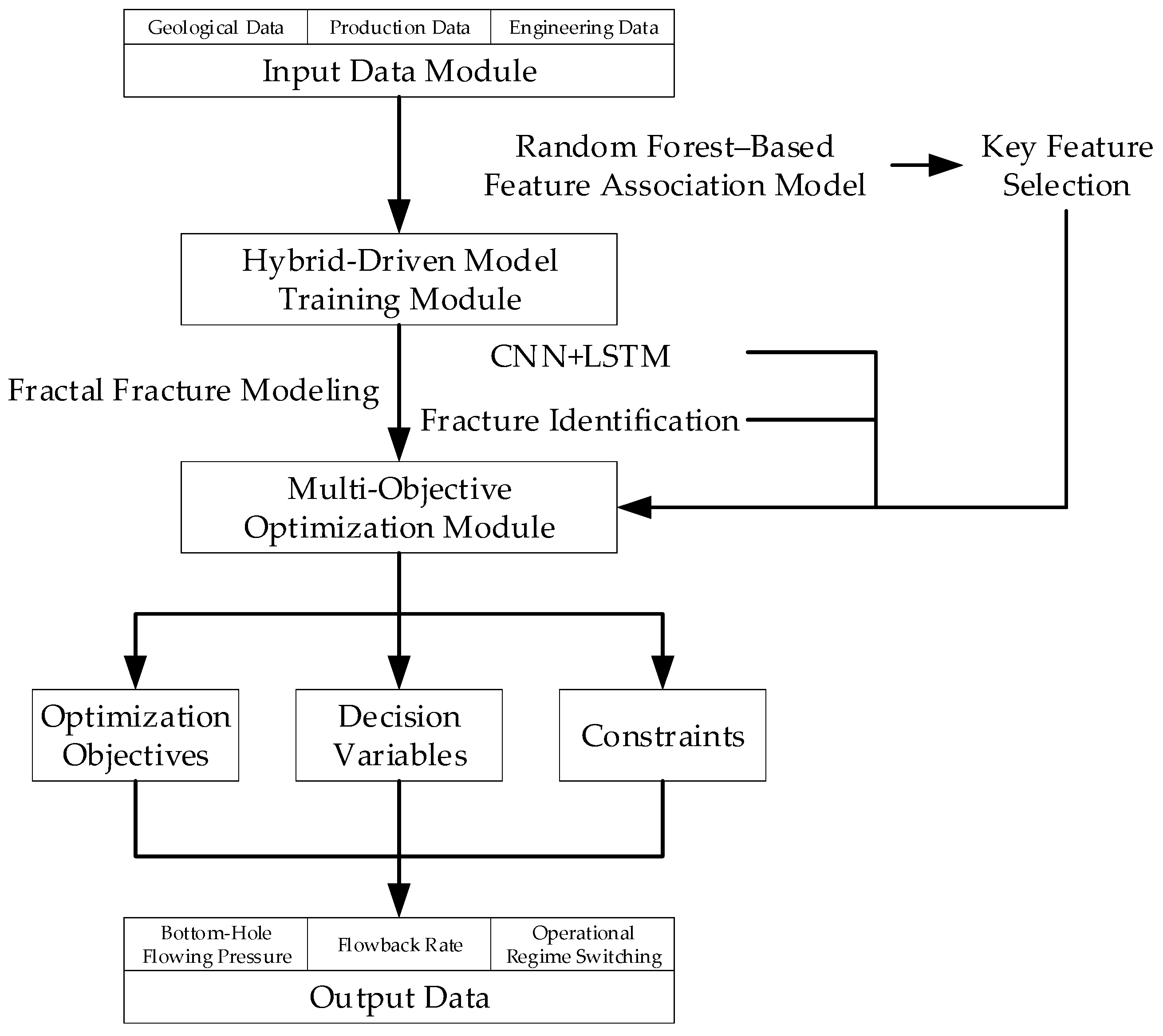
The objective of production optimization is the dynamic adaptation and precise quantification under a geology–engineering integrated framework. This requires a deep coupling among geological reservoir potential, engineering stimulation effectiveness, and the dynamic evolution of production performance. Therefore, it is necessary to characterize the complex pore structure and seepage behavior of shale reservoirs based on fractal theory, and to integrate hydraulic fracturing engineering mechanisms for production prediction. The flowchart of the hybrid physics-driven production prediction model is shown in Figure 2.
First, core experimental data from the L Formation shale gas reservoir—including porosity, permeability, total organic carbon (TOC) content, and brittleness index—were collected, together with logging data (GR, RT, AC, DEN), seismic interpretation results (reservoir thickness, burial depth, fault development characteristics), hydraulic fracturing operational parameters (injection rate, sand ratio, fracturing fluid volume, perforation parameters), and production dynamic data (daily gas production, bottom-hole flowing pressure, cumulative gas production). Through data preprocessing procedures such as data cleaning (outlier removal and missing value imputation), normalization (to eliminate dimensional inconsistencies), and spatiotemporal matching of geological and engineering parameters, a total of 120 coupled geology–engineering–production samples were obtained, covering different burial depths, fracturing scales, and production stages. The 120 coupled geology–engineering–production samples used in this study were constructed from field-acquired and field-interpreted multi-source data, including laboratory measurements on reservoir core samples, logging data, seismic interpretation results, hydraulic fracturing operational records, and actual production dynamic data. These samples therefore represent matched real-well observations rather than numerical-simulation-generated samples. For clarity, the synthetic fracture data and SMOTE-generated samples introduced later in Section 3.2 were used only for auxiliary training enhancement and domain adaptation, and were not included in the original 120-sample dataset.
Feature parameter selection was designed to account for both the static endowment of the geological reservoir and the dynamic response of engineering stimulation and production processes. Static parameters mainly represent the fundamental geological conditions and baseline engineering attributes, including reservoir static parameters (porosity, permeability, TOC content, brittleness index, clay mineral content, reservoir thickness, burial depth, and formation pressure coefficient) and engineering static parameters (fracturing stage length, perforation density, total proppant volume, total fluid volume, and peak injection rate). Dynamic parameters characterize the dynamic interactions among the reservoir, fluid flow, and stimulated reservoir volume during production, including production dynamic parameters (daily gas production, bottom-hole flowing pressure, casing pressure, and production pressure drawdown) and post-fracturing dynamic response parameters (instantaneous flowback rate, total dissolved solids of flowback fluid, and proppant flowback concentration).
Considering the characteristics of the dataset—namely high dimensionality (32 static and dynamic parameters), strong coupling (e.g., significant correlations between porosity and permeability, and between proppant volume and fracture conductivity), temporal dependency (dynamic parameters evolving continuously with production time), and localized nonlinearity caused by reservoir heterogeneity—a hybrid physics-driven CNN–LSTM modeling framework was constructed. Specifically, the convolutional neural network (CNN) was employed to extract local features and uncover latent coupling relationships between high-dimensional geological and engineering static parameters, such as the influence of the matching between brittleness index and proppant volume on fracture propagation. Meanwhile, the long short-term memory (LSTM) network was utilized to capture temporal dependencies in dynamic parameters and to model their time-dependent driving effects on production performance. Furthermore, fractal seepage governing equations—such as fractal porous-media permeability models and fractal fracture conductivity formulations—were embedded as physical constraints, enabling a deep integration of data-driven learning and physical mechanisms, thereby improving the accuracy and generalization capability of production prediction.
A random forest consisting of 200 decision trees was constructed using a random forest–based feature association model, and permutation importance was employed to evaluate the influence of fractal parameters on production performance:
The importance scores in Table 1 were calculated using permutation importance based on the trained random forest model with 200 decision trees. For each feature, its values were randomly shuffled while the remaining features were kept unchanged, and the corresponding decrease in model predictive performance was recorded; the final score was defined as the normalized average performance degradation over repeated permutations. It should be noted that the selection of the top three parameters was not based on a claim of statistical significance between the third- and fourth-ranked variables. Rather, these three variables were retained as a compact core subset because they ranked highest overall and were most directly related to the fracture-dynamic characterization framework of this study, whereas the remaining variables were treated as supporting explanatory factors.
The three parameters with the highest importance scores were selected as the focus of this study, namely the dynamic fractal dimension, fractal conductivity ratio, and adsorption hysteresis coefficient.
By extracting the decision paths of high-production samples (above the 80th percentile), key governing rules were identified:
IF   D f   >   1.6   AND   R c f   >   50   THEN   Production   Level   =   high
After data cleaning and outlier detection, an improved wavelet-threshold denoising method was applied to suppress data noise, and the isolation-forest algorithm was used to identify anomalous samples. Subsequently, dynamic time warping was employed for temporal alignment of time-series data, while inverse-distance-weighting interpolation was adopted to transform discrete microseismic event clouds into continuous fracture-density fields. Fractal descriptors such as dominant orientation and fractal dimension were then extracted and mapped to the equivalent fractal fracture model to update the permeability tensor and related dynamic parameters, thereby completing the spatiotemporal alignment of multi-source data and providing the basis for subsequent history matching and dynamic parameter inversion.

3.2. Development of a Machine Learning Prediction Model Driven by Fractal Theory and Physical Mechanisms

This study proposes an intelligent analysis framework for shale gas development that integrates fractal theory with physical mechanisms. By employing dynamic fractal fracture characterization, a time-varying mathematical model of complex fracture networks is established. Combined with a physics-constrained machine learning architecture [24,25]—including three core modules: (i) an LSTM embedded with seepage governing equations for dynamic production prediction, (ii) a fractal-preference random forest for feature association analysis, and (iii) a three-dimensional fractal convolutional network for fracture identification—a multi-objective optimization strategy is constructed to enable coordinated decision-making for dynamic production regulation and decline management under fracturing-constrained reservoir conditions. In this study, hydraulic fracturing design parameters were incorporated as static engineering inputs for feature association and fracture characterization, whereas the final optimization variables were restricted to post-fracturing operational controls, namely bottom-hole flowing pressure, flowback rate, and production regime switching time. The proposed framework innovatively employs fractal dimension as a unifying linkage throughout the entire workflow, encompassing data preprocessing, feature engineering, and model training. Based on numerical simulation models, an iterative optimization chain of “dynamic prediction–feature association–fracture identification” is formed. Through dynamic updating of fractal parameters and coupled multi-physics-field solutions, the framework drives the closed-loop evolution of development strategies, promoting a paradigm shift in shale gas development from experience-driven practices toward an intelligent mechanism–data fusion approach. This work provides theoretical tools and methodological support for the efficient development of unconventional oil and gas resources.
(1)
Design of Core Modules and Collaborative Mechanisms
a.
Dynamic Prediction Module (Seepage-Equation-Embedded LSTM)
To address the temporal evolution characteristics of production dynamic parameters, fractal-corrected seepage governing equations—including the equivalent permeability tensor formulation and the fractal fracture conductivity attenuation model—were embedded into the training process of a long short-term memory (LSTM) network as physical constraints. Through the forget gate, input gate, and output gate mechanisms of the LSTM architecture, the temporal dependencies of dynamic variables such as daily gas production and bottom-hole flowing pressure were effectively captured. Meanwhile, a physics-based loss function was introduced to constrain the network outputs to comply with fractal seepage laws, thereby preventing time-series predictions from deviating from engineering realities.
The total training loss is formulated as
L = λ d L d a t a + λ p L p h y s + λ i c L i c + λ b c L b c
where Ldata denotes the data-misfit term, Lphys denotes the physics-residual term, Lic denotes the initial-condition consistency term, and Lbc denotes the boundary/control-condition consistency term. In this study, Ldata is used to fit the observed production variables, including daily gas production and bottom-hole flowing pressure. Lphys is constructed from the fractal seepage governing equation together with the dynamic fracture-conductivity relationship, so as to penalize predictions that violate the physical evolution law of the reservoir-fracture system. Lic is used to constrain the prediction to match the prescribed initial production state, and Lbc is used to enforce consistency with the corresponding operational control conditions, including bottom-hole flowing pressure, flowback rate, and regime-switching settings. After normalization of the different loss components, the weighting coefficients λd, λp, λic, and λbc are introduced as balancing hyperparameters during training, where λd is taken as the reference coefficient for data fitting and the remaining coefficients are tuned on the validation set to balance predictive accuracy and physical consistency.
The core input features of this module include key fractal parameters such as the dynamic fractal dimension, fractal conductivity ratio, and adsorption hysteresis coefficient, together with dynamic response parameters including production pressure drawdown and flowback rate.
b.
Feature Association Module (Fractal-Preference Random Forest)
A random forest model consisting of 200 decision trees was constructed to identify feature combinations with significant impacts on production performance using permutation importance analysis. The results indicate that the dynamic fractal dimension, fractal conductivity ratio, and adsorption hysteresis coefficient constitute the top three most influential features. This module focuses on uncovering nonlinear associations between static parameters (e.g., porosity, total organic carbon (TOC) content, and fracturing stage length) and fractal characteristics. Decision rules extracted from high-production samples—for instance, optimal production achieved when the fractal dimension falls within the range of 1.52–1.68 and matches a high proppant volume—provide targeted feature-weight allocation for the CNN module, thereby enhancing the representation of critical geology–engineering coupling information.
c.
Fracture Identification Module (3D Fractal Convolutional Network)
To address the discreteness of microseismic monitoring data, a three-dimensional convolutional neural network was employed to extract fractal features of fracture spatial distribution through 3D convolution operations. Combined with the global fractal dimension calculated using the box-counting method, discrete microseismic event point clouds were transformed into a continuous fractal stimulated reservoir volume (F-SRV) representation. In this study, the fractal stimulated reservoir volume (F-SRV) represents the effective stimulated reservoir space associated with the fracture network under the fractal representation. The reference F-SRV used for validation is obtained from microseismic-interpreted stimulated fracture volume, while the model-predicted F-SRV is derived from the corresponding fracture-space representation generated by the EFF or DFN model under the same reservoir conditions. The outputs of this module—including fracture density fields and spatial distributions of fractal dimensions—are used to dynamically update the equivalent permeability tensor field, providing real-time reservoir seepage condition parameters for the LSTM module. This enables dynamic coupling between fracture evolution and production prediction.
In the present framework, the mapping from microseismic observations to permeability is implemented as a constrained sequential process. Discrete microseismic event clouds are first denoised, temporally aligned, and spatially interpolated into a continuous fracture-density field. Fractal descriptors extracted from this field are then used to characterize the corresponding F-SRV, and the resulting fracture-density and fractal-geometry information is subsequently mapped to the equivalent permeability tensor through the fractal permeability formulation introduced in Section 2.2. It should be noted that the current inversion is regularized by feasible fractal-dimension ranges, fracture-spacing constraints, fracture-conductivity retention constraints, and production-history matching.
For equivalent fractal fractures, the following constraints are imposed on the optimization model to ensure fracture effectiveness:
(1) Fracture Complexity Constraint
The fractal dimension must satisfy the feasibility requirements of hydraulic fracturing operations:
D f min D f D f max ( 1.4 D f 1.8 )
(2) Fracture Spacing Non-Interference Constraint
Based on fractal percolation theory, inter-stage stress interference is avoided:
L s 2 L f D f D c
where Lf denotes the fracture half-length, and Dc denotes a critical connectivity threshold in the fractal-percolation-based description of the fracture network. It is used to characterize the minimum fractal-connectivity condition required for effective fracture communication under the equivalent fractal representation. In this study, Dc is introduced as a physically constrained threshold parameter in the fracture-spacing non-interference condition, rather than as an independent optimization variable.
(3) Fracture Conductivity Degradation Constraint
A constraint is imposed on the retention of fracture conductivity after five years of production:
C f ( 5 ) C f 0 γ ( γ = 0.4 )
To address the optimization challenges in shale gas horizontal well development—characterized by multiple objectives, multiple constraints, and high-dimensional decision spaces—this section proposes an improved multi-objective intelligent optimization algorithm guided by fractal theory. Through dynamic parameter adjustment, hybrid strategy integration, and enhanced computational efficiency, production scheme optimization is achieved [28,29].
(2)
Model Training Optimization Strategies
a.
Domain-Adaptive Fine-Tuning
To mitigate the distribution discrepancy between synthetic fracture data and real microseismic monitoring data, a domain adaptation approach was adopted. Specifically, the maximum mean discrepancy (MMD) distance was minimized using data from 50 real wells. By employing a Gaussian kernel function, the feature distribution divergence between the source domain (synthetic data) and the target domain (real data) was reduced, thereby improving the model’s adaptability to actual shale gas reservoirs. The core formulation is expressed as:
L MMD = 1 n 2 i = 1 n j = 1 n k x i s , x j s + 1 m 2 i = 1 m j = 1 m k x i t , x j t 2 n m i = 1 n j = 1 m k x i s , x j t
b.
Positive–Negative Sample Balancing
To address model bias caused by the scarcity of low-production well samples, the Synthetic Minority Over-sampling Technique (SMOTE) was employed to generate synthetic samples for the minority class (low-production wells). New feature vectors were constructed using a random interpolation strategy, thereby improving class balance and enhancing the robustness of the model:
x new = x i + λ ( x j x i ) ,   λ ~ U ( 0 , 1 )
c.
Bayesian Hyperparameter Optimization
Considering the high computational cost of model training and the complex relationship between hyperparameters and model performance, Bayesian optimization was selected as the core optimization strategy. A Gaussian process surrogate model was employed to efficiently search for the optimal combination of hyperparameters. Meanwhile, constraints on fractal dimension (1.2–1.8) and geological–engineering rules (such as the fracture spacing non-interference condition) were embedded into the optimization process to ensure the physical compatibility of the optimized hyperparameters. This strategy significantly reduces trial-and-error costs during model training and improves overall training efficiency.
d.
Design of Multi-Dimensional Optimization Objectives
To achieve multi-objective optimization in shale gas horizontal well development, the optimization framework was constructed with cumulative gas production, stable production period, and fractal stimulated reservoir volume as optimization objectives, forming a multi-objective optimization model:
(1) Maximization of Cumulative Production
max Q cum = t = 1 T q t Δ t
(2) Extension of the Stable Production Period
The stable production period is defined as the duration during which the annual production decline rate D q is less than 20%:
max T s = arg max t t q 1 + 1 q t q t   <   0.2
(3) Optimization of Fractal Stimulated Reservoir Volume (F-SRV)
The effective stimulated region is characterized by the dynamic evolution of the fractal dimension:
max F - SRV = V ( D f ( x , y , z ) D c ) d V ( D f   >   D c )
The three engineering indicators in Equations (19)–(21), namely cumulative production, stable production period, and fractal stimulated reservoir volume (F-SRV), are used to characterize the production, decline, and stimulated-volume responses of candidate operating strategies. In the subsequent case study, these indicators are not treated as separate final economic objectives; instead, they are translated into time-phased production and control profiles, and the ultimate optimization criterion is the net present value (NPV).


4. Validation of the Equivalent Fractal Fracture Model

4.1. Geometric Validation of the Equivalent Fractal Fracture Model

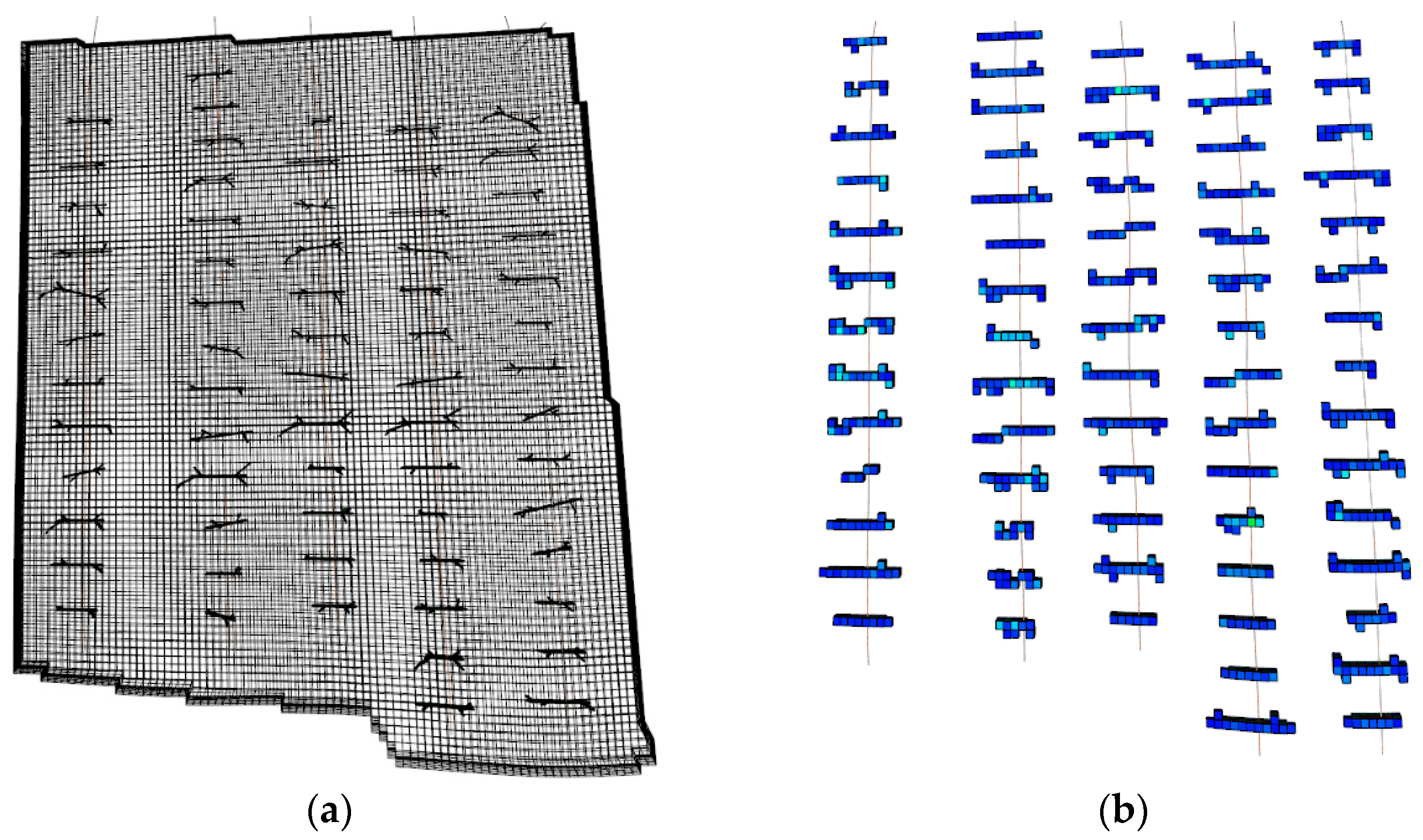
After introducing the equivalent fractal fracture model (EFF), the resulting fracture morphology shows good consistency with that of the discrete fracture network (DFN) model in terms of fracture extension angle and length, both exhibiting a dominant main fracture with secondary fractures extending from its two ends. Taking the DFN model as the benchmark, the accuracy and computational efficiency of the EFF were systematically evaluated. Over the one-year production-dynamics evaluation period, the EFF model yielded an average relative error of 6.8% for daily gas production, slightly higher than the 4.2% obtained by the DFN model; however, the computational time of the EFF is only approximately one-eighteenth of that required by the DFN model. In terms of grid sensitivity, the EFF demonstrates strong numerical stability, with the error increase remaining below 3% under a coarse grid resolution of 25 × 25 × 25, whereas the DFN model exhibits a significant error increase of up to11%. These results indicate that the EFF achieves a favorable balance between prediction accuracy and computational efficiency, making it more suitable for large-scale optimization and iterative simulation scenarios. The geometric comparison between the DFN model and the EFF model is shown in Figure 3.
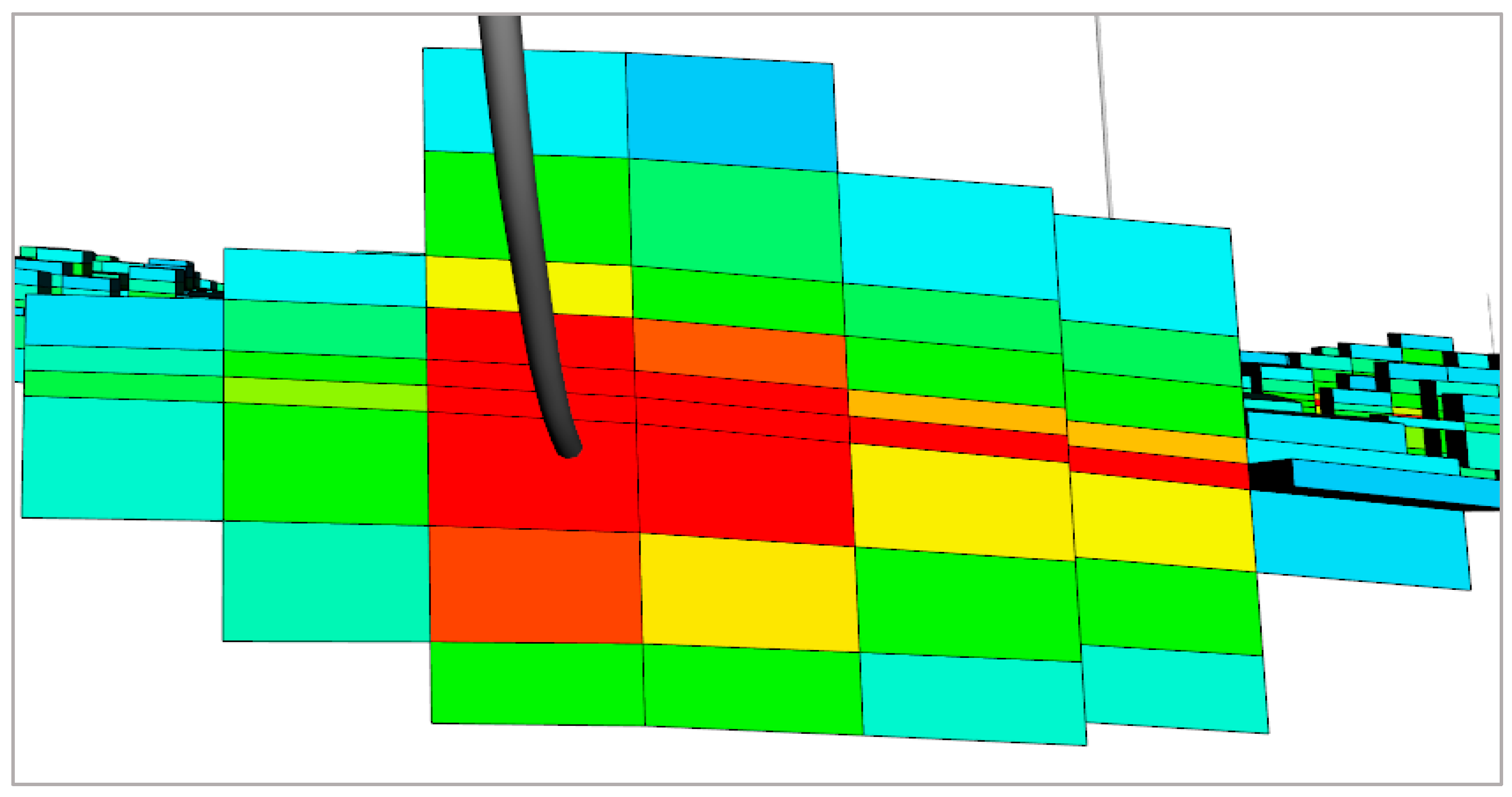
During the actual simulation process, the stratigraphic positions of hydraulic fracturing perforations were taken into account, and fracture permeability was calculated independently for each grid block. As observed from the single-fracture model within the simulation domain, the overall permeability exhibits a decreasing trend away from the grid containing the perforation point, extending toward both fracture wings as well as upward and downward stratigraphic layers, as shown in Figure 4.
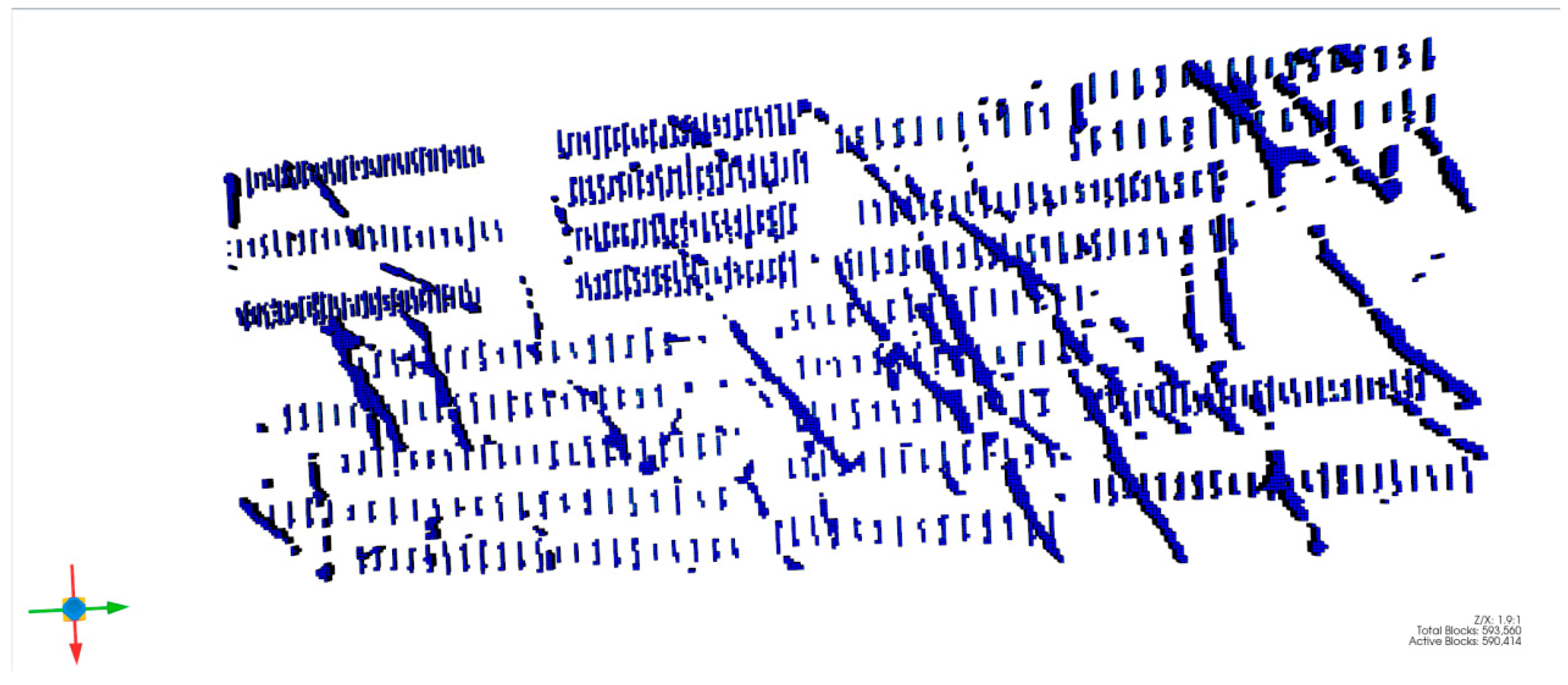
Based on the permeability distribution pattern of fractures, the overall fracture system in the well-area model was simulated. As shown in Figure 5, fractures associated with each well form a hybrid spatial distribution of artificial and natural fractures within the model domain.

4.2. Test Accuracy Validation

In this study, a stratified sampling strategy was employed to partition the dataset. A total of 120 samples were divided into training, validation, and testing sets at a ratio of 7:1:2, corresponding to 84, 12, and 24 samples, respectively. During dataset partitioning, stratified sampling was performed using three primary variables: burial depth interval, fracturing-scale interval, and production stage. Specifically, burial depth was grouped within the observed reservoir range (2500–3500 m), fracturing scale was stratified according to proppant-volume intervals within 1000–2000 t, and production data were classified into early, stable, and decline stages. These variables were selected as the principal stratification basis because they directly reflect reservoir condition, stimulation intensity, and temporal production behavior, respectively. Other variables, such as TOC and brittleness index, were not used as primary stratification variables because multi-factor simultaneous stratification under a 120-sample dataset would generate excessively sparse strata; instead, their post-split distributions were checked to ensure overall representativeness. This strategy helps reduce data distribution bias; otherwise, subset imbalance may cause overrepresentation of dominant sample groups, weaken prediction accuracy for underrepresented wells, and impair model generalization.
Model performance was evaluated using a comprehensive set of metrics that reflect both predictive accuracy and practical applicability. Production prediction accuracy was quantified using the relative errors of daily gas production and cumulative gas production, while computational efficiency was assessed based on the simulation time required for a single well. In addition, the effectiveness of multi-objective optimization was evaluated in terms of cumulative production enhancement, extension of the stable production period, and the adaptability of the fractal stimulated reservoir volume (F-SRV). Model stability was further examined through grid sensitivity analysis and generalization error assessment, providing a holistic evaluation of the model’s robustness and performance.
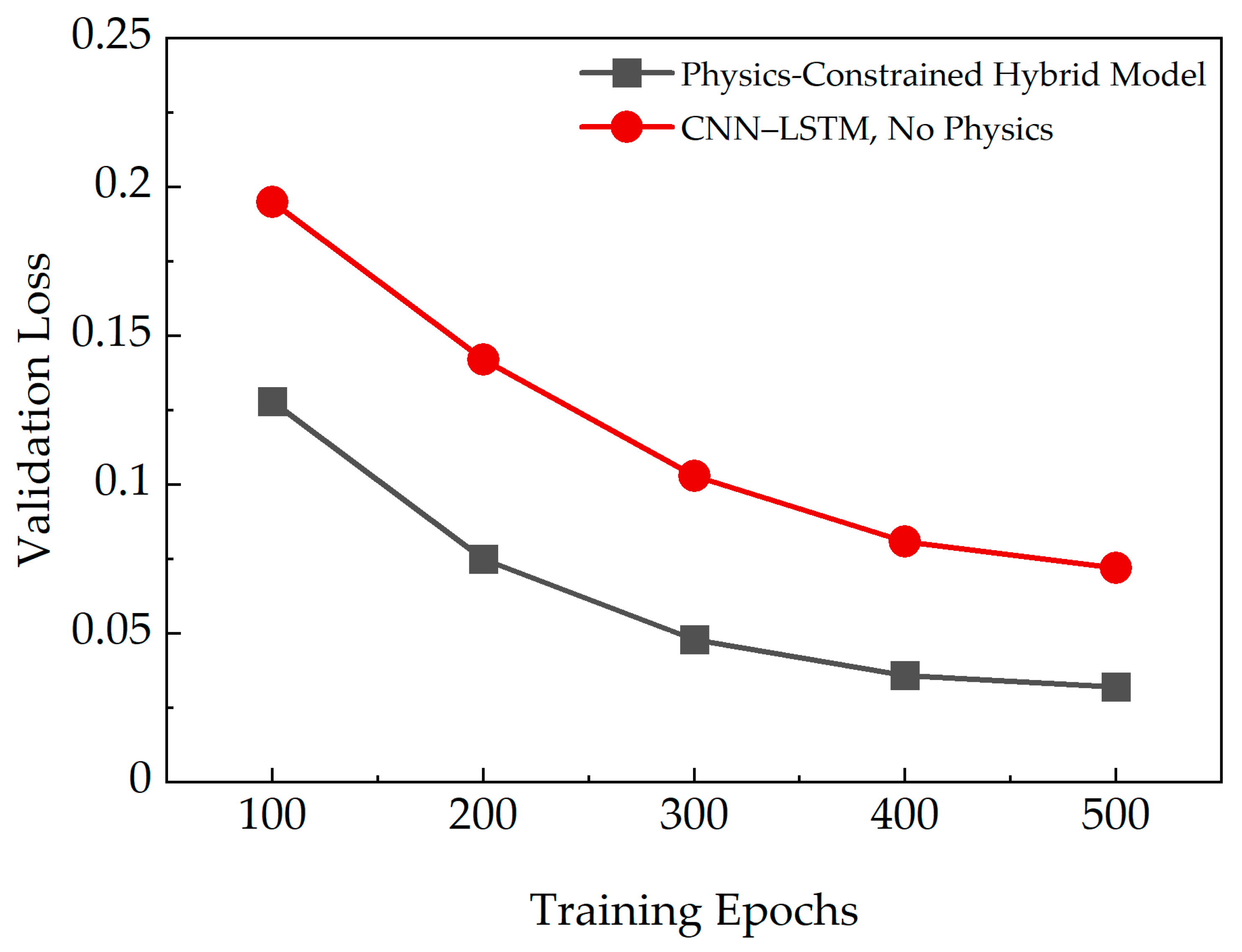
The model training loss function is shown in Figure 6. During model training, the multi-objective loss function incorporating fractal seepage equation constraints exhibited rapid and stable convergence. The validation loss stabilized below 0.032 after approximately 500 training iterations, representing a 40% improvement in convergence speed compared with the conventional CNN–LSTM model without physical constraints. Moreover, no evident overfitting was observed throughout the training process, indicating that the integration of physical mechanisms effectively enhances training stability and generalization capability.
To address prediction bias arising from the limited number of low-production well samples, the Synthetic Minority Over-sampling Technique (SMOTE) was applied to generate 18 additional synthetic samples for the minority class. As a result, the average prediction error for low-production wells was reduced from 12.3% to 7.5%, demonstrating a substantial improvement in model performance for underrepresented samples. Furthermore, domain-adaptive fine-tuning based on data from 50 real wells significantly reduced the maximum mean discrepancy (MMD) between the source and target domains to 0.015, indicating a marked enhancement in the model’s adaptability to real reservoir conditions.
In terms of hyperparameter optimization, Bayesian optimization was employed to identify the optimal hyperparameter configuration, yielding an LSTM hidden-layer dimension of 256, a CNN kernel size of 3 × 3, a learning rate of 0.001, and a regularization coefficient of 0.0005. Compared with conventional grid search, this approach improved training efficiency by approximately 60% while further reducing the average prediction error on the test set by 3.2 percentage points, highlighting its effectiveness in balancing computational efficiency and predictive accuracy.
The test-set results of production prediction accuracy are summarized in Table 2. The proposed model achieves an average relative error of 6.8% for daily gas production and a relative error of 9.8% for three-year cumulative gas production prediction. Further analysis indicates that the prediction error for high-production samples (daily gas production > 40 × 104 m3/d) is controlled within 5.2%, while that for low-production samples (daily gas production < 10 × 104 m3/d) does not exceed 8.7%.
The relative error of F-SRV reported in Table 2 describes the percentage deviation of the model-predicted F-SRV from the reference F-SRV. This indicator is introduced to evaluate whether the model can correctly reproduce the spatial extent and effective connectivity of the stimulated fracture system. Therefore, the F-SRV error complements the production-based error metrics by providing a structural validation measure for fracture-network representation.
In terms of computational efficiency, the proposed model demonstrates a significant advantage. The simulation time required for a complete five-year production cycle of a single well is only 61.54 s, compared with 1113.48 s for the conventional discrete fracture network (DFN) model, corresponding to an efficiency improvement of approximately 94.5%. In addition, the proposed framework supports parallel computation for multiple wells, providing an efficient and practical tool for large-scale reservoir development planning and optimization.
To further evaluate the applicability of the proposed method to shale-gas well-group development scenarios, an additional ten-well shale gas well-group simulation benchmark was conducted. Under the same simulation settings and production horizon, the total runtime of the EFF model was 918.73 s, whereas that of the DFN model was 12,178.69 s. This indicates that the EFF runtime was only about 7.54% of the DFN runtime, corresponding to a computational-time reduction of approximately 92.46%. These results further confirm that the proposed method retains a substantial computational-efficiency advantage not only at the single-well level but also at the shale-gas well-group scale.

4.3. Model Stability and Generalization Capability

The results of the grid sensitivity analysis are summarized in Table 3. Numerical tests were conducted using fine (100 × 100 × 100), medium (50 × 50 × 50), and coarse (25 × 25 × 25) grid resolutions. The results indicate that the increase in production prediction error of the proposed model remains below 3% across all grid scales. In contrast, the discrete fracture network (DFN) model exhibits a substantial error increase of up to 11% under coarse-grid conditions. These findings demonstrate that the proposed model shows low dependence on grid discretization and possesses strong numerical stability, making it suitable for numerical simulations and engineering applications with varying accuracy requirements.
To evaluate the cross-regional generalization capability of the proposed model, ten newly drilled wells from the W gas field in the Sichuan Basin that were not involved in model training were selected for independent validation. The results indicate that the average prediction errors for daily gas production and cumulative gas production are 7.3% and 10.5%, respectively, representing a reduction of approximately 4.8 percentage points in generalization error compared with conventional models developed for the same region. These findings demonstrate that the proposed model maintains high predictive accuracy under cross-regional application scenarios and exhibits strong adaptability to the pronounced heterogeneity of the L Formation shale gas reservoirs.
The degree of constraint satisfaction was systematically evaluated during the testing process. The predicted fractal dimensions consistently remained within the technologically feasible range of 1.2–1.8, fracture spacing satisfied the non-interference condition, and the fracture conductivity retention after five years of production met the prescribed design criteria. Overall, all prediction results complied with the imposed physical constraints and engineering feasibility requirements, demonstrating the robustness and reliability of the proposed model under complex constrained conditions.
The present study evaluates predictive reliability through deterministic validation rather than formal probabilistic uncertainty intervals. Specifically, model confidence is assessed using the relative errors of daily gas production, cumulative gas production, and F-SRV, together with subgroup error analysis, grid-sensitivity analysis, external validation on ten unseen wells, convergence behavior of the physics-constrained training loss, and physical-constraint satisfaction checks. Accordingly, the inverted parameters are interpreted as constrained history-matching solutions regularized by feasible fractal-dimension ranges, fracture-spacing constraints, fracture-conductivity retention constraints, and production-history matching.

5. Case Study of Model Application

In this study, a representative well block from the L Formation in the W gas field, Sichuan Basin, was selected as a case study for model application and validation. The key controlling parameters of the study area are listed in Table 4. The W shale gas block is located in the northern part of southern Sichuan and is characterized by a geomorphological setting transitioning from mountainous terrain in the north to hilly landscapes in the central and southern areas, with the overall topography gently dipping from northwest to southeast. Although water resources in the block are relatively abundant, the region is densely populated, and well-site deployment must therefore account for complex terrain, transportation conditions, and population distribution. The target L Formation in the study area is characterized by well-developed faults, natural fractures, and pronounced reservoir heterogeneity, resulting in complex geological conditions. Significant variability is observed in single-well test production, with daily gas production ranging from 4 to 70 × 104 m3/d, and production differences among wells on the same platform reaching factors of three to four. The controlling factors of high productivity exhibit strong multi-factor interactions and substantial inter-well variability. Owing to the strong reservoir heterogeneity, accurate prediction of vertical and lateral sweet spots remains challenging, and the effective drainage area of individual wells is limited, posing considerable challenges for production optimization and capacity forecasting.
The W shale gas reservoir is characterized by relatively thin reservoir thickness and pronounced lateral heterogeneity, while subtle structural features are developed but remain difficult to identify. Vertically, the thickness of high-quality reservoir intervals is approximately 40 m; however, the Longyi-11 sublayer is thin and well laminated, resulting in a relatively low drilling encounter rate for high-quality reservoirs. During horizontal well development, the target window is narrow (3–8 m) and exhibits significant lateral variability, which poses substantial challenges for well trajectory control. Although no large-scale faults are developed in the L Formation, formation dip and small-scale faults introduce discrepancies between logging-while-drilling interpretations and seismic data. Consequently, frequent trajectory adjustments are required, increasing the risk of missing the target zone and leading to an approximately 10% reduction in reservoir encounter rate. The parameters of the target well are summarized in Table 5.
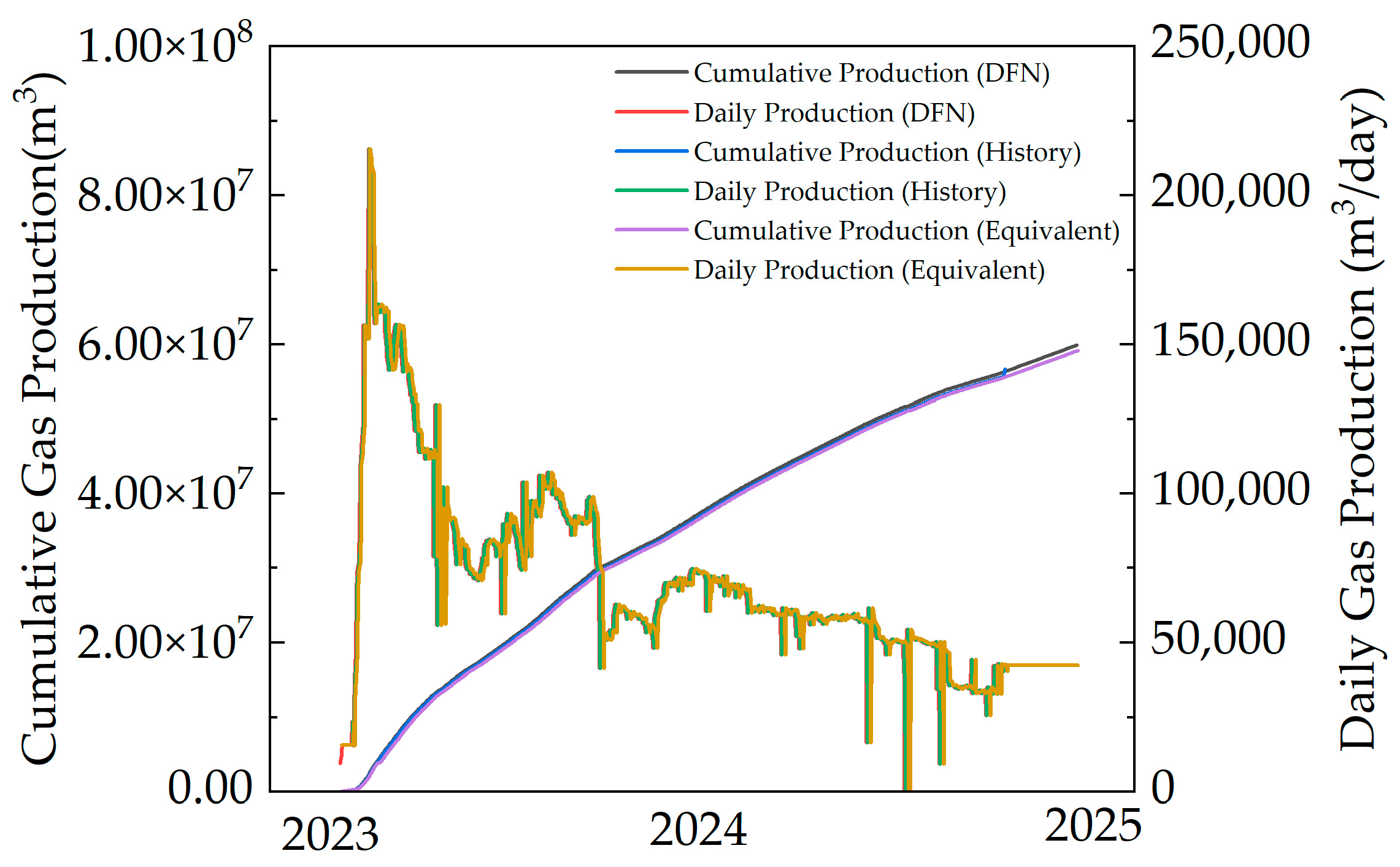
By constructing both discrete fracture network (DFN) and equivalent fracture network (EFF) models, the production performance predicted by the two approaches was systematically analyzed. As shown in Figure 7, both models exhibit good history-matching performance, with coefficients of determination (R2) greater than 90%, indicating that each can be effectively applied to numerical simulation of shale gas reservoirs. However, when computational time and economic cost are taken into account, the equivalent model demonstrates clear advantages in terms of computational efficiency while maintaining a high level of prediction accuracy.
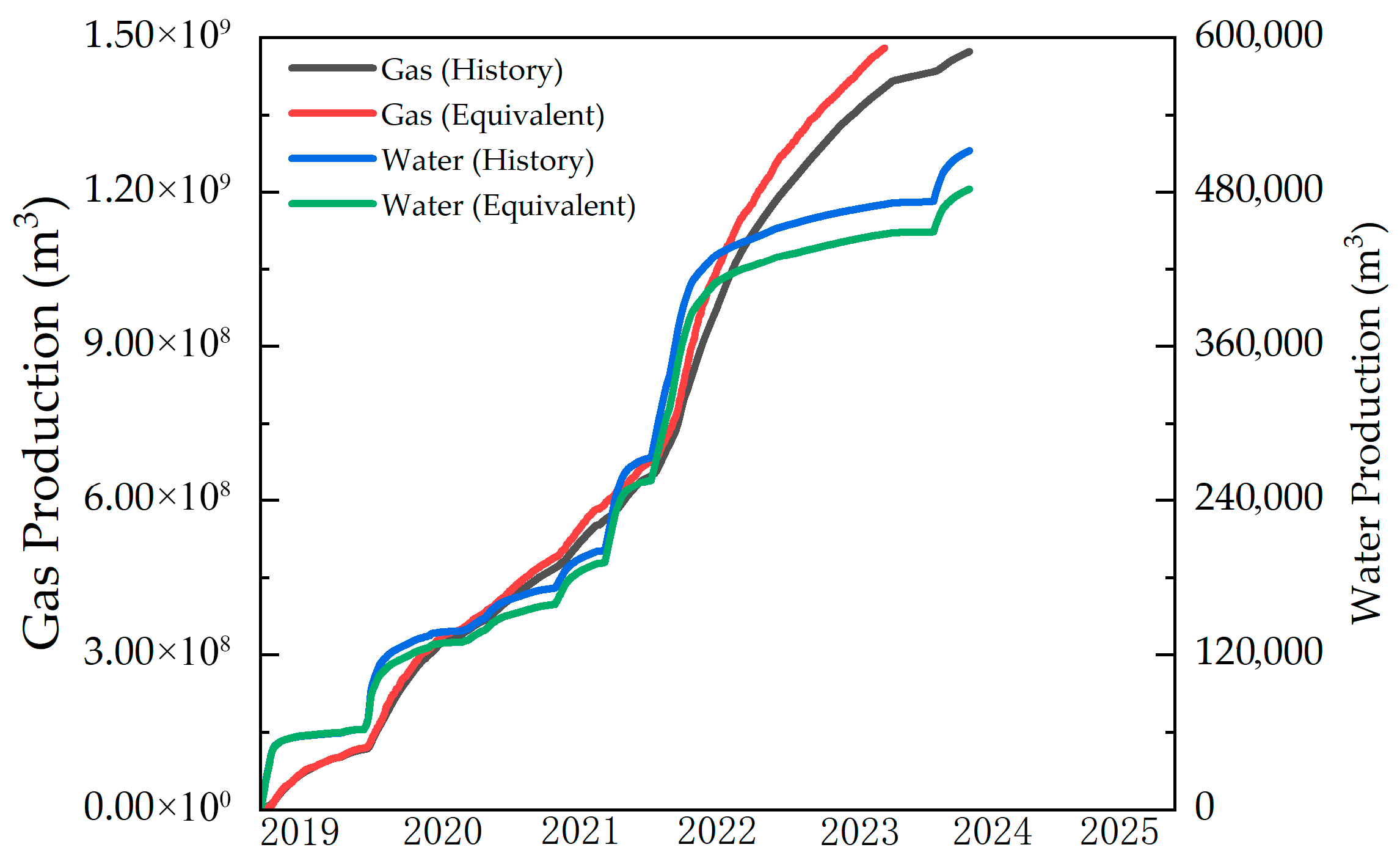
The production performance predicted by the discrete fracture network (DFN) model and the equivalent fracture network (EFF) model was systematically compared to evaluate their accuracy and computational efficiency. As illustrated in Figure 8, both models show good agreement with the historical cumulative gas production and daily gas production data, with coefficients of determination (R2) greater than 90%, indicating that both approaches are applicable for shale gas numerical simulation. However, a pronounced difference is observed in computational efficiency. The DFN model requires 1113.48 s to complete a single simulation run, whereas the EFF model completes the same simulation in 61.54 s, corresponding to only 5.5% of the DFN computational time. This substantial reduction in computational cost highlights the clear advantage of the equivalent model when time efficiency and economic feasibility are considered.
The final objective function used in the case study is defined as:
NPV = t = 1 T p g q g ( t ) C o p ( t ) C w ( t ) C c ( t ) ( 1 + r ) t C c a p
where pg denotes the gas price, qg(t) denotes gas production at time step t, Cop(t) denotes the operating cost, Cw(t) denotes the water/flowback handling cost, Cc(t) denotes other time-dependent production-control cost, Ccap denotes the initial capital-related cost, and r denotes the discount rate. In this study, the economic indicators reported in the case study are presented in normalized form.
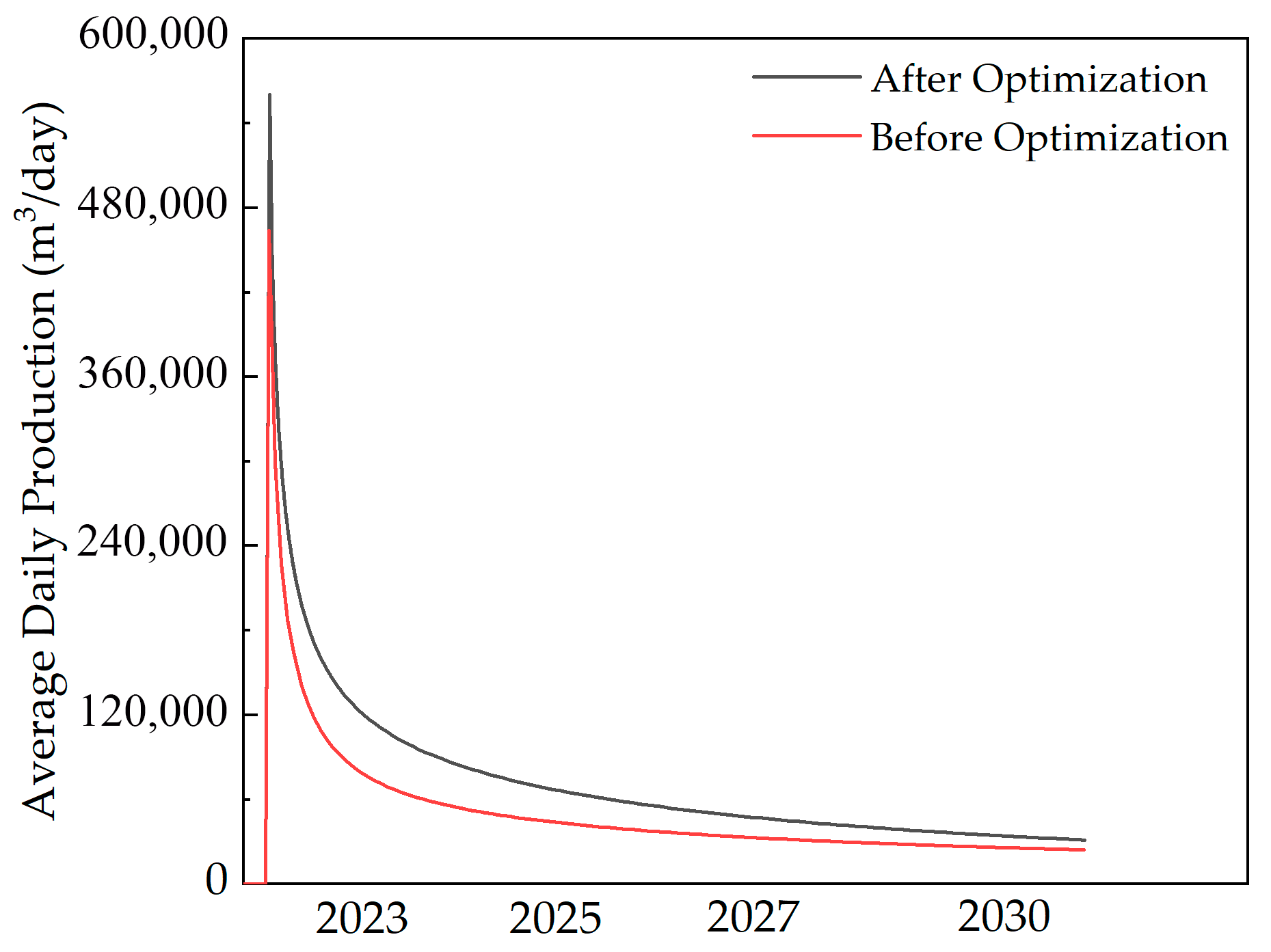
To avoid the problem of “increased production but not increased efficiency” caused by evaluating only by production indicators, this paper transforms the optimization objective from a simple engineering indicator to the maximization of the economic benefit over the entire life cycle, and uses the Net Present Value (NPV) as the unified objective function. NPV can comprehensively reflect the impact of early blowout and stable production strategies, decline characteristics, pressure systems, and flowback systems on cash flow within the same evaluation framework, thereby achieving an integrated optimization among “production capacity—decline—cost”. Based on the EFF-based dynamic production forecasts (illustrated in Figure 9), each candidate operating strategy is translated into a time-phased production profile and boundary conditions, which are then converted into discounted cash flows for NPV maximization. The optimization objectives, decision variables, constraints, and implementation results are summarized in Table 6.
In the formula, p g represents the gas price; r is the discount rate; C OPEX ( t ) represents the operating cost in period t; C CAPEX ( u ) represents the one-time investment item related to the scheme.
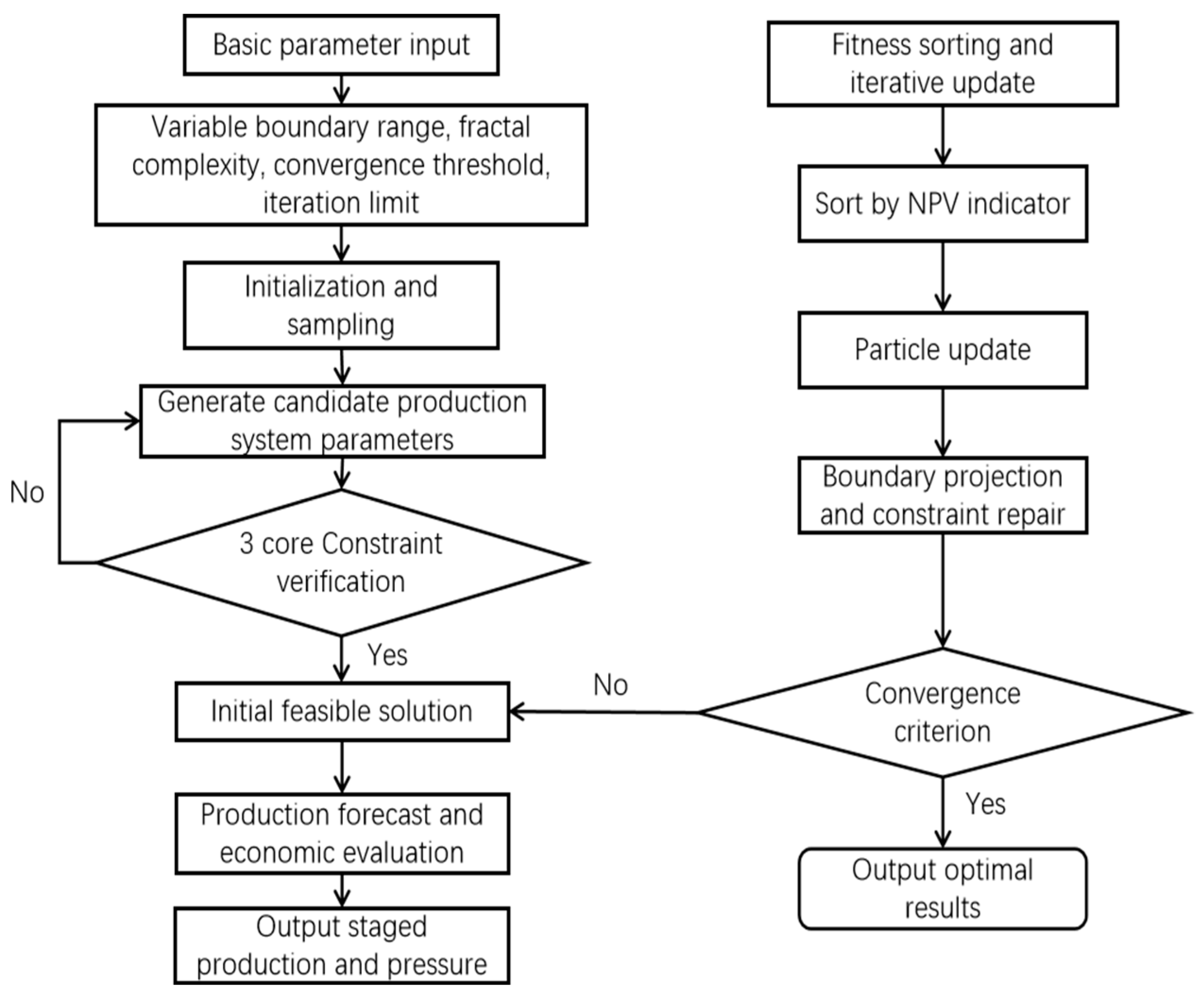
Based on the convergence statistics obtained from multiple random initializations, the recommended values of the decision variables given by the model are concentrated around: bottom-hole flowing pressure of 18–28 MPa, flowback rate of 8–15 m3/h, and production system switching time of 60–120 days. To ensure operational feasibility on-site, this paper converts the above optimal range into a single implementation point (taking the midpoint of the range) as the recommended system: BHP ≈ 23 MPa, flowback rate ≈ 12 m3/h, and system switching time ≈ 90 days. This is used for the subsequent “comparison before and after optimization” simulation and effect evaluation. The overall optimization workflow is shown in Figure 10.
To present the outcomes of the NPV-driven optimization, this study compares the key economic indicators before and after optimization under a consistent discounting convention and evaluation horizon, including Net Present Value (NPV), Internal Rate of Return (IRR), discounted payback period, and the present values of discounted revenue and cost (Revenue PV/Cost PV). For clarity and comparability, all metrics are reported in a normalized form (before = 1.0), providing a unified-scale view of the lifecycle economic impact of the optimization. The detailed comparison of the main economic indicators before and after optimization is presented in Table 7.
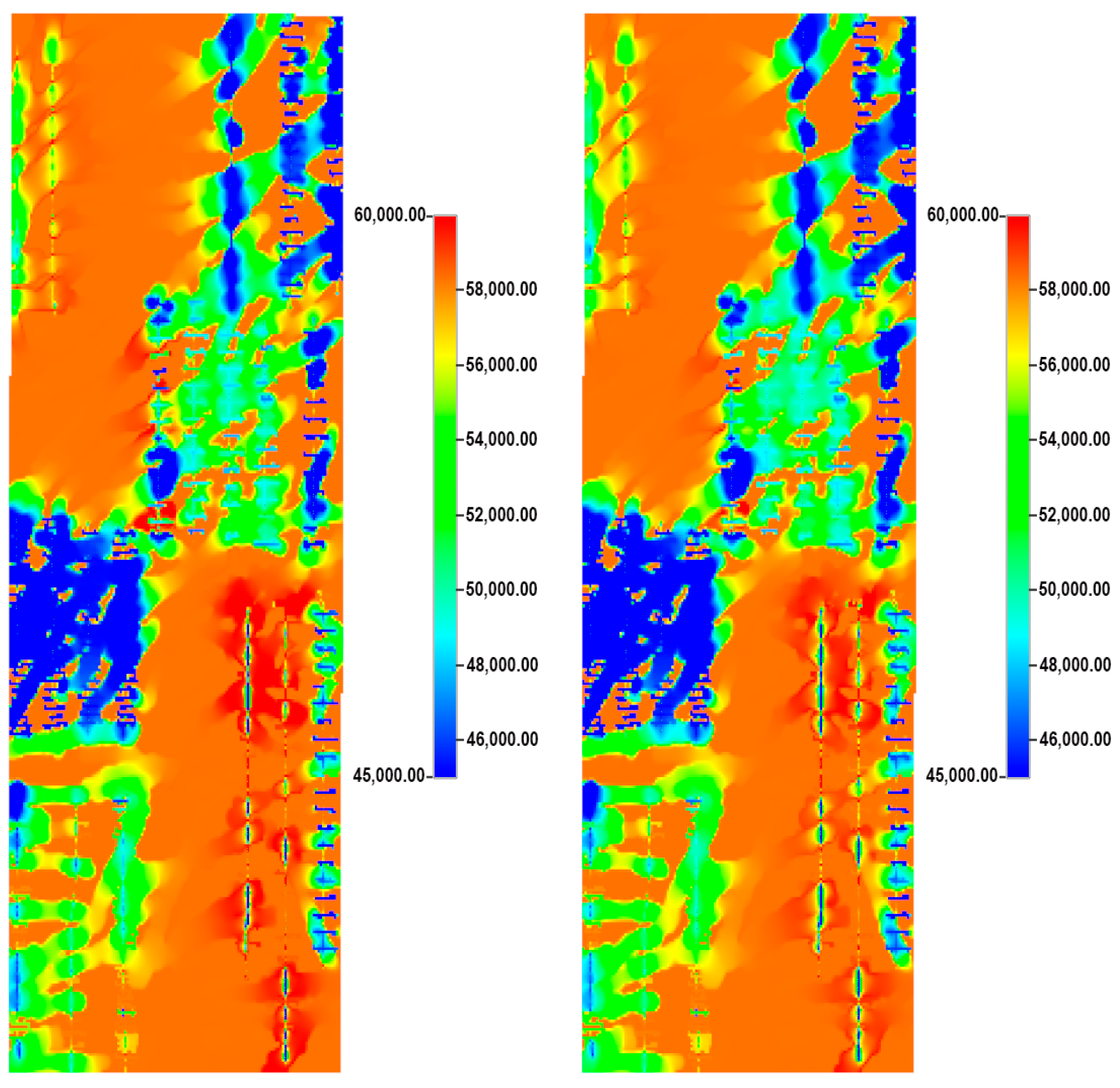
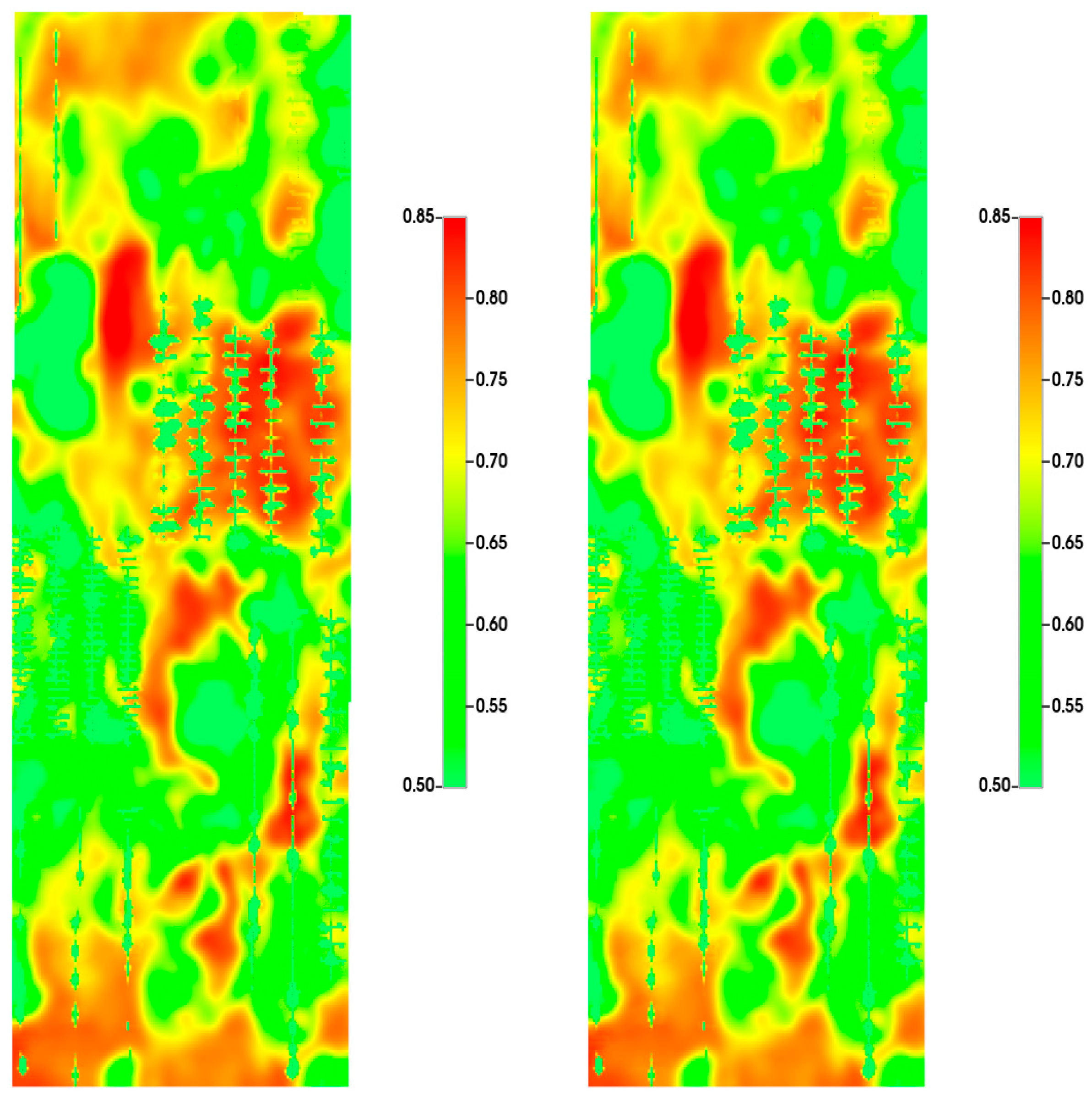
The spatial distributions of reservoir pressure and gas saturation before and after optimization are presented in Figure 11 and Figure 12, respectively. The optimized scheme leads to a more uniform pressure depletion pattern and a more balanced gas saturation distribution, indicating enhanced reservoir drainage efficiency and improved utilization of the stimulated reservoir volume.
Overall, the above results demonstrate that the EFF model achieves a favorable balance between prediction accuracy and computational efficiency. While maintaining a high level of history-matching accuracy comparable to that of the DFN model, the EFF approach significantly reduces computational cost and exhibits superior performance in large-scale simulation, optimization, and iterative decision-making scenarios, making it particularly suitable for engineering applications in shale gas reservoir development.

6. Conclusions

By integrating fractal theory with intelligent optimization techniques, this study proposes an intelligent analysis and collaborative optimization framework for production dynamics of shale gas horizontal wells based on an equivalent fractal fracture model. The proposed approach effectively addresses key challenges in complex fracture network representation, improvement of production prediction accuracy, and multi-objective coordinated optimization. The main conclusions are summarized as follows.
(1) An equivalent fractal fracture model with high computational efficiency and numerical stability is developed. The multiscale equivalent fractal permeability tensor model, together with the dynamic evolution mechanism of fractal dimension, enables efficient and accurate characterization of complex fracture networks. Compared with the conventional discrete fracture network (DFN) model, the equivalent fractal model exhibits an error increase of less than 3% under coarse-grid conditions (25 × 25 × 25), whereas the DFN model shows an error increase of 11%. Although the production prediction error of the equivalent model (6.8%) is slightly higher than that of the DFN model (4.2%), its computational time is only approximately one-eighteenth of that required by the DFN model, demonstrating its suitability for rapid numerical simulation and large-scale development scheme optimization of shale gas reservoirs.
(2) An intelligent production prediction model integrating physical mechanisms and data-driven learning is established. Guided by fractal theory, a key feature parameter system—including dynamic fractal dimension and fractal conductivity ratio—is constructed to support data preprocessing and feature selection. By embedding physical loss functions and fractal seepage governing equations into the machine learning framework, the interpretability and extrapolation capability of the model are significantly enhanced. Application to the W gas field in the Sichuan Basin shows that the prediction errors for one-year and three-year production dynamics are reduced to 6.8% and 9.8%.
(3) Using NPV as the unified objective function and imposing constraints on bottom-hole flow pressure, flowback rate, and system switching time for optimization, the pressure drop becomes more uniform and the gas saturation distribution becomes more balanced after optimization. This indicates that the “EFF + NPV” framework can achieve the collaborative optimization of “production capacity—decline—cost” while ensuring the reliability of the prediction, and improve the development efficiency.
(4) This study provides theoretical and methodological innovations for shale gas reservoir development. The proposed concept of fractal stimulated reservoir volume (F-SRV), the dynamic evolution mechanism of fractal dimension, and the hybrid-driven modeling framework offer new perspectives for multiscale seepage mechanism analysis and promote the deep integration of artificial intelligence with oil and gas development theory.
Future work will focus on coupling mechanisms between fractal parameters and dynamic in situ stress evolution, as well as extending the proposed framework to multi-physics coupling problems in various unconventional oil and gas reservoirs, thereby further enhancing the level of intelligent oil and gas field development.

Author Contributions

Conceptualization, Z.W. and Y.F.; resources, Y.Z.; data curation, Z.W. and Y.F.; writing—original draft preparation, Z.W. and Y.F.; writing—review and editing, G.Y. and W.C.; visualization, G.Y. All authors have read and agreed to the published version of the manuscript.

Funding

This research received no external funding.

Data Availability Statement

The original contributions presented in this study are included in the article. Further inquiries can be directed to the corresponding authors.

Conflicts of Interest

Author Wensheng Chen was employed by the Puguang Branch, Zhongyuan Oilfield Company. The remaining authors declare that the research was conducted in the absence of any commercial or financial relationships that could be construed as a potential conflict of interest. The Puguang Branch, Zhongyuan Oilfield Company had no role in the design of the study; in the collection, analyses, or interpretation of data; in the writing of the manuscript, or in the decision to publish the results.

References

  1. Sheng, G.; Huang, L.; Zhao, H. Integrated Simulation Approach for Fracture Network Propagation and Gas Flow in Shale Gas Reservoirs. J. Southwest Pet. Univ. (Sci. Technol. Ed.) 2021, 43, 84–96. [Google Scholar] [CrossRef]
  2. Han, D.; Zhang, W.; Jiao, K.; Yu, B.; Li, T.; Gong, L.; Wang, S. Analysis of thermal-hydraulic-mechanical-chemical coupling for EGS based on embedded discrete fracture model. Nat. Gas Ind. 2023, 43, 126–138. [Google Scholar] [CrossRef]
  3. Liu, X.; Qian, L.; Li, M.; Pan, Y.; Su, R. Study on the complexity of hydraulic fracture network in shale reservoirs considering the bedding planes encountering the natural fractures. J. Eng. Geol. 2024, 32, 1309–1321. [Google Scholar] [CrossRef]
  4. Gao, L.; Han, Z.; Liang, F.; Li, Y.; Lv, H. A New Productivity Model Considering Tree-Shaped Fracture Characteristics for Fractured Horizontal Wells in Tight Gas Reservoirs. Sci. Technol. Eng. 2024, 24, 11208–11214. [Google Scholar] [CrossRef]
  5. Meng, X.; Wang, Y.; Li, N.; Zhang, H.; Li, Z.; Li, J.; Zhang, J.; Deng, D.; Yang, C. Fracture network analysis using topological fractal methods. Sci. Technol. Eng. 2024, 24, 14984–14991. [Google Scholar] [CrossRef]
  6. Hu, B.; Wang, J.G.; Sun, R.; Zhao, Z. A permeability model for the fractal tree-like fracture network with self-affine surface roughness in shale gas reservoirs. Geomech. Geophys. Geo-Energy Geo-Resour. 2024, 10, 24. [Google Scholar] [CrossRef]
  7. Liu, G.; Li, W.; Ye, D.; Wang, B.; Guo, Z.; Wang, X. A fractal model for rough fractures and irregular pores in multi-field shale gas projects. Phys. Fluids 2025, 37, 107118. [Google Scholar] [CrossRef]
  8. Liu, X.; Zhang, J.; Li, T.; Liang, Z.; Meng, S.; Zheng, L.; Wu, N. Fracture complexity and mineral damage in shale hydraulic fracturing based on microscale fractal analysis. Fractal Fract. 2025, 9, 535. [Google Scholar] [CrossRef]
  9. Zou, C.; Zhao, Q.; Dong, D.; Yang, Z.; Qiu, Z.; Liang, F.; Wang, N.; Huang, Y.; Zhang, Q.; Hu, Z. Geological characteristics, main challenges and future prospect of shale gas. Nat. Gas Geosci. 2017, 28, 1781–1796. [Google Scholar] [CrossRef]
  10. Luo, J. Multi-Stage Fluid Activities and Processes of Hydrocarbon Accumulation in Sinian and Lower Palaeozoic in Southeast Part of Sichuan Basin. Doctoral Dissertation, China University of Geosciences, Wuhan, China. [CrossRef]
  11. Guo, B. Natural Fracture Distribution and 3D Modelling of Longmaxi Formation Shale Reservoir in Luobu Syncline in Zhaotong Demonstration Area. Master’s Thesis, China University of Petroleum, Beijing, China. [CrossRef]
  12. Li, H.; Li, S.; Cai, X.; Ye, J.; Xia, W. Fractal characteristics of fracture structure in shale gas reservoir: Take four shale gas wells in Southeast Chongqing as an example. Explor. Dev. 2021, 4, 140–141. [Google Scholar] [CrossRef]
  13. Li, X. Establishing a rough crack model based on fractal theory and its influence on proppant delivery. Technol. Inf. 2024, 28, 74–77. [Google Scholar] [CrossRef]
  14. Su, X. Flow Analysis of Fractured Vuggy Carbonate Reservoirs Based on the Fractal Theory. Master’s Thesis, China University of Petroleum, Beijing, China, 2020. [Google Scholar] [CrossRef]
  15. Wu, M.; Ding, M. A numerical well testing interpretation model for multiple fractured horizontal well in fractured shale gas reservoir based on fractal discrete fracture network. J. China Univ. Pet. (Nat. Sci. Ed.) 2020, 44, 98–104. [Google Scholar] [CrossRef]
  16. Wang, S.; Wu, T. Fractal model of permeability for rough-fracture porous media. J. Cent. China Norm. Univ. (Nat. Sci.) 2023, 57, 223–231. [Google Scholar] [CrossRef]
  17. Luo, X.; Cheng, Y.; Tan, C. Calculation method of equivalent permeability of dual-porosity media considering fractal characteristics and fracture stress sensitivity. J. Pet. Explor. Prod. Technol. 2023, 13, 1691–1701. [Google Scholar] [CrossRef]
  18. Jafari, A.; Babadagli, T. Estimation of equivalent fracture network permeability using fractal and statistical network properties. J. Pet. Sci. Eng. 2012, 92–93, 110–123. [Google Scholar] [CrossRef]
  19. Gong, L.; Fu, X.; Gao, S.; Zhao, P.; Luo, Q.; Zeng, L.; Yue, W.; Zhang, B.; Liu, B. Characterization and Prediction of Complex Natural Fractures in the Tight Conglomerate Reservoirs: A Fractal Method. Energies 2018, 11, 2311. [Google Scholar] [CrossRef]
  20. Li, C.; Sima, L.; Che, G.; Liang, W.; Shen, A.; Guo, Q.; Xie, B. Vug and fracture characterization and gas production prediction by fractals: Carbonate reservoir of the Longwangmiao Formation in the Moxi–Gaoshiti area, Sichuan Basin. Interpretation 2020, 8, SL159–SL171. [Google Scholar] [CrossRef]
  21. Fu, Y.; Dai, X.; Li, J.; Huo, D. Applicability analysis of equivalent continuum medium model in low-permeability reservoirs. J. Southwest Pet. Univ. (Sci. Technol. Ed.) 2010, 32, 93–104. [Google Scholar] [CrossRef]
  22. Wang, Z.; Rutqvist, J.; Dai, Y. Application of DC model with Oda’s crack tensor in seepage simulation of fractured rock mass. Chin. Q. Mech. 2011, 32, 486–497. [Google Scholar] [CrossRef]
  23. Wei, Y.; Wang, J.; Yu, W.; Qi, Y.; Miao, J.; Yuan, H.; Liu, C. A smart productivity evaluation method for shale gas wells based on 3D fractal fracture network model. Pet. Explor. Dev. 2021, 48, 787–796. [Google Scholar] [CrossRef]
  24. Liu, R.; Jiang, Y.; Li, B.; Wang, X. A fractal model for characterizing fluid flow in fractured rock masses based on randomly distributed rock fracture networks. Comput. Geotech. 2015, 65, 45–55. [Google Scholar] [CrossRef]
  25. Jia, A.; Wei, Y.; Liu, C.; Wang, J.; Qi, Y.; Jia, C.; Li, B. A dynamic prediction model of pressure-control production performance of shale gas fractured horizontal wells and its application. Nat. Gas Ind. B 2020, 7, 71–81. [Google Scholar] [CrossRef]
  26. Zhang, R.-H.; Chen, M.; Tang, H.-Y.; Xiao, H.-S.; Zhang, D.-L. Production performance simulation of a horizontal well in a shale gas reservoir considering the propagation of hydraulic fractures. Geoenergy Sci. Eng. 2023, 221, 111272. [Google Scholar] [CrossRef]
  27. Yu, R.; Guo, W.; Ding, L.; Wang, M.; Cheng, F.; Zhang, X.; Zhou, S.; Zhang, L. Quantitative characterization of horizontal well production performance with multiple indicators: A case study on the Weiyuan shale gas field in the Sichuan Basin, China. Front. Earth Sci. 2021, 15, 395–405. [Google Scholar] [CrossRef]
  28. Liu, W.; Liu, C.; Duan, Y.; Yan, X.; Sun, Y.; Sun, H. Fracture spacing optimization method for multi-stage fractured horizontal wells in shale oil reservoir based on dynamic production data analysis. Energies 2023, 16, 7922. [Google Scholar] [CrossRef]
  29. Cui, Y.; Jiang, R.; Wang, Q.; Liu, X. Production performance analysis of multi-fractured horizontal well in shale gas reservoir considering space variable and stress-sensitive fractures. J. Pet. Sci. Eng. 2021, 207, 109171. [Google Scholar] [CrossRef]
Figure 1. Schematic Diagram of the Fractal Model.
Processes 14 01294 g001
Figure 2. Flowchart.
Processes 14 01294 g002
Figure 3. Schematic diagram of the model (a) DFN model; (b) EFF model.
Processes 14 01294 g003
Figure 4. Permeability distribution of a single fracture.
Processes 14 01294 g004
Figure 5. Hybrid spatial distribution of artificial and natural fractures in the well-area model.
Processes 14 01294 g005
Figure 6. Convergence Curve of the Model Training Loss Function.
Processes 14 01294 g006
Figure 7. Comparison of History Matching Results.
Processes 14 01294 g007
Figure 8. History Matching Results of Gas and Water Production.
Processes 14 01294 g008
Figure 9. Comparison of Production Before and After Optimization.
Processes 14 01294 g009
Figure 10. Optimized flowchart.
Processes 14 01294 g010
Figure 11. Comparison of Pressure Distribution Before and After Optimization.
Processes 14 01294 g011
Figure 12. Comparison of Saturation Distribution Before and After Optimization.
Processes 14 01294 g012
Table 1. Influence of Feature Parameters.
Feature ParameterImportance ScoreRank
Dynamic Fractal Dimension D f 0.381
Fracture Permeability R cf 0.212
Adsorption Index H ads 0.153
Brittleness Index0.134
Average Formation Pressure0.134
Reservoir Thickness h0.126
Total Organic Carbon (TOC)0.117
Table 2. Comparison of Production Prediction Accuracy among Different Models.
Prediction MetricEquivalent Fractal Model (EFF)Discrete Fracture Network Model (DFN)
Average relative error of daily gas production6.8%4.2%
Relative error of cumulative gas production (3 years)9.8%7.3%
Relative error of fractal stimulated reservoir volume (F-SRV)7.1%5.8%
Table 3. Grid Sensitivity Analysis.
Grid ResolutionError Increase of the Equivalent Fractal Model (EFF)Error Increase of the Discrete Fracture Network Model (DFN)
Fine grid (100 × 100 × 100)0% (baseline)0% (baseline)
Medium grid (50 × 50 × 50)1.2%7.3%
Coarse grid (25 × 25 × 25)2.8%11.0%
Table 4. Key controlling parameters of the study area.
ParameterValue Range
Burial depth2500~3500 m
Effective reservoir thickness35~50 m
Total organic carbon (TOC)2.8%~4.5%
Brittleness index45%~62%
Natural fracture fractal dimension Df1.52~1.68
Table 5. Horizontal Well Parameters.
ParameterValue
Horizontal Section Length1800 m
Number of Fracturing Stages25
Cluster Spacing20~30 m
Proppant Volume1500 t
Table 6. Optimize parameter selection.
CategoryItemValue
Constraint conditions max u NPV ( u ) = t = 1 T p g q g ( t ) C OPEX ( t ) ( 1 + r ) t C CAPEX ( u )
Number of Fracturing StagesBottom-hole flowing pressure (BHP)15–35 MPa
Flowback rate5–20 m3/h
Production regime switching time30–180 days
Implementation Results max u Ω NPV ( u )
Table 7. Comparison of Key Economic Indicators Before and After Optimization.
IndicatorsBefore (Benchmark)AfterChange Amount
NPV1.001.14+14%
IRR1.001.154+15.4%
Payback period1.000.73−27%
Revenue PV/DCF revenue1.000.978−2.2%
Cost PV/DCF cost1.000.971−2.9%
Disclaimer/Publisher’s Note: The statements, opinions and data contained in all publications are solely those of the individual author(s) and contributor(s) and not of MDPI and/or the editor(s). MDPI and/or the editor(s) disclaim responsibility for any injury to people or property resulting from any ideas, methods, instructions or products referred to in the content.