The Dual-Core Driving Mechanism of Intelligent Oilfield Development: From Data Perception to Decision-Optimized Ecosystems

Abstract
1. Introduction
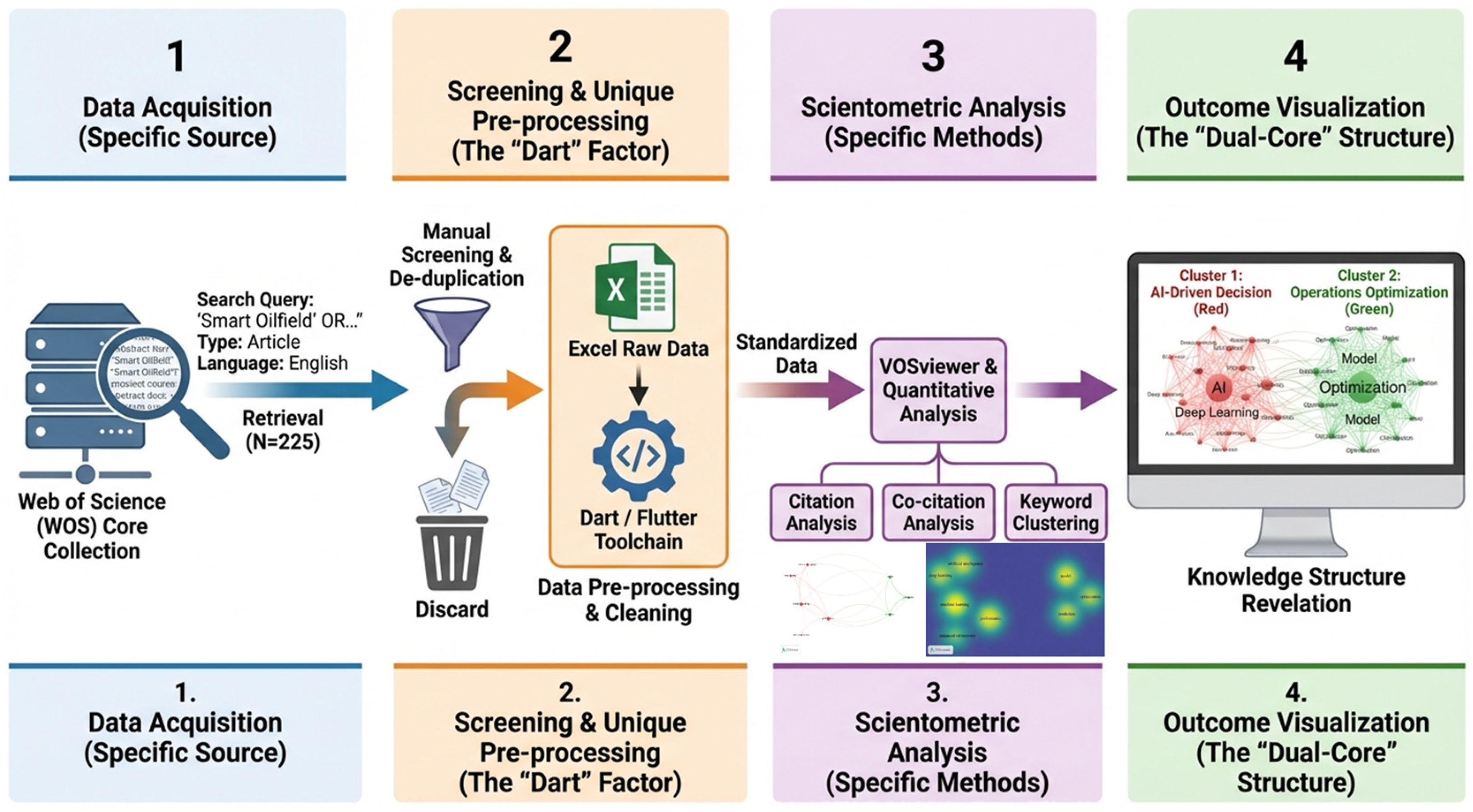
2. Materials and Methods
3. Results and Discussion
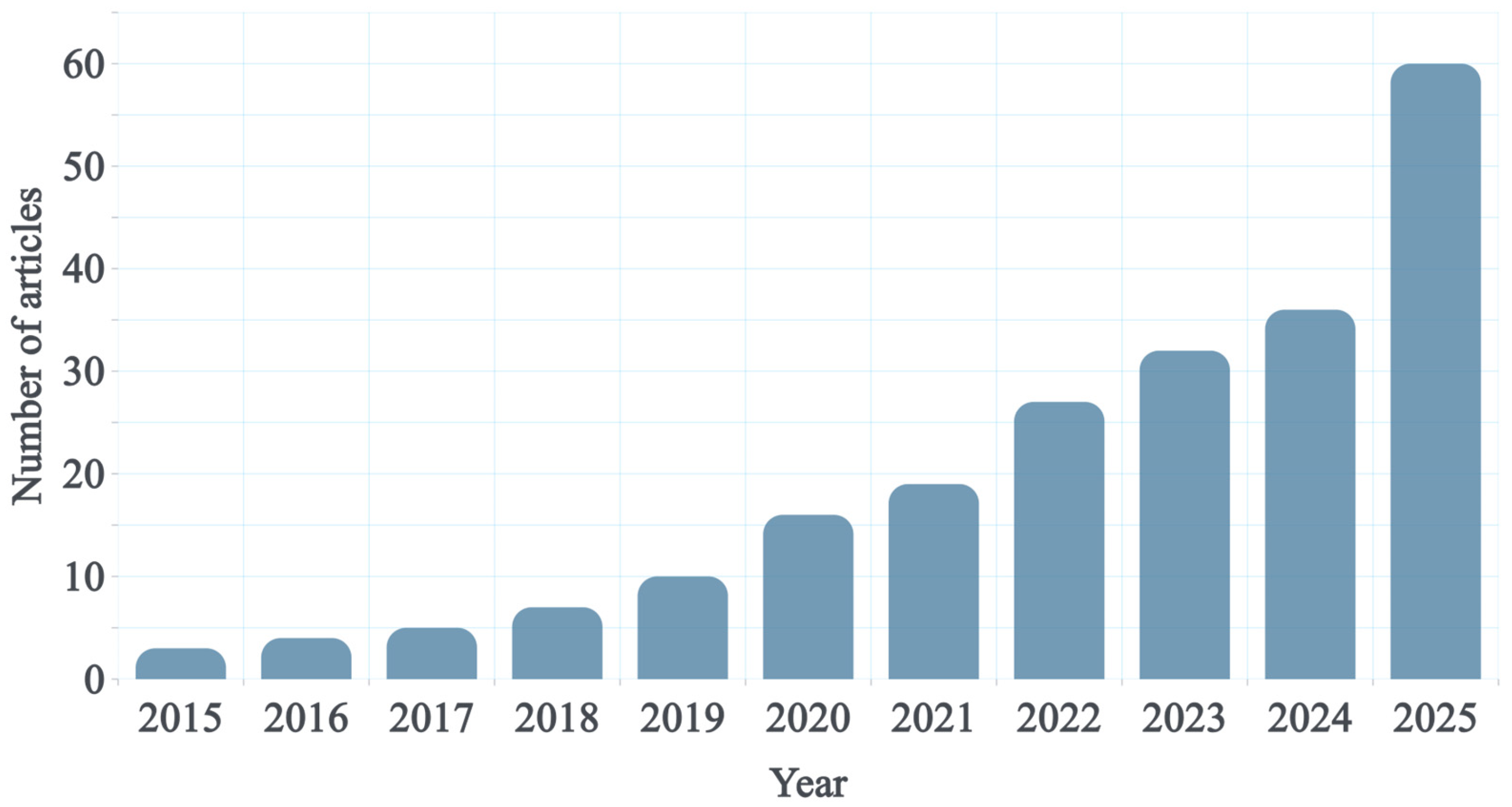
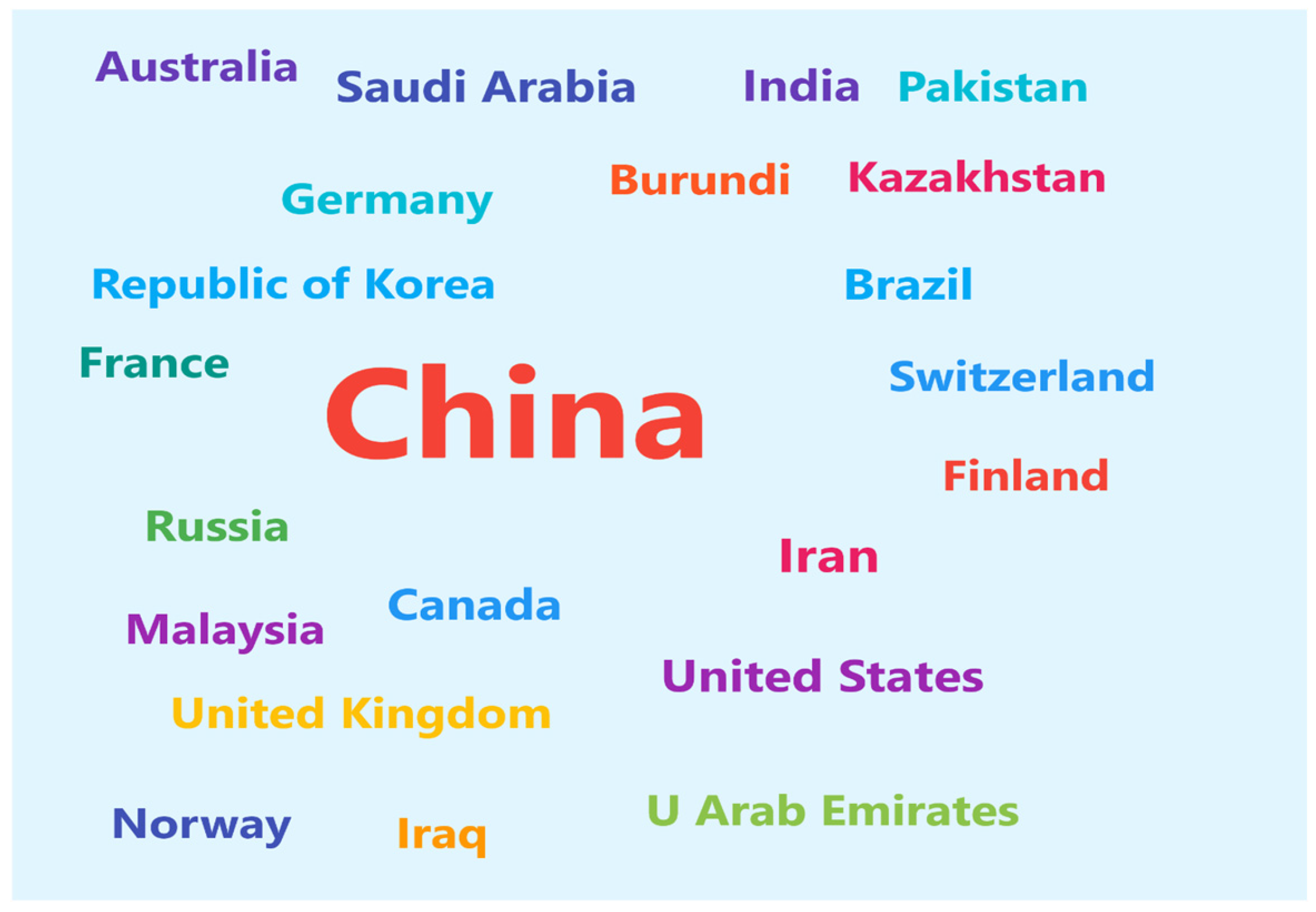
3.1. Research Citation Analysis
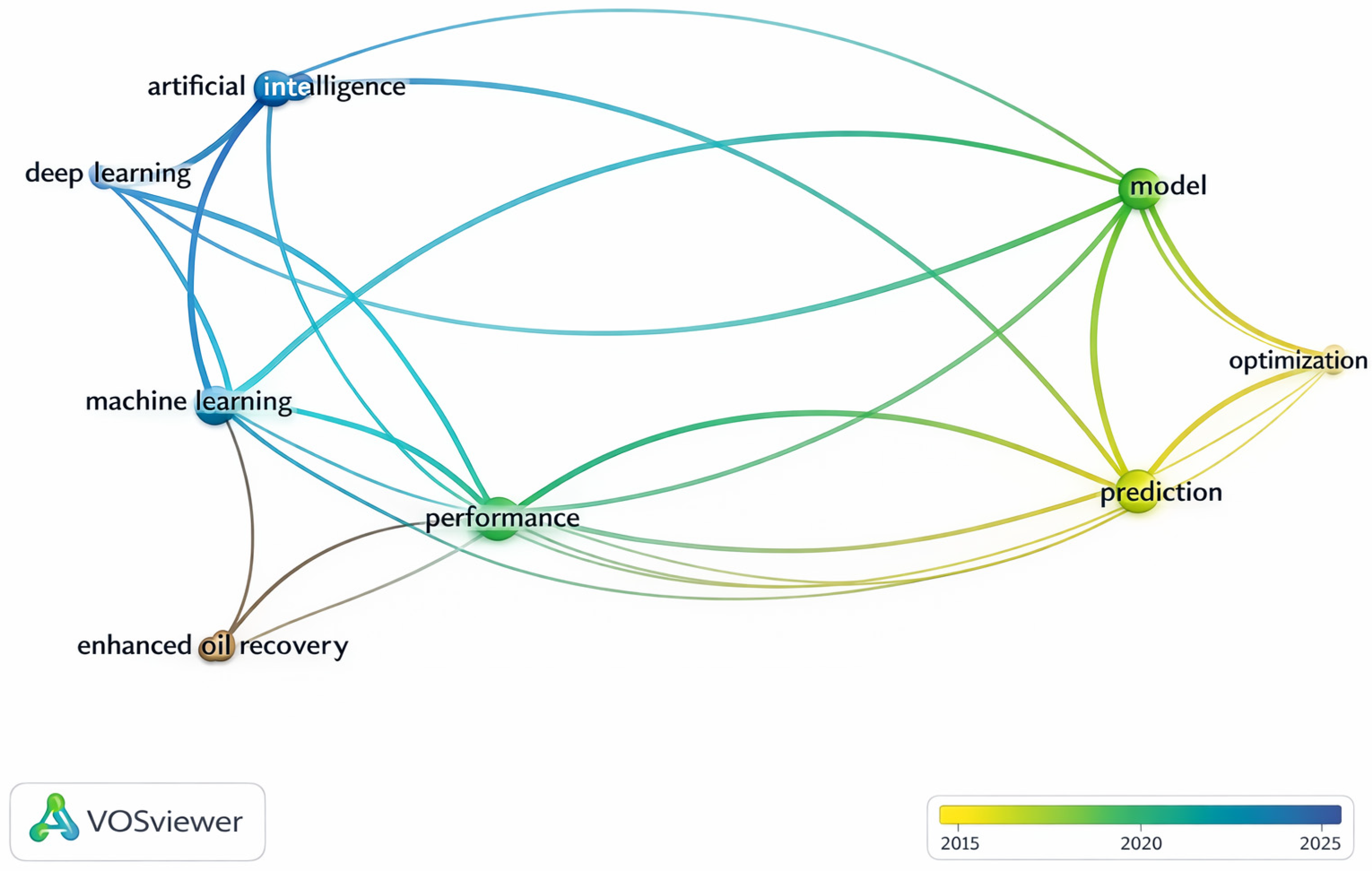
3.2. Core Hotspot Analysis
3.2.1. Hotspots in Artificial Intelligence Technology Applications
3.2.2. Hotspots in Operations Research and Optimization Applications
3.2.3. Could Deep Reinforcement Learning Be the Next Frontier?
4. Conclusions and Outlook
4.1. Security Risk Management and Resilience Building in the Context of Intelligentization Cannot Be Ignored
4.2. Research Summary
4.3. Research Outlook
Supplementary Materials
Author Contributions
Funding
Data Availability Statement
Conflicts of Interest
References
- Yao, J.; Huang, C.; Liu, W.; Zhang, Y.; Zeng, Q.; Yan, X. Key mechanical problems in the development of deep oil and gas reservoirs. Sci. Sin. Phys. Mech. Astron. 2018, 48, 044701. [Google Scholar]
- Li, Z.; Alharthi, S. Oil revenue and production cost disconnect and its impact on the environment: Economic globalization in Asia-Pacific economic cooperation countries. Geosci. Front. 2024, 15, 101772. [Google Scholar] [CrossRef]
- Fernandez-Vidal, J.; Gonzalez, R.; Gasco, J.; Llopis, J. Digitalization and corporate transformation: The case of European oil & gas firms. Technol. Forecast. Soc. Change 2022, 174, 121293. [Google Scholar] [CrossRef]
- Sui, X.; Lu, X.; Ji, Y.; Yang, Y.; Peng, J.; Li, M.; Han, G. Intelligent Oil Production Management System Based on Artificial Intelligence Technology. Processes 2025, 13, 133. [Google Scholar] [CrossRef]
- Temizel, C.; Canbaz, C.H.; Palabiyik, Y.; Putra, D.; Asena, A.; Ranjith, R.; Jongkittinarukorn, K. A Comprehensive Review of Smart/Intelligent Oilfield Technologies and Applications in the Oil and Gas Industry. In Proceedings of the SPE Middle East Oil and Gas Show and Conference; SPE: Richardson, TX, USA, 2019. [Google Scholar] [CrossRef]
- Baranidharan, S.; Dhanalakshmi, K.; Shabarisha, N.; Manoharan, S. Digital Innovations and Implementation Challenges in Oil and Gas Industry: Harnessing Technology. In Revolutionizing AI and Robotics in the Oil and Gas Industry; IGI Global Scientific Publishing: Hershey, PA, USA, 2025; pp. 65–86. [Google Scholar] [CrossRef]
- Aydin, H.; Temizel, C. Latest Applications of UAVs, Drones and Robotics in the Oil and Gas Industry. In Proceedings of the Offshore Technology Conference, Houston, TX, USA, 2–5 May 2022. [Google Scholar] [CrossRef]
- Asadzadeh, S.; de Oliveira, W.J.; Filho, C.R.d.S. UAV-based remote sensing for the petroleum industry and environmental monitoring: State-of-the-art and perspectives. J. Pet. Sci. Eng. 2022, 208, 109633. [Google Scholar] [CrossRef]
- Abdulaziz, A.M.; Mahdi, H.A.; Sayyouh, M.H. Prediction of reservoir quality using well logs and seismic attributes analysis with an artificial neural network: A case study from Farrud Reservoir, Al-Ghani Field, Libya. J. Appl. Geophys. 2019, 161, 239–254. [Google Scholar] [CrossRef]
- Ren, S.; Shen, F.; Zhang, X.; Fu, Z.; Zhu, L.; Wang, R. Application and development of digital twinning in oil and gas exploitation and production: A focus on China and global perspectives. Digit. Twin 2025, 2025, 2533862. [Google Scholar] [CrossRef]
- Aalsalem, M.Y.; Khan, W.Z.; Gharibi, W.; Armi, N. An intelligent oil and gas well monitoring system based on Internet of Things. In 2017 International Conference on Radar, Antenna, Microwave, Electronics, and Telecommunications (ICRAMET); IEEE: New York, NY, USA, 2017; pp. 124–127. [Google Scholar] [CrossRef]
- Olkhovikov, A.; Madhwal, Y.; Andrian, A.; Imran, H.; Rakhmatullin, O.; Vladykina, V.; Koroteev, D.; Yanovich, Y. Decentralized Oil Extraction Infrastructure via Blockchain-Enabled IoT Networks. Blockchain Res. Appl. 2025, 2025, 100425. [Google Scholar] [CrossRef]
- Lai, W.; Zhang, H.; Jiang, D.; Wang, Y.; Wang, R.; Zhu, J.; Chen, Q.; Gao, Y.; Li, W.; Xie, D. Digital Twin and Big Data Technologies Benefit Oilfield Management. In Proceedings of the Abu Dhabi International Petroleum Exhibition and Conference; SPE: Richardson, TX, USA, 2022. [Google Scholar] [CrossRef]
- LeBlanc, M.B. Digital Twin Technology for Enhanced Upstream Capability in Oil and Gas. Ph.D. Thesis, Massachusetts Institute of Technology, Cambridge, MA, USA, 2020. Available online: https://dspace.mit.edu/handle/1721.1/132840 (accessed on 24 March 2026).
- Shukla, A.; Karki, H. Application of robotics in offshore oil and gas industry—A review Part II. Robot. Auton. Syst. 2016, 75, 508–524. [Google Scholar] [CrossRef]
- DataHorizzon Research. Inspection Robotics in Oil and Gas Market Size, Growth, Report Trends & Forecast 2033; DataHorizzon Research: Fort Collins, CO, USA, 2025; Available online: https://datahorizzonresearch.com/inspection-robotics-in-oil-and-gas-market-63664 (accessed on 24 March 2026).
- Lu, Q. The Construction Progress and Technology Application of Intelligent Oilfield Production in the Eastern South China Sea. Int. Core J. Eng. 2023, 9, 354–360. [Google Scholar] [CrossRef]
- Wang, X.; Song, W. Artificial intelligence in petroleum companies: A patent landscape review. Procedia Comput. Sci. 2025, 266, 1322–1329. [Google Scholar] [CrossRef]
- Soromotin, A.V.; Martyushev, D.A.; Junho Pereira, J.L. On the application of machine learning algorithms in predicting the permeability of oil reservoirs. Artif. Intell. Geosci. 2025, 6, 100126. [Google Scholar] [CrossRef]
- Sircar, A.; Yadav, K.; Rayavarapu, K.; Bist, N.; Oza, H. Application of machine learning and artificial intelligence in oil and gas industry. Pet. Res. 2021, 6, 379–391. [Google Scholar] [CrossRef]
- Bai, W.-P.; Cheng, S.-Q.; Guo, X.-Y.; Wang, Y.; Guo, Q.; Tan, C.-D. Oilfield analogy and productivity prediction based on machine learning: Field cases in PL oilfield, China. Pet. Sci. 2024, 21, 2554–2570. [Google Scholar] [CrossRef]
- Marins, M.A.; Barros, B.D.; Santos, I.H.; Barrionuevo, D.C.; Vargas, R.E.; Prego, T.d.M.; de Lima, A.A.; de Campos, M.L.; da Silva, E.A.; Netto, S.L. Fault detection and classification in oil wells and production/service lines using random forest. J. Pet. Sci. Eng. 2021, 197, 107879. [Google Scholar] [CrossRef]
- Pratikto, F.; Indratno, S.; Suryadi, K.; Santoso, D. Using Machine Learning to Estimate Reservoir Parameters in Real Options Valuation of an Unexplored Oilfield. In Proceedings of the SPE Asia Pacific Oil and Gas Conference and Exhibition; SPE: Richardson, TX, USA, 2020. [Google Scholar] [CrossRef]
- Shutov, G.; Duplyakov, V.; Davoodi, S.; Morozov, A.; Popkov, D.; Pavlenko, K.; Vainshtein, A.; Kotezhekov, V.; Kaygorodov, S.; Belozerov, B.; et al. A deep learning-aided approach for estimating field permeability map by fusing well logs, well tests, and seismic data. Petroleum 2025, 11, 813–824. [Google Scholar] [CrossRef]
- Chen, Z.; Zhang, Y.; Li, J.; Hui, G.; Sun, Y.; Li, Y.; Chen, Y.; Zhang, D. Artificial intelligence large model for logging curve reconstruction. Pet. Explor. Dev. 2025, 52, 842–854. [Google Scholar] [CrossRef]
- Chen, G.; Tian, H.; Xiao, T.; Xu, T.; Lei, H. Time series forecasting of oil production in Enhanced Oil Recovery system based on a novel CNN-GRU neural network. Geoenergy Sci. Eng. 2024, 233, 212528. [Google Scholar] [CrossRef]
- Wu, L.; Dong, Z.; Li, W.; Jing, C.; Qu, B. Well-Logging Prediction Based on Hybrid Neural Network Model. Energies 2021, 14, 8583. [Google Scholar] [CrossRef]
- Su, S.; Zhang, N.; Wang, P.; Jia, S.; Zhang, A.; Wang, H.; Zhang, M. Investigation and Optimization of EOR Screening by Implementing Machine Learning Algorithms. Appl. Sci. 2023, 13, 12267. [Google Scholar] [CrossRef]
- Arvis, A.; Min, B. Updated screening criteria for enhanced oil recovery methods and their application to the T oilfield in eastern Mongolia. Sci. Rep. 2025, 15, 34670. [Google Scholar] [CrossRef] [PubMed]
- Sha, Y.; Liu, Q.; Yue, L.; Gao, W.; Zhang, K.; Peng, J. Dynamic Ensemble Learning: A Multidimensional Abilities Modeling Perspective. Tsinghua Sci. Technol. 2026, 31, 564–576. [Google Scholar] [CrossRef]
- Berghout, T.; Benbouzid, M. Confidence Intervals for Uncertainty Quantification in Sensor Data-Driven Prognosis. Eng. Proc. 2024, 82, 26. [Google Scholar] [CrossRef]
- Singh, J.; Rani, S.; Srilakshmi, G. Towards Explainable AI: Interpretable Models for Complex Decision-making. In 2024 International Conference on Knowledge Engineering and Communication Systems (ICKECS); IEEE: New York, NY, USA, 2024; Available online: https://ieeexplore.ieee.org/document/10616500 (accessed on 24 March 2026).
- Yang, X.; Bello, O.; Yang, L.; Bale, D.; Failla, R. Intelligent Oilfield—Cloud Based Big Data Service in Upstream Oil and Gas. In Proceedings of the International Petroleum Technology Conference; IPTC: London, UK, 2019. [Google Scholar] [CrossRef]
- Arya, A.K. A critical review on optimization parameters and techniques for gas pipeline operation profitability. J. Pet. Explor. Prod. Technol. 2022, 12, 3033–3057. [Google Scholar] [CrossRef]
- Zahedi-Seresht, M.; Sadeghi Bigham, B.; Khosravi, S.; Nikpour, H. Oil Production Optimization Using Q-Learning Approach. Processes 2024, 12, 110. [Google Scholar] [CrossRef]
- Falola, Y.; Nair, G.G.; Toms, J.; Osypov, K. Optimizing Oil Field Development with Multi-Action Decision-Making in Deep Reinforcement Learning. In Proceedings of the SPE Annual Technical Conference and Exhibition; IEEE: New York, NY, USA, 2025. [Google Scholar] [CrossRef]
- He, J.; Tang, M.; Hu, C.; Tanaka, S.; Wang, K.; Wen, X.-H.; Nasir, Y. Deep Reinforcement Learning for Generalizable Field Development Optimization. SPE J. 2022, 27, 226–245. [Google Scholar] [CrossRef]
- Shen, G.; Lei, L.; Li, Z.; Cai, S.; Zhang, L.; Cao, P.; Liu, X. Deep Reinforcement Learning for Flocking Motion of Multi-UAV Systems: Learn from a Digital Twin. IEEE Internet Things J. 2021, 9, 11141–11153. [Google Scholar] [CrossRef]
- Matta, S.S.; Bolli, M. Explainable Reinforcement Learning for High-Stakes Decision Systems Developing Interpretable Rl Models for Autonomous Vehicles, Healthcare, or Finance. J. Sustain. Dev. Policy 2022, 1, 31–70. [Google Scholar] [CrossRef]
- Arık, O.; Ahmet, O.; Toğa, G.; Gülhan, T.; Atalay, B. Reinforcement Learning Based Acceptance Criteria for Metaheuristic Algorithms. Int. J. Comput. Intell. Syst. 2025, 18, 207. [Google Scholar] [CrossRef]
- Lai, L.; Dong, Y.; Andriotis, C.P.; Wang, A.; Lei, X. Synergetic-informed deep reinforcement learning for sustainable management of transportation networks with large action spaces. Autom. Constr. 2024, 160, 105302. [Google Scholar] [CrossRef]
- Sharma, S.K.; Rani, A.; Bakhariya, H.; Kumar, R.; Tomar, D.; Ghosh, S. The Role of IoT in Optimizing Operations in the Oil and Gas Sector: A Review. Trans. Indian Natl. Acad. Eng. 2024, 9, 293–312. [Google Scholar] [CrossRef]
- Nuan, Y.; Ru, Z. Achieving Explainable, Scalable, and Robust Machine Learning for Real-World Applications. Preprint 2025. [Google Scholar] [CrossRef]
- Ogbidi, L.; Oteh, B. Reservoir Uncertainty Quantification Methods Supporting Reliable Forecasting Across Varying Geological and Operational Scenarios. Int. J. Adv. Multidiscip. Res. Stud. 2025, 3, 2345–2362. [Google Scholar] [CrossRef]
- Bahukhandi, N. Explainability as a Catalyst for Agentic AI Adoption in Subsurface Oil & Gas Workflows. Authorea, 2025; preprint. Available online: https://www.authorea.com/users/969579/articles/1337642-explainability-as-a-catalyst-for-agentic-ai-adoption-in-subsurface-oil-gas-workflows?commit=0c5abbb44f0af5a34269112f05c4d03eeca18a7a (accessed on 24 March 2026).





| Interdisciplinary/Technological Integration | Primary Applications | Technical Characteristics and Integration Directions | Performance Indicators or Advantages |
|---|---|---|---|
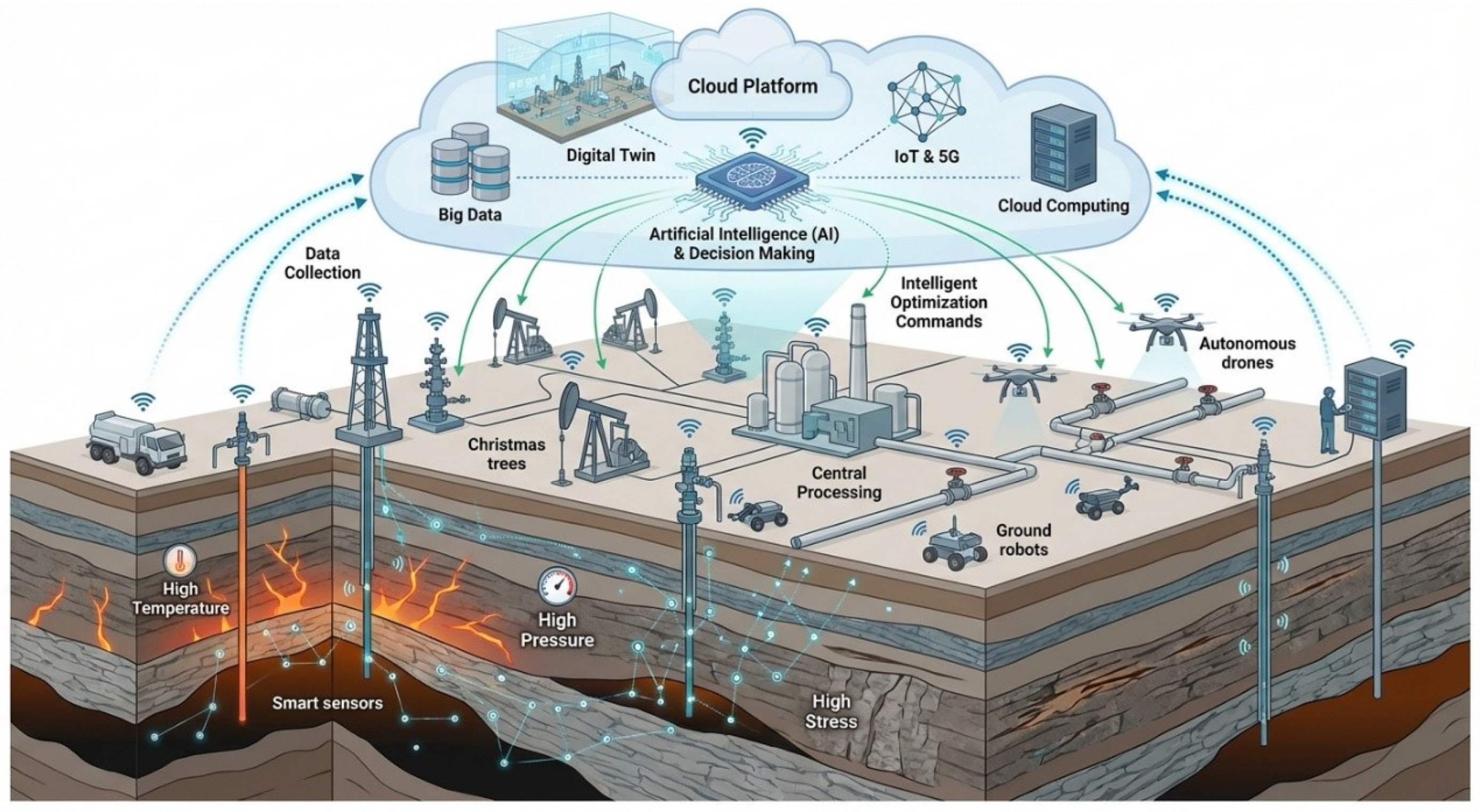
| Unmanned Aerial Vehicle (UAV) | Oilfield inspection, pipeline and wellsite monitoring, leak detection, emergency response [7] | Integrated with computer vision, remote sensing, and GIS to achieve low-cost, high-frequency, automated sensing | Unmanned aerial vehicle (UAV) remote sensing typically provides spatial resolution from centimeters to sub-meters, significantly higher than traditional satellite remote sensing (usually meters to tens of meters) and some aerial remote sensing (generally decimeters). Therefore, in applications such as oil and gas infrastructure inspection, pipeline monitoring, and environmental monitoring, UAV platforms can achieve higher precision spatial information acquisition and more flexible and rapid data collection [8]. |
| Artificial Intelligence and Big Data | Intelligent interpretation of seismic data, well logging, production, and equipment data; production forecasting, reservoir characterization, intelligent regulation [9] | Driven by machine learning and deep learning to support decision analysis and forecasting | Fault detection accuracy exceeds 90%, while manual interpretation typically achieves around 70–80%. AI can complete this process in hours or even days. Shell uses AI to reduce fault interpretation time by approximately 30%, BP uses AI to reduce seismic acquisition costs by approximately 20%, and ExxonMobil’s AI model achieves reservoir prediction accuracy of approximately 85% [4]. |
| Internet of Things and Intelligent Sensing | Real-time monitoring of wellbore-surface-pipeline networks [10], a decentralized approach enabling secure transmission of oilfield sensor data [11] | Integration of sensor networks, edge computing, decentralization, and wireless communication to achieve end-to-end perception | Research has shown that the Internet of Things (IoT) and intelligent sensing technologies can enable real-time monitoring and data management of oil and gas production equipment. For example, one study constructed an IoT-based prototype oilfield monitoring system, using Raspberry Pi and multiple sensors to collect equipment operating parameters and combining this with blockchain for secure data storage. Experiments validated the system based on over 15 million drilling data records, demonstrating that it maintains good scalability even with increasing data volume and can significantly reduce communication and computing resource consumption through batch data processing, thus supporting large-scale real-time monitoring and operation management of oilfields [12]. |
| Digital Twin Technology and Intelligent Decision-Making | Optimizing oilfield operations and managing risks [13] | Coupling physical models with data-driven models to support intelligent decision-making, simulation-based forecasting | An open-source paper from MIT demonstrates that digital twin technology, by constructing virtual models of oil and gas production systems and combining them with real-time data and predictive analytics, enables real-time monitoring, prediction, and optimization of oilfield operations. The research proposes a series of metrics for evaluating the performance of digital twin systems, including mean time between failures (MTBF), system Fidelity, latency, and lifecycle cost and net present value (NPV). Simulation results show that applying digital twin technology to offshore deepwater production facilities can improve facility availability by predicting equipment failures in advance and reducing downtime, resulting in a net present value increase of approximately $211 million over a 27-year lifecycle, thereby significantly enhancing oilfield operation optimization and risk management capabilities [14]. |
| Robotics and automated equipment | Operating in high-risk, high-temperature, and high-pressure environments, extending to deep-sea oilfield extraction [15] | Replacing manual labor to achieve safe, efficient, and automated operations | Inspection robots in the oil and gas industry demonstrate significant advantages in safety and operational efficiency. Studies show that deploying robotic inspection systems can reduce the number of safety incidents in oil and gas facilities by approximately 60%, primarily because robots can replace human labor in hazardous environments such as high temperatures, high pressures, and confined spaces. Furthermore, the oil and gas industry suffers approximately $49 billion annually in losses due to unplanned downtime caused by equipment failures, and robots can significantly reduce downtime risk through continuous monitoring and predictive maintenance. Currently, a single robotic inspection system costs approximately $500,000 to $2 million, and its design must withstand extreme conditions, such as temperatures ranging from −40 °C to 93 °C and high pressure environments reaching up to approximately 15,000 PSI, to meet the inspection needs of complex oilfield facilities [16]. |
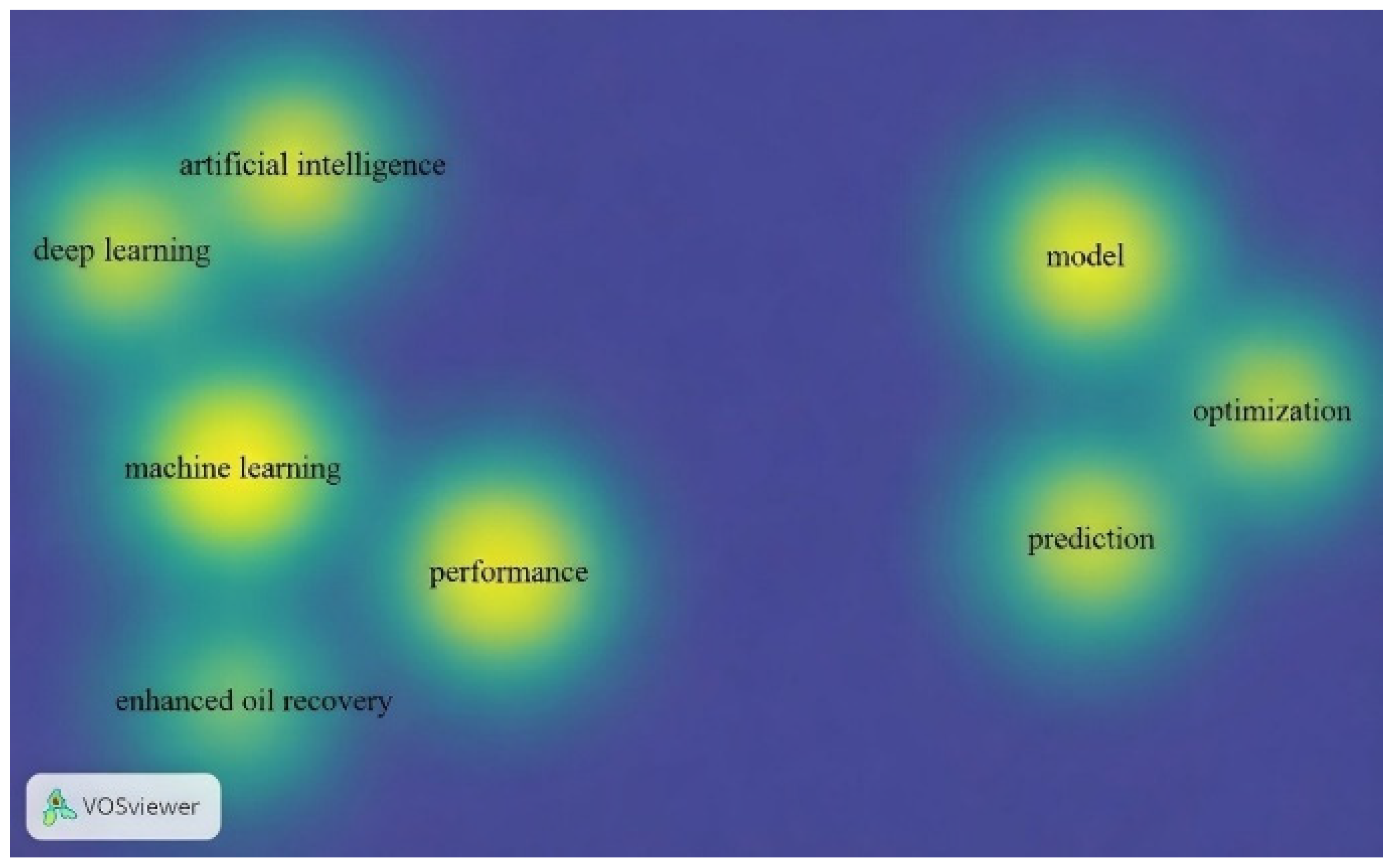
| Cluster ID Keywords Average Publication Year (Approx.) | Cluster ID Keywords Average Publication Year (Approx.) | Cluster ID Keywords Average Publication Year (Approx.) |
|---|---|---|
| C1 | artificial intelligence | 2023 |
| C1 | deep learning | 2024 |
| C1 | machine learning | 2022 |
| C1 | performance | 2021 |
| C1 | enhanced oil recovery | 2017 |
| C2 | model | 2020 |
| C2 | prediction | 2019 |
| C2 | optimization | 2018 |
| Process | Technology | Specific Applications |
|---|---|---|
| Exploration | Machine learning + deep learning | Japanese oil company INPEX has partnered with a technology company to utilize machine learning models for fault identification and reservoir structure interpretation in oil and gas exploration projects in Southeast Asia. Researchers manually labeled only a small number of faults (approximately 4% of the total seismic data volume), then used machine learning models to automatically infer fault structures in the remaining 3D seismic data. This reduced structure interpretation time by about 80% and enabled rapid identification of potential oil and gas traps. |
| Drilling | Deep learning combined with time series models, anomaly detection algorithms, etc. | The model automatically recommends optimal drilling trajectories and well locations, while also predicting equipment failures. In actual operation, ADNOC achieved a 23% increase in recovery rate, reduced annual drilling costs by approximately $480 million, and increased equipment utilization by 34%. |
| Well completion | Machine learning model + real-time data control system | The model analyzes fracturing pressure, injection rate, and other parameters in real time, resulting in a 78% reduction in fracturing operation time and premature termination of fracturing operations in Halliburton and its partners’ practices. |
| Gathering and Transportation | Researchers are using pipeline operation data (such as pressure, temperature, and flow rate) to build machine learning models for real-time anomaly monitoring of gathering and transportation pipelines. | Researchers have developed an intelligent leak detection system. This system can identify abnormal pipeline conditions and determine whether a leak has occurred through real-time data. The model achieves a leak detection accuracy of approximately 97.4%, is highly automated, and reduces the need for manual inspections. |
| Safety Risk Dimensions | Representative Technology | Primary Application Scenarios | Risk Prevention and Resilience |
|---|---|---|---|
| Cyberspace Security | Blockchain and Distributed Ledger Technology | Oilfield Sensor Data Acquisition and Production Data Sharing | Leveraging decentralized ledgers and immutability to ensure data integrity, traceability, and transmission reliability |
| Data and Communications Security | Blockchain and Distributed Ledger Technology | Oilfield Sensor Data Acquisition and Production Data Sharing [13] | Leveraging decentralized ledgers and immutability to ensure data integrity, traceability, and transmission reliability |
| Device and Edge Security | Edge Computing and Local Anomaly Detection | Remote well sites and unmanned stations, such as the Huawei Smart Well Site, a collaboration between Changqing Oilfield and Huawei | Enabling rapid anomaly detection and local decision-making at the edge to reduce reliance on central systems and enhance operational resilience under extreme conditions |
| Model decision security | Robust Optimization and Uncertainty Quantification (UQ) | Production Control, Injection-Production Optimization, Risk Early Warning [44] | Enhance AI decision stability under distribution drift and extreme conditions by explicitly modeling data and environmental uncertainties |
| Model interpretability | Explainable Artificial Intelligence (XAI) | Production Decision Support, Anomaly Diagnosis [45] | Improve model decision transparency to strengthen engineers’ understanding and trust in AI decisions, reducing misuse risks |
| System-Level Risk Simulation | Integration of Digital Twins and Intelligent Decision-Making | Accident drills and assessments of extreme operating conditions, such as IBM’s Digital Twin for Oil & Gas platform. | Perform risk scenario simulations and strategy assessments in virtual environments. |
| Environmental and Compliance Safety | Multi-source Perception and Intelligent Monitoring | Emissions monitoring and wellsite environmental protection, such as the Honeywell Emissions Management Suite monitoring platform | Monitor environmental risks in real time to support compliance decisions and enhance system adaptability to external constraint changes |
Disclaimer/Publisher’s Note: The statements, opinions and data contained in all publications are solely those of the individual author(s) and contributor(s) and not of MDPI and/or the editor(s). MDPI and/or the editor(s) disclaim responsibility for any injury to people or property resulting from any ideas, methods, instructions or products referred to in the content. |
© 2026 by the authors. Licensee MDPI, Basel, Switzerland. This article is an open access article distributed under the terms and conditions of the Creative Commons Attribution (CC BY) license.
Share and Cite
Wang, J.; Li, F.; Hu, J.; Ma, X.; Hong, S.; Luo, J.; Bao, T.; Dong, S.; Yang, Y.; Chu, J.; et al. The Dual-Core Driving Mechanism of Intelligent Oilfield Development: From Data Perception to Decision-Optimized Ecosystems. Processes 2026, 14, 1120. https://doi.org/10.3390/pr14071120
Wang J, Li F, Hu J, Ma X, Hong S, Luo J, Bao T, Dong S, Yang Y, Chu J, et al. The Dual-Core Driving Mechanism of Intelligent Oilfield Development: From Data Perception to Decision-Optimized Ecosystems. Processes. 2026; 14(7):1120. https://doi.org/10.3390/pr14071120
Chicago/Turabian StyleWang, Junxiang, Fei Li, Jing Hu, Xincheng Ma, Siyan Hong, Jun Luo, Tianyu Bao, Shuoyao Dong, Yuming Yang, Jun Chu, and et al. 2026. "The Dual-Core Driving Mechanism of Intelligent Oilfield Development: From Data Perception to Decision-Optimized Ecosystems" Processes 14, no. 7: 1120. https://doi.org/10.3390/pr14071120
APA StyleWang, J., Li, F., Hu, J., Ma, X., Hong, S., Luo, J., Bao, T., Dong, S., Yang, Y., Chu, J., Sergeevich, Y. E., & He, L. (2026). The Dual-Core Driving Mechanism of Intelligent Oilfield Development: From Data Perception to Decision-Optimized Ecosystems. Processes, 14(7), 1120. https://doi.org/10.3390/pr14071120