Article

Dynamic Evolution of Reservoir Pressure, Temperature, and Deformation During Multi-Coalbed Methane Commingled Production

1
Key Laboratory of Deep Coalbed Methane Exploration and Development, SINOPEC, Nanjing 210000, China
2
State Key Laboratory of Coal Mine Disaster Prevention and Control, China University of Mining and Technology, Xuzhou 221116, China
3
Key Laboratory of Theory and Technology on Coal and Rock Dynamic Disaster Prevention and Control, National Mine Safety Administration, China University of Mining and Technology, Xuzhou 221116, China
4
National Engineering Research Center for Coal Gas Control, China University of Mining and Technology, Xuzhou 221116, China
5
State Key Laboratory of Coal Mine Disaster Dynamics and Control, Chongqing University, Chongqing 400030, China
*
Author to whom correspondence should be addressed.
Processes 2026, 14(6), 976; https://doi.org/10.3390/pr14060976
Submission received: 31 January 2026 / Revised: 8 March 2026 / Accepted: 12 March 2026 / Published: 18 March 2026
(This article belongs to the Section Environmental and Green Processes)

Abstract

During multi-layer commingled production of coalbed methane (CBM), fluid interference induced by interlayer pressure differences is a major constraint on productivity, representing a dynamic coupling process of reservoir pressure, temperature, and deformation. To elucidate this mechanism, we constructed a four-layer superimposed reservoir physical model using a self-developed large-scale true triaxial multi-field coupling test system, which reflects the geological conditions of the Eastern Yunnan and Western Guizhou region. We precisely regulated interlayer pressure differences and monitoring multi-physical parameters in real time to analyze the dynamic evolution of reservoir temperature, pressure, and deformation fields. The findings reveal that: (1) Increased interlayer pressure difference intensifies fluid interference in low-pressure reservoirs, causing abnormal pressure buildup. For example, when the pressure difference rose from 0.2 MPa to 0.6 MPa, the maximum pressure increase in Reservoir I grew from 1.03 MPa to 1.13 MPa. (2) The high-pressure reservoir (Reservoir IV) remained largely unaffected throughout production, with its temperature decline rate consistently correlated positively with pressure difference, indicating a distinct response behavior. (3) Reservoir deformation correlates positively with initial pressure. When the initial pressure of Reservoir II increased from 1.2 MPa to 1.6 MPa, its volumetric strain rose from 1.81‰ to 2.21‰, attributable to the combined effects of matrix shrinkage, elevated effective stress, and desorption-induced thermal cooling. This study demonstrates how interlayer pressure differences regulate the coupled evolution of reservoir pressure, temperature, and deformation, providing experimental evidence and theoretical support for identifying interference mechanisms and optimizing development strategies in CBM commingled production.

1. Introduction

Coalbed methane (CBM), as a clean and efficient unconventional natural gas resource, is significant for optimizing the energy structure and enhancing energy security [1,2,3]. The Eastern Yunnan and Western Guizhou region in China possesses abundant CBM resources with substantial development potential, representing a crucial strategic area for future CBM exploration and exploitation [4,5]. However, the coal seams in this region are characterized by multiple layers, individual thinness, and considerable cumulative thickness [6,7]. Commingled production of multiple layers is commonly adopted to improve economic efficiency, yet it often leads to complex interlayer interference due to significant differences in reservoir properties and pressures, which severely constrains full productivity.
To understand the mechanisms of interlayer interference, extensive research has been conducted using numerical simulations [8,9], physical experiments [10,11], and field analyses [12,13]. Studies have examined production dynamics in two [14,15] or three-layer [16,17] superimposed reservoirs, exploring the impact of property heterogeneity. Others have established that interlayer pressure difference is a key driver of fluid channeling and productivity interference [18,19,20,21,22]. While these works provide a foundation [23,24,25], research specifically addressing four-layer superimposed reservoirs—a common scenario in the Eastern Yunnan and Western Guizhou region—remains limited, particularly regarding the coupled response of internal physical fields.
Most existing research has focused on macroscopic productivity [26,27], with insufficient attention to the dynamic evolution of key internal physical fields: temperature, pressure, and deformation (i.e., the thermal-hydrological-mechanical coupled fields). Interlayer interference inherently involves the coupling and interaction of these fields. The pressure difference drives fluid flow, induces stress redistribution and temperature changes, which in turn affect gas adsorption/desorption and seepage, forming a complex dynamic system. However, how interlayer pressure difference specifically governs the spatiotemporal evolution of these coupled fields in a four-layer system has not been clearly characterized through experimentation.
Therefore, this study employs a self-developed large-scale true triaxial multi-field coupled CBM extraction physical simulation platform. A four-layer superimposed physical model, replicating the in situ stress and pressure conditions typical of the Eastern Yunan and Western Guizhou region, was constructed. By precisely controlling interlayer pressure differences and monitoring reservoir temperature, pressure, and deformation in real-time with a high-precision sensor network, this investigation aims to characterize the thermal-hydrological-mechanical response characteristics and their coupling mechanisms during CBM commingled production. The aim is to provide theoretical and experimental insights for understanding interlayer interference and optimizing development strategies.

2. CBM Production Methodology

2.1. Experimental Setup

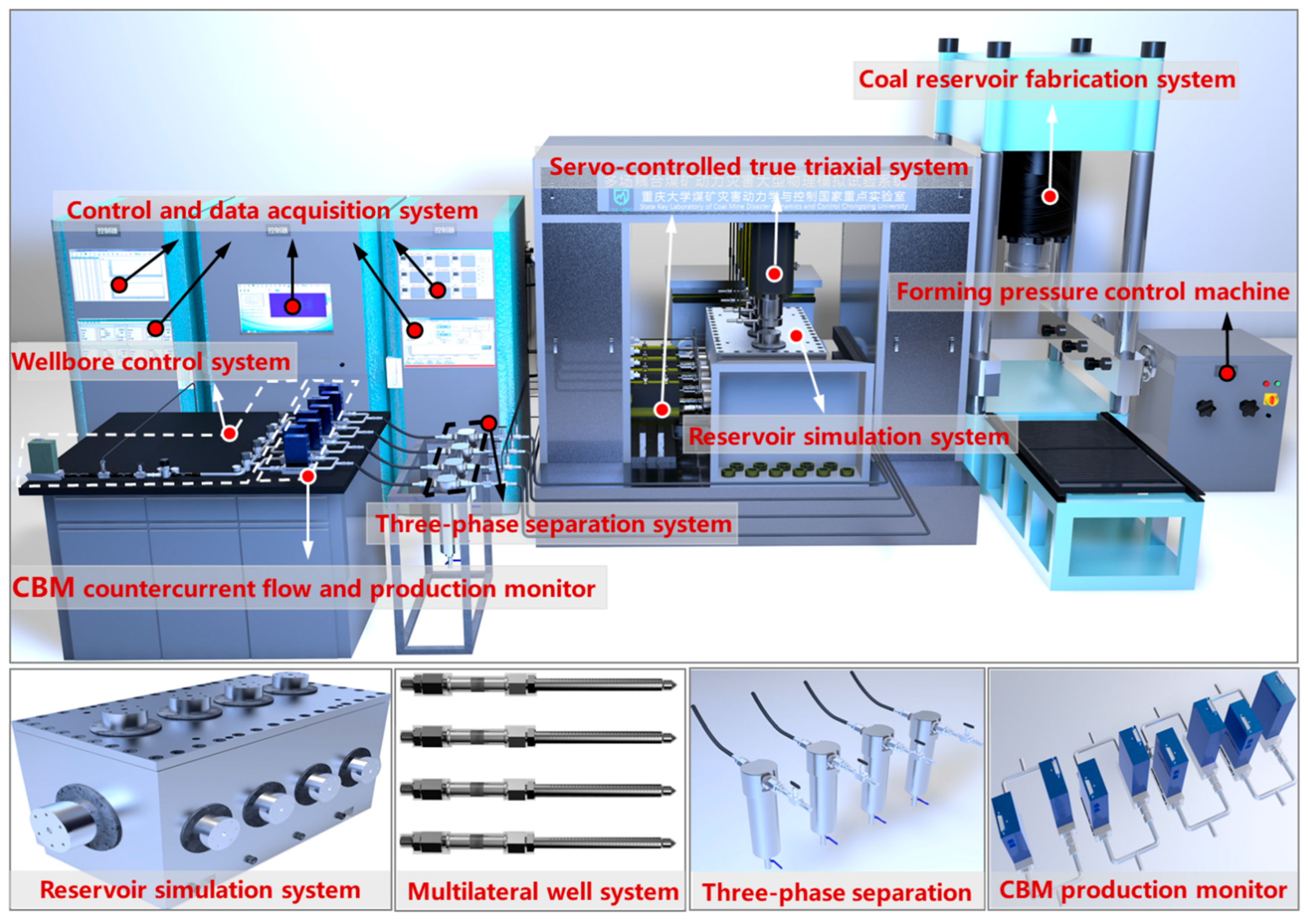
The physical simulation experiment for commingled coalbed methane production was conducted utilizing a large-scale true triaxial multi-field coupling coalbed methane extraction test platform, innovatively developed by Chongqing University (Chongqing, China). This experimental setup primarily consists of the following systems: a reservoir simulation system, a true triaxial loading and servo-control system, a coal reservoir molding system, a test control and data acquisition system, a coalbed methane counter-current flow and production monitoring system, and a gas–liquid-solid three-phase separation system, as illustrated in Figure 1.
Building upon the functionalities of the original experimental apparatus [10], the reservoir simulation system incorporates an innovatively designed coal reservoir simulation chamber and gas-blocking water-resisting layer simulation channels. The external dimensions of the system are 1250 mm × 605 mm × 605 mm, with an internal capacity for up to four independent simulation unit reservoirs. Each unit chamber measures 212 mm × 380 mm × 390 mm. A 300 mm × 162 mm rectangular recess is located at the bottom of each chamber to accommodate a gas-permeable steel plate. This plate is connected to an external independent gas injection port, enabling “areal” uniform gas injection to prevent reservoir damage, as well as supporting independent or simultaneous gas injection control for multiple reservoirs. Gas-blocking water-resisting layer channels are installed between reservoir units and between the units and the inner walls of the tank. The inter-layer channel dimensions are 50 mm × 400 mm × 390 mm, with a 10 mm gap from the wall. This system can withstand a maximum internal sealing pressure of 6.0 MPa, with an inter-layer sealing pressure capability of up to 1.0 MPa. The chamber is equipped with four rectangular pressure plates on both the vertical and lateral sides, each measuring 400 mm × 262.5 mm, with a maximum individual loading capacity of 1000 kN. A 400 mm × 400 mm square pressure plate is installed at the rear, with a loading capacity of 2000 kN. These plates support independent or coordinated loading, allowing for accurate simulation of various geomechanical conditions, including hydrostatic pressure, true triaxial stress, and stress concentration.

2.2. Experimental Protocol and Procedures

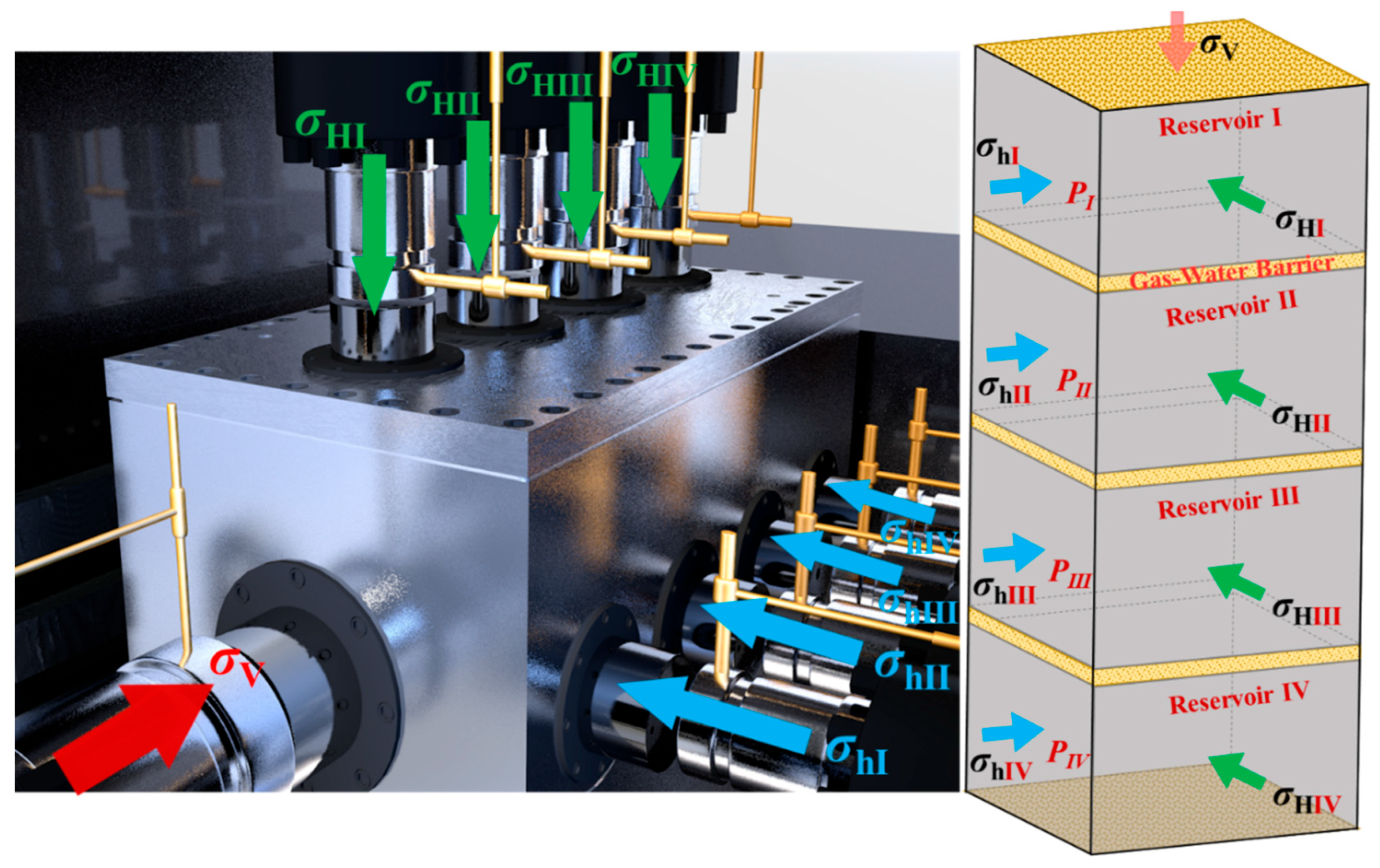
This study constructed a four-layer superimposed multi-reservoir physical model for commingled CBM production, designated as Reservoirs I to IV. Their spatial distribution and stress loading configuration are illustrated in Figure 2. Briquettes (manufactured coal) were selected as the simulative material for the reservoirs, based primarily on three considerations. First, the simulated reservoir scale is relatively large, requiring precise internal placement of a four-lateral horizontal well and up to 56 sensors. Raw coal struggles to meet such precision and structural integrity requirements during processing. Second, obtaining large-sized raw coal specimens is extremely difficult, and their inherent fracture networks exhibit significant heterogeneity, which can easily introduce uncontrollable experimental errors. Finally, briquettes have been demonstrated to possess good similarity to raw coal in terms of key physico-mechanical parameters and gas seepage characteristics, making them sufficient for effectively simulating the macroscopic mechanical and seepage responses of actual reservoirs.
A clay-based simulative material was chosen for the gas-blocking water-resisting strata, based on two main rationales. First, clay material inherently possesses very low permeability, enabling it to highly replicate the sealing and barrier functions of key interlayers in actual multi-reservoir systems. Second, its mechanical strength was designed to be lower than that of the briquettes. This ensures that during subsequent stress loading, stress can be effectively transmitted and redistributed through this interlayer, thereby more realistically simulating the mechanical interactions between strata.
The material preparation process was as follows. Collected coal rock was purified to remove impurities, then crushed using a ball mill, and subsequently classified via a vibrating sieve. Raw coal particles were sorted into four size fractions: 0.250–0.425 mm, 0.180–0.250 mm, 0.150–0.180 mm, and <0.150 mm. Clay was uniformly sieved to a fine particle size of <0.425 mm. Following a pre-optimized mixing ratio scheme [7], polyvinyl acetate emulsion was added as a cementing agent along with quantified gypsum powder and deionized water. High-speed mechanical mixing ensured thorough integration of all components, achieving a highly homogeneous mixture. The uniformly prepared coal reservoir and gas-blocking water-resisting layer slurries were then injected layer by layer into their corresponding simulation chambers and interlayer channels according to the designed structure. The complete four-layer superimposed multi-reservoir physical model was finally fabricated by maintaining a forming pressure of 10.0 MPa for 1.0 h.
Based on the geometric similarity ratio (CL = 2.95), bulk density similarity ratio (Cγ = 1.04), in situ stress similarity ratio (Cσ = Cγ × CL = 3.08), and reservoir pressure similarity ratio (Cp = Cσ = 3.08), the mechanical and pressure parameters for each simulated reservoir were determined as follows: Reservoir I: σH1 = 3.5 MPa, σh1 = 2.5 MPa, pI = 1.0 MPa; Reservoir II: σH2 = 3.9 MPa, σh2 = 2.8 MPa, pII = 1.4 MPa; Reservoir III: σH3 = 4.3 MPa, σh3 = 3.1 MPa, pIII = 1.8 MPa; Reservoir IV: σH4 = 4.7 MPa, σh4 = 3.4 MPa, pIV = 2.2 MPa [7]. To simulate constant-rate production conditions, a high-precision flow controller was installed at the wellbore outlet, setting the maximum gas production rate at 16 L/min to effectively constrain the wellbore output.
The main experimental procedure comprised the following steps:
(1)
System Initialization and Boundary Condition Establishment: The vacuum system was activated first to evacuate all residual gas from the reservoir chambers and high-pressure pipelines, while simultaneously initiating the high-precision servo stress loading system. Once the system pressure dropped to the preset threshold of −0.1 MPa, the corresponding three-dimensional stress loads were applied stepwise according to the experimental design to accurately replicate the in situ stress state of the target reservoirs.
(2)
Reconstruction of Reservoir Gas Occurrence State: The high-pressure gas injection system was activated, employing a stepwise intermittent inflation method with a pressure gradient of 0.25 MPa. This method, by pressurizing in stages, effectively avoided potential reservoir disturbance caused by rapid inflation, ensuring sufficient diffusion and adsorption of methane gas within the briquette matrix of each layer until each independent reservoir reached its preset pressure value and achieved a dynamic adsorption–desorption equilibrium. During the experiment, pressure equilibrium was assessed by monitoring either the fluctuation characteristics of the pressure curve or the magnitude of the pressure drop. Equilibrium was considered to be reached when the pressure curve remained relatively constant and exhibited linear variation, or when the pressure drop rate was approximately 0.01 MPa/h.
(3)
Production Scheme and Wellbore Parameter Setting: The wellbore control system was used to constrain the output conditions of the commingled production main line, primarily controlling its maximum gas production rate. Simultaneously, the flowing bottom-hole pressures of each horizontal lateral were independently fine-tuned. This aimed to precisely simulate the differential control effect of wellbore parameters on the production dynamics of different reservoirs under a “constant-rate” production scheme.
(4)
Commingled Production Execution and System Shutdown: Production was initiated and maintained according to the set scheme, with continuous data monitoring, until the predetermined termination criteria were met, followed by systematic shutdown procedures.

2.3. THM Parameter Monitoring Methods

The CBM extraction process is inherently a typical multi-field coupled dynamic system. Within this system, the reservoir temperature field, pressure field, and deformation field exhibit significant interactions and feedback mechanisms. These interrelated fields collectively govern the migration behavior and production efficiency of CBM. This study focuses on the core parameters within the thermal-hydrological-mechanical (THM) coupled system—reservoir temperature, pressure field, and deformation—systematically revealing their dynamic interlinkages and inherent correlation patterns.
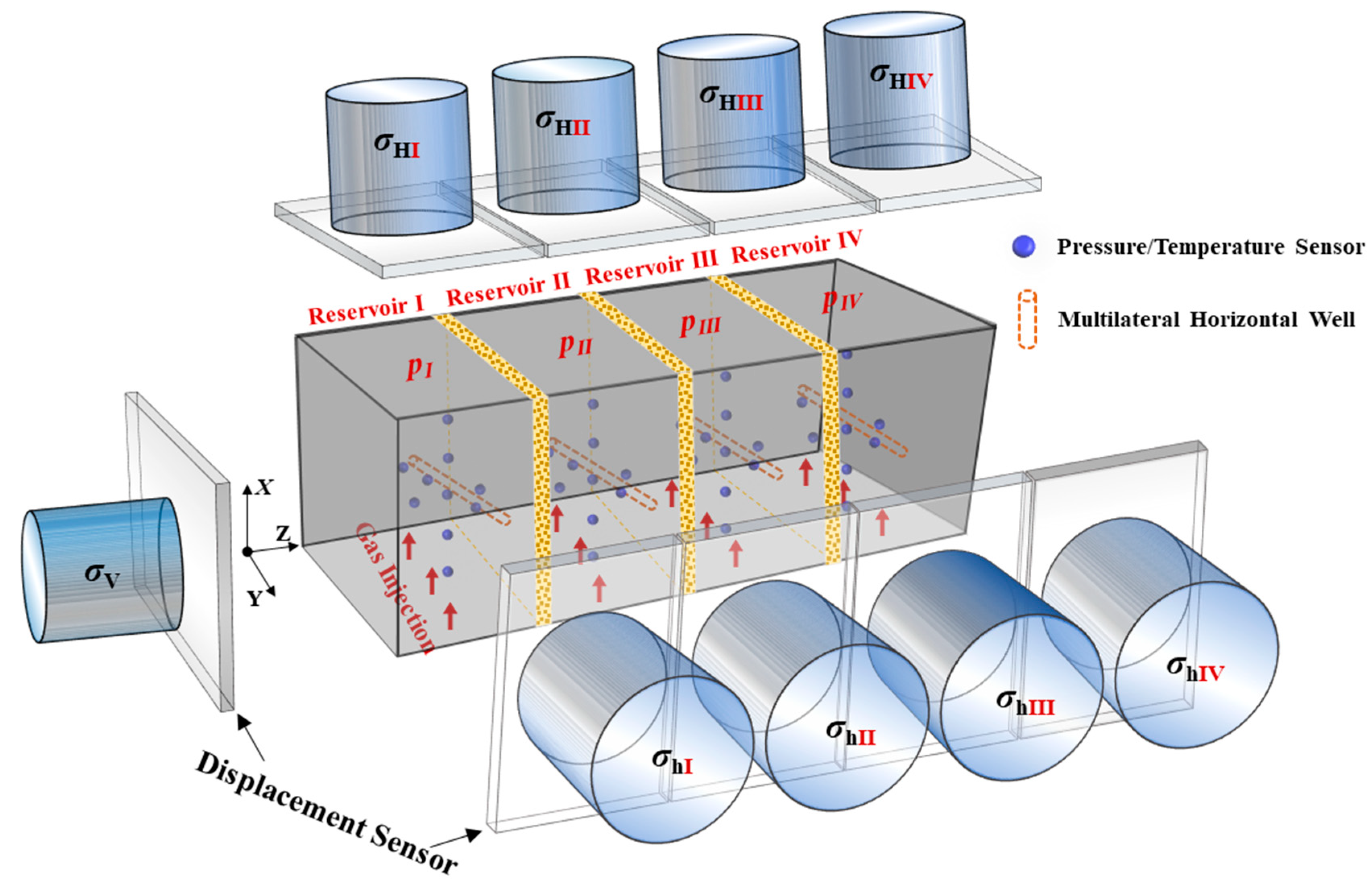
To enable real-time monitoring and data acquisition of multi-physical field parameters within the reservoir, a right-handed Cartesian coordinate system was established. The origin was set at the lower-left corner of the experimental tank. The length, width, and height directions of the tank correspond to the Z, Y, and X axes of the coordinate system, respectively. The spatial distribution of the sensors is shown in Figure 3, where the red cylinder represents the multilateral horizontal well.
Sensor installation commenced after the first superimposed CBM system layer was formed. Reservoir pressure and temperature sensors were primarily arranged around the multilateral horizontal well. A total of 40 reservoir pressure sensors (model: GB-Y-J6M) were installed, with a measurement range of −0.1 to 6 MPa and an accuracy of ±0.25% F.S. Sixteen temperature sensors were deployed using platinum resistance thermometers (model: Pt 100), featuring a theoretical measurement range of −200 to 850 °C and an accuracy of ±0.15 °C. Additionally, nine displacement sensors were installed. These sensors were connected to the nine rigid pressure plates in direct contact with the coal mass. Under the premise that the experimental apparatus is considered a rigid body, the extension/retraction of the loading cylinder—equating to the movement of the pressure plates—is taken as the average deformation of the coal mass. In this paper, coal deformation refers specifically to coal strain. The volumetric strains of the four reservoirs are denoted as εvI, εvII, εvIII, and εvIV, respectively.

3. Results and Analysis

3.1. Response Characteristics of Reservoir Temperature

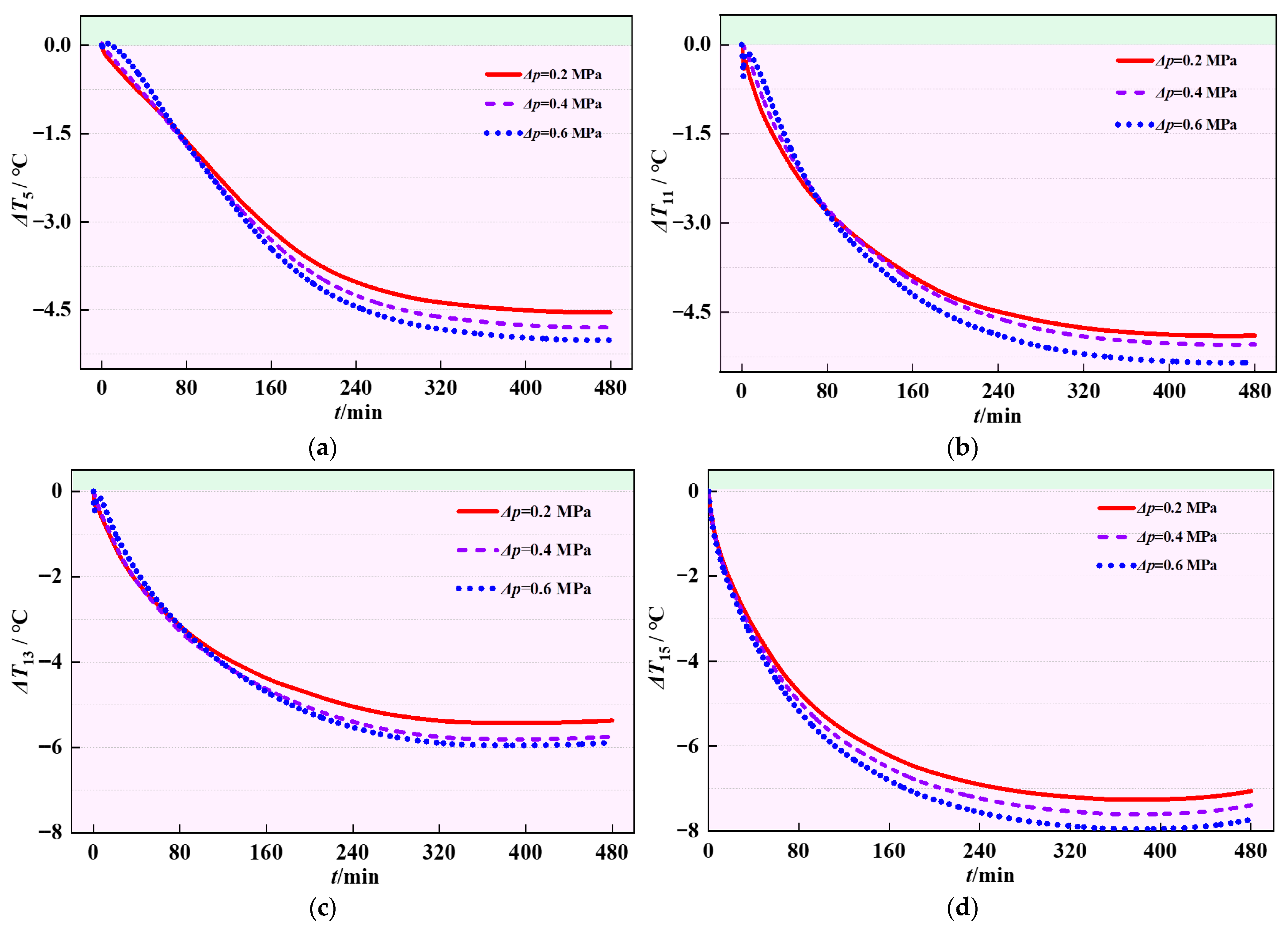
To facilitate the comparative analysis of reservoir temperature response characteristics under different pressure differentials, data from monitoring points T5, T11, T13, and T15 were selected for plotting, as shown in Figure 4. In the initial stage of commingled production, Reservoirs I to III exhibited the smallest temperature decline rate and magnitude under a pressure differential of 0.6 MPa, whereas the largest decline rate and magnitude were observed under a 0.2 MPa differential. As production progressed, the temperature curves intersected, and the decline rate accelerated. By the mid-to-late stage, a reversal occurred, showing that both the magnitude and rate of temperature decline gradually increased with larger reservoir pressure differentials.
In contrast, Reservoir IV displayed the opposite trend, with its temperature evolution curve maintaining a positive correlation with the pressure differential throughout the entire production process. This can be attributed to fluid interference during the early stage, which caused pressure buildup in the lower-pressure reservoirs, thereby inhibiting methane desorption and slowing temperature decline. A larger pressure differential intensified this fluid interference, further suppressing the temperature decline rate. As production continued, the fluid interference gradually diminished, allowing the gas content to become the dominant factor governing temperature evolution. Consequently, a positive correlation between reservoir temperature decline and pressure differential was established.

3.2. Evolution Characteristics of Reservoir Pressure

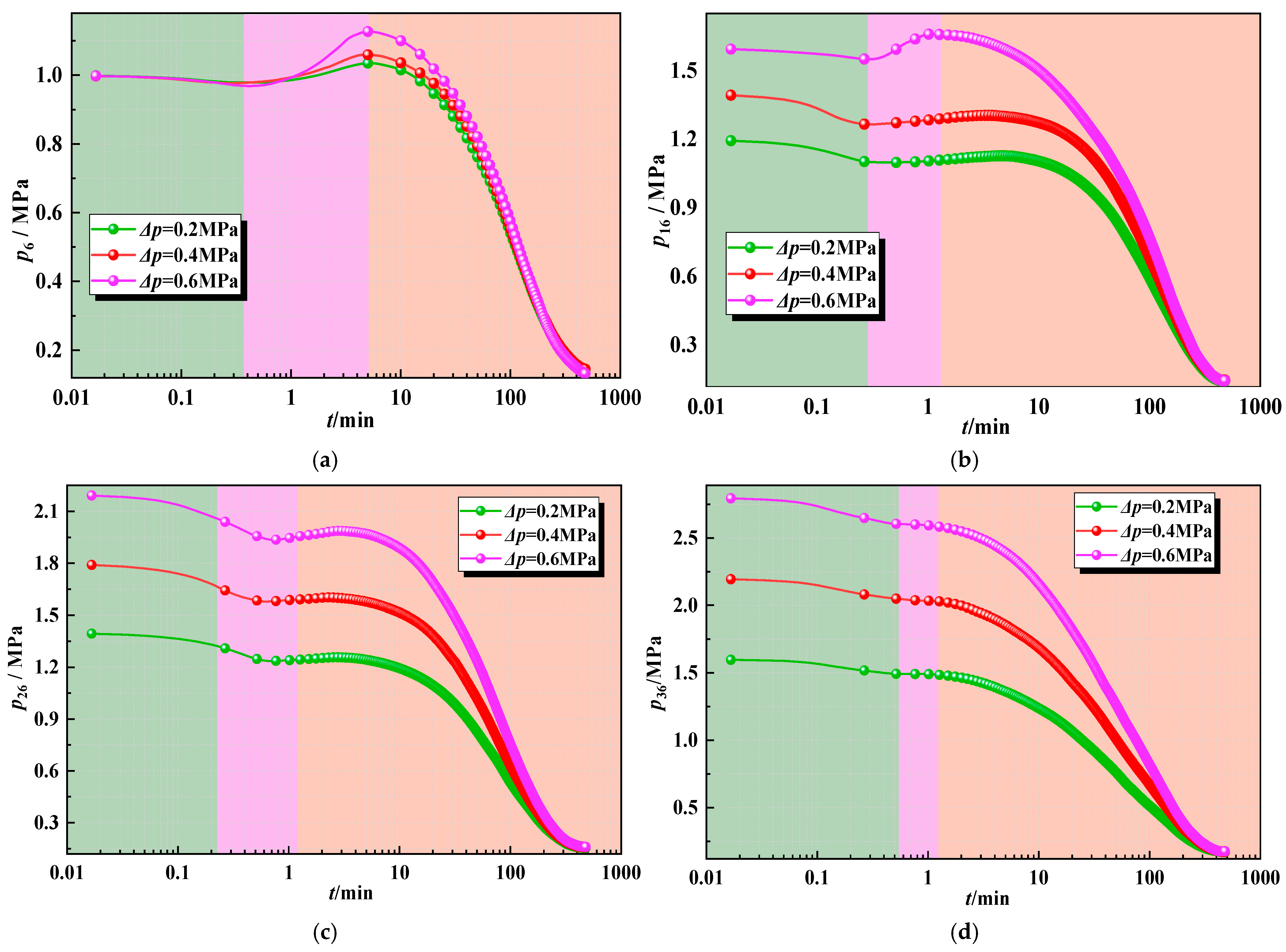
During the commingled production of CBM, the reservoir pressure differential is considered the primary factor inducing fluid interference, exhibiting a positive correlation with the reservoir energy gradient. The evolution of reservoir pressure under varying pressure differentials is illustrated in Figure 5. Analysis reveals that, despite an identical initial pressure of 1 MPa for Reservoir I, distinct pressure evolution patterns emerge under different commingled production pressure differentials. Specifically, a larger pressure differential leads to a greater increase in reservoir pressure and more pronounced fluid interference. Taking monitoring point P6 as an example, as the commingled production pressure differential increases sequentially from 0.2 MPa to 0.4 MPa and 0.6 MPa, the maximum pressure rise at P6 increases from 1.03 MPa to 1.06 MPa and 1.13 MPa, respectively. This indicates that a higher pressure differential amplifies the degree of pressure disturbance due to fluid interference in Reservoir I. Similar pressure responses are observed in Reservoirs II and III. In contrast, Reservoir IV did not exhibit fluid interference.

3.3. Response Characteristics of Reservoir Deformation

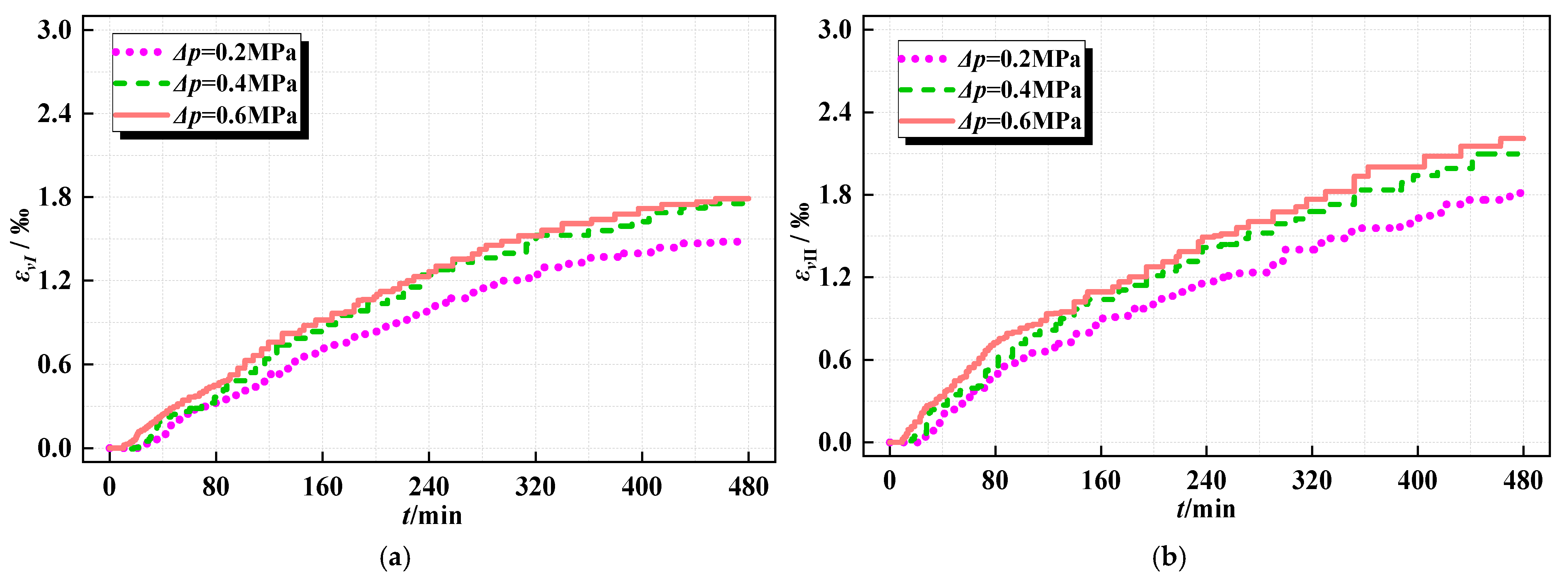
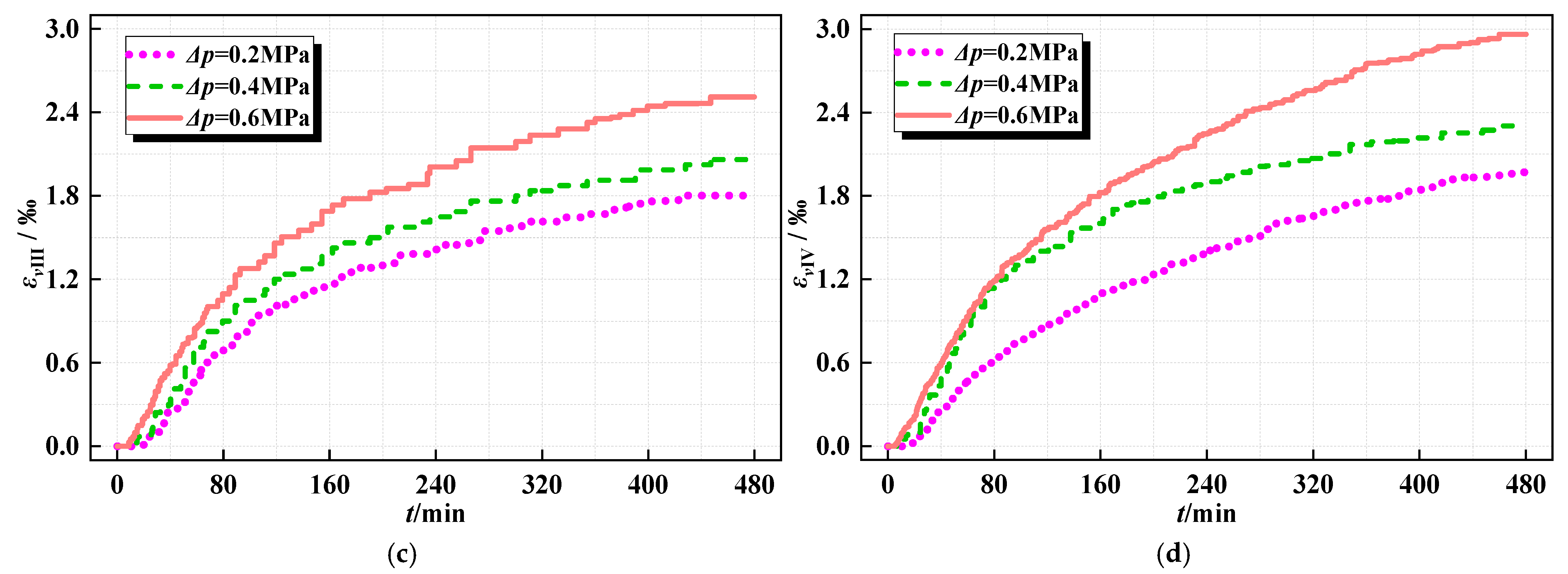
The evolution of reservoir volumetric strain under different pressure differentials is shown in Figure 6. Observations reveal a high consistency in the volumetric strain response across various pressure differentials. Reservoir deformation nonlinearly increases with prolonged production time, but the rate and magnitude of increase exhibit significant differences. This indicates that the initial reservoir pressure has a pronounced influence on the deformation response, with a positive correlation existing between initial pressure and reservoir deformation. For instance, in Reservoir II, when the initial pressure increased from 1.2 MPa to 1.4 MPa and then to 1.6 MPa, the post-production volumetric strain increased from 1.81 ‰ to 2.10 ‰ and 2.21‰, respectively.
Reservoir deformation results from the coupling of multiple factors, including matrix shrinkage, effective stress compression, and thermal expansion effects. During commingled production, the initial reservoir pressure is positively correlated with the reservoir’s effective stress. Consequently, reservoirs with higher initial pressures experience a greater increase in effective stress by the end of production, leading to more significant deformation. Furthermore, a higher initial pressure leads to increased extraction of adsorbed gas, enhancing matrix deformation and the structural deformation of the reservoir skeleton caused by desorption thermal effects. The interaction of these three influencing factors results in greater deformation magnitude and a faster deformation rate at the end of commingled production for reservoirs with higher initial pressures.
The nonlinear increase in deformation over time can be attributed to the evolving rates of these underlying processes. Initially, rapid pressure drawdown induces significant gas desorption and effective stress increase, leading to a high deformation rate. As production continues, the declining pressure gradient reduces desorption rates and the incremental effective stress, causing the deformation rate to gradually decrease—hence the observed nonlinear behavior. Moreover, the significant differences in deformation rate and magnitude among reservoirs with varying initial pressures arise from the distinct contributions of each mechanism. Higher initial pressure reservoirs maintain higher gas content and pressure differentials for longer periods, prolonging the duration of intense matrix shrinkage and effective stress change. Additionally, the thermal effects associated with desorption are more pronounced in these reservoirs due to greater cumulative gas production, further amplifying deformation. In contrast, lower initial pressure reservoirs experience earlier depletion of desorbable gas and smaller effective stress changes, resulting in reduced overall deformation and a faster transition to a stabilized state.

4. Conclusions

Using a self-developed physical simulation system for CBM commingled production, this study experimentally investigated a four-layer stacked reservoir. The dynamic evolution of reservoir pressure, temperature, and deformation under varying interlayer pressure differences was analyzed, yielding the following conclusions:
(1)
An increase in the inter-reservoir pressure difference exacerbates fluid interference in low-pressure reservoirs, leading to a notable rise in their pressure. When the pressure difference increases from 0.2 MPa to 0.6 MPa, the pressure in the low-pressure reservoir rises from 1.03 MPa to 1.13 MPa. Concurrently, the reservoir temperature response exhibits a two-phase characteristic: the initial decline was subdued, while the later phase shows an accelerated decrease with a larger pressure difference.
(2)
The high-pressure reservoir displayed unique behavior during commingled production, remaining unaffected by fluid interference. Reservoir IV, with an initial pressure of 2.2 MPa, showed no anomalous pressure increase, and its temperature decline maintained a positive correlation with the reservoir pressure difference throughout the production process.
(3)
A higher initial reservoir pressure led to greater reservoir deformation by the end of commingled production. For Reservoir II, when the initial pressure was increased from 1.2 MPa to 1.6 MPa, the volumetric strain rose from 1.81‰ to 2.21‰.
Although this study offers new insights, it has not yet been validated through engineering applications. Whether the conclusions can provide specific guidance for field-scale CBM production remains to be verified. Further work should focus on developing a mathematical model of CBM migration that accounts for fluid interference, informed by the experimental results. This model can then be refined using field production data to enable accurate predictions of commingled production compatibility and support stable, high-yield CBM extraction.

Author Contributions

Conceptualization, A.D., L.J. and S.P.; Resources, C.X. and L.W.; Writing—original draft, A.D., C.X. and L.J.; Writing—review and editing, A.D., L.J. and L.W.; Supervision, A.D., C.X., S.P. and L.W.; Funding acquisition, A.D., L.J. and L.W. All authors have read and agreed to the published version of the manuscript.

Funding

This work was supported by the Natural Science Foundation of Jiangsu Province (grant number: BK20251637), the National Natural Science Foundation of China, China (grant number: 52504271), the Fundamental Research Funds for the Central Universities, China (grant number: 2025QN1021), the China Postdoctoral Science Foundation (grant numbers 2025M771783; GZC20251235), and Open Fund of Deep Coalbed Methane Exploration and Development Key Laboratory, SINOPEC in 2024 (grant number: SMKK202404).

Data Availability Statement

The data that support the findings of this study are available from the corresponding author upon reasonable request.

Conflicts of Interest

Authors Anxu Ding and Cui Xiao were employed by Key Laboratory of Deep Coalbed Methane Exploration and Development, SINOPEC. The remaining authors declare that the research was conducted in the absence of any commercial or financial relationships that could be construed as a potential conflict of interest. The Key Laboratory of Deep Coalbed Methane Exploration and Development, SINOPEC had no role in the design of the study; in the collection, analyses, or interpretation of data; in the writing of the manuscript, or in the decision to publish the results.

References

  1. Jin, Z.; Liu, K.; Wang, H.; Liu, T.; Wang, H.; Wang, X.; Wang, X.; Wang, L.; Zhang, Q.; Huang, H. Research on Coalbed Methane Production Forecasting Based on GCN-BiGRU Parallel Architecture—Taking Fukang Baiyanghe Mining Area in Xinjiang as an Example. Sustainability 2025, 17, 8380. [Google Scholar] [CrossRef]
  2. Li, W.; Liao, J. Microscopic analysis of flow resistance of oil displacement fluid in reservoir fractures. Reserv. Sci. 2026, 2, 16–33. [Google Scholar] [CrossRef]
  3. Liu, Y.X.; Gao, Y.; Wang, G.; Cheng, W.M.; Xu, C.H.; Cheng, J.X. Development of experimental system for rock anisotropic seepage under true triaxial stress. Geomech. Energy Environ. 2025, 42, 100677. [Google Scholar] [CrossRef]
  4. Tian, W.G.; Yang, Z.B.; Qin, Z.H.; Qin, Y.; Li, C.L.; Lu, B.J.; Li, Y.C. Characteristics of microbial communities in water from CBM wells and biogas production potential in eastern Yunnan and western Guizhou, China. Front. Earth Sci. 2023, 17, 180–196. [Google Scholar] [CrossRef]
  5. Li, S.; Tang, D.Z.; Pan, Z.J.; Xu, H. Influence and control of coal facies on physical properties of the coal reservoirs in Western Guizhou and Eastern Yunnan, China. Int. J. Oil Gas Coal Technol. 2014, 8, 221–234. [Google Scholar] [CrossRef]
  6. Yang, R.Y.; Li, G.S.; Qin, X.Z.; Huang, Z.W.; Li, J.B.; Sheng, M.; Wang, B. Productivity enhancement in multilayered coalbed methane reservoirs by radial borehole fracturing. Pet. Sci. 2022, 19, 2844–2866. [Google Scholar] [CrossRef]
  7. Jia, L.; Wang, L.; Cheng, Y.P.; Xu, J.; Nie, B.S.; Peng, S.J. Advanced physical simulation technique for investigating coalbed methane coproduction in multicoal seams. Energy Fuels 2025, 39, 1981–1997. [Google Scholar] [CrossRef]
  8. Wang, K.F.; Tang, S.H.; Zhang, S.H.; Guo, Y.Y.; Lin, D.L.; Niu, Z.C. Numerical simulation of fracture propagation characteristics of hydraulic fracturing in multiple coal seams, Eastern Yunnan, China. Front. Earth Sci. 2022, 10, 854638. [Google Scholar] [CrossRef]
  9. Quan, F.K.; Li, H.J.; Lu, W.; Song, T.; Wang, H.Y.; Qin, Z.Y. Optimization of production layer combinations in multi-superposed coalbed methane systems using numerical simulation: A case study from Western Guizhou and Eastern Yunnan, China. Processes 2025, 13, 3280. [Google Scholar] [CrossRef]
  10. Tang, Y.B. Methane drainage optimization by roof-borehole based on physical simulation. Arab. J. Geosci. 2015, 8, 7879–7886. [Google Scholar] [CrossRef]
  11. Zhao, P.X.; Liu, H.; Ho, C.H.; Li, S.G.; Liu, Y.Q.; Lin, H.F.; Yan, M. Evaluating methane adsorption characteristics of coal-like materials. Materials 2020, 13, 751. [Google Scholar] [CrossRef]
  12. Jia, J.L.; Cao, L.W.; Sang, S.X.; Yi, T.S.; Zhou, X.Z. A case study on the effective stimulation techniques practiced in the superposed gas reservoirs of coal-bearing series with multiple thin coal seams in Guizhou, China. J. Pet. Sci. Eng. 2016, 146, 489–504. [Google Scholar] [CrossRef]
  13. Yang, Z.B.; Qin, Y.; Yi, T.S.; Tang, J.; Zhang, Z.G.; Wu, C.C. Analysis of multi-coalbed CBM development methods in western Guizhou, China. Geosci. J. 2019, 23, 315–325. [Google Scholar] [CrossRef]
  14. Wang, Z.W.; Qin, Y. Physical experiments of CBM coproduction: A case study in Laochang district, Yunnan province, China. Fuel 2019, 239, 964–981. [Google Scholar] [CrossRef]
  15. Wang, Z.W.; Qin, Y.; Li, T.; Zhang, X.Y. A numerical investigation of gas flow behavior in two-layered coal seams considering interlayer interference and heterogeneity. Int. J. Min. Sci. Technol. 2021, 31, 699–716. [Google Scholar] [CrossRef]
  16. Liu, G.F.; Meng, Z.; Luo, D.Y.; Wang, J.N.; Gu, D.H.; Yang, D.Y. Experimental evaluation of interlayer interference during commingled production in a tight sandstone gas reservoir with multi-pressure systems. Fuel 2019, 262, 116557. [Google Scholar] [CrossRef]
  17. Wang, L.; He, Y.M.; Wang, Q.; Liu, M.M.; Jin, X. Improving tight gas recovery from multi-pressure system during commingled production: An experimental investigation. Nat. Resour. Res. 2021, 30, 3673–3694. [Google Scholar] [CrossRef]
  18. Tahir, M.U.; Guo, S. Preliminary Investigation of Fracture Behavior during Carbon Dioxide Fracturing of Natural Hydrogen Reservoir with Hard-Core Imperfections. Reserv. Sci. 2026, 2, 34–51. [Google Scholar] [CrossRef]
  19. Wang, W.K.; Liu, S.Q.; Sang, S.X.; Du, R.B.; Liu, Y.H. A study on the production simulation of coal-shale interbedded coal measure superimposed gas reservoirs under different drainage methods. Processes 2023, 11, 3424. [Google Scholar] [CrossRef]
  20. Ding, A.X.; Xiao, C.; Xu, J.; Peng, S.J.; Wang, L.; Jia, L. Visualizing and quantifying fluid flow in multi-coal reservoirs using three-dimensional monitoring data. Energies 2025, 18, 5591. [Google Scholar] [CrossRef]
  21. Yang, Y.; Huang, F.; Kang, S. Mechanism of Penetration Rate Improvement in Hot Dry Rock Under the Coupling of Impact Load and Confining Pressure Release. Reserv. Sci. 2026, 2, 52–64. [Google Scholar] [CrossRef]
  22. Pu, H.; Xue, K.S.; Wu, Y.; Zhang, S.J.; Liu, D.J.; Xu, J.C. Estimating the permeability of fractal rough rock fractures with variable apertures under normal and shear stresses. Phys. Fluids 2025, 37, 036635. [Google Scholar] [CrossRef]
  23. Zhang, Q.; Peng, Y.L.; Li, X.; Li, Y.J.; Yin, Z.Y. High-gravity assisted coal mine gas separation based on clathrate hydrates: Implication for methane recovery. Int. J. Min. Sci. Technol. 2025, 35, 2199–2212. [Google Scholar] [CrossRef]
  24. Xue, K.S.; Pu, H.; Li, M.; Luo, P.; Liu, D.J.; Yi, Q.Y. Fractal-based analysis of stress-induced dynamic evolution in geometry and permeability of porous media. Phys. Fluids 2025, 37, 036630. [Google Scholar] [CrossRef]
  25. Wang, C.Z.; Zhou, B.; Li, S.G.; Lin, H.F.; Shuang, H.Q.; Zhang, D.M.; Peng, S.J.; Cheng, L.; Yang, H. Dominant governing mechanisms of deformation-seepage and dynamic evolution model of permeability in gas-containing coal under coupled stress-pore pressure. Fuel 2025, 404, 136408. [Google Scholar] [CrossRef]
  26. Liu, L.L.; Wang, J.J.; Su, P.H.; Huang, W.S.; Zhang, B.; Zhang, X.M.; Cui, Z.H.; Wei, X.Y.; Duan, L.J.; Li, M. Experimental study on interlayer interference of coalbed methane reservoir under different reservoir physical properties and pressure systems. J. Pet. Explor. Prod. Technol. 2022, 12, 3263–3274. [Google Scholar] [CrossRef]
  27. Liang, W.; Wang, J.G.; Li, P.B.; Leung, C.; Goh, S.; Sang, S.X. New Insight to interlayer interference during three-gas co-production based on a wellbore-reservoir coupling model. Nat. Resour. Res. 2023, 32, 2037–2052. [Google Scholar] [CrossRef]
Figure 1. CBM Commingled Production Experimental System.
Processes 14 00976 g001
Figure 2. Construction concept and stress loading configuration of the multilayer reservoir physical model.
Processes 14 00976 g002
Figure 3. Schematic diagram of 3D THM parameter acquisition.
Processes 14 00976 g003
Figure 4. Reservoir temperature response characteristics under different pressure differentials. (a) Temperature evolution curve of reservoir I; (b) Temperature evolution curve of reservoir II; (c) Temperature evolution curve of reservoir III; (d) Temperature evolution curve of reservoir IV.
Processes 14 00976 g004
Figure 5. Reservoir pressure response characteristics under pressure differentials. (a) Reservoir pressure evolution curve of reservoir I; (b) Reservoir pressure evolution curve of reservoir II; (c) Reservoir pressure evolution curve of reservoir III; (d) Reservoir pressure evolution curve of reservoir IV.
Processes 14 00976 g005
Figure 6. Reservoir volumetric strain response under pressure differentials. (a) Coal deformation evolution curve of reservoir I; (b) Coal deformation evolution curve of reservoir II; (c) Coal deformation evolution curve of reservoir III; (d) Coal deformation evolution curve of reservoir IV.
Processes 14 00976 g006aProcesses 14 00976 g006b
Disclaimer/Publisher’s Note: The statements, opinions and data contained in all publications are solely those of the individual author(s) and contributor(s) and not of MDPI and/or the editor(s). MDPI and/or the editor(s) disclaim responsibility for any injury to people or property resulting from any ideas, methods, instructions or products referred to in the content.