Next Article in Journal
Dynamic Evolution of Reservoir Pressure, Temperature, and Deformation During Multi-Coalbed Methane Commingled Production
Previous Article in Journal
A Correlation-Driven, Process-Oriented Framework for Vibro-Acoustic Comfort Assessment in Special-Purpose Vehicle Cabins
Previous Article in Special Issue
Assessment of UHPC with Various Particle Distributions (q) and Low Cement Consumption
 
 
Due to scheduled maintenance work on our servers, there may be short service disruptions on this website between 11:00 and 12:00 CEST on March 28th.
Article

A Calcined Mg/Al LDHs Strategy for High-Performance Steel Slag Cementitious Composites

1
School of Energy and Environmental Engineering, University of Science and Technology Beijing, Beijing 100083, China
2
School of Resources and Environmental Engineering, Inner Mongolia University of Technology, Hohhot 010051, China
3
State Key Laboratory of Iron and Steel Industry Environmental Protection, University of Science and Technology Beijing, Beijing 100083, China
*
Authors to whom correspondence should be addressed.
Processes 2026, 14(6), 974; https://doi.org/10.3390/pr14060974
Submission received: 19 February 2026 / Revised: 10 March 2026 / Accepted: 17 March 2026 / Published: 18 March 2026

Abstract

Due to the low hydration activity of steel slag, its mechanical properties are insufficient, which limits its strategic application in steel slag based cementitious composite. In this study, the promoting effect of calcined layered double hydroxide (CLDH) on the hydration process, mechanical properties, and microstructure of high-volume steel slag cementitious materials was systematically investigated. The results showed that the addition of CLDH significantly optimized the material’s performance. When the mass fraction of steel slag was 70 wt% and the CLDH dosage was 2.0 wt%, the 7-day compressive strength reached 42.5 MPa, indicating an increase of 23.9% compared with the control group. Microscopic characterization suggested that CLDH slightly enhanced the hydration reaction of steel slag and increased the generation of hydration products through the nucleation effect. The addition of CLDH demonstrated a change in the composition of C-(A)-S-H to a higher Al/Ca ratio. Meanwhile, the lamellar structure of CLDH effectively filled the pores and promoted the densification of the matrix. This research provides valuable insights for the high-value utilization of steel slag and the design of high-performance cementitious materials.

1. Introduction

In recent years, the rapid development of China and other developing countries has led to a huge demand for cement. In 2022, global cement production was approximately 4.2 billion tons [1], which has already reached the International Energy Agency’s (IEA) projected output of 3.69–4.4 billion tons by 2050 [2]. However, cement production, due to its high levels of carbon dioxide emissions and energy consumption, accounts for nearly 8% of the global total carbon dioxide emissions [3], posing a significant challenge to the sustainability of the global environment.
Alkali activation technology based on solid waste is currently an important way to significantly reduce carbon emissions in the construction industry [4,5]. This technology involves mixing activators and solid precursors to form a hardened cementitious system. Common alkali-activated material precursors mainly include slag and fly ash, etc. [6]. However, the properties of AAMs based on these common precursors are completely covered by the previous studies [7]. On the other hand, the 100 million tons of steel slag produced annually by China’s steel industry pose severe environmental pressure [8]. This kind of solid waste rich in silicon and aluminum phases is an ideal raw material for preparing alkali-activated materials. Steel slag is an industrial by-product of the steelmaking process, mainly composed of CaO, SiO2, Al2O3, MgO, Fe2O3, MnO, and P2O5 [9]. Its mineral phases mainly include C2S, C3S, and limonite (C2F), which are commonly found in cement [10], making steel slag potentially hydratable. In 2022, the global steel slag production was about 200 million tons, with China being the world’s largest producer of steel slag. However, the utilization rate of steel slag is only 30% [11]. Most of the steel slag is randomly piled up or landfilled, not only occupying land resources but also polluting water and the atmosphere [12]. Therefore, using steel slag in alkali-activated materials can not only alleviate the environmental risks caused by steel slag landfill, but also expand the application of low-carbon building materials.
The main reasons for the low utilization rate of steel slag as an alkali-activated material are its poor volume stability (high content of free CaO) [13] and low hydration activity [14], which have an adverse effect on mechanical properties. Many researchers have studied methods to reduce the content of free CaO and increase the hydration activity of steel slag. For example, thermal quenching [15] and carbonation [16] can be used to control the concentration of f- CaO; grinding [17] and adding the admixture glycine [18] can be used to increase hydration activity. However, the grinding process increases energy consumption, and the use of admixtures requires carbonation assistance, complicating the process. This study introduces calcined layered double hydroxide (CLDH),a commonly used admixture in cement materials, to increase the hydration activity of steel slag. At the same time, in alkali-activated materials, layered double hydroxide (LDH) as a secondary hydration product has good micro-mechanical properties, which can improve the mechanical properties of alkali-activated materials.
LDH is a mineral material with a unique layered structure and ion adsorption capacity. Due to its strong ion exchangeability and memory structure effect, it is applied in various fields [19,20,21]. These characteristics make LDH and its calcined product CLDH additives in cement materials, which can improve the ion binding of chlorides and enhance the carbonation resistance [22,23,24], and also improve the mechanical properties of the materials. Zhang [25] et al. studied the application of MgAl-CLDH in alkali-activated slag mortar and found that the addition of MgAl-CLDH in mortar not only effectively absorbs CO2 but also improves the mechanical properties of cement mortar. Chen [26] et al. investigated the effect of calcium layered double oxide on the hydration process and mechanical properties of cement-based materials. The results showed that the hydration heat, hydration degree, and mechanical properties of cement were all improved due to the nucleation effect of Ca-CLDH. Zhang [27] et al. explored the influence of introducing CLDH on the early hydration process of alkali-activated slag and found that during the hydration of slag, CLDH adsorbs OH ions and other anions in the solution, leading to the rapid recrystallization and formation of the hydrotalcite (Ht) phase. The generated Ht phase acts as a nucleation site, accelerating the formation of C-A-S-H amorphous gel and more Ht phases. The above-mentioned research has demonstrated the potential benefits of CLDH in cement-based materials. Compared with cementitious materials dominated by tricalcium silicate (such as Portland cement and ground granulated blast furnace slag), steel slag, whose main crystalline phase is β-dicalcium silicate (β-C2S), exhibits considerably low hydration reactivity [28]. However, the impact of CLDH on alkali-activated steel slag materials remains unclear. It is still unknown whether the promoting effect of CLDH on hydration activity is suitable for the alkali-activated steel slag system. Moreover, there are few studies on the use of CLDH to modify the compressive strength of alkali-activated materials. Therefore, it is necessary to explore the working mechanism of CLDH in alkali-activated slag materials, especially its influence on mechanical properties through the hydration reaction process.
In this paper, activated steel slag based cementitious composite with CLDH was prepared to investigate the relationship between the dosage of CLDH and the hydration rate. The influence of CLDH addition on the micro and macro properties of alkali-activated materials was explored. The influence of CLDH on the incorporation of calcium and aluminum into the silicate network was studied. This further revealed the mechanism of CLDH in the alkali-activated slag system. The findings not only have the potential to reveal the role of CLDH in alkali-activated systems but also to develop a new type of alkali-activated modified material.

2. Materials and Method

2.1. Raw Materials

The ultrafine steel slag (SS) powder was provided by Xuzhou Steel Group in Xuzhou, Jiangsu, China. The fly ash (FA) was supplied by Hinggan League, Inner Mongolia Autonomous Region, China. The industrial-grade sodium silicate with a modulus of 2.05 M (molar ratio of SiO2/Na2O) and analytical-grade sodium hydroxide (purity of 99%) were purchased from Aladdin Reagent (Shanghai, China) Co., Ltd. The elemental (oxide) contents of the precursor powders were quantitatively determined by X-ray fluorescence spectrometry (Shimadzu XRF-1800, Kyoto, Japan). The elemental (oxide) content of the precursor powders is given in Table 1. The particle size distribution of the precursor powders was examined using a micrometer laser particle sizer (Mastersizer 2000, Malvern, UK), as shown in Figure 1. The average particle size (d50) of FA, SS, and WSS were approximately 25.1 μm, 13.1 μm, and 14.6 μm, respectively. Referring to the research method in reference [29], the CLDH was made from the calcination of commodity MgAl-LDH (specifically Mg6Al2(OH)16CO3·4H2O). MgAl-LDH was calcined in a Muffle furnace at 500 °C for 5 h at a heating rate of 10 °C/min, and then cooled to room temperature. CLDH powder is obtained.

2.2. Pre-Hydration for Steel Slag

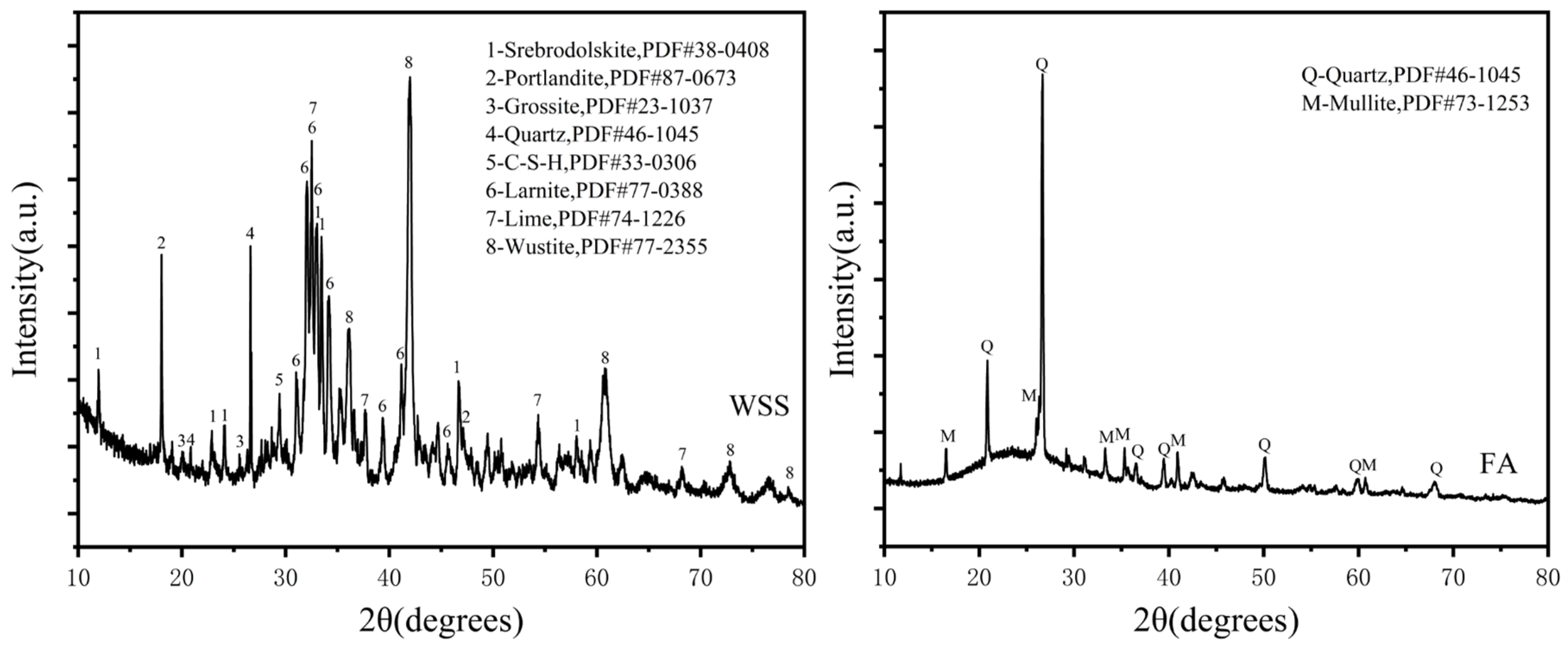
To reduce the expansibility of the matrix, the steel slag is subjected to pre-hydration treatment, allowing the f-CaO within it to undergo pre-expansion before the step of preparing the alkali-activated material. Firstly, steel slag and deionized water are mixed in a tray at a mass ratio of 1:4 and stirred for 2 min to fully mix. After 3 min, solid–liquid separation is carried out, the slurry is dried at 105 °C for 12 h, and then ground to less than 105 microns as washed steel slag (WSS). The X-ray diffraction (XRD) patterns of WSS and fly ash are shown in Figure 2.

2.3. Mix Composition and Sample Preparation

The modulus (molar ratio of SiO2/Na2O) of the alkaline activator used in this study was 1.4, which is a mixture of sodium silicate and sodium hydroxide. The alkaline activator was prepared by mixing deionized water and alkaline wastewater at a mass ratio of 2:1 (liquid:alkaline precursor). The prepared activator was stored for 24 h before use to release heat and cool to room temperature.
Water-washed steel slag and fly ash were sieved and thoroughly mixed at a mass ratio of 7:3, followed by the addition of 1%, 2%, and 3% CLDH (by mass) to form solid mixtures. The detailed mixing proportions are listed in Table 2. The activator modulus of 1.4 and the steel slag-to-fly ash mass ratio of 7:3 were selected based on our group’s previous research and published work [30], where these parameters provided relatively favorable comprehensive performance for the alkali-activated steel slag system. The mass ratio of water to binder was 0.33 in all AAMs, and the calculated water content was entirely derived from the deionized water added during the preparation of the alkaline solution. To ensure uniform dispersion of the CLDH admixture, the dry mixing time was extended with slow stirring for 180 s. The alkaline activator and solids were then blended for 2 min at a liquid-to-solid ratio of 1:2 to prepare AAM slurry. The slurry was vibrated for 2 min to remove air bubbles and cast into triple molds (40 mm × 40 mm × 40 mm). The molds were wrapped with plastic film to prevent moisture loss. After 24 h of curing at room temperature (20 ± 1 °C), the sample was demolded and further cured for 3, 7, and 28 days before compressive strength testing.
Samples at 3, 7, and 28 days were crushed, and the fragments/powders were immersed in isopropanol solution to terminate hydration. Subsequently, the sample were retrieved and dried in a 40 °C vacuum oven for 24 h. Selected fragments were used for SEM-EDS analysis, while powders were subjected to XRD and TGA characterization.

2.4. Characterization

The compressive strength of alkali-activated materials (AAMs) was tested using a universal compression testing machine with a loading rate of 2.4 kN/s, in accordance with GB/T 17671-2021 [31]. The average value of three specimens per group was adopted as the final result.
The phase compositions of LDH, CLDH, precursor powders, and AAMs were quantitatively analyzed by X-ray diffraction (XRD, Bruker D8, Karlsruhe, Germany) with Cu target radiation with a wavelength of 1.5416 angstroms. The operating parameters were set at 40 kV and 40 mA, with a scanning range of 5–80°, step size of 0.02°, and scanning rate of 5°/min.
The early hydration exothermic behavior of AAMs was monitored using isothermal conduction calorimetry (TAM Air 8-channel microcalorimeter, New Castle, DE, USA). A mixture of precursor and 1% CLDH additive was blended with alkaline activator for 1 min, then maintained at room temperature for 3 d. The heat evolution data were automatically recorded by the calorimeter.
For thermal analysis, approximately 10 mg of powdered paste samples were heated from 30 °C to 800 °C at 10 °C/min under nitrogen atmosphere using a Mettler Toledo TGA/DSC1 analyzer (Mettler-Toledo AG, Schwerzenbach, Switzerland). The mass loss curves and derivative thermogravimetry (DTG) profiles were obtained to evaluate thermal stability.
The microstructures of LDH, CLDH, and hardened pastes were characterized by SEM-EDS (ZEISS Sigma 300, Carl Zeiss Microscopy GmbH, Jena, Germany). Prior to imaging, samples were vacuum-dried and sputter-coated with gold to enhance conductivity. Elemental composition analysis was performed using an energy-dispersive spectrometer.
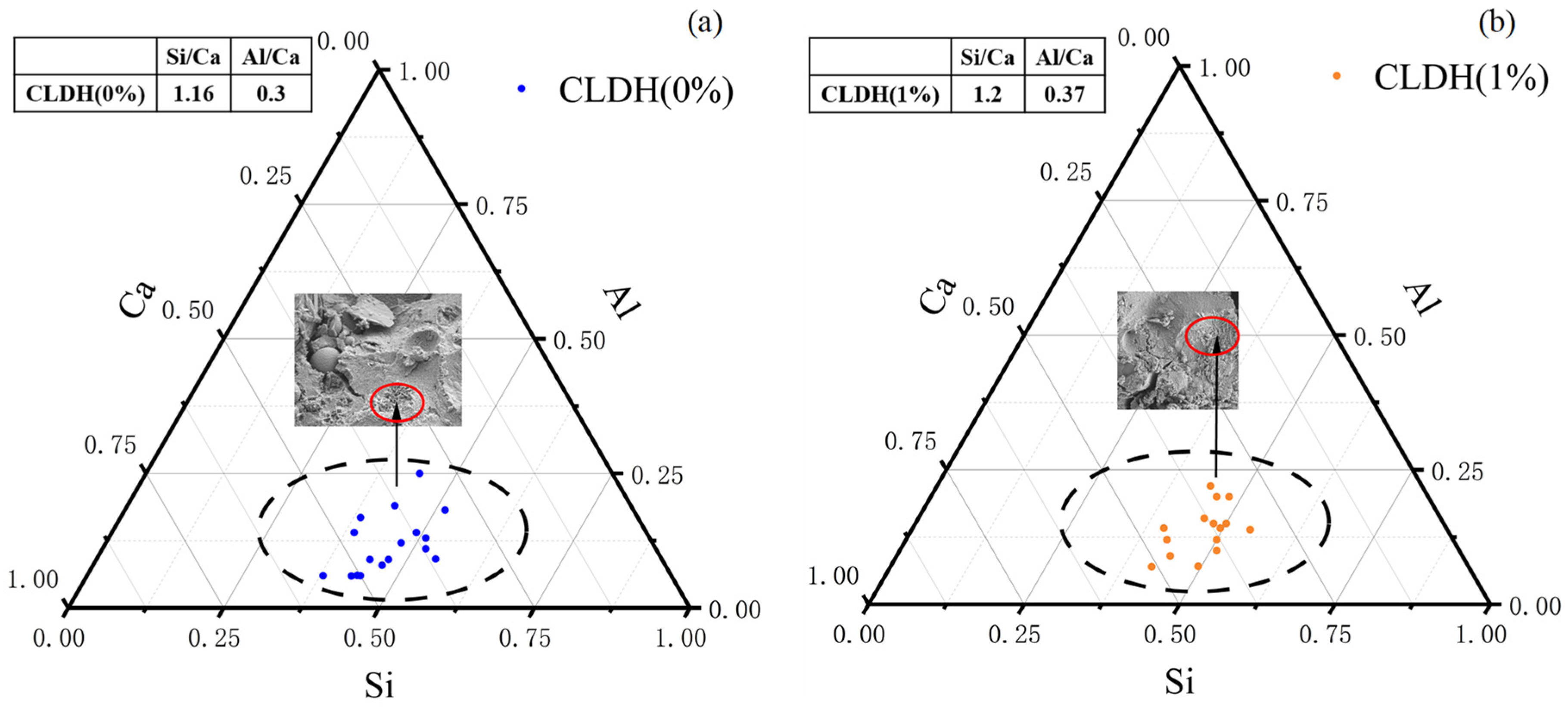
For EDS analysis of C-(A)-S-H gels, at least 10 different points were randomly selected for each sample to determine the atomic ratios of Si/Ca and Al/Ca. The confidence interval was set at 95%, and the average value was adopted as the final result to ensure the statistical credibility of the data.

3. Results

3.1. Chemical Structure and Composition of CLDH

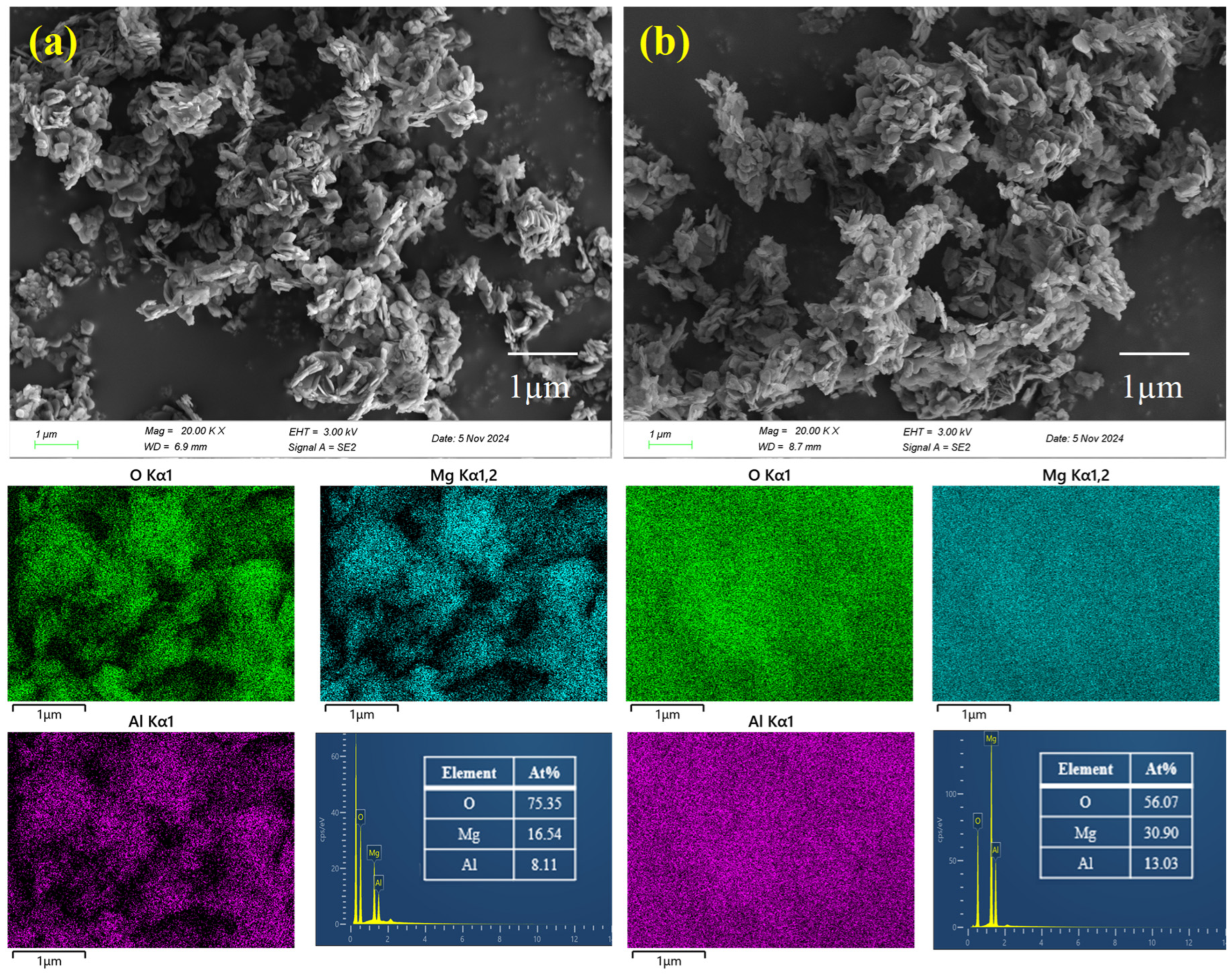
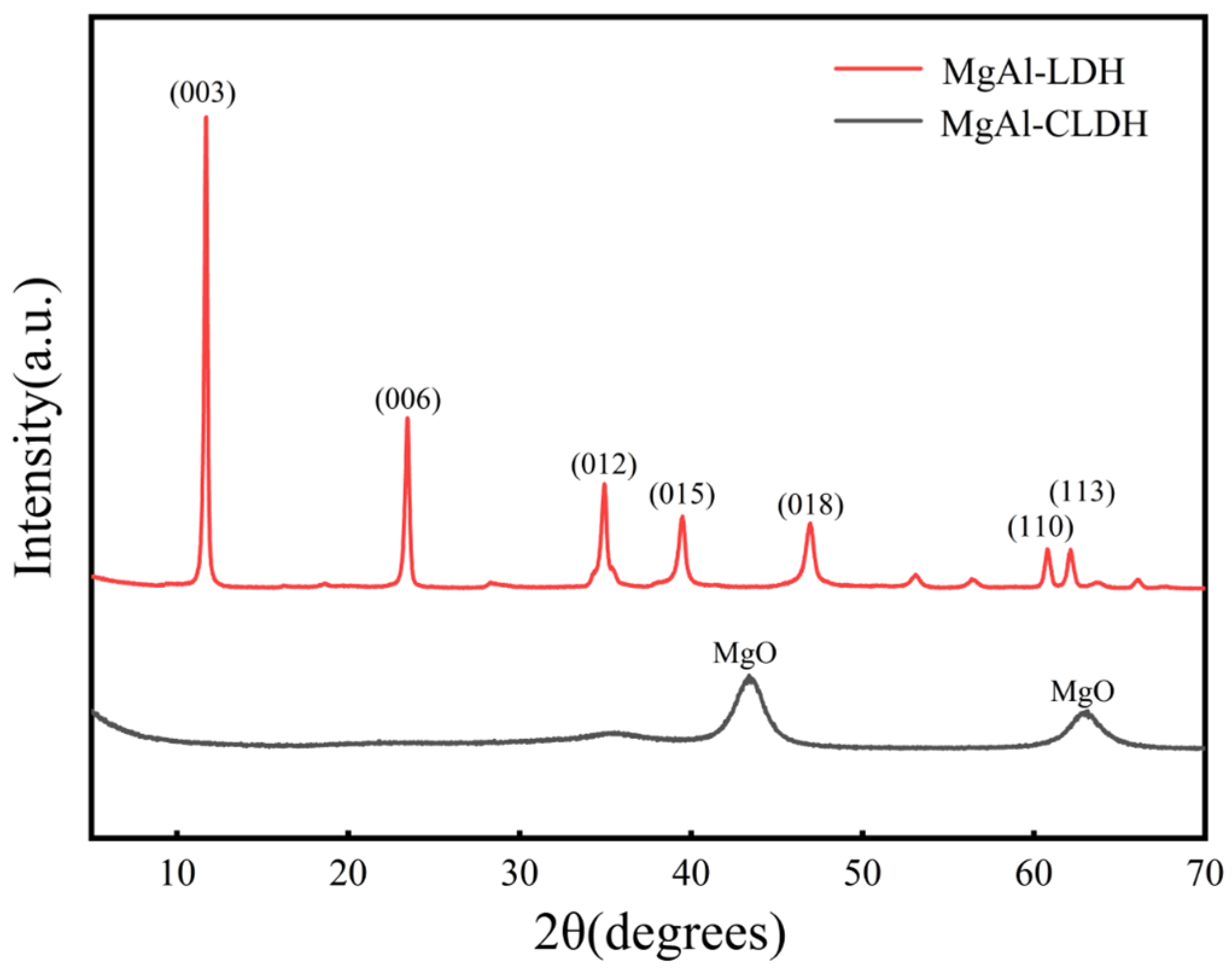
The SEM images of LDH and its calcined product CLDH are shown in Figure 3. MgAl-LDH presents a typical hexagonal plate-like structure, with a size range of approximately 200–500 nm and good dispersion. The particle size of the MgAl-CLDH sample decreases, and the structure shows a certain degree of agglomeration with poor dispersion. The SEM-EDS results indicate that Mg, Al, O, and C are present in the samples. After calcination, the molar ratio of Mg, Al, and O elements changes, indicating the loss of interlayer carbonate ions and water [32]. The successful preparation of CLDH is confirmed. The XRD patterns of LDH and CLDH are shown in Figure 4. The characteristic diffraction peaks of the samples are sharp and strong, indicating high crystallinity and complete crystal structure. Typical diffraction peaks (003) and (006) are observed [33,34]. After calcination, the interlayer CO32−, OH, and H2O of LDH are removed, leaving MgO and Al2O3 solid solutions [35]. The disappearance of the (003) and (006) crystal planes in CLDH indicates the collapse of the layered hydrotalcite structure after calcination. The XRD analysis shows two relatively broad MgO peaks, and no Al-containing compounds are detected, indicating that these compounds exist in an amorphous state.

3.2. Impacts of CLDH on Mechanical Properties

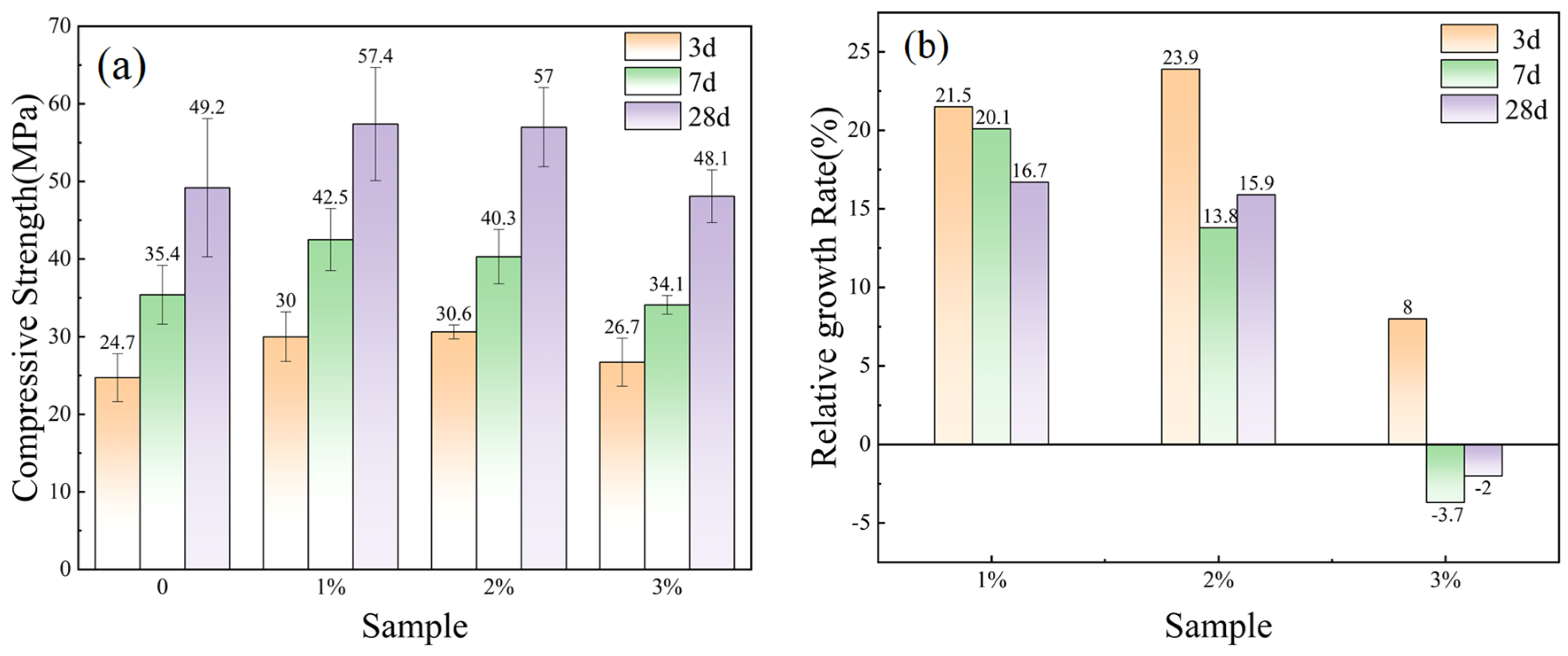
The effects of different CLDH dosages (1%, 2%, and 3%) on the mechanical properties of AAMs at different curing times (3 d, 7 d, and 28 d) are shown in Figure 5a. The relative compressive strength growth rates of CLDH-modified AAMs at the aforementioned curing times, in comparison with the CLDH-free control group, are presented in Figure 5b. Compared with the control group, the compressive strength of AAMs with CLDH addition improved when the dosage was 1% and 2%, particularly in the early stage (3 d and 7 d). At 3 d, the dosage of 2% increased the compressive strength by 23.9%, and at 7 d, the dosage of 1% increased the compressive strength by 20.1%. Combined with the SEM analysis results, it is hypothesized that an appropriate amount of CLDH exerts a micro-filling effect, which remarkably optimizes the pore structure of alkali-activated materials. Additionally, hydration heat analysis reveals that CLDH can also accelerate the hydration reaction and facilitate the formation of hydration products. At 3 d of curing, the microfilling effect of CLDH was dominant, and the optimal dosage was about 2%, which was most conducive to strength development. As the reaction proceeded and CLDH absorbed water, the strength growth tended to level off. At this stage, the water content in the system was insufficient to sustain a rapid hydration reaction relative to the control group, thereby restricting further strength growth. However, for AAMs with CLDH addition, CLDH, uniformly dispersed in the system, acted as “water storage stations”, which release the adsorbed water to continuously accelerate the hydration reaction and thus sustain the subsequent strength development. On the other hand, CLDH itself served as nucleation sites to promote the formation of hydration products, further enhancing the mechanical strength [36]. However, it is important to note that a dosage of 3% began to have an adverse effect on the compressive strength of AAMs. Although the strength at 3 d was slightly higher compared to the control group, this phenomenon can be attributed to the prominent micro-filling effect of CLDH at the early curing stage (3 d). Nevertheless, the 3% CLDH dosage led to a combined effect of dilution and water competition that outweighed its beneficial effects [26]. The high specific surface area of CLDH consumed additional water for wetting, resulting in local water insufficiency for hydration and increased matrix porosity, thereby deteriorating the mechanical properties of AAMs.
In summary, CLDH can bring about a strength increase of approximately 20% at an early stage (3 d) with an addition of only 1%, which makes it promising for application in other material systems, especially those requiring high early strength.

3.3. Impacts of CLDH on Hydration Kinetics

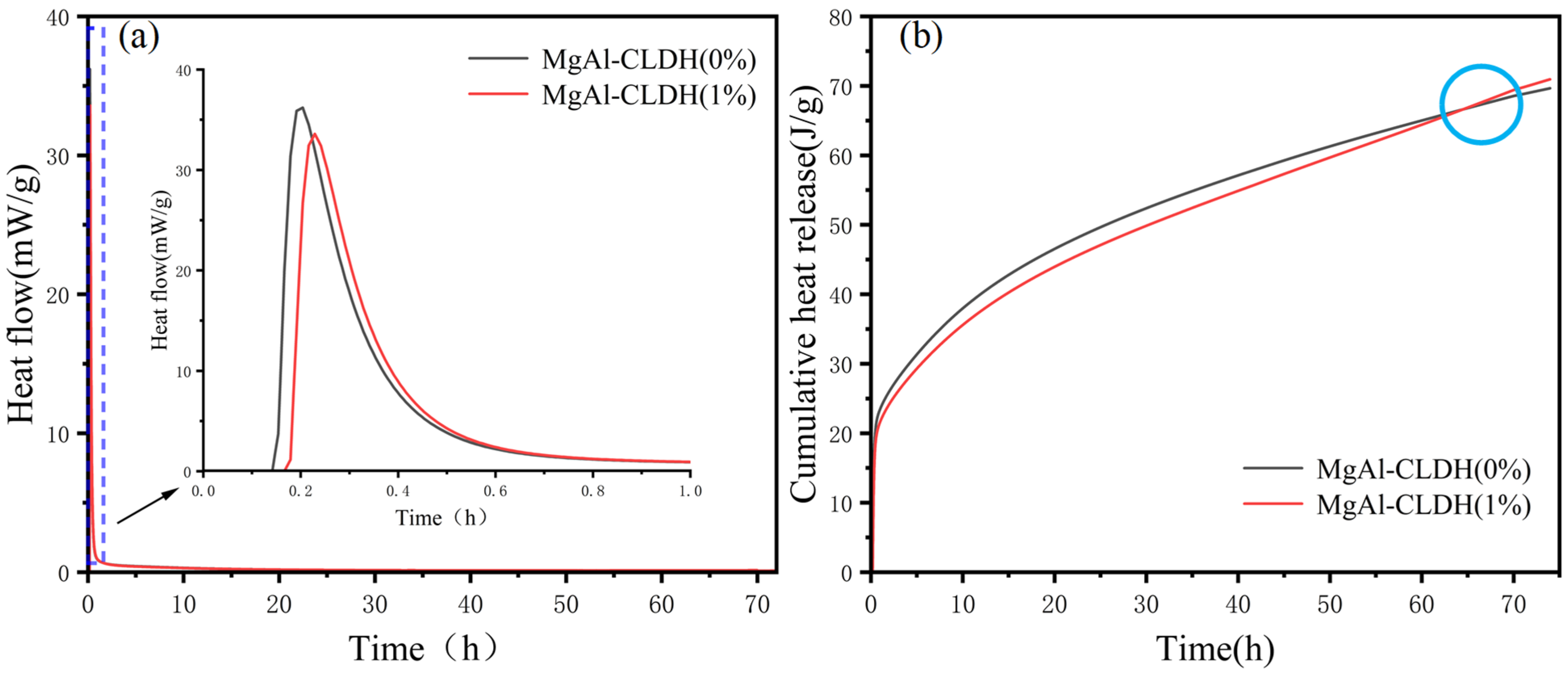
To further evaluate the degree of hydration, the hydration heat release rate and cumulative heat release of CLDH-containing samples and the control sample were investigated, with the results presented in Figure 6. A single exothermic peak was detected during the measurement of both groups of mixtures. This single-peak phenomenon has been reported in the alkali-activated SS/FA system [37], which is related to the dissolution of the precursors, the initial formation of silicate species, and their complexation with sodium and calcium ions [38]. It can be seen from the figure that the alkali-activated steel slag system undergoes a rapid and intense hydration reaction in a very short time. Upon the addition of CLDH, the time corresponding to the maximum heat release rate is delayed, and the peak heat release of the 1% CLDH sample is reduced. This may be due to the dilution effect and the ion adsorption effect of CLDH. In the initial stage of the reaction, the water in the samples containing CLDH is allocated to two purposes. The first part is used for the hydration reaction, and the remaining small part of the water is absorbed and stored by CLDH. In addition to dilution and water adsorption, CLDH can adsorb ions (Ca2+, OH) in the early pore solution, lower ionic strength, delay precursor dissolution, and thus reduce the early heat release rate [39].This explains the decrease in the peak heat release of the system and the decrease in the cumulative heat release in the first 2 days after the addition of CLDH. As the hydration reaction proceeds, the reaction rate gradually decreases due to the filling and maturation of the hydration products. As the hydration product layer around the SS particles thickens, the free water in the microstructure is consumed, which gradually retards the hydration process. Subsequently, the reaction enters a deceleration and steady-state stage [27]. When the reaction time approaches 3 days, the cumulative heat release of the 1% CLDH sample exceeds that of the control sample. This is because CLDH has a typical layered structure and exhibits certain water adsorption and storage capacity in alkaline environments, which can release water at a later stage to sustain the hydration process, as reported in previous studies [26].

3.4. Impacts of CLDH on Mineral Compositions

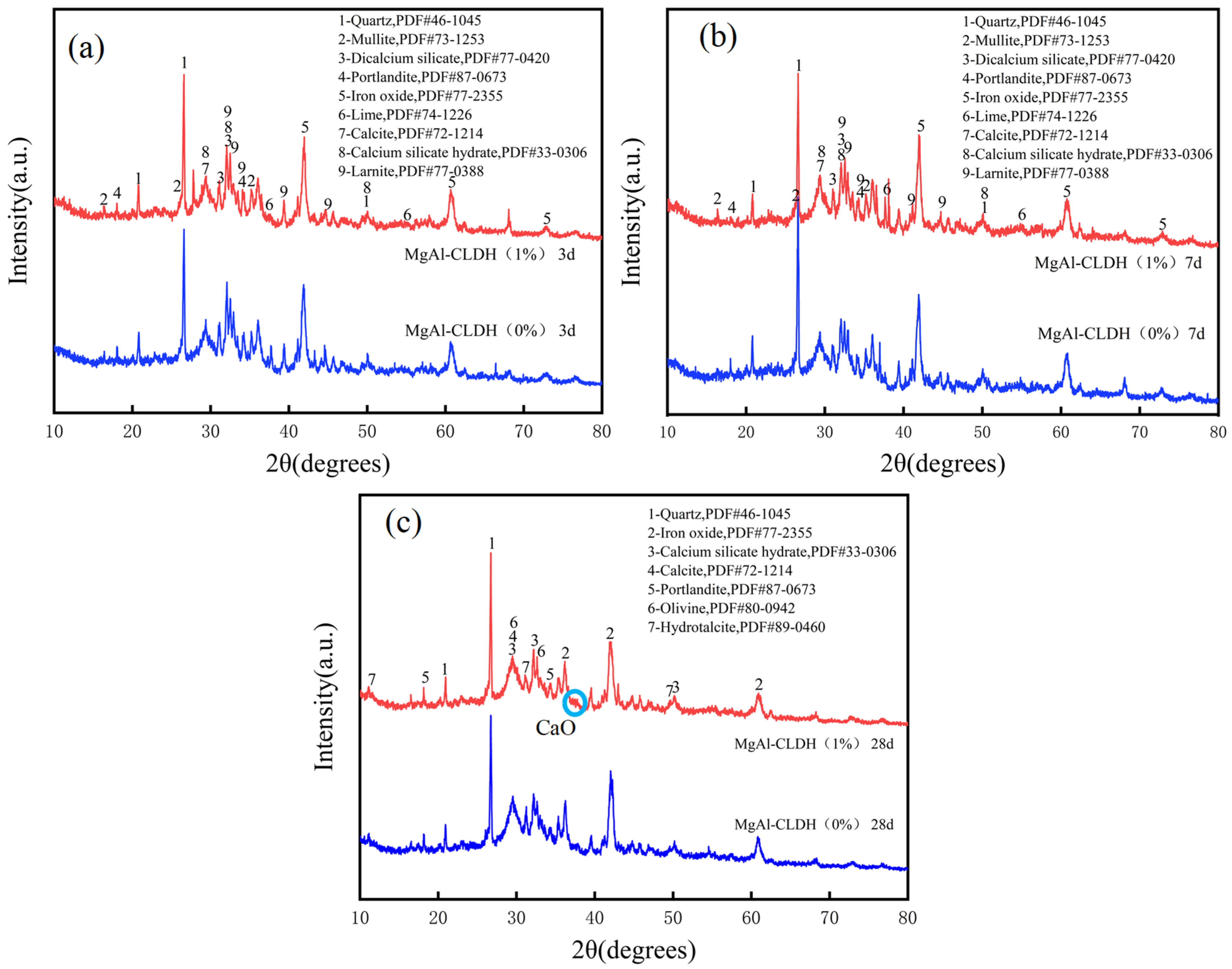
To further analyze the influence of CLDH on the hydration products of AAMs, XRD characterization was performed on AAMs with CLDH addition at various curing times (Figure 7). After the addition of CLDH, no new diffraction peaks emerged at different curing times, indicating that no new phases were formed, but the relative amounts of crystalline phases in the products were different. After 3 and 7 d of reaction, obvious C2S diffraction peaks were observed in all samples, indicating that C2S had not been completely hydrated. Notably, the C2S diffraction peak intensity decreased with CLDH addition. A broad peak at 2θ = 29.5° was observed, corresponding to the C-A-S-H gel peak with a tobermorite-like structure, as also reported in previous studies. No LDH or hydrotalcite-like phases were found in the samples with CLDH addition at 3 d and 7 d, which is consistent with the research results of Zhang [26].At a curing time of 28 d, compared with the early stage (3 d and 7 d), the diffraction peak of CaO (2θ = 37.6°) became extremely weak, indicating that nearly all CaO participated in the reaction. Additionally, compared with the control group, the C2S diffraction peak weakened and the calcium hydroxide diffraction peak strengthened in the samples with CLDH addition, indicating enhanced consumption of C2S and promoted hydration. Furthermore, olivine was detected in the samples at 28 d.

3.5. Impacts of CLDH on Phase Content

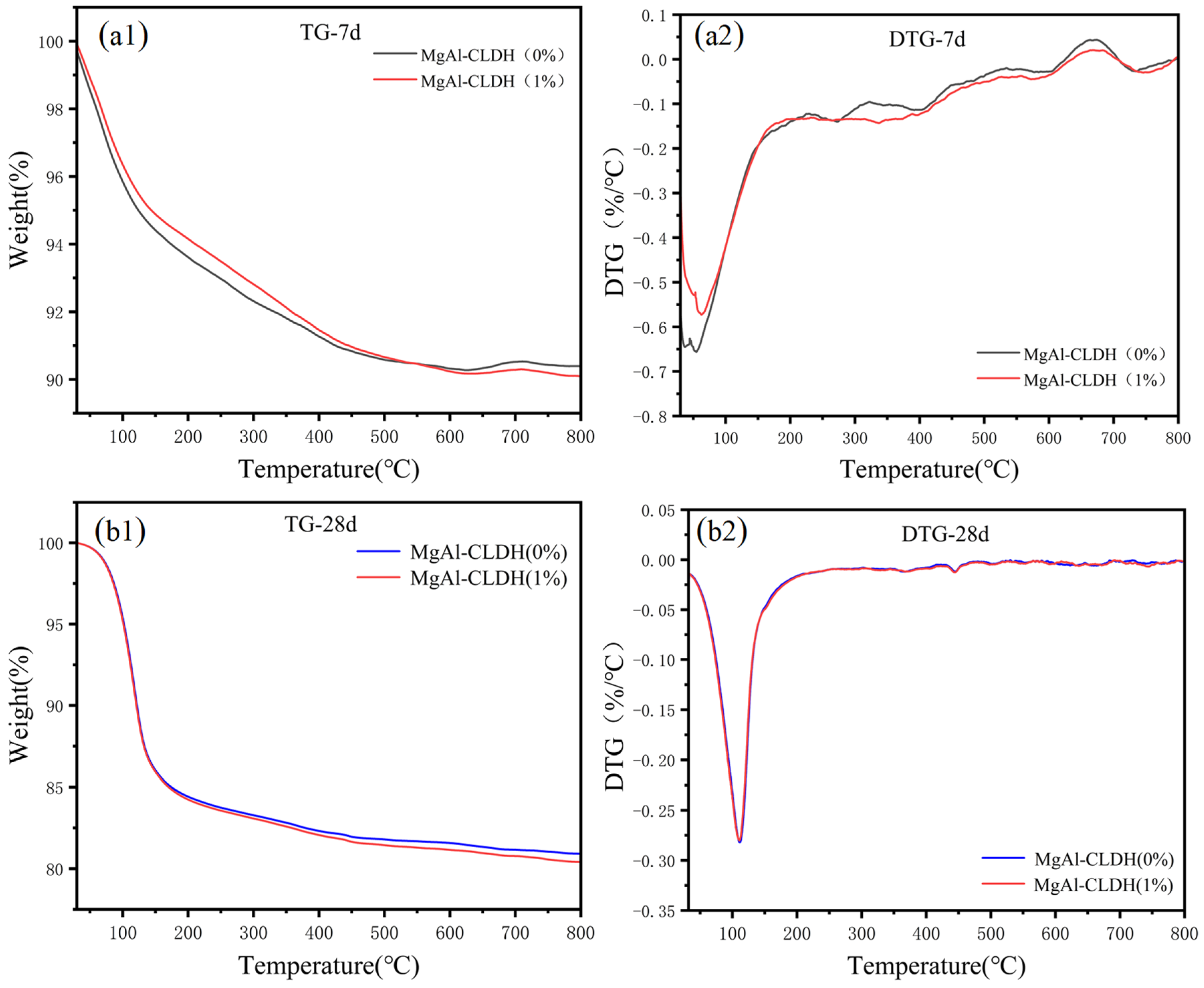
The TG and DTG curves of the reaction product samples are shown in Figure 8. No new weight loss peaks were detected across all temperature ranges, indicating that the addition of MgAl-CLDH did not change the type of hydration products. Four prominent weight loss peaks and several minor peaks were identifiable. Below 100 °C, the main weight loss is due to the removal of free water. In the range of 100–300 °C, the mass loss is related to the loss of bound water in the main hydration products, namely C-(N)-A-S-H and N-(C)-A-S-H gels [40]. It can be seen from Figure 8(a1,a2) that the peaks of C-(N)-A-S-H and N-(C)-A-S-H after adding exhibited samples show no significant differences from those of the samples without adding MgAl-CLDH, indicating that the contents of C-(N)-A-S-H and N-(C)-A-S-H in the two groups of samples are approximately the same after 7 days of reaction. This suggests that the main reason for the increase in the early strength of alkali-activated materials by adding CLDH is not the promotion of hydration product formation. Combined with the subsequent SEM analysis, the filling effect and the change in the elemental ratio of C-(N)-A-S-H are proposed to be the primary causes for the increased compressive strength. There is a significant weight loss peak at 400–500 °C, mainly due to the endothermic dehydroxylation process of Ca (OH)2 [41]. The extensive weight loss in the range of 500–800 °C is mainly due to the decomposition of CaCO3. Poorly crystallized calcite and amorphous CaCO3 decompose at 500–600 °C, while well-crystallized CaCO3 begins to decompose at around 700 °C [42,43]. For the samples cured for 28 days, only one dominant weight loss peak was observed, which is mainly attributed to the loss of free and bound water in the hydration product gels. This indicates that with the extension of curing time, gel formation continues to increase, accompanied by a corresponding improvement in compressive strength. At the same time, it can be seen from the TG curve that in the range of 100–300 °C, the mass loss of the samples with CLDH is slightly greater than that of the samples without CLDH, indicating that the addition of CLDH is conducive to promoting later hydration, generating more hydration products, and thereby increasing the compressive strength. Additionally, there is a small weight loss peak at 400–500 °C, which is again attributed to the endothermic dehydroxylation process of Ca(OH)2.

3.6. Impacts of CLDH on Micromorphology and Chemical Composition

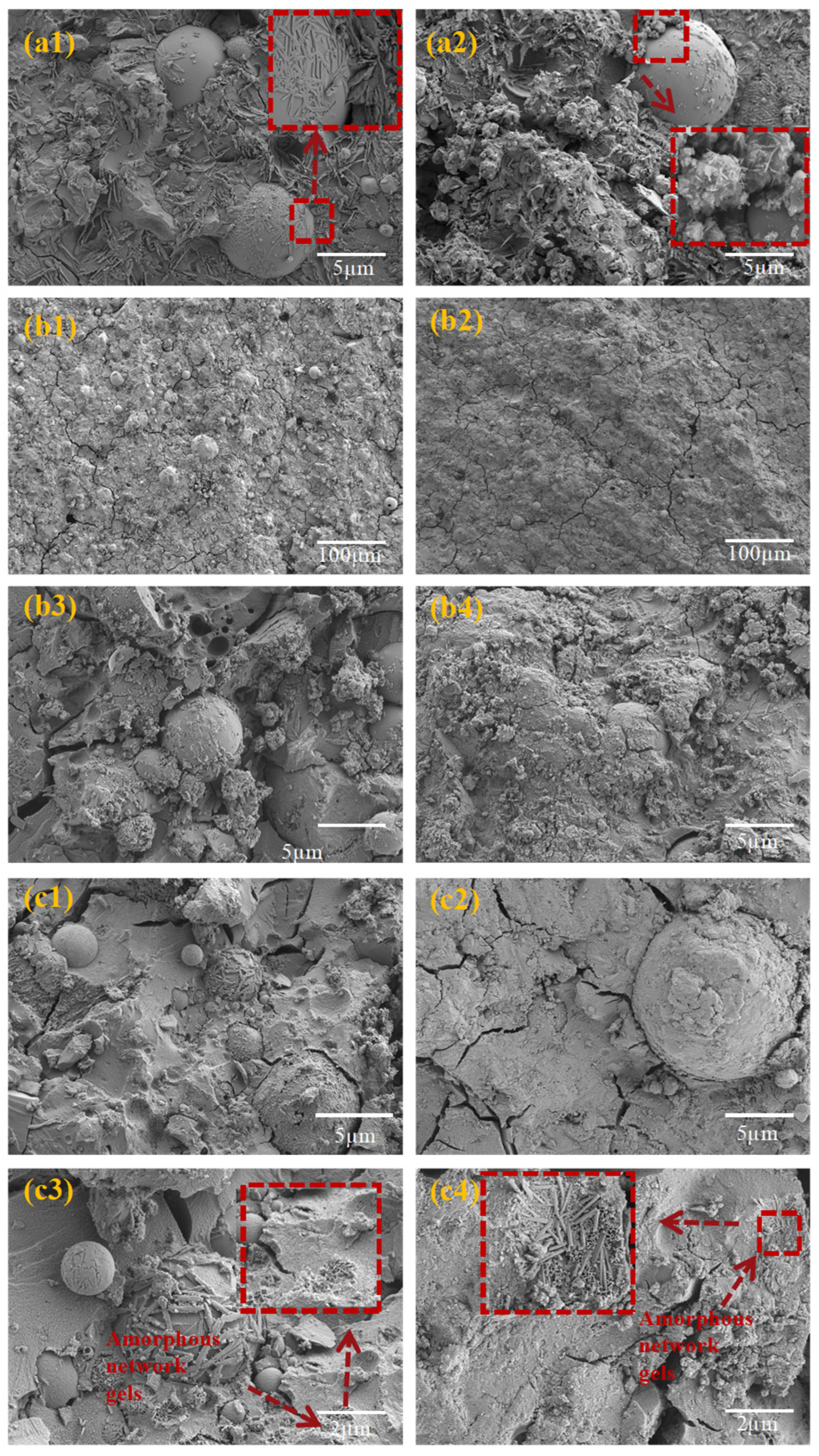
To reveal the surface morphology details of the reaction products at specific reaction stages, SEM analysis was conducted, as shown in Figure 9. At the early stage (3d), the microstructures of both sample groups consisted of gel phases, voids, cracks, and unreacted particles. Owing to the short curing time, a large number of undissolved fly ash particles was observed. In the control group samples, due to alkaline erosion, a large amount of flaky products was produced, which adhered to the substrate and the surface of fly ash particles. Compared with the control group, the samples with CLDH added showed more gel-like morphologies. As shown in the figure, the samples with CLDH added not only generated a small amount of flaky products but also a large amount of cluster-like gel products. It is speculated that the nucleation effect of CLDH promoted the formation of cluster gel products, which covered and combined with the fly ash particles, enabling the material to achieve higher compressive strength and facilitating subsequent strength development. After 7 days of reaction, with the prolongation of curing time, an increase in gel content was observed, which contributed to the improvement of compressive strength in the samples. More steel slag and fly ash participated in the reaction, and the surface of fly ash particles was covered by more gel products. EDS analysis indicated that the Al content in the C-(N)-A-S-H gel increased compared to that at 3d, implying that soluble Al species in the system reacted and facilitated the formation of C-(N)-A-S-H gel. Compared with the control group, the fly ash in the experimental group was coated and combined with the products, reducing harmful pores, which was the main reason for the increase in strength. After 28 days of reaction, most of the FA particles reacted under the action of the alkaline activator solution, and the residual shells of FA after reaction were clearly visible in the matrix. It can be seen that the microstructure of the samples with CLDH added was slightly different from that of the control group. Specifically, in the CLDH samples, the combination between gel products and fly ash was better, which might be due to the nucleation effect of CLDH promoting the formation of gel products and their good combination with fly ash. Meanwhile, at higher magnifications, amorphous reticular gel was observed in both groups. In the control group, the surfaces of FA particles were covered by a large amount of flaky gel; whereas in the experimental group, flaky gel was interwoven with amorphous reticular gel.
Figure 10 presents the EDS analysis results of the C-(A)-S-H gel in the hydrated samples after 28 d of curing. The data reveal that the C-(A)-S-H gel in the 1% CLDH sample shows a slight increase in Si/Ca and Al/Ca atomic ratios compared with the control sample. This observation implies that the C-(A)-S-H gel in 1% CLDH sample possesses a higher mean chain length (MCL) and polymerization degree [44,45]. Furthermore, the elevated Al/Ca ratio suggests that more aluminum participates in the reaction within this system. During the reaction process, Al atoms can substitute for Si in the C-S-H structure, thereby forming Al tetrahedra [46]. This fraction of aluminum is likely derived from fly ash. XRD analysis results show a difference in Ca (OH)2 content between the 1% CLDH and 0% CLDH samples. A considerable amount of aluminum from FA is incorporated into the hydration system, consuming Ca (OH) 2 in the system and actively participating in the pozzolanic reaction [47]. Consequently, the higher Al/Ca atomic ratio observed in the 1% CLDH sample not only indicates the substitution of silicon by aluminum but also favors the improvement of mechanical strength [48].

4. Discussion

The incorporation of CLDH effectively addresses the low strength issues in alkali-activated steel slag materials caused by poor volumetric stability and inadequate hydration activity. Experimental results demonstrate that CLDH influences both hydration kinetics and the growth of hydration products while simultaneously providing physical filling effects. These synergistic modifications collectively alter the microstructure and densification degree of the alkali-activated system, thereby promoting strength development. Consistent with established mechanisms in cementitious systems [27,49], nanoscale materials like CLDH serve as preferential nucleation sites that accelerate the crystallization of hydration products. Hydration kinetic analysis reveals enhanced heat evolution following CLDH addition, which is attributed to its nucleation-promoting capacity. EDS further indicates aluminum enrichment in the gel phase, suggesting an increased polymerization degree via Al incorporation. Microstructural characterization using XRD and SEM confirms that the nanoscale particle size of CLDH enables effective pore-filling, particularly reducing harmful pores within the 50–200 nm range. This physical densification mechanism optimizes pore structure and improves matrix compactness. Notably, the reinforcement effect exhibits dosage dependency: while 3% CLDH addition enhances early-age (3 d) strength, it leads to mechanical property degradation after 7 d due to the formation of weak zones induced by particle agglomeration [50,51]. Therefore, the optimal CLDH dosage is determined to be 1% based on comprehensive performance evaluations.
The application of synthesized CLDH in alkali-activated steel slag materials provides a new technical approach for the high-value upcycling of steel slag. However, several challenges must be carefully addressed for practical engineering applications. The chemical composition and fineness of materials may vary depending on their source and production process, which can affect reactivity and long-term strength development [52]. The fresh properties and long-term durability of CLDH-modified alkali-activated steel slag materials still need to be thoroughly investigated. It is crucial to bridge the gap between laboratory innovation and practical application through comprehensive performance testing and field validation.

5. Conclusions

This study focuses on the influence of CLDH on the hydration process, mechanical properties and microstructure of alkali-activated steel slag cementitious materials. The main conclusions are as follows:
  • The hydration heat test results show that in the initial reaction stage, the hydration heat peak decreases due to the dilution effect of CLDH. As the hydration reaction proceeds, the cumulative heat release of the 1% CLDH sample exceeds that of the control sample when the reaction time approaches 3 d. Thus, CLDH exerts a certain promotional effect on the hydration reaction of the system.
  • The compressive strength of steel slag cementitious materials containing CLDH is enhanced at all curing ages. Among them, the compressive strength of materials with 1% CLDH and 2% CLDH exhibits the most significant improvement: at 3 d of reaction, the compressive strength can increase by 21.5%, and at 28 d of reaction, it can still increase by 116.7%. However, when the CLDH dosage exceeds 2%, it will have a negative impact, especially on the compressive strength at 7and 28 d.
  • SEM analysis shows that the addition of CLDH changes the morphology of the gel products. Due to the nucleation effect of CLDH, it promotes the formation of cluster gel products, which cover and combine with fly ash particles, thereby endowing the material with higher compressive strength. EDS elemental analysis reveals that the addition of CLDH changes the microstructure of C-(A)-S-H. When 1% CLDH is used, a higher Si/Ca ratio can be observed relative to the control group.
  • The strengthening mechanism of CLDH on alkali-activated steel slag cementitious materials can be summarized into three pathways: (1) the micro-filling effect reduces pore defects; (2) CLDH does not significantly increase the amount of early hydration products (7 days), but optimizes the microstructure and elemental ratio of C-(A)-S-H gel; and (3) CLDH slightly promotes the hydration of steel slag after 7 days.

Author Contributions

Conceptualization, B.H.; Methodology, B.H.; Software, Z.Y.; Validation, F.C. and Z.T.; Formal analysis, Z.C.; Investigation, F.C., Z.T. and X.J.; Resources, L.Z. and D.C.; Data curation, Z.C.; Writing—original draft, F.C.; Writing—review & editing, L.Z.; Visualization, X.J.; Supervision, D.C. and Z.Y.; Project administration, L.Z.; Funding acquisition, L.Z. All authors have read and agreed to the published version of the manuscript.

Funding

This research was funded by State Key Laboratory of Iron and Steel Industry Environmental Protection, grant number YDG2026FM09.

Data Availability Statement

The original contributions presented in this study are included in the article. Further inquiries can be directed to the corresponding author(s).

Conflicts of Interest

The authors declare no conflict of interest.

References

  1. Cembureau. The European Cement Association (Cembureau) 2020 Activity Report; Cembureau—The European Cement Association: Brussels, Belgium, 2021. [Google Scholar]
  2. IEA. Cement Technology Roadmap 2009—Carbon Emissions Reductions up to 2050; World Business Council on Sustainable Development (WBCSD): Geneva, Switzerland; International Energy Agency (IEA): Paris, France, 2009. [Google Scholar]
  3. Mikulčić, H.; Klemeš, J.J.; Vujanović, M.; Urbaniec, K.; Duić, N. Reducing greenhouse gasses emissions by fostering the deployment of alternative raw materials and energy sources in the cleaner cement manufacturing process. J. Clean. Prod. 2016, 136, 119–132. [Google Scholar] [CrossRef]
  4. Provis, J.L. Alkali-activated materials. Cem. Concr. Res. 2018, 114, 40–48. [Google Scholar] [CrossRef]
  5. Provis, J.L.; Palomo, A.; Shi, C. Advances in understanding alkali-activated materials. Cem. Concr. Res. 2015, 78, 110–125. [Google Scholar] [CrossRef]
  6. Li, L.; Xie, J.; Zhang, B.; Feng, Y.; Yang, J. A state-of-the-art review on the setting behaviours of ground granulated blast furnace slag- and metakaolin-based alkaliactivated materials. Constr. Build. Mater. 2023, 368, 130389. [Google Scholar] [CrossRef]
  7. Rashad, A.M.; Khafaga, S.A.; Gharieb, M. Valorization of fly ash as an additive for electric arc furnace slag geopolymer cement. Constr. Build. Mater. 2021, 294, 123570. [Google Scholar] [CrossRef]
  8. Guo, J.; Bao, Y.; Wang, M. Steel slag in China: Treatment, recycling, and management. Waste Manag. 2018, 78, 318–330. [Google Scholar] [CrossRef]
  9. Zhao, L.H.; Wei, W.; Bai, H.; Zhang, X.; Cang, D.Q. Synthesis of steel slag ceramics: Chemical composition and crystalline phases of raw materials. Int. J. Miner. Metall. Mater. 2015, 22, 325–333. [Google Scholar] [CrossRef]
  10. Liu, P.; Zhang, M.; Mo, L.; Zhong, J.; Xu, M.; Deng, M. Probe into carbonation mechanism of steel slag via FIB-TEM: The roles of various mineral phases. Cem. Concr. Res. 2022, 162, 106991. [Google Scholar] [CrossRef]
  11. Hao, X.S.; Liu, X.M.; Zhang, Z.Q.; Zhang, W.; Lu, Y.; Wang, Y.G.; Yang, T.Y. Indepth insight into the cementitious synergistic effect of steel slag and red mud on the properties of composite cementitious materials. J. Build. Eng. 2022, 52, 104449. [Google Scholar] [CrossRef]
  12. Humbert, P.S.; Castro-Gomes, J. CO2 activated steel slag-based materials: A review. J. Clean. Prod. 2018, 208, 448–457. [Google Scholar] [CrossRef]
  13. Hou, J.W.; Lv, Y.; Liu, J.X.; Wu, Q.S. Expansibility of cement paste with tri-component f-CaO in steel slag. Mater. Struct. 2018, 51, 113. [Google Scholar] [CrossRef]
  14. Huo, B.B.; Li, B.L.; Huang, S.Y.; Chen, C.; Zhang, Y.M.; Banthia, N. Hydration and soundness properties of phosphoric acid modified steel slag powder. Construct. Build. Mater. 2020, 254, 119319. [Google Scholar] [CrossRef]
  15. Zhang, L.L.; Wang, Q.G.; Zheng, Y.C.; Cang, Z.Z.; Gisele, K.; Yu, C.S.; Cang, D.Q. Synergistic effect and mechanism of waste glass on the mechanical properties and autoclave stability of cementitious materials containing steel slag. Construct. Build. Mater. 2021, 311, 125295. [Google Scholar] [CrossRef]
  16. Chen, Z.; Liu, Y.; He, B.; Jing, X.; Cang, D.; Zhang, L. Study on evolution of pores channel in carbonation steel slag samples with Fly Ash. Constr. Build. Mater. 2024, 411, 134471. [Google Scholar] [CrossRef]
  17. Papayianni, I.; Anastasiou, E. Effect of granulometry on cementitious properties of ladle furnace slag. Cem. Concr. Compos. 2012, 34, 400–407. [Google Scholar] [CrossRef]
  18. Kim, S.; Kim, J.; Jeon, D.; Yang, J.; Moon, J. Enhanced mechanical property of steel slag through glycine-assisted hydration and carbonation curing. Cem. Concr. Compos. 2024, 149, 105532. [Google Scholar] [CrossRef]
  19. Qu, J.; Zhang, Q.; Li, X.; He, X.; Song, S. Mechanochemical approaches to synthesize layered double hydroxides: A review. Appl. Clay Sci. 2016, 119, 185–192. [Google Scholar] [CrossRef]
  20. Chafiq, M.; Chaouiki, A.; Suhartono, T.; Hazmatulhaq, F.; Ko, Y.G. Interface engineering of LDH-based material as efficient anti-corrosive system via synergetic performance of host, interlayers, and morphological features of nature-mimic architectures. Chem. Eng. J. 2023, 462, 142239. [Google Scholar] [CrossRef]
  21. Wang, X.; Zhu, J.; Zou, F.; Zhou, N.; Li, Y.; Lei, W. Ca-Al LDH hybrid self-healing microcapsules for corrosion protection. Chem. Eng. J. 2022, 447, 137125. [Google Scholar] [CrossRef]
  22. Duan, P.; Yan, C.; Zhou, W. Effects of calcined layered double hydroxides on carbonation of concrete containing fly ash. Construct. Build. Mater. 2018, 160, 725–732. [Google Scholar] [CrossRef]
  23. Jiang, H.; Tian, D.; Dong, M.; Lv, M.; Yang, X.; Lu, S. Effects of interlayer-modified layered double hydroxides with organic corrosion inhibiting ions on the propertiesof cement-based materials and reinforcement corrosion in chloride environment. Cem. Concr. Compos. 2024, 154, 105793. [Google Scholar] [CrossRef]
  24. Liu, J.; Gao, X.; Chen, T. Effect of SiO2-modified calcined layered double hydroxides on the properties of cement-based material: Crucial role of the phasetransformation induced by alkaline pore solution. Cem. Concr. Res. 2024, 178, 107465. [Google Scholar] [CrossRef]
  25. Zhang, M.; Wang, F.; Long, Y.; Yu, L.; Yang, C.; Wen, M.; Yu, X.; Tian, Y.; Zhao, M. Improving the carbonation resistance of alkali-activated slag mortars by calcined Mg/Al layered double hydroxides. Appl. Clay Sci. 2022, 216, 106379. [Google Scholar] [CrossRef]
  26. Chen, M.; Liu, Q.; Zheng, H.; Yu, L.; Jiang, L.; Gu, Z.; Li, W. Understanding strengthening mechanisms of Ca-LDO on cementitious materials. Cem. Concr. Compos. 2024, 145, 105340. [Google Scholar] [CrossRef]
  27. Zhang, Z.; Zhou, Z.; Zhu, H.; Duan, P.; Fang, Y.; Jiang, Z. Mechanisms of CLDH seeding on hydration kinetics of slag-based geopolymer: Towards aluminosilicate cement phase engineering. Compos. B Eng. 2024, 271, 111157. [Google Scholar] [CrossRef]
  28. Martins, A.C.; De Carvalho, J.M.; Costa, L.C.; Andrade, H.D.; de Melo, T.V.; Ribeiro, J.C.; Pedroti, L.G.; Peixoto, R.A. Steel slags in cement-based composites: Anultimate review on characterization, applications and performance. Constr. Build. Mater. 2021, 291, 123265. [Google Scholar] [CrossRef]
  29. Long, W.-J.; Xie, J.; Zhang, X.; Fang, Y.; Khayat, K.H. Hydration and microstructure of calcined hydrotalcite activated high-volume fly ash cementitious composite. Cem. Concr. Compos. 2021, 123, 104213. [Google Scholar] [CrossRef]
  30. He, B.; Zhu, X.; Lei, Y.; Jing, X.; Liu, Y.; Chen, Z.; Cang, D.; Birat, J.-P.; Tang, Z.; Zhang, L. Utilizing Alkaline Solid Waste for Low-Carbon Construction Material via In-Situ Calcium Phase Design. Nat. Commun. 2025, 16, 7275. [Google Scholar] [CrossRef] [PubMed]
  31. GB/T 17671-2021; Test method of cement mortar strength (ISO method). Standardization Administration of China, 2021.
  32. Vagvolgyi, V.; Palmer, S.J.; Kristof, J.; Frost, R.L.; Horvath, E. Mechanism for hydrotalcite decomposition: A controlled rate thermal analysis study. J. Colloid Interface Sci. 2008, 318, 302–308. [Google Scholar] [CrossRef]
  33. Zheludkevich, M.L.; Poznyak, S.K.; Rodrigues, L.M.; Raps, D.; Hack, T.; Dick, L.F.; Nunes, T.; Ferreira, M.G.S. Active protection coatings with layered double hydroxide nanocontainers of corrosion inhibitor. Corros. Sci. 2010, 52, 602–611. [Google Scholar] [CrossRef]
  34. Tedim, J.; Kuznetsova, A.; Salak, A.N.; Montemor, F.; Snihirova, D.; Pilz, M.; Zheludkevich, M.L.; Ferreira, M.G.S. Zn-Al layered double hydroxides as chloride nanotraps in active protective coatings. Corros. Sci. 2012, 55, 1–4. [Google Scholar] [CrossRef]
  35. Xu, S.; Chen, Z.; Zhang, B.; Yu, J.; Zhang, F.; Evans, D.G. Facile preparation of pureCaAl-layered double hydroxides and their application as a hardening accelerator inconcrete. Chem. Eng. J. 2009, 155, 881–885. [Google Scholar] [CrossRef]
  36. Yang, Z.; Fischer, H.; Cerezo, J.; Mol, J.M.C.; Polder, R. Aminobenzoate modified MgAl hydrotalcites as a novel smart additive of reinforced concrete for anticorrosion applications. Construct. Build. Mater. 2013, 47, 1436–1443. [Google Scholar] [CrossRef]
  37. Chithiraputhiran, S.; Neithalath, N. Isothermal reaction kinetics and temperature dependence of alkali activation of slag, fly ash and their blends. Construct. Build. Mater. 2013, 45, 233–242. [Google Scholar]
  38. Bernal, S.A.; Provis, J.L.; Rose, V.; de Gutierrez, R.M. Evolution of binder structure in sodium silicate-activated slag-metakaolin blends. Cem. Concr. Compos. 2011, 33, 46–54. [Google Scholar] [CrossRef]
  39. Ke, X.; Bernal, S.A.; Provis, J.L. Controlling the reaction kinetics of sodium carbonate-activated slag cements using calcined layered double hydroxides. Cem. Concr. Res. 2016, 81, 24–37. [Google Scholar] [CrossRef]
  40. Zhang, S.; Li, Z.; Ghiassi, B.; Yin, S.; Ye, G. Fracture properties and microstructure formation of hardened alkali-activated slag/fly ash pastes. Cem. Concr. Res. 2021, 144, 106447. [Google Scholar] [CrossRef]
  41. Tsivilis, S.; Kakali, G.; Chaniotakis, E.; Souvaridou, A. A study on the hydration of portland limestone cement by means of TG. J. Therm. Anal. Calorim. 1998, 52, 863–870. [Google Scholar] [CrossRef]
  42. Thiery, M.; Villain, G.; Dangla, P.; Platret, G. Investigation of the carbonation front shape on cementitious materials: Effects of the chemical kinetics. Cem. Concr. Res. 2007, 37, 1047–1058. [Google Scholar] [CrossRef]
  43. Abdalqader, A.F.; Jin, F.; Al-Tabbaa, A. Characterisation of reactive magnesia and sodium carbonate-activated fly ash/slag paste blends. Constr. Build. Mater. 2015, 93, 506–513. [Google Scholar] [CrossRef]
  44. Gao, Y.; Zhu, X.; Corr, D.J.; Konsta-Gdoutos, M.S.; Shah, S.P. Characterization of the interfacial transition zone of CNF-Reinforced cementitious composites. Cem. Concr. Compos. 2019, 99, 130–139. [Google Scholar] [CrossRef]
  45. Shen, P.; Lu, L.; He, Y.; Wang, F.; Hu, S. The effect of curing regimes on the mechanical properties, nano-mechanical properties and microstructure of ultrahigh performance concrete. Cem. Concr. Res. 2019, 118, 1–13. [Google Scholar] [CrossRef]
  46. Huang, H.; Teng, L.; Gao, X.; Khayat, K.H.; Wang, F.; Liu, Z. Effect of carbon nanotube and graphite nanoplatelet on composition, structure, and nano-mechanical properties of C-S-H in UHPC. Cem. Concr. Res. 2022, 154, 106713. [Google Scholar] [CrossRef]
  47. Zhao, Y.; Zheng, Y.; Cui, K.; Shen, P.; Poon, C.S.; Moon, J.; Peng, G.; Guo, R.; Xia, D. An innovative ternary carbon-fixing cementitious system of cement-fly ash-carbonated steel slag. Cem. Concr. Compos. 2025, 160, 106042. [Google Scholar] [CrossRef]
  48. Kani, E.N.; Mehdizadeh, H. Investigating gel molecular structure and its relation with mechanical strength in geopolymer cement based on natural pozzolan using in situ ATR-FTIR spectroscopy. J. Mater. Civ. Eng. 2017, 29, 04017078. [Google Scholar] [CrossRef]
  49. Ye, H. Nanoscale attraction between calcium-aluminosilicate-hydrate and Mg-Al layered double hydroxides in alkali-activated slag. Mater. Charact. 2018, 140, 95–102. [Google Scholar] [CrossRef]
  50. Li, H.; Xiao, H.G.; Ou, J.P. A study on mechanical and pressure-sensitiveproperties of cement mortar with nanophase materials. Cem. Concr. Res. 2004, 34, 435–438. [Google Scholar]
  51. Li, H.; Xiao, H.G.; Yuan, J.; Ou, J. Microstructure of cement mortar with nanoparticles. Compos. B Eng. 2004, 35, 185–189. [Google Scholar] [CrossRef]
  52. Bahmani, H.; Mostafaei, H. Sustainable high-performance concrete: Harnessing recycled rubber and slag for strength and eco-friendliness. Sci. Rep. 2026, 16, 7376. [Google Scholar] [CrossRef]
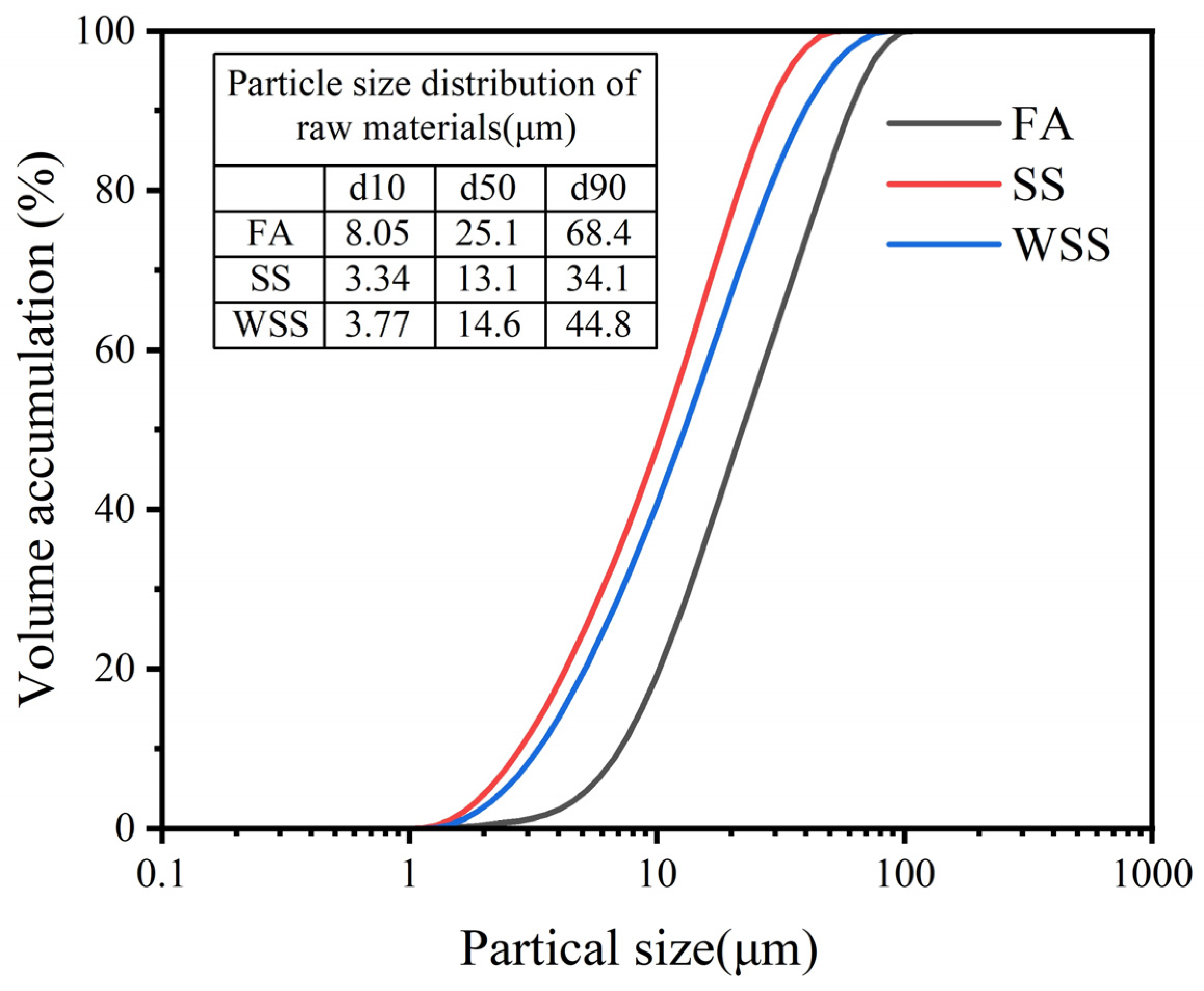
Figure 1. The particle size distribution of raw materials.
Processes 14 00974 g001
Figure 2. XRD pattern of WSS and FA.
Processes 14 00974 g002
Figure 3. Morphological characterization of samples: SEM images and EDS mapping spectra of (a) MgAl-LDH, (b) MgAl-CLDH.
Processes 14 00974 g003
Figure 4. XRD pattern of MgAl-LDH and MgAl-CLDH.
Processes 14 00974 g004
Figure 5. Effect of CLDH on the compressive strength of steel slag based AAMs. (a) Compressive strength of AAMs with different dosage of MgAl-CLDH at different curing ages. (b) The relative growth rate of compressive strength of AAMs with different dosage of MgAl-CLDH compared to the sample without MgAl-CLDH at different curing ages.
Processes 14 00974 g005
Figure 6. Hydration heat curve of AAMs in 72 h. (a) Heat flow. (b) Cumulative heat.
Processes 14 00974 g006
Figure 7. XRD patterns of AAMs with MgAl-CLDH after hydration for (a) 3 d, (b) 7 d and (c) 28 d.
Processes 14 00974 g007
Figure 8. TG-DTG curves of AAMs with MgAl-CLDH after hydration for (a1) TG-7d; (a2) DTG-7d; (b1) TG-28d; (b2) DTG-28d.
Processes 14 00974 g008
Figure 9. SEM images of AAMs after hydration for 3 days: (a1) Ref., (a2) 1% CLDH; 7 days: (b1,b3) Ref., (b2,b4) 1% CLDH; 28 days: (c1,c3) Ref., (c2,c4) 1% CLDH.
Processes 14 00974 g009
Figure 10. BSE-EDS analysis of hydrated samples at 28 days: (a) Ref., (b) 1% CLDH.
Processes 14 00974 g010
Table 1. The elemental (oxide) content of the precursor powders.
Oxide wt. (%) SiO2Al2O3CaOFe2O3K2OMgOMnOOthers
Fly ash (FA) 56.17920.9368.4256.3062.2931.6690.1473.882
Steel slag (SS) 16.8522.74842.00623.8370.0515.5515.2043.719
Water steel slag (WSS) 16.7632.68741.99024.1290.0515.3805.2813.662
Table 2. The details of mixture proportion of AAMs.
SamplesWSSFASodium HydroxideSodium SilicateMsw/bCLDH
CLDH (0 wt%) 70302.3114.361.40.330
CLDH (1 wt%) 70302.3114.361.40.331
CLDH (2 wt%) 70302.3114.361.40.332
CLDH (3 wt%) 70302.3114.361.40.333
Disclaimer/Publisher’s Note: The statements, opinions and data contained in all publications are solely those of the individual author(s) and contributor(s) and not of MDPI and/or the editor(s). MDPI and/or the editor(s) disclaim responsibility for any injury to people or property resulting from any ideas, methods, instructions or products referred to in the content.