Article

Insights into the Oxidation Mechanism and Oxidative Stability of Nettle (Urtica dioica L.) Seed Oil: Differential Scanning Calorimetry and Ozawa–Flynn–Wall Method


1
Department of Food Technology and Biotechnology, Faculty of Technology, University of Niš, 16000 Leskovac, Serbia
2
Department of Materials Engineering, Faculty of Technology, University of Novi Sad, 21000 Novi Sad, Serbia
3
Department of Plant Origin Food Sciences, Faculty of Veterinary Hygiene and Ecology, University of Veterinary Sciences Brno, 612 42 Brno, Czech Republic
*
Author to whom correspondence should be addressed.
Processes 2026, 14(6), 887; https://doi.org/10.3390/pr14060887
Submission received: 26 February 2026 / Revised: 6 March 2026 / Accepted: 9 March 2026 / Published: 10 March 2026
(This article belongs to the Section Food Process Engineering)

Abstract

Oxidation of oils is a free-radical cascade of reactions leading to the formation of undesirable odors and tastes, nutrient degradation, and potentially harmful compounds. To better understand the oxidation process, the kinetic parameters were examined depending on the degree of conversion (0 ≤ α ≤ 1) in this study. This approach provides insight into the complexity of the oxidative mechanism and allows a more reliable evaluation of the oxidative stability of nettle seed oil and its behavior during thermal treatment. A non-isothermal DSC method was applied, and kinetic parameters including the activation energy (Ea), the pre-exponential factor (A), and the reaction rate constant (k) were evaluated by applying the isoconversional Ozawa–Flynn–Wall method. Based on kinetic parameters, a simulation of oil oxidation at constant temperature (22 °C) was performed and the oil induction time was estimated. This value was compared to the ones obtained by OXITEST method. The observed conversion-dependent kinetic parameters demonstrate the complex oxidation behavior of nettle seed oil and justify the application of conversion-sensitive kinetic models to accurately describe its thermal stability. The induction period obtained under accelerated oxidation conditions suggests satisfactory oxidative stability of oil and highlights its potential suitability for nutritional and functional applications.

1. Introduction

Stinging nettle (Urtica dioica L.) is classified as a perennial herbaceous species of the family Urticaceae, widely distributed in temperate and tropical regions of Europe, Asia and North America [1]. Nettle is a good source of phenolic compounds, vitamins, minerals, and pigments, but it is also extremely rich in proteins, carbohydrates and fats [2]. It is known for its pronounced antioxidant, anti-inflammatory, antimicrobial and other activities [3,4]. Its seeds contain a high content of oil and phenolic compounds and have pronounced antioxidant properties. Nettle seed oil consists mainly of polyunsaturated fatty acids, among which linoleic is the most abundant. Due to its rich nutritional composition, particularly the high content of polyunsaturated fatty acids and bioactive compounds, nettle seed oil represents a nutritionally valuable resource with potential economic relevance for food and nutraceutical applications, particularly in the development of functional and value-added products [5,6].
The quality and nutritional value of seeds largely depend on the content of lipids, especially unsaturated fatty acids. The presence of unsaturated fatty acids (especially polyunsaturated linoleic and linolenic acids) significantly contributes to the potentially beneficial properties of the oil. In addition to improving functional properties, the high content of polyunsaturated fatty acids in the oil contributes to a higher nutritional value [7,8]. Oxidation of unsaturated fatty acids is one of the key processes that affects the stability, quality, and application of vegetable oils in the food, pharmaceutical, and other industries. Oxidation damages the chemical, physical, and organoleptic properties of oils and products containing them. Generally, oxidation proceeds via a free radical chain mechanism consisting of initiation, propagation, and termination stages. During the initiation stage, reactive radicals are formed from unsaturated fatty acids under the influence of heat, light, or metal catalysts. In the propagation stage, lipid radicals react with molecular oxygen to form lipid peroxyl radicals and hydroperoxides, which subsequently decompose into secondary oxidation products such as aldehydes, ketones, hydrocarbons, and epoxides. These compounds, particularly aldehydes and ketones, are mainly responsible for aroma and flavor changes. The termination stage involves the coupling of radical species, leading to the formation of stable non-radical products. The resulting reactive compounds can further interact with pigments, vitamins, proteins, etc., leading not only to sensory changes but also to alterations in the nutritional and functional properties of food products [9]. Therefore, understanding the oxidative stability of oils is essential for preserving the nutritional quality, ensuring safety, and optimizing their application in food, pharmaceutical, and other formulations.
Differential scanning calorimetry (DSC) is one of the most commonly used methods for studying oxidation processes and oxidative stability of oils. It is based on monitoring the heat change during heating in a controlled atmosphere, which can analyze exothermic and endothermic processes in non-isothermal or isothermal mode. DSC analysis enables the determination of important thermal parameters and is particularly useful for evaluating kinetic parameters, such as activation energy and reaction rate constant, as well as thermodynamic parameters, including heat capacity, entropy, and enthalpy of various processes. The calculation of the kinetic parameters can be achieved by applying internationally accepted model-free or isoconversional methods, Kissinger–Akahira–Sunose (KAS) and Ozawa–Flin–Wall (OFW) methods [10,11]. These methods are recommended by ICTAC and allow the calculation of kinetic parameters as a function of the degree of conversion, which is especially important in complex processes, such as oil oxidation, where the mechanism may vary during the reaction [10].
In the literature, there is a lot of data on the assessment of the oxidative stability of oils using these two types of isoconversional methods (KAS and OFW). Our previous work deals with the determination of the kinetic parameters of nettle seed oil oxidation using the KAS method [5]. In this work, the kinetic parameters were determined thanks to two parameters, the onset temperature of oxidation (Ton) and the temperature of the maximum of the peak (Tp). However, in order to achieve a deeper understanding of the oxidation process of nettle seed oil and gain a deeper insight into the complexity of the oxidative mechanism, a detailed kinetic characterization of the oil oxidation process is necessary, which, among other things, includes understanding the change in activation energy, pre-exponential factor, and reaction rate constant as a function of the degree of conversion. It is a fact that in the last decade, an increasing number of works apply DSC analysis to assess the oxidative stability of oils, but also to simulate isothermal induction times using kinetic parameters obtained from non-isothermal experiments. According to the research of Smook et al. (2022) [12], kinetic parameters determined as a function of the degree of conversion can be used to predict the oxidation behavior of oils at low temperatures and storage conditions, which makes this method particularly suitable when experimental determination of the induction time under isothermal conditions requires a long time. Therefore, the aim of this work was to determine the kinetic parameters (activation energy, Ea, pre-exponential factor, A and reaction rate constant, k) of the oxidation of nettle seed oil as a function of the degree of conversion, as well as to examine their dependence on the heating rate, by applying DSC analysis in the non-isothermal mode and using the isoconversion OFW method. The obtained kinetic parameters were used to potentially predict isothermal oxidation and storage conditions, and its stability and behavior during thermal treatment. In order to more comprehensively assess the oxidative stability, the oxidative stability was additionally tested using the OXITEST method, which enables the experimental determination of the induction period and serves as a complementary indicator of oil stability.

2. Materials and Methods

2.1. Plant Material

Nettle seeds (Urtica dioica L.) originating from the Central Serbia region (43°34′7.19″ N/21°54′.79″ E) were purchased from DOO “Jeligor”, Svrljig, Serbia. Prior to milling, the seeds were visually inspected and manually sorted to remove damaged, broken, or defective seeds. Then, the seeds were milled using an electric mill (Bosh, MKM 600, Gerlingen-Schillerhöhe, Germany) and passed through a 0.4 mm sieve. After milling, the material was immediately subjected to further analyses.

2.2. Extraction of Oil from the Nettle Seeds

Twenty grams of the sample were weighed and placed into a flask, into which 200 mL of the trichloroethylene (Sigma Aldrich, St. Louis, MI, USA, ACS reagent) was added. The flask was placed on a reflux extraction apparatus and heated using a heating mantle. Once boiling was achieved (at 87 °C), extraction was carried out for an additional 30 min. After cooling, the contents of the flask were filtered, and the filtrate evaporated in a vacuum evaporator (IKA-WERKE, Staufen, Germany) to an oily residue [5].

2.3. Non-Isothermal DSC Measurements

A non-isothermal DSC study of the oil was carried out on a differential scanning calorimeter, TA Instruments, Q20, USA (the TA Universal Analysis software, New Castle, DE, USA). Before the operation and measurement, the device was calibrated with indium. Nitrogen was used as a purge gas with a flow rate of 50 cm3 min−1. The oil sample was heated at three different heating rates, βi (5, 10, 20 °C min−1), starting from 40 °C until the beginning of the oxidation process.
The conversion rate of thermal decomposition of oils can be expressed as [12]:
d α d t = k T f α ,
where k(T) is the reaction rate that only depends on the absolute temperature T, α is the degree of conversion, and f(α) is the conversion function. The reaction rate can be described using an Arrhenius expression:
k ( T ) = A e x p E a R T ,
where A is the pre-exponential factor (s−1), Ea the apparent activation energy (J mol−1), R the universal gas constant (8.314 J mol−1K−1), and T the absolute temperature (K).
Using these expressions, the kinetic parameters (Ea, Af(α)) of the chemical process can be determined from experiments measuring the conversion rate (DSC, TGA). These thermal analyses are simple in cases where a single dominant chemical process occurs during the experiment, which can be described by a single set of kinetic parameters. However, oil oxidation is a complex process that involves multiple interconnected chemical reactions. Therefore, the single set of kinetic parameters is not sufficient to reliably predict the behavior of the oil during oxidation, with the kinetic parameters becoming a function of the degree of conversion. In such cases, the isoconversion method is applied. The isoconversion Ozawa–Flynn–Wall analysis enables the determination of the activation energy, which varies with conversion (α) and temperature (T). The activation energy Ea(α) was determined described by the following equation:
l n β = l n A E a g α R 1.052 E a R T α
For each degree of conversion, the dependence of ln(β) on 1/Tα is shown graphically, and the activation energy is calculated from the slope of the line [10,12].
The values of the apparent pre-exponential factor (A) are determined using the following equation:
A α = β E a ( α ) R T α 2 e x p E a ( α ) R T α
The reaction rate constant k(α,β) was calculated using the Arrhenius equation:
k α , β = A α e x p E a ( α ) R T α
Then, the graphs logk = f(α,β) and logA = f(α,β) were constructed. This allows visualization of changes in kinetic parameters at different heating rates and different stages of conversion.

2.4. OXITEST Analysis

Oil oxidation stability was determined using a VELP OXITEST Oxidation Stability Reactor (VELP Scientifica, Usmate, Italy) based on accelerated oxidation under controlled temperature and oxygen pressure. Oil samples were placed directly into the titanium oxidation chambers without prior chemical pretreatment. The chambers were sealed, flushed with pure oxygen, and pressurized (to 6 bar), then heated to a constant test temperature (90 °C). Oxidation progress was continuously monitored by measuring oxygen consumption as a function of time. The induction period, expressed in hours, was automatically calculated from the pressure–time curve and used as an indicator of oil oxidative stability [13]. The measurements were conducted in the laboratories of the Faculty of Technology in Leskovac, Serbia.

2.5. Data Processing

The DSC thermograms were analyzed using TA Universal Analysis software version 4.5A (TA Instruments, New Castle, DE, USA). The extracted data were further processed using OriginPro 6 (OriginLab Corporation, Northampton, MA, USA) software and Microsoft Excel for the construction of kinetic plots and calculation of kinetic parameters.

3. Results and Discussion

3.1. Kinetic Analysis of Nettle Seed Oil Oxidation Based on Non-Isothermal DSC Measurements

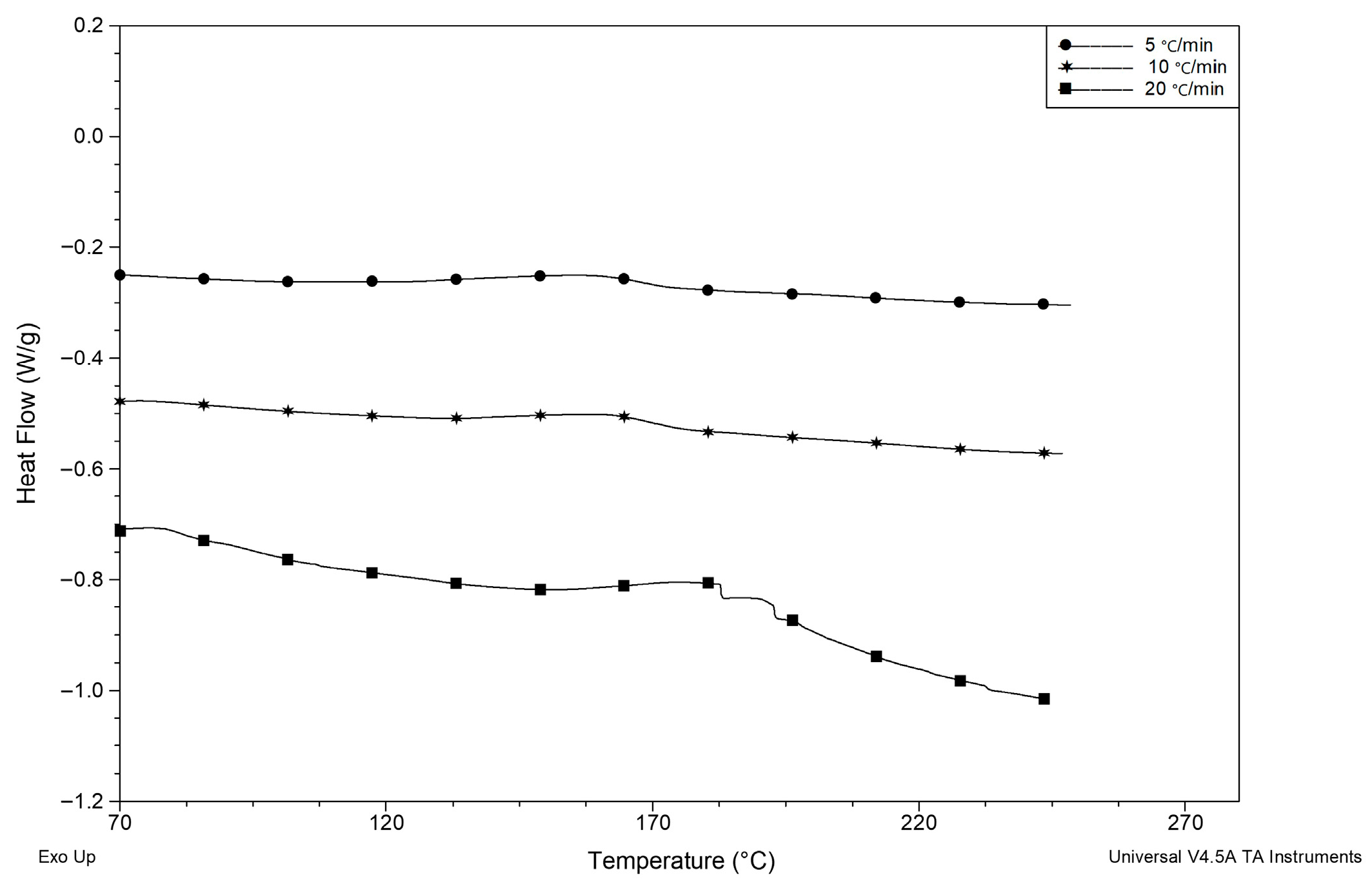
The DSC thermograms of nettle seed oil obtained under non-isothermal conditions (40–250 °C) at heating rates of 5, 10, and 20 °C min−1 are shown in Figure 1. The increase in temperature results in the appearance of an exothermic peak, which corresponds to thermo-oxidative degradation of the oil and generation of free radicals. The onset temperatures of the exothermic process were determined to be approximately 120, 130, and 150 °C for the corresponding heating rates (5, 10, and 20 °C min−1), respectively.
As mentioned earlier, the kinetic analysis of oil oxidation can be evaluated by following two isoconversional models, KAS and OFW. Several authors reported that to determine the kinetic parameters of oil oxidation using the KAS method, it is necessary to know three types of temperature: the start temperature (Ts), the onset temperature (Ton), and the peak temperature (Tp) [14,15,16].
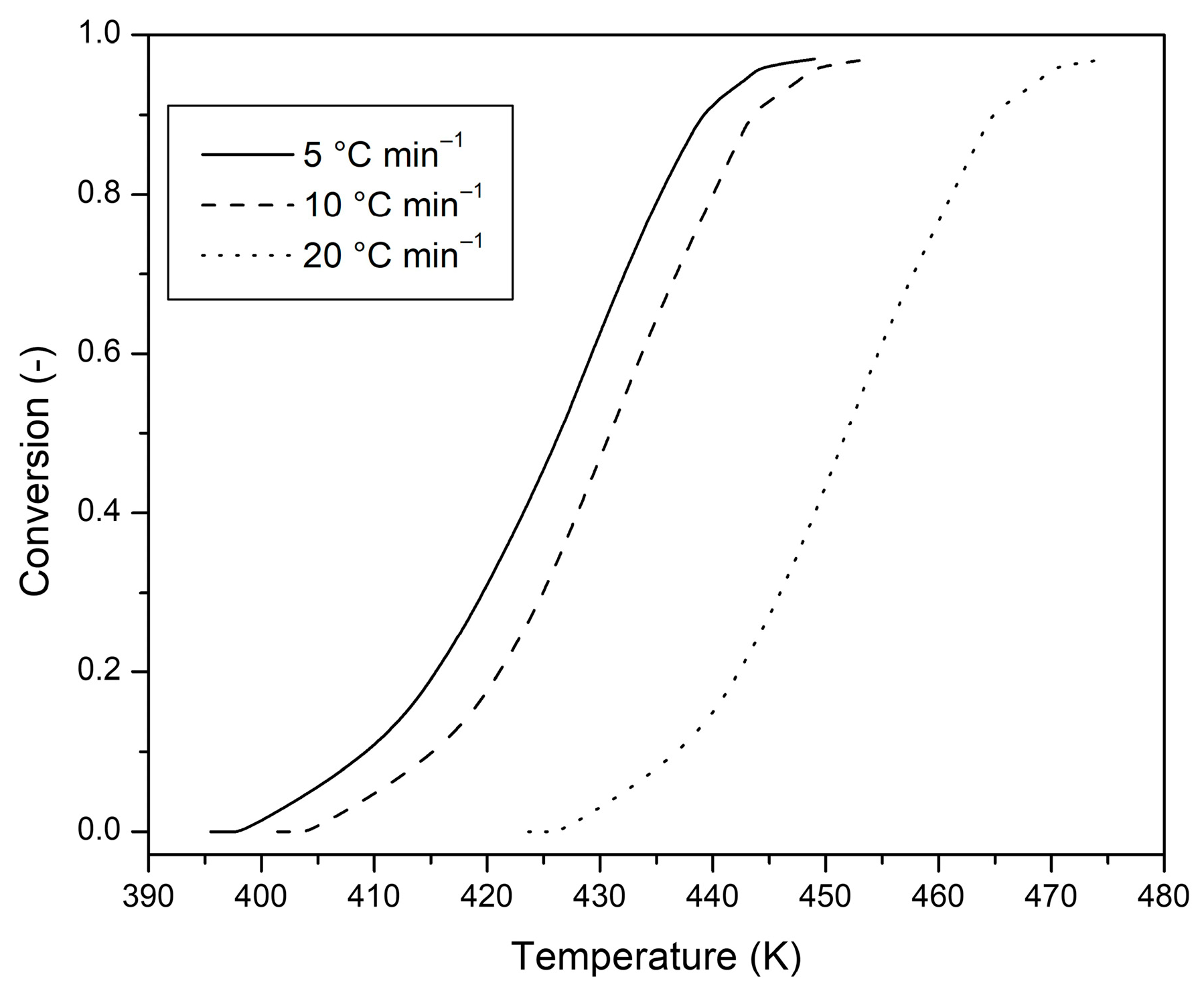
For the analysis of kinetic parameters of oil oxidation based on the OFW method, the key point is to compare the system with the degree of conversion [17]. In thermal analysis, the degree of conversion is defined as α = ΔHαHtotal, where ΔHα is the heat released at a certain value of conversion, and ΔHtotal is the total heat released during the process. Prior to applying the OFW method, the temperatures corresponding to fixed degrees of conversion were determined for each heating rate tested (5, 10, and 20 °C min−1). The curves describing the dependence of the degree of conversion on temperature are presented in Figure 2. It is observed that the degree of conversion increases with the increase in temperature for all heating rates, which is expected considering that the increase in temperature provides additional energy to the molecules, so more of them can be activated and participate in the reaction. On the other hand, as the reaction progresses, more and more of the reactants are converted into products, which additionally contributes to the increase in the degree of conversion. It is observed that the curve obtained at a heating rate of 20 °C min−1 is slightly steeper compared to the curves obtained at a heating rate of 5 and 10 °C min−1, which indicates a faster oxidation reaction.
It can also be seen from Figure 2 that at higher heating rates the onset of oxidation occurs at higher temperatures. This phenomenon was also observed in the work of Gundogar et al. (2014) [18] who analyzed crude oil of different origin using DSC analysis at a heating rate of 5, 10 and 15 °C min−1. The observed shift in the DSC signal with increasing heating rate is related to the behavior of oxidation intermediates. Under slower heating conditions, these intermediates (i.e., primary oxidation products) further react with oxygen to form low molecular weight secondary oxidation products (such as aldehydes and acids) which remain in the oil phase and promote oxidation. In contrast, higher heating rates favor the rapid volatilization of formed intermediates, limiting their participation in further oxidative reactions and resulting in a shift of the thermal event toward higher temperatures [14,15,19,20].
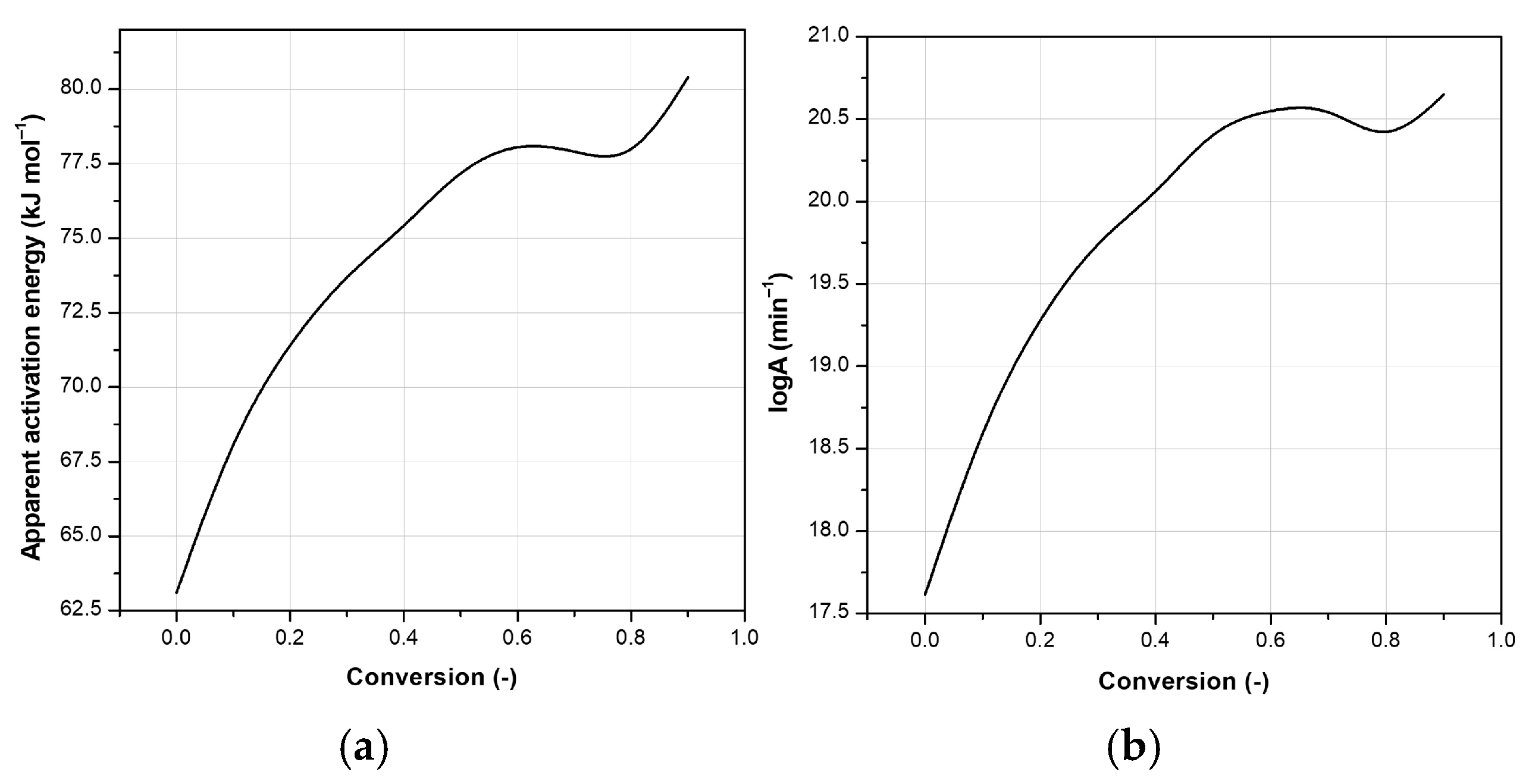
The calculated apparent activation energies for each degree of conversion are shown in Figure 3a. It can be seen from the figure that the activation energy curve in the conversion function can be divided into three domains. In the first domain (from conversion 0.1 to 0.6), the activation energy increases from 63.11 kJ mol−1 to 78.25 kJ mol−1. In the second domain (from conversion 0.6 to 0.75) it remains constant at approximately 78.9 kJ mol−1, and from 0.75 to 1, it increases again to 80.40 kJ mol−1. Thus, it is observed that with the increase in the degree of conversion, the activation energy also increases, which indicates the complexity of the reaction mechanism during the oil oxidation process. The results of our study are in agreement with literature data for other types of oils. Thus, the authors Kok and Gul (2013) [21] monitored the kinetics of the crude oil oxidation process at a heating rate of 5, 10 and 15 °C min−1 and found that the activation energy determined by the KAS method ranges from 33 (for the degree of conversion 0.1) to 78 kJ mol−1 (for the degree of conversion 0.9). The value of the activation energy at low conversion degrees depends on the structure of the fatty acids that make up the oil: the fact is that polyunsaturated fatty acids have more reactive centers (double bonds) and react with oxygen already in the initial stages of oxidation, requiring a lower activation energy. As the reaction proceeds, less reactive reaction products or more stable fractions (created by polymerization of oxidation products) are formed, which require more energy for further reactions, leading to an increase in activation energy [22,23]. In general, the activation energy is affected by the degree of polyunsaturation of the oil: a high content of polyunsaturated fatty acids (e.g., linoleic and linolenic acids) would decrease, while a high content of oleic acid in the fatty acid chain would increase the activation energy for oxidation. It should be noted that the kinetic parameters are influenced by other factors such as the presence of natural antioxidants (tocopherols, sterols, phenols) and pro-oxidants in the oil. Smook et al. (2022) [12] investigated the effect of adding antioxidants to oil and monitored the kinetic parameters of oil oxidation. They found that the main difference lies at conversions below 0.1. In this range, the addition of antioxidants increases the activation energy (and consequently the value for lnAf(α)), which leads to lower conversion rates at low conversions. Therefore, the antioxidant acts as expected and slows down oxidation. Overall, the results indicate that the oxidative degradation mechanism of nettle seed oil is a complex phenomenon involving several interconnected chemical reactions, such as the formation of hydroperoxides (primary oxidation products), their degradation, and the formation of secondary products. Therefore, the thermal decomposition process should not be represented by a single set of kinetic parameters over the entire conversion range [24].
In order to assess the reliability of the isoconversion approach, it should be noted that the activation energy at a low degree of conversion obtained by the OFW approach is almost equal to the activation energy obtained by the KAS method for the same degree of conversion. Namely, in our previous work, the kinetic parameters of the nettle seed oil oxidation were obtained based on the critical points (primarily Ton and Tp) determined on the DSC curves, using the KAS method [5]. According to this study, the activation energy calculated based on Ton was 63.48 kJ mol−1, which is about 0.58% difference compared to the activation energy obtained by the OFW approach. These results are in agreement with the literature results obtained for the activation energy of thermal decomposition of biomass samples (wheat straw, rich husk, and bagasse) [25]. According to this study, the activation energies obtained using the model-free OFW and KAS methods were almost equal, with a difference of 0.36–2.22%.
Figure 3b shows the logarithm of the product of the pre-exponential factor (for a heating rate of 5 °C min−1) in the conversion function (lnAf(α)). It is observed that this dependence follows a similar trend as the activation energy, which is consistent with the compensation effect [26]. The value of the pre-exponential factor (A) for a heating rate of 5 °C min−1 ranges from 4.47 × 10⁷ min−1 at low conversion (0,0) to 7.65 × 10⁸ min−1 at conversion 0.5, and up to 9.28 × 10⁸ min−1 at high conversion (0.9).
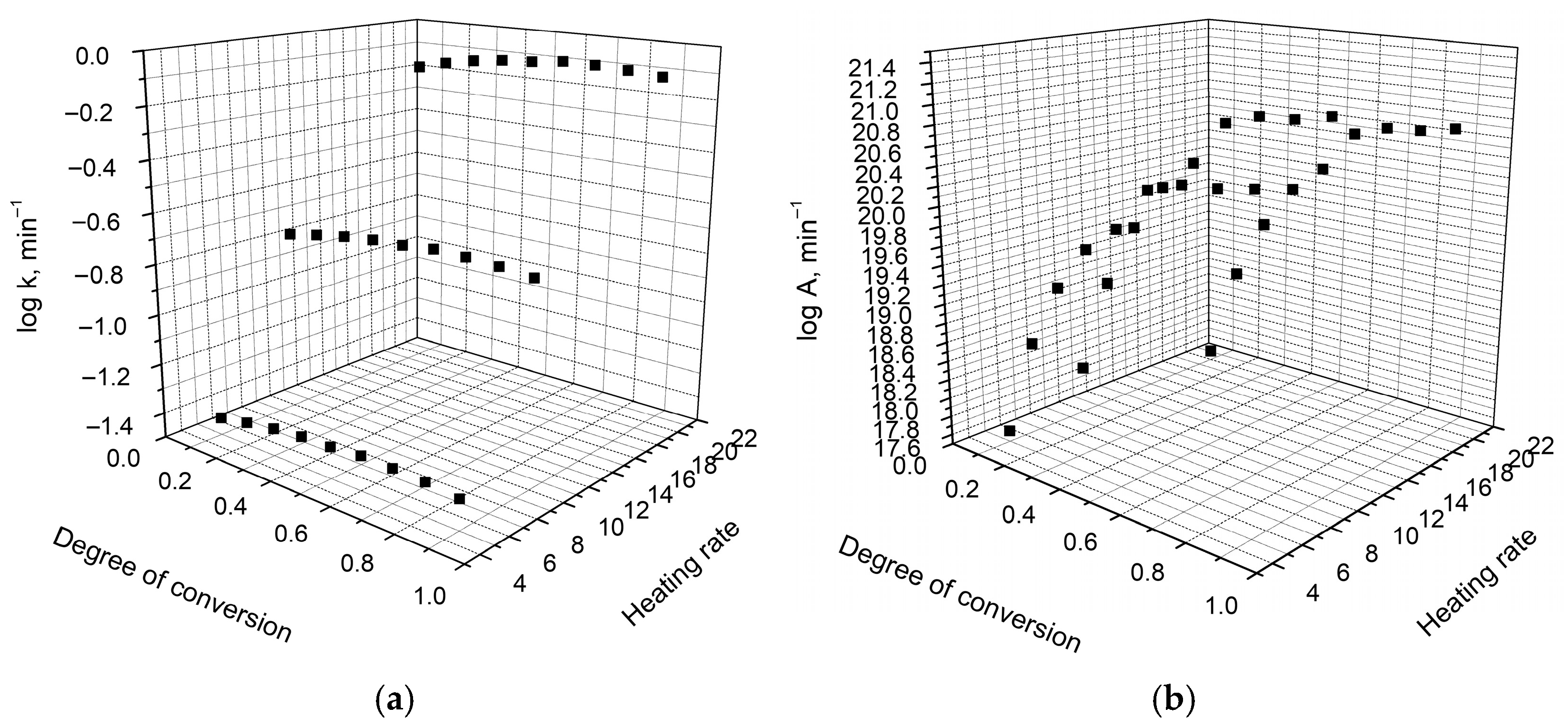
Thurgood et al. (2007) [27] in their study point out that the activation energy should not be the only parameter for considering the kinetics of lipid systems and evaluating their oxidative stability. They point out that the oxidation rate constant is also an important kinetic parameter to consider. Based on the obtained values of activation energies and pre-exponential factors, the reaction rate constant was determined using the Arrhenius equation. Figure 4 shows the correlation of the reaction rate constant, k (a) and the pre-exponential factor, A (b) on the degree of conversion and the heating rate. Figure 4a illustrates three separate curves that clearly define the dependence of the reaction rate constant on the heating rate. It is obvious that a higher heating rate accelerates the reaction which is consistent with the relationship between the rate of chemical reaction and temperature [28]. This phenomenon confirms the significant influence of the heating rate on the kinetic response of the system. On the other hand, it is observed that the obtained values of the reaction rate constant show a small variation depending on the degree of conversion, which may indicate a stable oxidation mechanism in a wider temperature range. Figure 4b shows a somewhat different influence of the pre-exponential factor. Namely, it is observed that the pre-exponential factor increases with the increase in the degree of conversion, but that there is no constant increase with the heating rate for the same degree of conversion. The observed increase in the pre-exponential factor with conversion may indicate changes in the dominant reaction pathways during oxidation. According to Vyazovkin (2021) [26], the pre-exponential factor strongly depends on the activation entropy: an increase in the activation entropy leads to a higher pre-exponential factor and, consequently, a higher reaction rate. Since the pre-exponential factor is related to the entropy of activation, its variation reflects modifications in the configurational state of the reacting system as oxidation progresses. According to Criado et al. (2008) [29] and Vyazovkin (2015) [30], in isoconversional analysis, kinetic parameters determined at a constant degree of conversion are primarily associated with changes in the reaction mechanism as oxidation progresses rather than experimental heating conditions. This could explain the absence of a systematic dependence of the pre-exponential factor on the heating rate at a given conversion degree in our study.
Based on the obtained kinetic parameters on the application of the non-isothermal mode of DSC analysis, the oxidation simulation was performed under isothermal conditions at 22 °C. According to Vyazovkin (2015) [30], low conversion degrees (α ≤ 0.2) correspond to the initial phase of thermally stimulated processes, where primary reaction steps dominate. Based on this concept, the conversion range ≤ 0.2 is considered representative for the initial phase of oxidation. The oxidation induction period (IP) was determined from the dependence of the degree of conversion on time, with a small degree of conversion, α = 0.1, taken as a criterion. The time required to reach this value was considered the oxidation induction period under isothermal conditions at 22 °C and is 15.13 h (907.8 min). Further, the time required to achieve a conversion rate of 0.2 is about 27.42 h (about 1.2 days). The significant increase in simulated induction time from α = 0.1 to α = 0.2 reflects the complex nature of the oxidation kinetics. However, it should be noted that the simulated induction time may be overestimated or underestimated, since the extrapolation of kinetic parameters obtained at accelerated temperatures to ambient conditions may not fully capture the complexity of oxidation reactions, changes in dominant reaction mechanisms, and specific behavior of the oil system at lower temperatures [31]. Moreover, the authors Smook et al. (2000) [12] point out that kinetic simulation is more reliable at higher temperatures, while the prediction error increases as the temperature decreases. The induction time represents the time before a dramatic increase in the rate of lipid oxidation (or the period of time where no change in the heat flow signal occurs) and its length is considered as a measurement of the oxidative stability of oils [32]. However, although oxidation induction time determined by DSC is frequently used as an indicator of oxidative stability, it does not directly correspond to the real storage shelf life, since it is obtained under accelerated thermal conditions and oxidative conditions that differ significantly from real storage environments.

3.2. OXITEST of Nettle Seed Oil

The OXITEST monitors the absorption of oxygen by reactive components present in a lipid matrix (fat or oil, in solid or liquid form), automatically determining the induction period. The test is performed under accelerated oxidation conditions at temperatures up to 120 °C and an oxygen pressure up to 8 bar. Since storage conditions, such as light exposure and oxygen availability (or, in practice, the use of packaging materials that limit light transmission and oxygen contact), can significantly affect shelf life, the OXITEST provides a reliable assessment of oxidative stability by offering a closed, light-free environment with strictly controlled oxygen exposure [33,34].
In our study, the induction period of nettle seed oil was evaluated at a temperature of 90 °C and pressure of 6 bars, and the obtained value was 13.74 h. These results are in agreement with the study by Tsao et al. (2021) [34], who investigated the oxidative stability of different types of oils using OXITEST at different temperatures (70 °C, 90 °C, and 100 °C). According to their study, the induction periods at 90 °C ranged from 6.50 to 81.52 h for different types of oils. Our results are closest to the induction period of camellia oil which was 14.20 h, while for pine nut oil and sunflower seed oil they were 10.88 h and 10.32 h, indicating a lower induction period by 20.35–24.45% compared to our results. On the other hand, studies of the induction periods of several extra virgin olive oils originating from two regions of Italy show that these oils have better oxidative stability compared to nettle seed oil [35]. In this study, the obtained induction period (IP) values for all the oils tested ranged from 20 to 78 h. Also, the same authors point to a strong correlation between the total content of polyphenols (which are natural antioxidants) in olive oil and oxidative stability measured by IP. In addition to polyphenols, the oxidative stability of oils is also influenced by fatty acid composition, sterols, alpha-tocopherol, chlorophyll and carotenoid pigments, as well as certain pro-oxidant components and storage conditions [34]. The amount of these compounds and their antioxidant potential are key parameters in assessing the oxidative stability of oils. Our previous study shows that nettle seeds are rich in polyunsaturated fatty acids, particularly linoleic acid (86.05%), whereas the content of monounsaturated oleic acid was 12.03% [5]. It should be noted that the high proportion of polyunsaturated fatty acids increases the number of reactive bis-allylic hydrogen atoms, which are characterized by lower bond dissociation energy and higher susceptibility to radical abstraction. Consequently, hydrogen abstraction accelerates the initiation and propagation steps of lipid oxidation, leading to rapid hydroperoxide formation and influencing the observed kinetic parameters. These processes are further accelerated at elevated temperatures and in the presence of oxygen [36,37]. Our further research will be focused on the qualitative and quantitative determination of another mentioned components in order to better understand the factors that influence the oxidative stability of nettle seed oil.
It should also be emphasized that, although the simulated induction period obtained from non-isothermal DSC data at 22 °C (α = 0.1) was close to the experimentally determined induction period by OXITEST at 90 °C, these values are not directly comparable due to differences in oxidation mechanisms, oxygen availability, and the definition of induction time used by each method. The OXITEST method evaluates oxidative stability under elevated oxygen pressure and isothermal conditions, whereas the kinetic simulation is based on extrapolation of non-isothermal DSC data obtained under atmospheric pressure. Extrapolation over a wide temperature interval may introduce deviations due the potential changes in dominant reaction pathways. Furthermore, the conversion degree α = 0.1 does not necessarily correspond to the classical induction period defined by rapid oxygen consumption in OXITEST measurements. Therefore, the simulated values should be regarded as theoretical kinetic estimates rather than direct predictors of real storage stability.

4. Conclusions

The results of these investigations confirm that oil oxidation is a complex, multiphase process whose kinetics significantly depend on the degree of conversion and the temperature regime. The application of the Ozawa–Flynn–Wall method enabled the monitoring of the variation of kinetic parameters during oxidation, as well as the simulation of isothermal storage conditions, which provided a deeper insight into the real oxidative stability of the oil. The observed increase in activation energy with the degree of conversion indicates a gradual transition to kinetically more demanding reactions in the later stages of oxidation. The induction period of nettle seed oil determined by the OXITEST at 90 °C (13.74 h) indicates good oxidative stability under accelerated oxidation conditions. Given the high content of polyunsaturated fatty acids, the obtained value suggest the presence of components that contribute to a certain resistance to oxidative processes and highlights its potential suitability for further nutritional and functional applications.

Author Contributions

Conceptualization, J.M.; methodology, J.M. and N.N.; formal analysis, J.M.; investigation, I.R., D.D. and S.S.; writing—original draft preparation, J.M.; writing—review and editing, I.K., B.D. and J.M. All authors have read and agreed to the published version of the manuscript.

Funding

This research was supported under Ministry of Education, Science and Technological Development of Republic of Serbia, Scientific Research Funding Program, ev. no. 451-03-34/2026-03/200133.

Data Availability Statement

The original contributions presented in this study are included in the article. Further inquiries can be directed to the corresponding author.

Conflicts of Interest

The authors declare no conflicts of interest.

References

  1. Yener, Z.; Celik, I.; Ilhan, F.; Bal, R. Effects of Urtica dioica L. seed on lipid peroxidation, antioxidants and liver pathology in aflatoxin-induced tissue injury in rats. Food Chem. Toxicol. 2009, 47, 418–424. [Google Scholar] [CrossRef]
  2. Chrubasik, J.E.; Roufogalis, B.D.; Wagner, H.; Chrubasik, S. A comprehensive review on the stinging nettle effect and efficacy profiles. Part II: Urticae radix. Phytomedicine 2007, 14, 568–579. [Google Scholar] [CrossRef] [PubMed]
  3. Biesiada, A.; Kucharska, A.; Sokół-Łętowska, A.; Kuś, A. Effect of the Age of Plantation and Harvest Term on Chemical Composition and Antioxidant Avctivity of Stinging Nettle (Urtica dioica L.). Ecol. Chem. Eng. A 2010, 17, 1061–1068. [Google Scholar]
  4. Paulauskienė, A.; Tarasevičienė, Ž.; Laukagalis, V. Influence of harvesting time on the chemical composition of wild stinging nettle (Urtica dioica L.). Plants 2021, 10, 686. [Google Scholar] [CrossRef] [PubMed]
  5. Mitrović, J.; Nikolić, N.; Ristić, I.; Karabegović, I.; Savić, S.; Šimurina, O.; Cvetković, B.; Pešić, M. The chemical characterisation of nettle (Urtica dioica L.) seed oil. Nat. Prod. Res. 2023, 39, 48–55. [Google Scholar] [CrossRef]
  6. Mitrović, J.; Nikolić, N.; Karabegović, I.; Savić, S.; Petrović, S.; Pešić, M.; Šimurina, O. Evaluation of the solvent effect on the extraction and antioxidant activity of phenolic compounds from the nettle (Urtica dioica L.) seeds: Application of PCA and regression analyses. J. Food Meas. Charact. 2024, 18, 6618–6626. [Google Scholar] [CrossRef]
  7. Fuentes, E.; Báez, M.E.; Bravo, M.; Cid, C.; Labra, F. Determination of Total Phenolic Content in Olive Oil Samples by UV-visible Spectrometry and Multivariate Calibration. Food Anal. Methods 2012, 5, 1311–1319. [Google Scholar] [CrossRef]
  8. Siger, A.; Nogala-Kalucka, M.; Lampart-Szczapa, E. The content and antioxidant activity of phenolic compounds in cold-pressed plant oils. J. Food Lipids 2008, 15, 137–149. [Google Scholar] [CrossRef]
  9. Ahmed, M.; Pickova, J.; Ahmad, T.; Liaquat, M.; Farid, A.; Jahangir, M. Oxidation of Lipids in Foods. Sarhad J. Agric. 2016, 32, 230–238. [Google Scholar] [CrossRef]
  10. Vyazovkin, S.; Burnham, A.K.; Criado, J.M.; Pérez-Maqueda, L.A.; Popescu, C.; Sbirrazzuoli, N. ICTAC Kinetics Committee recommendations for performing kinetic computations on thermal analysis data. Thermochim. Acta 2011, 520, 1–19. [Google Scholar] [CrossRef]
  11. Biliaderis, C.G. Differential scanning calorimetry in food research—A review. Food Chem. 1983, 10, 239–265. [Google Scholar] [CrossRef]
  12. Smook, A.L.; Sathwik, C.K.R.; Piet, M.L. Evaluating the oxidation properties of lubricants via non-isothermal thermogravimetric analysis: Estimating induction times and oxidation stability. Tribol. Int. 2022, 171, 107569. [Google Scholar] [CrossRef]
  13. Selvi, K.M.; Nagalapur, N.A.; Vijayaraj, P. Comparative assessment of edible oil oxidative stability through accelerated stability study. Biomedicine 2023, 43, 1662–1666. [Google Scholar] [CrossRef]
  14. Martínez-Monteagudo, S.I.; Saldaña, M.D.A.; Kennelly, J.J. Kinetics of non-isothermal oxidation of anhydrous milk fat rich in conjugated linoleic acid using differential scanning calorimetry. J. Therm. Anal. Calorim. 2012, 107, 973–981. [Google Scholar] [CrossRef]
  15. Micić, D.M.; Ostojić, S.B.; Simonović, M.B.; Krstić, G.; Pezo, L.L.; Simonović, B.R. Kinetics of blackberry and raspberry seed oils oxidation by DSC. Thermochim. Acta 2015, 601, 39–44. [Google Scholar] [CrossRef]
  16. Drăghici, O.; Păcală, M.L.; Oancea, S. Kinetic studies on the oxidative stabilization effect of red onion skins anthocyanins extract on parsley (Petroselinum crispum) seed oil. Food Chem. 2018, 265, 337–343. [Google Scholar] [CrossRef]
  17. Ostrowska-Ligeza, E.; Bekas, W.; Kowalska, D.; Lobacz, M.; Wroniak, M.; Kowalski, B. Kinetics of commercial olive oil oxidation: Dynamic differential scanning calorimetry and Rancimat studies. Eur. J. Lipid Sci. Technol. 2010, 112, 268–274. [Google Scholar] [CrossRef]
  18. Gundogar, S.A.; Kok, V.M. Thermal characterization, combustion and kinetics of different origin crude oils. Fuel 2014, 123, 59–65. [Google Scholar] [CrossRef]
  19. Ixtaina, V.Y.; Nolasco, S.M.; Tomás, M.C. Oxidative stability of chia (Salvia hispanica L.) seed oil: Effect of antioxidants and storage conditions. J. Am. Oil Chem. Soc. 2012, 89, 1077–1090. [Google Scholar] [CrossRef]
  20. Litwinienko, G. Autooxidation of unsaturated fatty acids and their esters. J. Therm. Anal. Calorim. 2001, 65, 639–646. [Google Scholar] [CrossRef]
  21. Kok, V.M.; Gul, G.K. Thermal characteristics and kinetics of crude oils and SARA fractions. Thermochim. Acta 2013, 569, 66–70. [Google Scholar] [CrossRef]
  22. Gharby, S.; Asbbane, A.; Ahmed, N.M.; Gagour, J.; Hallouch, O.; Oubannin, S.; Bijla, L.; Goh, W.K.; Bouyahya, A.; Ibourki, M. Vegetable oil oxidation: Mechanisms, impacts on quality, and approaches to enhance shelf life. Food Chem. 2025, 28, 102541. [Google Scholar] [CrossRef]
  23. Geng, L.; Liu, K.; Zhang, H. Lipid oxidation in foods and its implications on proteins. Front. Nutr. 2023, 10, 1192199. [Google Scholar] [CrossRef] [PubMed]
  24. De Britto, D.; Assis, O.B. Thermal degradation of carboxymethylcellulose in different salty forms. Thermochim. Acta 2009, 494, 115–122. [Google Scholar] [CrossRef]
  25. Mahmood, H.; Shakeel, A.; Abdullah, A.; Khan, M.I.; Moniruzzaman, M. A Comparative Study on Suitability of Model-Free and Model-Fitting Kinetic Methods to Non-Isothermal Degradation of Lignocellulosic Materials. Polymers 2021, 13, 2504. [Google Scholar] [CrossRef]
  26. Vyazovkin, S. Determining preexponential factor in model-free kinetic methods: How and why? Molecules 2021, 26, 3077. [Google Scholar] [CrossRef]
  27. Thurgood, J.; Ward, R.; Martini, S. Oxidation kinetics of soybean oil/anhydrous milk fat blends: A differential scanning calorimetry study. Food Res. Int. 2007, 40, 1030–1037. [Google Scholar] [CrossRef]
  28. Aktaş, N.; Gerçekaslan, K.E.; Uzlaşlr, T. The effect of some pre-roasting treatments on quality characteristics of pumpkin seed oil. OCL 2018, 25, A301. [Google Scholar] [CrossRef]
  29. Criado, J.M.; Sánchez-Jiménez, E.P.; Pérez-Maqueda, L.A. Critical Study of the Isoconversional Methods of Kinetic Analysis. J. Therm. Anal. Calorim. 2008, 92, 199–203. [Google Scholar] [CrossRef]
  30. Vyazovkin, S. Isoconversional Kinetics of Thermally Stimulated Processes; Springer: Cham, Switzerland, 2015; Volume XIII, p. 239. [Google Scholar] [CrossRef]
  31. Kaya, A.; Tekin, A.R.; Oner, M.D. Oxidative stability of sunflower and olive oils: Comparison between a modified active oxygen method and long term storage. Lebensm.-Wiss. Technol. 1993, 26, 464–468. [Google Scholar] [CrossRef]
  32. Tan, P.C.; Che Man, Y.B. Recent developments in differential scanning calorimetry for assessing oxidative deterioration of vegetable oils. Trends Food Sci. Technol. 2002, 13, 312–318. [Google Scholar] [CrossRef]
  33. Chabni, A.; Bañares, C.; Torre, F.C. Study of the oxidative stability via Oxitest and Rancimat of phenolic-rich olive oils obtained by a sequential process of dehydration, expeller and supercritical CO2 extractions. Front. Nutr. 2024, 11, 1494091. [Google Scholar] [CrossRef] [PubMed]
  34. Tsao, C.H.; Chang, C.W.; Ho, Y.C.; Chuang, Y.K.; Lee, W.J. Application of OXITEST for prediction of shelf-lives of selected cold-pressed oils. Front. Nutr. 2021, 8, 763524. [Google Scholar] [CrossRef] [PubMed]
  35. Caruso, M.C.; Galgano, F.; Scarpa, T.; Ornaghi, P.; Favat, F. Accelerated shelf life studies of extra virgin olive oils using the Oxitest method. Inform 2017, 28, 26–29. [Google Scholar] [CrossRef]
  36. Frankel, N.E. Lipid Oxidation, 2nd ed.; Oily Press: Bridgewater, UK, 2005; p. 488. [Google Scholar]
  37. Valgimigli, L. Lipid Peroxidation and Antioxidant Protection. Biomolecules 2023, 13, 1291. [Google Scholar] [CrossRef]
Figure 1. Non-isothermal DSC thermograms of nettle seed oil recorded at different heating rates (5, 10, and 20 °C min−1).
Processes 14 00887 g001
Figure 2. Dependence of the degree of conversion on temperature at different heating rates (5, 10, and 20 °C min−1).
Processes 14 00887 g002
Figure 3. Isoconversional kinetic analysis of the thermooxidation of nettle seed oil. (a) Apparent activation energy as a function of degree of conversion; (b) Pre-exponential factor as a function of degree of conversion.
Processes 14 00887 g003
Figure 4. Effect of conversion degree and heating rate on the reaction rate constant (a) and pre-exponential factor (b) of oil oxidation.
Processes 14 00887 g004
Disclaimer/Publisher’s Note: The statements, opinions and data contained in all publications are solely those of the individual author(s) and contributor(s) and not of MDPI and/or the editor(s). MDPI and/or the editor(s) disclaim responsibility for any injury to people or property resulting from any ideas, methods, instructions or products referred to in the content.