Review

Metal–Organic Frameworks as Multifunctional Platforms for Chemical Sensors: Advances in Electrochemical and Optical Detection of Emerging Contaminants


by
Iare Soares Ribeiro
1,2,
Wesley C. P. Aquino
1,2,
Lucas H. M. Alfredo
1,2 and
Jemmyson R. de Jesus
1,2,*
1
Research Laboratory in Bionanomaterials, LPbio, Department of Chemistry, Federal University of Viçosa, Viçosa 36570-900, Minas Gerais, Brazil
2
National Institute of Science and Technology of Bioanalytics-Lauro Kubota (INCTBio-LK), Campinas 13083-970, São Paulo, Brazil
*
Author to whom correspondence should be addressed.
Processes 2026, 14(6), 886; https://doi.org/10.3390/pr14060886
Submission received: 9 February 2026 / Revised: 5 March 2026 / Accepted: 7 March 2026 / Published: 10 March 2026
(This article belongs to the Special Issue Environmental Protection and Remediation Processes)

Abstract

Metal–organic frameworks (MOFs) have received significant attention as multifunctional platforms for chemical sensing due to their adjustable porosity, high specific surface area, and modular chemical architecture, which allow for customized host-guest interactions and signal transduction. This work presents a critical overview of recent advances in electrochemical and optical sensors based on MOFs for the detection of emerging contaminants, including toxic metal ions, pharmaceutical residues, and industrial pollutants in environmental and biological matrices. Special emphasis is placed on the underlying sensing mechanisms, such as redox activity, charge transfer, and luminescence modulation, as well as the main challenges related to structural stability under realistic operating conditions, including variations in pH, humidity, and temperature. Furthermore, the development of hybrid and hierarchical architecture based on MOFs is discussed as an effective strategy to improve sensitivity, selectivity, and long-term robustness. Finally, the perspective highlights how to optimize sensor performance and enable more reliable and scalable applications in monitoring emerging contaminants.

1. Introduction

Rapid global development, coupled with continued population growth, has intensified the pressure on natural ecosystems [1]. Hazardous materials, including pesticides, pharmaceuticals, industrial chemicals, and other emerging contaminants, have contributed significantly to high agricultural and industrial production, as well as guaranteeing technological innovation in new medicines [2]. However, they have increasingly represented a significant environmental challenge, driven by multiple factors. The use of pharmaceuticals, for example, continues to increase due to higher demand associated with an aging population and the growing prevalence of chronic diseases [3]. Similarly, pesticides and veterinary medicines are widely used in agriculture, livestock farming, and aquaculture, while industrial and household chemicals reach the environment through various pathways, including improper disposal, inefficient or non-existent sewage treatment, agricultural runoff, and emissions from livestock and aquaculture operations [3]. In this context, it is observed that after human or veterinary use, a substantial fraction of many active compounds, reaching up to 90% in some cases, is excreted unchanged or as active metabolites in domestic sewage [4]. According to the United Nations, approximately 42% of global domestic sewage is discharged without adequate treatment, facilitating the spread of hazardous materials in freshwater and marine environments [5]. As a result, contaminants such as pharmaceuticals, pesticides, personal care products and disinfection by-products (DBPs) are now widely detected in concentrations ranging from nanograms per liter to micrograms per liter [6,7]. Their presence generates increasing concern due to properties such as environmental persistence, bioaccumulation potential, and recognized or suspected (eco)toxicological effects [8]. While some compounds exhibit high chemical stability and low biodegradability, others degrade more easily but remain continuously present in water bodies, receiving the designation of “pseudopersistent”. Once bioavailable, these contaminants can accumulate in aquatic organisms and enter the food chain, ultimately posing risks to wildlife and human consumers [9]. Despite this growing evidence of environmental and public health impacts, scientific knowledge about the chronic and sublethal effects associated with exposure to these contaminants remains limited [10]. Regulatory frameworks are also outdated, resulting in many hazardous materials being classified as emerging contaminants [11]. In response, international bodies such as the European Commission have introduced monitoring programs to assess substances that may pose ecological or human health risks. Similar actions by the OSPAR Commission and the United States Environmental Protection Agency (EPA) reflect the global recognition of these threats [12].
In this context, these considerations highlight the urgent need for comprehensive monitoring of hazardous contaminants in environmental waters, aquatic organisms, and even drinking and tap water, to better assess risks and guide future regulatory action. The determination of hazardous contaminants in aqueous matrices is conventionally performed using chromatographic techniques [13]. These methods, including liquid chromatography and gas chromatography coupled with mass spectrometry, offer high precision, selectivity, and sensitivity. However, they require expensive laboratory instrumentation, as well as trained personnel, which limits their applicability for routine field monitoring. In contrast, sensor-based technologies offer a more flexible and accessible approach to environmental analysis [13]. Optical and electrochemical sensors have received considerable attention due to their ability to provide rapid, sensitive, and low-cost detection of contaminants directly in the field [14,15,16]. Optical sensors, including colorimetric [17], fluorescence [18], and surface plasmon resonance platforms [19], allow for non-destructive measurements and often enable visual or smartphone-assisted quantification. Their adjustable optical properties and compatibility with nanomaterials provide greater sensitivity and specificity, making them promising tools for detecting pollutants at trace levels.
Electrochemical sensors and biosensors, on the other hand, convert chemical or biochemical interactions into measurable electrical signals through oxidation or reduction reactions [20]. These devices are typically constructed from widely available conductive or semiconductor materials (e.g., carbon-based electrodes, metal oxides, or nanocomposites), which offer excellent flexibility for surface modification, miniaturization, and mass production [21]. As a result, they can be easily integrated into compact, portable, and low-power analytical platforms suitable for in situ environmental monitoring.
Metal–organic frameworks (MOFs) have emerged as highly versatile and promising materials for the development of electrochemical and optical sensors intended for the detection of hazardous contaminants in environmental matrices [15]. The development of these multifunctional platforms has been driven by the need for high sensitivity and selectivity in monitoring diverse chemical threats in aqueous environments, as demonstrated by recent advancements in the design of nanostructured frameworks for multi-target sensing [22,23]. Their intrinsic properties, such as exceptionally high surface area, adjustable porosity, diverse chemical functionality, and the ability to incorporate specific active sites [24,25,26], make them ideal for enhancing analyte recognition, signal transduction, and overall sensor performance. These structural advantages allow MOFs to host a wide variety of molecules, promote selective interactions, and facilitate rapid mass transport, all fundamental to achieving sensitive and accurate detection [14]. In electrochemical detection, MOFs can improve electron transfer processes, increase active surface area, and support the immobilization of catalytic or biological components [27]. Their integration with conductive materials (e.g., carbon nanostructures, metallic nanoparticles, and conductive polymers) further enhances electrical conductivity, resulting in sensors with superior detection limits, fast response times, and high selectivity for target analytes [28]. In optical detection, MOFs offer unique photophysical characteristics, including luminescence, chromogenic responses, and adjustable optical band gaps [29]. These characteristics allow their use in fluorescence-based, colorimetric, and photonic sensors capable of detecting trace contaminants, often with the possibility of visual or smartphone-assisted reading. The ability of MOFs to undergo specific structural or spectral changes through analytical interaction further expands their utility in the generation and amplification of optical signals [29].
In this sense, this work systematically analyzes the application of MOFs in electrochemical and optical sensors for monitoring emerging contaminants in environmental matrices. By providing a detailed overview of their capabilities and limitations, this study serves as a guide for developing more robust and selective in situ analytical platforms.

2. Synthesis and Properties of Metal–Organic Frameworks

2.1. Synthesis and Optimization of Metal–Organic Frameworks Design for Chemical Sensors

The synthesis strategy of MOFs directly influences their structural and functional properties, including surface area, morphology, and stability [30,31]. These parameters are critical for the performance of MOFs when employed as modifiers in chemical sensors [32]. Consequently, various synthetic methods have been explored, including (i) Solvothermal/hydrothermal synthesis; (ii) Microwave-assisted method; (iii) mechanochemical and sonochemical approaches. Each presents specific advantages and limitations in terms of morphological control, reaction time, scalability and overall process sustainability [33].
Solvothermal and hydrothermal syntheses are the most widely employed approaches, relying primarily on organic solvents in solvothermal routes and water in hydrothermal processes, typically conducted at moderate to high temperatures and elevated pressure [34,35]. These methods enable the formation of well-defined and highly porous crystals, suitable for applications that demand structural stability and large surface area. For instance, a Zn-based MOF synthesized solvothermal at 140 °C for 72 h using N,N-dimethylformamide (DMF) and water as mixed solvents exhibited well-defined crystalline morphology and high stability. The material was subsequently modified with Tb3+ via a post-synthetic strategy to form a Tb@Zn-MOF composite, which acted as a multi-emission luminescent sensor for the pesticide 2,6-dichloro-4-nitroaniline (DCNA) [36]. In another study, a ZnO/In2O3 composite derived from dual-MOF precursors was synthesized via a two-step hydrothermal method at 120 °C for 12 h, followed by thermal treatment at 500 °C [37]. The resulting material exhibited a hierarchical architecture with abundant gas adsorption sites, which enhanced the sensing response toward ethanolamine (EA) [37].
However, despite their widespread use and ability to yield highly crystalline materials, solvothermal methods present important limitations. For instance, reaction times are often excessively long (typically ranging from 12 to 48 h) which limits scalability and increases energy demand. In addition, this approach frequently relies on toxic and high-boiling organic solvents, posing environmental and safety concerns related to solvent handling, waste generation, and post-synthesis purification steps [38,39].
Microwave-assisted synthesis has emerged as a rapid and energy-efficient alternative, promoting homogeneous heating, uniform supersaturation and simultaneous nucleation of particles. This technique significantly reduces reaction time to just a few minutes, improving crystallinity, phase purity and control over particle size distribution [40]. In many cases, the higher efficiency of dielectric heating also minimizes the formation of unwanted byproducts and allows for better reproducibility compared to conventional solvothermal methods, making microwave-assisted techniques attractive for production of MOFs. Recently, a Cu-MOF/graphitic carbon nitride (GCN) composite was successfully synthesized by a simple microwave-assisted solvothermal route at 120 °C for 2 h using DMF as solvent. The resulting hybrid exhibited lower charge-transfer resistance and enhanced electronic conductivity, which translated into remarkable electrocatalytic performance for the detection of nitrofurantoin, with a linear range of 1–10 μmol L−1, a low detection limit of 0.478 μmol L−1, and excellent stability (92.8% retention) [41].
Despite its advantages, microwave-assisted synthesis also has significant limitations. One of the main challenges is the restricted scalability of the method, since efficient microwave penetration and homogeneous energy distribution become increasingly difficult in large-volume reactors [42].
Mechanochemical and sonochemical methods have also received significant attention in the field of green synthesis, reducing or even eliminating the use of organic solvents. Mechanochemical synthesis, which involves the direct grinding or milling of solid reagents, offers significant advantages, including simplicity, reduced solvent use, and potential scalability, making it particularly attractive for large-scale production. However, a common limitation of this approach is that it often produces materials with lower crystallinity and less defined porosity compared to those obtained by solvothermal or hydrothermal methods, which can impact their functional performance in certain applications [43]. Recently, Kaur et al. successfully synthesized a three-dimensional iron-based MOF with an interpenetrated, pillared-layered structure using a solvent-free mechanochemical approach [44]. In this study, 4,4′-bipyridine (4,4′-bipy) served as a rigid nitrogen-donor ligand, while p-aminobenzoic acid (PABA) acted as a labile conjugated linker, enabling the formation of the highly ordered material. The resulting Fe-MOF exhibited remarkable emissive properties, which were exploited for the development of a luminescent “turn-off” sensor toward organic compounds bearing aldehyde and ketone groups. Density functional theory calculations revealed that the selective recognition of carbonyl compounds was attributed to the formation of stable noncovalent interactions between the carbonyl group and the PABA unit within the MOF framework [44].
Sonochemical synthesis is another approach used for the synthesis of MOFs. This method employs ultrasonic irradiation to promote the formation of structures. Recently, Ismail et al. reported the synthesis of a zinc-based MOF composed of Zn2+ and 1,3-benzenedicarboxylate (BDC) via sonochemical route. The obtained structure, [Zn(BDC)(H2O)n], matched the theoretical pattern and demonstrated that ultrasound-assisted synthesis can efficiently produce high-purity MOFs in a short time [45].
Despite the advantages presented, including fast and energy-efficient, sonochemical synthesis, can have low reproducibility due to the difficulty in uniformly controlling acoustic cavitation, and is also poorly suited for industrial scaling [46].
In addition to the techniques mentioned above, other approaches, such as electrochemical and gas-phase syntheses, have also been explored. Electrochemical synthesis enables the direct growth of MOFs on the electrode surface, avoiding additional deposition steps and enhancing conductivity, which is particularly advantageous for electrochemical sensors [47]. Gas-phase synthesis, although less common, facilitates the fabrication of thin and homogeneous films on solid substrates.
Despite the advantages presented, these methods also have limitations that should be considered. In the case of electrochemical synthesis, MOF formation strongly depends on electrode characteristics and electrolytic conditions, which can restrict the variety of structures obtained and result in heterogeneous films or films with limited adhesion [48]. Gas-phase syntheses, while producing thin and homogeneous films, require specialized equipment, strictly controlled conditions, and have a reduced set of compatible volatile precursors, limiting their applicability to a relatively small number of MOFs. Therefore, the choice of synthetic route should consider not only efficiency and sustainability, but also intrinsic limitation [45].

2.2. Organic Linkers Used in the Synthesis of Metal–Organic Frameworks

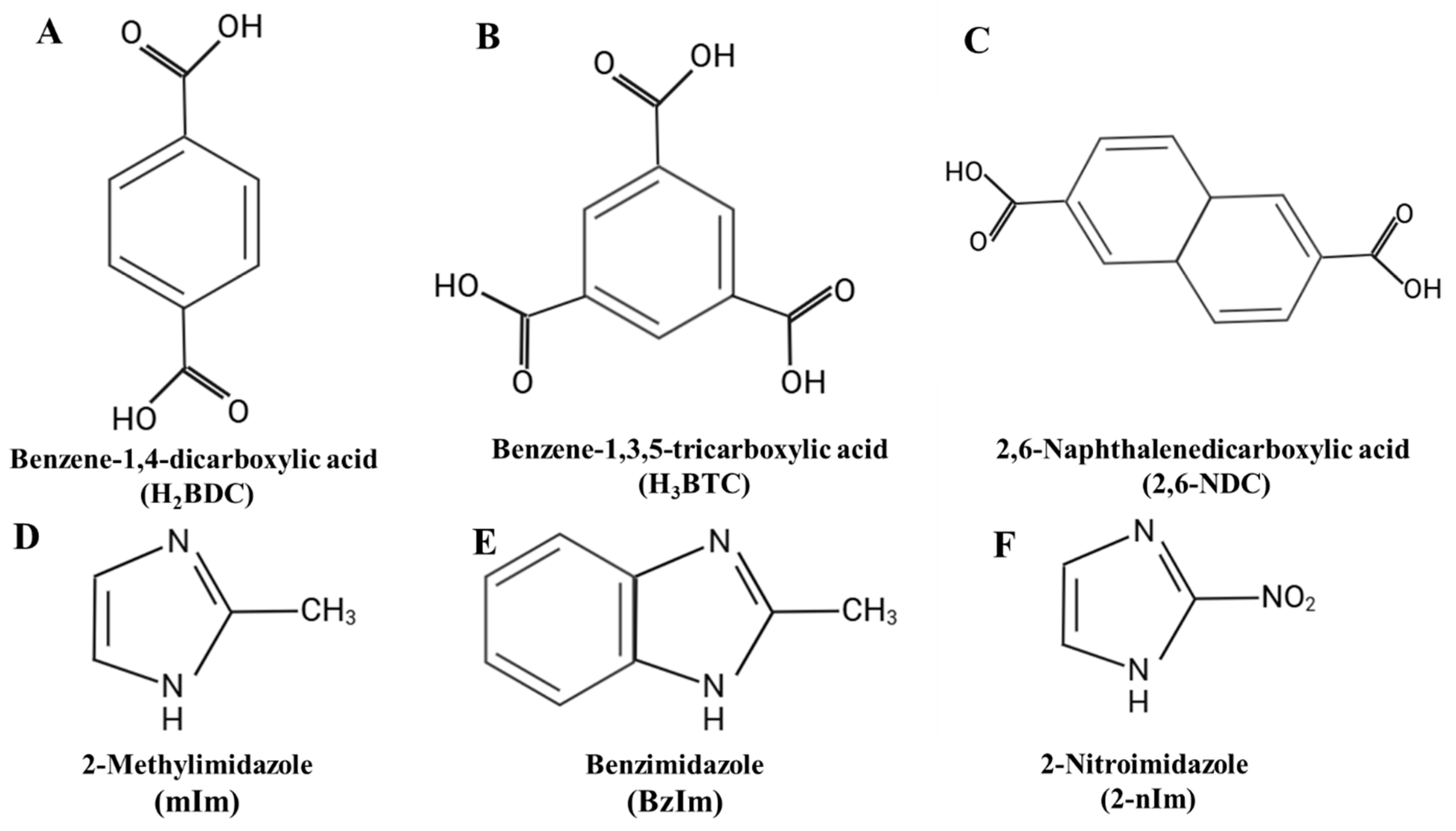
Organic linkers play a central role in modulating the physicochemical properties of MOFs, influencing their electronic conductivity, thermal stability, hydrophobicity, and selectivity. In general, the most employed linkers are derived from carboxylic acids, imidazolates, and pyridines (Figure 1) [49].
Carboxylate-based linkers (Figure 1A–C) are the most widespread due to their versatility and ability to form stable three-dimensional frameworks. MOFs based on BDC, such as [Cu(BDC)]n, have demonstrated excellent performance in electrochemical sensors for the detection of antibiotics and hormones, owing to their good aqueous stability and ease of surface modification [50]. Recently, a Pt–Ag@Cu-BDC nanocomposite has been reported as an efficient platform for pesticide detection, where the Cu-BDC framework provided a porous and stable support for bimetallic nanoparticles, enhancing charge transfer and overall sensing performance [51]. However, carboxylate linkers often lead to materials with low intrinsic electrical conductivity, which may limit their sensitivity in purely electrochemical applications [52].
Nitrogen-containing linkers, such as imidazole (Figure 1D–F) and its derivatives, provide enhanced thermal and electronic stability to MOFs and are frequently used in the Zeolitic Imidazolate Framework (ZIF) family [53]. These materials exhibit high chemical resistance and improved conductivity, making them ideal for gas sensing and non-enzymatic electrochemical applications. For instance, a bimetallic Co0.95Fe0.05-ZIF with an open nanosheet structure was recently developed, offering abundant active sites and efficient ion transport pathways [54]. This material demonstrated outstanding performance for glucose detection, achieving high sensitivity and a low detection limit due to its open porous morphology and synergistic effect between Co and Fe centers [54]. These results highlight the potential of ZIF-based materials for practical non-enzymatic biosensing applications.
Finally, linkers with specific functional groups such as -NH2, -OH, or -SO3H have been increasingly incorporated into MOF designs to enhance affinity toward target analytes and enable selective interactions. Such targeted functionalization is particularly advantageous in optical sensors, where the direct chemical interaction between the analyte and the functional group modulates the fluorescence emission of the material [55].

2.3. Main Characteristics of Metal–Organic Frameworks for Sensing

MOFs have emerged as promising materials for chemical detection due to their intrinsic characteristics [56], which include high surface area and adjustable porosity [57], abundance of functional active sites [58,59], and high thermal and chemical stability [60,61]. Such properties reinforce the potential of these structures to enhance the efficiency and sensitivity of analyses, especially in chemical sensors. Recent studies have demonstrated that the ordered structure of MOFs enables their application in the detection of various analytes, including metal ions and biomolecules [62], allowing the development of versatile sensors and high-performance sensors. For instance, Javaheri et al. proposed the synthesis of a colorimetric sensor based on Zr-MOF (MOF-808FA) for the detection and quantification of reduced glutathione (GSH). The method demonstrated high selectivity and low detection and quantification limits (0.74 μM and 2.21 μM, respectively), as well as recovery rates between 104.11% and 111.75% of the analyte in blood serum samples [63].
To ensure the effectiveness of an MOF-based sensor, some important parameters must be considered: (i) selectivity and sensitivity; (ii) stability; (iii) fast response time; and (iv) reusability. Together, these attributes define the overall reliability and analytical efficiency of MOF-based detection systems.

2.3.1. Selectivity and Sensitivity

The structural versatility of MOFs and their high crystallinity allow for modification of selectivity and increased sensitivity of the analytical method employed [64]. Pore size increases selectivity for a specific analyte or class of analytes through molecular sieving, allowing the entry of smaller molecules and preventing access of larger molecules to the interior [65]. On the other hand, high porosity can promote greater interaction of the analyte with the MOF, facilitating efficient diffusion to the active sites and increasing the sensitivity of the analysis. For instance, Zhang et al. synthesized a sensor based on Ce-MOF that demonstrated high performance in uric acid recognition, showing high detectability (LOD = 69 μmol L−1) and sensitivity (45.69 μA·L·mmol−1·cm−2), being considered promising for electrochemical detection [66].
In another study, Shah et al. reported the synthesis of a luminescent composite based on Zn-MOF and rhodamine B (RhB-Zn-MOF) for metal detection via fluorescence quenching. As a result, the sensor exhibited high selectivity for Cr(VI) ions and LOD of 20.5 µg L−1, standing out as a promising alternative for the development of chemical sensors for metals [67].

2.3.2. Stability

Stability is another important parameter that can ensure consistent sensor performance under different environmental or operational conditions. MOFs are known for their high chemical, thermal, and mechanical stability. This stability is related to thermodynamic factors, such as the strength of the metal–ligand coordination bond, and kinetic factors, including ligand rigidity, coordination number, and surface hydrophobicity [68]. The structural robustness of MOFs allows them to maintain their integrity even under severe environmental conditions, such as high temperature and pressure, or pH variations [69]. Feng et al. developed an electrochemical sensor based on Fe-MOF for the ultrasensitive detection of paracetamol. The material exhibited a LOD of 27.81 nmol L−1, recovery rates between 95.93% and 103.4% in real pharmaceutical samples, and high stability, maintaining a recovery of 94.33% after 11 days. These results confirm that this sensor is a promising candidate for detecting active compounds in the pharmaceutical industry [70]. For instance, Jiang et al. [71] developed a sensitive electrochemical sensor based on MOF for the detection of environmental pollutants. Notably, this system demonstrates a broad dynamic range spanning six orders of magnitude (1 × 10⁻⁴ μg/mL to 500 μg/mL). The nanosensor maintains exceptional specificity even when exposed to eight potentially interfering ions and exhibits excellent reusability, proving to be a robust tool for monitoring hazardous contaminants in water [71].

2.3.3. Fast Response Time

Another critical requirement is a fast response time, allowing the sensor to quickly produce measurable signal changes after interaction with the analyte. MOFs interact with target chemical species within their pores through host–guest interactions. These interactions can be enhanced due to the adjustable porosity and performance of MOFs. This characteristic allows for greater interaction between the analyte and the active sites, significantly reducing the response time in the detection process [72].
In this context, Elashery et al. developed a potentiometric sensor based on Mn-MOF for rapid and selective detection of Mn2+ in food samples. The material exhibited high sensitivity (29.50 mV per decade), high stability over a wide pH range (2.0–8.5), and a response time of 3 s, proving to be promising for ion detection in food samples [73]. Ding et al. also reported the synthesis of a gas sensor using Co-MOF-74 as a precursor for monitoring triethylamine (TEA). The sensor detected TEA at a concentration of 100 ppm, exhibited a LOD of 1.0 ppm and a response time of 13–15 s, while maintaining its structural integrity at 199 °C, highlighting its potential for gas capture.
In another study, Shang et al. studied the encapsulation of magnetic nanospheres by Zr-MOF [(Zr)(MB@MOF)] applied in sensitive immunoassays for the early diagnosis of rheumatoid arthritis. The synthesized hybrid exhibited LOD of 0.1 RU·mL−1, an accuracy of 91.7% in blood serum samples. The analysis time of 0.5 h indicates that the sensor is promising for clinical applications [74].

2.3.4. Reusability

Reusability is one of the most important characteristics of MOF in chemical detection. This parameter contributes to the practicality and cost-effectiveness of the sensing platform, enabling multiple detection cycles without significant loss of performance. In many cases, the interaction between analytes and the active sites of MOF can occur predominantly through physisorption, mediated by intermolecular interactions [75]. These interactions are reversible, allowing the pore to be easily cleared using appropriate desorption procedures, such as solvent washing or vacuum exposure, ensuring the regeneration and reuse of the material [76]. Consequently, recent studies have increasingly focused on developing MOFs with improved reusability and long-term operational stability. For instance, Magnuson et al. reported the synthesis of a hierarchical structure based on Zn and porphyrin for the detection of nitrobenzene. The method exhibited a LOD of 2.6 mmol L−1 while maintaining stability over six reuse cycles, demonstrating its potential for nitrobenzene monitoring [77]. Shifting the focus to detection, Li et al. developed a UiO-66-NH2-based electrochemical sensor for trace Pb2+ analysis. The amino-functionalization improved both aqueous stability and binding affinity, yielding a detection limit of 0.33 nM. Unlike traditional adsorbent applications, this platform demonstrated exceptional selectivity and reusability, highlighting the efficiency of MOFs as electrochemical transducers [78].

2.4. Design of MOF-Based Sensing Platforms

Beyond intrinsic properties, the development of a chemical sensor requires the strategic integration of the crystalline architecture with a transducer [32]. In electrochemical sensing, these hybrid materials are often synthesized or modified to facilitate charge transfer at the interface. This can be achieved through various pathways, such as in situ growth [79], the use of porous framework dispersions for surface modification [80], or the formation of composites with conductive carbonaceous matrices [81]. These approaches leverage the redox activity of metal nodes and the high surface area of the structure to accelerate electron transfer kinetics. For optical sensors, the MOF is functionalized with specific groups, amino and thiol groups that act as recognition sites within the pores. These sites enable the material to modulate light emission, via quenching or enhancement mechanisms, upon interaction with target analytes. Thus, the synthetic route and the method of application are decisive steps to ensure that structural features are effectively converted into measurable analytical signals [29].
In this context, the intensification of MOF-based chemical sensor research has driven significant advances in analytical methodologies for environmental monitoring. This advancement is further favored by the inherent ease of functionalization and the high structural tunability of MOFs, factors that have enabled the development of high-performance materials suited for a wide range of chemical applications.

3. Signal Transduction Strategy

In detection system, the signal transduction strategy defines how the interaction between the analyte and the sensing interface is converted into a measurable signal [82]. MOF-based systems are particularly advantageous for this purpose due to their high surface area, tunable porosity, and ease of chemical functionalization, enabling efficient adsorption of target species and facilitating electron transport or good optical responses during detection [83,84].

3.1. MOFs for Electrochemical Sensors

The electrochemical behavior of MOF-modified electrodes is mainly governed by three complementary mechanisms: (i) electronic conduction, (ii) charge transfer, and (iii) redox activity.
Electronic conduction occurs when the MOF structure supports efficient electron transport through conjugated metal–ligand bonds or conductive pathways, leading to enhanced current response [85,86]. Although most MOFs are intrinsically insulating, the incorporation of metals with partially filled d orbitals (such as Cu2+, Co2+, Ni2+, and Fe3+) and π-conjugated ligands as HITP (2,3,6,7,10,11-hexaiminotriphenylene), BDC (1,4-benzenedicarboxylic acid), or BTC (1,3,5-benzenetricarboxylic acid) promotes electron delocalization through the crystalline framework. This feature is essential for improving the electrochemical response, as it decreases internal resistance and strengthens the electronic communication between the analyte and the electrode [87]. As a practical demonstration, Gong et al. developed a sensor for the emerging contaminant bisphenol A (BPA) using the conductive MOF Ni3(HITP)2. Their study confirmed that among several Ni-based frameworks, Ni3(HITP)2 provided the highest conductivity and largest effective surface area. When integrated into a molecularly imprinted composite, the intrinsic electronic pathways of the MOF allowed for a superior current response and a low detection limit of 4.0 nM, even in complex environmental water samples. This performance was directly attributed to the efficient charge transport through the crystalline framework, which facilitates the oxidation of BPA [88].
The charge transfer process involves the movement of electrons between the analyte and the metallic nodes or functional groups of the MOF, playing a crucial role in oxidation and reduction reactions during detection [89]. In this context, the MOF acts as an electronic bridge, mediating electron exchange between electroactive species in solution and the electrode surface. The efficiency of this process is influenced by the framework’s defects that facilitate charge carrier migration. Electrochemical impedance spectroscopy (EIS) is often employed to evaluate this interfacial charge transfer resistance, which directly impacts the sensor’s sensitivity and reproducibility [90,91]. A practical case is the detection of ofloxacin using a NH2-UiO-66/CNT composite, where EIS confirmed that defective engineering in the MOF reduced the charge transfer resistance, enabling a detection limit of 0.03 nM [92].
Redox mechanisms are based on the ability of metal ions in the coordination nodes to participate directly in oxidation–reduction reactions, thereby amplifying the electrochemical signal and enhancing selectivity [93,94]. The metal centers can serve as intrinsic redox-active sites, alternating between oxidation states during the electrochemical process. This behavior provides catalytic activity, allowing signal amplification and selective detection of redox-active analytes such as dopamine, hydrogen peroxide, metal ions, and pharmaceuticals. Cyclic voltammetry (CV) is commonly used to monitor these redox transitions, offering insights into electron-transfer kinetics and catalytic behavior [93,94]. As a practical application, a nanocomposite of ZIF-67 and carbon nanohorns was developed for the detection of the pesticide carbendazim. The study demonstrated that the synergistic effect between the redox-active cobalt nodes and the conductive carbon support enhanced the catalytic ability towards the analyte, resulting in a low detection limit of 1 ng mL−1 and excellent performance in real sample analysis [95].
In general, these three mechanisms act synergistically to define the overall efficiency of MOF-based electrochemical sensors, directly influencing analytical parameters such as sensitivity, selectivity, stability, and detection limit. However, the inherently low electrical conductivity of most MOFs often limits their electrochemical performance. To overcome this limitation, conductive hybrid structures combining MOFs and nanomaterials have been widely explored, as will be discussed in the next section.

3.2. Integration of MOFs with Conducting Nanomaterials

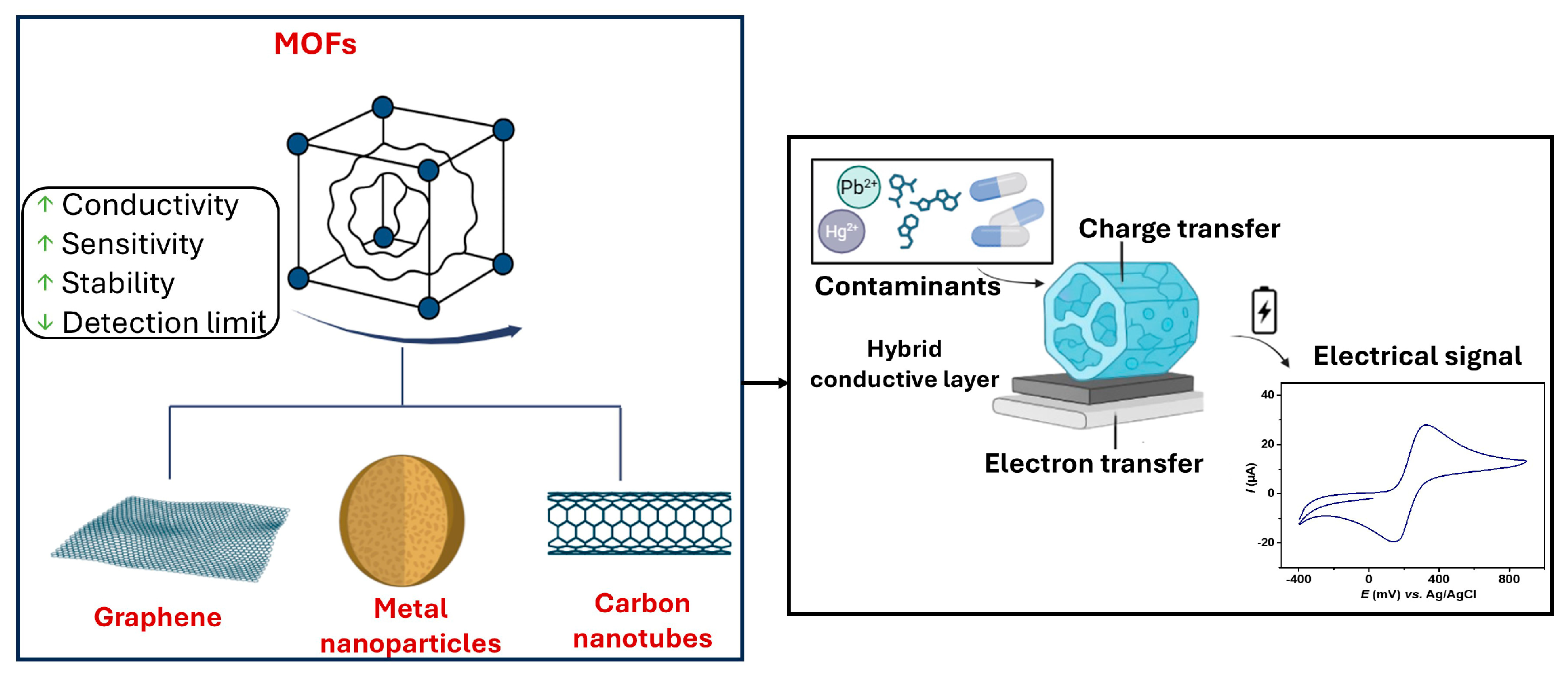
The integration of MOFs with conductive nanomaterials has emerged as an effective strategy to overcome the intrinsic insulating nature of MOFs. Although MOFs exhibit high surface area and ordered structures, their limited electron mobility restricts charge transfer efficiency [96,97]. To enhance their performance, MOFs are often hybridized with conductive nanomaterials such as graphene, carbon nanotubes (CNTs), and metallic nanoparticles (e.g., Au, Ag, Pt). These composites combine the structural versatility of MOFs with the superior electrical conductivity of the nanomaterials, resulting in improved charge transport, higher active site density, and accelerated redox kinetics (Figure 2) [98].
Graphene and its derivatives, particularly reduced graphene oxide (rGO), have been widely employed as conductive matrices owing to their high electronic mobility and mechanical flexibility. These properties allow for uniform MOF deposition, improve interfacial contact, and promote efficient electron movement across the entire detection platform [99]. In this context, Zhang et al. developed a non-enzymatic sensor based on GO–Au@MOF-199, integrating the excellent electron transport of GO, the catalytic activity of Au nanoparticles, and the high surface area of MOF-199 [100]. The device exhibited remarkable sensitivity, selectivity, and stability for the simultaneous detection of dopamine and uric acid, demonstrating the synergistic effect among the nanocomponents and the potential of graphene as a conductive platform for MOF-based sensors [100].
A recent study reported a portable electrochemical sensor based on a Cu-MOF modified for pefloxacin (PFL) detection using a smartphone-based readout system [101]. The active material was obtained through a two-step post-synthetic modification with thiourea (Th) incorporation into the Cu-MOF followed by functionalization with multi-walled carbon nanotubes (MWCNTs). The thiourea groups enhanced the MOF-PFL affinity and facilitated electron transfer between the MOF and MWCNTs, leading to improved conductivity and catalytic performance. The sensor showed a wide linear range (9 nmol L−1–2.5 μmol L−1), a LOD of 2.6 nmol L−1, excellent selectivity, and stability, with results comparable to liquid chromatography analyses in real water and food samples [101].
The development of such MOF-based conductive hybrids represents a promising direction for electrochemical sensors with adjustable selectivity, fast response, and transportable architectures. Table 1 summarizes that this strategy has been successfully applied to the detection of pharmaceuticals, pesticides, and heavy metals, achieving low detection limits, high reproducibility, and excellent operational stability.
Overall, the formation of MOF-nanomaterial hybrid structures promotes strong synergy between the components, enhancing the analytical performance of electrochemical sensors for the detection of several classes of emergent contaminants. The combination of large surface area, tunable porosity, and high density of active sites enables efficient adsorption and rapid electron transfer during detection.
Despite these advances, challenges remain regarding long-term stability in complex matrices, large-scale reproducibility, and the precise control of interfacial interactions.

3.3. MOFs for Colorimetric and Optical Sensors

In addition to electrochemical sensors, MOFs have been used as promising platforms for optical and colorimetric sensors [117]. Due to their unique properties, which combine high porosity, large internal surface area, open metal sites, and adjustable chemical functionalization, these materials offer significant advantages over conventional materials, enabling highly efficient interactions between the analyte and the sensing material, resulting in colorimetric or luminescent responses with a high degree of selectivity, sensitivity, and rapidity [117].
In colorimetric sensors, the presence of the analyte induces a visible color change in the sensing material or solution, enabling direct detection, often by the naked eye or with minimal instrumentation. On the other hand, luminescent sensors rely on light emission from an incorporated emitter or from the MOF framework itself. In this approach, parameters such as emission intensity, wavelength, or lifetime are modulated by the analyte through mechanisms including activation, deactivation or quenching of luminescence [118].
The next sections will provide a comprehensive overview of the principles driving the optical responses of MOF-based sensors, including color change, luminescence, and quenching phenomena. In addition, recent practical applications for monitoring metal ions and emerging contaminants will be discussed, highlighting both the structural versatility of MOFs and the remaining challenges in developing robust sensing platforms.

Principles of Optical Response: Quenching, Colorimetric, Luminescence

Optical sensors based on MOFs have attracted increasing attention due to their ability to convert chemical and physicochemical interactions into detectable signals through changes in light absorption or emission [119]. This class of sensors has gained prominence because it combines the intrinsic porosity and large internal surface area of MOFs with the tunable electronic and optical properties of their metal centers and organic linkers [117]. The hybrid nature of these structures, composed of metal clusters and organic ligands, enables the rational modulation of processes such as charge transfer, target-molecule confinement, and photoinduced mechanisms that ultimately result in optical responses. As a result, MOFs have emerged as versatile platforms for both colorimetric and luminescent detection, enabling qualitative and quantitative analyses with high sensitivity, selectivity, and stability.
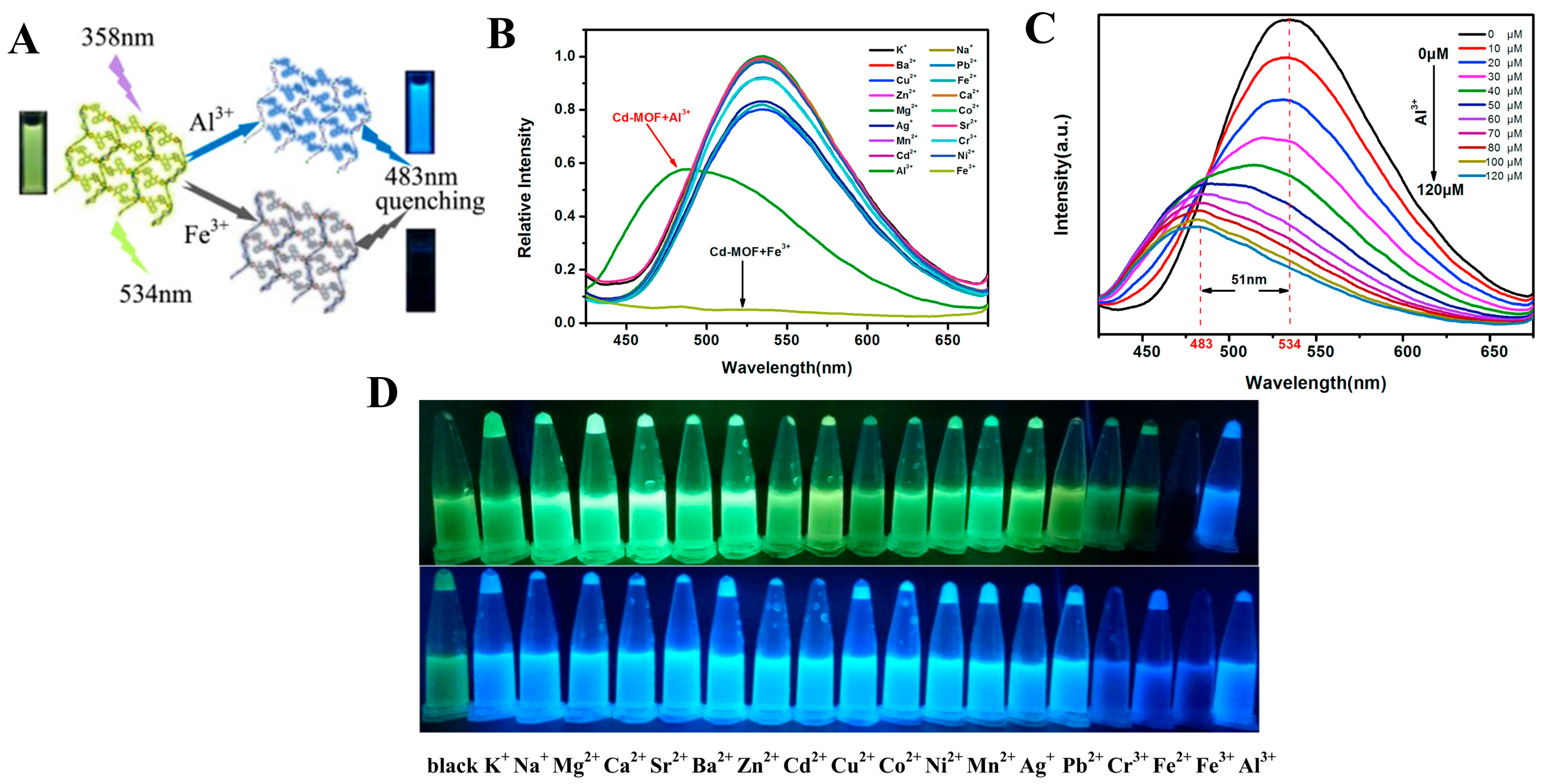
Recently, Lv et al. [120] reported the synthesis of a new luminescent cadmium(II)-based metal–organic framework (Cd-MOF), formulated with 4,4′-methylenebis(3-hydroxy-2-naphthalenecarboxylic acid) and 4-1,4-bis(4-pyridyl)-2,3-diaza-1,3-butadiene for the determination of Al3+ and Fe3+ ions in aqueous solution (Figure 3). The resulting Cd-MOF exhibited excellent photoluminescent behavior and allowed for highly selective recognition of Al3+ and Fe3+ ions in the presence of various potentially interfering metal species (Figure 3A–D). The detection limit for Al3+ in aqueous medium is 0.56 µmol L−1, significantly below the World Health Organization guideline value for drinking water (7.41 µmol L−1). Notably, the addition of Al3+ induces a distinct shift in luminescence from yellow to blue under 365 nm UV irradiation, enabling direct visual detection (Figure 3D). Furthermore, the material allows for the quantitative determination of Fe3+, achieving a detection limit of 0.3 µmol L−1. According to the authors, the Cd-MOF stands out as an excellent luminescent probe for the sensitive and selective analysis of Al3+ and Fe3+ ions present in wastewater and drinking water.
In the quenching mechanism, the luminescent emission of the sensor is suppressed when the analyte interacts with the active sites of the MOF (Figure 3A). This suppression may arise from phenomena such as photoinduced electron transfer (PET), fluorescence resonance energy transfer (FRET), or the inner-filter effect (IFE) [118]. The presence of electronically active species, such as heavy metal ions, facilitates charge transfer between the analyte and the MOF orbitals, resulting in a significant decrease in luminescence intensity (Figure 3B). This turn-off mechanism is widely exploited in optical sensors due to its high sensitivity, since even small variations in analyte concentration produce measurable responses (Figure 3C) [118]. However, selectivity remains a challenge, as interfering species with similar electronic properties may lead to analogous responses, making it difficult to distinguish analytes in complex matrices (Figure 3D) [121].
In another study, Liu et al. developed a rapid and easy-to-use sensor, based on a zirconium metal–organic framework (PCN-222), for the determination of Cd2+ and Pb2+ in tap and river water in the presence of PO43−. PCN-222 was synthesized via a solvothermal method, using benzoic acid (4,4,4,4-(porphyrin-5,10,15,20-tetrayl)tetrakis) as the organic ligand and zirconium chloride (ZrCl4) as the metal precursor [122]. The main characteristic of PCN-222 lies in its reactivity with PO43−. The strong coordination between PO43− and the Zr clusters induces the structural collapse of the MOF, resulting in the release of the porphyrin ligand (TCPP) and a visible color change in the solution to light red. Upon exposure to Cd2+ or Pb2+, the released TCPP exhibits distinct color changes: green for Cd2+ and yellow for Pb2+. These chromatic responses are attributed to the differences in ionic radius, electronic structure, and electronegativity between the two metal ions, which modulate their interactions with TCPP. The concentrations of Cd2+ and Pb2+ can be accurately quantified, separately or simultaneously, using ultraviolet spectroscopy or a smartphone application, offering flexibility depending on field conditions. Furthermore, the detection platform effectively addresses the selectivity limitations commonly encountered in ligand-based detection systems, providing high sensitivity, clear visual results, and minimal instrumental requirements.
Colorimetric sensors are based on changes in the absorption spectrum of the material or the solution in which the sensor is dispersed, which can be perceived either visually by color change or through UV/Vis spectroscopy. These variations are typically associated with changes in the oxidation state of the metal center, modifications in the electronic density of the ligands, or the formation of coordination complexes between the analyte and the active sites of the MOF [123]. Such transformations result in shifts in the visible absorption bands. For instance, MOFs incorporating chromophore linkers (such as functionalized terephthalic acid derivatives) exhibit noticeable color changes in the presence of transition metals, anions, or volatile organic compounds [117]. The main advantage of these systems lies in their ability to provide direct and rapid detection, often without the need for sophisticated instrumentation, a feature that has driven the development of portable sensors integrated with smartphone cameras [124].
Recently, Motora et al. reported the development of a highly sensitive and selective radiometric chemosensor for the detection of Co2+, Cu2+, and Ni2+ ions in wastewater based on an azo-functionalized zirconium metal–organic framework integrated into a carboxymethylated cellulose membrane (UiO-66-Azo-Im@CCM) [125]. The incorporation of the Zr-based MOF into the cellulose support not only increases the structural stability of the detection platform but also improves analyte accessibility and signal reproducibility [125]. Color changes ranging from shades of red-orange, yellow, and orange were observed for Co2+, Cu2+, and Ni2+, respectively. These specific colorimetric responses for each metal result from coordination interactions between the target ions and the azo/imidazole functional groups in the structure, which modulate the electronic structure of the sensor material. Taken together, these results demonstrate that the proposed UiO-66-Azo-Im@CCM platform shows strong potential for rapid, naked-eye colorimetric discrimination of heavy metal ions in aqueous environments, highlighting its applicability for low-cost, in situ environmental monitoring [125].
However, despite their sensitive responses toward different analytes, they still face limitations related to selectivity and reproducibility. Colorimetric responses are highly dependent on the structural design of the MOF, including the coordination geometry of the metal centers, the presence of chromophore ligands, and the incorporation of functional molecules, which can vary according to the experimental environment [126].
Luminescent sensors have also been used to determine heavy metals in environmental matrices. These sensors operate based on light emission triggered by optical excitation and can generate “on,” “off,” or radiometric responses, depending on the nature of the interaction between MOF and the target analyte [117]. The emissive behavior can originate from organic ligands, metal knots, or host species confined within the MOF pores, reflecting the structural versatility of these materials [75]. Variations in the intensity or wavelength of the emission are commonly associated with energy transfer mechanisms, photoinduced electron or charge transfer processes, and local structural or electronic perturbations induced by analyte adsorption. Due to their low background signal and high signal-to-noise ratios, MOF-based luminescent sensors typically exhibit exceptional sensitivity, frequently reaching detection limits in the nanomolar range [117]. Furthermore, the crystalline order and thermal robustness of MOFs ensure high reproducibility and stability of the optical response [75]. However, the need for an external excitation source and specialized instrumentation, such as fluorimeters or spectrometers, may limit their practical application in in situ or field monitoring [127].
Overall, the optical response of MOFs arises from the synergistic interaction between their structural components (metal ions, ligands, and functional sites) and the target analytes. A careful selection of the metal center, organic linker, and surface functionalization enables fine-tuning of the response mode and intensity, determining whether the sensor operates through quenching, colorimetric variation, or luminescence mechanisms. Understanding these principles is critical for the rational design of MOF-based platforms aimed at monitoring emerging contaminants, such as metal ions, and other environmentally relevant species.

3.4. Optical Sensors Applied to the Monitoring of Metal Ions and Emerging Contaminants

In recent years, the use of MOFs in optical sensors has emerged as a promising strategy for monitoring environmental contaminants, owing to their high surface area, tunable porosity, and functional modification capability [75]. Colorimetric, luminescent, and quenching-based sensors offer advantages such as rapid visual response, high selectivity, and potential for miniaturization in situ [128]. For instance, Gao et al. reported the synthesis of a luminescent sensor based on a bimetallic Ln-MOF (Eu-Tb-MOF) with good stability in water, for the detection of metal ions (Fe3+ and Pb2+) and pharmaceutical compounds, namely sulfamethoxazole (SZM) and sulfadiazine (SDZ), with high sensitivity (LOD = 0.037 μmol L−1 and 0.041 μmol L−1, respectively), demonstrating its potential as a material for chemical monitoring in aquatic environments [129]. In another study, Dong et al. developed a Zn-MOF with dual functionality for gas separation and fluorescence detection. The synthesized material exhibited good selectivity for fluorescence sensing of Fe3+, CrO42−, and Cr2O72− ions in aqueous solution, with low detection limits (1.67 × 10⁻⁴, 4 × 10⁻⁴, and 6.3 × 10⁻⁴, respectively), proving to be promising for metal detection in water [130].
Beyond aqueous systems, significant advances have also been reported in the application of MOFs in biological, food, and soil samples, demonstrating the versatility of these materials in detecting emerging contaminants, including pharmaceuticals, pesticides, and industrial dyes [131,132]. Table 2 summarizes recent applications of MOFs employed in optical sensors for different types of contaminants and matrices, highlighting the diversity of approaches and experimental conditions. These studies demonstrate that MOFs not only enable rapid and accurate detection but can also be adapted to real-world conditions, overcoming common limitations of selectivity and interference often observed in conventional sensors [133,134].

4. Current Challenges and Outlook

Although MOFs possess properties that favor their applicability in the detection of various analytes, many of these materials still face challenges related to structural stability under extreme conditions, particularly variation in humidity, pH, and temperature.
In aqueous environments or under high humidity, MOFs can undergo structural degradation through two main mechanisms: (i) ligand exchange or displacement caused by the coordination of water molecules to metal–ligand bonds, weakening the structure, and (ii) hydrolysis of the metal centers leading to the formation of hydrated cations and the release of free ligands [142,143]. These processes compromise the integrity and long-term performance of MOF-based sensors, which has driven research focused on the development of hierarchical and water-stable architectures capable of maintaining functionality in aqueous media.
The variations also exert a pronounced influence on the stability of MOFs. (i) Under acidic conditions, protons (H+) can compete with metal ions for coordination sites on the ligand, while in alkaline media, hydroxide ions (OH can compete with ligands for binding to metal centers, destabilizing the structure [144,145]. In this context, Ali et al. studied the development of a Zr-MOF (UiO-66) functionalized with amino (-NH2) and thiol (-SH) groups based on Pearson’s Hard and Soft Acids and Bases (HSAB) theory. The resulting material demonstrated high efficiency in removing Pb2+ ions from contaminated water, with recovery values ranging from 67 to 99% (pH = 6 and 30 °C), preserving its structural integrity even under acidic conditions. These findings highlight the potential of functionalized Zr MOFs as robust platforms for heavy metal remediation in critical pH environments [146].
Represents another critical factor that can compromise the stability of MOFs, since elevated temperatures can induce ligand decomposition, ultimately leading to structural collapse [147]. To overcome this limitation, considerable effort has been devoted to the synthesis of thermally robust MOFs. For instance, Shah et al. [148] reported the synthesis of a sensor based on Ni-MOF for the rapid detection of hydrogen sulfide (H2S) gas. The method exhibited high sensitivity, a low detection limit (20 ppm), a response time of 15 s, and successfully captured H2S at a concentration of 100 ppm at 175 °C without compromising the structure, making it promising for gas monitoring under severe environmental conditions [148].
In general, mitigating the limitations imposed by environmental conditions requires the rational design of more robust MOF architectures [149]. Current strategies to enhance structural stability focus on the coordination of hard Lewis bases, such as carboxylic ligands, to metal centers with high acceptor strength (e.g., Fe3+, Zr4+, and Al3+). This approach promotes stronger electrostatic interactions, increasing resistance to thermal, aqueous, and pH-induced degradation [150]. Furthermore, employing rigid and short ligands can significantly improve structural stiffness, thereby increasing the activation energy required for structural collapse. Enhancing the framework’s hydrophobicity is another vital strategy, as it protects coordination bonds through both thermodynamic and kinetic factors, such as steric hindrance [151]. Additionally, structural interpenetration or concatenation can be tailored to stabilize pore openings and prevent the framework from collapsing under operational stress [152].
Beyond structural design, the integration of Artificial Intelligence (AI) and Machine Learning (ML) has emerged as a transformative frontier in MOF sensor development [153]. ML algorithms enable high-throughput computational screening of vast chemical spaces, predicting the stability and selectivity of thousands of MOF candidates toward specific analytes before experimental synthesis [154,155]. These tools are particularly effective in optimizing “electronic tongue” or “nose” systems, where AI-driven pattern recognition allows for the accurate quantification of multiple contaminants in complex environmental matrices [156,157].
Reproducibility and scalability also constitute significant challenges for the practical large-scale use of MOFs [158]. In this regard, the difficulty in ensuring consistent quality and high performance of MOFs across different production batches makes the reproducibility of these porous polymers a considerable challenge [159]. Moreover, the synthesis of many MOFs involves the use of high-cost ligands and organic solvents under controlled temperature and pressure, which imposes challenges for industrial-scale production [160]. To overcome these challenges, future research should focus on developing green, sustainable, and economically viable synthetic routes, minimizing environmental impacts while also reducing process costs [161,162,163,164,165,166,167].

5. Conclusions

MOFs have consolidated their position as versatile and multifunctional platforms for the development of chemical sensors aimed at detecting emerging contaminants. Their intrinsic characteristics, such as high surface area, adjustable porosity, structural diversity, and the possibility of post-synthetic functionalization, allow for the rational design of sensor materials with enhanced sensitivity, selectivity, and adaptability in different analytical modalities. As discussed throughout this article, electrochemical and optical sensors based on MOFs have demonstrated excellent performance in detecting metal ions, pharmaceuticals, pesticides, dyes, and other environmentally relevant species in aqueous, biological, and complex matrices.
Electrochemical sensing strategies benefit from the incorporation of redox-active metal nodes, conductive ligands, and hybrid composites, which facilitate efficient charge transfer and low detection limits. In parallel, optical approaches, including colorimetric, luminescent, and radiometric sensors, exploit the strong host-guest interactions and photophysical properties of MOFs, enabling rapid, often visual, detection with potential for miniaturization and in situ analysis. The integration of MOFs with flexible substrates, membranes, and low-cost platforms further expands their applicability to portable and easy-to-use sensing devices. Despite these advances, challenges related to structural stability under extreme conditions of humidity, pH, temperature, and matrix complexity remain critical for their implementation in everyday analysis. Recent efforts focused on hierarchical architecture, robust metal–ligand coordination, and rational ligand design have significantly improved the chemical and thermal resilience of MOF-based sensors, reinforcing their suitability for environmental monitoring. Furthermore, emerging hybrid methodologies that combine sensing, imaging, and speciation analysis highlight the potential of MOFs to provide not only quantitative detection but also mechanistic insights into contaminant-material interactions.
Overall, the advances analyzed here highlight the potential of MOFs as next-generation sensing platforms, offering powerful tools for the selective, sensitive, and sustainable detection of emerging contaminants, while opening new perspectives for analytical chemistry, environmental science, and public health.

Author Contributions

J.R.d.J.: Funding acquisition, Conceptualization, Methodology and Writing—review & editing. I.S.R., W.C.P.A. and L.H.M.A.: Writing—original draft. All authors have read and agreed to the published version of the manuscript.

Funding

The authors are grateful to the Conselho Nacional de Desenvolvimento Científico e Tecnológico (CNPq, grants 405828/2022-5 and 408338/2024-5), and to the Fundação de Amparo à Pesquisa do Estado de Minas (FAPEMIG, grants APQ-01786-22, APQ-05429-23, RED-00144-22, APQ-03853-25) for their financial support.

Data Availability Statement

The original contributions presented in the study are included in the article, further inquiries can be directed to the corresponding author.

Conflicts of Interest

The authors declare that they do not have any known competing financial interests or personal relationships that could be perceived as influencing the work presented in this paper.

References

  1. Wiart, M.; Tavakoli, C.; Hubert, V.; Hristovska, I.; Dumot, C.; Parola, S.; Lerouge, F.; Chauveau, F.; Canet-Soulas, E.; Pascual, O.; et al. Use of metal-based contrast agents for in vivo MR and CT imaging of phagocytic cells in neurological pathologies. J. Neurosci. Methods 2023, 383, 109729. [Google Scholar] [CrossRef]
  2. Aduko, J.; Yakubu, M.A.; Anokye, K. Assessing the environmental impacts of urban sprawl on vegetation cover and ecosystem integrity in Wa municipality, Ghana. World Dev. Sustain. 2025, 6, 100225. [Google Scholar] [CrossRef]
  3. Estrada-Almeida, A.G.; Castrejón-Godínez, M.L.; Mussali-Galante, P.; Tovar-Sánchez, E.; Rodríguez, A. Pharmaceutical Pollutants: Ecotoxicological Impacts and the Use of Agro-Industrial Waste for Their Removal from Aquatic Environments. J. Xenobiot. 2024, 14, 1465–1518. [Google Scholar] [CrossRef] [PubMed]
  4. Pharmaceutical Residues in Freshwater; OECD Publishing: Paris, France, 2019. [CrossRef]
  5. UN-Water. Progress on Wastewater Treatment—2024 Update; UN-Water: New York, NY, USA, 2024. [Google Scholar]
  6. Osuoha, J.O.; Anyanwu, B.O.; Ejileugha, C. Pharmaceuticals and personal care products as emerging contaminants: Need for combined treatment strategy. J. Hazard. Mater. Adv. 2023, 9, 100206. [Google Scholar] [CrossRef]
  7. Li, J.; Sun, D.; Wen, Y.; Chen, X.; Wang, H.; Li, S.; Song, Z.; Liu, H.; Ma, J.; Chen, L. Molecularly imprinted polymers and porous organic frameworks based analytical methods for disinfection by-products in water and wastewater. Environ. Pollut. 2024, 356, 124249. [Google Scholar] [CrossRef]
  8. Eramma, N.; Shreeja; Naidu, S.B.K.; Patil, S.J. Monitoring and Management of Pollutants in the Environment. In Biotechnology for Environmental Sustainability; Springer: Berlin/Heidelberg, Germany, 2025; pp. 673–684. [Google Scholar] [CrossRef]
  9. Vasilachi, I.; Asiminicesei, D.; Fertu, D.; Gavrilescu, M. Occurrence and Fate of Emerging Pollutants in Water Environment and Options for Their Removal. Water 2021, 13, 181. [Google Scholar] [CrossRef]
  10. Li, X.; Shen, X.; Jiang, W.; Xi, Y.; Li, S. Comprehensive review of emerging contaminants: Detection technologies, environmental impact, and management strategies. Ecotoxicol. Environ. Saf. 2024, 278, 116420. [Google Scholar] [CrossRef]
  11. Nishmitha, P.S.; Akhilghosh, K.A.; Aiswriya, V.P.; Ramesh, A.; Muthuchamy, M.; Muthukumar, A. Understanding emerging contaminants in water and wastewater: A comprehensive review on detection, impacts, and solutions. J. Hazard. Mater. Adv. 2025, 18, 100755. [Google Scholar] [CrossRef]
  12. Harrison, S.; Barnett, C.; Short, S.; Uluseker, C.; Silva, P.V.; Pavlaki, M.D.; Roberts, S.; Vieira, M.; Lofts, S.; Loureiro, S.; et al. Continuous improvement towards environmental protection for pharmaceuticals: Advancing a strategy for Europe. Environ. Sci. Eur. 2025, 37, 128. [Google Scholar] [CrossRef]
  13. Alqarni, A.M. Analytical Methods for the Determination of Pharmaceuticals and Personal Care Products in Solid and Liquid Environmental Matrices: A Review. Molecules 2024, 29, 3900. [Google Scholar] [CrossRef]
  14. Ribeiro, I.S.; Andrade, T.d.A.; Silva, T.A.; de Jesus, J.R. Integration of Mesoporous Copper Coordination Polymer in Electrochemical Platform for Detection of Fluoroquinolone Antibiotic in Biological and Food Samples. ACS Omega 2025, 10, 51466–51478. [Google Scholar] [CrossRef] [PubMed]
  15. Soares Ribeiro, I.; de Araujo Andrade, T.; Almeida Silva, T.; da Silva, M.J.; de Jesus, J.R. Electrochemical sensor based on coordination compound [Co(BDC)]n allows detection of catecholamine neurotransmitter associated with neurological disorder from biological samples. Microchem. J. 2024, 206, 111571. [Google Scholar] [CrossRef]
  16. de Araujo Andrade, T.; Ribeiro, I.S.; Silva, T.A.; de Souza, L.K.A.; Coltro, W.K.T.; Borges, L.P.; Silva, D.M.R.R.; Garcia, P.T.; de Jesus, J.R. Diagnosis of viral infectious diseases through sensitive detection of human serum antibodies using a modified label-free electrochemical biosensor. Anal. Bioanal. Chem. 2024, 416, 6345–6355. [Google Scholar] [CrossRef]
  17. Qian, S.; Cui, Y.; Cai, Z.; Li, L. Applications of smartphone-based colorimetric biosensors. Biosens. Bioelectron. X 2022, 11, 100173. [Google Scholar] [CrossRef]
  18. Anchidin-Norocel, L.; Gutt, G.; Tătăranu, E.; Amariei, S. Electrochemical sensors and biosensors: Effective tools for detecting heavy metals in water and food with possible implications for children’s health. Int. J. Electrochem. Sci. 2024, 19, 100643. [Google Scholar] [CrossRef]
  19. Dhahi, T.h.S.; Yousif Dafhalla, A.K.; Tayfour, O.E.; Mubarakali, A.; Alqahtani, A.S.; Tayfour Ahmed, A.E.; Elobaid, M.E.; Adam, T.; Gopinath, S.C.B. Advances in nano sensors for monitoring and optimal performance enhancement in photovoltaic cells. IScience 2024, 27, 109347. [Google Scholar] [CrossRef]
  20. Hosseinikebria, S.; Khazaei, M.; Dervisevic, M.; Judicpa, M.A.; Tian, J.; Razal, J.M.; Voekcker, N.H.; Nilghaz, A. Electrochemical biosensors: The beacon for food safety and quality. Food Chem. 2025, 475, 143284. [Google Scholar] [CrossRef]
  21. Pimpilova, M. A brief review on methods and materials for electrode modification: Electroanalytical applications towards biologically relevant compounds. Discov. Electrochem. 2024, 1, 12. [Google Scholar] [CrossRef]
  22. Nandi, S.; Dalapati, R. Fluorometric Sensing of Arsenic in Water: Recent Developments in Metal-Organic Framework-Based Sensors. Processes 2025, 13, 923. [Google Scholar] [CrossRef]
  23. El Hammoudani, Y.; Achoukhi, I.; Haboubi, K.; El Youssfi, A.; Benaissa, C.; Bourjila, A.; Touzani, A.; Ahmadi, K.E.; Allaoui, H.; Kasmi, A.E.; et al. Graphene-Based Metal–Organic Frameworks for Advanced Wastewater Treatment: A Review of Synthesis, Characterization, and Micropollutant Removal. Processes 2025, 14, 117. [Google Scholar] [CrossRef]
  24. de Jesus, J.R.; de Sousa Pereira, M.V.; Ribeiro, I.S.; de Araujo Andrade, T.; de Carvalho, J.P.; de Tarso Garcia, P.; Junior, C.A.L. Multifunctional and eco-friendly nanohybrid materials as a green strategy for analytical and bioanalytical applications: Advances, potential and challenges. Microchem. J. 2023, 194, 109331. [Google Scholar] [CrossRef]
  25. Pereira, M.V.S.; Ribeiro, I.S.; da Silva, A.R.V.; Silva, J.P.P.; Aquino, W.C.P.; Lopes Júnior, C.A.; de Jesus, J.R. Sample preparation for environmental monitoring under the perspective of white analytical chemistry: Green, sustainable and, effective. Microchem. J. 2025, 215, 114444. [Google Scholar] [CrossRef]
  26. Aquino, W.C.P.; Ribeiro, I.S.; Pereira, M.V.S.; Guimarães, L.M.; da Silva-Junior, G.R.; da Silva, R.C.; de Jesus, J.R. Multivariate Optimization of an Eco-Friendly Zinc-Based MOF for Adsorptive Removal of Emerging Contaminants in Food Samples. ACS Omega 2025, 10, 42901–42912. [Google Scholar] [CrossRef]
  27. de Jesus, J.R.; Soares Ribeiro, I.; Passos de Carvalho, J.; Luiz Alves de Oliveira, K.; Pereira Lopes Moreira, R.; Chagas da Silva, R. Successful synthesis of eco-friendly Metal-Organic framework ([Ni(BDC)]n) allows efficient extraction of multiresidues pesticides and dyes from fish samples. Microchem. J. 2024, 201, 110592. [Google Scholar] [CrossRef]
  28. Kumar, R.; Shafique, M.S.; Chapa, S.O.M.; Madou, M.J. Recent Advances in MOF-Based Materials for Biosensing Applications. Sensors 2025, 25, 2473. [Google Scholar] [CrossRef] [PubMed]
  29. Kidanemariam, A.; Cho, S. Metal–Organic-Framework-Based Optical Biosensors: Recent Advances in Pathogen Detection and Environmental Monitoring. Sensors 2025, 25, 5081. [Google Scholar] [CrossRef] [PubMed]
  30. Wang, X.; Wang, Y.; Chen, L.; Xie, X.; Sun, J. Gel-state MOFs for environmental decontamination: Synthesis, application and optimization. Chem. Eng. J. 2024, 499, 156241. [Google Scholar] [CrossRef]
  31. Zhou, H.; Baig, M.M.; Gu, S.; Zou, W.; Zhang, J.; Dou, F.; Xu, J.; Li, L.; Zhang, Y.; Pang, H.; et al. Design, synthesis, and optimization of MXene- and MOF-based materials for 3D printed energy storage devices and beyond. Chin. Chem. Lett. 2025, 111489. [CrossRef]
  32. Aslam, M.; Ali, M.Z.; Akram, M.U.; Akram, A.; Laiba, L.; Naz, S.; Verpoort, F. MOFs for (bio)chemical sensor devices. J. Ind. Eng. Chem. 2025, 155, 52–88. [Google Scholar] [CrossRef]
  33. Sheokand, A.; Sindhu, S.; Bulla, M.; Devi, R.; Dahiya, R.; Sanger, A.; Sisodia, A.K.; Mishra, A.K.; Kumar, V. Transformative progress in MOF-based hybrid materials for supercapacitors and gas sensors: Multifunctional platforms for sustainable technologies. Coord. Chem. Rev. 2026, 549, 217213. [Google Scholar] [CrossRef]
  34. Kukkar, P.; Kukkar, D. Recent breakthroughs in the solvothermal assisted synthesis of luminescent metal-organic frameworks. Inorg. Chem. Commun. 2025, 178, 114631. [Google Scholar] [CrossRef]
  35. Ali, H.; Orooji, Y.; Al Alwan, B.; Jery, A.E.L.; Alhashmialameer, D.; Abu-Dief, A.M.; Guo, S.R.; Hayat, A.; Pei, L. Unlocking the potential of MOFs-based heterojunction Photocatalysts: Synthesis, modification, and performance enhancement. Renew. Sustain. Energy Rev. 2026, 226, 116359. [Google Scholar] [CrossRef]
  36. Song, N.; Geng, Z.; Zhu, Z.; Zhang, S.; Wang, Y.; Xu, Y.; Yang, L.; Zhang, D.; Zhou, Z. Post-synthesis of Tb@Zn-MOF composite as a multi-emission sensor for efficient detection of DCNA. Spectrochim. Acta A Mol. Biomol. Spectrosc. 2025, 343, 126548. [Google Scholar] [CrossRef]
  37. Ding, J.; Wang, Y.; Qu, Y.; Chen, H.; Fu, H. Hydrothermal synthesis of ZnO/In2O3 nanocomposites derived from dual MOFs to enhance the gas sensing performance for ethanolamine. Sens. Actuators A Phys. 2026, 397, 117198. [Google Scholar] [CrossRef]
  38. Iniyan, S.; Ren, J.; Deshmukh, S.; Rajeswaran, K.; Jegan, G.; Hou, H.; Suryanarayanan, V.; Murugadoss, V.; Kathiresan, M.; Xu, B.B.; et al. An Overview of Metal-Organic Framework Based Electrocatalysts: Design and Synthesis for Electrochemical Hydrogen Evolution, Oxygen Evolution, and Carbon Dioxide Reduction Reactions. Chem. Rec. 2023, 23, e202300317. [Google Scholar] [CrossRef]
  39. Bedia, J.; Muelas-Ramos, V.; Peñas-Garzón, M.; Gómez-Avilés, A.; Rodríguez, J.; Belver, C. A Review on the Synthesis and Characterization of Metal Organic Frameworks for Photocatalytic Water Purification. Catalysts 2019, 9, 52. [Google Scholar] [CrossRef]
  40. Phan, P.T.; Hong, J.; Tran, N.; Le, T.H. The Properties of Microwave-Assisted Synthesis of Metal–Organic Frameworks and Their Applications. Nanomaterials 2023, 13, 352. [Google Scholar] [CrossRef]
  41. Sujithkrishnan, E.; Elumalai, P.; Akremi, A.; Alshahrani, T.; Rajaji, U.; Hung, K.-Y. Facile microwave-assisted solvothermal synthesis of Cu-MOF/Graphitic carbon nitridemodified electrode for the electrochemical detection of nitrofurantoin. Microchem. J. 2025, 215, 114102. [Google Scholar] [CrossRef]
  42. Priecel, P.; Lopez-Sanchez, J.A. Advantages and Limitations of Microwave Reactors: From Chemical Synthesis to the Catalytic Valorization of Biobased Chemicals. ACS Sustain. Chem. Eng. 2019, 7, 3–21. [Google Scholar] [CrossRef]
  43. Głowniak, S.; Szczęśniak, B.; Choma, J.; Jaroniec, M. Mechanochemical Synthesis of MOF-303 and Its CO2 Adsorption at Ambient Conditions. Molecules 2024, 29, 2698. [Google Scholar] [CrossRef] [PubMed]
  44. Kaur, G.; Anthwal, A.; Kandwal, P.; Sud, D. Mechanochemical synthesis and theoretical investigations of Fe (II) based MOF containing 4,4′-bipyridine with ordained intercalated p-aminobenzoic acid: Application as fluoroprobe for detection of carbonyl group. Inorganica Chim. Acta 2023, 545, 121248. [Google Scholar] [CrossRef]
  45. Ismail, K.M.; Hassan, S.S.; Medany, S.S.; Hefnawy, M.A. A facile sonochemical synthesis of the Zn-based metal–organic framework for electrochemical sensing of paracetamol. Mater. Adv. 2024, 5, 5870–5884. [Google Scholar] [CrossRef]
  46. Deffo, G.; Tamo, A.K.; Fotsop, C.G.; Tchoumi, H.H.B.; Talla, D.E.N.; Wabo, C.G.; Deussi, M.C.N.; Temgoua, R.C.T.; Doungmo, G.; Njanja, E.; et al. Metal-organic framework-based materials: From synthesis and characterization routes to electrochemical sensing applications. Coord. Chem. Rev. 2025, 536, 216680. [Google Scholar] [CrossRef]
  47. Liu, Y.; Wei, Y.; Liu, M.; Bai, Y.; Wang, X.; Shang, S.; Chen, J.; Liu, Y. Electrochemical Synthesis of Large Area Two-Dimensional Metal–Organic Framework Films on Copper Anodes. Angew. Chem. Int. Ed. 2021, 60, 2887–2891. [Google Scholar] [CrossRef]
  48. Hussain, I.; Mahmud, A.A.; Amna, R.; Pato, A.H.; Sajjad, U.; Ajmal, Z.; Zhang, K. Interface and surface engineering: The nexus of MXenes, MOFs, and AI in hybrid material design for energy storage/conversion. Mater. Today 2025, 89, 344–373. [Google Scholar] [CrossRef]
  49. Tong, H.; Zhu, A.; Chen, G.; Tong, Z.; Wang, J. Review on the synthesis, construction and photocatalytic applications of double-ligand MOFs. Chem. Eng. J. 2025, 508, 161068. [Google Scholar] [CrossRef]
  50. Wang, S.; Hu, W.; Ru, Y.; Shi, Y.; Guo, X.; Sun, Y.; Pang, H. Synthesis Strategies and Electrochemical Research Progress of Nano/Microscale Metal–Organic Frameworks. Small Sci. 2022, 2, 2200042. [Google Scholar] [CrossRef] [PubMed]
  51. Hasani, F.; Raoof, J.B.; Ojani, R.; Ghani, M. High-performance electrochemical sensor based on Pt-Ag@Cu-BDC MOF composite modified glassy carbon electrode for detection of imidacloprid in citrus juice and water samples. Heliyon 2025, 11, e42438. [Google Scholar] [CrossRef]
  52. Xie, L.S.; Skorupskii, G.; Dincă, M. Electrically Conductive Metal–Organic Frameworks. Chem. Rev. 2020, 120, 8536–8580. [Google Scholar] [CrossRef]
  53. Molina, M.A.; Rodríguez-Campa, J.; Flores-Borrell, R.; Blanco, R.M.; Sánchez-Sánchez, M. Sustainable Synthesis of Zeolitic Imidazolate Frameworks at Room Temperature in Water with Exact Zn/Linker Stoichiometry. Nanomaterials 2024, 14, 348. [Google Scholar] [CrossRef]
  54. Liu, J.; Shi, L.; Shi, Y.; Zeng, Q.; Yang, Y. Glucose sensing performance of bimetallic MOFs CoFe-ZIF/CC for enzyme-free saliva sensor applications. J. Alloys Compd. 2024, 999, 174733. [Google Scholar] [CrossRef]
  55. Dong, R.; Shen, Z.; Li, H.; Cheng, J.; Fu, Y. Research progress in fluorescent gas sensors based on MOFs. J. Mater. Chem. C Mater. 2024, 12, 12692–12707. [Google Scholar] [CrossRef]
  56. Hua, Y.; Kukkar, D.; Brown, R.J.C.; Kim, K.-H. Recent advances in the synthesis of and sensing applications for metal-organic framework-molecularly imprinted polymer (MOF-MIP) composites. Crit. Rev. Environ. Sci. Technol. 2023, 53, 258–289. [Google Scholar] [CrossRef]
  57. Shafique, B.; Fu, Z.; Wang, H.; Xie, J.; Ding, Z. Multifunctional metal-organic framework based nanozymes: From synthesis to fluorescent and colorimetric dual mode sensing in food safety. Food Control 2025, 178, 111497. [Google Scholar] [CrossRef]
  58. Huang, J.; Dong, H.; Geng, L.; Xu, R.; Liu, M.; Guo, Z.; Sun, J.; Sun, X.; Guo, Y. Rational design and controlled synthesis of metal-organic frameworks to meet the needs of electrochemical sensors with different sensing characteristics: An overview. Compos. B Eng. 2024, 281, 111536. [Google Scholar] [CrossRef]
  59. Wang, X.; Ma, T.; Ma, J.-G.; Cheng, P. Integration of devices based on metal–organic frameworks: A promising platform for chemical sensing. Coord. Chem. Rev. 2024, 518, 216067. [Google Scholar] [CrossRef]
  60. Kayani, K.F.; Shatery, O.B.A.; Mohammed, S.J.; Ahmed, H.R.; Hamarawf, R.F.; Mustafa, M.S. Synthesis and applications of luminescent metal organic frameworks (MOFs) for sensing dipicolinic acid in biological and water samples: A review. Nanoscale Adv. 2025, 7, 13–41. [Google Scholar] [CrossRef]
  61. Shu, Y.; Ye, Q.; Dai, T.; Guan, J.; Ji, Z.; Xu, Q.; Hu, X. Incorporation of perovskite nanocrystals into lanthanide metal-organic frameworks with enhanced stability for ratiometric and visual sensing of mercury in aqueous solution. J. Hazard. Mater. 2022, 430, 128360. [Google Scholar] [CrossRef] [PubMed]
  62. Deng, Y.; Liu, L.; Chen, Y.; Deng, Y.; Li, J.; Liu, X.; Zou, Y.; Wu, L.; Xie, W. Elaborately designed intelligent responsive sensing materials for development of flexible gas sensors. Prog. Mater. Sci. 2026, 156, 101565. [Google Scholar] [CrossRef]
  63. Javaheri, S.; Hallajzadeh, J.; Saadat, M.; Azadnia, A. Colorimetric detection and quantification of glutathione in human serum using the peroxidase-like activity of MOF-808FA frameworks. Curr. Pharm. Anal. 2025, 21, 375–383. [Google Scholar] [CrossRef]
  64. Miklaszewska, P.; Wagner-Wysiecka, E. The color code: MOFs unlocking new horizons in chemical sensing. Appl. Mater. Today 2025, 47, 102966. [Google Scholar] [CrossRef]
  65. Zhao, D.L.; Feng, F.; Shen, L.; Huang, Z.; Zhao, Q.; Lin, H.; Chung, T.S. Engineering metal–organic frameworks (MOFs) based thin-film nanocomposite (TFN) membranes for molecular separation. Chem. Eng. J. 2023, 454, 140447. [Google Scholar] [CrossRef]
  66. Zhang, H.; Liu, J.; Xu, C.; Zhang, S.; Gao, X. Synthesis and characterization of Ce-MOF-based flexible electrode materials for uric acid sensing and oxygen evolution reaction. J. Rare Earths 2026, 44, 616–629. [Google Scholar] [CrossRef]
  67. Hussain Shah, J.; Sharif, S.; Şahin, O.; Shahbaz, M.; Azeem, W.; Ahmad, S. A dual-emitting Rhodamine B-encapsulated Zn-based MOF for the selective sensing of Chromium(VI). Spectrochim. Acta A Mol. Biomol. Spectrosc. 2024, 310, 123899. [Google Scholar] [CrossRef] [PubMed]
  68. He, L.; Wang, Z.; Wang, H.; Wu, Y. Are MOFs ready for environmental applications: Assessing stability against natural stressors? Coord. Chem. Rev. 2025, 526, 216361. [Google Scholar] [CrossRef]
  69. Luo, W.; Zhang, Z.; Zhu, G.; Zhang, X.; Huang, G.; Zhou, T.; Lu, X. Precise pore regulation strategies for constructing high-performance Metal–Organic Framework (MOF) membranes for gas capture: Frontier advances. J. Environ. Chem. Eng. 2025, 13, 118229. [Google Scholar] [CrossRef]
  70. Feng, Y.; Chen, P.; Ye, R.; Lin, X.; Guo, H. Ultrasensitive and Wide-Range Electrochemical Sensor for Acetaminophen Based on a “Three-In-One” Engineered MOF (Fe)@Fe3S4/CNF Platform. Appl. Organomet. Chem. 2025, 39, e70388. [Google Scholar] [CrossRef]
  71. Jiang, P.; Li, L.; Zuo, Y.; Zhou, A. Thiol-functional MOF-integrated SPR nanosensor for ultrasensitive and selective Hg2+ detection. Microchem. J. 2025, 216, 114768. [Google Scholar] [CrossRef]
  72. Farzin, M.A.; Naghib, S.M.; Rabiee, N. Emerging metal-organic framework (MOF)-based biosensors with high potential for point-of-care determination of biomarkers: Mechanisms and applications. TrAC Trends Anal. Chem. 2025, 191, 118345. [Google Scholar] [CrossRef]
  73. Elashery, S.E.A.; Attia, N.F.; El Badry Mohamed, M. Exploitation of 2D Mn-MOF nanosheets for developing rapid, sensitive, and selective sensor for determination of Mn(II) ions in food and biological samples. Talanta 2025, 294, 128217. [Google Scholar] [CrossRef] [PubMed]
  74. Shang, M.; Hu, J.; Shi, M.; Fan, Y.; Zou, Y.; Wang, Y.; Guo, J.; Mao, C. Zr-MOF encapsulated-magnetic beads-based fast and efficient conjugation strategy for sensitive immunoassays and early diagnosis of rheumatoid arthritis. Microchem. J. 2025, 219, 115926. [Google Scholar] [CrossRef]
  75. Shen, Y.; Tissot, A.; Serre, C. Recent progress on MOF-based optical sensors for VOC sensing. Chem. Sci. 2022, 13, 13978–14007. [Google Scholar] [CrossRef]
  76. Li, J.; Qi, W.; Li, H.; Yang, L.; Li, Y.; Zhang, X.; Cao, X.; Fu; Wei, X.; Liu, Y.; et al. Advanced three-dimensional porous materials for uranium extraction: Strategies for enhancing adsorption performance and optimizing reusability, anti-fouling property. Coord. Chem. Rev. 2026, 547, 217134. [Google Scholar] [CrossRef]
  77. Magnuson, Z.; Wolfe, B.; Mayers, J.M.; Wojtas, L.; Zhang, W.; Ma, S.; Larsen, R.W. Novel zinc Metalloporphyrin based metal-organic framework for Quantitative & Reusable Sensing of nitrobenzene. Inorganica Chim. Acta 2025, 586, 122785. [Google Scholar] [CrossRef]
  78. Li, Z.; Zhang, X.; Luo, Y.; Li, Q.; Qin, Y.; Wang, G.; Yang, S.; Liu, Z. An electrochemical sensor based on the composite UiO-66-NH2/rGO for trace detection of Pb(II) and Cu(II). Chem. Phys. Lett. 2023, 830, 140825. [Google Scholar] [CrossRef]
  79. Chen, D.-H.; Gliemann, H.; Wöll, C. Layer-by-layer assembly of metal-organic framework thin films: Fabrication and advanced applications. Chem. Phys. Rev. 2023, 4, 011305. [Google Scholar] [CrossRef]
  80. Mohammadzadeh Jahani, P.; Tajik, S.; Dourandish, Z. Electrochemical Sensor Based on Ce-MOF Modified Screen Printed Electrode for Metronidazole Determination. Chem. Methodol. 2024, 8, 123–132. [Google Scholar] [CrossRef]
  81. Harilal, C.C.; Uwaya, G.E.; Kanchi, S.; Bisetty, K. Engineered MOF-199 Modified Electrodes for Enhanced Electrochemical Immunosensing of Lactoferrin via Signal Amplification. J. Electrochem. Soc. 2025, 172, 126503. [Google Scholar] [CrossRef]
  82. Bao, W.; Aodeng, G.; Ga, L.; Ai, J. Aptamer-based electrochemical biosensors: Signal transduction mechanisms, application progress, and future trends. Sens. Actuators Rep. 2025, 10, 100366. [Google Scholar] [CrossRef]
  83. Salinas Domínguez, R.A.; Águila Rosas, J.; Martínez Tolibia, S.E.; Lima, E.; Dutt, A. Opportunities in functionalized metal-organic frameworks (MOFs) with open. metal sites for optical biosensor application. Adv. Colloid Interface Sci. 2025, 344, 103598. [Google Scholar] [CrossRef] [PubMed]
  84. Shubhangi; Nandi, I.; Rai, S.K.; Chandra, P. MOF-based nanocomposites as transduction matrices for optical and electrochemical sensing. Talanta 2024, 266, 125124. [Google Scholar] [CrossRef]
  85. Zhao, H.; Tan, X.; Chai, H.; Hu, L.; Li, H.; Qu, L.; Zhang, X.; Zhang, G. Recent advances in conductive MOF-based electrochemical sensors. Chin. Chem. Lett. 2025, 36, 110571. [Google Scholar] [CrossRef]
  86. Saha, R.; Gómez García, C.J. Extrinsically conducting MOFs: Guest-promoted enhancement of electrical conductivity, thin film fabrication and applications. Chem. Soc. Rev. 2024, 53, 9490–9559. [Google Scholar] [CrossRef]
  87. Diamond, B.G.; Payne, L.I.; Hendon, C.H. Ligand field tuning of d-orbital energies in metal-organic framework clusters. Commun. Chem. 2023, 6, 67. [Google Scholar] [CrossRef]
  88. Lei, X.; Deng, Z.; Zeng, Y.; Huang, S.; Yang, Y.; Wang, H.; Guo, L.; Li, L. A novel composite of conductive metal organic framework and molecularly imprinted poly (ionic liquid) for highly sensitive electrochemical detection of bisphenol A. Sens. Actuators B Chem. 2021, 339, 129885. [Google Scholar] [CrossRef]
  89. Li, P.; Cui, Z.; Wang, M.; Yang, J.; Hu, M.; Cheng, Q.; Wang, S. Electrochemical (Bio) Sensors Based on Metal–Organic Framework Composites. Electrochem. 2025, 6, 28. [Google Scholar] [CrossRef]
  90. Li, X.-M.; Liu, D.; Jia, J.; Chen, B.; Gao, J. Stimuli-responsive proton conduction in crystalline porous materials. Coord. Chem. Rev. 2025, 544, 216953. [Google Scholar] [CrossRef]
  91. Li, Z.; Zeng, W.; Li, Y. Recent Progress in MOF-Based Electrochemical Sensors for Non-Enzymatic Glucose Detection. Molecules 2023, 28, 4891. [Google Scholar] [CrossRef] [PubMed]
  92. Chen, S.; Guo, J.; Sun, Q.; Wang, Y.; Du, M.; Wang, A.; Yu, X.; Ding, L. Enhanced electrochemical sensor based on Uio-66-NH2/carbon nanotubes hybrid for selective detection of ofloxacin. Mater. Today Chem. 2024, 42, 102441. [Google Scholar] [CrossRef]
  93. Finelli, V.; Rojas-Buzo, S.; Signorile, M.; Bonino, F.; Bordiga, S. Exploring Ce(IV)-MOFs redox behavior for catalysis by spectroscopies. Nano Mater. Sci. 2024, 7, 761–772. [Google Scholar] [CrossRef]
  94. Shaheen, I.; Chiu, W.-H.; Chen, S.-H.; Lee, K.-M. MOF- & COF-integrated composite separators/membranes: Innovations for sustainable and high-performance redox flow batteries. Sep. Purif. Technol. 2025, 376, 134157. [Google Scholar] [CrossRef]
  95. Yang, Y.; Tan, H.; Wang, Y.; Wang, X.; Liu, X.; Huo, C.; Zhu, C. A novel electrochemical sensor for sensitive detection of carbendazim based on zeolitic-imidazolate-framework-67/carbon nanohorns nanocomposite. Mater. Res. Bull. 2024, 179, 112975. [Google Scholar] [CrossRef]
  96. Wachholz Junior, D.; Hryniewicz, B.M.; Tatsuo Kubota, L. Advanced Hybrid materials in electrochemical sensors: Combining MOFs and conducting polymers for environmental monitoring. Chemosphere 2024, 352, 141479. [Google Scholar] [CrossRef]
  97. Ntuli, L.M.; Nyembwe, A.; Mwengula, G.; Munonde, T.; Mulopo, J. Recent advances in metal oxide, bimetallic nanocomposites, metal-organic frameworks (MOFs), and non-invasive technologies for biofluid-based glucose sensors: A comprehensive review. Int. J. Electrochem. Sci. 2025, 20, 101184. [Google Scholar] [CrossRef]
  98. Naghib, S.M.; Khorasani, M.A.; Fateminia, F.S.; Sharifianjazi, F.; Tavamaishvili, K. From design to detection: MOF-functional nanomaterial hybrids for ultrasensitive electrochemical monitoring pharmaceutical contaminants in the aquatic environment. Trends Environ. Anal. Chem. 2025, 48, e00284. [Google Scholar] [CrossRef]
  99. Gautam, S.; Rialach, S.; Paul, S.; Goyal, N. MOF/graphene oxide based composites in smart supercapacitors: A comprehensive review on the electrochemical evaluation and material development for advanced energy storage devices. RSC Adv. 2024, 14, 14311–14339. [Google Scholar] [CrossRef]
  100. Zhou, F.; Lim, H.N.; Ibrahim, I.; Liu, Y.; Qin, D. Au@MOF-199 functionalized graphene oxide nanocomposite for simultaneous electrochemical detection of dopamine and uric acid. Talanta 2026, 298, 128968. [Google Scholar] [CrossRef]
  101. Liang, Q.; Zhou, D.; Zhang, K.; Camarada, M.B.; Xiong, J.; Liao, X. A novel portable electrochemical sensor based on post-synthetic modified Cu-MOF for highly sensitive electrochemical detection of pefloxacin in food samples. Microchem. J. 2025, 209, 112895. [Google Scholar] [CrossRef]
  102. Dhayanithi, C.A.; Palpandi, K.; Raman, N.; Babu, S.G. Development of amine-based transition metal MOFs as efficient electrochemical sensors for the detection of chloramphenicol in food and pharmaceutical samples. Electrochim. Acta 2023, 470, 143358. [Google Scholar] [CrossRef]
  103. Chen, H.; Chen, L.; Zhou, Y. A flower-like tri-metal MOF coupled with carbon nanomaterials for electrochemical detection of antibiotic Tinidazole. Microchem. J. 2025, 218, 115634. [Google Scholar] [CrossRef]
  104. Dhayanithi, C.A.; Maheshwaran, S.; Liu, T.-Y.; Ganesh Babu, S. Strategic interface engineering of nickel rods/Ni-MOF for the electrochemical detection of gatifloxacin in environmental samples. J. Environ. Chem. Eng. 2025, 13, 118189. [Google Scholar] [CrossRef]
  105. Nikfarjam, F.; Dehghan, G.; Khataee, S.; Rashtbari, S.; Amini, M. A dual-mode Co-doped Cu-MOF sensor for simultaneous colorimetric and electrochemical detection of acetaminophen and tramadol. Microchem. J. 2025, 215, 114499. [Google Scholar] [CrossRef]
  106. Zhang, Z.; Shi, Y.; Li, Z.; Han, J.; Chen, Z.; Ma, F.; Qi, Y.; Liu, Y. Bimetallic and dual-ligands MOFs modified electrochemical sensor for fast and highly sensitive miR-21 detection. Electrochim. Acta 2025, 540, 147229. [Google Scholar] [CrossRef]
  107. Jia, X.; Zhang, N.; Xu, Z.; Wang, H.; Zhang, W.; Luo, C. Fabrication of high-performance electrochemical sensors using MXene-SWCNHs-Cu@β-CD-MOF for chlorothalonil pesticide detection. Microchem. J. 2025, 219, 115983. [Google Scholar] [CrossRef]
  108. Dong, J.; Wang, G.; Geng, L.; Wang, H.; Li, C.; Xu, R.; Liu, J.; Liu, J.; Darwish, I.A.; Sun, X.; et al. Electrochemical aptamer sensor based on bimetallic CuZr-MOF and AuNPs for ultrasensitive detection of organophosphorus pesticides in vegetables. J. Food Compos. Anal. 2025, 144, 107761. [Google Scholar] [CrossRef]
  109. Habr, J.J.; Alem, F.E.; Kanagavalli, P.; Gandra, U.R.; Varghese, A.M.; Saraierh, H.; Yildiz, I.; Assen, A.H.; Price, G.; Eissa, S.; et al. Electrochemical sensor for the detection of imidacloprid using novel Cu-tetrazole MOF. Sens. Actuators Rep. 2025, 10, 100377. [Google Scholar] [CrossRef]
  110. Zhang, Y.; Jin, S.; Liu, R.; Liu, Z.; Gong, L.; Zhang, L.; Zhao, T.; Chen, S.; Niu, L.; Fa, H.; et al. A new portable electrochemical detection sensor based on molecularly imprinted polymer-modified MOF-808/AB for the highly sensitive and selective determination of dimethoate. Microchem. J. 2024, 206, 111436. [Google Scholar] [CrossRef]
  111. Khosropour, H.; Keramat, M.; Primpray, V.; Karuwan, C.; Tasca, F.; Laiwattanapaisal, W. An electrochemical aptamer-based biosensor for rapid and ultrasensitive detection of carbaryl by red blood cell-like MOFs. Alex. Eng. J. 2025, 124, 1–11. [Google Scholar] [CrossRef]
  112. Javed, S.; Sherin, L.; Riaz, S.; Ashfaq, A. A novel (Bi S)n MOF@MXene hybrid-integrated electrochemical sensor for simultaneous and sensitive detection of multiple trace-level heavy metal ions in drinking water and food samples. Microchem. J. 2025, 219, 116038. [Google Scholar] [CrossRef]
  113. Shao, Z.; Di, K.; Ding, L.; You, F.; Fan, C.; Wang, K. Amino-enriched Zn-MOFs with self-reduction for energy-free simultaneous removal and electrochemical detection of heavy metal ions in the aquatic environment. Anal. Chim. Acta 2025, 1333, 343408. [Google Scholar] [CrossRef] [PubMed]
  114. Shi, Y.; Dong, F.; Rodas-Gonzalez, A.; Wang, G.; Yang, L.; Chen, S.; Zheng, H.B.; Wang, S. Simultaneous detection of heavy metal ions in food samples using a hypersensitive electrochemical sensor based on APTES-incubated MXene-NH2@CeFe-MOF-NH2. Food Chem. 2025, 475, 143362. [Google Scholar] [CrossRef]
  115. Zhang, Y.; Xu, Y.; Ma, Y.; Luo, H.; Hou, J.; Hou, C.; Huo, D. Ultra-sensitive electrochemical sensors through self-assembled MOF composites for the simultaneous detection of multiple heavy metal ions in food samples. Anal. Chim. Acta 2024, 1289, 342155. [Google Scholar] [CrossRef] [PubMed]
  116. Wang, M.; Chen, Y.; Noureen, B.; Ma, Y.; Zheng, A.; Zhou, L.; Liu, M.; Zhao, Y.; Du, L.; Zhang, W.; et al. An electrochemical sensor using nickel-based metal-organic framework towards highly-sensitive detection of multiple heavy metal ions. Sens. Actuators B Chem. 2025, 444, 138352. [Google Scholar] [CrossRef]
  117. Sharma, P.; Siddiqui, K.A. Metal–organic frameworks as fluorescent and colorimetric sensors for antibiotic tracing. Discov. Chem. 2025, 2, 199. [Google Scholar] [CrossRef]
  118. Pal, T.K. Metal–organic framework (MOF)-based fluorescence “turn-on” sensors. Mater. Chem. Front. 2023, 7, 405–441. [Google Scholar] [CrossRef]
  119. Taghavi-Kahagh, A.; Behboodi-Sadabad, F.; Salami-Kalajahi, M. Multi-emission metal–organic framework (MOF)-based composites: A comprehensive review of synthesis strategies and luminescence applications. J. Ind. Eng. Chem. 2026, 154, 101–135. [Google Scholar] [CrossRef]
  120. Lv, R.; Chen, Z.; Fu, X.; Yang, B.; Li, H.; Su, J.; Gu, W.; Liu, X. A highly selective and fast-response fluorescent probe based on Cd-MOF for the visual detection of Al3+ ion and quantitative detection of Fe3+ ion. J. Solid. State Chem. 2018, 259, 67–72. [Google Scholar] [CrossRef]
  121. Dalfen, I.; Borisov, S.M. Porous matrix materials in optical sensing of gaseous oxygen. Anal. Bioanal. Chem. 2022, 414, 4311–4330. [Google Scholar] [CrossRef]
  122. Liu, X.; Chen, H.; Hu, X.; Liu, J.; Zhong, Y.; Li, P.; Zhu, X.; Zhang, Y.; Liu, M.; Yao, S. Traffic lights inspired colorimetric sensing platform for cadmium/lead ions: PO43− induced structural change of porphyrin metal-organic framework. Sens. Actuators B Chem. 2024, 420, 136455. [Google Scholar] [CrossRef]
  123. Peng, B.; Li, Y.; Qin, J.; Qiao, Z.; Li, Y.; Yang, J.; Zhou, P.; Zhao, X.; Kuang, Y.; Wu, K.; et al. Structure-engineered colorimetric sensors for volatile amine detection: Advances in freshness monitoring of meat and aquatic products. TrAC Trends Anal. Chem. 2026, 196, 118661. [Google Scholar] [CrossRef]
  124. Scurti, S.; Racchi, O.; Spinoso, V.; Bussolari, A.; D’Altri, G.; Gualandi, I.; Di Maiolo, F.; Sissa, C.; Caretti, D. Symmetric azobenzene-substituted diketopyrrolopyrroles dyes as acid-base switchable molecular-probe for colorimetric paper-based sensors. Dye. Pigment. 2026, 245, 113288. [Google Scholar] [CrossRef]
  125. Motora, K.G.; Wu, C.-M.; Li, K.-C. Effective Azo-functionalized metal-organic framework colorimetric and ratiometric sensor for detection of heavy metals in aqueous solution by the naked eye. J. Environ. Chem. Eng. 2023, 11, 110144. [Google Scholar] [CrossRef]
  126. Cao, L.; Chen, W.; Kang, W.; Lei, C.; Nie, Z. Engineering stimuli-responsive CRISPR-Cas systems for versatile biosensing. Anal. Bioanal. Chem. 2025, 417, 1699–1711. [Google Scholar] [CrossRef]
  127. Xu, X.; Ma, M.; Sun, T.; Zhao, X.; Zhang, L. Luminescent Guests Encapsulated in Metal–Organic Frameworks for Portable Fluorescence Sensor and Visual Detection Applications: A Review. Biosensors 2023, 13, 435. [Google Scholar] [CrossRef]
  128. Sharma, A.; Malik, P.; Kaur, G.; Sharma, R.K.; Sud, D. Recent developments in luminescence MOFs based sensing platform for lead and cadmium detection—An update. Microchem. J. 2025, 215, 114299. [Google Scholar] [CrossRef]
  129. Gao, Y.; Zhu, Y.; Wang, Y.; Bi, J. Water-Stable Ln-MOF as a multi-emitting luminescent sensor for the detection of metal ions and pharmaceuticals. Spectrochim. Acta A Mol. Biomol. Spectrosc. 2024, 323, 124915. [Google Scholar] [CrossRef]
  130. Dong, S.-W.; Zheng, L.-N.; Liu, S.; Sun, Y.-Z.; Xue, N.; Zhao, J.; Ding, T. Novel highly stable zinc(II)-MOF based on metal-/carbonate-/5-ATZ- orientation for CO2/CH4 and C2H2/CO2 gas adsorption separation and fluorescence detection of Fe3+/Cr6+. J. Mol. Struct. 2026, 1350, 144036. [Google Scholar] [CrossRef]
  131. Xuan, X.; Wang, M.; Manickam, S.; Boczkaj, G.; Yoon, J.Y.; Sun, X. Metal-Organic Frameworks-Based Sensors for the Detection of Toxins in Food: A Critical Mini-Review on the Applications and Mechanisms. Front. Bioeng. Biotechnol. 2022, 10, 906374. [Google Scholar] [CrossRef] [PubMed]
  132. Oladipo, A.A.; Derakhshan Oskouei, S.; Gazi, M. Metal-organic framework-based nanomaterials as opto-electrochemical sensors for the detection of antibiotics and hormones: A review. Beilstein J. Nanotechnol. 2023, 14, 631–673. [Google Scholar] [CrossRef]
  133. Elsherbiny, A.S.; Rady, A.; Abdelhameed, R.M.; Gemeay, A.H. Efficiency and selectivity of cost-effective Zn-MOF for dye removal, kinetic and thermodynamic approach. Environ. Sci. Pollut. Res. 2023, 30, 106860–106875. [Google Scholar] [CrossRef] [PubMed]
  134. Guselnikova, O.; Postnikov, P.; Elashnikov, R.; Miliutina, E.; Svorcik, V.; Lyutakov, O. Metal-organic framework (MOF-5) coated SERS active gold gratings: A platform for the selective detection of organic contaminants in soil. Anal. Chim. Acta 2019, 1068, 70–79. [Google Scholar] [CrossRef]
  135. Yue, X.; Zhou, Z.; Li, M.; Jie, M.; Xu, B.; Bai, Y. Inner-filter effect induced fluorescent sensor based on fusiform Al-MOF nanosheets for sensitive and visual detection of nitrofuran in milk. Food Chem. 2022, 367, 130763. [Google Scholar] [CrossRef] [PubMed]
  136. Wang, X.; Liu, Y.; Lin, H.; Xu, N.; Liu, G.; Wang, X.; Chang, Z.; Li, J. A novel cadmium metal–organic framework-based multiresponsive fluorescent sensor demonstrating outstanding sensitivities and selectivities for detecting NB, Fe3+ ions and Cr2O72− anions. CrystEngComm 2020, 22, 6626–6631. [Google Scholar] [CrossRef]
  137. Liu, W.; Cui, H.; Zhou, J.; Su, Z.; Zhang, Y.; Chen, X.; Yue, E. Synthesis of a Cd-MOF Fluorescence Sensor and Its Detection of Fe3+, Fluazinam, TNP, and Sulfasalazine Enteric-Coated Tablets in Aqueous Solution. ACS Omega 2023, 8, 24635–24643. [Google Scholar] [CrossRef]
  138. Zhu, C.; Hou, J.; Wang, X.; Wang, S.; Xu, H.; Hu, J.; Jing, L.; Wang, S. Optimizing ligand-to-metal charge transfer in metal–organic frameworks to enhance photocatalytic performance. Chem. Eng. J. 2024, 499, 156527. [Google Scholar] [CrossRef]
  139. Wiwasuku, T.; Chuaephon, A.; Puangmali, T.; Boonmak, J.; Ittisanronnachai, S.; Promarak, V.; Youngme, S. Multifunctional fluorescent Eu-MOF probe for tetracycline antibiotics and dihydrogen phosphate sensing and visualizing latent fingerprints. RSC Adv. 2023, 13, 10384–10396. [Google Scholar] [CrossRef]
  140. Wang, N.; Li, S.; Li, Z.; Gong, Y.; Li, X. A Zn(II)–Metal–Organic Framework Based on 4-(4-Carboxy phenoxy) Phthalate Acid as Luminescent Sensor for Detection of Acetone and Tetracycline. Molecules 2023, 28, 999. [Google Scholar] [CrossRef]
  141. Kulandaivel, S.; Lo, W.-C.; Lin, C.-H.; Yeh, Y.-C. Cu-PyC MOF with oxidoreductase-like catalytic activity boosting colorimetric detection of Cr(VI) on paper. Anal. Chim. Acta 2022, 1227, 340335. [Google Scholar] [CrossRef]
  142. Cai, Y.; Dong, T.; Bian, Z.; Liu, H.; Liu, X.; Liu, A. Metal-organic frameworks based fluorescent sensing: Mechanisms and detection applications. Coord. Chem. Rev. 2025, 529, 216470. [Google Scholar] [CrossRef]
  143. Rasheed, T. Water stable MOFs as emerging class of porous materials for potential environmental applications. Chemosphere 2023, 313, 137607. [Google Scholar] [CrossRef] [PubMed]
  144. Yang, S.; Zhou, Z.; Zhao, Z.; Liu, J.; Sun, Y.; Zhang, Y.; Gao, E.; Zhu, M.; Wu, S. Synthesis of multi-emission MOF composites for multi-dimensional sensing application. Microchem. J. 2024, 196, 109660. [Google Scholar] [CrossRef]
  145. Pramanik, B.; Sahoo, R.; Das, M.C. pH-stable MOFs: Design principles and applications. Coord. Chem. Rev. 2023, 493, 215301. [Google Scholar] [CrossRef]
  146. Ali, S.; Zuhra, Z.; Ali, S.; Han, Q.; Ahmad, M.; Wang, Z. Ultra-deep removal of Pb by functionality tuned UiO-66 framework: A combined experimental, theoretical and HSAB approach. Chemosphere 2021, 284, 131305. [Google Scholar] [CrossRef]
  147. Sonowal, S.; Prasad, R. Exploring the recent advancement of MOFs (metal-organic frameworks) in agriculture and food technology. Next Mater. 2025, 9, 101016. [Google Scholar] [CrossRef]
  148. Shah, S.; Hussain, S.; Din, S.U.; Ibrahim, T.K.; Zhao, X.; Manavalan, R.K.; Pan, X.; Liu, G.; Qiao, G. H2S gas sensors based on NiO@SnO2 heterojunction with SnO2 nanoparticles decorated MOF derived NiO hollowspheres. J. Environ. Chem. Eng. 2025, 13, 118997. [Google Scholar] [CrossRef]
  149. Ebadi Amooghin, A.; Sanaeepur, H.; Ghomi, M.; Luque, R.; Garcia, H.; Chen, B. Flexible–robust MOFs/HOFs for challenging gas separations. Coord. Chem. Rev. 2024, 505, 215660. [Google Scholar] [CrossRef]
  150. Zhang, Q.; Yang, H.; Zhou, T.; Chen, X.; Li, W.; Pang, H. Metal–Organic Frameworks and Their Composites for Environmental Applications. Adv. Sci. 2022, 9, e2204141. [Google Scholar] [CrossRef]
  151. Wang, F.; Wang, C.-C.; Yi, S. Rational design and synthesis of metal–organic frameworks derivatives: A perspective on emerging techniques. Chem. Eng. J. 2024, 495, 153398. [Google Scholar] [CrossRef]
  152. Borah, P.; Borah, P.; Ahmaruzzaman, M. MOF@metal-sulfide: Revolutionizing hybrid materials from structural engineering to advanced energy and environmental applications. Coord. Chem. Rev. 2026, 556, 217688. [Google Scholar] [CrossRef]
  153. Ouyang, Q.; Zhang, Y.; Xu, Z.; Xu, L.; Chang, B.; Lin, H.; Ma, Y.; She, Y. AI-integrated dye@MOF@MIPs odor sensors for monitoring of food freshness. Biosens. Bioelectron. 2026, 296, 118364. [Google Scholar] [CrossRef] [PubMed]
  154. Ji, Z.; Wang, M.; Guan, H.; Huang, H.; Guan, X.; Dong, Y. Artificial intelligence-powered MOF-incorporated thin-film nanocomposite desalination membranes for sustainable water purification. Desalination 2026, 621, 119702. [Google Scholar] [CrossRef]
  155. Zhang, M.; He, Y.; Tang, Z.; Qin, C.; Zhang, L.; Liu, H. Bibliometric analysis of MOF-based fluorescence detection in food safety: Development, multi-strategy optimization, and future AI integration. Food Chem. X 2025, 32, 103331. [Google Scholar] [CrossRef]
  156. Gaidimas, M.A.; Bai, J.; Kang, Y.; Kirlikovali, K.O.; Bernales, V.; Aspuru-Guzik, A.; Farha, O.K. Reimagining metal-organic framework discovery: Integrating experiment, computation, and artificial intelligence. Chem 2026, 102921. [Google Scholar] [CrossRef]
  157. Ji, Y.; Xue, L.; Luan, G.; Li, C. One-pot synthesized multifunctional Zn-MOF/HOF heterostructure sensor array assisted by machine learning for efficient capture, target discrimination and optosmart sensing of doxycycline analogs. J. Hazard. Mater. 2025, 494, 138512. [Google Scholar] [CrossRef] [PubMed]
  158. Wang, L.; Chang, S.-J.; Chen, C.-J.; Liu, J.-T. Metal-organic frameworks for electrochemical glucose sensors: Progress and challenges. Coord. Chem. Rev. 2025, 543, 216907. [Google Scholar] [CrossRef]
  159. Naga Prasuna, D.; Rao, A.V.; Anjani Devi, K.; Erfan, S.K.; Reddy, P.V.S.S.S.; Babu, B.V. A review on versatile roles of MOFs: Bridging biological applications and environmental technologies. Results Chem. 2025, 17, 102567. [Google Scholar] [CrossRef]
  160. Liu, Z.; Li, R.; Qi, Q.; Chen, X.; Yu, J.; Wang, R.; Chen, J. Research progress and prospects of MOF-based and -derived cathode catalysts in microbial electrochemical technologies: Mechanisms, performance and applications in wastewater treatment. J. Environ. Chem. Eng. 2025, 13, 118567. [Google Scholar] [CrossRef]
  161. Chakraborty, S.; Björk, J.; Dahlqvist, M.; Rosen, J.; Heintz, F. A survey of AI-supported materials informatics. Comput. Sci. Rev. 2026, 59, 100845. [Google Scholar] [CrossRef]
  162. Zivic, F.; Malisic, A.K.; Grujovic, N.; Stojanovic, B.; Ivanovic, M. Materials informatics: A review of AI and machine learning tools, platforms, data repositories, and applications to architectured porous materials. Mater. Today Commun. 2025, 48, 113525. [Google Scholar] [CrossRef]
  163. Xie, E.; Wang, X.; Siepmann, J.I.; Chen, H.; Snurr, R.Q. Generative AI for design of nanoporous materials: Review and future prospects. Digit. Discov. 2025, 4, 2336–2363. [Google Scholar] [CrossRef]
  164. Bae, S.; Jeon, M.; Moon, H.R. Text mining in MOF research: From manual curation to large language model-based automation. Chem. Commun. 2025, 61, 11083–11094. [Google Scholar] [CrossRef] [PubMed]
  165. Ti, H.; Yang, L.; Yan, W.; Chen, Y.; Yang, F.; Yue, Y.; Sun, Y.; Li, X.; Niu, Y.; Li, S. Structure-based machine learning with standardized feature selection for screening MOFs with high ammonia capture capacity. Process Saf. Environ. Prot. 2025, 203, 107955. [Google Scholar] [CrossRef]
  166. Arjmandi, M.; Aytaç, E.; Khayet, M.; Hilal, N. Next-generation MOFs for atmospheric water harvesting: The role of machine learning techniques. Coord. Chem. Rev. 2026, 548, 217211. [Google Scholar] [CrossRef]
  167. Abed, H.; Sabouni, R.; Ghommem, M. MOF-based spectrophotometric sensors for cholesterol detection: Current trends and challenges. RSC Adv. 2024, 14, 39472–39497. [Google Scholar] [CrossRef] [PubMed]
Figure 1. Chemical structures of representative organic linkers: (AC) carboxylate-based acids and (DF) imidazole derivatives. Created in BioRender.com.
Processes 14 00886 g001
Figure 2. Schematic representation of MOF-based hybrid structures integrated with conductive nanomaterials for enhanced electrochemical sensing. Created with BioRender.com.
Processes 14 00886 g002
Figure 3. Photoluminescent response of the Cd-MOF toward Al3+ and Fe3+ detection in solution. (A) Schematic representation of the fluorescence-quenching mechanism employed for metal sensing using the Cd-MOF. (B) Fluorescence variations in the Cd-MOF upon exposure to different metal ions (50 µM) in aqueous media. (C) Luminescence emission spectra of the Cd-MOF recorded in the presence of increasing concentrations of Al3+ ions (λexc = 358 nm). (D) Corresponding luminescence photographs of the Cd-MOF in the presence of various metal ions, followed by the addition of Al3+ to the same solutions at identical concentrations, under 365 nm UV irradiation. Imagens adapted from reference [120].
Processes 14 00886 g003
Table 1. Examples of MOF-modified electrochemical sensors applied to the detection of pharmaceuticals, heavy metals, and pesticides.
MOFSynthesisAnalyte
(Signal/Method)
SampleLimit of DetectionReference
Fe-MOFSolvothermalCAP
(Current/DPV)
Milk and eyedrops0.011 µmol L−1[102]
f-C@FeCoNi-MOFSolvothermalTN (Current/DPV)Tablet and Drugs7.4 × 10−10 mol L−1[103]
NiR/Ni-MOFSolvothermalGAT (Current/DPV)River
water, human sérum and urine
3.8 nmol L−1[104]
Co/Cu-MOFSolvothermalAcp and Tra (Current/DPV)Human blood serum3.8 and 3 nmol L−1 [105]
CoNi@MOFSolvothermalMiR-21
(Current/DPV)
Human serum10 f mol L−1[106]
β-CD-MOFSonochemicalCHL (Current density/CV)Tomato0.22 μg L−1[107]
Zr-MOF and CuZr-MOFSolvothermalOPs (Current/DPV)Spinach and carrot4.6 × 10 −14 mol L−1[108]
KU-1SolvothermalIMD (Current/DPV)Rice and tomato 0.089 μ mol L−1[109]
MOF-808SolvothermalDIM (Current/DPV)Orange and Cucumber43.05 pmol L−1[110]
rbMOFsReflux-isted solvothermalCBA (Current/DPV)Apple and potato0.4 pmol L−1[111]
(Bi-S)n MOFMicrowave-assistedPb2+, Cu2+ and Hg2+ (Current/SWV)Milk and rice water5.4036–6.4295 n mol L−1[112]
Zn-MOFSolutionCu2+, Hg2+ and Pb2+ (Current/SWASV)Tap and lake water0.17–0.25 μg L−1[113]
CeFe-MOFHydrothermalCd2+, Pb2+ and Hg2+ (Current/DPV)Fish, milk, rice and corn0.33–0.95 nmol L−1[114]
UiO-67 and Al-MOFSolvothermalCd2+, Pb2+, Cu2+ and Hg2+ (Current/SWV)Milk, honey and black tea0.018–0.041 pmol L−1 [115]
Ni-MOFSolutionPb2+ and Cu2+ (Current/ SWASV)Tap water1.21 and 0.77 μg L−1 [116]
Abbreviations: CAP: chloramphenicol; TN: Tinidazole; GAT: gatifloxacin; Acp: Acetaminophen; Tra: Tramadol; MiR-21: MicroRNA-2; CHL: chlorothalonil; OPs: organophosphorus pesticides in vegetables; KU-1: Khalifa University-1-Cu-Tetrazole Metal–Organic Framework; IMD: imidacloprid; MOF-808: Zirconium-based metal–organic framework; DIM: dimethoate; rbMOFS: Ru-based MOF; CBA: Carbaryl; UiO-67: University of Oslo-67; zirconium-based MOF; CV: Cyclic Voltammetry; DPV: Differential Pulse Voltammetry; SWV: Square Wave Voltammetry; SWASV: Square Wave Anodic Stripping Voltammetry.
Table 2. Recent applications of MOFs in optical sensors.
MOFSynthesisContaminantDetection TypeSampleLODReference
Al-MOFHydrothermalNitrofurazone, nitrofurantoin, furazolidoneFluorescenceMilk0.53–0.838 μmol L−1 [135]
Cd-MOFSolvothermalFe3+, Cr2O72−, NBFluorescenceAqueous solutions4.2 × 10−6–5.3 × 10⁻⁵ M[136]
Cd-MOFSolvothermalFe3+, fluazinam, TNPFluorescenceAqueous solutions10−5–10−6 mol L−1[137]
NH2-MIL-88B(Fe)SolvothermalBTEX vapors (benzene, toluene, ethylbenzene, xylene)ColorimetryAtmospheric0.22–3.70 g·m−3 [138]
Eu-MOFHydrothermalTetracyclines (OTC, TC, DOX) and H2PO4LuminescentAqueous solutions and food78 nmol L−1–0.70 µmol L−1[139]
Zn-MOFHydrothermalTC and VOCLuminescentWater, urine and aquaculture wastewater3.34 µmol L−1.[140]
Cu–PyC MOFSolvothermalCr (VI)ColorimetricEnvironmental samples0.051 µmol L−1[141]
Abbreviations: LOD: Limit of detection; NB: Nitrobenzene; TC: Tetracycline; VOC: acetone.
Disclaimer/Publisher’s Note: The statements, opinions and data contained in all publications are solely those of the individual author(s) and contributor(s) and not of MDPI and/or the editor(s). MDPI and/or the editor(s) disclaim responsibility for any injury to people or property resulting from any ideas, methods, instructions or products referred to in the content.