Article

A Spatiotemporal-Energy Clustering and Risk Index Model for Rock Fracture Early Warning Using Acoustic Emission Data


1
School of Intelligent Construction and Architectural Engineering, Zhongyuan University of Technology, Zhengzhou 450007, China
2
School of Earth Sciences and Engineering, North China University of Water Resources and Electric Power, Zhengzhou 450046, China
3
Beijing Victory Star Architectural and Civil Engineering Design, Beijing 450007, China
*
Author to whom correspondence should be addressed.
Processes 2026, 14(5), 774; https://doi.org/10.3390/pr14050774
Submission received: 22 December 2025 / Revised: 2 January 2026 / Accepted: 6 January 2026 / Published: 27 February 2026
(This article belongs to the Section Energy Systems)

Abstract

To address the challenges of traditional methods for monitoring rock dynamic hazards in mines, which struggle to fully characterize the spatiotemporal heterogeneity of damage evolution and the resulting lag in early warning, this paper proposes a dynamic rock damage classification and fracture early warning model driven by acoustic emission data. Based on an improved dynamic K-means algorithm, this model fuses time dependence, energy intensity, and event spatial density characteristics through exponentially decaying weights to construct a spatiotemporal-energy synergistic clustering framework. Furthermore, a nonlinear coupling model for the comprehensive risk index (RI) is established, combining the static damage variable D with dynamic parameters such as energy release rate, ring count, and spatial clustering, to create a five-level early warning threshold. Experimental results demonstrate that the improved algorithm achieves clustering silhouette coefficients exceeding 0.7 for single-source, multi-source, and complex fracture patterns, and the error between cluster regions and actual fracture distribution is less than 1 mm. The RI model accurately identifies the damage state of the test block and effectively predicts critical instability, significantly improving both timeliness and accuracy. This research overcomes the limitations of traditional static evaluation and provides high-precision technical support for real-time monitoring of hidden rock fractures and prevention and control of mine dynamic hazards.

1. Introduction

During mining, rock is easily disturbed by mining stress, which can lead to dynamic disasters such as rockbursts and roof falls [1]. These events are highly instantaneous and release high amounts of energy, threatening not only personnel safety but also equipment damage and production interruptions. The hidden nature and nonlinear evolution of rock fracture processes are the essential characteristics of their risks [2].
Rock fracture is an important precursor to engineering instability, and its dynamic characteristics directly determine the risk level [3]. Recent studies on non-explosive directional fracturing have demonstrated that rock failure is governed by a highly localized energy accumulation and fracture orientation control process, in which microcrack initiation progressively evolves into dominant fracture planes under constrained conditions [4,5]. Accurate assessment of fracture status not only helps to identify local stress concentration areas but also quantifies the fracture expansion trend, thereby optimizing support strategies and construction sequences, breaking through the passive mode of traditional safety management. In recent years, with the development of monitoring technology and data-driven methods, researchers have proposed a variety of methods for rock damage evaluation. For example, Sheng [6] used the SAEs deep learning model to accurately evaluate rock quality, which is better than ANN and RBF, providing an efficient tool for rock classification and slope risk prediction; Huang [7] proposed an improved Swin Transformer and Bayesian network to efficiently identify rock characteristics and predict quality, providing a new method for tunnel safety assessment; Li et al. [8] proposed a method for predicting explosive consumption based on rock mass quality evaluation (RMR). This method uses geostatistical analysis to analyze the spatial variability of rock mass quality, optimize blasting parameters and open-pit mine boundaries, thereby improving blasting effects and economic benefits. Eivazy et al. [9] used a geostatistical condition simulation method to study the geomechanical heterogeneity of the rock mass in the Mont-Wright open-pit mine in Canada, and constructed a three-dimensional model through rock mass scoring to quantify the uncertainty factors of slope instability risk and spatial variability of rock mass properties. In order to overcome the limitations of the existing rock mass classification system under complex conditions, Aydan et al. [10] proposed a new rock quality rating (RMQR) system, adopted a unified formula to directly convert the RMQR value into mechanical parameters such as deformation modulus and strength of the rock mass, and verified the reliability and practicability of the method by comparing it with a large number of in situ test data and other empirical formula results in Japan. Xiang [11] employed 3D scanning and point cloud reconstruction techniques to quantitatively analyze the Joint Roughness Coefficient, establishing an empirical JRC formula based on cross-section ratio and area ratio that overcomes the limitations of traditional one-dimensional analysis. Hasan et al. [12] proposed an integrated geophysical and rock mechanical parameters method to achieve two-dimensional/three-dimensional spatial continuous evaluation of rock mass by establishing an empirical formula between resistivity tomography inversion results and rock quality indexes, which provides a new scheme to reduce the dependence on traditional boreholes for the evaluation of engineering sites in weathering areas where coring is difficult.
On the other hand, the formation of dynamic disasters in mines is often a nonlinear process from the initiation and expansion of microcracks to final instability. Experimental investigations on sandstone and limestone under Mode I loading have further revealed that the fracture process zone (FPZ) exhibits a distinct spatiotemporal evolution, characterized by progressive microcrack coalescence, energy concentration, and localized damage amplification prior to macroscopic crack propagation [13]. Traditional static methods often have difficulty in timely identifying risks in stress concentration areas or in the early stages of crack expansion, resulting in delayed early warning. Acoustic emission (AE) technology has gradually become an important means of monitoring the internal fracture process of rocks due to its high sensitivity and real-time performance [14,15,16,17,18]. With the advancement of data-driven techniques, recent studies have further explored advanced acoustic emission analysis approaches, including deep learning-based waveform feature extraction and fracture mode identification. These methods have demonstrated strong pattern recognition performance under controlled conditions. However, such approaches primarily operate at the signal or waveform level and typically require large labeled datasets and considerable computational resources, which may limit their direct applicability in real-time engineering monitoring scenarios. In contrast, the present study does not focus on acoustic emission signal processing or waveform-level analysis, but employs AE technology as a laboratory-scale microseismic sensing tool to obtain source location, energy, and temporal information. Compared with conventional microseismic monitoring techniques, acoustic emission is more suitable for laboratory-scale experiments and early-stage damage studies due to its higher sensitivity to microcrack initiation and finer temporal resolution. A large number of studies have shown that the energy, frequency, spatial distribution and other characteristics of AE events are closely related to the evolution of fractures. Compared with conventional microseismic monitoring, acoustic emission technology provides higher sensitivity to microcrack initiation and evolution at the laboratory scale, making it more suitable for controlled experimental studies focusing on early-stage damage localization and regional activity assessment. However, how to effectively integrate these multidimensional parameters and establish a dynamic damage evaluation and classification system remains a scientific problem that needs to be solved urgently.
In recent years, data-driven intelligent analysis methods have gradually penetrated the fields of rock mechanics and disaster prediction. Clustering, machine learning, and deep learning algorithms have provided new approaches for processing multi-source nonlinear data. However, despite the increasing availability of source localization data, existing clustering-based analyses of localized fracture events still exhibit several limitations. Most approaches rely predominantly on spatial distance metrics, while the temporal evolution characteristics of events are insufficiently considered. In addition, event energy is often treated as an auxiliary attribute rather than an integral clustering factor, limiting the characterization of regional fracture intensity differences. Moreover, clustering results are commonly static and insensitive to continuous damage evolution, making it difficult to capture the transition from distributed microcracking to localized instability. Furthermore, existing damage classification systems mostly remain at the level of empirical judgment or static indicator classification, lacking a comprehensive integration with real-time dynamic monitoring data.
In summary, a multidimensional dynamic evaluation framework that comprehensively considers temporal dependency, energy intensity, and spatial distribution of localized source points is urgently needed. Accordingly, this paper proposes an improved dynamic K-means clustering method to aggregate localized events and evaluate regional damage evolution. Based on this, this paper proposes an improved dynamic K-means clustering method. Combining static damage variables with dynamic acoustic emission parameters, this method constructs a comprehensive risk index (RI) model and establishes a five-level warning threshold system. This research aims to break through the traditional evaluation methods’ reliance on manual experience and single parameters, enabling dynamic classification and real-time warning of rock damage evolution processes. This research provides a new theoretical basis and technical approach for deep mine dynamic disaster prevention and control and engineering stability assessment.

2. Theoretical Methodology

2.1. Improved Dynamic K-Means Spatial Clustering Method

In the dynamic clustering analysis of rock acoustic emission events, the traditional K-means algorithm only performs static division based on spatial distance and cannot characterize the nonlinear characteristics of time dependence, energy release intensity, and local event density during the fracture evolution process. Rock fractures have significant temporal clustering and spatial heterogeneity, and a weight function is needed to quantify the differences in the contributions of events in different time periods to damage evolution.
To address this, this paper proposes an improved dynamic K-means spatial clustering method, which quantifies the dynamic contribution differences in acoustic emission events to rock damage evolution through a spatiotemporal-energy synergistic weighting mapping logic and multidimensional feature coupling. The design is based on the spatiotemporal heterogeneity characteristics of rock fracturing: temporally, recent events have stronger indicative significance for the current damage state, manifested as an exponential decay of energy release rate over time; spatially, high-energy events are directly associated with local stress concentration, while high-density event clusters reflect active regions of damage propagation. This avoids the disconnection between single-parameter clustering results and the actual fracture process. Accordingly, the final weight ω is set as the core parameter of the improved algorithm, integrating the time decay term, event density term, and energy intensity term in an exponential form to, respectively, quantify temporal importance, spatial aggregation, and fracture intensity, with adjustable parameters to further adapt to the dynamic characteristics of different geological scenarios. ω acts directly on the data point allocation stage of the clustering process, namely the distance calculation and cluster center update steps. In the algorithm implementation, the weight influences distance calculation and cluster center updating, biasing clustering results toward highly active spatiotemporal regions. The final weight ω is calculated as follows:
ω = e x p { c [ ( N i N m a x ) 1.5 e 0.1 ( T t i ) ( 1 + E i ¯ E m a x ) ] }
where N i is the number of events in the current window, N m a x is the global maximum number of events, enhancing high-density windows exponentially; T   represents the analysis cutoff time, t i is the time marker of the i th window, and the decay coefficient 0.1 prioritizes the weight of recent events; E i and E m a x represents the average energy of the window and the global maximum energy, respectively, jointly characterizing the rupture intensity; c is an adjustable parameter used to control the degree of weight adjustment. The larger the value of c, the higher the sensitivity to the intensity of microseismic activity. In practical engineering parameter tuning experience, larger c values such as 1.2 to 1.8 are chosen for highly dynamic scenarios like frequent rock bursts to strengthen the weight of high-activity periods; smaller c values such as 0.5 to 1.0 are selected for stable scenarios like slow slope deformation to avoid excessive weight differences. Regarding the choice of exponent, experiments tested values of 1.2, 1.5, and 1.7, with results differing by less than 5%, and similar outcomes across different experimental data; therefore, an exponent of 1.5 is chosen here to enhance high-density windows. The attenuation coefficient was selected with reference to Newton’s cooling law and exponential attenuation model, and the energy attenuation model of Gong et al. [19] was applied to the cooling law of acoustic emission events. Combined with rock acoustic emission experiments, when the decay coefficient is 0.1, the actual results yield contour coefficients greater than 0.7, balancing timeliness and the need to retain historical data.

2.2. Local Rupture State Evaluation

2.2.1. Static Damage Variable

In rock mechanics, if it is assumed that rock is an isotropic body composed of rock matrix and microcracks, the damage variable can be defined by wave velocity to quantify the effect of microcracks or defects inside the rock on its mechanical properties [20]. The rock damage variable D is calculated by the following formula:
D = 1 ( V p V p f ) 2
where V p is the acoustic wave velocity of the fractured rock, and V p f is the acoustic wave velocity of the intact rock matrix in an undamaged state. It should be noted that the wave velocity-based damage variable D is defined under the assumption of material isotropy and uniform damage distribution. In practical rock masses, damage evolution is often anisotropic and spatially localized. Therefore, the D value in this study is intended to serve as a simplified global indicator reflecting the overall integrity degradation rather than a directional damage descriptor.

2.2.2. Dynamic Parameter Indicators

Traditional static parameters are difficult to capture the spatiotemporal evolution characteristics of rock rupture in real time, while dynamic parameters quantify the instantaneous energy release, ringing frequency sudden changes, and spatial aggregation characteristics of the fracture process through microseismic monitoring data [21]. The collaborative analysis of the three can accurately characterize the dynamic expansion trend of hidden rupture, make up for the lag of static criterions, and provide a highly sensitive multi-dimensional early warning basis for dynamic disasters such as rockburst and roofing.
K E = i = 1 L ω i [ E I ( t i + 1 ) E I ( t i ) ] i = 1 M ω i
In the formula, K E is the rate of change in the energy index, M is the size of the time window, ω i = e 0.1 · ( i 1 ) is the attenuation weight, with the attenuation coefficient set to 0.1, consistent with the attenuation law of dynamic clustering.
K R = R ( t ) 1 M i = t M t 1 R ( i ) 1 M i = t M t 1 R ( i ) × 100 %
In the formula, K R represents the cumulative increase rate of the ringing count; R ( t ) is the total ringing count at the current moment, and R ( i ) is the ringing count values at the previous M time points.
ρ ( t ) = M ( t ) 4 3 π k 3 λ 1 λ 2 λ 3
In the formula, ρ ( t )   denotes the intra-cluster event density; λ 1 ,     λ 2 , λ 3 represents the three eigenvalues obtained by decomposing the covariance matrix of the three-dimensional coordinate data of dynamic clustering clusters through principal component analysis; M ( t ) indicates the total sum of acoustic emission events within the time window t; k is the confidence scaling factor, and when calculating the 95% confidence ellipsoid, k = 2.795 .

2.3. Construction of the Comprehensive Evaluation Model

In the dynamic evolution analysis of rock damage, the construction of a comprehensive damage evaluation model needs to take into account the synergistic effect of static foundation quality and dynamic fracture response [22]. Based on the initial integrity of the rock represented by the D value, combined with the instantaneous change characteristics of multidimensional dynamic parameters such as energy release rate, ringing count and spatial aggregation, a nonlinear coupling equation reflecting the cumulative effect of damage is established by introducing the static weight coefficient α and the dynamic correction function f ( D ) . The core of this equation is to quantify the nonlinear weight distribution mechanism of the whole process of rock from microscopic fracture initiation to macroscopic instability [23].
R I ( t ) = α D + ( 1 α ) f ( D ) j = 1 3 w i ( t ) P i ( t )
w i ( t ) = e x p ( β Δ P i ( t ) ) j = 1 3 e x p ( β Δ P j ( t ) )
In the formula, α represents the proportion of the static parameter weight. This model focuses on the dynamic parameter changes during the rock fracture process, so here α is assigned a smaller weight of 0.2; P i ( t ) is the normalized dynamic parameter value, ranging from [0, 1]; w i ( t ) is the dynamic parameter weight, allocated based on an exponential decay function; Δ P i ( t ) is the instantaneous rate of change; β is the sensitivity coefficient, used to highlight the high dynamic characteristics of acoustic emission events. Here, β is set to 1.5, consistent with the event number high-density window enhancement index in the dynamic clustering parameters; f ( D ) is the correction factor associated with the D value, adjusting the total weight of dynamic parameter coupling. The value of f ( D ) matches the range of D values corresponding to different stages of rock failure obtained from extensive rock mechanics experiments and statistical results [24,25,26], as shown in Table 1.
To transform the theoretical calculation results into an evaluation standard with clear engineering warning, a damage level classification system corresponding to the RI value is established. This system decouples the nonlinear evolution process of rock from a stable state to critical instability into five continuous and statistically significant damage levels by quantifying the threshold intervals of the comprehensive risk index, as shown in Table 2.
The proposed five-level dynamic classification standard for rock damage aims to achieve a gradient discrimination of rupture states from stable to critical instability through continuous threshold segmentation of the comprehensive risk index (RI). This standard relies on the synergistic response characteristics of RI values to static quality degradation and dynamic parameter mutations, decoupling the damage evolution process into five state intervals with clear engineering significance. The threshold settings are based on clustering algorithm silhouette coefficients and misclassification rate validation, ensuring that each level has significant statistical separability and physical mechanism consistency in the spatiotemporal dimension, providing a standardized decision basis for engineering risk prevention and control.

3. Acoustic Emission Experiment Verification

3.1. Sample Preparation

To validate the proposed model, an indoor loading experiment was designed and conducted. Specimens were prepared from typical rock materials, and their dimensions and physical and mechanical properties were measured prior to the experiment. Loading was performed using an electro-hydraulic servo control system, maintaining a constant loading rate to simulate the stress process in a real-world engineering environment. Acoustic emission sensors were placed at key locations on the specimen surface to ensure real-time monitoring of the entire fracture process. The sensors were connected to a data acquisition system via a preamplifier, with a sampling frequency of 1 MHz to ensure signal integrity and accuracy.

3.2. Experimental Apparatus and Procedures

3.2.1. Experimental Apparatus

The MTS815 servo-controlled pressure testing machine (Eden Prairie, MN, USA) was used, with a displacement measurement resolution of 0.013 mm and a test force measurement range of 1%–100%FS. The loading mode was uniaxial continuous loading.
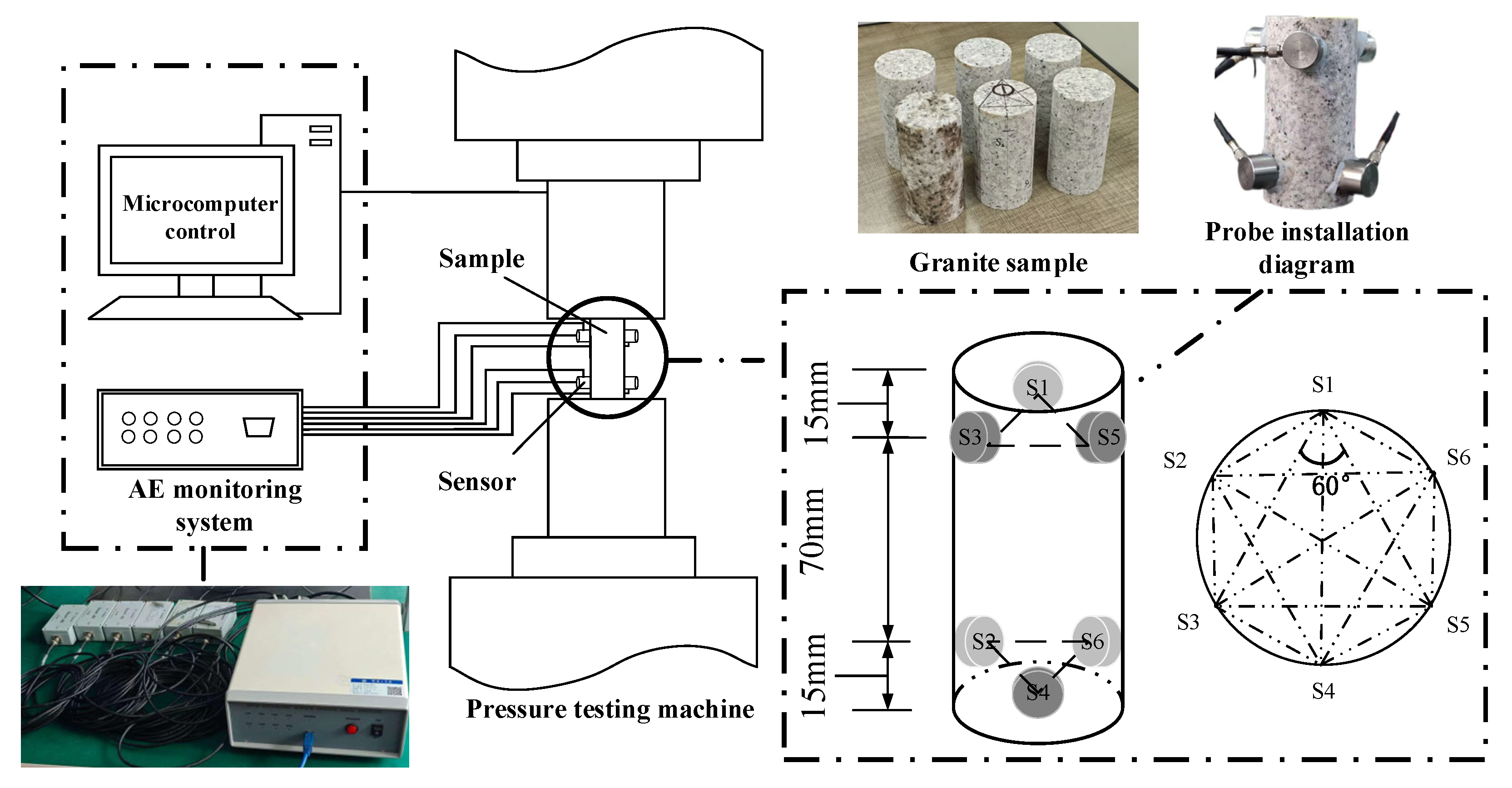
The acoustic emission test device is shown in Figure 1. It uses 6 broadband acoustic emission sensors with a frequency of 20 kHz~1 MHz, a sampling frequency ≥ 1 MHz, a dynamic range ≥ 16 bit, a trigger threshold of 40 dB, a main amplifier gain of 40 dB, and a wave velocity calibration method based on the time difference positioning method and the waveform arrival time difference method. The positioning accuracy is ≤1 mm. Place them in the position shown in Figure 1. Establish a 6 × 6 wave velocity matrix [27], and use the average value of the wave velocity of each connecting line as the wave velocity value of the area enclosed by each sensor connecting line to obtain the elastic wave velocity of the internal area of the test block. Combined with the wave velocity value of the original rock, the crack coefficient is obtained.
The wave velocity matrix-based approach does not aim to reconstruct a full anisotropic velocity field. Instead, it provides an equivalent average velocity representation for comparative damage assessment under controlled laboratory conditions. Axial force, displacement, lateral strain, and volumetric strain data were recorded synchronously, with timestamps aligned to the acoustic emission signals.

3.2.2. Experimental Procedure

During the test, maintain synchronization between the loading process and acoustic emission monitoring. Control the peak stress threshold to achieve the target damage level, i.e., control the loading to 50%, 80%, and 90% of the peak stress value as the target stress values, and monitor damage propagation in combination with acoustic emission or wave velocity changes.
In the preloading phase, determine the original rock wave velocity through acoustic emission wave velocity measurement, then load at a rate of 0.1 mm/min to 10% of the peak strength to eliminate internal voids in the specimen. In the main loading phase, apply continuous loading at a rate of 0.25 mm/min to the target stress value, recording acoustic emission parameters such as energy, amplitude, frequency, time, and three-dimensional coordinates throughout. After loading, test the wave velocity between each sensor again using the acoustic emission wave velocity measurement function.

3.3. Data Processing and Analysis

3.3.1. Dynamic Clustering of Acoustic Emission Localization Results

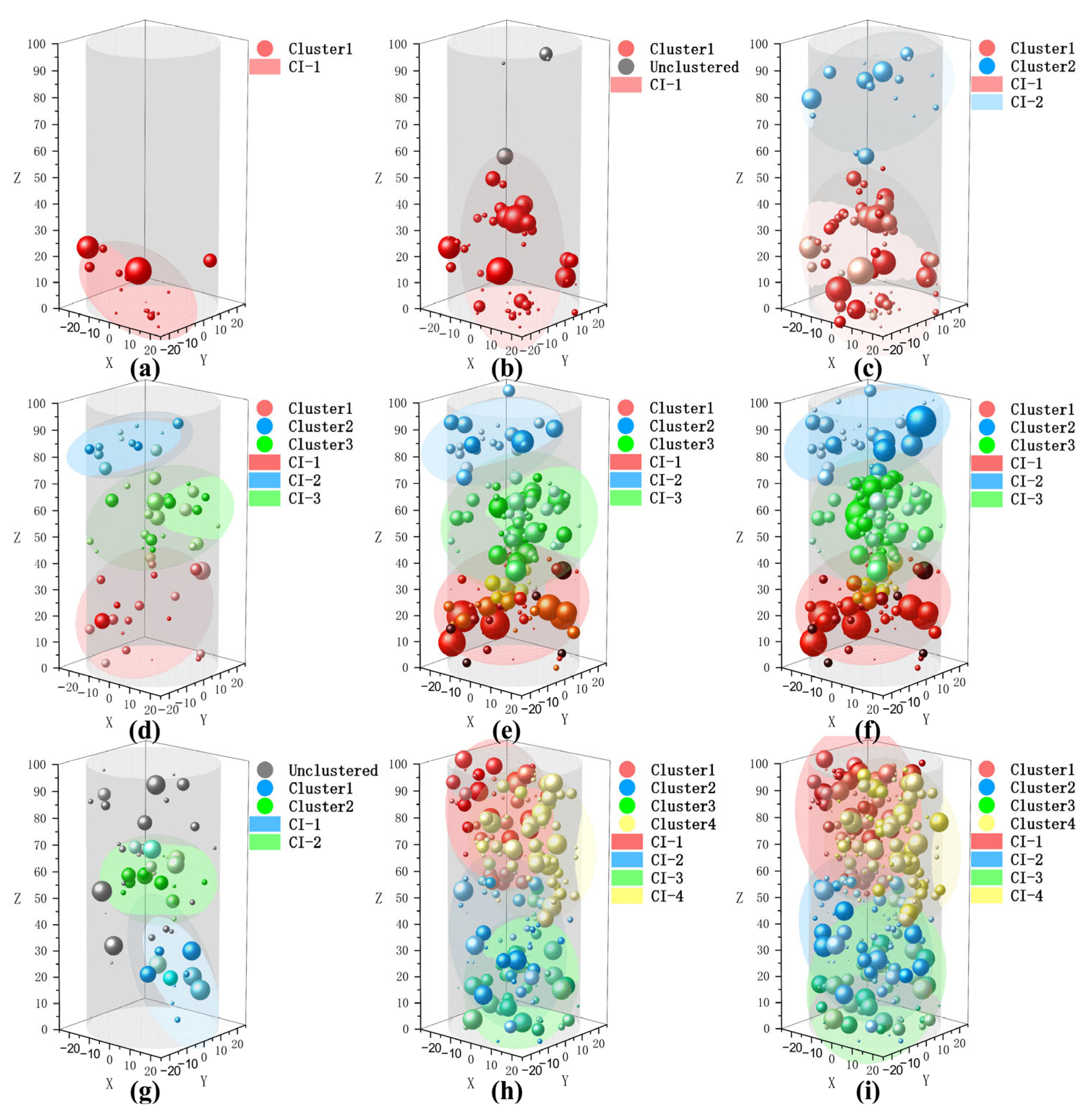
A total of nearly 640 acoustic emission events were obtained from three groups of experiments. Using the silhouette coefficient method, the number of cluster center samples was determined to be 5. After filtering out a small number of noise points caused by inaccurate arrival times, approximately 600 valid acoustic emission events remained. The optimal number of clusters for each test block was obtained using the elbow method. The test group parameters and clustering parameters at the target stress values for the three groups of experiments are shown in Table 3. The dynamic clustering results during the loading phase of the acoustic emission experiment are shown in Figure 2.
The damage evolution of Specimen 1 exhibits a typical single-source propagation pattern: during the initial loading phase (Figure 2a), high-energy events accompanied by low-energy disturbances formed the first cluster center, with a silhouette coefficient of 0.82; in the compaction phase (Figure 2b), moderate energy events clustered around this center, forming a Gaussian distribution characteristic; at the peak stress phase (Figure 2c), a secondary cluster center appeared in the upper part of the specimen, with a silhouette coefficient of 0.74, and its dispersed distribution reflected the end constraint effect. Ultimately, all valid events were assigned to these two clusters, verifying the algorithm’s ability to identify single-source fracture patterns. Specimen 2 exhibited multi-source synergistic damage characteristics: in the initial phase (Figure 2d), three cluster centers were distributed axially at equal intervals; during the crack propagation period (Figure 2e), the central cluster region evolved into an ellipsoidal confidence interval with a long-to-short axis ratio of 1.8:1, while the increased event density at the ends indicated enhanced constraint effects; in the failure phase (Figure 2f), the central region formed an axial linear distribution corresponding to a typical axial splitting failure mode, with an average silhouette coefficient of 0.78. The damage process of Specimen 3 was more complex: in the initial phase (Figure 2g), 36% of the scattered events were not clustered, reflecting the randomness of early microcracks; subsequent loading formed four laterally linear distribution centers spaced 12.7 ± 2.3 mm apart, with apex constraints causing an event density gradient; finally, frequent events with energy > 100 dB occurred between 700 s and 820 s before collapse, and the average silhouette coefficient of the four cluster centers was 0.75, confirming the algorithm’s adaptability to complex fracture patterns. The silhouette coefficients of all three specimen groups exceeded 0.7, and the clustering regions corresponded well with the actual fracture distributions, indicating that the algorithm effectively enhances intra-cluster cohesion in spatiotemporal data and accurately characterizes the temporal features of damage evolution.
In summary, clustering acoustic emission events using the improved dynamic K-means algorithm can effectively identify event clusters at different fracture stages. The cluster distribution is spatially concentrated, highly consistent with the locations of crack initiation and propagation. Compared with the traditional K-means method, the proposed algorithm outperforms both the silhouette coefficient and cluster stability, indicating that the introduction of spatiotemporal-energy weighting can better capture fracture evolution characteristics.

3.3.2. D-Value and Energy Index Rate Chart

Using the wave velocity measurement function of the acoustic emission monitoring system, elastic waves were actively excited by the built-in piezoelectric pulsing function, with designated sensors alternately acting as transmitters and receivers, and the first arrival times were recorded by the receiving sensors. Prior to formal testing, time-of-flight calibration was conducted using known sensor spacing to eliminate system delay and ensure the accuracy of the measured wave velocities. Petroleum jelly (Vaseline) was applied as a coupling agent between the sensors and the specimen surface to ensure stable signal transmission, and the coupling condition was checked before each measurement. Table 4, Table 5 and Table 6 show the wave velocity matrices of three sets of test blocks when the target loading intensity is reached. The boundary regions of the clustering clusters are mapped to the lines of the matrix, and the arithmetic mean of each wave velocity line corresponding to the boundary body of the clustering cluster is calculated to obtain the wave velocity of each clustering cluster, from which the D value is further calculated. Relevant parameters are shown in Table 6.
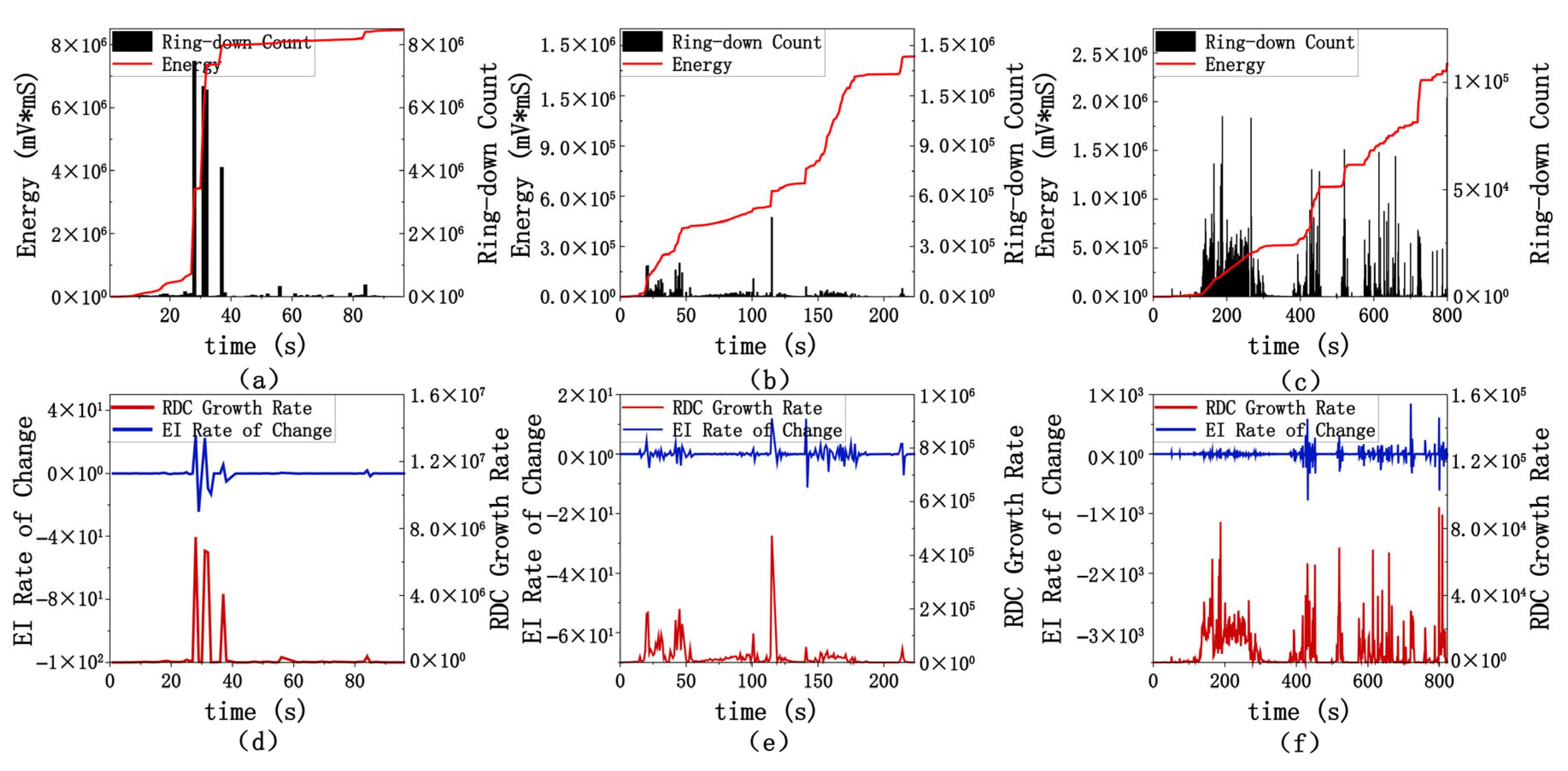
The basic quality indicators of rock are determined by coupling the acoustic emission wave velocity measurement with mechanical parameters, and a dynamic evolution curve is constructed by combining the energy index EI and ringing count. The synchronous timing curve of energy and ringing count is shown in Figure 3.
The acoustic emission responses of the three specimens show significant differences (Figure 3). For specimen 1, the acoustic emission events peak at 28 s during loading (Figure 3a), while the cumulative energy rapidly increases. At this time, the growth rates of the energy index and ringing count also simultaneously reach their maximum values (Figure 3d), indicating concentrated development of internal damage within the material. The acoustic emission behavior of specimen 2 can be divided into three stages: first, a large number of acoustic emission events occur during the compaction stage in the first 50 s (Figure 3b); subsequently, the number of events peaks at 115 s; finally, from 115 s to 223 s, the number of events decreases, but the cumulative energy continues to grow rapidly. The subsequent rates of change in the energy index and ringing count show distinct peaks at 130 s and 115 s, respectively (Figure 3e), with instantaneous growth rates exceeding 90% of the average level, indicating that damage evolution is not uniform. The acoustic emission characteristics of specimen 3 are more complex: between 100 s and 300 s, high-frequency low-energy events dominate (Figure 3c), and cumulative energy grows slowly; at 450 s and 520 s, secondary peaks dominated by medium to high-energy events appear; finally, during the failure stage, accompanied by spalling on the specimen’s side, acoustic emission events surge, and the energy accumulation rate significantly accelerates. The ringing count forms double peaks at 198 s and 802 s, while during 820 s, the rate of change in the energy index repeatedly exceeds 80% of the average value (Figure 3f), indicating that damage accumulation exhibits characteristics of intermittent intensification.

3.3.3. Comprehensive Evaluation of the Rupture Status of Test Block Groups

Based on the risk classification rule system, this study systematically evaluated the rupture status of three groups of test blocks through a multi-parameter coupling analysis method, as shown in Table 7. The results indicate that using the K-means dynamic clustering algorithm to perform a collaborative analysis of the D value and acoustic emission dynamic characteristic parameters can accurately characterize the damage evolution process of the test blocks at different loading stages and effectively predict their final failure modes. According to the damage characteristic analysis: Test Block 1 maintains good overall structural integrity, with its average D value stable below 0.3. Acoustic emission monitoring revealed a significant sudden increase in the energy index in the constrained region at the block end during the late loading stage, with an instantaneous growth rate reaching 180% of the average level. The RI values in both clustering regions were below 0.45, defined as Level II minor damage. Test Block 2 developed through cracks during loading, with an RI value around 0.5, reaching Level III moderate damage. Combined with micro-crack localization results, this abnormal area precisely corresponds to the initial location of the final failure, which basically matches the actual rupture region. Test Block 3 exhibited typical progressive failure characteristics. When the stress level reached 90% of the peak strength, the D values in Regions I and IV sharply increased from 0.5 to above 0.75 within 10 s, an increase exceeding 50%. High-speed camera observations confirmed that these two regions perfectly corresponded to the side spalling locations of the test block. More importantly, the synchronously monitored energy index change rate continuously exceeded 90% of the mean value, and the ringing count showed a significant “stepwise” increase. These features fully indicate that this region has entered an accelerated damage stage, with a comprehensive damage index RI value reaching about 0.85, corresponding to Level V critical instability.
In order to comprehensively evaluate the fracture evolution characteristics of different test blocks during loading, this paper conducted a graded analysis of each group of test blocks based on the comprehensive risk index (RI). The results showed that:
Overall trend: The RI values of each specimen gradually increased with the loading process, demonstrating a continuous evolution from low to high levels. Before the loading peak, the RI values increased significantly and approached the highest warning level, effectively reflecting the approach of critical instability of the rock mass.
Differences in stage characteristics: In the initial stage, the RI values of different specimens are relatively small and are all in the range of level I-II, indicating that the overall state is stable. As the load increases, the RI values of some specimens rise more rapidly in the middle stage and enter the level III-IV earlier, indicating that their internal structure has a more active fracture process.
Identification of fracture precursors: Immediately prior to fracture, the RI values of all specimens showed a sudden increase, with a distinct hierarchical clustering effect, demonstrating a Level V warning signature. This result is consistent with the dramatic increase in energy release rate and event density, demonstrating that the RI can sensitively detect precursor signals of a critical fracture state.
Comparison between test blocks: Although the RI evolution curves of different test blocks have some minor differences, the overall pattern is consistent, that is, they can well reflect the evolution process from stability to acceleration to instability. This shows that the proposed comprehensive evaluation method has strong robustness and universality.
The classification method proposed in this study not only accurately determines the damage state but, more importantly, reveals the spatiotemporal patterns of damage evolution. The model’s predicted fracture concentrations roughly match the actual fracture distribution, with misjudgment areas primarily located in areas of boundary noise interference. This result confirms the reliability of the evaluation method based on microseismic clustering and multi-parameter coupling for real-time diagnosis of rock fracture states, providing high-precision data support for engineering early warning.

4. Discussion

4.1. Experimental Results and Mechanism Analysis

This study evaluated the effectiveness of the improved dynamic K-means clustering algorithm and the comprehensive risk index (RI) model for characterizing rock damage evolution and early warning behavior based on acoustic emission laboratory experiments. The K-means clustering algorithm was chosen as the foundational algorithm primarily because of its high computational efficiency, simple structure, and ease of implementation-qualities crucial for potential real-time monitoring applications. Compared to density-based or hierarchical clustering methods, the K-means algorithm requires fewer parameters and has lower computational complexity, making it more suitable for dynamically updating clustering results. The improved method proposed in this paper retains the advantages of the K-means algorithm while enhancing its ability to integrate time and energy-related information, thereby improving its applicability in engineering damage assessment scenarios. The clustering results and RI evolution consistently reflected the progressive damage characteristics of the three specimens, ranging from stable single-source fracture to multi-source interaction and ultimately complex localized instability. The temporal correspondence between sharp increases in RI values and specimen failure indicates that the proposed framework can capture critical transitions in damage evolution under laboratory loading conditions.
The improved dynamic K-means algorithm integrates temporal dependency, energy intensity, and spatial density features through an exponential decay weighting strategy, addressing the limitations of static clustering methods in representing temporal non-uniformity of fracture activity. The setting of the time decay term enhances the indicative effect of recent events on the current damage state, while the synergistic effect of energy and density terms highlights the rupture intensity in highly active regions. This multidimensional feature coupling mechanism enhances the sensitivity of clustering results to recent high-activity events, which is beneficial for identifying rapidly evolving damage zones under different loading conditions. The comprehensive risk index (RI) model achieves nonlinear weight allocation throughout the entire process from microscopic crack initiation to macroscopic instability through the synergistic analysis of the static damage variable D value and dynamic parameters. The combination of static weights and dynamic correction functions not only preserves the initial integrity information of the rock but also captures the damage accumulation effect through instantaneous changes in energy release rate, ringing count, and spatial aggregation degree. The rapid increase in RI values prior to specimen failure was observed to coincide with synchronous changes in multiple dynamic parameters, suggesting that multi-parameter coupling may serve as an effective indicator of impending instability within the experimental framework.

4.2. Significance of the Study and Future Directions

The proposed dynamic clustering and RI-based framework provides a multidimensional perspective for analyzing rock damage evolution by reducing reliance on single-parameter or experience-based evaluation. By incorporating spatiotemporal and energy-related information, the method enables quantitative tracking of damage evolution trends, which may improve the timeliness of instability identification in laboratory-scale monitoring scenarios. From an engineering perspective, the proposed five-level warning threshold system has the potential to support decision-making in monitoring systems; however, further validation through field-scale experiments and system integration is required before practical application. Its classification accuracy and real-time advantages can significantly reduce the risk of support lag, and create a new technical paradigm for the dynamic assessment of rock stability under complex geological conditions. In addition, the dynamic weight allocation mechanism based on acoustic emission parameters provides a universal framework for the fusion analysis of multi-source heterogeneous data. Its technical path can be transferred to underground engineering safety fields such as tunnel excavation and slope monitoring, and has the potential for interdisciplinary promotion and application [28].
From a broader perspective, rock instability and failure can be regarded as a nonlinear dynamic transition process governed by the coupling of multiple physical parameters. Theoretical studies on phase transition dynamics have demonstrated that complex systems may undergo abrupt state changes once critical coupling thresholds are exceeded [29]. In rock mechanics, progressive failure and fracture localization are closely associated with the structural evolution and spatial organization of microcracks [30], particularly under deep in situ conditions characterized by high stress and multi-field coupling [31]. Between synchronous changes in dynamic parameters and macroscopic failure, several research questions warrant further investigation. For example, whether a critical coupling threshold exists among energy release rate, ringing count, and spatial clustering during the instability stage remains to be systematically verified. In addition, the migration behavior of clustering centers may provide insights into fracture localization tendencies, which could be explored through combined experimental and numerical studies with larger datasets.
Future studies should focus on improving the robustness of the proposed framework under boundary noise interference and heterogeneous conditions, as well as evaluating its applicability across different rock types and loading paths. Incorporating additional experimental data and refining parameter calibration strategies may further enhance the stability and generalization ability of the model [32].

5. Conclusions

The dynamic clustering-comprehensive risk index coupling model proposed in this study constructs a multidimensional dynamic evaluation framework for rock damage evolution. This model overcomes the limitations of traditional static evaluation systems, which rely on manual experience and single parameters. Through a spatiotemporal-energy collaborative clustering algorithm, it achieves the first quantitative coupled characterization of temporal heterogeneity and spatial heterogeneity during rock failure, enabling dynamic tracking of the spatiotemporal evolution of the damaged region. The model’s output of a five-level warning threshold system significantly improves the timeliness of rockburst warnings through a minute-level response mechanism. Its hierarchical accuracy and real-time performance provide a closed-loop management paradigm for deep mine dynamic disaster prevention and control that can be embedded in existing monitoring systems. Experimental verification reveals a strong correlation between synchronous jumps in dynamic parameters and macroscopic instability, providing new insights into the nonlinear mechanisms of damage accumulation and energy release. Future research should focus on improving the model’s generalization capabilities for multi-scale geological conditions, exploring the deep integration of machine learning and physical models, and developing a three-dimensional real-time visualization monitoring device based on edge computing. Furthermore, dynamic calibration of the wave velocity matrix and adaptive filtering algorithms should be used to enhance robustness to boundary noise interference, providing interdisciplinary technical support for the intelligent transformation of mines and the safety monitoring of underground engineering projects.

Author Contributions

Conceptualization and study design: W.L. and S.T.; Methodology: W.L., S.Z., S.T. and Z.Z.; Software: Z.Z. and Z.L.; Validation: W.L., S.T., Z.P., J.L. and B.Y.; Writing—original draft: S.Z.; Writing—review and editing: S.T., Z.P., J.L. and B.Y.; Supervision: S.T. and Z.L.; Funding acquisition: W.L. and S.T. All authors have read and agreed to the published version of the manuscript.

Funding

This work was supported by the following funding sources: 1. Weijian Liu, Natural Science Foundation of Henan Province (Grant No. 182300410161); 2. Shuai Teng, National Natural Science Foundation of China (Grant No. 52508178).

Data Availability Statement

The original contributions presented in this study are included in the article. Further inquiries can be directed to the corresponding author.

Conflicts of Interest

Author Ziwei Li was employed by the company Beijing Victory Star Architectural and Civil Engineering Design. The remaining authors declare that the research was conducted in the absence of any commercial or financial relationships that could be construed as a potential conflict of interest.

References

  1. Wang, C.; Wang, Y.; Lu, S. Deformational behaviour of roadways in soft rocks in underground coal mines and principles for stability control. Int. J. Rock Mech. Min. Sci. 2000, 37, 937–946. [Google Scholar] [CrossRef]
  2. Sun, J.; Wang, L.; Hou, H. Application of micro-seismic monitoring technology in mining engineering. Int. J. Min. Sci. Technol. 2012, 22, 79–83. [Google Scholar] [CrossRef]
  3. Dong, L.; Zhang, Y.; Pei, Z.; Chen, Y.; Yang, L. Investigation of quantitative precursory indicators for rock failure using spatio-temporal characteristics of velocity. Measurement 2024, 238, 115275. [Google Scholar] [CrossRef]
  4. Zhang, Q.; He, M.; Wang, J.; Guo, S.; Wang, C.; Hong, C.; Chen, K.; Yang, R.; Zhang, X.; Yang, J. Non-explosive directional fracturing blasting using coal-based solid waste expanding agent. J. Rock Mech. Geotech. Eng. 2025, 17, 3691–3710. [Google Scholar] [CrossRef]
  5. Zhang, Q.; He, M.; Guo, S.; Yang, R.; Chen, K.; Wang, C. Study on the mechanism and preliminary application of efficient directional rock breaking using a coal-based solid waste non-explosive expansive agent. Chin. J. Rock Mech. Eng. 2025, 44, 898–911. [Google Scholar] [CrossRef]
  6. Sheng, D.; Yu, J.; Tan, F.; Tong, D.; Yan, T.; Lv, J. Rock mass quality classification based on deep learning: A feasibility study for stacked autoencoders. J. Rock Mech. Geotech. Eng. 2023, 15, 1749–1758. [Google Scholar] [CrossRef]
  7. Huang, H.; Wu, C.; Zhou, M.; Chen, J.; Han, T.; Zhang, L. Rock mass quality prediction on tunnel faces with incomplete multi-source dataset via tree-augmented naive Bayesian network. Int. J. Min. Sci. Technol. 2024, 34, 323–337. [Google Scholar] [CrossRef]
  8. Li, J.; Yang, T.; Liu, F.; Du, S.; Deng, W.; Zhao, Y.; Liu, H.; Niu, L.; Xu, Z. Geostatistics-block-based characterization of the relationship between rock mass quality and powder factor and its application on open-pit limit optimization. Int. J. Min. Sci. Technol. 2025, 35, 135–147. [Google Scholar] [CrossRef]
  9. Eivazy, H.; Esmaieli, K.; Jean, R. Modelling geomechanical heterogeneity of rock masses using direct and indirect geostatistical conditional simulation methods. Rock Mech. Rock Eng. 2017, 50, 3175–3195. [Google Scholar] [CrossRef]
  10. Aydan, Ö.; Ulusay, R.; Tokashiki, N. A new rock mass quality rating system: Rock mass quality rating (RMQR) and its application to the estimation of geomechanical characteristics of rock masses. Rock Mech. Rock Eng. 2014, 47, 1255–1276. [Google Scholar] [CrossRef]
  11. Fan, X.; An, H.; Bao, H.; Ren, X.; Deng, Z.; Wu, R. An empirical method for calculating the roughness coefficient of structural plane with line-plane combination. Hydrogeol. Eng. Geol. 2023, 50, 78–86. [Google Scholar]
  12. Hasan, M.; Shang, Y.; Shao, P.; Yi, X.; Meng, H. Evaluation of engineering rock mass quality via integration between geophysical and rock mechanical parameters. Rock Mech. Rock Eng. 2022, 55, 2183–2203. [Google Scholar] [CrossRef]
  13. Wang, C.; Zhang, Q.; He, M.; Guo, S.; Jia, Y. Mechanism of fracture process zone development in sandstone and limestone under mode I loading wet-dry cycles and temperature. Rock Mech. Rock Eng. 2025, 58, 7307–7328. [Google Scholar] [CrossRef]
  14. Zhang, S.; Li, Y.; Liu, H.; Ma, X. Experimental investigation of crack propagation behavior and failure characteristics of cement infilled rock. Constr. Build. Mater. 2021, 268, 121735. [Google Scholar] [CrossRef]
  15. Guo, W.; Chen, L.; Yin, L.; Zhang, L.; Lu, D.; Kong, B.; Fei, H. Experimental study on the influence of loading rate on the directional propagation law of rock mode-I cracks. Theor. Appl. Fract. Mech. 2023, 125, 103873. [Google Scholar] [CrossRef]
  16. Yang, J.; Mu, Z.L.; Yang, S.Q. Experimental study of acoustic emission multi-parameter information characterizing rock crack development. Eng. Fract. Mech. 2020, 232, 107045. [Google Scholar] [CrossRef]
  17. Dong, L.; Zhang, Y.; Bi, S.; Ma, J.; Yan, Y.; Cao, H. Uncertainty investigation for the classification of rock micro-fracture types using acoustic emission parameters. Int. J. Rock Mech. Min. Sci. 2023, 162, 105292. [Google Scholar] [CrossRef]
  18. Shah, K.R.; Labuz, J.F. Damage mechanisms in stressed rock from acoustic emission. J. Geophys. Res. Solid Earth 1995, 100, 15527–15539. [Google Scholar]
  19. Gong, F.; Zhang, P.; Xu, L. Damage constitutive model of brittle rock under uniaxial compression based on linear energy dissipation law. Int. J. Rock Mech. Min. Sci. 2022, 160, 105273. [Google Scholar] [CrossRef]
  20. Kawamoto, T.; Ichikawa, Y.; Kyoya, T. Deformation and fracturing behaviour of discontinuous rock mass and damage mechanics theory. Int. J. Numer. Anal. Methods Geomech. 1988, 12, 1–30. [Google Scholar] [CrossRef]
  21. Liu, J.; Si, Y.; Wei, D.; Shi, H.-X.; Wang, R. Developments and prospects of microseismic monitoring technology in underground metal mines in China. J. Cent. South Univ. 2021, 28, 3074–3098. [Google Scholar] [CrossRef]
  22. Guo, J.; Zhang, J.; Feng, G.; Yu, L.; Bai, J.; Dias, D.; Wen, X.; Zhang, J.; Zhang, L. Shear failure behavior and damage evolution mechanism of sandstone under pre-static loading and low-frequency dynamic disturbance. Soil Dyn. Earthq. Eng. 2026, 200, 109796. [Google Scholar] [CrossRef]
  23. Bao, Y.; Su, D.; Mu, H. Study on large deformation mechanism of roadway with close and multi coal seam in mining. Geotech. Geol. Eng. 2021, 39, 1937–1949. [Google Scholar] [CrossRef]
  24. Li, W.; Fang, S.; Gao, X.; Han, Y. Method of defining rock damage variable on the basis of wave impedance. Energy Sci. Eng. 2023, 11, 3641–3661. [Google Scholar] [CrossRef]
  25. Zhang, Y.; Yao, X.; Liang, P.; Wang, K.; Sun, L.; Tian, B.; Liu, X.; Wang, S. Fracture Evolution and Localization Effect of Damage in Rock Based on Wave Velocity Imaging Technology. J. Cent. South Univ. 2021, 28, 2752–2769. [Google Scholar] [CrossRef]
  26. Zhou, J.; Zhou, Z.; Zhao, Y.; Cai, X. Global wave velocity change measurement of rock material by full-waveform correlation. Sensors 2021, 21, 7429. [Google Scholar] [CrossRef]
  27. Song, T.; Zhou, Y.; Yu, X. Three-dimensional acoustic emission source localization method for layered rock considering anisotropic P-wave velocity. Bull. Eng. Geol. Environ. 2024, 83, 185. [Google Scholar] [CrossRef]
  28. Wang, L.; Shao, A.; Qu, F.; Yue, X.; Wang, H.; Zhang, X.; Liu, X. Current status and prospects of mining technology in metal mines. Chin. J. Eng. 2025, 47, 971–983. [Google Scholar]
  29. Ma, T.; Wang, S. Phase Transition Dynamics; Springer: New York, NY, USA, 2014. [Google Scholar]
  30. Song, Z.; Zhang, J. Research on the progressive failure process and fracture mechanism of rocks with the structural evolution perspective. J. Struct. Geol. 2022, 154, 104484. [Google Scholar] [CrossRef]
  31. Gao, M.; Ye, S.; Yang, B.; Liu, Y.T.; Li, J.H.; Liu, J.J.; Xie, H.P. Progress in research on deep in situ rock mechanics. Bull. Natl. Nat. Sci. Found. China 2021, 35, 895–903. [Google Scholar]
  32. He, M.; Wu, Y.; Gao, Y.; Tao, Z. Research progress of rock mechanics in deep mining. J. China Coal Soc. 2024, 49, 75–99. [Google Scholar]
Figure 1. Acoustic emission experimental device.
Processes 14 00774 g001
Figure 2. Dynamic Clustering Results During the Loading Phase of the Acoustic Emission Experiment. (ac) Clustering evolution of Specimen 1 at different loading stages; (df) Clustering evolution of Specimen 2 at different loading stages; (gi) Clustering evolution of Specimen 3 at different loading stages. Different colors indicate different clustering regions, and the translucent ellipsoids represent the corresponding confidence intervals (CI).
Processes 14 00774 g002
Figure 3. Synchronous Timing Curve of Energy and Ringing Count. (ac) Time histories of energy release and ring-down count of a specimen at different loading stages; (df) corresponding rates of change of the energy index (EI) and growth rate of the ring-down count (RDC). Subfigures (a,d), (b,e), and (c,f) correspond to the same specimen under different loading stages, respectively. Black bars denote ring-down count, red curves represent energy or RDC growth rate, and blue curves indicate the EI rate of change.
Processes 14 00774 g003
Table 1. The determination of the correction factor f ( D ) .
Correction Factor D 0.3 0.3 < D < 0.6 D 0.6
f ( D ) 1.51.00.8
Table 2. Multi-parameter coupled rock fracture multi-level warning thresholds.
Warning RangeWarning LevelRock State
R I 0.25 Level I (Stable)Rock is intact with no visible signs of fracturing.
0.25 < R I < 0.45 Level II (Slight Damage)Localized scattered microcracks appear, without forming through-going fractures.
0.45 < R I < 0.65 Level III (Moderate Damage)Stable crack propagation, coordinated variation in multiple parameters, visible network-like microcracks.
0.65 < R I < 0.85 Level IV (Severe Damage)Accelerated crack coalescence, synchronous dynamic parameter jumps, macroscopic crack penetration.
R I 0.85 Level V (Critical Instability)The rock is approaching overall failure, with parameters fluctuating drastically, accompanied by rock bursts or roof collapse precursors.
Table 3. Test Group Parameters and Clustering Parameters at Target Stress Values.
Test GroupCompressive Strength
(MPa)
Loading Strength
(MPa)
Number of Acoustic Emission EventsOptimal Number of Clusters
1100.025553.3478882
2105.290185.07642023
3104.322892.28663004
Table 4. Wave Velocity Matrix of Test Block 1 for Acoustic Emission.
Acoustic Wave Transmitting ProbeAcoustic Wave Receiving Probe
S1S2S3S4S5S6
S1018472145179320881732
S2184701924211718752065
S3214519240198222161893
S4179321171982019632184
S5208818752216193601824
S6173220651893218418240
Table 5. Acoustic Emission Wave Velocity Matrix of Specimen 2.
Acoustic Wave Transmitting ProbeAcoustic Wave Receiving Probe
S1S2S3S4S5S6
S1012671548118914731095
S2126701324145212831426
S3154813240137616241298
S4118914521376013421578
S5147312831624134201217
S6109514261298157812170
Table 6. Acoustic Emission Wave Velocity Matrix of Specimen 3.
Acoustic Wave Transmitting ProbeAcoustic Wave Receiving Probe
S1S2S3S4S5S6
S101083654412627327
S210830512598467584
S365451205386871066
S44125985380524613
S56274676875240438
S632758410666134380
Table 7. Comprehensive Evaluation of Test Block Rupture Status.
Test Block Region D Intra-Cluster Event Density  ( E v e n t s / 10 2 m m 3 ) R I Inter-Cluster Damage LevelComprehensive Damage LevelActual DamageAccuracy
1I0.15050.21080.4133Level IILevel IIProcesses 14 00774 i001Good
II0.210.43880.1905Level I
2I0.22070.12710.4393Level IILevel IIIProcesses 14 00774 i002Good
II0.31550.23490.5060Level III
III0.40540.24220.5891Level III
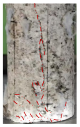
3I0.820.20060.9120Level VLevel VProcesses 14 00774 i003Good
II0.79910.12870.7894Level IV
III0.84040.35880.8309Level IV
IV0.92270.17460.8653Level V
Disclaimer/Publisher’s Note: The statements, opinions and data contained in all publications are solely those of the individual author(s) and contributor(s) and not of MDPI and/or the editor(s). MDPI and/or the editor(s) disclaim responsibility for any injury to people or property resulting from any ideas, methods, instructions or products referred to in the content.