Article

Comparative Stability of Heyndrickxia coagulans Spores in Oat and Rice-Bean Matrices: Impact of Processing, Storage, and Simulated Digestion

by
Glaubenia Temoteo Bento
,
Antônia Yvina Silva Santos
,
Sueli Rodrigues
and
Thatyane Vidal Fonteles
*
Food Engineering Department, Federal University of Ceara, Pici, Fortaleza 60440-900, Brazil
*
Author to whom correspondence should be addressed.
Processes 2026, 14(5), 775; https://doi.org/10.3390/pr14050775
Submission received: 28 January 2026 / Revised: 22 February 2026 / Accepted: 24 February 2026 / Published: 27 February 2026
(This article belongs to the Special Issue Green Technologies for Food Processing)

Abstract

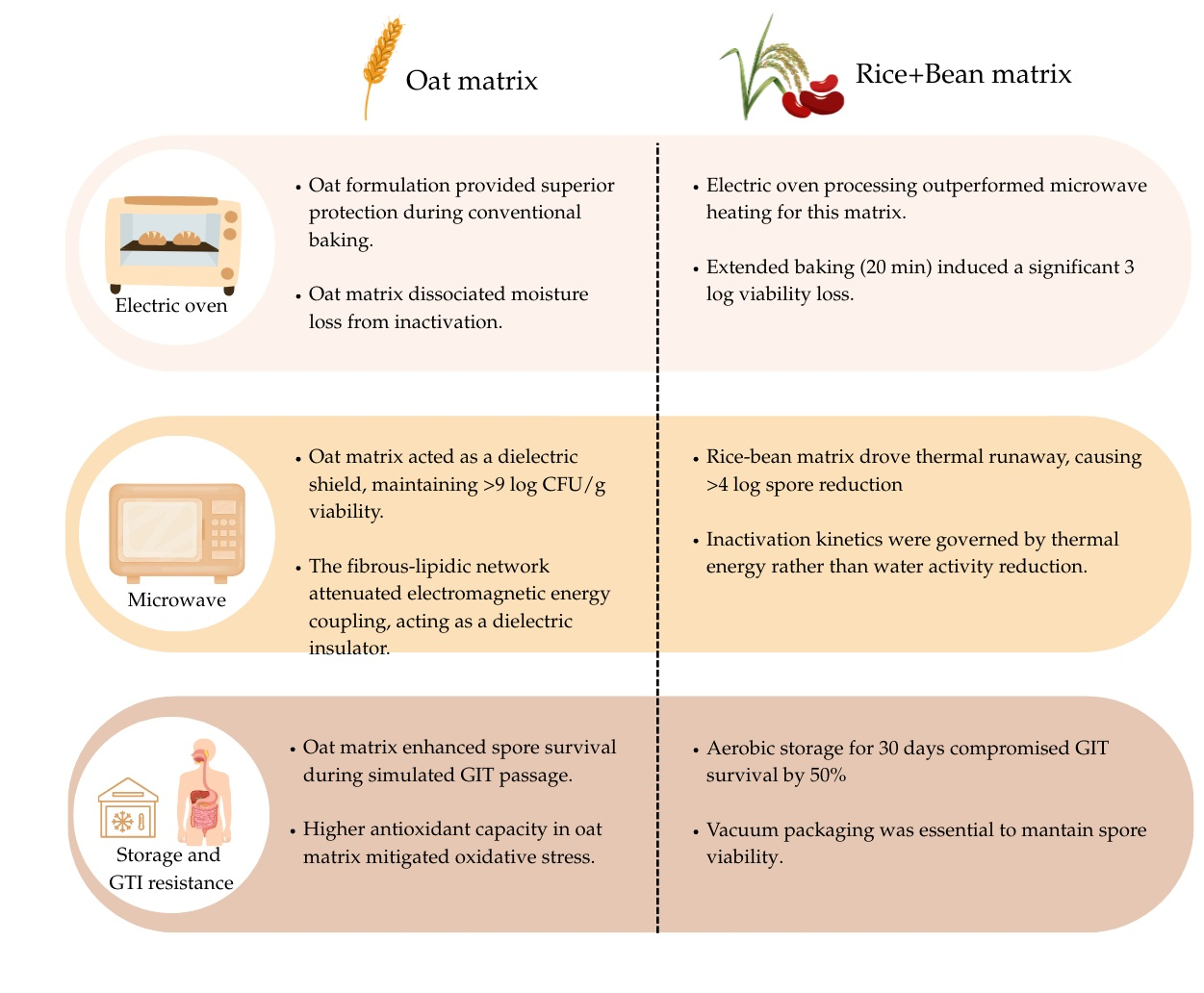
The incorporation of spore-forming probiotics into thermally processed foods represents a promising strategy to expand functional food availability. In this study, probiotic snacks were formulated from oat and rice-bean matrices as delivery vehicles for Heyndrickxia coagulans (formerly Bacillus coagulans) BC4 spores. The effects of baking and microwave processing, packaging, and storage conditions on spore viability and functionality were evaluated. While oven baking (180 °C) preserved viability in both matrices under mild conditions (survival > 90%), dielectric heating induced significant viability loss depending on the matrix. The starch-based rice-bean matrix, characterized by higher post-processing water activity (Aw), suffered a thermal runaway effect, resulting in significant spore inactivation (viability decreased to 6.08 log colony forming units/g (CFU/g); 1.5 min). Conversely, the oat matrix acted as a thermo-physical stabilizer, maintaining high viability (9.41 log CFU/g; 1.5 min) by limiting dielectric energy absorption via its fiber-lipid composition. Oxidative stress and premature germination likely contributed to the viability loss observed in atmospheric packaging during the 30-day storage. The oat matrix mitigated this effect through a dual-protective mode: active radical scavenging (validated by superior ferric reducing ability of plasma (FRAP) values) and passive water binding. Simulated digestion data align with the functional preservation observed, resulting in increased survival for oat-based formulations. Overall, the results demonstrate the feasibility of developing oat and rice-bean snacks enriched with H. coagulans spores and highlight the critical role of matrix and processing conditions in preserving probiotic viability.

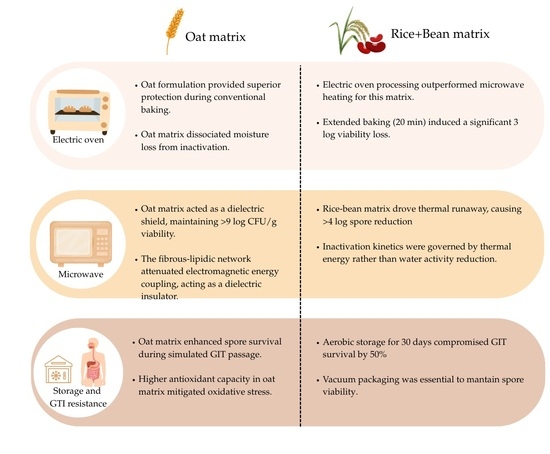
Graphical Abstract

1. Introduction

The convergence of two important consumer trends is shaping food development: the demand for plant-based products and the requirement for clinically proven functionality. This synergy has emerged from intensive research on the fortification of convenience-driven, “grab-and-go” snacks containing probiotics. However, the technological feasibility of these products is fundamentally contingent upon maintaining viability through thermal processing, especially in baked foods [1]. Ensuring that the probiotic concentration remains above the minimum threshold for efficacy (typically 106–107 CFU/g or mL of food product to reach the 108–109 CFU minimum daily intake level through the consumption of 100 g or mL of a food product) is important to observe the health benefits [2,3]. This challenge is intensified in nonrefrigerated formats, where conventional vegetative probiotics are nonviable.
This technological divide positions spore-forming bacteria as promising probiotic candidates for heat-processed foods [4,5]. Its dormant spore structure confers resilience not only to industrial processing (heat, drying, and high pressure) but also to the subsequent stresses of the gastrointestinal tract (acidity, bile salts, and enzymes), validating its use as a robust probiotic delivery vector [6]. Recently reclassified from Bacillus to Heyndrickxia based on phylogenomic analysis [7], H. coagulans, a spore-forming probiotic, has emerged as a promising alternative due to its resistance to heat, desiccation, acidity, and oxidative stress. These properties are largely attributed to the protective spore structure, which includes a low-water-content core stabilized by dipicolinic acid and small acid-soluble proteins (SASP) [8]. This enables H. coagulans spores to withstand industrial processes, such as baking, microwaving, extrusion, pasteurization, and high-pressure processing, while remaining viable and metabolically functional in finished products [4,8,9,10].
In addition to their robustness, H. coagulans strains have demonstrated functional benefits, including the production of organic acids and, bacteriocins, modulation of intestinal microbiota, reduction of inflammation, improvement of protein and nutrient absorption, and immunomodulatory effects [11,12,13]. The Generally Recognized as Safe (GRAS) status and efficacy of H. coagulans in various delivery systems, such as dairy, fruit-based, and cereal-based products, further support its use in functional food development [14].
However, the technological stability of probiotic spores is not absolute and is modulated by extrinsic factors, most notably the physicochemical composition of the food matrix [1]. Food matrix components, such as lipids, fibers, proteins, and micronutrients, are not merely passive carriers but rather active modulators of stress-resistance mechanisms [2]. The matrix can act as a protective vehicle by providing thermal insulation or binding water, which increases the glass transition temperature of the system, locking the spore in a stable, glassy state [15].
While matrix–spore interactions are well-documented in conventional heating, comparative research elucidating how macromolecular compositions modulate survival under dielectric (microwave) regimes remains scarce. Microwave processing is increasingly favored in the snack industry for its high-speed volumetric heating, which offers superior energy efficiency and enhanced retention of thermolabile bioactives compared to traditional conduction. However, internal energy dissipation can trigger thermal runaway, localized temperature spikes that accelerate probiotic inactivation. As these interactions are governed by the food’s dielectric properties, tailoring matrix composition, represents a primary strategy to stabilize probiotics. Understanding this interaction is critical for designing effective non-dairy carriers that protect H. coagulans spores against the non-uniform heating patterns characteristic of industrial microwave systems.
Oat and rice-bean matrices were strategically selected for their contrasting macromolecular and dielectric properties to investigate matrix–spore interactions. Oat was chosen for its high concentration of β-glucan fibers and lipids, which function as dielectric insulators, moisture-regulating agents, and radical scavengers. Furthermore, the unique profile of avenanthramides in oats offers superior antioxidant shielding for H. coagulans spores against oxidative stress during storage [16,17].
In contrast, the rice-bean blend provides a protein-dense starch network rich in minerals and electrolytes [18]. This combination serves as a physical model to evaluate thermal runaway during microwave processing, a common phenomenon in legume-based snacks with high dielectric loss factors. By comparing these diverse plant-based systems, specifically antioxidant-rich fibers versus protein-dense starch networks.
Therefore, this study evaluated the impact of oat and rice-bean matrices on H. coagulans BC4 viability throughout the product lifecycle, covering: (1) post-processing recovery (conventional vs. microwave heating), (2) shelf-life stability under diverse environmental conditions, and (3) survival after simulated in vitro digestion.

2. Materials and Methods

2.1. Raw Materials

Snacks were formulated using polished rice powder (Oryza sativa), cooked beans (Phaseolus vulgaris, carioca variety), or oat flour (Avena sativa), 100% unsweetened cocoa powder, and sugar. The beans were precooked in a domestic pressure cooker (3 L, Vancouver, Tramontina, Carlos Barbosa, Brazil) for 15 min, cooled to 30 °C, drained, and kept frozen at −20 °C until use.

2.2. Chemicals and Reagents

All chemicals and solvents used were of analytical grade (purity ≥ 95%). Reagents for the INFOGEST in vitro digestion (NaCl, KCl, KH2PO4, MgCl2 6H2O, NaHCO3, CaCl2, α-amylase (75 U/mL), pepsin (2000 U/mL) pancreatin (100 U/mL), and bile extract porcine; and antioxidant assays (2,2-diphenyl-1-picrylhydrazyl (DPPH), 2,4,6-tris(2-pyridyl)-s-triazine (TPTZ), Folin–Ciocalteu, gallic acid, 6-hydroxy-2,5,7,8-tetramethylchroman-2-carboxylic acid (Trolox), and bovine serum albumin (BSA); Corn steep liquor, dextrose, MnSO4, CaCO3, and (NH4)2SO4 were purchased from Sigma-Aldrich (St. Louis, MO, USA). Microbiological media including Trypticase Glucose Yeast (TGY) broth and peptone water, were obtained from HiMedia (Maharashtra, India).

2.3. Spore Suspension Preparation

H. coagulans BC4 spores were obtained from a commercial supplier (Sacco, Cadorago, Italy) in lyophilized form containing 11 log CFU/g. A spore stock was prepared by inoculating 1 g of lyophilized spores in 10 mL of TGY broth (37 °C, 150 rpm, 48 h), followed by two successive incubations in 45 mL of TGY broth. A 25 mL aliquot of the frozen culture was transferred to 225 mL of TGY broth and incubated (39 °C, 200 rpm, 24 h). After centrifugation (3000× g, 15 min), the pellet was inoculated into a sporulation medium (corn steep liquor, dextrose, MnSO4, CaCO3, and (NH4)2SO4) and incubated (39 °C, 200 rpm, 120 h). The biomass was centrifuged (Sigma Centrifuges, 6-16KS, Osterode am Harz, German), washed twice with sterile distilled water, and resuspended in water to obtain 11 log CFU/mL. Glycerol (50%) was added to the final culture before transferring to cryogenic tubes for storage at −20 °C [19]. Viable counts were determined by serial dilution and plating on TGY agar, with incubation at 37 °C for 48 h.

2.4. Snack Formulation

The oat probiotic snack formulation consisted of oat flour (40% w/w), sugar (10% w/w), and cocoa powder (7% w/w). The rice-bean probiotic snack formulation consisted of cooked beans (20% w/w), rice flour (20% w/w), sugar (10% w/w), and cocoa powder (7% w/w). Subsequently, sterile distilled water was added to the mixture to yield a cohesive dough with a standardized initial Aw of 0.9 ± 0.02 (~25 mL/100 g dry mix). A suspension of H. coagulans BC4 spores was then incorporated and mixed to obtain a final concentration of 10 log CFU/g. The inoculated dough was manually shaped into uniform spheres weighing 1.0 ± 0.1 g, with an average diameter of 2.5 ± 0.2 cm.

2.5. Processing

The processing time levels were selected based on preliminary tests that optimized product texture and considered the operational limits of the baking and microwave equipment. The snacks were processed by baking in an electric oven (6 L, 650 W, Mondial, FR-09, Sorocaba, Brazil) preheated to a fixed temperature of 180 °C. The processing times evaluated were 10, 15, and 20 min. The microwaving processing was performed in a domestic microwave oven (21 L, NNST254W, Panasonic, Osaka, Japan) operating at a frequency of 2450 MHz with a nominal power output of 700 W. The evaluated processsing times were 1, 1.5, and 2 min.

2.6. Storage Stability

The viability of H. coagulans was evaluated on the 1st and 30th day under different storage conditions. The 30-day storage period was selected based on the physicochemical dynamics of intermediate Aw matrices (typically between 0.60 and 0.85). In this specific Aw range, molecular mobility allows accelerated degradation reactions compared to low-moisture systems. Consequently, the highest rate of spore inactivation in intermediate-moisture cereal-based matrices typically occur during the initial phase of hygroscopic equilibrium and osmotic adaptation. Therefore, the 30-day interval serves as a critical window for assessing the resilience of spores against early germination and osmotic stress, which are the primary drivers of viability loss in probiotic spores.
After thermal processing, the samples were cooled to 25 °C and stored under four different conditions in polyethylene (PE) bags:
(1)
Atmospheric packaging (25 °C): A25
(2)
Atmospheric packaging under refrigeration (4 °C): A4
(3)
Vacuum-sealed packaging (25 °C): V25
(4)
Vacuum-sealed packaging under refrigeration (4 °C): V4
Atmospheric Packaging refers to samples that were heat-sealed in PE bags with ambient air headspace). This non-barrier, non-vacuum condition allows for gas exchange (e.g., oxygen and water vapor) with the ambient environment, representing a standard storage scenario. Vacuum Packaging refers to samples placed in identical PE bags. The headspace air was evacuated using a vacuum sealer (Conceito Vacuo, CAV40, São Paulo, Brazil) to a pressure of −0.8 bar, and the bags were immediately heat-sealed. This condition was designed to minimize oxidative stress by removing oxygen from the packages.

2.7. Resistance to Simulated Gastrointestinal Digestion

The simulated digestion of the snacks was performed according to the INFOGEST protocol [20], comprising salivary, gastric, and intestinal phases. A25-atmospheric packaging at room temperature; A4-atmospheric packaging under refrigeration; V25-vacuum packaging at room temperature; and V4-vacuum packaging under refrigeration were evaluated.
The salivary fluid was prepared with NaCl (47.2 mmol/L), KCl (6.9 mmol/L), KH2PO4 (0.9 mmol/L), MgCl2·6H2O (0.1 mmol/L), NaHCO3 (25 mmol/L), CaCl2 (0.3 g/L), and α-amylase. The gastric and intestinal fluids contained NaCl (38.4 mmol/L), KCl (6.8 mmol/L), KH2PO4 (0.64 mmol/L), MgCl2·6H2O (0.33 mmol/L), NaHCO3 (85 mmol/L), CaCl2 (0.37 g/L), pepsin or pancreatin, and bile extract porcine (6 g/L).
Each digestion step was conducted under agitation at 37 °C/2 min for the salivary phase and 2 h for both gastric and intestinal phases. The pH was adjusted to 7.0, 3.0, and 7.0 for the respective phases using 3 M NaOH and 3 M HCl. After each digestion phase, aliquots were collected to assess H. coagulans survival throughout digestion. Samples were collected at the end of simulated digestion and then centrifuged at 10,000× g at 4 °C for 10 min. The supernatant was used to quantify total phenolic compounds (TPC), proteins, and total antioxidant activity.

2.8. Analytical Methods

Viability
The viability of H. coagulans in the snacks was determined using 25 g of finely ground snack in a flask with 225 mL of peptone water. Cell counting was performed through serial dilutions, followed by triplicate inoculations on TGY agar plates (Yeast Extract, Tryptone, Potassium Sulfate, Dextrose, and Agar) using the spread plate method. The plates were incubated at 37 °C for 48 h.
The viability of H. coagulans spores was expressed as log CFU/g. In this study, viability refers to the absolute count of live H. coagulans per gram of the snack, whereas survival rate denotes the percentage of these cells that remained viable after processing compared to the initial count. The viability results were used to calculate the survival rate after processing, according to Equation (1).
S u r v i v a l   r a t e % = ( l o g   N / log   N 0 ) . 100
where:
log N is the log of the number of viable cells after processing
log N0 is the log of the number of viable cells before processing
Moisture content and water activity (Aw)
Moisture content was determined using a moisture analyzer (Marconi, ID50, Piracicaba, Brazil). Aw was determined at 25 °C using a dew point water activity meter (Decagon Devices Inc., AquaLab Series 3TE, Pullman, WA, USA).
Chemical Characterization and Antioxidant Profile
Extraction
For the determination of phenolic compounds and antioxidant capacity of non-digested samples, 1.0 g of finely ground snack was subjected to liquid-solid extraction using 10 mL of deionized water. The mixture was stirred for 2 h at 25 °C in the absence of light. Subsequently, the extracts were centrifuged at 1000× g for 15min, and the resulting supernatant was collected and stored at −20 °C until analysis.
Functional characterization (protein, TPC, DPPH, and FRAP) was performed on oven-baked snacks at Day 0 and Day 30 to evaluate the stability of the matrices’ intrinsic protective properties during storage. These analyses focused on the oven-baked samples to provide a mechanistic basis for the observed differences in spore viability and antioxidant efficacy under distinct packaging and temperature conditions.
Protein
Protein concentration was determined according to Bradford’s method (1976) [21]. The reaction was prepared with 10 µL of the sample and 250 µL of Bradford reagent and incubated for 10 min. The absorbance was measured at 595 nm (Global Trade Technology, UV-5100, Jaboticabal, Brazil). Results were calculated using a BSA standard curve and expressed as grams of protein per 50 g of snack (g/50 g).
Total antioxidant capacity
The in vitro antioxidant capacity was determined using the DPPH and FRAP methods. The DPPH radical method was performed according to Paixão et al. [22]. The reaction was prepared using 90 µL of the sample and 1800 µL of the DPPH reagent. The reaction was monitored by measuring the decrease in absorbance over 15 min. Absorbance was measured at 515 nm using an Evolution 220 UV-Vis spectrophotometer (Thermo Scientific, Evolution™ 220 UV-Visible, Waltham, MA, USA) and Thermo Insight Customizer User Enviroment (CUE) software v1.2.0 (Thermo Scientific, Waltham, MA, USA). The results were calculated using Equation (2):
T o t a l   a n t i o x i d a n t   a c t i v i t y   = K p   ×   C t K t × d
where:
Kp = kinetic constant obtained for each sample
Ct = Trolox concentration (1000 µM)
Kt = kinetic constant obtained for Trolox after 15 min of reaction
d = dilution factor.
In the FRAP method, the reaction between ferric chloride and TPTZ forms the Fe2+-TPTZ complex in the presence of an antioxidant under acidic conditions (pH = 3.6), as described by Benzie and Strain [23]. This reaction produces a blue complex. The samples were diluted at 1:5. The reaction was conducted using 15 µL of the sample and 285 µL of FRAP reagent. After 30 min in the absence of light, absorbance was measured in a microplate reader (Agilent, Biotek Epoch, Santa Clara, CA, USA) using the software Gen6 1.04 (Agilent, Biotek Epoch, Santa Clara, CA, USA). Results were calculated using an ascorbic acid (AA) standard curve and expressed as milimolar of ascorbic acid equivalents (AAE) per 50 g of snack (mM AAE/50 g).
TPC
TPC were quantified according to the method described by Obanda and Owuor [24], modified by Almeida et al. [25], using the Folin–Ciocalteu reagent and gallic acid for the standard curve. The reaction was performed using 10 µL of the diluted sample and 200 µL of Folin’s reagent. After 3 min, 100 µL of 20% sodium carbonate solution was added. The absorbance was measured using a microplate reader (Agilent, Biotek Epoch, Santa Clara, CA, USA) and Gen6 1.04 software (Agilent, Santa Clara, CA, USA). Results were calculated based on a gallic acid standard curve and expressed as milligrams of gallic acid equivalents (GAE) per 50 g of snack (mg GAE/50 g).

2.9. Statistical Analysis

The results are reported as mean ± standard deviation. The effects of processing methods, processing time, and storage conditions on the response variables were analyzed using ANOVA at a significance level of 5% (p < 0.05). Statistical analyses were conducted using Statistica (TIBCO Statistica™ 14.0.0).

3. Results and Discussion

3.1. Comparative Effect of Thermal Processing on Spore Viability

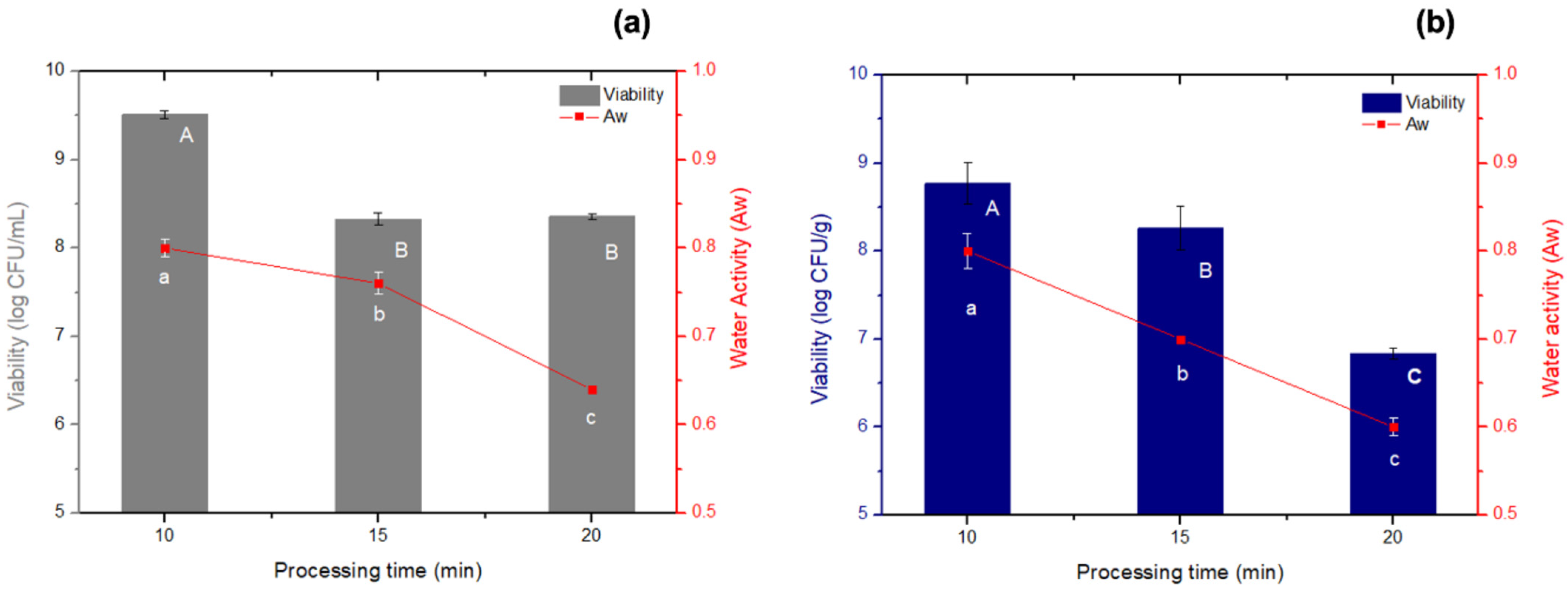
Figure 1 shows the thermal stability of H. coagulans spores incorporated into oat-based (a) and rice-bean-based (b) matrices during electric oven processing at 180 °C, alongside the corresponding variations in Aw.
Post-processing analysis revealed the thermal resilience of H. coagulans, which maintained high viability counts despite exposure to baking at 180 °C. The oat matrix demonstrated robust thermal protection during processing. At 10 min, spore viability was 9.5 log CFU/g (Aw 0.80). Extending the baking time to 20 min resulted in a final viability of 8.4 log CFU/g. The oat matrix exhibited a minor reduction of 1.17 log cycles between 10 and 20 min of processing. Despite the significant reduction in Aw, which decreased from 0.80 to 0.64 at the highest processing time (20 min), cell viability remained high. This suggests that the oat matrix effectively dissociated moisture loss from thermal inactivation, maintaining viability above 8 log CFU/g (Figure 1a).
In contrast, the rice-bean matrix showed a time-dependent sensitivity to thermal stress. While viability was relatively high at 10 min (8.8 log CFU/g; Aw 0.80), a decline was observed as the processing time increased. At 20 min, viability dropped to 6.8 log CFU/g. This corresponds to a significant reduction of 3 log cycles (~60% reduction in viable cell count) compared to the 10 min processing time (p < 0.05). As Aw decreased below 0.70 (15–20 min interval), the rate of inactivation accelerated, indicating that the structural changes associated with drying in the starch-rich matrix may have compromised the thermal resistance of the spores (Figure 1b). While both matrices reached similar final water activity levels (Aw ~0.60) after 20 min, the oat matrix proved superior in preserving spore integrity under the same thermal processing conditions.
The observed Aw values led to the formation of intermediate-moisture structures in both matrices. Despite the inherent resilience of spores, the high survival rates suggest that these solid matrices may have acted as thermal insulators, likely reducing heat transfer, and helping to maintain spore integrity. This observation is consistent with the protective effects of cereal-based systems [26,27], where survival is often linked to a low-moisture environment that limits metabolic activity while maintaining necessary spore hydration [14]. However, the stabilization mechanisms appeared to differ between the two snacks. In the oat matrix, the high concentration of lipids and β-glucan fibers likely contributed to a thermal barrier, potentially lowering thermal diffusivity and attenuating heat reaching the spore core. The hydrocolloidal nature of these fibers may form a viscous gel that physically supports the spore coat by modulating moisture evaporation. Conversely, while the protein-rich rice-bean matrix can offer thermal protection, its starch-protein network appeared less effective in mitigating thermal shock [28,29]. Factors such as protein denaturation or starch retrogradation potentially resulted in a more conductive structure, offering less protection than the lipid-fiber network of the oat matrix.
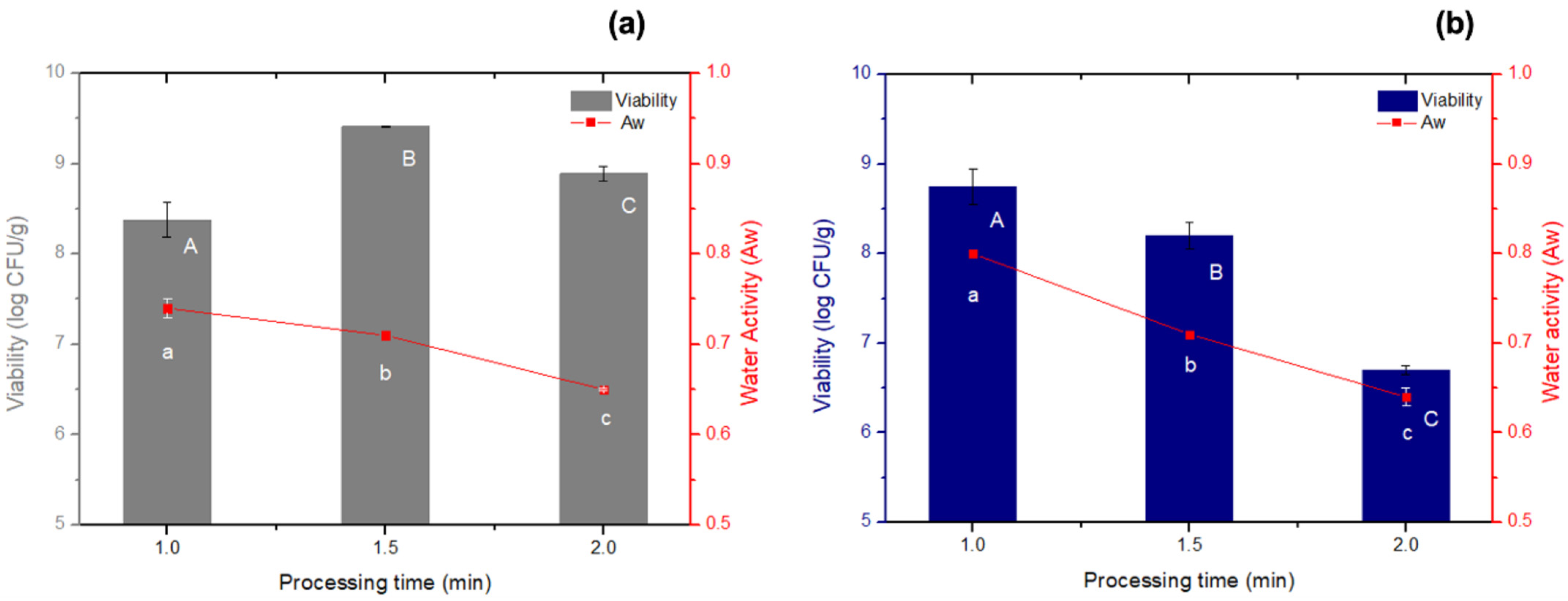
Figure 2 illustrates the impact of microwave processing on the viability of H. coagulans spores in oat-based (Figure 2a) and rice-bean-based (Figure 2b) matrices across independent exposure intervals (1.0, 1.5, and 2.0 min) and post-processing Aw.
The spores exhibited thermal stability under microwave processing of oat probiotic snack. Comparisons between independent treatments showed that samples processed for 1.5 min yielded significantly higher counts (9.4 log CFU/g) than those processed for 1.0 min (8.4 log CFU/g) (p < 0.05). This suggests that the 1.5 min exposure provided the optimal thermal activation shock for dormant spores, rather than causing inactivation. Even in the 2.0 min processing group, where Aw decreased to 0.65, viability remained robust (8.9 log CFU/g), indicating that the oat matrix effectively shielded spores against dielectric heating across all tested processing times.
In contrast, spore survivability on rice-bean matrix demonstrated instability across all processing times (Figure 2b). A clear inverse correlation was observed, with longer exposure times corresponding to lower viability. The group processed for 1.0 min retained 7.8 log CFU/g, whereas the 1.5 min group dropped sharply to 6.1 log CFU/g. Contrasting with the oat matrix, this significant reduction occurred despite similar post-processing water activity (Aw 0.64), implying that the lethality was driven by a rapid thermal shock rather than the gradual process of dehydration. Although the 2.0 min samples showed slightly higher counts (~6.5 log CFU/g) than the 1.5 min group, the overall trend confirmed the sensitivity to dielectric stress. Comparing the endpoints (2.0 min treatment), the spores in oat matrix retained significantly higher viability (~2.4 log CFU/g higher) than in the rice-bean matrix, despite both reaching similar final Aw levels (0.62–0.65).
The divergent stability profiles observed are fundamentally governed by the dielectric response of each matrix. The rice-bean probiotic snack formulation, characterized by high water activity and a mineral profile rich in electrolytes (e.g., K+ typical of legumes), presents a high dielectric loss factor (ε). This physical property maximizes heat generation through both dipolar rotation of free water and ionic conduction of dissolved salts [30]. The matrix’s interaction with the microwave field potentially facilitated the occurrence of the thermal runaway effect [31,32].
It is hypothesized that this rapid volumetric heating created a moist-heat regime that potentially lowered the activation energy required for protein denaturation. Under these conditions, the high retention of free water may have facilitated thermal conduction to the spore core, potentially overcoming its natural resistance mechanisms and causing the decline in viability observed (<6 log CFU/g). In contrast, the oat matrix likely acted as a thermo-dielectric stabilizer. Its composition, rich in lipids and with water tightly bound to β-glucan fibers, is suggested to restrict water mobility and ion migration. This may have effectively reduced the density of free dipoles, causing the matrix to behave as a low-dielectric-loss material that is partially transparent to the electromagnetic field. Such behavior potentially prevented the generation of lethal volumetric heat densities and shifted the thermodynamic system towards a dry-heat regime. In this state, the spore core likely remains effectively dehydrated, stabilized by dipicolinic acid (Ca-DPA) chelation and DNA-protecting SASPs [33]. By potentially maintaining the micro-environment within a stable glassy state, the oat matrix may have shielded the spore’s germination machinery from lethal denaturation, preserving robust viability even as Aw decreased.
The high survival rates observed in oven-baked snacks align with findings of Almada-Érix et al. [34] and Cinbaş et al. [29], who reported that H. coagulans spores can withstand baking temperatures within bread matrices due to the protective shielding of the solid starch network. These results reinforce the consensus that cereal-based systems act as effective thermal insulators, offering a more stable delivery vehicle.
Our findings suggest a critical interplay between processing time, moisture reduction, and matrix composition. While H. coagulans typically demonstrates high thermal resistance during conductive heating, as evidenced by >90% viability in soups processed at 85 °C [35], the significant inactivation observed in the rice-bean matrix underscores the distinct challenges inherent to microwave processing. Unlike conventional baking, which allows for thermal lag times through surface-to-center conduction [36], microwave processing utilizes volumetric heating that can be more severe. Although microwave heating offers superior energy efficiency and nutrient preservation, its industrial application for probiotics remains potentially hindered by risks associated with non-uniform heating [37].
This study confirms that for dielectric heating applications, matrix composition is the primary protective strategy. The oat matrix validates the rational design of fiber-dense, lipid-rich formulations that act as dielectric insulators, managing the trade-off between rapid dehydration and thermal intensity to ensure probiotic survival.

3.2. Effects of Storage Conditions on H. coagulans Survival Rate

Although microwave processing offered rapid dehydration, it resulted in inconsistent survival rates and significant inactivation in the starch-rich formulation (>4 log reduction). Therefore, to ensure high initial viability counts and process uniformity necessary for longitudinal analysis, the oven-baking method was chosen for the stability study. This method provided robust survival (>90%) for both oat and rice-bean matrices, establishing a reliable baseline for the shelf-life assessment. The processing conditions were standardized at 10 min for both matrices to ensure optimal probiotic retention.
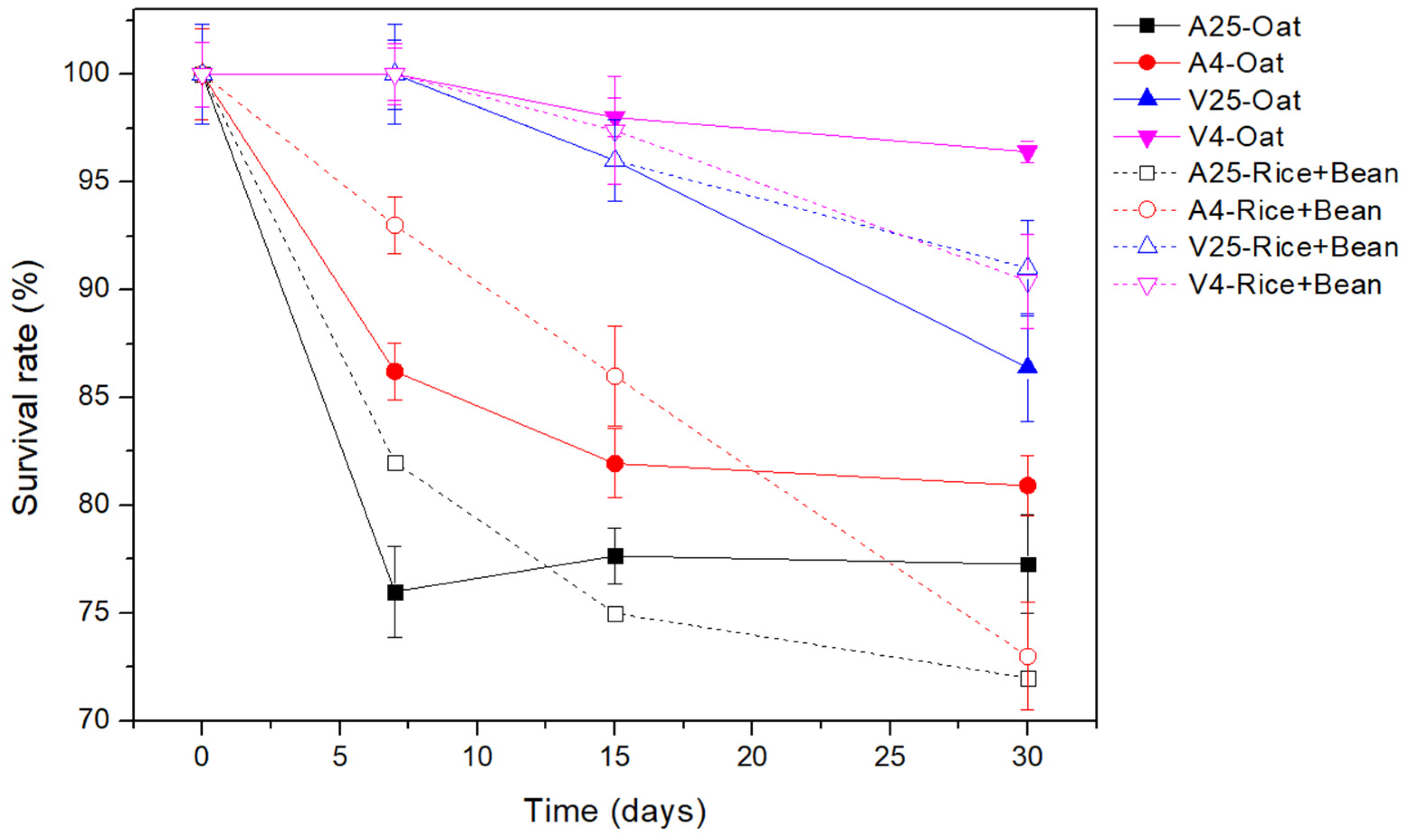
The evolution of spore viability over 30 days (Figure 3) revealed a progressive decline, with the packaging atmosphere acting as the predominant factor influencing stability, exerting a higher influence than storage temperature. A clear hierarchy of preservation was established: Vacuum/Refrigeration (V4) > Vacuum/Ambient (V25) > Atmospheric/Refrigeration (A4) > Atmospheric/Ambient (A25).
Notably, the oat matrix (Figure 3, dashed lines) demonstrated consistently higher spore viability than the rice-bean matrix across all similar conditions. The superior viability of vacuum-packed ambient samples (V25) compared to refrigerated aerobic samples (A4) indicates that oxidative stress, rather than thermal degradation, is the primary mechanism driving spore inactivation in these low-moisture matrices.
Despite its significantly higher lipid content, theoretically a substrate for oxidation, the oat matrix demonstrated superior protection. This paradox suggests a dual-protective mechanism. Unlike the rice-bean matrix, oats are rich in phenolic antioxidants, such as avenanthramides. These compounds may have acted as a radical scavenging system, effectively quenching Reactive Oxygen Species (ROS) and neutralizing the lipid peroxidation cascade. Furthermore, the oat matrix is thought to benefit from the hygroscopic sequestration capacity of its high β-glucan content. It is hypothesized that these fibers retained moisture more effectively than the starch-based system, potentially maintaining a stable Aw environment and limiting premature metabolic activation of the spores.
In contrast, the decline in viability observed in conventionally packaged rice-bean samples (A4, A25) is attributed to a synergistic failure mechanism driven by the packaging atmosphere. While vacuum-packaged samples (V4, V25) maintained stable moisture content, conventional packaging allowed for moisture ingress, raising the Aw to approximately 0.90. This value exceeds the threshold typically associated with shelf-stable foods and resides in a borderline thermodynamic region (0.88–0.91) known to destabilize spore dormancy [36].
Unlike Marcial-Coba et al. [9], who observed a high viability in date paste due to an intermediate Aw of 0.5–0.6, the high Aw in the nutrient-rich rice-bean matrix acted as a thermodynamic trigger for premature germination. Consequently, a sub-population of spores transitioned into metabolically active but fragile vegetative cells, which were rapidly inactivated by environmental stressors. This aligns with findings by Payne et al. [38], who reported significant log reductions in baked goods at high relative humidity due to similar moisture-mediated stresses.
The viability loss in conventionally packaged samples (A4, A25) results from two simultaneous degradation processes. The high Aw of the rice-bean matrix triggers premature germination [36] driving the shift from resistant spores to vulnerable vegetative cells that are rapidly inactivated during storage. At the same time, oxidation damages the structure of the remaining spores, specifically targeting their protective coats or DNA stability.
Cereal matrices are recognized as viable non-dairy carriers for H. coagulans GBI-30, as confirmed by Wang et al. [39]. Their study demonstrated that milder processing methods, such as sheeting, preserve viability (>8 log CFU/g) more effectively than high-stress extrusion. Additionally, they hypothesized that post-processing viability losses, such as the 5.75 log CFU/g observed after boiling, are likely due to the germination of dormant spores into heat-sensitive vegetative cells during hydration and heating. This supports our observation that matrix-induced germination is a critical challenge for maintaining probiotic stability in heat-treated foods.
The oxygen permeability of conventional packaging initiated oxidative stress, compromising the structural integrity of the remaining dormant spores, particularly the protective coats or DNA stability. The viability decrease observed in A4 and A25 samples confirms this synergistic effect: dormant spores were compromised chemically by oxidation, while the rise in Aw simultaneously induced others to germinate, transforming them into vulnerable vegetative cells that were subsequently destroyed. This hypothesis is corroborated by the in vitro digestion data (Figure 4), where the survival rate for A25 samples collapsed at day 30, confirming that the residual population consisted either of non-viable vegetative cells or oxidatively damaged spores unable to withstand gastric acidity.
The oat matrix showed high initial stability. Immediately post-processing (Day 0), all experimental groups exhibited a homogeneous survival rate of approximately 76%, indicating that the matrix composition provided consistent physical shielding against gastric acidity regardless of the packaging condition. However, storage conditions significantly influenced long-term bioaccessibility. Samples stored under vacuum (V25, V4) maintained their protective capacity, showing negligible loss of viability. The V4-Oat group retained the highest final survival rate (~71%), representing a minimal reduction of <7% relative to Day 0. In contrast, atmospheric packaging (A25, A4) resulted in a significant decline. The A25-Oat samples dropped to ~58% survival, a relative reduction of ~24% from the initial baseline. This suggests that oxidative stress or moisture ingress during storage compromised the matrix’s ability to stabilize the spores during digestion.
Regarding thermal effects, while most probiotics demonstrate stability across storage temperatures [40], this study observed significant declines at 25 °C, confirming the observations of Klu et al. [41] that elevated temperatures negatively impact viability. The hypothesis of premature germination in the rice-bean samples contrasts with Liao et al. [8], who observed no significant germination of H. coagulans over 56 days. However, their study was conducted under refrigeration and liquid matrices. In our study, the combination of ambient temperature (25 °C), high water activity (Aw > 0.85), and a nutrient-dense starch matrix provided the ideal metabolic triggers for germination, turning the bacteria susceptible to oxidative stress, a pathway effectively suppressed in the oat matrix due to its superior water-binding and antioxidant properties.
Table 1 presents the evolution of Aw and moisture content (%) of the oven-baked oat snacks over a 30-day storage period under different packaging and temperature conditions.
Samples stored in conventional packaging exhibited significant hygroscopic behavior, characterized by substantial moisture ingress regardless of storage temperature (p < 0.05). At 25 °C (A25), the moisture content increased from 10% to 18%, representing an 80% increase in total moisture. Concurrently, the Aw increased from an initial value of 0.70 to 0.90 by day 30, a relative increase of ~28.6%. At 4 °C (A4), a similar trend was observed, with Aw reaching saturation levels (0.90–0.91) within 14 days, indicating that the atmospheric packaging provided a negligible barrier against environmental humidity.
In contrast, vacuum packaging effectively preserved the physicochemical stability of the oat matrix. At 25 °C (V25), Aw remained significantly stable (p < 0.05), from 0.78 (day 0) to 0.77 (day 30), effectively preventing the thermodynamic shift towards conditions favorable for spoilage. At 4 °C (V4), this condition offered the highest stability. The moisture content showed a slight reduction of ~8.3% (from 12% to 11%), while Aw decreased from 0.81 to 0.79.
While conventionally packaged samples rapidly equilibrated with the external environment, reaching Aw levels (>0.85) that trigger spore germination and spoilage, vacuum packaging maintained the Aw within the intermediate range. This demonstrates that for the oven-baked oat matrix, vacuum sealing is important to restrict moisture mobility and maintain the dry state necessary for long-term spore survival.
Table 2 details the variations in Aw and moisture content (%) of the rice-bean matrix over a 30-day storage period under atmospheric (A) and vacuum (V) packaging conditions.
Probiotic rice-bean snacks stored in atmospheric packaging demonstrated significant instability (p < 0.05) and a high susceptibility to environmental moisture dynamics. At 4 °C (A-4): This condition exhibited the most drastic thermodynamic shift. Aw increased from an initial 0.65 to 0.94 by day 30, representing a massive 44.6% increase. Concurrently, moisture content showed a significant increase of ~7.1% (from 14% to 15%) (p < 0.05). The discrepancy between the increase in Aw and in total moisture indicates potential physicochemical transitions within the starch-protein network, specifically amylopectin retrogradation, which likely promoted the liberation of bound water into a mobile state within the matrix.
At 25 °C (A25), the samples showed non-linear behavior (Table 2). While Aw increased significantly by 22.7% (from 0.75 to 0.92), the total moisture content decreased by 16.7% (from 18% to 15%) (p < 0.05). This inverse relationship indicates that while the matrix dried out, the remaining water became increasingly free and chemically available, likely pushing the system into a zone favorable for microbial growth.
Vacuum packaging provided superior control over water mobility compared to atmospheric conditions, though the matrix still exhibited hygroscopic activity. At 25 °C (V-25), the probiotic rice-bean snack showed a gradual increase in Aw of 10.3% (0.68 to 0.75) over 30 days, while moisture content remained relatively stable, increasing slightly by 5.6% (18% to 19%). The condition of V-4 proved effective for maintaining low water activity, with Aw showing the smallest relative increase of 4.3% (0.69 to 0.72). However, moisture content decreased by 15.8% (19% to 16%), suggesting some moisture migration within the package.
The rice-bean matrix displayed a tendency to reach high water activity levels (Aw > 0.90) under atmospheric conditions within 30 days, regardless of the temperature. Vacuum packaging at 4 °C (V4) was the only condition capable of maintaining Aw near the initial processing levels (Aw~0.72), thereby offering the most robust protection against metabolic activation of the spores.
The importance of low water activity for spore dormancy is highlighted by Muñoz et al. [42], who reported 120 days of stability in quinoa snacks maintained at Aw < 0.25. In contrast, the higher Aw in the evaluated rice-bean matrix (0.75) likely facilitated premature metabolic activation or increased vulnerability to the lipid peroxidation cascade, explaining the more rapid decline in viability during our 30-day study.
The robustness of H. coagulans GBI-30 in intermediate-moisture environments is further supported by Ayrıç Danışman et al. [43], who demonstrated that probiotic counts remained stable (>7 \log CFU/g) for 42 days in intermediate-moisture apricots with a water activity range of 0.82–0.86. This confirms the suitability of this spore-forming strain for functional snacks that do not maintain low Aw levels throughout shelf-life. Their findings reinforce the observation of this study that refrigeration is a critical factor in preserving viability in high-Aw matrices, as lower temperatures prevent the premature germination of spores that might otherwise be triggered by the moisture levels observed in our rice-bean formulation.
The divergent moisture trends in the rice-bean matrix, where A25 and V4 showed a decrease while A4 and V25 showed an increase, reflect a complex interplay between matrix thermodynamics and packaging integrity. In the A25 condition, the loss of total moisture (18% to 15%) despite the sharp increase in Aw suggests that the matrix released bound water into the package headspace, potentially due to temperature-induced structural shifts in the starch network. Conversely, the moisture gain in A4 (14% to 15%) is attributed to the atmospheric package’s inability to block high relative humidity during refrigeration. For vacuum-sealed samples, the slight moisture reduction in V4 suggests internal moisture migration or surface condensation within the package, whereas the slight gain in V25 indicates the matrix reaching a new hygroscopic equilibrium under ambient storage.

3.3. Functional Performance After Simulated Digestion

H. coagulans viability
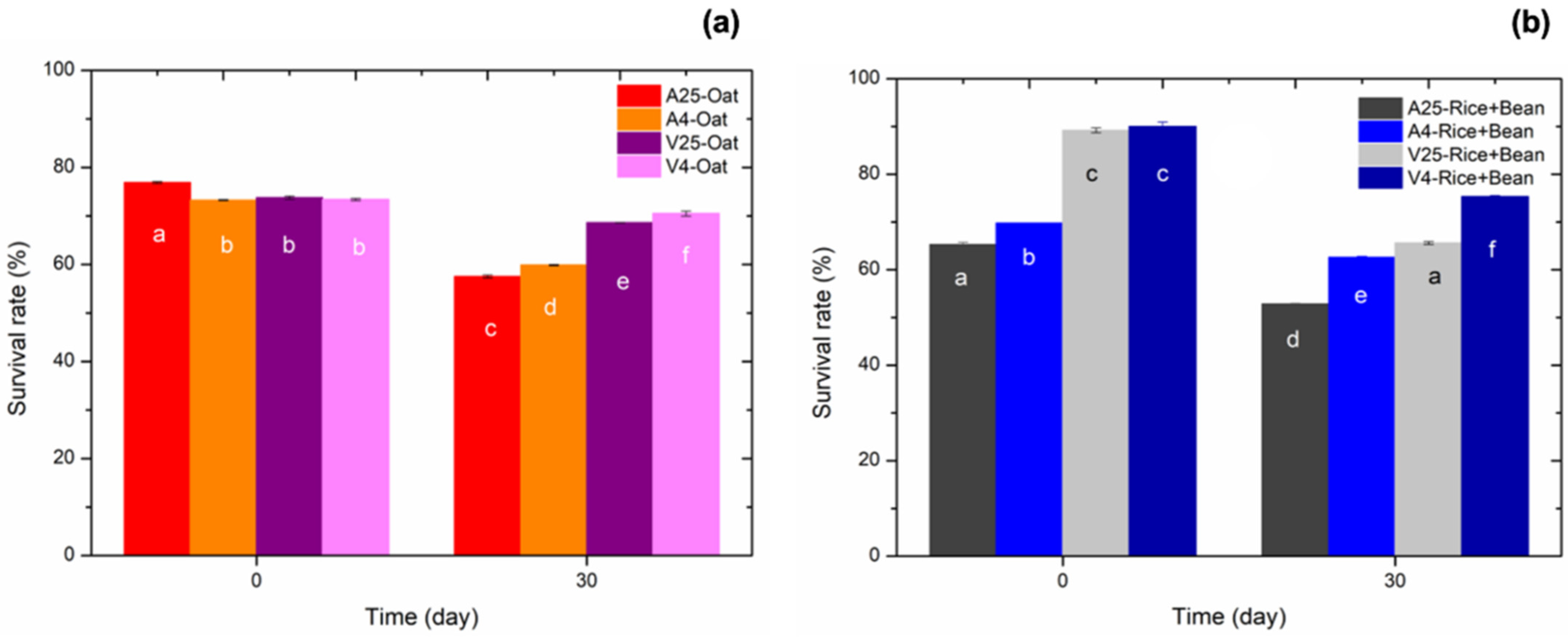
The functional efficacy of H. coagulans depends on its survival during gastrointestinal transit, which is heavily influenced by its storage history. As shown in Figure 4, all samples at day 0 maintained high post-digestion viability, confirming the spores’ inherent resistance to gastric acid and bile salts. However, a clear shift in functional stability emerged over the 30-day storage period.
Data are expressed as mean ± standard deviation (n = 3). Different letters indicate statistically significant differences in survival rate between storage conditions for each specific time point (p < 0.05). The oat matrix showed high initial stability. Immediately post-processing (Day 0), all experimental groups exhibited a homogeneous survival rate of approximately 76%, indicating that the matrix composition provided consistent physical shielding against gastric acidity regardless of the packaging condition. However, storage conditions significantly influenced long-term bioaccessibility. Samples stored under vacuum (V25, V4) maintained their protective capacity, showing negligible loss of viability. The V4-Oat group retained the highest final survival rate (~71%), representing a minimal reduction of <7% relative to Day 0. In contrast, atmospheric packaging (A25, A4) resulted in a significant decline. The A25-Oat samples dropped to ~58% survival, a relative reduction of ~24% from the initial baseline. This suggests that oxidative stress or moisture ingress during storage compromised the matrix’s ability to stabilize the spores during digestion.
The rice-bean matrix exhibited a distinct and highly sensitive behavior, characterized by an immediate dependence on packaging integrity even before storage (Day 0). Unlike the uniform baseline of the oat snack, the rice-bean samples showed a massive divergence at Day 0. Vacuum-packaged samples (V25, V4) achieved high initial survival (~89–90%), whereas atmospheric samples (A25, A4) were significantly lower (~65–70%). This ~20% gap at the baseline indicates that spores in the starch matrix appear more susceptible to digestive fluids when not protected by vacuum packaging or an oxygen-free environment. By Day 30, all rice-bean groups experienced substantial declines. The A25-rice-bean group exhibited the poorest performance, with survival collapsing to ~52%. Even vacuum packaging failed to stabilize the matrix at ambient temperature. Viability dropped from ~89% to ~65%, with a reduction of ~27%. Only the combination of vacuum and refrigeration provided moderate stability, retaining ~75% survival, though this still represented a ~16% decrease from the initial state.
Despite differences in shelf-life conditions, the protective capacity of oat matrix during simulated digestion aligns closely with the 70% survival rate reported by Muñoz Pabon et al. [42] for extruded quinoa snacks. This comparison validates the use of antioxidant-rich cereal matrices as robust vehicles for B. coagulans GBI-30 delivery, matching the performance of specialized functional food formats.
The comparative analysis reveals a fundamental difference in matrix functionality. The oat matrix functions as a robust, passive delivery system that is relatively stable unless compromised by atmospheric exposure. Conversely, the rice-bean matrix acts as a highly dynamic, unstable system where spore protection is transient and heavily dependent on the exclusion of oxygen and low temperatures. The performance of the oat matrix (V4-Oat vs. V4-Rice-bean at Day 30) supports the hypothesis that fiber-rich, low Aw matrices may provide enhanced gastrointestinal protection compared to starch-based formulations.
The highest post-digestion viability was achieved in snacks stored under vacuum and refrigeration (V4), which consistently maintained spore counts > 6 log CFU/g. This underscores that the packaging strategy is a determining factor for functional delivery. Consistent with Liao et al. [8], who reported >89% viability in vacuum-packed beverages, these findings reinforce that oxygen-restricted storage is a prerequisite for preserving the spore’s resistance mechanisms. Packaging permeability led to oxidative stress and moisture fluctuations that may have weakened spore coat. Consequently, these spores appeared less resilient to the subsequent acid shock of the gastric phase.
These results support the proposed synergistic failure hypothesis. The decline in post-digestion survival for the conventionally packaged samples (A4, A25) suggests that a portion of the residual population may have lost dormancy. Storage conditions, specifically oxygen exposure or elevated Aw, appear to promote premature germination, converting resistant spores into vegetative cells. Unlike dormant spores, which utilize protective macromolecules and SASPs to shield DNA [44], vegetative cells are typically more sensitive to gastric pH. Therefore, the low survival in Figure 4 for A25 samples may indicate that these spores either germinated during storage or underwent structural weakening, potentially leading to lysis during digestion.
The experimental findings demonstrate that the oat matrix was a superior delivery vehicle for H. coagulans BC4 spores, maintaining significantly higher viability compared to the rice-bean matrix during both thermal processing and simulated gastrointestinal transit (p < 0.05). This enhanced survivability is likely attributed to the protective microenvironment provided by the oat’s macromolecular composition, including its β-glucans and lipids, which protect the spores against thermal and physiological stressors. While the starch-protein network of the rice-bean matrix also offered stability during oven baking, it was less effective under microwave dielectric heating, where the oat matrix preserved a viability of 9.41 log CFU/g. Consequently, the oat matrix validates its efficacy as a robust vehicle for enhancing probiotic resilience, ensuring that high counts of viable spores reach the simulated intestinal phase.
Chemical Characterization and Antioxidant Profile
The characterization of the matrices (Table 3) elucidates the underlying mechanism behind the performance of each matrix. The oat matrix demonstrated a superior antioxidant profile compared to the rice-bean formulation, providing a chemical basis for the enhanced spore stability observed in this study. The oat snack contained 580 mg GAE/50 g of phenolic compounds. This represents a 2.5-fold difference compared to the rice-bean matrix, which contained 229.77 mg GAE/50 g. This difference was most evident in the FRAP assay results. The oat matrix exhibited an activity of 6400.59 mM AAE/50 g, which is approximately 4.6 times higher than that of the rice-bean snack (1370.56 AAE mM/50 g). This suggests that the oat matrix possesses a robust electron-donating capacity, capable of neutralizing oxidative stressors that target the spore coat. Interestingly, both matrices showed similar DPPH radical scavenging activity. This indicates that while both matrices have equal capacity to scavenge specific organic radicals, the oat matrix has a far superior reducing potential to mitigate metal-ion-catalyzed oxidation.
In terms of macronutrients, the rice-bean matrix exhibited a significantly higher protein content (3.8 g/50 g) compared to the oat matrix (1.4 g/50 g). While higher protein content often correlates with thermal protection, in this specific context, the ~39% higher protein content in the rice-bean matrix did not result in a superior spore survival. This reinforces the conclusion that oxidative stress (mitigated by phenolics in oats) and water activity (controlled by fibers in oats) were the dominant drivers of stability, rather than protein-based physical shielding. The data in Table 3 supports the oxidative damage hypothesis. The high concentration of phenolic compounds and the superior reducing power (FRAP) of the oat matrix created a chemically reductive environment. This active antioxidant system likely quenched ROS during storage, preserving the structural integrity of the spore coats, whereas the significantly lower antioxidant capacity of the rice-bean matrix left the spores vulnerable to oxidative degradation.
The oat formulation exhibited statistically superior levels of total phenolic compounds and antioxidant activity (assessed via DPPH and FRAP assays) compared to the rice-bean matrix (p < 0.05). This observation is corroborated by the literature, which identifies avenanthramides, anthranilic acid derivatives exclusive to oats, as phenolic compounds characterized by high radical scavenging potential [45]. While oats primarily contribute these alkaloids and free phenolic acids, specifically ferulic and caffeic acids, the biological functionality of the rice-bean snacks is based on the synergy between the phenolic acids of the rice pericarp, with a predominance of ferulic and p-coumaric acids, and the diversity of polyphenols and flavonoids characteristic of common beans [46,47]. Additionally, although constituents such as dietary fiber and phytic acid may negatively correlate with the initial bioaccessibility of micronutrients and bioactive compounds, the functional performance of these snacks during simulated digestion is ensured by the gradual release of insoluble-bound phenolics, guaranteeing bioactivity in the lower gastrointestinal tract [47]. Thus, the oat matrix provides a dual-protective system: physical insulation against thermal stress and active chemical protection against oxidative degradation (Table 3), ensuring that the spores remain structurally intact and metabolically dormant until they reach the target colonization site in the gut.
The relationship between matrix composition and probiotic resilience is emphasized by Muñoz Pabon et al. [42], who demonstrated that increasing the protein and fiber content in quinoa-rice snacks significantly enhanced antioxidant activity. Consistent with the results of the present study, H. coagulans added to quinoa formulation achieved high gastrointestinal survival (75%), suggesting that antioxidant-rich matrices provide a synergistic protective effect during both processing and digestion. Although those snacks were maintained at a lower Aw (0.23–0.28), this comparison validates the performance of the oat matrix and highlights the stability gap observed in the less antioxidant-dense rice-bean formulation.
While Suwanangul et al. [48] showed that protein encapsulation protects H. coagulans during spray drying, the findings of the present study suggest that in solid matrices, physical barrier properties play a key role when exposed to different environmental conditions. Although the rice-bean matrix contained protein, it failed to protect the spores under high Aw. Conversely, the oat matrix, rich in β-glucans and lipids, likely acted as a hydrophobic barrier, limiting molecular mobility and water plasticization. This suggests that for shelf-stable probiotic snacks, the structural immobilization of water by fibers offers superior protection against viability loss compared to protein content alone.


4. Conclusions

This study demonstrates that matrix composition is a decisive factor in the development of heat-processed probiotic snacks. The oat matrix significantly outperformed the rice-bean formulation by acting as a thermal and dielectric stabilizer. While oven baking ensured survival rates > 90% for both matrices, the oat matrix effectively shielded spores during microwave processing (9.41 log CFU/g) compared to the rice-bean matrix (6.08 log CFU/g). It is hypothesized that the oat’s 2.5-fold higher phenolic content (580 mg GAE/50 g) helped to mitigate oxidative stress, while its β-glucans potentially managed moisture levels to limit premature germination. Furthermore, the oat matrix likely acted as a superior carrier during digestion, maintaining 71% survival rate, whereas the rice-bean survival collapsed to 52%. These findings suggest that designing antioxidant-rich matrices with controlled Aw is a promising strategy for developing stable, shelf-stable probiotic foods.

Author Contributions

Conceptualization T.V.F.; methodology, G.T.B. and A.Y.S.S.; software, G.T.B. and A.Y.S.S.; validation, S.R. and T.V.F.; formal analysis, G.T.B. and A.Y.S.S.; investigation, G.T.B. and A.Y.S.S.; resources, T.V.F. and S.R.; data curation, T.V.F. and S.R.; writing—original draft preparation, G.T.B. and A.Y.S.S.; writing—review and editing, T.V.F. and S.R.; visualization, T.V.F. and S.R.; supervision, T.V.F.; project administration, T.V.F.; funding acquisition, T.V.F. and S.R. All authors have read and agreed to the published version of the manuscript.

Funding

The authors thank the Brazilian funding agency CNPq through the National Institute of Science and Technology of Tropical Fruits for the financial support and FUNCAP for the grants and scholarships. This study was financed in part by the Coordenação de Aperfeiçoamento de Pessoal de Nível Superior—finance code 001 Brasil (CAPES).

Data Availability Statement

The original contributions presented in this study are included in the article. Further inquiries can be directed to the corresponding author.

Conflicts of Interest

The authors declare no conflicts of interest.

References

  1. Awulachew, M.T. Probiotics and Thermal Processing: A Review of Challenges and Protective Strategies. Lett. Food Res. 2025, 1, e25057. [Google Scholar] [CrossRef]
  2. Bustos, A.Y.; Taranto, M.P.; Gerez, C.L.; Agriopoulou, S.; Smaoui, S.; Varzakas, T.; El Enshasy, H.A. Recent Advances in the Understanding of Stress Resistance Mechanisms in Probiotics: Relevance for the Design of Functional Food Systems. Probiotics Antimicrob. Proteins 2025, 17, 138–158. [Google Scholar] [CrossRef] [PubMed]
  3. Rathore, S.; Salmerón, I.; Pandiella, S.S. Production of Potentially Probiotic Beverages Using Single and Mixed Cereal Substrates Fermented with Lactic Acid Bacteria Cultures. Food Microbiol. 2012, 30, 239–244. [Google Scholar] [CrossRef]
  4. Soares, M.B.; Almada, C.N.; Pereira, E.P.R.; Ferreira, B.M.; Balthazar, C.F.; Khorshidian, N.; Rocha, R.S.; Xavier-Santos, D.; Cruz, A.G.; Ranadheera, C.S.; et al. Review—Sporeforming Probiotic Bacteria: Characteristics, Health Benefits, and Technological Aspects for Their Applications in Foods and Beverages. Trends Food Sci. Technol. 2023, 138, 453–469. [Google Scholar] [CrossRef]
  5. Poshadri, A.; Deshpande, H.W.; Khodke, U.M.; Katke, S.D. Bacillus coagulans and Its Spore as Potential Probiotics in the Production of Novel Shelf-Stable Foods. Curr. Res. Nutr. Food Sci. 2022, 10, 858–870. [Google Scholar] [CrossRef]
  6. Costa, N.d.A.; Martins, A.F.L.; Guimarães, A.D.B.; da Capela, A.P.; Magalhães, I.S.; Arruda, T.R.; Vieira, É.N.R.; Júnior, B.R.d.C.L. Probiotic and Paraprobiotic Potential of Bacillus coagulans: Impact of Processing and Storage on Viability and Resistance in the Gastrointestinal Tract. Res. Soc. Dev. 2022, 11, e26211831013. [Google Scholar] [CrossRef]
  7. Gupta, R.S.; Patel, S.; Saini, N.; Chen, S. Robust Demarcation of 17 Distinct Bacillus Species Clades, Proposed as Novel Bacillaceae Genera, by Phylogenomics and Comparative Genomic Analyses: Description of Robertmurraya kyonggiensis sp. Nov. and Proposal for an Emended Genus Bacillus Limiting It Only to the Members of the Subtilis and Cereus Clades of Species. Int. J. Syst. Evol. Microbiol. 2020, 70, 5753–5798. [Google Scholar] [CrossRef]
  8. Liao, C.W.; Hung, M.C.; Wang, C.Y.; Chen, B.Y. Effects of High-Pressure Processing and Thermal Processing on Different Beverages Containing Bacillus coagulans Spores. LWT 2023, 183, 114887. [Google Scholar] [CrossRef]
  9. Marcial-Coba, M.S.; Pjaca, A.S.; Andersen, C.J.; Knøchel, S.; Nielsen, D.S. Dried Date Paste as Carrier of the Proposed Probiotic Bacillus Coagulans BC4 and Viability Assessment during Storage and Simulated Gastric Passage. LWT 2019, 99, 197–201. [Google Scholar] [CrossRef]
  10. Almada-Érix, C.N.; Almada, C.N.; Souza Pedrosa, G.T.; Lollo, P.C.; Magnani, M.; Sant’Ana, A.S. Development of a Semi-Dynamic in Vitro Model and Its Testing Using Probiotic Bacillus coagulans GBI-30, 6086 in Orange Juice and Yogurt. J. Microbiol. Methods 2021, 183, 106187. [Google Scholar] [CrossRef] [PubMed]
  11. Stecker, R.A.; Moon, J.M.; Russo, T.J.; Ratliff, K.M.; Mumford, P.W.; Jäger, R.; Purpura, M.; Kerksick, C.M. Bacillus coagulans GBI-30, 6086 Improves Amino Acid Absorption from Milk Protein. Nutr. Metab. 2020, 17, 93. [Google Scholar] [CrossRef] [PubMed]
  12. Joyce, O.-N.C.; Chinweike, O.F.; Godswill, C.C.; Ifeanyi, O.O.; Vivian, I.N.; Christian, S.O. Production of Fermented Soymilk Drink Containing Probiotic Bacillus coagulans. Eur. J. Nutr. Food Saf. 2021, 13, 51–61. [Google Scholar] [CrossRef]
  13. Cao, J.; Yu, Z.; Liu, W.; Zhao, J.; Zhang, H.; Zhai, Q.; Chen, W. Probiotic Characteristics of Bacillus coagulans and Associated Implications for Human Health and Diseases. J. Funct. Foods 2020, 64, 103643. [Google Scholar] [CrossRef]
  14. Haldar, L.; Gandhi, D.N. Development of Vacuum-Dried Probiotic Milk Powder with Bacillus coagulans. Int. J. Dairy Technol. 2020, 73, 283–291. [Google Scholar] [CrossRef]
  15. Nag, A.; Waterland, M.; Janssen, P.; Anderson, R.; Singh, H. Importance of Intact Secondary Protein Structures of Cell Envelopes and Glass Transition Temperature of the Stabilization Matrix on the Storage Stability of Probiotics. Food Res. Int. 2019, 123, 198–207. [Google Scholar] [CrossRef]
  16. Alemayehu, G.F.; Forsido, S.F.; Tola, Y.B.; Amare, E. Nutritional and Phytochemical Composition and Associated Health Benefits of Oat (Avena sativa) Grains and Oat-Based Fermented Food Products. Sci. World J. 2023, 2023, 2730175. [Google Scholar] [CrossRef]
  17. Soycan, G.; Schär, M.Y.; Kristek, A.; Boberska, J.; Alsharif, S.N.S.; Corona, G.; Shewry, P.R.; Spencer, J.P.E. Composition and Content of Phenolic Acids and Avenanthramides in Commercial Oat Products: Are Oats an Important Polyphenol Source for Consumers? Food Chem. X 2019, 3, 100047. [Google Scholar] [CrossRef]
  18. Lindemann, I.d.S.; Dittgen, C.L.; Batista, C.d.S.; dos Santos, J.P.; Bruni, G.P.; Elias, M.C.; Vanier, N.L. Rice and Common Bean Blends: Effect of Cooking on in Vitro Starch Digestibility and Phenolics Profile. Food Chem. 2021, 340, 127908. [Google Scholar] [CrossRef]
  19. Oliveira, A.S.; Niro, C.M.; Bresolin, J.D.; Soares, V.F.; Ferreira, M.D.; Sivieri, K.; Azeredo, H.M.C. Dehydrated Strawberries for Probiotic Delivery: Influence of Dehydration and Probiotic Incorporation Methods. LWT 2021, 144, 111105. [Google Scholar] [CrossRef]
  20. Brodkorb, A.; Egger, L.; Alminger, M.; Alvito, P.; Assunção, R.; Ballance, S.; Bohn, T.; Bourlieu-Lacanal, C.; Boutrou, R.; Carrière, F.; et al. INFOGEST Static in Vitro Simulation of Gastrointestinal Food Digestion. Nat. Protoc. 2019, 14, 991–1014. [Google Scholar] [CrossRef] [PubMed]
  21. Bradford, M.M. A Rapid and Sensitive Method for the Quantitation of Microgram Quantities of Protein Utilizing the Principle of Protein-Dye Binding. Anal. Biochem. 1976, 72, 248–254. [Google Scholar] [CrossRef]
  22. Paixão, L.M.N.; Fonteles, T.V.; Oliveira, V.S.; Fernandes, F.A.N.; Rodrigues, S. Cold Plasma Effects on Functional Compounds of Siriguela Juice. Food Bioprocess Technol. 2019, 12, 110–121. [Google Scholar] [CrossRef]
  23. Benzie, I.F.F.; Strain, J.J. The Ferric Reducing Ability of Plasma (FRAP) as a Measure of “Antioxidant Power”: The FRAP Assay. Anal. Biochem. 1996, 239, 70–76. [Google Scholar] [CrossRef]
  24. Obanda, M.; Owuor, P.O. Flavanol Composition and Caffeine Content of Green Leaf as Qualit y Potential Indicators of Ken y an Black Teas. J. Sci. Food Agric. 1997, 50, 209–215. [Google Scholar] [CrossRef]
  25. Almeida, F.D.L.; Cavalcante, R.S.; Cullen, P.J.; Frias, J.M.; Bourke, P.; Fernandes, F.A.N.; Rodrigues, S. Effects of Atmospheric Cold Plasma and Ozone on Prebiotic Orange Juice. Innov. Food Sci. Emerg. Technol. 2015, 32, 127–135. [Google Scholar] [CrossRef]
  26. Alizadeh, N.; Babaeipour, V.; Tabandeh, F. Enhancing the Survival Rate and Population Growth of Heyndrickxia coagulans Spores for Use in Functional Foods. Appl. Food Biotechnol. 2025, 12, 24. [Google Scholar] [CrossRef]
  27. Yadav, A.K.; Chaudhari, A.B.; Kothari, R.M. Enhanced Viability of Bacillus coagulans after Spray Drying with Calcium Lactate, Storage and Re-Hydration. Indian J. Chem. Technol. 2009, 16, 519–522. [Google Scholar]
  28. Almada-Érix, C.N.; Almada, C.N.; Souza Pedrosa, G.T.; Paulo Biachi, J.; Bonatto, M.S.; Schmiele, M.; Nabeshima, E.H.; Clerici, M.T.P.S.; Magnani, M.; Sant’Ana, A.S. Bread as Probiotic Carriers: Resistance of Bacillus coagulans GBI-30 6086 Spores through Processing Steps. Food Res. Int. 2022, 155, 111040. [Google Scholar] [CrossRef]
  29. Cinbaş, G.; Arslan Tontul, S.; Akin, N. Effect of Bread Ingredients and Baking Techniques on Bacillus coagulans GBI-30 Viability during Baking and in Vitro Digestion. J. Cereal Sci. 2024, 117, 103907. [Google Scholar] [CrossRef]
  30. Laguerre, J.-C.; Hamoud-Agha, M.M. Microwave Food Processing: Principles and Applications. In Thermal Food Engineering Operations; Wiley-Scrivener: Hoboken, NJ, USA, 2022; pp. 301–347. [Google Scholar]
  31. Ben, H.; Agarwal, H.; Gurnani, B.; Pradhan, A.A.; Khan, A.A.; Jain, N. Breaking the Barrier: Disruption of Bacterial Biofilms Using Microwave Radiation. Front. Cell. Infect. Microbiol. 2025, 15, 1670237. [Google Scholar] [CrossRef]
  32. Qiu, S.; Fan, H.; He, L. Single-Cell Analysis Reveals Microbial Spore Responses to Microwave Radiation. J. Innov. Opt. Health Sci. 2023, 16, 2244004. [Google Scholar] [CrossRef]
  33. Setlow, B.; Sun, D.; Setlow, P. Interaction between DNA and Ox/,3-Type Small, Acid-Soluble Spore Proteins: A New Class of DNA-Binding Protein. J. Bacteriol. 1992, 174, 2312–2322. [Google Scholar] [CrossRef]
  34. Almada-Érix, C.N.; Almada, C.N.; Souza Pedrosa, G.T.; dos Santos, P.; Schmiele, M.; Clerici, M.T.P.S.; Martinez, J.; Lollo, P.C.; Magnani, M.; Sant’Ana, A.S. Quantifying the Impact of Eight Unit Operations on the Survival of Eight Bacillus Strains with Claimed Probiotic Properties. Food Res. Int. 2021, 142, 110191. [Google Scholar] [CrossRef]
  35. Shaikh, S.S.; Joshi, C.; Malek, F.; Malik, A.; Gandhi, M. Food Storage, Processing and Genetic Stability Studies of Bacillus (Heyndrickxia) coagulans BCP92 (MTCC 25460). Appl. Food Biotechnol. 2024, 11, e22. [Google Scholar] [CrossRef]
  36. Setlow, P. Spore Resistance Properties. Bact. Spore Mol. Syst. 2014, 2, 201–215. [Google Scholar] [CrossRef] [PubMed]
  37. Yan, L.; Wang, C.; Yin, X. A Review of Methods for Improving Microwave Heating Uniformity. Microwave 2025, 1, 12. [Google Scholar] [CrossRef]
  38. Payne, J.; Bellmer, D.; Jadeja, R.; Holt, B.; Holcomb, B.; Spring, S. Storage Temperature Effects on Bacillus Spores and Lactobacillus acidophilus Viability. Int. J. Food Sci. 2025, 2025, 3966944. [Google Scholar] [CrossRef]
  39. Wang, J.; Wu, P.; Chen, X.D.; Yu, A.; Dhital, S. Fortification of Cereal-Based Food with Lactobacillus rhamnosus GG and Bacillus coagulans GBI-30 and Their Survival During Processing. Foods 2025, 14, 2250. [Google Scholar] [CrossRef]
  40. Klu, Y.A.K.; Phillips, R.D.; Chen, J. Survival of Four Commercial Probiotic Mixtures in Full Fat and Reduced Fat Peanut Butter. Food Microbiol. 2014, 44, 34–40. [Google Scholar] [CrossRef]
  41. Klu, Y.A.K.; Chen, J. Effect of Peanut Butter Matrices on the Fate of Probiotics during Simulated Gastrointestinal Passage. LWT 2015, 62, 983–988. [Google Scholar] [CrossRef]
  42. Muñoz Pabon, K.S.; Roa Acosta, D.F.; Bravo, J.E. Second-Generation Snacks Prepared from Quinoa with Probiotic. Physicochemical Properties, in Vitro Digestibility, Antioxidant Activity and Consumer Acceptability. Heliyon 2024, 10, e36525. [Google Scholar] [CrossRef] [PubMed]
  43. Ayrıç Danışman, F.; Taştan, Ö.; Baysal, T. Development of Intermediate-Moisture Apricot with Impregnation of Bacillus coagulans GBI-30 6086 as a Functional Snack: Quality Assessment during Storage. J. Food Process. Preserv. 2022, 46, e16348. [Google Scholar] [CrossRef]
  44. Nerber, H.N.; Sorg, J.A. The Small Acid-Soluble Proteins of Spore-Forming Organisms: Similarities and Differences in Function. Anaerobe 2024, 87, 102844. [Google Scholar] [CrossRef]
  45. Emmons, C.L.; Peterson, D.M. Antioxidant Activity and Phenolic Content of Oat as Affected by Cultivar and Location. Crop Sci. 2001, 41, 1676–1681. [Google Scholar] [CrossRef]
  46. Walter, M.; Marchesan, E. Phenolic Compounds and Antioxidant Activity of Rice. Braz. Arch. Biol. Technol. 2011, 54, 371–377. [Google Scholar] [CrossRef]
  47. Eckhof, P.; Márquez, K.; Kruger, J.; Nina, N.; Ramirez-Jara, E.; Frank, J.; Jiménez-Aspee, F. Bioaccessibility of Carotenoids, Tocochromanols, and Iron from Common Bean (Phaseolus vulgaris L.) Landraces. Food Res. Int. 2024, 194, 114935. [Google Scholar] [CrossRef] [PubMed]
  48. Suwanangul, S.; Jaichakan, P.; Narkprasom, N.; Kraithong, S.; Narkprasom, K.; Sangsawad, P. Innovative Insights for Establishing a Synbiotic Relationship with Bacillus coagulans: Viability, Bioactivity, and In Vitro-Simulated Gastrointestinal Digestion. Foods 2023, 12, 3692. [Google Scholar] [CrossRef]
Figure 1. H. coagulans viability and water activity as a function of baking time of oat-based (a) and rice-bean-based (b) probiotic snack matrices. Results are expressed as mean ± standard deviation (n = 3). Different uppercase letters indicate significant differences in viability, and different lowercase letters indicate significant differences in Aw between processing times (p < 0.05).
Processes 14 00775 g001
Figure 2. Viability of H. coagulans and water activity of the probiotic snack matrices as a function of microwave processing time: Oat-based (a) and rice-bean-based (b) matrices. Results are expressed as mean ± standard deviation (n = 3). Different uppercase letters indicate significant differences in viability, and different lowercase letters indicate significant differences in Aw between processing times (p < 0.05).
Processes 14 00775 g002
Figure 3. Survival rate of H. coagulans spores during storage. Comparison between rice-bean (solid lines) and oat-based (dashed lines) probiotic formulations across four packaging-temperature combinations: Atmospheric 25 °C (A25); atmospheric 4 °C (A4); vacuum 25 °C (V25) and vacuum 4 °C (V4).
Processes 14 00775 g003
Figure 4. Effect of storage conditions on H. coagulans viability after simulated gastrointestinal digestion of probiotic oat (a) and rice-bean snacks (b). Different lowercase letters therefore represent statistical groupings of survival rates under different storage conditions and times. Data are expressed as mean ± standard deviation (n = 3). Different letters indicate statistically significant differences in survival rate between storage conditions for each specific time point (p < 0.05).
Processes 14 00775 g004
Table 1. Water activity and moisture (%) of the probiotic oat snack during storage in different packages.
Time (Day)Water ActivityMoisture (%)
A-25 °CA-4 °CV-25 °CV-4 °CA-25 °CA-4 °CV-25 °CV-4 °C
00.70 ± 0.01 b0.79 ± 0.0 a0.78 ± 0.01 a0.81 ± 0.01 a10 ± 0.02 C11 ± 0.08 B10 ± 0.01 C12 ± 0.05 A
70.86 ± 0.01 a0.85 ± 0.0 a0.76 ± 0.01 c0.80 ± 0.00 b13 ± 0.01 A13 ± 0.01 A10 ± 0.01 C12 ± 0.06 B
140.90 ± 0.00 a0.91 ± 0.0 a0.74 ± 0.02 c0.81 ± 0.01 b15 ± 0.05 A13 ± 0.07 B13 ± 0.00 B11 ± 0.02 C
300.90 ± 0.02 a0.90 ± 0.0 a0.77 ± 0.00 c0.79 ± 0.01 b18 ± 0.00 A15 ± 0.01 B13 ± 0.01 C11 ± 0.09 D
A25: conventional package stored at 25 °C; A4: conventional package stored at 4 °C; V25: vacuum package stored at 25 °C; V4: vacuum package stored at 4 °C. Data are expressed as mean ± standard deviation (n = 3). Different lowercase letters in the same row indicate statistically significant differences in water activity (Aw) between storage conditions for each specific time point (p < 0.05). Different uppercase letters in the same row indicate statistically significant differences in moisture content (%) between storage conditions for each specific time point (p < 0.05).
Table 2. Water activity and moisture (%) of the probiotic rice-bean snack during storage in different packages.
Time (Day)Water ActivityMoisture (%)
A-25 °CA-4 °CV-25 °CV-4 °CA-25 °CA-4 °CV-25 °CV-4 °C
00.75 ± 0.01 a0.65 ± 0.03 b0.68 ± 0.01 b0.69 ± 0.01 b18 ± 0.00 A14 ± 0.11 B18 ± 0.05 A19 ± 0.02 A
70.81 ± 0.06 a0.86 ± 0.02 a0.76 ± 0.05 b0.72 ± 0.00 b17 ± 0.00 B15 ± 0.09 C18 ± 0.05 A17 ± 0.04 B
140.90 ± 0.00 a0.94 ± 0.05 a0.75 ± 0.02 b0.71 ± 0.01 c15 ± 0.01 C17 ± 0.01 B19 ± 0.02 A17 ± 0.06 B
300.92 ± 0.02 a0.94 ± 0.01 a0.75 ± 0.00 b0.72 ± 0.01 c15 ± 0.08 C15 ± 0.03 C19 ± 0.01 A16 ± 0.01 B
A25: conventional package stored at 25 °C; A4: conventional package stored at 4 °C; V25: vacuum package stored at 25 °C; V4: vacuum package stored at 4 °C. Data are expressed as mean ± standard deviation (n = 3). Different lowercase letters in the same row indicate statistically significant differences in water activity (Aw) between storage conditions for each specific time point (p < 0.05). Different uppercase letters in the same row indicate statistically significant differences in moisture content (%) between storage conditions for each specific time point (p < 0.05).
Table 3. Total phenolic compounds (TPC), antioxidant activity (DPPH and FRAP assays), protein, in the probiotic oat and rice-bean snacks.
Oat Rice-Bean
TPC mg GAE/50 g580.00 ± 12.68 a 229.77 ± 4.89 b
FRAP mM AAE/50 g6400.59 ± 152.91 a 1370.56 ± 12.56 b
DPPH mM TE/50 g5.69 ± 0.09 a 5.82 ± 0.15 a
Protein g/50 g1.4 ± 0.01 b 3.8 ± 0.04 a
Data are expressed as mean ± standard deviation (n = 3). Different letters in the same row indicate statistically significant differences (p < 0.05). TPC result is expressed as mg of gallic acid equivalents per 50 g of snack (mg GAE/50 g); FRAP result is expressed as milimolar of ascorbic acid equivalents per 50 g of snack (mM AAE/50 g of snack); and DPPH result is expressed in milimolar of trolox equivalents per 50 g of snack (DPPH mM TE/50 g).
Disclaimer/Publisher’s Note: The statements, opinions and data contained in all publications are solely those of the individual author(s) and contributor(s) and not of MDPI and/or the editor(s). MDPI and/or the editor(s) disclaim responsibility for any injury to people or property resulting from any ideas, methods, instructions or products referred to in the content.