Communication

The Twelve Principles of Green Chemistry in Complex Industrial Systems: A Critical Analysis

by
Maria Carla Ciacchella
1,*,
Andrea Tomassi
2,* and
Andrea Falegnami
2
1
Department of Chemical Engineering Materials Environment, Sapienza University of Rome, 00185 Rome, Italy
2
Faculty of Engineering, International Telematic University UniNettuno, 00186 Rome, Italy
*
Authors to whom correspondence should be addressed.
Processes 2026, 14(5), 765; https://doi.org/10.3390/pr14050765
Submission received: 23 January 2026 / Revised: 14 February 2026 / Accepted: 24 February 2026 / Published: 26 February 2026

Abstract

Green chemistry is built on twelve guiding principles intended to reduce waste, energy use, and hazardous substances in chemical manufacturing. These principles have inspired more sustainable practices, yet their implementation in real-world industrial contexts reveals significant limitations and internal contradictions. This position paper critically examines each principle’s practical challenges, with an emphasis on Principle 6 (design for energy efficiency) and its relationship to process complexity and resource intensity. Using concepts from complexity theory—notably simplexity and complixity—the analysis highlights how chemical production systems behave as complex adaptive networks, where straightforward “green” solutions can trigger emergent trade-offs. Industrial case studies from pharmaceuticals, microelectronics, and large chemical producers (e.g., BASF and Dow) illustrate successes and setbacks in applying green chemistry: catalytic routes that improve yields but rely on scarce elements, solvent recovery systems that save waste at the cost of energy and capital, and integrated processes that achieve remarkable efficiency gains while introducing control complexity. These examples underscore that the principles cannot be treated as isolated absolutes; instead, a holistic, systems-thinking approach is required. The discussion calls for expanding the Green Chemistry framework with new or revised principles that account for lifecycle complexities, adaptive process design, and socio-technical factors. By confronting the gaps between the idealized principles and industrial reality, this analysis offers insight into how green chemistry can evolve—guided by both scientific rigor and practical pragmatism—to better meet the sustainability challenges of modern chemical production. The novelty of this work resides in its systems oriented analysis of the Twelve Principles of Green Chemistry when applied to complex industrial processes. By integrating industrial examples with concepts from complexity theory, the manuscript clarifies limitations and trade offs that are not evident in principle based or metric focused approaches.

1. Introduction

The twelve principles of green chemistry were proposed in 1998 as a proactive framework to design chemicals and processes with minimal environmental and health impact [1]. These principles—including waste prevention, maximized atom economy, safer synthesis, inherently benign reagents and solvents, energy efficiency, use of renewable feedstocks, avoidance of derivatives, catalysis, product biodegradability, real-time pollution monitoring, and accident prevention—have become widely accepted guidelines in chemistry research and industry practice [2,3]. Collectively, they outline an ideal vision of chemical manufacturing that produces no waste, uses only safe and renewable materials, consumes minimal energy, and poses negligible risk. The influence of this framework has been profound: it reshaped academic research agendas and informed corporate sustainability goals, embedding the notion of “benign by design” into the ethos of chemical innovation [4,5,6]. Two decades of experience, however, have revealed that translating these principles into large-scale industrial reality is far from straightforward. Many companies have faced economic, technical, and regulatory hurdles when attempting to implement green chemistry changes in established processes [7,8]. In some cases, improvements in one dimension of “greenness” have led to setbacks in another, exposing contradictions among the principles themselves. For example, switching to a less toxic solvent or reagent can compromise reaction yield or rate, forcing longer processing times or larger reactors to achieve the same output—potentially increasing energy use and costs [9,10]. Likewise, using renewable biological feedstocks in place of petroleum may introduce supply chain complexity or land-use impacts that offset the intended environmental benefits. Such trade-offs illustrate that the principles, when applied in isolation, do not automatically sum up to sustainability in a complex production ecosystem.
Recent critiques have also pointed out conceptual overlaps in the original twelve principles. Several of the principles are secondary guidelines that essentially provide strategies to achieve a more fundamental goal. For instance, high atom economy (Principle 2) is one means to accomplish waste prevention (Principle 1), and using catalysis (Principle 9) is a strategy to improve efficiency and reduce waste as well. An analysis by Nowak (2023) reorganized the canonical list into six core principles (addressing waste, toxicity, energy, renewables, degradability, and inherent safety) with the remaining six seen as derivative or overlapping measures [2]. This internal redundancy suggests the need for a more unified and concise theoretical basis. Moreover, defining what it means for a process or product to be “green” is itself challenging—greenness is not an absolute property but a relative one that depends on system boundaries and weighting of different impacts. No single metric captures all dimensions of environmental performance, and a chemical process can only be deemed “greener” in comparison to an alternative, under specified criteria [11]. Thus, rigorous assessment of green chemistry claims demands transparency in the models and assumptions used to evaluate improvements. Crucially, the scope of the Twelve Principles as originally formulated is mostly confined to the design and production phase of a chemical’s life cycle. In practice, sustainability entails considerations beyond the factory gate—including the impacts of raw material extraction, product use, and end-of-life disposal—which the traditional green chemistry framework only partially addresses [12]. A process optimized for minimal waste and hazard on the production floor might still result in environmental harm if, for example, the product is not recyclable or generates toxic degradation byproducts after use. This disconnects points to the importance of systems thinking and life-cycle analysis in evaluating true sustainability. Green chemistry cannot exist in a vacuum; it must operate in concert with green engineering, industrial ecology, and circular economy principles to achieve comprehensive improvements. Against this backdrop, this paper provides a critical assessment of the Green Chemistry principles through the lens of complex industrial systems. The following sections examine the practical limitations and contradictions encountered when applying the principles in large-scale chemical manufacturing. Principle 6—design for energy efficiency—is highlighted because it epitomizes the interplay between a single-factor optimization (energy minimization) and the multi-faceted complexity of real processes. Concepts from complexity theory, including simplexity and complixity [13,14,15,16], are introduced to frame these challenges in terms of emergent system behavior. Simplexity describes the design strategy of embedding complexity at a deeper structural or molecular level in order to achieve simpler, more robust, and more controllable behavior at the system or operational level. In process engineering terms, it corresponds to solutions where sophisticated chemistry or design enables fewer unit operations, reduced downstream processing, or simpler plant operation. Complixity refers to a form of emergent simplicity that arises when previously separate subsystems or contexts interact, expanding the design space and enabling new system level simplifications.
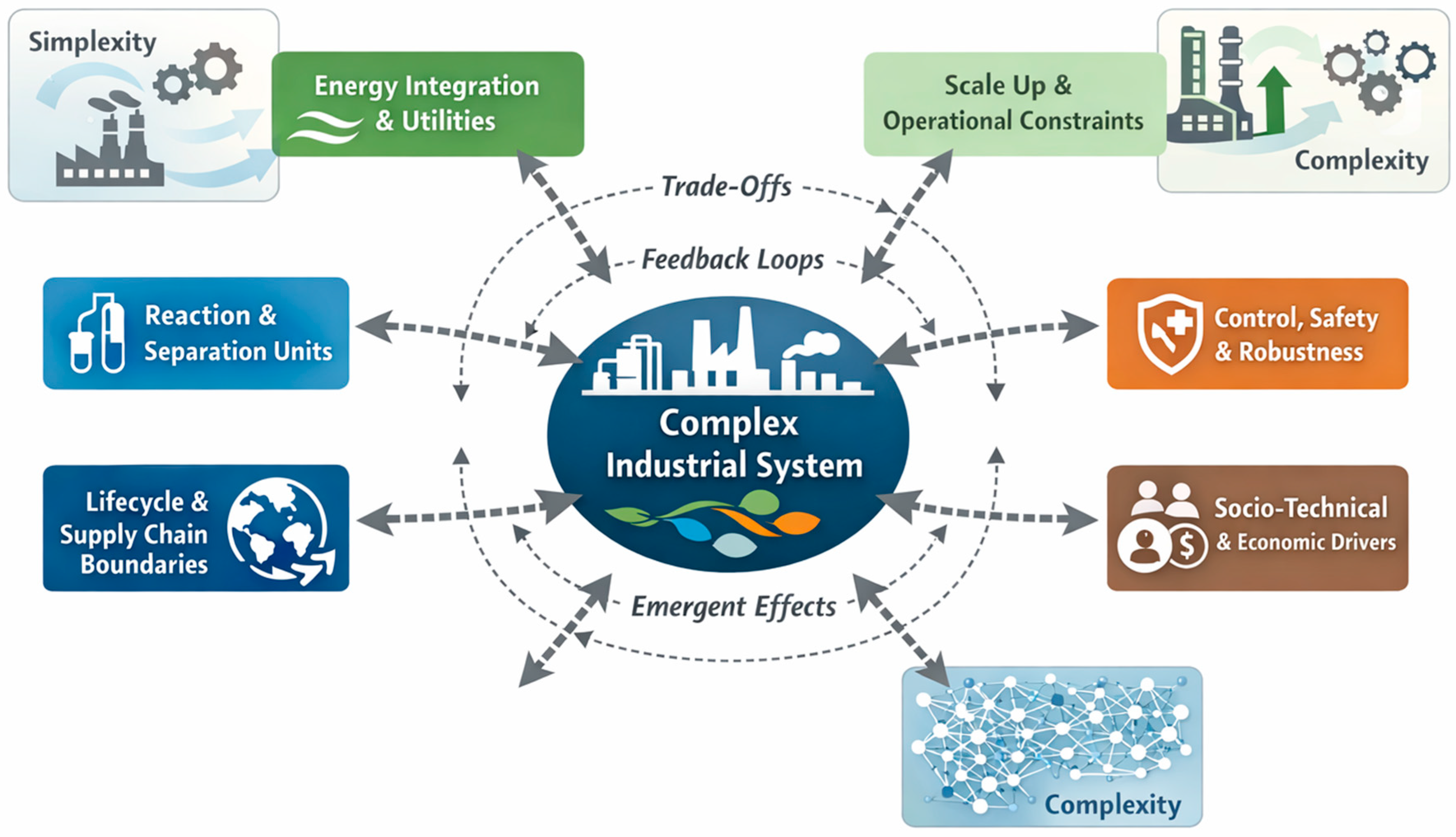
Industrial case studies from pharmaceuticals, microelectronics, and petrochemicals are integrated into the analysis to ground the discussion in concrete examples of success and failure. Ultimately, the paper advocates for an evolved green chemistry framework—one that embraces complexity and adapts the principles to better guide sustainable innovation in the socio-technical context of modern chemical production. Figure 1 schematically summarizes the system level context within which the Twelve Principles are discussed in the following sections.
The novelty of this contribution lies in its explicit treatment of the Twelve Principles of Green Chemistry as elements embedded in complex industrial systems rather than as isolated design rules. Building on industrial experience and selected large scale examples, the manuscript highlights how interactions between process integration, energy management, scale up constraints, and socio technical factors can alter the effectiveness and interpretation of individual principles. By framing green chemistry within a systems and complexity oriented analysis, this work provides an interpretative contribution that complements existing methodological and metric driven studies, and supports more informed decision making in process design and industrial implementation.

Scope, Selection Criteria, and Methodological Boundaries

This Communication adopts a qualitative and interpretative approach aimed at critically examining the application of the Twelve Principles of Green Chemistry within complex industrial systems. The scope of the analysis is intentionally focused on industrial sectors where green chemistry concepts have been most actively discussed and applied at scale, namely pharmaceuticals, bulk and specialty chemicals, and microelectronics. These sectors were selected because they combine high societal relevance, stringent performance and safety requirements, and well-documented tensions between sustainability objectives and industrial constraints.
The industrial examples discussed throughout the manuscript were chosen based on three main criteria: their recognition as established or widely cited cases in the scientific and industrial literature, their relevance to illustrating specific trade-offs among Green Chemistry principles, and the authors’ long-term academic exposure to these sectors through research activities, teaching, and indirect collaboration with industrial stakeholders. The examples are therefore intended to be illustrative rather than exhaustive, and they are used to support conceptual reasoning rather than to provide a statistically representative survey of industrial practice.
The evidence base of this work relies on peer-reviewed literature, authoritative industrial reports, and documented case studies. No new experimental data or quantitative modeling is introduced, in line with the Communication format. As a consequence, the conclusions drawn are not meant to be prescriptive or universally generalizable. Instead, they are intended to support critical reflection, highlight system-level interactions and unintended consequences, and inform more context-aware decision making when applying Green Chemistry principles in industrial settings. The inherent limitations of this qualitative and selective approach are acknowledged and further discussed in the Section 6.

2. Limitations and Contradictions in Industrial Practice

2.1. Economic and Performance Trade-Offs

A fundamental real-world constraint on green chemistry adoption is economic feasibility. New synthetic routes or materials developed under green chemistry guidelines often carry higher initial R&D and retooling costs than established processes, especially when expensive catalysts, novel solvents, or specialized equipment are required [17]. Smaller companies operating on thin margins may find the upfront investment prohibitive, even if the long-term environmental benefits are evident. Industrial history is rife with examples where a theoretically greener method was passed over because it could not compete on cost or scale with the status quo. Furthermore, some “greener” alternatives do not yet match the performance of conventional options. A bio-based plastic, for instance, might have inferior mechanical strength or thermal stability compared to a petroleum-derived polymer, limiting its adoption in demanding applications [18]. Similarly, a safer solvent for a reaction may lead to lower reaction rates or yields, making the process economically unviable due to longer cycle times or larger volume requirements. These performance trade-offs mean that chemists and engineers must often balance the benefits of hazard reduction against the risk of reduced efficiency or product quality. In industries like pharmaceuticals or microelectronics, even slight compromises in product purity or yield are unacceptable, creating a high bar for green substitutes to clear [19].

2.2. Scale-Up and Complexity Challenges

Many green chemistry breakthroughs originate in laboratory research, but scaling these innovations to industrial production poses non-trivial challenges. Processes that work in a beaker or bench-top reactor can encounter unforeseen problems when implemented at ton or kiloton scales (e.g., mixing inefficiencies, heat and mass transfer limitations, or catalyst deactivation over long runs). Ensuring that the advantages of a novel “green” route persist at manufacturing scale often requires complex engineering and significant redesign of plant infrastructure [20]. For example, a reaction that proceeds solvent-free in the lab might, on scale-up, demand a solvent to control viscosity and temperature, reintroducing the very auxiliary substances one hoped to eliminate. Similarly, a catalyst that performs selectively on small scale may show different behavior in a large reactor with altered hydrodynamics or impurities present. The case of pharmaceutical manufacturing is illustrative: many early-stage drug syntheses reported as “green” (due to minimal solvent or high atom economy) later require additional steps or controls when scaled for production, eroding the initial gains. In general, industrial scale-up tends to amplify any complexity the process contains. Green chemistry solutions that rely on intricate reaction conditions or tight specifications can be difficult to run robustly in a 24/7 plant environment. This is why in practice, changes are often incremental—retrofits to existing processes rather than wholesale replacement—to manage risk and ensure continuity of supply [4]. The inherent complexity of re-designing established chemical processes cannot be overstated. Many large-scale processes have been fine-tuned over decades for maximum output and profitability using conventional methods. Introducing green modifications into such optimized systems can disrupt the delicate equilibrium of inputs, outputs, and recycle streams. In some cases, solving one problem creates new ones: for example, replacing a traditional stoichiometric reagent with a catalytic alternative may necessitate adding purification steps to remove catalyst residues, thus generating a new waste stream or energy burden. As another example, consider the replacement of chlorinated solvents (due to toxicity concerns) with a “greener” solvent like methyl tert-butyl ether or a biobased solvent. The new solvent might be safer for workers and environment in terms of toxicity and ozone depletion potential, but it could be more volatile or less effective, leading to larger solvent quantities or more cooling capacity. This kind of risk-risk trade-off is known in green engineering—one must be wary of solving a targeted problem only to shift the burden elsewhere (e.g., from toxicity to flammability, or from local pollution to global warming potential) [21].

2.3. Overlooking Lifecycle and System Boundaries

By focusing principally on the manufacturing stage, classical green chemistry sometimes neglects impacts outside the plant fence line. In truth, a chemical product’s sustainability is determined across its entire lifecycle: raw material sourcing, production, distribution, use, and disposal. There is potential for burden shifting if improvements in one stage cause greater impacts in another. For instance, using biomass-derived feedstocks (Principle 7) aligns with renewability, but if those feedstocks require intensive agriculture, fertilizer use, or land clearing, the net environmental benefit may vanish or even become negative when factors like carbon emissions and biodiversity loss are accounted for [22]. Likewise, a “degradable” plastic (Principle 10) might break down in the environment as intended, yet if it fragments into microplastics or its degradation consumes oxygen in waterways, it introduces new ecological risks. Traditional green chemistry guidelines do not explicitly address such system-wide effects. The need for complementary tools like Life Cycle Assessment (LCA) is now widely recognized: LCA provides a holistic view of environmental impacts and can flag counterintuitive trade-offs that a narrow focus on hazard or waste would miss [23,24]. The push for integrated thinking is evident in industry initiatives to marry green chemistry with circular economy strategies—for example, designing products for recyclability (beyond Principle 10’s focus on degradation) or developing take-back programs to ensure proper end-of-life handling. Green chemistry’s emphasis on molecular design and process optimization remains vital, but it is increasingly seen as one piece of a larger puzzle, which includes sustainable energy inputs, efficient logistics, and product stewardship beyond the factory [25].

2.4. Unintended Consequences and the Precautionary Approach

Implementing novel chemicals or processes always carries some uncertainty. Even changes made with the best intentions for health and environment can have unforeseen outcomes. A new solvent or additive touted as “green” might, after wider use, reveal unexpected persistence in ecosystems or subtle toxicological effects. For example, certain ionic liquids were initially proposed as green solvent alternatives due to their non-volatility (avoiding air emissions); later studies showed some ionic liquids can be harmful to aquatic life and are not readily biodegradable, raising concerns about their release [26,27]. Another case is the replacement of chlorofluorocarbons (CFCs) with hydrofluorocarbons (HFCs) in the semiconductor industry for plasma etching processes: while HFCs spared the ozone layer (a clear environmental gain), many turned out to be potent greenhouse gases, contributing to climate change. These examples underline the importance of applying a precautionary principle and thorough testing when adopting “green” substitutes at scale. Continuous monitoring and adaptive management are necessary because complex systems often behave in non-linear ways—small changes can produce amplified effects over time. Green chemistry innovations should therefore be accompanied by robust environmental surveillance and feedback mechanisms to catch any emergent issues early [14]. In industrial practice, this might mean phased rollouts of new processes, allowing time to study their real-world impact, or the development of contingency plans to mitigate unintended outcomes.

2.5. Corporate Greenwashing and Incrementalism

A more subtle limitation of the green chemistry movement is the temptation for companies to engage in greenwashing—making superficial changes or selective claims to appear sustainable without truly altering core practices [28]. Because the Twelve Principles can be implemented piecemeal, a company might tout a single achievement (e.g., eliminating a hazardous solvent in one product line) as evidence of being “green,” even while other processes remain unchanged or polluting. In some cases, firms focus on easily attainable tweaks (the “low-hanging fruit”) that yield positive publicity, instead of pursuing deeper, more challenging reforms that would substantially reduce environmental impact [29]. For instance, adopting a slightly more efficient reaction condition or switching to a less noxious cleaning agent are good practices but may have marginal benefits compared to, say, redesigning an entire synthesis route or investing in renewable energy for the plant. The incremental approach often aligns with short-term business incentives—it is less costly and risky—but it can delay the transformative changes needed for sustainability. Critics note that a focus on hazard reduction alone (as in many green chemistry efforts) sometimes ignores the larger drivers of unsustainability, such as overconsumption, single-use product paradigms, or the continued reliance on fossil resources [30]. In this sense, green chemistry initiatives must be careful not to become a fig leaf that obscures lack of progress on systemic issues. True leadership in sustainable industry requires coupling green chemistry principles with broader shifts in business models and policy support, ensuring that incremental improvements pave the way for fundamental change rather than substituting for it.

2.6. Infrastructure and Socio-Technical Factors

The existing industrial infrastructure and socio-economic context impose external limitations on how far and how fast green chemistry can advance. Large chemical production facilities represent billions of dollars in investment and are engineered for specific processes; retrofitting or replacing them to accommodate new chemistries (even if greener) can be prohibitively expensive and time-consuming [31]. A petrochemical refinery or pharmaceutical plant cannot be overhauled overnight—thus, improvements often have to be integrated into the existing asset base. This reality favors evolutionary changes and can lock in certain technologies. Additionally, global supply chains add complexity: a multinational product might involve raw materials, intermediates, and final assembly across multiple countries. Aligning all parts of such a chain with green principles requires coordinated effort and regulatory alignment across jurisdictions, which is difficult to achieve uniformly. Economic development pressures, particularly in emerging economies, can lead to prioritizing immediate growth over stricter environmental standards, challenging the universal application of green chemistry practices [32]. Moreover, the benefits of green innovation are not always equitably distributed. High upfront costs or intellectual property barriers might concentrate advantages in large corporations or wealthy regions, while smaller firms or poorer communities see fewer direct gains—unless deliberate policies (like technology transfer and capacity building) are in place to bridge this gap. These socio-technical dimensions mean that advancing green chemistry is not merely a technical exercise but also a matter of governance, education, and economics. Overcoming these barriers may require incentives such as government subsidies for green R&D, updated regulations that internalize environmental costs (making green options more competitive), and collaborations across industry, academia, and policy-makers to share knowledge and align objectives [33].
The laudable goals encapsulated in the Twelve Principles come up against a web of practical challenges in the industrial arena. The principles sometimes conflict with each other when pursued single-mindedly, and their original formulation does not fully capture the intricacies of real production systems. A deeper understanding of chemical manufacturing as a complex adaptive system—where multiple objectives must be balanced and where changes have ripple effects—is necessary. The next section delves into one principle in particular, energy efficiency, to illustrate how even a seemingly straightforward directive can become complicated in practice, and how principles might be reinterpreted or expanded in light of complexity science insights.
Table 1 provides a qualitative comparison between conventional and green chemistry oriented process approaches, highlighting key differences and trade offs discussed in Section 2.6.
Across the different sections of this analysis, a set of recurring themes emerges. In particular, the presence of trade-offs among Green Chemistry principles, the limitations associated with scale-up and industrial implementation, and the need for a systems-oriented perspective consistently shape the effectiveness of proposed solutions. These elements are not independent issues but interconnected aspects of complex industrial systems, where local optimizations can generate system-level consequences. Recognizing this interplay is essential to move beyond principle-based reasoning toward more robust and context-aware approaches to sustainable process design.

3. Principle 6—Design for Energy Efficiency: Complexity and Resource Intensity

Principle 6 of green chemistry states that energy requirements of chemical processes should be minimized, with processes conducted at ambient temperature and pressure whenever feasible [1,34]. This principle reflects the fact that energy use often correlates with environmental impact, given that much industrial energy is derived from fossil fuels. Reducing energy consumption in manufacturing not only lowers greenhouse gas emissions but also typically reduces operational cost, making it a win-win target. Table 2 summarizes common energy-efficiency strategies associated with Principle 6, highlighting both their intended benefits and the system-level trade-offs that often emerge in industrial implementation.
In the context of industrial chemistry, energy efficiency efforts include operating reactions under milder conditions, improving thermal insulation, capturing and reusing waste heat, and choosing process routes that avoid energy-intensive steps (such as multiple distillations or cryogenic temperatures). The principle appears simple in formulation—use less energy—but applying it effectively involves delving into the complexity of how energy is distributed and used in a chemical plant. Studies of industrial processes have shown that surprisingly, the energy directly applied to reaction transformations is often only a small fraction of the total energy consumed by a manufacturing process [34]. Far more energy can be expended in ancillary operations like separation, purification, solvent evaporation, compression, and pumping. For example, heating and cooling duties for distillation columns, evaporators, and dryers frequently dominate the energy profile of a chemical production line. As a result, a process could fulfill Principle 6 in a narrow sense—e.g., the main reaction step runs at room temperature—and yet still be highly energy-intensive overall due to downstream processing. An analysis by the ACS Green Chemistry Institute noted that simply conducting reactions at ambient conditions, while beneficial, does not guarantee low energy usage if extensive solvent removal or product isolation steps are required later [35]. In pharmaceutical manufacturing, for instance, each synthetic step might be followed by solvent swaps, crystallizations, or filtrations that cumulatively consume large amounts of steam and electricity. Thus, tackling energy efficiency means taking a holistic view of the entire process flow, not just the reaction conditions. Often, the biggest opportunities for energy reduction lie in process integration and clever engineering [36].
Achieving significant energy reductions can introduce new complexity and resource intensity in process design. Consider the strategy of heat integration: rather than wasting the heat from exothermic reactions or hot effluent streams, that energy can be used to preheat other parts of the process. Large chemical plants like oil refineries and ammonia plants routinely employ heat exchanger networks (HENs) to recover heat internally, drastically cutting the need for external heating fuel. The result, as exemplified by companies like BASF, can be a remarkable improvement in overall efficiency. BASF’s highly integrated “Verbund” production sites connect hundreds of plants via utilities and product streams, so that the waste from one unit becomes the feed or energy source for another [37,38]. At BASF’s flagship Ludwigshafen site, such integration has been reported to significantly reduce fossil fuel consumption over several decades, while supporting substantial growth in production output. This demonstrates Principle 6 taken to its logical conclusion: a complex adaptive network of processes finely tuned to reuse energy and materials wherever possible. The energy savings and emission reductions are undeniable—corresponding to large scale CO2 emission reductions as reported in sustainability assessments—illustrating the power of a systems approach to efficiency [39].
Yet, the very integration that yields these benefits also makes the system more complex and potentially fragile. Highly integrated plants require sophisticated control strategies to manage interdependent units. If one part of the network trips or changes throughput, it can upset the energy balance of the entire system. Operators must coordinate startups and shutdowns carefully to avoid cascading disturbances. An integrated heat recovery loop, for instance, can create tight coupling between a reactor and a distillation column that were previously independent. While energy is saved by eliminating a separate reboiler utility, the column’s operation now depends on the reactor’s heat output, complicating control. A case study from a petrochemical unit revealed that aggressive heat integration—using a reactor’s effluent to directly heat two downstream distillation columns—led to significant control difficulties [40]. The integrated system became prone to oscillations (“hunting”) because small fluctuations were amplified through the coupled heat loops, forcing operators to constantly intervene. In this instance, a design intended to save energy nearly rendered the operation unmanageable until engineering fixes were implemented. This loss of controllability mirrors situations in other tightly coupled systems, where stability is preserved only as long as a key state variable remains within a specific operating regime; once that regulating mechanism is exhausted or collapses the process can rapidly drift beyond manageable limits [41,42]. This highlights a general principle: maximizing thermodynamic efficiency can push a process closer to stability limits, requiring additional sensors, control valves, and automation complexity to keep everything in balance. It is a classic example of complexity emerging from the combination of previously separate subsystems. The new landscape offered by reaction and separation (in this case) yields new complex behavior that must be mastered, for example through a complix solution (i.e., a simplicity designed exploiting the new possibilities emerging from the same landscape) [13,15].
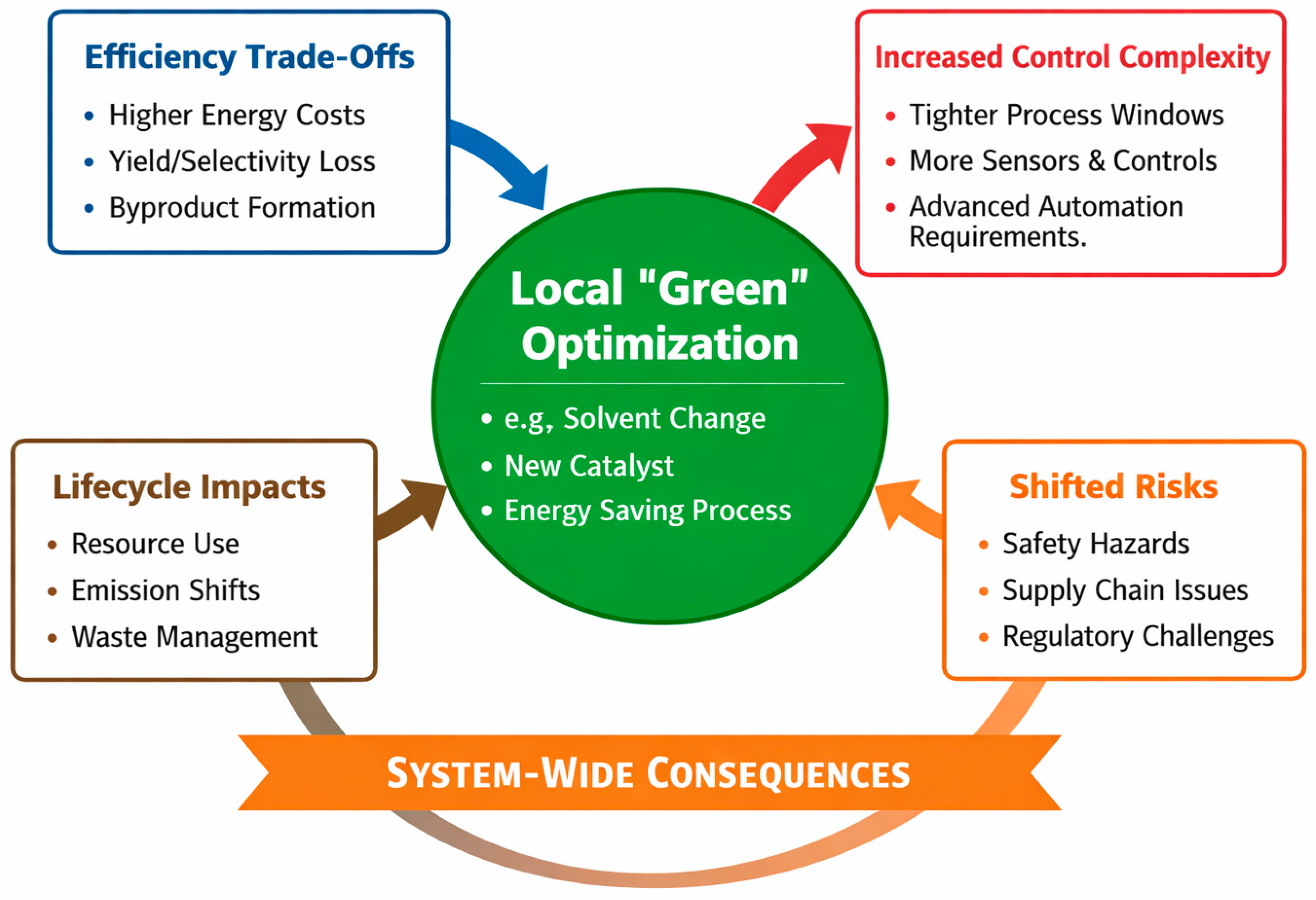
Another dimension of resource intensity comes in the form of capital investment. Technologies to reduce energy use often involve adding equipment: heat exchangers, insulation, heat pumps, solvent recovery units, etc. These not only incur capital cost and maintenance, but also have their own embodied environmental footprint (materials and energy used to manufacture them). There can be diminishing returns where chasing ever-smaller energy gains is not justified by the extra complexity and resources required. Green engineering principles explicitly acknowledge this in what has been called the “conserve complexity” guideline. In the allied 12 Principles of Green Engineering, Principle 6 states that embedded entropy and complexity in a process should be viewed as an investment—to be conserved and not wasted—when making design choices about recycle and reuse [43]. This concept suggests that one should only add complexity (for example, a recycle loop or energy recovery subsystem) if the value derived from it (reduced waste, lower energy input) outweighs the costs. In other words, complexity is a resource to be judiciously spent. A practical example is solvent recycling in pharmaceutical production: instead of using fresh solvent for every batch (creating waste), companies install solvent recovery units like distillation columns or membranes to purify and reuse solvents. This aligns with Principles 5 and 6 (safer solvents and energy efficiency), but the trade-off is a more intricate plant with additional columns, storage tanks, and possibly the energy usage of the recovery operation itself. If recovering a solvent uses more energy than producing a fresh batch would, the benefit is lost—thus engineers must optimize the recovery process, often via heat integration or selecting distillation sequences with minimal reboiling needs [44]. In the microelectronics industry, where vast quantities of high-purity solvents are used to clean semiconductor wafers, advanced multi-component distillation systems and novel membranes have been developed to reclaim solvents from waste streams with high efficiency [44]. These solutions illustrate the delicate balance between adding system complexity and achieving net sustainability gains. Figure 2 provides a schematic representation of how local green optimizations, when implemented within complex industrial systems, can generate system-wide ripple effects that extend beyond the original design objective.
Energy efficiency measures can also interact with other principles, sometimes in conflicting ways. For instance, running a reaction at ambient temperature (to save heating energy) might require a highly active catalyst (Principle 9) to proceed at a reasonable rate. That catalyst could be a precious metal that is scarce or toxic, which contravenes the spirit of using benign and renewable materials (Principles 3 and 7). An example is the use of platinum or rhodium catalysts to allow low-temperature hydrogenation; energy is saved and reaction conditions are mild, but the trade-off is reliance on mining and eventually disposing of heavy-metal catalysts. Another scenario is when energy-efficient operation means higher pressure (to avoid solvent reflux at boiling, for example). Elevated pressures may actually reduce energy per throughput, but they raise the hazard profile (tension with Principle 12 on accident prevention). Ammonia synthesis is a classic example—it is most efficient at high pressure and temperature (to get reasonable reaction rates and conversions), but these conditions inherently carry risk and require robust safety engineering [45]. There is ongoing research into electrochemical ammonia production at mild conditions using renewable electricity, aiming to reconcile energy efficiency with inherent safety and using sustainable inputs (water and air as feedstocks). This is promising but not yet industrially competitive; it exemplifies the kind of innovation needed to simultaneously fulfill multiple principles.
Principle 6’s call for energy efficiency serves as a gateway to considering the system-level design of processes. Achieving dramatic improvements in energy usage often requires reimagining the process as an integrated whole—capturing energy wherever possible and avoiding needless heat waste. Industrial success stories like BASF’s integrated sites and Dow’s adoption of advanced heat integration in chemical plants show that large gains are achievable [46]. Dow and BASF’s joint development of the hydrogen peroxide to propylene oxide (HPPO) process is illustrative: by choosing a route that inherently yields no useless byproducts, they not only eliminated waste streams but also with reported energy savings of several tens of percent under specific industrial configurations. The HPPO case combined a novel catalyst (titanium zeolite) with clever process design to produce propylene oxide in high yield with only water as a co-product, thus avoiding energy-intensive separation of co-products and recycling of spent reagents. Building the new HPPO plants still required significant capital—including safe handling systems for concentrated hydrogen peroxide—but the payoff was a more efficient, simpler chemistry that adheres to multiple green principles at once (waste prevention, atom economy, catalysis, and energy efficiency). This example shows that when a breakthrough aligns with the principles, it can greatly simplify the overall process (in this case, no need for co-product management), achieving exactly the aforementioned complixity: an elegant simplicity in operation emerging from a two-tier underlying chemical complexity [14,47].
However, not every energy-saving measure leads to such simplex outcomes; many introduce layers of control and optimization that must be managed. The key is to understand where the complexity lies in a process and to apply energy efficiency measures in a way that leverages natural process synergies rather than fights against them. For example, integrating a heat pump to upgrade low-quality waste heat into useful process heat can save energy, but if that heat pump is poorly integrated, it might create a bottleneck or reliability issue. The design for energy efficiency, therefore, is best approached with a whole-system perspective, considering the dynamic behavior of the plant. Modern computational tools like process simulators and pinch analysis help identify the best integration opportunities and quantify trade-offs. Principle 6, viewed through the lens of complexity, teaches chemists and engineers to move beyond the unit operation level and think about networks, feedback loops, and emergent properties of their processes. In doing so, it becomes clear that efficiency is not just about adding new technology (since any further element will just introduce more ties within the system): it is equally about simplifying the flows of energy and materials by aligning them in beneficial ways, an idea closely tied to the concept of simplexity in design, i.e., leveraging structure and rules to filter the complexity lying on the background [13]. In practical terms, the concepts of simplexity and complixity can inform process design and decision making by guiding where complexity should be introduced and where it should be avoided. Simplexity suggests that additional complexity is most effective when embedded at the molecular or design level, such as through highly selective catalysts or integrated reaction pathways, in order to simplify plant operation and reduce downstream processing. Complixity, in contrast, highlights situations in which the interaction of different subsystems enables new simplifications, for example by coupling reaction and separation or energy recovery in a way that eliminates entire process steps. From a decision making perspective, these concepts support the evaluation of trade offs between energy efficiency, controllability, robustness, and capital investment, helping practitioners identify solutions that improve sustainability without compromising operational stability.

4. Industrial Case Studies: Navigating Principles in Practice

Real-world examples from industry highlight how the pursuit of green chemistry principles plays out in practice—often requiring negotiation between competing objectives and inventive problem-solving to overcome constraints. Here we examine a few cases in different sectors (pharmaceuticals, fine chemicals, and microelectronics) to illustrate the practical application of Principles 1 (waste minimization), 5 (safer solvents), 9 (catalysis), and 6 (energy efficiency), among others [11,34,35].

4.1. Pharmaceuticals—Waste Minimization and Catalysis

Pharmaceutical manufacturing has historically been resource-intensive, generating large quantities of solvent and byproduct waste per unit of product. This is quantified by the E-factor (Environmental factor) which in the 1990s was often in the range of 25–100 kg of waste per kg of Active Pharmaceutical Ingredient (API) produced [30,44]. Driven by both cost and environmental pressure, major pharmaceutical companies have undertaken green chemistry initiatives to reduce waste and improve atom economy. A notable example is the synthesis of the antidepressant sertraline (the API in Zoloft®, Pfizer Inc., New York, NY, USA) [48]. Pfizer scientists reworked the original multi-step synthetic route and combined steps, introducing a biocatalytic resolution and an innovative crystalline intermediate to avoid multiple isolations. The revamped process doubled the overall yield, reduced the number of solvents, and eliminated several isolation steps—leading to a dramatic reduction in waste and energy usage. Importantly, worker safety was improved by avoiding hazardous reagents and high-pressure hydrogenation steps in the original process. This success was enabled by catalysis (an enzyme to resolve isomers, replacing a traditional chemical resolution) and by designing intermediates that could be telescoped through subsequent steps without purification. It exemplifies how Principles 1, 3, 5, and 9 can converge: less waste, less hazard, fewer solvents, and use of catalysis all reinforced each other in a well-thought-out redesign. The challenge for Pfizer was partly organizational—convincing different departments to adopt a new process—but once the improved route showed clear economic and safety benefits, it became a compelling business case. Indeed, the company reported significant cost savings alongside the environmental benefits [49]. This case also underscores the need for management support and cross-disciplinary collaboration (chemists, engineers, safety experts) to implement green chemistry at scale, reflecting that technical solutions must coincide with organizational complexity management.
Not all efforts are immediately successful. There have been cases where a green chemistry modification in pharma R&D did not translate to manufacturing due to scale issues or unforeseen side-reactions. For instance, replacing a commonly used stoichiometric reagent with an enzymatic step might work on lab scale but fail in a plant due to enzyme instability or substrate impurities. Companies like GSK and Novartis have developed solvent selection guides and reagent guides to help chemists pick inherently greener options early in development, thus smoothing the path to scale-up. Even so, a certain percentage of promising green routes are abandoned because they cannot meet the rigorous demands of producing metric tons of pharmaceutical with consistent quality. Regulatory requirements add another layer—any change in process for an approved drug must be filed with authorities, which can be a deterrent to late-stage changes even if they are greener. This highlights a systemic issue: the incentives and flexibility in highly regulated industries may need adjustment to fully realize green chemistry innovations. Collaborative initiatives such as the ACS Green Chemistry Institute’s Pharmaceutical Roundtable have been instrumental in pooling knowledge on green methodologies and encouraging industry-wide metrics for improvement, indicating that community-wide approaches can help overcome individual company hesitance and share the burden of innovation risk.

4.2. Bulk Chemicals—Catalysis and Renewable Feedstocks

In the bulk chemical sector, catalytic process innovation has been a mainstay of greener chemistry because even small increases in selectivity or yield can translate to enormous waste reductions when scaled. A classic example is the production of adipic acid (a nylon precursor), which traditionally involved nitric acid oxidation of cyclohexanol/cyclohexanone mixtures, producing N2O greenhouse gas as an undesirable byproduct [50]. DuPont and others developed an alternative route via a cobalt-catalyzed oxidation that reduced N2O emissions significantly [51]. More recently, bio-based routes (using glucose fermentation to muconic acid, then hydrogenating) have been explored to avoid fossil feedstocks entirely, aligning with Principle 7 (use of renewable feedstocks) [52]. While these biotechnological routes can eliminate certain hazardous reagents and cut fossil carbon usage, they raise new questions about efficiency and land use. The fermentation approach trades a high-energy chemical oxidation for a biological step that runs at mild conditions (a gain for Principle 6) but currently achieves lower yields and requires separation of dilute products from water (a new energy challenge). This illustrates a recurring theme: renewable feedstock processes often shift the burden to water and separation management. Companies are investing in research to improve titers and conversion rates of bio-processes to make them competitive. If successful, an integrated biorefinery could produce platform chemicals with much less pollution. If not, the conventional petro-process with improved abatement (like catalytic N2O decomposition units to treat the off-gas) might still be overall greener when considering full lifecycle. Here, only a detailed comparative assessment (including energy, emissions, and ecological impacts of cultivation for bio-feedstocks) can determine the preferable path. It shows the fuzzy decision-making required—greener is not absolute, but context-dependent.
Another bulk chemical example is the aforementioned propylene oxide production. The traditional processes either co-produced masses of waste (e.g., the chlorohydrin process yielding calcium chloride waste) or were inefficient without a large market for the co-product (e.g., the PO/tert-butyl alcohol process). Dow and BASF’s HPPO process introduced in the late 2000s was a game-changer: by using hydrogen peroxide as the oxidant and a titanium zeolite catalyst, it eliminated chlorinated wastes and avoided any co-product aside from water [53]. This meant no energy was spent in handling or purifying unwanted streams, and the raw material efficiency (atom economy) was very high. The new process was also built with modern energy integration, achieving a reduction in energy use per ton of propylene oxide produced. For this innovation, the developers won a Presidential Green Chemistry Challenge Award. It is an instructive case because it required significant interdisciplinary effort—chemists had to develop the catalyst and reaction, engineers had to design reactors that could handle the reactive H2O2 safely, and the business had to commit to constructing world-scale plants for a new technology. Once proven, though, the payoff was substantial: economic savings from a simpler process with fewer separation trains, and environmental gains from a cleaner route. Interestingly, one could view the HPPO process through the simplexity lens: the underlying catalyst and chemistry are more complex (titanium sites in a nanoporous solid, and careful control of peroxides) [54], but they create a simpler overall plant (no chlor-alkali plant for chlorine, no lime-based waste treatment, fewer distillation columns) [55]. In essence, complexity was shifted to the molecular scale (in the catalyst design) so that at the macro scale the process became more streamlined—a beautiful example of emergent simplicity.

4.3. Microelectronics—Solvent Recovery and Reduction of Hazardous Substances

The microelectronics industry, responsible for manufacturing semiconductors and electronic devices, faces unique green chemistry challenges [56]. The fabrication of silicon chips involves dozens of steps with various chemicals: solvents for cleaning, gases for etching and deposition, and photoresists and developers. Many of these substances are hazardous (toxic, pyrophoric, or potent greenhouse gases), and the processes consume vast amounts of ultra-pure water and energy in cleanroom facilities. Green chemistry principles have motivated efforts to reduce or eliminate certain chemicals (for example, moving away from perfluorinated compounds for plasma etching because of their extreme global warming potential) and to recycle materials where possible [56]. One successful initiative has been the recovery of wasted solvents from processes like wafer cleaning. Isopropanol (IPA) and other solvents are used in huge quantities and often disposed of after one use. Companies have implemented solvent purification systems to capture used IPA, distill it to remove contaminants, and reuse it in the process, thereby cutting down on hazardous waste shipments and the production of fresh solvent. Advanced distillation techniques, including multi-component separation and pressure swing distillation, have been optimized to handle the complex mixtures of organics and water that come from wafer fabs [57]. Researchers have reported designs for distillation sequences that minimize energy use for solvent recovery in semiconductor manufacturing, showing that careful heat integration and column configuration can make solvent recycling both environmentally and economically favorable [58].
In addition to distillation, membrane separation technologies are emerging (nano-filtration and pervaporation) that can separate solvent-water mixtures at lower energy cost, sometimes leveraging the specific size or polarity differences [59]. This is a case where an initially more complex setup (adding membranes and hybrid separation units) leads to overall simpler handling of resources: less frequent need to purchase and dispose of solvent, and reduced load on end-of-pipe waste treatment. The trade-off is that the reclaimed solvent must meet extremely high purity standards (parts-per-billion contaminant levels), which can be technically challenging. Nonetheless, major chip manufacturers like Intel have invested in on-site solvent recycling and water recycling, achieving substantial reductions in waste generation and water withdrawal per chip produced. These efforts align with Principles 5 and 1 (safer solvents and waste prevention) and also have a strong Principle 6 component (the need to make recycling energy-efficient) [34].
One complexity in microelectronics is that any change in chemistry must be rigorously tested for compatibility with product performance and yield. The cost of failure is high—a slight impurity can ruin an entire batch of microchips. Therefore, introducing greener alternatives (be it a new solvent, an alternative cleaning method like supercritical CO2, or a new resist material) is slow and requires close collaboration between chemists, engineers, and equipment suppliers. A notable success has been the shift from traditional wet etching processes that used hot sulfuric acid and other harsh chemicals to plasma etching using gases, which in some cases can reduce liquid chemical waste (though it introduced the issue of greenhouse gas emissions from PFCs) [60]. Now, the industry is again adjusting by capturing or abating those gases (installing burn or catalytic scrubbers for PFCs) and exploring replacements like fluorine-free etchants, illustrating the continuous evolution as new information comes to light.

4.4. Toward Simplexity in Process Design

Across these cases, a recurring pattern is evident—improvements often come from reimagining the process in a way that complexity is managed or redirected rather than simply adding on top of existing complexity. When successful, a greener process can simplify operations (fewer steps, less monitoring of hazardous streams, easier compliance with regulations). This simplification at the user level is often achieved by sophisticated chemistry or engineering behind the scenes, embodying the concept of simplexity: hiding complexity within a well-designed system so that its outward behavior is simple and robust [13,14]. For example, using a highly selective catalyst may require years of research to develop (complex science), but once implemented it can eliminate several purification steps, making the plant operation simpler and less wasteful. On the other hand, when a green solution is suboptimal, it can lead to added complexity that breeds new problems, as seen with overly integrated heat recovery loops or poorly scaled reactions that need layers of fixes. The art of green chemical engineering, then, is to strike a balance—to find designs that achieve environmental goals without over-complicating the system to the point of diminishing returns. Nature often achieves such balance (biological systems are complex internally yet operate with elegant efficiency from the organism’s perspective), which is why biomimicry and complex systems science are valuable sources of inspiration for chemical process design [13,15].

5. Embracing Complexity: Integrating Systems Thinking and Adaptive Design

The shortcomings of the original Green Chemistry framework largely stem from treating each principle in isolation and assuming linear cause-effect improvements. Rather than focusing on one molecule or one reaction at a time, chemists and engineers need to evaluate how changes alter the behavior of the whole network.
Complexity theory introduces several useful concepts for this purpose. One is emergence—the idea that the system can exhibit properties that are not obvious from its parts. For example, an emergent property of an integrated chemical complex might be resilience (or conversely, systemic brittleness) to certain disturbances, which is not apparent when looking at each plant unit alone. By simulating or analyzing integrated systems, one might discover emergent bottlenecks or synergies. A practical step is to use integrated process modeling and life-cycle modeling early in design to predict such emergent outcomes. Another concept is self-organization—systems can sometimes find efficient operating points without top-down direction, given the right conditions. In chemical plants, this might be analogous to processes that naturally reach equilibrium or steady-state that is optimal. For instance, a reaction-separation loop can self-regulate at a certain recycle ratio that maximizes output purity—if one provides the means (like a feedback controller) for it to adjust to perturbations.
The ideas of simplexity and complixity provide a language for discussing how to manage complexity in design. Simplexity refers to achieving apparent simplicity through complex means—for instance, a one-button start for a process enabled by a complex automated sequence under the hood [13]. One might interpret simplexity as abstraction for complex systems, a way to hide underlying complexity (a concept expressed also like complexity compression). In green chemistry, one could view a well-designed catalyst or an enzymatic one-pot reaction as introducing molecular simplexity: the user sees a one-step, clean reaction, but the catalyst’s microstructure and the enzyme’s active site are highly complex systems that orchestrate this simplicity. Complixity, on the other hand, describes situations where combining elements unleashes new ways to simplify uncompounded complexity—often because the interactions span different contexts or scales. An example of complixity in a socio-technical sense is when a new regulation (external context) interacts with an internal process change, producing unexpected favorable bureaucracy behaviors that facilitate implementation. In a technical sense, complixity might describe the scenario of mixing disparate subsystems (e.g., chemical and biological steps in a hybrid process, or coupling electrical energy systems with chemical processes) where the match of dynamics solves complications.
Understanding these patterns can guide the formulation of improved principles. For instance, one might propose a new principle of System Integration and Robustness: design processes that maximize synergies and minimize vulnerabilities when integrating multiple operations. This principle would urge practitioners to consider energy and mass integration (as traditional Principle 6 does) but also to consider dynamic stability and controllability as first-class design goals (tying in Principle 12 on safety). Another principle might explicitly address Life Cycle Thinking: ensure that optimizations at one stage do not cause greater harms at another, effectively broadening Principle 1 beyond the factory. Some scholars have suggested adding a principle for Social and Economic Sustainability, acknowledging that a green chemistry solution must be viable in the real world to have impact, which includes being cost-effective and acceptable to society (e.g., not using a feedstock that has ethical issues like competition with food). While some of these ideas go beyond the chemistry itself, they recognize that chemistry does not exist in a vacuum and that the best technical solution fails if not implemented. Green chemistry is evolving toward this broader perspective. The concept of “benign by design” is extending to “benign by system design.” This means involving interdisciplinary teams in process development: chemists, chemical engineers, environmental scientists, and even economists and sociologists. An example of forward-thinking design is the development of biorefineries that co-produce multiple products (fuels, chemicals, power) from biomass. These are complex systems that require integration of biochemical and thermochemical processes. Early designs sometimes struggled due to unexpected interactions (e.g., one product’s purification steps disrupting another’s economics), but newer designs are using sophisticated models and pilots to iron out these issues. In doing so, they aim to create a self-organizing production system where each output stream optimizes in tandem rather than in conflict.
Another important facet is resilience. Traditional plant design focuses on efficiency at steady-state, but a complex systems view also values resilience—the ability to cope with disruptions, both internal and external. Incorporating resilience might mean designing backup systems or alternative pathways within the process (for example, a plant that can temporarily bypass a recycle loop if a purifier fails, so it does not have to halt and waste material). This is analogous to biological allostasis and is a principle that sustainability experts are considering for industrial systems. It resonates with Principle 12 (inherently safer design), because resilient systems are often safer and more environmentally sound under abnormal conditions.
Complexity thinking encourages humility and iteration. It suggests that we rarely “get it perfect” on the first try, and continuous improvement should be expected. In the context of green chemistry, this implies regular re-evaluation of processes as new technologies emerge or as conditions change. A plant designed with best practices in 2020 might be retrofitted in 2030 with even greener technology. To facilitate this, modular design (so that parts can be upgraded) is beneficial—a concept known in green engineering as design for evolution. Industry examples include modular reactors or separation skids that can be swapped out if a better method comes along, thereby not locking in old technology for decades. This is particularly relevant for emerging areas like CO2 utilization or hydrogen economy processes, where rapid innovation is occurring.

Proposed Extensions to the Green Chemistry Framework: Summary

Building on the analysis presented in this work, the limitations of the traditional Green Chemistry framework in complex industrial systems suggest the need for an explicit extension of the principles. The following points summarize the proposed extensions in a compact form, each accompanied by a practical implication for industrial application:
1. 
System Integration and Robustness
Principle: Chemical processes should be designed as integrated systems that maximize synergies between units while preserving controllability and operational stability.
Practical implication: Energy and mass integration strategies (e.g., heat exchanger networks or coupled operations) should be evaluated not only for efficiency gains but also for their impact on process controllability and resilience.
2. 
Lifecycle and Boundary Awareness
Principle: Sustainability assessments must extend beyond the production stage to include full lifecycle impacts, avoiding burden shifting across system boundaries.
Practical implication: Process development should systematically incorporate Life Cycle Assessment (LCA) to ensure that improvements at the plant level do not lead to higher impacts upstream or downstream.
3. 
Management of Trade-offs and Multi-objective Optimization
Principle: Green Chemistry decisions should explicitly account for trade-offs among energy, materials, toxicity, safety, and cost, rather than optimizing single parameters in isolation.
Practical implication: Decision-making should rely on multi-criteria evaluation frameworks that balance environmental, technical, and economic indicators.
4. 
Conservation and Strategic Use of Complexity
Principle: Complexity should be treated as a resource to be strategically introduced or minimized, in line with the concepts of simplexity and complixity.
Practical implication: Complexity should be preferentially embedded at the molecular or design level (e.g., selective catalysts or integrated pathways) to simplify plant operation and reduce downstream processing.
5. 
Adaptive Design and Continuous Monitoring
Principle: Processes should be designed to adapt to uncertainty and evolving conditions through monitoring, feedback, and iterative improvement.
Practical implication: Real-time monitoring, digital tools, and phased implementation strategies should be adopted to detect unintended consequences and enable continuous optimization.
6. 
Socio-technical and Economic Viability
Principle: Green Chemistry solutions must be compatible with industrial, economic, and regulatory constraints to ensure real-world implementation.
Practical implication: Process innovations should be evaluated not only for environmental performance but also for scalability, cost, infrastructure compatibility, and regulatory acceptance.
These extensions do not replace the original Twelve Principles, but rather complement them by embedding them within a systems-oriented and complexity-aware framework, better suited to guide sustainable innovation in industrial practice.

6. Conclusions and Future Perspectives

The Twelve Principles of Green Chemistry have been invaluable in guiding chemists and engineers toward more sustainable practices, but this critical assessment shows that realizing these principles in industrial contexts requires a nuanced and flexible approach. We have seen that the principles can conflict or overlap, that they often need translation when scaling from lab to plant, and that they must be embedded in a broader systems framework to truly deliver environmental benefits. Principle 6, in particular, exemplifies how a singular focus (energy efficiency) must expand to consider system-wide energy flows and the complexities of process integration. The use of complexity theory concepts like simplexity and complixity provides a useful lens for understanding how to design systems that are both efficient and manageable—achieving simplicity of operation through sophisticated design and avoiding compounded complexity by mindful integration of subsystems [13]. For industry practitioners and researchers, several key lessons emerge. First, trade-offs are inevitable: a successful green chemistry implementation is one that smartly balances the trade-offs between principles (hazard vs. energy vs. resource use) in light of specific project priorities and societal needs. Achieving this balance demands quantitative tools and open reporting—for example, using metrics like e-factor, carbon footprint, and lifecycle impact assessments to compare options on a level playing field. Second, context matters: what is green in one context may not be in another. A solvent or material that is preferable for a pharmaceutical process (due to low toxicity) might be unacceptable in electronics manufacturing (due to impurities). Tailoring solutions to context, and designing flexibility for context changes (e.g., future feedstock shifts), is part of embracing complexity. Third, integration and collaboration are powerful enablers. Many of the case studies showed that involving interdisciplinary teams and sometimes entire value chains (such as suppliers and customers) was crucial to success. When Dow and BASF developed the HPPO process, it was a collaboration that combined expertise in catalysis, plant engineering, and market development for hydrogen peroxide [53]. Such partnerships can spread risk and pool knowledge, making big leaps more attainable. Similarly, the pharmaceutical roundtables and consortia in green chemistry illustrate how competitors can cooperate pre-competitively to solve common problems (like solvent waste reduction), benefiting everyone.
The critique also indicates areas where the Green Chemistry framework itself could evolve. One suggestion is to consolidate the principles into a smaller set of high-level principles that emphasize outcomes (like “minimize environmental footprint”) supported by strategies (like “use catalysis” or “use renewable feedstocks” as means to that end). This could reduce redundancy and help practitioners focus on the fundamental goals rather than a checklist. Another suggestion is to introduce a principle of Systems Thinking, which explicitly encourages considering the entire system and lifecycle. This would formally bring in concepts from green engineering and industrial ecology, such as conserving complexity, designing for disassembly and recycling, and considering energy source in addition to energy use (e.g., favoring renewable energy). Additionally, a principle of Transparency and Verification could be valuable—encouraging the use of standardized metrics and data disclosure when claiming a process is “green,” to combat greenwashing and ensure that improvements are real and accountable [2]. While not traditionally part of chemistry, transparency is increasingly important to build trust that sustainability claims are evidence-based.
In practice, the next generation of green chemistry will likely be characterized by digitalization and modeling to handle complexity. Process simulation, artificial intelligence for reaction optimization, and real-time monitoring (aligning with Principle 11’s call for analysis for pollution prevention) will allow fine-tuning processes in a way previously not possible. These tools can help identify hidden inefficiencies or risks in a complex process that a human might overlook. They also enable scenario analysis—exploring how a process responds to different conditions or configurations, which is crucial for robust sustainable design. For example, advanced modeling might reveal that a process is very green under normal operation but has a heavy environmental cost during rare upset conditions; armed with that knowledge, engineers can devise safeguards or redesign to mitigate those rare events. Education and mindset are critical. Upcoming scientists and engineers must be trained to think in terms of systems and sustainability from the start, rather than treating green considerations as afterthoughts or constraints. As more case studies of successful green chemistry in industry become available, they should be incorporated into curricula to illustrate the multifaceted decision-making involved. The stories of both success and failure are instructive: success shows what is possible and how to replicate it, while failure often reveals blind spots and encourages more resilient designs. The green chemistry principles remain a foundational guide, but to keep them effective in a rapidly changing world, we must interpret them through the prism of complexity and practical reality. By doing so, we transform a static list of ideals into a dynamic philosophy of design—one that is iterative, evidence-driven, and responsive to the interconnected nature of technology, society, and the environment. This approach will enable us to design chemical processes and products that are not only greener in theory, but truly sustainable in practice, helping to secure a healthier planet for future generations. This study has some inherent limitations that should be acknowledged. The analysis is intentionally qualitative and interpretative, and it does not rely on quantitative modeling, comparative metrics, or exhaustive sector coverage. The industrial examples discussed are selective and illustrative rather than representative, and they reflect both the availability of documented cases and the authors’ professional exposure. As a result, the conclusions are not meant to be generalized as prescriptive rules, but rather to support critical reflection and informed judgment when applying Green Chemistry principles in complex industrial contexts. Future research should focus on the operationalization of the concepts discussed in this work. In particular, the development of structured decision-support frameworks, including step-by-step application procedures, multi-criteria evaluation tools, and comparative “before vs. after” analyses, would enable a more systematic integration of simplexity and complixity into process design. Such developments could bridge the gap between interpretative analysis and practical implementation, supporting more robust and quantitatively grounded decision-making in industrial contexts.


Author Contributions

Conceptualization, M.C.C., A.T. and A.F.; methodology, M.C.C., A.T. and A.F.; validation, M.C.C., A.T. and A.F.; writing—original draft preparation, M.C.C. and A.T.; writing—review and editing, M.C.C., A.T. and A.F.; supervision, M.C.C., A.T. and A.F. All authors have read and agreed to the published version of the manuscript.

Funding

This research received no external funding.

Data Availability Statement

No new data were created or analyzed in this study, as it is a communication; therefore, data sharing is not applicable.

Acknowledgments

We are grateful to the editor and the anonymous reviewers for their constructive comments and suggestions which greatly improved the scientific quality of the work. The authors acknowledge the use of the AI-based language model ChatGPT (OpenAI) based on the GPT-5.2 model, with knowledge cutoff August 2025 solely for linguistic editing and stylistic refinement of the manuscript. All scientific content, analyses, and conclusions are the responsibility of the authors.

Conflicts of Interest

The authors declare that they have no known competing financial interests or personal relationships that could have appeared to influence the work reported in this paper.

References

  1. Anastas, P.T.; Warner, J.C. Green Chemistry: Theory and Practice; Oxford University Press: Oxford, UK, 2000. [Google Scholar] [CrossRef]
  2. Nowak, P.M. What Does It Mean That “Something Is Green”? The Fundamentals of a Unified Greenness Theory. Green Chem. 2023, 25, 4625–4640. [Google Scholar] [CrossRef]
  3. Littler, B. It Ain’t Easy Being Green. Scientific Update—UK 2023. Available online: https://www.scientificupdate.com/process-chemistry-articles/it-aint-easy-being-green/ (accessed on 10 January 2026).
  4. Beach, E.S.; Cui, Z.; Anastas, P.T. Green Chemistry: A Design Framework for Sustainability. Energy Environ. Sci. 2009, 2, 1038–1049. [Google Scholar] [CrossRef]
  5. Tomassi, A.; Falegnami, A.; Meleo, L.; Romano, E. The GreenSCENT Competence Frameworks. In The European Green Deal in Education; Routledge: Oxford, UK, 2024. [Google Scholar] [CrossRef]
  6. Falegnami, A.; Romano, E.; Tomassi, A. The Emergence of the GreenSCENT Competence Framework. In The European Green Deal in Education; Routledge: London, UK, 2024; pp. 204–216. [Google Scholar] [CrossRef]
  7. Sheldon, R.A. Green Solvents for Sustainable Organic Synthesis: State of the Art. Green Chem. 2005, 7, 267–278. [Google Scholar] [CrossRef]
  8. Clarke, C.J.; Tu, W.-C.; Levers, O.; Brohl, A.; Hallett, J.P. Green and Sustainable Solvents in Chemical Processes. Chem. Rev. 2018, 118, 747–800. [Google Scholar] [CrossRef]
  9. Sheldon, R.A. Metrics of Green Chemistry and Sustainability: Past, Present, and Future. ACS Sustain. Chem. Eng. 2018, 6, 32–48. [Google Scholar] [CrossRef]
  10. Ciacchella, M.C.; Castellino, M.; Tomassi, A.; Trippetta, F.; Marrocchi, A.; Bracciale, M.P. Waves After Waves: The Use of Citric Acid as Salt Crystallization Inhibitor for Improving the Resistance of Concrete in Marine Environments. J. Compos. Sci. 2025, 9, 639. [Google Scholar] [CrossRef]
  11. Tang, S.L.; Smith, R.L.; Poliakoff, M. Principles of Green Chemistry: PRODUCTIVELY. Green Chem. 2005, 7, 761–762. [Google Scholar] [CrossRef]
  12. Kralisch, D.; Ott, D.; Gericke, D. Rules and Benefits of Life Cycle Assessment in Green Chemical Process and Synthesis Design: A Tutorial Review. Green Chem. 2015, 17, 123–145. [Google Scholar] [CrossRef]
  13. Tomassi, A.; Falegnami, A.; Romano, E. Unveiling Simplexity: A New Paradigm for Understanding Complex Adaptive Systems and Driving Technological Innovation. Innovation 2025, 6, 100954. [Google Scholar] [CrossRef]
  14. Tomassi, A.; Falegnami, A.; Romano, E. Talking Resilience: Embedded Natural Language Cyber-Organizations by Design. Systems 2025, 13, 247. [Google Scholar] [CrossRef]
  15. Dunn, P.J. The Importance of Green Chemistry in Process Research and Development. Chem. Soc. Rev. 2012, 41, 1452–1461. [Google Scholar] [CrossRef] [PubMed]
  16. Cywar, R.M.; Rorrer, N.A.; Hoyt, C.B.; Beckham, G.T.; Chen, E.Y.-X. Bio-Based Polymers with Performance-Advantaged Properties. Nat. Rev. Mater. 2022, 7, 83–103. [Google Scholar] [CrossRef]
  17. Jenck, J.F.; Agterberg, F.; Droescher, M.J. Products and Processes for a Sustainable Chemical Industry: A Review of Achievements and Prospects. Green Chem. 2004, 6, 544–556. [Google Scholar] [CrossRef]
  18. Sarkis, J. Greener Manufacturing and Operations: From Design to Delivery and Back; Routledge: Oxford, UK, 2017. [Google Scholar]
  19. Jacobson, M.Z. Review of Solutions to Global Warming, Air Pollution, and Energy Security. Energy Environ. Sci. 2009, 2, 148–173. [Google Scholar] [CrossRef]
  20. Makepa, D.C.; Chihobo, C.H. Sustainable Pathways for Biomass Production and Utilization in Carbon Capture and Storage—A Review. Biomass Convers. Biorefinery 2025, 15, 11397–11419. [Google Scholar] [CrossRef]
  21. Gibson, R.B. Avoiding Sustainability Trade-Offs in Environmental Assessment. Impact Assess. Proj. Apprais. 2013, 31, 2–12. [Google Scholar] [CrossRef]
  22. Dong, Y.; Miraglia, S.; Manzo, S.; Georgiadis, S.; Sørup, H.J.D.; Boriani, E.; Hald, T.; Thöns, S.; Hauschild, M.Z. Environmental Sustainable Decision Making–The Need and Obstacles for Integration of LCA into Decision Analysis. Environ. Sci. Policy 2018, 87, 33–44. [Google Scholar] [CrossRef]
  23. Jiménez-González, C.; Constable, D.J. Green and Sustainable Chemistry and Engineering: A Practical Design Approach; John Wiley & Sons: Hoboken, NJ, USA, 2025; Available online: https://www.wiley.com/en-us/Green+and+Sustainable+Chemistry+and+Engineering%3A+A+Practical+Design+Approach%2C+2nd+Edition-p-9781394164127 (accessed on 8 January 2026).
  24. Flieger, J.; Flieger, M. Ionic Liquids Toxicity—Benefits and Threats. Int. J. Mol. Sci. 2020, 21, 6267. [Google Scholar] [CrossRef]
  25. Coleman, D.; Gathergood, N. Biodegradation Studies of Ionic Liquids. Chem. Soc. Rev. 2010, 39, 600–637. [Google Scholar] [CrossRef]
  26. Jones, E. Rethinking Greenwashing: Corporate Discourse, Unethical Practice, and the Unmet Potential of Ethical Consumerism. Sociol. Perspect. 2019, 62, 728–754. [Google Scholar] [CrossRef]
  27. Bergmann, A.; Rotzek, J.N.; Wetzel, M.; Guenther, E. Hang the Low-Hanging Fruit Even Lower-Evidence That Energy Efficiency Matters for Corporate Financial Performance. J. Clean. Prod. 2017, 147, 66–74. [Google Scholar] [CrossRef]
  28. Sheldon, R.A. The E Factor 25 Years on: The Rise of Green Chemistry and Sustainability. Green Chem. 2017, 19, 18–43. [Google Scholar] [CrossRef]
  29. Marion, P.; Bernela, B.; Piccirilli, A.; Estrine, B.; Patouillard, N.; Guilbot, J.; Jérôme, F. Sustainable Chemistry: How to Produce Better and More from Less? Green Chem. 2017, 19, 4973–4989. [Google Scholar] [CrossRef]
  30. Schwarzman, M.R.; Wilson, M.P. Reshaping Chemicals Policy on Two Sides of the Atlantic: The Promise of Improved Sustainability through International Collaboration. In Transatlantic Regulatory Cooperation; Edward Elgar Publishing: Cheltenham, UK, 2011. [Google Scholar]
  31. Speck, S.; Zoboli, R.; Paleari, S.; Marin, G.; Mazzanti, M.; Costantini, V.; Barbieri, N.; Gilli, M.; D’Amato, A.; Zoli, M. The Sustainability Transition in Europe in an Age of Demographic and Technological Change. 2020. Available online: https://sfera.unife.it/retrieve/e309ade2-d6ae-3969-e053-3a05fe0a2c94/ETC_REPORT_sustainability_aging.pdf (accessed on 7 January 2026).
  32. Anastas, P.; Eghbali, N. Green Chemistry: Principles and Practice. Chem. Soc. Rev. 2010, 39, 301–312. [Google Scholar] [CrossRef]
  33. Abdussalam-Mohammed, W.; Ali, A.Q.; Errayes, A. Green Chemistry: Principles, Applications, and Disadvantages. Chem. Methodol. 2020, 4, 408–423. [Google Scholar] [CrossRef]
  34. Tucker, J.L. Green Chemistry, a Pharmaceutical Perspective. Org. Process Res. Dev. 2006, 10, 315–319. [Google Scholar] [CrossRef]
  35. Brassil, A.E. Sustainability at BASF. 2011. Available online: https://trace.tennessee.edu/cgi/viewcontent.cgi?article=2423&context=utk_chanhonoproj (accessed on 7 January 2026).
  36. Schmidt, I.; Meurer, M.; Saling, P.; Kicherer, A.; Reuter, W.; Gensch, C.-O. SEEbalance®: Managing Sustainability of Products and Processes with the Socio-Eco-Efficiency Analysis by BASF. Greener Manag. Int. 2004, 79–94. Available online: https://www.jstor.org/stable/greemanainte.45.79 (accessed on 10 January 2026).
  37. Grosse-Sommer, A.P.; Grünenwald, T.H.; Paczkowski, N.S.; van Gelder, R.N.; Saling, P.R. Applied Sustainability in Industry: The BASF Eco-eEfficiency Toolbox. J. Clean. Prod. 2020, 258, 120792. [Google Scholar] [CrossRef]
  38. Jabbar, K.J.; Zein, S.H.; Hasan, A.H.; Ahmed, U.; Jalil, A. Process Design Optimisation, Heat Integration, and Techno-Economic Analysis of Oil Refinery: A Case Study. Energy Sources Part A Recovery Util. Environ. Eff. 2023, 45, 4931–4947. [Google Scholar] [CrossRef]
  39. Rasmussen, J. Risk Management in a Dynamic Society: A Modelling Problem. Saf. Sci. 1997, 27, 183–213. [Google Scholar] [CrossRef]
  40. Cook, R.; Rasmussen, J. “Going Solid”: A Model of System Dynamics and Consequences for Patient Safety. BMJ Qual. Saf. 2005, 14, 130–134. [Google Scholar] [CrossRef]
  41. Zimmerman, J.B. Sustainable Development Through the Principles of Green Engineering. 2006. Available online: https://www.nationalacademies.org/read/11577/chapter/9 (accessed on 10 January 2026).
  42. Aboagye, E.A.; Chea, J.D.; Yenkie, K.M. Systems Level Roadmap for Solvent Recovery and Reuse in Industries. iScience 2021, 24, 103114. [Google Scholar] [CrossRef]
  43. Fedorov, A.; Yablonsky, G. Critical Situations and Prevention of Accidents in Chemico-Technological Systems (Methodological Aspects). Processes 2024, 12, 161. [Google Scholar] [CrossRef]
  44. U.S. Environmental Protection Agency. Presidential Green Chemistry Challenge: 2010 Greener Synthetic Pathways Award. Available online: https://www.epa.gov/greenchemistry/presidential-green-chemistry-challenge-2010-greener-synthetic-pathways-award (accessed on 3 December 2025).
  45. Berthoz, A. La Simplexité. Psychology 2009, 12, 256. [Google Scholar]
  46. Quallich, G.J. Development of the Commercial Process for Zoloft®/Sertraline. Chirality 2005, 17, S120–S126. [Google Scholar] [CrossRef] [PubMed]
  47. Larson, A.; O’Brien, K.; Anderson, A. Pfizer Pharmaceuticals: Green Chemistry Innovation and Business Strategy. SSRN J. 2017. [Google Scholar] [CrossRef]
  48. Vafaeezadeh, M.; Hashemi, M.M. Dual Catalytic Function of the Task-Specific Ionic Liquid: Green Oxidation of Cyclohexene to Adipic Acid Using 30% H2O2. Chem. Eng. J. 2013, 221, 254–257. [Google Scholar] [CrossRef]
  49. Bories, C.C.; Sodreau, A.; Barbazanges, M.; Petit, M. Well-Defined Low-Valent Cobalt Complexes in Catalysis: An Overview. Organometallics 2024, 43, 895–923. [Google Scholar] [CrossRef]
  50. Hočevar, B.; Grilc, M.; Likozar, B. Aqueous Dehydration, Hydrogenation, and Hydrodeoxygenation Reactions of Bio-Based Mucic Acid over Ni, NiMo, Pt, Rh, and Ru on Neutral or Acidic Catalyst Supports. Catalysts 2019, 9, 286. [Google Scholar] [CrossRef]
  51. Young, I. BASF and Sinopec Study HPPO Unit at Nanjing. Chem. Week 2011, 173, 17–18. Available online: https://go.gale.com/ps/i.do?id=GALE%7CA247223616&sid=googleScholar&v=2.1&it=r&linkaccess=abs&issn=0009272X&p=AONE&sw=w&userGroupName=anon%7E9c0950bc&aty=open-web-entry (accessed on 9 January 2026).
  52. Schmidt, W. Titanium-Based Nanoporous Materials. In Ordered Porous Solids; Elsevier: Amsterdam, The Netherlands, 2009; pp. 51–75. [Google Scholar] [CrossRef]
  53. Lakshmanan, S.; Murugesan, T. The Chlor-Alkali Process: Work in Progress. Clean Technol. Environ. Policy 2014, 16, 225–234. [Google Scholar] [CrossRef]
  54. O’Neil, A.; Watkins, J.J. Green Chemistry in the Microelectronics Industry. Green Chem. 2004, 6, 363–368. [Google Scholar] [CrossRef]
  55. Chaniago, Y.D.; Kim, J.-K.; Park, M.-J.; Koo, K.-K.; Lee, M. Design and Modeling of Optimal Distillation Sequence for Recovery of Valuable Components from a Waste Photoresist Stripper. J. Mater. Cycles Waste Manag. 2016, 18, 366–376. [Google Scholar] [CrossRef]
  56. Chaniago, Y.D.; Lee, M. Recovery of Solvents and Fine Chemicals. In Sustainable Separation Engineering; John Wiley & Sons, Ltd.: Hoboken, NJ, USA, 2022; pp. 483–518. [Google Scholar]
  57. Singha, I.; Kumar Mishrab, P. Nano-Membrane Filtration a Novel Application of Nanotechnology for Waste Water Treatment. Mater. Today Proc. 2020, 29, 327–332. [Google Scholar] [CrossRef]
  58. Lee, B.J.; Hwang, Y.; Jo, D.K.; Jeong, J. A Study on Greenhouse Gas (PFCs) Reduction in Plasma Scrubbers to Realize Carbon Neutrality of Semiconductors and Displays. Atmosphere 2023, 14, 1220. [Google Scholar] [CrossRef]
  59. Constable, D.J.C. Green and Sustainable Chemistry—The Case for a Systems-Based, Interdisciplinary Approach. iScience 2021, 24, 103489. [Google Scholar] [CrossRef]
  60. De Nicola, A.; Villani, M.L.; Sujan, M.; Watt, J.; Costantino, F.; Falegnami, A.; Patriarca, R. Development and Measurement of a Resilience Indicator for Cyber-Socio-Technical Systems: The Allostatic Load. J. Ind. Inf. Integr. 2023, 35, 100489. [Google Scholar] [CrossRef]
Figure 1. Conceptual schematic illustrating the interaction between the Twelve Principles of Green Chemistry and complex industrial systems. The diagram highlights how process integration, energy flows, scale up constraints, control and safety requirements, lifecycle boundaries, and socio technical factors mediate the practical application of individual principles, giving rise to trade offs and emergent system level behavior.
Processes 14 00765 g001
Figure 2. Conceptual diagram illustrating how a local green optimization, such as a solvent substitution, catalyst change, or energy-saving process modification, can propagate through a complex industrial system. The diagram highlights system-wide consequences including increased control complexity, shifted safety and supply-chain risks, lifecycle impact redistribution, and efficiency trade-offs arising from local design choices.
Processes 14 00765 g002
Table 1. Qualitative comparison between conventional and green chemistry approaches in selected industrial process contexts.
AspectConventional ProcessesGreen Chemistry-Oriented Processes
Reaction conditionsOften high temperature and pressure to ensure conversion and throughputMilder conditions enabled by catalysis or alternative reaction pathways, with potential trade offs in catalyst complexity
Reagents and materialsStoichiometric reagents, often hazardous or inefficient in atom economyIncreased use of catalytic systems and safer reagents, sometimes relying on scarce or sensitive materials
Energy demandHigh energy consumption driven by reaction severity and extensive downstream separationsReduced energy demand at unit operation level, often coupled with increased process integration
Separation and purificationMultiple separation steps with high solvent and utility useFewer or integrated separations, sometimes requiring additional control and design complexity
Waste generationSignificant waste streams and byproducts requiring treatmentReduced waste generation, with possible burden shifting to energy or infrastructure
Process complexityRelatively modular and decoupled unit operationsHigher system coupling due to heat and material integration
Operational robustnessWell established and tolerant to disturbancesPotentially more sensitive to fluctuations, requiring advanced control strategies
Lifecycle considerationsLimited focus on upstream and downstream impactsIncreased attention to lifecycle and supply chain boundaries
Industrial implementationMature technologies with known economic performanceEmerging or evolving solutions with higher upfront investment but potential long term benefits
Table 2. Energy-efficiency strategies under Principle 6: benefits and system-level trade-offs.
Energy-Saving StrategyIntended BenefitSystem-Level Trade-Offs/Rebound Effects
Operation at milder temperature and pressureReduced direct energy demand and lower operational costsSlower kinetics may require longer residence times, larger reactors, or highly active catalysts, increasing capital cost and process sensitivity
Heat integration and heat exchanger networksRecovery and reuse of waste heat, reduced external utilitiesIncreased process coupling and control complexity; higher vulnerability to disturbances and cascading failures
Process intensification (coupling reaction and separation)Elimination of unit operations and reduced energy consumptionTighter operational windows and reduced flexibility; challenges in scale-up and controllability
Use of highly active or selective catalystsEnables low-energy operation and improved conversionDependence on scarce, toxic, or expensive materials; added complexity in catalyst recovery and lifetime management
Solvent reduction or solvent-free processingLower energy for solvent recovery and reduced wasteViscosity, heat removal, or mass transfer issues at scale, potentially requiring additional engineering solutions
Energy-efficient separation technologies (membranes, hybrid systems)Reduced thermal energy demand compared to distillationAdded equipment complexity, fouling, limited robustness, and potential need for pre-treatment
Advanced utilities (heat pumps, vapor recompression)Upgrading low-grade heat to useful energyAdditional capital investment, maintenance burden, and dependency on reliable electricity supply
Disclaimer/Publisher’s Note: The statements, opinions and data contained in all publications are solely those of the individual author(s) and contributor(s) and not of MDPI and/or the editor(s). MDPI and/or the editor(s) disclaim responsibility for any injury to people or property resulting from any ideas, methods, instructions or products referred to in the content.