1. Introduction
Against the backdrop of the global energy transition, park-level integrated energy systems (PIESs), leveraging the synergistic advantages of the “energy source-storage-load-consumption” multi-element system, have emerged as a core vehicle for improving energy utilization efficiency and promoting the integration of renewable energy [
1]. With the opening-up of China’s electricity spot market to diverse market participants and the gradual refinement of multi-time-scale trading mechanisms (covering day-ahead, intra-day, and real-time markets), PIESs now possess both policy and market foundations for participating in spot trading. By engaging in activities such as energy arbitrage and auxiliary services across different time-scale markets, the electricity spot market is expected to become a key growth driver for PIESs to break free from the traditional “single energy supply revenue” model, thereby providing a new pathway for its commercialized operation.
However, during PIESs’ participation in the multi-time-scale electricity spot market, two core contradictions restrict its operational efficiency and stability, and existing research has yet to develop a systematic solution. First, the high volatility and randomness of renewable energy output (particularly photovoltaic generation) often lead to deviations between actual dispatch and day-ahead plans in the real-time market phase. Meanwhile, this forces PIESs to rely on power purchases from the grid to maintain energy balance, significantly increasing the system’s dependence on the external power grid. Second, PIESs contain a wide variety of flexible resources, with marked differences in their regulation characteristics. For instance, battery energy storage systems (BESS) feature millisecond-level response speed and high regulation accuracy, while ice storage systems (ISS) and electric boilers (EB) are characterized by large capacity and slow response. Traditional dispatch strategies, however, mostly adopt a one-size-fits-all resource allocation logic, failing to consider the compatibility between resource characteristics and the demands of multi-time-scale markets. This results in the inability of the day-ahead market to fully tap into the arbitrage potential of large-capacity resources, and the intra-day and real-time markets to efficiently utilize fast-response resources, ultimately leading to economic losses and resource waste.
In the field of optimal operation for integrated energy systems participating in the electricity spot market, many scholars have conducted studies: Ref. [
2] provides a systematic review of PIES models and operation optimization methods, classifying PIES modeling methods from multiple perspectives. Ref. [
3] considers the impact of multiple uncertainties on PIES operation and models source- and load-side uncertainties via robust optimization and stochastic optimization, respectively. Ref. [
4] examines the impact of renewable energy on PIES operation and evaluates in detail the roles of stochastic programming, robust optimization, and distributed optimization in PIES operation. Refs. [
5,
6] both adopt robust optimization to mitigate the impact of demand-side uncertainty in integrated energy systems. Ref. [
7] addresses interconnection among multiple PIESs, building an electricity–heat–hydrogen coupling framework to co-optimize capacity allocation and operation strategies, emphasizing cross-system resource sharing and coordinated scheduling. Ref. [
8] models the bidding behavior of PIESs in the electricity spot market and proposes a distributional robust bidding model for market participation. Ref. [
9] investigated data-driven pricing strategies for individual renewable energy stations participating in electricity spot markets, where deep reinforcement learning was adopted to optimize bidding decisions in day-ahead and intraday trading. Recent studies have further explored market-oriented participation strategies for integrated and decentralized energy systems. For example, bi-level optimization frameworks have been proposed to enhance the flexibility of decentralized energy resources intra-day regional markets, enabling coordinated interactions between upper-level market signals and lower-level resource responses [
10]. In addition, the economic coordination between medium- and long-term contracts and spot market trading has been investigated to improve overall profitability under renewable-dominated market environments [
11]. Other works have examined multi-market participation mechanisms, emphasizing the integration of continuous intra-day trading to better allocate flexibility across different market layers [
12]. The above works conduct very detailed investigations into PIES modeling and optimization methods. However, regarding the uncertainty of renewable energy, most adopt robust optimization, which yields results that are overly conservative. Moreover, few studies touch upon the design of market mechanisms for PIES participation in the electricity spot market, and there is relatively little research on how PIESs specifically participate in the day-ahead, intraday, and real-time markets. Current studies largely discuss model complexity and coupling mechanisms yet lack in-depth discussion on practical operation within the electricity spot market, risk handling, and revenue stability.
Regarding the issue of uncertainty in renewable generation, the primary research approaches include robust optimization, stochastic programming, and information-gap decision theory (IGDT). Ref. [
13] summarizes, from the three dimensions of planning, operation, and market mechanisms, the progress of research on power-system flexibility under uncertainty, covering stochastic programming, robust optimization (RO), distributional robust optimization, and other methods. However, many studies focus on traditional power systems, with little mention of uncertainty coupling in integrated energy systems. Ref. [
14] considers photovoltaic and electricity price uncertainties and uses robust optimization to handle dual uncertainties, but the approach is conservative and fails to fully exploit flexibility resources. Ref. [
15] constructs a bi-level capacity optimization configuration model based on IGDT and the entropy-weight method, focusing on capacity optimization of generation systems, and does not specifically address uncertainty in PIESs. Ref. [
16] focuses on power-system flexibility and proposes optimization schemes including energy storage, demand response, and virtual power plants. Ref. [
17] employs IGDT to address the severe uncertainty of wind power, considering the coupling between PIESs and multi-energy markets; however, its focus is on demand response, and it does not describe in detail how PIESs operate in the electricity spot market. Ref. [
18], based on the Conditional Value at Risk (CVaR) theory, proposes a PIES operation optimization method under an electricity market environment that considers load and electricity price uncertainties, but it focuses on wholesale and retail electricity markets and lacks research tailored to the temporal characteristics of the electricity spot market. In summary, few studies consider renewable-energy uncertainty from the perspective of integrated energy systems; furthermore, IGDT and RO theories mostly describe uncertainty scenarios using symmetric intervals [
19], whereas the random distributions of uncertain factors are multi-modal [
20], and the resulting decisions are also overly conservative. Beyond robust and IGDT-based formulations, stochastic and multi-stage optimization methods have also been adopted to explicitly characterize uncertainty propagation in energy systems. For instance, stochastic two-stage programming has been applied to improve system-level decision-making under measurement and forecast uncertainty [
21], while economic MPC frameworks with multi-time-scale structures have been developed to handle time-coupled uncertainties in integrated energy system operation [
22]. These studies highlight the importance of uncertainty-aware decision frameworks but often focus on system operation or estimation problems rather than the coordinated participation of PIESs in multi-timescale spot markets.
At present, many scholars have also carried out research on the exploitation of flexibility resource potential within park-level integrated energy systems. Ref. [
23] systematically introduces the historical development of the concept of power-system flexibility and its sources. From the perspective of the transmission system operator, Ref. [
24] proposes an integrated transmission–distribution flexibility market mechanism to fully tap flexibility resources in distribution-level markets. Ref. [
25] simultaneously considers multiple types of flexible and controllable devices on both the supply side and the demand side to carry out coordinated energy management. Targeting energy systems composed of many small units, Ref. [
26] optimizes the capacity and operation of thermal storage devices and enhances system flexibility through the coordination of storage and load. Recent works have investigated the exploitation of flexibility resources from different perspectives, including coordinated MPC-based flexibility optimization [
27], multiscale simulation of energy systems interacting with electricity markets [
28]. These studies have demonstrated that flexibility is a key enabler for improving economic performance and operational reliability. Nevertheless, most existing works still focus on flexibility provision within a single market or treat flexibility as a homogeneous capability, with limited consideration of how heterogeneous resource characteristics should be matched with the temporal requirements of different spot market layers. In summary, research on the flexibility resources of PIESs has become quite substantial. Nevertheless, most studies focus on exploiting the flexibility capability of a single type of device, with few works starting from the regulation-speed characteristics inherent to resources themselves to consider how different types of resources operate in the market. There are also very few studies that mine the flexibility potential of integrated energy systems specifically under an electricity market environment.
To sum up, in the field of PIESs participating in the electricity spot market, there is a lack of research that systematically classifies flexible resources based on the resources’ own regulation characteristics under the multi-time-scale market and can balance “day-ahead market economic optimization” and “real-time market uncertainty response”. Existing achievements either fail to break through the optimization limitations of a single time-scale market or fail to establish an accurate matching mechanism between resource characteristics and multi-market demands, making it difficult to effectively solve the risks of real-time dispatch deviations caused by renewable energy output fluctuations and the problem of low utilization efficiency of diverse resources. To address the above issues, this paper proposes an operation strategy for park-level integrated energy systems (PIESs) that considers the hierarchical dispatch of flexibility resources under the multi-timescale electricity spot market. The main research contents are as follows:
(1) Construction of a flexibility classification framework: A classification framework for adjustable resources in park-level integrated energy systems participating in the spot market is proposed. The framework quantitatively evaluates the regulation capabilities of heterogeneous adjustable resources from three key dimensions: power regulation range, energy shifting capacity, and dynamic response speed. By assigning a corresponding classification ratio to each resource, their applicability to spot markets with different timescales can be quantified, providing a solid foundation for coordinated scheduling of flexibility resources.
(2) Design of the hierarchical dispatch model: The flexibility classification ratios are embedded as dynamic constraints into a Model Predictive Control (MPC) framework. In the day-ahead stage, the model prioritizes meeting the park’s internal basic electricity demand, while dynamically reserving part of the flexible resource capacity for participation in intra-day and real-time markets to obtain higher economic returns, depending on the conservativeness of the operational strategy. In this process, the uncertainty of photovoltaic (PV) generation is modeled as a primary driver for real-time balancing requirements.
The remainder of this paper is organized as follows.
Section 2 details the hierarchical flexibility classification framework and the uncertainty modeling method.
Section 3 formulates the MPC-based optimization model, detailing its objective function and principal constraints.
Section 4 presents the case study results and analysis, and
Section 5 presents the future work of this study, and
Section 6 provides the conclusions.
2. Hierarchical Flexibility Classification and Uncertainty Modeling
The PIES discussed in this paper is a typical integrated energy system encompassing electricity, heat, and cooling. The resources in the PIES include PV panels, battery energy storage systems, ice storage systems, conventional chillers, ground source heat pumps, and thermal storage electric boilers. These resources are coordinated to meet the park’s demand in electricity, cooling, and heating. This section details the modeling framework developed to achieve coordinated dispatch of PIESs in the electricity spot market. This framework is mainly based on two components: a hierarchical flexibility classification framework for quantitatively assessing resource flexibility and a robust modeling method for characterizing PV generation uncertainty, providing the necessary foundation for constructing the hierarchical robust optimization model in the next section.
2.1. Hierarchical Flexibility Classification Framework
To effectively leverage the diverse capabilities of PIESs’ adjustable resources in multi-timescale spot markets, a static or monolithic view of flexibility is insufficient. The inherent physical characteristics of each resource determine its suitability for different market applications, such as long-term energy arbitrage in the day-ahead market versus rapid response for real-time balancing. This section introduces a systematic hierarchical framework to quantitatively classify the dynamic flexibility of each adjustable resource based on a multi-dimensional indicator system and assigns dynamic participation ratios that are embedded as constraints in the dispatch model. The process consists of three sequential steps.
2.2. Dynamic Adjustment Capacity Modeling
The initial step involves accurately modeling the operational capabilities of each resource at discrete time intervals. The flexibility of a resource is not treated as a static attribute but as a dynamic parameter dependent on its real-time operational state. We define the upward and downward reserve adjustment capacities, and , which denote the maximum feasible range of power modulation that resource can provide at time .
For storage-type resources such as batteries and ice storage systems, the reserve adjustment capability is co-limited by the rated power conversion capacity and the available energy storage margin. The upward reserve adjustment capacity is formulated as follows:
where
is the maximum rated charging power of resource
;
is the state of charge of resource
at the beginning of time step
;
is the maximum permissible state of charge;
is the rated energy capacity of resource
;
is the charging efficiency of resource
;
is the duration of the time step.
The downward reserve adjustment capacity is formulated as follows:
where
is the maximum rated discharging power of resource
;
is the minimum permissible state of charge;
is the discharging efficiency of resource
.
For supply-type resources that enable the direct transformation of one energy form into another without significant internal energy storage such as conventional chillers and geothermal heat pumps, the reserve adjustment capability is constrained by the operational range available at their present operating point. The upward reserve adjustment capacity is formulated as follows:
where
is the maximum electrical input power of resource
;
is the electrical input power of resource at time
.
The downward reserve adjustment capacity is formulated as follows:
where
is the minimum electrical input power of resource
.
2.3. Multi-Dimensional Flexibility Indicators
To enable a standardized comparison across heterogeneous adjustable resources, their dynamic capacities are evaluated by a multi-dimensional set of flexibility indicators to quantify three essential and distinct aspects of a resource’s adjustment capability.
Power regulation indicator
quantifies the instantaneous power regulation capacity of a resource. It denotes the total extent of power modulation that the resource can provide at a given time
, defined as the aggregate of its dynamic upward and downward reserve adjustment capabilities. A higher
indicates an enhanced ability to mitigate immediate power imbalances.
where
and
are the dynamic adjustment capacities of resource
at time
as defined in the above subsection.
Energy shifting indicator
quantifies the continuous energy modulation capacity of a resource. It is predominantly relevant to storage-based resources and denotes the aggregate amount of energy available for temporal shifting purposes. The calculation formula is as follows:
For supply-type resources, the indicator
can be expressed as:
where
is the rated power of the resource
and
is a reference duration, yielding an equivalent energy capacity. Here, the reference duration denotes the standard operating period associated with the corresponding market timescale and is introduced to normalize energy-related flexibility indicators across different resources. It reflects the temporal granularity of the target electricity market rather than a device-specific physical characteristic.
Dynamic response indicator
quantifies the temporal correspondence between the physical response speed of a resource and the granularity of various market timescales. It is modeled using an exponential function to encapsulate the notion of a time constant:
where
denotes the inherent response time of resource
, such as start-up or ramping time;
denotes the minimum response timescale of market
, where
can be the day-ahead market (
) or real-time market (RTM,
). The dynamic response indicator
quantifies the response speed of a resource to dispatch signals and reflects its suitability for participating in markets with short time scales. It is used as an evaluation metric in the flexibility assessment framework.
To enhance transparency and reproducibility, it is noted that the flexibility indicators defined in Equations (5)–(8) are evaluated based on the dynamically feasible operating bounds under current system states and constraints, rather than on nameplate ratings alone. In particular, the power regulation indicator reflects the available power margin bounded by the feasible upper/lower limits, the energy shifting indicator is anchored to market-timescale-related quantities (e.g., the reference duration corresponding to the target market layer) to ensure consistent comparison across heterogeneous resources, and the dynamic response indicator characterizes the relative response speed with respect to the temporal granularity of the market. Moreover, the weighting and aggregation in
Section 2.4 are conducted at the market/strategy level via the strategy factor
, while resource heterogeneity is primarily captured by the physical indicators themselves, enabling a consistent and reproducible mapping to participation ratios.
2.4. Strategy Factor and Hierarchical Flexibility Mapping
To enable a coordinated and continuous allocation of heterogeneous flexibility resources across multi-timescale spot markets, this study introduces a strategy factor which governs the operational inclination between long-term economic scheduling in the day-ahead (DA) market and short-term uncertainty mitigation in the real-time (RT) market.
Rather than prescribing discrete operational modes, α provides a smooth, tunable, and system-wide control signal that reshapes the relative importance of DA, ID, and RT services in an integrated manner.
It should be noted that the market participation ratio is introduced as a strategy-level flexibility reservation variable, rather than a physical control variable. Its primary role is to allocate the limited flexibility budget of heterogeneous resources across different market layers, including day-ahead, intra-day, and real-time markets. By doing so, highly responsive flexibility is prevented from being prematurely exhausted in earlier market stages, thereby preserving sufficient adjustment capability for real-time operation. The rolling MPC framework still determines the actual dispatch decisions at each time step, while provides structured and market-oriented guidance on how much flexibility is allowed to participate in each market. This design ensures monotonicity with respect to flexibility indicators, boundedness of participation ratios, and scalability to different resource portfolios, enabling a consistent and reproducible mapping between flexibility assessment and multi-timescale market participation.
2.4.1. Mapping from α to Timescale Preference Weights
The first step is to translate α into timescale-specific preference weights
for each market layer
. Instead of fixing concrete numerical expressions, this work adopts a general monotonic mapping framework:
where
is a monotonically varying preference-shaping function,
is a calibrated parameter set, the mapping satisfies the structural properties:
where
is a constant. These constraints ensure a progressive shift in operational posture: When
, the scheduling strategy prioritizes DA arbitrage and stable planning. When
, the strategy shifts toward rapid-response RT balancing. Thus, α becomes a universal scalar descriptor that adjusts how much “flexible potential” the PIES reserves for each market layer.
The specific parameters used in the case study correspond to a calibrated linear instance of (9), but the framework itself is fully general and extendable to other market environments.
2.4.2. Integration with Flexibility Characteristics and Economic Signals
Each adjustable resource
possesses intrinsic flexibility indicators
, defined in
Section 2.3, which quantify its suitability for operating in timescale
. These indicators capture three fundamental physical attributes: power regulation capability, energy shifting capacity and dynamic response speed.
To incorporate both system strategy and market conditions, the combined suitability score for resource
at market layer
is defined as:
where
is the physical ability of resource
to provide flexibility at layer
;
is the strategic emphasis imposed by α;
is the market-driven profitability corresponding to that timescale, which represents the relative strength of price signals or economic incentives at timescale
.
Therefore, measures the joint strategic, physical, and economic suitability for assigning resource to market layer .
2.4.3. Normalized Participation Ratios for Hierarchical Dispatch
To determine the actual flexibility allocation, the suitability scores are normalized to obtain the hierarchical participation ratios:
In this study, the strategy factor α is treated as an exogenous and static parameter within each dispatch cycle, representing a specific market participation posture of the system operator. Different values of α correspond to different trade-offs between day-ahead economic optimization and real-time flexibility reservation. Although α is not updated dynamically within the MPC process, its optimal value varies across scenarios with different levels of market volatility and forecast uncertainty, indicating its sensitivity to external market conditions.
3. The Integrated Hierarchical Dispatch Model
Following the classification of adjustable resources and the characterization of PV uncertainty established in
Section 2, this section details the integrated hierarchical dispatch model. The model is formulated to perform coordinated dispatch, ensuring that decisions comply with the hierarchical structure and are robust against uncertainty. We develop a mathematical optimization model based on the MPC, incorporating the hierarchical participation ratios and the robust uncertainty set as constraints.
The multi-timescale spot market involved in this study is modeled as a sequential decision-making process consisting of the day-ahead, intra-day, and real-time layers. In line with practical participation of park-level integrated energy systems, the park operator is assumed to be a price taker, i.e., the clearing prices and settlement-related market information are treated as exogenous signals obtained from historical data or market forecasts, rather than being endogenously determined in the proposed optimization model. Accordingly, the day-ahead stage produces a 24 h baseline schedule to satisfy fundamental energy demands and reserve part of the flexible capacity for subsequent market stages, while the intra-day and real-time stages update decisions in a rolling manner based on the latest forecasts and price signals under finer temporal granularity. The coupling among different market layers is reflected through (i) physical continuity constraints (e.g., storage state evolution), and (ii) the hierarchical flexibility reservation mechanism represented by the market participation ratios, which explicitly allocates the available flexibility budget across different timescales. Under this modeling assumption, the proposed dispatch strategy focuses on market-oriented coordination of flexibility resources, and it can be readily adapted to alternative market rules by adjusting the clearing interval/resolution and corresponding price input signals, without changing the overall hierarchical dispatch framework.
3.1. Model Predictive Control Framework
To address the dynamic nature of the spot market and the continuous updating of forecast information, PIES scheduling employs a MPC framework. Unlike static day-ahead optimization, the MPC framework implements a proactive and adaptive scheduling strategy through a rolling implementation mechanism. Its operational process is as follows: (1) At the beginning of each dispatch interval , the model acquires the latest system state, with particular emphasis on the state of charge (SOC) of all energy storage resources. (2) The model most recent forecasts for energy loads, PV generation, and spot electricity prices over a specified future prediction horizon , which is set to 24 h in this study. (3) An optimization problem constrained by all relevant physical and hierarchical limitations is solved over the entire horizon , yielding a cost-minimizing dispatch schedule from to . (4) Only the dispatch decisions corresponding to the immediate next time step are implemented, while all other planned actions are discarded. (5) The system progresses to the subsequent time step , and the entire process is repeated, ensuring that dispatch decisions are continuously refined based on the most current information available.
3.2. Objective Function
The primary objective of the optimization model is to minimize the total operational cost of electricity purchased from the external grid over the entire prediction horizon. This objective function drives the model to strategically utilize its internal resources to reduce reliance on high-priced electricity and capitalize on low-price periods. The mathematical formulation is:
where
and
represent the compensation for upward and downward reserves in market
at time
.
and
represent the regulation power provided by device
in market
.
This objective primarily focuses on electricity purchase cost because it represents the most controllable variable cost in short-term spot market dispatch. Other operational costs, such as operation and maintenance costs, are typically considered fixed or are planned over longer timescales, thereby do not significantly influencing real-time dispatch decisions.
3.3. Model Constraints
The optimization is subject to a set of constraints for every time step within the prediction horizon to ensure that the dispatch plan is physically feasible, robust against uncertainty, and compliant with the hierarchical structure. The constraints of the optimization model are mainly categorized as follows.
- (1)
Energy Balance Constraints
These constraints ensure that the supply meets the demand at every time step for electricity, cooling and heating energy.
First, the electrical power balance must be maintained robustly. This is achieved by formulating a planned power balance and a reserve adequacy constraint. Equation (16) ensures that the planned grid purchases and internal generation meet the forecasted electrical load, which includes both system demand and the consumption of energy conversion devices.
where
is the decision variable for power purchased from the grid at time
;.
is the forecasted power generation from PV panels at time
;
is the forecasted electrical load of the park at time
;
is the set of all electrical devices;
and
are the is the discharge and charge powers for electrical storage device
at time
.
The heating and cooling power balance constraint ensures that heating and cooling demands are always met.
where
and
are the heating and cooling load demands at time
;
and
are the sets of heating and cooling devices;
and
are the thermal outputs of these devices.
/
and
/
represent the charging/discharging powers of the thermal storage electric boiler and ice storage system, respectively.
- (2)
Resource Operational Constraints
These constraints define the physical and operational limits of adjustable resources in the PIES. For storage-type resources such as battery energy storage systems, ice storage systems and thermal storage electric boilers, the state of charge (SOC) or stored energy level of a storage-type resource
evolves based on its charging/discharging schedule, considering its efficiencies and self-discharge.
where
is the self-discharge rate of resource
;
and
are the charging and discharging efficiencies of resource
;
is the time step duration; and
is the rated energy capacity of resource
.
and
are the upper and lower limits of SOC for resource
.
To account for the long-term wear and degradation of battery energy storage systems under frequent real-time operation, a cumulative charge–discharge throughput constraint is introduced. The total energy exchanged by the battery within a scheduling horizon is limited as follows:
where
denotes the maximum allowable energy throughput of the battery during the considered period. This constraint serves as a degradation-aware proxy to restrict excessive high-frequency cycling while maintaining the linearity and computational tractability of the optimization problem.
For supply-type resources such as conventional chillers and ground source heat pumps, the relationship between the electrical power input and heating or cooling power output of these resources is governed by their coefficient of performance (COP). For example, the operational constraint of heat pump is as follows.
In addition, all resources are subject to their maximum and minimum power constraints, so the sum of a resource’s planned power output and committed reserve power must not exceed its physical capacity.
where
is the minimum rated power of resource
.
- (3)
Hierarchical Dispatch Constraints for Adjustable Resources
Overall, the model adopts a strategy of “prioritizing supply guarantee first, followed by hierarchical reservation” while comprehensively considering the output of renewable energy and various types of flexible adjustable resources within the park. Firstly, in the day-ahead phase, the basic electricity demand of the integrated energy system is met; further, based on satisfying the load demand, the responses of hierarchically regulated resources to intra-day regulation demands and real-time random uncertainty signals are simulated in the intra-day and real-time phases. Among them, different reservation strategies for flexible resources are realized by adjusting the strategy factor α.
For resources such as energy storage batteries, ice storage systems, and thermal storage electric boilers, the constraints of the hierarchical dispatch strategy are as follows:
Equations (24) and (25) embed the strategy factor α into the physical adjustment capacities of flexible resources by scaling their dynamic upward and downward reserves according to the participation ratios
. This ensures that the available flexibility of each resource is partitioned across the DA, ID, and RT markets in a manner consistent with the strategic posture determined by α.
Equations (26) and (27) couple the hierarchical reserve commitments with the physical capacity limits of each resource, preventing over-allocation of flexibility across the three market layers.
For energy storage devices, the reserved upward and downward regulation capacities must be feasible in terms of energy.
By adjusting the strategy factor, under the dual uncertainty conditions of renewable energy output and price fluctuations in multi-time-scale markets, the profit realization of hierarchical dispatch strategies in different scenarios is achieved. These constraints embed the classification framework into the model, enforcing the functional roles of each adjustable resource.
The objective function (14) subject to the constraint set (15)–(29) constitutes a deterministic MILP problem, ensuring that the robust and hierarchical dispatch problem is rendered computationally tractable. Within the MPC framework, this MILP is instantiated and solved at each time step using a commercial solver, allowing the PIES to generate optimal and robust dispatch plans suitable for different timeframes of the electricity spot market based on the characteristics of heterogeneous adjustable resources.
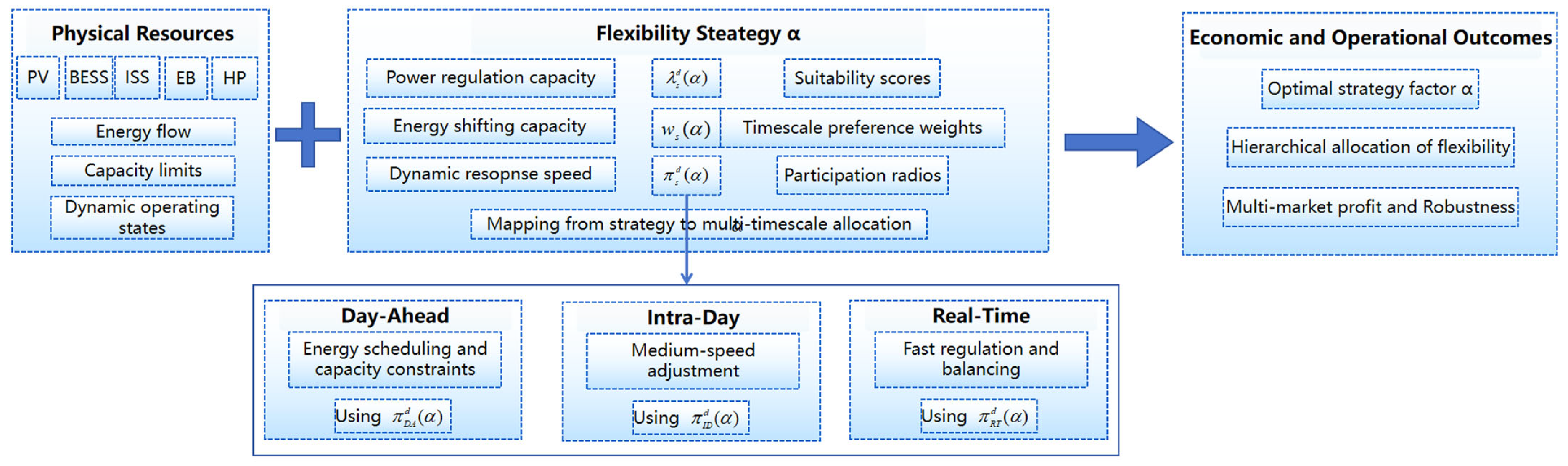
To facilitate understanding of the proposed hierarchical dispatch mechanism,
Figure 1 summarizes the overall modeling framework presented in
Section 2 and
Section 3, as well as the role of the strategy factor α in multi-timescale scheduling.
4. Case Studies
To validate the effectiveness and demonstrate the practical advantages of the proposed hierarchical dispatch strategy, case studies were conducted on a representative Northern Park of the State Grid Customer Service Center. The park’s integrated energy system is equipped with a diverse portfolio of adjustable resources, including photovoltaic (PV) generation, the battery energy storage system (BESS), ice storage system (ISS), electric boiler (EB) for thermal storage, heat pumps (HP), conventional air conditioning (AC), and both interruptible and shiftable electric vehicle charging stations (EVCS). This section details the simulation setup, presents the validation results for the key methodology, and analyzes the dispatch performance of the proposed model. All simulation is executed in Python 3.11.0 using the Gurobi solver. The simulation environment for the case study is an Intel Core-i5 1.6GHz processor with 16GB RAM. To evaluate real-time feasibility, the solution time of each MILP instance within the rolling MPC procedure was recorded; the average solution time per control interval is approximately 12 s, and the maximum solution time does not exceed 20 s, which is well within the available decision window for typical market dispatch intervals. The basic parameters of the case study are provided in
Appendix A.
4.1. Simulation Setup
The core objective of this case study is to validate the hierarchical dispatch strategy’s ability to dynamically adapt its operational strategy in response to varying market signals and system uncertainties. To this end, simulations were performed for both typical summer and winter operational seasons. Within each season, four distinct scenarios were designed to rigorously test the strategy’s performance under different conditions:
(1) Scenario A: Baseline. This scenario utilizes nominal parameters for PV generation uncertainty, intra-day (ID) market prices, and real-time (RT) imbalance penalties, serving as a benchmark for comparison.
(2) Scenario B: High Uncertainty. Characterized by a significant increase in the forecast error of PV generation, this scenario is designed to evaluate the strategy’s robustness and its ability to manage heightened real-time volatility.
(3) Scenario C: High Value ID Market. This scenario features higher price signals within the ID market, aiming to test the strategy’s responsiveness to targeted economic incentives and its capacity to reallocate flexible resources accordingly.
(4) Scenario D: High Value RT Market. This scenario imposes a lower penalty factor for real-time imbalances, thus decreasing the economic risk of dispatch deviations. It serves to examine how the strategy prioritizes system reliability and risk mitigation when faced with severe financial consequences.
A key element of our methodology is the strategy factor , a continuous parameter ranging from 0 to 1. This factor governs the fundamental trade-off between prioritizing economic optimization in the day-ahead (DA) market (α = 0, DA-Focused) and reserving flexibility to manage uncertainties in the real-time (RT) market (α = 1, RT-Focused). By performing a parametric sweep of , we can identify the optimal operational posture for each specific scenario.
4.2. Analysis of Optimal Strategy Adaptation to Market Scenarios
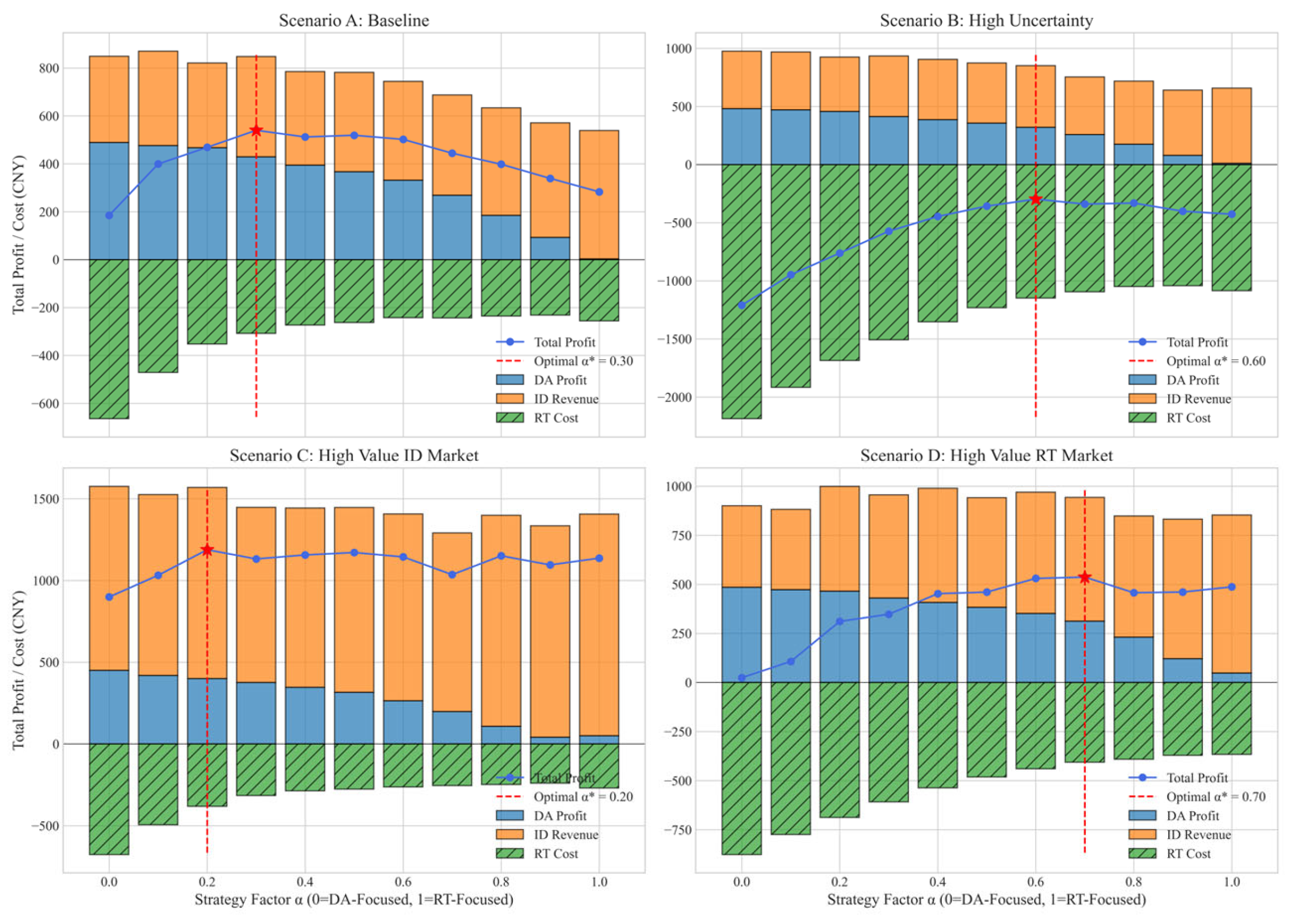
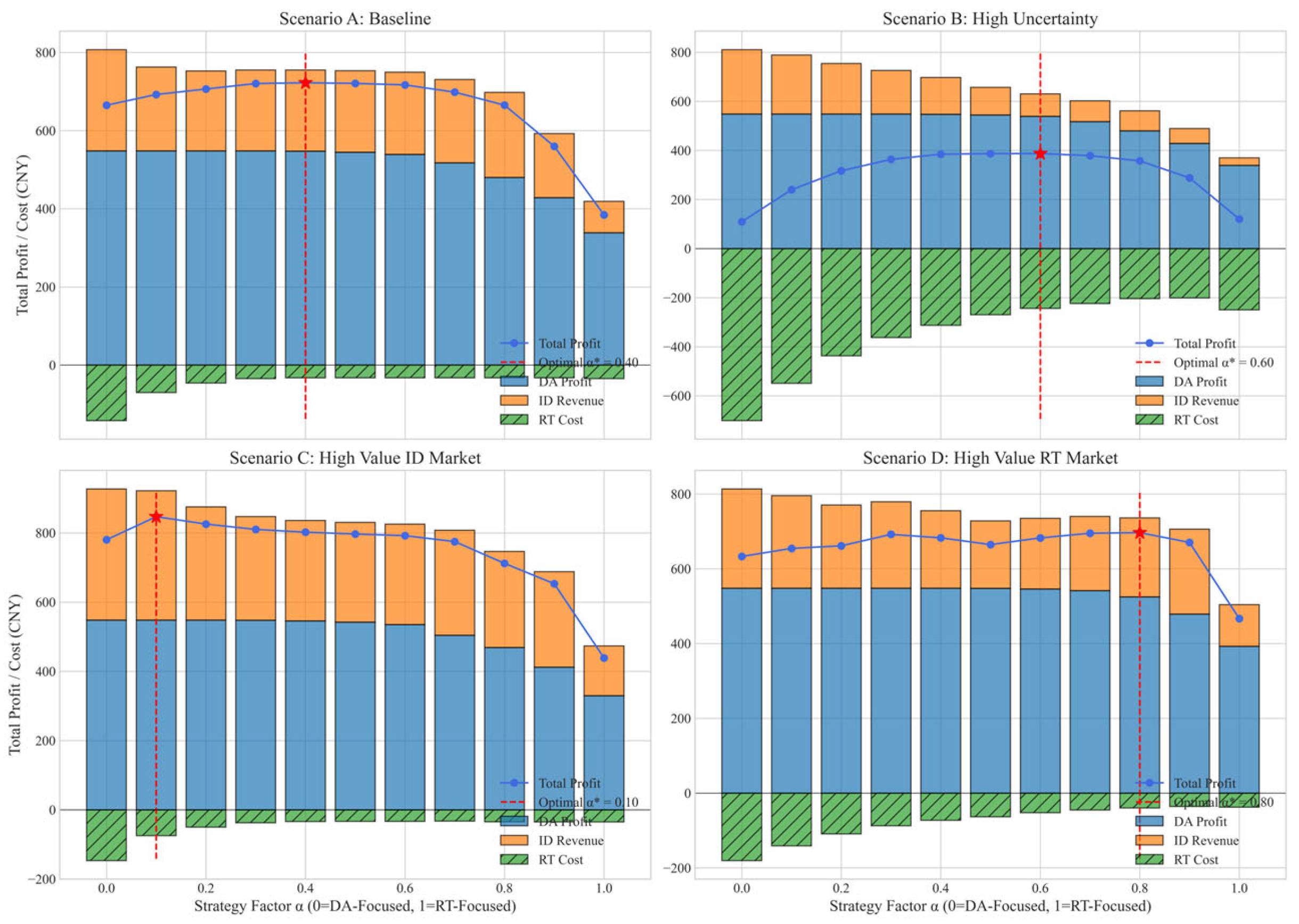
This section aims to validate the core adaptive capability of the hierarchical dispatch strategy. Specifically, we demonstrate how the strategy autonomously identifies an optimal operational posture—balancing day-ahead economic optimization against real-time operational security—in response to diverse market and uncertainty conditions. This is achieved by analyzing the total net profit as a function of the strategy factor α across the four designed scenarios for both summer and winter seasons, as depicted in
Figure 2 and
Figure 3, respectively.
Since the absolute value of the total profit is highly sensitive to the specific price settings, it cannot adequately reflect the intrinsic merits of the proposed scheduling strategy. Moreover, because the proposed strategy operates in a linear manner, this section focuses on the strategy factor α*, which maximizes the total profit under each scenario. Variations in α* provide a more accurate indication of the adaptive capability of the strategy under changes in market structure, price signals, and uncertainty conditions. Based on the analysis of the case study results, the conclusions are as follows:
(1)
Figure 2 and
Figure 3 clearly show that, in every scenario, the relationship between the strategy factor α and the total profit exhibits a unimodal convex structure with a unique optimal point. This observation aligns with our theoretical expectation: neither a purely day-ahead-oriented strategy (α = 0) nor a purely real-time-oriented strategy (α = 1) can achieve the highest economic return. The optimal solution necessarily emerges from a hybrid strategy that balances both timescales, thereby affirming the necessity of the proposed coordination mechanism. A crucial finding is that this optimal point is not fixed but instead migrates dynamically across scenarios.
(2) In the summer scenarios (
Figure 2), comparison across different market conditions reveals that both price structures and uncertainty levels exert substantial influence on economic performance, while the proposed strategy demonstrates strong effectiveness and adaptability. As shown in the figure, the optimal α shifts markedly from 0.3 in the Baseline scenario (A) to 0.6 in the High Uncertainty scenario (B). This significant shift arises from the increased profit opportunities induced by stochastic PV fluctuations, which create richer revenue potential for flexible resources in the integrated energy system. Consequently, the rightward shift in α* indicates that the strategy proactively reserves a larger share of system flexibility for real-time balancing to capture these additional profit opportunities. Similarly, in the High Value ID Market (C) and High Value RT Market (D) scenarios, α* shifts to 0.2 and 0.4, respectively, demonstrating the strategy’s ability to pivot toward the most profitable market segment under each condition.
(3) From a seasonal perspective, the winter scenarios (
Figure 3) exhibit narrower and lower profit ranges compared with summer, primarily due to reduced PV availability for arbitrage and increased inflexible heating demand. Nevertheless, the adaptive behavior of α remains consistent across seasons. For example, in the winter High Uncertainty scenario (B), the optimal α reaches 0.6, remaining higher than the Baseline value of 0.4. This further reinforces the conclusion that the strategy’s risk-responsive logic is robust across varying operational seasons. By adaptively identifying α*, the PIES is able to maintain operational robustness while achieving maximum profitability under the specific conditions of each trading day.
In summary, the systematic migration of the optimal strategy factor α* provides compelling evidence that the proposed hierarchical scheduling strategy can achieve adaptive optimization under diverse market structures and uncertainty conditions, while consistently maintaining strong economic performance.
4.3. Visualization of Dispatch Behavior Across Different Market
To deconstruct the underlying mechanism driving the strategic adaptation observed in
, this section analyzes how the dispatch of individual resources with heterogeneous characteristics is allocated across different market timescales as a function of
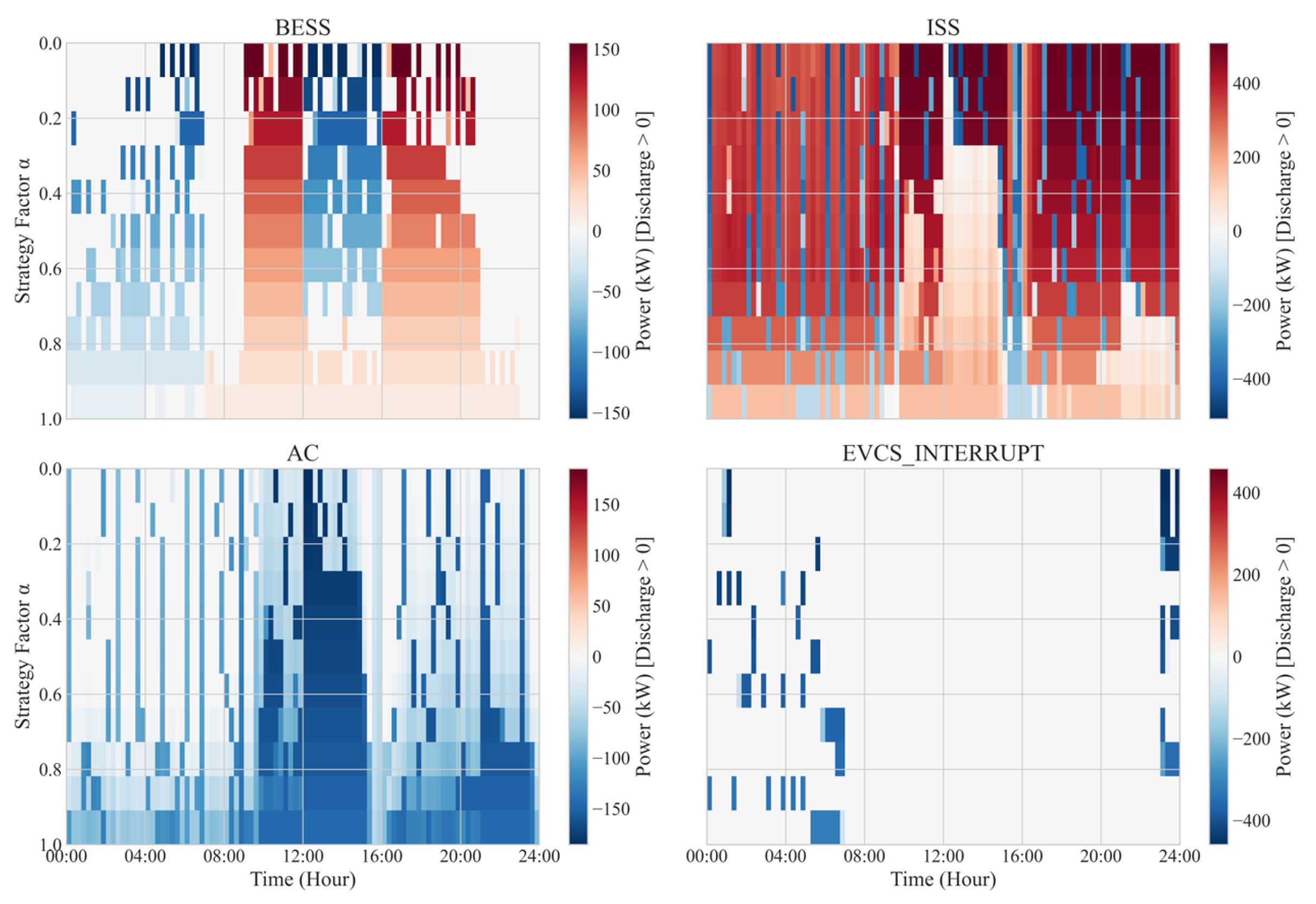
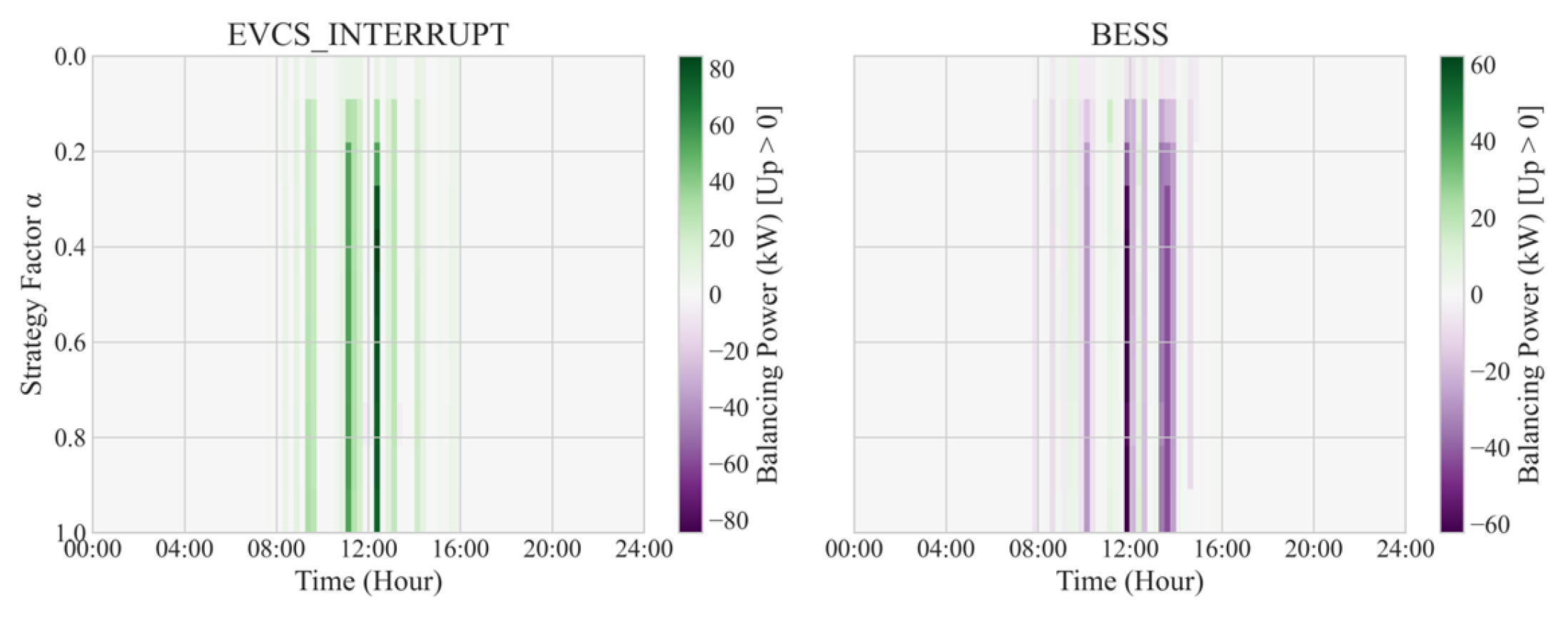
. This analysis validates the strategy’s ability to match resource capabilities with market requirements. The heatmaps in
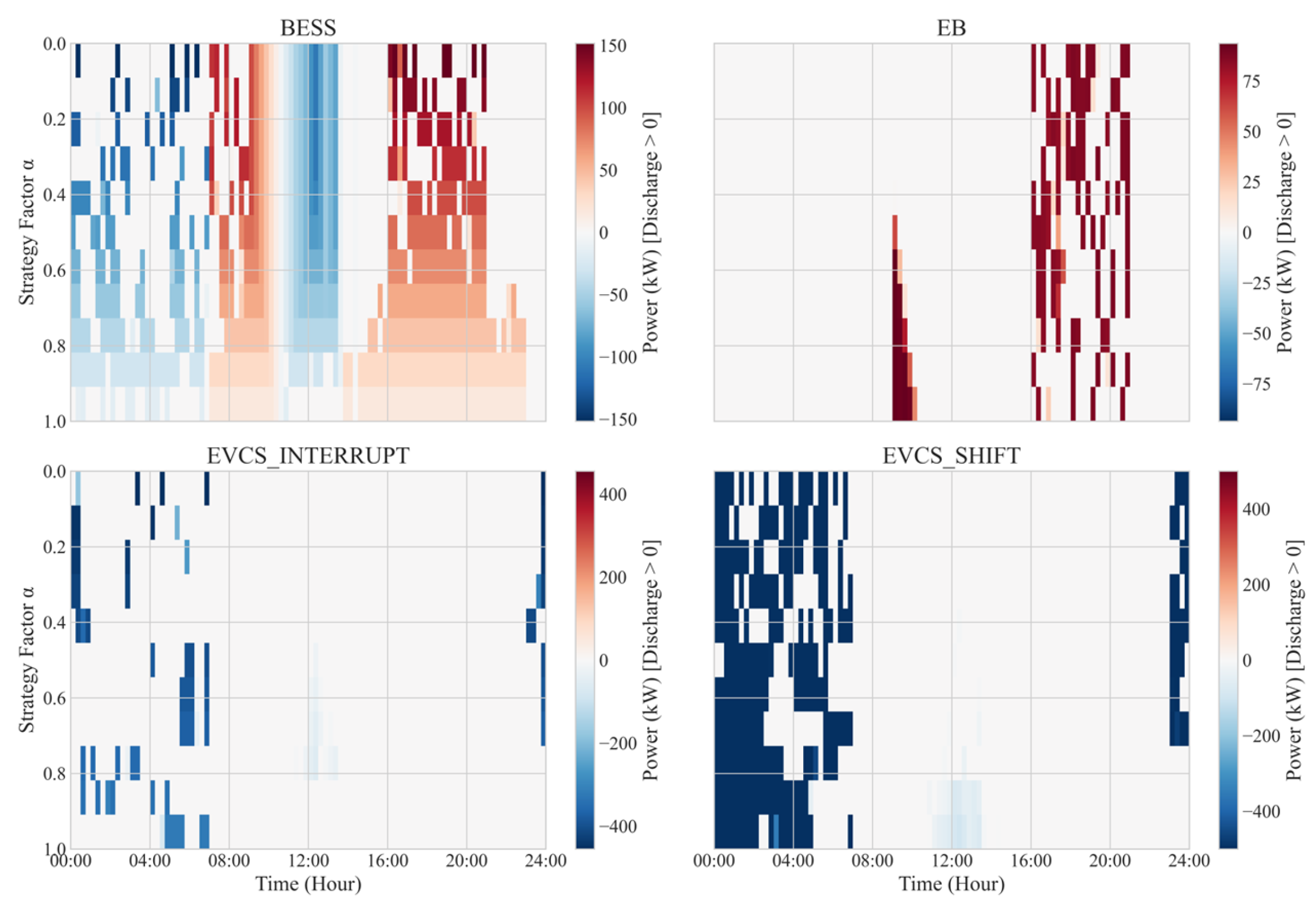
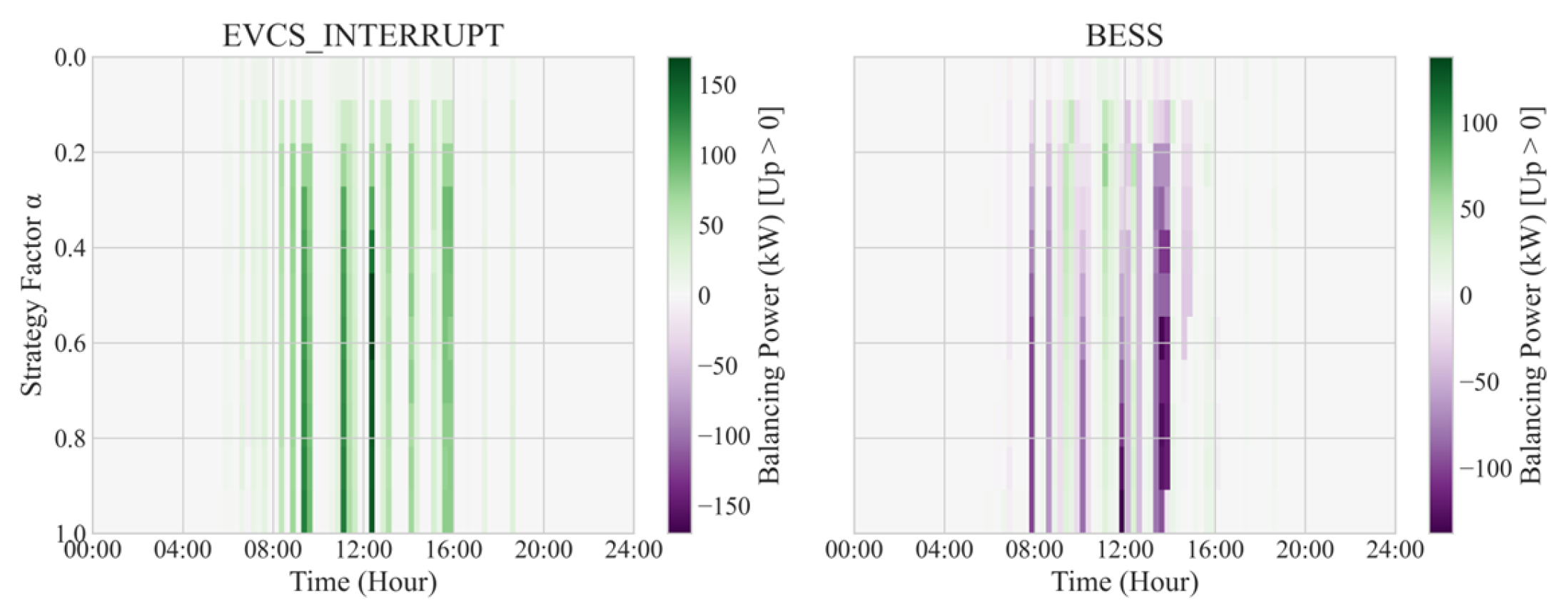
Figure 4,
Figure 5,
Figure 6,
Figure 7,
Figure 8 and
Figure 9 illustrate the dispatch behavior for key assets in the baseline scenario.
The day-ahead market dispatch (
Figure 4 for summer,
Figure 5 for winter) clearly reflects the resources’ suitability for long-duration energy arbitrage. At low
values, both BESS and the slower-responding thermal storage (ISS in summer, EB in winter) exhibit aggressive arbitrage, charging at low prices and discharging at high prices. However, a crucial distinction emerges as
increases: the BESS, being a fast-response resource, progressively curtails its DA arbitrage to preserve its state-of-charge, thereby reserving its flexibility for higher-value, faster-timescale markets. In contrast, the ISS and EB, with limited value beyond energy shifting, maintain their DA arbitrage behavior across a wider range of
. The seasonal difference is also apparent: in winter (
Figure 5), the EB and shiftable EVCS loads become primary assets for DA optimization, whereas in summer (
Figure 4), the AC and ISS fulfill this role, demonstrating the strategy’s adaptation to the seasonal resource portfolio.
The intra-day (
Figure 6 and
Figure 7) and real-time (
Figure 8 and
Figure 9) market heatmaps confirm the hierarchical allocation. Participation in the ID market, a mid-speed service, increases as
grows, indicating a shift away from a pure DA focus. The RT market, which demands the fastest response, is almost exclusively served at high α values. Critically, these markets are dominated by the most agile assets. The BESS is a prominent participant in both ID and RT markets, whereas interruptible EVCS contribute significantly to RT balancing. This visual evidence validates that the strategy does not treat flexibility monolithically; instead, it systematically prioritizes and dispatches resources in a manner commensurate with their inherent dynamic response characteristics and the temporal granularity of the market.
In practical spot-market operations, real-time price signals and market clearing information may be subject to communication delays and measurement inaccuracies. To examine the sensitivity of the proposed hierarchical dispatch strategy to such imperfect information, an additional qualitative sensitivity analysis was conducted by introducing a one-step delay and ±10% multiplicative noise into the real-time price signals and intraday market clearing information while keeping the original optimization model and rolling MPC framework unchanged. The results indicate that the overall dispatch behavior and total net profit remain nearly unchanged compared with the baseline case. This robustness can be attributed to the rolling-horizon MPC structure, which continuously updates dispatch decisions and mitigates the accumulation of transient signal errors, as well as the hierarchical flexibility allocation mechanism that provides inherent buffering capability against short-term market information imperfections. These observations suggest that the proposed strategy exhibits low sensitivity to moderate delays and inaccuracies in real-time market signals, supporting its applicability in practical spot-market environments.
To further examine the robustness and effectiveness of the proposed flexibility-to-participation mapping, an additional comparative experiment is conducted under the same case-study settings. The experiment uses exactly the same Excel-based input data, model formulation, solver configuration, and simulation procedure as the original case study. The only difference lies in the generation of the market participation ratios. Specifically, the proposed strategy computes
using the flexibility assessment–based mapping described in
Section 2 and
Section 3, whereas a baseline strategy adopts fixed participation ratios for the day-ahead, intra-day, and real-time markets, representing a commonly used heuristic allocation without flexibility awareness. To ensure a fair comparison under stochastic PV realizations, the same random seed is applied so that both strategies experience identical PV actual trajectories.
Simulation results show that the proposed adaptive mapping achieves a higher overall economic performance under the high-uncertainty scenario. The total net profit increases from 3835.22 under the fixed-ratio baseline to 3883.65 with the proposed strategy. Notably, the proposed mapping allocates more value to real-time participation, with real-time revenue increasing from 1973.88 to 2327.26, while day-ahead profitability is also maintained (221.05 versus 194.08). These results demonstrate that the proposed mapping effectively reserves high-speed flexibility for real-time markets and enhances overall economic performance without compromising feasibility, thereby validating the robustness of the flexibility-based participation strategy.
4.4. Hierarchical Allocation of Flexibility Resources
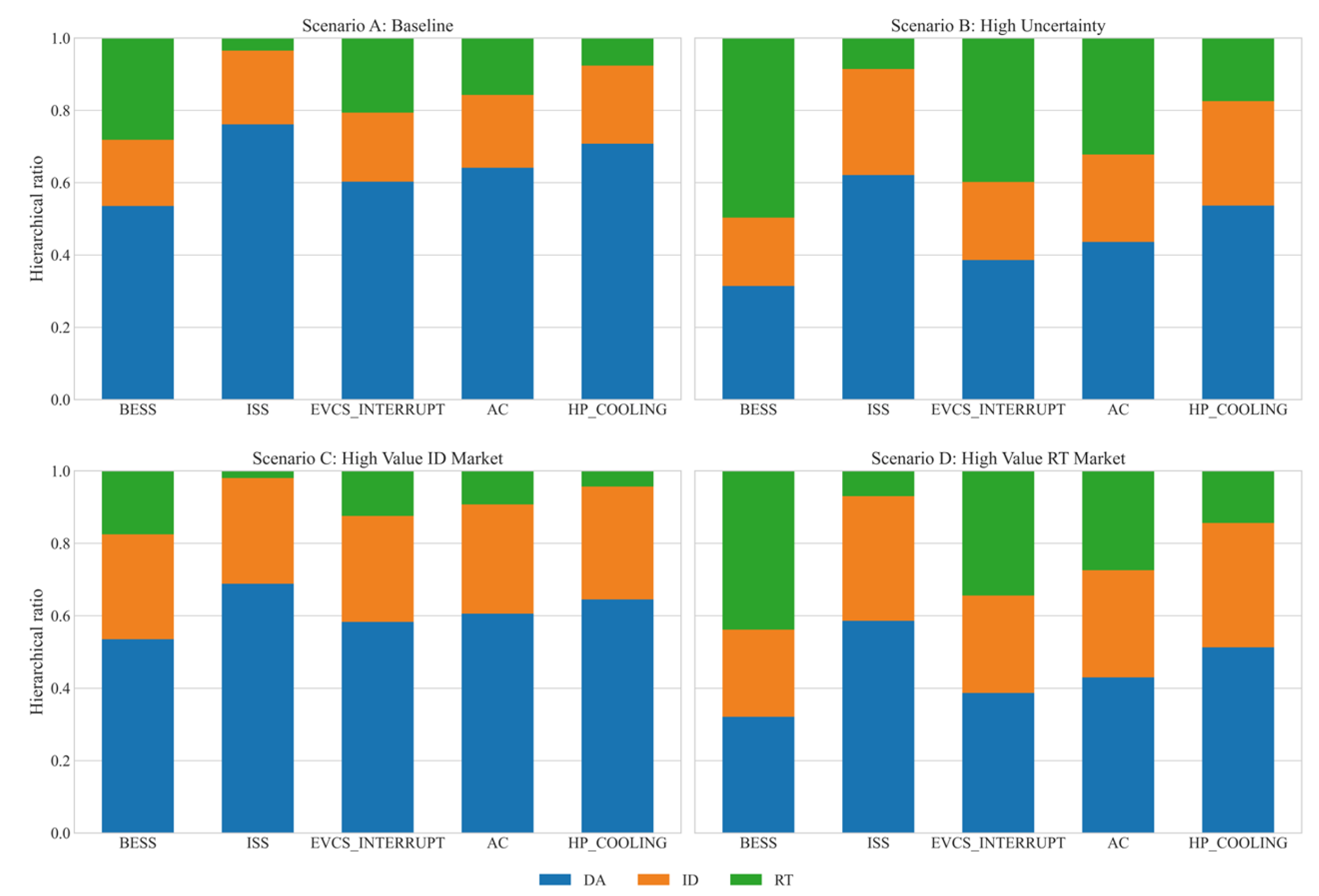
This section quantitatively validates the effectiveness of the hierarchical classification framework by examining the precise proportional allocation of flexibility from each resource to the DA, ID, and RT market tiers at the optimal strategy point (
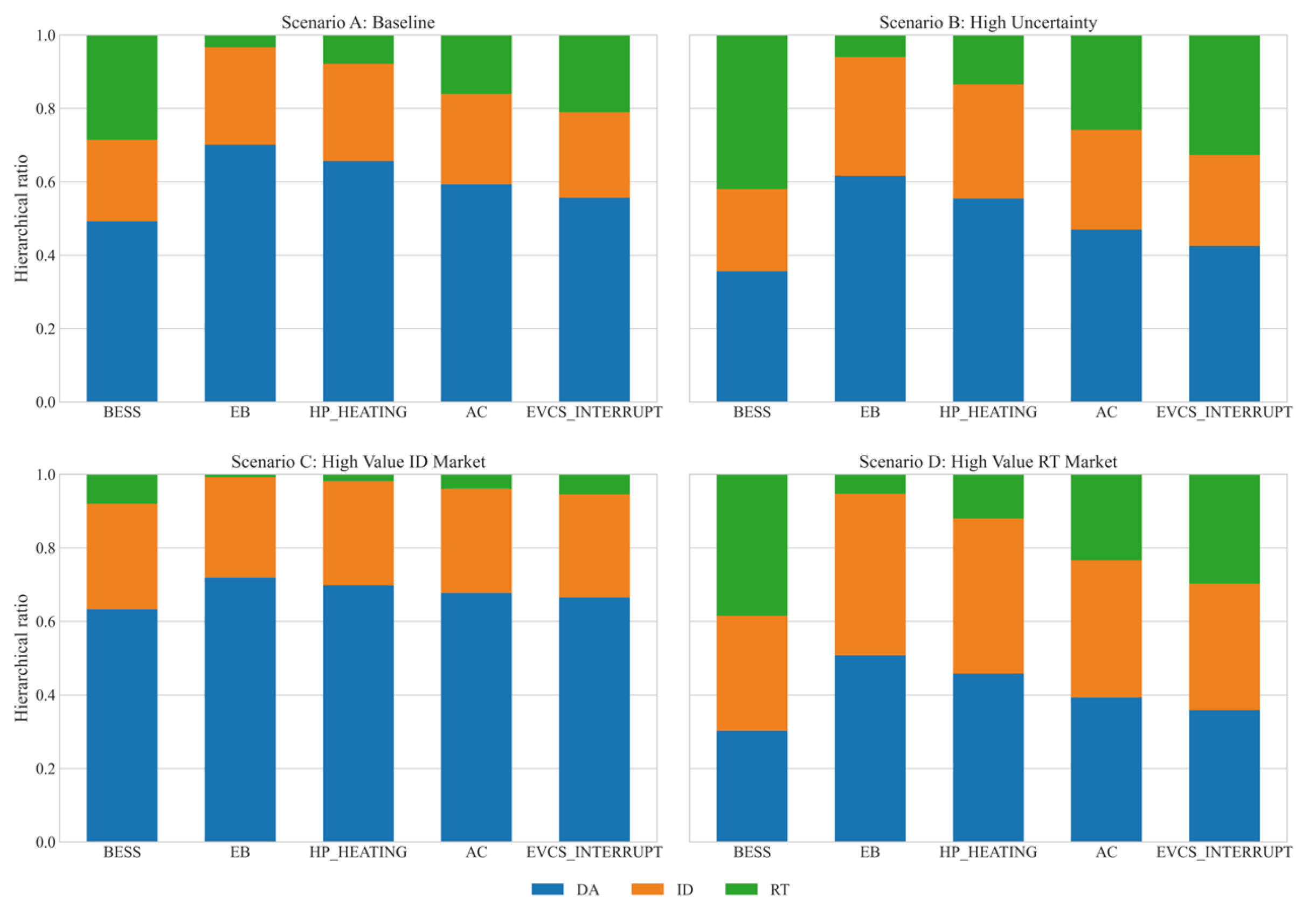
). The analysis of the stacked bar charts in
Figure 10 (summer) and
Figure 11 (winter) confirms that the strategy enforces a rational, characteristic-based allocation of resources.
The results reveal a consistent pattern of trait-market matching. The BESS, with its rapid response capabilities, consistently has a balanced portfolio with significant flexibility allocated to the ID (orange) and RT (green) tiers across all scenarios. For example, in the summer Baseline (
Figure 9, Scenario A), over 40% of its flexibility is reserved for ID and RT markets. In stark contrast, the ISS, a large-capacity but slow-response thermal storage asset, has its flexibility almost entirely allocated to the DA tier (blue), reflecting its primary function as a bulk energy arbitrage tool. This demonstrates the effectiveness of hierarchical classification in assigning appropriate market roles.
Furthermore, the allocation ratios dynamically adapt to market signals. Comparing the Baseline scenario (A) with the High Value ID Market scenario (C) in
Figure 10, the proportional allocation to the ID market (orange segment) increases for all resources, most notably for the BESS and AC. This shift quantifies the strategy’s economic opportunism, as it redirects resources to capture higher profits. Similarly, in the High Uncertainty scenario (B), the RT allocation (green segment) for the BESS expands from approximately 15% in the baseline to over 25%, a direct and quantifiable response to the increased need for real-time balancing. The seasonal comparison between
Figure 10 and
Figure 11 shows this logic holds, with the EB in winter adopting the DA-dominant role like the ISS in summer, proving the framework’s robustness across different operational contexts.
4.5. Benchmarking Results Under Different PV Uncertainty Levels
To further demonstrate the generality and performance advantages of the proposed hierarchical flexibility dispatch strategy, additional benchmarking studies are conducted under different PV uncertainty levels. All benchmarking experiments are performed using the same park-level integrated energy system configuration, identical input datasets, and the same rolling MPC framework as described in
Section 4.1,
Section 4.2 and
Section 4.3. The comparison therefore isolates the impact of different market participation strategies without introducing confounding factors.
Three representative strategies are evaluated. The first is the proposed adaptive hierarchical dispatch strategy, in which the market participation ratios are dynamically determined based on the flexibility assessment results. The second is a fixed-ratio baseline, where the participation ratios for the day-ahead, intra-day, and real-time markets are set to without considering flexibility heterogeneity. The third is a conventional RT-only strategy, representing operation without hierarchical flexibility dispatch, in which flexible resources participate only in the real-time market. In addition, two PV uncertainty levels are considered to reflect different operating conditions, including a low-uncertainty scenario and a high-uncertainty scenario. For all cases, the same solver settings and random seed are applied to ensure fair and reproducible comparisons.
The quantitative benchmarking results are summarized in
Table 1. As can be observed, under low PV uncertainty conditions, the fixed-ratio strategy achieves slightly higher total profit by aggressively exploiting intra-day market opportunities, while the proposed adaptive strategy maintains comparable economic performance with a more balanced allocation across market layers. In contrast, under high PV uncertainty conditions, the advantages of the proposed strategy become more pronounced. By dynamically reserving high-speed flexibility for real-time participation, the adaptive strategy achieves the highest total profit and significantly improves real-time revenue compared with both baseline strategies. The RT-only strategy, which lacks coordination across market timescales, exhibits the poorest performance and strong sensitivity to uncertainty.
Overall, the benchmarking results confirm that the proposed flexibility-aware hierarchical dispatch strategy effectively coordinates multi-timescale market participation. It enhances economic robustness under volatile operating conditions while avoiding overly aggressive or myopic market behavior, thereby demonstrating its applicability and effectiveness across different uncertainty levels.
4.6. Analysis of Detailed Dispatch Performance Under Optimal Strategy
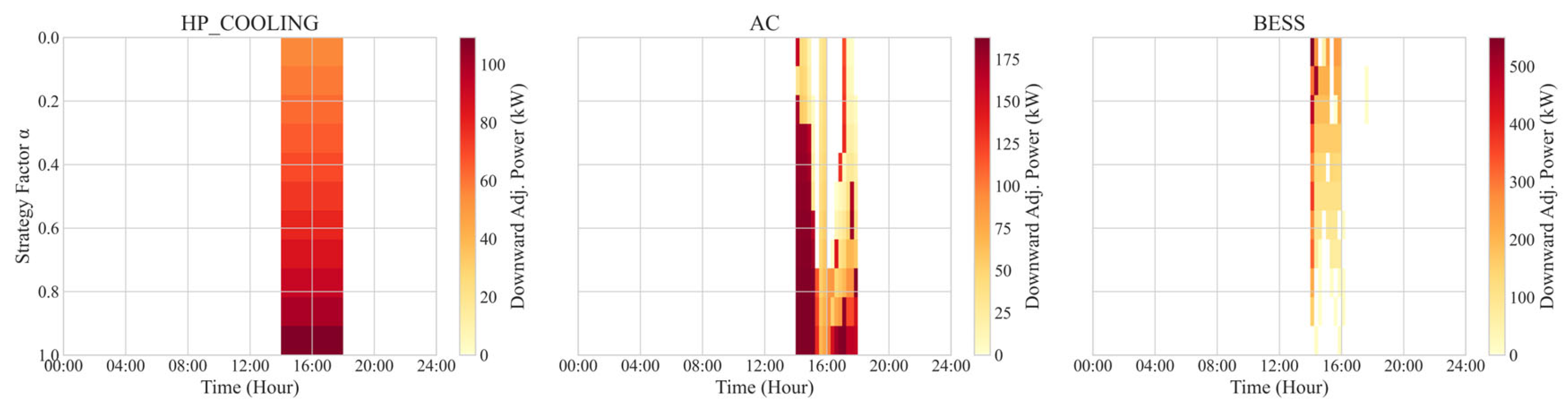
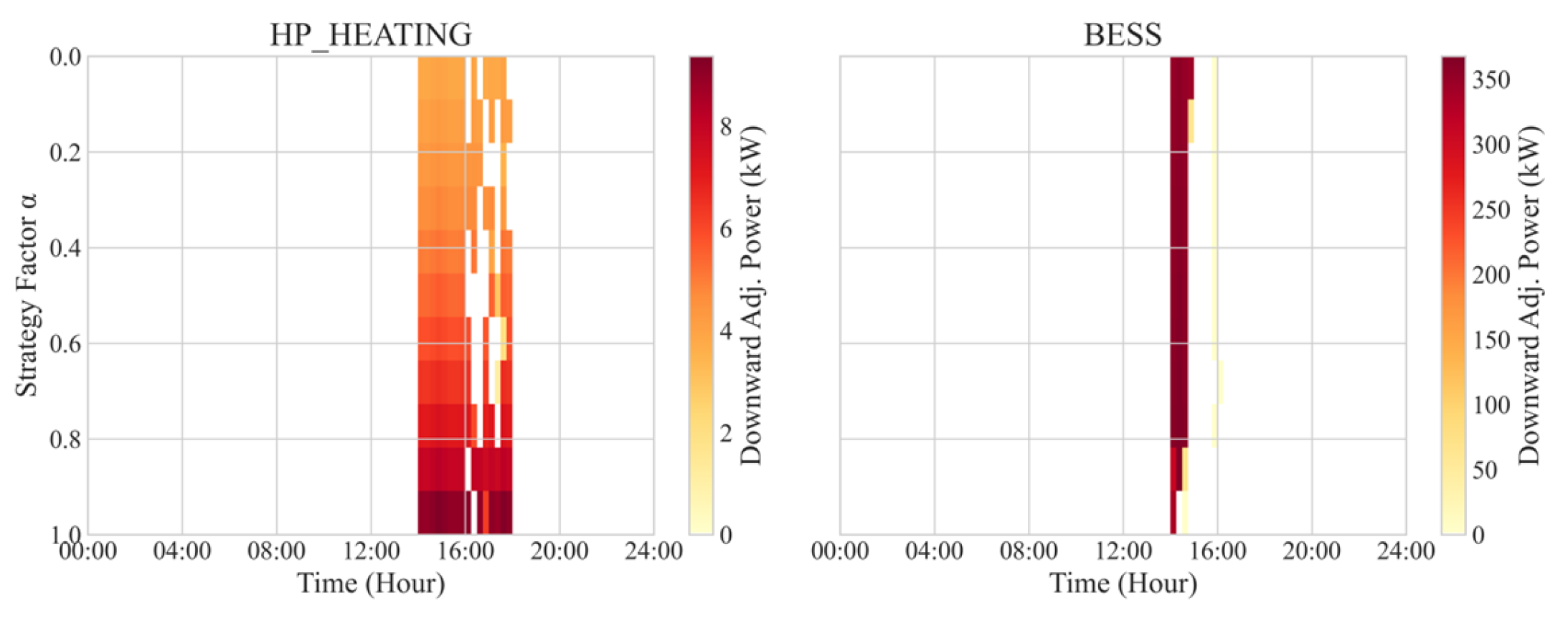
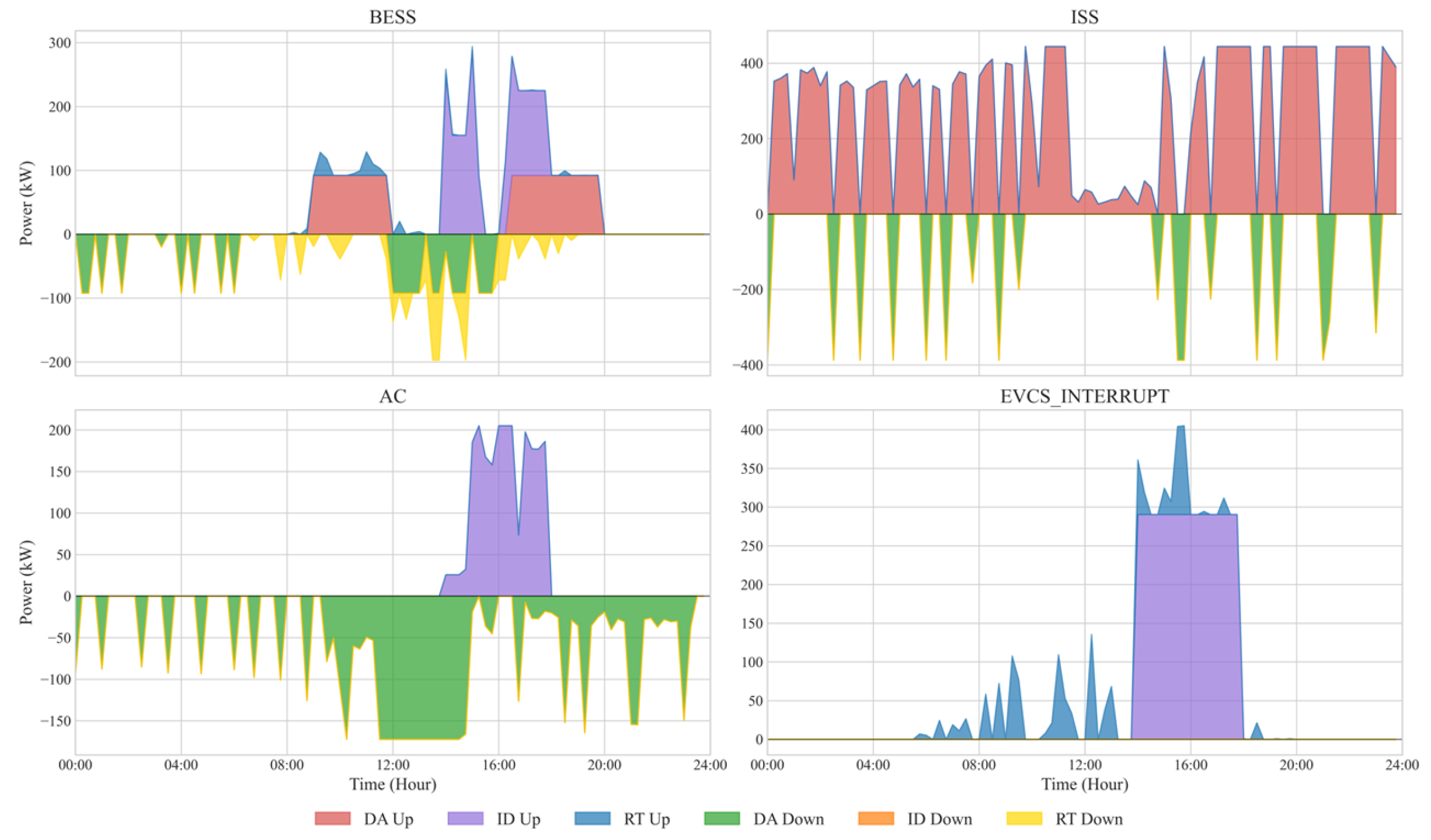
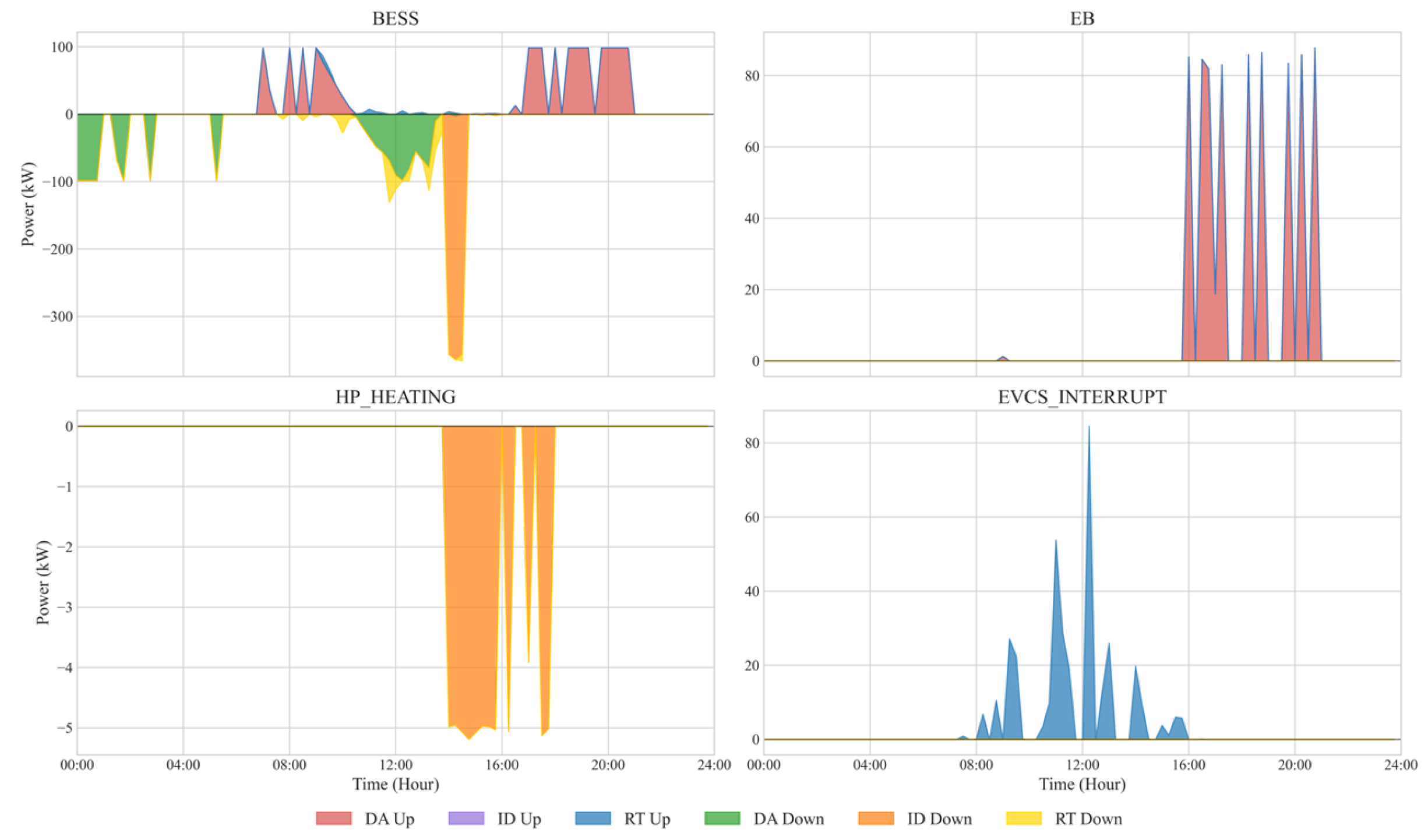
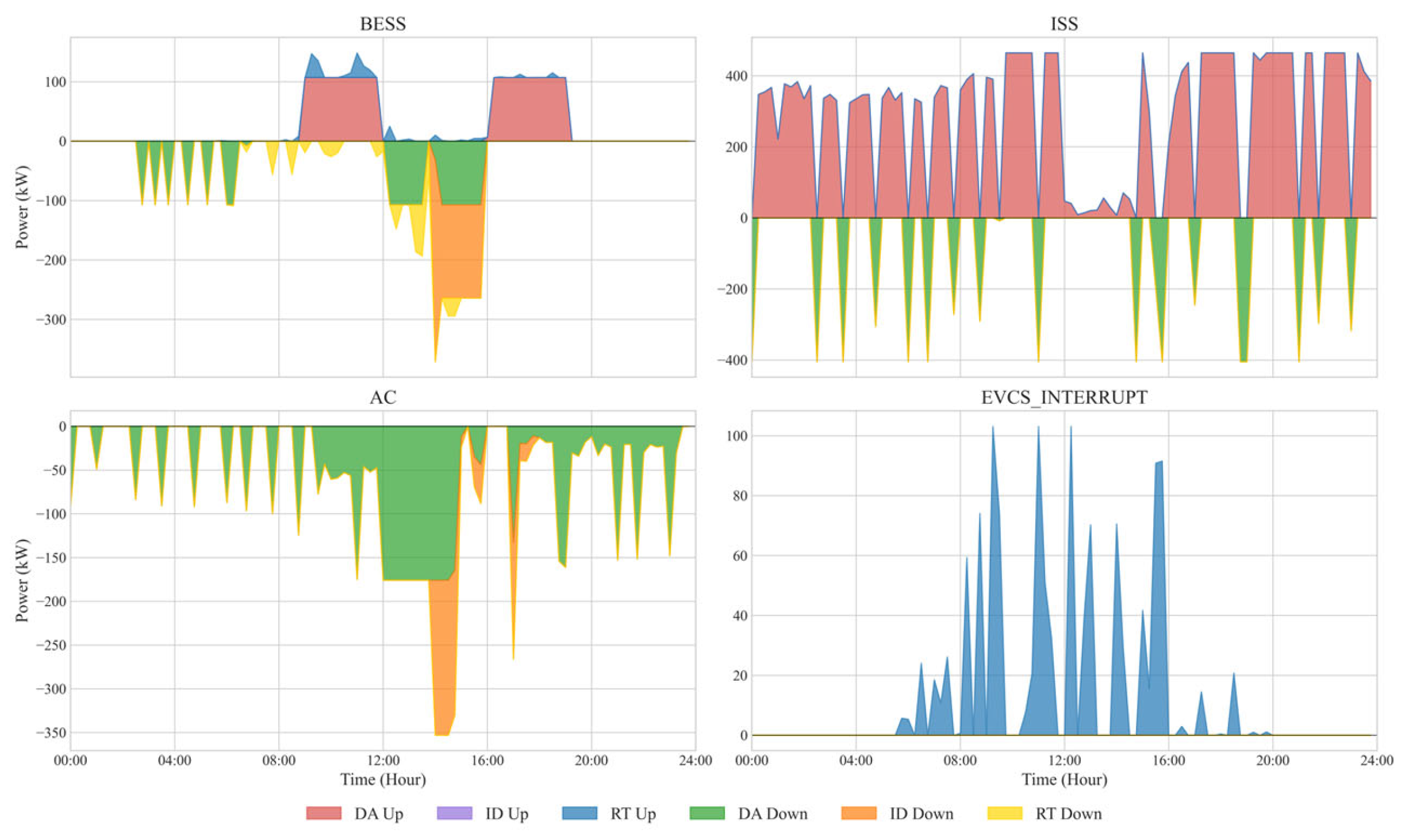
This section analyzes the final dispatch execution to validate the strategy’s ability to generate coherent, integrated, and physically optimal operational schedules under different market service requirements. The dispatch breakdown plots (
Figure 12,
Figure 13,
Figure 14 and
Figure 15) illustrate the multi-market power contributions for key assets, comparing upward and downward ID service provision in both summer and winter seasons.
A comparison between the summer ID-downward (
Figure 12) and ID-upward (
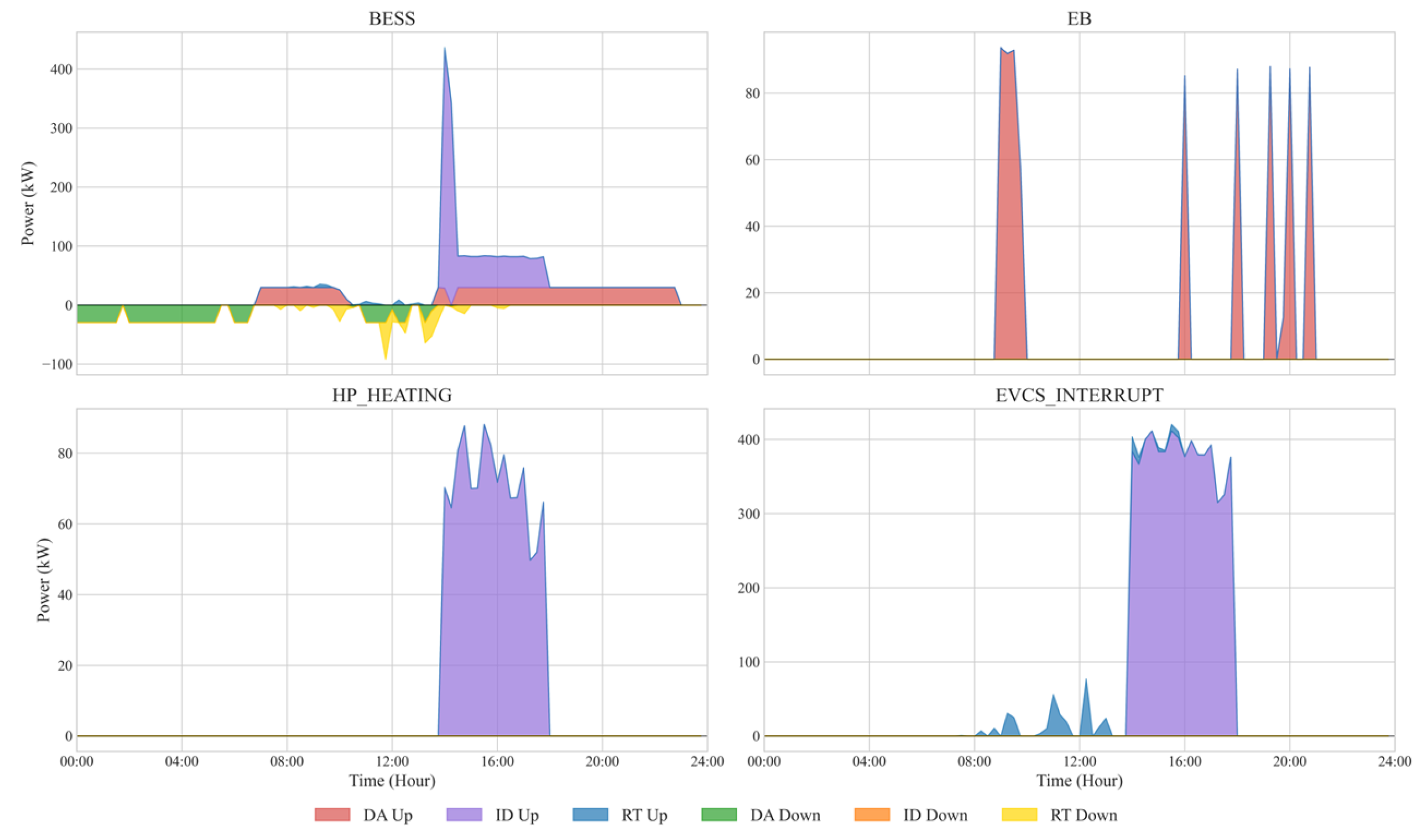
Figure 13) scenarios highlight the strategy’s symmetric and precise response. The downward scenario highlights the BESS provides regulation by increasing its charging power during the 14:00–18:00 ID window (ID Down, orange area), which is superimposed on its foundational DA arbitrage schedule. The AC also contributes significantly by increasing its consumption. In the ID-upward scenario, the BESS provides the required service by discharging (ID Up, purple area), demonstrating a clear reversal of its role based on the market signal. This precise power modulation is distinct from the high-frequency, smaller-magnitude adjustments made for the RT market (RT Up/Down, blue and yellow areas), showcasing the multi-timescale coordination.
The seasonal comparison reveals the adaptation to the available resource mix. In winter (
Figure 14 and
Figure 15), the primary assets for thermal load management shift from AC and ISS to the HP and EB. In the winter ID-downward scenario (
Figure 14), the HP provides downward regulation. The BESS continues its role as a key flexible asset, but its DA schedule is adapted to the different winter load profile, with a more pronounced discharge during the evening peak. In all cases, the dispatch of each asset is a seamless composite of its scheduled DA plan, its committed ID response, and its continuous RT balancing actions, confirming that the hierarchical strategy successfully translates high-level objectives into concrete, co-optimized, and economically superior operational actions.