1. Introduction
Bearings are ubiquitous and indispensable components across numerous fields including aerospace, precision machine tools, robotics, automobiles, and high-speed rail. They must possess properties such as fatigue resistance, wear resistance, high strength, and extended service life. This necessitates that the heat treatment process, serving as the near-net-shape finishing for bearings, not only achieves fatigue resistance and high strength but also minimizes distortion of the bearing rings during heat treatment. The goal is to maximize the grindable allowance of the rings post-heat treatment, thereby reducing costs while effectively safeguarding and enhancing the overall service performance of the bearings [
1,
2,
3,
4,
5,
6,
7,
8]. However, as thin-walled annular components, bearing inner and outer rings must be heated above the austenitizing temperature during heat treatment and then immersed in quenching oil, where complex nucleate boiling, vapor film attachment, and film boiling phenomena occur. These phenomena cause differences in bearing cooling rates, leading to non-uniform phase transformation structures, hardness, and distortion across different regions [
9,
10,
11,
12]. Therefore, how to predict and control bearing distortion, internal metallic structure changes, and hardness has always been an important research topic in bearing production.
In industrial practice, mesh belt furnaces are widely employed for carburizing and quenching the inner and outer rings of bearings. This automated equipment, optimized for high-efficiency mass production, is often operated with oil as the cooling medium. By precisely controlling furnace temperature, heating duration, and cooling parameters, a stable martensitic microstructure can be obtained, thereby enhancing wear resistance and fatigue strength. Nevertheless, in large-scale production, the uniformity of oil quenching critically affects post-quench distortion. During continuous feeding, components are heated to complete austenitization in the furnace’s heating zone before being transferred into the quenching oil. However, stacking during the cooling stage can compromise uniform cooling. To mitigate this issue, an additional secondary mesh belt is installed in the oil tank to ensure that each end face of the bearing ring sequentially contacts the secondary belt and the lifting belt. The residence time of the rings on the secondary belt is crucial—either excessive or insufficient durations fail to achieve the intended effect. The process is illustrated in
Figure 1. From a quality control perspective, adjusting the reverse motor frequency of the secondary belt has been identified as an effective approach to minimize distortion, making it a significant factor in large-scale bearing production. However, given the variability in operational conditions across different batches—due to production equipment and tooling constraints—experimentally validating the optimal frequency for each scenario is highly challenging.
In recent years, with the rapid development of artificial intelligence (AI) technology, data-driven methods have been increasingly introduced into the modeling and process parameter optimization of complex heat treatment processes. Existing research indicates that machine learning and deep learning methods have certain advantages in establishing mapping relationships between process parameters and material properties or distortion responses. For instance, Kusano et al. [
13] predicted the tensile properties of Ti-6Al-4V alloy after additive manufacturing and heat treatment using multiple linear regression combined with quantitative microstructural features. Hernandez et al. [
14] compared the applicability of multiple regression and random forest models in predicting the stabilization time of a heat treatment furnace. Zhu et al. [
15] and Wang et al. [
16] employed XGBoost and support vector machine (SVM) models, respectively, to model steel hardenability and gear heat treatment process control. Such studies have validated the feasibility of data-driven models in predicting heat treatment processes, yet their predictive performance typically relies on a relatively ample sample size. Building upon this foundation, some studies have further integrated machine learning models with optimization algorithms or numerical simulation methods to achieve multi-objective process parameter optimization. Nandal et al. [
17] utilized artificial intelligence methods to explore the design of non-isothermal aging processes for Ni–Al alloys, demonstrating the application prospects of AI in complex heat treatment path design. For example, Chintakindi et al. [
18] combined principal component analysis, machine learning models, and the particle swarm optimization algorithm to perform multi-objective optimization of the annealing process parameters for Monel 400 alloy. Xia et al. [
19] proposed a process optimization framework coupling finite element analysis with a neural network, applied to the optimal design of heat treatment parameters for bearing rings. Oh and Ki [
20] utilized deep neural networks to predict the hardness distribution of tool steel during laser heat treatment. Jia et al. [
21] proposed a deep learning-based model for predicting post-quench hardness and carburized layer depth, which was then applied to process parameter recommendation. Wang et al. [
22] constructed a neural network-based multi-objective optimization model that simultaneously considered hardness, distortion, and total helix deviation, significantly reducing the total helix deviation in gear heat treatment. While such methods demonstrate strong capability in process search, they typically involve complex model construction, high parameter tuning costs, and often struggle to maintain stability when experimental samples are limited.
The potential of large language models (LLMs) in engineering design and manufacturing decision-making is also gaining attention. Sun et al. [
23] proposed a large language model-based method for quenching process design, achieving end-to-end intelligent modeling of the process flow. However, existing LLM-related research has predominantly focused on process path generation or decision support at the workflow level. Their capability for quantitative prediction of continuous process parameter–performance relationships and stable interpolation under small-sample conditions still requires further investigation.
In summary, while existing research has achieved significant progress in modeling heat treatment processes and optimizing process parameters, current methods still face challenges of insufficient prediction stability and limited engineering applicability in industrial scenarios characterized by limited experimental samples, highly nonlinear frequency–distortion relationships, and the need to explicitly incorporate empirical process rules. To address these challenges, this paper proposes a prior-guided regression and process parameter recommendation method based on a pre-trained large language model. By uniformly encoding geometric parameters, process conditions, and domain knowledge into structured prompts, the method achieves stable prediction of bearing quenching distortion trends and optimization of the reverse motor frequency under small-sample conditions, without the need for training an additional predictive model.
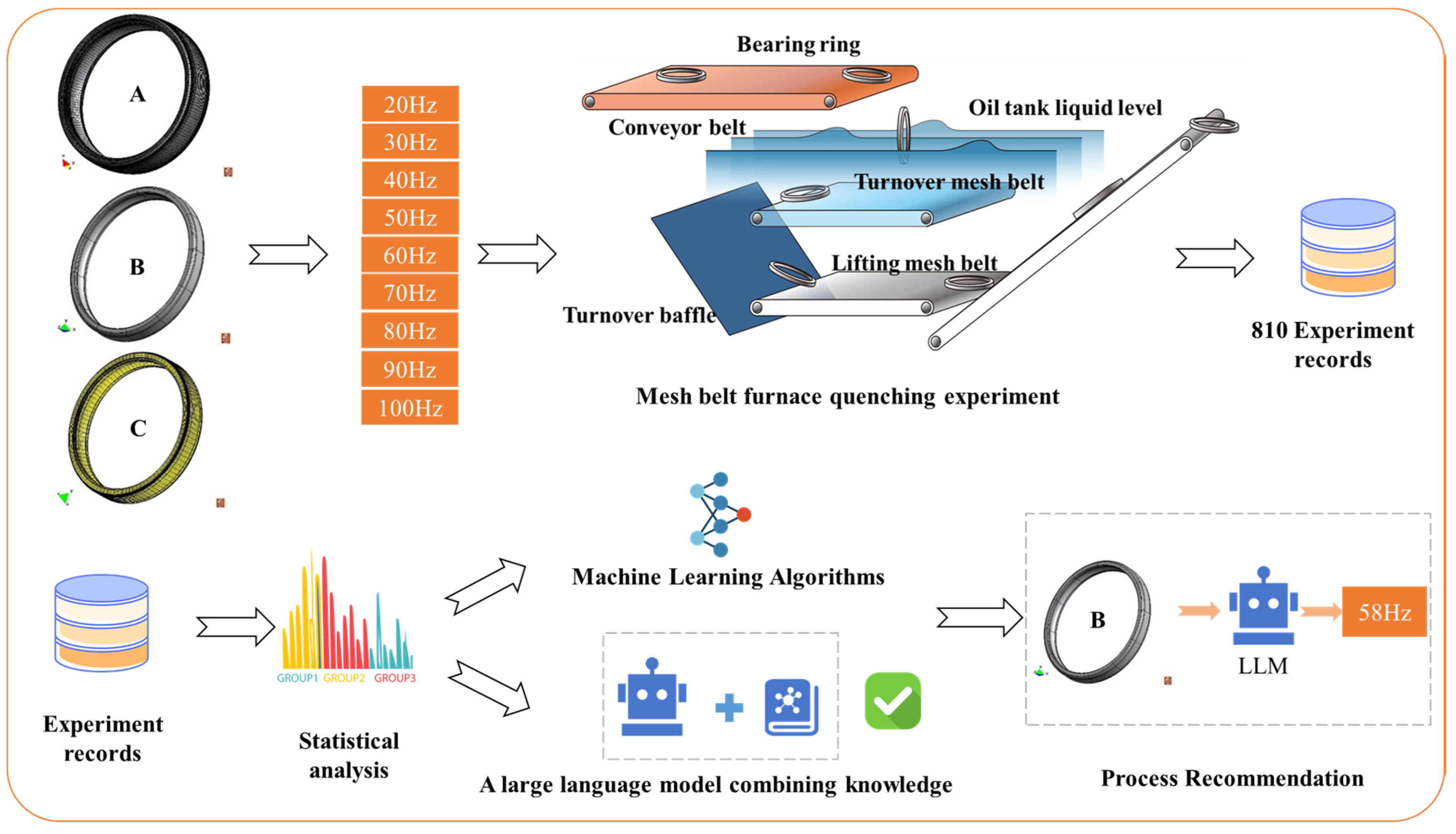
In this study, targeting the secondary quenching process in a mesh-belt continuous furnace, experiments were designed to quantitatively analyze the process, and a method for distortion prediction and process parameter optimization under small-sample conditions was proposed. First, this paper establishes an experimental database comprising measurements from 810 thin-walled bearing outer rings, covering three typical geometric types and nine discrete reverse motor frequencies (20–100 Hz). The difference in diameter values between the upper and lower end faces and the oval distortion are adopted as the primary evaluation metrics. Given the sparse and highly nonlinear characteristics of the frequency–distortion relationship, the predictive stability of conventional regression methods under small-sample conditions is analyzed. Innovatively, a pretrained large language model (LLM) is introduced as a prior-constrained regressor. By encoding geometric parameters, frequency information, and historical distortion statistics into structured prompts, along with embedding key process rules, stable predictions of the distortion trend within untested frequency intervals are achieved.
Building upon this foundation, a frequency optimization workflow for process recommendation is further established. Under the premise of satisfying quality constraints, the optimal reverse motor frequency for bearing rings of different geometric types is determined via fine-step search. Supplementary experimental results verify the engineering applicability of this method in terms of reducing testing costs, improving parameter selection efficiency, and supporting decision-making for scaled production.
3. Results and Discussions
3.1. Experimental Results
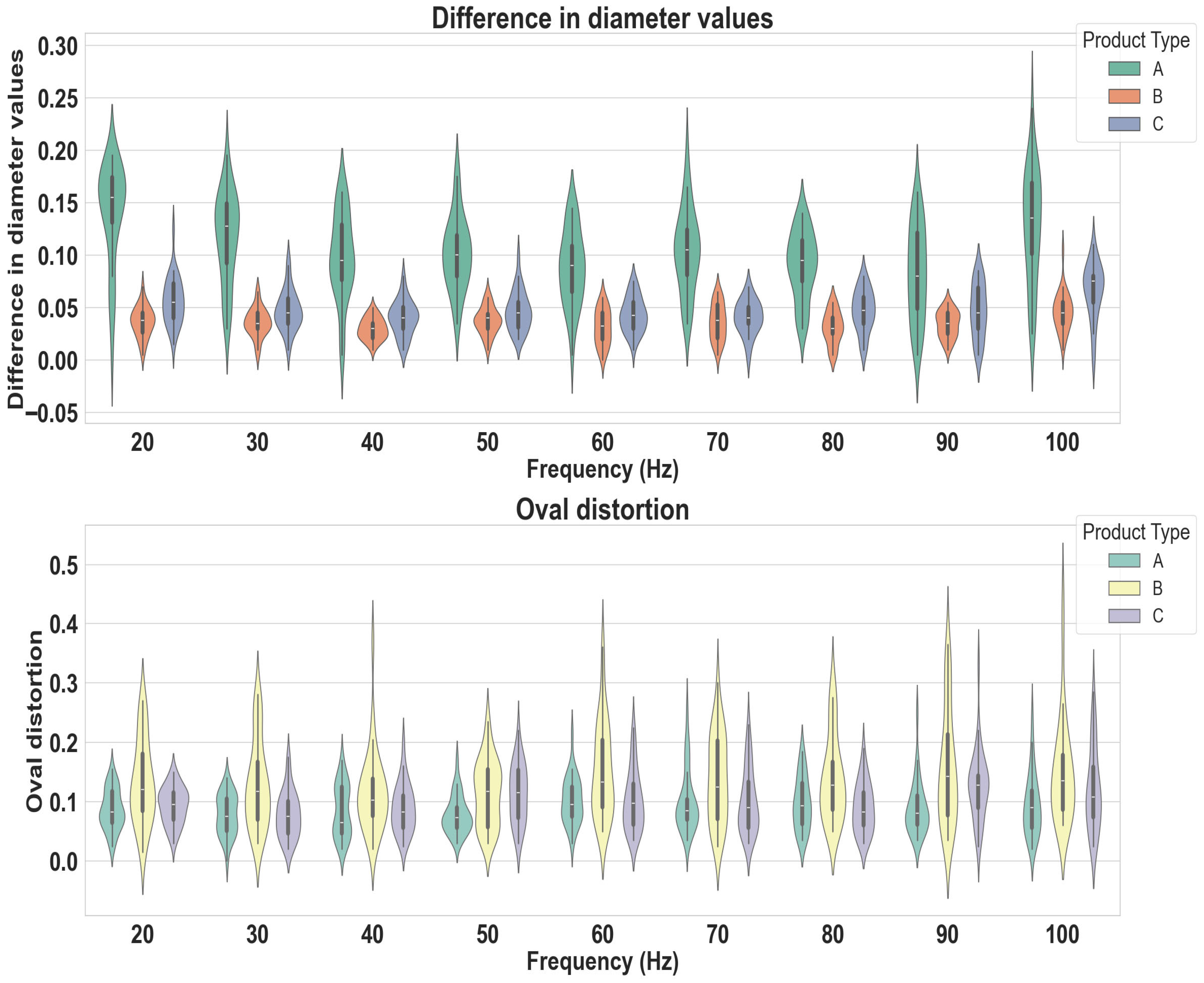
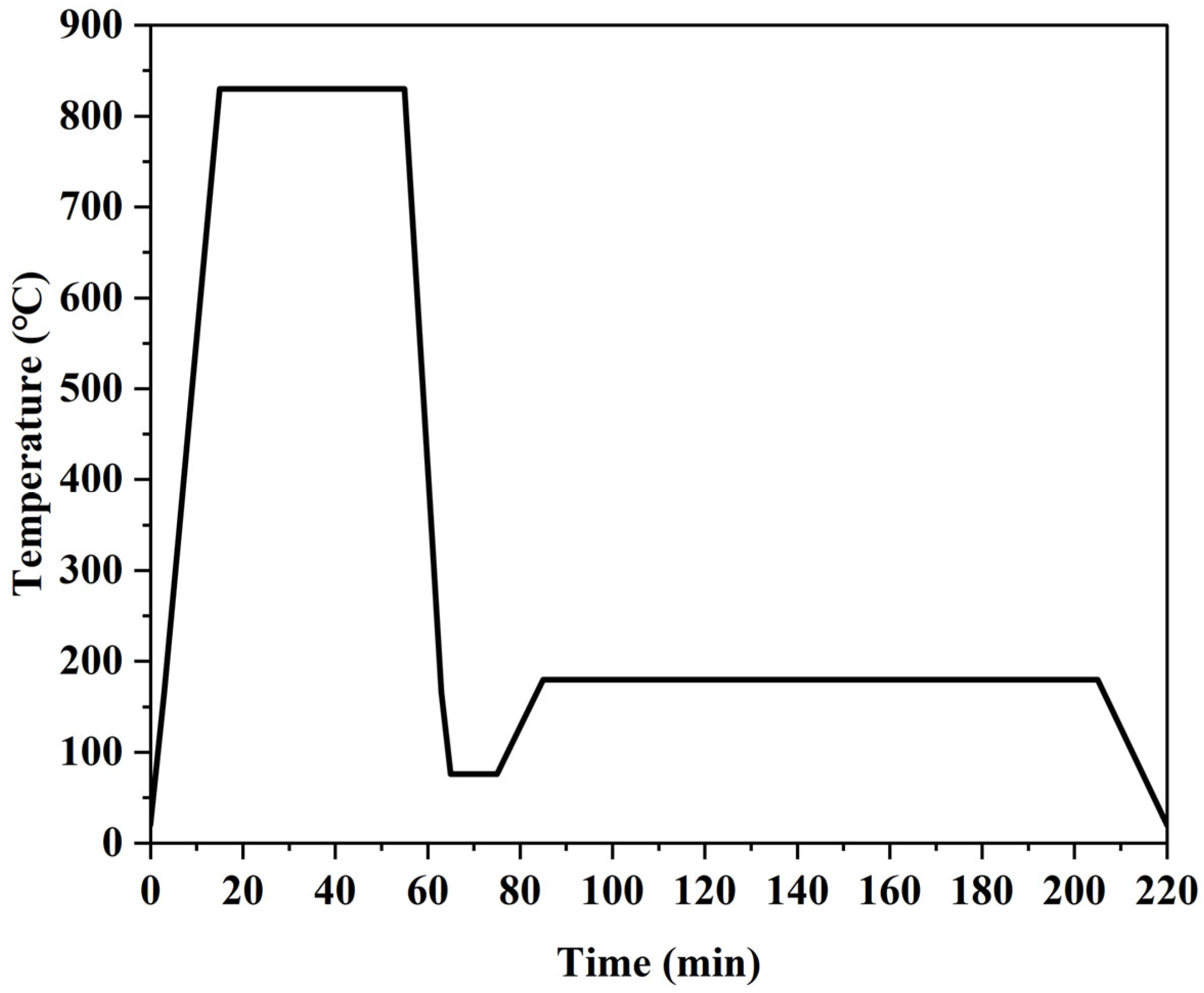
During the experiments, bearing components underwent identical heating and quenching processes. The diameter difference between the upper and lower surfaces and the elliptical distortion were measured and recorded to assess the influence of varying reverse motor frequencies on distortion characteristics. Since distortion of individual components in production environments may be affected by random factors, mean values for each experimental group were calculated to improve the stability of the experimental data (as shown in
Table 3), thereby characterizing the overall distortion trend under each condition.
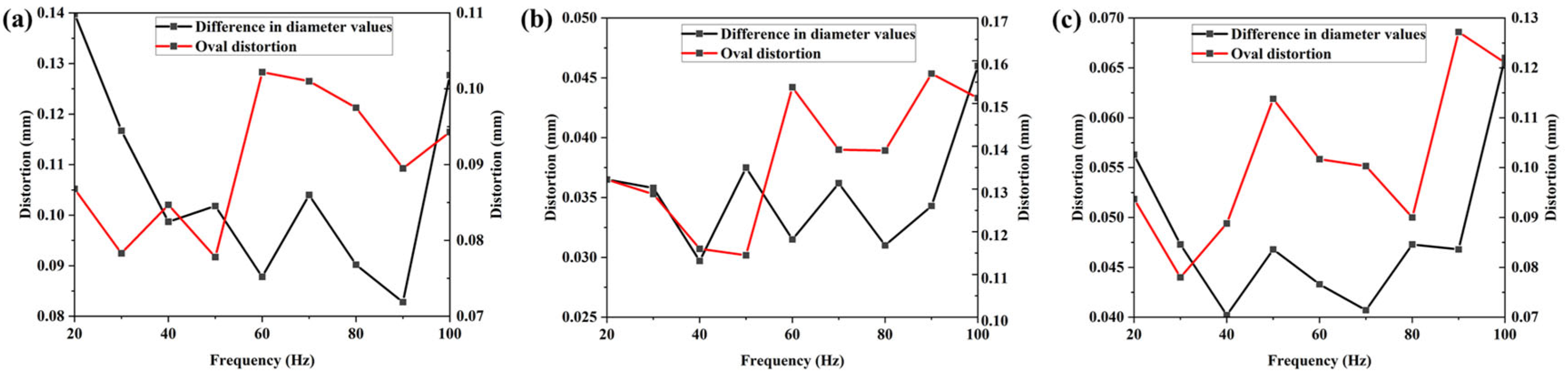
The experimental data indicate that the reverse motor frequency affects both the diameter difference between the upper and lower surfaces and the elliptical distortion of the bearings. Under different frequency conditions, the distortion characteristics of the three bearing types exhibited certain fluctuations. In certain frequency ranges, the magnitude of distortion was relatively low, suggesting that an appropriate reverse motor frequency helps to reduce overall distortion. Compared to low or high frequencies, a moderate frequency range (40–60 Hz) showed a trend of reduced distortion for some products, as shown in
Figure 3, indicating that proper control of the reversing process can optimize cooling uniformity during quenching, thereby reducing distortion. However, the optimal reverse motor frequency varied among the bearing products, showing certain differences: Type A exhibited smaller distortion under specific frequencies but greater fluctuation at higher frequencies. Type B elliptical distortion was more sensitive to frequency changes, resulting in larger distortion at some frequencies. Type C demonstrated generally low distortion overall but still displayed a degree of frequency dependence, as shown in
Figure 4In summary, the findings highlight that selecting an appropriate reverse motor frequency is critical for controlling heat treatment distortion. Proper reverse motor parameters can improve cooling uniformity during quenching, thereby reducing distortion and enhancing product quality. Further data analysis could enable predictive modeling to recommend optimal reverse motor frequencies for different bearing geometries, providing valuable support for process optimization in heat treatment.
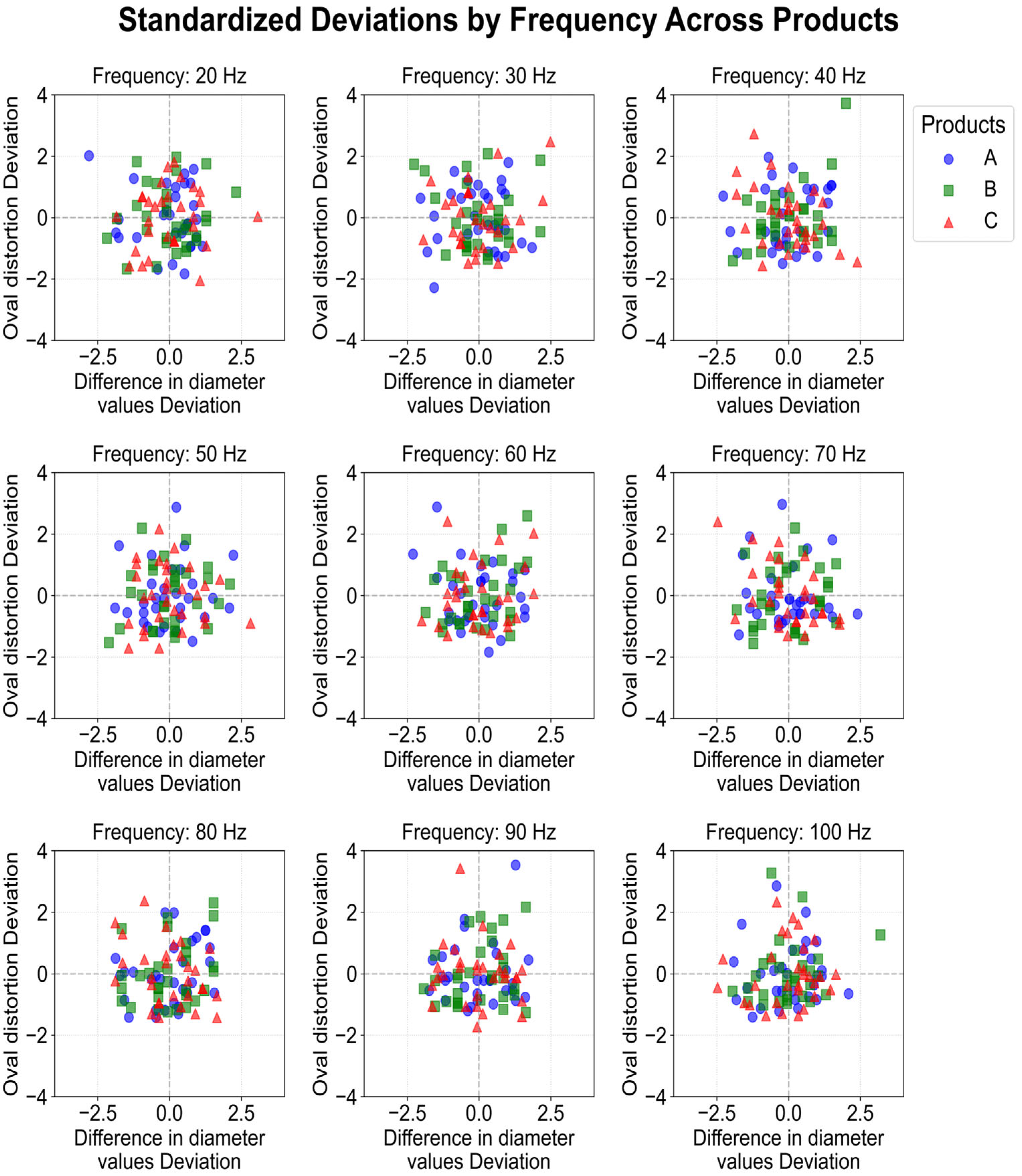
To explore the relationship between the mean diameter difference in the upper and lower surfaces and oval distortion after bearing heat treatment, a standardized deviation analysis method was employed, and a visualization analysis was performed on the distortion characteristics under different reverse motor frequencies. Specifically, measurements of mean diameter difference and oval distortion were obtained for three bearing types (A, B and C) under nine secondary mesh belt reverse motor frequencies, then standardized to eliminate the effect of scale differences across products and frequency conditions. Standardized taper deviation was plotted on the x-axis and standardized ovality on the y-axis, and scatter distribution plots were constructed for different reverse motor frequencies to visually illustrate the relationship between them, as shown in
Figure 5.
The analysis showed that, under all frequency conditions, the standardized deviations exhibited the characteristics of random distributions, with no evident linear or nonlinear correlation. While slight variations existed among products at different frequencies, the overall data distribution in two-dimensional space was uniform, lacking clear trends or clustering. Furthermore, under certain frequency conditions, individual data points deviated from the central region, but this deviation did not follow a consistent pattern across all products, further indicating no statistically significant relationship between the mean diameter difference and oval distortion.
Based on the above analysis, it can be inferred that the factors influencing the mean diameter difference and oval distortion may be largely independent, with the reverse motor frequency affecting them through different mechanisms, or their formation being dominated by other process parameters. Consequently, to further optimize distortion control in bearing heat treatment, it is necessary to establish independent models for the mean diameter difference and oval distortion, respectively, incorporating more process parameters for in-depth analysis to identify the key variables governing distortion characteristics.
3.2. AI-Driven Method and Accuracy Analysis
In this study, a database established through experimental results was used to develop a machine learning prediction model for the average diameter difference between the upper and lower surfaces (T) and the oval distortion (R) of bearing components to investigate the influence of reverse motor frequency and geometric parameters on distortion and further optimize process parameters. The dataset included key dimensional parameters of the bearing parts, taking height, outer diameter, inner diameter, wall thickness, and reverse motor frequency as input features, and the average diameter difference (T) and oval distortion (R) as target variables. Due to differences in the dimensional units of the features, all input variables were standardized to avoid the impact of feature scale on model training. To ensure generalization capability and make full use of the limited experimental data, Leave-One-Out (LOO) cross-validation was employed: each time, one sample was left out as the test set while the remaining samples were used for training. This process was repeated until all samples had been used once as the test set, thereby reducing overfitting risk and improving model robustness.
To comprehensively evaluate the predictive capability of different algorithms, five common regression models were selected for training and comparative analysis: linear regression (LR), random forest regression (RF), gradient boosting-based eXtreme Gradient Boosting (XGB) model, decision tree regression (DT), and support vector regression (SVR). The linear regression model was used to establish a baseline to assess the linear relationships between input and target variables. Decision tree regression can capture nonlinear characteristics in the data but is prone to overfitting. Random forest regression integrates multiple decision trees to reduce the variance of single-tree models and improve generalization. SVR uses kernel methods to find the optimal hyperplane in high-dimensional space, enabling more accurate nonlinear regression fitting. XGB, as an efficient regression method based on gradient boosted decision trees, offers strong generalization and computational efficiency in multiple predictive tasks. In addition, a Multi-Layer Perceptron (MLP) model was employed, which utilizes a multi-layer neural network architecture to capture complex nonlinear relationships and has been widely applied in recent years to process outcome prediction and materials property prediction.
3.2.1. Few-Shot LLM Prediction Method
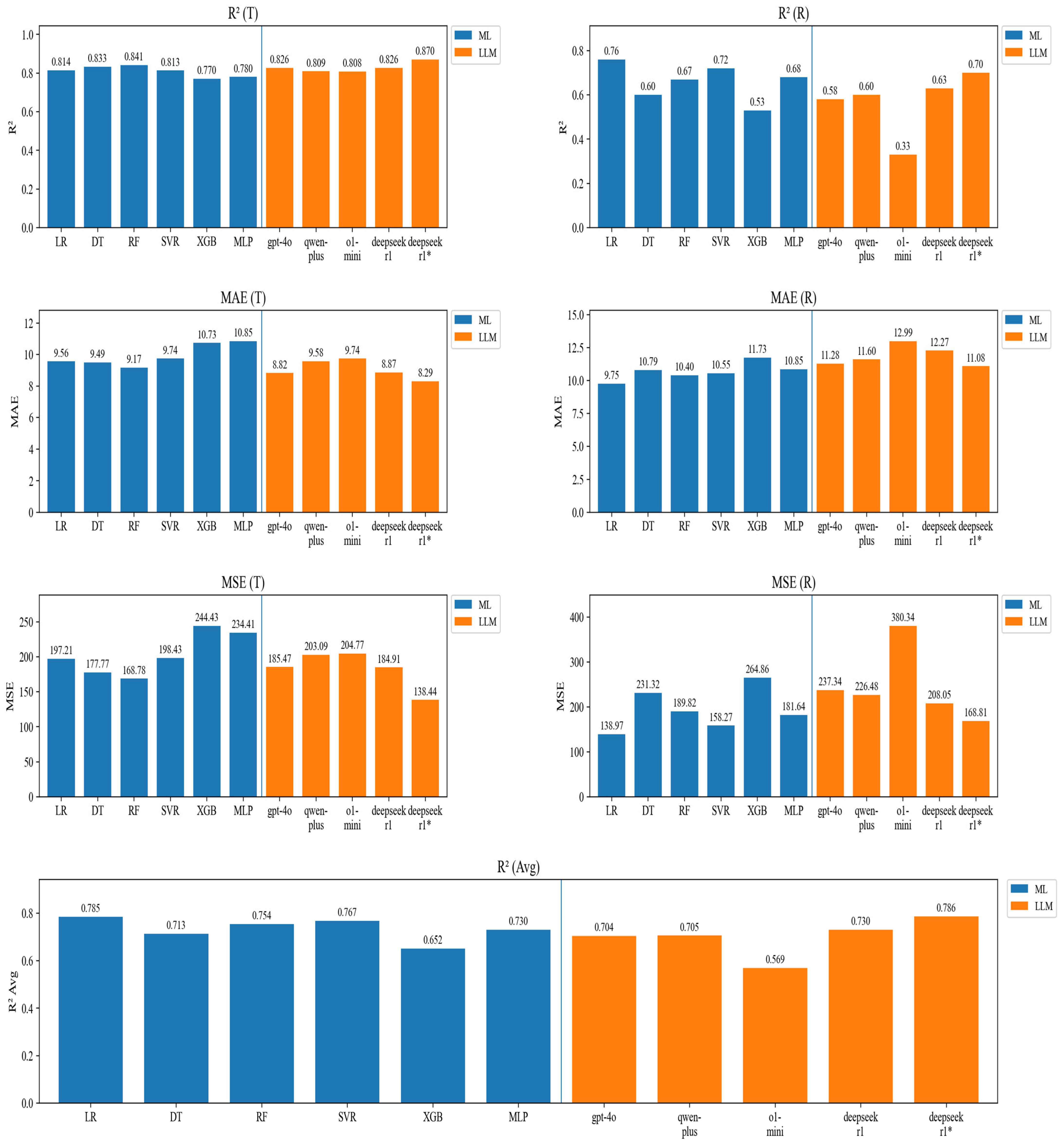
To further explore the applicability of methods based on data-driven approaches to predicting bearing part distortion, a large language model (LLM) was utilized for the few-shot prediction. A domain-specific prompt was designed for the mesh-belt furnace quenching process to emulate expert reasoning in the field of materials science and engineering. This method combined data retrieval and knowledge reasoning to achieve the prediction of the average diameter difference (T) and oval distortion (R) under specific process conditions. Model performance was evaluated using the coefficient of determination (R
2), mean squared error (MSE), and mean absolute error (MAE); the results are shown in
Figure 6.
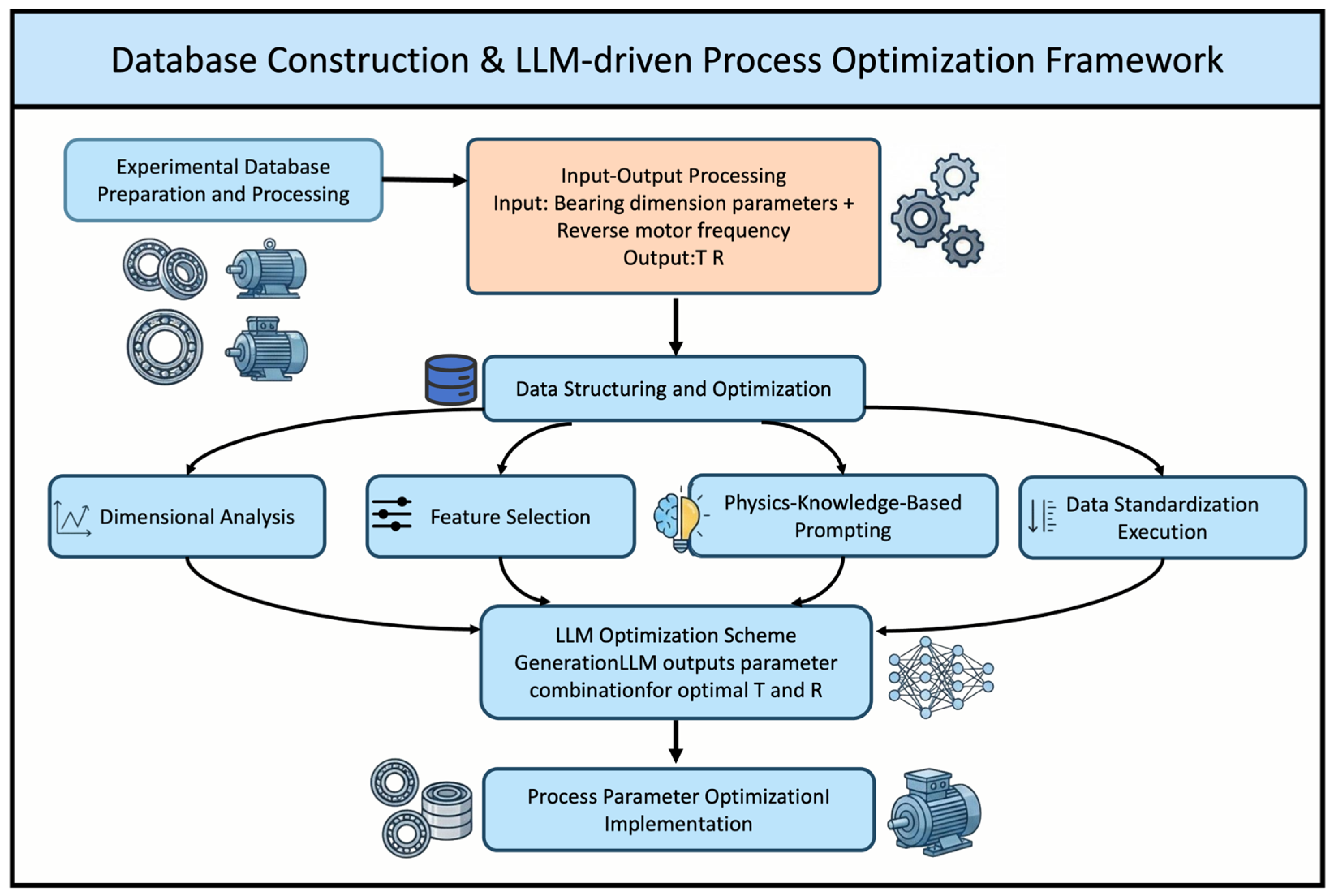
The results indicate that in process optimization tasks, LLMs combined with domain knowledge in heat treatment can significantly enhance predictive capability. Future work will further explore how to efficiently integrate physical knowledge and experimental data to improve reliability and generalization. The LLM recommendation process is illustrated in
Figure 7.
3.2.2. Prediction Results for Three Types of Thin-Walled Bearing Rings
In the preceding study, both machine learning and LLM few-shot methods were applied to distortion prediction tasks in bearing quenching processes. The experimental results show that LLM significantly outperforms traditional machine learning methods in prediction accuracy. Based on this, to further explore the application potential of LLMs in intelligent process optimization, the few-shot method was used to test the LLM on process recommendation tasks, followed by experimental verification of the recommended process schemes to assess their feasibility.
To improve the LLM understanding and reasoning capability for process optimization, a specialized few-shot prompt was constructed for the design of the reversing mesh belt in bearing quenching. This prompt combined data-driven analysis with knowledge reasoning, ensuring that the model could make reasonable process recommendations under limited data conditions. The core design of the prompt revolved around enhancing the model reasoning capacity: first, by assigning the model the role of a domain expert in materials science and engineering, guiding it to integrate data with physical knowledge; second, by emphasizing the influence of the “multi-stage flipping quenching” process on distortion, prompting it to fully consider the mechanism of this process when recommending the optimal reverse motor frequency. In terms of optimization objectives and constraints, the prompt explicitly required that the LLM recommend a reverse motor frequency that minimizes both taper and roundness distortion while maintaining a product qualification rate of no less than 96%. Furthermore, considering that experimental data only covered nine discrete frequency points from 20 Hz to 100 Hz, and that it is impractical to test all possible frequencies in actual production, the prompt instructed the LLM to first identify potential optimal intervals and then perform interpolation within these intervals, requiring it to derive more reasonable process parameters from the limited dataset. During data matching and trend analysis, the LLM was required to match bearings with similar shapes, analyze distortion trends under different reverse motor frequencies, deduce possible optimal frequencies, and make reasonable predictions beyond the existing experimental data points to improve accuracy and feasibility. Accordingly, a specialized few-shot prompt was developed for process optimization tasks, using the DeepSeek-R1 model for process recommendation testing and experimental validation.
From the experimental results in
Table 4, the LLM recommended process achieved certain optimizations in some cases but did not universally outperform experimental data across all bearing models. This indicates that although the LLM can recommend process parameters outside the experimental range, its interpolation and extrapolation capabilities may still have limitations, preventing precise matching to optimal processes in all cases. Overall, the LLM can optimize individual indicators in certain cases, but its recommended frequencies did not universally outperform experimental results for all bearing models. Distortion results from the coupled effects of thermal stress, phase transformation stress, and residual stress—a highly nonlinear physical process. Even for bearings from the same furnace batch, the distortion can vary under identical processing conditions due to subtle differences in material microstructure, which contributes to significant experimental scatter, suggesting further improvements are needed in process parameter optimization.



 ,
,