Article

A Generalized Methodology for the Development of Reactive Double Dividing-Wall Distillation Columns

College of Information Science and Technology, Beijing University of Chemical Technology, Beijing 100029, China
*
Author to whom correspondence should be addressed.
Processes 2026, 14(4), 673; https://doi.org/10.3390/pr14040673
Submission received: 16 January 2026 / Revised: 10 February 2026 / Accepted: 13 February 2026 / Published: 15 February 2026
(This article belongs to the Section Chemical Processes and Systems)

Abstract

The reactive double dividing-wall distillation column (R-DDWDC) can simultaneously integrate and effectively coordinate reaction–separation coupling (RSC) and separation–separation coupling (SSC), thereby offering greater technical advantages and development potential than the conventional reactive distillation column and the reactive single dividing-wall distillation column. However, the application of two dividing walls and the introduction of external recycle flows inevitably lead to multiple candidate configurations of the R-DDWDC, and this significantly adds complexity and computational burden to its synthesis and design. To address the issue, we propose an effective methodology for developing the R-DDWDC, which involves a two-step strategy: the first step is to determine the configuration of external recycle flows by searching for the RSC from non-sharp separation to sharp separation of reaction mixtures, and the second step is to adjust the arrangement of the dividing walls to intensify the SSC. The former serves to provide the greatest flexibility for the inclusion of the SSC, and the latter helps to achieve full coordination with the RSC, thereby allowing the determination of the optimal design with low complexity and computational intensity. The methodology is fundamentally a conceptual design and structural optimization framework that can be implemented using either generic process simulation platforms or custom computational programs. Four representative examples, including the metathesis of 2-pentene; the acetalization of ethanol with butanal; the transesterification of propylene glycol monomethyl ether with methyl acetate; and the esterification of lactic acid with methanol, are selected to assess the derived procedure, and the obtained results confirm its simplicity and efficiency. Because the procedure proposed in this work is independent of the number of components contained in reaction mixtures and their relative volatility rankings, it can be regarded as a general methodology for developing other complicated reactive dividing-wall distillation columns.

1. Introduction

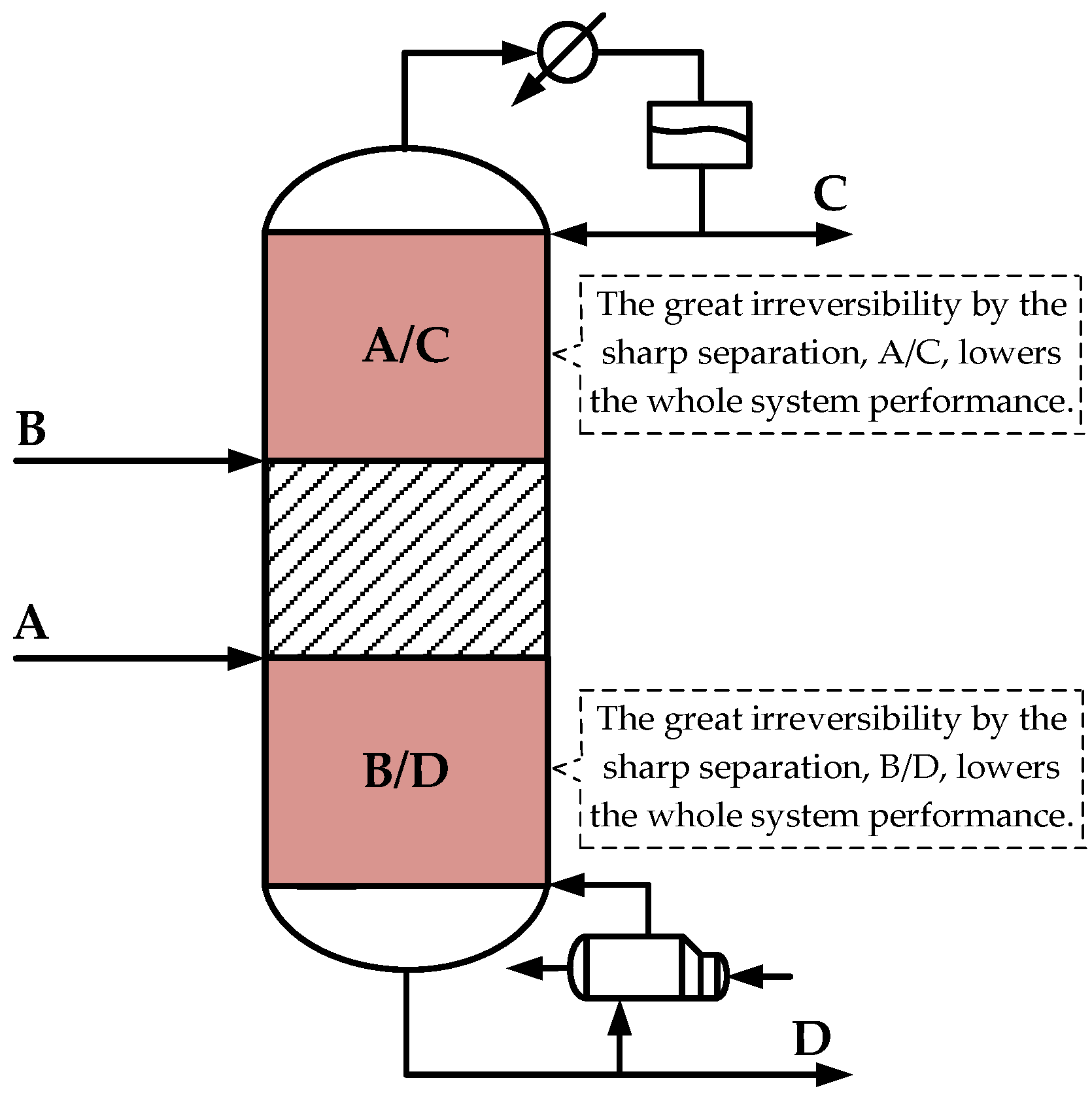
According to the ranking of relative volatilities, reaction systems can be classified into four categories: (i) most favorable ranking of relative volatilities (MFRRV), where the light and heavy reactants generate the lightest and heaviest products; (ii) somewhat favorable ranking of relative volatilities (SFRRV), where the lightest and light reactants yield the heavy and heaviest products, or the heavy and heaviest reactants yield the lightest and light products; (iii) somewhat unfavorable ranking of relative volatilities (SURRV), where the light and heaviest reactants produce the lightest and heavy products, or the lightest and heavy reactants produce the light and heaviest products; and (iv) most unfavorable ranking of relative volatilities (MURRV), where the lightest and heaviest reactants form the light and heavy products [1]. Tung et al. [2] systematically investigated the effect of the relative volatilities on the design of the conventional reactive distillation column (CRDC) and pointed out that the ranking differences in relative volatilities gave rise to significantly different steady-state performances. For the reaction mixture with the MURRV, the utility consumption was the highest among all types of reactive distillation columns. In contrast, for the reaction mixture with the MFRRV, the utility consumption was the lowest. It is noteworthy that even for the separation of reaction mixtures with the MFRRV, the CRDC still has its drawbacks. Figure 1 depicts the CRDC separating a hypothetical quaternary reaction system featuring the MFRRV. Since products C and D were the lightest and heaviest components, respectively, it was appropriate to place the reactive zone in the middle of the column [3]. The reaction–separation coupling (RSC) clearly helped to overcome the equilibrium limitation, thereby reducing both capital investment and utility consumption [4]. The rectifying and stripping zones performed the sharp separations of A/C and B/D, respectively. When the reaction system exhibited unfavorable reaction kinetics and/or thermodynamic characteristics, the separations between products and reactants inevitably resulted in significant operation irreversibility, which represented the main cause of the low thermodynamic efficiency of the CRDC [5]. For addressing this drawback, the separation–separation coupling (SSC) between the rectifying and stripping zones must be fully considered in process synthesis and design. However, the CRDC is fundamentally incapable of fulfilling this requirement due to its intrinsic structural defects.
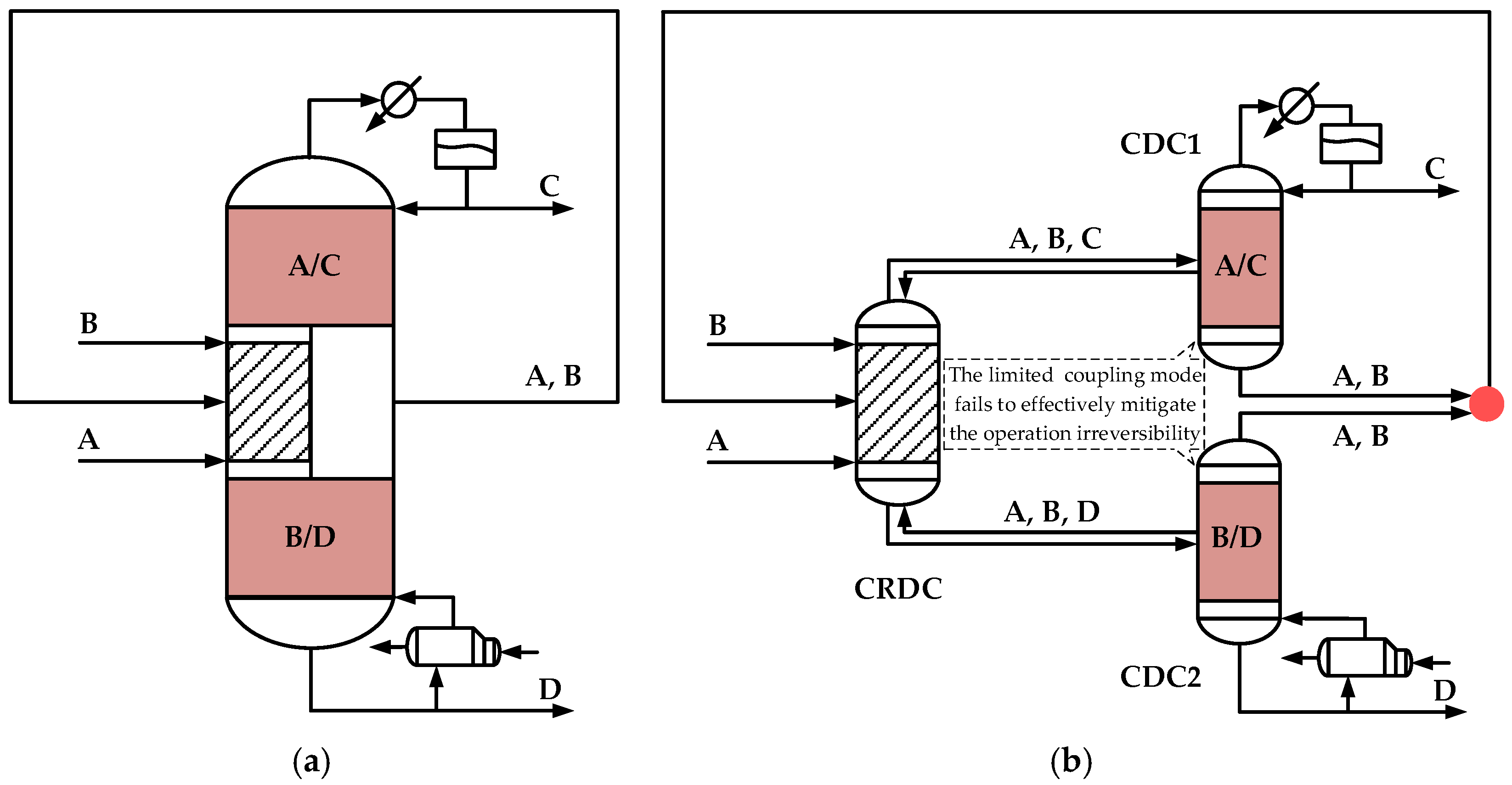
Figure 2a illustrates the reactive single dividing-wall distillation column (R-SDWDC). As can be seen, the left section of the dividing wall corresponds to a CRDC, primarily serving to couple the reaction and separation operations, while the right section corresponds to a conventional distillation column (CDC) with a side withdrawal, mainly working to couple the separation operations in the rectifying and stripping zones. The side withdrawal recycles the unconverted reactants to the reactive zone on the left side of the dividing wall and is responsible for coordinating the interaction between the RSC and the SSC. The incorporation of the SSC and recycle flow can contribute to the enhancement of the internal coupling, thereby improving the thermodynamic efficiency of the R-SDWDC [6]. Egger and Fieg [7,8] developed an enzymatic R-SDWDC for the transesterification of hexanol and n-butyl acetate, demonstrating the feasibility of steady-state operation. Based on a rigorous mathematical model, they conducted a detailed investigation into the dynamic characteristics and start-up strategies of the system. Figure 2b presents the thermodynamically equivalent of an R-SDWDC. It can be found that the R-SDWDC involves the SSC between the rectifying and stripping zones in the CRDC as shown in Figure 1, but this coupling remains strictly constrained by the side withdrawal flow rate, thereby limiting its energy-saving potential. Consequently, although the R-SDWDC can outperform the CRDC, its intrinsic structural drawbacks may limit the exploitation of the full potential of the SSC.
The above analysis indicates that the development of reactive dividing-wall distillation columns (R-DWDCs) must account not only for the RSC but also for the SSC. To maximize the potential of process intensification, it is necessary to fully intensify and coordinate these two coupling subsystems. Therefore, our research group has recently proposed the co-process intensification (Co-PI) philosophy for the development of R-DWDCs [9]. In this framework, the RSC can be realized through a CRDC, while the SSC can be implemented via either a dividing-wall distillation column (DWDC) or a Kaibel dividing-wall distillation column (KDWDC). The further coupling between them serves to coordinate these two types of subsystems, resulting in the reactive double dividing-wall distillation column (R-DDWDC). For a hypothetical quaternary reaction system featuring the most unfavorable ranking of relative volatilities, Zang et al. [10] reported that the R-DDWDC offered considerable advantages in steady-state performance over the reactive distillation column system (CRDS), comprising a CRDC followed by one or two CDCs, as well as the R-SDWDC. Fan et al. [11] derived a systematic procedure for developing the R-DDWDC in terms of the esterification of palmitic acid and isopropanol, and the obtained results indicated that this approach was both computationally simple and highly efficient in search, outperforming exhaustive strategies and nonlinear programming methods [12,13]. However, this procedure was developed for the reaction system with the most unfavorable ranking of relative volatilities, and its application to other types of reaction mixtures remains to be explored. To address this, we aimed to establish a generalized approach for developing the R-DDWDC that can be applicable not only to the most favorable systems but also to a broader range of reaction mixtures.
In the current research, the synthesis and design of the R-DDWDC have been intensively studied. For reaction mixtures with different relative volatility rankings, the R-DDWDC configuration can be systematically derived based on the philosophy of Co-PI. For reducing the complexity and computational requirement caused by incorporating two dividing walls and external recycle flows, a generalized methodology has been proposed for the development of the R-DDWDC. Four reaction systems corresponding to the four fundamental types of reaction systems classified by relative volatility, including the metathesis of 2-pentene (2-PEN); the acetalization of ethanol (EtOH) with butanal (BuCHO); the transesterification of propylene glycol monomethyl ether (PM) with methyl acetate (MeOAc); and the esterification of lactic acid (LA) with methanol (MeOH), as previously reported in the literature, are thoroughly studied here to assess the proposed methodology. Some key findings are presented in the concluding section.

2. Generalized Methodology for the Development of the R-DDWDC

2.1. Derivation of the R-DDWDC

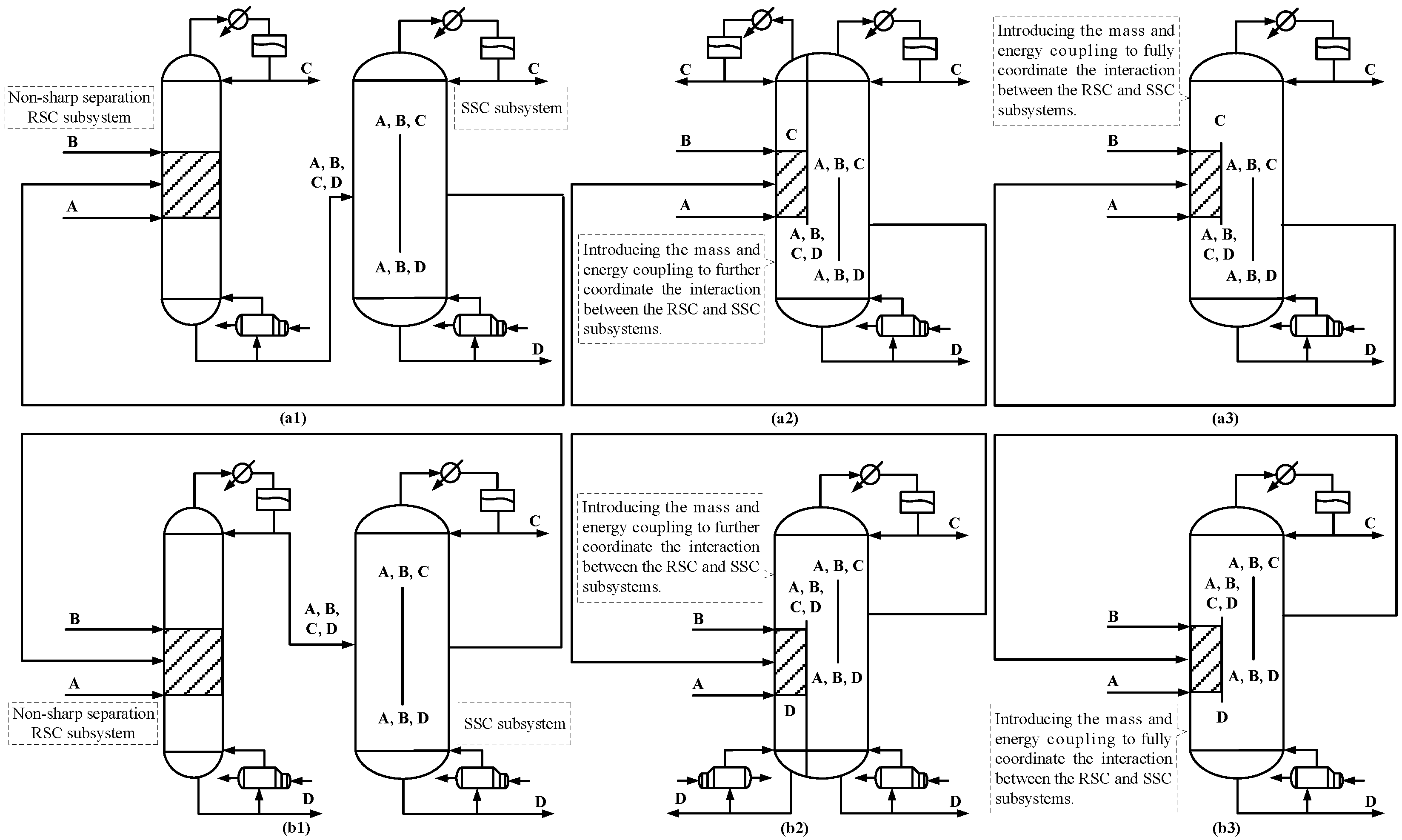
For clarity without sacrificing generality, a hypothetical quaternary reaction, A + B ↔ C + D, is adopted to exemplify the derivation. When the reaction system exhibits the MFRRV (i.e., αC > αA > αB > αD), Figure 3 provides a detailed derivation of the R-DDWDC. To maximize the potential inherent in the SSC, it is essential to avoid the sharp separation mode in the CRDC, as illustrated in Figure 1. The MFRRV allows only two advantageous non-sharp separation modes. One is to withdraw component C from the top while all four components are discharged at the bottom, and the other is to withdraw all four components from the top while component D is discharged at the bottom. The corresponding configurations, involving both the RSC and SSC, are presented in Figure 3(a1,b1). As compared with the CRDC shown in Figure 1, this configuration provides the RSC with relatively mild operating conditions and helps to fully tap the potential of the SSC to reduce the irreversibility of separation operations. Although the latter involves the separation of a quaternary mixture, a single DWDC is sufficient to recycle the unconverted reactants due to the adjacent relative volatilities of reactants B and A. This not only simplifies the process design but also enhances steady-state performance. Ultimately, products C and D are respectively extracted from the top and bottom of the DWDC, while the recycle flow of unconverted reactants serves to coordinate the interaction between the RSC and the SSC. For the configurations depicted in Figure 3(a1,b1), the coupling between the CRDC and DWDC leads to partially coupled configurations, as shown in Figure 3(a2,b2). It is evident that the primary difference between the two lies in the specific locations of the dividing walls: the left one is positioned at the top/bottom and the right one is located in the middle. This coupling works to reduce the remixing in the CRDC and coordinate the interaction between the RSC and the SSC. Further coupling can be introduced into the R-DDWDCs shown in Figure 3(a2,b2), yielding the fully coupled configurations illustrated in Figure 3(a3,b3) and denoted as R-DDWDC1 and R-DDWDC2. This coupling is readily achieved by adjusting the left dividing wall from the top/bottom to the middle, reducing remixing within the CRDC and thoroughly coordinating the interaction between the RSC and the SSC. The configurations depicted in Figure 3(a3,b3) thus represent the final R-DDWDC configurations obtained in this work based on the Co-PI philosophy. The selection of the optimal configuration (Figure 3(a3) or Figure 3(b3)) is highly dependent on the physicochemical characteristics of the reaction mixture involved.
The above derivation relies entirely on thermodynamic equivalence of topological structures rather than on detailed thermodynamic, phase equilibrium, or reaction models, and is therefore generally applicable to any reaction system that intrinsically exhibits MFRRV and is suitable for reactive distillation. Similarly, the derivations of the R-DDWDCs for the reaction systems featuring the SFRRV, SURRV, and MURRV are provided in Figures S1–S3 of the Supplementary Information.

2.2. Two-Step Strategy for the Synthesis and Design of the R-DDWDC

According to the above derivation, the application of the two dividing walls and the introduction of external recycle flows inevitably generate numerous configurations of the R-DDWDC, substantially adding computational complexity and intensity to its synthesis and design. The configuration of external recycle flows is directly determined by the segmentation of the reaction mixture within the RSC, which allows for only two potential schemes: non-sharp separation of the reaction mixture or sharp separation of one component. Since the former can provide greater flexibility for the inclusion of the SSC than the latter, the search for the RSC should be from non-sharp separation to sharp separation of the reaction mixture. On the other hand, the arrangement of the two dividing walls decides the SSC intensity, and the intensification of the SSC helps to strengthen the internal mass and energy coupling, thereby achieving full coordination with the RSC. By integrating these two aspects, a two-step strategy is proposed in this work. In the first step, the configuration of the external recycle flows is determined by identifying the segment mode of the reaction mixture in the RSC. In the second step, the arrangement of the two dividing walls is optimized to intensify the SSC. This approach can effectively intensify and coordinate the RSC and the SSC, thereby greatly facilitating process synthesis and design.
Here, the two types of arrangement of the dividing walls must be clarified. When the right dividing wall is arranged to withdraw two components from its right (i.e., the RSC performs non-sharp separation of the reaction mixture), the adjustment of the left dividing wall from the top/bottom to the middle can effectively suppress the remixing, indicating the intensification of the SSC. In contrast, when the right dividing wall is arranged to withdraw one component from its right (i.e., the RSC performs sharp separation of the reaction mixture), such adjustment causes significant changes in the composition distribution, and the resulting impact on the SSC is largely dependent on the specific physicochemical properties. Accordingly, a quantitative metric should be introduced for the comparative assessment of the SSC intensity in this scenario.
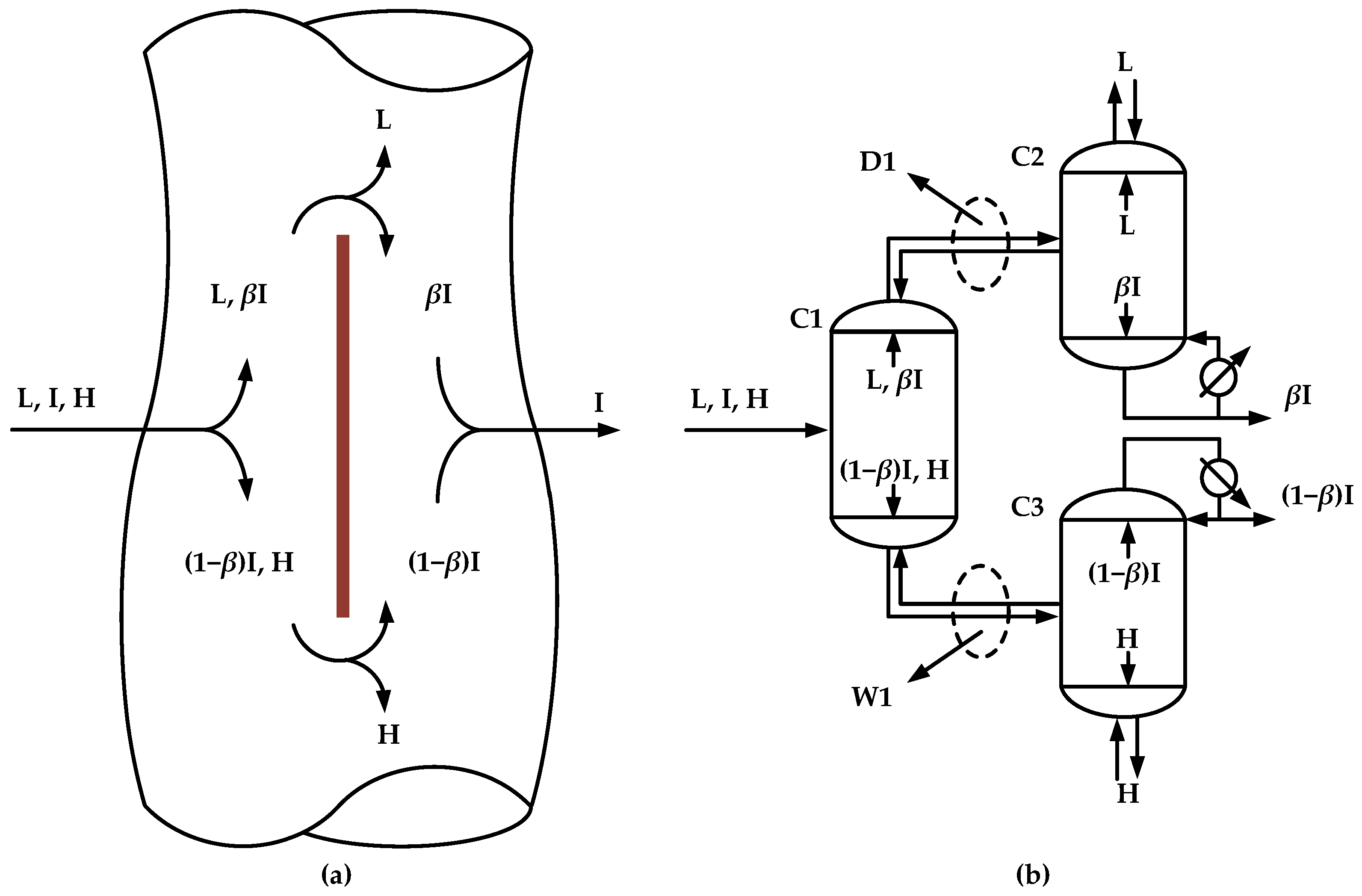
Figure 4 depicts the composition distribution of the light (L), intermediate (I), and heavy (H) components in the surrounding region of the dividing wall and the corresponding equivalent conditions, as reported by Carlberg and Westerberg [14]. The pre-fractionator (C1) performs the separation of LI/IH, while the main distillation column performs the separation of L/I in the upper section (C2) and I/H in the lower section (C3). The vapor flow from C1 to C2 contains mostly components L and I where it then separates into relatively pure components L and I in the latter. Similarly, the liquid flow from C1 to C3 contains mostly components I and H where it again separates into relatively pure components I and H in the latter. It should be emphasized that this configuration can be regarded as thermodynamically equivalent to a dividing-wall distillation column (DWDC) only when the additional reboiler and condenser heat duties required by C2 and C3 are strictly identical. On the basis that both relative volatility and molar overflow remain constant, the minimum vapor flow rate (Vmin) of C1 can be calculated using the Underwood equation as follows:
  R min   +   1   = i α i   x Di   α i     θ 1  
  V min = i α i   x Di D   α i θ 1  
where Rmin is the minimum reflux ratio; θ1 is defined as the solution to the Underwood equation for C1; xi is the liquid-phase mole fraction of component i; and D is the net flow rate of C1 overhead product.
The feed thermal conditions of C1, C2, and C3 can also be calculated using the Underwood equation as follows:
  i α i   x Fi   α i     θ 1   =   1     q 1
q 2 θ 1 , β = 1   α L   F   x F , L   α I θ 1 + α I   F   x F , I   β   α L θ 1 α L θ 1   α I θ 1   F   x F , L + F   x F , I   β
q 3 θ 1 , β = 1   + α L   F   x F , L   α I θ 1 + α I   F   x F , I   β   α L θ 1 α L θ 1   α I θ 1   1   β   F   x F , I + F   x F , H
where q1, q2, and q3 represent the feed thermal conditions of C1, C2, and C3, respectively; β (0 < β < 1) corresponds to the recovery ratio of I from the top of C1; and F denotes feed flow rate.
According to Equation (2), θ1 has two roots, θ11 and θ12, which satisfy the inequality αL > θ11 > αI > θ12 > αH. The corresponding Vmin (θ11) and Vmin (θ12) vary in opposite directions with β, and their sole intersection represents the minimum value [15]. Under this condition, the corresponding β value for I is identified as the optimum. The heat duties of the C2 reboiler (QREB,2) and the C3 condenser (QCON,3) can then be calculated using the Underwood equation as follows:
  i α i   x Fi   α i     θ 2   =   1     q 2
Q REB , 2 θ 1 ,   θ 2 ,   β = β   F   x F , I   α I   H I θ 2 α I
  i α i   x Fi   α i θ 3 = 1 q 3
Q CON , 3 θ 1 ,   θ 3 ,   β = 1 β   F   x F , I   α I   H I α I θ 3
where Hi is the latent heat of vaporization of the component i.
In most practical scenarios, the extra reboilers and condensers of C2 and C3 generally exhibit unequal heat duties, and the imposing equality constraint between them certainly leads to additional utility consumption, thereby reducing the thermodynamic efficiency of the SSC. Accordingly, the deviation between QREB, 2 and QCON, 3Q) can be taken as an indicator for the assessment of the SSC intensity and expressed as follows:
Δ Q = Q CON , 3 θ 1 ,   θ 3 ,   β     Q REB , 2 θ 1 , θ 2 , β   =   1     β α I     θ 3     β θ 2     α I   F   x F , I   α I   H I
With reference to Equation (10), the distribution of I (i.e., the variable β) plays a pivotal role in constructing effective mass and energy coupling between C1 and C2–C3. Through careful arrangement of the internal dividing walls, the optimum distribution of I can be achieved, which minimizes the heat duty deviation near the location of the intermediate withdrawal and indicates the intensification of the SSC.

2.3. An Effective Procedure for the Development of the R-DDWDC

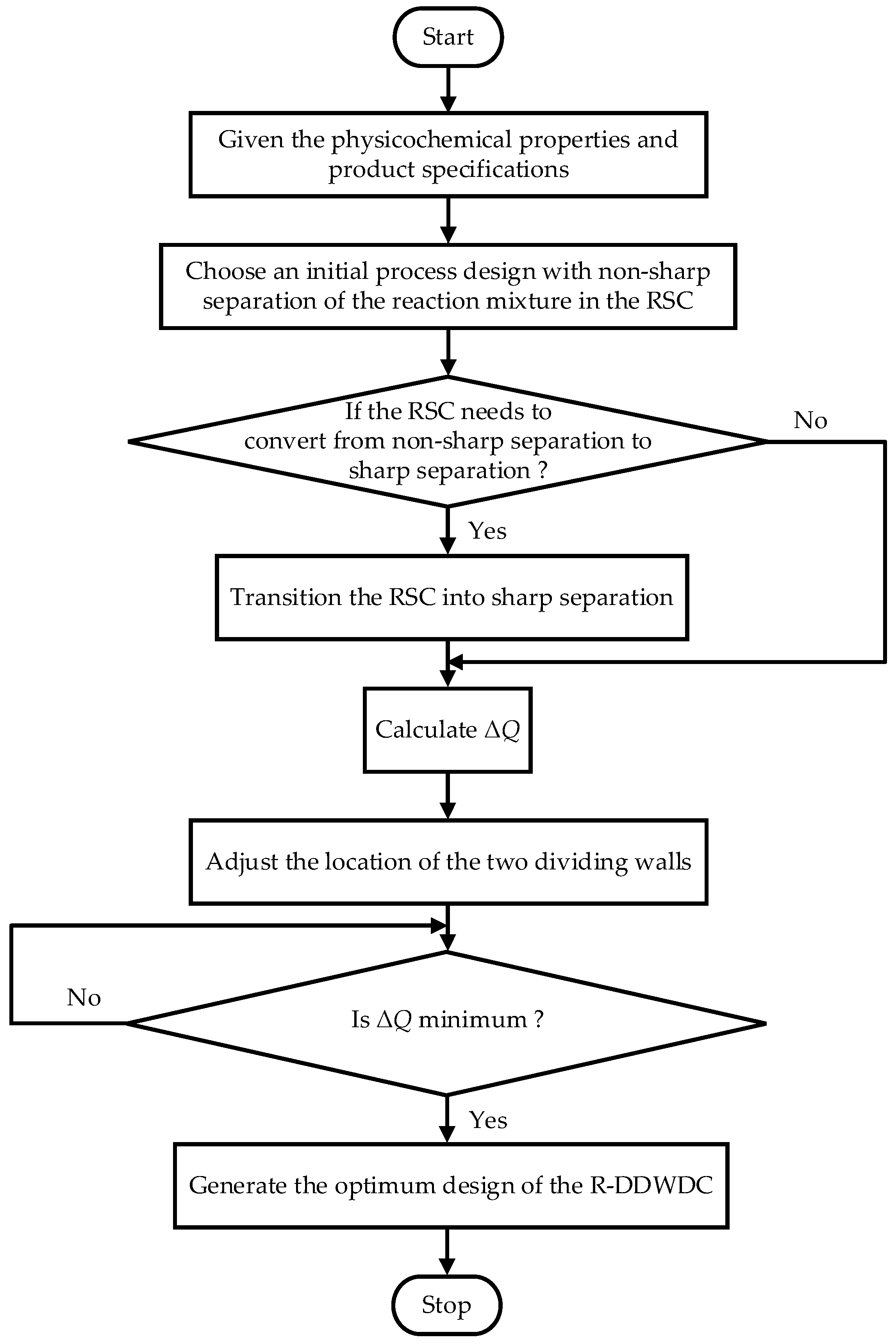
Based on the two-step strategy, a systematic procedure is developed for the design of R-DDWDCs, as illustrated in Figure 5. With the product requirements and operating conditions specified, the process design should be initiated from configuration with non-sharp separation of the reaction mixture in the RSC. In this step, the external stream flow rate that determines the segmentation mode serves as the key variable dictating structural transition. When the flow rate is negligibly small, the corresponding stream is removed, indicating that the RSC should transition from non-sharp to sharp separation of the reaction mixture. Conversely, when the flow rate is significant, the stream is retained, maintaining the non-sharp separation mode. Through this process, the configuration of external recycle flows is determined.
Once the segmentation mode in the RSC is established, the positions of the two dividing walls are sequentially adjusted to enhance the SSC. For each candidate configuration, the ΔQ value is calculated using Equation (10) to quantify the SSC intensity. The dividing walls are then moved iteratively following the direction that maximally reduces ΔQ until the minimum ΔQ is reached, yielding the optimal R-DDWDC design. This sequential adjustment is conceptually similar to a gradient-based search, guiding the structure along the path of greatest potential performance improvement.
Compared with conventional methods, the proposed procedure offers notable advantages, since it neither requires conducting the process design for every candidate configuration, as in exhaustive searches, nor involves constructing intricate superstructures, as in mixed-integer nonlinear programming approaches. Furthermore, the derivation of this procedure is independent of the relative volatility ranking of the reaction components, demonstrating broad applicability in the development of R-DDWDCs.
In what follows, four reaction systems are selected to assess the proposed methodology, including the metathesis of 2-PEN, the acetalization of EtOH with BuCHO, the transesterification of PM with MeOAc, and the esterification of LA with MeOH. Process simulation is carried out with Aspen Plus V11. To facilitate the comparison among the related process designs, we make two assumptions here: one is that the two sides of each dividing wall are assigned the same number of stages; the other is that all designs are required to employ the same number of total stages and arrange the same catalyst distribution within the reactive zone. Under these assumptions, the minimization of total reboiler duty can simply be adopted as the objective for the process design. The structural variables, including the locations of reactive zones dividing walls, reactant feeds, product withdrawals, and the operating variables, such as the boilup ratio (BR), reflux ratio (RR), liquid split ratio (βL), and vapor split ratio (βV), are all subject to optimization via a genetic algorithm developed in the MATLAB 2020b environment.

3. Example I: Metathesis of 2-PEN

3.1. Problem Statement

The metathesis of 2-PEN to produce 2-butene (2-BUT) and 3-hexene (3-HEX) can be expressed as follows:
2   2 - PEN     2 - BUT +   3 - HEX
The reactive kinetics model from Okasinski and Doherty [16] can be applied as follows:
r   =   K f   α 2 - PEN 2     α 2 - BUT   α 3 - HEX   /   K eq
K f =   1.0661   ×   1 0 5   exp     3321.2   /   T
K eq =   0.25
where ai denotes the activity of component i, while T is the temperature in K.
Table 1 presents the primary physicochemical properties, operating parameters, and product requirements for the process design [17]. It is noted that the ranking of relative volatility is 2-BUT > 2-PEN > 3-HEX. Therefore, the reaction system is characterized by the most favorable ranking of relative volatilities, and its vapor–liquid equilibrium relationship is described by an ideal model [18].

3.2. Searches for the Optimal Design of the R-DDWDC

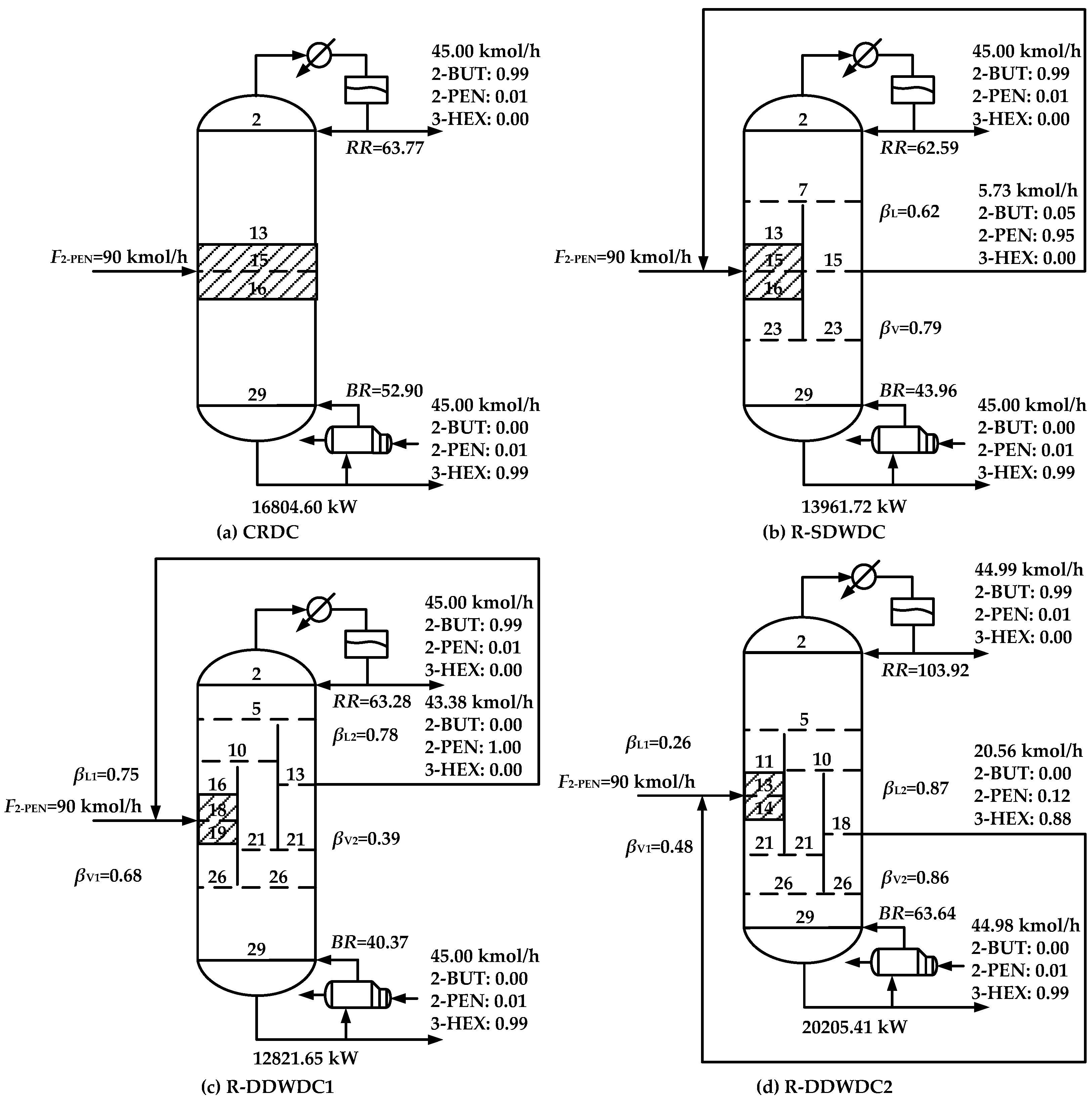
Figure 6 shows the optimal designs of the CRDC, R-SDWDC, R-DDWDC1, and R-DDWDC2. According to the procedure proposed in this work, the initial configuration should be selected first. Since the R-SDWDC, R-DDWDC1, and R-DDWDC2 all perform non-sharp separation in the RSC, each configuration involves only a single external recycle flow. Moreover, the dividing wall in the R-SDWDC essentially performs the same function as the left dividing wall in the two R-DDWDCs, whereas their right dividing walls are merely structural extensions added to the top/bottom region of the dividing wall in the R-SDWDC. Accordingly, the R-SDWDC is selected here as the initial configuration and its design is carried out. The ΔQ value is determined to be 22.12 kW using Equation (11). Building upon the process design of the R-SDWDC, perturbation analysis is applied to evaluate the R-DDWDC1 and R-DDWDC2 configurations. The results indicate that when the right dividing wall is located above the left dividing wall, the ΔQ value is determined to be 20.95 kW, indicating the intensification of the SSC from the R-SDWDC to R-DDWDC1. In contrast, when the right dividing wall is located below the left dividing wall, the ΔQ value is determined to be 23.03 kW, indicating the deterioration of the SSC from the R-SDWDC to R-DDWDC2. Further analysis reveals that the sequence of the SSC enhancement is as follows: R-DDWDC2 → R-DDWDC1. Consequently, R-DDWDC1 emerges as the optimal design for the R-DDWDC.

3.3. Comparative Analysis of the R-DDWDC

The detailed comparison between the CRDC, R-SDWDC, R-DDWDC1, and R-DDWDC2 is presented in Table 2. As compared with the CRDC and the R-SDWDC, the optimal design of the R-DDWDC (R-DDWDC1) reduces the reboiler duty by 100.00% − 76.30% = 23.70% and 83.08% − 76.30% = 6.78%, respectively. This outcome strongly suggests the rationality of the following analysis. Although the CRDC involves the RSC, it entirely overlooks the potential for the SSC. This is why it fails to effectively reduce the irreversibility of the separation operations involved, ultimately resulting in low thermodynamic efficiency. In contrast, building upon the RSC involved in the CRDC, the R-SDWDC introduces the SSC, which is the primary reason for its higher thermodynamic efficiency as compared with the CRDC. However, the limited coupling mode of the R-SDWDC hampers its ability to suppress the operation irreversibility, making it difficult to compete with the R-DDWDC1. Moreover, the R-DDWDC1 not only incorporates the RSC and the SSC but also achieves their full coordination through the careful arrangement of two dividing walls, exhibiting the highest thermodynamic efficiency. The great enhancement in system performance can be primarily ascribed to the feasibility and effectiveness of the Co-PI philosophy. Furthermore, it is important to note that, although similar to the R-DDWDC1, the R-DDWDC2 also integrates and coordinates these two kinds of coupling subsystems, and its thermodynamic performance is significantly compromised because of the incompetence of the SSC. As a result, the reboiler duty of the R-DDWDC2 is 120.24% − 76.30% = 43.94% higher than that of the R-DDWDC1, and its performance is even inferior to that of the CRDC and R-SDWDC, placing it at a clear disadvantage. This result confirms the necessity and importance of the procedure proposed in this work for developing the R-DDWDC.
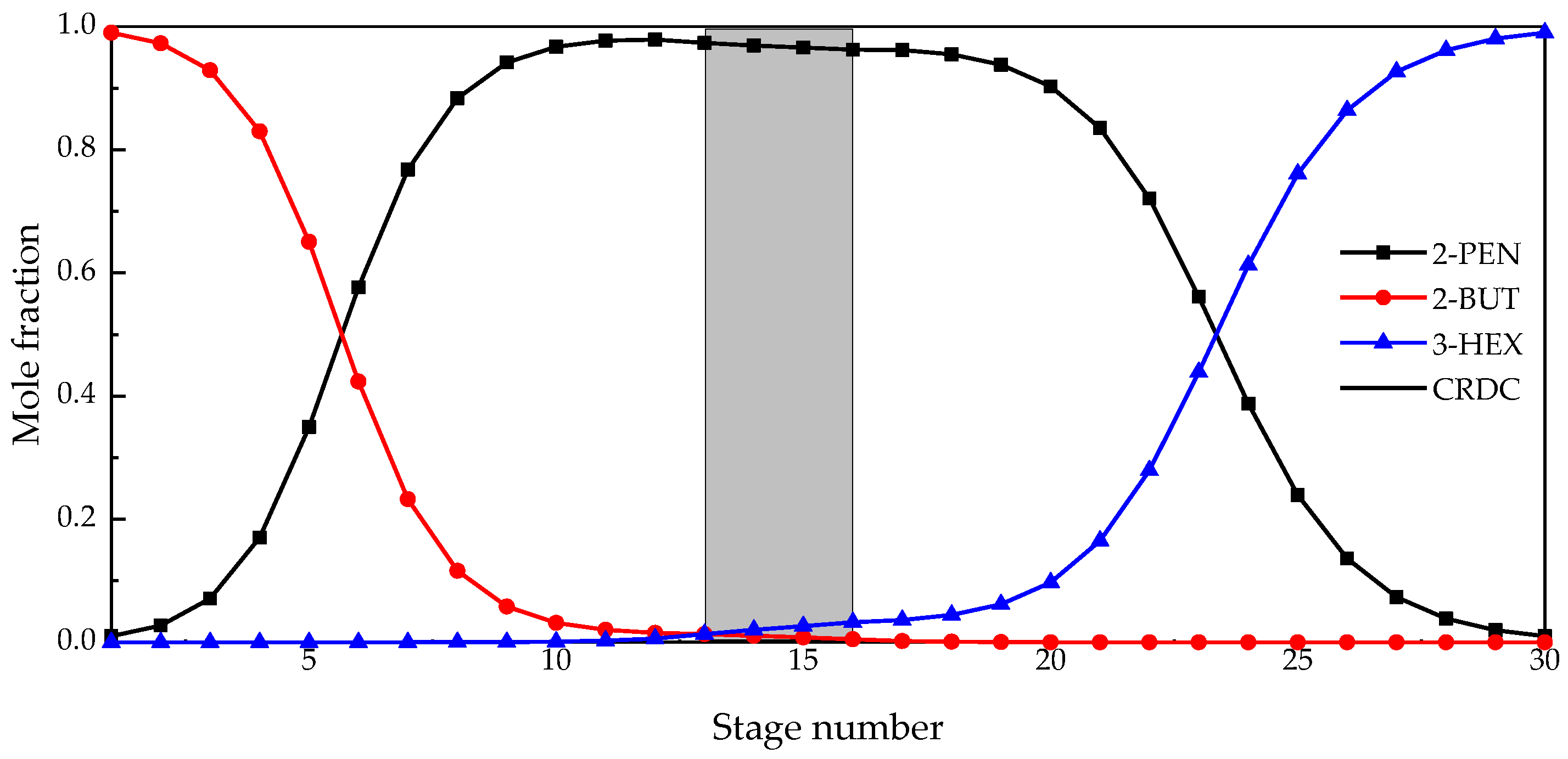
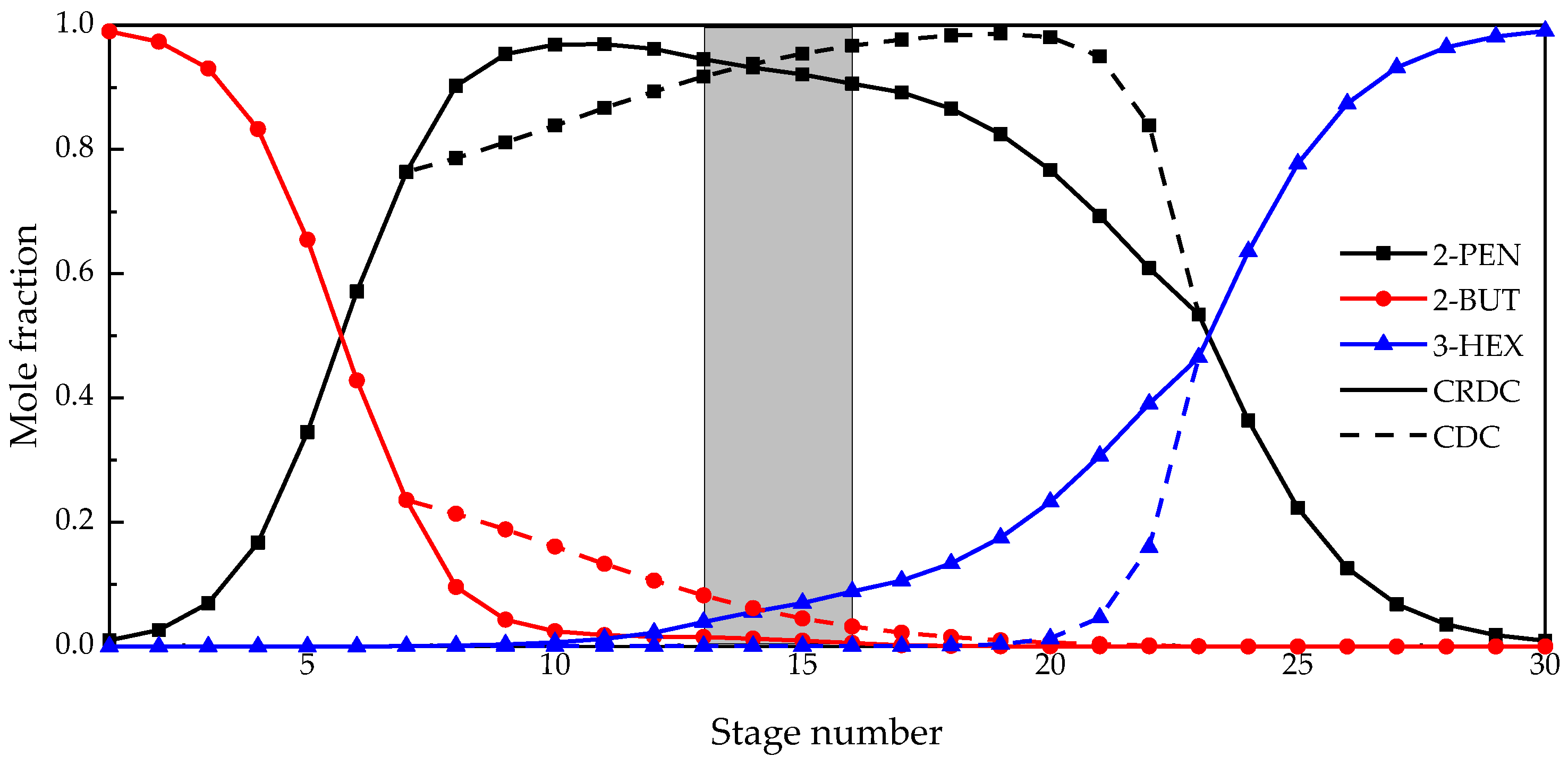
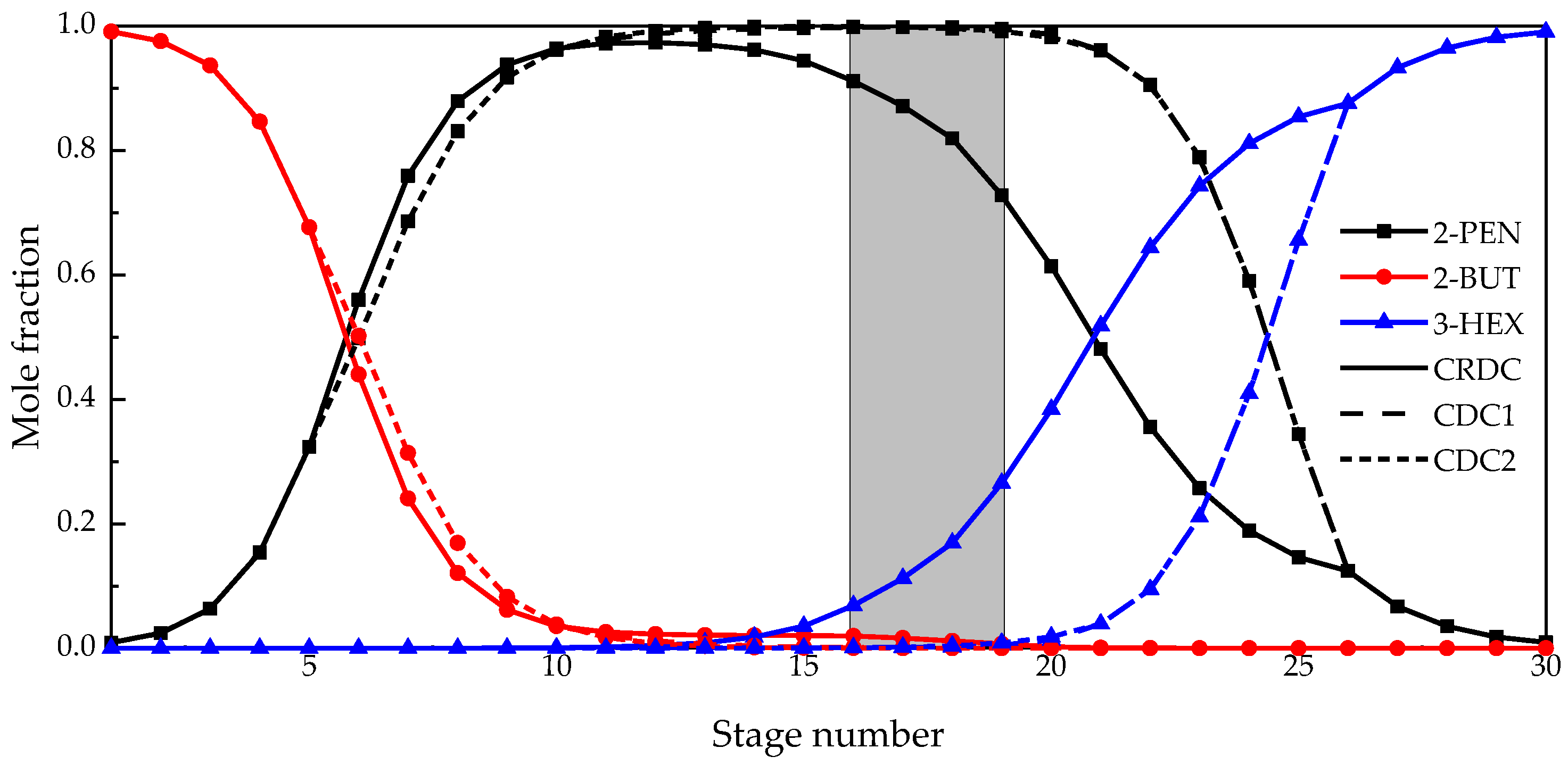
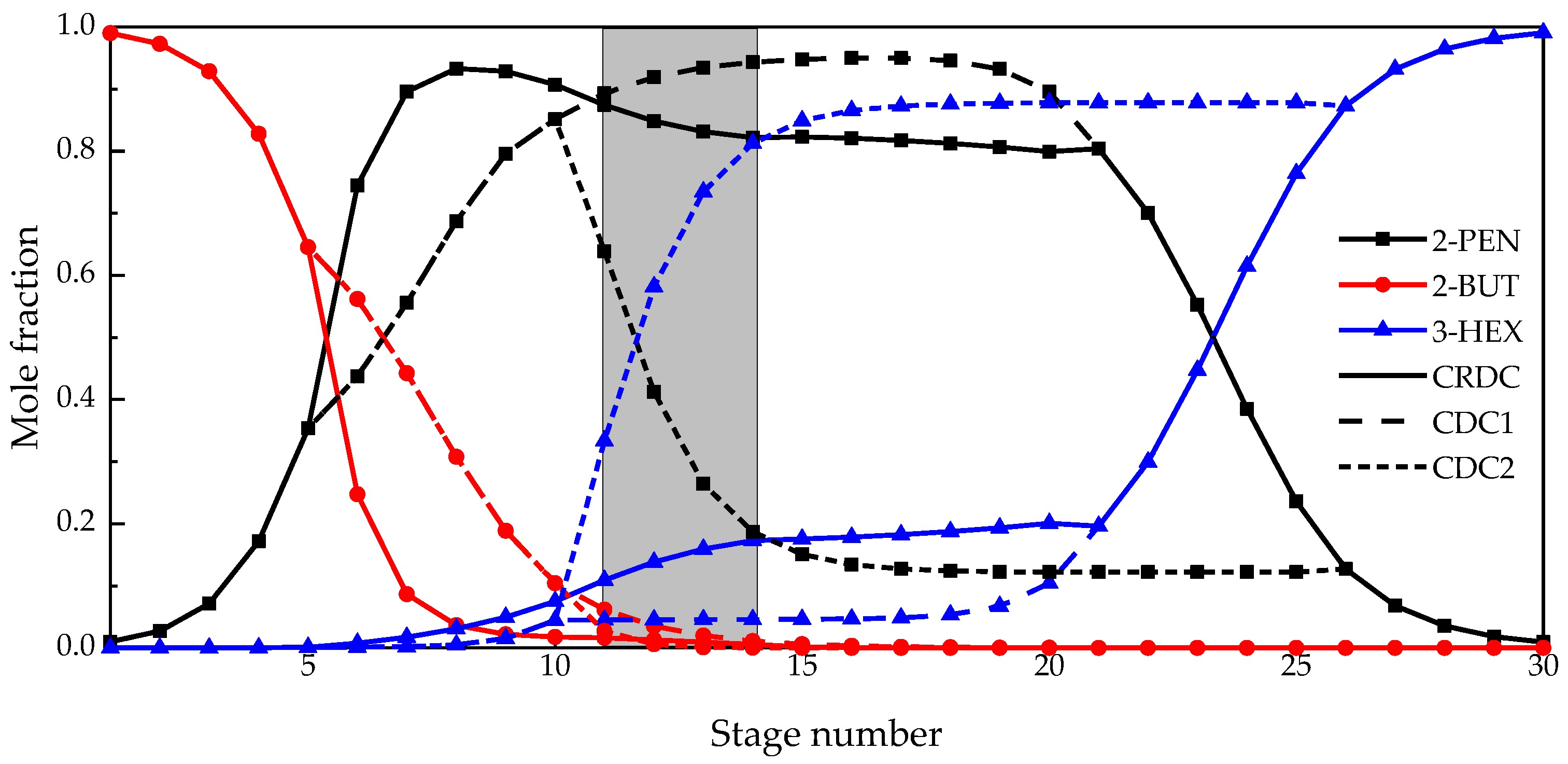
Figure 7, Figure 8, Figure 9 and Figure 10 present the liquid-phase composition profiles of Example I according to the vertical partitioning of the column induced by the dividing walls. For the R-SDWDC, the column is divided into two regions, namely the CRDC and the CDC, while for the R-DDWDC, three regions are defined: CRDC, CDC1, and CDC2. To facilitate direct comparison, the composition profiles of all regions are plotted in the same figure. Figure 7 exhibits the liquid-phase composition profiles of the CRDC. The sharp separations of 2-BUT/2-PEN and 2-PEN/3-HEX in the rectifying and stripping zones of the CRDC result in a very high composition of reactant 2-PEN in the reactive zone, reflecting the stringent requirements for the reaction conditions and the reaction progression. In addition, the relatively low compositions of products 2-BUT and 3-HEX in the rectifying and stripping zones indicate adverse conditions for the separation operations, as already demonstrated in our previous work [19]. Introducing the coupling between the separation operations in the rectifying and stripping zones and coordinating it with the reactive zone through an external recycle flow clearly helps to improve the overall steady-state performance. Figure 8 delineates the liquid-phase composition profiles of the R-SDWDC. It is observable that the modification benefits both the reaction and separation operations (e.g., the composition of reactant 2-PEN decreases in the reactive zone, while the compositions of products 2-BUT and 3-HEX increase in the rectifying and stripping zones on the left side of the CRDC). However, the impact remains limited; this is primarily due to the limited coupling mode, which is unable to significantly mitigate the operation irreversibility. Figure 9 shows the liquid-phase composition profiles of the R-DDWDC1. When the right dividing wall is placed above the left dividing wall, the full coupling mode benefits the reaction and separation operations of the left side of the CRDC (e.g., the composition of reactant 2-PEN significantly decreases in the reactive zone, and the compositions of products 2-BUT and 3-HEX exhibit a notable increase in the rectifying and stripping zones). Accordingly, a higher composition of reactant 2-PEN is observed at the right-side inlet of the DWDC, which helps to intensify the SSC and improve the overall system performance accordingly. Figure 10 depicts the liquid-phase composition profiles of the R-DDWDC2. When the right dividing wall is placed below the left dividing wall, this coupling mode results in a lower composition of reactant 2-PEN on the two sides of the right dividing wall, giving rise to the degradation of the SSC and consequently weakening the performance of the overall system. The above analysis provides profound insights into the inherent principles and essential attributes of the Co-PI philosophy, which highlights that strengthening the SSC is a highly effective approach to developing the R-DDWDC.

4. Example II: Acetalization of EtOH with BuCHO

4.1. Problem Statement

The acetalization of EtOH with BuCHO to generate 1,1-diethoxy butane (1,1-DEB) and water (W) can be represented as follows:
2   EtOH   +   BuCHO     1 , 1 - DEB   +   W
Amberlyst 47 is employed as the catalyst, and the reaction kinetics are described using the pseudo-homogeneous model proposed by Agirre et al. [20] as follows:
r   =   k F   C EtOH 2   C BuCHO     k B   C 1 , 1 - DEB   C W  
k F = k F 0   exp   E F   /   R   T  
k B = k B 0   exp   E B   /   R   T  
where Ci denotes the molarity of component i, while R denotes the universal gas constant, 8.314 kJ/kmol/K.
Table 3 details the critical physicochemical properties, operating parameters, and product requirements for the process design [21]. It is observed that the ranking of relative volatility is BuCHO > EtOH > W > 1,1-DEB. Therefore, the reaction system has the somewhat favorable ranking of relative volatilities, and the NRTL thermodynamic model is applied to calculate the vapor–liquid equilibrium [22].

4.2. Searches for the Optimal Design of the R-DDWDC

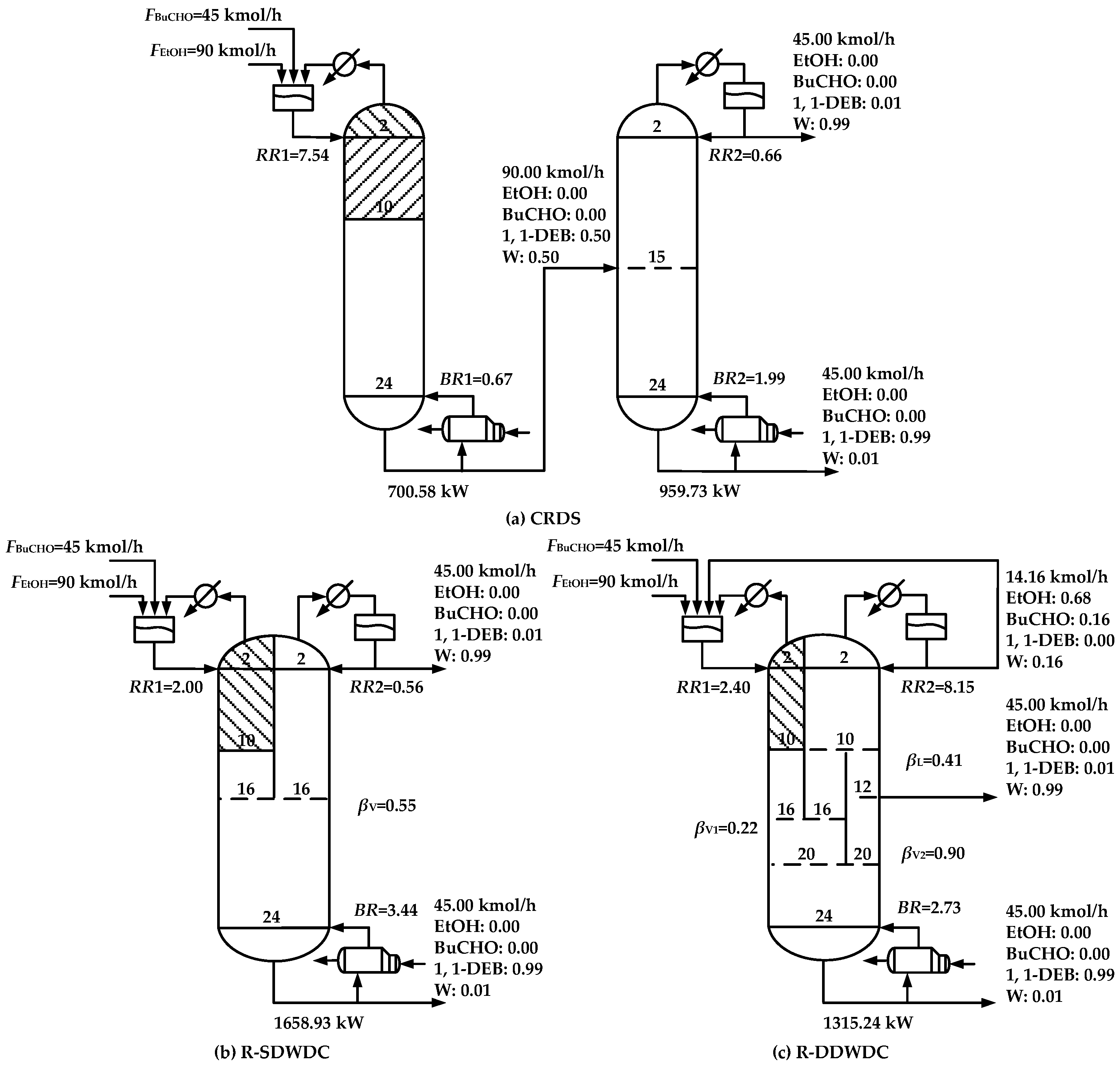
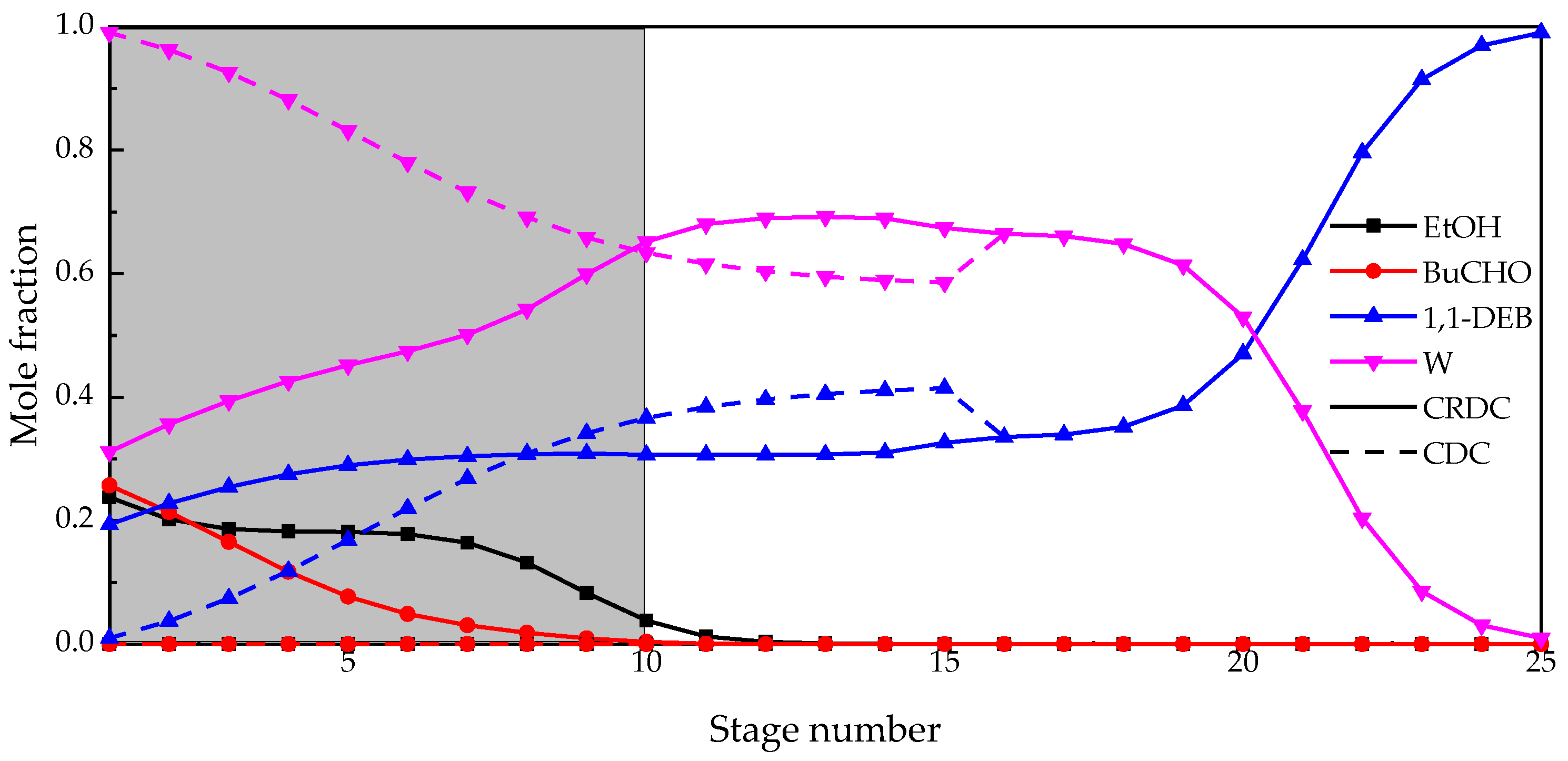
Figure 11 outlines the optimal designs of the CRDS, R-SDWDC, and R-DDWDC. Following the procedure proposed and developed in the present study, the process design adopts the R-DDWDC as the initial configuration. The results show that the top recycle flow exhibits a non-negligible flow rate and should thus be retained, confirming that the R-DDWDC represents the optimal design. It is interesting to further investigate the variation in the SSC from the R-SDWDC to R-DDWDC; for the R-SDWDC, the reaction mixture is withdrawn from the left side of the CRDC, with the intermediate component W not being distributed but instead entering the right side of the CDC in its vapor phase. Therefore, the ΔQ value for the R-SDWDC is equivalent to the condenser duty of the right side of the CDC, specifically 895.64 kW. In contrast, the ΔQ value for the R-DDWDC is determined to be 531.06 kW according to Equation (11). The reduction in ΔQ value from the R-SDWDC to R-DDWDC signifies the intensification of the SSC.

4.3. Comparative Analysis of the R-DDWDC

The comparison between the CRDS, R-SDWDC, and R-DDWDC is presented in Table 4. The R-DDWDC reduces the reboiler duty by 100.00% − 79.20% = 20.80% and 99.90% − 79.20% = 20.70% relative to the CRDS and the R-SDWDC, respectively. This result strongly supports the following analysis. For the CRDS, although the RSC involved in the CRDC can potentially reduce both capital investment and utility consumption by overcoming equilibrium limitations, the sharp separations of EtOH/W in the stripping zone of the CRDC and W/1,1-DEB in the subsequent CDC significantly increase the operation irreversibility, thereby resulting in low thermodynamic efficiency. The R-SDWDC introduces the SSC by incorporating the separation operation of the CDC into the CRDC; however, the resulting performance improvement remains limited. The primary reason lies in the fact that the perfunctory combination of the CRDC and the CDC cannot generate an effective SSC. By carefully arranging the two dividing walls and introducing external recycle flows, the R-DDWDC1 can simultaneously intensify and coordinate the RSC and the SSC, thereby achieving superior thermodynamic efficiency. These outcomes further confirm the feasibility and effectiveness of the Co-PI philosophy, and that the mechanism and procedure proposed in this work are also effective for developing the R-DDWDC.
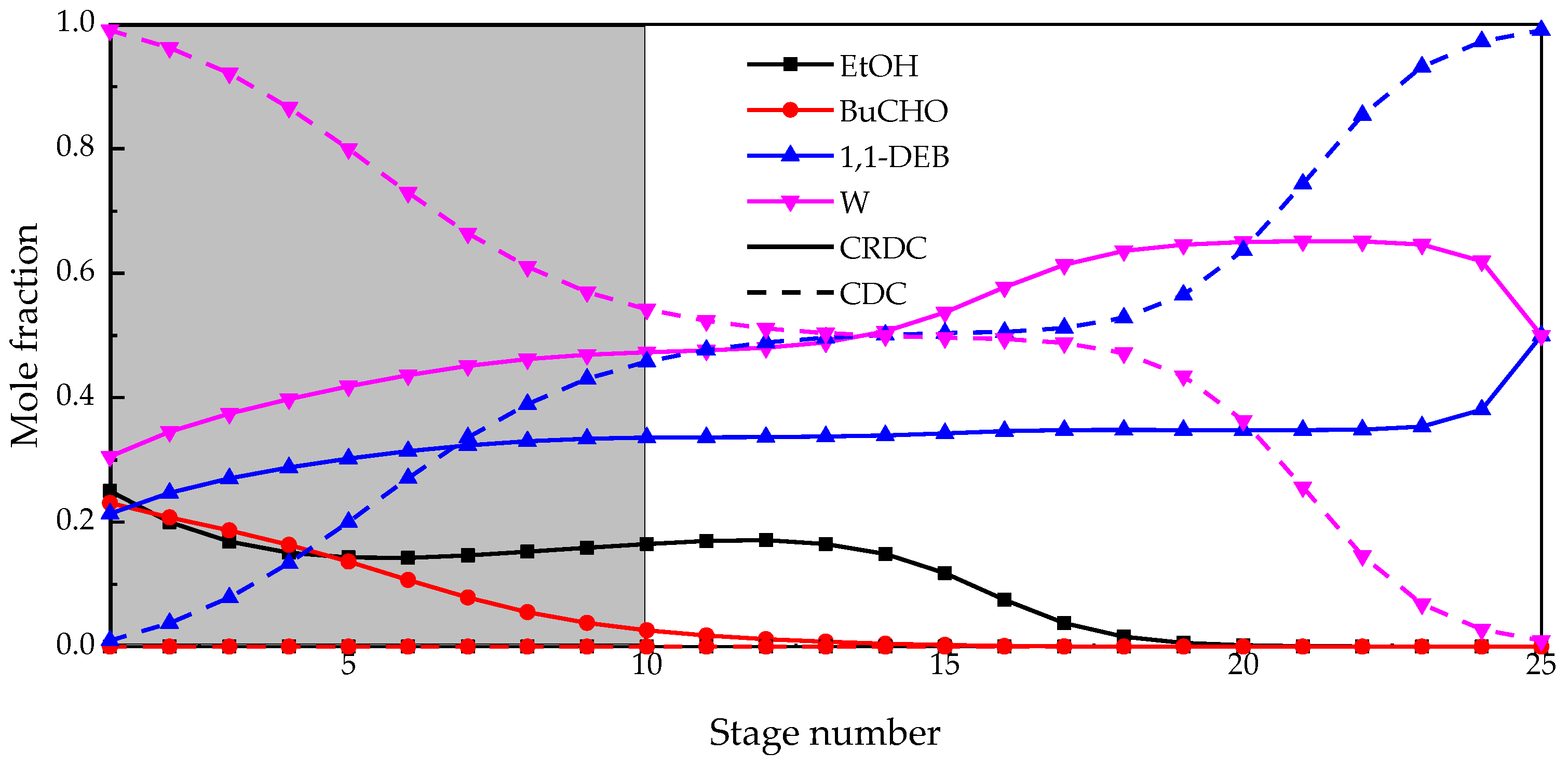
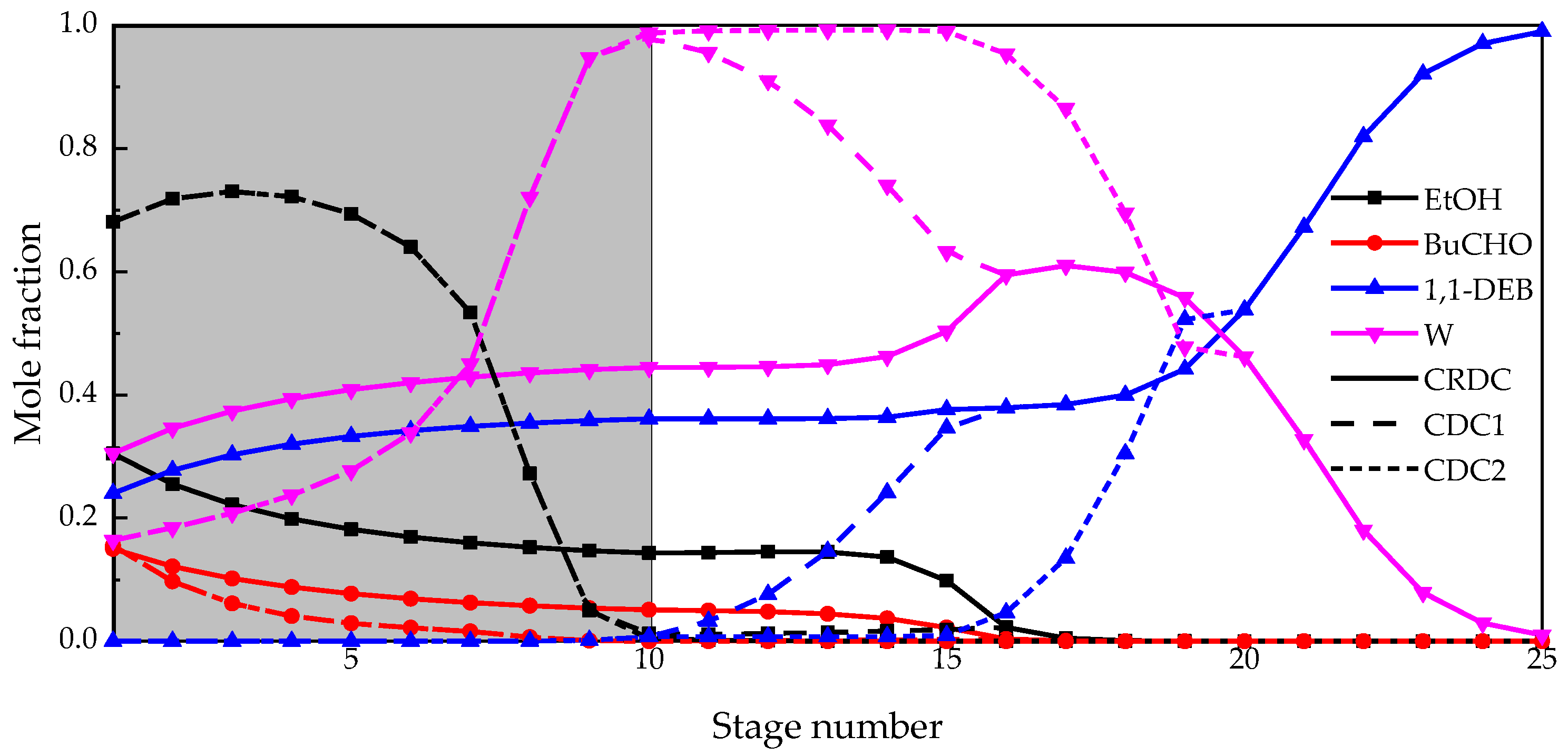
Figure 12 outlines the liquid-phase composition profiles of the CRDS. The sharp separation of EtOH/W in the stripping zone of the CRDC results in a significant deviation from the stoichiometric ratio between EtOH and BuCHO in the reactive zone and a certain degree of remixing. These factors adversely affect the reaction and separation operations in the CRDC. Figure 13 presents the liquid-phase composition profiles of the R-SDWDC. It can be observed that introducing the coupling between the CRDC and CDC positively affects both the reaction and separation operations (e.g., alleviating the stoichiometric deviation and mitigating the remixing). However, the improvement is still limited, mainly due to insufficient coupling between separation operations, which makes it difficult to effectively reduce the operation irreversibility. Figure 14 shows the liquid-phase composition profiles of the R-DDWDC1. The involvement of the right dividing wall and the addition of the top recycle flow effectively mitigate the constraints of product W on the reaction operation, thereby facilitating the RSC and enabling the compositions of BuCHO and EtOH in the reactive zone to more closely approach the stoichiometric ratio. Moreover, this adjustment gives rise to a high composition of W at the right-side inlet of the DWDC, which helps to strengthen the SSC and results in enhanced system performance. These outcomes offer an in-depth comprehension of the inherent principles and essential attributes of the Co-PI philosophy, confirming that strengthening the SSC represents an effective strategy for developing the R-DDWDC.

5. Example III: Transesterification of PM with MeOAc

5.1. Problem Statement

The transesterification of PM with MeOAc to yield propylene glycol monomethyl ether acetate (PMA) and MeOH can be described as follows:
PM   +   MeOAc     PMA   +   MeOH
The reaction proceeds in the presence of sodium methoxide as a catalyst, and its kinetics are described by the model reported by Zhu et al. [23] as follows:
r   =   k F   α PM   α MeOAc     k B   α PMA   α MeOH  
k F = k F 0   exp   E F   /   R   T  
k B = k B 0   exp   E B   /   R   T  
where ai denotes the activity of component i.
Table 5 lists the fundamental physicochemical properties, operating parameters, and product requirements for process design [24]. The ranking of relative volatility is MeOAc > MeOH > PM > PMA. Thus, the reaction system exhibits the somewhat unfavorable ranking of relative volatilities, and the NRTL thermodynamic model is used to describe its vapor-liquid equilibrium relationship [25].

5.2. Searches for the Optimal Design of the R-DDWDC

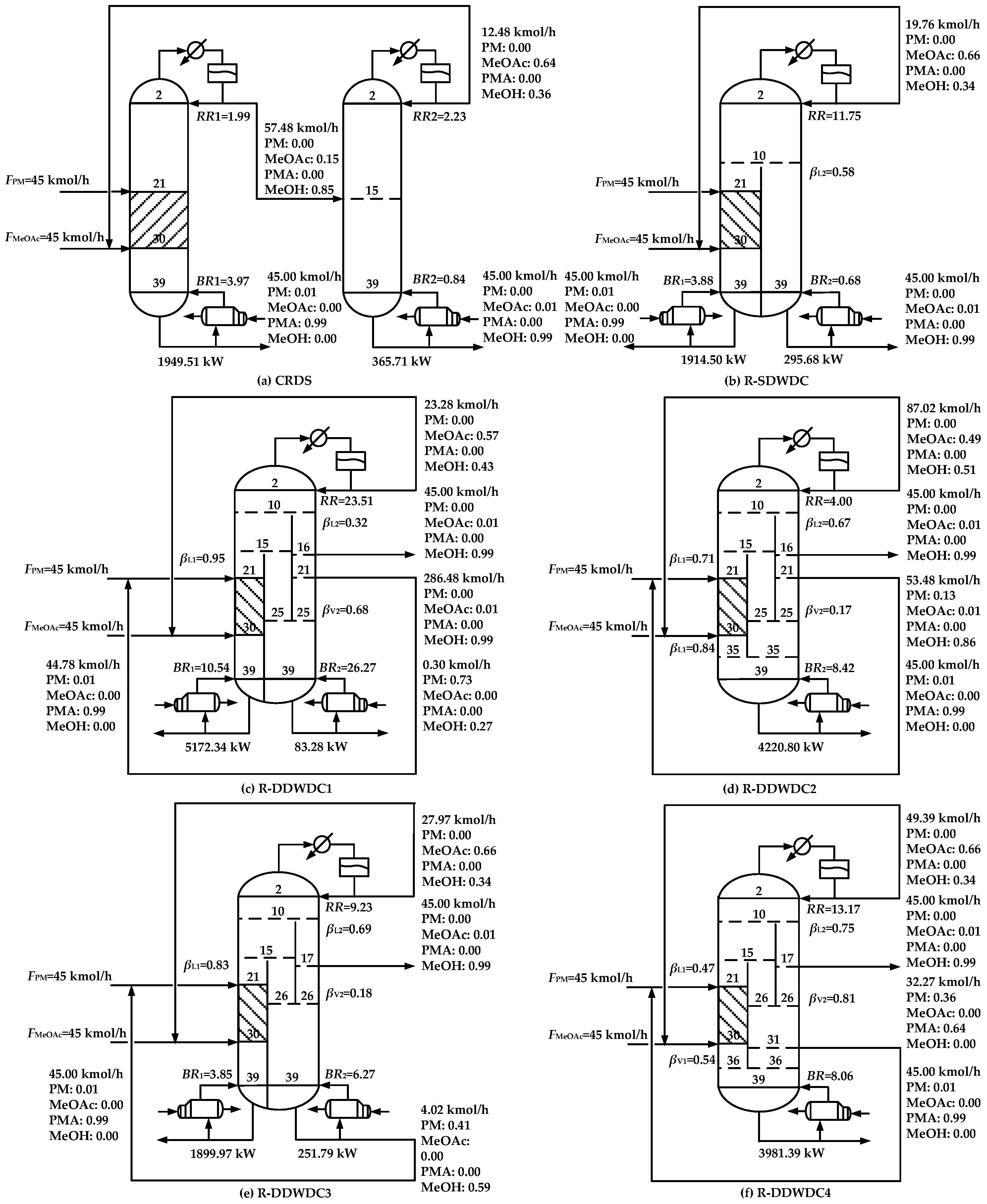
Figure 15 illustrates the optimal designs of the CRDS, R-SDWDC, and various R-DDWDC configurations. As per the procedure developed in this work, the R-DDWDC1 is chosen as the initial configuration for process design. The results show that the right-side PMA flow rate is very small, which suggests that this stream should be removed, leading to the evolution of the R-DDWDC1 into the R-DDWDC3. Subsequently, the arrangement of the dividing walls in the R-DDWDC3 is evaluated, and the ΔQ value is determined to be 446.69 kW according to Equation (11). Building upon the process design of the R-DDWDC3, perturbation analysis is applied to evaluate the R-DDWDC4 configuration, yielding a ΔQ of 752.94 kW. This value is significantly higher than that of the R-DDWDC3, reflecting the deterioration of the SSC from the R-DDWDC3 to the R-DDWDC4 (i.e., the sequence of the SSC enhancement is as follows: R-DDWDC4 → R-DDWDC3). Therefore, the R-DDWDC3 is determined as the optimal design of the R-DDWDC.

5.3. Comparative Analysis of the R-DDWDC

A thorough comparison is included in Table 6 between the CRDS, R-SDWDC, R-DDWDC1, R-DDWDC2, R-DDWDC3, and R-DDWDC4. In comparison with the CRDS and the R-SDWDC, the optimal design of the R-DDWDC (R-DDWDC3) achieves a reduction in reboiler duty of 100.00% − 92.94% = 7.06% and 95.46% − 92.94% = 2.52%, respectively. This outcome strongly corroborates the following analysis. For the CRDS, although the RSC involved in the CRDC offers potential advantages in reducing capital and utility demands by surpassing equilibrium constraints, the sharp separations of MeOH/PM and PM/PMA in the rectifying and stripping zones of the CRDC and MeOAc/MeOH in the CDC give rise to great operation irreversibility, severely worsening whole system thermodynamic efficiency. The R-SDWDC introduces the SSC by incorporating the separation operation of the CDC into the CRDC, which is the primary reason for its superior thermodynamic efficiency over the CRDS. However, by relying solely on the simple inclusion of the CDC to achieve the SSC, the R-SDWDC suffers from limited coupling mode, thereby limiting its ability to suppress the operation irreversibility and making it difficult to compete with the R-DDWDC1. In contrast, the R-DDWDC3 simultaneously involves and coordinates the RSC and the SSC through the careful arrangement of the two dividing walls and the introduction of external recycle flows, thereby attaining the highest thermodynamic efficiency. This superior performance is definitely attributed to the feasibility and effectiveness of the Co-PI philosophy. It is worth noting that although the R-DDWDC1, R-DDWDC2, and R-DDWDC4 also integrate and coordinate the two types of coupling subsystems, like the R-DDWDC3, their thermodynamic performance is considerably compromised due to the improper segmentation mode in the RSC for the R-DDWDC1 and R-DDWDC2, and the ineffectiveness of the SSC in the R-DDWDC4. As a result, the reboiler duties of the R-DDWDC1, R-DDWDC2, and R-DDWDC4 are 227.00% − 92.94% = 134.06%, 182.31% − 92.94% = 89.37%, and 171.97% − 92.94% = 79.03% higher than that of the R-DDWDC3, respectively. Their performance is even inferior to that of the CRDS and R-SDWDC, posing a significant drawback. These results further highlight the necessity and importance of the procedure proposed in this work.
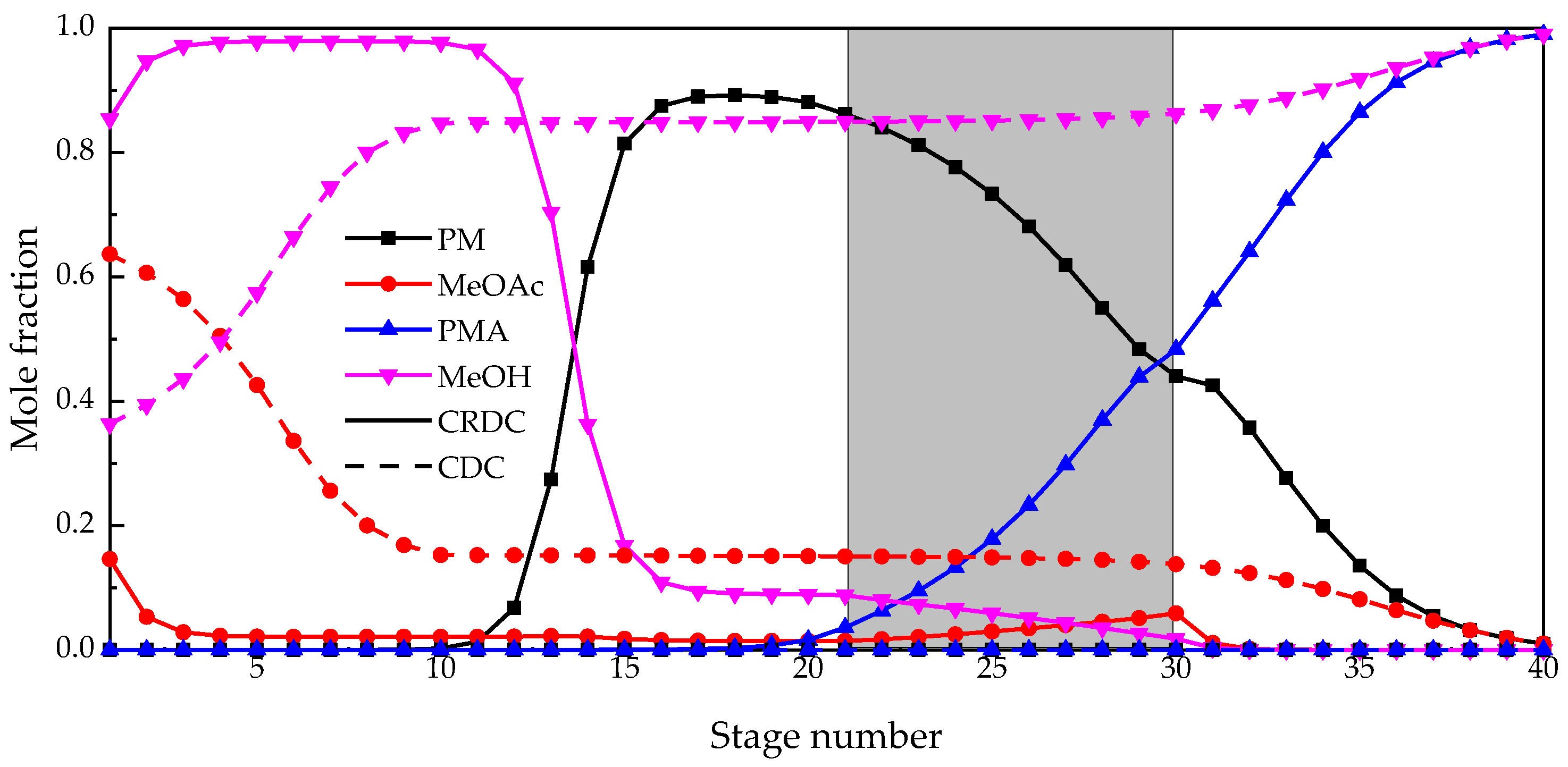
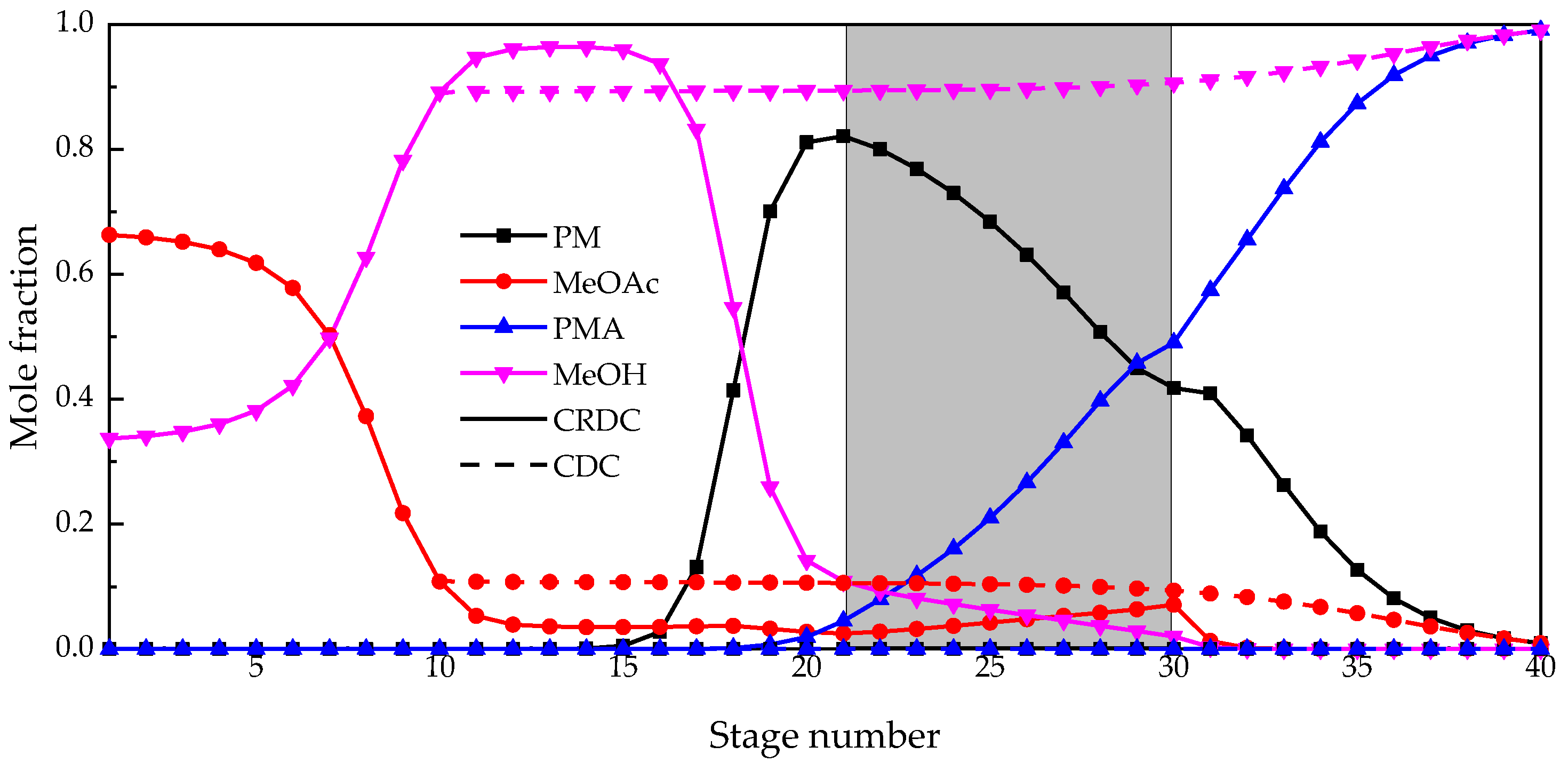
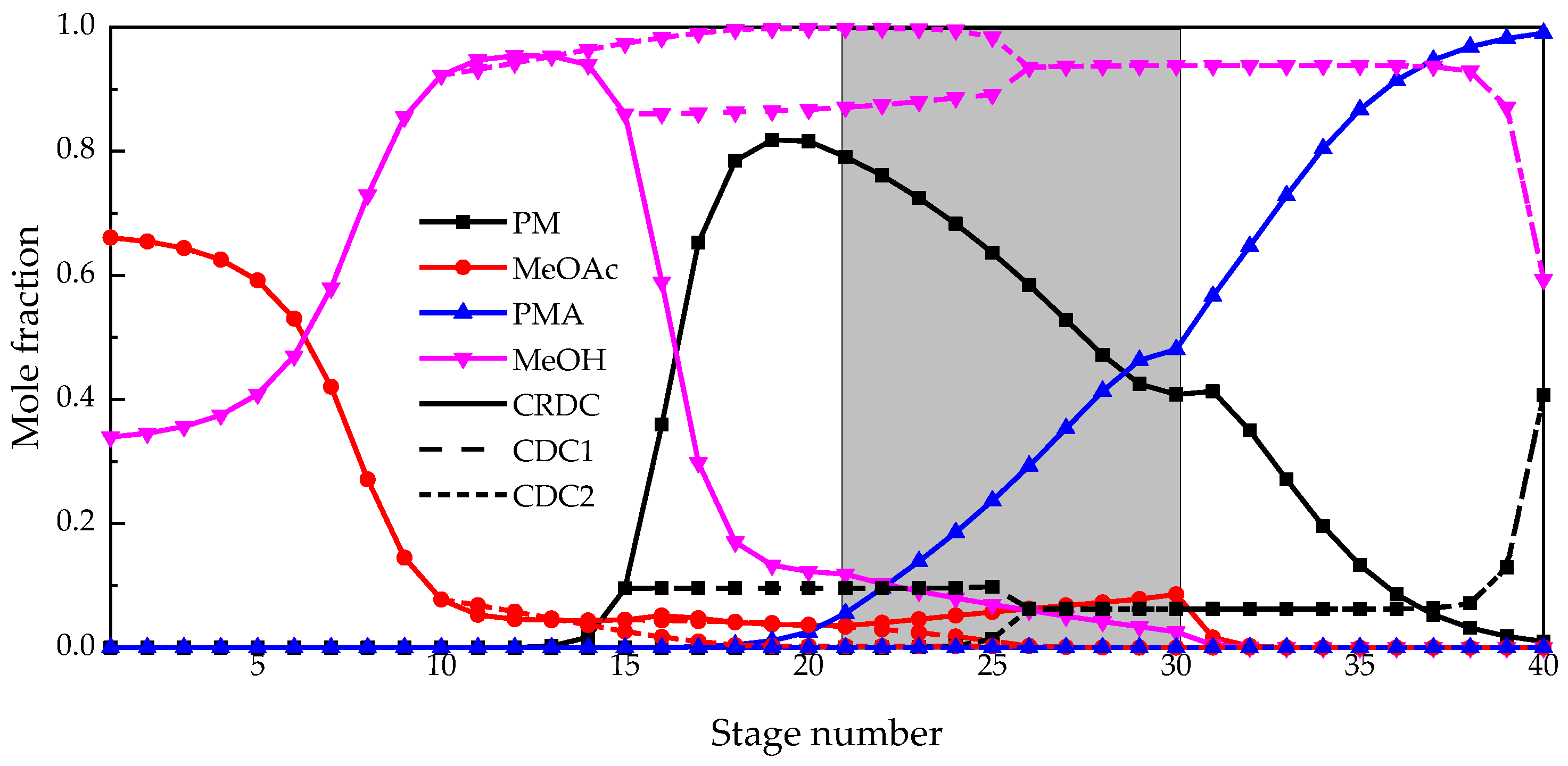
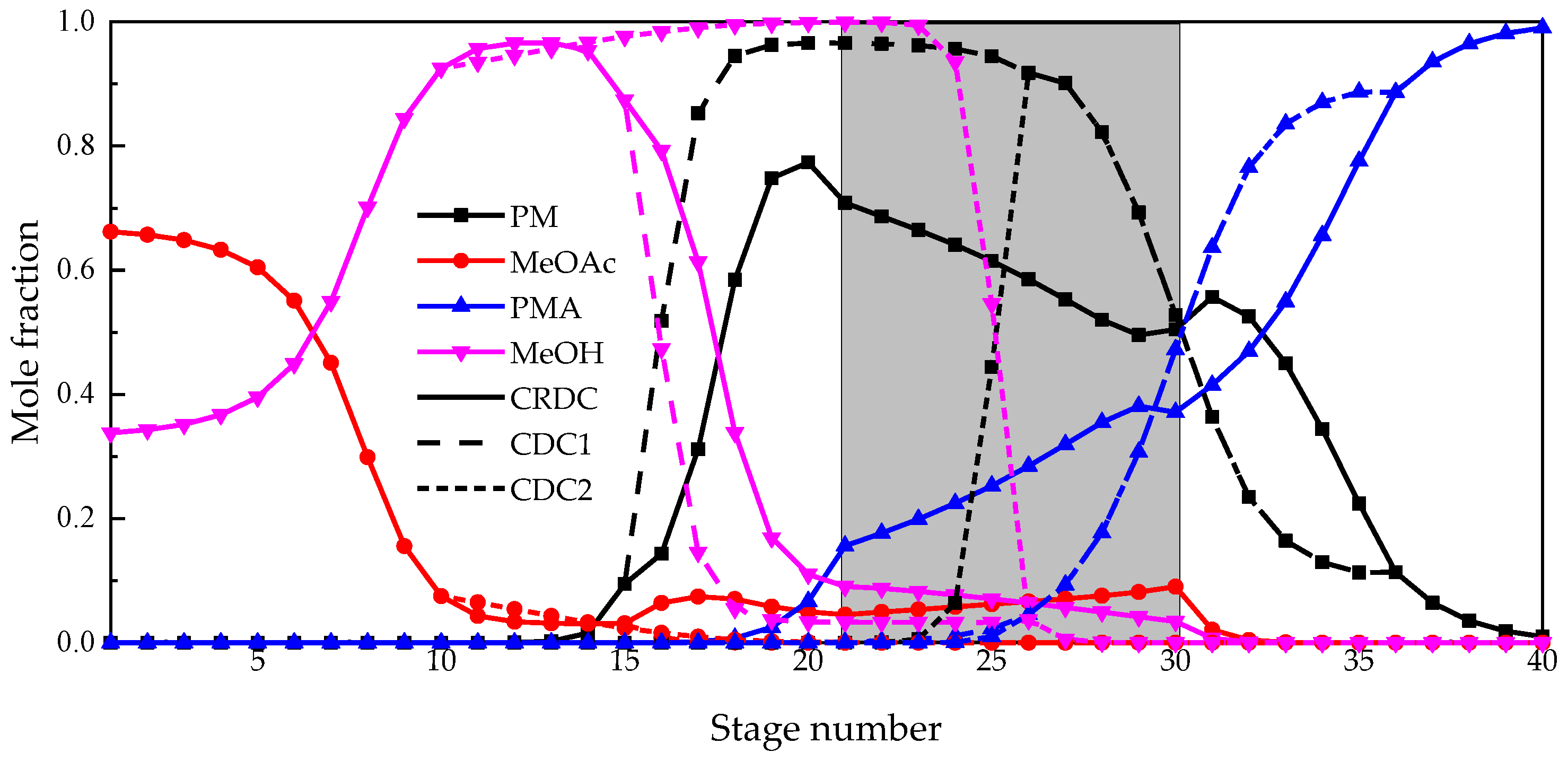
Figure 16 presents the liquid-phase composition profiles of the CRDS. Due to the sharp separations of MeOH/PM and PM/PMA in the rectifying and stripping zones of the CRDC, the composition of reactant PM is significantly higher than that of reactant MeOAc in the reactive zone. This not only hampers the efficient progression of the reaction operation but also complicates the separation operations. Figure 17 shows the liquid-phase composition profiles of the R-SDWDC. It can be found that the coupling between the CRDC and the CDC indeed has a positive impact on the reaction and separation operations (e.g., the decrease in PM composition and the increase in MeOAc composition in the reactive zone). However, the improvement remains limited, as this is mainly due to the insufficient coupling of the separation operations which cannot significantly mitigate the operation irreversibility. Figure 18 depicts the liquid-phase composition profiles of the R-DDWDC3. By configuring the right dividing wall and introducing a bottom recycle flow, the limitations imposed by product MeOH on the reactive operation are substantially alleviated. This significantly facilitates the RSC, thereby reducing the composition of PM while elevating that of MeOAc in the reactive zone. The modification also yields a high composition of product MeOH at the right-side inlet of the DWDC, which serves to intensify the SSC and thereby boost the overall system performance. Figure 19 outlines the liquid-phase composition profiles of the R-DDWDC4. By moving the left dividing wall results in the discharge of PM and PMA at the bottom, this leads to a lower composition of MeOH produced at the right-side inlet of the DWDC than that in the R-DDWDC3, thereby weakening the SSC. In addition, this change gives rise to an increased composition of PM on the right side of the dividing wall, benefiting the coupling between the top of the binary separation (PM/PMA) and the bottom of the ternary separation (MeOAc/MeOH/PM). Because the adverse effects of the former far outweigh the beneficial impacts of the latter, this adjustment fails to effectively enhance the SSC. These outcomes uncover the inherent principles and essential attributes of the Co-PI philosophy and illustrate that pursuing the SSC intensification represents an effective method for developing the R-DDWDC.

6. Example IV: Esterification of LA with MeOH

6.1. Problem Statement

The esterification of LA with MeOH to form methyl lactate (MLA) and W can be written as follows:
LA   +   MeOH     MLA   +   W
The reaction is carried out in the presence of an acidic cation-exchange resin, and its kinetics are described using the pseudo-homogeneous model reported by Kumar et al. [26] as follows:
r   =   k F   α LA   α MeOH     k B   α MLA   α W  
k F = k F 0   exp   E F   /   R   T  
k B = k B 0   exp   E B   /   R   T  
where ai denotes the activity of component i.
Table 7 lists the key physicochemical properties, operating parameters, and product requirements for process design [27]. It is apparent that the ranking of relative volatility is MeOH > W > MLA > LA. Accordingly, the reaction system features the most unfavorable ranking of relative volatilities, and the UNIQUAC thermodynamic model is chosen for describing vapor–liquid equilibrium relationships [28].

6.2. Searches for the Optimal Design of the R-DDWDC

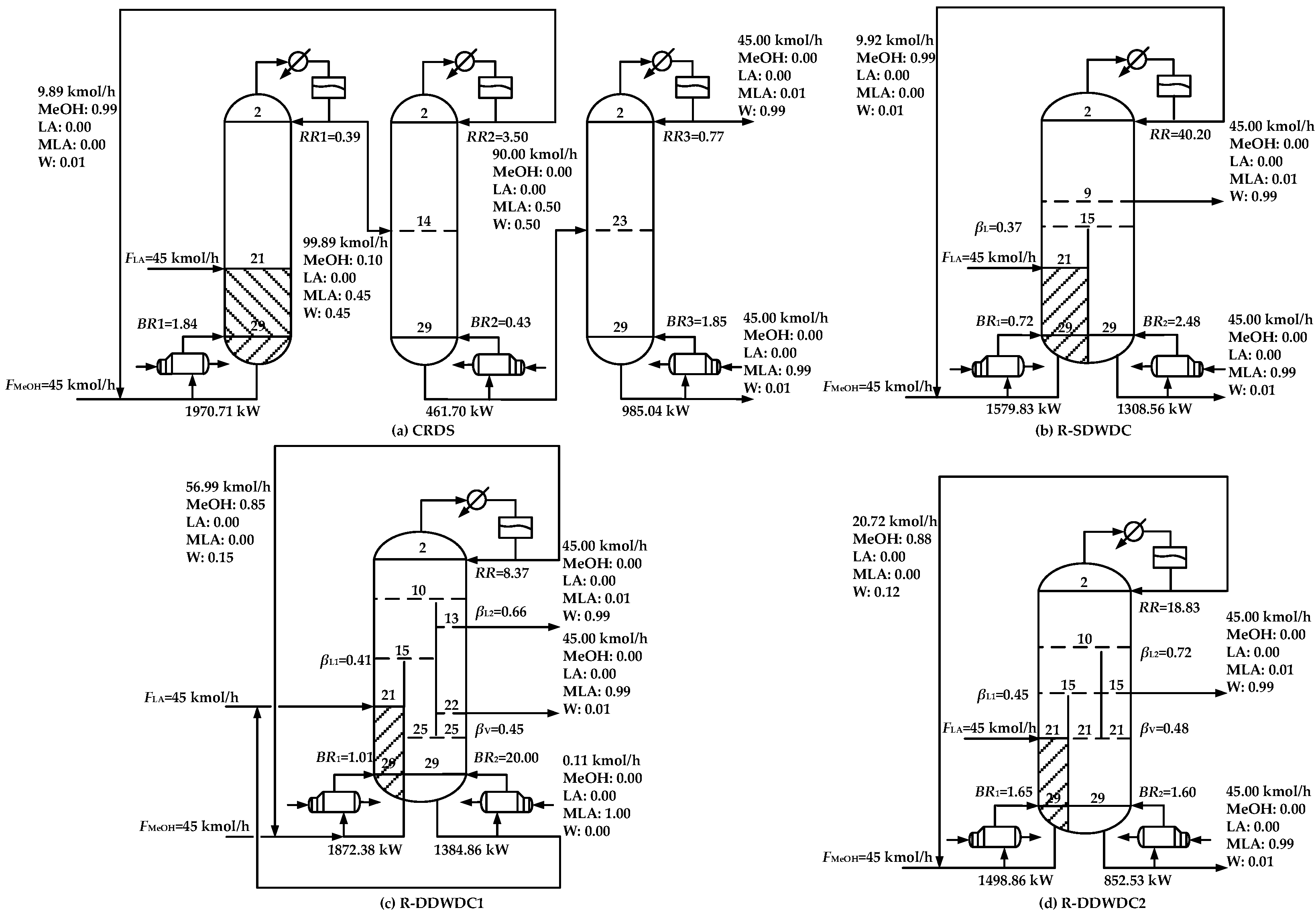
Figure 20 exhibits the optimal designs of the CRDS, R-SDWDC, R-DDWDC1, and R-DDWDC2. Based on the procedure established in this work, the R-DDWDC1 is selected as the initial configuration for process design. The results reveal that the bottom LA recycle flow displays a negligible flow rate, which indicates that the recycle flow should be removed and leads the system to transition from R-DDWDC1 to R-DDWDC2. Consequently, the optimal design of the R-DDWDC (R-DDWDC2) can be determined. It is worthwhile to further examine the variation in the SSC from the R-SDWDC to the R-DDWDC2. For the R-SDWDC, the reaction mixture is withdrawn from the left side CRDC, with the intermediate component W not being distributed but instead entering the right side ternary distillation (MeOH/W/MLA) in its vapor phase. Due to the complexity of calculating the exact ΔQ value, only the latent heat of product condensation is considered for simplification, specifically 508.51 kW. In contrast, the ΔQ value for the R-DDWDC2 is determined to be 316.19 kW according to Equation (11). The decrease in ΔQ value from the R-SDWDC to the R-DDWDC2 reflects the intensification of the SSC.

6.3. Comparative Analysis of the R-DDWDC

The comparison between the CRDS, R-SDWDC, R-DDWDC1, and R-DDWDC2 is summarized in Table 8. As compared with the CRDS and the R-SDWDC, the optimal design of the R-DDWDC (R-DDWDC2) reduces the reboiler duty by 100.00% − 68.81% = 31.19% and 84.52% − 68.81% = 15.71%, respectively. This outcome provides strong evidence for the rationality of the following system structure analysis. Although the RSC involved in the CRDC provides potential benefits in reducing capital investment and utility consumption by overcoming equilibrium limitations, the sharp separations of MLA/LA in the rectifying zone of the CRDC, MeOH/W in the CDC1, and W/MLA in the CDC2 inevitably increase the operation irreversibility, thereby leading to reduced thermodynamic efficiency. By incorporating the separation operations in both CDC1 and CDC2 into the CRDC, the R-SDWDC introduces the SSC, which serves as the main reason for its superior thermodynamic efficiency compared to the CRDS. Nevertheless, the limited coupling mode of the R-SDWDC restricts its ability to effectively mitigate the irreversibility of the separation operations, resulting in its performance still being inferior to that of the R-DDWDC2. Through the careful arrangement of the two dividing walls and the introduction of external recycle flows, the R-DDWDC2 can simultaneously intensify and coordinate the RSC and the SSC, thereby achieving the highest thermodynamic efficiency. This substantial improvement further validates the feasibility and effectiveness of the Co-PI philosophy. It is worth highlighting that, despite achieving integration and coordination of the two coupled subsystems, the R-DDWDC1 exhibits significantly lower thermodynamic efficiency, primarily owing to the shortcomings of the SSC. As a result, the reboiler duty of the R-DDWDC1 is 95.31% − 68.81% = 26.50% higher than that of the R-DDWDC2, while its performance is even lower than that of the R-SDWDC. This result further emphasizes the necessity and importance of the procedure proposed in this work.
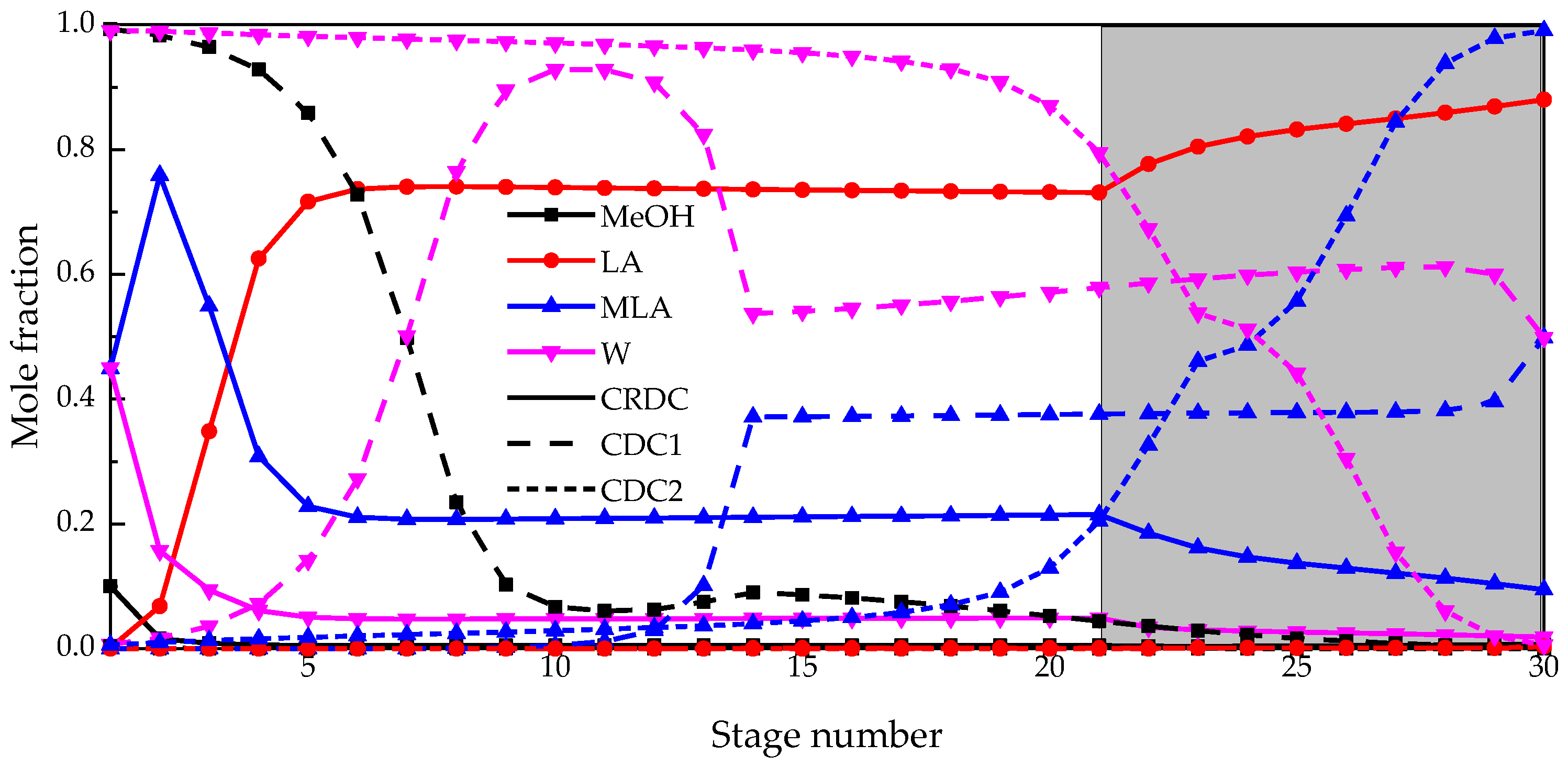
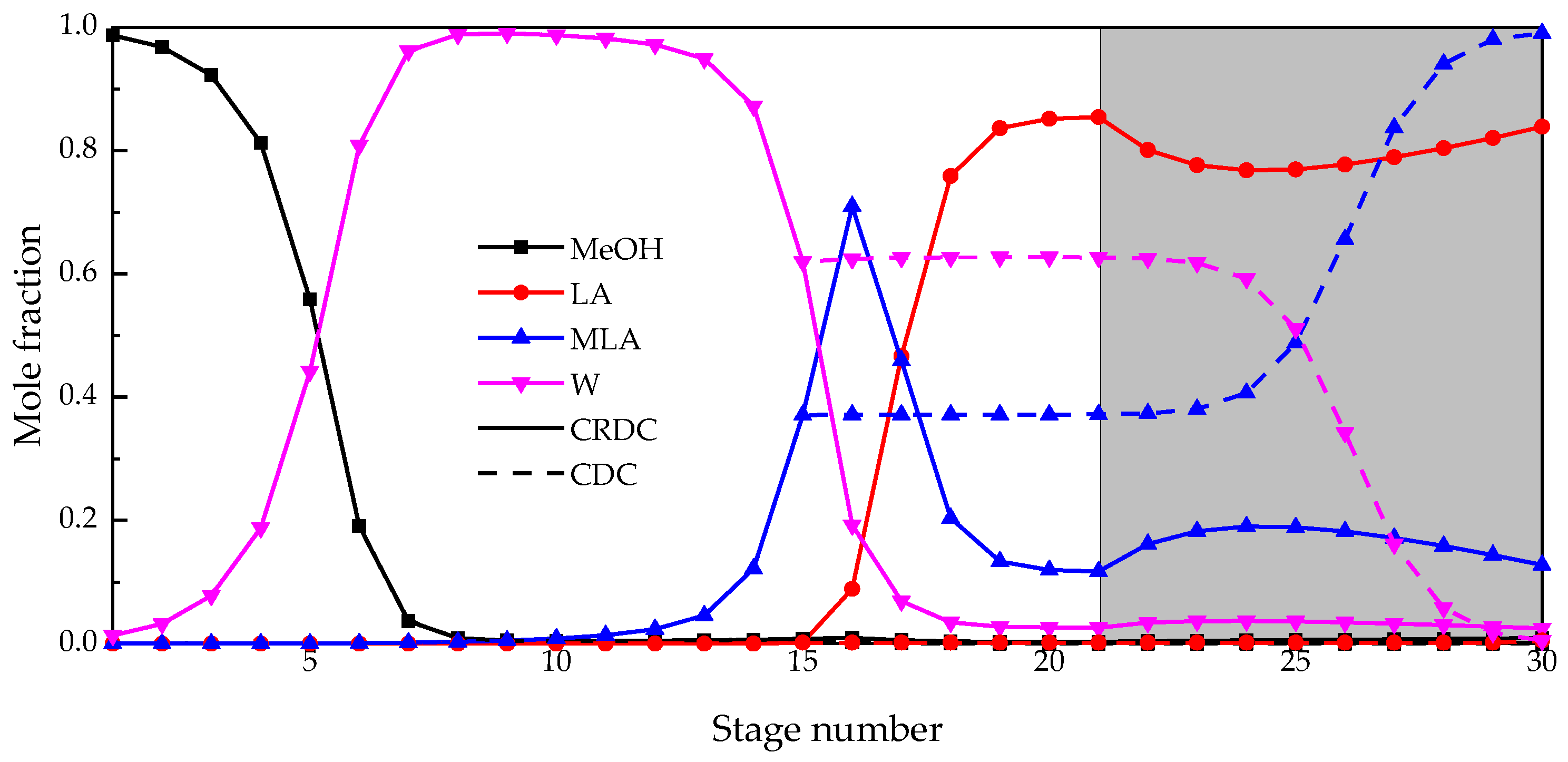
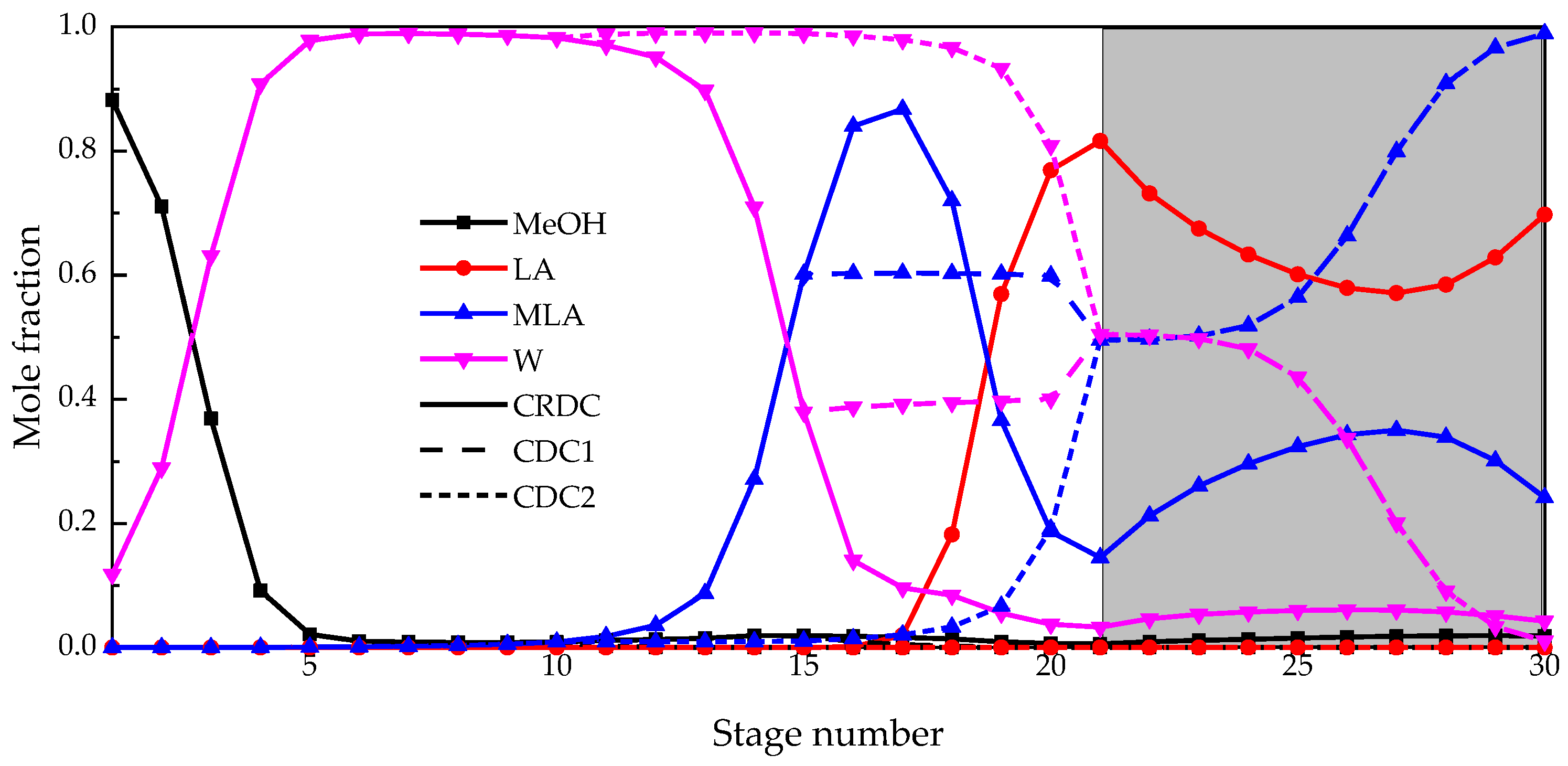
Figure 21 outlines the liquid-phase composition profiles of the CRDS. The sharp separation of MLA/LA in the rectifying zones of the CRDC leads to an excessively high LA composition and a very low MeOH composition in the reactive zone. This not only imposes stringent requirements on the reactive operation but also markedly increases the complexity of the subsequent separation operation. Figure 22 shows the liquid-phase composition profiles of the R-SDWDC where the introduction of the SSC via the coupling of the CRDC and the CDCs should exert a beneficial effect on both the reaction and separation operations (e.g., a slight decrease in the LA composition and a slight increase in the MeOH composition in the reactive zone); however, the reaction operation must still be conducted under stringent conditions owing to the withdrawal of product W, producing a rather low MeOH composition in the reactive zone. This is mainly due to insufficient coupling between separation operations, making it difficult to effectively reduce operation irreversibility. Figure 23 depicts the liquid-phase composition profiles of the R-DDWDC2. Introducing the right dividing wall results in a high composition of W at the right-side inlet of the DWDC; his not only facilitates the enhancement of the SSC but also provides additional operational space for the RSC, thereby showing a high composition of reactant MeOH in the reactive zone. The above findings offer deep insights into the inherent principles and essential attributes of the Co-PI philosophy and reveal that seeking the intensification of the SSC is an effective approach for developing the R-DDWDC.

7. Discussion

The results from Examples I to IV show that the R-DDWDC is greatly superior to its corresponding CRDS and R-SDWDC. The remarkable enhancement of system performance substantiates the feasibility, effectiveness, and importance of developing the R-DDWDC based on the Co-PI philosophy. In addition, the introduction of the two dividing walls and the arrangement of external recycle flows inevitably give rise to numerous R-DDWDC configurations, significantly adding computational complexity and intensity to the process synthesis and design. The procedure developed in this work found the optimal design of the R-DDWDC by comparing and evaluating a limited number of intermediate process designs, fully demonstrating its simplicity and efficiency. Moreover, because the proposed methodology does not rely on the specific physicochemical properties of the reaction system, it is applicable to various reaction mixtures, especially for those with unfavorable reaction kinetics.
For the separation of multicomponent reaction mixtures (e.g., five- or six-component systems), the complex relative volatility relationships among the components require the arrangement of multiple dividing walls and the configuration of several external recycle flows. The configuration of recycle flows is directly dependent on the number of the segmented components in the RSC, and can also be determined progressively by systematically searching the RSC from no segmentation to the maximum segmentation of the reaction mixture. Once the segmentation mode is clarified, the position of each dividing wall is sequentially adjusted to intensify the SSC following the strategy that most effectively reduces ΔQ value until it approaches its minimum, thereby identifying the optimal design. Therefore, the procedure proposed in this work is, in nature, not limited by the number of components in reaction mixtures and the ranking of their relative volatilities, and could provide a general methodology for developing other complicated R-DWDCs.

8. Conclusions

Although the complicated configuration of the R-DDWDC inevitably can add computational complexity and intensity to its synthesis and design, the methodology proposed in this study can significantly alleviate these issues. This was primarily attributed to the two-step strategy employed: first, determining the configuration of external recycle flows by searching the RSC from non-sharp separation to sharp separation of the reaction mixture; and second, adjusting the arrangement of internal dividing walls to intensify the SSC, thereby achieving full coordination between the RSC and the SSC and consequently generating the optimal design of the R-DDWDC. Four illustrative systems were thoroughly investigated, including the metathesis of 2-PEN, the acetalization of EtOH with BuCHO, the transesterification of PM with MeOAc, and the esterification of LA with MeOH, and the obtained results confirmed that the optimal design of the R-DDWDC can be determined effectively and efficiently. Since the procedure proposed in this work should not be confined by the number of components and their relative volatility rankings in the reaction mixtures, it is also applicable to the development of other complicated R-DWDCs.
Future research will be devoted to the development of control strategies for the R-DDWDC, with particular emphasis on the impact of the Co-PI philosophy.

Supplementary Materials

The following supporting information can be downloaded at: https://www.mdpi.com/article/10.3390/pr14040673/s1, Figure S1: Derivation of the topological configuration of the R-DDWDC for A + B ↔ C + D with αA > αB > αC > αD and αC > αD > αA > αB; Figure S2: Derivation of the topological configuration of the R-DDWDC for A + B ↔ C + D with αA > αC > αB > αD and αC > αA > αD > αB; Figure S3. Derivation of the topological configuration of the R-DDWDC for A + B ↔ C + D with αA > αC > αD > αB.

Author Contributions

Conceptualization, C.F. and P.L.; methodology, K.H.; software, C.F.; validation, P.L., H.C. and X.Q.; formal analysis, C.F.; investigation, C.F. and P.L.; resources, P.L. and H.C.; data curation, C.F.; writing—original draft preparation, H.C.; writing—review and editing, X.Q.; visualization, C.F.; supervision, H.C.; project administration, P.L.; funding acquisition, H.C. All authors have read and agreed to the published version of the manuscript.

Funding

This research was funded by the National Natural Science Foundation of China (21878011 and 21576014), China.

Data Availability Statement

Data will be made available on request.

Conflicts of Interest

The authors declare no conflicts of interest.

Abbreviations

The following abbreviations are used in this manuscript:
FMolar flow rate
QHeat duty
xLiquid composition
RRReflux ratio
BRBoilup ratio
βVVapor splitting ratio
βLLiquid splitting ratio

References

  1. Luyben, W.L. Reactive Distillation Design and Control; John Wiley & Sons Inc.: Hoboken, NJ, USA, 2008. [Google Scholar]
  2. Tung, S.; Yu, C. Effects of Relative Volatility Ranking on the Design of Reactive Distillation. AIChE J. 2007, 53, 1278–1297. [Google Scholar] [CrossRef]
  3. Ding, Q.; Hou, Z.; Geng, X.; Gao, G.; Dong, W.; Li, H.; Wang, Y.; Chen, X.; Gao, X. Investigation of Sustainable Reactive Distillation Process to Produce Malonic Acid from Dimethyl Malonate. Sep. Purif. Technol. 2023, 315, 123730. [Google Scholar] [CrossRef]
  4. Anbreen, A.; Ramzan, N.; Faheem, M. A Heat-Integrated Reactive Distillation Process for Methyl Lactate Hydrolysis. Chem. Eng. Process. Process Intensif. 2022, 170, 108695. [Google Scholar] [CrossRef]
  5. Nagveni, P.; Kamesh, R.; Rani, K.Y. Production of n-Butyl Acetate through Continuous Reactive Distillation Using PTSA–POM as the Catalyst: Lab-Scale Experiments, Modeling and Validation, Commercial-Scale Design, and Economic Evaluation. Ind. Eng. Chem. Res. 2023, 62, 15070–15083. [Google Scholar] [CrossRef]
  6. Duanmu, F.; Chia, D.N.; Tsatse, A.; Sorensen, E. Optimal Design and Operation of Reactive Distillation Systems and Reactive Dividing-Wall Systems with Pressure Swing Distillation and Hybrid Distillation–Pervaporation. Chem. Eng. Process. Process Intensif. 2024, 201, 109832. [Google Scholar] [CrossRef]
  7. Egger, T.; Fieg, G. Enzymatic Catalyzed Reactive Dividing-Wall Column: Experiments and Model Validation. AIChE J. 2017, 63, 2198–2211. [Google Scholar] [CrossRef]
  8. Egger, T.; Fieg, G. Dynamic Process Behavior and Model Validation of Reactive Dividing-Wall Columns. Chem. Eng. Sci. 2018, 179, 284–295. [Google Scholar] [CrossRef]
  9. Huang, K.; Hong, Y.; Han, S.; Fan, C.; Ge, G.; Chen, H.; Zhang, L.; Qian, X.; Yuan, Y.; Wang, S. Co-Process Intensification in the Synthesis and Design of Reactive Double Dividing-Wall Distillation Columns. Chem. Eng. Process. Process Intensif. 2023, 189, 109405. [Google Scholar] [CrossRef]
  10. Zang, L.; Zhang, L.; Huang, K.; Chen, H.; Wang, S.; Yuan, Y.; Qian, X. Reactive Double Dividing-Wall Distillation Columns: Structure and Performance. Ind. Eng. Chem. Res. 2020, 59, 20410–20427. [Google Scholar] [CrossRef]
  11. Fan, C.; Han, S.; Liang, P.; Chen, H.; Huang, K.; Yuan, Y.; Qian, X. Reactive Double Dividing-Wall Distillation Columns via Co-Process Intensification for the Esterification of Palmitic Acid and Isopropanol. Sep. Purif. Technol. 2025, 360, 131248. [Google Scholar] [CrossRef]
  12. Tian, Y.; Demirel, S.E.; Hasan, M.F.; Pistikopoulos, E.N. An Overview of Process Systems Engineering Approaches for Process Intensification: State of the Art. Chem. Eng. Process. Process Intensif. 2018, 133, 160–210. [Google Scholar] [CrossRef]
  13. Pistikopoulos, E.N.; Barbosa-Póvoa, A.; Lee, J.H.; Misener, R.; Mitsos, A.; Reklaitis, G.V.; Venkatasubramanian, V.; You, F.; Gani, R. Process Systems Engineering—The Generation Next? Comput. Chem. Eng. 2022, 166, 107925. [Google Scholar] [CrossRef]
  14. Carlberg, N.A.; Westerberg, A.W. Temperature–Heat Diagrams for Complex Columns. 2. Underwood’s Method for Side Strippers and Enrichers. Ind. Eng. Chem. Res. 1989, 28, 1379–1386. [Google Scholar] [CrossRef]
  15. Carlberg, N.A.; Westerberg, A.W. Temperature–Heat Diagrams for Complex Columns. 3. Underwood’s Method for the Petlyuk Configuration. Ind. Eng. Chem. Res. 1989, 28, 1386–1397. [Google Scholar] [CrossRef]
  16. Okasinski, M.J.; Doherty, M.F. Design Method for Kinetically Controlled, Staged Reactive Distillation Columns. Ind. Eng. Chem. Res. 1998, 37, 2821–2834. [Google Scholar] [CrossRef]
  17. Chen, F.; Huss, R.S.; Malone, M.F.; Doherty, M.F. Simulation of Kinetic Effects in Reactive Distillation. Comput. Chem. Eng. 2000, 24, 2457–2472. [Google Scholar] [CrossRef]
  18. Al-Arfaj, M.A.; Luyben, W.L. Design and Control of an Olefin Metathesis Reactive Distillation Column. Chem. Eng. Sci. 2002, 57, 715–733. [Google Scholar] [CrossRef]
  19. Huang, K.; Lin, Q.; Shao, H.; Wang, C.; Wang, S. A Fundamental Principle and Systematic Procedures for Process Intensification in Reactive Distillation Columns. Chem. Eng. Process. Process Intensif. 2010, 49, 294–311. [Google Scholar] [CrossRef]
  20. Agirre, I.; Barrio, V.L.; Güemez, B.; Cambra, J.F.; Arias, P.L. Catalytic Reactive Distillation Process Development for 1,1-Diethoxybutane Production from Renewable Sources. Bioresour. Technol. 2011, 102, 1289–1297. [Google Scholar] [CrossRef]
  21. Lorenzo, B.; Granca, N.S.; Ortega, J.; Rodrigues, A.E. Operation and Modeling of a Process for 1,1-Diethoxybutane Synthesis in a Simulated Moving Bed Reactor Pilot Unit. Ind. Eng. Chem. Res. 2024, 63, 21190–21199. [Google Scholar] [CrossRef]
  22. Agirre, I.; Güemez, M.B.; Motelica, A.; van Veen, H.M.; Vente, J.F.; Arias, P.L. The Conceptual Design of a Continuous Pervaporation Membrane Reactor for the Production of 1,1-Diethoxybutane. AIChE J. 2012, 58, 1862–1868. [Google Scholar] [CrossRef]
  23. Zhu, J.; Hao, L.; Zhu, Z.; Wei, H. Development of Novel Hybrid Pre-Separation/Extractive Reactive Distillation Processes for the Separation of Methanol/Methyl Acetate/Ethyl Acetate. Sep. Purif. Technol. 2024, 348, 127496. [Google Scholar] [CrossRef]
  24. Wang, Q.; Zhao, D.; Li, H.; Gao, X.; Shen, W.; Yang, C.; Ye, C.; Qiu, T. Kinetic and Process Analysis of Continuous Catalytic Distillation for High-Purity Propylene Glycol Monomethyl Ether Acetate Production. Chin. J. Chem. Eng. 2025, 86, 200–210. [Google Scholar] [CrossRef]
  25. Wang, X.; Wang, Q.; Ye, C.; Dong, X.; Qiu, T. Feasibility Study of Reactive Distillation for the Production of Propylene Glycol Monomethyl Ether Acetate through Transesterification. Ind. Eng. Chem. Res. 2017, 56, 7149–7159. [Google Scholar] [CrossRef]
  26. Kumar, R.; Mahajani, S.M.; Nanavati, H.; Noronha, S.B. Recovery of Lactic Acid by Batch Reactive Distillation. J. Chem. Technol. Biotechnol. 2006, 81, 1141–1150. [Google Scholar] [CrossRef]
  27. Sanz, M.T.; Murga, R.; Beltrán, S.; Cabezas, J.L.; Coca, J. Kinetic Study for the Reactive System of Lactic Acid Esterification with Methanol:  Methyl Lactate Hydrolysis Reaction. Ind. Eng. Chem. Res. 2004, 43, 2049–2053. [Google Scholar] [CrossRef]
  28. Sanz, M.T.; Beltrán, S.; Calvo, B.; Cabezas, J.L.; Coca, J. Vapor–Liquid Equilibria of the Mixtures Involved in the Esterification of Lactic Acid with Methanol. J. Chem. Eng. Data 2003, 48, 1446–1452. [Google Scholar] [CrossRef]
Figure 1. Configuration of the CRDC.
Processes 14 00673 g001
Figure 2. Configuration of the R-SDWDC (a) and its equivalent (b).
Processes 14 00673 g002
Figure 3. Derivation of the R-DDWDC configuration for a hypothetical quaternary reaction mixture with the MFRRV. (a1) CRDC-DWDC1; (b1) CRDC-DWDC2; (a2) intermediate structure derived for R-DDWDC1; (b2) intermediate structure derived for R-DDWDC2; (a3) R-DDWDC1; and (b3) R-DDWDC2.
Processes 14 00673 g003
Figure 4. Composition distribution around the dividing wall (a) and the thermodynamic equivalent (b).
Processes 14 00673 g004
Figure 5. Procedure proposed for the development of the R-DDWDC.
Processes 14 00673 g005
Figure 6. Optimum designs of system. (a) CRDC; (b) R-SDWDC; (c) R-DDWDC1; (d) R-DDWDC2 (Example I).
Processes 14 00673 g006
Figure 7. Liquid composition profiles of the CRDC (Example I).
Processes 14 00673 g007
Figure 8. Liquid composition profiles of the R-SDWDC (Example I).
Processes 14 00673 g008
Figure 9. Liquid composition profiles of the R-DDWDC1 (Example I).
Processes 14 00673 g009
Figure 10. Liquid composition profiles of the R-DDWDC2 (Example I).
Processes 14 00673 g010
Figure 11. Optimum designs of system. (a) CRDS; (b) R-SDWDC; and (c) R-DDWDC (Example II).
Processes 14 00673 g011
Figure 12. Liquid composition profiles of the CRDS (Example II).
Processes 14 00673 g012
Figure 13. Liquid composition profiles of the R-SDWDC (Example II).
Processes 14 00673 g013
Figure 14. Liquid composition profiles of the R-DDWDC (Example II).
Processes 14 00673 g014
Figure 15. Optimum designs of system. (a) CRDS; (b) R-SDWDC; (c) R-DDWDC1; (d) R-DDWDC2; (e) R-DDWDC3; and (f) R-DDWDC4 (Example III).
Processes 14 00673 g015
Figure 16. Liquid composition profiles of the CRDS (Example III).
Processes 14 00673 g016
Figure 17. Liquid composition profiles of the R-SDWDC (Example III).
Processes 14 00673 g017
Figure 18. Liquid composition profiles of the R-DDWDC3 (Example III).
Processes 14 00673 g018
Figure 19. Liquid composition profiles of the R-DDWDC4 (Example III).
Processes 14 00673 g019
Figure 20. Optimum designs of system. (a) CRDS; (b) R-SDWDC; (c) R-DDWDC1; and (d) R-DDWDC2 (Example IV).
Processes 14 00673 g020
Figure 21. Liquid composition profiles of the CRDS (Example IV).
Processes 14 00673 g021
Figure 22. Liquid composition profiles of the R-SDWDC (Example IV).
Processes 14 00673 g022
Figure 23. Liquid composition profiles of the R-DDWDC2 (Example IV).
Processes 14 00673 g023
Table 1. Physicochemical properties, operating parameters, and product requirements (Example I).
Parameter Value
Boiling point (K)2-PEN309.51
2-BUT276.87
3-HEX339.77
Operating pressure (kPa) 506.65
Stage pressure drop (kPa) 0.69
Holdup on a reactive stage (kmol) 1.00 × 10⁻⁷
Feed flow rate (kmol/h)2-PEN90.00
Feed temperature (K) 298.15
Feed pressure (kPa) 1013.25
Product requirement (m.f.)2-BUT0.99
3-HEX0.99
Table 2. Comparison between the CRDC, R-SDWDC, R-DDWDC1, and R-DDWDC2 (Example I).
SchemeReboiler Duty/kWComparison/%
CRDC16,804.60100.00
R-SDWDC13,961.7283.08
R-DDWDC112,821.6576.30
R-DDWDC220,205.41120.24
Table 3. Physicochemical properties, operating parameters, and product requirements (Example II).
Parameter Value
Boiling point (K)EtOH351.44
BuCHO347.94
1,1-DEB416.13
W373.15
Forward activation energy (kJ/kmol)EF35,505.00
Backward activation energy (kJ/kmol)EB59,752.00
Forward reaction rate constant (m9/kmol2/kg/s)kF0 × 10−61.08
Backward reaction rate constant (m3/kmol/kg/s)kB0 × 10−81.06
Operating pressure (kPa) 101.33
Stage pressure drop (kPa) 0.69
Holdup on a reactive stage (kg) 1.20 × 10⁻⁷
Holdup in condenser (kg) 6.00 × 10⁻⁷
Feed flow rate (kmol/h)EtOH45.00
BuCHO45.00
Feed temperature (K) 298.15
Feed pressure (kPa) 303.975
Product requirement (m.f.)1,1-DEB0.99
W0.99
Table 4. Comparison between the CRDS, R-SDWDC, and R-DDWDC (Example II).
SchemeReboiler Duty/kWComparison/%
CRDS1660.58100.00
R-SDWDC1658.9399.90
R-DDWDC1315.2479.20
Table 5. Physicochemical properties, operating parameters, and product requirements (Example III).
Parameter Value
Boiling point (K)PM393.25
MeOAc330.09
PMA418.95
MeOH337.85
Forward activation energy (kJ/kmol)EF55,704.00
Backward activation energy (kJ/kmol)EB14,439.00
Forward reaction rate constant (m9/kmol2/kg/s)kF0 × 10−92.96
Backward reaction rate constant (m3/kmol/kg/s)kB0 × 10−39.49
Operating pressure (kPa) 101.33
Stage pressure drop (kPa) 0.69
Holdup on a reactive stage (m3) 1.00 × 10⁻³
Feed flow rate (kmol/h)PM45.00
MeOAc45.00
Feed temperature (K) 298.15
Feed pressure (kPa) 303.975
Product requirement (m.f.)PMA0.99
MeOH0.99
Table 6. Comparison between the CRDS, R-SDWDC, and various R-DDWDCs (Example III).
SchemeReboiler Duty/kWComparison/%
CRDS2315.22100.00
R-SDWDC2210.1895.46
R-DDWDC15255.62227.00
R-DDWDC24220.80182.31
R-DDWDC32151.7692.94
R-DDWDC43981.39171.97
Table 7. Physicochemical properties, operating parameters, and product requirements (Example IV).
Parameter Value
Boiling point (K)LA490.00
MeOH337.85
MLA417.95
W373.15
Forward activation energy (kJ/kmol)EF51,430.00
Backward activation energy (kJ/kmol)EB42,720.00
Forward reaction rate constant (kmol/kg/s)kF070,500.00
Backward reaction rate constant (kmol/kg/s)kB0152.50
Operating pressure (kPa) 101.33
Stage pressure drop (kPa) 0.69
Holdup on a reactive stage (kg) 2.50
Holdup in reboiler (kg) 25.00
Feed flow rate (kmol/h)LA45.00
MeOH45.00
Feed temperature (K) 298.15
Feed pressure (kPa) 303.975
Product requirement (m.f.)MLA0.99
W0.99
Table 8. Comparison between the CRDS, R-SDWDC, R-DDWDC1, and R-DDWDC2 (Example IV).
SchemeReboiler Duty/kWComparison/%
CRDS3417.45100.00
R-SDWDC2888.3984.52
R-DDWDC13257.2495.31
R-DDWDC22351.3968.81
Disclaimer/Publisher’s Note: The statements, opinions and data contained in all publications are solely those of the individual author(s) and contributor(s) and not of MDPI and/or the editor(s). MDPI and/or the editor(s) disclaim responsibility for any injury to people or property resulting from any ideas, methods, instructions or products referred to in the content.