Article

An Integrated Adsorption–Regeneration–Distillation–Plasma System for Low-Energy PFAS Remediation with Waste Heat and Solvent Recovery

1
College of Resources and Environmental Engineering, Wuhan University of Science and Technology, Wuhan 430081, China
2
Hubei Key Laboratory for Efficient Utilization and Agglomeration of Metallurgic Mineral Resources, Wuhan University of Science and Technology, Wuhan 430081, China
3
Industrial Safety Engineering Technology Research Center of Hubei Province, Wuhan University of Science and Technology, Wuhan 430081, China
4
College of Materials Science and Chemical Engineering, Hubei University of Technology, Wuhan 430081, China
*
Authors to whom correspondence should be addressed.
Processes 2026, 14(4), 665; https://doi.org/10.3390/pr14040665
Submission received: 25 December 2025 / Revised: 10 February 2026 / Accepted: 12 February 2026 / Published: 14 February 2026
(This article belongs to the Special Issue Advances in Remediation of Contaminated Sites: 3rd Edition)

Abstract

The extreme persistence of per- and polyfluoroalkyl substances (PFAS), exemplified by perfluorooctanoic acid (PFOA), demands remediation technologies that surpass conventional approaches. This study introduces a novel closed-loop adsorption–regeneration–distillation–plasma (ARDP) process designed for high-efficiency PFOA removal with low energy and chemical consumption. Comparative evaluation of anion-exchange resins identified D311 (macroporous methyl polyacrylate) as the optimal adsorbent. In batch experiments with an initial PFOA concentration of 100 mg/L, D311 achieved an adsorption capacity of ~20 mg/g, exhibited rapid kinetics, and achieved high regeneration efficiency (up to 100% under optimized conditions) via a methanol–NaCl solution. Distillation of the spent regenerant recovered approximately 80% of methanol while simultaneously concentrating PFOA for subsequent destruction, accomplished by utilizing waste heat from the plasma system, without the need for additional thermal energy input. Subsequent dielectric barrier discharge (DBD) plasma treatment of the residue achieved 100% PFOA degradation and up to 69% defluorination. The ARDP process proves to be a highly sustainable strategy, characterized by a low specific energy input (4.15 kWh/m3) and minimized secondary waste, making it a promising approach for practical PFAS remediation.

1. Introduction

Owing to their exceptional chemical stability, diverse per- and polyfluoroalkyl substances (PFAS) have been synthesized and used in a variety of products such as fire retardants [1] and surfactants [2]. However, such wide application of PFAS has resulted in global contamination for decades, with dermal contact identified as a significant exposure pathway [3]. PFAS are ineffectively degraded in natural environments, making them persistent pollutants [4]. PFAS has been reported to induce hepatotoxicity [5], immunosuppression, and carcinogenic risks [6], posing serious long-term threats to both human health and the marine environment [7]. As such, more and more countries and regions are taking action against PFAS pollution. For example, in 2023, the European Chemicals Agency (ECHA) proposed a comprehensive ban on approximately 10,000 PFAS compounds [8], coinciding with their classification as Group 2B carcinogens by the International Agency for Research on Cancer [9]. These escalating regulatory measures underscore the urgent need for advanced PFAS remediation technologies.
Anion-exchange resins (AERs) have been proven effective in removing both short-chain and long-chain PFAS, with high adsorption capacities [10]. Recent studies have elucidated that the adsorption mechanism primarily relies on the synergistic effect of electrostatic interactions and hydrophobic interactions [11]. Owing to their operational simplicity and technological maturity, anion-exchange resins (AERs) have been implemented in water treatment systems for PFAS removal [11]. However, spent resins can become secondary PFAS pollution sources, necessitating their safe disposal, such as incineration [12] and landfilling [13]. PFAS emissions have been detected in all incineration residues, including flue gas, process water, and ash [14]. Landfilling is a low-cost disposal method; however, PFAS can be enriched in leachate and may leach out into the surrounding environment [15].
Notably, PFAS-laden resins can be reused through chemical regeneration rather than being disposed of. During regeneration, PFAS are desorbed into the liquid phase, resulting in a concentrated PFAS solution. In this context, the safe and effective treatment of concentrated PFAS becomes imperative. Current degradation methods—photochemical treatment [14,15], electrochemical oxidation [16,17], persulfate activation [18], and non-thermal plasma (NTP) [19]—showed different extents of success in PFAS degradation and defluorination. Among them, NTP technology is notable for its chemical-free operation and high efficiency. NTP generates a variety of reactive species (e.g., high-energy electrons, •OH, •H) that can effectively attack the tough C–F bonds of PFAS, leading to their mineralization [20]. However, the direct application of NTP for large-volume, low-concentration PFAS wastewater is often constrained by mass transfer limitations and excessive energy consumption. For example, Chen et al. achieved 90% degradation and 40% defluorination of PFAS by NTP degradation using a dielectric barrier discharge plasma system [21]. However, limited attention has been devoted to the integration of anion-exchange resins and non-thermal plasma for PFAS wastewater treatment. Specifically, during the regeneration process, the organic solvent (e.g., methanol) and salt are required to achieve the PFAS release from the resin to the liquid phase. In this case, the high concentration of organic solvents contained in the bottom of the retort may create a flammability risk during slurry handling, making distillation pre-treatment necessary. In addition, the effect of the aqueous matrix (e.g., methanol and salt) at the bottom of the still on PFAS degradation and defluorination remained unknown.
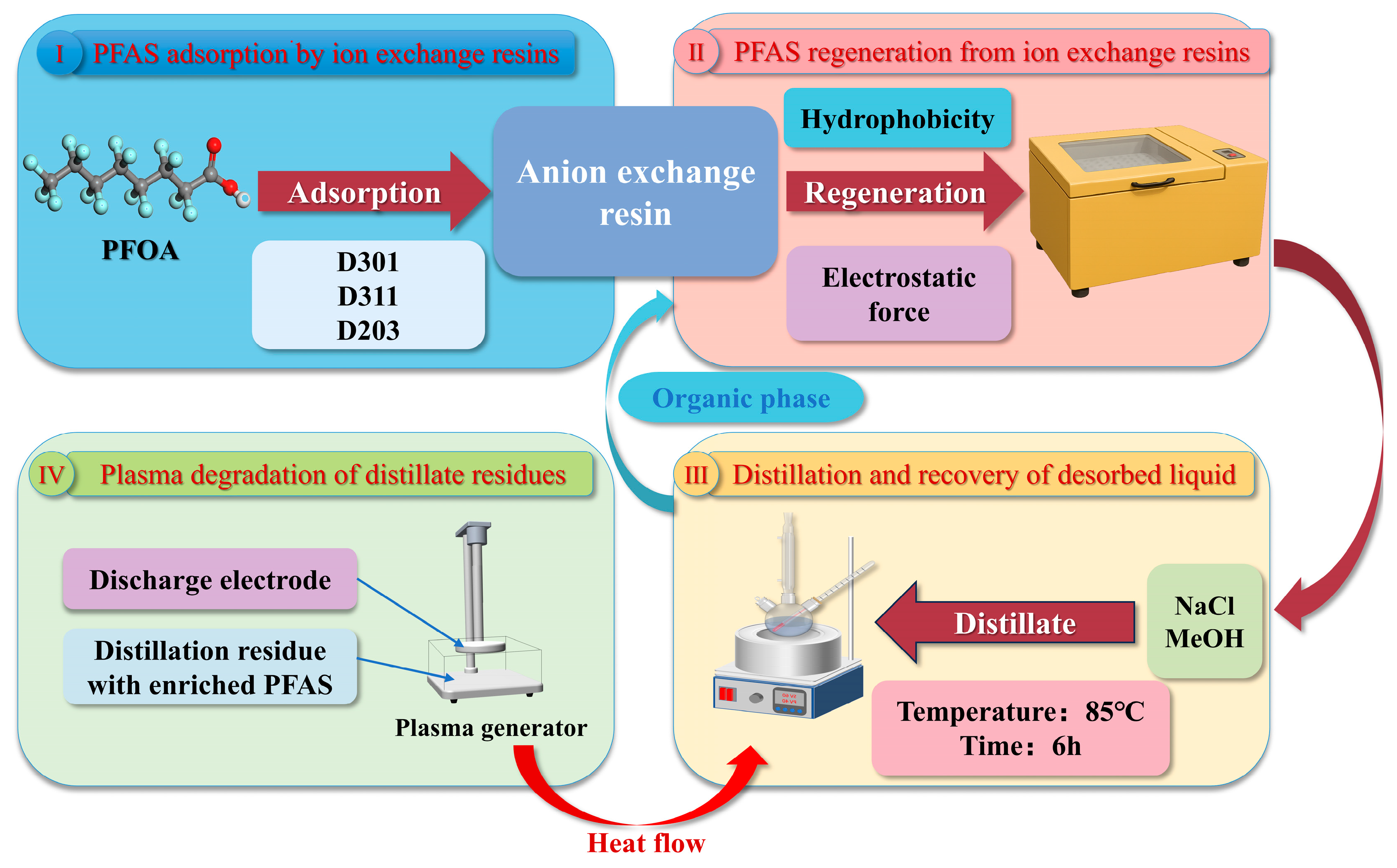
Consequently, a novel integrated adsorption–regeneration–distillation–plasma (ARDP) system was developed to provide a sustainable solution for PFAS remediation (Figure 1). Unlike previous studies [22] that focused on individual treatment units, this work presents a comprehensive closed-loop strategy that minimizes solvent consumption and energy consumption. A key innovation is the realization of ‘waste-heat-to-resource’, where the plasma unit’s thermal byproduct powers the distillation process. In this study, we rigorously evaluated the adsorption kinetics and capacity of three resins (D301, D311, and D203), optimized the solvent-salt regeneration system, and investigated the plasma degradation efficiency in complex concentrated matrices. This integrated approach significantly enhances economic feasibility compared to standalone resin or plasma processes.

2. Materials and Methods

2.1. Chemicals and Reagents

The chemical reagents used in this study included sodium chloride (purity > 99.5%), methanol (purity > 99.7%), phosphoric acid (purity > 85%), sodium carbonate (purity > 98.5%), sodium bicarbonate (purity > 99.5%), and anhydrous sodium dihydrogen phosphate (purity > 99.0%), all of which were purchased from Sinopharm Chemical Reagent Co., Ltd., Shanghai, China.. Perfluorooctanoic acid (PFOA, purity > 96%) was sourced from Aladdin® (Aladdin Industrial Corporation, Shanghai, China). Chromatography-grade acetonitrile (purity > 99.7%) and methanol (chromatographic grade) were supplied by Thermo Fisher Scientific, Waltham, MA, USA. Nylon membrane filters (0.22 μm pore size) were obtained from Tianjin Keyilong Laboratory Equipment Co., Ltd., Tianjin, China. Unless otherwise specified, all reagents were of analytical grade.
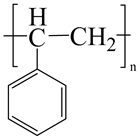
Three types of commercial strong base anion-exchange resins (D301, D311, and D203) were employed for PFOA adsorption. These resins were chosen due to their high adsorption capacity for PFAS compounds with varying chain lengths and functional groups. The pore structure, polymer matrix, and functional group properties of the resins are summarized in Table 1.

2.2. Adsorption Experiments

Prior to conducting adsorption experiments, the anion-exchange resin underwent sequential pretreatment activation, as detailed in Text S1 in the Supplementary Information (SI). During the adsorption treatment, 0.5 g of activated resin was transferred to a conical flask containing 100 mL of 100 mg/L PFOA solution; the initial pH of the PFOA solution was measured to be approximately 3–4 without adjustment, which was agitated in a thermostatic shaker (25 ± 0.5 °C, 200 rpm) for 24 h. Samples (1.0 mL) were collected after 24 h of treatment, which were subjected to PFOA concentration analysis; the detailed quantification method is provided in Text S2. All experiments were performed in triplicate, and data are expressed as mean ± standard deviation. The PFOA removal efficiency (R) and the adsorption capacity (Qe) were calculated separately using the following Equations (1) and (2):
R   %   =   ( C 0 C t ) C 0   ×   100
Qe = C 0 C e   V m
C0 and Ct are the initial concentration and the concentration at time t (mg·L−1), respectively; Qe represents the adsorption capacity of the resin (mg·g−1); V is the solution volume (L); m is the mass of the adsorbent (g); and t is the contact time (min).

2.3. Regeneration Experiments

During the regeneration process, 0.5 g of PFOA-loaded resin was accurately weighed and transferred to a conical flask containing 20 mL of regeneration solution. The flask was placed on a shaker and agitated at 200 rpm for 24 h. After treatment, water samples were collected for PFOA concentration analysis. Regeneration solutions with varying concentrations of methanol and salt were employed in this study. Specifically, the methanol content ranged from 0% to 90%, while the salt concentration varied from 0% to 4%. The measured initial pH of the regeneration solution was approximately 6–7. To ensure reproducibility, all tests were performed in triplicate, and the values are expressed as mean ± standard deviation. The resin regeneration efficiency was calculated using Equation (3):
Regeneration   efficiency   %   =   100   ×   Total   PFAS   desorbed   in   regenerant Total   PFAS   adsorbed   in   resin

2.4. Distillation of Desorbed Liquid

Distillation experiments were conducted to recover methanol from the PFOA-laden regenerant (composed of methanol, NaCl, and desorbed PFOA) obtained from the regeneration unit. As illustrated in Figure S1, a custom-assembled setup was employed, consisting of a 500 mL round-bottom flask, a coil condenser, and a water bath. The distillation was carried out at 85 °C for 6 h. Upon completion, samples were collected from the still-bottom residues for PFOA concentration analysis. Data represent the mean ± standard deviation of three independent determinations.

2.5. Plasma Degradation Experiment

The concentrated distillation residue (still-bottoms enriched with PFOA) collected after solvent recovery was treated by dielectric barrier discharge (DBD) plasma, and the schematic diagram thereof is shown in Figure S2. The distillation residue (200 mL) was introduced into the reactor, and solution mixing was performed using a peristaltic pump. A flat stainless-steel plate with a diameter of 10 cm was used as the plasma electrode. Plasma was generated using air by applying a pulsed high voltage connected to the plasma electrode covering a quartz glass plate, and a ground electrode. A working voltage of 30 kV and a pulsed frequency of 0.1 kHz were used, resulting in a mean current of 50 mA. The plasma degradation treatment was conducted for 50 min, and the samples were collected every 10 min, which were subjected to PFOA and fluoride ion (F) analysis. Each experiment was carried out in three independent replicates, with data reported as the mean ± standard deviation.

3. Results and Discussion

3.1. Adsorption Performance of Anion-Exchange Resins

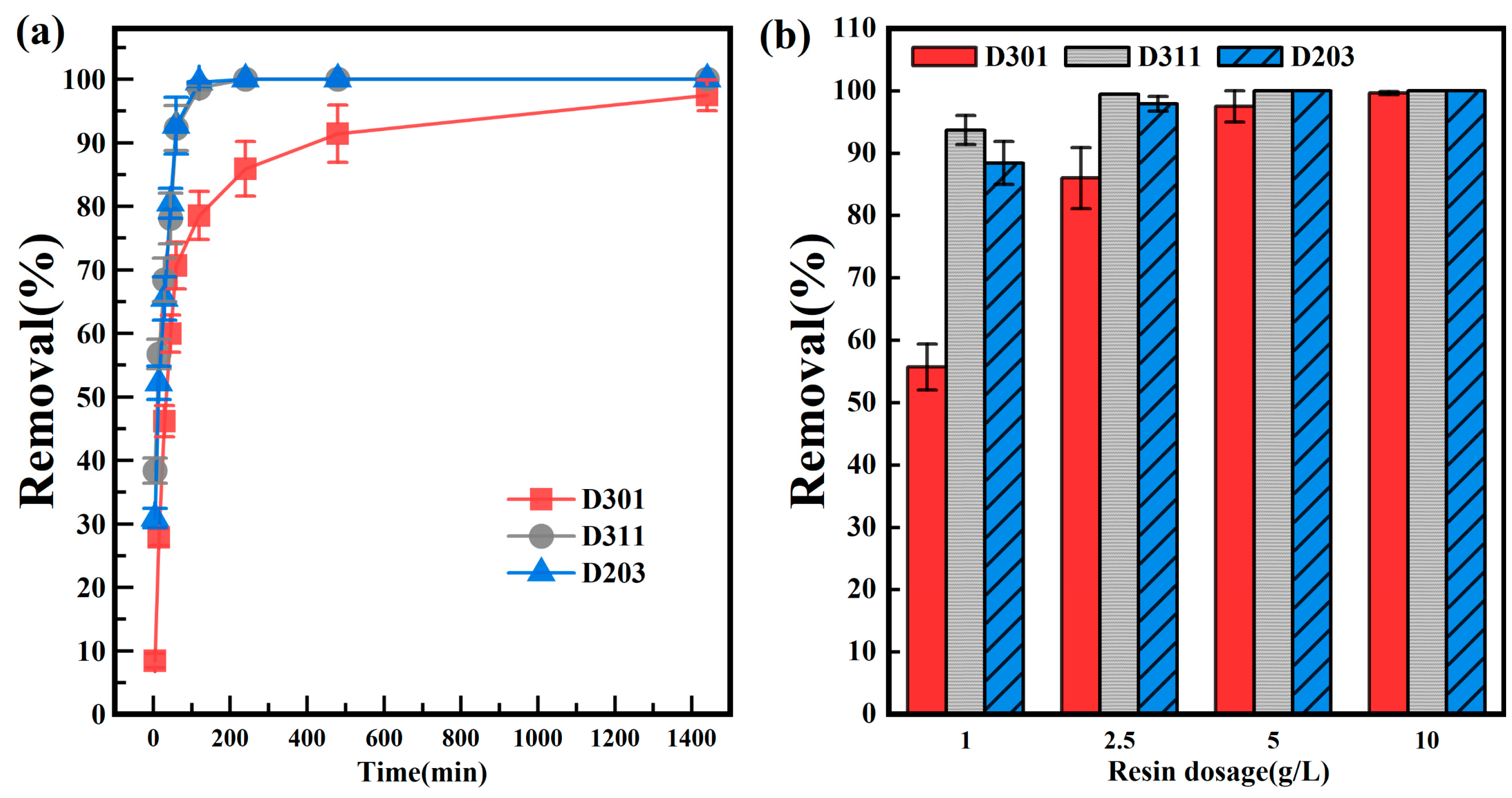
The adsorption kinetic analysis indicated that D203 and D311 exhibited significantly faster adsorption rates for PFOA compared to D301 (Figure 2a). Specifically, D203 and D311 reached adsorption equilibrium within 2 h, whereas D301 required up to 8 h. Although all three resins possess macroporous structures, their pore size distributions vary substantially: D301 (20–200 nm), D311 (150–500 nm), and D203 (100–500 nm). The slower kinetics observed for D301 can be attributed to the size exclusion effect, where smaller pores hinder the mass transfer of PFOA, in contrast to the more accessible pore structures of D311 and D203 [23]. This trend aligns with the findings of Park et al. (2020), who reported superior PFAS adsorption performance of macroporous activated carbon over microporous variants, underscoring the importance of pore structure in the PFAS adsorption efficiency of AERs [24].
As shown in Figure 2b, all three resins achieved complete PFOA removal (100%) within 24 h at an initial PFOA concentration of 100 mg/L and a resin dosage of 5 g/L. However, when the dosage was reduced to 1 g/L, the removal efficiencies of D301, D203, and D311 decreased to 56%, 88%, and 93%, respectively. These results indicate that D311 exhibits superior adsorption capacity, followed by D203 and D301 (Figure 2b). The performance decline of D301 at lower dosages can be attributed to its relatively low ion exchange capacity (≥1.4 mmol/mL), compared to D203 (≥1.6 mmol/mL) and D311 (≥2.3 mmol/mL), which demonstrated better adsorption efficiency under the same conditions. These results align with the conclusions of Ren et al. [25], who emphasized that anion-exchange resins with both macroporous structures and high ion exchange capacities are more effective for long-chain PFAS removal. Therefore, resins with higher exchange capacities, such as D311, are more favorable for practical applications due to their superior adsorption performance.
Future work should consider the adsorption isotherm to determine the saturation capacity of D311. In practice, adsorption will plateau once the resin’s exchange sites become occupied. Factors such as influent PFAS concentration, co-existing anions, or natural organic matter can lower the effective capacity [11]. For instance, coexisting fulvic acid and common inorganic anions have been shown to significantly reduce PFAS uptake on ion-exchange resins [11]. However, D311’s strongly hydrophobic, macroporous structure and high exchange capacity help maintain a high affinity for PFAS, minimizing such interference. Characterizing the maximum adsorption capacity (e.g., via isotherms or breakthrough tests) and its dependence on water chemistry would clarify this adsorption bottleneck.

3.2. Regeneration Behavior of Anion-Exchange Resins

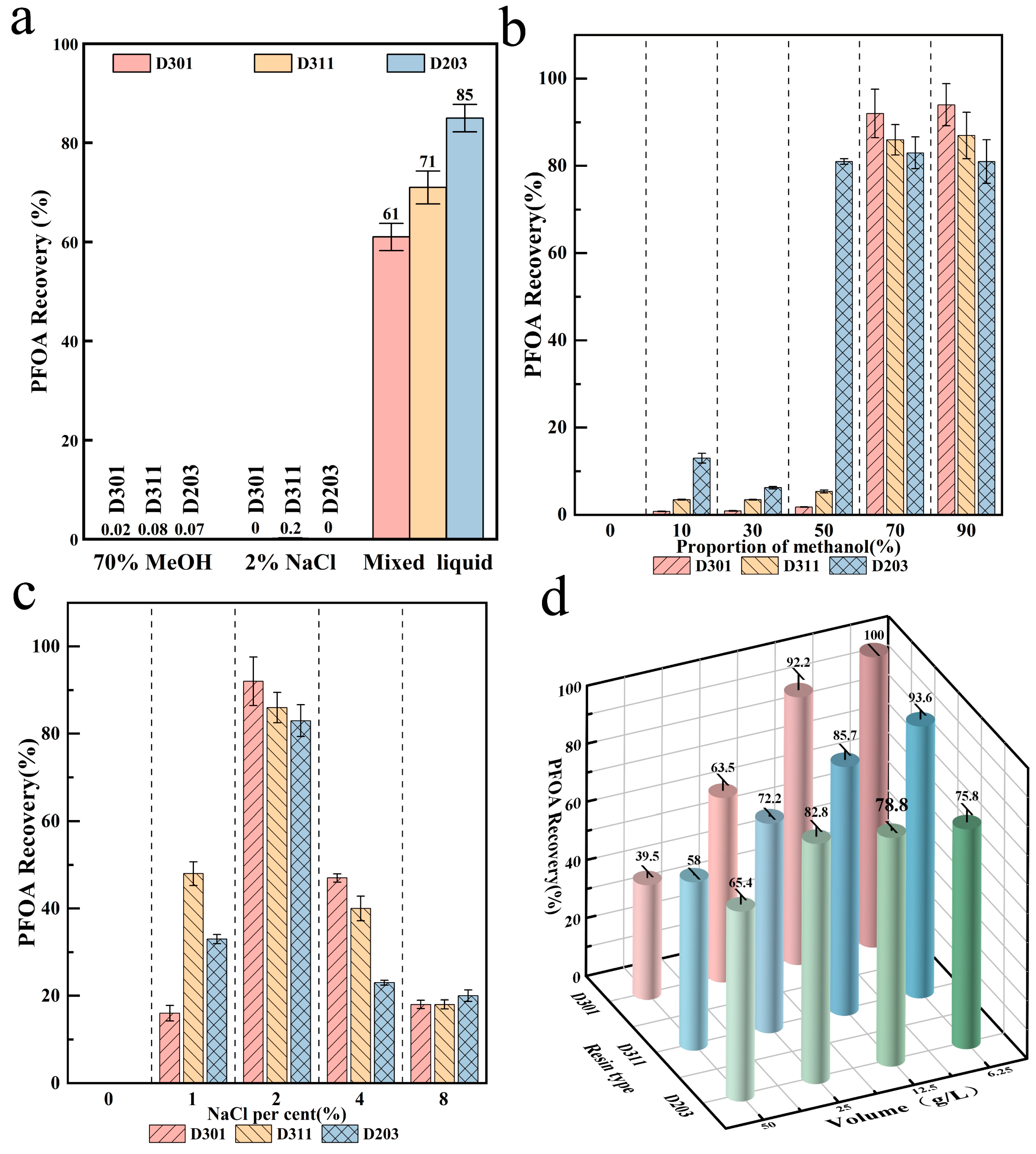
Figure 3 illustrates the regeneration performance of three anion-exchange resins (D301, D311, and D203) under various conditions for PFOA desorption. When single-component desorption solutions were applied, all three resins exhibited extremely low regeneration efficiencies, with PFOA recovery rates below 0.2%. In contrast, the combination of 70% methanol and 2% NaCl significantly enhanced desorption performance, raising the regeneration efficiencies of D301, D311, and D203 to 61%, 71%, and 85%, respectively (Figure 3a). To further optimize the regeneration conditions, this study systematically evaluated the effects of methanol and NaCl concentrations in mixed solutions on PFOA desorption (Figure 3b,c). When the methanol content was below 50%, the regeneration efficiencies of all three resins remained under 15%, suggesting that hydrophobic interactions between the resin matrix and PFOA could not be effectively disrupted under high dielectric constant conditions [26]. At 50% methanol, the regeneration efficiency of D203 increased sharply to 80.5%, while D301 and D311 remained below 6%. This indicates that methanol at this concentration partially disrupted hydrophobic interactions, and the permanently charged quaternary ammonium groups in D203 allowed Cl to compete for high-affinity binding sites [27]. In contrast, the tertiary amine-based D301 and D311 exhibited poor regeneration due to limited protonation and low ion-exchange activity [28]. The abrupt increase in D203’s desorption efficiency also reflects a critical threshold at which synergistic effects between hydrophobic disruption and anion-exchange competition become evident. When the methanol concentration was further increased to 70%, the regeneration efficiencies of D301 and D311 surged to 92% and 86%, respectively, while D203 slightly increased to 83%. At this stage, the high methanol content not only fully disrupted hydrophobic adsorption but also protonated tertiary amine groups into –NH+ under mildly acidic conditions, activating ion-exchange sites [29]. Furthermore, the methyl acrylate matrix of D311 caused weaker pore swelling than the styrene-based matrix of D301, leading to a smaller increase in regeneration efficiency [30]. Increasing methanol concentration to 90% resulted in no significant improvement for any resin [31], indicating a plateau effect, where most hydrophobic adsorption was already eliminated, leaving only a few high-affinity sites [32]. NaCl concentration also influenced regeneration in a non-monotonic pattern. The highest efficiencies were observed at 2% NaCl (D301: 92%; D311: 86%; D203: 83%), followed by clear declines at 4% and 8% (Figure 3c). This trend may result from the interplay between ion exchange and salting-out effects. Low Cl concentrations were insufficient to displace PFOA, while high Cl levels promoted salting-out [33], reducing PFOA solubility and driving re-adsorption onto the resin surface via hydrophobic interactions [34]. Simultaneously, high salt concentrations may have shielded positive charges on the resin, suppressing ion exchange [35], and possibly reduced resin swelling, thus increasing mass transfer resistance [36].
In addition, the mass-to-liquid ratio significantly affected regeneration efficiency (Figure 3d). When the ratio was reduced from 50 g/L to 6.25 g/L, the regeneration efficiency of D301 increased significantly from 39.5% to 100%, and that of D311 increased from 58% to 93.6%. D203 reached a maximum of 82.8% at 25 g/L, followed by a decline at lower ratios. For PFOA-saturated resins, a lower mass-to-liquid ratio provides more Cl and MeOH molecules [37], enhancing the thermodynamic driving force of desorption [38]. The hydrophobic polystyrene matrix of D301 requires sufficient methanol to wet the pores and promote PFOA diffusion, explaining its sharp increase in regeneration efficiency [39]. In contrast, D203 showed a decrease in regeneration below 12.5 g/L, likely due to insufficient Cl- chemical potential and partial re-establishment of hydrophobic interactions [40]. The regeneration efficiency of D311 plateaued at 12.5 g/L (reaching ~85.7%), suggesting that mass transfer equilibrium had been reached due to its more hydrophilic matrix [30]. Although reducing the ratio to 6.25 g/L further increased efficiency to near 100%, it required doubling the solvent volume. This indicates that 12.5 g/L represents a critical trade-off point between regeneration efficiency and solvent consumption.
Based on the above findings, the combined use of methanol and NaCl has been shown to be the optimal solution for regenerating AERs, achieving outstanding regeneration efficiencies of up to 93.6% and 100% for D311 and D301, respectively, under the optimized conditions. Therefore, D311 can be considered the most suitable AER for PFOA treatment, as it has demonstrated excellent performance in both adsorption and regeneration processes.
It should be noted that each regeneration cycle in this study employed a 24 h contact time, which may be relatively long for practical applications. Previous studies have demonstrated that efficient PFAS desorption can be achieved with substantially shorter regeneration protocols (e.g., approximately 10 bed volumes of 70% methanol brine) [10], indicating that regeneration time is not an inherent limitation but can be optimized through process design.
Beyond regeneration duration, the long-term feasibility of D311 is closely associated with its stability and resistance to fouling during repeated adsorption–regeneration cycles. In real wastewater matrices, fouling typically arises from suspended solids and the competitive adsorption of natural organic matter (NOM). Nevertheless, D311 exhibits strong selectivity toward PFAS, resulting from the synergistic effects of electrostatic interactions and hydrophobic matching, which helps mitigate interference from co-existing ions and organic constituents. Moreover, the macroporous structure of D311 (150–500 nm) facilitates the diffusion and removal of large organic foulants during regeneration, while its hydrophilic methyl polyacrylate backbone provides superior resistance to organic fouling compared with conventional polystyrene-based resins. These inherent material properties, combined with the high regeneration efficiency (>93.6%) achieved in this study, serve as preliminary experimental evidence of the resin’s cyclic stability. Although continuous adsorption–regeneration cyclic experiments (e.g., 3–5 cycles) were not conducted in the current phase, the near-complete desorption implies that the active sites of D311 are effectively restored, minimizing the accumulation of residual adsorbates (heel effect) that typically compromises long-term capacity. Consequently, D311 is expected to maintain stable performance in sequential operations. Validation of long-term stability in continuous flow systems is recognized as a limitation of the current work and will be the primary focus of our future pilot-scale investigations.

3.3. Distillation Performance

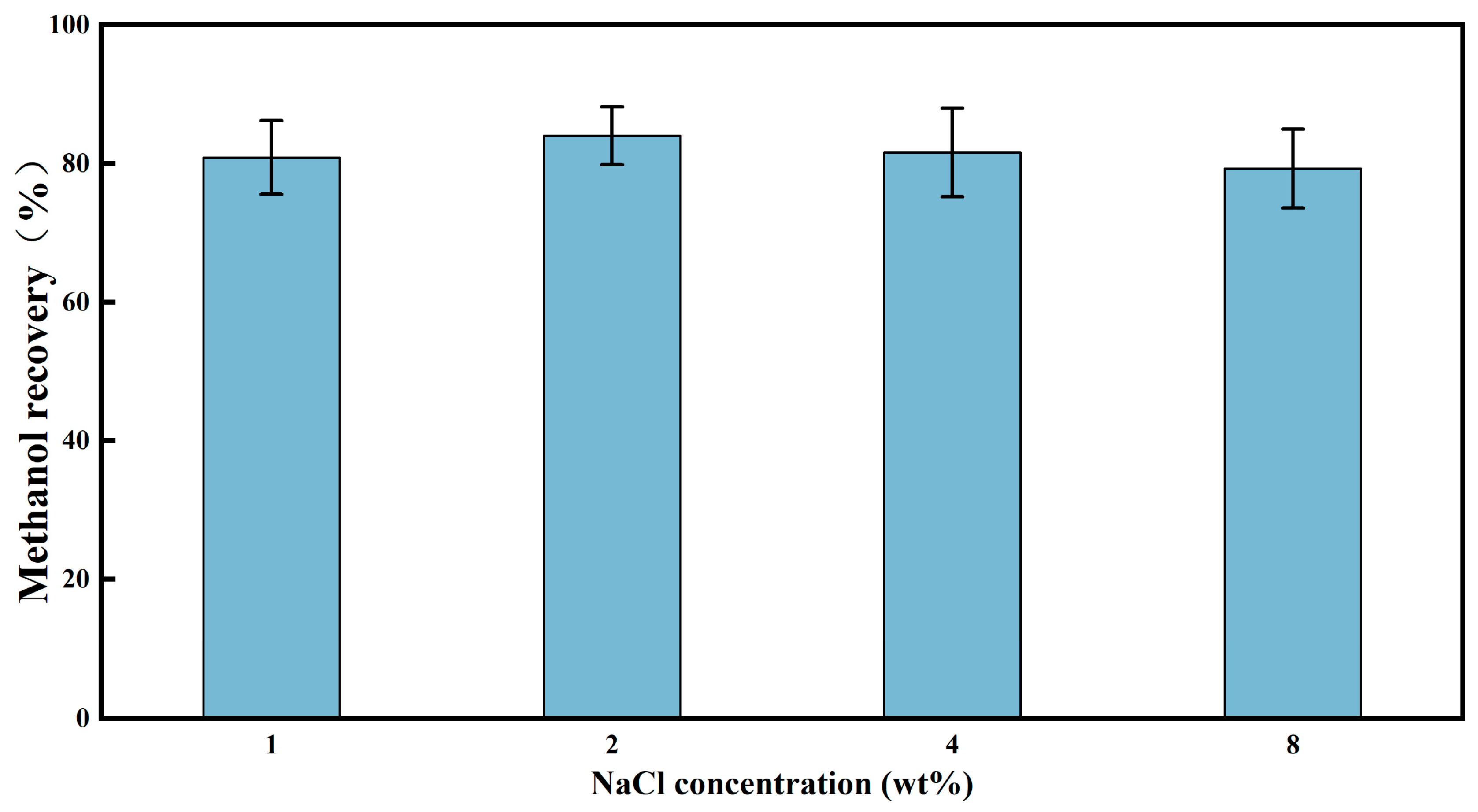
Distillation of the PFOA-laden regenerant effectively removed methanol—recovered in the condensate—and concentrated PFOA in the still-bottom residue for subsequent plasma treatment. Post-distillation analysis indicated that the methanol recovery rate was approximately 80%, and that NaCl concentration had a negligible influence on the distillation process (Figure 4). This is likely due to the low NaCl concentrations (1–8%) used in the regeneration solutions, which exert a minimal impact on boiling behavior and phase separation during distillation [41].
In addition, the PFOA concentrations in the condensate were below the detection limit, while concentrations in the distillation residue increased as the methanol content decreased (Table 2). This indicates that the vast majority of PFOA remained in the still-bottom fraction, which is consistent with its low volatility [40]. The concentration factors for PFOA during distillation ranged from 2.1 to 2.7. Although approximately 20% of methanol is lost during each distillation cycle, potentially posing minor risks to air and water quality, these risks can be effectively mitigated through further optimization of the closed distillation system, enhanced condensation and solvent recovery units, adequate ventilation, and regular system monitoring. Addressing these aspects also represents an important direction for future investigation in this study.

3.4. Plasma Degradation of Distillation Residues

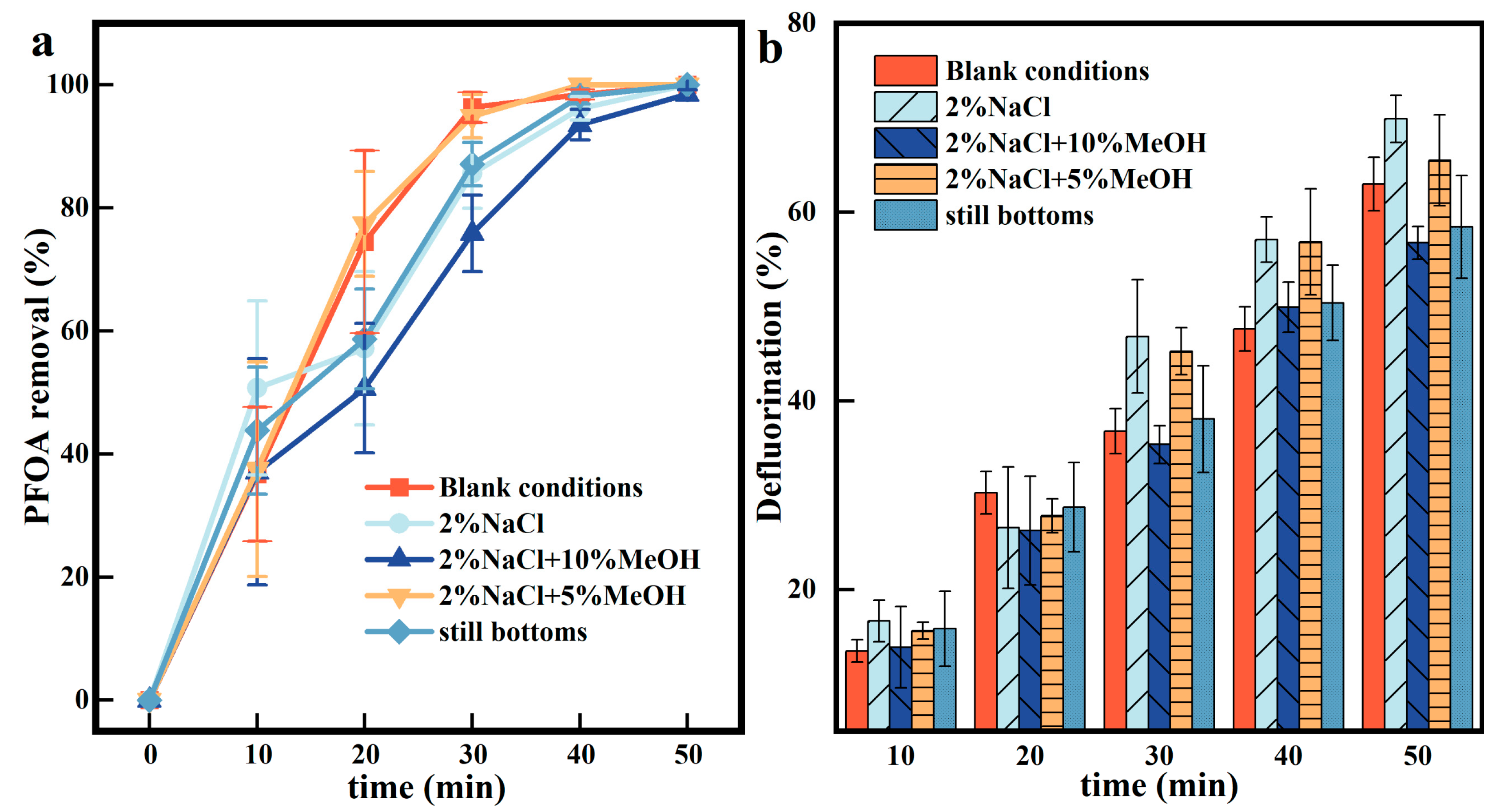
The concentrated distillation residues (still-bottoms enriched with PFOA) collected after solvent recovery were treated by dielectric barrier discharge (DBD) plasma. Based on the mass balance and evaporation rates observed in the distillation unit, these still-bottoms are characterized as a high-strength brine/organic matrix. To evaluate the influence of different solution components on plasma degradation performance, three simulated systems were prepared: (1) blank solution, (2) 2% NaCl single-component system, and (3) 2% NaCl + 10% MeOH dual-component system. The degradation efficiency of perfluorooctanoic acid (PFOA) and the corresponding defluorination rate were monitored throughout the treatment.
In the blank system, PFOA degradation efficiency increased rapidly from 0% to 96% within the first 30 min, followed by a slower phase that reached complete degradation (100%) at 50 min. The defluorination rate steadily increased over time, reaching 62% at 50 min. In the 2% NaCl single-component system, the PFOA degradation profile was nearly identical to that of the blank system, while the defluorination rate increased slightly to 69%. In contrast, in the 2% NaCl + 10% MeOH system, PFOA was also completely degraded by 50 min treatment; however, the defluorination rate was around 56%. A similar degradation trend was observed in actual distillation residues, with a final defluorination rate of approximately 60% (Figure 5).
The PFOA degradation process followed a biphasic kinetic pattern, consisting of an initial rapid phase (0–30 min) followed by a plateau phase (30–50 min). This behavior corresponds to a dynamic equilibrium between the generation and consumption of reactive species. In the early stage, the high concentration of PFOA and abundance of radicals facilitated rapid degradation. However, as intermediates accumulated, they began to compete for reactive species, leading to a decrease in the degradation rate [42]. Despite complete PFOA degradation after 50 min of plasma treatment, the defluorination rate remained limited to 50–70%, indicating incomplete mineralization and the formation of intermediates with intact C–F bonds (e.g., short-chain perfluoro carboxylic acids, PFCAs). To validate this hypothesis, the distribution of fluorinated intermediates was characterized via LC–MS/MS. As illustrated in Figure S4 (Supporting Information), four major short-chain perfluorocarboxylic acids (sc-PFCAs)—perfluoroheptanoic acid (PFHpA, C7), perfluorohexanoic acid (PFHxA, C6), perfluoropentanoic acid (PFPeA, C5), and perfluorobutanoic acid (PFBA, C4)—were identified in the treated solution. These findings confirm that PFOA degradation follows a stepwise chain-shortening pathway (C8 → C7 → … → C4). The C–F bonds within these short-chain intermediates exhibit high resistance to oxidative radical attack, creating a significant kinetic bottleneck. Consequently, the accumulation of C4–C7 species indicates that their subsequent mineralization is the rate-determining step, thereby limiting the final defluorination efficiency to approximately 69%. This recalcitrance is attributed to two primary mechanisms. The dominant factor is the ‘hydrophobic effect’ governing gas–liquid plasma interactions. PFOA (C8), acting as a strong surfactant, preferentially accumulates at the gas–liquid interface where the density of reactive species (e.g., high-energy electrons, •OH) is maximal [43]. Conversely, as the chain length decreases (e.g., to PFBA), the molecules become more hydrophilic and soluble, migrating from the active interface into the bulk solution, thereby evading plasma attack [44]. Secondly, regarding molecular stability, although the C–F bond energy remains high (~485 kJ/mol), the shortening of the carbon chain alters the electron density distribution (inductive effect), rendering short-chain PFCAs less susceptible to electrophilic radical attack compared to the parent PFOA [45]. Therefore, the discrepancy between 100% PFOA degradation and ~69% defluorination corresponds to the mass accumulation of these stable, soluble short-chain intermediates. The accumulation of such intermediates likely hindered PFOA degradation by competing for reactive species, as evidenced by the slowed degradation rate after 30 min [46].
Notably, although all systems achieved 100% PFOA degradation at 50 min, defluorination efficiencies varied significantly. In the 2% NaCl system, the enhanced defluorination may be attributed to two mechanisms: (1) increased solution conductivity due to NaCl, which expanded the plasma discharge region and improved defluorination efficiency [47], and (2) Na+-induced salting-out effects [48], which enriched PFOA and its intermediates at plasma-active interfaces [49]. (3) Reactive chlorine species (e.g., •Cl and •Cl2) generated from NaCl facilitate C–F bond cleavage in saline plasma systems, a hypothesis that was experimentally validated by Song et al. using ESR analysis [50]. In contrast, reduced defluorination in methanol-containing systems may be explained by the radical-scavenging behavior of methanol, particularly its interaction with •OH radicals, thereby lowering the availability of reactive species for PFOA degradation [51]. Consequently, the high organic load in the still-bottoms creates a competitive environment where reactive species are diverted toward the oxidation of the solvent rather than the deep mineralization of PFOA. To further examine the effect of methanol concentration, two additional simulated systems were tested: 2% NaCl + 10% MeOH and 2% NaCl + 5% MeOH. Experimental results showed that the 10% MeOH system achieved 99% PFOA degradation and 56% defluorination at 50 min, whereas the 5% MeOH system achieved complete degradation by 40 min and reached a defluorination rate of 65% at 50 min. These findings are consistent with previous studies demonstrating that lower methanol concentrations reduce radical-scavenging effects, thereby enhancing defluorination efficiency [52].
We note that the effectiveness of the plasma unit depends on the residence time of the liquid in the discharge. In our batch system, complete PFOA removal required about 50 min, after which further treatment yielded only marginal defluorination. This plateau suggests diminishing returns beyond that duration. Non-thermal plasma processes often suffer from limited residence time and mass transfer, which can constrain degradation rates [21]. Future reactor designs should ensure adequate contact (for example, through enhanced mixing, film reactors, or higher flow-contact area) or couple plasma with pre-treatment (such as ultrafiltration) to increase effective residence time [20].
It should be acknowledged that this study was conducted using synthetic PFOA solutions to validate the feasibility and mechanism of the ARDP-coupled system. In practical engineering applications, real PFAS-contaminated wastewater typically contains complex co-existing constituents, such as natural organic matter (NOM) and competing inorganic anions (e.g., SO42−, NO3), which may compete for adsorption sites or scavenge reactive species during plasma treatment. Therefore, the performance data reported herein represent an optimized scenario. While the high selectivity of the D311 resin provides a degree of resistance to interference, verification of the process efficacy using authentic industrial wastewater at the pilot scale remains a critical necessity. Future work will focus on assessing the impact of these complex matrices on the long-term stability and engineering practicability of the ARDP system.

3.5. Mass and Energy Consumption Analysis of ARDP

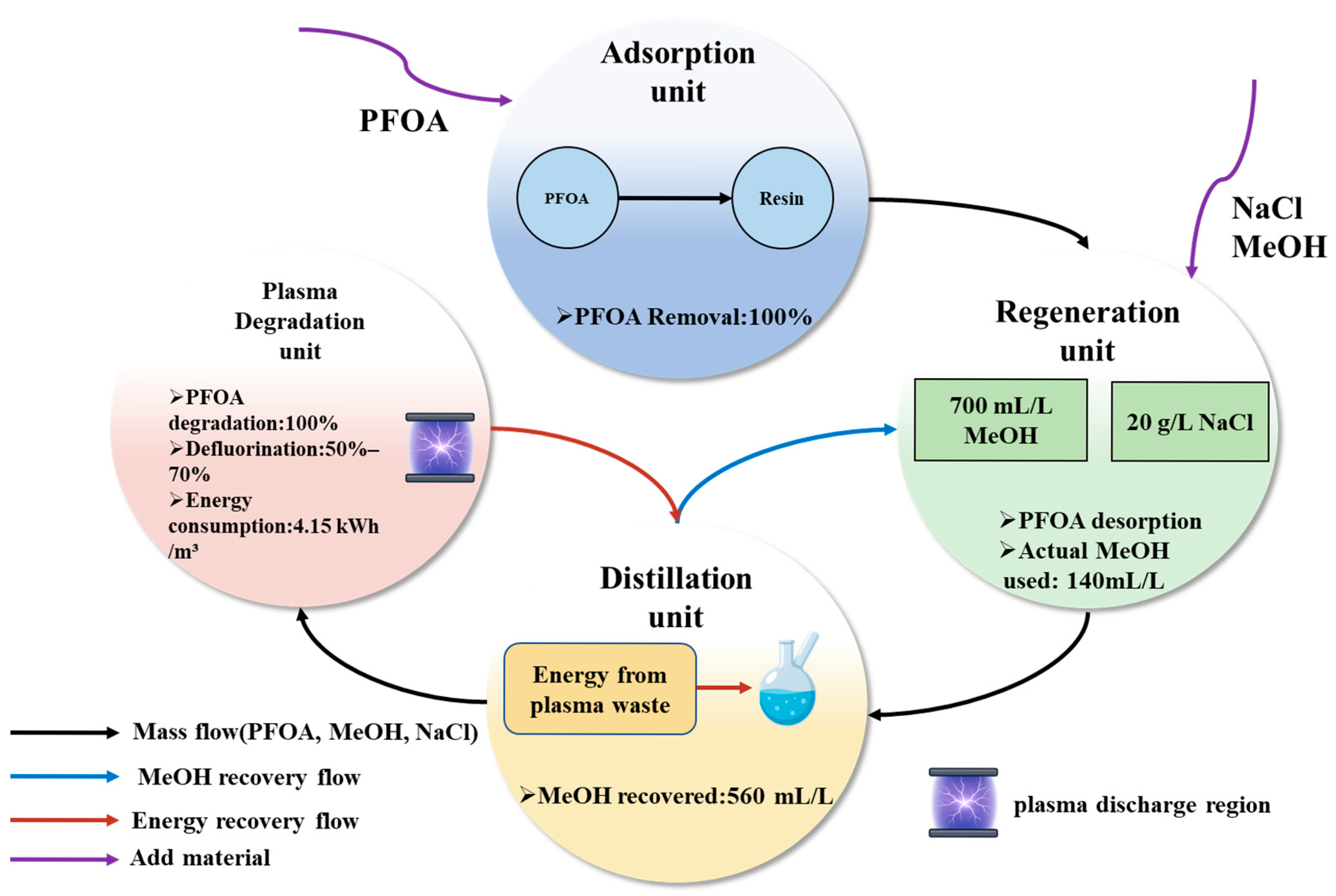
This study systematically evaluated the mass and energy flows throughout the ARDP process. As summarized in Figure 6, the adsorption unit achieved 100% PFOA removal from the aqueous phase.
In the regeneration unit, a solution containing 700 mL/L methanol (MeOH) and 20 g/L NaCl was used. A solid-to-liquid ratio of 12.5 g/L was selected as the key operational parameter. Although a lower ratio (6.25 g/L) could theoretically achieve near-complete regeneration (~100%), it would double the solvent consumption. To balance regeneration performance with chemical costs, the system was operated at 12.5 g/L, achieving a robust PFOA recovery of 85.7%.
Subsequently, the PFOA-laden regenerant was processed in the distillation unit. This step recovered 560 mL/L of methanol, reducing the net methanol consumption to only 140 mL/L per cycle. While NaCl was not recovered in the distillate, it was retained in the residue, allowing for potential reuse in the system. Finally, the plasma unit treated the PFOA-enriched distillation residue (200 mL per batch), achieving complete (100%) degradation of the desorbed PFOA with an electrical energy consumption of 0.83 kWh (corresponding to 4.15 kWh/m3). Significantly, the thermal energy required for distillation (~0.0076 kWh per 100 mL) was entirely derived from waste heat generated by the plasma system, enabling solvent recovery with negligible additional energy input. Regarding economic feasibility, the operational cost of the ARDP process (0.498 USD/m3) was calculated based on the plasma unit’s energy consumption (4.15 kWh/m3 × 0.10 USD/kWh) and reagent replenishment. Driven by the high solvent recovery efficiency (~80%), chemical costs were minimized to approximately 0.065 USD/m3 for methanol and 0.018 USD/m3 for NaCl.
Furthermore, regarding the energy boundary of this study, the reported analysis primarily accounts for the energy consumption of the core plasma unit and the thermal integration of the distillation process. The operational energy consumption of auxiliary laboratory equipment (e.g., peristaltic pumps and magnetic stirrers) was not included, as these devices typically exhibit disproportionately low energy efficiency at the bench scale compared to industrial applications. For actual engineering implementation, the overall system energy efficiency can be further optimized by adopting high-efficiency hydraulic pumps, optimizing reactor geometry to reduce mixing energy demands, and implementing advanced process control (APC) systems to coordinate unit operations.
Moreover, the ARDP process demonstrates markedly lower energy consumption and operational costs compared to conventional incineration (>90 kWh/m3) [53] or electrochemical oxidation (9.4–10.8 kWh/m3) [29], as well as standalone adsorption–incineration (10.8–29 USD/m3) [54] or electrochemical oxidation (1.128–1.296 USD/m3) [55], without incurring additional expenses (Table 3). In comparison, several recently reported integrated PFAS treatment trains, such as nanofiltration coupled with UV–sulfite oxidation (EE/O ≤ 13.1 kWh/m3 for PFCAs) [56] and electrochemical desulfonation followed by alkaline mineralization [57], generally require higher electrical energy input and/or involve more complex operational configurations, which may pose challenges for large-scale implementation. By contrast, the ARDP system benefits from solvent recycling and closed-loop operation, contributing to reduced overall energy demand and operational costs (Table 3).
Therefore, the closed-loop “adsorption–regeneration–distillation–plasma degradation” design offers an innovative and energy-efficient pathway for PFAS remediation with low operational cost and minimal energy consumption.

4. Conclusions

In this study, an integrated adsorption–regeneration–distillation–plasma (ARDP) process was developed for the effective treatment of perfluorooctanoic acid (PFOA), a representative member of persistent and toxic per- and polyfluoroalkyl substances (PFAS). Among the three tested anion-exchange resins (AERs), D311, characterized by a macroporous structure and a methyl polyacrylate backbone polymer, exhibited the best overall performance, featuring rapid adsorption kinetics and a theoretical adsorption capacity of approximately 20 mg/g. While this study utilized a high inlet concentration (100 mg/L) to delineate kinetic mechanisms, the robust removal efficiency confirms the system’s suitability for remediating high-strength industrial wastewaters (e.g., electroplating effluents or AFFF concentrates). Additionally, D311 demonstrated excellent regeneration efficiency when regenerated using a mixed methanol and NaCl solution.
The distillation step effectively concentrated PFOA in the still-bottom residue while recovering approximately 80% of the methanol. This process was further enhanced by utilizing waste heat from the plasma system, resulting in nearly zero additional thermal energy input. The plasma degradation unit achieved complete (100%) PFOA degradation and a defluorination rate of up to 69%, depending on the composition of the aqueous matrix. Notably, the presence of NaCl enhanced defluorination efficiency, whereas methanol inhibited defluorination due to its radical-scavenging effect.
Overall, the ARDP system demonstrated a closed-loop capability with a regeneration efficiency of 85.7% under economically optimized conditions, minimal chemical consumption, low energy demand (with a specific energy input of approximately 4.15 kWh/m3 for plasma treatment), and effective solvent reuse, thereby providing a sustainable and practical strategy for PFAS remediation. This work not only addresses the challenges associated with AER regeneration and the treatment of concentrated PFAS streams but also offers a scalable and environmentally friendly alternative for managing PFAS-contaminated water. Future work will prioritize validating the long-term performance of the ARDP system using actual PFAS-contaminated wastewater to rigorously evaluate its robustness against co-existing contaminants, alongside enhancing defluorination efficiency through catalyst-assisted plasma processes.

Supplementary Materials

The following supporting information can be downloaded at: https://www.mdpi.com/article/10.3390/pr14040665/s1, Text S1: Resin activation treatment; Text S2: HPLC Method for the Determination of PFOA; Figure S1: (a) Schematic diagram of distillation unit (distillation time 6 h, distillation temperature 85 °C). (b) Schematic diagram of distillation unit; Figure S2: (a) Schematic diagram of the plasma unit (volume of treated solution = 200 mL, operating voltage = 30 kV, pulse frequency = 0.1 kHz, average current = 50 mA). (b) Physical diagram of plasma device; Figure S3: Resin Adsorption Capacity (mg·g−1) as a Function of Contact Time for Resins D301, D311, and D203 (resin dose: 5 g/L, solution volume: 100 mL, PFOA concentration: 100 mg/L, contact time: 24 h, temperature: 25 °C, no PH adjustment); Figure S4: Selected ion chromatograms (SIC) identifying PFOA and its short-chain degradation intermediates (PFHpA, PFHxA, PFPeA, and PFBA) in the distillation residue detected by LC-MS/MS.

Author Contributions

Z.W.: conceptualization, investigation, data curation, visualization, writing—original draft, writing—reviesw and editing; N.K.: investigation, data curation, visualization, writing—review and editing; Y.Y.: funding acquisition, writing—review and editing; D.R.: writing—review and editing. All authors have read and agreed to the published version of the manuscript.

Funding

This work was funded by the Natural Science Foundation of Hubei Province (Grant No. 2024AFB764) and the China Postdoctoral Science Foundation Funded Project (Project No. 2023M742719).

Data Availability Statement

The raw data supporting the conclusions of this article will be made available by the authors upon request.

Acknowledgments

The authors would like to thank all colleagues who provided technical assistance.

Conflicts of Interest

The authors declare that they have no known competing financial interests or personal relationships that could have appeared to influence the work reported in this paper.

Abbreviations

The following abbreviations are used in this manuscript:
AERAnion-Exchange Resin
PFASPer- and Polyfluoroalkyl Substances
PFOAPerfluorooctanoic Acid
ARDPAdsorption–Regeneration–Distillation–Plasma

References

  1. Gaines, L.G.T. Historical and current usage of per- and polyfluoroalkyl substances (PFAS): A literature review. Am. J. Ind. Med. 2023, 66, 353–378. [Google Scholar] [CrossRef] [Scilit]
  2. Buck, R.C.; Franklin, J.; Berger, U.; Conder, J.M.; Cousins, I.T.; de Voogt, P.; Jensen, A.A.; Kannan, K.; Mabury, S.A.; van Leeuwen, S.P.J. Perfluoroalkyl and polyfluoroalkyl substances in the environment: Terminology, classification, and origins. Integr. Environ. Assess. Manag. 2011, 7, 513–541. [Google Scholar] [CrossRef] [Scilit]
  3. Ragnarsdóttir, O.; Abdallah, M.A.-E.; Harrad, S. Dermal uptake: An important pathway of human exposure to perfluoroalkyl substances. Environ. Pollut. 2022, 307, 119478. [Google Scholar] [CrossRef] [Scilit] [PubMed]
  4. Bayode, A.A.; Emmanuel, S.S.; Akinyemi, A.O.; Ore, O.T.; Akpotu, S.O.; Koko, D.T.; Momodu, D.E.; López-Maldonado, E.A. Innovative techniques for combating a common enemy forever chemicals: A comprehensive approach to mitigating per- and polyfluoroalkyl substances (PFAS) contamination. Environ. Res. 2024, 261, 119719. [Google Scholar] [CrossRef] [Scilit] [PubMed]
  5. eBioMedicine. Forever chemicals: The persistent effects of perfluoroalkyl and polyfluoroalkyl substances on human health. EBioMedicine 2023, 95, 104806. [Google Scholar] [CrossRef] [Scilit] [PubMed]
  6. Zheng, J.; Liu, S.; Yang, J.; Zheng, S.; Sun, B. Per- and polyfluoroalkyl substances (PFAS) and cancer: Detection methodologies, epidemiological insights, potential carcinogenic mechanisms, and future perspectives. Sci. Total Environ. 2024, 953, 176158. [Google Scholar] [CrossRef] [Scilit]
  7. Bilela, L.L.; Matijošytė, I.; Krutkevičius, J.; Alexandrino, D.A.M.; Safarik, I.; Burlakovs, J.; Gaudêncio, S.P.; Carvalho, M.F. Impact of per- and polyfluorinated alkyl substances (PFAS) on the marine environment: Raising awareness, challenges, legislation, and mitigation approaches under the One Health concept. Mar. Pollut. Bull. 2023, 194, 115309. [Google Scholar] [CrossRef] [Scilit]
  8. ECHA. ECHA Publishes PFAS Restriction Proposal. 2023. Available online: https://echa.europa.eu/-/echa-publishes-pfas-restriction-proposal (accessed on 6 June 2025).
  9. IARC Working Group on the Identification of Carcinogenic Hazards to Humans. Exposure Characterization. In Occupational Exposure as a Firefighter; International Agency for Research on Cancer: Lyon, France, 2023. [Google Scholar]
  10. Liu, B.; Liu, Y.-L.; Sun, M. Remove legacy perfluoroalkyl acids and emerging per- and polyfluoroalkyl ether acids by single-use and regenerable anion exchange resins: Rapid small-scale column tests and model fits. Water Res. 2024, 257, 121661. [Google Scholar] [CrossRef] [Scilit]
  11. Lei, X.; Lian, Q.; Zhang, X.; Karsili, T.K.; Holmes, W.; Chen, Y.; Zappi, M.E.; Gang, D.D. A review of PFAS adsorption from aqueous solutions: Current approaches, engineering applications, challenges, and opportunities. Environ. Pollut. 2023, 321, 121138. [Google Scholar] [CrossRef] [Scilit]
  12. Feng, Y.; Du, Y.; Li, S.; Li, L.; Feng, S.; Li, K.; Zhan, M.; Wang, J.; Xu, X.; Lin, P. Emission Characteristics of PCDD/Fs, Heavy Metals, and Nuclides during Incineration of Waste Resins Containing Nuclides. Aerosol Air Qual. Res. 2024, 24, 240001. [Google Scholar] [CrossRef] [Scilit]
  13. Mor, S.; Ravindra, K. Municipal solid waste landfills in lower- and middle-income countries: Environmental impacts, challenges and sustainable management practices. Process Saf. Environ. Prot. 2023, 174, 510–530. [Google Scholar] [CrossRef] [Scilit]
  14. Qu, R.; Liu, J.; Li, C.; Wang, L.; Wang, Z.; Wu, J. Experimental and theoretical insights into the photochemical decomposition of environmentally persistent perfluorocarboxylic acids. Water Res. 2016, 104, 34–43. [Google Scholar] [CrossRef] [Scilit]
  15. Liu, J.; Guo, C.; Wu, N.; Li, C.; Qu, R.; Wang, Z.; Jin, R.; Qiao, Y.; He, Z.; Lu, J.; et al. Efficient photocatalytic degradation of PFOA in N-doped In2O3/simulated sunlight irradiation system and its mechanism. Chem. Eng. J. 2022, 435, 134627. [Google Scholar] [CrossRef] [Scilit]
  16. Teng, X.; Qi, Y.; Guo, R.; Zhang, S.; Wei, J.; Ajarem, J.S.; Maodaa, S.; Allam, A.A.; Wang, Z.; Qu, R. Enhanced electrochemical degradation of perfluorooctanoic acid by ligand-bridged PtII at Pt anodes. J. Hazard. Mater. 2024, 464, 133008. [Google Scholar] [CrossRef] [Scilit] [PubMed]
  17. Gomri, C.; Krzyzanowski, D.; Rivallin, M.; Zaviska, F.; Petit, E.; Semsarilar, M.; Cretin, M. Electrochemical advanced oxidation of PFOA by Ti4O7 reactive electrochemical membrane anode. J. Environ. Chem. Eng. 2024, 12, 113495. [Google Scholar] [CrossRef] [Scilit]
  18. Qian, L.; Kopinke, F.-D.; Scherzer, T.; Griebel, J.; Georgi, A. Enhanced degradation of perfluorooctanoic acid by heat-activated persulfate in the presence of zeolites. Chem. Eng. J. 2022, 429, 132500. [Google Scholar] [CrossRef] [Scilit]
  19. Tamang, S.G.; Umlauf, G.; Barz, J.; Ghomi, M.R. Degradation of PFOA solutions and PFAS-contaminated groundwater using atmospheric non-thermal plasma treatment. Water Pract. Technol. 2024, 19, 2645–2654. [Google Scholar] [CrossRef] [Scilit]
  20. Li, X.; Zhang, S.; Guo, R.; Wei, J.; Wang, Z.; Qu, R. Dual-functionality of Bismuth oxide (Bi2O3): Catalyst and dielectric barrier for efficient PFOS degradation in plasma system. Water Res. 2025, 287, 124459. [Google Scholar] [CrossRef] [Scilit]
  21. Chen, C.; Ma, C.; Yang, X.; Gromov, M.; Tian, Y.; Demeestere, K.; Nikiforov, A.; Van Hulle, S.W.H. Degradation of perfluoroalkyl and polyfluoroalkyl substances (PFAS) in water by use of a nonthermal plasma-ozonation cascade reactor: Role of different pro-cesses and reactive species. Chem. Eng. J. 2024, 486, 150218. [Google Scholar] [CrossRef] [Scilit]
  22. Li, X.; Xiao, X.; Zhang, S.; Teng, X.; Wang, Z.; Qu, R. Self-regenerable zeolite Beta(35) for efficient adsorption and photocatalytic degradation of PFOA under simulated solar irradiation. Water Res. 2025, 288, 124645. [Google Scholar] [CrossRef] [Scilit]
  23. Zenobio, J.E.; Salawu, O.A.; Han, Z.; Adeleye, A.S. Adsorption of per- and polyfluoroalkyl substances (PFAS) to containers. J. Hazard. Mater. Adv. 2022, 7, 100130. [Google Scholar] [CrossRef] [Scilit]
  24. Park, M.; Wu, S.; Lopez, I.J.; Chang, J.Y.; Karanfil, T.; Snyder, S.A. Adsorption of perfluoroalkyl substances (PFAS) in groundwater by granular activated carbons: Roles of hydrophobicity of PFAS and carbon characteristics. Water Res. 2020, 170, 115364. [Google Scholar] [CrossRef] [Scilit]
  25. Ren, Z.; Zhang, R.; Xu, X.; Li, Y.; Wang, N.; Leiviskä, T. Sorption/desorption and degradation of long- and short-chain PFAS by anion exchange resin and UV/sulfite system. Environ. Pollut. 2024, 361, 124847. [Google Scholar] [CrossRef] [Scilit]
  26. Inamdar, A.I.; Pathak, A.; Usman, M.; Chiou, K.-R.; Tsai, P.-H.; Mendiratta, S.; Kamal, S.; Liu, Y.-H.; Chen, J.-W.; Chiang, M.-H.; et al. Highly hydrophobic metal–organic framework for self-protecting gate dielectrics. J. Mater. Chem. A 2020, 8, 11958–11965. [Google Scholar] [CrossRef] [Scilit]
  27. Bureš, F. Quaternary Ammonium Compounds: Simple in Structure, Complex in Application. Top. Curr. Chem. 2019, 377, 14. [Google Scholar] [CrossRef] [Scilit]
  28. Pang, B.; Yu, Y.; Zhang, W. Thermoresponsive Polymers Based on Tertiary Amine Moieties. Macromol. Rapid Commun. 2021, 42, e2100504. [Google Scholar] [CrossRef] [Scilit]
  29. Xu, X.; Li, Y.; Vo, P.; Shukla, P.; Ge, L.; Zhao, C. Electrochemical advanced oxidation of per-and polyfluoroalkyl substances (PFASs): Development, challenges and perspectives. Chem. Eng. J. 2024, 500, 157222. [Google Scholar] [CrossRef] [Scilit]
  30. Kapil, K.; Jazani, A.M.; Sobieski, J.; Madureira, L.P.; Szczepaniak, G.; Martinez, M.R.; Gorczyński, A.; Murata, H.; Kowalewski, T.; Matyjaszewski, K. Hydrophilic Poly(meth)acrylates by Controlled Radical Branching Polymerization: Hyperbranching and Fragmentation. Macromolecules 2024, 57, 5368–5379. [Google Scholar] [CrossRef] [Scilit]
  31. Zeidabadi, F.A.; Esfahani, E.B.; McBeath, S.T.; Mohseni, M. Managing PFAS exhausted Ion-exchange resins through effective regeneration/electrochemical process. Water Res. 2024, 255, 121529. [Google Scholar] [CrossRef] [Scilit]
  32. Kalam, S.; Abu-Khamsin, S.A.; Kamal, M.S.; Patil, S. Surfactant Adsorption Isotherms: A Review. ACS Omega 2021, 6, 32342–32348. [Google Scholar] [CrossRef] [Scilit] [PubMed]
  33. Raynie, D. Enhancing Extractions by Salting Out. LCGC N. Am. 2023, 41, 262–265. [Google Scholar] [CrossRef] [Scilit]
  34. Priya, R.B.; Shadakshara, S.P.; Ajay, P.; Alexander, S.; Jayanti, P. Increased Hydrophobicity and Decreased Backbone Flexibility Explain the Lower Solubility of a Cataract-Linked Mutant of γD-Crystallin. J. Mol. Biol. 2011, 412, 647–659. [Google Scholar] [CrossRef] [Scilit]
  35. Li, R.; Xiong, Y.L. Sensitivity of oat protein solubility to changing ionic strength and pH. J. Food Sci. 2021, 86, 78–85. [Google Scholar] [CrossRef] [Scilit] [PubMed]
  36. Hiendlmeier, L.; Teshima, T.F.; Zurita, F.; Url, H.; Rinklin, P.; Wolfrum, B. A Superabsorbent Sodium Polyacrylate Printing Resin as Actuator Material in 4D Printing. Macromol. Mater. Eng. 2022, 307, 2200306. [Google Scholar] [CrossRef] [Scilit]
  37. Fang, Y.; Meng, P.; Schaefer, C.; Knappe, D.R.U. Removal and destruction of perfluoroalkyl ether carboxylic acids (PFECAs) in an anion exchange resin and electrochemical oxidation treatment train. Water Res. 2023, 230, 119522. [Google Scholar] [CrossRef] [Scilit] [PubMed]
  38. Rodrigues, S.C.; Silva, M.C.; Torres, J.A.; Bianchi, M.L. Use of Magnetic Activated Carbon in a Solid Phase Extraction Procedure for Analysis of 2,4-dichlorophenol in Water Samples. Water Air Soil Pollut. 2020, 231, 294. [Google Scholar] [CrossRef] [Scilit]
  39. Demir, Ö.; Gök, A.; Kırbaşlar, Ş.İ. Optimization of protocatechuic acid adsorption onto weak basic anion exchange resins: Kinetic, mass transfer, isotherm, and thermodynamic study. Biomass Convers. Biorefin. 2023, 13, 16131–16147. [Google Scholar] [CrossRef] [Scilit]
  40. Tan, X.; Sawczyk, M.; Chang, Y.; Wang, Y.; Usman, A.; Fu, C.; Král, P.; Peng, H.; Zhang, C.; Whittaker, A.K. Revealing the Molecular-Level Interactions between Cationic Fluorinated Polymer Sorbents and the Major PFAS Pollutant PFOA. Macromolecules 2022, 55, 1077–1087. [Google Scholar] [CrossRef] [Scilit]
  41. Liu, Q.; Zhao, Y.; Wu, Y.; Qin, G.; Li, G.; Lyu, J. Impacts of salt concentration on nucleate pool boiling of NaCl solution. AIP Adv. 2023, 13, 035005. [Google Scholar] [CrossRef] [Scilit]
  42. Vyazovkin, S.; Burnham, A.K.; Favergeon, L.; Koga, N.; Moukhina, E.; Pérez-Maqueda, L.A.; Sbirrazzuoli, N. ICTAC Kinetics Committee recommendations for analysis of multi-step kinetics. Thermochim. Acta 2020, 689, 178597. [Google Scholar] [CrossRef] [Scilit]
  43. Vecitis, C.D.; Park, H.; Cheng, J.; Mader, B.T.; Hoffmann, M.R. Treatment technologies for aqueous perfluorooctanesulfonate (PFOS) and perfluorooctanoate (PFOA). Environ. Sci. Technol. 2009, 43, 2700–2705. [Google Scholar] [CrossRef] [Scilit]
  44. Kavanagh, K.L.; Flemming, C.D.; Edwards, D.C.; Senevirathna, S.T.M.L.D.; Atugoda, T.; Wijesekara, H.; Dickenson, E.R.V.; Shon, H.K.; Varma, R.S.; Bolan, N.; et al. Non-thermal plasma degradation of per-and polyfluoroalkyl substances in water: Influence of chain length and solution chemistry. ACS Sustain. Chem. Eng. 2024, 12, 2154–2164. [Google Scholar]
  45. Trojanowicz, M.; Bojanowska-Czajka, A.; Bartoszewicz, I.; Kulisa, K. Advanced Oxidation/Reduction Processes treatment for aqueous perfluorooctanoate (PFOA) and perfluorooctanesulfonate (PFOS)—A review of recent advances. Chem. Eng. J. 2018, 331, 192–211. [Google Scholar] [CrossRef] [Scilit]
  46. Yang, J.-S.; Lai, W.W.-P.; Panchangam, S.C.; Lin, A.Y.-C. Photoelectrochemical degradation of perfluorooctanoic acid (PFOA) with GOP25/FTO anodes: Intermediates and reaction pathways. J. Hazard. Mater. 2020, 391, 122247. [Google Scholar] [CrossRef] [Scilit] [PubMed]
  47. Steffens, S.D.; Cook, E.K.; Sedlak, D.L.; Alvarez-Cohen, L. Under-reporting Potential of Perfluorooctanesulfonic Acid (PFOS) under High-Ionic Strength Conditions. Environ. Sci. Technol. Lett. 2021, 8, 1032–1037. [Google Scholar] [CrossRef] [Scilit]
  48. Parker, B.A. Hydrophobicity, Anion Exchange, and Phytoaccumulation of Per- and Polyfluoroalkyl Substances (PFAS): Retention and Remediation. Ph.D. Thesis, Oregon State University, Corvallis, OR, USA, 2021. [Google Scholar]
  49. Yan, Y.; Duan, S.; Liu, B.; Wu, S.; Alsaid, Y.; Yao, B.; Nandi, S.; Du, Y.; Wang, T.-W.; Li, Y.; et al. Tough Hydrogel Electrolytes for Anti-Freezing Zinc-Ion Batteries. Adv. Mater. 2023, 35, 2211673. [Google Scholar] [CrossRef] [Scilit]
  50. Song, D.; Qiao, B.; Wang, X.; Zhao, L.; Li, X.; Zhang, P.; Yao, Y.; Chen, H.; Zhu, L.; Sun, H. Degradation of Perfluorooctanoic Acid by Chlorine Radical Triggered Electrochemical Oxidation System. Environ. Sci. Technol. 2023, 57, 9416–9425. [Google Scholar] [CrossRef] [Scilit]
  51. Wang, L.; Li, B.; Dionysiou, D.D.; Chen, B.; Yang, J.; Li, J. Overlooked Formation of H2O2 during the Hydroxyl Radical-Scavenging Process When Using Alcohols as Scavengers. Environ. Sci. Technol. 2022, 56, 3386–3396. [Google Scholar] [CrossRef] [Scilit]
  52. Chen, Z.; Teng, Y.; Wang, W.; Hong, R.; Huang, L.; Wang, X.; Zhu, F.; Li, H.; Hao, S.; Wu, B.; et al. Enhanced UV photoreductive destruction of perfluorooctanoic acid in the presence of alcohols: Synergistic mechanism of hydroxyl radical quenching and solvent effect. Appl. Catal. B Environ. 2022, 316, 121652. [Google Scholar] [CrossRef] [Scilit]
  53. Mahinroosta, R.; Senevirathna, L. A review of the emerging treatment technologies for PFAS contaminated soils. J. Environ. Manag. 2020, 255, 109896. [Google Scholar] [CrossRef] [Scilit]
  54. Ling, A.L. Estimated scale of costs to remove PFAS from the environment at current emission rates. Sci. Total Environ. 2024, 918, 170647. [Google Scholar] [CrossRef] [Scilit] [PubMed]
  55. Modiri, M.; Sasi, P.C.; Thompson, K.A.; Lee, L.S.; Marjanovic, K.; Hystad, G.; Khan, K.; Norton, J. State of the science and regulatory acceptability for PFAS residual management options: PFAS disposal or destruction options. Chemosphere 2024, 368, 143726. [Google Scholar] [CrossRef] [Scilit]
  56. Liu, C.J.; McKay, G.; Jiang, D.; Tenorio, R.; Cath, J.T.; Amador, C.; Murray, C.C.; Brown, J.B.; Wright, H.B.; Schaefer, C.; et al. Pilot-scale field demonstration of a hybrid nanofiltration and UV-sulfite treatment train for groundwater contaminated by per- and polyfluoroalkyl substances (PFASs). Water Res. 2021, 205, 117677. [Google Scholar] [CrossRef] [Scilit] [PubMed]
  57. Song, Z.; Tang, H.; Wang, N.; Wang, J.; Chen, P.; Zhu, L.; Li, A.; Huang, Q.; Zhang, W.; Wang, X.; et al. Electrochemical degradation of perfluorooctanesulfonate (PFOS) using a boron-doped diamond anode: Kinetics, mechanism, and energy consumption. Environ. Sci. Technol. 2020, 54, 4241–4250. [Google Scholar] [CrossRef] [Scilit]
Figure 1. Schematic illustration of the integrated adsorption–regeneration–distillation–non-thermal plasma degradation (ARDP) process for PFAS treatment. ( Color scheme: C (dark gray), F (cyan), H (light gray), and O (red)).
Processes 14 00665 g001
Figure 2. (a) Adsorption kinetics of PFOA by D301, D311, and D203 (resin dosage: 5 g/L; solution volume: 100 mL; initial PFOA concentration: 100 mg/L; contact time: 24 h; temperature: 25 °C; pH: 3–4). (b) Effect of resin dosage (1–10 g/L) on PFOA removal efficiency for D301, D311, and D203 under identical conditions.
Processes 14 00665 g002
Figure 3. (a) Comparison of desorbent formulations on the efficiency of anion-exchange resins for the recovery of PFOA (contact time: 24 h, saturated resin dose: 25 g/L, temperature: 25 °C, pH: 6–7). (b) Effect of methanol concentration on the regeneration efficiency of saturated D301, D311, and D203 resins (contact time: 24 h; desorbent volume: 20 mL; D301/D311 dosage: 12.5 g/L; D203 dosage: 25 g/L; temperature: 25 °C; pH: 6–7). (c) Effect of NaCl concentration (0–8%) on the regeneration efficiency of the three resins under the same conditions. (d) Effect of mass-to-liquid ratio on the PFOA regeneration efficiency of D301, D311, and D203 resins (contact time: 24 h; temperature: 25 °C; pH: 6–7).
Processes 14 00665 g003
Figure 4. Effect of NaCl concentration on methanol recovery efficiency during the distillation process (distillation time: 6 h; temperature: 85 °C; atmospheric pressure).
Processes 14 00665 g004
Figure 5. (a) Variation in PFOA degradation efficiency with plasma treatment time in different systems; comparison of blank, 2% NaCl single-component, and 2% NaCl + MeOH dual-component systems. (b) Variation in defluorination rate with plasma treatment time in different systems; comparison of blank, 2% NaCl single-component, and dual-component systems with varying MeOH concentrations: rated power: 1 kW, rated voltage: 30 V, pulse frequency: 0.1 kHz, duty cycle: 10%, solution volume: 200 mL, discharge distance: 2 mm.
Processes 14 00665 g005
Figure 6. Overview of PFOA removal, defluorination, chemical usage, and energy consumption in each ARDP unit.
Processes 14 00665 g006
Table 1. Comparative characteristics of backbone structures and functional groups of selected resins.
Resin NamePore StructureBackbone PolymerFunctional GroupsSpecific Surface Area (m2/g)Pore Volume (cm3/g)
D301Macroporous pore structurePolystyrene
Processes 14 00665 i001
Tertiary amino group
[–N(CH3)2]
15–450.30–0.45
D311Macroporous pore structureMethyl polyacrylate
Processes 14 00665 i002
Tertiary amino group
[–N(CH3)2]
20–500.28–0.60
D203Macroporous pore structurePolystyrene
Processes 14 00665 i003
Quaternary amino group
[–N(CH3)3OH]
10–350.20–0.45
Table 2. PFOA concentrations in distillation residue and condensate (data from three parallel distillations; duration: 6 h; temperature: 85 °C; atmospheric pressure).
Distillation TimesInitial PFOA Concentration (mg/L)Distillation Residue PFOA Concentration (mg/L)Condensate PFOA Concentration (mg/L)Concentration Factor (CF)
1370888below detection limit2.40
2381815below detection limit2.14
3344918below detection limit2.67
4357911below detection limit2.55
5337755below detection limit2.24
Note: The concentration factor (CF) was calculated using the following equation: CF = Cresidue/Cinitial. Where Cresidue represents the PFOA concentration in the distillation residue (still-bottoms), and Cinitial is the PFOA concentration in the regenerant solution before distillation.
Table 3. Comparison of energy consumption and treatment costs between ARDP and conventional PFAS treatment methods.
Treatment MethodEnergy Consumption (kWh/m3)Treatment Cost (USD/m3)
High-temperature incineration90–242 [53]1.010–2.029 [54]
Electrochemical oxidation (EO)9.4–10.8 [29]1.628–2.796 [55]
NF + UV–sulfite13.1 [53]~1.3 *
Electrochemical desulfonation + alkaline mineralization50–200 [54]~100 *
ARDP process4.150.498
Values marked with “*” are not explicitly reported in the references and are estimated. The operational cost of ARDP includes electricity (assumed at 0.10 USD/kWh) and chemical consumption. Chemical costs account for the replenishment of unrecovered methanol (~0.065 USD/m3) and NaCl (~0.018 USD/m3) per ton of treated water.
Disclaimer/Publisher’s Note: The statements, opinions and data contained in all publications are solely those of the individual author(s) and contributor(s) and not of MDPI and/or the editor(s). MDPI and/or the editor(s) disclaim responsibility for any injury to people or property resulting from any ideas, methods, instructions or products referred to in the content.