1. Introduction
Hydrogen, as a clean and efficient secondary energy source, is of great strategic significance for building a zero-carbon energy system [
1,
2,
3,
4]. In recent decades, physical hydrogen storage methods such as high-pressure gaseous compression and cryogenic liquefaction have been developed. However, the substantial costs associated with maintaining extreme pressure and temperature conditions during hydrogen storage cannot be overlooked, severely restricting their large-scale application [
5,
6,
7]. Solid-state hydrogen storage technology utilizing advanced hydrogen storage materials has garnered considerable attention in recent years. Among various solid-state hydrogen storage materials, metal hydrides (MH), which store hydrogen by incorporating hydrogen atoms into the interstices of alloy lattices to form hydrides, demonstrate prominent advantages, including high theoretical hydrogen storage capacity, moderate operating conditions, and relatively low cost [
8,
9,
10,
11]. Despite these merits, the insufficient re/de-hydrogenation rate of MH still limits their applications in scenarios such as fuel cell vehicles and stationary power supply systems. Moreover, the ability of hydrogen storage materials to release hydrogen rapidly directly determines the power output and responsiveness of the entire system, which has become the main challenge for MH-based hydrogen storage technologies [
12,
13].
Numerous studies have focused on the optimization of heat exchange systems [
14,
15,
16,
17]. For instance, the spiral fin heat exchanger designed by Dhaou’s team can increase the adsorption/desorption kinetic efficiency by more than 40% [
14]. Tong et al.’s simulation study compared straight-tube and coiled-tube heat exchangers, with the latter showing higher efficiency. For effective central cooling, two further schemes (coiled-straight tube combination and concentric double-coiled tube) were explored. Results confirm the concentric double-coiled tube is more effective in improving metal hydride reactor efficiency [
16]. However, previous studies have shown that comprehensively considering key physical parameters and optimizing the composition and design of metal hydride reactors are also crucial for improving hydrogen storage efficiency. Freni et al. [
17] pointed out that changes in permeability alter the pressure gradient via Darcy’s velocity, thereby exerting a significant impact on the performance of MH reactors. The two-dimensional axisymmetric model established by Busque’s team also revealed the nonlinear relationship between the porosity of hydrogen storage materials and thermodynamic parameters [
15]. Chaise et al. [
18] established a numerical model based on simulation software, which confirms that the thermal conductivity of the material is a key factor affecting the hydrogen charging and discharging efficiency of the hydrogen storage tank. Based on the optimal structure of the metal hydride hydrogen storage container with embedded cooling tubes, Muthukumar et al. explored the effects of various operating parameters, such as supply pressure and cooling fluid temperature, on hydrogen adsorption characteristics and proposed an optimal geometry based on the shortest hydrogen adsorption time and ease of manufacturing [
19].
However, most prior studies either adopt a qualitative approach centered on the parameter optimization of hydrogen storage tanks or merely elucidate the influence of a single parameter, thus suffering from a lack of systematic and quantitative assessment of the interactive effects among multiple parameters. Against this backdrop, it is of vital scientific and engineering significance to carry out comprehensive multi-parameter research and further quantify the impacts of core parameters, including initial temperature, inlet/outlet pressure, bed porosity, convective heat transfer coefficient, and bed effective thermal conductivity, on the efficiency of hydrogen adsorption and desorption in metal hydride systems.
In this study, a two-dimensional axisymmetric model is developed to quantitatively describe the hydrogen storage/release processes in MH systems, with the simulation results achieving excellent consistency with the experimental data reported in existing literature. Leveraging this validated model, we conduct an in-depth investigation into the regulatory effects of the aforementioned key parameters on the thermal performance and reaction kinetics of an MH hydrogen storage system. Distinct from the single-parameter analysis in traditional research, this work adopts the single-variable control method combined with a quantitative quantification strategy to accurately measure the contribution of each core parameter to key performance indicators (e.g., reaction completion time and bed temperature evolution). More innovatively, it clarifies the optimization sensitivity and priority of each parameter in the hydrogen adsorption and desorption processes and further reveals the intrinsic mechanism of parameter coupling on the system’s reaction and thermal performance. Ultimately, this research provides reliable quantitative data support and in-depth theoretical guidance for the engineering design and performance optimization of next-generation high-efficiency MH hydrogen storage tanks, filling the research gap of systematic multi-parameter quantitative evaluation in this field.
2. Model Establishment of Metal Hydride Hydrogen Storage Tank
2.1. Model Assumptions
To conduct simulation analysis of hydrogen adsorption/desorption performance in metal hydride hydrogen storage containers, a mathematical model is developed based on the software COMSOL Multiphysics 6.2 [
20,
21]. This simulation process employs the coupling of physical fields, including heat transfer in porous media, Darcy’s law, and relevant ordinary differential equations, as well as differential algebraic equations. Through adjusting the parameter settings of these physical fields, the influence of various factors on the hydrogen adsorption/desorption characteristics of the hydrogen storage tank is systematically investigated. The model is based on the following assumptions:
(1) Hydrogen gas inside the container is assumed to be in an ideal gas state, and relevant analyses follow the ideal gas equation of state.
(2) The powdered alloy is assumed to be an isotropic and uniformly distributed porous medium.
(3) Convective heat radiation between hydrogen and alloy powder is ignored.
(4) During the hydrogen adsorption process, volume expansion of metal hydrides due to chemical reactions is not considered.
(5) Physical properties of metal hydrides, such as porosity, permeability, and thermal conductivity, remain constant throughout the hydrogen adsorption/desorption process.
(6) The influence of the hydrogen storage container wall on hydrogen storage performance is ignored.
(7) It is assumed that the temperature of the alloy and gas inside the container is uniform, and local thermal equilibrium is achieved between the hydrogen storage alloy and hydrogen gas.
2.2. Geometric Model
The hydrogen adsorption/desorption in metal hydrides involves two core processes: One is the mass transfer process, where hydrogen gas enters the hydrogen storage device, flows through the hydrogen storage bed, and dynamically contacts the metal hydride to undergo adsorption and desorption reactions. The other is the heat transfer process, which is accompanied by the chemical reaction between hydrogen and metal hydride, exhibiting thermodynamic characteristics of heat release or adsorption.
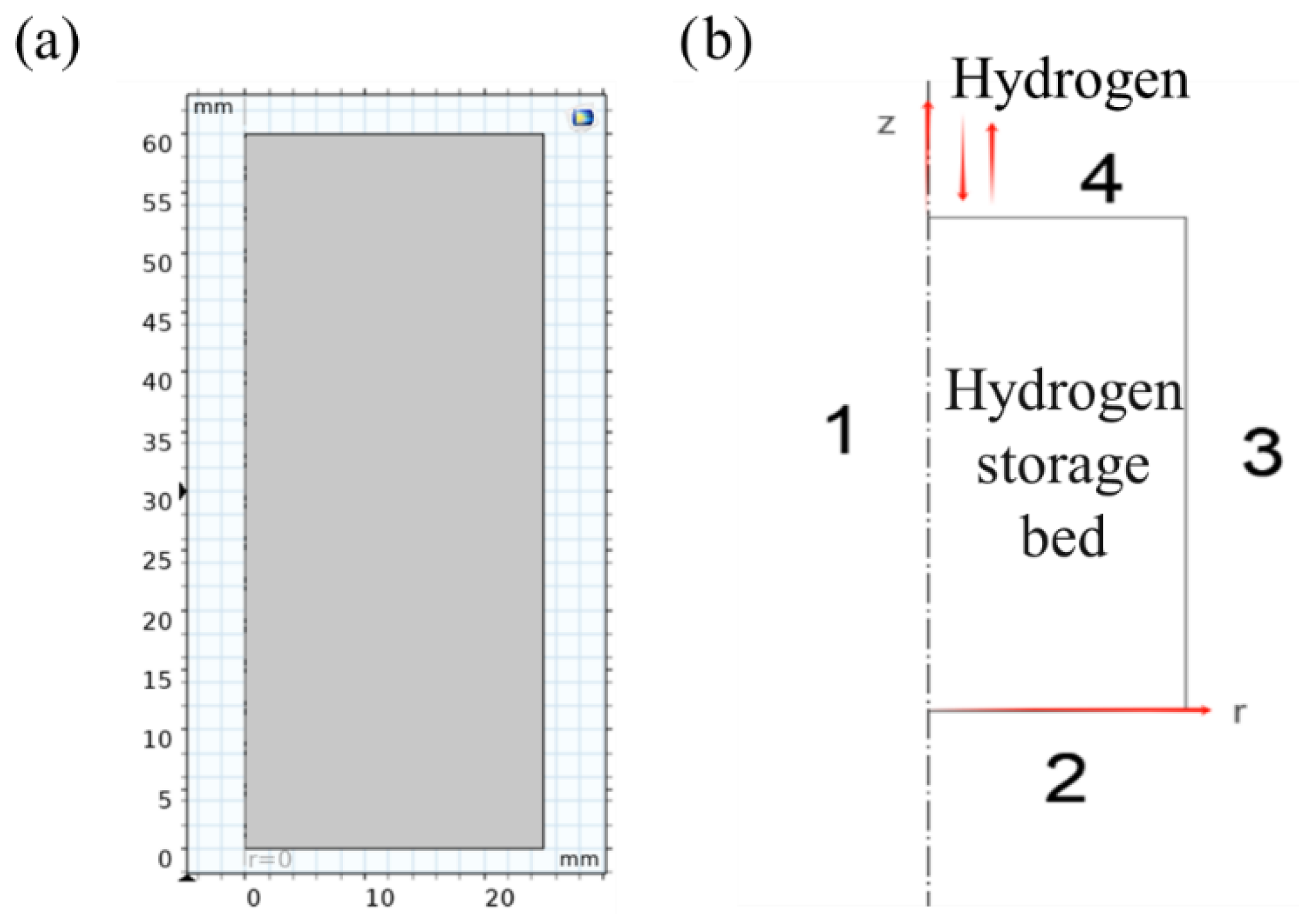
The hydrogen storage container established in this study is cylindrical. To investigate the influence of various parameters on hydrogen adsorption/desorption of the container, visually illustrate the impact of parameters on the hydrogen adsorption/desorption rate, and accelerate the calculation speed, the three-dimensional cylinder is simplified into a two-dimensional axisymmetric model, as shown in
Figure 1a. The model has a height of 60 mm and a radius of 25 mm.
The alloy in the hydrogen storage bed of the container is LaNi
5 alloy powder.
Table 1 and
Table 2 show the physical property parameters of LaNi
5 alloy and H
2, respectively [
22,
23].
2.3. Mathematical Model [17,20,24]
2.3.1. Mathematical Model
The mass conservation equation of hydrogen gas is given by Equation (1):
where
ε represents the porosity of the hydrogen storage bed in the hydrogen storage tank,
stands for the density of hydrogen gas, and
is used to characterize the mass of hydrogen absorbed or released per unit volume per unit time.
Based on the previous assumption that hydrogen gas is an ideal gas, it conforms to the ideal gas conservation formula from a thermodynamic perspective. Thus,
is expressed as Equation (2):
During the metal hydride reaction process, the mass change in the hydrogen storage bed follows the mass conservation equation, expressed as Equation (3):
In the coordinate system (r, z) of the two-dimensional axisymmetric model of the cylinder, the energy conservation equation of the container can be expressed by Equation (4):
In the equation, C
p,g represents the specific heat capacity at constant pressure of hydrogen gas; in relevant parameters, C
p.s represents the specific heat capacity of the hydrogen storage alloy (LaNi
5), and ΔH represents the enthalpy change during the reaction. Among them, (ρC
p)
eff refers to the effective heat capacity of the hydrogen storage bed layer, and λ
eff represents the effective thermal conductivity of the hydrogen storage bed layer. Their equations are expressed as Equations (5) and (6):
where ε
b represents the porosity of the metal hydride bed layer, ρ
g and ρ
s represent the density of hydrogen gas and the hydrogen storage alloy, respectively, λ
g and λ
s represent the thermal conductivities of hydrogen gas and the hydrogen storage alloy, respectively.
In the analysis of the hydrogen storage tank, the spatial distribution of hydrogen gas follows the principle of momentum conservation. The momentum conservation equations in the radial and axial directions are given by Equations (7) and (8), respectively:
Radial direction (r-direction):
Axial direction (z-direction):
In the momentum conservation equations, S
r and S
z represent the momentum dissipation effects in the radial and axial directions, respectively, mainly caused by the viscous action of the fluid. Based on Darcy’s law seepage theory, the mathematical expressions for momentum loss in each direction can be obtained:
This mathematical expression decomposes the flow resistance in the porous medium into a functional relationship between the permeability K of the hydrogen storage bed layer and the dynamic viscosity μ, where the subscript i represents the spatial dimension component in the cylindrical coordinate system.
In the thermodynamic equilibrium of the hydrogen storage tank, the hydrogen adsorption/desorption behavior of the hydrogen storage alloy is governed by the relative magnitude between the hydrogen partial pressure inside the tank and the phase equilibrium pressure. Specifically, hydrogen adsorption occurs when the hydrogen partial pressure in the tank exceeds the phase equilibrium pressure, whereas dehydrogenation takes place when the former is lower than the latter. The reaction equations are shown in (10)–(12):
In the reaction kinetics equations of the hydrogen storage alloy, each parameter has a clear physical meaning: Ca and Cd characterize the kinetic constants of the hydrogen adsorption and desorption processes, respectively. Ea and Ed are defined as the activation energy barriers for the corresponding reactions. ρsat represents the material state when the hydrogen storage alloy reaches the maximum hydrogen storage density, and ρemp represents the initial phase density after complete hydrogen desorption. Pg is the real-time monitored working pressure of hydrogen in the hydrogen storage tank. Peq,a and Peq,d denote the thermodynamic equilibrium pressures for forward hydrogen adsorption and reverse hydrogen desorption based on the Van’t Hoff equation, respectively. These parameters construct the energy transfer and conversion relationships in the dynamic hydrogen storage/desorption process of metal hydrides.
The equilibrium hydrogen pressure can be determined by the Van’t Hoff equation, in which temperature plays a dominant role in the change in equilibrium hydrogen pressure. Therefore, the equilibrium hydrogen pressure is only a function of temperature, as shown in Equation (13):
where P
ref is the reference pressure during hydrogen adsorption. A and B represent reaction constants related to the equilibrium hydrogen pressure in the reaction process, which can be determined through the hydride material list database: for hydrogen adsorption, A = 10.700 and B = 3704.6; for hydrogen desorption, A = 10.570 and B = 3704.6.
During the hydrogen adsorption/desorption process in the hydrogen storage tank, a parameter of mass hydrogen storage density (wt%) is introduced to characterize the hydrogen adsorption amount. The equation for wt% is shown in Equation (14):
2.3.2. Initial and Boundary Conditions Setting
The initial conditions refer to the hydrogen storage alloy that has not yet started to react with hydrogen. At this time, the temperature of the hydrogen storage bed is consistent with the ambient temperature, expressed by Equation (15):
The initial value of T
f is 293 K. Before the reaction starts, hydrogen has not been introduced into the hydrogen storage tank, and the hydrogen inside is in the stationary state, expressed by Equation (16):
During the hydrogen adsorption process, the initial state of the hydrogen storage alloy is set to complete dehydrogenation, and the material density parameter is ρ
emp. Meanwhile, based on the thermodynamic equilibrium condition, the initial value of hydrogen pressure adopts the hydrogen adsorption equilibrium pressure at temperature T
f, expressed by Equations (17) and (18) respectively:
During the hydrogen desorption process, the hydrogen storage alloy is in a hydrogen-saturated state, and the material density parameter is ρ
sat. Similarly, based on the thermodynamic equilibrium condition, the initial value of hydrogen pressure adopts the hydrogen desorption equilibrium pressure at temperature T
f, expressed by Equations (19) and (20) respectively:
The computational domain boundary is shown in
Figure 1b. Boundary 1 is set as a symmetric condition along the container:
In the porous medium flow model of the hydrogen storage device, u
z and u
r are defined as the axial and radial transport velocities of the hydrogen flow field. Heat transfer boundaries 2 and 3 use a constant convective heat transfer coefficient h to characterize the energy exchange at the solid–fluid interface, as shown in Equation (24):
For the flow outlet and closed boundary 4, the following assumptions are made: in the thermal conduction effect during hydrogen diffusion, the normal heat flux component is ignored; the flow tangential velocity field satisfies the no-slip condition; and the normal projection of the viscous stress tensor is set to zero. The inlet pressure is set as
, expressed by Equations (25)–(28):
Hydrogen adsorption occurs when
, and hydrogen desorption occurs when
.
where t
m refers to the pressure adjustment time for the inlet/outlet pressure to transition from the initial state to the stable state during the hydrogen adsorption/desorption process.
3. Influences of Different Parameters on Hydrogen Adsorption
The initial temperature of the container during hydrogen adsorption is set to 293 K, and the inlet pressure is 0.8 MPa. According to the Van’t Hoff equation [
23], the hydrogen adsorption equilibrium pressure is 0.143 MPa. When hydrogen adsorption starts, the hydrogen storage tank has been completely dehydrogenated, so there is a process of rapid hydrogen pressure increase until the internal and external pressures of the tank are equal.
The metal hydrogen storage tank releases heat during the hydrogen adsorption reaction.
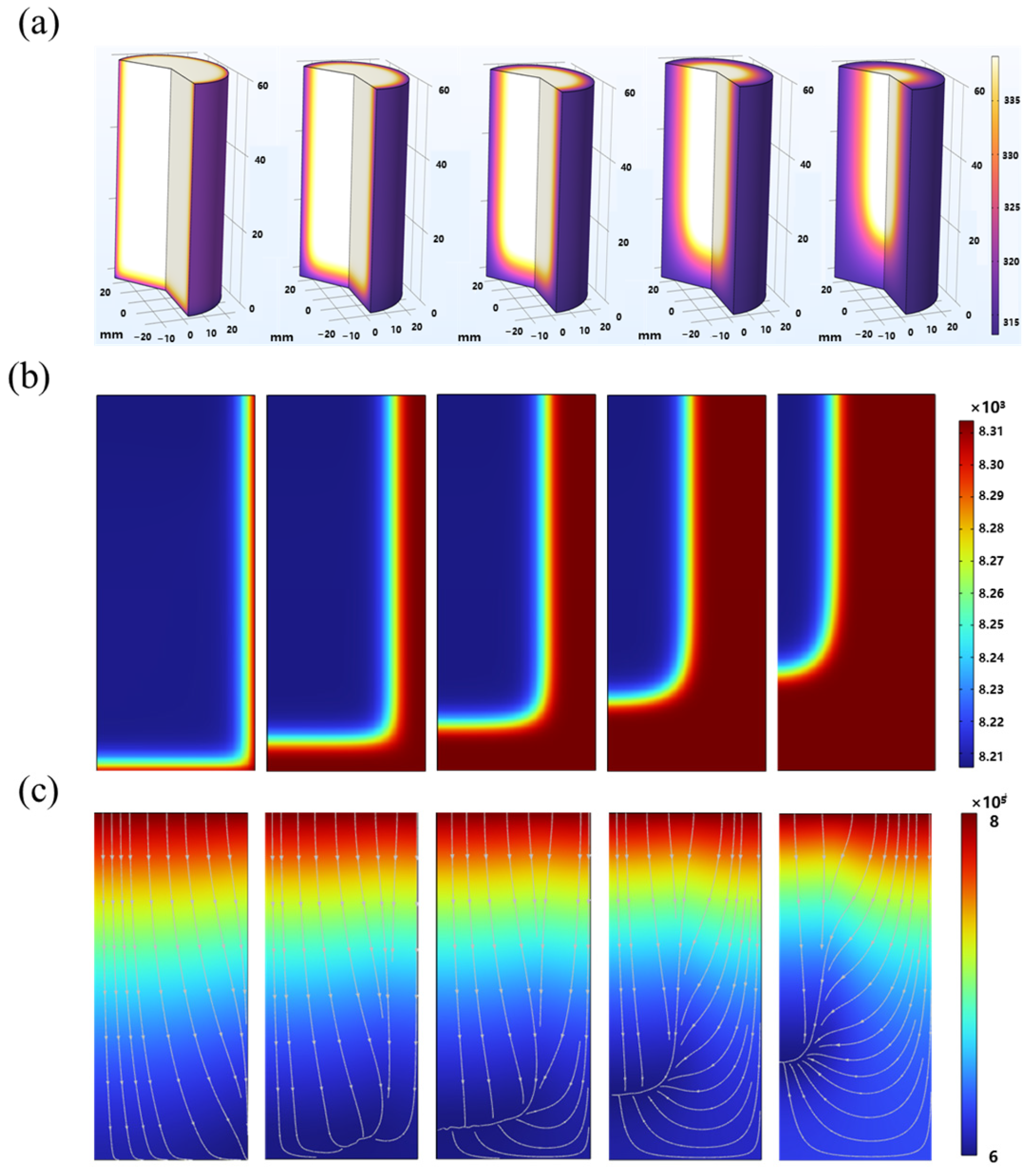
Figure 2a depicts the contour plot of the internal temperature change in the hydrogen storage tank during hydrogen adsorption and the temperature conditions inside the container at 50 s, 500 s, 1000 s, 2000 s, and 3000 s from left to right. Due to the existence of convective heat transfer, the position close to the outer wall of the container has a lower temperature and faster heat exchange. However, the hydrogen storage bed cannot directly contact the outer wall for heat exchange and can only dissipate heat through heat transfer in the porous medium. Therefore, the temperature inside the container gradually decreases from the inside to the outside.
Figure 2b shows the change in hydrogen adsorption amount inside the container. Comparing with the temperature change in
Figure 2a, it is evident that the trends of temperature change and hydrogen adsorption amount change are consistent, indicating that temperature is a critical factor influencing hydrogen adsorption performance. Furthermore,
Figure 2c illustrates the variation in equilibrium hydrogen pressure and hydrogen flow during the adsorption process. Hydrogen enters from the inlet and flows toward the negative mass source term; after the reaction is completed, it follows the flow model in the porous medium.
3.1. Effects of the Temperature
To study the influence of initial temperature on hydrogen adsorption performance, simulation analyses of hydrogen adsorption were conducted at T = 303 K, 313 K, and 323 K. The inlet pressure of the hydrogen storage container was kept constant at 0.8 MPa, the heat transfer coefficient remained unchanged at 1652 W/(m
2·K), and other parameters corresponded to the ones outlined in
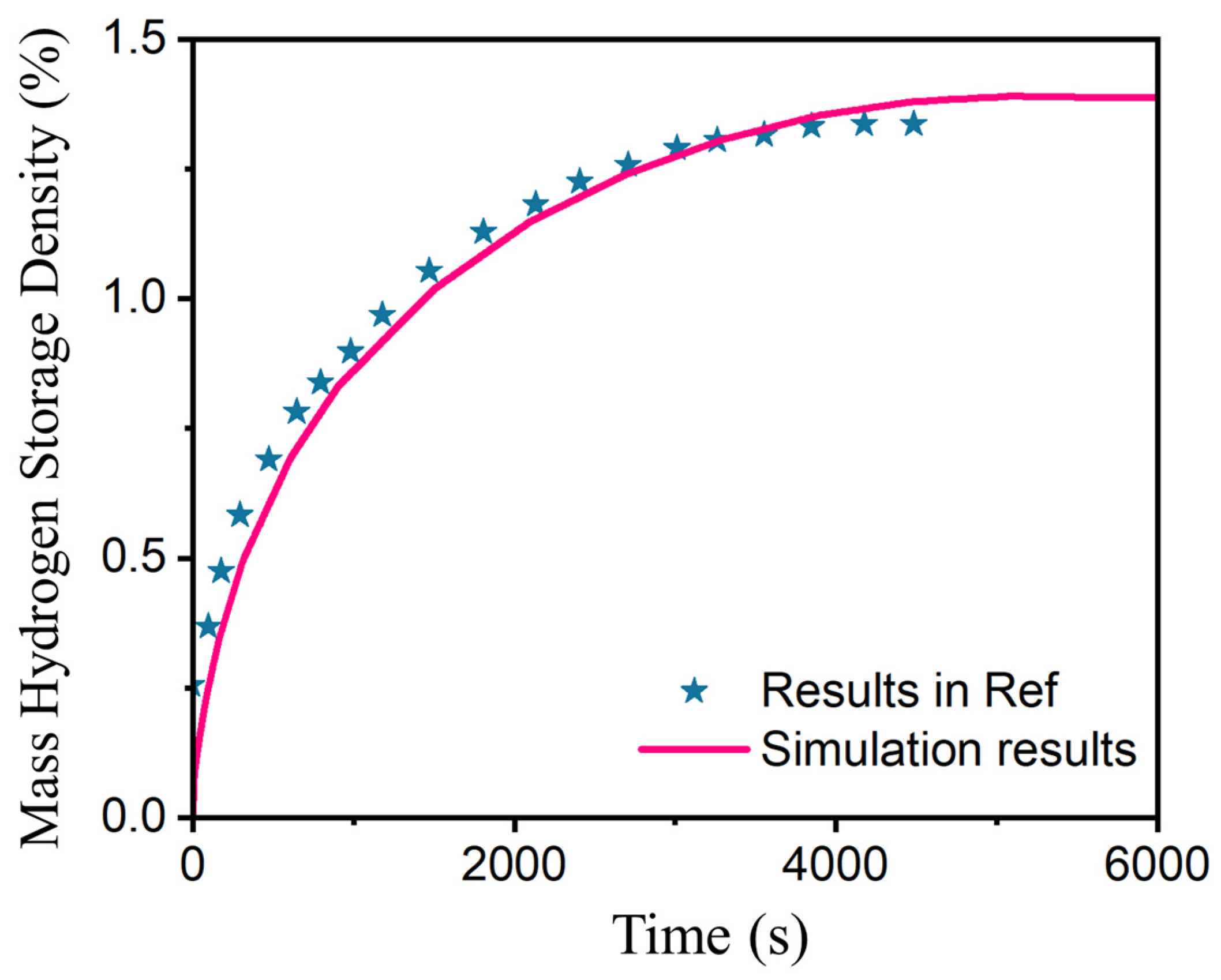
Section 2. A comparison of the simulation results regarding mass hydrogen storage density with previous research findings [
25] is demonstrated in
Figure 3, which confirms the accuracy of our simulation.
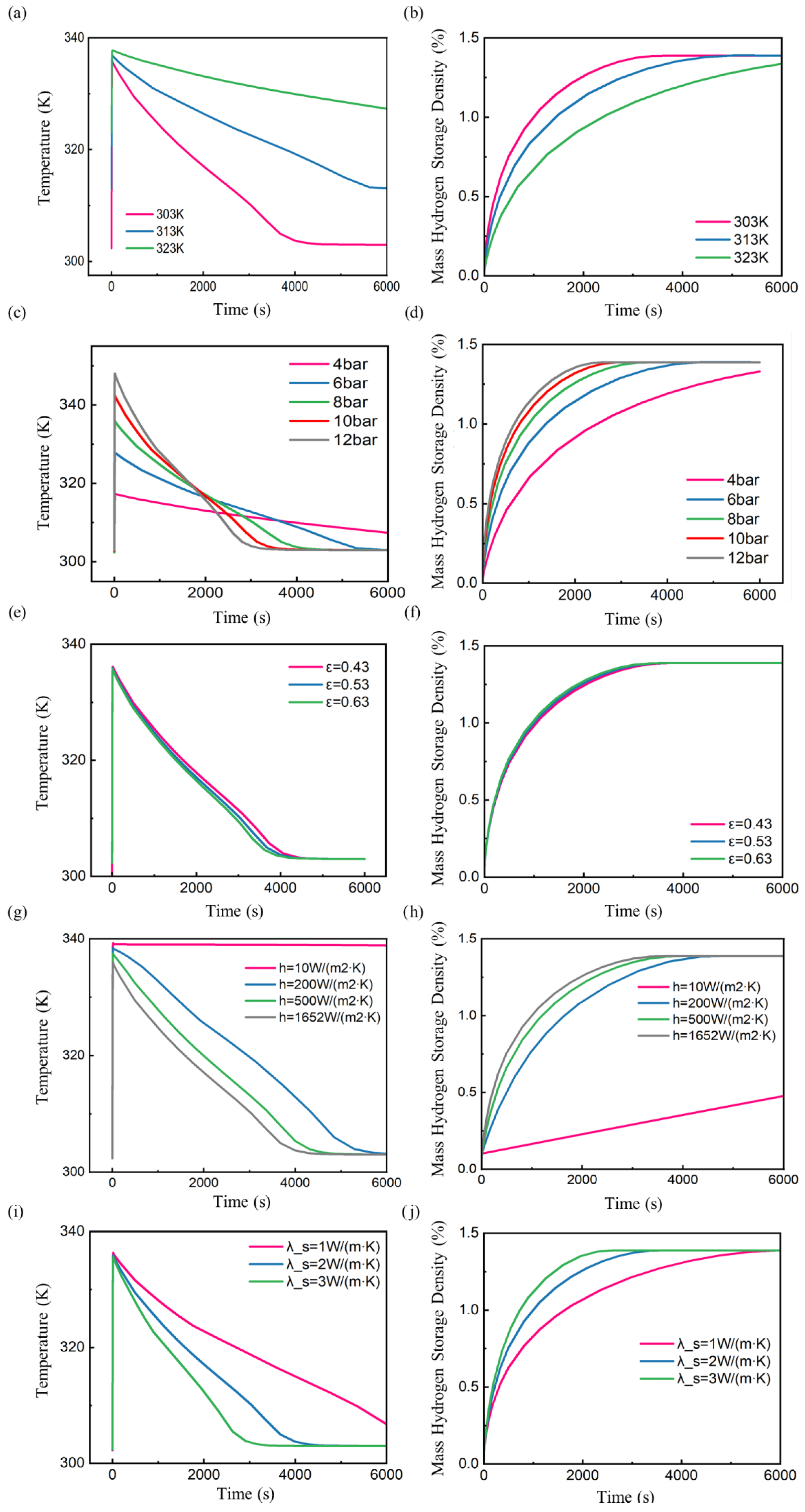
As shown in
Figure 4a,b, the reaction temperature inside the container exhibits an increasing trend with the rise in initial temperature, the hydrogen adsorption rate significantly slows down, and the time required to reach the hydrogen adsorption saturation state is correspondingly prolonged. From the perspective of thermodynamic principles, this phenomenon is attributed to the exothermic nature of the hydrogen adsorption reaction. When the initial temperature inside the device is high, the temperature difference between the inside and outside of the container narrows, leading to a decrease in convective heat transfer efficiency. As a result, heat is difficult to export quickly, which inhibits the progress of the hydrogen adsorption reaction.
Table 3 shows the maximum temperature during the hydrogen adsorption reaction and the time required to reach hydrogen adsorption saturation under different initial temperature conditions. It can be seen from the table that the initial temperature of the hydrogen storage device is positively correlated with the maximum temperature inside the container, indicating that the temperature parameter has a decisive influence on the hydrogen adsorption kinetic process. With the increase in the initial temperature, the time for the LaNi
5 alloy to reach saturated hydrogen adsorption also decreases significantly. When the initial temperature is 323 K, the hydrogen adsorption saturation time reaches more than 6000 s. Therefore, reducing the initial temperature can greatly improve the hydrogen adsorption performance and efficiency of the hydrogen storage tank.
3.2. Effects of the Inlet Pressure
To study the influence of the inlet pressure on the hydrogen adsorption performance, simulation analyses of hydrogen adsorption were carried out with inlet pressures P
in of 4 bar, 6 bar, 8 bar, 10 bar, and 12 bar. The initial temperature of the hydrogen storage container was set at 303 K, and the heat transfer coefficient was kept constant at 1652 W/(m
2∙K). Other parameters corresponded to the physical property parameters in
Table 1 and
Table 2.
As shown in
Figure 4c,d, with the increase in the inlet pressure, the temperature inside the hydrogen storage tank remained the same as the initial temperature at first, and the hydrogen storage capacity also remained stable. As the reaction continued, the thermodynamic state inside the container changed significantly, and the average temperature inside the tank increased sharply. From the perspective of kinetics, this is because the increase in the inlet pressure, Pin, promotes the progress of the hydrogen adsorption reaction and significantly improves the efficiency of the hydrogen adsorption reaction. The increase in the pressure inside the container makes the hydrogen adsorption reaction faster, which is consistent with the laws of hydrogen adsorption kinetics.
According to
Table 4, the maximum temperature inside the container is positively correlated with the inlet pressure, indicating that the pressure parameter has a significant impact on the hydrogen adsorption kinetic process. As the inlet pressure increases, the time required for the hydrogen storage alloy to achieve saturated hydrogen adsorption is significantly shortened, and the maximum temperature inside the container also increases accordingly. However, when the pressure exceeds 8 bar, the increase in the hydrogen adsorption rate slows down. Considering the pursuit of a higher hydrogen adsorption rate, a higher pressure leads to a higher hydrogen adsorption rate. But from the perspectives of economy and safety, an inlet pressure of 8–10 bar is the most suitable.
3.3. Effects of the Porosity
Based on the literature, the porosity of LaNi
5 alloy ranges from 0.43 to 0.63. To study the effect of porosity on hydrogen adsorption performance, simulation analyses of hydrogen adsorption were conducted with porosities of 0.43, 0.53, and 0.63. The initial temperature of the hydrogen storage container was 303 K, the inlet pressure was 8 bar, and the heat transfer coefficient was maintained at 1652 W/(m
2∙K). Other parameters corresponded to the physical property parameters in
Table 1 and
Table 2.
As shown in
Figure 4e,f, with the increase in porosity, the container initially maintains the initial temperature, and then the temperature gradually rises. The time required for saturated hydrogen adsorption also decreases gradually with the increase in porosity, but the reduction amplitude is small. This is because an increase in porosity leads to a decrease in the effective content of the alloy, thereby accelerating the progress of the hydrogen adsorption reaction.
According to
Table 5, changes in porosity have little effect on temperature. The larger the porosity, the shorter the time required for saturated hydrogen adsorption, but the variation is also minimal. Therefore, changes in porosity do not significantly affect hydrogen adsorption performance, nor can they reflect the hydrogen adsorption performance. This phenomenon can be explained from the perspective of coupled heat and mass transfer in the metal hydride bed: on the one hand, an increase in porosity widens the gas diffusion channels within the bed and reduces the mass transfer resistance of hydrogen in the porous medium, thereby slightly shortening the hydrogen adsorption saturation time. On the other hand, an increase in porosity decreases the volume fraction of LaNi
5 solid particles in the bed, weakens the contact thermal conduction between particles, and consequently leads to a reduction in the effective thermal conductivity of the bed. Indeed, the positive mass transfer effect and negative heat transfer effect induced by the variation in porosity achieve a dynamic balance. This coupling compensation mechanism results in only a slight change in the overall heat and mass transfer efficiency of the bed with the variation in porosity. Therefore, no significant changes are observed in the hydrogen adsorption temperature, reaction saturation time and comprehensive performance of the system, which ultimately manifests as a limited influence of porosity on hydrogen adsorption performance.
3.4. Effects of the Convective Heat Transfer Coefficient
To investigate the impact of the convective heat transfer coefficient on hydrogen adsorption performance, four common convection modes were selected: natural air convection (h = 10 W/(m
2·K)), forced air convection (h = 200 W/(m
2·K)), natural water convection (h = 500 W/(m
2·K)), and forced water convection (h = 1652 W/(m
2·K)). The initial temperature of the hydrogen storage container was set at 303 K, and the inlet pressure was maintained at 8 bar. By comparing hydrogen adsorption characteristics under different heat transfer conditions, the influence on reaction kinetics was determined. Other parameters corresponded to the physical properties in
Table 1 and
Table 2.
As shown in
Figure 4g,h, when h = 10 W/(m
2·K), the container exhibited the highest temperature, lowest hydrogen adsorption efficiency, and longest saturation time. This is because the hydrogen adsorption process is constrained by convective heat transfer. At low coefficients, heat generated by the exothermic reaction accumulates within the container, forming a thermal resistance that significantly inhibits the reaction. Conversely, increasing the coefficient enhances heat dissipation, improving the cooling effect on the metal bed and accelerating both the reaction rate and hydrogen adsorption efficiency.
Table 6 reveals a positive correlation between the convective heat transfer coefficient and hydrogen adsorption performance. Higher coefficients improve heat transfer efficiency, reduce peak temperatures, and create favorable conditions for the reaction, thereby enhancing overall efficiency. Therefore, optimizing convective heat transfer conditions is critical for improving the hydrogen adsorption efficiency of storage systems. In practical applications, it should be noted that when the convective heat transfer coefficient exceeds a certain critical threshold, the internal mass transfer resistance of the metal hydride bed gradually becomes the core factor limiting the further improvement of hydrogen adsorption performance. At this stage, continuously increasing the heat transfer coefficient will lead to a significant weakening of its promotional effect on the overall heat dissipation of the bed and the improvement of hydrogen adsorption performance. In such cases, it is necessary to adopt more sophisticated heat transfer system designs and operational strategies, such as upgrading and replacing the heat transfer medium, increasing the flow rate of the heat transfer medium, and adding enhanced heat transfer structures (e.g., fins, microchannels) inside the hydrogen storage tank. These measures will inevitably result in an increase in various costs of the system, which requires analysis based on actual conditions.
3.5. Effects of the Alloy Thermal Conductivity
Based on the literature, the thermal conductivity of LaNi
5 alloy ranges from 0.524 to 3.18 W/(m∙K). To study the effect of alloy thermal conductivity on hydrogen adsorption performance, simulation analyses of hydrogen adsorption were conducted with thermal conductivities (λs) of 1 W/(m∙K), 2 W/(m∙K), and 3 W/(m∙K). The initial temperature of the hydrogen storage container was 303 K, the inlet pressure was 8 bar, and the heat transfer coefficient was maintained at 1652 W/(m
2∙K). Other parameters corresponded to the physical property values listed in
Table 1 and
Table 2.
As shown in
Figure 4i,j, the increase in alloy thermal conductivity significantly promotes the hydrogen adsorption reaction. When the thermal conductivity of the alloy increases, the thermal conduction efficiency of the hydrogen storage bed layer is significantly improved, accelerating the process of convective heat transfer and creating favorable conditions for hydrogen adsorption in the device, thereby shortening the time required for complete hydrogen adsorption.
According to
Table 7, there is a positive correlation between the thermal conductivity of the hydrogen storage alloy and the hydrogen adsorption efficiency. With the increase in the alloy thermal conductivity, the heat transfer capacity is enhanced, which greatly improves the heat exchange efficiency in the container, effectively suppresses the local accumulation of reaction heat, and thus reduces the maximum temperature in the container. This enables the hydrogen adsorption reaction to proceed more stably and rapidly, significantly shortening the time required for the alloy to reach the saturated hydrogen adsorption density. The results show that optimizing the thermal conductivity of the hydrogen storage alloy can improve its hydrogen adsorption performance.
4. Influences of Different Parameters on Hydrogen Desorption
The initial temperature of the container during hydrogen desorption is set to 313 K, and the outlet pressure is 0.1 MPa. According to the Van’t Hoff equation, the equilibrium pressure of hydrogen desorption is 0.283 MPa. Since the hydrogen storage tank is fully hydrogenated during hydrogen desorption, the hydrogen pressure rapidly decreases until it equals the outlet pressure of the tank.
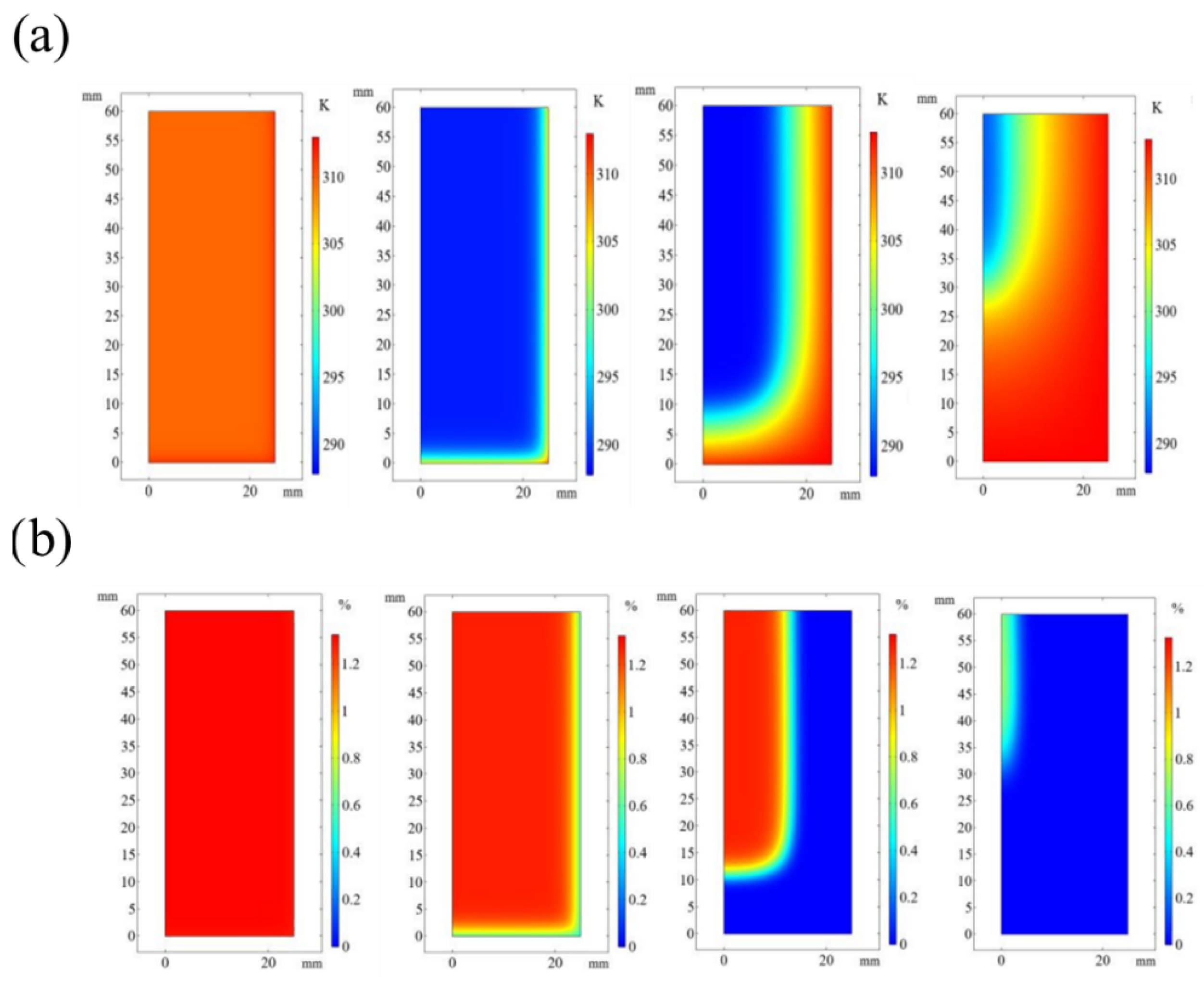
As shown in
Figure 5a, the cloud diagrams depict the internal temperature changes in the tank during hydrogen desorption at 20 s, 200 s, 2000 s, and 4000 s from left to right. Because the hydrogen desorption reaction is endothermic, the internal temperature initially matches the ambient temperature. As desorption starts, the reaction absorbs heat, causing the temperature to drop rapidly. Once desorption is complete, the internal temperature slowly rises back to the initial temperature.
Figure 5b shows the change in hydrogen desorption capacity within the container. Compared with the temperature changes in
Figure 5a, the temperature trend roughly aligns with the hydrogen desorption amount, consistent with the law during hydrogen desorption, indicating that temperature is a key factor affecting hydrogen desorption performance. The comparison reveals that temperature change and hydrogen desorption are mutually interactive processes.
4.1. Effects of the Temperature
To study the effect of initial temperature on hydrogen desorption performance, simulation analyses of hydrogen desorption were conducted at temperatures of 303 K, 313 K, and 323 K. The outlet pressure of the hydrogen storage container was kept constant at 0.1 MPa, and the heat transfer coefficient was maintained at 1652 W/(m
2·K). Other parameters corresponded to the physical property parameters in
Table 1 and
Table 2.
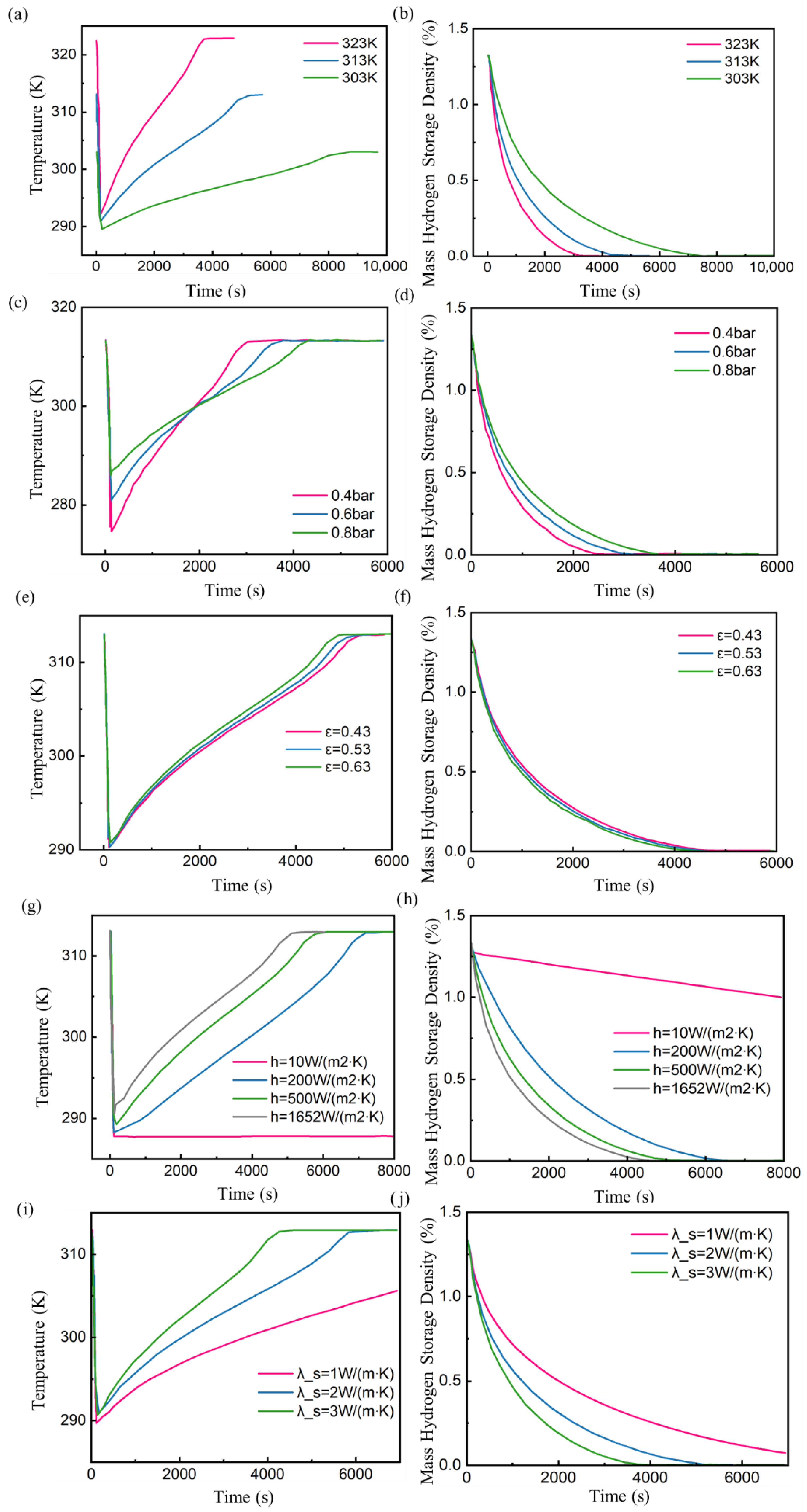
As demonstrated in
Figure 6a,b, temperature variations exert a dominant influence on the reaction kinetics of hydrogen desorption. In the initial stage of hydrogen desorption, the temperature inside the storage tank remains consistent with the initial temperature. As the reaction proceeds, the temperature inside the container drops rapidly, which also significantly increases the hydrogen desorption rate and shortens the hydrogen desorption time. The essence of this phenomenon is the endothermic characteristics of the hydrogen desorption process. When the initial temperature is higher, the temperature difference between the inside and outside of the container becomes larger, the heat transfer speed becomes faster, and the hydrogen desorption reaction is more intense, resulting in an increase in hydrogen desorption efficiency, which is also in line with the kinetic reaction law of hydrogen desorption.
As shown in
Table 8, the initial temperature inside the container has a significant correlation with the hydrogen desorption process. At an initial temperature of 323 K, the time required for complete hydrogen desorption is only 5040 s, whereas at 303 K, this duration exceeds 10,000 s. Consequently, elevating the initial temperature serves to shorten the time required to complete the hydrogen desorption reaction and optimize the hydrogen desorption performance.
4.2. Effects of the Outlet Pressure
To investigate the effect of outlet pressure on hydrogen desorption performance, simulation analyses of hydrogen desorption were conducted with outlet pressures of 0.4 bar, 0.6 bar, and 0.8 bar. The initial temperature of the hydrogen storage container was 313 K, and the heat transfer coefficient was maintained at 1652 W/(m2·K).
As shown in
Figure 6c,d, the outlet pressure also affects the hydrogen desorption process in the storage tank. In the initial stage of the desorption reaction, when the outlet pressure decreases, the temperature inside the tank remains consistent with the initial temperature, and the hydrogen storage capacity stays stable. As the reaction proceeds, the average temperature inside the container drops sharply, significantly shortening the time required for complete hydrogen desorption. This phenomenon indicates that reducing the outlet pressure can effectively accelerate the hydrogen desorption reaction, which is consistent with kinetic laws.
Table 9 shows that the outlet pressure is negatively correlated with the hydrogen desorption rate. When Pout decreases, the minimum temperature inside the device decreases, increasing the temperature difference between the inside and outside, accelerating the hydrogen desorption rate, and reducing the complete desorption time. A 0.2 bar difference in outlet pressure results in a difference in desorption time of up to approximately 1500 s. Therefore, reducing the outlet pressure can improve the hydrogen desorption performance of the storage tank when conditions permit.
4.3. Effects of the Porosity
According to the porosity in the hydrogen desorption simulation above, porosities of 0.43, 0.53, and 0.63 were selected for the hydrogen desorption simulation analysis. The initial temperature of the hydrogen storage container was 313 K, the outlet pressure was 1 bar, and the heat transfer coefficient was maintained at 1652 W/(m2·K).
As illustrated in
Figure 6e,f, the container initially maintains its initial temperature. Once the hydrogen desorption reaction occurs, the internal temperature drops rapidly. When the desorption reaction is complete, the temperature gradually rises back to the initial temperature. As porosity increases, the time required for complete hydrogen desorption decreases; however, the magnitude of this reduction is extremely small, resulting in negligible variation. In
Table 10, the variations in porosity exert little influence on temperature, and the hydrogen desorption time is slightly reduced but with minimal variation. Consequently, changes in porosity have no significant impact on hydrogen desorption performance and cannot reflect the quality of desorption performance.
The negligible effect of porosity on hydrogen desorption performance can also be elucidated from the perspective of coupled heat and mass transfer in the metal hydride bed: a dynamic balance is established between the positive mass transfer effect and the negative heat transfer effect induced by porosity variation during the hydrogen desorption reaction. On the one hand, an increase in porosity widens the gas diffusion channels within the bed, reduces the mass transfer resistance of hydrogen in the porous medium, and accelerates the diffusion and release of hydrogen from the LaNi5. On the other hand, an elevated porosity decreases the volume fraction of LaNi5 solid particles in the bed, weakens the contact thermal conduction between adjacent particles, and thereby leads to a reduction in the effective thermal conductivity of the bed. This coupling compensation mechanism results in only a slight variation in the overall heat and mass transfer efficiency of the bed with the change in porosity. Consequently, no significant alterations are observed in all key performance indicators of the system during hydrogen desorption, which ultimately manifests as the limited influence of porosity on the hydrogen desorption performance of the metal hydride hydrogen storage system.
4.4. Effects of the Convective Heat Transfer Coefficient
Furthermore, to investigate the correlation between the convective heat transfer coefficient and hydrogen desorption characteristics, four common convection modes were selected: natural air convection (h = 10 W/(m2·K)), forced air convection (h = 200 W/(m2·K)), natural water convection (h = 500 W/(m2·K)), and forced water convection (h = 1652 W/(m2·K)). The initial temperature of the hydrogen storage container was set at 313 K, and the outlet pressure was maintained at 1 bar. By comparing hydrogen desorption characteristics under different heat transfer conditions, the influence on reaction kinetics was obtained.
As shown in
Figure 6g,h, the hydrogen desorption reaction proceeds slowest when h = 10 W/(m
2·K). It can be seen from
Figure 6h that increasing the heat transfer coefficient accelerates the hydrogen desorption reaction and shortens the complete desorption time. However, after the heat transfer coefficient reaches a threshold, the complete desorption time only decreases slightly, and the improvement in hydrogen desorption performance is reduced.
Table 11 shows the positive correlation between the convective heat transfer coefficient and the hydrogen desorption performance of the storage device. With the increase in the heat transfer coefficient, the minimum temperature during hydrogen desorption tends to rise, and the time required for complete desorption is notably shortened. However, the performance improvement obtained by continuously increasing the heat transfer coefficient is relatively small, and the cost is difficult to justify relative to the performance improvement. Therefore, when the heat transfer coefficient h = 1652 W/(m
2·K), it is the most suitable. In practical applications, when regulating the convective heat transfer coefficient during the hydrogen desorption process, blind pursuit of an ultra-high coefficient should be avoided. For engineering scenarios with different requirements for hydrogen desorption efficiency and cost budgets, an appropriate convection mode and heat transfer coefficient ought to be selected to maximize the comprehensive benefits of the hydrogen desorption system.
4.5. Effects of the Alloy Thermal Conductivity
Moreover, to study the effect of alloy thermal conductivity on hydrogen desorption performance, simulation analyses of hydrogen desorption were conducted with thermal conductivities of 1 W/(m∙K), 2 W/(m∙K), and 3 W/(m∙K). The initial temperature of the hydrogen storage container was 303 K, the outlet pressure was 1 bar, and the heat transfer coefficient was maintained at 1652 W/(m2∙K).
As shown in
Figure 6i,j, with the increase in alloy thermal conductivity, the minimum temperature inside the container increases, and the time required for complete hydrogen desorption decreases accordingly. This is because the accelerated heat transfer rate of the alloy speeds up the hydrogen desorption reaction and the desorption rate within the container.
According to
Table 12, the thermal conductivity of the hydrogen storage alloy has a significant impact on the hydrogen desorption process. The increase in alloy thermal conductivity causes the minimum temperature during desorption to show an upward trend, while the time required for complete desorption is significantly shortened. This phenomenon indicates that improving the thermal conductivity of the alloy can effectively optimize the thermodynamic conditions of the hydrogen desorption reaction and enhance heat transfer efficiency, thereby accelerating the desorption process. It is concluded that an alloy with better thermal conductivity can significantly improve hydrogen desorption performance.
5. Discussions
The reliability and accuracy of numerical simulation results are closely related to the validity of model assumptions and geometric simplifications. This study adopts several key assumptions and simplifies the 3D tank geometry to a 2D axisymmetric model, which has limitations that may affect the simulation results. First, the study ignores metal hydride volume expansion during adsorption/desorption, an assumption based on the low expansion rate of the selected alloy under designed operating conditions, with the resulting porosity change not affecting the core objective of analyzing multi-parameter optimization sensitivity and priority. However, this assumption is limited for high-expansion alloys or extreme conditions, where significant expansion reduces bed permeability, slows mass transfer, and may lead to overestimated reaction rates in simulations. Second, the assumption of uniform temperature and local thermal equilibrium is valid under the moderate reaction rates considered in this study, as reaction heat transfer matches the system’s heat capacity. This assumption loses validity under high reaction rates, where rapid heat release/adsorption causes local temperature inhomogeneity, breaking local thermal equilibrium and reducing the prediction accuracy of key indicators like reaction completion time. Third, simplifying to a 2D axisymmetric model is rational for mainstream cylindrical industrial tanks, as it accurately captures radial/axial physical field distributions while reducing computational cost. However, it is only applicable to axisymmetric cylindrical tanks, failing to capture circumferential differences for non-axisymmetric tanks (e.g., rectangular, multi-tube bundle), thus limiting its applicability. To address these limitations, subsequent research will focus on introducing a dynamic porosity model considering MH volume expansion, establishing a non-local thermal equilibrium model for high reaction rate scenarios, and developing 3D models for non-axisymmetric and large-scale tanks with complex structures to enhance model accuracy and industrial application value.
In addition, it is necessary to state that the use of the single-variable control method in this paper has certain limitations for practical applications. In practical engineering applications, the parameters of the hydrogen storage system are not independent of each other but exhibit obvious coupling effects: for instance, the increase in alloy thermal conductivity can enhance the heat transfer efficiency of the system, which will further amplify the promotion effect of increasing the convective heat transfer coefficient on the hydrogen adsorption/desorption rate; the change in initial temperature will not only directly affect the reaction kinetics of LaNi5 alloy with hydrogen but also indirectly alter the pressure distribution inside the tank, thus interacting with the inlet/outlet pressure to jointly regulate the mass transfer process of hydrogen. In addition, the coupling between porosity and heat transfer parameters (thermal conductivity, convective heat transfer coefficient) may also affect the heat and mass transfer efficiency of the porous medium bed—although the single-variable study shows that porosity has a limited independent effect on the hydrogen storage performance, the matching degree between porosity and heat transfer parameters will determine the flow state of hydrogen in the bed and the uniformity of heat conduction, thereby exerting a secondary regulatory effect on the overall performance of the system.
6. Conclusions
In this study, a two-dimensional axisymmetric model of the LaNi5 hydrogen storage tank was established, and the single-variable control method was employed to systematically investigate the effects of five key parameters (initial temperature, inlet/outlet pressure, alloy porosity, convective heat transfer coefficient, and alloy thermal conductivity) on the hydrogen adsorption/desorption processes. The research findings demonstrate that these five parameters exhibit significant differences in the degree of influence on the hydrogen adsorption/desorption performance of the LaNi5 hydrogen storage tank. Among them, the regulatory effect of initial temperature is the most prominent: during the hydrogen adsorption process, a lower initial temperature can intensify the reaction inside the hydrogen storage bed, resulting in a 30% reduction in hydrogen adsorption time, whereas during the hydrogen desorption process, a higher initial temperature can significantly enhance the desorption rate, shortening the complete desorption time by 50%. Alloy thermal conductivity is another critical factor affecting hydrogen storage performance: when the thermal conductivity increases from 1 W/(m·K) to 3 W/(m·K), the hydrogen adsorption time is reduced by 43% and the desorption time by 42%, which confirms the positive correlation between thermal conductivity and hydrogen storage kinetic characteristics. Inlet/outlet pressure also exerts a significant impact on the hydrogen adsorption/desorption processes: a higher inlet pressure is conducive to improving performance during adsorption, while a lower outlet pressure is more advantageous during desorption. In contrast, within the porosity range of 0.43~0.63, the influence of alloy porosity on hydrogen adsorption/desorption performance is negligible, with the fluctuation ranges of saturated hydrogen adsorption time and complete desorption time both less than 5%, indicating that porosity is not a key parameter for system optimization under the conditions set in this study. Additionally, enhancing the heat transfer process by increasing the convective heat transfer coefficient (from 10 W/(m2·K) to 1652 W/(m2·K)) can effectively accelerate heat dissipation, thereby reducing the hydrogen adsorption time by 30% and the desorption time by 28%.
The aforementioned results provide clear and targeted guidance for the practical design and optimization of LaNi5 hydrogen storage tanks. Regarding the applicability of the research results to real-scale hydrogen storage systems, it should be noted that the two-dimensional axisymmetric model established in this paper can effectively reflect the key heat and mass transfer characteristics and reaction kinetic laws of the LaNi5 hydrogen storage tank, and the obtained parameter influences and optimization schemes can provide a reliable theoretical basis for the large-scale design of actual hydrogen storage equipment. However, in practical large-scale applications, factors such as uneven temperature and pressure distribution, the structural complexity of the hydrogen storage tank, and the dynamic changes in operating conditions may affect the actual effect of parameter optimization, which requires further verification and adjustment in combination with specific engineering scenarios. In addition, considering the limitations of the single-variable control method adopted in this study, subsequent research will focus on exploring the coupling effects between multiple parameters and establishing a multi-objective optimization model that comprehensively considers factors such as performance, safety, and economy, thereby further improving the practical application value of the research results.
Author Contributions
Conceptualization, J.F. and Y.H.; software, J.F. and Y.H.; validation, J.F. and X.G.; writing—original draft preparation, J.F. and Y.H.; writing—review and editing, X.G. and F.W.; funding acquisition, J.F. and X.G. All authors have read and agreed to the published version of the manuscript.
Funding
This research was funded by the Nanxun Scholars Program for Young Scholars of ZJWEU, grant number RC2024020103; the National Key R&D Program Project, grant number 2025YFE0102900; the National Natural Science Foundation of China, grant number 52376037; and the Key Research and Development Program of Zhejiang Province, grant number 2025C02030.
Data Availability Statement
Data is unavailable due to privacy restrictions.
Acknowledgments
During the preparation of this manuscript, the authors used Doubao for the purposes of translation. The authors have reviewed and edited the output and take full responsibility for the content of this publication.
Conflicts of Interest
Author Yanzhong Huang was employed by the company Power China Huadong Engineering Corporation Limited. The remaining authors declare that the research was conducted in the absence of any.
References
- Dong, Y.; Zhang, Y.; Liu, S. The impacts and instruments of energy transition regulations on environmental pollution. Environ. Impact Assess. Rev. 2024, 105, 107448. [Google Scholar] [CrossRef]
- Pan, Y.; Dong, F. Dynamic evolution and driving factors of new energy development: Fresh evidence from China. Technol. Forecast. Soc. Change 2022, 176, 121475. [Google Scholar] [CrossRef]
- Li, D.; Ge, A. New energy technology innovation and sustainable economic development in the complex scientific environment. Energy Rep. 2023, 9, 4214–4223. [Google Scholar] [CrossRef]
- Ionescu, R.V.; Zlati, M.L.; Antohi, V.M.; Susanu, I.O.; Cristache, N. A new approach on renewable energy as a support for regional economic development among the European Union. Technol. Forecast. Soc. Change 2022, 184, 121998. [Google Scholar] [CrossRef]
- Pan, Y.; Dong, F. Factor substitution and development path of the new energy market in the BRICS countries under carbon neutrality: Inspirations from developed European countries. Appl. Energy 2023, 331, 120442. [Google Scholar] [CrossRef]
- Yang, Z.X.; Li, X.G.; Yao, Q.L.; Lu, Z.H.; Zhang, N.; Xia, J. 2022 roadmap on hydrogen energy from production to utilizations. Rare Met. 2022, 41, 3251–3267. [Google Scholar] [CrossRef]
- Le, T.T.; Sharma, P.; Bora, B.J.; Tran, V.D.; Truong, T.H.; Le, H.C.; Nguyen, P.Q.P. Fueling the future: A comprehensive review of hydrogen energy systems and their challenges. Int. J. Hydrogen Energy 2024, 54, 791–816. [Google Scholar] [CrossRef]
- Danebergs, J.; Deledda, S. Can hydrogen storage in metal hydrides be economically competitive with compressed and liquid hydrogen storage? A techno-economical perspective for the maritime sector. Int. J. Hydrogen Energy 2024, 50, 1040–1054. [Google Scholar] [CrossRef]
- Lin, H.J.; Lu, Y.S.; Zhang, L.T.; Liu, H.Z.; Edalati, K.; Révész, Á. Recent advances in metastable alloys for hydrogen storage: A review. Rare Met. 2022, 41, 1797–1817. [Google Scholar] [CrossRef]
- Ye, Y.; Yue, Y.; Lu, J.; Ding, J.; Wang, W.; Yan, J. Enhanced hydrogen storage of a LaNi5 based reactor by using phase change materials. Renew. Energy 2021, 180, 734–743. [Google Scholar] [CrossRef]
- Somo, T.R.; Maponya, T.C.; Davids, M.W.; Hato, M.J.; Lototskyy, M.V.; Modibane, K.D. A Comprehensive Review on Hydrogen Absorption Behaviour of Metal Alloys Prepared through Mechanical Alloying. Metals 2020, 10, 562. [Google Scholar] [CrossRef]
- Wu, J.; Guo, J.; Zhang, N.; Zhang, J.; Chen, G.; Gai, J. Combining the first-principles calculations with kinetic Monte Carlo simulations of LaNi5-graphene heterojunctions as hydrogen storage materials. Comput. Mater. Sci. 2025, 246, 113470. [Google Scholar] [CrossRef]
- Liu, Y.; Chabane, D.; Elkedim, O. Optimization of LaNi5 hydrogen storage properties by the combination of mechanical alloying and element substitution. Int. J. Hydrogen Energy 2024, 53, 394–402. [Google Scholar] [CrossRef]
- Dhaou, H.; Khedher, N.B.; Mellouli, S.; Souahlia, A.; Askri, F.; Jemni, A.; Nasrallah, S.B. Improvement of thermal performance of spiral heat exchanger on hydrogen storage by adding copper fins. Int. J. Therm. Sci. 2011, 50, 2536–2542. [Google Scholar] [CrossRef]
- Busqué, R.; Torres, R.; Grau, J.; Roda, V.; Husar, A. Mathematical modeling, numerical simulation and experimental comparison of the desorption process in a metal hydride hydrogen storage system. Int. J. Hydrogen Energy 2018, 43, 16929–16940. [Google Scholar] [CrossRef]
- Tong, L.; Xiao, J.; Yang, T.; Bénard, P.; Chahine, R. Complete and reduced models for metal hydride reactor with coiled-tube heat exchanger. Int. J. Hydrogen Energy 2019, 44, 15907–15916. [Google Scholar] [CrossRef]
- Freni, A.; Cipitì, F.; Cacciola, G. Finite element-based simulation of a metal hydride-based hydrogen storage tank. Int. J. Hydrogen Energy 2009, 34, 8574–8582. [Google Scholar] [CrossRef]
- Chaise, A.; de Rango, P.; Marty, P.; Fruchart, D. Experimental and numerical study of a magnesium hydride tank. Int. J. Hydrogen Energy 2010, 35, 6311–6322. [Google Scholar] [CrossRef]
- Muthukumar, P.; Singhal, A.; Bansal, G.K. Thermal modeling and performance analysis of industrial-scale metal hydride based hydrogen storage container. Int. J. Hydrogen Energy 2012, 37, 14351–14364. [Google Scholar] [CrossRef]
- Jemni, A.; Nasrallah, S.B.; Lamloumi, J. Experimental and theoretical study of ametal–hydrogen reactor. Int. J. Hydrogen Energy 1999, 24, 631–644. [Google Scholar] [CrossRef]
- Xiao, J.; Wang, J.; Cossement, D.; Bénard, P.; Chahine, R. Finite element model for charge and discharge cycle of activated carbon hydrogen storage. Int. J. Hydrogen Energy 2012, 37, 802–810. [Google Scholar] [CrossRef]
- Yang, F.; Meng, X.; Deng, J.; Wang, Y.; Zhang, Z. Identifying heat and mass transfer characteristics of metal hydride reactor during adsorption: Improved formulation about parameter analysis. Int. J. Hydrogen Energy 2009, 34, 1852–1861. [Google Scholar] [CrossRef]
- Chung, C.A.; Ho, C.-J. Thermal–fluid behavior of the hydriding and dehydriding processes in a metal hydride hydrogen storage canister. Int. J. Hydrogen Energy 2009, 34, 4351–4364. [Google Scholar] [CrossRef]
- Zhang, B.; Wang, F.; Zeng, X.; Zhang, K.; Kou, H. A three-dimensional heat transfer model for thermal performance evaluation of ZrCo-based hydride bed with embedded circular-shaped cooling tubes. Int. J. Energy Res. 2019, 43, 6994–7009. [Google Scholar] [CrossRef]
- Jemni, A.; Nasrallah, S.B. Study of two-dimensional heat and mass transfer during absorption in a metal-hydrogen reactor. Int. J. Hydrogen Energy 1995, 20, 43–52. [Google Scholar] [CrossRef]
Figure 1.
(a) 2D axisymmetric model of a hydrogen storage container, (b) computational domain boundary.
Figure 1.
(a) 2D axisymmetric model of a hydrogen storage container, (b) computational domain boundary.
Figure 2.
(a) Temperature change inside the container (°C), (b) density change in the tank body (kg/m3), (c) flow change of hydrogen pressure (Pa).
Figure 2.
(a) Temperature change inside the container (°C), (b) density change in the tank body (kg/m3), (c) flow change of hydrogen pressure (Pa).
Figure 3.
Comparison of the simulation results in our work with previous research [
24].
Figure 3.
Comparison of the simulation results in our work with previous research [
24].
Figure 4.
(a) Temperature variation and (b) variation in mass hydrogen storage density at different initial temperatures; (c) temperature variation and (d) variation in mass hydrogen storage density under different pressures; (e) temperature variation and (f) variation in mass hydrogen storage density at different porosities; (g) temperature variation and (h) variation in mass hydrogen storage density under different convective heat transfer coefficients; (i) temperature variation and (j) variation in mass hydrogen storage density for different alloy thermal conductivities.
Figure 4.
(a) Temperature variation and (b) variation in mass hydrogen storage density at different initial temperatures; (c) temperature variation and (d) variation in mass hydrogen storage density under different pressures; (e) temperature variation and (f) variation in mass hydrogen storage density at different porosities; (g) temperature variation and (h) variation in mass hydrogen storage density under different convective heat transfer coefficients; (i) temperature variation and (j) variation in mass hydrogen storage density for different alloy thermal conductivities.
Figure 5.
(a) Temperature contour changes during hydrogen desorption, (b) variation of hydrogen storage capacity during hydrogen desorption (from left to right: 20 s, 200 s, 2000 s, 4000 s).
Figure 5.
(a) Temperature contour changes during hydrogen desorption, (b) variation of hydrogen storage capacity during hydrogen desorption (from left to right: 20 s, 200 s, 2000 s, 4000 s).
Figure 6.
(a) Temperature variation and (b) mass hydrogen storage density variation under different initial temperatures, (c) temperature variation and (d) mass hydrogen storage density variation under different outlet pressures, (e) temperature variation and (f) mass hydrogen storage density variation under different porosities, (g) temperature variation and (h) mass hydrogen storage density variation under different heat transfer coefficients, (i) temperature variation and (j) mass hydrogen storage density variation under different alloy thermal conductivities.
Figure 6.
(a) Temperature variation and (b) mass hydrogen storage density variation under different initial temperatures, (c) temperature variation and (d) mass hydrogen storage density variation under different outlet pressures, (e) temperature variation and (f) mass hydrogen storage density variation under different porosities, (g) temperature variation and (h) mass hydrogen storage density variation under different heat transfer coefficients, (i) temperature variation and (j) mass hydrogen storage density variation under different alloy thermal conductivities.
Table 1.
Physical property parameters of LaNi5 alloy.
Table 1.
Physical property parameters of LaNi5 alloy.
| Parameters | Significance | Values | Units |
|---|
| Ea | Hydrogen adsorption activation energy | 21,179.6 | J/mol |
| Ed | Hydrogen desorption activation energy | 16,473 | J/mol |
| Ca | Hydrogen adsorption rate coefficient | 59.17 | 1/s |
| Cd | Hydrogen desorption rate coefficient | 9.57 | 1/s |
| λs | Thermal conductivity of LaNi5 | 2 | W/(m∙K) |
| Cp,s | Specific heat capacity at constant pressure of LaNi5 | 419 | J/(kg∙K) |
| ρsat | Hydrogen adsorption saturation density of LaNi5 | 8313.8 | kg/m3 |
| ρemp | Hydrogen-free density of LaNi5 | 8200 | kg/m3 |
| h | Convective heat transfer coefficient | 1652 | W/(m2∙K) |
| K | Permeability | 1 10−8 | m2 |
| ε | Porosity | 0.563 | / |
Table 2.
Physical property parameters of H2.
Table 2.
Physical property parameters of H2.
| Parameters | Significance | Values | Units |
|---|
| λg | Thermal conductivity | 0.1815 | W/(m∙K) |
| ρg | Density | 0.089 | kg/m3 |
| Mg | Molar mass | 2.01588 | J/mol |
| Cp,g | Specific heat capacity at constant pressure | 14,890 | J/(kg∙K) |
| μ | Dynamic viscosity | 8.41 10−6 | Pa∙s |
| R | Gas constant | 8.314 | J/(mol∙K) |
Table 3.
The maximum temperature and the time required to reach hydrogen adsorption saturation.
Table 3.
The maximum temperature and the time required to reach hydrogen adsorption saturation.
| Initial Temperature (K) | 303 | 313 | 323 |
|---|
| Maximum temperature (K) | 335.95 | 336.98 | 337.75 |
| Time required (s) | 4850 | 5080 | >6000 |
Table 4.
Maximum temperature and the time required to reach hydrogen adsorption saturation under different pressures.
Table 4.
Maximum temperature and the time required to reach hydrogen adsorption saturation under different pressures.
| Pressure (Bar) | 4 | 6 | 8 | 10 | 12 |
|---|
| Maximum temperature (K) | 317.22 | 327.69 | 335.95 | 342.46 | 348.01 |
| Time required (s) | 6000+ | 5450 | 4255 | 3550 | 3100 |
Table 5.
Maximum temperature and the time required to reach hydrogen adsorption saturation under different porosities.
Table 5.
Maximum temperature and the time required to reach hydrogen adsorption saturation under different porosities.
| Porosity | 0.43 | 0.53 | 0.63 |
|---|
| Maximum temperature (K) | 336.11 | 335.95 | 335.74 |
| Time required (s) | 4030 | 4085 | 4180 |
Table 6.
Maximum temperature and the time required to reach hydrogen adsorption saturation under different heat transfer coefficients.
Table 6.
Maximum temperature and the time required to reach hydrogen adsorption saturation under different heat transfer coefficients.
| Heat Transfer Coefficients (W/(m2∙K)) | 10 | 200 | 500 | 1652 |
|---|
| Maximum temperature (K) | 339.09 | 338.50 | 337.38 | 335.95 |
| Time required (s) | 6000+ | 4980 | 4555 | 4255 |
Table 7.
Maximum temperature and the time required to reach hydrogen adsorption saturation under different alloy thermal conductivities.
Table 7.
Maximum temperature and the time required to reach hydrogen adsorption saturation under different alloy thermal conductivities.
| Alloy Thermal Conductivities (W/(m∙K)) | 1 | 2 | 3 |
|---|
| Maximum temperature (K) | 336.35 | 335.95 | 335.68 |
| Time required (s) | 5935 | 4260 | 3350 |
Table 8.
Minimum temperature in the container and time required for complete hydrogen desorption under different initial temperatures.
Table 8.
Minimum temperature in the container and time required for complete hydrogen desorption under different initial temperatures.
| Temperature (K) | 303 | 313 | 323 |
|---|
| Minimum temperature (K) | 287 | 290 | 292 |
| Time required (s) | 10,000+ | 5640 | 5040 |
Table 9.
Minimum temperature in the container and time required for complete hydrogen desorption under different outlet pressures.
Table 9.
Minimum temperature in the container and time required for complete hydrogen desorption under different outlet pressures.
| Outlet Pressure (Bar) | 0.4 | 0.6 | 0.8 |
|---|
| Minimum temperature (K) | 274.63 | 280.97 | 285.98 |
| Time required (s) | 4115 | 4815 | 5628 |
Table 10.
Minimum temperature in the container and time required for complete hydrogen desorption under different porosities.
Table 10.
Minimum temperature in the container and time required for complete hydrogen desorption under different porosities.
| Porosity | 0.43 | 0.53 | 0.63 |
|---|
| Minimum temperature (K) | 290.23 | 290.31 | 290.76 |
| Time required (s) | 5870 | 5890 | 5945 |
Table 11.
Minimum temperature in the container and time required for complete hydrogen desorption under different heat transfer coefficients.
Table 11.
Minimum temperature in the container and time required for complete hydrogen desorption under different heat transfer coefficients.
| Heat Transfer Coefficients (W/(m2∙K)) | 10 | 200 | 500 | 1652 |
|---|
| Minimum temperature (K) | 287 | 288 | 289 | 290 |
| Time required (s) | 8000+ | 7740 | 7950 | 5725 |
Table 12.
Minimum temperature in the container and time required for complete hydrogen desorption under different alloy thermal conductivities.
Table 12.
Minimum temperature in the container and time required for complete hydrogen desorption under different alloy thermal conductivities.
| Alloy Thermal Conductivities (W/(m∙K)) | 1 | 2 | 3 |
|---|
| Minimum temperature (K) | 290.47 | 290.68 | 290.95 |
| Time required (s) | 6940 | 5780 | 4010 |
| Disclaimer/Publisher’s Note: The statements, opinions and data contained in all publications are solely those of the individual author(s) and contributor(s) and not of MDPI and/or the editor(s). MDPI and/or the editor(s) disclaim responsibility for any injury to people or property resulting from any ideas, methods, instructions or products referred to in the content. |