Market Clearing Optimization of Auxiliary Peak Shaving Services with Participation of Flexible Resources

Abstract
1. Introduction
- (1)
- This paper proposes a coordinated peak-regulation framework that links the marginal contribution of generation-, load-, and storage-side flexible resources to peak-regulation capacity demand and subsequent market-clearing outcomes, rather than treating them solely as parallel dispatch variables.
- (2)
- This paper incorporates Information Gap Decision Theory (IGDT) into the determination of peak-regulation capacity demand, so that wind and photovoltaic uncertainty directly influences the required depth of peak shaving, rather than being handled solely through dispatch-stage uncertainty modeling.
- (3)
- This paper develops a unified marginal clearing price mechanism under IGDT-derived uncertainty sets, through which renewable uncertainty is explicitly transmitted to both clearing quantities and marginal prices in the peak-regulation market.
2. Literature Review
2.1. Flexible Resources Participating in Peak-Shaving Auxiliary Services Markets
2.2. Uncertainty Modeling
3. Model Construction Methodology
3.1. Model Construction Objectives
3.2. Model Research Methodology
- (1)
- Economic Modeling Approach: Mathematical models reflecting the physical operational constraints and commercial cost structures of thermal power, wind power, photovoltaic power, and energy storage were constructed separately. Notably, a segmented linearization cost function for peak-shaving was established for thermal power units to precisely characterize their economic properties across different operational intervals.
- (2)
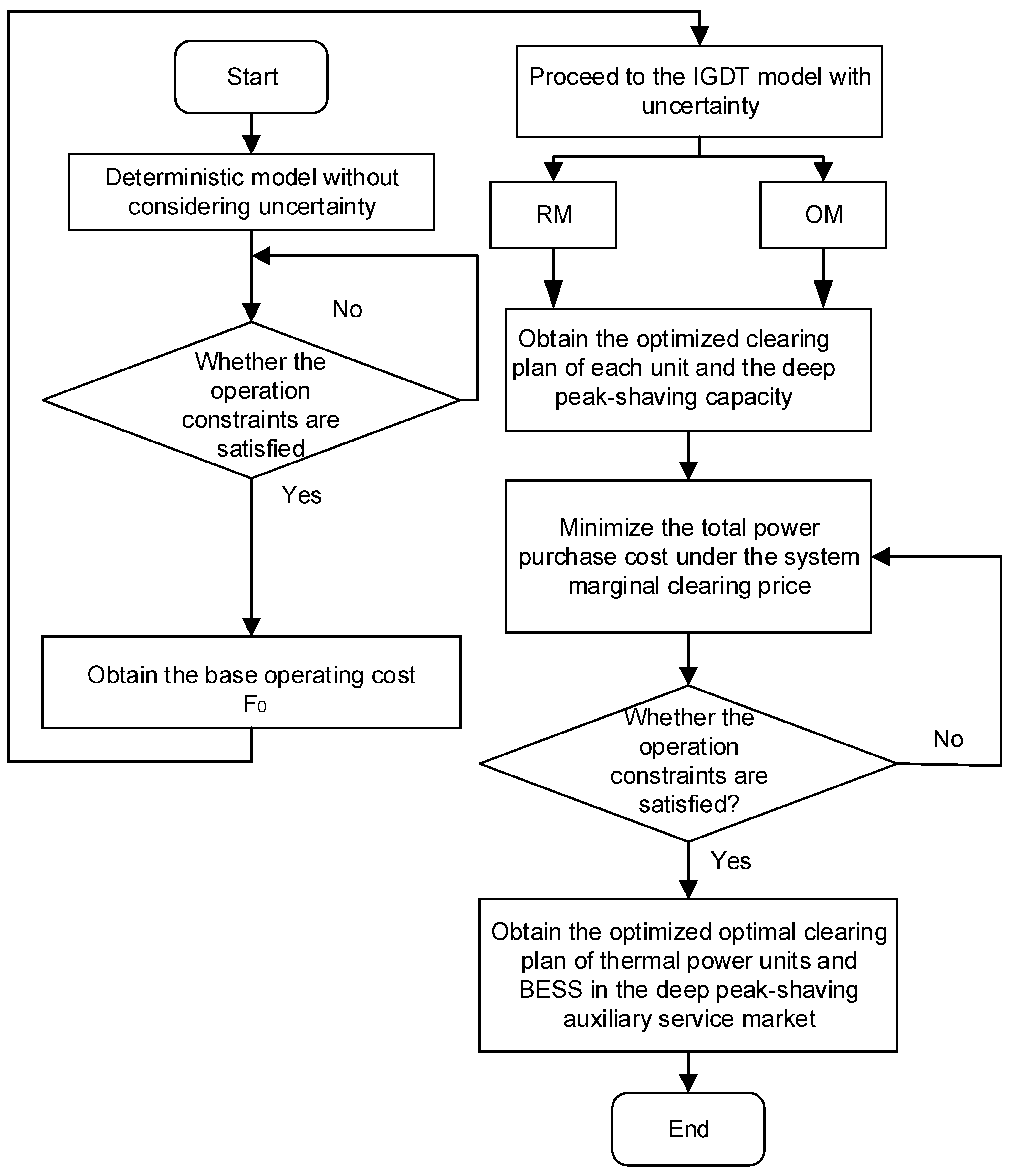
- Two-layer optimization and market simulation methodology: A two-layer optimization framework based on principal–agent game theory is established, in which the upper-level model determines optimal peak-shaving demand by minimizing total system operating costs, while the lower-level model minimizes electricity procurement costs to simulate a competitive market-clearing process under a unified marginal price, thereby capturing the feedback effects of market mechanisms on physical operations.
- (3)
- Information Gap Decision Theory–based uncertainty modeling: A non-probabilistic uncertainty modeling approach based on IGDT is adopted to characterize wind and photovoltaic uncertainty, avoiding reliance on probability distributions or fuzzy membership functions. By defining IGDT uncertainty sets, the model generates dispatch schemes under both risk-averse and opportunity-seeking strategies, providing multi-perspective decision support.
- (4)
- Mathematical programming formulation and solution method: The proposed framework is ultimately formulated as a mixed-integer linear programming (MILP) problem, enabling efficient and reliable numerical solution using standard optimization solvers.
3.3. Model Applicability and Limitations
4. Multi-Source Coordinated Peak-Shaving Cost Model Incorporating Flexible Unit Retrofits
4.1. Thermal Power Units
4.1.1. Flexibility Retrofitting for Thermal Power Units
4.1.2. Fuel
4.1.3. Life Degradation
4.1.4. Oil Injection
4.1.5. Environmental
4.2. Wind Turbine (WT) Operation
4.2.1. WT Operation and Maintenance (O&M)
4.2.2. Wind Curtailment Penalty
4.3. Photovoltaic (PV) Operation
4.3.1. PV O&M
4.3.2. Solar Curtailment Penalty
4.4. Battery Energy Storage Station (BESS) Operation
4.4.1. BESS O&M
4.4.2. Life Degradation
5. Peak-Shaving Ancillary Service Clearing Model
5.1. Upper-Level Model
5.1.1. Objective Function
5.1.2. Operational Constraints
- (1)
- Power balance constraint
- (2)
- Output constraint of thermal power units
- Constraint of conventional peak-regulating units:
- Constraint of deep peak-regulating units:where represents the minimum output limit of a thermal power unit under conventional operation; represents the minimum output limit after flexibility retrofitting; represents the maximum output limit of the thermal power unit; represents denotes the load ratio of the retrofitted thermal power unit; is a binary variable. When , the thermal power unit is retrofitted for flexibility, whereas when , the unit is not retrofitted.
- (3)
- Thermal power unit ramp constraint
- (4)
- WT unit output constraint
- (5)
- PV output constraint:
- (6)
- Charging and discharging logic constraint of BESS
- (7)
- Charging and discharging power constraint of BESS
- (8)
- SOC constraint
5.2. Lower-Level Model
5.2.1. Objective Function
5.2.2. Operational Constraints
- (1)
- Capacity constraint
- (2)
- Bid price constraint
- (3)
- Charging and discharging logic constraint of BESS
- (4)
- Charging and discharging power constraint of BESS
- (5)
- SOC constraint
- (6)
- Thermal power unit ramp constraint
5.3. I GDT-Based Minimum System Operating Cost Model
5.3.1. Uncertainty Modeling of WT and PV Outputs
5.3.2. IGDT-Based Peak-Regulating Model
- (1)
- Risk Avoidance Strategy
- (2)
- Opportunity-Seeking Strategy
5.3.3. Economic Interpretation and Practical Selection of IGDT Deviation Parameters
- (1)
- Economic Interpretation of the IGDT Deviation Parameter Δ
- (2)
- Practical Interpretation of Deviation Coefficients Δ1 and Δ2
5.4. Model Solution
6. Case Study
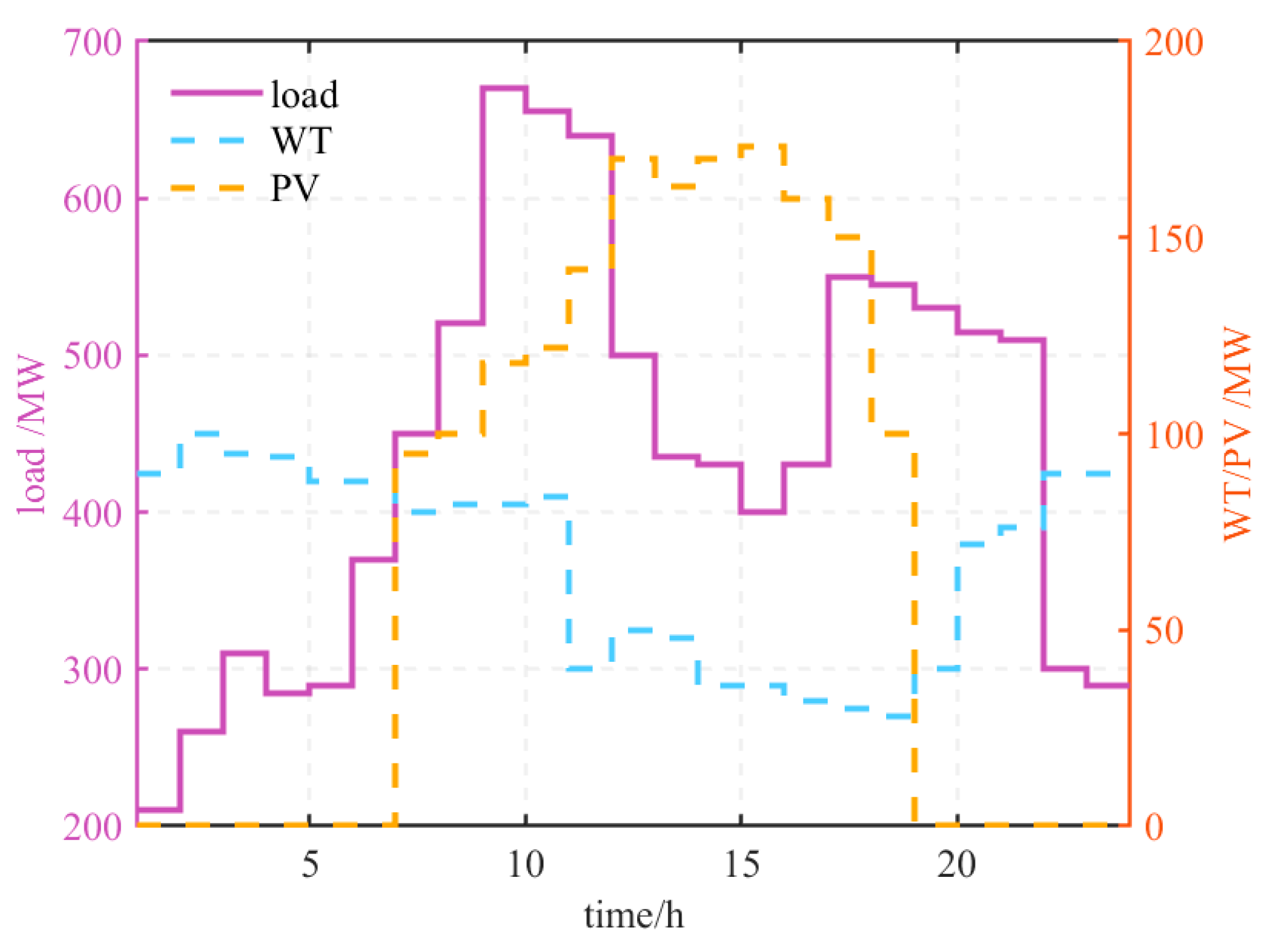
6.1. Case Study Data
6.2. Calculation Results and Analysis
- Scenario 1: Basic operation strategy, excluding energy storage, demand response, IGDT, and unified marginal clearing price mechanism;
- Scenario 2: On the basis of Scenario 1, adding demand response and energy storage;
- Scenario 3: On the basis of Scenario 2, adding the unified marginal clearing price mechanism;
- Scenario 4: On the basis of Scenario 2, considering the risk avoidance strategy (RM) model;
- Scenario 5: On the basis of Scenario 4, adding the unified marginal clearing price mechanism;
- Scenario 6: On the basis of Scenario 2, considering the opportunity-seeking strategy (OM) model;
- Scenario 7: On the basis of Scenario 6, adding the unified marginal clearing price mechanism.
6.2.1. Deterministic Model Analysis
- (1)
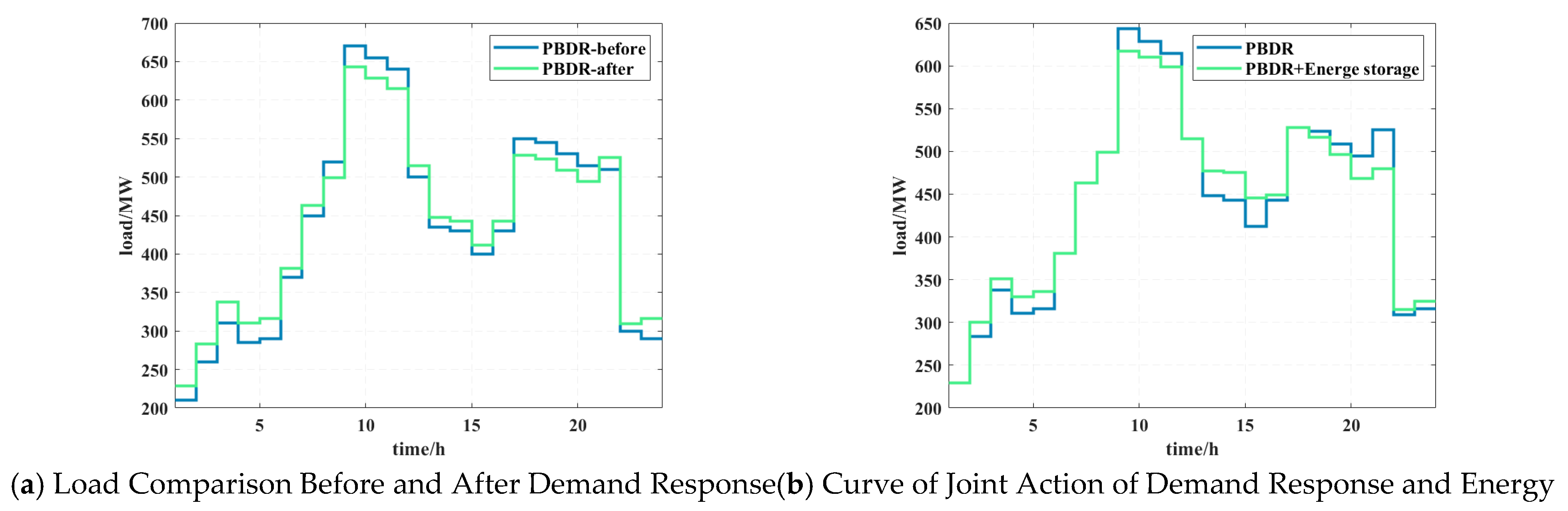
- Optimization Result Analysis of Demand Response and Energy Storage
- (2)
- Cost Optimization Result Analysis
- (3)
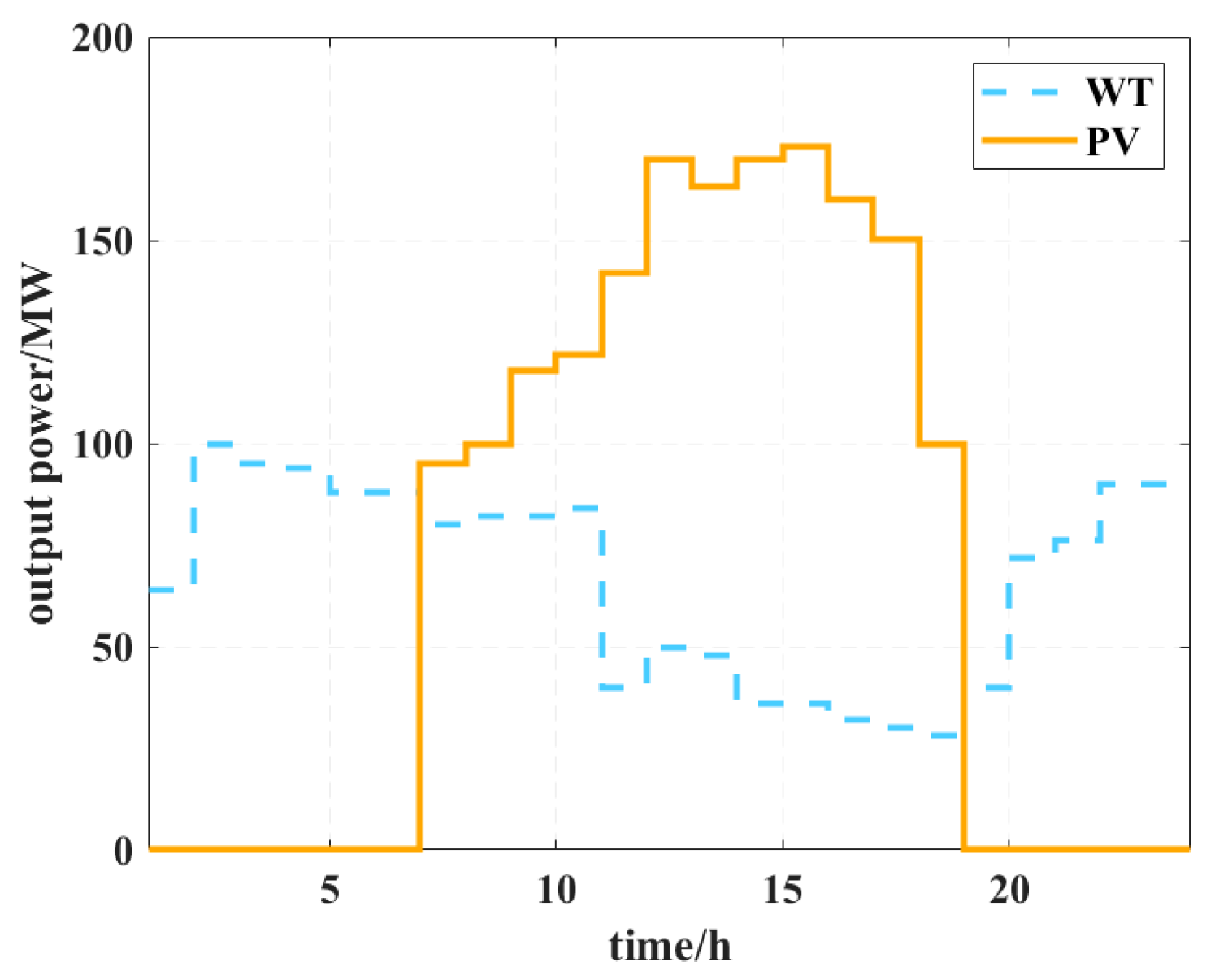
- Optimization Analysis of Wind and Solar Accommodation in Different Scenarios
6.2.2. Uncertainty Model Analysis
Optimization Result Analysis of Different Strategies
- (1)
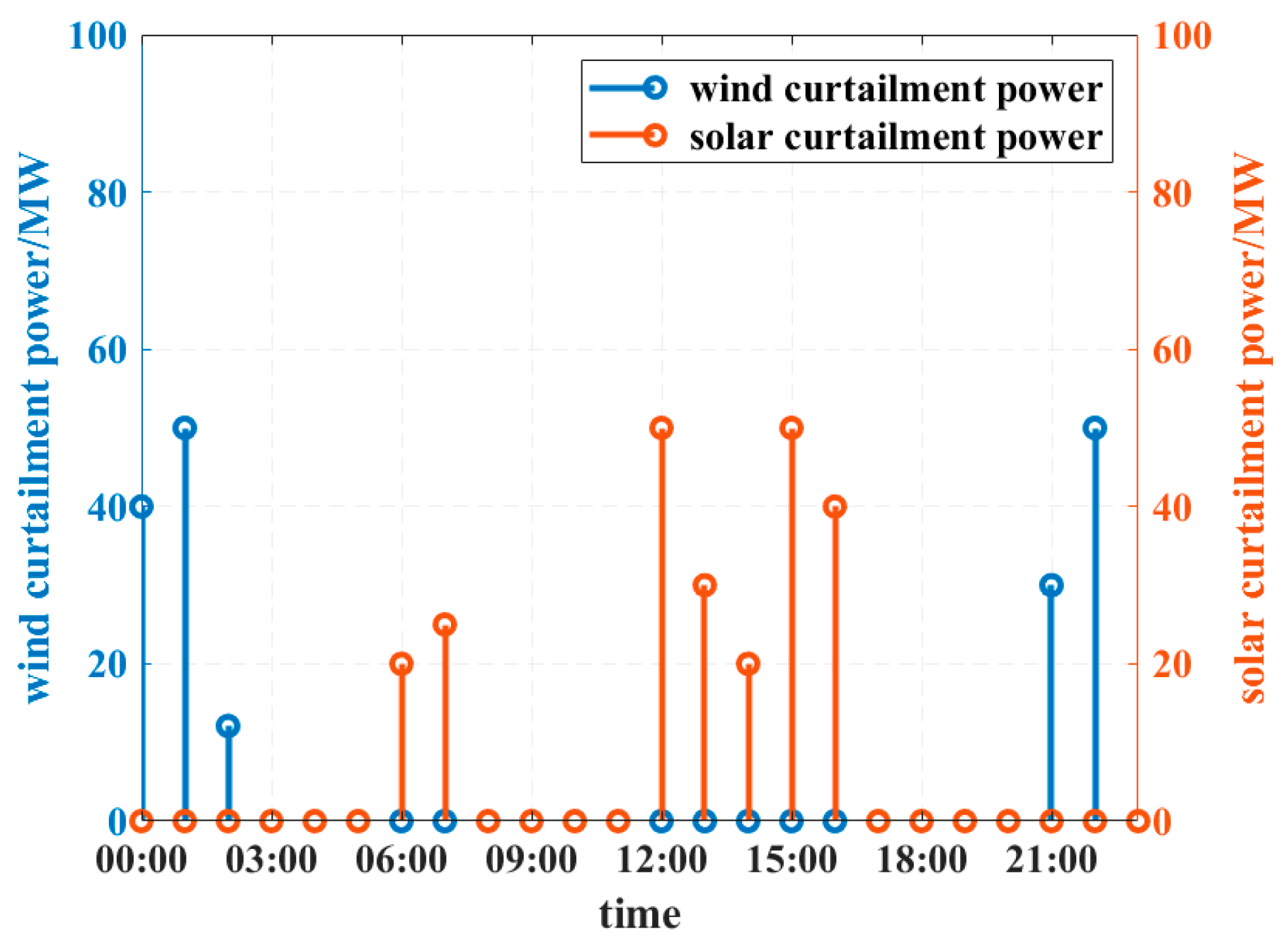
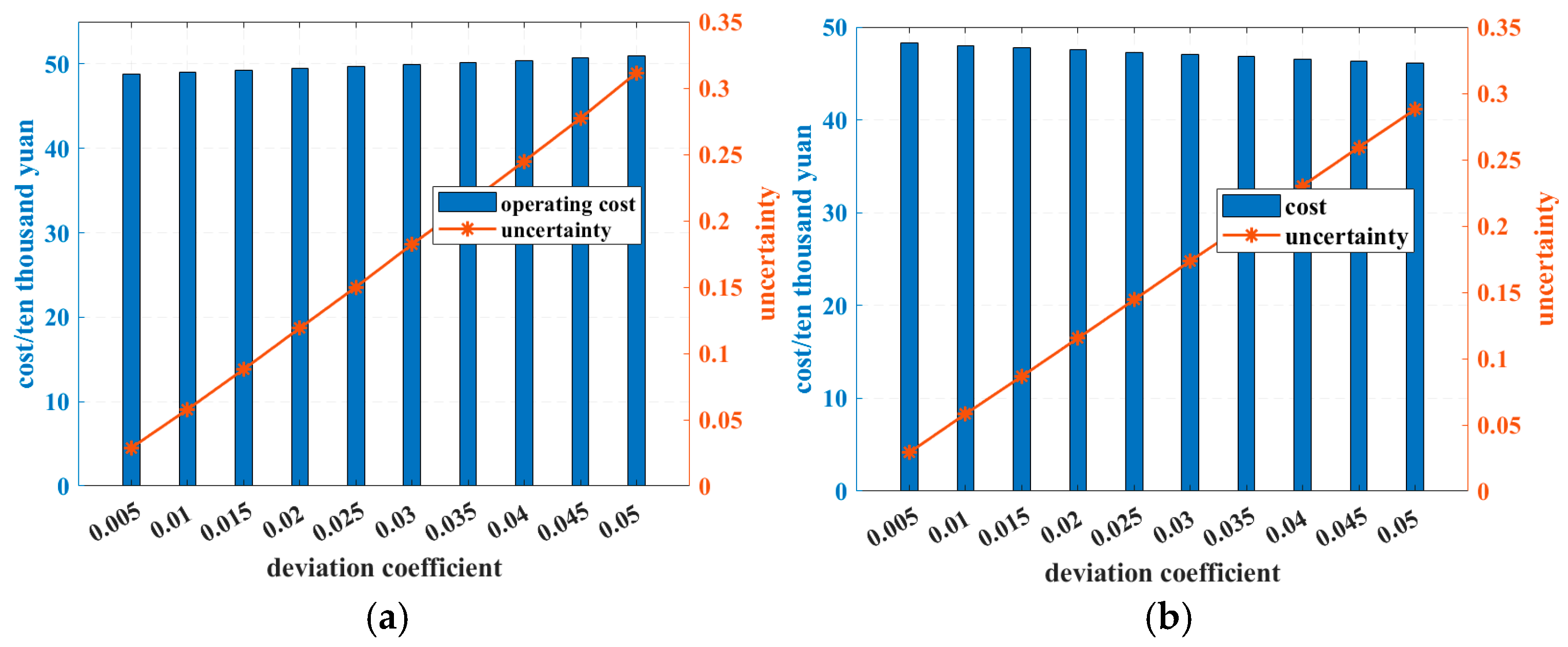
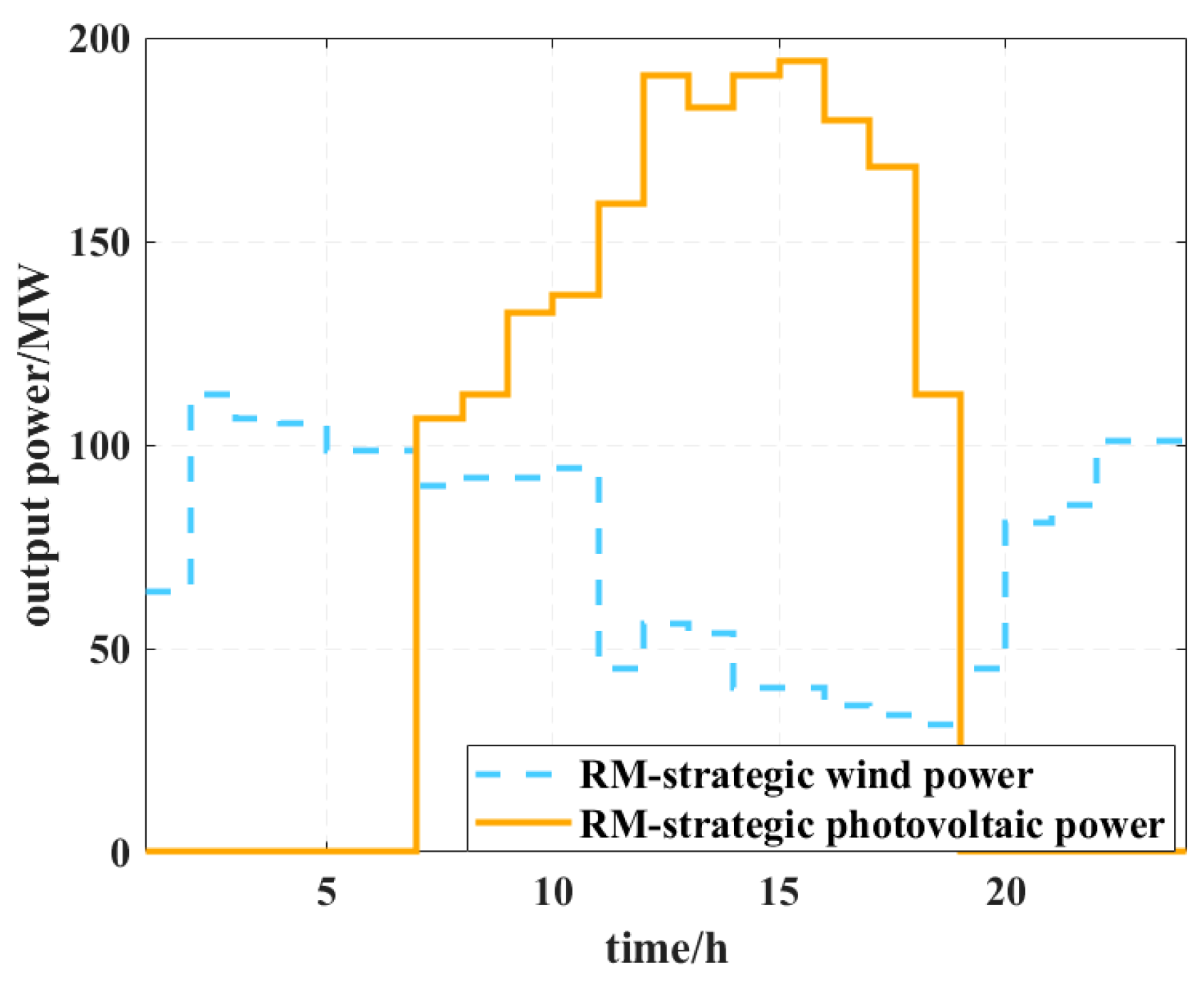
- Risk Avoidance Strategy, under the risk avoidance strategy, a deviation coefficient of 0.04 and an uncertainty of 0.2449 are selected for analysis. The wind and PV output under this scheme is shown in Figure 8.
- (2)
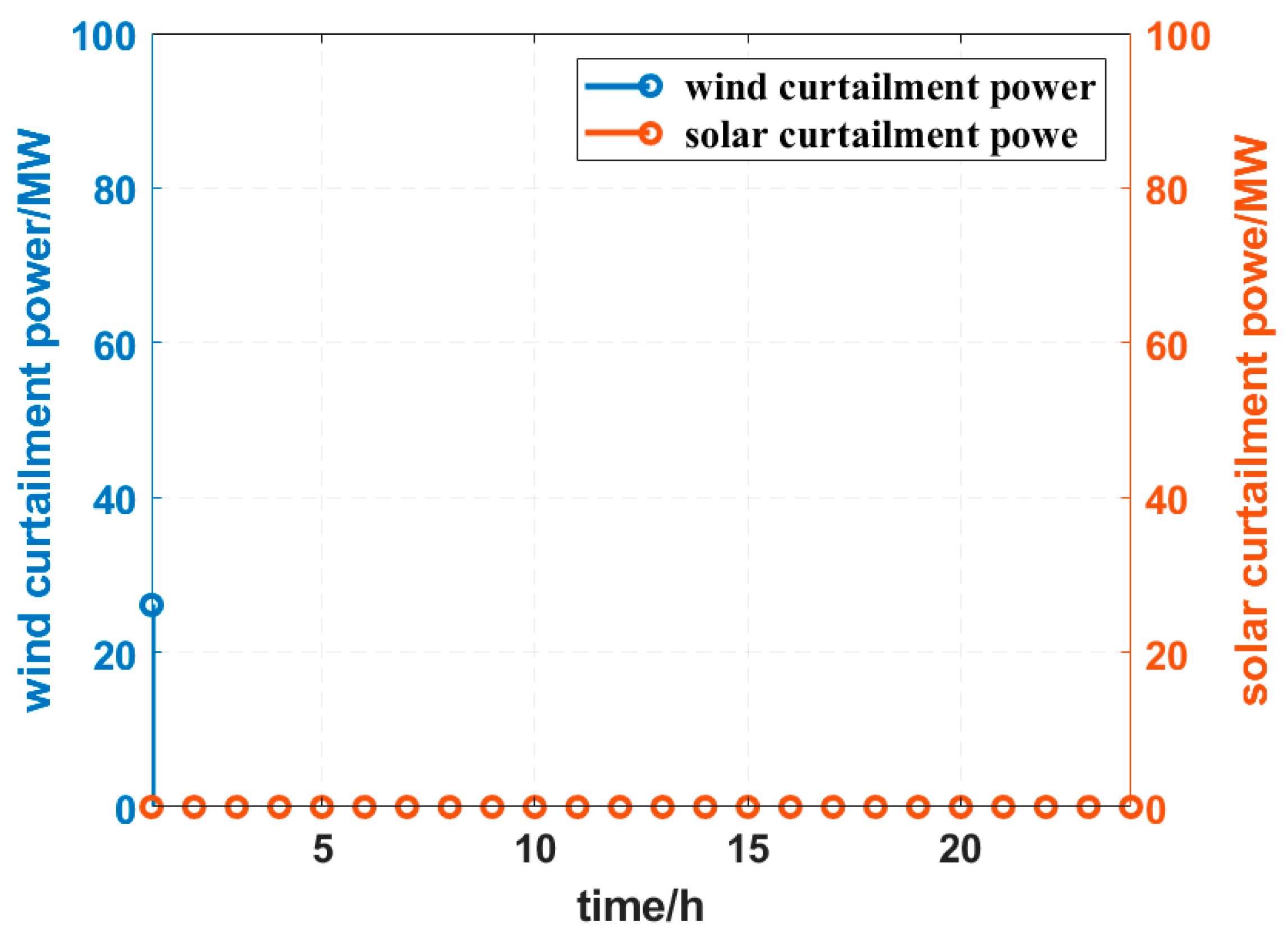
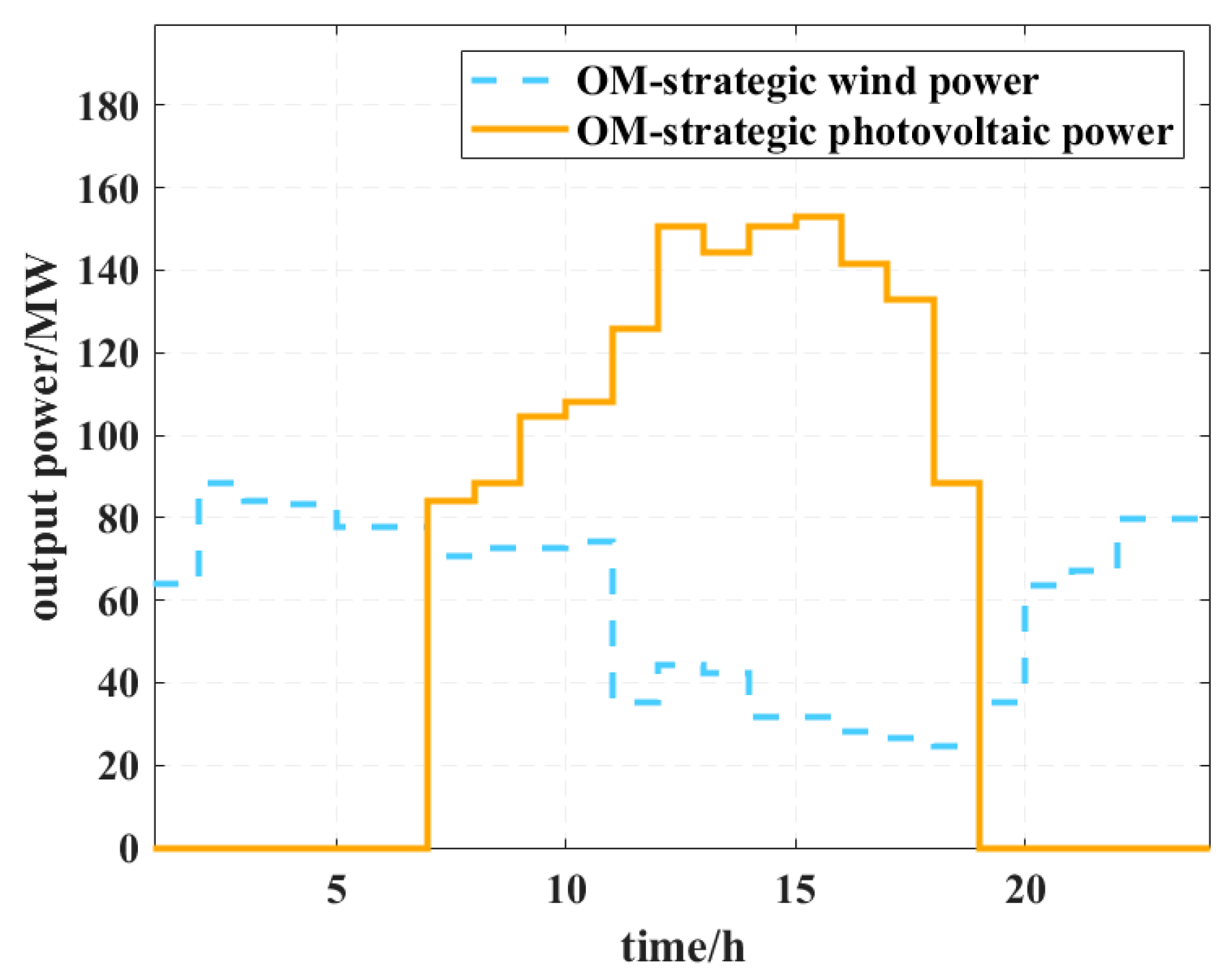
- Opportunity-seeking strategy under the opportunity-seeking strategy, a deviation coefficient of 0.04 and an uncertainty of 0.2304 are selected for analysis. The wind and PV output under this scheme are shown in Figure 9.
7. Results and Discussion
7.1. Research Results
- (1)
- The synergistic operation of demand response and energy storage effectively flattened the net load curve, reducing the peak-to-valley difference by 16.31% and drastically cutting wind/PV curtailment costs by 95.59%, thereby alleviating the deep peak-shaving pressure on thermal power units.
- (2)
- The settlement mechanism based on a uniform marginal clearing price incentivized a more efficient allocation of peak-shaving tasks, favoring energy storage participation. This led to a 41.08% reduction in total system operating costs and significantly decreased the frequency, especially of oil injection deep peak shaving, for thermal units, enhancing their participation willingness.
- (3)
- The IGDT framework successfully quantified wind/PV output uncertainty, providing distinct dispatch strategies for risk-averse and opportunity-seeking decision-makers. When combined with the uniform marginal clearing price, this approach further optimized costs under uncertainty, offering a practical tool for market participants.
7.2. Research Discussion
Author Contributions
Funding
Data Availability Statement
Conflicts of Interest
References
- Lu, D.; Bian, X.; Zhou, B.; Xu, B.; Xu, Z.; Li, D. Hierarchical Distributed Coordinated Optimal Dispatch of Active Distribution Networks Considering Frequency Regulation Reserve Benefits. Electr. Power Autom. Equip. 2023, 43, 55–63. [Google Scholar]
- National Energy Administration Operation of Renewable Energy Grid Connection in 2024 [EB/OL]. Available online: https://www.nea.gov.cn/20250221/e10f363cabe3458aaf78ba4558970054/c.html (accessed on 27 January 2025).
- Zhang, Y. Research on Multi Energy Complementary Low Carbon Operation of Power Grid Considering Multidimensional Uncertainty of “Source Load”. Ph.D. Thesis, Xi’an University of Technology, Xi’an, China, 2024. [Google Scholar]
- Zhang, H.; Jin, P.; Pang, W. Research on deep peaking cost allocation mechanism considering peaking demand subject and thermal power unit. Energy Rep. 2024, 12, 158–172. [Google Scholar] [CrossRef]
- Yang, B.; Cao, X.; Cai, Z.; Yang, T.; Chen, D.; Gao, X.; Zhang, J. Unit Commitment Comprehensive Optimal Model Considering the Cost of Wind Power Curtailment and Deep Peak shaving of Thermal Unit. IEEE Access 2020, 8, 71318–71325. [Google Scholar] [CrossRef]
- Yang, Y.; Wang, Y.; Gao, Y. Peak Shaving Analysis of Power Demand Response with Dual Uncertainty of Unit and Demand-Side Resources under Carbon Neutral Target. Energies 2022, 15, 4588. [Google Scholar] [CrossRef]
- Zhao, Y.; Wang, Y.; Liu, C.; Cai, G.; Ge, W.; Xu, Y.; Xiang, Z. Research on the deep peak-shaving cost allocation mechanism considering the responsibility of the load side. Front. Energy Res. 2023, 11, 1182620. [Google Scholar] [CrossRef]
- Meng, Q.; Wei, Y.; Fan, J. Peak shaving strategies for ground source heat pump demand response of based on load forecasting: A case study of rural building in China. Renew. Energy 2024, 224, 120059. [Google Scholar] [CrossRef]
- Tong, Z.; Mansouri, S.A.; Huang, S.; Jordehi, A.R.; Tostado-Véliz, M. The role of smart communities integrated with renewable energy resources, smart homes and electric vehicles in providing ancillary services: A tri-stage optimization mechanism. Appl. Energy 2023, 351, 121897. [Google Scholar] [CrossRef]
- Wang, Y.; Shi, P.; Chen, G.; Wang, X.; Sun, X.; Ding, L.; Li, Y. A multi-time scale schedulable capacity evaluation method for stations considering user wishes. Energy Rep. 2023, 9, 321–325. [Google Scholar] [CrossRef]
- Nie, X.; Mansouri, S.A.; Jordehi, A.R.; Tostado-Véliz, M. A two-stage optimal mechanism for managing energy and ancillary services markets in renewable-based transmission and distribution networks by participating electric vehicle and demand response aggregators. Int. J. Electr. Power Energy Syst. 2024, 158, 109917. [Google Scholar] [CrossRef]
- Owens, J.; Schittekatte, T.; Gençer, E. Commercial electric vehicle fleets in U.S. ancillary services markets: A stochastic analysis to inform utility rate design. Util. Policy 2024, 90, 101790. [Google Scholar] [CrossRef]
- Guan, D.; Shen, Y.; Ye, P.; Li, Z.; Tang, M.; Wang, H. Temperature control load-regulation strategy based on multi-dimensional state queue method. Energy Rep. 2022, 8, 159–171. [Google Scholar] [CrossRef]
- Lin, S.; He, T.; Shen, Y.; Qian, L.; Li, D.; Li, F. Bilevel optimal dispatch model for a peak shaving ancillary service in an industrial park of energy-intensive loads. Electr. Power Syst. Res. 2024, 230, 110272. [Google Scholar]
- Liu, B.; Liu, T.; Liao, S.; Wang, H.; Jin, X. Short-term operation of cascade hydropower system sharing flexibility via high voltage direct current lines for multiple grids peak shaving. Renew. Energy 2023, 213, 11–29. [Google Scholar] [CrossRef]
- Geng, X.; Zhou, Y.; Zhao, W.; Shi, L.; Chen, D.; Bi, X.; Xu, B. Pricing ancillary service of a Francis hydroelectric generating system to promote renewable energy integration in a clean energy base: Tariff compensation of deep peak shaving. Renew. Energy 2024, 226, 120292. [Google Scholar]
- Yue, X.; Liao, S.; Xu, J.; Ke, D.; Wang, H.; Yang, J.; He, X. Collaborative optimization of renewable energy power systems integrating electrolytic aluminum load regulation and thermal power deep peak shaving. Appl. Energy 2024, 373, 123869. [Google Scholar] [CrossRef]
- Wang, J.; Zhang, S.; Huo, J.; Zhou, Y.; Li, L.; Han, T. Dispatch optimization of thermal power unit flexibility transformation under the deep peak shaving demand based on invasive weed optimization. J. Clean. Prod. 2021, 315, 128047. [Google Scholar] [CrossRef]
- Naemi, M.; Davis, D.; Brear, M.J. Optimisation and analysis of battery storage integrated into a wind power plant participating in a wholesale electricity market with energy and ancillary services. J. Clean. Prod. 2022, 373, 133909. [Google Scholar] [CrossRef]
- Fang, L.; Dong, H.; Zhen, X.; Li, S. Peak Shaving Strategy of Concentrating Solar Power Generation Based on Multi-Time-Scale and Considering Demand Response. Energy Eng. 2024, 121, 661–679. [Google Scholar]
- Wang, P.; Hu, B.; Tai, N.; Zhao, L.; Vafai, K. Peak shaving auxiliary service analysis for the photovoltaic and concentratin solar power hybrid system underthe planning-dispatch optimization framework. Energy Convers. Manag. 2023, 295, 117609. [Google Scholar]
- Guan, H.; Feng, Y.; Yang, X.; Du, Y.; Feng, D.; Zhou, Y. Optimization strategy of combined thermal-storage-photovoltaic economic operation considering deep peak load regulation demand. Energy Rep. 2022, 8, 112–120. [Google Scholar]
- Guo, Q.; Wu, X.; Cai, H.; Cheng, L.; Huang, J.; Liu, Y.; Chen, K. Multi-power sources joint optimal scheduling model considering nuclear power peak shaving. Energy 2024, 293, 130678. [Google Scholar]
- Wang, H.; Mu, S.; Li, G.; Yang, Z.; Yang, J.; Marquez, F.P.G.; Zhou, X.; Ma, Y.; Chen, Z. Modeling and operation strategy of nuclear power plant with electric heat storage in the ancillary service market. Nucl. Eng. Des. 2023, 415, 112686. [Google Scholar] [CrossRef]
- Zhang, Z.; Cong, W.; Liu, S.; Li, C.; Qi, S. Auxiliary Service Market Model Considering the Participation of Pumped-Storage Power Stations in Peak Shaving. Front. Energy Res. 2022, 10, 915125. [Google Scholar] [CrossRef]
- Ge, X.; Ma, Y.; Li, Y.; Jiao, Y.; Wang, Z.; Wu, F.; Zhao, B.; Xue, X. Daily peak shaving operation of mixed pumped-storage hydro plants considering cascade hydraulic coupling. Energy Rep. 2023, 9, 971–978. [Google Scholar] [CrossRef]
- Chen, G. Optimization Control Strategy for Electrochemical Energy Storage Cluster Participating in System Peak Shaving. Master’s Thesis, Northeast Electric Power University, Jilin, China, 2023. [Google Scholar]
- Li, S.; Xu, Q.; Huang, J. Research on the integrated application of battery energy storage systems in grid peak and frequency regulation. J. Energy Storage 2023, 59, 106459. [Google Scholar] [CrossRef]
- Hameed, Z.; Træholt, C.; Hashemi, S. Investigating the participation of battery energy storage systems in the Nordic ancillary services markets from a business perspective. J. Energy Storage 2023, 58, 106464. [Google Scholar] [CrossRef]
- Lin, S.; Zhang, Q.; Shen, Y.; Zhou, B.; Bian, X.; Li, D. Optimization and scheduling strategy for cross regional power grid flexibility resources considering mutual benefit of flexibility. Electr. Power Constr. 2023, 44, 71–81. [Google Scholar] [CrossRef]
- Wang, J.; Wang, Y.; Zhang, W. Research on peak shaving of high proportion new energy microgrids based on priority sorting. Electr. Technol. 2024, 43–45. [Google Scholar] [CrossRef]
- Zhai, H.; Li, B.; Ma, Q. Optimization method for unit combination modeling considering the flexibility of back-to-back flexible and straight operation. Grid Technol. 2024, 48, 2660–2669. [Google Scholar] [CrossRef]
- Xu, W. Research on Wind Solar Thermal Storage Optimization Scheduling Considering Deep Peak Shaving and Wind Solar Uncertainty. Master’s Thesis, Lanzhou University of Technology, Lanzhou, China, 2023. [Google Scholar] [CrossRef]
- Li, J.; Zhang, J.; Li, C. Configuration scheme and economic analysis of energy storage system participating in peak shaving. J. Electr. Technol. 2021, 36, 4148–4160. [Google Scholar]
- Song, X.; Wang, P.; Zhang, B. A low-carbon peak-load regulation trading strategy for large-scale wind power integration using information gap decision theory. Energy Rep. 2022, 8, 9642–9661. [Google Scholar]
- Yang, X.; Wang, X.; Deng, Y.; Mei, L.; Deng, F.; Zhang, Z. Integrated energy system scheduling model based on non-complete interval multi-objective fuzzy optimization. Renew. Energy 2023, 218, 119289. [Google Scholar]
- Qiu, G.; He, C.; Luo, Z. Fuzzy optimization scheduling of integrated energy system for electric gas interconnection in industrial parks considering source and load uncertainties. Electr. Power Autom. Equip. 2022, 42, 8–14. [Google Scholar]
- Pan, Z.; Liu, S.; Wang, Z. Dispatch of Wind Power Systems Based on Information Gap Decision Theory. Electr. Power Constr. 2018, 39, 87–94. [Google Scholar]
- Li, P.; Wang, X.; Han, P. Research on Risk Analysis of Microgrid Optimization Operation and Scheduling under Dual Uncertainty Environment. Chin. J. Electr. Eng. 2017, 37, 4296–4303+4569. [Google Scholar] [CrossRef]
- Zhong, Z.; Fan, N.; Wu, L. Multistage Stochastic optimization for mid-term integrated generation and maintenance scheduling of cascaded hydroelectric system with renewable energy uncertainty. Eur. J. Oper. Res. 2024, 318, 179–199. [Google Scholar] [CrossRef]
- Li, B. Research on Stochastic Optimization Scheduling Considering Wind Power and Demand Response Uncertainty. Master’s Thesis, North China Electric Power University, Beijing, China, 2024. [Google Scholar]
- Yang, Y.; Chen, M.; Qin, F. Static voltage stability probability evaluation method based on Latin hypercube key sampling. Guangxi Electr. Power 2022, 45, 44–52. [Google Scholar] [CrossRef]
- Han, F.; Zhao, Y.; Zeng, J.; Zhang, S.; Wu, T. Uncertain parameters adjustable two-stage robust optimization of a rural housing integrated energy system considering biomass on-site utilization. Energy 2024, 296, 131106. [Google Scholar] [CrossRef]
- Liu, C.; Zheng, X.; Yang, H.; Tang, W.; Sang, G.; Cui, H. Techno-economic evaluation of energy storage systems for concentrated solar power plants using the Monte Carlo method. Appl. Energy 2023, 352, 121983. [Google Scholar] [CrossRef]
- Chen, L.; Yang, D.; Cai, J.; Yan, Y. Robust optimization based coordinated network and source planning of integrated energy systems. Int. J. Electr. Power Energy Syst. 2024, 157, 109864. [Google Scholar] [CrossRef]
- Wang, Y.; Chen, H.; Huang, Y. Robust optimization scheduling strategy for virtual power plants participating in the electricity and demand response market under multiple uncertainties. Power Gener. Technol. 2024, 45, 1173–1185. [Google Scholar]
- Sun, S.; Yang, S. Distributed robust optimization scheduling method considering the uncertainty of photovoltaic output. Adv. Laser Optoelectron. 2025, 62, 0925001. [Google Scholar] [CrossRef]
- Yan, R.; Wang, J.; Wang, J.; Tian, L.; Tang, S.; Wang, Y.; Zhang, J.; Cheng, Y.; Li, Y. A two-stage stochastic-robust optimization for a hybrid renewable energy CCHP system considering multiple scenario-interval uncertainties. Energy 2022, 247, 123498. [Google Scholar]
- Ben-Haim, Y. Info-Gap Decision Theory: Decisions Under Severe Uncertainty; Elsevier: Amsterdam, The Netherlands, 2006. [Google Scholar]
- Li, D.; You, Y.; Zhou, B. Optimization decision-making of power sales companies participating in multiple markets based on information gap decision-making theory. Grid Technol. 2022, 46, 4778–4790. [Google Scholar] [CrossRef]




| No. | Unit Capacity (MW) | Quantity | Maximum Output (MW) | Minimum Output (MW) | Ramp Rate (MW/h) | Fuel Cost Coefficient a (CNY/MW2) | Fuel Cost Coefficient b (CNY/MW) | Fuel Cost Coefficient c (CNY) |
|---|---|---|---|---|---|---|---|---|
| 1 | 200 | 1 | 200 | 50 | 100 | 0.0375 | 20 | 372.5 |
| 2 | 100 | 1 | 100 | 25 | 50 | 0.077 | 19 | 360.5 |
| 3 | 100 | 1 | 100 | 50 | 50 | 0.077 | 19 | 360.5 |
| 4 | 80 | 1 | 80 | 40 | 40 | 0.175 | 17.5 | 352.3 |
| Parameter | Unit | Conventional Peak Shaving | Deep Peak Shaving Without Oil Injection | Deep Peak Shaving with Oil Injection |
|---|---|---|---|---|
| Minimum Load Rate | % | 50 | 40 | 25 |
| Operation Impact Coefficient () | — | — | 1.2 | 1.5 |
| Unit Purchase Cost () | CNY/kW | 3464 | — | — |
| Oil Consumption During Oil Injection Phase | t/h | — | — | 4.2 |
| Oil Price | CNY/t | — | — | — |
| Unit Pollutant Discharge Fee (δ) | CNY/t | — | — | 25.22 |
| SO2 Emission Standard () | mg/m3 | — | — | 50 |
| SO2 Emission Excess () | % | — | — | 10 |
| SO2 Excess Penalty () | CNY/(mg/m3) | — | — | 842 |
| NOx Emission Standard () | mg/m3 | — | — | 100 |
| NOx Emission Excess () | % | — | — | 12 |
| NOx Excess Penalty () | CNY/(mg/m3) | — | — | 667 |
| Parameter | Value |
|---|---|
| Energy Storage Capacity (MWh) | 300 |
| Charging/Discharging Cost (CNY/MWh) | 10 |
| Self-Discharge Rate (%) | 0.5 |
| Initial State of Charge (SOC) | 0.5 |
| Charging/Discharging Efficiency (%) | 90/90 |
| Maximum SOC | 0.9 |
| Minimum SOC | 0.1 |
| Load Period | Time Interval | Electricity Price (CNY/(kW·h)) |
|---|---|---|
| Peak | 8:00–12:00, 17:00–21:00 | 0.92 |
| Flat | 6:00–8:00, 12:00–17:00, 21:00–22:00 | 0.54 |
| Valley | 0:00–6:00, 22:00–24:00 | 0.23 |
| Scenario | Operation Cost (10,000 CNY) | Wind and Solar Curtailment Cost (10,000 CNY) | Fuel Cost (10,000 CNY) | Life Degradation Cost (10,000 CNY) | Oil Injection and Environ-Mental Cost (10,000 CNY) | Energy Storage Cost (10,000 CNY) |
|---|---|---|---|---|---|---|
| 1 | 94.58 | 35.50 | 24.19 | 1.20 | 33.70 | 0.00 |
| 2 | 48.50 | 1.57 | 22.76 | 0.83 | 22.70 | 0.64 |
| 3 | 28.58 | 1.57 | 22.56 | 0.26 | 3.37 | 0.82 |
| Risk Avoidance Strategy | Opportunity-Seeking Strategy | |||||
|---|---|---|---|---|---|---|
| System Operation Cost Threshold (10,000 CNY) | System Operation Cost (10,000 CNY) | Uncertainty | Deviation Coefficient | Uncertainty | System Operation Cost (10,000 CNY) | System Operation Cost Threshold (10,000 CNY) |
| 48.5000 | 48.5000 | 0 | 0 | 0 | 48.5000 | 48.5000 |
| 48.7425 | 48.6289 | 0.0289 | 0.005 | 0.0292 | 48.1339 | 48.2575 |
| 48.9850 | 48.8709 | 0.0578 | 0.010 | 0.0583 | 47.8921 | 48.0150 |
| 49.2275 | 49.1128 | 0.0880 | 0.015 | 0.0866 | 47.6502 | 47.7725 |
| 49.4700 | 49.3547 | 0.1191 | 0.020 | 0.1154 | 47.4083 | 47.5300 |
| 49.7125 | 49.5967 | 0.1500 | 0.025 | 0.1443 | 47.1664 | 47.2875 |
| 49.9550 | 49.8386 | 0.1822 | 0.030 | 0.1736 | 46.9245 | 47.0450 |
| 50.1975 | 50.0805 | 0.2132 | 0.035 | 0.2019 | 46.6827 | 46.8025 |
| 50.4400 | 50.3225 | 0.2449 | 0.040 | 0.2304 | 46.4408 | 46.5600 |
| 50.6825 | 50.5644 | 0.2772 | 0.045 | 0.2593 | 46.1989 | 46.3175 |
| 50.9250 | 50.8063 | 0.3115 | 0.050 | 0.2878 | 45.9570 | 46.0750 |
| Scenario | Operation Cost (10,000 CNY) | Wind and Solar Curtailment Cost (10,000 CNY) | Fuel Cost (10,000 CNY) | Life Degradation Cost (10,000 CNY) | Oil Injection and Environmental Cost (10,000 CNY) | Energy Storage Cost (10,000 CNY) |
|---|---|---|---|---|---|---|
| 2 | 48.50 | 1.57 | 22.76 | 0.83 | 22.70 | 0.64 |
| 3 | 28.58 | 1.57 | 22.56 | 0.26 | 3.37 | 0.82 |
| 4 | 50.32 | 2.29 | 22.61 | 1.12 | 23.59 | 0.71 |
| 5 | 29.69 | 2.29 | 22.63 | 0.36 | 3.37 | 1.05 |
| Scenario | Unit | Conventional Peak Shaving (Times) | Deep Peak Shaving Without Oil Injection (Times) | Deep Peak Shaving with Oil Injection (Times) |
|---|---|---|---|---|
| 2 | 1 | 12 | 8 | 4 |
| 2 | 20 | 3 | 1 | |
| 3 | 1 | 17 | 6 | 1 |
| 2 | 23 | 1 | 0 | |
| 4 | 1 | 11 | 8 | 5 |
| 2 | 18 | 4 | 2 | |
| 5 | 1 | 15 | 6 | 1 |
| 2 | 20 | 3 | 1 |
| Scenario | Operation Cost (10,000 CNY) | Wind and Solar Curtailment Cost (10,000 CNY) | Fuel Cost (10,000 CNY) | Life Degradation Cost (10,000 CNY) | Oil Injection and Environmental Cost (10,000 CNY) | Energy Storage Cost (10,000 CNY) |
|---|---|---|---|---|---|---|
| 2 | 48.50 | 1.57 | 22.76 | 0.83 | 22.70 | 0.64 |
| 3 | 28.58 | 1.57 | 22.56 | 0.26 | 3.37 | 0.82 |
| 6 | 46.44 | 1.24 | 23.64 | 0.53 | 20.22 | 0.80 |
| 7 | 27.33 | 1.24 | 24.74 | 0.23 | 0.00 | 1.12 |
| Scenario | Unit | Conventional Peak Shaving (Times) | Deep Peak Shaving Without Oil Injection (Times) | Deep Peak Shaving with Oil Injection (Times) |
|---|---|---|---|---|
| 2 | 1 | 12 | 8 | 4 |
| 2 | 20 | 3 | 1 | |
| 3 | 1 | 17 | 6 | 1 |
| 2 | 23 | 1 | 0 | |
| 6 | 1 | 16 | 7 | 1 |
| 2 | 21 | 3 | 0 | |
| 7 | 1 | 17 | 7 | 0 |
| 2 | 23 | 1 | 0 |
Disclaimer/Publisher’s Note: The statements, opinions and data contained in all publications are solely those of the individual author(s) and contributor(s) and not of MDPI and/or the editor(s). MDPI and/or the editor(s) disclaim responsibility for any injury to people or property resulting from any ideas, methods, instructions or products referred to in the content. |
© 2026 by the authors. Licensee MDPI, Basel, Switzerland. This article is an open access article distributed under the terms and conditions of the Creative Commons Attribution (CC BY) license.
Share and Cite
Ma, T.; Wu, G.; Luo, H.; Ding, Y.; Wang, C.; Zou, X. Market Clearing Optimization of Auxiliary Peak Shaving Services with Participation of Flexible Resources. Processes 2026, 14, 599. https://doi.org/10.3390/pr14040599
Ma T, Wu G, Luo H, Ding Y, Wang C, Zou X. Market Clearing Optimization of Auxiliary Peak Shaving Services with Participation of Flexible Resources. Processes. 2026; 14(4):599. https://doi.org/10.3390/pr14040599
Chicago/Turabian StyleMa, Tiannan, Gang Wu, Hao Luo, Yiran Ding, Cuixian Wang, and Xin Zou. 2026. "Market Clearing Optimization of Auxiliary Peak Shaving Services with Participation of Flexible Resources" Processes 14, no. 4: 599. https://doi.org/10.3390/pr14040599
APA StyleMa, T., Wu, G., Luo, H., Ding, Y., Wang, C., & Zou, X. (2026). Market Clearing Optimization of Auxiliary Peak Shaving Services with Participation of Flexible Resources. Processes, 14(4), 599. https://doi.org/10.3390/pr14040599