Article

A Framework for Inertia Pricing in Renewable-Rich Power Systems Using Convex Hull Pricing
1
College of Electrical Engineering and New Energy, China Three Gorges University, Yichang 443002, China
2
Key Laboratory of Hubei Province for Operation and Control of Cascade Hydropower Stations, China Three Gorges University, Yichang 443002, China
*
Author to whom correspondence should be addressed.
Processes 2026, 14(4), 667; https://doi.org/10.3390/pr14040667
Submission received: 15 January 2026 / Revised: 10 February 2026 / Accepted: 13 February 2026 / Published: 15 February 2026

Abstract

With the rapid development of power systems rich in renewable energy, inertia shortages pose significant challenges to frequency security. There is an urgent need for appropriate market pricing mechanisms to quantify the economic value of inertia and incentivize inertia resources to participate in system frequency regulation. Existing market pricing mechanisms struggle to address non-convex generation scheduling problems involving inertia constraints, often resulting in substantial uplift payments that undermine market efficiency and reduce market transparency. To address this issue, this paper proposes a novel convex hull pricing framework specifically designed for the integrated energy–inertia market. The core innovation lies in combining Dantzig–Wolfe decomposition with column generation algorithms to efficiently solve non-convex optimization problems by dynamically constructing the convex hull of feasible dispatch schemes. Based on transient frequency security metrics, the method derives the minimum inertia requirement constraint for the system and calculates the economic value of inertia in non-convex markets using convex hull pricing. Simulation studies on a modified IEEE 39-node system demonstrate two major breakthroughs: the method accurately assesses the economic value of synchronous inertia, with prices reflecting scarcity as wind penetration increases and significantly reduces total system uplift payments compared to integer relaxation pricing schemes. Consequently, this research provides a transparent, incentive-compatible, and cost-effective tool for designing and operating future inertia ancillary service markets.

1. Introduction

With the large-scale integration of renewable energy, the operation mode of power system is undergoing profound changes [1,2]. The permeability of fluctuating power sources such as wind power and photovoltaic increases result in a significant reduction in the inertia support capability of the system, and the problem of frequency stability has become increasingly prominent [3,4]. As an important physical characteristic to maintain the dynamic stability of power grid frequency, the economic value of inertia needs to be accurately quantified by market mechanism to encourage more inertia resources to provide inertia support [5,6].
In this context, how to achieve the goal of quantifying the economic value of system inertia has become a core issue to be solved in the field of power market design and operation. In recent years, researchers have actively explored the frequency regulation auxiliary service market mechanism of the new power system and promoted the construction and development of the inertial auxiliary service market to deal with the frequency stability problem caused by the low inertia risk of the system [7]. The researchers in reference [8] first proposed the establishment of a primary frequency modulation and inertia auxiliary service market, in which the dynamic frequency response analysis and calculation need to use MATLAB/Simulink. In reference [9], an inertia economic value evaluation model considering the influence of energy storage on inertia price was established, and the difference differentiation method was used to linearize the frequency constraints in the model. However, the above pricing model and frequency calculation method are difficult to meet the needs of real-time decision-making of large-scale systems in the future dimension disaster problem and simulation speed. Reference [10] established an electricity energy–inertia joint pricing–clearing model and calculated the economic value of the inertia of the synchronous unit according to the inertia demand constraint. In [6,11,12,13], considering the inertia of synchronous generators and virtual inertia such as wind power and energy storage, the frequency security constraints of the system are derived, and the economic value of the system inertia is derived. At the same time, some scholars have discussed the marketization of system inertia service under the participation of more inertia resources. Reference [14] integrated fast response resources, such as emergency interruptible load into the system, and solved the joint clearing model considering the participation of emergency interruptible load through mixed-integer second-order cone programming. Reference [15] designed and validated an entirely new electricity market mechanism, achieving for the first time the joint, simultaneous optimization and pricing of three critical resources: energy, system inertia, and ramping regulation capability. References [6,10,11,12,13,14,15] focus on the marginal cost pricing of inertia nodes, focus on the frequency security constraint modeling under the participation of different inertia resources, establish a joint clearing model of electric energy and the inertia market, and use the method of integer variable relaxation to clear the electric energy and inertia resources. However, the market clearing process is essentially a non-convex unit commitment problem with unit start–stop integer variables. Due to the non-convexity of the clearing model, the nodal price no longer satisfies the incentive compatibility considering the discrete operation state and start–stop cost of the unit. There may be a self-scheduling scheme for the unit, and its maximum profit is greater than the actual profit, so it is necessary to provide the unit with an increase in cost. The uplift payment is the difference between the maximum profit of the unit and the actual profit under the market scheduling scheme, which affects the transparency and fairness of the market. The total increase cost in the market should be minimized. In existing research, the pricing–clearing model based on the node price generates a large uplift payment. Therefore, it is urgent to innovate the pricing mechanism to study new non-convex pricing ideas to achieve the goal of minimizing the uplift payment.
The convex hull pricing (CHP) proposed by Professor William W. Hogan has become the frontier direction to solve the non-convex market pricing problem because of its characteristics of minimizing the increase in costs and improving market fairness [16,17]. Reference [16] revealed for the first time that CHP originates from the Lagrange dual problem of the original problem and proved the equivalence between the dual gap and the raised cost between the Lagrange dual problem and the original problem. References [18,19] try to obtain the convex hull price, obtaining the approximate convex hull price after the convergence of the algorithm by means of sub-gradient iteration. However, the non-convex pricing method based on the convexification of the feasible region is very difficult to construct the convex hull feasible region of the unit in the unit combination problem, and the convergence performance of the solution method is insufficient to obtain the accurate convex hull price [20]. The existing research literature [21,22] proposed two convex hull forms for the unit commitment problem by tracking the continuous start-up period of a single unit and all the state spaces existing in the unit. In reference [23], the convex hull of a single machine is extended to a multi-machine system, and the convex hull model of a large-scale UC problem with security constraints is constructed. It is theoretically proven that these convex hull forms have been verified to provide equivalent solutions for the unit commitment problem. In [24], a linear relaxation pricing method based on the convex hull of the unit is further proposed, and the effectiveness of the method in reducing the total upward cost and achieving market fairness is finally theoretically demonstrated. Reference [25] proposed a classification convex hull description for different unit categories and constraints, expounded the difficulty of obtaining the convex hull price and designed an iterative algorithm. In reference [21,22,23,24,25], based on the structure and physical meaning of the unit commitment problem, a convex hull model of large-scale unit commitment problem considering safety constraints is established, which has strong adaptability in the electric energy market. However, the two convex hull forms studied are difficult to solve with multiple variables and are not suitable for long-term unit commitment problems. In reference [26], a Dantzig–Wolfe (DW) decomposition and column generation algorithm is proposed to solve the Lagrange dual problem and obtain the convex hull price. This method directly derives the convex hull through the convex constraint of DW decomposition and uses the column generation algorithm and the test number to dynamically construct the convex hull feasible region of the main problem. It does not need to change the problem structure and complex expansion formula. It has strong applicability and can be extended to any type of generating units. The convex hull price is obtained by iterative convergence. However, most of the convex hull descriptions in the existing CHP research are only for thermal power units, and the characteristics of the units are relatively simple and stable [27]. Moreover, in the application of electricity market, most of them focus on the electricity energy market and do not involve the research and application of auxiliary service markets such as inertia, and the exploration of the cooperative pricing mechanism of electricity energy and inertia resources in high-proportion renewable energy systems is insufficient.
This paper aims to effectively address the challenge of quantifying the inertia value of synchronous units in high-penetration renewable energy systems and to mitigate additional costs and market opacity stemming from model non-convexity by optimizing market clearing mechanisms. This paper proposes a convex hull pricing method that utilizes Dantzig–Wolfe decomposition and column generation algorithms to calculate the economic value of inertia within non-convex electricity markets. The research contributions of this paper are as follows:
(1)
A novel inertia demand constraint model derived from transient frequency security analysis is proposed. This model provides a rigorous and dynamic quantitative foundation for determining the minimum system inertia requirement, which is essential for its integration into market-clearing models.
(2)
A coordinated clearing mechanism for electricity energy markets and inertia markets is established based on a CHP framework. To efficiently solve this inherently non-convex problem, DW decomposition combined with column generation algorithms is employed. This method marks the first application of a DW decomposition-based CHP approach to inertia pricing, enabling direct construction of the convex hull without complex model restructuring. This significantly reduces computational complexity and enhances market transparency.
(3)
This framework achieves dual objectives: precise valuation of inertia and reduction of system costs. It not only effectively measures the economic value of synchronous inertia but also significantly reduces premium payments caused by non-convexity. Compared to traditional pricing schemes, this dual breakthrough markedly enhances market incentive compatibility and fairness.

2. System Minimum Inertia Requirement Assessment

2.1. System Dynamic Frequency Response Modeling

The inertia of the power system refers to the hindering effect of the system on frequency fluctuation, which is mainly quantified by the moment of inertia of the grid-connected rotating motor. Among them, the inertia contribution of the synchronous unit is prominent, and the inertia time constant of the synchronous machine is defined as the ratio of the rotor kinetic energy to the rated capacity under the rated speed operation of the unit. Taking a pole-pair synchronous generator as an example, the physical meaning of the inertia time constant is as follows.
When the generator rotor rotates at a synchronous electrical angular velocity ω 0 , the kinetic energy it stores is as follows:
E k = 1 2 J ω 0 2
where J is the moment of inertia of the rotor, and the unit is kg · m 2 ; E k is the kinetic energy of the rotor, and the unit is MW s.
H = E K S N = J ω 0 2 2 S N
When there are n generators in a system, the kinetic energy of the system is often used to measure the inertia, and the system inertia is expressed as follows:
H s y s = i = 1 N H i S N i U i
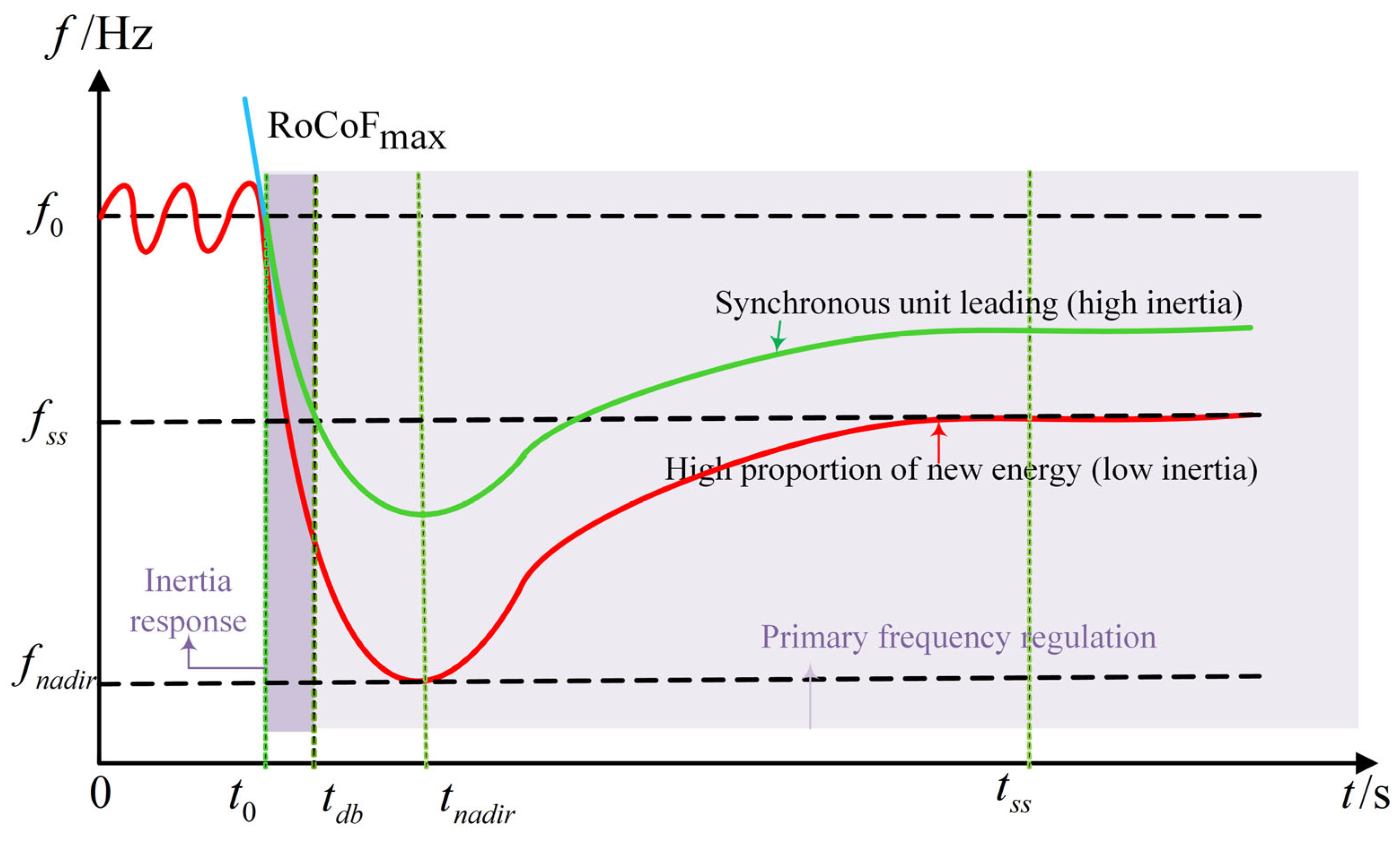
Due to the high proportion of renewable energy and power electronic loads integrated into the system, its rotational inertia is severely insufficient, exhibiting pronounced low-inertia characteristics. When the system is disturbed, taking the frequency decrease caused by the sudden increase in Δ P L power of the system load as an example, the dynamic process of frequency disturbance under different inertia support conditions is illustrated in Figure 1. The power difference between the mechanical power and the electromagnetic power of the generator is the root cause of the fluctuation of the system frequency. Under the frequency protection considering only the inertial response of the synchronous generator and the primary frequency regulation, the frequency dynamic response model of the system after disturbance can be expressed by the rotor motion equation.
2 H s y s f 0 d f ( t ) d t + D Δ f ( t ) = Δ P L , t < t d b 2 H s y s f 0 d f ( t ) d t + D Δ f ( t ) = Δ P G Δ P L , t t d b
where D is the damping coefficient of the system, in MW/Hz.

2.2. System Frequency Security Constraints

In the process of frequency dynamic response, the maximum value of frequency change rate and the deviation of frequency extreme value are important indexes to measure the frequency stability characteristics. In this section, by simplifying the frequency dynamic response process according to the rotor motion equation, and taking the active power shortage under power imbalance as an example, we ignore the effect of the damping coefficient (the damping coefficient primarily affects the quasi-steady-state frequency deviation and the recovery trajectory, with a secondary influence on the short-term metrics). This simplification is standard in studies focusing on the initial frequency dynamics—specifically the R o C o F and the frequency nadir—for determining the H min s y s . The rate of change of frequency constraints and frequency minimum point constraints are derived as follows.
From the rotor motion in Equation (4), it can be seen that at the initial moment of disturbance, the frequency support of the system mainly depends on the inertial capacity of the synchronous generator, and the R o C o F of the system is the largest. Under the unbalanced power Δ P L of the system, the R o C o F max is as follows:
R o C o F max = R o C o F t = t 0 + = d f ( t ) d t | t = 0 + = f 0 Δ P L 2 H s y s
The R o C o F constraint is as follows:
R o C o F max R o C o F max s e t
Frequency deviation extreme value constraint: According to the frequency variation curve, the lowest frequency occurs when R o C o F is zero, and the frequency extreme deviation x is not only related to the online inertia level of the system but also to the primary frequency modulation capability of the system. It is the lowest frequency value under the combined action of inertial response and primary frequency modulation.
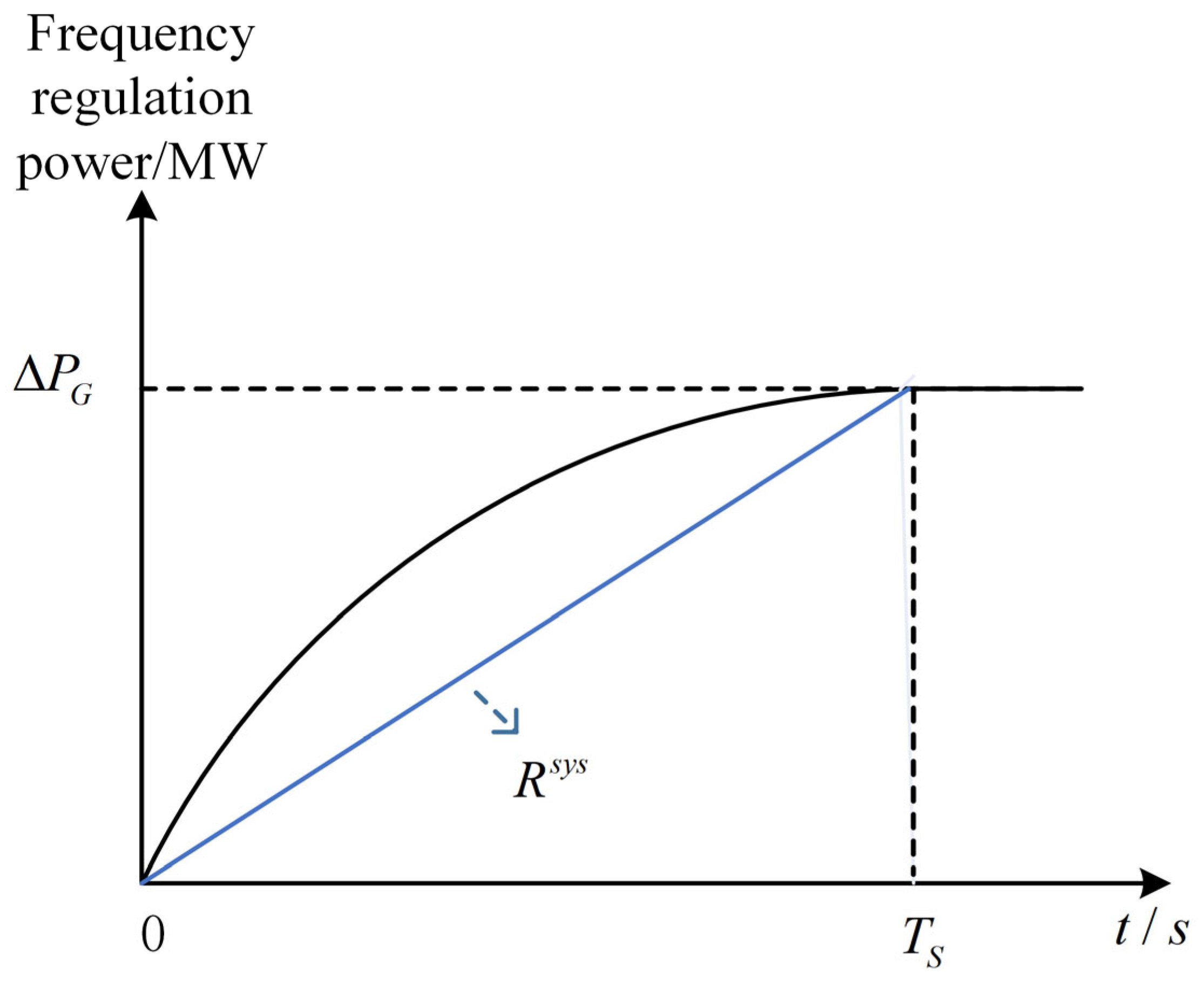
In order to obtain its time domain expression, the frequency response process of the t 0 ~ t n a d i r period and the primary frequency modulation process of the system are linearized. In period t 0 ~ t d b , due to the existence of a primary frequency modulation dead zone t d b the governing generator is not started, and the unbalanced power of the system remains unchanged in period t d b ~ t n a d i r . As shown in Figure 2, for linearizing primary frequency regulation using system units [7], the system performs primary frequency regulation at the rate of R s y s . T s is the response time corresponding to the maximum primary frequency regulation power of the system generator set. At this point, there is an equation R s y s = Δ P G / T s .
Let R o C o F = d f ( t ) d t = 0 be substituted into Equation (4), and the lowest frequency moment t n a d i r is obtained.
t n a d i r = Δ P L R s y s + t d b
The left and right sides of Equation (4) are integrated at the same time, and Equation (7) is substituted to obtain the lowest point of the system frequency, and the expression of the extreme value constraint of the frequency deviation is obtained.
Δ f n a d i r = f B + f 0 Δ P L 2 4 H s y s R s y s Δ f s e t
In summary, it can be seen that under the low-inertia operation scenario, the two important transient frequency indicators R o C o F and Δ f n a d i r tend to deteriorate.

2.3. The Minimum Inertia Level Constraint of the System

When the R o C o F value of the system exceeds the threshold of the R o C o F protection relay, the new energy unit and the distributed power unit will operate off the grid, thus deepening the active power imbalance of the system, accelerating the time to reach the start-up value of the low frequency load shedding/high frequency tripping, and threatening the frequency stability. Therefore, many power grids have stipulated the R o C o F value of the system. The British power grid sets the set value of the distributed power equipment-level anti-islanding protection as 0.125 Hz/s. Some countries have proposed a standard that the frequency change rate should not be higher than 0.4 Hz/s or 0.6 Hz/s [28]. Reference [29] suggests that the absolute value of the system R o C o F should not exceed 2 Hz/s.
Then, in order to ensure that the system R o C o F is within the allowable range, that is, to meet constraint (6), the system needs to have sufficient inertia, and the actual online inertia of the system should be higher than this critical inertia, otherwise the system R o C o F value will exceed the allowable range.
H s y s H R o C o F min = f 0 Δ P L 2 R o C o F max s e t
At the same time, if the extreme frequency of the system exceeds the allowable range, the low-frequency load shedding/high-frequency tripping will be started, breaking the third defense line of frequency protection and resulting in system tripping or large-scale power outage. In general, in order to prevent the system under-frequency load shedding action, we set the frequency extreme value so it does not exceed the first round of the under-frequency load shedding action value, generally taking 49 Hz [30]. The frequency extreme deviation is the difference between the frequency rated value and the frequency extreme value, usually no more than 1 Hz. The minimum inertia required to satisfy the type system is as follows:
H s y s H Δ f n a d i r min = Δ P L 2 f 0 4 R s y s ( Δ f s e t f d b )
Therefore, in order not to trigger R o C o F protection or low-frequency load shedding/high-frequency generator tripping, the minimum inertia level range required to maintain frequency stability by inertial response and primary frequency modulation measures is derived as follows:
H min s y s = max H R o C o F min , H Δ f n a d i r min
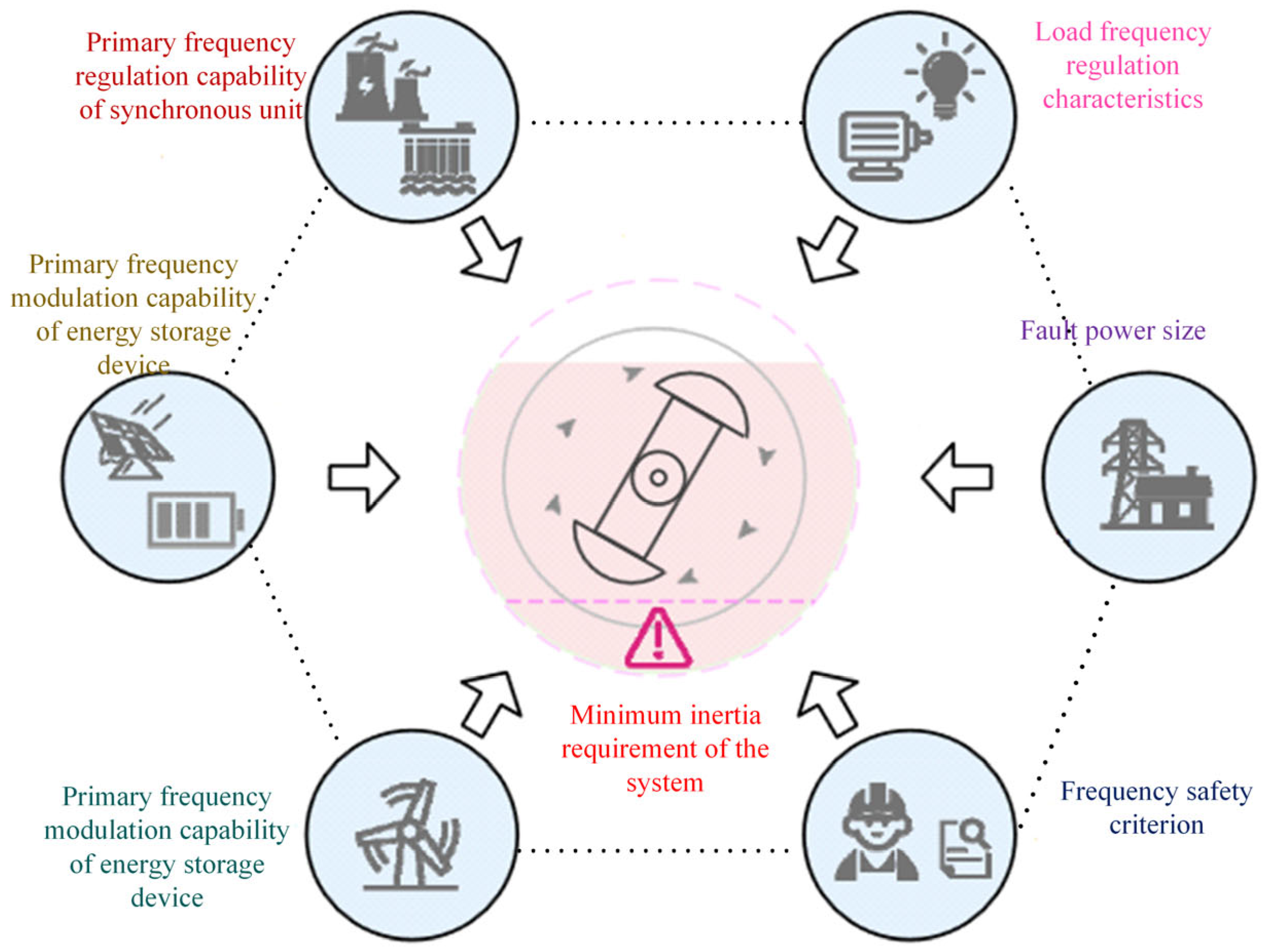
According to Equations (9)–(11), the minimum inertia requirement of the system is closely related to the system’s ultimate fault power, primary frequency modulation capability, and frequency stability target values, as shown in Figure 3.

3. Synchronous Inertia Economic Value Evaluation Model

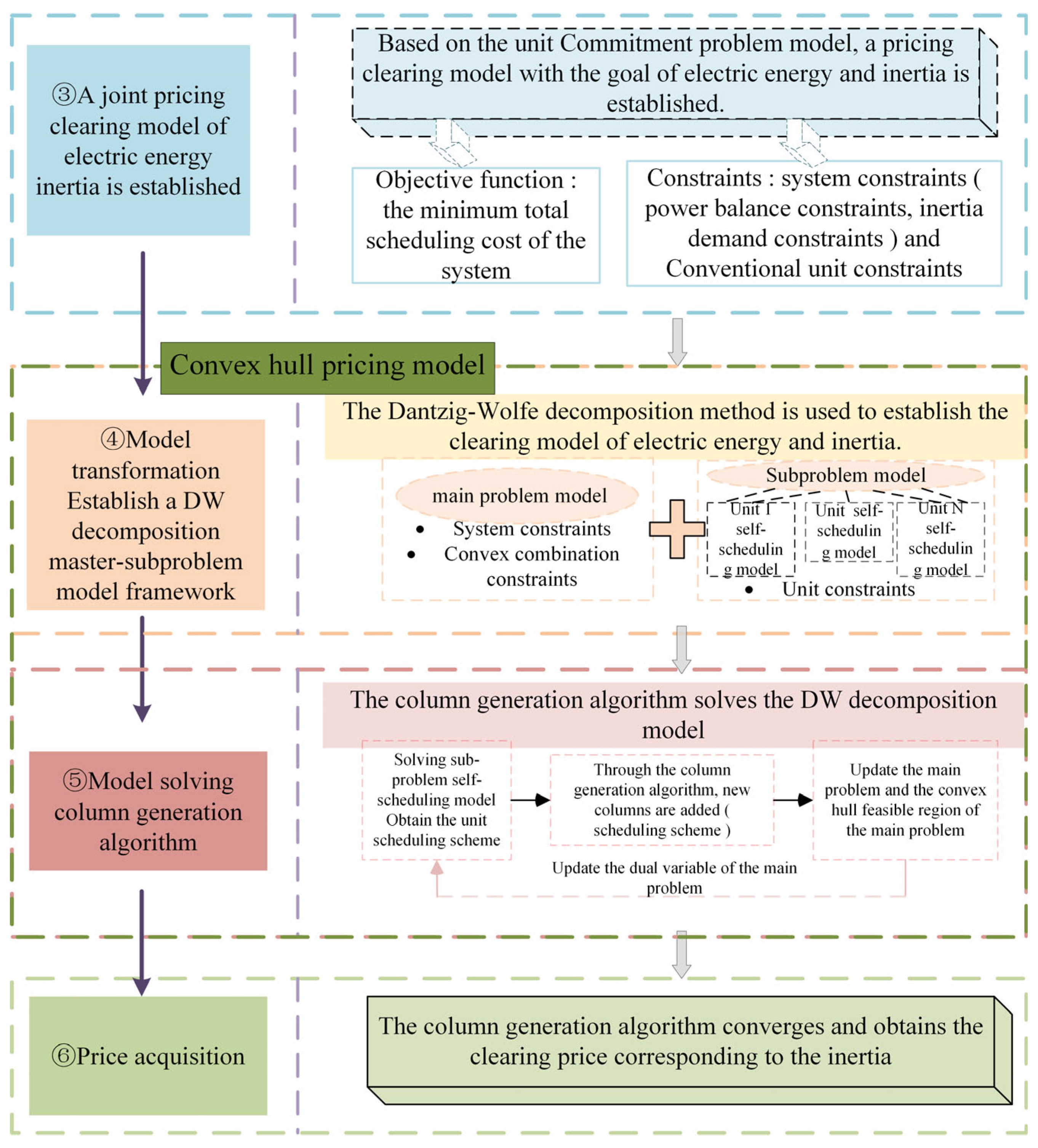
In this section, the inertia demand constraint is considered in the unit combination, and the joint pricing and clearing model of electric energy and inertia is established. In order to obtain the inertia price of the synchronous machine, considering that the state variable U in the model is discrete, the state variable causes the system synchronous machine inertia to be unable to change continuously, and the marginal value of the synchronous machine inertia cannot be obtained. Using the pricing model under integer relaxation, the state variable U is relaxed from the binary variable of {0, 1} to the continuous variable of [0, 1], which can realize the continuity of inertia value. However, the above integer relaxation method of discrete variables is contrary to the actual scheduling process. In view of the non-convex problem caused by such integer variables, the CHP method can not only price inertia but also have significant advantages in reducing the uplift payment.
The construction of a convex hull is the premise of obtaining the convex hull price. Therefore, on the basis of the pricing–clearing model, the DW decomposition is used to decompose the original pricing–clearing model into the main problem and the subproblem. The main problem is used to coordinate the global constraints and use the convex combination to select the feasible scheduling scheme of the subproblem. The subproblem is the self-scheduling problem of each unit responding to the price signal of the main problem. The column generation algorithm is used to gradually add a new scheduling scheme to the feasible region of the main problem, dynamically approach the convex hull feasible region of the main problem, and converge to obtain the final price. The idea and process of economic value evaluation of synchronous inertia proposed in this paper are shown in Figure 4.

3.1. Joint Clearing Model of Electric Energy Inertia

3.1.1. Objective Function

In this paper, the synchronous unit start–stop state U , the synchronous unit output value P and the wind power output value P w are taken as the optimization variables, and the clearing model is established with the minimum total dispatching cost F as the objective function. The mathematical description is as follows:
F = t = 1 T i = 1 N [ f ( P i t ) U i t + U i t ( 1 U i ( t 1 ) ) S i t ]

3.1.2. Constraints

(1)
Power balance constraint
i = 1 N P i t + P w t = P L t
(2)
Minimum inertia demand constraint
i = 1 N U i t H i S N i H min s y s , t
(3)
Unit output constraint
U i t P i min P i t U i t P i max 0 P w t P w t r e
(4)
Ramp constraint
Δ P i up U i t + P i min ( U i t U i ( t 1 ) ) P i t P i ( t 1 ) Δ P i down U i ( t 1 ) + P i min ( U i ( t 1 ) U i t ) P i ( t 1 ) P i t
(5)
Minimum start–stop time constraint
( X i ( t 1 ) on T i on ) ( U i ( t 1 ) U i t ) 0 ( X i ( t 1 ) down T i down ) ( U i t U i ( t 1 ) ) 0

3.2. Convex Hull Pricing Model

To fix these ideas, the previous joint pricing–clearing model is simplified as follows:
min F = f ( U i , P i ) s . t . g i ( U i , P i ) = 0 , i = 1 , 2 , , l h j ( U i , P i ) 0 , j = 1 , 2 , , k ( U i , P i ) Z i , i N
where g i ( U i , P i ) = 0 denotes the equality constraint and h j ( U i , P i ) 0 denotes the inequality constraint. Z i denotes the set of constraints for unit i for the entire horizon.
In general, the method of deriving the convex hull price is to eliminate the complexity of the system constraints by Lagrange dualization and to describe the convex hull of each unit with tight or extended formulations.
The dual multiplier is introduced, and its Lagrange function is constructed as follows:
L ( U i , P i , λ , μ ) = f + t = 1 T i = 1 l λ i t g i + t = 1 T j = 1 k 1 μ j t h j
where λ i t , μ j t are Lagrange dual multipliers corresponding to other system-level constraints in time period t .
Thus, the Lagrange dual problem (LD) of the original pricing–clearing problem is obtained as follows.
max λ , μ θ = max λ , μ   min U i , P i   L ( U i , P i , λ , μ )
By solving the model, the values of the dual multipliers λ i t and μ j t can be obtained accordingly. At this time, this is also called the marginal cost of system resources, namely LD price. It is pointed out that the exact solution of the LD problem and the exact solution of the dual multiplier are the convex hull price. The CHP (named by the convex hull of the feasible set Z i ) is essentially equivalent to the LD price (the solution of the Lagrange dual problem), which refers to the solution of the pricing problem (dual problem), rather than the solution of the original problem. There is a dual gap between them. The goal of the pricing problem is to obtain the price signal ( λ i t , μ j t ).
If the price λ i t and μ j t are known at this time, φ i ( U i , P i , λ , μ ) is used to represent the profit obtained by the unit.
φ i ( U i , P i , λ , μ ) = t = 1 T λ t g i + t = 1 T μ t h j f i
If the market scheduling scheme φ i ( U i z , P i z ) and price φ i ( λ i z , μ i z ) are obtained by solving the original problem, then the unit obtains the profit φ i ( U i z , P i z , λ i z , μ i z ) under the market scheduling instruction. However, under a given price φ i ( λ i z , μ i z ) , the unit i performs optimal self-scheduling, that is, solves the problem of maximizing the profit of the unit:
φ i ( U i m , P i m , λ i z , μ i z ) arg   max ( U i , P i ) Z i , i N φ i ( U i , P i , λ , μ )
Unit i gets maximum profit φ i ( U i m , P i m , λ i z , μ i z ) . Therefore, unit i has a profit difference between self-scheduling and market scheduling, which is an additional uplift payment that needs to be paid to the unit.
U P i = φ i ( U i m , P i m , λ i z , μ i z ) φ i ( U i z , P i z , λ i z , μ i z )
The Lagrange dual problem includes the CHP model and the model explanation and economic explanation of the up-regulation cost. It shows that the price obtained under the CHP model has the good nature of minimizing the uplift payment [17], which is conducive to improving the transparency of the market and enhancing the incentive compatibility of the market.

3.3. D-W Characterization and Decomposition Model

3.3.1. Main Problem Model

In order to solve problem (20) and obtain the convex hull price, no changes or assumptions are made to the constraint form describing the unit, and no special treatment is given to specific types of constraints (such as ramp constraint). Using the polyhedron representation theorem, any point in the polyhedron can be expressed as a convex combination of other poles. It means that the set of scheduling schemes is bound by a polyhedron and non-empty; then, the point P i in the set Z i (includes conventional unit constraint) can be expressed as follows:
P i = i N , n i N i P i , t n i z i n i n i N i z i n i = 1 , z i n i 0 , i N , n i N i
Following the above, the joint clearing model (18) can be expressed as follows:
min g z z = i , n i N i k C ^ i n i z i n i
i N , n i N i P i t n i z i n i +   P w t = P L t , t T
i N , n i N i U i t n i H i S N i z i n i H min s y s , t , t T
n i N i z i n i = 1 , i N
z i n i 0 , i N , n i N i
Objective function (25) is equivalent to (12). Constraint (26) represents the power balance constraint and is equivalent to (13). Constraint (27) represents the minimum inertia demand constraint and is equivalent to (14) Note that C ^ i n i = f i ( U i n i , P i n i ) and P i , t n i are parameters, and hence, both the objective function and the constraints are linear in z i n i . Constraint (28) requires us to select a feasible schedule represented by the variable z i n i .
Following [31], the problem in Equations (25)–(29) is equivalent to the LD problem (20); the solution of Equations (25)–(29) also solves (20). Compared to other methods that require altering the problem structure, the DW decomposition approach utilizes the polyhedral representation theorem to derive a natural formulation without modifying the functional form or constraints of the original problem. To reduce computational complexity and avoid processing the entire feasible solution set, column generation algorithms can be integrated. By generating subproblems, the column generation algorithm produces a relatively small number of feasible points in practice. These points suffice to characterize the solution to the convex hull problem without reconstructing the original problem model.
Considering a subset of feasible schedules for each unit i , say N i k N i , where k is an iteration counter, N i k contains all feasible schedules of unit i available at iteration k . The Restricted Master Problem ( R M P ) obtained after k iterations is as follows in Equations (30)–(34). The initial feasible solution set for the R M P can be populated by assuming each synchronous unit is offline and out of service as a simple feasible scheduling scenario. This approach is supplemented by introducing slack variables in the constraints and correspondingly increasing the penalty coefficient and penalty cost in the objective function to ensure the feasibility of the R M P solution set.
R M P k : min   g k z , s = i N , n i N i k C ^ i n i z i n i + t T M s t p + s t H
i N , n i N i k P i t n i z i n i +   P w t + s t p = P L t , t T , λ t p k
i N , n i N i k U i t n i H i S N i z i n i + s t H H min s y s , t , t T , λ t H k
i N , n i N i k z i n i = 1 , i N , π i k
z i n i 0 , s t p , s t H 0 , i N , n i N i k

3.3.2. Subproblem Model

Since the column generation algorithm continuously solves subproblems to generate new columns (feasible schedules) added to the main problem, it determines convergence by assessing whether the reduction cost is negative. This approach also facilitates a clearer interpretation of the dual multiplier corresponding to the required convex hull price at final convergence. Hence, at iteration k , feasible schedules with potential negative reduced cost can be obtained by the solution of the following subproblem, for each unit i . Subproblem i in iteration k is denoted as S u b k :
S u b k : min h i k = F t ( λ t p k P i t + λ t H k H i S N i U i t )
The feasible region for the subproblem is represented by ( U i , P i ) Z i , i N , indicating that each unit satisfies its own conventional unit constraints without system-level constraints such as power balance, inertia requirements, and reserve capacity.
Similarly, subproblem (35) can be regarded as the profit-maximizing self-dispatching problem for a power unit at a given price ( λ t p k , λ t H k ) , equivalent to problem (22), and can be expressed as follows:
S u b k : φ i ( U i m , P i m , λ t p k , λ t H k ) arg   max ( U i , P i ) Z i , i N φ i ( U i , P i , λ t p k , λ t H k )
where φ i ( U i m , P i m , λ t p k , λ t H k ) denotes the optimal self-dispatching plan for unit i at the current price ( λ t p k , λ t H k ) (dual multiplier) under k iterations of the main problem. Moreover, the maximum profit for the units under self-scheduling at this time is as follows:
φ i ( U i m , P i m , λ t p k , λ t H k ) = h i k

4. Model Solving

Within the DW decomposition framework, the column generation algorithm achieves optimization through iterative solution of the main and subproblems. The reduced cost criterion identifies effective columns: if a subproblem generates a feasible schedule with negative reduction cost (corresponding to an extremum point), it is added as a new column to R M P . Typically, to ensure iterative feasibility, slack variables with penalty terms are introduced into the constraints to drive the algorithm forward until an optimal solution to the R M P is obtained. Specifically, in each iteration, the subproblem is solved using the current dual multiplier to compute its reduced cost (i.e., the subproblem objective function value plus the dual multiplier term). If this cost is negative, the corresponding column is added to the R M P , progressively enriching the feasible region described by the convex hull of the R M P . The R M P is then re-solved to update the dual information, and the iteration continues. The algorithm terminates when no subproblem can generate a column with a negative reduction cost. The solution obtained at this point is the convex hull problem optimal solution for the original problem.
The reduced cost r c i ( k ) of feasible schedule ( U i m , P i m ) is given by the following:
r c i ( k ) ( U i m , P i m ) = h i ( k ) ( U i m , P i m ) π i ( k ) = π i ( k ) φ i ( U i m , P i m , λ t p k , λ t H k )
The duality of problem R M P k indicates that the value of the dual π i k denotes the tentative profit of unit i , as calculated by the optimal selection of schedules in the R M P , which results in prices ( λ t p k , λ t H k ) . Equation (38) indicates that if the unit’s self-scheduling yields better profit at the current price ( λ t p k , λ t H k ) , then we have the following:
φ i ( U i m , P i m , λ t p k , λ t H k ) > π i ( k )
r c i ( k ) ( U i m , P i m ) < 0
Therefore, under this scenario, since the self-dispatching scheme generates negative reduction costs, Equation (40) is equivalent to the iteration condition of the column generation algorithm. When the algorithm converges, r c i ( k ) ( U i m , P i m ) = 0 , the unit self-scheduling profit equals the system scheduling profit, and the convex hull price is obtained at this point, minimizing the uplift payment (23). Thus, upon algorithm termination, the exact convex hull price is obtained.

5. Example Analysis

5.1. Example Setting

This study employs the proposed inertia economic value assessment method to validate the effectiveness of the proposed pricing model and convex pricing approach using an enhanced IEEE 39-node system as a testbed. The system-level parameter settings are shown in Table 1.
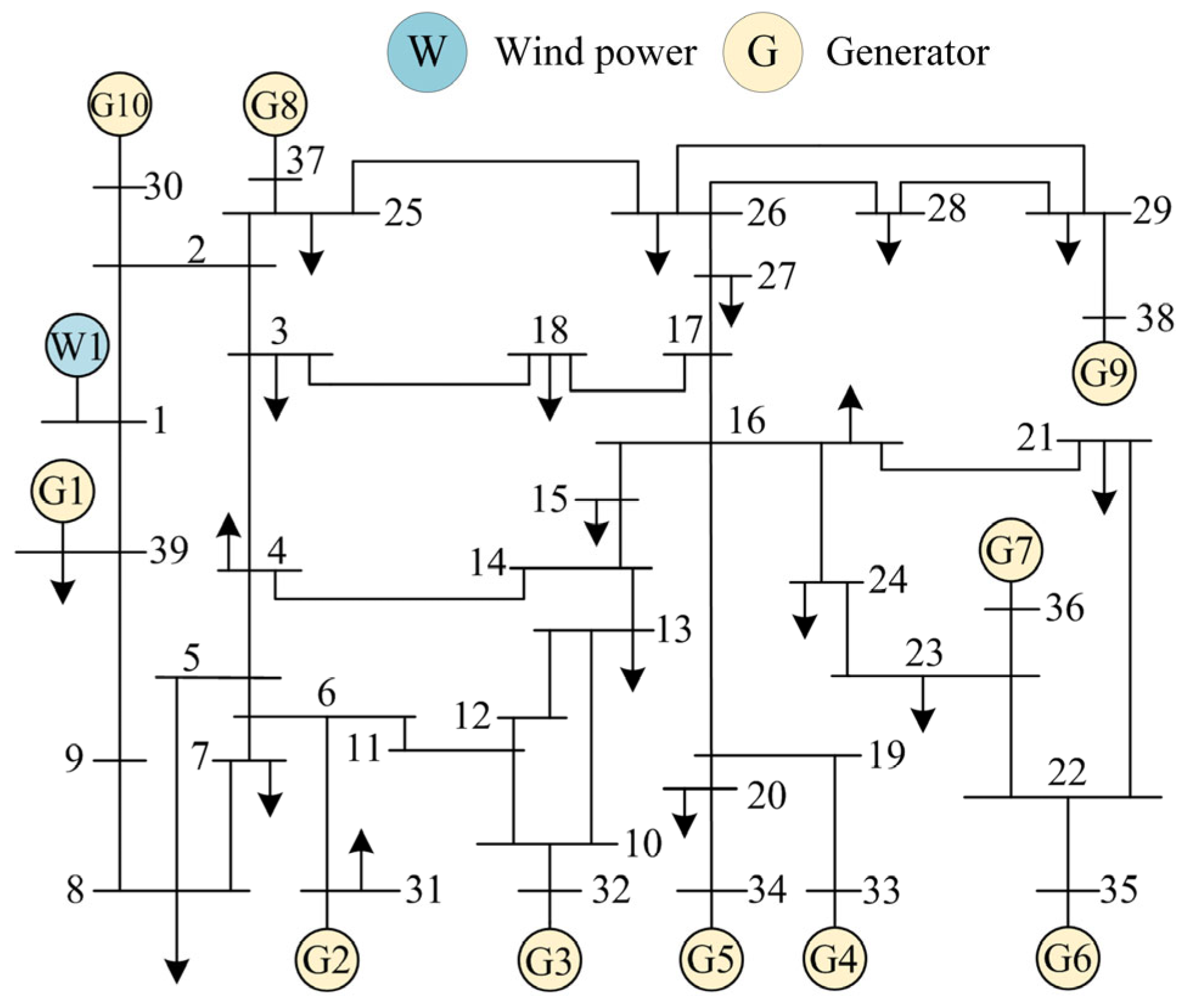
Unit parameters and load forecast data are sourced from reference [32]. Unit parameters are listed in Table 2. The total installed capacity of the 10 synchronous generators is 1662 MW, and the total system inertia is 13,795.2 MW·s. The system single-line diagram is shown in Figure 5. The simulation example employs Matlab R2018b/YALMIP and Python 3.13 to construct a pricing clearance model, utilizing the Gurobi 12.0.1 solver for computation.
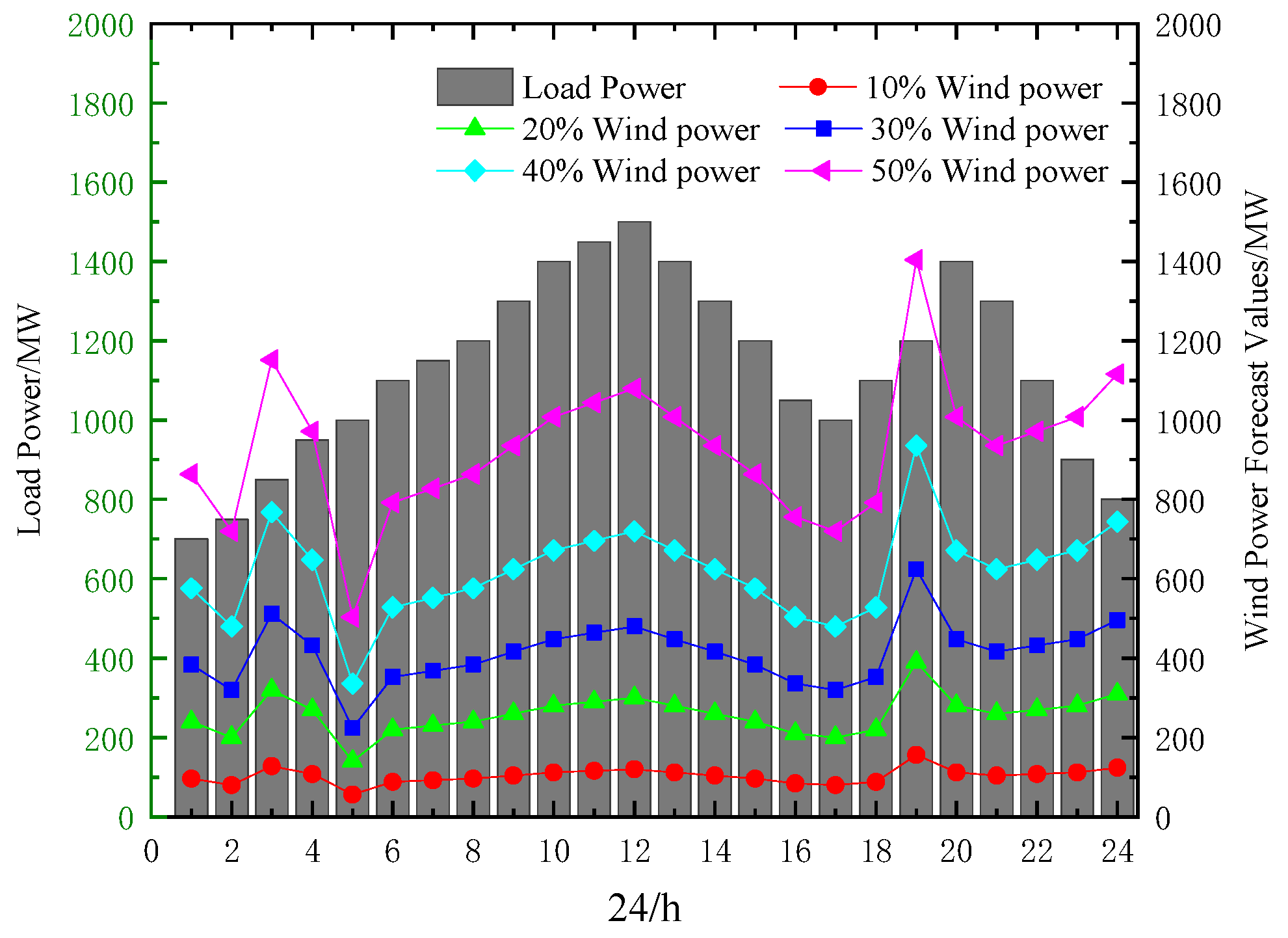
Wind turbine data was collected across five system operation scenarios. By varying the installed capacity of wind turbines connected to the system, simulation results were compared and analyzed under different capacity distribution scenarios. Among these, the wind power penetration scenario is defined based on installed capacity (i.e., wind power capacity/(wind power capacity + total synchronous machine installed capacity)), which constitutes the input scenario. The total installed capacity of wind turbines in the system and their respective capacity proportions is shown in Table 3. Additionally, under different installed capacities, wind speed forecasts remained consistent across all time periods, and system load power values remained unchanged. Corresponding wind power forecasts and load power data are detailed in Figure 6.

5.2. Analysis of Example Results

5.2.1. Clearing Results of Synchronous Units Under Different Wind Power Capacity Proportions

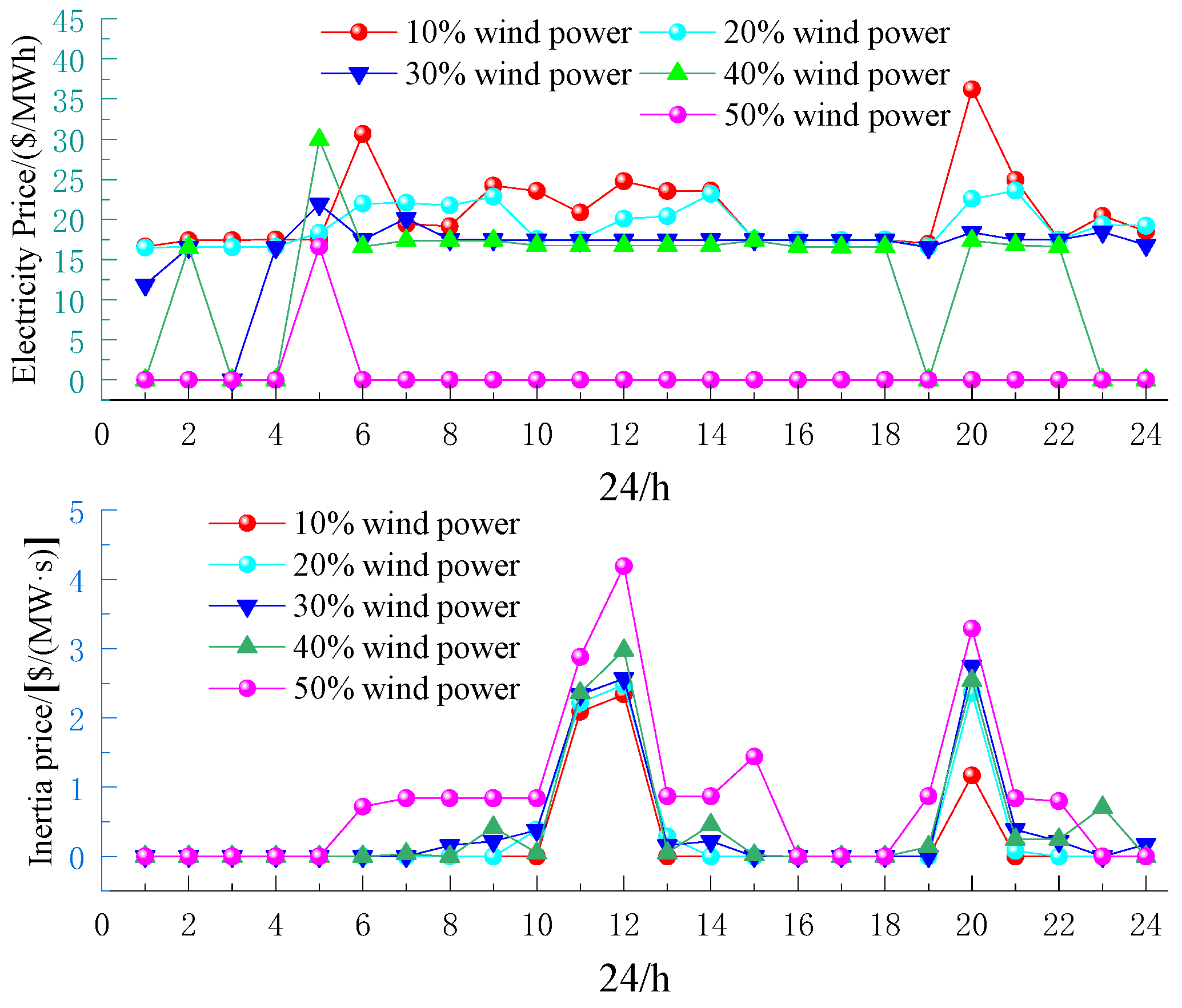
Without considering virtual inertia in wind farms and under constant system load conditions, simulation tests were conducted for five wind farm capacity scenarios to analyze the economic effects of inertia by comparing different simulation results. The proposed method evaluates the economic value of synchronous inertia under varying wind farm capacity shares. The shadow prices for electricity and synchronous inertia under different wind turbine capacity shares are shown in Figure 7.
It can be seen from Figure 7 that the higher the wind turbine capacity is, the lower the shadow price of electric energy is, and the higher the shadow price of inertia is. This is because in this example, the capacity of the wind turbine is increased, but the rated capacity of the synchronous generator connected to the system does not change. Therefore, with the increase in wind farm capacity, the more power generation resources available to the system and the lower the shadow price of electric energy corresponding to the system. At the same time, the capacity of wind turbines increases, the share of synchronous generators is squeezed, and the online inertia of the system is reduced. The larger the capacity of the wind turbine, the scarcer the inertia, and the higher the shadow price of the inertia.
It can also be seen from Figure 7 that under the same wind power penetration rate, the shadow price of inertia in period 12 is higher than that in other periods. The main reason is that the disturbance amount is set to 10% of the load in this period. The load value of period 12 is the largest in 24 periods, and the power shortage caused by the corresponding disturbance of instant period 12 is the largest. Therefore, period 12 requires the largest frequency modulation resources and inertia. Correspondingly, the shadow price of period 12 inertia is the highest.
To gain a deeper understanding of the underlying physical drivers behind the aforementioned price fluctuations, Table 4 summarizes key system performance metrics determined by the optimization model under different wind power penetration scenarios. The table presents the total energy generation, derived average power outputs, and system inertia from the joint market clearing. The average power outputs are calculated as total energy divided by the 24 h scheduling period.
Table 4 clearly demonstrates the key role of dispatch characteristics and inertia constraints under high wind power proportion. As wind power proportion increases from 10% to 50%, the system’s online inertia exhibits an overall downward trend, with the capacity of online synchronous machines continuously decreasing. This indicates that not all synchronous units remain online. However, to meet the minimum inertia requirement H min s y s for system frequency security, a certain level of online synchronous machines must still be maintained, making online inertia an increasingly scarce resource.
It is noteworthy that in Figure 7 and Table 4, the inertia price was zero during periods 1 to 5 and 16 to 18. Under the 50% scenario, the system’s online inertia exceeded that of the 40% scenario, and the inertia price was also higher during the same periods. This occurs because during these periods, the system online inertia H s y s determined by the optimized dispatch significantly exceeds the minimum inertia requirement H min s y s , rendering the inertia demand constraint non-constrained. In convex pricing theory, the shadow price for a non-constrained condition is zero. This is because adding a unit of inertia at this point does not require altering the unit combination to increase generation or system inertia. Consequently, it does not raise the total system cost by necessitating additional online inertia. The relationship between this phenomenon and the system inertia margin and inertia reserve will be further explored in Section 5.2.3.

5.2.2. The Benefits of Synchronous Units Under Different Wind Power Capacity Ratios

Similarly, under the final convergence of the column generation algorithm when the pricing–clearing model obtains the optimal solution, the shadow price of the electric energy and inertia of the synchronous unit is obtained by the dual multiplier of the system-level constraint in the Restricted Master Problem. When the shadow price of electric energy is paid to the synchronous generator set as the settlement price, the inertial service is included in the paid service; when the inertial income of the synchronous generator set is taken into account, the income of all the synchronous generators of the system under different wind turbine capacity ratios is calculated. The results are shown in Table 5.
The revenue composition in Table 3 stems from the joint pricing mechanism proposed in this paper. Under this mechanism, inertia payments are settled independently from energy payments. Electricity revenue is settled based on the convex hull price of electricity ( λ t p k ), while inertia revenue is settled based on the independent inertia convex hull price ( λ t H k ), which is the shadow price of the system’s minimum inertia constraint. Synchronous units provide inertia services based on their online status and receive compensation accordingly.
The total income in Table 5 is the total income of the synchronous unit obtained by the electric energy income plus the inertia income minus the total dispatching cost, and the income of the inertial service is the electric energy income minus the total dispatching cost. It can be seen from Table 5 that as the proportion of wind power capacity increases, the electric energy income of synchronous generator sets decreases. This is because when the proportion of wind power capacity increases, the share of the synchronous generator set is occupied and the marginal price decreases, both of which lead to the decrease in electric energy income of the synchronous generator set. On the contrary, the higher the proportion of wind power capacity, the scarcer the inertia, the higher the shadow price of inertia, and the higher the inertia income of the synchronous generator set. If only considering the electric energy income of the synchronous generator set, when the wind turbine capacity accounts for a relatively high proportion, the synchronous generator set may suffer losses, and there is a risk off-grid.

5.2.3. Analysis of the Economic Relationship Between Inertia Resources and Synchronous Inertia Shadow Price

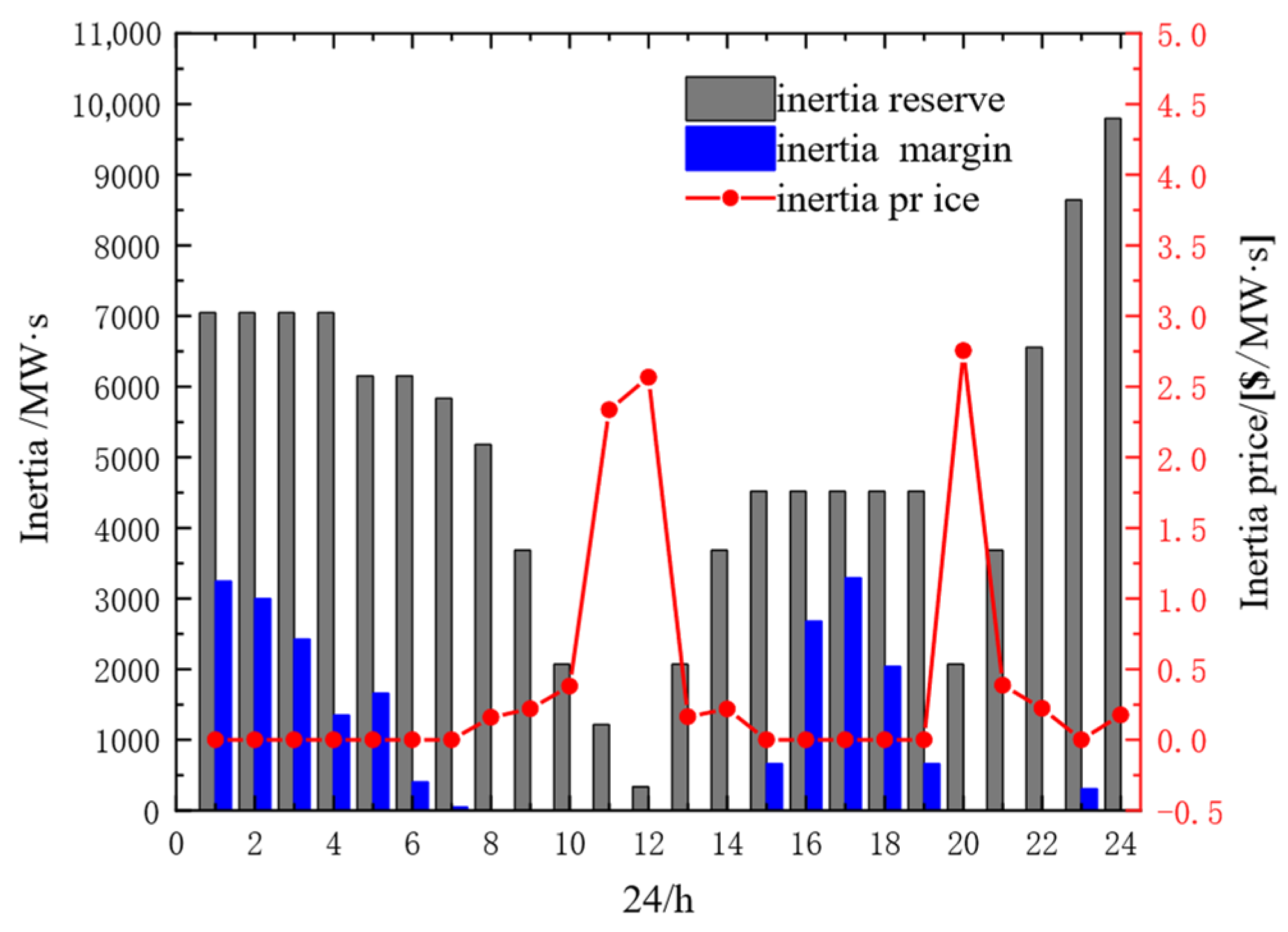
In order to further explore the economic relationship between the system inertia resources and the shadow price of synchronous inertia, the influence of which index on the level of inertia price is explored. Taking the installed capacity of wind power as 30% of the total installed capacity of the system as an example, this paper introduces the inertia margin H t s m (the difference between the online inertia of the system and the minimum inertia limit in each time period) and the system inertia reserve H t t s (the difference between the online inertia of all the inertia of the system in each time period). The relationship between the two and the shadow price of inertia is shown in Figure 8.
Figure 8 shows that since the model takes into account the minimum inertia of the system to maintain the safe and stable operation of the frequency, there will be no case of system inertia exceeding the limit, H t s m 0 . In the scheduling cycle, there are units that are not scheduled, and these synchronous units provide the inertia reserve of the system. H t t s > 0 . When H t s m > 0 , the shadow price of synchronous inertia (representing the marginal cost of the system caused by its additional 1 MW s inertia) is always zero. This is because the online running inertia of the system exceeds the minimum inertia of the system. Without changing the unit combination, it can meet the inertia demand of the system by itself, without adjusting the unit combination to increase the inertia, and the marginal cost does not change. When H t s m = 0 , if the minimum inertia requirement is improved, relying on the existing unit start–stop cost cannot meet the inertia required by the system. By changing the unit commitment scheme, adding units or starting large-capacity units, the scheduling cost is increased, and the inertia shadow price is generated.
In the period with inertia shadow price, it is further found that inertia shadow price is negatively correlated with inertia reserve capacity H t t s . The larger the reserve capacity is, the more the optional scheduling schemes satisfying the inertia constraint are, and the units with better economy can be preferentially invoked. The smaller the marginal cost increase is, the lower the shadow price is. For example, in the 9–13 period, high load, less reserve, large disturbance, large online inertia required to meet inertial demand, and small available reserve capacity lead to significant changes in marginal cost and higher shadow price.

5.2.4. Comparative Analysis of the Uplift Payment Under Different Pricing Methods

Similarly, two distinct pricing settlement methods were employed—the 0–1 integer relaxation pricing method (Q1) and the CHP method based on DW decomposition and column generation algorithms proposed herein (Q2). For different wind power capacity share scenarios, the uplift payment of the two pricing and settlement methods were compared to validate the effectiveness of the CHP method based on DW decomposition and column generation in reducing uplift payment. Table 6 presents the uplift payment under different wind power capacity proportion for both pricing methods. Table 7 further details the comprehensive comparison of costs, dispatch profits, self-dispatch profits, and uplift payment for synchronous generators under a 30% wind power capacity proportion.
Table 6 demonstrates the effectiveness of the proposed method in reducing uplift payment, as illustrated by Table 7. According to the electricity price signal obtained by the Q1 method, the uplift payment compensation corresponding to the electricity price is $13,265: the CHP method proposed in this paper is used to ensure that the unit can perform market scheduling, and the uplift payment compensation under the electricity price obtained by Q2 is about $4303. It is not difficult to find in Table 6 and Table 7 that the price signal obtained based on the pricing method Q2 proposed in this paper is superior to the Q1 pricing method in reducing the uplift payment compensation. However, both Q1 and Q2 can only reduce the uplift payment and reduce the discriminatory payment and cannot fully realize the uplift payment cost of 0, which is determined by the nature of the non-convex problem. Q2 has better pricing effects on non-convex problems, lower uplift payment costs, which are the most obvious nature of market incentive compatibility, and excellent performance in achieving market fairness.

5.2.5. Performance Analysis of the Following Generation Algorithms Under Different Initial Solution Sets

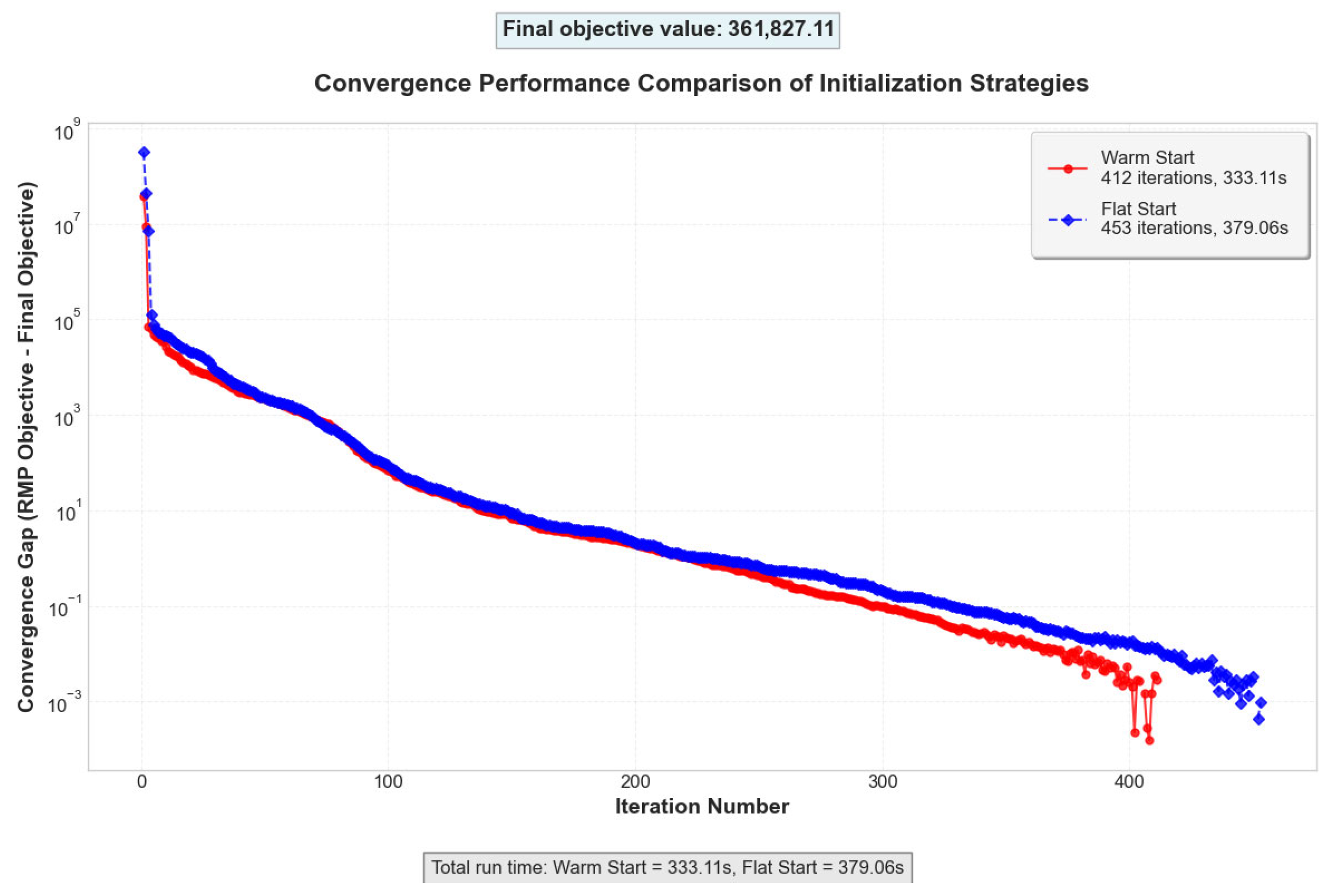
To verify the influence of the R M P initial solution set on the performance of the column generation algorithm, two initial solution strategies are used for iterative convergence analysis. Two initial solutions: The first is the initial solution ‘FLAT’ cold start corresponding to the scheduling scheme of all units shut down. The second is to add two initial columns for each generator; two columns are the initial solutions of the minimum output and the maximum output of the whole period, corresponding to the ‘WARM’ hot start. The iterative process of the column generation algorithm corresponding to the two different initial solution strategies is shown in Figure 9.
The experimental results in Figure 9 show that the initial solution of ‘WARM’ can significantly improve the convergence performance of the column generation algorithm, and its effect is better than the initial solution of ‘FLAT’. Specifically, the ‘WARM’ strategy not only reduces the number of iterations as a whole but also reduces the calculation time, showing a faster convergence speed. The fundamental reason for this advantage is that the initial solution provided by the ‘FLAT’ strategy is of poor quality, and the feasible region constructed by its initial R M P is too rough, which requires more iterations and more columns to gradually approach the optimal convex hull. Therefore, using a high-quality hot-start initial solution can effectively reduce the search cost of the column generation algorithm by providing an initial feasible region closer to the final solution, thereby significantly accelerating the solution process and enabling more efficient convergence toward the optimal solution space. Although the use of different initial solutions (‘WARM’ and ‘FLAT’) will lead to differences in iterative path and convergence speed, the column generation algorithm eventually converges to the same optimal objective function value of R M P . The effectiveness of the algorithm is proven.

6. Conclusions

In this paper, for power systems with high renewable energy penetration, the inertial auxiliary service market is established by quantifying the economic value of the inertia of the synchronous unit, and the uplift payment of the market is reduced by CHP, enhancing market fairness. In this paper, the improved IEEE 39-node system is used to verify the effectiveness of the proposed pricing–clearing model. Through the analysis of the example results, the following conclusions are drawn:
(1)
The economic value of synchronous inertia increases as wind turbines’ proportion of system capacity rises, while electricity prices decline. In the system with high wind power capacity, only considering the electric energy income is not enough to cover the operation cost of synchronous generator set, and considering the value of inertia is helpful to reduce the risk of the synchronous generator set off-grid. This highlights the necessity of separately quantifying the economic value of inertia to ensure the sustainability of synchronous generators.
(2)
Improved initial strategies substantially accelerate algorithm execution speed without compromising optimal solutions. A better initial solution has a better effect on the number of iterations and the convergence speed, but different initial solutions do not change the final convergence result, which reflects the effectiveness of the column generation algorithm in solving the pricing–clearing model.
(3)
The proposed CHP clearing model based on DW decomposition and the column generation algorithm has a significant effect on reducing the up-regulation cost of the system, which is conducive to minimizing the uplift payment to meet the incentive compatibility of the market, enhancing market transparency, maintaining market stability and ensuring the participation enthusiasm of the unit.
The core innovation of this study lies not only in applying the CHP method to inertia pricing but also in demonstrating its practical efficacy through the DW decomposition method, which avoids complex model reconstruction. this paper is based on the joint pricing–clearing model under DW decomposition and the column generation algorithm, evaluating the economic value of the synchronous unit inertia, and verifies that the initial solution of the main problem affects the computational efficiency of the model. Although the proposed framework demonstrates effectiveness, it has limitations and faces practical challenges: (1) The computational efficiency of the column generation algorithm requires further enhancement for large-scale, real-time market applications. (2) The model relies on a simplified frequency dynamics representation; incorporating more detailed device-level responses could improve its accuracy. (3) The current model does not incorporate network constraints (e.g., transmission line limits). In real systems, network topology and congestion could affect unit commitment and the locational distribution of inertia, potentially leading to spatially differentiated inertia prices. (4) Practical implementation faces market design challenges, including the need for advanced metering infrastructure, coordinated market rules with other ancillary services, and regulatory adaptation. To address these issues, more efficient convex hull models and solution methods will be considered in the future. At the same time, in the future, we will also conduct in-depth research on the economic value assessment of synchronous inertia and virtual inertia after considering virtual inertia such as new energy and energy storage to participate in the system, so as to better help the construction and development of the inertial auxiliary service market.

Author Contributions

Conceptualization, B.Z. and J.Y.; methodology, B.Z.; software, B.Z.; validation, B.Z.; formal analysis, J.Y.; investigation, Y.G.; data curation, Y.G.; writing—original draft preparation, W.W.; writing—review and editing, W.W.; visualization, W.W.; supervision, Y.S. All authors have read and agreed to the published version of the manuscript.

Funding

This research was funded by key projects of the National Natural Science Foundation of China, grant number 62233006.

Data Availability Statement

The data supporting the findings of this study are available from the corresponding author, Bijiang Zhu, upon reasonable request.

Conflicts of Interest

The authors declare no conflicts of interest.

Nomenclature

Indices and Sets
R o C o F Rate of change of frequency.
CHPConvex hull pricing.
LDLagrange dual.
R M P Restricted Master Problem.
i , N Index and set of all generators.
t , T Index and set of time periods.
Z i Set of constraints for unit i for the entire horizon.
n i Index of unit i feasible schedules, which are contained in the set N i , n i N i .
k Index of iteration counter.
Main Variables
H i Inertia time constant of the i generator [s].
H sys Online inertia of the system [MW s].
S N i Rated capacity of the i generator [MW].
Δ P L System power disturbance shortfall [MW].
f t Frequency of the system at time t [Hz].
Δ f t Frequency deviation at time t [Hz].
f 0 Rated frequency of the system [Hz].
f s s Quasi-steady-state frequency of the system [Hz].
f n a d i r Lowest frequency of the system [Hz].
t d b Dead time of primary frequency regulation of synchronous unit [s].
t n a d i r Time when the system reaches the lowest frequency point [s].
t s s Time when the system reaches quasi-steady-state frequency [s].
Δ P G Active power regulation of primary frequency regulation [MW].
R s y s Equivalent primary frequency response regulation coefficient of the system [MW/s].
R o C o F max Maximum rate of change of frequency [Hz/s].
R o C o F max s e t R o C o F limit threshold set by the system [Hz/s].
Δ f n a d i r Extreme value of frequency deviation [Hz].
Δ f s e t Limit threshold of frequency deviation [Hz].
f B Primary frequency modulation dead zone [Hz]
H min s y s Minimum inertia requirement of the system [MW s].
H min s y s , t Minimum inertia of the system in period t [MW s].
a i , b i , c i Coefficients of the generator i cost function
f ( P i t ) Generation operation cost of generator i in time period t [$/MW].
S i t Start-up cost of generator i in time period t [$/MW]
P i t Output value of generator i in time period t [MW].
P w t Output value of wind farm in period t [MW].
P L t Load demand of period t [MW].
P i max , P i min Upper and lower limits of the output of the generator i , respectively [MW].
Δ P i up , Δ P i down Maximum climbing ability and the maximum landslide ability of the active power output per hour of the generator i , respectively [MW].
X i ( t 1 ) on , X i ( t 1 ) down Continuous start-up time and shutdown time of the generator i in the first t 1 periods, respectively [s].
T i on , T i down Minimum start-up and shutdown time of the generator i , respectively [s].
P i , t n i Output of unit i in scheme n i [MW].
z i n i A specific feasible schedule, denoted by ( U i n i , P i n i ) .
C ^ i n i Cost under scheduling scheme z i n i , C ^ i n i = f i ( U i n i , P i n i ) .
N i k A subset of feasible schedules for each unit i , N i k N i , which contains all feasible schedules of unit i available at iteration k .
M Penalty coefficient, typically set to a large value.
s t p Slack variables representing power demand [MW].
s t H Slack variables representing inertia demand [MW s].
λ t p k Dual variable for the power balance constraint at iteration k [$/MW h].
λ t H k Dual variable for the system’s minimum inertia requirement constraint at iteration k [$/MW s].
π i k Dual variable for the convex combination constraint at iteration k .
U i State variable that characterizes the start-up and shutdown of the generator i (when U i = 0 , it means shutdown, and when equal U i = 1 , it means start-up).
U i t Start–stop state of generator i in time period t .

References

  1. Wang, S.; Sun, Z. An Energy-Function-Based Approach for Power System Inertia Assessment. Energies 2025, 18, 3105. [Google Scholar] [CrossRef]
  2. Zhang, W.; Wen, Y.; Chung, C.Y. Inertia Security Evaluation and Application in Low-Inertia Power Systems. IEEE Trans. Power Syst. 2025, 40, 1725–1737. [Google Scholar] [CrossRef]
  3. Tan, B.; Zhao, J.; Netto, M.; Krishnan, V.; Terzija, V.; Zhang, Y. Power system inertia estimation: Review of methods and the impacts of converter-interfaced generations. Int. J. Elect. Power Energy Syst. 2022, 134, 107362. [Google Scholar] [CrossRef]
  4. Amamra, S.-A. Quantifying the Need for Synthetic Inertia in the UK Grid: Empirical Evidence from Frequency Demand and Generation Data. Energies 2025, 18, 5345. [Google Scholar] [CrossRef]
  5. Liu, B.; Chen, Z.; Zhou, T.; Li, Y.; Wang, Y. Overview and Prospects of Equivalent Inertia Evaluation, Requirements, and Optimization Research for New Power Systems. High Volt. Technol. 2025, 51, 1251–1268. [Google Scholar] [CrossRef]
  6. Liang, Z.; Mieth, R.; Dvorkin, Y. Inertia Pricing in Stochastic Electricity Markets. IEEE Trans. Power Syst. 2023, 38, 2071–2084. [Google Scholar] [CrossRef]
  7. Lu, Z.; Wang, J.; Shahidehpour, M.; Bai, L.; Li, Z. Convex-Hull Pricing of Ancillary Services for Power System Frequency Regulation with Renewables and Carbon-Capture-Utilization-and-Storage Systems. IEEE Trans. Power Syst. 2024, 39, 6615–6635. [Google Scholar] [CrossRef]
  8. Ela, E.; Gevorgian, V.; Tuohy, A.; Kirby, B.; Milligan, M.; Malley, M.O. Market Designs for the Primary Frequency Response Ancillary Service—Part I: Motivation and Design. IEEE Trans. Power Syst. 2014, 29, 421–431. [Google Scholar] [CrossRef]
  9. Xu, T.; Jang, W.; Overbye, T. An Economic Evaluation Tool of Inertia Services for Systems with Integrated Wind Power and Fast-Acting Storage Resources. In Proceedings of the 2016 49th Hawaii International Conference on System Sciences (HICSS); IEEE: New York, NY, USA, 2016; pp. 2456–2465. [Google Scholar] [CrossRef]
  10. Nguyen, H.T.; Chleirigh, M.N.; Yang, G. A Technical & Economic Evaluation of Inertial Response From Wind Generators and Synchronous Condensers. IEEE Access 2021, 9, 7183–7192. [Google Scholar] [CrossRef]
  11. Badesa, L.; Teng, F.; Strbac, G. Pricing inertia and Frequency Response with diverse dynamics in a Mixed-Integer Second-Order Cone Programming formulation. Appl. Energy 2020, 260, 114334. [Google Scholar] [CrossRef]
  12. Chen, S.; Zhou, J.; Han, H.; Zhang, X.; Zhou, Y.; Wei, Z. Investment strategies for energy storage systems in a joint energy and frequency ancillary service market. J. Energy Storage 2025, 116, 115798. [Google Scholar] [CrossRef]
  13. Badesa, L.; Matamala, C.; Zhou, Y.; Strbac, G. Assigning Shadow Prices to Synthetic Inertia and Frequency Response Reserves from Renewable Energy Sources. IEEE Trans. Sustain. Energy 2023, 14, 12–26. [Google Scholar] [CrossRef]
  14. Zhu, L.; Zhang, X.; Tang, L.; Qiu, N.; Tian, Y. Taking into account the emergency interruptible load of electrical energy, inertia and primary frequency regulation combined clearing model. J. Shanghai Jiao Tong Univ. 2025, 59, 16–27. (In Chinese) [Google Scholar] [CrossRef]
  15. Deng, J.; Li, X.; Liu, J. A joint optimal clearing model for energy, inertia and ramping in power systems considering multiple time scales. Appl. Energy 2025, 390, 125892. [Google Scholar] [CrossRef]
  16. Gribik, P.R.; Hogan, W.W.; Popeii, S.L. Market-Clearing Electricity Prices and Energy Uplift; Harvard University: Cambridge, MA, USA, 2007. [Google Scholar]
  17. Fang, X.; Yang, Z.; Yu, J.; Lai, X.; Xia, Q. Electricity Pricing Under Constraint Violations. IEEE Trans. Power Syst. 2020, 35, 2794–2803. [Google Scholar] [CrossRef]
  18. Yang, Z.; Zheng, T.; Yu, J.; Xie, K. A Unified Approach to Pricing Under Nonconvexity. IEEE Trans. Power Syst. 2019, 34, 3417–3427. [Google Scholar] [CrossRef]
  19. Wang, G.; Shanbhag, U.V.; Zheng, T.; Litvinov, E.; Meyn, S. An Extreme-Point Subdifferential Method for Convex Hull Pricing in Energy and Reserve Markets—Part I: Algorithm Structure. IEEE Trans. Power Syst. 2013, 28, 2111–2120. [Google Scholar] [CrossRef]
  20. Schiro, D.A.; Zheng, T.; Zhao, F.; Litvinov, E. Convex Hull Pricing in Electricity Markets: Formulation, Analysis, and Implementation Challenges. IEEE Trans. Power Syst. 2016, 31, 4068–4075. [Google Scholar] [CrossRef]
  21. Guan, Y.; Pan, K.; Zhou, K. Polynomial time algorithms and extended formulations for unit commitment problems. IISE Trans. 2018, 50, 735–751. [Google Scholar] [CrossRef]
  22. Gentile, C.; Morales-España, G.; Ramos, A. A tight MIP formulation of the unit commitment problem with start-up and shut-down constraints. EURO J. Comput. Optim. 2017, 5, 177–201. [Google Scholar] [CrossRef]
  23. Qu, M.; Ding, T.; Li, L.; Chi, F.; He, Y.; Chen, T.; Wang, F. Approximate Linear Programming for Large Scale Unit Combinations from NP Hard to Polynomial Time Algorithm: Double Convex hull Model. Chin. J. Electr. Eng. 2022, 42, 3261–3276. (In Chinese) [Google Scholar] [CrossRef]
  24. Xiao, Y.; Ding, T.; Huang, Y.; Zhang, B.; Yu, J.; Dai, J.; Tian, N.; Tang, X. Extended Locational Marginal Price: A Linear Relaxation Pricing Method Based on Convex Hull of Unit Commitment and Its Applications in Electricity Spot Market. CSEE J. Power Energy Syst. 2026, 46, 101–114. (In Chinese) [Google Scholar] [CrossRef]
  25. Yu, Y.; Guan, Y.; Chen, Y. An Extended Integral Unit Commitment Formulation and an Iterative Algorithm for Convex Hull Pricing. IEEE Trans. Power Syst. 2020, 35, 4335–4346. [Google Scholar] [CrossRef]
  26. Andrianesis, P.; Bertsimas, D.; Caramanis, M.C.; Hogan, W.W. Computation of Convex Hull Prices in Electricity Markets with Non-Convexities Using Dantzig–Wolfe Decomposition. IEEE Trans. Power Syst. 2022, 37, 2578–2589. [Google Scholar] [CrossRef]
  27. Qin, Q. Research and Application of Convex hull Pricing Algorithm Based on ADMM. Master’s Thesis, Guangxi University, Nanning, China, 2024. (In Chinese) [Google Scholar] [CrossRef]
  28. Wang, B.; Sun, H.; Li, W.; Yang, C.; Wei, W.; Wu, J. Power System Inertia Estimation Method Based on Energy Conservation. In Proceedings of the 2020 IEEE Sustainable Power and Energy Conference (iSPEC), Chengdu, China, 23–25 November 2020; IEEE: New York, NY, USA, 2020; pp. 705–711. [Google Scholar] [CrossRef]
  29. Sneha, F.H.; Liu, Y.; Martinez, R.U.; Dong, J. Calculating Critical Inertia of a Power System. In Proceedings of the SoutheastCon 2025, Concord, NC, USA, 22–30 March 2025; IEEE: New York, NY, USA, 2025; pp. 40–45. [Google Scholar] [CrossRef]
  30. Zhang, G.; Ren, J.; Zeng, Y.; Liu, F.; Wang, S.; Jia, H. Security assessment method for inertia and frequency stability of high proportional renewable energy system. Int. J. Elect. Power Energy Syst. 2023, 153, 109309. [Google Scholar] [CrossRef]
  31. Magnanti, T.L.; Shapiro, J.F.; Wagner, M.H. Generalized Linear Programming Solves the Dual. Manage. Sci. 1976, 22, 1195–1203. [Google Scholar] [CrossRef]
  32. Ongsakul, W.; Petcharaks, N. Unit commitment by enhanced adaptive Lagrangian relaxation. IEEE Trans. Power Syst. 2004, 19, 620–628. [Google Scholar] [CrossRef]
Figure 1. Post-fault frequency dynamics variation curve.
Processes 14 00667 g001
Figure 2. Primary frequency regulation response curve of system.
Processes 14 00667 g002
Figure 3. The influencing factors of the minimum inertia demand of the system.
Processes 14 00667 g003
Figure 4. Research framework of synchronous inertia economic value evaluation.
Processes 14 00667 g004
Figure 5. The system single-line diagram.
Processes 14 00667 g005
Figure 6. Load forecast and wind power forecast.
Processes 14 00667 g006
Figure 7. Clearing price of synchronous unit resources under different wind power capacities.
Processes 14 00667 g007
Figure 8. The relationship between the synchronous inertia price and the system inertia resource.
Processes 14 00667 g008
Figure 9. Algorithm convergence performance under different initial solutions.
Processes 14 00667 g009
Table 1. System parameters and simulation settings.
Parameter and SymbolValue/Setting
Testing Systemenhanced IEEE 39-node system
T 24 h
f 0 50 Hz
Δ P L 10% P L
R o C o F max s e t 0.5 Hz/s
f n a d i r 49 Hz
Δ f s e t 1 Hz
f B 0.005 Hz
M 1500
Table 2. Generator parameters.
Unit H i /s P i max /MW P i min /MW Δ P i up / down /(MW/h) T i on / down /h a i /($/h) b i /($/MWh) c i /($/MW2h) S i /($/h)
19.3455150±1508100016.190.000484500
29.3455150±150897017.260.000315000
38.113020±40570016.600.00200550
48.113020±40568016.500.00211560
58.116225±45645019.700.00398900
65.88020±20337022.260.00712170
75.88525±25348027.740.00079260
85.85515±15166025.920.0041330
95.85515±15166527.270.0022230
105.85515±15167027.790.0017330
Table 3. Different installed capacity and their proportions of wind farms.
Wind Proportion ScenarioInstalled Capacity
/MW
Capacity Proportion
/%
10184184/(184 + 1662)
20416416/(416 + 1662)
30712712/(712 + 1662)
4011081108/(1108 + 1662)
5016621662/(1662 + 1662)
Table 4. Optimized system dispatch under different wind proportion scenarios.
Wind Proportion ScenarioSystem’s Average
Online Inertia
/MW s
Total Wind Power Generation
/MWh
Total Synchronous Generator Output
/MWh
Average Online Synchronous Generator Output
/MW
Average Wind Power Generation
/MW
10%10,128.51247623,724988.50103.17
20%9298.43619020,010833.75257.92
30%8571.74990416,299679.15412.67
40%8133.9114,85612,312513.03619.00
50%8359.2822,28411,064461.04928.50
Table 5. Benefits of synchronous units under different wind power proportion.
Proportion of Wind PowerElectric Energy Income
/$
Inertia
Income
/$
Total Income of Synchronous Units
/$
Total Scheduling
Cost
/$
Total
Profit
/$
Total Profit (No Inertia Income)
/$
10%526,35475,803602,157494,904107,25331,447
20%433,756109,328543,084422,371120,71311,385
30%367,052119,525486,577361,827124,7055225
40%215,227146,412361,639287,13874,501−71,911
50%79,281224,485303,766257,11246,654−177,831
Table 6. Comparison of system uplift payments across wind proportion.
Wind ProportionUplift Payment (Q1)
/$
Uplift Payment (Q2)
/$
10%17,3558135
20%12,5225581
30%13,2654303
40%17,6974113
50%37,5547620
Table 7. Uplift payment for units with different pricing methods.
MethodCost
/$
Scheduling Profit
/$
Self-Scheduling Profit
/$
Uplift Payment
/$
Q1359,438.65107,428120,69313,265
Q2361,827.11124,705129,0084303
Disclaimer/Publisher’s Note: The statements, opinions and data contained in all publications are solely those of the individual author(s) and contributor(s) and not of MDPI and/or the editor(s). MDPI and/or the editor(s) disclaim responsibility for any injury to people or property resulting from any ideas, methods, instructions or products referred to in the content.