
Article

Unraveling Co-Pyrolysis Mechanisms for Municipal Sludge and Microplastics: Thermodynamic, Kinetic, and Product Insights

1
Guangdong Education Department Key Laboratory of Resources Comprehensive Utilization and Cleaner Production, School of Environmental Science and Engineering, Guangdong University of Technology, Guangzhou 510006, China
2
Cooperative Extension, University of Maine, Orono, ME 04469, USA
3
Key Laboratory of Radioactive and Rare Scattered Minerals, Ministry of Natural Resources, Shaoguan 510080, China
4
School of Analysis and Test Center, Guangdong University of Technology, Guangzhou 510006, China
*
Authors to whom correspondence should be addressed.
Processes 2026, 14(4), 591; https://doi.org/10.3390/pr14040591
Submission received: 2 January 2026 / Revised: 29 January 2026 / Accepted: 6 February 2026 / Published: 9 February 2026

Abstract

This study aimed to characterize the impacts of high density polyethylene (HDPE) and polyethylene terephthalate (PET) on the co-pyrolysis mechanisms and products of municipal sludge (MS) by using thermogravimetric analysis. Compared with PET, the addition of 30% HDPE maximized the comprehensive pyrolysis index of MS from 7.68 to 20.37 × 10⁻⁶ %3/(min2·°C3). Between 350 and 500 °C, the facilitatory effect of the MS-PET co-pyrolysis was stronger than that of HDPE-MS. Between 500 and 1000 °C, the addition of PET/HDPE exerted an inhibitory effect on the MS pyrolysis. Prior to adding either plastic, the two main pyrolysis stages of MS followed distinct reaction models: a first-order reaction between 162.6 and 431.5 °C and a sixth-order (F6) reaction between 431.5 and 735.8 °C. However, the addition of HDPE transformed the high-temperature stage kinetics from the F6 model to nucleation growth. Throughout the (co-)pyrolysis process, the decomposition of alcohols, aliphatic hydrocarbons, acids, and aromatic substances occurred, accompanied by the formation of new aromatic compounds. The addition of HDPE further disrupted the char structure, while the addition of PET formed a barrier within the co-pyrolytic char, hindering the release of volatiles. Multi-objective optimization revealed that both HDPE and PET yielded superior energy performance compared with the MS pyrolysis. Increasing HDPE content further enhanced energetic optimization, with temperature and plastic type identified as the primary factors governing energy output at a heating rate of 10 °C/min. This study introduces a novel co-pyrolytic approach for tightening the co-circularity of both MS and PET/HDPE.

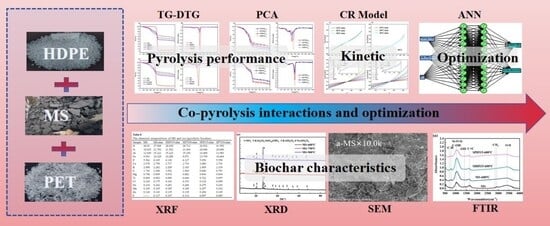
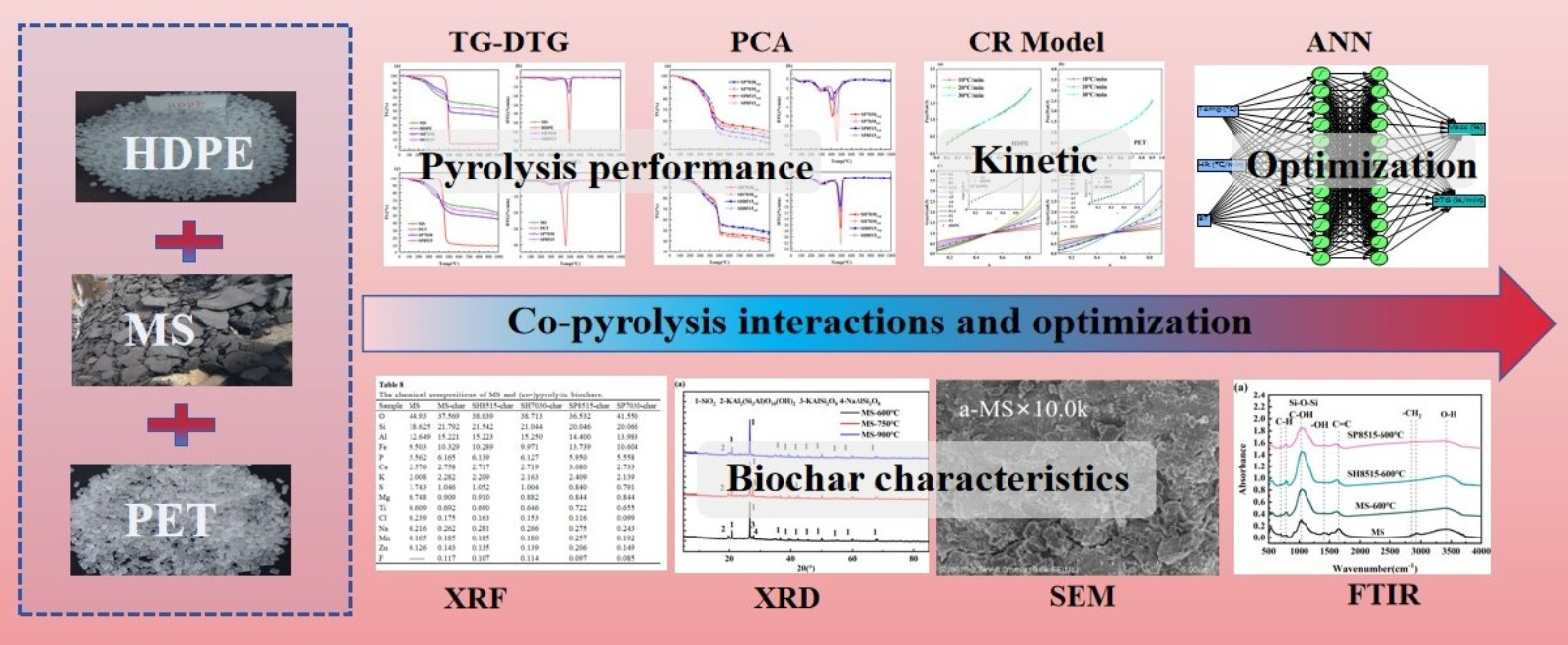
Graphical Abstract

1. Introduction

Microplastics (MPs) are plastic particles with a size of less than 5 mm, originating from the degradation of plastic products due to external forces, such as washing, abrasion, corrosion, and erosion [1,2]. Wastewater is a primary carrier of MPs, with a significant portion of MPs accumulating in wastewater treatment plants (WWTPs) through adhesion, precipitation, and filtration [3], resulting in over 90% of MPs being concentrated in municipal sludge (MS) [4]. Sludge MP concentrations have been reported to range from 1.60 × 10³ to 56.4 × 10³ particles per kilogram of dry sludge [5]. Due to its diverse sources, MS contains various types of MPs, including polypropylene (PP), polyethylene (PE), polyvinyl chloride (PVC), and polyethylene terephthalate (PET). MPs possess a highly polymerized structure, making them resistant to degradation in MS, thus posing a risk of releasing toxic substances into the environment and threatening human health [6,7]. The significant accumulation of MPs in MS underscores the urgent need for a comprehensive understanding of and effective strategies to reduce the environmental burden of both MPs and MS.
Among various treatment methods, pyrolysis stands out for its ability to significantly reduce sludge volume while degrading most organic matter and toxic substances, including MPs [8]. Recent studies on the co-pyrolysis of sludge and plastics have revealed complex interactions that govern both the process dynamics and resultant products. These interactions can alter reaction pathways, leading to either facilitatory or inhibitory effects on the decomposition regime [9]. A key concern is the consequent modification of char properties, where the inclusion of plastics has been shown to influence the retention of pollutants [10], induce the formation of environmentally persistent free radicals [11], and modify physicochemical characteristics, such as aromaticity, conductivity, and pH [12]. Consequently, optimizing co-pyrolysis conditions (e.g., feedstock ratio and temperature) is crucial for tailoring the final char’s functionality and application potential [13,14,15]. PP and PE inhibit sludge lysis, whereas PVC may enhance char aromaticity, stability, and adsorption activity [16]. Previous co-pyrolysis studies have prioritized optimizing conditions for high-quality bio-oils/gases, leaving a critical knowledge gap in the kinetics and mechanisms of MP-MS co-cracking. The objective of this study was to investigate interactions during MS co-cracking with MP, specifically addressing the full transformation potential of MP in MS and its effects on resultant product properties.
HDPE—constituting 15% of global plastic consumption (>56 Mt/yr) and widely used in containers [17,18]—and PET—the dominant textile plastic (>70 Mt/yr) [18,19]—were selected in this study. Despite their prevalence, co-pyrolytic interactions between MS and HDPE/PET and their impacts on process parameters and char properties remain unclear. To unravel these complex mechanisms and optimize the process, contemporary studies increasingly employ advanced characterization techniques coupled with data-driven modeling. On the one hand, sophisticated analytical approaches, such as the coupling of thermogravimetry with evolved gas analysis (e.g., TG-FTIR), X-ray diffraction (XRD), and microscopy, are deployed to gain fundamental insights into reaction pathways and product yields [20]. On the other hand, machine learning (ML) frameworks are integrated to model catalytic reforming processes [21], predict and optimize bio-oil upgrading [22], and dynamically simulate co-conversion systems, thus surpassing the limitations of traditional experimental optimization methods [23,24,25]. Therefore, this study bridges this gap via multi-objective optimization combining TG, tube furnace experiments, SEM, XRF, XRD, and FTIR characterization, and artificial neural networks (ANN). This comprehensive quantification and optimization provide actionable insights into the enhanced co-circularity of the MPs and MS through their co-pyrolysis.

2. Materials and Methods

2.1. Sample Preparation and Characterization

The municipal sludge sample utilized in this study was randomly obtained from a domestic sewage treatment plant located in Foshan City. The MS samples underwent a drying process in a cool and ventilated area, followed by further drying in an oven at 65 °C for 24 h. Subsequently, they were crushed using a grinder and then sieved through a 200-mesh sieve. High-density polyethylene powder (HDPE, Shanghai Macklin Biochemical Co., Ltd., Shanghai, China) and PET powder (Shandong Yawanglai Chemical Co., Ltd., Jinan, China) were chosen as the representative MPs, both of which were also screened using a 200-mesh sieve. To elucidate the interaction mechanisms during co-pyrolysis, elevated MP concentrations of 15–30 wt% were employed, following an established approach for amplifying thermal signatures in related literature [26,27]. The prepared MS and MP samples were dried for an additional 24 h and then mixed in a mortar until achieving uniform coloration according to the two mass ratios of 70% MS:30% MPs and 85% MS:15% MPs. The resulting mixed samples were designated as SH7030, SH8515, SP7030, and SP8515.
Ultimate analysis, proximate analysis, and higher heating value analysis of these samples were conducted using an elemental analyzer (Vario EL cube, Elementar Instruments, Langenselbold, Germany)and a microcomputer calorimeter (WZR-IT-CII, Changsha Bente Instruments, Changsha, China).

2.2. TG Experiments and Parameter Estimation

2.2.1. TG Experiments

Thermogravimetric experiments were performed using a TG analyzer (NETZSCH STA 409 PC, NETZSCH-Gerätebau GmbH, Selb, Germany) at the three heating rates of 10, 20, and 30 °C/min. The experimental atmosphere used was high purity nitrogen (N2), with 50 mL/min as its flow rate. The final experimental temperature was set to 1000 °C. At the initiation of each experiment, approximately 6 mg of the sample was carefully placed in an alumina crucible, after which the heating program commenced from 30 °C and progressed to 1000 °C. To minimize systematic errors, prior to commencing the experiments, an empty crucible was utilized to conduct blank tests at the three heating rates, and the resulting background baseline was established. Subsequently, the background baseline corresponding to each heating rate was subtracted from the experimental data of all the samples. Each experiment was conducted at least twice to minimize relative errors. The experimental data were recorded onto a computer by the analyzer, yielding TG data and differential TG (DTG) data.

2.2.2. Comprehensive Pyrolysis Index

The following parameters were obtained through the analysis of the TG data: ignition temperature (Ti, °C), maximum weight loss rate (Rmax, %/min), temperature corresponding to maximum weight loss rate (Tmax, °C), average weight loss rate (Rmean, %/min), total weight loss rate of the samples (m, %) and the corresponding temperature (ΔT1/2, °C) when the weight loss rate is half of the maximum weight loss rate. Based on these established parameters, the comprehensive pyrolysis index (CPI) was employed to evaluate overall pyrolysis performance as follows [23]:
C P I = ( R m a x ) × ( R m e a n ) × m T i × T m a x × Δ T 1 / 2

2.2.3. Interaction Analysis

By comparing the theoretical TG/DTG data versus actual TG/DTG data of the co-pyrolysis experiments, the interactions between MS and HDPE/PET were explored. The theoretical co-pyrolysis data were derived from weighted calculations when the materials were pyrolyzed separately as follows:
( D ) T G c a l = ( 1 w ) ( D ) T G s a m p l e + w ( D ) T G M S
where (D)TGcal is the theoretical co-pyrolysis data; w is the mass percentage of MS; TGsample is the mono-pyrolysis data of HDPE/PET; and TGMS is the mono-pyrolysis data of MS.
The deviations (Δ(D)TG) between the actual and theoretical co-pyrolysis data were leveraged to evaluate the interaction effects as follows:
Δ ( D ) T G = ( D ) T G e x p ( D ) T G c a l
where (D)TGexp is the experimental co-pyrolysis data. A positive value indicates an inhibitory effect, while a negative value indicates a facilitatory effect. The larger the deviation value is, the stronger the interaction is.

2.2.4. Principal Component Analysis

Principal component analysis (PCA) was employed to reduce data dimensionality while preserving information, identifying key drivers in the co-pyrolysis system [28]. Following variable standardization, principal components were extracted using an eigenvalue threshold > 2, with Kaiser-normalized varimax rotation applied. Two principal components (PC1 and PC2) derived from the DTG data were interpreted through factor loading plots and component score plots using SPSS 19.0.

2.2.5. Kinetic and Thermodynamic Analyses

The (co-)pyrolysis kinetics were estimated from the TG data as follows:
d a d t = k ( T ) × f ( a )
where T is the reaction temperature (K); f(α) is the reaction function; and α is the conversion degree, whose formula is as follows:
α = m 0 m t m 0 m f
where m0, mt, and mf refer to the initial, real-time, and residual sample masses, respectively.
k(T) is the reaction rate constant and described according to the Arrhenius equation as follows:
k ( T ) = A e x p ( E R T )
where A is the pre-exponential factor (s−1); R is the gas constant (8.314 J/K/mol); and E is the activation energy (kJ/mol).
Substituting Equation (6) into Equation (4) and combining it with the heating rate (β = dT/dt) yields the following:
d a d T = A β e x p ( E R T ) f ( a )
According to Equation (7), the activation energy of the sample reaction can be estimated using the Flynn–Wall–Ozawa (FWO), Kissinger–Akahira–Sunose (KAS), and Starink methods as follows:
F W O : l n β = l n ( A E R G ( a ) ) 2.315 0.4567 E R T
K A S : l n β T 2 = l n ( A E R G ( a ) ) R R T  
S t a r i n k : l n ( β T 1.92 ) = C s 1.008 E R T
After the estimation of the activation energy of the (co-)pyrolysis, the thermodynamic parameters of pre-exponential factor (A, s−1); enthalpy change (ΔH, kJ/mol); free Gibbs energy (ΔG, kJ/mol); and entropy [ΔS, J/(mol·K) can be computed as follows:
A = [ β × E α × e x p ( E α R T m a x ) ] / ( R T m a x 2 )
H = E α R T
G = E α + R T m a x l n ( K B T m a x h A )
S = ( G H ) / T m a x
where KB = 1.381 × 10⁻³⁴ J/K; and h = 6.626 × 10⁻³⁴ J/s.
Based on the estimated activation energy, the best-fit reaction model of the (co-)pyrolysis can be determined using the integral master-plots method according to which Equation (7) can be transformed as follows [29]:
G ( α ) = A E β R P ( u )
where P(u) is the temperature integral, u = E/TR and estimated as follows [30]:
P ( u ) = e x p ( u ) u × ( 1.00198882 u + 1.87391198 )
Taking the value of α = 0.5 as the reference point and both A and E as the constants, Equation (15) can be converted to
G ( 0.5 ) = A E β R P ( u 0.5 )
where u0.5 = E/RT0.5.
Combining Equations (15) and (17) leads to the following:
G ( α ) G ( 0.5 ) = P ( u ) P ( u 0.5 )
The common thermal reaction mechanisms of solid materials are illustrated in Table 1. According to Equation (18), the smaller the variance is between the theoretical G(α)/G(0.5) curve and the actual P(u)/P(u0.5) curve for a given reaction model G(α), the more closly the selected reaction model aligns with the reaction process of a given sample. This can be leveraged to determine the best-fit reaction model. To validate the accuracy of the selected model, the reaction kinetic process of the model was deduced using MATLAB R2018b (MathWorks, Inc., Natick, MA, USA).

2.2.6. Kinetic Analysis

The reaction mechanism of the co-pyrolysis was analyzed using the Coast-Redfern (CR) method [32]. The same as that outlined in Section 2.2.5, the derivation process is thus:
G ( α ) = A E β R P ( x ) = A β R T 2 E ( 1 2 R T E ) e x p ( E R T ) f ( α )
In the thermal decomposition, when 2RT/E is far less than 1 [33], Equation (19) can be simplified thus:
l n ( G ( α ) T 2 ) = E R T + l n ( A R β E )
Taking 1/T and ln(G(α)/T2) as x and y, respectively, the best-fit linear model can be selected according to the maximum coefficient of determination (R2). Once the best-fit model was selected, the activation energy (E, kJ/mol) and pre-exponential factor (A, s−1) were estimated as its slope and intercept, respectively.

2.3. Char Characterization via Tube Furnace Simulation

Pyrolytic carbon samples were prepared using a tube furnace (SX-G12123, Tianjin Zhonghuan Electric Furnace Co., Ltd., Tianjin, China). Prior to the experiment, high-purity N2 was introduced into the tube furnace at a flow rate of 0.5 L/min for 20 min to purge the air. A sample weighing 3.0000 ± 0.1000 g was loaded onto a corundum boat and positioned at the center of the furnace. The heating program was started. The heating program was initiated, with a heating rate of 8 °C/min between 30 and 500 °C and of 4 °C/min between 500 °C and the three temperatures (600, 750, and 900 °C). After the co-pyrolysis process was completed, the chars in the furnace were continuously cooled to below 150 °C in a nitrogen atmosphere, transferred to a drying dish to allow for their cooling to room temperature, and collected as the char samples.
The co-pyrolytic char was characterized using an X-ray fluorescence spectroscopy (XRF, Axios mAX Petro, PANalytical B.V., Almelo, The Netherlands), an X-ray diffraction (X’Pert Pro MPD, PANalytical B.V., Almelo, The Netherlands), a scanning electron microscopy (SU8010, Hitachi High-Tech Corp., Tokyo, Japan), and an FTIR spectrometer (Nicolet iS50, Thermo Fisher Scientific, Madison, WI, USA). The characterization focused on determining the elemental composition, crystal structure, surface micromorphology, and functional groups of the co-pyrolytic char.

2.4. Artificial Neural Network-Based Joint Optimization

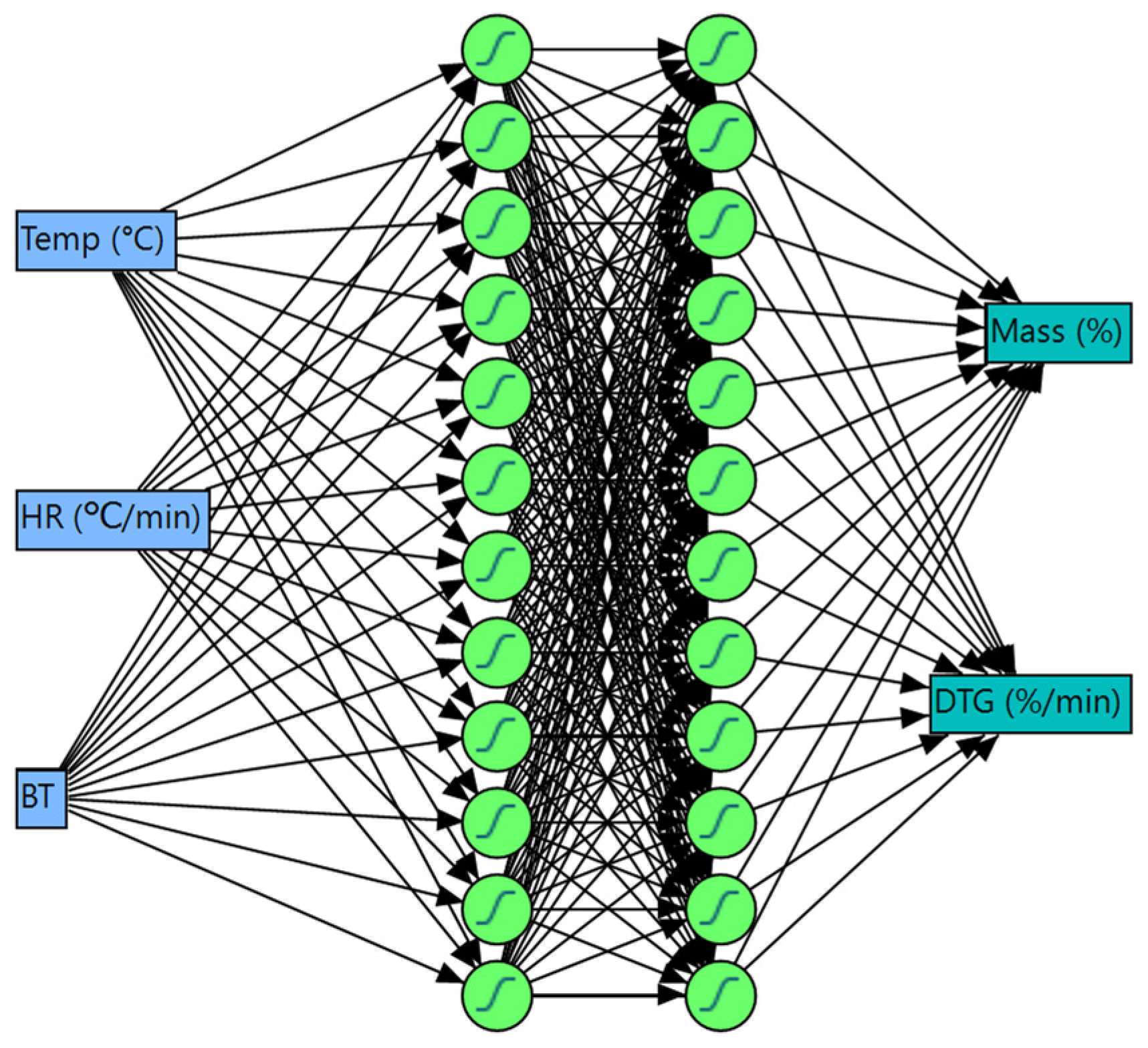
In this study, the ANN model employed a feedforward architecture with a 3-12-12-2 topology (input layer, two hidden layers with 12 neurons each, output layer), utilizing hyperbolic tangent (TanH) activation functions throughout. The input variables were temperature (Temp), heating rate (HR), and blend type (BT). To ensure proportional representation of HR and BT, the entire data was stratified by these variables. The model was developed and validated using 5-fold cross-validation. Model performance was evaluated using validation-based root mean squared error (RMSE), mean absolute deviation (MAD), and coefficient of determination (R2) to select optimal hyperparameters. A composite desirability function (D) was used to implement multi-objective optimization of the ANN model [34]. Monte Carlo simulations (N = 5000 iterations) were employed to quantify predictor sensitivity [35]. All modeling and optimization were conducted using JMP Pro 18.2.

3. Results and Discussion

3.1. Physicochemical Drivers and Patterns

Proximate, ultimate, lower heating value (LHV), and higher heating value (HHV) analyses are summarized in Table 2. HDPE (46.33 MJ/kg) and PET (22.89 MJ/kg) exhibited substantially higher HHVs than MS (8.69 MJ/kg) and TDS (4.11 MJ/kg), surpassing even common biomass feedstocks like bamboo leaves (17.74 MJ/kg), bamboo shoot leaves (18.23 MJ/kg), and water hyacinth (14.77 MJ/kg). The low HHVs of MS and TDS indicate poor inherent combustibility, justifying co-combustion with high-calorific-value materials—a recognized strategy for enhancing MS combustion [36]. HDPE and PET are ideal candidates given their exceptional HHVs, minimal moisture (<0.1%) and ash content (<0.1%), and high volatile matter (HDPE: 99.89%; PET: 95.68%), all exceeding values for sludge and biomass. They outperform PP in these key combustion characteristics. Their near-absence of N and S (predominantly composed of C/H/O) further minimizes NOx and SO2 formation. Thus, co-pyrolyzing MS with these plastics simultaneously enhances energy recovery and reduces emissions of hazardous pollutants.

3.2. Thermal Decomposition Amount and Rate of Mono-Pyrolysis

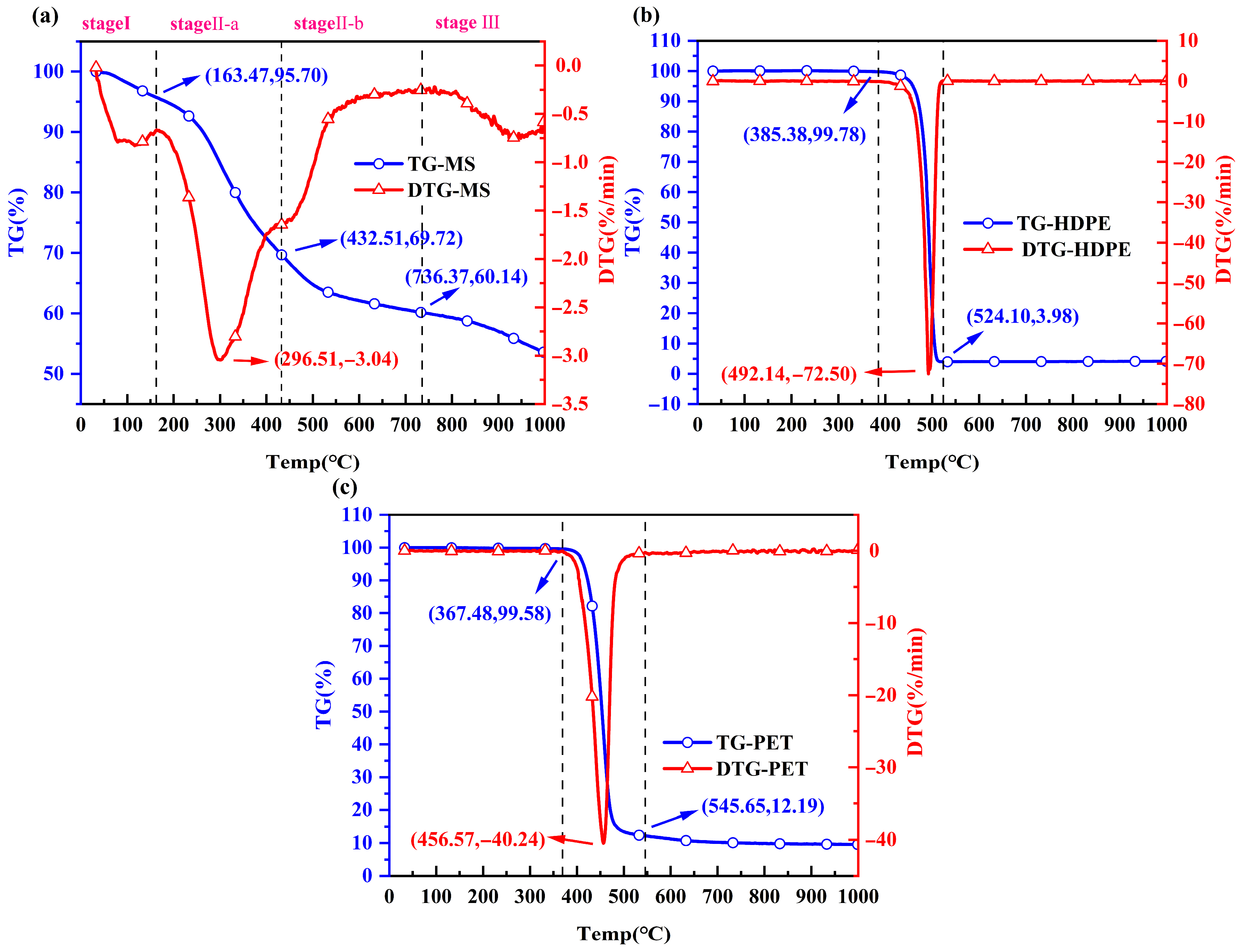
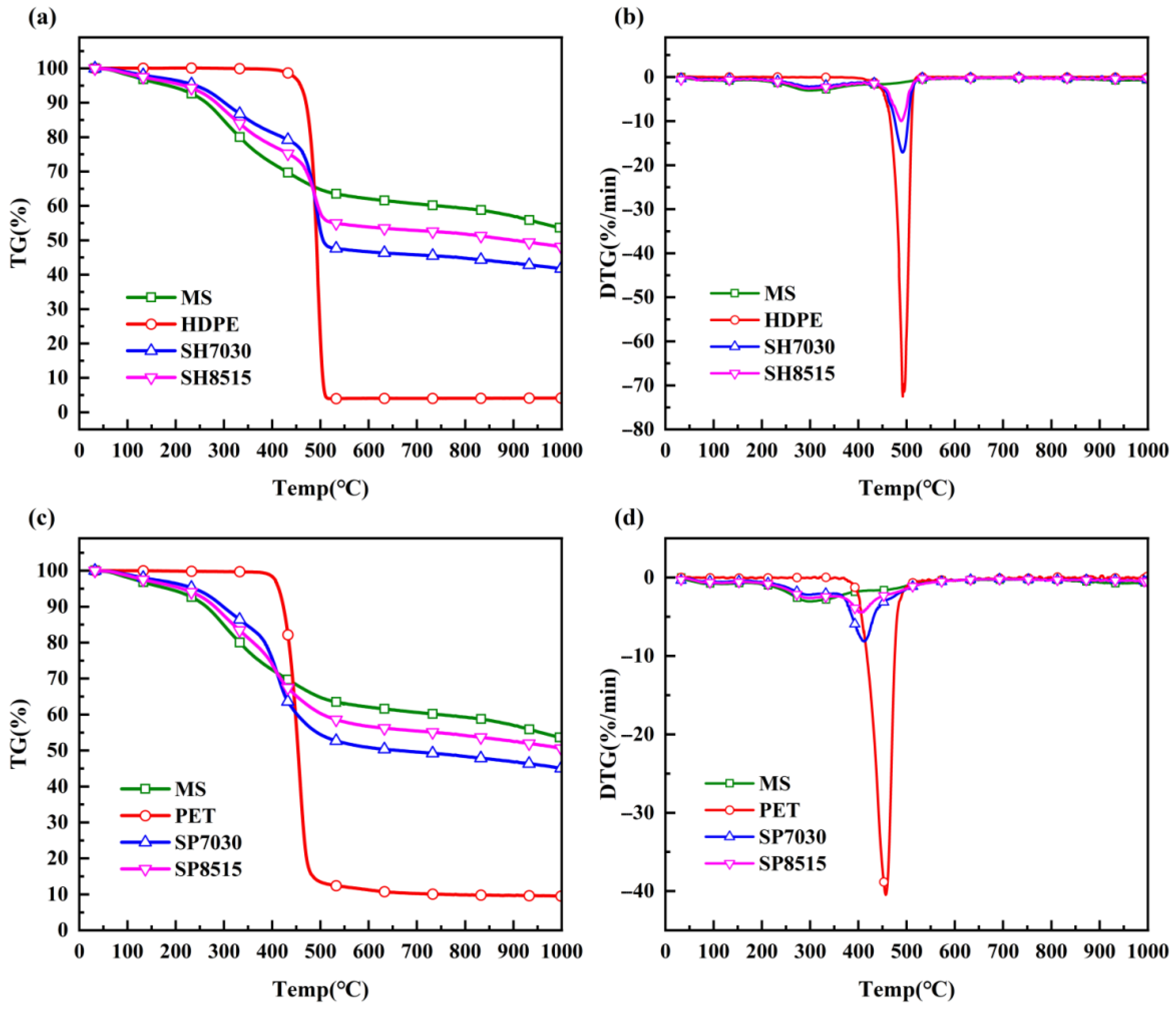
The TG and DTG curves of the MS pyrolysis at a heating rate of 20 °C/min are illustrated in Figure 1a. The pyrolysis stages and weight losses of the MS pyrolysis at a heating rate of 20 °C/min are shown in Table 3. The MS pyrolysis process was delineated into three stages. The initial stage (33–163 °C) primarily entailed the evaporation of water. The subsequent stage (163–736 °C) represented the pyrolysis phase, mainly due to the decomposition of carbohydrates and lipids, accounting for 36% of the total mass loss. As per the DTG curve, this pyrolysis stage was subdivided into the following two sub-stages: the first sub-stage (163–433 °C) associated with lipid decomposition, and the second sub-stage (433–736 °C) corresponding to carbohydrate decomposition [38]. The final stage (736–1000 °C) predominantly involved the decomposition of inorganic salts and char.
The pyrolysis curves of HDPE and PET are illustrated in Figure 1. Both samples exhibited similar curves, featuring distinct degradation peaks in the DTG curves. In Figure 1b, the primary pyrolysis stage of HDPE occurred between 385 and 524 °C, with the mass loss rate peaking at approximately 492 °C (72.50 %/min) and with a cumulative mass loss of 95.80%. At the lower temperatures, the breaking of C-C bonds (332 kJ/mol), characterized by lower bond energy, occurred randomly during the HDPE pyrolysis. As the temperature rose, the breaking of C-H bonds (414 kJ/mol) with higher bond energy became prevalent [39].
The pyrolysis curve of PET in Figure 1c highlights the main degradation stage between 367 and 546 °C. At this stage, the sample mass loss rate peaked at approximately 456 °C (40.24 %/min), with a cumulative mass loss of 87.39%. The PET pyrolysis yielded more residues than the HDPE pyrolysis due to the formation of cross-linked products and polyaromatic hydrocarbons, considered to be the precursors of char [40]. The mass loss during the PET pyrolysis was attributed to the ester cracking reaction, generating benzoic acid, CO2, acetaldehyde, and various other degradation products [41].

3.3. (Co-)Pyrolysis Performances as a Function of Temperature

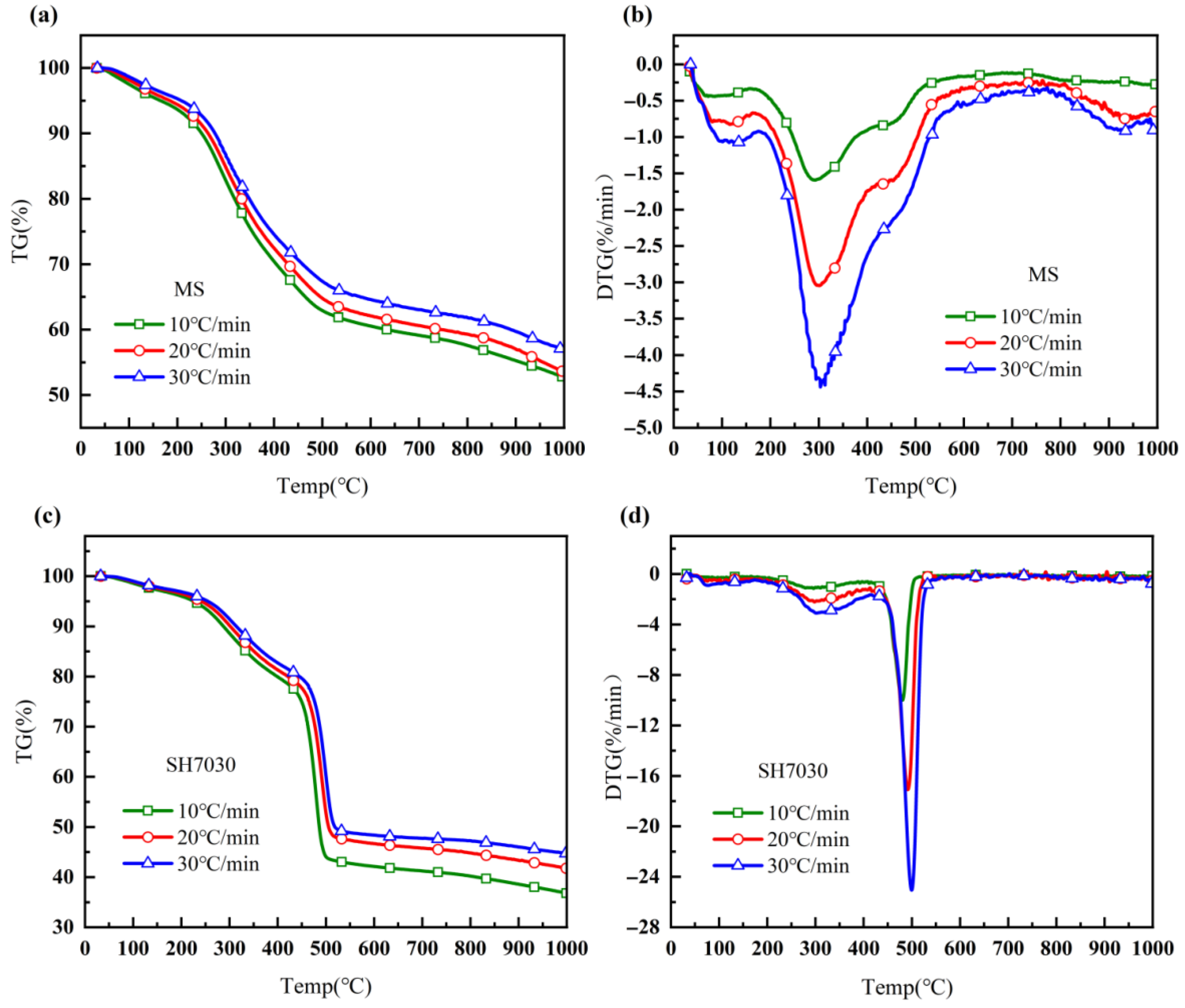
Since the curves exhibited a similar trend across the varying heating rates, the effect of the heating rate on the (co-)pyrolysis of MS and SH7030 was focused on in this section. The (co-)pyrolysis curves are illustrated in Figure 2, with the corresponding (co-)pyrolysis parameters summarized in Table 4. With the increasing heating rate, the peak Rmax value of the DTG curve also rose. For example, as the heating rate rose from 10 °C/min to 30 °C/min, the decomposition peak of MS increased from 1.6 %/min to 4.44 %/min, while that of SH7030 rose from 10.00 %/min to 25.06 %/min. As the heating rates increased, residual mass yields rose due to thermal hysteresis—a consequence of heat transfer limitations delaying decomposition kinetics.
As revealed in Table 4, increases in the heating rate corresponded to higher values for both the average weight loss rate (Rmean) and CPI. This trend indicates that a faster heating rate intensified the overall (co-)pyrolysis reactions. Concurrently, the ignition temperature (Ti) and the temperature of maximum mass loss rate (Tmax) systematically shifted to higher values as the heating rate increased from 10 to 30 °C/min, denoting a thermal delay in the process. This shift in characteristic temperatures with heating rate is a common feature in both mono- and co-pyrolysis [42,43]. The underlying cause for this behavior is rooted in heat transfer dynamics. At lower heating rates, the temperature gradient between the sample surface and its interior remains small, allowing sufficient time for heat to penetrate uniformly. At higher heating rates, this gradient steepens, creating a significant internal temperature lag. Consequently, the bulk of the sample requires more time (and a higher external temperature) to reach its decomposition threshold, thus delaying the observed Ti and Tmax [44].

3.4. (Co-)Pyrolysis Performances as a Function of Blend Ratio

The TG-DTG curves of co-pyrolysis at the varying blend ratios are illustrated in Figure 3. The primary co-pyrolysis stage across the blend ratios occurred between 200 and 550 °C. Given the peaks of the DTG curves of the co-pyrolysis, this main stage was segmented into the following two sub-stages: 200–430 °C and 430–550 °C for MS-HDPE; and 200–360 °C and 360–550 °C for MS-PET.
During the first co-pyrolytic sub-stage (200–430 °C; 200–360 °C), the decomposition primarily involved organic matter, such as lipids, sugars, and proteins. It should be noted that HDPE and PET did not decompose within this temperature range (as observed in Figure 1b,c). Hence, the co-pyrolysis process in this stage was predominantly governed by MS. With the increased MS fraction, both the decomposition rate and mass loss increased.
As for the second co-pyrolytic sub-stage in Figure 3b,d, the reaction was intensified relative to the first one. During this stage, heavy carbon substances, such as carbohydrates in MS and polymer organic compounds in the MPs, began to decompose, aligning with the primary stage observed during the mono-pyrolysis of MS, HDPE, and PET in Section 3.2 [39,45]. In particular, the co-pyrolysis curve underwent a distinct change compared to the previous stage. With the increased plastic fraction, both the mass loss and maximum weight loss rate rose in this stage. This intensified, thorough co-pyrolysis reaction underscored the dominance of the HDPE/PET pyrolysis reactions during this stage. Above 550 °C, the decomposition primarily involved inorganic salts and char, with the co-pyrolysis reaction exhibiting relatively weaker activity.
Table 5 presents the co-pyrolysis parameters. Across the entire main stage, the maximum weight loss rate (Rmax) of the MS-HDPE co-pyrolysis was 9.98 %/min for SH8515 and 17.09 %/min for SH7030. The Rmax values were 4.43 %/min for SP8515; 8.13 %/min for SP7030, and 3.05 %/min for MS. The co-pyrolysis exhibited higher intensity and efficiency than the mono-pyrolysis of MS. Moreover, the average weight loss rate (Rmean) of the co-pyrolysis surpassed that of the mono-pyrolysis of MS, indicating a more thorough co-pyrolysis.
All the co-pyrolysis scenarios yielded higher CPI values than the mono-pyrolysis of MS, underscoring the enhanced efficiency and process stability achieved through co-processing with MPs [46]. Also, the nature of the MPs significantly influenced the outcome. At identical blend ratios, the MS-HDPE mixtures exhibited higher Rmax, Rmean, and CPI values than the MS-PET mixtures. This indicates that HDPE acted as a more effective synergist in enhancing the pyrolysis performance of MS, a difference attributable to the distinct chemical structures and decomposition pathways of the two polymers. The influence of MP concentration was also clear. For both systems, increasing the MP fraction from 15 wt% to 30 wt% led to elevated Rmax, Rmean, and CPI values. Specifically, the CPI value increased from 9.61 × 10⁻⁶ to 20.37 × 10⁻⁶ %3·min−2·°C−3 for MS-HDPE and from 8.03 × 10⁻⁶ to 12.74 × 10⁻⁶ %3·min−2·°C−3 for MS-PET. This concentration-dependent enhancement indicates the beneficial role of MPs in intensifying the MS pyrolysis process.
With the increased fraction of the MPs, the ignition temperature (Ti) and peak temperature (Tmax) shifted toward higher temperatures. This phenomenon occurred since the initial decomposition at the low temperatures (30–163 °C) primarily involved free water and some easily decomposable substances in MS. As the MS fraction decreased, so did the proportion of those substances. Simultaneously, since the decomposition of the MPs began at the high temperatures (>360 °C), increasing the MP ratio also shifted both the peak temperature and overall process toward higher temperatures.
Since MS exhibited a higher ash content than HDPE/PET, the final residual mass (Mf) increased with the high MS ratio. Specifically, at 1000 °C, the Mf values increased from 41.77% to 48.14% and 45.03% to 50.60% for the MS-HDPE and MS-PET co-pyrolysis, respectively. The increased Mf value of MS-PET was attributed to the cross-linking of the MS and PET primary products. This cross-linking formed polyaromatic hydrocarbons, which in turn produced more coke than the MS-HDPE co-pyrolysis, thus increasing the Mf value [47].

3.5. Interaction Effects

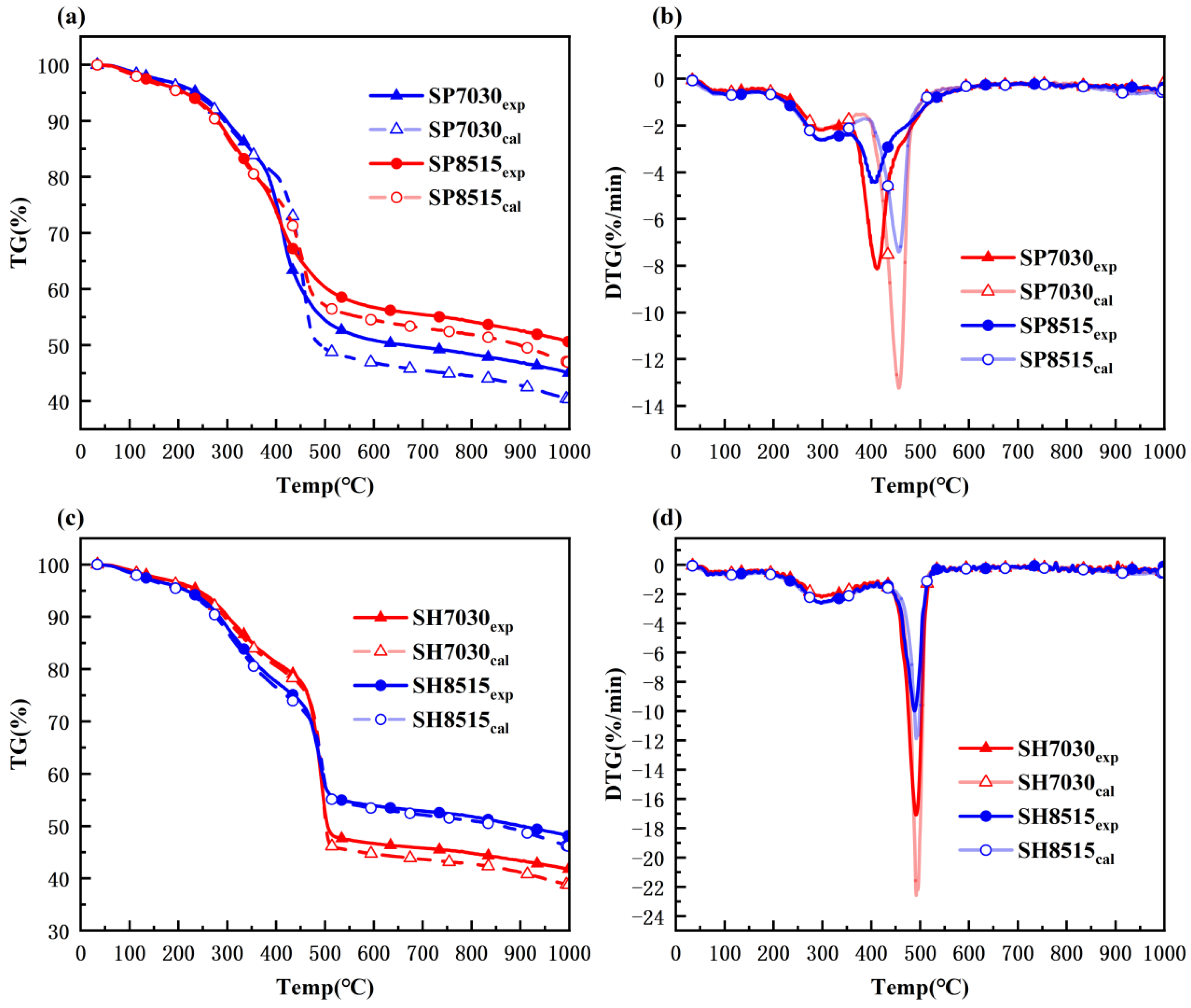
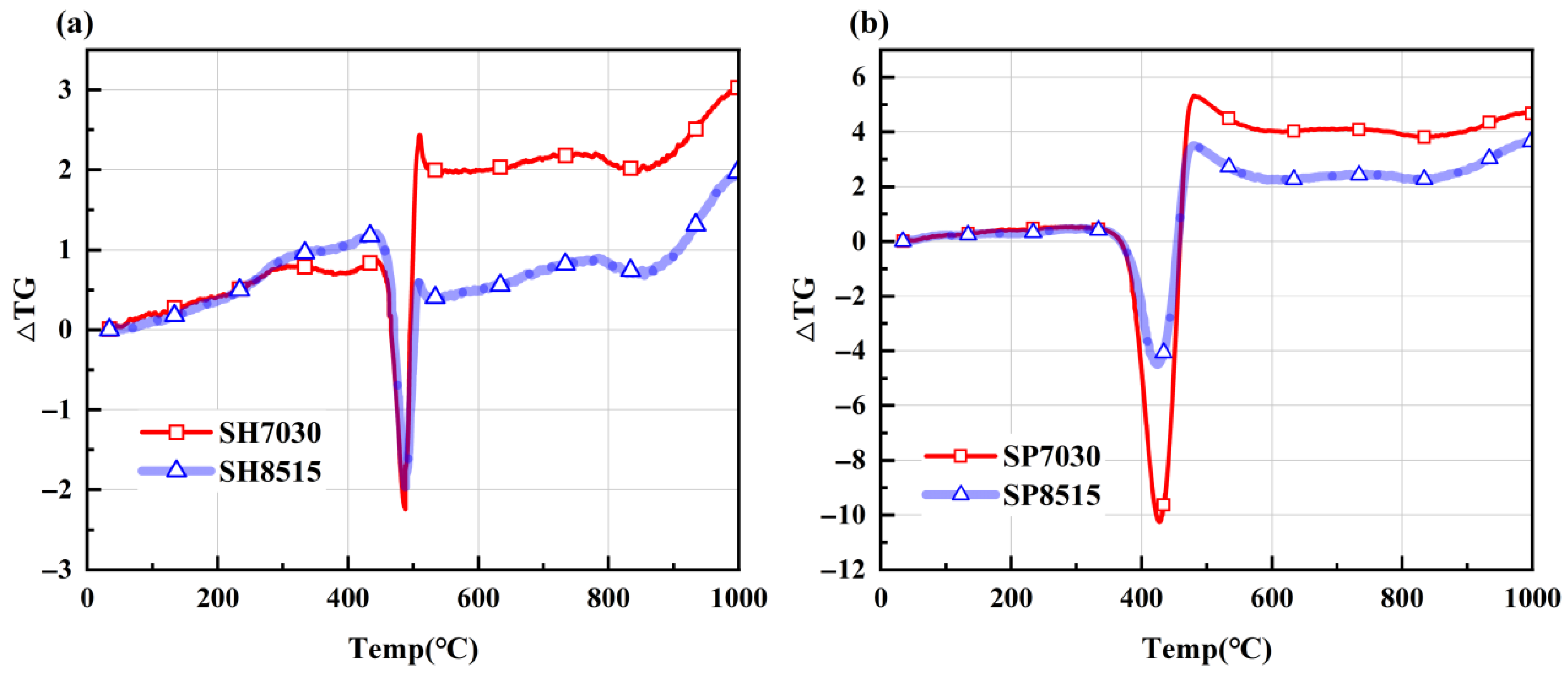
As shown in Equation (2), the theoretical curve was obtained following the weighting of the data. The comparison between the experimental and theoretical curves is shown in Figure 4. To assess the interaction strength, the deviation value, as shown in Equation (3), is presented in Figure 5. The TG deviation values of the MS-PET co-pyrolysis remained close to 0 between 30 and 350 °C, indicating a weak interaction. This weak interaction was attributable to mass loss in this stage, deriving primarily from readily decomposable light volatiles in MS. Since PET remained thermally stable at the lower temperatures and exhibited no reactive synergy with biomass components (e.g., cellulose and lignin) in MS, interactions were negligible. The observed positive deviation (>0) likely originated from softened MP particles encapsulating MS surfaces prior to decomposition. This physical encapsulation impeded heat transfer and volatile release, manifesting as inhibitory behavior [48].
Between 350 and 460 °C, the deviation began to appear, peaking approximately at 430 °C (Figure 4a,b). The negative deviation, indicative of a facilitatory effect, during this stage grew stronger with the increased PET fraction. This temperature range corresponded to the primary decomposition stage of PET. PET-MS interactions emerged through complex pathways involving volatiles, feedstock components, and char dynamics [49]. This facilitatory effect may be due to (i) the large number of free radicals generated during the MS pyrolysis, accelerating PET chain scission and decomposition, or (ii) hydrogen donation from PET to unstable MS-derived intermediates (e.g., polycondensation products), converting them to volatiles, thus reducing solid residue yield [50].
Between 460 and 550 °C, the positive deviation, indicative of an inhibitory effect, during this stage, peaked at 480 °C. This was attributed to PET-derived oxygenated compounds (e.g., aldehydes, carboxylic acids, and aromatic hydrocarbons) generated during this stage, which underwent cross-linking reactions with pyrolysis intermediates from MS, thus promoting char formation [51,52]. The increased deviation from the increased PET ratio suggested that the actual co-pyrolysis process produced more coke than the theoretical process, raising the coke yield.
Figure 5a shows that the deviation was less pronounced for the MS-HDPE co-pyrolysis than for the MS-PET one. At the lower temperatures (<380 °C), the positive deviation was attributed to HDPE softening and hindering the release of volatiles in MS. With the temperature rise, the deviation trended downward, corresponding to the main decomposition stage of HDPE. During this stage, the HDPE decomposition began, resulting in a facilitatory effect peaking at 490 °C. This was because HDPE acted as a hydrogen donor, transferring reactive hydrogen that inhibited polymerization and cross-linking reactions during the MS pyrolysis. By stabilizing free radicals and suppressing char formation, this hydrogen donation promoted volatile release, thus increasing mass loss [53,54,55].

3.6. Relative Contributions of the Co-Pyrolysis Components

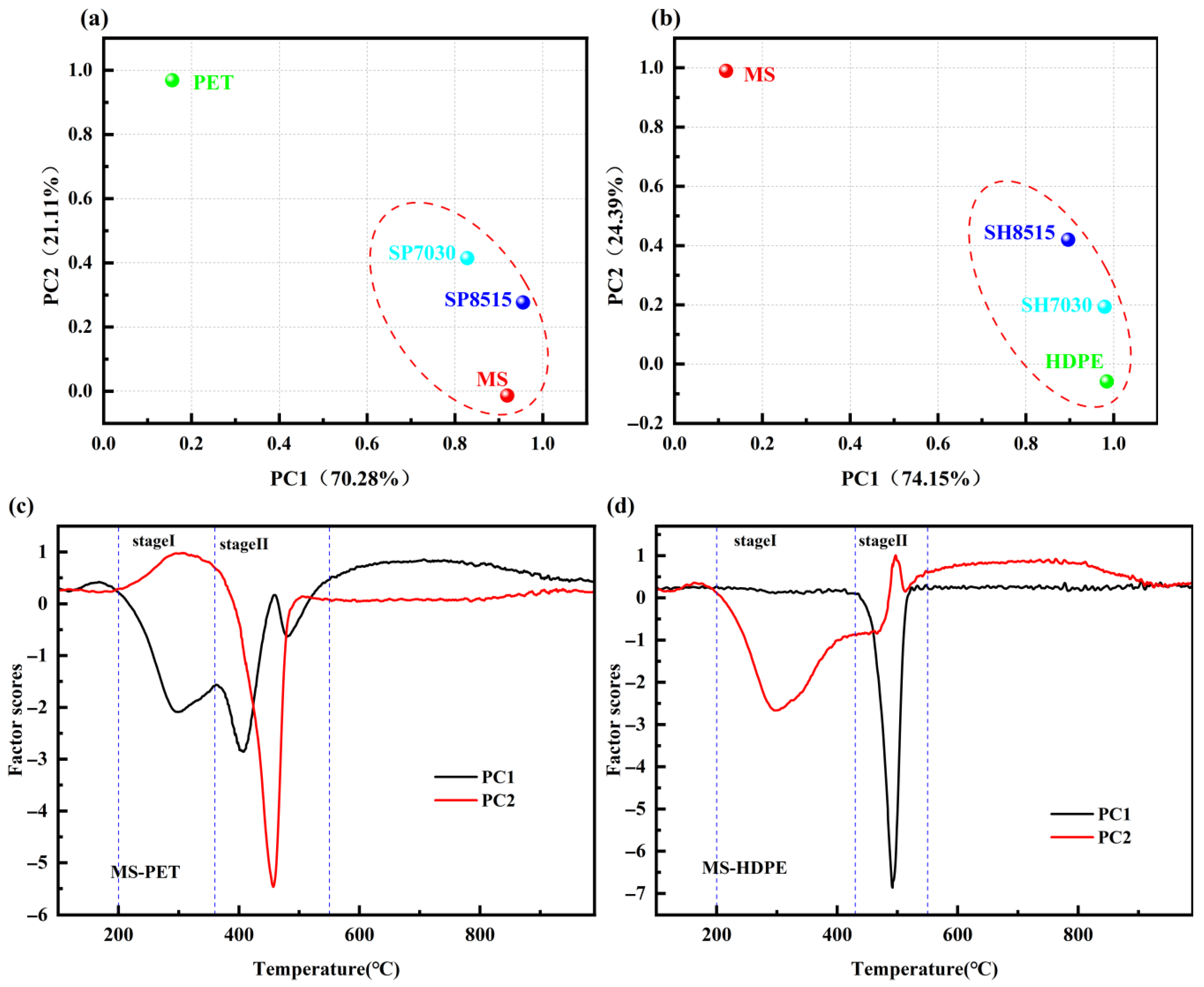
Due to the intricacy of the process, directly discerning the roles of the different raw materials in the co-pyrolysis is challenging. Therefore, the PCA method was employed to reduce the dimensionality of the DTG data and compare the respective contributions of the raw materials [56]. Following the treatment, the main component score and factor score diagrams of the co-pyrolysis are illustrated in Figure 6.
Figure 6a shows that PC1 and PC2 corresponded to MS and PET, accounting for 70.28% (PC1) and 21.11% (PC2), respectively, for the MS-PET co-pyrolysis. The cumulative contribution of these two components was 91.39%, exceeding a typical threshold of 80%. The projected position of the co-pyrolysis was closer to MS than PET, indicating that the co-pyrolysis aligned more closely with the mono-pyrolysis of MS than that of PET. Figure 6c illustrates the following two stages of the entire main co-pyrolysis process: (1) the initial stage (approximately 200–360 °C) where the decomposition of light volatiles in MS predominated since the MPs remained intact; and (2) the subsequent stage (approximately 360–550 °C) where heavy volatiles in both MPs and MS began to decompose, demonstrating a complex interaction between the two. The high volatile contents of the MPs also contributed significantly. At above 600 °C, the co-pyrolysis reactions were stabilized.
As for the MS-HDPE co-pyrolysis shown in Figure 6b, PC1 and PC2 corresponded to HDPE and MS, accounting for 74.15% and 24.39%, respectively. Their cumulative contribution to the explanation of the variance was 98.54%. The projected position of the co-pyrolysis components was close to HDPE, indicating that MS-HDPE and HDPE shared a similar pyrolysis reaction, that is, the cracking reaction of polyolefin [57]. The factor score diagram of the MS-HDPE co-pyrolysis, as illustrated in Figure 6d, supports this observation. In the initial stage (approximately 200–430 °C), MS predominantly controlled the decomposition of some light volatiles, whereas in the subsequent stage (approximately 430–550 °C), HDPE took over almost entirely.

3.7. Mono-Pyrolytic Kinetics of HDPE and PET

The activation energy represents the energy required for molecules to transition from their normal state to an active state conducive to chemical reactions. Higher activation energy values indicate stronger intermolecular interaction forces, requiring more energy for reactions to occur. In this study, the FWO, Starink, and KAS methods were employed to estimate the activation energy of the main pyrolysis stages of PET and HDPE. The results are presented in Table 6. Due to the complexity of their pyrolysis process, this study adopted a conversion degree (α) range of 0.10–0.90 with an interval of 0.05 to refine the entire process, providing a highly accurate depiction of the change in the activation energy.
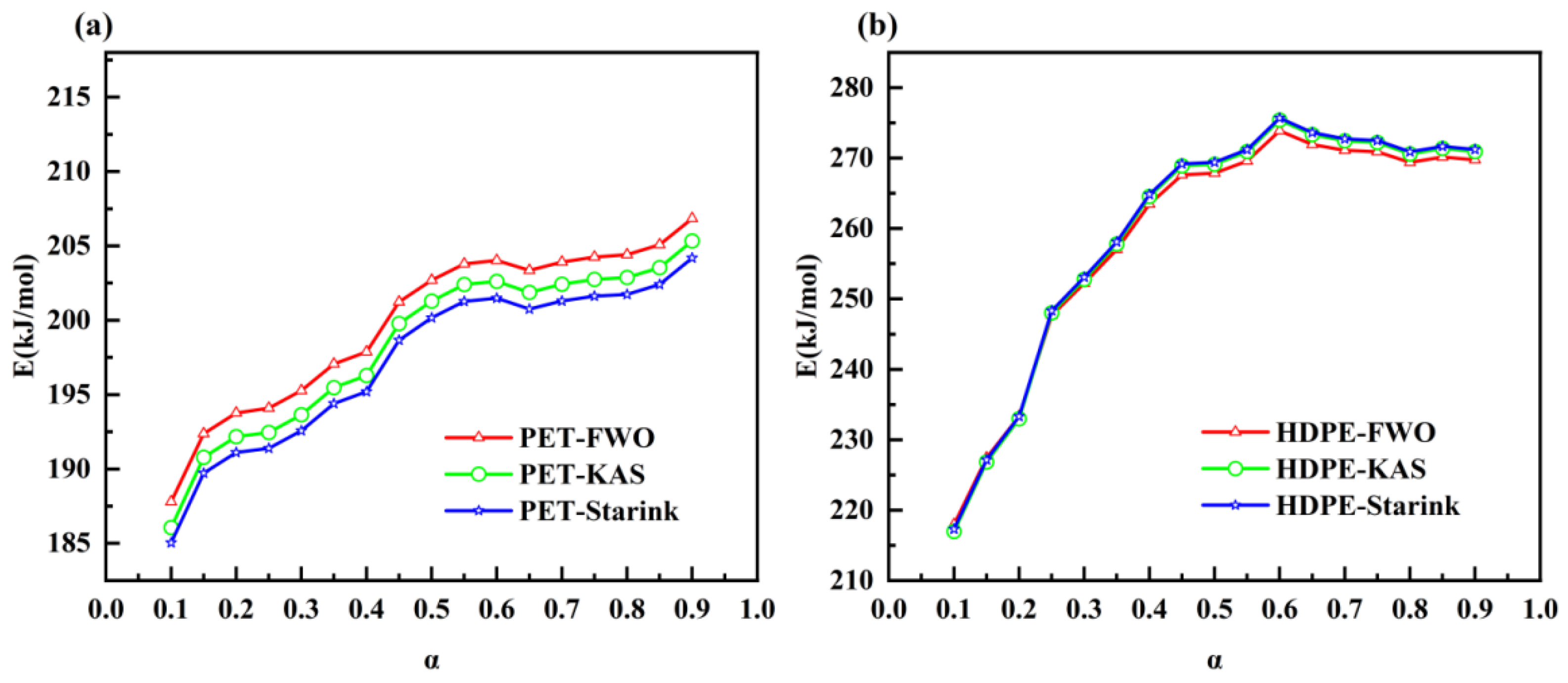
The average activation energies for PET were determined to be 199.87 kJ/mol (FWO), 198.34 kJ/mol (KAS), and 197.23 kJ/mol (Starink), showing close agreement with literature values (166–230.7 kJ/mol) [58,59] and minimal variation among the methods. Similarly, the average activation energies for HDPE were 258.90 kJ/mol (FWO), 259.71 kJ/mol (KAS), and 260.01 kJ/mol (Starink), consistent with the reported value of 268.32 kJ/mol for PE [60]. Reliability is indicated by R2 values exceeding 0.99 for all the estimates and consistent trends in the conversion-dependent activation energy profiles across the three methods (Figure 7).
As shown in Figure 7, the E value of the HDPE pyrolysis was higher than that of the PET one at the same α value, indicating that HDPE was more resistant to decomposition than PET. This can be attributed to PET containing numerous oxygen-containing groups, which decreased its stability. Consistent with this observation, the initial (Ti) and peak (Tmax) pyrolysis temperatures of PET were lower than those of HDPE.
The curve of the PET activation energy exhibited a rapid rise–slow fall–rise pattern. When α < 0.6, the increasing temperature accelerated the pyrolysis rate of PET, continuously increasing the activation energy. When α = 0.6, the PET activation energy peaked at 202.61 kJ/mol, corresponding to the temperature of its maximum weight loss peak. When 0.6 < α < 0.9, the activation energy first fell slowly and then rose continuously due to intermediate products generated by the PET pyrolysis continuing to react at the high temperatures.
In contrast, the curve of the HDPE activation energy first rose and then tended to stabilize. When α < 0.6, HDPE initially broke C-C bonds with lower bond energy, followed by the C-H bond breakage with higher bond energy, continuously increasing the activation energy. When α = 0.6, the value of E peaked at 275.40 kJ/mol, corresponding to the maximum weight loss peak of the DTG curve.

3.8. Mono-Pyrolytic Thermodynamics of HDPE and PET

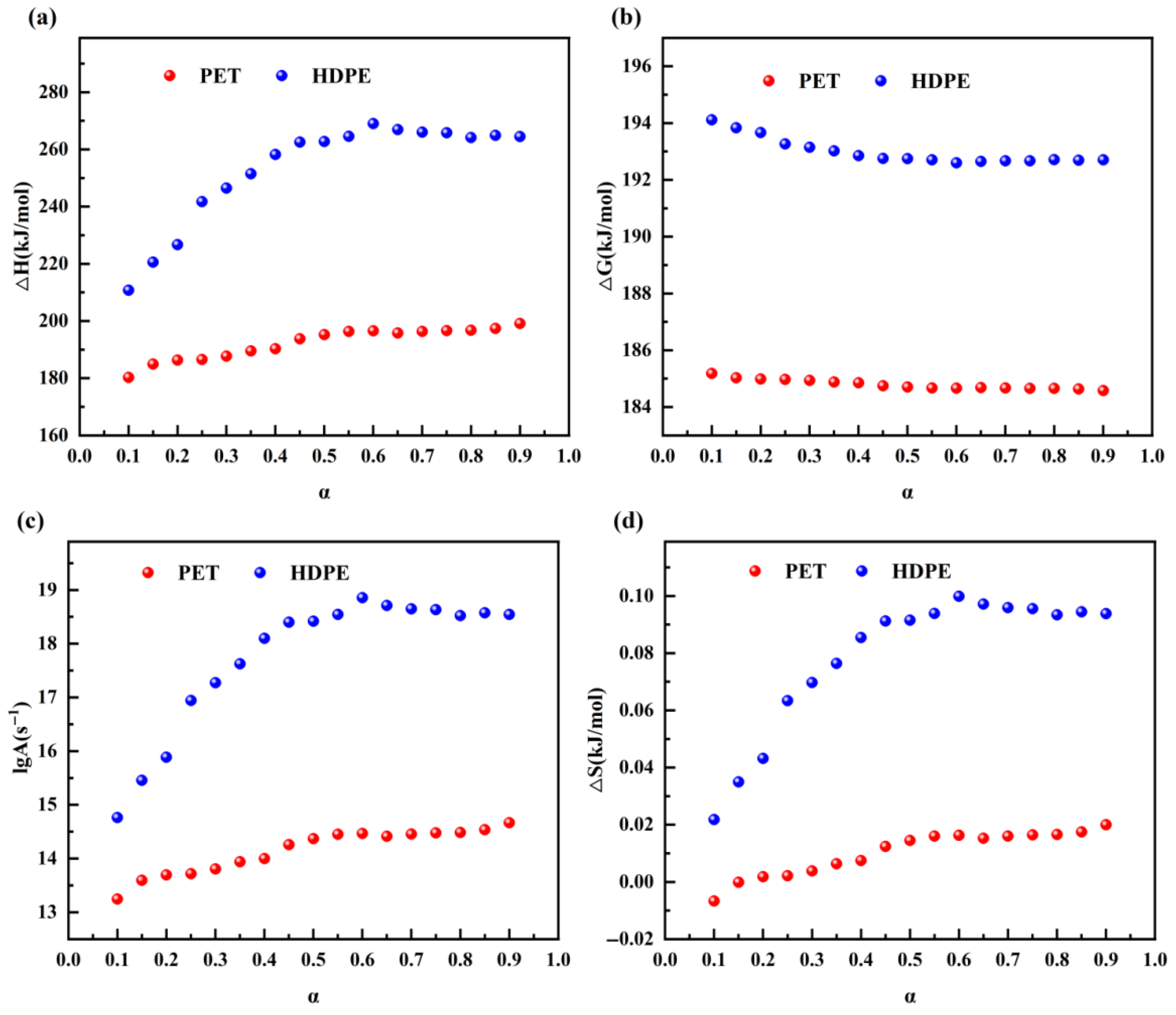
In this study, we utilized the KAS method to estimate the thermodynamic parameters of A, ΔH, ΔS, and ΔG at a heating rate of 20 °C/min. The findings are provided in Figure 8. The enthalpy change (ΔH) signifies the energy required by the reactant to transition into an activated molecular state, with lower values indicating easier reactions. The ΔH profiles for both HDPE and PET paralleled their respective E trends (Figure 8a). For PET, ΔH varied between 180.282 and 199.150 kJ/mol, with a mean difference from E of 6.00 kJ/mol. HDPE showed a ΔH range of 210.78 to 264.47 kJ/mol and a slightly larger mean difference of 6.34 kJ/mol. The minimal magnitude of these differences suggests the thermodynamic feasibility of the pyrolysis reactions for both plastics [58].
The Gibbs free energy change (ΔG) reflects the total energy change within the system during the reaction, with higher values indicating a less favorable reaction. The ΔG values for HDPE were consistently higher than those for PET at equivalent α values (Figure 8b), indicating a higher energy barrier and lesser thermodynamic favorability for HDPE pyrolysis. Also, the initial temperature (Ti) of HDPE exceeded that of PET. With the increasing α value, the ΔG values of both MPs decreased gradually, reflecting a reduction in the required energy input as the reactions advanced. The estimated ΔG values for HDPE and PET were lower than the reported value for PE (224.88 kJ/mol) [60], suggesting a relatively more favorable pyrolysis pathway for the studied plastics under these conditions.
The pre-exponential factor (A) gauges the collision frequency between activated molecules of reactants during the reaction. When A ≥ 109 s−1, it suggests a simple composite reaction. The lgA values exceeded 9 s−1 for HDPE and PET across all the α values (Figure 8c), indicating the complex, multi-step nature of their pyrolysis. HDPE exhibited higher lgA values at the same α values as PET. The values for HDPE ranged from 14.76 to 18.85 s−1, characterized by a sharp initial increase that peaked at α = 0.6 before stabilizing. In contrast, PET displayed a narrower and more gradual increase from 13.24 to 14.67 s−1. This distinct behavior in lgA, which correlated with the trends in activation energy, indicates that the pyrolysis mechanism of HDPE involved a greater degree of complexity and more intricate reaction pathways than that of PET.
The entropy change (ΔS) reflects the disorderliness of the reaction system, with larger values indicating greater disorder. The ΔS trends were similar for both plastics, though with distinct characteristics. For PET, ΔS was initially negative (α < 0.15) before rising gradually, whereas ΔS remained positive for HDPE across all the α values. The larger variation in ΔS for HDPE signifies a greater increase in molecular disorder and a more complex reaction pathway during its pyrolysis. This observation aligned with and corroborated the trends in E and A, collectively suggesting the higher reaction difficulty and mechanistic intricacy of the HDPE pyrolysis compared to the PET pyrolysis. The progression of A, ΔH, ΔS, and ΔG with the conversion degree for both materials was consistent with therelated literature [58,60,61]. These findings underscore the distinct thermodynamic behaviors of HDPE and PET pyrolysis, shedding light on their respective kinetics and complexities.

3.9. Mono-Pyrolysis Mechanisms of HDPE and PET

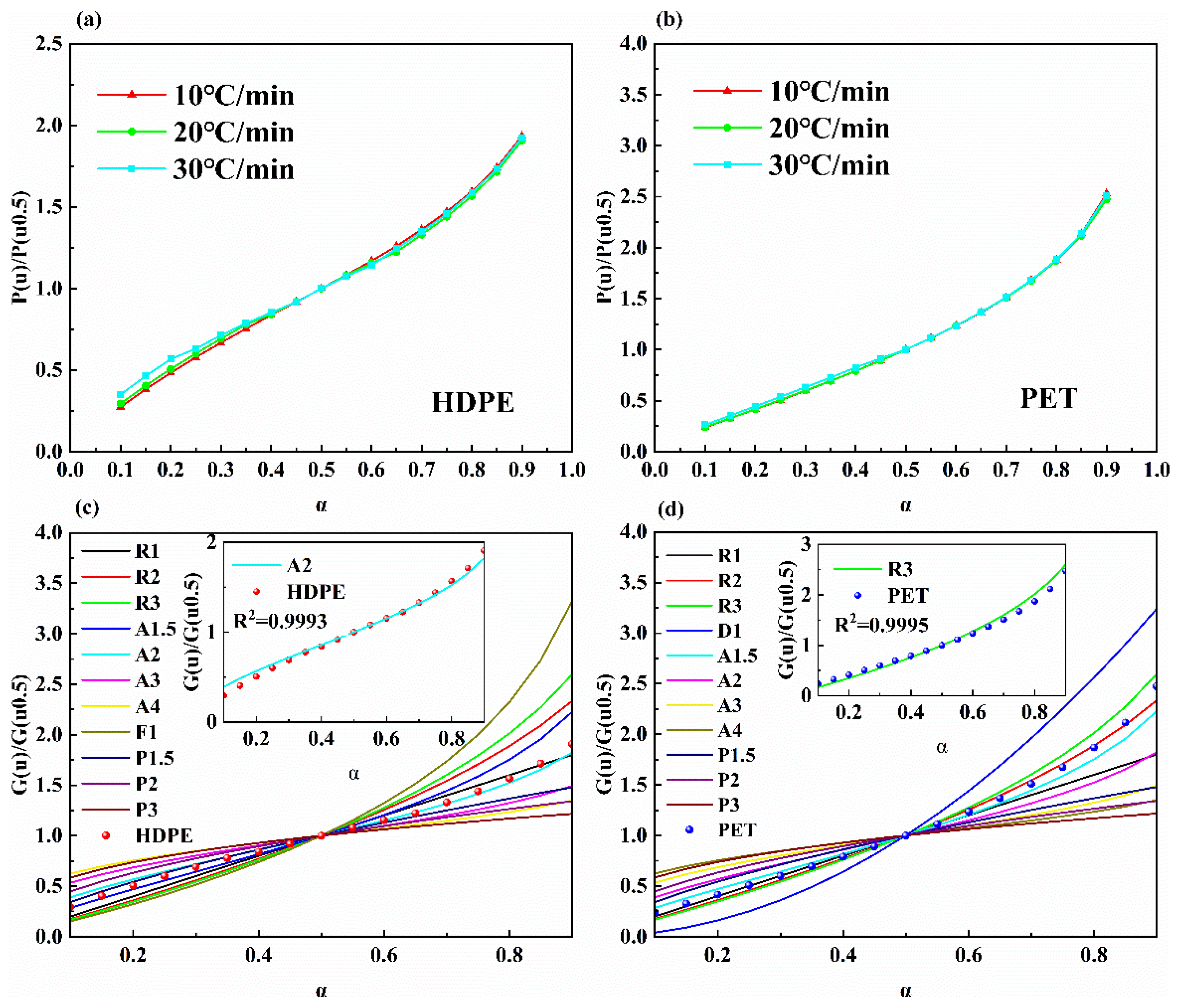
Pinpointing the pyrolysis mechanisms of HDPE and PET requires selecting appropriate reaction models. Given the similarity of the estimated E curves among the three model-free methods, we chose the KAS method-based E values when α = 0.10–0.90 in order to analyze the primary pyrolysis stages through the integral master diagram method. The relationship between the P(u)/P(u0.5) and α values at the three heating rates is depicted in Figure 9a,b. The curves at the three heating rates exhibited a consistent pattern, indicating that the pyrolysis mechanisms of both MPs remained unaffected by the heating rate. Consequently, a heating rate of 20 °C/min was chosen for subsequent discussion to determine the most representative pyrolysis mechanisms, with results being verified via MATLAB. The theoretical master graph G(u)/G(u0.5) was calculated and compared with the experimental master graph P(u)/P(u0.5), as illustrated in Figure 9c,d.
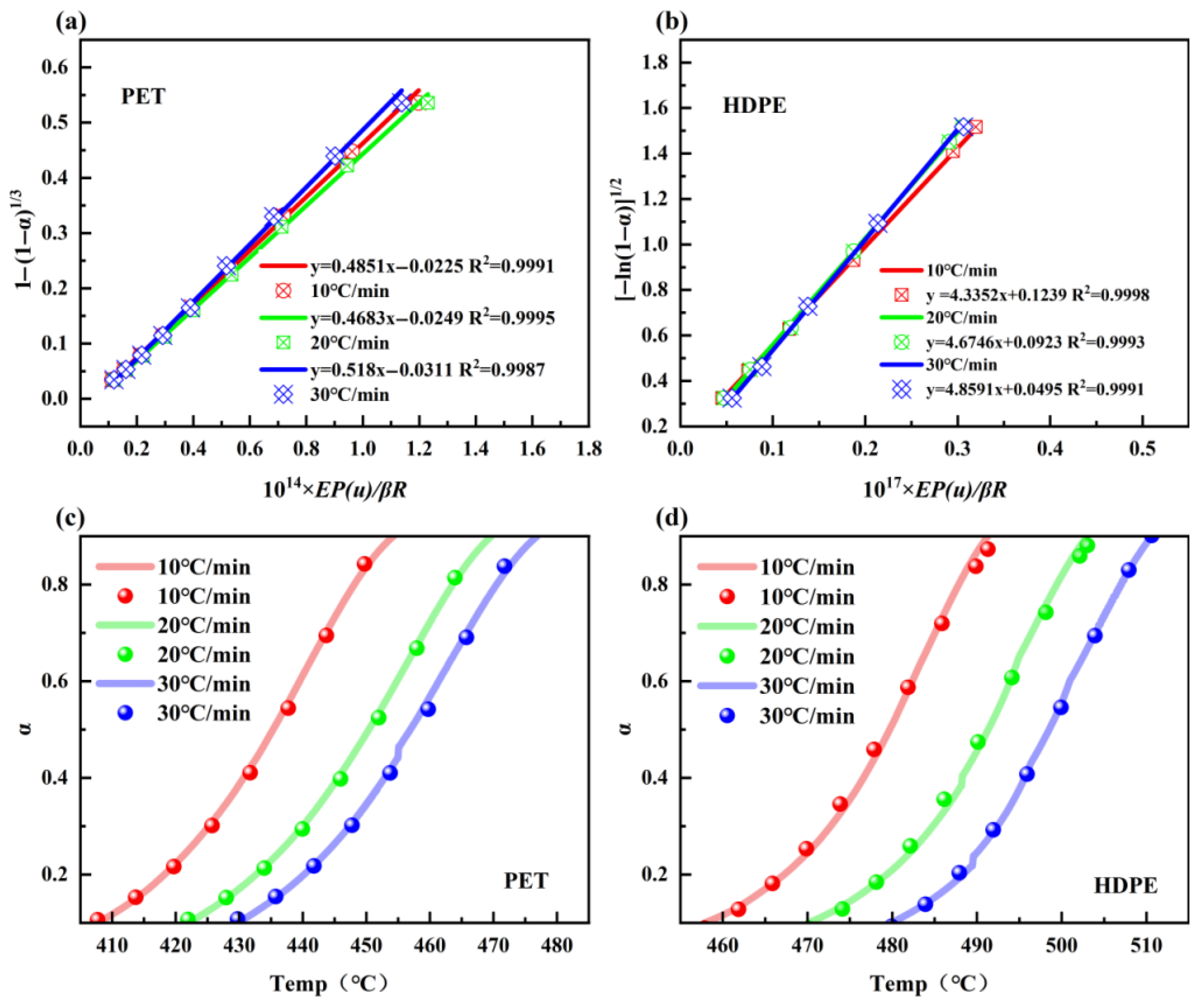
The pyrolysis processes of HDPE and PET can be elucidated using single models. Specifically, the An and Rn models best described the HDPE and PET pyrolysis. The functions for the An and Rn mechanisms were thus: G(α) = [−ln(1 − α)]1/n for HDPE; and G(α) = 1 − (1 − α)1/n for PET. To ascertain a more precise model, we subdivided n to obtain the functions of [−ln(1 − α)]1/n, 1 − (1 − α)1/n, and EP(u)/βR. The best-fit regression lines and their R2 values were calculated for each function. The function with the highest R2 value signified the best-fit model. The results are presented in Figure 10a,b, indicating that the most suitable models for describing the pyrolysis of HDPE and PET were A2 and R3, respectively, with their corresponding R2 values of 0.9993 and 0.9995, respectively. To ensure prediction accuracy, we used MATLAB to compute the theoretical conversion degree as a function of the temperature and three heating rates and compared it with the actual conversion degree, as shown in Figure 10c,d. The results aligned closely, affirming that the A2 and R3 models effectively described the pyrolysis of HDPE and PET, respectively.

3.10. (Co-)Pyrolysis Kinetics

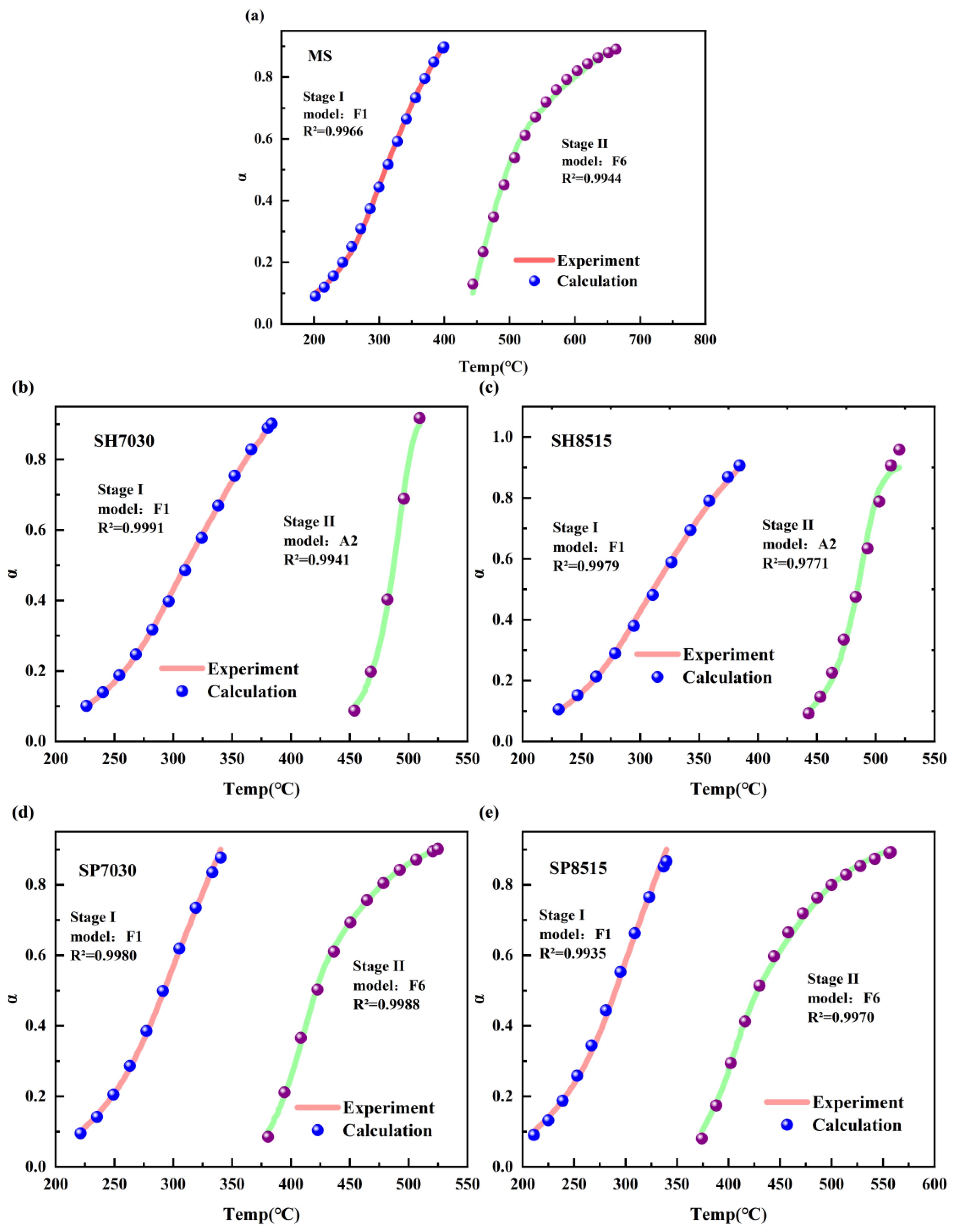
To elucidate the kinetic mechanisms of the (co-)pyrolysis, the CR method was employed to analyze the main pyrolysis stages (approximately 164–703 °C) of MS, MS-HDPE, and MS-PET. Given their complexity, each pyrolysis was roughly divided into the following two stages: the MS-HDPE (stage I between about 164–410 °C and stage II between about 410–703 °C); the MS-PET (stage I between about 164–352 °C and stage II between about 352–703 °C). The results of the estimated activation energy values and models are presented in Table 7, with the R2 values of the best-fit model exceeding 0.97.
Comparing the activation energies of HDPE and PET (259.71 and 198.34 kJ/mol, respectively) with that of the first stage of MS (33.46 kJ/mol) showed that MS was more prone to pyrolysis at lower temperatures, with a lower ignition temperature (Ti) than those of HDPE and PET. Following the inclusion of the MPs, the activation energy of the first stage of the co-pyrolysis exceeded that of MS, indicating that the MPs with high energy barriers affected the co-pyrolysis. Similarly, with the increased MP fraction, the activation energy of the second stage of the co-pyrolysis rose, with the MS-HDPE co-pyrolysis increasing from 94.46 to 128.35 kJ/mol and with the MS-PET co-pyrolysis increasing from 275.04 to 352.75 kJ/mol.
For the MS pyrolysis, the best-fit models for the two stages were F1 and F6. The devolatilization behavior of MS could be elucidated by the n-order reaction mechanism, where the reaction rate depends on the concentration of the remaining reactants, indicating that the number of volatiles controls the reaction rate [57]. Upon the addition of HDPE, the first-stage reaction model of MS-HDPE aligned with that of MS, represented by the first-order reaction model (F1). In this stage, the reaction rate was controlled by the reactant concentration. Consistent with the HDPE reaction model, the second-stage reaction model was A2, signifying random nucleation and growth in this stage. This phenomenon may arise from the formation of numerous low molecular weight chains due to random cracking at high temperatures, serving as centers for random nucleation or degradation reaction growth [62].
For the MS-PET co-pyrolysis, the reaction models for both stages were consistent with those of MS, characterized by F1 and F6, respectively, with the entire reaction rate being controlled by the reactant concentration. To ensure the accuracy of the best-fit model, the predicted relationship between the conversion degree and temperature was compared with the actual data, confirming that the selected models effectively described the co-pyrolysis process (Figure 11).

3.11. (Co-)Pyrolytic Chars

3.11.1. XRF Analysis

Detected using XRF, the main elements of the (co-)pyrolytic bottom slags are presented in Table 8. The elemental composition was predominantly consistent, with O, Si, Al, Fe, P, Ca, K, S, and other elements comprising the majority. O and Si predominantly existed in the form of SiO2 in MS, maintaining high content even after its pyrolysis. The notable presence of Al and Fe stemmed from the use of conditioners containing these elements during the MS dewatering process. The content of S, O, Cl, and other elements decreased after the MS pyrolysis since these elements were volatilized during the process (Table 8). Conversely, the minerals resistant to volatilization, K, Fe, Si, Al, Na, Mn, Mg, and Ca, accumulated in the bottom slag. The co-pyrolysis with PET yielded char with higher Fe, Ca, and K levels than that with HDPE. Alkali metals (Na and K) and alkaline earth metals (Mg and Ca) exhibited catalytic properties during the co-pyrolysis, suggesting that their elevated contents may further enhance performance. However, the co-pyrolysis compositions were hindered at above 600 °C, likely due to the high Si, Al, and K contents of the co-pyrolysis char. Alkali metals reacted with aluminosilicates in the char, thus losing catalytic activity [63].

3.11.2. Crystal Phases of (Co-)Pyrolytic Chars

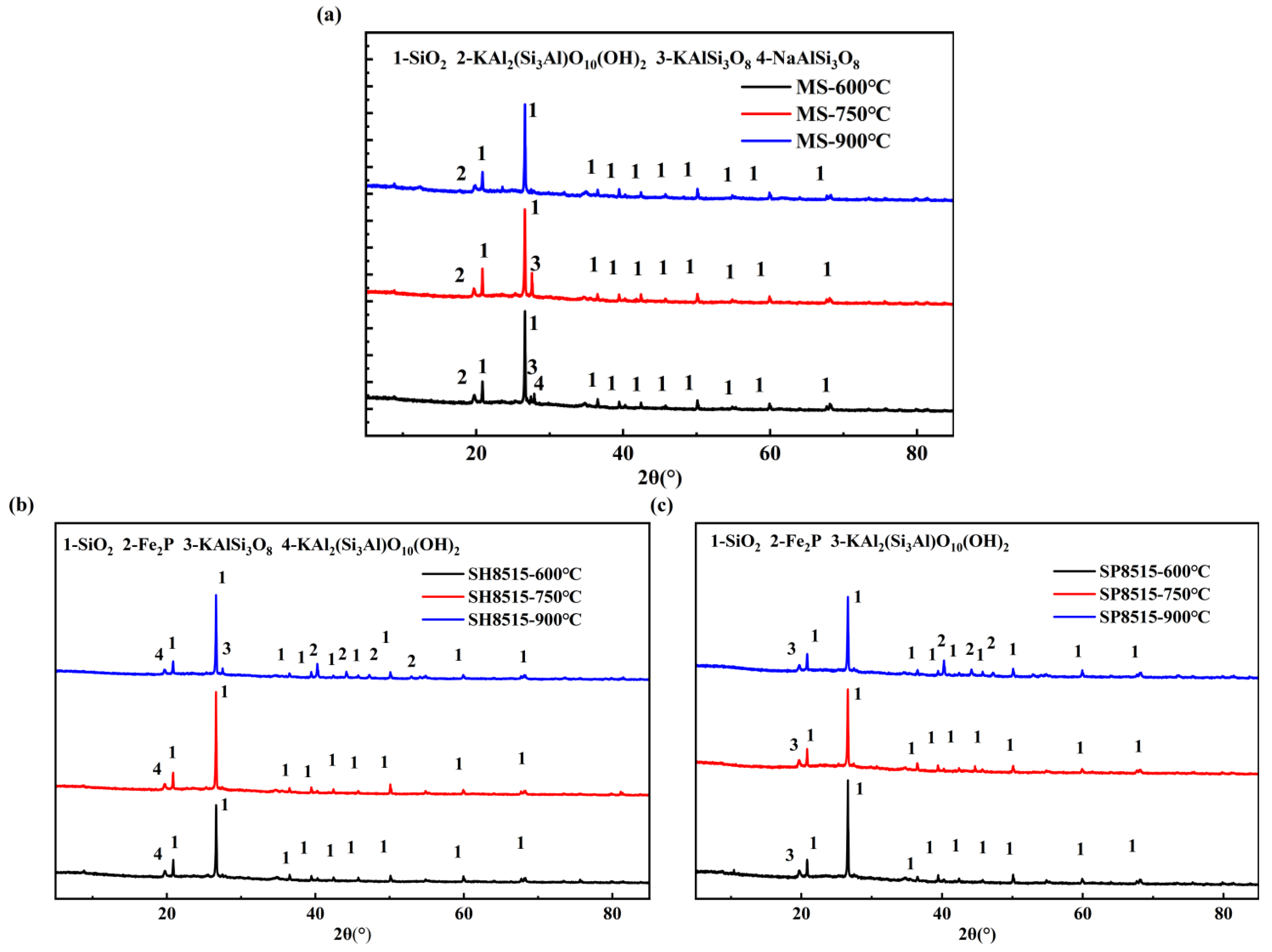
Changes in the XRD crystal phases of the post-(co-)pyrolytic residues with varying temperatures (600 °C, 750 °C, and 900 °C) are shown in Figure 12. No significant difference was detected in the phase compositions of the MS bottom slag among the three temperatures. The predominant phases included quartz (SiO2), muscovite (KAl2(AlSi3O10)(OH)2), potassium feldspar (KAlSi3O8), and albite (NaAlSi3O8). With the temperature rise from 600 °C to 750 °C, the diffraction peak intensity of KAlSi3O8 noticeably rose, and the diffraction peak of NaAlSi3O8 disappeared due to their respective melting points. Having a lower melting point than KAlSi3O8, NaAlSi3O8 liquefied first at the high temperatures. This phase transition aligned with the findings of a previous study [64].
Quartz remained the dominant phase in the co-pyrolytic char owing to its abundant presence in MS. Upon the addition of the MPs, no KAlSi3O8 was observed in the co-pyrolytic char at 600 °C and 750 °C. This phenomenon may be attributed to the alkaline environment created by the co-pyrolysis, promoting the decomposition of KAlSi3O8 at high temperatures [65]. At 900 °C, KAlSi3O8 was observed in the co-pyrolytic HDPE char. Conversely, no KAlSi3O8 was observed in the co-pyrolytic PET char, indicating that the addition of PET enhanced the decomposition of KAlSi3O8 in MS more effectively than that of HDPE.

3.11.3. Micromorphology of (Co-)Pyrolytic Chars

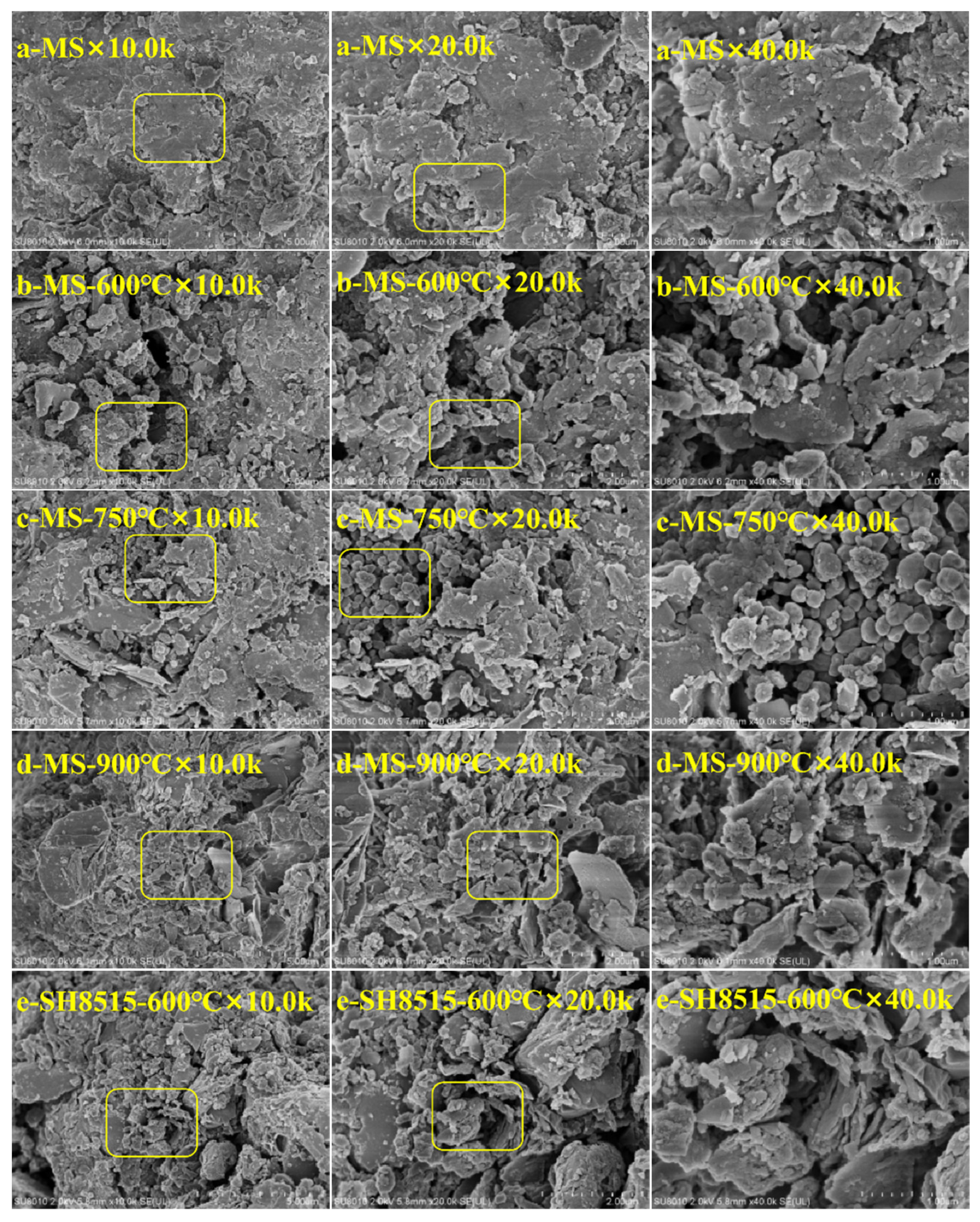
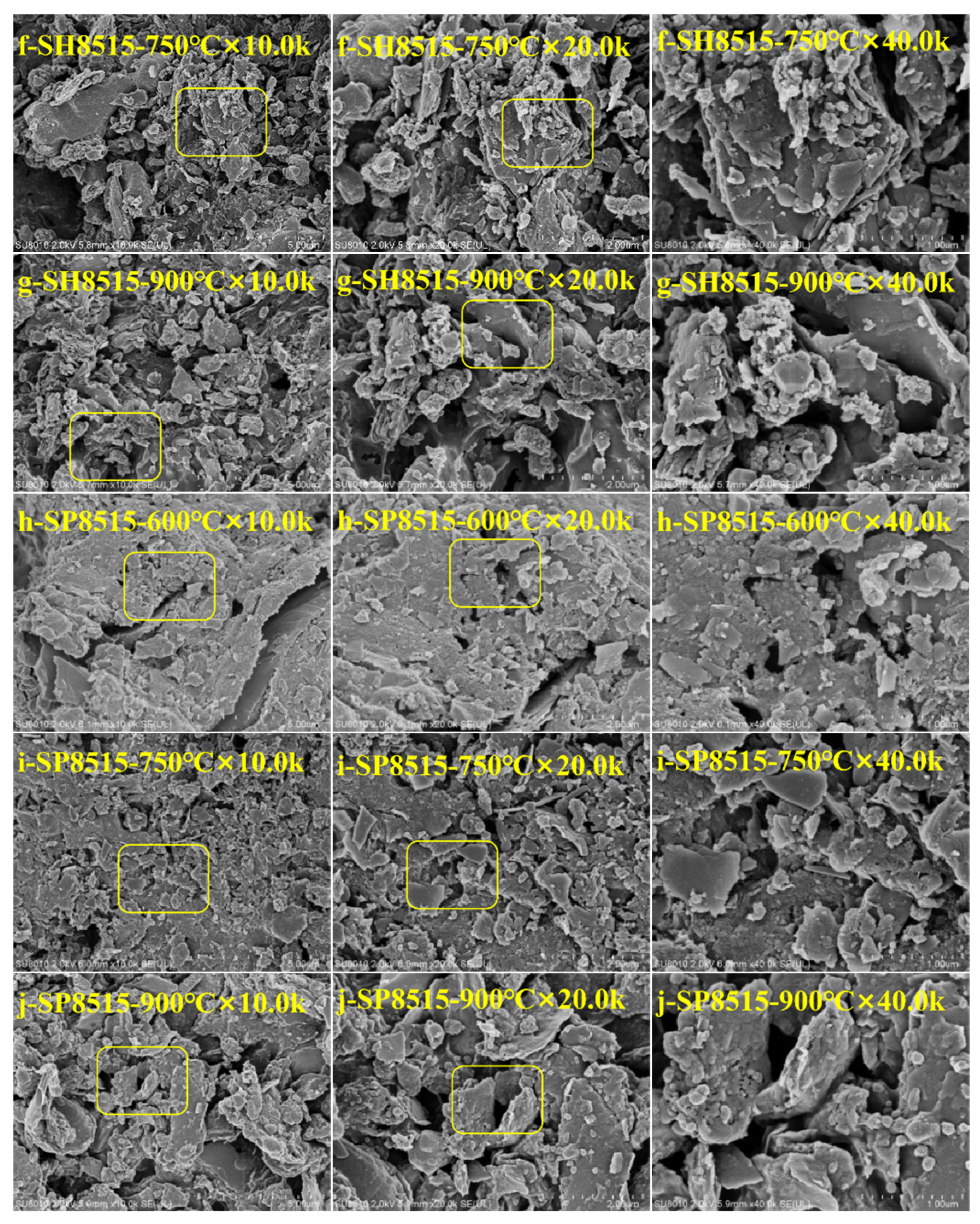
Detected via SEM at the varying magnifications, the micromorphology of (co-)pyrolytic chars (MS, SH8515, and SP8515) at the three temperatures is shown in Figure 13. The MS surface appeared relatively flat and smooth, displaying a dense structure. As the temperature increased, the char surface grew rougher, with irregular pores and prominent protrusions due to the volatilization during the MS pyrolysis (Figure 13b) [66]. The temperature rise increased particle clustering on the char surface, alongside irregular pores, in addition to the appearance of round and smooth particles, indicating sintering and melting, including mineral components forming spherical particles (Figure 13c) [67].
The SH8515 char exhibited a looser structure, with more and larger irregular voids on the surface and lower overall density than the MS char (Figure 13e–g). The high volatility of HDPE resulted in minimal post-co-pyrolysis residue, weakening the overall structure. Also, the interaction between MS and HDPE promoted volatilization and structural damage [13,68]. The high temperatures exacerbated the structural deterioration.
A dense plate-like structure with irregular pores was observed on the SP8515 char surface (Figure 13h). MS intermediate products reacted with PET, cross-linking and compacting the co-pyrolytic char structure [51]. It indicates that co-pyrolytic interactions formed a barrier in the char, hindering volatilization [69]. These interactions also contributed to the inhibition effect exerted by the MS-PET co-pyrolysis at above 450 °C. As the temperature increased, the char maintained its plate-like structure but developed larger, irregular pores, indicative of increased looseness, which was attributed to structural damage due to the volatilization (Figure 13i,j).

3.11.4. Functional Groups of (Co-)Pyrolytic Chars

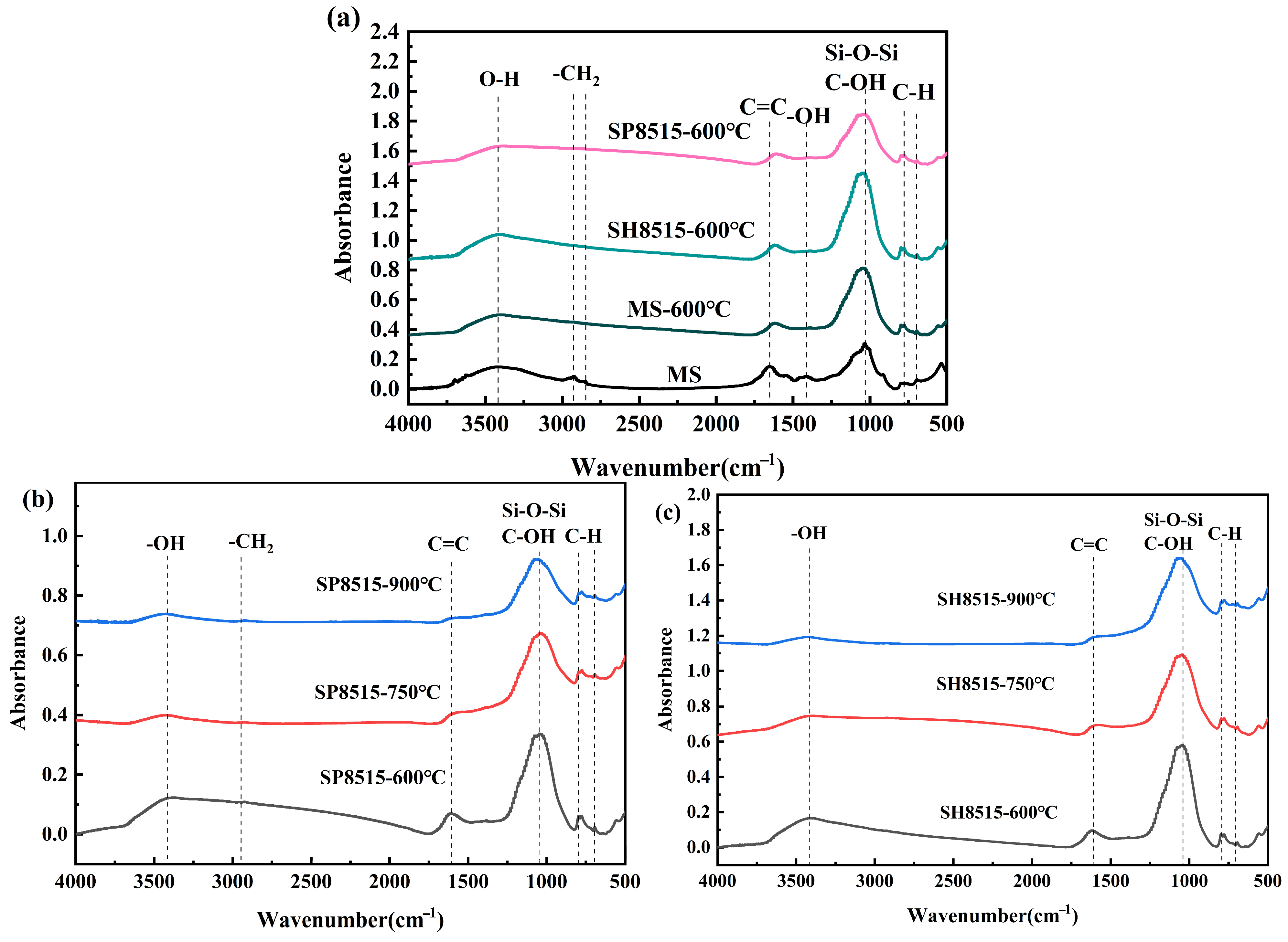
The infrared spectra of the (co-)pyrolytic chars (MS, SH8515, and SP8515) are shown in Figure 14. Overall, functional groups remained consistent among the (co-)pyrolytic chars. The absorption peak around 3400 cm−1 corresponded to the stretching vibration of hydroxyl -OH groups, originating from water or other compounds containing -OH, such as alcohol and acids. Compared with that in the control MS sample, the -OH absorption peak in pyrolytic carbon widened and softened due to the release of macromolecular substances containing hydroxyl groups. The MS exhibited asymmetric and symmetric stretching vibration peaks of saturated alkane methylene -CH2 at approximately 2900 cm−1 and methylene -CH2 at 2852 cm−1, respectively. These two diffraction peaks largely disappeared in all the (co-)pyrolytic chars at 600 °C, indicating the decomposition of macromolecular substances. A weak peak around 2852 cm−1 was observed during the co-pyrolysis with PET but completely disappeared during the co-pyrolysis with HDPE, indicating interactions between PET and MS.
The absorption peak around 1650 cm−1 arose from C=C stretching vibrations of the benzene ring skeleton. When the benzene ring is directly linked to the double bond, the absorption peak splits. The increased temperature led to a smoother absorption peak for C=C, as also observed in the co-pyrolytic char [70]. The peak at approximately 1431 cm−1 represented the in-plane bending vibration of alcohol, disappearing in the post-(co-)pyrolysis, indicating the removal of alcohol from MS.
The peak at around 1010 cm−1 corresponded to the stretching vibration of C-OH and the asymmetric stretching vibration of Si-O-Si, derived from the Si- and O-rich MS. Also, the XRD results verified the presence of Si-containing minerals, such as quartz, albite, potassium feldspar, and muscovite. After the (co-)pyrolysis, the peak grew smoother and stronger due to the decomposition of alcohol substances at the high temperatures, reducing the interference with the MS peak of Si-O-Si and increasing the Si content of the (co-)pyrolytic chars. SH8515 exhibited higher diffraction peak intensity than SP8515 due to the absence of residuals after the HDPE co-pyrolysis. The XRF results also confirmed the higher Si content of SH8515 than that of SP8515.

3.12. Operationally Optimal Settings

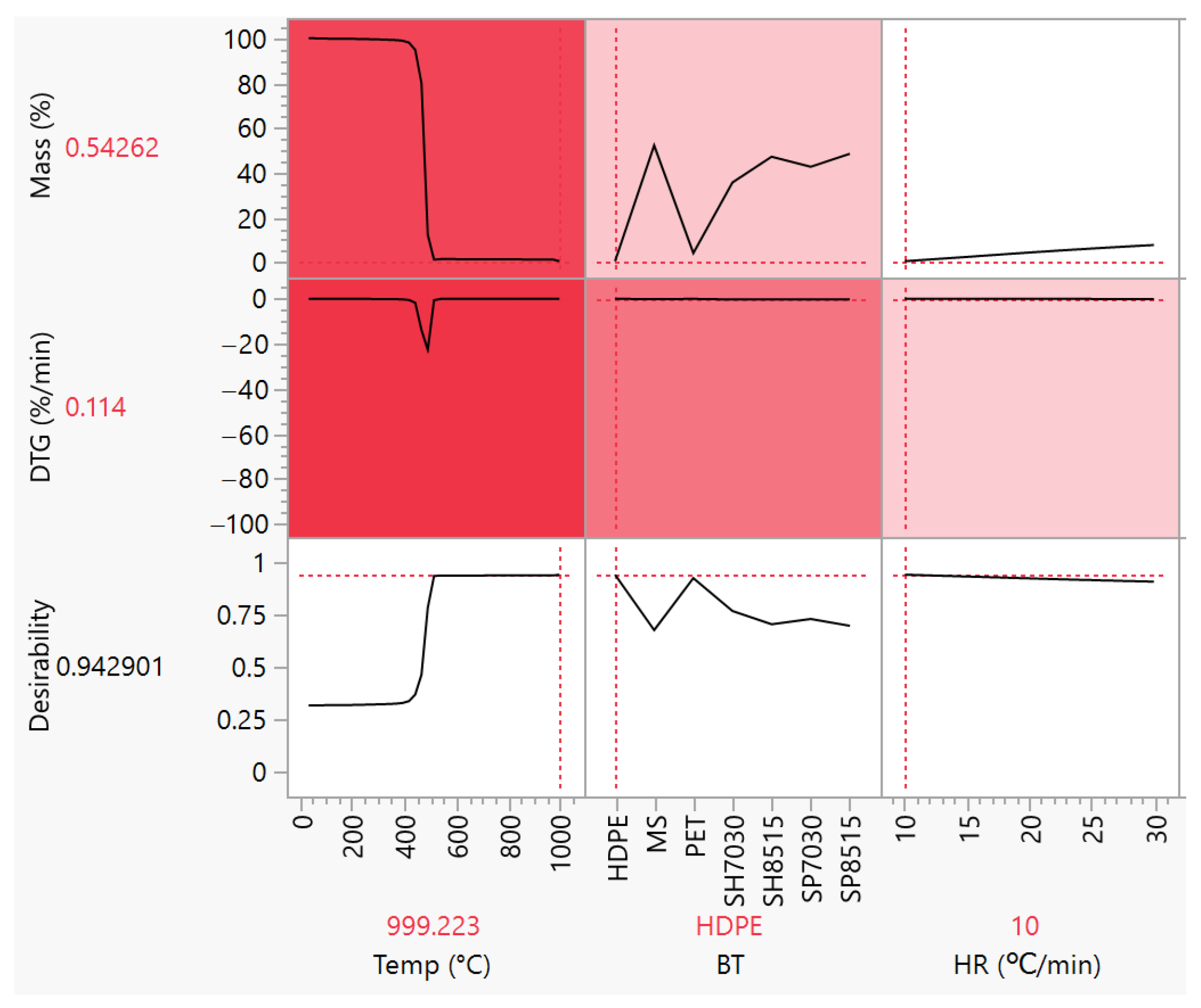
Given the 5-fold cross-validation results in Table 9, the best-fit ANN built in this study (Figure 15) accounted for 99.99% and 94.70% of variations in the remaining mass (TG, %) and decomposition rate (DTG, %/min) (N = 811,437 and 202,859), respectively. The optimal joint response of the minimized residuals and maximized decomposition rate was achieved using HDPE between 500 and 999 °C at 10 °C/min (D = 0.942) (Figure 16). The other optimal responses were of the following pattern in a descending order of the D value: PET between 500 and 999 °C at 10 °C/min (D = 0.926) > SH7030 between 900 and 999 °C at 10 °C/min (D = 0.768) > SP7030 between 900 and 999 °C at 10 °C/min (D = 0.730) > SH8515 between 900–999 °C at 10 °C/min (D = 0.704) > SP8515 between 950 and 999 °C at 10 °C/min (D = 0.697) > MS between 950 and 999 °C at 10 °C/min (D = 0.676). Regardless of not only the overall versus individual responses but also the additive (main) versus multiplicative (interaction) effects, the relative importance of the inputs, as derived from Monte Carlo simulations, was of the following descending order: temperature > blend type > heating rate.
The energetically optimal pyrolysis settings corresponded to the results of TG analysis. The comprehensive pyrolysis index (CPI) of HDPE and PET was significantly higher than that of MS. The incorporation of the MPs enhanced the mono-pyrolysis of MS, thus increasing the CPI values of the co-pyrolysis. Under the same blend ratio, the CPI value of the MS-HDPE co-pyrolysis exceeded that of the MS-PET co-pyrolysis. Overall, at 10 °C/min, the temperature and MP type were the drivers of the co-pyrolysis energetic performance. Temperature dominated the energetic performance, most likely due to its direct control over bond cleavage kinetics. At 10 °C/min, higher temperatures (>500 °C) maximized end-chain scission in HDPE (activation energy: 256 kJ/mol) vs. ester cleavage in PET (218 kJ/mol), consistent with reported degradation mechanisms by Das and Tiwari (2018) [71]. HDPE’s superior performance (D = 0.942 vs. 0.926 for PET) most likely stemmed from its higher H/C ratio (2.0 vs. 1.33) and radical-mediated synergies with sludge lipids—mirroring findings in co-pyrolysis of polyolefins with biosolids by Ding et al. (2021) [65].

4. Conclusions

This study investigated the co-pyrolysis mechanisms, kinetics, thermodynamics, and products of MS with HDPE and PET microplastics. Thermogravimetric analysis, tube furnace experiments, and multiple analytical characterization techniques revealed that co-pyrolysis significantly enhanced efficiency, reaction thoroughness, and thermal stability compared with the MS mono-pyrolysis. HDPE exerted a stronger positive influence on the MS pyrolysis than PET, with performance improving proportionally to MP fraction. Interaction analysis identified promoting effects between 350 and 500 °C but inhibitory effects between 500 and 1000 °C. Principal component analysis demonstrated MS dominance in initial stages, shifting to MP control in later phases. The distinct kinetic (activation energy and pre-exponential factor) and thermodynamic (enthalpy, Gibbs free energy, and entropy) parameters quantitatively underscored the differing difficulty and mechanistic complexity of the HDPE versus PET pyrolysis reactions. Reaction models were optimized via kinetic analysis, while co-pyrolytic char exhibited distinct elemental profiles, crystalline phases, micromorphology, and functional groups. Multi-objective optimization maximized decomposition rates and minimized residuals, confirming HDPE (D = 0.942) and PET (D = 0.926) energetically outperformed MS (D = 0.676). Optimal conditions occurred for 30% MP blends (SH7030: D = 0.768; SP7030: D = 0.730), with temperature and MP type being key performance drivers at 10 °C/min. Building upon the mechanistic insights established in this study, future research should extend the product analysis to fully characterize the yield and detailed composition of the co-pyrolytic bio-oil and biogas fractions. Additionally, studies should integrate experiments with environmentally relevant MPs concentrations (<5 wt%) to translate the identified interaction mechanisms into practical applications. These findings advance sustainable co-recycling of the MPs and MS via tailored pyrolysis.

Author Contributions

J.L.: Conceptualization, Funding acquisition, Project administration, Writing—review and editing. Z.C.: Data curation, Formal analysis, Writing—original draft, Writing—review and editing. F.L.: Data curation, Methodology, Writing—original draft. Z.L.: Data curation, Formal analysis, Writing—original draft. L.T.: Data curation, Formal analysis, Writing—original draft. F.E.: Methodology, Predictive modeling, Writing—original draft, Writing—review and editing. Y.H.: Formal analysis, Writing—review and editing. Y.X.: Methodology, Writing—review and editing. W.L.: Methodology, Formal analysis. C.Y.: Data curation, Formal analysis, Methodology, Resources. All authors have read and agreed to the published version of the manuscript.

Funding

Key Laboratory of Radioactive and Rare Scattered Minerals, Ministry of Natural Resources (2025-RRSM-04); Large-scale Instrument and Equipment Open Fund of the Analysis and Test Center, Guangdong University of Technology (ATCKF202305).

Data Availability Statement

The data will be made available on request.

Conflicts of Interest

The authors declare no conflicts of interest.

References

  1. Ding, Z.; Chen, Z.; Liu, J.; Evrendilek, F.; He, Y.; Xie, W. Co-combustion, life-cycle circularity, and artificial intelligence-based multi-objective optimization of two plastics and textile dyeing sludge. J. Hazard. Mater. 2022, 426, 128069. [Google Scholar] [CrossRef]
  2. Gatidou, G.; Arvaniti, O.S.; Stasinakis, A.S. Review on the occurrence and fate of microplastics in Sewage Treatment Plants. J. Hazard. Mater. 2019, 367, 504–512. [Google Scholar] [CrossRef] [PubMed]
  3. Zhang, Z.; Chen, Y. Effects of microplastics on wastewater and sewage sludge treatment and their removal: A review. Chem. Eng. J. 2020, 382, 122955. [Google Scholar] [CrossRef]
  4. Eerkes-Medrano, D.; Thompson, R.C.; Aldridge, D.C. Microplastics in freshwater systems: A review of the emerging threats, identification of knowledge gaps and prioritisation of research needs. Water Res. 2015, 75, 63–82. [Google Scholar] [CrossRef]
  5. Ma, J.; Gong, Z.; Wang, Z.; Liu, H.; Chen, G.; Guo, G. Elucidating degradation properties, microbial community, and mechanism of microplastics in sewage sludge under different terminal electron acceptors conditions. Bioresour. Technol. 2022, 346, 126624. [Google Scholar] [CrossRef] [PubMed]
  6. Halsband, C.; Herzke, D. Plastic litter in the European Arctic: What do we know? Emerg. Contam. 2019, 5, 308–318. [Google Scholar] [CrossRef]
  7. Li, W.; Lo, H.-S.; Wong, H.-M.; Zhou, M.; Wong, C.-Y.; Tam, N.F.-Y.; Cheung, S.-G. Heavy metals contamination of sedimentary microplastics in Hong Kong. Mar. Pollut. Bull. 2020, 153, 110977. [Google Scholar] [CrossRef]
  8. Dai, L.; Zhou, N.; Lv, Y.; Cheng, Y.; Wang, Y.; Liu, Y.; Cobb, K.; Chen, P.; Lei, H.; Ruan, R. Pyrolysis technology for plastic waste recycling: A state-of-the-art review. Prog. Energy Combust. Sci. 2022, 93, 101021. [Google Scholar] [CrossRef]
  9. Milato, J.V.; França, R.J.; Calderari, M.R.M. Marques Calderari, Co-pyrolysis of oil sludge with polyolefins: Evaluation of different Y zeolites to obtain paraffinic products. J. Environ. Chem. Eng. 2020, 8, 103805. [Google Scholar] [CrossRef]
  10. Ni, B.-J.; Zhu, Z.-R.; Li, W.-H.; Yan, X.; Wei, W.; Xu, Q.; Xia, Z.; Dai, X.; Sun, J. Microplastics Mitigation in Sewage Sludge through Pyrolysis: The Role of Pyrolysis Temperature. Environ. Sci. Technol. Lett. 2020, 7, 961–967. [Google Scholar] [CrossRef]
  11. Yuan, Z.; Huang, Q.; Wang, Z.; Wang, H.; Luo, J.; Zhu, N.; Cao, X.; Lou, Z. Medium-Low Temperature Conditions Induce the Formation of Environmentally Persistent Free Radicals in Microplastics with Conjugated Aromatic-Ring Structures during Sewage Sludge Pyrolysis. Environ. Sci. Technol. 2022, 56, 2c04453. [Google Scholar] [CrossRef]
  12. Li, W.; Meng, J.; Zhang, Y.; Haider, G.; Ge, T.; Zhang, H.; Li, Z.; Yu, Y.; Shan, S. Co-pyrolysis of sewage sludge and metal-free/metal-loaded polyvinyl chloride (PVC) microplastics improved biochar properties and reduced environmental risk of heavy metals. Environ. Pollut. 2022, 302, 119092. [Google Scholar] [CrossRef] [PubMed]
  13. Tang, X.; Chen, X.; He, Y.; Evrendilek, F.; Chen, Z.; Liu, J. Co-pyrolytic performances, mechanisms, gases, oils, and chars of textile dyeing sludge and waste shared bike tires under varying conditions. Chem. Eng. J. 2022, 428, 131053. [Google Scholar] [CrossRef]
  14. Nguyen, Q.V.; Choi, Y.S.; Choi, S.K.; Jeong, Y.W.; Han, S.Y. Co-pyrolysis of coffee-grounds and waste polystyrene foam: Synergistic effect and product characteristics analysis. Fuel 2021, 292, 120375. [Google Scholar] [CrossRef]
  15. Ma, M.-Y.; Xu, D.-H.; Guo, Y.; Wang, S.-Z.; He, Y.-L. Impacts of microplastics in municipal sludge pyrolysis-gasification: Melt-induced microaggregation and increased deposition risk. Renew. Sustain. Energy Rev. 2025, 214, 115542. [Google Scholar] [CrossRef]
  16. Xiong, Q.; Li, Y.; Hou, C.; Yang, J.; Zhou, X.; Ma, X.; Zuo, X.; Wu, X. How microplastics affect sludge pyrolysis behavior: Thermogravimetry-mass spectrum analysis and biochar characteristics. Waste Manag. 2023, 172, 108–116. [Google Scholar] [CrossRef]
  17. Wang, Z.; Burra, K.G.; Lei, T.; Gupta, A.K. Co-pyrolysis of waste plastic and solid biomass for synergistic production of biofuels and chemicals-A review. Prog. Energy Combust. Sci. 2021, 84, 100899. [Google Scholar] [CrossRef]
  18. Kong, Y.; Wang, R.; Zhou, Q.; Li, J.; Fan, Y.; Chen, Q. Recent progresses and perspectives of polyethylene biodegradation by bacteria and fungi: A review. J. Contam. Hydrol. 2025, 269, 104499. [Google Scholar] [CrossRef]
  19. Lee, W.-B.; Jae, J.; Kim, J.; Kwon, J.; Kim, Y.-M. Co-feeding effect of municipal sludge on the pyrolysis of polyethylene terephthalate. Korean J. Chem. Eng. 2023, 40, 2701–2707. [Google Scholar] [CrossRef]
  20. Fardi, Z.; Shahbeik, H.; Nosrati, M.; Motamedian, E.; Tabatabaei, M.; Aghbashlo, M. Waste-to-energy: Co-pyrolysis of potato peel and macroalgae for biofuels and biochemicals. Environ. Res. 2023, 242, 117614. [Google Scholar] [CrossRef] [PubMed]
  21. Shafizadeh, A.; Shahbeik, H.; Nadian, M.H.; Gupta, V.K.; Nizami, A.-S.; Lam, S.S.; Peng, W.; Pan, J.; Tabatabaei, M.; Aghbashlo, M. Turning hazardous volatile matter compounds into fuel by catalytic steam reforming: An evolutionary machine learning approach. J. Clean. Prod. 2023, 413, 137329. [Google Scholar] [CrossRef]
  22. Chen, X.; Shafizadeh, A.; Shahbeik, H.; Rafiee, S.; Golvirdizadeh, M.; Moradi, A.; Peng, W.; Tabatabaei, M.; Aghbashlo, M. Machine learning-based optimization of catalytic hydrodeoxygenation of biomass pyrolysis oil. J. Clean. Prod. 2024, 437, 140738. [Google Scholar] [CrossRef]
  23. Chen, Z.; Liu, J.; Tao, L.; Jia, D.; Ke, G.; Evrendilek, F.; Apul, O.G.; Zhuang, P.; He, Y.; Li, W.; et al. Interaction effects of feedstock and temperature on biogas production during torrefaction-coupled catalytic stepwise pyrolysis of phytoremediation biomass. Renew. Energy 2025, 260, 125131. [Google Scholar] [CrossRef]
  24. Ma, D.; Yao, Q.; Wang, J.; Hao, Q.; Chen, H.; Ma, L.; Sun, M.; Ma, X. Simple descriptor based machine learning model development for synergy prediction of different metal loadings and solvent swellings on coal pyrolysis. Chem. Eng. Sci. 2022, 252, 117538. [Google Scholar] [CrossRef]
  25. Derringer, G.; Suich, R. Simultaneous optimization of several response variables. J. Qual. Technol. 1980, 12, 214–219. [Google Scholar] [CrossRef]
  26. Chang, X.; Wu, P.; Chu, Y.; Zhou, Y.; Tang, Y. Pyrolysis-induced migration and transformation of heavy metals in sewage sludge containing microplastics. Waste Manag. 2024, 189, 401–409. [Google Scholar] [CrossRef]
  27. Zhao, X.; Wan, C.; Pan, Y.; Fan, Y.; Liu, X. Pyrolysis behavior of sewage sludge coexisted with microplastics: Kinetics, mechanism, and product characteristics. J. Environ. Manag. 2024, 370, 123030. [Google Scholar] [CrossRef] [PubMed]
  28. Wang, L.; Barta-Rajnai, E.; Skreiberg, Ø.; Khalil, R.; Czégény, Z.; Jakab, E.; Barta, Z.; Grønli, M. Effect of torrefaction on physiochemical characteristics and grindability of stem wood, stump and bark. Appl. Energy 2018, 227, 137–148. [Google Scholar] [CrossRef]
  29. Ding, K.; Zhong, Z.; Zhang, B.; Song, Z.; Qian, X. Pyrolysis Characteristics of Waste Tire in an Analytical Pyrolyzer Coupled with Gas Chromatography/Mass Spectrometry. Energy Fuels 2015, 29, 3181–3187. [Google Scholar] [CrossRef]
  30. Chen, J.; Mu, L.; Jiang, B.; Yin, H.; Song, X.; Li, A. TG/DSC-FTIR and Py-GC investigation on pyrolysis characteristics of petrochemical wastewater sludge. Bioresour. Technol. 2015, 192, 1–10. [Google Scholar] [CrossRef] [PubMed]
  31. Chen, Y.; Liu, J.; Li, L.; Chen, X.; Lin, Z.; Yang, C.; Evrendilek, F.; Li, W.; Huang, W.; He, Y.; et al. Optimizing pyrolysis of herbal tea and Salvia miltiorrhiza residues for sustainable energy and product recovery. Chem. Eng. J. 2025, 513, 162694. [Google Scholar] [CrossRef]
  32. Barta-Rajnai, E.; Jakab, E.; Sebestyén, Z.; May, Z.; Barta, Z.; Wang, L.; Skreiberg, Ø.; Grønli, M.; Bozi, J.; Czégény, Z. Comprehensive Compositional Study of Torrefied Wood and Herbaceous Materials by Chemical Analysis and Thermoanalytical Methods. Energy Fuels 2016, 30, 8019–8030. [Google Scholar] [CrossRef]
  33. Naqvi, S.R.; Tariq, R.; Hameed, Z.; Ali, I.; Naqvi, M.; Chen, W.-H.; Ceylan, S.; Rashid, H.; Ahmad, J.; Taqvi, S.A.; et al. Pyrolysis of high ash sewage sludge: Kinetics and thermodynamic analysis using Coats-Redfern method. Renew. Energy 2019, 131, 854–860. [Google Scholar] [CrossRef]
  34. Ilo, O.P.; Simatele, M.D. Water hyacinth biorefinery: Improved biofuel production using Trichoderma atroviride pretreatment. Biofuels Bioprod. Biorefin. 2024, 19, 68–84. [Google Scholar] [CrossRef]
  35. Zhang, X.; Zhang, Q.; Li, Y.; Zhang, H. Modeling and optimization of photo-fermentation biohydrogen production from co-substrates basing on response surface methodology and artificial neural network integrated genetic algorithm. Bioresour. Technol. 2023, 374, 128789. [Google Scholar] [CrossRef] [PubMed]
  36. Wang, T.; Liu, B.; Xue, Y.; Wang, W.; Chen, S. Effect of textile waste on incineration behavior of dyeing sludge: Combustion characteristics, gas emissions, kinetics. J. Clean. Prod. 2024, 435, 140619. [Google Scholar] [CrossRef]
  37. Zhang, J.; Sun, G.; Liu, J.; Evrendilek, F.; Buyukada, M. Co-combustion of textile dyeing sludge with cattle manure: Assessment of thermal behavior, gaseous products, and ash characteristics. J. Clean. Prod. 2020, 253, 119950. [Google Scholar] [CrossRef]
  38. Wang, C.; Bi, H.; Lin, Q.; Jiang, X.; Jiang, C. Co-pyrolysis of sewage sludge and rice husk by TG-FTIR-MS: Pyrolysis behavior, kinetics, and condensable/non-condensable gases characteristics. Renew Energy 2020, 160, 1048–1066. [Google Scholar] [CrossRef]
  39. Singh, R.; Ruj, B.; Sadhukhan, A.; Gupta, P. A TG-FTIR investigation on the co-pyrolysis of the waste HDPE, PP, PS and PET under high heating conditions. J. Energy Inst. 2020, 93, 1020–1035. [Google Scholar] [CrossRef]
  40. Singh, R.K.; Ruj, B.; Sadhukhan, A.; Gupta, P. Impact of fast and slow pyrolysis on the degradation of mixed plastic waste: Product yield analysis and their characterization. J. Energy Inst. 2019, 92, 1647–1657. [Google Scholar] [CrossRef]
  41. Dimitrov, N.; Krehula, L.K.; Siročić, A.P.; Hrnjak-Murgić, Z. Analysis of recycled PET bottles products by pyrolysis-gas chromatography. Polym. Degrad. Stab. 2013, 98, 972–979. [Google Scholar] [CrossRef]
  42. Vamvuka, D.; Salpigidou, N.; Kastanaki, E.; Sfakiotakis, S. Possibility of using paper sludge in co-firing applications. Fuel 2009, 88, 637–643. [Google Scholar] [CrossRef]
  43. Kan, T.; Strezov, V.; Evans, T. Catalytic Pyrolysis of Coffee Grounds Using NiCu-Impregnated Catalysts. Energy Fuels 2013, 28, 228–235. [Google Scholar] [CrossRef]
  44. Kan, T.; Grierson, S.; de Nys, R.; Strezov, V. Comparative Assessment of the Thermochemical Conversion of Freshwater and Marine Micro- and Macroalgae. Energy Fuels 2013, 28, 104–114. [Google Scholar] [CrossRef]
  45. Yao, D.; Li, H.; Dai, Y.; Wang, C.-H. Impact of temperature on the activity of Fe-Ni catalysts for pyrolysis and decomposition processing of plastic waste. Chem. Eng. J. 2020, 408, 127268. [Google Scholar] [CrossRef]
  46. Bi, H.; Wang, C.; Lin, Q.; Jiang, X.; Jiang, C.; Bao, L. Pyrolysis characteristics, artificial neural network modeling and environmental impact of coal gangue and biomass by TG-FTIR. Sci. Total. Environ. 2021, 751, 142293. [Google Scholar] [CrossRef] [PubMed]
  47. Brems, A.; Baeyens, J.; Vandecasteele, C.; Dewil, R. Polymeric Cracking of Waste Polyethylene Terephthalate to Chemicals and Energy. J. Air Waste Manag. Assoc. 2011, 61, 721–731. [Google Scholar] [CrossRef]
  48. Xiang, Z.; Liang, J.; Morgan, H.M.; Liu, Y.; Mao, H.; Bu, Q. Thermal behavior and kinetic study for co-pyrolysis of lignocellulosic biomass with polyethylene over Cobalt modified ZSM-5 catalyst by thermogravimetric analysis. Bioresour. Technol. 2018, 247, 804–811. [Google Scholar] [CrossRef] [PubMed]
  49. Liu, X.; Burra, K.G.; Wang, Z.; Li, J.; Che, D.; Gupta, A.K. On deconvolution for understanding synergistic effects in co-pyrolysis of pinewood and polypropylene. Appl. Energy 2020, 279, 115811. [Google Scholar] [CrossRef]
  50. Zhou, L.; Wang, Y.; Huang, Q.; Cai, J. Thermogravimetric characteristics and kinetic of plastic and biomass blends co-pyrolysis. Fuel Process. Technol. 2006, 87, 963–969. [Google Scholar] [CrossRef]
  51. Ko, K.-H.; Rawal, A.; Sahajwalla, V. Analysis of thermal degradation kinetics and carbon structure changes of co-pyrolysis between macadamia nut shell and PET using thermogravimetric analysis and 13C solid state nuclear magnetic resonance. Energy Convers. Manag. 2014, 86, 154–164. [Google Scholar] [CrossRef]
  52. Ko, K.-H.; Sahajwalla, V.; Rawal, A. Specific molecular structure changes and radical evolution during biomass-polyethylene terephthalate co-pyrolysis detected by 13C and 1H solid-state NMR. Bioresour. Technol. 2014, 170, 248–255. [Google Scholar] [CrossRef]
  53. Chattopadhyay, J.; Pathak, T.; Srivastava, R.; Singh, A. Catalytic co-pyrolysis of paper biomass and plastic mixtures (HDPE (high density polyethylene), PP (polypropylene) and PET (polyethylene terephthalate)) and product analysis. Energy 2016, 103, 513–521. [Google Scholar] [CrossRef]
  54. Xue, Y.; Kelkar, A.; Bai, X. Catalytic co-pyrolysis of biomass and polyethylene in a tandem micropyrolyzer. Fuel 2016, 166, 227–236. [Google Scholar] [CrossRef]
  55. Zhang, X.; Lei, H.; Zhu, L.; Qian, M.; Zhu, X.; Wu, J.; Chen, S. Enhancement of jet fuel range alkanes from co-feeding of lignocellulosic biomass with plastics via tandem catalytic conversions. Appl. Energy 2016, 173, 418–430. [Google Scholar] [CrossRef]
  56. Gómez, C.; Mészáros, E.; Jakab, E.; Velo, E.; Puigjaner, L. Thermogravimetry/mass spectrometry study of woody residues and an herbaceous biomass crop using PICA techniques. J. Anal. Appl. Pyrolysis 2007, 80, 416–426. [Google Scholar] [CrossRef]
  57. Zhang, J.; Zou, H.; Liu, J.; Evrendilek, F.; Xie, W.; He, Y.; Buyukada, M. Comparative (co-)pyrolytic performances and by-products of textile dyeing sludge and cattle manure: Deeper insights from Py-GC/MS, TG-FTIR, 2D-COS and PCA analyses. J. Hazard. Mater. 2021, 401, 123276. [Google Scholar] [CrossRef]
  58. Mishra, R.K.; Sahoo, A.; Mohanty, K. Pyrolysis kinetics and synergistic effect in co-pyrolysis of Samanea saman seeds and polyethylene terephthalate using thermogravimetric analyser. Bioresour. Technol. 2019, 289, 121608. [Google Scholar] [CrossRef] [PubMed]
  59. Osman, A.I.; Farrell, C.; Al-Muhtaseb, A.H.; Al-Fatesh, A.S.; Harrison, J.; Rooney, D.W. Pyrolysis kinetic modelling of abundant plastic waste (PET) and in-situ emission monitoring. Environ. Sci. Eur. 2020, 32, 112. [Google Scholar] [CrossRef]
  60. Fu, J.; Wu, X.; Liu, J.; Evrendilek, F.; Chen, T.; Xie, W.; Xu, W.; He, Y. Co-circularity of spent coffee grounds and polyethylene via co-pyrolysis: Characteristics, kinetics, and products. Fuel 2022, 337, 127061. [Google Scholar] [CrossRef]
  61. Hussein, Z.A.; Shakor, Z.M.; Alzuhairi, M.; Al-Sheikh, F. Kinetic and Thermodynamic Study of the Pyrolysis of Plastic Waste. Environ. Process. Int. J. 2023, 10, 27. [Google Scholar] [CrossRef]
  62. Hu, M.; Chen, Z.; Wang, S.; Guo, D.; Ma, C.; Zhou, Y.; Chen, J.; Laghari, M.; Fazal, S.; Xiao, B.; et al. Thermogravimetric kinetics of lignocellulosic biomass slow pyrolysis using distributed activation energy model, Fraser–Suzuki deconvolution, and iso-conversional method. Energy Convers. Manag. 2016, 118, 1–11. [Google Scholar] [CrossRef]
  63. Habibi, R.; Kopyscinski, J.; Masnadi, M.S.; Lam, J.; Grace, J.R.; Mims, C.A.; Hill, J.M. Co-gasification of Biomass and Non-biomass Feedstocks: Synergistic and Inhibition Effects of Switchgrass Mixed with Sub-bituminous Coal and Fluid Coke During CO2 Gasification. Energy Fuels 2012, 27, 494–500. [Google Scholar] [CrossRef]
  64. Kim, J.; Heo, E.; Kim, S.-J.; Kim, J.-Y. Investigation of the mineral components of porcelain raw material and their phase evolution during a firing process by using a Rietveld quantitative analysis. J. Korean Phys. Soc. 2016, 68, 126–130. [Google Scholar] [CrossRef]
  65. Ding, Z.; Liu, J.; Chen, H.; Huang, S.; Evrendilek, F.; He, Y.; Zheng, L. Co-pyrolysis performances, synergistic mechanisms, and products of textile dyeing sludge and medical plastic wastes. Sci. Total Environ. 2021, 799, 149397. [Google Scholar] [CrossRef]
  66. Liu, Y.; Ran, C.; Siyal, A.A.; Song, Y.; Jiang, Z.; Dai, J.; Chtaeva, P.; Fu, J.; Ao, W.; Deng, Z.; et al. Comparative study for fluidized bed pyrolysis of textile dyeing sludge and municipal sewage sludge. J. Hazard. Mater. 2020, 396, 122619. [Google Scholar] [CrossRef]
  67. Kleinhans, U.; Wieland, C.; Frandsen, F.J.; Spliethoff, H. Ash formation and deposition in coal and biomass fired combustion systems: Progress and challenges in the field of ash particle sticking and rebound behavior. Prog. Energy Combust. Sci. 2018, 68, 65–168. [Google Scholar] [CrossRef]
  68. Gu, L.; Dong, G.; Yu, H.; Zhang, K.; Lu, X.; Wen, H.; Zou, T. Preparation of porous biochar by urine assisted pyrolysis of sewage sludge and their application for Eriochrome Black T adsorption. J. Anal. Appl. Pyrolysis 2021, 153, 104975. [Google Scholar] [CrossRef]
  69. Chen, L.; Wang, S.; Meng, H.; Wu, Z.; Zhao, J. Synergistic effect on thermal behavior and char morphology analysis during co-pyrolysis of paulownia wood blended with different plastics waste. Appl. Therm. Eng. 2017, 111, 834–846. [Google Scholar] [CrossRef]
  70. Zhang, D.; Cao, C.-Y.; Lu, S.; Cheng, Y.; Zhang, H.-P. Experimental insight into catalytic mechanism of transition metal oxide nanoparticles on combustion of 5-Amino-1H-Tetrazole energetic propellant by multi kinetics methods and TG-FTIR-MS analysis. Fuel 2019, 245, 78–88. [Google Scholar] [CrossRef]
  71. Das, P.; Tiwari, P. Valorization of packaging plastic waste by slow pyrolysis. Resour. Conserv. Recycl. 2018, 128, 69–77. [Google Scholar] [CrossRef]
Figure 1. The TG-DTG curves of (a) MS, (b) HDPE, and (c) PET pyrolysis at a heating rate of 20 °C/min.
Processes 14 00591 g001
Figure 2. The TG-DTG curves of the (a,b) MS pyrolysis and (c,d) SH7030 co-pyrolysis at the three heating rates.
Processes 14 00591 g002
Figure 3. The TG-DTG curves of the (a,b) MS-HDPE and (c,d) MS-PET co-pyrolysis at the three blend ratios.
Processes 14 00591 g003
Figure 4. The experimental and theoretical TG-DTG curves of the (a,b) MS-PET and (c,d) MS-HDPE co-pyrolysis at the three blend ratios.
Processes 14 00591 g004
Figure 5. Deviation analysis for the co-pyrolysis of (a) MS-HDPE and (b) MS-PET at the three blend ratios.
Processes 14 00591 g005
Figure 6. The PCA score plots of the (a) MS-PET and (b) MS-HDPE co-pyrolysis and the factor scores of the (c) MS-PET and (d) MS-HDPE co-pyrolysis.
Processes 14 00591 g006
Figure 7. The activation energy curves of the (a) PET and (b) HDPE pyrolysis according to the FWO, KAS, and Starink methods.
Processes 14 00591 g007
Figure 8. Changes in (a) ΔH, (b) ΔG, (c) lgA, and (d) ΔS as a function of conversion degree (α) in PET and HDPE pyrolysis at 20 °C/min.
Processes 14 00591 g008
Figure 9. The curves of the P(u)/P(u0.5) versus conversion degree (α) for the (a) HDPE and (b) PET pyrolysis at the three heating rates, and reaction mechanisms of the (c) HDPE and (d) PET pyrolysis at 20 °C/min.
Processes 14 00591 g009
Figure 10. The curves of the G(α) versus 10n × EP (u)/βR for the (a) PET and (b) HDPE pyrolysis at the three heating rates, and the experimental (solid line) and predicted (dot) conversion degrees of the pyrolysis of (c) PET and (d) HDPE at the three heating rates.
Processes 14 00591 g010
Figure 11. The curves of the theoretical and experimental conversion degrees (α) versus temperature for the (a) MS, (b,c) MS-HDPE, and (d,e) MS-PET co-pyrolysis.
Processes 14 00591 g011
Figure 12. XRD-detected crystal phases of the (co-)pyrolytic chars of (a) MS, (b) SH8515, and (c) SP8515 at the three temperatures.
Processes 14 00591 g012
Figure 13. The micromorphology of the (co-)pyrolytic chars of (a) MS, (bd) MS, (eg) SH8515, and (hj) SP8515 at the three temperatures.
Processes 14 00591 g013aProcesses 14 00591 g013b
Figure 14. FTIR spectra of the (a) MS, (b) SP8515, and (c) SH8515 chars produced at 600, 750, and 900 °C.
Processes 14 00591 g014
Figure 15. The architecture of the best-fit ANN adopted in this study.
Processes 14 00591 g015
Figure 16. The multi-objective optimization of the best-fit ANN adopted in this study and the relative importance levels of the cumulative (main and interaction) effect of the inputs on the individual outputs, as depicted by the red (strongest)-to-white (weakest) gradient according to Monte Carlo simulations.
Processes 14 00591 g016
Table 1. The common reaction mechanisms and the integral forms [23,31].
Reaction MechanismCodef(α)G(α)
First-order (n = 1)F11 − α−ln(1 − α)
Three-halves order (n = 1.5)F1.5(1 − α)3/22[(1 − α)−1/2 − 1]
Second-order (n = 2)F2(1 − α)2(1 − α)−1 − 1
Third-order (n = 3)F3(1 − α)3[(1 − α)−2 − 1]/2
Multi-order reactionFn(1 − α)n[(1 − α)1−n−1]/(n−1)
One-dimensional diffusionD11/2αα2
Two-dimensional diffusionD2[−ln(1 − α)]−1(1 − α) ln(1 − α) + α
Three-dimensional diffusionD3(3/2) (1 − α)2/3[1 − (1 − α)1/3]−1[1 − (1 − α)1/3]2
Four-dimensional diffusionD4(3/2) [(1 − α)−1/3 − 1]−1(1 − 2α/3) − (1 − α)2/3
Power lawP22α1/2α1/2
Power lawP33α2/3α1/3
Index lawP44α3/4α1/4
One dimensionalR11α
Two dimensionalR22(1 − α)1/21 − (1 − α)1/2
Three dimensionalR33(1 − α)2/31 − (1 − α)1/3
Nucleation growth (n = 1.5)A1.53/2(1 − α) [−ln(1 − α)]1/3[−ln(1 − α)]2/3
Nucleation growth (n = 2)A22(1 − α) [−ln(1 − α)]1/2[−ln(1 − α)]1/2
Nucleation growth (n = 3)A33(1 − α) [−ln(1 − α)]2/3[−ln(1 − α)]1/3
Multi-dimensionsAnn(1 − α) [−ln(1 − α)](n−1)/n[−ln(1 − α)]1/n
Table 2. Proximate, ultimate, and higher heating value analyses of the samples.
SampleProximate Analysis (wt.%)Ultimate Analysis (wt.%)LHV
(MJ/kg)
HHV
(MJ/kg)
Reference
MAVFCCHNOS
MS4.3755.2137.872.5520.623.783.5312.060.437.738.69--
HDPE0.050.0699.89086.1414.18nd0.32nd43.1446.33--
PET0.230.0595.684.0462.634.01nd33.36nd21.9822.89--
PP0.1117.5675.436.966.3510.4805.50.0930.7033.06 [1]
TDS5.0260.2634.72016.232.510.9611.823.213.424.11[37]
PP = polypropylene; TDS = textile dyeing sludge; LHV = lower heating value; HHV = higher heating value; M = moisture; A = ash; V = volatile matter; FC = fixed carbon; and nd = not detected.
Table 3. The pyrolysis stages and weight losses of the samples at a heating rate of 20 °C/min.
SampleStage IStage IIStage IIIResidue (%)
Temperature Range (°C)Weight Loss (%)Temperature Range (°C)Weight Loss (%)Temperature Range (°C)Weight Loss (%)
MS33.00–163.474.30163.47–736.3735.56736.37–1000.006.5853.56
HDPE33.00–385.380.22385.38–524.1095.80524.10–1000.000.013.97
PET33.00–367.480.42367.48–545.6587.39545.65–1000.002.649.55
Table 4. (Co-)pyrolysis characteristic parameters of MS and SH7030 at the three heating rates.
βTiTmaxRmaxRmeanmfΔT1/2CPI
°C/min(°C)(°C)(%/min)(%/min)(%)(°C)[10−6·%3/(min2·°C3)]
MS10243.90288.36−1.60−0.4952.59232.502.27
20248.40296.51−3.04−0.9653.56239.637.68
30282.10303.28−4.44−1.3356.96246.3212.06
SH703010245.50480.31−10.00−0.6536.80460.097.57
20254.40491.54−17.09−1.2141.77472.9320.37
30259.30499.51−25.06−1.7244.72480.2938.30
Table 5. The (co-)pyrolysis characteristic parameters of the samples at the three blend ratios.
SampleTiTmaxRmaxRmeanmfΔT1/2CPI
(°C)(°C)(%/min)(%/min)(%)(°C)[10−6·%3/(min2·°C3)]
MS248.40296.51−3.04−0.9653.56239.637.68
SH8515252.80488.62−9.98−1.0748.14466.759.61
SH7030254.40491.54−17.09−1.2141.77472.9320.37
HDPE484.70491.98−72.50−2.003.97482.55121.01
SP8515248.20407.46−4.43−1.0250.60274.648.03
SP7030254.90411.57−8.13−1.1445.03381.1512.74
PET428.00456.49−40.46−1.879.55432.6280.97
Table 6. Eα and R2 values of the PET and HDPE pyrolysis according to the FWO, KAS, and Starink methods.
SampleαFWO KAS Starink
EαR2EαR2EαR2
PET0.10187.790.9994186.060.9993185.040.9993
0.15192.370.9991190.780.9989189.720.9990
0.20193.760.9987192.170.9985191.110.9985
0.25194.090.9980192.450.9978191.390.9978
0.30195.270.9979193.640.9976192.570.9976
0.35197.060.9975195.470.9973194.390.9973
0.40197.870.9973196.280.9970195.200.9971
0.45201.230.9960199.780.9955198.660.9955
0.50202.690.9944201.280.9938200.160.9938
0.55203.790.9933202.400.9925201.270.9925
0.60204.020.9932202.610.9924201.480.9924
0.65203.350.9932201.870.9924200.750.9924
0.70203.910.9939202.420.9932201.290.9932
0.75204.250.9940202.750.9933201.620.9933
0.80204.410.9942202.870.9936201.740.9936
0.85205.080.9948203.530.9942202.400.9942
0.90206.840.9960205.330.9955204.180.9955
Mean199.87 198.34 197.23
HDPE0.10217.960.9941216.960.9934217.280.9934
0.15227.410.9956226.820.9951227.130.9951
0.20233.320.9967232.970.9964233.290.9964
0.25247.660.9995248.020.9994248.320.9994
0.30252.220.9998252.780.9998253.080.9998
0.35257.031.0000257.801.0000258.101.0000
0.40263.460.9998264.550.9998264.840.9998
0.45267.610.9999268.890.9999269.180.9999
0.50267.860.9999269.120.9999269.410.9999
0.55269.591.0000270.921.0000271.211.0000
0.60273.871.0000275.401.0000275.691.0000
0.65271.940.9990273.340.9989273.630.9989
0.70271.110.9993272.450.9992272.740.9992
0.75270.900.9994272.210.9993272.500.9993
0.80269.400.9994270.600.9993270.900.9994
0.85270.150.9995271.370.9995271.660.9995
0.90269.760.9996270.920.9996271.220.9996
Mean258.90 259.71 260.01
Table 7. The kinetic parameters of the (co-)pyrolysis.
SampleStageTemp Range (°C)Weight Loss (%)Modelf(α)R2A (s−1)Eα (kJ/mol)
SH7030I164.2–409.716.62F11 − α0.99915.2 × 10443.85
II409.7–733.835.22A22(1 − α) [−ln(1 − α)]1/20.99418.8 × 109128.35
SH8515I174.6–411.319.53F11 − α0.99797.1 × 10445.26
II411.3–692.123.87A22(1 − α) [−ln(1 − α)]1/20.97713.2 × 10794.46
MSI162.6–431.527.27F11 − α0.99664.9 × 10333.46
II431.5–735.89.62F6[(1 − α)−5 − 1]/50.99442.3 × 1020267.22
SP8515I162.3–352.715.69F11 − α0.99353.2 × 10549.54
II352.7–734.225.83F6[(1 − α)−5 − 1]/50.99707.8 × 1022275.04
SP7030I177.4–352.512.66F11 − α0.99801.1 × 10655.27
II352.5–702.134.78F6[(1 − α)−5 − 1]/50.99881.0 × 1029352.75
Table 8. The chemical compositions of MS and the (co-)pyrolytic chars.
SampleMSMS-CharSH8515-CharSH7030-CharSP8515-CharSP7030-Char
O44.9337.56938.03938.71336.53241.550
Si18.62521.79221.54221.04420.04620.066
Al12.64915.22115.22315.25014.40013.983
Fe9.50310.32910.2899.97113.73910.604
P5.5626.1656.1396.1275.9505.558
Ca2.5762.7582.7172.7193.0802.733
K2.0082.2822.2092.1632.4092.139
S1.7431.0461.0521.0040.8400.791
Mg0.7480.9090.9100.8820.8440.844
Ti0.6090.6920.6900.6460.7220.655
Cl0.2390.1750.1630.1530.1160.099
Na0.2160.2620.2810.2660.2750.243
Mn0.1650.1850.1850.1800.2570.192
Zn0.1260.1430.1350.1390.2060.149
Fnd0.1170.1070.1140.0970.085
nd = not detected; Values are normalized mass percentages of detected elements.
Table 9. The key performance indicators of the best-fit ANN adopted in this study.
Training 5-Fold Cross-Validation
MeasuresMass
(%)
DTG
(%/min)
Mass
(%)
DTG
(%/min)
R2 (%)99.9994.7799.9994.70
RMSE0.3930.6260.3950.626
MAD0.0850.2720.0840.272
N811,437811,437202,859202,859
Disclaimer/Publisher’s Note: The statements, opinions and data contained in all publications are solely those of the individual author(s) and contributor(s) and not of MDPI and/or the editor(s). MDPI and/or the editor(s) disclaim responsibility for any injury to people or property resulting from any ideas, methods, instructions or products referred to in the content.