Article

Controls of Structural Evolution and Complex Lithologic Architecture on the Identification and Accumulation Mechanisms of Low-Contrast Reservoirs: A Case Study from the Chang 3 Member, Zhenbei Area, Ordos Basin
1
State Key Laboratory of Continental Dynamics, Department of Geology, Northwest University, Xi’an 710069, China
2
The Sixth Oil Production Plant of Petrochina Changqing Oilfield Company, Xi’an 710200, China
3
The Seventh Oil Production Plant of Petrochina Changqing Oilfield Company, Xi’an 710200, China
4
Daging Drilling and Exploration Engineering Company Well 0pemtion Enginering Company, Songyuan 138000, China
*
Author to whom correspondence should be addressed.
Processes 2026, 14(3), 541; https://doi.org/10.3390/pr14030541
Submission received: 8 January 2026 / Revised: 27 January 2026 / Accepted: 2 February 2026 / Published: 4 February 2026

Abstract

Low-resistivity reservoirs characterized by weak log contrasts are highly concealed and therefore difficult to detect using conventional oil–water discrimination methods. Recent exploration and development indicate that low-resistivity reservoirs are widely developed in the Triassic Chang 3 Member of the Zhenbei area, Ordos Basin. However, contrasting tectonic evolution associated with the Tianhuan Depression and complex lithologic assemblages in the western and eastern sectors have resulted in complicated hydrocarbon migration and accumulation processes. In this study, integrated well-log and geochemical data were used to systematically investigate the genesis of low-resistivity reservoirs in the Chang 3 Member and to establish oil–water discrimination charts. Three-dimensional seismic flattening was applied to restore the Late Jurassic paleostructure of the western Chang 3 Member and to analyze its tectonic evolution. Reservoir petrology and pore–throat architecture in the western and eastern areas were comparatively examined using thin-section petrography, field-emission scanning electron microscopy (FESEM), and high-pressure mercury intrusion. Results indicate that the development of low-resistivity reservoirs in the Chang 3 Member is primarily controlled by highly saline formation water and elevated bound-water saturation. Based on these controls, the invasion factor–acoustic transit time cross-plot and the apparent spontaneous potential difference (ΔSP) method effectively discriminate oil- and water-bearing intervals in a total of 25 wells within the study area. Paleostructural restoration reveals that the western Chang 3 Member has undergone a tectonic inversion from a west-high–east-low configuration since the Late Jurassic to the present-day east-high–west-low geometry. Oil–source correlation indicates that hydrocarbons in the Chang 3 reservoirs were mainly derived from the underlying Chang 7 source rocks, whereas the bimodal distribution of fluid-inclusion homogenization temperatures suggests that the reservoirs experienced two distinct charging episodes. Integrated analysis suggests that tectonic inversion during the Yanshanian movement, combined with multistage hydrocarbon charging, led to secondary migration and partial destruction of early-formed reservoirs in the western area, resulting in predominantly scattered accumulations. In contrast, the eastern area experienced relatively limited tectonic modification, and laterally extensive accumulations are controlled by Type I–III lithologic–structural traps formed by the Chang 3 reservoir interval and its overlying strata. These findings provide an important geological basis for the identification of low-contrast reservoirs and for the exploration and development of hydrocarbon accumulations that are jointly controlled by tectonic evolution and lithologic heterogeneity.

1. Introduction

With ongoing exploration and development, large, high-quality conventional oil and gas accumulations have generally entered the middle to late stages of exploitation, and conventional high-resistivity targets are becoming increasingly scarce. Consequently, the exploration potential of more subtle, low-contrast reservoirs is emerging as an area of growing interest [1,2,3]. Previous studies indicate that the formation mechanisms of low-resistivity reservoirs are complex and primarily controlled by high saline formation water and elevated bound-water saturation. Both factors can significantly enhance reservoir conductivity, resulting in anomalously low resistivity in oil-bearing intervals, while complex pore structures may further modify the electrical conduction behavior of the reservoir rocks [4,5]. When the resistivity of oil-bearing layers approaches that of adjacent water-bearing strata, the contrast in electrical response is significantly reduced, making it difficult for conventional well logs to effectively discriminate oil–water contacts. This poses substantial challenges for hydrocarbon identification, reservoir evaluation, and the study of accumulation patterns. Current approaches for identifying low-resistivity reservoirs can be broadly divided into two categories. The first relies on empirical methods based on conventional well logs, such as cross-plot techniques, dynamic calibration, and multiwell correlation. These approaches depend heavily on regional experience, are subject to interpretation bias, have limited applicability, and their effectiveness is further constrained by the accuracy of the available experimental data. The second category employs advanced logging technologies, including array induction resistivity and nuclear magnetic resonance logging, which improve identification accuracy by directly constraining apparent resistivity and pore-fluid properties [6]. However, effective identification of low-contrast reservoirs fundamentally depends on a thorough understanding of their formation mechanisms and the underlying causes of resistivity anomalies, which is essential for developing robust, area-specific identification models. In the Triassic reservoirs of the Ordos Basin, numerous low-resistivity oil reservoirs are widely developed, and early exploration has shown that these reservoirs are highly concealed and challenging to recognize. To achieve efficient development of low-resistivity reservoirs, it is therefore critical to investigate their electrical response characteristics and formation mechanisms, and to establish identification methods that are tailored to different genetic types. Such approaches are necessary for delineating enrichment zones and defining favorable exploration targets within the study area [7,8].
At the same time, under the premise of accurately identifying low-contrast reservoirs, hydrocarbon accumulation patterns are also controlled by the specific accumulation models that are characteristic of the study area. In the western Zhenbei area, proximity to the Tianhuan Depression results in pronounced tectonic influence. Previous studies have shown that the Yanshanian tectonic event caused notable modifications to the paleostructural configuration of this region [9,10,11,12,13]. Consequently, regional paleostructural restoration has become a key component in understanding hydrocarbon migration and accumulation patterns [14]. Paleostructural restoration is an essential tool in petroleum exploration for delineating paleogeomorphology and predicting hydrocarbon enrichment zones, and it remains both a central and challenging aspect of petroleum geology [15,16]. Conventional restoration methods include the polygonal (baota) method, thickness map method, balanced cross-section, seismic reflection analysis, and sequence-stratigraphic restoration. These approaches typically reconstruct the paleo-thickness and paleo-burial depth of target layers by removing fault effects, correcting for compaction, and restoring folding and erosion, thereby revealing the tectonic evolution characteristics of the basin. However, because most of these methods rely on qualitative well-based data, the accuracy and objectivity of the results are limited and may not meet the high-precision quantitative requirements needed for current reservoir development [17,18,19,20].
Three-dimensional seismic data, with its wide coverage, high spatial continuity, and information density, provides a new avenue for paleostructural analysis [21]. By integrating seismic interpretation with paleostructural restoration, it is possible to achieve detailed three-dimensional characterization of structural units and improve semi-quantitative or quantitative restoration accuracy, thereby overcoming the spatial and precision limitations of traditional approaches. In sedimentary basins characterized by low-amplitude structures, such as the Ordos and Tarim basins during the Mesozoic, structural relief is subtle and spatial differences are minor, making conventional structural recognition challenging [22]. Therefore, high-resolution paleostructural restoration is critical for identifying potential favorable zones and for understanding hydrocarbon accumulation processes and distribution patterns [23].
In recent years, as the exploration and development of the Triassic reservoirs in the Zhenbei Oilfield have progressed, numerous low-resistivity reservoirs have been identified. These reservoirs generally exhibit resistivities below 10 Ω·m (Figure 1), with significant variability in the minimum productive resistivity among different well blocks. The electrical responses of oil-bearing and water-bearing intervals are closely similar, making it difficult for conventional electric logs to reliably discriminate between oil and water zones. Traditional sonic transit time–resistivity cross-plot methods have proven to be ineffective for distinguishing oil–water contacts in this area. At the same time, the genesis of these low-resistivity reservoirs remains unclear, introducing substantial uncertainty into hydrocarbon identification and reservoir evaluation. Furthermore, the western Zhenbei area has been strongly influenced by tectonic evolution, resulting in complex hydrocarbon migration pathways and diverse accumulation styles. These factors further complicate the understanding of hydrocarbon accumulation and distribution, representing a critical geological challenge that constrains efficient exploration and development in the region [24,25,26].
In this area, the western reservoirs are strongly controlled by tectonic evolution, whereas the eastern reservoirs, located farther from the Tianhuan Depression, are subject to a comparatively weaker tectonic influence. This spatial variability necessitates a comprehensive investigation of both regional reservoir characteristics and structural attributes. Previous studies of hydrocarbon accumulation in this region have not distinguished between these subareas, nor have they examined the enrichment patterns of newly identified low-resistivity reservoirs. To address these gaps, this study focuses on the formation mechanisms of low-resistivity reservoirs. Key factors affecting reservoir resistivity, including formation water salinity and bound-water saturation, are systematically analyzed to characterize the electrical response of low-contrast oil-bearing layers and to establish area-specific oil–water identification cross-plots. Additionally, three-dimensional seismic and well-log data are integrated to reconstruct the paleostructural configuration of the Chang 3 interval in the western area and to delineate the hydrocarbon aggregation processes. In the eastern area, reservoir characteristics and spatial lithologic assemblages controlling hydrocarbon entrapment are comprehensively analyzed to identify the key factors governing accumulation [27,28,29,30]. The results of this study provide insights into the formation mechanisms of low-resistivity reservoirs in the Zhenbei area, enhance the accuracy of oil–water discrimination, and, for the first time, distinguish and summarize the differential accumulation models between the western and eastern subareas. These findings offer scientific and theoretical support for future petroleum exploration in the region.

2. Geological Background

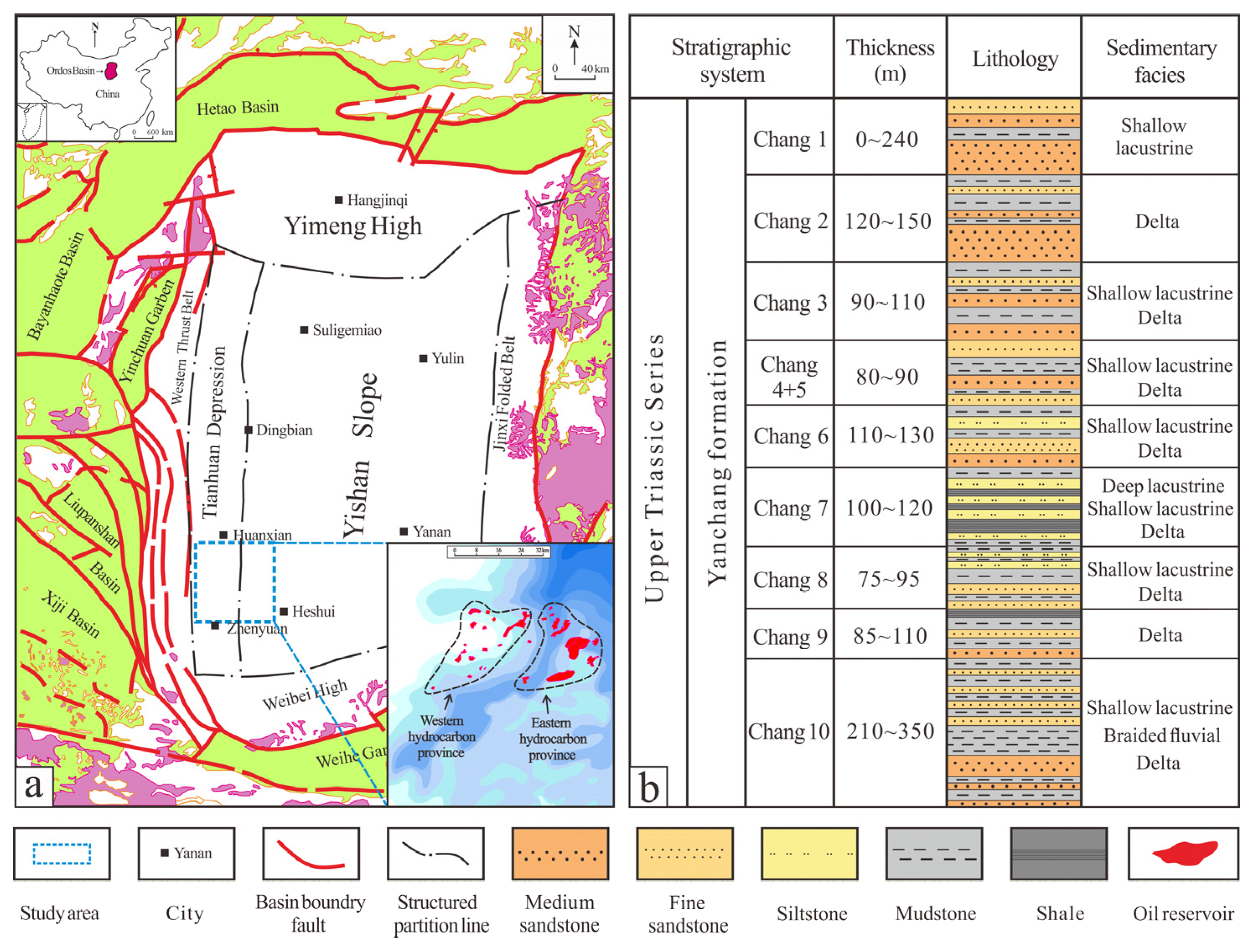
The Zhenbei area is located on the southwestern margin of the Tianhuan Depression in the Ordos Basin. The basin is underlain by the stable North China Craton basement of the Paleozoic age, upon which a multi-cycle, superimposed intracontinental basin developed through repeated episodes of sedimentary and tectonic evolution [31]. The Ordos Basin, the second-largest sedimentary basin in China, has undergone multi-phase modification since the Mesozoic due to Indosinian, Yanshanian, and Himalayan tectonic movements, resulting in a well-defined structural zonation pattern [32]. Overall, the basin can be subdivided into several first-order structural units, including the Western Thrust Belt, the Yimeng Uplift, the Tianhuan Depression, the Yishan Slope, the Western Shanxi Flexural Fold Belt, and the Weibei Uplift (Figure 2a).
The overall structural framework of the study area is characterized by relatively well-developed folding structures in the western part, whereas the eastern strata are comparatively gentle. Regionally, the strata exhibit a near-monoclinal pattern dipping from northwest to southeast, with a gradual uplift toward the southeast. Since the Triassic, the area has undergone continuous sedimentation, forming a stratigraphic succession that includes the Yanchang, Fuxian, Yan’an, Anding, and Zhidan formations and Quaternary deposits [33,34]. Among these, the Yanchang and Yan’an formations experienced varying degrees of erosion during subsequent tectonic uplift, resulting in parallel or angular unconformities with the overlying strata and indicating significant structural modification.
The Yanchang formation shows a clear internal depositional architecture and can be subdivided lithologically into ten reservoir intervals, from Chang 10 to Chang 1. Due to regional uplift and erosion associated with the Late Indosinian tectonic event, the Chang 1–Chang 2 intervals are largely absent in the study area, and localized erosion of the Chang 3 interval is also observed. This demonstrates the pronounced control of tectonic uplift and differential erosion on the preservation pattern of the stratigraphic sequence. The principal hydrocarbon source rocks are the dark mudstone and shale intervals within the Yanchang formation, among which the shales of the Chang 7 Member are particularly well developed and laterally persistent, with an average thickness of approximately 16 m. These units constitute the most significant high-quality source rocks in the region and provide the material foundation for hydrocarbon generation and accumulation (Figure 2b). Given the complex geological setting and the distinctive distribution patterns of hydrocarbon reservoirs within the area, this study focuses on the Chang 3 reservoir interval in the Zhenbei region as the primary target for a detailed investigation [35,36].

3. Samples and Methods

3.1. Samples

This study aims to investigate the identification of low-salinity–contrast reservoirs within the Chang 3 interval and to elucidate the differentiated hydrocarbon accumulation patterns between the western and eastern Zhenbei areas. To achieve this goal, the research focuses on four key aspects: (1) the genesis of low-contrast reservoirs and the establishment of identification templates; (2) reservoir petrography and pore–throat structural characteristics; (3) paleotectonic reconstruction and structural evolution; and (4) oil-source correlation and hydrocarbon charging stages of the Chang 3 reservoirs. Based on the distinct spatial distribution patterns—scattered accumulations in the west and laterally continuous accumulations in the east—the study area was subdivided into two zones: the Western hydrocarbon province and the Eastern hydrocarbon province (Figure 1a).
For the investigation of low-contrast reservoir genesis and identification templates, formation-water samples and selected crude oil samples from both the western and eastern Chang 3 reservoirs were collected and analyzed.
For reservoir petrography and pore–throat characterization, a total of 120 core samples from the Chang 3 interval were obtained from wells drilled across the western and eastern hydrocarbon accumulation zones.
For paleotectonic restoration and structural evolution, well-log data from 260 wells within the western hydrocarbon province and 12 three-dimensional seismic sections were selected for analysis.
For oil-source correlation and determination of hydrocarbon charging stages of the Chang 3 reservoirs, crude oil samples from the Chang 3, Chang 7, and Chang 9 intervals, along with selected source-rock samples from both the western and eastern reservoir zones of the Zhenbei area, were analyzed (Table 1).

3.2. Methods

In the Chang 3 reservoirs, the low-contrast nature of certain oil layers results in partial concealment of some reservoirs. Therefore, accurate identification of low-resistivity reservoirs within the study area is a prerequisite for reliably investigating the differential hydrocarbon accumulation patterns between the western and eastern Zhenbei regions.
To explore effective methods for identifying low-resistivity reservoirs under conditions of highly mineralized formation water, this study established integrated identification templates based on well-log data, drill-stem tests, production tests, and electrical parameter analyses. In the context of high-salinity formation water, conductive ions form stable conduction pathways within the pore network, substantially reducing the resistivity contrast between oil-bearing and water-bearing layers and diminishing the effectiveness of conventional resistivity-based hydrocarbon discrimination.
To address this, a multi-source, quantitatively constrained approach was employed. Well-log interpretations were systematically integrated with production test data from producing wells to construct electrical-parameter cross-plot templates. Considering the combined effects of freshwater drilling fluid invasion and highly mineralized formation water on dual-induction resistivity logs, the “invasion factor” was introduced as a proxy for the theoretical formation’s true resistivity, thereby minimizing the influence of fluid invasion on logging responses. The invasion factor is defined as follows:
η = A T 30 A T 60 A T 60
where η is the invasion factor, dimensionless; and AT30 and AT60 are resistivity measurements (Ω·m) obtained from dual lateral electrode logging at two different electrode spacings.
Simultaneously, acoustic transit time (Δt, AC) was selected to characterize reservoir porosity and physical properties. An integrated identification template for low-resistivity Chang 3 reservoirs was constructed using the “invasion factor–acoustic transit time” cross-plot, enabling discrimination among oil-bearing layers, oil–water transition zones, and water-bearing layers. The template is typically established based on producing wells with production test data, projecting the corresponding well-log parameters onto the cross-plot to define recognition domains. For newly drilled wells, logging parameters are projected onto the established template to identify oil–water contacts, and the results are subsequently validated and adjusted once production test data become available. For wells showing significant deviations, the recognition boundaries are further refined according to actual conditions, allowing for dynamic optimization of the template and improving its regional applicability.
For individual wells where resistivity is strongly influenced by formation-water salinity, conventional resistivity-based identification may be unreliable. In such cases, the spontaneous potential (SP) difference method is applied for oil–water discrimination. The SP response of low-resistivity reservoirs is affected by both the salinity of the borehole fluid and the cation-exchange capacity of the formation. When the drilling mud has lower salinity than the formation water, cation exchange increases the number of cations in sandstone pores, causing a slight rise in SP. Previous studies have demonstrated a negative correlation between relative SP and oil saturation. Based on this principle, in low-resistivity reservoirs where clay-enhanced conductivity reduces the SP amplitude, cross-plots of SP can effectively distinguish low-resistivity oil layers from water-bearing layers.
According to Archie’s equation:
S w n = a b R w Φ m R t
Similarly, for the flushed zone:
S x o n = a R m f Φ m R x o
Dividing the two equations yields:
S w n S x o n = R x o R t R m f R w
Taking the logarithm of both sides of Equation (4) gives:
log S w n S x o n = log R x o R t log R m f R w
While:
S P = K log R m f R w
log S w n S x o n = log R x o R t S P K
log S w n S x o n = K log R x o R t S P = S P S P
where Sw is the water saturation of the rock (dimensionless); Sxo is the water saturation in the flushed zone (dimensionless); Rxo is the resistivity of the flushed zone (Ω·m); Rmf is the resistivity of the mud filtrate (Ω·m); Rt is the true formation resistivity (Ω·m); Rw is the formation water resistivity (Ω·m); K is the spontaneous potential (SP) coefficient (mV); SP is the spontaneous potential (mV); and SP′ is the apparent spontaneous potential (mV).
For a pure water-bearing layer, Sw = Sxo, SP′ ≈ SP; for a pure oil-bearing layer, Sw < Sxo, SP′ < SP.
As shown in Equation (8), this apparent spontaneous potential (SP) method has the following advantages: (1) it is independent of RwR_wRw and RmfR_{mf}Rmf; (2) it is unaffected by the parameters aaa, bbb, mmm, and nnn, and thus remains reliable even in reservoirs with complex pore structures; and (3) it is independent of porosity.
Reservoir petrography and pore–throat characteristics were investigated using core samples collected from both western and eastern hydrocarbon accumulation zones. Thin sections were prepared, and samples were examined under a polarizing microscope and a field emission scanning electron microscope (FESEM) to identify mineral types, cement types, and pore–throat types. Field emission scanning electron microscopy (FESEM) uses a strong electric field to extract electrons from a field emission gun, producing a high-brightness, finely focused beam that scans the sample surface. Interactions between the beam and the sample generate secondary and backscattered electrons, which are detected to provide high-resolution images of surface and near-surface microstructures. Quantitative analyses were conducted using ImageJ 1.x. software by delineating the contours of target minerals, cements, and pore throats, as well as measuring pore–throat radii, to reveal the mineralogical and pore–throat characteristics of reservoirs in the western and eastern zones.
Core samples from both the western and eastern hydrocarbon zones were cut into cylindrical specimens (diameter 2.5 cm, length 3–5 cm), cleaned, and oven-dried at 100 °C for 48 h. Mercury intrusion porosimetry (AutoPore IV 9500, Micromeritics GmbH, headquartered in Unterschleißheim, Germany) was conducted to measure mercury saturation over a pressure range of 0.1 to 60,000 psi. The experiments provided capillary pressure curves, mercury saturation, and pore–throat distribution parameters (e.g., displacement pressure and maximum mercury saturation), which were used to evaluate the pore–throat characteristics of reservoirs in the different hydrocarbon zones.
To elucidate the formation and evolution of the Chang 3 paleostructures in the Zhenbei area, paleotectonic restoration was conducted based on three-dimensional (3D) seismic interpretation techniques. The restoration process was carried out in three hierarchical levels: line–surface–volume. First, key horizons were flattened on seismic sections, and relative structural corrections were applied to restore the evolution of structural units through different geological periods, achieving profile-level (line) restoration of structural morphology. Second, multiple reflection horizons were interpreted, stripped, and superimposed using 3D seismic data to restore the paleostructure at the map (surface) level. Finally, leveraging the spatial continuity of seismic data and the stereoscopic visualization capabilities of seismic interpretation software, volumetric (3D) restoration of structural morphology was performed, providing comprehensive three-dimensional information on structural evolution.
Prior to horizon interpretation, stratigraphic development and seismic reflection characteristics in the Zhenbei area and adjacent regions were systematically collected and analyzed. Multi-well composite logs were constructed by integrating regional drilling and well-log data to calibrate and correct seismic reflection features. Through the combined constraints of geological, well-log, and drilling data, accurate calibration of reflection packages and horizon tracking were achieved. Paleotectonic restoration constrained by 3D seismic data can thus be regarded as a process of multi-source data integration, offering high precision and strong structural restoration integrity.
The study of oil-source correlation and hydrocarbon charging stages for the Chang 3 reservoirs was based on crude oil samples from the Chang 3, Chang 7, and Chang 9 intervals, as well as selected source-rock samples, collected from both western and eastern hydrocarbon zones in the Zhenbei area. For this study, crude oil samples were obtained from four wells, and mudstone samples from four wells. Specifically, two crude oil samples were collected from the Chang 3 interval and two from the Chang 7 interval; two mudstone samples from the Chang 7 interval, and two additional Chang 9 mudstone samples from within the basin. Sample pretreatment and analytical testing were conducted at the Low-Permeability Experimental Center of the Changqing Oilfield Research Institute.
Fluid inclusion temperature measurements were conducted at the Fluid Inclusion Laboratory of Northwest University using a THMS600 heating–cooling stage (Linkam, UK) coupled with a Leica DMR microscope. The THMS600 stage has a temperature range of −196 to 600 °C with a control accuracy of ±0.1 °C, and the laboratory environment was maintained at 25 °C to ensure measurement stability.
First, fluid inclusions in the samples were analyzed petrographically, using a polarizing microscope for fluid inclusion assemblage (FIA) characterization. This involved documenting the distribution, size, phase, color, and gas–liquid ratios of inclusions to identify assemblages corresponding to different formation stages. Subsequently, target inclusions were subjected to the THMS600 stage to sequentially determine key thermodynamic parameters, including the homogenization temperature (Th), ice-melting temperature (Tm-ice), and initial melting temperature (Te). Finally, based on the microthermometric data and in combination with the burial and thermal evolution history of the Zhenbei stratigraphy, hydrocarbon charging stages were constrained and determined. This workflow enabled precise quantification of the thermodynamic parameters of fluid inclusions, providing a robust basis for identifying the timing of hydrocarbon accumulation.

4. Results

4.1. Reservoir Petrographic Characteristics

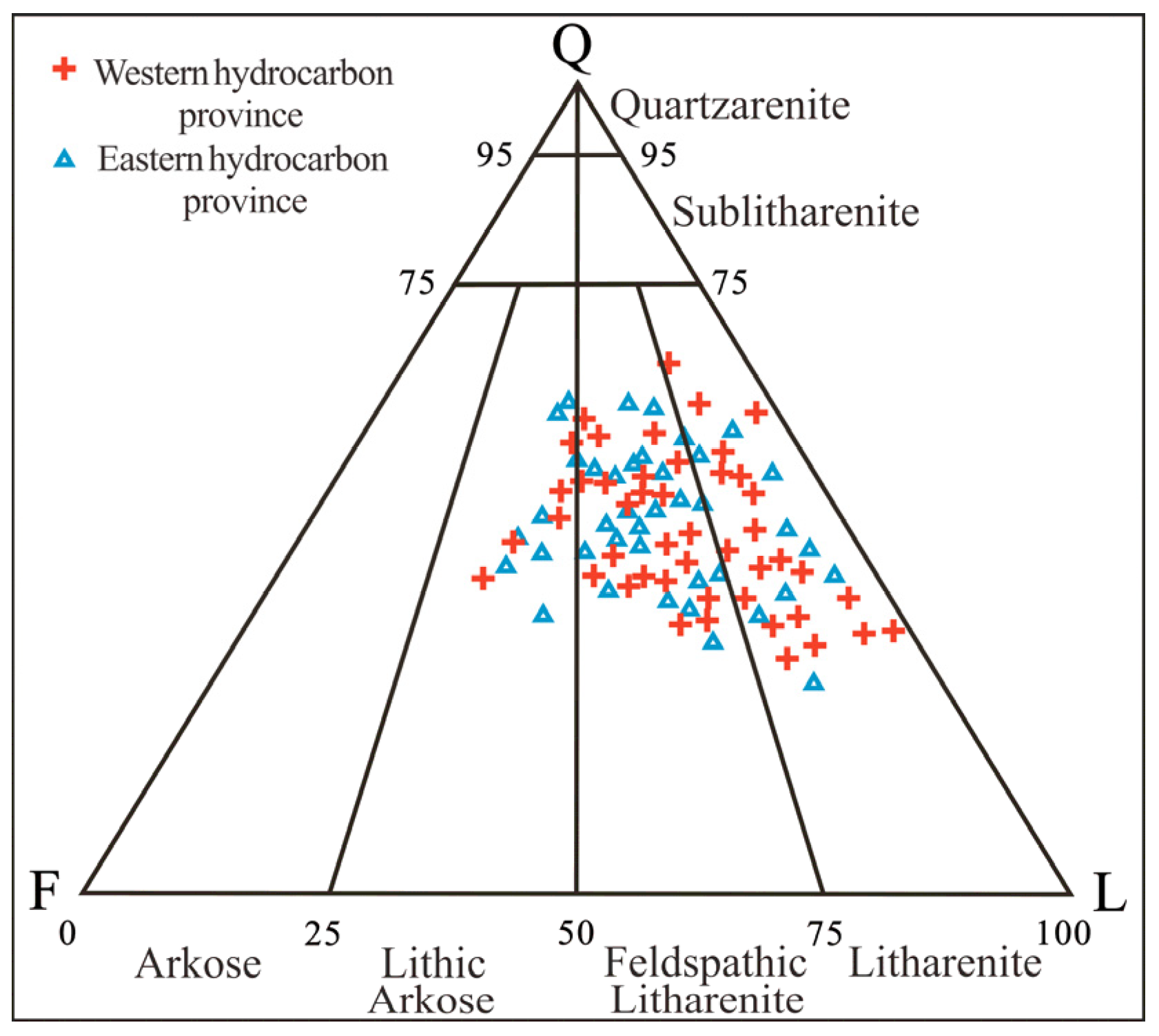
The petrographic compositions of Chang 3 Member reservoir sandstones from the Zhenbei area were statistically analyzed for two hydrocarbon accumulation zones: namely, the western and eastern reservoir areas. A total of 85 sandstone thin sections from 60 cored wells were examined under the microscope, and the results were systematically processed. Based on the relative abundances of quartz, feldspar, and lithic fragments, a Q–F–L ternary diagram was constructed. The ternary plot indicates that the Chang 3 reservoirs in the study area are dominated by feldspathic lithic sandstones and lithic sandstones overall. Comparatively, lithic sandstones are more prevalent in the western reservoir area (Figure 3).
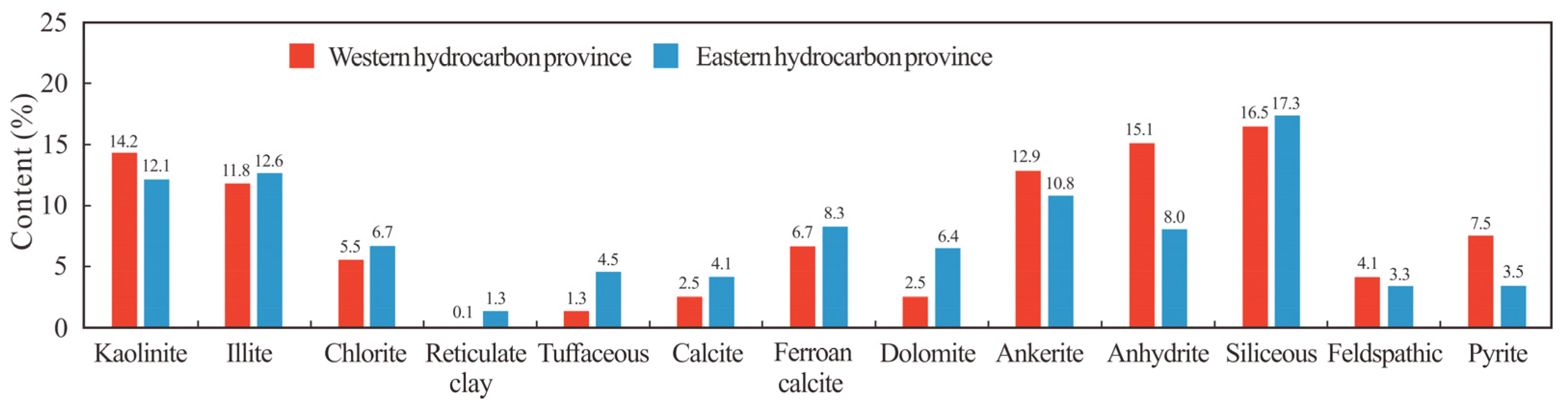
Analysis of the distribution of pore-filling minerals in the Chang 3 reservoir across the western and eastern accumulation zones of the Zhenbei area shows that the pore-filling materials are dominated by kaolinite, illite, siliceous minerals, and ferroan dolomite. In the western zone, kaolinite (14.2%), gypsum (15.1%), and ferroan dolomite (12.9%) are more abundant than in the eastern zone, whereas the eastern zone exhibits higher contents of chlorite (6.7%), tuffaceous material (4.5%), and calcite (4.1%) compared to the western zone. During diagenesis, gypsum and ferroan dolomite can precipitate abundant cements or filling minerals, which may occlude primary pores and micro-throats, thereby altering the original reservoir properties in the affected zone. Additionally, the presence of iron-bearing components can promote secondary mineral precipitation, further modifying pore–throat connectivity and significantly enhancing intra-reservoir heterogeneity (Figure 4).

4.2. Characteristics of Reservoir Pore–Throat Structure

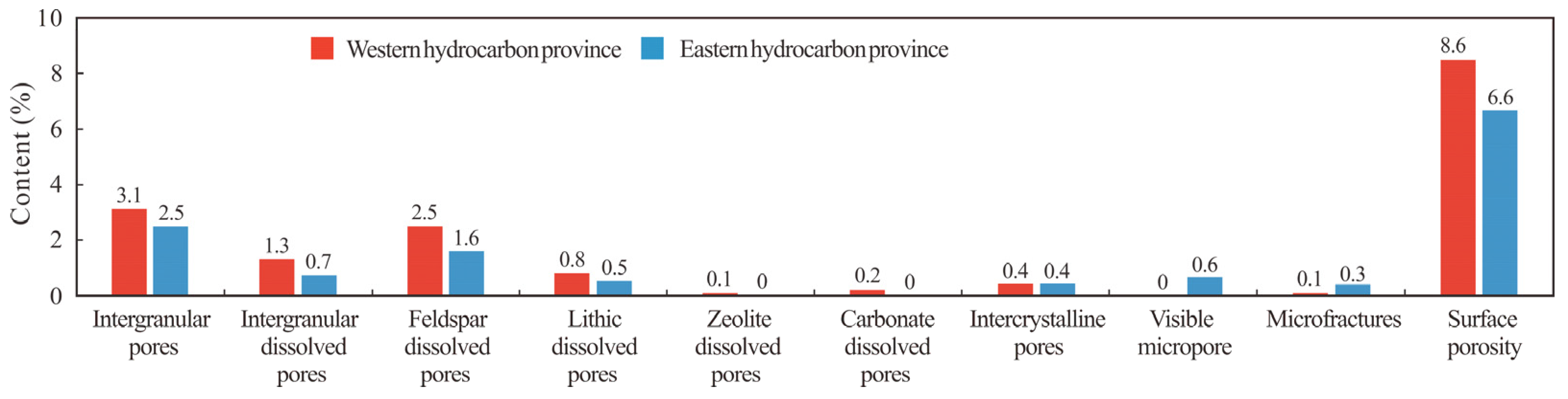
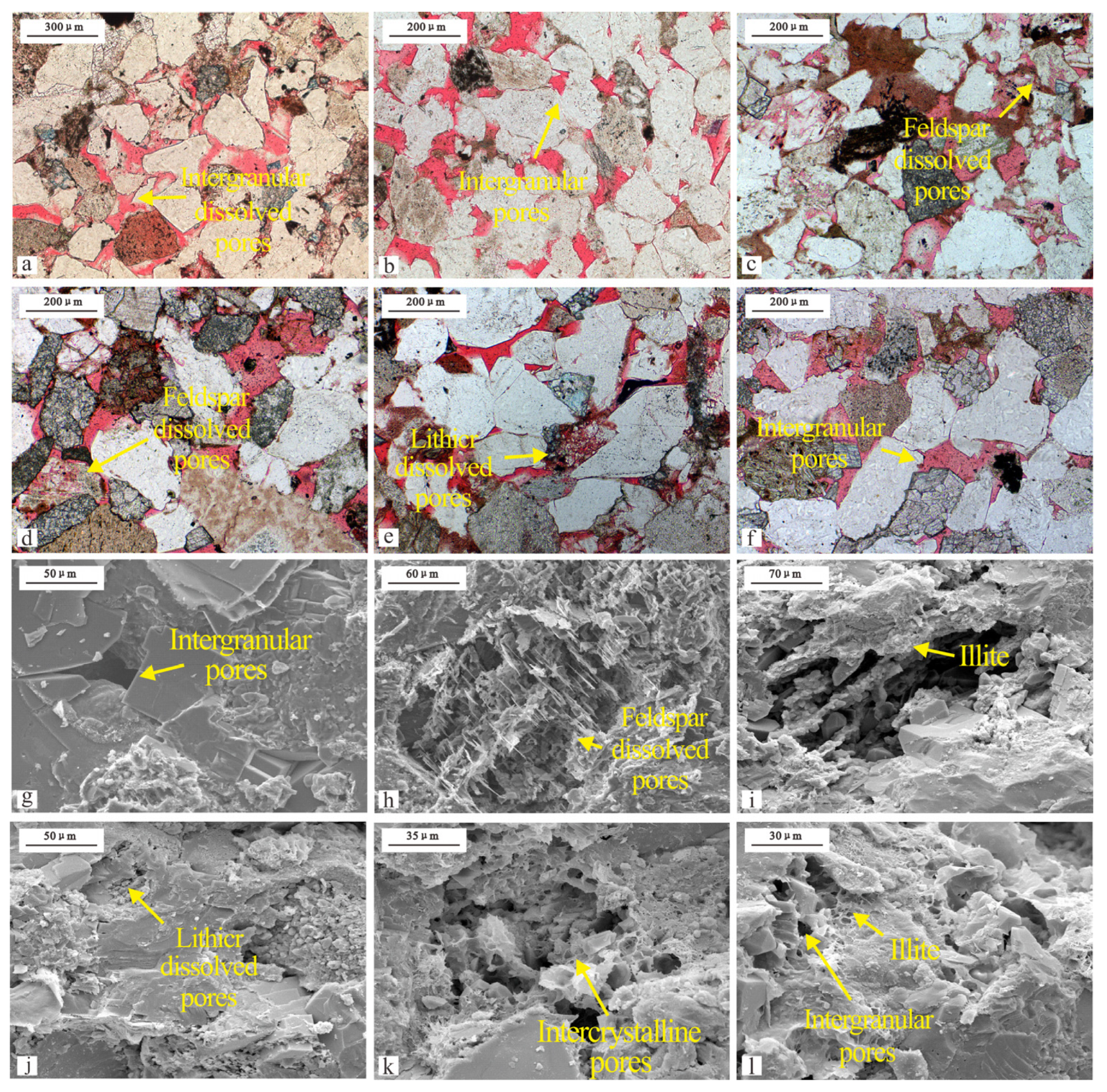
Polarized-light microscopy and field-emission scanning electron microscopy (FESEM) observations of thin sections prepared from Chang 3 reservoir sandstone samples in the Zhenbei area indicate that the reservoir is mainly characterized by intergranular pores, feldspar dissolution pores, and intergranular dissolution pores, with minor occurrences of lithic dissolution pores, intercrystalline pores, and microfractures. A comparative statistical analysis was conducted for the western and eastern oil accumulation zones (Figure 5).
In the western oil accumulation zone, the total porosity is 8.6%, with intergranular pores being the dominant pore type, accounting for 3.1%. Secondary pore types include feldspar dissolution pores (2.5%), intergranular dissolution pores (1.3%), lithic dissolution pores (0.8%), intercrystalline pores (0.4%), and carbonate dissolution pores (0.2%). Intergranular pores and intergranular dissolution pores can be clearly observed under polarized-light microscopy (Figure 6a,b), while secondary feldspar dissolution pores formed by the acid-induced dissolution of feldspar grains are also visible (Figure 6c). Field-emission scanning electron microscopy (FESEM) further confirms the presence of primary intergranular pores between quartz grains (Figure 6g), feldspar dissolution pores (Figure 6h), and illite partially filling some secondary dissolution pores (Figure 6i).
In the eastern oil accumulation zone, the total porosity is 6.6%, with intergranular pores being the primary pore type again, accounting for 2.5%. Other pore types include feldspar dissolution pores (1.6%), intergranular dissolution pores (0.7%), lithic dissolution pores (0.5%), visible micropores (0.6%), intercrystalline pores (0.4%), and microfractures (0.3%). Under polarized-light microscopy, feldspar dissolution pores (Figure 6d), lithic dissolution pores (Figure 6e), and primary intergranular pores (Figure 6f) are observable. FESEM observations provide a more direct view of lithic dissolution pores, contributing to improved reservoir quality (Figure 6j), secondary intercrystalline pores (Figure 6k), and illite-filled pores (Figure 6l).
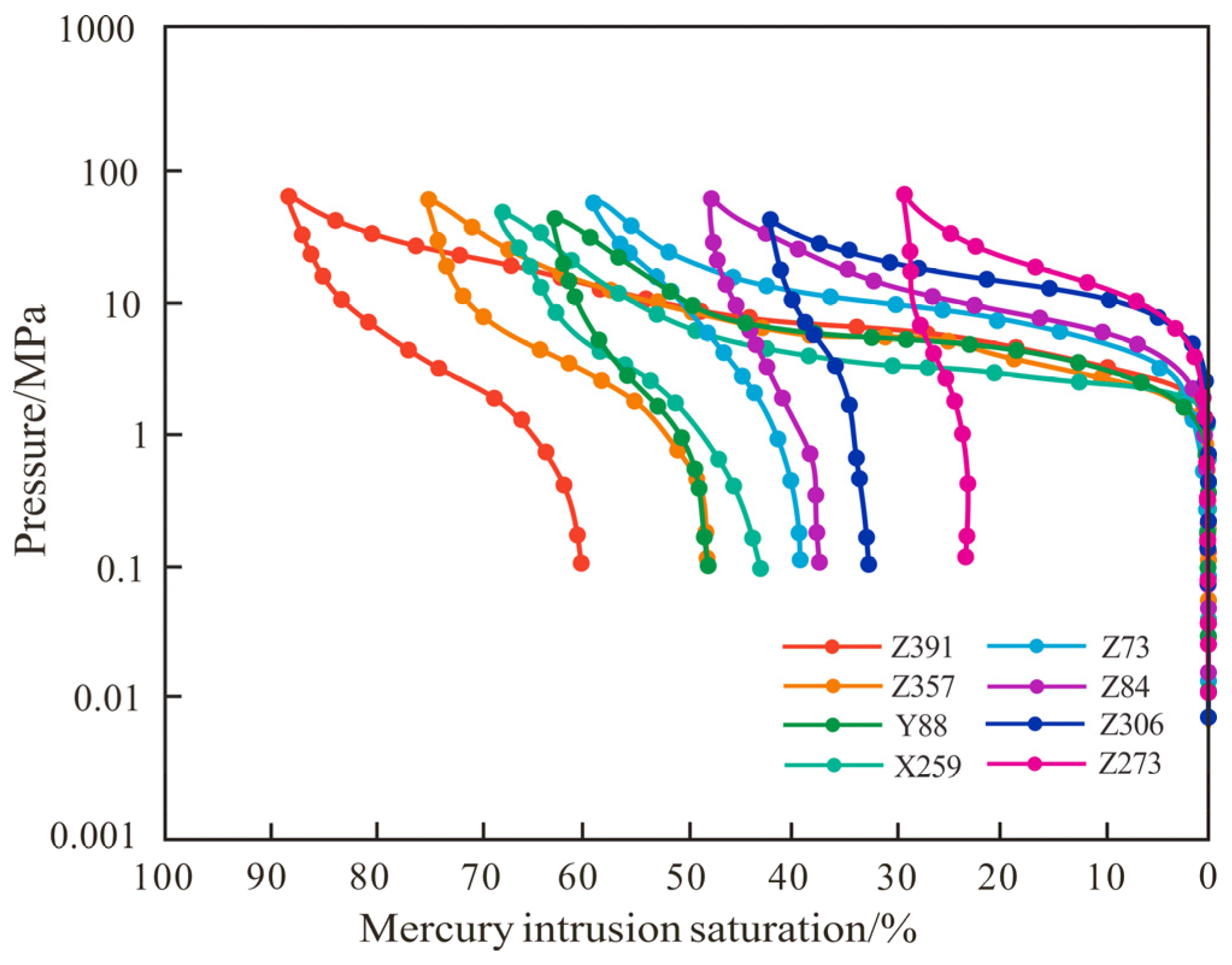
Statistical analysis was conducted on capillary pressure data obtained from high-pressure mercury injection (HPMI) experiments on the Chang 3 reservoir in the Zhenbei area. The data were categorized according to different parameter types, and capillary pressure plots were generated (Figure 7). The capillary pressure curve patterns of different samples shown in the figure objectively reflect the characteristics and distribution of the corresponding reservoir pore–throat microstructures. The results indicate that the mean median pore–throat radius of the Chang 3 reservoir ranges from 0.12 to 0.31 μm, the mean displacement pressure ranges from 1.1 to 3.6 MPa, the mean maximum mercury saturation (SHg) ranges from 69.3% to 89.4%, and the mean mercury withdrawal efficiency ranges from 14.5% to 36.2%. Based on the features of the capillary pressure curves and HPMI parameters, the Chang 3 reservoir pore–throat types were classified into three categories: Type I, small-pore–medium-throat; Type II, small-pore–fine-throat; and Type III, small-pore–micro-throat (Table 2).
The petrophysical properties of individual sublayers in the Chang 3 reservoir were statistically analyzed for the western and eastern oil accumulation zones in the study area (Table 3). In the Chang 31 sublayer, measured porosity in the western zone ranges from 4.8% to 18.8%, with an average of 11.9%, and permeability ranges from 0.11 to 21.59 mD, with an average of 7.41 mD. In the eastern zone, porosity ranges from 5.7% to 18.1%, with an average of 10.9%, and permeability ranges from 0.25 to 10.12 mD, with an average of 6.35 mD.
For the Chang 32 sublayer, the western zone exhibits porosity ranging from 2.1% to 19.6%, with an average of 11.6%, and permeability ranging from 0.16 to 16.04 mD, with an average of 6.84 mD. In the eastern zone, porosity ranges from 3.9% to 17.2%, with an average of 10.9%, and permeability ranges from 0.22 to 16.91 mD, with an average of 6.12 mD.
In the Chang 33 sublayer, porosity in the western zone ranges from 2.5% to 18.2%, with an average of 11.1%, and permeability ranges from 0.24 to 20.89 mD, with an average of 5.53 mD. In the eastern zone, porosity ranges from 1.5% to 16.9%, with an average of 10.7%, and permeability ranges from 0.31 to 17.62 mD, with an average of 5.03 mD.
Overall, the Chang 3 reservoir in the Zhenbei area is characterized as a low-porosity, ultra-low-permeability formation, with the petrophysical properties in the western oil accumulation zone generally being superior to those in the eastern zone.
Based on the statistical analysis of petrophysical parameters for each sublayer in the study area, it is noted that the mean values of reservoir properties alone cannot adequately reflect the internal heterogeneity of different reservoirs. Reservoir heterogeneity plays a critical role in controlling whether a given reservoir can serve as a primary locus for hydrocarbon accumulation. Therefore, the coefficient of variation, breakthrough coefficient, and range of permeability were selected to quantitatively compare and evaluate reservoir heterogeneity in the study area. The results indicate that both the western and eastern reservoirs of the Chang 3 Member in the Zhenbei area exhibit relatively high heterogeneity, with the eastern reservoirs showing more pronounced heterogeneity than the western ones. This difference in heterogeneity is likely to influence subsequent hydrocarbon charging and accumulation, leading to variations in hydrocarbon distribution patterns (Table 4).

4.3. Origins and Identification of Low-Contrast Reservoirs

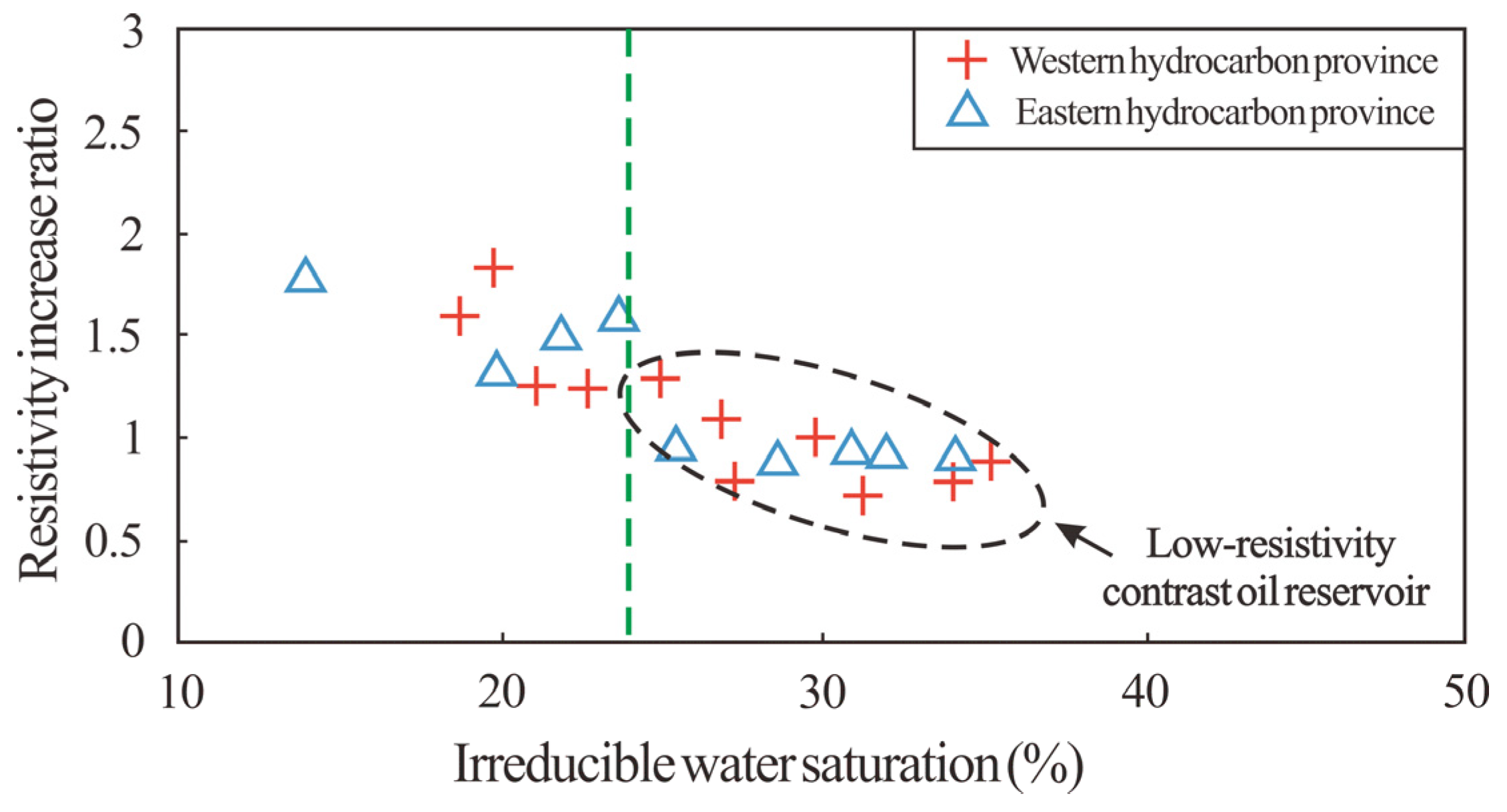
Identification of low-contrast reservoirs in the western and eastern zones of the Chang 3 interval in the Zhenbei area first requires understanding the factors responsible for their formation. As discussed in the Introduction, high formation water salinity is one of the causes of low-resistivity reservoirs. Here, we introduce another factor contributing to low resistivity—high bound water saturation. Considering the formation mechanism of bound water, its electrical conductivity is higher than that of crude oil; thus, elevated bound water saturation in the reservoir leads to reduced resistivity. By correlating bound water saturation measured from selected Chang 3 reservoir samples with the corresponding resistivity increase calculated from well logs, it is evident that the resistivity increase decreases markedly with increasing bound water saturation, showing a positive correlation between the two parameters (Figure 8).
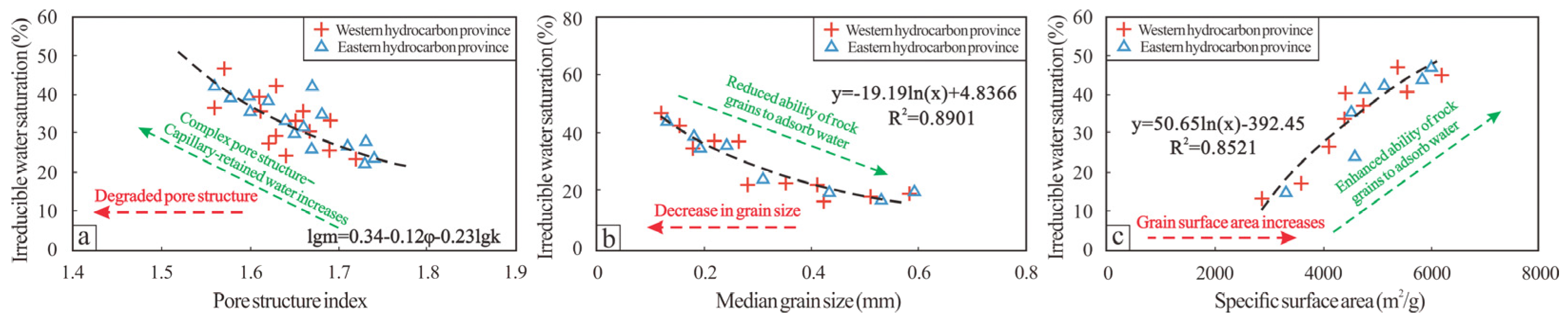
The factors leading to high bound water saturation can be explained in terms of reservoir pore–throat structure and the grain size and specific surface area of the sedimentary particles. By correlating the pore structure index of the Chang 3 reservoir in the western and eastern zones with bound water saturation, it is observed that the bound water content steadily increases as the reservoir pore–throat structure deteriorates. This indicates that reservoirs with poorer internal pore–throat structures are more prone to converting part of the free water into bound water (Figure 9a).
Similarly, the correlation between median grain size and bound water saturation shows that finer sedimentary grains tend to create smaller pore–throat spaces, leading to an increase in residual or bound water within the formation, thereby resulting in higher bound water saturation (Figure 9b). Moreover, the correlation between specific surface area and bound water saturation clearly demonstrates a positive relationship, indicating that an increase in particle-specific surface area enhances water adsorption on grain surfaces, facilitating the formation of high bound water saturation (Figure 9c).
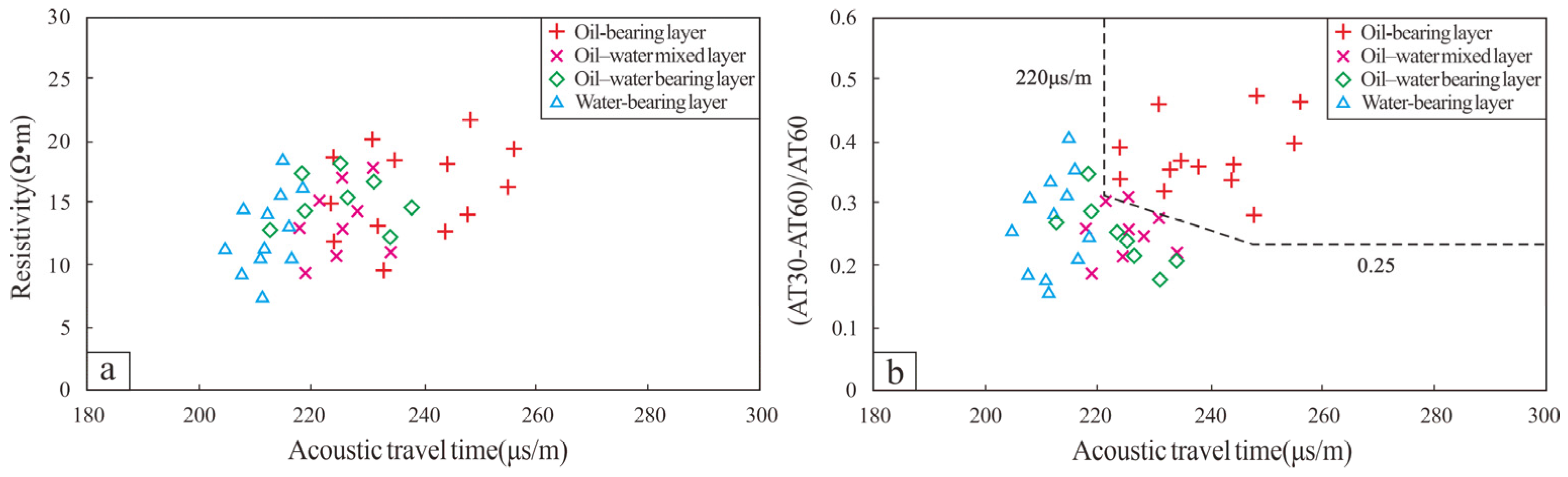
After identifying the factors responsible for low resistivity in the reservoirs, the invasion factor–sonic transit time plot method was first applied to identify oil and water layers in the low-contrast Chang 3 reservoirs of the Zhenbei area (Figure 10). Furthermore, the boundaries between oil- and water-bearing layers shown in the figure provide a quantitative basis for delineating the oil–water contact in the study area. The identification plots indicate that, overall, oil layers, oil–water transitional layers, and water layers can be well distinguished. Using this method for initial identification in 25 production wells within the study area, a success rate of 92% was achieved, while two wells could not be finely resolved.
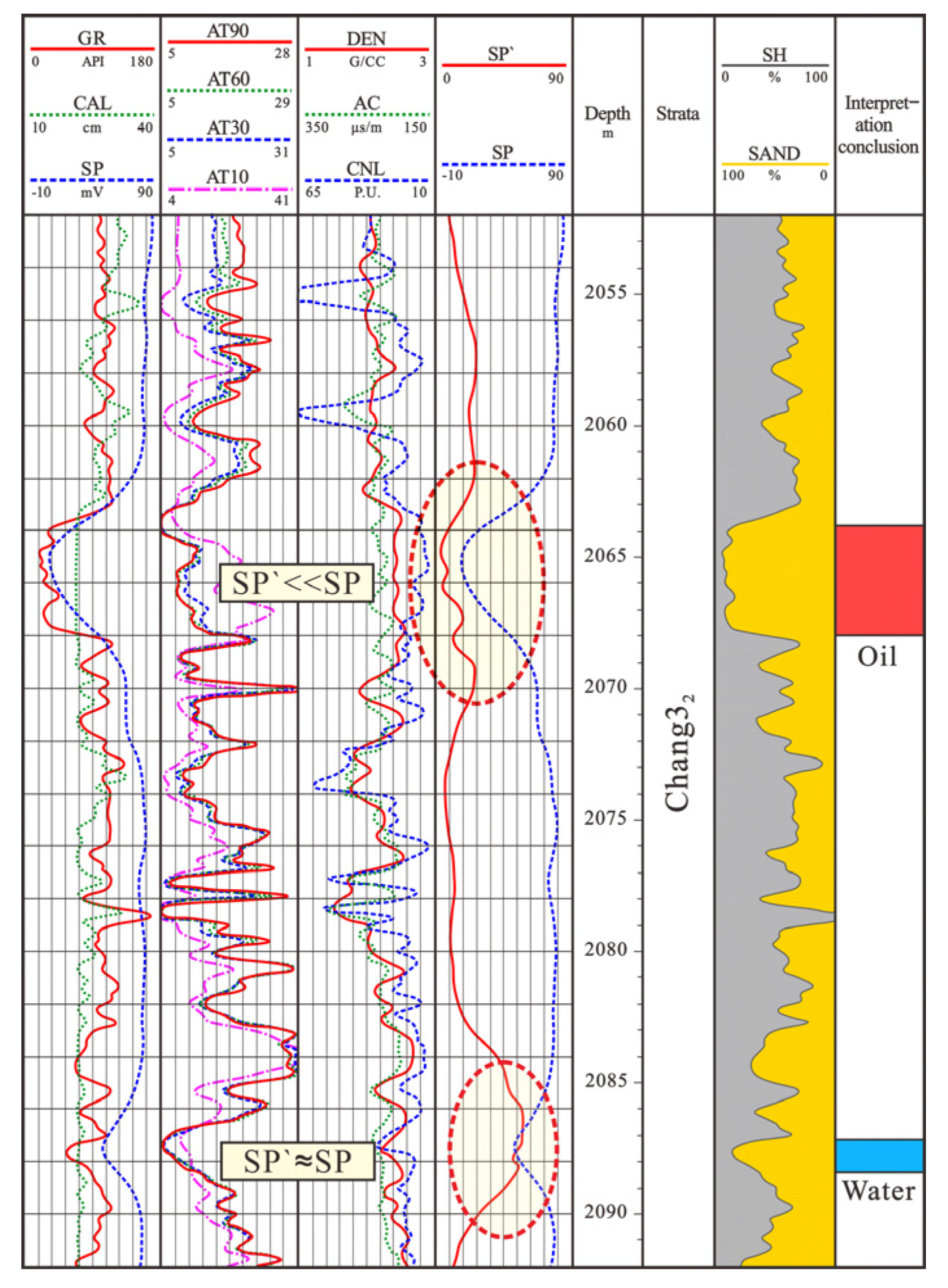
Analysis suggests that the resistivity of these two wells is significantly influenced by formation water salinity. Therefore, the spontaneous potential difference method was applied for secondary oil–water identification in the remaining two wells (Figure 11). As illustrated in the figure, oil-bearing and water-bearing layers exhibit distinctly different positional relationships between the spontaneous potential and apparent spontaneous potential curves. The identification results indicate that this method is highly effective for such well types, clearly distinguishing oil layers from water layers (Table 5).

4.4. Paleotectonic Restoration and Evolutionary Characteristics

Using the horizon flattening function in seismic interpretation software, seismic profiles were flattened layer by layer to study tectonic evolution. Time–depth conversion was applied to the seismic data to transform it from the time domain to the depth domain. A cross-well seismic profile was generated for representative wells (Y284–H55–Y385–H60–H56), and selected seismic reflectors corresponding to different restoration periods were interpreted and depth-converted, followed by layer-by-layer flattening using the horizon flattening function.
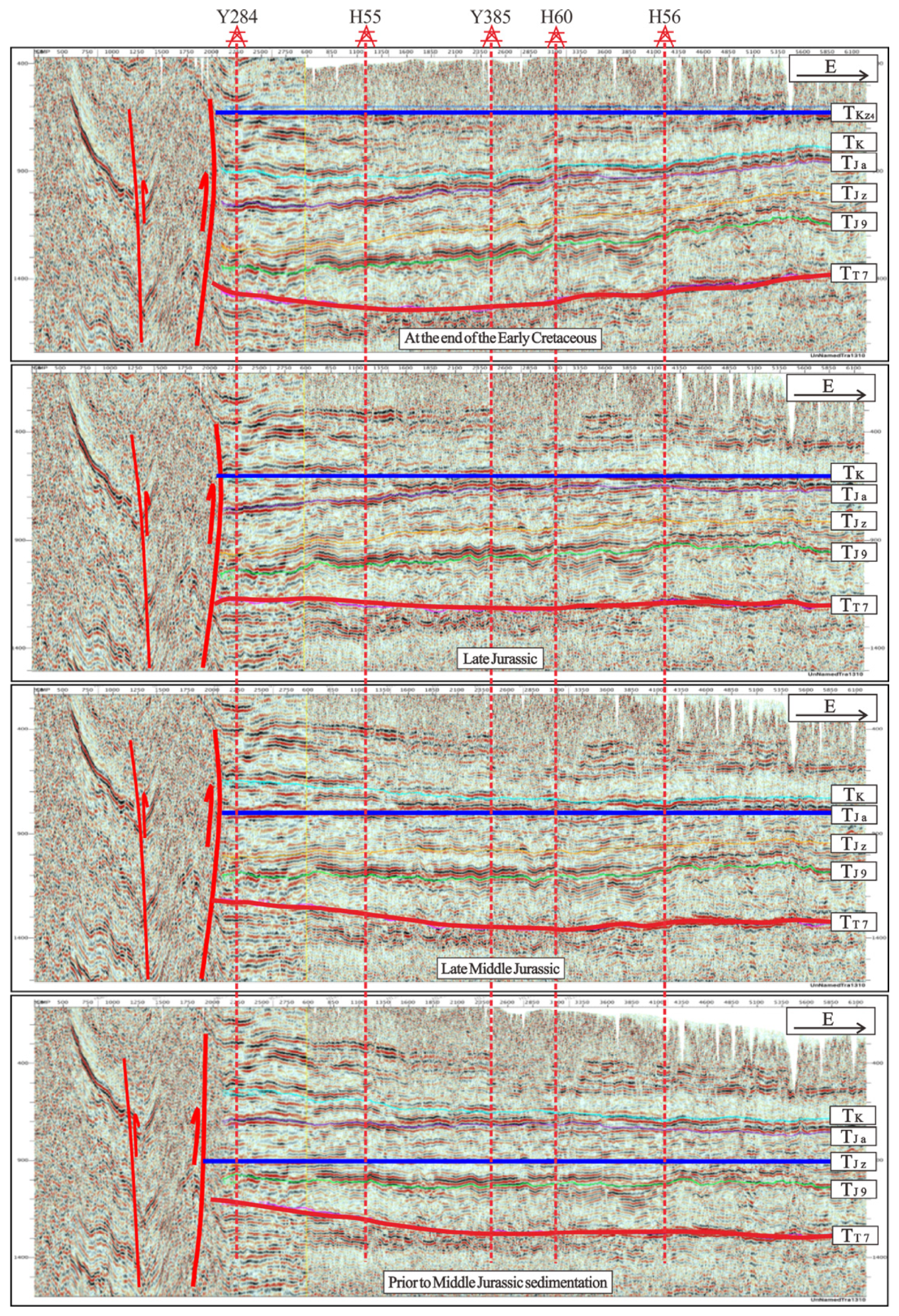
The paleostructural evolution along a nearly east–west well section (Y284–H55–Y385–H60–H56) in the Zhenbei area (Figure 12) showed that: (1) prior to Middle Jurassic deposition (end of the Yan’an formation), the paleotopography was characterized by a general west-high, east-low trend, and the Tianhuan sag had not yet formed; (2) in the Late Middle Jurassic, the western region was influenced by the Yanshan movement, leading to the initial development of the Tianhuan sag; (3) during the Late Jurassic, continued Yanshan tectonic activity further accentuated the Tianhuan sag; and (4) by the end of the Early Cretaceous, prior to the deposition of the Huachi formation, the eastern part of the area was uplifted, forming the Tianhuan sag in conjunction with the westward-dipping monocline.
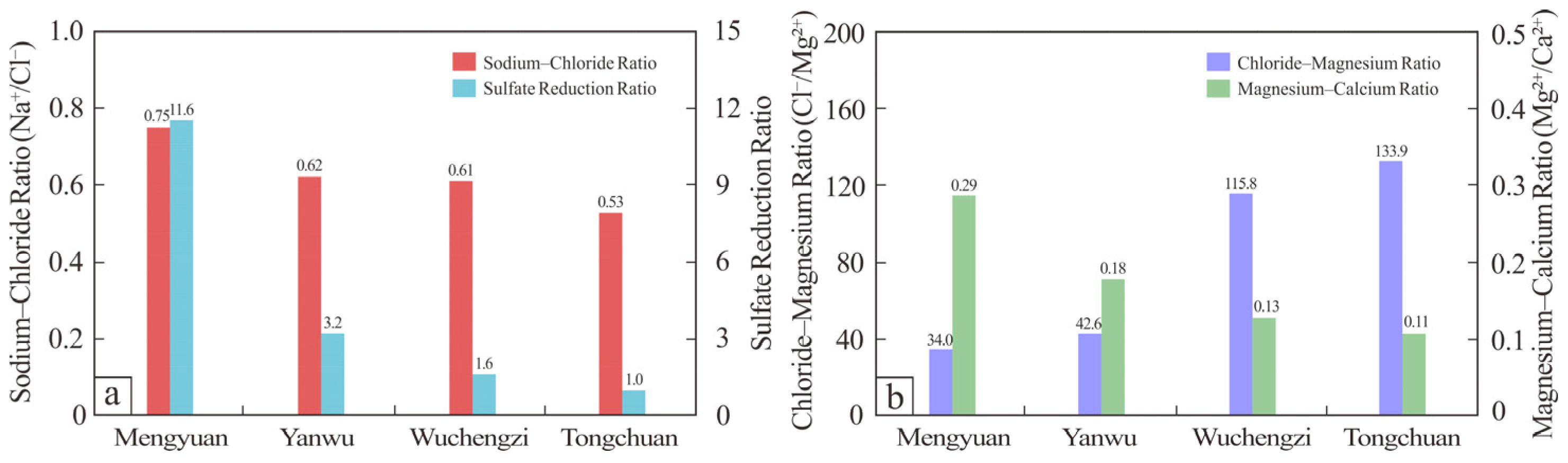
Continuous tectonic evolution also resulted in unconformable contact between the western Chang 3 strata near the western edge of the alluvial–colluvial belt and the overlying Fuxian formation and Yan 10 strata. This process led to partial interaction between Chang 3 reservoir fluids and surface water. This phenomenon is clearly reflected in the histogram comparing formation water chemistry parameters, which shows evidence of fluid–surface water exchange in the western oil accumulation zone of the study area (Figure 13). Additionally, comparison of formation water chemical compositions from the Tongchuan, Wuchengzi, Yanwu, and Mengyuan areas reveals that the sulfate ion concentration in the western Mengyuan area is significantly higher than in the other regions (Table 6), providing further geochemical evidence for fluid leakage in the western reservoirs.
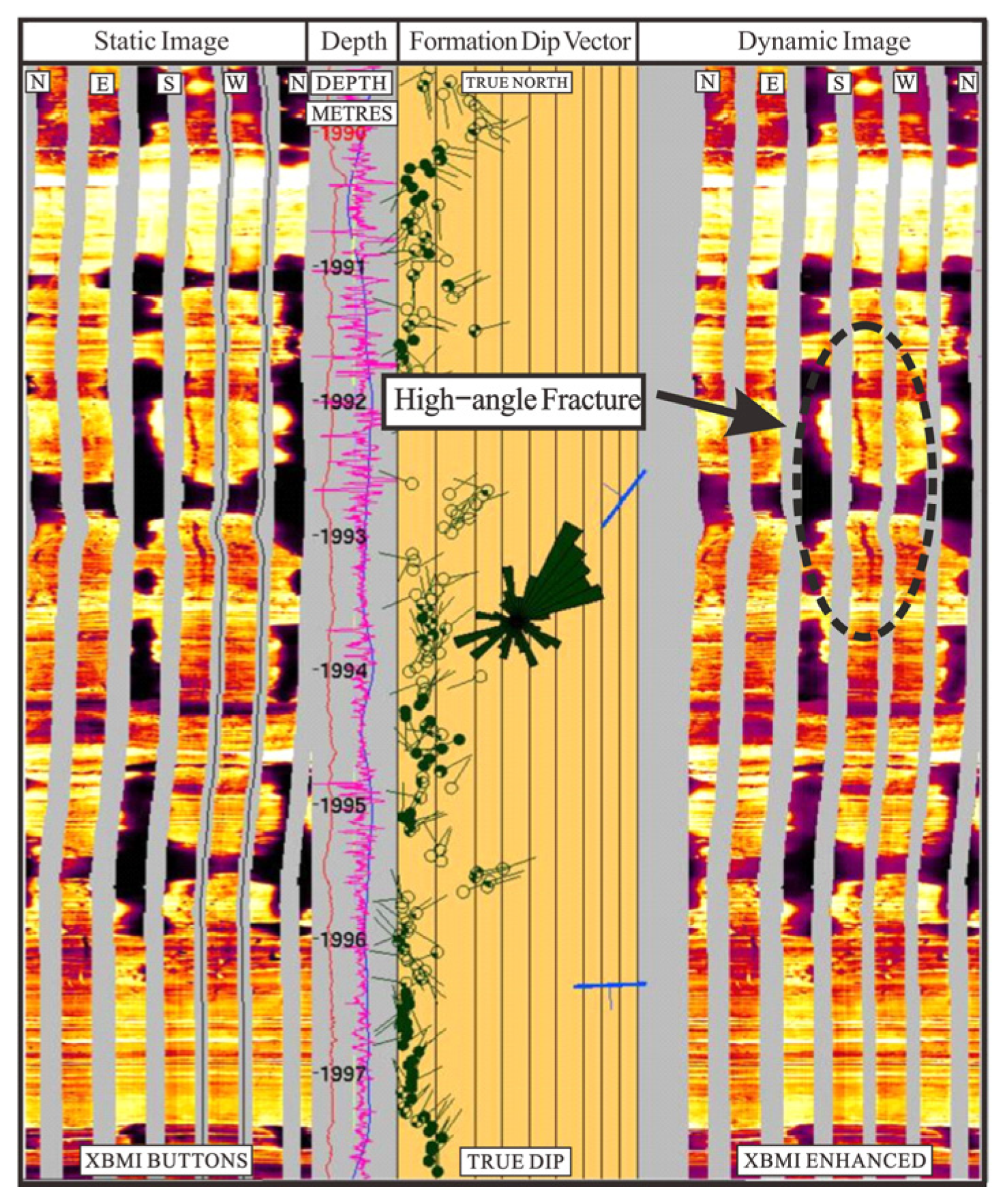
Meanwhile, the imaging log of Well Y248 clearly shows that, influenced by the tectonic activity of the Tianhuan sag, the reservoirs in the western region have developed high-angle fractures to a certain extent (Figure 14). The presence of these structural fractures can be directly interpreted as potential upward migration pathways for hydrocarbons, providing direct evidence for secondary hydrocarbon migration in the western reservoirs under the control of tectonic movement.

4.5. Source Oil Comparison and Study of Reservoir Formation Stages

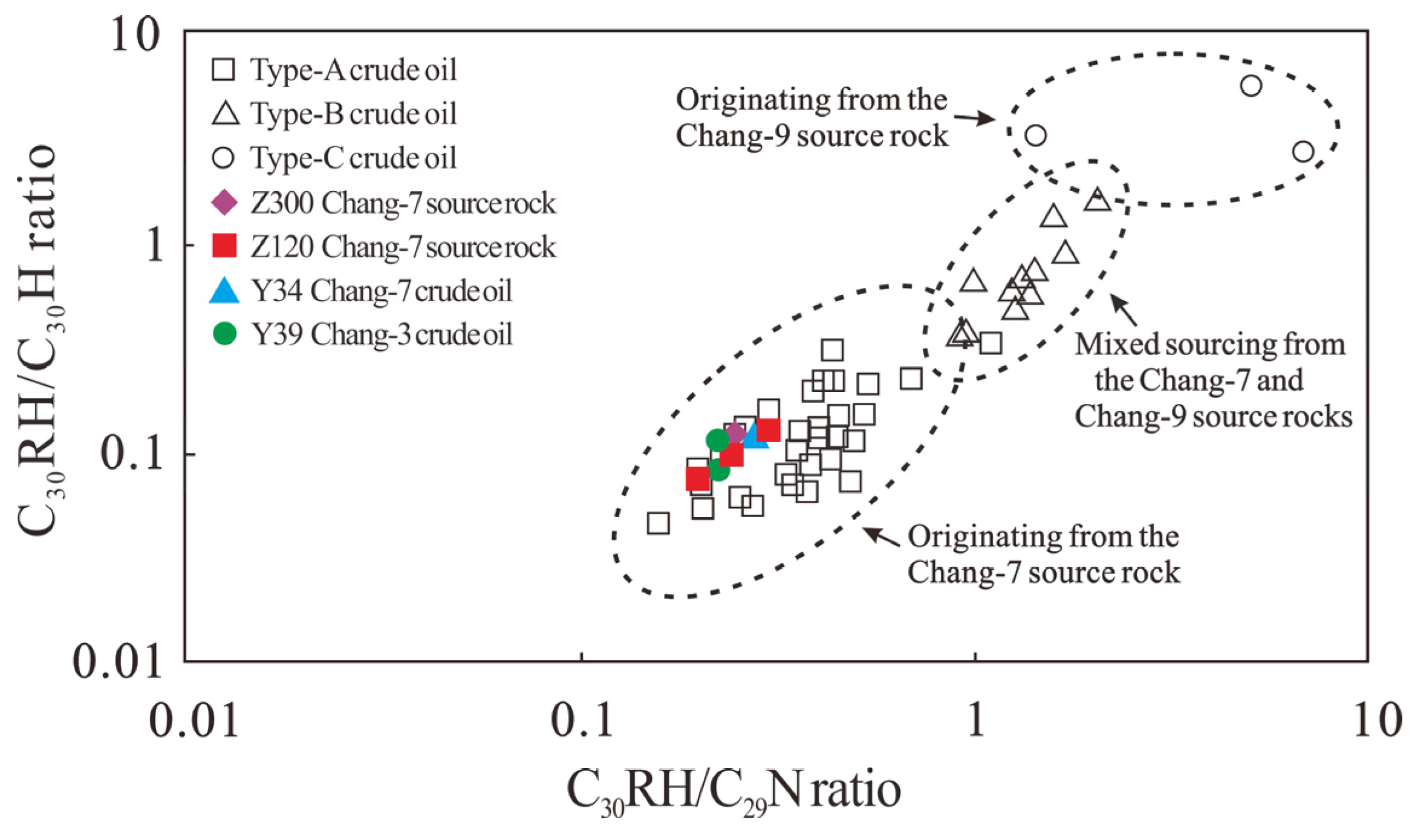
Previous studies have conducted comprehensive research on Mesozoic source rocks in the Ordos Basin, classifying Mesozoic crude oils into three types: Type A oils derived from the Chang 7 source rock, Type B oils generated from a mixture of Chang 7 and Chang 9 source rocks, and Type C oils that are mainly sourced from the Chang 9 source rock. The crude oils in the Zhenbei area are all classified as Type A, characterized by relatively low contents of rearranged hopanes. Their source is attributed to the high-quality Chang 7 source rocks within the basin, represented by wells Z120 and Z300 (Figure 15).
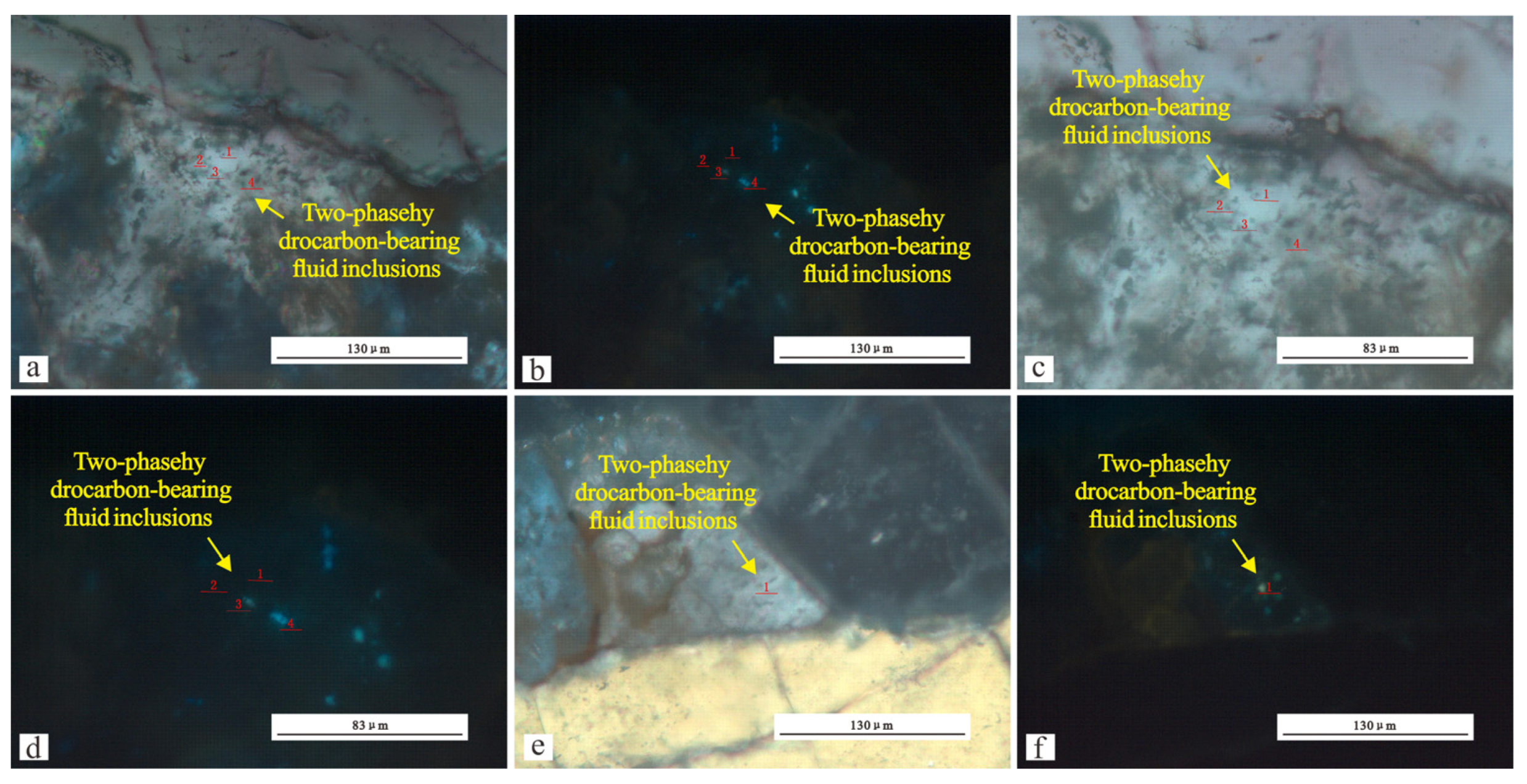
Based on the oil-source comparison, saline fluid inclusions in host minerals from the Zhenbei area were analyzed using a combination of transmitted light and fluorescence microscopy. Three types of fluid inclusions were identified: (1) Saline fluid inclusions, mostly exhibiting elliptical, prismatic, or irregular shapes, primarily occurring along secondary enlarged edges of quartz and in quartz dissolution microfractures. Individual inclusions are generally small and moderately abundant. (2) Fluid inclusions containing liquid hydrocarbons, commonly elliptical or irregular in shape, distributed in a beaded or streaked pattern along secondary enlarged edges of quartz and quartz dissolution microfractures. These inclusions are very small and relatively abundant. (3) Liquid hydrocarbon inclusions, mainly elliptical or irregular in shape, also distributed along secondary enlarged edges of quartz and quartz dissolution microfractures. Individuals are small and relatively less abundant. Under fluorescence, these inclusions appear yellow-green or pale blue, and under transmitted light, they exhibit a weak light-brown color (Figure 16a–f).
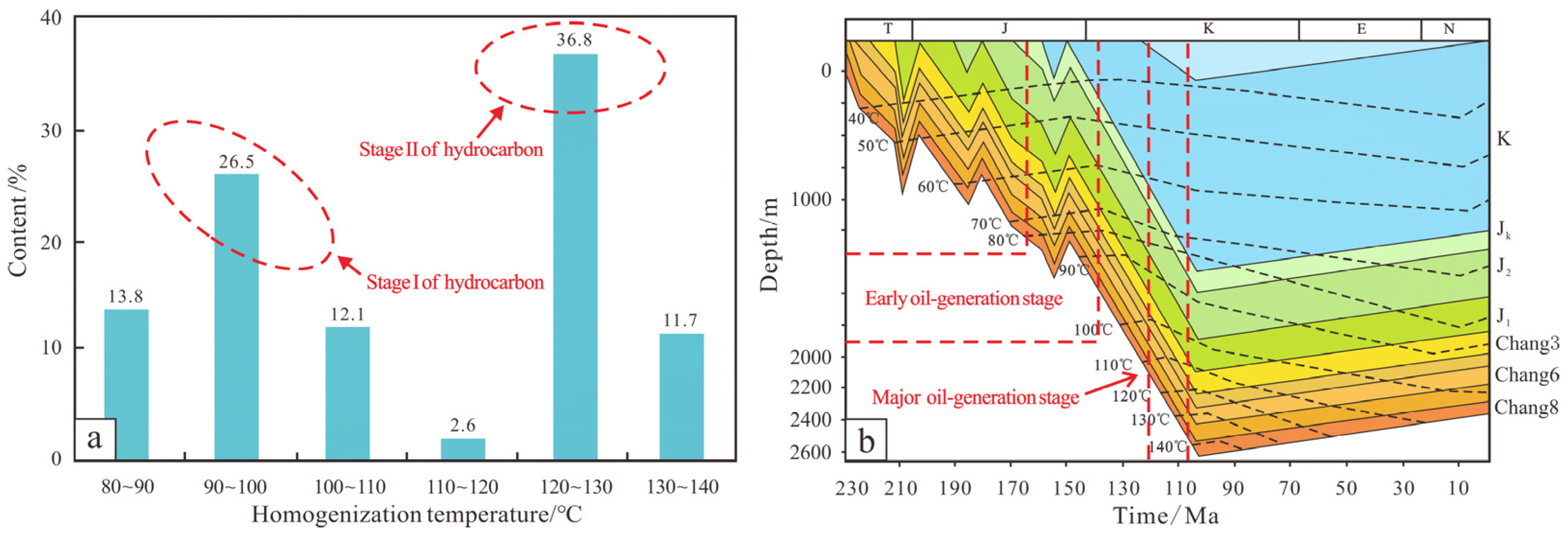
The homogenization temperature of fluid inclusions reflects the temperature of the fluid at the time it was trapped by the host mineral [37,38]. In particular, the homogenization temperature of hydrocarbon inclusions can indicate the paleotemperature characteristics of the reservoir during hydrocarbon charging and accumulation. Therefore, homogenization temperature measurements were conducted on liquid hydrocarbon inclusions from the study area. We conducted fluid inclusion microthermometric measurements on a total of ten samples collected from eight representative wells in the study area. The results show a bimodal distribution of homogenization temperatures for hydrocarbon inclusions in the Chang 3 reservoir of the Zhenbei area (Figure 17a), indicating that the oil and gas reservoirs underwent two distinct charging events.
In determining the timing of reservoir formation, geologists typically combine homogenization temperatures of fluid inclusions with the burial history and thermal evolution of the strata to infer hydrocarbon charging periods and accumulation stages. Accordingly, integrating the homogenization temperatures of hydrocarbon inclusions with the burial history of the Zhenbei area establishes that the first charging stage, corresponding to the early hydrocarbon generation phase, occurred at 145–160 Ma (Late Jurassic), whereas the second stage, corresponding to the main hydrocarbon generation phase, occurred at 100–120 Ma (Early Cretaceous) (Figure 17b).

5. Discussion

5.1. Analysis of Reservoir Formation Patterns in the Western Oil Accumulation Zone Controlled by Tectonic Evolution

Based on the results presented in the previous sections, it is now evident that the Chang 3 reservoirs in the Zhenbei area underwent two major hydrocarbon accumulation stages. Concurrent with these significant charging events, the western block of the study area was also influenced by the tectonic evolution of the Tianhuan sag, resulting in substantial changes in stratigraphic structure from the Early Middle Jurassic to the Late Early Cretaceous [39,40,41,42]. Therefore, the evolution of paleostructures inevitably exerted a dynamic influence on hydrocarbon charging and accumulation in the western reservoir area. Changes in structural highs first led to partial inversion within pre-existing structural traps, resulting in shifts in hydrocarbon enrichment zones in response to structural reconfiguration. Meanwhile, tectonic deformation generated micro-faults and structural fractures within some high-quality reservoirs, providing new vertical migration pathways. Consequently, hydrocarbons that were previously trapped migrated upward along these newly formed conduits, leading to partial destruction of earlier accumulations. This interpretation is further supported by evidence of interaction between formation water and surface water in the western Chang 3 reservoirs of the study area.
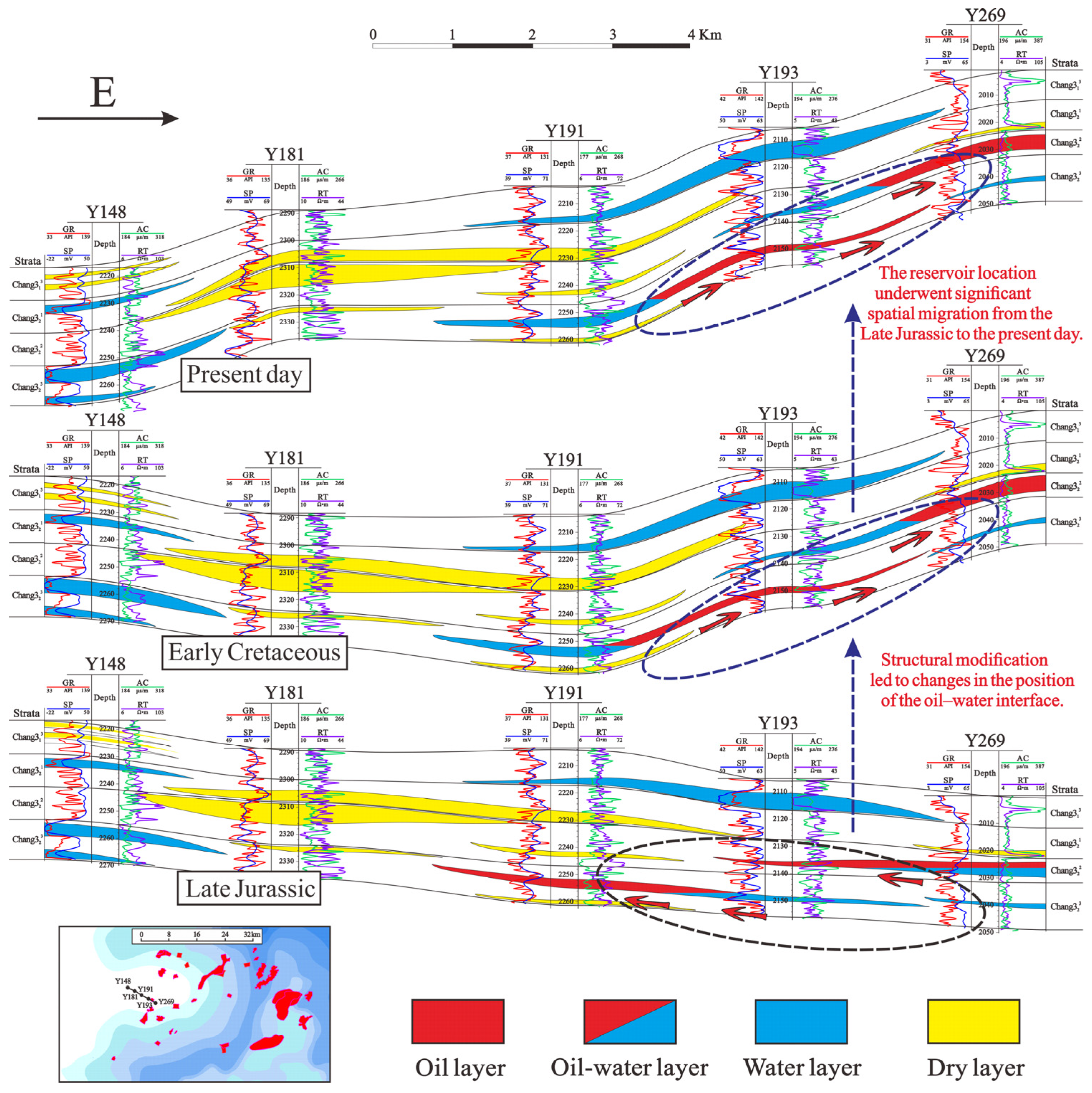
By integrating paleostructural evolution with reservoir cross-sectional profiles, a three-dimensional schematic illustrating the dynamic evolution of hydrocarbon migration and accumulation was constructed. This model enables a direct and intuitive analysis of the hydrocarbon accumulation pattern in the study area (Figure 18). The model clearly shows that during the Late Jurassic, the areas around wells Y191 and Y193 represented typical structural highs, where favorable trapping conditions led to the formation of classic structural hydrocarbon reservoirs. However, as a result of the Yanshan Movement, the topography of the study area underwent significant inversion by the Early Cretaceous. The regions of wells Y191 and Y193 transformed from a west-high, east-low to an east-high, west-low configuration, causing secondary migration of hydrocarbons. Consequently, the early hydrocarbon accumulation zone shifted from the western block to the structural high near the eastern part of Y193. Continuous hydrocarbon charging during the second accumulation stage in the Early Cretaceous ultimately resulted in the present-day hydrocarbon enrichment pattern.
Overall, hydrocarbon accumulation in the western Chang 3 reservoir of the Zhenbei area was governed by the coupling between structural evolution and the temporal–spatial relationships of two hydrocarbon charging episodes, resulting in a persistently dynamic adjustment process. During secondary hydrocarbon migration, some originally closed traps experienced positional reconfiguration associated with structural inversion, whereas a limited number of accumulations were disrupted and underwent hydrocarbon leakage. The combined effects of these processes ultimately led to the present-day pattern of scattered hydrocarbon accumulations in the western part of the study area.

5.2. Reservoir Formation Patterns in the Eastern Oil Accumulation Zone Controlled by Unconformity Contacts and Lithofacies Variations

In the eastern hydrocarbon accumulation zone of the study area, which is located farther from the Tianhuan sag, the influence of tectonic evolution on hydrocarbon migration and accumulation is relatively weak. Instead, the migration and accumulation patterns are primarily controlled by conventional lithofacies associations and trap formation modes. Compared to the western region, the eastern block has experienced less erosion, thereby preserving portions of the Chang 2 strata. However, due to the weathering and erosion of the overlying thin Chang 1 strata, the resulting sediments are generally finer-grained, which has moderately improved the reservoir properties of the underlying Chang 2 strata, leading to increased reservoir tightness. Additionally, clay layers formed from weathered and eroded materials have, to some extent, acted as barriers that hinder upward hydrocarbon migration [43,44].
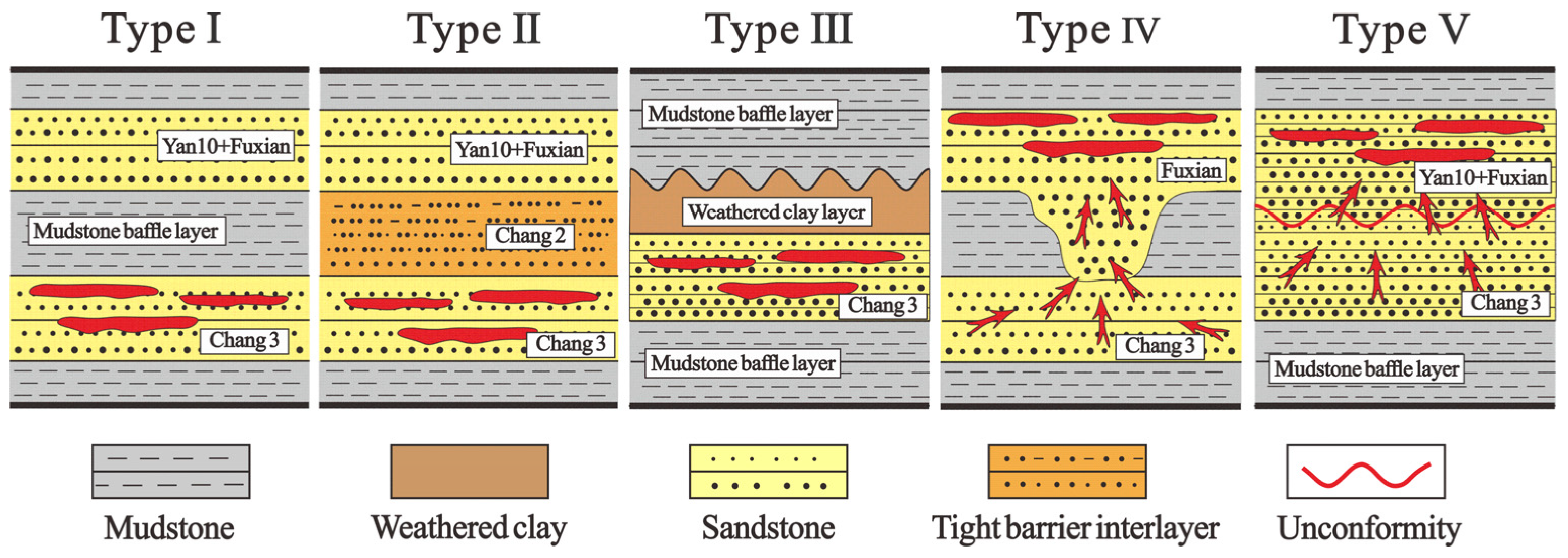
Based on a comprehensive analysis of the various contacts between the Chang 3 reservoir and the overlying strata in the eastern block, five primary types of hydrocarbon accumulation were identified (Figure 19). Types I–III represent the reservoir formation patterns within the eastern Chang 3 reservoirs. As shown in the figure, hydrocarbons are effectively trapped and accumulated in zones of favorable reservoir properties and pore–throat structures, primarily because the overlying mudstones, tight lithologic barriers, and weathered clay layers act as seals that restrict upward migration. In contrast, Types IV and V correspond to areas where the overlying Chang 1–Chang 2 strata were completely eroded, resulting in unconformable contact between the Chang 3 reservoir and the Fuxian formation, as well as the Yan 10 formation. In these regions, the absence of effective vertical seals allows the Chang 3 reservoir to serve as a preferential pathway for upward hydrocarbon migration, preventing significant accumulation in these zones.
In the eastern oil accumulation zone, which is dominated by lithology–structure controlled reservoirs, hydrocarbon accumulations tend to form continuous, areally extensive enrichment zones in areas with favorable reservoir properties and trap conditions. This pattern contrasts markedly with the sporadic distribution of reservoirs observed in the western block.

5.3. Exploration Insights and Future Directions

The distribution patterns of the Chang 3 reservoirs in the western and eastern parts of the Zhenbei area differ markedly. The scattered hydrocarbon accumulations in the western area, in contrast to the laterally continuous accumulations in the eastern area, indicate pronounced differences in their early hydrocarbon enrichment processes. Based on these characteristics, low-resistivity and low-contrast reservoirs within the study area were first identified through a multi-method, high-resolution approach. Building upon this framework, integrated analyses incorporating geochemical data, regional well-logging responses, three-dimensional seismic interpretation, and reservoir characterization experiments were conducted. These datasets were used to summarize distinct hydrocarbon accumulation models for the western and eastern areas, taking into account multiple controlling factors, including the degree of influence of structural evolution, unconformity-related contact systems, and differentiated lithologic assemblages. This integrated workflow not only provides important guidance for hydrocarbon exploration in the Zhenbei area, but also offers valuable insights into the enrichment mechanisms and accumulation models of low-contrast reservoirs in other structurally complex settings worldwide.
The low-contrast reservoir identification method can effectively distinguish previously unrecognized potential oil and gas reservoirs in the Zhenbei area and plays an important role in the secondary characterization of reservoir distribution features. It has practical value in guiding well placement and optimizing development plans in oil and gas exploration, directly impacting the exploration efficiency and economic returns.
With the ongoing advancement of exploration and development, the low-contrast reservoir identification techniques employed in this study should be integrated with additional disciplinary approaches, including but not limited to combined geophysical logging and geochemical interpretation. Furthermore, with the evolution of three-dimensional seismic analysis from “line-based” to “area-based” studies, large-scale paleotectonic restoration and stratigraphic dynamic evolution reconstruction are increasingly feasible. The incorporation of artificial intelligence, such as neural networks, can facilitate an integrated analysis framework linking paleotectonic evolution, sedimentary–reservoir characteristics, source rock comparison, and hydrocarbon enrichment patterns. This approach enables a shift from “static, single-dimensional studies” to “dynamic, multi-faceted analyses” of reservoir formation processes.

6. Conclusions

This study focuses on the Chang 3 reservoir interval in the Zhenbei area of the Ordos Basin. Low-resistivity reservoirs in 25 wells were accurately identified by using the invasion factor–acoustic transit time cross-plot and the apparent spontaneous potential difference (ΔSP) method. On this basis, reservoir petrology, pore–throat architecture, and petrophysical properties were systematically investigated for both the western and eastern reservoir areas. The Chang 3 reservoirs are characterized overall by low porosity and ultra-low permeability, with reservoir quality in the western area being generally better than that in the eastern area.
Integrated three-dimensional seismic and well-log data were further applied to reconstruct the paleostructural configuration of the western area, revealing a tectonic transformation of the Chang 3 strata from an early west-high–east-low geometry to the present-day east-high–west-low configuration. Abnormally high SO42− concentrations in the Mengyuan area indicate that formation water in the western Chang 3 Member experienced interaction with meteoric water. Oil–source correlation confirms that hydrocarbons in the Chang 3 reservoirs were derived from the underlying Chang 7 source rocks. Fluid-inclusion homogenization temperatures, combined with regional burial history, indicate two hydrocarbon accumulation episodes, including an early phase at approximately 145–160 Ma and a main charging phase at approximately 110–120 Ma.
By integrating the timing of hydrocarbon accumulation with structural evolution, distinct accumulation models are proposed for the western and eastern reservoir areas. In the western area, proximity to the Tianhuan Depression resulted in strong tectonic control, leading to leakage of early accumulations and secondary migration during the Late Jurassic–Early Cretaceous. Hydrocarbons were subsequently re-trapped in newly formed structural highs, producing the present-day pattern of scattered and isolated accumulations. In contrast, the eastern area, located farther from the Tianhuan Depression and less affected by tectonic reorganization, is characterized by five major hydrocarbon enrichment types controlled by lithologic assemblages between the Chang 3 reservoir interval and its overlying strata. Among these, Type I–III traps represent the dominant accumulation models in the eastern area. Dynamic accumulation modeling that integrates three-dimensional structural evolution with hydrocarbon charging history provides a robust framework for understanding hydrocarbon enrichment and accumulation patterns in the study area. These results have broad applicability, not only for the exploration and evaluation of low-contrast reservoirs with complex structural settings in the Ordos Basin, but also for analogous low-resistivity reservoir systems worldwide.

Author Contributions

Conceptualization, Y.Z. and Y.H.; methodology, Y.H.; validation, C.Z.; formal analysis, Y.Z. and Y.H.; investigation, H.Z.; data curation, Z.S.; writing—original draft preparation, Y.H.; writing—review and editing, Y.H.; visualization, X.L.; supervision, Y.Z. and Y.H.; project administration, Y.Z. All authors have read and agreed to the published version of the manuscript.

Funding

This research received no external funding.

Data Availability Statement

The original contributions presented in this study are included in the article. Further inquiries can be directed to the corresponding author.

Acknowledgments

This study was supported by technology and data provided by CNPC Changqing Exploration Institute.

Conflicts of Interest

The authors declare no conflicts of interest.

References

  1. Claverie, M.; Allen, D.F.; Heaton, N.; Bordakov, G. A new look at low-resistivity and low-contrast (LRLC) pay in clastic reservoirs. In Proceedings of the SPE Annual Technical Conference and Exhibition, Florence, Italy, 19–22 September 2010. [Google Scholar] [CrossRef]
  2. Bai, Z.; Tan, M.; Shi, Y.; Li, G.; Clark, S.M. Reservoir characteristics and control mechanism of resistivity low-contrast oil pays in Chang 8 tight sandstone of Longdong West area, Ordos Basin. J. Pet. Explor. Prod. Technol. 2021, 11, 2609–2620. [Google Scholar] [CrossRef]
  3. Belevich, A.; Bal, A.A. The problem with silt in low-resistivity low-contrast (LRLC) pay reservoirs. Petrophysics 2018, 59, 118–135. [Google Scholar] [CrossRef]
  4. Awolayo, A.; Ashqar, A.; Uchida, M.; Salahuddin, A.A.; Olayiwola, S.O. A cohesive approach at estimating water saturation in a low-resistivity pay carbonate reservoir and its validation. J. Pet. Explor. Prod. Technol. 2017, 7, 637–657. [Google Scholar] [CrossRef]
  5. Pratama, E.; Suhaili Ismail, M.; Ridha, S. An integrated workflow to characterize and evaluate low resistivity pay and its phenomenon in a sandstone reservoir. J. Geophys. Eng. 2017, 14, 513–519. [Google Scholar] [CrossRef]
  6. Etnyre, L.M.; Mullarkey, J.C. Low Contrast, Low Resistivity Reservoirs-Causes, Pitfalls, Environments of Deposition. In Producing Low Contrast, Low Resistivity Reservoirs Guidebook; Rocky Mountain Association of Geologists: Denver, CO, USA, 1996; pp. 11–16. [Google Scholar]
  7. Wang, S.; Xie, R.H.; Jin, G.W.; Guo, J.F.; Xiao, L.Z. A new method for fluid identification and saturation calculation of low contrast tight sandstone reservoir. Pet. Sci. 2024, 21, 3189–3201. [Google Scholar] [CrossRef]
  8. Li, D.M.; Xu, B.; Zhang, Y. Logging Identification of Low-Contrast. In Proceedings of the International Field Exploration and Development Conference; Springer Nature: London, UK, 2024; Volume 3, p. 341. [Google Scholar] [CrossRef]
  9. Wang, Y.; Sun, L.; Zhou, L.; Xie, Y. Discussion on the relationship between the Yanshanian Movement and cratonic destruction in North China. Sci. China Earth Sci. 2018, 61, 499–514. [Google Scholar] [CrossRef]
  10. Dong, S.; Zhang, Y.; Long, C.; Yang, Z.; Ji, Q.; Wang, T.; Hu, J.; Chen, X. Jurassic tectonic revolution in China and new interpretation of the “Yanshan Movement”. Acta Geol. Sin.-Engl. Ed. 2008, 82, 334–347. [Google Scholar] [CrossRef]
  11. Nie, Z. The Yanshanian Movement in the North China. Chin. J. Geol. 1985, 20, 320–333. [Google Scholar]
  12. He, Z.; Wang, X.; Li, S.; Wo, Y.; Zhou, Y. Yanshan movement and its influence on petroleum preservation in middle-upper Yangtze region. Pet. Geol. Exp. 2011, 31, 1–11. [Google Scholar] [CrossRef]
  13. Faure, M.; Lin, W.; Chen, Y. Is the Jurassic (Yanshanian) intraplate tectonics of North China due to westward indentation of the North China block. Terra Nova 2012, 24, 456–466. [Google Scholar] [CrossRef]
  14. Wang, G.; Li, S.; Li, X.; Zhao, W.; Zhao, S.; Suo, Y.; Liu, X.; Somerville, I.; Liu, Y.; Zhou, J.; et al. Destruction effect on Meso-Neoproterozoic oil-gas traps derived from Meso-Cenozoic deformation in the North China Craton. Precambrian Res. 2019, 333, 105427. [Google Scholar] [CrossRef]
  15. Lin, C.; Yang, H.; Liu, J.; Peng, L.; Cai, Z.; Yang, X.; Yang, Y. Paleostructural geomorphology of the Paleozoic central uplift belt and its constraint on the development of depositional facies in the Tarim Basin. Sci. China Ser. D Earth Sci. 2009, 52, 823–834. [Google Scholar] [CrossRef]
  16. Liu, J.; Wang, S.; Pan, K.; Ren, C.; Zhang, Q.; Xu, J. Identification of denudation periods and thickness in petroliferous basins and their geological significance: A case study of the central Sichuan Basin. Energy Geosci. 2025, 6, 100390. [Google Scholar] [CrossRef]
  17. Greenhalgh, B. Almond Formation reservoirs in Canyon Creek and Trail fields: Paleostructural evolution of a tight-gas accumulation. AAPG Bull. 2025, 109, 591–616. [Google Scholar] [CrossRef]
  18. Li, C.; Zhang, L.Q.; Zhang, L.K.; Wang, P.; Hu, C.Z.; Zhang, H.S. Estimation of denudation thickness of Mesozoic strata and paleostructure restoration in Zhenjing area, Ordos Basin. Lithol. Reserv. 2016, 28, 72–79. [Google Scholar] [CrossRef]
  19. Xing, J.; Gao, L.; Du, C.; Li, B.; Zhang, Z.; Jin, X.; Chen, S.; Li, X.; Wang, L.; Chen, W. Integrated Analysis of Tectonic Evolution and Hydrocarbon Potential in the Aonan Sag, Northern Songliao Basin: Insights from Rift-Phase Structural Controls. Processes 2025, 13, 3445. [Google Scholar] [CrossRef]
  20. Zhu, D.W.; Ding, W.L.; You, S.G.; Deng, L.H.; Bian, W.J. Paleostructure restoration and its geological significance of southeast of Ordos Basin. Tezhong Youqicang-Spec. Oil Gas Reserv. 2013, 20, 48–51. [Google Scholar] [CrossRef]
  21. Jiu, K.; Ding, W.L.; Li, C.Y.; Zeng, W.T. Advances of paleostructure restoration methods for petroliferous basin. Lithol. Reserv. 2012, 24, 13–19. [Google Scholar]
  22. Wang, Z.; Zhao, W.; Zhang, S.; Wang, H.; Yu, Q. Control of coupling among three major factors for formation of high-efficiency gas reservoir—A case study on the oolitic beach gas reservoir in Feixianguan Formation in the northeast Sichuan Basin. Chin. Sci. Bull. 2007, 52, 201–214. [Google Scholar] [CrossRef]
  23. Carpentier, B.; Arab, H.; Pluchery, E.; Chautru, J.M. Tar mats and residual oil distribution in a giant oil field offshore Abu Dhabi. J. Pet. Sci. Eng. 2007, 58, 472–490. [Google Scholar] [CrossRef]
  24. Wang, S.; Luo, J.H.; Li, S.; Deng, L.G.; Han, B.H. Study on Remaining Oil Distribution of Single Sand Body in Yan 10 Reservoir in Zhenbei Area, Ordos Basin. In Proceedings of the International Field Exploration and Development Conference; Springer: Singapore, 2021; pp. 340–348. [Google Scholar] [CrossRef]
  25. Yang, G.; Ren, Z.; Qi, K. Research on diagenetic evolution and hydrocarbon accumulation periods of Chang 8 Reservoir in Zhenjing area of Ordos Basin. Energies 2022, 15, 3846. [Google Scholar] [CrossRef]
  26. Li, C.; Zheng, Q.; Zhang, S.; Liu, Y.; Wang, L.; Liang, X. Microscopic pore structure of the fourth and fifth members of the Yanchang Formation in Zhenbei area of the Ordos Basin. Pet. Geol. Exp. 2015, 37, 729–736. [Google Scholar] [CrossRef]
  27. Weber, K.J. Hydrocarbon distribution patterns in Nigerian growth fault structures controlled by structural style and stratigraphy. J. Pet. Sci. Eng. 1987, 1, 91–104. [Google Scholar] [CrossRef]
  28. Zhao, J.; Cao, Q.; Bai, Y.; Er, C.; Li, J.; Wu, W.; Shen, W. Petroleum accumulation: From the continuous to discontinuous. Pet. Res. 2017, 2, 131–145. [Google Scholar] [CrossRef]
  29. Qu, H.; Zhang, G.; Chen, S. Distribution pattern and main factors controlling hydrocarbon accumulation of global oil and gas-rich deepwater basins. J. Nat. Gas Geosci. 2018, 3, 135–145. [Google Scholar] [CrossRef]
  30. Monreal, F.R.; Villar, H.J.; Baudino, R.; Delpino, D.; Zencich, S. Modeling an atypical petroleum system: A case study of hydrocarbon generation, migration and accumulation related to igneous intrusions in the Neuquen Basin, Argentina. Mar. Pet. Geol. 2009, 26, 590–605. [Google Scholar] [CrossRef]
  31. Xi, S.; Liu, X.; Ren, J.; Liu, G.; Zhang, C.; Hui, X.; Zhao, W.; Wang, H.; Jing, X.; Dong, G.; et al. New understanding of hydrocarbon accumulation and exploration potential in risk exploration field in Ordos Basin. China Pet. Explor. 2023, 28, 34. [Google Scholar] [CrossRef]
  32. Ye, B.; Liang, X.; Li, W.; Zhen, J.; Ma, J. Reservoir distribution and hydrocarbon accumulation pattern of Jurassic in Longdong Area of Ordos Basin. Xinjiang Pet. Geol. 2014, 35, 1. [Google Scholar]
  33. Liu, S.; Yang, S. Upper Triassic–Jurassic sequence stratigraphy and its structural controls in the western Ordos Basin, China. Basin Res. 2000, 12, 1–18. [Google Scholar] [CrossRef]
  34. Li, P.; Zheng, M.; Bi, H.; Wu, S.; Wang, X. Pore throat structure and fractal characteristics of tight oil sandstone: A case study in the Ordos Basin, China. J. Pet. Sci. Eng. 2017, 149, 665–674. [Google Scholar] [CrossRef]
  35. Lin, S.; Yuan, X.; Tao, S.; Yang, Z.; Wu, S. Geochemical characteristics of the source rocks in Mesozoic Yanchang Formation, central Ordos Basin. J. Earth Sci. 2013, 24, 804–814. [Google Scholar] [CrossRef]
  36. Tenger; Liu, W.; Xu, Y.; Chen, J. Comprehensive geochemical identification of highly evolved marine carbonate rocks as hydrocarbon-source rocks as exemplified by the Ordos Basin. Sci. China Ser. D 2006, 49, 384–396. [Google Scholar] [CrossRef]
  37. Blamey, N.J.; Ryder, A.G. Hydrocarbon fluid inclusion fluorescence: A review. Rev. Fluoresc. 2007, 2007, 299–334. [Google Scholar] [CrossRef]
  38. Kihle, J. Adaptation of fluorescence excitation-emission micro-spectroscopy for characterization of single hydrocarbon fluid inclusions. Org. Geochem. 1995, 23, 1029–1042. [Google Scholar] [CrossRef]
  39. Xu, H.; Wei, G.; Jia, C.; Yang, W.; Zhou, T.; Xie, W.; Li, C.; Luo, B. Tectonic evolution of the Leshan-Longnüsi paleo-uplift and its control on gas accumulation in the Sinian strata. Pet. Explor. Dev. 2012, 39, 436–446. [Google Scholar] [CrossRef]
  40. Yang, Q.; Wang, W.; Wu, S.; Li, J.; Liu, C.; Pan, B. Tectonic evolution of Chuxiong Basin and its control on hydrocarbon accumulation. China Pet. Explor. 2011, 16, 29. [Google Scholar] [CrossRef]
  41. Li, C.; Ou, C. Modes of Shale-Gas Enrichment Controlled by Tectonic Evolution. Acta Geol. Sin.-Engl. Ed. 2018, 92, 1934–1947. [Google Scholar] [CrossRef]
  42. Jia, C. The characteristics of intra-continental deformation and hydrocarbon distribution controlled by the Himalayan tectonic movements in China. Earth Sci. Front. 2007, 14, 96–104. [Google Scholar] [CrossRef]
  43. Zou, C.; Hou, L.; Yang, F.; Yang, C.; Tao, S.; Yuan, X.; Zhu, R. Structure of weathered clastic crust and its petroleum potential. Sci. China Earth Sci. 2014, 57, 3015–3026. [Google Scholar] [CrossRef]
  44. Li, H.; Tang, H.M.; Qin, Q.R.; Fan, C.H.; Han, S.; Yang, C.; Zhong, C. Reservoir characteristics and hydrocarbon accumulation of Carboniferous volcanic weathered crust of Zhongguai high area in the western Junggar Basin, China. J. Cent. South Univ. 2018, 25, 2785–2801. [Google Scholar] [CrossRef]
Figure 1. Cross−plot of formation water salinity versus resistivity for low−resistivity reservoirs in the Zhenbei area: (a) Chang 31 sublayer; (b) Chang 32 sublayer; and (c) Chang 33 sublayer.
Processes 14 00541 g001
Figure 2. Location map of the study area in the Zhenbei Region, Ordos Basin: (a) map of the study area and reservoir distribution characteristics; and (b) stratigraphic correlation column of the Yanchang formation.
Processes 14 00541 g002
Figure 3. Ternary sandstone composition classification diagram for the western and eastern reservoir zones, Zhenbei area.
Processes 14 00541 g003
Figure 4. Column chart of cement types for the western and eastern reservoir zones, Zhenbei area.
Processes 14 00541 g004
Figure 5. Column chart of pore-type distribution in the western and eastern reservoir zones, Zhenbei area.
Processes 14 00541 g005
Figure 6. Photomicrographs of pore types in the western and eastern oil accumulation zones of the Zhenbei area: (a) Well Z74,2228.7 m, Chang 3, intragranular dissolution pores and intergranular pores; (b) Well Z391,2116.5 m, Chang 3, intergranular pores; (c) Well Z73,2134.1 m, Chang 3, feldspar dissolution pores filled with kaolinite; (d) Well X259,1827.6 m, Chang 3, feldspar dissolution pores; (e) Well Z207,2069.2 m, Chang 3, secondary dissolution pores formed by the dissolution of lithic grains; (f) Well Y86,2055.3 m, Chang 3, intergranular pores; (g) Well 205,1960.6 m, Chang 3, primary intergranular pores formed between rigid quartz grains; (h) Well 293,1897.1 m, Chang 3, secondary feldspar dissolution pores; (i) Well Z84,2208.1 m, Chang 3, illite coating around primary intergranular pores; (j) Well L44,2163.5 m, Chang 3, the presence of lithic dissolution pores enhances the storage space in tight reservoirs; (k) Well Z74,2267.6 m, Chang 3, the presence of intercrystalline pores also improves reservoir properties; (l) Well Z391,2159.7 m, Chang 3, primary intergranular pores and illite-filled pores.
Processes 14 00541 g006
Figure 7. Characteristics of capillary pressure curves from high-pressure mercury injection in the western and eastern reservoir zones, Zhenbei area.
Processes 14 00541 g007
Figure 8. Relationship between bound water saturation and resistivity increase in the western and eastern reservoir zones, Zhenbei area.
Processes 14 00541 g008
Figure 9. Schematic panels showing the genesis of high bound water saturation in the western and eastern reservoir zones, Zhenbei area: (a) relationship between pore structure and bound-water saturation; (b) relationship between median grain size and bound-water saturation; (c) relationship between specific surface area and bound-water saturation.
Processes 14 00541 g009
Figure 10. Oil–water identification charts for the western and eastern reservoirs of the Zhenbei area: (a) acoustic slowness–resistivity identification chart and (b) invasion factor–acoustic slowness cross-plot.
Processes 14 00541 g010
Figure 11. Oil–water identification panels using the ΔSP method in the western and eastern reservoir zones of the Zhenbei area.
Processes 14 00541 g011
Figure 12. Three-dimensional seismic paleostructural reconstruction of the western reservoir zone, Zhenbei area.
Processes 14 00541 g012
Figure 13. Column charts showing evidence of formation water escape in the western reservoir zone, Zhenbei area.
Processes 14 00541 g013
Figure 14. Imaging log interpretation of structural fracture characteristics in the three intervals of well Y 248, Zhenbei area.
Processes 14 00541 g014
Figure 15. Comparison of crude oil–source correlation for the Chang 3 Member in the western and eastern reservoir zones, Zhenbei area.
Processes 14 00541 g015
Figure 16. Photomicrographs of hydrocarbon inclusions in the Chang 3 interval from the western and eastern oil accumulation zones of the Zhenbei area: (a) Well Z441,1932.8 m, Chang 3, petroleum-bearing aqueous–liquid hydrocarbon inclusions occurring in clusters within calcite cement, coexisting with pale-brown hydrocarbon-bearing saline fluid inclusions; (b) Well Y275,2194.2 m, Chang 3, fluorescence appears bluish-white with moderate intensity; (c) Well Z73,2134.1 m, Chang 3, petroleum-bearing aqueous–liquid hydrocarbon inclusions occurring in clusters within calcite cement, coexisting with pale-brown hydrocarbon-bearing saline fluid inclusions; (d) Well Y275,2194.2 m, Chang 3, fluorescence appears bluish-white with moderate intensity; (e) Well Z209,2058.3 m, Chang 3, clustered aqueous–liquid hydrocarbon inclusions within calcite cement; (f) Well Z209,2058.3 m, Chang 3, bluish-white and yellowish-brown fluorescence of moderate intensity.
Processes 14 00541 g016
Figure 17. Substages of hydrocarbon accumulation in the Chang 3 formation, Zhenbei area: (a) histogram of homogenization temperatures of hydrocarbon inclusions; and (b) burial and thermal evolution history of the Triassic Yanchang formation in the Zhenbei area.
Processes 14 00541 g017
Figure 18. Diagram showing the secondary migration and accumulation pattern of the western reservoir zone under structural evolution, Zhenbei area.
Processes 14 00541 g018
Figure 19. Diagram showing the accumulation pattern controlled by lithologic assemblages and unconformities in the eastern reservoir zone, Zhenbei area.
Processes 14 00541 g019
Table 1. Sampling summary for oil–source correlation in the western and eastern reservoir zones of the Zhenbei area.
Sample NameSample TypeStratigraphic PositionSource Area
Sample 1Source RockChang 7Western Reservoir Zone
Sample 2Source RockChang 7Eastern Reservoir Zone
Sample 3Source RockChang 9Western Reservoir Zone
Sample 4Source RockChang 9Eastern Reservoir Zone
Sample 5Crude OilChang 7Western Reservoir Zone
Sample 6Crude OilChang 7Eastern Reservoir Zone
Sample 7Crude OilChang 3Western Reservoir Zone
Sample 8Crude OilChang 3Eastern Reservoir Zone
Table 2. High-pressure mercury injection parameters for pore–throat analysis in the western and eastern reservoir zones, Zhenbei area.
TypeMedian
Radius (μm)
Median
Pressure (MPa)
Displacement
Pressure (Mpa)
Maximum
SHg (%)
Mercury
Drainage
Efficiency (%)
Type I0.313.051.789.436.2
Type II0.261.891.173.122.3
Type III0.121.023.669.314.5
Table 3. Comparison of petrophysical parameters between the western and eastern reservoir zones, Zhenbei area.
StratumPorosity (%)Permeability (mD)
MinMaxAvgMinMaxAvg
Chang 31Western4.818.811.90.1121.597.41
Eastern5.718.110.90.2510.126.35
Chang 32Western2.119.611.60.1616.046.84
Eastern3.917.210.90.2216.916.12
Chang 33Western2.518.211.10.2420.895.53
Eastern1.516.910.70.3117.625.03
Table 4. Reservoir heterogeneity statistics of the western and eastern Chang 3 Member, Zhenbei area.
StratumCoefficient of Variation
in Permeability
Breakthrough Coefficient
of Permeability
Range of
Permeability (mD)
Reservoir
Heterogeneity
Chang 31Western1.816.12153.17highly heterogeneous
Eastern1.866.28159.28highly heterogeneous
Chang 32Western1.987.19216.32highly heterogeneous
Eastern2.157.31221.39highly heterogeneous
Chang 33Western2.858.05242.08highly heterogeneous
Eastern3.028.41253.96highly heterogeneous
Table 5. Statistical summary of oil–water layer identification results in the western and eastern reservoir zones of the Zhenbei area.
WellAC
(us/m)
RT
(Ω·m)
Por
(%)
Perm
(mD)
So
(mD)
Depth (m)Primary Results
(Resistivity–Sonic Travel Time)
Secondary Results
(Invasion Factor–Sonic Travel Time)
TopBottom
Z448239.7814.9812.784.9441.741792.31797.3Oil–Water LayerOil Layer
Z301232.9113.685.6311.7642.211992.51995.4Oil–Water Coexistence LayerOil Layer
Z419236.311.7111.758.9645.132407.12409.1Oil–Water Coexistence LayerOil Layer
Z422232.9210.4110.2311.1838.952355.22357.1Oil–Water Coexistence LayerOil Layer
Z219235.9115.5112.528.5636.181901.031904.05Oil–Water LayerWater Layer
Z248232.149.1910.839.1339.251991.151993.21Oil LayerOil–Water Coexistence Layer
Z540224.39.4911.958.8936.731928.731929.53Oil–Water Coexistence LayerOil–Water Layer
Z61230.167.0713.23.1136.51817.41819.3Water LayerOil–Water Coexistence Layer
Y62224.179.4416.343.3440.112237.32242.9Oil–Water Coexistence LayerOil Layer
Y187230.110.2310.621.9441.982277.42280.8Oil–Water Coexistence LayerOil Layer
Y253223.579.698.710.8846.322230.52233.5Oil–Water Coexistence LayerOil Layer
Z303222.725.2211.967.7261.621900.31901.8Oil–Water Coexistence LayerOil Layer
Z447230.287.929.790.3234.452291.52294.8Water LayerOil–Water Coexistence Layer
Y87223.6128.7711.034.7159.5522542255.6Oil–Water LayerOil Layer
Z140232.3314.3213.641.3946.261823.41825.5Water LayerOil–Water Coexistence Layer
Z303237.8213.312.33.9749.522065.52067.1Oil–Water LayerOil Layer
Z216230.9410.4911.413.7849.417581762.1Oil–Water Coexistence LayerOil Layer
Z164228.2418.7114.7211.4257.682362.92365.4Oil–Water LayerOil Layer
Y215255.2414.1815.129.546.512098.22103.8Oil–Water LayerOil–Water Coexistence Layer
Y226216.646.4613.744.5826.72203.52206.4Oil–Water LayerWater Layer
Y247229.666.3713.064.7737.9921892191.9Oil–Water Coexistence LayerOil–Water Layer
Y266234.019.028.910.5523.32210.42211.9Water LayerOil–Water Layer
Z380241.95.849.061.5418.631985.81988.6Water LayerOil–Water Layer
Z385219.727.3310.642.1114.242152.92157.5Oil–Water LayerWater Layer
Z419234.715.5313.796.7322.872021.52026.1Oil–Water LayerOil–Water Layer
Table 6. Statistical summary of formation water geochemical parameters in the western reservoir zone of the Zhenbei area.
AreaWellIon Concentration (mg/L)Total Mineralization (g/L)Water Type
K+ + Na+Ca2−Mg2+ClSO42−CO32−HCO3
TongchuanZ28928,0009661112581,85026208884.85CaCl2
Z20413,498358868938,92119330011177.62CaCl2
Z350450013347611,71000353102.12CaCl2
WuchengziM6713,3792933112378,694302021363.17CaCl2
Y389399341783498867051081.39CaCl2
Z476960084915222,100819024992.58CaCl2
YanwuY19035,60066218267,80016000472112.21CaCl2
Z30525,000245210150,50016401310284.95CaCl2
Z133887113367415,80015390053.17MgCl2
MengyuanZ8633,700272825356,0002781056995.28CaCl2
Y2678100158910913,9722679017442.36CaCl2
Y18219,5002833627,5692205011351.02CaCl2
Disclaimer/Publisher’s Note: The statements, opinions and data contained in all publications are solely those of the individual author(s) and contributor(s) and not of MDPI and/or the editor(s). MDPI and/or the editor(s) disclaim responsibility for any injury to people or property resulting from any ideas, methods, instructions or products referred to in the content.