Numerical Simulation of Mechanical Parameters of Oil Shale Rock in Minfeng Subsag


Abstract
1. Introduction
2. Physical Property Testing of Oil Shale
2.1. Mineral Composition Testing of Oil Shale
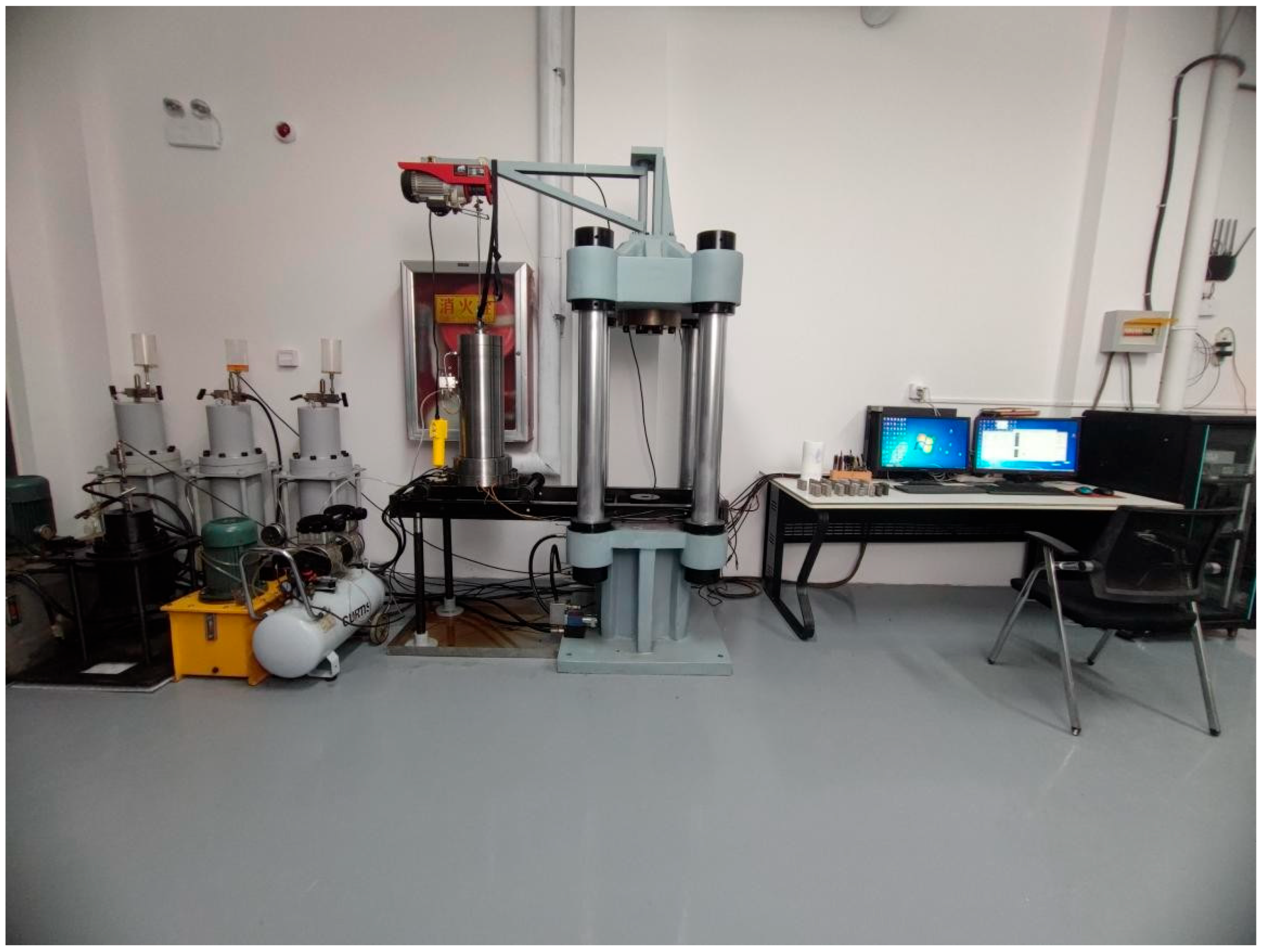
2.2. Rock Mechanics Experimental Testing of Oil Shale
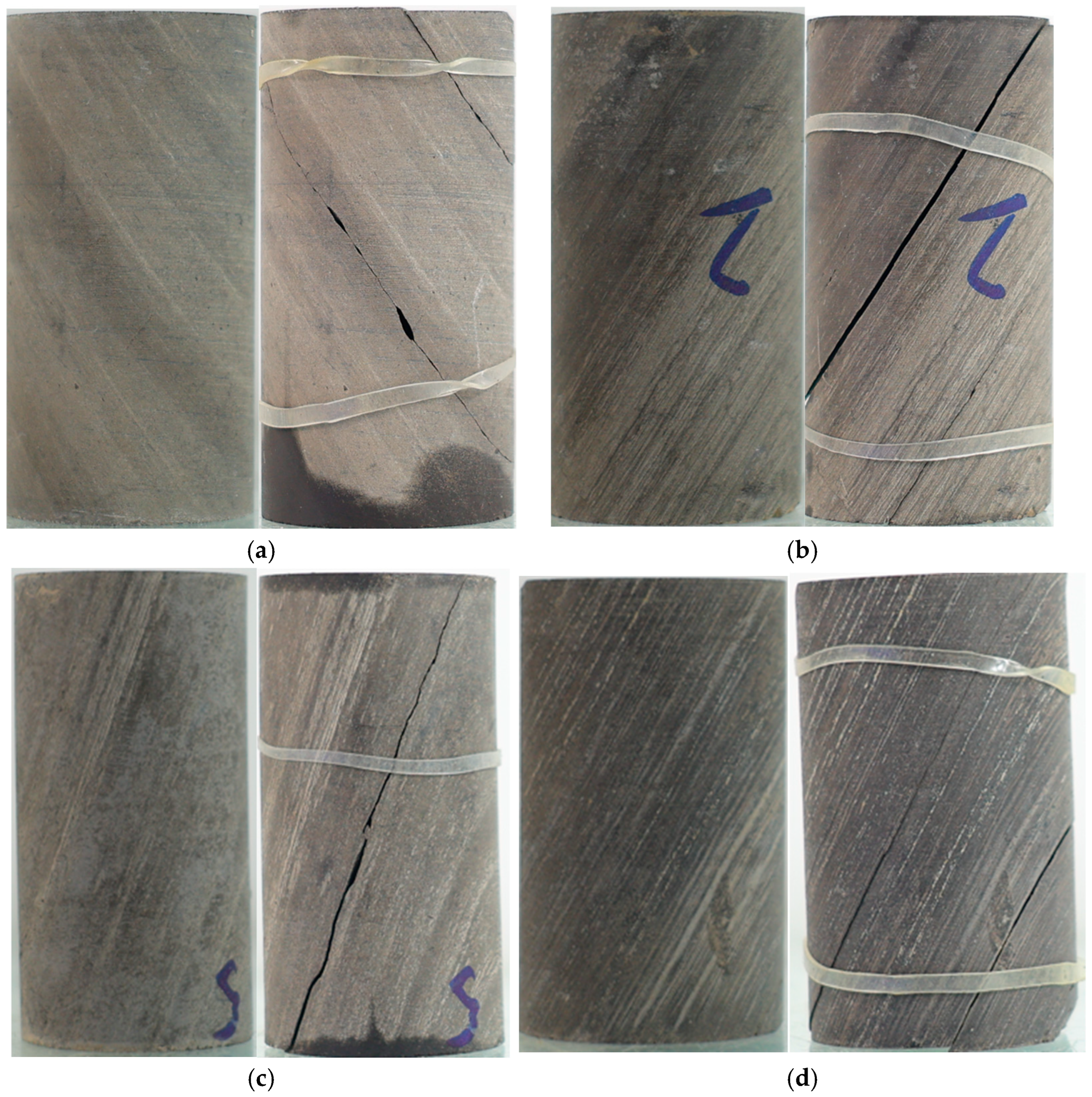
2.2.1. Brazilian Test
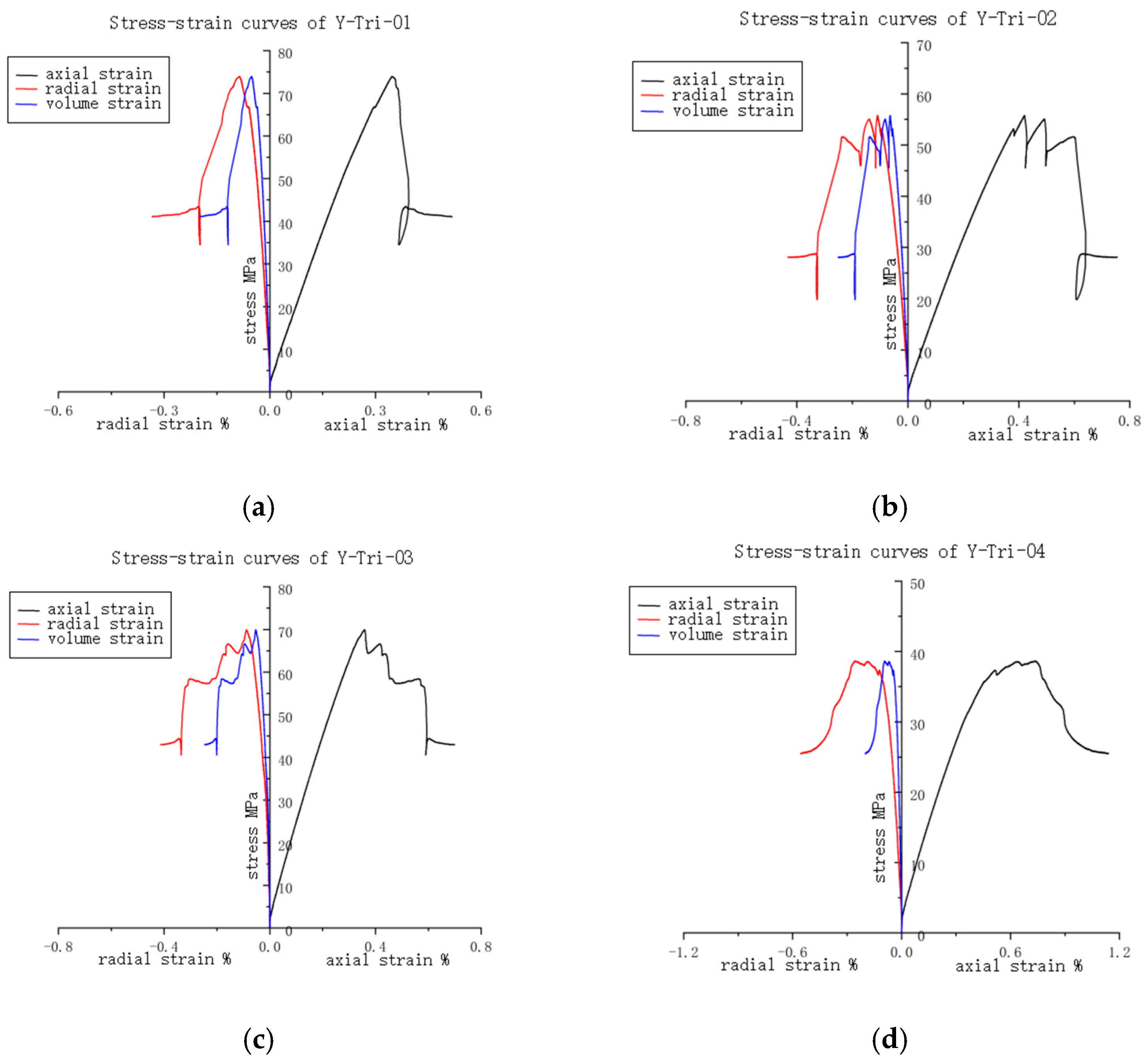
2.2.2. Triaxial Test
3. Numerical Simulation of Oil Shale Mechanical Properties
3.1. Principle of Particle Discrete Element Method
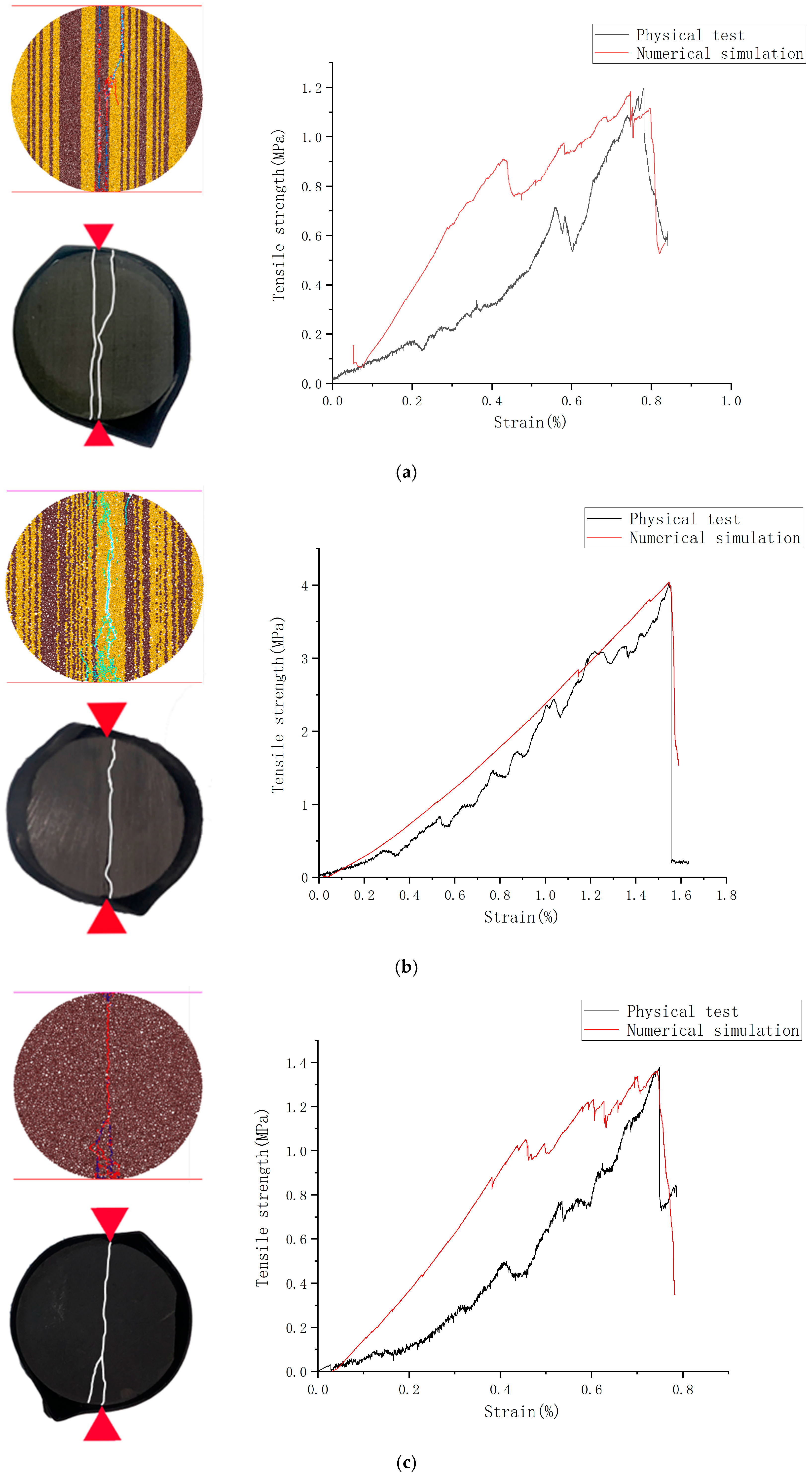
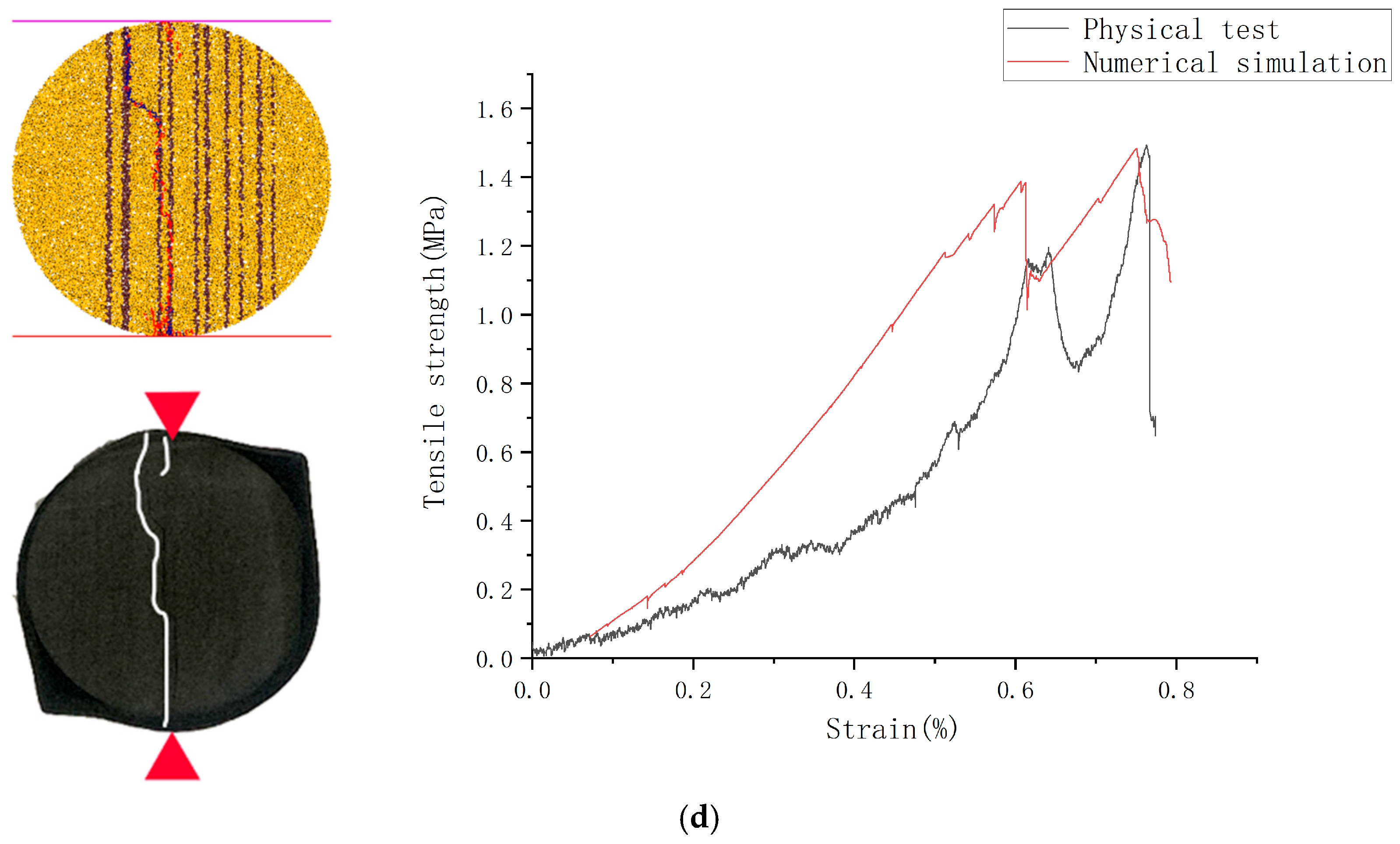
3.2. Numerical Simulation of Brazilian Splitting
3.3. Numerical Simulation of Biaxial Compression
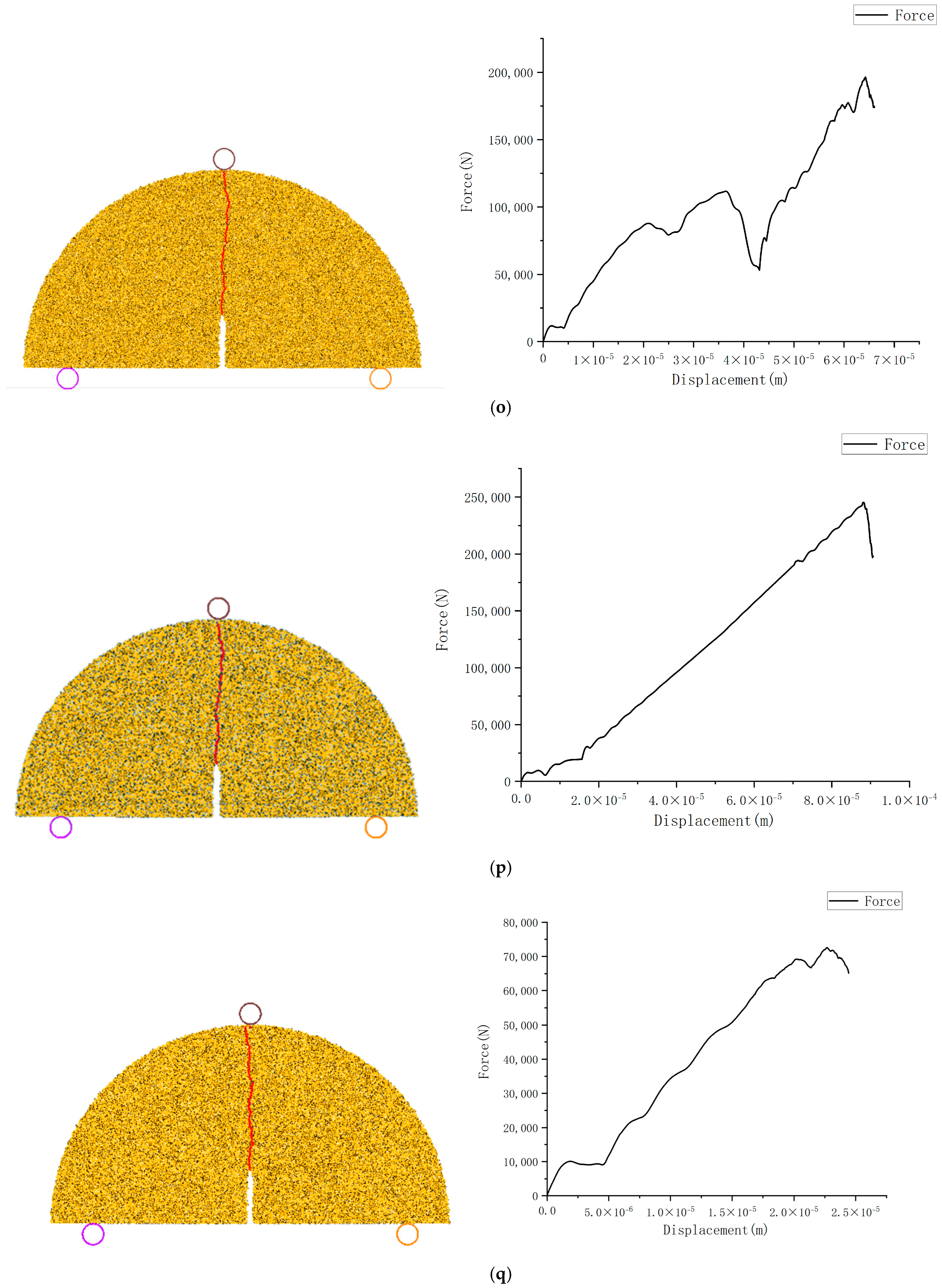
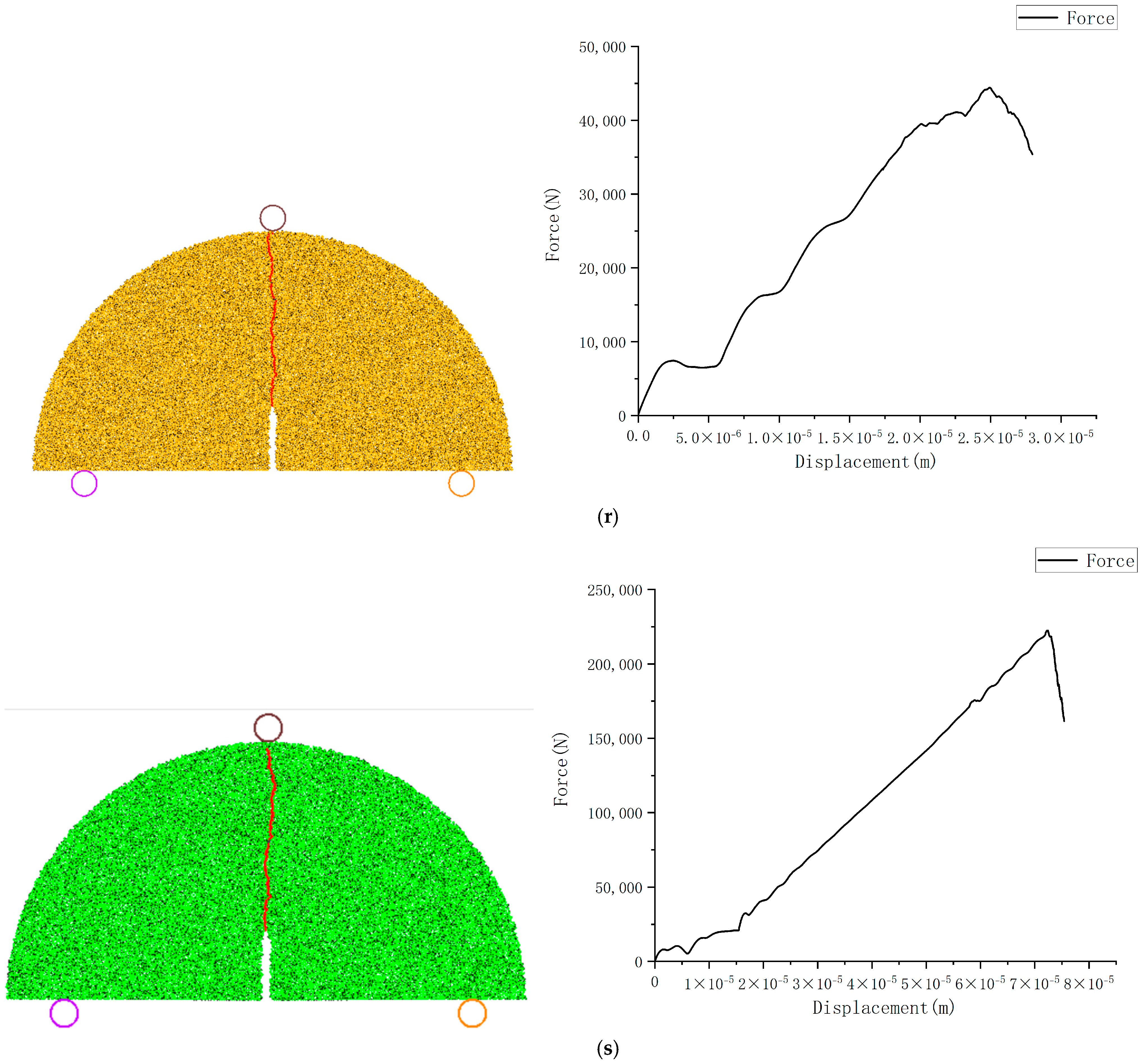
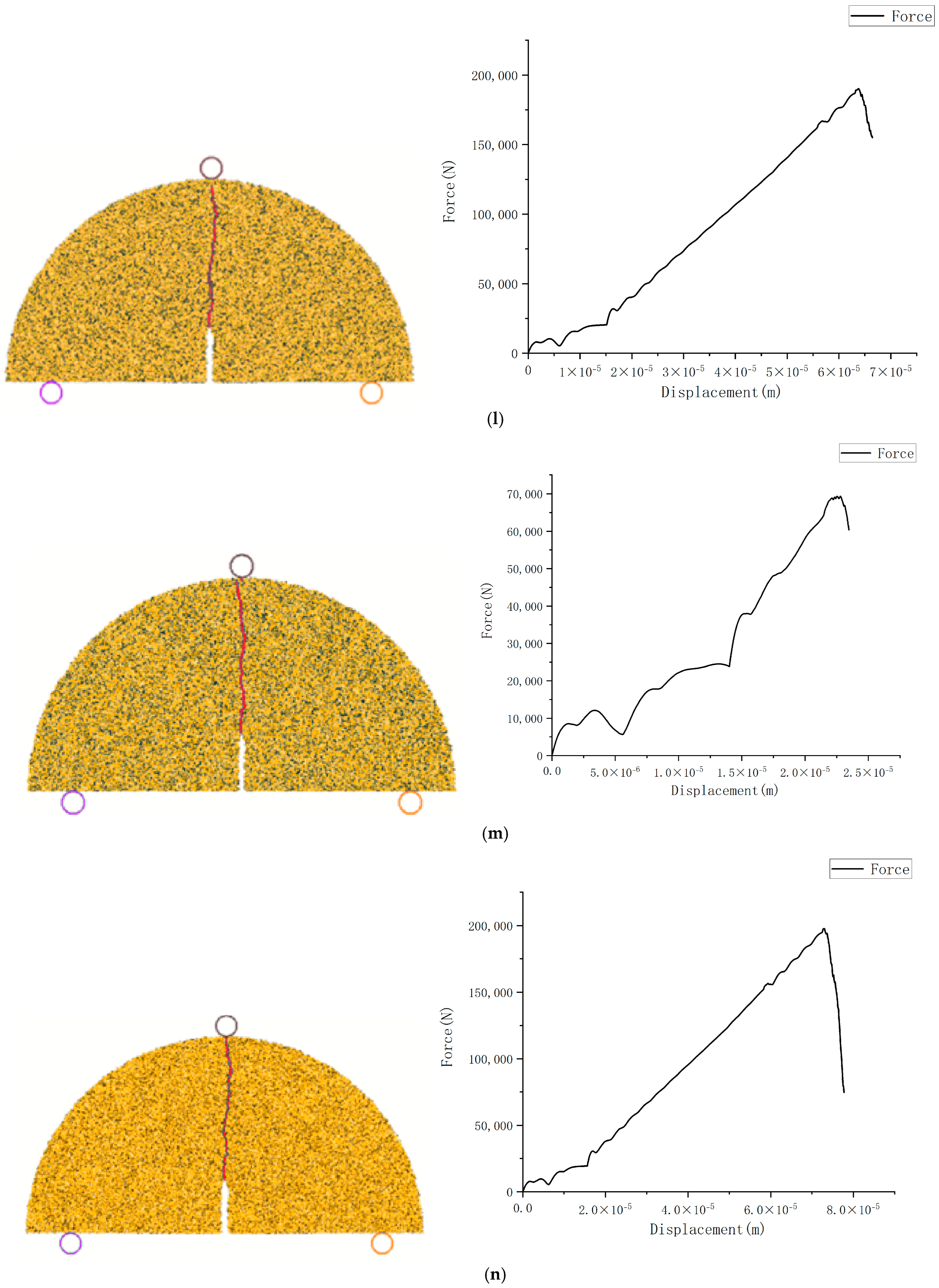
3.4. Fracture Toughness Simulation
4. Conclusions
- (1)
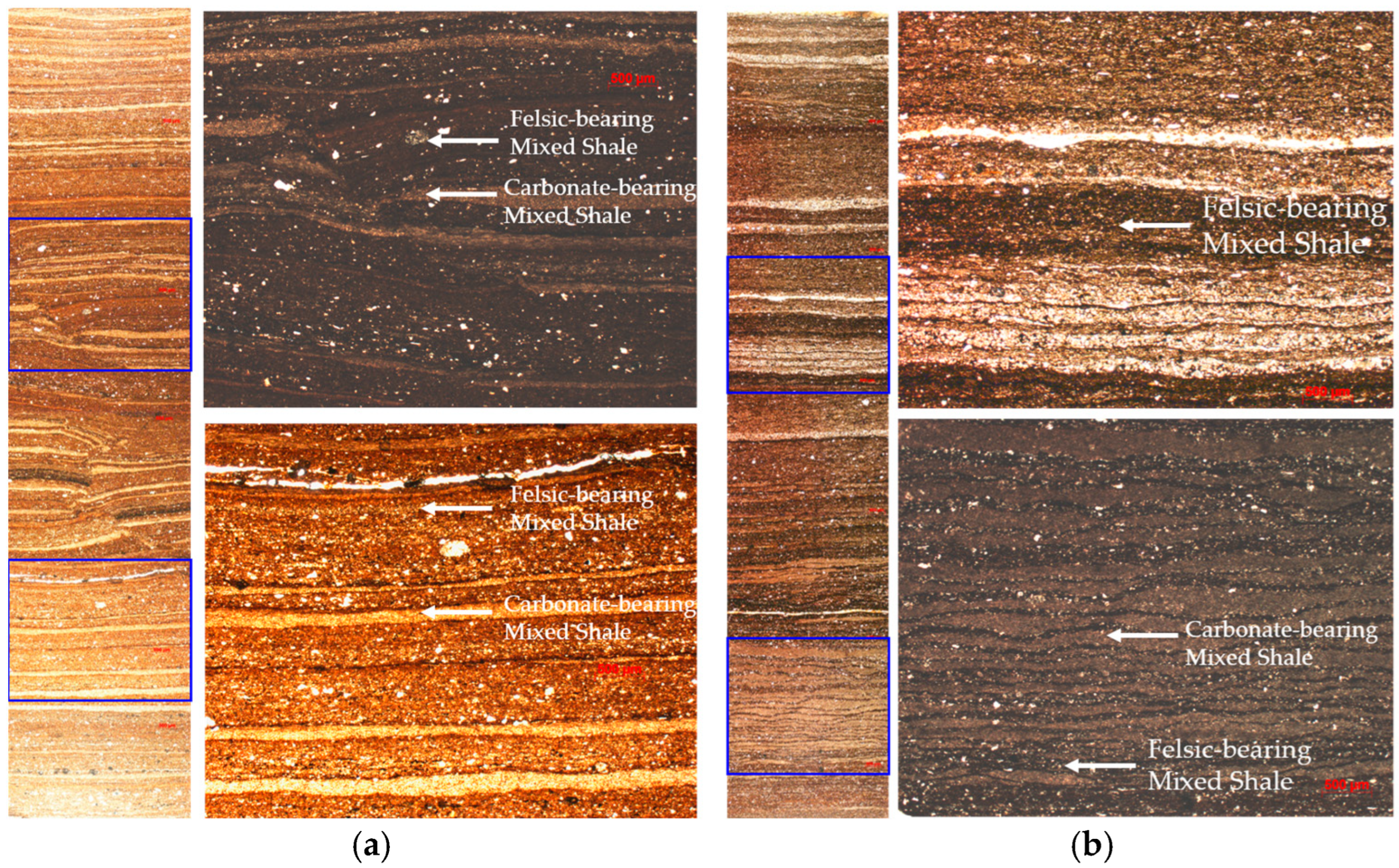
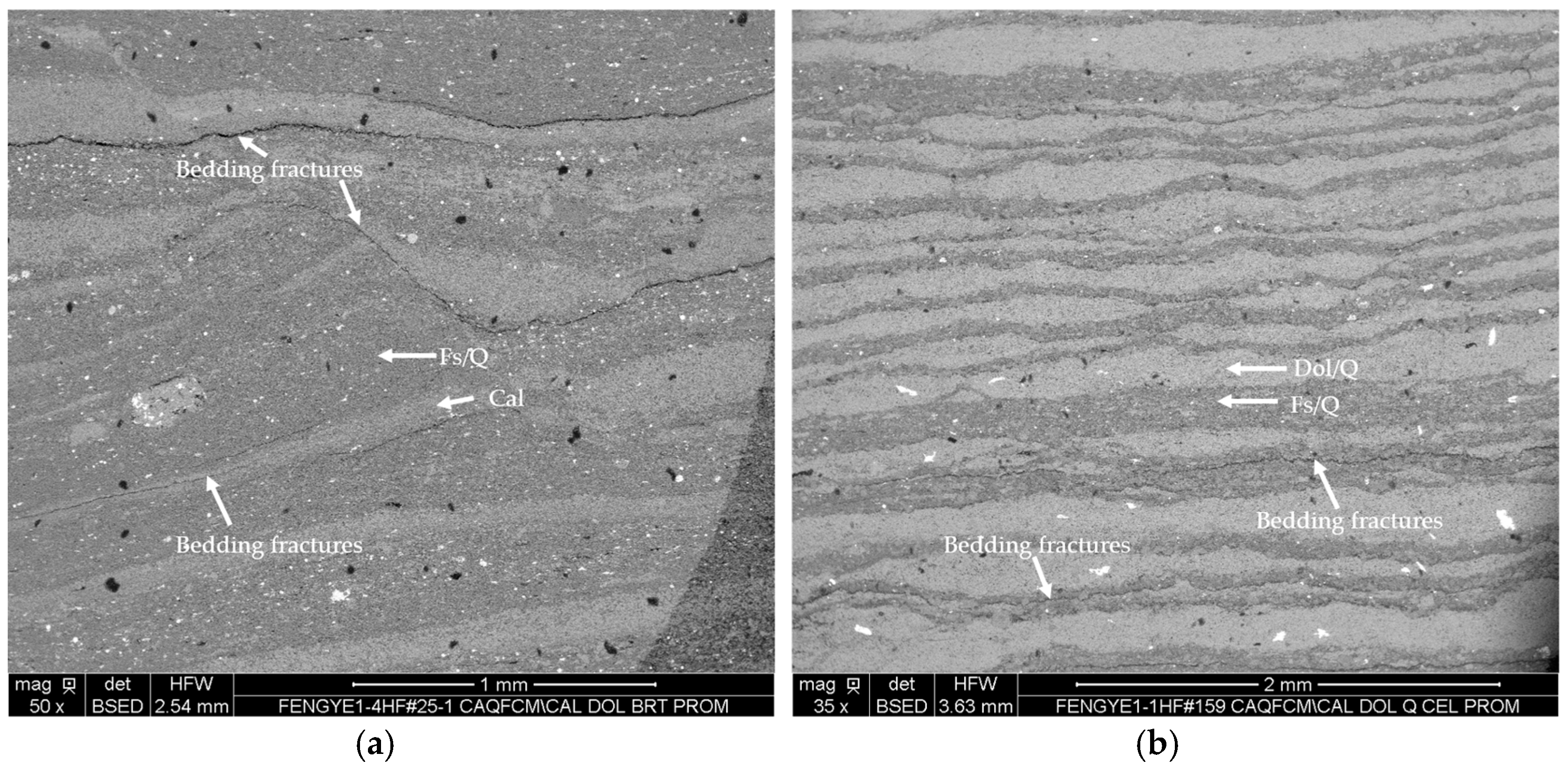
- After XR-ray diffraction, ordinary thin-section observation, and scanning electron microscope observation of some shale samples in Minfeng subsag, the lithology of different laminae can be divided into carbonate-bearing mixed shale and felsic-bearing mixed shale. The observed bedding mainly includes horizontal bedding or wavy bedding. The bedding density is large, most of them are horizontally developed, and some regional beddings have inclined angles. There are many bedding fissures, most of which are horizontally developed along the bedding boundary. If the laminae are inclined, the bedding fissures developed at the boundary will also be inclined. A small number of bedding joints develop inside the lamina, and the length and width of this kind of bedding joint are generally small. Most bedding fractures have organic matter filling, and some bedding fractures have quartz and pyrite filling.
- (2)
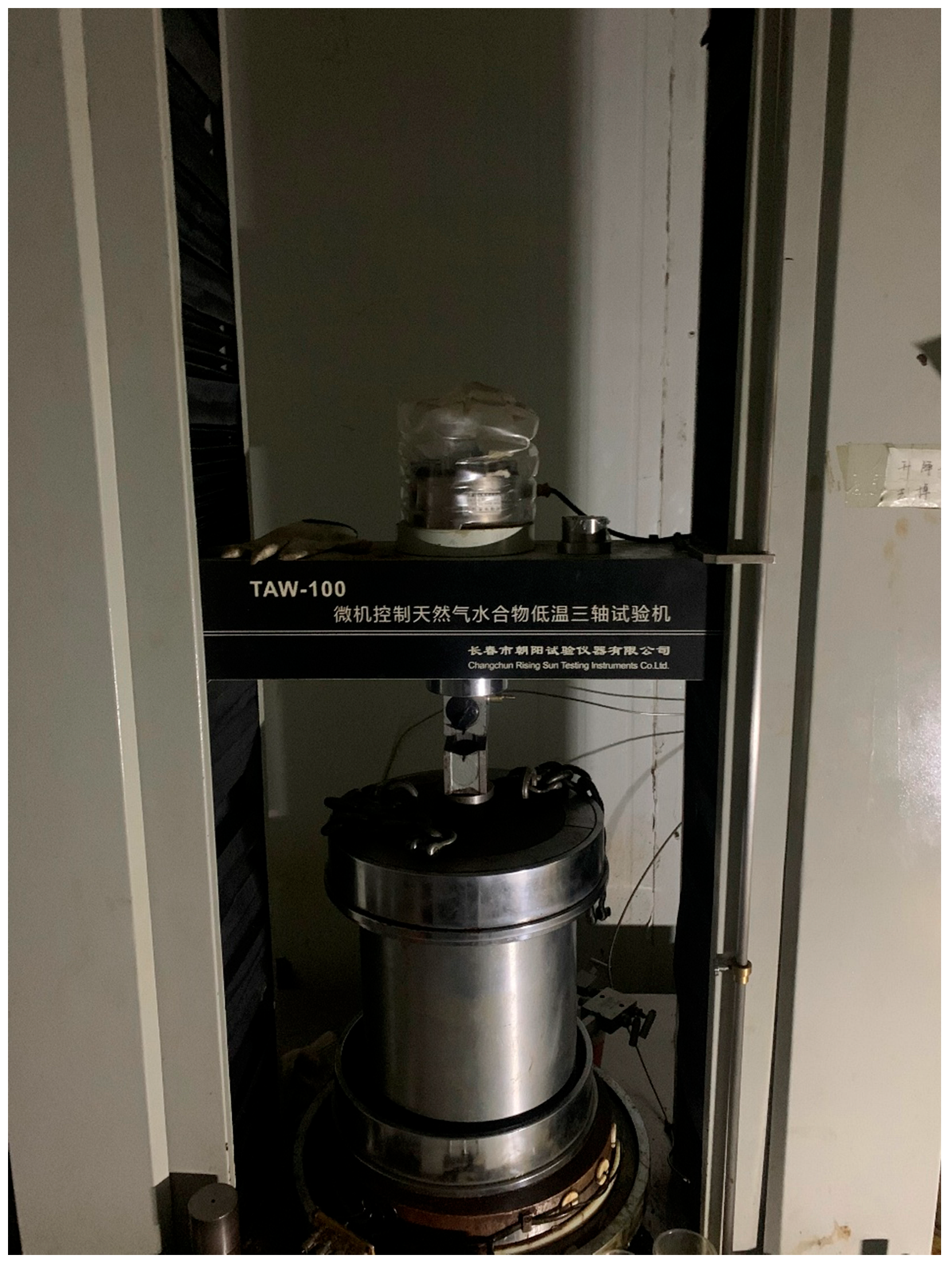
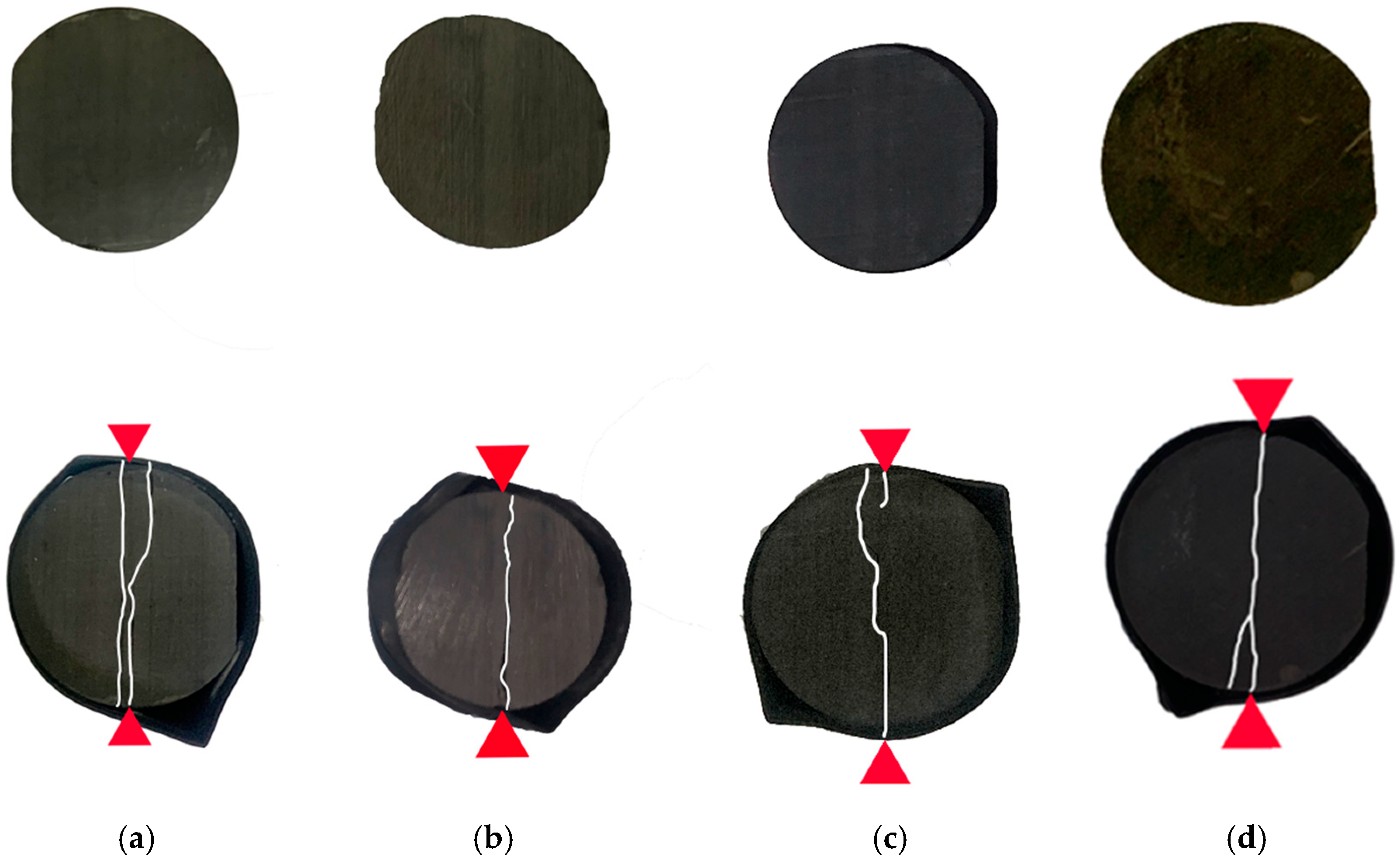
- There are large fluctuations in the data of the four groups of rock samples participating in the rock mechanics experiment. The tensile strength, compressive strength, Young’s modulus, and Poisson’s ratio span are large. Most of the cracks generated by the Brazilian splitting experiment expand along the weak surface of the interlaminar structure, and only one group expands in the lamina, resulting in its tensile strength being much larger than the other three sets of data. Through the triaxial compression experiment to obtain the parameters to calculate the brittleness index, it is found that there are two groups of rock samples with good brittleness, and there are two groups of rock samples with poor brittleness, indicating that the brittleness of shale in Minfeng subsag is obviously different in different locations, and the overall heterogeneity is strong.
- (3)
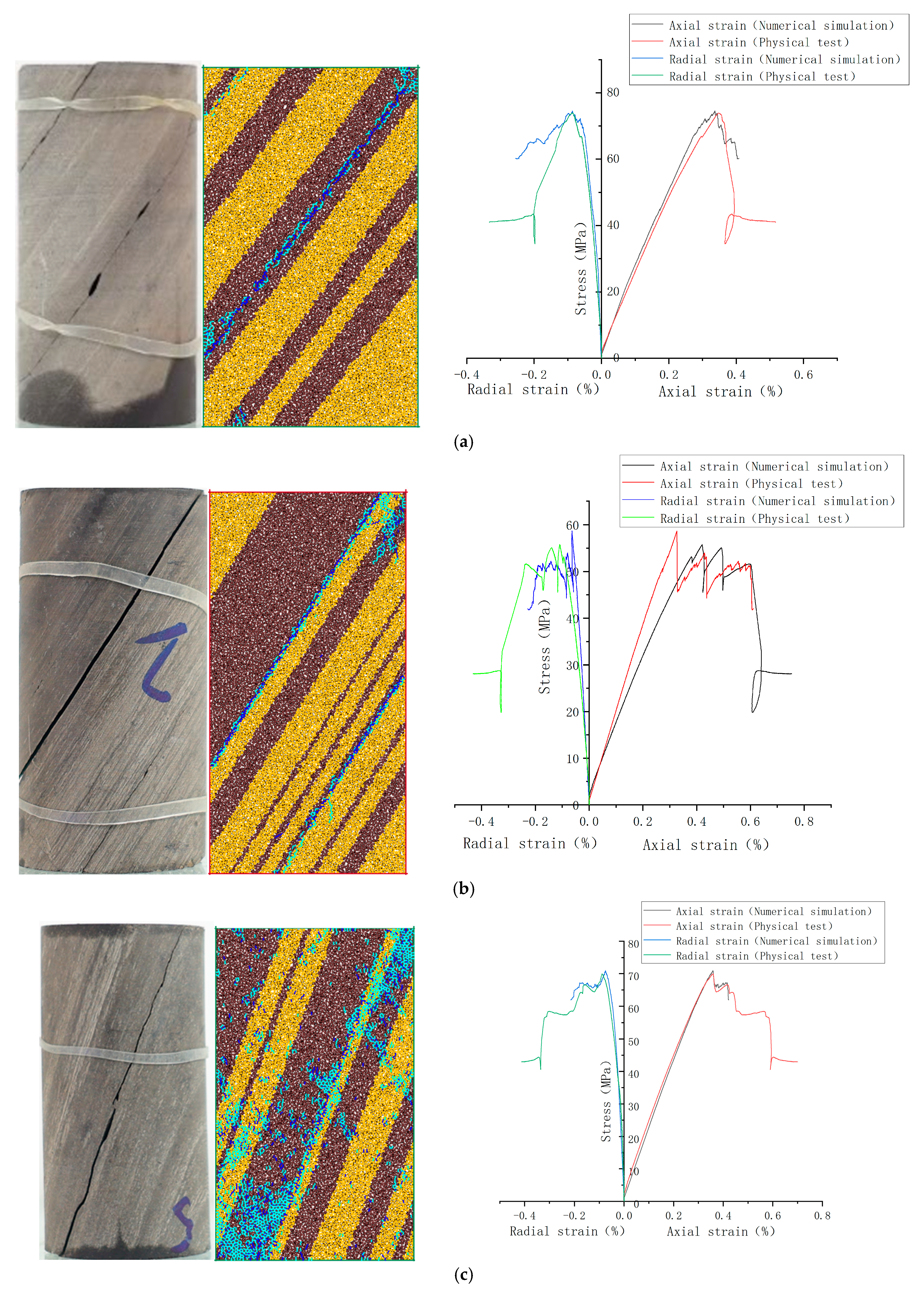
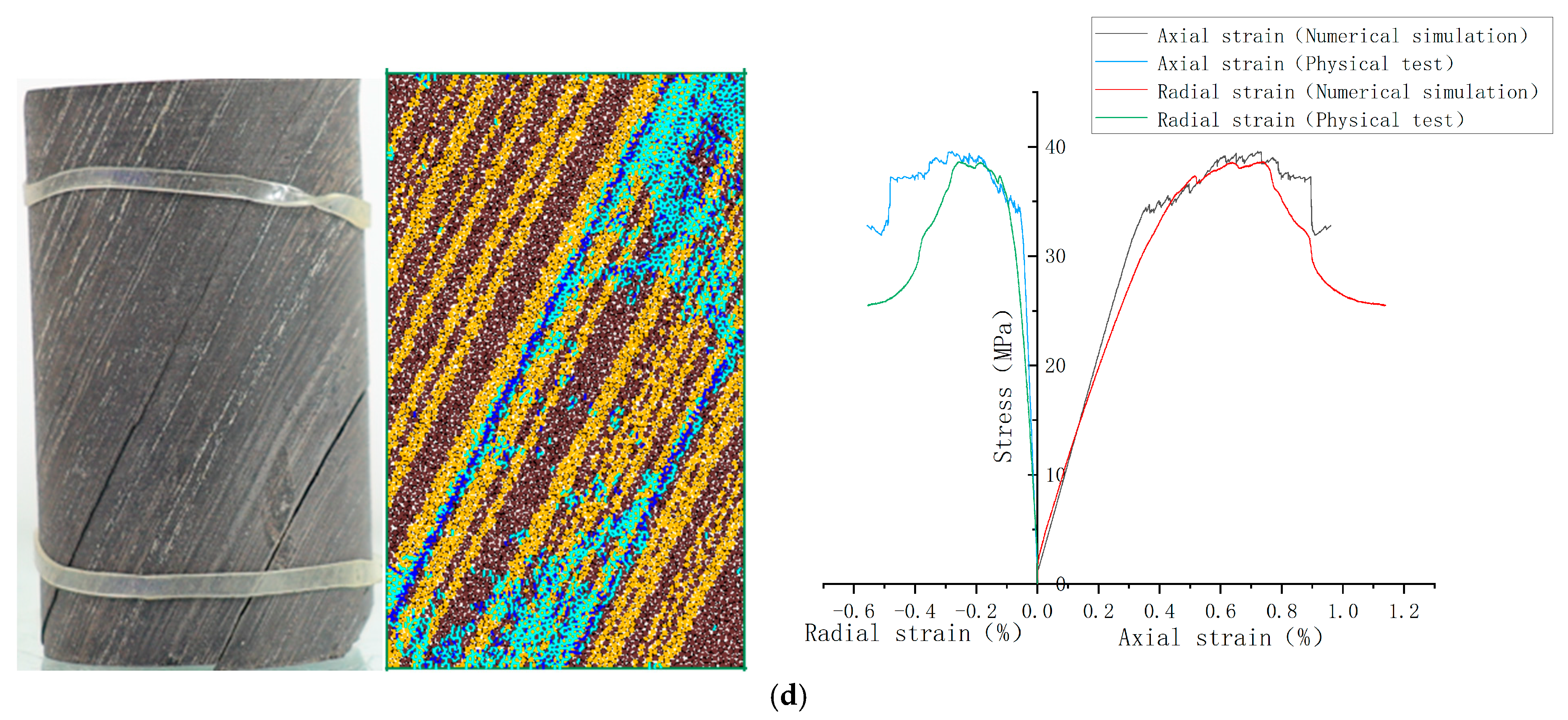
- The simulation results show that the average tensile strength of the carbonate-bearing mixed shale lamina is 3.609 MPa; the average compressive strength is 31.41 MPa; and the average Young’s modulus is 19.66 GPa. The average Poisson’s ratio is 0.240. The average tensile strength of felsic-bearing mixed shale laminae is 3.675 MPa, the average compressive strength is 35.28 MPa, the average compressive strength is 35.28 MPa, and the average Young’s modulus is 20.83 GPa; the average Poisson’s ratio is 0.263. The average tensile strength is 0.319 MPa. The rock heterogeneity is strong, the data fluctuates greatly, and the strength of felsic shale is greater than that of carbonate shale. According to the Young’s modulus and Poisson’s ratio data of each lamina, the brittleness index is calculated. It is found that the brittleness index of each lamina of rock samples decreases obviously. It is speculated that the development of bedding joints leads to the increase in brittleness of the whole rock.
- (4)
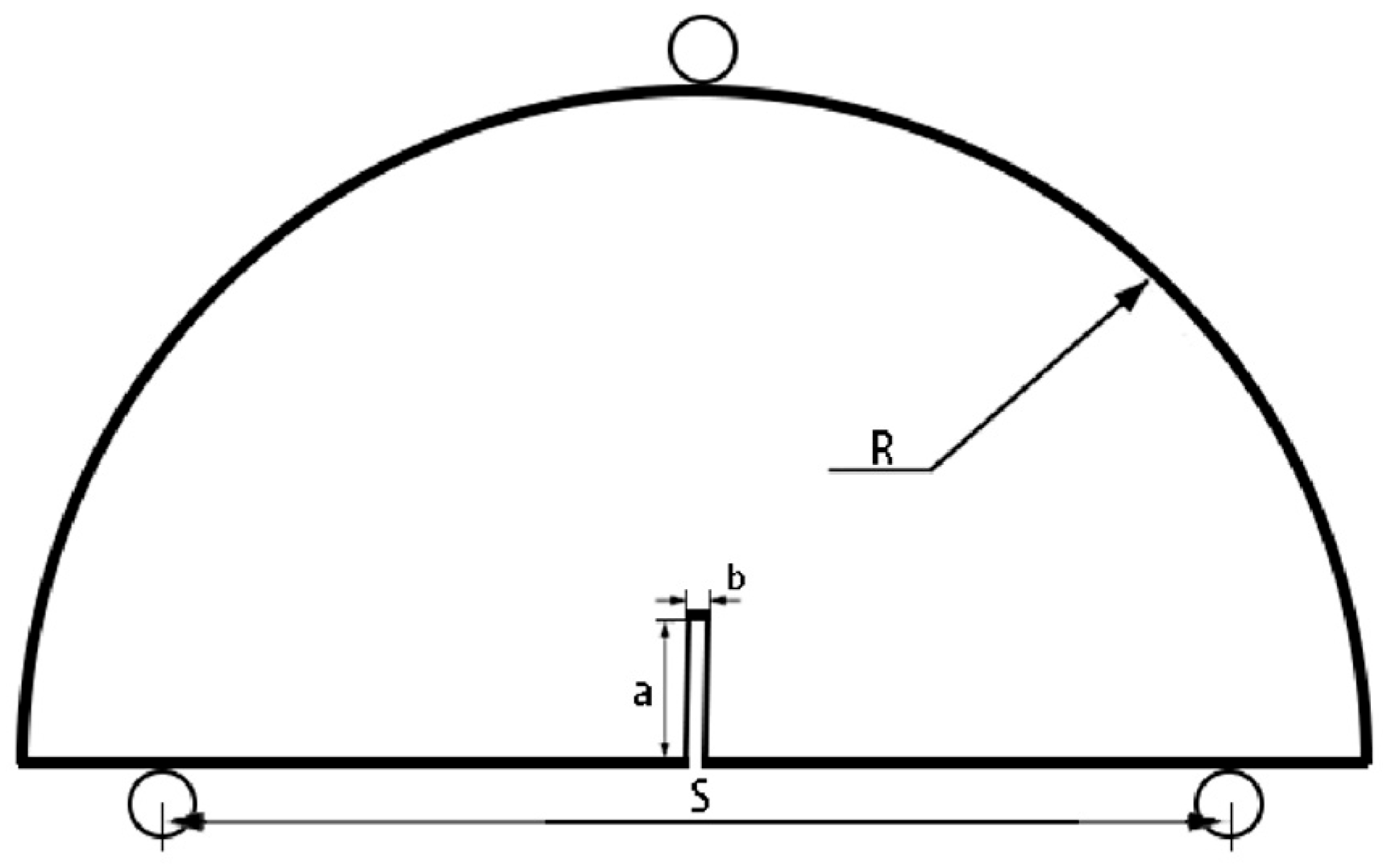
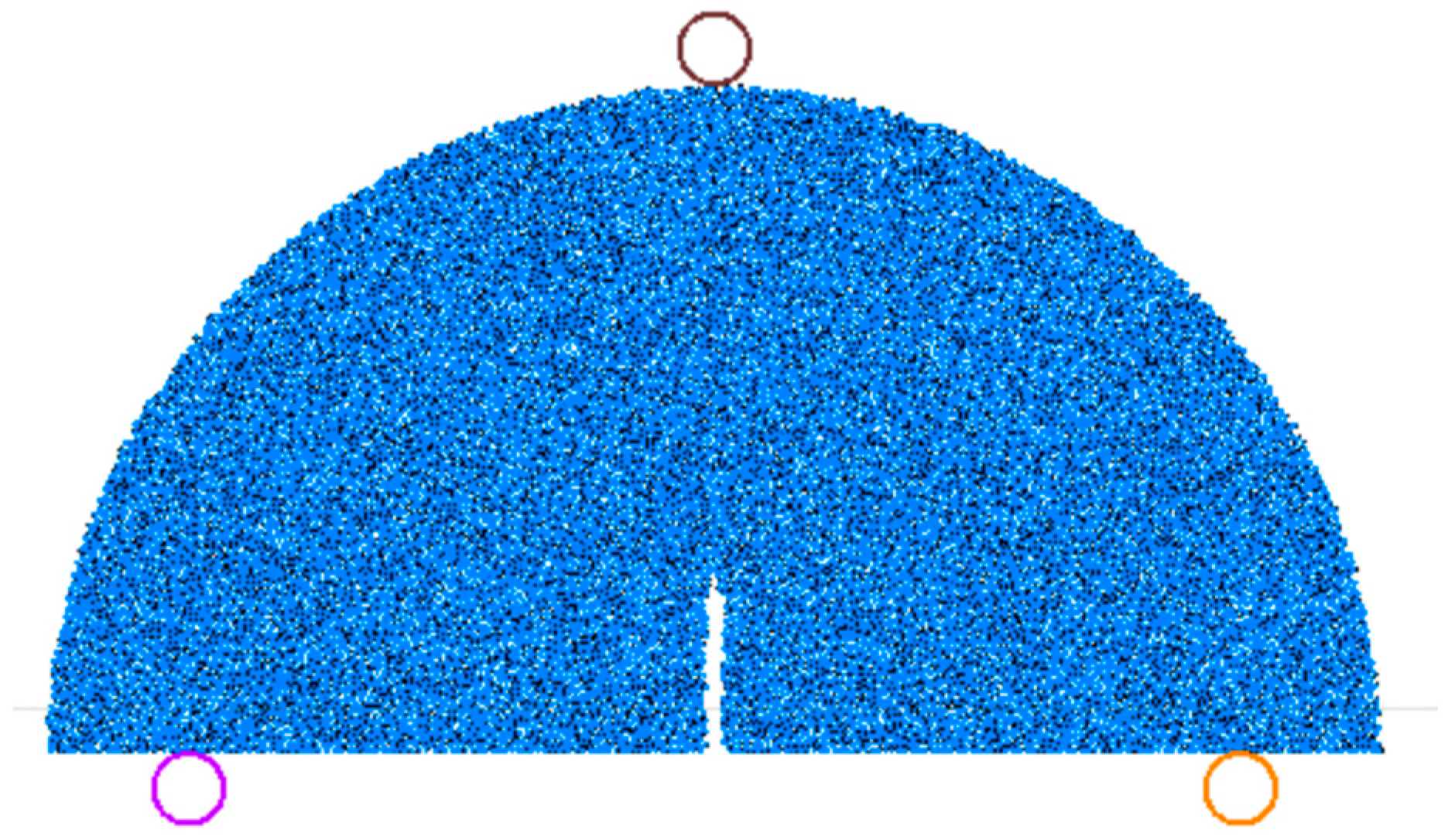
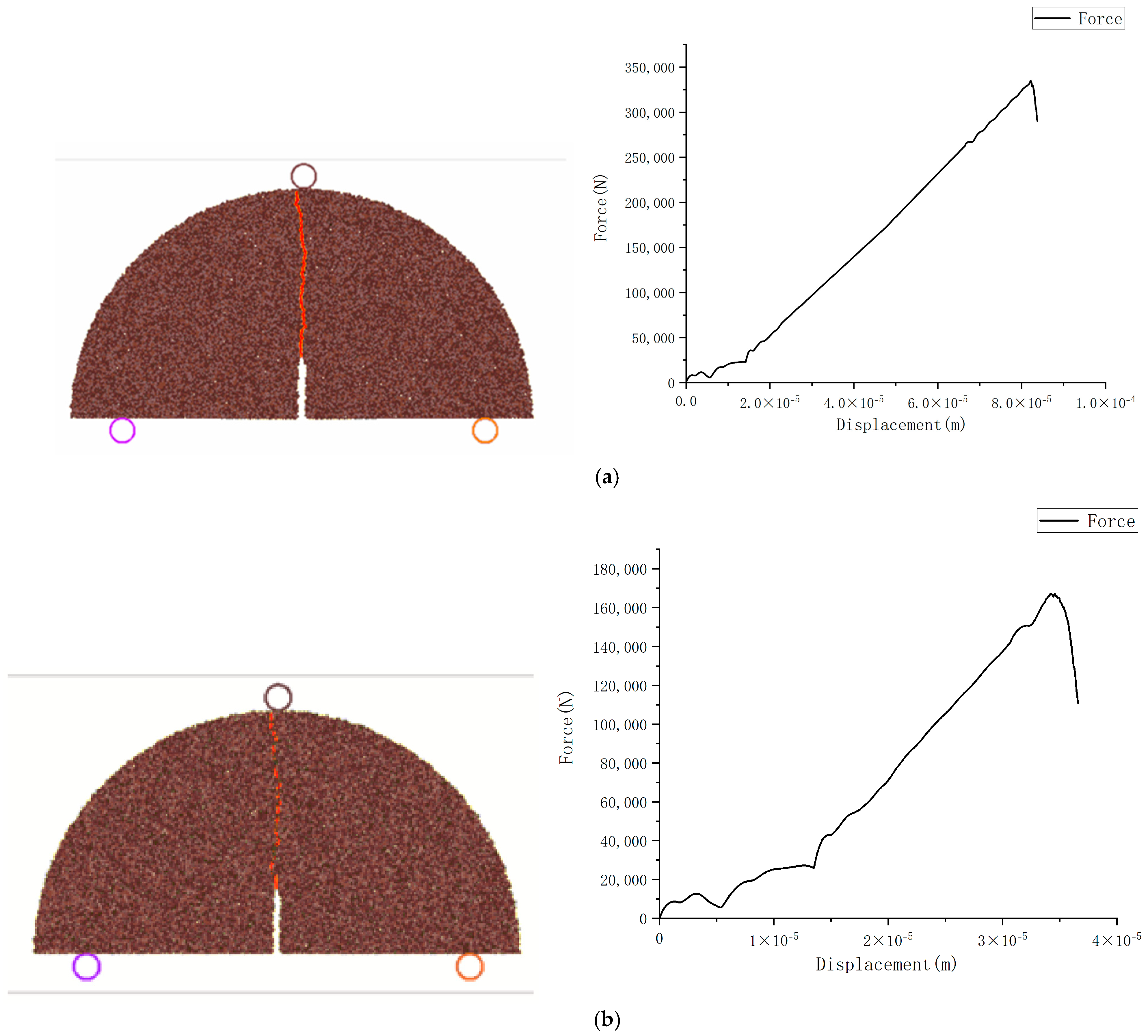
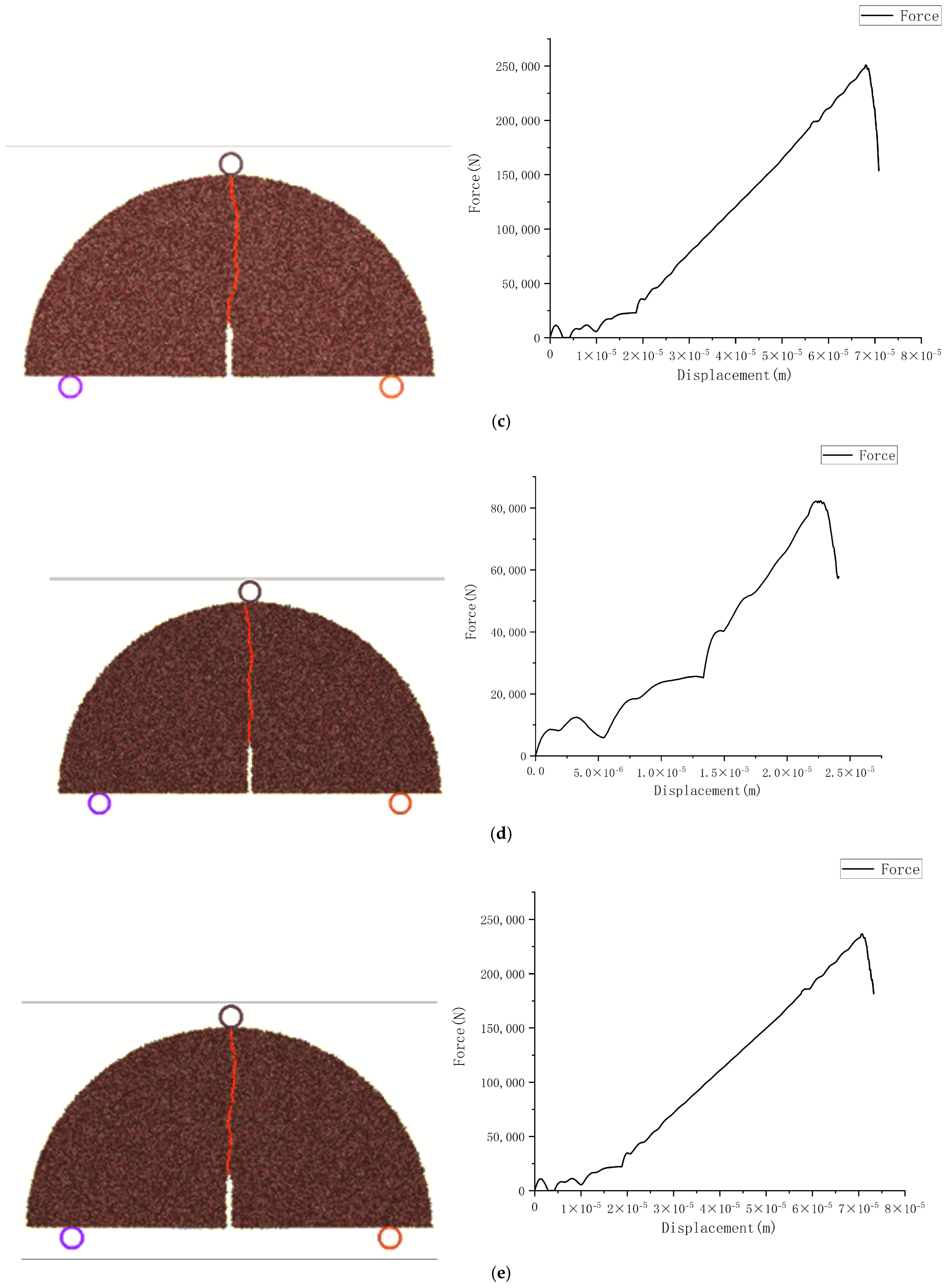
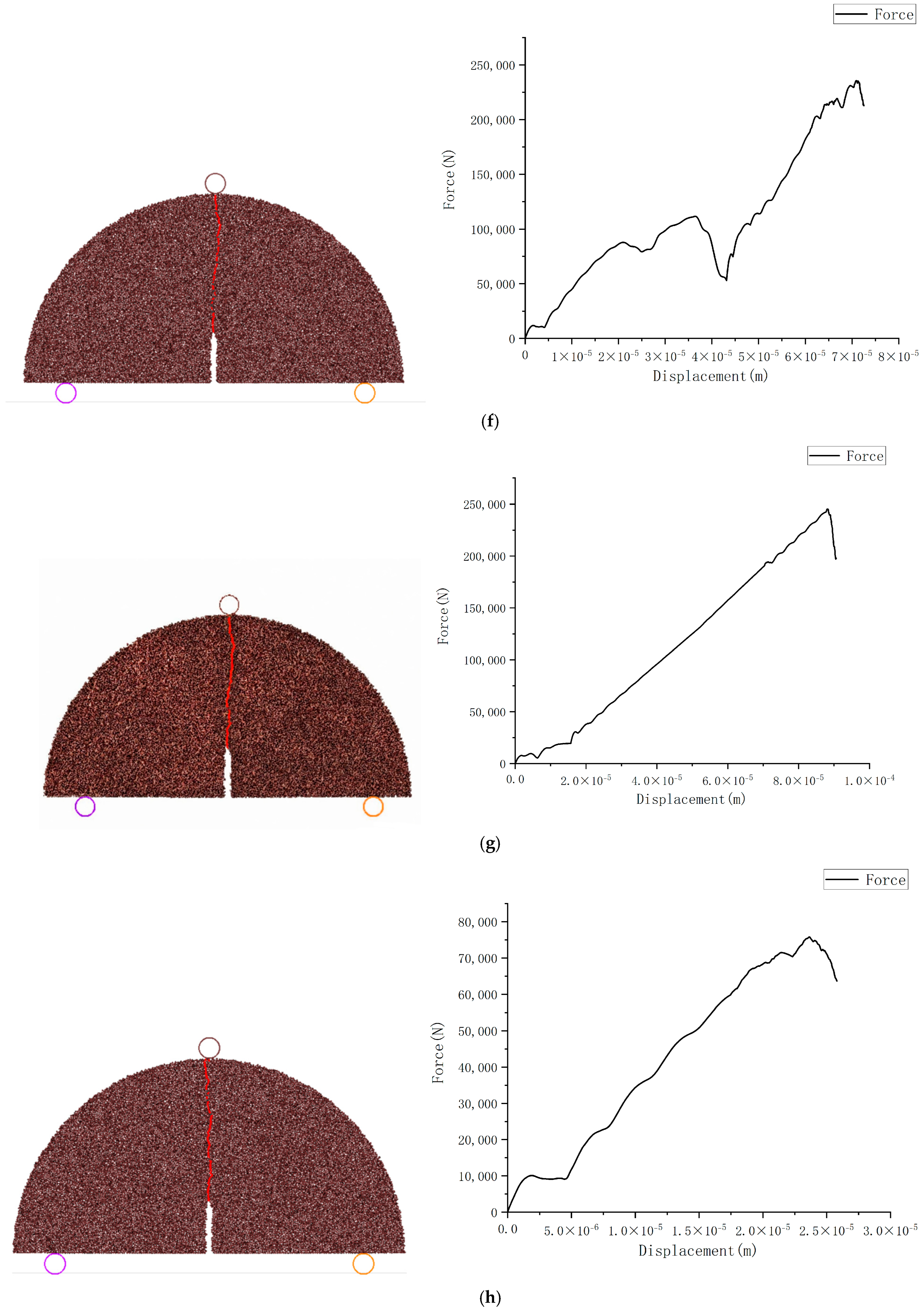
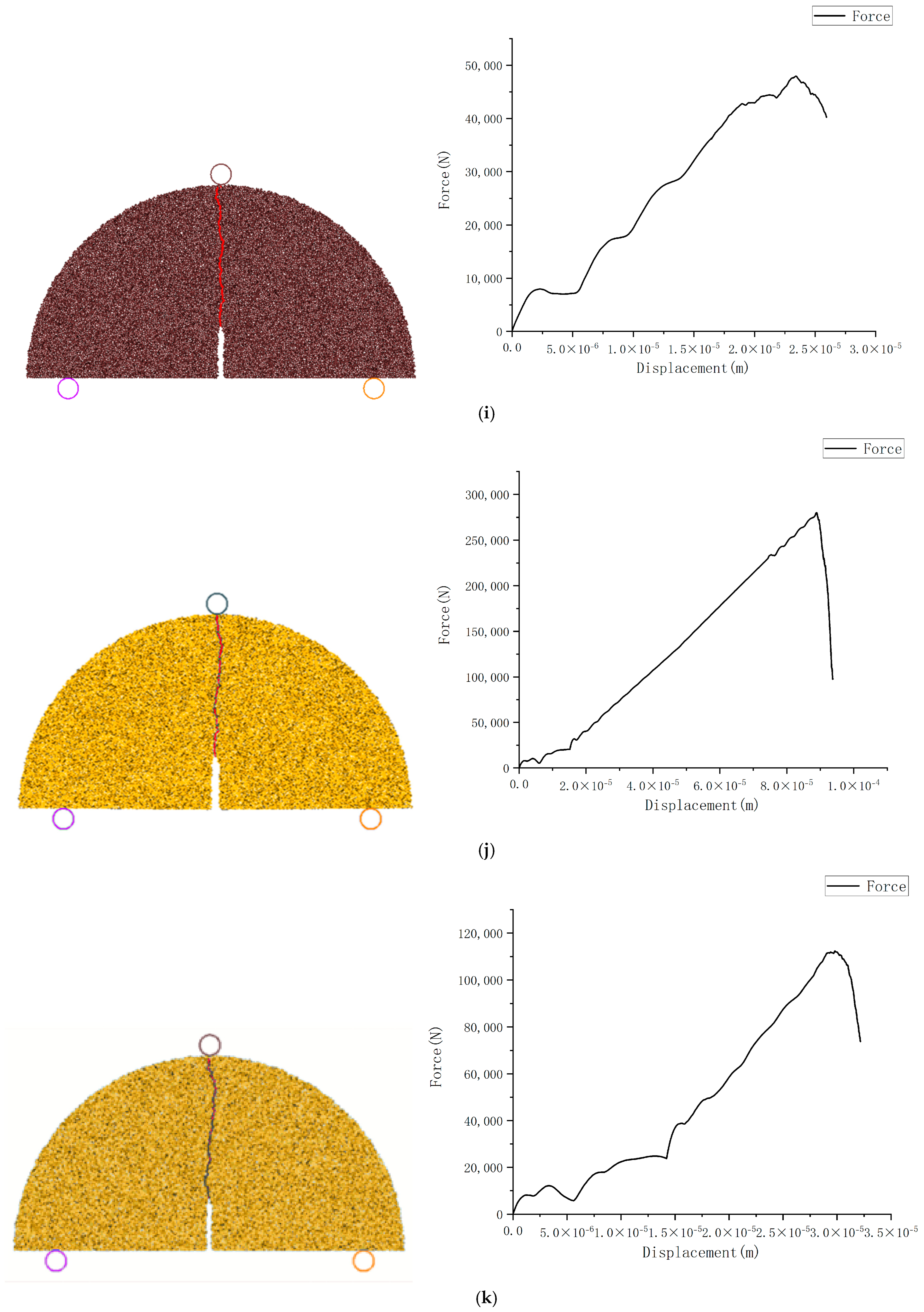
- The simulation results show that the fracture toughness of each lamina is uneven and the variance is large. The average fracture toughness of carbonate-bearing mixed shale laminae is 1.973. The average fracture toughness of the felsic-bearing mixed shale lamina is 1.791, the clay mixed shale lamina has only one set of data, and the fracture toughness is 2.4016. However, the fracture toughness of each lamina can be roughly divided into two ranges of 0.4–1.0 and above 2.0, and only one set of data is outside these two ranges. The fracture toughness of carbonate-bearing mixed shale laminae is greater than that of felsic-bearing mixed laminae. Because the slip fracture is not considered in the simulation, the simulation and acquisition of mode II fracture toughness is not carried out. In the subsequent simulation process, it is necessary to carry out simulation experiments on the slip fracture of rock, and construct a central straight crack Brazilian disc with a certain offset angle to simulate the mode II fracture toughness [31].
Author Contributions
Funding
Data Availability Statement
Conflicts of Interest
References
- Félix, G.; Djimasbe, R.; Varfolomeev, M.A.; Al-Muntaser, A.; Tirado, A.; Suwaid, M.; Prochukhan, K.Y.; Bochkov, A.S.; Frolov, K.N.; Zhdaneev, O.V.; et al. Kinetic modeling of oil shale upgrading at sub- and supercritical water conditions using Ni- and Fe-based oil-soluble catalysts. J. Supercrit. Fluids 2024, 207, 106193. [Google Scholar] [CrossRef] [Scilit]
- Zhou, Q.; Jin, Z.; Yang, G.; Dong, N.; Shang, Z. Inspiration from the post-shale revolution era in North America. China Pet. Explor. 2022, 27, 26–39. [Google Scholar]
- Zhang, F.; Li, G.; Zheng, X.; Wu, Q.; Li, Z.; Zhang, Q.; Wang, J.; Zhang, L. Ten major driving forces for the vigorous development of unconventional oil and gas in North America and its impact on regional oil and gas supply and demand. Pet. J. 2014, 35, 890–900. [Google Scholar]
- Zhao, W.; Hu, S.; Hou, L.; Yang, T.; Li, X.; Guo, B.; Yang, Z. Types and resource potential of continental shale oil in China and its boundary with tight oil. Pet. Explor. Dev. 2020, 47, 2–12. [Google Scholar] [CrossRef] [Scilit]
- Jin, Z.; Wang, G.; Liu, G.; Gao, B.; Liu, Q.; Wang, H.; Liang, X.; Wang, R. Research progress and key scientific issues of continental shale oil in China. Pet. J. 2021, 42, 821–835. [Google Scholar]
- Sun, L.; Liu, H.; Zhu, R.; Cui, B.; Lei, Z.; Meng, S.; Tang, J. ten issues worthy of attention in China ‘s shale oil revolution. Pet. J. 2023, 44, 2007–2019. [Google Scholar]
- Cała, M.; Cyran, K.; Stopkowicz, A.; Kolano, M.; Szczygielski, M. Preliminary Application of X-ray Computed Tomography on Characterization of Polish Gas Shale Mechanical Properties. Rock Mech. Rock Eng. 2016, 49, 4935–4943. [Google Scholar] [CrossRef] [Scilit]
- Zhang, H. Rock Mechanics Characteristics and Brittleness Evaluation Technology of Marine High Mature Shale Reservoir. Ph.D. Thesis, Chengdu University of Technology, Chengdu, China, 2019. [Google Scholar]
- Cheng, S.; Sheng, M.; Deng, C. Identification of different lithofacies laminations in oil shale and their mechanical properties. Front. Energy Res. 2024, 11, 1321853. [Google Scholar] [CrossRef] [Scilit]
- Shi, X.; Jiang, S.; Lu, S.; He, Z.; Li, D.; Wang, Z.; Xiao, D. Investigation of mechanical properties of bedded shale by nanoindentation tests: A case study on Lower Silurian Longmaxi Formation of Youyang area in southeast Chongqing, China. Pet. Explor. Dev. 2019, 46, 155–164. [Google Scholar] [CrossRef] [Scilit]
- Shi, Y.; Gou, Y.; Liu, X.; Geng, Z.; Xiong, J.; Zhang, J.; Luo, J. Logging prediction method of rock mechanical parameters for complex lithology shale reservoirs in continental shale oil—A case study of the Lucaogou Formation in Jimsar Sag, Junggar Basin. Nat. Gas Geosci. 2025, 36, 2179–2192. [Google Scholar]
- Wang, Y.; Cao, Y.; Ma, B.; Liu, H.; Gao, Y.; Chen, L. Mechanism of diagenetic trap formation in nearshore subaqueous fans on steep rift lacustrine basin slopes—A case study from the Shahejie Formation on the north slope of the Minfeng Subsag, Bohai Basin, China. Pet. Sci. 2014, 11, 481–494. [Google Scholar] [CrossRef] [Scilit]
- Yang, C. Study on Sedimentary Characteristics and Genesis of Multi-Grade Reservoirs in the Upper Submember of the Fourth Member of Shahejie Formation, Paleogene, Minfeng Sag. Master’s Thesis, China University of Geosciences (Beijing), Beijing, China, 2023. [Google Scholar] [CrossRef]
- Fang, Z.; Liu, H.; Tian, W.; Zhang, P.; Zhang, L.; Guo, W.; Hao, P. Lithofacies Characteristics and Distribution Patterns of Shale in Steep Slope Deep Depression Areas of Continental Rift Basins. J. China Univ. Pet. (Ed. Nat. Sci.) 2025, 49, 57–70. [Google Scholar]
- Bieniawski, Z.T.; Hawkes, I. Suggested Methods for Determining Tensile Strength of Rock Materials. Int. J. Rock Mech. Min. Sci. 1978, 15, 99–103. [Google Scholar] [CrossRef] [Scilit]
- NB/T 10248-2019; Determination and Evaluation Method of Shale Brittleness Index. National Energy Administration: Beijing, China, 2019.
- Cundall, P.A.; Strack, O.D.L. A discrete numerical model for granular assemblies. Géotechnique 1979, 29, 47–65. [Google Scholar] [CrossRef] [Scilit]
- Tang, H.; Song, G.; Zhou, F.; Yang, J. Experimental study on macro and meso parameters of limestone materials based on particle flow model-taking Zengziyan unstable rock in Nanchuan District of Chongqing as an example. J. Chongqing Norm. Univ. (Nat. Sci. Ed.) 2024, 41, 50–60. [Google Scholar]
- Jiang, Y.; Zou, W. Study on the correlation between macro and micro parameters of hollow cylindrical gray sandstone based on PFC3D. Coal Sci. Technol. 2024, 52, 78–89. [Google Scholar]
- Wang, X. PFC Simulation of Jointed Rock Indoor Test and Failure Law Analysis. Master’s Thesis, Kunming University of Science and Technology, Kunming, China, 2023. [Google Scholar]
- Liu, X.; Zeng, N.; Zhang, L.; Hou, Z.; Pan, Y.; Hao, Z.; Li, T. Improved PFC fluid-solid coupling model and its simulation of reservoir shale seepage failure. Appl. J. Fundam. Eng. Sci. 2023, 31, 467–482. [Google Scholar]
- He, B.; Liu, J.; Zhao, P.; Wang, J. PFC2D-based investigation on the mechanical behavior of anisotropic shale under Brazilian splitting containing two parallel cracks. Front. Earth Sci. 2021, 15, 803–816. [Google Scholar] [CrossRef] [Scilit]
- Tang, W.; Zhai, C.; Yu, X.; Xu, J.; Sun, Y.; Cong, Y.; Zheng, Y.; Wang, Y. Dynamic Brazilian splitting experiment of bedding shale based on continuum-discrete coupled method. Int. J. Impact Eng. 2022, 168, 104289. [Google Scholar] [CrossRef] [Scilit]
- Lan, S. Study on the Physical and Mechanical Properties of Xinjiang Balikun Oil Shale and the Mechanism of Crack Evolution Under Confining Pressure. Master’s Thesis, Jilin University, Changchun, China, 2024. [Google Scholar] [CrossRef]
- Duan, K. Micromechanical Modeling of Inherently Anisotropic Rock and Its Application in Borehole Breakout Analyses. Ph.D. Thesis, The University of Hong Kong, Hong Kong, China, 2016. [Google Scholar]
- Du, Y.; Li, R.; Xing, Z.; Yang, H.; Xiong, L.; Deng, H.; Ma, S.; He, J.; Li, K.; Su, H. Brittleness evaluation based on micro-macro rock mechanics and fractal dimension and its application in hydraulic fracturing-taking the shale reservoir of Qiongzhusi formation in southern Sichuan as an example. Geol. China 2026, 1–20. [Google Scholar]
- Liu, H.; Li, J.; Liu, X.; Yu, F.; Yan, J.; Wang, Y.; Ren, J.; Feng, H.; Wei, X.; Yang, C. The development characteristics and genetic mechanism of shale fractures in the upper Es4-lower Es3 of Dongying Sag, Bohai Bay Basin. Oil Nat. Gas Geol. 2025, 46, 1960–1979. [Google Scholar]
- Zhao, Z.; Liu, D.; Cui, Z.; Tang, T.; Han, W. Experimental study on the determination of fracture toughness (KIC) of shale by semi-disk three-point bending method. Geomechanics 2018, 39, 258–266. [Google Scholar]
- Wei, M.; Dai, F.; Xu, N.; Zhao, T.; Liu, Y. Experimental and numerical study on the cracked chevron notched semi-circular bend method for characterizing the mode I fracture toughness of rocks. Rock Mech. Rock Eng. 2016, 49, 1595–1609. [Google Scholar] [CrossRef] [Scilit]
- Dai, F.; Wei, M.-D.; Xu, N.-W.; Xu, Y.; Zhao, T. Rock fracture toughness CCNSCB method for progressive failure mechanism and dimensionless stress intensity factor calibration in a wide range. Geotech. Mech. 2016, 37, 3215–3223. [Google Scholar]
- Zhang, C.; Li, D.; Yang, B. Progress in Mode II Fracture Theory and Test Technology of Rock Materials. Eng. Mech. 2025, 42, 19–36. [Google Scholar] [CrossRef] [Scilit]







| Lithology | Quartz Content | Dolomite Content | Calcite Content | Illite Content | Pyrite Content | Plagioclase Content | Siderite Content |
|---|---|---|---|---|---|---|---|
| Carbonate-bearing Mixed Shale Lamina | 27% | 21% | 19% | 22% | 2% | 8% | 1% |
| Felsic-bearing Mixed Shale Lamina | 29% | 21% | 11% | 29% | 1% | 8% | 1% |
| Core Number | Diameter D/mm | Length L/mm | Failure Load P/N | Tensile Strength σt/MPa |
|---|---|---|---|---|
| Y-Ten-01 | 25 | 12.5 | 1369 | 2.79 |
| Y-Ten-02 | 25 | 12.5 | 1984 | 4.03 |
| Y-Ten-03 | 25 | 12.5 | 668 | 1.33 |
| Y-Ten-04 | 25 | 12.5 | 733 | 1.49 |
| Core Number | Diameter/mm | Height/mm | Mass/g | Density g/cm3 |
|---|---|---|---|---|
| Y-Tri-01 | 24.82 | 49.02 | 60.87 | 2.57 |
| Y-Tri-02 | 24.81 | 48.59 | 56.39 | 2.40 |
| Y-Tri-03 | 24.91 | 42.13 | 49.13 | 2.39 |
| Y-Tri-04 | 24.84 | 49.15 | 59.38 | 2.49 |
| Core Number | Confining Pressure /MPa | Compressive Strength /MPa | Young’s Modulus/GPa | Poisson’s Ratio | Angle/° |
|---|---|---|---|---|---|
| Y-Tri-01 | 13.2 | 73.92 | 23.40 | 0.173 | 33.29 |
| Y-Tri-02 | 13.2 | 55.78 | 14.86 | 0.216 | 32.03 |
| Y-Tri-03 | 13.2 | 69.91 | 21.07 | 0.159 | 20.04 |
| Y-Tri-04 | 13.2 | 38.65 | 8.36 | 0.192 | 28.19 |
| Core Number | Brittleness Index |
|---|---|
| Y-Tri-01 | 87.719 |
| Y-Tri-02 | 21.609 |
| Y-Tri-03 | 92.254 |
| Y-Tri-04 | 21.053 |
| Brittleness Index of Shale Rock Mechanics | Evaluation Level |
|---|---|
| Excellent | |
| Good | |
| medium | |
| Poor |
| Core Number | Lithology | emod = pb_emod/GPa | krat = pb_krat | pb_ten/MPa | pb_coh/MPa | pb_fa/° |
|---|---|---|---|---|---|---|
| Y-Ten-01 | Carbonate-bearing Mixed Shale | 2.0 | 3 | 19.407 | 19.53 | 33.58 |
| Y-Ten-01 | Felsic-bearing Mixed Shale | 2.4 | 2.8 | 20.066 | 20.876 | 33.58 |
| Y-Ten-02 | Carbonate-bearing Mixed Shale | 1.0 | 2.5 | 19.08 | 19.25 | 43.81 |
| Y-Ten-02 | Felsic-bearing Mixed Shale | 1.0 | 2.5 | 13.83 | 14.88 | 33.58 |
| Y-Ten-03 | Carbonate-bearing Mixed Shale | 1.8 | 2.8 | 15.29 | 11.27 | 13.58 |
| Y-Ten-04 | Carbonate-bearing Mixed Shale | 1.2 | 3 | 10.342 | 10.011 | 33.58 |
| Y-Ten-04 | Felsic-bearing Mixed Shale | 1.8 | 2.5 | 10.852 | 10.373 | 33.58 |
| Core Number | sj_kn/GPa | sj_ks/GPa | fric | sj_ten /MPa | sj_coh /MPa | sj_fa /° | dip/° |
|---|---|---|---|---|---|---|---|
| Y-Ten-01 | 783.5 | 560 | 0.5 | 1.111–1.815 | 1.128–1.810 | 4.9 | 71.52/90 |
| Y-Ten-02 | / | / | / | / | / | / | / |
| Y-Ten-03 | 1563.5 | 1560 | 0.5 | 3.330–4.130 | 3.332–4.130 | 4.9 | 90 |
| Y-Ten-04 | 1560 | 1560 | 0.577 | 2.792–3.792 | 3.064–4.064 | 4.9 | 90 |
| Core Number | Tensile Strength/MPa | Error | ||||
|---|---|---|---|---|---|---|
| Carbonate | Felsic | Structural Weak Planes | Simulated Core | Actual Core | ||
| Y-Ten-01 | 4.999 | 4.907 | 0.139–0.299 | 1.182 | 1.197 | 1.25% |
| Y-Ten-02 | 4.541 | 4.075 | / | 4.042 | 4.030 | 0.30% |
| Y-Ten-03 | 2.514 | / | 0.422 | 1.363 | 1.379 | 1.16% |
| Y-Ten-04 | 2.381 | 2.043 | 0.414 | 1.483 | 1.493 | 0.67% |
| Core Number | Lithology | emod = pb_emod/GPa | krat = pb_krat | pb_ten/MPa | pb_coh/MPa | pb_fa/° |
|---|---|---|---|---|---|---|
| Y-Tri-01 | Carbonate-bearing Mixed Shale | 21.2 | 2.8 | 30 | 25.72 | 43.81 |
| Y- Tri-01 | Felsic-bearing Mixed Shale | 21.2 | 2.0 | 38 | 29.72 | 33.53 |
| Y- Tri-02 | Carbonate-bearing Mixed Shale | 10.2 | 2.0 | 40 | 35.72 | 43.81 |
| Y- Tri-02 | Felsic-bearing Mixed Shale | 15.2 | 2.0 | 48 | 39.72 | 33.53 |
| Y- Tri-03 | Carbonate-bearing Mixed Shale | 12.2 | 2.0 | 10.50 | 9.72 | 43.81 |
| Y- Tri-03 | Felsic-bearing Mixed Shale | 12.2 | 2.0 | 11.00 | 10.22 | 33.53 |
| Y- Tri-04 | Carbonate-bearing Mixed Shale | 5.2 | 2.0 | 6.00 | 6.22 | 33.58 |
| Y- Tri-04 | Felsic-bearing Mixed Shale | 16.2 | 2.0 | 6.50 | 6.72 | 33.58 |
| Core Number | sj_kn/GPa | sj_ks/GPa | fric | sj_ten/MPa | sj_coh/MPa | sj_fa/° | dip/° |
|---|---|---|---|---|---|---|---|
| Y-Tri-01 | 1100 | 2000 | 0.577 | 23.3–33.1 | 18.9–28.1 | 4.9 | 135 |
| Y- Tri -02 | 1000 | 1000 | 0.577 | 30–35 | 25–30 | 4.9 | 38.2 |
| Y- Tri -03 | 1300 | 2000 | 0.577 | 11.8 | 11.6 | 4.9 | -45 |
| Y- Tri -04 | 1000 | 2000 | 0.577 | 11.8 | 11.9 | 4.9 | 110 |
| Core Number | Lithology | Poisson Ratio | Young’s Modulus/GPa | Compressive Strength/MPa |
|---|---|---|---|---|
| Y-Tri-01 | Felsic-bearing Mixed Shale | 0.273 | 35.57 | 65.71 |
| Y-Tri-02 | Felsic-bearing Mixed Shale | 0.244 | 18.14 | 38.14 |
| Y-Tri-03 | Felsic-bearing Mixed Shale | 0.267 | 19.81 | 22.62 |
| Y-Tri-04 | Felsic-bearing Mixed Shale | 0.267 | 9.81 | 14.64 |
| Y-Tri-01 | Carbonate-bearing Mixed Shale | 0.224 | 34.70 | 55.89 |
| Y-Tri-02 | Carbonate-bearing Mixed Shale | 0.198 | 15.37 | 33.76 |
| Y-Tri-03 | Carbonate-bearing Mixed Shale | 0.268 | 19.63 | 22.35 |
| Y-Tri-04 | Carbonate-bearing Mixed Shale | 0.271 | 8.92 | 13.62 |
| Core Number | Lithology | Brittleness Index |
|---|---|---|
| Y-Tri-01 | Felsic-bearing Mixed Shale | 50.000 |
| Y-Tri-02 | Felsic-bearing Mixed Shale | 36.632 |
| Y-Tri-03 | Felsic-bearing Mixed Shale | 24.432 |
| Y-Tri-04 | Felsic-bearing Mixed Shale | 5.670 |
| Y-Tri-01 | Carbonate-bearing Mixed Shale | 81.034 |
| Y-Tri-02 | Carbonate-bearing Mixed Shale | 62.099 |
| Y-Tri-03 | Carbonate-bearing Mixed Shale | 23.427 |
| Y-Tri-04 | Carbonate-bearing Mixed Shale | 1.333 |
| Model Parameter | Design Value/mm | Recommended ISRM Values |
|---|---|---|
| Diameter (D = 2R) | 76 | Take a large value (10 times the particle diameter or 76 mm) |
| Centre Crack Length (a) | 10 | 0.20 ≤ a/R |
| Centre Crack width (b) | 1000 | \ |
| Span (S) | 60 | 0.5 ≤ S/2R ≤ 0.8 |
| Core Number | Lithology | emod = pb_emod/GPa | krat = pb_krat | pb_ten/MPa | pb_coh/MPa | pb_fa/° |
|---|---|---|---|---|---|---|
| Y-KI-01 | Carbonate-bearing Mixed Shale | 15.0 | 1.0 | 45.00 | 43.2 | 33.53 |
| Y-KI-01 | Felsic-bearing Mixed Shale | 10.21 | 1.0 | 51.00 | 48.2 | 43.81 |
| Y-KI-02 | Carbonate-bearing Mixed Shale | 31.2 | 1.0 | 28.00 | 19.72 | 33.53 |
| Y-KI-02 | Felsic-bearing Mixed Shale | 21.2 | 1.0 | 20.00 | 15.72 | 43.81 |
| Y-KI-03 | Carbonate-bearing Mixed Shale | 15.2 | 2.0 | 38.00 | 34.72 | 33.53 |
| Y-KI-03 | Felsic-bearing Mixed Shale | 10.2 | 2.0 | 32.00 | 28.72 | 43.81 |
| Y-KI-04 | Carbonate-bearing Mixed Shale | 25.2 | 1.0 | 13.00 | 13.72 | 33.58 |
| Y-KI-04 | Felsic-bearing Mixed Shale | 20.2 | 1.0 | 11.00 | 11.72 | 43.81 |
| Y-KI-05 | Carbonate-bearing Mixed Shale | 15.2 | 2.0 | 38.00 | 34.72 | 33.58 |
| Y-KI-05 | Felsic-bearing Mixed Shale | 10.2 | 2.0 | 32.00 | 28.72 | 43.81 |
| Y-KI-05 | Clay- bearing Mixed Shale | 12.2 | 2.0 | 36.00 | 32.72 | 33.58 |
| Core Number | Lithology | Peak Load /kN | Fracture Toughness/ (MPa·m0.5) |
|---|---|---|---|
| Y-KI-01 | Carbonate-bearing Mixed Shale | 334.8425 | 3.6140 |
| Y-KI-02 | Carbonate-bearing Mixed Shale | 167.1003 | 1.8035 |
| Y-KI-03 | Carbonate-bearing Mixed Shale | 250.8668 | 2.7076 |
| Y-KI-04 | Carbonate-bearing Mixed Shale | 82.3265 | 0.8886 |
| Y-KI-05 | Carbonate-bearing Mixed Shale | 197.7146 | 2.1339 |
| Y-Tri-01 | Carbonate-bearing Mixed Shale | 196.4008 | 2.1185 |
| Y-Tri-02 | Carbonate-bearing Mixed Shale | 298.9261 | 3.2263 |
| Y-Tri-03 | Carbonate-bearing Mixed Shale | 72.5475 | 0.7824 |
| Y-Tri-04 | Carbonate-bearing Mixed Shale | 44.4140 | 0.4790 |
| Y-KI-01 | Felsic-bearing Mixed Shale | 280.0740 | 3.0228 |
| Y-KI-02 | Felsic-bearing Mixed Shale | 112.3747 | 1.2129 |
| Y-KI-03 | Felsic-bearing Mixed Shale | 190.1976 | 2.0528 |
| Y-KI-04 | Felsic-bearing Mixed Shale | 69.3505 | 0.7485 |
| Y-KI-05 | Felsic-bearing Mixed Shale | 236.5637 | 2.5532 |
| Y-Tri-01 | Felsic-bearing Mixed Shale | 235.6903 | 2.5422 |
| Y-Tri-02 | Felsic-bearing Mixed Shale | 245.3330 | 2.6479 |
| Y-Tri-03 | Felsic-bearing Mixed Shale | 75.7750 | 0.8175 |
| Y-Tri-04 | Felsic-bearing Mixed Shale | 47.9401 | 0.5172 |
| Y-KI-05 | Clay-bearing Mixed Shale | 222.5164 | 2.4016 |
Disclaimer/Publisher’s Note: The statements, opinions and data contained in all publications are solely those of the individual author(s) and contributor(s) and not of MDPI and/or the editor(s). MDPI and/or the editor(s) disclaim responsibility for any injury to people or property resulting from any ideas, methods, instructions or products referred to in the content. |
© 2026 by the authors. Licensee MDPI, Basel, Switzerland. This article is an open access article distributed under the terms and conditions of the Creative Commons Attribution (CC BY) license.
Share and Cite
Huo, Y.; You, Q.; Liu, X. Numerical Simulation of Mechanical Parameters of Oil Shale Rock in Minfeng Subsag. Processes 2026, 14, 476. https://doi.org/10.3390/pr14030476
Huo Y, You Q, Liu X. Numerical Simulation of Mechanical Parameters of Oil Shale Rock in Minfeng Subsag. Processes. 2026; 14(3):476. https://doi.org/10.3390/pr14030476
Chicago/Turabian StyleHuo, Yuhao, Qing You, and Xiaoqiang Liu. 2026. "Numerical Simulation of Mechanical Parameters of Oil Shale Rock in Minfeng Subsag" Processes 14, no. 3: 476. https://doi.org/10.3390/pr14030476
APA StyleHuo, Y., You, Q., & Liu, X. (2026). Numerical Simulation of Mechanical Parameters of Oil Shale Rock in Minfeng Subsag. Processes, 14(3), 476. https://doi.org/10.3390/pr14030476