Article

Characterization of the Microbiota Dynamics in Cold-Smoked Salmon Under Cold Chain Disruption Using 16S rRNA Amplicon Sequencing


by
Joanna Bucka-Kolendo
1,*,
Paulina Średnicka
1,
Adrian Wojtczak
1,
Dziyana Shymialevich
1,
Agnieszka Zapaśnik
1,
Ewelina Kiełek
1,
Dave J. Baker
2 and
Barbara Sokołowska
1,*
1
Department of Microbiology, Prof. Waclaw Dabrowski Institute of Agricultural and Food Biotechnology—State Research Institute, Rakowiecka 36 Street, 02-532 Warsaw, Poland
2
Quadram Institute Bioscience, Norwich Research Park, Rosalind Franklin Rd., Norwich NR4 7UQ, UK
*
Authors to whom correspondence should be addressed.
Processes 2026, 14(3), 452; https://doi.org/10.3390/pr14030452
Submission received: 16 December 2025 / Revised: 26 January 2026 / Accepted: 26 January 2026 / Published: 28 January 2026

Abstract

Background/Objectives: Cold-smoked salmon (CSS) is a ready-to-eat product with minimal preservation hurdles and a microbiota shaped by raw-material contamination and processing environments. Short breaks in refrigeration commonly occur during shopping and transport, yet their microbiological impact remains unclear. Here, we used ASV-resolved 16S rRNA gene metataxonomics to characterize storage-driven microbiota dynamics in CSS—quantifying ASV-level genetic diversity and phylogeny-aware (UniFrac) community structure—and to evaluate the effect of a brief, consumer-mimicking 2 h room-temperature cold-chain disruption. Methods: Three CSS types (organic, conventional Norwegian, and conventional Scottish) were stored at 5 °C for 35 days. On day 16, half of each batch was exposed to 2 h at room temperature (RT) before analysis; paired controls remained refrigerated. Culture-based counts (total mesophiles, lactic acid bacteria, Photobacterium spp.; indicator/pathogen screens) were performed per ISO methods. Community profiling used 16S rRNA (V3–V4) amplicon sequencing with QIIME 2/DADA2 and SILVA taxonomy. Linear mixed effects modelled alpha diversity; beta diversity by PERMANOVA on UniFrac distances; differential abundance by ANCOM-BC. Results: ASV-resolved 16S rRNA gene profiles of CSS were dominated by Pseudomonadota and Bacillota, with storage-driven shifts and taxon-specific trajectories (e.g., increasing Latilactobacillus). Both time and product type significantly explained phylogeny-aware community structure (unweighted and weighted UniFrac), consistent with storage-driven phylogenetic convergence across products. At day 16, ASV-level genetic diversity (Shannon/Observed features) and genus-level composition did not differ between RT-disrupted and continuously refrigerated samples. Culture-dependent counts increased from baseline to day 16 and largely plateaued by day 35, with lactic acid bacteria in Norwegian CSS continuing to rise; no systematic effect of the 2 h RT exposure was observed in culture-based comparisons. Indicator/pathogen screens detected no unexpected pathogenic species throughout the study period. Conclusions: Refrigerated storage drives pronounced, phylogeny-aware microbiota shifts and cross-product convergence in cold-smoked salmon, whereas a single 2 h RT interruption at mid-storage did not measurably alter ASV-level genetic diversity or community structure under the tested conditions. Integrating culture-based enumeration with ASV-resolved 16S rRNA gene metataxonomics provides complementary insights for shelf-life evaluation and risk assessment in ready-to-eat seafood.

1. Introduction

Global smoked salmon production represents a rapidly expanding, multi-billion-euro market, largely driven by farmed Atlantic salmon (Salmo salar). Europe dominates both production and consumption, with Poland and France among the leading processors, while North America remains a major consumer market and the Asia–Pacific region shows the fastest growth rate [1]. Salmon is currently the second most consumed fish species in the European Union, with global production reaching approximately 2.9 million tonnes in 2022. This high demand, combined with extended distribution chains and consumer preference for minimally processed products, places increasing pressure on maintaining quality and safety throughout the supply chain.
Fish and seafood products are inherently highly perishable due to their biochemical composition and susceptibility to microbial activity [2,3,4,5,6,7,8]. High water activity, neutral pH, and abundant proteins and lipids create favourable conditions for microbial growth, leading to rapid spoilage and sensory deterioration. It is estimated that microbial growth and metabolism account for up to 25% of food losses in the fish sector. The rate and nature of spoilage are further influenced by seasonality, fish origin, farming practices, and handling conditions, highlighting the complexity of microbial dynamics in seafood products.
Cold-smoked salmon (CSS) is a high-value ready-to-eat (RTE) product that undergoes salting and smoking without lethal heat treatment. As a result, CSS retains a high water activity and requires prolonged refrigerated storage, conditions that promote the development of complex and dynamic microbial communities. From a safety perspective, CSS has historically been associated with Listeria monocytogenes, owing to the pathogen’s ability to tolerate salt, grow at refrigeration temperatures, and persist in processing environments through biofilm formation [9]. Consequently, regulatory frameworks and routine microbiological surveillance have focused primarily on pathogen detection and compliance, particularly with respect to L. monocytogenes in RTE foods.
However, an exclusive focus on pathogens provides an incomplete view of CSS microbiology. A growing body of evidence demonstrates that the microbiota of CSS also plays a functional role in determining product quality, sensory attributes, and shelf-life stability. Typical CSS microbial communities are dominated by psychrotrophic and halotolerant bacteria, including lactic acid bacteria (LAB; Lactobacillus, Carnobacterium), as well as Photobacterium, Shewanella, Brochothrix, and Psychrobacter. These microorganisms contribute to proteolysis, lipolysis, and the transformation of smoke-derived compounds, leading to the production of volatile organic compounds associated with characteristic aroma and flavour notes such as buttery, smoky, and umami-like sensations. Thus, the CSS microbiome represents a functional ecosystem in which spoilage organisms, technologically relevant bacteria, and potential pathogens coexist and interact [10,11,12,13]. The biochemical and structural properties of CSS further facilitate microbial spoilage. The soft, protein-rich muscle matrix allows microbial enzymes to diffuse rapidly, resulting in textural degradation and off-flavour formation, often becoming perceptible within one to two weeks of refrigerated storage [14,15]. Because cold smoking does not provide a sterilizing effect, the initial microbiota of the raw fish and the processing environment serve as the inoculum for subsequent microbial succession [15,16]. Even under vacuum packaging (VP) or modified atmosphere packaging (MAP), microbial growth continues, with time and temperature acting as key drivers of community shifts. During storage, microbial diversity typically decreases, while a limited number of taxa become dominant, such as Photobacterium in VP products or LAB and certain Gram-negative species in MAP products [4,14,17,18,19,20], especially after 7 days of storage, when the temperature shifts from 4 °C to 8 °C. By day 35, total viable counts often reach 7–8 log of colony-forming units per gram (CFU/g), approaching or surpassing sensory rejection thresholds [4]. These successional patterns are highly product- and batch-specific and may be influenced by fat content, anatomical origin of the fillet, and packaging conditions.
Despite these complexities, microbiological quality control in the seafood industry still relies predominantly on culture-dependent methods [21]. In the EU, there is no specific legislative limit for total viable count (TVC) in RTE smoked fish. However, the standard industry guidelines often categorize TVC levels in the RTE as: satisfactory < 105 CFU/g; acceptable 105 to <106 CFU/g; and unsatisfactory ≥ 106 CFU/g [22]. The EU regulations Reg. (EC) No 2073/2005, updated by Reg. (EU) 2024/2895 July 2026, focus heavily on Listeria monocytogenes in RTE smoked fish, requiring absence in 25 g or levels below 100 CFU/g throughout shelf life. While such methods are standardized, cost-effective, and required for regulatory compliance, they are inherently limited to cultivable microorganisms and provide little insight into microbial interactions or community structure [23]. Moreover, viable but non-culturable (VBNC) bacteria—which may retain metabolic activity and pathogenic potential—remain undetected, potentially leading to underestimation of microbial risks [21,24]. Given the dynamic and heterogeneous nature of CSS microbiota, culture-based approaches alone are insufficient to capture the full microbial landscape. Therefore, conventional identification methods can be underestimated, and the number of nonculturable microorganisms can be up to 99% [21,25]. Since the microbiome of the food and food processing environments is very complicated and dynamic, identifying the microorganisms with more advanced molecular biology techniques is needed [26]. Therefore, the development of culture-independent molecular methods and high-throughput sequencing technology became crucial in food-related microbiome analyses [21]. Those techniques’ high sensitivity and specificity allow for the detection of pathogens in food [11,21].
Recent research using next-generation sequencing (NGS) has significantly expanded our understanding of the microbial ecology of CSS. Beyond microbial surveillance, NGS-based tools offer novel opportunities for process monitoring and control in CSS production. By correlating metagenomic profiles with processing parameters and sensory outcomes, it becomes possible to develop predictive microbiome-based indicators of quality and safety. Such approaches support emerging strategies in precision food processing, where microbial communities are actively steered to enhance desirable traits while limiting pathogen proliferation [19]. The studies by Maillet et al. [2] and Jarvis et al. [27] demonstrate the strengths of culture-independent methods such as 16S rRNA metabarcoding and shotgun metagenomics in profiling both dominant and rare taxa, monitoring community dynamics over time, and distinguishing between product- and facility-associated microbial signatures. Both studies confirm the presence of a core microbiota in CSS, including Carnobacterium, Lactobacillus, Photobacterium, Shewanella, Psychrobacter, and Pseudomonas. These genera are recurrently identified across different batches, processing plants, and time points, and are recognized for their roles in spoilage or fermentation-related processes. However, the microbial community is not static. As shown in the large-scale longitudinal analysis by Maillet et al. [2], storage time drives shifts in the relative abundance of key taxa—particularly increases in LAB and declines in marine-origin bacteria such as Photobacterium. These changes are influenced not only by time and temperature, but also by packaging atmosphere and product physicochemical properties.
Crucially, both Maillet et al. and Jarvis et al. [2,27] report significant variation between processing facilities, which they attribute to the microbiological imprint of the local environment. Operational taxonomic units (OTUs) and genera unique to specific facilities (e.g., Arcobacter, Marinomonas, Enhydrobacter) suggest that surfaces, equipment, water quality, and hygienic practices shape the final microbiota of the product. Such facilities-specific microbial signatures align with findings from broader food microbiome studies, such as those discussed by Jarvis et al. [28], who observed strong overlaps between food microbiota and the microbiomes of production environments in both plant- and animal-based products.
The high-resolution insight provided by NGS makes it possible to trace contamination pathways and assess the stability of processing environments over time [11,20]. This is particularly important in the context of ready-to-eat products such as CSS, which undergo minimal thermal treatment and are consumed without further cooking. The ability to detect VBNC organisms or low-abundance pathogens adds another dimension to safety monitoring that cannot be achieved with traditional plating techniques [24]. Overall, shifting from a pathogen-centric perspective to a holistic, functionally informed view of the CSS microbiome allows for a more accurate representation of the product as a living microbial system. NGS-based technologies provide a critical link between microbial ecology, sensory quality, and risk assessment, enabling more effective and sustainable management of both safety and quality in CSS production.
Taken together, the reviewed studies underscore the growing consensus that microbiota composition in CSS results from a combination of intrinsic factors (e.g., water activity, salinity), process-related influences (e.g., salting, smoking), and extrinsic environmental inputs [7,8,15,19,24,29]. The integration of NGS technologies into routine surveillance not only enhances spoilage diagnostics but also enables data-driven optimization of hygiene, shelf-life, and food safety protocols. As NGS becomes more accessible and standardized, it is likely to play an increasingly central role in seafood microbiology and quality control frameworks [20,30,31,32,33,34,35,36,37].
The present study was designed to address this gap by evaluating whether a mild, consumer-relevant disruption of the cold chain induces detectable and product-specific changes in the microbiome of CSS that cannot be attributed to storage time alone. Three commercially relevant product types (organic, conventional Norwegian, and conventional Scottish) were stored for 35 days at 5 °C, with a standardized 2 h exposure to room temperature (RT) applied at mid-shelf life to simulate typical consumer handling. While the applied temperature abuse was intentionally mild and functional validation was beyond the scope of this study, the approach allows assessment of microbiome responsiveness under realistic conditions. By integrating product type, origin, and a controlled thermal perturbation, this study aims to contribute to a more nuanced understanding of microbial stability in CSS and to inform strategies for reducing spoilage, food losses, and safety risks in smoked seafood supply chains.

2. Materials and Methods

2.1. Salmon Samples

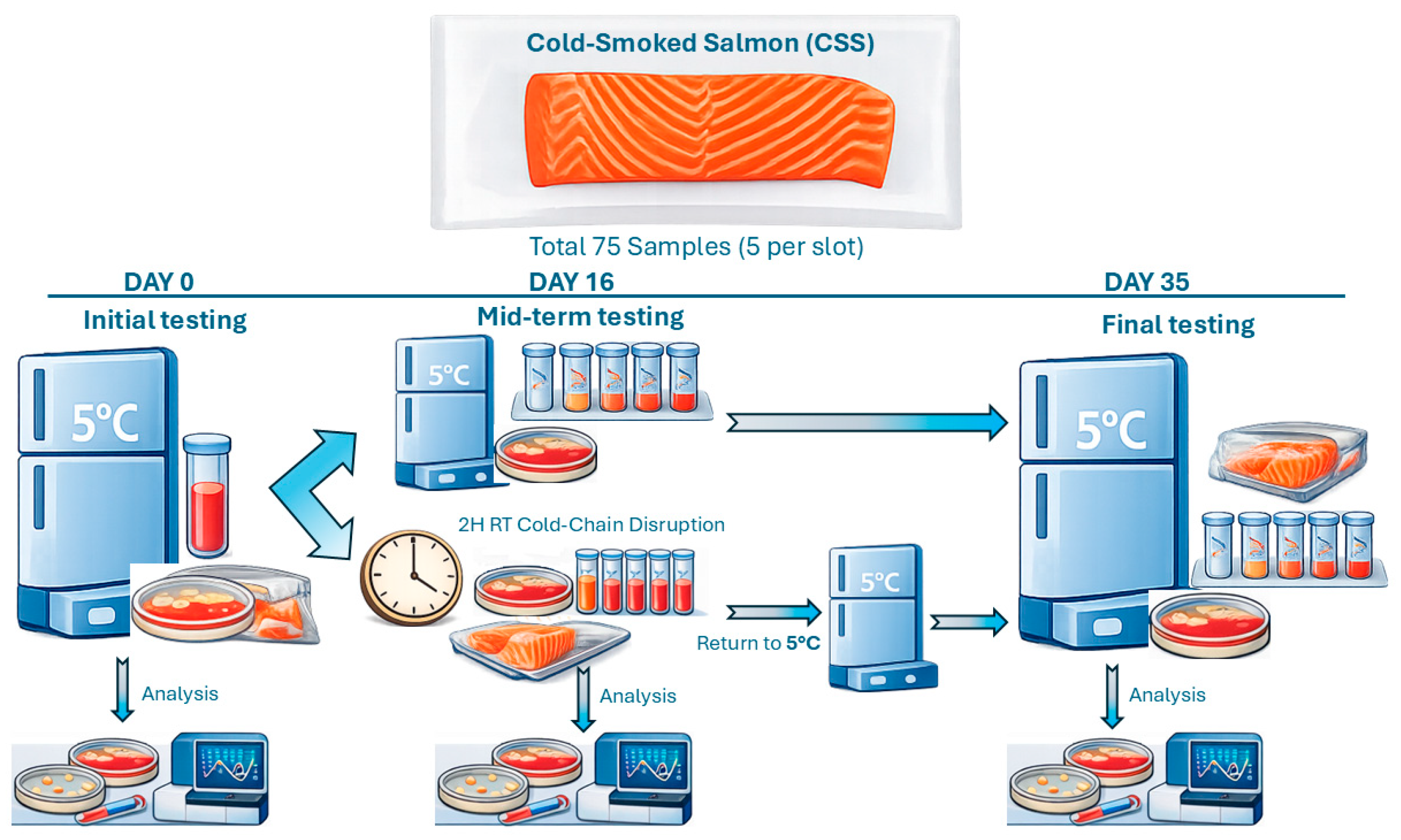
In this study, three types of CSS were used: sliced organic from Norway, conventional from Norway, and conventional from Scotland. All types of salmon were obtained directly from the manufacturer, where the fillets were salted, cured, and dried under controlled conditions. After that, the dried fillets were cold-smoked at approximately 27 °C over locally sourced beechwood. The smoked fillets were cut according to specifications and vacuum-packed (VP) on gold-silver trays, sealed with foil, and shipped to the laboratory in refrigerated conditions at 5 °C. Microbiological analyses were carried out on the first day and after 16 and 35 days of storage at 5 °C. A 2 h cold-chain disruption was selected to simulate realistic consumer handling scenarios, as this duration corresponds to commonly reported domestic exposure times and aligns with food safety guidance identifying 2 h at ambient temperature as a critical threshold for perishable RTE foods. To model the disruption of the cold chain, on the 16th day, a subset of samples originating from the same production batch was removed from refrigeration and exposed to room temperature for 2 h.
Immediately after 2 h of disruption, part of the material was taken for analysis. The remaining material from this subset was returned to refrigeration at 5 °C and stored further until day 35, when it was analyzed. Samples not subjected to RT exposure remained continuously refrigerated and were analyzed at the corresponding time points.
In total, 75 samples of CSS were tested, and five samples per slot were analyzed Figure 1).

2.2. Sample Preparation and DNA Extraction

The DNA was extracted at delivery (control), after 16 days of storage at 5 °C, and after 35 days of storage at 5 °C (n = 5), as described by Rouger et al. [38]. Briefly, 100 g of salmon fillet was placed in sterile filter bags and mixed with 100 mL of TS buffer (8.5 g/L NaCl, 1 g/L tryptone, and 1% Tween 80). After that, samples were hand-shaken for 5 min to separate the microbiome from the fish surface. Then, 20 mL of filtrate was placed in the sterile Falcon tubes and centrifuged for 20 min at 4000× g and 4 °C, after which the pellet was resuspended in 10 mL of TS buffer. Finally, the samples were either processed immediately for further analysis or stored at −20 °C for later DNA analysis.
DNA was extracted using the Qiagen DNeasy PowerFood Microbial Kit (Qiagen, GmbH, Hilden, Germany) according to the manufacturer’s protocol. The purity of the DNA was measured with a NanoDrop ND-1000 Spectrophotometer (Thermo Fisher Scientific, Waltham, MA, USA), and the DNA concentration was quantified using a Qubit 4.0 Fluorometer with the use of Qubit dsDNA BR Assay Kit (Invitrogen, Carlsbad, CA, USA). DNA was stored at −20 °C for further analysis.

2.3. 16S Illumina Library Preparation and NGS Analysis

The V3–V4 hypervariable region of the 16S rRNA gene was amplified using primers 341F/805R with Illumina overhang adapters. Library preparation and indexing were performed following the 16S Illumina Library Preparation Protocol v1.0 (Quadram Institute, Norwich, UK) [39]. Paired-end sequencing (2 × 300 bp) was conducted on an Illumina MiSeq platform (Illumina, San Diego, CA, USA) using v3 chemistry. Raw reads were demultiplexed, quality-filtered (>Q25), and denoised with DADA2 (v2025.7.0) implemented in QIIME 2 (v2025.7) [40], and amplicon sequence variants (ASVs) were then taxonomically classified using the SILVA v132 reference database.
Bioinformatic and statistical analyses were conducted separately for two experimental comparisons. In the first analysis, the effect of salmon type (SalmonType) on the temporal dynamics of alpha diversity (Shannon entropy) was assessed using the qiime longitudinal linear-mixed-effects model. Beta diversity differences were evaluated using PERMANOVA (qiime diversity adonis), and temporal changes in feature abundances were assessed using the qiime longitudinal feature-volatility approach. In the second comparison, the effect of a single 2 h RT exposure applied on day 16 was evaluated by comparing samples exposed to this episode with continuously refrigerated samples at the corresponding time points. Alpha diversity was assessed using the Shannon index and Observed Features metrics, with group differences tested by the Mann–Whitney U test. Differential abundance analysis was performed using ANCOM-BC to identify taxa with significantly different relative abundances between storage conditions. All analyses were performed in QIIME 2 using default parameters unless otherwise specified.

2.4. Microbiology Analyses

To evaluate the initial microbiota (control samples), plate count analysis was carried out immediately after the delivery of salmon samples, as described previously by Juszczuk-Kubiak et al. [41]. The procedure was repeated at each time point. Following ISO 6887-1 and 4:2017 [42,43], 100 g portions from each batch were aseptically placed into sterile filter bags. To prepare an initial suspension in a sterile stomacher plastic bag (Interscience, Saint-Nom-la-Bretèche, France), 100 mL Tryptone salt broth (0.85% (w/v) NaCl, 0.1% (w/v) tryptone, Biokar Diagnostic, Beauvais, France) was added. Then samples were agitated for 2 min in a Stomacher Colworth 400. Finally, serial decimal dilutions were prepared using the same diluent. Total mesophilic counts were enumerated at 30 °C on Plate Count Agar PCA (Merck, Darmstadt, Germany), incubated for 72 h according to ISO 4833-1:2013 [44]. LAB were enumerated according to ISO 15214:1998 [45] on de Man, Rogosa, and Sharpe (MRS) agar plates (Merck, Darmstadt, Germany) and incubated for 72 h at 30 °C. Confirmation presumptive LAB was carried out according to ISO standards (catalase test). Presumptive Photobacterium spp. were investigated according to Hilgarth et al. [46] on Marine Agar (Difco, Becton Dickinson, Sparks, MD, USA) supplemented with vancomycin. Where vancomycin effectively inhibits the growth of common Gram-positive meat spoilers, while the growth of Photobacterium spp. stayed unaffected. The colonies were enumerated after 5 days at 15 °C. Enterobacteriaceae were enumerated after 2 days at 30 °C on Violet Red Bile Glucose agar (VRBG) (Graso, Jabłowo, Poland). According to ISO 21528-2:2017 [47], five suspected colonies were selected and further screened by the biochemical assays. Presumptive Enterobacteriaceae were recorded if colonies appearing pink/purple on VRBGA were Gram-negative, oxidase-negative, and fermentative-positive (glucose). Coagulase-positive staphylococci (ISO 6888-2:2021 [48]) were enumerated on rabbit plasma fibrinogen agar medium after 2 days at 37 °C. Detection of Listeria monocytogenes was performed according to ISO standards ISO 11290-1:2017 [49], and enumerated on ALOA (bioMérieux, Marcy-l’Etoile, France) after 2 days at 37 °C according to ISO 11290-2:2017 [50]. The results were expressed as log CFU/g, with the limit of detection 1 log (CFU/g). All microbiological results were reported as mean log CFU/g ± standard deviation of two replicates.

2.5. Data Analysis and Statistics

All microbiological counts were log10-transformed (CFU/g) prior to analysis to ensure the normality of distributions. Data were first tested for compliance with assumptions of parametric tests using the Shapiro–Wilk test for normality and Levene’s test for homogeneity of variances.
To assess the effect of storage time (T0, T1, T2) within each product type (Scottish, Organic, Norwegian), one-way analysis of variance (ANOVA) was applied separately for each bacterial group (Total Microbial Count, Photobacterium, Lactic Acid Bacteria). When a significant main effect was detected (p < 0.05), Tukey’s HSD post hoc test was used to identify pairwise differences between time points.
Similarly, one-way ANOVA was performed to evaluate differences between product types within each time point. Post hoc pairwise comparisons were again conducted using Tukey’s HSD test (α = 0.05). Results are reported in tables as mean ± standard deviation, with superscripts indicating statistically significant groupings.
In addition, the effect of cold chain disruption (a single 2 h storage at RT applied on day 16) was evaluated. For this purpose, microbial counts in rested samples were compared with their corresponding non–rested controls (within each product type and storage time point) using the two-sample Student’s t-test (independent samples; α = 0.05).
All analyses were conducted using Statistica 14.0 (TIBCO Software Inc., Palo Alto, CA, USA).

3. Results and Discussion

3.1. Alpha and Beta Diversity of Microbial Composition

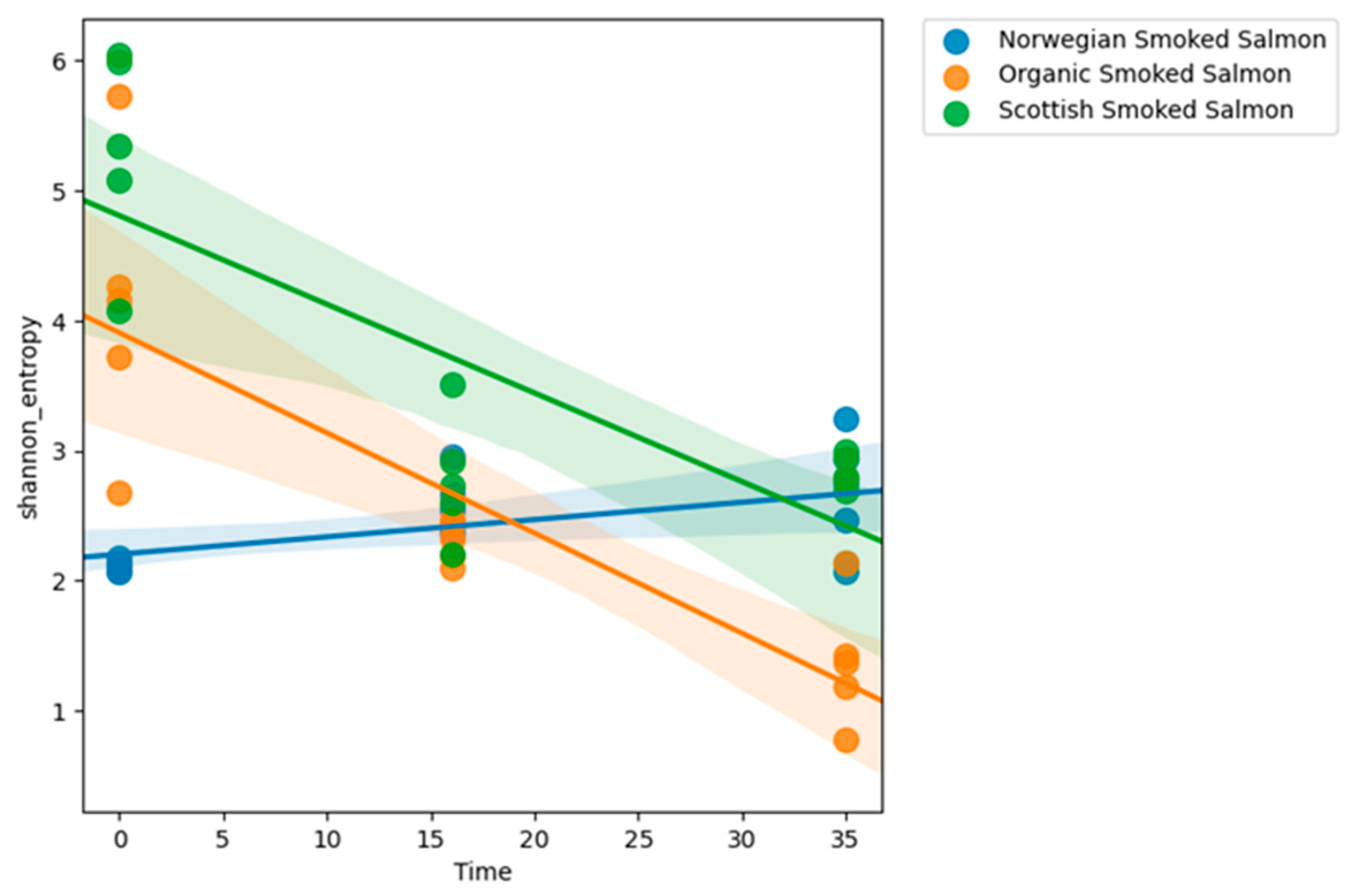
Alpha diversity, assessed using the Shannon diversity, displayed distinct temporal trajectories among the three salmon types (Figure 2). Linear mixed-effects modelling (Table S1) indicated that both Organic Salmon (β = 1.701, p < 0.001) and Scottish Salmon (β = 2.601, p < 0.001) had significantly higher initial Shannon diversity compared with Norwegian Salmon. However, significant negative interaction terms for time were observed for both Organic (β = −0.099, p < 0.001) and Scottish Salmon (β = −0.081, p < 0.001), indicating a faster decline in diversity over time compared to Norwegian Salmon. No significant temporal trend was observed for Norwegian Salmon (β = 0.013, p = 0.255). These findings suggest that although some salmon types began with higher microbial diversity, they experienced a more rapid loss of diversity during storage.
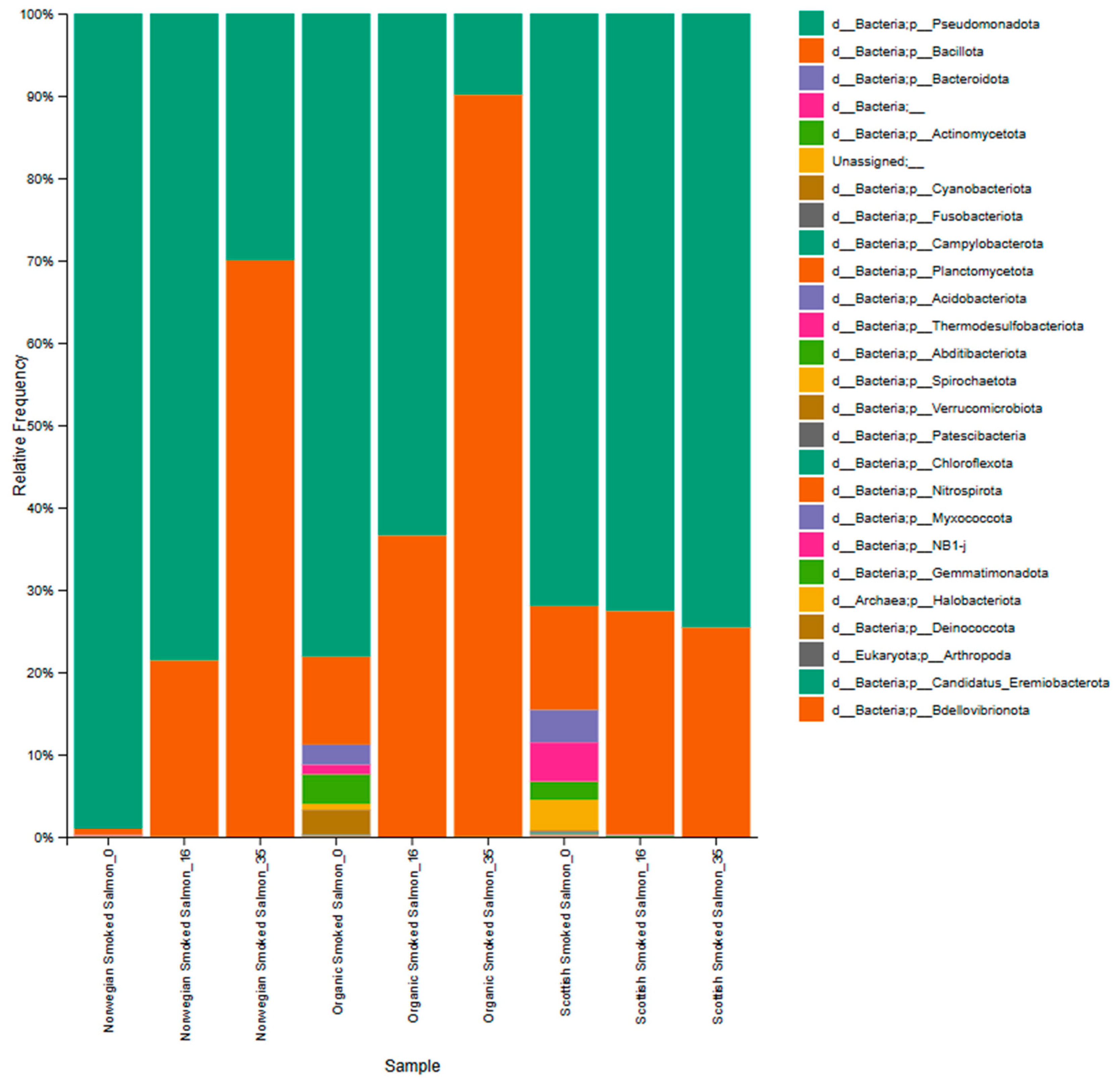
At the phylum level, the bacterial communities were predominantly composed of Pseudomonadota and Bacillota (Figure 3). Pseudomonadota dominated most samples, particularly at the initial time points (0 h), whereas Bacillota became dominant in Norwegian Salmon_35 and Organic Salmon_35. Minor contributions from other phyla, such as Bacteroidota, Actinomycetota, and Cyanobacteria, were also observed in some samples. Organic and Scottish salmon exhibited greater phylum-level diversity at 0 h, which decreased over time, while Norwegian salmon maintained a more consistent community composition.
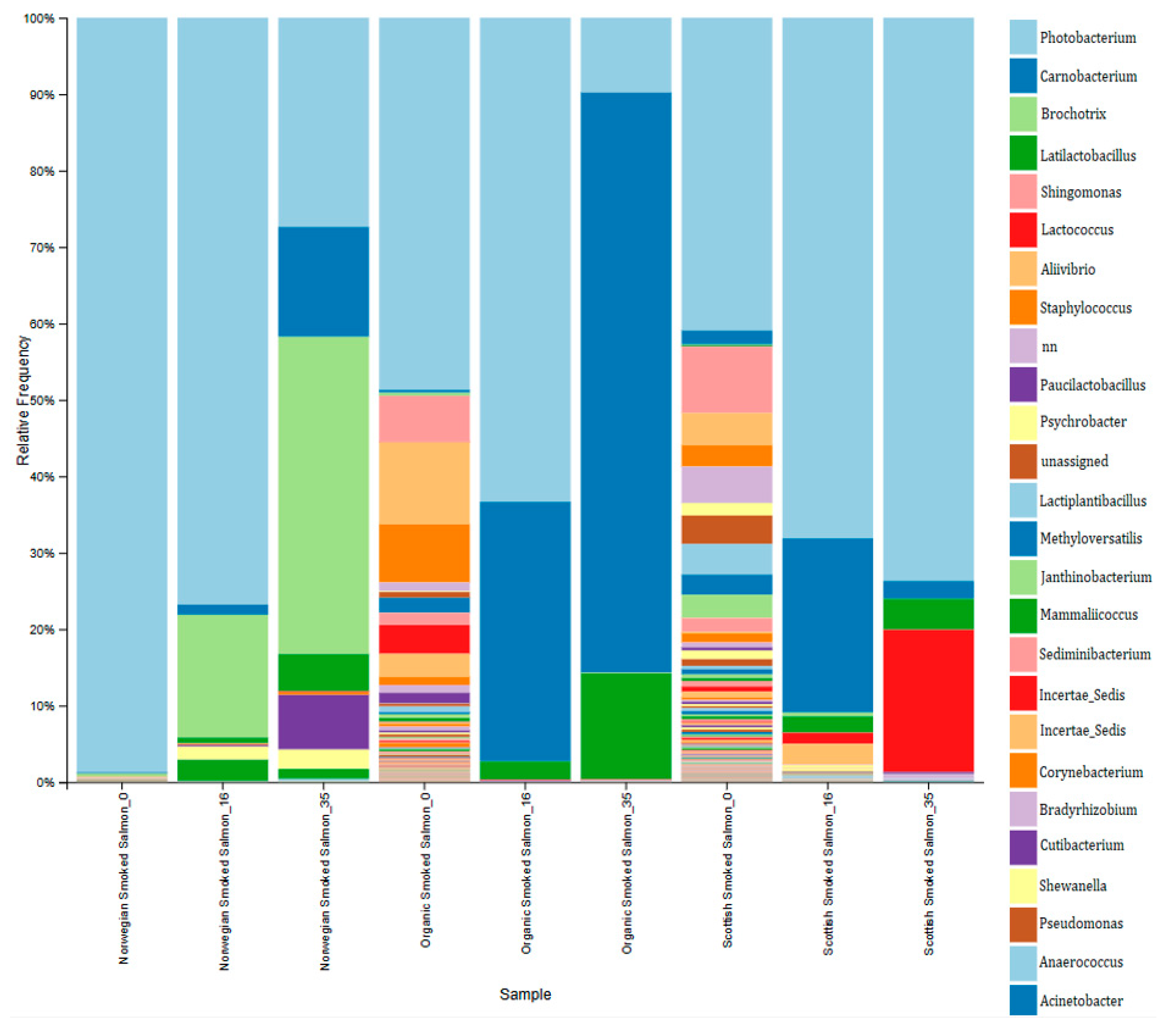
Analysis of genus-level feature volatility revealed clear differences in the taxa most strongly associated with temporal changes in microbiota composition among the three salmon types (Figure 4). For Norwegian Salmon, the genera Photobacterium (importance = 0.360, Cumulative Avg Decrease = −0.701) and Acinetobacter (importance = 0.276, Cumulative Average Decrease = −0.00016) showed the highest predictive importance, both exhibiting marked decreases over time, particularly Photobacterium, which displayed the strongest negative trend across all groups (Table S2).
This observation is consistent with previous studies showing that Photobacterium species often dominate the bacterial community in VP CSS during storage, and are closely associated with spoilage [4,51,52]. Similarly, in raw salmon stored under vacuum or modified atmosphere packaging, Photobacterium phosphoreum has been identified as one of the key spoilage taxa, along with Serratia, Hafnia, Carnobacterium, Brochothrix thermosphacta, etc. [5,17].
In contrast, LAB are frequently reported as the predominant taxa in VP smoked fish stored at low temperatures [4,14,17,20,53]. Their ability to thrive under reduced oxygen conditions, coupled with the production of organic acids, bacteriocins, and other antimicrobial metabolites, allows them to influence microbial succession and suppress competing spoilage organisms. Our findings align with these reports, as Latilactobacillus (importance = 0.180) was the only genus among the top-ranked features with a consistent cumulative increase (0.048). This pattern suggests that Latilactobacillus may play a role in microbial succession in this product, particularly in later storage stages, possibly contributing to shelf-life extension by inhibiting Gram-negative spoilage bacteria.
In Organic salmon, Latilactobacillus (importance = 0.371, Cumulative Avg Increase = 0.157) and Carnobacterium (importance = 0.232, Increase = 0.724) dominated the top positions, both showing strong positive trends over time (Table S3). This contrasts with Norwegian salmon, where lactic acid bacteria were less dominant among the most important features. The only genus with a notable decrease among the top features was Corynebacterium (importance = 0.100, Decrease = −0.0082), suggesting relatively stable or increasing trends for most high-importance taxa.
In Scottish salmon, Vagococcus (importance = 0.189) and Shewanella (importance = 0.169) were the most important taxa, both showing modest decreases (−0.00082 and −0.0121, respectively) (Table S4). Unlike Norwegian and Organic salmon, lactic acid bacteria (Lactiplantibacillus and Latilactobacillus) appeared further down the importance ranking but still exhibited positive trends in abundance (e.g., Latilactobacillus Increase = 0.043).
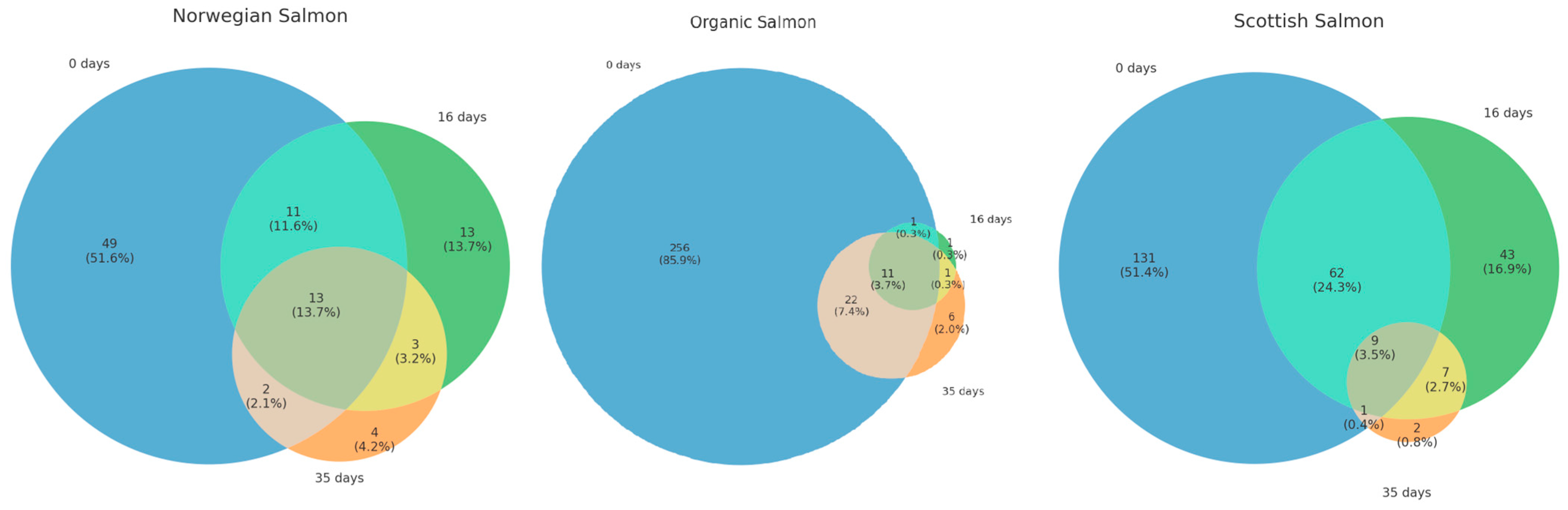
The Venn Diagram presents differences in richness and stability of bacterial communities associated with Norwegian, Organic, and Scottish salmon over 0, 16, and 35 days of storage (Figure 5). Fresh samples dominated across all types, most strikingly in Organic salmon, where 85.9% of taxa were unique to day 0, compared with half in Norwegian (51.6%) and Scottish (51.4%). A small time-stable core was detected in all groups but was relatively largest in Norwegian (13.7%), while Organic (3.7%) and Scottish (3.5%) retained only a minor fraction.
Scottish salmon displayed the strongest continuity between day 0 and day 16 (24.3%) and the largest influx of new taxa at day 16 (16.9%), whereas Organic showed almost no persistence (0.3%) or mid-stage novelty (0.3%). Norwegian fell in between, with moderate overlap (11.6%) and some new taxa (13.7%) at day 16. By day 35, few new taxa appeared in any group (≤4.2%), suggesting late-stage stabilization. A unique feature of Organic salmon was a subset of taxa present at both day 0 and day 35 but absent at day 16 (7.4%), pointing to a resilient fraction.
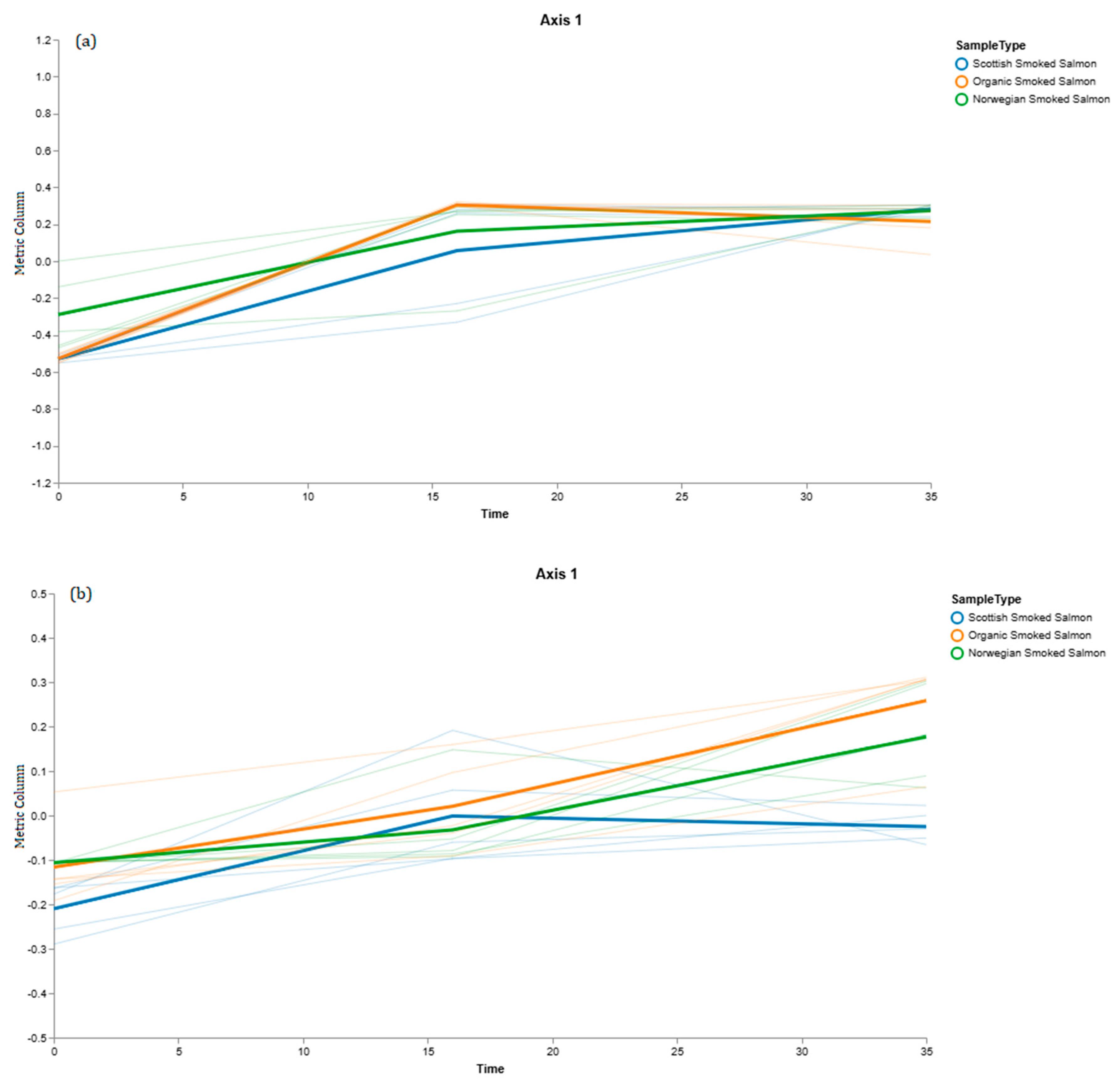
Beta diversity of differences in microbial community composition between salmon types and across time was assessed using PERMANOVA (Adonis) based on (a) unweighted UniFrac and (b) weighted UniFrac distances (Table S5). For unweighted UniFrac, both SampleType (R2 = 0.0707, p = 0.024) and Time (R2 = 0.3046, p = 0.001) significantly explained variation in community composition. For weighted UniFrac, SampleType (R2 = 0.1242, p = 0.004) and Time (R2 = 0.3334, p = 0.001) were also significant, with SampleType accounting for a larger proportion of variation compared to unweighted UniFrac (Figure 6). These findings suggest that temporal changes in the salmon microbiome were predominantly driven by taxon turnover (presence/absence), while differences between salmon types were largely linked to variation in the abundance of dominant taxa characteristic of each type.
The observed dynamics highlight a typical succession pattern in VP CSS: initial dominance of fast-growing, oxygen-tolerant, widely dispersed spoilage taxa such as Photobacterium, followed by the progressive establishment of LAB, including Latilactobacillus and Carnobacterium, as storage time increases. A similar succession was documented by Macé et al. [17], who observed that in vacuum- or MAP-packaged raw salmon steaks, Photobacterium phosphoreum and other Gram-negative bacteria dominate early, while LAB and Carnobacterium increase with storage. Wiernasz et al. [4] reported that in VP CSS, Photobacterium relative abundance increased from day 14 to day 28 and was dominant (78–97% of the microbial composition), whereas Lactobacillus and Lactococcus were present and increased later in other packaging types.

3.2. Effect of 2 h Cold Chain Disruption

At T1 and T2, microbial counts in fillets exposed to a single 2 h RT episode on day 16 did not differ significantly from continuously refrigerated controls across all product types and bacterial groups (Student’s t-test for independent samples, α = 0.05; Table S6). This indicates that short-term cold chain disruption did not affect culture-dependent outcomes and did not measurably alter the storage-related patterns described above under the tested conditions.
Alpha diversity, assessed using the Shannon diversity and observed features, showed no significant differences between samples stored at refrigeration temperature and those with a history of a 2 h RT cold chain disruption for any salmon type (Norwegian, Organic, Scottish) (Mann–Whitney U test, p > 0.05; Figure S1). At the genus level, ANCOM-BC analysis revealed no statistically significant differences in relative abundance between samples stored at refrigeration temperature and those subjected to an additional 2 h cold chain disruption in any salmon type.

3.3. Culture-Dependent Microbial Analysis

Samples from Scottish, Organic, and Norwegian variants of CSS were tested in five replicates for each time point. They exhibited clear microbial succession during chilled storage: total microbial counts (TMC), Photobacterium, and lactic acid bacteria (LAB) increased significantly over time, whereas Listeria spp., Enterobacteriaceae, and coagulase-positive staphylococci remained below the detection threshold (<10 CFU/g) at all sampling points. These trends are consistent with established spoilage microbiology in vacuum-packed chilled seafood and reflect both product quality and effective control of key safety indicators (Table 1).

Overview Across Bacterial Groups and Product Types

Across all three product types (Scottish (S), Organic (O), and Norwegian (N)), counts increased markedly from T0 to T1, and then stabilized between T1 and T2 for two of the three groups (TMC; Total Microbial Count and Photobacterium). A consistent feature of the dataset is that product type differences were detectable only at baseline (T0); by day 16 (T1) and day 35 (T2), the three salmon variants showed comparable levels for each group. The sole systematic exception is lactic acid bacteria (LAB) in Norwegian salmon, which continued to rise significantly from T1 to T2, while Scottish and Organic LAB plateaued after T1.
At T0, TMC differed between products, with Scottish salmon exhibiting the lowest initial load (1.50 ± 0.45 log CFU/g), Organic was intermediate (2.12 ± 0.22), and Norwegian the highest (2.69 ± 0.32). All products experienced a pronounced increase from T0 to T1, with counts to 4.62–6.09 log CFU/g. No significant differences were detected between products at T1 or T2, and T1–T2 changes within products were not significant, consistent with a mid-storage plateau. Overall, increases from T0 to T2 were ~3.7–3.9 log CFU/g (Scottish ≈ +3.89; Organic ≈ +3.86; Norwegian ≈ +3.68). Although variability peaked at T1 in Scottish salmon (SD ≈ 1.25), suggesting more heterogeneous growth dynamics at the mid-storage time point.
Baseline differences mirrored TMC were observed for Photobacterium. Norwegian salmon started higher (2.35 ± 0.40 log CFU/g) than Scottish and Organic salmon (≈1.21–1.28), which did not differ from each other. From T0 to T1, all products rose significantly (to ≈4.63–5.86), and then remained statistically unchanged through T2 (≈4.77–5.55). As with TMC, no differences in product type were detected at T1 or T2, indicating convergence during storage. Absolute increases from T0 to T2 were ≈+3.20 to +3.79 log CFU/g, with Organic salmon showing the largest rise.
Initial LAB levels were low and did not differ between products at T0 (≈1.23–1.99 log CFU/g). All products increased significantly by T1 (4.56–5.82). From T1 to T2, Scottish and Organic salmon did not change further, while Norwegian salmon continued to increase significantly, achieving the highest LAB level at the end of storage (5.91 ± 0.55). The T0→T2 gain was largest in Organic (≈+4.56 log CFU/g) and similar in Scottish and Norwegian (≈+3.97 and +3.93, respectively). This pattern highlights a general time-driven rise in LAB across products, with a distinct sustained growth in Norwegian late in storage.
Two robust features emerged across endpoints:
  • Storage time was the dominant driver of culture-dependent counts. Product type differences present at baseline dissipate by day 16 and remain absent at day 35.
  • After the strong T0 → T1 increase, T1 → T2 changes are generally negligible, indicating a near plateau mid-way through storage—except for LAB in Norwegian salmon, which continued to rise to day 35.
These converging trajectories suggest that initial contamination profiles differ by product, but growth during cold storage quickly overcame those differences, leading to similar levels by mid- and late-storage for most groups. Across all product types and bacterial groups, no statistically significant differences were observed between samples exposed to the 2 h RT episode and continuously refrigerated samples under the tested conditions.
The progressive increase in spoilage groups (Photobacterium and LAB) observed here is concordant with extensive literature reporting the dominance of psychrotrophic spoilage flora in CSS. Recent multi-omics studies confirm that genera such as Photobacterium, Carnobacterium, and other Gram-negative and Gram-positive taxa drive spoilage trajectories during storage, with strong correlations to volatile compound production and sensory deterioration profiles. For example, a multi-omics analysis of CSS from several processing plants identified Photobacterium, Carnobacterium, Aliivibrio, and Brochothrix as key taxa shaping spoilage signatures, particularly as storage time increases beyond the initial unspoiled phase. These findings highlight that microbial community composition, not just total counts, is central to understanding quality decline in this product category [11].
The absence of detectable Listeria spp., Enterobacteriaceae, and coagulase-positive staphylococci (<10 CFU/g) in all samples throughout the sampling period is a positive indicator of microbiological safety under the processing and storage conditions applied. Recent work on smoked fish highlights that although Listeria monocytogenes can be associated with cold-smoked products, its prevalence in commercially processed and properly stored RTE fish may be low when hygiene standards and cold chains are maintained. A recent large survey of smoked fish products in England from 2022 to 2023 reported L. monocytogenes in only 3.6% of samples, with the majority detected at low levels; elevated Enterobacteriaceae levels correlated with Listeria detection, suggesting that hygienic processing environments that suppress Enterobacteriaceae may also reduce pathogen occurrence [54]. The consistency between these large-scale surveillance outcomes and our experimental results underlines the feasibility of producing CSS with microbiological safety indicators below detectable or regulatory concern levels. The observed suppression of Enterobacteriaceae and staphylococci in VP, chilled environments can be attributed to the selective pressures imposed by low temperatures, moderate salt concentrations, and competitive exclusion by psychrotrophic spoilage bacteria. Prior research reveals that LAB and other dominant spoilage groups can inhibit or outcompete slower-growing mesophilic and facultative taxa, contributing to their low prevalence in chilled smoke-processed products [16]. Moreover, although Enterobacteriaceae are part of the core microbiota in some settings, their growth is often curtailed under VP plus cold storage, in contrast to more resilient psychrotrophic spoilers [16]. The dominance of spoilage taxa such as Photobacterium and LAB reflects typical ecological succession in chilled seafood, while the absence of detectable Listeria, Enterobacteriaceae, and coagulase-positive staphylococci corroborates the effectiveness of current processing and storage controls.

4. Conclusions

Our results demonstrate that ASV-resolved 16S rRNA gene metataxonomics, combined with culture-dependent enumeration, provides valuable complementary insights into the dynamics of microbial communities in CSS subjected to a 2 h cold chain disruption. The absence of measurable effects following a single 2 h RT exposure suggests a degree of resilience to mild cold-chain disruption. Importantly, this short exposure was designed to realistically mimic common consumer behaviour during shopping and transport prior to home refrigeration, thereby providing practical insight into product safety under everyday handling conditions.
Specifically, a single, mid-storage 2 h RT interruption, no measurable differences were detected under the tested conditions (VP, 5 °C). Phylogeny-aware PERMANOVA revealed that storage time explained ~30–33% of β diversity (UniFrac), while product type accounted for ~7–12% (all p ≤ 0.004), consistent with storage-driven phylogenetic convergence across products. We observed a progressive increase in total microbial load accompanied by a decline in overall microbial diversity, a pattern consistent with the selective enrichment of specific taxa under storage stress. Notably, no unexpected or pathogenic species were detected in any salmon type throughout the experimental period, indicating that short-term cold chain deviations, while promoting microbial proliferation, may not necessarily compromise microbiological safety within the studied timeframe. In summary, Organic salmon is dominated by a large but short-lived initial community; Norwegian retains the strongest time-stable core; and Scottish combines early persistence with a pronounced mid-stage influx. These distinct temporal patterns highlight type-specific microbial trajectories during storage.
The decline in Photobacterium may reduce spoilage-associated amine production, while the rise of LAB could be beneficial if bioprotective species dominate. However, proliferation of Carnobacterium or Brochothrix thermosphacta may negatively impact sensory attributes and limit shelf life. Future research should therefore aim to distinguish beneficial LAB strains from undesirable spoilage LAB and assess whether targeted microbial management could steer succession toward more favourable communities.
These findings underscore the importance of continuous monitoring of both microbial load and community composition as complementary indicators of product stability. From an industry perspective, our results suggest that short, controlled cold chain interruptions may be tolerable without posing an immediate risk to consumer safety. However, they can have a negative impact on product quality over time. For regulatory agencies, this study highlights the value of incorporating molecular microbiome-based tools into routine surveillance frameworks, thereby enabling more sensitive and holistic risk assessments beyond traditional culture-based methods. Future research should focus on extending these investigations to longer or repeated cold chain disruptions, diverse production and storage conditions, and a broader range of seafood products to refine critical control points. Ultimately, integrating high-resolution microbiome profiling into food safety management systems has the potential to strengthen preventive strategies, improve shelf-life prediction models, and support evidence-based updates to regulatory guidelines.

Supplementary Materials

The following supporting information can be downloaded at: https://www.mdpi.com/article/10.3390/pr14030452/s1, Figure S1: Alpha diversity metrics (Shannon index, observed features) for Norwegian, Organic, and Scottish smoked salmon stored under refrigeration (T1/2, T1) and after an additional 2 h at room temperature (T1/2 + 2H, T1 + 2H); Table S1: Results of the linear mixed-effects model testing the effects of salmon type and time on Shannon diversity. Norwegian Salmon was used as the reference category. Coefficients (Coef.), standard errors (Std. Err.), z-scores (z), and p-values (p > |z|) are presented, along with 95% confidence intervals; Table S2: Feature importance results from QIIME 2 longitudinal feature-volatility analysis at the genus level for Norwegian Salmon. The table lists taxa ranked by their importance in predicting temporal changes across the experiment; Table S3: Feature importance results from QIIME 2 longitudinal feature-volatility analysis at the genus level for Organic Salmon. The table lists taxa ranked by their importance in predicting temporal changes across the experiment; Table S4: Feature importance results from QIIME 2 longitudinal feature-volatility analysis at the genus level for Scottish Salmon. The table lists taxa ranked by their importance in predicting temporal changes across the experiment; Table S5: Results of PERMANOVA (Adonis test) for β-diversity based on unweighted and weighted UniFrac distance matrices, assessing the effect of salmon type (SampleType) and storage time (Time) on microbiome composition. Statistically significant effects (p < 0.05) are indicated in bold; Table S6: Effect of 2 h bench resting at room temperature on culture-dependent counts in cold-smoked salmon. The table reports mean ± SD (log10 CFU/g) for Total Microbial Count, Photobacterium spp., and Lactic Acid Bacteria in three product types—Scottish, Organic, Norwegian—at T1 (day 16) and T2 (day 35) of refrigerated storage. For each product × time point, values are shown for Control (no bench rest) and Bench-rested (2 h RT) samples, together with the difference Δ = Bench-rested − Control, results of the two-sample Student’s t-test (t, df, p), Levene’s test p for equality of variances, and two-sided 95% confidence intervals (CI) for Δ.

Author Contributions

Conceptualization, J.B.-K.; methodology, J.B.-K. and D.J.B.; software, P.Ś. and A.W.; validation, J.B.-K., P.Ś. and A.W.; formal analysis, J.B.-K., P.Ś., A.W., D.S., A.Z., E.K. and D.J.B.; investigation, J.B.-K.; resources, J.B.-K.; data curation, J.B.-K.; writing—original draft preparation, J.B.-K., P.Ś. and A.W.; writing—review and editing, J.B.-K.; visualization, J.B.-K.; supervision, J.B.-K. and B.S.; project administration, J.B.-K.; funding acquisition, J.B.-K. All authors have read and agreed to the published version of the manuscript.

Funding

This research received no external funding.

Data Availability Statement

The raw data supporting the conclusions of this article can be made available by the authors on request.

Conflicts of Interest

The authors declare no conflicts of interest.

Abbreviations

The following abbreviations are used in this manuscript:
CSSCold-smoked salmon
LABLactic acid bacteria
CFU/gColony-forming units per gram
VPVacuum packaging
MAPModified atmosphere packaging
NGSNext-generation sequencing
OUTOperational taxonomic units
VBNCViable but non-culturable
RTRoom temperature
MRSMan, Rogosa and Sharpe
VRBGViolet Red Bile Glucose agar
TMCTotal microbial count

References

  1. Eu, W.E. Price Structure in the Supply Chain Focus on France, Germany and Poland December 2024 Case Study in the Eu Smoked Salmon. Available online: https://op.europa.eu/en/publication-detail/-/publication/27f12bef-d2f2-11ef-be2a-01aa75ed71a1/language-en (accessed on 8 December 2025).
  2. Maillet, A.; Denojean, P.; Bouju-Albert, A.; Scaon, E.; Leuillet, S.; Dousset, X.; Jaffrès, E.; Combrisson, J.; Prévost, H. Characterization of Bacterial Communities of Cold-Smoked Salmon during Storage. Foods 2021, 10, 362. [Google Scholar] [CrossRef] [Scilit]
  3. Wiernasz, N.; Leroi, F.; Chevalier, F.; Cornet, J.; Cardinal, M.; Rohloff, J.; Passerini, D.; Skırnisdóttir, S.; Pilet, M.F. Salmon Gravlax Biopreservation With Lactic Acid Bacteria: A Polyphasic Approach to Assessing the Impact on Organoleptic Properties, Microbial Ecosystem and Volatilome Composition. Front. Microbiol. 2020, 10, 3103. [Google Scholar] [CrossRef] [Scilit] [PubMed]
  4. Wiernasz, N.; Gigout, F.; Cardinal, M.; Cornet, J.; Rohloff, J.; Courcoux, P.; Vigneau, E.; Skírnisdottír, S.; Passerini, D.; Pilet, M.F.; et al. Effect of the Manufacturing Process on the Microbiota, Organoleptic Properties and Volatilome of Three Salmon-Based Products. Foods 2021, 10, 2517. [Google Scholar] [CrossRef] [Scilit] [PubMed]
  5. Gram, L.; Dalgaard, P. Fish Spoilage Bacteria—Problems and Solutions. Curr. Opin. Biotechnol. 2002, 13, 262–266. [Google Scholar] [CrossRef] [Scilit]
  6. Gram, L.; Huss, H.H. Microbiological Spoilage of Fish and Fish Products. Int. J. Food Microbiol. 1996, 33, 121–137. [Google Scholar] [CrossRef] [Scilit]
  7. Cortés-Sánchez, A.D.J.; Diaz-Ramírez, M.; Rayas-Amor, A.A.; Espinosa-Chaurand, L.D.; Torres-Ochoa, E.; Salgado-Cruz, M.D.I.P. Microbiological Hazards in the Food Chain of Fish and Products, a Focus on Klebsiella spp. Vet. Sci. 2025, 12, 133. [Google Scholar] [CrossRef] [Scilit] [PubMed]
  8. Cortés-Sánchez, A.D.J.; Jaramillo-Flores, M.E.; Díaz-Ramírez, M.; Espinosa-Chaurand, L.D.; Torres-Ochoa, E. Biopreservation and the Safety of Fish and Fish Products, the Case of Lactic Acid Bacteria: A Basic Perspective. Fishes 2024, 9, 303. [Google Scholar] [CrossRef] [Scilit]
  9. Brillet, A.; Pilet, M.F.; Prevost, H.; Bouttefroy, A.; Leroi, F. Biodiversity of Listeria Monocytogenes Sensitivity to Bacteriocin-Producing Carnobacterium Strains and Application in Sterile Cold-Smoked Salmon. J. Appl. Microbiol. 2004, 97, 1029–1037. [Google Scholar] [CrossRef] [Scilit]
  10. Joffraud, J.J.; Cardinal, M.; Cornet, J.; Chasles, J.S.; Léon, S.; Gigout, F.; Leroi, F. Effect of Bacterial Interactions on the Spoilage of Cold-Smoked Salmon. Int. J. Food Microbiol. 2006, 112, 51–61. [Google Scholar] [CrossRef] [Scilit]
  11. Macé, S.; Rannou, C.; Jérôme, M.; Chevalier, F.; Kolypczuk, L.; Donnay-Moreno, C.; Leroi, F.; Cardinal, M.; Noël, C. Multi-Omics Signature Profiles of Cold-Smoked Salmon from Different Processing Plants: Insights into Spoilage Dynamics. Int. J. Food Microbiol. 2025, 438, 111233. [Google Scholar] [CrossRef] [Scilit]
  12. Leroi, F. Occurrence and Role of Lactic Acid Bacteria in Seafood Products. Food Microbiol. 2010, 27, 698–709. [Google Scholar] [CrossRef] [Scilit]
  13. Løvdal, T. The Microbiology of Cold Smoked Salmon. Food Control 2015, 54, 360–373. [Google Scholar] [CrossRef] [Scilit]
  14. Leroi, F.; Joffraud, J.-J.; Chevalier, F.; Cardinaí, M.C. Study of the Microbial Ecology of Cold-Smoked Salmon during Storage at 8C. Int. J. Food Microbiol. 1998, 39, 111–121. [Google Scholar] [CrossRef] [Scilit] [PubMed]
  15. Boziaris, I.S.; Parlapani, F.F. Specific Spoilage Organisms (SSOs) in Fish. In The Microbiological Quality of Food: Foodborne Spoilers; Elsevier Inc.: Amsterdam, The Netherlands, 2017; pp. 61–98. [Google Scholar] [CrossRef] [Scilit]
  16. Maillet, A.; Bouju-Albert, A.; Roblin, S.; Vaissié, P.; Leuillet, S.; Dousset, X.; Jaffrès, E.; Combrisson, J.; Prévost, H. Impact of DNA Extraction and Sampling Methods on Bacterial Communities Monitored by 16S RDNA Metabarcoding in Cold-Smoked Salmon and Processing Plant Surfaces. Food Microbiol. 2021, 95, 103705. [Google Scholar] [CrossRef] [Scilit]
  17. Macé, S.; Cornet, J.; Chevalier, F.; Cardinal, M.; Pilet, M.F.; Dousset, X.; Joffraud, J.J. Characterisation of the Spoilage Microbiota in Raw Salmon (Salmo Salar) Steaks Stored under Vacuum or Modified Atmosphere Packaging Combining Conventional Methods and PCR-TTGE. Food Microbiol. 2012, 30, 164–172. [Google Scholar] [CrossRef] [Scilit]
  18. Chan, S.S.; Moen, B.; Løvdal, T.; Roth, B.; Nilsson, A.; Pettersen, M.K.; Rotabakk, B.T. Extending the Shelf Life of Atlantic Salmon (Salmo Salar) with Sub-Chilled Storage and Modified Atmosphere Packaging in Recyclable Mono-Material Trays. Foods 2024, 13, 19. [Google Scholar] [CrossRef] [Scilit] [PubMed]
  19. Chaillou, S.; Chaulot-Talmon, A.; Caekebeke, H.; Cardinal, M.; Christieans, S.; Denis, C.; Hélène Desmonts, M.; Dousset, X.; Feurer, C.; Hamon, E.; et al. Origin and Ecological Selection of Core and Food-Specific Bacterial Communities Associated with Meat and Seafood Spoilage. ISME J. 2015, 9, 1105–1118. [Google Scholar] [CrossRef] [Scilit] [PubMed]
  20. Ekonomou, S.I.; Parlapani, F.F.; Kyritsi, M.; Hadjichristodoulou, C.; Boziaris, I.S. Preservation Status and Microbial Communities of Vacuum-Packed Hot Smoked Rainbow Trout Fillets. Food Microbiol. 2022, 103, 103959. [Google Scholar] [CrossRef] [Scilit]
  21. Yap, M.; Ercolini, D.; Álvarez-Ordóñez, A.; O’toole, P.W.; O’sullivan, O.; Cotter, P.D. Next-Generation Food Research: Use of Meta-Omic Approaches for Characterizing Microbial Communities Along the Food Chain. Annu. Rev. Food Sci. Technol. 2022, 13, 361–384. [Google Scholar] [CrossRef] [Scilit]
  22. European Salmon Smokers Association (ESSA). European Guide to Good Practice for Smoked and/or Salted and/or Marinated Fish; European Commission: Brussels, Belgium, 2018. Available online: https://essa-salmon.org/_library/_files/ESSA_-_European_Guide_to_good_practice_for_smoked%2C_salted%2C_marinated_fish_-_FINAL_CLEAN_(6_September_2018).pdf (accessed on 8 December 2025).
  23. Mandal, P.K.; Biswas, A.K.; Choi, K.; Pal, U.K. Methods for Rapid Detection of Foodborne Pathogens An Overview. Am. J. Food Technol. 2011, 6, 87–102. [Google Scholar] [CrossRef] [Scilit]
  24. Cao, Y.; Fanning, S.; Proos, S.; Jordan, K.; Srikumar, S. A Review on the Applications of next Generation Sequencing Technologies as Applied to Food-Related Microbiome Studies. Front. Microbiol. 2017, 8, 1829. [Google Scholar] [CrossRef] [Scilit]
  25. Handelsman, J. Metagenomics: Application of Genomics to Uncultured Microorganisms. Microbiol. Mol. Biol. Rev. 2004, 68, 669–685. [Google Scholar] [CrossRef] [Scilit]
  26. Akimowicz, M.; Bucka-Kolendo, J. MALDI-TOF MS-Application in Food Microbiology. Acta Biochim. Pol. 2020, 67. [Google Scholar] [CrossRef] [Scilit] [PubMed]
  27. Jarvis, K.G.; Hsu, C.K.; Pettengill, J.B.; Ihrie, J.; Karathia, H.; Hasan, N.A.; Grim, C.J. Microbiome Population Dynamics of Cold-Smoked Sockeye Salmon during Refrigerated Storage and after Culture Enrichment. J. Food Prot. 2022, 85, 238–253. [Google Scholar] [CrossRef] [Scilit]
  28. Jarvis, K.G.; Daquigan, N.; White, J.R.; Morin, P.M.; Howard, L.M.; Manetas, J.E.; Ottesen, A.; Ramachandran, P.; Grim, C.J. Microbiomes Associated with Foods from Plant and Animal Sources. Front. Microbiol. 2018, 9, 2540. [Google Scholar] [CrossRef] [Scilit] [PubMed]
  29. Leroi, F.; Cornet, J.; Chevalier, F.; Cardinal, M.; Coeuret, G.; Chaillou, S.; Joffraud, J.J. Selection of Bioprotective Cultures for Preventing Cold-Smoked Salmon Spoilage. Int. J. Food Microbiol. 2015, 213, 79–87. [Google Scholar] [CrossRef] [Scilit]
  30. Parlapani, F.F.; Meziti, A.; Kormas, K.A.; Boziaris, I.S. Indigenous and Spoilage Microbiota of Farmed Sea Bream Stored in Ice Identified by Phenotypic and 16S RRNA Gene Analysis. Food Microbiol. 2013, 33, 85–89. [Google Scholar] [CrossRef] [Scilit]
  31. Parlapani, F.F.; Michailidou, S.; Pasentsis, K.; Argiriou, A.; Krey, G.; Boziaris, I.S. A Meta-Barcoding Approach to Assess and Compare the Storage Temperature-Dependent Bacterial Diversity of Gilt-Head Sea Bream (Sparus Aurata) Originating from Fish Farms from Two Geographically Distinct Areas of Greece. Int. J. Food Microbiol. 2018, 278, 36–43. [Google Scholar] [CrossRef] [Scilit] [PubMed]
  32. Parlapani, F.F. Microbial Diversity of Seafood. Curr. Opin. Food Sci. 2021, 37, 45–51. [Google Scholar] [CrossRef] [Scilit]
  33. Parlapani, F.F.; Kormas, K.A.; Boziaris, I.S. Microbiological Changes, Shelf Life and Identification of Initial and Spoilage Microbiota of Sea Bream Fillets Stored under Various Conditions Using 16S RRNA Gene Analysis. J. Sci. Food Agric. 2015, 95, 2386–2394. [Google Scholar] [CrossRef] [Scilit]
  34. Parlapani, F.F.; Mallouchos, A.; Haroutounian, S.A.; Boziaris, I.S. Microbiological Spoilage and Investigation of Volatile Profile during Storage of Sea Bream Fillets under Various Conditions. Int. J. Food Microbiol. 2014, 189, 153–163. [Google Scholar] [CrossRef] [Scilit] [PubMed]
  35. Syropoulou, F.; Anagnostopoulos, D.A.; Parlapani, F.F.; Karamani, E.; Stamatiou, A.; Tzokas, K.; Nychas, G.J.E.; Boziaris, I.S. Microbiota Succession of Whole and Filleted European Sea Bass (Dicentrarchus Labrax) during Storage under Aerobic and MAP Conditions via 16S RRNA Gene High-Throughput Sequencing Approach. Microorganisms 2022, 10, 1870. [Google Scholar] [CrossRef] [Scilit]
  36. Parlapani, F.F.; Michailidou, S.; Anagnostopoulos, D.A.; Sakellariou, A.K.; Pasentsis, K.; Psomopoulos, F.; Argiriou, A.; Haroutounian, S.A.; Boziaris, I.S. Microbial Spoilage Investigation of Thawed Common Cuttlefish (Sepia Officinalis) Stored at 2 °C Using next Generation Sequencing and Volatilome Analysis. Food Microbiol. 2018, 76, 518–525. [Google Scholar] [CrossRef] [Scilit]
  37. Parlapani, F.F.; Michailidou, S.; Anagnostopoulos, D.A.; Koromilas, S.; Kios, K.; Pasentsis, K.; Psomopoulos, F.; Argiriou, A.; Haroutounian, S.A.; Boziaris, I.S. Bacterial Communities and Potential Spoilage Markers of Whole Blue Crab (Callinectes Sapidus) Stored under Commercial Simulated Conditions. Food Microbiol. 2019, 82, 325–333. [Google Scholar] [CrossRef] [Scilit] [PubMed]
  38. Rouger, A.; Remenant, B.; Prévost, H.; Zagorec, M. A Method to Isolate Bacterial Communities and Characterize Ecosystems from Food Products: Validation and Utilization in as a Reproducible Chicken Meat Model. Int. J. Food Microbiol. 2017, 247, 38–47. [Google Scholar] [CrossRef] [Scilit] [PubMed]
  39. Baker, D. 5. 16S Illumina Library Preparation. Available online: https://quadram.ac.uk/16s-illumina-library-preparation/ (accessed on 8 December 2025).
  40. Bolyen, E.; Rideout, J.R.; Dillon, M.R.; Bokulich, N.A.; Abnet, C.C.; Al-Ghalith, G.A.; Alexander, H.; Alm, E.J.; Arumugam, M.; Asnicar, F.; et al. Reproducible, Interactive, Scalable and Extensible Microbiome Data Science Using QIIME 2. Nat. Biotechnol. 2019, 37, 852–857. [Google Scholar] [CrossRef] [Scilit]
  41. Juszczuk-Kubiak, E.; Dekowska, A.; Sokołowska, B.; Połaska, M.; Lendzion, K. Evaluation of the Spoilage-Related Bacterial Profiles of Vacuum-Packaged Chilled Ostrich Meat by next-Generation Dna Sequencing Approach. Processes 2021, 9, 803. [Google Scholar] [CrossRef] [Scilit]
  42. ISO 6887-1:2017; Microbiology of the Food Chain — Preparation of Test Samples, Initial Suspension and Decimal Dilutions for Microbiological Examination. Part 1: General Rules for The Preparation of The Initial Suspension and Decimal Dilutions. The International Organization for Standardization: Geneva, Switzerland, 2017.
  43. ISO 6887-4:2017; Microbiology of the Food Chain — Preparation of Test Samples, Initial Suspension and Decimal Dilutions for Microbiological Examination. Part 4: Specific Rules for the Preparation of Miscellaneous Products. The International Organization for Standardization: Geneva, Switzerland, 2017.
  44. ISO 4833-1:2013; Microbiology of the Food Chain — Horizontal Method for the Enumeration of Microorganisms. Part 1: Colony Count at 30 °C by the Pour Plate Technique. The International Organization for Standardization: Geneva, Switzerland, 2013.
  45. ISO 15214:1998; Microbiology of Food and Animal Feeding Stuffs — Horizontal Method for the Enumeration of Mesophilic Lactic Acid Bacteria — Colony-Count Technique at 30 Degrees C. The International Organization for Standardization: Geneva, Switzerland, 1998.
  46. Hilgarth, M.; Fuertes, S.; Ehrmann, M.; Vogel, R.F. Photobacterium carnosum sp. nov., Isolated from Spoiled Modified Atmosphere Packaged Poultry Meat. Syst. Appl. Microbiol. 2018, 41, 44–50. [Google Scholar] [CrossRef] [Scilit]
  47. ISO 21528-2:2017; Microbiology of the Food Chain — Horizontal Method for the Detection and Enumeration of Enterobacteriaceae. Part 2: Colony-Count Technique. The International Organization for Standardization: Geneva, Switzerland, 2017.
  48. ISO 6888-2:2021; Microbiology of the Food Chain — Horizontal Method for the Enumeration of Coagulase-Positive Staphylococci (Staphylococcus aureus and Other Species) Part 2: Method Using Rabbit Plasma Fibrinogen Agar Medium. The International Organization for Standardization: Geneva, Switzerland, 2021.
  49. ISO 11290-1:2017; Microbiology of the Food Chain — Horizontal Method for the Detection and Enumeration of Listeria monocytogenes and of Listeria spp. Part 1: Detection Method. The International Organization for Standardization: Geneva, Switzerland, 2017.
  50. ISO 11290-2:2017; Microbiology of the Food Chain — Horizontal Method for the Detection and Enumeration of Listeria monocytogenes and of Listeria spp. Part 2: Enumeration Method. The International Organization for Standardization: Geneva, Switzerland, 2017.
  51. Hansen, L.T.; Drewes Røntved, S.; Henrik Huss, H. Microbiological Quality and Shelf Life of Cold-Smoked Salmon from Three Different Processing Plants. Food Microbiol. 1998, 15, 137–150. [Google Scholar] [CrossRef] [Scilit]
  52. Dalgaard, P.; Vancanneyt, M.; Vilalta, N.E.; Swings, J.; Fruekilde, P.; Leisner, J.J. Identification of Lactic Acid Bacteria from Spoilage Associations of Cooked and Brined Shrimps Stored under Modified Atmosphere between 0 °C and 25 °C. J. Appl. Microbiol. 2003, 94, 80–89. [Google Scholar] [CrossRef] [Scilit]
  53. Jørgensen, L.V.; Huss, H.H.; Dalgaard, P. The Effect of Biogenic Amine Production by Single Bacterial Cultures and Metabiosis on Cold-Smoked Salmon. J. Appl. Microbiol. 2000, 89, 920–934. [Google Scholar] [CrossRef] [Scilit] [PubMed]
  54. Jorgensen, F.; Kesby, M.; Amar, C.; Rajendram, D.; Barker, C.; Crewdson, A.; Painset, A.; Sadler-Reeves, L.; Aird, H.; Lai, S.; et al. An Investigation of the Microbiological Quality of Smoked Fish in England and Detection of Listeria Monocytogenes Strains Associated with Listeriosis. J. Appl. Microbiol. 2025, 136, lxaf192. [Google Scholar] [CrossRef] [Scilit] [PubMed]
Figure 1. Schematic overview of the workflow of cold-smoked salmon sampling, including a 2 h room-temperature cold-chain disruption and subsequent microbiological analyses.
Processes 14 00452 g001
Figure 2. Temporal trends in Shannon diversity across different salmon types. Lines represent linear mixed-effects model (LME) fits with 95% confidence intervals. Norwegian Salmon (blue), Organic Salmon (orange), and Scottish Salmon (green) were analyzed over the storage period.
Processes 14 00452 g002
Figure 3. Relative abundance of bacterial phyla in Norwegian, Organic, and Scottish Salmon during storage, at the beginning (day 0), in the middle (day 16), and at the end of the storage (day 35), at 5 °C. The y-axis scale reflects the normalized abundance percentages (%).
Processes 14 00452 g003
Figure 4. Relative abundance (%) of dominant bacterial genera in Norwegian, Organic, and Scottish Salmon at the beginning (day 0), in the middle (day 16), and at the end of the storage (day 35), at 5 °C. The y-axis scale reflects the normalized abundance percentages (%).
Processes 14 00452 g004
Figure 5. Venn diagram presenting unique and shared OTUs at the genus level within Norwegian Salmon, Organic Salmon, and Scottish Salmon at the beginning (day 0), in the middle (day 16), and at the end of the storage (day 35), at 5 °C.
Processes 14 00452 g005
Figure 6. Temporal changes in beta diversity of the salmon microbiome across product types based on (a) unweighted UniFrac distances and (b) weighted UniFrac distances. Lines represent the trajectories of individual samples, with bold lines showing group means for Scottish Salmon, Organic Salmon, and Norwegian Salmon.
Processes 14 00452 g006
Table 1. Culture-dependent counts in cold-smoked salmon across storage. Mean ± SD (log CFU/g) for Total Microbial Count, Photobacterium spp., and Lactic Acid Bacteria in Scottish (S), Organic (O), and Norwegian (N) products at T0 (initial), T1 (day 16), and T2 (day 35). One-way ANOVA tested the effect of time within each product and the effect of product within each time point, followed by Tukey’s HSD (α = 0.05). Lower case superscripts in the table denote significant temporal differences within a product; upper case superscripts denote significant differences among products at the same time point. All values are expressed as log10 CFU/g.
Variant
Scottish (S)Organic (O)Norwegian (N)
Total Microbial Count
(log10 CFU/g)
T01.498909 ± 0.449505 aA2.122559 ± 0.223270 aB2.691743 ± 0.316977 aC
T14.616678 ± 1.245736 bA6.087451 ± 0.862450 bA5.985703 ± 0.181070 bA
T25.391406 ± 0.545485 bA5.984933 ± 0.887541 bA6.367375 ± 0.300675 bA
Photobacterium
(log10 CFU/g)
T01.211275 ± 0.422549 aA1.276042 ± 0.275553 aA2.353289 ± 0.403536 aB
T14.631852 ± 1.378050 bA5.817507 ± 0.524399 bA5.859759 ± 0.169258 bA
T24.765697 ± 1.032920 bA5.066891 ± 1.230759 bA5.548539 ± 0.491404 bA
Lactic Acid Bacteria
(log10 CFU/g)
T01.225772 ± 0.451153 aA1.328295 ± 0.441055 aA1.986363 ± 0.414389 aA
T14.562735 ± 1.340910 bA5.817643 ± 0.670226 bA5.134689 ± 0.374274 bA
T25.194672 ± 0.295742 bA5.887629 ± 0.842002 bA5.913018 ± 0.546782 cA
Enterobacteriaceae
(log10 CFU/g)
T0NDNDND
T1NDNDND
T2NDNDND
Listeria spp.
(log10 CFU/g)
T0NDNDND
T1NDNDND
T2NDNDND
Coagulase-positive
staphylococci
(log10 CFU/g)
T0NDNDND
T1NDNDND
T2NDNDND
ND—not detected (below the detection limit of the method, 10 CFU/g).
Disclaimer/Publisher’s Note: The statements, opinions and data contained in all publications are solely those of the individual author(s) and contributor(s) and not of MDPI and/or the editor(s). MDPI and/or the editor(s) disclaim responsibility for any injury to people or property resulting from any ideas, methods, instructions or products referred to in the content.