Next Article in Journal
Interlayer Identification Method Based on SMOTE and Ensemble Learning
Next Article in Special Issue
Domain-Adaptive Multimodal Large Language Models for Photovoltaic Fault Diagnosis via Dynamic LoRA Routing
Previous Article in Journal
Feasibility of Basalt Fiber Felt as Biocarrier for Rural Domestic Wastewater Treatment: Performance and Microbial Community Analysis
Previous Article in Special Issue
IWMA-VINC-Based Maximum Power Point Tracking Strategy for Photovoltaic Systems
 
 
Due to scheduled maintenance work on our servers, there may be short service disruptions on this website between 11:00 and 12:00 CEST on March 28th.
Article

Voltage Adaptability of Hierarchical Optimization for Photovoltaic Inverter Control Parameters in AC/DC Hybrid Receiving-End Power Grids

by
Ran Sun
1,
Jianbo Wang
1,
Feng Yao
1,
Zhaohui Cui
1,
Xiaomeng Li
2,
Hao Zhang
2,
Jiahao Wang
3 and
Lixia Sun
3,*
1
Henan Electric Power Company, State Grid Corporation of China, Zhengzhou 450018, China
2
Henan Electric Power Research Institute, State Grid Corporation of China, Zhengzhou 450052, China
3
School of Electrical and Power Engineering, Hohai University, Nanjing 211100, China
*
Author to whom correspondence should be addressed.
Processes 2026, 14(2), 350; https://doi.org/10.3390/pr14020350
Submission received: 8 December 2025 / Revised: 11 January 2026 / Accepted: 15 January 2026 / Published: 19 January 2026

Abstract

The high rate of photovoltaic integration poses significant challenges in terms of violations of voltage limits in power grids. Additionally, the operational behavior of PV systems under fault conditions requires thorough investigation in receiving-end grids. This paper analyzes the dynamic coupling characteristics between reactive power and transient voltage in a receiving-end grid with high PV penetration and multiple HVDC infeeds, considering typical AC and DC fault scenarios. Voltage adaptability issues in PV generation systems are also examined. Through an enhanced sensitivity analysis method, the suppression capabilities of transient voltage peaks are quantified in the control parameters of low-voltage ride-through (LVRT) and high-voltage ride-through (HVRT) photovoltaic inverters. On this basis, a hierarchical optimization strategy for PV inverter control parameters is proposed to mitigate post-fault transient voltage peaks and improve the transient voltage response both during and after faults. The feasibility of the proposed method has been verified through simulation on a revised 10-generator 39-bus power system. Following optimization, the transient voltage peak is reduced from 1.263 to 1.098. This validation offers support for the reliable grid connection of the Henan Power Grid. In the events of the N-2 fault at 500 kV and Tian-zhong HVDC monopolar block fault, the post-fault voltage at each node remains below 1.1 p.u. This serves as evidence of a significant enhancement in transient voltage stability within the Henan Power Grid, demonstrating effective improvements in power supply reliability and operational performance.

1. Introduction

The deep penetration of renewable energy has become an irreversible trend, posing unprecedented challenges to power grid voltage stability. Renewable energy sources, such as photovoltaics and wind power, exhibit significant stochasticity and volatility. This uncertainty can trigger bus voltage violations, thereby weakening the grid’s voltage support capability and potentially inducing voltage collapse. The integration of high-penetration photovoltaic (PV) systems has introduced critical challenges to power system voltage stability, as evidenced by the blackout incident in the Iberian Peninsula power grid on 28 April 2025. Analysis of this event reveals that reactive power balance issues pose a significant threat to power system security [1,2,3,4,5]. The transient control strategy of photovoltaic inverters directly determines their voltage response characteristics. When a high proportion of photovoltaic power is integrated into the receiving-end grid, the proportion of traditional synchronous generators within this grid becomes relatively small. Consequently, the dominant factor influencing the transient voltage stability of the receiving-end grid transitions from the rotor stability of the synchronous generator to the control stability of inverters. In the event of a short-circuit fault occurring in the receiving-end grid, when the grid connection voltage of the photovoltaic power station drops below 0.9 p.u., the controller immediately switches from normal operation mode to low-voltage ride-through (LVRT) mode. If LVRT control parameters of these inverters are mismatched, a substantial number of inverters may trip simultaneously. This simultaneous tripping leads to an abrupt increase in the grid’s active and reactive power deficit, which further exacerbates the degradation of voltage transient characteristics. In severe cases, this can ultimately result in voltage collapse, posing a critical threat to the stable operation of the power system. Specifically, the fixed power factor operation of photovoltaic (PV) plants is unable to provide dynamic voltage support during grid disturbances. Additionally, their interaction with other reactive power sources can lead to local reactive power surplus. Furthermore, the implementation of inappropriate oscillation suppression measures has resulted in a continuous voltage rise, and insufficient fault ride-through capability has caused cascading disconnections of renewable energy units. These factors collectively triggered a perilous positive feedback loop, characterized by increasing voltage levels, subsequent renewable unit disconnections, resulting power shortfalls, frequency drops, and further voltage increases. This voltage-driven instability mechanism differs fundamentally from traditional voltage collapse phenomena, thereby underscoring the critical necessity for PV plants to be equipped with dynamic reactive power regulation capabilities and for the establishment of defense systems designed to prevent overvoltage-triggered cascading failures.
The ongoing transition toward green, low-carbon energy systems is fundamentally transforming receiving-end grids into power-electronics-dominated networks characterized by distinct operational features [6,7,8,9,10]. This shift presents significant challenges for voltage adaptability, especially as high photovoltaic (PV) penetration impacts stability at distributed connection points through three critical factors, including inverter control parameters and grid short-circuit capacity. Inverter normal operating voltage adaptability is defined as the ability of an inverter to maintain a continuous stable grid connection within a voltage range of 90% to 110% of the nominal voltage, while simultaneously providing effective voltage regulation. This characteristic ensures reliable inverter operation under typical voltage fluctuations without necessitating disconnection from the grid. In contrast, transient voltage adaptability refers to the specific performance requirements imposed on inverters during low-voltage ride-through (LVRT) and high-voltage ride-through (HVRT) events. It includes the duration for which the inverter must remain connected to the grid under varying voltage magnitudes during these transient conditions, as well as the reactive power response characteristics required to support grid stability and comply with system protection standards. More importantly, the optimization of active and reactive power coordination during low-voltage ride-through (LVRT) has been demonstrated to effectively mitigate voltage collapse risk, providing crucial theoretical foundations for enhancing voltage adaptability in high-penetration PV integration scenarios.
In modern power systems with HVDC infeed, the displacement of conventional generation units by HVDC transmission has created unique voltage stability challenges [11,12]. The contrasting reactive power characteristics of HVDC systems, combined with expanding PV integration that diminishes local traditional generation, result in reduced short-circuit capacity and weakened voltage support. Consequently, when AC system faults occur with insufficient dynamic reactive power support, they may cause commutation failures in multiple HVDC links, leading to massive reactive power absorption and prolonged voltage depression. Conversely, HVDC system faults can drop bus voltages below 0.9 p.u., activating LVRT modes and potentially causing abnormal disconnections that lead to power shortages and load transfer during transients.
The vulnerability of such systems was clearly demonstrated in the case of a single-phase AC fault near the Tian-zhong HVDC project. Analysis identified this as a potential cause of voltage collapse in the Henan Power Grid or even across the entire Central China grid following the commissioning of the Qingyu HVDC project [13,14]. This vulnerability stems primarily from reduced thermal generation, where AC faults induce simultaneous commutation failures in multiple HVDC lines, significantly impacting active and reactive power balances and causing transient voltage instability. The situation is further exacerbated by large-scale renewable integration, which deteriorates grid voltage stability and limits the power-receiving capacity of HVDC clusters.
The critical importance of prompt and appropriate system responses becomes evident when considering scenarios such as bipolar block faults in critical transmission links like the Jinping–Sunan UHVDC [13,14]. In the absence of an effective control strategy, it is necessary to trip a substantial amount of generation capacity and shed significant loads in order to maintain system stability. This process exposes power systems to considerable risks of widespread blackouts, as the sudden loss of generation and the deliberate reduction in demand can disrupt the delicate balance required for reliable grid operation. Furthermore, even following system recovery, prolonged low-voltage conditions may persist, heightening the system’s vulnerability to subsequent disturbances. Consequently, voltage stability emerges as a critical and dominant concern in high-PV-penetration power systems.
From a technical perspective, high PV penetration fundamentally alters power system behavior through multiple mechanisms [15,16]. The displacement of conventional units by PV generation reduces system inertia, potentially exacerbating post-fault dynamic responses, while also altering power flow distribution and voltage profiles to increase steady-state deviations. In distribution networks specifically, distributed PV integration causes rapid voltage fluctuations that create control conflicts with conventional voltage regulation equipment designed for slower load variations, thereby deteriorating static voltage stability.
To address these challenges, voltage regulation strategies have evolved substantially, employing sophisticated approaches including network partitioning based on community detection algorithms [17,18,19,20,21,22,23]. These methods construct cluster performance indices using electrical distance and regional voltage capability to create autonomous control zones, enabling coordinated reactive and active power optimization through virtual slack bus voltage updates. Additionally, innovative two-level voltage control strategies have been developed for low-voltage feeders [24,25,26,27,28], incorporating day-ahead optimization that coordinates OLTC and ESS operations based on PV forecasting to handle both overvoltage during generation peaks and voltage sags during demand peaks while accounting for PV uncertainty.
Comprehensive power quality analysis has further established voltage deviation and fluctuation as core indicators for assessing PV system health [29,30,31,32]. Grid-connected PV systems typically elevate voltage levels, confirming these parameters serve as quantitative criteria for evaluating the operational status of PV-integrated systems. Moreover, systematic evaluation of LVRT capability and post-fault recovery speed through advanced analytical methods [33,34,35] has demonstrated that slow recovery strategies or immediate disconnection during voltage sags severely deteriorate short-term stability, whereas proper control strategies can enhance stability margins by approximately 25%.
Addressing the voltage stability issues, extensive exploration has been conducted regarding optimal dispatch and the excavation of flexibility resources. Focusing on coastal regions, an optimization strategy for Integrated Energy Systems (IESs) is proposed [36]. By utilizing the flexible regulation capability of seawater desalination loads, this approach not only effectively alleviated winter wind power curtailment issues but also significantly reduced system operating costs by 4.6% through a “water storage for energy” mechanism. Targeting supply–demand balance at the microgrid level, Meng et al. constructed a day-ahead economic dispatch framework incorporating energy storage systems and hybrid Demand Response (DR) [37]. This study confirmed that the synergy between price-based and incentive-based DR effectively smooths load fluctuations, enhancing system economics while maintaining user electricity usage comfort above 90%. Facing the coordinated optimization of massive heterogeneous resources, computational efficiency and uncertainty management have become popular research subjects, and 5G base stations are integrated into Virtual Power Plants (VPPs) [38]. By leveraging the regulation potential of base station transceivers and backup energy storage, combined with chance-constrained programming to handle renewable energy uncertainty, they achieved a win–win outcome for communication quality assurance and economic power dispatch. At the large-scale grid level, a hybrid data-and-model-driven acceleration approach was specifically designed to address Network-Constrained Unit Commitment (NCUC) problems under high renewable penetration [39]. Through offline clustering and online variable reduction, this method increased computational speed by tens of times while guaranteeing extremely high solution accuracy, providing rapid decision support for real-time mitigation of voltage stability risks. The relationship between grid connection point voltage and key PV inverter control parameters in high-penetration receiving-end grids is studied in [40] using a rational fraction fitting method. Time-domain simulations are used to analyze these stability issues.
This paper concentrates on transient voltage stability issues in receiving-end grids with high rates of PV penetration during power grid faults, including AC faults and DC faults. It analyzes the impact of HVRT and LVRT control parameters on PV output characteristics through mechanistic modeling and identifies critical control parameters that can suppress transient overvoltage using sensitivity analysis. A hierarchical optimization strategy for HVRT/LVRT control parameters of PV inverters is also proposed to alleviate transient overvoltage. The effectiveness of the proposed strategy is demonstrated in a revised IEEE 10-generator 39-bus system and the Henan Power Grid, respectively.

2. Analysis of the Dynamic Coupling Characteristics of Reactive Power and Transient Voltage

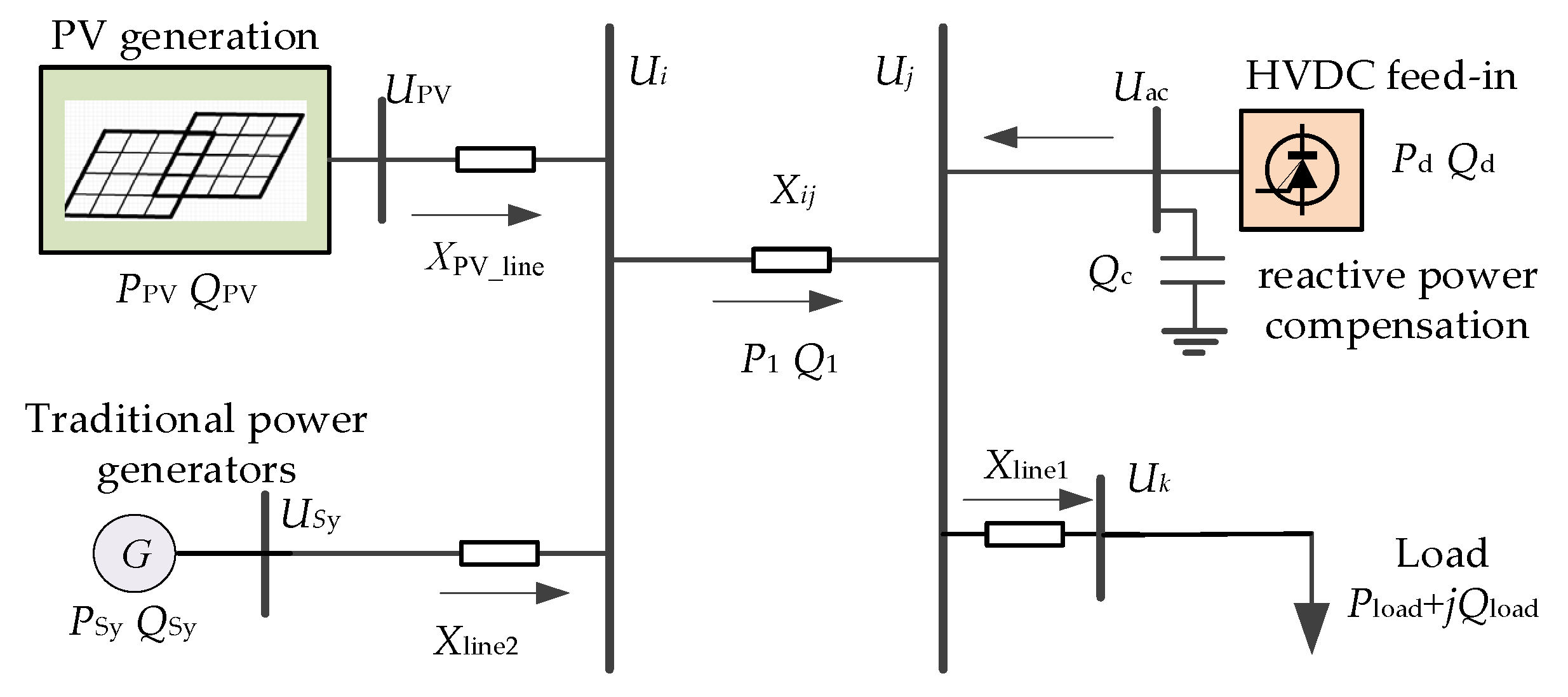
The diagram of a receiving-end power grid with a high proportion of PV and HVDC infeed is shown in Figure 1. PPV and QPV denote the active and reactive power outputs of the PV station, respectively; PSy and QSy indicate the active and reactive power outputs of the conventional generator units in the receiving-end grid, respectively; Pd is the active power injected by the HVDC system; variables Qd and Qc represent the consumed reactive power and the reactive power compensation in the inverter-side converter station, respectively; UWind, UPV, USy, and Uac correspond to the voltages at the grid connection points of the wind farm, PV station, and conventional generator units in the receiving-end system, and the converter bus at the HVDC inverter side, respectively; the load is defined as Pload + jQload; and the renewable energy sources and HVDC infeed exhibit cross-voltage-level coupling characteristics. X PV _ line and X line 2 denote the line impedance from the point of common coupling (PCC) for the PV station and conventional generation units for bus i, respectively. Finally, X line 1 represents the line impedance from bus j to bus k on the load side, and X i j signifies the line impedance between bus i and bus j.
According to the directions of active and reactive power flow, the power output from both the renewable energy sources and the conventional generation units within the receiving-end grid is evaluated as follows:
P 1 = P PV + P Sy
Q 1 = Q PV + Q Sy Q PV _ line Q line 2
Q PV _ line = P PV 2 + Q PV 2 U PV 2 X PV _ line
Q line 2 = U i 2 U Sy 2 X line 2
where Q PV _ line and Q line 2 are the reactive power losses of the transmission line.

2.1. Steady Operation

Under normal operation, renewable energy sources typically maintain zero reactive power output; thus, it is specified that Q PV = 0 .
The power injected by the HVDC infeed into bus j is represented by the following:
P 2 = P d
Q 2 = Q c Q d
Under ideal operating conditions, the reactive power Qc generated by the compensation devices at the inverter station is approximately balanced by the reactive power Qd consumed within the station. Consequently, negligible reactive power is exchanged between the HVDC system and the receiving-end AC system. This relationship is expressed as follows:
Q c Q d = 0
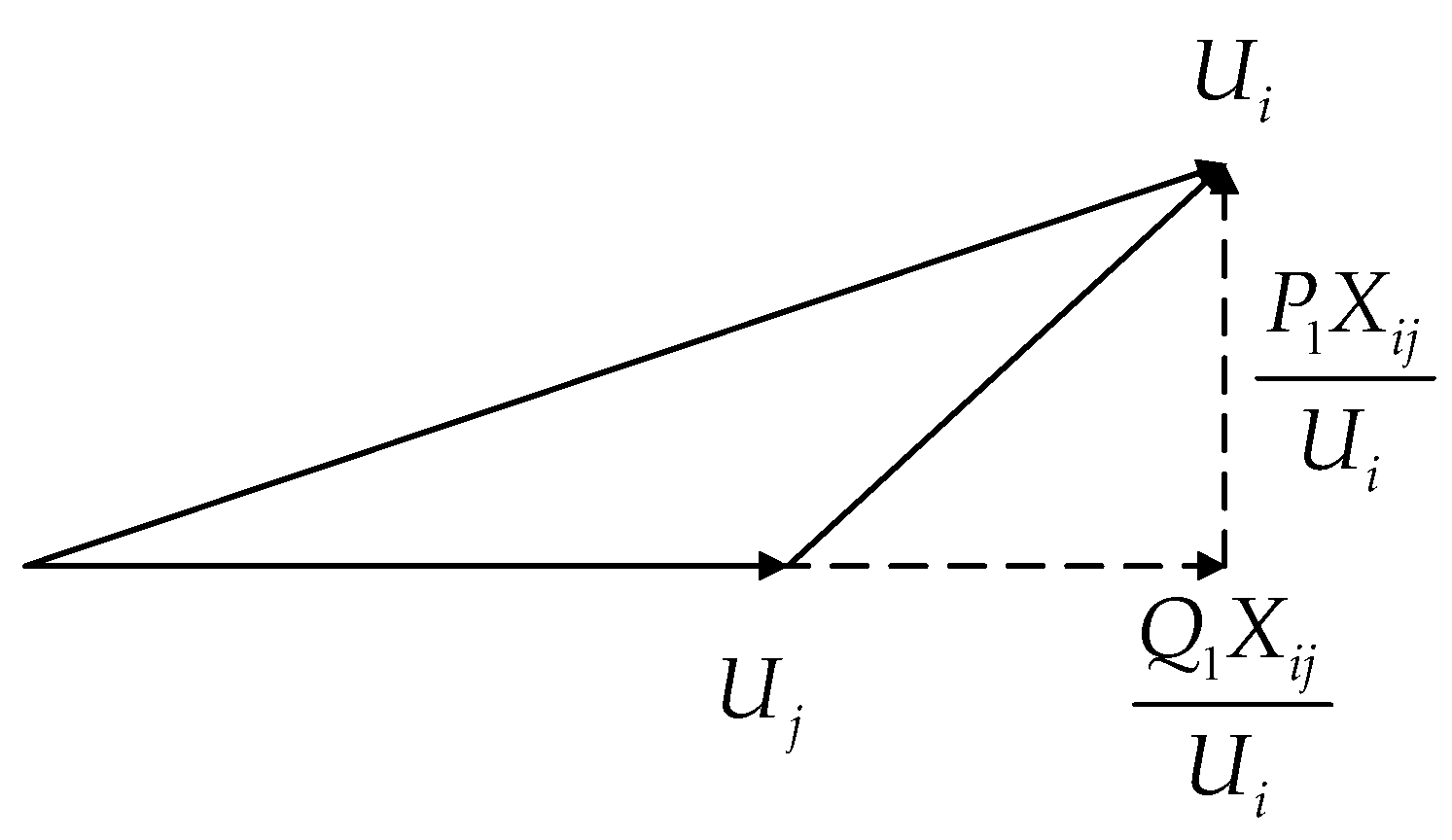
Figure 2 shows the relationship between the power supply side voltage and the receiving-end power grid. As such, the voltage at bus j during steady-state operation of the HVDC transmission system is expressed as follows:
U j = U i Q 1 X i j U i 2 + P 1 X i j U i 2
Based on Equations (1)–(8), the steady-state voltage at bus j is derived. Consequently, the steady-state voltage for monitored bus k is characterized. The analysis of steady-state operation provides a foundational understanding of the system’s behavior under normal conditions. It highlights how PV stations, traditional generators, and HVDC systems interact to maintain voltage stability, which lays the groundwork for further exploration into transient voltage stability issues.

2.2. Process of LVRT and Fault Recovery

In the event of a short-circuit fault occurring in the AC system adjacent to the inverter side of an HVDC converter station, the voltage on the converter bus will experience a sharp and temporary drop. This voltage depression can potentially lead to commutation failure at the inverter-side converter station. The occurrence of a commutation failure in the HVDC system is characterized by significant variations in the converter bus voltage and the reactive power at the infeed side. Under this condition, the reactive power output of the compensation devices at the HVDC inverter station is denoted as Qc1. When capacitor banks are used for compensation, their output capacity becomes voltage-dependent. Thus, the reactive power delivered by the capacitor banks during a power system fault is expressed as follows:
Q c 1 = U ac 1 2 U ac 2 Q c
where Q c 1 represents the reactive power delivered by the filter banks during the transient process, and U ac 1 denotes the voltage on the converter bus after the fault.
When the fault occurs, U ac 1 < U ac . However, the HVDC transmission current I d and commutation angle α remain approximately constant. So, the reactive power consumed at the inverter side also undergoes corresponding changes:
Q d 1 = k d 1 Q c
where Q d 1 represents the reactive power consumed at the inverter side during the system fault, and kd1 denotes the proportionality coefficient.
Consequently, the exchange reactive power Δ Q d between the inverter side of the HVDC transmission system and the AC system during the fault can be expressed as follows:
Δ Q d = U ac 1 U ac 2 Q c Q d 1 = U ac 1 U ac 2 k d 1 Q c
During the commutation failure period, the reactive power absorbed by the inverter side usually drops to 30% to 50% of the steady-state value [41]. In this paper, the reactive power consumed by the inverter station can be considered at its minimum value, kd1 = 0.50.
For PV power stations, when the voltage at the grid connection point falls below 90% of the nominal voltage, the reactive current increment injected into the grid is I q - LVRT . Thus, the increment of the dynamic reactive power Δ Q PV in the PV station is as follows:
Δ Q PV = I q - LVRT × U PV       0 U PV 0.9
Given that the receiving-end power grid operates a limited number of conventional units with restricted reactive power support capability, their reactive power variations in highly renewable-penetrated power grids exert a negligible influence on the overall voltage stability. Hence, it is a valid assumption that the reactive power output of conventional units remains essentially constant during transient processes.
Therefore, the reactive power balance equation during symmetrical faults incorporates the dynamic cross-voltage-level coupling effects between renewable energy sources and HVDC systems, which are expressed as follows:
Q F = Δ Q PV + Q Syn Q F _ PV _ line Q F _ line 2 + Δ Q d
where Q F _ PV _ line and Q F _ line 2 represent the reactive power loss of the transmission line during the fault period.
Therefore, similar to formula (8), the voltage at bus j during the fault period can be expressed as active power P1 and reactive power QF. The relationship is presented as follows:
U F _ j = U F _ i Q F X i j U F _ i 2 + P 1 X i j U F _ i 2
where U F _ j and U F _ i are the voltages at bus j and bus i in the process of the fault.
The relationship between these power components and the voltage magnitude at bus j is derived from the fundamental principles of symmetrical components and fault analysis in power systems. Mathematically, the expression for U F _ j during the fault period incorporates both the active and reactive power contributions to accurately model the voltage behavior under fault conditions.
According to Equation (14), the voltage during the failure period of bus j can be determined. During recovery periods from failure, photovoltaic power systems do not provide any reactive power while the voltage at the grid connection point of the photovoltaic power station remains above 0.9 p.u.
Analysis of the reactive power and voltage characteristics during steady-state, fault, and post-fault periods demonstrates that adjusting the reactive power output of the photovoltaic power station is an effective measure for enhancing the transient voltage performance of the receiving-end power grid.
During the low-voltage ride-through (LVRT) and fault recovery periods, five typical strategies are employed for active and reactive power control: constant power control, constant current control, no additional control, low-voltage limited-current control, and current control following the pre-LVRT profile. In particular, when the constant active current control strategy is implemented, the corresponding active and reactive current commands are given by
I p - LVRT = K 1 - I p - LVRT × U PV + K 2 - I p - LVRT × I p 0 + I p s e t - LVRT
I q - LVRT = K 1 - I q - LVRT × U LVset U PV + K 2 - I q - LVRT × I q 0 + I q s e t - LVRT
where K1-Ip-LVRT is voltage regulation factor of the active power current during LVRT; parameter K2-Ip-LVRT is the active power current adjustment factor during LVRT; Ipset-LVRT is the active power current constant during LVRT; UPV is the voltage magnitude at the photovoltaic grid-connected side; and Ip0 presents the pre-LVRT active current steady-state value. K1-Iq-LVRT is the voltage difference adjustment factor for the reactive power current during LVRT; K2-Iq-LVRT refers the reactive power current regulation factor; Iqset-LVRT serves as the reactive power current constant for LVRT; ULVset is the boundary value for LVRT; and Iq0 is the pre-LVRT reactive power current steady-state value.
The inverter control parameters affecting the LVRT output characteristics of PVs are summarized in Table 1, which provides the applicable ranges for the active and reactive power current control.
When the voltage at the grid connection point of the photovoltaic power station exceeds 1.1 p.u., the inverter initiates the HVRT process. When the specified current strategy is implemented, the active and reactive power currents are as follows:
I p - HVRT = K 1 - I p - HVRT × U PV + K 2 - I p - HVRT × I p 0 + I p s e t - HVRT
I q - HVRT = K 1 - I q - HVRT × U HVset U PV + K 2 - I q - HVRT × I q 0 + I q s e t - HVRT
where K1-Ip-HVRT denotes the voltage regulation coefficient of the active power current during HVRT; parameter K2-Ip-HVRT denotes the active power current regulation coefficient during HVRT; Ipset-HVRT represents the active power current’s setpoint during HVRT; UPV denotes the voltage amplitude at the PV station side; and Ip0 indicates the pre-HVRT steady-active power current. K1-Iq-HVRT is the voltage deviation regulation coefficient for the reactive power current during HVRT, K2-Iq-HVRT is the reactive power current’s adjustment coefficient, Iqset-HVRT serves as the reactive power current setpoint for HVRT, UHVset is the threshold value for HVRT, and Iq0 indicates the pre-HVRT steady-reactive power current.
The key inverter control parameters that affect the HVRT output characteristics of PV systems are presented in Table 2, with their respective numerical ranges for active and reactive current control provided.
This section employs a parameter sensitivity method to establish a quantitative relationship between the inverter voltage ride-through control parameters and the maximum transient overvoltage at the PCC by systematically evaluating the impact of parameter variations.

3. Photovoltaic Inverter Control Parameter Sensitivity Analysis

To visually represent the impact of the photovoltaic inverter’s control parameters on transient overvoltage, a normalized parameter sensitivity index S x i ( p . u . ) is established to measure the degree of change in the system’s transient voltage extremes when control parameters vary. This can be expressed as follows:
S x i ( p . u . ) = U lim x i U B x i x i , max x i , min = lim Δ x i 0 U lim x 1 , , x i + Δ x i , , x m U lim x 1 , , x i , , x m / U B Δ x i / x i , max x i , min                         = lim Δ x i 0 U lim x i ( p . u . ) Δ x i ( p . u . )
where xi represents the control parameter to be optimized; i∈[1, m], Δ x i represents the variations in the control parameter; U lim x 1 , , x i , , x m denotes the maximum transient voltage under a set of key parameter controls; xi,max and xi,min represent the maximum and minimum values of the parameter, respectively; UB is the reference voltage; and Δ x i ( p . u . ) represents normalized control parameters.
Since the active power output of photovoltaic systems during HVRT is consistent with that during steady-state operation, the active power control parameters remain basically unchanged during this period. Therefore, a parameter sensitivity analysis of the active current control parameters during HVRT is not performed.
This scope definition is pertinent for studying the severe transient overvoltage events caused by HVDC inverter station blocking following multiple commutation failures—events during which inverters undergo both LVRT and HVRT periods. To address the issue of transient overvoltage suppression, the sensitivity of key control parameters is studied independently in this work, focusing on LVRT active current control, LVRT reactive current control, and HVRT reactive current control.
To analyze the commutation failure fault, the first, second, and third commutation failures occurred at 1 s, 1.2 s, and 1.4 s, respectively, and HVDC monopolar blocking occurred at 1.43 s.

3.1. LVRT Active Current Control Parameter Sensitivity Analysis

Under the LVRT active current control mode, there are three control parameters: parameter K1-Ip-LVRT, parameter K2-Ip-LVRT, and Ipset-LVRT. These schemes are outlined below:
  • K1-Ip-LVRT is set to 0, 0.5, and 1, while K2-Ip-LVRT and Ipset-LVRT are set to 0;
  • K2-Ip-LVRT is set to 0.2, 0.5, 0.7, and 0.9, while K1-Ip-LVRT and Ipset-LVRT are set to 0;
  • Ipset-LVRT is set to 0, 0.5, and 1, while K1-Ip-LVRT and K2-Ip-LVRT are set to 0.
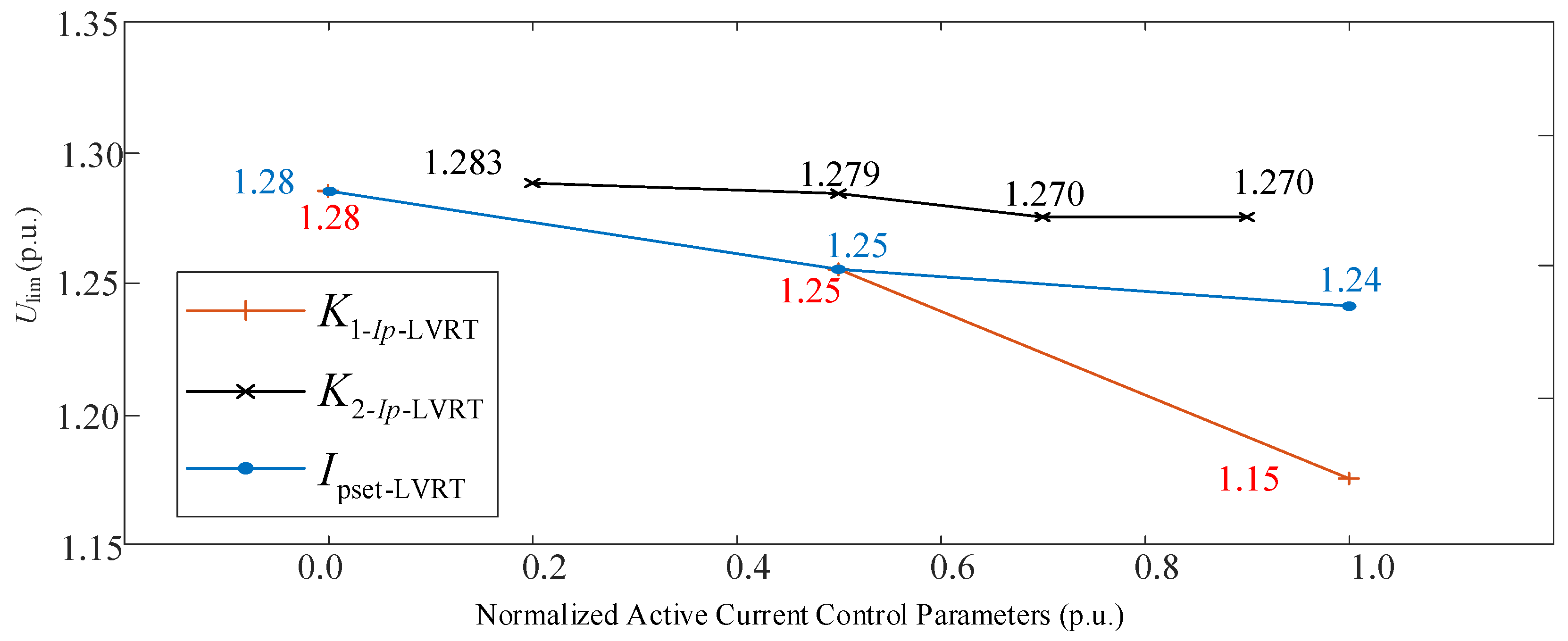
The ranges of various control parameters differ. To more effectively study the sensitivity of these parameters, we conducted normalization processing on the control parameters. The x-axis represents the per-unit value of control parameters, and the y-axis represents the maximum transient overvoltage. The relationship between the normalized LVRT active current control parameter and the maximum transient overvoltage is shown in Figure 3. In the figure, a positive slope indicates a positive correlation, while a negative slope indicates a negative correlation. The higher the absolute value of the slope, the higher the sensitivity of the parameter, and the greater its impact on the maximum transient overvoltage.
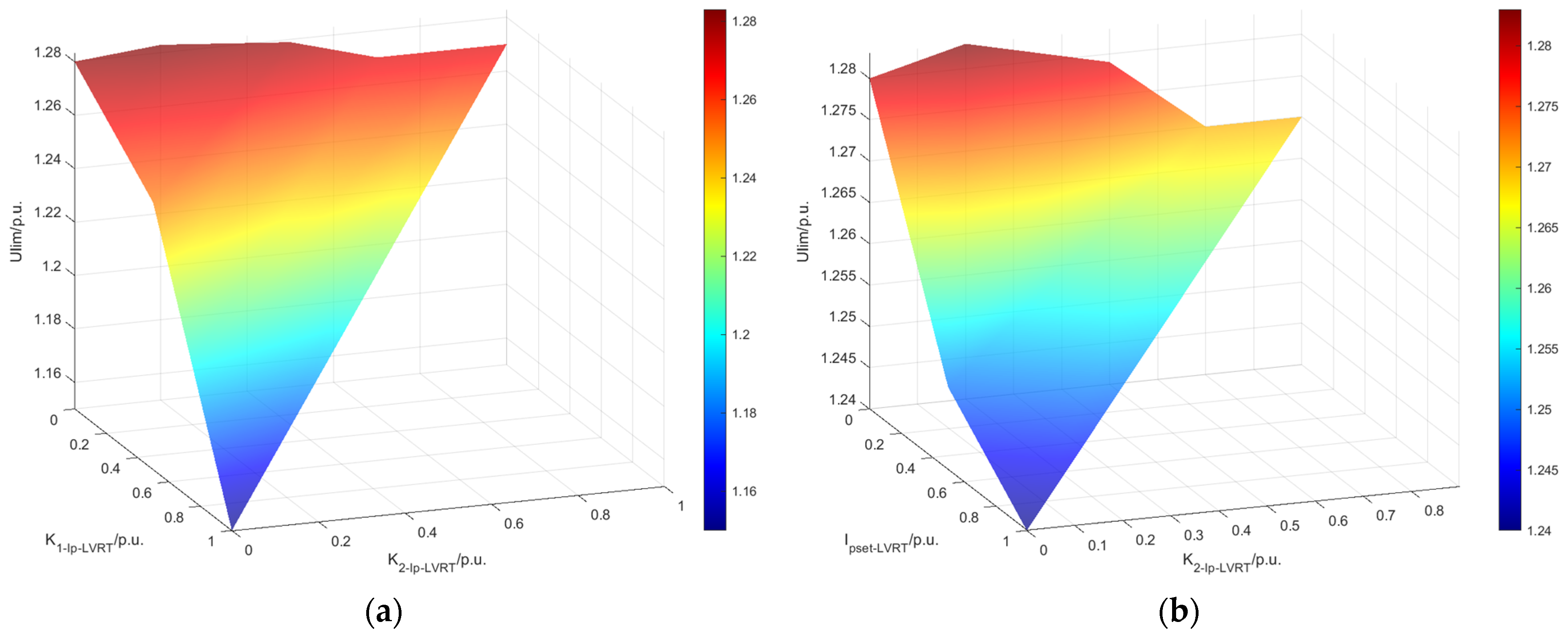
According to Figure 3, a commutation failure leads to an HVDC blocking fault. When the normalized LVRT active current control parameter varies from 0.0 to 1.0, the peak voltage drops caused by parameter K1-Ip-LVRT decrease from 1.28 to 1.15. Notably, the voltage peak value drops by 0.1 when the value of parameter K1-Ip-LVRT changes from 0.5 to 1.0. Thus, the effect of the change in parameter K1-Ip-LVRT is very obvious. Similarly, the peak voltage is reduced from 1.28 to 1.24 by changing the parameter Ipset-LVRT. But with the change from 0.5 to 1.0, the reduction in the peak voltage is tiny, from 1.25 to 1.24. As the active current control parameter value increases, the transient overvoltage during the HVDC blocking fault decreases. Parameter K2-Ip-LVRT significantly suppresses transient overvoltage caused by the previous three commutation failures, but it is less effective at suppressing transient overvoltage during HVDC monopolar blocking compared to the parameter K1-Ip-LVRT. Parameter K1-Ip-LVRT exhibits the highest sensitivity, with |SK1-Ip-LVRT| = 0.2, when K1-Ip-LVRT is within [0.5, 1]. Parameter K2-Ip-LVRT has the lowest sensitivity because max (|SK2-Ip-LVRT|) = 0.045.
Figure 4 presents the relationship between LVRT normalized active current control parameters and the maximum transient overvoltage Ulim.

3.2. LVRT Reactive Current Control Parameter Sensitivity Analysis

Under the LVRT reactive current control mode, there are three control parameters: K1-Iq-LVRT, K2-Iq-LVRT, and Iqset-LVRT. The schemes are shown below.
  • K1-Iq-LVRT is set to 1.5, 2, 2.5, and 3, while K2-Iq-LVRT and Iqset-LVRT are set to 0.5 and 0.2, respectively;
  • K2-Iq-LVRT is set to 0, 0.5, and 1, while K1-Ip-LVRT and Ipset-LVRT are set to 1.5 and 0.2, respectively;
  • Iqset-LVRT is set to 0, 0.1, and 0.2, while K1-Ip-LVRT and K2-Ip-LVRT are set to 1.5 and 0.5, respectively.
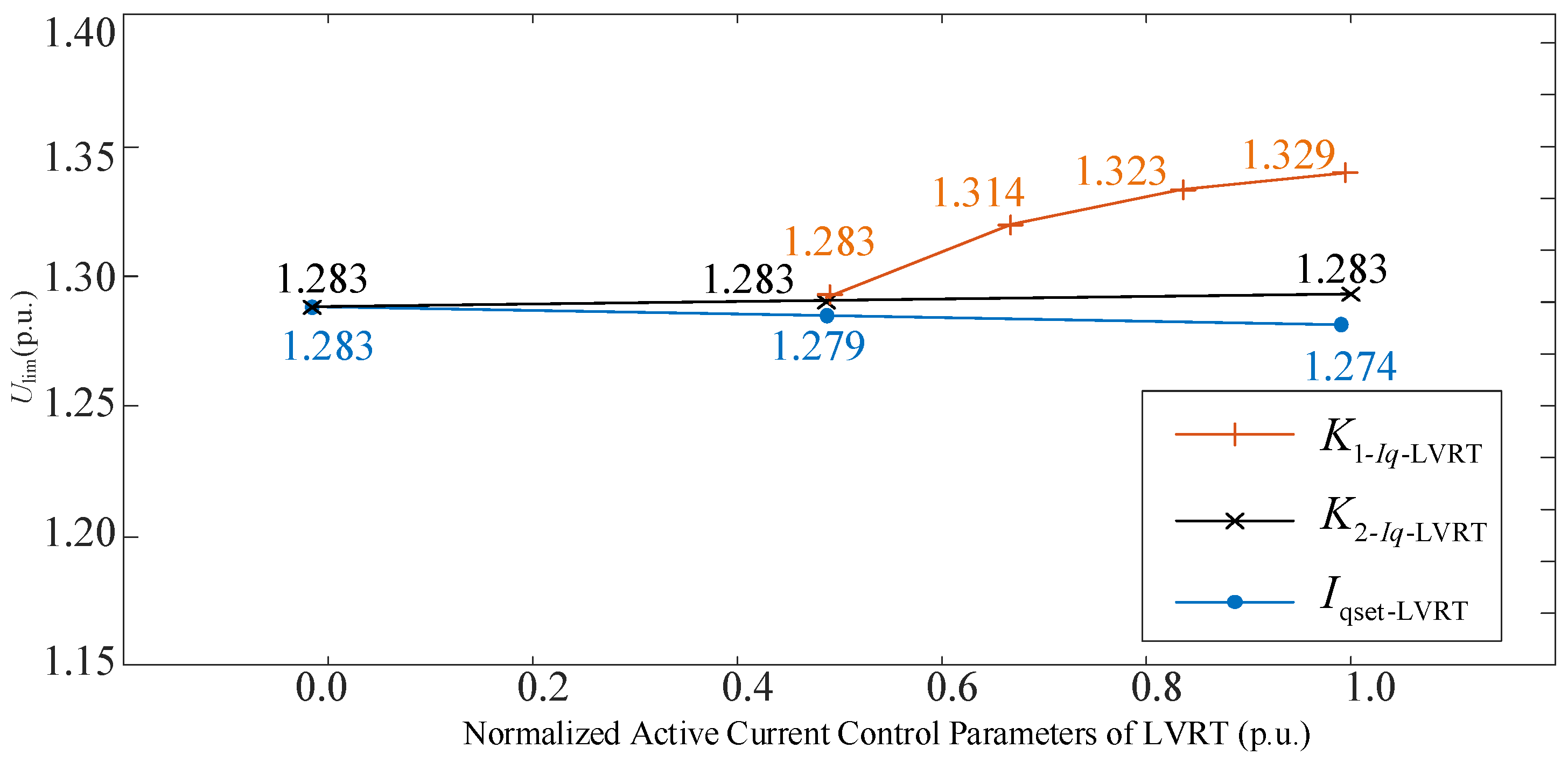
The relationship between the normalized reactive current control parameters of LVRT and maximum transient overvoltage is shown in Figure 5. When the normalized LVRT reactive current control parameter varies from 0.0 to 1.0, the peak voltage drops caused by parameter K2-Iq-LVRT decrease from 1.283 to 1.274. The overall trend is a slight decline, but the reduction is minimal, only 0.009 p.u. Similarly, the peak voltage remains at 1.283 despite changes to parameter Iqset-LVRT. However, the peak voltage stays at 1.283 for parameter K1-Iq-LVRT values between 0 and 0.4. After exceeding 0.4, it rapidly increases from 1.283 to 1.329, indicating that the peak voltage significantly increases with changes in parameter K1-Iq-LVRT.
According to Figure 5, the following were found:
Parameters K2-Iq-LVRT and Iqset-LVRT exert a negligible influence on transient overvoltage during HVDC blocking and can be safely disregarded.
The slope of the K1-Iq-LVRT parameter curve is the most pronounced, signifying its high sensitivity. This occurs because photovoltaics remain within the LVRT period during HVDC blocking. Consequently, a larger K1-Iq-LVRT value generates greater excess reactive power, directly elevating the magnitude of overvoltage during the blocking event. Reducing the K1-Iq-LVRT parameter value, therefore, significantly decreases the transient magnitude of overvoltage observed during HVDC blocking.
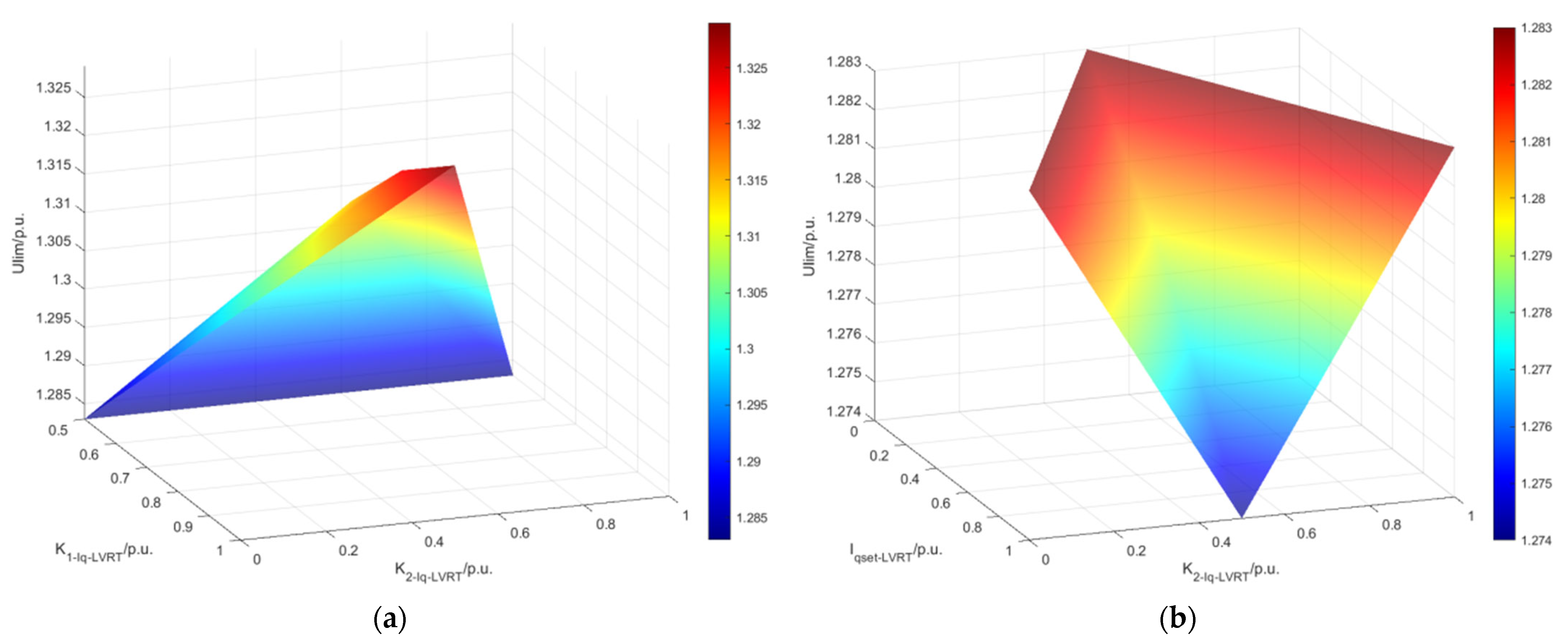
The sensitivity of normalized reactive current control parameters during LVRT is detailed in Table 3 and Table 4. The results indicate that SK2-Iq-LVRT = 0, which means that changing the parameter K2-Iq-LVRT has no effect on reducing the transient voltage peak. Therefore, the parameter does not need to be optimized. A combined analysis with Figure 6 reveals that K1-Iq-LVRT exhibits the highest absolute slope and sensitivity, whereas K2-Iq-LVRT demonstrates the lowest absolute slope and sensitivity.

3.3. HVRT Reactive Current Control Parameter Sensitivity Analysis

Three schemes are outlined as follows:
  • Parameter K1-Iq-HVRT is set to 0, 1, 2, and 3, respectively; K2-Iq-HVRT = 0, Iqset-HVRT = 0;
  • Parameter K2-Iq-HVRT is set to 0, 0.5, and 1, respectively; K1-Iq-HVRT = 0, Iqset-HVRT = 0;
  • Parameter Iqset-HVRT is set to 0, −0.1, and −0.2, respectively; K1-Iq-HVRT = 0, K2-Iq-HVRT = 0.
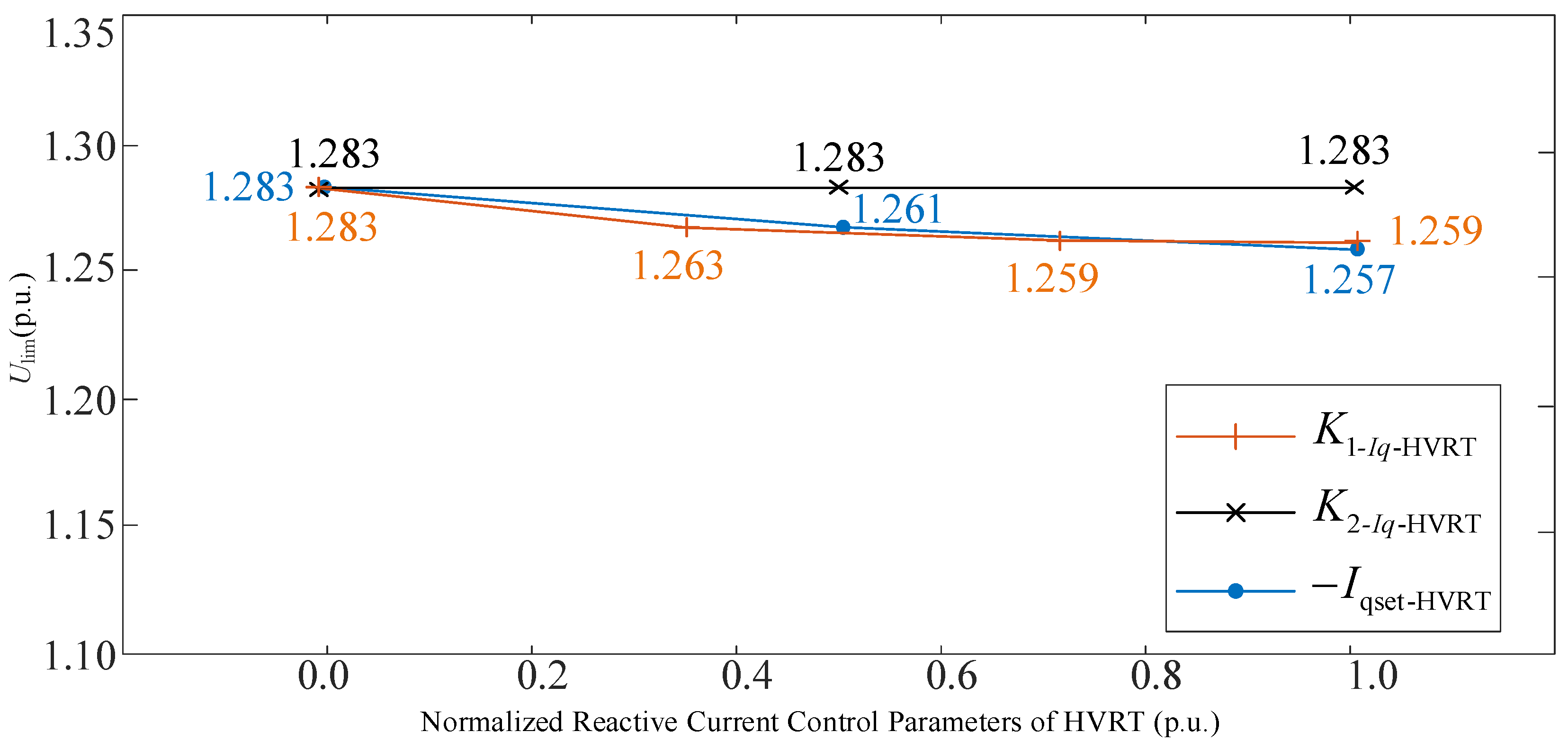
Figure 7 depicts the relationship between the normalized reactive current control parameters of HVRT and maximum transient overvoltage. When the normalized HVRT reactive current control parameter varies from 0.0 to 1.0, the peak voltage drops caused by parameter K1-Iq-HVRT decrease from 1.283 to 1.259. Similarly, the peak voltage decreases due to parameter Iqset-HVRT modification from 1.283 to 1.257. However, the peak voltage remains at 1.283 despite changes to parameter K2-Iq-HVRT.
Figure 7 demonstrates the following points. The impact of control parameter K2-Iq-HVRT on transient overvoltage during lockout is negligible.
High values of the parameters K1-Iq-HVRT and |Iqset-HVRT| directly result in reduced peaks of transient overvoltage. When the reactive power absorbed by the photovoltaic is greater during HVRT, the transient overvoltage is more effectively suppressed during HVDC blocking.
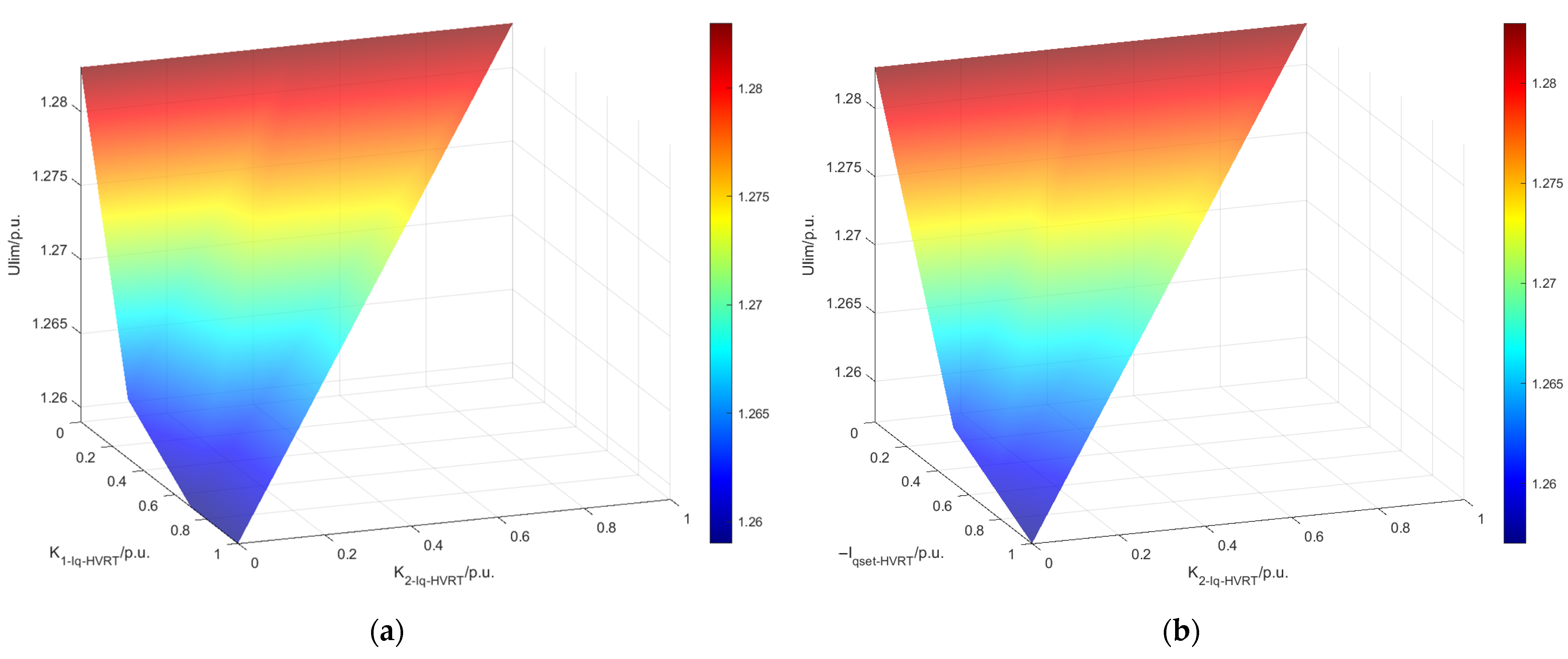
In detail, Table 5 show the sensitivity of HVRT reactive current control parameters. Combined with Figure 8, parameter K1-Iq-HVRT exhibits the highest sensitivity, reflected by its large absolute slope, whereas K2-Iq-HVRT shows the lowest sensitivity with the smallest absolute slope. Because SK2-Iq-HVRT = 0, the parameter K2-Iq-HVRT does not need to be optimized.
Based on the normalized parameter sensitivity index, the high-voltage ride-through control parameters are first optimized with high sensitivity. Then, the low-voltage ride-through control parameters are sorted in descending order of their sensitivity, and hierarchical optimization is performed on them. The degree of influence that each control parameter has on LVRT and HVRT can be categorized into three levels: primary, secondary, and tertiary. The findings are shown in Table 6.

4. Hierarchical Optimization Strategy for Photovoltaic Inverter Control Parameters

Building on the preceding mechanism and simulation analysis, which confirmed the significant impact of photovoltaic inverter voltage ride-through control parameters on transient voltage during fault and recovery periods, this study employs a normalized parameter sensitivity analysis. This method quantitatively evaluates the efficacy of different parameters in suppressing transient overvoltage, thereby pinpointing those with the highest sensitivity.
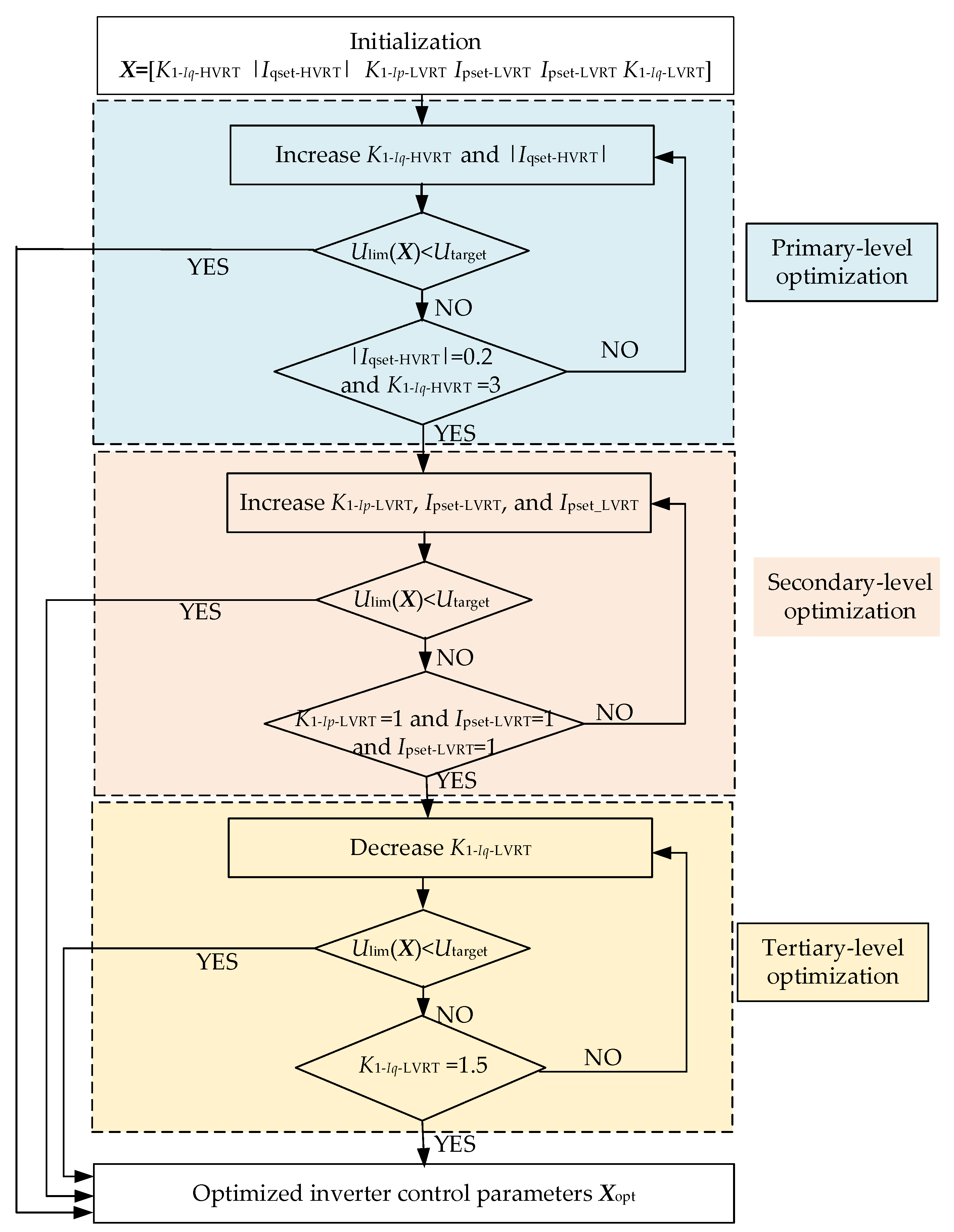
A hierarchical optimization control strategy is proposed for the low-voltage and high-voltage ride-through parameters of photovoltaic inverters to mitigate the maximum transient overvoltage at the grid-connected point.
The specific optimization process is as follows:
Primary level: This top-priority optimization aims to enhance the critical parameters K1-Iq-HVRT and Iqset-HVRT in HVRT control of photovoltaic inverters. The process ends when the maximum transient overvoltage at the grid connection point decreases to below the reference value UREF while continuing to optimize other parameters. If these parameters meet their maximum allowable limits and the overvoltage exceeds the reference value, UREF, a secondary-level optimization process is then conducted on the previously optimized parameters K1-Iq-HVRT and Iqset-HVRT.
Secondary level: This phase enhances the LVRT active current control parameters by elevating K1-Ip-LVRT, K2-Ip-LVRT, and Ipset-LVRT. When suboptimal parameters reach their limits and the peak transient overvoltage at the connection point exceeds the reference value UREF, third-tier parameters will be optimized based on the previously optimized control parameters of the PV inverter.
Tertiary level: This level specifically optimizes LVRT reactive current control parameters by reducing K1-Iq-LVRT. When the maximum transient overvoltage at the grid connection point complies with the requirements, the inverter optimization parameters are determined. If the maximum transient overvoltage fails to meet the requirements, further reductions occur for K1-Iq-LVRT. If parameter K1-Iq-LVRT reaches its limit and the maximum transient overvoltage does not meet the requirements, the optimization process is halted, and inverter parameters are set. The optimization strategy is shown in Figure 9.

5. Simulations

5.1. Revised IEEE 10-Generator 39-Bus System

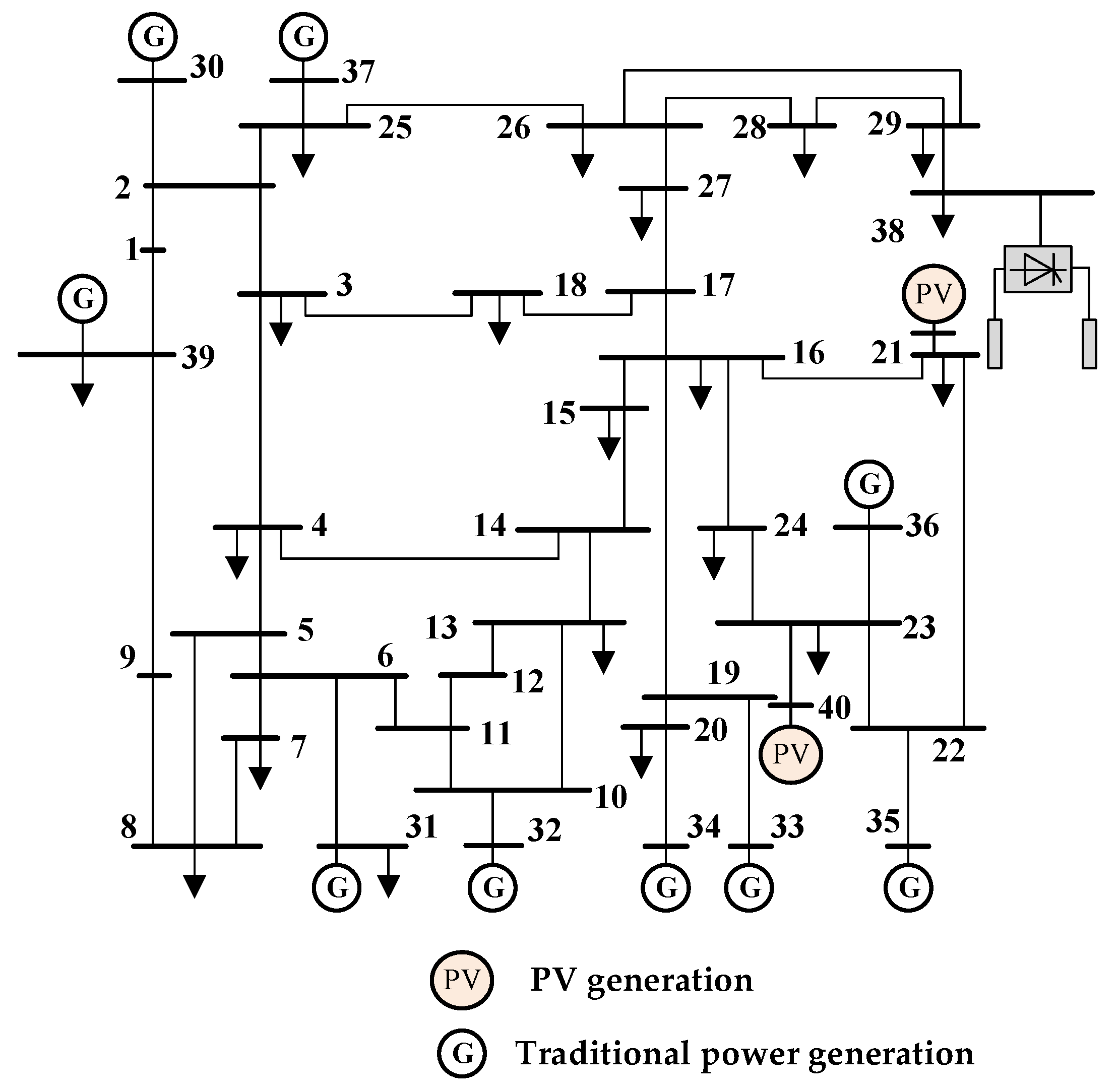
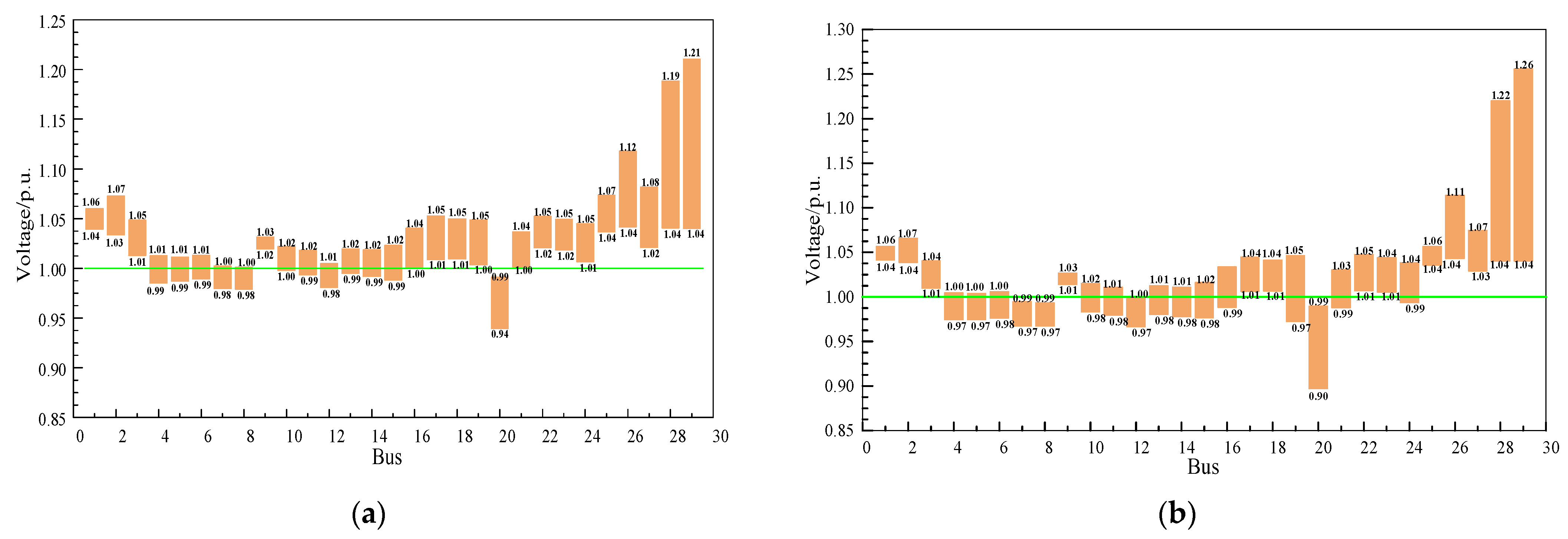
The IEEE 39-bus system was modified by converting the conventional generator at bus 38 to an HVDC feed-in with a capacity of 30%. Buses 21 and 40 were converted into photovoltaic power stations, with grid-connected capacities of 23% and 18%, respectively. The photovoltaic penetration rate is as high as 41%. An HVDC monopole blocking fault and a bipolar lockout fault occurred at bus 38, respectively, after 1 s, and the capacitor was disconnected at 0.25 s. The voltage variation curves from bus 1 to bus 29 in the power grid are shown in Figure 10.
From the results in Figure 11, when a monopolar blocking fault occurred at bus 38 in the HVDC transmission system, overvoltage was observed in the adjacent buses 28 and 29 shortly thereafter. The overvoltage of buses 28 and 29 reached 1.19 and 1.21, respectively. This phenomenon occurred because the redundant reactive power compensation devices at the inventor station did not immediately disconnect following the monopolar lockout, resulting in localized voltage surges. After the removal of the capacitor banks at the converter station, the bus voltage gradually returned to normal levels. Most bus voltages are maintained within acceptable ranges with no evidence of significant overvoltage. However, the overvoltage on buses 28 and 29 was more severe. The maximum voltage of buses 28 and 29 reached 1.22 and 1.26, respectively, which is larger than that of a single-pole locking fault. This is because when a bipolar lockout fault occurs at the inverter-side station, reactive power is transmitted to the AC power grid, causing a more severe reactive power surplus than a monopolar blocking fault.
To achieve the transient overvoltage control target of 1.1 p.u., we optimized the PV inverter control parameters using the method proposed in this paper (see Table 7). A key finding is that the optimal parameter values are contingent upon the photovoltaic penetration rate and must be adjusted accordingly.
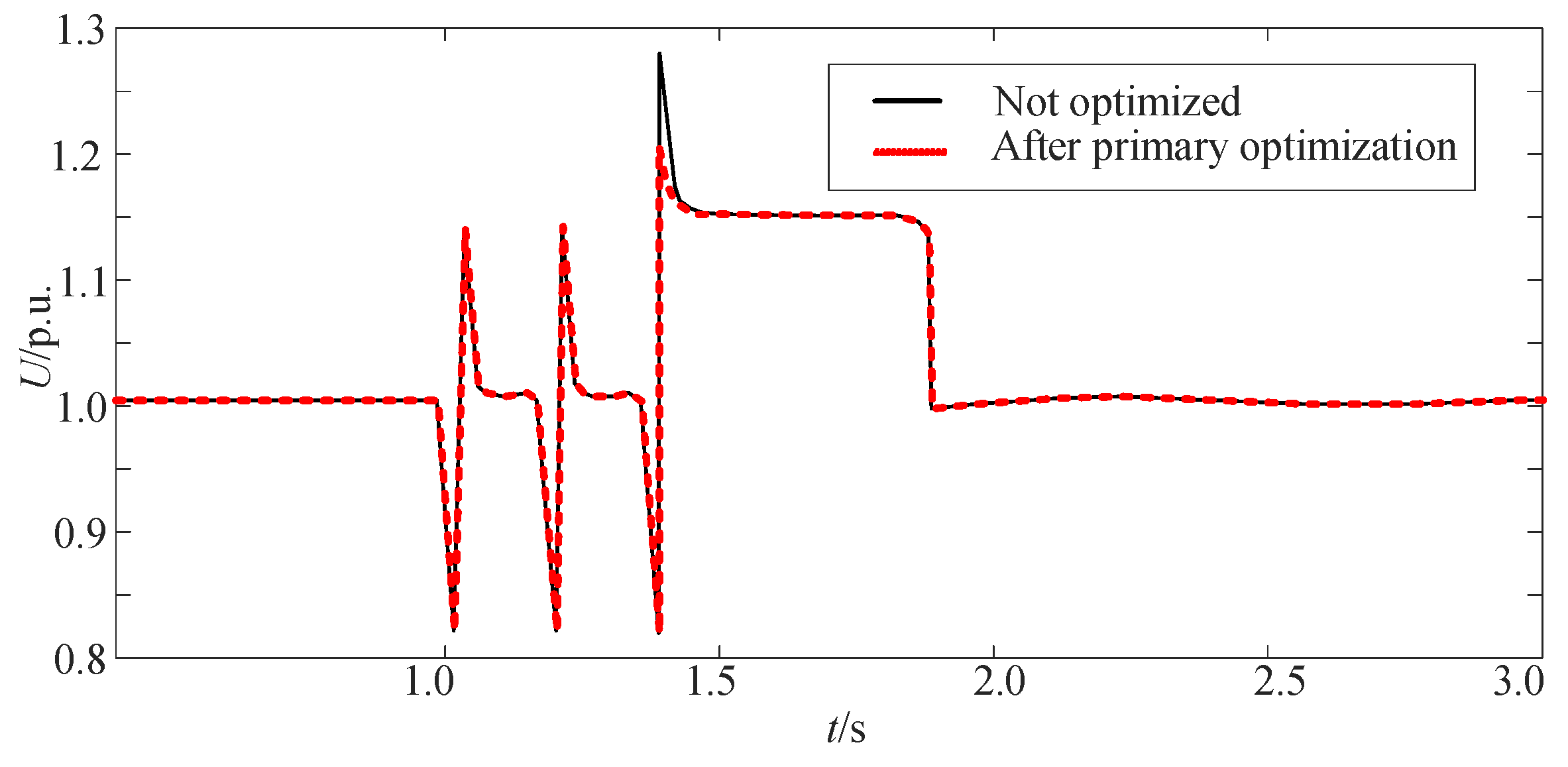
Figure 12 shows that optimizing the primary-level parameters significantly suppressed the transient overvoltage at the PCC during lockout to 1.207 p.u. This outcome, while still exceeding the 1.1 p.u. target, occurred because the system optimized the suboptimal-level parameters after the optimal-level parameters reached their limits, as dictated by the proposed strategy.
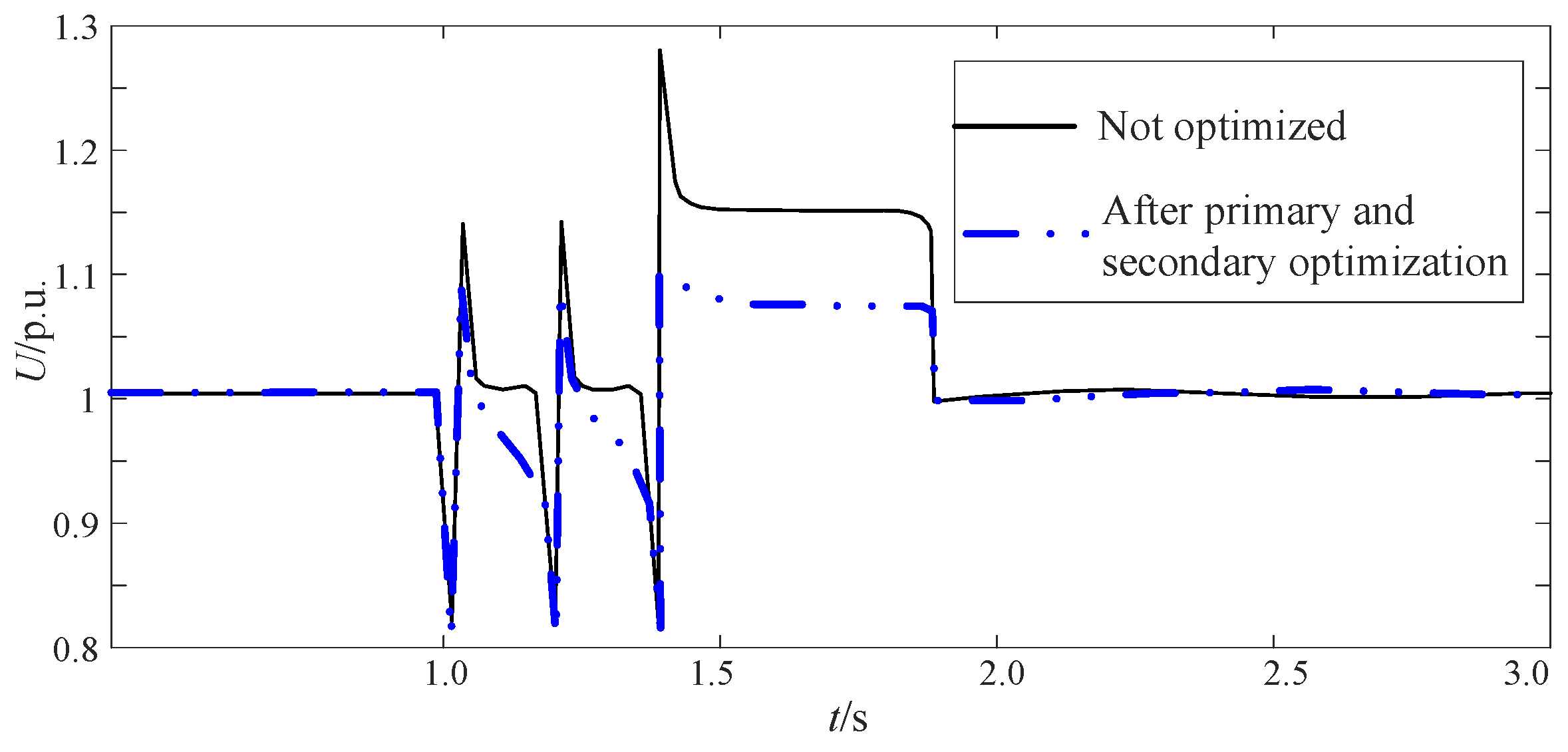
The grid connection point voltage profile is compared before and after secondary-level optimization in Figure 13. By adjusting secondary-level control parameters, the maximum transient overvoltage decreased during HVDC blocking to 1.116 p.u. Since secondary-level parameters reached operational limits, optimization proceeded to the tertiary-level strategy proposed in this paper.
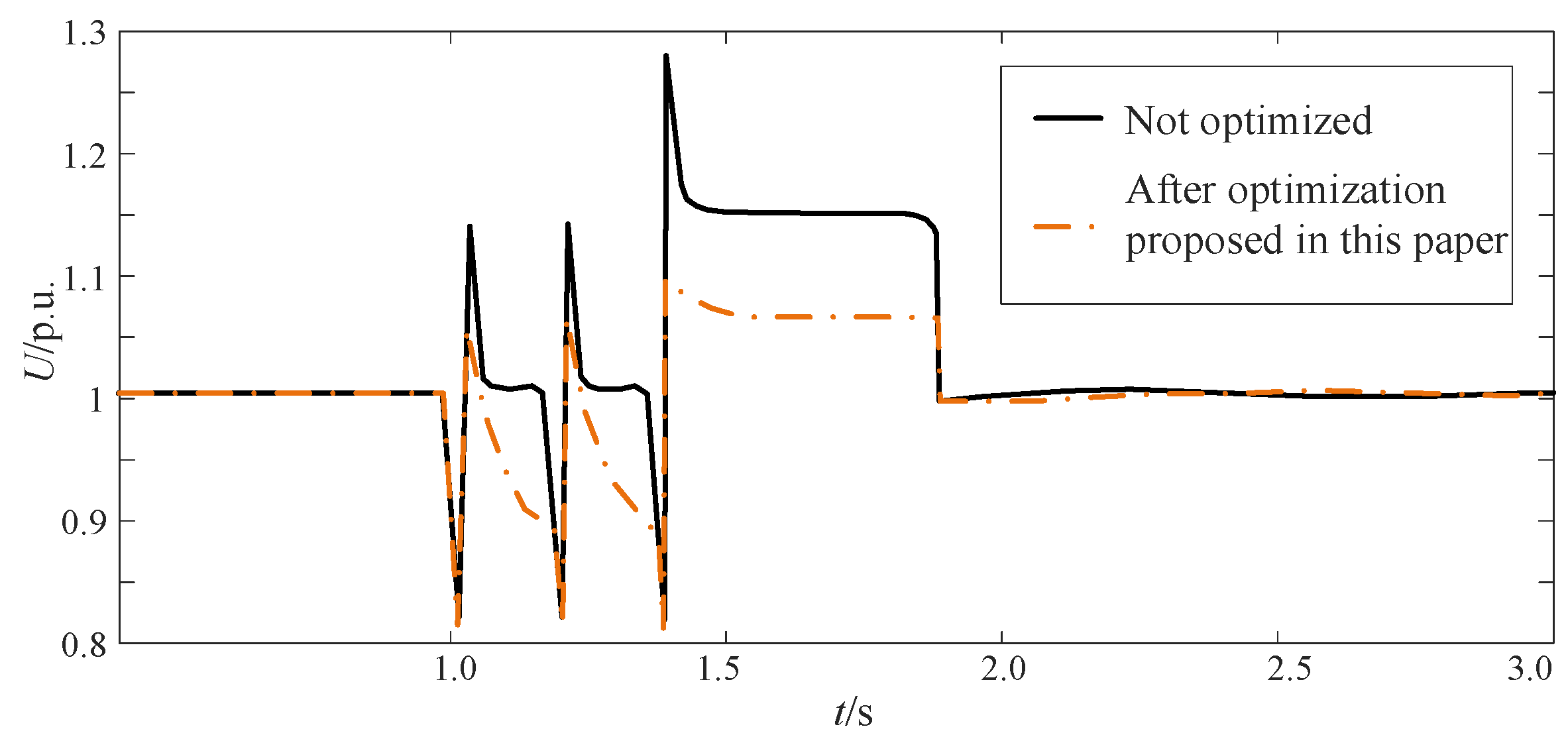
The tertiary-level parameter K1-Iq-LVRT was reduced to two. The grid connection point voltage profile is compared before and after tertiary-level optimization in Figure 14. Adjusting tertiary-level control parameters reduced maximum transient overvoltage during HVDC blocking to 1.098 p.u., which is below the value of 1.1 p.u., resulting in the termination of the optimization process. After three levels of optimization, the transient voltage peak was reduced from 1.263 to 1.098, meeting the target of not exceeding 1.1, with a decrease of 15.03%. Table 8 presents a comparison of the PV inverter’s control parameter results before and after each level optimization.
Simulation results confirm that the proposed hierarchical optimization strategy effectively mitigates the maximum transient overvoltage. This improvement is achieved because the parameters optimized at each level are highly sensitive, making their adjustment particularly effective. Specifically, the hierarchical approach decomposes the complex optimization problem into multiple interconnected sub-problems, each targeting specific stages of the system’s transient response. The high sensitivity of these parameters means that even small adjustments can lead to significant reductions in overvoltage magnitude, as they directly impact node voltage dynamic response characteristics. By iteratively optimizing each level, the hierarchical strategy effectively minimizes the maximum transient overvoltage across fault scenarios. Crucially, by restricting the optimization of HVRT parameters to the primary level and adjusting LVRT parameters at the secondary and tertiary levels, the strategy successfully suppresses overvoltage while preserving the system’s critical voltage support capabilities.

5.2. Henan Power Grid

To verify the practical applicability of the proposed method, we conducted operational verification on the Henan Power Grid. This study analyzes key parameters, including the active current coefficient during LVRT, the reactive current coefficient during LVRT, and the active power recovery rate. Additionally, the paper evaluates the sensitivity of transient voltages in the power grid, examining how voltage levels at different nodes respond to dynamic changes during and after LVRT events, ensuring that these transient conditions remain within acceptable limits as defined by grid operational standards.
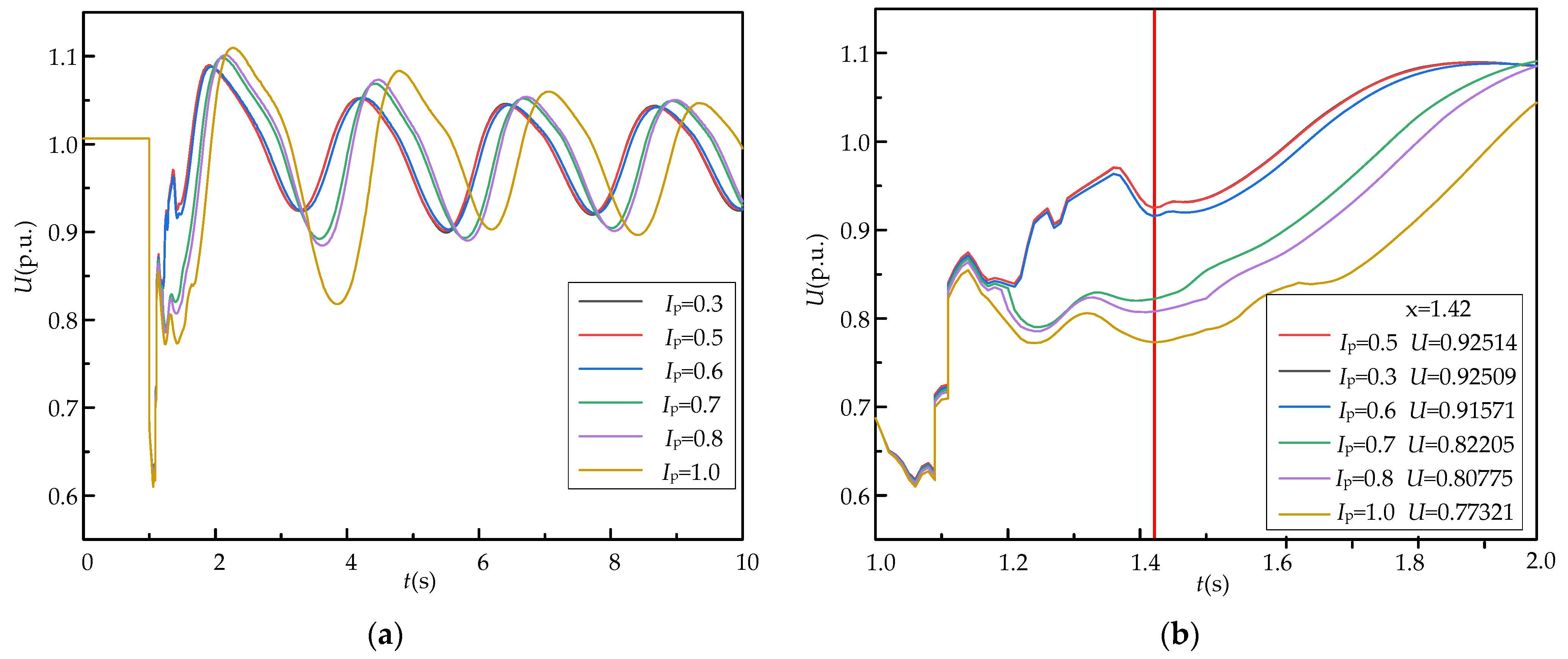
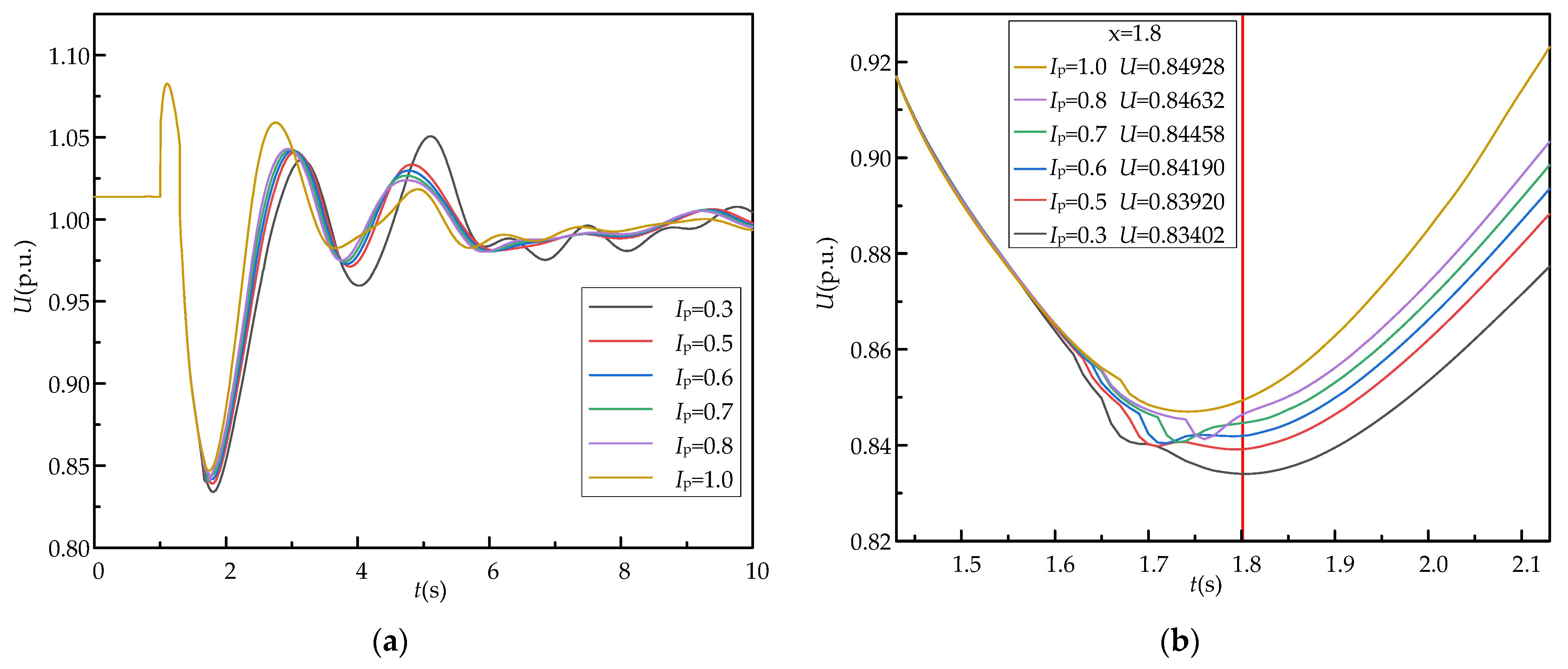
The active current coefficient of 0.5 and reactive current coefficient of 1.5 were set in the regions of Northern Henan and Western Henan, with an active power recovery rate of 3.0. An analysis was conducted on the sensitivity of renewable energy control parameters in the eastern and southern regions of Henan Province. Figure 15 depicts the influence of the active current coefficient on the voltage at the PCC for new energy power stations under different active currents in the case of an N-2 fault occurring within the region. Figure 16 shows the voltage at the PCC for new energy power stations under the Tian-zhong HVDC block fault. Sequentially decreasing the active current coefficients to 1.0, 0.8, 0.7, 0.6, 0.5, and 0.3, the minimum voltage increases from 0.773 to 0.925, while the maximum voltage decreases from 1.108 to 1.092 during the fault recovery period under an N-2 fault in Eastern and Southern Henan. On the other hand, under a Tian-zhong HVDC monopolar block fault, the minimum voltage increases from 0.834 to 0.849, and the maximum voltage decreases from 1.07 to 1.04. This indicates that an increased active current results in improved voltage recovery characteristics. Therefore, it is recommended that, during the LVRT process in the eastern and southern regions of Henan Province, the active current coefficient be set at 0.7.
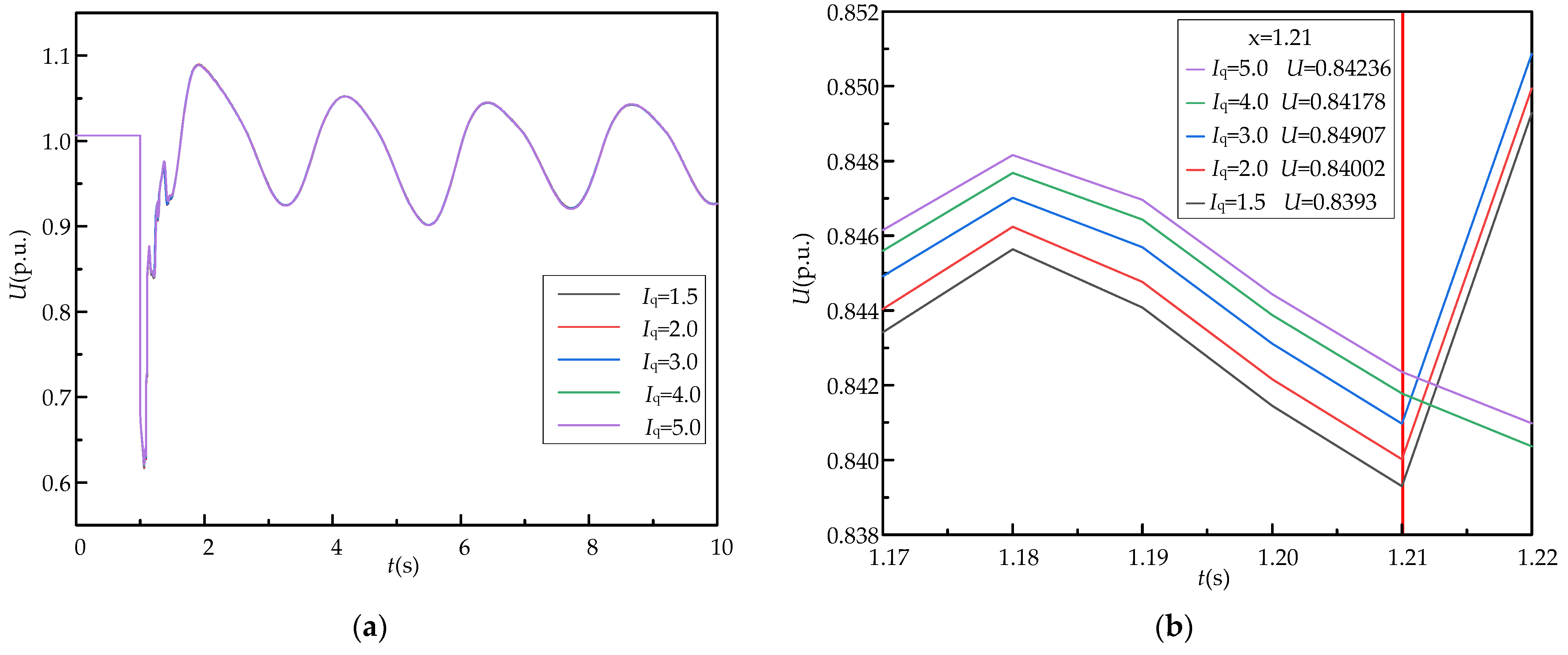
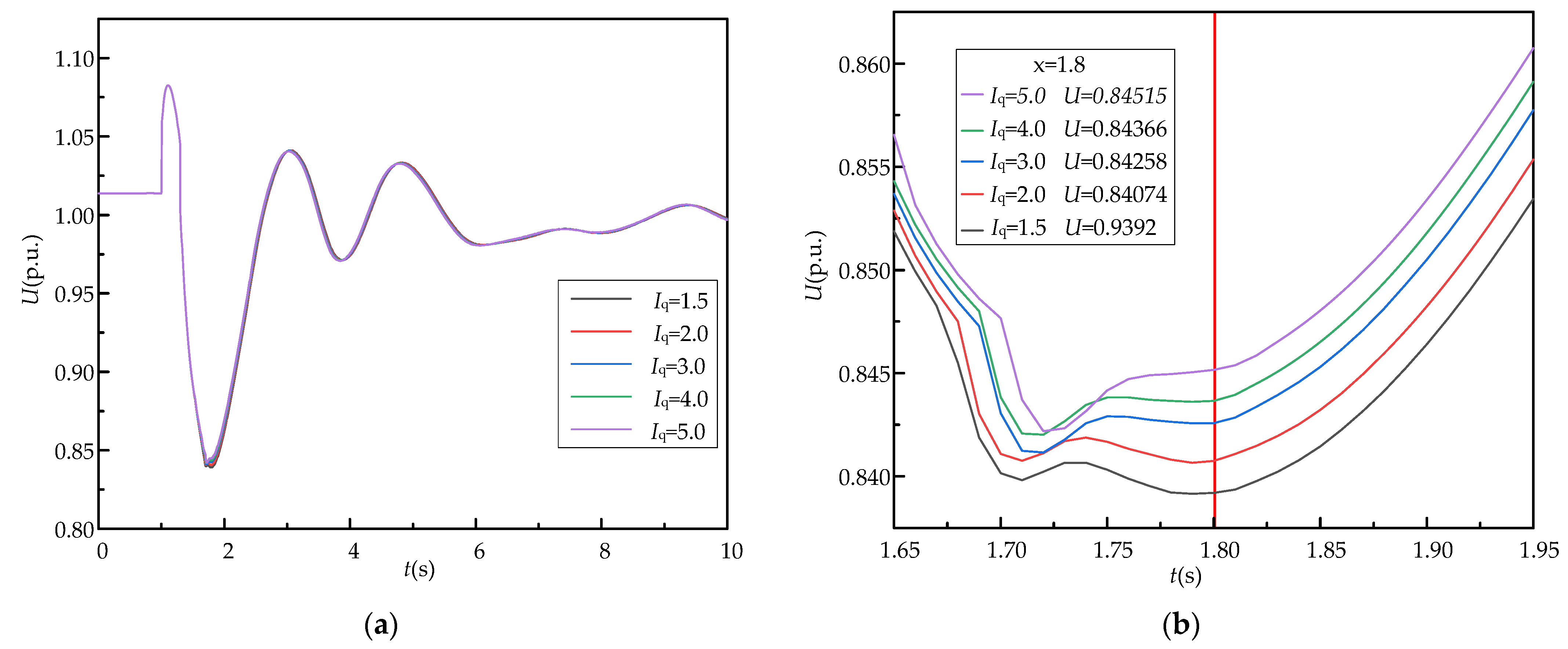
During the LVRT period, the limited demand for local active power support (concentrated near the fault) led to increased reactive power losses from active power flow, consequently raising the reactive power support requirement from renewables. Accordingly, a reactive current coefficient of 4.0 is proposed.
Figure 17 illustrates the voltage at the point of common coupling (PCC) during LVRT process under an N-2 fault in Eastern and Southern Henan, with varying reactive current coefficients. Figure 18 shows voltage at the PCC during LVRT process under a Tian-zhong HVDC monopolar block fault in Eastern and Southern Henan when the reactive current coefficients change.
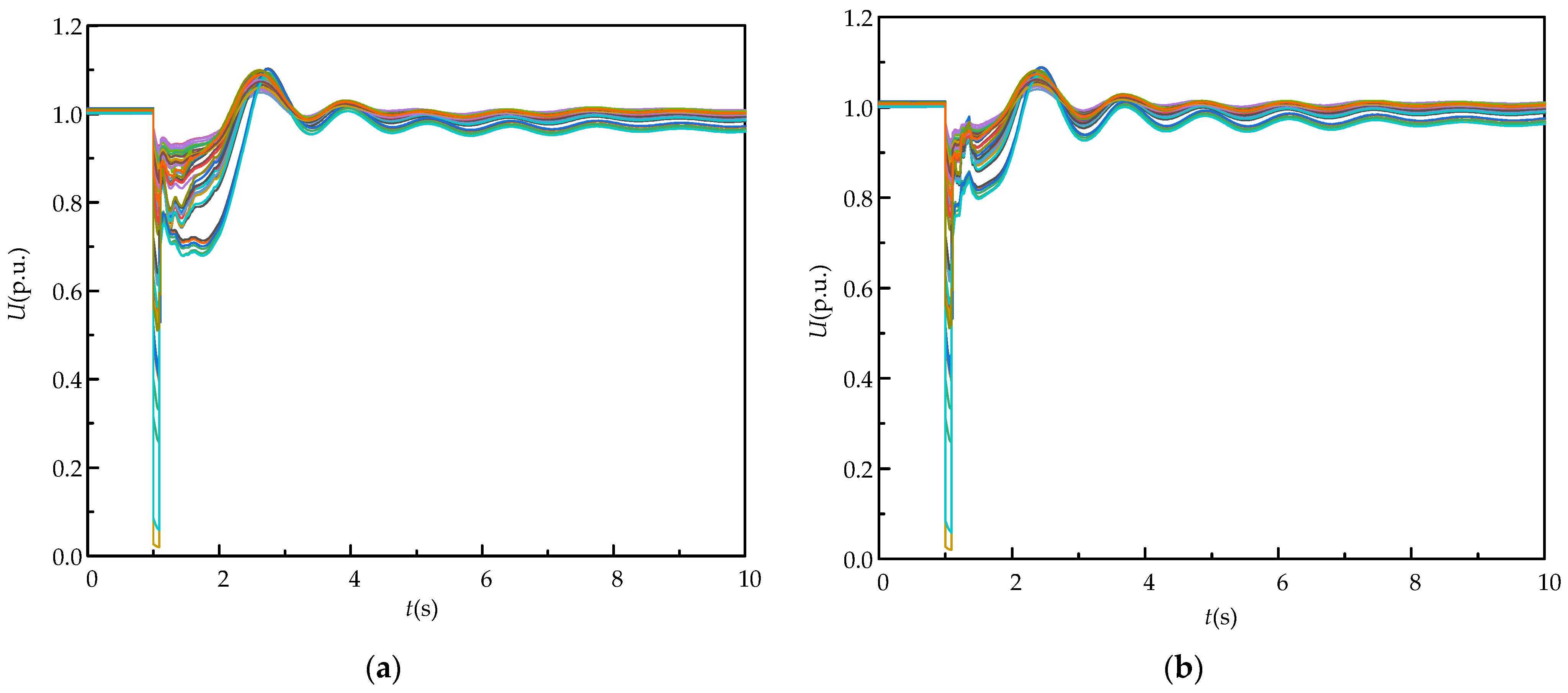
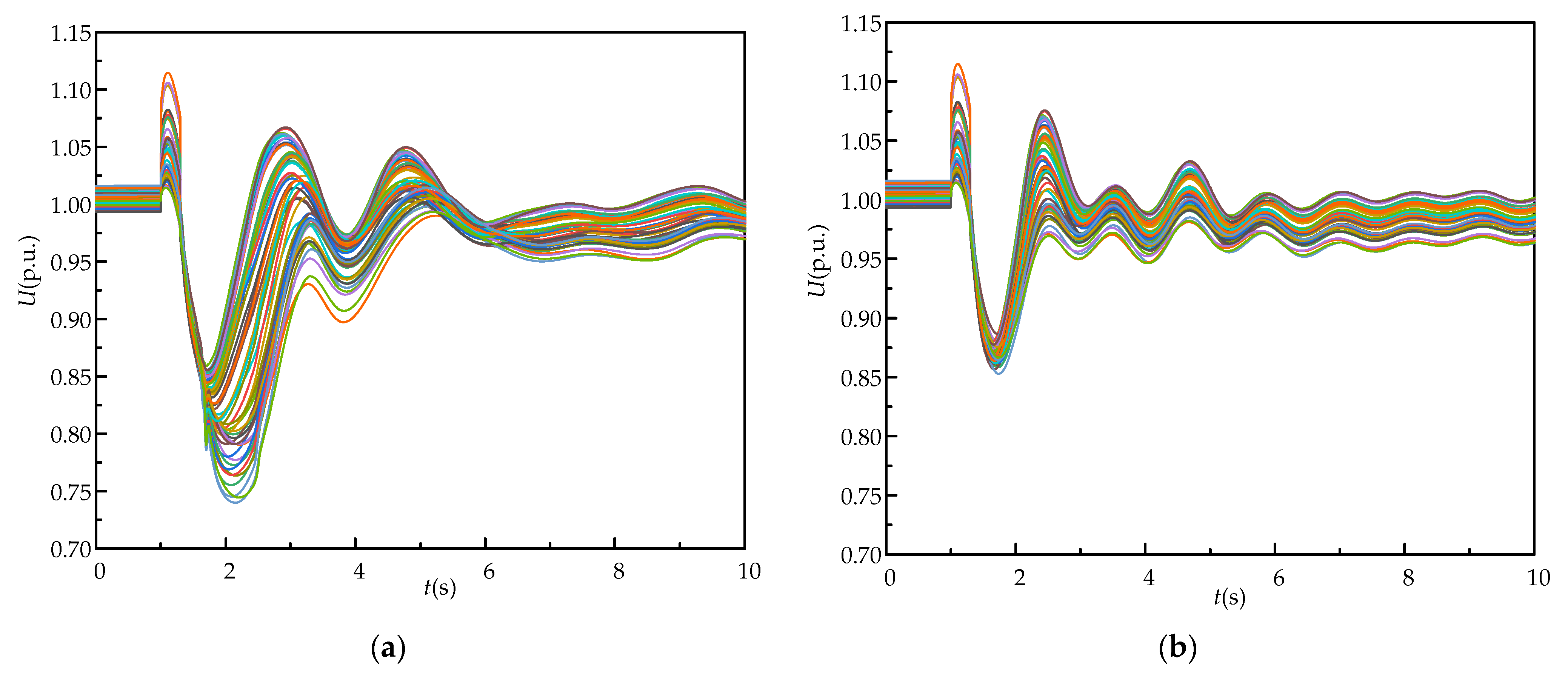
Simulations comparing the optimized and typical parameter sets were performed for the N-2 and Tian-zhong HVDC monopolar block faults, as shown in Figure 19 and Figure 20. The optimized parameters yielded superior voltage performance throughout the fault and post-fault periods, a conclusion further supported by the transient voltage characteristic indices.
The simulation results in Figure 20 indicate that the optimized parameters elevated the minimum voltage during faults at 500 kV nodes from 0.747 p.u. to 0.850 p.u., and maintained the post-fault voltage below 1.1 p.u.
The simulation results in Figure 20 show that the optimized parameters increased the minimum voltage during faults at 500 kV nodes from 0.747 p.u. to 0.850 p.u., while keeping the post-fault voltage below 1.1 p.u., with markedly reduced fluctuations. This attests to a substantial improvement in voltage quality and system stability for the Henan Power Grid. Results confirm that the strategy provides the dual advantages of suppressing overvoltage while preserving essential voltage support during LVRT, enhancing overall grid reliability and offering broad applicability for power system stability.
Additionally, these tests would help to further verify the stability and effectiveness of the parameter optimization strategy under different dynamic operating conditions, including load peaks and various fault scenarios. As the power grid structure in Henan may change due to the addition of new power generation sources or the expansion of transmission lines, the optimized parameters need to be updated accordingly.

6. Conclusions

This paper addresses the mitigation of transient overvoltage by optimizing both low-voltage ride-through and high-voltage ride-through control parameters of the PV inverter. This not only enhances voltage during the fault process, but also suppresses overvoltage in the initial stage of fault recovery at the PPC in AC/DC hybrid receiving-end power grids. The research began with an analysis of the reactive power–transient voltage coupling during steady-state, fault, and recovery periods. Based on this analysis, a sensitivity study quantified the impact of inverter control parameters on the maximum PPC voltage, and a ranking identified the most influential ones. Subsequently, a proposed optimization strategy was simulated and validated, demonstrating its capability to maintain the transient overvoltage within the required limit.
There are some issues that need further research in the future. The challenge of transient overvoltage caused by faults in the AC/DC interconnected receiving-end power grid can be effectively addressed through the optimization of inverter control parameters utilizing intelligent algorithms, such as machine learning or genetic algorithms, which can further improve the adaptability and robustness of the control strategy. In addition, coordinated optimization with other reactive power compensation devices is also one of the future research directions.

Author Contributions

Conceptualization, J.W. (Jiahao Wang) and L.S.; formal analysis, X.L.; investigation, F.Y. and H.Z.; methodology, J.W. (Jiahao Wang); software, R.S., J.W. (Jianbo Wang), and L.S.; supervision, R.S.; validation, F.Y. and Z.C.; visualization, J.W. (Jiahao Wang); writing—original draft, L.S.; writing—review and editing, L.S. All authors have read and agreed to the published version of the manuscript.

Funding

This research is funded by the National Natural Science Foundation of China under grant 52077058. The work is also supported by the project of the State Grid Henan Electric Power Company (No. 52170224001A).

Data Availability Statement

The original contributions presented in this study are included in the article. Further inquiries can be directed to the corresponding author.

Conflicts of Interest

Authors Ran Sun, Jianbo Wang, Feng Yao, Zhaohui Cui, Xiaomeng Li and Hao Zhang are employed by the company State Grid Corporation of China. The remaining authors declare that the research was conducted in the absence of any commercial or financial relationships that could be construed as a potential conflict of interest. The company State Grid Corporation of China had no role in the design of the study; in the collection, analyses, or interpretation of data; in the writing of the manuscript, or in the decision to publish the results.

References

  1. Shu, Y.B.; Tang, Y.; Zhang, Z.L.; Zhang, F.Y.; Zhong, W.Z.; Shi, H.B.; Wang, G.Z.; Chen, C.S.; Gu, Z.Y. Analysis and lessons of the April 28, 2025 blackout in the Iberian Peninsula power system. Proc. CSEE 2025, 45, 6603–6612. [Google Scholar] [CrossRef]
  2. Zhang, M.; Liu, J.; Lin, J.G.; Zhao, X.B. Environmental benefit analysis of rooftop distributed photovoltaic development under the “dual carbon” background. Energy Res. Util. 2021, 6, 37–41. [Google Scholar] [CrossRef]
  3. Spanish National Security Council. Analysis Report on the Electricity Crisis on April 28, 2025: Unclassified Version; Spanish Government: Madrid, Spain, 2025. Available online: https://www.lamoncloa.gob.es/consejodeministros/resumenes/Documents/2025/Informe-no-confidencial-Comite-de-analisis-28A.pdf (accessed on 17 June 2025).
  4. Sebastian, O.H.; Carlos, B.D. Trade-off between frequency stability and renewable generation–studying virtual inertia from solar PV and operating stability constraints. Renew. Energy 2024, 232, 121075. [Google Scholar] [CrossRef]
  5. Liu, C.; Wu, T.; Zhu, J.; Wei, R.; Wu, Y.; Tian, A. A transient reactive power control strategy of PV-ESS enhances the system transient stability. J. Energy Storage 2024, 92, 112302. [Google Scholar] [CrossRef]
  6. Qu, Y.; Han, X.; Meng, T.; Liu, X.; Chen, D.; Liu, Z. Fast assessment method for transient voltage stability of photovoltaic receiving-end grid. Adv. Math. Phys. 2024, 1, 7361194. [Google Scholar] [CrossRef]
  7. Wang, Q.; Zhang, Y.; Tian, P.; Ren, B.; Li, Q.; Luo, P.; Hao, J. Research on the influence of load model with distributed PV generation on the voltage stability of receiving-end power grid. Energy Rep. 2023, 9, 880–886. [Google Scholar] [CrossRef]
  8. Li, T.; Jiang, X.; Yu, L.; Yan, X.; Wang, J. Voltage Transient Analysis and Control Discussion of a Power Grid with High Proportion of Photovoltaic and Large-Capacity DC Receiving. In Proceedings of the 2024 3rd Asian Conference on Frontiers of Power and Energy (ACFPE), Chengdu, China, 25–27 October 2024. [Google Scholar] [CrossRef]
  9. Gerdroodbari, Y.Z.; Razzaghi, R.; Shahnia, F. Improving voltage regulation and unbalance in distribution networks using peer-to-peer data sharing between single-phase PV inverters. IEEE Trans. Power Deliv. 2021, 37, 2629–2639. [Google Scholar] [CrossRef]
  10. Hao, W.; Chen, M.; Gan, D. Short-term voltage stability analysis and enhancement strategies for power systems with photovoltaic penetration. IEEE Access 2024, 12, 88728–88738. [Google Scholar] [CrossRef]
  11. Cui, H.; Wang, C.; Ye, J.; Yang, B. Research of interaction of distributed PV system with multiple access points and distribution network. Power Syst. Prot. Control 2015, 43, 91–97. [Google Scholar]
  12. Wang, J.; Zhang, Z.; Yi, J.; Chen, Z.; Liu, C. Transient Voltage Characteristics Analysis of DC Receiving-End Power Grid with Large-Scale Integrated Distributed Photovoltaics. In Proceedings of the 2024 3rd International Conference on Power Systems and Electrical Technology (PSET), Beijing, China, 5–8 August 2024. [Google Scholar] [CrossRef]
  13. Wang, J.M.; Sun, H.D.; Zhang, J.; Ren, D.; Yin, Y.; Bu, G.Q. Stability characteristics and coordinated control strategy of interconnected grid integrated with UHVDC transmission line from Jinping to Sunan. Power Syst. Technol. 2012, 36, 66–70. [Google Scholar] [CrossRef]
  14. Fang, Y.J. Reducing the risk of system collapse caused by transmission section opening through emergency control-reflections on the Indian blackout. Autom. Electr. Power Syst. 2013, 37, 1–6. [Google Scholar]
  15. Eftekharnejad, S.; Vittal, V.; Heydt, G.T.; Keel, B.; Loehr, J. Impact of increased penetration of photovoltaic generation on power system. IEEE Trans. Power Syst. 2012, 28, 893–901. [Google Scholar] [CrossRef]
  16. Awad, A.S.; Turcotte, D.; El-Fouly, T.H. Impact assessment and mitigation techniques for high penetration levels of renewable energy sources in distribution networks: Voltage-control perspective. J. Mod. Power Syst. Clean Energy 2021, 10, 450–458. [Google Scholar] [CrossRef]
  17. Ni, S.; Cui, C.G.; Zheng, Q.R.; Hao, H.L.; Yang, N. Stochastic multi-objective reactive power optimization of distribution network based on multiple wind turbines correlative scenario generation method. Zhejiang Electr. Power 2020, 39, 103–111. [Google Scholar] [CrossRef]
  18. Chai, Y.; Guo, L.; Wang, C.; Zhao, Z.; Du, X.; Pan, J. Network partition and voltage coordination control for distribution networks with high penetration of distributed PV units. IEEE Trans. Power Syst. 2022, 33, 3396–3407. [Google Scholar] [CrossRef]
  19. Zhu, K.; Qin, H.; Zhao, J.; Wan, C.; Zheng, S.; Zhang, X. Network Partition-based Multi-timescale Coordinated Voltage Regulation of Distribution Networks with High-penetration Distributed PVs. In Proceedings of the 2024 IEEE 8th Conference on Energy Internet and Energy System Integration (EI2), Beijing, China, 25–27 October 2024. [Google Scholar] [CrossRef]
  20. Zhao, B.; Xu, Z.; Xu, C.; Wang, C.; Lin, F. Network partition-based zonal voltage control for distribution networks with distributed PV systems. IEEE Trans. Smart Grid 2017, 9, 4087–4098. [Google Scholar] [CrossRef]
  21. Gui, Y.H.; Nainar, K.; Bendtsen, J.D.; Diewald, N.; Iov, F.; Yang, Y.; Blaabjerg, F.; Xue, Y.; Liu, J.; Hong, T.; et al. Voltage support with PV inverters in low-voltage distribution networks: An overview. IEEE J. Emerg. Sel. Top. Power Electron. 2024, 12, 1503–1522. [Google Scholar] [CrossRef]
  22. Fazio, A.R.D.; Risi, C.; Russo, M.; De Santis, M. Coordinated optimization for zone-based voltage control in distribution grids. IEEE Trans. Ind. Appl. 2022, 58, 173–184. [Google Scholar] [CrossRef]
  23. Li, Z.; Wang, W.B.; Han, S.F.; Lin, L.J. Voltage adaptability of distributed photovoltaic access to a distribution network considering reactive power support. Power Syst. Prot. Control 2022, 50, 32–41. [Google Scholar] [CrossRef]
  24. Emarati, M.; Barani, M.; Farahmand, H.; Aghaei, J.; del Granado, P.C. A two-level over-voltage control strategy in distribution networks with high PV penetration. Int. J. Electr. Power Energy Syst. 2021, 130, 1776–1781. [Google Scholar] [CrossRef]
  25. Cheng, Z.; Wang, L.; Zeng, S.; Su, C.; Zhang, R.; Zhou, W. Partition-global dual-layer collaborative voltage control strategy for active distribution network with high proportion of renewable energy. IEEE Access 2024, 12, 22546–22556. [Google Scholar] [CrossRef]
  26. Aboshady, F.M.; Pisica, I.; Zobaa, A.F.; Taylor, G.A.; Ceylan, O.; Ozdemir, A. Reactive power control of PV inverters in active distribution grids with high PV penetration. IEEE Access 2023, 11, 81477–81496. [Google Scholar] [CrossRef]
  27. Reguieg, Z.; Bouyakoub, I.; Mehedi, F.; Bouhadji, F. Enhancing Electrical Grid Stability through Power Quality Optimization via PV-PO-UPQC: An Integrated Approach. In Proceedings of the 2024 2nd International Conference on Electrical Engineering and Automatic Control (ICEEAC), Kunming, China, 7–9 June 2024. [Google Scholar] [CrossRef]
  28. Ikaouassen, H.; Raddaoui, A.; Rezkallah, M. Performance and stability analysis of enhanced Lyapunov function and predictive voltage control with active damping for single-phase PV/grid electric power system. Iran. J. Sci. Technol. Trans. Electr. Eng. 2024, 48, 731–746. [Google Scholar] [CrossRef]
  29. Vieira, R.; Guerra, M.I.; Bandeira, S. Analysis of the power quality of a grid-connected photovoltaic system. IEEE Lat. Am. Trans. 2020, 18, 714–721. [Google Scholar] [CrossRef]
  30. Zhou, C. Research on Coordinated Optimization of Reactive Power Compensation and Power Quality in Photovoltaic Grid-Connected Systems. In Proceedings of the 2025 7th International Conference on Information Science, Electrical and Automation Engineering (ISEAE), Harbin, China, 18–20 April 2025. [Google Scholar] [CrossRef]
  31. Mahela, O.P.; Khan, B.; Alhelou, H.H.; Siano, P. Power quality assessment and event detection in distribution network with wind energy penetration using Stockwell transform and fuzzy clustering. IEEE Trans. Ind. Inform. 2020, 16, 6922–6932. [Google Scholar] [CrossRef]
  32. Babakmehr, M.; Sartipizadeh, H.; Simões, M.G. Compressive informative sparse representation-based power quality events classification. IEEE Trans. Ind. Inform. 2020, 16, 909–921. [Google Scholar] [CrossRef]
  33. Kawabe, K.; Tanaka, K. Impact of dynamic behavior of photovoltaic power generation systems on short-term voltage stability. IEEE Trans. Power Syst. 2015, 30, 3416–3424. [Google Scholar] [CrossRef]
  34. Sambath, R.; Selvaraj, T. Enhanced grid stability in PV systems using an improved Luo converter and neural network-based droop control. Electr. Eng. 2025, 107, 4215–4239. [Google Scholar] [CrossRef]
  35. Sarwar, M.; Ajjarapu, V.; Matavalam, A.R.R.; Roy, S.; Pico, H.N.V. Short-term voltage stability improvement in power system through grid-forming hybrid PV plants. IEEE Trans. Ind. Appl. 2025, 61, 7892–7902. [Google Scholar] [CrossRef]
  36. Meng, Q.; Xu, J.; Ge, L.; Wang, Z.; Wang, J.; Xu, L.; Tang, Z. Economic optimization operation approach of integrated energy system considering wind power consumption and flexible load regulation. J. Electr. Eng. Technol. 2024, 19, 209–221. [Google Scholar] [CrossRef]
  37. Meng, Q.; He, Y.; Hussain, S.; Lu, J.; Guerrero, J.M. Day-ahead economic dispatch of wind-integrated microgrids using coordinated energy storage and hybrid demand response strategies. Sci. Rep. 2025, 15, 26579–26592. [Google Scholar] [CrossRef] [PubMed]
  38. Guo, C.; Ye, C.; Ding, Y.; Li, J.; Dai, J.; Zhou, X. Chance-constrained optimization for VPPs with base stations considering diverse communication rate requirements. IEEE Trans. Sustain. Energy 2026, 17, 648–660. [Google Scholar] [CrossRef]
  39. Zhou, Y.; Han, Z.; Zhai, Q.; Wu, L.; Cao, X.; Guan, X. A data-and-model-driven acceleration approach for large-scale network-constrained unit commitment problem with uncertainty. IEEE Trans. Sustain. Energy 2025, 16, 2299–2311. [Google Scholar] [CrossRef]
  40. Lai, Q.Y.; Chen, M.Q.; Li, S.Y.; Kang, Z.R.; Gan, D.Q. Transient voltage analysis for receiving power system with high PV penetration based on rational fraction fitting method. Proc. CSEE 2019, 39, 3186–3194. [Google Scholar] [CrossRef]
  41. Rahimi, E.; Gole, A.M.; Davies, J.B.; Fernando, I.T.; Kent, K.L. Commutation failure analysis in multi-infeed HVDC systems. IEEE Trans. Power Deliv. 2011, 26, 378–384. [Google Scholar] [CrossRef]
Figure 1. Diagram of a receiving-end power grid with a high proportion of PV and HVDC infeed.
Processes 14 00350 g001
Figure 2. The relationship between the power supply side voltage and the receiving-end power grid.
Processes 14 00350 g002
Figure 3. Relationship between normalized active current control parameters of LVRT and maximum transient overvoltage.
Processes 14 00350 g003
Figure 4. The relationship between normalized LVRT active current control parameters and the maximum transient overvoltage. (a) The relationship between parameters K1-Ip-LVRT (p.u.) and K2-Ip-LVRT (p.u.) and transient voltage Ulim. (b) The relationship between parameters Ipset-LVRT (p.u.) and K2-Ip-LVRT (p.u.) and transient voltage Ulim.
Processes 14 00350 g004
Figure 5. Relationship between normalized reactive current control parameters of LVRT and maximum transient overvoltage.
Processes 14 00350 g005
Figure 6. The relationship between normalized LVRT reactive current control parameters and the maximum transient overvoltage. (a) The relationship between parameters K1-Iq-LVRT (p.u.), K2-Iq-LVRT (p.u.), and transient voltage Ulim; (b) the relationship between parameters Iqset-LVRT (p.u.), K2-Iq-LVRT (p.u.), and transient voltage Ulim.
Processes 14 00350 g006
Figure 7. Relationship between normalized reactive current control parameters of HVRT and maximum transient overvoltage.
Processes 14 00350 g007
Figure 8. The relationship between normalized HVRT reactive current control parameters and the maximum transient overvoltage. (a) The relationship between parameters K1-Iq-HVRT (p.u.), K2-Iq-HVRT (p.u.), and transient voltage Ulim. (b) The relationship between parameters Iqset-HVRT (p.u.), K2-Iq-HVRT (p.u.), and transient voltage Ulim.
Processes 14 00350 g008
Figure 9. Photovoltaic inverter control parameter optimization flow chart.
Processes 14 00350 g009
Figure 10. Revised 10-generator 39-bus power system.
Processes 14 00350 g010
Figure 11. The maximum and minimum voltage of each bus after different HVDC faults. (a) Monopolar blocking fault; (b) bipolar blocking fault (green line presents U = 1.0 p.u.).
Processes 14 00350 g011
Figure 12. The PCC voltage before and after optimization of the primary optimal stage parameters.
Processes 14 00350 g012
Figure 13. The PCC voltage before and after secondary optimal parameter optimization.
Processes 14 00350 g013
Figure 14. The PCC voltage before and after the third stage parameter optimization.
Processes 14 00350 g014
Figure 15. Voltage at the PCC during the LVRT process under an N-2 fault in Eastern and Southern Henan with varying active current coefficients: (a) PCC voltage; (b) zoomed in.
Processes 14 00350 g015
Figure 16. Voltage at the point of common coupling (PCC) during the low-voltage ride-through (LVRT) process under a Tianzhong HVDC monopolar block fault in Eastern, Central, and Southern Henan with varying active current coefficients: (a) PCC voltage; (b) zoomed in.
Processes 14 00350 g016
Figure 17. Voltage at the point of common coupling (PCC) during the low-voltage ride-through (LVRT) process under an N-2 fault in Eastern and Southern Henan with varying reactive current coefficients: (a) PCC voltage; (b) zoomed in.
Processes 14 00350 g017
Figure 18. Voltage at the PCC during the LVRT process under a Tian-zhong HVDC monopolar block fault in Eastern and Southern Henan with varying reactive current coefficients: (a) PCC voltage; (b) zoomed in.
Processes 14 00350 g018
Figure 19. Voltage of each bus of Henan Power Grid at 500 kV under N-2 fault. (a) Without optimization; (b) with optimization.
Processes 14 00350 g019
Figure 20. Voltage of each bus of Henan Power Grid at 500 kV under Tian-zhong HVDC monopolar block fault. (a) Without optimization; (b) with optimization.
Processes 14 00350 g020
Table 1. Control parameters affecting the LVRT characteristics of the photovoltaic inverter.
Control StrategyProcessControl ParametersValue Range
active power current controlperiod of both LVRT and fault recoveryK1-Ip-LVRT0~1
K2-Ip-LVRT0~1
Ipset-LVRT0~1
reactive power current controlperiod of both LVRT and fault recoveryK1-Iq-LVRT1.5~3
K2-Iq-LVRT0~1
Iqset-LVRT0~0.2
Iq0/
Table 2. Control parameters influencing HVRT characteristics of photovoltaic inverters.
Control StrategyPeriodControl ParametersValue Range
active power current controlboth HVRT and fault recoveryK1-Ip-HVRT0~1
K2-Ip-HVRT0~1
Ipset-HVRT0~1
reactive power current controlboth HVRT and fault recoveryK1-Iq-HVRT0~3
K2-Iq-HVRT0~1
Iqset-HVRT−0.2~0
Iq0/
Table 3. Sensitivity of normalized LVRT reactive current control parameters.
[xmin, xmax] (p.u.)[0, 0.5][0.5, 1]
SK1-Ip-LVRT−0.06−0.2
SIpset-LVRT−0.06−0.02
SK2-Iq-LVRT00
SIqset-LVRT−0.008−0.01
Table 4. Sensitivity of normalized reactive current control parameters for LVRT.
[xmin, xmax] (p.u.)[0.2, 0.5][0.5, 0.7][0.7, 0.9]
SK2-Ip-LVRT−0.013−0.0450
[xmin, xmax] (p.u.)[0, 0.5][0.5, 0.67][0.67, 0.83][0.83, 1]
SK1-Iq-LVRT00.1860.0540.036
Table 5. Sensitivity of normalized HVRT reactive current control parameters.
[xmin, xmax] (p.u.)[0, 0.5][0.5, 1]
SK2-Iq-HVRT00
SIqset-HVRT−0.044−0.008
[xmin, xmax] (p.u.)[0, 0.33][0.33, 0.67][0.67, 1]
SK1-Iq-HVRT−0.06−0.0120
Table 6. Optimization parameters at all levels.
Optimization LevelOptimized Parameters
primaryK1-Iq-HVRT\Iqset-HVRT
secondaryK1-Ip-LVRT\K2-Ip-LVRT\Ipset-LVRT
tertiaryK1-Iq-LVRT
Table 7. The control parameters of the PV inverter after optimization and without optimization.
ProcessOptimized Control ParametersRangeResult Without OptimizationOptimized Result
during LVRT and fault recovery
(active current control)
K1-Ip-LVRT0~10.51
K2-Ip-LVRT0~10.20.7
Ipset-LVRT0~10.81
during LVRT and fault recovery
(reactive current control)
K1-Iq-LVRT1.5~32.82.1
during HVRT and fault recovery
(reactive current control)
K1-Iq-HVRT0~31.53.0
Iqset-HVRT−0.2~00.1−0.2
Table 8. Comparison of results for the control parameters of the PV inverter after optimization and without optimization.
VariableWithout OptimizationPrimary LevelSecondary LevelTertiary Level
maximum transient overvoltage 1.2631.2071.1161.098
Disclaimer/Publisher’s Note: The statements, opinions and data contained in all publications are solely those of the individual author(s) and contributor(s) and not of MDPI and/or the editor(s). MDPI and/or the editor(s) disclaim responsibility for any injury to people or property resulting from any ideas, methods, instructions or products referred to in the content.