Article

Replacing Stumbo’s Tables with Simple and Accurate Mathematical Modelling for Food Thermal Process Calculations


Campus of Agripolis, University of Padova, Via dell’Università, 16, 35020 Legnaro, Italy
Processes 2026, 14(1), 155; https://doi.org/10.3390/pr14010155
Submission received: 1 November 2025 / Revised: 24 December 2025 / Accepted: 31 December 2025 / Published: 2 January 2026

Abstract

The practical use of computational thermo-fluid dynamics (CFD) for food thermal process calculations still appears very premature due to both the high costs and the inhomogeneity and anisotropy of foods. Therefore, the traditional formula method with both Ball and Stumbo’s tables is still widely used due to its accuracy and safety. In both cases, the calculations require consulting and interpolating data from the respective tables, making the procedure slow and prone to human errors. The computerization of Ball’s tables to speed up and automate the calculations with a new mathematical approach based on the substitution of the integral exponential function and the initial cooling hyperbola has already been developed. The high accuracy obtained, superior to the direct regression of the table data, suggested adopting it also in the computerization of Stumbo’s tables. However, the latter are 14 times larger than those of Ball due to the extension of the thermo-bacteriological parameter z up to over 100 °C and the variability of the cooling lag factor Jcc. Therefore, the mathematical modelling was modified using an additional function, dependent on z and Jcc. The results obtained with the mathematical modelling showed a mean relative error and the standard deviation with respect to the Stumbo’s tables equal to MRE ± SD = 0.62% ± 1.29%. Further validation was obtained by calculating the thermal process time for different lethalities and thermo-bacteriological parameters with MRE ± SD compared to the Stumbo tables equal to 1.04% ± 0.82%.

1. Introduction

One of the safest food preservation technologies is the thermal process of canned foods. It remains widely used throughout the world due to the good nutritional and organoleptic quality that can be achieved, combined with low costs [1,2].
During thermal processes, the two parameters, temperature and time, act by reducing the microbial population, but also by altering vitamins, enzymes, and proteins. The mathematical description of the influence of these two parameters, temperature and time, is based on the first and second Bigelow’s law [3], described in the next Section 2.2.1 and Section 2.2.2, and it produced the first method for food thermal process calculations: the general method. It involves a first step with the experimental measurement of the heat penetration curve, i.e., the temperature–time curve of the coldest point of the product (critical point), which is normally found at the geometric centre of the can. A second step follows with the calculation of the process lethality, F, using a graphical or numerical method and a possible repetition of the experiment until the desired lethality is achieved. The desired lethality is the time necessary to ensure the commercial death of the microbial population. Over the decades, various improvements and optimizations of the general method have been made [4,5,6,7,8].
The high accuracy of the general method, however, is accompanied by high costs in terms of time for experimental tests and non-automated calculations. To develop a new method with predictive capability, and therefore faster and less expensive, it was necessary to use the non-steady state heat transfer equation to describe the penetration of heat into canned food. This was called the formula method and was first developed by Ball [9,10] who, in addition to the formula for calculating the heating time in the retort, had to provide two tables with data, necessary for the formula, to be read and interpolated. Subsequently, Stumbo [11] with his 57 tables, expanded and improved it to also be used in the calculation of the alteration of biochemical constituents. Other authors such as Herndon et al. [12], Griffin et al. [13,14], Hayakawa [15], Larkin [16], Steele and Board [17] and Larkin and Berry [18] have further intervened with their proposals. However, the comparative evaluation carried out by Smith and Tung [19] showed that the formula method with Ball’s tables provides the most conservative calculation and with Stumbo’s tables provides the most accurate calculation for the safety achieved in food thermal processes.
In place of the heat transfer equation and the related tables obtained by Ball [9] with analytical integration, numerical integration methods have also been proposed [20,21,22,23,24], regarding which the scientific literature also presents some review works [25,26,27,28,29].
The availability of computational thermo-fluid dynamics (CFD) software has recently led some authors [30,31,32,33,34] to use them for the calculation of thermal processes of canned foods. CFD modelling has proven to be a promising method [35,36,37,38,39,40,41,42], but the use of this method requires significant computing time and power [43]. Furthermore, food technologists often lack the experience (correct mesh selection, etc.) and accurate knowledge of the multiple input data required by CFD method (food thermal diffusivity, convective heat transfer coefficients, etc.).
With these considerations, a recent paper [44] noted that formula methods remain current and the formula method with Ball’s tables allows the most conservative calculation of heating time to achieve the desired microbial lethality.
The formula method, developed by Ball [9,10], is based on the analytical integration of a differential equation. It is obtained by combining the heat penetration equation with Bigelow’s laws on the thermal death of microorganisms in food. The solution obtained by Ball presents the exponential integral function, Ei, i.e., a non-elementary function with its values available only in tabular form [45]. For this reason, Ball had to prepare tables containing the process lethality values F (or the sterilizing value U) with respect to the quantity g (difference between the retort temperature and the temperature of the canned food at its critical point at the end of the heating time) and with respect to the heating rate index f and the thermo-bacteriological quantity z.
Ball [9,10] also had to prepare his tables for a second reason. In fact, when he used the hyperbola equation to describe the temperature–time relationship during the initial cooling, he then had to perform a numerical/graphical integration. This last operation provided him with the results in the form of tables that added to those of the exponential integral function. In conclusion, the method of Ball’s formula [10] (pp. 313–358) requires the reading and linear interpolation of the data present in the tables.
To computerize Ball’s tables and thus eliminate the bottleneck of their reading and interpolation, it is necessary to replace them with appropriate equations, as, for example, Stoforos [46] has performed through nonlinear regression of the tabulated data.
Considering the limits of this procedure, in the recent work [44] the mathematical modelling of Ball’s tables [10] was performed with a different procedure by critically retracing the development of the differential equation integration. This differential equation is the combination of the two thermal death laws [3] and the heat penetration equation. The heat transfer shows three periods: (1) heating with asymptotic increase in temperature; (2) initial cooling; and (3) cooling with asymptotic decrease in temperature.
Two modifications were developed [44] as a consequence of the critical revisitation of the procedure followed by Ball: (1) for the initial cooling, an exponential function was used instead of the hyperbola so that the process lethality equation had a solution with the exponential integral function, Ei, as in the case of asymptotic heating and cooling; (2) to analytically approximate the exponential integral function Ei, two equations were developed, containing only elementary functions, one for the negative domain and one for the positive domain.
Ultimately, the process lethality F (or U) of all three periods (heating, initial cooling and final cooling) was described by the exponential integral function, Ei, which was then replaced by two simple and accurate equations (one for negative x and one for positive x) consisting of a few terms with only elementary functions (exponential and logarithm). The consequent elimination of the Ball’s tables [10] made the formula method completely computerizable with the advantage of automating the thermal process calculation, eliminating the risk of human error and offering in perspective a tool for the automation of retort control. In the context of the calculation of thermal sterilization processes using the formula method, alternative tables to those of Ball are also available. These are the tables of Stumbo [11] which always link quantities such as the difference g between the retort temperature (steam) and the critical point temperature of the canned food at the end of heating, the process lethality F (or U), the thermo-bacteriological quantity z and the heating rate index f. While Ball constructed his tables through analytical integration of the differential equation of process lethality, Stumbo instead constructed his tables through numerical solution of the non-steady-state heat transfer equation using the finite difference method of Texeira et al. [47]. He then generated the temperature–time curves and then used these curves to calculate the process lethality F (or U) by the general method in an automated manner using the algorithm proposed by Jen et al. [48].
The advantage of Stumbo’s tables over Ball’s is that they cover thermo-bacteriological quantity z values up to approximately 100 °C (180 °F), thus also being able to describe the alteration of the organoleptic and nutritional quality of thermally processed canned food. In fact, if the z values in Ball’s tables (z < 15 °C) can represent, via Bigelow’s laws, the phenomenon of thermal death of the microbial population, the higher z values inserted in Bigelow’s laws may represent the phenomenon of alteration of biochemical constituents. For example, for vitamin B, z is approximately between 25 and 30 °C, for vitamin C it is approximately 50 °C, and for chlorophyll it is approximately between 50 and 100 °C [11] (pp. 241–247).
Furthermore, Stumbo’s tables extend the value of the cooling lag factor J c c from a minimum of 0.4 to a maximum of 2, while Ball choses J c c equal to 1.41. Thus, Stumbo’s tables provide process lethality predictions that are more in line with experimental values. This does not change the fact that the Ball’s tables still provide more conservative process lethality values and therefore longer treatment times, which, however, entail risks of over sterilization.
The equally widespread use of Stumbo’s tables by the canning industry would also require mathematical modelling for them to make the formula method computerizable. Mathematical models obtained by directly approximating the data from Stumbo’s tables have already been proposed in the past [49,50,51], but they are somewhat complex, albeit with good results, due to the large amount of data to be regressed present in the tables (over eighteen thousand).
However, the excellent results obtained with the mathematical modelling of Ball’s tables [44] by applying the nonlinear regression of the exponential integral function instead of the direct regression of the data in the tables, have led to the hypothesis that its adaptation to the Stumbo’s tables could allow for an excellent analytical representation of the data in them with a few simple equations. Therefore, in the present work the mathematical modelling already developed for Ball’s tables [44] will be applied to the Stumbo’s tables, with the awareness that some modifications will be necessary, imposed by the size of the data in the Stumbo’s tables which are approximately 14 times larger than those in Ball’s tables. The modifications will involve the introduction of a correction factor for calculating the sterilizing value U during initial cooling. The equations providing the correction factor for the mathematical model of Ball’s tables will be developed in several phases. The first step will consist of developing an error equation between the modelling results and the exact values of Stumbo’s tables. The second step will consist of applying the equation to the data from a representative sample of the 57 Stumbo’s tables. In practice, the equation will be repeatedly applied 2200 times. The third step will consist of zeroing the errors to obtain 2200 correction factor values from the equations. Multiple nonlinear regressions will be performed on these 2200 values, finally obtaining the relationships between the correction factor and the quantities on which it depends.

2. Materials and Methods

2.1. The Formula Method

The formula method which was first proposed by Ball [9,10] is characterized by the following Formula (1), with which the heating time B (min) is calculated as follows:
B = f log J c h T R T 0 g
where log is the decimal logarithm; T R is the retort temperature; T 0 is the initial temperature of the canned food; g = T R T g ; T g is the canned food critical point temperature at the end of the heating period; f is the heating rate index (min); J c h is the heating lag factor.
The values of f and J c h must be experimentally determined. The temperature difference g depends on the sterilizing value U (min), which in turn depends on the required lethality F (min), i.e., a value that ensures the thermal death of spoilage microorganisms, and on the retort temperature T R . The relationship between the temperature difference g and the sterilizing value U is very complex and forced Ball to propose it in tables, as will be seen shortly.
Subsequently, Stumbo [11] also proposed to use the formula method but associated it with new tables capable of extending the use of the formula method, as already mentioned in the introduction. To help the reader, it is worth remembering that Stumbo created his tables through the numerical solution of the non-steady-state heat transfer equation using the finite difference method. Thus, he generated the temperature–time curves on which he calculated the process lethality F (or U) with the general method in an automated way. Instead, Ball performed the analytical integration of the differential equation of the process lethality for the heating and cooling phases both with exponential decay of the temperature difference between the retort and the critical point of the canned food. These two analytical solutions presented the exponential integral function Ei, which also contained the quantity g in its argument. Unfortunately, the Ei function, which is known only in tabular form, forced Ball to present the relationship between F (or U) and g in tabular form. The need to present the relationship between F (or U) and g in tabular form was also made necessary by the numerical/graphical procedure that Ball had to perform to calculate the process lethality, F (or U), during the so-called initial cooling.
In previous work [44], mathematical modelling was developed that could replace the Ball’s tables to eliminate the wasted time and risk of errors induced by reading and interpolating the data from the tables, also making it possible to use the mathematical model as a thermal process control algorithm.
Since the aim of this work is to use the previous mathematical model [44] also to describe the data from Stumbo’s tables, in the next Section 2.2. both the original Bigelow equations (Section 2.2.1 and Section 2.2.2) and the original Ball equations (Section 2.2.3, Section 2.2.4 and Section 2.2.6) will be recalled, as well as the new equations introduced in [44] to achieve the replacement of the Ball’s tables (Section 2.2.5 and Section 2.2.7). Finally, the equations for fitting the mathematical model to the data from the Stumbo’s tables will be developed (Section 2.2.8).
Stumbo’s tables cover values of the thermo-bacteriological parameter z up to over 100 °C, while the Ball’s tables are limited to a maximum z value of 14.4 °C. Therefore, Stumbo’s tables are also able to describe the alteration of the organoleptic and nutritional quality of thermally processed canned food. In fact, the z values between 8 and 15 °C represent the phenomenon of thermal death of the microbial population, while the higher z values inserted in Bigelow’s laws may represent the phenomenon of the alteration of biochemical constituents such as vitamin B with z between approximately 25 and 30 °C, vitamin C with z of approximately 50 °C and chlorophyll with z between approximately 50 and 100 °C. Furthermore, Stumbo’s tables extend the value of the cooling lag factor J c c , from a minimum of 0.4 to a maximum of 2, while for Ball, J c c was unique and equal to 1.41. In this way, Stumbo’s tables provide process lethality prediction closer to experimental values than Ball’s tables.

2.2. The Proposed Mathematical Modelling

2.2.1. Thermal Death at Constant Temperature

By subjecting food with a homogeneous microbial population to a lethal temperature T, a reduction in the population is produced over time which follows first-order kinetics:
l o g N 0 N = t D T
where N is the number of microorganisms at time t and N 0 is the number at time 0; D T is the decimal reduction time, or the time required to destroy 90% of the initial population N 0 . D T depends on the temperature, the type of microorganism and the chemical–physical characteristics of the food; log is the symbol of decimal logarithm.
Equation (2) shows that, if N = 0 , i.e., the absolute sterility is imposed, the total time, t, becomes infinite for any given lethal temperature T. By imposing instead, a final number of microorganisms N > 0 but sufficiently small, i.e., the commercial sterility, Equation (2) can provide the time t necessary for the desired thermal death. The quantity l o g N 0 N in Equation (2) is called the reduction exponent n or also the number of decimal reductions.
Therefore, performing a thermal sterilization process on a food with a given microbial population requires defining the reduction exponent n. In the last century, thermo-bacteriology has experimentally determined the values of n for the various types of spoilage microorganisms. Also, the values of the decimal reduction time D T are known experimentally at temperature T = 121.1   ° C (250 °F). For this reason, it is also written D 121.1 . Consequently, at the constant lethal temperature T = 121.1   ° C , achieving commercial sterility will require a thermal death time t T = t 121.1 which can be obtained immediately with the following equation derived from Equation (2): t 121.1 = n D 121.1 . This time t 121.1 is also defined as required lethality F:
F = t 121.1 = n D 121.1
As already mentioned, both the reduction exponent n and the decimal reduction time D 121.1 at the reference temperature of 121.1 °C (250 °F) are known experimentally for the various microorganisms. Therefore, Equation (3), easily provides the required lethality F.
For a different lethal temperature T, the thermal death time tT generalizes as follows:
t T = n D T
Equation (4) is called Bigelow’s 1st law.

2.2.2. Microbial Destruction as a Function of Temperature

If the sterilization temperature increases from T 1 to T 2 , the decimal reduction time, D T , decreases. Bigelow’s 2nd law [3] describes the relationship between D T and T as follows:
D T 2 = D T 1 1 0 T 1 T 2 z
The quantity z is the temperature increase to be implemented to decrease the decimal reduction time D T by tenfold.
Combining the two Bigelow’s laws (4) and (5) we obtain the following equation: t T 2 = t T 1 1 0 T 1 T 2 z . If the temperature T 1 is equal to the reference temperature of 121.1 °C and therefore the thermal death time t 121.1 is equal to the required lethality F based on (3), then the thermal death time at the generic temperature T is easily calculated as follows:
t T = t 121.1 1 0 121.1 T z = F 1 0 121.1 T z

2.2.3. Variable Temperature Thermal Processes

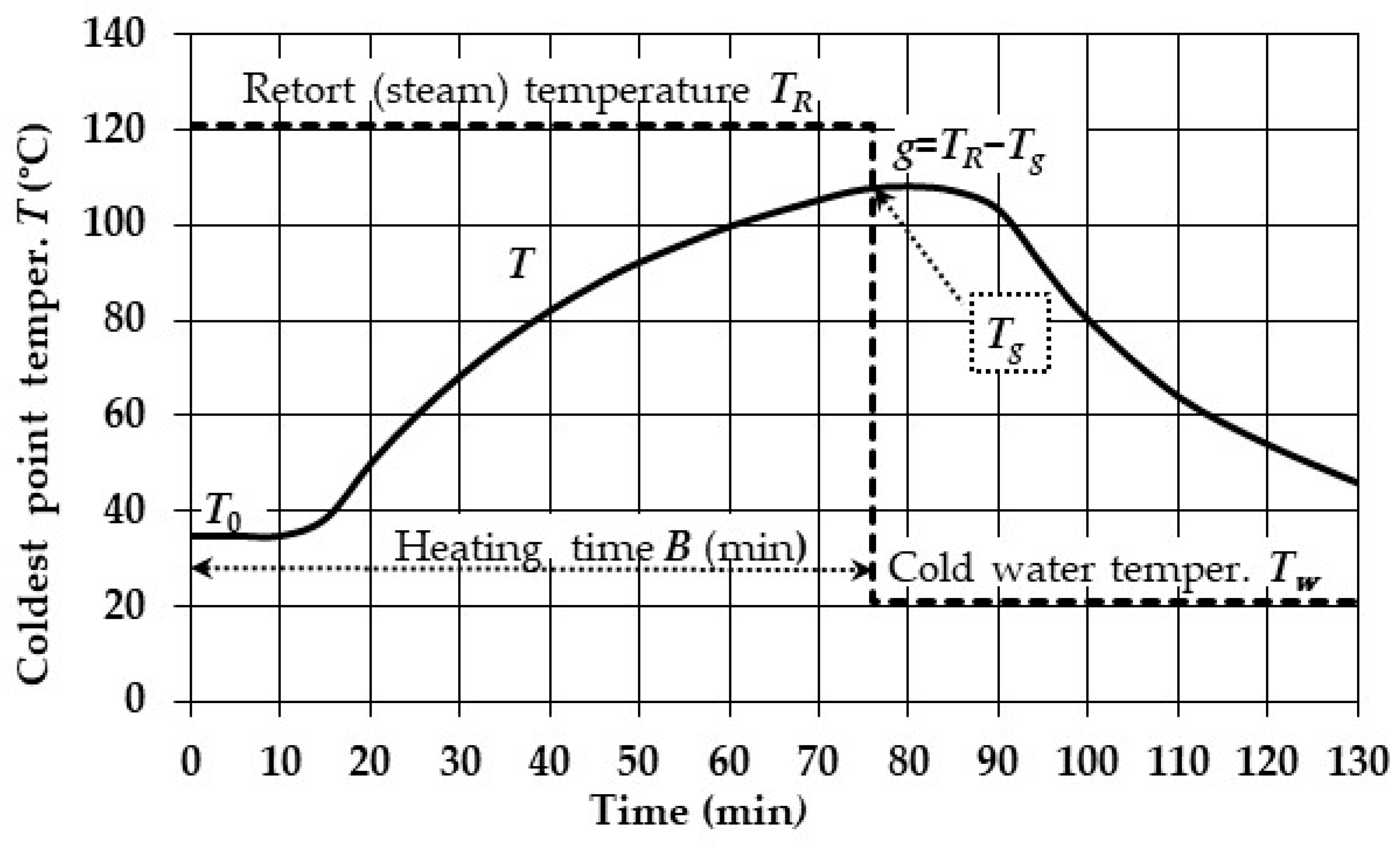
Figure 1 shows the trend of the temperature of the coldest point of the canned food (generally the geometric centre of the volume) vs. the time during the thermal process whether it is sterilization or cooking or pasteurization, etc. There are two phases, one heating and one cooling, the first due to the introduction of steam and the second due to the introduction of cold water into the retort.

2.2.4. Process Lethality During Heating Curve

Considering the heating phase, the variation in the temperature T vs. the time t (Figure 1) causes a variation in the decimal reduction time, D T , according to the following equation derived from Equation (5): D T = D 121.1 1 0 121.1 T ( t ) z . This latter relationship can be combined with the equation describing the temperature T vs. time t appearing in Figure 1, to obtain process lethality F h during heating. After some transformations and integration, already reported in the previous work [44] and developed for the first time by Ball [9,10], the following equation was obtained:
F h = e 2.303 121.1 T R z f 2.303 Ei 2.303 g z Ei 2.303 44.4 z
Ball introduced a quantity directly linked to the process lethality F h and the retort temperature T R , to consider the influence on the sterilization achieved when T R 121.1   ° C and which he called sterilizing value:
U h = F h e 2.303 121.1 T R z
for which he obtained the following equation:
U h = f 2.303 Ei 2.303 g z Ei 2.303 44.4 z
where f is the heating rate index (min) experimentally known; g = T R T g is the difference between the retort temperature T R and the canned food critical point temperature T g at the end of the heating period (Figure 1); T R T = 44.4   ° C is the lower integration limit, i.e., it is the initial temperature difference during heating, equal to 44.4 °C (80 °F), a value imposed by Ball [10] to count all contributions to lethality; Ei is the exponential integral function; z is the known thermo-bacteriological quantity.

2.2.5. Process Lethality During Initial Cooling Curve

Figure 1 shows how the cooling curve begins at the cold-water entry point into the retort. To describe the curve, two equations are needed. The first describes the temperature T of critical point during the initial period, the second describes the temperature T when the difference between this T and the cold-water temperature T T w has an exponential decay.
To describe the initial cooling curve, Ball [9,10] empirically proposed a hyperbola, which, however, forced him to carry out graphical and numerical integration since analytical integration was impossible. This was the first reason why he was forced to produce tables containing the integration results.
Since the aim of the previous work [44] was the computerization of Ball’s tables and the aim of the present work is the computerization of Stumbo’s tables, the equation of Ball’s hyperbola is not reported because it is substituted as already proposed in [44]. The substitution equation of the hyperbola, found in [44], is characterized by its analytical integrability during the subsequent calculation of process lethality, F i c , and therefore of the sterilizing value, U i c . It is as follows:
T = T g + k 1 e 2.303 · t c f
where t c   (min) is the cooling time with the origin at the cold-water-on (and steam-off); T g is the temperature of the critical point (coldest point of the canned food) at the steam-off; k was determined in [44] as the following equation:
k = T A T g · ( T A T w ) ( T A T w ) ( T g T w ) J c c
where J c c is the cooling lag factor, experimentally known; T g is the canned food critical point temperature at the end of the heating period (Figure 1); T w is the cold-water temperature; T A is the canned food critical point temperature at the end of the initial cooling. The difference T g T w is known because the temperatures T g and T w are known. The difference T g T A can be calculated based on Ball’s empirical indications: T g T A = 0.343 T g T w from which it is easy to obtain the temperature difference T A T w = 0.657 T g T w .
In the previous work [44], starting from Equations (10) and (11) and with appropriate analytical integration, the sterilizing value equation, U i c , during initial cooling was obtained as follows:
U i c = F i c · e 2.303 121.1 T R z = f 2.303 e 2.303 T R k T g z Ei 2.303 k z Ei 2.303 k + T g T A z
where f is the heating rate index (min), experimentally known; T R is the retort temperature; k is the quantity calculated by Equation (11); T g is the canned food critical point temperature at the end of the heating period (Figure 1); T w is the cold-water temperature; T A is the canned food critical point temperature at the end of the initial cooling; Ei is the exponential integral function; z is the known thermo-bacteriological quantity.

2.2.6. Process Lethality During Second Cooling Curve

When the initial cooling period is over, i.e., when the temperature T A is reached, cooling begins with the temperature difference between the critical point and the cold water T T w decaying exponentially. For this type of cooling, Ball developed the equation for the sterilizing value, U c , as follows:
U c = F c · e 2.303 121.1 T R z = f 2.303 e 2.303 T R T w z Ei 2.303 0.657 · T g T w z Ei 2.303 T R T w 44.4 z
where f is the heating rate index (min), experimentally known; Ei is the exponential integral function; z is the known thermo-bacteriological quantity; T R is the retort temperature; T g is the canned food critical point temperature at the end of the heating period (Figure 1); T w is the cold-water temperature.

2.2.7. Polynomials Substituting the Exponential Integral Function Ei

In Section 2.2.5, it was highlighted how Ball’s choice to use the hyperbola to represent the initial cooling forced him to numerical and graphical integration to obtain the process lethality. This was the first reason that forced him to represent the result of this numerical/graphical integration with tables to be consulted and interpolated. Therefore, in the previous work [44] a substitutive equation of the hyperbola was developed, containing the exponential function, which led to the analytical solution presenting the exponential integral function as it appears in Equation (12).
Furthermore, as seen in Section 2.2.4 and Section 2.2.6, the exponential integral function Ei also appears in the solution to the differential equation for lethality during heating and cooling with the exponential decay of the temperature difference. Since it is a non-elementary function, it is only available for discrete tabulated values [45], which further forced Ball to produce his tables. Therefore, it was necessary to find an equation made of elementary functions that would replace the non-elementary function Exponential integral Ei.
The development of polynomial equations consisting of only elementary functions (exponential and logarithm) that approximate the Ei function with excellent precision has already been extensively described in previous work [44]. Two approximation equations for Ei were found, one for negative values of the domain and one for positive values. For negative values E i x , the 5° polynomial obtained was the following:
E i x = e x x 0.000013244 · l n 5 x + 0.00049412 · l n 4 x 0.0072926 · l n 3 x 0.098067 · l n 2 x + 0.18998 · ln x + 0.59713
Valid for 0.09 x 30 , while for x < 0.09 , the following must be used:
E i x = 0.5772 + ln x x
For positive values of the domain E i x , the 6° polynomial obtained was the following:
E i x = e x x 0.0235 · l n 6 x 0.2827 · l n 5 x + 1.2663 · l n 4 x 2.4567 · l n 3 x + 1.5081 · l n 2 x + 0.7056 · ln x + 0.7038
Valid for 1 x 30 , while for x < 1 , the following must be used:
E i x = 0.5772 + ln x + x + x 2 4

2.2.8. Adjusting the Mathematical Modelling to Stumbo’s Tables

As already mentioned in Section 2.1, the Stumbo’s tables were obtained by first applying the finite difference solution method to the non-steady-state heat transfer equation and then using the general method in an automated way to obtain the lethality values for varying the following parameters: the difference g between the retort temperature and the final temperature of the heating curve; the thermo-bacteriological value z; the cooling lag factor Jcc. Therefore, Stumbo’s tables have no connection with Equations (9) and (13) obtained from Ball and Equation (12) obtained in [44]. In fact, these three equations representing mathematical modelling contain simplifying assumptions discussed in [44] while the Stumbo’s tables were obtained with the general method. Ultimately, the use of the three equations in place of the tables requires the development of an adjustment equation that provides a correction factor σ depending on g, z and J c c .
To develop this adjustment equation, all the values of f / U and consequently the sterilizing values U of a significant sample equal to 9 of Stumbo’s 57 tables were considered. These are those for z equal to 10, 20, 30, 40, 50, 61.1, 72.2, 83.3 and 100 °C. As is known, each table reports, for each f / U and for each J c c , the value of g. For each g value the sterilizing value U = U h + U i c + U c was calculated using Equations (9), (12) and (13, respectively, for the heating phase U h , the initial cooling U i c , and the cooling U c .
Since the main reason that produced the difference in the sterilizing value U was due to the initial cooling phase, the correction factor σ was introduced as a divisor of the quantity k present in Equation (12) of the U i c . Therefore, after having imposed in this equation a sterilizing value U i c , equal to the Stumbo sterilizing value U minus the sterilizing values U h , and U c , the only easily obtainable unknown remained σ.
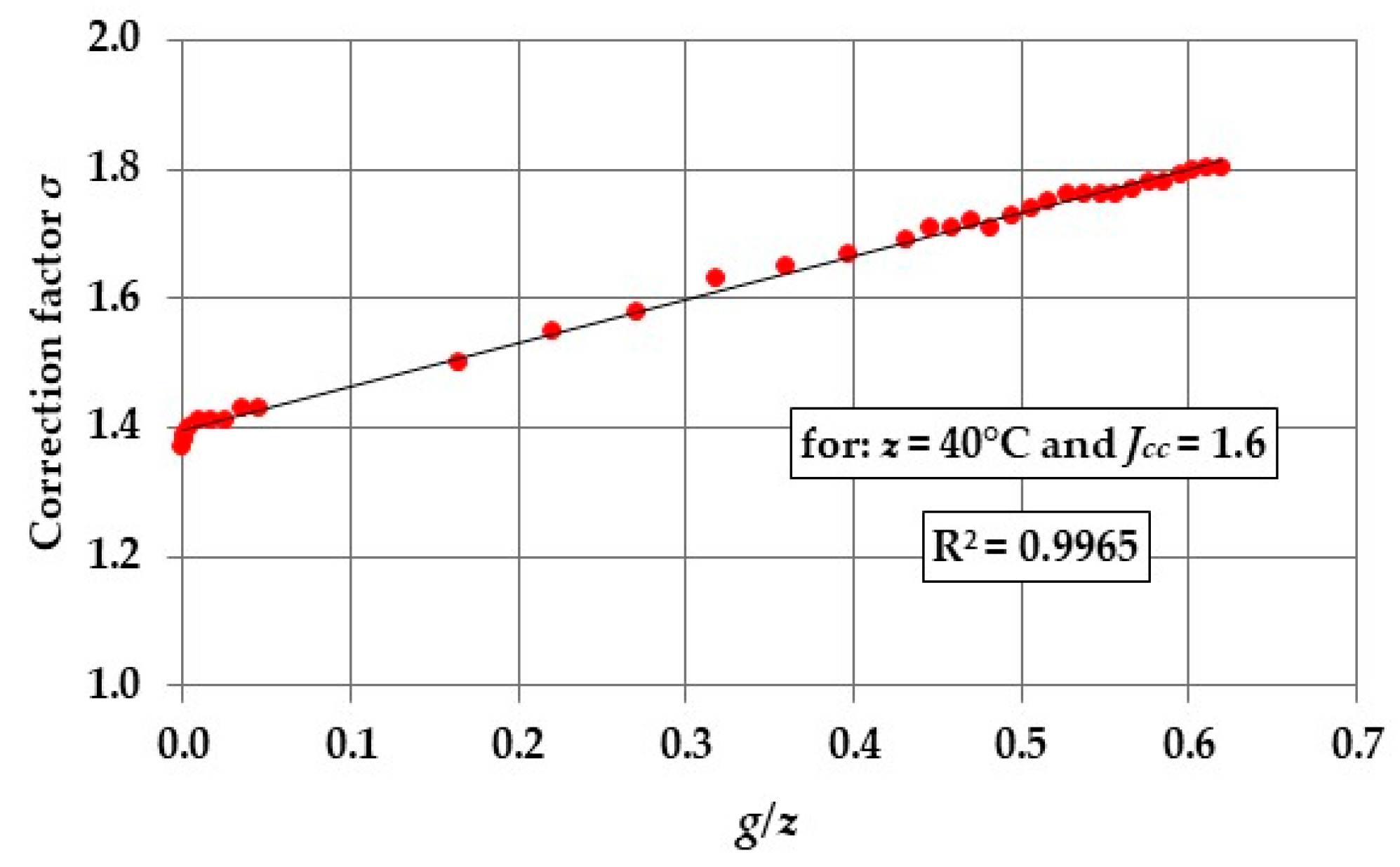
For example, Figure 2 shows the correction factor σ vs. g/z ratio for the case of the table with z equal to 40 °C and the column with J c c equal to 1.6. The relationship σ : g / z was found with a linear regression (Microsoft Excel 17.0, Redmond, WA, USA) which, for this pair of z and J c c has an R2 = 0.9965:
σ = α · g z + β
For the other values of z and J c c , the R2 was similar.
Analyzing the values of α and β, as z and J c c   vary, it was noted that β depends only on z according to the following equation obtained by nonlinear regression (Microsoft Excel 17.0, Redmond, WA, USA):
β = 23.5 z 1.1 + 0.0145 · z + 0.363
While α also depends on J c c   according to the following equation obtained by multiple nonlinear regression (Microsoft Excel 17.0, Redmond, WA, USA):
α = 0.000657 · z 2 · J c c 2 + 0.002016 · z 2 · J c c 0.001434 · z 2 + 0.1046 · z · J c c 2 0.2838 · z · J c c + 0.2028 · z + 53.999 · J c c 2 / z 138.875 · J c c / z + 92.977 · 1 / z 4.1797 · J c c 2 + 12.70 · J c c 9.9244
Equations (18)–(20) are valid for 8   ° C z 100   ° C and for 1 J c c 2 .
The regression excluded the J c c values equal to 0.2, 0.4 and 0.8 present in the Stumbo’s tables because values of J c c < 1 would imply an advance of the cooling curve with respect to the introduction of cold water. This would correspond to the fact that the coldest point of the canned food is not at the geometric centre. Therefore, at a certain moment during the heating, a thermal convection movement of this coldest part towards the geometric centre would occur. It would appear as if the geometric centre cooled before the steam closed and the simultaneous introduction of cold water. Since the formula method, even with the use of the Stumbo’s tables, requires an experimental phase to determine the values of f, J c h and J c c , the possible presence of the phenomenon just described would manifest itself with J c c value lower than 1. This is an unlikely case and if it were to occur it cannot be represented with mathematical model; instead, it will be necessary to return to using the data from Stumbo’s tables.
Ultimately, the correction factor σ obtained with Equations (18)–(20) must be inserted into Equation (12) relating to the calculation of the sterilizing value U i c during the initial cooling, as follows:
U i c = F i c · e 2.303 121.1 T R z = f 2.303 e 2.303 T R k / σ T g z Ei 2.303 k / σ z Ei 2.303 k / σ + T g T A z
where f is the heating rate index (min), experimentally known; TR is the retort temperature; k is the quantity calculated by Equation (11), it must be divided by the correction factor σ; T g is the canned food critical point temperature at the end of the heating period (Figure 1); T w is the cold-water temperature; T A is the canned food critical point temperature at the end of the initial cooling; Ei is the exponential integral function; z is the known thermo-bacteriological quantity.

3. Results

The fifty-seven Stumbo’s tables, one for each value of z from 4.44 °C to 111.1 °C (8 °F to 200 °F), have a first row with the values of the cooling lag factor Jcc ranging from a minimum of 0.4 to a maximum of 2 and a first column on the left with the values of the ratio ( f / U ) of the heating rate index f and the total sterilizing value U. The range of the f / U ratio is the result of the combination of f and U adopted by the canning industry. The remaining boxes in the tables are filled with the values of g = T R T g that Stumbo correlated with the f / U ratio using his calculation method already described in Section 2.2.8. Therefore, to evaluate the accuracy of mathematical modelling proposed in the previous Section 2.2, the f / U values calculated by the mathematical model were compared to those in the tables for varying g, J c c and z. The calculated ratio of the heating rate index f and the total sterilizing value U is as follows:
f U = f U h + U i c + U c
where the total sterilizing value U is the sum of the sterilizing values obtained in the individual sections of the heat penetration curve (Figure 1), i.e., heating U h , initial cooling U i c and final cooling U c , respectively, with Equations (9), (21) and (13).
The sterilizing value U h is obtained by inserting the values of the function E i x (obtained from Equation (14) if 0.09 x 30 ) into Equation (9) twice, first with x = 2.303 g z and then with x = 2.303 44.4 z . If x < 0.09 , then the E i x value is obtained from Equation (15).
The sterilizing value U i c is obtained by inserting the values of the E i x (obtained from Equation (14)) into Equation (21) twice, first with x = 2.303 k / σ z and then with x = 2.303 k / σ + T g T A z . Equation (21) requires the values of σ which are calculated from Equations (18)–(20) and the values of k which are obtained from Equation (11).
The sterilizing value U c , is obtained by inserting the values of the E i x (obtained from Equation (16)) into Equation (13) twice, first with x = 2.303 0.657 · T g T w z and then with x = 2.303 T R T w 44.4 z .
As already mentioned in Section 2.2.8, mathematical modelling was limited to 1 J c c 2 . Furthermore, z values lower than 7.9 °C (14 °F) and higher than 100 °C (180 °F) were excluded.
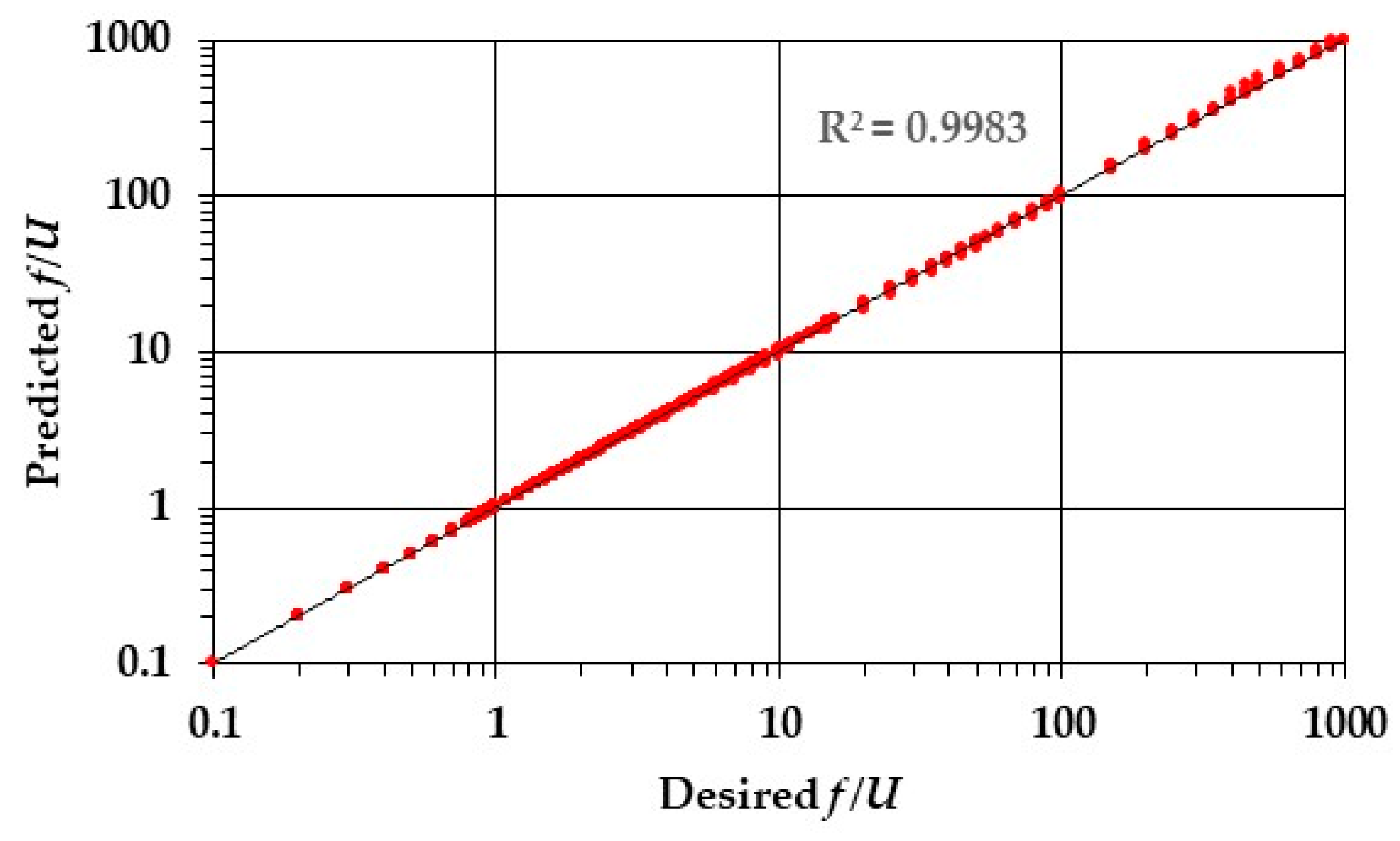
In Figure 3, the calculated f / U values, predicted by Equation (22) using Equations (9), (11), (13), (14), (16), (18)–(21) of the proposed mathematical modelling, were compared with the desired f / U values obtained from the Stumbo’s tables. Figure 3 shows the high R2 value of 0.9983.
The values of f / U obtained from Equations (9), (11), (13), (14), (16), (18)–(22) of this work were compared with the desired values from Stumbo’s tables to obtain the mean relative error MRE (%):
M R E = f / U p r e d i c t e d f / U d e s i r e d f / U d e s i r e d · 100
and the mean absolute error MAE:
M A E = f / U p r e d i c t e d f / U d e s i r e d
and the standard deviation SD.
Table 1 shows the values of MRE (%) ± SD (%), MAE ± SD and R2. Table 1 also presents the corresponding values obtained with the previous mathematical models of the Stumbo’s tables [49,51]. The comparison shows the improvement achieved, with MRE ± SD equal to 0.62 ± 1.29 (%), about halved compared to MRE ± SD of the previous work [51]. It is useful to note that the mathematical model of this work is based on the regression of the exponential integral function, while the mathematical model of the previous work [51] was based on the direct regression of the data from the Stumbo’s tables.
For further validation of the mathematical model, the process time B was calculated with Ball’s Equation (1) together with Equations (9), (11), (13), (14), (16), (18)–(22). It was compared to the benchmark value, i.e., the process time B obtained with Equation (1) using the Stumbo tables.
The values of the variables, such as lethality F, thermo-bacteriological quantity z, retort temperature TR, initial temperature T0, heating rate index f, heating lag factor J c h , cooling lag factor J c c , adopted to perform the calculations, are the same as those used by Sablani and Shayya [52] in the validation of their ANNG model based on neural networks, i.e., F equal to 5, 15 and 25 min, z equal to 10 and 44.44 °C, TR equal to 121.1 and 140 °C, T0 equal to 65.55 °C, f equal to 30 and 90 min, J c h equal to 1 and 2. Sablani and Shayya then set the extreme values of 0.4 and 2 for J c c . The latter was also adopted here, but the value of 0.4 was replaced by the value of 1, since the mathematical model is valid starting from J c c equal to 1.
Table 2 summarizes the process times B and the relative error RE (%) as the difference between the process times obtained from mathematical model and those obtained from the Stumbo’s tables, for the case of F equal to 5. Table 3 summarizes B and RE for F equal to 15, and Table 4 B and RE for F equal to 25. For further comparison, Table 2, Table 3 and Table 4 also report the process time values calculated by Sablani and Shayya, limited to J c c equal to 2, together with the relative error RE (%) calculated with respect to the process time values obtained with the Stumbo’s tables.
Table 2, Table 3 and Table 4 show the maximum R E value of Sablani’s ANNG model (only for J c c = 2 ) equal to 3.6% vs. the maximum R E value of 2.6% for the mathematical model (only for J c c = 2 ). For J c c = 1 , the mathematical model has a maximum R E value of 1.3%.
The mean relative error values, MRE (%), are shown in Table 5 together with the standard deviation SD) (%). For Sablani’s ANNG model, the MRE (only J c c = 2 ) was 1.63% and the SD was 0.95%, compared to the MRE and SD (only J c c = 2 ) for the mathematical model, which were 1.04% and 0.82%, respectively. Considering both J c c values 1 and 2, the MRE for mathematical model dropped to 0.74% and the SD to 0.69%.
Ultimately, both with regard to the calculation of lethality F and therefore of f / U , and with regard to the calculation of the process time B, the mathematical model of this work to represent the Stumbo tables within the values of J c c between 1 and 2, shows a high adherence to the tabulated values, on average higher than previous models.

4. Discussion and Conclusions

In recent years, several authors have studied the application of thermal computational fluid dynamics (CFD) to calculate the food thermal processes. However, its practical application still appears premature, as the use of CFD requires considerable expertise, without which errors can be fatal to food safety. Furthermore, the use of CFD requires accurate knowledge of multiple food data, such as thermal diffusivity and the convective heat transfer coefficient for heating and cooling, which are always very difficult to calculate given inhomogeneity and anisotropy characterizing foods. Therefore, classical methods for calculating the food thermal processes, which have been in use for at least half a century, continue to be relevant and commonly used.
Excluding the General Method, also known as the Bigelow Method, which is primarily intended for foods with broken heating curves, two methods are discussed as follows: the formula method using Ball’s tables and the formula method with Stumbo’s tables. In both cases, the calculations require consulting and interpolating data from the respective tables, making the calculation process slow and prone to errors.
The computerization of Ball’s tables to speed up and automate the calculations of the related formula method with a new mathematical approach has already been developed and proposed in a recent work [44]. Compared to previous works based on the direct regression of table data, the novelty of this approach was to find an approximate equation to replace the exponential integral function Ei appearing in the analytical solution of the differential equation of heat penetration and thermal death. In fact, Ei is a non-elementary function and therefore only available in tabular form, which forced Ball to produce his tables to be consulted manually and interpolated. A second reason that forced Ball to his tables was his choice of the hyperbola to represent the initial cooling. Therefore in [44] the hyperbola was also replaced by a mathematical equation compatible with the computerization of the data.
The high accuracy achieved with this approach, superior to the direct data regression method, suggested adopting it also in the computerization of Stumbo’s tables. However, the dataset in Stumbo’s tables are 14 times larger than those in Ball’s tables, primarily due to the extension, predicted by Stumbo, of the values of the thermo-bacteriological parameter z up to over 100 °C. Indeed, these high values of z allow the formula method to be used also in the calculations of alteration of nutritional constituents such as vitamins, etc. Furthermore, the tables are very numerous also due to the variability of the cooling lag factor J c c , which Ball had instead kept constant at 1.41. Therefore, the mathematical modelling previously developed on Ball’s tables was modified and extended to the data in Stumbo’s tables using a correction factor, dependent on z and J c c , obtained with nonlinear multiple regression. However, the modelling of the Stumbo tables proposed can be used for the cooling lag factor J c c between 1 and 2, excluding values less than 1 because these are exceptional situations for which direct reading of the tables will have to be used.
The results obtained showed an excellent adherence of the values of the f / U ratio, containing the sterilizing value U and therefore the process lethality F, to the f / U values of the Stumbo’s tables with a mean relative error and the standard deviation MRE ± SD = 0.62% ± 1.29%. These values, compared with those previously obtained in two other works [49,51] namely MRE ± SD = 2.47% ± 3.38% and, respectively, MRE ± SD = 1.18% ± 2.11%, show the important improvement obtained by choosing to replace the integral exponential function and the hyperbola of the initial cooling with new elementary approximate functions instead of directly regressing the data from the tables.
Furthermore, the mathematical model was also validated by calculating the process time B for different conditions, the same as those proposed by Sablani and Shayya [52]. The relative errors between the process time with the mathematical model and the exact expected process time with the Stumbo’s tables were calculated. Similarly, the relative errors between the process time with the ANNG model of Sablani and Shayya and the exact Stumbo values were also calculated. The comparison, with the same J c c equal to 2, between the relative errors of the ANNG model of Sablani and Shayya and those of the mathematical model is summarized by the mean values which resulted MRE ± SD equal to 1.63% ± 0.95% and, respectively, MRE ± SD equal to 1.04% ± 0.82%. For J c c equal to 1 and 2, the mathematical model presented even lower values equal to 0.74% ± 0.69%.
Ultimately, this mathematical modelling of Stumbo’s tables, within J c c between 1 and 2, can be a tool to speed up the calculation of the thermal process, reduce the risk of error and, in the future, also be useful for the automation of process control.
The extension of the mathematical model to J c c < 1 remains pending, despite the limited importance these J c c values have in industrial practice. This goal will be achieved in the future through further study to obtain new equations for the correction factor suitable for extending the mathematical modelling to the case J c c < 1 .

Funding

This research received no external funding.

Data Availability Statement

The original contributions presented in this study are included in the article. Further inquiries can be directed to the corresponding author.

Conflicts of Interest

The author declares no conflicts of interest.

Nomenclature

SymbolUnitName
Bminprocess (heating) time
D T mindecimal reduction time at the temperature T
fminheating rate index
F minrequired lethality
F h minprocess lethality during heating
F i c minprocess lethality during initial cooling curve
F c minprocess lethality during second cooling curve
g°C temperature   difference   between   T R   and   T g
J c c cooling lag factor
J c h heating lag factor
k°Ctemperature from Equation (11)
n reduction exponent (number of decimal reductions)
N number of microorganisms at time t
N 0 number of microorganisms at time t = 0
tmintime
t c mincooling time with the origin at the cold-water-on
t T minthermal death time at the temperature T
T°Ctemperature
T A °Ctemperature of the critical point at the end of initial cooling
T g °Ctemperature of the critical point at the steam-off
T R °Cretort temperature
T w °Ccold-water temperature
T0°CInitial temperature
U mintotal sterilizing value
U h minsterilizing value during heating
U i c minsterilizing value during initial cooling curve
U c minsterilizing value during second cooling curve
z thermo-bacteriological quantity
σ correction factor from Equation (18)

References

  1. Featherstone, S. A review of developments in and challenges in thermal processing over the past 200 years—A tribute to Nicolas Appert. Food Res. Int. 2012, 47, 156–160. [Google Scholar] [CrossRef]
  2. Mafart, P. Food engineering and predictive microbiology: On the necessity to combine biological and physical kinetics. Int. J. Food Microbiol. 2005, 100, 239–251. [Google Scholar] [CrossRef]
  3. Bigelow, W.D.; Bohart, G.S.; Richardson, A.C.; Ball, C.O. Heat Penetration in Processing Canned Foods, Bulletin 16-L Res, 1st ed.; Laboratory National Canners Associated: Washington, DC, USA, 1920; pp. 1–128. [Google Scholar]
  4. Ball, C.O. Mathematical Solution of Problems on Thermal Processing of Canned Food, Berkley: Publication Health, 1st ed.; University of California Publications in Public Health: Berkeley, CA, USA, 1928; pp. 15–245. [Google Scholar]
  5. Schultz, O.T.; Olson, F.C. Thermal processing of canned foods in tin containers. III. Recent improvements in the General Method of thermal process calculation. A special coordinate paper and methods of converting initial retort temperature. J. Food Sci. 1940, 5, 399–407. [Google Scholar] [CrossRef]
  6. Patashnik, M. A simplified procedure for thermal process evaluation. Food Technol. 1953, 7, 1–6. [Google Scholar]
  7. Hayakawa, K.I. A procedure for calculating the sterilizing value of a thermal process. Food Technol. 1968, 22, 93–95. [Google Scholar]
  8. Simpson, R.; Almonacid, S.; Teixeira, A.A. Bigelow’s General Method revisited: Development of a new calculation technique. J. Food Sci. 2003, 68, 1324–1333. [Google Scholar] [CrossRef]
  9. Ball, C.O. Thermal Process Times for Canned Foods, Bulletin 37, 1st ed.; National research Council: Washington, DC, USA, 1923; pp. 1–76. [Google Scholar]
  10. Ball, C.O.; Olson, F.C. Sterilization in Food Technology, 1st ed.; McGraw-Hill: New York, NY, USA, 1957; pp. 1–507. [Google Scholar]
  11. Stumbo, C.R. Thermobacteriology in Food Processing, 2nd ed.; Academic Press: New York, NY, USA, 1973; pp. 1–329. [Google Scholar]
  12. Herndon, D.H.; Griffin, R.C., Jr.; Ball, C.O. Use of computer derived tables to calculate sterilizing processes for packaged foods. Food Technol. 1968, 22, 473–484. [Google Scholar]
  13. Griffin, R.C., Jr.; Herndon, D.H.; Ball, C.O. Use of computer derived tables to calculate sterilizing processes for packaged foods. 2. Application to broken line heating curves. Food Technol. 1969, 23, 519–524. [Google Scholar]
  14. Griffin, R.C., Jr.; Herndon, D.H.; Ball, C.O. Use of computer derived tables to calculate sterilizing processes for packaged foods 3. Application to cooling curves. Food Technol. 1971, 25, 134–143. [Google Scholar]
  15. Hayakawa, K. Experimental formulas for accurate estimation of transient temperature of food and their application to thermal process evaluation. Food Technol. 1970, 24, 1407–1418. [Google Scholar]
  16. Larkin, J.W. Use of a modified Ball’s formula method to evaluate aseptic processing of foods containing particulates. Food Technol. 1989, 43, 124–131. [Google Scholar]
  17. Steele, R.J.; Board, P.W. Thermal process calculations using sterilizing ratios. J. Food Technol. 1979, 14, 227–235. [Google Scholar] [CrossRef]
  18. Larkin, J.W.; Berry, R.B. Estimating cooling process lethality for different cooling j values. J. Food Sci. 1991, 56, 1063–1067. [Google Scholar] [CrossRef]
  19. Smith, T.; Tung, M.A. Comparison of formula methods for calculating thermal process lethality. J. Food Sci. 1982, 47, 626–630. [Google Scholar] [CrossRef]
  20. Kim, K.H.; Teixeira, A.A.; Bichier, J.; Tavares, J. STERILIMATE: Software for designing and evaluating thermal sterilization processes. In Proceedings of the American Society of Agricultural Engineers. Meeting (USA), Chicago, IL, USA, 15 December 1993. ASAE paper No. 93-4051. [Google Scholar]
  21. Noronha, J.; Hendrickx, M.; Van Loey, A.; Tobback, P. New semi-empirical approach to handle time-variable boundary conditions during sterilization of non-conductive heating foods. J. Food Eng. 1995, 24, 249–268. [Google Scholar] [CrossRef]
  22. Teixeira, A.A.; Balaban, M.O.; Germer, S.P.M.; Sadahira, M.S.; Teixeira-Neto Vitali, R.O. Heat Transfer Model Performance in Simulation of Process Deviations. J. Food Sci. 1999, 64, 488–493. [Google Scholar] [CrossRef]
  23. Holdsworth, D.; Simpson, R. Thermal Processing of Packaged Foods, 2nd ed.; Springer: Berlin/Heidelberg, Germany, 2016; pp. 1–516. [Google Scholar]
  24. Miranda Zamora, W.R.; Sanchez Chero, M.J.; Sanchez Chero, J.A. Software for the Determination of the Time and the F Value in the Thermal Processing of Packaged Foods Using the Modified Ball Method. In Intelligent Human Systems Integration 2020, Proceedings of the 3rd International Conference on Intelligent Human Systems Integration (IHSI 2020): Integrating People and Intelligent Systems, Modena, Italy, 19–21 February 2020; Ahram, T., Karwowski, W., Vergnano, A., Leali, F., Taiar, R., Eds.; Advances in Intelligent Systems and Computing; Springer: Cham, Switzerland, 2020; Volume 1131, pp. 498–502. [Google Scholar] [CrossRef]
  25. Cleland, A.C.; Robertson, G.L. Determination of thermal processes to ensure commercial sterility of foods in cans. In Developments in Food Preservation, 1st ed.; Thorne, S., Ed.; Elsevier Applied Science: London, UK, 1985; Volume 3, pp. 1–315. [Google Scholar]
  26. Hayakawa, K.I. A critical review of mathematical procedures for determining proper heat sterilization processes. Food Technol. 1978, 32, 59–65. [Google Scholar]
  27. Stoforos, N.G.; Noronha, J.; Hendrickx, M.; Tobback, P.A. Critical analysis of mathematical procedures for the evaluation and design of in-container thermal processes for foods. Crit. Rev. Food Sci. Nutr. 1997, 37, 411–441. [Google Scholar] [CrossRef]
  28. Sojecka, A.A.; Drozd-Rzoska, A.; Rzoska, S.J. Food Preservation in the Industrial Revolution Epoch: Innovative High Pressure Processing (HPP, HPT) for the 21st-Century Sustainable Society. Foods 2024, 13, 3028. [Google Scholar] [CrossRef]
  29. Gomi, Y.; Inaba, S.; Mukai, I. Comparison of mathematical models used to simulate thermal processing of canned foods. J. Food Eng. 2026, 407, 1128030. [Google Scholar] [CrossRef]
  30. Ghani, A.G.A.; Farid, M.M. Using the computational fluid dynamics to analyze the thermal sterilization of solid-liquid food mixture in cans. Innov. Food Sci. Emerg. 2006, 7, 55–61. [Google Scholar] [CrossRef]
  31. Augusto, P.E.D.; Cristianini, M. Numerical simulation of packed liquid food thermal process using computational fluid dynamics (CFD). Int. J. Food Eng. 2011, 7, 16. [Google Scholar] [CrossRef]
  32. Erdogdu, F. Optimization in Food Engineering, 1st ed.; CRC Press: Boca Raton, FL, USA, 2008; pp. 585–594. [Google Scholar] [CrossRef]
  33. Dimou, A.; Panagou, E.; Stoforos, N.G.; Yanniotis, S. Analysis of Thermal Processing of Table Olives Using Computational Fluid Dynamics. J. Food Sci. 2013, 78, 1695–1703. [Google Scholar] [CrossRef]
  34. Park, H.W.; Yoon, W.B. Computational Fluid Dynamics (CFD) Modelling and Application for Sterilization of Foods: A Review. Processes 2018, 6, 62. [Google Scholar] [CrossRef]
  35. Azar, A.B.; Ramezan, Y.; Khashehchi, M. Numerical simulation of conductive heat transfer in canned celery stew and retort program adjustment by computational fluid dynamics (CFD). Int. J. Food Eng. 2020, 16, 20190303. [Google Scholar] [CrossRef]
  36. Soleymani Serami, M.; Ramezan, Y.; Khashehchi, M. CFD simulation and experimental validation of in-container thermal processing in Fesenjan stew. Food Sci. Nutr. 2021, 9, 1079–1087. [Google Scholar] [CrossRef]
  37. Zhu, S.; Li, B.; Chen, G. Improving prediction of temperature profiles of packaged food during retort processing. J. Food Eng. 2022, 313, 110758. [Google Scholar] [CrossRef]
  38. Fu, Z.; Liu, H.; Huang, L.; Duan, L.; Wang, Y.; Sun, X.; Zhou, C. Numerical simulation of thermal sterilization heating process of canned fruits with different shapes based on UDM and RDM. Int. J. Food Eng. 2023, 19, 159–175. [Google Scholar] [CrossRef]
  39. Das, S.; Baro, R.K.; Kotecha, P.; Anandalakshmi, R. Numerical studies on thermal processing of solid, liquid, and solid–liquid food products: A comprehensive analysis. J. Food Process Eng. 2023, 46, e14484. [Google Scholar] [CrossRef]
  40. Dalvi-Isfahan, M. Effect of flow behavior index of CMC solutions on heat transfer and fluid flow in a cylindrical can. J. Food Process Eng. 2024, 47, e14672. [Google Scholar] [CrossRef]
  41. Sampanis, P.-A.; Chatzidakis, S.M.; Stoforos, G.N.; Stoforos, N.G. Analysis of Shell Egg Pasteurization Using Computational Fluid Dynamics. Appl. Sci. 2025, 15, 1263. [Google Scholar] [CrossRef]
  42. Szpicer, A.; Bińkowska, W.; Stelmasiak, A.; Zalewska, M.; Wojtasik-Kalinowska, I.; Piwowarski, K.; Piepiórka-Stepuk, J.; Półtorak, A. Computational Fluid Dynamics Simulation of Thermal Processes in Food Technology and Their Applications in the Food Industry. Appl. Sci. 2025, 15, 424. [Google Scholar] [CrossRef]
  43. Calomino, G.E.; Minim, L.A.; Coimbra, J.S.D.; Rodrigues Minim, V.P. Thermal process calculation using artificial neural networks and other traditional methods. J. Food Process Eng. 2006, 29, 162–173. [Google Scholar] [CrossRef]
  44. Friso, D. Simple and Accurate Mathematical Modelling to Replace Ball’s Tables in Food Thermal Process Calculations. Processes 2025, 13, 1975. [Google Scholar] [CrossRef]
  45. Gautschi, W.; Cahill, W.F. Exponential integral and related functions. In Handbook of Mathematical Functions, 1st ed.; Abramowitz, M., Stegun, I.A., Eds.; Applied Mathematics Series; National Bureau of Standards: Washington, DC, USA, 1964; Volume 55, pp. 227–237. [Google Scholar]
  46. Stoforos, N.G. Thermal process calculations through Ball’s original formula method: A critical presentation of the method and simplification of its use through regression equations. Food Eng. Rev. 2010, 2, 1–16. [Google Scholar] [CrossRef]
  47. Texeira, A.A.; Dixon, J.R.; Zahradnik, J.W.; Zinsmeister, G.E. Computer optimization of nutrient retention in the thermal processing of conduction-heat foods. Food Technol. 1969, 23, 845–850. [Google Scholar]
  48. Jen, Y.; Manson, J.E.; Stumbo, C.R.; Zahradnik, J.W. A procedure for estimating sterilization of and quality factor degradation in thermally processed foods. J. Food Sci. 1971, 36, 693–698. [Google Scholar] [CrossRef]
  49. Friso, D. A new mathematical model for food thermal process prediction. Model. Simul. Eng. 2013, 2013, 569473. [Google Scholar] [CrossRef]
  50. Friso, D. A Mathematical Solution for Food Thermal Process Design. Appl. Math. Sci. 2015, 9, 255–270. [Google Scholar] [CrossRef]
  51. Friso, D. The Check Problem of Food Thermal Processes: A Mathematical Solution. Appl. Math. Sci. 2015, 9, 6529–6546. [Google Scholar] [CrossRef]
  52. Sablani, S.S.; Shayya, W.H. Computerization of Stumbo’s method of thermal process calculations using neural networks. J. Food Eng. 2001, 47, 233–240. [Google Scholar] [CrossRef]
Figure 1. Temperature versus time of the coldest point (critical point) of canned food during the thermal process including heating and cooling. The relationship is also called the heat penetration curve. Tg is the temperature of the canned food critical point at the end of the heating curve.
Processes 14 00155 g001
Figure 2. Correction factor σ, to be introduced as a divisor of the quantity k present in Equation (12), vs. the ratio between the temperature difference g and the thermo-bacteriological quantity z. The black line is obtained with linear regression.
Processes 14 00155 g002
Figure 3. Predicted f / U values (ratio of heating rate index, f, to total sterilization value, U) using mathematical modelling compared to desired f / U values from Stumbo’s tables.
Processes 14 00155 g003
Table 1. Mean Relative Error MRE (%), Mean Absolute Error MAE, Standard Deviation SD and R2 obtained as difference between predicted f / U and desired f / U from Stumbo’s tables. They are compared with MRE, MAE, SD and R2 obtained with previous mathematical modelling.
This WorkFriso, 2015 [51]Friso, 2013 [49]
MRE ± SD (%)0.62 ± 1.291.18 ± 2.112.47 ± 3.38
MAE ± SD0.60 ± 5.341.61 ± 11.273.39 ± 20.49
R2 (Figure 3)0.9980.9910.982
Table 2. Comparison of process time, B, for lethality F = 5, calculated with Ball’s Equation (1) using Stumbo’s tables, using the model of this work and using the ANNG model of Sablani and Shayya [52]. RE is the relative error (%).
F (min)z (°C)TR (°C)f (min)f/UJchJccB (min)
(Stumbo)
B (min)
(This
RE (%)
Work)
B (min)
(ANNG
RE (%)
Model)
510121.13061136.1336.370.7
510121.13061232.8032.05−2.333.642.6
510121.13062145.1645.420.6
510121.13062241.8341.08−1.842.682.0
510121.190181183.5683.45−0.1
510121.190181272.1670.28−2.674.553.3
510121.1901821110.66110.54−0.1
510121.190182299.2597.39−1.9101.62.4
51014030465.71118.4818.570.5
51014030465.71214.5914.952.414.2−2.7
51014030465.72127.5127.600.3
51014030465.72223.6223.981.523.24−1.6
510140901397.2 *11
510140901397.2 *12
510140901397.2 *21
510140901397.2 *22
544.44121.13061116.2616.20−0.4
544.44121.1306129.679.710.410.023.6
544.44121.13062125.2925.23−0.2
544.44121.13062218.7018.740.219.051.9
544.44121.19018 *11
544.44121.19018 *12
544.44121.19018 *21
544.44121.19018 *22
* Not estimated since the f/U values were outside the range provided in the tables.
Table 3. Comparison of process time, B, for lethality F = 15, calculated with Ball’s Equation (1) using Stumbo’s tables, using the model of this work and using the ANNG model of Sablani and Shayya [52]. RE is the relative error (%).
F (min)z (°C)TR (°C)f (min)f/UJchJccB (min)
(Stumbo)
B (min)
(This
RE (%)
Work)
B (min)
(ANNG
RE (%)
Model)
1510121.13021151.4651.22−0.5
1510121.13021247.5047.15−0.848.121.3
1510121.13022160.4960.25−0.4
1510121.13022256.5356.18−0.657.151.1
1510121.190611108.40109.190.7
1510121.19061298.4196.12−2.3100.92.5
1510121.190621135.49136.280.6
1510121.190622125.50123.22−1.81282.0
151014030155.21121.6721.941.3
151014030155.21217.9218.101.118.050.8
151014030155.22130.7030.970.9
151014030155.22226.9527.140.727.080.5
151014090465.71155.4355.710.5
151014090465.71243.7844.842.442.62−2.6
151014090465.72182.5282.800.3
151014090465.72270.8771.931.569.71−1.6
1544.44121.13021130.4230.39−0.1
1544.44121.13021223.7423.70−0.223.80.3
1544.44121.13022139.4539.42−0.1
1544.44121.13022232.7732.73−0.132.830.2
1544.44121.19061148.7948.60−0.4
1544.44121.19061229.0129.130.430.063.6
1544.44121.19062175.8975.69−0.3
1544.44121.19062256.1156.230.257.151.9
Table 4. Comparison of process time, B, for lethality F = 25, calculated with Ball’s Equation (1) using Stumbo’s tables, using the model of this work and using the ANNG model of Sablani and Shayya [52]. RE is the relative error (%).
F (min)z (°C)TR (°C)f (min)f/UJchJccB (min)
(Stumbo)
B (min)
(This
RE (%)
Work)
B (min)
(ANNG
RE (%)
Model)
2510121.1301.21162.7562.72−0.1
2510121.1301.21258.7858.850.159.120.6
2510121.1301.22171.7871.75−0.1
2510121.1301.22267.8167.880.168.150.5
2510121.1903.611126.74126.33−0.3
2510121.1903.612115.82113.70−1.8117.91.8
2510121.1903.621153.84153.42−0.3
2510121.1903.622142.91140.79−1.5145.11.5
25101403093.11123.6523.800.6
25101403093.11219.7419.820.420.11.8
25101403093.12132.6832.830.5
25101403093.12228.7728.850.329.131.3
251014090279.41159.3460.121.3
251014090279.41248.1348.751.347.75−0.8
251014090279.42186.4487.210.9
251014090279.42275.2275.840.874.83−0.5
2544.44121.1301.21141.6641.770.3
2544.44121.1301.21235.0135.190.534.7−0.9
2544.44121.1301.22150.6950.800.2
2544.44121.1301.22244.0544.220.443.73−0.7
2544.44121.1903.61164.9664.70−0.4
2544.44121.1903.61244.9044.68−0.545.832.1
2544.44121.1903.62192.0691.80−0.3
2544.44121.1903.62271.9971.77−0.372.931.3
Table 5. The first row shows the mean relative error MRE (%) and standard deviation SD (%) obtained from all the errors (Table 2, Table 3 and Table 4) of the process time, B, of this work with respect to one calculated with Stumbo’s tables. The second row shows MRE and SD obtained from relative errors limited to J c c = 2 . The third row shows MRE and SD of the relative errors, limited to   J c c = 2 , between the process time calculated with the ANNG model [52] and the Stumbo’s one (last column of Table 2, Table 3 and Table 4).
JccMRE (%)SD (%)
This work 1 and 2 0.74 0.69
This work21.040.82
ANNG model21.630.95
Disclaimer/Publisher’s Note: The statements, opinions and data contained in all publications are solely those of the individual author(s) and contributor(s) and not of MDPI and/or the editor(s). MDPI and/or the editor(s) disclaim responsibility for any injury to people or property resulting from any ideas, methods, instructions or products referred to in the content.