Review

A Review of Eddy Current In-Line Inspection Technology for Oil and Gas Pipelines

1
Supervision Center for Surface Engineering Construction, Shengli Oilfield Company, Dongying 257000, China
2
College of Pipeline and Civil Engineering, China University of Petroleum (East China), Qingdao 266580, China
*
Author to whom correspondence should be addressed.
Processes 2026, 14(2), 247; https://doi.org/10.3390/pr14020247
Submission received: 21 December 2025 / Revised: 7 January 2026 / Accepted: 8 January 2026 / Published: 10 January 2026

Abstract

Pipeline infrastructure constitutes the primary transportation system within the oil and gas industry, where operational safety is critically dependent on advanced in-line inspection technologies. This study presents a comprehensive analysis of eddy current testing (ECT) applications for pipeline integrity assessment. The fundamental principles of ECT are first elucidated, followed by a systematic comparative evaluation of five key ECT methodologies: conventional, multi-frequency, remote field, pulsed, and array eddy current techniques. The analysis examines their detection mechanisms, technical specifications, comparative advantages, and current developmental trajectories, with particular emphasis on future technological evolution. Subsequently, integrating global pipeline infrastructure development trends and market requirements, representative designs of pipeline inspection tools are detailed and we review relevant industry applications. Finally, persistent challenges in ECT applications are identified, particularly regarding adaptability to complex operational environments, quantification accuracy for micro-scale defects, and predictive capability for defect progression. This study proposes that future ECT equipment development should prioritize multi-modal integration, miniaturization, and intelligent analysis to enable comprehensive pipeline safety management throughout the entire asset lifecycle.

1. Introduction

Pipelines represent the dominant infrastructure for oil and gas transportation due to their exceptional efficiency, economic viability, and environmental sustainability [1,2]. Globally, pipeline networks exceed millions of kilometers in total length, with approximately 30% of these systems having surpassed their design lifespans, presenting significant aging challenges and safety risks [3,4]. In China, the oil and gas pipeline network reached approximately 150,000 km by the end of 2023, constituting 9% of the global total, as illustrated in Figure 1. Consequently, balancing cost reduction with transportation safety has become a critical concern for the oil and gas sector.
To ensure pipeline safety, national regulations require that in-service pipelines undergo regular inspections. Due to the long total length of pipelines and the complexity of their operating environments, traditional inspection methods often encounter many limitations. According to the GB 32167–2015 [5] Specifications for Integrity Management of Oil and Gas Transmission Pipelines, in-line inspection (ILI) should be prioritized as the preferred method for pipeline integrity assessment. In-line inspection technology refers to a method that does not interfere with the normal and safe operation of the pipeline. It involves using an intelligent pig equipped with nondestructive testing (NDT) devices as well as signal acquisition, processing, and storage systems. Powered by the transported medium inside the pipeline, the system enables real-time detection of corrosion, deformation, and cracking within the pipeline [6,7]. Currently, the most commonly used in-line inspection techniques include magnetic flux leakage (MFL) [8,9], ultrasonic testing (UT), eddy current testing (ECT) [10,11,12,13]. However, each technique has its own advantages and limitations. Among them, ECT remains the most widely applied method. The remainder of this paper is structured as follows: Section 2 provides a systematic review of the core principles and various modalities of ECT technology, including conventional, multi-frequency, pulsed, remote field, and array eddy current testing. Section 3 discusses the market demand, structural classification, and representative industrial applications of in-pipe inspection devices in the oil and gas sector. Finally, Section 4 summarizes the current challenges and outlines future development trajectories for intelligent pipeline integrity management.

2. Development of Eddy Current Testing Technology

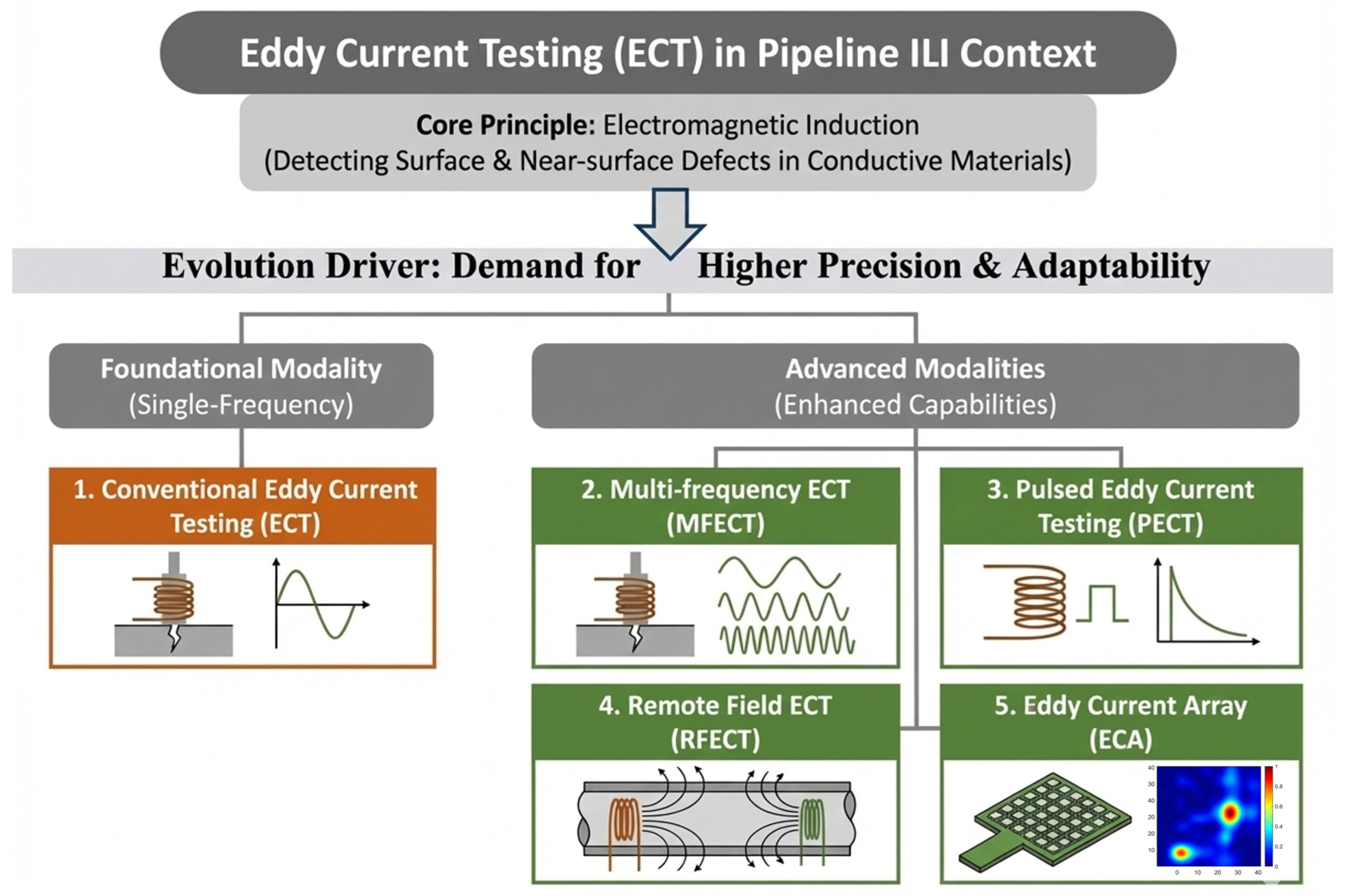
ECT is an NDT method rooted in the principle of electromagnetic induction, widely utilized for detecting surface and near-surface defects in conductive materials. Since the discovery of the eddy current phenomenon by Léon Foucault in 1855, this technology has evolved from early applications in aerospace fatigue detection to sophisticated digital systems. In the context of pipeline in-line inspection, the demand for higher precision and adaptability has driven ECT from single-frequency excitation toward more advanced modalities [14]. This section systematically reviews the five primary eddy current technologies currently applied in pipeline inspection [15,16]: Conventional ECT, Multi-frequency Eddy Current Testing (MFECT), Pulsed Eddy Current Testing (PECT), Remote Field Eddy Current Testing (RFECT), and Eddy Current Array (ECA). The classification is illustrated in Figure 2.

2.1. Fundamental Principles of Eddy Current Testing

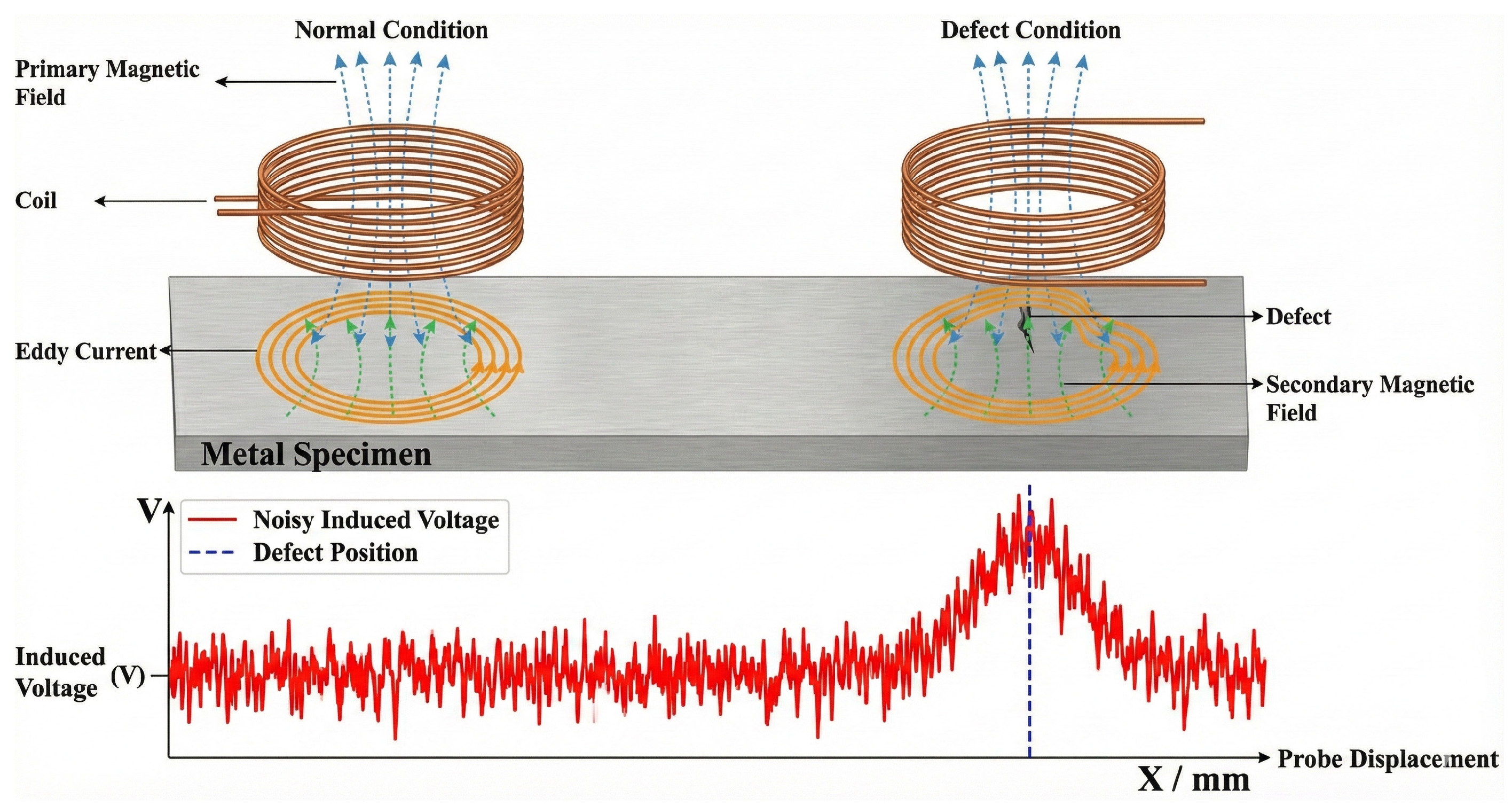
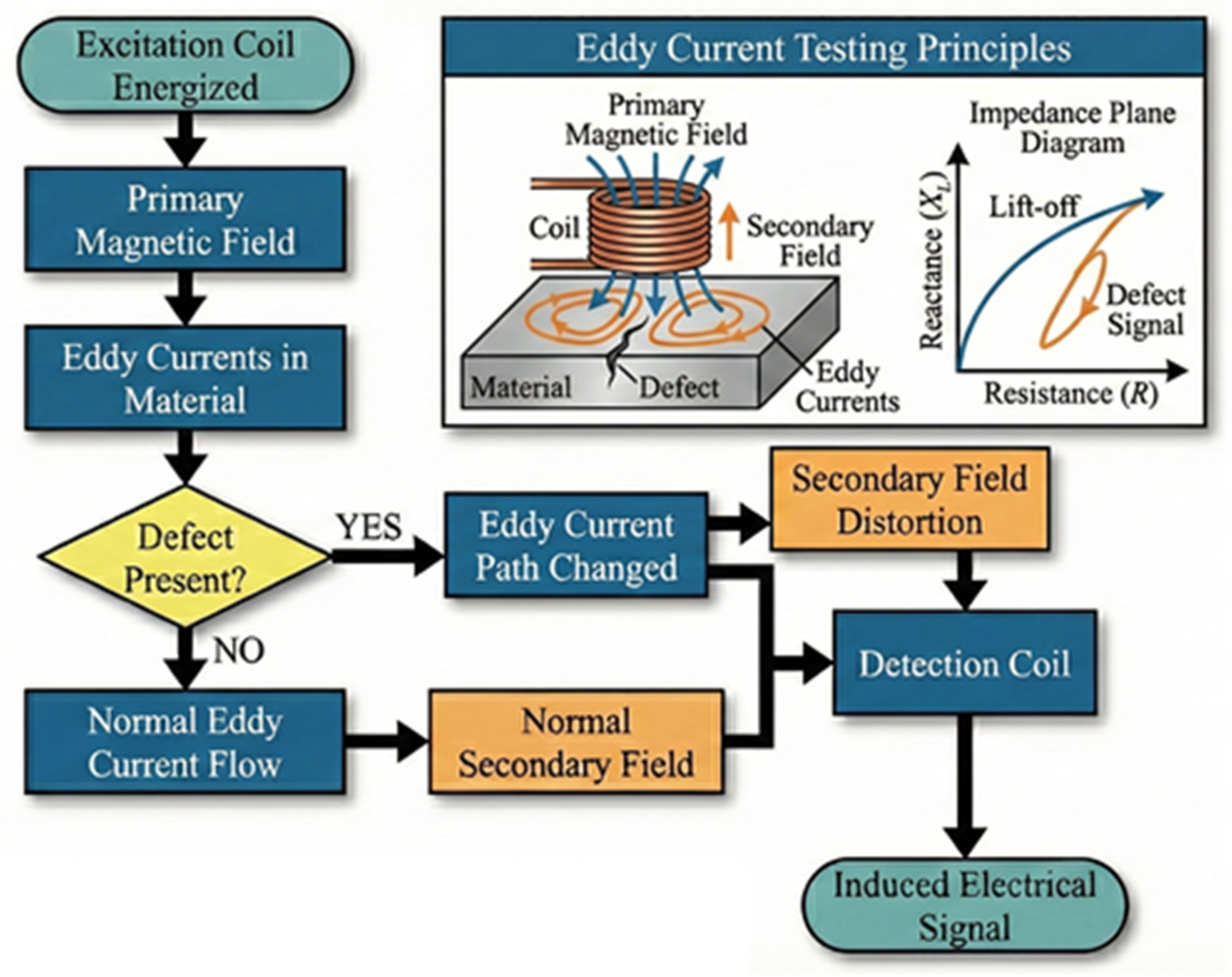
ECT is an NDT method that utilizes the principles of electromagnetic induction to detect flaws in materials. When ECT is used in the pipeline, once the excitation coil is energized with an alternating current, an alternating primary magnetic field is formed around the coil [13,15,16,17]. This primary magnetic field induces eddy currents on the pipe wall, which in turn generate a secondary magnetic field in the opposite direction to the main magnetic field. When there is a defect in the pipe wall, it causes variations in the induced eddy currents and subsequently affects the secondary magnetic field. The detection coil measures changes in the magnitude and phase of the induced voltage to obtain information about the defect parameters [18]. Its physical basis can be derived from Maxwell’s equations, integrating the formation of induced electric fields, the flow characteristics of eddy currents, and the impedance response of the detection coil for a systematic description. The following sections systematically elaborate the key mechanisms of eddy current testing, starting from fundamental electromagnetic theory [15].

2.1.1. Formation of Eddy Currents and Fundamentals of Electromagnetic Induction

The core of eddy current testing lies in Faraday’s law of electromagnetic induction. When an alternating current passes through the probe coil, it generates an alternating magnetic field, referred to as the primary magnetic field, around the probe [18]. When the probe is placed near the surface of a conductive material, this primary magnetic field induces currents within the material. These currents flow in circular patterns on the material’s surface and are termed eddy currents. From a physical perspective, the formation of eddy currents can be described by Faraday’s law of electromagnetic induction [19,20,21].
ε = d ϕ d t
where ε is the induced electromotive force (EMF), ϕ is the magnetic flux passing through the material, and t is the time variable.
The induced eddy currents generate a secondary magnetic field that opposes the direction of the primary magnetic field, in accordance with Lenz’s law. This induction process can be described by two key expressions from Maxwell’s equations [22,23,24]:
× E = B t
× H = J + D t
where E is the electric field, B is the magnetic flux density, H is the magnetic field intensity, J is the current density, D is the electric displacement, and t is the time variable.
The presence of the secondary magnetic field, in turn, affects the magnetic field experienced by the detection coil, thereby altering the coil’s equivalent impedance. When defects (such as cracks, corrosion, or voids) are present within the conductive material, they disrupt the flow path of the eddy currents, causing local changes in magnetic flux density. This, in turn, leads to variations in the coil’s resistance or inductance, which manifest externally as changes in the induced voltage. This process can be described using an equivalent model of the coil’s impedance [25,26]:
U = I × Z = I R + j X = I R + j X L X C
where U is the voltage, I is the current, j is the imaginary unit, XL is the inductive reactance, and Xc is the capacitance reactance.
To elucidate the physical mechanism and response logic of eddy current testing, Figure 3 summarizes the key steps from excitation signal generation to defect response signal acquisition in a flowchart format. Figure 4 illustrates the influence of defect presence/absence on magnetic field distribution and induced signals using a simplified model, providing a schematic representation of the impedance variation mechanism. As depicted in the scan in Figure 4, a typical signal in conventional ECT is characterized by a prominent voltage peak that corresponds to the defect location, allowing for precise spatial identification.

2.1.2. Factors Affecting Induction Parameters

The effectiveness of eddy current in-line inspection technology in identifying near-surface defects is largely influenced by the penetration capability of the electromagnetic field. This phenomenon is known as the skin effect [21]. The skin effect refers to the tendency of eddy currents to concentrate near the surface of a conductor when subjected to an alternating magnetic field, with their intensity rapidly decaying as the depth increases. Additionally, the skin effect also dictates the phase shift in the induced signal. As the electromagnetic field penetrates deeper into the pipe wall, the eddy currents experience a progressive phase lag relative to those at the surface. This phase-depth relationship provides the fundamental physical basis for discriminating defect depth and distinguishing between internal (ID) and external (OD) pipeline flaws [23].
Furthermore, the edge effect (also known as the end effect) is another critical factor in tube inspection. It refers to the distortion of the eddy current field that occurs when the probe approaches the physical end of a pipe or a structural boundary. At these boundaries, the continuity of the electromagnetic field is disrupted, resulting in a strong disturbance signal that can mask real defects in the vicinity. Understanding and suppressing the end effect is essential for ensuring the reliability of inspection data near joints or termination points in pipeline systems.
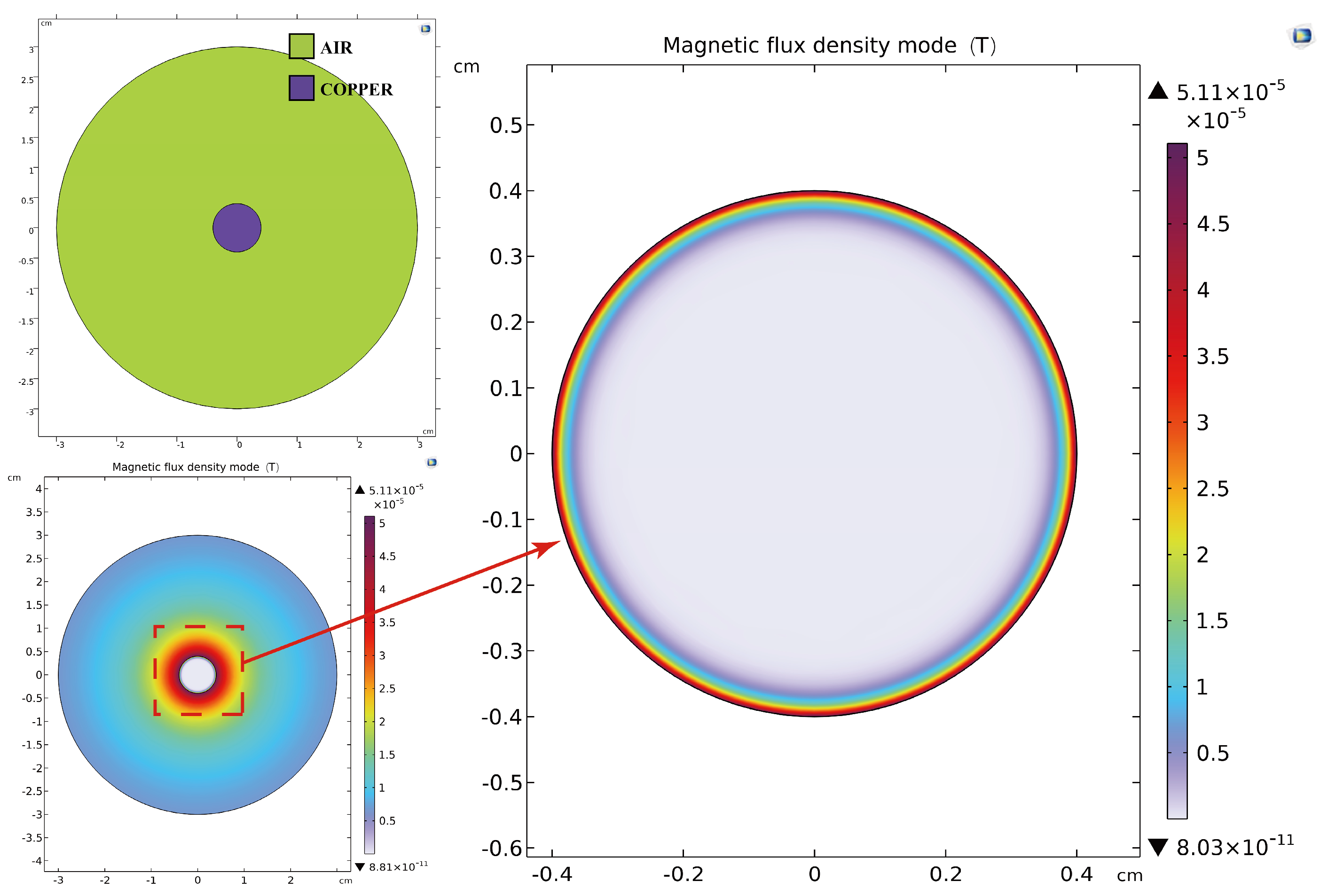
Figure 5 schematic diagram of the skin effect based on a copper wire model, showing that eddy current density is maximum at the conductor surface and decays exponentially with depth.
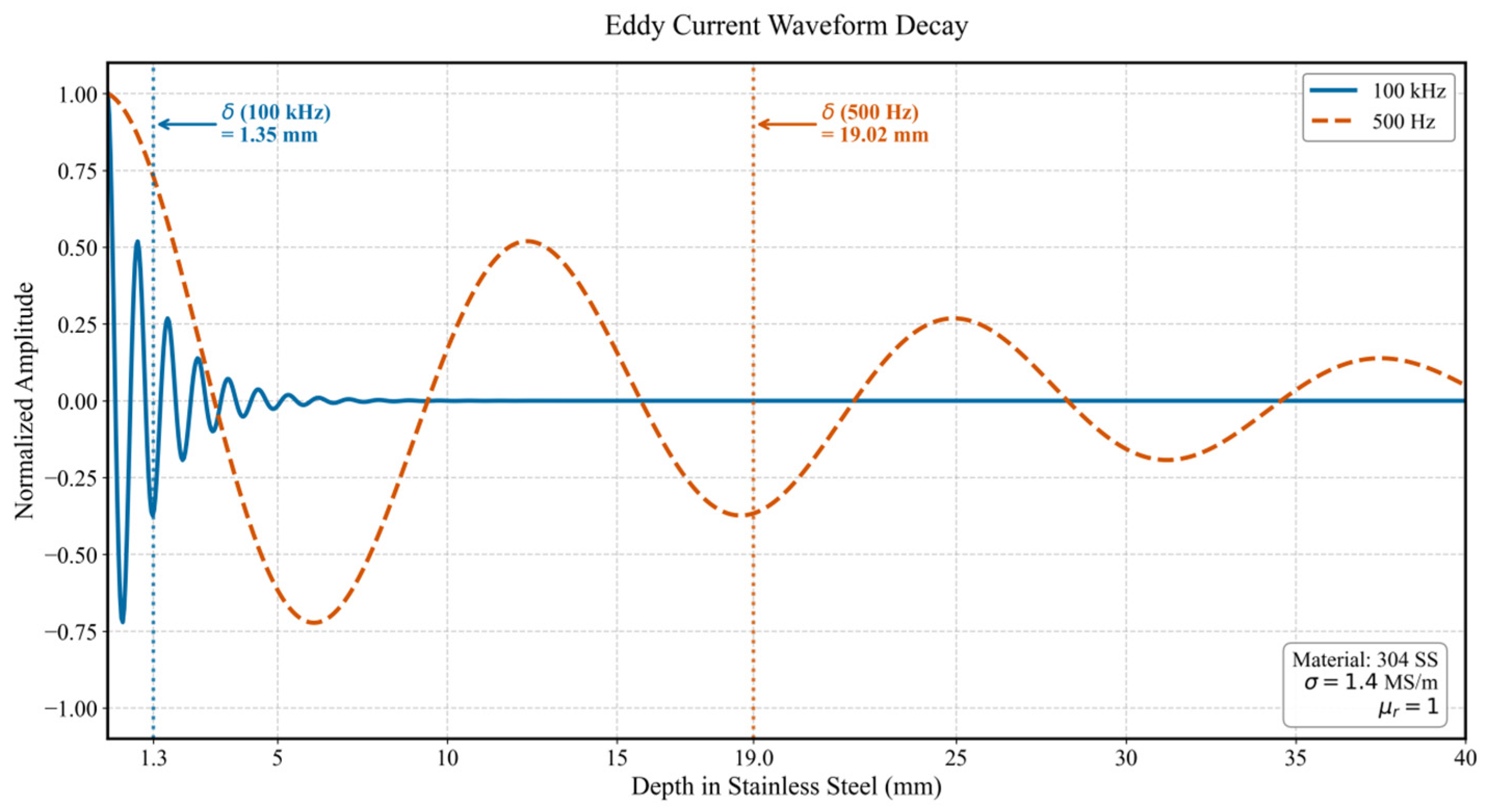
Skin depth, denoted as δ, is commonly defined as the depth at which the eddy current density drops to 1/e of its surface value. It can be calculated using the following formula [20]:
δ = 2 μ σ ω
where δ is the skin depth, μ is the magnetic permeability, σ is the electrical conductivity, and ω is the angular frequency.
The lift-off effect is the influence in eddy current testing where changes in the distance between the probe and the test piece lead to changes in the eddy current density generated on the surface of the test piece [11]; a larger lift-off distance will weaken the coupling between the excitation magnetic field and the work piece, resulting in a decrease in induced eddy current density, a reduction in signal amplitude, and a decrease in anti-interference capability [14].

2.1.3. Defect Perturbations and Signal Response Characteristics

When a defect such as a crack, corrosion pit, or inclusion exists within a conductor, it disrupts the original eddy current flow paths, resulting in an abnormal distribution of eddy current density. This disturbance alters the magnetic field sensed by the coil, thereby causing a change in its impedance, which generates a detectable signal [10].
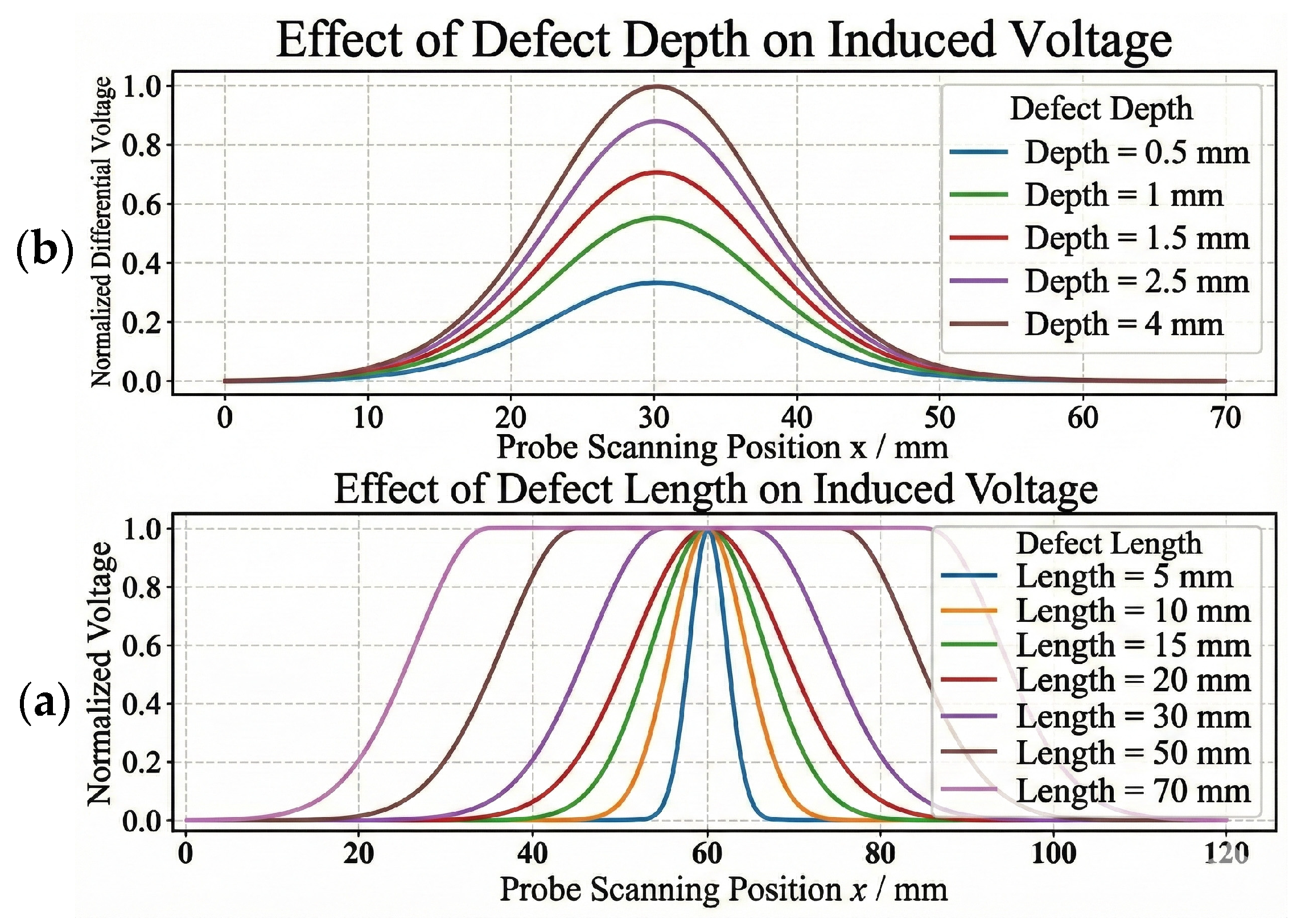
Defects with different geometric characteristics interfere with eddy currents to varying degrees, leading to changes in the amplitude or phase of the signal induced in the detection coil. Figure 6 illustrates the trends in induced signal variations with respect to changes in defect length and depth, respectively, revealing the sensitivity of eddy current testing to defect morphology [16]. To ensure the quantitative accuracy of these signal responses, calibration using standardized artificial defects is essential. Common calibration standards include inner and outer (ID/OD) grooves, flat-bottom holes (FBH) with varying depths, and through-thickness holes. These artificial flaws serve as critical benchmarks for establishing the correlation between signal amplitude, phase, and actual defect dimensions [19]. Specifically, ID and OD grooves facilitate the identification of defect location via the phase-depth relationship, allowing operators to effectively distinguish between internal surface corrosion and external wall thinning, even in the presence of complex structural components [20].

2.2. Conventional Eddy Current Testing

Conventional eddy current testing (ECT) is an NDT method based on the principle of electromagnetic induction, used to detect surface and near-surface defects in conductive materials. In ECT, an excitation coil generates an alternating magnetic field that induces eddy currents on the inner wall of a pipeline. Defects such as cracks or corrosion disturb the eddy current distribution, altering the coil’s impedance and thereby allowing for the identification of defect location and characteristics [24]. ECT offers advantages such as non-contact operation and high sensitivity. The typical detection depth is less than 5 mm, making it suitable for detecting surface cracks and corrosion in oil and gas pipelines.
In recent years, with the growing demands for oil and gas pipeline inspection, traditional ECT has encountered limitations in complex environments—such as one-dimensional bends and small-diameter pipelines—where high accuracy and environmental adaptability are required. Researchers have focused on probe miniaturization and flexibility to expand its application scenarios through optimized structural design. Chen et al. [25] addressed the drawbacks of large volume and slow response in conventional differential coils by designing a racetrack-shaped differential coil. This design reduced the probe size by 30% and improved sensitivity by approximately 20%, making it more suitable for small-diameter pipeline inspection. Chen et al. [26,27] proposed a flexible planar probe based on the Koch fractal structure, which exhibited stronger signal intensity and improved detection performance for crack orientations that were previously difficult to detect compared with traditional circular coils.
Due to its simple structure and ease of operation, this technique remains widely used for surface defect detection. Recent advances in probe miniaturization and flexibility have further enhanced its sensitivity. However, as inspection requirements become more demanding, conventional ECT is constrained by its limited penetration depth and sensitivity to lift-off, making it insufficient for detecting deep or thick-wall pipeline defects. Consequently, increasing research efforts have shifted toward alternative eddy current testing techniques—such as remote field eddy current (RFEC), pulsed eddy current (PEC), and eddy current array (ECA)—to enable deeper, more accurate, and more robust inspection under complex conditions.

2.3. Multi-Frequency Eddy Current Testing

Multi-frequency Eddy Current Testing (MFECT) represents an advancement over traditional eddy current testing techniques. Conventional high-frequency testing is limited by the use of a single-frequency excitation signal, which struggles to simultaneously detect defects on both the surface and within the interior of the test material. MFECT addresses this limitation by applying multiple sinusoidal signals of different frequencies to the excitation coil, inducing eddy currents with varying depths and distributions within the tested material. Each frequency’s eddy currents exhibit distinct sensitivities to the material’s electrical conductivity, magnetic permeability, and defects [28]. By analyzing the eddy current response signals at different frequencies, comprehensive information about the material’s properties at various depths and defect states can be obtained, enabling thorough detection of internal defects. Figure 7 illustrates the variation in skin depth at different excitation frequencies.
In practical applications, multi-frequency eddy current testing is currently widely used in the aviation sector (e.g., for detecting cracks in aircraft skins) and nuclear power industry (e.g., for heat exchanger tube inspection). However, its application in the oil and gas storage and transportation industry is limited due to the complexity of operational environments, resulting in relatively infrequent use. Zhang et al. [29] developed an innovative multi-channel, multi-frequency eddy current testing system. By employing precise phase-locked amplification technology, this system effectively mitigates multi-channel signal crosstalk while suppressing interference from external environmental noise, thereby improving the signal-to-noise ratio of the detection. Yuan et al. [30] employed the phase reversal feature technique to achieve high-precision classification and depth assessment of cracks in aluminum alloys. Gan et al. [31] combined multi-frequency excitation with zero-phase signal processing to achieve effective identification and assessment of deep hidden defects (such as cracks and corrosion), addressing the issue of insufficient sensitivity of traditional methods to subsurface defects. Zhou et al. [32] proposed a method using multi-frequency detection technology to observe reactance changes at weld seams to detect metal phase transformations, and the study demonstrated that this method can achieve detection of welding quality and weldability for different steel grades.
Current technical analyses indicate that multi-frequency eddy current detection technology in recent research tends towards defects in pipe wall coatings and weld base materials. Its multi-frequency excitation can effectively decouple complex signals, superior to conventional eddy current. However, compared to pulsed eddy current, its detection depth and adaptability to multi-layer structures are slightly inferior, and the analysis of multi-frequency signals is also more complex, therefore in pipeline detection, pulsed eddy current detection technology is widely preferred in industrial applications.

2.4. Pulsed Eddy Current Testing

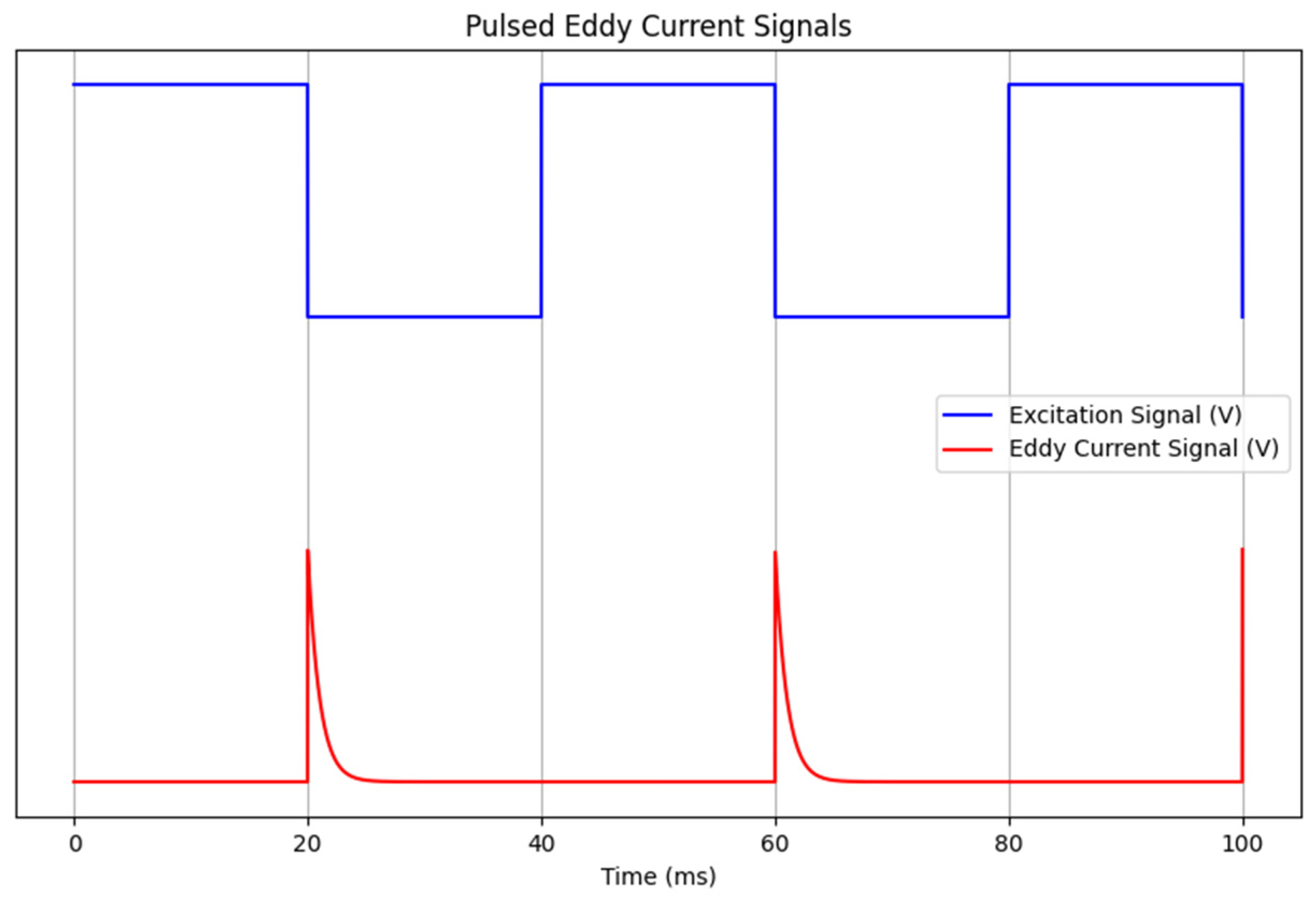
Pulsed eddy current (PEC) testing differs from conventional eddy current testing (ECT), which typically employs sinusoidal current excitation and focuses on steady-state field analysis. PEC utilizes square-wave pulsed currents with a specific duty cycle as the excitation signal, and analyzes the transient response of the induced magnetic field received by detection coils to extract pipeline information. According to Fourier analysis, a square wave can be decomposed into a sum of sinusoidal signals of different frequencies. Therefore, using a pulsed current for excitation is equivalent to simultaneously applying a range of excitation frequencies, enabling broadband excitation. Compared with conventional and multifrequency eddy current techniques, PEC offers faster response times, larger inspection ranges, and stronger resistance to electromagnetic interference [33].
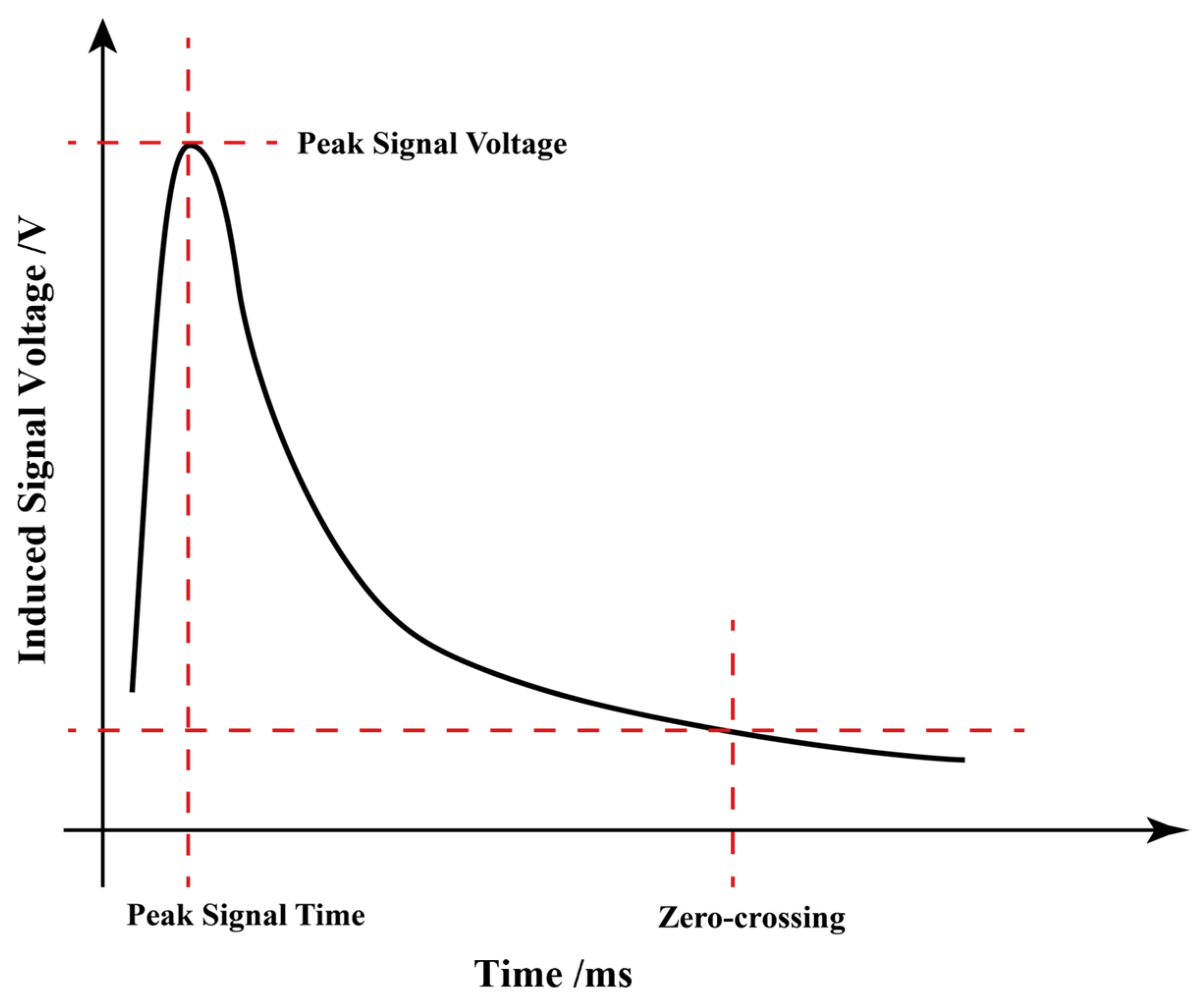
Figure 8 illustrates a typical pulsed excitation signal and its corresponding transient response, which helps explain the signal formation mechanism. Figure 9 presents the results of defect quantification based on signal features, demonstrating the potential of PEC for evaluating defect dimensions.
In recent years, pulsed eddy current (PEC) testing has been widely applied in the inspection of pipelines with cladding or coating layers due to its advantages such as large lift-off tolerance and deep penetration capabilities. Researchers have conducted in-depth investigations into probe design, lift-off suppression, and signal processing, continuously enhancing the detection performance of PEC systems.
For different target materials and complex working conditions, various new PEC probes have been proposed. Zhou et al. [34] proposed a design method for pulsed eddy current rectangular differential probes by analyzing the eddy current distribution of the probes, and fabricated a pulsed eddy current rectangular differential sensor based on differential magnetic sensor PCB. Chen et al. [35] designed a flexible planar probe based on Koch curve, achieving higher spatial resolution and better anti-interference performance. Yang et al. [36,37,38] adopted a U-shaped focusing probe structure, achieving local detection under large lift-off, eliminating the field of view blind area of traditional cylindrical probes; In a subsequent comparative study, they evaluated rectangular, U-shaped, and semicircular probes, demonstrating that the semicircular design offered superior magnetic energy utilization and optimal detection sensitivity across varying lift-off heights. This advancement significantly improved detection accuracy and efficiency for pipelines with complex cladding structures. In addition to the shape adjustment of the probes, the combination with other technologies is also a point of attention; the differential Hall sensor developed by Tran Thi Hoai Dung [39] combined with Gaussian pulse excitation technology significantly enhanced the depth, accuracy, and anti-interference capability of pulsed eddy current detection, providing a more reliable solution for corrosion defect detection. Xiao et al. [40] designed a probe for high-sensitivity detection of multi-directional microcracks through electromechanical rotating excitation. Yang et al. [41] combined pulsed eddy current with electromagnetic acoustic technology, improving the detection sensitivity while significantly enhancing the capability of simultaneous detection of inner and outer walls of pipelines.
Lift-off effect represents a pivotal challenge in maintaining the accuracy of PECT. Researchers have proposed various strategies for its suppression or compensation. Yin et al. [42] discovered that mid-time PECT signals are less affected by coating thickness and can be used to characterize lift-off distances. Duan et al. [43] proposed a novel lift-off detection method for stainless steel using a persistent coherent feature barcode, achieving a relative error of ±6.00% in characterizing lift-off distances between 60–140 mm and thicknesses above 18 mm. Sreevatsan and George [44] utilized changes in distributed capacitance between the probe and target to realize simultaneous detection of defects and lift-off, offering significant improvements for integrated PECT applications.
To enable qualitative and quantitative defect evaluation, researchers have explored feature extraction, signal denoising, and advanced analysis techniques. Shin et al. [45] investigated key feature quantities of differential PECT sensors, such as peak time, zero-crossing time, and peak amplitude, validating their effectiveness in characterizing plate thickness. Tian [46] analyzed the effect of lift-off on PECT signals and proposed a method to calculate lift-off height using mid-time intercepts and to estimate wall thickness using late-time slopes. In a follow-up study [47], Tian compared PECT signals from stainless steel and carbon steel, establishing a mapping model between late-time signal slopes and stainless steel wall thickness. Zhang et al. [48] developed a novel PECT signal processing algorithm combining ICA-Gaussian filtering and Hough Transform, which significantly improved the quantification of wall thinning in ferromagnetic materials under large lift-off conditions. Experimental results demonstrated superior performance in noise suppression, feature extraction, and measurement accuracy compared with traditional approaches.
Owing to its non-contact nature, efficiency, and rich signal content, PECT has been extensively applied in corrosion inspection of pipelines. However, challenges remain, including bulky probe size, significant sensitivity to lift-off, and insufficient precision in feature extraction. Future research may focus on probe miniaturization and integration, enhanced lift-off compensation mechanisms, and the incorporation of deep learning and multimodal fusion strategies to further improve detection performance.

2.5. Remote Field Eddy Current Testing

Remote Field Eddy Current Testing (RFECT) is a low-frequency eddy current testing technique that, in addition to possessing the advantages of conventional eddy current testing, offers strong penetration capabilities, enabling simultaneous inspection of both the inner and outer walls of pipelines without being affected by the skin effect.
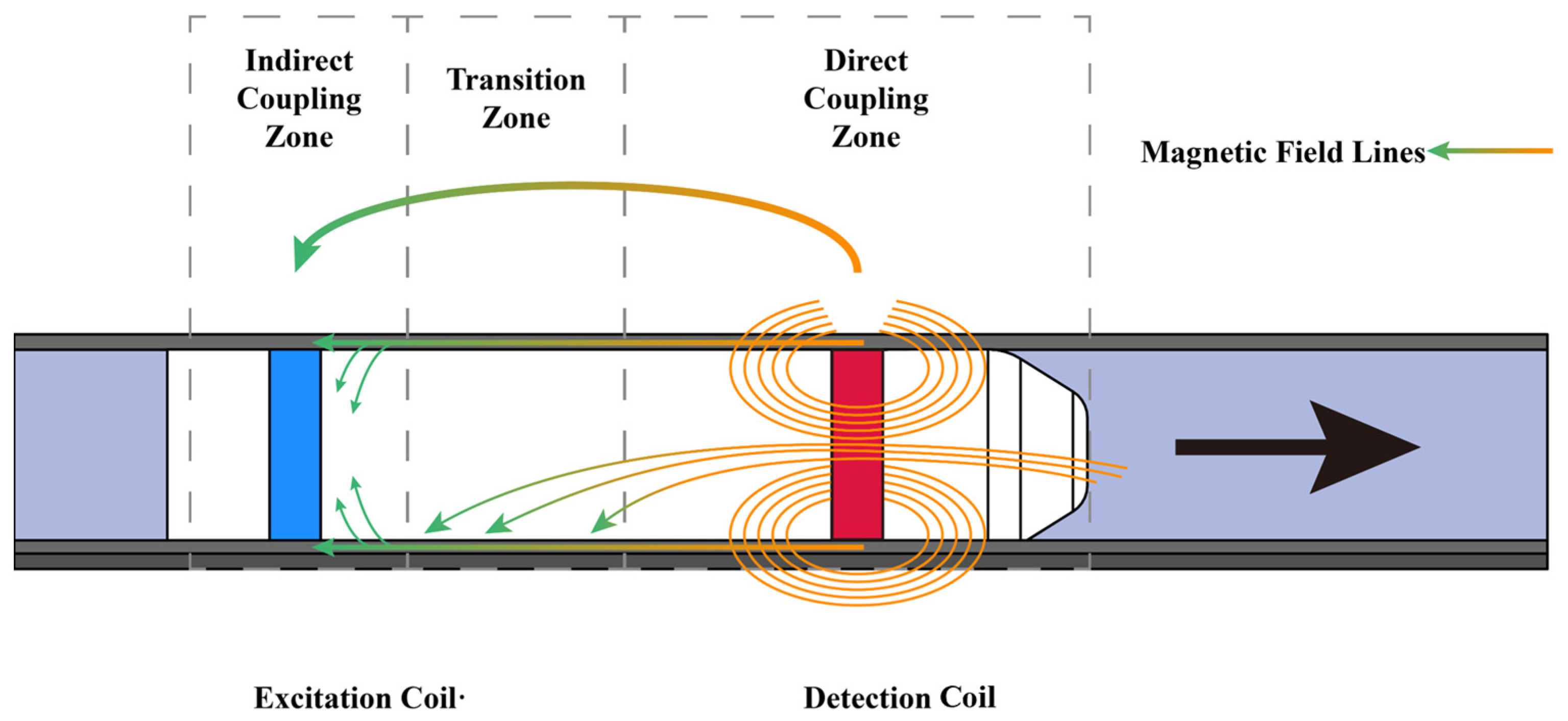
Taking the simplest RFECT system as an example, the equipment consists of two coaxial coils: an excitation coil and a detection coil positioned approximately 2–3 times the pipelines inner diameter away from the excitation coil. By supplying a low-frequency current to the excitation coil, an alternating magnetic field is generated. Part of the magnetic field energy propagates within the pipeline, referred to as the direct magnetic field, while another portion penetrates the pipe wall, travels axially, and re-enters the pipeline at a certain distance, known as the indirect magnetic field. Based on the varying proportions of these two magnetic fields at different distances, the detection region is divided into the direct coupling zone, transition zone, and indirect coupling zone. The direct magnetic field dominates in the direct coupling zone, located near the excitation coil, while the indirect magnetic field predominates in the indirect coupling zone, where the detection coil is typically placed. The indirect magnetic field carries information about pipeline defects and wall thickness variations [49]. By analyzing the phase and amplitude changes in the magnetic field through the detection coil, the condition of the pipeline can be determined. A typical RFECT signal scan involves monitoring these phase lags and amplitude reductions; specifically, wall thinning results in a predictable phase shift in the indirect coupling zone, which is the primary indicator used for defect quantification. Figure 10 illustrates a typical schematic diagram of the remote field eddy current (RFEC) testing configuration, including the direct coupling zone, indirect coupling zone, and the distribution characteristics of magnetic field lines.
In response to the problem of excessive size in traditional far-field probes, She et al. [50] performed structural optimization on the RFEC device by inserting a shielding plate between the excitation coil and the detection coil of the RFEC probe, shortening the probe size by 2 times, and introducing a ferromagnetic ring on the outside of the ferromagnetic pipeline to generate stronger magnetic flux density, improving the signal reception performance of the detection coil. Similarly, to address the drawbacks of traditional probes, Zhou [51] tackled the issues of structural complexity and large size in flat RFECT probes. By integrating energy flow simulation with characteristic curve analysis, they quantified the influence of shielding layer thickness and subsequently simplified its design. This work provided a crucial theoretical foundation for the development of subsequent miniaturized probes. Yang [52] designed a planar far-field eddy current probe, reducing the volume while achieving measurement of the internal and external conditions of the pipeline from the outer wall of the pipeline. Vijayachandrika et al. [53] addressed the issues that traditional axial coil detectors are sensitive to circumferential defects but respond weakly to axial defects, and the signals are easily polluted by noise, by proposing a conical radial magnetic field detector, which effectively reduced the minimum bore size and improved sensitivity to circumferential defects and complex defects through empirical mode decomposition signal processing technology, and possesses the potential to expand into an array structure.
Although far-field eddy current detection technology overcomes the influence of skin effect on traditional eddy current detection technology and can perform synchronous detection inside and outside the pipe wall, the far-field zone signal is too weak, leading to very small induced currents generated, and higher difficulty in signal processing. In response to these situations, Zhou et al. [54] addressed the problem that traditional eddy current detection is difficult to detect deep hidden defects in flat metal conductor plates due to skin effect, and proposed a magnetic field energy concentration method for deep defect detection based on far-field eddy current; Zhu et al. [55] addressed the problem of weak detected signals mixed with noise interference and proposed a signal denoising method combining successive variational mode decomposition and singular value decomposition, the new algorithm can reduce the key signal denoising error ratio to 9.30, showing obvious performance improvement compared to current algorithms. Xiao et al. [49] proposed an external pulsed far-field detection method to achieve differentiation of internal and external defects, serving as a supplement to traditional internal detection methods. Sun et al. [56] successfully reduced the average wall thickness inversion error to 2.23% by combining low-frequency remote field eddy current technology (RFEC) with quasi-Newton method, overcame lift-off effect interference, shortened detection time, and achieved the unification of high precision and high efficiency in buried pipeline thickness measurement.
Furthermore, due to the dual penetration of the pipe wall by remote field eddy current signals, both the excitation and detection coils produce a peak signal when near a defect. The main peak, detected by the detection coil, contains defect information, while the pseudo-peak, detected near the excitation coil, acts as an interference factor affecting the main peak signal. To address this issue, Shi et al. [57,58] initially designed a dual-receiver coil structure using Wiener deconvolution filtering to eliminate the pseudo-peak effect. Subsequently, Sun et al. [59] further optimized the design, proposing a single-receiver remote field eddy current testing scheme combining radial basis functions with the Nelder--Mead simplex method.
Due to its working principle, remote field eddy current testing is more suitable for complex pipeline environments compared to other technologies and excels in detecting large-scale corrosion or wall thinning defects. However, its application is limited by probe size and the weak nature of remote field signals, which also poses challenges for defect localization on both inner and outer pipeline walls. Future improvements should focus on optimizing probe design and integrating AI algorithms to enhance defect localization capabilities.

2.6. Eddy Current Array Testing Technology

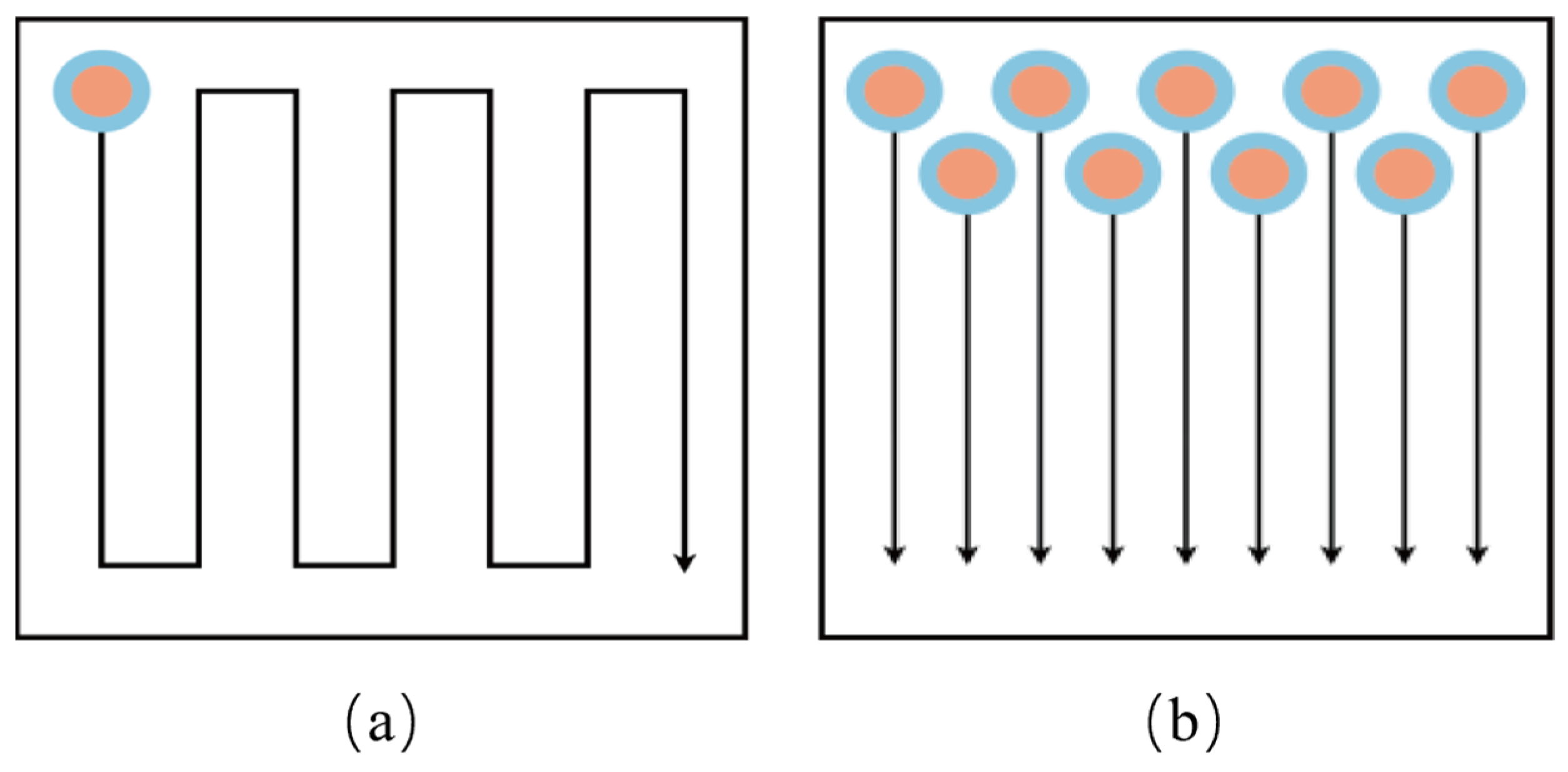
Eddy current array (ECA) testing technology integrates traditional single-probe eddy current testing with multi-channel array technology. Its fundamental principle involves arranging multiple independently operating eddy current probes in a specific structure on the detection surface to achieve simultaneous scanning of a large area. Compared to the repetitive scanning required by traditional methods, ECA technology offers higher detection efficiency and accuracy, while enabling the collection of multi-dimensional parameters from the test specimen [58,59,60]. This provides significant advantages in large-area inspections and the detection of complex surface structures. In an ECA system, the multi-channel data is typically synthesized into a C-scan image, where defect morphology is visualized as a two-dimensional spatial intensity map, as illustrated in the array-probe scan logic in Figure 11. Additionally, Figure 11 illustrates the differences between eddy current array and traditional single-probe eddy current scanning, where the arrows indicate the scanning direction in each configuration.
Due to the need to simultaneously control multiple probes, electromagnetic mutual interference between probes is one of the key challenges faced by eddy current array systems. Du et al. [60] established finite element models for both individual array units and the overall sensor, analyzing the impact of mutual interference on output signals. Their findings indicate that mutual interference leads to reduced signal amplitude and phase shifts, but using transimpedance amplitude as a characteristic parameter can effectively mitigate its impact, providing a theoretical basis for array sensor design. Liu et al. [61] utilized ANSYS 15.0 simulations to analyze the mutual inductance characteristics between probes, investigating the effects of structural parameters on detection sensitivity and spatial resolution. Jing et al. [62] designed a bottomless magnetic shielding layer using high-conductivity material (aluminum), effectively reducing coil mutual inductance in the array and increasing output voltage by 50%.
Additionally, various novel array designs have been proposed to optimize detection performance. Zhang et al. [63] developed a coil array eddy current sensor based on PCB technology, successfully detecting micro-cracks on aluminum plates and verifying that increased frequency enhances detection sensitivity. Li et al. [64] addressed the issue of sensitivity degradation in linear array probes with increasing radial distance from the coil, proposing a semicircular arc equidistant TMR sensor layout. This approach achieved high-resolution two-dimensional imaging of copper plate defects through pulsed eddy current C-scanning. Bui et al. [65] developed an eddy current probe array based on giant magnetoresistance sensors, enabling precise identification and localization of micro-defects.
With advancements in artificial intelligence and image reconstruction technologies, the signal interpretation capabilities of ECA systems have significantly improved. Le et al. [66] introduced the Mag FSRCNN model, integrating a fast super-resolution convolutional neural network module with parts of a generative adversarial network’s generator module, significantly enhancing the resolution and clarity of magnetic images acquired by ECT sensor arrays. Abdou et al. [67] proposed a method combining ECA with a fast search algorithm, establishing an algorithm for reconstructing three-dimensional defect geometries from two-dimensional images based on three-dimensional finite element simulations. This method was applied to pipeline inner wall defect identification, with experiments validating its high sensitivity to defects measuring 5 mm × 2 mm. Chen et al. [68] introduced a multi-frequency signal separation method based on phase-locked technology, effectively reducing inter-channel interference and improving detection speed. Xing et al. [69] proposed a defect identification framework based on Feature Boosting, leveraging multi-channel in-pipe inspection signal features to enhance the classification of complex defect signals through strengthened feature construction and hierarchical classification. Zhu et al. [55] improved defect localization in array-based pulsed remote field eddy current systems by increasing the number of receiving coils and processing weak signals with a combined SVMD–SVD algorithm.
Overall, ECA technology, with its high resolution critical for identifying micro-cracks and early-stage pitting, rapid detection enabling efficient inspection of long-distance pipelines, and inherent imaging capabilities providing intuitive defect mapping, represents a pivotal development direction in pipeline eddy current testing. This evolution is primarily driven by the industry’s urgent need for higher inspection throughput and more detailed defect characterization [58]. Current research on ECA technology concentrates on several key areas. These include minimizing inter-array interference, optimizing sensor layouts, improving imaging accuracy, and advancing intelligent defect identification algorithms. Despite these efforts, significant engineering challenges remain [62]. A primary challenge is ensuring consistent performance across all probes within an array.

2.7. Summary of Eddy Current Testing Technologies

To systematically evaluate the applicability and technical characteristics of different ECT methods, a comparative analysis is presented in Table 1, which summarizes their excitation methods, typical applications, and key performance parameters. This comparison highlights the trade-offs between penetration depth, resolution, and implementation complexity, guiding the selection of an appropriate technique for specific pipeline inspection scenarios.

2.8. Predictions for Future Development of Eddy Current Detection Technology

In summary, a single eddy current detection technology has a limited application scope and cannot achieve comprehensive pipeline inspection on its own. Consequently, future research will prioritize the integration of multiple technologies. This multi-technology fusion is essential to expand inspection applicability and enhance overall operational efficiency [70]. The integration of artificial intelligence and optimization algorithms is essential to enhance the analysis and identification of detection information. This integration enables the autonomous interpretation of complex signals within high-noise operational environments. In practice, deep learning architectures—for instance, the Mag FSRCNN model—facilitate super-resolution magnetic imaging. This capability effectively suppresses non-defect interference, which is critical for the precise classification of micro-cracks and for modeling defect progression [71]. Collectively, these technical advances support a transition from passive data collection to proactive asset integrity management, ultimately realizing the goal of ‘early detection, early prevention, and treatment’.
Specifically, deep learning architectures such as Convolutional Neural Networks (CNNs) are being leveraged to automate the interpretation of eddy current array (ECA) C-scan images, enhancing defect detection and characterization. Recurrent Neural Networks (RNNs), including Long Short-Term Memory (LSTM) networks, show promise in analyzing time-series signals from pulsed eddy current (PECT) for depth quantification. However, the real-world reliability of these AI-driven systems hinges on critical factors such as the availability of large, high-quality labeled datasets for training, the model’s ability to generalize across varying pipeline conditions (e.g., material properties, coating types), and the need for interpretable outcomes to gain operator trust [69]. Addressing these challenges is essential to transition AI from a promising tool to a robust component of next-generation ILI systems [72]. Equipment optimization will be a key research area, by promoting miniaturization and modular design, improving the portability and flexibility of detection equipment. In addition, pipeline stress detection will also become a key focus to support more comprehensive preventive maintenance. In conclusion, these directions will jointly drive the evolution of eddy current detection technology towards higher precision, higher efficiency, and more intelligent future.

3. Applications of In-Pipe Eddy Current Inspection Devices

3.1. Market Demand and Global Context for Pipeline In-Line Inspection

This technological evolution is driven by the growing demands of pipeline safety and maintenance. Pipeline in-line inspection technology originated in the 1960s with basic mechanical pigs used for cleaning and simple gauging in oil pipelines. Over the decades, it advanced to incorporate magnetic flux leakage and ultrasonic sensors in the 1980s and 1990s, enabling more accurate defect detection. These developments have paved the way for the current highly intelligent systems. From the initial stage in the 20th century, pipeline in-line inspection technology devices have evolved into the current highly intelligent systems. Current pipeline in-line inspection services conduct detection inside the pipeline by using in-line inspectors loaded with detection modules, which can effectively identify defects such as corrosion, cracks, mechanical damage, and deformation, reducing the risk of failures throughout the pipeline lifecycle. Compared to other detection methods, in-line inspection has advantages such as not interrupting transportation and real-time data acquisition, playing an irreplaceable role in pipeline monitoring in long-distance and high-risk areas [73].

3.2. Classification of Common In-Pipe Inspection Device Structures

To adapt to complex and variable pipeline environments, in-pipe inspection devices exhibit a trend toward diversified structural designs, which can be primarily classified based on two dimensions: power source and motion mechanism. Based on the power source, these devices can be divided into pressure-driven and self-propelled types. The former relies on the pressure differential created by the pipeline transported medium to propel the device forward, representing the most common driving method due to its relatively simple structure and suitability for routine inspections in most transportation pipelines. The latter, powered by internal motors and batteries, operates independently of the pipeline medium, making it suitable for shut-down, low-pressure, or complex branched pipeline environments. However, self-propelled devices are more complex in structure and have higher requirements for control and endurance. Based on the motion mechanism and structural form, inspection devices can be further categorized into common types, including wheeled structures (suitable for long, straight pipeline sections) [74,75], tracked structures (offering strong traction and obstacle-crossing capabilities) [76,77,78], spiral-driven structures (adaptable to pipeline sections with significant curvature changes) [79,80], peristaltic structures (mimicking the segmented motion of soft-bodied animals, suitable for small-diameter or complex pipelines) [81,82], snake-like structures (highly flexible with strong directional control) [83,84], multi-legged structures (providing high structural stability and obstacle-crossing capabilities), and cup seal or foam structures (typically pressure-driven, with good flexibility and conformity, often used for single-use inspection tasks).
However, self-propelled devices are more complex in structure and have higher requirements for control and endurance [85]. From a mechanism perspective, while pressure-driven pigs are efficient for long-distance inspection, their reliance on medium flow makes precise speed control difficult, often leading to signal instability during ECT data acquisition [86,87,88]. In contrast, self-propelled mechanisms offer superior sampling consistency but are limited by mechanical passability in high-curvature sections of small-diameter (DN100–150 mm) pipelines.
In the current market, pressure-driven cup/foam structures remain the most widely used design, playing a dominant role in the integrity management of oil and gas pipeline networks due to their high maturity, low cost, and excellent adaptability to pipeline environments.

3.3. Representative Industrial Applications and Case Studies

The earliest applications of intelligent in-pipe inspection devices were achieved by Shell (Houston, TX, USA) and Tuboscope (Houston, TX, USA). Currently, the global pipeline inspection industry is dominated by companies such as ROSEN, NDT Global, Baker Hughes (Houston, TX, USA), Tuboscope (Houston, TX, USA), and Intero (Delft, The Netherlands, The Netherlands), which provide advanced magnetic flux leakage, ultrasonic, and eddy current testing technologies. Among them, ROSEN, NDT Global, Tuboscope, and Eddyfi Technologies (London, ON, Canada) lead in the field of eddy current testing, renowned for their high-precision crack detection and data analysis capabilities, widely serving the oil, gas, and energy industries.
As an emerging market, China is also rapidly advancing in the R&D of inspection equipment. Notable developments include the eddy current array sensors developed by Beihang University in cooperation with enterprises, the pipeline inspection equipment by Shanghai Lanbao Sensing Technology, and the eddy current in-line inspectors developed by China University of Petroleum (East China) in collaboration with Tongao Inspection Group Co., Ltd. (Wuhan, Hubei, China). However, currently Chinese companies still lag behind global leaders in technology maturity, international market competitiveness, and high-end equipment research and development, and need to further enhance innovation capabilities and standardization levels.
Sichuan Deyuan Pipeline Technology Co., Ltd. (Chengdu, China) specializes in in-pipe inspection, integrity assessment, and anti-corrosion repair technologies, emerging as an innovative enterprise in the field of eddy current testing (ECT) for oil and gas pipelines in China. Its PIGPRO-EC system, centered on eddy current testing technology, is designed specifically for small- and medium-diameter pipelines and low-pressure environments, enabling efficient detection of corrosion, cracks, and deposits. Developed in collaboration with the University of Electronic Science and Technology of China, the PIGPROX system, released in 2021, represents China’s first fully proprietary electromagnetic eddy current in-pipe inspection robot system [89]. Currently, the PIGPRO-EC series has been successfully deployed in projects such as the West-East Gas Pipeline and the Chengdu Chemical Industrial Park, covering over 500 km of pipeline inspections and assisting clients such as China Petroleum, China Petrochemical, and the National Pipeline Network in optimizing pipeline integrity management.
The UK-based i2i Pipelines (Manchester, UK) focuses on integrating intelligent sensing technologies into simple pigging devices, aiming to achieve high-frequency, low-cost, and non-invasive inspections for pipelines with various media and complex geometries [90]. The company’s developed in-line inspection equipment, in addition to the traditional cup structure Pioneer series, the Smart Foam intelligent foam in-line inspector combines advanced eddy current sensors with foam pigs, possessing the advantages of both, and is suitable for high-frequency inspections of the inner walls of small-diameter and complex-structured pipelines.
The German company ROSEN is a global leader in pipeline integrity inspection solutions, achieving significant advancements in the development of cup-structured in-pipe inspection devices. A key to its success is the sophisticated integration of eddy current testing (ECT) technology, which enables high-precision identification of shallow corrosion, pitting, and other minor defects. By further combining ECT with geometric measurement technologies, ROSEN has developed advanced inspection tools like the RoCombo ECT and RoCorr ECT series. These devices deliver not only precise defect detection but also accurate geometric deformation measurement [91].
In 2022, ROSEN adopted RoCorr ECT technology to successfully assess the internal corrosion and geometric anomalies of two production loops of ExxonMobil company’s floating production storage and offloading unit “Liza Destiny” located in the ultra-deepwater area of Guyana (above 5000 feet) [92]. These high-end industrial cases highlight a critical research gap: despite the success of heavy-duty tools in standard pipelines, current commercial solutions still struggle to balance high passability in complex, small-diameter geometries with the multi-modal sensing (e.g., ECT integrated with stress detection) required for proactive integrity management.

3.4. Predictions for Future Development of In-Pipe Eddy Current Detectors

However, existing in-line inspectors still face numerous technical challenges in structural design and actual operation, with extremely complex working conditions inside long-term operating pipeline environments; in addition, the passability of the equipment limits its widespread application in small and medium-diameter, variable-diameter, and high-curvature pipelines [93,94].
The future development of in-line inspectors will inevitably be closely integrated with pipeline construction and market demands. First, in response to the trend that future new pipeline networks are mainly natural gas pipelines, the equipment needs to improve response speed to adapt to the higher gas flow rates inside the pipelines; at the same time, due to the urgency of detection demands for small and medium-diameter pipelines, as well as the gradual expansion of new pipeline networks to harsh environments such as oceans and polar regions, the combination of complex pipeline conditions and extreme environments makes the original method of solving pipeline blockages through excavation no longer applicable, thus making the miniaturization and modular design of the equipment particularly important; a single detection technology is difficult to comprehensively address complex pipeline environments, therefore the integration of multiple detection technologies is crucial; in addition, existing technologies are difficult to effectively detect hidden defects such as pipeline cracks and stress concentrations, these defects differ from large defects that directly affect transportation, and once conditions mature, they are extremely prone to evolve into serious safety hazards, therefore it is necessary to enhance the detection capabilities of the equipment, develop early warning and stress detection functions to prevent potential failures; finally, as an emerging economy, China’s domestic market continues to grow, and under complex international political situations, to maintain national security, it is necessary to promote technological localization and productization, accelerating the transformation from laboratory to engineering applications. Overall, the equipment will evolve towards directions of independent controllability, lightweight efficiency, and multi-functional integration to meet the demands of China’s pipeline network safety and digital transformation, and gradually narrow the gap with international advanced levels.

4. Conclusions

Current eddy current testing technologies still face challenges in achieving qualitative and quantitative defect analysis, necessitating further research. The future of in-pipe eddy current testing for oil and gas pipelines will inevitably move toward multi-modal integration and intelligent prediction, with the following key directions:
(1)
Enhanced Defect Identification: Improve defect detection accuracy and enable qualitative and quantitative analysis by optimizing detection probes and information processing algorithms. Specifically, CNNs enable the automated super-resolution of ECA images, while LSTM and Transformer networks improve PECT defect quantification by extracting deep temporal features from transient signals.
(2)
Integration of Multiple Technologies: Overcome the limitations of single detection methods by developing combined detection systems, such as multi-eddy current technologies or hybrid approaches (e.g., pulsed + remote field, eddy current + ultrasonic, eddy current + thermal imaging), to enhance defect detection capabilities through multi-source data integration.
(3)
Device Miniaturization: Further reduce the size of inspection devices while maintaining operational duration.
(4)
Transition from Passive Detection to Proactive Prevention: Enable the detection of pipeline stress in addition to traditional defects, facilitating early warnings for high-risk pipeline sections.
(5)
Development of Digital Pipelines: Leverage big data and Internet of Things (IoT) technologies to transform offline inspection into online monitoring, enabling real-time assessment of pipeline conditions.

Author Contributions

Conceptualization, X.L. and C.X.; Methodology, X.L., C.X. and X.Z.; Software, C.X. and X.Z.; Validation, X.L., C.X. and X.Z.; Formal analysis, X.L. and X.Z.; Investigation, X.L., C.X. and W.J.; Resources, W.J.; Data curation, X.Z.; Writing—original draft, X.L. and C.X.; Writing—review & editing, X.Z. and W.J.; Visualization, C.X.; Supervision, W.J.; Project administration, W.J.; Funding acquisition, W.J. All authors have read and agreed to the published version of the manuscript.

Funding

This study was supported by the Eddy Current Internal Inspection R&D and Manufacturing Project of T-ALL Inspection Group Co., Ltd. (Grant No. JCHT-FC-653-TA-2023).

Data Availability Statement

The authors confirm that the data supporting the findings of this study are available within the article.

Conflicts of Interest

Author Xianbing Liang was employed by the Shengli Oilfield Company. The remaining authors declare that the research was conducted in the absence of any commercial or financial relationships that could be construed as a potential conflict of interest.

Abbreviations

The following abbreviations are used in this manuscript:
ECTEddy Current Testing
ILIIn-line Inspection
NDTNondestructive Testing
MFLMagnetic Flux Leakage
UTUltrasonic Testing
MFECTMulti-frequency Eddy Current Testing
PECT/PECPulsed Eddy Current Testing/Pulsed Eddy Current
RFECTRemote Field Eddy Current Testing
ECAEddy Current Array
EMATElectromagnetic Acoustic Transducer
EMFElectromotive Force
PCBPrinted Circuit Board
ICAIndependent Component Analysis
IoTInternet of Things

References

  1. Liang, Y.T.; Tu, R.F.; Zhang, H.; Liu, C.Y.; Fu, G.T.; Qiu, R.; Liao, Q.; Xu, N. Role of oil and gas pipelines in the construction of a new energy system with multi-energy integration. Oil Gas Storage Transp. 2025, 44, 361–378. [Google Scholar] [CrossRef]
  2. Li, Z.C.; Liang, Y.T.; Liang, Y.Y.; Liao, Q.; Wang, B.H.; Huang, L.J.; Zheng, J.Q.; Zhang, H.R. Review on intelligent pipeline technologies: A life cycle perspective. Comput. Chem. Eng. 2023, 175, 108283. [Google Scholar] [CrossRef]
  3. Mukharror, D.A.; Maulana, I.; Yusuf, M.; Devianto, H.; Sommeng, A.N.S.; Kartohardjono, S.; Hermansyah, H. Collection and analysis of hydrocarbon gas buried onshore pipeline accidents in Indonesia as the databases for failure frequency assessment in a quantitative risk analysis. Process Saf. Prog. 2024, 43, S128–S133. [Google Scholar] [CrossRef]
  4. Silva, A.; Evangelista, L.; Ferreira, C.; Valença, J.; Mendes, M.P. Towards resilient pipeline infrastructure: Lessons learned from failure analysis. Discov. Appl. Sci. 2024, 6, 11. [Google Scholar] [CrossRef]
  5. GB 32167-2015; Specifications for Integrity Management of Oil and Gas Transmission Pipelines. Standardization Administration of China: Beijing, China, 2015.
  6. Wang, Y.T.; Lü, Y.X.; Yang, W.L.; Sun, X.; Zhu, X.X. Review of gas pipeline accident research at home and abroad. Chem. Eng. Equip. Pipelines 2022, 59, 78–84. [Google Scholar] [CrossRef]
  7. Li, R. Current status and prospects of pipeline inspection technology and data analysis methods. Oil Gas Storage Transp. 2024, 43, 241–256. [Google Scholar]
  8. Shi, Y.; Zhang, C.; Li, R.; Cai, M.; Jia, G. Theory and application of magnetic flux leakage pipeline detection. Sensors 2015, 15, 31036–31055. [Google Scholar] [CrossRef] [PubMed]
  9. Feng, B.; Wu, J.; Tu, H.; Tang, J.; Kang, Y. A review of magnetic flux leakage nondestructive testing. Materials 2022, 15, 7362. [Google Scholar] [CrossRef]
  10. Zang, X.; Xu, Z.D.; Lu, H.; Zhu, C.; Zhang, Z. Ultrasonic guided wave techniques and applications in pipeline defect detection: A review. Int. J. Press. Vessels Pip. 2023, 206, 105033. [Google Scholar] [CrossRef]
  11. Lyu, F.; Zhou, X.; Ding, Z.; Qiao, X.; Song, D. Application research of ultrasonic-guided wave technology in pipeline corrosion defect detection: A review. Coatings 2024, 14, 358. [Google Scholar] [CrossRef]
  12. Zhang, X.; Li, B.; Zhang, X.; Song, X.; Tu, J.; Cai, C.; Yuan, J.; Wu, Q. Internal and external pipe defect characterization via high-frequency lamb waves generated by unidirectional EMAT. Sensors 2023, 23, 8843. [Google Scholar] [CrossRef]
  13. Tian, Y.; Palaev, A.G.; Shammazov, I.A.; Ren, Y. Non-destructive testing technology for corrosion wall thickness reduction defects in pipelines based on electromagnetic ultrasound. Front. Earth Sci. 2024, 12, 1432043. [Google Scholar] [CrossRef]
  14. Wang, Y.; Li, P.; Li, J. Methods of monitoring and non-destructive testing for sewer pipelines. Water Sci. Technol. 2022, 85, 2563–2583. [Google Scholar] [CrossRef]
  15. Zhang, Y.; Guan, E.; Li, P.; Zhao, Y. An automatic nondestructive testing system for pressure pipeline weld surface. J. Field Robot. 2023, 40, 1735–1750. [Google Scholar] [CrossRef]
  16. Waqar, M.; Memon, A.M.; Sabih, M.; Alhems, L.M. Composite pipes: Assessing defects and advancements in nondestructive testing techniques. Eng. Fail. Anal. 2024, 157, 107914. [Google Scholar] [CrossRef]
  17. Komatsubara, K.; Gao, Y.; Gotoh, Y.; Guan, W.; Muramatsu, K. Frequency characteristics analysis of remote field eddy current testing for ferromagnetic pipes. IEEE Trans. Magn. 2023, 59, 6200605. [Google Scholar] [CrossRef]
  18. Noguchi, Y.; Tsunokai, M.; Nakata, K.; Takeda, N. Applicability of eddy current technique to nondestructive inspection tool for inner bore of welded joints in ITER hydraulic piping. Fusion Eng. Des. 2019, 146, 2311–2314. [Google Scholar] [CrossRef]
  19. Urayama, R.; Uchimoto, T.; Takagi, T. Application of EMAT/EC dual probe to wall thickness monitoring in high-temperature environments. Int. J. Appl. Electromagn. Mech. 2010, 33, 1317–1327. [Google Scholar] [CrossRef]
  20. French, P.C.; Bond, L.J. Finite-element modeling of eddy-current nondestructive evaluation (NDE). J. Nondestruct. Test. Eval. 1988, 7, 85–97. [Google Scholar] [CrossRef]
  21. Griffiths, D.J. Introduction to Electrodynamics, 4th ed.; Cambridge University Press: Cambridge, UK, 2017. [Google Scholar] [CrossRef]
  22. Ammari, H.; Buffa, A.; Nédélec, J.C. A justification of eddy currents model for the Maxwell equations. SIAM J. Appl. Math. 2000, 60, 1805–1823. [Google Scholar] [CrossRef]
  23. Chu, Z.; Jiang, Z.; Mao, Z.; Shen, Y.; Gao, J.; Dong, S. Low power consumption eddy current testing with 1–1 type magnetoelectric sensor for monitoring pipeline cracks. Sens. Actuators A Phys. 2021, 320, 112496. [Google Scholar] [CrossRef]
  24. García-Martín, J.; Gómez-Gil, J.; Vázquez-Sánchez, E. Non-destructive techniques based on eddy current testing. Sensors 2011, 11, 2525–2565. [Google Scholar] [CrossRef]
  25. Chen, T.; Zhang, S.; Xiao, X.; Song, X.; Li, D.; Liao, C.; Tu, J. Design and performance study of runway-type differential eddy-current probe. J. Eng. Des. 2020, 27, 781–785. [Google Scholar] [CrossRef]
  26. Chen, G.; Zhang, S.; Cao, Z.; Li, Z.; Jin, W. Research on crack detection performance of absolute Koch fractal planar eddy current sensors. Chin. J. Sci. Instrum. 2022, 43, 98–107. [Google Scholar] [CrossRef]
  27. Chen, G.; Zhang, W.; Pang, W. Koch curve fractal geometry excitation probe for eddy current non-destructive testing. Measurement 2018, 124, 470–478. [Google Scholar] [CrossRef]
  28. Li, Z.M.; Chen, M.J.; Zhang, J.H. A new-developed multi-frequency impedance analyzing instrument used for eddy current testing based on DSP. In Proceedings of the 2013 Fifth International Conference on Measuring Technology and Mechatronics Automation (ICMTMA), Hong Kong, China, 16–17 January 2013; IEEE: Piscataway, NJ, USA, 2013; pp. 55–58. [Google Scholar] [CrossRef]
  29. Zhang, X.D.; Bai, S.; Liu, Z.Y.; Lin, Y.X.; Zhang, Z.; Zhao, Y.X.; Wang, G.; Zhang, S. Multi-channel and multi-frequency eddy current testing of aviation lithium battery welds. Weld. J. 2024, 45, 85–94. [Google Scholar] [CrossRef]
  30. Yuan, X.; Zhao, J.; Li, W.; Yin, X.; Li, X.; Zhao, J.; Fan, M. Novel phase reversal feature for inspection of cracks using multi-frequency alternating current field measurement technique. Mech. Syst. Signal Process. 2023, 186, 109857. [Google Scholar] [CrossRef]
  31. Gan, F.; Li, W.; Liao, J. New feature for evaluation of subsurface defects via multi-frequency alternating current field signature method. AIP Adv. 2018, 8, 015026. [Google Scholar] [CrossRef]
  32. Zhou, Z.M.; Du, T.C.; Wan, F.; Zhang, J.; Yin, W.L. Experimental study on grain size measurement of offset welds in continuous oil pipes by multi-frequency eddy current testing. J. Electron. Meas. Instrum. 2022, 36, 188–195. [Google Scholar] [CrossRef]
  33. Sophian, A.; Tian, G.; Fan, M. Pulsed eddy current non-destructive testing and evaluation: A review. Chin. J. Mech. Eng. 2017, 30, 500–514. [Google Scholar] [CrossRef]
  34. Zhou, D.Q.; Wang, J.; Pan, M.; Li, K.; Su, L.; Hua, C.J. Defect detection mechanism of pulsed eddy current rectangular differential probe. Chin. Mech. Eng. 2016, 27, 3032–3037. [Google Scholar] [CrossRef]
  35. Chen, G.L.; Han, Y.; Zhang, Y.L.; Zhang, G.; Li, Y.X.; He, J.; Chen, Y.L.; Luo, X.H. Microcrack imaging method for planar flexible Koch fractal eddy current sensors excited by pulse square. Mech. Syst. Signal Process. 2025, 236, 112990. [Google Scholar] [CrossRef]
  36. Yang, F.; Fu, Y.W.; Huang, W.F.; Li, B.S.; Li, Z.Y. Research on pulsed eddy current testing of pipeline with complex structure parts with coating based on focused probe. Fail. Anal. Prev. 2022, 17, 353–361+391. [Google Scholar] [CrossRef]
  37. Yang, F.; Fu, Y.W.; Huang, W.F.; Li, B.S.; Li, Z.Y. Research on pulsed eddy current testing of pipeline with U-shaped magnetic conductor focused probe. Chin. J. Sens. Actuators 2022, 35, 267–276. [Google Scholar] [CrossRef]
  38. Yang, F.; Li, Z.Y.; Fu, Y.W.; Huang, W.F.; Tang, C.H.; Cao, A.S. Comparison of different types of focusing probes in pulsed eddy current testing. AIP Adv. 2022, 12, 075010. [Google Scholar] [CrossRef]
  39. Tran, T.H.D.; Le, Q.T.; Kasai, N.; Le, M.; Luong, V.S. Development of differential Hall sensors for pulsed eddy current testing using Gaussian pulse excitation. Sens. Actuators A Phys. 2024, 379, 115998. [Google Scholar] [CrossRef]
  40. Xiao, Y.R.; Xu, Q.Z.; Duan, Z.Q.; Chi, L.; Kang, Y.H. Pulse eddy current probe based on rotation of blade-type excitation coil. Nondestr. Test. 2024, 46, 22–27. [Google Scholar] [CrossRef]
  41. Yang, S.Y.; Zhao, R.X.; Duan, Z.R.; Hu, P.; Chen, Z.M.; Xie, S.J.; Wan, Q.; Yan, S.P.; Zheng, Y.A. A novel enhanced sensitive sensor for small-diameter pipe based on the PECT-EMAT hybrid testing method. Mech. Syst. Signal Process. 2025, 226, 112350. [Google Scholar] [CrossRef]
  42. Yin, X.F.; Cheng, Q.L.; Dou, F.J.; Cui, J.J. Research on lift-off height detection method based on pulsed eddy current. Press. Vessel. Technol. 2021, 38, 81–86. [Google Scholar] [CrossRef]
  43. Duan, S.Y.; Song, Y.; Wu, X. Research on lift-off distance measurement method of pulsed eddy current based on persistent homology. Chem. Autom. Instrum. 2022, 49, 54–59. [Google Scholar] [CrossRef]
  44. Sreevatsan, S.; George, B. Simultaneous detection of defect and lift-off using a modified pulsed eddy current probe. IEEE Sens. J. 2020, 20, 2156–2163. [Google Scholar] [CrossRef]
  45. Shin, Y.K.; Choi, D.M.; Kim, Y.J.; Lee, S.S. Signal characteristics of differential-pulsed eddy current sensors in the evaluation of plate thickness. NDT E Int. 2009, 42, 215–221. [Google Scholar] [CrossRef]
  46. Tian, Y. Lift-off height and wall thickness detection based on pulsed eddy current technology. Press. Vessel Technol. 2024, 41, 71–78. [Google Scholar] [CrossRef]
  47. Tian, Y.; Xiang, A.; Lai, Y. Wall thickness measurement of stainless steel based on the slope of late-time signal in pulsed eddy current. Nondestruct. Test. 2022, 44, 18–21+31. [Google Scholar] [CrossRef]
  48. Zhang, J.Z.; Fan, S.W.; Lu, G.H.; Yang, S.Y.; Xie, S.J.; Chen, Z.M.; Zheng, Y.; Uchimoto, T.; Takagi, T. Wall thinning quantification with a lift-off distance for ferromagnetic structures using pulsed ECT equipped with ICA-Gauss filter and Hough transform. NDT E Int. 2025, 149, 103272. [Google Scholar] [CrossRef]
  49. Xiao, Q.; Feng, J.; Xu, Z.Y.; Zhang, H.G. Receiver signal analysis on geometry and excitation parameters of remote field eddy current probe. IEEE Trans. Ind. Electron. 2022, 69, 3088–3098. [Google Scholar] [CrossRef]
  50. She, S.B.; Chen, Y.F.; He, Y.Z.; Zhou, Z.J.; Zou, X. Optimal design of remote field eddy current testing probe for ferromagnetic pipeline inspection. Measurement 2021, 168, 108306. [Google Scholar] [CrossRef]
  51. Zhou, D.Q.; Jiao, T.Q.; Gao, X.; Zhou, R.T.; Sheng, W.F. Investigation on magnetic shield thickness of remote field eddy current probes for inspection of ferromagnetic and non-ferromagnetic plates. Int. J. Appl. Electromagn. Mech. 2023, 71, 325–339. [Google Scholar] [CrossRef]
  52. Yang, B.F.; Xu, J.M.; Wu, H.; He, Y.Z. Magnetic field shielding technique for pulsed remote field eddy current inspection of planar conductors. NDT E Int. 2017, 90, 48–54. [Google Scholar] [CrossRef]
  53. Vijayachandrika, T.; Thirunavukkarasu, S.; Kumar, A. Radial field detector to improve sensitivity of localized defects in remote field eddy current technique. Res. Nondestruct. Eval. 2024, 35, 247–267. [Google Scholar] [CrossRef]
  54. Zhou, R.Q.; Zhou, D.Q.; Hu, Y.Q.; Chen, J.W.; Sheng, W.F. Research and optimization of flat-plate remote field eddy current detection probe based on energy flow. Comput. Digit. Eng. 2023, 51, 2763–2768. [Google Scholar] [CrossRef]
  55. Zhu, G.C.; Liu, D.S. Signal denoising methods for array pulse remote field eddy current detection. Electron. Meas. Technol. 2024, 47, 79–87. [Google Scholar] [CrossRef]
  56. Sun, H.; Shi, Y.B.; Zhang, W.; Li, Y.J. RFEC based oil downhole metal pipe thickness measurement. J. Nondestruct. Eval. 2021, 40, 35. [Google Scholar] [CrossRef]
  57. Luo, Q.W.; Shi, Y.B.; Wang, Z.G.; Zhang, W.; Ma, D. A method for locating large-area defects in pipelines based on remote field eddy current. Chin. J. Sci. Instrum. 2015, 36, 2790–2797. [Google Scholar] [CrossRef]
  58. Li, T.; Ma, S.; Li, B.; Wang, M.; Wang, Y. Fuzzy Theory based control method for an in-pipe robot to move in variable resistance environment. Chin. J. Mech. Eng. 2015, 28, 1160–1170. [Google Scholar] [CrossRef]
  59. Sun, H.; Shi, Y.B.; Gao, X. Secondary peak separation of remote field eddy current testing in ferromagnetic pipes. In Proceedings of the 2019 IEEE International Instrumentation and Measurement Technology Conference (I2MTC), Auckland, New Zealand, 20–23 May 2019; IEEE: Piscataway, NJ, USA, 2019; pp. 1–5. [Google Scholar] [CrossRef]
  60. Du, J.Q.; He, Y.T.; Li, P.Y. Influence of mutual interference on crack detection performance of eddy current array sensors. J. Huazhong Univ. Sci. Technol. (Nat. Sci. Ed.) 2015, 43, 22–26. [Google Scholar] [CrossRef]
  61. Liu, S.W.; Guo, Q. Optimized design of array eddy current sensors based on coil mutual inductance. Sens. Microsyst. 2015, 34, 107–109+119. [Google Scholar] [CrossRef]
  62. Nie, J.; Li, Y.; She, S. Magnetic shielding analysis for arrayed eddy current testing. J. Magn. 2019, 24, 328–332. [Google Scholar] [CrossRef]
  63. Zhang, W.M.; Zeng, W.Q.; Yang, X.J.; Qin, F.; Yu, X. Eddy current testing of cracks in aluminum plate material based on planar coil array sensors. Trans. Beijing Inst. Technol. 2014, 34, 1101–1105. [Google Scholar] [CrossRef]
  64. Li, X.B.; Ye, Z.H.; Luo, N.Z.; Li, S.L.; Zhang, Y. Research on pulsed eddy current C-scan imaging technology based on TMR sensors. J. Electron. Meas. Instrum. 2022, 36, 105–113. [Google Scholar] [CrossRef]
  65. Bui, L.V.; Jeng, J.T.; Huang, H.C.; Nguyen, H.T.; Doan, V.D.; Nguyen, T.H. High-resolution flaw detection using eddy current probe array based on giant magnetoresistance sensors. IEEE Trans. Magn. 2024, 60, 6200205. [Google Scholar] [CrossRef]
  66. Le, H.; Le, Q.T.; Phuong, T.V.; Le, M.; Lee, J.; Kasai, N. Optimising signal quality for corrosion detection using the innovative Mag_FSRCNN model to minimise Hall sensor array in eddy current testing. Nondestruct. Test. Eval. 2025, 40, 2020–2043. [Google Scholar] [CrossRef]
  67. Abdou, A.; Bouchala, T.; Abdelnadi, B.; Guettafi, A. 3D surface crack characterization by eddy current array image and a fast algorithm search. J. Electr. Eng. 2023, 74, 127–131. [Google Scholar] [CrossRef]
  68. Chen, T.; Xia, X.R.; Lü, C.; Zhang, L.H.; Deng, Z.Y.; Song, X.C. Research on array eddy current signal processing method based on lock-in technology. Sens. Microsyst. 2023, 42, 70–73+78. [Google Scholar] [CrossRef]
  69. Xing, H.Y.; Wu, X.Y.; Cai, Z.H.; Zhao, L.W.; Su, T.; Han, Q. Quantitative identification of oil and gas pipeline defect grade based on ResGNNet multimodal fusion and magnetic memory. China Mech. Eng. 2025, 36, 2150–2157. [Google Scholar] [CrossRef]
  70. Yuan, F.; Yu, Y.T.; Wang, W.; Xue, K.; Tian, G.Y. Pulsed eddy current array design and electromagnetic imaging for defects detection in metallic materials. Nondestruct. Test. Eval. 2021, 36, 371–391. [Google Scholar] [CrossRef]
  71. Li, E.L.; Guo, W.X.; Cao, X.; Zhu, J.Z. A magnetic head-based eddy current array for defect detection in ferromagnetic steels. Sens. Actuators A Phys. 2024, 379, 115862. [Google Scholar] [CrossRef]
  72. Zhang, W.P.; Wang, C.L.; Xie, F.Q.; Zhang, H.Y. Defect imaging curved surface based on flexible eddy current array sensor. Measurement 2020, 154, 107280. [Google Scholar] [CrossRef]
  73. Zhang, J.; Sun, M.N.; Qin, L.; Lin, D.; Liu, C.; Li, J.; Li, C.L.; Wen, S.M.; Han, C.J. In-line inspection methods and tools for oil and gas pipeline: A review. Int. J. Press. Vessel. Pip. 2025, 214, 105409. [Google Scholar] [CrossRef]
  74. Hu, C.; Luo, S.; Li, W.; Lv, F.; Cai, D.; Kong, L. Research and evaluation of measurement uncertainty of pipeline robot. J. Phys. Conf. Ser. 2021, 1894, 012036. [Google Scholar] [CrossRef]
  75. Thung-Od, K.; Kanjanawanishkul, K.; Maneewarn, T.; Sethaput, T.; Boonyaprapasorn, A. An in-pipe inspection robot with permanent magnets and omnidirectional wheels: Design and implementation. Appl. Sci. 2022, 12, 1226. [Google Scholar] [CrossRef]
  76. Liu, G.D.; Ye, L.Z.; Liu, P.D.; Li, F.; Zhu, X.J. Analysis of a tracked in-pipe robot’s obstacle-crossing performance. Appl. Sci. 2025, 15, 5905. [Google Scholar] [CrossRef]
  77. Hong, S.; Lee, J.; Shin, D.; Hahm, J.; Baek, J.; Suh, J. Robotic system for detecting and grinding pipe spatters. Appl. Sci. 2022, 12, 11045. [Google Scholar] [CrossRef]
  78. Ling, Z.W.; Kong, S.; Chen, Y.G.; Miao, C.J.; Guo, W.C. Variable-diameter in-pipe inspection robot for industrial pipelines. Nondestruct. Test. 2021, 43, 17–20. [Google Scholar] [CrossRef]
  79. Ren, T.; Zhang, Y.; Li, Y.J.; Chen, Y.H.; Liu, Q.Y. Driving mechanisms, motion, and mechanics of screw drive in-pipe robots: A review. Appl. Sci. 2019, 9, 2514. [Google Scholar] [CrossRef]
  80. Ab Rashid, M.Z.; Mohd Yakub, M.F.; Shaikh Salim, S.A.Z.; Mamat, N.; Syed Mohd Putra, S.M.; Roslan, S.A. Modeling of in-pipe inspection robot: A comprehensive review. Ocean Eng. 2020, 208, 107206. [Google Scholar] [CrossRef]
  81. Okuma, R.; Matsuo, S.; Ito, F.; Nakamura, T. Basic study on a peristaltic motion-type in-pipe inspection robot using a hyper-extension unit for improving locomotion speed. In Lecture Notes in Networks and Systems; Springer: Cham, Switzerland, 2024; pp. 105–116. [Google Scholar] [CrossRef]
  82. Xu, Z.L.; Lu, S.; Yang, J.; Feng, Y.H.; Shen, C.T. A wheel-type in-pipe robot for grinding weld beads. Adv. Manuf. 2017, 5, 182–190. [Google Scholar] [CrossRef]
  83. Yaqub, S.; Ali, A.; Usman, M.; Zuhalb, K.M.; Khan, A.M.; An, B.; Moon, H.; Lee, J.Y.; Han, C.S. A spiral curve gait design for a modular snake robot moving on a pipe. Int. J. Control Autom. Syst. 2019, 17, 2565–2573. [Google Scholar] [CrossRef]
  84. You, Y.Q.; Zheng, Y.C.; Huang, K.L.; He, Y.L.; Huang, Z.Q.; Zhan, L.L. Development of a Small-Sized Inspection Robot for Urban Cable Ducts. Actuators 2024, 13, 349. [Google Scholar] [CrossRef]
  85. Yeh, C.Y.; Chen, C.Y.; Juang, J.Y. A soft hopping and crawling robot for in-pipe locomotion. Extreme Mech. Lett. 2020, 37, 100854. [Google Scholar] [CrossRef]
  86. Wang, G.R.; Yan, H.W.; Kou, Z.M.; Wei, H.M.; Ren, H.J.; Ma, Y.H. Design and traction performance analysis of a deformable tracked pipeline robot for mining. Ind. Mine Autom. 2025, 51, 71–80. [Google Scholar] [CrossRef]
  87. Ren, T.; Liu, Q.Y.; Li, Y.J.; Chen, Y.H. Design, analysis and innovation in variable radius active screw in-pipe drive mechanisms. Int. J. Adv. Rob. Syst. 2017, 14, 1729881417703564. [Google Scholar] [CrossRef]
  88. Granosik, G.; Borenstein, J. Integrated joint actuator for serpentine robots. IEEE/ASME Trans. Mechatron. 2005, 10, 473–481. [Google Scholar] [CrossRef]
  89. Wu, Y.F.; Li, Y.L.; Xue, W.; Guo, P.; Xiao, T.F.; Luo, H.J.; Li, X.H.; Zhu, X.J.; Yang, J. Flexible, wideband triboelectric accelerometer integrated into quadruped robot legs for vibration source detection and localization. Compos. Part B Eng. 2025, 305, 112710. [Google Scholar] [CrossRef]
  90. I2I Pipelines. SmartFoam Mk 2 for Utility Pipeline Inspection. Available online: https://www.i2ipipelines.com/latest-news/smartfoam-mk-2-for-utility-pipeline-inspection/ (accessed on 25 July 2025).
  91. Rosen Group. Combined In-Line Inspection Services. Available online: https://www.rosen-group.com/en/expertise/product-and-service-finder/combined-in-line-inspection-services#combined-metal-loss-and-geometry-inspections (accessed on 25 July 2025).
  92. Rosen Group. In-Line Inspection Services for Corrosion. Available online: https://www.rosen-group.com/en/expertise/product-and-service-finder/in-line-inspection-services-for-corrosion#ro-corr-iec-service (accessed on 25 July 2025).
  93. Ma, Q.P.; Tian, G.Y.; Zeng, Y.L.; Li, R.; Song, H.D.; Wang, Z.; Gao, B.; Zeng, K. Pipeline in-line inspection method, instrumentation and data management. Sensors 2021, 21, 3862. [Google Scholar] [CrossRef]
  94. Parlak, B.O.; Yavasoglu, H.A. A comprehensive analysis of in-line inspection tools and technologies for steel oil and gas pipelines. Sustainability 2023, 15, 2783. [Google Scholar] [CrossRef]
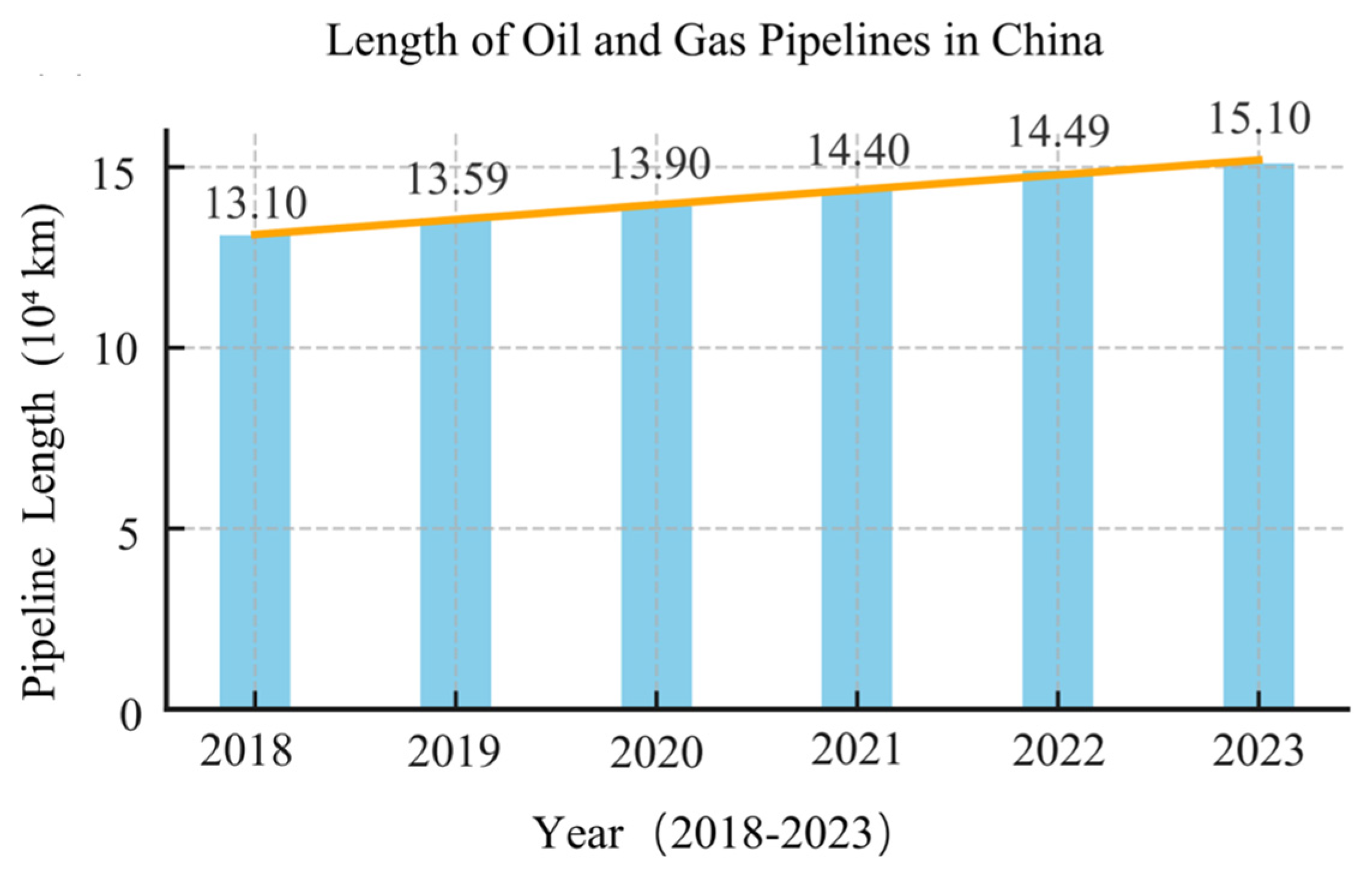
Figure 1. Oil and gas pipeline length in China.
Processes 14 00247 g001
Figure 2. Eddy Current Testing (ECT) in pipeline ILI context.
Processes 14 00247 g002
Figure 3. Flowchart of eddy current testing (ECT) basic principle.
Processes 14 00247 g003
Figure 4. Basic schematic of ECT.
Processes 14 00247 g004
Figure 5. Schematic diagram of the skin effect based on a copper wire model.
Processes 14 00247 g005
Figure 6. Variation in induced voltage: (a) different defect lengths; (b) different defect depths.
Processes 14 00247 g006
Figure 7. Skin depth variation at different excitation frequencies.
Processes 14 00247 g007
Figure 8. Pulsed excitation signal and corresponding transient response.
Processes 14 00247 g008
Figure 9. Feature-based defect dimension evaluation.
Processes 14 00247 g009
Figure 10. Principle schematic of remote field eddy current (RFEC) testing.
Processes 14 00247 g010
Figure 11. Comparison of Single-Probe Scan and Array-Probe Scan: (a) Single probe; (b) Array probe.
Processes 14 00247 g011
Table 1. ECT Methods Comparison: Excitation, Applications, and Performance.
TechniqueExcitation MethodTypical Application ScenariosTarget DefectsAdvantagesLimitationsKey Performance Parameters & NotesReferences
Conventional ECTSingle-frequency sinusoidal excitationSurface and near-surface defect detection on pipe inner wallSurface cracks, corrosion pitsSimple configuration, low cost, fast responseLimited depth, lift-off interferenceTypical Frequency: 1 kHz–2 MHz. Sensitivity: Typically detects surface cracks with depth ≥ 0.1 mm. Susceptible to lift-off and material variations.[10,11,12,21,22]
MFECTMulti-frequency excitationMultilayered structures, weld inspection, coating thickness measurementLayered defects, subsurface flawsLayer-specific detection, strong electromagnetic noise immunityComplex system, signal processing complexityTypical Frequency: Multi-frequency mix (e.g., 100 Hz & 10 kHz). Enables defect detection under coating and thickness assessment via frequency mixing to suppress interference.[24,25,29,30,31]
Remote Field ECT (RFECT)Low-frequency excitationThick-walled pipes, full wall-thickness assessment, simultaneous ID/OD defect detectionDeep wall thinning, internal/external corrosionStrong penetration, lift-off independentLow efficiency, poor axial sensitivityTypical Frequency: 10–500 Hz. Capable of full wall-thickness inspection. Sensitive to uniform wall thinning. Weak signal requires high-gain amplification.[42,49,50,51,52]
Pulsed ECT (PECT)Square-wave pulse excitationPipes with coating, non-ferromagnetic materialsDeep subsurface and under-coating corrosionHigh lift-off tolerance, rich time-domain signal, fast signal acquisitionLimited penetration depth, high power consumptionTypical Excitation: Millisecond-level pulses. Sensitive to subsurface corrosion. Defect depth can be evaluated via time-domain analysis. Suitable for rapid screening.[33,34,35,36]
Eddy Current Array (ECA)Spatially arranged probe arraysLarge-diameter pipelines, complex geometrical areasCracks, corrosion, geometric anomaliesHigh efficiency, defect imaging, high spatial resolutionComplex equipment, probe interferenceTypical Frequency: 100 Hz–1 MHz (depends on element design). Provides C-scan images. Spatial resolution depends on element pitch and scan step.[60,61,62,63,65]
Disclaimer/Publisher’s Note: The statements, opinions and data contained in all publications are solely those of the individual author(s) and contributor(s) and not of MDPI and/or the editor(s). MDPI and/or the editor(s) disclaim responsibility for any injury to people or property resulting from any ideas, methods, instructions or products referred to in the content.