Abstract
This research reports the development of photocatalytic active composites for hydrogen evolution obtained through high-energy mechanical milling of a mixture of the organic semiconductor g-C3N4 (CN) and the metal–organic framework ZIF-67. These composites, called CNZ-x (X = mass proportion of ZIF-67), were characterized using powder XRD, which showed that the crystalline phases of both the g-C3N4 and ZIF-67 precursors are present in the composites. SEM was used to determine the morphology, revealing that the ZIF-67 octahedral particles adhere to the surface of the CN sheets due to the intimate interfacial contact induced by high-energy mechanical grinding. The results of the photocatalytic evolution of H2 indicate that the CNZ-50 composite produced 261 μmol g−1 of H2, which is higher than the 229.5 and 124 μmol g−1 produced by the precursors ZIF-67 and CN, respectively. The higher efficiency in H2 evolution is due to the composite having better electron-hole separation than the precursor materials.
1. Introduction
The exponential growth of the global population and industry, coupled with rapid technological advancement, has driven a drastic increase in global energy demand, depleting limited fossil fuel reserves and significantly impacting the environment [1]. Despite growing awareness, many countries are still dependent on these non-renewable sources, which contribute to environmental problems such as drought, increased CO2 emissions, ozone layer depletion, global warming, climate change, and environmental pollution [2,3,4]. In this context, the search for sustainable energy sources that allow for efficient energy storage and transport has intensified. Among these, hydrogen is a clean, versatile fuel with a high energy density (120 MJ·kg−1) [5,6]
Conventional hydrogen production, which is mainly achieved via natural gas reforming or coal gasification, has its advantages, but it also emits substantial CO2, which diminishes its reputation as an ecologically clean fuel [7]. Consequently, research has focused on hydrogen generation as a green fuel due to its high energy content and zero carbon emissions during combustion [8,9,10].
The most efficient and environmentally friendly options for green hydrogen production are achieved through electrocatalytic and photocatalytic processes [11,12,13]. However, photocatalysis via water splitting (water molecule dissociation) has become increasingly important. This is because it offers lower operational costs and the ability to harness solar energy directly [14,15,16,17,18]. In this process, a semiconductor material absorbs photons with sufficient energy to promote electrons from the valence band to the conduction band. This generates electron–hole pairs that participate in oxide-reduction reactions and split water into hydrogen and oxygen molecules. The efficiency of the photocatalyst depends on its ability to separate the photogenerated charges, thereby minimizing their recombination [13,19].
Graphitic carbon nitride (g-C3N4) has emerged as one of the most versatile metal photocatalysts due to its band gap (~2.7 eV), chemical stability, and ability to participate in visible-light-driven redox reactions [20,21]. Recent studies highlight its tunable electronic structure and enhanced charge separation when combined with porous materials or transition-metal centers [22,23,24]. On the other hand, ZIF-67, a zeolite framework composed of Co2+ ions and 2-methylimidazole [25,26]. It has a high surface area, abundant Co–N active sites, and well-defined porosity that facilitate molecular diffusion and surface reactions, characteristics of the structural and functional versatility of MOFs [27]. The ZIF-67 was applied in different fields like adsorption [28,29], catalysis [30,31], batteries [32] and fuel cells [33]. Its photoactivity has been associated with ligand-metal charge transfer (LMCT) processes and the involvement of Co2+ centers in catalytic cycles, a mechanism that has been extensively studied in photoactive metal–organic frameworks [30]. The strategic integration of semiconductors, such as g-C3N4, with MOFs to form heterostructures is a recognized approach to improve charge separation and photocatalytic performance. In particular, cobalt-based MOFs, such as ZIF-67, are ideal candidates for this synergy in reactions such as photocatalytic H2 production [34,35,36]. The integration of g-C3N4 with ZIF-67 establishes an intense interfacial contact that enhances charge separation, suppresses recombination, and significantly increases photocatalytic efficiency for hydrogen evolution and other solar-driven reactions [37,38]. These findings, consistent with the design principles of efficient heterostructures, support the relevance of g-C3N4/ZIF-67 heterostructures as promising candidates for water photodissociation.
In recent years, researchers have recognized mechanochemical synthesis as a sustainable, solvent-free, and nontoxic approach [39]. Mechanical forces such as compression, continuous deformation, fracture, shear, or friction induce chemical transformations, enabling the production of materials with high dispersion and lower environmental impact [40,41].
Mechanochemistry has many advantages over other synthesis methods. These include short reaction times, reduced energy consumption, industrial scalability, and environmental friendliness [42]. However, despite growing interest in g-C3N4/MOF photocatalysts, little is known about how mechanochemically synthesized heterostructures and their mass ratios influence charge separation and overall hydrogen evolution performance. Clarifying this knowledge could guide the development of more efficient photocatalysts.
This research therefore proposes forming heterojunctions (or heterostructures) via mechanochemical synthesis via high-energy milling of g-C3N4/ZIF-67. The materials characterized and enhanced hydrogen production via monochromatic UV-driven were analyzed. This strategy aims to suppress charge recombination and enhance charge separation under UV irradiation, thereby improving the photocatalytic efficiency of the materials. Performance was optimized by testing three composites with different g-C3N4/ZIF mass ratios: 10/90, 50/50, and 90/10. The 50/50 composite exhibited the highest hydrogen production efficiency.
2. Materials and Methods
The melamine, 2-methyl imidazole (2-MI), and CoCl2·6H2O for the synthesis of precursor materials were acquired from Merck.
2.1. Synthesis of g-C3N4
The g-C3N4 (CN) powders were produced by subjecting 10 g of melamine to heat treatment in an electric furnace at a temperature of 550 °C for a duration of 4.5 h.
2.2. Synthesis ZIF-67
The stoichiometric ratio of 2-MI to Co2+ ions was 1:20, and the synthesis was carried out at this ratio. First, 0.476 g (2 mmol) of CoCl2·6H2O was dissolved in 15 mL of distilled H2O, followed by 3.284 g (40 mmol) of 2-MI being dissolved in 15 mL of distilled H2O. We mixed both solutions and transferred them to a stainless-steel Teflon-lined container. The Teflon-lined container was sealed and then subjected to heat treatment at 120 °C for 2 h. The violet powder obtained was then subjected to centrifugation at 4500 rpm for 10 min. It was then dried at 80 °C for 24 h.
2.3. Synthesis of CNZ-x Composites
The composites were synthesized by combining CN and ZIF-67 through mechanical grinding. This process was carried out in a 45 mL grinding bowl made of zirconium, utilizing a planetary micro mill PULVERISETTE 7 (FRITSCH GmbH–Milling and Sizing, Idar-Oberstein, Renania-Palatinado, Germany). The grinding conditions for the preparation of the composites were established at a rotational speed of 500 rpm for a duration of 5 min. The precursor materials, CN and ZIF-67, were placed in the following mass percentage ratios in the grinding bowls: 90–10%, 50–50%, and 10–90%. The resulting composites were designated CNZ-x (x = mass proportion of ZIF-67).
2.4. Characterization of Photocatalysts
The precursors and composite CNZ-x samples were analyzed using powder X-ray diffraction to determine their crystal structure on a D8 ADVANCE diffractometer (BRUKER AXS GmbH, Karlsruhe, Germany) with CuKα radiation (λ = 1.5418 Å). The XRD data were evaluated within the 2θ range of 5–55° at a scanning speed of 0.05°s−1.
To identify the functional groups in the samples, a FTIR Nicolet iS50 model (Thermo Fisher Scientific, Madison, WI, USA) equipped with a diamond ATR detector was used. The samples were analyzed in the 4000–500 cm−1 range with a resolution of 2 cm−1. A total of 64 scans were collected at room temperature.
Scanning electron microscopy (SEM) was performed to analyze the morphology of the samples. SEM analysis was performed using a JSM 6490 model (JEOL, Ltd., Musashino, Akishima, Tokyo, Japan) equipped with energy-dispersive X-ray spectroscopy for elemental analysis.
The surface area of the photocatalysts was determined using the Brunauer–Emmett–Teller (SBET) method from N2 adsorption–desorption isotherms, with analysis performed using a NOVA 2000e (Anton Paar QuantaTec Inc., Boynton Beach, FL, USA) surface area and pore size analyzer. The isotherms were evaluated at −196 °C using liquid nitrogen, after degassing the samples in a vacuum at 200 °C for 24 h.
The optical properties of the materials were characterized using diffuse reflectance UV-Vis spectroscopy (DRS-UV-Vis). The samples were measured within a wavelength range of 200 to 800 nm using a Cary 5000 UV-Vis NIR spectrophotometer (Agilent Technologies, Inc., Santa Clara, CA, USA) equipped with an integrating sphere. The energy band gap (Eg) was determined by analyzing the DRS-UV-Vis spectra using the Kubelka–Munk function [F(R)].
2.5. Photocatalytic Tests for Hydrogen Evolution
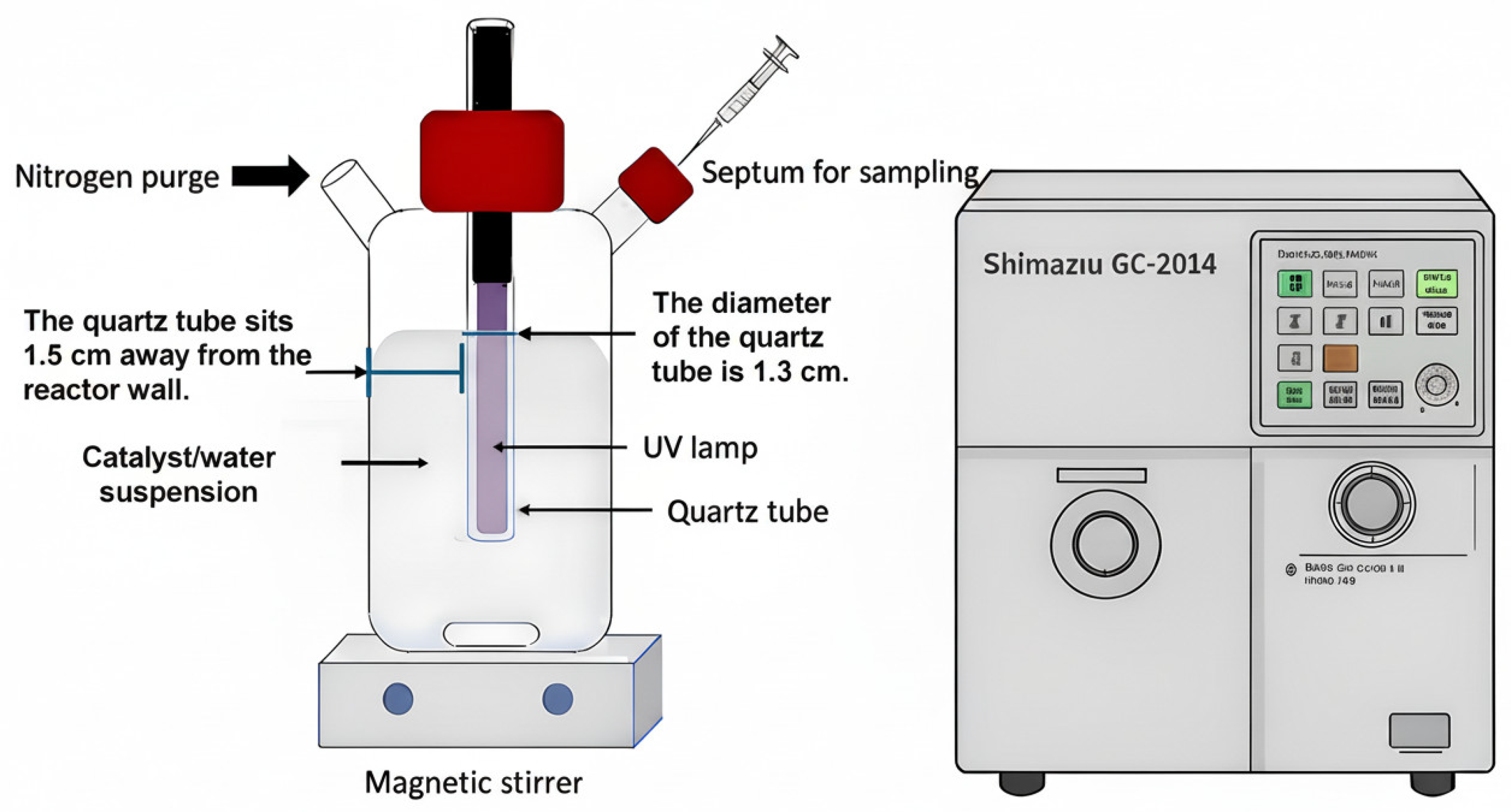
Photocatalytic H2 evolution experiments were conducted in a cylindrical glass photoreactor with an initial total volume of 250 mL, an internal diameter of 5 cm and an effective height of 14.5 cm. Following adaptation for gas sampling and purge, the total reactor height increased to 20 cm. For each experiment, 200 mg of photocatalyst was dispersed in 200 mL of distilled water to form a homogeneous suspension, which was then stirred magnetically at 600 rpm.
Before irradiation, the suspension was purged with high-purity nitrogen (N2) for 30 min to remove dissolved oxygen and ensure an inert atmosphere. The photocatalytic reactions were conducted under UV irradiation using a low-intensity Hg UV-C lamp (Pen-Ray 11SC-1, Analytik Jena, GmbH + Co. KG, Konrad-Zuse-Straße, Jena, Germany), which had a dominant emission wavelength of 254 nm and an irradiance of 4.4 mW cm−2 (see Figure S1 for the emission spectrum).
The Hg lamp was positioned vertically at the center of the reactor inside a 1.3 cm diameter quartz glass immersion tube. The distance between the outer surface of the quartz tube and the inner wall of the photoreactor was approximately 1.5 cm to ensure uniform radial irradiation of the photocatalyst suspension. The illuminated lateral surface area of the quartz tube exposed to the reaction medium was estimated to be 10.15 cm2. Throughout the experiments, continuous stirring was maintained to prevent sedimentation and promote efficient mass transfer and light distribution.
The experiments were conducted in darkness at temperature of 28° ± 2 °C and the H2 samples were taken at 30 min intervals up to a final time of 180 min. Samples were collected using a 1 mL chromatography syringe with an integrated septum in the reactor cover. The gas sample was then injected into a GC-2014 gas chromatograph (Shimadzu Corporation, Nishinokyo-Kuwabara-cho, Nakagyo-ku, Kyoto, Japan) equipped with a TCD detector operating at 150 °C with a Moil Sieve 5A PLOT capillary GC column (Merck KGaA, Darmstadt, Germany) and using N2 as the carrier gas. Finally, the generated H2 was quantified using a calibration curve (see Figure S2). Figure 1 shows the scheme for producing and quantifying H2.
Figure 1.
Schematic representation of the system for producing and quantifying H2.
The apparent quantum yield (AQY) was calculated using the following expression (Equation (1)):
where is the amount (mol) of evolved H2, is Avogadro’s number and is the number of incident photons obtained from the total incident energy and the photon energy . AQY values are reported as percentages relative to incident photons [43].
After the photocatalytic hydrogen production tests, the solid photocatalysts were recovered by vacuum filtration and washed several times with distilled water to remove any residual soluble species. These samples were then dried in an oven at 100 °C for 24 h, after which they were characterized using X-ray diffraction (XRD) to evaluate changes in crystallinity and phase integrity, and Fourier-transform infrared spectroscopy (FTIR) to detect any modifications to the chemical bonding environment following photocatalytic operation.
2.6. Band Position and Mechanism Determination by Electrochemical Test
Electrochemical measurements were performed with a pocketSTAT2 potentiostat/galvanostat (Ivium Technologies B.V., Eindhoven, The Netherlands). A three-electrode cell was used: the ink-coated Au disk (4 mm Ø) as working electrode (WE), Au wire as counter electrode (CE) and a Ag/AgCl (saturated KCl) electrode as reference (RE). The electrolyte of the medium was 0.5 M KOH at pH 14.
The catalytic ink was prepared by dispersing 10.0 mg of the catalyst powder in a mixture of 250 μL Nafion® solution (5 wt%) and 1250 μL deionized water (total ink volume = 1500 μL). The suspension was sonicated/stirred for 20 min to ensure homogeneity. An aliquot of 3.0 μL of the ink was pipetted onto a polished gold disk electrode (diameter = 4.00 mm) and allowed to dry under ambient laboratory conditions until the solvent had evaporated.
Cyclic voltammetry (CV) was performed at 50 mV s−1. Mott–Schottky analysis was carried out by impedance spectroscopy: capacitance was extracted from EIS measurements at 1.0 kHz with 10 mV rms AC amplitude at DC potential steps of 20–50 mV in the potential range −1.0 to +1.0 V vs. Ag/AgCl. The flat band potential was determined by linear fitting of the vs. E plot and extrapolating to = 0. The Ag/AgCl (saturated KCl) reference was assumed to have a standard potential. E°(Ag/AgCl(sat.)) = +0.197 V vs. NHE at 25 °C. In the main text and graphics, potentials are reported vs. RHE using the Nernst equation for conversion [44].
3. Results and Discussion
3.1. Structural Analysis by XRD
The crystallite size was calculated by the Scherrer equation (Equation (3)) [45]:
where L is the crystallite size, k is the Scherrer constant, usually taken as 0.89, λ is the wavelength of the X-ray radiation (1.5418 Å), β is the full width of half maximum diffraction peak measured at 2θ (FWHM), and θ is the diffraction angle. Employing the exact parameters of the crystallite size, the lattice strain (ε) was calculated using the following equation (Equation (4)) [46]:
The crystallite size and lattice strain of the precursors and composites CNZ-x are observed at Table 1.
Table 1.
Crystallite size and lattice strain of. CN, ZIF-67 and CNZ-x composites.
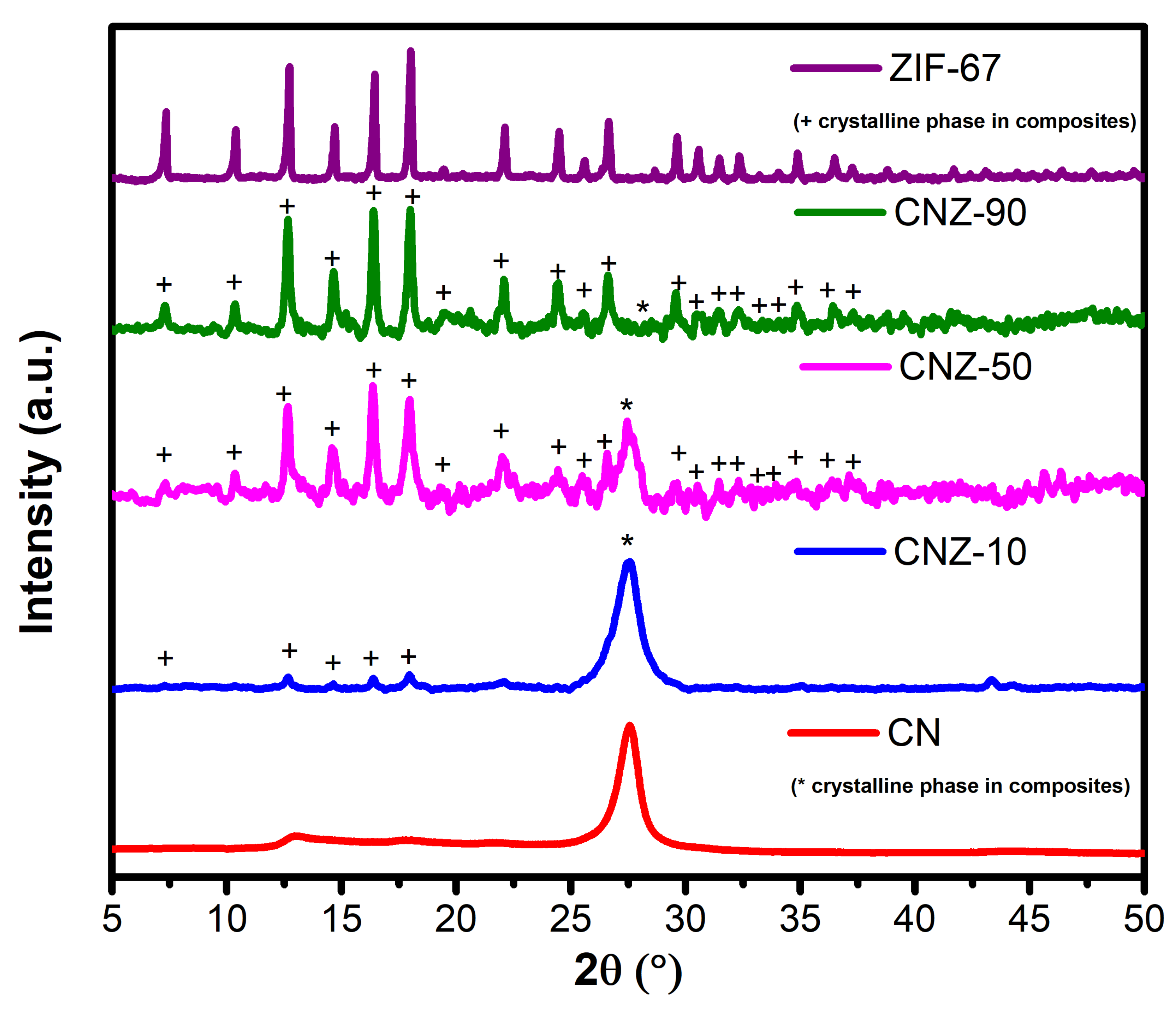
The XRD patterns (Figure 2) confirm the crystalline structures of ZIF-67 and g-C3N4 (CN), as well as the CNZ-x composites, which were obtained via high-energy mechanical milling. This method promotes intimate contact between both precursors through repeated fractures, which induce lattice defects and partial amorphization at the interface, favoring the formation of heterojunctions without altering the main crystalline phases [47].
Figure 2.
XRD patterns of CN, ZIF-67 and CNZ-x composites.
The ZIF-67 diffractogram exhibits sharp, intense reflections at 2θ = 7.4°, 10.4°, 12.7°, 14.7°, 16.4°, 17.9°, and 22.1°, which correspond to the MOF structure’s (0 1 1), (0 0 2), (1 1 2), (0 2 2), (0 1 3), (2 2 2), and (1 1 4) planes, as reported in the literature [48,49,50]. The calculated crystallite size, as determined by the Scherrer equation, was 67 nm, with a lattice strain of 0.351%, indicating high crystallinity.
For CN, two characteristic peaks are seen at 13.1° and 27.6°, which correspond to the (100) and (002) planes, respectively. The first peak is attributed to the in-plane packing of tri-s-triazine units, and the second peak is related to interlayer stacking of conjugated aromatic systems [51,52]. The calculated crystallite size is 21.7 nm, with a lattice strain of 0.687%, which is typical of semicrystalline graphitic carbon nitride.
After high-energy milling, the CNZ-10 composite exhibits the dominant (002) peak of CN at 27.6° and weaker ZIF-67 reflections at 12.6°, 14.6°, 16.4°, 18.0°, and 22.1°, confirming partial ZIF-67 incorporation onto the CN surface. The crystallite size decreased to 15.8 nm while the lattice strain increased to 1.171%, revealing strong structural stress and defect formation caused by the mechanical impact of milling [53].
In the CNZ-50 composite, both CN and ZIF-67 reflections are visible, indicating the presence of both crystalline phases. The reflections are slightly broader, suggesting partial lattice distortion and reduced coherent domains due to the mechanical forces applied during high-energy milling. The crystallite size was 38.6 nm with a strain of 0.596%, confirming the preservation of structural order while enhancing interfacial contact between the two phases.
The diffractogram of CNZ-90 resembles that of pristine ZIF-67, with intense reflections up to 2θ ≈ 39.5° and notably diminished CN (002) peaks. The crystallite size (38.7 nm) and lattice strain (0.595%) are similar to those of CNZ-50. This suggests that an increased ZIF-67 content does not significantly affect crystalline integrity.
As the ZIF-67 content increases, its diffraction peaks become more prominent while the characteristic peaks of CN gradually weaken. This suggests the formation of an effective heterojunction between ZIF-67 and CN, a behavior previously reported in a similar system involving ZIF-8 and g-C3N4 [54].
3.2. Fingerprint Analysis by FTIR
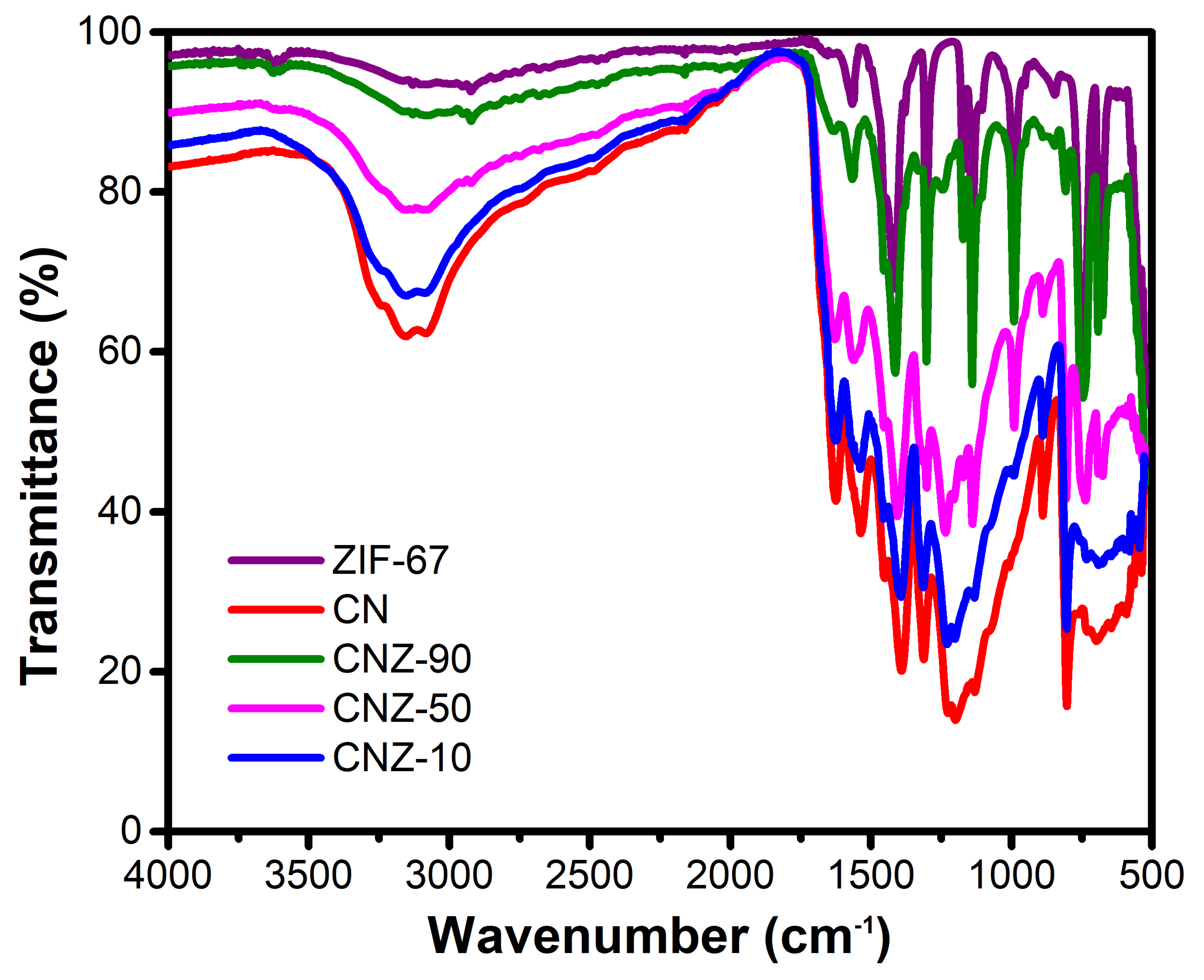
Figure 3 presents the FTIR spectra of the material, and Table S1 presents the comparative FTIR band assignments for CN, ZIF-67, and CNZ-x.
Figure 3.
FTIR fingerprints of CN, ZIF-67 and CNZ-x composites.
The spectrum of pure g-C3N4 displays the well-known vibrational features of the tri-s-triazine backbone. A broad absorption between 3300 and 3000 cm−1 is assigned to N–H stretching from terminal –NH or –NH2 groups [55,56]. The band at ~1630 cm−1 corresponds to C=N stretching [57], while the region 1560–1240 cm−1 contains several contributions associated with C–N and C=N stretching within the heptazine ring [58,59]. The distinct band observed at ~810 cm−1 (attributed to the out-of-plane bending of the triazine units) serves as the structural fingerprint of the g-C3N4 framework [60,61].
The spectrum of ZIF-67 exhibits characteristic signals from the 2-methylimidazolate linker [62]. The peaks in the 3130–3000 cm−1 region correspond to aromatic C–H stretching [50,63], whereas the bands at 2920 and 2850 cm−1 originate from aliphatic C–H stretching of the methyl group [64]. Vibrations in the 1580–1350 cm−1 interval are attributed to C=N and C–N stretching in the imidazolate ring [65], and those in the 1140–900 cm−1 range are associated with ring deformations and C–N bending modes [66,67].
The CNZ-x composites clearly exhibit the superimposed spectral features of both parent materials, indicating that no new chemical phases were generated during synthesis. In CNZ-10, the spectrum is dominated by g-C3N4 vibrations; however, faint contributions from ZIF-67 are discernible at 2920–2850 cm−1 and within the 1580–1500 cm−1 region. As the ZIF-67 proportion increases in CNZ-50 and CNZ-90, the intensities of these imidazolate-related bands become progressively more pronounced, while the signature g-C3N4 band at ~810 cm−1 decreases in intensity, suggesting increasing surface coverage.
Slight shifts and variations in intensity are observed in the 1600–1200 cm−1 region for all CNZ-x composites, implying possible interfacial interactions between CN and ZIF-67. These interactions may include hydrogen bonding between the N–H groups of g-C3N4 and the N sites of the imidazolate linkers or π–π stacking between the aromatic units of both structures [68]. Additionally, high-energy mechanical milling promotes defect generation and partial disruption of surface groups, which may enhance interfacial coupling further [69]. The evolution of band intensities and subtle spectral shifts as ZIF-67 content increases provides clear evidence of chemical interaction and physical coupling between the two frameworks, contrasted with the evidence of XRD analysis [31].
3.3. Morphology Analysis by SEM
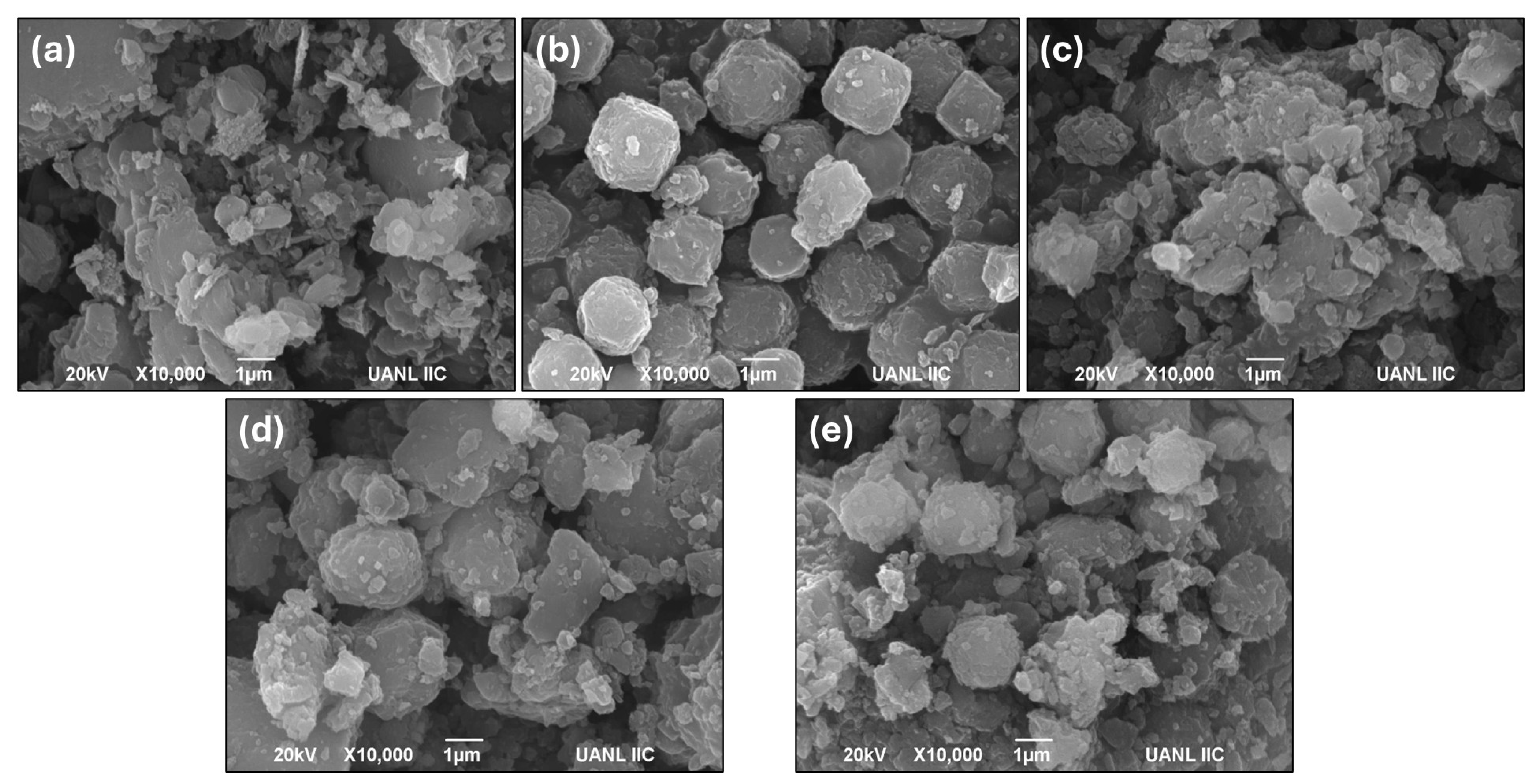
Figure 4 shows the surface morphologies of CN, ZIF-67 and the CNZ-x composites, as examined by scanning electron microscopy (SEM). The pristine g-C3N4 (Figure 4a) exhibits an irregular, stacked lamellar morphology with aggregated sheets and a rough surface [70,71,72]. These layers are highly aggregated, forming a dense structure with large interparticle voids; this is consistent with the material’s layered graphitic structure [73].
Figure 4.
SEM micrographs of (a) CN, (b) ZIF-67, (c) CNZ-10, (d) CNZ-50, and (e) CNZ-90.
In contrast, ZIF-67 (Figure 5b) shows the typical rhombic dodecahedral crystals with well-defined edges and smooth surfaces, which are characteristic of cobalt-based zeolitic imidazolate frameworks [74,75,76]. The crystals have a particle size of about 500–800 nm, and their uniformity confirms the successful formation of the ZIF-67 structure through the solvothermal process.
Significant morphological changes were observed in the CNZ-x composites after mechanochemical treatment. The hybrid composites demonstrate successful integration of the two components like other systems that were obtained by milling [77]. For CNZ-10 (Figure 5c), the lamellar CN sheets appear partially fragmented and embedded with ZIF-67 particles.
As the ZIF-67 content increases to CNZ-50 (Figure 5d) and CNZ-90 (Figure 5e), morphology evolves toward more compact and irregular aggregates. The original dodecahedral morphology of ZIF-67 becomes progressively less defined and is replaced by granular clusters and rougher surfaces. Those changes are the result of repeated impacts during milling and have been reported previously with ZIF-8 [78]. The reduction in particle size and loss of sharp ZIF-67 edges suggest partial structural deformation, which is induced by the high-energy milling process [79].
This structural distortion promotes intimate interfacial interaction between CN and ZIF-67, as supported by FTIR and XRD results. In these results, the characteristic bands and diffraction peaks of both phases coexist but become broader due to strain and reduced crystallite size. These morphological features confirm that the high-energy mechanical milling effect promotes the integration of ZIF-67 onto g-C3N4, resulting in heterostructured composites [47,80]. The resulting morphology combines the laminar texture of CN with the polyhedral structure of ZIF-67. This combination leads to the formation of interstitial voids, which are critical for the porous properties discussed below. Additionally, an abundance of interfacial regions is created that could enhance charge transfer across the junction [81].
Figures S4–S8 in the SI show the EDS analysis of CN, ZIF-67, CNZ-10, CNZ-50 and CNZ-90, respectively. In the CNZ-x samples, the proportion of cobalt (Co) increases with the mass of ZIF-67 incorporated into the composite.
3.4. Textural Analysis by SBET
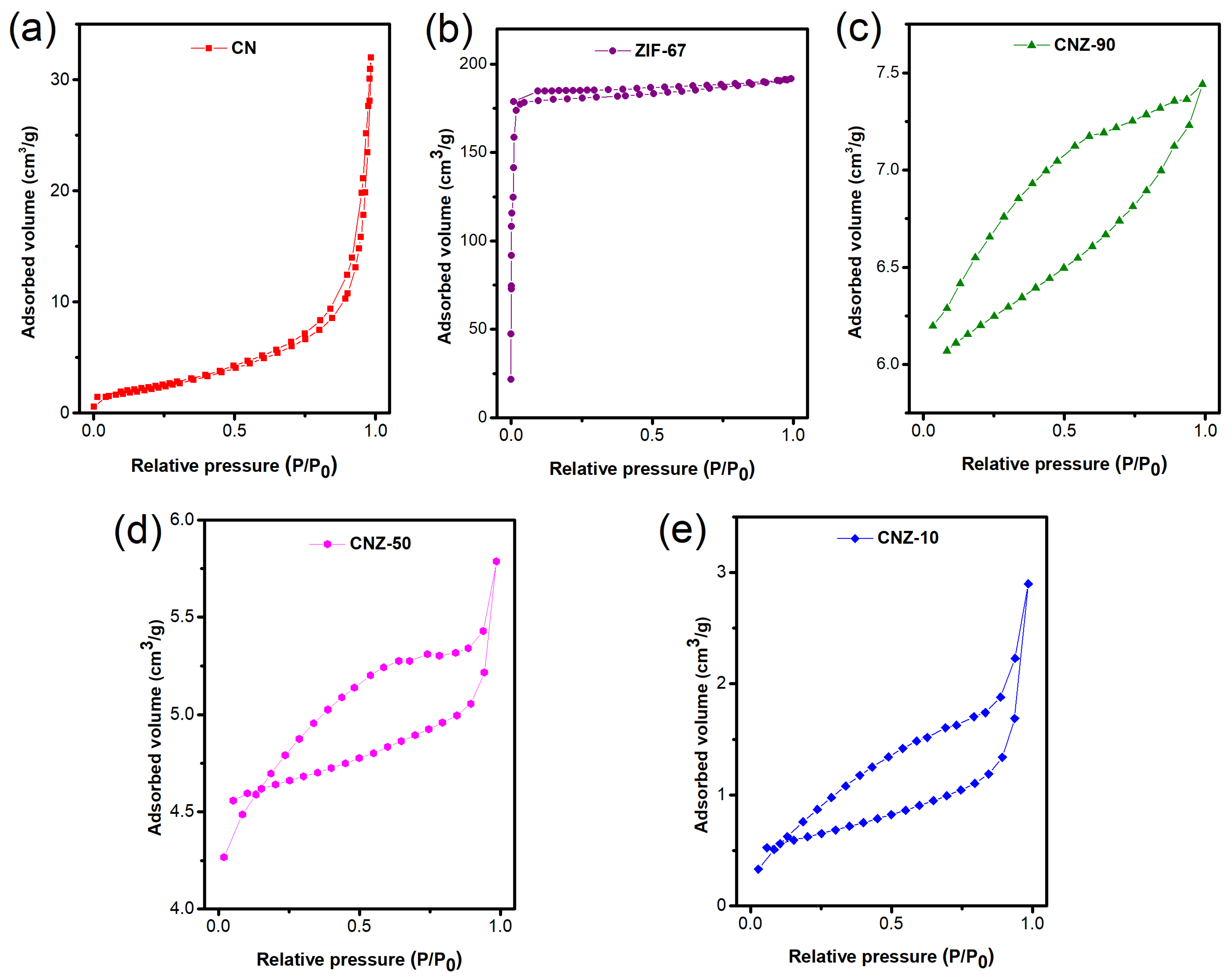
Nitrogen adsorption–desorption isotherms measured at 77 K (Figure 5) were used to analyze the specific surface area and pore structure, with results summarized in Table 2. Pristine g-C3N4 (Figure 5a) exhibits a type II isotherm without hysteresis, which is characteristic of nonporous or macroporous solids [82]. Its low specific surface area of 8.45 m2 g−1 reflects the compact stacking of g-C3N4 layers and this limits the accessibility of internal pores and adsorption sites, as has been reported for bulk polymeric carbon nitride [83].
Table 2.
Textural properties obtained by SBET of CN, ZIF-67 and CNZ-x composites.
In comparison, the ZIF-67 sample exhibits a Type I isotherm, which is characteristic of microporous materials [84]. Its high surface area of 541.19 m2 g−1 confirms the presence of well-developed micropores associated with the ZIF-67 framework [85].
All of the hybrid composites (CNZ-10, CNZ-50, and CNZ-90) exhibit Type IV isotherms, which are characteristic of mesoporous materials [86]. These isotherms feature a distinct H3 hysteresis loop within the P/P0 range of approximately 0.4–0.9. The presence of this loop confirms capillary condensation and the existence of slit-shaped mesopores [87]. This finding is strongly supported by SEM images showing the dense aggregation and intimate interaction of ZIF-67 polyhedral and CN sheets, which form secondary interparticle mesopores between component surfaces
The SBET values for the composites increase significantly with ZIF-67 loading: CNZ-10 (42.94 m2 g−1), CNZ-50 (146.13 m2 g−1), and CNZ-90 (401.35 m2 g−1). These results confirm that the microporosity of ZIF-67 is largely preserved and effectively combined with the mesoporosity generated by high-energy milling, establishing a hierarchical porous structure. Materials with this structure and a large specific surface area, such as certain g-C3N4-based composites, offer more active sites and accelerate the transfer of photogenerated electrons, maximizing the use of incident photons through multiple reflections [22,88].
The pore structure of CN, ZIF-67, and the CNZ composites was analyzed by N2 adsorption–desorption measurements, and the pore size distribution (PSD) was evaluated using the BJH method applied to the desorption branch. While the BJH approach cannot accurately resolve intrinsic microporosity, it provides reliable qualitative information on the mesoporous contribution within the measurable range [88]. Pristine CN exhibits mesoporous features mainly associated with interlayer voids originating from its layered framework [89]. However, its broader hierarchical porosity is only partially captured by BJH analysis. ZIF-67 predominantly exhibits intrinsic microporosity, as reported in the literature [62]. The BJH-derived PSD reflects only secondary mesoporosity, which arises from particle aggregation or partial framework modification during thermal treatment of the synthesis [90].
Figure 5.
Adsorption–desorption isotherms of (a) CN, (b) ZIF-67, (c) CNZ-10, (d) CNZ-50, and (e) CNZ-90.The CNZ composites exhibit a combination of mesopores and residual micropores due to the integration of g-C3N4 with the ZIF-derived phase, where interfacial interactions contribute to a more complex pore architecture [31]. A summary of the mesoporous characteristics is provided in Table S2, and the corresponding BJH-derived PSD curves are shown in Figure S9 in the Supporting Information.
Figure 5.
Adsorption–desorption isotherms of (a) CN, (b) ZIF-67, (c) CNZ-10, (d) CNZ-50, and (e) CNZ-90.The CNZ composites exhibit a combination of mesopores and residual micropores due to the integration of g-C3N4 with the ZIF-derived phase, where interfacial interactions contribute to a more complex pore architecture [31]. A summary of the mesoporous characteristics is provided in Table S2, and the corresponding BJH-derived PSD curves are shown in Figure S9 in the Supporting Information.

3.5. Optical Properties Analysis by DRS-UV-VIS
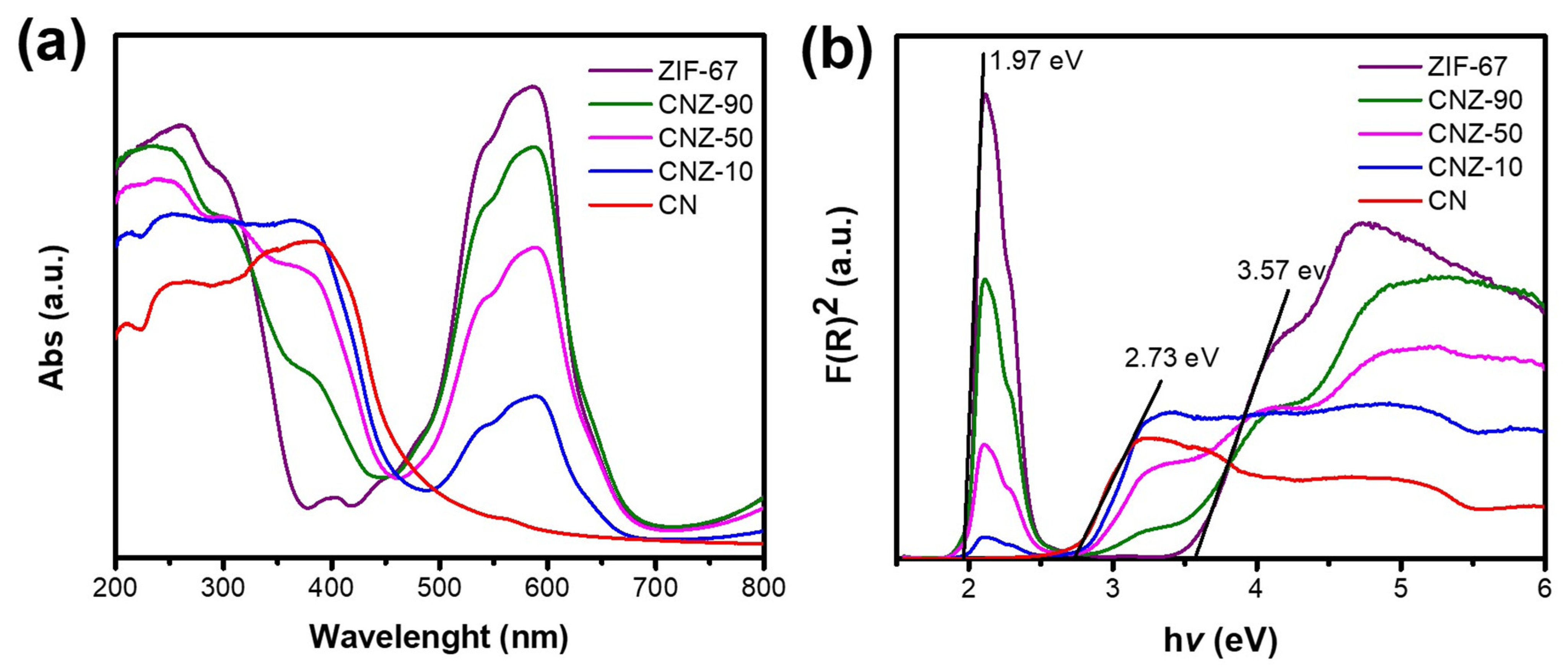
The optical properties of CN, ZIF-67, and the CNZ-x composites were investigated. UV–Vis diffuse reflectance spectroscopy (DRS) was used to investigate their properties. The related spectra and Tauc plots derived from the Kubelka–Munk function (see Equation (5)) are shown in Figure 6a,b.
where R is the sample’s reflectance, the value of Eg was calculated for a direct transition by extrapolating a straight line to the slope of the x-axis [91].
Figure 6.
(a) UV-Vis spectrum and (b) Kubelka–Munk function [F(R)] of CN, ZIF-67 and CNZ-x composites.
The pure CN exhibits an absorption edge between 200 and 450 nm, which is characteristic of its ability to harvest near-ultraviolet (UV) and visible light. The estimated optical band gap (Eg) was found to be 2.73 eV, which aligns with the previously reported values of 2.4–2.8 eV for g-C3N4 prepared under different conditions [92].
The ZIF-67 spectrum exhibits broad absorption across the ultraviolet (UV) and visible regions, featuring a pronounced maximum at approximately 594 nm. This maximum corresponds to d–d transitions of Co2+ ions within a tetrahedral coordination environment [93]. The estimated band gap energy of 1.97 eV agrees well with previous reports for cobalt-imidazolate frameworks [94,95]. A strong absorption band was seen at 3.54 eV (~350 nm) in the UV region. This high-energy transition can be attributed to either ligand-centered *π ← π excitations of the 2-methylimidazolate linker or ligand-to-metal charge transfer (LMCT) associated with the Co–N coordination bond [96]. These features confirm the coexistence of both metal-centered and ligand-based electronic transitions within ZIF-67.
For the CNZ composites, the optical response combines features from both precursors, and absorption behavior depends strongly on ZIF-67 content. The CNZ-90 sample has a similar spectrum to ZIF-67, but with an additional shoulder around 400 nm arising from the g-C3N4 contribution. This indicates improved absorption in the visible region [97]. The CNZ-50 composite, which contains equal mass ratios of CN and ZIF-67, exhibits the most balanced absorption profile, displaying contributions from both materials. In contrast, the absorption edge typical of CN is retained by CNZ-10, which contains less ZIF-67, but a weak feature is still shown in the 500–650 nm region, confirming the presence of Co2+-related transitions [98].
Overall, the DRS-UV–Vis results confirm that coupling ZIF-67 with g-C3N4 via high-energy ball milling expands the composites’ light absorption range. The presence of *π ← π, LMCT, and d–d transitions enhances light harvesting across the UV–visible range [99]. This is expected to promote photocatalytic activity under monochromatic UV (254 nm) irradiation during H2 generation tests.
3.6. Photocatalytic Hydrogen Evolution

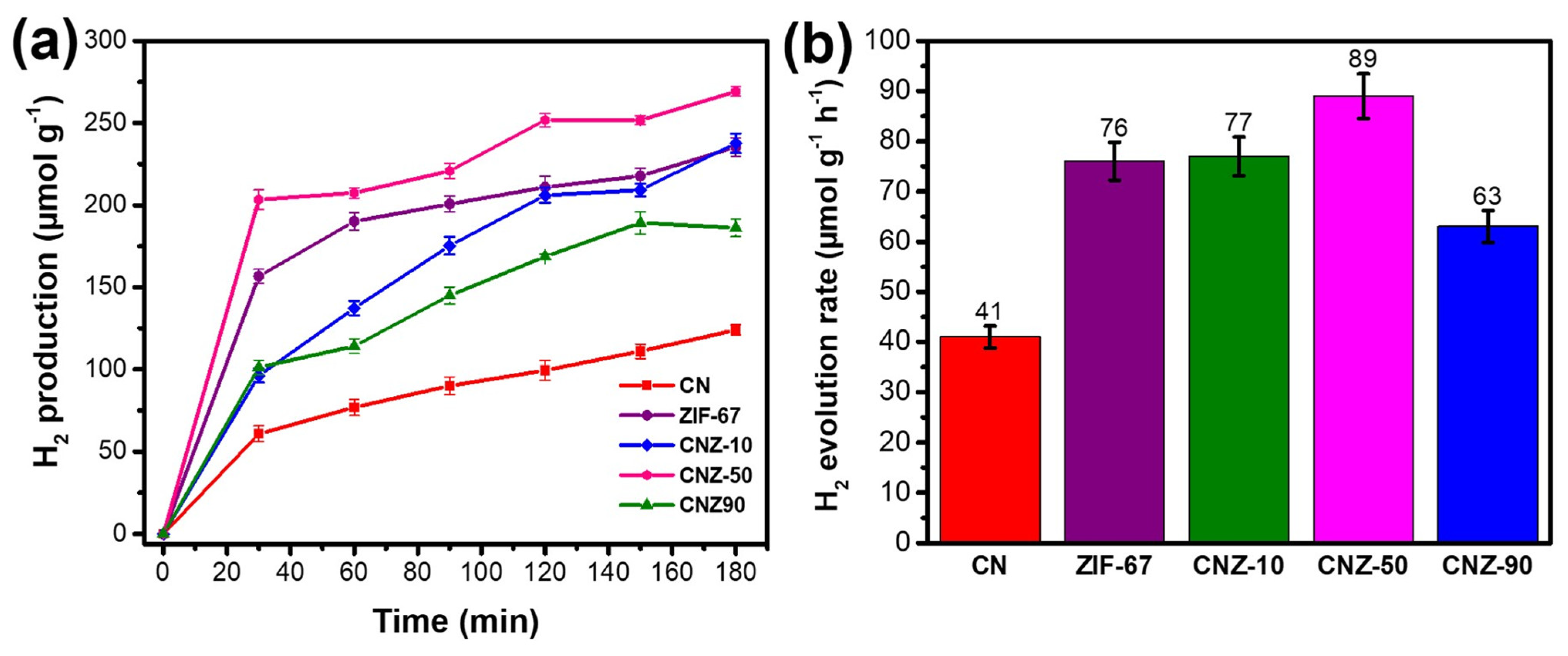
The prepared materials were evaluated for their photocatalytic activity, which was measured by the amount of hydrogen evolution that occurred when they were irradiated with a wavelength of 254 nm. Figure 7a shows the cumulative volume of H2 produced over time, and Figure 7b compares the steady-state hydrogen evolution rates (HER).
Figure 7.
(a) Hydrogen production at different times (μmol g−1) and (b) Hydrogen Evolution Rate at 3 h (μmol g−1 h−1) of CN, ZIF-67, and CNZ-x.
Pristine CN exhibited a relatively low H2 production rate of 123.98 μmol g−1 which is consistent with the limited charge mobility and fast electron–hole recombination typically reported for bulk g-C3N4 [100]. In contrast, ZIF-67 showed a significantly higher activity 229.47 μmol g−1 attributed to the presence of Co2+ centers capable of acting as electron acceptors and redox mediation sites, improving charge separation upon UV excitation [96].
A clear synergistic enhancement was observed after forming the CNZ composites. CNZ-50 displayed the highest H2 evolution among them, reaching 265.81 μmol g−1 and outperforming both individual components. The enhancement can be attributed to the establishment of a heterojunction interface between CN and ZIF-67 [101]. This interface facilitates directional charge transfer from the conduction band of ZIF to that of CN. Consequently, it suppresses recombination and enhances the availability of photogenerated electrons for reduction [102]. In the next section, the mechanism is explained in detail.
Referring to the BET analysis, the CNZ-50 possesses the microporosity of ZIF-67 and the beneficial mesoporosity (Type IV/H3) generated at the interfaces. This is due to the fact that microporous channels and internal porosity make it easier for electrons to move around, and they allow reactants to enter the interior of the particles, which reduces electron-hole recombination rates [103,104]. The presence of mesopores can also enhance light scattering and reflection, leading to increased light capture and superior photocatalytic activity [105]. This directly supports the observed high hydrogen evolution.
The performance trend reflects the anticipated impact of ZIF content on surface area, interfacial contact, and light absorption. CNZ-10 (231 μmol g−1) showed less enhancement because of inadequate ZIF-67 coverage. In contrast, CNZ-90 (188.15 μmol g−1) underperformed due to an excess of ZIF-67 that partially blocked the CN’s light-harvesting sites, reducing charge transfer efficiency. Consequently, CNZ-50 achieves the ideal equilibrium between heterojunction formation, porosity, and optical response.
Table 3 compares the hydrogen evolution rate (HER μmol g−1 h−1) of the CNZ-50 composite synthesized in this study to several photocatalysts based on MOF or g-C3N4 that have been reported in the literature under different operational conditions. Notably, most reference materials only operate in the presence of sacrificial electron donors such as TEOA, MeOH, or Na2S/Na2SO3. These donors are necessary to suppress charge recombination and stabilize photogenerated electrons [106,107]. For example, Pt(3%)/MIL-100(Fe) and Pt(3%)/Dy-MOF have H2 production rates of 62 and 21.53 μmol g−1 h−1, respectively, under Xe lamps (300–420 nm), while CdS/UiO-67-NH2 achieves 487.5 μmol g−1 h−1 with TEOA. Similarly, ZIF-8/CdS-HS achieves a rate of 436 μmol g−1 h−1 under Xe irradiation when Na2S/Na2SO3 is introduced as a sacrificial agent.
In contrast, the CNZ-50 composite used in this study achieves an H2 evolution rate of 89 μmol g−1 h−1 under UV illumination at 254 nm without the use of a sacrificial agent, representing a significantly more challenging reaction environment. Furthermore, while most of the photocatalysts listed in Table 3 operate under high-intensity Xe lamps (300–600 W), the CNZ-50 system operates under a low-irradiance Hg lamp at 254 nm (~4 mW cm−2). This highlights the intrinsic efficiency of the CNZ heterojunction in promoting charge separation and surface proton reduction rather than relying on an external sacrificial electron donor or high photon flux.
Emphasis should also be placed on the fact that the incorporation of noble metals (e.g., Pt) in many of the catalysts listed in Table 3 is for the purpose of enhancing photocatalytic efficiency, which results in increased cost and limited scalability [108]. On the other hand, CNZ-50 is completely noble-metal-free, relying exclusively on earth-abundant Co and C/N elements, yet still performs at a level comparable to or better than platinum-containing photocatalysts operating with sacrificial donors and with high power of irradiation [109,110].
Table 3.
HER performance of different photocatalyst-based MOFs or g-C3N4.
Table 3.
HER performance of different photocatalyst-based MOFs or g-C3N4.
| Photocatalyst | Sacrificial Agent | H2 Evolution Rate (μmol g−1 h−1) | Light Source | Reference |
|---|---|---|---|---|
| Sc3-TBAPy | TEA | 82.5 | Xe 300 W > 420 nm | [111] |
| Pt-NP/UiO-66-NH2 | Acetonitrile/TEA | 329 | Xe 300 W > 305 nm | [112] |
| Pt(3%)/MIL(100)Fe | MeOH | 62 | Xe 300 W > 420 nm | [113] |
| Pt(3%)/Dy-MOF | TEOA | 21.53 | Xe 300 W > 320 nm | [114] |
| Pt(1%)@UiO-66(Zr) | TEOA | 3.9 | Xe 300 W > 420 nm | [115] |
| CdS/UiO-67-NH2 | TEOA | 487.5 | Xe 600 W > 320 nm | [116] |
| UiO-67-Ti | MeOH | 31 | Xe 300 W | [117] |
| Pt/MIL-125(Ti) | TEA | 77.36 | Xe 300 W > 320 nm | [118] |
| ZIF-8/CdS HS30 | Na2S/Na2SO3 | 436 | Xe 300 W > 320 nm | [119] |
| Pt/Fe2O3/g-C3N4 | TEOA | 77.6 | Xe 300 W > 420 nm | [120] |
| g-C3N4/Ag2S | HOCH2-CH2 | 33.03 | Xe 300 W > 420 nm | [121] |
| CNZ-50 | Without sacrificial agent | 89 | Hg 4.4 mW/cm2, UV 254 nm | Present work |
| CNZ-10 | Without sacrificial agent | 77 | Hg 4.4 mW/cm2, UV 254 nm | Present work |
| ZIF-67 | Without sacrificial agent | 76 | Hg 4.4 mW/cm2, UV 254 nm | Present work |
| CNZ-90 | Without sacrificial agent | 63 | Hg 4.4 mW/cm2, UV 254 nm | Present work |
| CN | Without sacrificial agent | 41 | Hg 4.4 mW/cm2, UV 254 nm | Present work |
Table 4 shows the AQY calculated values under the above-described experimental conditions (λ = 254 nm, irradiance = 4.4 mW cm−2, illuminated area = 10.15 cm2, t = 3 h, catalyst mass = 0.20 g), the CNZ-50 composite exhibited an apparent quantum yield (AQY) of 10.4%, equivalent to 0.05197 moles of H2 per mole of photons (i.e., 5.20 × 10⁴ μmoles of H2 per mole of photons). For comparison, the AQY values of CN, ZIF-67, CNZ-10 and CNZ-90 were 4.85%, 8.98%, 9.04% and 7.36%, respectively. These AQY values confirm that CNZ-50 is the most efficient at using incident photons for H2 generation under UV-C 254 nm irradiation.
Table 4.
AQY (%) calculated values for CN, ZIF-67 and CNZ-x using incident photons for H2 generation.
The reference values obtained from the literature were compared with the apparent quantum yield (AQY) values obtained in this study (see Table S3). AQY values of around 5.4% for Pt/TiO2 and up to 10.3% for Pt-Zn/TiO2 were found by Garstenauer et al., under UV irradiation [122]. Grado et al. (2025) achieved 17.64% with SrTi0.2Zr0.1O3 [43]. In our research, ZIF-67 reached 8.98%, while pure carbon nitride (CN) reached 4.85%. Composites of ZIF-67 and CN performed better, with CNZ-50 producing an AQY of 10.40%, which is comparable to the best Pt-Zn/TiO2 systems. However, efficiency dropped to 7.36% at 90% ZIF-67, suggesting an ideal composition of around 50%. Overall, these results demonstrate the potential of CN/ZIF-67 composites as a substitute for noble metal catalysts. While they outperform pure CN, they fall short of mixed oxides such as SrTi0.2Zr0.1O3.
3.7. Mechanism of H2 Evolution
The electronic properties of CN and ZIF-67 were evaluated using two methods: cyclic voltammetry (CV) and Mott–Schottky (MS) analysis. These evaluations were conducted in 0.5 M KOH, with an Ag/AgCl reference electrode. The results were then converted to the RHE scale for direct comparison with the H+/H2 and H2O/O2 redox potential for a mechanism of H2 evolution.
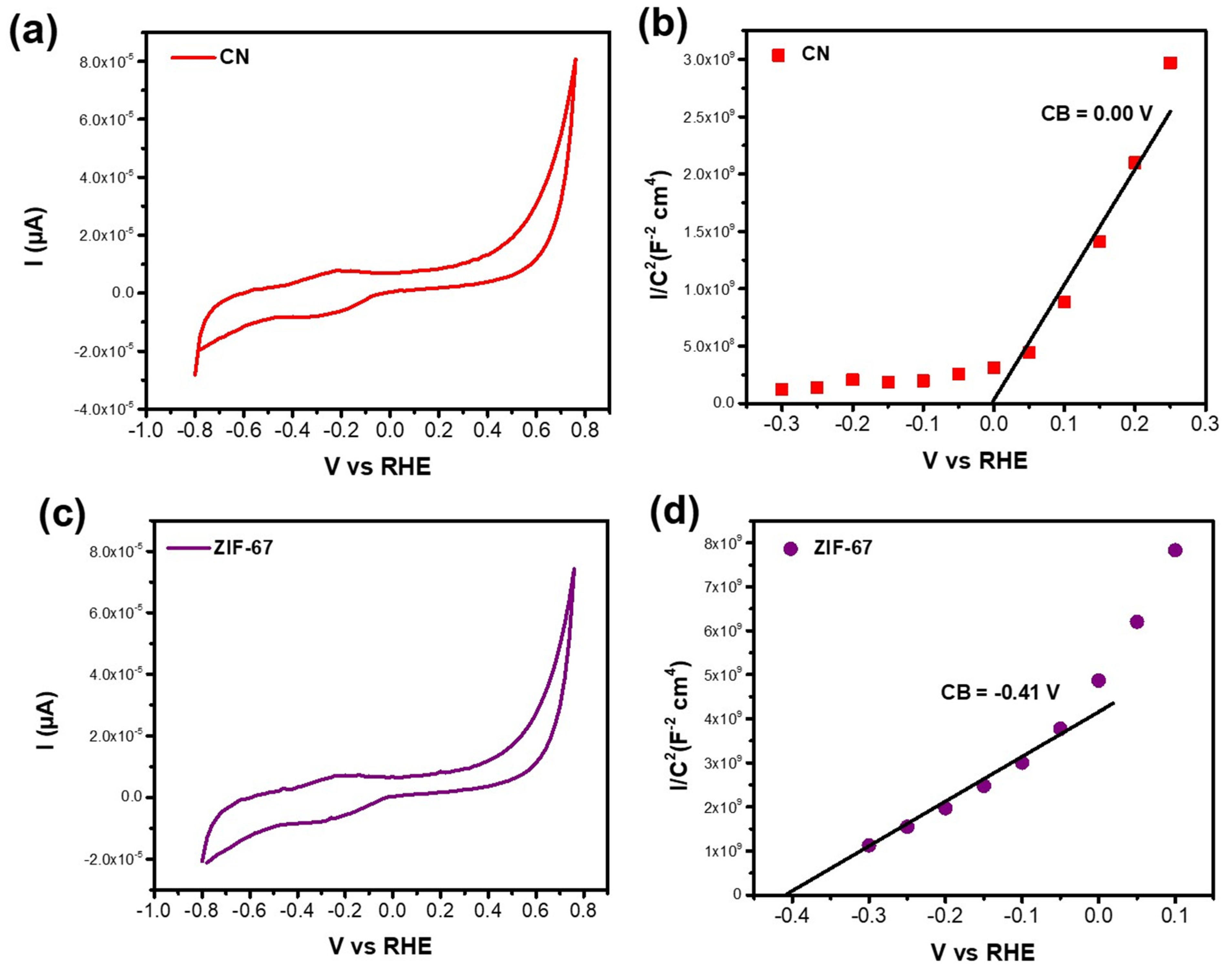
CV measurements were performed in a 0.5 M KOH aqueous solution to evaluate the electrochemical stability of the materials (see Figure 8a,c). The CV curves for both ZIF-67 (Figure 8a) and CN (Figure 8c) show a nearly rectangular shape across the measured potential range. The region is an important piece of the puzzle for electrochemical stability. If there are no significant, sharp Faradaic peaks in this region, then we can be sure that both precursors are stable in an alkaline environment [123]. This is essential for reliable MS analysis.
Figure 8.
(a) Cyclic voltammetry of CN, (b) Mott–Schottky plot of CN, (c) cyclic voltammetry of ZIF-67 and (d) Mott–Schottky plot of ZIF-67.
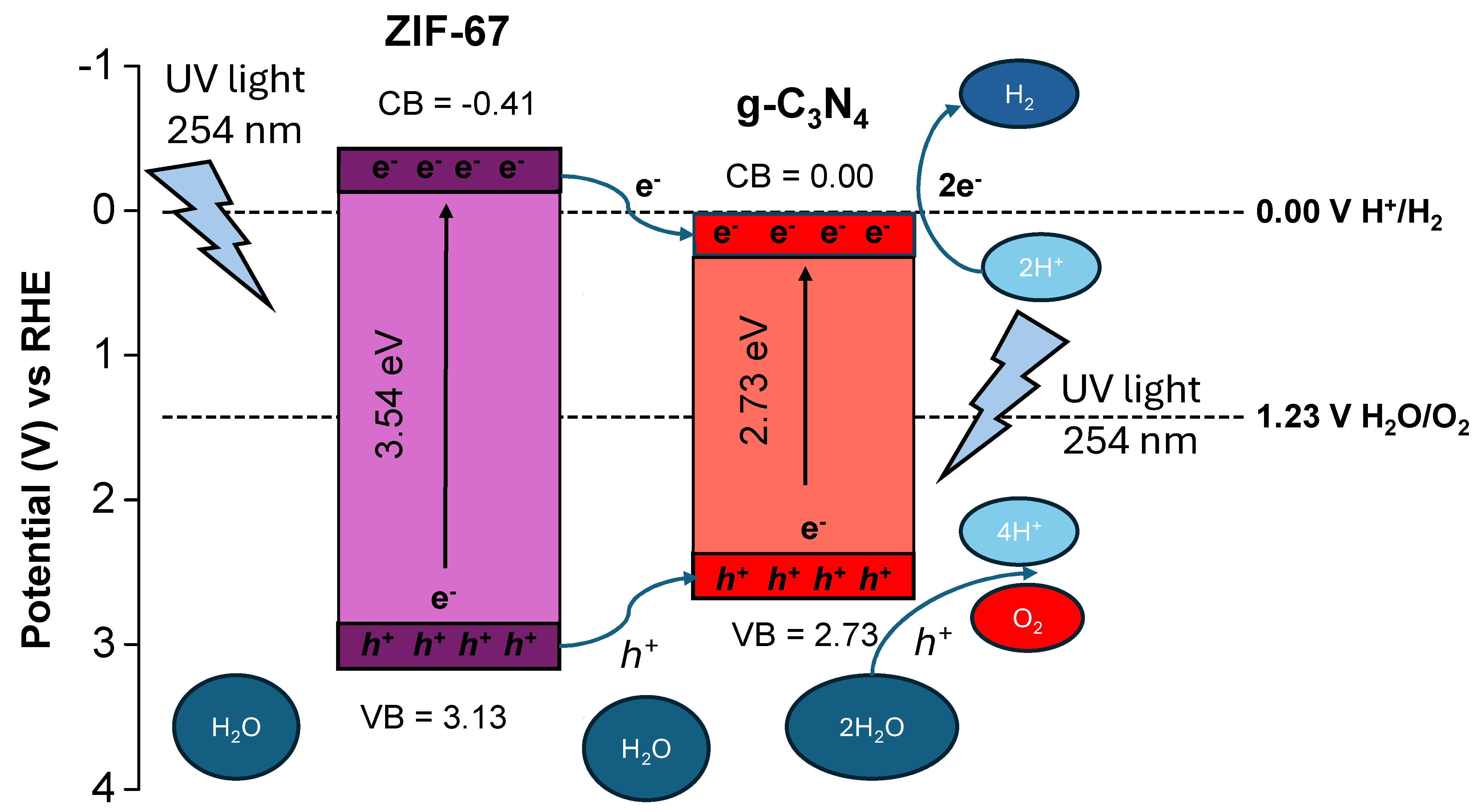
MS plots confirm that both CN and ZIF-67 exhibit n-type semiconductor behavior (see Figure 8b,d), which is consistent with previous reports [98,124]. The conduction band (CB) edge of CN has been located at 0.00 V vs. RHE, whereas a more negative CB edge has been exhibited by ZIF-67 at −0.41 V vs. RHE, indicating a higher intrinsic electron-reduction capability under UV excitation. Based on the optical band gaps determined from UV–Vis DRS, CN displays a band gap of 2.73 eV, whereas ZIF-67 exhibits a higher-energy optical transition at 3.54 eV. Using these values, the valence band (VB) edges can be estimated at +2.73 V for CN and +3.13 V vs. RHE for ZIF-67. This band alignment therefore represents the electronic structure under UV-C irradiation conditions, which is directly relevant to the photocatalytic experiments conducted in this study.
Figure 9 shows the proposed charge-transfer pathway in the CN/ZIF-67 composite when exposed to UV light at 254 nm. Both g-C3N4 and ZIF-67 can be photoexcited due to their wide band gaps. Based on Mott–Schottky and UV–Vis DRS results, a type-I band alignment is evident, whereby photogenerated electrons and holes in ZIF-67 migrate towards CN [125].
Figure 9.
Type I heterojunction mechanism for H2 evolution by composite CNZ-50.
In this configuration, electrons from ZIF-67’s CB (−0.41 V vs. RHE) transfer to CB of CN (0.00 V vs. RHE), while ZIF-67’s valence band holes also migrate towards VB of CN. This carrier funneling enhances charge accumulation on CN, where proton reduction to H2 occurs [126,127].
Concurrently, the depletion of charge carriers within the ZIF-67 framework, coupled with its inherent hydrolytic instability and sustained UV-C exposure, accelerates metal–ligand decoordination [128]. This process culminates in the ZIF-67 structure collapsing into an amorphous cobalt-containing phase. Therefore, in this system, ZIF-67 acts primarily as a transient photoactive component that facilitates charge transfer, undergoing structural degradation during photocatalysis.
This cooperative charge separation and reaction pathway explains the improved hydrogen production performance of the CNZ-50 composite compared to its individual components. The intermediate ZIF-67 content in CNZ-50 establishes a well-defined interfacial contact area and an optimal balance between light absorption and charge transfer. This leads to superior photocatalytic activity compared to CNZ-10, which has insufficient interfacial coupling, and CNZ-90, which has excess ZIF-67 that causes shading and non-conductive agglomeration.
3.8. Stability Test After Photocatalytic Activity
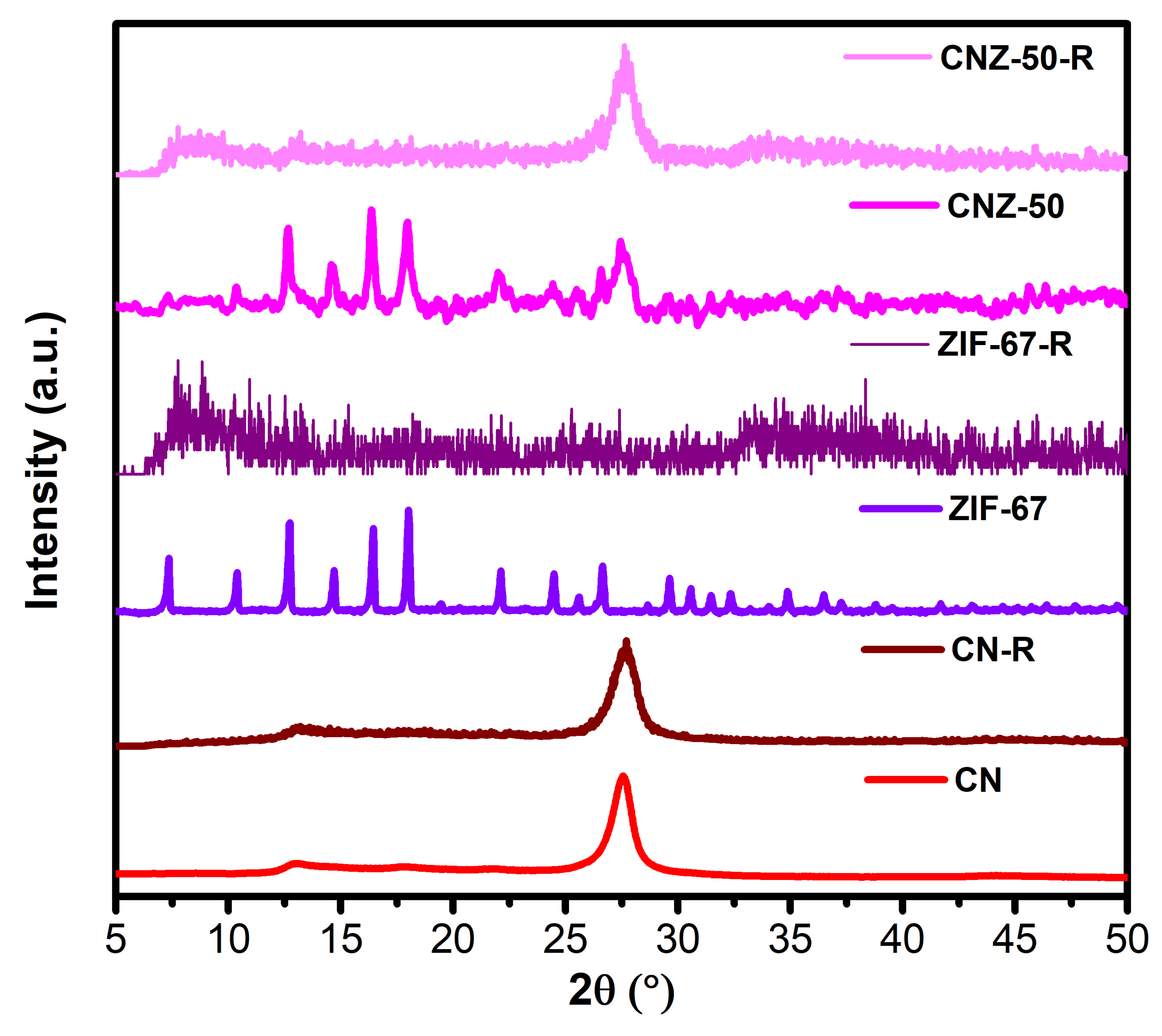
The structural stability of the materials post-photocatalytic H2 production was evaluated by XRD analysis (Figure 10). Significant structural degradation was observed in ZIF-67 and the CNZ-50 composite, whereas pristine CN was essentially unaffected.
Figure 10.
Comparison of XRD patterns of the materials after and before the photocatalytic H2 tests.
Following the reaction, ZIF-67-R displays a substantial collapse of its crystalline zeolitic-type framework. The characteristic reflections at 2θ ≈ 7.3°, 10.4°, 12.7°, 14.7°, 16.4° and 18.0°, as well as the higher-order peaks, disappeared almost entirely and the remaining signal barely reached ~13 a.u. in intensity. This drastic loss of crystallinity suggests that the Co–N/imidazolate secondary building units are severely degraded under UV-C (254 nm) irradiation, possibly due to the action of hydroxyl radicals, photogenerated holes and the low hydrostability of the ZIF-67 [129,130]. The presence of a residual broad background indicates the formation of a primarily amorphous carbonaceous phase, which is consistent with the decomposition of the organic linker and the partial release of cobalt species into the reaction medium. This behavior is consistent with previous reports showing that ZIF-67 is structurally unstable under strong oxidative or high-energy photon environments.
A similar trend is observed for CNZ-50-R, where the reflections originating from ZIF-67 are no longer detectable. Only the broad peaks associated with g-C3N4 (at approximately 13° and 27.5°) remain visible after the reaction. This confirms that the ZIF component inside the composite also collapses during photocatalysis, whereas g-C3N4 preserves its layered structure. While the stabilization of cobalt species by the CN matrix may delay the breakdown of the ZIF framework under UV-C exposure, it does not prevent it.
By contrast, both CN and CN-R exhibit identical diffraction patterns before and after photocatalysis, which demonstrates the excellent photochemical and structural stability of g-C3N4 under the reaction conditions. There is no peak shift or broadening, suggesting that neither irradiation nor redox cycling influences its conjugated polymeric network [131].
The FTIR spectra of the recovered materials (CN-R, CNZ-50-R and ZIF-67-R) provide additional evidence of the structural changes that occur during photocatalytic H2 evolution (see Figure S10). As with the XRD analysis, the extent of degradation varies depending on the material, ranging from minimal for CN to severe for ZIF-67.
For CN-R, the characteristic vibrational bands of g-C3N4 remain almost unchanged after the reaction. The breathing mode of the heptazine units at approximately 810 cm−1 and the stretching modes of the C–N=C/C–N–C groups in the 1200–1650 cm−1 region are clearly preserved. This indicates that the polymeric tri-s-triazine framework is highly resistant to UV-C irradiation and redox reactions. The broad band between 3000 and 3300 cm−1, associated with N–H and surface –OH groups, also remains similar to that of the pristine material. This confirms that g-C3N4 undergoes negligible chemical modification during H2 production, in accordance with its known photochemical stability [132].
By contrast, ZIF-67-R displays significant spectral changes, indicating the disintegration of its metal–organic framework. Decomposition of the organic linker is indicated by the disappearance or drastic reduction in the imidazolate ring vibrations (typically located at 1145, 995, 756, and ~420 cm−1). The substantial loss of intensity in the mid-IR region, together with the appearance of broad, featureless bands, is consistent with the formation of an amorphous carbonaceous residue. This is in line with the XRD results showing near-total loss of crystallinity. These observations confirm that ZIF-67 is not structurally stable under high-energy UV-C illumination, likely due to photodegradation of the linker and oxidative attack [133].
The CNZ-50-R spectrum exhibits intermediate behavior. While the bands corresponding to g-C3N4 remain visible, those associated with the ZIF-67 component are largely suppressed, mirroring the structural collapse observed in XRD. The attenuation of imidazolate-related peaks suggests that the ZIF-67 moieties embedded in the composite decompose during photocatalysis too. However, the presence of the characteristic CN vibrational modes indicates that the g-C3N4 provides partial stabilization, preventing the complete loss of the framework. This indicates that the g-C3N4 matrix remains intact while the ZIF-67 fraction degrades, resulting in a hybrid material that is enriched in amorphous carbon and cobalt-containing residues after the reaction.
The mechanism of degradation of ZIF-67 pristine and in the CNZ-50 composite is followed by the next steps:
Step 1. ZIF-67 absorbs high-energy UV photons, generating charge carriers within the framework:
This step introduces electronic stress into the coordination network.
Step 2. Photogenerated holes oxidize adsorbed water molecules, producing highly reactive hydroxyl radicals:
This reaction occurs at the ZIF-67 surface and is a key trigger for ligand degradation.
Step 3. The 2-methylimidazolate ligand (mIm−) is oxidized by photogenerated holes and radicals, leading to loss of aromaticity and structural integrity:
This step represents the initiation of ligand decomposition without forcing complete mineralization.
Step 4. As the imidazolate ligand becomes chemically modified, its coordination ability toward Co2+ is reduced, resulting in framework disassembly:
This process is responsible for the complete loss of long-range crystallinity observed in XRD.
Step 5. In aqueous medium, the released cobalt ions react with hydroxide ions generated during water oxidation, leading to the precipitation of cobalt hydroxide:
This step accounts for the immobilization of cobalt species after framework collapse and is consistent with the absence of crystalline cobalt-containing phases in XRD.
Step 6. The organic radical fragments undergo recombination and photochemical rearrangement under continuous UV irradiation, yielding a disordered carbon-rich residue:
This process explains the amorphous background observed in XRD and the broad FTIR features after reaction.
4. Conclusions
The development of g-C3N4/ZIF-67 composites was achieved through high-energy mechanochemical milling, resulting in the formation of intimate interfacial contact without the need for solvents or thermal treatments. The coexistence of both phases and a substantial increase in surface area upon incorporation of ZIF-67 were confirmed by structural, textural, and morphological analyses. The formation of a type-I heterojunction was demonstrated by optical and electrochemical measurements, which favored charge separation and enabled conduction band potentials suitable for H2 evolution.
Among the materials that were the focus of the investigation, CNZ-50 demonstrated the most effective photocatalytic performance, achieving a hydrogen production of 265.8 μmol·g−1 within 3 h, outperforming both g-C3N4 and ZIF-67 in their pristine state. This enhanced activity can be attributed to improved charge separation at the CN/ZIF-67 interface, increased availability of active sites and more balanced light harvesting. Hydrogen evolution was notably achieved without sacrificial agents and under low-intensity UV irradiation at 254 nm, highlighting the effectiveness of the heterojunction design. However, an intrinsic limitation of ZIF-67 has also been revealed by the results. Poor hydrolytic stability combined with UV-C light exposure has been found to cause partial structural collapse within the composite during photocatalysis. This degradation highlights the trade-off between enhanced initial activity and long-term structural stability, a factor that must be considered in the future design of MOF-based photocatalytic systems.
The results show that the simple and scalable process of mechanochemically assembling g-C3N4 with ZIF-67 is an effective strategy for developing photocatalysts that can be used to produce sustainable hydrogen.
Supplementary Materials
The following supporting information can be downloaded at: https://www.mdpi.com/article/10.3390/pr14020219/s1, Figure S1. UV analytikjena Pen-Ray® 11SC-1 lamp emission spectrum. Figure S2. H2 calibration curve. Figure S3. Comparison of the simulated XRD pattern of ZIF 67 vs. ZIF-67 hydrothermal. Figure S4. EDS of CN. Figure S5. EDS of ZIF-67. Figure S6. EDS of CNZ-10. Figure S7. EDS of CNZ-50. Figure S8. EDS of CNZ-90. Figure S9. PSD plots from BJH analysis of the (a) CN, (b) ZIF-67, (c) CNZ-90, (d) CNZ-50, and (e) CNZ-10. Figure S10. FTIR of CN, ZIF-67 and CNZ-50 after H2 photocatalytic production. Table S1. Comparative FTIR Band Assignments for CN, ZIF-67, and CNZ-x. Table S2. Qualitative pore structure analysis and its relevance to photocatalytic H2 production. Table S3. Comparative values from CN, ZIF-67, CNZ-x, and another photocatalytic systems with a UV lamp of 254 nm previously reported.
Author Contributions
Conceptualization, D.S.-M., D.B.H.-U. and J.S.R.-G.; methodology, J.S.R.-G., B.E.A.-S., D.H.-L., A.A.M.-T. and R.P.-R.; software, J.S.R.-G., B.E.A.-S., R.P.-R., A.A.M.-T., R.S.G.-P. and L.A.V.-H.; validation, R.P.-R., A.A.M.-T., A.C.-P. and D.H.-L.; formal analysis, A.A.M.-T., R.P.-R., R.S.G.-P., A.C.-P., D.H.-L. and L.A.V.-H.; investigation, J.S.R.-G., B.E.A.-S., R.S.G.-P., L.A.V.-H. and A.C.-P.; resources, D.S.-M., D.B.H.-U., J.S.R.-G. and B.E.A.-S.; data curation, D.H.-L., R.P.-R., A.A.M.-T., A.C.-P., R.S.G.-P. and L.A.V.-H.; writing—original draft preparation, J.S.R.-G., B.E.A.-S., R.S.G.-P. and L.A.V.-H.; writing—review and editing, D.S.-M., D.B.H.-U., J.S.R.-G., B.E.A.-S., R.P.-R., A.A.M.-T., R.S.G.-P., L.A.V.-H., A.C.-P. and D.H.-L.; visualization, R.P.-R., A.A.M.-T., A.C.-P. and D.H.-L.; supervision, D.S.-M. and D.B.H.-U.; project administration, D.S.-M. and D.B.H.-U.; funding acquisition, D.S.-M. and D.B.H.-U. All authors have read and agreed to the published version of the manuscript.
Funding
This research was funded by the Universidad Autónoma de Nuevo León (UANL) by Projects ProACTI 161-INTER-2023 and 98-FMYCT-2023, and CONAHCyT/SECIHTI for supporting Project CBF-2025-I-1769.
Data Availability Statement
The data supporting this research have been included in the main article.
Acknowledgments
JSRG (CVU 824115) acknowledges the postdoctoral fellowship EPM 2024(1) provided by CONAHCyT/SECIHTI. DSM and DBHU wish to thank the Universidad Autónoma de Nuevo León (UANL) for its invaluable support.
Conflicts of Interest
The authors declare no conflicts of interest.
References
- Ramezani, M.; Shokrollahi, A.; Tavakkoli, N.; Soltani, N.; Shahdost-Fard, F. Supercapacitor with synergistic integration of ZIF-67-derived Co3O4, N-doped porous carbon, and rGO for enhanced energy storage performance. Diam. Relat. Mater. 2025, 157, 112476. [Google Scholar] [CrossRef]
- Al-Shaibah, F.N.; Ibrahim, M.A.A.; Hatab, A.S.A.; Abotaleb, A.; Sinopoli, A.; Zekri, A.; Ahmad, Y.H.; Al-Qaradawi, S.Y. Rational synthesis of MOF-Derived Cobalt-Based binary selenides nanocrystals for electrochemical oxygen evolution reaction. Appl. Surf. Sci. 2025, 688, 162479. [Google Scholar] [CrossRef]
- Morshedy, A.S.; Elwakeel, K.Z.; Elgarahy, A.M.; El-Khair, M.A.A. Tailoring charge transfer in Cu-MOF-derived CuO @[OMIM]Br ionic liquid p-n heterojunction photocatalysts for enhanced green hydrogen production via photocatalytic water splitting. Int. J. Hydrogen Energy 2025, 172, 151235. [Google Scholar] [CrossRef]
- Islam, M.N.; Mondol, M.M.H.; Torofder, M.S.; Nuren, A.H.; Dipto, N.I. Towards green energy: Progress in metal-organic framework and their derived catalysts for hydrogen production through water-splitting via the hydrogen evolution reaction. J. Power Sources 2025, 660, 238539. [Google Scholar] [CrossRef]
- Calvin, K.; Dasgupta, D.; Krinner, G.; Mukherji, A.; Thorne, P.W.; Trisos, C.; Romero, J.; Aldunce, P.; Barrett, K.; Blanco, G.; et al. IPCC, 2023: Climate Change 2023: Synthesis Report. Contribution of Working Groups I, II and III to the Sixth Assessment Report of the Intergovernmental Panel on Climate Change; Core Writing Team, Lee, H., Romero, J., Eds.; IPCC: Geneva, Switzerland, 2023. [Google Scholar] [CrossRef]
- Ashraf, A.; Sagheer, M. Renewable energy capacity and technological innovations: A review of global trends and future directions. Environ. Prog. Sustain. Energy 2025, 44, e70071. [Google Scholar] [CrossRef]
- Muradov, N.Z.; Veziroǧlu, T.N. From hydrocarbon to hydrogen-carbon to hydrogen economy. Int. J. Hydrogen Energy 2005, 30, 225–237. [Google Scholar] [CrossRef]
- Zakaria, Z.; Kamarudin, S.K.; Salehmin, M.N.I.; Ahmad, N.N.R.; Aminuddin, M.A.; Hanapi, I.H.; Osman, S.H.; Mohamad, A.A. Energy scenario in Malaysia: Embarking on the potential use of hydrogen energy. Int. J. Hydrogen Energy 2023, 48, 35685–35707. [Google Scholar] [CrossRef]
- Capurso, T.; Stefanizzi, M.; Torresi, M.; Camporeale, S.M. Perspective of the role of hydrogen in the 21st century energy transition. Energy Convers. Manag. 2022, 251, 114898. [Google Scholar] [CrossRef]
- Tarhan, C.; Çil, M.A. A study on hydrogen, the clean energy of the future: Hydrogen storage methods. J. Energy Storage 2021, 40, 102676. [Google Scholar] [CrossRef]
- Kržmanc, M.M.; Daneu, N.; Čontala, A.; Santra, S.; Kamal, K.M.; Likozar, B.; Spreitzer, M. SrTiO3/Bi4Ti3O12Nanoheterostructural Platelets Synthesized by Topotactic Epitaxy as Effective Noble-Metal-Free Photocatalysts for pH-Neutral Hydrogen Evolution. ACS Appl. Mater. Interfaces 2021, 13, 370–381. [Google Scholar] [CrossRef]
- Ali, M.; Pervaiz, E.; Noor, T.; Rabi, O.; Zahra, R.; Yang, M. Recent advancements in MOF-based catalysts for applications in electrochemical and photoelectrochemical water splitting: A review. Int. J. Energy Res. 2021, 45, 1190–1226. [Google Scholar] [CrossRef]
- Hailu, T.G.; Worku, A.K.; Agegnehu, S.D. Recent trends of green hydrogen production via nano-photocatalysts. J. Phys. Chem. Solids 2026, 208, 113151. [Google Scholar] [CrossRef]
- Gunawan, D.; Zhang, J.; Li, Q.; Toe, C.Y.; Scott, J.; Antonietti, M.; Guo, J.; Amal, R. Materials Advances in Photocatalytic Solar Hydrogen Production: Integrating Systems and Economics for a Sustainable Future. Adv. Mater. 2024, 36, 2404618. [Google Scholar] [CrossRef]
- Hassan, Q.; Algburi, S.; Sameen, A.Z.; Salman, H.M.; Al-Jiboory, A.K. A review of green hydrogen production by renewable resources. Energy Harvest. Syst. 2024, 11, 20220127. [Google Scholar] [CrossRef]
- Kumar, A.; Sharma, P.; Sharma, G.; Dhiman, P.; Shekh, M.; Sillanpää, M.; Stadler, F.J. Recent progress in advanced strategies to enhance the photocatalytic performance of metal molybdates for H2 production and CO2 reduction. J. Alloys Compd. 2024, 971, 172665. [Google Scholar] [CrossRef]
- El-Khair, M.A.A.; Al-Gamal, A.G.; Kabel, K.I.; Gado, W.S.; Morshedy, A.S. Harvesting the synergistic effect of CuFe2O4@Ni-MOF nanomagnetic photocatalyst for enhanced visible light-driven green hydrogen production. Int. J. Hydrogen Energy 2025, 101, 280–294. [Google Scholar] [CrossRef]
- Ikuerowo, T.; Bade, S.O.; Akinmoladun, A.; Oni, B.A. The integration of wind and solar power to water electrolyzer for green hydrogen production. Int. J. Hydrogen Energy 2024, 76, 75–96. [Google Scholar] [CrossRef]
- Salem, H.M.; El-Khair, M.A.A.; Morshedy, A.S. Sustainable hydrogen production through photocatalytic water splitting with CdO loaded MCM-48 under visible light. Renew. Energy 2025, 245, 122789. [Google Scholar] [CrossRef]
- Zhurenok, A.V.; Vasilchenko, D.B.; Kozlova, E.A. Comprehensive Review on g-C3N4-Based Photocatalysts for the Photocatalytic Hydrogen Production under Visible Light. Int. J. Mol. Sci. 2023, 24, 346. [Google Scholar] [CrossRef]
- Kyriakos, P.; Hristoforou, E.; Belessiotis, G.V. Graphitic Carbon Nitride (g-C3N4) in Photocatalytic Hydrogen Production: Critical Overview and Recent Advances. Energies 2024, 17, 3159. [Google Scholar] [CrossRef]
- Gao, R.H.; Ge, Q.; Jiang, N.; Cong, H.; Liu, M.; Zhang, Y.Q. Graphitic carbon nitride (g-C3N4)-based photocatalytic materials for hydrogen evolution. Front. Chem. 2022, 10, 1048504. [Google Scholar] [CrossRef] [PubMed]
- Wudil, Y.S.; Ahmad, U.F.; Gondal, M.A.; Al-Osta, M.A.; Almohammedi, A.; Sa’id, R.S.; Hrahsheh, F.; Haruna, K.; Mohamed, M.J.S. Tuning of graphitic carbon nitride (g-C3N4) for photocatalysis: A critical review. Arab. J. Chem. 2023, 16, 104542. [Google Scholar] [CrossRef]
- Gujjula, S.R.; Manchala, S.; Karingula, S.; Cho, E.B.; Kim, J.; Narayanan, V. Fabrication of Ag(l) MOF nanoparticles and ultrathin g-C3N4 nanosheets Co-decorated with Ag3VO4: A versatile bifunctional catalyst for efficient green hydrogen production. Fuel 2026, 405, 136592. [Google Scholar] [CrossRef]
- Ye, S.; Xu, J.; Wang, P.; Bai, Z.; Li, T. Progress and perspectives of green hydrogen production by splitting atmospheric water. Chem. Eng. J. 2025, 521, 166684. [Google Scholar] [CrossRef]
- Ejtemaei, M.; Mohammadi, T.; Mahmoudi, E.; Delibas, N.; Çoruh, A.; Asghari, E.; Niaei, A. Synergistic catalytic behavior in tailored ZIF-67 composites for efficient oxygen evolution reaction. J. Electroanal. Chem. 2025, 999, 119544. [Google Scholar] [CrossRef]
- Akeremale, O.K.; Ore, O.T.; Bayode, A.A.; Badamasi, H.; Olusola, J.A.; Durodola, S.S. Synthesis, characterization, and activation of metal organic frameworks (MOFs) for the removal of emerging organic contaminants through the adsorption-oriented process: A review. Results Chem. 2023, 5, 100866. [Google Scholar] [CrossRef]
- Guo, Z.; Zhang, H.; Song, Y.; Zong, Y.; Wei, P.; Yin, L.; Wang, M. Synergistic adsorption-degradation of methylene blue via electrospun ZIF-67/PAN nanofibers: Performance and mechanisms. Environ. Res. 2026, 288, 123196. [Google Scholar] [CrossRef]
- Zhao, G.; Wang, K.; Fan, X.; Yang, S.; Cui, P.; Yin, S.; Zhong, L.; Zheng, F.; Wang, Y. A facile amino ligand exchange strategy to enhance the CO2 selective adsorption capability of ZIF-67. Sep. Purif. Technol. 2025, 379, 134955. [Google Scholar] [CrossRef]
- Sasikumar, K.; Rajamanikandan, R.; Ju, H. Construction of Z-Scheme ZIF67/NiMoO4 Heterojunction for Enhanced Photocatalytic Degradation of Antibiotic Pollutants. Materials 2024, 17, 6225. [Google Scholar] [CrossRef]
- Khan, S.; Noor, T.; Iqbal, N.; Pervaiz, E.; Yaqoob, L. A zeolitic imidazolate framework (ZIF-67) and graphitic carbon nitride (g-C3N4) composite based efficient electrocatalyst for overall water-splitting reaction. RSC Adv. 2023, 13, 24973–24987. [Google Scholar] [CrossRef]
- Diop, N.F.; Otun, K.O.; Thior, S.; Maphiri, V.M.; Kitenge, V.N.; Sarr, S.; Sylla, N.F.; Wenqiang, X.; Chaker, M.; Ngom, B.D.; et al. Facile room-temperature solution-phase synthesis of a ZIF-67: Ni hybrid-MOF battery type material for supercapacitor applications. RSC Adv. 2025, 15, 34976–34990. [Google Scholar] [CrossRef] [PubMed]
- Li, C.; Yang, X.; Chen, C.; Wang, C.; Lu, J.; Liu, H. Application of ZIF-67-grafted CuMoS in microbial fuel cells: Efficient oxygen reduction catalysis regulated by the d-band center. J. Environ. Chem. Eng. 2025, 13, 119458. [Google Scholar] [CrossRef]
- Ma, X.; Guo, H.; Zhang, C.; Chen, D.; Tian, Z.; Wang, Y.; Chen, Y.; Wang, S.; Han, J.; Lou, Z.; et al. ZIF-67/wood derived self-supported carbon composites for electromagnetic interference shielding and sound and heat insulation. Inorg. Chem. Front. 2022, 9, 6305–6316. [Google Scholar] [CrossRef]
- Pandiyan, S.; Elsayed, E.; Khanesar, M.A.; Brevis, I.; Wildman, R.D.; van der Zee, K.G.; Piano, S.; Tokay, B. Inkjet printing of ZIF-67 based-polymer composite membranes. Sep. Purif. Technol. 2025, 376, 134040. [Google Scholar] [CrossRef]
- Meng, Y.; Zhang, L.; Jiu, H.; Zhang, Q.; Zhang, H.; Ren, W.; Sun, Y.; Li, D. Construction of g-C3N4/ZIF-67 photocatalyst with enhanced photocatalytic CO2 reduction activity. Mater. Sci. Semicond. Process. 2019, 95, 35–41. [Google Scholar] [CrossRef]
- Jian, L.; Sun, X.; Zhao, P.; Meng, X.; Dong, Y. Strong interfacial interaction of α-Fe2O3/Mel-PHI mediated electron transfer for promoting rapid conversion of H2O2 to •OH during photocatalysis-self-fenton. Chem. Eng. J. 2025, 515, 163871. [Google Scholar] [CrossRef]
- Mishra, B.P.; Dahiya, J.; Krishnan, V. Semiconductor photocatalysts for hydrogen evolution: Critical role of cocatalysts in enhancing performance. Chem. Commun. 2025, 61, 17302–17329. [Google Scholar] [CrossRef]
- Yang, L.; Pan, Z.; Tian, Z. Mechanochemical Synthesis of Solid Catalysts and Application in Catalytic Reaction. ChemCatChem 2024, 16, 1519. [Google Scholar] [CrossRef]
- Dubadi, R.; Huang, S.D.; Jaroniec, M. Mechanochemical Synthesis of Nanoparticles for Potential Antimicrobial Applications. Materials 2023, 16, 1460. [Google Scholar] [CrossRef]
- Takacs, L. Self-sustaining reactions induced by ball milling. Prog. Mater. Sci. 2002, 47, 355–414. [Google Scholar] [CrossRef]
- Giannakoudakis, D.A.; Chatel, G.; Colmenares, J.C. Mechanochemical Forces as a Synthetic Tool for Zero- and One-Dimensional Titanium Oxide-Based Nano-photocatalysts. Top. Curr. Chem. 2019, 378, 2. [Google Scholar] [CrossRef] [PubMed]
- Grado, A.G.; Garay-Rodríguez, L.F.; Torres-Martínez, L.M. Sol–gel synthesis of SrTixZr1−xO3 solid solution: Effect of Ti addition on photocatalytic hydrogen production performance. Fuel 2025, 399, 135625. [Google Scholar] [CrossRef]
- Bentley, C.L.; Perry, D.; Unwin, P.R. Stability and Placement of Ag/AgCl Quasi-Reference Counter Electrodes in Confined Electrochemical Cells. Anal. Chem. 2018, 90, 7700–7707. [Google Scholar] [CrossRef] [PubMed]
- Rungjaroentawon, N.; Onsuratoom, S.; Chavadej, S. Hydrogen production from water splitting under visible light irradiation using sensitized mesoporous-assembled TiO2-SiO2 mixed oxide photocatalysts. Int. J. Hydrogen Energy 2012, 37, 11061–11071. [Google Scholar] [CrossRef]
- Hernández-Uresti, D.B.; Sanchez-Martinez, D.; Torres-Martinez, L.M. Novel visible light-driven PbMoO4/g-C3N4 hybrid composite with enhanced photocatalytic performance. J. Photochem. Photobiol. A Chem. 2017, 345, 21–26. [Google Scholar] [CrossRef]
- Ayala-Ayala, M.T.; Pérez, A.I.G.; Terrazas, P.S.C.; González-Hernández, J.; Bahnemann, D.W.; Muñoz-Saldaña, J. Nanostructured β-Bi2O3/Cu2O Heterojunctions Synthesized via Mechanical Milling for Visible-Light Region Photocatalysis. ACS Appl. Nano Mater. 2025, 8, 8663–8675. [Google Scholar] [CrossRef]
- Li, Y.; Jin, Z.; Zhao, T. Performance of ZIF-67—Derived fold polyhedrons for enhanced photocatalytic hydrogen evolution. Chem. Eng. J. 2020, 382, 123051. [Google Scholar] [CrossRef]
- Shekofteh, F.; Arabi, H.; Ghorbani, S.R.; Azad, N. Effect of heat treatment on microstructural and electrochemical properties of ZIF-67-derived trimetallic oxide–carbon, (Mg, Ni, Co)3O4@C, as Li-ion battery anode. J. Mater. Sci. Mater. Electron. 2025, 36, 778. [Google Scholar] [CrossRef]
- Yaghoubi, M.; Zanganeh, A.R.; Mokhtarian, N.; Vakili, M.H. ZIF-67 nanocrystals for determining silver: Optimizing conditions by Box–Behnken design. J. Appl. Electrochem. 2022, 52, 683–696. [Google Scholar] [CrossRef]
- Yang, J.; Zhang, X.; Xie, C.; Long, J.; Wang, Y.; Wei, L.; Yang, X. Preparation of g-C3N4 with High Specific Surface Area and Photocatalytic Stability. J. Electron. Mater. 2021, 50, 1067–1074. [Google Scholar] [CrossRef]
- Wu, M.; Yan, J.M.; Zhang, X.W.; Zhao, M. Synthesis of g-C3N4 with heating acetic acid treated melamine and its photocatalytic activity for hydrogen evolution. Appl. Surf. Sci. 2015, 354, 196–200. [Google Scholar] [CrossRef]
- Huang, S.-J.; Mose, M.P. High-energy ball milling-induced crystallographic structure changes of AZ61-Mg alloy for improved hydrogen storage. J. Energy Storage 2023, 68, 107773. [Google Scholar] [CrossRef]
- Sun, Y.; Zhang, H.; Lv, Y.; An, S.; Wang, R. ZIF-8/g-C3N4 photocatalysts: Enhancing CO2 reduction through improved adsorption and photocatalytic performance. RSC Adv. 2024, 14, 17498–17506. [Google Scholar] [CrossRef] [PubMed]
- Pareek, S.; Sharma, M.; Lal, S.; Quamara, J.K. Polymeric graphitic carbon nitride–barium titanate nanocomposites with different content ratios: A comparative investigation on dielectric and optical properties. J. Mater. Sci. Mater. Electron. 2018, 29, 13043–13051. [Google Scholar] [CrossRef]
- Li, H.; Jing, Y.; Ma, X.; Liu, T.; Yang, L.; Liu, B.; Yin, S.; Wei, Y.; Wang, Y. Construction of a well-dispersed Ag/graphene-like g-C3N4 photocatalyst and enhanced visible light photocatalytic activity. RSC Adv. 2017, 7, 8688–8693. [Google Scholar] [CrossRef]
- Narkbuakaew, T.; Sujaridworakun, P. Synthesis of Tri-S-Triazine Based g-C3N4 Photocatalyst for Cationic Rhodamine B Degradation under Visible Light. Top. Catal. 2020, 63, 1086–1096. [Google Scholar] [CrossRef]
- Mo, Z.; She, X.; Li, Y.; Liu, L.; Huang, L.; Chen, Z.; Zhang, Q.; Xu, H.; Li, H. Synthesis of g-C3N4 at different temperatures for superior visible/UV photocatalytic performance and photoelectrochemical sensing of MB solution. RSC Adv. 2015, 5, 101552–101562. [Google Scholar] [CrossRef]
- Li, W.; Chen, Q.; Zhong, Q. One-pot fabrication of mesoporous g-C3N4/NiS co-catalyst counter electrodes for quantum-dot-sensitized solar cells. J. Mater. Sci. 2020, 55, 10712–10724. [Google Scholar] [CrossRef]
- Jia, Z.; Lyu, F.; Zhang, L.C.; Zeng, S.; Liang, S.X.; Li, Y.Y.; Lu, J. Pt nanoparticles decorated heterostructured g-C3N4/Bi2MoO6 microplates with highly enhanced photocatalytic activities under visible light. Sci. Rep. 2019, 9, 7636. [Google Scholar] [CrossRef]
- Kim, M.; Hwang, S.; Yu, J.S. Novel ordered nanoporous graphitic C3N4 as a support for Pt-Ru anode catalyst in direct methanol fuel cell. J. Mater. Chem. 2007, 17, 1656–1659. [Google Scholar] [CrossRef]
- Khamis, A.; Mahmoud, A.S.; El Naga, A.O.A.; Shaban, S.A.; Youssef, N.A. Activation of peroxymonosulfate with ZIF-67-derived Co/N-doped porous carbon nanocubes for the degradation of Congo red dye. Sci. Rep. 2024, 14, 12313. [Google Scholar] [CrossRef] [PubMed]
- Ammar, M.; Jiang, S.; Ji, S. Heteropoly acid encapsulated into zeolite imidazolate framework (ZIF-67) cage as an efficient heterogeneous catalyst for Friedel-Crafts acylation. J. Solid State Chem. 2016, 233, 303–310. [Google Scholar] [CrossRef]
- Mohamed, A.M.; Abbas, W.A.; Khedr, G.E.; Abass, W.; Allam, N.K. Computational and experimental elucidation of the boosted stability and antibacterial activity of ZIF-67 upon optimized encapsulation with polyoxometalates. Sci. Rep. 2022, 12, 15989. [Google Scholar] [CrossRef] [PubMed]
- Siva, V.; Sanjana, S.; Murugan, A.; Shameem, A.; Jauhar, R.M.; Babu, S. Facile synthesis and asymmetric device fabrication of zeolite like Co-MOF as a promising electrode material with improved cyclic stability. J. Mater. Sci. Mater. Electron. 2024, 35, 75. [Google Scholar] [CrossRef]
- Damiri, Z.; Jafari, S.; Yousefinejad, S.; Kazemian, H. Enhanced adsorption of toluene on thermally activated ZIF-67: Characterization, performance, and modeling insights. Heliyon 2024, 10, e30745. [Google Scholar] [CrossRef]
- Li, X.; Gao, X.; Ai, L.; Jiang, J. Mechanistic insight into the interaction and adsorption of Cr(VI) with zeolitic imidazolate framework-67 microcrystals from aqueous solution. Chem. Eng. J. 2015, 274, 238–246. [Google Scholar] [CrossRef]
- Liu, R.; Chen, Z.; Yao, Y.; Li, Y.; Cheema, W.A.; Wang, D.; Zhu, S. Recent advancements in g-C3N4-based photocatalysts for photocatalytic CO2 reduction: A mini review. RSC Adv. 2020, 10, 29408–29418. [Google Scholar] [CrossRef]
- Zirar, F.E.; Katir, N.; Qourzal, S.; Ichou, I.A.; El Kadib, A. The solvent-free mechano-chemical grinding of a bifunctional P25-graphene oxide adsorbent-photocatalyst and its configuration as porous beads. RSC Adv. 2022, 12, 21145–21152. [Google Scholar] [CrossRef]
- Ly, P.P.; Nguyen, D.V.; Luu, T.A.; Hung, N.Q.; Hue, P.T.; Hue, N.T.N.; Pham, M.T.; Ung, T.D.T.; Bich, D.D.; Phan, P.D.M.; et al. Insights into Molten Salts Induced Structural Defects in Graphitic Carbon Nitrides for Piezo-Photocatalysis with Multiple H2O2 Production Channels. Adv. Sustain. Syst. 2024, 8, 2300470. [Google Scholar] [CrossRef]
- Wang, J.; Sun, Y.; Lai, J.; Pan, R.; Fan, Y.; Wu, X.; Ou, M.; Zhu, Y.; Fu, L.; Shi, F.; et al. Two-dimensional graphitic carbon nitride/N-doped carbon with a direct Z-scheme heterojunction for photocatalytic generation of hydrogen. Nanoscale Adv. 2021, 3, 6580–6586. [Google Scholar] [CrossRef]
- Wang, F.; Lei, W.; Pan, X.; Lu, B.; Ye, Z. A nine-fold enhancement of visible-light photocatalytic hydrogen production of g-C3N4with TCNQ by forming a conjugated structure. RSC Adv. 2020, 10, 20110–20117. [Google Scholar] [CrossRef] [PubMed]
- Stefa, S.; Zografaki, M.; Dimitropoulos, M.; Paterakis, G.; Galiotis, C.; Sangeetha, P.; Kiriakidis, G.; Konsolakis, M.; Binas, V. High surface area g-C3N4 nanosheets as superior solar-light photocatalyst for the degradation of parabens. Appl. Phys. A Mater. Sci. Process. 2023, 129, 754. [Google Scholar] [CrossRef]
- Zhang, J.; Hu, H.; Li, Z.; Lou, X.W. Double-Shelled Nanocages with Cobalt Hydroxide Inner Shell and Layered Double Hydroxides Outer Shell as High-Efficiency Polysulfide Mediator for Lithium-Sulfur Batteries. Angew. Chem.-Int. Ed. 2016, 55, 3982–3986. [Google Scholar] [CrossRef] [PubMed]
- Hsu, S.H.; Li, C.T.; Chien, H.T.; Salunkhe, R.R.; Suzuki, N.; Yamauchi, Y.; Ho, K.C.; Wu, K.C.W. Platinum-free counter electrode comprised of metal-organic-framework (MOF)-derived cobalt sulfide nanoparticles for efficient dye-sensitized solar cells (DSSCs). Sci. Rep. 2014, 4, 6983. [Google Scholar] [CrossRef]
- Sun, X.; Lv, X.; Sui, M.; Weng, X.; Li, X.; Wang, J. Decorating MOF-derived nanoporous Co/C in chain-like polypyrrole (PPy) aerogel: A lightweight material with excellent electromagnetic absorption. Materials 2018, 11, 781. [Google Scholar] [CrossRef]
- Caudillo-Flores, U.; Rodríguez-Padrón, D.; Muñoz-Batista, M.J.; Kubacka, A.; Luque, R.; Fernández-García, M. Facile synthesis of B/g-C3N4 composite materials for the continuous-flow selective photo-production of acetone. Green Chem. 2020, 22, 4975–4984. [Google Scholar] [CrossRef]
- Tanaka, S.; Nagaoka, T.; Yasuyoshi, A.; Hasegawa, Y.; Denayer, J.F.M. Hierarchical Pore Development of ZIF-8 MOF by Simple Salt-Assisted Mechanosynthesis. Cryst. Growth Des. 2018, 18, 274–279. [Google Scholar] [CrossRef]
- Rios, J.; Restrepo, A.; Zuleta, A.; Bolívar, F.; Castaño, J.; Correa, E.; Echeverria, F. Effect of ball size on the microstructure and morphology of mg powders processed by high-energy ball milling. Metals 2021, 11, 1621. [Google Scholar] [CrossRef]
- Liu, M.; Quan, Y.; Feng, M.; Ren, C.; Wang, Z. Ball-milling preparation of ZnFe2O4/AgI nanocomposite with enhanced photocatalytic activity. RSC Adv. 2024, 14, 31193–31204. [Google Scholar] [CrossRef]
- Xia, Y.; Liang, R.; Yang, M.Q.; Zhu, S.; Yan, G. Construction of chemically bonded interface of organic/inorganic g-C3N4/LDH heterojunction for Z-schematic photocatalytic H2 generation. Nanomaterials 2021, 11, 2762. [Google Scholar] [CrossRef]
- Jiménez-Calvo, P.; Michel, L.; Keller, V.; Caps, V. Titania-Carbon Nitride Interfaces in Gold-Catalyzed CO Oxidation. ACS Appl. Mater. Interfaces 2021, 13, 61015–61026. [Google Scholar] [CrossRef]
- Speltini, A.; Pisanu, A.; Profumo, A.; Milanese, C.; Sangaletti, L.; Drera, G.; Patrini, M.; Pentimalli, M.; Malavasi, L. Rationalization of hydrogen production by bulk g-C3N4: An in-depth correlation between physico-chemical parameters and solar light photocatalysis. RSC Adv. 2018, 8, 39421–39431. [Google Scholar] [CrossRef] [PubMed]
- Alothman, Z.A. A review: Fundamental aspects of silicate mesoporous materials. Materials 2012, 5, 2874–2902. [Google Scholar] [CrossRef]
- Wang, M.; Liu, J.; Guo, C.; Gao, X.; Gong, C.; Wang, Y.; Liu, B.; Li, X.; Gurzadyan, G.G.; Sun, L. Metal-organic frameworks (ZIF-67) as efficient cocatalysts for photocatalytic reduction of CO2: The role of the morphology effect. J. Mater. Chem. A 2018, 6, 4768–4775. [Google Scholar] [CrossRef]
- Kolesnikov, A.L.; Budkov, Y.A.; Gor, G.Y. Models of adsorption-induced deformation: Ordered materials and beyond. J. Phys. Condens. Matter 2021, 34, 063002. [Google Scholar] [CrossRef]
- Yurdakal, S.; Garlisi, C.; Özcan, L.; Bellardita, M.; Palmisano, G. (Photo)catalyst characterization techniques: Adsorption isotherms and BET, SEM, FTIR, UV-Vis, photoluminescence, and electrochemical characterizations. In Heterogeneous Photocatalysis; Elsevier: Amsterdam, The Netherlands, 2019. [Google Scholar] [CrossRef]
- Shi, K.; Santiso, E.E.; Gubbins, K.E. Current Advances in Characterization of Nano-porous Materials: Pore Size Distribution and Surface Area. In Porous Mater: Theory and Its Application for Environmental Remediation; Moreno-Piraján, J.C., Giraldo-Gutierrez, L., Gómez-Granados, F., Eds.; Springer International Publishing: Cham, Switzerland, 2021; pp. 315–340. [Google Scholar] [CrossRef]
- Jiang, T.J.; Luo, C.W.; Xie, C.; Wei, Y.H.; Li, A. Synthesis of oxygen-doped graphitic carbon nitride and its application for the degradation of organic pollutants via dark Fenton-like reactions. RSC Adv. 2020, 10, 32906–32918. [Google Scholar] [CrossRef]
- Fan, X.; Zhou, J.; Wang, T.; Zheng, J.; Li, X. Opposite particle size effects on the adsorption kinetics of ZIF-8 for gaseous and solution adsorbates. RSC Adv. 2015, 5, 58595–58599. [Google Scholar] [CrossRef]
- Makuła, P.; Pacia, M.; Macyk, W. How To Correctly Determine the Band Gap Energy of Modified Semiconductor Photocatalysts Based on UV-Vis Spectra. J. Phys. Chem. Lett. 2018, 9, 6814–6817. [Google Scholar] [CrossRef]
- Lei, Z.D.; Xue, Y.C.; Chen, W.Q.; Li, L.; Qiu, W.H.; Zhang, Y.; Tang, L. The Influence of Carbon Nitride Nanosheets Doping on the Crystalline Formation of MIL-88B(Fe) and the Photocatalytic Activities. Small 2018, 14, 1802045. [Google Scholar] [CrossRef]
- Park, H.; Reddy, D.A.; Kim, Y.; Ma, R.; Choi, J.; Kim, T.K.; Lee, K.S. Zeolitic imidazolate framework-67 (ZIF-67) rhombic dodecahedrons as full-spectrum light harvesting photocatalyst for environmental remediation. Solid State Sci. 2016, 62, 82–89. [Google Scholar] [CrossRef]
- Yu, Z.; Qian, L.; Zhong, T.; Ran, Q.; Huang, J.; Hou, Y.; Li, F.; Li, M.; Sun, Q.; Zhang, H. Enhanced visible light photocatalytic activity of CdS through controllable self-assembly compositing with ZIF-67. Mol. Catal. 2020, 485, 110797. [Google Scholar] [CrossRef]
- Abdelhameed, R.M.; El-Shahat, M. Fabrication of ZIF-67@MIL-125-NH2 nanocomposite with enhanced visible light photoreduction activity. J. Environ. Chem. Eng. 2019, 7, 103194. [Google Scholar] [CrossRef]
- Potter, M.E.; Ross, C.P.; Gianolio, D.; Rios, R.; Raja, R. Cobalt-containing zeolitic imidazole frameworks for C-H activation using visible-light redox photocatalysis. Catal. Sci. Technol. 2020, 10, 7262–7269. [Google Scholar] [CrossRef]
- Vatani, P.; Aliannezhadi, M.; Tehrani, F.S. Improvement of optical and structural properties of ZIF-8 by producing multifunctional Zn/Co bimetallic ZIFs for wastewater treatment from copper ions and dye. Sci. Rep. 2024, 14, 15434. [Google Scholar] [CrossRef]
- Shao, W.; Chen, Y.R.; Xie, F.; Zhang, H.; Wang, H.T.; Chang, N. Facile construction of a ZIF-67/AgCl/Ag heterojunction via chemical etching and surface ion exchange strategy for enhanced visible light driven photocatalysis. RSC Adv. 2020, 10, 38174–38183. [Google Scholar] [CrossRef]
- Huang, Z.; Zhou, J.; Zhao, Y.; Cheng, H.; Lu, G.; Morawski, A.W.; Yu, Y. Stable core–shell ZIF-8@ZIF-67 MOFs photocatalyst for highly efficient degradation of organic pollutant and hydrogen evolution. J. Mater. Res. 2021, 36, 602–614. [Google Scholar] [CrossRef]
- Rahman, M.Z.; Maity, P.; Mohammed, O.F.; Gascon, J. Insight into the role of reduced graphene oxide in enhancing photocatalytic hydrogen evolution in disordered carbon nitride. Phys. Chem. Chem. Phys. 2022, 24, 11213–11221. [Google Scholar] [CrossRef]
- Wang, C.-C.; Yi, X.-H.; Wang, P. Powerful combination of MOFs and C3N4 for enhanced photocatalytic performance. Appl. Catal. B Environ. 2019, 247, 24–48. [Google Scholar] [CrossRef]
- Wang, D.; Saleh, N.B.; Sun, W.; Park, C.M.; Shen, C.; Aich, N.; Peijnenburg, W.J.G.M.; Zhang, W.; Jin, Y.; Su, C. Next-generation multifunctional carbon-metal nanohybrids for energy and environmental applications. Environ. Sci. Technol. 2019, 53, 7265–7287. [Google Scholar] [CrossRef]
- Masai, H.; Sakurai, H.; Koreeda, A.; Fujii, Y.; Ohkubo, T.; Miyazaki, T.; Akai, T. Photocatalytic hydrogen generation of monolithic porous titanium oxide-based glass–ceramics. Sci. Rep. 2020, 10, 11615. [Google Scholar] [CrossRef]
- Bai, Y.; Wilbraham, L.; Gao, H.; Clowes, R.; Yang, H.; Zwijnenburg, M.A.; Cooper, A.I.; Sprick, R.S. Photocatalytic polymers of intrinsic microporosity for hydrogen production from water. J. Mater. Chem. A 2021, 9, 19958–19964. [Google Scholar] [CrossRef]
- Chen, D.; Xu, Y.; Zhang, Y.; Sheng, W.; Qian, G. Nickel hydroxide as a non-noble metal co-catalyst decorated on Cd0.5Zn0.5S solid solution for enhanced hydrogen evolution. RSC Adv. 2021, 11, 20479–20485. [Google Scholar] [CrossRef] [PubMed]
- Zhang, T.; Lu, S. Sacrificial agents for photocatalytic hydrogen production: Effects, cost, and development. Chem Catal. 2022, 2, 1502–1505. [Google Scholar] [CrossRef]
- Kumaravel, V.; Imam, M.D.; Badreldin, A.; Chava, R.K.; Do, J.Y.; Kang, M.; Abdel-Wahab, A. Photocatalytic hydrogen production: Role of sacrificial reagents on the activity of oxide, carbon, and sulfide catalysts. Catalysts 2019, 9, 276. [Google Scholar] [CrossRef]
- Zhao, W.; Chen, Z.; Yang, X.; Qian, X.; Liu, C.; Zhou, D.; Sun, T.; Zhang, M.; Wei, G.; Dissanayake, P.D.; et al. Recent advances in photocatalytic hydrogen evolution with high-performance catalysts without precious metals. Renew. Sustain. Energy Rev. 2020, 132, 110040. [Google Scholar] [CrossRef]
- Liu, S.; Meng, X.; Adimi, S.; Guo, H.; Qi, W.; Attfield, J.P.; Yang, M. Efficient photocatalytic hydrogen evolution over carbon supported antiperovskite cobalt zinc nitride. Chem. Eng. J. 2021, 408, 127307. [Google Scholar] [CrossRef]
- Holmes, A.; Pan, J.; Wang, L.; Franco, L.; Bicudo, R.R.; Albinsson, B.; Araujo, C.M.; Zhu, W.; Wang, D.; Nguyen, T.Q.; et al. Highly Efficient Platinum-Free Photocatalytic Hydrogen Evolution from Low-cost Conjugated Polymer Nanoparticles. Adv. Mater. 2025, 37, 2507702. [Google Scholar] [CrossRef]
- Kinik, F.P.; Ortega-Guerrero, A.; Ebrahim, F.M.; Ireland, C.P.; Kadioglu, O.; Mace, A.; Asgari, M.; Smit, B. Toward Optimal Photocatalytic Hydrogen Generation from Water Using Pyrene-Based Metal–Organic Frameworks. ACS Appl. Mater. Interfaces 2021, 13, 57118–57131. [Google Scholar] [CrossRef]
- Chiu, N.-C.; Nord, M.T.; Tang, L.; Lancaster, L.S.; Hirschi, J.S.; Wolff, S.K.; Hutchinson, E.M.; Goulas, K.A.; Stickle, W.F.; Zuehlsdorff, T.J.; et al. Designing Dual-Functional Metal–Organic Frameworks for Photocatalysis. Chem. Mater. 2022, 34, 8798–8807. [Google Scholar] [CrossRef]
- Wang, D.; Song, Y.; Cai, J.; Wu, L.; Li, Z. Effective photo-reduction to deposit Pt nanoparticles on MIL-100(Fe) for visible-light-induced hydrogen evolution. New J. Chem. 2016, 40, 9170–9175. [Google Scholar] [CrossRef]
- Yu, Q.; Dong, H.; Zhang, X.; Zhu, Y.X.; Wang, J.H.; Zhang, F.M.; Sun, X.J. Novel stable metal-organic framework photocatalyst for light-driven hydrogen production. CrystEngComm 2018, 20, 3228–3233. [Google Scholar] [CrossRef]
- He, J.; Wang, J.; Chen, Y.; Zhang, J.; Duan, D.; Wang, Y.; Yan, Z. A dye-sensitized Pt@UiO-66(Zr) metal–organic framework for visible-light photocatalytic hydrogen production. Chem. Commun. 2014, 50, 7063–7066. [Google Scholar] [CrossRef] [PubMed]
- Dong, Z.; Li, D.; Han, T.; Zhao, X.; Lei, X. Boosting solar hydrogen generation by growth of UiO-based MOF on metal sulfide surface. J. Environ. Chem. Eng. 2025, 13, 116141. [Google Scholar] [CrossRef]
- Wang, J.; Zhang, J.; Peh, S.B.; Zhai, L.; Ying, Y.; Liu, G.; Cheng, Y.; Zhao, D. Dimensional impact of metal-organic frameworks in catalyzing photoinduced hydrogen evolution and cyanosilylation reactions. ACS Appl. Energy Mater. 2019, 2, 298–304. [Google Scholar] [CrossRef]
- Shen, L.; Luo, M.; Huang, L.; Feng, P.; Wu, L. A clean and general strategy to decorate a titanium metal-organic framework with noble-metal nanoparticles for versatile photocatalytic applications. Inorg. Chem. 2015, 54, 1191–1193. [Google Scholar] [CrossRef]
- Ke, Y.; Zhang, J.; Liu, L.; Li, X.; Liang, Q.; Li, Z. Self-Assembled Zeolitic Imidazolate Framework/CdS Hollow Microspheres with Efficient Charge Separation for Enhanced Photocatalytic Hydrogen Evolution. Inorg. Chem. 2022, 61, 10598–10608. [Google Scholar] [CrossRef]
- Li, Y.P.; Li, F.T.; Wang, X.J.; Zhao, J.; Wei, J.N.; Hao, Y.J.; Liu, Y. Z-scheme electronic transfer of quantum-sized A-Fe2O3 modified g-C3N4 hybrids for enhanced photocatalytic hydrogen production. Int. J. Hydrogen Energy 2017, 42, 28327–28336. [Google Scholar] [CrossRef]
- Wu, M.; Yan, J.M.; Zhang, X.W.; Zhao, M.; Jiang, Q. Ag2O modified g-C3N4 for highly efficient photocatalytic hydrogen generation under visible light irradiation. J. Mater. Chem. A 2015, 3, 15710–15714. [Google Scholar] [CrossRef]
- Garstenauer, D.; Myakala, S.N.; Ayala, P.; Rabl-Wolff, H.; Zobač, O.; Jirsa, F.; Eder, D.; Cherevan, A.; Richter, K.W. Engineering active intermetallic Pt-Zn sites via vapour-solid synthesis for photocatalytic hydrogen production. Sustain. Energy Fuels 2025, 9, 3283–3292. [Google Scholar] [CrossRef]
- Khoshroo, A.; Fattahi, A. Electrochemical analysis of anionic analytes in weakly supported media using electron transfer promotion effect: A case study on nitrite. Sci. Rep. 2020, 10, 14511. [Google Scholar] [CrossRef]
- Liu, Y.; Zheng, Z.; Li, Y.; Xi, K.; Mi, Y. PI/g-C3N4 composite photocatalyst with enhanced activity of degrading pollutants under visible light. J. Mater. Sci. 2021, 56, 9122–9133. [Google Scholar] [CrossRef]
- Opoku, F.; Govender, K.K.; van Sittert, C.G.C.E.; Govender, P.P. Recent Progress in the Development of Semiconductor-Based Photocatalyst Materials for Applications in Photocatalytic Water Splitting and Degradation of Pollutants. Adv. Sustain. Syst. 2017, 1, 1700006. [Google Scholar] [CrossRef]
- Zhang, S.; Lei, S.; Fang, L.; Guo, Y.; Xie, H. BiOCl/SiC Type I heterojunction with efficient interfacial charge transfer for enhanced photocatalytic CO2 reduction. Surf. Interfaces 2025, 58, 105838. [Google Scholar] [CrossRef]
- Yan, H.; Lu, X.; Shen, G.; Xu, Y.; Zhang, X.; Luo, Q.; Zhou, G.; Lu, Z.; Huang, Y.; Luo, X.; et al. Construction of Nonclassical Type-I Heterojunction for Efficient Photodegrading Tetracycline. Ind. Eng. Chem. Res. 2024, 63, 19589–19599. [Google Scholar] [CrossRef]
- Saeed, F.; Safdar, M.; Lewis, A.; Mazlan, N.A.; Radacsi, N.; Fan, X.; Arellano-garcía, H.; Huang, Y. Superhydrophobic ZIF-67 with exceptional hydrostability. Mater. Today Adv. 2023, 20, 100448. [Google Scholar] [CrossRef]
- Liu, X.; Li, Y.; Ban, Y.; Peng, Y.; Jin, H.; Bux, H.; Xu, L.; Caro, J.; Yang, W. Improvement of hydrothermal stability of zeolitic imidazolate frameworks. Chem. Commun. 2013, 49, 9140–9142. [Google Scholar] [CrossRef]
- Lewis, A.; Butt, F.S.; Wei, X.; Mazlan, N.A.; Chen, Z.; Yang, Y.; Yang, S.; Radacsi, N.; Chen, X.; Huang, Y. Crystallization and phase selection of zeolitic imidazolate frameworks in aqueous cosolvent systems: The role and impacts of organic solvents. Results Eng. 2023, 17, 100751. [Google Scholar] [CrossRef]
- Xu, Y.; Zhang, W.D. CdS/g-C3N4 Hybrids with Improved Photostability and Visible Light Photocatalytic Activity. Eur. J. Inorg. Chem. 2015, 2015, 1744–1751. [Google Scholar] [CrossRef]
- Ren, B.; Wang, T.; Qu, G.; Deng, F.; Liang, D.; Yang, W.; Liu, M. In situ synthesis of g-C3N4/TiO2 heterojunction nanocomposites as a highly active photocatalyst for the degradation of Orange II under visible light irradiation. Environ. Sci. Pollut. Res. 2018, 25, 19122–19133. [Google Scholar] [CrossRef]
- Rasheed, S.; Khan, S.A.; Nazir, M.A.; Ali, S.; Younas, M.; Iqbal, R.; Mansha, M.; Tufail, M.K.; Arshad, M.; Rehman, A.U. Photocatalytic Degradation of Methylene Blue by Engineering Tungstic Acid@ZIF-67 Cocatalyst. ChemistrySelect 2024, 9, e202403807. [Google Scholar] [CrossRef]
Disclaimer/Publisher’s Note: The statements, opinions and data contained in all publications are solely those of the individual author(s) and contributor(s) and not of MDPI and/or the editor(s). MDPI and/or the editor(s) disclaim responsibility for any injury to people or property resulting from any ideas, methods, instructions or products referred to in the content. |
© 2026 by the authors. Licensee MDPI, Basel, Switzerland. This article is an open access article distributed under the terms and conditions of the Creative Commons Attribution (CC BY) license.