Article

Operational Optimization of Combined Heat and Power Units Participating in Electricity and Heat Markets


1
State Key Laboratory of Power System Operation and Control, Department of Energy and Power Engineering, Tsinghua University, Beijing 100084, China
2
East China Electric Power Test & Research Institute, China Datang Corporation Science and Technology General Research Institute Co., Ltd., Hefei 230061, China
*
Author to whom correspondence should be addressed.
Processes 2026, 14(2), 210; https://doi.org/10.3390/pr14020210
Submission received: 28 November 2025 / Revised: 31 December 2025 / Accepted: 3 January 2026 / Published: 7 January 2026
(This article belongs to the Section Energy Systems)

Abstract

In the background of electricity market reform, combined heat and power (CHP) units must balance electricity market revenues with reliable heat supply. However, the flexibility of CHP units to confront various features of renewable outputs remains to be explored more thoroughly. In this study, day-ahead electricity price curves are classified into four typical categories adopting k-means clustering, featured by diverse temporal trends associated with the output of renewables. An integrated model—capturing the CHP, the battery energy storage system (BESS), and heating network dynamics—supports day-ahead operational optimization. The results suggest that distinct operational strategies are to be implemented under different price profiles. Moreover, incorporating a BESS and exploiting thermal inertia of the network expands arbitrage opportunities and profit from the electricity market. Lastly, an alternation in the operational goal of CHP units is proposed, namely, from thermal-economy-guided to comprehensive-economy-oriented. Comparative results underscore the benefits of the revised strategies.

1. Introduction

The global energy system is undergoing a profound low-carbon transition, driven by the dual imperatives of climate change and energy security. A significant milestone was reached in 2025, when renewable energy resources surpassed coal to become the world’s leading source of electricity, accounting for more than one third of the global power generation [1]. This shift is powered by the rapid deployment of solar and wind energy, with investments in renewables exceeding those in fossil fuels. Consequently, the future energy system will be characterized by a high proportion of renewable energy and low-carbon emissions, advancing new demands on traditional thermal power units as the previous foundation of the power system [2].
Meanwhile, electricity market reform will fundamentally affect the operation modes of thermal power units. Electricity market reform has been a globally dominant trend since the late 20th century, shifting the sector from vertically integrated, state-controlled monopolies towards liberalized and competitive structures [3]. The primary drivers include enhancing economic efficiency, reducing electricity price, improving service quality, and integrating renewable energy resources to meet climate goals [4]. Nowadays, adapting market designs to accommodate high shares of variable renewables has become a more essential contemporary focus due to the prosperous expansion of renewables [5]. In the meantime, the reform will prompt thermal units to accommodate new operation modes on account of time-varying electricity prices. In other words, the targets of power generation for thermal power units will transition from assuring power generation hours considering relatively fixed prices to flexibly adjusting power generation according to fluctuant prices as a result of electricity market reform.
In cold areas, thermal power units also function as heating devices apart from power generation devices, referred to as CHP units. Under such circumstances, it is crucial for CHP units to benefit from power generation and ensure heat supply at the same time. However, the actual operation of CHP units is affected by the “heat-led” mode and other operating strategies, constraining their operational flexibility [6]. Integrated energy systems (IESs) have the characteristics of multi-energy complementarity and flexible scheduling, featured by globally optimal system operations and better flexibility than single-component systems [7]. The concept refers to an integrated energy production, supply, and consumption system formed by comprehensively coordinating and optimizing various processes (transmission, conversion, distribution, etc.) of various energy sources (electricity, gas, heat/cold, etc.) during planning and operation [8]. Therefore, this study explores the flexibility of CHP units from the perspective of IESs. BESSs and other auxiliary devices will contribute to leveraging the flexibility [9].
In the literature, studies have been conducted with regard to the impact of renewables on the electricity price. Dillig et al. utilized historical data to quantify the impact of renewable energy, demonstrating that renewables reduced electricity market prices and saved German electricity consumers nearly EUR 30 billion between 2011 and 2013 [10]. Kyritsis et al. studied the influence of photovoltaics (PVs) and wind power on electricity prices in Germany—PVs reduced the output of peak-load power plants, thereby reducing price volatility, while wind power challenged the flexibility of the electricity market, thereby increasing price volatility [11]. Figueiredo et al. analyzed the role of the merit-order effect in the Iberian electricity market from 2008 to 2017, which was negatively affected by the residual load and positively affected by the demand, output of wind turbines, and output of PVs [12]. Shimomura et al. estimated how PV generation affected the Japanese electricity market and explained the obvious price decrease caused by PV generation during the day. More precisely, the impact of PVs varied with the time, season, and demand [13]. Fuke et al. analyzed the implications of PV generation on electricity price levels and volatility, pointing out that when the PV output increased, the price volatility decreased in spring and summer due to changes in the supply–demand relationship between PV output and the electricity demand [14].
In terms of operational optimization, scholars have implemented research on how to improve the profitability of CHP units. Rolfsman studied CHP units and district heating in a deregulated electricity market and found that heat storage could be used to maximize the amount of electricity produced by the CHP units during peak-price periods [15]. Alipour presents a stochastic programming framework for the optimal scheduling of a CHP-based microgrid to illustrate the impact of the wind speed, the market, and load uncertainties on the scheduling problem [16]. Cui focused on the bidding strategy of a flexible CHP plant with multiple types of CHP units and heat storage participating in a day-ahead market composed of the energy market and downregulation service market [17]. Kumbartzky et al. present a multi-stage stochastic mixed-integer linear programming model to demonstrate the profitability of CHP units equipped with thermal energy storage systems participating in multiple electricity markets [18]. De Rosa et al. concentrated on the techno-economic feasibility and the potential for enhancing flexibility in implementing demand-side management technology in view of combining CHP units with energy storage systems [19]. Mallier et al. proposed a general modeling framework for the short-term planning of energy systems that supports the fast prototyping of optimization models, further illustrating its function by participating in the operation planning of CHP units in the French day-ahead electricity market [20]. Gao et al. investigated the potential benefits of CHP units participating in both the day-ahead and frequency regulation markets. Grounded in real market prices, it showed that providing frequency regulation services on top of day-ahead trading was able to increase the annual profit of CHP units [21]. Meanwhile, some researchers made attempts to explore the potential of the heat market. Fang et al. constructed a master–slave game model with CHP units, the electricity market, and the heat market as participants, subsequently proposing the concept of the locational marginal heat price resembling the concept of the locational marginal electricity price in the electricity market [22]. Tang et al. put forward a two-tiered collaborative decision-making model for CHP units in a multi-energy market under a real-time pricing mechanism for heat and applied the mechanism to investigate demand flexibility [23]. Fu et al. suggested a bidirectional auction market for electricity–heat coupling, treating the combination as a single commodity and providing a three-dimensional supply (demand) framework of “electricity-heat-price” so as to allow multiple energy producers to participate in market bidding [24].
From previous studies, researchers have analyzed data to explore the influence of renewable energy on electricity market prices at different time scales. However, current research and explanations of the mechanisms by which renewable energy affects intraday electricity market prices are insufficient. One challenge is that investigating the effects of renewable energy on electricity prices day by day is not straightforward and increases the complexity of the problem. In addition, previous studies lack sufficient exploration of the operational flexibility, with some studies focusing on how to improve profitability by expanding the service range of CHP units. In previous studies, the significance of heating network inertia in maximizing unit flexibility and further increasing unit revenues was not fully considered. A significant time lag in heating network transmission is to be considered; at the same time, the dynamic change in the working fluid temperature enables the heating network to storage thermal energy.
Therefore, in this work, day-ahead electricity market prices are classified into several typical categories using historical data to illustrate the diverse representative effects of renewables on electricity prices. Additionally, the BESS and the dynamic characteristics of the heating network are taken into consideration to amply evaluate the flexibility of the system, assisting in leveraging more revenues from the electricity market.
The main contributions made in this work can be summarized as follows:
  • A day-ahead operational planning of CHP units is developed in light of the classification of typical intraday electricity price profiles related to different scenarios of renewable outputs.
  • The total profit of the IES is improved as a consequence of the deployment of a BESS, as well as the adequate consideration of the dynamic characteristics of the heating network.
  • The operation goals of CHP units are supposed to vary from thermal economy to comprehensive economy in the background of electricity market reform.
The remainder of the paper is organized as follows. The categorization of electricity price curves as well as the modeling of CHP units and the heating network are elaborated in Section 2. In Section 3, the optimization problem is proposed with regard to the IES according to the objective function and constraints. Section 4 presents the proposed day-ahead operation planning on the ground of different price curves supported by introducing energy storage systems and considering the thermal inertia of the heating network. Finally, conclusions are drawn in Section 5.

2. Methodology

In this section, featured price curves are categorized utilizing k-means clustering to obtain typical electricity price profiles. Moreover, the feasible operation region and the coal consumption of CHP units are formulated. The thermal inertial characteristics of heating network are also described through dynamic modeling.

2.1. Establishment of Typical Electricity Price Curves

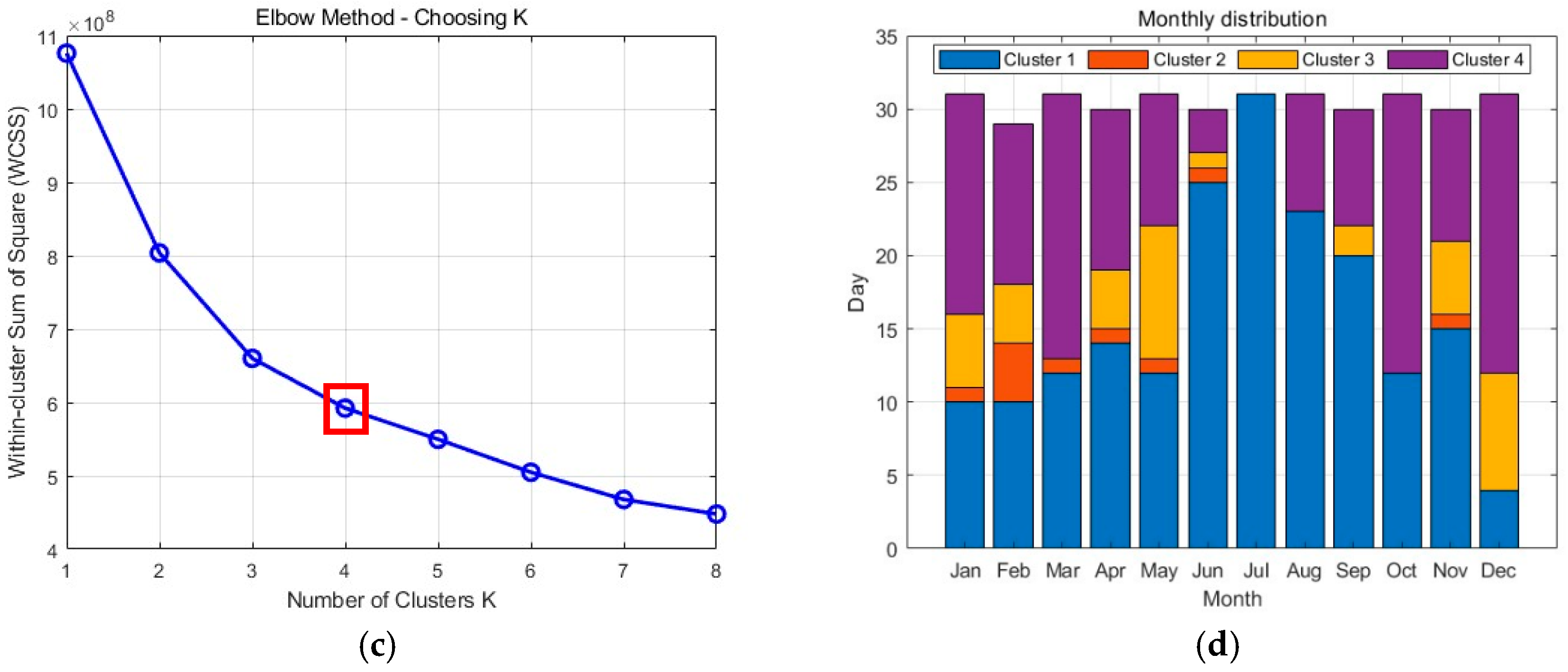
The dataset utilized in this study consists of the full-year day-ahead electricity prices from China’s Shanxi power grid in 2024. The dataset with 1 year in length has a time interval of 15 min, which is firstly depicted as 366 daily curves. To extract the key features of electricity market price curves while relieving the model’s computational burden, the impact of renewable energy on market prices based on price curves with typical characteristics was analyzed. Therefore, a k-means clustering algorithm was applied to 366 curves, which is well known for its ease of implementation, simplicity, efficiency, and empirical success [25]. K-means is an unsupervised clustering method that partitions a dataset into k clusters, each represented by its mean (centroid) [25]. The dataset is partitioned into several clusters so that data within each cluster are as similar as possible, while data across clusters are as dissimilar as possible. The k-means clustering of the day-ahead price curves was performed using MATLAB’s Statistics and Machine Learning Toolbox. According to the elbow method (i.e., choosing the smallest k after which adding more clusters yields only small, diminishing reductions in the within-cluster sum of squares), the number of clusters was set to k = 4, according to Figure 1c (if k = 3 had been chosen, the all-day high electricity price curve corresponding to Cluster 2 would have been lost, which may have led to an underestimation of the market revenues of CHP units). The results are displayed in Figure 1.
It can be inferred that the day-ahead electricity market prices are closely associated with the renewable outputs from Figure 1a,b. Specifically, for each cluster, a pattern can be concluded: for Cluster 1, the electricity price is comparatively steady, with the price of the midday period slightly lower than that of the morning and evening periods, which can be explained by the normal output characteristics of renewables; for Cluster 2, the electricity price is consistently high all day as a result of the extremely low output of renewable energy all the time; for Cluster 3, the drop in renewable output during the evening period triggers the requirement of thermal power units to supply electrical loads, which consequently brings about a sharp rise in electricity prices; for Cluster 4, the electricity price maintains a low level throughout the day due to the relatively high output of renewable energy. From Figure 1d, the rationality of the clustering results can be examined from the monthly distribution perspective—As mentioned before, Cluster 1 illustrates normal output patterns and Cluster 4 represents the relatively high output of renewables. The light wind in the summer months precisely matches a small number of days in Cluster 4 and a large number of days in Cluster 1, thereby demonstrating the coherence of the clustering results. In the following text, the four clusters are referred to as Curve 1 to Curve 4 for convenience.

2.2. Modeling of CHP Units

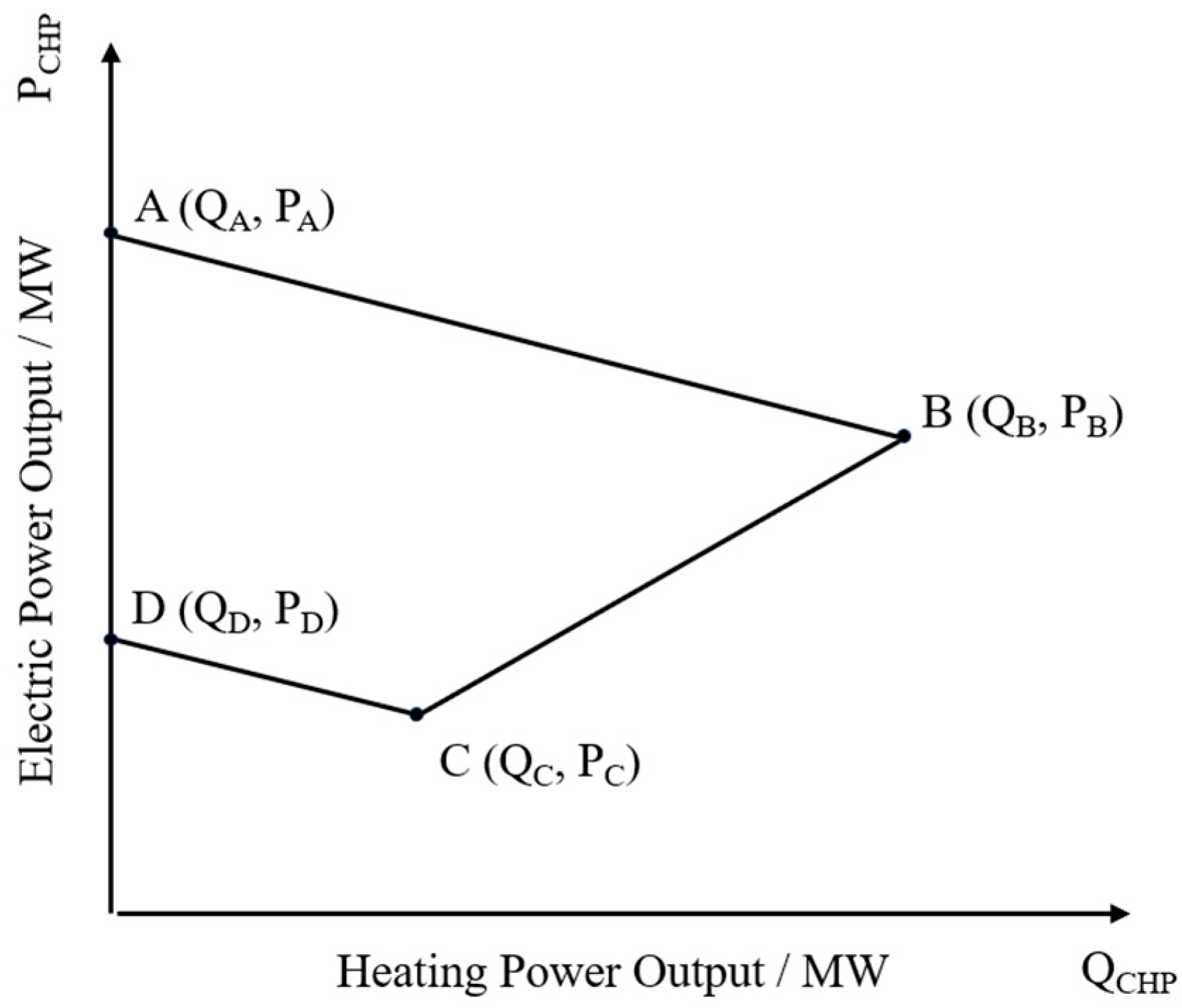
During the operation of CHP units, in order to warrant safety, it is essential to guarantee that the operating conditions remain within the feasible range. The feasible operation region of CHP units is shown in Figure 2, where the boundary AB corresponds to the maximum main steam flow constraint, the boundary BC corresponds to the low-pressure cylinder minimum steam intake constraint, and the boundary CD corresponds to the minimum main steam flow constraint [26]. The slopes of AB and CD are negative—to increase the heating power output, more steam must be extracted at higher pressure so that less of it undergoes downstream expansion; consequently, the turbine performs less work and the electric power output decreases. For the BC boundary, the slope is positive; the turbine requires a minimum stable flow, and the total steam supply is supposed to increase to add more heat, which will also increase the electric power output. At the same time, the electric power output and heating power output of any operating point in the feasible operation region can be expressed as a linear combination of the electric power output and heating power output of the four vertices A, B, C, and D, which can be denoted as follows [27,28]:
P CHP = i α i P i , i { A , B , C , D }
Q CHP = i α i Q i , i { A , B , C , D }
0 α i 1
i α i = 1
Under different operating conditions, the hourly coal consumption of CHP units is fitted by the following relationship, which can be subsequently used for calculation of the operating cost:
c o a l CHP = a CHP P CHP + b CHP Q CHP + c CHP
where c o a l CHP (t/h) is the hourly coal consumption of CHP units; P CHP and Q CHP (MW) are the electric power output and heating power output of CHP units, respectively; and a CHP , b CHP , and c CHP are the hourly coal consumption coefficients with respect to the operating points in the feasible operation region.

2.3. Dynamic Modeling of Heating Network

2.3.1. Modeling of Pipelines

Two major inherent features of thermal energy transmission in pipelines are considered, as follows:
(1)
Transmission delay. Assuming that the speed of energy transmission in the heating network is approximately the speed of the water flow in the pipelines, the following equation can be derived:
t delay = L pipe v
where t delay (h) is the transmission time delay; L pipe (km) is the length of the pipelines; v (km/h) is the water flow velocity in the pipelines.
(2)
Heat loss. When thermal energy is transmitted in the pipelines, due to the existence of a temperature difference between the water in the pipelines and the ambient air, heat exchange with the environment occurs, resulting in energy loss [29]:
T loss = [ 1 e λ L pipe / ( c p m ˙ ) ] ( T in T amb ) λ L pipe c p m ˙ ( T in T amb )
where λ (W·m−1·K−1) is the thermal conductivity coefficient of the pipelines; c p (J·kg−1·K−1) is the specific heat of the water at constant pressure; and m ˙ (kg/s) is the mass flow rate of the water within the pipelines.
Combining the above two characteristics, the overall pipeline transmission equation can be expressed as follows:
T out , t = T in , t t delay T loss
According to Equation (8), the energy in pipelines is characterized. By selecting a reference temperature, the input energy, output energy, and heat loss of the pipelines are calculated to derive the differential equation. Furthermore, the information concerning the energy change in the pipelines over time can be obtained by means of the forward difference:
d E pipe d t = Q in Q out Q loss
E pipe , t = E pipe , t 1 + ( Q in Q out Q loss ) Δ t

2.3.2. Modeling of Buildings

For the buildings on the load side, a dynamic model is established by depicting the change in room temperature to explore the system flexibility. For the room, the input is the heat exchanged between the heater and the room, while the output includes three terms: the heat dissipation through walls, the heat dissipation through windows, and the heat dissipation via ventilation. Specifically, the energy relationship can be described as follows:
Q wall = A wall 1 h in + R wall + 1 h out ( T room T amb )
Q win = A win 1 h in + R win + 1 h out ( T room T amb )
Q vent = c p , air ρ air V vent ( T room T amb )
where A wall and A win (m2) are the areas of the wall and window, respectively; h in and h out (W·m−2·K−1) are the convection heat transfer coefficients inside and outside the wall, respectively; R wall and R win (m2·K/W) are the thermal resistances of the wall and window, respectively; c p , air (J·kg−1·K−1) is the specific heat of the air at constant pressure; ρ air (kg/m3) is the air density; and V vent (m3/s) is the ventilation air volume flow rate.
By calculating Equations (11)–(13), the differential equation for the temporal change in room temperature can be deduced, on the basis of which the forward difference method is applied to derive Equation (15):
c p , air m air d T room d t = Q heater Q wall Q win Q vent
T room , t = T room , t 1 + ( Q heater Q wall Q win Q vent ) Δ t c p , air m air
where m air (kg) denotes the mass of the air in the room.

3. Optimization Problem Construction

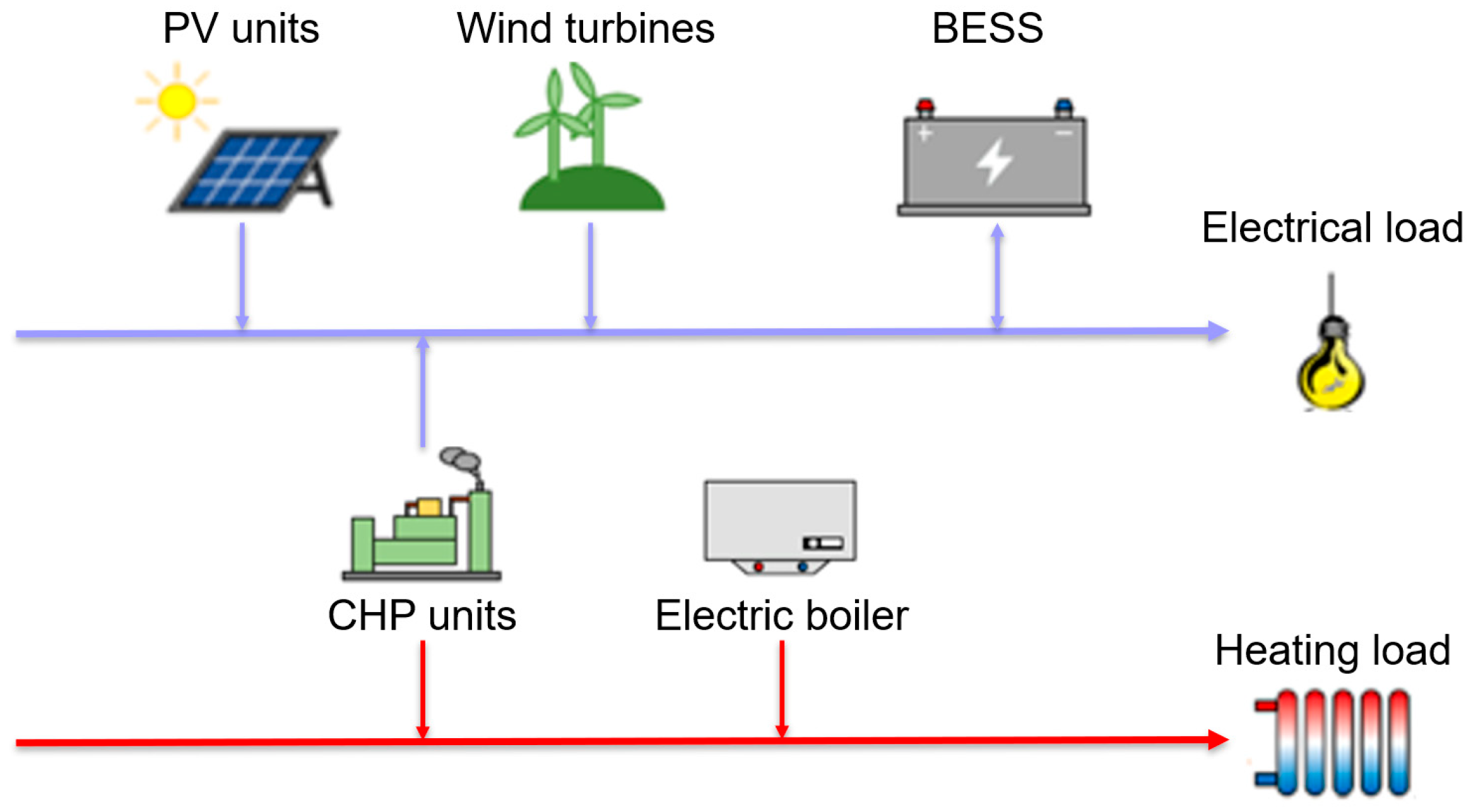
In this section, the system optimization is founded on the IES illustrated in Figure 3, which includes the following components: two CHP units, wind turbines, PV units, an electric boiler, and a BESS. Generally, CHP units function as dual suppliers of electricity and heat. The wind turbines and PV units represent the variable renewables, the output characteristics of which influence the electricity price curve of the day-ahead market. Moreover, the electric boiler manages to convert electricity into heat, improving the operational flexibility of the system. Finally, the BESS is able to maintain the power balance of the system by switching between the charging and discharging states [30].

3.1. Objective Function

The objective of the optimization problem is to maximize the total profit of the IES from the electricity market. It is worth mentioning that the income from the heat market is neglected here due to the fixed heat price as well as heating load. Additionally, to emphasize the operation planning with the existence of variable renewables, the income of renewables also contributes to the total profit. Consequently, the total profit is formulated in Equation (16), which consists of the revenues of CHP units from the electricity market ( r e v e n u e CHP ), the revenues of renewable units from generating power ( r e v e n u e RE ), the costs of fuel consumed by CHP units ( c o s t fuel ), and the costs of the operation and maintenance of the BESS ( c o s t OM ):
max   p r o f i t total = r e v e n u e CHP + r e v e n u e RE c o s t fuel c o s t OM
Specifically, considering the time-variant electricity price, the revenues of CHP units from the electricity market are calculated in Equation (17), where C CHP , t (CNY/MWh) denotes the day-ahead time-varying electricity market price:
r e v e n u e CHP = t P CHP , t C CHP , t Δ t
The revenues of the power generation of renewable units are derived in Equation (18), where C RE (CNY/MWh) is the fixed price in contrast with the constant-changing electricity market price:
r e v e n u e RE = C RE t P RE , t Δ t
The costs of coal consumption by CHP units are obtained in Equation (19) according to the hourly coal consumption of CHP units derived in Equation (5), where C coal (CNY/t) represents the price of coal:
c o s t fuel = C coal t c o a l CHP , t Δ t
The operation and maintenance costs of the BESS are computed in Equation (20), where P BESS , c , t and P BESS , disc , t signify the charging and discharging power of the BESS, respectively:
c o s t OM = C OM t ( P BESS , c , t + P BESS , disc , t ) Δ t

3.2. Constraints

3.2.1. CHP Units

Apart from the feasible operation region constraints reflected in Equations (1)–(4), due to the large inertia of coal mills and boilers, CHP units possess a relative low ramping rate [31], which means that the operation is restricted by the ramping constraint depicted in Equations (21) and (22):
r a m p t = P CHP , t P CHP , t 1 Δ t
r a m p min r a m p t r a m p max

3.2.2. Renewable Units

The output of the renewables is limited by the maximum generation associated with the different price profiles, which means that the renewable output cannot exceed the historical envelope under the same price curve:
0 P RE , t P RE , max

3.2.3. Electric Boiler

The electric boiler is an auxiliary device for the IES providing a complementary heat supply source. The power constraint and efficiency characteristics of electric boilers are described as follows [32]:
0 P EB , t P EB , max
P EB , t = Q EB , t η EB

3.2.4. BESS

The BESS plays a significant role in the power balance of the system, which can cope with the intermittency of the renewables, thereby enhancing stability as well as flexibility of the system. To be more specific, the BESS manages to realize energy shift over time periods, which means that the system is charged during off-peak periods and discharged during peak periods to guarantee a reliable power supply [33]. Moreover, under the electricity market environment, the application of a BESS is able to assist the IES to achieve higher profits owing to the variation in the operation strategies of CHP units.
The operation of the BESS is firstly confined to the power constraint, which implies that the charging and discharging power of the BESS cannot go beyond the maximum. Simultaneously, the BESS is limited to the capacity constraint, also referred to as the state-of-charge (SOC) constraint. Meanwhile, the BESS is not capable of charging and discharging at the same time. Last, in the proposed optimization problem, to ensure the continuous operation of the system, the capacities of the BESS at the beginning and end of the scheduling period ought to be equal. The above constraints are demonstrated as follows [34,35]:
0 P BESS , c , t P BESS , c , max
0 P BESS , disc , t P BESS , disc , max
C A P BESS , t = C A P BESS , t 1 + ( P BESS , c , t η c P BESS , disc , t η disc ) Δ t
C A P BESS , min C A P BESS , t C A P BESS , max
x c · x disc = 0
C A P BESS , end = C A P BESS , beginning
where x c and x disc are the binary variables symbolizing the charging and discharging states of the BESS, respectively.

3.2.5. Power Balance

The power balance of the system should be satisfied at every single time point, ensuring the stable operation of the IES. Generally, on the supply side, the primary supply devices include CHP units, renewable units, and the BESS in the discharging state; on the other side, the main power consumption approaches are the operation of the electric boiler, the charging of the BESS, and the electrical load of the demand side. To summarize, the power balance of the system is addressed in Equation (32):
P CHP , t + P RE , t + P BESS , disc , t = P EB , t + P BESS , c , t + P load , t
where the symbols on the left-hand side of the equation refer to the electric power output of CHP units, the output of renewable units, and the discharging power of the BESS; the symbols on the right-hand side of the equation stand for the electrical power expenditure of the electric boiler, the charging power of the BESS, and the electrical load of the system.

3.2.6. Heat Balance

The heat balance of the system can be expressed as follows with the static modeling of the heating network:
( Q CHP , t + Q EB , t ) η net = Q load , t
where η net is the equivalent transmission efficiency of the heating network in correspondence with the heat transmission loss in the dynamic modeling; and Q load , t symbolizes the heating load of the system.
Under dynamic modeling, the constraints for the thermal system turn into the restriction of the temperature of the room and pipelines. The room temperature is supposed to be controlled within a certain range to assure the living comfort of residents; the inlet and outlet temperatures of the pipelines ought to be maintained in a safety range for the purpose of reliable operation. The constraints are displayed in Equations (34) and (35), where T room , t signifies the room temperature and T pipe , t denotes the pipe temperature:
T room , min T room , t T room , max
T pipe , min T pipe , t T pipe , max
Moreover, to preserve the system operational stability and consistency, the energy stored in the heating network is equivalent at the beginning and end of the scheduling period, as depicted in Equation (36):
E net , end = E net , beginning
where E net , beginning and E net , end signify the heat energy stored in the heating network initially and finally.

3.3. Parameters and Case Settings

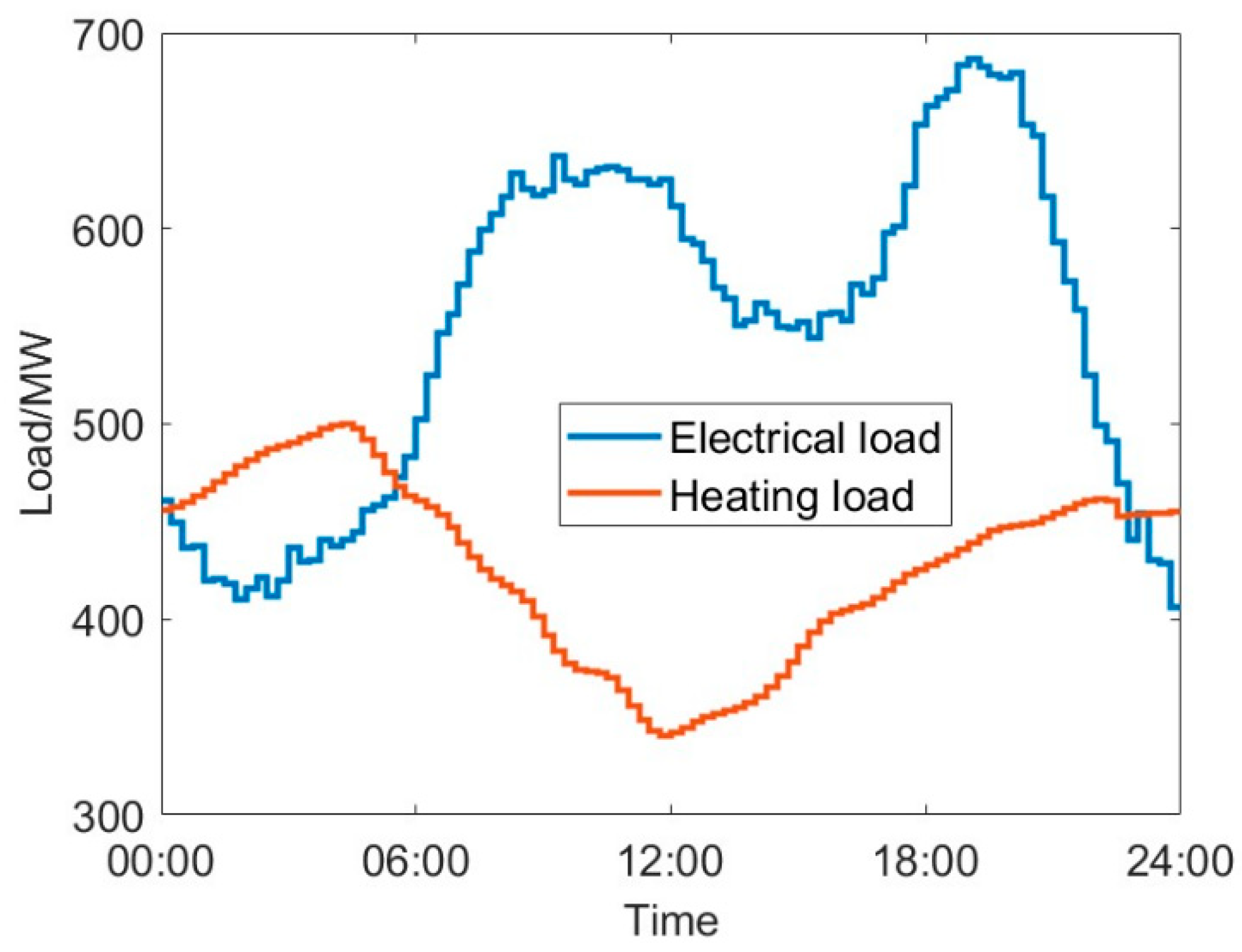
Specifically, the IES in the case study consisted of the following parts: two CHP units with 330 MW capacity each; an electric boiler with 100 MW capacity; renewable units, of which the capacity was in accordance with the clustering result; a BESS with a capacity of 150 MW/300 MWh. The daily electrical and heating loads of the IES with 15 min in resolution and 96 points in length are illustrated in Figure 4. In addition, the key parameters are listed in Table 1.
To explore the flexibility of the IES as well as the maximum total profit, four cases are compared with the BESS, and the dynamic characteristics of the heating network are considered. Case 1 is the baseline scenario in which both the BESS and dynamic characteristics of the heating network are not accounted for; Case 2 introduces the BESS on the basis of Case 1; Case 3 takes the dynamic characteristics of the heating network into account built upon Case 1; Case 4 combines the previous considerations, which means focusing on the comprehensive impact of the BESS and dynamic characteristics of the heating network. The detailed setting is displayed in Table 2. It is worth mentioning that all cases above explore the operation of the IES under four distinct settings of electricity price profiles. Generally, the optimal scheduling of the IES is formulated as a mixed-integer linear programming problem, and it is calculated in MATLAB R2023b by invoking the GUROBI solver.

4. Results and Discussion

In this section, the different optimization results under distinct price curves are elaborated in the beginning to discover the influence of the price curve features on the strategies of the system operation. Consequently, a comparison of the system operation under certain electricity price profiles in different cases regarding the BESS and the inertia of the heating network is carried out in an effort to gain more profit as well as improve the flexibility of the system. Eventually, implementation of a careful contrast between optimization in terms of different objectives implies the alteration of the operational goals of CHP units from thermal economy to comprehensive economy, thereby benefiting more from the electricity market.

4.1. Diverse Operational Strategies Regarding Different Price Curves

Overall, this section presents the impact of different electricity price curves on the day-ahead planning of the system, mainly focusing on indices including the total profit and renewable curtailment rate of the system. The results are presented in Table 3.
First, for a given case, the total system profit and renewable curtailment rate exhibit similar regularities under distinct electricity price profiles. This phenomenon is explained as follows. Focusing on total profits, the orders are invariant across the four cases: Curve 2 yields the highest profit, followed by Curve 3, Curve 1, and Curve 4. Using the baseline case (Case 1) for demonstration, Curve 1 represents the most common price profile and is associated with typical renewable output; Curve 2 features low renewable output throughout the day, leading to persistently high market prices, so CHP units can secure elevated revenues from the electricity market; Curve 3 is similar to Curve 1 before nighttime, yet the drop in renewable output during the evening period creates a power shortfall that drives market prices noticeably higher—often exceeding 1000 CNY/MWh. Coupled with the evening demand peak, the CHP units earn substantial revenues in this period, resulting in a daily profit close to that under Curve 2. Curve 4 corresponds to high renewable output all day long, under which the market earnings of CHP units decline markedly.
The pattern of renewable utilization within the same case across the four price profiles is further investigated. The sequential order of the renewable curtailment rate from low to high is likewise consistent: Curve 1, Curve 3, Curve 4, and Curve 2. Under Curve 1, renewable generation is high at midday, when supply exceeds demand, leading to midday curtailment. Under Curve 2, since CHP units capture higher market revenues, they are prioritized for electricity supply under profit maximization, leading to more curtailment of renewables. In terms of Curve 3, the first half of the day resembles Curve 1; in the evening, given the raised market prices, the CHP units are again prioritized, reducing renewable absorption and thereby producing a slightly higher overall curtailment rate compared with that of Curve 1. Under Curve 4, renewable output is high throughout the day, and the CHP units mainly serve to meet the heat demand, while renewable generation substantially exceeds electricity required, leading to a high curtailment rate.
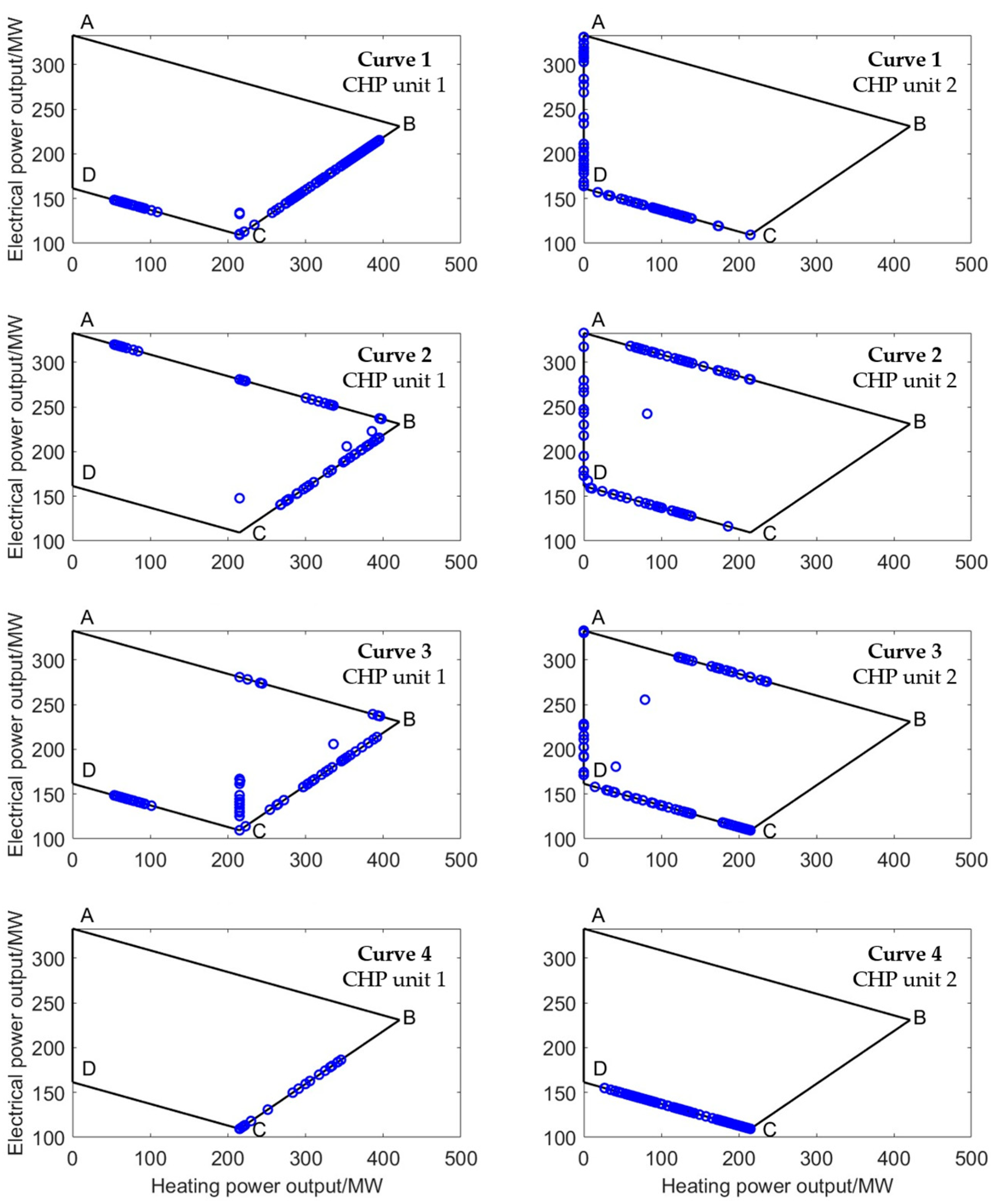
Moreover, the operation of CHP units under different price profiles is elaborated by analyzing the distribution of the operating points within the feasible operation region using Case 1 (baseline case) as the reference. As described in Figure 5, CHP units provide both heating and electrical supply under Curve 1. The operating points cluster along the AD, BC, and CD boundaries of the feasible region, indicating a “heat-led” mode in which the electricity production is dictated by the heat demand. Under Curve 2, due to lower renewable output, CHP units assume a greater share of electricity generation—compared with Curve 1, the operating points shift upward overall, with many located along boundary AB. Under Curve 3, the distribution of the operating points resembles that under Curve 1 in the time period prior to the evening, consistent with similar renewable output and electricity price profiles; during the evening peak, CHP units undertake more electricity generation, thereby motivating some operating points to move upward and appear along boundary AB, yet their number is obviously smaller than that under Curve 2. For Curve 4, abundant renewable generation allows CHP units to primarily guarantee heating supply and operate in a “heat-led” mode. Considering sufficient renewable generation to meet the electrical demand, the operating points are concentrated along the BC and CD boundaries of the feasible operation region.
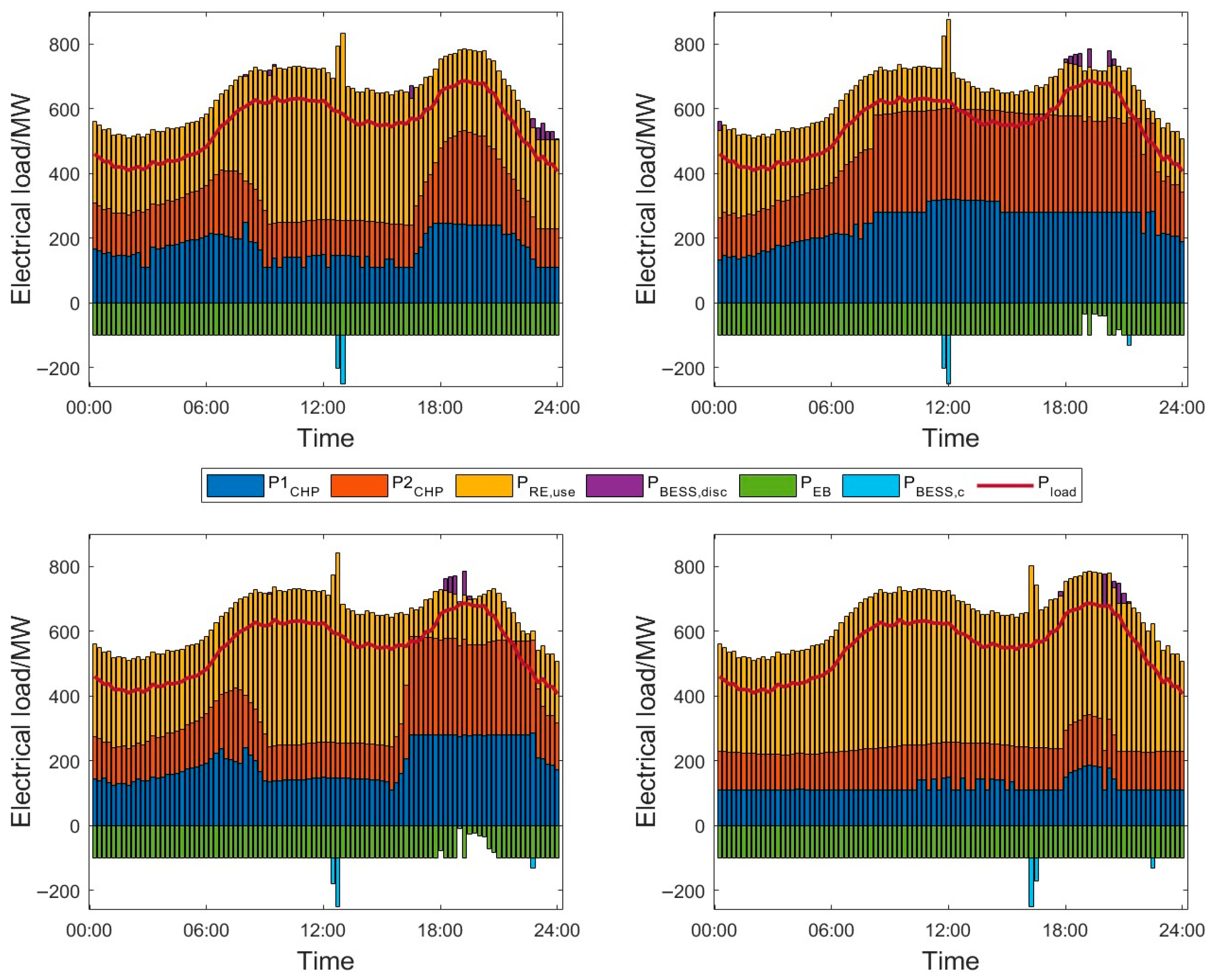
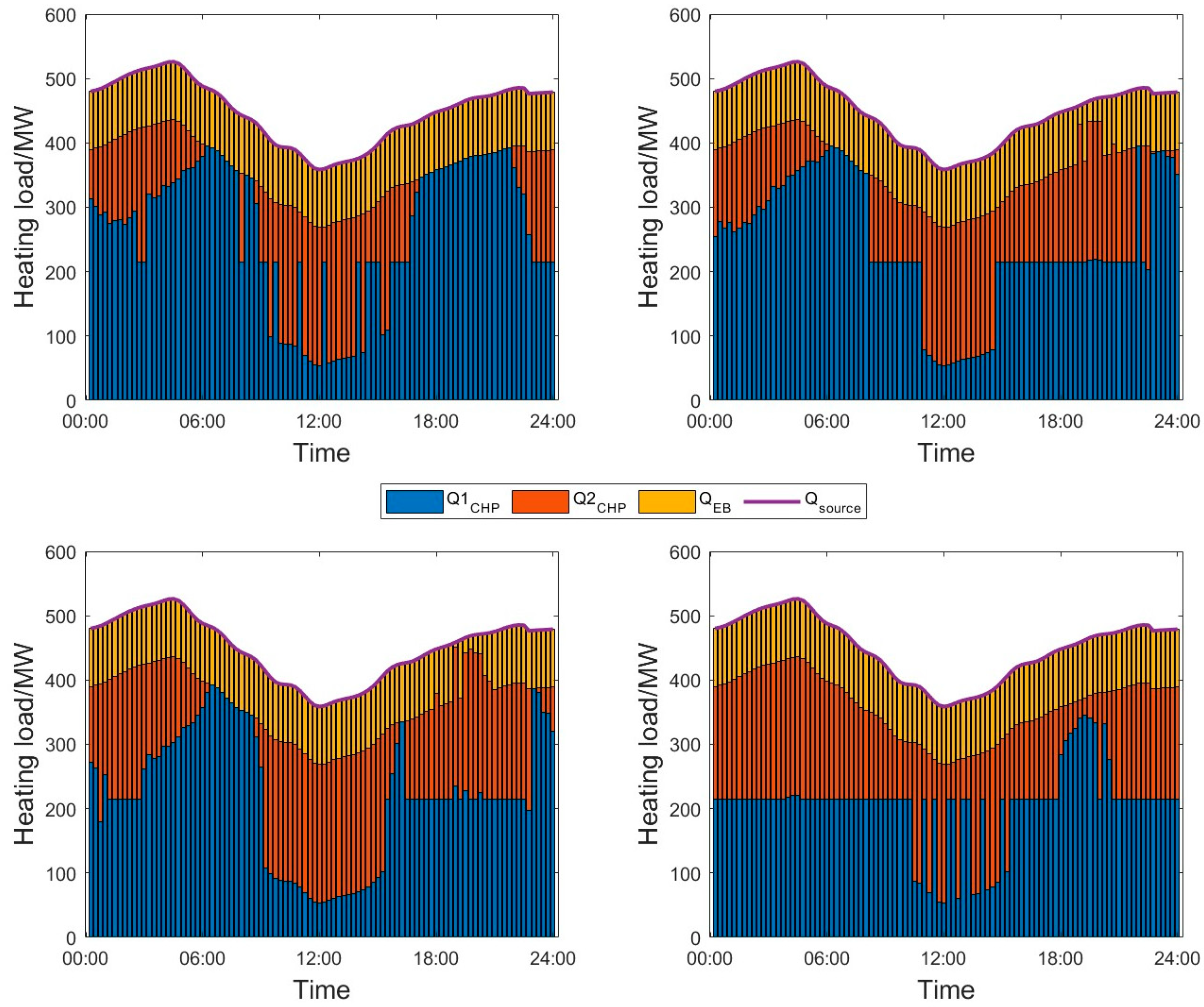
The operation details of the IES under diverse electricity price profiles are also investigated. Using Case 2 (the energy storage case) as an example, Figure 6 and Figure 7 depict the electrical and heating load supplies of the IES under different price profiles. Notably, the observed operation of CHP units and the renewable output patterns are consistent with the feasible operation region analysis presented earlier—under Curve 1, CHP units and renewable units jointly supply the electrical load; under Curve 2, the electrical load is preferentially met by CHP units; under Curve 3, the operation of CHP units resembles that under Curve 1 prior to the evening peak, while during the evening peak, CHP units assume the primary generation role; under Curve 4, renewable units supply most of the electricity, and CHP units prioritize meeting the heating demand while minimizing electricity production. In addition, the electric boiler maintains a high output most of the time across all price profiles. Specifically, given the CHP operational strategy, the electric boiler provides an approach for electricity consumption, thereby facilitating greater renewable integration and enhancing system profits. The BESS performs two principal functions: first, the BESS stores surplus electricity and releases it when needed to increase renewable utilization; second, the BESS enables CHP units to capitalize on inter-period price differences, thereby securing additional revenues from the electricity market.

4.2. Effects of Deploying BESS and Considering Dynamics of Heating Network

This section examines the impacts of deploying the BESS and explicitly modeling heating network dynamics. Table 1 shows that these impacts vary with the price profile. Comparing Case 2 (energy storage case) with Case 1 (baseline case), the BESS increases the total profit and renewable utilization under all four profiles, with the largest gain under Curve 2. In contrast, Case 3 (heating network case) consistently raises the total profit relative to Case 1. However, it does not clearly improve renewable utilization when the renewable output is persistently low or high (Curve 2 and Curve 4).
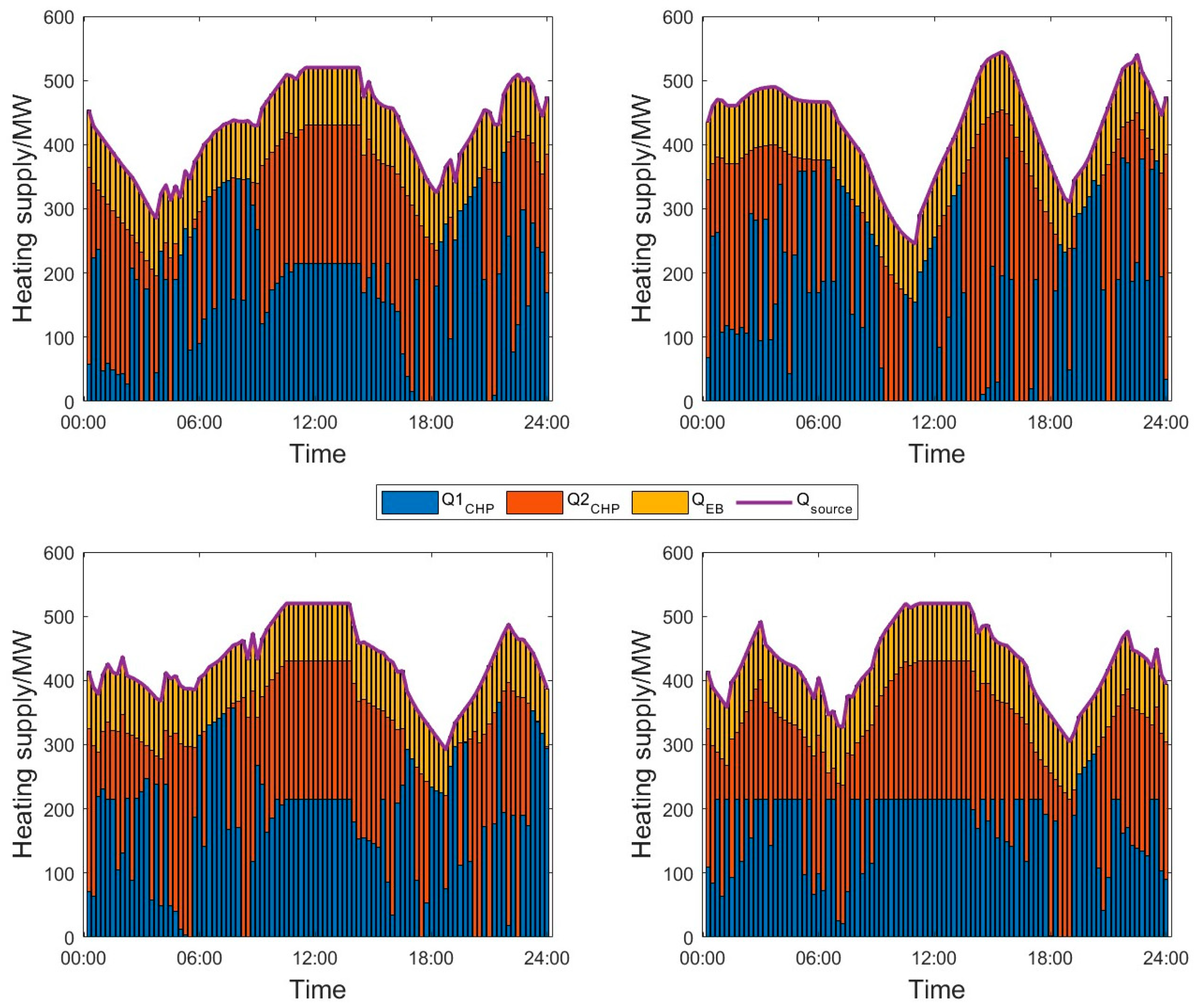
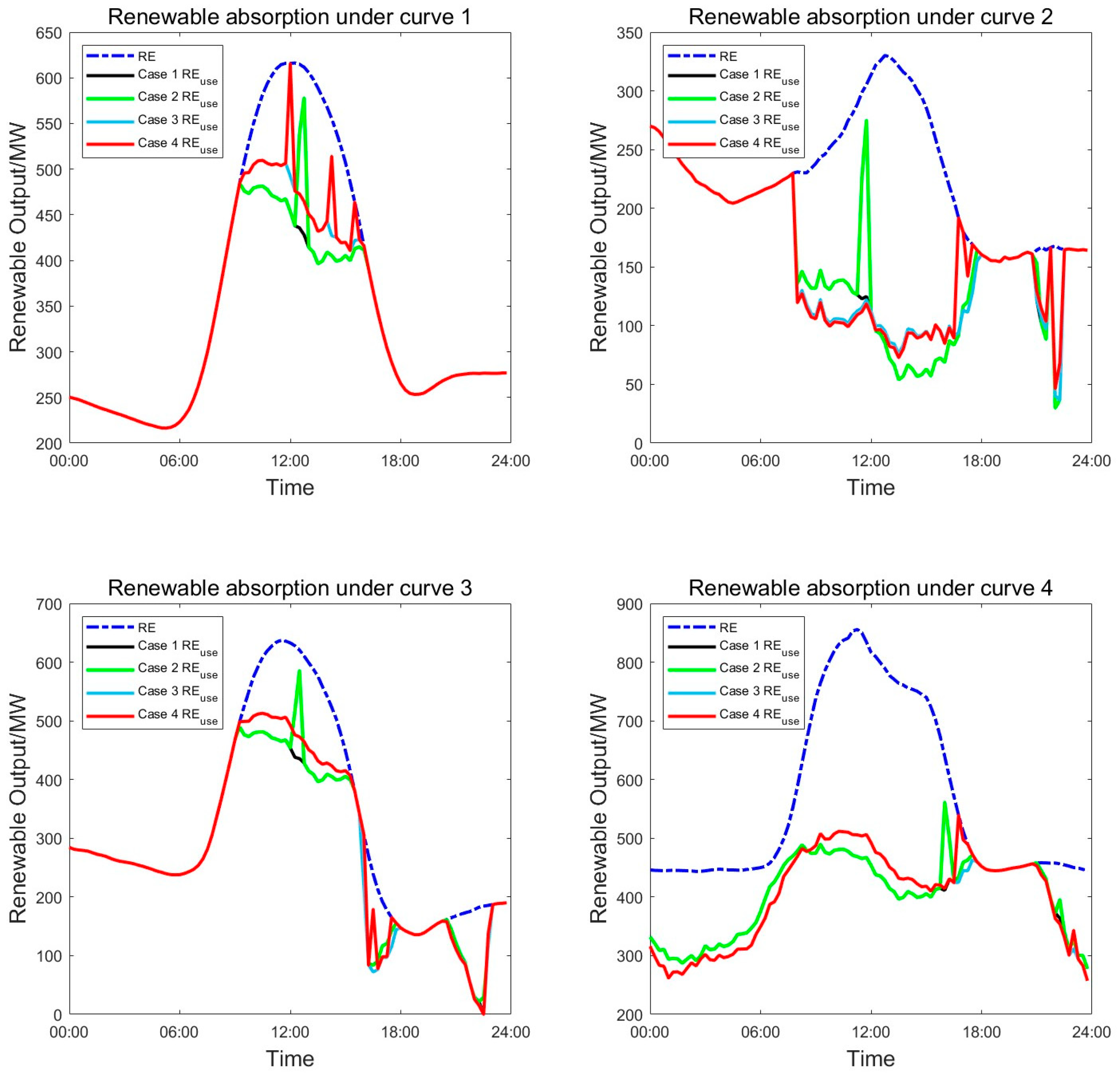
These differences stem from distinct operating mechanisms. In Case 2, the BESS performs short-term energy shifting, moving surplus electricity over time via charging and discharging. Consequently, across all four curves, it both reduces the curtailment and increases the total profit of the system. In Case 3, heating network inertia is leveraged as an intrinsic storage buffer within the heat transmission process, reshaping the heat supply schedule. As illustrated in Figure 8, the resulting heat supply trajectory deviates from the heat demand profile observed in Case 2, thereby enhancing the overall flexibility of heat provision and creating space for CHP units to obtain additional revenues from the electricity market. The renewable utilization across the scenarios is reported in Figure 9, which further confirms that the BESS and heating network dynamics influence renewable integration in distinct ways. The sensitivity analysis was also conducted regarding the BESS capacity and coal price, as displayed in Table 4, taking Case 2 under Curve 3 as an example.

4.3. Modification of Operational Target for CHP Units

This section suggests a variation in the operational objective of CHP units—from the thermal economic objective represented by fuel cost minimization to the overall economic objective aligned with revenues from participation in the electricity market. Accordingly, a system-wide operational optimization under the objective of comprehensive economy was performed, and based on the resulting optimal schedule, the revenues earned by the CHP units in the electricity market were computed, thereby deriving the total profit of the system from market participation, which was further compared with the results from the preceding text. The detailed calculation procedure and objective function are presented below:
max   p r o f i t thermal = r e v e n u e RE c o s t fuel c o s t OM
p r o f i t total = r e v e n u e CHP + p r o f i t thermal
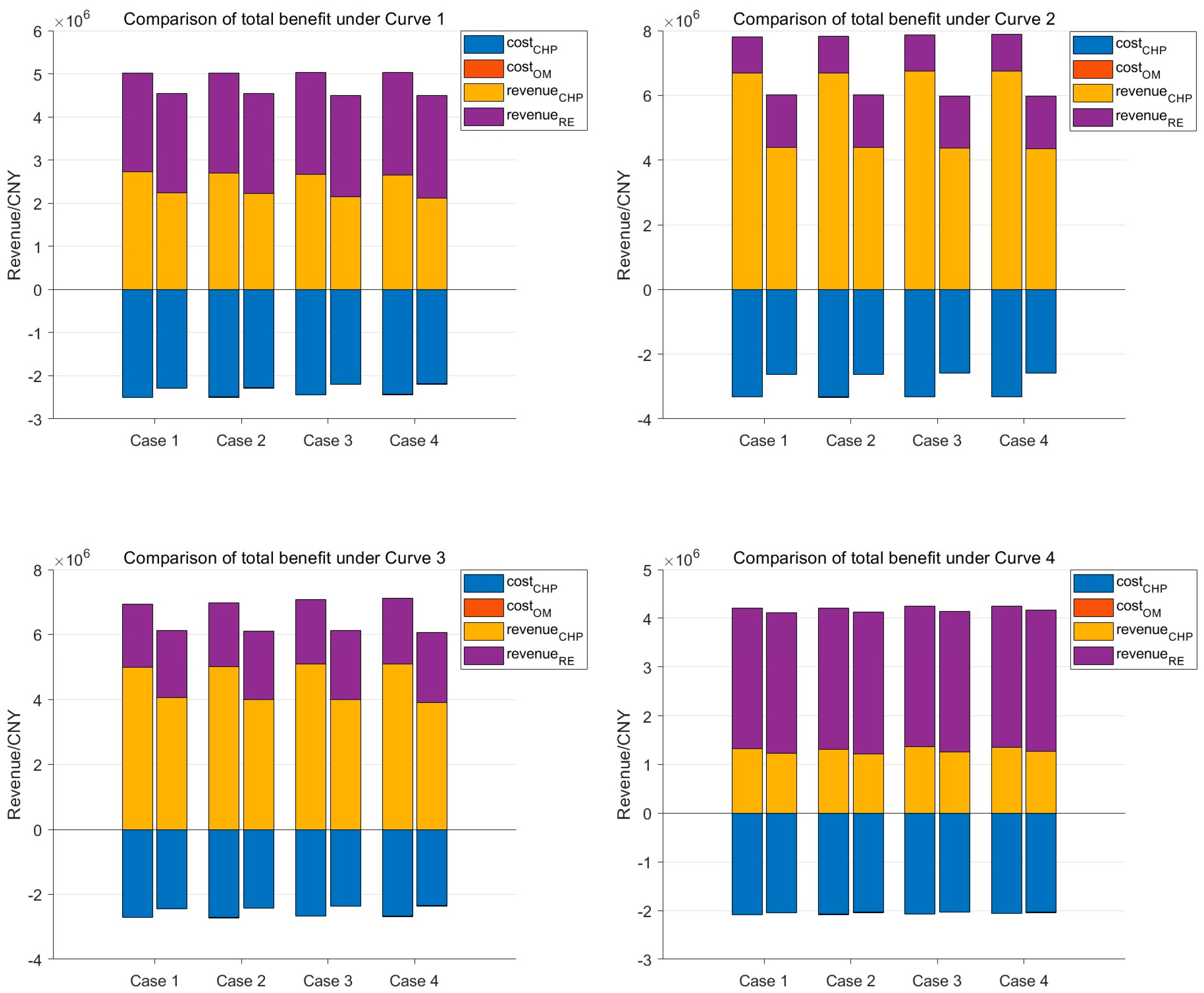
The results are displayed in Table 5. Across different electricity price profiles and all cases, the comprehensive economic optimization that explicitly accounts for the electricity market participation of CHP units consistently delivered higher system profits than the thermal economic optimization on the basis of the coal consumption cost. The improvement was the greatest under Curve 2, owing to persistently elevated market prices and the resulting high profit potential throughout the day. Conversely, under Curve 4, electricity market prices remained low, leading to the correspondingly modest profit increase.
In addition, the detailed cost breakdown is exhibited in Figure 10. Compared with the optimization under the objective of thermal economy, the market-oriented economic objective accepts a modest increase in fuel costs to realize higher revenues during high-price periods, thereby raising the total profit. It is noteworthy that Case 2 (energy storage case) and Case 4 (energy storage + heating network case) include the operation and maintenance costs of the BESS. Although these costs are small relative to other components and therefore not visually prominent in the figure, they are crucial due to underpinning the additional profit realized by Case 2 (energy storage case) over Case 1 (baseline case) and Case 4 (energy storage + heating network case) over Case 3 (heating network case).

5. Conclusions

This study developed a day-ahead operational planning framework for CHP units within an IES under electricity market reform. By clustering one-year day-ahead price trajectories into four archetypal profiles and building detailed component models, the framework links market price patterns to physically feasible and profitable schedules that also safeguard heat supply. The key findings are as follows:
Price profile-driven scheduling. Electricity prices are strongly coupled with renewable output patterns, and distinct price profiles lead to markedly different optimal strategies. Across cases, the daily profits rank as Curve 2 > Curve 3 > Curve 1 > Curve 4, reflecting persistently high prices when renewable output is low (Curve 2) and depressed prices when renewables are abundant (Curve 4). Renewable curtailment tends to rank as Curve 1 < Curve 3 < Curve 4 < Curve 2. The operating points of CHP units shift between heat-led boundaries and the electricity-oriented boundary according to the price profile and renewable availability.
Role of flexibility resources. The BESS consistently raised total profits and reduced renewable curtailment across all price profiles by time-shifting energy through charging and discharging. Explicitly exploiting heating network inertia increased profits by decoupling instantaneous heat production from the heat demand, thereby creating freedom for CHP units to capture high-price periods; its impact on curtailment was limited when renewable output was persistently low or high. Combining the BESS with heating network dynamics delivered the highest profits and, in most profiles, the lowest curtailment.
Market-oriented operation objective. Switching from a thermal-economy objective (fuel cost minimization) to a comprehensive-economy objective that internalizes electricity market revenues increased daily profits by 2.1–34.6% across all cases and profiles, with the largest gains under sustained high-price conditions (Curve 2) and the smallest under low-price conditions (Curve 4). The profit uplift arises from accepting modestly higher fuel costs to exploit inter-period price differences. This evidences a practical shift from strictly heat-led operation toward profit-aware scheduling under market signals while honoring comfort and safety constraints.
Practical implications are twofold. First, recognizing the price profile provides actionable guidance on the alignment of CHP operations with market opportunities. Second, both deploying the BESS and leveraging thermal inertia in networks and buildings measurably enhance flexibility and profitability, supporting investment and operation decisions for CHP-centered IESs.
This study was conducted under the assumption of a fixed price of renewable generation. Also, the optimization was based on a one-day framework, which can be further expanded for overall profit maximization. Moreover, the uncertainty of renewables was treated deterministically by considering the output according to each electricity price profile, which is equivalent to perfect foresight of the day-ahead price profile. Future research will extend to the participation of renewables in electricity markets and the corresponding operational strategies of CHP units. In addition, the inherent uncertain and intermittent features of renewables will be taken into consideration.

Author Contributions

Conceptualization, Z.L.; methodology, Y.S.; data curation, Y.S.; validation, S.W.; investigation, Z.H.; writing—original draft preparation, Y.S.; writing—review and editing, P.L.; supervision, Z.L.; project administration, P.L. All authors have read and agreed to the published version of the manuscript.

Funding

This research was funded by the National Key Research and Development Program of China (2023YFC3807201) and the Phase IV Collaboration between BP and Tsinghua University.

Data Availability Statement

The original contributions presented in this study are included in the article. Further inquiries can be directed to the corresponding author.

Conflicts of Interest

Authors Zhilong He and Shengwen Wang were employed by the company China Datang Corporation Science and Technology General Research Institute Co., Ltd. The remaining authors declare that the research was conducted in the absence of any commercial or financial relationships that could be construed as a potential conflict of interest.

Abbreviations

The following abbreviations are used in this manuscript:
CHPCombined heat and power
BESSBattery energy storage system
IESIntegrated energy system
PVPhotovoltaic

References

  1. International Energy Agency. Electricity 2025: Analysis and Forecast to 2027; International Energy Agency: Washington, DC, USA, 2025. [Google Scholar]
  2. Zhuo, Z.; Zhang, N.; Xie, X.; Li, H.; Kang, C. Key technologies and developing challenges of power system with high proportion of renewable energy. Autom. Electr. Power Syst. 2021, 45, 171–191. [Google Scholar] [CrossRef]
  3. Hartley, P.R.; Medlock, K.B.; Jankovska, O. Electricity reform and retail pricing in Texas. Energy Econ. 2019, 80, 1–11. [Google Scholar] [CrossRef]
  4. Streimikiene, D.; Siksnelyte, I. Electricity market opening impact on investments in electricity sector. Renew. Sustain. Energy Rev. 2014, 29, 891–904. [Google Scholar] [CrossRef]
  5. Liu, J.; Wang, J.; Cardinal, J. Evolution and reform of UK electricity market. Renew. Sustain. Energy Rev. 2022, 161, 112317. [Google Scholar] [CrossRef]
  6. Widmann, C.; Lödige, D.; Toradmal, A.; Thomas, B. Enabling CHP units for electricity production on demand by smart management of the thermal energy storage. Appl. Therm. Eng. 2017, 114, 1487–1497. [Google Scholar] [CrossRef]
  7. Clegg, S.; Mancarella, P. Integrated electrical and gas network flexibility assessment in low-carbon multi-energy systems. IEEE Trans. Sustain. Energy 2016, 7, 718–731. [Google Scholar] [CrossRef]
  8. Yu, X.; Xu, X.; Chen, S.; Wu, J.; Jia, H. A brief review to integrated energy system and energy internet. Trans. China Electrotech. Soc. 2016, 31, 1–13. [Google Scholar] [CrossRef]
  9. Chen, X.; Kang, C.; Malley, M.O.; Xia, Q.; Bai, J.; Liu, C.; Sun, R.; Wang, W.; Li, H. Increasing the Flexibility of Combined Heat and Power for Wind Power Integration in China: Modeling and Implications. IEEE Trans. Power Syst. 2015, 30, 1848–1857. [Google Scholar] [CrossRef]
  10. Dillig, M.; Jung, M.; Karl, J. The impact of renewables on electricity prices in Germany—An estimation based on historic spot prices in the years 2011–2013. Renew. Sustain. Energy Rev. 2016, 57, 7–15. [Google Scholar] [CrossRef]
  11. Kyritsis, E.; Andersson, J.; Serletis, A. Electricity prices, large-scale renewable integration, and policy implications. Energy Policy 2017, 101, 550–560. [Google Scholar] [CrossRef]
  12. Figueiredo, N.C.; Silva, P.P.d. The “Merit-order effect” of wind and solar power: Volatility and determinants. Renew. Sustain. Energy Rev. 2019, 102, 54–62. [Google Scholar] [CrossRef]
  13. Shimomura, M.; Keeley, A.R.; Matsumoto, K.I.; Tanaka, K.; Managi, S. Beyond the merit order effect: Impact of the rapid expansion of renewable energy on electricity market price. Renew. Sustain. Energy Rev. 2024, 189, 114037. [Google Scholar] [CrossRef]
  14. Fuke, N.; Ohashi, K. Seasonal variation in the impact of solar power generation on electricity price level and variability. J. Commod. Mark. 2025, 40, 100521. [Google Scholar] [CrossRef]
  15. Rolfsman, B. Combined heat-and-power plants and district heating in a deregulated electricity market. Appl. Energy 2004, 78, 37–52. [Google Scholar] [CrossRef]
  16. Alipour, M.; Mohammadi-Ivatloo, B.; Zare, K. Stochastic Scheduling of Renewable and CHP-Based Microgrids. IEEE Trans. Ind. Inform. 2015, 11, 1049–1058. [Google Scholar] [CrossRef]
  17. Cui, H.; Song, K.; Dou, W.; Nan, Z.; Wang, Z.; Zhang, N. Bidding Strategy of a Flexible CHP Plant for Participating in the Day-Ahead Energy and Downregulation Service Market. IEEE Access 2021, 9, 149647–149656. [Google Scholar] [CrossRef]
  18. Kumbartzky, N.; Schacht, M.; Schulz, K.; Werners, B. Optimal operation of a CHP plant participating in the German electricity balancing and day-ahead spot market. Eur. J. Oper. Res. 2017, 261, 390–404. [Google Scholar] [CrossRef]
  19. De Rosa, M.; Carragher, M.; Finn, D.P. Flexibility assessment of a combined heat-power system (CHP) with energy storage under real-time energy price market framework. Therm. Sci. Eng. Prog. 2018, 8, 426–438. [Google Scholar] [CrossRef]
  20. Mallier, L.; Hétreux, G.; Thery-Hétreux, R.; Baudet, P. A modelling framework for energy system planning: Application to CHP plants participating in the electricity market. Energy 2021, 214, 118976. [Google Scholar] [CrossRef]
  21. Gao, S.; Jurasz, J.; Li, H.; Corsetti, E.; Yan, J. Potential benefits from participating in day-ahead and regulation markets for CHPs. Appl. Energy 2022, 306, 117974. [Google Scholar] [CrossRef]
  22. Fang, Y.; Wei, W.; Mei, S.; Liu, F. Stackelberg game strategy for combined heat power unit considering locational marginal prices. Control Theory Appl. 2018, 35, 109–114. [Google Scholar] [CrossRef]
  23. Tang, M.; Luo, Y.; Hu, B.; Luo, H.; Zhu, W.; Han, Y. Electricity market bidding strategy for combined heat and power unit considering cooperation of heat demand control. In Proceedings of the 3rd Asia Energy Electrical Engineering Symposium (AEEES), Chengdu, China, 26–29 March 2021; pp. 1042–1048. [Google Scholar] [CrossRef]
  24. Fu, Y.; Shan, J.; Li, Z.; Pan, J.-S. P2P energy trading of multi-energy prosumers: An electricity-heat coupling double auction market. Appl. Energy 2025, 390, 125804. [Google Scholar] [CrossRef]
  25. Jain, A.K. Data clustering: 50 years beyond K-means. Pattern Recogn. Lett. 2010, 31, 651–666. [Google Scholar] [CrossRef]
  26. Tao, G.; Henwood, M.I.; Van Ooijen, M. An algorithm for combined heat and power economic dispatch. IEEE Trans. Power Syst. 1996, 11, 1778–1784. [Google Scholar] [CrossRef]
  27. Lahdelma, R.; Hakonen, H. An efficient linear programming algorithm for combined heat and power production. Eur. J. Oper. Res. 2003, 148, 141–151. [Google Scholar] [CrossRef]
  28. Vasebi, A.; Fesanghary, M.; Bathaee, S.M.T. Combined heat and power economic dispatch by harmony search algorithm. Int. J. Electr. Power 2007, 29, 713–719. [Google Scholar] [CrossRef]
  29. Liu, X.; Wu, J.; Jenkins, N.; Bagdanavicius, A. Combined analysis of electricity and heat networks. Appl. Energy 2016, 162, 1238–1250. [Google Scholar] [CrossRef]
  30. Amir, M.; Deshmukh, R.G.; Khalid, H.M.; Said, Z.; Raza, A.; Muyeen, S.M.; Nizami, A.-S.; Elavarasan, R.M.; Saidur, R.; Sopian, K. Energy storage technologies: An integrated survey of developments, global economical/environmental effects, optimal scheduling model, and sustainable adaption policies. J. Energy Storage 2023, 72, 108694. [Google Scholar] [CrossRef]
  31. Wang, X.; Dong, L.; Zhu, Q.; Li, Y.; Han, H.; Liang, J.; Duan, B. Dynamic modeling and flexible control of combined heat and power units integrated with thermal energy storage system. Energy Rep. 2023, 10, 396–406. [Google Scholar] [CrossRef]
  32. Wu, C.; Gu, W.; Xu, Y.; Jiang, P.; Lu, S.; Zhao, B. Bi-level optimization model for integrated energy system considering the thermal comfort of heat customers. Appl. Energy 2018, 232, 607–616. [Google Scholar] [CrossRef]
  33. Wang, H.; Yin, W.; Abdollahi, E.; Lahdelma, R.; Jiao, W. Modelling and optimization of CHP based district heating system with renewable energy production and energy storage. Appl. Energy 2015, 159, 401–421. [Google Scholar] [CrossRef]
  34. Liu, Z.; Cui, Y.; Wang, J.; Yue, C.; Agbodjan, Y.S.; Yang, Y. Multi-objective optimization of multi-energy complementary integrated energy systems considering load prediction and renewable energy production uncertainties. Energy 2022, 254, 124399. [Google Scholar] [CrossRef]
  35. Li, Y.; Wang, B.; Yang, Z.; Li, J.; Chen, C. Hierarchical stochastic scheduling of multi-community integrated energy systems in uncertain environments via Stackelberg game. Appl. Energy 2022, 308, 118392. [Google Scholar] [CrossRef]
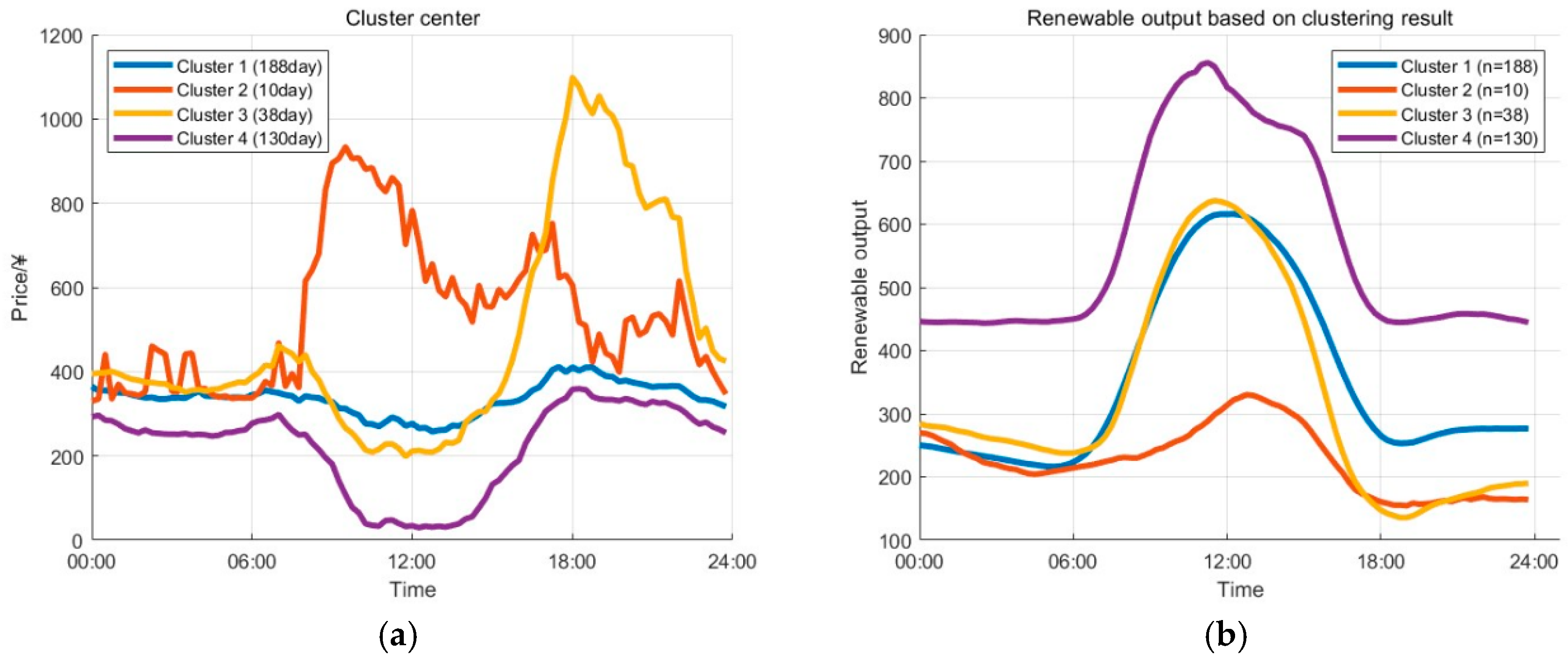
Figure 1. The k-means clustering results. (a) The cluster center and corresponding number of days. (b) The renewable output based on the clustering results. (c) The elbow method for choosing the proper k. (d) The monthly distribution of clustering.
Processes 14 00210 g001aProcesses 14 00210 g001b
Figure 2. The feasible operation region of CHP units.
Processes 14 00210 g002
Figure 3. Schematic diagram of IES investigated.
Processes 14 00210 g003
Figure 4. Settings of electrical load and heating load of IES.
Processes 14 00210 g004
Figure 5. Operation of CHP units under different electricity price curves in Case 1 (baseline case). Each row represents the operation point distribution of two individual CHP units in correspondence with a certain electricity price profile from Curve 1 to Curve 4.
Processes 14 00210 g005
Figure 6. Supply of electrical load under different electricity price curves in Case 2 (energy storage case). Each panel describes the supply of electrical load given different electricity price profiles.
Processes 14 00210 g006
Figure 7. Supply of heating load under different electricity price curves in Case 2 (energy storage case). Each panel describes the supply of heating load given different electricity price profiles.
Processes 14 00210 g007
Figure 8. Supply of heating load under different electricity price curves in Case 3 (heating network case). Each panel describes the supply of heating load given different electricity price profiles.
Processes 14 00210 g008
Figure 9. Renewable absorption under different electricity price curves across all cases. Each panel denotes a contrast among all cases according to a certain price profile (from Curve 1 to Curve 4).
Processes 14 00210 g009
Figure 10. Cost breakdown of all cases regarding objectives of comprehensive economy and thermal economy. Each panel consists of the total profit derived by different objectives for all cases under one certain electricity market price profile (from Curve 1 to Curve 4).
Processes 14 00210 g010
Table 1. Parameter settings of the IES.
ParameterValueParameterValue
Thermal conductivity of pipelines
λ /(W·m−1·K−1)
1.5 a CHP 0.2369
Length of pipelines L /km6 b CHP 0.0609
Mass flow rate of water in heating network m ˙ /(kg/s)2000 c CHP 8.0780
Specific heat of water at constant pressure c p /(J·kg−1·K−1)4.19 × 103Transmission efficiency of heating network η net 0.95
Convection heat transfer coefficients inside wall h in /(W·m−2·K−1)8.7Minimum room
temperature T room , min /°C
18
Convection heat transfer coefficients outside wall h out /(W·m−2·K−1)23Maximum room
temperature T room , max /°C
25
Thermal resistances of wall
R wall /(m2·K/W)
0.93Minimum supply water temperature T sup , min /°C90
Thermal resistances of window
R win /(m2·K/W)
0.18Maximum supply water temperature T sup , max /°C120
Coal price C coal /(CNY/t)900Minimum return water temperature T ret , min /°C50
Renewable price C RE /(CNY/MWh)300Maximum return water temperature T ret , max /°C70
Table 2. Case settings of IES.
Case SettingBESS AppliedDynamic Characteristics of Heating Network Considered
Case 1 (baseline case)××
Case 2 (energy storage case)×
Case 3 (heating network case)×
Case 4 (energy storage + heating network case)
Table 3. Overall results of optimization.
Curve 1Curve 2Curve 3Curve 4
Case 1
(baseline case)
Total profit/CNY 104251.5447.1422.3212.4
Renewable curtailment/%9.831.515.529.0
Case 2
(energy storage case)
Total profit/CNY 104251.6448.7424.8212.5
Renewable curtailment/%9.130.214.728.5
Case 3
(heating network case)
Total profit/CNY 104258.5454.9440.0218.7
Renewable curtailment/%7.631.313.829.2
Case 4
(energy storage + heating network case)
Total profit/CNY 104258.6456.3442.4218.7
Renewable curtailment/%6.930.312.928.7
Table 4. (a) Total profit of IES under diverse settings of BESS capacity and coal price. (b) Renewable curtailment of IES under diverse settings of BESS capacity and coal price.
(a)
Total Profit/CNY 104BESS Capacity/MWh
100200300400500
Coal Price/CNY700483.8484.6485.4486.2487.0
800453.4454.2455.0455.8456.6
900423.1424.0424.8425.6426.3
1000393.1393.9394.7395.5396.3
1100363.1363.9364.7365.5366.3
(b)
Renewable Curtailment/%BESS Capacity/MWh
100200300400500
Coal Price/CNY70016.616.416.115.915.7
80015.715.415.114.814.6
90015.215.014.714.414.1
100014.213.913.613.313.0
110014.113.813.513.212.9
Table 5. Comparison of total benefits with objectives of thermal economy and overall economy.
Curve 1Curve 2Curve 3Curve 4
Case 1
(baseline case)
Total profit based on
thermal economy/CNY 104
225.5339.2368.8207.5
Total profit based on
overall economy/CNY 104
251.5447.1422.3212.4
Improvement/%11.531.814.52.4
Case 2
(energy storage case)
Total profit based on
thermal economy/CNY 104
224.9339.2366.2208.1
Total profit based on
overall economy/CNY 104
251.6448.7424.8212.5
Improvement/%11.932.316.02.1
Case 3
(heating network case)
Total profit based on
thermal economy/CNY 104
230.2339.9375.8211.7
Total profit based on
overall economy/CNY 104
258.5454.9440.0218.7
Improvement/%12.333.817.13.3
Case 4
(energy storage + heating network case)
Total profit based on
thermal economy/CNY 104
229.2339.1373.4213.0
Total profit based on
overall economy/CNY 104
258.6456.3442.4218.7
Improvement/%12.834.618.52.7
Disclaimer/Publisher’s Note: The statements, opinions and data contained in all publications are solely those of the individual author(s) and contributor(s) and not of MDPI and/or the editor(s). MDPI and/or the editor(s) disclaim responsibility for any injury to people or property resulting from any ideas, methods, instructions or products referred to in the content.