Article

Effect of Structural and Wettability Differences Between Low-Rank Vitrain and Durain on Methane Adsorption and Desorption


1
College of Geology and Environment, Xi’an University of Science and Technology, Xi’an 710054, China
2
Research Institute of Exploration and Development, Changqing Oilfield Company, PetroChina, Xi’an 710018, China
3
State Key Laboratory of Coal and CBM Co-Mining, Jincheng 048000, China
4
College of New Energy, Longdong University, Qingyang 745000, China
*
Author to whom correspondence should be addressed.
Processes 2026, 14(2), 207; https://doi.org/10.3390/pr14020207
Submission received: 10 December 2025 / Revised: 27 December 2025 / Accepted: 5 January 2026 / Published: 7 January 2026

Abstract

The wettability differences among macroscopic coal lithotypes constitute a critical issue requiring in-depth investigation in the development of low-rank coalbed methane. To elucidate the impact of wettability variation on methane adsorption/desorption, this study employed vitrain and durain samples from Jurassic low-rank coals in the Huanglong Coalfield. We analyzed changes in adsorption/desorption characteristics before and after wettability modification and conducted coal seam desorption experiments under simulated extraction conditions to explore the influence of wettability on methane adsorption/desorption behavior. The results indicate that vitrain exhibits greater full-scale pore volume (0.04073–0.07975 cm3/g) and specific surface area (132.302–170.919 m2/g) compared to durain (0.03646–0.05187 cm3/g and 114.572–122.827 m2/g, respectively). The coal–water interface contact angles of the low-rank coals are below 90°, indicating a weakly hydrophilic nature. Both cationic (CTAC) and zwitterionic (BS-12) surfactants effectively improved coal wettability. Following wettability modification, the maximum reduction in saturated adsorption capacity reached 48.24%, while the maximum increases in desorption ratio and recovery efficiency were 35.56% and 24.39%, respectively. Durain, due to its stronger inherent hydrophilicity, exhibited greater changes than vitrain. Under simulated extraction conditions, the combined effects of pore structure and wettability differences between the lithotypes led to preferential methane production along the vitrain–durain interfaces.

1. Introduction

The large-scale exploration and development of coalbed methane (CBM) play a vital role in strengthening China’s energy security and diversifying its national energy mix [1,2]. Following over three decades of development, China’s CBM industry has entered a stage of commercial scale production [3]. However, the efficient and large-scale development of low-rank CBM remains challenging, despite technological breakthroughs at the levels of individual wells, well patterns, and pilot blocks. Key constraints in low-rank CBM reservoirs include low gas content and high water saturation, with the latter being identified as a major impediment to efficient gas desorption [4,5].
Coal surface wettability refers to the phenomenon where the coal interface transitions from a coal–gas interface to a coal–water interface [6]. In general, the smaller the coal–water contact angle, the better its wettability and the stronger its hydrophilicity [7,8]. Studies have found that both surfactants [9,10,11] and nanocomposites [12,13] can enhance reservoir wettability. Coal is a composite rock composed of distinct macroscopic lithotypes, whose significant heterogeneity stems from variations in material composition and multi-scale pore structures [14]. Such heterogeneity, particularly the wettability contrast between vitrain and durain as representative coal facies, governs the complex microscopic distribution of gas and water within the seam [15,16]. The CBM production process is controlled by interfacial interactions among coal, water, and methane [17,18], which induce competing mechanisms of mutual promotion and inhibition between water and gas [19]. Water exerts a dual role—either facilitative or inhibitory—in methane desorption [20], governed primarily by coal wettability. Wettability influences both gas sorption behavior and the efficiency of reservoir dewatering, thereby ultimately constraining CBM recovery efficiency [21]. Although coal wettability directly determines water adsorption capacity rather than methane sorption/desorption per se, it exerts indirect control by regulating moisture content, water uptake, and its spatial distribution, thereby modulating methane adsorption and release [22]. The inherent material composition and depositional history of coal predispose reservoirs to near-saturation conditions, establishing a stable coal–gas–water system [23]. This innate state underpins the pronounced influence of wettability and moisture on gas sorption/desorption processes. CHEN Yue et al. [24] reported that durain exhibits stronger wettability than vitrain, attributable to its abundance of polar oxygen-containing functional groups and hydrophilic clay-rich ash, whereas vitrain contains more non-polar ethers and esters [25]. Zhang Shiyin et al. [26,27] defined methane adsorption in the three-phase (coal–gas–water) system as physical adsorption dominated by van der Waals forces, emphasizing the coal–adsorbate molecular interaction as the key factor, with wettability serving as the primary mediator of water’s effect. The hydrogen bonding energy between coal and water exceeds the van der Waals forces between coal and methane, causing gaseous water molecules to outcompete methane for adsorption sites, thus lowering the surface adsorption potential relative to dry coal [28]. Chen Jinsheng [29,30], Liu Xiaoli et al. [31] demonstrated that during external water intrusion, coal samples display enhanced methane desorption volume and rate compared to spontaneous desorption, a phenomenon they attributed to water displacing adsorbed methane via competitive adsorption. Furthermore, while increased moisture content generally promotes cumulative methane desorption under constant adsorption equilibrium pressure by occupying adsorption sites, a critical moisture threshold exists beyond which further water injection yields diminishing returns in gas displacement [32].
This study focuses on low-rank bituminous coals from the Huanglong Jurassic Coalfield located on the southwestern margin of the Ordos Basin. By analyzing their coal petrology and quality, pore structure, and wettability differences, it compares the methane adsorption/desorption characteristics of vitrain and durain modified by different surfactants. Combined with negative-pressure extraction experiments simulating in situ reservoir conditions, the research elucidates the underlying mechanisms by which wettability differences between vitrain and durain influence methane desorption, explores a desorption model for methane in vitrain and durain, and aims to provide a reference for the development of low-rank coalbed methane resources.

2. Samples and Experiments

2.1. Samples

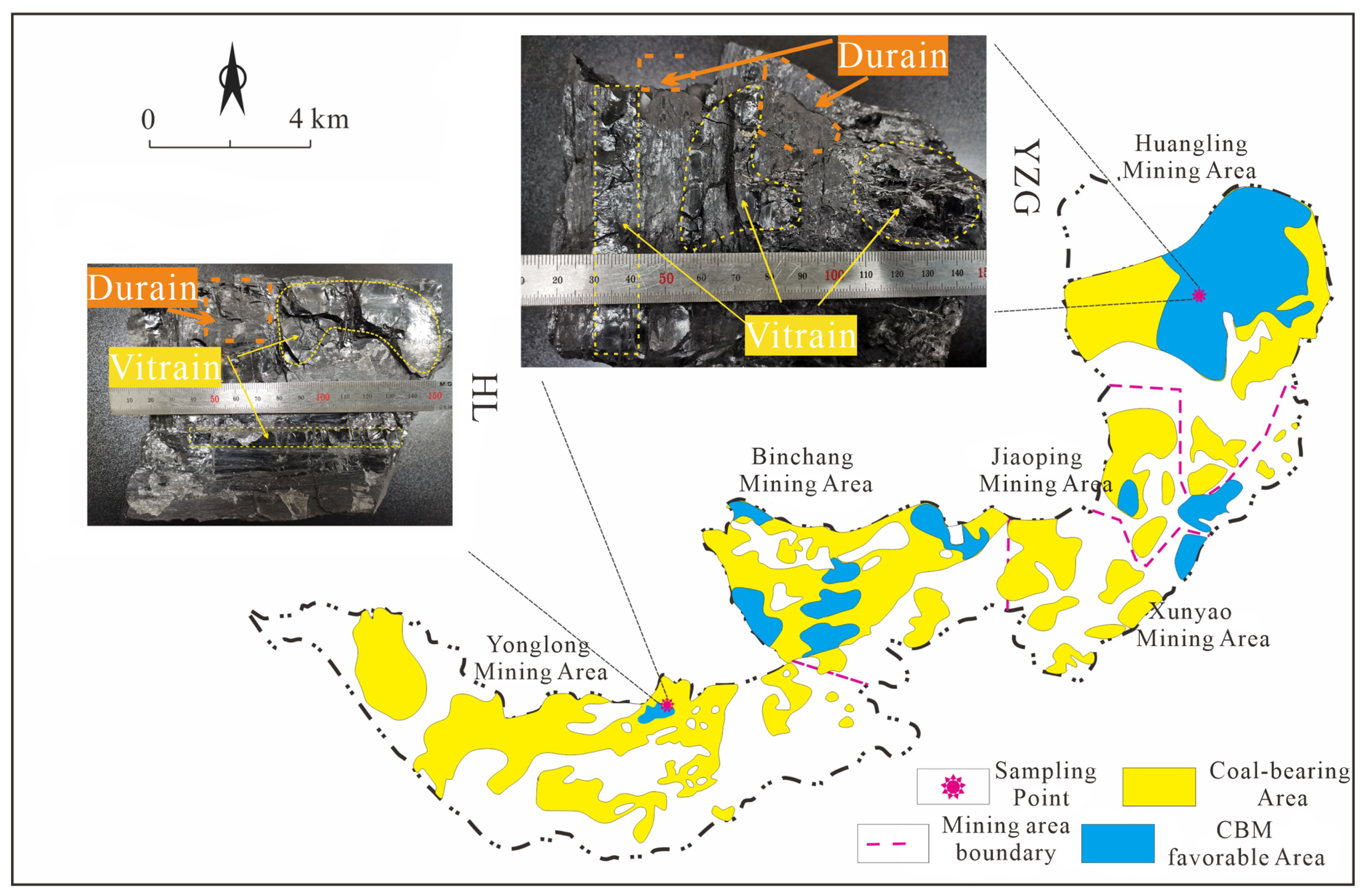
The experimental coal samples, classified as low-rank bituminous coal, were sourced from the Huanglong Jurassic Coalfield on the southwestern margin of the Ordos Basin, China. The YZG coal is black in color, with a brown to brownish-black streak and a bituminous luster; its endogenous fractures are poorly developed. The HL coal exhibits streaks ranging from grayish-brown and dark brown to brownish black, a weak bituminous luster, and its endogenous and exogenous fractures are relatively well-developed (Figure 1). Vitrain (YZG-VC, HL-VC) and durain (YZG-DC, HL-DC) were manually separated in compliance with Chinese national standard GB/T 482-2008 [33]. All samples then underwent a series of analyses including coal petrography, proximate analysis, measurement of basic physical properties, and adsorption or desorption experiments.

2.2. Experiments

The coal samples underwent characterization through the following analytical methods:
Proximate analysis, maceral composition, and vitrinite reflectance were determined in accordance with Chinese national standard GB/T 212-2008 [34], GB/T 15590-2008 [35], and GB/T 6948-2008 [36], respectively. Pore characteristics were evaluated using mercury intrusion porosimeter (AutoPore IV9500 (Micromeritics, Norcross, GA, USA), following Chinese national standard GB/T 21650.1-2008 [37]) and low-temperature nitrogen adsorption (ASAP2020 (Micromeritics, Norcross, GA, USA)), from which parameters including pore volume, specific surface area, and porosity were derived. Wettability was characterized by measuring the coal–water contact angle on polished and dried block samples (3 cm × 3 cm × 2 cm) using an OCA25 optical contact angle analyzer (DataPhysics, Stuttgart, Germany). Reported values represent the average of repeated measurements. Adsorption/desorption behaviour was investigated using an AST-2000 isothermal adsorption–desorption simulation system (Xi’an University of Science and Technology, Xi’an, China), following Chinese industry standard MT/T 752-1997 [38] and Chinese national standard GB/T 19560-2008 [39]. Tests were conducted on air-dried, moisture-equilibrated, CTAC-modified, and BS-12-modified samples. To represent the influence of in situ fractures and macropores—key reservoirs and flow pathways in coal reservoirs—on gas sorption/desorption characteristics [40], all experiments were performed using crushed coal particles with a size of ≈1.0 cm.
V a = a a b a p 1 + b a p
where Va-methane adsorption capacity at reservoir pressure P, cm3/g; aa-maximum methane adsorption capacity, cm3/g; ba-comprehensive parameter reflecting sorption/desorption rate and heat of adsorption, MPa−1.
The Langmuir equation (Equation (1)) was used to analyze the methane adsorption process. In contrast, the desorption behavior, which showed a residual adsorption capacity diverging from the Langmuir curve, was described using the model developed by Ma Dongmin et al. that incorporates this residual amount (Equation (2)) [41].
V d = a d b d p 1 + b d p + c
where Vd-residual methane adsorption capacity at pressure P, cm3/g; ad-maximum methane adsorption capacity, cm3/g; bd-comprehensive parameter reflecting sorption/desorption rate and heat of adsorption, MPa−1; c-residual adsorption capacity at depletion pressure, cm3/g.
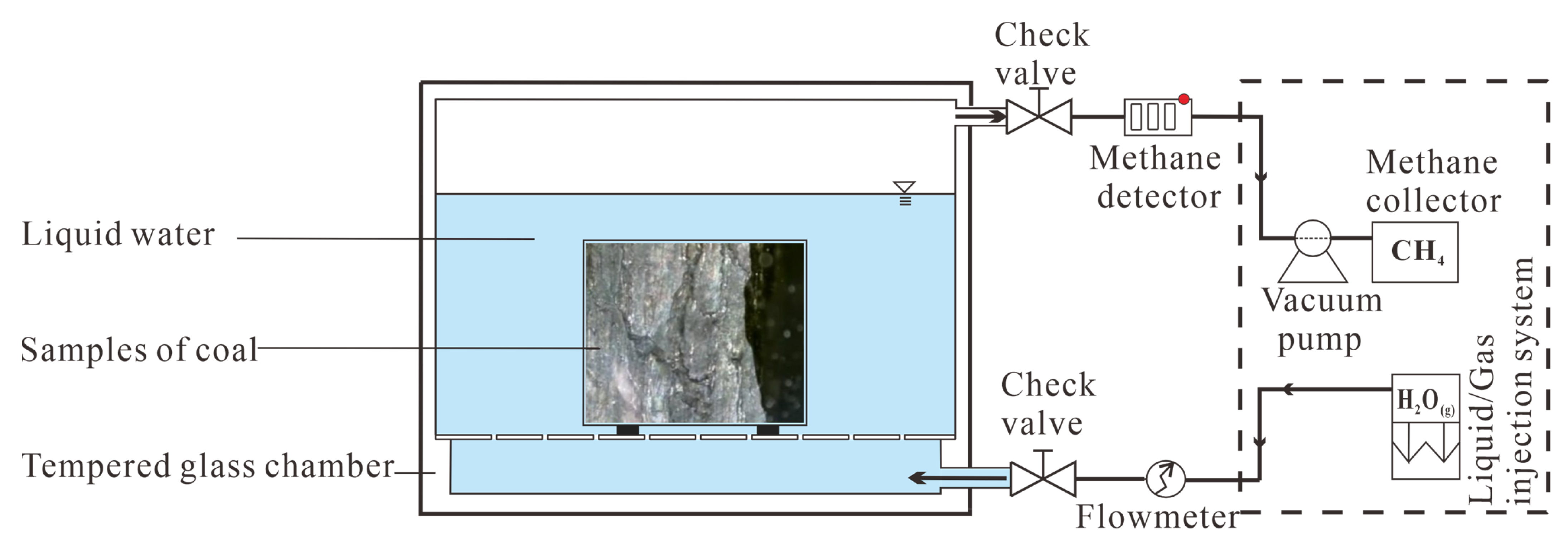
Methane desorption simulation: A negative-pressure extraction experiment (Figure 2) was designed to simulate in situ methane desorption. Procedures included:
(1)
The collected low-rank coal samples (20 cm × 20 cm × 20 cm) were placed into a tempered glass experimental tank filled with solution, ensuring the liquid level was above the coal samples.
(2)
A vacuum pump was then activated for negative pressure extraction. Each time the pressure dropped by 5 kPa, the valve and vacuum pump were closed to observe the rate and size of bubble generation in the tank.
(3)
The vacuum pump and valve were then reopened, and step (2) was repeated until the pattern of bubble generation became constant or no bubbles were produced.
Figure 2. Methane negative-pressure extraction experimental setup.
Processes 14 00207 g002

3. Coal Sample Characteristics

3.1. Characteristics of Coal Petrology and Quality

Petrographic analysis shows that vitrain is rich in vitrinite (avg. 88.39%), while durain contains a high proportion of inertinite (avg. 65.15%). Liptinite content is generally low in both lithotypes, averaging approximately 1.18% (Table 1). In terms of proximate analysis, vitrain exhibits a higher volatile matter yield (avg. 35.11%) compared to durain (avg. 24.13%). The moisture, ash yield, and fixed carbon contents of durain (avg. 4.89%, 8.28%, and 62.88%, respectively) are slightly higher than those of vitrain (avg. 3.53%, 2.29%, and 59.12%) (Table 1).

3.2. Pore Structure Characteristics

3.2.1. High-Pressure Mercury Intrusion

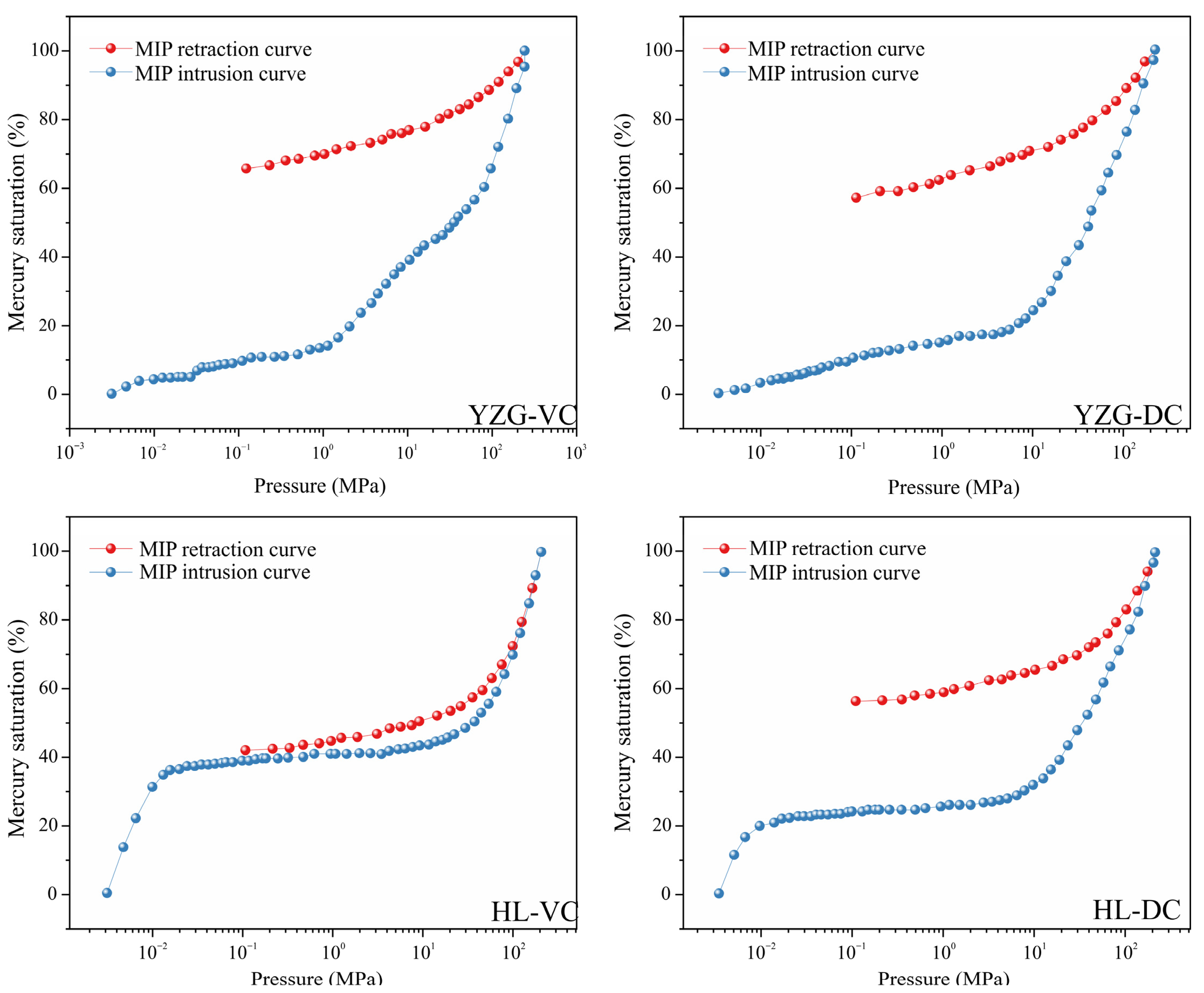
Petrographic analysis According to B. B. Xoдoт’s classification, vitrain in YZG samples has more meso- and micropores than durain, with similar macropores. Durain shows significantly more transitional pores (Figure 3). In brittle HL-VC, macropores are better developed, micro- and transitional pores resemble YZG, but mesopores show the opposite trend. Vitrain exhibits a smaller average pore diameter, higher threshold pressure, and greater tortuosity than durain, indicating finer pore throats and more complex pore structure (Table 2 and Table 3).
The shape of the mercury intrusion curve provides insights into the pore geometry and connectivity (Figure 2). The pronounced hysteresis between the intrusion and retraction mercury curves of the YZG coal sample indicates a pore system dominated by well-connected open pores. The high coincidence between mercury intrusion and retraction curves of the HL-VC sample, along with minimal hysteresis and high retraction efficiency, indicates that apart from macropores (fractures), its pore system is dominated by semi-open pores with poor connectivity. In contrast, the HL-DC sample exhibits significant hysteresis. While its intrusion-retraction curves converge in the high-pressure range (>100 MPa), pronounced hysteresis is observed in the medium-to-low pressure range, indicating poor connectivity among smaller pores but effective connectivity in meso- to macro-pores.

3.2.2. Low-Temperature Nitrogen Adsorption

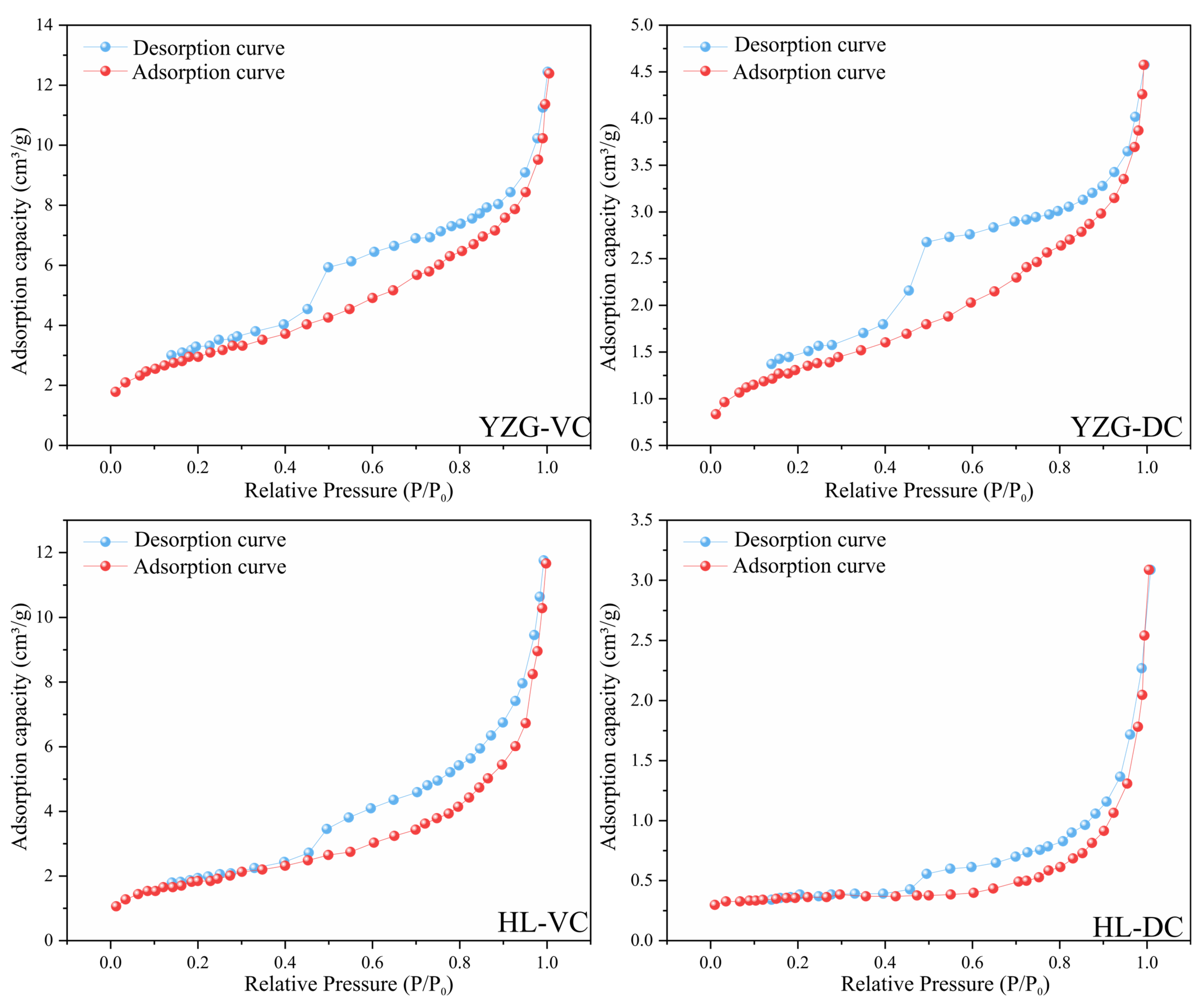
Based on the International Union of Pure and Applied Chemistry (IUPAC) classification of hysteresis loops and its correlation with pore structures in coal adsorption/desorption isotherms [42], the sharp decline in the desorption branch at a relative pressure P/P0 = 0.5 suggests the presence of ink-bottle pores in the tested coal samples [43]. Further analysis of the complete adsorption/desorption isotherms reveals that the pore system does not conform to a single pore type but displays hybrid characteristics consistent with multiple IUPAC hysteresis categories. Notably, the adsorption and desorption branches nearly coincide in the relative pressure ranges of P/P0 < 0.4 and P/P0 > 0.7 (Figure 4), indicating the coexistence of cylindrical pores, slit-shaped pores, parallel plate-like pores, and wedge-shaped semi-open pores, which reflects a structurally heterogeneous pore network. The pore volume distribution follows the order macropores > mesopores > micropores, with specific surface area exhibiting a similar pattern. These features collectively indicate more developed micropores in vitrain and a greater abundance of macropores in durain (Table 4).

3.2.3. Low-Pressure Carbon Dioxide (LP-CO2) Adsorption

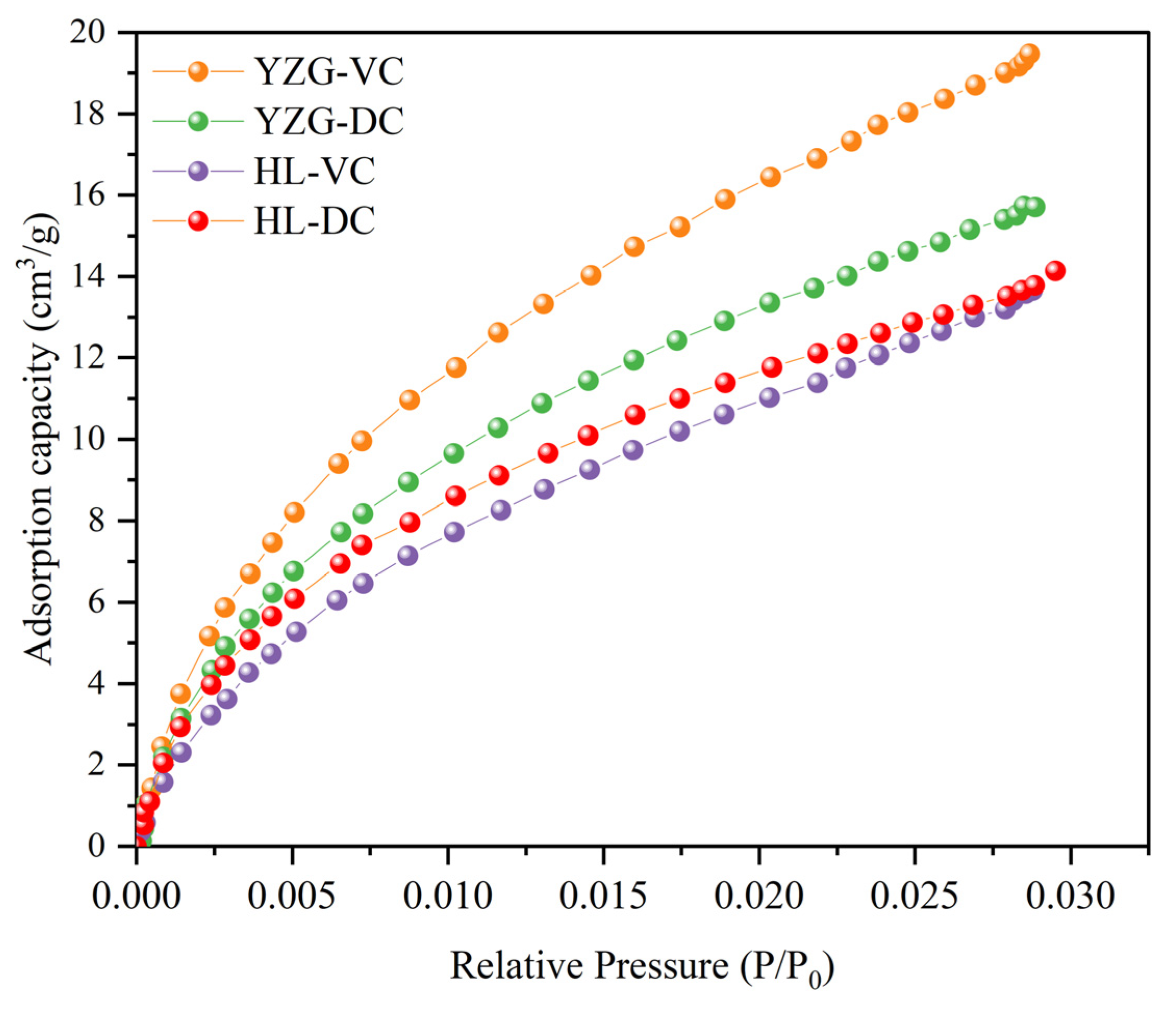
The shapes of the LP-CO2 adsorption isotherms for the different coal samples are largely similar, with vitrain exhibiting greater adsorption capacity than durain. Furthermore, the isotherm of the YZG sample lies above that of the HL sample, indicating a more developed pore structure. The LP-CO2 adsorption/desorption data were analysed using the DFT model. The average pore widths are 0.975 nm and 1.018 nm for YZG-VC and YZG-DC, respectively, and 0.752 nm and 1.023 nm for HL-VC and HL-DC, respectively, indicating that the average micropore width of durain is greater than that of vitrain (Table 5). However, both the pore volume and specific surface area of vitrain are greater than those of durain (Figure 5).

3.2.4. Full-Scale Pore Characteristics

Relying on a single testing method only allows for the analysis of pores within a specific size range, making it difficult to achieve a refined characterization of the full pore size distribution in coal. Therefore, based on the IUPAC pore classification scheme (micropores < 2 nm, mesopores 2–50 nm, macropores > 50 nm), the pore development characteristics of vitrain and durain were accurately characterized across the full pore size spectrum by integrating test results from MIP (for macropores), LT-N2 adsorption (for mesopores), and LP-CO2 adsorption (for micropores), each method targeting its dominant pore size range. The results (Table 6) indicate that macropores remain the largest contributor to total pore volume, accounting for over 50% of the total, followed by micropores, with mesopores constituting the smallest proportion. However, for specific surface area, micropores are the dominant contributor, consistently exceeding 90%, followed in turn by mesopores and macropores. For both the YZG and HL coal samples, the total pore volume and specific surface area of vitrain are greater than those of durain. Considering that the specific surface area provided by pores is critical for coalbed methane adsorption, vitrain holds a distinct advantage due to its well-developed micropores.

3.3. Wettability

The role of surfactants is to effectively improve the wettability of coal reservoirs, enhance desorption through pressure reduction and displacement, mitigate the water blocking effect, promote drainage capacity, and ultimately increase coalbed methane (CBM) recovery. Considering factors such as cost, low damage, and environmental protection, surfactants that carry a positive charge or both positive and negative charges upon dissolution in water were selected. The cationic surfactant chosen is cetyltrimethylammonium chloride (CTAC). The active component of this surfactant is the cation, which is characterized by high water solubility and stability in both acidic and alkaline solutions. The zwitterionic surfactant selected is dodecyl dimethyl betaine (BS-12). The molecular structure of this surfactant contains both positively and negatively charged groups. It exhibits the properties of an anionic surfactant in alkaline aqueous solutions and those of a cationic surfactant in acidic solutions.
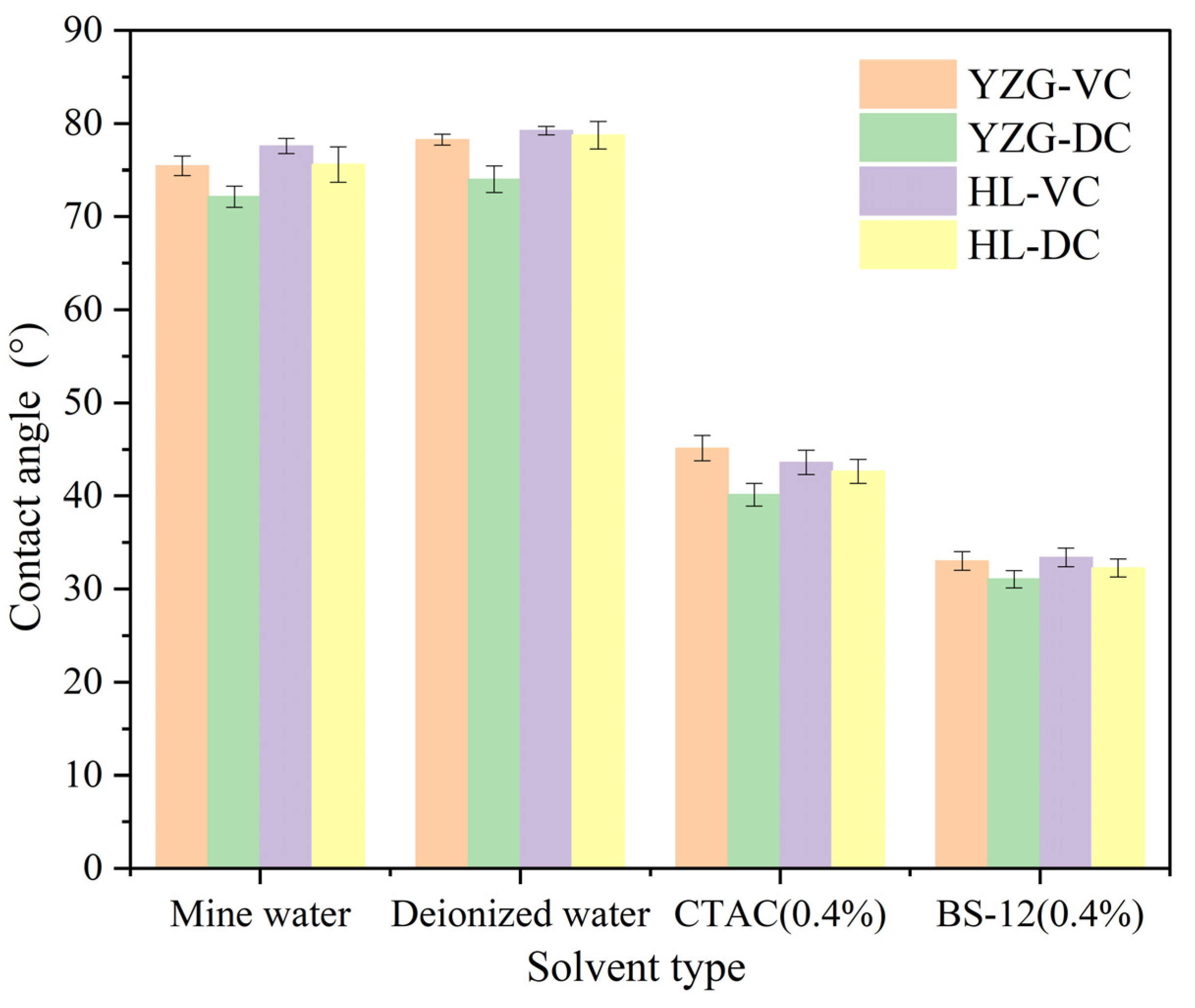
Overall, low-rank coals demonstrate weakly hydrophilic behaviour. Notably, under identical surfactant treatments, vitrain consistently displays larger water contact angles than durain, suggesting that durain possesses stronger intrinsic hydrophilicity. Furthermore, when replacing distilled water with mine water, durain exhibits an approximately twofold greater increase in contact angle compared to vitrain (Figure 6), implying that its wettability is more sensitive to ionic constituents in the aqueous phase. Both BS-12 (dodecyl dimethyl betaine) and CTAC (hexadecyltrimethylammonium chloride) improved the hydrophilicity of coal surfaces, with BS-12 showing the most pronounced enhancement in wettability modification.

4. Methane Adsorption/Desorption Characteristics of Vitrain and Durain

Surfactants modify coal wettability through contact angle alteration. Non-ionic surfactants improve water retention capacity in coal, whereas cationic (CTAC) and zwitterionic (BS-12) surfactants enhance water drainage efficiency [44]. Based on these distinct mechanisms, CTAC and BS-12 were selected for coal treatment in this study, followed by systematic methane adsorption/desorption experiments.

4.1. Methane Adsorption/Desorption Characteristics of Vitrain and Durain

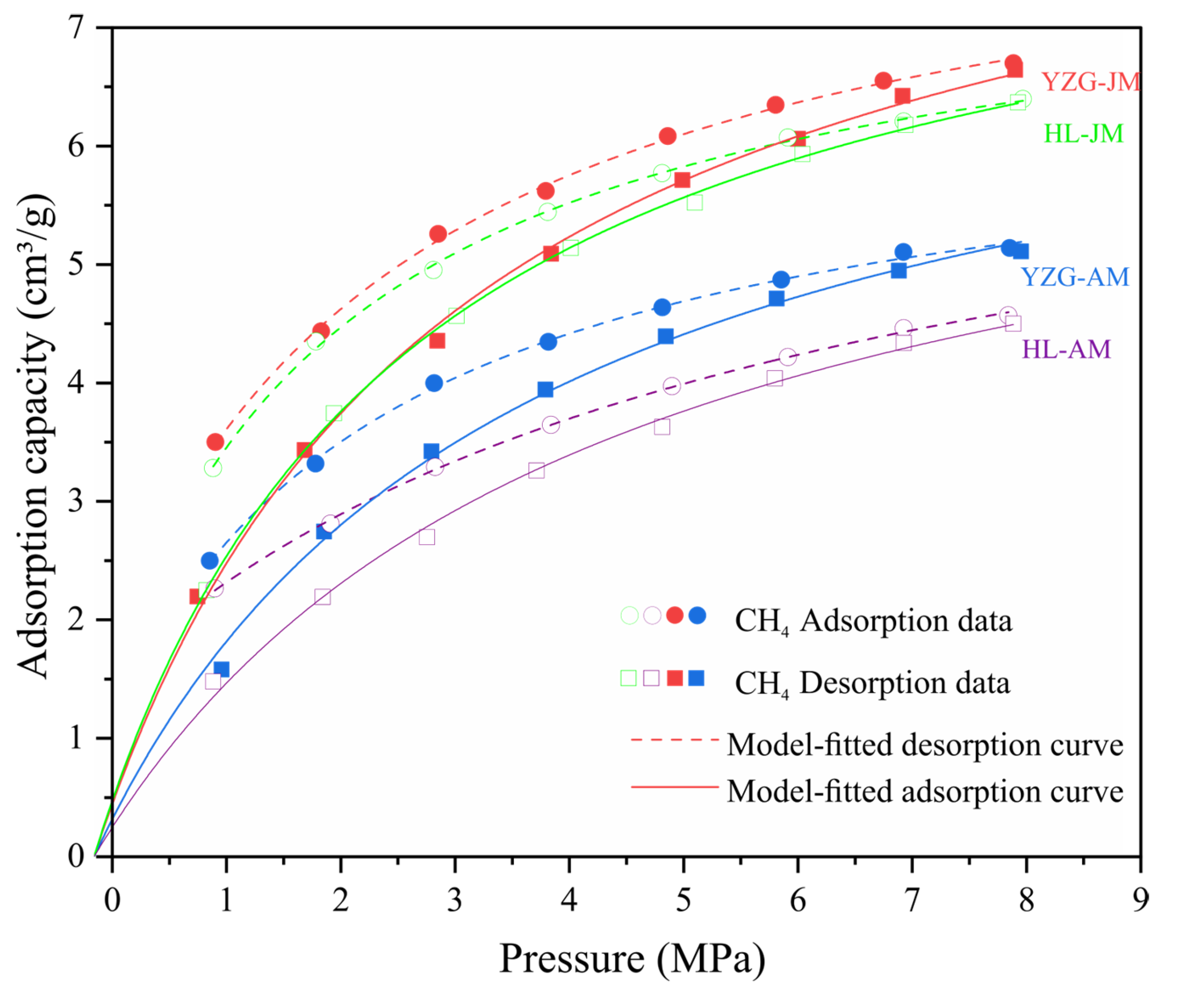
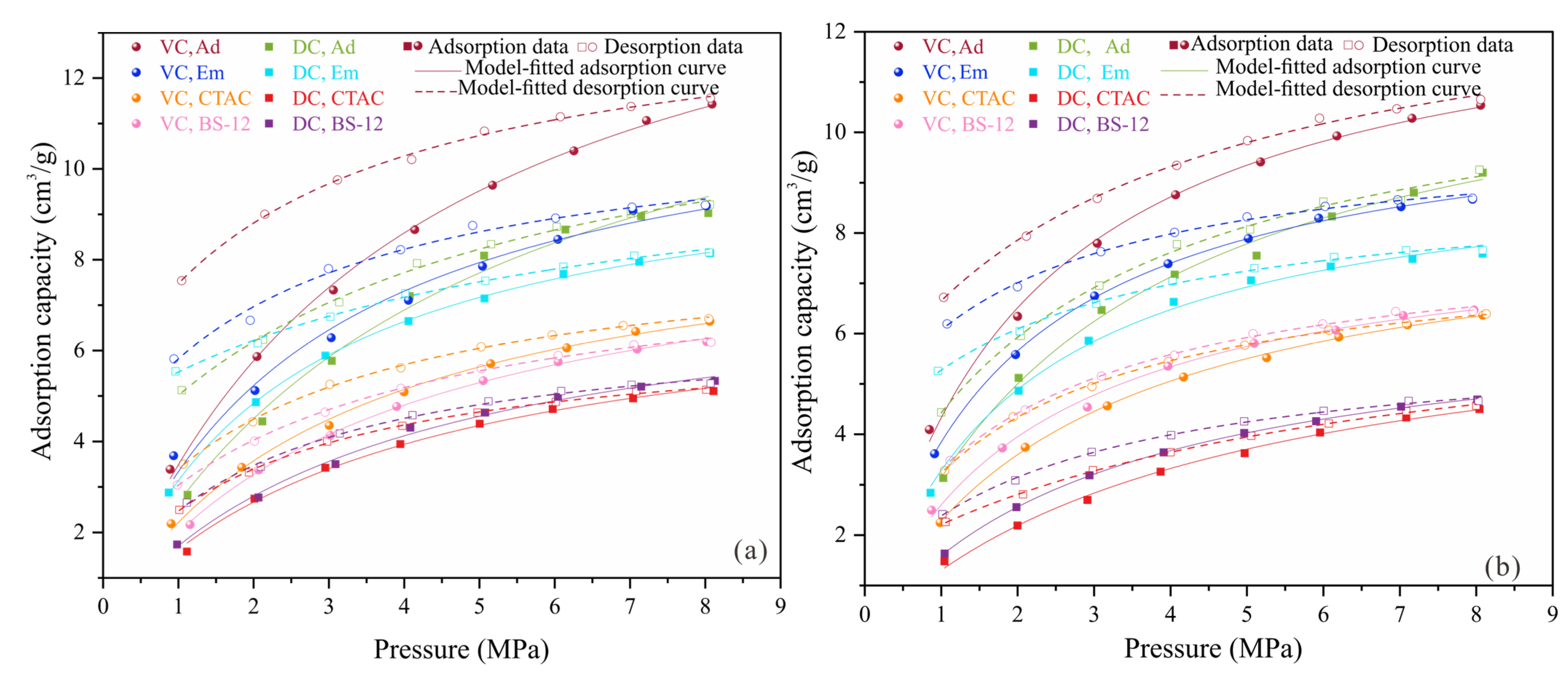
The methane isothermal adsorption data were fitted with the Langmuir model (Table 7). At 298.5 K, durain consistently exhibits a lower saturated adsorption capacity than vitrain within the same coal sample. The Langmuir pressure PL is higher in durain than in vitrain, and a greater PL corresponds to a slower increase in adsorption capacity with increasing pressure, indicating a stronger methane adsorption affinity in vitrain. In contrast, the desorption curves lie above the adsorption curves (Figure 7), revealing distinct desorption hysteresis. Vitrain shows higher residual gas content, whereas durain exhibits a greater desorption ratio and recovery efficiency, demonstrating its superior desorption performance.
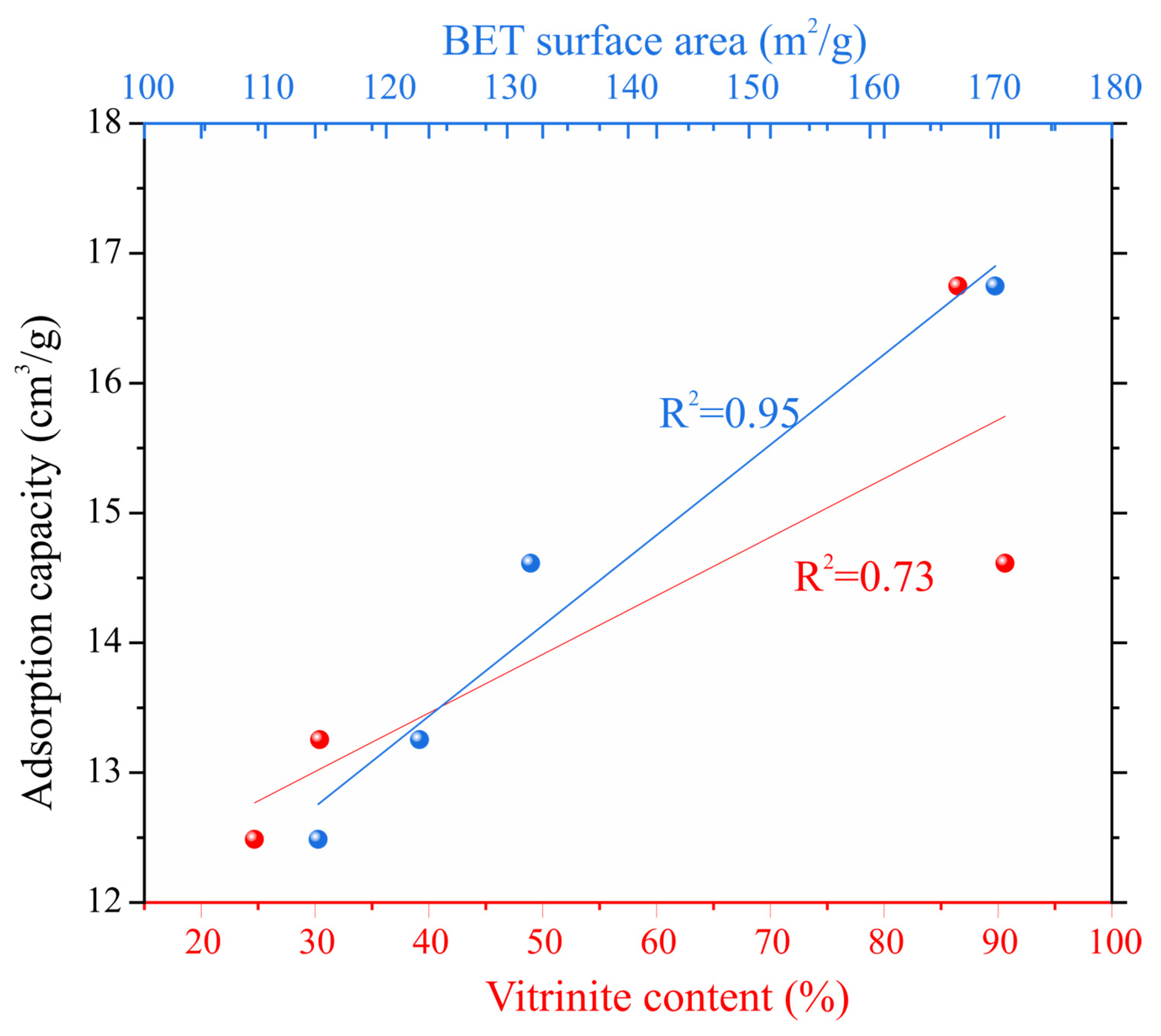
Methane adsorption capacity demonstrates a positive correlation with both specific surface area and vitrinite content (Figure 8). Vitrain exhibits greater methane adsorption capacity than durain, which is attributed to its larger specific surface area-confirming that adsorption capacity is governed by available adsorption space. During depressurization-induced desorption, the interaction forces between methane molecules and vitrain surfaces are stronger than those in durain [45], as a result, methane molecules are more readily released from durain surfaces at equivalent pressures. In the subsequent diffusion stage, the well-developed mesopores and macropores, along with superior pore connectivity in durain, facilitate the transport of desorbed methane.

4.2. Effect of Wettability Differences on Methane Adsorption/Desorption

4.2.1. Effect of Wettability Differences on Methane Adsorption

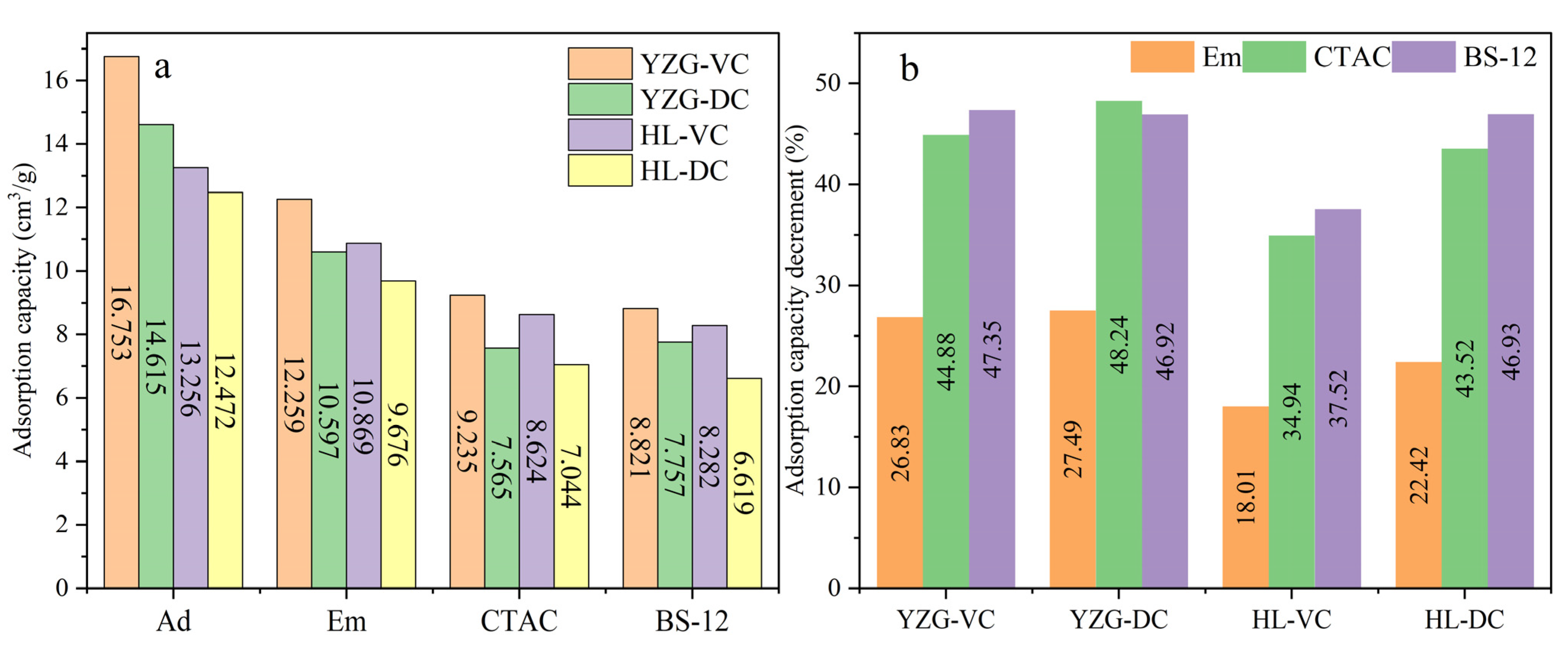
Wettability plays a critical role in governing methane adsorption/desorption behavior, especially in low-rank coal reservoirs. Methane adsorption tests conducted under varied conditions (Table 8) reveal a consistent decline in adsorption capacity in the sequence: air-dried > moisture-equilibrated > CTAC-treated > BS-12-treated samples. This progression correlates with the enhanced wettability alteration achieved by BS-12 relative to CTAC, indicating that zwitterionic surfactants more effectively reduce methane adsorption capacity than their cationic counterparts (Figure 9a). Notably, under air-dried conditions, YZG-DC exhibits higher saturated methane adsorption capacity than HL-VC, attributable to its more developed micropores and greater specific surface area. However, following CTAC-mediated wettability modification, HL-VC displays greater saturated adsorption capacity than YZG-DC. For all samples, the decrease in saturated adsorption capacity was greater for the surfactant-treated samples than for the equilibrium moisture samples (Figure 10). Furthermore, the variation among different samples under the same conditions was overall smaller than the variation for the same sample under different conditions. This indicates that under surfactant treatment, wettability exerts a stronger influence on methane adsorption than pore structure. Surfactant application markedly diminishes the saturated methane adsorption capacity across all coal samples, with the extent of reduction escalating as wettability improves. Furthermore, within a given coal sample, durain undergoes a more substantial decrease in adsorption capacity than vitrain—a differential response ascribed to durain’s inherently stronger hydrophilicity [46,47]—confirming that surfactants influence durain more significantly than vitrain.
The observed reduction in methane adsorption capacity under moisture-equilibrated conditions arises from competitive adsorption, wherein water molecules occupy a portion of the methane adsorption sites [18,48]. Comparison of surfactant-treated samples reveals that BS-12 modified coal exhibits significantly lower saturated methane adsorption capacity than CTAC modified coal. This difference can be explained by distinct adsorption mechanisms: cationic surfactants interact with low-rank coal through short-range exothermic processes, while anionic surfactants involve long-range endothermic interactions [49,50,51]. Specifically, CTAC, bearing a positive charge, readily adsorbs onto low-rank coal via strong electrostatic attraction between its -N+(CH3)3 group and surface -COO- groups [52]. In contrast, the zwitterionic surfactant BS-12 undergoes oriented adsorption on the negatively charged coal surface-the ammonium group is attracted while the carboxyl group is repelled, leading to a V-shaped molecular configuration at the interface [53,54,55], with hydrophobic chains extending into the aqueous phase.

4.2.2. Effect of Wettability Differences on Methane Desorption

The methane adsorption/desorption fitted curves reveal that at identical pressures, the desorption branch corresponds to higher adsorption capacities than the adsorption branch, demonstrating clear hysteresis behaviour (Figure 9). Under the same experimental conditions, a fraction of adsorbed methane molecules remains retained, as reflected by the consistently lower Langmuir volume (VL) values for desorption compared to adsorption (Table 8). In terms of desorption performance, YZG-DC shows a higher desorption ratio than YZG-VC, whereas HL-VC exceeds HL-DC. Recovery efficiency remains relatively uniform across samples, with durain consistently outperforming vitrain in surfactant-modified coal. The presence of moisture suppresses methane desorption capacity, resulting in decreased desorption ratios [56,57]. By contrast, surfactant-treated coal samples display enhanced desorption ratios and recovery efficiency relative to equilibrium moisture samples, indicating that surfactant modification promotes a more conducive environment for methane desorption and subsequent transport.
Under air-dried conditions, the pore network in coal reservoirs offers substantial methane adsorption capacity. Vitrain, characterized by well-developed micropores and a high specific surface area, provides abundant adsorption sites, leading to strong methane adsorption. In contrast, durain exhibits more developed mesopores and macropores but a smaller specific surface area, resulting in lower methane adsorption capacity than vitrain. The presence of moisture induces competitive adsorption between water and methane molecules on pore surfaces. Since the hydrogen bonding energy between coal and water significantly exceeds the van der Waals interactions with methane, water molecules preferentially occupy adsorption sites, thereby reducing methane adsorption capacity [58,59,60]. While vitrain shows a greater affinity for methane, durain contains more polar oxygen-containing functional groups [61], enhancing its water adsorption capacity and wettability.
As a result, under identical moisture conditions, durain adsorbs more water molecules, reflecting its stronger hydrophilic character compared to vitrain. In terms of desorption behaviour, under air-dried conditions, durain exhibits a lower heat of adsorption and weaker methane adsorption energy, along with better pore connectivity. These properties contribute to its higher desorption ratio and recovery efficiency relative to vitrain. Under moist conditions, however, durain’s strong hydrophilicity promotes firm adsorption of water molecules on pore surfaces. Through hydrogen bonding, multilayer adsorption occurs and forms water clusters that block pore throats and weaken pressure transmission, significantly impeding methane desorption [62,63] an effect more evident in durain than in vitrain.

4.3. Methane Desorption Model for Vitrain and Durain

4.3.1. Simulated Methane Desorption Experiment

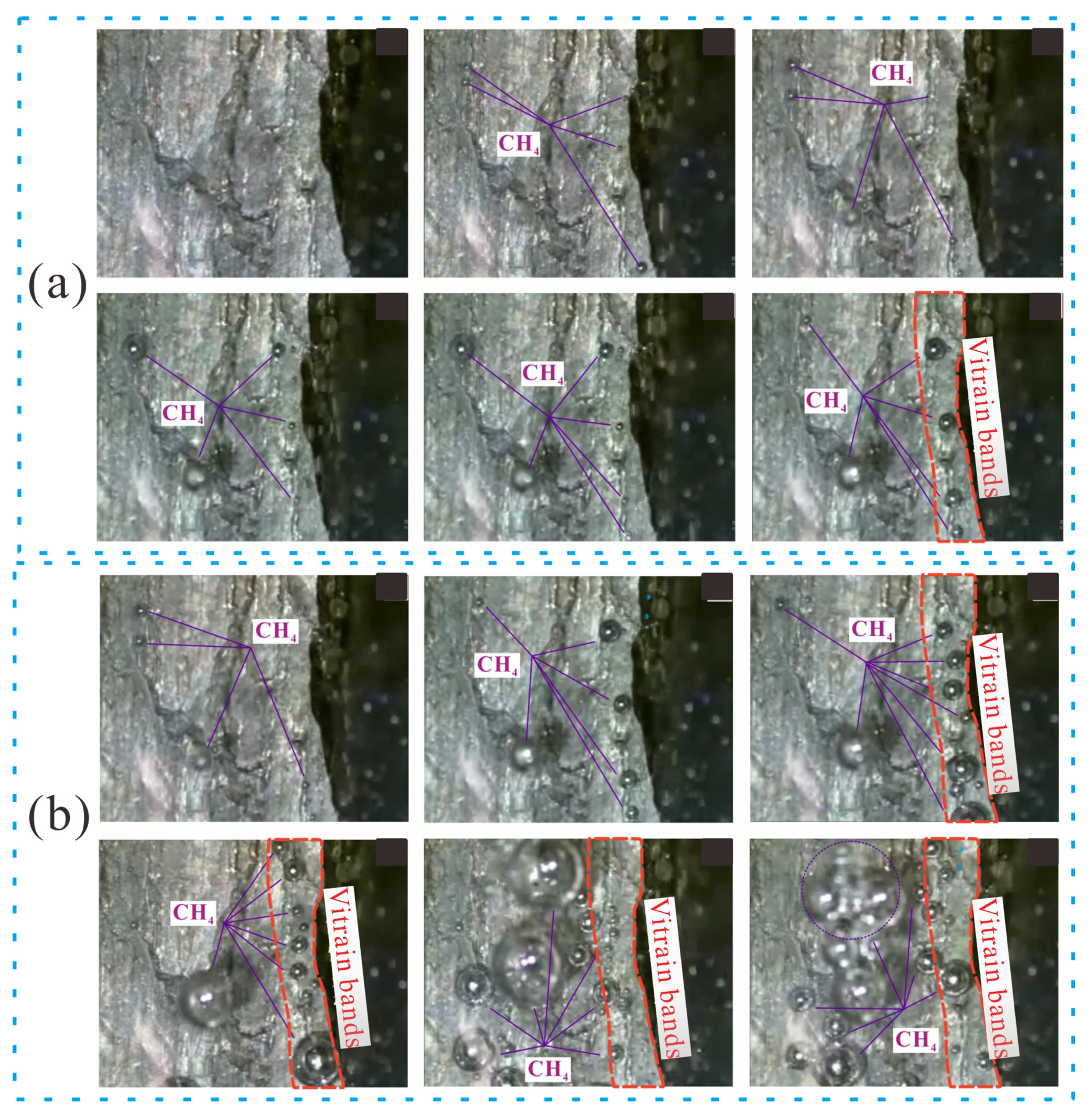
In the methane desorption simulation experiment (Figure 11), the addition of mine water resulted in negligible bubble formation on the coal block surface during the initial extraction stage. When the extraction pressure was reduced to 40 kPa, only small, non-growing bubbles appeared (Figure 11a), and no measurable methane concentration was detected. After 24 h of immersion in CTAC solution and subsequent initiation of negative-pressure extraction, the coal surface initially showed minimal change. As the pressure decreased and extraction continued for 8.5 min, bubble formation was observed. These bubbles grew in size, rose upward, and eventually collapsed (Figure 11b), accompanied by a gradual increase in methane concentration. Notably, methane release exhibited a spatially heterogeneous pattern, concentrating predominantly along lithotype boundaries, with the highest emission frequency occurring at the edges of vitrain bands.

4.3.2. Methane Desorption Model for Vitrain/Durain

The pore system in low-rank coal reservoirs is characterized by a dominance of micropores, accompanied by open, semi-open, and ink-bottle type pore morphologies. In contrast, vitrain contains a significant proportion of poorly connected ink-bottle pores, whereas durain exhibits a higher abundance of open and semi-open conical pores, fewer ink-bottle pores, and significantly better pore connectivity. Building on these structural and wettability distinctions, we developed a desorption model for the vitrain–durain system that incorporates wettability variation as a key controlling factor.
(1)
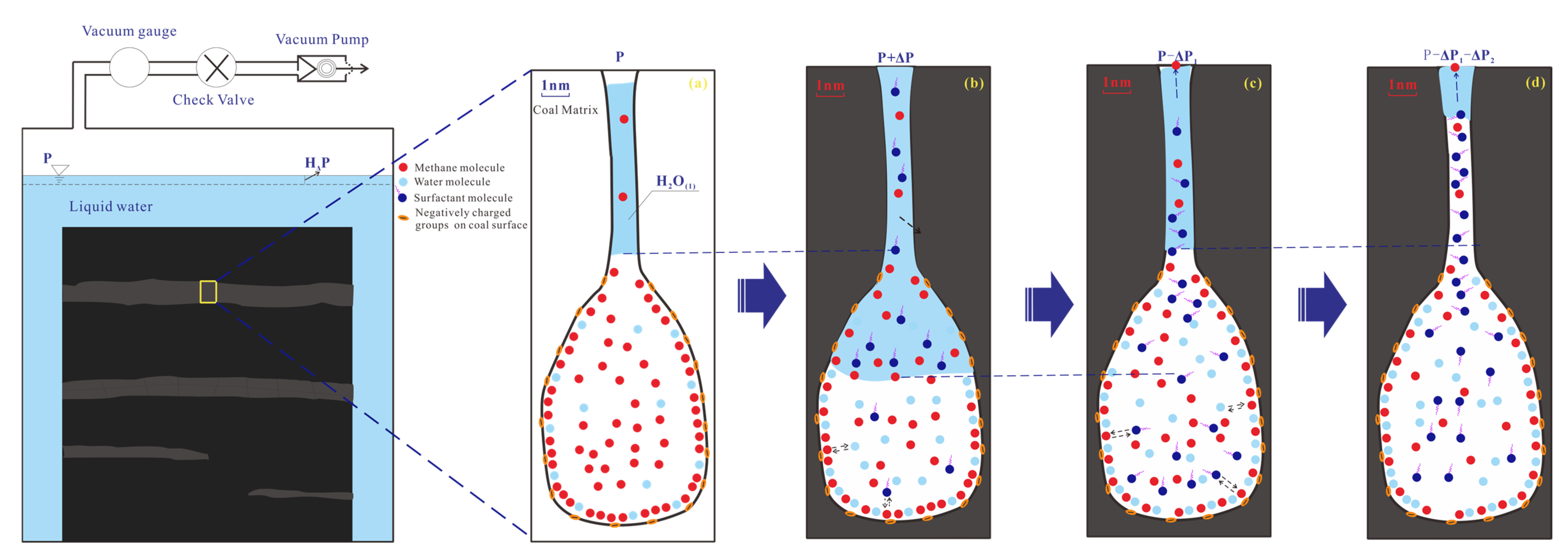
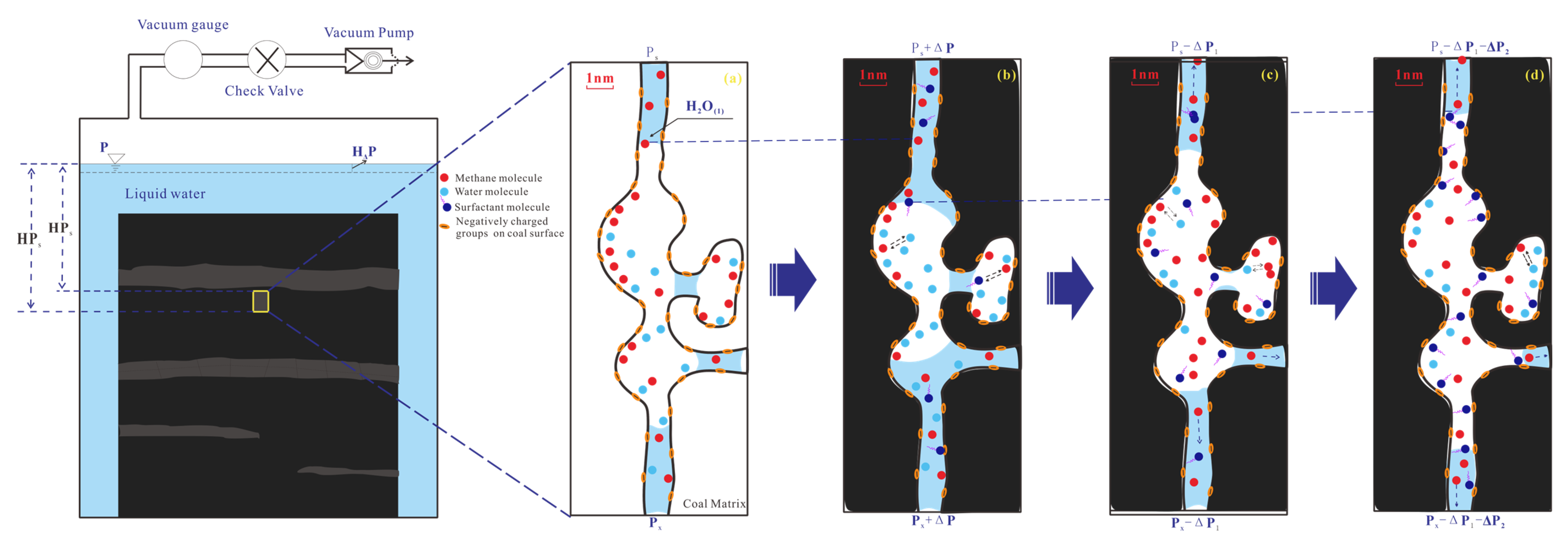
Methane desorption model in vitrain. Based on the pore structure characteristics and size distribution in vitrain, the methane desorption process can be categorized into three main stages (Figure 12):
Under initial reservoir conditions, the internal surfaces of semi-open ink-bottle pores in vitrain are primarily occupied by adsorbed methane, accompanied by minor amounts of gaseous water molecules. Free and dissolved methane are distributed within pore spaces and pore water, while capillary water fills the pore throats. Together, these components establish a solid–liquid–gas three-phase dynamic equilibrium under in situ temperature and pressure conditions (Figure 12a).
After hydraulic fracturing in the coal seam, surfactant-containing fracturing fluid-with reduced surface tension-enters the fractures and pores. It undergoes spontaneous imbibition into micropores, generating a significant amount of water vapor that competes with methane for adsorption sites, thereby promoting methane desorption (Figure 12b).
As dewatering begins in the coalbed methane well, reservoir pressure drops (creating a pressure differential ΔP1), leading to the gradual expulsion of capillary water from pore throats. The small pore sizes in vitrain facilitate rapid pressure transmission, inducing internal vaporization of free pore water from the inside outward-a process enhanced by low-pressure evaporation and wetting-induced exothermic effects. The heat released during water vapor adsorption further promotes the desorption of methane from the adsorbed phase into free gas, which subsequently occupies the available pore space (Figure 12c). Moreover, on surfactant-modified coal surfaces, the accelerated expulsion of capillary water from micropores mitigates water-blocking effects. The resulting increase in free-gas content significantly enhances the two-phase (gas–water) flow capacity within the reservoir (Figure 12d).
(2)
Methane desorption model in durain. Owing to its larger pores and superior connectivity compared to vitrain, the methane desorption behavior and corresponding microscopic processes in durain are illustrated in Figure 13. Although the overall methane production process in durain resembles that in vitrain, its stronger hydrophilicity induces higher capillary forces from aqueous fracturing fluid within micropores, resulting in more pronounced water-blocking effects. However, the larger pore structure and improved connectivity of durain enable the cationic surfactant CTAC in the fracturing fluid to mitigate water blockage effectively. This mitigation enhances the desorption of adsorbed methane and promotes free-gas mass transfer, leading to higher CBM production efficiency in durain than in vitrain.
(3)
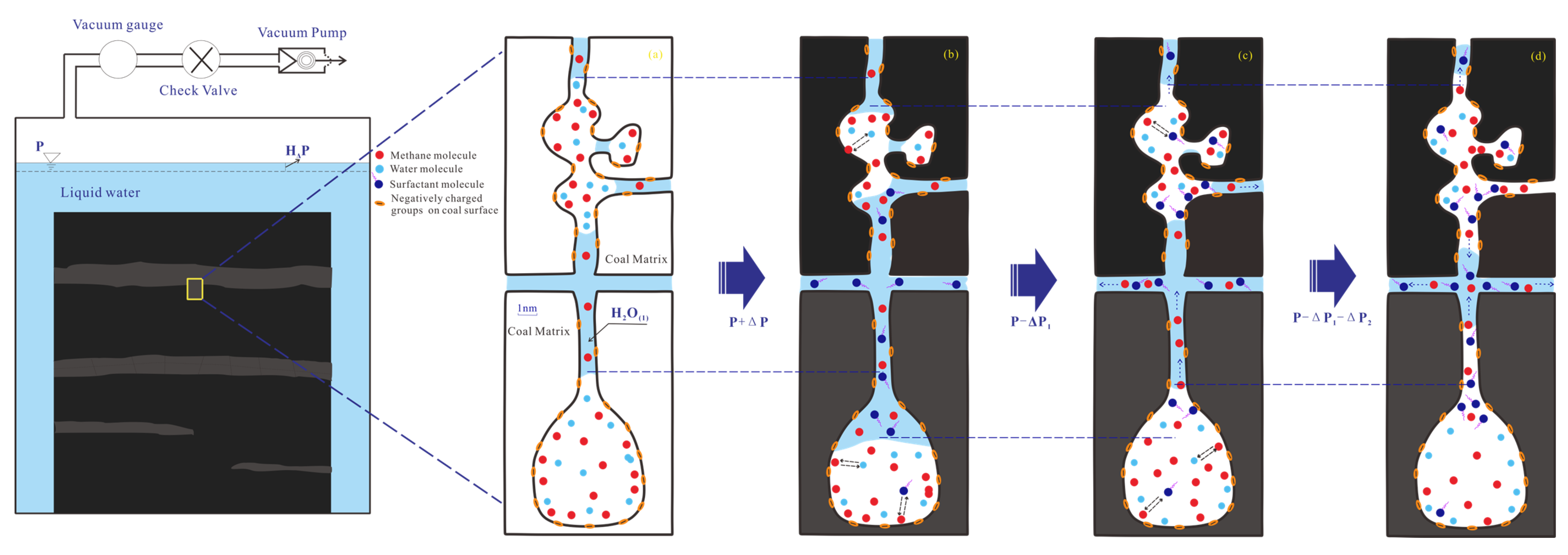
Vitrain-durain methane desorption model. Simulated negative-pressure extraction experiments demonstrate that methane release is preferentially concentrated along vitrain band edges. This localized desorption behaviour arises from the distinct pore structure and wettability contrast at the vitrain–durain interfaces, where wettability-induced interfacial effects promote pressure drawdown and gas release. Consequently, pressure drop-driven methane displacement desorption and convective mass transfer are significantly enhanced in these transitional zones. Integrating the pore and wettability characteristics of both lithotypes, Figure 14 presents a unified methane desorption model detailing the underlying microscopic processes.
Desorption is fundamentally governed by competitive adsorption between CH4 and H2O(g) on the coal surface, manifesting as displacement desorption. In practical CBM extraction, hydraulic fracturing followed by dewatering and depressurization not only enhances free methane displacement but also improves gas and water transport pathways. Adding surfactants to the fracturing fluid further intensifies displacement desorption and alleviates capillary water blockage. Collectively, these mechanisms constitute an integrated desorption process characterized by the following sequence: fracturing-driven displacement → competitive desorption → wettability modification → convective mass transfer.

5. Conclusions

Based on analyses of basic physical properties, pore structure and wettability characterization, and methane adsorption and desorption experiments under varying conditions, this study finely characterized the pore size distribution characteristics of low-rank coal samples. A comparative analysis of the methane adsorption/desorption behaviors of vitrain and durain was then conducted. The influence of pore structure and wettability on methane adsorption/desorption was investigated, followed by a deconstruction of the differences in methane desorption from surfactant-modified coal samples. The study further the mechanism by which wettability differences between vitrain and durain affect methane desorption and ultimately constructed a methane desorption-migration model based on the dual mechanisms of pore structure and wettability. The main findings are as follows:
(1) Analysis of the full-scale pore size distribution characteristics of vitrain and durain revealed the following: the total pore volumes of YZG-VC and YZG-DC are 0.0797 cm3/g and 0.0519 cm3/g, respectively; those of HL-VC and HL-DC are 0.0407 cm3/g and 0.0365 cm3/g, respectively. The specific surface areas of YZG-VC and YZG-DC are 170.919 m2/g and 132.302 m2/g, respectively; those of HL-VC and HL-DC are 122.827 m2/g and 114.572 m2/g, respectively. Overall, within the same coal sample, both the pore volume and specific surface area of vitrain are greater than those of durain. Specifically, vitrain exhibits more developed micropores and fractures, whereas durain shows more developed mesopores. Macropores (>50 nm) contribute to more than 50% of the total pore volume, while micropores (<2 nm) are the core contributor to the specific surface area, accounting for over 90% in all cases. Both CTAC and BS-12 effectively reduced the coal–water interface contact angle. The BS-12 solution achieved an approximately 10° greater reduction than the CTAC solution, with BS-12 showing the most pronounced enhancement in wettability modification.
(2) Moisture and surfactants inhibited the methane adsorption capacity of coal, with a more pronounced effect on durain than on vitrain. Compared to the air-dried coal samples, the equilibrium moisture samples exhibited a reduction in saturated adsorption capacity ranging from 18.01%~27.49%. The reduction for CTAC-modified samples ranged from 34.94%~48.24%, and for BS-12-modified samples, it ranged from 37.52%~48.24%. The desorption ratio and recovery efficiency of surfactant-modified coal samples were higher than those of both equilibrium moisture and air-dried samples, indicating that surfactants improve methane desorption and transport environment.
(3) Methane desorption simulation experiments revealed that methane production was primarily concentrated at the interface between vitrain and durain, namely at the edges of vitrain bands. The cationic surfactant CTAC was found to promote the frequency of methane production. Based on pore structure characteristics, methane desorption behavior, and the observed locations of methane production from water-covered lump coal, a methane desorption model for the vitrain–durain system was constructed. This model elucidates the methane desorption and transport mechanisms constrained by the structural features and wettability differences between vitrain and durain.

Author Contributions

Writing—original draft, Visualization, Validation, Methodology, Formal analysis, Data curation, Conceptualization, J.S.; Writing—review and editing, Visualization, Formal analysis, Data curation, D.M.; Writing—review and editing, Supervision, Resources, Data curation, Y.C. (Yue Chen); Writing—review and editing, Validation, Funding acquisition, H.W.; Writing—review and editing, Validation, Funding acquisition, C.J.; Writing—review and editing, Supervision, Resources, Project administration, Funding acquisition, Conceptualization, C.Z.; Writing—review and editing, Visualization, Validation, P.G.; Writing—review and editing, Visualization, Validation, Y.C. (Yuan Cao); Writing—review and editing, Visualization, Validation, Y.J. All authors have read and agreed to the published version of the manuscript.

Funding

This research is funded by the National Natural Science Foundation of China (Grant No. 41902175), the Open Funding Project of the National Engineering Laboratory for Exploration and Development of Low-Permeability Oil and Gas Fields (Grant No. KFKT2024-02), the Shanxi Province Science and Technology Major Special Funding Project (Grant No. 20201101002). The authors also thank the editors and anonymous reviewers very much for valuable comments and suggestions that have greatly improved the manuscript.

Data Availability Statement

The data presented in this study are available on request from the corresponding author (the data are not publicly available due to privacy or ethical restrictions).

Conflicts of Interest

Author Huaichang Wang was employed by the Research Institute of Exploration and Development, Changqing Oilfield Company, PetroChina. The remaining authors declare that the research was conducted in the absence of any commercial or financial relationships that could be construed as a potential conflict of interest.

Abbreviations

The following abbreviations are used in this manuscript:
CBMCoalbed Methane
CTACCetyltrimethylammonium chloride
BS-12Dodecyl dimethyl betaine

References

  1. Qin, Y.; Moore, T.A.; Shen, J.; Yang, Z.; Shen, Y.; Wang, G. Resources and geology of coalbed methane in china: A review. Int. Geol. Rev. 2017, 60, 777–812. [Google Scholar] [CrossRef] [Scilit]
  2. Lu, H.F.; Xu, F.Y.; Liu, H.X.; Wang, J.; Campbell, D.E.; Ren, H. Emergy-based analysis of the energy security of China. Energy 2019, 181, 123–135. [Google Scholar] [CrossRef] [Scilit]
  3. Song, Y.; Liu, S.; Ma, X.; Ju, Y.; Hong, F. Accumulation models for coalbed methane in medium- to high-rank coals: Examples from the southern Qinshui Basin and southeastern Ordos Basin. Aust. J. Earth Sci. 2018, 65, 575–590. [Google Scholar] [CrossRef] [Scilit]
  4. Guo, H.J.; Yuan, L.; Cheng, Y.P.; Wang, K.; Xu, C.; Zhou, A.T.; Zang, J.; Liu, J.J. Effect of moisture on the desorption and unsteady-state diffusion properties of gas in low-rank coal. J. Nat. Gas Sci. Eng. 2018, 57, 45–51. [Google Scholar] [CrossRef] [Scilit]
  5. Liu, J.J.; Yang, D.; Yang, M.; Nie, Z.S.; Wang, D. Research on the main control factors of gas desorption in middle and low rank coals based on orthogonal testing. Fuel 2024, 357, 129862. [Google Scholar] [CrossRef] [Scilit]
  6. Tōsen, M. Study on Wettability of Coal and Its Applications; Coal Industry Press: Beijing, China, 1992. [Google Scholar]
  7. Jia, L.; Li, K.W.; Shi, X.H.; Zhao, L.P.; Linghu, J.S. Application of gas wettability alteration to improve methane drainage performance: A case study. Int. J. Min. Sci. Technol. 2021, 31, 621–629. [Google Scholar] [CrossRef] [Scilit]
  8. Shi, G.Q.; Han, C.; Wang, Y.M.; Wang, H.T. Experimental study on synergistic wetting of a coal dust with dust suppressant compounded with noncationic surfactants and its mechanism analysis. Powder Technol. 2019, 356, 1077–1086. [Google Scholar] [CrossRef] [Scilit]
  9. Zhou, Q.; Qin, B.; Ma, D.; Jiang, N. Novel technology for synergetic dust suppression using surfactant-magnetized water in underground coal mines. Process Saf. Environ. Prot. 2017, 109, 631–638. [Google Scholar] [CrossRef] [Scilit]
  10. Wang, G.; Huang, T.; Yan, S.; Liu, X. Experimental study of the fracturing-wetting effect of VES fracturing fluid for the coal seam water injection. J. Mol. Liq. 2019, 295, 111715. [Google Scholar] [CrossRef] [Scilit]
  11. Wang, X.; Yuan, S.; Jiang, B. Experimental investigation of the wetting ability of surfactants to coals dust based on physical chemistry characteristics of the different coal samples. Adv. Powder Technol. 2019, 30, 1696–1708. [Google Scholar] [CrossRef] [Scilit]
  12. Ahmadi, Y. Improving Fluid Flow through Low Permeability Reservoir in the Presence of Nanoparticles: An Experimental Core Flooding WAG Tests. Lranian J. Oil Gas Sci. Technol. 2023, 12, 1–14. [Google Scholar] [CrossRef]
  13. Mansouri, M.; Ahmadi, Y.; Sedghamiz, M.A.; Vaferi, B. Experimental investigation of the influence of ZnO-CuO nanocomposites on interfacial tension, contact angle, and oil recovery by spontaneous imbibition in carbonate rocks. Phys. Fluids 2024, 36, 106612. [Google Scholar] [CrossRef] [Scilit]
  14. Zheng, C.; Ma, D.M.; Chen, Y.; Zheng, G.; Teng, J.X. Pore structure of different macroscopically distinguished components within low-rank coals and its methane desorption characteristics. Fuel 2021, 293, 120465. [Google Scholar] [CrossRef] [Scilit]
  15. Peng, T.; Chen, Y.; Wang, L.Y.; Ma, D.M.; Li, G.F.; Li, W.B.; Zheng, C.; Ji, Y.S.; Ma, Z.Y.; Hui, P.; et al. Mechanism of Methane Adsorption/Desorption in Low-Rank Vitrain and Durain Coal Affected by Pore Structure and Wettability: A Case Study in Dafosi Area, South Ordos Basin, China. Energies 2022, 15, 5094. [Google Scholar] [CrossRef] [Scilit]
  16. Lyu, S.; Chen, X.J.; Lu, B.; Li, Y.L.; Ji, Z.Y. Wettability Variations among Macroscopic Components of High-Rank Coal and Their Effects on Permeability-Stress Correlations: An Experimental Study. Energy Fuels 2025, 39, 1813–1827. [Google Scholar] [CrossRef] [Scilit]
  17. Lu, W.Y.; Huang, B.X.; Chen, S.L.; Zhao, X.L. Experimental verification of the water-methane displacement effect in gassy coal. Int. J. Oil Gas Coal Technol. 2020, 23, 126–141. [Google Scholar] [CrossRef] [Scilit]
  18. Zhao, J.J.; Lin, B.Q.; Liu, T.; Liu, T.; Ma, S.Q.; Tian, S.X. Mechanism of water adsorption and penetration at the coal interface under methane pressure and temperature. Phys. Fluids 2025, 37, 062018. [Google Scholar] [CrossRef] [Scilit]
  19. Chen, M.Y.; Chen, X.Y.; Wang, L.; Tian, F.C.; Yang, Y.M.; Zhang, X.J.; Yang, Y.P. Water adsorption characteristic and its impact on pore structure and methane adsorption of various rank coals. Environ. Sci. Pollut. Res. 2022, 29, 29870–29886. [Google Scholar] [CrossRef] [Scilit]
  20. Chao, Z.; Ma, D.M.; Chen, Y.; Ji, Y.S.; Ma, Z.Y.; Wang, L.Y.; Wang, X. Research progress micro effect of water on coalbed methane adsorption/desorption. Coal Sci. Technol. 2023, 51, 256–268. [Google Scholar] [CrossRef]
  21. Wang, Z.; Xiong, J.; Zhang, Y.; Tao, G.; Pan, J.; Niu, Q. Investigation of Permeability Stress Induced Damage Evolution of Shallow and Deep Coal Reservoirs in the Junggar Basin, China. Rock Mech. Rock Eng. 2025. [Google Scholar] [CrossRef] [Scilit]
  22. Zhang, L.X.; Zhang, S.H.; Tang, S.H.; Xi, Z.D.; Li, J.X.; Zhang, Q.; Zhang, K.; Tian, W.G. Molecular Dynamics Unveiled: Temperature-Pressure-Coal Rank Triaxial Coupling Mechanisms Governing Wettability in Gas-Water-Coal Systems. Processes 2025, 13, 2209. [Google Scholar] [CrossRef] [Scilit]
  23. Liu, S.; Fu, X.; Xu, Y.; Lun, Z.; Zhao, C.; Wang, H.; Zhang, D. Influence of Water on Nitrous Oxide Adsorption and Desorption on Coals. Ind. Eng. Chem. Res. 2021, 60, 4714–4726. [Google Scholar] [CrossRef] [Scilit]
  24. Chen, Y.; Ma, D.M.; Xie, Y.C.; Guo, C.; Fu, Y.; Shao, K. Study on wettability and influencing factors of different macroscopic components in low rank coal. Coal Sci. Technol. 2019, 47, 97–104. [Google Scholar] [CrossRef]
  25. Li, J.Y.; Li, K.Q. Influence factors of coal surface wettability. J. China Coal Soc. 2016, 41, 448–453. [Google Scholar] [CrossRef]
  26. Zhang, S.Y.; Shao, S.X.; Yang, Z.G. Mechanism Analysis on the Effect of Liquid Water on Coal Adsorbing Methane. J. China Univ. Min. Technol. 2009, 38, 707–712. [Google Scholar]
  27. Zhang, S.Y. Study on the Interaction Mechanism of Solid-Liquid-Gas in Coal Reservoir. Ph.D. Thesis, China University of Mining and Technology, Beijing, China, 2009. [Google Scholar]
  28. Liu, Z.; Ren, H.; Yang, Z.; Liao, Y.; Cao, Y. Effect of mixed collector addition sequence on the adsorption behavior of low-rank coal surface: Experimental and molecular dynamics simulation study. Powder Technol. 2022, 1397, 117119. [Google Scholar] [CrossRef] [Scilit]
  29. Chen, J.; Wang, Z.; Fan, Y. Experimental study on desorption promoting effect of coal containing gas by water natural invasion. J. Saf. Sci. Technol. 2016, 12, 76–80. [Google Scholar]
  30. Chen, J.; Wan, Z.; Yue, J.; Fan, Y. Experimental study for the coal gas de-sorption regularity in the process of moistening. J. Saf. Environ. 2017, 17, 1309–1313. [Google Scholar] [CrossRef]
  31. Liu, X.; Kan, T.; Liu, K. Effect of water intrusion on gas desorption of loaded coal containing gas. Saf. Coal Mines 2018, 49, 6–9+13. [Google Scholar] [CrossRef]
  32. Li, P.; Du, F.; Wang, F.; Zhang, P.; Jiang, Y.; Cui, B. Influence of water injection on the desorption characteristics of coalbed methane. Energy Sci. Eng. 2020, 8, 4222–4228. [Google Scholar] [CrossRef] [Scilit]
  33. GB/T 482-2008; Sampling of Coal Seams. Standardization Administration of the People’s Republic of China: Beijing, China, 2008.
  34. GB/T 212-2008; Proximate Analysis of Coal. Standardization Administration of the People’s Republic of China: Beijing, China, 2008.
  35. GB/T 15590-2008; Method of Determining Microlithotype Composition. National Technical Committee on Coal Standardization of China: Xi’an, China, 2008.
  36. GB/T 6948-2008; Method of Determining Microscopically the Reflectance of Vitrinite in Coal. National Technical Committee on Coal Standardization of China: Xi’an, China, 2008.
  37. GB/T 21650.1-2008; Pore Size Distribution and Porosity of Solid Materials by Mercury Porosimetry and Gas Adsorption—Part 1: Mercury Porosimetry. Standardization Administration of the People’s Republic of China: Beijing, China, 2008.
  38. MT/T 752-1997; Determine Method of Methane Adsorption Capacity in Coal. National Technical Committee on Coal Standardization of China: Fushun, China, 1997.
  39. GB/T 19560-2008; Experimental Method of High-Pressure Isothermal Adsorption to Coal. National Technical Committee on Coal Standardization of China: Xi’an, China, 2008.
  40. Kang, Z.; Li, X.; Li, W.; Zhao, J. Experimental investigation of methane adsorption/desorption behavior in coals with different coal-body structure and its revelation. J. China Coal Soc. 2018, 43, 1400–1407. [Google Scholar] [CrossRef]
  41. Ma, D.M.; Zhang, S.A.; Lin, Y.B. Isothermal adsorption and desorption experiment of coal and experimental results accuracy fitting. J. China Coal Soc. 2011, 36, 477–480. [Google Scholar] [CrossRef]
  42. Matthias, T.; Katsumi, K.; Neimark, A.V.; Olivier, J.P.; Rodriguez-Reinoso, F.; Rouquerol, J.; Sing, K.S. Physisorption of gases, with special reference to the evaluation of surface area and pore size distribution (IUPAC Technical Report). Pure Appl. Chem. 2015, 87, 1051–1069. [Google Scholar] [CrossRef] [Scilit]
  43. Tao, G.; Wang, Z.; Jin, Y.; Wang, H.; Xia, D.; Pan, J. Multiscale Pore-Fracture Structure Characteristics of Deep Coal Reservoirs in the Eastern Margin of the Ordos Basin, China. Nat. Resour. Res. 2025, 34, 1557–1584. [Google Scholar] [CrossRef] [Scilit]
  44. Ji, L.; Wang, W.; Yang, H.; Zhang, T.; Zhang, Z.; Wang, H.; Li, J.; Zheng, C. Influence of different surfactants on wettability of vitrain and durain. J. Xi’An Univ. Sci. Technol. 2024, 44, 144–154. [Google Scholar] [CrossRef]
  45. Ma, D.; Tang, C.; Chen, Y.; Wang, H.; Li, G.; Ji, C.; Wang, L.; Zhu, H.; Liu, Z. Effect of vitrain/durain nanopores on H2O adsorption based on molecular structure differences. Geoscience 2025, 39, 1349–1362. [Google Scholar] [CrossRef]
  46. Semenova, S.A.; Patrakov, Y.F.; Lyrshchikov, S.Y. Dependence of Coal Surface Wettability on the Petrographic Composition. Solid Fuel Chem. 2020, 54, 69–78. [Google Scholar] [CrossRef] [Scilit]
  47. Xin, F.; Xu, H.; Tang, D.; Cao, C. Storage Potential of Multi-State Fluids in Different Lithotypes of Lignite: An in Situ Water-Gas-Bearing Analysis Based on Nuclear Magnetic Resonance. Nat. Resour. Res. 2023, 32, 1199–1214. [Google Scholar] [CrossRef] [Scilit]
  48. Zhang, H.; Song, C.; Du, S.L.; Li, Y.T.; Zhao, H.B.; Wang, T. Microscopic mechanisms of water-coal interactions on methane adsorption: A combined DFT and MD study. Chem. Eng. Sci. 2025, 319, 122249. [Google Scholar] [CrossRef] [Scilit]
  49. Li, W.F.; Wang, H.N.; Li, X.; Liang, Y.N.; Wang, Y.T.; Zhang, H.J. Effect of mixed cationic/anionic surfactants on the low-rank coal wettability by an experimental and molecular dynamics simulation. Fuel 2021, 289, 119886. [Google Scholar] [CrossRef] [Scilit]
  50. Li, R.S.; Xie, Z.J.; Zhou, Y.; Wang, W.L.; Gui, X.H. Interfacial interaction mechanism between alkali metal ions and cationic/anionic surfactants and insight into low-rank coal flotation. Adv. Powder Technol. 2024, 35, 104640. [Google Scholar] [CrossRef] [Scilit]
  51. Yang, X.N.; Xiao, P.; Wang, R.Z.; Hu, B.; Zhang, X.Y.; Li, E.Y.; Su, R.W. Mechanistic analysis of coal wettability enhancement by nanoparticle-assisted surfactant systems in aqueous/salt solution environment. Fuel 2025, 405, 136822. [Google Scholar] [CrossRef] [Scilit]
  52. Wang, C.; Xing, Y.; Xia, Y.; Zhang, R.; Wang, S.; Li, J.; Gui, X. Regulation mechanism of ionic surfactant on the wettability of low rank coal. J. China Coal Soc. 2022, 47, 3101–3107. [Google Scholar] [CrossRef]
  53. Li, N.; Zhang, G.C.; Ge, J.J.; Jin, L.C.; Zhang, J.Q.; Ding, B.D.; Pei, H.H. Adsorption Behavior of Betaine-Type Surfactant on Quartz Sand. Energy Fuels 2011, 25, 4430–4437. [Google Scholar] [CrossRef] [Scilit]
  54. Kumar, A.; Mandal, A. Critical investigation of zwitterionic surfactant for enhanced oil recovery from both sandstone and carbonate reservoirs: Adsorption, wettability alteration and imbibition studies. Chem. Eng. Sci. 2019, 209, 115222. [Google Scholar] [CrossRef] [Scilit]
  55. Jin, H.; Zhang, Y.; Dong, H.; Zhang, Y.; Sun, Y.; Shi, J.; Li, R. Molecular dynamics simulations and experimental study of the effects of an ionic surfactant on the wettability of low-rank coal. Fuel 2022, 320, 123951. [Google Scholar] [CrossRef] [Scilit]
  56. Nie, B.; Liu, X.; Yuan, S.; Ge, B.; Jia, W.; Wang, C.; Chen, X. Sorption charateristics of methane among various rank coals: Impact of moisture. Adsorption 2016, 22, 315–325. [Google Scholar] [CrossRef] [Scilit]
  57. Wang, F.; Yao, Y.B.; Wen, Z.A.; Sun, Q.P.; Yuan, X.H. Effect of water occurrences on methane adsorption capacity of coal: A comparison between bituminous coal and anthracite coal. Fuel 2020, 266, 117102. [Google Scholar] [CrossRef] [Scilit]
  58. Liao, Y.; Gao, Z.; Yang, W.; Zhong, J.; Ding, Y. Weak interaction between water molecule and different rank coals: A DFT-D3 study. Int. J. Oil Gas Coal Technol. 2019, 21, 91–108. [Google Scholar] [CrossRef] [Scilit]
  59. Jiang, B.; Huang, J.; Yu, C.F.; Wang, X.H.; Zhou, Y.; Zheng, Y.; Ji, B.; Zhang, Q. Experimental and theoretical study on molecular structure construction of Hongliulin coal. Fuel 2023, 349, 128708. [Google Scholar] [CrossRef] [Scilit]
  60. Zhang, J.S.; Ni, X.M.; Liu, G.F.; Liu, X. Wetting Behaviors and Mechanisms of Coal Modified by Different Types of Surfactants under Intervention Using KCl. Langmuir 2025, 41, 10250–10262. [Google Scholar] [CrossRef] [Scilit] [PubMed]
  61. Fan, J.W.; Du, M.L.; Liu, L.; Li, G.; Wang, D.C.; Liu, S. Study on the separation of lithotypes and their properties: A case study in the Permian period coal of the Dahebian coal mine, Liupanshui coalfield, China. Int. J. Coal Prep. Util. 2023, 43, 1697–1720. [Google Scholar] [CrossRef] [Scilit]
  62. Tang, H.Y.; Wang, X.H.; Feng, L.; Cao, Z.X.; Liu, X.C. Theoretical study on the interactions between the lignite monomer and water molecules. Russ. J. Phys. Chem. A 2015, 89, 1605–1613. [Google Scholar] [CrossRef] [Scilit]
  63. Wang, C.; Xing, Y.; Wang, S.; Xia, Y.; Li, J.; Gui, X. Predicting the adsorption configurations of water clusters on-COOH and-OH using DFT calculations. Comput. Mater. Sci. 2024, 245, 113295. [Google Scholar] [CrossRef] [Scilit]
Figure 1. Sample collection sites and macroscopic characteristics.
Processes 14 00207 g001
Figure 3. Mercury intrusion-retraction curves of vitrain and durain.
Processes 14 00207 g003
Figure 4. N2 adsorption/desorption isotherms of vitrain and durain.
Processes 14 00207 g004
Figure 5. LP-CO2 adsorption isotherms of vitrain and durain.
Processes 14 00207 g005
Figure 6. Contact angles of vitrain and durain treated with different surfactants.
Processes 14 00207 g006
Figure 7. Methane adsorption/desorption isotherms of coal samples.
Processes 14 00207 g007
Figure 8. Effect of vitrinite content and surface area on methane adsorption.
Processes 14 00207 g008
Figure 9. Adsorption/Desorption isotherms of coal samples with different wettability: (a) YZG; (b) HL.
Processes 14 00207 g009
Figure 10. Comparison of changes in saturated adsorption capacity between vitrain and durain (a) saturated adsorption capacity, (b) variation magnitude.
Processes 14 00207 g010
Figure 11. Simulated process of negative-pressure methane extraction: (a) Mine Water; (b) CTAC.
Processes 14 00207 g011
Figure 12. Methane desorption model and microscopic processes at the vitrain interface pores: (a) Original coal reservoir pores; (b) Hydraulic fracturing; (c) Dewatering and depressurization I; (d) Dewatering and depressurization II.
Processes 14 00207 g012
Figure 13. Methane desorption model and microscopic processes at the durain interface pores: (a) Original coal reservoir pores; (b) Hydraulic fracturing; (c) Dewatering and depressurization I; (d) Dewatering and depressurization II.
Processes 14 00207 g013
Figure 14. Methane desorption model and microscopic processes at the vitrain–durain interface pores: (a) Original coal reservoir pores; (b) Hydraulic fracturing; (c) Dewatering and depressurization I; (d) Dewatering and depressurization II.
Processes 14 00207 g014
Table 1. Determined Petrographic and Chemical Characteristics of Vitrain and Durain.
SampleRo, max
(%)
Vitrinite
(%)
Inertinite
(%)
Liptinite
(%)
Mineral Matter
(%)
Mad
(%)
Ad
(%)
Vdaf
(%)
FCad
(%)
YZG-VC0.65~0.6786.518.452.242.804.211.3835.5758.86
YZG-DC30.5064.150.954.405.316.7525.9762.05
HL-VC0.63~0.7490.266.96%0.782.002.843.2134.6559.38
HL-DC24.7366.10.738.404.469.822.2863.71
Table 2. MIP pore characteristics of vitrain and durain.
SampleAverage Pore Diameter (nm)Porosity
(%)
Threshold Pressure (KPa)Tortuosity
(%)
Fractal
Dimension
Mercury Retraction
Efficiency (%)
YZG-VC19.1011.2129.858.4432.82734.17
YZG-DC19.558.919.173.2892.81141.82
HL-VC18.604.544.272.1352.97758.38
HL-DC20.596.253.591.9852.96643.39
Table 3. MIP pore volume and specific surface area distributions of vitrain and durain.
SamplePore
Volume (cm3/g)
Pore Volume Distribution by Size Range (%)Pore
Surface Area (m2/g)
Surface Area Distribution by Size Range (%)
<10
nm
10~102
nm
102~103
nm
>103
nm
<10
nm
10~102
nm
102~103
nm
>103
nm
YZG-VC0.09828.1332.9324.8714.0720.53570.0328.351.580.04
YZG-DC0.06923.8251.948.3245.9314.25960.5438.630.790.04
HL-VC0.03629.7026.702.1841.427.88775.9223.860.190.02
HL-DC0.04823.0044.975.9526.089.45462.8536.550.580.02
Table 4. DFT-derived pore volume and specific surface area distributions of vitrain and durain.
SamplePore
Volume (cm3/g)
Pore Volume Distribution by Size Range (%)Pore
Surface Area (m2/g)
Surface Area Distribution by Size Range (%)
MicroporesMesoporesMacroporesMicroporesMesoporesMacropores
YZG-VC0.007715.3220.7573.932.41422.1236.7941.09
YZG-DC0.003292.7322.4975.080.97811.6648.3639.98
HL-VC0.007491.47296.530.98914.966.878.24
HL-DC0.00434001000.2900100
Table 5. LP-CO2 adsorption pore characteristics of vitrain and durain.
SampleAverage Pore Width (nm)DFT Pore Volume (cm3/g)DFT Surface Area
(m2/g)
YZG-VC0.9750.02535160.51
YZG-DC1.0180.02097127.417
HL-VC0.7520.01503117.623
HL-DC1.0230.01866113.924
Table 6. Full-scale pore size characteristics of vitrain and durain.
SampleVolume (cm3/g)Surface Area (m2/g)
TotalMicroporesMesoporesMacroporesTotalMicroporesMesoporesMacropores
YZG-VC0.079750.025350.00890.0455170.919160.519.7030.7064
YZG-DC0.051870.020970.00380.0271132.302127.424.2110.6709
HL-VC0.040730.015030.00450.0212122.872117.624.8840.3683
HL-DC0.036460.018660.00040.0174114.572113.9240.5610.0972
Table 7. Methane adsorption/desorption parameters for air-dried coal samples.
SampleAdsorptionDesorption
VL
(cm3/g)
PL
(MPa)
R2VL
(cm3/g)
PL
(MPa)
c
(cm3/g)
R2Desorption Rate
(%)
Recovery Ratio
(%)
YZG-VC16.7533.8170.9998.3762.5715.1960.99668.9858.28
YZG-DC14.6154.4440.9949.3184.5253.3990.99276.7468.02
HL-VC13.2562.1010.9998.4113.3004.7410.99464.2453.13
HL-DC12.4723.0400.9989.7623.0862.0730.99473.3868.91
Table 8. Parameters of methane adsorption/desorption in coal samples with varying wettability.
SampleTypeAdsorptionDesorption
VL
(cm3/g)
PL
(MPa)
R2VL
(cm3/g)
PL
(MPa)
c
(cm3/g)
R2Desorption
Rate (%)
Recovery
Ratio (%)
YZG-VCAd16.7533.8170.9998.3762.5715.1960.99668.9858.28
Em12.2592.7470.9957.3592.6393.9720.98467.6055.01
CTAC9.2353.2360.9996.9392.5191.4070.99784.7668.44
BS-128.8213.3220.9996.6262.9331.3770.99784.3969.91
YZG-DCAd14.6154.4440.9949.3184.5253.3990.99276.7468.02
Em10.5972.3920.9995.9855.1284.5610.99656.9650.18
CTAC7.5653.6900.9975.7972.1140.5660.99992.5274.57
BS-127.7573.3110.9976.0452.1600.5810.99592.5173.43
HL-VCAd13.2562.1010.9998.4113.3004.7410.99464.2453.13
Em10.8691.8800.9995.6832.1984.2190.99661.1848.55
CTAC8.6242.6320.9996.7072.1511.1120.99987.1168.01
BS-128.2822.2270.9987.0692.0620.9160.99788.9467.32
HL-DCAd12.4723.0400.9989.7623.0862.0730.99473.3868.91
Em9.6761.9720.9985.2222.3983.7270.99661.4849.29
CTAC7.0444.4250.9965.5365.9521.4250.99979.7771.51
BS-126.6193.2470.9995.0032.5450.9210.99886.0969.78
Note: Ad—Air-Dried Basis; Em—Moisture-Equilibrated; CTAC—Cetyltrimethylammonium chloride; BS-12—Dodecyl dimethyl betaine.
Disclaimer/Publisher’s Note: The statements, opinions and data contained in all publications are solely those of the individual author(s) and contributor(s) and not of MDPI and/or the editor(s). MDPI and/or the editor(s) disclaim responsibility for any injury to people or property resulting from any ideas, methods, instructions or products referred to in the content.