Article

Temperature-Sensitive Properties and Drug Release Processes of Chemically Cross-Linked Poly(N-isopropylacrylamide) Hydrogel: A Molecular Dynamics Simulation

1
School of Integrated Circuit, Chongqing University of Posts and Telecommunications, Chongqing 400065, China
2
Chongqing Key Laboratory of Big Data for Bio Intelligence, Chongqing University of Posts and Telecommunications, Chongqing 400065, China
3
Department of Chemistry and Physical Sciences, Nicholls State University, P.O. Box 2022, Thibodaux, LA 70310, USA
*
Authors to whom correspondence should be addressed.
Processes 2026, 14(2), 185; https://doi.org/10.3390/pr14020185
Submission received: 3 November 2025 / Revised: 20 December 2025 / Accepted: 30 December 2025 / Published: 6 January 2026

Abstract

This study utilized a dynamic cross-linking algorithm to formulate a chemical cross-linked hydrogel model of poly(N-isopropylacrylamide) (PNIPAM) with N, N’-methylenebisacrylamide (BIS). Molecular dynamics (MD) simulations were conducted to investigate the temperature sensitivity and ibuprofen release mechanism of this hydrogel under varying cross-linking degrees and water contents. The low critical solution temperature (LCST) of the hydrogel was determined based on changes in solvent-accessible surface area (SASA) and hydrogen bond count. The LCST was found to be between 300 and 310 K. As the temperature increased, both SASA and hydrogen bond counts generally exhibited a gradual decrease. However, near the LCST, polymer chain collapse temporarily exposed the hydrophilic groups of the PNIPAM, forming hydrophilic regions that increased the contact area with water. This led to a transient increase in SASA (8% higher than that before 300 K) and hydrogen bond counts (6.25% higher than that at 290 K). Concurrently, Young’s modulus of the PNIPAM hydrogel was found to decrease with increasing water content (from 3.11 GPa to 2.59 GPa, representing a 16.7% decrease when water content increased from 0% to 50% for 80% cross-linking degree) and increase with rising cross-linking density (from 2.02 GPa to 2.94 GPa, representing a 45.5% increase when the cross-linking degree increased from 0% to 80% for 20% water content). These findings indicate that enhancing cross-linking density is an effective strategy for improving the hydrogel’s mechanical properties. A PNIPAM–ibuprofen delivery model was constructed and molecular dynamics (MD) simulations were conducted, revealing temperature dependence release behavior. Below the LCST, the PNIPAM hydrogel remains in a highly swollen state (PNIPAM single-chain radius of gyration, Rg = 0.64 nm at 290 K), with ibuprofen molecules adsorbed within the PNIPAM polymer chain network. Conversely, above the LCST, PNIPAM undergoes phase separation (Rg decreases to 0.56 nm at 320 K, representing a 12.5% decrease), resulting in volume contraction (cavity volume reduced by 35%) and disruption of the hydrogen bond network. This process results in the release of ibuprofen molecules, accompanied by an increase in their diffusion coefficient from 1.3817 × 10⁻⁹ (280 K) to 4.2847 × 10⁻⁹ m2/s (320 K). Concurrently, the interaction energy with PNIPAM experiences a decline, from −126.72 kcal/mol to −108.69 kcal/mol. The findings of this study provide insights into the optimization of the structural stability of ibuprofen delivery carriers.

1. Introduction

A hydrogel is defined as a three-dimensional water-containing polymer network comprising physical [1] or chemical cross-linking. Due to their water absorption and elasticity [2], hydrogels are widely used in many fields. In recent years, research has focused on smart hydrogels that respond to external conditions, including pH [3], light, heat, magnetism [4], and electricity [5]. These hydrogels show great potential for use in drug delivery [6], sensors [7], tissue engineering, and advanced manufacturing technologies [8]. PNIPAM is a temperature-sensitive polymer that forms hydrogels with an LCST of approximately 302~305 K [9], which is analogous to the temperature of the human body. Consequently, it can be employed in the field of medicine as a smart temperature-sensitive material. In 1968, Heskins [10] demonstrated that PNIPAM hydrogels undergo dissolution at low temperatures and precipitation at high temperatures, with the transition occurring within a narrow temperature range. Subsequent studies [11] have revealed that the hydrogen bonding interaction between hydrophobic and hydrophilic groups and water molecules is subject to fluctuations in temperature, which in turn give rise to the extension and collapse of the PNIPAM chain structure. While these experimental phenomena can be observed, a microscopic mechanistic explanation remains elusive.
Molecular dynamics (MD) represents a viable methodology for elucidating the microscopic mechanism of hydrogel phase transition. Researchers have been seeking to elucidate the microscopic mechanism of the phase transition occurring in hydrogels from an atomic point of view. However, the cross-linking structure of PNIPAM hydrogels is highly complex [12], and a multitude of factors can influence their LCST, which has made simulating them a challenging endeavor. Current molecular simulation studies of PNIPAM hydrogels can be broadly classified into two categories. The first category comprises MD simulations of single polymer chains, which are employed to elucidate the underlying phase transition mechanism. For instance, Chiessi [13] indicates that the transition of a single PNIPAM chain from a linear to a curled conformation in the vicinity of the LCST is associated with the hydrophilic transition of the chain. However, the study does not elucidate the manner in which temperature affects this hydrophilic transition. Dalgicdir [14] employed MD simulations to investigate the phase transition behavior of PNIPAM above and below LCST. They proposed that the phase transition dehydration of the polymer is due to chain collapse in the co-solvated state. Custodio [15] focused on the structural changes in water, suggesting that the temperature dependence of the coordination shell of water is an important reason for the collapse of the chain. These simulations are limited to the modeling of a single PNIPAM chain and are therefore unable to elucidate the phase transition process of a complex polymer network formed by the cross-linking of multiple PNIPAM chains. Additionally, Boţan [16] highlighted that the relaxation time for single-chain simulations is considerable and that the conformational transition may not fully align with the actual phase transition. The second category of simulations is concerned with the optimization of cross-linked structures, with the objective of enhancing the mechanical properties of hydrogels. One of the most significant challenges in cross-linking simulations is the selection of an appropriate method for creating cross-links between the reactive atoms of the polymer and the cross-linker, with the aim of simulating the actual cross-linking process. Tönsing [17] employed a static cross-linking approach to simulate the cross-linked system of PNIPAM and the cross-linker, BIS. This resulted in the confirmation of strong hydrogen bonding between the polymer and the water molecules. This bonding was posited as the reason behind the PNIPAM hydrogel’s dissolution in water at a temperature below its LCST. However, the static cross-linking algorithm necessitates the introduction of artificial judgment regarding the ability of the bonding between the reactive hydrogel and the cross-linking agent to respond to the actual dynamic cross-linking process. Furthermore, this algorithm does not reflect the phase transition process occurring in PNIPAM. Deshmukh [18] investigated the effect of different cross-linking agents on the properties of PNIPAM hydrogels. The findings indicated that the chain length of the cross-linking agent influences solubilization. Feng [19] found that chemical cross-linking significantly enhances the thermomechanical properties of hydrogels. Furthermore, the degree of cross-linking affects the heat transfer efficiency. However, none of the aforementioned studies incorporated a model of the dynamic cross-linking process. Prior to Farahani’s [20] proposal of a dynamic cross-linking algorithm for PNIPAM with a cross-linking agent, which reflects the process of a chemical reaction between PNIPAM and a cross-linking agent to a certain extent, the restoration of the real cross-linking process was not achieved in a realistic manner. Furthermore, the actual cross-linking process was not simulated, and the importance of a low strain rate for accurate simulation was not emphasized.
Nevertheless, the model only simulates cross-linking at low water content (less than 25%) and is therefore unable to demonstrate the impact of higher water content on cross-linking performance. A study [21] posits that water content is a pivotal factor influencing the elasticity of hydrogels. In the context of low water content, the tensile and shear properties of hydrogels are observed to undergo enhancement. The impact of water content on the elastic modulus and fracture energy of hydrogels was also illustrated in a study by Li [22], who proposed that both the elastic modulus and fracture toughness increase with decreasing water content. The existing literature has not yet been able to accurately elucidate the phase change mechanism of PNIPAM hydrogels under chemical cross-linking networks, nor has it been able to fully account for the effects of water content and cross-linking degree on the mechanical properties of PNIPAM hydrogels.
In this study, we employ an MD approach to investigate the range of LCSTs of chemically cross-linked PNIPAM hydrogels and the effect of cross-linking degree and water content on the mechanical properties of PNIPAM hydrogels at the all-atom level. Initial models with varying degrees of cross-linking were generated by cross-linking the polymer PNIPAM with the cross-linker BIS through an algorithm of dynamic cross-linking. Models of PNIPAM hydrogels with varying degrees of cross-linking and water contents were constructed by incorporating different quantities of water molecules into the initial models. Subsequently, the changes in the mechanical properties of PNIPAM hydrogels with different cross-linking degrees and water contents were simulated in order to evaluate the effects of cross-linking degree and water content on the mechanical behavior of hydrogels at the atomic level. Specifically, the mechanism by which PNIPAM hydrogels release ibuprofen will also be discussed.

2. Methods

2.1. Modeling

In this study, a random PNIPAM oligomer with a degree of polymerization of 10 and the cross-linker BIS were selected as the model for the 3D cross-linking network of PNIPAM. In the dynamic cross-linking algorithm, the COMPASS II force field is employed for the PNIPAM oligomer and cross-linker, whereas the CVFF force field is utilized for the subsequent simulation processes. The water molecules are modeled using the SPC/E water model. The complete set of force field parameters and atomic site labels are provided in Tables S1 and S2, and Figure S1 (Supplementary Materials), respectively. The simulations were performed using the open-source software large-scale atomic/molecular massively parallel simulator LAMMPS (2 August 2023—Update 2, https://www.lammps.org/, accessed on 2 November 2025).
The degree of cross-linking (DOC) is defined as the ratio of PNIPAM reactive atomic sites participating in the reaction to the total number of PNIPAM reactive sites. A PNIPAM chain has two reactive sites, while the cross-linker BIS has four. When the ratio of the total number of PNIPAM chains and cross-linkers is set to 2:1, the theoretical result is complete cross-linking of the PNIPAM chains. The entire simulation system was constructed as a cube with dimensions of approximately 5 × 5 × 5 nm3, comprising 40 PNIPAM chains and 20 BIS cross-linkers with periodic boundary conditions. The initial density of the model was established at 0.5 g/cm3. In order to investigate the effects of cross-linking degree and water content on the hydrogel properties, samples were generated with cross-linking degrees of 30%, 60%, and 80% and water contents of 20% and 50%. Additionally, uncross-linked and water-free samples were prepared as controls. In this context, the term “water content” (wt) is used to denote the percentage of water molecules present in the hydrogel, relative to its dry weight.
It is imperative to emphasized that the established model (box size ~5 nm, 40 PNIPAM oligomers, limited cross-linking sites) is smaller than real hydrogel networks, and finite-size effects may affect the accuracy of results. The conclusions of this study can be applied to the nanoscale PNIPAM network; however, extrapolation to macroscopic hydrogels requires further verification with larger-scale models.

2.2. Dynamic Cross-Linking Algorithm

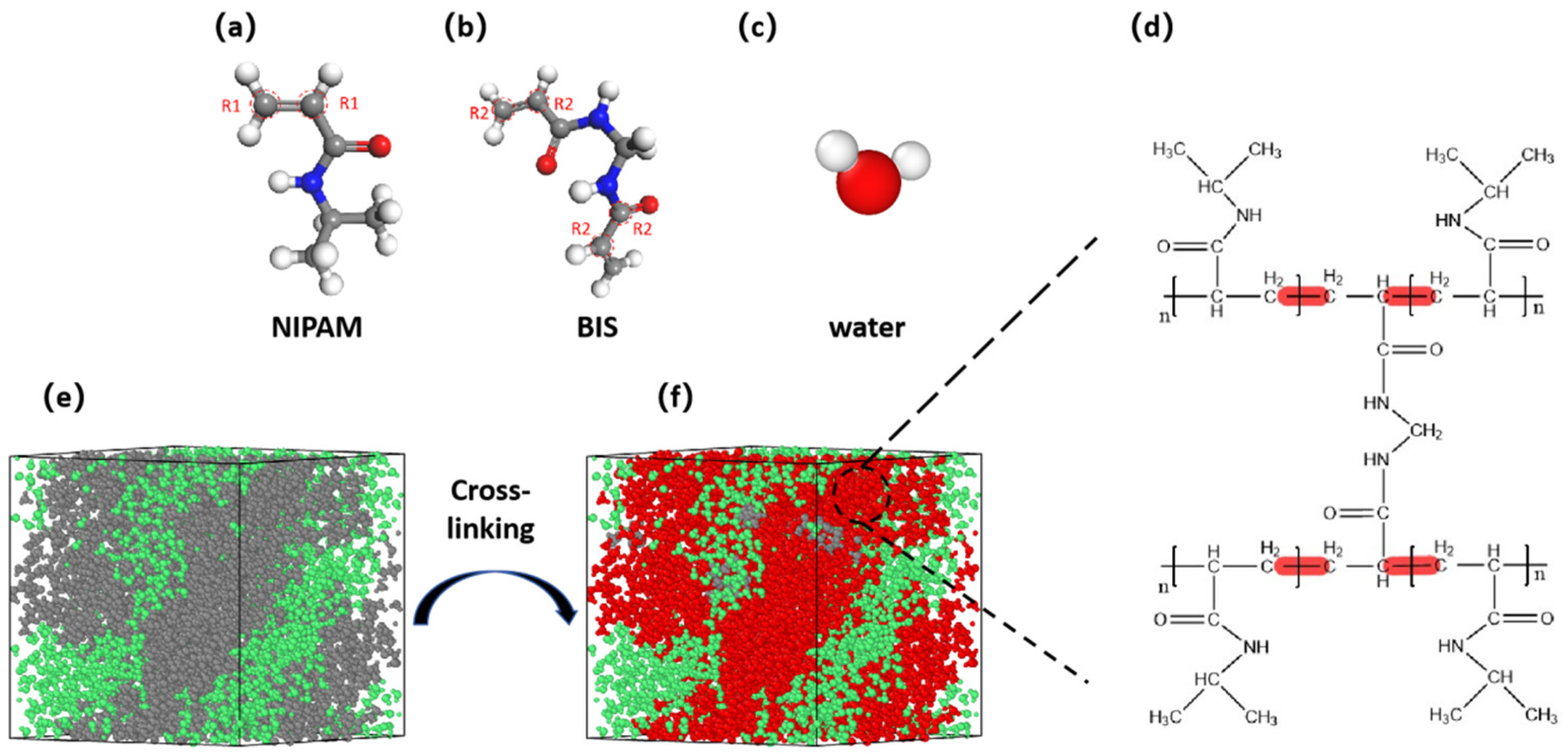
The structure optimization of PNIPAM oligomers and BIS cross-linker monomers with a polymerization degree of 10 was initially conducted using the most rapid descent method, with the objective of obtaining stable structures. Subsequently, 20 PNIPAM oligomers and 40 cross-linkers were introduced into a periodic box. Three-dimensional hydrogel structures with different cross-linking degrees were generated by a dynamic cross-linking algorithm (see Supplementary Materials Figure S2 for its flow chart). The dynamic cross-linking process is based on the ability to identify whether there is a reactive site, designated R2, on the cross-linker BIS within a radius of 4~11 Å around the reactive site, R1, on the oligomer PNIPAM (for a visual representation of these sites, please refer to Figure 1a,b). The dynamic cross-linking algorithm initially reads the coordinates of each atom and calculates the distance between the reactive atoms R1 and R2 based on the coordinates. If the distance between R1 and R2 is within 4 Å, a cross-linking bond is generated. The formation of a cross-linking bond occurs each time a new cross-link is formed. A hydrogen atom check is conducted with each formation of a new cross-link bond, and any redundant hydrogen atoms are subsequently removed. Subsequently, the atomic charges are reassigned in accordance with the revised atom types. At the conclusion of each cross-linking process, a geometry optimization and annealing procedure is conducted to eliminate any residual stress within the newly formed structure and to restore its stability. In the event that the target reactive atoms are not identified within a radius of 4 Å, the search radius is increased by 1 Å and the reactive atoms are located once more within the expanded search range.
The aforementioned steps were repeated until the maximum search radius was reached, thus completing one iteration of cross-linking. The temperature and pressure coupling were managed by an Andersen thermostat and a Nose–Hoover voltage regulator, respectively. Furthermore, the Ewald summation method, with an accuracy of 10−5 kcal/mol, was employed for the electrostatic and van der Waals interactions. Additionally, the cutoff distance for the long-range contribution to the potential energy was set to 12 Å. A buffer width of 1 Å was utilized to initiate the neighbor list update, and the simulation steps were all of 1 fs. A schematic representation of the hydrogel modeling is provided in Figure 1.
Typically, following a single round of cross-linking, approximately 50% cross-linking is achieved. To achieve greater cross-linking, several rounds of cross-linking must be repeated. Following each round of cross-linking, a geometry optimization process is undertaken to stabilize the structure of the cross-linked polymer, thereby enhancing the probability of success for the subsequent round of cross-linking. After 4~5 rounds of cross-linking, a cross-linked structure with a cross-linking degree of 65% or more can be obtained. See Supplementary Materials Table S3 for information on each round of cross-linking. A proportion of water molecules is then introduced to the cross-linked structure in order to form the desired cross-linked hydrogel model. All hydrogel models were subjected to an equilibrium period of over 10 ns. As shown in Figure S8 of the Supplementary Materials, the RMSD indicates that a stable structure was obtained during this period. Table 1 lists the principal cross-linked hydrogel models employed in this study. The nomenclature employed for these models is based on the cross-linking degree and water content, with the format “xxDOC-yywt”. Thus, a hydrogel model with a 60% cross-linking degree and 20% water content is designated as follows: the model is designated 60DOC-20wt. Visualization of the main model and the equilibrated densities is shown in Supplementary Materials, Figure S3 and Table S4.

3. Results and Discussion

The most noteworthy attribute of PNIPAM is its thermosensitive nature. The classic thermosensitive characteristics of PNIPAM hydrogels were reproduced by determining the LCST of different PNIPAM hydrogel models. Subsequently, the alterations in the cavity of the hydrogel were modeled, demonstrating the expulsion of water molecules from the PNIPAM polymer chain as temperature increases, thereby further elucidating the thermosensitive characteristics of PNIPAM hydrogels. Finally, the change trend of the hydrogel under different DOC and wt was explored through the simulation and prediction of the tensile properties of the hydrogel. By analyzing the stress–strain changes associated with stretching and the structural characteristics of the hydrogel, the influence of different water contents and cross-linking degrees on the mechanical properties could be determined.

3.1. Determination of LCST for PNIPAM Hydrogels

The temperature-sensitive property of PNIPAM hydrogels is most concerned with the LCST. Experimental measurements [23] demonstrate that the LCST is approximately 302~305 K. However, alterations in the molecular weight, morphology, and water molecule modeling of PNIPAM [24], etc., can result in changes to the LCST. A decrease in molecular weight tends to lower the LCST, but within a cross-linked network, topological constraints may counteract or even outweigh this tendency, resulting in a net effect of increasing the LCST. To ascertain the LCST of the simulated PNIPAM hydrogels, a number of approaches were employed. Firstly, a PNIPAM single chain with a degree of polymerization of 10 was selected in order to ensure consistency with the pre-cross-linking monomer, and this was employed as the foundation for the simulation. The LCST of the hydrogel was inferred from the nature and structure of the single PNIPAM chain, and the simulation environment was set in a cubic box with a side length of 4 nm filled with 1007 SPC/E water molecules. Following the optimization of the structure, a 10 ns equilibrium simulation was conducted under the NPT ensemble. The temperature range was set between 270 K and 320 K, and a series of simulations was conducted at 10 K intervals. The radius of gyration (Rg) [25] is a key indicator for assessing the morphology of polymer chains in solution (see Supplementary Materials S5 for calculations) and is commonly used in PNIPAM hydrogel studies to monitor the transition from the solvated to the collapsed state.
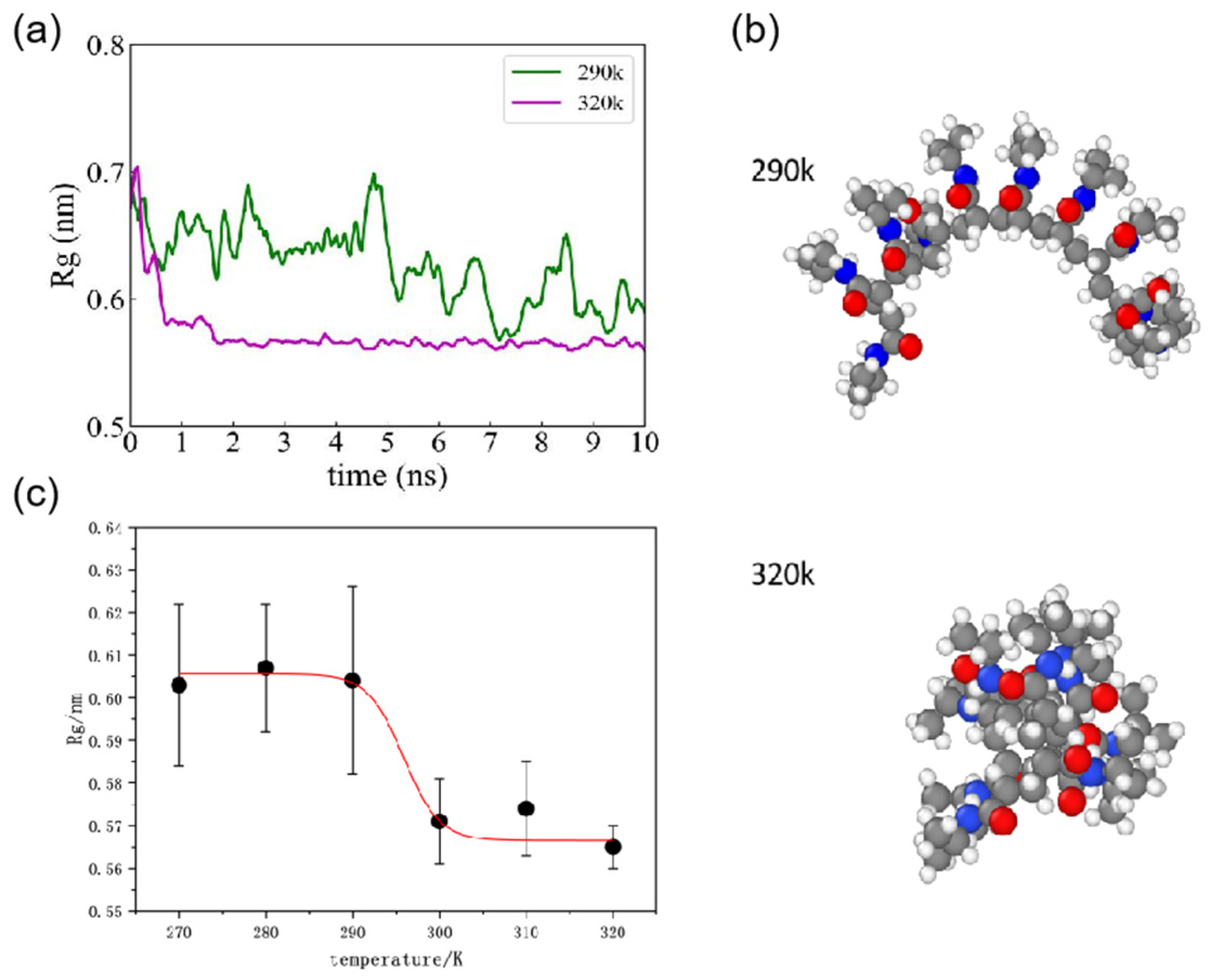
Figure 2a illustrates the variation in Rg of a single PNIPAM chain with a degree of polymerization of 10 at temperatures of 290 K and 320 K. It is observed that at 290 K, the Rg of the PNIPAM chain exhibits pronounced fluctuations, reflecting the linear conformation depicted in Figure 2b This indicates that the PNIPAM chain is in a swollen state below the LCST. In contrast, at 320 K, the Rg exhibits greater stability within a smaller range, and the chain conformation transitions to a compact, curled-up configuration, which corresponds to the collapsed state of the PNIPAM chain above the LCST. Figure 2c illustrates the distribution of Rg in the final 5 ns equilibrium phase, which provides a visual representation of the variation in Rg at different temperatures. The data clearly demonstrate that the Rg value decreases sharply in the interval from 290 K to 300 K, which marks the transition of the polymer chain from the swelling state to the collapsed state. This is in accordance with the theoretical findings of Kröger et al. [26] and Rezaeisadat et al. [27].
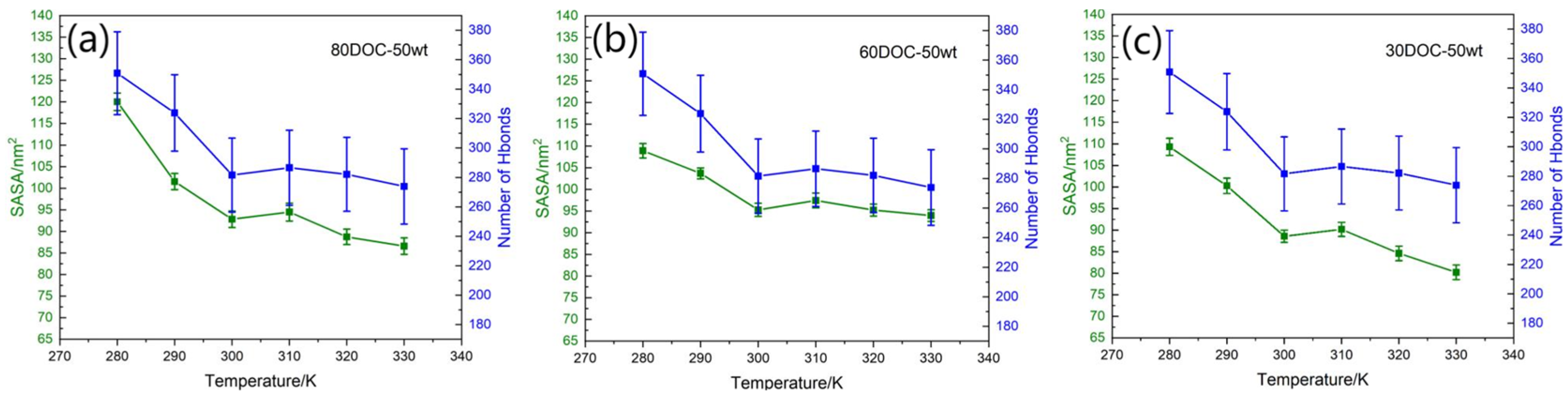
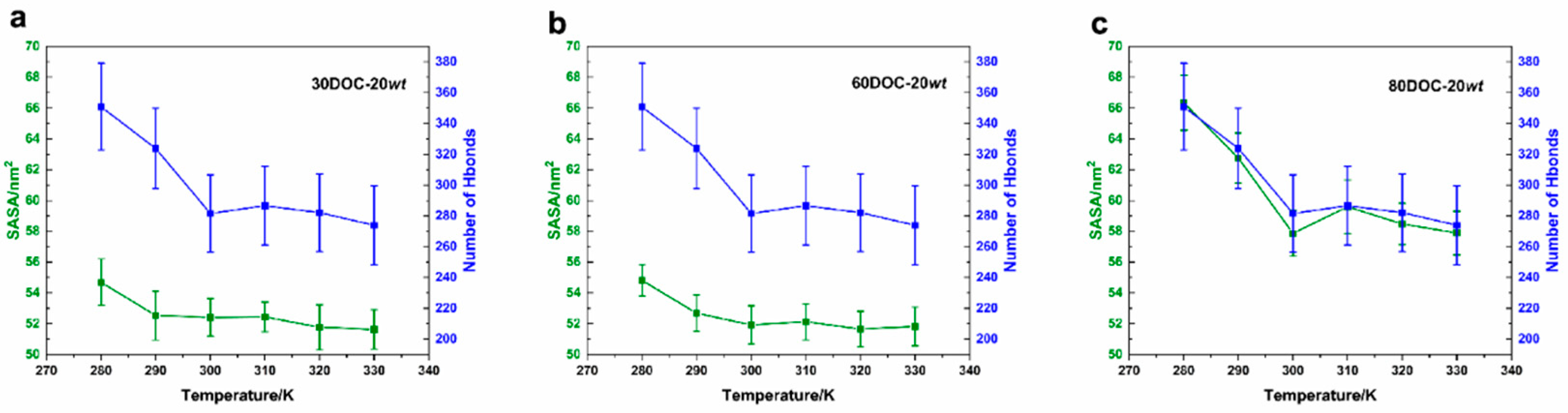
In addition to evaluating the phase transition with the aid of the Rg of individual chains, we also quantified the temperature-dependent alterations in the SASA in relation to the number of hydrogen bonds of the cross-linked systems at equilibrium. The cross-linked systems, with cross-linking degrees of 30%, 60%, and 80%, respectively, and a fixed water content of 50%, were selected for in-depth analysis of their post-equilibrium structures. Equilibrium simulations were conducted for 1 ns within the NVT ensemble synthesis framework, utilizing a time step of 1 fs and recording structural snapshots at 1000 fs intervals, resulting in a total of 1000 frames of trajectory data. By enumerating the hydrogen bonding alterations in these trajectories, calculating the mean number of hydrogen bonds per frame, and integrating this with the solvent-accessible surface area trend, we were able to qualitatively ascertain the LCST of the PNIPAM hydrogels. Figure 3 and Figure 4 illustrate the variation in the SASA and the number of hydrogen bonds as a function of temperature for the hydrogel system with 50% water content and 20% water content, and the number of hydrogen bonds and SASA raw data for the main models are shown in Tables S5 and S6. As shown in Figure 3b, for the 60DOC-50wt hydrogel, the SASA decreased from 10,889.25 ± 166.12 nm2 at 280 K to 9394.97 ± 133.97 nm2 at 330 K (a 13.7% reduction), while the H-bond count decreased from 323.23 ± 24.29 to 229.05 ± 22.36 (a 29.1% reduction), indicating a gradual transition to hydrophobic collapse with increasing temperature.
Notably, near the LCST, both SASA and H-bond count exhibited a transient increase, which was attributed to the exposure of hydrophilic groups during partial chain collapse. For the 60DOC-50wt hydrogel, the SASA rose from 9527.1 ± 150.60 nm2 (300 K) to 9742.54 ± 169.75 nm2 (310 K, 2.3% increase) and the H-bond count increased from 285.56 ± 25.22 (300 K) to 296.54 ± 25.06 (310 K, 3.8% increase). The small standard deviations of these parameters (relative standard deviation < 6%) confirm the reliability of the transient hydrophilicity phenomenon, excluding random fluctuations as the cause. This non-monotonic change directly verifies that the LCST of the cross-linked PNIPAM hydrogel is within 300–310 K, with the transition process being reversible and structurally reproducible.
The non-monotonic temperature dependence of the overall hydrogen bonding changes in the system and the SASA [28] together demonstrate the intricate behavior of the temperature-sensitive properties of the PNIPAM hydrogels, particularly near the LCST. As illustrated in Figure 3 and Figure 4, the SASA of hydrogels with varying degrees of cross-linking exhibits a general decline with rising temperature. This trend aligns with the underlying mechanism governing the transition from low-temperature stretching to high-temperature curling observed in PNIPAM hydrogels. Additionally, the alteration in the number of hydrogen bonds is indicative of the transition of the hydrogel from a hydrophilic to a hydrophobic state. It is noteworthy that the 30DOC-50wt, 60DOC-50wt, and 80DOC-50wt hydrogels exhibited an anomalous increase in the overall hydrogen bonding number and SASA from 300 K to 310 K. This observation led to the hypothesis that the polymer chains were in the critical state of hydrophilic-to-hydrophobic transition at the turning point of the temperature increase, which would indicate that the LCST was at around 300 K. As the temperature approaches the LCST, the collapse of localized polymer chains results in the transient exposure of hydrophilic groups and the formation of hydrophilic regions. This increases the contact surface with water molecules and temporarily elevates the SASA. The concurrent increase in the number of hydrogen bonds serves to corroborate this phenomenon. As the temperature continued to increase, the polymer chains underwent further collapse, resulting in a subsequent decrease in the SASA.

3.2. Effect of Temperature on Cavity Volume

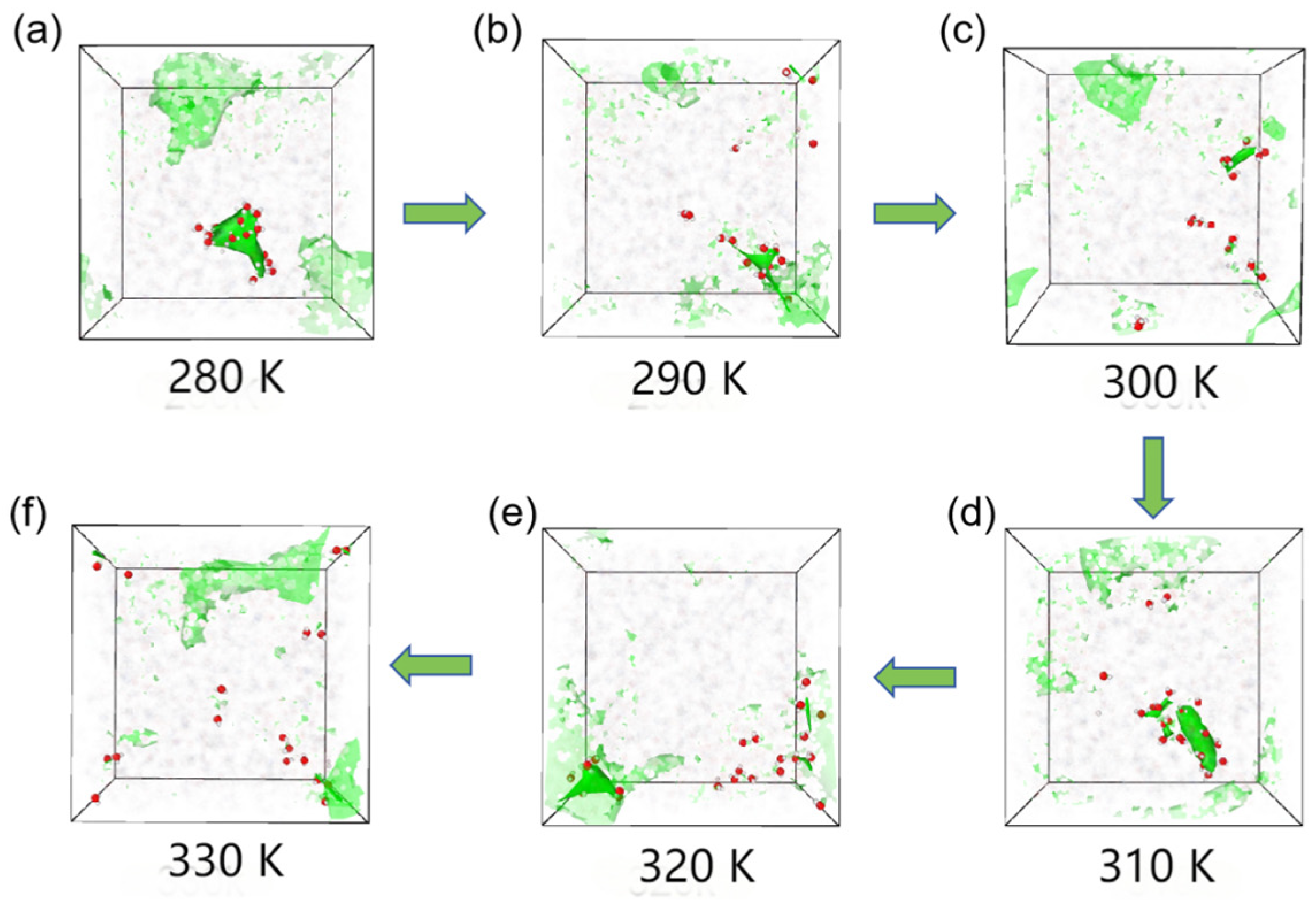
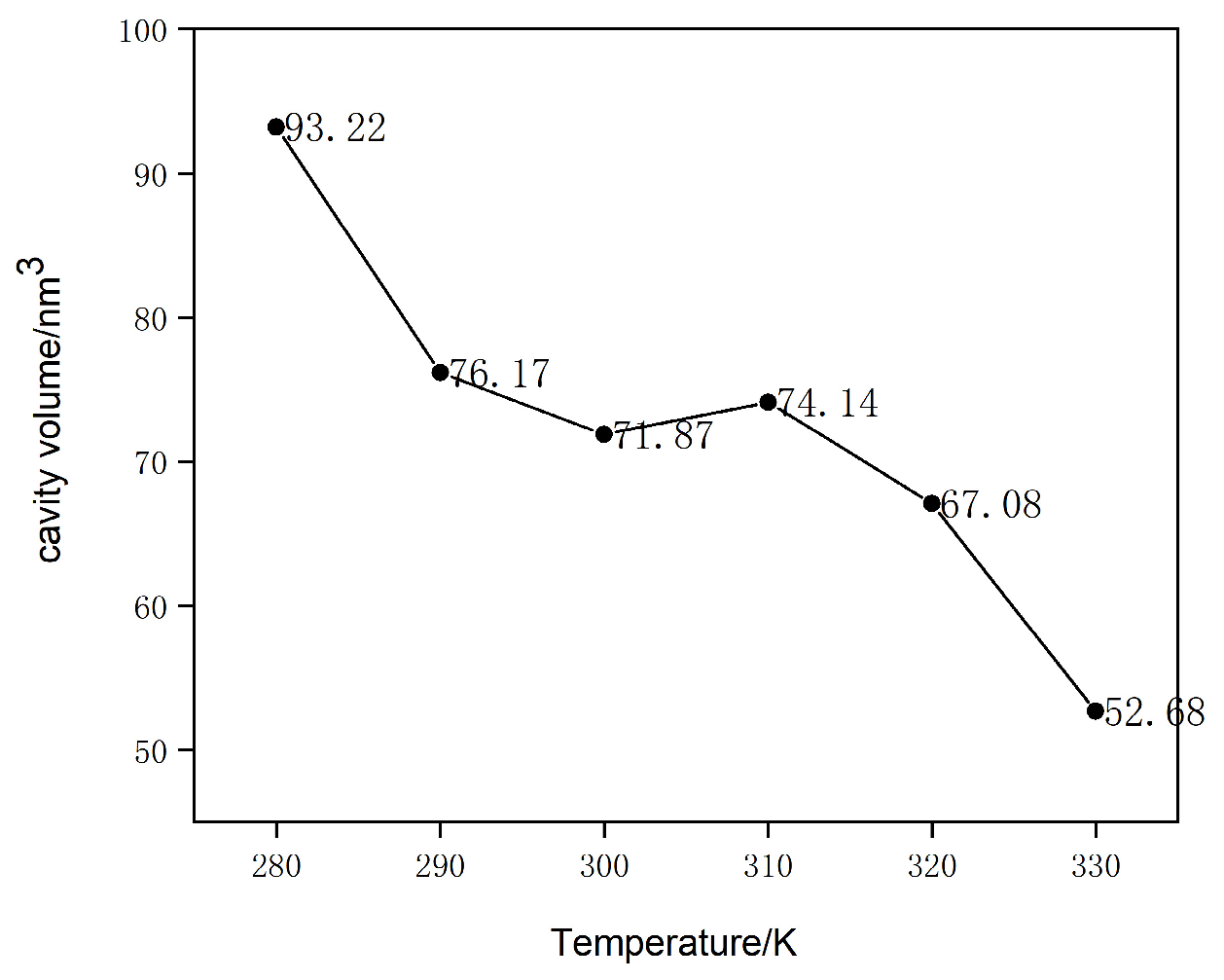
A series of cavities of varying dimensions are formed within the three-dimensional mesh structure resulting from the cross-linking of PNIPAM polymers. The formation of these cavities is crucial for the polymer’s capacity to retain significant quantities of water. Additionally, they can serve as vehicles for the targeted delivery of drugs. Figure 4 illustrates the displacement of water molecules within the central cavity of the PNIPAM polymer at varying temperatures. As the temperature rises from 280 K, the water molecules situated within the central cavity begin to diffuse towards the edges. This also corroborates the hypothesis that the PNIPAM polymer chain undergoes a gradual collapse with increasing temperature, resulting in the extrusion of water molecules from the interior of the polymer chain. Figure 5d illustrates the formation of a relatively smaller cavity in the lower right corner of the edge, which correlates with the anomalous elevation of hydrogen bonding and solvent-accessible surface area at 310 K. To ascertain the precise change in the polymer cavity volume, the cavity volume of the polymer was measured, as illustrated in Table S7. The cavity volume of PNIPAM hydrogels (calculated via the Alpha-shape method, Table S7) further quantified the temperature-induced structural shrinkage, with standard deviations of cavity volume across all models ranging from 5.52 nm3 to 11.35 nm3, reflecting the structural heterogeneity of cross-linked networks. As shown in Table 2, for the 60DOC-20wt hydrogel, the cavity volume decreased significantly from 93.22 ± 9.10 nm3 at 280 K to 52.68 ± 7.52 nm3 at 330 K (a 43.5% reduction), with the most dramatic shrinkage occurring above the LCST (310–330 K, volume reduction of 29.1%). At 310 K (near LCST), the cavity volume of the 60DOC-20wt hydrogel was 74.14 ± 8.65 nm3, which was slightly higher than that at 300 K (71.87 ± 8.44 nm3). This anomalous increase (accompanied by a low relative standard deviation of 11.9%) is consistent with the transient SASA and H-bond elevation in Section 3.1, proving that the hydrophilic domain formed near LCST expands local cavity space before overall network collapse. The cavity volume data (with uncertainty) provides a quantitative structural basis for temperature-controlled drug release, as the shrinkage of cavity space above the LCST directly drives the extrusion of loaded small molecules. The change in cavity volume provides further evidence that PNIPAM hydrogels undergo a gradual curling up with increasing temperature, which results in a reduction in the original cavity volume and the expulsion of water molecules from the polymer network. This property provides the potential for the utilization of PNIPAM hydrogels as carriers for small-molecule drugs. As the temperature rises, the small-molecule drugs are gradually excluded from the PNIPAM polymer network, thereby achieving the effect of slow drug release.

3.3. Effect of Water Content and Cross-Linking Degree on Mechanical Properties

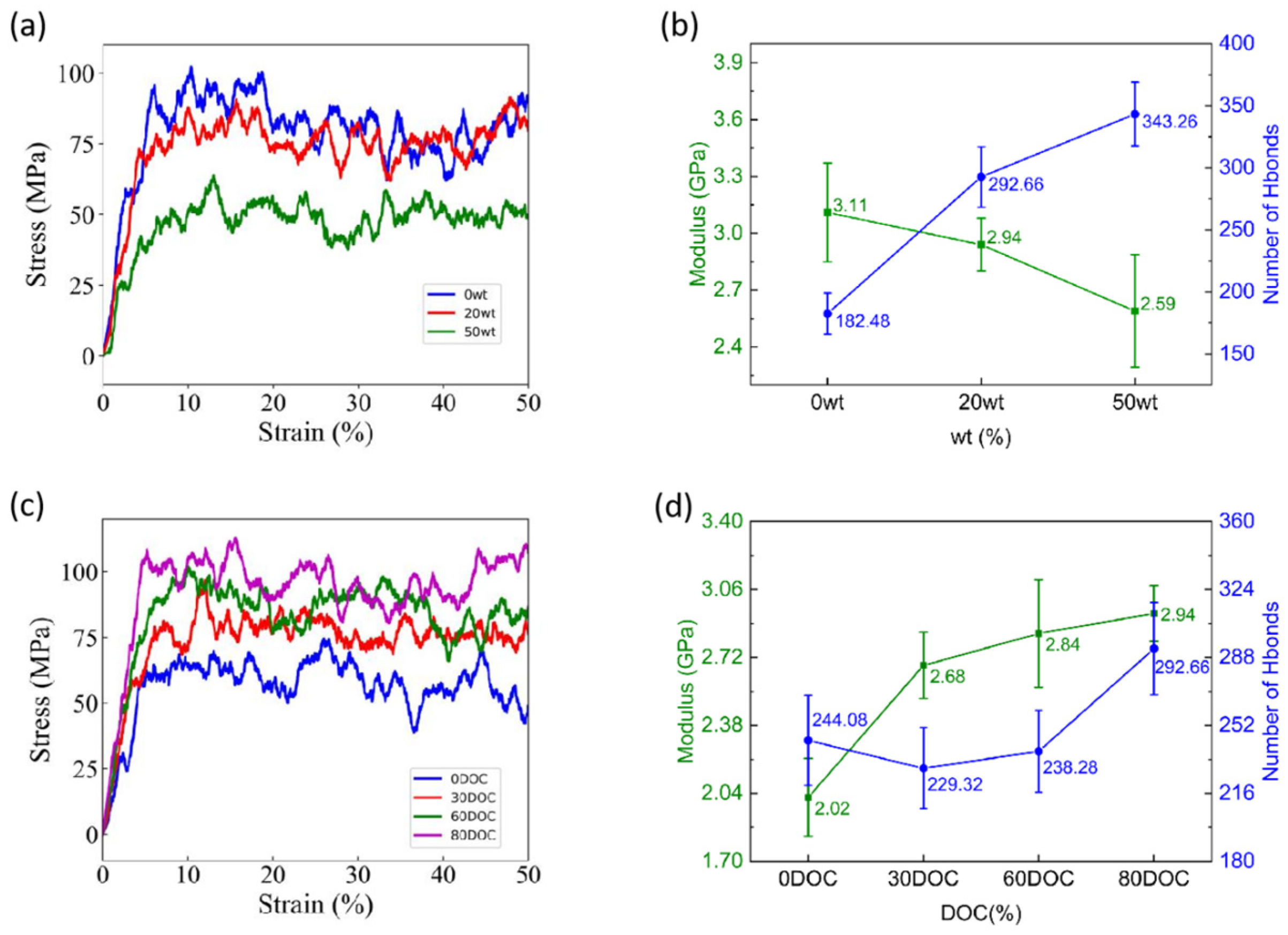
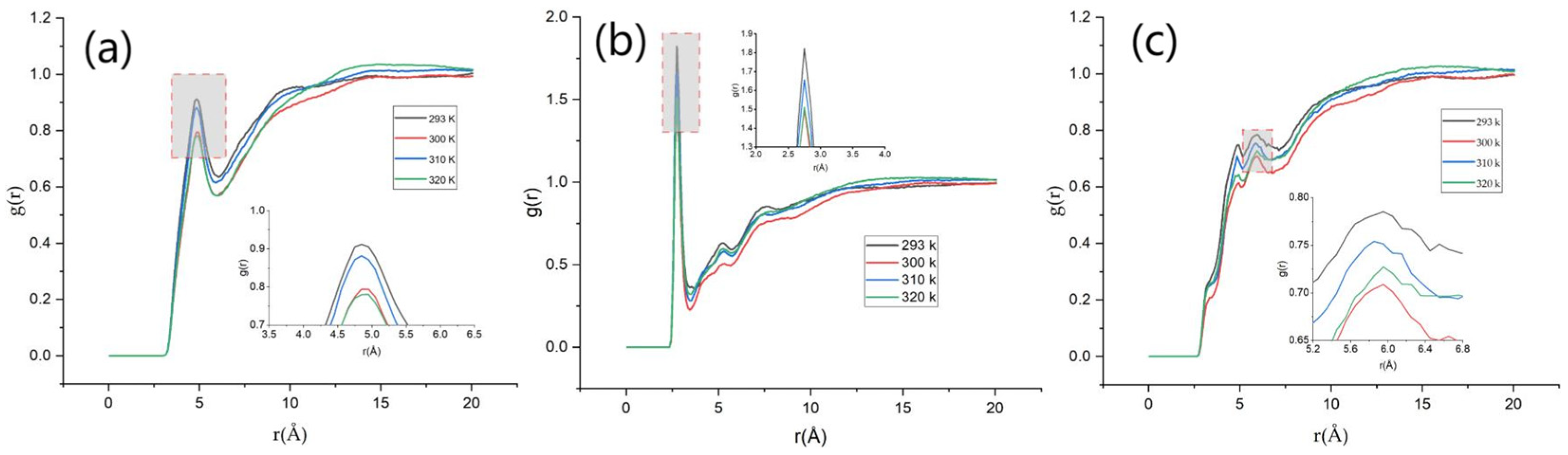
The mechanical properties of PNIPAM hydrogels are significantly influenced by the water content and degree of cross-linking. The objective of this study was to investigate the effects of varying degrees of cross-linking and water content on the tensile properties and Young’s modulus of PNIPAM hydrogels. Furthermore, the hydrogen bonding changes in PNIPAM hydrogels with varying degrees of cross-linking and water content were also quantified. The tensile properties were averaged across the three principal directions at a strain of 50% to construct the stress–strain curve. Young’s modulus was calculated from the ratio of stress to strain in the linear portion of the curve (strain at 0% to 5%). Table 3 shows Young’s modulus for the main models. Figure 6a depicts the stress–strain curves for PNIPAM hydrogels with an 80% cross-linking degree at varying water contents (see Figure S5 of the Supplementary Materials for results at other cross-linking degrees). The results demonstrate that the level of water content has a significant impact on the stress level and Young’s modulus of the hydrogel. In comparison to the anhydrous (0% water content) PNIPAM hydrogel, the Young’s modulus exhibited a decrease of 19% and 24% for 20% and 50% water content, respectively. This finding serves to reinforce the experimental observation that hydrogel stress decreases with increasing water content. In general, an increase in water content leads to a greater number of hydrogen bonds being formed, which results in a denser hydrogel structure and, consequently, an increase in stress. The mechanical properties of PNIPAM hydrogels were closely related to their H-bond network and cavity structure, with the statistical uncertainty of H-bond count (Table S5) and cavity volume (Table S7) explaining the dispersion of mechanical data. For 80DOC hydrogels with different water contents, the Young’s modulus decreased from 3.11 ± 0.26 GPa (0wt) to 2.59 ± 0.29 GPa (50wt), which was positively correlated with the increase in H-bond count (from 187.74 ± 16.22 (0wt) to 387.7 ± 28.46 (50wt) at 280 K, relative standard deviation of 16.3%). The increase in water content enhanced the lubrication between polymer chains, and the higher H-bond dispersion (standard deviation increased by 66%) weakened the structural stability, leading to a lower modulus. It is postulated that the presence of water molecules serves to enhance the lubricating effect between the polymer chains, thereby reducing the degree of entanglement between the chain segments, thus facilitating the sliding apart of the polymer chains. The increase in water content has multifaceted effects on hydrogel structure and properties. While water molecules can form hydrogen bonds with PNIPAM, they simultaneously weaken direct interactions between polymer chains. Our simulation data (Supplementary Table S5) shows that when the water content increases from 0% to 50% in a 30% cross-linking hydrogel, although the total number of hydrogen bonds doubles, the polymer network becomes diluted, resulting in reduced effective cross-linking density. The radial distribution function (RDF) analysis in Figure 7 indicates that, at different temperatures within the range of 293–320 K, the water oxygen g(r) peak resides at the same radial distance. However, its intensity exhibits a decreasing trend with increasing temperature. This trend indicates that rising temperatures reduce the orderliness of the coordination shell surrounding the isopropyl group and destabilize the hydrogen bonds formed between water and the amide group. By comparing Figures S9 and S10, the average interchain distance of PNIPAM in high-water-content (50wt) samples increases by approximately 18% compared to low-water-content (20wt) samples. While higher water content does introduce more hydrogen bonds, these primarily occur between water and the polymer rather than polymer–polymer interactions. The lubricating effect of water molecules and network dilution dominate the changes in mechanical properties, offsetting and even exceeding the potential reinforcement effects from additional hydrogen bonds.
It is postulated that the presence of water molecules serves to enhance the lubricating effect between the polymer chains, thereby reducing the degree of entanglement between the chain segments, thus facilitating the sliding apart of the polymer chains. This phenomenon is particularly evident in tensile fracture experiments, wherein it is demonstrated that smaller polymer fragments are more readily dislodged from the network, thereby accelerating the process of hydrogel fracture. This observation is also reflected in a study conducted by Farahani.
Furthermore, the impact of varying cross-linking degrees on tensile properties and Young’s modulus was examined using PNIPAM hydrogels with 20% water content. To investigate the anisotropy of hydrogel systems, this study simulated tensile phenomena along the x, y, and z directions. During uniaxial stretching, the NPT ensemble was employed to maintain pressure at 1 atm in the remaining two directions while keeping the temperature consistent with the stretching direction. To fully release initial stress, a 1 ns relaxation period was first conducted in the NVT ensemble, followed by an additional 1 ns relaxation in the NPT ensemble to ensure thermodynamic equilibrium. After relaxation, a 2 ns uniaxial stretching simulation was performed. This process was repeated sequentially for all three axes, with each direction taking 2 ns, resulting in a total simulation time of 6 ns per hydrogel sample. The simulations employed a standard strain rate of 1 × 10⁶ s−1. According to Table 3, for hydrogels with 20 wt water content, Young’s modulus increased from 2.02 ± 0.19 GPa (0DOC) to 2.94 ± 0.14 GPa (80DOC), which was associated with the optimization of cross-linked network homogeneity and the regulation of cavity structure. Specifically, the standard deviation of cavity volume at 280 K showed a trend of first decreasing and then increasing with the rise in cross-linking degree: it decreased from 7.50 nm3 (30DOC-20wt) to 9.10 nm3 (60DOC-20wt) and then increased to 11.09 nm3 (80DOC-20wt). This variation indicates that low-to-moderate cross-linking (30–60% DOC) reduces structural defects and homogenizes cavity distribution, while high cross-linking (80% DOC) leads to localized network densification and heterogeneous cavity expansion due to excessive cross-linking points. Despite the higher cavity volume standard deviation (11.09 nm3) of the 80DOC-20wt hydrogel, its overall cavity volume reached 101.74 ± 11.09 nm3 at 280 K, which was significantly larger than that of 30DOC-20wt (72.39 ± 7.50 nm3) and 60DOC-20wt (93.22 ± 9.10 nm3). Meanwhile, the hydrogen bond count of 80DOC-20wt hydrogel was 307.45 ± 25.05 at 280 K (relative standard deviation of 8.2%), which was more stable than that of 0DOC-20wt hydrogel (274.39 ± 23.17, relative standard deviation of 8.4%), but the ‘hydrogen bond count’ we measure and discuss actually refers to the total number of hydrogen bonds, including PNIPAM-PNIPAM hydrogen bonds, PNIPAM-H2O hydrogen bonds, and H2O-H2O hydrogen bonds. The combination of denser cross-linked covalent networks and more stable hydrogen bond interactions offset the negative impact of cavity heterogeneity, thus realizing the enhancement of Young’s modulus. This result confirms that cross-linking degree is the dominant factor in regulating the mechanical properties of hydrogels, while cavity and hydrogen bond heterogeneity reflects the trade-off between network cross-linking density and structural uniformity. The results provide compelling evidence that an increase in cross-linking degree markedly enhances the mechanical strength of hydrogels, a conclusion that is consistent with extensive research findings. Specifically, Young’s modulus of the samples with a cross-linking degree of 30%, 60%, and 80% exhibited an increase of 32%, 40%, and 45%, respectively, in comparison to the uncross-linked hydrogels. This suggests that an increase in the degree of polymer cross-linking is an effective method for enhancing the mechanical properties of hydrogels. The network structure formed by cross-linking can bind small-sized fragments more efficiently, thereby conferring a higher strain resistance to the overall structure. This undoubtedly contributes to an enhancement of the fracture strength and toughness of hydrogels. However, hydrogen bonding is relatively higher in the uncross-linked hydrogels than in the partially cross-linked ones, as observed in several of our models. We hypothesize that uncross-linked PNIPAM oligomer chains adopt a more compact conformation. Due to the greater number of cross-links between water molecules, the hydrogen bond strength in the non-cross-linked network exceeds that in the partially cross-linked network, resulting in fewer cavities. Consequently, the binding of water molecules to PNIPAM chains decreases, making it more difficult for the PNIPAM chains to collapse. When the temperature increases, the changes in hydrogen bonding are not significant.

3.4. Study on the Mechanism of Ibuprofen Release from PNIPAM Hydrogels

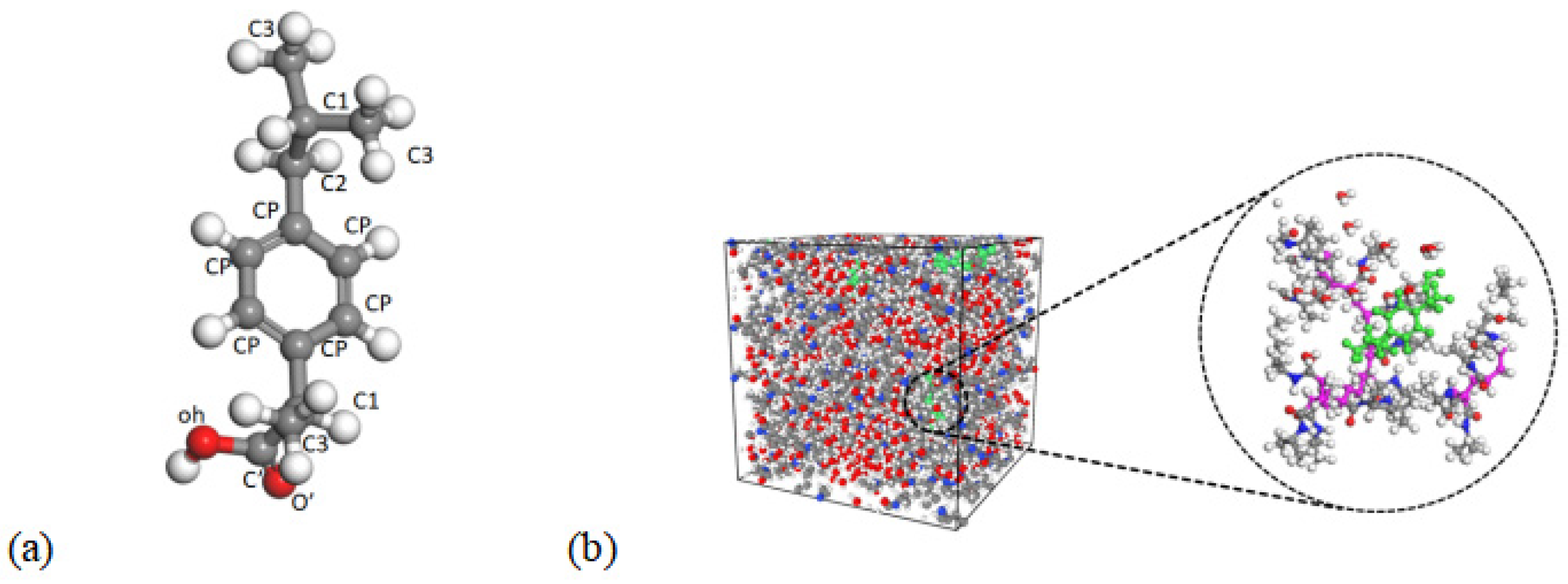
Ibuprofen, a commonly used nonsteroidal anti-inflammatory drug (NSAID), exhibits issues such as uncontrolled release, low bioavailability, and gastrointestinal side effects, as shown in its molecular structure in Figure 8a. To address these challenges, this study employs PNIPAM hydrogel—known for its thermosensitivity and excellent biocompatibility—as a novel drug delivery system. A PNIPAM–ibuprofen delivery model was constructed by incorporating 1% ibuprofen into a PNIPAM hydrogel with 60% cross-linking density and 20% water content, as shown in Figure 8b. The system underwent 10 ns relaxation treatment at three temperatures: 280 K, 300 K, and 320 K. Based on the relaxation trajectories and final structures, the drug release mechanism of this system was subsequently analyzed in depth.
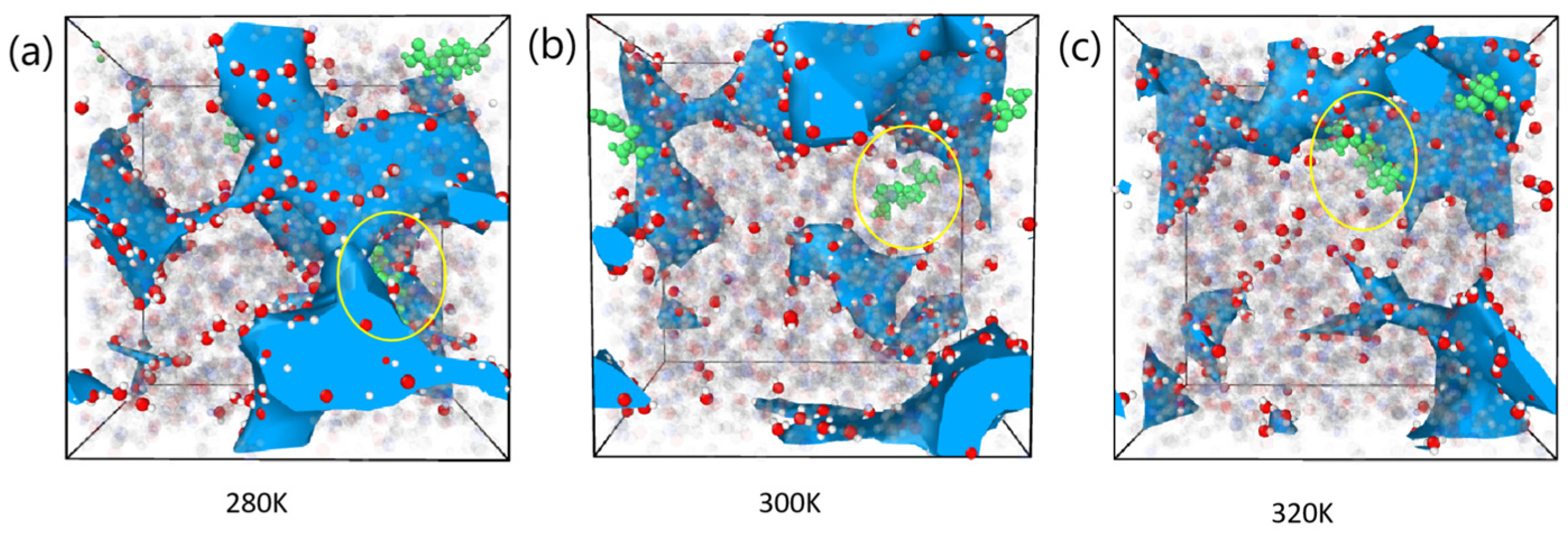
This study utilized the Volume Region Identification module in OVITO (basic—3.14.1—win64, https://www.ovito.org/, accessed on 2 November 2025) software to analyze cavity volume changes in the PNIPAM–ibuprofen model based on the Alpha-shape method. The results are shown in Figure 9. At temperatures below the LCST (280 K), the hydrogel exhibits hydrophilicity, with the polymer network expanding to form larger cavities that provide abundant adsorption sites for ibuprofen molecules. When the temperature rises above the LCST (300 K, 320 K), PNIPAM undergoes a phase transition. Hydrophobic contraction of the segments leads to a significant reduction in cavity volume, disrupting the hydrogen bond network and forming a compact structure. This restricts ibuprofen molecule movement and promotes its expulsion.
To further investigate the microscopic release process, surface smoothing of water molecules was performed using the “surface mesh” function in OVITO software (blue represents water channels, green represents ibuprofen) to clearly track their trajectories. This yielded the conformations of the model after relaxation at different temperatures (Figure 10): At 280 K (Figure 10a), water molecules form connected pathways, causing the PNIPAM network to relax while ibuprofen is distributed within the network. At 300 K (approaching the LCST, Figure 10b), water channels diffuse and form larger clusters, expelling some water molecules. The PNIPAM network begins to contract, with ibuprofen moving distinctly along the water channels. At 320 K (above the LCST, Figure 10c), water molecules near the central cavity are extensively expelled, the PNIPAM network becomes more compact, and ibuprofen migrates to the model periphery.
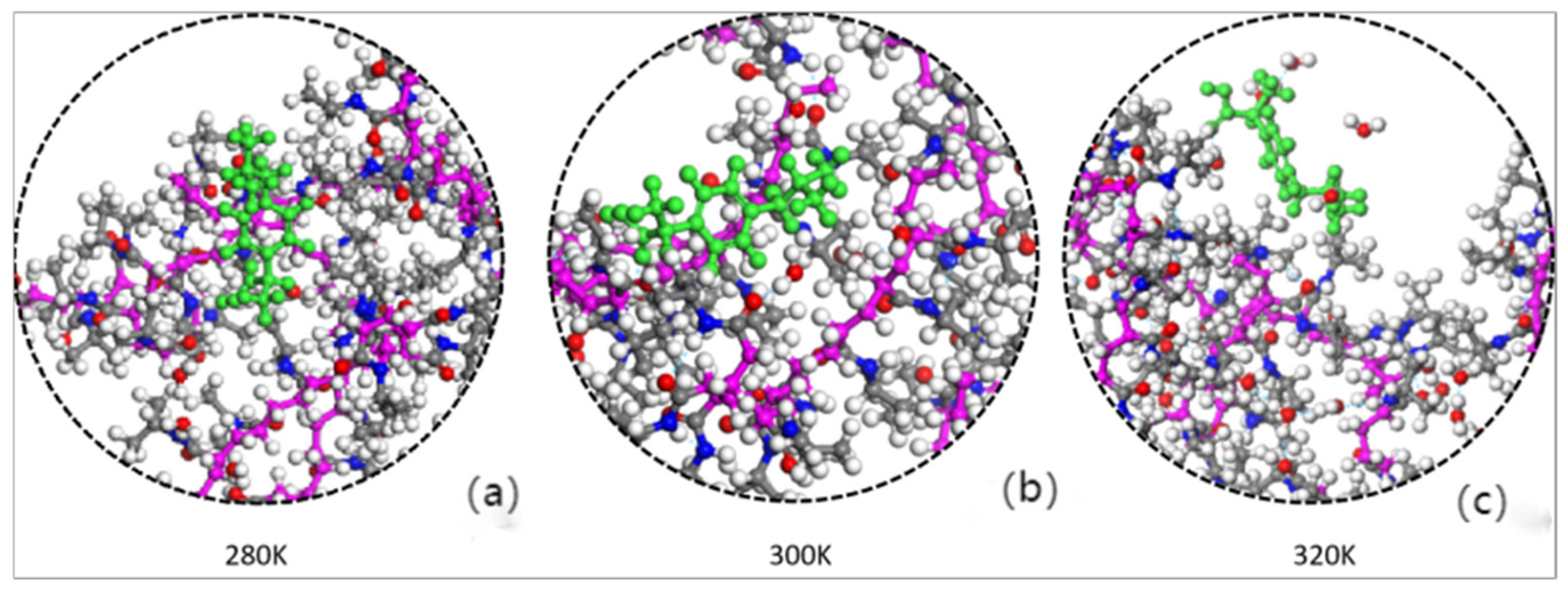
Local observations of ibuprofen release trajectories (Figure 11) also reveal the following: At 280 K (Figure 11a), ibuprofen is fully embedded within the extended PNIPAM network, surrounded by abundant cavities. At 300 K (Figure 11b), PNIPAM chain contraction reduces cavities, causing ibuprofen to trend away from molecular chains. At 320 K (Figure 11c), the ibuprofen hydroxyl end tilts toward cavities and gradually detaches from the network, with PNIPAM chains further curling.
Additionally, the interaction energy calculation results (Table 4) indicate that as the temperature increases from 280 K to 320 K, the interaction energy between PNIPAM polymer chains and ibuprofen molecules gradually decreases from −126.72 kcal/mol to −108.69 kcal/mol, suggesting that the interaction strength between the two weakens with rising temperature.
We calculated the interaction energy between PNIPAM and ibuprofen using the standard energy decomposition method, expressed by the formula
E int = E total ( E PNIPAM + E Ibu )
where Etotal is the total potential energy of the PNIPAM–ibuprofen complex system, EPNIPAM is the total potential energy of the isolated PNIPAM hydrogel system (without ibuprofen), EIbu is the total potential energy of isolated ibuprofen molecules (placed in an identical-sized water box), and Eint is the net interaction energy between PNIPAM and ibuprofen. All energy values (Etotal, EPNIPAM, EIbu, and Eint) refer to total potential energy.
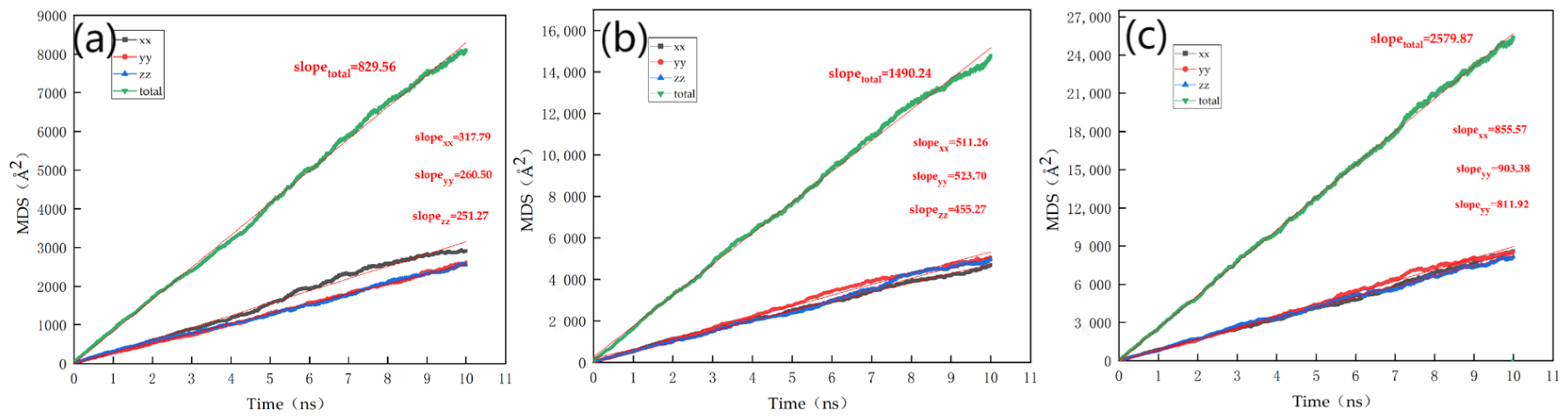
Additionally, we calculated the diffusion coefficient D for ibuprofen. As shown in Figure 12 and Table 5, the diffusion coefficient increased from 1.3817 × 10⁻⁹ m2/s to 4.2847 × 10⁻⁹ m2/s with rising temperature. This accelerated kinetic behavior results from the combined effects of microstructural changes and weakened interaction energies. As indicated by ibuprofen’s trajectory, elevated temperatures induce the PNIPAM network to transition from swelling to collapse, physically displacing drug molecules. Concurrently, this phenomenon aligns with the trend in interaction energy, where the energy barrier for drug molecules to escape polymer confinement decreases. Consequently, network collapse alters the diffusion pathways and spatial distribution of drugs, while weakened binding energy reduces the barrier for drugs to detach from polymer chains, leading to enhanced ibuprofen diffusion capacity.

4. Conclusions

This study systematically investigated the temperature sensitivity, mechanical properties, and ibuprofen release mechanism of chemically cross-linked poly(N-isopropylacrylamide) (PNIPAM) hydrogels using N, N’-methylenebisacrylamide (BIS) as a cross-linker through molecular dynamics (MD) simulations. Researchers employed a dynamic cross-linking algorithm to construct three-dimensional network structures of hydrogels with varying cross-linking degrees. This method overcomes the inherent limitations of static cross-linking by iteratively adjusting the reaction site search radius, precisely forming cross-links, and performing subsequent structural optimization. This approach yields structures with higher consistency and closer alignment to actual physical properties, establishing a reliable foundation for subsequent performance studies and drug delivery model construction. MD simulations revealed a strong correlation between hydrogel mechanical properties and its spatial network structure: below the lower critical solution temperature (LCST, 300–310 K), the hydrogel exhibits a loose spatial network with high cavity water concentration, adopting a hydrophilic sol–gel state. In this state, abundant cavities provide ample adsorption sites for ibuprofen, enabling efficient loading via hydrogen bonds and van der Waals forces. Above the LCST, the network contracts and repels water molecules, transforming the hydrogel into a hydrophobic state. Cavity volume significantly decreases, reducing the interaction energy between PNIPAM and ibuprofen from −126.72 kcal/mol to −108.69 kcal/mol. This weakened binding allows ibuprofen to be released through water-draining channels, enabling temperature-controlled release. Furthermore, tensile simulations indicate that the hydrogel is more prone to rupture along the large cavity direction, as hydrogen bonds between water molecules and polymers at the cavity site are less stable than cross-linked covalent bonds. The temperature effect on tensile properties also relates to hydrogen bonding: below the LCST, hydrogen bonds slightly increase tensile strength; above the LCST, reduced hydrogen bonding and increased chain entanglement cause a slight decrease in tensile stress and a slight increase in elongation. Higher water content lubricates polymer chains and reduces entanglement, lowering stress on the hydrogel and enhancing tensile performance. In summary, this study reveals, at the atomic level, the mechanical behavior of cross-linked hydrogels and the mechanism of temperature-controlled ibuprofen release, providing fundamental theoretical support for developing high-performance medical hydrogel drug delivery systems (such as ibuprofen carriers).

Supplementary Materials

The following supporting information can be downloaded at: https://www.mdpi.com/article/10.3390/pr14020185/s1, Figure S1: Major atom numbers of PNIPAM monomer and cross-linker BIS; Figure S2: Dynamic cross-linking flow chart; Figure S3: (a–l) Main representative model. The horizontal axis from left to right represents water content of 0, 20%, and 50%, and the vertical axis from top to bottom represents cross-linking degree of 0, 30%, 60%, and 80%. For example, the first model in the upper left corner represents the 0DOC-0wt hydrogel model. The red color represents the cross-linked structure, the gray color represents the uncross-linked structure, and the green color represents the water molecules; Figure S4: RMSD Plot During the Relaxation Process of 60DOC-50wt; Figure S5: Effect of different degrees of cross-linking and water content on mechanical properties; Figure S6: 60DOC-20wt g(r) plots of oxygen and hydrogen atoms relative to the isopropyl carbon of PNIPAM; Figure S7: 60DOC-20wt g(r) plots of oxygen and hydrogen atoms in the water phase relative to the amide N of PNIPAM. (a–d) correspond to temperatures of 293 K, 300 K, 310 K, and 320 K, respectively; Figure S8: 60DOC-20wt g(r) plots of oxygen and hydrogen atoms in the water phase relative to the amide oxygen of PNIPAM; Figure S9: 60DOC-50wt g(r) plot of oxygen and hydrogen atoms relative to PNIPAM; Figure S10: g(r) plots for 60DOC-50wt configuration at 293 K, 300 K, 310 K, and 320 K, representing g(r) plots for oxygen atoms and hydrogen atoms of water relative to the amide oxygen of PNIPAM; Table S1: Atomic charges; Table S2: SPC/E water model parameters; Table S3: Reaction progress of dynamic cross-linking; Table S4: Densities of hydrogels with cross-linking degree of 60%, 80% and water content of 20% and 50% at different temperatures; Table S5: Average number of hydrogen bonds at different temperatures for hydrogels with cross-linking degrees of 0%, 30%, 60%, and 80% and water contents of 0%, 20%, and 50%; Table S6: Effect of different temperatures on solvent availability and surface area of PNIPAM hydrogels; Table S7: Cavity volume of different hydrogel models at different temperatures.

Author Contributions

Conceptualization, W.Z.; methodology, S.Y.; formal analysis, G.Z.; investigation, G.Z.; data curation, H.L.; writing—original draft preparation, G.Z.; writing—review and editing, H.L.; visualization, Y.D. All authors have read and agreed to the published version of the manuscript.

Funding

This research received no external funding.

Data Availability Statement

The original contributions presented in the study are included in the article/Supplementary Material; further inquiries can be directed to the corresponding author/s.

Conflicts of Interest

The authors declare no conflicts of interest.

References

  1. Xu, S.; Wu, S.; Zhu, R.; Qiu, Z.; Yan, Y. Fully Physically Crosslinked PNIPAM Ionogels with High Mechanical Properties and Temperature-Managed Adhesion Achieved by H2O/Ionic Liquid Binary Solvents. Adv. Funct. Mater. 2024, 34, 2405965. [Google Scholar] [CrossRef]
  2. Liu, J.; Jiang, L.; He, S.; Zhang, J.; Shao, W. Recent Progress in PNIPAM-Based Multi-Responsive Actuators: A Mini-Review. Chem. Eng. J. 2022, 433, 133496. [Google Scholar] [CrossRef]
  3. He, J.; Zhang, Z.; Yang, Y.; Ren, F.; Li, J.; Zhu, S.; Ma, F.; Wu, R.; Lv, Y.; He, G.; et al. Injectable Self-Healing Adhesive pH-Responsive Hydrogels Accelerate Gastric Hemostasis and Wound Healing. Nano-Micro Lett. 2021, 13, 80. [Google Scholar] [CrossRef]
  4. Li, Z.; Li, Y.; Chen, C.; Cheng, Y. Magnetic-Responsive Hydrogels: From Strategic Design to Biomedical Applications. J. Control. Release 2021, 335, 541–556. [Google Scholar] [CrossRef]
  5. Yang, J.; Huang, W.; Peng, K.; Cheng, Z.; Lin, L.; Yuan, J.; Sun, Y.; Cho, N.; Chen, Y. Versatile Agar-Zwitterion Hybrid Hydrogels for Temperature Self-Sensing and Electro-Responsive Actuation. Adv. Funct. Mater. 2024, 34, 2313725. [Google Scholar] [CrossRef]
  6. Ganguly, S.; Wulff, D.; Phan, C.M.; Jones, L.W.; Tang, X.S. Injectable and 3D Extrusion Printable Hydrophilic Silicone-Based Hydrogels for Controlled Ocular Delivery of Ophthalmic Drugs. ACS Appl. Bio Mater. 2024, 7, 6286–6296. [Google Scholar] [CrossRef]
  7. Jiang, Z.; Shi, X.; Qiao, F.; Sun, J.; Hu, Q. Multistimuli-Responsive PNIPAM-Based Double Cross-Linked Conductive Hydrogel with Self-Recovery Ability for Ionic Skin and Smart Sensor. Biomacromolecules 2022, 23, 5239–5252. [Google Scholar] [CrossRef]
  8. Puza, F.; Lienkamp, K. 3D Printing of Polymer Hydrogels—From Basic Techniques to Programmable Actuation. Adv. Funct. Mater. 2022, 32, 2205345. [Google Scholar] [CrossRef]
  9. Haq, M.A.; Su, Y.; Wang, D. Mechanical Properties of PNIPAM Based Hydrogels: A Review. Mater. Sci. Eng. C 2017, 70, 842–855. [Google Scholar] [CrossRef]
  10. Heskins, M.; Guillet, J.E. Solution Properties of Poly(N-Isopropylacrylamide). J. Macromol. Sci. Part A 1968, 2, 1441–1455. [Google Scholar] [CrossRef]
  11. Haraguchi, K.; Xu, Y. Thermal Analyses of Poly(N-Isopropylacrylamide) in Aqueous Solutions and in Nanocomposite Gels. Colloid Polym. Sci. 2012, 290, 1627–1636. [Google Scholar] [CrossRef]
  12. Yuan, Y.; Qianqian, Z.; Shumiao, L.; Jinlong, L. Water: The soul of hydrogels. Prog. Mater. Sci. 2025, 148, 101378. [Google Scholar] [CrossRef]
  13. Chiessi, E.; Paradossi, G. Influence of Tacticity on Hydrophobicity of Poly(N-Isopropylacrylamide): A Single Chain Molecular Dynamics Simulation Study. J. Phys. Chem. B 2016, 120, 3765–3776. [Google Scholar] [CrossRef] [PubMed]
  14. Dalgicdir, C.; Van Der Vegt, N.F.A. Improved Temperature Behavior of PNIPAM in Water with a Modified OPLS Model. J. Phys. Chem. B 2019, 123, 3875–3883. [Google Scholar] [CrossRef]
  15. Custodio, K.K.S.; Claudio, G.C.; Nellas, R.B. Structural Dynamics of Neighboring Water Molecules of N-Isopropylacrylamide Pentamer. ACS Omega 2020, 5, 1408–1413. [Google Scholar] [CrossRef] [PubMed]
  16. Boţan, V.; Ustach, V.; Faller, R.; Leonhard, K. Direct Phase Equilibrium Simulations of NIPAM Oligomers in Water. J. Phys. Chem. B 2016, 120, 3434–3440. [Google Scholar] [CrossRef]
  17. Tönsing, T.; Oldiges, C. Molecular Dynamic Simulation Study on Structure of Water in Crosslinked Poly(N-Isopropylacrylamide) Hydrogels. Phys. Chem. Chem. Phys. 2001, 3, 5542–5549. [Google Scholar] [CrossRef]
  18. Deshmukh, S.; Mooney, D.A.; MacElroy, J.M.D. Molecular Simulation Study of the Effect of Cross-Linker on the Properties of Poly(N-Isopropyl Acrylamide) Hydrogel. Mol. Simul. 2011, 37, 846–854. [Google Scholar] [CrossRef]
  19. Feng, H.; Tang, N.; An, M.; Guo, R.; Ma, D.; Yu, X.; Zang, J.; Yang, N. Thermally-Responsive Hydrogels Poly(N-Isopropylacrylamide) as the Thermal Switch. J. Phys. Chem. C 2019, 123, 31003–31010. [Google Scholar] [CrossRef]
  20. Farahani, E.N.; Arzemanzadeh, S.; Mahnama, M.; Hosseinian, E. Atomistic Insights into the Mechanical Properties of Cross-Linked Poly(N-Isopropylacrylamide) Hydrogel. Polymer 2024, 297, 126798. [Google Scholar] [CrossRef]
  21. An, M.; Demir, B.; Wan, X.; Meng, H.; Yang, N.; Walsh, T.R. Predictions of Thermo-Mechanical Properties of Cross-Linked Polyacrylamide Hydrogels Using Molecular Simulations. Adv. Theory Simul. 2019, 2, 1800153. [Google Scholar] [CrossRef]
  22. Li, Z.; Liu, Z.; Ng, T.Y.; Sharma, P. The Effect of Water Content on the Elastic Modulus and Fracture Energy of Hydrogel. Extrem. Mech. Lett. 2020, 35, 100617. [Google Scholar] [CrossRef]
  23. Yoon, J.H.; Kim, T.; Seo, M.; Kim, S.Y. Synthesis and Thermo-Responsive Behavior of Poly(N-Isopropylacrylamide)-b-Poly(N-Vinylisobutyramide) Diblock Copolymer. Polymers 2024, 16, 830. [Google Scholar] [CrossRef]
  24. Tavagnacco, L.; Zaccarelli, E.; Chiessi, E. Modeling Solution Behavior of Poly(N-Isopropylacrylamide): A Comparison between Water Models. J. Phys. Chem. B 2022, 126, 3778–3788. [Google Scholar] [CrossRef]
  25. Zhelavskyi, O.S.; Kyrychenko, A. Atomistic Molecular Dynamics Simulations of the LCST Conformational Transition in Poly(N-Vinylcaprolactam) in Water. J. Mol. Graph. Model. 2019, 90, 51–58. [Google Scholar] [CrossRef]
  26. Kröger, M.; Dietz, J.D.; Hoy, R.S.; Luap, C. The Z1+ Package: Shortest Multiple Disconnected Path for the Analysis of Entanglements in Macromolecular Systems. Comput. Phys. Commun. 2023, 283, 108567. [Google Scholar] [CrossRef]
  27. Rezaeisadat, M.; Bordbar, A.-K.; Omidyan, R. Molecular Dynamics Simulation Study of Curcumin Interaction with Nano-Micelle of PNIPAAm-b-PEG Co-Polymer as a Smart Efficient Drug Delivery System. J. Mol. Liq. 2021, 332, 115862. [Google Scholar] [CrossRef]
  28. Alaghemandi, M.; Spohr, E. Molecular Dynamics Investigation of the Thermo-Responsive Polymer Poly(N-isopropylacrylamide). Macromol. Theory Simul. 2012, 21, 106–112. [Google Scholar] [CrossRef]
Figure 1. Schematic diagram of hydrogel modeling. (a) Molecular structure of NIPAM monomer, where R1 is the polymer reaction site. (b) Molecular structure of cross-linker BIS, where R2 is the cross-linker reaction site. (c) Water molecules. In (ac), the gray, blue, red, and white spheres represent carbon, nitrogen, oxygen, and hydrogen atoms, respectively. (d) The chemical structure of the crosslinking segment contains a BIS unit connecting four PNIPAM chains, with the red-marked portion indicating the crosslinking site. (e) Structure before cross-linking. (f) Structure after cross-linking. In (e,f), gray represents the uncross-linked segment, red represents the cross-linked segment, and green represents the water molecule.
Processes 14 00185 g001
Figure 2. Plot of radius of gyration and conformation of single-chain PNIPAM hydrogels. (a) Plot of Rg over time at the lowest (290 K) and highest (320 K) temperatures in the LCST range. (b) Final structure of PNIPAM chains at 290 K and 320 K, with water molecules hidden to clearly show the PNIPAM chains. (c) Plot of Rg versus temperature in the range of 270 K to 320 K, where black dots represent Rg values measured at 10 K intervals. The fitted curve was obtained using the Boltzmann method.
Processes 14 00185 g002
Figure 3. Hydrogen bonding number and solvent-accessible surface area of hydrogels at different temperatures. (a) 80DOC-50wt, (b) 60DOC-50wt, (c) 30DOC-50wt. The green curve represents the solvent-accessible surface area, and the blue curve represents the number of hydrogen bonds.
Processes 14 00185 g003
Figure 4. Hydrogen bonding number and solvent-accessible surface area of hydrogels at different temperatures. (a) 30DOC-20wt, (b) 60DOC-20wt, (c) 80DOC-20wt. The green curve represents the solvent-accessible surface area, and the blue curve represents the number of hydrogen bonds.
Processes 14 00185 g004
Figure 5. Variation in cavity volume of 60DOC-20wtPNIPAM hydrogel at different temperatures. (af) Plots of water molecule movement in the central cavity at temperatures ranging from 280 K to 330 K, respectively. The water molecule movement located in the center of the polymer is highlighted in all the figures. The polymer and other water molecules are defocused in order to clearly show the change in water molecule positions in the central cavity. The light gray color in the figure is the polymer, and the light green color is the cavity formed by the water molecules.
Processes 14 00185 g005
Figure 6. Effect of water content and cross-linking degree on the mechanical properties of PNIPAM hydrogels. (a) Stress–strain plots of hydrogels with 80% cross-linking degree at different water contents; (b) Young’s modulus and number of hydrogen bonds of hydrogels with 80% cross-linking degree at different water contents; (c) stress–strain plots of hydrogels with 20% water content at different cross-linking degrees; (d) Young’s modulus and number of hydrogen bonds of hydrogels with 20% water content at different cross-linking degrees.
Processes 14 00185 g006
Figure 7. g(r) plots at 293 K, 300 K, 310 K, and 320 K for 60DOC-20wt configuration. (ac) represent the g(r) plots for oxygen atoms and hydrogen atoms of water relative to the isopropyl carbon of PNIPAM, the amide oxygen of PNIPAM, the amide nitrogen of PNIPAM, and the amide nitrogen of PNIPAM, respectively.
Processes 14 00185 g007
Figure 8. Schematic diagram of the molecular structure of ibuprofen. (a) The single chain of the ibuprofen molecule; (b) The PNIPAM-ibuprofen delivery model, the fluorescent green portion is the ibuprofen chain.
Processes 14 00185 g008
Figure 9. Cavity volume diagram of PNIPAM–ibuprofen delivery model at different temperatures.
Processes 14 00185 g009
Figure 10. Conformations of the PNIPAM–ibuprofen release model after relaxation, the yellow circle highlights the structure of ibuprofen. (a) Structure after relaxation at 280 K; (b) structure after relaxation at 300 K; (c) structure after relaxation at 320 K.
Processes 14 00185 g010
Figure 11. Details of ibuprofen release from PNIPAM hydrogel (a) at 280 K; (b) at 300 K; (c) at 320 K.
Processes 14 00185 g011
Figure 12. Diffusion behavior of ibuprofen in polymer hydrogel systems and its dependence on temperature and composition (a) at 280 K; (b) at 300 K; (c) at 320 K.
Processes 14 00185 g012
Table 1. Main hydrogel models.
NameDOC%wt%Water Molecule NumberNumber of ElementsModel Size
Cross-Linked FragmentsUncross-Linked FragmentsUncross-Linked BIS
0DOC-0wt0000204054.9 × 54.9 × 54.9
0DOC-20wt205480204054.9 × 54.9 × 54.9
0DOC-50wt5013850204054.9 × 54.9 × 54.9
30DOC-0wt30000402054.3 × 54.3 × 54.3
30DOC-20wt205306281454.3 × 54.3 × 54.3
30DOC-50wt5013356281454.3 × 54.3 × 54.3
60DOC-0wt60000402054.3 × 54.3 × 54.3
60DOC-20wt205331281054.3 × 54.3 × 54.3
60DOC-50wt5013381281054.3 × 54.3 × 54.3
80DOC-0wt80000403054.9 × 54.9 × 54.9
80DOC-20wt20550164454.9 × 54.9 × 54.9
80DOC-50wt501381164454.9 × 54.9 × 54.9
Table 2. 60DOC-20wt configuration: cavity volume and standard deviation corresponding to temperatures from 280 K to 330 K.
60DOC-20wt
TemperatureVol/nm3(Statistics) Standard Deviation
280 K93.229.10
290 K76.178.65
300 K71.878.44
310 K74.148.65
320 K67.087.74
330 K52.687.52
Table 3. Young’s modulus and standard deviation corresponding to different hydrogel models.
0wt20wt50wt
Modulus/GPa(Statistics) Standard DeviationModulus/GPa(Statistics) Standard DeviationModulus/GPa(Statistics) Standard Deviation
0DOC2.540.23452.020.19461.880.3051
30DOC2.830.20662.680.16522.040.2286
60DOC3.020.30012.840.27002.500.3207
80DOC3.110.26102.940.13862.590.2961
Table 4. Interaction energy between PNIPAM polymer chain and ibuprofen molecule.
T (K)EPNIPAM-Ibuprofen (kcal/mol)EPNIPAM (kcal/mol)EIbuprofen (kcal/mol)Eint (kcal/mol)
280−20,695.08−20,522.88−45.48−126.72
300−20,078.20−19,923.73−38.66−115.81
320−19,597.08−19,456.61−31.808−108.69
Table 5. The diffusion MDS of ibuprofen.
T (K)MDS (m2/s)
2801.3817 × 10−9
3002.4837 × 10−9
3204.2847 × 10−9
Disclaimer/Publisher’s Note: The statements, opinions and data contained in all publications are solely those of the individual author(s) and contributor(s) and not of MDPI and/or the editor(s). MDPI and/or the editor(s) disclaim responsibility for any injury to people or property resulting from any ideas, methods, instructions or products referred to in the content.