1. Introduction
Nearly two-thirds of the world’s energy is produced by burning carbon-based fossil fuels. This has led to an increasing need to address environmental problems associated with emissions of harmful substances, including greenhouse gases (NOx, CO
2, CH
4). The issues arising in the course of solving these problems are inextricably linked to decarbonization processes. The term “decarbonization” encompasses a wide range of directions for the development of industry, transport, science, and technology, such as renewable energy; low-carbon fuel energy; carbon capture from energy production; electrification of production; and improving energy efficiency of technologies [
1,
2]. One of the above methods for reducing CO
2 emissions is the use of low-carbon or completely carbon-free fuels in the energy sector and power systems. As a carbon-free fuel, ammonia–hydrogen blends are considered promising [
3,
4]. However, it should be borne in mind that the production of ammonia is currently one of the most carbon-intensive processes in the global industry [
5]. Its carbon footprint is directly dependent on the method of producing hydrogen, which is a key component for the synthesis of NH
3. On a per-unit basis, ammonia leaves almost twice the carbon footprint of steel and four times that of cement.
The idea of using ammonia as a fuel emerged quite a long time ago. One of the earliest pieces of evidence of ammonia being used as a fuel dates back to the late 19th century—a drawing by the American artist A.R. Waud (1881) depicting a tram with an ammonia-gas engine operating on a route in New Orleans. Also noteworthy is the Norwegian oil, gas, and metallurgical company Norsk Hydro Power, which in 1933 converted a small truck to run on hydrogen. The hydrogen was produced through ammonia reforming and fed into an internal combustion engine. In 1960, NASA introduced the X-15 rocket plane, equipped with an NH3-powered engine, which set speed (3514 km/h) and altitude (41,605 m) records. More recently, a sign of progress in this field is the Chinese vessel Anhui, which successfully completed its first trial voyage in Hefei in June 2025, using ammonia as fuel. The tests confirmed stable fuel combustion with relatively low nitrogen oxide emissions. The vessel had a cargo capacity of up to 50 tonnes and an average cruising speed of 18 km/h.
Despite the clear progress in developing ammonia-based engine technologies, several challenges associated with this fuel type should be noted: low burning velocity and consequently, flame stabilisation issues; a narrow range of operating conditions (combustion near stoichiometry); and the need to neutralise residual ammonia in the combustion products in the case of fuel-rich mixtures [
6]. In [
7], using a swirl burner under maximum efficiency conditions (minimum NO emissions with high combustion completeness), the equivalence ratio range was found to be
φ = 1.05–1.1. To extend the stability limits in terms of velocities and equivalence ratios, ammonia–hydrogen or ammonia–methane blends have been proposed. The properties of such blends are being actively studied [
8,
9,
10,
11].
Analysis has shown that the presence of ammonia in the mixture significantly complicates the chemical kinetics. Moreover, computational models often fail to adequately describe the behaviour of mixtures in the fuel-rich flame region, not only overpredicting NO emissions quantitatively but also showing qualitative disagreement with experiments [
12,
13,
14], although the combustion of lean mixtures is modelled with reasonable accuracy. It should be noted that such physicochemical properties of reacting mixtures as the laminar flame speed, the critical velocity gradient at flashback, and the characteristic combustion time are key parameters in the analysis of thermodynamic processes, particularly in studying turbulent flame propagation [
15]. The dimensionless parameter “burning velocity increment,” proposed in [
16] for analysing the dependence of flame speed on fuel composition,
where
is the flame speed,
is the mole fraction of the active component (usually hydrogen), and
is the equivalence ratio, has proven useful for hydrocarbon–hydrogen blends but has shown low effectiveness for ammonia-containing fuels. The use of the critical velocity gradient at adiabatic flashback gives more promising results. To approximate the “burning velocity increment” dependence on the mole fraction of the active component, the function
can be used, where the coefficient
, 2.85, and 0.5 for CH
4/H
2, NH
3/H
2, and NH
3/CH
4, respectively, is determined through the critical flashback velocity gradient [
17].
According to numerical modeling results [
18], in fuel-rich regions of a swirling flame during oxygen-enriched ammonia combustion, NO and NO
2 concentrations exceed equilibrium values. Unstable ammonia combustion regimes exhibit characteristic features. During flame blow-off, NO concentration decreases, while N
2O and NO
2 emissions increase. The increase in the latter is due to the fact that, under blow-off conditions, both the formation and consumption rates of these species decrease. However, owing to the temperature drop, the consumption rate falls faster than the generation rate, leading to the accumulation of NO
2 and N
2O. The obtained data indicate that the deterioration of emission characteristics during blow-off is a critical issue that must be taken into account when designing emission control systems.
The strategy for reducing NO
x emissions during combustion of NH
3/H
2 mixtures is fundamentally different from that applied to hydrocarbons [
19]. In the case of hydrocarbons, NO
x emissions peak near stoichiometric conditions and decrease to equilibrium values with increasing residence time at reduced temperature in the reaction zone. This is due to the high-temperature mechanism of nitrogen oxide formation. For NH
3/H
2 mixtures, the main contribution comes from “unrelaxed” emissions; therefore, the concept of “rapid equilibrium attainment” is aimed at accelerating chemical relaxation without increasing residence time. Intense mixing is necessary for effective preheating, but it hinders the attainment of equilibrium. Accordingly, within this concept, mixing is maximised in the preheating zone and decreases monotonically as equilibrium is approached.
Flame flashback is one of the undesirable operating regimes of combustion chambers, and a considerable number of studies have been devoted to investigating the limiting conditions for its occurrence. In particular, in [
20], high-speed video recording of the flashback process in a rich 20% NH
3/80% H
2–air mixture (
φ = 1.17) revealed a separation of the reaction zone into two regions: inside the burner and at its rim. The authors observed an unsteady process recurring at a frequency of ~10 Hz. It is assumed that a hydrogen combustion front propagates inside the burner, while at the rim, afterburning occurs, accompanied by NH
2 emission over a broad spectral range (from 300 to 830 nm). The observed effect of reaction-zone separation during flashback into the burner attracted our attention.
This paper presents the results of an experimental investigation of combustion regimes of ammonia–methane mixtures accompanied by flashback and separation of the combustion zones. One of the tasks was to identify the nature of the luminescence in the combustion products downstream of the burner exit. To address this task, an integrated approach was employed, including gas analysis, chemiluminescence detection of OH* and CH* radicals, and flame emission spectroscopy inside the burner and beyond its edge.
2. Materials and Methods
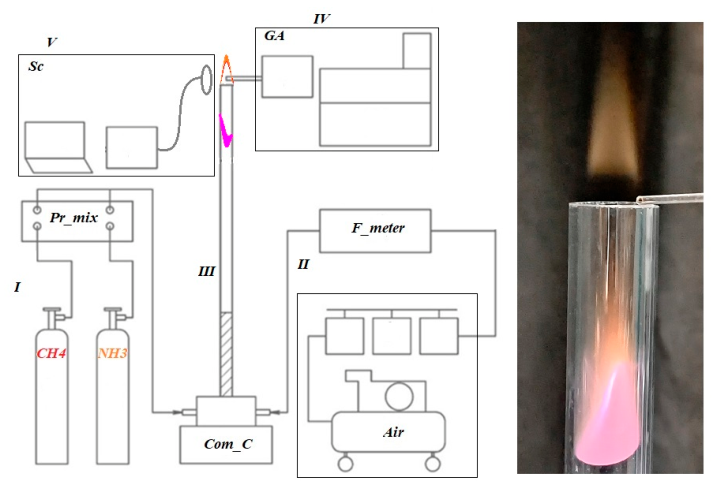
Figure 1 shows a schematic of the experimental setup. The fuel mixture preparation and flow control system (I) included cylinders of combustible gases NH
3 and CH
4 (99.99% purity) and a UFPGS-2 fuel mixture generator (Neosib, Novosibirsk, Russia). The air supply system (II) consisted of a compressor with a receiver, a set of purification filters, and a flow meter. The experiments were carried out on a Bunsen-type burner (III), which was a long quartz tube with an inner diameter of
mm and a length of
mm, sufficient to establish Poiseuille flow at the exit (
–
,
). The fuel–air composition was set using the UFPGS-2 flow controller for the ammonia–hydrogen mixture and a Bronkhorst MassView air flow controller. Atmospheric air from the compressor at a pressure of 3.5 bar was supplied through a line to a system of three filters (AME 350C–F04, AME 350C–F04, AME 350C–F04–T (SMC Corp., Tokyo, Japan)) to prevent compressor oil vapour from entering the test section. The air then passed through a MassFlow meter before being mixed with the fuel. The fuel mixture composition and flow rates were adjusted to ensure a stationary position of the flame front. The volumetric concentrations of CO, CO
2, H
2, and O
2 at the measurement point in the flame were determined using electrochemical sensors of a Test-1 gas analyser (Bonair, Novosibirsk, Russia).
The gas sample was extracted using a quartz sampling probe with a diameter of 1.2 mm, whose position could be adjusted in the radial and vertical directions using a traversing mechanism. Prior to measurement, the sampled gas passed through a gas dryer, where water vapour was condensed in a Peltier cooler. A computer was used to control the precision gas flow regulator and to manage data acquisition. As is known, the main errors in sampling are associated with the uncertainty of the position of the sampling zone (spatial non-locality) and the possible influence on chemical transformations. In the object under study, the temperature and composition gradients are negligibly small; therefore, in our opinion, the actual dimensions of the sampling zone can be neglected. The quartz sampling probe is catalytically inactive, so the relative error does not exceed ± 10% of the measured value. The temperature was measured with a platinum thermocouple type B (wire diameter 0.1 mm). The thermocouple junction is extended beyond the edge of the ceramic holder (diameter 3 mm) by 5 mm along the axis and bent towards the flow to a depth of 4 mm, thus being located almost on an isotherm. No correction for radiation was applied to the thermocouple readings. Temperature and composition measurements were taken using different probes, not simultaneously.
OH* and CH* radical chemiluminescence was recorded in the selected spectral range with LaVision interference filters and a NANOGATE-38 digital optoelectronic camera (Nano Scan Technology Ltd., Dolgoprudny, Russia). The emission spectra of the flame were recorded using a Kolibri-2 spectrometer (Optoelektronika, Novosibirsk, Russia) [
21]. Radiation from the flame was collected by a collimator (focal length 17 mm, diameter 10 mm) aligned to focus a 5 mm diameter region of the flame onto the end face of a 1 mm diameter quartz fiber optic cable, the other end of which was connected to the spectrometer. Spectra in the range of 190–1080 nm were recorded with a resolution of 1 nm using a back-illuminated CCD array (2048 pixels, each 14 × 1000 µm in size). The acquisition time for a single spectrum was 500 ms. The total spectrum acquisition time was 30 s, the entrance slit width of the spectrometer was 15 µm, and the spectral resolution was 0.8 nm (reciprocal linear dispersion 32 nm/mm). During spectrum recording, the dark signal of the spectrometer (background in the absence of radiation) was subtracted. Spectral data processing was performed using Atom 3.3 software (version 3.3, Optoelektronika, Novosibirsk, Russia).
3. Results
During combustion of a premixed NH
3/CH
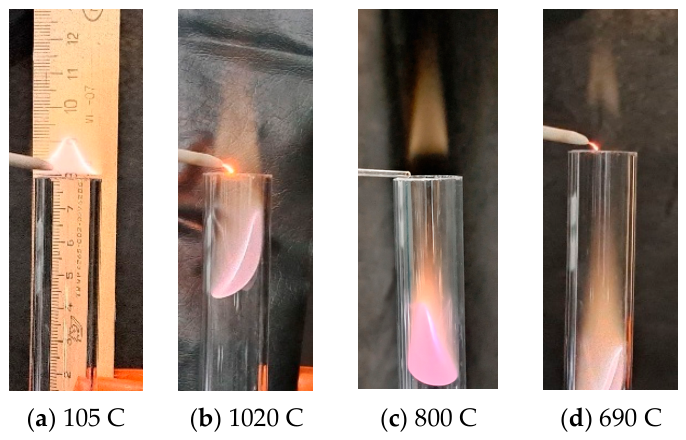
4/air mixture in a Bunsen burner under conditions close to flame flashback, regimes with the flame splitting into two reaction zones are observed (
Figure 2). The critical velocity gradient that determines flame flashback strongly depends on the wall temperature. Highly reactive mixtures (H
2/CH
4, H
2/NH
3) are characterized by high critical gradients; therefore, during flashback, the flame does not remain inside the burner. For the NH
3/CH
4 mixture, as shown, there exists a range of parameters in which the flame stabilizes inside the burner, which is due to low values of the critical gradient. The regime in which the flame penetrates into the burner and stabilizes at some depth is referred to in the present work as quasi-flashback, as opposed to adiabatic flashback. This phenomenon is of a stationary nature. Quasi-flame flashback can be controlled by varying the thermal conditions at the wall. For a tube of given diameter
, these conditions are determined by the mole fraction of ammonia in the binary fuel blend with methane,
, the volumetric fuel flow rate
, the volumetric air flow rate
, the equivalence ratio
, and the Reynolds number. The Reynolds number is defined as
, where
is the bulk flow velocity,
is the tube diameter, and
is the kinematic viscosity of the fuel–air mixture.
It was observed experimentally that there exists a range of mixture compositions and flow rates for which quasi-steady combustion conditions can be achieved during flashback. In this case, one of the combustion zones propagates upstream into the burner and stabilises on its inner surface. In modes b–d, two spatially separated reaction zones are observed: one inside the tube (referred to as the “lower” zone) and one outside (the “outer” zone). Between these zones, there is a region with no visible emission.
The deeper the lower combustion zone penetrates into the tube, the higher the outer luminous region rises above the tube end. As the dark gap between the tube end and the outer flame increases, the temperature at the burner exit decreases. Under the experimental conditions, the temperature was observed to drop from 1020 °C to 690 °C (see
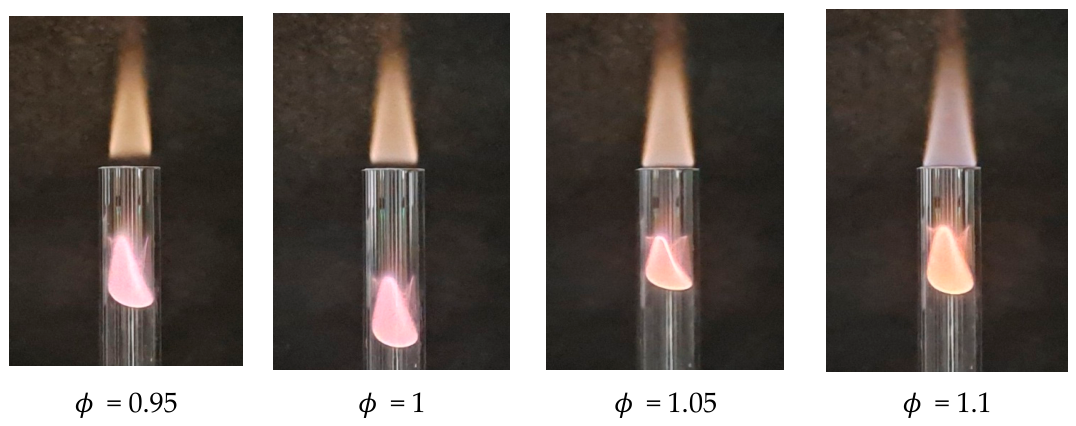
Figure 2). Flame separation during flashback is observed in both lean and rich mixtures (see photos in
Figure 3). The gap observed between the burner rim and the “upper” luminous region (the reaction quenching zone near the tube end) is significantly smaller in the case of a rich mixture than in a lean one. The “lower” flame front has a curved shape, as the flow velocity exceeds the flame propagation speed. In the regimes studied, no oscillations of the flame front position were observed.
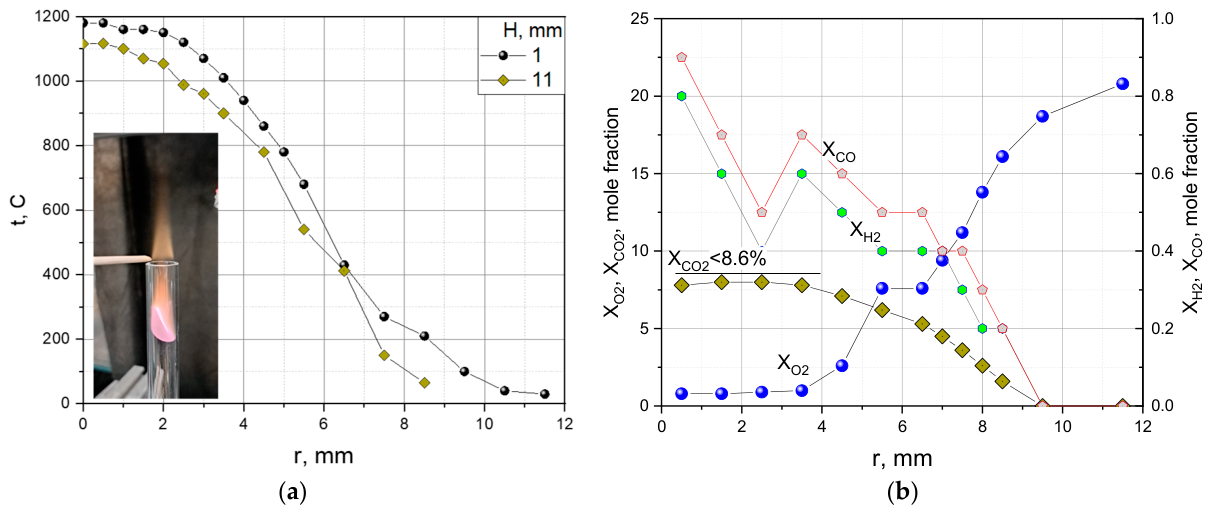
Figure 4 presents the results of temperature and composition measurements near the burner exit under the flame flashback conditions. Here H is the distance from the burner exit. The temperature in the “outer” flame region was measured using a type K thermocouple with a bead diameter of 0.1 mm. No correction for thermocouple radiation was applied. The temperature distribution has a bell-shaped profile; despite the visible front of the “outer” flame region, no local temperature maxima are observed (
Figure 4a). The dried gas composition at the quartz tube exit is shown in
Figure 4b. A CO
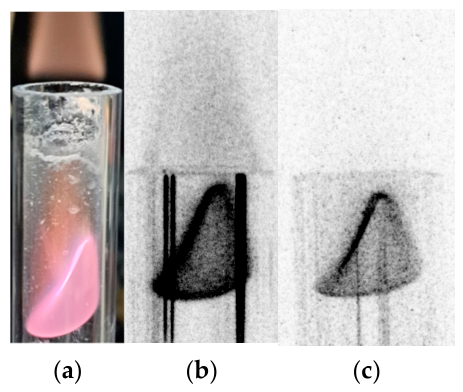
2 content close to 8.6% indicates high combustion efficiency, corresponding to complete methane combustion in the lower flame front. A value of 8.6% corresponds to efficient oxidation of the carbon in the fuel mixture of this composition, based on the overall reaction rate. As can be seen, for this combustion regime, a clear separation of the flame front into two distinct regions—an “outer” and a “lower” one—was observed in the visible range (see
Figure 5a).
Figure 5b shows the OH* chemiluminescence signal, which revealed only weak emission above the burner exit. The residual presence of OH* suggests that in the “lower” part of the flame, the oxidiser is consumed in the formation of fuel NO, reducing the content of the final product H
2O. At the CH* radical wavelength, no signal is detected in this region (
Figure 5c), indicating complete methane combustion within the burner flame front.
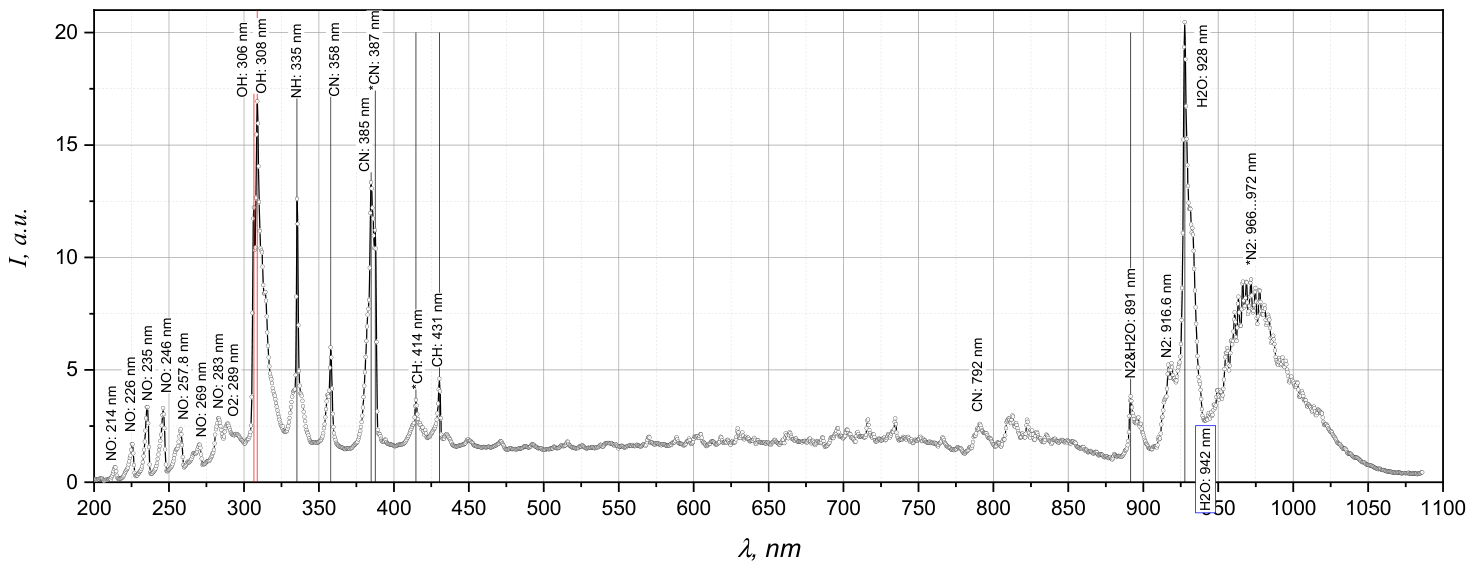
A typical emission spectrum of a laminar NH
3/CH
4/air flame under stoichiometric conditions with stabilisation at the rim is shown in
Figure 6, where the characteristic lines of the main species typical of ammonia–methane–air flames are indicated [
22,
23]. The ratios of the measured intensities of the chemiluminescence lines of OH, NH, CN, and CH allow the equivalence ratio and the ammonia fraction in premixed ammonia–methane–air flames to be predicted [
24,
25].
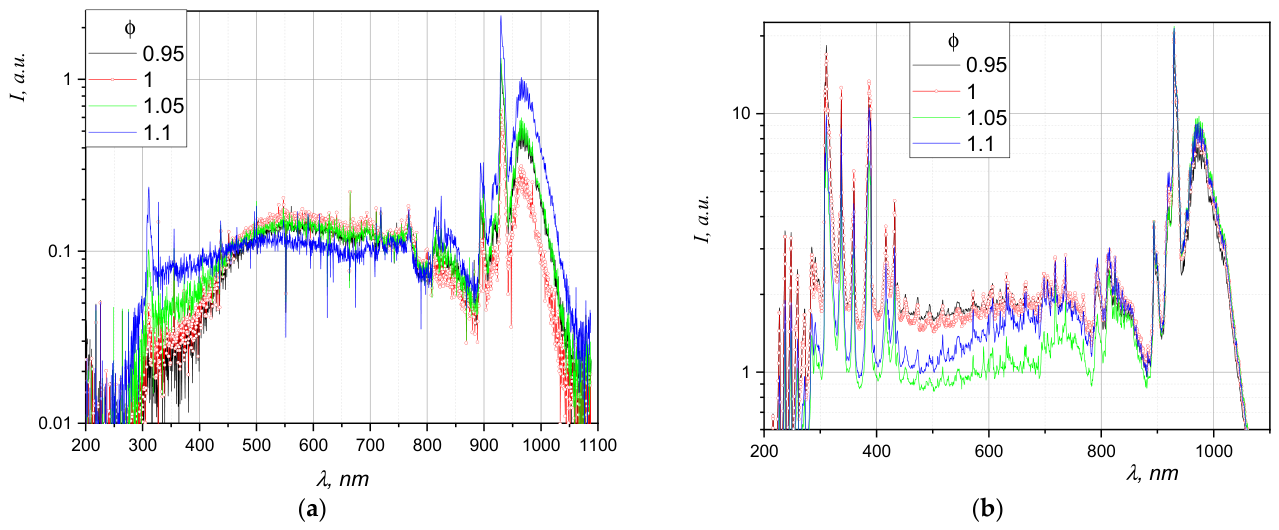
Figure 7 presents the measured spectra of a premixed ammonia–methane flame at various equivalence ratios. As the equivalence ratio increases, the following characteristic changes can be observed in the spectra: a monotonic increase in the intensity of OH* and H
2O lines in the separated (outer) flame, and the presence of a maximum for these lines (
) in the rim-stabilized flame without flashback. It is known that some molecules exhibit a continuous spectrum due to strong coupling between electronic and vibrational levels. The NO2* chemiluminescence spectrum appeared to be continuous and unstructured, while the NH2* chemiluminescence spectrum consisted of groups of distinct emission lines in the 400–700 nm range [
26]. According to [
27], the NO
2 spectrum is extremely complex and highly developed. Typically, the NO
2 spectrum is divided into two systems: visible in the 400–500 nm range and ultraviolet in the 235–250 nm range. However, no significant correlation is observed between the NO2 molecular bands and the flame emission spectrum.
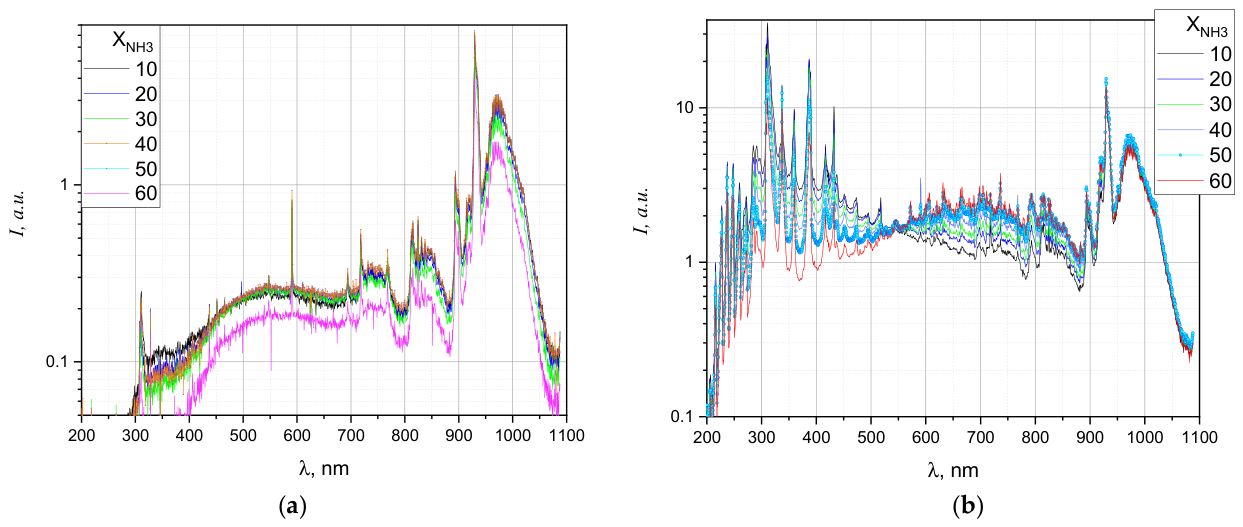
In the case of the separated flame, an increase in the ammonia mole fraction (
Figure 8a) leads to a decrease in the intensity of the OH lines and a reduction in the overall luminosity of the flame. The peak at 928 nm (H
2O) remains practically unchanged. The spectral pattern in the 400–800 nm range, as can be seen, does not depend on the carbon content in the fuel mixture. Moreover, no peaks corresponding to NH
2 emission are observed in the spectrum, which are clearly visible in the spectrum of the rim-stabilized flame (
Figure 8b). An increase in the ammonia fraction leads to an increase in the intensity of these lines.
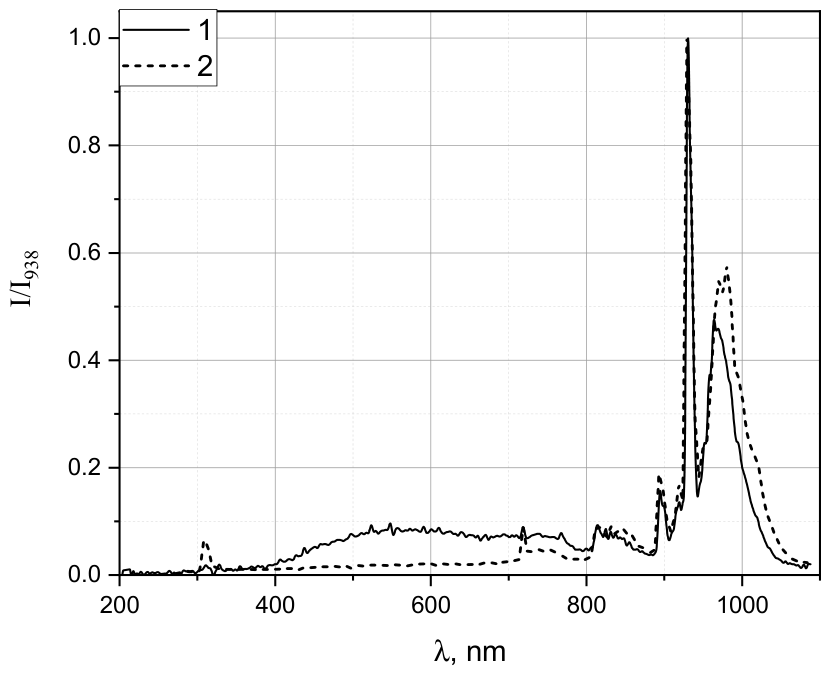
A comparison of the emission spectra of the combustion products for rim-stabilized (without flashback) and outer (quasi-flashback) flames is shown in
Figure 9. The spectra are normalized to the line with maximum intensity in the recorded range (H
2O at 938 nm). Traces of OH* emission (308 nm) are observed in the combustion products. In the 500–800 nm range, a significant difference between the spectra is observed, which is probably related to the presence of NO
2 in the outer flame.
In studies [
28,
29], which focused on combustion processes in burner devices with separated combustion zones, the spectra exhibit lines of the same set of species. This is apparently because the separation of the combustion zones does not lead to changes in the chemical kinetics. As can be seen from the data presented in
Figure 7 and
Figure 8, the separation of the NH
3/CH
4 flame during quasi-flashback is accompanied by qualitative changes in the emission spectra.
4. Discussion
As already noted, during combustion of premixed NH
3/CH
4/air mixtures in a Bunsen burner, an atypical regime may occur, namely, partial flame breakthrough into the burner, which we called quasi-flashback. In contrast to the results reported in [
20] for NH
3/H
2/air mixtures, we obtained a nearly stationary separated flame under quasi-flashback conditions in NH
3/CH
4/air mixtures. This may have been possible because methane has a lower chemical reactivity than hydrogen. The range of velocities and compositions for this combustion scenario is rather narrow:
φ = 0.95–1.1 and Re = 250–300. It should also be noted that a flame of a hydrocarbon–hydrogen mixture does not separate during flashback.
Temperature measurements in the “outer” flame region did not reveal any flame fronts, while the temperature of the combustion products decreases downstream in the outer reaction zone. Gas analysis results at the burner exit support the hypothesis of high combustion completeness in the “lower” flame front. The authors of [
20] suggested that the outer reaction zone in the separated flame contains NH
2, which is responsible for the orange colour of the luminous region. In our experiments with lean mixtures, this species cannot be present in significant amounts, yet luminescence is still observed.
The results of flame spectrometry deserve separate discussion. First, under quasi-flashback conditions for a premixed stoichiometric NH3/CH4/air mixture, the spectrum of the “lower” flame is completely identical to that of a flame stabilised at the rim of the Bunsen burner. In this experiment, the ammonia fraction in the binary NH3/CH4 fuel blend was by volume. It should be noted, however, that the “outer” reaction zone under quasi-flashback conditions is not analogous to the afterburning products behind a rich flame front.
In the wavelength range 500–800 nm, the emission spectrum of the “outer” flame of ammonia-containing fuel mixtures may contain lines of NO
2 and NH
2, which cannot be resolved separately. NH
2 molecules, formed in significant amounts upon ammonia decomposition, can be present only during combustion of rich mixtures. The presence of NO
2 is apparently associated with the low-temperature reaction
occurring in the region where oxygen from the ambient air is mixed in [
30].
Flame separation into two reaction zones is hardly caused by differential diffusion, since the molecular diffusion coefficients of ammonia and methane in air are close in value. In the upper reaction zone during flame stratification, the observed luminescence, as already mentioned, is associated with the oxidation of nitrogen oxide in the region of atmospheric air entrainment. A large amount of nitrogen oxides at the burner outlet is associated with combustion modes close to critical [
19].
In addition to emission band heads, absorption lines may also be of practical interest, such as, for example, H
2O absorption at 942 nm. Comparison of the flame emission spectra shows that under the same conditions, a “dip” is observed in the “outer” flame near ~790 nm. In this range, both NH
3 and HCN (hydrogen cyanide) absorb radiation intensely [
22]. Since the fuel–air mixture composition corresponds to the stoichiometric ratio, the absorption is most likely caused by the formation of HCN, as an intermediate product reflecting the interaction between nitrogen and carbon chemistry. In NH
3/CH
4/air mixtures, the maximum mole fractions of HCN are located in the central part of the flame front stabilised at the burner rim [
31].
5. Conclusions
Unlike classical adiabatic flashback, during quasi-flashback the flame front stabilises inside the tube (at some distance from the exit) and does not propagate upstream into the mixer. Visually, the flame front is observed to split into two parts: an inner zone (inside the burner) and an outer region above the exit. There is a gap between the burner exit and the afterburning region, which increases as the front moves upstream inside the tube. The temperature profile does not show the characteristic extrema of flame fronts.
Analysis of chemiluminescence showed that only OH* emission is detected above the burner exit, while no CH* radiation is present. This suggested that methane is completely consumed inside the tube, and only afterburning with OH* participation occurs in the outer zone. The results of the composition measurements confirm complete carbon oxidation inside the burner (absence of O2, presence of CO2 at maximum levels). The high NO content (>2000 ppm) is characteristic of ammonia combustion in lean mixtures.
According to flame emission spectra measurements, it was established that:
- -
Under quasi-flashback conditions, the emission spectrum of the flame inside the burner has the same set of spectral lines as that of the rim-stabilised flame;
- -
The outer combustion region under quasi-flashback is not analogous to the afterburning zone behind a rich flame front;
- -
In the 500–800 nm wavelength range, the emission spectrum of the “outer” flame of ammonia-containing fuel mixtures most likely corresponds to NO2 emission, formed via the low-temperature reaction in the region where oxygen from the ambient air is entrained;
- -
The presence of an absorption line at ~790 nm in the quasi-flashback regime apparently indicates HCN formation.
Quasi-flashback is a regime with pronounced non-equilibrium in combustion reactions, which is reflected in the composition of intermediate reaction products (NO, NO2, HCN). When using hydrocarbon-enriched ammonia as a low-carbon fuel for practical burner design, it is necessary to consider the chemical kinetics that arise in near-critical conditions. Even in the laminar flame of a Bunsen burner, complex transient processes can be observed. The quasi-flame-flashback regime proposed in this paper may become an effective tool for studying transient conditions.