Article

Chemical Plugging Optimization for Channeling Control During CO2 Flooding Using Multi-Surrogate Collaborative Prescreening


1
Hubei Key Laboratory of Complex Shale Oil and Gas Geology and Development in Southern China, Wuhan 430100, China
2
College of Petroleum Engineering, Yangtze University, Wuhan 430100, China
3
Western Research Institute, Yangtze University, Karamay 834000, China
4
State Key Laboratory of Low Carbon Catalysis and Carbon Dioxide Utilization, Wuhan 430100, China
5
Guizhou Wujiang Coalbed Methane Exploration and Development Co., Ltd., Qianxi 551500, China
6
College of Earth Resources, China University of Geosciences, Wuhan 430074, China
*
Authors to whom correspondence should be addressed.
These authors contributed equally to this work.
Processes 2026, 14(17), 2716; https://doi.org/10.3390/pr14172716
Submission received: 30 July 2026 / Revised: 18 August 2026 / Accepted: 24 August 2026 / Published: 25 August 2026
(This article belongs to the Special Issue Advances in Reservoir Simulation and Multiphase Flow in Porous Media)

Abstract

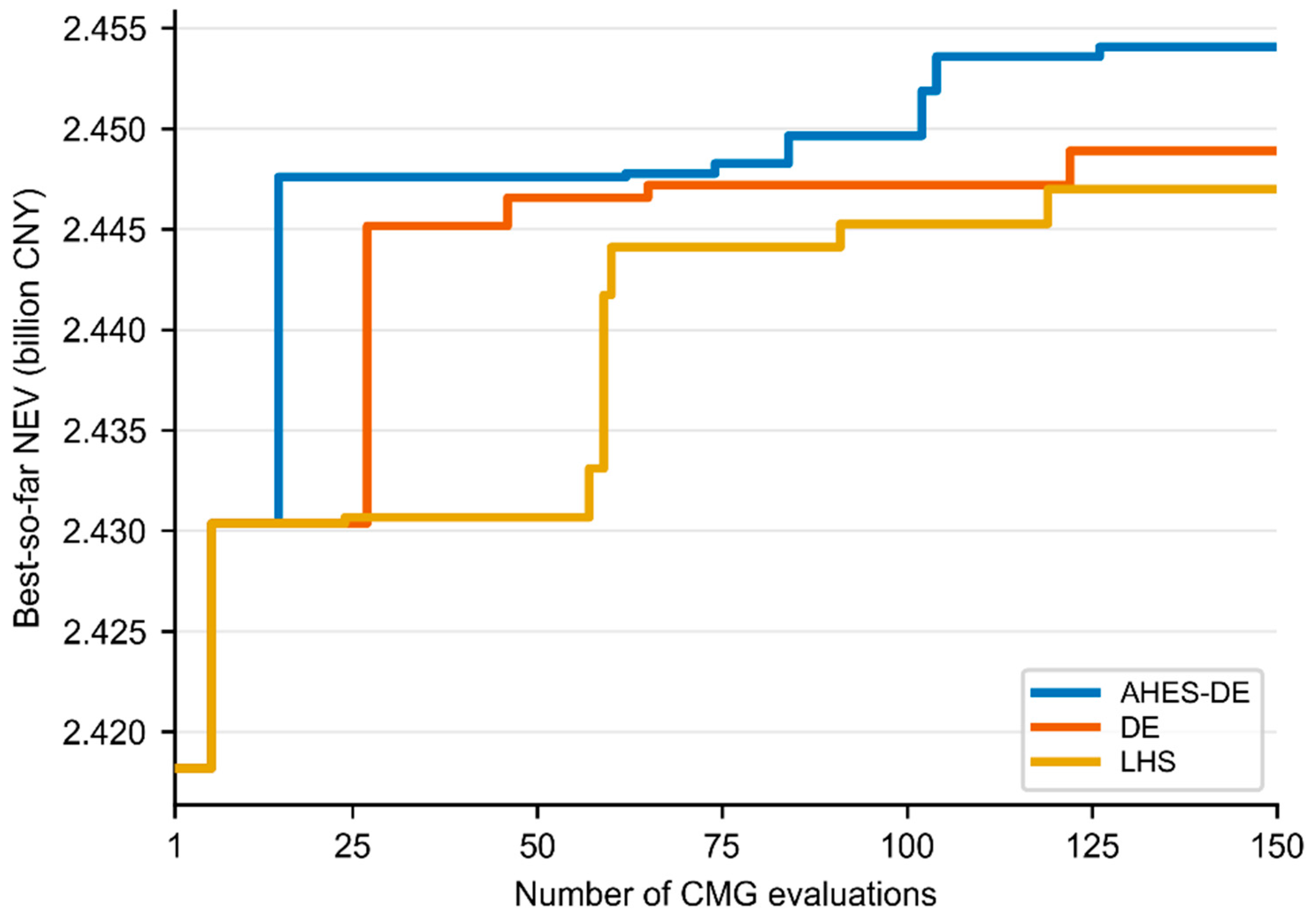
During CO2 flooding, unfavorable mobility ratios and interlayer heterogeneity can induce preferential flow through high-permeability intervals, leaving central low-permeability intervals insufficiently swept and rich in remaining oil. To address the strong coupling among composite chemical-plugging parameters and the high computational cost of CMG-STARS simulations for individual candidate strategies, this study proposes an adaptive heterogeneous ensemble surrogate-assisted differential-evolution method (AHES-DE). The method integrates radial basis function, inverse-distance weighting, and ridge-linear surrogate models, whose predictions are dynamically weighted according to leave-one-out cross-validation errors. Explorer, Exploiter, and Robust roles are used for global search, local exploitation, and prediction-risk control, respectively, with differential-evolution offspring generation embedded in the Exploiter role. A stratified one-injector–four-producer conceptual model with a 21 × 21 × 6 grid was used to establish a numerical evaluation workflow comprising CO2 injection, preferential-channel development, composite chemical plugging, and subsequent displacement. Mobile chemical concentration, adsorbed preformed particle gel (PPG) mass density, water-phase resistance factor, oil saturation at a common termination time, and net economic value (NEV) were used to evaluate treatment performance. Under an equal budget of 150 high-fidelity CMG-STARS evaluations per method, the reported single-seed final best-so-far NEVs were 2.45405 × 10⁹ CNY for AHES-DE, 2.44888 × 10⁹ CNY for differential evolution (DE), and 2.44698 × 10⁹ CNY for Latin hypercube sampling (LHS). The layer-resolved responses indicate more pronounced chemical transport, retention, and resistance development in the upper and lower preferential intervals, while the oil saturation in the central low-permeability interval decreased further after treatment, indicating that flow redistribution facilitated remaining-oil mobilization. A realistic geological model was further used to assess the engineering consistency of the identified flow-control mechanism.

1. Introduction

Carbon capture, utilization and storage (CCUS) is an important route for reducing emissions from mature hydrocarbon reservoirs. CO2-enhanced oil recovery (CO2-EOR) can couple incremental oil recovery with subsurface CO2 retention [1,2,3]. However, the high mobility of CO2 relative to resident oil and brine makes displacement highly sensitive to viscous fingering, gravity segregation, and permeability contrast. In stratified heterogeneous reservoirs, injected CO2 may preferentially enter high-conductivity intervals and bypass less permeable oil-bearing regions, causing premature breakthrough, inefficient gas recycling, and reduced sweep efficiency [4,5,6]. This issue is particularly pronounced when upper and lower high-permeability intervals communicate rapidly with producers while the central low-permeability interval remains insufficiently swept and retains substantial remaining oil. Chemical conformance control is widely used to mitigate preferential flow during gas flooding. Polymer gels, preformed particle gels (PPGs), foam-gel systems, and CO2-responsive gels can increase flow resistance in dominant channels and promote subsequent displacement into insufficiently swept regions [7,8,9,10,11,12,13,14,15,16,17]. In composite PPG–polymer treatments, the particle-gel and polymer components are introduced to provide complementary flow-control functions. However, treatment performance depends jointly on chemical concentrations, injection rates, slug durations, subsequent displacement intensity, well constraints, and operating cost. The selection of a chemical-plugging strategy is therefore a strongly coupled design problem rather than a simple combination of independent operating variables. Evaluating each candidate strategy requires a high-fidelity reservoir simulation that resolves coupled flow, chemical transport, and well-control effects. Conventional population-based optimization methods may therefore require a computationally prohibitive number of simulator calls. Surrogate-assisted evolutionary algorithms reduce this burden by using completed high-fidelity evaluations to construct inexpensive approximations and prioritize promising candidates for subsequent simulation [18,19,20,21,22,23,24,25,26,27]. Nevertheless, the predictive performance of a single surrogate can be sensitive to the limited and evolving sample set, particularly when the response surface contains operational thresholds, chemical-placement transitions, or localized flow-redistribution responses. Although heterogeneous surrogate ensembles and surrogate-guided evolutionary search have been developed for expensive optimization [28,29,30], their application to composite chemical-plugging design under a fixed reservoir-simulation budget remains limited. In particular, an integrated strategy is needed to balance global exploration, local exploitation, and prediction-risk control while retaining the differential-evolution search capability.
To address this gap, this study develops an adaptive heterogeneous ensemble surrogate-assisted differential-evolution method (AHES-DE) for composite chemical-plugging strategy optimization during CO2 flooding. AHES-DE integrates a radial basis function, inverse-distance weighting, and ridge-linear surrogate models, with their contributions dynamically weighted using leave-one-out cross-validation errors. Explorer, Exploiter, and Robust roles generate globally informative, locally competitive, and prediction-risk-aware candidates, respectively; differential-evolution offspring generation is embedded in the Exploiter role. A 21 × 21 × 6 six-layer one-injector–four-producer conceptual model is used to screen chemical-plugging strategies under a constrained CMG-STARS simulation budget. The screened treatment is subsequently assessed through layer-resolved chemical transport, modeled PPG retention, water-phase resistance, oil-saturation, and net-economic-value responses, and the identified flow-control response is further examined using a realistic geological model. This workflow links simulation-budget-aware optimization with reservoir-scale evidence for chemical conformance control.

2. Mathematical Formulation and AHES-DE Optimization Framework

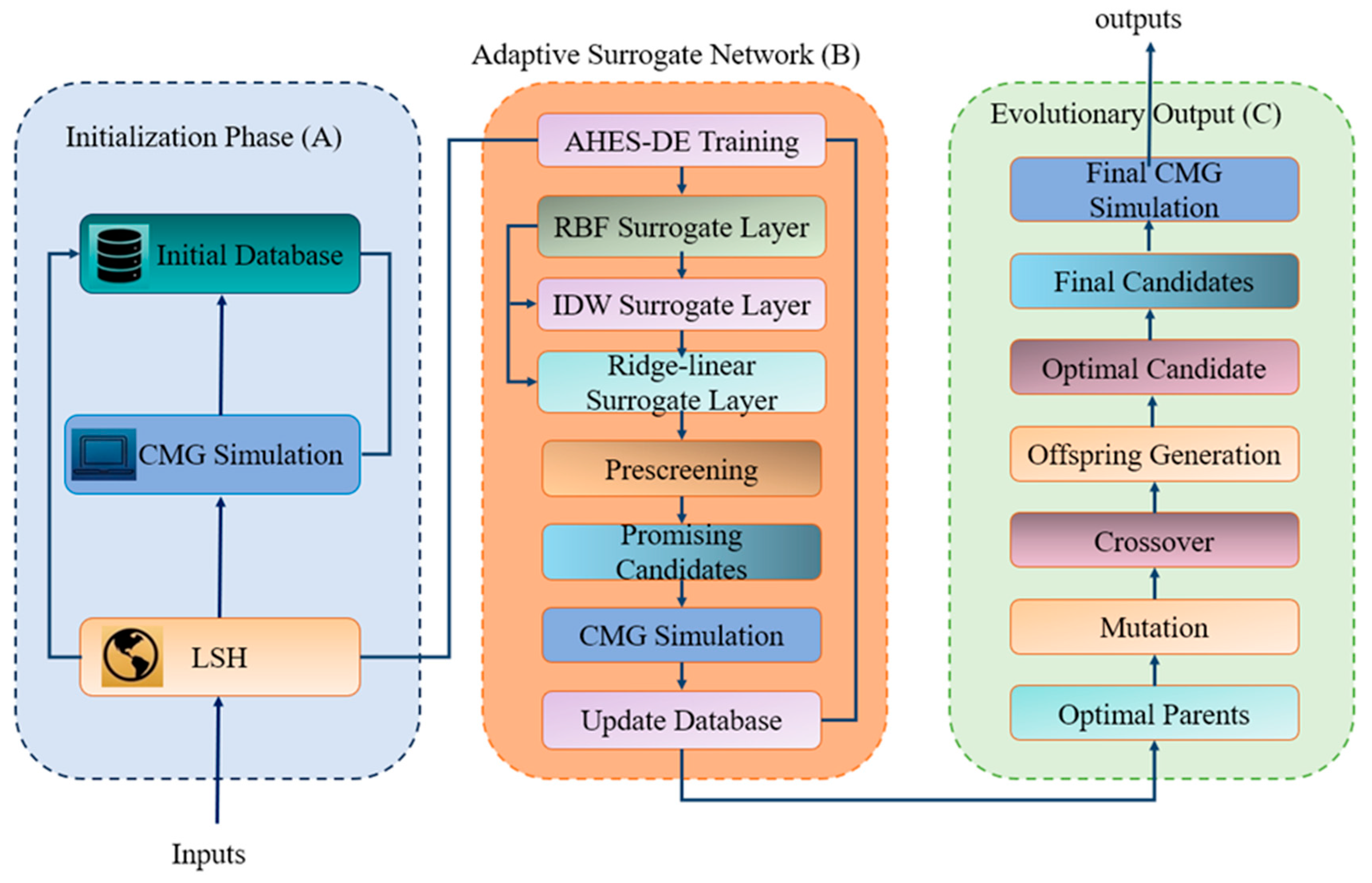
To address the high dimensionality, strong nonlinearity and high computational cost associated with numerical evaluation in chemical-plugging parameter optimization for CO2 channeling control, this section formulates a single-objective black-box optimization problem that maximizes net economic value (NEV). It then describes the mathematical architecture and implementation of the proposed adaptive heterogeneous ensemble surrogate-assisted differential-evolution algorithm (AHES-DE). An overview of the proposed AHES-DE workflow is provided in Figure 1.
Figure 1. Workflow of the adaptive heterogeneous ensemble surrogate-assisted differential-evolution (AHES-DE) framework, including Latin hypercube sampling initialization, ensemble-surrogate screening, role-based candidate generation, CMG-STARS evaluation, and database update.
Processes 14 02716 g001

2.1. Mathematical Formulation of the Optimization Problem

Composite chemical-plugging design was formulated as a single-objective black-box optimization problem constrained by a high-fidelity numerical simulator. For a specified reservoir model, well pattern and development schedule, the optimizer searches the controls of the preformed particle gel (PPG) slug, polymer-gel slug and post-slug waterflooding stage to maximize the economic objective over the evaluation period. The objective is termed net economic value (NEV) rather than net present value (NPV), because it is calculated without temporal discounting over a common fixed simulation horizon. Accordingly, NEV is used here as a consistent economic screening metric for comparing alternative chemical-plugging schedules under identical reservoir and cost assumptions, rather than as a full project-level discounted cash-flow evaluation.
max x Ω J ( x ) = NEV ( x ) = p o N p ( x ) c i W i ( x ) c p W p ( x ) c PPG M PPG ( x ) c poly M poly ( x )
Here, Np, Wi and Wp denote cumulative oil production, cumulative water injection and cumulative water production returned by CMG-STARS, respectively. MPPG and Mpoly are the injected masses of PPG and polymer gel. po is the oil price, whereas ci, cp, cPPG and cpoly denote the costs of water injection, produced-water handling, PPG and polymer gel, respectively. Equation (1) expresses production revenue, water-management costs and chemical costs in a common monetary unit. The present NEV formulation does not include net CO2 retention or CO2 recycling metrics. Therefore, the optimization results are interpreted as economic screening results for the specified simulation schedule, rather than as a quantitative assessment of geological CO2 storage performance. Extension to a multi-objective formulation would require explicitly simulated and validated CO2 injection, production, retention, and recycling responses.
x = c PPG , c poly , q PPG , q poly , q w , τ PPG , τ poly T
x L x x U , τ PPG , τ poly 1 , 2 , , 6
The decision vector includes the mass fractions of the two chemical agents, the injection rates of the PPG and polymer-gel slugs, the post-slug water-injection rate and the durations of both slugs. Continuous variables are searched within prescribed bounds, whereas slug durations are integer numbers of months. Each candidate is translated into a CMG-STARS operating schedule, simulated, and evaluated by Equation (1). Table 1 lists the optimization variables and their ranges.

2.2. AHES-DE Optimization Framework

AHES-DE was developed for small-sample, strongly nonlinear and computationally expensive chemical-plugging optimization. Between successive exact CMG evaluations, a heterogeneous surrogate ensemble rapidly evaluates a large candidate pool. Explorer, Exploiter and Robust roles then propose candidates from complementary search perspectives. Each newly obtained high-fidelity evaluation is added to the database to update surrogate models and role credits.
To eliminate differences in variable scales, historical samples are mapped to the unit hypercube:
x ~ j = x j x j L x j U x j L
In the normalized space, the radial basis function (RBF), inverse-distance weighting (IDW) and ridge-linear models provide local smooth interpolation, distance-weighted neighborhood prediction and global linear-trend estimation, respectively. The RBF model uses a Gaussian kernel, IDW weights neighboring samples by inverse squared distance, and ridge-linear regression stabilizes linear fitting through L2 regularization. These three models were selected for complementary nonlinear, local and global-trend representations; Kriging was not included because AHES-DE uses leave-one-out-error-based weighting and role-based prescreening rather than a predictive-variance-driven acquisition function.
y ^ RBF x ~ = i = 1 n α i exp x ~ x ~ i 2 2 l 2
y ^ IDW x ~ = i N k ( x ~ ) w i y i i N k ( x ~ ) w i , w i = 1 max x ~ x ~ i , ε 2
y ^ RL x ~ = β 0 + β T x ~ , β = Φ T Φ + λ I 1 Φ T y
The surrogate weights are not specified a priori. For surrogate m, its leave-one-out root-mean-square error, RMSEm, is calculated; lower-error models receive larger ensemble weights. The ensemble prediction is defined as:
ω m = RMSE m + ε 1 k = 1 3 RMSE k + ε 1 , y ^ x ~ = m = 1 3 ω m y ^ m x ~
Explorer selects globally informative candidates by combining expected improvement, uncertainty and novelty. Exploiter searches the trust region of promising samples together with a differential-evolution offspring pool, ranking candidates by expected improvement. Robust uses a risk-adjusted prediction score to suppress candidates with high surrogate disagreement. A dynamic coordinator allocates exact evaluation opportunities to the three roles according to their historical improvement contributions.
S Explorer = EI + λ u z σ + λ n z d
v i = x i + F x pbest x i + F x r 1 x r 2 , S Robust = μ λ r σ + λ n z d
Here, EI is expected improvement; μ and σ are the ensemble-predicted mean and uncertainty, with the latter represented by surrogate disagreement; d is the minimum normalized distance between a candidate and the historical sample set; and z(·) denotes standardization. The left-hand expression in Equation (10) is the DE/current-to-pbest/1 mutation used by Exploiter. Offspring undergo binomial crossover, bound repair and rounding of integer variables before joint surrogate prescreening with trust-region candidates. Only the final candidate selected in each iteration is evaluated by CMG-STARS.

2.3. Benchmark-Function Tests and Algorithm-Validation Protocol

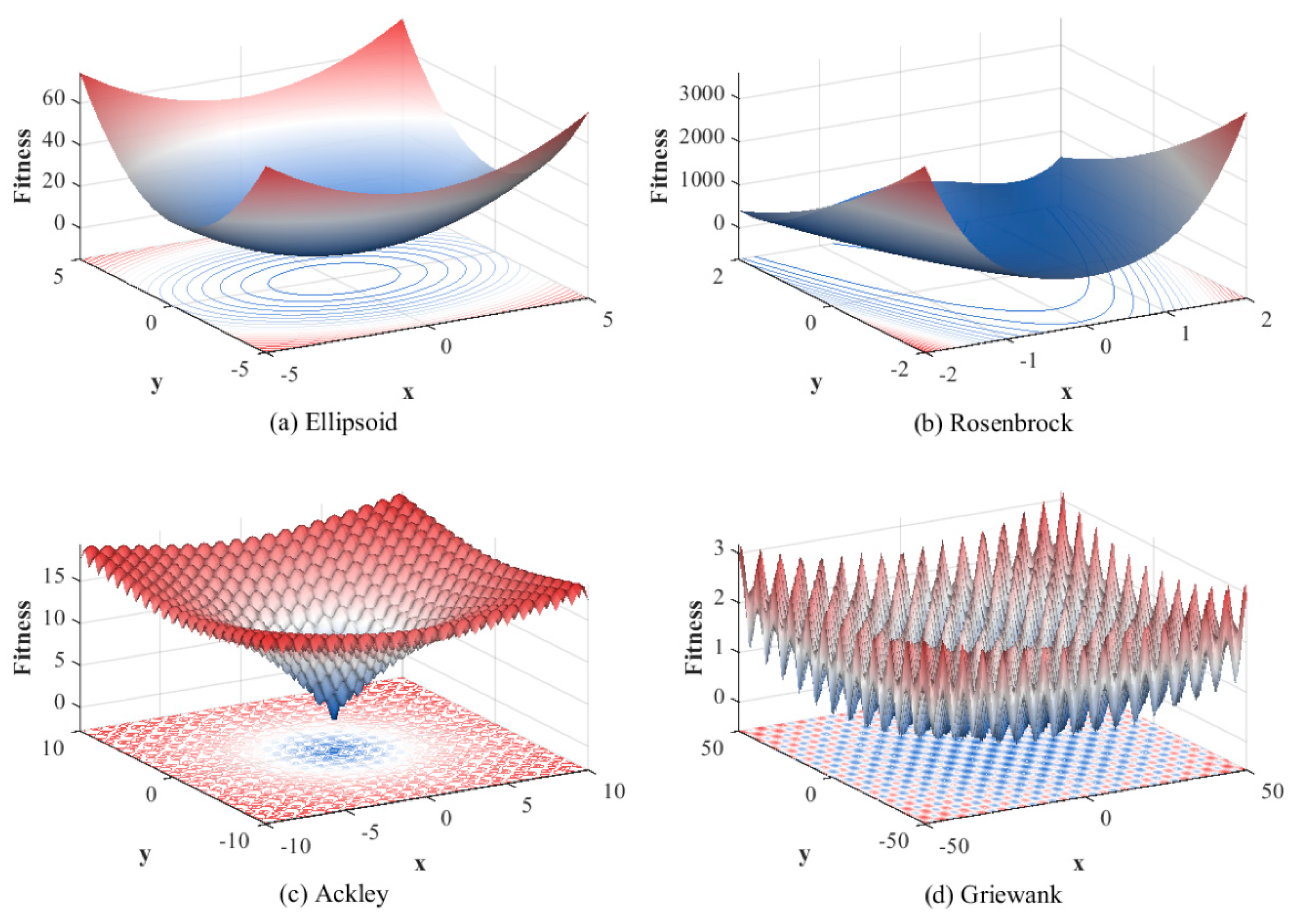
Before deployment on the computationally expensive reservoir optimization problem, four 100-dimensional benchmark functions were used as generic stress tests of the numerical search framework. These continuous functions were selected to examine boundary handling, convergence recording, and the balance between global exploration and local exploitation under high-dimensional continuous landscapes. They were not intended to reproduce the seven-dimensional mixed continuous–discrete decision space of the chemical-plugging problem or to serve as application-matched performance tests. Sphere, Rosenbrock, Ackley and Griewank functions represent unimodal, ill-conditioned, multimodal and highly multimodal landscapes, respectively. Their definitions are given in Table 2. Figure 2 presents two-dimensional illustrative visualizations of these functions and does not represent the target reservoir search space.
Reservoir-level algorithm comparisons were conducted under an equal exact-evaluation-budget protocol. AHES-DE, differential evolution (DE), and Latin hypercube sampling (LHS) were assigned identical decision variables, variable bounds, initial sample size, CMG-STARS model, and a maximum budget of 150 high-fidelity evaluations. For each algorithm, the best-so-far net economic value (NEV), the evaluated candidate set, and the feasibility of the generated schedules were recorded throughout the search. This protocol ensured that differences in the reported search histories were examined under the same computational budget and reservoir-simulation setting. DE and LHS were used as direct evolutionary-search and space-filling sampling references, respectively, rather than as an exhaustive set of surrogate-assisted evolutionary benchmarks. This reservoir-level comparison, rather than the generic benchmark results, provides the application-relevant assessment for the mixed-variable chemical-plugging optimization problem.

3. Six-Layer Conceptual Model and Chemical Conformance-Control Mechanism

A controlled six-layer conceptual model was used to examine whether the chemical-plugging settings screened by AHES-DE produced the intended flow redistribution. Unlike a realistic geological model, in which multiple sources of heterogeneity are superimposed, the conceptual model explicitly separates upper and lower preferential layers from central low-permeability target layers. This configuration allows chemical transport, resistance development and remaining-oil mobilization to be interpreted by layer. The conceptual-model results establish the mechanism evidence chain, whereas the realistic geological model in the next section is used to assess engineering consistency.

3.1. Stratified Conceptual Model and Development Schedule

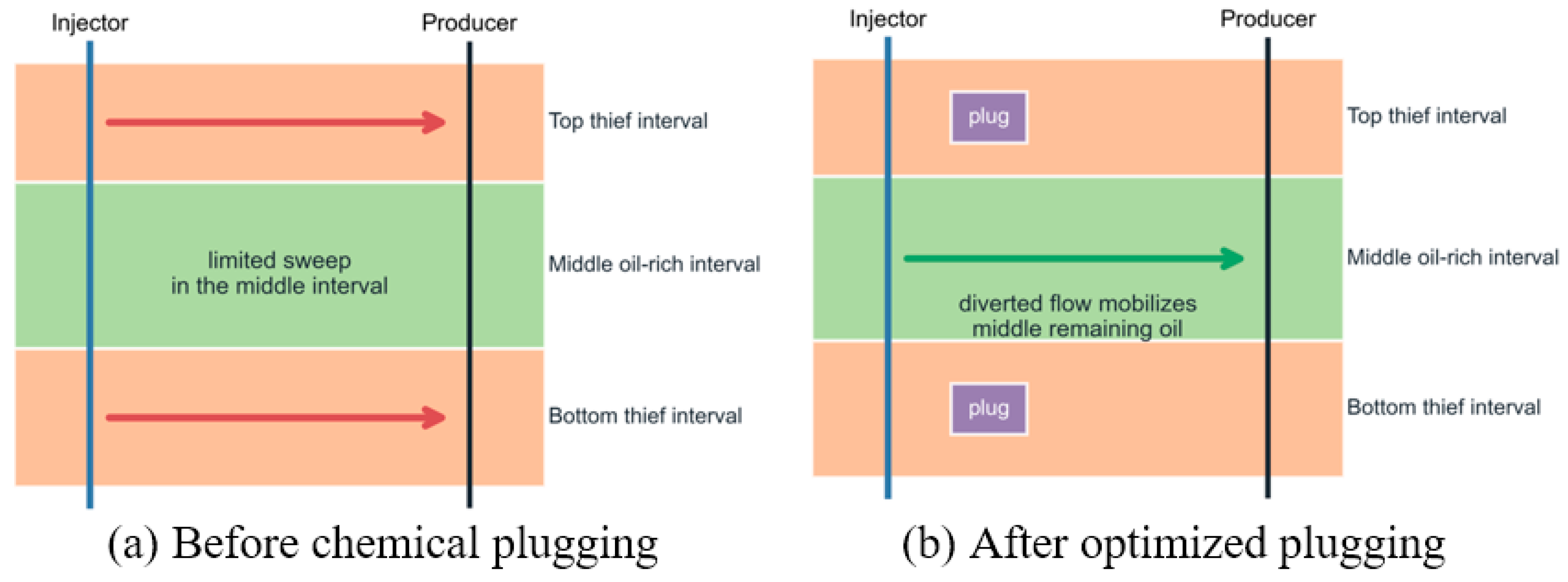
The model comprised a 21 × 21 × 6 Cartesian grid with areal cell dimensions of 50 m × 50 m and a layer thickness of 8 m, giving 2646 active grid blocks. One injection well was placed at the center and four production wells at the corners, forming a symmetric one-injector–four-producer pattern. Vertical heterogeneity was introduced through interlayer permeability contrasts rather than through preset areal high-permeability strips: Planes 1–2 and 5–6 represented upper and lower preferential layers, whereas Planes 3–4 represented central low-permeability layers containing the principal remaining-oil target. The conceptual well pattern and the intended flow-redistribution mechanism are illustrated in Figure 3. The principal grid, well-pattern, interlayer-heterogeneity, and chemical-sequence settings are summarized in Table 3.
Table 3. Main settings of the six-layer conceptual reservoir model.
ParameterSpecification
Grid dimensions21 × 21 × 6
Active grid blocks2646
Areal grid size50 m × 50 m
Layer thickness8 m
Well patternOne central injector and four corner producers
Interlayer heterogeneityPlanes 1–2 and 5–6: preferential layers; Planes 3–4: central low-permeability target layers
Chemical sequencePPG slug → polymer-gel slug → subsequent waterflooding
Figure 3. Conceptual illustration of preferential flow in the upper and lower high-flow-capacity intervals and flow redistribution after composite chemical plugging. Arrows indicate the dominant displacement directions.
Processes 14 02716 g003
The development schedule consisted of a pre-displacement stage, a chemical-plugging stage and a subsequent waterflooding stage. The pre-displacement stage established preferential flow in the high-mobility layers. During chemical plugging, a PPG slug was followed by a polymer-gel slug. Subsequent waterflooding maintained the interlayer pressure differential. The optimization variables controlled the concentrations, injection rates and slug durations of both chemical agents, as well as the subsequent water-injection rate; their bounds are listed in Table 1.
In CMG-STARS, PREP_GEL and POLY_GEL were treated as pseudo-components in a parameterized chemical-conformance-control representation. PPG-related retention was represented through prescribed adsorption/retention settings and a residual water-phase resistance factor, whereas polymer-gel effects were represented using specified component-viscosity and flow-resistance settings. These inputs define the numerical treatment scenario for strategy optimization and were not calibrated against matched coreflood experiments.
The model does not independently resolve PPG mechanical shear degradation, swelling-ratio kinetics, or permanent formation damage. Accordingly, the simulated water-phase resistance response is interpreted as an effective reservoir-scale reduction in aqueous-phase mobility rather than as a direct prediction of material-specific mechanical or kinetic behavior. The results are therefore used to compare parameterized chemical-plugging schedules within the adopted CMG-STARS representation.

3.2. Chemical Transport, Resistance Development and Flow Redistribution

In the numerical model, composite chemical plugging is represented through coupled chemical-transport and flow-resistance responses. Mobile chemical concentration is used to indicate the simulated extent of chemical transport, whereas adsorbed preformed particle gel (PPG) mass density identifies the modeled retention of the particle-gel component. The water-phase resistance factor quantifies the reduction in effective aqueous-phase mobility after treatment. These simulator outputs are interpreted together with the oil-saturation response at a common termination time to evaluate whether the selected treatment redistributes displacement flow from preferential intervals towards the central low-permeability interval. The present representation evaluates the reservoir-scale flow-control response of the parameterized chemical treatment; it does not constitute a direct measurement of thermodynamic, kinetic, or interfacial processes.
R w ( x , t ) = k r w μ w 0 k r w μ w ( x , t )
where Rw is the water-phase resistance factor; [krw/μw]0 is the water-phase mobility before chemical treatment; and [krw/μw](x,t) is the local water-phase mobility after chemical treatment. Within the numerical representation, a resistance factor close to unity indicates a limited change in local aqueous-phase mobility, whereas a larger value indicates a stronger simulated reduction in flow capacity. Regions with elevated resistance factors were jointly examined with the distributions of adsorbed PPG mass density and preferential layers to characterize the spatial correspondence between simulated chemical retention and resistance development.

3.3. Optimization Results and Remaining-Oil Mobilization

The conceptual-model results were analyzed in the sequence of economic evaluation, chemical transport and retention, resistance development, and oil-saturation response. Figure 4 presents the best-so-far NEV search trajectories of AHES-DE, DE and LHS under the common evaluation budget. All three methods completed 150 high-fidelity CMG-STARS evaluations. The figure records the evolution of the best solution identified during each search process under the prescribed computational budget. Candidate-evaluation records for the three methods are provided in Supplementary Figure S1.
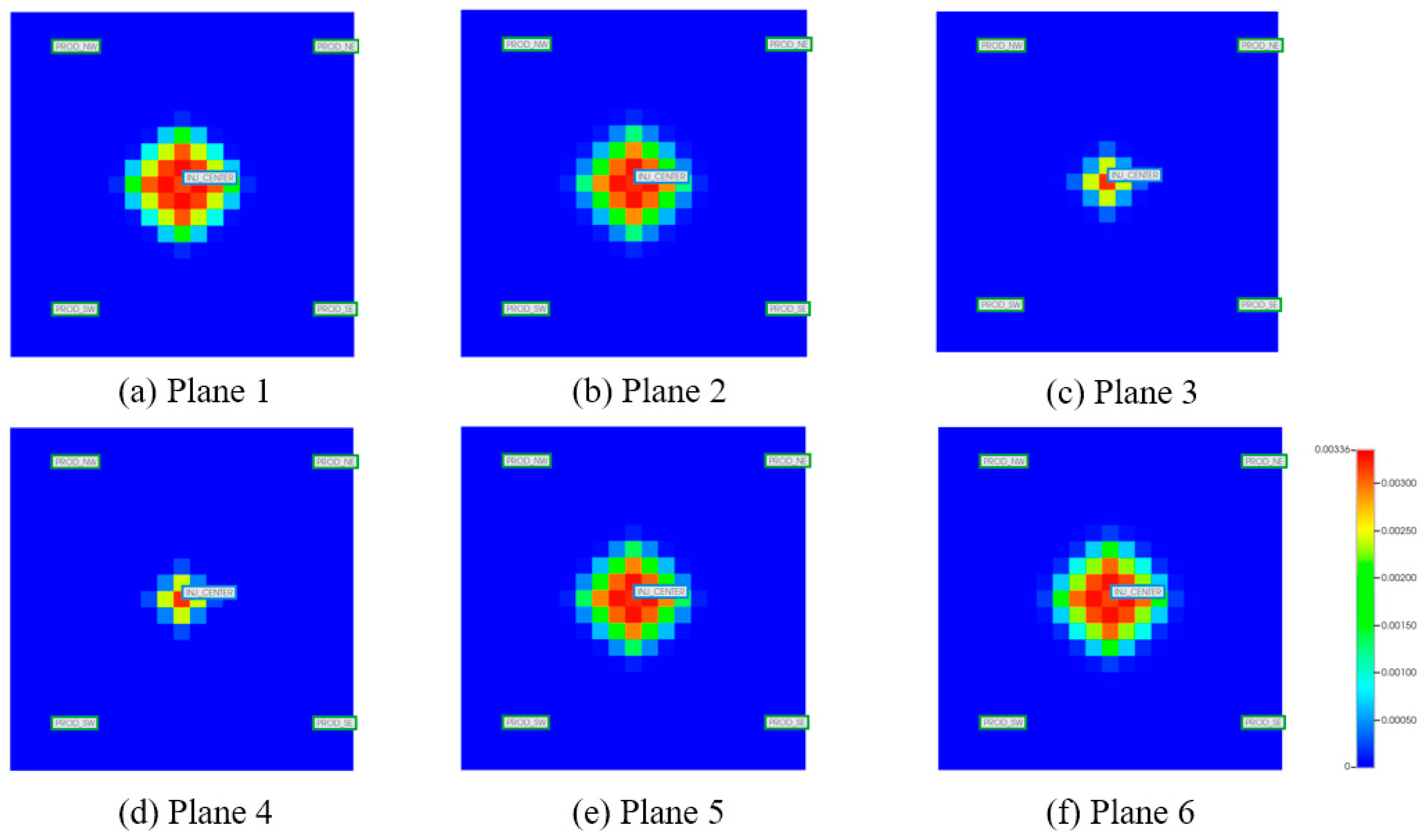
Figure 5 shows the six-plane distribution of adsorbed PPG mass density at the early stage of chemical plugging. PPG retention was more pronounced in Planes 1, 2, 5 and 6 than in Planes 3 and 4, indicating a layer-dependent retention response rather than uniform treatment throughout the reservoir. The adsorbed PPG mass-density maps identify the simulated retention zones of particle gel. The corresponding mobile PPG-concentration distributions at the common evaluation endpoint are provided in Supplementary Figure S2.
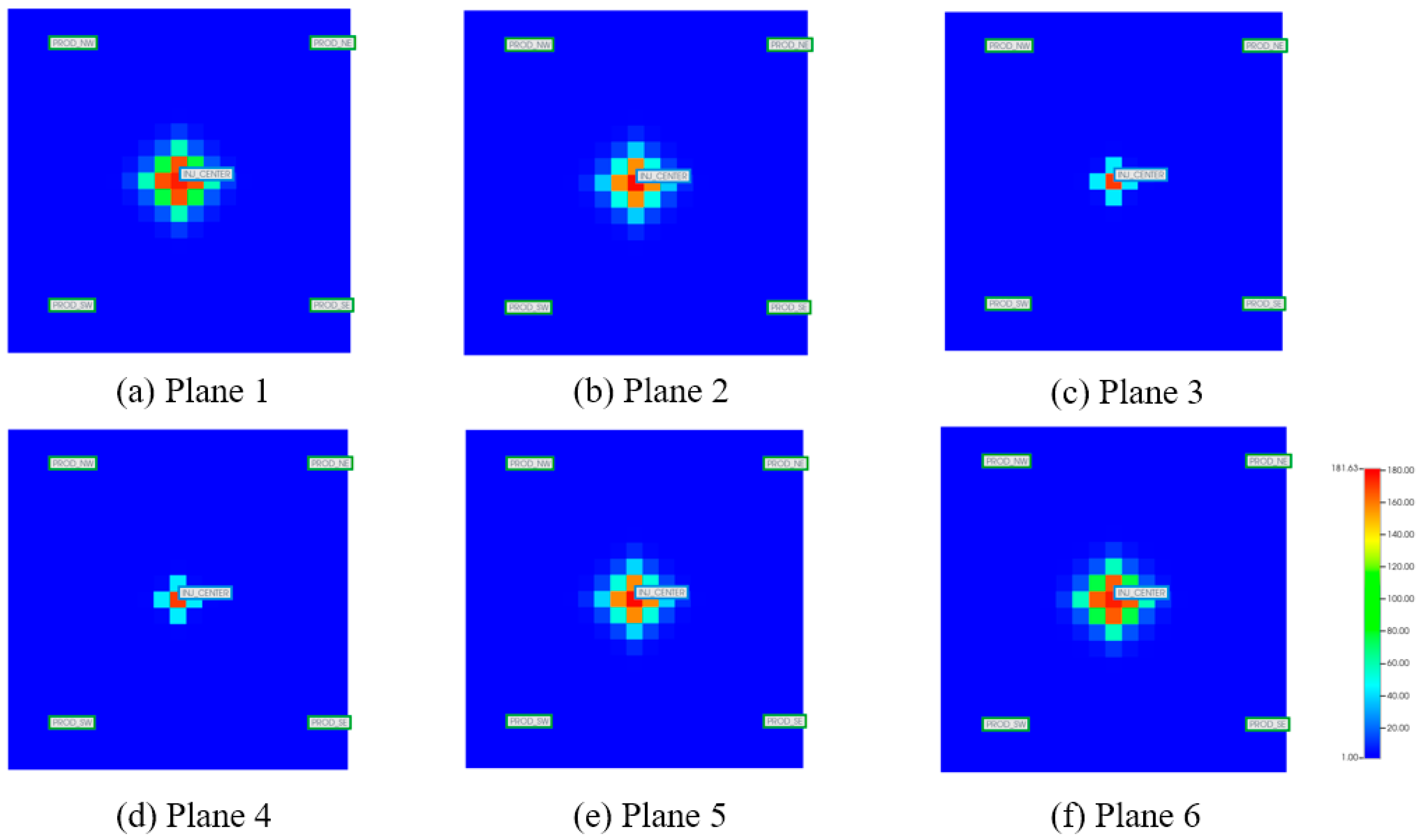
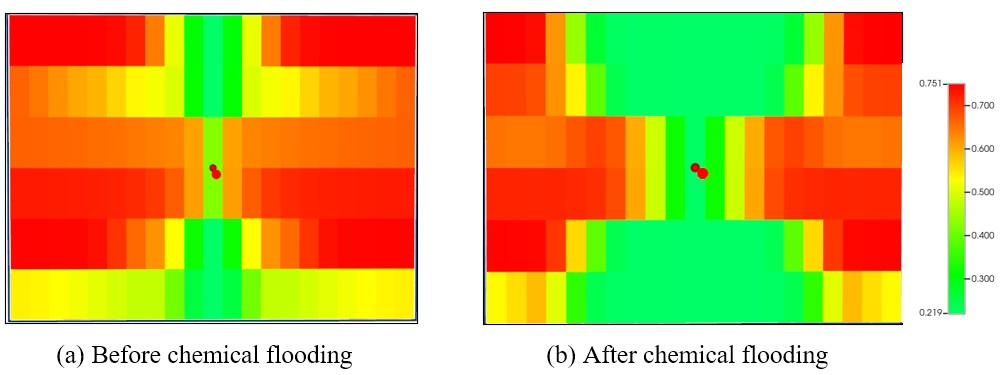
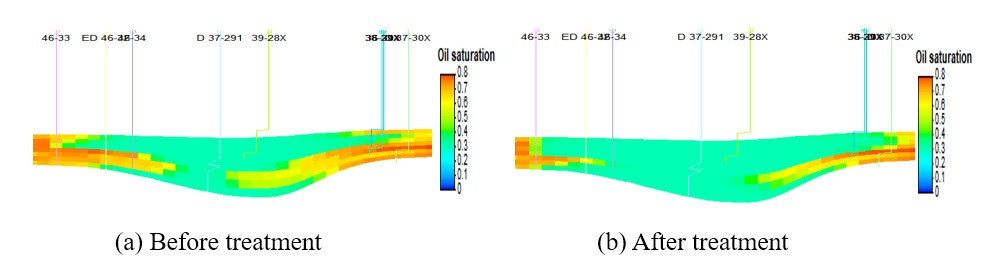
Figure 6 shows the spatial distribution of the water-phase resistance factor after chemical plugging. Elevated resistance-factor regions were interpreted together with the adsorbed-PPG distribution to identify the simulated location of flow resistance development. Figure 7 compares the oil-saturation profiles before chemical treatment and at the common termination time after chemical flooding. Together, the PPG-retention, resistance-factor and oil-saturation responses provide reservoir-scale evidence that chemical treatment preferentially regulated high-flow-capacity regions and redistributed subsequent displacement towards the central low-permeability interval. Layerwise oil-saturation distributions at the common termination time are provided in Supplementary Figure S3.
By integrating three response types—adsorbed PPG mass density, water-phase resistance factor and oil saturation at a common termination time—a layer-resolved framework was used to evaluate chemical conformance-control performance. Adsorbed mass density identifies the simulated retention zones of particle gel, the resistance factor characterizes the simulated change in aqueous-phase flow capacity, and oil saturation evaluates the displacement response of remaining oil.

4. Engineering-Consistency Assessment Using a Realistic Geological Model

The six-layer conceptual model was intentionally designed as a controlled environment to screen a representative chemical-plugging strategy and to identify the associated layerwise flow-redistribution mechanism under a fixed simulation budget. A realistic geological model was subsequently used as an independent engineering-consistency assessment to examine whether this mechanism remained evident under a realistic well pattern, areal heterogeneity and interval-scale variability. This assessment was not designed to establish that the transferred schedule was globally optimal in the realistic geological model. Rather, it examined whether preferential-region chemical transport, local flow-capacity regulation and the associated remaining-oil response were mechanistically consistent under more complex geological conditions. A full reoptimization of the realistic geological model would require a substantially larger number of high-fidelity CMG-STARS evaluations because of its more complex grid structure, spatial heterogeneity and interwell connectivity. Such field-scale optimization was beyond the fixed computational budget and the mechanism-validation scope of the present study.

4.1. Three-Dimensional Geological Model and Stratified Remaining-Oil Characteristics

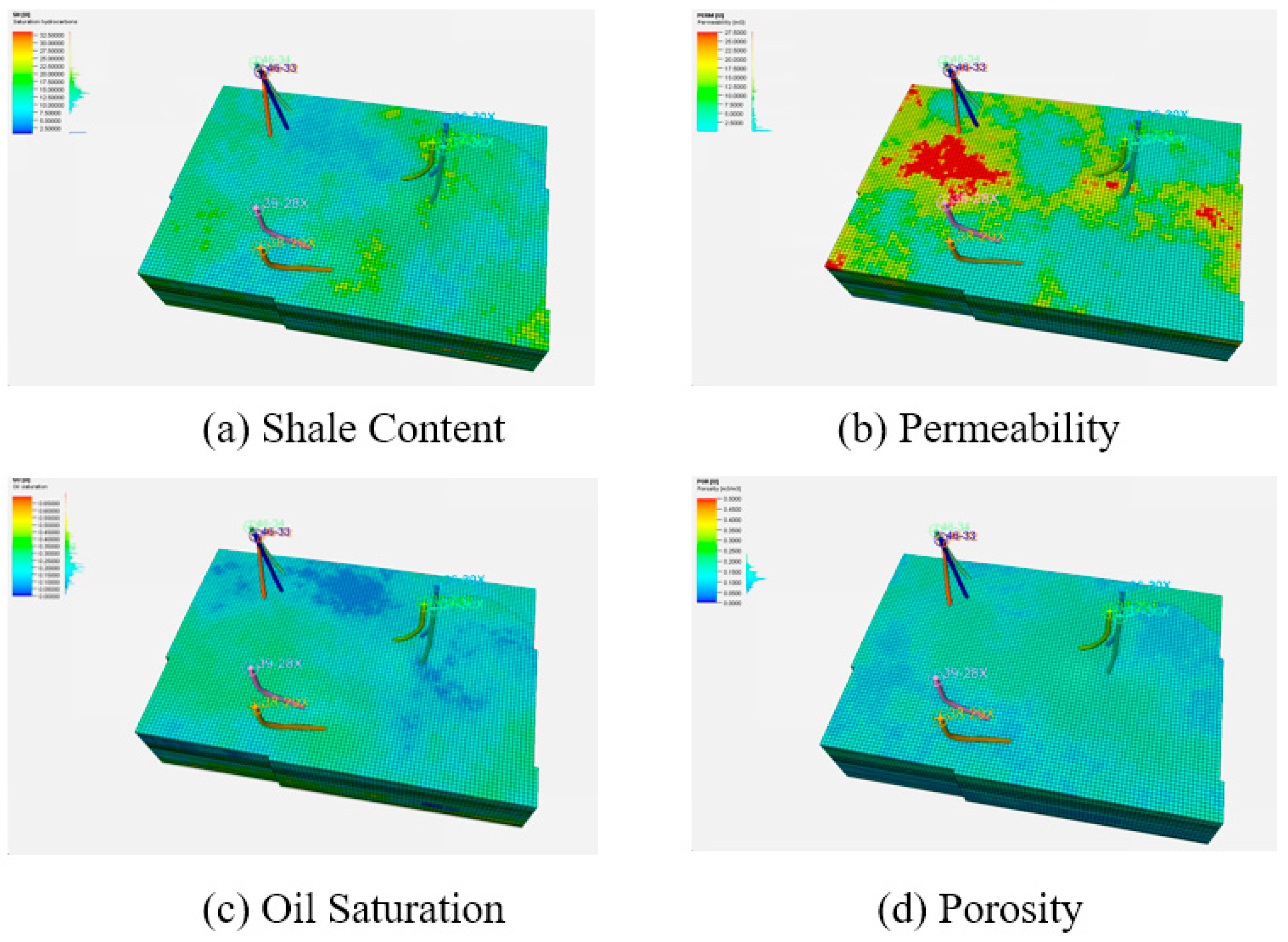
The realistic geological model was constructed from well locations, reservoir stratification and petrophysical-property data. Sequential Gaussian simulation was used to represent the spatial variability in shale content, porosity, permeability and initial oil saturation. The model retained interwell connectivity and intralayer heterogeneity, thereby providing a more representative setting for evaluating chemical transport, preferential-channel regulation and remaining-oil mobilization. The spatial distributions of the principal geological-model properties are shown in Figure 8.
Figure 8. Spatial distributions of shale content, permeability, porosity and initial oil saturation in the realistic geological model.
Processes 14 02716 g008
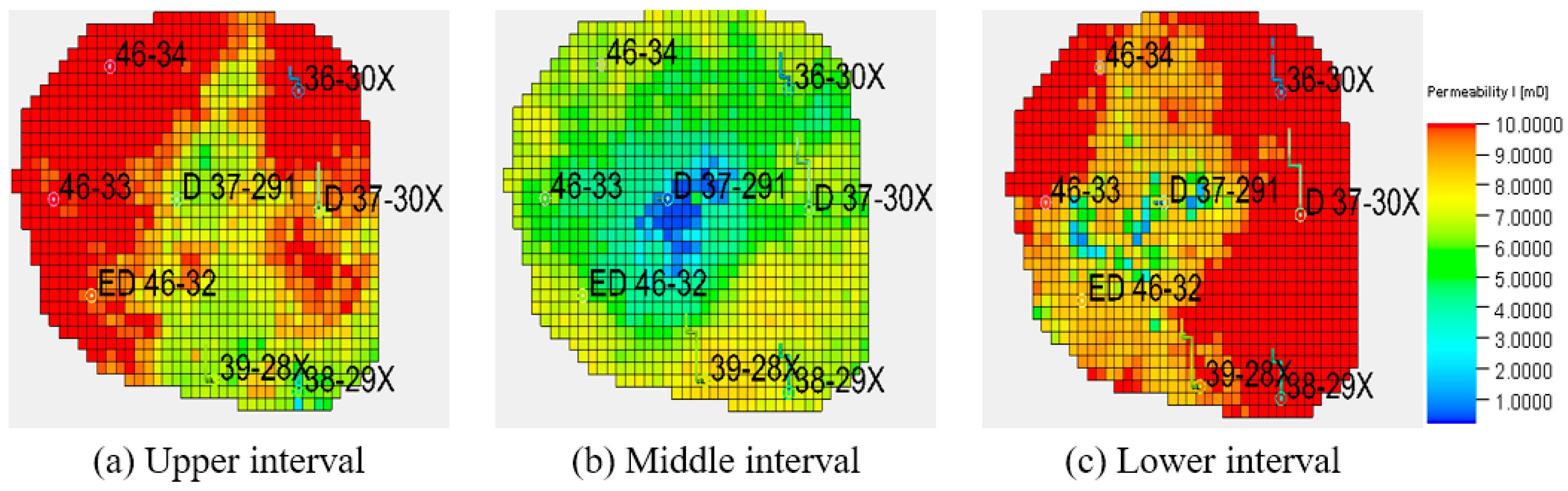
For the Chang 8 reservoir, the study area was divided into an upper interval (2130–2160 m), a middle interval (2160–2190 m) and a lower interval (2190–2222 m). Their average permeabilities were 7.2, 3.5 and 8.3 mD, respectively. The corresponding interval-scale areal permeability distributions are shown in Figure 9.The upper and lower intervals therefore formed relatively preferential-flow regions, whereas the lower permeability of the middle interval limited sweep and preserved a larger remaining-oil potential for subsequent conformance control.
Figure 9. Areal permeability distributions of the Chang 8 reservoir in the upper (2130–2160 m), middle (2160–2190 m), and lower (2190–2222 m) intervals.
Processes 14 02716 g009
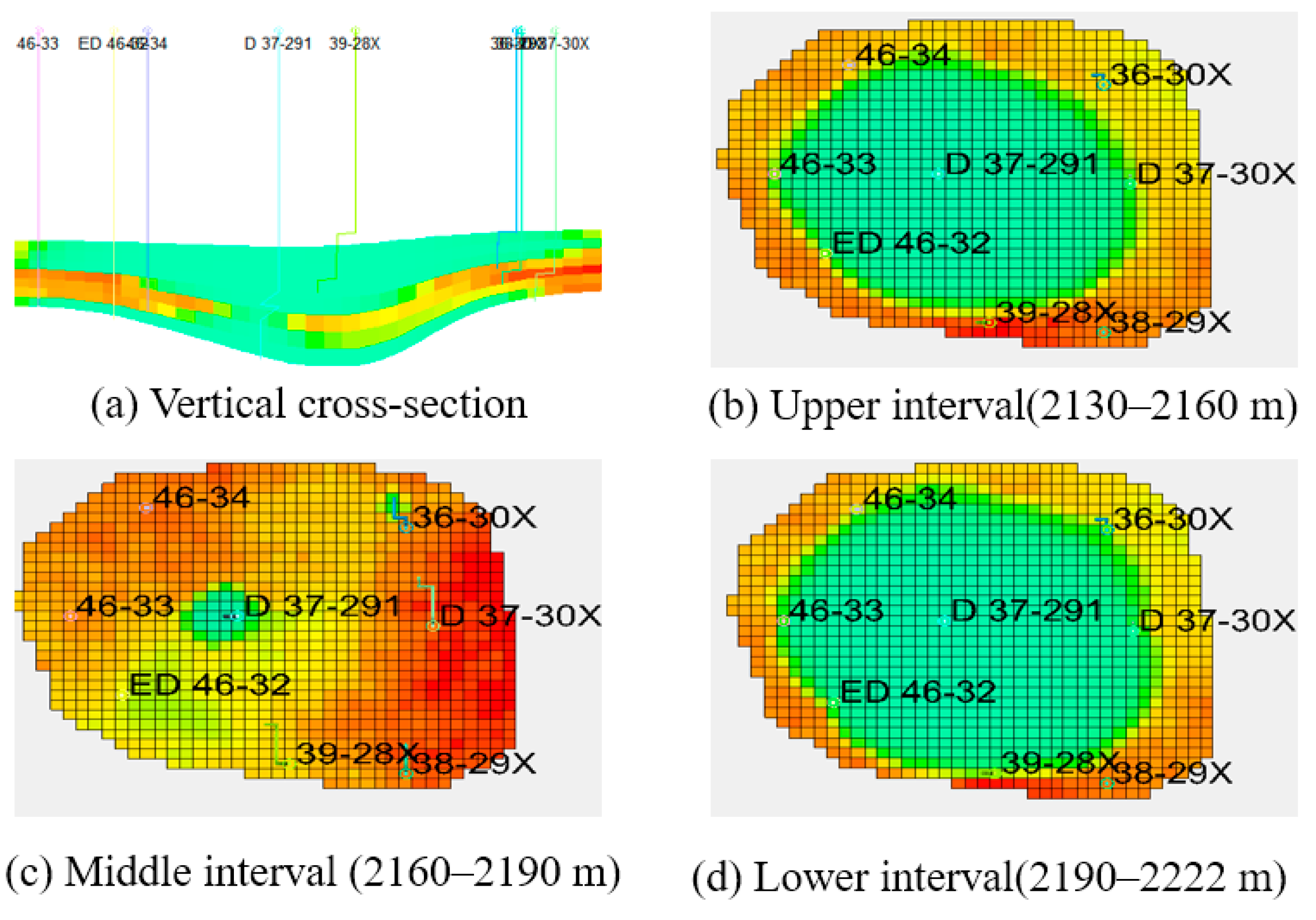
Figure 10 shows the vertical remaining-oil profile and areal oil-saturation distributions of the three intervals under the baseline development scheme. The upper and lower relatively high-permeability intervals exhibited broader swept regions and lower oil saturation. By contrast, the middle low-permeability interval retained a laterally continuous high-oil-saturation region because of insufficient interwell sweep. This stratified remaining-oil pattern was consistent with the permeability contrast and identified the middle interval as the principal target for composite chemical conformance control.

4.2. Chemical-Conformance-Control Results, Flow Redistribution and Engineering Consistency

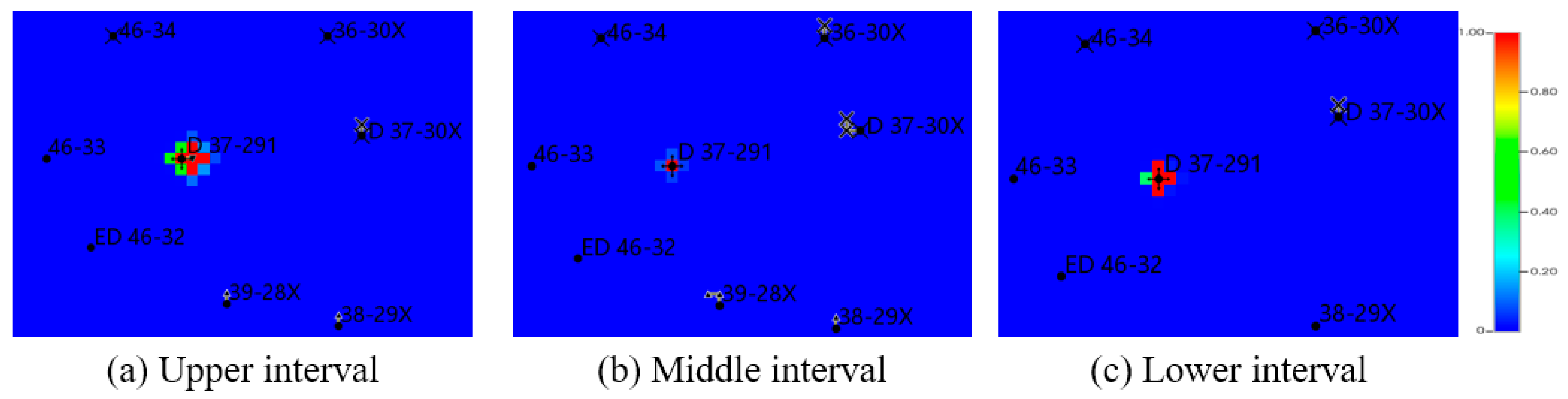
The representative chemical-plugging strategy screened in the conceptual model was applied to the realistic geological model for an engineering-consistency assessment; it was not treated as a globally optimal field-model solution. Chemical transport, preferential-channel regulation and remaining-oil mobilization displayed clear interlayer differences. The interval concentration maps showed that the chemical agent extended over a wider area in the upper and lower relatively high-permeability intervals, whereas its migration range remained more limited in the middle low-permeability interval. This pattern corresponded to the interval permeability distribution and showed preferential entry of the injected chemical system into higher-flow-capacity regions.The corresponding interval concentration maps are presented in Figure 11.
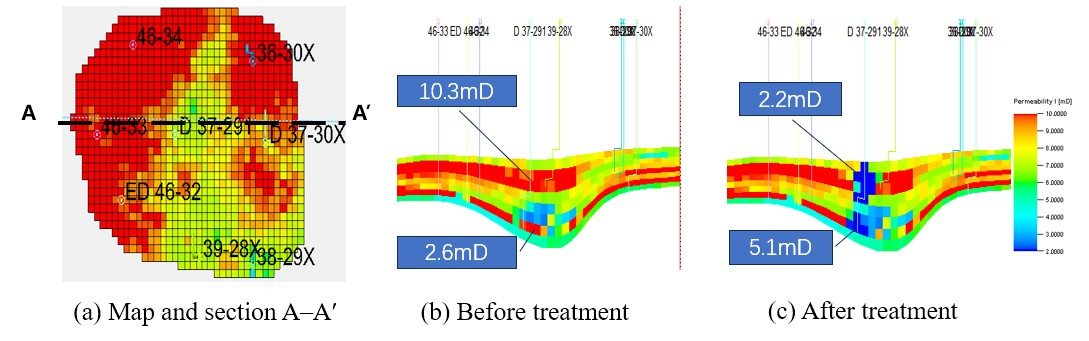
The permeability comparison along section A–A′ further illustrates the regulation of preferential channels. After chemical treatment, the flow capacity of the original high-permeability main-flow region decreased and the contrast between preferential channels and the middle interval was reduced. The spatial coincidence between effective flow capacity was reduced and chemical enrichment indicated that the composite chemical system acted selectively in preferential-flow regions, creating conditions for subsequent displacement fluid to enter the remaining-oil-rich central interval.The associated permeability profiles along section A–A′ are shown in Figure 12.
Figure 13 compares the oil-saturation profiles along section A–A′ before and after chemical flooding. Following chemical treatment, flow channels adjacent to the upper and lower preferential layers were regulated and oil saturation decreased further in the middle low-permeability interval and neighboring regions. Taken together, the chemical-transport, flow-capacity, and oil-saturation responses indicate that selective chemical action in preferential channels redistributed interlayer flow and improved the mobilization of remaining oil in the central interval.
Figure 11. Chemical-concentration distributions in the upper, middle, and lower intervals of the realistic geological model after chemical treatment.
Processes 14 02716 g011
Figure 12. Permeability distribution and section A–A′ profiles in the realistic geological model: (a) areal permeability map and section location; (b) profile before chemical treatment; and (c) profile after chemical treatment. Colours represent permeability (mD).
Processes 14 02716 g012
Figure 13. Oil-saturation profiles along section A–A′ before chemical treatment and at the common termination time after chemical flooding: (a) before treatment and (b) after treatment.
Processes 14 02716 g013

5. Conclusions

This study developed a surrogate-assisted workflow for screening composite chemical-plugging strategies in stratified heterogeneous reservoirs. The workflow integrates budget-aware optimization with layer-resolved simulation evidence to evaluate chemical transport, resistance development, flow redistribution, remaining-oil mobilization, and economic performance. (1) AHES-DE combines heterogeneous surrogate models with dynamic weighting and role-based candidate generation, including differential-evolution offspring generation in the Exploiter role. Under the common budget of 150 high-fidelity CMG-STARS evaluations, the final best-so-far NEVs were 2.45405 × 10⁹ CNY for AHES-DE, 2.44888 × 10⁹ CNY for DE, and 2.44698 × 10⁹ CNY for LHS. (2) In the six-layer one-injector–four-producer conceptual model, composite chemical plugging preferentially increased the resistance response of high-flow-capacity intervals. The oil-saturation response at a common termination time was consistent with improved remaining-oil mobilization in the central low-permeability interval. (3) The realistic geological model provided an engineering-consistency assessment of the conceptual-model mechanism. The representative screened treatment regulated high-flow-capacity intervals and redirected subsequent displacement toward insufficiently swept regions. These results support the use of the workflow for site-specific strategy screening. Field-scale reoptimization using reservoir-specific objectives, operating constraints and economic assumptions is required before deployment.

Supplementary Materials

The following supporting information can be downloaded at: https://www.mdpi.com/article/10.3390/pr14172716/s1. Figure S1. Candidate-evaluation records and best-so-far NEV trajectories for (a) AHES-DE, (b) DE, and (c) LHS. Points represent evaluated candidates, and stepped lines represent the corresponding best-so-far NEV. Figure S2. Mobile PPG-concentration distributions in Planes 1–6 at the common evaluation endpoint. Figure S3. Layerwise oil-saturation distributions at the common termination time after chemical flooding: (a–f) Planes 1–6.

Author Contributions

Conceptualization, Z.L. and H.Z.; Validation, X.X.; Investigation, Y.Z.; Writing—original draft, X.L.; Writing—review and editing, Z.L., H.Z., L.H., Q.S. and J.H.; Project administration, H.Z. All authors have read and agreed to the published version of the manuscript.

Funding

This work was supported by the Deep Earth and Mineral Resources Exploration—National Science and Technology Major Project (Grant No. 2024ZD5521004300), the National Natural Science Foundation of China (Grant No. 52504021), the Natural Science Foundation of Xinjiang Uygur Autonomous Region (Grant No. 2025D01A133), the Science and Technology Innovation Team Project of the “Tianshan Talents” Training Program of Xinjiang Uygur Autonomous Region (Grant No. 2024TSYCTD0018), and the National Science and Technology Major Project for New Oil and Gas Exploration and Development: “Technology Integration and Demonstration of CO2 Miscible Flooding in Water-sensitive Low-permeability Conglomerate Reservoirs” (Grant No. 2025ZD1408403).

Data Availability Statement

The datasets used and/or analyzed during the current study are available from the corresponding author on reasonable request.

Conflicts of Interest

Qinghao Sun was employed by Guizhou Wujiang Coalbed Methane Exploration and Development Co., Ltd. The remaining authors declare that the research was conducted in the absence of any commercial or financial relationships that could be construed as a potential conflict of interest.

References

  1. Bui, M.; Adjiman, C.S.; Bardow, A.; Anthony, E.J.; Boston, A.; Brown, S.; Fennell, P.S.; Fuss, S.; Galindo, A.; Hackett, L.A.; et al. Carbon capture and storage (CCS): The way forward. Energy Environ. Sci. 2018, 11, 1062–1176. [Google Scholar] [CrossRef] [Scilit]
  2. Wei, B.; Wang, B.; Li, X.; Aishan, M.; Ju, Y. CO2 storage in depleted oil and gas reservoirs: A review. Adv. Geo-Energy Res. 2023, 9, 76–93. [Google Scholar] [CrossRef] [Scilit]
  3. Enick, R.M.; Olsen, D.K.; Ammer, J.R.; Schuller, W. Mobility and conformance control for CO2 EOR via thickeners, foams, and gels—A Literature Review of 40 Years of Research and Pilot Tests. In SPE Improved Oil Recovery Symposium; SPE: Tulsa, OK, USA, 2012; SPE-154122-MS. [Google Scholar] [CrossRef] [Scilit]
  4. Luo, X.-J.; Wei, B.; Gao, K.; Jing, B.; Huang, B.; Guo, P.; Yin, H.-Y.; Feng, Y.-J.; Zhang, X. Gas channeling control with an in-situ smart surfactant gel during water-alternating-CO2 enhanced oil recovery. Petrol. Sci. 2023, 20, 2835–2851. [Google Scholar] [CrossRef] [Scilit]
  5. Zhao, M.; Yan, X.; Wang, X.; Yan, R.; Dai, C. The development of a smart gel for CO2 mobility control in heterogeneity reservoir. Fuel 2023, 342, 127844. [Google Scholar] [CrossRef] [Scilit]
  6. Ding, Y.; Zhao, Y.; Wen, X.; Liu, Y.; Feng, M.; Rui, Z. Development and applications of CO2-responsive gels in CO2 flooding and geological storage. Gels 2023, 9, 936. [Google Scholar] [CrossRef] [Scilit]
  7. Ji, W.; Dai, C.; Cao, Y.; Yang, N.; Wang, T.; Zhao, G. A novel CO2-resistant dispersed particle gel for gas channeling control in low-permeability reservoirs. J. Mol. Liq. 2023, 374, 121251. [Google Scholar] [CrossRef] [Scilit]
  8. Fang, P.; Zhang, Q.; Zhou, C.; Yang, Z.; Yu, H.; Du, M.; Chen, X.; Song, Y.; Wang, S.; Gao, Y.; et al. Chemical-assisted CO2 water-alternating-gas injection for enhanced sweep efficiency in CO2-EOR. Molecules 2024, 29, 3978. [Google Scholar] [CrossRef] [Scilit]
  9. Jiang, H.-Z.; Yang, H.-B.; Pan, R.-S.; Ren, Z.-Y.; Kang, W.-L.; Zhang, J.-Y.; Pan, S.-L.; Sarsenbekuly, B. Performance and enhanced oil recovery efficiency of acid-resistant polymer microspheres for anti-CO2 channeling in low-permeability reservoirs. Petrol. Sci. 2024, 21, 2420–2432. [Google Scholar] [CrossRef] [Scilit]
  10. Alotibi, A.; Song, T.; Al Brahim, A.; Bai, B.; Schuman, T. Experimental evaluation of a recrosslinkable CO2-resistant micro-sized preformed particle gel for CO2 sweep efficiency improvement in reservoirs with super-K channels. Gels 2024, 10, 765. [Google Scholar] [CrossRef] [Scilit]
  11. Liu, T.; Zhang, Y.; Feng, Y. Delayed swelling polymer microspheres for CO2 channeling control under high-temperature and high-salinity environment. ACS Omega 2025, 10, 24181–24193. [Google Scholar] [CrossRef] [Scilit]
  12. Liu, R.; Chen, C.; Tao, Y.; Chen, Z. CO2-responsive system for preventing gas channeling during CO2 flooding in low-permeability reservoirs. Geoenergy Sci. Eng. 2025, 255, 214094. [Google Scholar] [CrossRef] [Scilit]
  13. Afolabi, F.; Dzulkarnain, I.; Kwon, S.; Martyushev, D.A.; Lee, J.H.; Jufar, S.R.; Al-Akbari, F. Gels for CO2 geo-storage and conformance control: A systemic review of behavior and performance. Deep Undergr. Sci. Eng. 2025, 4, 612–637. [Google Scholar] [CrossRef] [Scilit]
  14. Ma, W.; Li, Y.; Liu, P.; Liu, Z.; Song, T. Progress of Research into Preformed Particle Gels for Profile Control and Water Shutoff Techniques. Gels 2024, 10, 372. [Google Scholar] [CrossRef] [Scilit]
  15. Bai, B.; Liu, Y.; Coste, J.-P.; Li, L. Preformed particle gel for conformance control: Factors affecting its properties and applications. SPE Reserv. Eval. Eng. 2007, 10, 415–422. [Google Scholar] [CrossRef] [Scilit]
  16. Bai, B.; Zhou, J.; Yin, M. A comprehensive review of polyacrylamide polymer gels for conformance control. Petrol. Explor. Dev. 2015, 42, 525–532. [Google Scholar] [CrossRef] [Scilit]
  17. Kang, W.; Kang, X.; Lashari, Z.A.; Li, Z.; Zhou, B.; Yang, H.; Sarsenbekuly, B.; Aidarova, S. Progress of Polymer Gels for Conformance Control in Oilfield. Adv. Colloid Interface Sci. 2021, 289, 102363. [Google Scholar] [CrossRef] [Scilit]
  18. Liu, Z.; Zhang, J.; Li, X.; Xu, C.; Chen, X.; Zhang, B.; Zhao, G.; Zhang, H.; Li, Y. Conformance Control by a Microgel in a Multi-Layered Heterogeneous Reservoir during CO2 Enhanced Oil Recovery Process. Chin. J. Chem. Eng. 2022, 43, 324–334. [Google Scholar] [CrossRef] [Scilit]
  19. Zerpa, L.E.; Queipo, N.V.; Pintos, S.; Salager, J.-L. An optimization methodology of alkaline–surfactant–polymer flooding processes using field-scale numerical simulation and multiple surrogates. J. Pet. Sci. Eng. 2005, 47, 197–208. [Google Scholar] [CrossRef] [Scilit]
  20. Forrester, A.I.J.; Keane, A.J. Recent advances in surrogate-based optimization. Prog. Aerosp. Sci. 2009, 45, 50–79. [Google Scholar] [CrossRef] [Scilit]
  21. Jin, Y. Surrogate-assisted evolutionary computation: Recent advances and future challenges. Swarm Evol. Comput. 2011, 1, 61–70. [Google Scholar] [CrossRef] [Scilit]
  22. Jin, Y.; Wang, H.; Chugh, T.; Guha, D.; Deb, K. Data-driven evolutionary optimization: An overview and case studies. IEEE Trans. Evol. Comput. 2019, 23, 442–458. [Google Scholar] [CrossRef] [Scilit]
  23. Guo, D.; Jin, Y.; Ding, J.; Chai, T. Heterogeneous ensemble-based infill criterion for evolutionary multiobjective optimization of expensive problems. IEEE Trans. Cybern. 2019, 49, 1012–1025. [Google Scholar] [CrossRef] [Scilit]
  24. Li, F.; Shang, Z.; Liu, Y.; Shen, H.; Jin, Y. Inverse distance weighting and radial basis function based surrogate model for high-dimensional expensive multi-objective optimization. Appl. Soft Comput. 2024, 152, 111194. [Google Scholar] [CrossRef] [Scilit]
  25. Li, B.; Lu, Y.; Qian, H.; Hong, W.; Yang, P.; Zhou, A. Regularity model based offspring generation in surrogate-assisted evolutionary algorithms for expensive multi-objective optimization. Swarm Evol. Comput. 2024, 86, 101506. [Google Scholar] [CrossRef] [Scilit]
  26. Wang, L.; Deng, R.; Zhang, L.; Qu, J.; Wang, H.; Zhang, L.; Zhao, X.; Xu, B.; Lv, X.; Adenutsi, C.D. A novel surrogate-assisted multi-objective well control parameter optimization method based on selective ensembles. Processes 2024, 12, 2140. [Google Scholar] [CrossRef] [Scilit]
  27. Yu, L.; Meng, Z.; Zhu, H. A hierarchical surrogate-assisted differential evolution with core space localization. IEEE Trans. Cybern. 2025, 55, 939–952. [Google Scholar] [CrossRef] [Scilit]
  28. Yu, L.; Meng, Z.; Kong, L.; Snášel, V.; Pan, J.-S. Surrogate-assisted differential evolution: A survey. Swarm Evol. Comput. 2025, 94, 101879. [Google Scholar] [CrossRef] [Scilit]
  29. Liang, J.; Lou, Y.; Yu, M.; Bi, Y.; Yu, K. A survey of surrogate-assisted evolutionary algorithms for expensive optimization. J. Membr. Comput. 2025, 7, 108–127. [Google Scholar] [CrossRef] [Scilit]
  30. Wolpert, D.H.; Macready, W.G. No free lunch theorems for optimization. IEEE Trans. Evol. Comput. 1997, 1, 67–82. [Google Scholar] [CrossRef] [Scilit]
Figure 2. Three-dimensional surface plots of the two-dimensional Sphere, Rosenbrock, Ackley, and Griewank benchmark functions.
Processes 14 02716 g002
Figure 4. Best-so-far net economic value (NEV) trajectories of AHES-DE, differential evolution (DE), and Latin hypercube sampling (LHS) under 150 high-fidelity CMG-STARS evaluations per method.
Processes 14 02716 g004
Figure 5. Adsorbed preformed particle gel (PPG) mass-density distributions in Planes 1–6 at the early stage of chemical plugging.
Processes 14 02716 g005
Figure 6. Water-phase resistance-factor distributions in Planes 1–6 after chemical plugging.
Processes 14 02716 g006
Figure 7. Oil-saturation profiles before chemical treatment and at the common termination time after chemical flooding.
Processes 14 02716 g007
Figure 10. Vertical cross-section and areal remaining-oil distributions in the top, middle and bottom intervals of the realistic geological model.
Processes 14 02716 g010
Table 1. Decision variables and ranges for composite chemical-plugging optimization.
VariablePhysical MeaningRange
x1PPG mass fraction0.0002–0.0040
x2Polymer-gel mass fraction0.0002–0.0040
x3PPG slug injection rate (m3 d−1)50–250
x4Polymer-gel slug injection rate (m3 d−1)50–250
x5Post-slug water-injection rate (m3 d−1)80–300
x6PPG slug duration (months)1–6, integer
x7Polymer-gel slug duration (months)1–6, integer
Table 2. Properties of the four selected 100D benchmark functions.
FunctionMathematical ExpressionCharacteristics
F1: Sphere f 1 ( x ) = i = 1 D x i 2 Continuous, unimodal, separable
F2: Rosenbrock f 2 ( x ) = i = 1 D 1 100 ( x i + 1 x i 2 ) 2 + ( x i 1 ) 2 Continuous, non-separable, ill-conditioned valley
F3: Ackley f 3 ( x ) = 20 exp 0.2 1 D i = 1 D x i 2 exp 1 D i = 1 D cos ( 2 π x i ) + 20 + e Continuous, multimodal, non-separable
F4: Griewank f 4 ( x ) = i = 1 D x i 2 4000 i = 1 D cos x i i + 1 Continuous, highly multimodal, non-separable
Disclaimer/Publisher’s Note: The statements, opinions and data contained in all publications are solely those of the individual author(s) and contributor(s) and not of MDPI and/or the editor(s). MDPI and/or the editor(s) disclaim responsibility for any injury to people or property resulting from any ideas, methods, instructions or products referred to in the content.