Hydrogen Substitution for Conventional Fuels in High-Temperature Industrial Furnaces and Kilns: Key Technologies, Applications, and Future Prospects


 ,
,
Abstract
1. Introduction
2. Combustion Characteristics in High-Temperature Furnaces and Kilns
2.1. Fuel Characteristics and Combustion Behavior
2.2. Flame Radiation and Combustion Products
3. Key Technologies for Hydrogen Substitution in High-Temperature Furnaces and Kilns
3.1. Flashback Prevention and Flame Stabilization
3.1.1. Structural and Thermal Design for Flashback Suppression
3.1.2. Combustion and Flow-Field Control for Wide-Range Stability
3.1.3. System Dynamics and Thermoacoustic Control
3.2. Low-NOx Combustion Control
3.2.1. Deep Dilution via Flameless/MILD Combustion
3.2.2. Burner Geometry and Aerodynamic Control
3.2.3. Thermodynamic Control via Lean Combustion and Humidification
3.2.4. Oxy-Fuel Combustion and Oxygen Staging
3.3. Thermal-Flow-Field Reconstruction and Heat Transfer Control
3.4. Material and Component Adaptation in Water-Vapor-Rich Atmospheres
3.4.1. Oxidation and Microstructural Evolution of Metallic Components
3.4.2. Moisture-Induced Degradation of Refractories and Insulation Systems
3.4.3. Hydrogen Service Compatibility and Integrated Adaptation Strategies
4. Representative Applications in Furnaces and Kilns
4.1. Metallurgical and Heat-Treatment Furnaces
4.1.1. Thermal Flow Field and Efficiency Assessment
4.1.2. Scale Formation Control in Water-Vapor-Rich Atmospheres
4.2. Petrochemical and Refinery Furnaces
4.2.1. Fuel Switching and Heat Load Redistribution
4.2.2. Fuel Supply and Flow Adaptation
4.2.3. Low-NOx Control in Refinery Furnaces
4.3. Special-Purpose Furnaces and Kilns
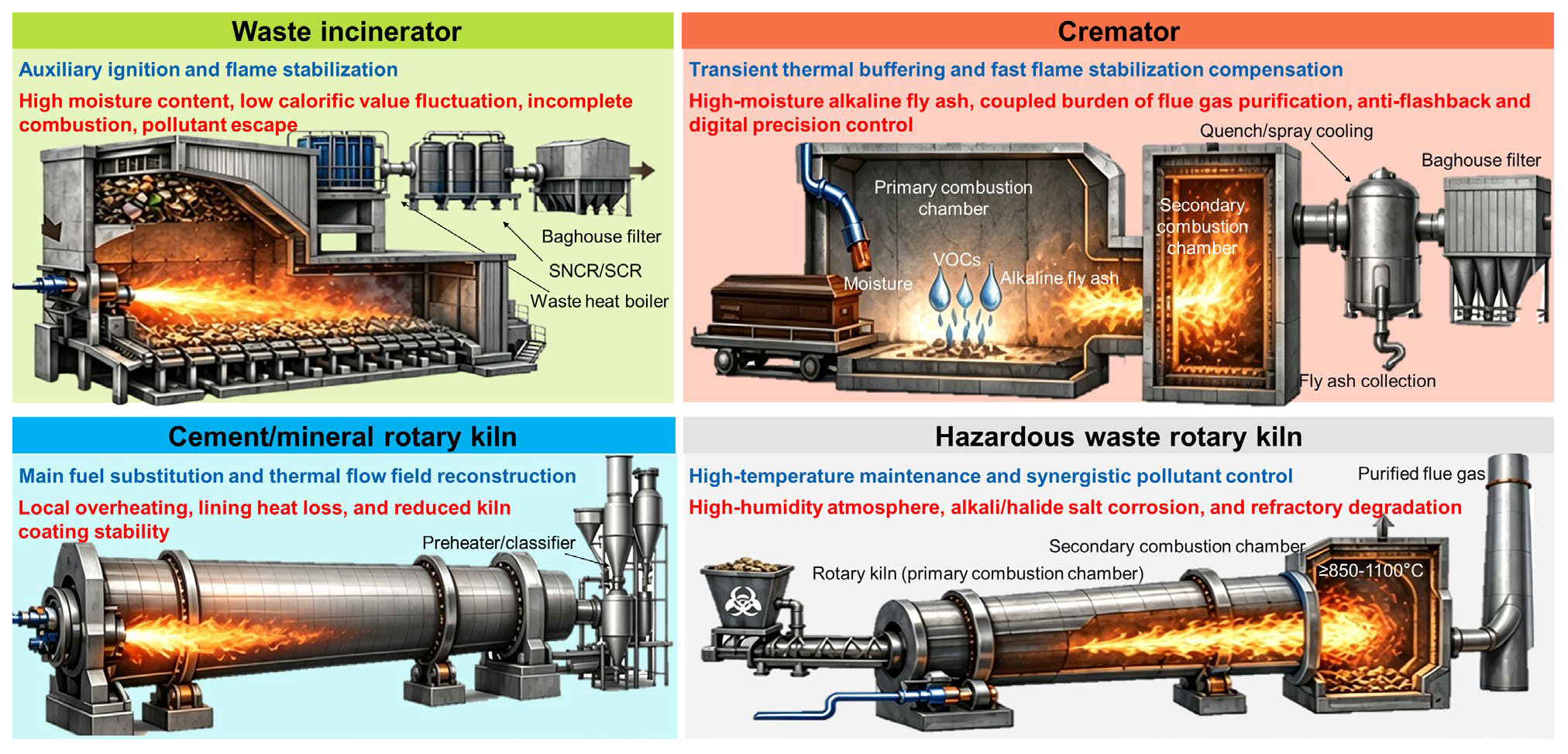
4.3.1. Municipal Solid Waste Incinerators
4.3.2. Medical and Hazardous Waste Rotary Kilns
4.3.3. Cement and Mineral Rotary Kilns
4.3.4. Cremation Furnaces
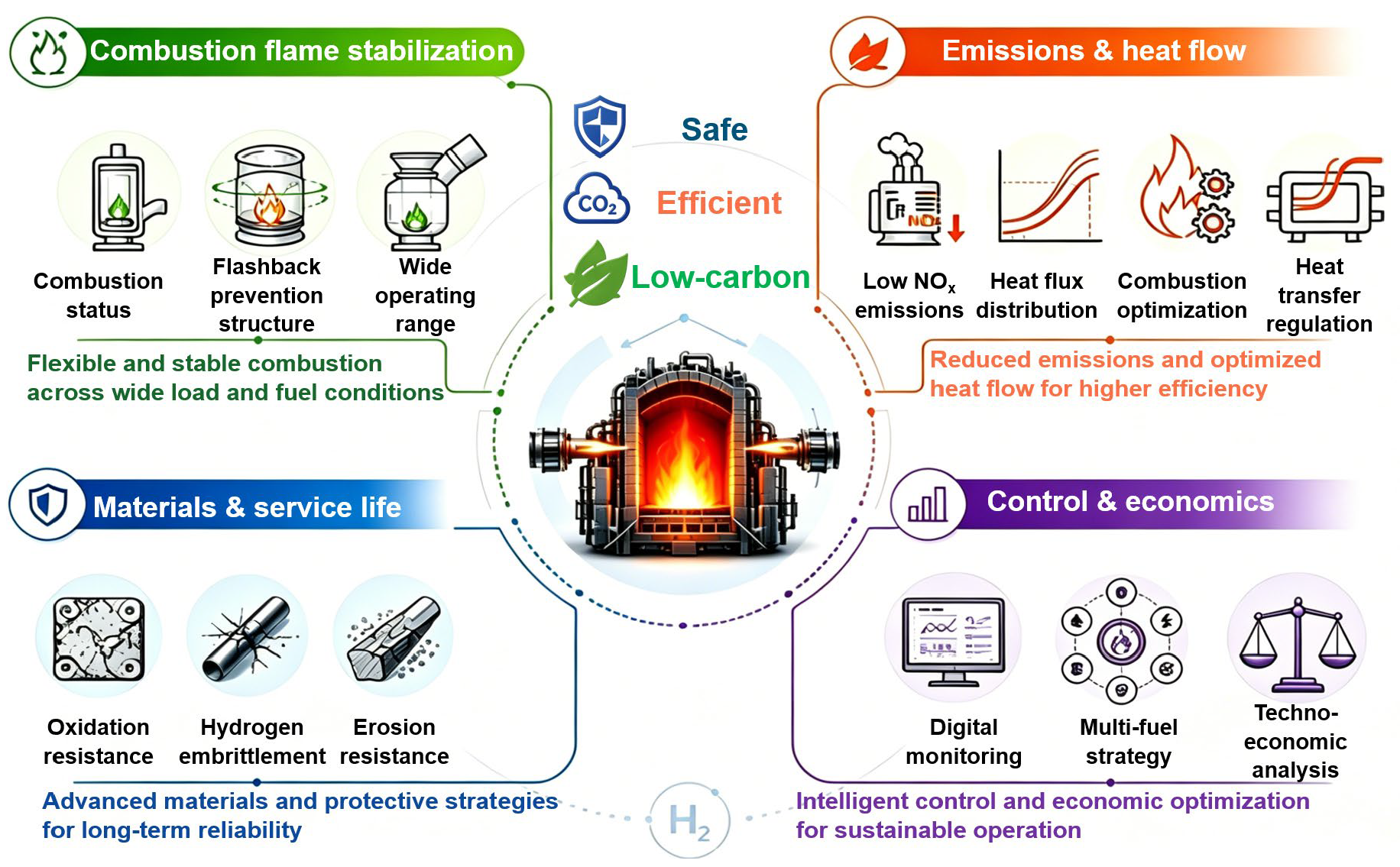
5. Conclusions and Outlook
Author Contributions
Funding
Data Availability Statement
Conflicts of Interest
References
- Zhu, Y.; Keoleian, G.A.; Cooper, D.R. The role of hydrogen in decarbonizing U.S. industry: A review. Renew. Sustain. Energy Rev. 2025, 214, 115392. [Google Scholar] [CrossRef]
- Pisciotta, M.; Pilorgé, H.; Feldmann, J.; Jacobson, R.; Davids, J.; Swett, S.; Sasso, Z.; Wilcox, J. Current state of industrial heating and opportunities for decarbonization. Prog. Energy Combust. Sci. 2022, 91, 100982. [Google Scholar] [CrossRef]
- Bataille, C.; Åhman, M.; Neuhoff, K.; Nilsson, L.J.; Fischedick, M.; Lechtenböhmer, S.; Solano-Rodriquez, B.; Denis-Ryan, A.; Stiebert, S.; Waisman, H.; et al. A review of technology and policy deep decarbonization pathway options for making energy-intensive industry production consistent with the Paris Agreement. J. Clean. Prod. 2018, 187, 960–973. [Google Scholar] [CrossRef]
- Leicher, J.; Giese, A.; Wieland, C. Electrification or Hydrogen? The Challenge of Decarbonizing Industrial (High-Temperature) Process Heat. J 2024, 7, 439–456. [Google Scholar] [CrossRef]
- Franco, A.; Rocca, M. Industrial Decarbonization through Blended Combustion of Natural Gas and Hydrogen. Hydrogen 2024, 5, 519–539. [Google Scholar] [CrossRef]
- Knorr, L.; Buchenau, N.; Schlosser, F.; Divkovic, D.; Prina, M.G.; Meschede, H. Electrification and flexibility of process heat in energy system modelling: A review. Renew. Sustain. Energy Rev. 2025, 216, 115698. [Google Scholar] [CrossRef]
- Marocco, P.; Gandiglio, M.; Audisio, D.; Santarelli, M. Assessment of the role of hydrogen to produce high-temperature heat in the steel industry. J. Clean. Prod. 2023, 388, 135969. [Google Scholar] [CrossRef]
- Lo Basso, G.; Pastore, L.M.; Sgaramella, A.; Mojtahed, A.; Ciancio, A.; Massulli, A.R.; Vespasiano, D.; de Santoli, L. Status and perspectives of hydrogen role for decarbonising industry: A comprehensive review. Renew. Sustain. Energy Rev. 2025, 224, 116083. [Google Scholar] [CrossRef]
- Veronezi, D.; Soulier, M.; Kocsis, T. Energy Solutions for Decarbonization of Industrial Heat Processes. Energies 2024, 17, 5728. [Google Scholar] [CrossRef]
- Hu, W.; Xia, Q.; Zhang, L.Y.; Lu, J.; He, Q.; Yuan, W. In situ controllably self-assembled amorphous Co–TDPAT MOFs as superior cocatalysts of α-Fe2O3 nanosheet arrays for highly efficient and ultrastable photoelectrochemical oxygen evolution. J. Mater. Chem. A 2025, 13, 4614–4623. [Google Scholar] [CrossRef]
- Yuan, W.; Yuan, J.; Xie, J.; Li, C.M. Polymer-mediated self-assembly of TiO2@Cu2O core-shell nanowire array for highly efficient photoelectrochemical water oxidation. ACS Appl. Mater. Interfaces 2016, 8, 6082–6092. [Google Scholar] [CrossRef] [PubMed]
- Cravero, C.; Marsano, D.; Milanese, G. Simulation of flame development in a glass furnace with hydrogen enriched natural gas. Int. J. Hydrogen Energy 2026, 204, 153254. [Google Scholar] [CrossRef]
- Daurer, G.; Schwarz, S.; Demuth, M.; Gaber, C.; Hochenauer, C. Evaluation of numerical modeling and combustion characteristics of hydrogen oxy-fuel combustion in a semi-industrial furnace. Fuel 2024, 369, 131690. [Google Scholar] [CrossRef]
- Hasche, A.; Krause, H.; Eckart, S. Hydrogen admixture effects on natural gas-oxygen burner for glass-melting: Flame imaging, temperature profiles, exhaust gas analysis, and false air impact. Fuel 2025, 387, 134397. [Google Scholar] [CrossRef]
- Habib, M.A.; Abdulrahman, G.A.Q.; Alquaity, A.B.S.; Qasem, N.A.A. Hydrogen combustion, production, and applications: A review. Alex. Eng. J. 2024, 100, 182–207. [Google Scholar] [CrossRef]
- Sîrbu, T.M.; Iolu, C.E.; Prisecaru, T. Combustion Characteristics of Hydrogen-Enriched Natural Gas with a Focus on Residential Appliances: A Review. Hydrogen 2026, 7, 20. [Google Scholar] [CrossRef]
- Wang, T.; Zhang, Y.; Zhang, H.; Lyu, J. Stability and emissions of hydrogen-enriched methane flames on metal fiber surface burners. Int. J. Hydrogen Energy 2024, 72, 1308–1320. [Google Scholar] [CrossRef]
- Schwarz, S.; Daurer, G.; Gaber, C.; Demuth, M.; Prieler, R.; Hochenauer, C. Experimental investigation of the combustion characteristics in oxy-fuel combustion of hydrogen-enriched natural gas on a semi-industrial scale. Int. J. Hydrogen Energy 2024, 49, 323–337. [Google Scholar] [CrossRef]
- Wang, Y.; Sohn, C.H.; Kim, J.-Y. Effects of hydrogen blending on combustion and pollutant emission of propane/air in a model furnace with a rotary kiln burner. Therm. Sci. Eng. Prog. 2024, 47, 102330. [Google Scholar] [CrossRef]
- Daurer, G.; Schwarz, S.; Demuth, M.; Gaber, C.; Hochenauer, C. Experimental and numerical analysis of industrial-type low-swirl combustion of hydrogen enriched natural gas including OH* chemiluminescence imaging. Int. J. Hydrogen Energy 2024, 80, 890–906. [Google Scholar] [CrossRef]
- Cheng, L.; Li, W.; Peng, S.; Chai, C.; Wang, W.; Tian, C.; Zhang, J.; Liu, L.; Zhang, H.; Zhang, Y. Study of combustion characteristics of hydrogen-doped natural gas in industrial boilers. Int. J. Hydrogen Energy 2024, 92, 590–604. [Google Scholar] [CrossRef]
- Taamallah, S.; Vogiatzaki, K.; Alzahrani, F.M.; Mokheimer, E.M.A.; Habib, M.A.; Ghoniem, A.F. Fuel flexibility, stability and emissions in premixed hydrogen-rich gas turbine combustion: Technology, fundamentals, and numerical simulations. Appl. Energy 2015, 154, 1020–1047. [Google Scholar] [CrossRef]
- Rashed, E.S.; Elwardany, A.E.; Emam, M.; Abo-Elfadl, S.; Mori, S.; Hassan, H. 3D numerical study of NH3/H2 MILD combustion in a reversed flow MILD combustion furnace. Appl. Therm. Eng. 2024, 252, 123610. [Google Scholar] [CrossRef]
- Shi, Z.; Xu, H.; Cui, L.; Dong, Y. Burner, combustion characteristic and flame stabilization mechanism in micromix combustion: A review. Renew. Sustain. Energy Rev. 2026, 225, 116164. [Google Scholar] [CrossRef]
- Cheng, J.; Hu, B.; Zeng, Z.; Fu, J.; Zhang, B. A Review on Combustion Instability of Hydrogen-Enriched Marine Gas Turbines. J. Mar. Sci. Eng. 2025, 13, 2110. [Google Scholar] [CrossRef]
- Beita, J.; Talibi, M.; Sadasivuni, S.; Balachandran, R. Thermoacoustic Instability Considerations for High Hydrogen Combustion in Lean Premixed Gas Turbine Combustors: A Review. Hydrogen 2021, 2, 33–57. [Google Scholar] [CrossRef]
- Aniello, A.; Poinsot, T.; Selle, L.; Schuller, T. Hydrogen substitution of natural-gas in premixed burners and implications for blow-off and flashback limits. Int. J. Hydrogen Energy 2022, 47, 33067–33081. [Google Scholar] [CrossRef]
- Pers, H.; Aniello, A.; Morisseau, F.; Schuller, T. Autoignition-induced flashback in hydrogen-enriched laminar premixed burners. Int. J. Hydrogen Energy 2023, 48, 10235–10249. [Google Scholar] [CrossRef]
- Mohamadi, M.; Tahsini, A.M.; Tavazohi, R. Hydrogen addition impacts on flashback phenomenon in combustion chamber. Int. J. Hydrogen Energy 2024, 67, 769–775. [Google Scholar] [CrossRef]
- Fruzza, F.; Lamioni, R.; Tognotti, L.; Galletti, C. Flashback of H2-enriched premixed flames in perforated burners: Numerical prediction of critical velocity. Int. J. Hydrogen Energy 2023, 48, 31790–31801. [Google Scholar] [CrossRef]
- Lan, Y.; Wang, Z.; Xu, J.; Yi, W. The Impact of Hydrogen on Flame Characteristics and Pollutant Emissions in Natural Gas Industrial Combustion Systems. Energies 2024, 17, 4959. [Google Scholar] [CrossRef]
- Kim, Y.B.; Sohn, C.B.; Jeong, Y.S. Development of a low-NOx hydrogen combustion burner with an oblong flame port and orthogonal fuel-air injection. Appl. Therm. Eng. 2025, 279, 127714. [Google Scholar] [CrossRef]
- Swaminathan, S.; Spijker, C.; Raonic, Z.; Koller, M.; Kofler, I.; Raupenstrauch, H. Numerical study of an industrial burner to optimise NOx emissions and to evaluate the feasibility of hydrogen-enriched fuel. Int. J. Hydrogen Energy 2024, 49, 1210–1220. [Google Scholar] [CrossRef]
- Guo, P.; Smith, N.; Proud, D.; Medwell, P.R.; Ashman, P.J. Heat transfer and NOx emissions from hydrogen/natural gas flames in thin-walled furnaces. Therm. Sci. Eng. Prog. 2025, 65, 103839. [Google Scholar] [CrossRef]
- Salcı, O.; Öztuna, S. Modeling of hydrogen blending natural gas combustion characteristics and emission analyses in industrial burners. Int. J. Hydrogen Energy 2025, 144, 782–797. [Google Scholar] [CrossRef]
- Mabic, K.; Adendorff, M.; Madhu, N.T.; Iplik, E.; Ekman, T.; Aslanidou, I.; Kyprianidis, K. Heat transfer and emission characteristics of hydrogen-enriched natural gas in flameless air/oxyfuel combustion in a semi-industrial furnace. Meas. Energy 2026, 9, 100083. [Google Scholar] [CrossRef]
- Kislinger, C.; Daurer, G.; Schwarz, S.; Demuth, M.; Gaber, C.; Hochenauer, C. CFD study of hydrogen combustion effects on the heat-up characteristics of steel samples using a low-swirl burner: A comparative analysis with methane. Appl. Therm. Eng. 2025, 261, 125105. [Google Scholar] [CrossRef]
- Gee, A.J.; Proud, D.B.; Smith, N.; Chinnici, A.; Medwell, P.R. Hydrogen addition to a commercial self-aspirating burner and assessment of a practical burner modification strategy to improve performance. Int. J. Hydrogen Energy 2024, 49, 59–76. [Google Scholar] [CrossRef]
- Madhu, N.T.; Adendorff, M.; Mabic, K.; Iplik, E.; Eckart, S.; Krause, H. Comparison of NOx emission and heat transfer in hydrogen-natural gas oxyfuel burner. Fuel 2025, 396, 135623. [Google Scholar] [CrossRef]
- Lopez-Ruiz, G.; Blanco, J.M.; Peña, A.; Romero-Anton, N.; Azkorra-Larrinaga, Z. CFD study of flameless combustion in a real industrial reheating furnace considering different H2/NG blends as fuel. Int. J. Hydrogen Energy 2024, 49, 1362–1374. [Google Scholar] [CrossRef]
- Airaksinen, S.; Haapakangas, J.; Gyakwaa, F.; Heikkinen, E.-P.; Fabritius, T. Utilization of hydrogen fuel in reheating furnace and its effect on oxide scale formation of low-carbon steels. Int. J. Hydrogen Energy 2025, 140, 1212–1220. [Google Scholar] [CrossRef]
- Daurer, G.; Schwarz, S.; Demuth, M.; Gaber, C.; Hochenauer, C. On the use of hydrogen in oxy-fuel glass melting furnaces: An extensive numerical study of the fuel switching effects based on coupled CFD simulations. Fuel 2025, 380, 133576. [Google Scholar] [CrossRef]
- Shchepakina, E.A.; Zubrilin, I.A.; Kuznetsov, A.Y.; Tsapenkov, K.D.; Antonov, D.V.; Strizhak, P.A.; Yakushkin, D.V.; Ulitichev, A.G.; Dolinskiy, V.A.; Hernandez Morales, M. Physical and Chemical Features of Hydrogen Combustion and Their Influence on the Characteristics of Gas Turbine Combustion Chambers. Appl. Sci. 2023, 13, 3754. [Google Scholar] [CrossRef]
- Zhang, L.; Li, S.; Liu, T.; Zhou, H.; Ren, Z. Flow characteristics analysis and combustion oscillation mitigation of a hydrogen industrial burner. Int. J. Hydrogen Energy 2025, 97, 444–456. [Google Scholar] [CrossRef]
- Ma, K.; Deng, J.; Wang, G.; Zhou, Q.; Xu, J. Utilization and impacts of hydrogen in the ironmaking processes: A review from lab-scale basics to industrial practices. Int. J. Hydrogen Energy 2021, 46, 26646–26664. [Google Scholar] [CrossRef]
- Furszyfer Del Rio, D.D.; Sovacool, B.K.; Foley, A.M.; Griffiths, S.; Bazilian, M.; Kim, J.; Rooney, D. Decarbonizing the glass industry: A critical and systematic review of developments, sociotechnical systems and policy options. Renew. Sustain. Energy Rev. 2022, 155, 111885. [Google Scholar] [CrossRef]
- Xie, Y.; Lv, N.; Li, Q.; Wang, J. Effects of CO addition on laminar flame characteristics and chemical reactions of H2 and CH4 in oxy-fuel (O2/CO2) atmosphere. Int. J. Hydrogen Energy 2020, 45, 20472–20481. [Google Scholar] [CrossRef]
- Hu, E.; Huang, Z.; He, J.; Jin, C.; Zheng, J. Experimental and numerical study on laminar burning characteristics of premixed methane–hydrogen–air flames. Int. J. Hydrogen Energy 2009, 34, 4876–4888. [Google Scholar] [CrossRef]
- Ilbas, M.; Crayford, A.P.; Yilmaz, I.; Bowen, P.J.; Syred, N. Laminar-burning velocities of hydrogen–air and hydrogen–methane–air mixtures: An experimental study. Int. J. Hydrogen Energy 2006, 31, 1768–1779. [Google Scholar] [CrossRef]
- Di Sarli, V.; Di Benedetto, A. Laminar burning velocity of hydrogen–methane/air premixed flames. Int. J. Hydrogen Energy 2007, 32, 637–646. [Google Scholar] [CrossRef]
- Ren, F.; Chu, H.; Xiang, L.; Han, W.; Gu, M. Effect of hydrogen addition on the laminar premixed combustion characteristics the main components of natural gas. J. Energy Inst. 2019, 92, 1178–1190. [Google Scholar] [CrossRef]
- Miao, H.; Lu, L.; Huang, Z. Flammability limits of hydrogen-enriched natural gas. Int. J. Hydrogen Energy 2011, 36, 6937–6947. [Google Scholar] [CrossRef]
- Wierzba, I.; Wang, Q. The flammability limits of H2–CO–CH4 mixtures in air at elevated temperatures. Int. J. Hydrogen Energy 2006, 31, 485–489. [Google Scholar] [CrossRef]
- Ern, A.; Giovangigli, V. Thermal diffusion effects in hydrogen–air and methane–air flames. Combust. Theory Model. 1998, 2, 349–372. [Google Scholar] [CrossRef]
- Hu, E.; Huang, Z.; He, J.; Zheng, J.; Miao, H. Measurements of laminar burning velocities and onset of cellular instabilities of methane–hydrogen–air flames at elevated pressures and temperatures. Int. J. Hydrogen Energy 2009, 34, 5574–5584. [Google Scholar] [CrossRef]
- Kalantari, A.; McDonell, V. Boundary layer flashback of non-swirling premixed flames: Mechanisms, fundamental research, and recent advances. Prog. Energy Combust. Sci. 2017, 61, 249–292. [Google Scholar] [CrossRef]
- Zhao, Y.; McDonell, V.; Samuelsen, S. Influence of hydrogen addition to pipeline natural gas on the combustion performance of a cooktop burner. Int. J. Hydrogen Energy 2019, 44, 12239–12253. [Google Scholar] [CrossRef]
- Hutny, W.P.; Lee, G.K. Improved radiative heat transfer from hydrogen flames. Int. J. Hydrogen Energy 1991, 16, 47–53. [Google Scholar] [CrossRef]
- Yin, Y.; Medwell, P.R.; Gee, A.J.; Foo, K.K.; Dally, B.B. Fundamental insights into the effect of blending hydrogen flames with sooting biofuels. Fuel 2023, 331, 125618. [Google Scholar] [CrossRef]
- Ditaranto, M.; Anantharaman, R.; Weydahl, T. Performance and NOx emissions of refinery fired heaters retrofitted to hydrogen combustion. Energy Procedia 2013, 37, 7214–7220. [Google Scholar] [CrossRef]
- Weydahl, T.; Jamaluddin, J.; Seljeskog, M.; Anantharaman, R. Pursuing the pre-combustion CCS route in oil refineries: The impact on fired heaters. Appl. Energy 2013, 102, 833–839. [Google Scholar] [CrossRef]
- Zhang, W.; Wang, J.; Lin, W.; Mao, R.; Xia, H.; Zhang, M.; Huang, Z. Effect of differential diffusion on turbulent lean premixed hydrogen-enriched flames through structure analysis. Int. J. Hydrogen Energy 2020, 45, 10920–10931. [Google Scholar] [CrossRef]
- Schmidt, N.; Müller, M.; Preuster, P.; Zigan, L.; Wasserscheid, P.; Will, S. Development and characterization of a low-NOx partially premixed hydrogen burner using numerical simulation and flame diagnostics. Int. J. Hydrogen Energy 2023, 48, 15709–15721. [Google Scholar] [CrossRef]
- Pers, H.; Masset, P.A.; Flores-Montoya, E.; Selle, L.; Schuller, T. Influence of slit asymmetry on blow-off and flashback in methane/hydrogen laminar premixed burners. Combust. Flame 2024, 263, 113413. [Google Scholar] [CrossRef]
- Funke, H.H.-W.; Beckmann, N.; Abanteriba, S. An overview on dry low NOx micromix combustor development for hydrogen-rich gas turbine applications. Int. J. Hydrogen Energy 2019, 44, 6978–6990. [Google Scholar] [CrossRef]
- Böncü, E.; Güleryüz, D.; Karaca, M.; Allouis, C.; Gökalp, İ. Numerical and experimental investigations of swirl-stabilized partially premixed flames using natural gas-hydrogen-air mixtures. Appl. Therm. Eng. 2024, 254, 123830. [Google Scholar] [CrossRef]
- Lu, C.; Zhang, L.; Cao, C.; Chen, X.; Xing, C.; Shi, H.; Liu, L.; Qiu, P. The effects of N2 and steam dilution on NO emission for a H2/air micromix flame. Int. J. Hydrogen Energy 2022, 47, 27266–27278. [Google Scholar] [CrossRef]
- Sabia, P.; Manna, M.V.; Ariemma, G.B.; Sorrentino, G.; Ragucci, R.; de Joannon, M. Novel insights into mild combustion processes through analyses of hysteresis behavior. Proc. Combust. Inst. 2023, 39, 4501–4507. [Google Scholar] [CrossRef]
- Pan, H.; Geng, S.; Yang, H.; Zhang, G.; Bian, H.; Liu, Y. Influence of H2 blending on NOx production in natural gas combustion: Mechanism comparison and reaction routes. Int. J. Hydrogen Energy 2023, 48, 784–797. [Google Scholar] [CrossRef]
- Frassoldati, A.; Faravelli, T.; Ranzi, E. A wide range modeling study of NOx formation and nitrogen chemistry in hydrogen combustion. Int. J. Hydrogen Energy 2006, 31, 2310–2328. [Google Scholar] [CrossRef]
- Ayoub, M.; Rottier, C.; Carpentier, S.; Villermaux, C.; Boukhalfa, A.M.; Honoré, D. An experimental study of mild flameless combustion of methane/hydrogen mixtures. Int. J. Hydrogen Energy 2012, 37, 6912–6921. [Google Scholar] [CrossRef]
- Schwarz, S.; Reichenbäck, S.; Daurer, G.; Gaber, C.; Demuth, M.; Hochenauer, C. Experimental investigation of high-impulse oxygen lancing to achieve ultra-low nitrogen oxide formation in air- and oxy-fuel co-combustion. Results Eng. 2026, 29, 109576. [Google Scholar] [CrossRef]
- Cavalcanti, M.H.C.; Pappalardo, J.R.; Barbosa, L.T.; Brasileiro, P.P.F.; Roque, B.A.C.; da Rocha e Silva, N.M.P.; Silva, M.F.d.; Converti, A.; Barbosa, C.M.B.d.M.; Sarubbo, L.A. Hydrogen in Burners: Economic and Environmental Implications. Processes 2024, 12, 2434. [Google Scholar] [CrossRef]
- Wu, X.; Zhang, H.; Yang, M.; Jia, W.; Qiu, Y.; Lan, L. From the perspective of new technology of blending hydrogen into natural gas pipelines transmission: Mechanism, experimental study, and suggestions for further work of hydrogen embrittlement in high-strength pipeline steels. Int. J. Hydrogen Energy 2022, 47, 8071–8090. [Google Scholar] [CrossRef]
- Meda, U.S.; Bhat, N.; Pandey, A.; Subramanya, K.N.; Raj, M.A.L.A. Challenges associated with hydrogen storage systems due to the hydrogen embrittlement of high strength steels. Int. J. Hydrogen Energy 2023, 48, 17894–17913. [Google Scholar] [CrossRef]
- Radünz, C.; Schwarz, S.; Ravotti, M.A.; Kislinger, C.; Plank, B.; Demuth, M.; Hochenauer, C. Experimental investigation of the oxidation behaviour of stainless steel exposed to different air- and oxy-fuel natural gas or hydrogen combustion atmospheres and temperatures during reheating on a semi-industrial scale. Int. J. Hydrogen Energy 2025, 122, 67–81. [Google Scholar] [CrossRef]
- Schwarz, S.; Daurer, G.; Plank, B.; Krull, H.-G.; Szittnick, A.; Lakhdari, M.A.; Collin, S.; Gasca, P.; Chauveau, E.; Deville-Cavellin, C.; et al. A comparative experimental analysis of the scale formation of various steel grades during reheating under hydrogen and natural gas air–fuel and oxy–fuel combustion conditions. Int. J. Hydrogen Energy 2025, 101, 1105–1115. [Google Scholar] [CrossRef]
- Poirier, T.; Taddeo, L.; Hody, S. Estimation of the impact of 10–100% H2 admixtures in natural gas fuel on the lifetime of industrial kilns. In Proceedings of the International Gas Union Research Conference (IGRC2024), Banff, AB, Canada, 13–16 May 2024. [Google Scholar]
- Walter, D.; Boehm, P.; Drünert, F.; Fleischmann, B.; Löber, N.-H. The influence of hydrogen (co-)firing on the physical and chemical properties of different glasses—Results originating from the projects HyGlass and H2-Glas (IGF 21745 N). In Proceedings of the 97th DGG Glass Technology Conference, Aachen, Germany, 27–29 May 2024. [Google Scholar]
- Hemrick, J.G. Refractory issues related to the use of hydrogen as an alternative fuel. Am. Ceram. Soc. Bull. 2022, 101, 26–31. [Google Scholar]
- Yuan, S.; Zhang, S.; Wei, J.; Gao, Y.; Zhu, Y.; Wang, H. Materials selection, design, and regulation of polymer-based hydrogen barrier composite coatings, membranes and films for effective hydrogen storage and transportation: A comprehensive review. Int. J. Hydrogen Energy 2024, 91, 555–573. [Google Scholar] [CrossRef]
- Von Schéele, J.; Zilka, V. Successful use of flameless oxyfuel in steel reheating. In Proceedings of the 29th International Conference on Metallurgy and Materials, Brno, Czech Republic, 20–22 May 2020; pp. 37–45. [Google Scholar] [CrossRef]
- Mayrhofer, M.; Koller, M.; Seemann, P.; Prieler, R.; Hochenauer, C. Assessment of natural gas/hydrogen blends as an alternative fuel for industrial heat treatment furnaces. Int. J. Hydrogen Energy 2021, 46, 21672–21686. [Google Scholar] [CrossRef]
- Cirilli, F.; Jochler, G.; Mosconi, M.; Praolini, F. Effects of H2 combustion on scale growth and steel surface quality in reheating furnaces. Matér. Tech. 2021, 109, 302. [Google Scholar] [CrossRef]
- Schmitz, N.; Sankowski, L.; Kaiser, F.; Schwotzer, C.; Echterhof, T.; Pfeifer, H. Towards CO2-neutral process heat generation for continuous reheating furnaces in steel hot rolling mills: A case study. Energy 2021, 224, 120155. [Google Scholar] [CrossRef]
- Papkov, V.; Pashchenko, D. CFD-modeling of steam methane reforming via particle-resolved and pseudo-homogeneous models: Comparative analysis with experimental verification. Fuel 2025, 393, 134906. [Google Scholar] [CrossRef]
- Lowe, C.; Brancaccio, N.; Batten, D.; Leung, C.; Waibel, D. Technology assessment of hydrogen firing of process heaters. Energy Procedia 2011, 4, 1058–1065. [Google Scholar] [CrossRef][Green Version]
- Mu, L.; Wang, S.; Lu, J.; Liu, G.; Zhao, L.; Lan, Y. Effect of flue gas condensing waste heat recovery and its pressure drop on energy saving and carbon reduction for refinery heating furnace. Energy 2023, 279, 128081. [Google Scholar] [CrossRef]
- Variny, M.; Jediná, D.; Kizek, J.; Illés, P.; Lukáč, L.; Janošovský, J.; Lesný, M. An Investigation of the Techno-Economic and Environmental Aspects of Process Heat Source Change in a Refinery. Processes 2019, 7, 776. [Google Scholar] [CrossRef]
- Lee, C.-L.; Jou, C.-J.G. Influence of the hydrogen-rich on the furnace thermal efficiency. Appl. Therm. Eng. 2016, 93, 556–560. [Google Scholar] [CrossRef]
- Makarichi, L.; Jutidamrongphan, W.; Techato, K.-A. The evolution of waste-to-energy incineration: A review. Renew. Sustain. Energy Rev. 2018, 91, 812–821. [Google Scholar] [CrossRef]
- Schiavon, M.; Ravina, M.; Zanetti, M.; Panepinto, D. State-of-the-Art and Recent Advances in the Abatement of Gaseous Pollutants from Waste-to-Energy. Energies 2024, 17, 552. [Google Scholar] [CrossRef]
- Xu, L.; Dong, K.; Zhang, Y.; Li, H. Comparison and analysis of several medical waste treatment technologies. IOP Conf. Ser. Earth Environ. Sci. 2020, 615, 012031. [Google Scholar] [CrossRef]
- Lu, J.W.; Zhang, S.; Hai, J.; Lei, M. Status and perspectives of municipal solid waste incineration in China: A comparison with developed regions. Waste Manag. 2017, 69, 170–186. [Google Scholar] [CrossRef] [PubMed]
- Vehlow, J. Air pollution control systems in WtE units: An overview. Waste Manag. 2015, 37, 58–74. [Google Scholar] [CrossRef] [PubMed]
- Li, X.; Zhang, C.; Li, Y.; Zhi, Q. The status of municipal solid waste incineration (MSWI) in China and its clean development. Energy Procedia 2016, 104, 498–503. [Google Scholar] [CrossRef]
- Dal Pozzo, A.; Capecci, S.; Cozzani, V. Techno-economic impact of lower emission standards for waste-to-energy acid gas emissions. Waste Manag. 2023, 166, 305–314. [Google Scholar] [CrossRef] [PubMed]
- Yang, N.; Zhang, H.; Chen, M.; Shao, L.-M.; He, P.-J. Greenhouse gas emissions from MSW incineration in China: Impacts of waste characteristics and energy recovery. Waste Manag. 2012, 32, 2552–2560. [Google Scholar] [CrossRef] [PubMed]
- Chen, D.; Christensen, T.H. Life-cycle assessment (EASEWASTE) of two municipal solid waste incineration technologies in China. Waste Manag. Res. 2010, 28, 508–519. [Google Scholar] [CrossRef] [PubMed]
- Lombardi, L.; Carnevale, E.; Corti, A. A review of technologies and performances of thermal treatment systems for energy recovery from waste. Waste Manag. 2015, 37, 26–44. [Google Scholar] [CrossRef] [PubMed]
- Chen, W.; Wei, C.; Sun, L.; Dong, H.; Hijioka, Y.; Nakajima, K.; Fujii, M. Carbon-neutral heat supply strategies for industrial decarbonization: A critical and systematic literature review. Clean. Responsible Consum. 2024, 15, 100244. [Google Scholar] [CrossRef]
- Thiagarajan, C.; Yuvarajan, D.; Channappagoudra, M.; Bhanot, D.; Upadhye, V.J.; Choudhury, S.; Shukla, K.K. Advancing sustainable medical waste management: The role of pyrolysis in resource recovery and environmental protection. Results Chem. 2025, 17, 102639. [Google Scholar] [CrossRef]
- Kandasamy, J.; Kinare, Y.P.; Pawar, M.T.; Majumdar, A.; Vimal, K.E.K.; Agrawal, R. Circular economy adoption challenges in medical waste management for sustainable development: An empirical study. Sustain. Dev. 2022, 30, 958–975. [Google Scholar] [CrossRef]
- Zhao, H.-L.; Wang, L.; Liu, F.; Liu, H.-Q.; Zhang, N.; Zhu, Y.-W. Energy, environment and economy assessment of medical waste disposal technologies in China. Sci. Total Environ. 2021, 796, 148964. [Google Scholar] [CrossRef] [PubMed]
- Paulino, R.F.S.; Essiptchouk, A.M.; Costa, L.P.C.; Silveira, J.L. Thermodynamic analysis of biomedical waste plasma gasification. Energy 2022, 244, 122600. [Google Scholar] [CrossRef]
- Williams, P.T. Dioxins and furans from the incineration of municipal solid waste: An overview. J. Energy Inst. 2005, 78, 38–48. [Google Scholar] [CrossRef]
- Wang, Y.-F.; Wang, L.-C.; Hsieh, L.-T.; Li, H.-W.; Jiang, H.-C.; Lin, Y.-S.; Tsai, C.-H. Effect of temperature and CaO addition on the removal of polychlorinated dibenzo-p-dioxins and dibenzofurans in fly ash from a medical waste incinerator. Aerosol Air Qual. Res. 2012, 12, 191–199. [Google Scholar] [CrossRef]
- Wang, Y.; Zhang, Y.; Xu, J.; Zhong, J.-P.; Wei, F.; Zhang, J.; Zheng, Y.; Qian, G.-R. Footprints in compositions, PCDD/Fs and heavy metals in medical waste fly ash: Large-scale evidence from 17 medical waste thermochemical disposal facilities across China. J. Hazard. Mater. 2023, 445, 130471. [Google Scholar] [CrossRef] [PubMed]
- Zheng, Q.; Chen, H.; Wu, H.; Zheng, H.; Wang, X. Performance analysis of a medical waste gasification-based power generation system integrated with a coal-fired power unit considering dispatching optimization. Energy 2024, 310, 133200. [Google Scholar] [CrossRef]
- Gaurav, G.K.; Khanam, S. Analysis of temperature profile and % metallization in rotary kiln of sponge iron process through CFD. J. Taiwan Inst. Chem. Eng. 2016, 63, 473–481. [Google Scholar] [CrossRef]
- Villalba Weinberg, A.; Varona, C.; Chaucherie, X.; Goeuriot, D.; Poirier, J. Extending refractory lifetime in rotary kilns for hazardous waste incineration. Ceram. Int. 2016, 42, 17626–17634. [Google Scholar] [CrossRef]
- Bäckström, D.; Johansson, R.; Andersson, K.; Wiinikka, H.; Fredriksson, C. On the use of alternative fuels in rotary kiln burners: An experimental and modelling study of the effect on the radiative heat transfer conditions. Fuel Process. Technol. 2015, 138, 210–220. [Google Scholar] [CrossRef]
- Carrasco, F.; Grathwohl, S.; Maier, J.; Ruppert, J.; Scheffknecht, G. Experimental investigations of oxyfuel burner for cement production application. Fuel 2019, 236, 608–614. [Google Scholar] [CrossRef]
- Williams, F.; Yang, A.; Nhuchhen, D.R. Decarbonisation pathways of the cement production process via hydrogen and oxy-combustion. Energy Convers. Manag. 2024, 300, 117931. [Google Scholar] [CrossRef]
- Hercog, J.; Lewtak, R.; Glot, B.; Jóźwiak, P.; Nehring, G.; Tavares, V.D.; Nunes, A.M.; Gaspar, D. Pilot testing and numerical simulations of the multifuel burner for the cement kiln. Fuel 2023, 342, 127801. [Google Scholar] [CrossRef]
- Xue, Y.; Cheng, L.; Chen, X.; Zhai, X.; Wang, W.; Zhang, W.; Bai, Y.; Tian, H.; Nie, L.; Zhang, S.; et al. Emission characteristics of harmful air pollutants from cremators in Beijing, China. PLoS ONE 2018, 13, e0194226. [Google Scholar] [CrossRef] [PubMed]
- Yin, W.; Liu, L.; Li, X.; Xie, D.; Yang, Y.; Han, J.; Peng, J.; He, Z.; Feng, G.; Huang, H. Impacts of implementation of emission standard of air pollutants for crematory on reduction of PCDD/Fs emissions from cremation plants. Res. Environ. Sci. 2022, 35, 2092–2099. [Google Scholar] [CrossRef]
- He, W.-X. Numerical Simulation of Combustion Process in the Cremator. Master’s Thesis, China University of Petroleum (Beijing), Beijing, China, 2019. [Google Scholar]
- Guo, C.; He, W.-X.; Fang, X.; Zhang, Y.-X. Simulation study on pollutant emission of cremator based on FLUENT. Ind. Heat. 2019, 48, 181–186. [Google Scholar] [CrossRef]
- Cui, Y.-Y.; Yi, H.-W.; Wang, W.; Chen, X.; Luo, Y.-S.; Wang, B.-C.; Zhu, L.-J.; Xue, Y.-F. Evaluation of the implementation effectiveness and revision recommendations for Emission Standard of Air Pollutants for Crematory in Beijing. J. Environ. Eng. Technol. 2025, 15, 848–855. [Google Scholar] [CrossRef]
- Zhai, X.-M.; Cui, Y.-Y.; Liu, J.; Chen, X.; Xue, Y.; Wang, W. Emission characteristics of PM2.5 and risk assessment of heavy metal exposure in cremation workshop. Environ. Chem. 2022, 41, 3279–3287. [Google Scholar]
- Chen, X.; Cui, Y.-Y.; Liu, J.; Zhai, X.; Wang, W.; Zhang, S.-H.; Wang, B.-C.; Hu, X.-H.; Shen, Y.; Xue, Y.-F. VOCs emission characteristics, ozone formation potential and exposure risk assessment in cremation workshop. Acta Sci. Circumst. 2022, 42, 109–116. [Google Scholar]
- Zhou, Z.-G.; Qi, L.; Xu, P.-J.; Zheng, S.; Zhao, H.; Liu, H.-R.; Yang, Q.; Liu, A.-M. Study on the characteristics of PCDD/Fs in exhaust from crematories in China. Environ. Pollut. Control 2019, 41, 584–587. (In Chinese) [Google Scholar]
- Yin, W.-H.; Li, X.-D.; Feng, G.-X.; Yang, Y.-Y.; Fu, J.-P.; Liu, L.-J.; Xie, D.-P.; Han, J.-L.; Qing, X.; Huang, J.-Q. Emission characteristics of PCDD/Fs from crematories and identification of I-TEQ indicator in flue gases. Acta Sci. Circumst. 2017, 37, 4670–4676. (In Chinese) [Google Scholar]
- GB 13801-2015; Emission Standard of Air Pollutants for Crematory. Ministry of Environmental Protection of the People’s Republic of China: Beijing, China, 2015.
- DB11/1203-2015; Emission Standard of Air Pollutants for Crematory. Beijing Municipal Environmental Protection Bureau and Beijing Administration of Quality and Technology Supervision: Beijing, China, 2015.
- Takeda, N.; Takaoka, M.; Oshita, K.; Eguchi, S. PCDD/DF and co-planar PCB emissions from crematories in Japan. Chemosphere 2014, 98, 91–98. [Google Scholar] [CrossRef] [PubMed]
- Gao, Y.; Meng, H.; Qian, G. Design of secondary air preheater for vehicular cremator. Ind. Heat. 2016, 45, 13–15. (In Chinese) [Google Scholar]
- Gao, Y. Design and Application of Vehicle-Mounted Remains Cremation Equipment. J. Chang. Soc. Work Coll. 2016, 23, 41–45. [Google Scholar]
- Luo, Y.-S.; Chen, X.; Xing, X.-L.; Liu, H.-R.; Zhong, C.; Wang, W.; Lu, Q.; Zhai, X.-M. Hazardous characterization of captured ash in dust collector of funeral home smoke purification system. Acta Sci. Circumst. 2024, 44, 328–337. (In Chinese) [Google Scholar]
- Liu, C.; Xu, W.-Y.; Li, Y.-G.; Shen, F.; Wang, S.; Li, J. Deep denitrification of cremation flue gas absorption liquid by sulfur autotrophic denitrification. China Water Wastewater 2022, 38, 7–12. (In Chinese) [Google Scholar]
- Zhang, S. Discussion on design optimization of heat exchange unit of tail gas system of cremation machine. Guangzhou Chem. Ind. 2023, 51, 100–102. (In Chinese) [Google Scholar]
- Chang, J.-H. Research on green, low-carbon and digital transformation and upgrading development of cremation equipment. J. Changsha Soc. Work Coll. 2024, 31, 42–46. (In Chinese) [Google Scholar]
- Huang, F.-G.; Zhou, R.; Guang, H.-Z. Design and application of wireless monitoring system for cremation equipment based on ARM embedded technology and 4G wireless network. J. Changsha Soc. Work Coll. 2023, 30, 129–132. (In Chinese) [Google Scholar]
- Shi, F.; Zhu, T. Working condition monitoring system of cremation machine reusing conventional instrument. Mod. Electron. Tech. 2024, 47, 6–10. (In Chinese) [Google Scholar]
- Shi, F.; He, X.-F. Design of universal cremation machine quality detection system based on PXI platform. Comput. Meas. Control 2021, 29, 80–85. (In Chinese) [Google Scholar]
- Wang, L. Brief Analysis of Application of PLC in Control of Cremation Machine. Electromech. Inf. 2019, 12, 43–44. [Google Scholar]
- Yu, J.-C.; Guo, L.; Qian, G.; Yong, G.-X.; Zhang, Y.-P. Numerical study on heat transfer characteristics of thermal protection device for endoscopic camera system of cremation machine. J. Beijing Inst. Petrochem. Technol. 2023, 31, 7–10. (In Chinese) [Google Scholar]
- Xue, Y.-F.; Tian, H.-Z.; Yan, J.; Xiong, C.-C.; Pan, T.; Nie, L.; Wu, X.-Q.; Li, J.; Wang, W.; Gao, J.-J.; et al. Present and future emissions of HAPs from crematories in China. Atmos. Environ. 2016, 124, 28–36. [Google Scholar] [CrossRef]



| Category | Key Parameter | Hydrogen (H2) | Methane/Natural Gas (CH4/NG) | Engineering Implications and System-Adaptation Challenges | References |
|---|---|---|---|---|---|
| Basic thermophysical properties | Density at ambient temperature and pressure | ~0.084–0.09 kg/m3 | ~0.65–0.72 kg/m3 | A much higher fuel volumetric flow rate is required for the same heat load, which changes jet momentum and mixing behavior. | [15] |
| Mass-based lower heating value (LHV) | ~120 MJ/kg | ~50 MJ/kg | Hydrogen has a high heat release per unit mass, but this does not imply superior volumetric heat-supply capacity. | [5,15] | |
| Volumetric lower heating value (LHV) | ~10–11 MJ/m3 | ~33–36 MJ/m3 | The volumetric heating value is only about one-third that of natural gas, requiring re-matching of nozzle diameter, jet momentum, and primary air entrainment ratio. | [15,38] | |
| Wobbe Index | ~40.7–48.2 MJ/m3 | ~47.0–53.4 MJ/m3 | Conventional thermodynamic fuel interchangeability criteria become less applicable under high hydrogen blending ratios. | [4,5] | |
| Chemical kinetics | Laminar burning velocity | ~209–325 cm/s | ~38–45 cm/s | The flame propagation speed increases markedly, producing shorter and more compact flames and increasing boundary-layer flashback risk. | [48,49,50] |
| Minimum ignition energy (MIE) | ~0.02 mJ | ~0.29 mJ | Ignition sensitivity increases substantially, requiring stricter explosion prevention in pipelines and anti-preignition burner design. | [15] | |
| Flammability limits in air | ~4–75 vol% | ~5–15 vol% | This favors lean combustion and wide-load flame stabilization but also expands the range over which flammable mixtures must be controlled. | [52,53] | |
| Adiabatic flame temperature in air | ~2376–2400 K | ~2220–2223 K | Local high-temperature zones are more likely to form, increasing the risks of thermal NOx formation and localized overheating. | [15] | |
| Multidimensional diffusion and stability | Effective Lewis number (Le) | ~0.3–0.44 (<1) | ~1.0 | Preferential diffusion is enhanced, making local equivalence ratio and local flame temperature more likely to increase. | [54] |
| Markstein length | Very small or even negative | Generally positive and larger | Flame-front sensitivity to stretch increases, intensifying cellular instability. | [55] | |
| Quenching distance | ~0.64 mm | ~2.0 mm | Flames can propagate through narrower gaps, requiring re-evaluation of conventional flame-arresting and nozzle-gap designs. | [28,56] | |
| Blow-off resistance | Relatively strong | Relatively weak | This benefits ultra-lean operation, but the stable combustion window and operating boundaries must be redefined. | [27,55] | |
| Flashback sensitivity | Significantly higher | Relatively lower | Aerodynamic co-design is required to balance flashback prevention, overheating control, and low-NOx operation. | [27,38,56] | |
| Primary air entrainment and jet characteristics | Higher jet momentum under high volumetric flow rates | Mature matching with existing burners | Hydrogen blending alters entrainment behavior, requiring re-matching of nozzle diameter and air-supply configuration. | [38,57] |
| Refractory or Insulation Family | Possible Vulnerability Under H2-Enriched Combustion | Main Degradation Mechanisms | Typical Engineering Concerns |
|---|---|---|---|
| Silica refractories | Sensitive to thermal cycling and chemically active humid atmospheres, especially in alkali-containing flue gas | Steam-assisted corrosion, alkali volatilization/reaction, phase-transformation-related expansion, thermal shock | Spalling, dimensional instability, reduced lining lifetime |
| Aluminosilicate refractories | Affected by water vapor, alkali vapors, and glassy-phase degradation at high temperature | Steam-assisted corrosion, alkali attack, mullite/glassy-phase alteration, microcrack growth | Strength loss, increased porosity, insulation degradation |
| Magnesia-based refractories | Vulnerable when hydration/dehydration and slag penetration occur | MgO hydration/dehydration, slag interaction, chemical spalling, pore-network corrosion | Cracking, peeling, slag-line corrosion, reduced corrosion resistance |
| Zirconia-containing refractories | Generally high-temperature resistant, but sensitive to thermal shock and phase-stability issues under cycling | Thermal-shock cracking, phase transformation, steam/impurity-assisted degradation | Crack propagation, local lining damage, reduced thermal-cycle reliability |
| Spinel refractories | Relatively stable, but degradation depends on slag chemistry and impurity penetration | Slag corrosion, alkali/sulfur/chlorine interaction, thermal mismatch, microstructural coarsening | Corrosion at slag-contact zones, lining thinning, hot-spot formation |
| Insulating fiber materials | Sensitive to long-term high-temperature humidity and repeated heating/cooling | Fiber shrinkage, devitrification, moisture-assisted embrittlement, binder degradation | Loss of insulation performance, dusting, local heat loss, shell overheating |
| Furnace/Kiln category | Operating Characteristics | Main Role of H2 Substitution | Potential Benefits | Main Technical Limitations | NOx and Material Concerns | Indicative Maturity/TRL | Decarbonization Potential |
|---|---|---|---|---|---|---|---|
| Metallurgical and heat-treatment furnaces | Continuous or semi-continuous heating; strict temperature uniformity and surface-quality requirements | H2 blending or pure H2 firing for reheating and heat treatment | Direct CO2 reduction, faster heating, compatibility with high-temperature process heat | Upstream shift of heat flux, local overheating, scale formation, burner retrofit | Thermal NOx, oxide-scale growth, water-vapor-enhanced oxidation, refractory hot spots | Medium–high; pilot and industrial demonstrations increasing | High, especially when low-carbon H2 is available |
| Petrochemical and refinery-fired heaters | High-duty process heating; radiant/convection sections; existing hydrogen networks at some sites | H2-rich refinery fuel gas, H2 blending, or dedicated H2 burners | Use of existing H2 infrastructure, reduced carbon emissions from fuel combustion | Heat load redistribution, tube-wall temperature control, coking risk, fuel network adaptation | Thermal/prompt NOx balance, tube overheating, material lifetime, thermoacoustic stability | Medium–high; retrofit feasibility is relatively strong | Medium–high, depending on hydrogen source and process integration |
| Municipal solid waste incinerators | Heterogeneous feedstock; variable moisture and calorific value; strict burnout and flue gas treatment | Auxiliary H2 for ignition, flame stabilization, and heat load compensation | Lower fossil auxiliary fuel use, improved transient combustion stability, reduced incomplete combustion risk | Feedstock variability, complex pollutant formation, integration with existing flue gas cleaning systems | Fuel-bound nitrogen, NOx from waste volatiles, PCDD/F control, fly ash and corrosion issues | Low–medium; mainly conceptual or auxiliary-fuel potential | Moderate; mainly through replacement of auxiliary fossil fuel |
| Medical and hazardous waste rotary kilns | Multiphase reactions; long residence time; secondary combustion chamber required | Auxiliary or co-firing fuel for thermal stabilization and tail gas burnout | Stable high-temperature destruction of hazardous organics and pathogens; lower fossil fuel support | Coupling of kiln, afterburner, and emission-control system; safety and flame stability constraints | Fuel-bound nitrogen, acid gases, refractory corrosion, water-vapor-rich flue gas | Low–medium; further validation needed | Moderate; site-specific and strongly limited by waste composition |
| Cement and mineral rotary kilns | Long axial temperature gradient; large thermal inertia; flame length and kiln coating stability are critical | Partial H2 substitution or co-firing with alternative fuels | Reduced fossil carbon contribution from kiln fuel; potential integration with multifuel burners | Shorter H2 flames, near-burner heat concentration, disturbance of axial heat profile, and clinker quality | Thermal NOx, front-end refractory overheating, kiln coating instability, alkali/sulfur/chlorine interactions | Low–medium; early-stage demonstrations and modeling | Medium–high, but technically challenging |
| Cremation furnaces | Batch-type, intermittent operation; transient and heterogeneous thermal load; secondary combustion required | Zero-carbon auxiliary fuel for transient heat buffering and rapid flame stabilization | Reduced fossil fuel use, improved combustion completeness, potential support for low-carbon public-service facilities | Frequent start–stop cycles, ignition reliability, odor control, safety management, integration with exhaust treatment | NOx from nitrogen-containing volatiles, PCDD/F control, heavy-metal/fly ash migration, refractory durability under humid flue gas | Low; specialized demonstrations and system-level validation are still needed | Moderate; important for specialized public-service decarbonization |
Disclaimer/Publisher’s Note: The statements, opinions and data contained in all publications are solely those of the individual author(s) and contributor(s) and not of MDPI and/or the editor(s). MDPI and/or the editor(s) disclaim responsibility for any injury to people or property resulting from any ideas, methods, instructions or products referred to in the content. |
© 2026 by the authors. Licensee MDPI, Basel, Switzerland. This article is an open access article distributed under the terms and conditions of the Creative Commons Attribution (CC BY) license.
Share and Cite
Liu, K.; Xiao, T.; Xu, X.; Liu, G.; Li, Y.; Zhang, L.; Dong, X. Hydrogen Substitution for Conventional Fuels in High-Temperature Industrial Furnaces and Kilns: Key Technologies, Applications, and Future Prospects. Processes 2026, 14, 2172. https://doi.org/10.3390/pr14132172
Liu K, Xiao T, Xu X, Liu G, Li Y, Zhang L, Dong X. Hydrogen Substitution for Conventional Fuels in High-Temperature Industrial Furnaces and Kilns: Key Technologies, Applications, and Future Prospects. Processes. 2026; 14(13):2172. https://doi.org/10.3390/pr14132172
Chicago/Turabian StyleLiu, Kai, Tianjiao Xiao, Xiaoling Xu, Guokai Liu, Yang Li, Lili Zhang, and Xiling Dong. 2026. "Hydrogen Substitution for Conventional Fuels in High-Temperature Industrial Furnaces and Kilns: Key Technologies, Applications, and Future Prospects" Processes 14, no. 13: 2172. https://doi.org/10.3390/pr14132172
APA StyleLiu, K., Xiao, T., Xu, X., Liu, G., Li, Y., Zhang, L., & Dong, X. (2026). Hydrogen Substitution for Conventional Fuels in High-Temperature Industrial Furnaces and Kilns: Key Technologies, Applications, and Future Prospects. Processes, 14(13), 2172. https://doi.org/10.3390/pr14132172