1. Introduction
Against the backdrop of global consensus on carbon neutrality and escalating regional conflicts, energy security and the energy transition have emerged as top policy priorities worldwide. Accelerating the energy revolution and building a new power system centered on new energy has thus become a global consensus [
1]. Vanadium and titanium are both classified as strategic minerals in China, the United States, the European Union, Australia, Canada, Russia, and South Africa, with abundant global reserves but highly concentrated distribution. Compared with other critical metals, China is abundant in vanadium and titanium resources, which has laid a solid resource foundation for the construction of the entire industrial chain of vanadium–titanium energy storage materials [
2,
3]. From an application perspective, vanadium has continuously adjustable valence states from V
2+ to V
5+, outstanding pseudocapacitive characteristics, and high theoretical specific capacity, making it an ideal active material for energy storage materials such as flow batteries and aqueous ion batteries [
4,
5]. Titanium-based materials, with a stable crystal structure, small volume strain, wide electrochemical window, and extremely high safety, are the first choice for anode and framework materials of long-cycle energy storage devices [
6].
In recent years, global research institutions and industrial stakeholders have carried out extensive research around efficient extraction of vanadium–titanium resources, material structure modification, device performance optimization, and closed-loop recycling and regeneration. A series of breakthroughs have been made in sodium/calcification roasting for vanadium extraction, hydrometallurgical acid leaching for titanium extraction, nanocomposite modification, electrolyte stabilization, and recycling of retired materials, driving vanadium–titanium-based energy storage materials to gradually move from laboratories to industrial applications [
7,
8,
9,
10,
11,
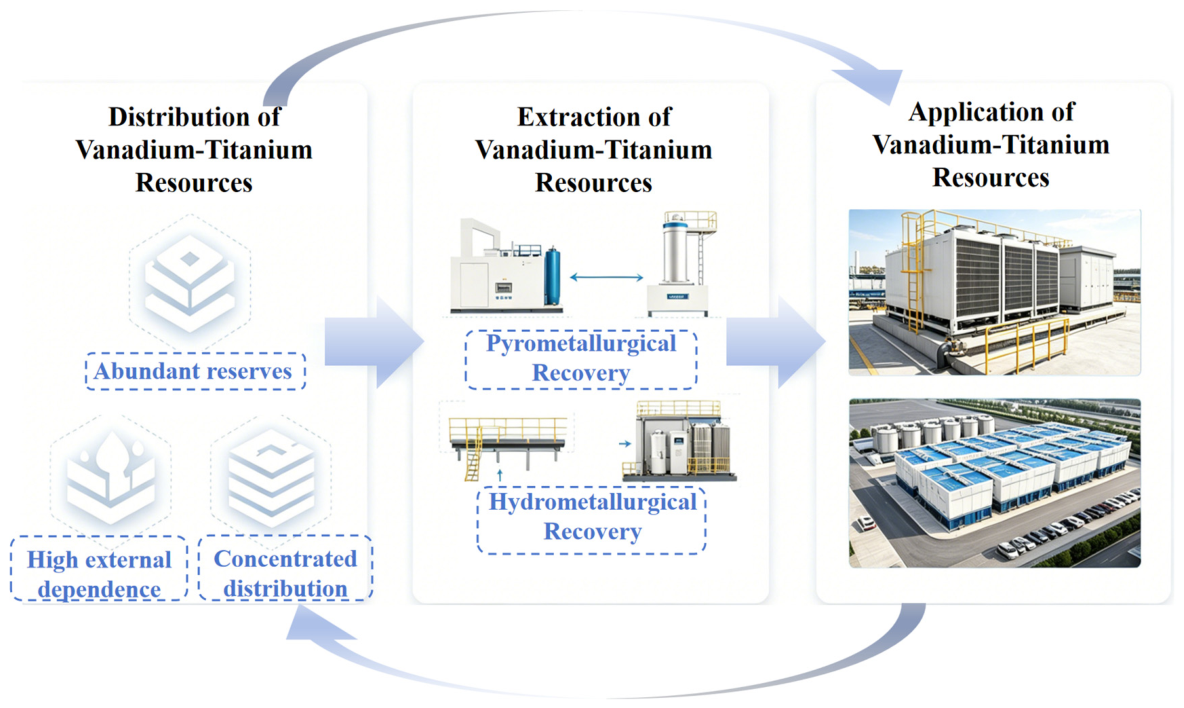
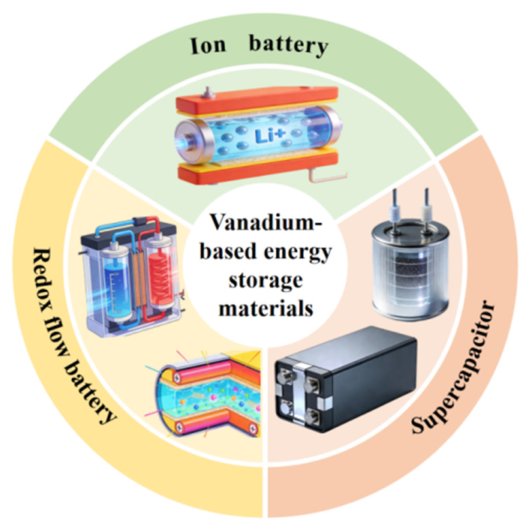
12]. However, the field still faces a series of key bottlenecks: the clean and efficient extraction technology for low-grade vanadium–titanium resources is immature, and the separation of associated impurities is difficult; the efficient closed-loop recycling system for vanadium and titanium from secondary resources such as retired energy storage devices and waste catalysts has not been established, and the mechanism for collaborative optimization of full-life-cycle environmental and economic benefits is missing. At the same time, existing studies mostly focus on resource extraction, material preparation, or single-device applications, lacking systematic sorting and integrated analysis of the full chain of “resource–material–recycling”. The full-life-cycle environmental impact and economic evaluation system are not yet sound, making it difficult to support the high-quality development of the industry. Therefore, it is of great theoretical value and practical significance to systematically summarize the technological evolution, energy storage application characteristics, and full-life-cycle evaluation results of the whole “resource–material–recycling” closed-loop industrial chain of vanadium–titanium resources and identify future development directions and breakthrough paths (
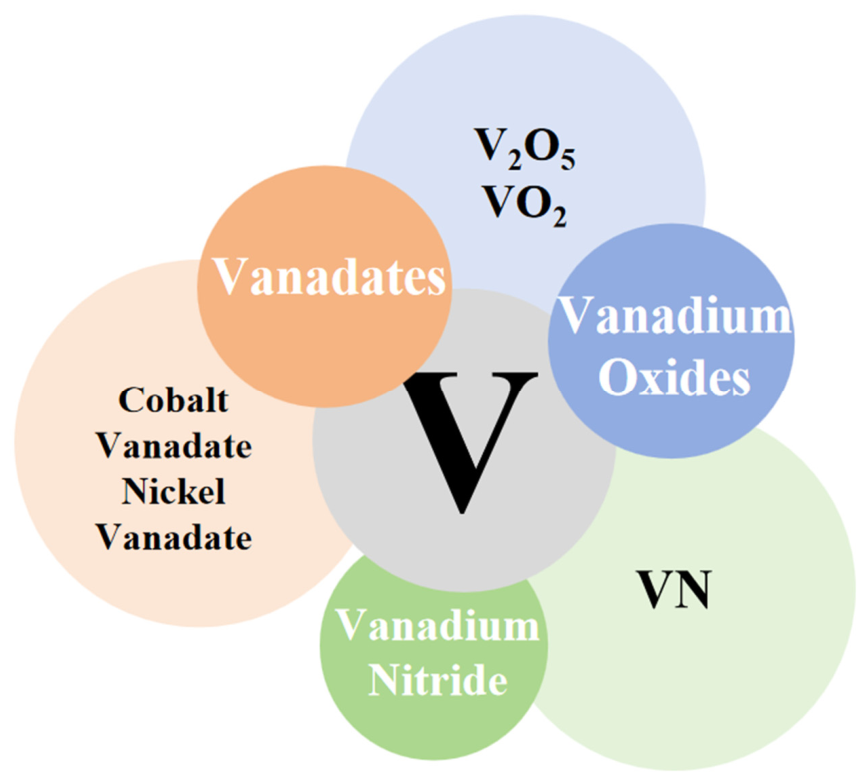
Figure 1).
Building upon this foundation, this paper systematically sorts the characteristics of vanadium–titanium resource distribution and reserves, reviews the mainstream extraction and recycling processes of vanadium and titanium resources, comprehensively summarizes the application characteristics and research progress of vanadium–titanium-based materials in various energy storage systems, discusses the closed-loop regeneration technology paths and full-life-cycle evaluation results, analyzes the core technical challenges facing industrial development, and proposes future development directions. It aims to provide a systematic reference for the efficient utilization, green recycling, and large-scale sustainable development of vanadium–titanium-based materials in energy storage, and facilitates the implementation of the energy transition and low-carbon strategies.
2. Materials and Methods
This is a review paper. All literature collection, content sorting, academic induction and manuscript compilation were independently completed by the authors.
A subset of illustrations throughout the paper, specifically those presented in Figures 1, 6a, 8, 9a,b,d, 12, 13a and 16 were produced with the assistance of Doubao AI (Versions 13.0.0, 13.2.0, 13.3.0, 13.5.0, developed by ByteDance Inc., Beijing, China). The specific application details are stated as follows: the authors determined the core content, overall layout, block division, text annotations and internal logical relationships of each figure according to the research theme. We then sorted out design requirements and compiled detailed descriptive prompts, and submitted the prompts to the GenAI (Doubao AI, Versions 13.0.0, 13.2.0, 13.3.0, 13.5.0, developed by ByteDance Inc., Beijing, China) tool for graphic rendering.
The GenAI tool was only responsible for visual graphic production. It did not participate in literature collection, content summarization, manuscript drafting or academic analysis. All text content, structural frameworks and layout arrangements of these schematic diagrams were independently designed and created by the authors. All AI-generated figures have been checked and confirmed by the authors. No raw experimental images prohibited by the journal were created during the whole process.
3. Current Status of Vanadium and Titanium Resource Distribution
3.1. Overview of Vanadium and Titanium Resources
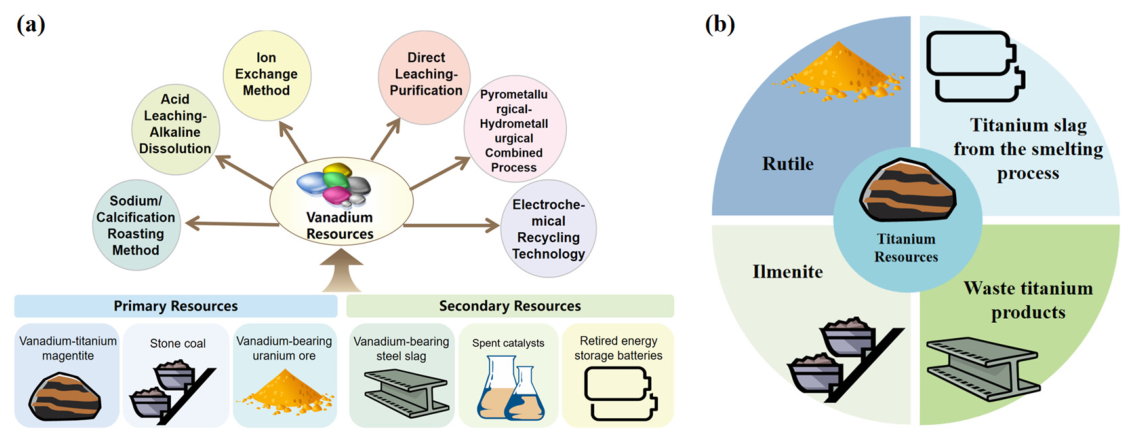
Vanadium and titanium resources are generally classified into primary resources and secondary resources. Primary vanadium resources include vanadium–titanium magnetite, stone coal, and vanadium-bearing uranium ore, which are initial enrichment carriers of vanadium; their mineral composition and occurrence state determine the subsequent extraction difficulty and process path. Secondary resources cover vanadium-bearing steel slag, waste catalysts, and retired energy storage batteries, originating from industrial production and product retirement; they have complex compositions but contain recyclable vanadium and associated elements (
Figure 2a).
Primary titanium resources are mainly ilmenite (accounting for more than 90%) and rutile, with secondary minerals including anatase, brookite, etc., which are less used in industry due to low reserves or high processing difficulty. Secondary titanium resources include production waste (titanium slag, residual titanium from smelting, titanium chips, milling materials from processing, etc.) and waste products after use (waste titanium alloy components in aerospace, waste titanium equipment in chemical industry, etc.). Four main types of titanium extraction technologies are available: hydrometallurgy, pyrometallurgy, molten salt electrolysis, and selective phase separation extraction. Titanium extraction technologies can effectively recover titanium components to a certain extent, with better economic value (
Figure 2b).
3.2. Global Distribution of Primary Vanadium and Titanium Resources
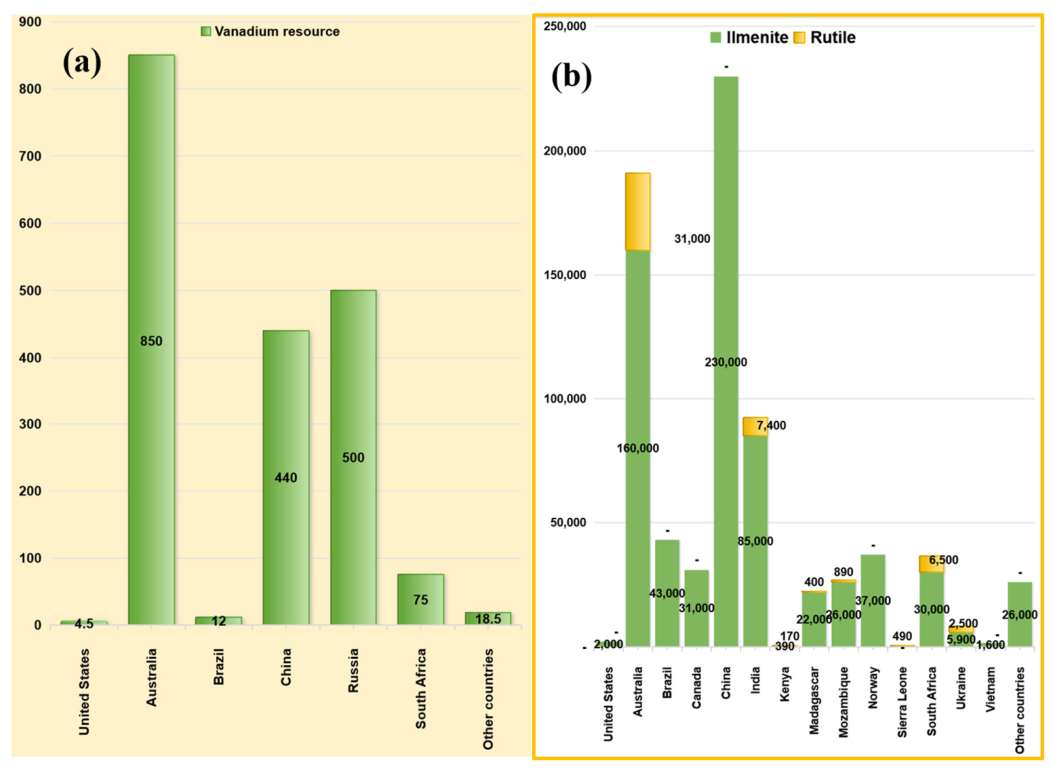
Most of the global vanadium supply comes from mined ores (or steelmaking slag). There are two main types of mineral resources for vanadium extraction: one is vanadium–titanium magnetite, and the other is vanadium-bearing carbonaceous shale (commonly known as stone coal, coal gangue). According to incomplete statistics from the U.S. Geological Survey (USGS), as of the end of 2023, global vanadium reserves exceeded 63 million tons (metal content, the same below), among which the proven vanadium ore reserves meeting current mining and production requirements were approximately 18.82 million tons (vanadium content) [
13]. Although vanadium reserves are relatively abundant, its resource distribution is scattered and uneven. Global vanadium reserves are concentrated in six countries: Australia, Russia, China, South Africa, Brazil, and the United States. Among them, Australia, Russia, China, and South Africa have the largest resource reserves, accounting for 45.2%, 26.6%, 23.4%, and 4% of the global total reserves respectively (
Figure 3a) [
14].
Global titanium resources are concentrated but unevenly distributed. Australia ranks first in the world in titanium reserves, followed by China, India, South Africa, and other countries. The above 13 countries account for approximately 97% of the global total titanium reserves. Currently, the world’s main titanium resources are ilmenite and rutile. Ilmenite resources are mainly concentrated in China, Australia, India, South Africa, and Brazil; rutile titanium resources are mainly distributed in Australia, South Africa, India, and Sierra Leone. According to USGS statistics, global titanium ore reserves exceed 2 billion tons, including 700 million tons of proven ilmenite resources and 49 million tons of rutile resources. Titanium resources are abundant in six continents except Antarctica, distributed in more than 30 countries. Global ilmenite and rutile reserves in 2022 are shown in
Figure 3b (0 indicates unproven reserves) [
15].
3.3. Distribution of Primary Vanadium and Titanium Resources in China
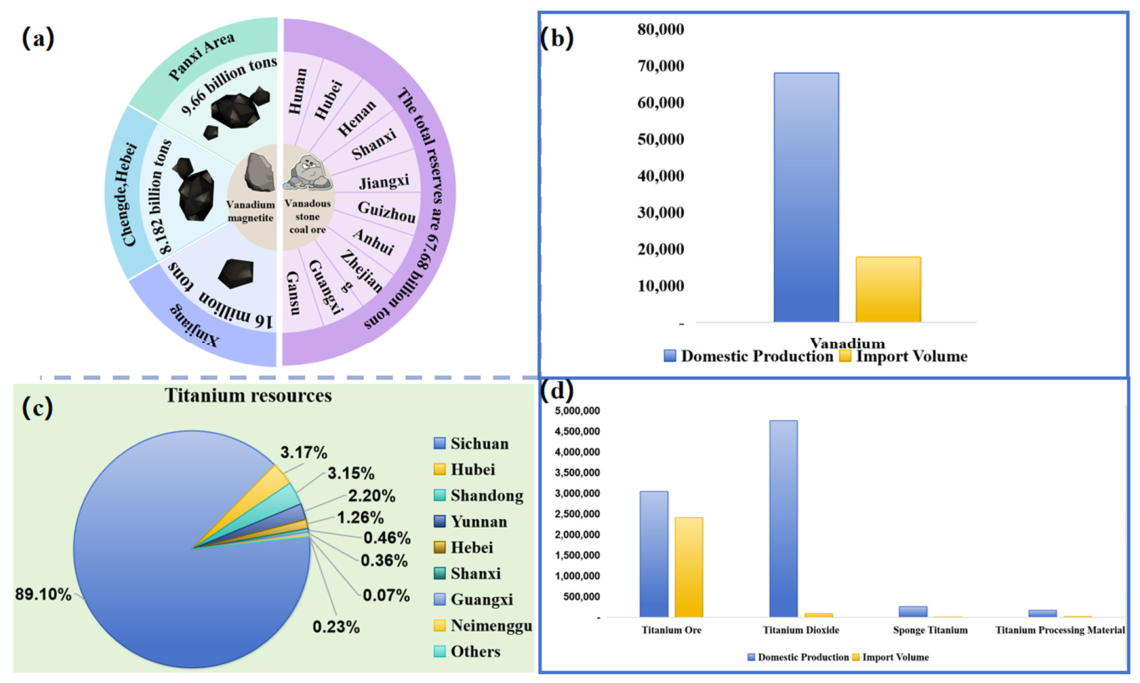
China’s proven vanadium resources are mainly geographically in 19 provinces, autonomous regions, and municipalities (
Figure 4a). The dominant geological hosts are vanadium–titanium magnetite and stone coal. China possesses the world’s largest inventory of vanadium–titanium magnetite hosting approximately 21% of the world’s total reserves. Among them, vanadium–titanium magnetite with good development economy and environmental benefits is mainly distributed in Panxi, Sichuan, and Chengde, Hebei [
1,
16]. Vanadium-bearing stone coal is mainly distributed in Hunan, Hubei, Henan, Shaanxi, Jiangxi, Guizhou, Anhui, Zhejiang, Guangdong, Guangxi and other places in China; the national proven reserves of vanadium-bearing stone coal reach 61.88 billion tons. In 2023, China remained the world’s largest vanadium producer, contributing 65.7% of the global total [
17]. China’s import volume of vanadium oxides and hydroxides reached 6083 tons, ranking first in the world, with imports of about 10,000 tons of other niobium, tantalum, vanadium ore and concentrates, and 6082.483 tons of vanadium pentoxide imported (
Figure 4b) [
14]. Accordingly, China exhibits a relatively high external dependence on vanadium resources.
China hosts abundant titanium resources, with a total of 142 titanium deposits discovered across 20 provinces and regions (
Figure 4c) [
3]. Primary titanium mining and mineral processing activities are concentrated in the Panxi region of Sichuan Province, while titanium ores of varying grades have also been discovered and utilized in Chengde, Hebei; Chaoyang, Liaoning; Hami, Xinjiang; and other regions. According to data from the Titanium–Zirconium–Hafnium–Vanadium Branch of China Nonferrous Metals Industry Association (
Figure 4d), China produced a total of 3.044 million tons of titanium ore (calculated as TiO
2 content) in 2024. Imports of various titanium ores, titanium dioxide, sponge titanium, and other products all increased [
18]. Overall, China’s primary titanium resource output is growing gradually, but the external dependence is still high.
3.4. Application Prospects of Vanadium–Titanium-Based Materials
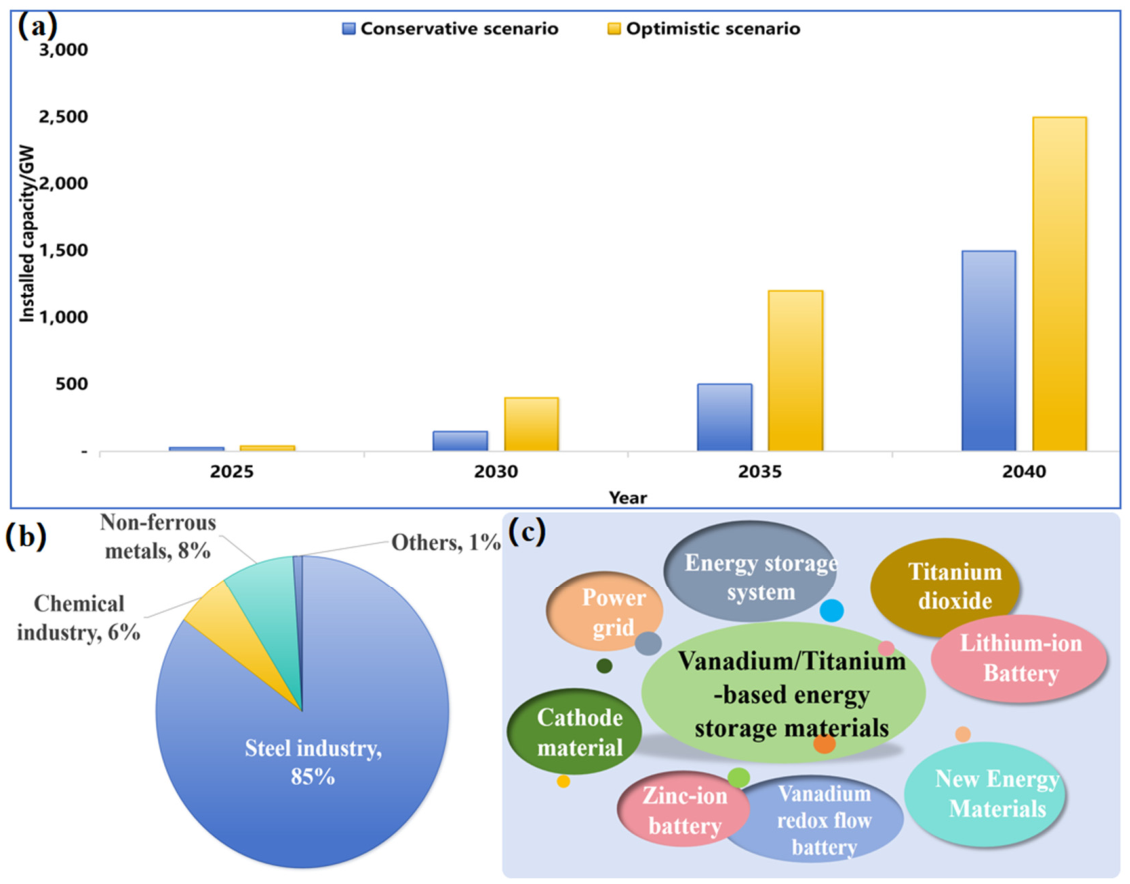
The rapid expansion of wind and solar power generation has elevated energy storage to a critical enabler of the nation’s energy system transformation. According to McKinsey’s forecast (
Figure 5a), from 2030, the global renewable energy penetration rate will rise to 60–70%, long-duration energy storage will increase by 5–10 times compared with 2025, and the cumulative investment scale will reach 200~500 billion US dollars. By 2040, long-duration energy storage will accelerate to 1.5–2.5 TW, with a cumulative investment of 3 trillion US dollars [
19]. Relying on their unique physical and chemical properties, vanadium–titanium resources are witnessing an explosive diversified market demand. The construction of a closed-loop regeneration system provides a guarantee for the long-term stable supply of vanadium–titanium resources. In the future, with the continuous upgrading of energy storage technology and the continuous maturity of closed-loop regeneration technology, the market demand for vanadium–titanium resources will further tilt towards high-value-added energy storage fields.
At the same time, the number of publications on vanadium–titanium energy storage materials has grown rapidly in recent years. Many reviews have focused on vanadium–titanium-based energy storage materials for emerging metal ion batteries (including alkali metal ion batteries and polyvalent metal ion batteries), flow batteries, energy storage systems, new energy materials, power grids, electrode materials and other fields (
Figure 5c). However, there is no comprehensive review of vanadium–titanium energy storage materials from the closed-loop industrial chain, and this paper presents their resource extraction, applications, closed-loop recycling and life cycle assessment.
Given the diverse application prospects of vanadium–titanium-based materials, the efficiency and sustainability of their industrial chain depend critically on the extraction and recovery processes. The following section systematically reviews the major technological routes for vanadium and titanium recovery, with an emphasis on process mechanisms, performance indicators, and environmental considerations.
4. Extraction Processes of Vanadium and Titanium Resources
4.1. Vanadium Recovery Processes
Vanadium recovery mainly targets vanadium–titanium magnetite, vanadium slag, stone coal, and secondary resources such as waste catalysts and retired vanadium batteries. The selection of a specific method is largely determined by ore characteristics (e.g., vanadium occurrence state and associated impurities), thermodynamic constraints during oxidation, and kinetic limitations in leaching stages, and the overall trend is moving towards clean, low-consumption, high-selectivity, and high-value closed-loop recycling.
4.1.1. Pyrometallurgical Recovery
Sodium roasting for vanadium extraction is a classic process for extracting vanadium from vanadium slag, vanadium–titanium magnetite, stone coal and other raw materials. The core is to oxidize low-valence vanadium (V
3+/V
4+) in raw materials to V
5+ in an oxidizing atmosphere (as shown in Formula (1)), which reacts with sodium salts (Na
2CO
3/NaCl/Na
2SO
4) to generate water-soluble sodium metavanadate NaVO
3, as shown in Formula (2), realizing the separation of vanadium from impurities such as silicon, iron, and titanium [
20]. Yi et al. [
20] performed thermodynamic calculations on the sodium sulfate roasting process of vanadium–titanium magnetite. The results show that the oxidation of vanadium spinel to V
2O
5 can proceed spontaneously at roasting temperatures. The reaction between vanadium oxides and sodium sulfate to form water-soluble sodium vanadate is thermodynamically spontaneous at temperatures above 1000 °C, and temperature is the key factor driving the sodiumation reaction.
Using NaCl, NaOH, Na
2SO
4 or Na
2CO
3 as sodium agents, the reactions with FeV
2O
4 under the action of oxygen are shown in Formulas (3)–(6) [
21,
22].
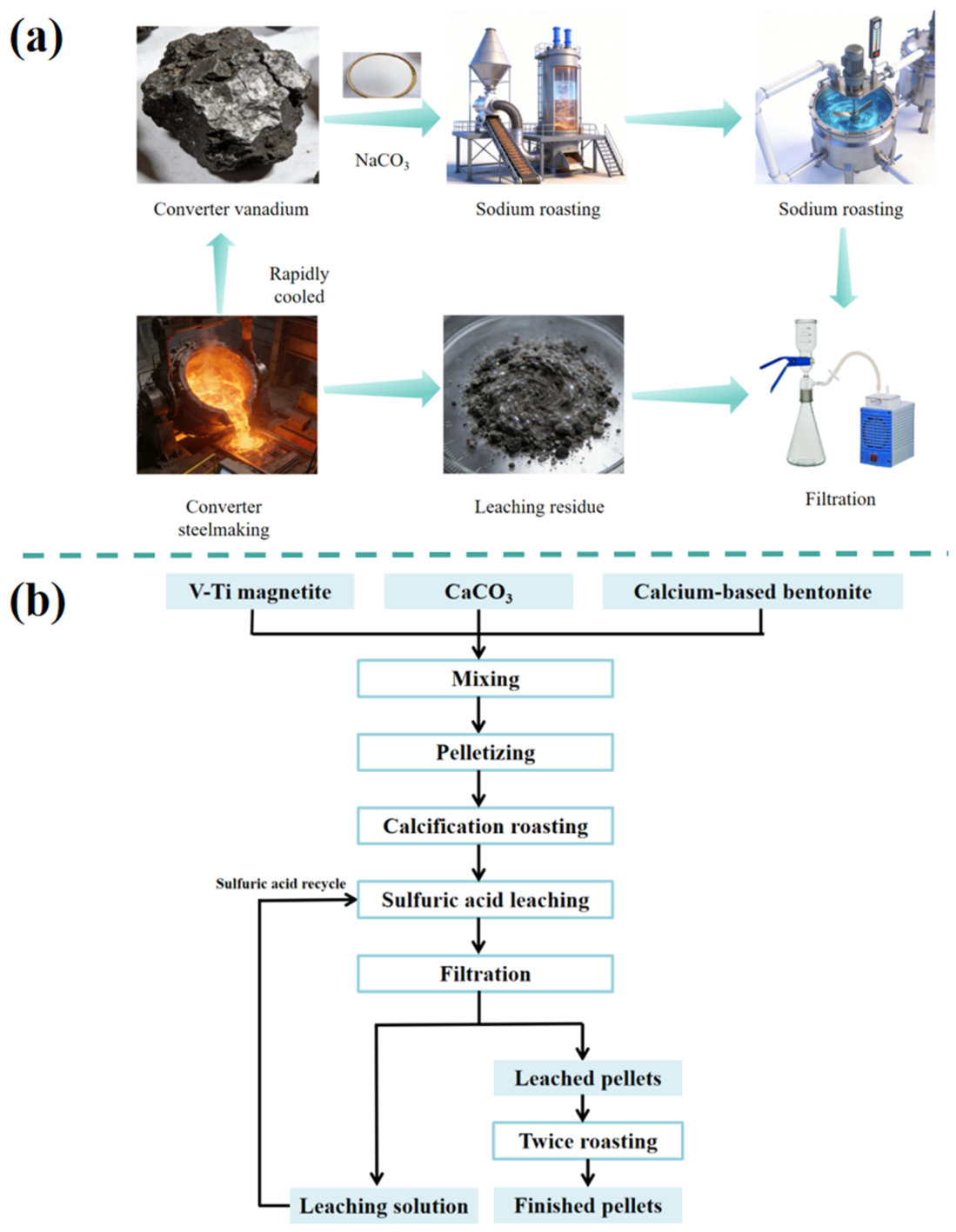
Figure 6a is a schematic diagram of the NaOH vanadium extraction process.
Calcification roasting–acid leaching is a clean vanadium extraction process with reduced waste gas, wastewater and solid waste pollution. This method works at the EVRAZ Vanadium Tula plant in Russia. Its core is to oxidize vanadium spinel into V
2O
5, which then reacts with calcium carbonate to form acid-soluble calcium vanadates. Leaching efficiency depends mainly on the conversion rate, and the recovery rises at 400–900 °C but declines when the temperature is too high [
8]. The reaction mechanism is shown in Formulas (7) and (8).
From the perspective of reaction kinetics, calcification roasting has lower activation energy and a more stable reaction progress, while sodium roasting features higher activation energy and severe solid-phase mass transfer resistance. The high-temperature requirement of sodium roasting leads to high energy consumption and large quantities of salt slag and waste gas. In contrast, calcification roasting avoids harsh reaction conditions and pollutant generation, which fundamentally accounts for their differences in recovery efficiency and energy consumption.
4.1.2. Hydrometallurgical Recovery
Hydrometallurgical recovery covers vanadium–chromium slag, vanadium secondary resources, stone coal, and others. Vanadium slag is produced from vanadium–titanium magnetite via blast furnace smelting followed by converter vanadium extraction. The ore is reduced in the blast furnace to produce vanadium-containing hot metal, which is then oxidized in the converter. Vanadium is selectively oxidized and combined with modifiers to form high-vanadium molten slag. After slag-iron separation, cooling and grinding, the final product rich in vanadium–iron spinel is obtained as the key raw material for vanadium production.
Leaching methods are divided into acid leaching and alkali leaching. Acid leaching directly dissolves and leaches vanadium from raw materials with acidic solutions under heating conditions, and then obtains high-purity vanadium pentoxide through purification, vanadium precipitation, and calcination [
23]. Partial reactions are shown in Formulas (9)–(15). Alkali leaching can realize selective leaching of vanadium [
24,
25], solving the problem of excessive impurities in acid leaching. A typical alkali leaching technology is the sub-molten salt technology developed by the Institute of Process Engineering, Chinese Academy of Sciences. The core of this technology is to carry out continuous liquid-phase oxidation of vanadium-bearing slag in sub-molten salt medium under normal pressure. Vanadium-bearing slag decomposes in concentrated sodium hydroxide/potassium hydroxide (NaOH/KOH) molten salt solution, and the vanadium leaching rate can reach 98% [
25,
26,
27,
28]. Both leaching reactions are thermodynamically spontaneous. Kinetically, acid leaching has a low apparent activation energy of 8.80–29.96 kJ/mol and a large reaction rate constant, so the reaction proceeds rapidly [
29]. But vanadium and impurities share similar kinetic properties, resulting in impurity co-dissolution. Alkaline leaching has an activation energy of 32.39–50.27 kJ/mol and a smaller rate constant, hence a slower reaction. The activation energy difference between vanadium and impurities is over 20 kJ/mol, which enables high selectivity of alkaline leaching [
30].
Hydrometallurgical leaching is generally followed by an ion exchange section. During ion exchange, V(V) reacts with anionic functional groups on the resin and is subsequently adsorbed [
31,
32,
33]. The exchange resins commonly used for vanadium recovery are shown in
Table 1.
4.2. Titanium Recovery Processes
4.2.1. Pyrometallurgical Recovery
Pyrometallurgical titanium extraction refers to a series of metallurgical processes for extracting titanium from ores (mainly ilmenite and rutile) under high-temperature conditions [
41].
High-temperature carbonization is the core process of pyrometallurgical titanium extraction, mostly used for secondary resources such as titanium-bearing blast furnace slag and titanium slag. It converts TiO
2 into titanium carbide through high-temperature carbothermic reduction using only carbon as the reducing agent, and the corresponding reaction is shown in Formula (16). TiC can be further converted to TiCl
4 or high-purity titanium through chlorination/purification, which is a mature route for processing low-grade titanium resources in industry [
42]. Thermodynamic analysis reveals that the carbothermic reduction in TiO
2 is a strongly endothermic reaction. The Gibbs free energy (
) of each sub-reaction gradually decreases with increasing temperature. At conventional temperatures,
≫ 0, so the reactions cannot proceed spontaneously. Only when the temperature rises to 1600–1800 °C does
< 0, allowing the reduction reactions to proceed continuously [
43]. This is the fundamental thermodynamic reason why the process requires ultra-high operating temperatures. Kinetically, this reduction reaction has an extremely high activation energy and large reaction resistance. The reaction rate remains low even under favorable thermodynamic conditions. Extended holding time is necessary to guarantee complete reduction, leading to higher energy consumption.
Metallothermic reduction reduces titanium compounds (such as Ti
xO
y, Ti
xCl
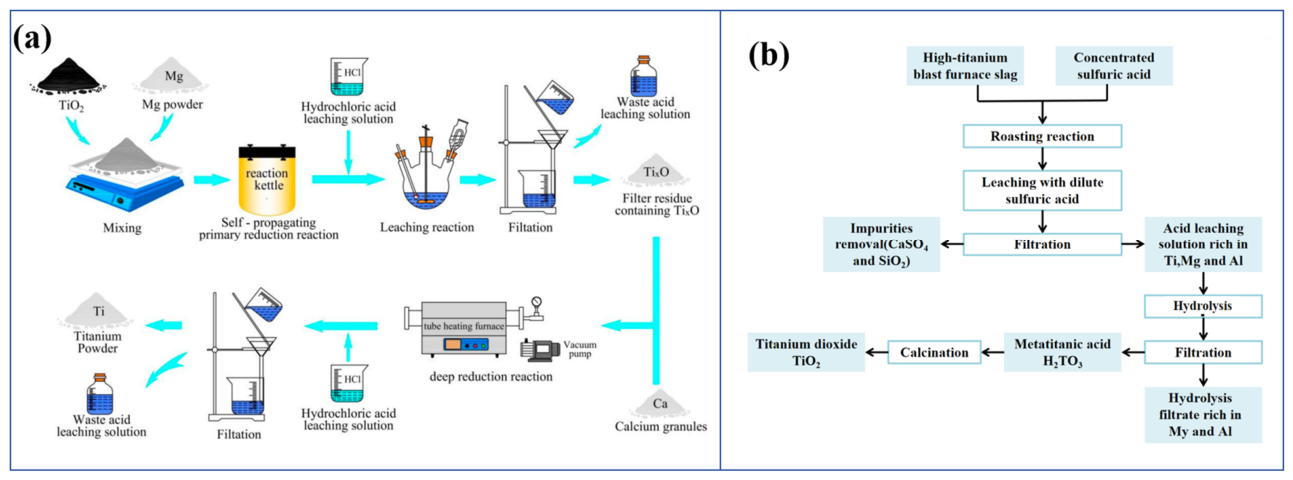
y) to metallic titanium or titanium alloys through strong reducing metals (such as aluminum, magnesium, sodium). Fan Shunguo proposed a “TiO
2 magnesiothermic-calciothermic two-step reduction method”, with the process flow chart shown in
Figure 7a [
44]. This process reduces the energy barrier of TiO
2 step-by-step deoxidation (from TiO
2 to low-valence titanium oxides and then to metallic titanium) by adjusting reaction conditions (such as temperature, type and proportion of reducing agent), enabling deep deoxidation reactions to proceed under milder conditions.
4.2.2. Hydrometallurgical Recovery
Hydrometallurgical leaching is a key technology for high-value conversion of titanium components in titanium-bearing slag titanium extraction based on the principle of chemical dissolution–crystallization, which mainly include the sulfuric acid method and selective precipitation titanium extraction technology.
Acid leaching is the mainstream process of hydrometallurgical titanium recovery. Titanium in titanium-bearing raw materials is dissolved into soluble titanium salts with strong acids such as sulfuric acid, and then high-purity TiO
2 is obtained through hydrolysis and calcination.
Figure 7b shows the process of high-titanium slag through concentrated sulfuric acid roasting–dilute sulfuric acid leaching. Zhou Lishan [
45] adopted concentrated sulfuric acid (95.0–98.0 wt.%) roasting activation technology. At 130 °C, by optimizing experimental parameters, the titanium leaching rate of titanium-bearing blast furnace slag after concentrated sulfuric acid roasting activation reached more than 85% [
42].
The basic principle of selective precipitation titanium extraction is to create specific physical and chemical conditions to drive the selective migration and enrichment of valuable elements (such as titanium) from dispersed mineral phases to the designed target phases, following the “chemical potential gradient-driven” mechanism [
46,
47]. Guo et al. designed an ultra-gravity separation system to achieve phase separation through a high-speed centrifugal device and selectively extract enriched components, rutile with a purity of 95.56% was obtained, and the efficiency was increased by 60% compared with traditional gravity separation methods. However, temperature fluctuations (±20 °C) may lead to remelting of rutile, and industrial energy consumption is 25% higher than traditional processes [
48,
49].
4.3. Summary of Recovery Processes
Vanadium–titanium resource recovery processes have been continuously iterated around the core goals of “efficient separation, low consumption, environmental protection, and scenario adaptation”. Different processes show significant differences in key indicators such as recovery rate, energy consumption, and cost due to differences in the reaction mechanism, complexity, and equipment requirements, and have their own adaptive advantages under specific conditions.
For vanadium recovery processes, mainstream recovery methods such as sodium roasting, calcification roasting, acid leaching, alkali leaching, and ion exchange show significant differences in core indicators such as the recovery rate, energy consumption, and cost. Restricted by high-temperature thermodynamic requirements and poor solid-phase kinetics, sodium roasting consumes more energy. Calcification roasting benefits from favorable thermodynamic conditions and low activation energy, realizing low energy and cost. Acid leaching relies on superior kinetic properties to obtain considerable recovery, but impurity co-dissolution limits its application. Alkaline leaching achieves high recovery via kinetic selectivity, while its relatively slow reaction increases energy consumption. Ion exchange depends on low-energy interfacial reactions, leading to low energy use but high material and operation costs.
Table 2 systematically compares the key performance parameters of various methods, providing references for technology selection and process optimization.
Table 3 compares and summarizes the main titanium extraction processes discussed in this chapter, including their applicable titanium-bearing slag composition, optimal operating conditions, and performance indicators, aiming to clearly compare the technical maturity, efficiency, and applicability of each method.
Overall, the selection of vanadium–titanium recovery processes should follow core principles: high-grade raw materials are suitable for simple processes such as sodium roasting and carbothermic reduction [
41,
44]; high-purity products prefer the combined process of “selective leaching + deep purification”; general-grade products can choose a single roasting–leaching process to balance cost and efficiency; areas with strict environmental protection requirements should avoid processes with pollution risks such as sodium roasting; areas with high energy costs prefer low-energy technologies such as water leaching and ion exchange; primary ores focus on large-scale processes, while secondary resources prefer highly selective processes such as alkali leaching and ion exchange.
5. Application of Vanadium–Titanium-Based Materials in Energy Storage Systems
Boasting unique physical and chemical properties, vanadium–titanium-based materials have achieved diversified applications in energy storage systems such as ion batteries, flow batteries, and supercapacitors, becoming the core support to solve the performance bottlenecks of energy storage devices. At the same time, they have continuously broken through their own limitations through structural modification and process optimization in applications.
5.1. Vanadium-Based Energy Storage Materials
5.1.1. Overview
Vanadium-based materials benefit from relatively abundant resources and moderate cost. Due to their multi-valence states and rich layered structures, they have become promising electrode materials. In various energy storage systems, vanadium-based materials can achieve efficient conversion between electrical energy and chemical energy through reversible redox reactions, exhibiting high theoretical specific capacity, good rate performance, and long cycle life, and have broad application prospects in aqueous zinc-ion batteries, sodium-ion batteries, magnesium-ion batteries, flow batteries and other energy storage systems (
Figure 8).
5.1.2. Ion Batteries
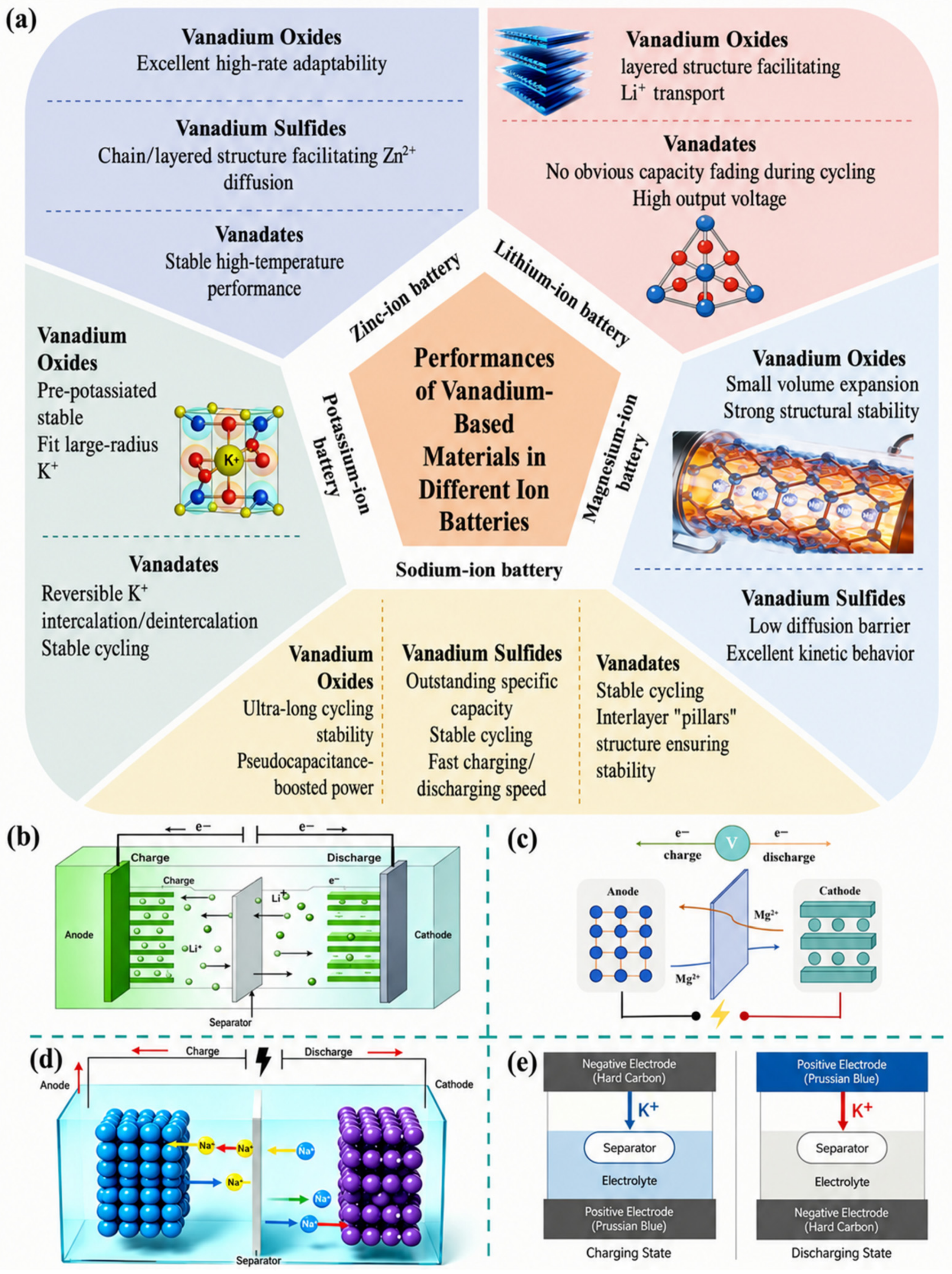
Vanadium-based materials show the advantages of high theoretical specific capacity, good rate performance and cycle stability in mainstream ion battery systems such as aqueous zinc-ion batteries, lithium-ion batteries, magnesium-ion batteries, sodium-ion batteries, and potassium-ion batteries, and adapt to the storage needs of different carriers (Zn
2+, Li
+, Mg
2+, Na
+, K
+) (
Figure 9a).
Zinc-Ion Batteries
In recent years, aqueous zinc-ion batteries (ZIBs) have attracted extensive attention due to their mild and non-toxic electrolytes, high theoretical energy density, and abundant zinc resources [
51]. Vanadium-based materials, relying on their multi-valence characteristics and adapted crystal structure, have become high-quality choices for ZIB cathodes. Vanadium oxides, vanadium sulfides, and vanadate materials realize efficient storage and transmission of Zn
2+ through the advantages of a layered/tunnel structure, open channels, and stable skeleton respectively, effectively improving battery performance. A comparison of properties of different vanadium-based cathode materials for aqueous zinc-ion batteries is shown in
Table 4.
Lithium-Ion Batteries
Lithium-ion batteries (LIB) are rechargeable batteries with the advantages of high working voltage, high power density, long cycle life and no memory effect [
59,
60], with its working schematic diagram shown in
Figure 9b. Vanadium oxides and vanadates, as key electrode materials of lithium-ion batteries, rely on unique crystal structures (layered, tunnel, etc.) and multi-valence characteristics to provide sufficient space and stable support for lithium ion intercalation/deintercalation, and becoming an important choice to optimize the electrochemical performance of lithium-ion batteries.
Vanadium oxide is an important candidate material for lithium-ion battery cathodes. Metastable monoclinic VO
2 (B) has a layered structure formed by edges, thus obtaining better capacity performance, showing a specific capacity of 200 mAh g
−1, and still reaching 45 mAh g
−1 at a high current density of 1600 mA g
−1, making it a promising electrode material [
61].
Vanadates have good electrochemical properties and good application prospects in the field of lithium-ion batteries. LiV
3O
8 has a typical layered structure and exhibits a capacity of more than 300 mAh g
−1 in organic systems [
62]. Li [
63] et al. prepared carbon-coated Li
3V
2(PO
4)
3 by the sol–gel method, with a particle size as small as 45 nm, and the capacity still maintained 167.6 mAh g
−1 after 50 cycles at a current density of 28 mA g
−1 and a voltage of 3.0~4.8 V.
Magnesium-Ion Batteries
As a high-quality alternative to lithium-ion batteries, magnesium-ion batteries (MIBs) have attracted much attention in the field of portable and large-scale electronic device energy storage due to their important advantages such as no dendrite formation during cycling (safety), low reduction potential (−2.37 V relative to standard hydrogen electrode (SHE)), high volumetric capacity, abundant resources and non-toxicity [
64,
65], with its working schematic diagram shown in
Figure 9c. Vanadium oxides and vanadium sulfides, relying on adapted crystal structures and excellent electrochemical properties, have become key electrode materials for magnesium-ion batteries.
Vanadium oxides, due to their open crystal structure, are ideal choices for magnesium-ion battery electrodes. Compared with alloy-type anodes (such as Bi, Sn), vanadium oxides have low volume expansion (about 10–20%) during Mg
2+ intercalation, reducing electrode pulverization risk and extending cycle life [
66]. Mg
2+ intercalated Mg-VO
2 shows excellent rate capability and good cycle stability, providing an ultra-high initial capacity of 442.3 mAh g
−1 at 1.0 A g
−1, 235.5 mAh g
−1 at a high current density of 5.0 Ag
−1, and a capacity retention rate of 62.5% after 1000 cycles [
67].
Vanadium sulfides are also key electrode materials for magnesium-ion batteries. VS
4 has a “linear chain” structure, with an interlayer distance much larger than the ionic diameter of Mg
2+, facilitating magnesium-ion diffusion and storage [
4,
68]. Ding [
69] et al. introduced S vacancy modification in VS
4. The cathode could cycle more than 350 times at 50 mA g
−1, maintaining a high discharge specific capacity of 120 mAh g
−1, and had good cycle stability at 500 mA g
−1.
Sodium-Ion Batteries
Due to the abundant and cheap sodium resources, significantly improved battery capacity in recent years, and suitable redox potential, sodium-ion batteries have become extremely sustainable next-generation energy storage devices with broad prospects in large-scale energy storage [
70,
71], with its working schematic diagram shown in
Figure 9d. Vanadium oxides, vanadates and vanadium-based sulfides, relying on unique crystal structures (layered, tunnel, chain, etc.) and multi-valence characteristics of vanadium, provide sufficient space and stable support for sodium ion intercalation/deintercalation, effectively improving the capacity performance, cycle stability and rate performance of batteries, and are important choices for sodium-ion battery electrode materials. A comparison of properties of different vanadium-based cathode materials for aqueous sodium-ion batteries is shown in
Table 5.
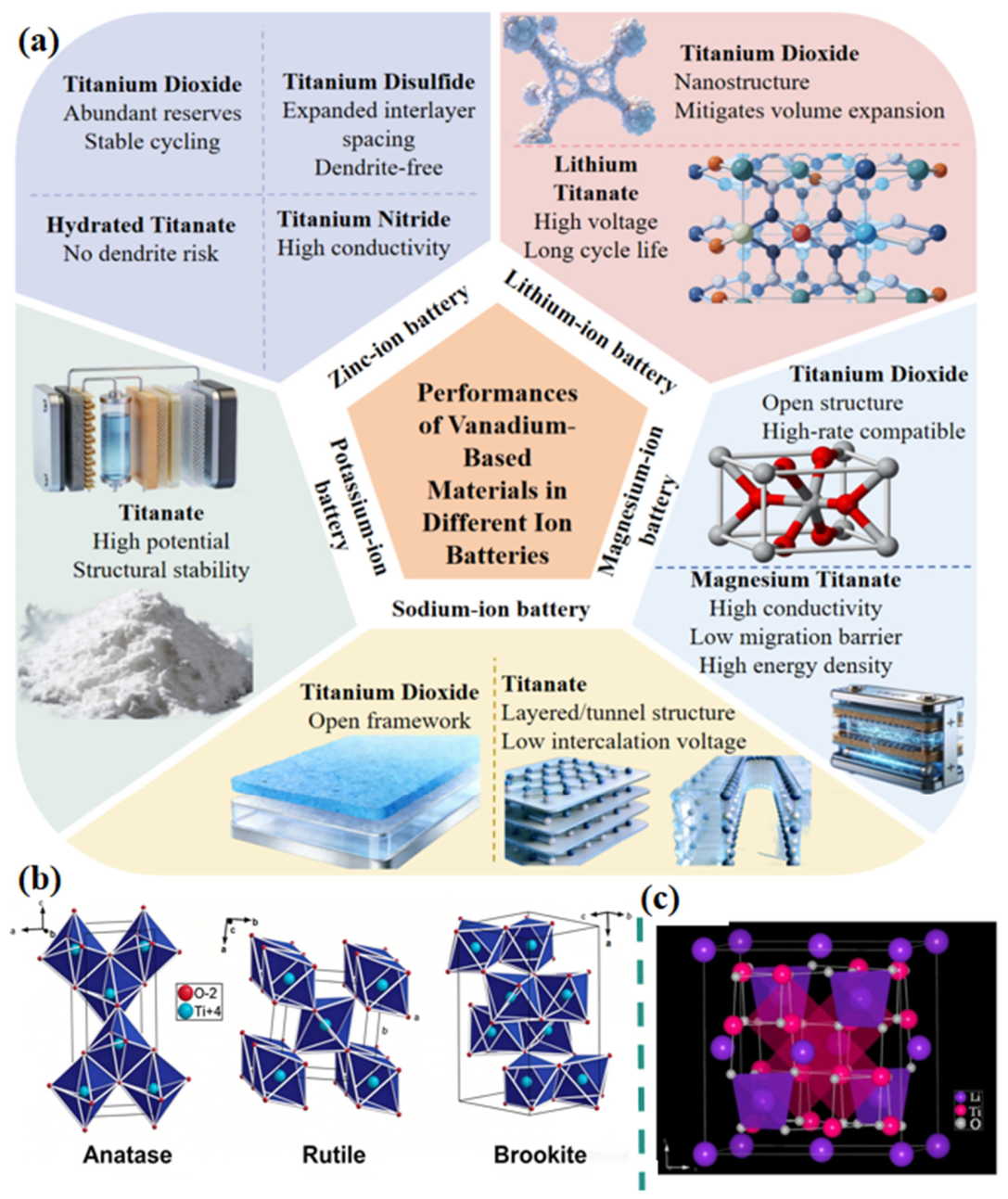
Figure 9.
(
a) Schematic diagram of characteristics of vanadium-based materials in different ion batteries; (
b) schematic diagram of lithium-ion battery operation; (
c) schematic diagram of magnesium-ion battery operation; (
d) schematic diagram of sodium-ion battery operation [
72]; (
e) schematic diagram of potassium-ion battery operation.
Figure 9.
(
a) Schematic diagram of characteristics of vanadium-based materials in different ion batteries; (
b) schematic diagram of lithium-ion battery operation; (
c) schematic diagram of magnesium-ion battery operation; (
d) schematic diagram of sodium-ion battery operation [
72]; (
e) schematic diagram of potassium-ion battery operation.
Table 5.
Comparison of characteristics of different vanadium-based cathode materials for aqueous sodium-ion batteries.
Table 5.
Comparison of characteristics of different vanadium-based cathode materials for aqueous sodium-ion batteries.
| Material Category | Key Electrochemical Performance | Cycling Stability Performance | References |
|---|
| Vanadium Oxide-Based Materials | V2O3@MCNFs | Maintains high specific capacity
at a 5 A g−1 | Maintains high specific capacity after 10,000 cycles at 5 A g−1 | [73] |
| Sodium Vanadate-Based Materials | Na1.25V3O8 | Initial capacity 158.7 mAh g−1
at 200 mA g−1 (1.5~4.0 V) | 95% capacity retention after 200 cycles at 200 mA g−1 | [74] |
| NH4V4O10 | Specific capacity 167.3 mAh g−1 at 100 mA g−1 | >70% capacity retention after 250 cycles at 100 mA g−1 | [75] |
| Vanadium-Based Sulfide Materials | VS2-SNSs | Reversible capacity 250 mAh g−1
at 0.2 A g−1; 150 mAh g−1 at 20 A g−1 ultra-high current density | | [76] |
| VS4/Bi2S3@PDA | 567.4 mAh g−1 after 200 cycles at 0.5 A g−1; 379.0 mAh g−1 after 1800 cycles at 2 A g−1 | Outstanding long-cycle stability | [77] |
Potassium-Ion Batteries
Potassium-ion batteries have potential application value in large-scale energy storage due to their abundant potassium resources and suitable redox potential, becoming an important research direction of new energy storage batteries. Vanadium oxides and vanadates, as key electrode materials of potassium-ion batteries, rely on their layered and tunnel crystal structures and multi-valence characteristics of vanadium to provide sufficient space and stable structural support for potassium ion intercalation/deintercalation. The working principle of potassium-ion batteries is shown in
Figure 9e.
V
2O
5 and its derivatives, due to their layered or tunnel structure and multi-valence vanadium centers (V
2+ to V
5+), can provide multiple electron transfers to achieve high-capacity storage, and are considered promising electrode materials for potassium-ion batteries [
78]. For potassium-ion battery anodes, Daniel Koch et al. [
79] conducted a first-principles study on four different vanadium oxide phases (α-V
2O
5, β-V
2O
5, bronze-type VO
2(B) and rutile-type VO
2(R)). The results showed that metastable β-V
2O
5 had the lowest potassium ion intercalation energy.
Vanadate compounds usually have stable layered or tunnel structures, and the multi-valence characteristics of vanadium give them high electrochemical activity and adjustable electrochemical properties [
80]. Deng et al. [
81] proposed a layered potassium vanadate K
0.5V
2O
5 as a potential cathode material for potassium-ion batteries. The prepared material could provide a reversible capacity of about 90 mAh g
−1 at a current of 10 mA g
−1 in the voltage range of 1.5~3.8 V, and showed fast rate performance, with a capacity retention rate of 81% after 250 cycles at a current of 100 mA g
−1, and highly stable and reversible structural changes during potassium intercalation/deintercalation.
5.1.3. Flow Batteries
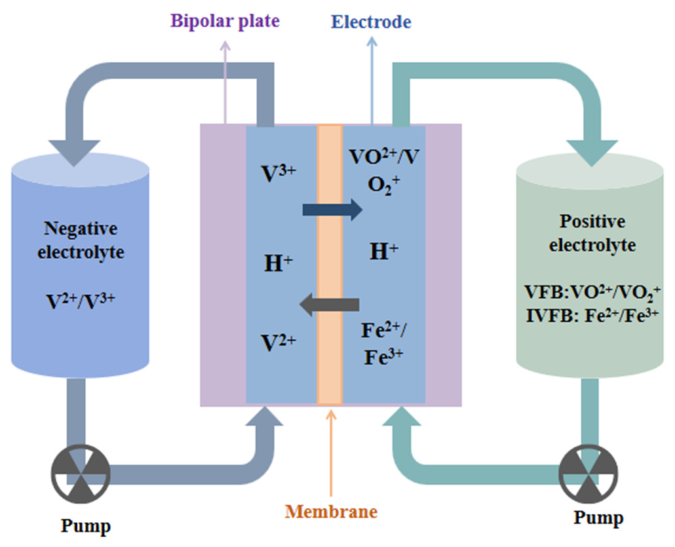
Flow batteries represent a core technical pathway for large-scale long-duration energy storage. Vanadium, with its continuously reversible multi-valence states, has become the core active material for flow battery couples, and related systems have developed diversified technical directions such as all-vanadium and iron–vanadium. The structural schematic diagrams of all-vanadium and iron–vanadium flow batteries are shown in
Figure 10.
All-Vanadium Flow Battery
All-vanadium flow batteries (VFBs) use vanadium as the active material for both positive and negative electrodes, making it one of the most successful flow batteries at present [
5].
Chen et al.’s [
5] studies showed that the VFB positive VO
2+/VO
2+ couple has a high reaction potential. It shows excellent capacity stability in long-term cycle performance. In 1000 cycles, the energy efficiency only decreases by about 3%, and the capacity evolution shows a “rapid decline-stable” characteristic. After the first 150 cycles, the capacity stabilizes in the range of 650–700 mAh. However, the self-discharge performance of VFB is relatively weak, and it will completely lose capacity after about 80 h in hot standby mode, which is related to the influence of ion transmembrane diffusion.
Iron–Vanadium Flow Battery
Chen et al.’s [
5] experiments confirmed that the IVFB positive Fe
2+/Fe
3+ couple has good electrochemical reversibility, in terms of cycle performance, the energy efficiency of IVFB only decays by 3% after 1000 cycles, and the capacity shows a “rapid decline-recovery-stable” characteristic. In the 100–200-cycle stage, the internal temperature rise of the battery and the improvement in electrode wettability will promote capacity recovery. The capacity decay after the long-term cycle stems from ion transmembrane pollution. By replacing the positive electrolyte, the capacity can be restored to 65% of the initial state after 1000 cycles, and the cost of the positive electrolyte only accounts for 1% of the total system investment, without additional vanadium resources.
Table 6 compares the cost and performance differences between all-vanadium and iron–vanadium flow batteries.
5.1.4. Supercapacitors
Emerging vanadium-based material supercapacitors have the advantages of high power density, long cycle life and fast charge and discharge [
82]. The main vanadium-based materials are shown in
Figure 11. The performance and cost comparison of vanadium oxide, vanadate and vanadium nitride materials in supercapacitors are shown in
Table 7.
Vanadium oxide-based materials are promising high-specific-capacity candidates for supercapacitor electrode materials. V
2O
5 has a theoretical specific capacitance as high as 1400 F/g [
83]. VO
2 has great potential as a pseudocapacitive active material. Liu [
84] prepared nickel oxide-coated Ni-VO
2@NiO, and assembled a supercapacitor using Ni-VO
2@NiO-200 as both positive and negative electrodes. It exhibited a maximum energy density of 4.03 W h kg
−1 (power density of 55 W kg
−1), and a capacity retention rate of 72.8% after 2500 cycles.
Transition metal vanadates are increasingly concerned as supercapacitor electrode materials. The assembled NVR supercapacitors had excellent power and energy density values of 2511 W kg
−1 and 34.67 Wh kg
−1 respectively. In addition, after adding rGO to NV NPs, the cycle stability increased from 83% to 91% after 5000 constant current charge and discharge cycles [
83]. Arasi et al. [
85] prepared Co
3V
2O
8 stacked into particles by thin layers using the co-precipitation method, and the capacitance retention rate was 90.1% after 10,000 consecutive cycles.
Vanadium nitride (VN) has the advantages of high conductivity, high specific capacitance, excellent cycle stability and a wide voltage range. In particular, nanostructured vanadium nitride is considered an ideal pseudocapacitor material due to its large specific surface area and high electronic conductivity. VN has a specific capacitance of up to 1350 F/g and a conductivity of 1.6 × 10
6 S/m [
86].
Table 7.
Performance and cost comparison of vanadium-based materials in supercapacitors.
Table 7.
Performance and cost comparison of vanadium-based materials in supercapacitors.
| Material Type | Cost Level | Key Advantages | Limitations |
|---|
| Vanadium Oxide (V2O5, VO2) | Medium | Significant pseudocapacitive effect,
high energy density, abundant resources | Insufficient conductivity;
needs to composite with conductive materials to improve performance |
Vanadate
(Ni3V2O8, Co3V2O8) | Medium–high | Synergistic redox of multiple elements, structural stability | Slow reaction kinetics;
low charge–discharge rate |
| Vanadium Nitride (VN) | High | Extremely high conductivity, excellent cycle stability, suitable for flexible devices | Difficult large-scale synthesis,
prone to oxidation |
5.2. Titanium-Based Energy Storage Materials
5.2.1. Overview
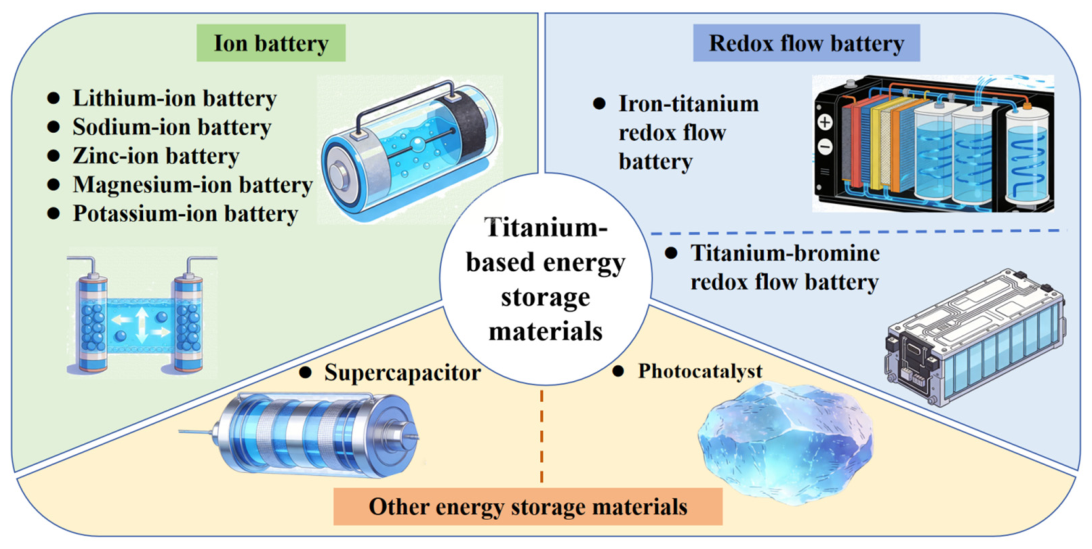
Relying on the advantages of abundant resources, a stable structure and environmental friendliness, titanium-based energy storage materials play a key role in ion batteries, flow batteries, supercapacitors and other energy storage fields (
Figure 12). Among them, titanium and titanium-containing compounds are mainly used as anode active materials, conductive skeletons or functional additives. Through their unique physical and chemical properties (such as the “zero strain” characteristic of lithium titanate, high specific surface area of titanium dioxide nanotubes and high conductivity of titanium-based MXene), they improve the rate performance, cycle life and safety of devices, and are expected to fulfill large-scale commercial applications in high-power, long-life new-generation energy storage systems.
5.2.2. Ion Batteries
The characteristics of titanium-based materials in different ion batteries are shown in
Figure 13a.
Zinc-Ion Batteries
Titanium-based materials, relying on a stable structure and good electrochemical compatibility, have become key choices to optimize the performance of zinc-ion batteries. Titanium disulfide, hydrated titanic acid, titanium nitride and other titanium-based materials provide sufficient channels for zinc ion transmission through a unique crystal structure and physical and chemical properties, while inhibiting dendrite growth, effectively improving the cycle stability and capacity performance of batteries. A comparison of properties of different titanium-based cathode materials for aqueous zinc-ion batteries is shown in
Table 8. Titanium disulfide (TiO
2) is abundant and low-cost, and its unique crystal structure gives it good application potential in zinc-ion batteries. Hydrated titanic acid (H
2Ti
3O
7), with its ultra-low redox potential, excellent cycle stability and rate performance, is a high-quality anode material for zinc-ion batteries. Titanium nitride (TiN) has attracted extensive attention due to its high stability and conductivity. Designing porous titanium nitride with high specific surface area helps to improve the charge field and ion distribution, thereby inhibiting dendrite generation.
Lithium-Ion Batteries
In lithium-ion batteries, titanium-based materials have the core advantages of a stable structure, high safety and long cycle life, mainly using titanium dioxide (TiO2) and lithium titanate (Li4Ti5O12) as two representative anode materials. Relying on excellent structural stability and charge–discharge reversibility, they effectively solve the dendrite risk and cycle attenuation problems of traditional carbon-based anodes.
There are three main crystal forms of titanium dioxide, anatase, rutile and brookite, whose crystal structures are shown in
Figure 13b. Studies have found that the particle size, morphology and specific surface area of nanostructured titanium dioxide directly determine the electrochemical performance: the smaller the particle size, the larger the contact area and the shorter the diffusion distance, resulting in a better rate and high-current performance. Wang et al. [
90] prepared titanium dioxide nanowires containing an anatase phase and a small amount of bronze phase by the hydrothermal method, with a capacity of 280 mAh/g after 40 cycles at a current density of 140 mA/g, and the coulombic efficiency was close to 98%.
As an anode material for lithium-ion batteries, lithium titanate has a working voltage of lithium titanate anode of about 1.55 V (vs. Li
+/Li), greatly reducing the risk of dendrite formation [
91]. The spinel structure of this material (
Figure 13c) has a large active surface area, enabling fast electron transfer and ion diffusion. However, lithium titanate anodes have shortcomings such as gas generation (H
2, CO
2, CO) and low intrinsic electronic conductivity and ion diffusion coefficient (10
−8–10
−15 cm
2/s) [
92,
93]. Studies by Sato et al. showed that when aqueous electrolytes such as lithium chloride and lithium sulfate are used with lithium-ion conductive solid electrolyte (SE) separators and zinc-plated anodes, hydrogen release can be effectively suppressed [
94].
Figure 13.
(
a) Schematic diagram of characteristics of titanium-based materials in different ion batteries; (
b) crystal structures of anatase, rutile, and brookite [
95]; (
c) LTO spinel structure [
91].
Figure 13.
(
a) Schematic diagram of characteristics of titanium-based materials in different ion batteries; (
b) crystal structures of anatase, rutile, and brookite [
95]; (
c) LTO spinel structure [
91].
Magnesium-, Sodium- and Potassium-Ion Batteries
Titanium dioxide and various titanates are regarded as highly promising electrode materials for magnesium-ion, sodium-ion, and potassium-ion batteries owing to their stable crystal structures, controllable morphology, suitable ion transport channels, and excellent electrochemical stability.
As a typical titanium-based material, titanium dioxide exhibits excellent adaptability in magnesium-ion, sodium-ion, and potassium-ion batteries. Jumanova et al. [
96] obtained titanium dioxide with a nanotube structure by the electrochemical method of titanium oxidation. In magnesium electrolyte, the coulombic efficiency reached 88% at low discharge current (0.1 C), and decreased to 56% at high current (1 C). Xiong et al. prepared a sodium-ion battery with titanium dioxide nanotube anode and Na
1.0Li
0.2Ni
0.25Mn
0.75O
8 cathode, with a capacity of 80 mAh/g at a current density of 11 mA/g and good cycle stability [
97]. The sodium storage performance of carbon-coated titanium dioxide (CC-TiO
2) nanoparticles synthesized with sucrose is enhanced, with a reversible capacity of 116 mAh/g after 50 cycles and a capacity retention rate of 77% after 100 cycles [
98].
Corresponding titanates, including magnesium titanate, sodium titanate, and potassium titanate/fluorophosphate, also play a vital role in magnesium-ion, sodium-ion, and potassium-ion batteries. Khadim et al. studied the performance of Mg
5Ti
13O
30 as a potential cathode for magnesium-ion batteries in detail. The results showed that the specific capacity reached 227 mAh/g, the electrochemical potential was 3.92 V, and the energy density was 885 Wh/kg, far exceeding the existing magnesium-ion battery cathodes (specific capacity 60–150 mAh/g, energy density 150–400 Wh/kg) [
99]. When Na
2Ti
3O
7 is matched with ionic liquid electrolyte, it delivers a discharge capacity of 215 mAh/g at a current density of 20 mA/g within the voltage range of 0.01–2.5 V. The theoretical capacity of Na
2Ti
6O
13 is 196 mAh/g [
100], and the theoretical capacity of Na
3Ti
4O
9 is 150 mAh/g [
101]. Fedotov et al. [
102] investigated KTiPO
4F as a titanium-based cathode for potassium-ion batteries. Its most significant advantage is the high redox potential of 3.6 V (vs. K
+/K). The carbon-coated KTiPO
4F/C composite material shows excellent performance, no capacity decay after 100 cycles at 5 C high rate, coulombic efficiency over 99.5%, with a theoretical energy density of up to 430 Wh/kg.
5.2.3. Flow Batteries
The performance and cost comparison of titanium-based materials in flow batteries are shown in
Table 9.
Iron–Titanium Flow Battery
Due to the abundant and low-cost titanium resources, iron-based flow batteries widely use Ti
3+/TiO
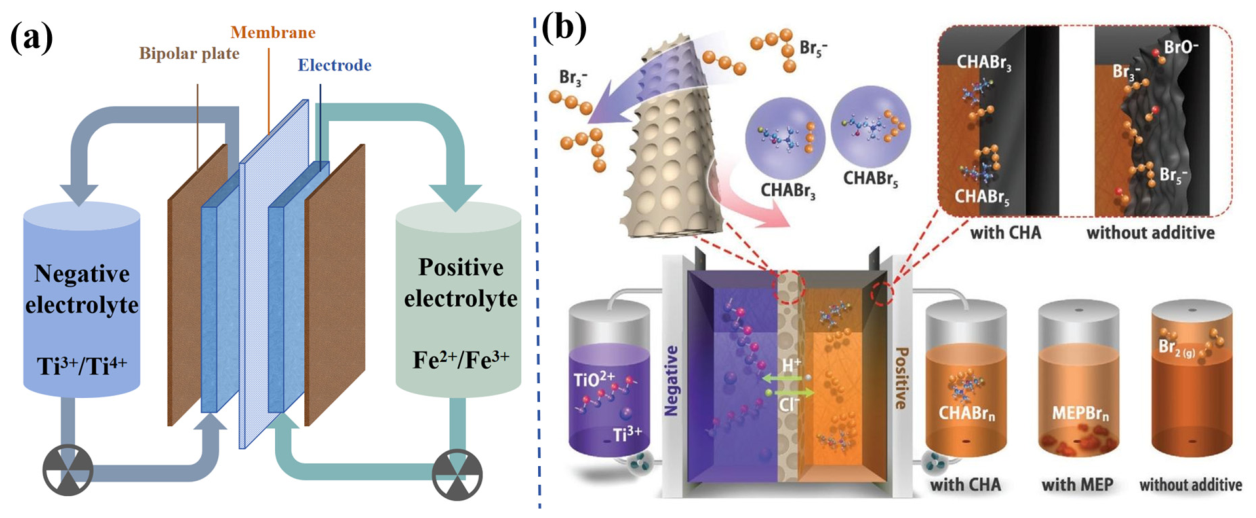
2+ as the anode couple. Its schematic diagram is shown in
Figure 14a. Qiao et al. [
10] proposed and prepared a low-cost, high-stability iron–titanium flow battery using H
2SO
4 as the electrolyte, which alleviates the hydrolysis reaction of TiO
2+. The battery can run stably for more than 1000 cycles with extremely slow capacity decay. By optimizing the electrolyte composition and electrode activity, the iron–titanium flow battery achieves a coulombic efficiency of 99.7% and an energy efficiency of 85.6% at a current density of 40 mA/cm
2. At a temperature of 65 °C and a current density of 80 mA/cm
2, the energy efficiency of the iron–titanium flow battery reaches 79.13%.
Titanium–Bromine Flow Battery
Bromine-based flow batteries have attracted extensive attention due to their high energy density and low cost, and their working principle schematic diagram is shown in
Figure 14b. Li et al. [
103] developed a low-cost, ultra-high-stability titanium–bromine flow battery. A new complexing agent, CHA, is used to limit bromine diffusion and cross-contamination, equipped with a porous polyolefin membrane. At a current density of 40 mA/cm
2, the coulombic efficiency reaches 95% and the energy efficiency reaches 83%. Notably, the titanium–bromine flow battery can run continuously for more than 1000 cycles without obvious performance degradation. Most importantly, the battery is easy to scale. The assembled 300 W titanium–bromine flow battery stack shows superior performance, running for more than 500 cycles, confirming the reliability and applicability of titanium–bromine flow batteries.
5.2.4. Supercapacitors
With titanium carbide, titanium nitride and titanium dioxide as the core, through structural design and composite modification, electric double layer capacitance and pseudocapacitance can be realized synergistically, making them key electrode materials for high-performance supercapacitors.
The binder-free Ti
3C
2 foam electrode has a specific capacitance of 370 F/g at 2 mV/s, the 3D Ti
3C
2T
x aerogel can reach up to 438 F/g, and the volumetric capacitance of MnO
x-Ti
3C
2 is as high as 392.9 F/cm
3. Even at a high scan rate of 1000 mV/s, it can still maintain a rectangular cyclic voltammetry curve, with outstanding cycle stability. Some systems have a capacity retention rate of 86.3% after 10,000 cycles, and have both electric double layer capacitance and pseudocapacitance characteristics, suitable for diversified device scenarios such as flexibility and stretchability [
104,
105,
106].
Titanium nitride (TiN)-based composites are dominated by pseudocapacitance. PPy/TiN has a specific capacitance of up to 1265 F/g at 0.6 A/g in 1 mol/L H
2SO
4, and PANI/C/TiN NWA and TiN/NiCo
2O
4 also have specific capacitances exceeding 1000 F/g under the corresponding test conditions. It has extremely high conductivity (4000–55,500 S/cm), low charge transfer resistance, excellent cycle life, CL-TiN maintains 89.8% capacity after 20,000 cycles, and can withstand high current density of 100 A/g, suitable for high-power, high-capacity energy storage requirements [
103].
Titanium dioxide (TiO
2) can be used as electroactive material for supercapacitors, but the electrochemical performance of TiO
2-based supercapacitors is still low [
107]. Titanium dioxide–carbon (TiO
2/carbon) composites can make up for the insufficient intrinsic conductivity of TiO
2, and improve the specific surface area and ion diffusion efficiency. The specific capacitance is concentrated in the range of 178–409 F/g; rGO/TiO
2 has a specific capacitance of 409.34 F/g at 4 mV/s, 332.6 F/g at 0.2 A/g, good cycle stability, and a capacity retention rate of 83.4% after 1000 cycles [
103].
6. Closed-Loop Recycling Technologies for Vanadium–Titanium Materials
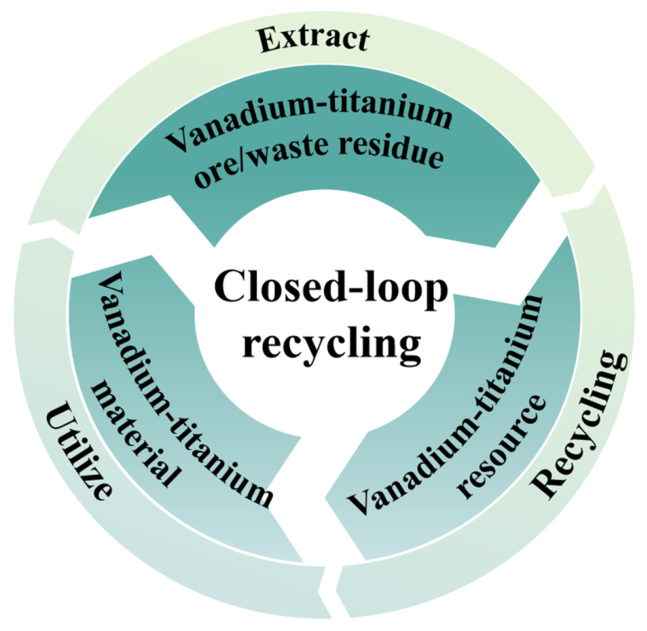
The global energy transition and the “dual carbon” goals have driven rapid growth in demand for vanadium–titanium materials for energy storage. Given limited primary resource mining and stricter environmental rules, closed-loop recycling of vanadium–titanium resources has become critical to industrial sustainability. Growing secondary resources supply raw materials for recycling, while technological advances shift the industry from waste disposal to circular utilization, cutting resource reliance, pollution, and costs. A full-life-cycle model centered on closed-loop regeneration will form a complete industrial chain of “resource extraction–material preparation–application–recycling”, serving as a core driver of green and low-carbon growth in the vanadium–titanium industry (
Figure 15).
6.1. Closed-Loop Recycling of Vanadium-Based Materials
As the core component of energy storage systems, the recycling of vanadium-based materials is not only related to environmental sustainability, but can also alleviate the pressure of resource depletion. Especially in application scenarios such as vanadium flow battery electrolyte and aqueous zinc-ion battery vanadium cathode, closed-loop regeneration technology has shown clear practical value. Wet regeneration adopts aqueous solution leaching, impurity removal and vanadium precipitation processes, which can efficiently recover vanadium from waste and prepare high-purity vanadium products. It has the characteristics of mildness, low consumption and environmental protection, making it the mainstream technology for vanadium resource recycling.
Vanadium-based compounds in the form of vanadyl sulfate (VOSO
4) are the core raw materials for vanadium flow battery (VRFB) electrolytes. Their recycling is crucial to reducing the cost of VRFBs. Ajeya et al. synthesized Rhodamine B-based Schiff base ligand (L1) through an ultrasonic-assisted condensation reaction, which has high selectivity for V(IV). The recovery of VOSO
4 from the complex was realized through a simple acid leaching route. When the recovered VOSO
4 electrolyte was used in VRFB, the charge–discharge curve, discharge capacity and energy efficiency were equivalent to those of traditional electrolytes. The discharge capacities at the 50th cycle were 1.2173 Ah and 1.179 Ah for the conventional and recovered. It provides a new strategy for the recycling of waste electrolytes of vanadium flow batteries [
108].
Vanadium-based compounds are widely used in the cathodes of aqueous zinc-ion batteries (AZIBs), but traditional vanadium production relies on ore resources such as stone coal and vanadium-bearing shale, with high energy consumption and environmental burden in the extraction process. Therefore, it is crucial to recover vanadium from waste batteries for reuse [
109]. Tseng et al. [
109] developed a closed-loop recycling process. The process includes acid leaching, solvent extraction, stripping, precipitation and calcination, which can prepare vanadium pentoxide (V
2O
5) with a purity of more than 99%. The crystal structure and microscopic morphology are consistent with commercial V
2O
5, and the electrochemical performance is equivalent. The recovered V
2O
5 was reused as AZIB cathode material to successfully reassemble Zn/V
2O
5 batteries, with an initial capacity of about 175 mAh/g at a current density of 0.2 A/g, a capacity retention rate of 98% after 100 cycles, and no significant difference in rate performance and impedance characteristics to commercial materials. By integrating material regeneration and battery assembly, the proposed process provides a feasible path for the sustainable utilization of vanadium resources.
6.2. Closed-Loop Recycling of Titanium-Based Materials
Closed-loop regeneration of titanium-based materials reduces resource waste, costs, and environmental impact. By recycling titanium-bearing industrial slags through efficient extraction, a full-life-cycle closed loop of “raw material–extraction–product–recycling” is formed to support the green and sustainable titanium industry.
The technology of direct titanium extraction with liquid metal cathode in a closed loop effectively solves the problems of environmental pollution, a long process and high cost of traditional titanium recycling processes, realizing efficient resource utilization of titanium-bearing waste residues. Pu et al. used two low-cost waste residues (titanium-bearing blast furnace slag and electroslag remelting slag) as electrolytes, and regulated a variety of liquid cathode metals to reveal the depolarization effect. Through thermodynamic and experimental analysis and kinetic calculation, it was found that the binding energy, work function and titanium activity of liquid metal cathodes synergistically produce a depolarization effect, inhibiting the preferential reduction of SiO
2 and realizing selective deposition of titanium; adding CaF
2 can optimize electrolyte fluidity and the ion diffusion rate, improving electrolytic kinetics. After constant current electrolysis, titanium-rich alloy cathode was obtained, and sponge titanium with a purity of more than 97% was obtained by vacuum distillation. Cathode metals (Sn, Sb, etc.) can be recycled, forming a full-life-cycle closed loop. It achieved an ultra-high cathode current efficiency (about 64%), with a short process and low energy consumption, which can significantly reduce energy loss and industrial production costs in the titanium extraction process, providing an environmentally friendly solution for the efficient and clean utilization of titanium resources [
110]. However, at present, the research on the closed-loop regeneration of titanium-based energy storage materials is still scarce, and a systematic technical path and theoretical system have not been formed, making it difficult to support the industrial demand for large-scale, high-value recycling of such materials.
7. Life Cycle Sustainability Assessment
Life cycle assessment (LCA) of the vanadium–titanium industry chain is a core tool to quantify the environmental impact of its whole process and promote industrial green transformation. This section conducts life cycle assessment around the core processes of extraction and regeneration of different vanadium–titanium-based materials, focusing on analyzing the environmental impact differences and optimization potential of different processes, providing targeted guidance for the sustainable development of the vanadium–titanium industry chain.
7.1. Life Cycle Assessment of the Vanadium Industry Chain
7.1.1. Pyrometallurgical Recovery
Life cycle assessment (LCA) of vanadium production is a research hotspot in the field of environmental assessment. There are few studies on the environmental assessment of the vanadium production process. Xiao et al. conducted a life cycle assessment of the V
2O
5 production process [
111]. This section takes vanadium slag as a raw material and establishes a life cycle assessment for three typical V
2O
5 production processes (Process 1: sodium roasting method; Process 2: calcium roasting method; Process 3: sub-molten salt method) [
112].
The whole production process was divided into four sections (i.e., RM: raw materials (vanadium slag); Sl: pretreatment section; SIl: purification section; and SIll: production section). The system boundary focuses on three production processes (PI, PII, PIII) from vanadium slag to products. In the pretreatment section (SI) of PI, the vanadium slag was preliminarily treated by shattering, magnetic separation, and ball milling. In the purification section (SI), sodium salts were added to the process. The vanadium in the vanadium slag is converted to water-soluble (V
2O
5) after oxidative roasting. The product obtained by roasting was leached with water to obtain vanadium leachate. In the production section (SIll), ammonium salts were added to the leachate for precipitation to form ammonium metavanadate, which was then calcined to (V
2O
5). The overall production process of PII was similar to PI. In the SI, the vanadium slag was shattered, magnetically separated, ball-milled and wind selected to complete the initial treatment. In the purification section, calcium salts were added to the process. Vanadium was roasted and converted into water-insoluble calcium salts. Finally, the precipitation of ammonium polyvanate was obtained by ammonium salt precipitation which was calcined to obtain (V
2O
5). In the SI of PIII, vanadium slag was shattered and ball-milled to complete the preliminary treatment. After the maceration/filtration process, sub-molten salt medium strengthening and the oxidation process of the vanadium slag were achieved. Finally, vanadium crystallization, chromium crystallization, and product conversion were separated cleanly to obtain (V
2O
5) [
112]. The results showed that the sodium roasting production process had the greatest environmental impact, followed by the sub-molten salt production process, and the calcium roasting production process had the smallest environmental impact.
7.1.2. Wet Regeneration
Yang et al. [
113] proposed an environmentally friendly method to extract toxic vanadium from gasification waste and use it to synthesize a variety of V-MOFs as high-efficiency cathode materials for zinc-ion batteries, and conducted a life cycle assessment on them. The system boundary for life cycle assessment is defined as cradle-to-gate, ranging from gasification waste feedstock to the final fiber-shaped Zn-ion battery, involving vanadium extraction, material synthesis, electrode preparation and battery assembly. Life cycle assessment found that the preparation of w-MIL-47@carbon nanotube cathode is the main environmental burden, and the environmental contribution of carbon nanotube fiber synthesis is the highest; in contrast, the Zn@CNT anode preparation step has the highest impact in only four dimensions, and the environmental impact of gel electrolyte preparation and battery assembly steps is the smallest. In addition, the use of CNT fibers contributes more than 50% of the total environmental score in 12 of the 17 impact dimensions. Therefore, the development of more efficient and environmentally friendly CNT fiber synthesis methods is an effective way to reduce the total emissions of fibrous zinc-ion batteries.
7.2. Life Cycle Assessment of the Titanium Industry Chain
Life cycle assessment (LCA) of the titanium industry chain covers key links such as primary titanium extraction, titanium-based material preparation, and retired titanium resource recycling and regeneration, focusing on comparing the environmental benefits of traditional processes and innovative technologies, identifying links with high environmental burden and proposing optimization paths, and finally promoting the titanium industry chain to achieve the collaborative development of “efficient resource utilization-minimized environmental impact-economic sustainability”.
7.2.1. Microwave-Assisted Leaching Recovery
Chen et al. [
114] uses high-grade, high-titanium slag prepared by an electric arc furnace as raw material. A traditional acid leaching process is set as the control group, and the experimental conditions of the two are kept consistent. The process conditions of preparing high-titanium, slag-based, high-grade synthetic rutile by microwave-assisted leaching and traditional leaching processes were compared. At the same time, five decision factors of resource consumption, environmental impact, cost, time and quality were considered, and relevant research was carried out using the fuzzy comprehensive evaluation method. The green degree score of the microwave-assisted leaching process is 86.51, and that of the traditional acid leaching process is 81.28. The former has significant advantages in energy consumption, processing time and environmental protection. The microwave-assisted leaching process meets the goals of green manufacturing and sustainable development of titanium resources, with practical application potential.
7.2.2. Wet Regeneration
Life cycle assessment was carried out for the regeneration process of two typical titanium-based materials: one is the process of recovering nearly 80% titanium dioxide (TiO2) from waste SCR catalysts by alkali leaching and using the obtained TiO2 as anode material for lithium-ion batteries; the other is the hydrometallurgical recycling process of lithium titanate anode batteries.
A comparison was conducted between the alkaline leaching approach and the conventional sol–gel method for recovering TiO
2 from waste SCR catalysts. Normalized to 100 g of recovered TiO
2, the sol–gel method exhibited a human toxicity potential of 122.85 g versus 16.09 g for alkaline leaching; the CO
2 emissions were 330.22 g and 42.97 g, respectively. Meanwhile, the NMVOC emissions stood at 3.12 g for sol–gel and 0.23 g for alkaline leaching, and the corresponding SO
2 emissions were 3.06 g and 0.40 g. The system boundary covers the recovery of TiO
2 from spent SCR catalyst through pretreatment, alkaline leaching, filtration, drying, and calcination. Upstream and downstream processes are excluded [
115].
Kumar et al. [
116] achieved the recycling of spent lithium titanate (LTO) batteries via hydrometallurgy. The life cycle assessment in this study covers the entire process of spent LTO batteries from pretreatment, sulfuric acid–hydrogen peroxide leaching, and solid–liquid separation to the recovery of lithium and titanium. The terrestrial ecotoxicity of the process reaches 97.09 kg 1,4-dichlorobenzene equivalent, which has significant harm to the ecological environment [
117], and the impact needs to be reduced through waste acid recovery in the system. Ionizing radiation (1.773 kBq cobalt-60 equivalent), freshwater eutrophication and marine eutrophication potential are negligible [
118], and the recycling process avoids radioactive pollution in primary titanium minerals, with resource advantages.
7.3. Integrated Analysis of Process Mechanism and Life Cycle Performance
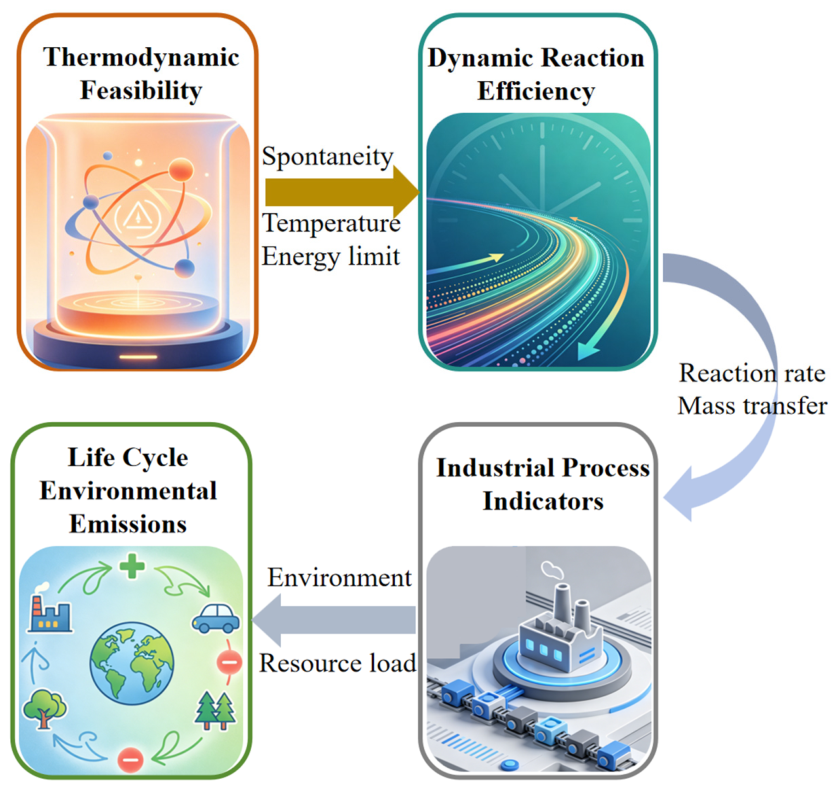
This section strengthens the intrinsic links between thermodynamics, kinetics, production processes and life cycle impacts, and establishes a full analytical chain: Thermodynamic Feasibility → Kinetic Reaction Efficiency → Industrial Indicators → Life Cycle Environmental Emissions (
Figure 16).
Thermodynamics determines reaction spontaneity and temperature thresholds. Sodium roasting requires temperatures above 1000 °C for spontaneous reactions and thus consumes more energy, while calcification roasting operates efficiently at 400–900 °C. Both acid and alkaline leaching are thermodynamically viable under routine conditions. Kinetics governs reaction rates, mass transfer and impurity separation. Pyrometallurgy suffers from solid-phase transfer limitations. Acid leaching features fast reactions, and alkaline leaching offers high selectivity. Microwave treatment effectively improves mass transfer and reaction efficiency. Jointly determined by thermodynamic and kinetic properties, practical indicators including recovery, energy use, cost and waste output directly translate into resource consumption and environmental loads evaluated by LCA. High-temperature pyrometallurgy generates more emissions, whereas hydrometallurgy and microwave-assisted processes show better environmental performance.
This analysis unifies mechanism, production and environmental assessment, clarifying the essential differences among various routes and providing theoretical guidance for process optimization and industrial application.
8. Summary and Outlook
With excellent electrochemical performance, structural stability and environmental friendliness, vanadium–titanium-based materials have become key core materials in the field of new energy storage, widely used in ion batteries, flow batteries, supercapacitors and other systems, providing important support for large-scale renewable energy grid connection and long-term energy storage. Global vanadium–titanium resources are abundant but unevenly distributed. China has significant advantages in resources such as vanadium–titanium magnetite and vanadium-bearing stone coal, laying a solid foundation for industrial development. At present, the extraction and recycling processes of vanadium–titanium resources have formed a diversified technical system such as pyrometallurgy, hydrometallurgy and electrochemistry. The closed-loop recycling of retired energy storage devices and industrial solid waste has been initially practiced. The integration of full-chain extraction, preparation, application, recycling and LCA thereby constructs a complete closed-loop industrial chain for vanadium–titanium-based materials.
However, the industrial chain still faces critical bottlenecks:
Intrinsic shortcomings of vanadium–titanium materials: vanadium-based materials suffer from poor conductivity and insufficient cycling stability, while titanium-based materials exhibit low specific capacity and slow ion dynamics, which restrict the performance of high-performance energy storage devices.
Imperfect closed-loop recycling system for secondary resources: the recycling of waste catalysts, spent batteries, and metallurgical slags mostly remains at the laboratory stage, lacking standardized engineering technologies and high-value utilization routes.
Incomplete life cycle assessment (LCA) system: current LCA studies only focus on single processes, without a unified evaluation standard covering the whole chain of “resource–preparation–application–recycling”.
Future efforts should focus on improving the intrinsic electrochemical performance of vanadium–titanium materials via rational structural design and composite modification. Meanwhile, a standardized, short-process closed-loop recycling system is urgently needed to realize the high-value utilization of various secondary resources. Furthermore, a comprehensive and full-chain life cycle assessment should be established to achieve coordinated optimization of environmental impact and economic benefits, thereby supporting the sustainable development of the vanadium–titanium energy storage industry.
In summary, vanadium–titanium-based materials have irreplaceable strategic value and broad prospects in the field of new energy storage. With the continuous breakthrough of technology, continuous improvement in the industrial chain and rapid release of market demand, vanadium–titanium-based energy storage materials will fully support the application of large-scale renewable energy grid connection, power grid peak regulation, distributed microgrid, rail transit and other scenarios, providing key support for the global energy transition and the realization of the “dual carbon” goals.
Author Contributions
Conceptualization, J.W.; investigation, Z.Q.; N.W., F.C. and X.G.; visualization, Z.Q.; writing—original draft, Z.Q. and N.W.; writing—review and editing, Z.Q. and J.W.; project administration, J.W.; funding acquisition, J.W. All authors have read and agreed to the published version of the manuscript.
Funding
This research was funded by the Project of Zhongyuan Critical Metals Laboratory, grant number GJJSKFZD202405; the open foundation of State Key Laboratory of Chemical Engineering, grant number SKL-Che-24B02; and the Beijing Natural Science Foundation, grant number L259009.
Data Availability Statement
The original contributions presented in this study are included in the article. Further inquiries can be directed to the corresponding author.
Acknowledgments
During the preparation of this manuscript, the authors used Doubao AI (Versions 13.0.0, 13.2.0, 13.3.0, 13.5.0, developed by ByteDance Inc.) for the purposes of generating multiple conceptual schematic diagrams according to the complete layout, text labels and logical frameworks predefined independently by the authors. The authors have reviewed and edited the output and take full responsibility for the content of this publication.
Conflicts of Interest
The authors declare no conflicts of interest.
References
- Zou, C.; Xiong, B.; Li, S.; Ma, F.; Pan, S.; Liu, H.; Zhang, G.; Zhao, Q.; Guan, C. World’s Energy Transition and Chinese-style Modern Energy Revolution under Carbon Neutrality (II). China Oil Gas 2024, 31, 11–19. [Google Scholar]
- Pei, G.S. Thermodynamic Model Construction and Application of CaO-MgO-R2O-V2O5 (R = Li, Na, K, Rb and Cs) System. Doctoral Dissertation, Chongqing University, Chongqing, China, 2023. (In Chinese) [Google Scholar] [CrossRef]
- Tan, R.; He, S.; Hu, M.; Yu, W.; Liang, W.; Bai, C. The current status and prospects of titanium industry in China. Iron Steel Vanadium Titan. 2025, 46, 1–9. (In Chinese) [Google Scholar] [CrossRef]
- Xu, X.; Xing, F.; Meng, J.; Wang, X.; Niu, C.; An, Q.; Mai, L. Vanadium-based nanomaterials: A promising family for emerging metal-ion batteries. Adv. Funct. Mater. 2020, 30, 1904398. [Google Scholar] [CrossRef]
- Chen, H.; Zhang, X.; Zhang, S. A comparative study of iron-vanadium and all-vanadium flow battery for large scale energy storage. Chem. Eng. J. 2022, 429, 132403. [Google Scholar] [CrossRef]
- Chen, J.B.; Wang, Y.W.; He, X.M.; Xu, S.M.; Fang, M.; Zhao, X.; Shang, Y.M. Electrochemical properties of MnO2 nanorods as anode materials for lithium ion batteries. Electrochim. Acta 2014, 142, 152–156. [Google Scholar] [CrossRef]
- Li, X.S.; Xie, B.; Wang, G.E.; Li, X.J. Oxidation process of low-grade vanadium slag in presence of Na2CO3. Trans. Nonferrous Met. Soc. China 2011, 21, 1860–1867. [Google Scholar] [CrossRef]
- Xiang, J.Y.; Huang, Q.Y.; Lv, X.W.; Bai, C.G. Extraction of vanadium from converter slag by two-step sulfuric acid leaching process. J. Clean. Prod. 2018, 170, 1089–1101. [Google Scholar] [CrossRef]
- He, S.Q. Study on Principle and Chemical Kinetics of Valuable Components Extraction and Separation from Panzhihua High Titanium-Blast Furnace Slag. Ph.D. Thesis, Southwest University of Science and Technology, Mianyang, China, 2020. [Google Scholar] [CrossRef]
- Qiao, L.; Fang, M.; Liu, S. New-generation iron-titanium flow batteries with low cost and ultrahigh stability for stationary energy storage. Chem. Eng. J. 2022, 431, 134588. [Google Scholar] [CrossRef]
- Wang, Y.Y.; Lin, M.R.; Wan, C.C. A study of the discharge performance of the Ti/Fe redox flow system. J. Power Sources 1984, 13, 65–74. [Google Scholar] [CrossRef]
- Zhao, J.; Zhang, X.; Yang, F.; Ai, Y.; Chen, Y.; Pan, D. Strategy and technical progress of recycling of spent vanadium–titanium-based selective catalytic reduction catalysts. ACS Omega 2024, 9, 6036–6058. [Google Scholar] [CrossRef] [PubMed]
- Chen, Z.Y.; Zhu, Q.; Wu, H.W.; Zou, X.H.; Nie, D.H.; Qi, X.L. Vanadium resource demand trend analysis under the development of new energy storage. China Min. Mag. 2024, 33, 99–110. [Google Scholar] [CrossRef]
- Shi, J.L.; Yu, L.H. Analysis and reflection on the supply and demand of vanadium resources at home and abroad. China Min. Mag. 2025, 34, 63–69. [Google Scholar] [CrossRef]
- Feng, E.; Gao, D.; Wang, Y.; Yu, F.; Wang, C.; Wen, J.; Gao, Y.; Huang, G.; Xu, S. Sustainable recovery of titanium from secondary resources: A review. J. Environ. Manag. 2023, 339, 117818. [Google Scholar] [CrossRef] [PubMed]
- Zhao, H. Overview of Vanadium Resource Utilization and Analysis of China’s Vanadium Market Demand. Conserv. Util. Miner. Resour. 2014, 2, 54–58. [Google Scholar] [CrossRef]
- National Minerals Information Center. Mineral Commodity Summaries; U.S. Geological Survey: Reston, VA, USA, 2023. [CrossRef]
- An, Z.; Zhao, W.; Huai, J. 2024 China Titanium Industry Development Report. Titan. Ind. Prog. 2025, 42, 40–48. [Google Scholar] [CrossRef]
- McKinsey Company. Net-Zero Power: Long Duration Energy Storage for a Renewable Grid; LDES Council: London, UK, 2021; Available online: https://www.mckinsey.com/capabilities/sustainability/our-insights/net-zero-power-long-duration-energy-storage-for-a-renewable-grid (accessed on 16 March 2026).
- Yi, Y.-H.; Sun, H.; You, J.-X.; Zhang, J.; Cai, Y.; Zhang, X.; Luo, J.; Qiu, G.-Z. Vanadium Recovery from Na2SO4-Added V-Ti Magnetite Concentrate via Grate-Kiln Process. Trans. Nonferrous Met. Soc. China 2022, 32, 2019–2032. [Google Scholar] [CrossRef]
- Kim, E.; Spooren, J.; Broos, K.; Horckmans, L.; Quaghebeur, M.; Vrancken, K.C. Selective recovery of Cr from stainless steel slag by alkaline roasting followed by water leaching. Hydrometallurgy 2015, 158, 139–148. [Google Scholar] [CrossRef]
- Bian, W. Extraction of vanadium pentoxide from high silicon and low vanadium slag. Ferro-Alloy 2008, 3, 5–8. (In Chinese) [Google Scholar] [CrossRef]
- Zhang, G.Q.; Zhang, T.A.; Lü, G.Z.; Zhang, Y.; Liu, Y.; Liu, Z.L. Extraction of vanadium from vanadium slag by high pressure oxidative acid leaching. Int. J. Min. Met. Mater. 2015, 22, 21–26. [Google Scholar] [CrossRef]
- Peng, H.; Li, G.; Wang, F.; Guo, J.; Li, B. Recovery and Separation of Vanadium and Chromium by Two-Step Alkaline Leaching Enhanced with an Electric Field and H2O2. ACS Omega 2020, 5, 5340–5345. [Google Scholar] [CrossRef] [PubMed]
- Peng, H.; Liu, Z.; Tao, C. Selective leaching of vanadium from chromium residue intensified by electric field. J. Environ. Chem. Eng. 2015, 3, 1252–1257. [Google Scholar] [CrossRef]
- Wang, Z.; Zheng, S.; Wang, S.; Qin, Y.; Du, H.; Zhang, Y. Electrochemical decomposition of vanadium slag in concentrated NaOH solution. Hydrometallurgy 2015, 151, 51–55. [Google Scholar] [CrossRef]
- Adavodi, R.; Rahmati, S.; Taglieri, L.; Ferella, F. Selective Two-Stage Redox-Controlled Acidic Leaching and Alkaline Hydrothermal Leaching of Vanadium and Tungsten from Spent Selective Catalytic Reduction Catalysts with Experimental and Thermodynamic Evaluation. Sep. Purif. Technol. 2026, 400, 138434. [Google Scholar] [CrossRef]
- Peng, H.; Wang, F.; Li, G.; Guo, J.; Li, B. Highly efficient recovery of vanadium and chromium: Optimized by response surface methodology. ACS Omega 2019, 4, 904–910. [Google Scholar] [CrossRef] [PubMed]
- Xu, Y.B.; Luo, Z.Y.; Wang, Q.H.; Zhou, J.S.; Shi, Z.L. Leaching kinetics of vanadium pentoxide from stone coal ash. Chin. J. Process Eng. 2010, 10, 60–64. Available online: https://jproeng.ipe.ac.cn/CN/article/downloadArticleFile.do?attachType=PDF&id=1253 (accessed on 10 June 2026).
- Liu, H.B.; Du, H.; Wang, S.N.; Zheng, S.L. Kinetics analysis of decomposition of vanadium slag by KOH sub-molten salt method. Trans. Nonferrous Met. Soc. China 2013, 23, 1489–1500. [Google Scholar] [CrossRef]
- Shu, J.; Wu, H.; Liu, R.; Liu, Z.; Li, B.; Chen, M.; Tao, C. Simultaneous stabilization/solidification of Mn2+ and NH4+-N from electrolytic manganese residue using MgO and different phosphate resource. Ecotoxicol. Environ. Saf. 2018, 148, 220–227. [Google Scholar] [CrossRef] [PubMed]
- Shu, J.; Wu, H.; Chen, M.; Peng, H.; Li, B.; Liu, R.; Liu, Z.; Wang, B.; Huang, T.; Hu, Z. Fractional removal of manganese and ammonia nitrogen from electrolytic metal manganese residue leachate using carbonate and struvite precipitation. Water Res. 2018, 153, 229–238. [Google Scholar] [CrossRef] [PubMed]
- Zhu, H.; Xiao, X.; Guo, Z.; Han, X.; Liang, Y.; Zhang, Y.; Zhou, C. Adsorption of vanadium (V) on natural kaolinite and montmorillonite: Characteristics and mechanism. Appl. Clay Sci. 2018, 161, 310–316. [Google Scholar] [CrossRef]
- Peng, H.; Guo, J.; Li, B.; Huang, H. Vanadium properties, toxicity, mineral sources and extraction methods: A review. Environ. Chem. Lett. 2022, 20, 1249–1263. [Google Scholar] [CrossRef]
- Hu, J.; Wang, X.; Xiao, L.; Song, S.; Zhang, B. Removal of vanadium from molybdate solution by ion exchange. Hydrometallurgy 2009, 95, 203–206. [Google Scholar] [CrossRef]
- Huang, J.; Su, P.; Wu, W.; Liao, S.; Qin, H.; Wu, X.; He, X.; Tao, L.; Fan, Y. Concentration and separation of vanadium from alkaline media by strong alkaline anion-exchange resin 717. Rare Met. 2010, 29, 439–443. [Google Scholar] [CrossRef]
- Zhu, X.; Li, W.; Zhang, Q.; Zhang, C.; Chen, L. Separation characteristics of vanadium from leach liquor of red mud by ion exchange with different resins. Hydrometallurgy 2018, 176, 42–48. [Google Scholar] [CrossRef]
- Li, Q.; Zeng, L.; Xiao, L.; Yang, Y.; Zhang, Q. Completely removing vanadium from ammonium molybdate solution using chelating ion exchange resins. Hydrometallurgy 2009, 98, 287–290. [Google Scholar] [CrossRef]
- Polowczyk, I.; Cyganowski, P.; Urbano, B.F.; Rivas, B.L.; Bryjak, M.; Kabay, N. Amberlite IRA-400 and IRA-743 chelating resins for the sorption and recovery of molybdenum(VI) and vanadium(V): Equilibrium and kinetic studies. Hydrometallurgy 2017, 169, 496–507. [Google Scholar] [CrossRef]
- Stéphane, F.; Moreau, C.; Chéry, P.; Lespes, G. Chelating performance evaluation of ion exchange resin chelex-100. J. Anal. Chem. 2020, 75, 468–473. [Google Scholar] [CrossRef]
- Ju, J.R.; Feng, Y.L.; Li, H.R.; Liu, S.L.; Xu, C.L. Separation and recovery of V, Ti, Fe and Ca from acidic wastewater and vanadium-bearing steel slag based on a collaborative utilization process. Sep. Purif. Technol. 2021, 276, 119335. [Google Scholar] [CrossRef]
- Li, C.; Du, P.; Zhang, J.; Zhao, S.; Gao, M.; Wang, Q.; Tian, T.; Li, L.; Long, Y. Advances in Integrated Extraction of Valuable Components from Ti-Bearing Slag. Metals 2025, 15, 1080. [Google Scholar] [CrossRef]
- Zhang, R.; Liu, D.; Fan, G.Q.; Sun, H.B. Thermodynamic and experimental study on the reduction and carbonization of TiO2 through gas–solid reaction. Int. J. Energy Res. 2019, 43, 4897–4906. [Google Scholar] [CrossRef]
- Fan, S.G. Basic Research on Preparation of Titanium Powder by Multi-Stage Reduction. Ph.D. Thesis, Northeastern University, Shenyang, China, 2020. [Google Scholar] [CrossRef]
- Zhou, L.S.; Peng, T.J.; Sun, H.J.; Wang, S.Y. Thermodynamics analysis and experiments on Ti bearing blast furnace slag leaching enhanced by sulfuric acid roasting. RSC Adv. 2022, 12, 34990–35001. [Google Scholar] [CrossRef] [PubMed]
- Xie, J.; Ye, Q.; Yang, F.; Qian, G.M.; Zhang, H.J. Selective enrichment and extraction of well-catalyzed perovskites on meltingmicrowave heating process from blast furnace slag. J. Clean. Prod. 2023, 420, 138377. [Google Scholar] [CrossRef]
- Lan, X.; Gao, J.T.; Xue, K.R.; Xu, H.H.; Guo, Z.C. A new finding and technology for selective separation of different REEs from CaO-SiO2-CaF2-P2O5-Fe3O4-RE2O3 system. Sep. Purif. Technol. 2022, 293, 121121. [Google Scholar] [CrossRef]
- Du, Y.; Gao, J.T.; Lan, X.; Guo, Z.C. Recovery of rutile from Ti-Bearing blast furnace slag through phase transformation and super-gravity separation for dielectric material. Ceram. Int. 2020, 46, 9885–9893. [Google Scholar] [CrossRef]
- Du, Y.; Gao, J.T.; Lan, X.; Guo, Z.C. Replacement behavior of Ti and Mg and selective separation of MgxTi3−xO5(x = 1, 0.9, 0.75, 0.6) from Ti-bearing electric furnace smelting slag via super-gravity. Ceram. Int. 2022, 48, 7918–7925. [Google Scholar] [CrossRef]
- Luo, Y.; Che, X.; Cui, X.; Zheng, Q.; Wang, L. Selective leaching of vanadium from V-Ti magnetite concentrates by pellet calcification roasting-H2SO4 leaching process. Int. J. Min. Sci. Technol. 2021, 31, 447–454. [Google Scholar] [CrossRef]
- Liu, Y.; Zhou, X.; Wang, X.; Chen, G.; Liu, R.; Ma, Y.; Bai, Y.; Yuan, G. Hydrated titanic acid as an ultralow-potential anode for aqueous zinc-ion full batteries. Chem. Eng. J. 2021, 420, 129629. [Google Scholar] [CrossRef]
- Chen, L.N.; Ruan, Y.S.; Zhang, G.B.; Wang, C.L.; Wu, X.W.; Wang, H. Ultrastable and High-Performance Zn/VO2 Battery Based on a Reversible Single-Phase Reaction. Chem. Mater. 2019, 31, 699–706. [Google Scholar] [CrossRef]
- Zhao, S. Controlled Preparation and Zinc Storage Mechanism of V2O3 Aqueous Zinc-Ion Batteries Cathode Materials. Master’s Thesis, Inner Mongolia University of Science and Technology, Baotou, China, 2023. Available online: https://d.wanfangdata.com.cn/thesis/ChhUaGVzaXNOZXdTMjAyNDA5MjAxNTE3MjUSCUQwMzIyNTE5NRoIM3dndDVjeWk%3D (accessed on 2 April 2026).
- Zhang, N.; Dong, Y.; Jia, M.; Bian, X.; Wang, Y.; Qiu, M.; Xu, J.; Liu, Y.; Jiao, L.; Cheng, F. Rechargeable aqueous Zn-V2O5 battery with high energy density and long cycle life. ACS Energy Lett. 2018, 3, 1366–1372. [Google Scholar] [CrossRef]
- Jiang, H. Controlled Preparation and Zinc Storage Performance of Vanadium Disulfide and Its Composite Electrode Materials. Master’s Thesis, Northeast Normal University, Changchun, China, 2022. [Google Scholar] [CrossRef]
- Chen, K.; Li, X.; Zang, J.; Zhang, Z.; Wang, Y.; Lou, Q.; Bai, Y.; Fu, J.; Zhuang, C.; Zhang, Y.; et al. Robust VS4@rGO nanocomposite as a high-capacity and long-life cathode material for aqueous zinc-ion batteries. Chem. Eng. J. 2023, 471, 144528. [Google Scholar] [CrossRef] [PubMed]
- Tang, B.; Fang, G.; Zhou, J.; Wang, L.; Lei, Y.; Wang, C.; Lin, T.; Tang, Y.; Liang, S. Potassium vanadates with stable structure and fast ion diffusion channel as cathode for rechargeable aqueous zinc-ion batteries. Nano Energy 2018, 51, 579–587. [Google Scholar] [CrossRef]
- Li, Q.; Rui, X.; Chen, D.; Feng, Y.; Xiao, N.; Gan, L.; Zhang, Q.; Yu, Y.; Huang, S. A high-capacity ammonium vanadate cathode for zinc-ion battery. Nano-Micro Lett. 2020, 12, 67. [Google Scholar] [CrossRef] [PubMed]
- Xu, Y.H.; Zhu, Y.J.; Liu, Y.H.; Wang, C. Electrochemical performance of porous carbon/tin composite anodes for sodium-ion and lithium-ion batteries. Adv. Energy Mater. 2013, 3, 128–133. [Google Scholar] [CrossRef]
- Li, M.; Lu, J.; Chen, Z.W.; Amine, K. 30 years of lithium-ion batteries. Adv. Mater. 2018, 30, 1800561. [Google Scholar] [CrossRef] [PubMed]
- Choi, S.; Ahn, G.; Moon, S.J.; Lee, S. Tunable resistivity of correlated VO2(A) and VO2(B) via tungsten doping. Sci. Rep. 2020, 10, 9721. [Google Scholar] [CrossRef] [PubMed]
- Padhi, A.K.; Nanjundaswamy, K.S.; Goodenough, J.B. Phospho-olivines as positive electrode materials for rechargeable lithium batteries. J. Electrochem. Soc. 1997, 144, 1188–1194. [Google Scholar] [CrossRef]
- Li, Y.Z.; Zhou, Z. A promising sol-gel route based on citric acid to synthesize Li3V2(PO4)3/carbon composite material for lithium ion batteries. Electrochim. Acta. 2007, 52, 4922–4926. [Google Scholar] [CrossRef]
- Zhang, Y.; Geng, H.; Wei, W.; Ma, J.; Chen, L.; Li, C.C. Challenges and recent progress in the design of advanced electrode materials for rechargeable Mg batteries. Energy Stor. Mater. 2019, 20, 118–138. [Google Scholar] [CrossRef]
- Sheha, E.; El-Deftar, M. Magnesium hexakis(methanol)-dinitrate complex electrolyte for use in rechargeable magnesium batteries. J. Solid State Electrochem. 2018, 22, 2671–2679. [Google Scholar] [CrossRef]
- He, W.; Fan, Z.; Huang, Z.; Liu, X.; Qian, J.; Ni, M.; Zhang, P.; Hu, L.; Sun, Z. A Li+ and PANI co-intercalation strategy for hydrated V2O5 to enhance zinc ion storage performance. J. Mater. Chem. A 2022, 10, 18962–18971. [Google Scholar] [CrossRef]
- Li, M. Preparation of Ion-Intercalated Vanadium Dioxide and Its Application in Aqueous Magnesium-Ion Batteries. Master’s Thesis, Yangzhou University, Yangzhou, China, 2025. [Google Scholar] [CrossRef]
- Deng, R. Regulation of Magnesium Storage Kinetics and Electrochemical Performance of Vanadium-Based Materials. Ph.D. Thesis, Chongqing University, Chongqing, China, 2024. [Google Scholar] [CrossRef]
- Ding, S.Q.; Li, Z.J.; Dai, X.; Sun, C.; Meng, A. Mo-doped VS4 with interlayer-expanded and engineering sulfur vacancies as cathode for advanced magnesium storage. Chem. Eng. J. 2021, 417, 129328. [Google Scholar] [CrossRef]
- Singh, A.N.; Islam, M.; Meena, A.; Faizan, M.; Han, D.; Bathula, C.; Hajibabaei, A.; Anand, R.; Nam, K. Unleashing the Potential of Sodium-Ion Batteries: Current State and Future Directions for Sustainable Energy Storage. Adv. Funct. Mater. 2023, 33, 2304617. [Google Scholar] [CrossRef]
- Namazbay, A.; Karlykan, M.; Tolegen, A.; Adilov, A. Towards high-performance sodium-ion batteries: A comprehensive review on NaxNiyFezMn1-(y+z)O2 cathode materials. J. Energy Chem. 2025, 77, 104212. [Google Scholar] [CrossRef]
- Yang, G.; Pan, M.; Li, B. Preparation Methods and Research Status of Cathode Materials for Sodium-Ion Batteries. China Build. Mater. Sci. Technol. 2025, 34, 14–18. [Google Scholar] [CrossRef]
- Yuan, J. Preparation of Vanadium-Based Materials and Their Application in Lithium/Sodium Batteries. Master’s Thesis, University of Jinan, Jinan, China, 2020. [Google Scholar] [CrossRef]
- Dong, Y.; Li, S.; Zhao, K.; Han, C.; Chen, W.; Wang, B.; Wang, L.; Xu, B.; Wei, Q.; Zhang, L.; et al. Hierarchical zigzag Na1.25V3O8 nanowires with topotactically encoded superior performance for sodium-ion battery cathodes. Energy Environ. Sci. 2015, 8, 1267–1275. [Google Scholar] [CrossRef]
- Ding, L. Synthesis and Sodium Storage Performance of Novel Layered Vanadium-Based Cathode Materials for Sodium-Ion Batteries. Master’s Thesis, South China University of Technology, Guangzhou, China, 2024. [Google Scholar] [CrossRef]
- Zuo, C.; Tang, W.; Lan, B.; Xiong, F.; Tang, H.; Dong, S.; Zhang, W.; Tang, C.; Li, J.; Ruan, Y.; et al. Unexpected discovery of magnesium-vanadium spinel oxide containing extractable Mg2+ as a high-capacity cathode material for magnesium ion batteries. Chem. Eng. J. 2021, 405, 127005. [Google Scholar] [CrossRef]
- Fan, R. Preparation and Performance Study of Vanadium-Based Anode Materials for Sodium-Ion Batteries. Master’s Thesis, Zhejiang Sci-Tech University, Hangzhou, China, 2022. [Google Scholar] [CrossRef]
- Wu, Y.; Chen, G.; Wu, X.; Li, L.; Yue, J.; Guan, Y.; Hou, J.; Shi, F.; Liang, J. Research progress on vanadium oxides for potassium-ion batteries. J. Semicond. 2023, 44, 041701. [Google Scholar] [CrossRef]
- Koch, D.; Kulish, V.V.; Manzhos, S. A first-principles study of potassium insertion in crystalline vanadium oxide phases as possible potassium-ion battery cathode materials. MRS Commun. 2017, 7, 819–825. [Google Scholar] [CrossRef]
- Huo, J.Y.; Dong, Y.L.; Ren, C.Q.; Cao, K.-Z.; Lei, Y. Progress of vanadate materials for sodium-ion and potassium-ion storage. Tungsten 2025, 7, 405–423. [Google Scholar] [CrossRef]
- Deng, L.; Niu, X.; Ma, G.; Yang, Z.; Zeng, L.; Zhu, Y.; Guo, L. Layered Potassium Vanadate K0.5V2O5 as a Cathode Material for Nonaqueous Potassium Ion Batteries. Adv. Funct. Mater. 2018, 28, 1800670. [Google Scholar] [CrossRef]
- Liang, F.; Zheng, R.; Zou, Z.; Long, F.; Zhang, S.; Zhong, S.; Jia, S.; Nong, J.; Wang, Y.; Song, L. Vanadium oxide-based battery materials. Ionics 2024, 30, 6729–6755. [Google Scholar] [CrossRef]
- Babu, M.; Hariharan, G.; Bharathi, S.; Satheesh, K.; Dineshkumar, D.; Arivarasan, A. Electrochemical performances of reduced graphene oxide loaded orthorhombic nickel vanadates for supercapacitor applications. J. Taiwan Inst. Chem. Eng. 2026, 178, 106377. [Google Scholar] [CrossRef]
- Liu, W. Modification of Vanadium-Based Electrode Materials and Their Supercapacitor Performance. Master’s Thesis, Harbin University of Science and Technology, Harbin, China, 2022. [Google Scholar] [CrossRef]
- Arasi, S.E.; Ranjithkumar, R.; Devendran, P.; Krishnakumar, M.; Arivarasan, A. Studies on electrochemical mechanism of nanostructured cobalt vanadate electrode material for pseudocapacitors. J. Energy Storage 2021, 41, 102986. [Google Scholar] [CrossRef]
- Wunch, M.A.; Garcia, J.A.; Mahmood, S.F.; Tian, Y.; Balkus, K.J.; Ferraris, J.P.; Yang, D.J. Vanadium nitride-vanadium oxide-carbon nanofiber hybrids for high performance supercapacitors. Electrochim. Acta 2024, 488, 143992. [Google Scholar] [CrossRef]
- Li, W.; Wang, K.; Cheng, S.; Jiang, K. An Ultrastable Presodiated Titanium Disulfide Anode for Aqueous “Rocking-Chair” Zinc Ion Battery. Adv. Energy Mater. 2019, 9, 1900993. [Google Scholar] [CrossRef]
- Guo, X.; Chen, Y.; Zhou, Y.; Li, J.; He, P.; Tang, Y.; Deng, W.; Li, R. Protonated layered titanate anode at 0.008 V enables 1.75 V rocking-chair aqueous zinc-ion batteries with 87% energy efficiency. Nano Res. 2026, 19, 94908435. [Google Scholar] [CrossRef]
- Jiao, Q.; Zhou, T.; Zhang, N.; Liu, S.; Huang, Q.; Bi, W.; Chu, W.; Wu, X.; Zhu, Y.; Feng, Y.; et al. High-surface-area titanium nitride nanosheets as zinc anode coating for dendrite-free rechargeable aqueous batteries. Sci. China Mater. 2022, 65, 1771–1778. [Google Scholar] [CrossRef]
- Wang, Y.F.; Wu, M.Y.; Zhang, W.F. Processable electrochromic and fluorescent polymers based on N-substituted thienylpyrrole. Electrochim. Acta 2008, 53, 7863–7868. [Google Scholar] [CrossRef]
- Passerini, S. Optimization Strategies of Hybrid Lithium Titanate Oxide/Carbon Anodes for Lithium-Ion Batteries. Nanomaterials 2024, 14, 1799. [Google Scholar] [CrossRef] [PubMed]
- Zhao, H. Lithium Titanate-Based Anode Materials. In Green Energy and Technology; Springer: Cham, Switzerland, 2015; pp. 157–187. Available online: https://link.springer.com/chapter/10.1007/978-3-319-15458-9_6 (accessed on 28 March 2026).
- Mickey, M.S.; Hoffmann, J.; Payne, M.; Lucht, B.L. Effect of Electrolyte Additives on Li4Ti5O12 Cycling Performance and Gas Evolution. J. Electrochem. Soc. 2018, 165, A3925–A3931. [Google Scholar] [CrossRef]
- Sato, H.; Yamashita, K.; Yasuda, Y.; Minami, S.; Tsuruta, N. Aqueous Lithium-Ion Battery of Li4Ti5O12/LiMn2O4 Using a Lithium-Ion Conductive Solid Electrolyte Separator. J. Power Sources 2021, 482, 228950. [Google Scholar] [CrossRef]
- Shi, H.; Shi, C.; Jia, Z.; Zhang, L.; Wang, H.; Chen, J. Titanium dioxide-based anode materials for lithium-ion batteries: Structure and synthesis. RSC Adv. 2022, 12, 33641–33652. [Google Scholar] [CrossRef] [PubMed]
- Jumanova, R.; Rakhymbay, G.; Abildina, A.; Avchukir, K.; Bakhytzhan, Y.; Vacandio, F.; Argimbayeva, A. Nanostructured TiO2 as anode material for magnesium-ion batteries. J. Solid State Electrochem. 2023, 27, 223–233. [Google Scholar] [CrossRef]
- Xiong, H.; Slater, M.D.; Balasubramanian, M.; Johnson, C.S.; Rajh, T. Amorphous TiO2 Nanotube Anode for Rechargeable Sodium Ion Batteries. J. Phys. Chem. Lett. 2011, 2, 2560–2565. [Google Scholar] [CrossRef]
- Kumar, R.; Pradeep, A.; Bhargava, P. Carbon Coated Titanium Dioxide (CC-TiO2) as an Efficient Anode Material for Sodium- Ion Batteries. Mater. Renew. Sustain. Energy 2025, 14, 20. [Google Scholar] [CrossRef]
- Khadim, B.; Majid, A.; Khan, M.I.; Alkhedher, M.; Haider, S.; Alam, K. Magnesium titanate as high-performance cathode material for magnesium-ion batteries. J. Am. Ceram. Soc. 2025, 108, e70110. [Google Scholar] [CrossRef]
- Choi, Y.S.; Costa, S.I.R.; Tapia-Ruiz, N.; Scanlon, D.O. Intrinsic Defects and Their Role in the Phase Transition of Na-Ion Anode Na2Ti3O7. ACS Appl. Energy Mater. 2023, 6, 484–495. [Google Scholar] [CrossRef] [PubMed]
- Bai, X.; Wu, N.; Yu, G.; Li, T. Recent Advances in Anode Materials for Sodium-Ion Batteries. Inorganics 2023, 11, 289. [Google Scholar] [CrossRef]
- Fedotov, S.S.; Luchinin, N.D.; Aksyonov, D.A.; Morozov, A.V.; Ryazantsev, S.V.; Gaboardi, M.; Plaisier, J.R.; Stevenson, K.J.; Abakumov, A.M.; Antipov, E.V. Titanium-based potassium-ion battery positive electrode with extraordinarily high redox potential. Nat. Commun. 2020, 11, 6126. [Google Scholar] [CrossRef] [PubMed]
- Li, X.; Xie, C.; Li, T.; Zhang, Y.; Li, X. Low-cost titanium–bromine flow battery with ultrahigh cycle stability for grid-scale energy storage. Adv. Mater. 2020, 32, 2005036. [Google Scholar] [CrossRef] [PubMed]
- Zhong, Y.; Xia, X.H.; Shi, F.; Zhan, J.Y.; Tu, J.P.; Fan, H.J. Transition metal carbides and nitrides in energy storage and conversion. Adv. Sci. 2016, 3, 1500286. [Google Scholar] [CrossRef] [PubMed]
- Feng, H.; Wang, W.; Zhang, M.; Zhu, S.; Wang, Q.; Liu, J.; Chen, S. 2D titanium carbide-based nanocomposites for photocatalytic bacteriostatic applications. Appl. Catal. B Environ. 2020, 266, 118609. [Google Scholar] [CrossRef]
- Cai, T.; Wang, L.; Liu, Y.; Zhang, S.; Dong, W.; Chen, H.; Yi, X.; Yuan, J.; Xia, X.; Liu, C.; et al. Ag3PO4/Ti3C2 MXene interface materials as a Schottky catalyst with enhanced photocatalytic activities and anti-photocorrosion performance. Appl. Catal. B Environ. 2018, 239, 545–554. [Google Scholar] [CrossRef]
- Raj, C.C.; Prasanth, R. Review-advent of TiO2 nanotubes as supercapacitor electrode. J. Electrochem. Soc. 2018, 165, E345–E358. [Google Scholar] [CrossRef]
- Ajeya, K.V.; Sadhasivam, T.; Kurkuri, M.D.; Kang, U.-I.; Park, I.-S.; Park, W.-S.; Kim, S.-C.; Jung, H.-Y. Recovery of spent VOSO4 using an organic ligand for vanadium redox flow battery applications. J. Hazard. Mater. 2020, 399, 123047. [Google Scholar] [CrossRef] [PubMed]
- Tseng, H.K.; Su, J.A.; Chen, I.M.; Chen, Y.-Z.; Wu, J.-Y.; Chen, P.-H.; Liu, F.-W. Closed-loop recycling and recovery of vanadium cathodes from waste aqueous zinc-ion batteries. Chem. Eng. J. 2026, 529, 172590. [Google Scholar] [CrossRef]
- Pu, Z.; Luo, Y.; Wang, W.; Zhang, G.; Wang, M.; Tu, J.; Zhu, H.; Jiao, S. A universal study of liquid metal cathodes for direct extraction of titanium within a closed loop. J. Clean. Prod. 2022, 368, 133135. [Google Scholar] [CrossRef]
- Xiao, J.H. Environmental Impact Assessment and Cost Analysis of Vanadium Pentoxide Based on Life Cycle Assessment. Master’s Thesis, Kunming University of Science and Technology, Kunming, China, 2021. [Google Scholar] [CrossRef]
- Zhang, G.; Wang, Y.; Meng, X.; Li, J.; Wang, H. Life cycle assessment on the vanadium production process: A multi-objective assessment under environmental and economic perspectives. Resour. Conserv. Recycl. 2023, 192, 106926. [Google Scholar] [CrossRef]
- Yang, J.; Tian, H.; Li, Y.; Wang, H.; Zhang, L. Eco-friendly synthesis of vanadium metal-organic frameworks from gasification waste for wearable Zn-ion batteries. Energy Storage Mater. 2022, 53, 484–495. [Google Scholar] [CrossRef]
- Chen, G.; Chen, J.; Peng, J.H.; Wan, R.-D. Green evaluation of microwave-assisted leaching process of high titanium slag on life cycle assessment. Trans. Nonferrous Met. Soc. China 2010, 20, 117–123. [Google Scholar] [CrossRef]
- Feng, E.; Gao, D.; Yu, F.; Wang, H. TiO2 recovered from spent selective catalytic reduction catalysts as anode material for lithium-ion batteries. J. Clean. Prod. 2024, 444, 141120. [Google Scholar] [CrossRef]
- Kumar, B.; Srivastava, R.R.; Barik, S.P. Hydrometallurgical recycling of lithium-titanate anode batteries: Leaching kinetics and mechanisms, and life cycle impact assessment. Miner. Eng. 2023, 202, 108289. [Google Scholar] [CrossRef]
- Vallejos-Michea, C.; Barrueto, Y.; Jimenez, Y.P. Life cycle analysis of the ionic liquid leaching process of valuable metals from electronic wastes. J. Clean. Prod. 2022, 34, 131357. [Google Scholar] [CrossRef]
- Henryson, K.; Kätterer, T.; Tidåker, P.; Sundberg, C. Soil N2O emissions, N leaching and marine eutrophication in life cycle assessment—A comparison of modelling approaches. Sci. Total Environ. 2020, 725, 138332. [Google Scholar] [CrossRef] [PubMed]
| Disclaimer/Publisher’s Note: The statements, opinions and data contained in all publications are solely those of the individual author(s) and contributor(s) and not of MDPI and/or the editor(s). MDPI and/or the editor(s) disclaim responsibility for any injury to people or property resulting from any ideas, methods, instructions or products referred to in the content. |