Valorization of Coconut By-Products Using Eutectic Solvents: A Comprehensive Review on Green Extraction

 , ,
, ,  and
and
Abstract
1. Introduction
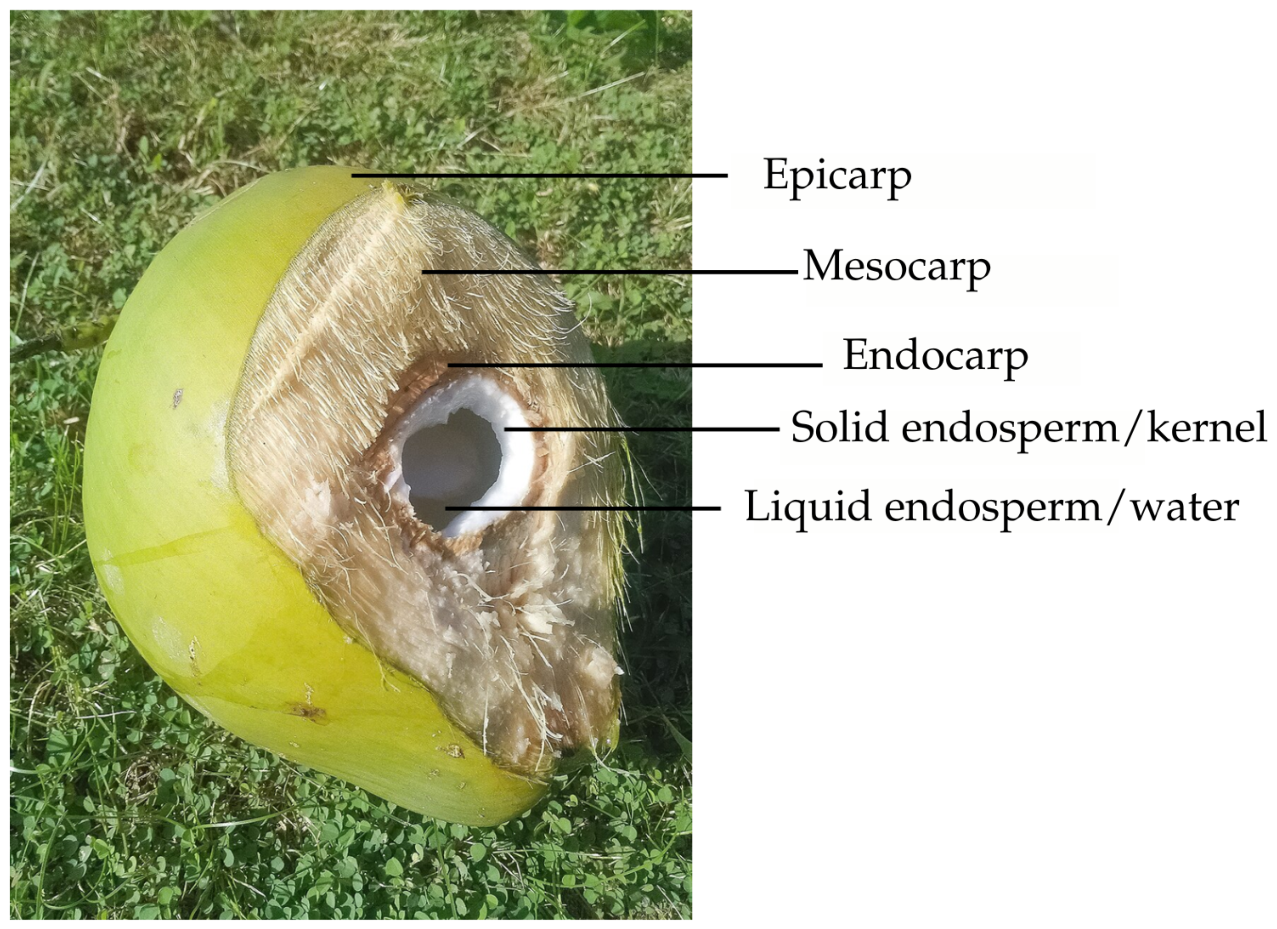
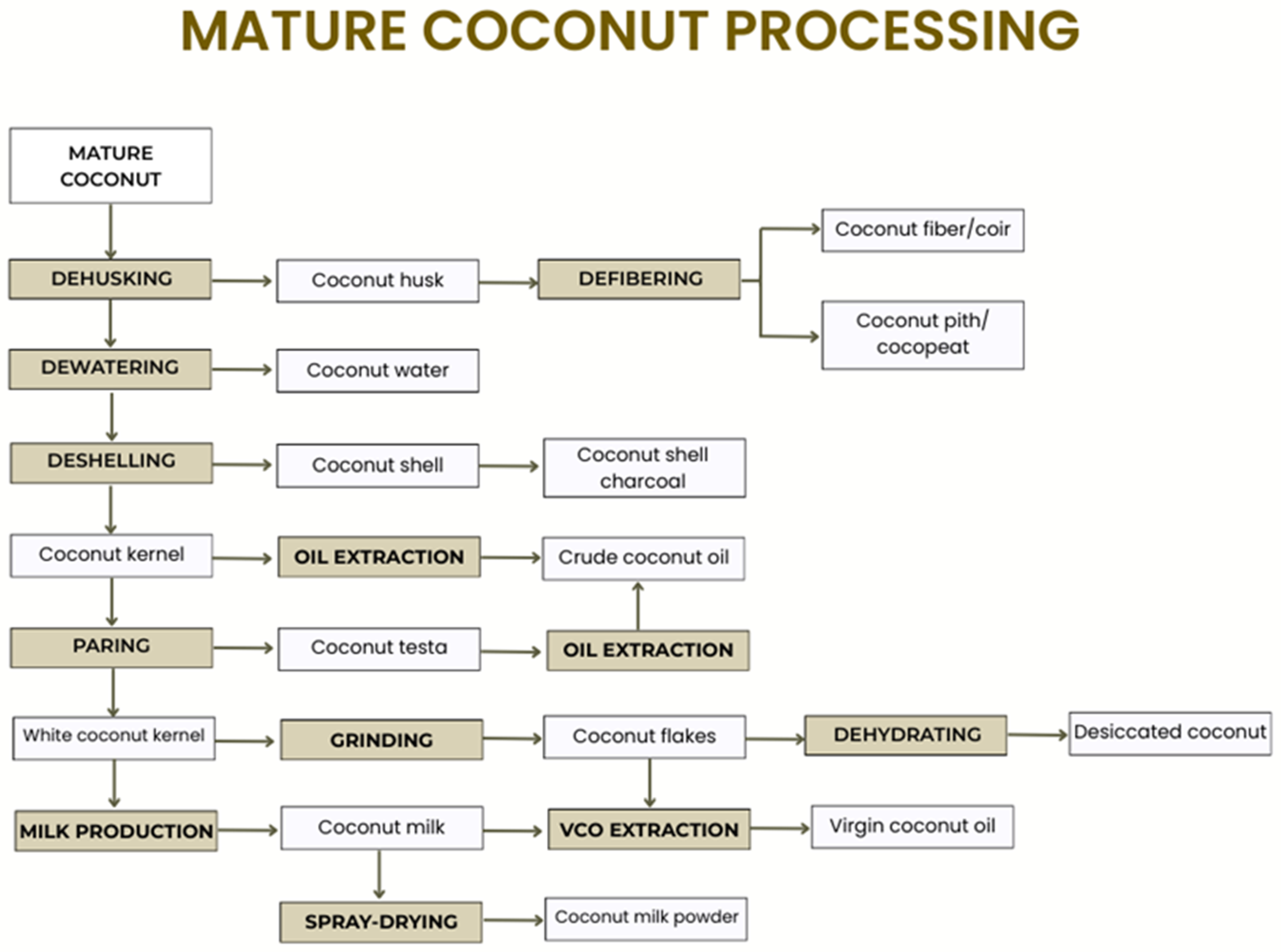
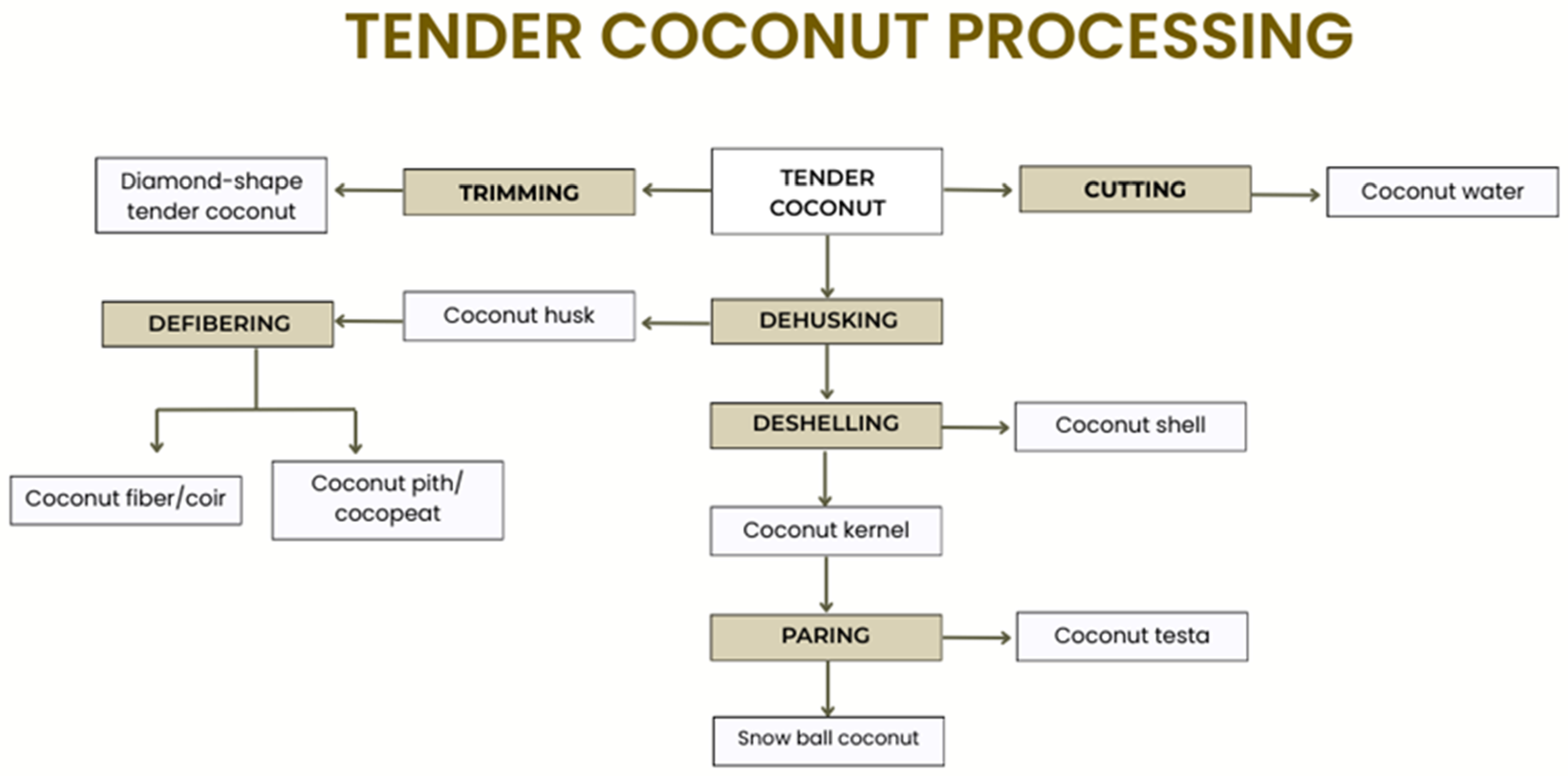
2. Coconut Fruit: Structure, Processing, and By-Product Generation
3. High-Value-Added Compounds from Coconut By-Products
3.1. Lignocellulose
3.2. Phenolic Compounds
3.3. Tannins
3.4. Lipid/Fatty Acids
4. Extraction with Eutectic Solvents
4.1. General Concepts of Eutectic Solvents and Principles of Green Extraction
4.2. Applications of Eutectic Solvents in Extraction

| Material | Compounds Extracted | Method | Solvents | Optimal Extraction Conditions | Extraction Yield | Reference |
|---|---|---|---|---|---|---|
| Coconut coir | Lignin | MAE + ES | ChCl:lactic acid (1:4) | SLR = 1:30, 20 min, 150 °C | 82% lignin recovery | [161] |
| Coconut coir | Lignin | ES | ChCl:lactic acid (1:10) | SLR = 1:20, 160 °C, 3 h | 68.51% lignin recovery | [162] |
| Coconut coir | Lignin | ES | ChCl:oxalic acid (1:1) ChCl:ZnCl2 (1:2) | SLR = 1:20, 100 °C, 24 h | - | [163] |
| Coconut coir | Lignin | ES | ChCl:urea (1:2) | SLR = 1:20, 120 °C, 1 h | 60.93% delignification | [164] |
| Coconut husk | Lignin | UAE + ES | ChCl-based ES ChCl:glycerol:urea (1:1:1) | Bath: SLR = 1:250, 90 min, 65 °C, 95 W, 50–60 Hz Probe+bath: SLR = 1:250, 35 min, 80% amplitude | Bath: 100 ± 10% lignin recovery Probe+bath: 90 ± 10% lignin recovery | [165] |
| Coconut husk | Lignin | ES | ChCl:lactic acid (1:2) | SLR = 1:10, 120 °C, 12 h | 17% lignin recovery | [166] |
| Coconut husk | Lignin | ES | ChCl:monoethanolamine (1:4) Betaine:lactic acid (1:4) | SLR = 1:10, 121 °C, 6 h | 60.53% lignin recovery 65.81% lignin recovery | [167] |
| Coconut husk | Lignin and sugars | ES | ChCl:Lactic acid (1:10) | HT: SLR = 1:20, 210 °C, 78 min ES: SLR =1:30, 120 °C, 6 h | 10.1% TRS 50.2% lignin recovery | [157] |
| Sequential HT + ES | Water and ChCl:Lactic acid (1:10) | 31.3% TRS 48.8% lignin recovery | ||||
| Coconut shell | Lignin | ES | K2CO3:ethylene glycol (1:7) | SLR = 1:15, 130 °C, 1 h | 70.7% delignification | [168] |
| Coconut shell | Lignin | ES | Tetramethylammonium hydroxide-based ES | SLR = 1:15, 50 °C, 3 h | 63.33–67.37% delignification | [169] |
| Coconut husk | Cellulose | ES | ZnCl2:glycerol (1:7) AlCl3:glycerol (1:7) ChCl:glycerol (1:2) Betaine:glycerol (1:2) | SLR = 1:12, 100 °C, 100 min | 39.39% (ZnCl2:glycerol) 48.72% (AlCl3:glycerol) 38.04% (ChCl:glycerol) 38.37% (Betaine:glycerol) | [159] |
| Coconut shell | Phenolics | ES | ChCl:ascorbic acid (1:2) | SLR = 1:10; 20 min, 25 °C | TPC = 3715.67 mg GAE/L | [158] |
| Coconut milk powder | Lipids and phytosterol | UAE + ES | ChCl:ethylene glycol (1:2):n-hexane (30:70) | SLR = 1:10, 60 °C, 1 h | Lipid content 56.35 g/100 g Phytosterol content 604.11 mg/kg | [114] |
5. Conclusions
Author Contributions
Funding
Data Availability Statement
Acknowledgments
Conflicts of Interest
Abbreviations
| ChCl | Choline chloride |
| DW | Dry weight |
| ES | Eutectic solvents |
| FAOSTAT | Food and Agriculture Organization of the United Nations Statistics Division |
| GAE | Gallic acid equivalent |
| GC-MS | Gas chromatography-mass spectrometry |
| HSQC-NMR | Heteronuclear Single Quantum Coherence Nuclear Magnetic Ressonance |
| HBA | Hydrogen bond acceptor |
| HBD | Hydrogen bond donor |
| HT | Hydrothermal treatment |
| LCC | Lignin-carbohydrate complex |
| MCFA | Medium-chain fatty acids |
| MCG | Medium-chain glycerides |
| MCT | Medium-chain triglycerides |
| MAE | Microwave-assisted extraction |
| QE | Quercetin equivalent |
| RE | Rutin equivalent |
| SLR | Solid–liquid ratio |
| TAE | Tannic acid equivalent |
| TC | Total carbohydrates |
| TFC | Total flavonoid content |
| TPC | Total phenolic content |
| TRS | Total reducing sugar |
| TTC | Total tannin content |
| UAE | Ultrasound-assisted extraction |
| VCO | Virgin coconut oil |
References
- Kumar, B.M.; Kunhamu, T.K. Nature-Based Solutions in Agriculture: A Review of the Coconut (Cocos nucifera L.)-Based Farming Systems in Kerala, “the Land of Coconut Trees.”. Nat.-Based Solut. 2022, 2, 100012. [Google Scholar] [CrossRef] [Scilit]
- Lédo, A.D.S.; Passos, E.E.M.; Fontes, H.R.; Ferreira, J.M.S.; Talamini, V.; Vendrame, W.A. Advances in Coconut Palm Propagation. Rev. Bras. Frutic. 2019, 41, e-159. [Google Scholar] [CrossRef] [Scilit]
- Vieira, F.; Santana, H.E.P.; Jesus, M.; Santos, J.; Pires, P.; Vaz-Velho, M.; Silva, D.P.; Ruzene, D.S. Coconut Waste: Discovering Sustainable Approaches to Advance a Circular Economy. Sustainability 2024, 16, 3066. [Google Scholar] [CrossRef] [Scilit]
- Food and Agriculture Organization of the United Nations. FAOSTAT Statistical Database. Available online: https://www.fao.org/faostat/en (accessed on 28 April 2026).
- Ignacio, I.-F.; Miguel, T.-S. Research Opportunities on the Coconut (Cocos nucifera L.) Using New Technologies. South Afr. J. Bot. 2021, 141, 414–420. [Google Scholar] [CrossRef] [Scilit]
- Kalaipandian, S.; Biddle, J.; Adkins, S.W. Global Coconut Trade, Economy and the Value Chain. In Botany, Production and Uses; Adkins, S.W., Biddle, J.M., Bazrafshan, A., Kalaipandian, S., Eds.; CABI: Long Beach, CA, USA, 2024; pp. 193–205. ISBN 978-1-78924-971-2. [Google Scholar]
- Singh, P.; Dubey, P.; Younis, K.; Yousuf, O. A Review on the Valorization of Coconut Shell Waste. Biomass Convers. Biorefinery 2024, 14, 8115–8125. [Google Scholar] [CrossRef] [Scilit]
- Corradini, E.; Rosa, M.D.F.; Macedo, B.P.D.; Paladin, P.D.; Mattoso, L.H.C. Composição Química, Propriedades Mecânicas e Térmicas Da Fibra de Frutos de Cultivares de Coco Verde. Rev. Bras. Frutic. 2009, 31, 837–846. [Google Scholar] [CrossRef] [Scilit]
- Nunes, L.A.; Silva, M.L.S.; Gerber, J.Z.; Kalid, R.D.A. Waste Green Coconut Shells: Diagnosis of the Disposal and Applications for Use in Other Products. J. Clean. Prod. 2020, 255, 120169. [Google Scholar] [CrossRef] [Scilit]
- Arivalagan, M.; Roy, T.K.; Yasmeen, A.M.; Pavithra, K.C.; Jwala, P.N.; Shivasankara, K.S.; Manikantan, M.R.; Hebbar, K.B.; Kanade, S.R. Extraction of Phenolic Compounds with Antioxidant Potential from Coconut (Cocos nucifera L.) Testa and Identification of Phenolic Acids and Flavonoids Using UPLC Coupled with TQD-MS/MS. LWT 2018, 92, 116–126. [Google Scholar] [CrossRef] [Scilit]
- Liu, Z.; Zhao, M.; Wang, X.; Li, C.; Wang, J.; Liu, Z.; Shen, X.; Zhou, D. Response Surface Methodology-Optimized Extraction of Flavonoids with Antioxidant and Antimicrobial Activities from the Exocarp of Three Genera of Coconut and Characterization by HPLC-IT-TOF-MS/MS. Food Chem. 2022, 391, 132966. [Google Scholar] [CrossRef] [Scilit] [PubMed]
- Ismail, H.F.; Akhir, F.N.M.; Othman, N.; Hara, H. Optimization of Extraction Solvents on the Antioxidant Properties of Coconut Waste. J. Adv. Res. Fluid Mech. Therm. Sci. 2024, 117, 109–117. [Google Scholar] [CrossRef] [Scilit]
- Ali Redha, A. Review on Extraction of Phenolic Compounds from Natural Sources Using Green Deep Eutectic Solvents. J. Agric. Food Chem. 2021, 69, 878–912. [Google Scholar] [CrossRef] [Scilit] [PubMed]
- Sheraz, M.; Cao, L.; Zhao, S.; Gao, H.; Dansawad, P.; Xue, C.; Li, Y.; Li, W. Lignocellulosic Biomass Pretreatment Methods and Application of Extracted Fractions. Arab. J. Sci. Eng. 2025, 50, 3717–3736. [Google Scholar] [CrossRef] [Scilit]
- Ferreira, C.; Sarraguça, M. A Comprehensive Review on Deep Eutectic Solvents and Its Use to Extract Bioactive Compounds of Pharmaceutical Interest. Pharmaceuticals 2024, 17, 124. [Google Scholar] [CrossRef] [Scilit] [PubMed]
- Sidana, A.; Yadav, S.K. Recent Developments in Lignocellulosic Biomass Pretreatment with a Focus on Eco-Friendly, Non-Conventional Methods. J. Clean. Prod. 2022, 335, 130286. [Google Scholar] [CrossRef] [Scilit]
- Abolore, R.S.; Jaiswal, S.; Jaiswal, A.K. Green and Sustainable Pretreatment Methods for Cellulose Extraction from Lignocellulosic Biomass and Its Applications: A Review. Carbohydr. Polym. Technol. Appl. 2024, 7, 100396. [Google Scholar] [CrossRef] [Scilit]
- Martins, M.A.R.; Pinho, S.P.; Coutinho, J.A.P. Insights into the Nature of Eutectic and Deep Eutectic Mixtures. J. Solut. Chem. 2019, 48, 962–982. [Google Scholar] [CrossRef] [Scilit]
- Li, P.; Zhang, Z.; Zhang, X.; Li, K.; Jin, Y.; Wu, W. DES: Their Effect on Lignin and Recycling Performance. RSC Adv. 2023, 13, 3241–3254. [Google Scholar] [CrossRef] [Scilit] [PubMed]
- Zhou, M.; Fakayode, O.A.; Ahmed Yagoub, A.E.; Ji, Q.; Zhou, C. Lignin Fractionation from Lignocellulosic Biomass Using Deep Eutectic Solvents and Its Valorization. Renew. Sustain. Energy Rev. 2022, 156, 111986. [Google Scholar] [CrossRef] [Scilit]
- Prabhune, A.; Dey, R. Green and Sustainable Solvents of the Future: Deep Eutectic Solvents. J. Mol. Liq. 2023, 379, 121676. [Google Scholar] [CrossRef] [Scilit]
- Omar, K.A.; Sadeghi, R. Physicochemical Properties of Deep Eutectic Solvents: A Review. J. Mol. Liq. 2022, 360, 119524. [Google Scholar] [CrossRef] [Scilit]
- Viñas-Ospino, A.; Sá-Nogueira, I.; Duarte, A.R.; López-Malo, D.; Esteve, M.J.; Frígola, A.; Blesa, J.; Paiva, A. Exploring the Biological Properties and Bioaccessibility of Orange Peel Extracts Using Deep Eutectic Systems. Food Biosci. 2024, 61, 104684. [Google Scholar] [CrossRef] [Scilit]
- Vo, T.P.; Phan, T.H.; Nguyen, T.H.P.; Nguyen, V.K.; Dang, T.C.T.; Nguyen, L.G.K.; Chung, T.Q.; Nguyen, H.Q.; Chau, P.T.T.; Thinh, L.D.A.; et al. Green Extraction of Phenolics and Terpenoids from Passion Fruit Peels Using Natural Deep Eutectic Solvents. J. Food Process Eng. 2024, 47, e14503. [Google Scholar] [CrossRef] [Scilit]
- Ćirić, I.; Dabić Zagorac, D.; Sredojević, M.; Fotirić Akšić, M.; Rabrenović, B.; Blagojević, S.; Natić, M. Valorisation of Raspberry Seeds in Cosmetic Industry-Green Solutions. Pharmaceutics 2024, 16, 606. [Google Scholar] [CrossRef] [Scilit] [PubMed]
- Ojeda, G.A.; Vallejos, M.M.; Sgroppo, S.C.; Sánchez-Moreno, C.; De Ancos, B. Enhanced Extraction of Phenolic Compounds from Mango By-Products Using Deep Eutectic Solvents. Heliyon 2023, 9, e16912. [Google Scholar] [CrossRef] [Scilit] [PubMed]
- Erdawati; Dianhar, H.; Khairunnisa, H. Effect of Pretreatment Spent Coffee Ground with Natural Deep Eutectic Solvent (NADES) on Coffee Oil Yield. J. Phys. Conf. Ser. 2022, 2309, 012002. [Google Scholar] [CrossRef] [Scilit]
- Kumar, A.K.; Parikh, B.S.; Pravakar, M. Natural Deep Eutectic Solvent Mediated Pretreatment of Rice Straw: Bioanalytical Characterization of Lignin Extract and Enzymatic Hydrolysis of Pretreated Biomass Residue. Environ. Sci. Pollut. Res. 2016, 23, 9265–9275. [Google Scholar] [CrossRef] [Scilit] [PubMed]
- Hou, X.-D.; Li, A.-L.; Lin, K.-P.; Wang, Y.-Y.; Kuang, Z.-Y.; Cao, S.-L. Insight into the Structure-Function Relationships of Deep Eutectic Solvents during Rice Straw Pretreatment. Bioresour. Technol. 2018, 249, 261–267. [Google Scholar] [CrossRef] [Scilit] [PubMed]
- Procentese, A.; Johnson, E.; Orr, V.; Garruto Campanile, A.; Wood, J.A.; Marzocchella, A.; Rehmann, L. Deep Eutectic Solvent Pretreatment and Subsequent Saccharification of Corncob. Bioresour. Technol. 2015, 192, 31–36. [Google Scholar] [CrossRef] [Scilit] [PubMed]
- Lou, R.; Ma, R.; Lin, K.; Ahamed, A.; Zhang, X. Facile Extraction of Wheat Straw by Deep Eutectic Solvent (DES) to Produce Lignin Nanoparticles. ACS Sustain. Chem. Eng. 2019, 7, 10248–10256. [Google Scholar] [CrossRef] [Scilit]
- Liu, Y.; Zheng, J.; Xiao, J.; He, X.; Zhang, K.; Yuan, S.; Peng, Z.; Chen, Z.; Lin, X. Enhanced Enzymatic Hydrolysis and Lignin Extraction of Wheat Straw by Triethylbenzyl Ammonium Chloride/Lactic Acid-Based Deep Eutectic Solvent Pretreatment. ACS Omega 2019, 4, 19829–19839. [Google Scholar] [CrossRef] [Scilit] [PubMed]
- Hebbar, K.B.; Ramesh, S.V.; Kalaipandian, S.; Adkins, S.W. Coconut Production under a Changing Climate. In Botany, Production and Uses; Adkins, S.W., Biddle, J.M., Bazrafshan, A., Kalaipandian, S., Eds.; CABI: Long Beach, CA, USA, 2024; pp. 46–57. ISBN 978-1-78924-971-2. [Google Scholar]
- Kaur, K.; Chhikara, N.; Sharma, P.; Garg, M.K.; Panghal, A. Coconut Meal: Nutraceutical Importance and Food Industry Application. Foods Raw Mater. 2019, 419–427. [Google Scholar] [CrossRef] [Scilit]
- Gunn, B.F.; Baudouin, L.; Olsen, K.M. Independent Origins of Cultivated Coconut (Cocos nucifera L.) in the Old World Tropics. PLoS ONE 2011, 6, e21143. [Google Scholar] [CrossRef] [Scilit] [PubMed]
- Adkins, S.W.; Cave, R.; Beveridge, F.C. An Introduction: Botany, Origin and Diversity. In Botany, Production and Uses; Adkins, S.W., Biddle, J.M., Bazrafshan, A., Kalaipandian, S., Eds.; CABI: Long Beach, CA, USA, 2024; pp. 1–13. ISBN 978-1-78924-971-2. [Google Scholar]
- Terdwongworakul, A.; Chaiyapong, S.; Jarimopas, B.; Meeklangsaen, W. Physical Properties of Fresh Young Thai Coconut for Maturity Sorting. Biosyst. Eng. 2009, 103, 208–216. [Google Scholar] [CrossRef] [Scilit]
- Jirapong, C.; Wongs-Aree, C.; Noichinda, S.; Uthairatanakij, A.; Kanlayanarat, S. Assessment of Volatile and Non-Volatile Organic Compounds in the Liquid Endosperm of Young ‘Nam Hom’ Coconut (Cocos nucifera L.) at Two Stages of Maturity. J. Hortic. Sci. Biotechnol. 2015, 90, 477–482. [Google Scholar] [CrossRef] [Scilit]
- Pandiselvam, R.; Khanashyam, A.C.; Dakshayani, R.; Beveridge, F.C.; Karouw, S.; Manikantan, M.R. Harvest and Postharvest Management of Coconut. In Botany, Production and Uses; Adkins, S.W., Biddle, J.M., Bazrafshan, A., Kalaipandian, S., Eds.; CABI: Long Beach, CA, USA, 2024; pp. 99–110. ISBN 978-1-78924-971-2. [Google Scholar]
- Wickramasinghe Mudiyanselage, D.R.; Wickramasinghe, I. Comparison of Physicochemical Characteristics of Virgin Coconut Oils from Traditional and Hybrid Coconut Varieties. J. Agric. Food Res. 2023, 12, 100554. [Google Scholar] [CrossRef] [Scilit]
- Aba, R.P.M.; Luna, M.B.Z.; Villasis, J.C.; Ching, A.A.A. Characterization of Mature Coconut (Cocos nucifera L.) Water from Different Varieties. Food Humanit. 2024, 2, 100248. [Google Scholar] [CrossRef] [Scilit]
- Obeng, G.Y.; Amoah, D.Y.; Opoku, R.; Sekyere, C.K.K.; Adjei, E.A.; Mensah, E. Coconut Wastes as Bioresource for Sustainable Energy: Quantifying Wastes, Calorific Values and Emissions in Ghana. Energies 2020, 13, 2178. [Google Scholar] [CrossRef] [Scilit]
- Henrietta, H.M.; Kalaiyarasi, K.; Raj, A.S. Coconut Tree (Cocos nucifera) Products: A Review of Global Cultivation and Its Benefits. J. Sustain. Environ. Manag. 2022, 1, 257–264. [Google Scholar] [CrossRef] [Scilit]
- Pandiselvam, R.; Manikantan, M.R.; Balasubramanian, D.; Beegum, P.P.S.; Mathew, A.C.; Ramesh, S.V.; Hebbar, K.B.; Niral, V. Mechanical Properties of Tender Coconut (Cocos nucifera L.): Implications for the Design of Processing Machineries. J. Food Process Eng. 2020, 43, e13349. [Google Scholar] [CrossRef] [Scilit]
- Chauhan, O.P.; Archana, B.S.; Singh, A.; Raju, P.S.; Bawa, A.S. A Refreshing Beverage from Mature Coconut Water Blended with Lemon Juice. J. Food Sci. Technol. 2014, 51, 3355–3361. [Google Scholar] [CrossRef] [Scilit] [PubMed]
- Tomy, M.; Aravind, A.M.; Suryabai, X.T. Advances of Coconut Waste as a Sustainable Energy Storage Solution—A Comprehensive Review. Biomass Convers. Biorefinery 2025, 15, 14675–14695. [Google Scholar] [CrossRef] [Scilit]
- Leliana, L.; Setyaningsih, W.; Palma, M.; Supriyadi; Santoso, U. Antioxidant Activity of Aqueous and Ethanolic Extracts of Coconut (Cocos nucifera) Fruit By-Products. Agronomy 2022, 12, 1102. [Google Scholar] [CrossRef] [Scilit]
- Singh, P.; Pandey, V.K.; Chakraborty, S.; Dash, K.K.; Singh, R.; Mukarram Shaikh, A.; Béla, K. Ultrasound-Assisted Extraction of Phytochemicals from Green Coconut Shell: Optimization by Integrated Artificial Neural Network and Particle Swarm Technique. Heliyon 2023, 9, e22438. [Google Scholar] [CrossRef] [Scilit] [PubMed]
- Arziyah, D.; Kasim, A.; Asben, A.; Busniah, M. Analysis of the Chemical Content of Coconut Husk as a Raw Material for Furfural Production. J. Appl. Agric. Sci. Technol. 2025, 9, 413–424. [Google Scholar] [CrossRef] [Scilit]
- Din, N.A.S.; Lim, S.J.; Maskat, M.Y.; Zaini, N.A.M. Bioconversion of Coconut Husk Fibre through Biorefinery Process of Alkaline Pretreatment and Enzymatic Hydrolysis. Biomass Convers. Biorefinery 2021, 11, 815–826. [Google Scholar] [CrossRef] [Scilit]
- Anuchi, S.O.; Campbell, K.L.S.; Hallett, J.P. Effective Pretreatment of Lignin-Rich Coconut Wastes Using a Low-Cost Ionic Liquid. Sci. Rep. 2022, 12, 6108. [Google Scholar] [CrossRef] [Scilit] [PubMed]
- Silliman, J.; Schniepp, H.C. The Isolation and Characterization of Cellulose Nanofibrils from the Endocarp of Cocos nucifera. Wood Sci. Technol. 2025, 59, 108. [Google Scholar] [CrossRef] [Scilit]
- Andrade, S.N.; Andrade. Chemical-activated carbon from coconut (Cocos nucifera) Endocarp waste and its application in the adsorption of β-lactoglobulin proteinplication in the adsorption of β-lactoglobulin protein. Rev. Mex. Ing. Quím. 2018, 17, 463–475. [Google Scholar] [CrossRef] [Scilit]
- D’Almeida, A.P.; De Albuquerque, T.L. Coconut Husk Valorization: Innovations in Bioproducts and Environmental Sustainability. Biomass Convers. Biorefinery 2025, 15, 13015–13035. [Google Scholar] [CrossRef] [Scilit]
- Stelte, W.; Reddy, N.; Barsberg, S.; Sanadi, A.R. Coir from Coconut Processing Waste as a Raw Material for Applications beyond Traditional Uses. BioResources 2022, 18, 49. [Google Scholar] [CrossRef] [Scilit]
- Udayana, S.K.; Naorem, A.; Singh, N.A. The Multipurpose Utilization of Coconut By-Products in Agriculture: Prospects and Concerns. Int. J. Curr. Microbiol. Appl. Sci. 2017, 6, 1408–1415. [Google Scholar] [CrossRef] [Scilit]
- Sathiparan, N.; Anburuvel, A.; Muralitharan, M.; Isura Kothalawala, D.A. Sustainable Use of Coco Pith in Cement-Sand Mortar for Masonry Block Production: Mechanical Characteristics, Durability and Environmental Benefit. J. Clean. Prod. 2022, 360, 132243. [Google Scholar] [CrossRef] [Scilit]
- Ag, M.; Yp, K.; Kg, D.; Pa, S. Physico-Chemical Characterization of Coconut Shell (Cocos nucifera). Int. J. Adv. Biochem. Res. 2024, 8, 118–122. [Google Scholar] [CrossRef] [Scilit]
- Basha, N.A.; Rathinavel, T.; Sridharan, H. Activated Carbon from Coconut Shell: Synthesis and Its Commercial Applications-A Recent Review. Appl. Sci. Eng. Prog. 2022. [Google Scholar] [CrossRef] [Scilit]
- Geetha, V.; Kumar, G.S. Concentrates from Tender Coconut Water and Coconut Testa Beneficially Modulates Tissue Lipid Profiles in High-Fat Fed Rats. J. Food Sci. Technol. 2022, 59, 1649–1657. [Google Scholar] [CrossRef] [Scilit] [PubMed]
- Ramesh, S.V.; Pandiselvam, R.; Shameena Beegum, P.P.; Saravana Kumar, R.M.; Manikantan, M.R.; Hebbar, K.B. Review of Cocos nucifera L. Testa-Derived Phytonutrients with Special Reference to Phenolics and Its Potential for Encapsulation. J. Food Sci. Technol. 2023, 60, 1–10. [Google Scholar] [CrossRef] [Scilit] [PubMed]
- Ramesh, S.V.; Pandiselvam, R.; Shameena Beegum, P.P.; Shil, S.; Sugatha, P.; Sharanya, K.; Manikantan, M.R.; Gopal, M.; Hebbar, K.B.; Uchoi, A.; et al. Valorization of Coconut (Cocos nucifera L.) Testa as a Biocolourant. Front. Sustain. Food Syst. 2024, 8, 1382214. [Google Scholar] [CrossRef] [Scilit]
- Ulpathakumbura, S.; Gunarathne, R.; Marikkar, N.; Feng, Y.; Liu, J.; Lu, J. A Review on Coconut Testa: Nutritional Attributes, Physical Properties, Biological Activities, and Product Innovation. Future Foods 2025, 12, 100827. [Google Scholar] [CrossRef] [Scilit]
- Punzalan, J.K.M.; Rosentrater, K.A. Copra Meal: A Review of Its Production, Properties, and Prospects. Animals 2024, 14, 1689. [Google Scholar] [CrossRef] [Scilit] [PubMed]
- Biddle, J.M.; Chapman, K.; Pandiselvam, R.; Khanashyam, A.C. Traditional Coconut Products. In Botany, Production and Uses; Adkins, S.W., Biddle, J.M., Bazrafshan, A., Kalaipandian, S., Eds.; CABI: Long Beach, CA, USA, 2024; pp. 176–192. ISBN 978-1-78924-971-2. [Google Scholar]
- Fanelli, N.S.; Torres-Mendoza, L.J.; Abelilla, J.J.; Stein, H.H. Chemical Composition of Copra, Palm Kernel, and Cashew Co-Products from South-East Asia and Almond Hulls from Australia. Anim. Biosci. 2023, 36, 768–775. [Google Scholar] [CrossRef] [Scilit] [PubMed]
- Ouyang, K.; Wei, L.; Hu, C.; Qi, Q.; Liu, J.; Sun, R.; Zhao, G.; Zhang, Y.; Liu, Q. Effects of Dietary Supplementation with Copra Meal on Growth Performance, Meat Quality, and Intestinal Health of Wenchang Chicken. BMC Vet. Res. 2025, 21, 635. [Google Scholar] [CrossRef] [Scilit] [PubMed]
- Stein, H.H.; Casas, G.A.; Abelilla, J.J.; Liu, Y.; Sulabo, R.C. Nutritional Value of High Fiber Co-Products from the Copra, Palm Kernel, and Rice Industries in Diets Fed to Pigs. J. Anim. Sci. Biotechnol. 2015, 6, 56. [Google Scholar] [CrossRef] [Scilit] [PubMed]
- Chato, R.J.A.; Cuevas, C.C.R.; Tangpuz, J.S.N.; Cabatingan, L.K.; Go, A.W.; Ju, Y.-H. Dilute Acid Hydrolysis as a Method of Producing Sugar-Rich Hydrolysates and Lipid-Dense Cake Residues from Copra Cake. J. Environ. Chem. Eng. 2018, 6, 5693–5705. [Google Scholar] [CrossRef] [Scilit]
- Te, K.G.D.; Go, A.W.; Wang, H.J.D.; Guevarra, R.G.; Cabatingan, L.K.; Tabañag, I.D.F.; Angkawijaya, A.E.; Ju, Y.-H. Extraction of Lipids from Post-Hydrolysis Copra Cake with Hexane as Solvent: Kinetic and Equilibrium Data. Renew. Energy 2020, 158, 311–323. [Google Scholar] [CrossRef] [Scilit]
- Ghosh, A.; Verma, A.K.; Tingirikari, J.R.; Shukla, R.; Goyal, A. Recovery and Purification of Oligosaccharides from Copra Meal by Recombinant Endo-β-Mannanase and Deciphering Molecular Mechanism Involved and Its Role as Potent Therapeutic Agent. Mol. Biotechnol. 2015, 57, 111–127. [Google Scholar] [CrossRef] [Scilit] [PubMed]
- Haldar, D.; Purkait, M.K. A Review on the Environment-Friendly Emerging Techniques for Pretreatment of Lignocellulosic Biomass: Mechanistic Insight and Advancements. Chemosphere 2021, 264, 128523. [Google Scholar] [CrossRef] [Scilit] [PubMed]
- Bajpai, P. Deep Eutectic Solvents for Pretreatment of Lignocellulosic Biomass; Springer Briefs in Applied Sciences and Technology; Springer Singapore: Singapore, 2021; ISBN 978-981-16-4012-4. [Google Scholar]
- Tarasov, D.; Leitch, M.; Fatehi, P. Lignin–Carbohydrate Complexes: Properties, Applications, Analyses, and Methods of Extraction: A Review. Biotechnol. Biofuels 2018, 11, 269. [Google Scholar] [CrossRef] [Scilit] [PubMed]
- Lorenci Woiciechowski, A.; Dalmas Neto, C.J.; Porto De Souza Vandenberghe, L.; De Carvalho Neto, D.P.; Novak Sydney, A.C.; Letti, L.A.J.; Karp, S.G.; Zevallos Torres, L.A.; Soccol, C.R. Lignocellulosic Biomass: Acid and Alkaline Pretreatments and Their Effects on Biomass Recalcitrance—Conventional Processing and Recent Advances. Bioresour. Technol. 2020, 304, 122848. [Google Scholar] [CrossRef] [Scilit] [PubMed]
- Cai, J.; He, Y.; Yu, X.; Banks, S.W.; Yang, Y.; Zhang, X.; Yu, Y.; Liu, R.; Bridgwater, A.V. Review of Physicochemical Properties and Analytical Characterization of Lignocellulosic Biomass. Renew. Sustain. Energy Rev. 2017, 76, 309–322. [Google Scholar] [CrossRef] [Scilit]
- Okolie, J.A.; Nanda, S.; Dalai, A.K.; Kozinski, J.A. Chemistry and Specialty Industrial Applications of Lignocellulosic Biomass. Waste Biomass Valorization 2021, 12, 2145–2169. [Google Scholar] [CrossRef] [Scilit]
- Liao, Y.; De Beeck, B.O.; Thielemans, K.; Ennaert, T.; Snelders, J.; Dusselier, M.; Courtin, C.M.; Sels, B.F. The Role of Pretreatment in the Catalytic Valorization of Cellulose. Mol. Catal. 2020, 487, 110883. [Google Scholar] [CrossRef] [Scilit]
- Singhvi, M.S.; Gokhale, D.V. Lignocellulosic Biomass: Hurdles and Challenges in Its Valorization. Appl. Microbiol. Biotechnol. 2019, 103, 9305–9320. [Google Scholar] [CrossRef] [Scilit] [PubMed]
- Chen, Z.; Wang, Y.; Cheng, H.; Zhou, H. Hemicellulose Degradation: An Overlooked Issue in Acidic Deep Eutectic Solvents Pretreatment of Lignocellulosic Biomass. Ind. Crops Prod. 2022, 187, 115335. [Google Scholar] [CrossRef] [Scilit]
- Ji, T.; Liaqat, F.; Khazi, M.I.; Liaqat, N.; Nawaz, M.Z.; Zhu, D. Lignin Biotransformation: Advances in Enzymatic Valorization and Bioproduction Strategies. Ind. Crops Prod. 2024, 216, 118759. [Google Scholar] [CrossRef] [Scilit]
- Slabon, A.; Rodrigues, B.V.M. To Break, or Not to Break: Is Selective Depolymerization of Lignin a Riemann Hypothesis Rather than a Solution? Green Chem. 2025, 27, 2178–2183. [Google Scholar] [CrossRef] [Scilit]
- Katahira, R.; Elder, T.J.; Beckham, G.T. Chapter 1. A Brief Introduction to Lignin Structure. In Energy and Environment Series; Beckham, G.T., Ed.; Royal Society of Chemistry: Cambridge, UK, 2018; pp. 1–20. ISBN 978-1-78262-554-4. [Google Scholar]
- Vieira, F.; Santana, H.E.P.; Jesus, M.; Mata, F.; Pires, P.; Vaz-Velho, M.; Silva, D.P.; Ruzene, D.S. Comparative Study of Pretreatments on Coconut Fiber for Efficient Isolation of Lignocellulosic Fractions. Sustainability 2024, 16, 4784. [Google Scholar] [CrossRef] [Scilit]
- Xu, L.; Wang, X. A Comprehensive Review of Phenolic Compounds in Horticultural Plants. Int. J. Mol. Sci. 2025, 26, 5767. [Google Scholar] [CrossRef] [Scilit] [PubMed]
- Durazzo, A.; Lucarini, M.; Souto, E.B.; Cicala, C.; Caiazzo, E.; Izzo, A.A.; Novellino, E.; Santini, A. Polyphenols: A Concise Overview on the Chemistry, Occurrence, and Human Health. Phytother. Res. 2019, 33, 2221–2243. [Google Scholar] [CrossRef] [Scilit] [PubMed]
- Alara, O.R.; Abdurahman, N.H.; Ukaegbu, C.I. Extraction of Phenolic Compounds: A Review. Curr. Res. Food Sci. 2021, 4, 200–214. [Google Scholar] [CrossRef] [Scilit] [PubMed]
- Kozłowska, A.; Szostak-Wegierek, D. Flavonoids—Food Sources and Health Benefits. Rocz. Panstw. Zakl. Hig. 2014, 65, 79–85. [Google Scholar] [PubMed]
- Mir-Cerdà, A.; Nuñez, O.; Granados, M.; Sentellas, S.; Saurina, J. An Overview of the Extraction and Characterization of Bioactive Phenolic Compounds from Agri-Food Waste within the Framework of Circular Bioeconomy. TrAC Trends Anal. Chem. 2023, 161, 116994. [Google Scholar] [CrossRef] [Scilit]
- Rashmi, H.B.; Negi, P.S. Phenolic Acids from Vegetables: A Review on Processing Stability and Health Benefits. Food Res. Int. 2020, 136, 109298. [Google Scholar] [CrossRef] [Scilit] [PubMed]
- Zhu, C.; Lin, Z.; Jiang, H.; Wei, F.; Wu, Y.; Song, L. Recent Advances in the Health Benefits of Phenolic Acids in Whole Grains and the Impact of Processing Techniques on Phenolic Acids: A Comprehensive Review. J. Agric. Food Chem. 2024, 72, 24131–24157. [Google Scholar] [CrossRef] [Scilit] [PubMed]
- De Araújo, F.F.; De Paulo Farias, D.; Neri-Numa, I.A.; Pastore, G.M. Polyphenols and Their Applications: An Approach in Food Chemistry and Innovation Potential. Food Chem. 2021, 338, 127535. [Google Scholar] [CrossRef] [Scilit] [PubMed]
- Galić, L.; Lončarić, Z.; Lisjak, M. A Review of Phenolic Compounds: From Biosynthesis and Ecological Roles to Human Health and Nutrition. Phyton 2025, 94, 3297–3318. [Google Scholar] [CrossRef] [Scilit]
- Rahman, M.M.; Rahaman, M.S.; Islam, M.R.; Rahman, F.; Mithi, F.M.; Alqahtani, T.; Almikhlafi, M.A.; Alghamdi, S.Q.; Alruwaili, A.S.; Hossain, M.S.; et al. Role of Phenolic Compounds in Human Disease: Current Knowledge and Future Prospects. Molecules 2021, 27, 233. [Google Scholar] [CrossRef] [Scilit] [PubMed]
- Dias, R.; Oliveira, H.; Fernandes, I.; Simal-Gandara, J.; Perez-Gregorio, R. Recent Advances in Extracting Phenolic Compounds from Food and Their Use in Disease Prevention and as Cosmetics. Crit. Rev. Food Sci. Nutr. 2021, 61, 1130–1151. [Google Scholar] [CrossRef] [Scilit] [PubMed]
- Zeb, A. Concept, Mechanism, and Applications of Phenolic Antioxidants in Foods. J. Food Biochem. 2020, 44, e13394. [Google Scholar] [CrossRef] [Scilit] [PubMed]
- Luzardo-Ocampo, I.; Ramírez-Jiménez, A.K.; Yañez, J.; Mojica, L.; Luna-Vital, D.A. Technological Applications of Natural Colorants in Food Systems: A Review. Foods 2021, 10, 634. [Google Scholar] [CrossRef] [Scilit] [PubMed]
- Gutiérrez-del-Río, I.; López-Ibáñez, S.; Magadán-Corpas, P.; Fernández-Calleja, L.; Pérez-Valero, Á.; Tuñón-Granda, M.; Miguélez, E.M.; Villar, C.J.; Lombó, F. Terpenoids and Polyphenols as Natural Antioxidant Agents in Food Preservation. Antioxidants 2021, 10, 1264. [Google Scholar] [CrossRef] [Scilit] [PubMed]
- Liu, J.; Wang, X.; Yong, H.; Kan, J.; Jin, C. Recent Advances in Flavonoid-Grafted Polysaccharides: Synthesis, Structural Characterization, Bioactivities and Potential Applications. Int. J. Biol. Macromol. 2018, 116, 1011–1025. [Google Scholar] [CrossRef] [Scilit] [PubMed]
- Ozkan, G.; Ceyhan, T.; Çatalkaya, G.; Rajan, L.; Ullah, H.; Daglia, M.; Capanoglu, E. Encapsulated Phenolic Compounds: Clinical Efficacy of a Novel Delivery Method. Phytochem. Rev. 2024, 23, 781–819. [Google Scholar] [CrossRef] [Scilit]
- Leliana, L.; Setyaningsih, W.; Palma, M.; Supriyadi, S.; Santoso, U. Optimization of Ultrasound-Assisted Extraction from Young Coconut Mesocarp in the Rapid Extraction of Phenolic Compounds and Antioxidant Activity. Agronomy 2022, 12, 2798. [Google Scholar] [CrossRef] [Scilit]
- Li, N.; Jiang, H.; Yang, J.; Wang, C.; Wu, L.; Hao, Y.; Liu, Y. Characterization of Phenolic Compounds and Anti-Acetylcholinase Activity of Coconut Shells. Food Biosci. 2021, 42, 101204. [Google Scholar] [CrossRef] [Scilit]
- Valadez-Carmona, L.; Cortez-García, R.M.; Plazola-Jacinto, C.P.; Necoechea-Mondragón, H.; Ortiz-Moreno, A. Effect of Microwave Drying and Oven Drying on the Water Activity, Color, Phenolic Compounds Content and Antioxidant Activity of Coconut Husk (Cocos nucifera L.). J. Food Sci. Technol. 2016, 53, 3495–3501. [Google Scholar] [CrossRef] [Scilit] [PubMed]
- Farha, A.K.; Yang, Q.-Q.; Kim, G.; Li, H.-B.; Zhu, F.; Liu, H.-Y.; Gan, R.-Y.; Corke, H. Tannins as an Alternative to Antibiotics. Food Biosci. 2020, 38, 100751. [Google Scholar] [CrossRef] [Scilit]
- Das, A.K.; Islam, M.N.; Faruk, M.O.; Ashaduzzaman, M.; Dungani, R. Review on Tannins: Extraction Processes, Applications and Possibilities. South Afr. J. Bot. 2020, 135, 58–70. [Google Scholar] [CrossRef] [Scilit]
- Dos Santos Silva, L.; Da Silva, C.N.; Santos, W.O.; Buarque, F.S.; Ribeiro, B.D. Extraction of Phenolic Compounds from Plant Matrices Using Eutectic Solvents. In Deep Eutectic Solvents; Environmental Footprints and Eco-design of Products and Processes; Kuperkar, K., Kumar, D., Raghav, S., Jangir, A.K., Shahid, M., Eds.; Springer Nature Switzerland: Cham, Switzerland, 2026; pp. 227–256. ISBN 978-3-032-03800-5. [Google Scholar]
- Sirisangsawang, R.; Phetyim, N. Optimization of Tannin Extraction from Coconut Coir through Response Surface Methodology. Heliyon 2023, 9, e13377. [Google Scholar] [CrossRef] [Scilit] [PubMed]
- Rauf, A.; Imran, M.; Abu-Izneid, T.; Iahtisham-Ul-Haq; Patel, S.; Pan, X.; Naz, S.; Sanches Silva, A.; Saeed, F.; Rasul Suleria, H.A. Proanthocyanidins: A Comprehensive Review. Biomed. Pharmacother. 2019, 116, 108999. [Google Scholar] [CrossRef] [Scilit] [PubMed]
- Bele, A.A.; Jadhav, V.M.; Kadam, V.J. Potential of Tannnins: A Review. Asian J. Plant Sci. 2010, 9, 209–214. [Google Scholar] [CrossRef] [Scilit]
- Wrasiati, L.P.; Antares, A.; Anggreni, A.A.M.D.; Harsojuwono, B.A.; Gunam, I.B.W.; Nitivattananon, V.; Arnata, I.W. Green Extraction Method and Microencapsulation of Tannins from Young Coconut Husks-Based Food Waste Using Gelatin/Nanofiber Cellulose. Case Stud. Chem. Environ. Eng. 2025, 11, 101210. [Google Scholar] [CrossRef] [Scilit]
- Morbeck, F.L.; Lelis, R.C.C.; Schueler, M.V.E.; Santos, W.A.; Sampaio, D.A.; Silva, B.C.D.; Morais, R.D.M.; Santana, G.M. Extraction and Evaluation of Tannin from Green Coconut Mesocarp. Matér. Rio Jan. 2019, 24, e12433. [Google Scholar] [CrossRef] [Scilit]
- Guedes, D.; Martins, G.; Alviano, D.; Lutterbach, M.; Reznik, L.; Sérvulo, E. Application of Coconut Condensed Tannin as Corrosion Inhibitor for Carbon Steel AISI 1020 in Neutral Medium. In Proceedings of the Joint European Corrosion Congress 2017, EUROCORR 2017 and 20th International Corrosion Congress and Process Safety Congress 2017, Prague, Czech Republic, 3–7 September 2017. [Google Scholar]
- Adeel, S.; Kiran, S.; Shahid, M.; Habib, S.R.; Habib, N.; Hussaan, M. Ecofriendly Application of Coconut Coir (Cocos nucifera) Extract for Silk Dyeing. Environ. Sci. Pollut. Res. 2022, 29, 564–572. [Google Scholar] [CrossRef] [Scilit] [PubMed]
- Cui, J.; Yang, Z.; Xu, Y.; Tan, C.-P.; Zhang, W. Lipidomics Insight on Differences in Lipid Profiles and Phytosterol Compositions of Coconut Oils Extracted by Classical and Green Solvents. Food Res. Int. 2023, 174, 113653. [Google Scholar] [CrossRef] [Scilit] [PubMed]
- Appaiah, P.; Sunil, L.; Prasanth Kumar, P.K.; Gopala Krishna, A.G. Composition of Coconut Testa, Coconut Kernel and Its Oil. J. Am. Oil Chem. Soc. 2014, 91, 917–924. [Google Scholar] [CrossRef] [Scilit]
- Darsana, K.; Bashir, O.; Morya, S.; Pawase, P.A.; Mondal, I.H.; Amin, T.; Mugabi, R. Coconut Milk as a Plant-Based Dairy Alternative: Developmental Trends and Assessing Carbon Footprint Impact. Discov. Food 2026, 6, 25. [Google Scholar] [CrossRef] [Scilit]
- Che-U-Bong, W.; Hongsprabhas, P.; Jaree, A.; Klinkesorn, U. Enhancing the Recovery Yield and Quality of Oil from Coconut Residue by Ultrasound Pretreatment-Assisted Ethanol Extraction. J. Agric. Food Res. 2025, 22, 102133. [Google Scholar] [CrossRef] [Scilit]
- Nandi, S.; Gangopadhyay, S.; Ghosh, S. Production of Medium Chain Glycerides from Coconut and Palm Kernel Fatty Acid Distillates by Lipase-Catalyzed Reactions. Enzym. Microb. Technol. 2005, 36, 725–728. [Google Scholar] [CrossRef] [Scilit]
- Jadhav, H.B.; Annapure, U.S. Triglycerides of Medium-Chain Fatty Acids: A Concise Review. J. Food Sci. Technol. 2023, 60, 2143–2152. [Google Scholar] [CrossRef] [Scilit] [PubMed]
- Nimbkar, S.; Leena, M.M.; Moses, J.A.; Anandharamakrishnan, C. Medium Chain Triglycerides (MCT): State-of-the-art on Chemistry, Synthesis, Health Benefits and Applications in Food Industry. Compr. Rev. Food Sci. Food Saf. 2022, 21, 843–867. [Google Scholar] [CrossRef] [Scilit] [PubMed]
- Miyashita, K.; Beppu, F.; Hosokawa, M.; Liu, X.; Wang, S. Bioactive Significance of Fucoxanthin and Its Effective Extraction. Biocatal. Agric. Biotechnol. 2020, 26, 101639. [Google Scholar] [CrossRef] [Scilit]
- Zulfakar, M.H.; Pubadi, H.; Ibrahim, S.I.; Hairul, N.M. Medium-Chain Triacylglycerols (MCTs) and Their Fractions in Drug Delivery Systems: A Systematic Review. J. Oleo Sci. 2024, 73, 293–310. [Google Scholar] [CrossRef] [Scilit] [PubMed]
- Liu, H.; Zhou, W.; Cai, C.; Feng, F.; Cai, H.; Yang, H. Biological Function of Medium-Chain Fatty Acids and Their Application in Aquatic Animals: A Review. Animals 2025, 15, 2294. [Google Scholar] [CrossRef] [Scilit] [PubMed]
- Abbott, A.P.; Capper, G.; Davies, D.L.; Rasheed, R.K.; Tambyrajah, V. Novel Solvent Properties of Choline Chloride/Urea mixtures. Chem. Commun. 2003, 70–71. [Google Scholar] [CrossRef] [Scilit] [PubMed]
- Kurul, F.; Doruk, B.; Topkaya, S.N. Principles of Green Chemistry: Building a Sustainable Future. Discov. Chem. 2025, 2, 68. [Google Scholar] [CrossRef] [Scilit]
- Florindo, C.; Branco, L.C.; Marrucho, I.M. Quest for Green-Solvent Design: From Hydrophilic to Hydrophobic (Deep) Eutectic Solvents. ChemSusChem 2019, 12, 1549–1559. [Google Scholar] [CrossRef] [Scilit] [PubMed]
- Abranches, D.O.; Coutinho, J.A.P. Type V Deep Eutectic Solvents: Design and Applications. Curr. Opin. Green Sustain. Chem. 2022, 35, 100612. [Google Scholar] [CrossRef] [Scilit]
- Nunes Da Silva, C.; Pina De Almeida, L.M.; Lemes, A.C.; Ribeiro, B.D. Citrus By-Products Valorization Using Deep Eutectic Solvents—A Review. Food Biosci. 2024, 60, 104446. [Google Scholar] [CrossRef] [Scilit]
- Ruesgas-Ramón, M.; Figueroa-Espinoza, M.C.; Durand, E. Application of Deep Eutectic Solvents (DES) for Phenolic Compounds Extraction: Overview, Challenges, and Opportunities. J. Agric. Food Chem. 2017, 65, 3591–3601. [Google Scholar] [CrossRef] [Scilit] [PubMed]
- Warrag, S.E.E.; Kroon, M.C. Hydrophobic Deep Eutectic Solvents. In Deep Eutectic Solvents; Ramón, D.J., Guillena, G., Eds.; Wiley: Hoboken, NJ, USA, 2019; pp. 83–93. ISBN 978-3-527-34518-2. [Google Scholar]
- Van Osch, D.J.G.P.; Zubeir, L.F.; Van Den Bruinhorst, A.; Rocha, M.A.A.; Kroon, M.C. Hydrophobic Deep Eutectic Solvents as Water-Immiscible Extractants. Green Chem. 2015, 17, 4518–4521. [Google Scholar] [CrossRef] [Scilit]
- Kyriakoudi, A.; Tsiouras, A.; Mourtzinos, I. Extraction of Lycopene from Tomato Using Hydrophobic Natural Deep Eutectic Solvents Based on Terpenes and Fatty Acids. Foods 2022, 11, 2645. [Google Scholar] [CrossRef] [Scilit] [PubMed]
- Jiménez-Ortega, L.A.; Marques, M.; Quiñonez-Angulo, M.P.; Paiva, A.; Heredia, J.B.; Duarte, A.R.C.; Mota-Morales, J.D. Sustainable Extraction of Phytochemicals from Agricultural and Food By-Products Using Eutectic Solvents and Their Integration into Functional Materials. RSC Sustain. 2026, 4, 687–719. [Google Scholar] [CrossRef] [Scilit]
- Zainal-Abidin, M.H.; Hayyan, M.; Wong, W.F. Hydrophobic Deep Eutectic Solvents: Current Progress and Future Directions. J. Ind. Eng. Chem. 2021, 97, 142–162. [Google Scholar] [CrossRef] [Scilit]
- Wang, W.; Lee, D.-J. Lignocellulosic Biomass Pretreatment by Deep Eutectic Solvents on Lignin Extraction and Saccharification Enhancement: A Review. Bioresour. Technol. 2021, 339, 125587. [Google Scholar] [CrossRef] [Scilit] [PubMed]
- Marcus, Y. Deep Eutectic Solvents; Springer International Publishing: Cham, Switzerland, 2019; ISBN 978-3-030-00607-5. [Google Scholar]
- Oliveira, F.S.; Pereiro, A.B.; Rebelo, L.P.N.; Marrucho, I.M. Deep Eutectic Solvents as Extraction Media for Azeotropic Mixtures. Green Chem. 2013, 15, 1326. [Google Scholar] [CrossRef] [Scilit]
- Florindo, C.; Branco, L.C.; Marrucho, I.M. Development of Hydrophobic Deep Eutectic Solvents for Extraction of Pesticides from Aqueous Environments. Fluid Phase Equilibria 2017, 448, 135–142. [Google Scholar] [CrossRef] [Scilit]
- Ghanemi, K.; Navidi, M.-A.; Fallah-Mehrjardi, M.; Dadolahi-Sohrab, A. Ultra-Fast Microwave-Assisted Digestion in Choline Chloride–Oxalic Acid Deep Eutectic Solvent for Determining Cu, Fe, Ni and Zn in Marine Biological Samples. Anal. Methods 2014, 6, 1774–1781. [Google Scholar] [CrossRef] [Scilit]
- Krishnan, A.; Gopinath, K.P.; Vo, D.-V.N.; Malolan, R.; Nagarajan, V.M.; Arun, J. Ionic Liquids, Deep Eutectic Solvents and Liquid Polymers as Green Solvents in Carbon Capture Technologies: A Review. Environ. Chem. Lett. 2020, 18, 2031–2054. [Google Scholar] [CrossRef] [Scilit]
- Schiavi, P.G.; Altimari, P.; Branchi, M.; Zanoni, R.; Simonetti, G.; Navarra, M.A.; Pagnanelli, F. Selective Recovery of Cobalt from Mixed Lithium Ion Battery Wastes Using Deep Eutectic Solvent. Chem. Eng. J. 2021, 417, 129249. [Google Scholar] [CrossRef] [Scilit]
- Rashid, S.N.; Hayyan, A.; Hayyan, M.; Hashim, M.A.; Elgharbawy, A.A.M.; Sani, F.S.; Basirun, W.J.; Lee, V.S.; Alias, Y.; Mohammed, A.K.; et al. Ternary Glycerol-Based Deep Eutectic Solvents: Physicochemical Properties and Enzymatic Activity. Chem. Eng. Res. Des. 2021, 169, 77–85. [Google Scholar] [CrossRef] [Scilit]
- Huang, Z.-L.; Wu, B.-P.; Wen, Q.; Yang, T.-X.; Yang, Z. Deep Eutectic Solvents Can Be Viable Enzyme Activators and Stabilizers: DESs Can Be Enzyme Activators and Stabilizers. J. Chem. Technol. Biotechnol. 2014, 89, 1975–1981. [Google Scholar] [CrossRef] [Scilit]
- Ma, H.; Fu, P.; Zhao, J.; Lin, X.; Wu, W.; Yu, Z.; Xia, C.; Wang, Q.; Gao, M.; Zhou, J. Pretreatment of Wheat Straw Lignocelluloses by Deep Eutectic Solvent for Lignin Extraction. Molecules 2022, 27, 7955. [Google Scholar] [CrossRef] [Scilit] [PubMed]
- Yu, H.; Xue, Z.; Shi, R.; Zhou, F.; Mu, T. Lignin Dissolution and Lignocellulose Pretreatment by Carboxylic Acid Based Deep Eutectic Solvents. Ind. Crops Prod. 2022, 184, 115049. [Google Scholar] [CrossRef] [Scilit]
- Wu, L.; Li, L.; Chen, S.; Wang, L.; Lin, X. Deep Eutectic Solvent-Based Ultrasonic-Assisted Extraction of Phenolic Compounds from Moringa oleifera L. Leaves: Optimization, Comparison and Antioxidant Activity. Sep. Purif. Technol. 2020, 247, 117014. [Google Scholar] [CrossRef] [Scilit]
- García, A.; Rodríguez-Juan, E.; Rodríguez-Gutiérrez, G.; Rios, J.J.; Fernández-Bolaños, J. Extraction of Phenolic Compounds from Virgin Olive Oil by Deep Eutectic Solvents (DESs). Food Chem. 2016, 197, 554–561. [Google Scholar] [CrossRef] [Scilit] [PubMed]
- Cvjetko Bubalo, M.; Ćurko, N.; Tomašević, M.; Kovačević Ganić, K.; Radojčić Redovniković, I. Green Extraction of Grape Skin Phenolics by Using Deep Eutectic Solvents. Food Chem. 2016, 200, 159–166. [Google Scholar] [CrossRef] [Scilit] [PubMed]
- Nam, Y.H.; Ahn, S.M.; Seo, G.J.; Kim, N.W.; Shin, S.W.; Nuankaew, W.; Murughanantham, N.; Pandian, S.; Hwang, J.S.; Hong, B.N.; et al. Optimization of NADES-Based Green Extraction of Ellagitannins from Rambutan Peel with Enhanced Antioxidant Activity. Food Chem. 2025, 475, 143308. [Google Scholar] [CrossRef] [Scilit] [PubMed]
- Kovač, M.J.; Jokić, S.; Jerković, I.; Molnar, M. Optimization of Deep Eutectic Solvent Extraction of Phenolic Acids and Tannins from Alchemilla vulgaris L. Plants 2022, 11, 474. [Google Scholar] [CrossRef] [Scilit] [PubMed]
- Liew, S.Q.; Ngoh, G.C.; Yusoff, R.; Teoh, W.H. Acid and Deep Eutectic Solvent (DES) Extraction of Pectin from Pomelo (Citrus grandis (L.) Osbeck) Peels. Biocatal. Agric. Biotechnol. 2018, 13, 1–11. [Google Scholar] [CrossRef] [Scilit]
- Shafie, M.H.; Yusof, R.; Gan, C.-Y. Deep Eutectic Solvents (DES) Mediated Extraction of Pectin from Averrhoa bilimbi: Optimization and Characterization Studies. Carbohydr. Polym. 2019, 216, 303–311. [Google Scholar] [CrossRef] [Scilit] [PubMed]
- Morais, E.S.; Mendonça, P.V.; Coelho, J.F.J.; Freire, M.G.; Freire, C.S.R.; Coutinho, J.A.P.; Silvestre, A.J.D. Deep Eutectic Solvent Aqueous Solutions as Efficient Media for the Solubilization of Hardwood Xylans. ChemSusChem 2018, 11, 753–762. [Google Scholar] [CrossRef] [Scilit] [PubMed]
- Dong, C.-D.; Tsai, M.-L.; Nargotra, P.; Kour, B.; Chen, C.-W.; Sun, P.-P.; Sharma, V. Bioprocess Development for the Production of Xylooligosaccharide Prebiotics from Agro-Industrial Lignocellulosic Waste. Heliyon 2023, 9, e18316. [Google Scholar] [CrossRef] [Scilit] [PubMed]
- Ribeiro, B.D.; Coelho, M.A.Z.; Marrucho, I.M. Extraction of Saponins from Sisal (Agave sisalana) and Juá (Ziziphus joazeiro) with Cholinium-Based Ionic Liquids and Deep Eutectic Solvents. Eur. Food Res. Technol. 2013, 237, 965–975. [Google Scholar] [CrossRef] [Scilit]
- Suresh, P.S.; Singh, P.P.; Anmol; Kapoor, S.; Padwad, Y.S.; Sharma, U. Lactic Acid-Based Deep Eutectic Solvent: An Efficient Green Media for the Selective Extraction of Steroidal Saponins from Trillium govanianum. Sep. Purif. Technol. 2022, 294, 121105. [Google Scholar] [CrossRef] [Scilit]
- Wijaya, C.; Sangadji, N.L.; Muharja, M.; Widjaja, T.; Riadi, L.; Widjaja, A. An Integrated Green Fractionation of Coconut Husk: Hydrothermal and Deep Eutectic Solvent Pretreatment for Enhanced Sugar and Lignin Production. Bioresour. Technol. Rep. 2025, 29, 102078. [Google Scholar] [CrossRef] [Scilit]
- Aziz, A.H.A.; Engliman, N.S.; Mansor, M.F.; Nasaruddin, R.R. Extraction of Phenolic Compound Using Natural Deep Eutectic Solvent from Biomass Waste. IOP Conf. Ser. Mater. Sci. Eng. 2021, 1192, 012001. [Google Scholar] [CrossRef] [Scilit]
- Zulkiflee, Z.N.; Kamaludin, N.H.I.; Osman, H. Effect of Glycerol-Based Deep Eutectic Solvent Pretreatment on the Cellulose Yield from Coconut Mesocarp. In Proceedings of the 4th International Conference on Biomass Utilization and Sustainable Energy; ICoBiomasSE 2024; 2–3 September; Penang, Malaysia; Green Energy and Technology; Ong, H.L., Mohd Yusof, S.J.H., Mohd Salleh, N.H., Kasim, K.F., Abidin, N.S.A., Eds.; Springer Nature Singapore: Singapore, 2025; pp. 455–464. ISBN 978-981-96-3784-3. [Google Scholar]
- Hong, S.; Shen, X.-J.; Xue, Z.; Sun, Z.; Yuan, T.-Q. Structure–Function Relationships of Deep Eutectic Solvents for Lignin Extraction and Chemical Transformation. Green Chem. 2020, 22, 7219–7232. [Google Scholar] [CrossRef] [Scilit]
- Mankar, A.R.; Pandey, A.; Pant, K.K. Microwave-Assisted Extraction of Lignin from Coconut Coir Using Deep Eutectic Solvents and Its Valorization to Aromatics. Bioresour. Technol. 2022, 345, 126528. [Google Scholar] [CrossRef] [Scilit] [PubMed]
- Zheng, Q.; Shi, S.; Gu, Y.; Osei, P.O.; Wang, L.; Duan, X.; Wu, X.; Liao, X. Utilization of Structure-Specific Lignin Extracted from Coconut Fiber via Deep Eutectic Solvents to Enhance the Functional Properties of PVA Nanocomposite Films. Int. J. Biol. Macromol. 2025, 297, 139914. [Google Scholar] [CrossRef] [Scilit] [PubMed]
- Mudzakir, A.; Nandiyanto, A.B.D.; Heraldy, E.; Efendi, J.; Rizky, K.M.; Widyaningsih, M.; Anggiat, L.S. Dissolution Study of Lignin from Coconut Fiber as Lignocellulosic Biomass Using Eutectic Based Ionic Liquids. In Proceedings of the 9th Mathematics, Science, and Computer Science Education International Seminar (MSCEIS 2023); Advances in Social Science, Education and Humanities Research; Khoerunnisa, F., Yuliani, G., Zakwandi, R., Eds.; Atlantis Press SARL: Paris, France, 2024; Volume 860, pp. 347–370. ISBN 978-2-38476-282-8. [Google Scholar]
- Agrawal, D.; Tripathi, A.; Pal, P.; Hoque, M.; Bharathi, S.D.; Jacob, S. Sustainable Extraction Strategy for Lignin from Coconut Coir Using Organosolv and Deep Eutectic Solvents (DES). Waste Biomass Valorization 2025, 16, 1599–1608. [Google Scholar] [CrossRef] [Scilit]
- Carbonell, M.T.; Sánchez-Romero, R.; Sanahuja, A.B. Synergistic Ultrasound-Assisted Approach for Enhanced Lignin Extraction from Coconut Husk Using Deep Eutectic Solvents. Food Bioprocess Technol. 2026, 19, 3. [Google Scholar] [CrossRef] [Scilit]
- Chakane, A.; Nakamura, Y.; Asada, C. Total Utilization of Components Contained in Coconut Husk by Microwave-Assisted Thermal Hydrolysis and Deep Eutectic Solvent Treatment. Waste Biomass Valorization 2025, 16, 1899–1910. [Google Scholar] [CrossRef] [Scilit]
- Yerizam, M.; Jannah, A.M.; Aprianti, N.; Yandriani, Y.; Rendana, M.; Ernas, A.Q.; Tamba, J.L. Bioethanol Production from Coconut Husk Using DES-NADES Pretreatment and Enzymatic Hydrolysis Method. Comptes Rendus Chim. 2024, 26, 53–62. [Google Scholar] [CrossRef] [Scilit]
- He, C.; Li, X.; Luo, F.; Mi, C.; Zhan, A.; Ou, R.; Fan, J.; Clark, J.H.; Yu, Q. Glycol-Based Alkaline Deep Eutectic Solvents for “Lignin-First” Dissolution from Coconut Shells. ACS Sustain. Chem. Eng. 2024, 12, 11327–11337. [Google Scholar] [CrossRef] [Scilit]
- He, C.; Luo, F.; Zhu, Y.; Zhan, A.; Fan, J.; Clark, J.H.; Lv, J.; Yu, Q. A “Lignin-First” Biorefinery towards Efficient Aromatic Monomer Conversion from Coconut Shells Using Mild TMAH-Based Alkaline Deep Eutectic Solvents. Green Chem. 2025, 27, 2019–2034. [Google Scholar] [CrossRef] [Scilit]
- Li, P.; Du, X.; Wu, S. Effect of Acid-Alcohol Deep Eutectic Solvents-Regulated Lignin Structure on Subsequent Pyrolysis Products Distribution. Fuel 2024, 378, 132879. [Google Scholar] [CrossRef] [Scilit]
- Li, S.; Wang, Y.; Dong, Q.; Yuan, Z.; Mu, T.; Xue, Z.; Cao, L. Polyol-Assisted Ternary Deep Eutectic Solvent Protective Lignocellulose Pretreatment for High-Efficiency Xylan Utilization and Ethanol Production. Carbohydr. Polym. 2024, 346, 122628. [Google Scholar] [CrossRef] [Scilit] [PubMed]
- Tan, J.; Yu, D.; Yuan, J.; Wu, H.; Luo, H.; Zhang, H.; Li, X.; Li, H.; Yang, S. Efficient Delignification of Wheat Straw for Microbial Lipid Production Enabled by a Novel Ternary Deep Eutectic Solvent Containing Ethylene Glycol. Fuel 2023, 347, 128485. [Google Scholar] [CrossRef] [Scilit]
- Şahin, S.; Kurtulbaş, E.; Toprakçı, İ.; Anwar, F.; Khan, R.; Ciğeroğlu, Z.; İnce Yardımcı, A.; Torun, M.; Balcı Torun, F.; Falsafi, S.R. Deep Eutectic Solvents for Sustainable Extraction of Bioactive Compounds from Biomass: Mechanistic Insights and Scale-Up Challenges. Molecules 2026, 31, 880. [Google Scholar] [CrossRef] [Scilit] [PubMed]
- Song, G.; Sun, C.; Madadi, M.; Sun, F. Pretreatment Methods for Lignin Fractionation. In Lignin-driven Advanced Materials; Elsevier: Amsterdam, The Netherlands, 2026; pp. 29–63. ISBN 978-0-443-33798-7. [Google Scholar]
- Nascimento, D.M.D.; Almeida, J.S.; Vale, M.D.S.; Leitão, R.C.; Muniz, C.R.; Figueirêdo, M.C.B.D.; Morais, J.P.S.; Rosa, M.D.F. A Comprehensive Approach for Obtaining Cellulose Nanocrystal from Coconut Fiber. Part I: Proposition of Technological Pathways. Ind. Crops Prod. 2016, 93, 66–75. [Google Scholar] [CrossRef] [Scilit]
- Latif, N.H.A.; Brosse, N.; Ziegler-Devin, I.; Chrusiel, L.; Hashim, R.; Hussin, M.H. A Comparison of Alkaline and Organosolv Lignin Extraction Methods from Coconut Husks as an Alternative Material for Green Applications. BioResources 2021, 17, 469–491. [Google Scholar] [CrossRef] [Scilit]
- Duy, N.V.; Tsygankov, P.Y.; Menshutina, N.V. Facile Lignin Extraction and Application as Natural UV Blockers in Cosmetic Formulations. ChemEngineering 2024, 8, 69. [Google Scholar] [CrossRef] [Scilit]
- Cabral, M.M.S.; Abud, A.K.D.S.; Silva, C.E.D.F.; Almeida, R.M.R.G. Bioethanol Production from Coconut Husk Fiber. Ciênc. Rural 2016, 46, 1872–1877. [Google Scholar] [CrossRef] [Scilit]
- Tang, S.-L.; Hii, S.-L.; Koh, C.-C. Process Optimisation of Ultrasound-Assisted Extraction of Oligosaccharides from Coconut Husk. Sci. World J. 2023, 2023, 9427831. [Google Scholar] [CrossRef] [Scilit] [PubMed]
- Valarmathy, K.; Indulekha, J.; Manjunatha, B.K.; Remya, R. Tender Coconut Husk Waste as a Potential Source for Extraction of Xylooligosaccharides. Res. J. Chem. Environ. 2025, 9, 134. [Google Scholar] [CrossRef] [Scilit]
- Salaenoi, J.; Jurejan, N.; Yokthongwattana, C.; Pluempanupat, W.; Boonprab, K. Characteristics of Coconut Husk Cellulose and Its Effectiveness as a Potassium Permanganate Absorbent for Fishery Applications. Case Stud. Chem. Environ. Eng. 2024, 10, 100975. [Google Scholar] [CrossRef] [Scilit]
- Poornachandhra, C.; Jayabalakrishnan, R.M.; Balasubramanian, G.; Lakshmanan, A.; Selvakumar, S.; Maheswari, M.; John, J.E. Coconut Husk Fiber: A Low-Cost Bioresource for the Synthesis of High-Value Nanocellulose. Biointerface Res. Appl. Chem. 2023, 13, 504. [Google Scholar] [CrossRef] [Scilit]
- Rodrigues, S.; Pinto, G.A.S.; Fernandes, F.A.N. Optimization of Ultrasound Extraction of Phenolic Compounds from Coconut (Cocos nucifera) Shell Powder by Response Surface Methodology. Ultrason. Sonochem. 2008, 15, 95–100. [Google Scholar] [CrossRef] [Scilit] [PubMed]
- Nor, M.E.M.; Hussin, N.; Salahuddin, M.A.H.; Samah, A.H.A.; Towhid, M.F.; Radzi, M.F.M. Evaluation of Phenolic Content and Antibacterial Activity of Coconut (Cocos nucifera L.) Shell and Coir Powder in Different Extraction Solvents. J. Trop. Plant Physiol. 2023, 15, 9. [Google Scholar] [CrossRef] [Scilit]
- Adekola, K.A.; Salleh, A.B.; Zaidan, U.; Azlan, A.; Chiavaro, E.; Paciulli, M.; Marikkar, N. Total Phenolic Content, Antioxidative and Antidiabetic Properties of Coconut (Cocos nucifera L.) Testa and Selected Bean Seed Coats. Ital. J. Food Sci. 2017, 29, 741–753. [Google Scholar] [CrossRef] [Scilit]
- Karseno; Haryanti, P.; Poetri, R.K. Phytochemical Characteristic and Antimicrobial Activity of Coconut Coir Extract on Various Solvents. In Proceedings of the 3rd International Conference on Sustainable Agriculture for Rural Development (ICSARD 2022); Advances in Biological Sciences Research; Sulistyo, S.B., Ritonga, A.M., Satriani, R., Oktaviani, E., Leana, N.W.A., Eds.; Atlantis Press International BV: Dordrecht, The Netherlands, 2023; Volume 30, pp. 169–182. ISBN 978-94-6463-127-2. [Google Scholar]
- Abd Razak, D.L.; Jamaluddin, A.; Abd. Rashid, N.Y.; Sharifudin, S.A.; Long, K. Comparative Study of Antioxidant Activities, Cosmeceutical Properties and Phenolic Acids Composition of Fermented Rice Bran and Coconut Testa. J. Teknol. 2016, 78, 29–34. [Google Scholar] [CrossRef] [Scilit]
- Hakimi, M.I.; Ilham, Z.; Abdul Kohar, R.A. Enhancement of Agro-Industrial Copra Residue Oil Yield Using Microwave-Assisted Extraction. Waste Biomass Valorization 2019, 10, 2681–2688. [Google Scholar] [CrossRef] [Scilit]
- Zhang, Y.; Zheng, Y.; Duan, K.; Gui, Q. Preparation, Antioxidant Activity and Protective Effect of Coconut Testa Oil Extraction on Oxidative Damage to Human Serum Albumin. Int. J. Food Sci. Technol. 2016, 51, 946–953. [Google Scholar] [CrossRef] [Scilit]
- Lugani, Y.; Rai, R.; Prabhu, A.A.; Maan, P.; Hans, M.; Kumar, V.; Kumar, S.; Chandel, A.K.; Sengar, R.S. Recent Advances in Bioethanol Production from Lignocelluloses: A Comprehensive Review with a Focus on Enzyme Engineering and Designer Biocatalysts. Biofuel Res. J. 2020, 7, 1267–1295. [Google Scholar] [CrossRef] [Scilit]
- Fakayode, O.A.; Akpabli-Tsigbe, N.D.K.; Wahia, H.; Tu, S.; Ren, M.; Zhou, C.; Ma, H. Integrated Bioprocess for Bio-Ethanol Production from Watermelon Rind Biomass: Ultrasound-Assisted Deep Eutectic Solvent Pretreatment, Enzymatic Hydrolysis and Fermentation. Renew. Energy 2021, 180, 258–270. [Google Scholar] [CrossRef] [Scilit]
- Korányi, T.I.; Fridrich, B.; Pineda, A.; Barta, K. Development of ‘Lignin-First’ Approaches for the Valorization of Lignocellulosic Biomass. Molecules 2020, 25, 2815. [Google Scholar] [CrossRef] [Scilit] [PubMed]
- Forero-Sandoval, I.Y.; Duarte-Aranda, S.; Canche-Escamilla, G. Valorization of Waste from Coconut Palm Cultivation as Source of Cellulose to Papermaking. Int. J. Environ. Sci. Technol. 2025, 22, 9303–9318. [Google Scholar] [CrossRef] [Scilit]
- Ajien, A.; Idris, J.; Md Sofwan, N.; Husen, R.; Seli, H. Coconut Shell and Husk Biochar: A Review of Production and Activation Technology, Economic, Financial Aspect and Application. Waste Manag. Res. J. Sustain. Circ. Econ. 2023, 41, 37–51. [Google Scholar] [CrossRef] [Scilit] [PubMed]
- Xue, X.; Qi, Z.; Zhou, H.; Tao, R.; Li, W.; He, Q.; Lei, J.; Wang, C. Pulsed Ultrasound-Assisted Deep Eutectic Solvent-Mediated Stabilization and Bioactivity Enhancement of Hydrolysable Tannins from Chestnut (Castanea mollissima) Burrs. Food Res. Int. 2026, 229, 118454. [Google Scholar] [CrossRef] [Scilit] [PubMed]
- Huang, R.; Zheng, Y.; Yao, X.; Yu, Y.; Yin, J.; Chen, S.; Zhang, S. Mechanistic Insights into Lipid Extraction from Wet Microalgae Using Hydrophobic Deep Eutectic Solvents under Hydrothermal Conditions. Energy 2024, 312, 133531. [Google Scholar] [CrossRef] [Scilit]
- Van Den Bruinhorst, A.; Raes, S.; Maesara, S.A.; Kroon, M.C.; Esteves, A.C.C.; Meuldijk, J. Hydrophobic Eutectic Mixtures as Volatile Fatty Acid Extractants. Sep. Purif. Technol. 2019, 216, 147–157. [Google Scholar] [CrossRef] [Scilit]
- Chevé-Kools, E.; Choi, Y.H.; Roullier, C.; Ruprich-Robert, G.; Grougnet, R.; Chapeland-Leclerc, F.; Hollmann, F. Natural Deep Eutectic Solvents (NaDES): Green Solvents for Pharmaceutical Applications and Beyond. Green Chem. 2025, 27, 8360–8385. [Google Scholar] [CrossRef] [Scilit] [PubMed]
- Dai, Y.; Witkamp, G.-J.; Verpoorte, R.; Choi, Y.H. Natural Deep Eutectic Solvents as a New Extraction Media for Phenolic Metabolites in Carthamus tinctorius L. Anal. Chem. 2013, 85, 6272–6278. [Google Scholar] [CrossRef] [Scilit] [PubMed]
- Foroutani, Z.; Afshar Mogaddam, M.R.; Ghasempour, Z.; Ghareaghajlou, N. Application of Deep Eutectic Solvents in the Extraction of Anthocyanins: Stability, Bioavailability, and Antioxidant Property. Trends Food Sci. Technol. 2024, 144, 104324. [Google Scholar] [CrossRef] [Scilit]
- Ivanović, M.; Islamčević Razboršek, M.; Kolar, M. Innovative Extraction Techniques Using Deep Eutectic Solvents and Analytical Methods for the Isolation and Characterization of Natural Bioactive Compounds from Plant Material. Plants 2020, 9, 1428. [Google Scholar] [CrossRef] [Scilit] [PubMed]
- Isci, A.; Kaltschmitt, M. Recovery and Recycling of Deep Eutectic Solvents in Biomass Conversions: A Review. Biomass Convers. Biorefinery 2022, 12, 197–226. [Google Scholar] [CrossRef] [Scilit]
- Jeong, K.M.; Lee, M.S.; Nam, M.W.; Zhao, J.; Jin, Y.; Lee, D.-K.; Kwon, S.W.; Jeong, J.H.; Lee, J. Tailoring and Recycling of Deep Eutectic Solvents as Sustainable and Efficient Extraction Media. J. Chromatogr. A 2015, 1424, 10–17. [Google Scholar] [CrossRef] [Scilit] [PubMed]
- Yan, G.; Zhou, Y.; Zhao, L.; Wang, W.; Yang, Y.; Zhao, X.; Chen, Y.; Yao, X. Recycling of Deep Eutectic Solvent for Sustainable and Efficient Pretreatment of Corncob. Ind. Crops Prod. 2022, 183, 115005. [Google Scholar] [CrossRef] [Scilit]
- De Medeiros, L.G.; Rios, N.S.; Dos Santos, E.S. Recovery and Reuse of Deep Eutectic Solvents in Lignocellulosic Biomass Pretreatment: A Review in the Context of Circular Economy. Biosci. Biotechnol. Res. Asia 2025, 4, 1311. [Google Scholar] [CrossRef] [Scilit]


| Material | Cellulose (%) | Hemicellulose (%) | Lignin (%) | Reference |
|---|---|---|---|---|
| Husk (young coconut) | 30.33–36.95 | 19.85–25.93 | 19.45–31.42 | [49] |
| Husk (mature coconut) | 37.36–41.30 | 16.31–25.12 | 36.16–48.85 | |
| Husk | 23.2 | 15.0 | 38.8 | [50] |
| Husk | 37.6 | 15.2 | 41.3 | [51] |
| Shell | 25.2 | 27.7 | 46.0 | |
| Shell | 32.1 | 39.6 | 28.3 | [52] |
| Shell | 10.4 | 15.2 | 33.7 | [53] |
| Material | Compounds Extracted | Method | Solvents | Optimal Extraction Conditions | Extraction Yield | Reference |
|---|---|---|---|---|---|---|
| Coconut coir | Lignin | Organosolv | Acetic acid 93%: HCl 0.3% | Lignin: SLR = 1:20, 110 °C, 3 h | 30.1% (lignin) | [175] |
| Nanocellulose | Acid hydrolysis | H2SO4 (60% w/w) | Nanocellulose: SLR = 1:20, 60 °C, 6 h | 59.8% (nanocellulose) | ||
| Coconut husk and shell | Lignin | Ionic liquid extraction | N,N,N-dimethylbutylammonium hydrogen sulfate ([DMBA][HSO4]) | SLR = 1:10, 170 °C, 45 min | 77% delignification (husk) 82 delignification (shell) | [51] |
| Coconut coir | Lignin | Organosolv | Ethanol 50% (v/v) + FeCl3 3% (w/v) | SLR = 1:20, 90 °C, 3 h | 71.03% delignification | [164] |
| Coconut husk | Lignin | Organosolv | Ethanol:water (65:35 v/v) + H2SO4 0.5% (w/w) | SLR = 1:10, 190 °C, 1 h | 2.79% lignin recovery | [176] |
| Coconut husk | Lignin | Organosolv | Ethanol 95% (v/v) + NaOH | SLR = 1:20, 80 °C, 6 h | 34% lignin recovery | [177] |
| UAE | 1,4-dioxane 95% (v/v) | SLR = 1:15, 30 °C, 7 h | 19% lignin recovery | |||
| Coconut husk | Polysaccharides | Alkaline treatment | 5% NaOH | SLR = 1:20, 121 °C, 40 min | TRS = 45 g/100 g DW | [178] |
| Coconut husk | Oligosaccharides | UAE | Aqueous NaOH solution 1.05% (w/v) | SLR = 1:127, 248 W, 5 min, 30 °C | TC = 14.29 mg/mL TRS = 3.84 mg/mL | [179] |
| Coconut husk | Xylan | Alkali and steam treatment | 20% NaOH (w/v) | SLR = 1:10, 25 °C (alkali) 121 °C, 15 psi (pressure), 60 min (steam) | 82% | [180] |
| Coconut husk | Cellulose | Acid digestion | 10% v/v NaOCl + 2 N HCl | 1 h, 25 °C | 48.10% | [181] |
| Coconut husk | Cellulose | Steam explosion | Water | 121 °C, 20 lbs (pressure), 1 h | 45.52% | [182] |
| Alkali-acid hydrolysis | 0.05 N Nitric acid 0.1 M NaOH | 70 °C, 1 h (acid treatment) 45 °C, 3 h (alkali treatment) | 80.32% | |||
| Coconut coir | Tannins | Solvent extraction | Water Ethanol | SLR = 1:30, 70 °C, 2 h | 8.117 mg/g (water) 4.517 mg/g (ethanol) | [107] |
| Coconut husk | Tannins | Maceration | Water | SLR = 1:10, 80 °C, 3 h | 16.34% | [110] |
| Coconut husk | Tannins | Solvent extraction | Water+ 5% Na2SO3 | SLR = 1:15, 80 °C, 2 h | 3.37% | [111] |
| Coconut husk | Phenolics | UAE | 50% Ethanol | SLR = 1:20, 70 °C, 5 min, 200 W, 26 kHz | 48.05 mg GAE/g | [101] |
| Coconut shell and husk | Phenolics | UAE | Ethanol | SLR = 1:20, 45 °C, 1 h, 320 W, 37 kHz | 39.41% (husk) 39.21% (shell) | [47] |
| Coconut shell | Phenolics | UAE | Methanol | SLR = 1:24, 33 °C, 15 min, | TPC = 40.99 mg GAE/g TFC = 36.13 mg QE/g TTC = 176.73 mg TAE/g 38% total yield | [48] |
| Coconut testa | Phenolic acids and flavonoids | UAE | 80% Acetone (phenolics) 80% Methanol (flavonoids) | SLR = 1:10, 60 °C, 1 h | TPC = 167 mg GAE/g TFC = 115 mg GAE/g | [10] |
| Coconut shell | Phenolics | UAE | 50% Ethanol | SLR = 1:50, 30 °C, 15 min, 150 W, 25 kHz | 22.44 mg TAE/g | [183] |
| Coconut shell and coir | Phenolics | Solvent extraction | Methanol, ethanol, and acetone | SLR = 1:20, 20 °C, 8 h | 47.89 mg GAE/g (shell) 1035.61 mg GAE/g (coir) | [184] |
| Coconut testa | Phenolics | Solvent extraction | 70% Ethanol | SLR = 1:10, 25 °C, 48 h | TPC = 44.61 mg GAE/g TFC = 67.60 mg QE/g | [185] |
| Coconut testa | Phenolics | Solvent extraction | 0.1 M HCl acidified Ethanol | SLR = 1:10, 75 °C, 90 min | TPC = 154.39 mg GAE/g TFC = 53.65 mg QE/g | [62] |
| Coconut coir | Phenolics | Solution extraction | Water | SLR = 1:10, 28 °C, 30 min | TPC = 76.04 mg GAE/g TFC = 1.57 mg QE/g TTC = 522.95 mg TAE/g | [186] |
| Coconut skin | Flavonoids | UAE | 60% Ethanol | SLR = 1:40; 50 °C, 90 min, 150 W | 366.03–596.38 mg RE/g | [11] |
| Coconut testa | Phenolic acids | Solvent extraction | Water | SLR = 1:10, 100 °C, 15 min | 0.78 mg GAE/g | [187] |
| Coconut milk powder | Lipids and phytosterol | UAE | n-hexane Dimethyl carbonate Cyclopentyl methyl ether Ethanol | SLR = 1:10, 60 °C, 1 h | Lipid content: 65.66 g/100 g (best result ethanol) Phytosterol content: 644.26 mg/kg (best result cyclopentyl methyl ether) | [114] |
| Coconut copra cake | Lipids | UAE MAE Sohxlet extraction | Hexane | Sohxlet: SLR = 1:40, 60 °C, 48 h UAE: SLR = 1:30, 60 °C, 30 min, 120 W, 40 kHz MAE: SLR = 1:10, 60 °C, 15 min, 800 W | 81.39% (Sohxlet) 75.80% (UAE) 62.97% (MAE) | [188] |
| Coconut copra cake hydrolysate | Lipids | Solvent extraction | Hexane | SLR = 1:8, 50 °C, 10 min | 190 mg/g (80% recovery) | [70] |
| Coconut testa | Lipids | UAE | 80% Methanol | SLR = 1:4, 60 °C, 3 h | 76.83% (total oil content) | [189] |
Disclaimer/Publisher’s Note: The statements, opinions and data contained in all publications are solely those of the individual author(s) and contributor(s) and not of MDPI and/or the editor(s). MDPI and/or the editor(s) disclaim responsibility for any injury to people or property resulting from any ideas, methods, instructions or products referred to in the content. |
© 2026 by the authors. Licensee MDPI, Basel, Switzerland. This article is an open access article distributed under the terms and conditions of the Creative Commons Attribution (CC BY) license.
Share and Cite
Silva, L.d.S.; Paranhos, R.; Paredes, M.L.L.; Itabaiana, I., Jr.; Ribeiro, B.D. Valorization of Coconut By-Products Using Eutectic Solvents: A Comprehensive Review on Green Extraction. Processes 2026, 14, 2098. https://doi.org/10.3390/pr14132098
Silva LdS, Paranhos R, Paredes MLL, Itabaiana I Jr., Ribeiro BD. Valorization of Coconut By-Products Using Eutectic Solvents: A Comprehensive Review on Green Extraction. Processes. 2026; 14(13):2098. https://doi.org/10.3390/pr14132098
Chicago/Turabian StyleSilva, Lucas dos Santos, Renan Paranhos, Marcio L. L. Paredes, Ivaldo Itabaiana, Jr., and Bernardo Dias Ribeiro. 2026. "Valorization of Coconut By-Products Using Eutectic Solvents: A Comprehensive Review on Green Extraction" Processes 14, no. 13: 2098. https://doi.org/10.3390/pr14132098
APA StyleSilva, L. d. S., Paranhos, R., Paredes, M. L. L., Itabaiana, I., Jr., & Ribeiro, B. D. (2026). Valorization of Coconut By-Products Using Eutectic Solvents: A Comprehensive Review on Green Extraction. Processes, 14(13), 2098. https://doi.org/10.3390/pr14132098