1. Introduction
The Tajik Basin is located in the southeastern part of the Turan Plate within the Tethyan tectonic domain [
1,
2]. The western part of the basin is adjacent to the Amu Darya Basin, the eastern part is the Pamir Plateau, the northern part is the Tianshan Mountains and the southeastern part is the Hindu Kush Mountains. The basin covers an area of 12.5 × 10
4 km
2 [
3] and is divided into two parts by the Amu Darya and its upstream Panj River [
4]. The Tajik Basin spans across four countries: Tajikistan, Turkmenistan, Uzbekistan, and Afghanistan [
5]. A total of 54 oil and gas reservoirs have been discovered in the Tajik Basin, including 27 post-salt reservoirs and 27 pre-salt reservoirs. The distribution of discovered oil and gas reservoirs is extremely uneven—more in the west and less in the east, with more gas and less oil in the west and more oil and less gas in the east [
6]. A total of 422 million tons of recoverable reserves has been discovered, including 382.9 billion cubic meters of natural gas recoverable reserves and 37.96 million tons of oil recoverable reserves. The reserves below the salt layer account for 93% (
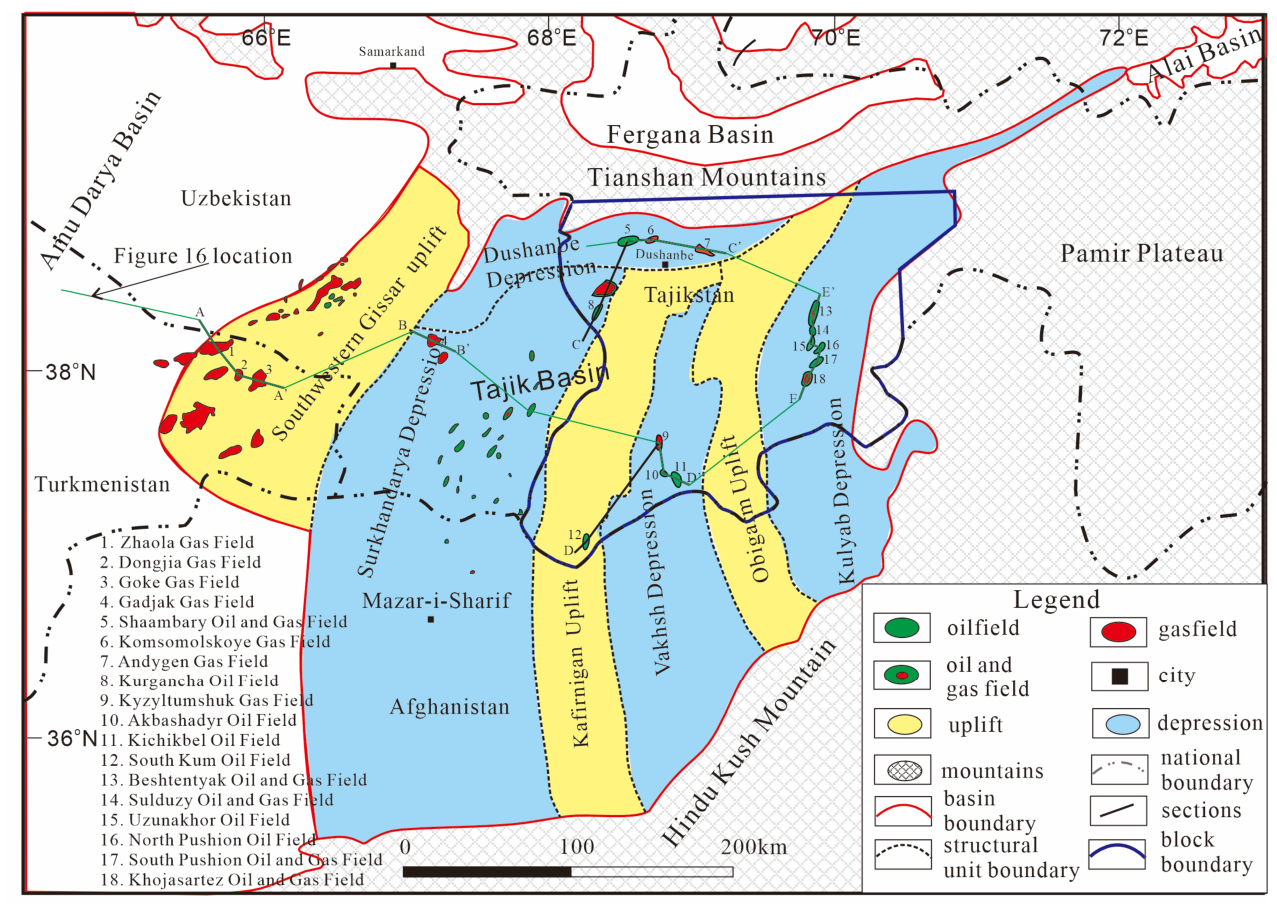
Figure 1).
Previous researchers have conducted in-depth studies on the characteristics of oil and gas reservoirs in the southwestern Gissar Uplift of the Tajik Basin [
7]. However, research on the overall petroleum geological conditions of the Tajik Basin is relatively weak. Previous studies on the types of oil and gas reservoirs, petroleum geological conditions, and exploration potential analysis in the Surkhandarya Depression, the Kafirnigan Uplift in Block B in the east, the Vakhsh Depression, the Kulyab Depression, and the Dushanbe Depression are also relatively scarce.
Block B is located in the southwestern part of Tajikistan in the northeastern part of the Tajik Basin. The most prominent feature of this paper is that it places the Tajik Basin in the tectonic context of the Tethyan tectonic domain. This paper systematically analyzes the tectonic–sedimentary evolution of the Tajik Basin, with a focus on studying the influence of the opening and closing of the Neo/Paleo-Tethys Ocean on the basin’s tectonic evolution, sedimentary filling, and subsequent modification.
The scarcity of core data in the Tajik Basin has posed a significant obstacle to the study of source rocks and reservoirs in the basin. The research team compensated for the lack of core data by utilizing abundant outcrop data. From 2016 to 2025, the research team conducted five field geological surveys in the Tajik Basin, focusing primarily on the outcrops in the northern part of the basin near the Tianshan Mountains, the western part near the Pamir Mountains, and the exposed strata areas within the basin. The project team collected a large number of field outcrop samples of source rocks and reservoirs. The source rock samples were analyzed at the Key Laboratory of Oil and Gas Geochemistry, China National Petroleum Corporation (CNPC), where total organic carbon (TOC) was measured using a carbon–sulfur analyzer to analyze the organic matter abundance of the source rocks, and the maturity of the source rocks was studied using vitrinite reflectance (Ro). The reservoir samples were analyzed at the Key Laboratory of Carbonate Reservoirs, CNPC, where the field outcrop samples were cut into plugs with a diameter of 2.54 cm and a length of 2.54 cm to further measure the porosity and permeability of the plugs, thereby evaluating the physical properties of the reservoirs. The basic experimental data disclosed in this paper can provide significant support for other scholars in their subsequent research.
Based on the experimental analysis data mentioned above, a comprehensive study was conducted on the source rocks, reservoirs, and cap rocks of the basin, and their lithofacies paleogeographic models were established. The author studied the control mechanism of trap formation controlled by the opening and closing of the Tethyan Ocean and the Himalayan orogeny and analyzed the petroleum geological characteristics and distribution patterns of oil and gas in the southwestern Gissar Uplift in the southwest, the Surkhandarya Depression in the west, and the Kafirnigan Uplift, Vakhsh Depression, Kulyab Depression and Dushanbe Depression in Block B in the east. Based on this, the exploration potential for forming large- or medium-scale oil and gas reservoirs in Block B was further evaluated, and the future exploration directions for the basin were pointed out.
2. Structural–Sedimentary Evolution Characteristics
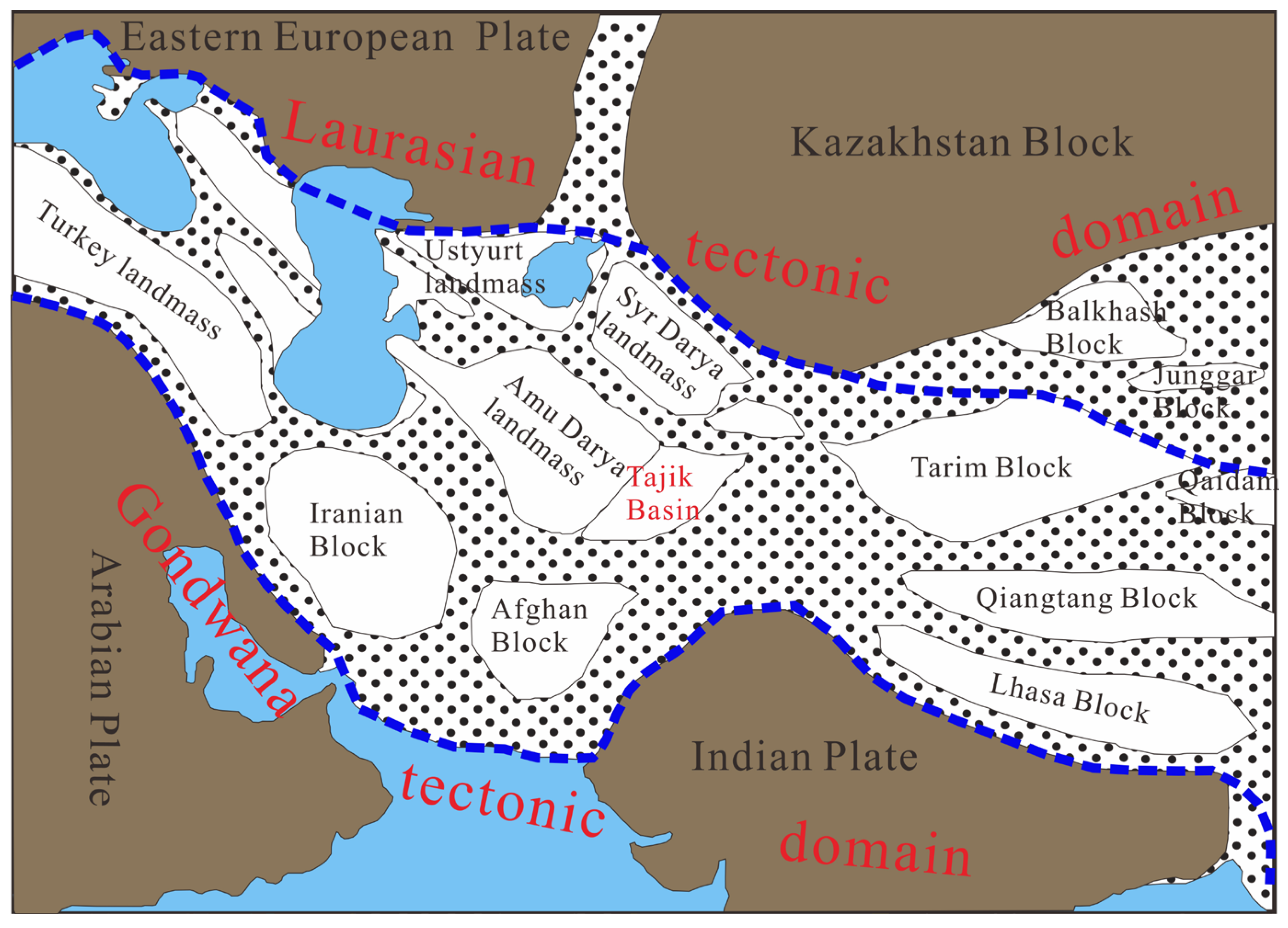
The Tajik Basin is located on the eastern edge of the Central Asian segment of the Tethyan tectonic domain. It is bordered by the Amu Darya block to the west, the Tarim block to the east, the Iranian and Afghan blocks to the southwest, and the Qiangtang and Lhasa blocks to the southeast. These ancient landmasses were all located within the Tethyan tectonic domain, which was sandwiched between the Indian Plate, the Kazakhstan Plate, the East European Plate, and the Arabian Plate in the early stages (
Figure 1).
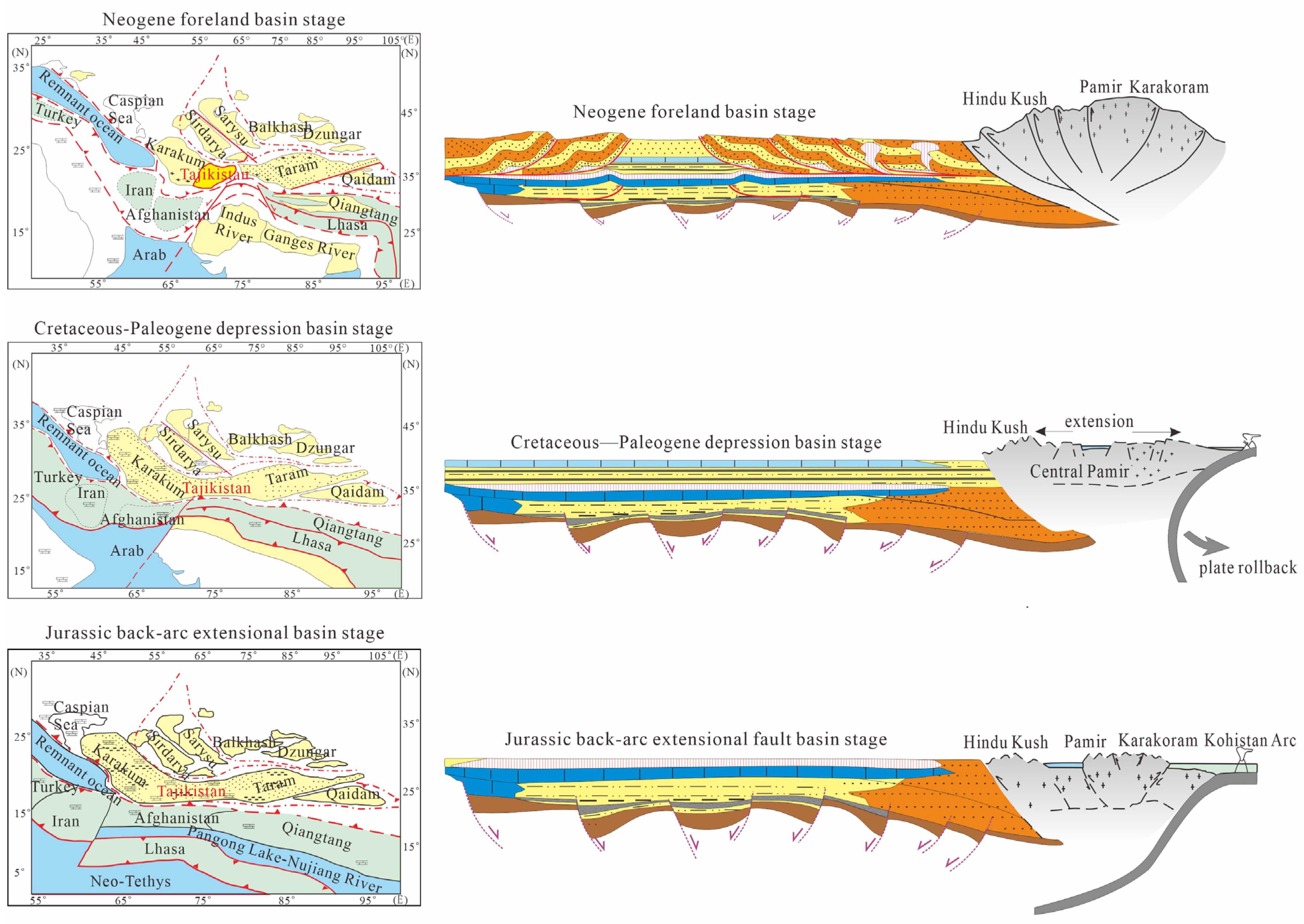
The Tethyan tectonic domain underwent four tectonic movements [
8,
9,
10]: ① The development stage of back-arc foreland basins from the Late Permian to the Triassic: During this period, basins such as the Tajik Basin were interconnected back-arc foreland basins, depositing clastic rocks and intermediate-acid volcanic rocks. From west to east, small-scale marine incursion areas deposited marine sandstone and mudstone. At the end of the Triassic, the Iran–Afghanistan–Qiangtang block collided with the Eurasian Plate, closing the ancient Tethyan Ocean and leaving behind the western oceanic basin. ② Development stage of back-arc extension fault depression in the Jurassic period: During this period, the Neo-Tethyan Ocean subducted northward, leading to back-arc spreading. Under the background of tectonic extension, humid climate, and basin rifting in the early and middle Jurassic, coal-bearing source rocks were developed, forming the most promising set of source rocks in the Tajik Basin. In the middle and late Jurassic, thermal subsidence occurred in the basin, and seawater invaded from west to east, depositing a widely distributed set of carbonate rocks, which formed the most exploration-potential reservoirs in the Tajik Basin. In the late Jurassic, the collision of the Lhasa block, basin uplift, seawater retreat, and arid climate led to the formation of salt–gypsum rocks, creating a widely distributed regional cap rock. ③ Development stage of Cretaceous–Paleogene depression basins: During the Early Cretaceous, the Lhasa block subsided after collision, while the Neo-Tethyan Ocean continued to expand. The Tajik Basin deposited transitional marine–continental sandstone–mudstone and marine mudstone–shale interbedded with limestone. In the Paleocene, large-scale marine transgression occurred again, affecting the Kuqa and southwestern Tarim Depressions. The Tajik Basin mainly deposited limestone and marlstone. During this period, multiple sets of source–reservoir–cap assemblages were formed in the Tajik Basin. ④ Development stage of reactivated foreland basin in the Neogene: The continuous collision between the Indian Plate and the Eurasian Plate has formed a group of regenerated foreland basins. The reactivation of the Gissar orogenic belt has separated the Tajik Basin from the Amu Darya Basin, and the Pamir thrust has divided the Tajik Basin from the Tarim Basin. The Tajik Basin features a bidirectional thrust belt and hosts thick molasse deposits, resulting in an ultra-deep target stratum and making exploration challenging [
11] (
Figure 2 and
Figure 3).
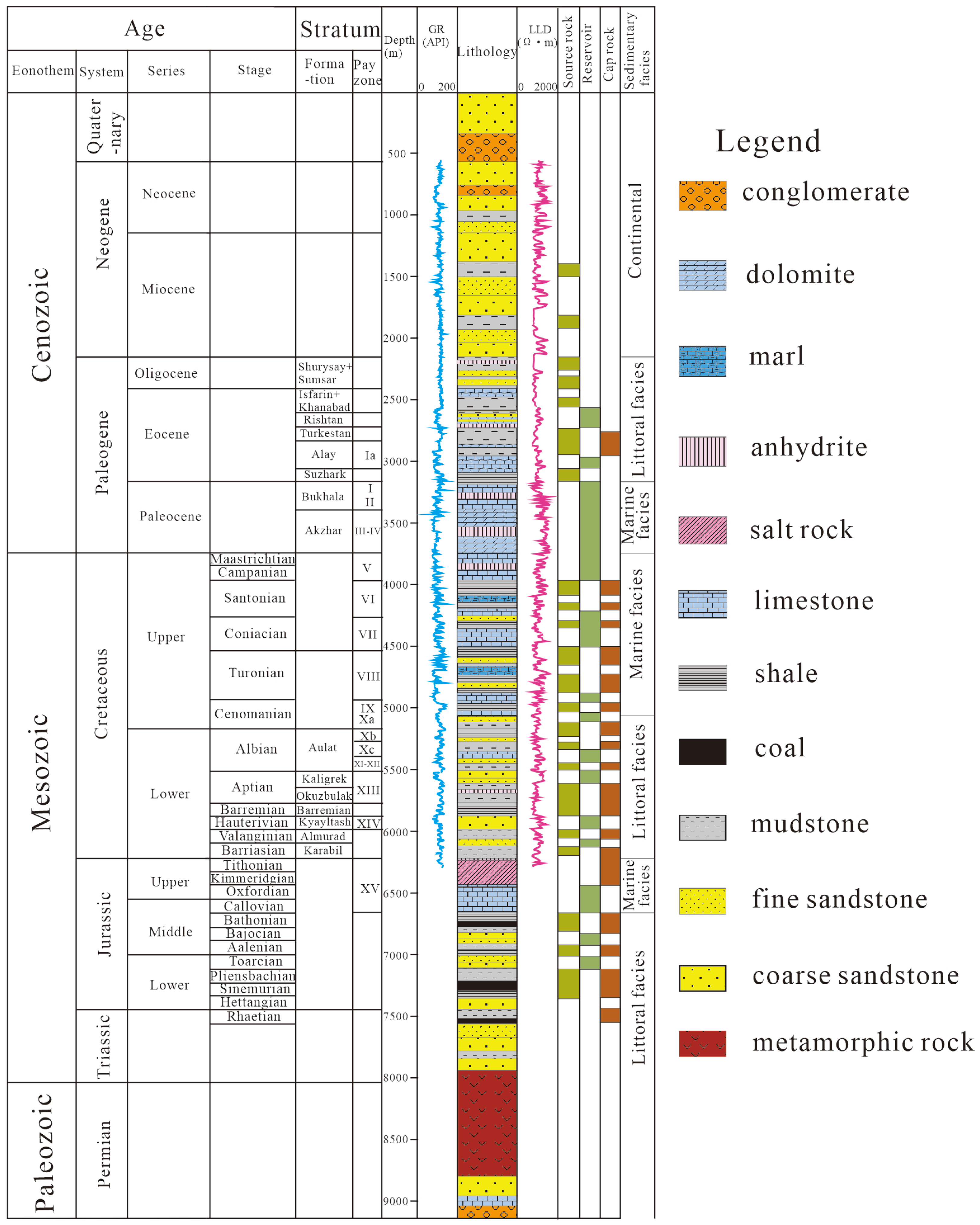
Under the influence of tectonic movements in the Tethyan tectonic domain, the Tajik Basin has successively deposited Triassic transitional facies sediments, coal-bearing clastic rocks of the Middle and Lower Jurassic, carbonate rocks of the Middle and Upper Jurassic, Kimmeridgian–Tithonian gypsum–salt rocks, Cretaceous marine clastic rocks and carbonate rocks, Paleogene marine carbonate rocks–continental clastic rocks, and Neogene–Quaternary clastic rocks and molasse deposits. Kimmeridgian–Tithonian gypsum–salt rocks divide the basin into two sets of oil and gas systems, namely the pre-salt and post-salt systems, and four sets of reservoir–caprock combinations: ① The coal seam–carbonaceous mudstone–mudstone source rocks of the Middle and Lower Jurassic, the Karoo–Oxfordian carbonate rock reservoir, and the Kimmeridgian–Tithonian gypsum–salt rock caprock constitute the most important source–reservoir–caprock combination in the basin. ② The Lower Cretaceous Hauterivian (K1h) and Aptian (K1ap) stages develop a large set of thick sandstones, which are the most important reservoirs in the Lower Cretaceous. The Albian (K1al) stage is characterized by interbedded sandstone and mudstone deposits. The Valanginian and Barremian stages develop thick mudstones, which are the main source rocks and caprock layers in the Lower Cretaceous. The Lower Cretaceous can be vertically subdivided into two sets of source–reservoir–caprock combinations. ③ The lower part of the Upper Cretaceous experienced frequent fluctuations in sea level, resulting in frequent interbedding deposition of sandstone, carbonate rock, and mudstone. The upper part of the Upper Cretaceous underwent marine transgression, depositing a large suite of carbonate rocks. The carbonate rocks and the overlying mudstone formed an effective reservoir–cap rock combination. ④ The Paleogene period continued the deep-water depositional environment of the Late Cretaceous, with the deposition of gypsum rocks and carbonate rocks of the Akzhar Formation (Pg1ak), carbonate rocks of the Bukhara Formation (Pg1bh), mudstones of the Suzak Formation (Pg1sz), carbonate rocks of the Alai Formation (Pg2al), mudstones of the Turkestan–Rishan–Isfara–Khanabad, and sandstones of the Shurase–Sumusar, forming a Paleogene reservoir–caprock combination. All four sets of reservoir–caprock combinations have been discovered to contain oil and gas (
Figure 3).
The Tajik Basin was ultimately formed under the influence of tectonic movements in the Tethyan region. The basin is divided into seven structural units, which, from west to east, are the Southwestern Gissar Uplift, Surkhan Depression, Kafirnigan Uplift, Vakhsh Depression, Obigarm Uplift, and Kulyab Depression, with the Dushanbe Depression, the dipping end of the Surkhan Depression, located in the north (
Figure 4).
3. Reservoir-Forming Conditions
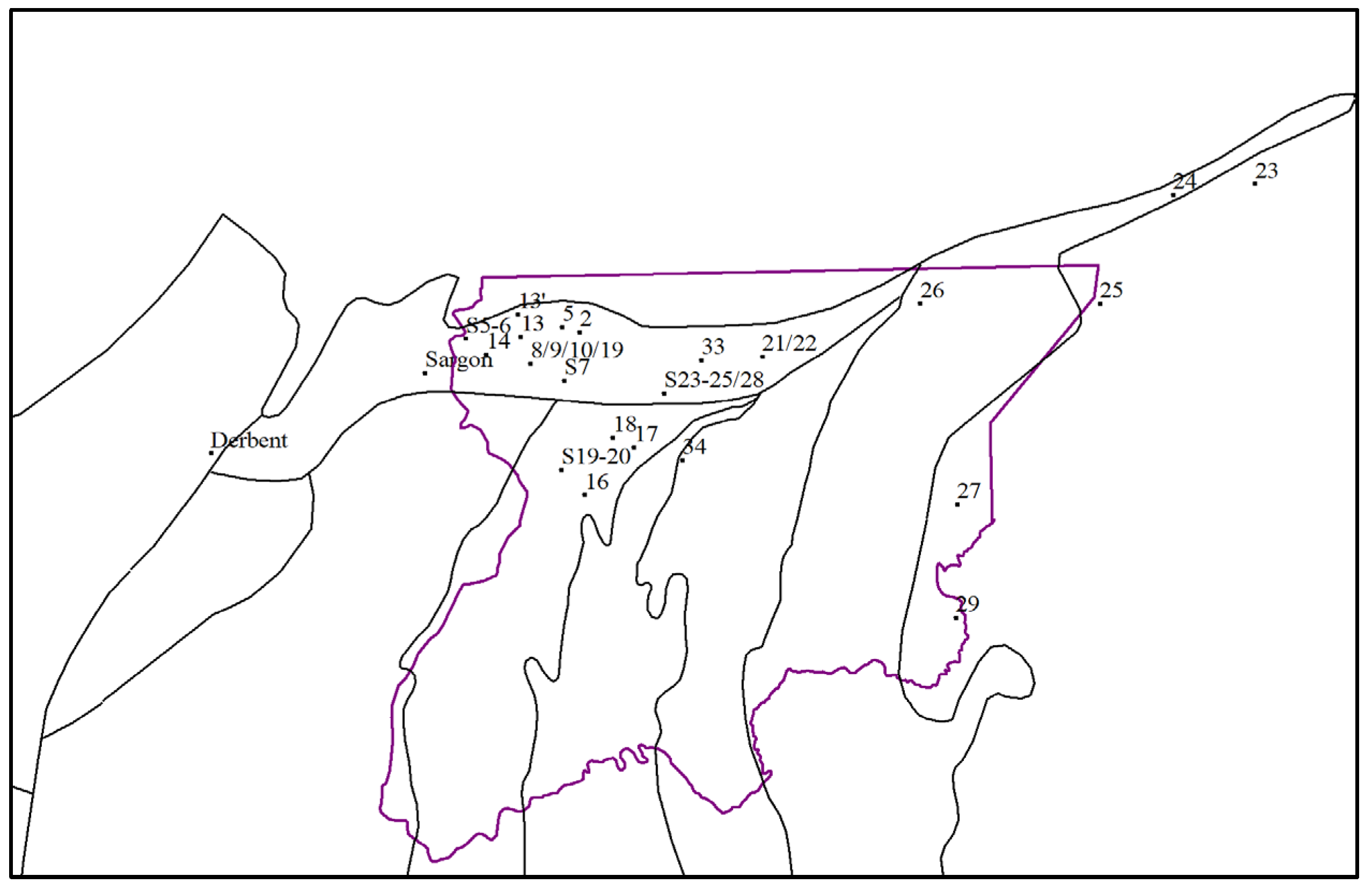
Using field outcrop hydrocarbon source rock samples collected from 2016 to 2025, we analyzed the organic matter abundance and maturity of three sets of hydrocarbon source rocks and assessed the hydrocarbon generation potential of basin source rocks. We also analyzed the porosity and permeability characteristics of the Tajik Basin using field reservoir samples, clarifying the reservoir physical properties and exploration potential. The specific sample locations are shown in the figure below (
Figure 5).
3.1. Source Rock Conditions
The Tajik Basin develops three sets of source rocks, namely the Middle-Lower Jurassic, Cretaceous, and Paleogene ones [
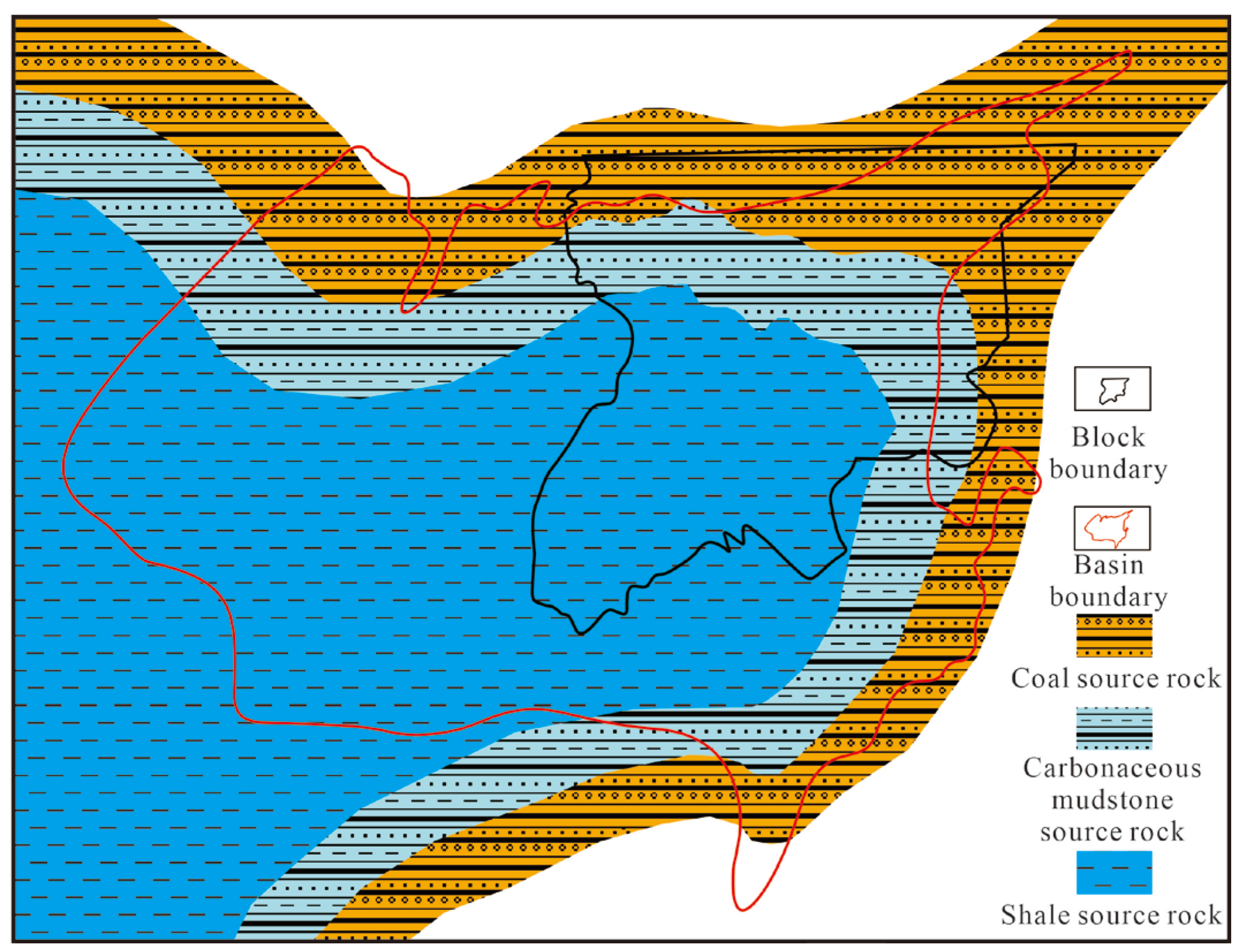
4], which provide an important material basis for oil and gas accumulation in the basin. During the early Jurassic period, the Neo-Tethyan Ocean subducted and collided northward, resulting in relaxation and extension after orogeny, which led to the widespread formation of grabens in the region. The northern part of Block B is an offshore open basin with fluvial–lacustrine facies, depositing coal seams and carbonaceous mudstone source rocks. The southern part is an open basin depositing mudstone source rocks. The Middle-Lower Jurassic coal-bearing source rocks are the most promising set of source rocks in the Tajik Basin. The Middle-Lower Jurassic strata in the Tajik Basin, from the basin interior to the basin margin, successively develop mud shale, carbonaceous mudstone, and coal seams. These strata serve as the natural gas source for the oil and gas reservoirs in the southwestern Gissar Uplift and the Gadjak gas reservoir in the Surkhandarya Depression in the west (
Figure 6).
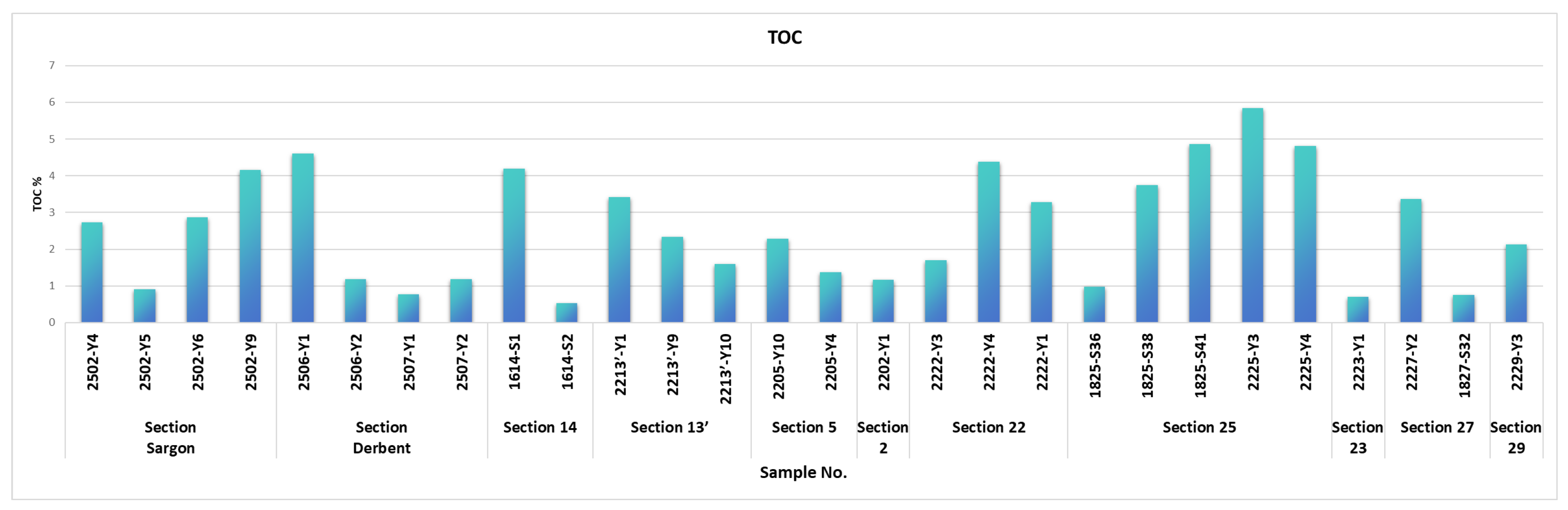
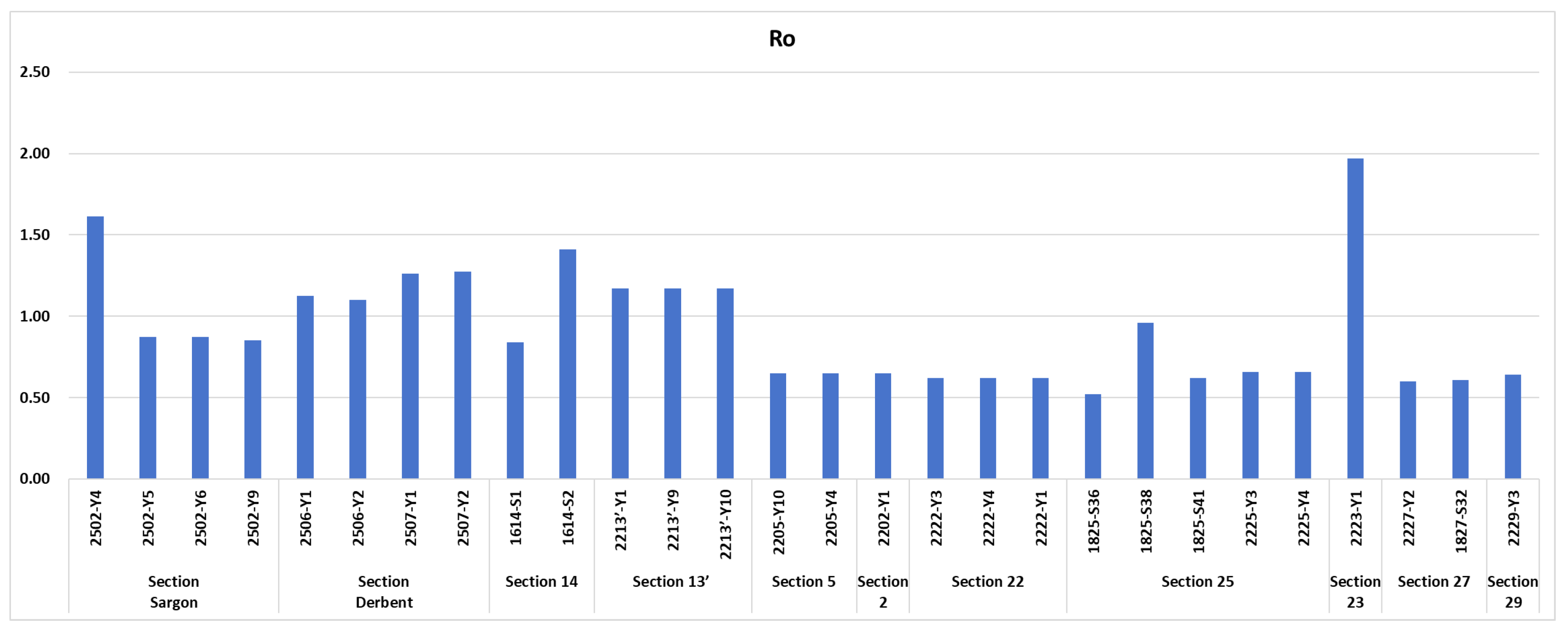
There is no core data available for Block B. Therefore, the potential of deeply buried Jurassic source rocks within the basin is indirectly analyzed through field outcrop samples. The field outcrop samples were uplifted to the surface during the Himalayan period and compared to the same set of strata buried deep within the basin; they have a shorter burial time. Consequently, the quality of deeply buried source rocks within the basin is superior to that of outcrop source rocks. Through analysis of Jurassic source rocks based on outcrop samples from the basin margin, it was confirmed that Block B possesses similar source rock conditions to those in the southwestern Gissar Uplift of the basin and the Surkhandarya Depression. The TOC distribution range of mud shale samples from Block B is 0.54% to 5.84%, with an average of 2.57%; the Ro distribution range is 0.52% to 1.97%, with an average of 0.92%; and the S1 + S2 distribution range is 0.50 to 17.82 mg/g, with an average of 4.05 mg/g. These samples are primarily classified as average to good source rocks. The maturity of the source rock is relatively high, indicating high hydrocarbon generation potential (
Table 1 and
Figure 7 and
Figure 8).
The distribution range of HI values for carbonaceous mudstone is 3 to 377 mg/g, with an average of 148.48 mg/g; the distribution range of S1 + S2 is 0.79 to 120 mg/g, with an average of 42.26 mg/g; the distribution range of TOC is 6.9 to 36.2%, with an average of 13.3%; and the distribution range of Ro for carbonaceous mudstone is 0.57% to 0.89%, with an average of 0.66%. Most carbonaceous mudstones meet the criteria for general-to-high-quality hydrocarbon source rocks, but they have low maturity.
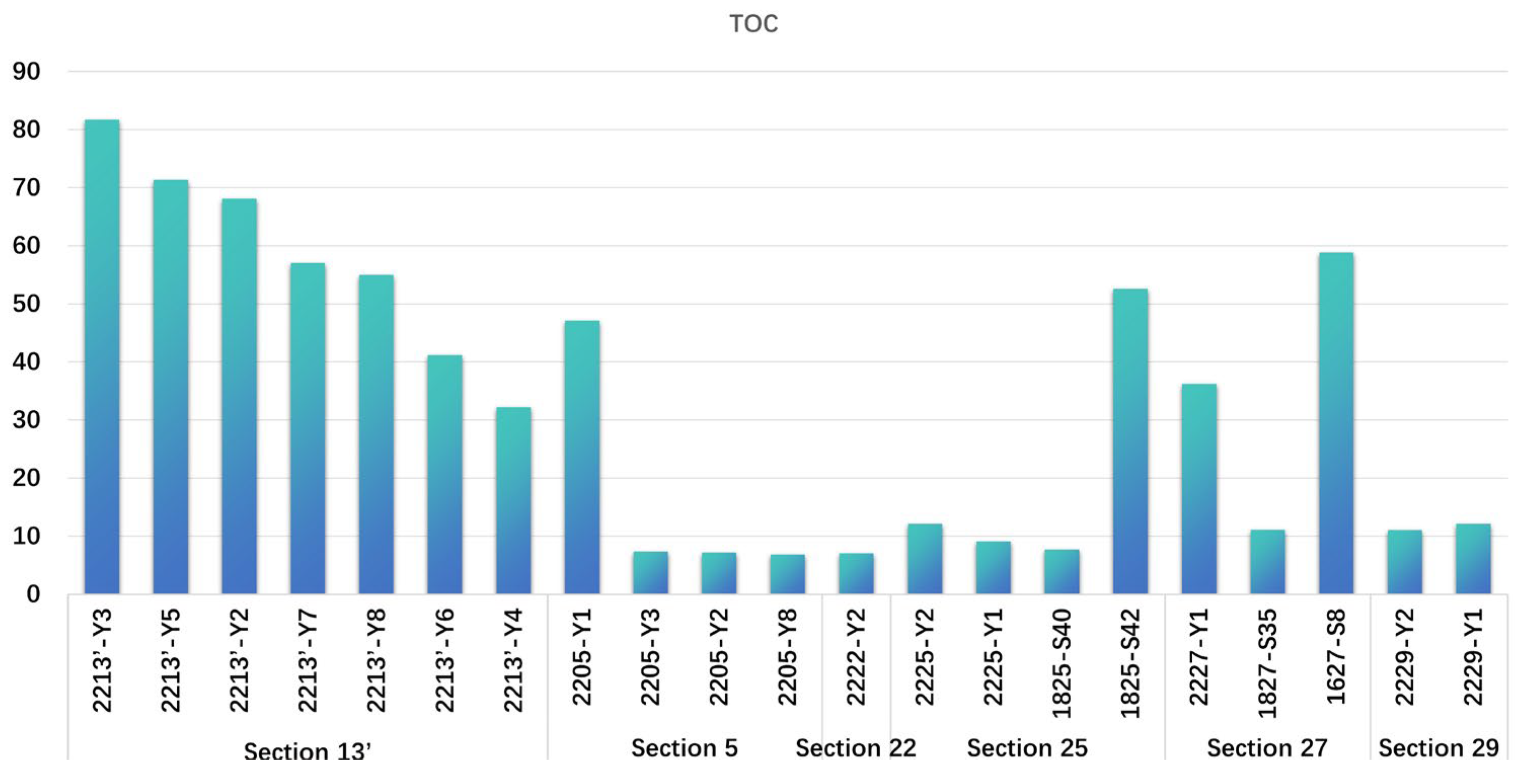
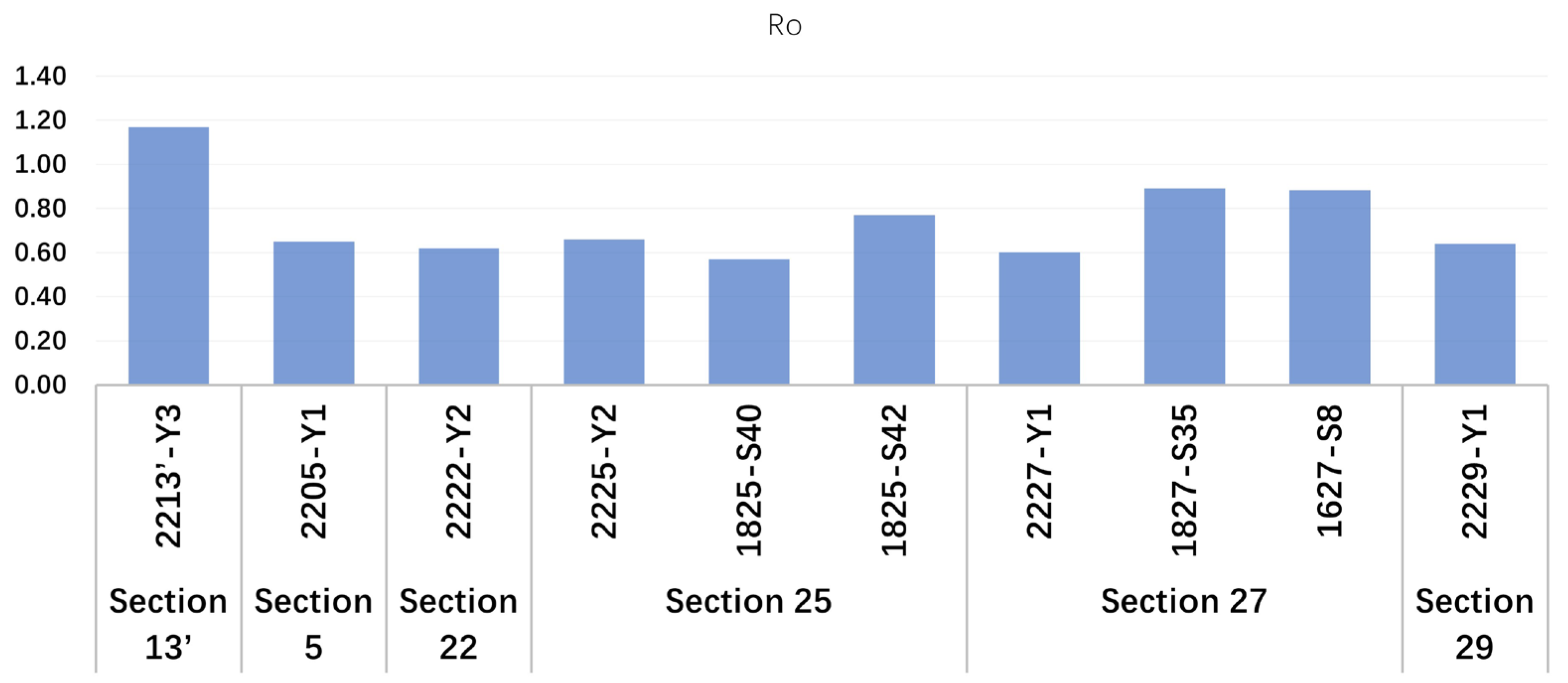
The distribution range of HI values for coal samples is 59–450 mg/g, with an average of 190.84 mg/g; the distribution range of S1 + S2 is 30.74–351.63 mg/g, with an average of 114.75 mg/g; the distribution range of TOC is 41.2–81.7%, with an average of 59.2%; and the distribution range of Ro for coal samples is 0.65–1.17%, with an average of 0.87%. Overall, it belongs to the good hydrocarbon source rock category. The organic matter type of the hydrocarbon source rocks in the Middle-Lower Jurassic is mainly humic (II2–III type) kerogen, and most of the hydrocarbon source rocks are in a mature state. Analysis of basin margin samples confirms that the Middle-Lower Jurassic in Block B has superior hydrocarbon source rock conditions (
Table 2 and
Figure 9 and
Figure 10).
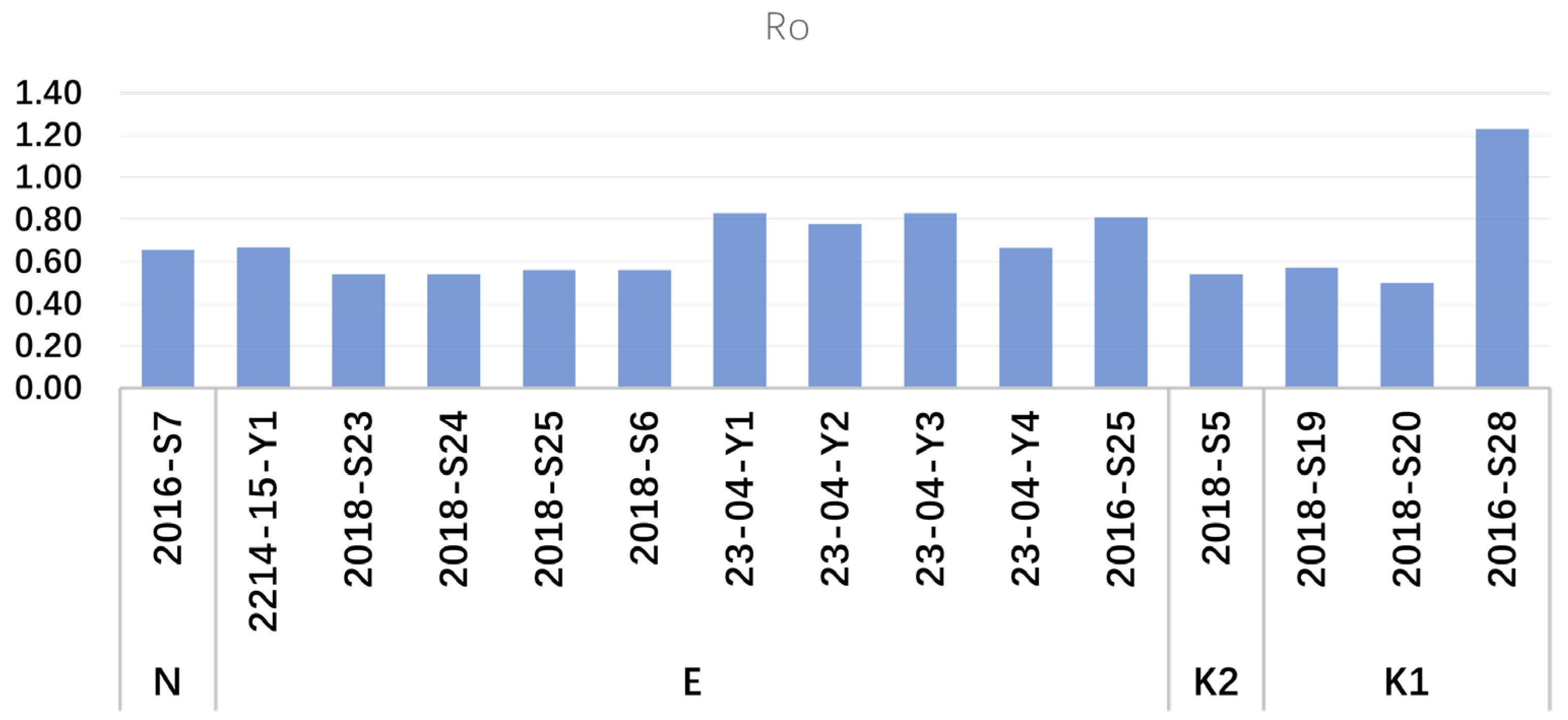
After the Lhasa block collided and merged northward in the Early Cretaceous, the Tajik Basin subsided, forming a transitional marine–continental sedimentary environment. This led to the deposition of mudstones of the Vanlanyin (K1v) and Albian (K1al) stages. In the Late Cretaceous, the Neo-Tethyan Ocean continued to subduct, causing back-arc extension and a west-to-east marine transgression, which formed a marine sedimentary environment. This resulted in the deposition of mudstones and shales of the Turonian (K2t) and Cenomanian (K2sn) stages. The total organic carbon (TOC) content of the Cretaceous system ranges from 0.63% to 1.41%, with an average of 1.14%. The organic matter abundance meets the criteria for source rocks. The organic matter types are primarily composed of sapropel and chitinite (types II1–II2). The maturity (Ro) values range from 0.50 to 1.23, with an average of 0.71. The source rocks are in a low-mature to mature state.
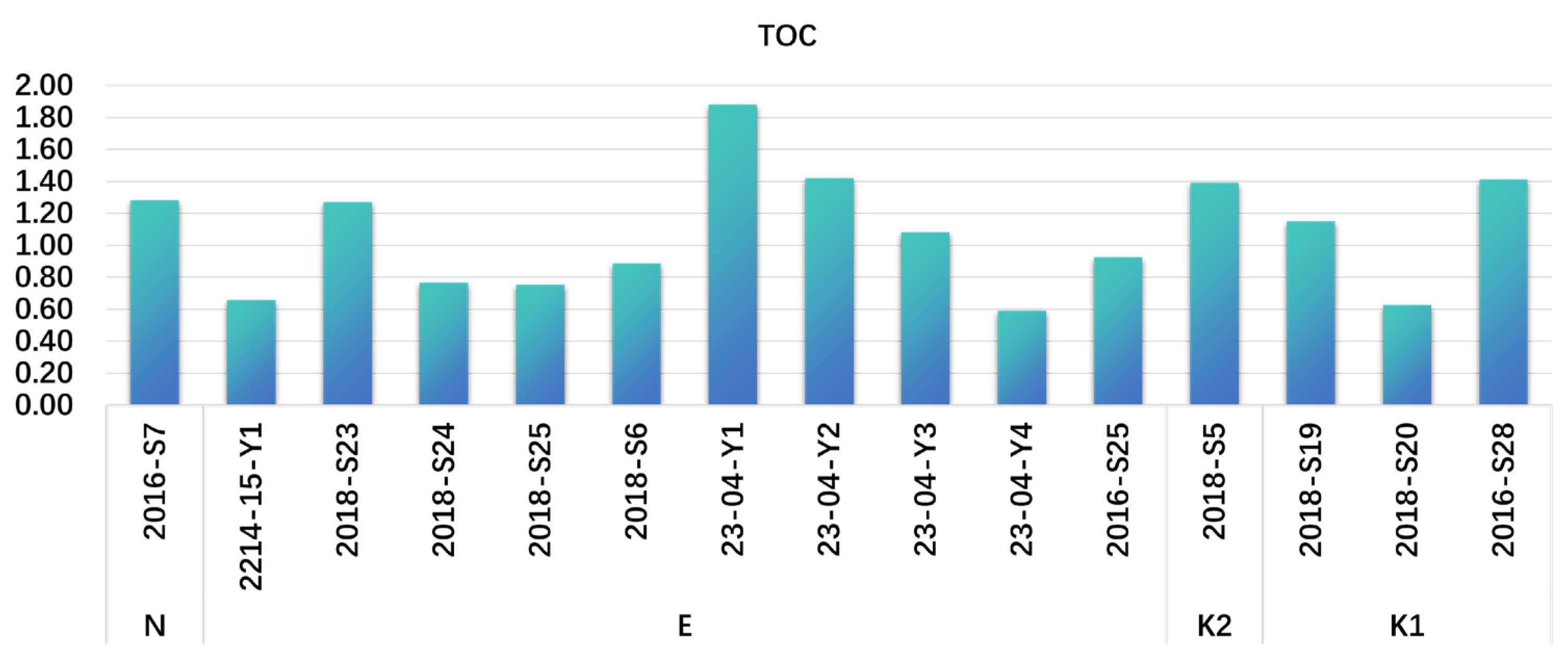
At the beginning of the Paleocene, the Tajik Basin experienced another large-scale marine transgression, which affected the Kuqa Depression and the Southwestern Tarim Basin Depression in the Tarim Basin. The Tajik Basin mainly deposited mudstone and marlstone. The Akzhar (E1ak) Formation marlstone, Suzak (E2sz) Formation marlstone, and Lishitan (E2li) Formation mudstone are Paleogene source rocks. The Paleogene total organic carbon (TOC) ranges from 0.59% to 1.88%, with an average of 1.02%, indicating a high abundance of organic matter. The type of organic matter in the Paleogene is dominated by the sapropel group, supplemented by the chitin group, belonging to type I–II1. The maturity (Ro) ranges from 0.54 to 0.83, with an average of 0.68, indicating that the source rocks are in a low-mature state. The above-mentioned samples are all basin-edge samples. Samples within the basin are buried deeper and for longer periods of time, so the maturity of source rocks within the basin is higher than that of basin-edge source rocks, and the basin has more favorable conditions for source rocks (
Table 3 and
Figure 11 and
Figure 12).
3.2. Reservoir Conditions
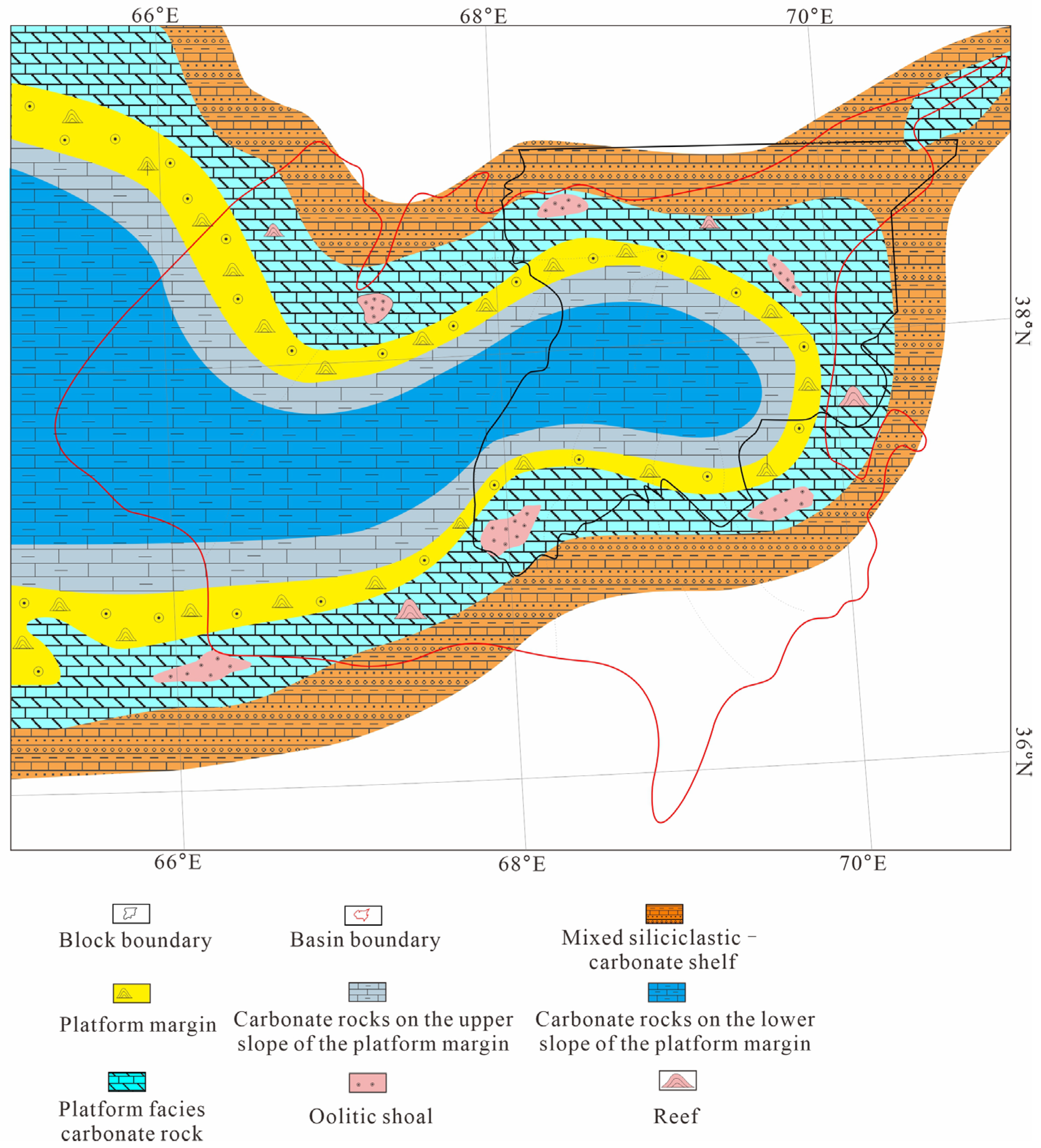
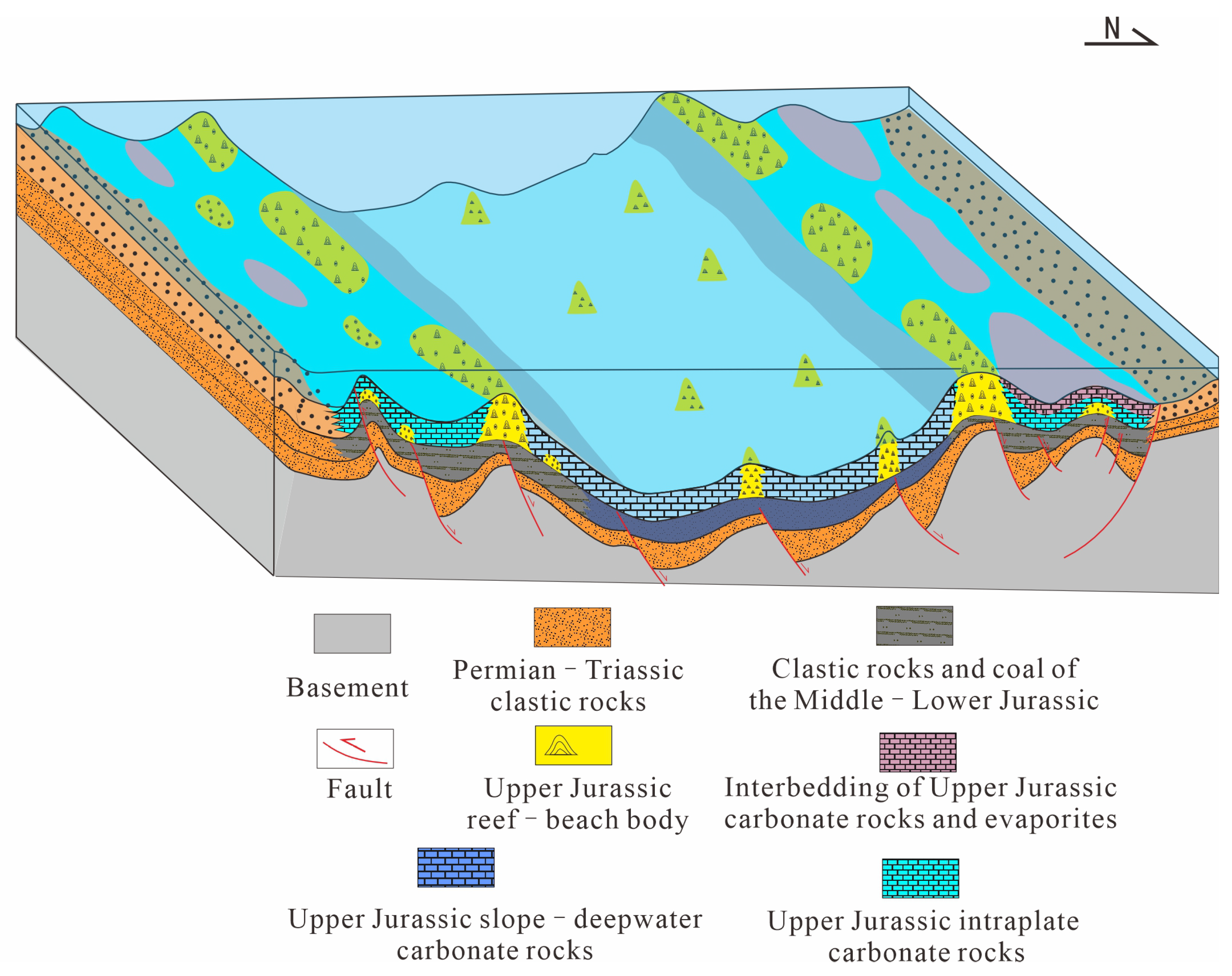
The Tajik Basin develops three sets of reservoirs: the Middle-Upper Jurassic carbonate rocks, the Cretaceous clastic–carbonate rocks, and the Paleogene carbonate rocks. During the Middle-Late Jurassic, regional thermal subsidence occurred in Central Asia after orogeny, and the Neo-Tethyan Ocean experienced large-scale marine transgression from west to east. From the basin margin to the basin interior, mixed continental shelf–coastal facies clastic rocks, platform facies carbonate rocks, and platform margin and slope facies carbonate rocks were deposited in sequence. The carbonate rocks deposited during this period formed the reservoir with the greatest exploration potential in the Tajik Basin, with the platform margin reef zone and platform facies reservoirs having the best physical properties, followed by the slope area (
Figure 13 and
Figure 14). Generally, carbonate reef–beach bodies are mainly developed on the platform margin and early paleo-uplifts within the platform. The platform margin slope mainly hosts rock types such as fine-grained micrite limestone [
12,
13,
14,
15], resulting in relatively low exploration potential for the platform margin slope and difficulty forming large and medium-sized gas reservoirs [
7].
The carbonate rocks of the Middle-Upper Jurassic are the reservoirs for the southwestern Gissar Uplift, the Gadjak natural gas reservoir in the Surkhandarya Depression, and the Jurassic gas reservoir in Block B’s Dushanbe Depression. In the southwestern Gissar Uplift, due to the relatively flat slope landform of the carbonate platform margin of the Middle-Upper Jurassic, coupled with high water energy, high-energy beach bodies and ramp–reef–beach complexes dominated by barrier–accretionary–clay beaches have developed at high parts of the ancient landform or at topographic transitions [
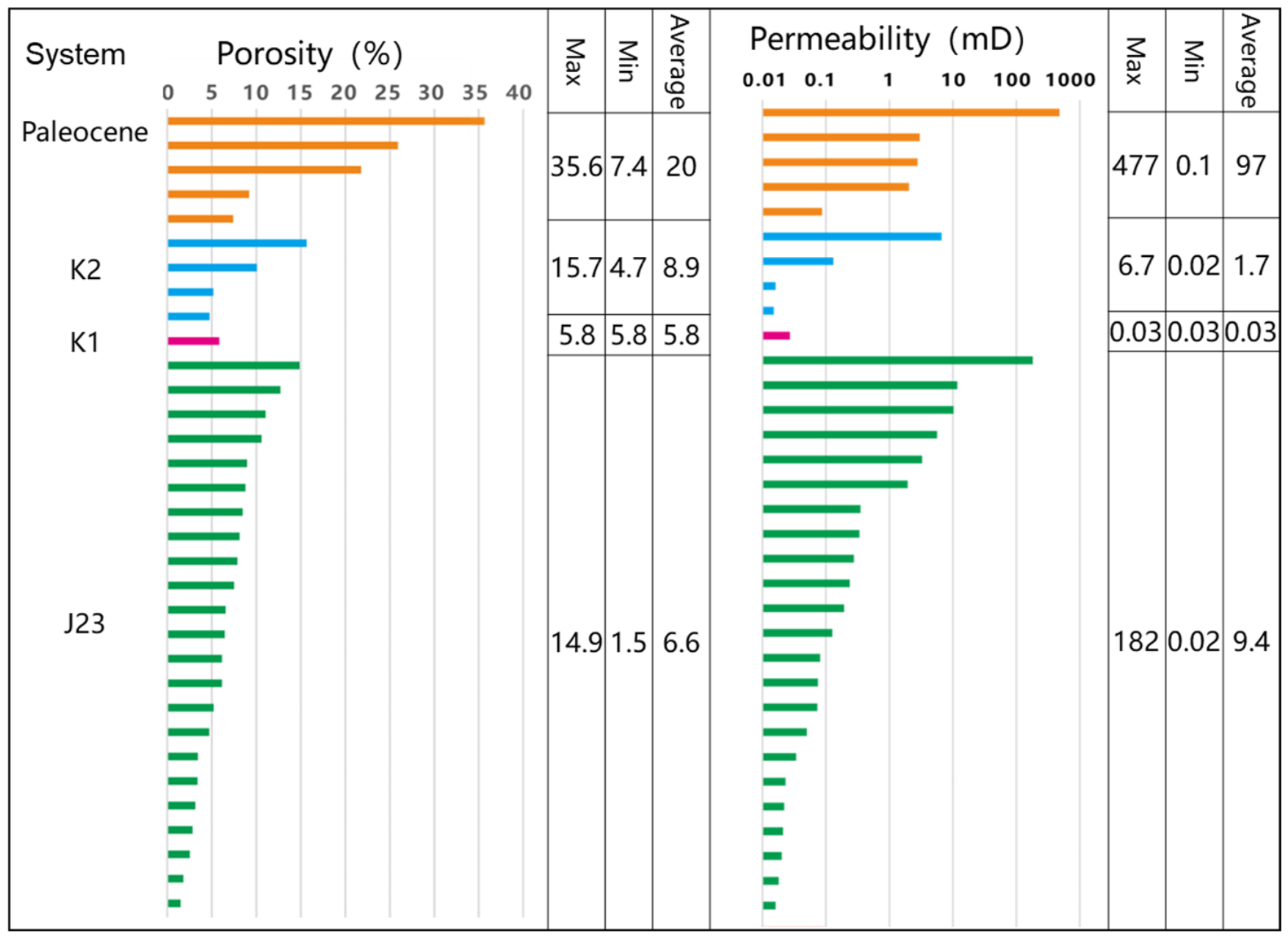
7], forming good carbonate reservoirs. Additionally, after experiencing intense tectonic movements in the later stages, a large number of fractures were formed, significantly improving the reservoir’s physical properties. The Jiajake gas reservoir in the western Surkhandarya Depression is a typical platform-facies depositional environment, widely developing intra-platform beach deposits. In its northern part, typical seismic reflection characteristics of platform-margin facies hilly aggradation and thickening are observed, indicating that the high-quality depositional facies belt of the platform-margin facies widely developed in the Amu Darya basin can extend to the Surkhandarya Depression in the Tajik basin. In the northern part of Block B, where the Upper Jurassic salt layers are not developed, the Shaambary, Komsomolskoye, and Andygen gas reservoirs encountered Jurassic carbonate rocks and discovered natural gas. Due to the lack of core data for Block B, the characteristics of the Jurassic carbonate reservoirs in Block B were indirectly studied through field outcrops in the north. The field outcrops in the northern edge of Block B show lithologies such as reef limestone, high-energy beach facies bioclastic limestone, micrite grain limestone, sparry bioclastic limestone, and dolomite. Microscopically, reef-building organisms such as bryozoans and green algae are observed, and pores and fractures are very developed. The maximum porosity of the Middle-Upper Jurassic is 16.7%, with an average of 7%, and the maximum permeability is 182 md, with an average of 9 md. The discovered reservoirs and outcrop reservoir characteristics confirm that the Jurassic carbonate rocks in Block B have good reservoir conditions.
In the early Cretaceous, the waters of the Neo-Tethyan Ocean gradually receded, and continental clastic sandstone reservoirs developed in the Lower Cretaceous. In the northern basin margin of Block B, outcrops of Lower Cretaceous Hauterivian channel sandstone with a thickness of up to 154 m are visible. The maximum porosity of the Lower Cretaceous clastic rocks is 23.4%, the minimum is 5.7%, and the average is 13.4%. The maximum permeability is 490 md, the minimum is 0.03 md, and the average is 65.8 md. In the late Cretaceous, seawater invaded again, and the Upper Cretaceous deposited marine–continental sediments. The lower part of the Upper Cretaceous developed clastic reservoirs, while the upper part developed carbonate reservoirs. The maximum porosity of the Upper Cretaceous is 15.7%, the minimum is 4.7%, and the average is 8.3%. The maximum permeability is 22 md, the minimum is 0.02 md, and the average is 5.4 md. In the northern Dushanbe Depression, sandstone gas reservoirs of the Lower Cretaceous Hauterivian, Albian, Aptian, and Upper Cretaceous Cenomanian stages have been discovered in the Communist Youth League and Andijan gas reservoirs. In the southern Kizil Tumshuk gas reservoir, a carbonate gas reservoir at the top of the Upper Cretaceous has been discovered.
During the Paleocene, the Neo-Tethyan Ocean underwent another large-scale marine transgression, affecting the Kuqa and southwestern Tarim Depressions. Due to the favorable sedimentary facies and shallow burial depth, the Paleogene system in Block B of the Tajik Basin developed thick, high-quality carbonate reservoirs. The maximum porosity of the Paleogene carbonate reservoirs is 35.6%, the minimum is 7.4%, and the average is 20%. The maximum permeability is 477 md, the minimum is 0.09 md, and the average is 97 md. The Paleogene carbonate reservoirs are the main reservoir types for the Paleogene carbonate oil and gas reservoirs in the southern and eastern parts of Block B as well as the multi-layered and multi-lithological oil and gas reservoirs in the northern part of Block B. The three sets of reservoirs in the Tajik Basin provide favorable storage space for oil and gas accumulation (
Figure 15 and
Table 4).
3.3. Covering Conditions
The gypsum–salt rocks and mudstones developed in the basin provide favorable sealing conditions for the formation of oil and gas reservoirs [
16]. The Tajik Basin hosts two sets of gypsum–salt rocks—the Upper Jurassic gypsum–salt rocks and the Paleogene gypsum–salt rocks. The Upper Jurassic gypsum–salt rocks provide effective sealing conditions for the carbonate rocks of the Karoo–Oxfordian stage of the Middle-Upper Jurassic, playing a significant role in the effective accumulation and preservation of pre-salt natural gas, such as the Jurassic carbonate gas reservoirs in the southwestern Gissar Uplift and Surkhandarya Depression in the southwest. This set of gypsum–salt rocks is widely distributed, covering almost the entire Amu Darya Basin and Tajik Basin, with only a pinch-out occurring in the Dushanbe Depression in the northern part of the Tajik Basin. The thickness of this set of gypsum–salt rocks is considerable, with the maximum thickness of salt–gypsum rocks reaching 1000 m in the Amu Darya Basin, being thinner in the west and thicker in the east. Drilling in the Tajik Basin has revealed 3000 m of gypsum–salt rocks. The Paleogene strata were strongly modified by tectonic movements during the Himalayan period, resulting in frequent detachment and thrust faults along the gypsum–salt rock layers. These layers form sealing layers above the oil and gas reservoirs or provide lateral barriers to the reservoirs. The Khojasartez and South Pushion oil and gas reservoirs in the eastern oil-bearing area of Block B are typical examples of laterally sealed oil and gas reservoirs in gypsum–salt layers. The sealing layers for the pore-fracture carbonate oil and gas reservoirs and the composite pore–fracture carbonate–clastic rock oil and gas reservoirs in the eastern part of the basin are local mudstone and shale cap rocks.
3.4. Trap Conditions
After the closure of the Paleo-Tethyan Ocean in the Triassic period, stress relaxation occurred, leading to the formation of a back-arc extensional fault depression during the Early and Middle Jurassic. Following the collision and compression between the Indian Plate and the Eurasian Plate during the Himalayan period, the fault block traps of the Early and Middle Jurassic were reactivated and reshaped. Under the regulating effect of the salt layer on the top of the Jurassic system, the deformation intensity below the salt was relatively low, resulting in the development of wide and gentle (faulted) anticlinal structures. The strata above the salt were significantly affected by the tectonic movements during the Himalayan period, with strong thrusting in the shallow layers above the salt, ultimately forming structural traps such as fault noses and faulted anticlinal structures.
4. Characteristics of Oil and Gas Reservoirs
The southwestern Gissar Uplift and Surkhandarya Depression in the western part of the Tajik Basin are similar to the Amu Darya Basin, with Jurassic carbonate gas reservoirs developed. The Gissar Uplift features a significant uplift amplitude and shallow burial depth for its oil and gas reservoirs. The Gadjak gas reservoir in the Surkhandarya Depression is located at the secondary step of the depression, with a deeper structural position compared to the Gissar Uplift. The southern and eastern parts of the Vakhsh Depression and the Kulyab Depression in the Tajik Basin host Paleogene carbonate oil and gas reservoirs. Due to the intense tectonic movements during the Himalayan period in Block B, thick layers of Neogene and Quaternary sediments were deposited, resulting in deeper burial depths for the target strata and greater exploration difficulties (
Figure 8). The northern part of Block B features multi-layered and multi-lithological oil and gas reservoirs composed of Jurassic–Cretaceous–Paleogene carbonate and clastic rocks (
Figure 16).
4.1. Jurassic Carbonate Gas Reservoir
The primary controlling factor of this type of oil and gas reservoir is the sedimentary facies belt. The thermal subsidence following the orogeny of the Late Jurassic in the Tethyan tectonic domain led to a large-scale marine transgression in the Tajik Basin. The thick carbonate rocks deposited during this period provided excellent reservoir conditions for the Tajik Basin. The gypsum–salt rocks deposited in the Late Jurassic provided good sealing conditions for this set of carbonate rocks. The coal-bearing source rocks of the Middle and Lower Jurassic provided superior gas source conditions for this set of carbonate rocks. Under the tectonic movement of the Himalayan period, the pre-salt traps were reshaped and finalized, forming Jurassic carbonate gas reservoirs. The unique feature of this type of oil and gas reservoir is that it only contains gas in the pre-salt Jurassic system. This type of oil and gas reservoir is distributed in the southwestern Gissar Uplift and Surkhandarya Depression in the western part of the basin.
The largest Jurassic carbonate gas reservoir in the Tajik Basin is located in the southwestern Gissar Uplift, the westernmost part of the basin, which belongs to Turkmenistan. The trap type is faulted anticlinal [
17], and the productive layer is the Middle-Upper Jurassic Karoo–Oxfordian carbonate rock. The sedimentary facies type is the platform margin upper slope zone, where the platform margin upper slope develops into clusters of gentle slope reef beaches [
18], mainly composed of bioclastic beaches, barrier reefs, and boundstone mounds. The reservoir matrix has poor physical properties and is strongly influenced by the tectonic movements during the Himalayan period, forming fractured, corroded, cavity and porous carbonate reservoirs. Marlstone, which usually serves as a cap rock or interlayer, can also form high-yield fractured–cavity reservoirs [
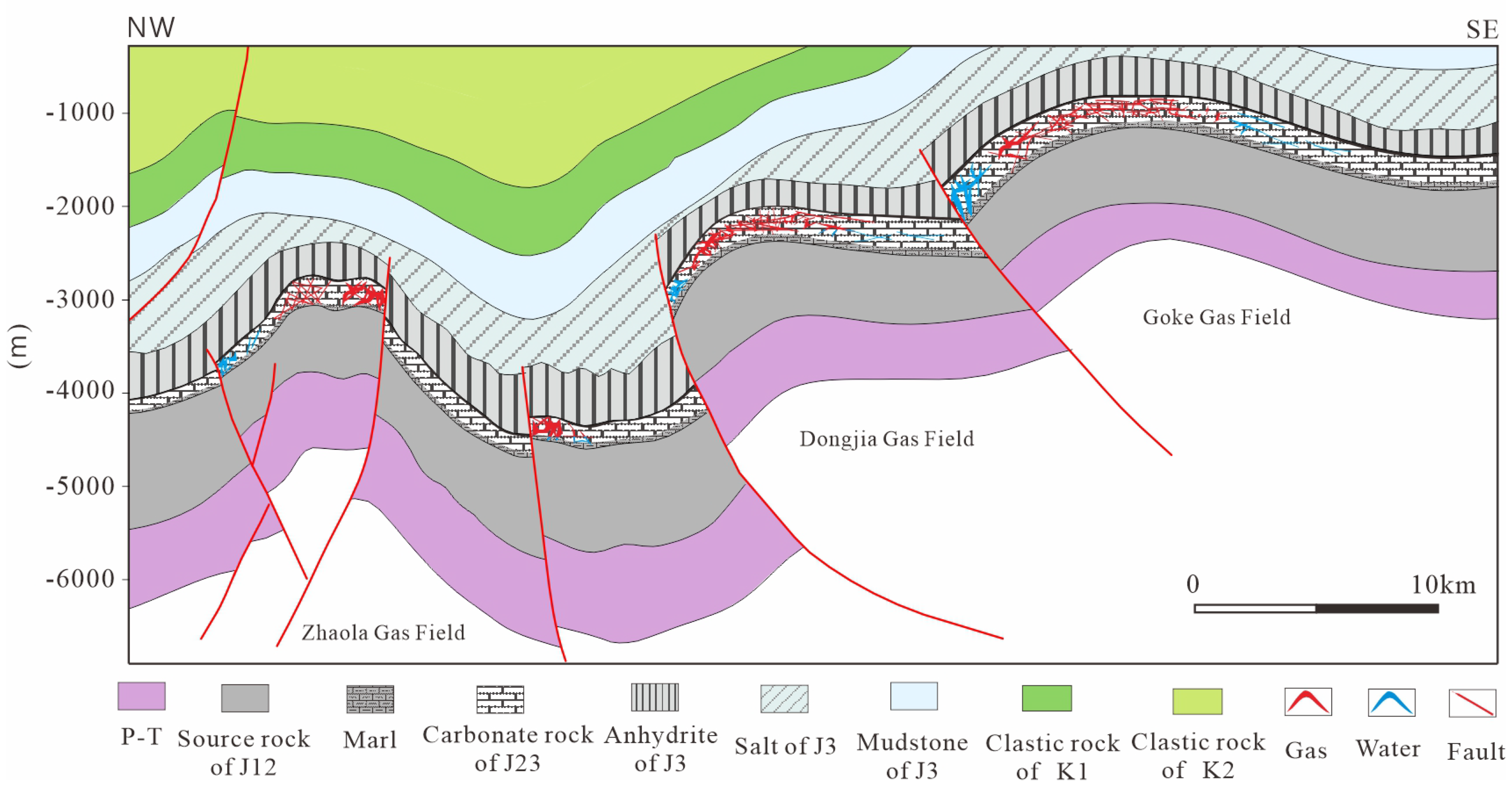
19]. Generally, fractured–corroded pore–cavity reservoirs mainly develop along the main controlling faults. These reservoirs are significantly influenced by tectonic movements and weakly controlled by sedimentary facies zones, such as the Zhaola gas reservoir. Fractured–porous reservoirs usually develop away from faults, where tectonic fracturing and burial dissolution weaken. They are more strongly influenced by sedimentary facies zones. The higher the energy of the reef beaches, the better the reservoir physical properties, such as the Dongjia and Goke gas reservoirs. Faults are the main migration pathways for gas reservoirs, so they are significantly controlled by faults. The closer to the faults, the stronger the natural gas injection, the lower the gas–water contact, and the higher the single-well production [
20] (
Figure 17).
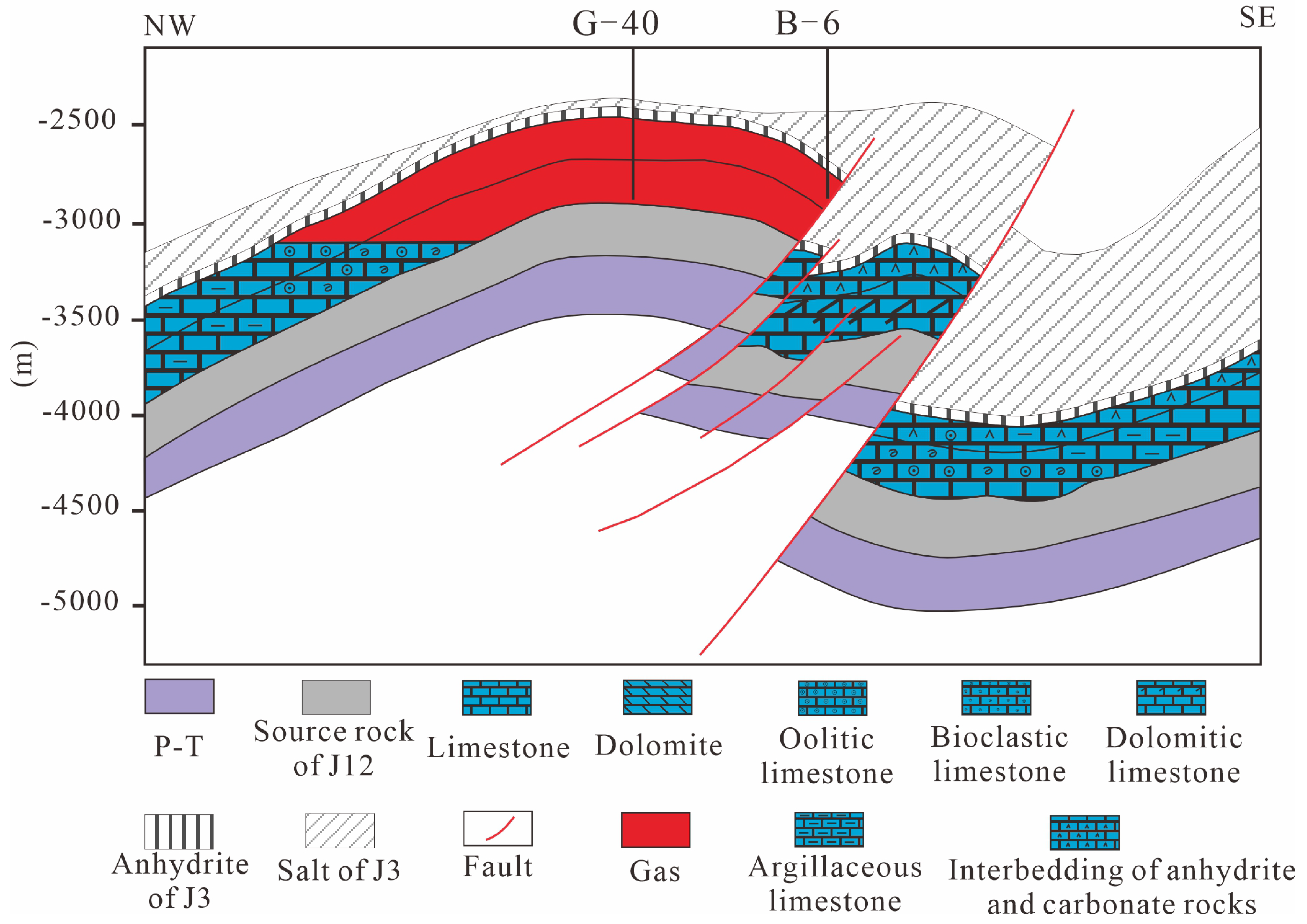
The Gadjak gas reservoir, the second largest Jurassic carbonate gas reservoir in the Tajik Basin, is located in the northern part of the Surkhandarya Depression. This gas reservoir belongs to Uzbekistan (
Figure 1). It is controlled by a set of inherited northeast–southwest faults in the southeast, forming a faulted anticlinal gas reservoir. The faults are divided into two phases: the early faults are normal faults controlling the distribution of local fault depressions, while the late faults are reverse faults controlling the trap morphology. The carbonate reservoir of the Gadjak gas reservoir is divided into two sections: the upper section consists of interbedded deposits of evaporative platform and restricted platform low-energy grain-clast beach and high-energy bioclastic beach, with frequent interbedding of limestone and anhydrite, locally developing argillaceous limestone and granular limestone, with a thickness of 213–412 m and a high resistivity; the lower section consists of open platform and restricted platform deposits, developing limestone, dolomite, granular limestone, bioclastic limestone, argillaceous limestone, dolomitic limestone, etc., with no anhydrite observed and a low resistivity. The carbonate rocks have not been drilled through. The reservoir of the Gadjak gas reservoir is mainly of pore–cavity-type platform beach reservoirs, with a wide lateral distribution area, significantly affected by sea-level fluctuations. Fracture–pore–cavity-type reservoirs are developed near the faults (
Figure 18). The main controlling factor of the Jurassic carbonate gas reservoir is the sedimentary facies belt, and late tectonic movements have played a promoting role in the formation of oil and gas reservoirs.
4.2. Paleogene Carbonate Reservoirs
The Tethyan tectonic domain experienced another large-scale marine transgression during the Paleogene period, resulting in the deposition of thick carbonate rocks in the Paleogene system of the Tajik Basin. The main controlling factor for the oil and gas reservoirs in the Paleogene carbonate rocks of the Tajik Basin is the carbonate depositional facies belt directly influenced by the marine transgression. Due to this marine transgression, extensive Paleogene carbonate reservoirs were formed in Block B. The source rocks of this set of reservoirs are derived from Cretaceous source rocks, and the cap rocks are local marl cap rocks located above the reservoirs. Due to the intense tectonic movements during the Himalayan period, the requirements for cap rocks in oil and gas reservoir formation are very high. Whether an effective reservoir–cap rock combination can be formed is a key factor determining whether effective oil and gas accumulation can occur in this set of reservoirs. The typical characteristics of the Paleogene carbonate oil and gas reservoirs in Block B are ① their location in a depression area with good surface conditions, where the terrain is relatively flat, the degree of fracturing is weak, and the preservation conditions are good; and ② the development of underground traps that were formed relatively early, having already taken on a rudimentary form before the last phase of the Himalayan movement and further being reshaped and finalized during the Himalayan period.
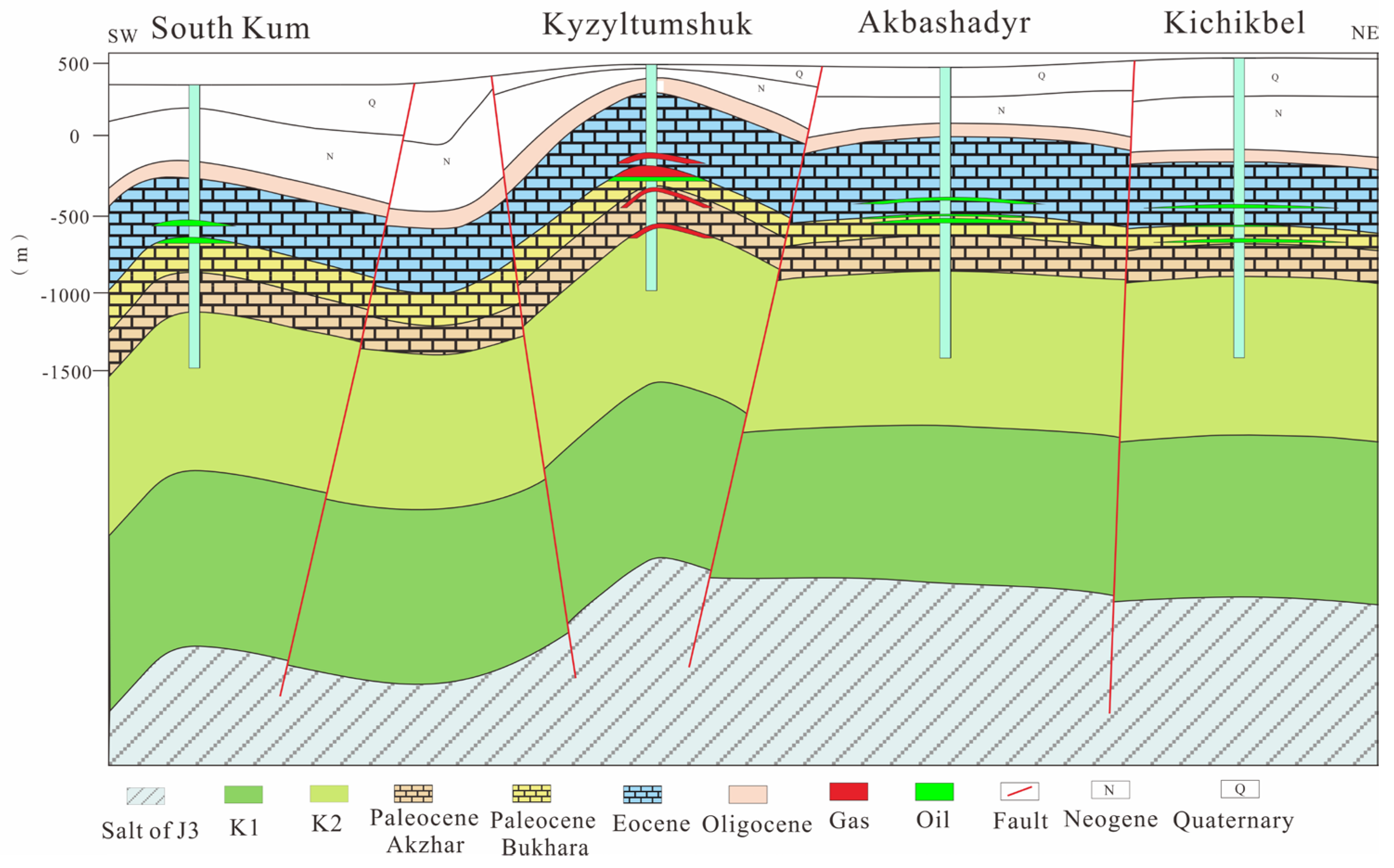
Four Paleogene carbonate reservoirs have been discovered successively in the Kafirnigan Uplift of Block B and the southern part of the Vakhsh Depression. Among them, the Kyzyltumshuk gas reservoir, the Akbashadyr oil reservoir, and the Kichikbel oil reservoir are located in the sag–uplift of the southern margin of the Vakhsh Depression, while the South Kum oil reservoir is located in the southernmost part of the Kafirnigan Uplift. All four reservoirs are anticlinal reservoirs, with the oil- and gas-bearing strata being Paleogene. The Kyzyltumshuk structure, the only gas reservoir, is the highest in structural position, with three sets of oil- and gas-bearing strata developed in the Paleogene and one set of gas-bearing strata developed in the Cretaceous. The reservoir type is primarily porous, supplemented by fractured, with a reservoir thickness ranging from 13 to 91 m, a gas-bearing thickness ranging from 15.4 to 65.2 m, a porosity ranging from 10 to 20%, a permeability ranging from 4.85 to 247 md, and a formation temperature ranging from 48.6 to 51.9 °C. The other three reservoirs are oil reservoirs, located at lower structural positions than the Kyzyltumshuk gas reservoir, and all contain oil in the Paleocene Bukhara Formation and Eocene Alai Formation carbonate rocks. The Akbashadyr oil reservoir has a reservoir type of fractured–porous, with a reservoir thickness ranging from 10 to 84 m, an oil-bearing thickness ranging from 6 to 19.2 m, a porosity ranging from 2 to 16%, and a permeability ranging from 1 to 200 md. The South Kum oil reservoir is the only oil reservoir on the Kafirnigan Uplift, with a porosity ranging from 5 to 28% and a permeability ranging from 0 to 136.8 md (
Figure 19).
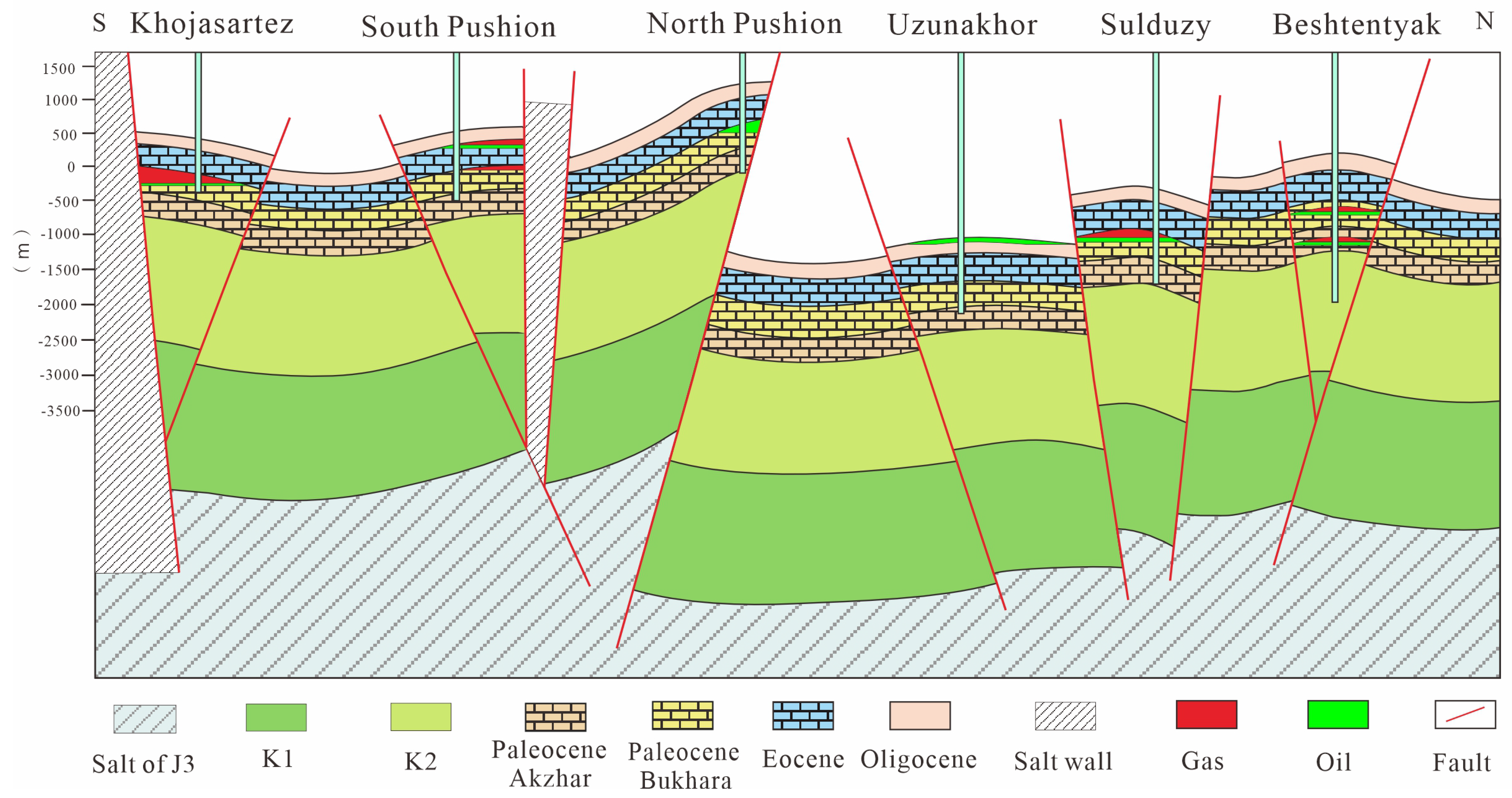
Six Paleogene carbonate reservoirs have been discovered in the Kulyab Depression in the eastern part of Block B. These reservoirs are significantly controlled by faults. The southern reservoirs of Khojasartez and South Pushion have formed oil and gas accumulations due to salt layer obstruction. The Kulyab Depression is buried relatively deep, with a wide horizontal distribution and large thickness of Upper Jurassic salt layers. No drilling has reached the strata below the Upper Jurassic salt layers. The oil- and gas-bearing strata are mainly the shallow Paleocene Bukhara Formation, supplemented by the Paleocene Akzhar Formation, Eocene Alai Formation, and Oligocene Sumusar Formation. The four oil and gas reservoirs in the north and south are oil-bearing in the lower part and gas-bearing in the upper part, while the two in the middle are pure oil reservoirs. The six oil and gas reservoirs in the east have a gas-bearing area of 2.5–20 km
2, a gas-bearing thickness of 3.9–98 m, a porosity of 3–16%, a permeability of 0.05–267.8 md, and a fullness of 20–95%. The Himalayan tectonic movement was intense during this period with fault development, and the reservoirs underwent significant modification in the later stages, developing into porous–fractured reservoirs (
Figure 20).
4.3. Multi-Layered and Multi-Lithological Oil and Gas Reservoirs
This type of oil and gas reservoir is located in the Dushanbe Depression in the northern part of Block B. The reservoir consists of Jurassic carbonate rocks, Cretaceous clastic rocks, and Paleogene carbonate rocks. The multi-layered and multi-lithological characteristics of this type of oil and gas reservoir are due to the absence of Upper Jurassic gypsum–salt layers in the Dushanbe Depression. The pre- and post-salt petroleum systems of other tectonic units merge into one petroleum system in the Dushanbe Depression, with oil and gas originating from multiple sets of source rocks in the Jurassic, Cretaceous, and Paleogene systems. Additionally, as this area is close to the West Tianshan Mountains, the burial depth is relatively shallow after uplift, reducing the difficulty of drilling. Multiple wells have drilled to the basement, leading to oil and gas discoveries in both Jurassic, Cretaceous, and Paleogene carbonate and clastic rocks.
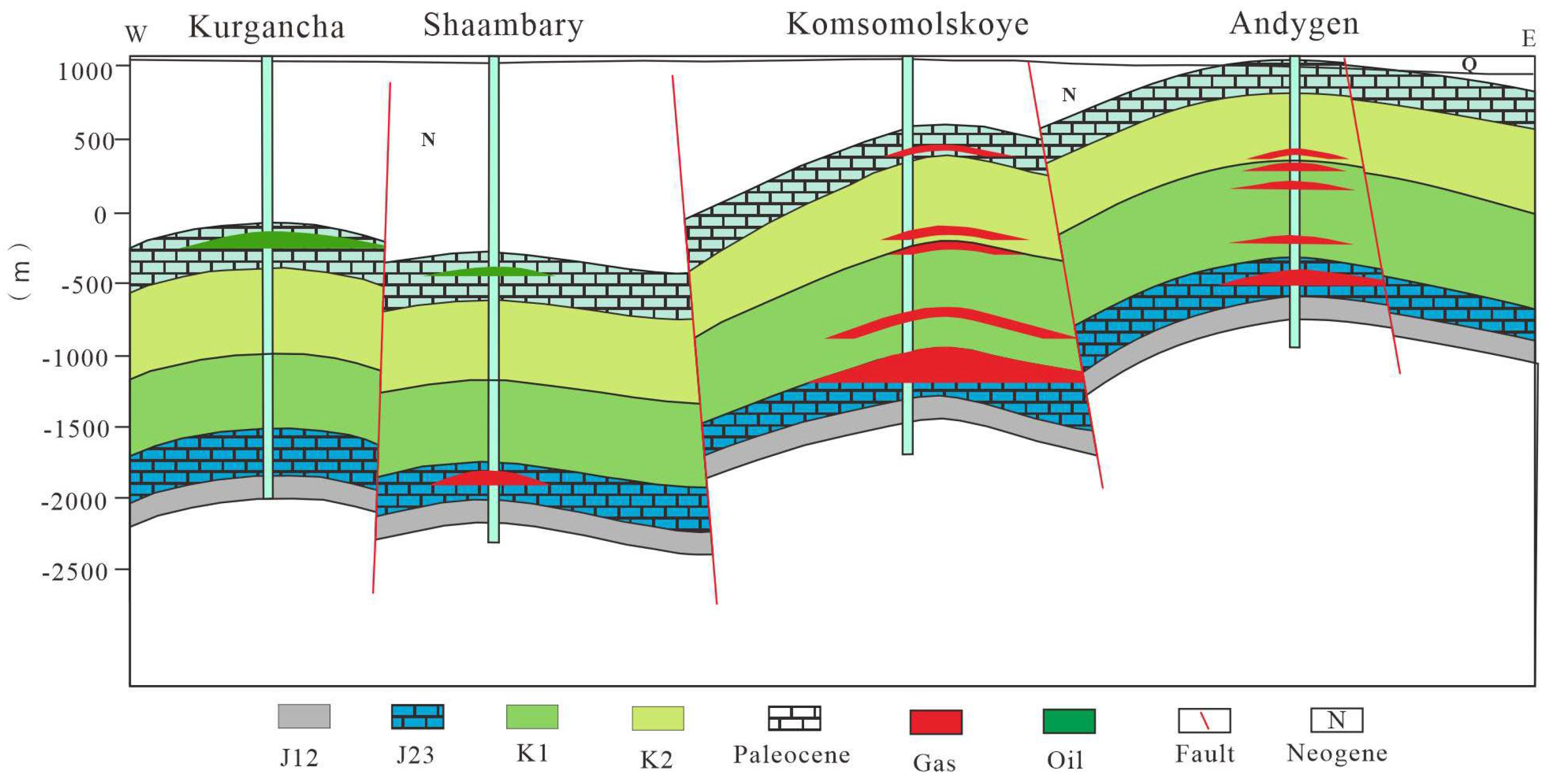
Four oil and gas reservoirs have been discovered in the Dushanbe Depression in the northern part of Block B. The structural types of the Komsomolskoye gas field, Andygen gas field, and Kurgancha oil field are faulted anticlines, while the structural type of the Shaambary oil field is an anticline. The distribution and migration of oil and gas reservoirs are significantly controlled by faults. Deep oil and gas migrate along faults to the shallow layers, forming oil and gas accumulations. The four oil and gas reservoirs exhibit a distribution characteristic of being high in the east and low in the west, with gas accumulating in the east and oil accumulating in the west. The Andygen and Komsomolskoye in the east are gas reservoirs with multiple gas-bearing strata, including Middle-Upper Jurassic carbonate rocks, Cretaceous sandstones, and Paleogene carbonate rocks. The Shaambary oil and gas reservoir in the west has significantly fewer oil- and gas-bearing strata, with no oil and gas focusing in the Cretaceous, and only Middle-Upper Jurassic carbonate rocks and Paleogene carbonate rocks accumulating oil and gas. In the Kurgancha of the Surkhandarya Depression in the west, only Paleogene carbonate rocks form oil accumulations, but the oil reservoir is large in scale (
Figure 21).
The four oil and gas reservoirs have a gas-bearing area ranging from 1 to 6.5 km2 and a structural amplitude of 40 to 125 m. The reservoirs were reshaped by tectonic movements during the Himalayan period. The carbonate reservoirs are of the pore–fracture type, while the clastic rock reservoirs are of the pore type. The average gas-bearing thickness ranges from 23 to 62 m, with a porosity of 4.6% to 21%, a maximum permeability of 1100 md, a gas saturation of 56% to 87%, a formation pressure of 71.2 to 225 Pa, and a fullness of 80% to 95%.
5. Oil and Gas Distribution Pattern
Up to now, the oil and gas discoveries in the Tajik Basin exhibit a distribution pattern characterized by “natural gas in the west and oil in the east, more in the west and less in the east, salt below in the west and above in the east, and gas below salt and oil above salt” (
Figure 1).
The Jurassic carbonate gas reservoirs are located in the southwestern Gissar Uplift and Surkhandarya Depression in the southwest. The structural location of these gas reservoirs in the Jurassic system is relatively shallow and possesses favorable conditions for natural gas accumulation. The structural thrusting of the Gissar Uplift in the southwest forms traps, which significantly transform the carbonate reservoirs into pore–fracture–cavity reservoirs. The eastern side is adjacent to the hydrocarbon-generating depression of the Surkhandarya Depression, and the gypsum–salt rocks at the top of the Upper Jurassic serve as favorable cap rocks, facilitating the accumulation of natural gas under the salt. Compared to the Gissar Uplift in the southwest, the structural movement in the secondary terrace of the Surkhandarya Depression is weaker. The early favorable depositional facies belt, namely the intra-platform beach, is the main controlling factor for this gas reservoir, and the later-formed structural traps are important factors. Coupled with the favorable source rocks and sealing conditions of the Surkhandarya Depression, this results in good natural gas accumulation. The discovery of the Jurassic carbonate gas field confirms that, within the overall context of the Tethyan tectonic domain, the entire Jurassic system in the Tajik Basin possesses superior petroleum geological conditions and significant exploration potential, which can radiate from west to east, opening up a new exploration landscape for the Jurassic system.
The Paleogene carbonate reservoirs are primarily located in the central uplifts of the Surkhandarya, Vakhsh, and Kulyab Depressions, with few oil and gas discoveries in the Kafirnigan and Obigarm Uplift zones. After undergoing tectonic movements during the Himalayan period, the uplifted areas in the Tajik Basin experienced intense tectonic activity, significant uplift, severe damage to the shallow layers, and high preservation risks, making it difficult to form effective oil and gas accumulations. The depression areas experienced relatively weaker tectonic movements and damage, with better preservation conditions in the upper parts and close proximity to hydrocarbon source rocks in the lower parts, making them conducive to oil and gas accumulation. The discovery of Paleogene carbonate reservoirs indicates that the salt-overlying areas possess the basic petroleum geological conditions for oil and gas accumulation, and further exploration can be conducted in areas with good preservation conditions in the depression areas.
The multi-layered and multi-lithological oil and gas reservoirs are located in the Dushanbe Depression. The most typical feature of this type of reservoir is the discovery of oil and gas in multiple lithologies, including carbonate rocks and clastic rocks, within the three strata of the Jurassic, Cretaceous, and Paleogene systems. The Jurassic marine transgression in the Tajik Basin originated from the southwest, while the Late Jurassic marine regression occurred from the northeast to the southwest. The Dushanbe Depression is located on the edge of marine deposits, with no development of Upper Jurassic gypsum–salt rocks. The gas generated from Jurassic source rocks migrates upward without the sealing of gypsum–salt rocks, forming oil and gas accumulations in multiple layers. The discovery of multi-layered and multi-lithological oil and gas reservoirs in the Dushanbe Depression also confirms the exploration potential of the three strata of the Jurassic, Cretaceous, and Paleogene systems. The difference from the western Jurassic carbonate rock gas reservoirs is the absence of Upper Jurassic gypsum–salt rocks, which eliminates the need to drill through the Upper Jurassic gypsum–salt layer, reducing drilling difficulty. However, without the sealing of regional gypsum–salt layers, the scale of the Jurassic gas reservoir may decrease.
Both the eastern and western sides of the Tajik Basin are located in the Tethyan tectonic domain, sharing similar tectonic and sedimentary backgrounds. The Jurassic source–reservoir–cap assemblage is developed almost throughout the entire basin. The eastern part of the basin also possesses the geological conditions for forming large natural gas reservoirs. However, Jurassic natural gas reservoirs have only been discovered in the southwestern Gissar Uplift and Surkhandarya Depression in the western part of the basin, with no significant discoveries in the east. The main reason for this is the strong tectonic movements during the Himalayan period, which affected the Tajik Basin. The eastern side is adjacent to the Pamir Plateau, where the Himalayan subduction was intense, resulting in a thick sedimentary cover of molasse after orogeny. The Jurassic strata are buried deep, making drilling challenging. Most wells only reach the Cretaceous and Paleogene strata, where minor oil and gas discoveries have been made. The western side, farther from the Pamir and adjacent to Gissar, experiences relatively weaker tectonic movements. The sedimentary thickness after orogeny during the Himalayan period is smaller, ultimately leading to shallower burial depths of the Jurassic strata in the western part of the Tajik Basin. Many wells have reached the pre-salt Jurassic strata and made natural gas exploration discoveries.
6. Exploration Potential and Exploration Direction
The Tajik Basin is located on the eastern edge of the Central Asian segment of the Tethyan tectonic domain, and its tectonic–sedimentary evolution is directly influenced by the closure of the Paleo-Tethyan Ocean and the Neo-Tethyan Ocean. At the end of the Triassic period, the Iran–Afghanistan–Qiangtang block collided with the Eurasian Plate, leading to the closure of the Paleo-Tethyan Ocean. After closure, stress relaxation occurred, resulting in the Early-Middle Jurassic period corresponding to a rift basin phase in the Tajik Basin, where marine and continental facies coal-bearing strata were developed. These strata, along with the widely distributed Middle-Lower Jurassic coal-bearing strata in Central Asia and Northwestern China, are all located in the Central Asian coal-formed gas accumulation domain [
21], indicating favorable gas generation conditions. The Middle-Late Jurassic period corresponds to a post-rift depression phase, during which large carbonate platforms were also deposited in the Amu Darya Basin in the west and the Qiangtang Basin in the east. In the Late Jurassic, seawater gradually receded, forming evaporative platform deposits and thick layers of gypsum–salt rocks. These three factors vertically form a high-quality source–reservoir–cap combination. The Gissar Uplift in the southwest of the basin, the Gadjak gas field in the Surkhandarya Depression, and the Jurassic gas fields in the Dushanbe Depression have been confirmed. The pre-salt Jurassic strata in Block B in the eastern part of the basin have similar depositional backgrounds to the discovered gas fields, indicating the geological conditions for forming large natural gas reservoirs and possessing significant exploration potential.
In the early Cretaceous, the Lhasa block in the southern Tajik Basin collided northward and subsequently subsided, superimposing the northward subduction of the Neo-Tethyan Ocean. This led to multiple frequent marine transgressions and regressions. The Cretaceous deposits in the Tajik Basin consist of transitional marine–continental sandstone–mudstone and marine mudstone–shale interbedded with limestone. The Lower Cretaceous Hauterivian (K1h), Aptian (K1ap), and Albian (K1al) sandstones are interbedded with the Valanginian (K1v), Barremian (K1b), and Albian (K1al) mudstones, forming three sets of source–reservoir–cap assemblages vertically. In the lower part of the Upper Cretaceous, the seawater level frequently rose and fell, resulting in frequent interbedding of sandstone, carbonate rock, and mudstone–shale. The Cretaceous carbonate rock of the Cenomanian (K2cm) at the bottom of the Upper Cretaceous and the mudstone–shale above it form an effective reservoir–cap combination. In the late Cretaceous, the seawater experienced large-scale transgression, and the thick carbonate rock at the top of the Upper Cretaceous and the gypsum–salt of the Akzhar Formation at the bottom of the Paleogene formed an effective reservoir–cap combination. All of these reservoir–cap combinations have been confirmed by drilling. The Komsomol gas field and Andijan gas field in the Dushanbe Depression in the northern part of the basin have discovered natural gas in the Hauterivian, Aptian, Albian, and Cenomanian stages of the Cretaceous. The Kizil Tulum Shuke gas field in the southern part of the basin has discovered natural gas at the top of the Upper Cretaceous, indicating that the Cretaceous strata under the tectonic–sedimentary background of the Tethyan tectonic domain possess the conditions for hydrocarbon accumulation. The Cretaceous strata in Block B in the eastern part of the basin have undergone tectonic transformation during the Himalayan period, forming a large number of anticlinal and faulted anticlinal traps, which have great exploration potential and remain untapped.
The Paleogene marine transgression was large in scale and wide in scope, affecting the Kuqa and southwestern Tarim Basin Depressions, as well as the Akza Formation (E1ak) gypsum rock, Bukhara Formation (E1bh) carbonate rock, Suzak Formation (E1su) mudstone and shale, Alai Formation (E2al) carbonate rock, Turkestan–RishitanIsfara–Khanabad mudstone, and Shurase–Sumusar sandstone, forming three sets of reservoir–cap rock combinations in the Paleogene. The discovery and distribution of oil and gas in the Paleogene are widespread, with large reserves, covering the northern, eastern, and southern parts of Block B. The reservoir-forming conditions in the Paleogene are relatively favorable, making it another key area for potential exploration above the salt [
22].
7. Conclusions
(1) Through extensive laboratory analysis of a large number of outcrop source rocks and reservoir samples from the field, the research team identified three sets of source rocks in the Tajik Basin, namely the Middle and Lower Jurassic, Cretaceous, and Paleogene systems. Samples from the basin margin of the Middle-Lower Jurassic have high organic matter abundance and primarily generate gas, with most samples being in a mature state. The Cretaceous and Paleogene hydrocarbon source rocks primarily generate oil and are in a low-mature to mature state. The basin is developed with four sets of reservoirs: the Middle-Upper Jurassic carbonate rocks, Lower Cretaceous clastic rocks, Upper Cretaceous carbonate rocks, and Paleogene carbonate rocks. The gypsum–salt rocks and mudstones developed in the basin provide good sealing conditions for the formation of oil and gas reservoirs. Comprehensive research suggests that the source rock of the Middle-Lower Jurassic, the carbonate reservoir of the Middle-Upper Jurassic, and the gypsum–salt rock of the Upper Jurassic form the most promising source–reservoir–cap combination in the Tajik Basin, making them the focus of future exploration.
(2) The Tajik Basin hosts three types of oil and gas reservoirs: Jurassic carbonate gas reservoirs are distributed in the southwestern Gissar Uplift and Surkhandarya Depression in the western part of the basin; Paleogene carbonate oil and gas reservoirs are found in the Vakhsh Depression on the southern side of the basin and the Kulyab Depression in the east; and multi-layered, multi-lithological oil and gas reservoirs are located in the Dushanbe Depression in the northern part of the basin. Through comprehensive petroleum geological research on discovered oil and gas, it is believed that Jurassic carbonate gas reservoirs are a key exploration direction and reserve growth point in Block B of the Tajik Basin.
(3) The current distribution of oil and gas in the Tajik Basin exhibits characteristics of “natural gas in the west and oil in the east, more in the west and less in the east, salt below in the west and above in the east, and gas below salt and oil above salt”. Affected by the overall tectonic movement of the Tethyan tectonic domain, the pre-salt Jurassic system in the Tajik Basin has the potential to form large natural gas reservoirs, while the post-salt Cretaceous and Paleogene systems still retain potential for further exploration.
Author Contributions
Conceptualization, W.Y. and Z.J.; methodology, W.Y., X.W. and R.J.; software, Y.Z. (Yiqiong Zhang) and W.M.; formal analysis, W.Y., Z.J., B.L., X.Z., L.Z., X.W., R.J., Y.Z. (Yue Zheng), Y.Z. (Yiqiong Zhang), W.M. and S.L.; investigation, W.Y., Z.J., X.Z., L.Z., X.W., R.J., Y.Z. (Yue Zheng), Y.Z. (Yiqiong Zhang), W.M. and S.L.; resources, B.L., X.Z., L.Z., M.Z., C.W. and Y.Z. (Yue Zheng); data curation, B.L., X.Z., L.Z., R.J., Y.Z. (Yue Zheng) and S.L.; writing—original draft, W.Y., B.L. and X.W.; writing—review and editing, W.Y. and X.W.; visualization, M.Z. and C.W.; supervision, B.L.; project administration, Z.J. and B.L.; funding acquisition, Z.J. and B.L. All authors have read and agreed to the published version of the manuscript.
Funding
This research was funded by Research Project of CNPC “Study on the enrichment law of deep oil and gas in Tajikistan complex thrust salt basin” (2024DJ99).
Data Availability Statement
The original contributions presented in this study are included in the article. Further inquiries can be directed to the corresponding author.
Conflicts of Interest
The authors declare no conflicts of interest. Authors Wei Yin, Zhifeng Ji, Xueke Wang, Mingjun Zhang, Chunsheng Wang, Ren Jiang, Yue Zheng, Yiqiong Zhang and Wuling Mo were employed by the PetroChina Research Institute of Petroleum Exploration & Development, Beijing 100083. Authors Bing Lu and Liangjie Zhang were employed by the CNPC (Tajikistan) Bokhtar Company, Dushanbe. Authors Xingyang Zhang were employed by the Dubai Research Institute of CNPC. Authors Song Li were employed by China University of Geosciences (Beijing). The funder had no role in the design of the study; in the collection, analyses, or interpretation of data; in the writing of the manuscript; or in the decision to publish the results.
References
- Jia, C.Z.; Yang, S.F. Tectonic Geology and Gas in Basins, Northern Margin of Tethys; Petroleum Industry Press: Beijing, China, 2001; pp. 39–49. [Google Scholar]
- Yang, S.F.; Jia, C.Z.; Chen, H.L.; Wei, G.Q.; Cheng, X.G.; Jia, D.; Xiao, A.C.; Guo, S.J. The evolution of the Tethys tectonic belt and the formation of the northern margin basin group, as well as the exploration prospects of natural gas in the Tarim Basin. Chin. Sci. Bull. 2002, 47, 36–42. [Google Scholar]
- Wang, S.H.; Qian, X.L. Cenozoic tectonics and oil-gas perspectives in Tadjik and southwestern Tarim depression. J. Peking Univ. (Nat. Sci.) 2001, 37, 523–528. [Google Scholar]
- Zhu, Y.X.; Liu, L.F. Petroleum geology of South Tajikistan Basin in central Asia. Xinjiang Pet. Geol. 2007, 28, 257–261. [Google Scholar]
- Yin, J.Q.; Jia, C.Z.; Wang, C.S.; Li, Q.Y.; Zhou, T.W. Petroleum Geology Characteristics and Exploration Potential in Afghan-Tajik Basin. Mar. Orig. Pet. Geol. 2015, 20, 43–47. [Google Scholar]
- Zhang, K.X.; Han, S.Q.; Wang, Z.X.; Tao, C.Z.; Han, F.B.; Li, C.L.; Li, X.S. Characteristics of petroleum systems and resources potential in the Afghan-Tajik Basin. Geol. China 2018, 45, 920–929. [Google Scholar]
- Wang, H.J.; Zhang, L.J.; Chen, H.L.; Zhang, H.W.; Bai, Z.H.; Jiang, L.Z. Geological characteristics and distribution law of pre-salt Jurassic large and medium gas fi elds in the right bank of the Amu Darya River. China Pet. Explor. 2020, 25, 1672–7703. [Google Scholar]
- Jamal, F.; Qiu, L.; Faisal, S.; Khan, S.; Ullah, R.; Naseer, A.; Zhou, Z. Structural and biostratigraphic records of Janakor Valley in northwestern Himalayas, Pakistan: Implications for closure of the Neo-Tethys Ocean. J. Asian Earth Sci. X 2025, 13, 100187. [Google Scholar]
- Liu, X.Q.; Zhang, C.L.; Zou, H.; Ye, X.T. Diverse metavolcanic sequences in the Cambrian accretionary complex at the Pamir Syntax: Implications for tectonic evolution from Proto-Tethys to Paleo-Tethys. J. Asian Earth Sci. 2023, 241, 105481. [Google Scholar] [CrossRef]
- Mu, H.X.; Yan, D.P.; Qiu, L.; Kong, R.Y.; Gong, L.X. Fate of the late Triassic Songpan–Ganzi Basin in the eastern Paleo-Tethys Ocean: Geochemical and geochronological constraints in the NE Tibetan Plateau. J. Asian Earth Sci. X 2025, 13, 100194. [Google Scholar] [CrossRef]
- Chen, H.L.; Chen, Y.G.; Chen, S.Q.; Lin, X.B.; Yang, R.; Cheng, X.G.; Li, K. The tectonic processes and geomorphic characteristics of Pamir salient. Acta Geoscinetica Sin. 2019, 40, 55–75. [Google Scholar]
- Ma, S.; Chen, S.Y.; Jia, B.B.; Sun, J.P.; Wang, F.; Zeng, H.J. Sedimentary characteristics and controlling factors of the Early Ordovician platform-slope-basin in the northern margin of the Qaidam Basin. Earth Sci. Front. 2018, 25, 185–197. [Google Scholar]
- Shen, C.; Tan, X.C.; Li, L.; Shi, K.L.; Su, C.P.; Lian, C.B.; Li, H.W.; Xiao, D. Sedimentary characters of carbonate platform marginal slope of the Early Cambrian in northern Sichuan Basin and perspective of deformation structures. J. Palaeogeogr. 2015, 17, 321–334. [Google Scholar]
- Nereo, P.; Piero, G.; Marco, F.; Giovanni, G.; Alberto, R. Geometry and evolution of Triassic high-relief, isolated microbial platforms in the Dolomites, Italy: The Anisian Latemar and Carnian Sella platforms compared. AAPG Bull. 2017, 101, 475–483. [Google Scholar] [CrossRef]
- Ursula, H.; Michael, K.; Maria, M. Unconventional reservoir potential of the upper Permian Zechstein Group: A slope to basin sequence stratigraphic and sedimentological evaluation of carbonates and organic-rich mudrocks, Northern Germany. Environ. Earth Sci. 2013, 70, 3797–3816. [Google Scholar] [CrossRef]
- Yin, W.; Ji, Z.F.; Zhang, Y.Q.; He, J.Y.; Wang, X.K.; Zhang, M.J.; Jiang, R.; Zheng, Y.; Pan, Y. Physical modelling of salt structural deformation in the Tajik Basin: Insights into the formation of complex fold-and-thrust structures. Front. Earth Sci. 2024, 12, 1478591. [Google Scholar] [CrossRef]
- Lu, S.K.; Bao, Z.H.; Yang, J.S. Structural feature of the Low-Middle Jurassic series in the southeast of Amu-Darya right bank area close to Gissar Mountain and analysis of its origin. Xinjiang Geol. 2013, 31, 260–264. [Google Scholar]
- Li, X.H.; Zhang, T.; Li, H.X. Integrated prediction on the distribution of reef beach in the depositional environment of low-energy deep water slopes in the Amu Darya right bank block. Nat. Gas Ind. 2019, 39, 1–9. [Google Scholar]
- Li, Z. Geologic Structure and Hydrocarbon Accumulation of Eastern Foreland in Amu Darya Right Bank. Master’s Thesis, China University of Geosciences(Beijing), Beijing, China, 2015; pp. 1–148. [Google Scholar]
- Zhang, L.J.; Wang, H.J.; Zhang, X.Y.; Ma, W.X.; Zhang, H.W. Effect of thrust structural pattern on carbonate reservoir and gas reservoir type in the east of Amu Darya right bank. The Organizing Committee of IWEG2018. In Proceedings of the International Workshop on Environment and Geoscience; Science and Technology Publications: Setúbal, Portugal, 2018; pp. 239–248. [Google Scholar]
- Dai, J.X.; He, B.; Sun, Y.X.; Li, P.J.; Li, X.Q. Formation of the central Asia coal-formed gas accumulation domain and its source rocks—Series study on the central Asia coal formed gas accumulation domain. Pet. Explor. Dev. 1995, 22, 1–6. [Google Scholar]
- Sun, L.D.; Zou, C.N.; Zhu, R.K.; Zhang, Y.H.; Zhang, S.C.; Zhang, B.M.; Zhu, G.Y.; Gao, Z.Y. Formation, distribution and potential of deep hydrocarbon resources in China. Pet. Explor. Dev. 2013, 40, 641–649. [Google Scholar] [CrossRef]
Figure 1.
Location of Tajikistan Basin in the Tethys tectonic domain.
Figure 1.
Location of Tajikistan Basin in the Tethys tectonic domain.
Figure 2.
Tectonic evolution process of the Tajik Basin (According to Chengzao Jia, 2001) [
1,
2].
Figure 2.
Tectonic evolution process of the Tajik Basin (According to Chengzao Jia, 2001) [
1,
2].
Figure 3.
Comprehensive column of Tajikistan Basin.
Figure 3.
Comprehensive column of Tajikistan Basin.
Figure 4.
Structural unit division map and oil and gas reservoir distribution map.
Figure 4.
Structural unit division map and oil and gas reservoir distribution map.
Figure 5.
Sampling locations of source rocks and reservoirs in the field.
Figure 5.
Sampling locations of source rocks and reservoirs in the field.
Figure 6.
Lithofacies and paleogeographic model of Middle and Lower Jurassic source rocks.
Figure 6.
Lithofacies and paleogeographic model of Middle and Lower Jurassic source rocks.
Figure 7.
TOC histogram of Jurassic shale in the Tajik Basin.
Figure 7.
TOC histogram of Jurassic shale in the Tajik Basin.
Figure 8.
Ro histogram of Jurassic shale in the Tajik Basin.
Figure 8.
Ro histogram of Jurassic shale in the Tajik Basin.
Figure 9.
TOC histogram of Jurassic coal and carbonaceous mudstones in the Tajik Basin.
Figure 9.
TOC histogram of Jurassic coal and carbonaceous mudstones in the Tajik Basin.
Figure 10.
Ro histogram of Jurassic coal and carbonaceous mudstones in the Tajik Basin.
Figure 10.
Ro histogram of Jurassic coal and carbonaceous mudstones in the Tajik Basin.
Figure 11.
TOC histogram of the Cretaceous, Paleogene and Neogene systems in the Tajik Basin.
Figure 11.
TOC histogram of the Cretaceous, Paleogene and Neogene systems in the Tajik Basin.
Figure 12.
Ro histogram of the Cretaceous, Paleogene and Neogene systems in the Tajik Basin.
Figure 12.
Ro histogram of the Cretaceous, Paleogene and Neogene systems in the Tajik Basin.
Figure 13.
Lithofacies and paleogeographic model of Middle and Upper Jurassic source rocks in the Tajik Basin.
Figure 13.
Lithofacies and paleogeographic model of Middle and Upper Jurassic source rocks in the Tajik Basin.
Figure 14.
3D model of carbonate rocks in the Middle and Upper Jurassic of the Tajik Basin.
Figure 14.
3D model of carbonate rocks in the Middle and Upper Jurassic of the Tajik Basin.
Figure 15.
Porosity and permeability of the Jurassic–Paleogene system in the Tajik Basin.
Figure 15.
Porosity and permeability of the Jurassic–Paleogene system in the Tajik Basin.
Figure 16.
Distribution profile of oil and gas reservoirs in the Tajik Basin (the section location is shown in
Figure 4).
Figure 16.
Distribution profile of oil and gas reservoirs in the Tajik Basin (the section location is shown in
Figure 4).
Figure 17.
Geological profile AA’ of Jurassic carbonate gas reservoir in southwestern Gissar Uplift [
7].
Figure 17.
Geological profile AA’ of Jurassic carbonate gas reservoir in southwestern Gissar Uplift [
7].
Figure 18.
Geological profile BB’ of Jajak Jurassic carbonate gas reservoir in Surhan Depression.
Figure 18.
Geological profile BB’ of Jajak Jurassic carbonate gas reservoir in Surhan Depression.
Figure 19.
Profile DD’ of Paleogene carbonate oil and gas reservoirs in southern Block B.
Figure 19.
Profile DD’ of Paleogene carbonate oil and gas reservoirs in southern Block B.
Figure 20.
Profile EE’ of cave- and fracture-type carbonate oil and gas reservoirs in eastern Block B.
Figure 20.
Profile EE’ of cave- and fracture-type carbonate oil and gas reservoirs in eastern Block B.
Figure 21.
Profile CC’ of oil and gas reservoirs in the northern Dushanbe Depression.
Figure 21.
Profile CC’ of oil and gas reservoirs in the northern Dushanbe Depression.
Table 1.
TOC and Ro of Jurassic shale in the Tajik Basin.
Table 1.
TOC and Ro of Jurassic shale in the Tajik Basin.
| Section | Sample Number | Formation | Lithology | TOC | Ro |
|---|
Section
Sargon | 2502-Y4 | J12 | shale | 2.73 | 1.61 |
| 2502-Y5 | J12 | shale | 0.91 | 0.87 |
| 2502-Y6 | J12 | shale | 2.87 | 0.87 |
| 2502-Y9 | J12 | shale | 4.16 | 0.85 |
Section
Derbent | 2506-Y1 | J12 | shale | 4.6 | 1.12 |
| 2506-Y2 | J12 | shale | 1.19 | 1.10 |
| 2507-Y1 | J12 | shale | 0.77 | 1.26 |
| 2507-Y2 | J12 | shale | 1.19 | 1.27 |
| Section 14 | 1614-S1 | J12 | shale | 4.20 | 0.84 |
| 1614-S2 | J12 | shale | 0.54 | 1.41 |
| Section 13’ | 2213’-Y1 | J12 | shale | 3.42 | 1.17 |
| 2213’-Y9 | J12 | shale | 2.33 | 1.17 |
| 2213’-Y10 | J12 | shale | 1.60 | 1.17 |
| Section 5 | 2205-Y10 | J12 | shale | 2.29 | 0.65 |
| 2205-Y4 | J12 | shale | 1.37 | 0.65 |
| Section 2 | 2202-Y1 | J12 | shale | 1.17 | 0.65 |
| Section 22 | 2222-Y3 | J12 | shale | 1.70 | 0.62 |
| 2222-Y4 | J12 | shale | 4.38 | 0.62 |
| 2222-Y1 | J12 | shale | 3.29 | 0.62 |
| Section 25 | 1825-S36 | J12 | shale | 0.98 | 0.52 |
| 1825-S38 | J12 | shale | 3.75 | 0.96 |
| 1825-S41 | J12 | shale | 4.87 | 0.62 |
| 2225-Y3 | J12 | shale | 5.84 | 0.66 |
| 2225-Y4 | J12 | shale | 4.80 | 0.66 |
| Section 23 | 2223-Y1 | J12 | shale | 0.70 | 1.97 |
| Section 27 | 2227-Y2 | J12 | shale | 3.36 | 0.60 |
| 1827-S32 | J12 | shale | 0.75 | 0.61 |
| Section 29 | 2229-Y3 | J12 | shale | 2.13 | 0.64 |
Table 2.
TOC and Ro of Jurassic coal and carbonaceous mudstones in the Tajik Basin.
Table 2.
TOC and Ro of Jurassic coal and carbonaceous mudstones in the Tajik Basin.
| Section | Sample Number | Formation | Lithology | TOC | Ro |
|---|
| Section 13’ | 2213’-Y3 | J12 | coal | 81.7 | 1.17 |
| 2213’-Y5 | J12 | coal | 71.3 | |
| 2213’-Y2 | J12 | coal | 68.1 | |
| 2213’-Y7 | J12 | coal | 57.0 | |
| 2213’-Y8 | J12 | coal | 55.0 | |
| 2213’-Y6 | J12 | coal | 41.2 | |
| 2213’-Y4 | J12 | carbonaceous mudstone | 32.2 | |
| Section 5 | 2205-Y1 | J12 | coal | 47.1 | 0.65 |
| 2205-Y3 | J12 | carbonaceous mudstone | 7.3 | |
| 2205-Y2 | J12 | carbonaceous mudstone | 7.1 | |
| 2205-Y8 | J12 | carbonaceous mudstone | 6.9 | |
| Section 22 | 2222-Y2 | J12 | carbonaceous mudstone | 7.0 | 0.62 |
| Section 25 | 2225-Y2 | J12 | carbonaceous mudstone | 12.1 | 0.66 |
| 2225-Y1 | J12 | carbonaceous mudstone | 9.1 | |
| 1825-S40 | J1 | carbonaceous mudstone | 7.7 | 0.57 |
| 1825-S42 | J1 | coal | 52.6 | 0.77 |
| Section 27 | 2227-Y1 | J12 | carbonaceous mudstone | 36.2 | 0.60 |
| 1827-S35 | J1-2 | carbonaceous mudstone | 11.1 | 0.89 |
| 1627-S8 | J1 | coal | 58.8 | 0.88 |
| Section 29 | 2229-Y2 | J12 | carbonaceous mudstone | 11.0 | |
| 2229-Y1 | J12 | carbonaceous mudstone | 12.1 | 0.64 |
Table 3.
TOC and Ro of the Cretaceous, Paleogene and Neogene systems in the Tajik Basin.
Table 3.
TOC and Ro of the Cretaceous, Paleogene and Neogene systems in the Tajik Basin.
| Section | Sample Number | Formation | TOC | Ro |
|---|
| Section-S7 | 2016-S7 | N | 1.28 | 0.66 |
| Section-14 | 2214-15-Y1 | E | 0.66 | 0.67 |
| Section-S23 | 2018-S23 | 1.27 | 0.54 |
| Section-S24 | 2018-S24 | 0.77 | 0.54 |
| Section-S25 | 2018-S25 | 0.75 | 0.56 |
| Section-S6 | 2018-S6 | 0.89 | 0.56 |
| Section-34 | 23-04-Y1 | 1.88 | 0.83 |
| Section-34 | 23-04-Y2 | 1.42 | 0.78 |
| Section-34 | 23-04-Y3 | 1.08 | 0.83 |
| Section-34 | 23-04-Y4 | 0.59 | 0.67 |
| Section-S25 | 2016-S25 | 0.92 | 0.81 |
| Section-S5 | 2018-S5 | K2 | 1.39 | 0.54 |
| Section-S19 | 2018-S19 | K1 | 1.15 | 0.57 |
| Section-S20 | 2018-S20 | 0.63 | 0.50 |
| Section-S28 | 2016-S28 | 1.41 | 1.23 |
Table 4.
Data table of porosity and permeability for the Jurassic–Paleogene system in the Tajik Basin (2214-12-W1 represents the first porosity and permeability sample from the 12th layer of the 14th profile in 2022, and so on).
Table 4.
Data table of porosity and permeability for the Jurassic–Paleogene system in the Tajik Basin (2214-12-W1 represents the first porosity and permeability sample from the 12th layer of the 14th profile in 2022, and so on).
| Section | Sample Number | System | Lithology | Porosity | Permeability (md) |
|---|
| Section-14 | 2214-12-W1 | Pg1bhl | micritic limestone | 7.39 | 3.01 |
| Section-16 | 2216-W1 | micritic limestone | 35.64 | 2.78 |
| Section-17 | 2217-W1 | dolomite | 25.9 | 477 |
| 2217-W2 | Oolitic limestone | 21.78 | 2.045 |
| Section-19 | 2219-W1 | dolomite | 9.19 | 0.087 |
| Section-14 | 1802-10 | K2 | limestone | 15.67 | 6.668 |
| 1802-14 | limestone | 10.06 | 0.13 |
| 1802-15 | sandstone | 4.74 | 0.016 |
| 1802-18 | Bioclastic limestone | 5.17 | 0.015 |
| 2019-1-12 | K1 | sandstone | 5.84 | 0.027 |
| Section-02 | 2202-W1 | J23 | micritic limestone | 8.79 | 0.193 |
| Section-08 | 2208-W1 | Micrite Bioclastic limestone | 12.71 | 182 |
| 2208-W2 | Bioclastic limestone | 6.58 | 5.619 |
| Section-09 | 2209-W1 | Bioclastic limestone | 6.14 | 0.034 |
| 2209-W2 | Bioclastic limestone | 6.14 | 0.021 |
| 2209-W3 | Micrite grain limestone | 6.47 | 0.339 |
| Section-10 | 2210-3-W1 | calcareous dolomite | 14.87 | 10.3 |
| 2210-3-W2 | calcareous dolomite | 10.58 | 0.35 |
| Section-13 | 2213-2-W1 | Micrite grain limestone | 1.49 | 3.27 |
| 2213-2-W2 | Micrite grain limestone | 8.47 | 0.05 |
| 2213-2-W3 | Bioclastic limestone | 7.5 | 0.126 |
| 2213-2-W4 | Bioclastic grain limestone | 3.44 | 0.018 |
| 2213-2-W5 | Micrite grain limestone | 11.04 | 11.7 |
| 2213-2-W6 | Micrite grain limestone | 8.96 | 0.238 |
| Section-14 | 2214-W1 | Bioclastic limestone | 5.22 | 0.02 |
| 2214-W2 | Micrite limestone | 8.13 | 0.274 |
| 2214-W3 | Micrite limestone | 7.9 | 0.073 |
| 2214-W4 | Micrite limestone | 3.39 | 1.94 |
| Section-21 | 2221-W1 | Bioclastic limestone | 2.85 | 0.016 |
| 2221-W2 | Bioclastic limestone | 2.54 | 0.022 |
| 2221-W3 | Bioclastic limestone | 1.79 | 0.081 |
| 2221-W4 | Bioclastic limestone | 4.72 | 0.075 |
| 2221-M1 | Bioclastic limestone | 3.17 | 0.023 |
| Disclaimer/Publisher’s Note: The statements, opinions and data contained in all publications are solely those of the individual author(s) and contributor(s) and not of MDPI and/or the editor(s). MDPI and/or the editor(s) disclaim responsibility for any injury to people or property resulting from any ideas, methods, instructions or products referred to in the content. |




 ,
,