Article

Numerical Investigation of Inter-Wheel Melt Transfer and Fiberization Behavior During the Co-Production of Ceramic Fibers from Fly Ash and Coal Gangue

1
College of Metallurgy and Energy, North China University of Science and Technology, Tangshan 063210, China
2
Yanzhao Iron and Steel Laboratory, North China University of Science and Technology, Tangshan 063210, China
3
College of Materials Science and Engineering, North China University of Science and Technology, Tangshan 063210, China
4
Comprehensive Testing and Analysis Center, North China University of Science and Technology, Tangshan 063210, China
5
Central Research Institute, China Baowu Group, Shanghai 201900, China
*
Authors to whom correspondence should be addressed.
Processes 2026, 14(13), 2062; https://doi.org/10.3390/pr14132062 (registering DOI)
Submission received: 19 May 2026 / Revised: 18 June 2026 / Accepted: 23 June 2026 / Published: 25 June 2026

Abstract

The synergistic co-production of ceramic fibers from fly ash and coal gangue offers a promising path for their high-value utilization. However, research in this area remains limited, hindering its broader application. This study employs numerical simulations to assess the influence of high-wheel rotational speed and melt temperature on the mass of inter-wheel melt transfer, as well as their effects on ligament size and slag-ball fraction. The results show that the high wheel, responsible for melt pre-fragmentation and transfer, plays a crucial role in determining the mass of inter-wheel melt transfer and controlling ligament dimensions. In contrast, the low wheel does not directly affect ligament size but aids in transforming pre-fragmented droplets into ligaments and modulates their dispersion. Melt temperature impacts both transfer mass and ligament size by modifying melt properties. The slag-ball fraction increases with the melt temperature and decreases with the high-wheel speed, while the low-wheel speed has a negligible effect. Under the optimal operating conditions of a melt temperature of 1745 °C and equal rotational speeds of 10,000 rpm for both the high and low wheels, a ligament structure with a relatively concentrated size distribution is obtained, with the slag-ball fraction effectively controlled within the range of 8–13%.

1. Introduction

Blast-furnace slag, steel slag, fly ash, and coal gangue are typical solid wastes generated in large quantities by the metallurgical and energy industries [1,2,3,4]. Previous studies have demonstrated that these wastes are rich in key constituents such as Si and Al, indicating substantial potential for resource recovery and reutilization [5,6]. Nevertheless, conventional disposal routes—including water quenching, air quenching, and landfilling—not only lead to the loss of recoverable resources but may also cause secondary environmental pollution [7], highlighting the urgent need for greener and more efficient valorization pathways. From a production and environmental technology perspective, energy intensity is one of the core indicators for evaluating the sustainability of solid waste valorization technologies, which is directly related to raw material pretreatment requirements, melting operating temperature, and equipment operation energy consumption. Although the traditional water quenching method has a simple process, it not only completely wastes the sensible heat contained in high-temperature molten slag (about 1.2–1.8 GJ of thermal energy per ton of blast furnace slag) but also consumes a large amount of water resources and produces harmful gases such as hydrogen sulfide. In contrast, direct landfilling completely abandons the resource value and thermal energy value of solid waste. In comparison, centrifugal fiberization technology can directly utilize high-temperature molten solid waste for fiber preparation, realizing the synergistic recovery of chemical resources and thermal energy and significantly reducing the full-process energy intensity. In recent years, centrifugal fabrication of inorganic fibers from aluminosilicate solid wastes has emerged as a promising technological direction for high value-added utilization [8,9,10]. This approach enables the conversion of aluminosilicate wastes typified by conditioned blast-furnace slag into high-value refractory and thermal-insulation fiber materials [11,12], thereby facilitating efficient recovery and cascade utilization of elemental resources. To further improve production efficiency and fiber quality, extensive and systematic efforts have been devoted to elucidating and regulating the mechanisms governing the centrifugal fiberization process.
In terms of theoretical studies on centrifugal fiberization, Širok et al. [12] systematically analyzed the relationship between melt-film structural dynamics and the rotational speed of the spinning wheel and developed a phenomenological model describing the dependence of structural instability on the wheel speed. Their results indicate that Taylor instability is one of the fundamental mechanisms responsible for ligament formation and subsequent solidification into fibers. Bizjan et al. [13] investigated the lubrication effect of a Newtonian liquid jet on the surface of a spinning wheel under varying impact locations, jet velocities, and wheel speeds and experimentally established a power-law correlation between the ratio of the film width to the jet diameter and both the jet velocity and the spinning-wheel speed. They further visualized the disintegration of Newtonian fluids on a spinning wheel and derived expressions for the ligament number, N , and the mean ligament diameter, dL [14]. Moreover, Bizjan et al. [15] examined the ligament-type breakup of the liquid film on the spinning-wheel surface and showed that the velocity slip between the film and the wheel is governed primarily by the spinning-wheel speed; at sufficiently high speeds, the slip decreases to approximately 1–1.5%. When liquid ligaments grow out of a thin film, the relative trajectory of the free end resembles an involute curve, and the mean ligament length at detachment increases with an increasing liquid flow rate and Ohnesorge number (Oh). Another study employed high-speed imaging to experimentally characterize mineral-fiber formation and, using an isomalt melt as a model fluid, simulated the fiberization process under different spinning-wheel speeds, melt flow rates, and impact positions to reproduce dynamics comparable to those in industrial mineral-wool production [16]. The results demonstrate that centrifugal fiberization efficiency is jointly influenced by the melt impact position, melt flow rate, and the Weber number of the melt film; an optimal efficiency can be achieved at an impact position of 30° when the velocity ratio of the melt film to the blowing air approaches unity. Bizjan et al. [17] also used high-speed imaging to study liquid disintegration in an atomizer equipped with two counter-rotating spinning wheels, systematically assessing the effects of spinning-wheel speed, liquid flow rate, and impact position. The liquid trajectory within the inter-wheel gap was found to be approximately tangential; by optimizing the relative wheel position and operating parameters, the formation of large droplets induced by hydraulic jumps and the escape of spray through the wheel gap can be effectively mitigated.
With respect to industrial applications of centrifugal fiberization, Bizjan et al. [18] investigated the mineral-wool centrifugal fiberization process using nonlinear time-series analysis and identified mineral-wool fiberization as a low-dimensional, non-stationary dynamical process. The 0–1 test for chaos further indicated that the centrifugal fiberization process exhibits chaotic behavior. In addition, Bizjan et al. established a high-speed-camera-based methodology for temperature evaluation during centrifugal fiberization, which satisfactorily addressed temperature-related requirements in mineral-wool production and markedly improved the spatial and temporal resolutions of temperature-field measurements [19]. By performing time-series analysis of image grayscale values under different operating conditions, they assessed the adhesion quality of the melt film on the spinning wheel and the associated heat-transfer parameters; during the investigated spinning-wheel preheating stage, the best wettability on the spinning-wheel surface was observed at the lowest rotational speed and the lowest melt viscosity [20]. Peternelj et al. [21] examined the effects of purging airflow, the suction pressure in the collecting chamber, and the circumferential speed of the collecting device on the areal density of the primary layer. The results showed that the circumferential speed of the collecting device and the purging airflow significantly affect the packing-density distribution and structure of the primary layer, whereas the suction pressure has a negligible influence on these characteristics. Long Yue et al. [11,22] analyzed the mechanism of centrifugal fiberization of blast-furnace slag and further evaluated the effects of the acidity coefficient and rotational speed of the spinning wheel on fiber diameter and slag-ball content, thereby elucidating the roles of temperature and rotational speed in fiberization performance. Their results indicated that the acidity coefficient is positively correlated with slag-ball content and fiber diameter, whereas the spinning-wheel speed is negatively correlated with both metrics. Li Zhihui et al. [23] investigated the influence of conditioned blast-furnace slag composition on centrifugal fiberization performance and reported that high-quality mineral-wool fibers can be produced when the acidity coefficient is within 1.1–1.3 and the temperature is maintained at 1350–1450 °C.
The aforementioned studies have, to some extent, advanced the development and industrial implementation of inorganic-fiber production from aluminosilicate solid wastes. Nevertheless, the mechanistic roles of operating parameters and melt properties in governing inter-wheel melt transport, the evolution of ligament size and morphology, and the slag-ball fraction remain insufficiently understood, thereby hindering process optimization and robust operation. To address this knowledge gap, the present work conducts a numerical simulation study on the co-production of ceramic fibers from coal gangue and fly ash. The effects of key operating parameters and melt properties on inter-wheel melt transfer mass, ligament size/morphology, and slag-ball fraction are systematically evaluated, with the aim of providing theoretical guidance for practical production and parameter optimization.

2. Mathematical Formulation and Numerical Methods

2.1. Governing Equation

2.1.1. Continuity Equation and Momentum Conservation Equations

The formation of the liquid film on the wheel surface can be characterized as a shear-driven flow over a curved surface. The flow considered in this study is incompressible and is solved using ANSYS Fluent (ANSYS Inc., USA, 2021R1), a finite-volume-based solver. The governing equations comprise the continuity equation and the Navier–Stokes momentum equations, which can be written as follows:
ρ t + u = S m
ρ u t + u u = p + μ u + ρ g + F s t
F s t = γ κ α α m a x α m i n
In the above equations, ρ denotes the fluid density, kg/m3; t is the time, s; u is the velocity vector, m/s; Sm is the mass source term, kg/(m3·s); g is the gravitational acceleration, m/s2, taken as 9.81; p is the pressure, Pa; γ is the surface-tension coefficient, N/m; κ is the local curvature, 1/m; defined as the divergence of the unit normal vector to the interface; and α is the liquid volume fraction, dimensionless.

2.1.2. Turbulence Transport Equations

Considering the characteristics of the fluid motion over the rotating wheel surface, the RNG kε turbulence model is employed. Compared with the standard kε model, the RNG kε model—derived from renormalization group (RNG) theory—generally provides improved accuracy for high-speed and rotational flows. Accordingly, the RNG kε model is adopted in this study, and its transport equations are given as follows:
t ρ k + X i ρ k u i = X j α k μ e f f k X j + G k + G b ρ ε Y M + S k
t ( ρ ε ) + x i ( ρ ε u i ) = x j α ε μ e f f ε x j + C 1 ε ε k G k + C 3 ε G b C 2 ε ρ ε 2 k R ε + S ε
In the above equations, ρ denotes the fluid density, kg/m3; ε is the turbulent dissipation rate, m2/s3; ui is the i -th Cartesian component of the fluid velocity, m/s; αk and αε are the inverse effective Prandtl numbers for k and ε, dimensionless; μeff is the effective viscosity, kg/(m·s); k is the turbulent kinetic energy, m2/s2; Gk represents the production of turbulent kinetic energy due to mean velocity gradients (shear production), m2/s3; Gb is the production of turbulent kinetic energy associated with large-scale turbulence or external sources, m2/s3; C1ε is the empirical coefficient weighting the production term, typically C1ε = 1.44; C2ε is the empirical coefficient weighting the dissipation term, typically C2ε = 1.92; and C3ε is the empirical coefficient weighting the source term, typically C3ε = 1.00.

2.1.3. Interface Tracking

The present simulations involve interphase motion and diffusion in a gas–liquid two-phase system, which requires accurate tracking of the spatiotemporal evolution of the phase interface. In ANSYS Fluent, various approaches are available for tracking gas–liquid interfaces; among them, the Volume of Fluid (VOF) method offers distinct advantages in interface capturing, boundary representation, and the formation and breakup of interfaces [24]. Therefore, the VOF model is adopted in this study to track the gas–liquid interface. Within the VOF framework, the material properties appearing in the transport equations are determined by the local phase fractions in each control volume, typically through volume-fraction-weighted averaging. The transient interface location is captured using the VOF method, the indicator function α (volume fraction) is defined as α = 1, and the cell is full with liquid; 0 < α < 1, and the cell contains the interface between air and liquid; α = 0, and the cell is full with air.
According to the value of α, appropriate material properties and flow variables are assigned to each control volume in the computational domain. When a gas–liquid interface exists within a given cell, the indicator function α satisfies the transport equation in the form of Equation (6), as follows:
α t + α u = 0

2.1.4. Energy Equation and Melting Solidification Equation

(1) Energy equation
t ρ e + v 2 2 + ρ u h + v 2 2 = k e f f T j h j j j + τ e f f u + S h
In the above equations, ρ is the fluid density, kg/m3; u is the velocity vector, m/s; e is the specific internal energy, J/kg; h is the sensible enthalpy, J/kg; T is the temperature, K; keff is the effective thermal conductivity, W/(m·K); hj is the enthalpy of species j, J/kg; j j is the diffusion flux of species j, kg/(m2·s); τeff is the effective viscous stress tensor; Sh is the volumetric heat source, W/m3.
The solidification/melting model is implemented based on the enthalpy-porosity method, which treats the mushy zone existing between the solid and liquid phases as a porous medium. The energy equation used by Fluent 2021 R1 for solidification/melting problems is presented as follows:
t ( ρ H ) + ( ρ u H ) = ( k T ) + S
H = h + Δ H h = h r e f + T r e f T c p d T Δ H = β L
S = ( 1 β ) 2 ( β l 3 + ε 0 ) A m u s h ( u u p )
In the above equations, ρ is the fluid density, kg/m3; H is the total enthalpy of the material, J/kg; u is the velocity vector, m/s; k is the thermal conductivity, W/(m·K); ▽T is the temperature gradient, K; S is the momentum sink term in the mushy zone, which accounts for the flow resistance caused by solidification; h is the sensible enthalpy, J/kg; △H is the additional enthalpy, J/kg; href is the reference enthalpy, J/kg; cp is the specific heat capacity at a constant pressure, J/(kg·K); β is the liquid fraction; L is the latent heat of fusion, J/kg; ε0 is the model correction parameter, used for nonlinear correction of the effect of the liquid fraction on the interphase interaction; Amush is the mushy zone constant; u p is the solid velocity of the solidified material; m/s.

2.2. Numerical Model

2.2.1. Geometric Model and Grid Generation

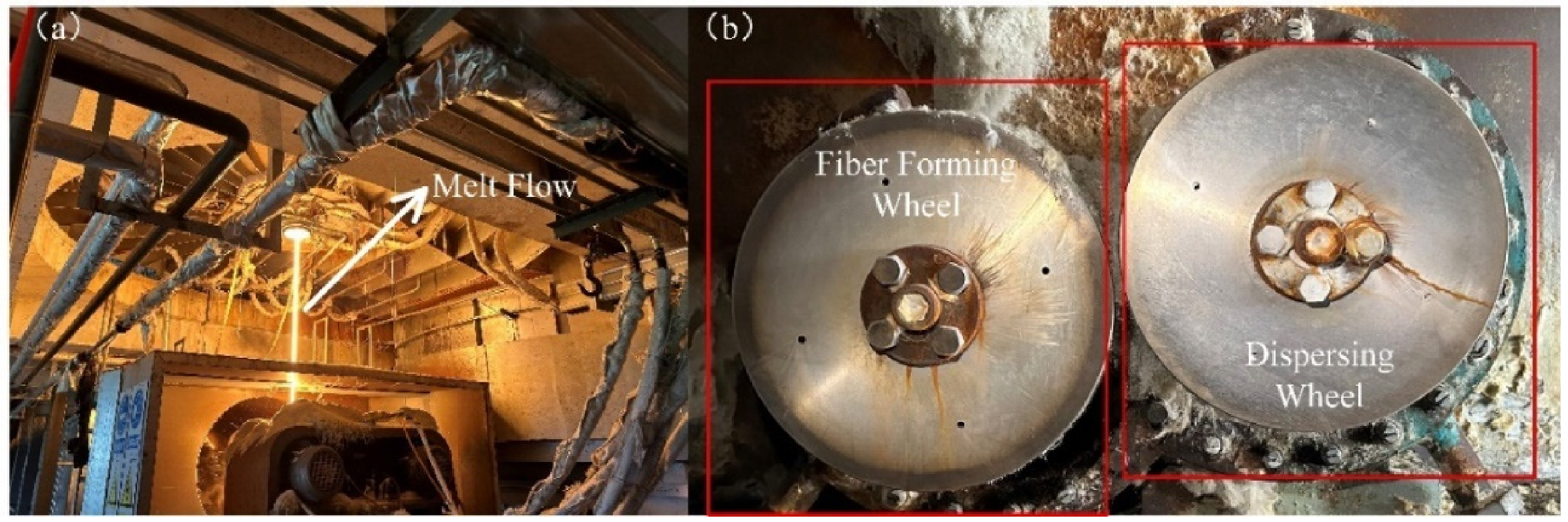
As illustrated in Figure 1, the industrial production of ceramic fibers typically employs two cooperative spinning wheels to enhance fiberization efficiency. According to the melt transport and distribution characteristics on each wheel, the two wheels can be classified as a distributing wheel and a fiberizing wheel. The wheel that directly impinges the melt stream is defined as the distributing wheel; it is required to rapidly transfer a portion of the melt onto the subsequent wheel surface, while simultaneously fiberizing the melt retained on its own surface to some extent. The fiberizing wheel is primarily responsible for converting the transferred melt into fibers. In practice, the distributing wheel is usually mounted at a higher vertical position than the fiberizing wheel to facilitate inter-wheel melt transfer.
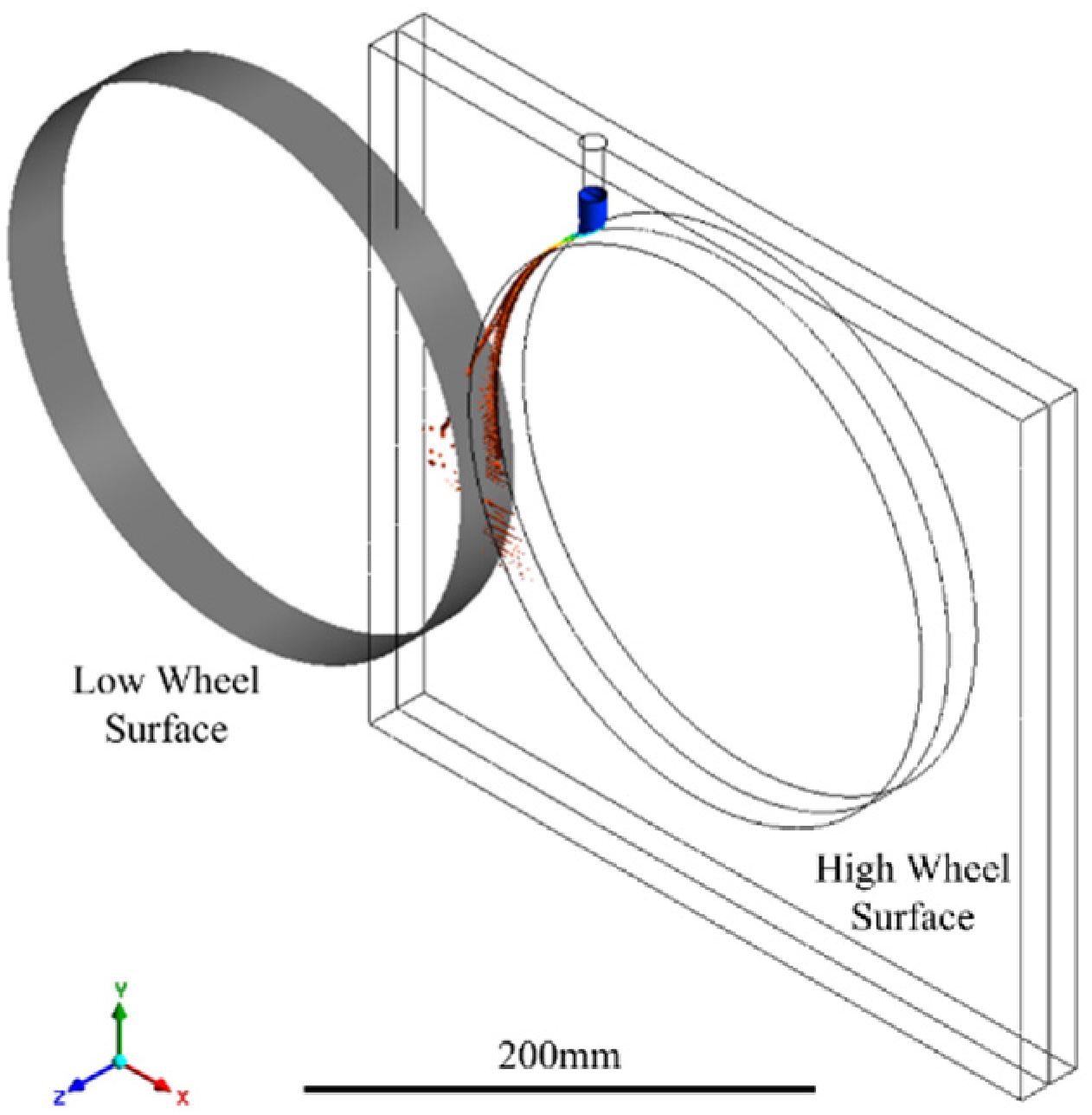
Considering the distinct functions of the two wheels in industrial operation and the corresponding research objectives, single-wheel and dual-wheel geometries were constructed using ANSYS SpaceClaim (2021 R1), as shown in Figure 2. Figure 2a presents the single-wheel geometry for the distributing spinning wheel, which is primarily used for numerical simulations of inter-wheel melt transfer mass. Figure 2b shows the local dual-wheel geometry, where the center-to-center distance between the high and low spinning wheels is 255 mm and the vertical offset is 50 mm; this configuration is mainly employed to simulate ligament size characteristics and the slag-ball fraction.
Figure 3 shows the mesh generation for the computational geometry. The mesh was generated in Fluent Meshing using a hybrid topology composed of hexahedral and polyhedral elements, which improves numerical accuracy while keeping the total cell count relatively low. A Body of Influence (BOI) refinement was applied near the circular wall to enhance the mesh quality and resolution in key flow regions. The first-layer cell height was set to 0.3 mm to accurately capture near-wall flow details.

2.2.2. Grid-Independent Verification

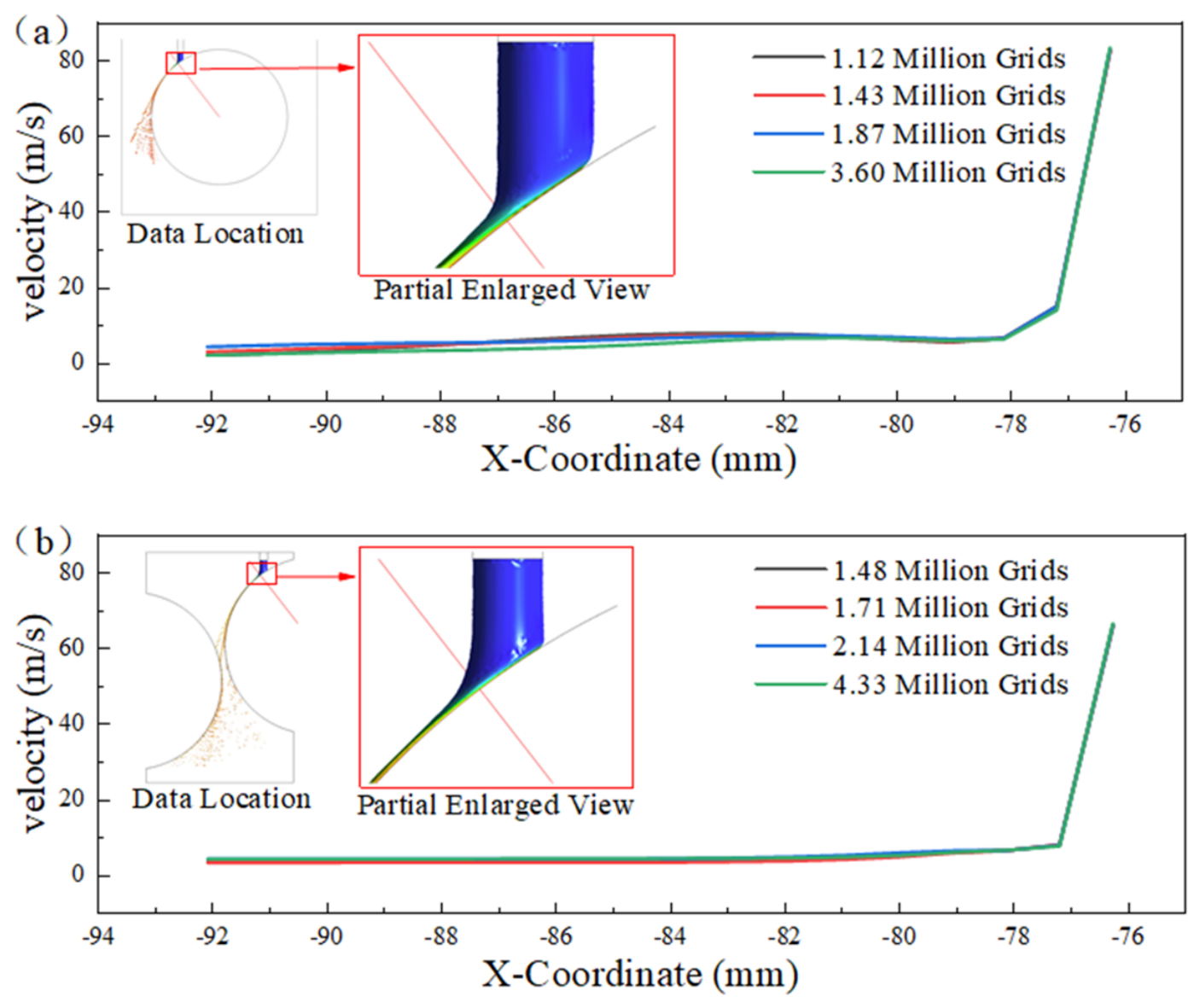
To ensure mesh reliability and establish grid independence, the liquid-film velocity at the contact point between the left edge of the inlet lip and the wheel surface, taken along the local wall-normal direction, was selected as the monitoring quantity. For the single-wheel model, grid-independence tests were performed using meshes with 1.12, 1.43, 1.87, and 3.60 million cells. For the dual-wheel model, meshes with 1.48, 1.71, 2.14, and 4.33 million cells were examined. Figure 4 presents the grid-independence curves for both the single-wheel and dual-wheel models. As shown in Figure 4, the monitored velocity remains essentially stable within a very narrow range as the mesh is refined, indicating that the numerical results are insensitive to the grid resolution. Balancing computational accuracy and efficiency, 1.87 million cells and 2.14 million cells were adopted for the single-wheel and dual-wheel simulations, respectively.
The time step was set to 1 × 10⁻⁶ s, and the global Courant number was specified as 0.25. During the simulations, results were saved every 2000 time steps, corresponding to a physical time interval of 0.002 s. A total of 20,000 time steps were performed for the single-wheel model, whereas 32,000 time steps were conducted for the dual-wheel model.

2.2.3. Model Validity Verification

To validate the single-wheel model, benchmark comparisons were performed against the experimental study reported by Bizjan et al. [14]. An aqueous glycerol solution with a glycerol mass fraction of 85% was used as the working fluid. Numerical simulations were conducted under the experimental conditions of n = 300 rpm and a volumetric flow rate of Q = 3.27 mL/s, and the simulated results were quantitatively compared with the corresponding physical measurements.
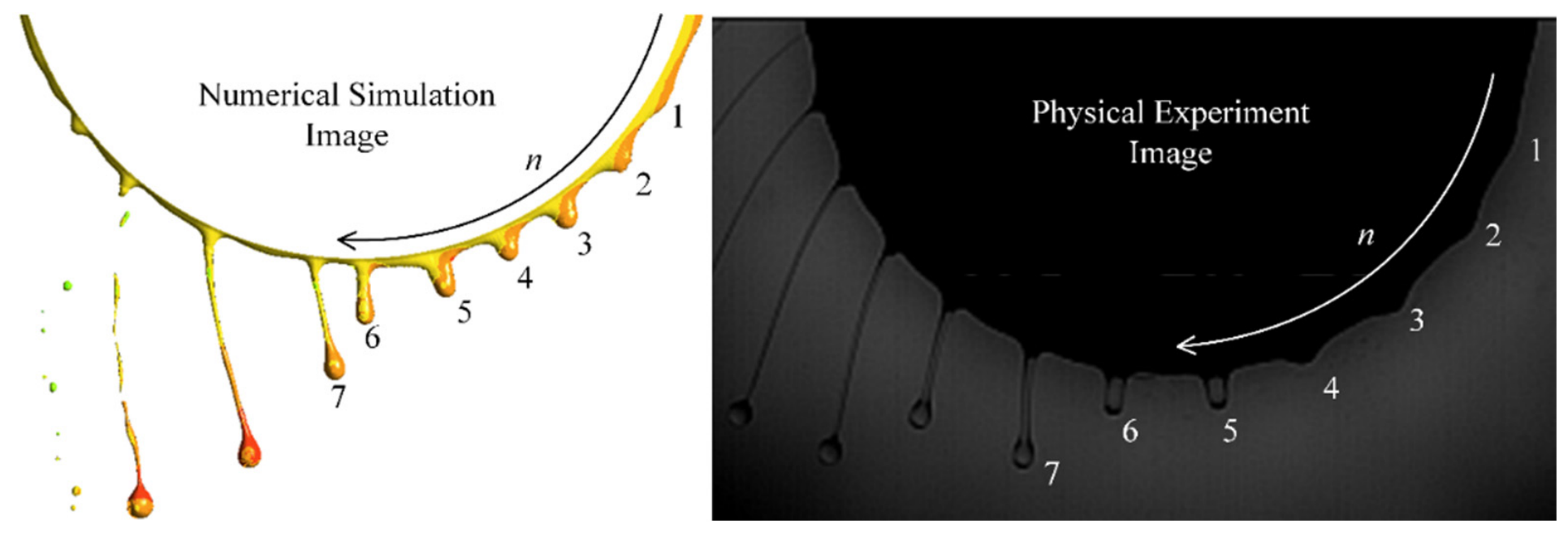
Figure 5 compares the numerical snapshots with the experimental images reported by Bizjan et al. [14]. As shown in Figure 5, both results exhibit the characteristic morphological sequence of filament formation–necking–head droplet development. Moreover, the evolution of filament (fiber) length is consistent between the simulation and the experiment, showing a progressive increase along the wheel rotation direction.
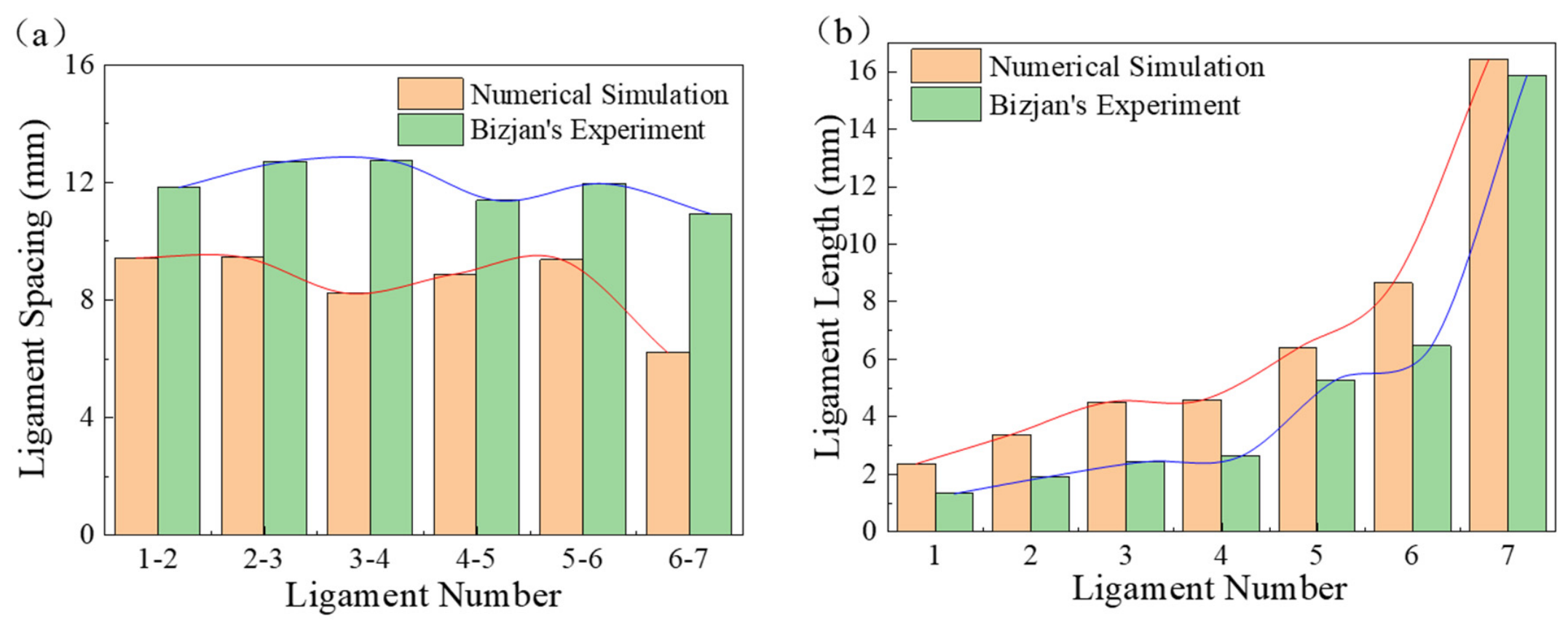
Figure 6 compares the numerical simulations with the physical experiments in terms of ligament spacing and ligament length. With respect to ligament spacing, although noticeable discrepancies exist between the simulated and measured values, the numerical model is able to reproduce a trend consistent with the experiments and captures the overall variation pattern. In contrast, the agreement is markedly better for ligament length, with a coefficient of determination of R2 = 0.886 and a Pearson correlation coefficient of r = 0.944, indicating high predictive accuracy for the ligament formation process on the wheel surface. Overall, the qualitative and quantitative comparisons demonstrate that the developed numerical model provides a reliable representation of the interfacial ligament formation dynamics.
To validate the dual-wheel numerical model, process images acquired from an on-site ceramic-fiber production line were compared with the inorganic-fiber production images reported by Chen et al. [20], thereby assessing the model’s capability to reproduce the key morphological features of the dual-wheel fiberization process.
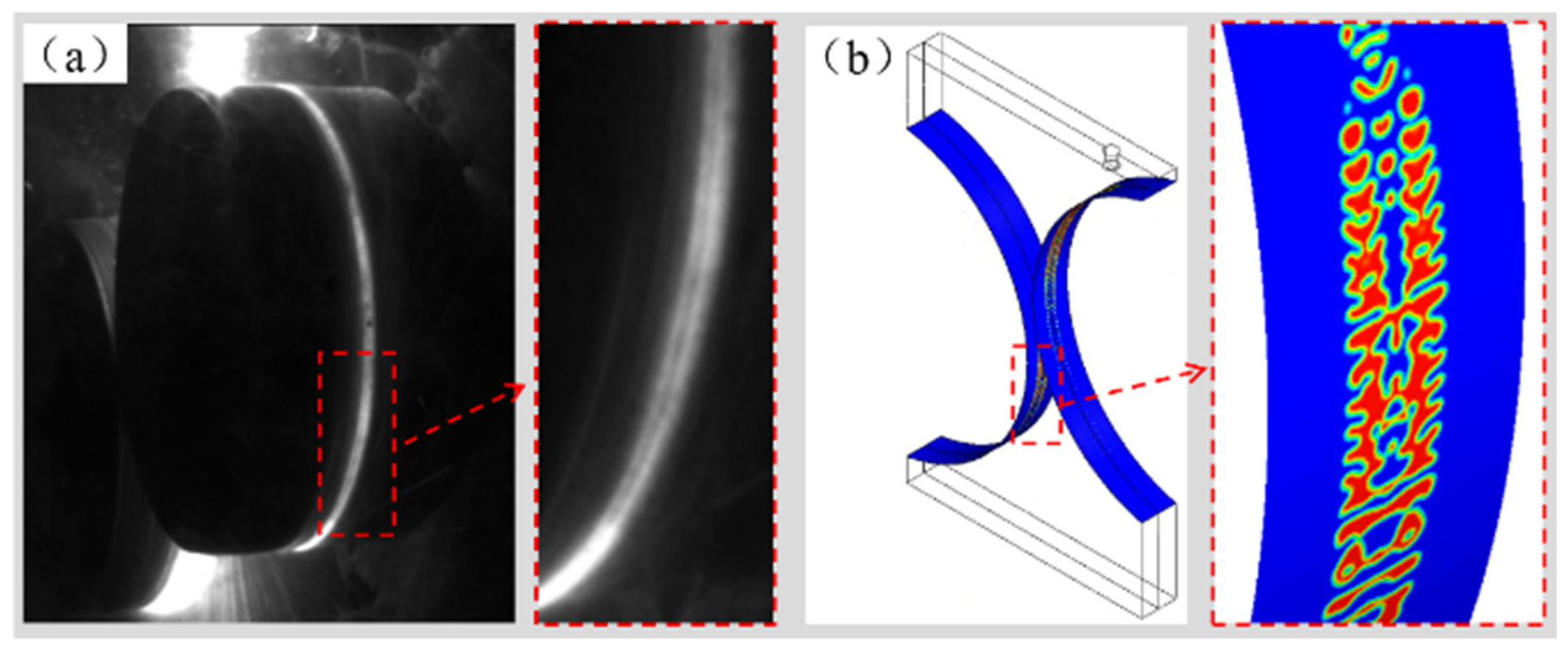
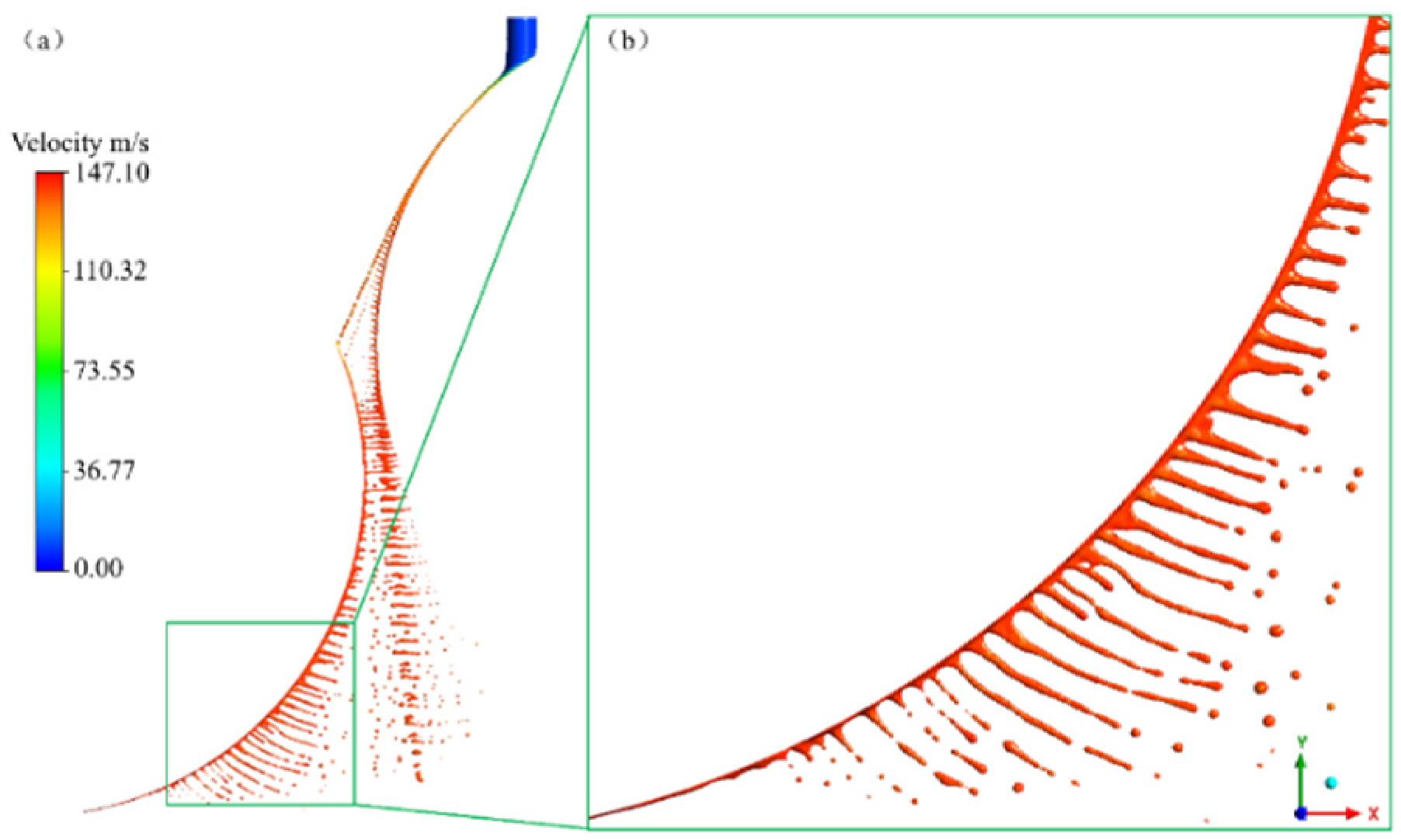
Figure 7a shows an on-site snapshot of ceramic-fiber production with a 1:1 fly ash/coal gangue mass ratio, whereas Figure 7b presents a transient image from the dual-wheel numerical simulation in this work. As observed in Figure 7a, the melt exhibits an intermittent and non-uniform distribution on the wheel surface during ceramic-fiber production. The enlarged view further reveals pronounced melt accumulation along both sides of the melt film, while the melt content near the film centerline is comparatively lower. The numerical result in Figure 7b reproduces these distribution characteristics to a certain extent, showing good qualitative agreement with the on-site observations.
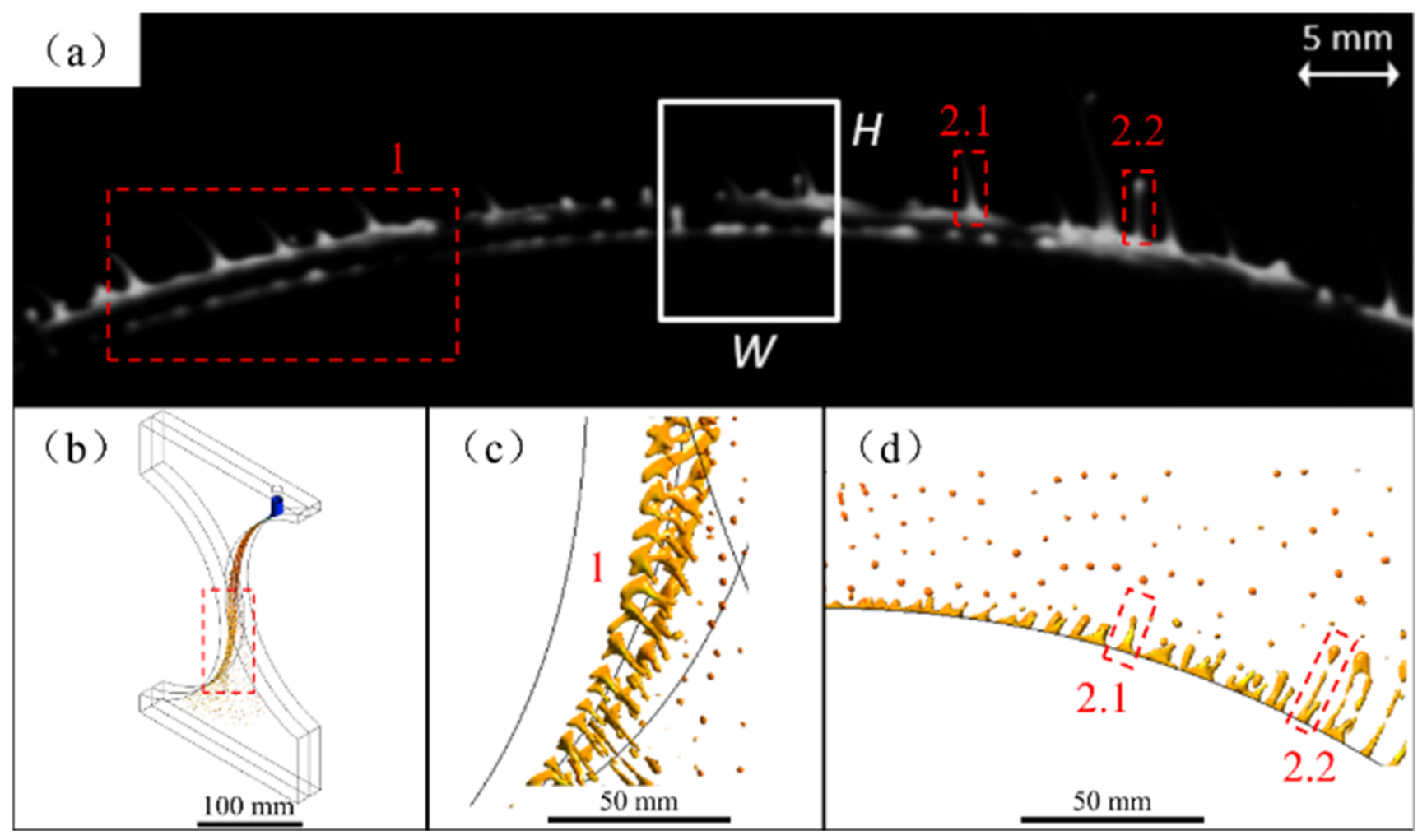
Figure 8a shows an image of the inorganic-fiber production process reported by Chen et al. [20], demonstrating the melt distribution and fiberization characteristics on the spinning wheel surface in actual industrial production; Figure 8b presents a transient snapshot from the dual-wheel simulation in this study, showing the overall transport and evolution process of the melt on the surfaces of the two wheels; Figure 8c is an enlarged view of the multi-row fiberization region in Figure 8b, clearly showing the process of multiple parallel melt streaks being simultaneously pulled out from the liquid film and forming ligaments; Figure 8d is an enlarged view of the typical fiberization morphology region in Figure 8b, presenting the structural characteristics of residual melt and head droplets in detail. As shown in Figure 8a, the melt transport on the wheel surface exhibits pronounced spatial heterogeneity. In the region labeled 1, the melt film displays a multi-row fiberization pattern, where multiple melt streaks undergo fiberization simultaneously; a similar phenomenon is accurately reproduced in the enlarged numerical view Figure 8c, and the simulation results clearly show the formation and development process of different melt streaks. The region labeled 2 in Figure 8a illustrates representative morphologies during wheel-surface fiberization: region 2.1 corresponds to the thin liquid film remaining on the wheel surface after the melt has been stretched into fibers, whereas region 2.2 depicts the process of a head droplet entraining the wheel-surface melt and continuously extending to form fibers under the action of centrifugal force. Consistently, the simulation precisely captures these two corresponding melt morphologies on the wheel surface in the enlarged view Figure 8d, further verifying that the numerical model developed in this study can accurately reproduce the key dynamic characteristics of the dual-wheel centrifugal fiberization process.
Overall, the proposed numerical model for ceramic-fiber production shows good agreement with on-site observations in terms of the spatial distribution of the melt film on the wheel surface, the multi-row fiberization behavior of the melt, and the characteristic morphological evolution during fiberization. These consistencies demonstrate that the model can reliably represent the dual-wheel fiberization process and, thus, provides a valid and practically applicable framework for subsequent analysis and process optimization.
The model validation in this study has several limitations. First, the single-wheel model validation used room-temperature glycerol solution as the experimental medium, which differs from the real high-temperature aluminosilicate melt in thermophysical properties. However, under the high rotational speeds investigated (5000–12,000 rpm), inertial forces dominate over viscous and surface tension forces. Therefore, hydrodynamic similarity still holds under these high Reynolds number conditions, and glycerol solution experiments effectively verify the model’s ability to capture flow patterns and dynamic characteristics.
Second, the dual-wheel model validation is based primarily on qualitative visual comparison with industrial production images, lacking quantitative experimental support. This is because the transient, high-speed, and high-temperature nature of the melt transfer process between dual wheels makes direct measurement of key parameters extremely difficult with current techniques. Most existing studies on dual-wheel centrifugal fiberization also rely on qualitative validation methods.

2.2.4. Boundary Conditions and Numerical Solver Settings

All boundary conditions of the computational domain were clearly defined to ensure the accuracy and reproducibility of the numerical simulations, as detailed below.
(1)
Inlet boundary
The melt inlet was set as a velocity inlet boundary condition. The melt flowed vertically into the computational domain with a velocity ranging from 7.51 m/s to 8.68 m/s according to different simulation cases. The inlet temperature was consistent with the melt temperature of each working condition (1680–1980 °C). The turbulence intensity at the inlet was set to 5%, and the hydraulic diameter was equal to the nozzle diameter (11 mm), which is consistent with industrial production parameters.
(2)
Outlet boundary
All outer boundaries of the computational domain, except the inlet and wheel surfaces, were set as pressure outlet boundaries with a relative pressure of 0 Pa. The backflow temperature was set to 300 K (room temperature), and the backflow turbulence intensity was 5%. This setting allows the gas and uncollected melt droplets to freely exit the computational domain without causing numerical reflections.
(3)
Rotating wheel wall boundaries
Both the high wheel and low wheel were set as rotating wall boundaries with no-slip conditions, through which the independent rotational motion of the two spinning wheels was directly implemented. The rotation axes coincided with the geometric centers of the respective wheels, the rotation direction was consistent with actual industrial production, and the rotational speeds were set according to the simulation cases. The wall tangential velocity was automatically calculated from the rotational speed and radius to ensure complete consistency with the actual rotational motion.
(4)
Symmetry boundaries
The surface in contact with the flow diameter in the computational domain is set as the symmetry plane. This setting effectively reduces computational costs while ensuring the accuracy of radial and circumferential flow field simulation.
(5)
Contact angle and wettability treatment
In the original numerical simulations of this study, the default wall adhesion boundary condition of the ANSYS Fluent VOF model was used, which corresponds to a contact angle of 90°, assuming neutral wetting between the melt and the wheel surface.
(6)
Solver and discretization scheme settings
All numerical simulations were performed using the pressure-based solver ANSYS Fluent 2021R1 for transient calculations. The SIMPLEC algorithm was used for pressure-velocity coupling, which has good stability and convergence in rotating flow and multiphase flow simulations. The PRESTO! scheme was used for pressure interpolation, which is suitable for high swirl flows and free surface flows; the momentum, turbulent kinetic energy, and turbulent dissipation rate were all discretized using the second-order upwind scheme to improve calculation accuracy; the geometric reconstruction (Geo-Reconstruct) method was used for gas–liquid interface reconstruction, which provides the sharpest interface representation and is the most accurate interface reconstruction algorithm in the VOF model. The time step was set to 1 × 10⁻⁶ s, and the global Courant number was controlled below 0.25 to ensure the stability and accuracy of interface tracking.
(7)
A dual-convergence criterion combining residual convergence and physical quantity monitoring was adopted in this study. Each time step was iterated until the residuals of all governing equations met the following standards: continuity equation residual < 1 × 10⁻⁴; x-, y-, and z-direction velocity residuals < 1 × 10⁻⁴; turbulent kinetic energy k and dissipation rate ε residuals < 1 × 10⁻⁴; and energy equation residual < 1 × 10⁻⁸. At the same time, to ensure the convergence of physical quantities and the stability of simulation results, the average liquid film thickness on the high wheel surface and the melt mass flow rate at the outlet of the computational domain were monitored.

2.3. Material Composition and Thermal Properties

2.3.1. Main Components

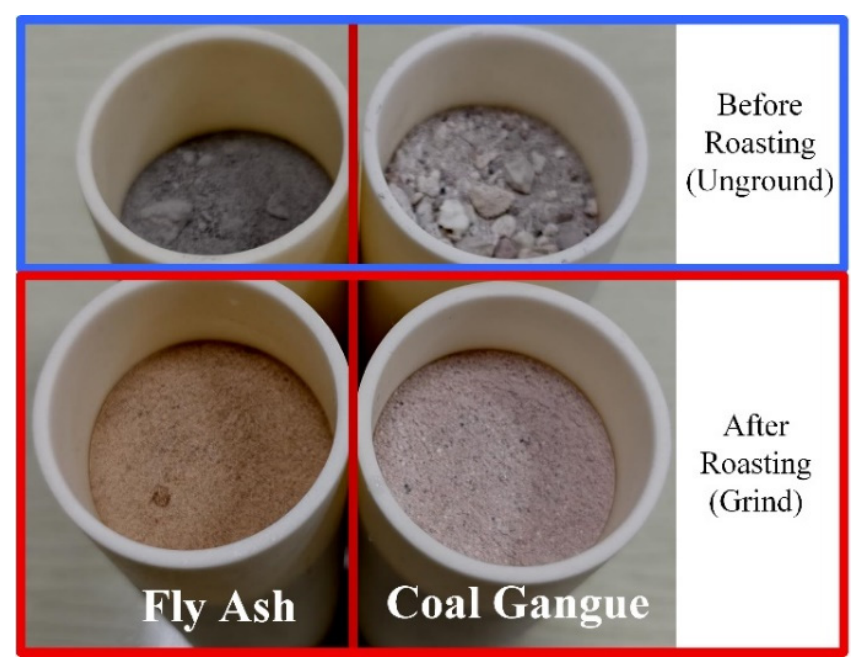
In recent years, it has been recognized that producing ceramic fibers from fly ash and coal gangue provides an effective route to alleviate solid-waste stockpiling and achieve high value-added utilization [25,26]. Given that fly ash and coal gangue typically contain considerable carbon, decarburization pretreatment is required prior to fiber production. Specifically, the feedstocks are calcined to reduce the residual carbon content and thereby improve melt quality for fiberization. Figure 9 compares the appearances of fly ash and coal gangue before calcination and after calcination at 800 °C with a 7 h holding time.
As shown in Figure 9, the fly ash appears dark gray prior to calcination due to the presence of unburnt carbon and iron-bearing oxides. After calcination, the unburnt carbon is oxidized to CO2 and released, while part of Fe2+ is further oxidized to Fe3+, leading to a distinct color change in fly ash from dark gray to yellow. Coal gangue typically exhibits a more complex mineralogy, commonly consisting of kaolinite, quartz, and carbonate phases. Before calcination, it generally shows a light brown appearance. Under high-temperature treatment, certain volatile impurities are removed or decomposed, carbonates undergo thermal decomposition, and kaolinite experiences dehydroxylation and phase transformation, resulting in a grayish-white color after calcination.
The chemical compositions of the calcined fly ash and coal gangue samples were quantitatively analyzed by X-ray fluorescence spectroscopy (XRF, Bruker S8 Tiger). Before testing, the samples were dried at 105 °C for 2 h to remove adsorbed water and then pressed into discs with a diameter of 32 mm. The test results are expressed as mass fractions of each element and oxide, and the sum of the contents of all components is 100 wt.%. The calcined fly ash and coal gangue were analyzed for their chemical compositions, and the major oxide contents are summarized in Table 1. As shown in Table 1, both materials contain high levels of SiO2 and Al2O3, meeting the basic compositional requirements for ceramic-fiber feedstocks. Meanwhile, the contents of impurity oxides, such as TiO2, MgO, K2O, Na2O, and Fe-bearing species, are relatively low, which is beneficial for producing fibers with stable composition and consistent properties. In particular, the Fe contents in fly ash and coal gangue are 2.100% and 1.008%, respectively, both within the acceptable range for ceramic-fiber raw materials and, thus, unlikely to cause a pronounced deterioration in high-temperature performance.
The CaO content is below the detection limit (0.05 wt.%) of X-ray fluorescence spectroscopy (XRF), so it is not listed in the table. The sum of all component contents is 100 wt.%. Based on the chemical compositions in Table 1, the acidity coefficient, Mk, of the 1:1 mass ratio of the mixed raw material in this study is about 39.2, where the acidity coefficient is defined as Mk = (SiO2 + Al2O3)/(CaO + MgO). Compared with traditional blast furnace slag (acidity coefficient of 1.1–1.3), the acidity coefficient of the raw materials in this study is significantly higher, which is due to their extremely low CaO content and high alumina-silica content. For high-alumina-silica solid wastes, their fiberization mechanism is obviously different from that of blast furnace slag: blast furnace slag mainly controls the melt viscosity by adjusting the acidity coefficient, while the raw materials in this study mainly adjust the viscosity by controlling the melt temperature.
The fly ash used in this study is high-temperature pulverized coal combustion fly ash, from a pulverized coal boiler of a coal-fired power plant in North China, with a combustion temperature of 1300–1500 °C. Compared with fluidized bed combustion fly ash, high-temperature pulverized coal combustion fly ash has the characteristics of low carbon content (0.205 wt.%), high glass phase content, and fine uniform particles and only needs mild calcination decarburization treatment at 800 °C for 7 h to meet the requirements of ceramic-fiber production.
The co-production of ceramic fibers from fly ash and coal gangue not only enables tailoring of the Si/Al ratio to achieve a balanced combination of melting behavior and a controllable viscosity window but also reduces reliance on high-purity feedstocks or natural minerals, thereby facilitating elemental-resource recovery and high value-added valorization of solid wastes. In particular, fly ash is widely available, fine in particle size, and readily vitrified, allowing it to act as a conditioning component to improve melt fluidity during fiberization. Coal gangue, by contrast, is enriched in Al2O3 and SiO2, which is beneficial for enhancing the thermal resistance and structural stability of the resulting ceramic fibers.
Overall, fly ash and coal gangue exhibit strong compositional complementarity. Their synergistic utilization for ceramic-fiber production is not only technically feasible in terms of feedstock design and processing but also offers clear advantages in reducing material costs, promoting comprehensive resource utilization, and improving fiber performance. Consequently, this approach holds significant potential for engineering deployment and delivers tangible environmental benefits.

2.3.2. Thermophysical Properties of Materials

In ceramic-fiber production, the feedstocks are first heated to form a stable melt pool, after which the melt is guided onto the surface of the spinning wheel for fiber formation. During this process, the melt undergoes pronounced temperature fluctuations, causing key thermophysical properties—such as surface tension, thermal conductivity, viscosity, and radiative properties—to vary strongly with temperature. To clarify the temperature dependence of these melt properties, experimental measurements and computational analyses of thermophysical properties were performed using a fly ash/coal gangue blend with a 1:1 mass ratio.
Melt viscosity is a critical parameter governing fiberization stability and fiber quality, and it is highly sensitive to temperature. Therefore, the temperature-dependent melt viscosity was experimentally measured using a high-temperature melt-property testing system. Viscosity measurements were performed with a Brookfield rotational viscometer (Brookfield, USA) equipped with a Brookfield DV2T sensor.
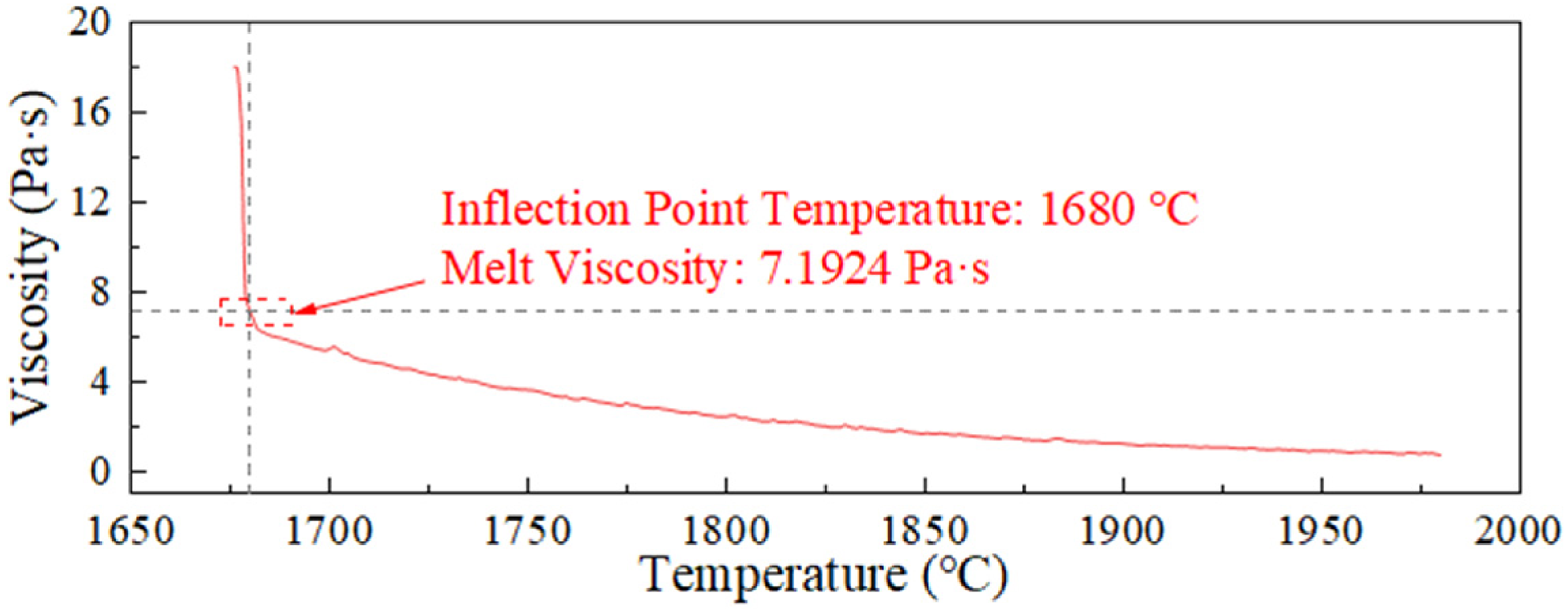
During the viscosity measurements, the melt was first heated slowly to 1800 °C, mechanically stirred, and held for 30 min to ensure complete melting of the feedstocks. The melt was then further heated to 1980 °C. Upon reaching this temperature, heating was terminated and the rotational viscometer was initiated to record the melt viscosity. Figure 10 shows the viscosity–temperature curve obtained from the high-temperature melt-property testing system.
As shown in Figure 10, a viscosity inflection point is observed at approximately 1680 °C. When the melt temperature is below this inflection temperature, the viscosity increases sharply with a decrease in temperature; when the temperature is above the inflection point, the viscosity decreases more gradually with an increase in temperature. Excessively high viscosity results in insufficient melt fluidity and cannot meet the requirements for spreading and elongation during fiberization. Conversely, an overly low viscosity increases the energy consumption of the electric furnace and may promote premature filament breakage during fiberization, thereby deteriorating fiber quality.
Given that the fly ash–coal gangue melt is dominated by SiO2 and Al2O3, it exhibits the characteristic behavior of silicate melts. According to previous studies [27,28], the temperature dependence of the thermal conductivity of silicate melts can be evaluated using the following relationship:
λmelt = 0.7095 + 7.3468 × 10⁻⁴Tmelt + 7.6638 × 10⁻⁷Tmelt2 − 6.5718 × 10⁻¹⁰Tmelt3 (Tmelt < 1373.15 K)
λmelt = −99.552 + 0.1967Tmelt − 1.2574 × 10⁻⁷Tmelt2 + 2.625 × 10⁻⁸Tmelt3 (Tmelt ≥ 1373.15 K)
In the above equation, Tmelt denotes the melt temperature, K; and λmelt represents the melt thermal conductivity, W/(m·K).
In addition, the melt surface tension was calculated using an established surface-tension model [29] in conjunction with the constituent composition of the 1:1 (fly ash/coal gangue, by mass) mixture, and the resulting expression is given in Equation (9) [30]. The melt specific heat capacity and emissivity can be evaluated using Equation (14) and Equation (15), respectively [31,32].
σ = 0.653 ( 1.5 × 1 0 4 ) T m e l t
C p = 1014 + 0.062 T m e l t 0.347 × 1 0 8 T m e l t 2
ε = 4 × 10 7 T M s u r f 273.15 2 7 × 10 4 T M s u r f 273.15 + 1.087
In the above equations, σ denotes the melt surface tension, N/m; TMelt is the melt temperature, K; Cp is the melt specific heat capacity, J/(Kg·K); ε is the melt emissivity, dimensionless); and TM-surf is the melt surface temperature, K.
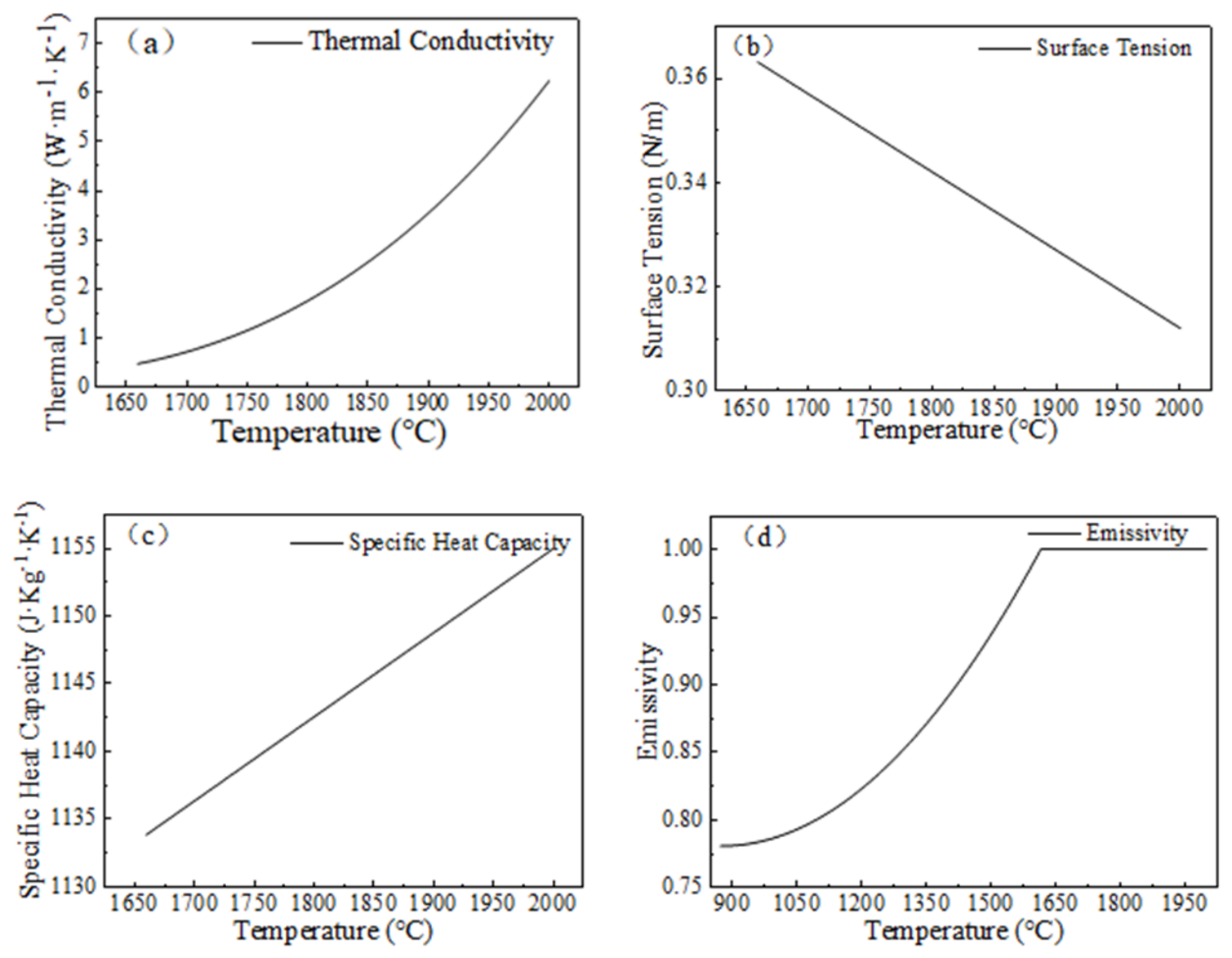
Figure 11 presents the temperature-dependent thermophysical properties of the melt. As shown in Figure 11, the melt thermal conductivity increases markedly over 1650–2000 °C, indicating a pronounced enhancement in heat-transfer capability with increasing temperature. The melt surface tension decreases approximately linearly with temperature; the reduced surface tension at elevated temperatures facilitates the formation and stabilization of ligament structures during centrifugal fiberization. The specific heat capacity increases with temperature, suggesting a slightly higher heat-absorption (thermal-storage) capacity in the high-temperature regime than in the low-temperature regime. The melt emissivity rises rapidly from 0.78 to 1.00 over 900–1600 °C, implying strengthened radiative heat-transfer characteristics with increasing temperature. Once fully molten, the melt exhibits near-blackbody radiative behavior, with an emissivity approaching unity.
In summary, the material properties used in the numerical simulations are summarized in Table 2.
Regarding the melt density, a constant value of 2750 kg/m3 was adopted in this study. This value is based on the typical density range of aluminosilicate melts. The volume expansion coefficient of aluminosilicate melts is extremely low, usually (2–5) × 10−4/°C. Within the temperature range of 1680–1980 °C, the relative change rate of density is only 2–5%, which is much smaller than the variation amplitudes of other thermophysical properties such as viscosity and surface tension. Therefore, in the high-speed centrifugal fiberization process of this study, the minor change in melt density has a negligible impact on the simulation results, and adopting a constant density is reasonable and can ensure the accuracy of the simulation results and the reliability of the research conclusions.

2.4. Simulation Scheme

To systematically elucidate the effects of melt temperature, T, high-wheel rotational speed, n, and melt jet velocity, vj, on inter-wheel melt transfer mass, the underlying mechanisms were first analyzed using the single-wheel model. Subsequently, the dual-wheel model was employed to reveal the intrinsic relationships between melt temperature, high-low-wheel rotational speeds and the ligament aspect ratio, as well as the slag-ball fraction.
For the simulation plan, which aimed at evaluating inter-wheel melt transfer mass, a Box–Behnken Design (BBD) was implemented in Design-Expert to generate the numerical test matrix within the ranges T = 1680–1980 °C, wheel rotational speed n = 5000–12,000 rpm, and melt jet velocity vj = 7.51–8.68 m/s.
After establishing the influence of the above parameters on inter-wheel melt transfer mass, dual-wheel simulations were further performed by treating melt temperature, T , high-wheel rotational speed, n H , and low-wheel rotational speed, n L , as the operating variables. The low-wheel speed was varied within n = 6000–11,000 rpm with an increment of Δn = 1000 rpm. On this basis, the mechanisms by which these three parameters govern the ligament diameter and the slag-ball fraction were systematically investigated.

3. Results and Discussion

3.1. Inter-Wheel Melt Transfer Mass and Its Influencing Factors

In industrial production, the melt must be transferred from the high wheel to the low wheel, and stable control of inter-wheel melt transfer mass is essential for improving feedstock utilization efficiency. Therefore, based on the single-wheel configuration shown in Figure 2a, the inter-wheel melt transfer mass was quantified using the User Surface function in CFD-Post. Specifically, a virtual surface representing the low spinning-wheel surface was constructed by defining a circular surface whose center is located 255 mm horizontally and 50 mm vertically from the axis center of the high spinning wheel, as illustrated in Figure 12.
According to the Box–Behnken Design (BBD) scheme, a numerical simulation plan was established to evaluate inter-wheel melt transfer mass. Melt temperature (A), melt jet velocity (B), and high-wheel rotational speed (C) were selected as the three design factors, while the mass of melt transferred within 0.01 s was taken as the response variable. A three-factor, three-level response surface design was constructed, and the resulting design matrix is summarized in Table 3.
According to the factor-level combinations listed in Table 3, a total of 17 numerical simulation cases were performed, and the corresponding results are summarized in Table 4.
After performing multiple regression fittings and comparative analyses of the dataset in Design-Expert, the reduced quadratic model was identified as the best representation of the experimental data. The response-surface regression equation is given as follows:
Y = −0.1434 + 0.000049A + 0.027669B − 3.29703 × 10⁻⁶C − 6.52707 × 10⁻⁶AB − 4.48596 × 10⁻⁶BC − 0.00115B2
In this equation, Y denotes the inter-wheel melt transfer mass (kg); A is the melt temperature (°C); B is the melt jet velocity (m/s); and C is the high-wheel rotational speed (rpm). It should be emphasized that this regression equation is established based on the actual physical values of each factor with real engineering units, rather than the normalized coded values conventionally adopted in response surface methodology. All coefficients in the equation correspond to the actual operating parameters in the numerical simulation, so the equation can be directly used for prediction by substituting on-site or simulated working condition parameters.
To verify the accuracy of this regression equation, the parameters of all 17 groups of experiments in Table 4 were substituted into the equation for calculation. The results show that the average relative error between the predicted values and the actual simulation values is 3.12%, and the maximum relative error is 7.85%, both within the acceptable error range of numerical simulation. Taking the typical working condition (A = 1830 °C, B = 8.095 m/s, C = 8500 rpm) as an example, substituting into the equation gives Y = 0.00154 kg, which is almost consistent with the actual simulation value of 0.00155 kg, with a relative error of only 0.65%, proving that the equation can accurately predict the inter-wheel melt transfer mass.
To evaluate the statistical significance and goodness of fit of the developed quadratic response model for inter-wheel melt transfer mass, an analysis of variance (ANOVA) and model-fit statistics were performed. The results are presented in Table 5 and Table 6, respectively.
As shown in Table 5, the developed reduced quadratic model exhibits extremely high statistical significance, with an F-value of 28.44 and a p-value of less than 0.0001. This result verifies that the overall regression relationship between the three influencing factors and the inter-wheel melt transfer mass is statistically reliable, and the model can effectively characterize the variation law of the response value within the selected experimental parameter range.
In terms of main effects, all three factors pass the significance test at the 0.05 level, but there are remarkable differences in their influence weights on the response value. Ranked by F-value and the proportion of sum of squares in the total model variation, the significance order of the main factors is as follows: high-wheel rotational speed (C, F = 90.16, p < 0.0001) > melt jet velocity (B, F = 18.96, p = 0.0014) > melt temperature (A, F = 17.55, p = 0.0019). Specifically, the sum of squares of factor C accounts for more than 52% of the total sum of squares of the model, far exceeding that of the other two factors, which indicates that the high-wheel rotational speed is the dominant factor governing the inter-wheel melt transfer mass. This phenomenon is mainly attributed to that the linear velocity of the wheel surface directly determines the melt entrainment capacity and the thickness of the liquid film adhered to the wheel surface. The influence intensities of melt temperature and jet velocity are relatively close: the former changes the melt viscosity and surface tension to affect the adhesion behavior of the melt, while the latter regulates the impact momentum and spreading area of the jet, both of which indirectly adjust the final transfer mass.
For the interaction terms, both the AB interaction (melt temperature × melt jet velocity, p = 0.0082) and the BC interaction (melt jet velocity × high-wheel rotational speed, p = 0.0004) reach the significant level. The BC interaction has a higher F-value and stronger coupling effect, meaning that the influence rule of melt jet velocity on transfer mass is significantly regulated by the high-wheel rotational speed. With the increase in wheel speed, the optimal jet velocity corresponding to the maximum transfer mass will shift accordingly, which essentially reflects the coupling mechanism between jet impact and viscous entrainment on the wheel surface. The significant AB interaction indicates that the change in melt viscosity caused by temperature variation will further adjust the action intensity of jet velocity on the melt transfer process.
In addition, the quadratic term B2 has a p-value of 0.0425, which is statistically significant, revealing that the effect of melt jet velocity on inter-wheel melt transfer mass presents a nonlinear parabolic trend instead of a simple linear monotonic relationship. Within the studied parameter range, the transfer mass first increases and then decreases with the rise of jet velocity, and there exists an optimal velocity interval to achieve the maximum transfer mass.
For the lack-of-fit test, the F-value of lack of fit is 4050.00. It should be noted that the response value (melt transfer mass) is in the order of 10−3 kg, and the pure error sum of squares obtained from repeated central point experiments is only 2.000 × 10⁻¹⁰, reflecting extremely high repeatability of the numerical simulation results under the same working condition. The absolute magnitude of the deviation caused by lack of fit is very limited. Combined with the high determination coefficient and acceptable prediction error of the model, the model still has sufficient fitting performance and can accurately describe the change rule of the response value.
Table 6 summarizes the statistical indicators for model fitting. As shown in Table 6, the coefficient of determination is R2 = 0.9446 and the adjusted coefficient of determination is R2adj = 0.9114, indicating that the model provides an excellent fit to the numerical simulation data. Meanwhile, the predicted coefficient of determination R2pre = 0.7923 differs from R2adj by less than 0.2, demonstrating satisfactory predictive capability. The low standard deviation (Std.Dev. = 0.0003) suggests small residual fluctuations and a narrow prediction error band. Furthermore, in conjunction with the coefficient of variation (C.V. = 22.25%) and the mean value of inter-wheel melt transfer mass (Mean = 0.0016), the results confirm that the developed model exhibits high accuracy and reliability.
Overall, the developed quadratic model is highly statistically significant, provides an excellent fit to the numerical simulation data, and exhibits strong predictive capability for inter-wheel melt transfer mass.
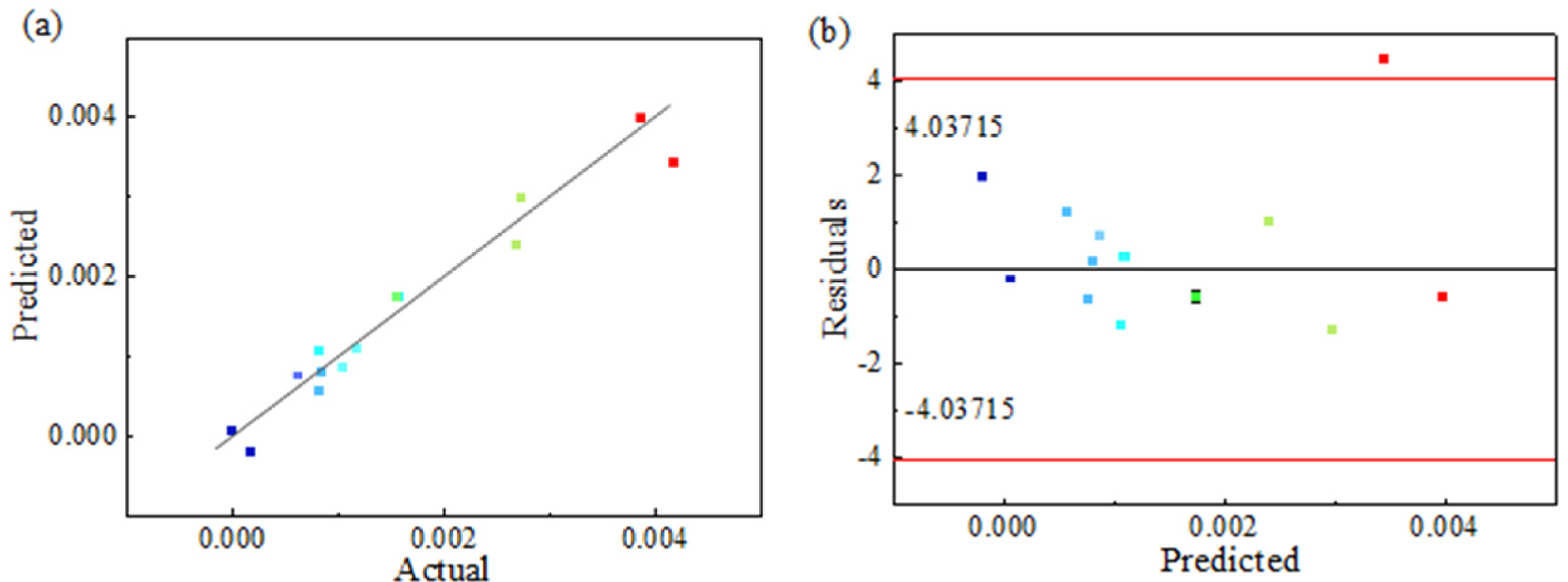
Figure 13a illustrates the correspondence between the predicted inter-wheel melt transfer mass obtained from the quadratic regression model and the actual values. As shown in the figure, the data points are closely and uniformly distributed around the diagonal line, exhibiting a strong linear correlation. This behavior indicates that the quadratic regression model provides an accurate fit to the numerical simulation results.
Figure 13b presents the distribution of residuals as a function of the model-predicted values. As shown in the figure, most residuals are randomly scattered within ±4.03715, with no discernible systematic pattern, indicating that the independence assumption of the residuals is reasonably satisfied.
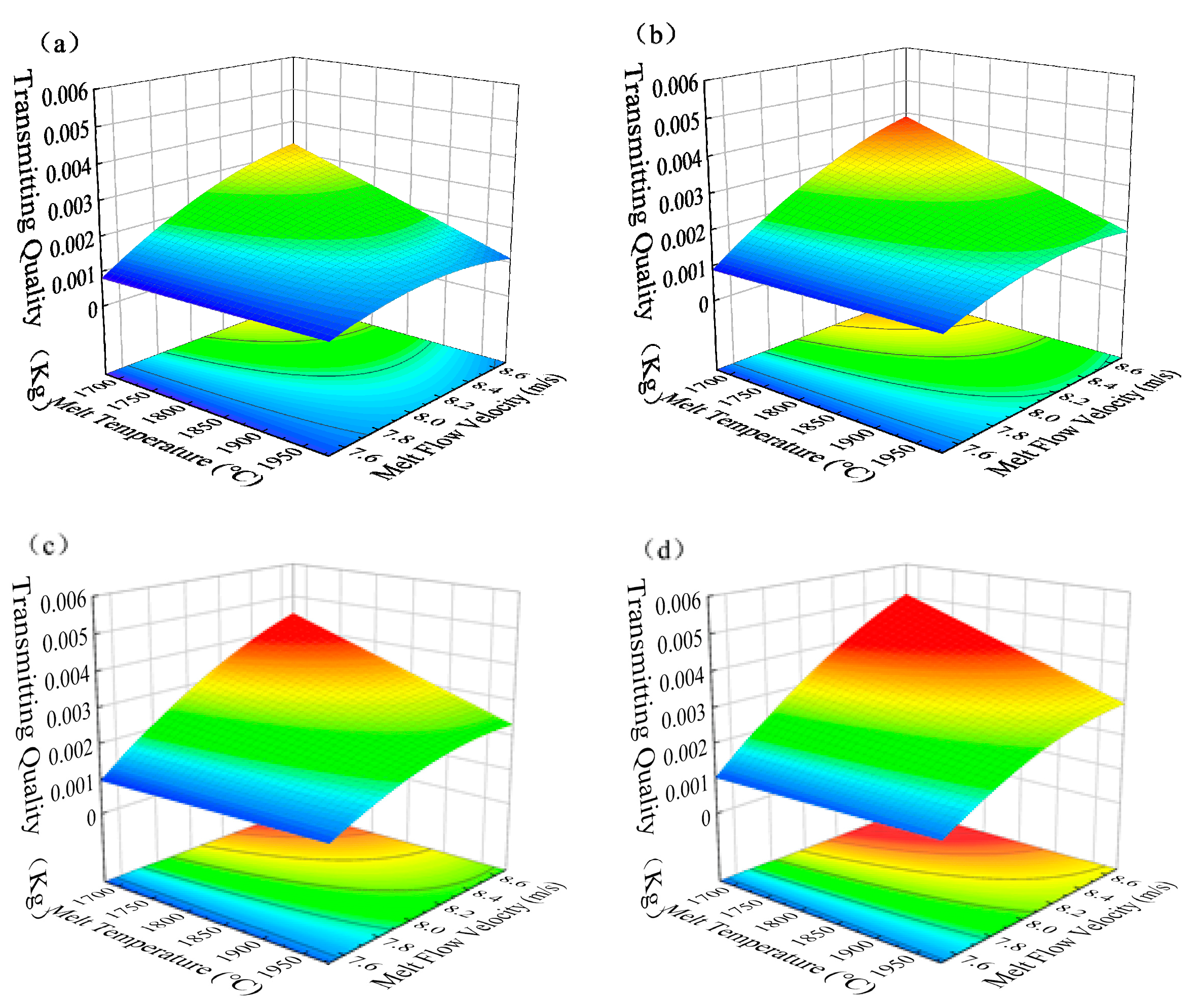
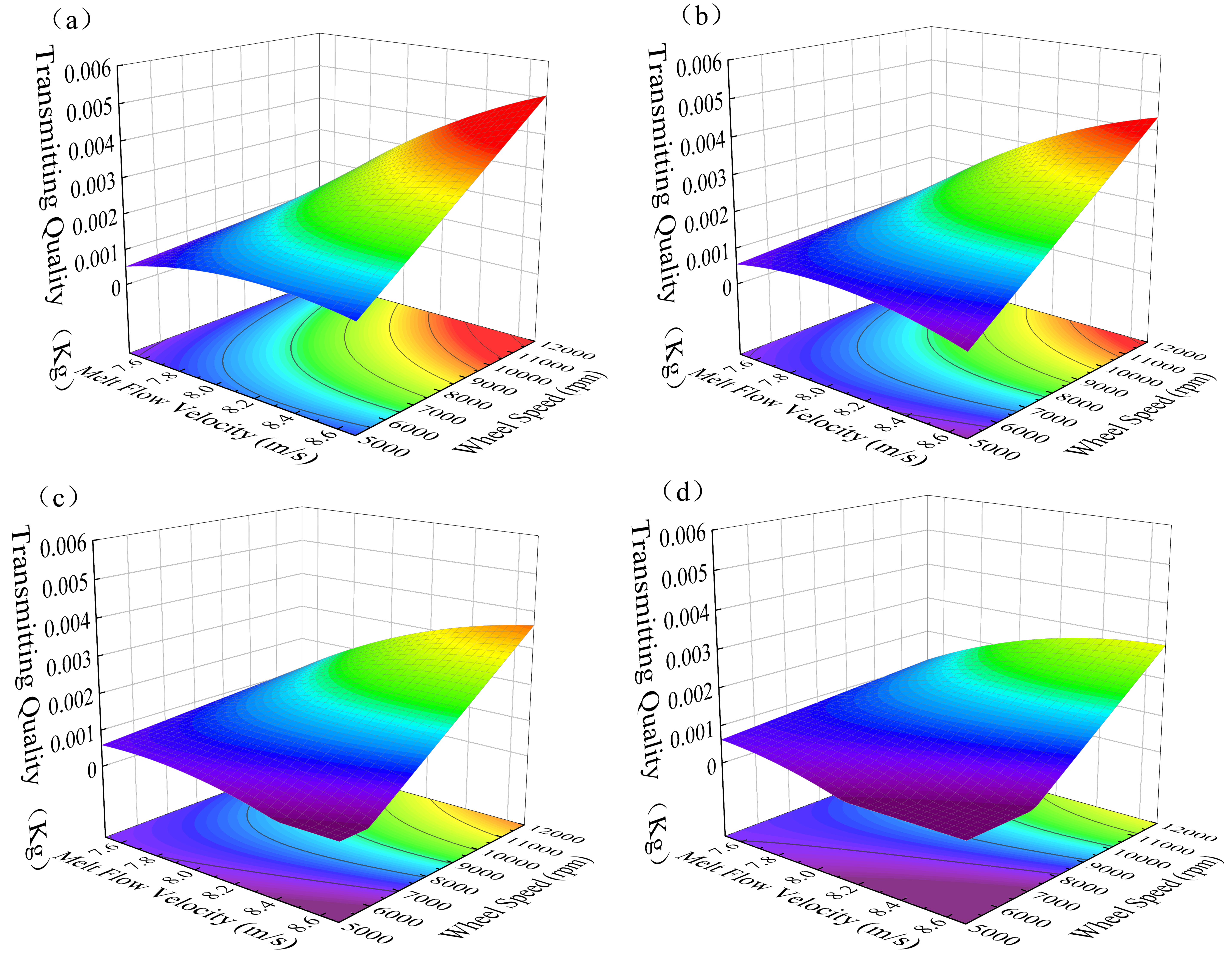
Figure 14 presents the response surfaces constructed using melt temperature and melt jet velocity as independent variables and inter-wheel melt transfer mass as the response under different wheel rotational speeds. As shown in Figure 14, increasing the wheel speed from n = 9000 rpm to n = 12,000 rpm leads to a pronounced enhancement in inter-wheel melt transfer mass, with the peak response rising from 0.00329 kg to 0.00508 kg. Within this range, the influence of melt temperature is relatively minor, whereas the effect of melt jet velocity exhibits a strong dependence on wheel speed: it is insignificant at lower speeds but acts synergistically with wheel rotation at higher speeds, resulting in a substantial increase in inter-wheel melt transfer mass.
These observations indicate that the high-wheel rotational speed is the dominant factor governing inter-wheel melt transfer mass. High-speed rotation markedly increases the tangential velocity of the wheel surface, enabling the melt to acquire greater kinetic energy during spreading and transport along the wheel surface, which in turn enhances melt-transfer performance. By contrast, although melt temperature affects viscosity and surface tension, it does not play a decisive role in determining inter-wheel melt transfer mass in the ultra-high-speed regime. The influence of the melt jet velocity becomes significant only at elevated wheel speeds, where its effect is progressively amplified, highlighting the synergistic nature of multi-parameter interactions in the melt-transfer process. Overall, the high-wheel rotational speed serves as the primary controlling parameter for the inter-wheel melt transfer mass, the contribution of the melt jet velocity increases with the increase in speed, and the effect of the melt temperature becomes comparatively weak at high rotational speeds.
Figure 15 illustrates the response surfaces constructed using the melt jet velocity and high-wheel rotational speed as independent variables and inter-wheel melt transfer mass as the response under different melt temperatures. As shown in Figure 15, the melt temperature exerts a pronounced but non-monotonic influence on the inter-wheel melt transfer mass. At a melt temperature of T = 1680 °C, the response surface reaches its maximum, with a peak value of approximately 0.00508 kg. When the temperature increases to T = 1780 °C, the peak decreases to 0.00436 kg. With a further increase in the melt temperature to T = 1980 °C, the peak response drops to only 0.0029 kg, and regions with nearly zero inter-wheel melt transfer mass emerge under low-rotational-speed conditions.
At lower melt temperatures, the melt exhibits relatively high viscosity and surface tension. Although the shear-driven flow induced upon contact with the wheel surface is comparatively weak, the overall melt velocity can increase rapidly; consequently, the inter-wheel melt transfer mass reaches a maximum under conditions of high melt jet velocity and high-wheel rotational speed. As the melt temperature increases further, however, both the viscosity and surface tension decrease markedly, making the melt more prone to breakup and splashing upon wheel impact. In addition, pronounced velocity gradients develop within the melt layer on the wheel surface, which collectively diminish the effectiveness of the melt transport. This effect is particularly evident at high melt temperatures combined with low-wheel rotational speeds, where the tangential velocity of the wheel surface is insufficient to further accelerate the low-viscosity melt, resulting in an inter-wheel melt transfer mass that approaches zero.
Melt temperature exerts a dual effect on inter-wheel melt transfer mass, characterized by a moderately beneficial but excessively detrimental behavior. At relatively low temperature levels, melt temperature strengthens the synergistic interaction between melt jet velocity and high-wheel rotational speed, thereby enhancing melt transfer. In contrast, excessively high melt temperatures suppress effective melt transport.
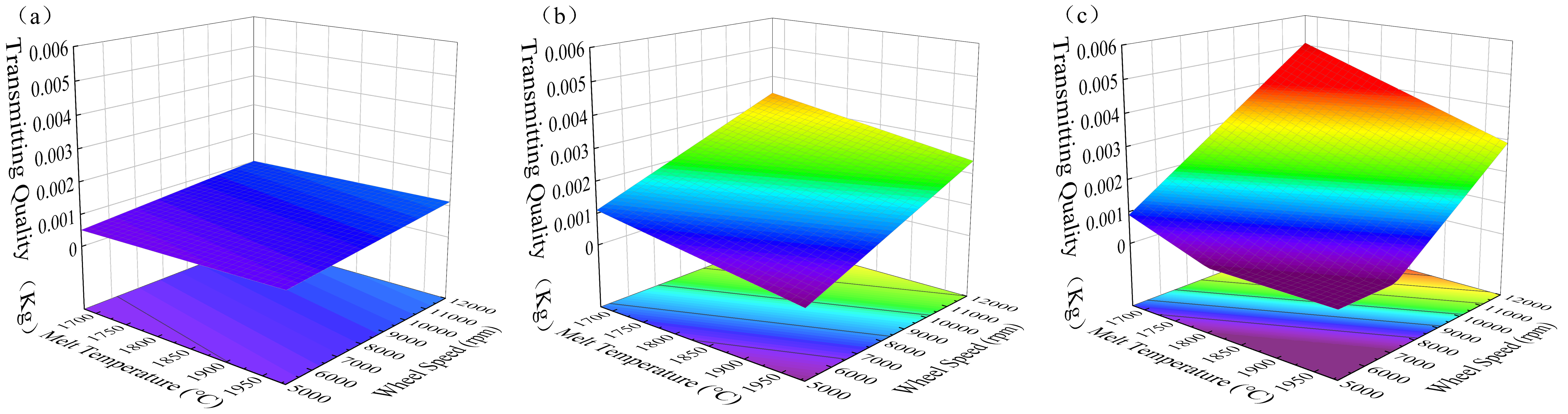
Figure 16 presents the response surfaces constructed using the melt temperature and high-wheel rotational speed as independent variables and inter-wheel melt transfer mass as the response under different melt jet velocities. As shown in Figure 16, the melt jet velocity largely governs the overall level of the inter-wheel melt transfer mass. Under low-jet-velocity conditions (Figure 16a), the transfer mass remains generally low, and the synergistic interaction between high-wheel speed and melt temperature is not pronounced. In contrast, at higher jet velocities (Figure 16b,c), the inter-wheel melt transfer mass increases substantially and reaches a peak. Under conditions of a high melt temperature combined with a relatively low high-wheel rotational speed, the transfer mass decreases to a minimum and may even approach zero. This behavior arises because a low melt jet velocity cannot effectively couple with a high rotational speed, whereas a high jet velocity, although providing sufficient initial momentum to the melt, can suppress splashing. Consequently, maximization of inter-wheel melt transfer mass requires the combined action of a high melt jet velocity, ultra-high-wheel rotational speed, and relatively low melt temperature.
Response-surface analysis of the melt temperature, melt jet velocity, and high-wheel rotational speed enables a systematic elucidation of their individual and interactive effects on inter-wheel melt transfer mass. The results indicate that a high-wheel rotational speed is the dominant controlling factor, as increasing the wheel speed markedly accelerates melt motion on the wheel surface and, thus, substantially enhances inter-wheel melt transfer mass. Melt temperature exhibits a pronounced dual effect: at relatively low temperatures, higher melt viscosity and surface tension reinforce the positive synergy between melt jet velocity and wheel speed, whereas at elevated temperatures, the reduction in viscosity and surface tension promotes melt breakup and splashing, leading to a significant deterioration in transfer mass. Melt jet velocity determines the baseline level of transfer performance; low jet velocities constrain the overall transfer capacity, while higher jet velocities can interact strongly with ultra-high-wheel speeds to drive the inter-wheel melt transfer mass to its maximum.
Overall, enhancement of inter-wheel melt transfer mass relies on the coordinated regulation of multiple parameters: high-wheel rotational speed provides the primary driving force, melt jet velocity determines the initial momentum level, and melt temperature exerts a bidirectional (promotive–inhibitive) influence by modulating melt properties. By integrating practical production requirements with the response-surface analysis, it is found that when the melt temperature is maintained at T = 1700–1800 °C, the high-wheel rotational speed at n = 10,000–12,000 rpm, and the melt jet velocity at vj = 8.3–8.6 m/s, the melt-transfer ratio from the high wheel to the low wheel can exceed 35%.

3.2. Ligament Dimensional Characteristics

To distinguish the melt morphology at different evolutionary stages, the melt is defined as a ligament when it has elongated into filament-like structures but still retains fluidity; once the ligament solidifies into a solid phase, it is referred to as a fiber. Figure 17 shows representative images of ligaments on the wheel surface. As observed in Figure 17, the melt is fragmented on the high wheel and subsequently transferred to the low wheel, where it undergoes a transition from a liquid film to ligaments on the wheel surface. Ligament formation constitutes a necessary intermediate stage in fiber generation, and the diameter and length of the ligaments directly determine the mass and dimensional characteristics of the resulting fibers.
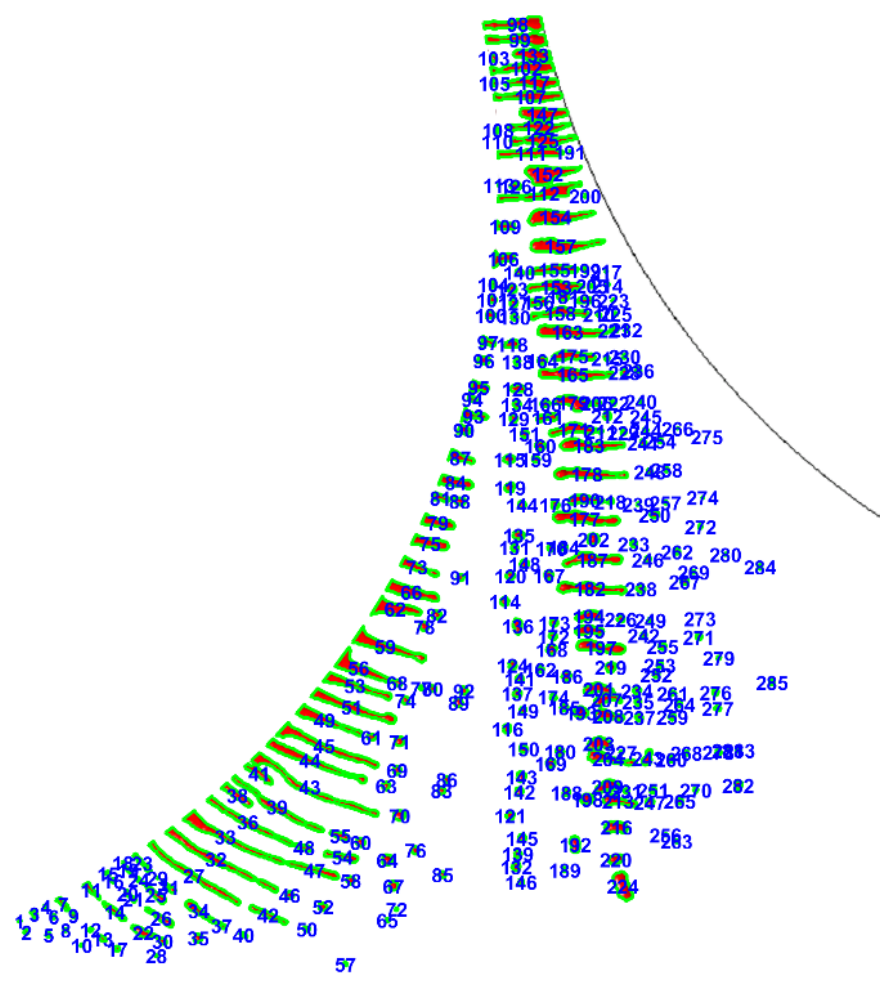
To quantitatively elucidate the effects of melt temperature, high-wheel rotational speed, and low-wheel rotational speed on ligament diameter, length, and aspect ratio, an automated measurement and statistical analysis was performed on the numerical simulation results using a MATLAB R2021b-based image-processing and data-analysis program.
Figure 18 presents representative images after automated measurement and annotation using the MATLAB R2021b program. Through morphological operations and connected-component analysis, the red ligament features are segmented and regularized into binary regions suitable for skeleton extraction and distance-transform processing. Based on this representation, the ligament centerline length is determined using skeleton geodesic distance, while local diameters are obtained from the distance transform. This approach enables precise quantitative characterization of ligament geometric features, including length, diameter, and aspect ratio.
Slag balls refer to spherical or nearly spherical melt particles that fail to be fully stretched into fibers during the centrifugal fiberization process, and their content is one of the core indicators for evaluating the quality of fiber products. In this study, length-to-diameter ratio L/D < 1.4 was adopted as the criterion for identifying slag balls, where L is the maximum length of the particle and D is the maximum width of the particle.
To verify the rationality of this threshold selection, we conducted a systematic sensitivity analysis: when the L/D threshold varies within the reasonable range of 1.2–1.6, the variation amplitude of slag-ball fraction under all working conditions is less than 5%,This indicates that the slag-ball fraction calculation results of this study have good robustness and will not change significantly due to minor adjustments of the threshold. Based on this, L/D < 1.4 was used as the unified slag ball identification criterion in this study to statistically analyze the slag-ball fraction under different working conditions.
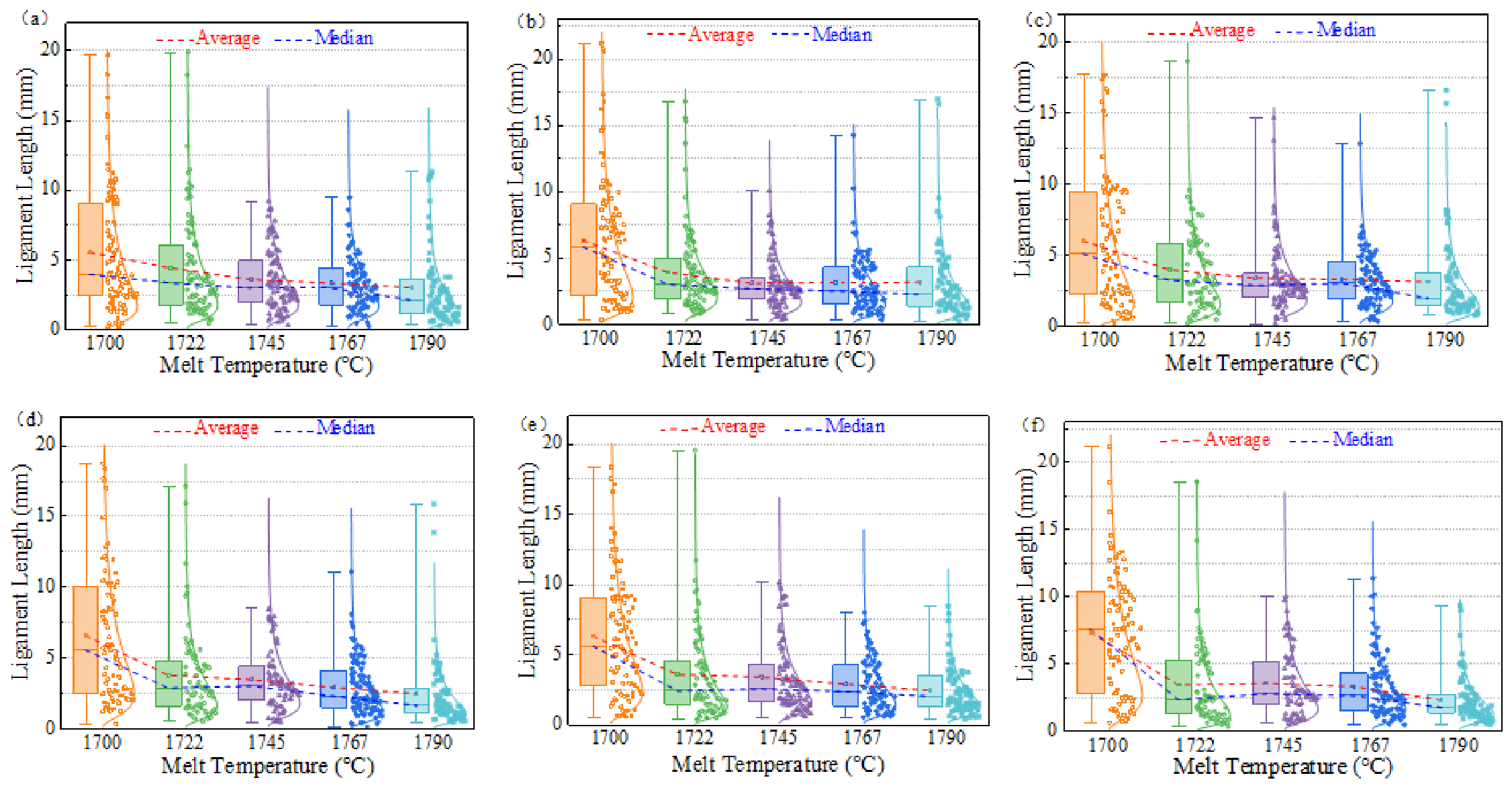
Figure 19 presents the statistical distributions of ligament length as a function of melt temperature under different low-wheel rotational speeds. As shown in Figure 19, the ligament length follows an approximately log-normal distribution. For all low-wheel speeds, the ligament length decreases monotonically with increasing melt temperature. At T = 1700 °C, the ligament-length distribution is relatively dispersed, with maximum lengths exceeding 20 mm; both the mean and median values are higher than those at other temperatures. When the melt temperature increases from T = 1700 °C to T = 1722–1745 °C, the mean and median ligament lengths decrease markedly, accompanied by a pronounced shrinkage of the whiskers and interquartile range in the box plots. This behavior indicates a substantial reduction in ligament number, shorter ligament lengths, and a more concentrated distribution. As the melt temperature is further increased to T = 1767–1790 °C, only a slight decrease in the mean and median values is observed, suggesting that the influence of melt temperature on ligament length becomes significantly weaker in the high-temperature regime.
Mechanistically, melt temperature affects ligament length primarily through its influence on melt viscosity. As indicated in Figure 10, within the temperature range of T = 1700–1745 °C, the melt viscosity decreases sharply with increasing temperature, making ligaments more susceptible to stretching and breakup under inertial forces, thereby producing shorter ligaments with a more concentrated length distribution. When T ≥ 1767 °C, the sensitivity of melt viscosity to temperature variations diminishes; consequently, excessively high melt temperatures exert a much weaker influence on the ligament length distribution.
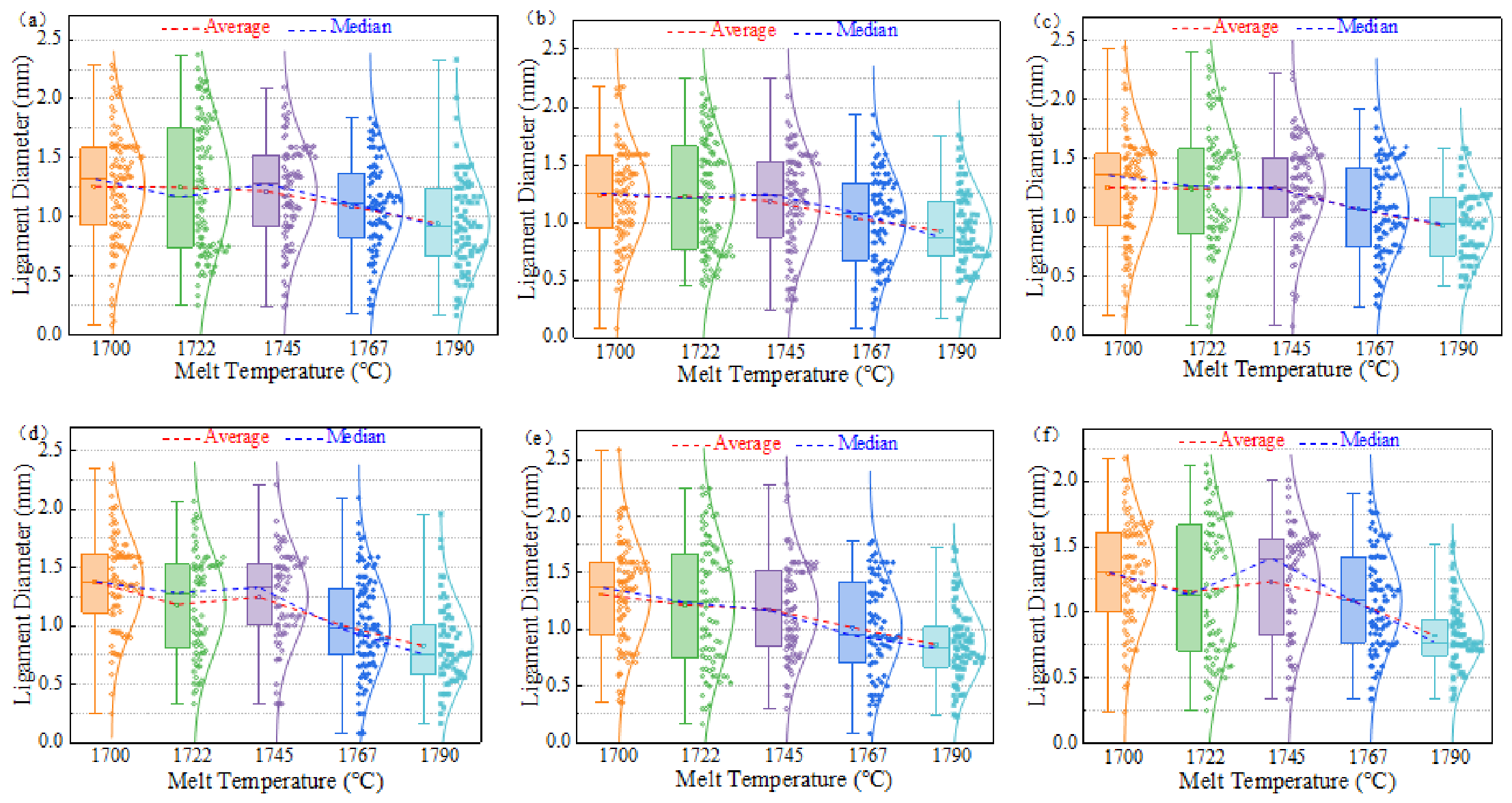
Figure 20 shows the statistical distributions of ligament diameter as a function of melt temperature under different low-wheel rotational speeds. As observed in Figure 20, the ligament diameter follows an approximately normal distribution. At a melt temperature of T = 1700 °C, the melt exhibits relatively high viscosity, which suppresses ligament stretching under inertial forces; consequently, ligaments with comparatively larger diameters are formed.
As the melt temperature increases to T = 1745 °C, the mean and median values of the ligament diameter show no pronounced change; however, under multiple low-wheel rotational speeds, the diameter distribution becomes markedly more concentrated, as evidenced by the substantial reduction in the whisker ranges of the box plots. This behavior can be attributed to the decrease in melt viscosity and surface tension, which causes the ligaments to be governed jointly by inertial forces and capillary contraction, thereby suppressing diameter fluctuations. With a further increase in the melt temperature, the inertial and capillary effects become increasingly dominant, leading to a sharp decrease in both the mean and median ligament diameters. Concurrently, the interquartile range and whisker lengths contract further, indicating a more concentrated distribution of ligament diameters.
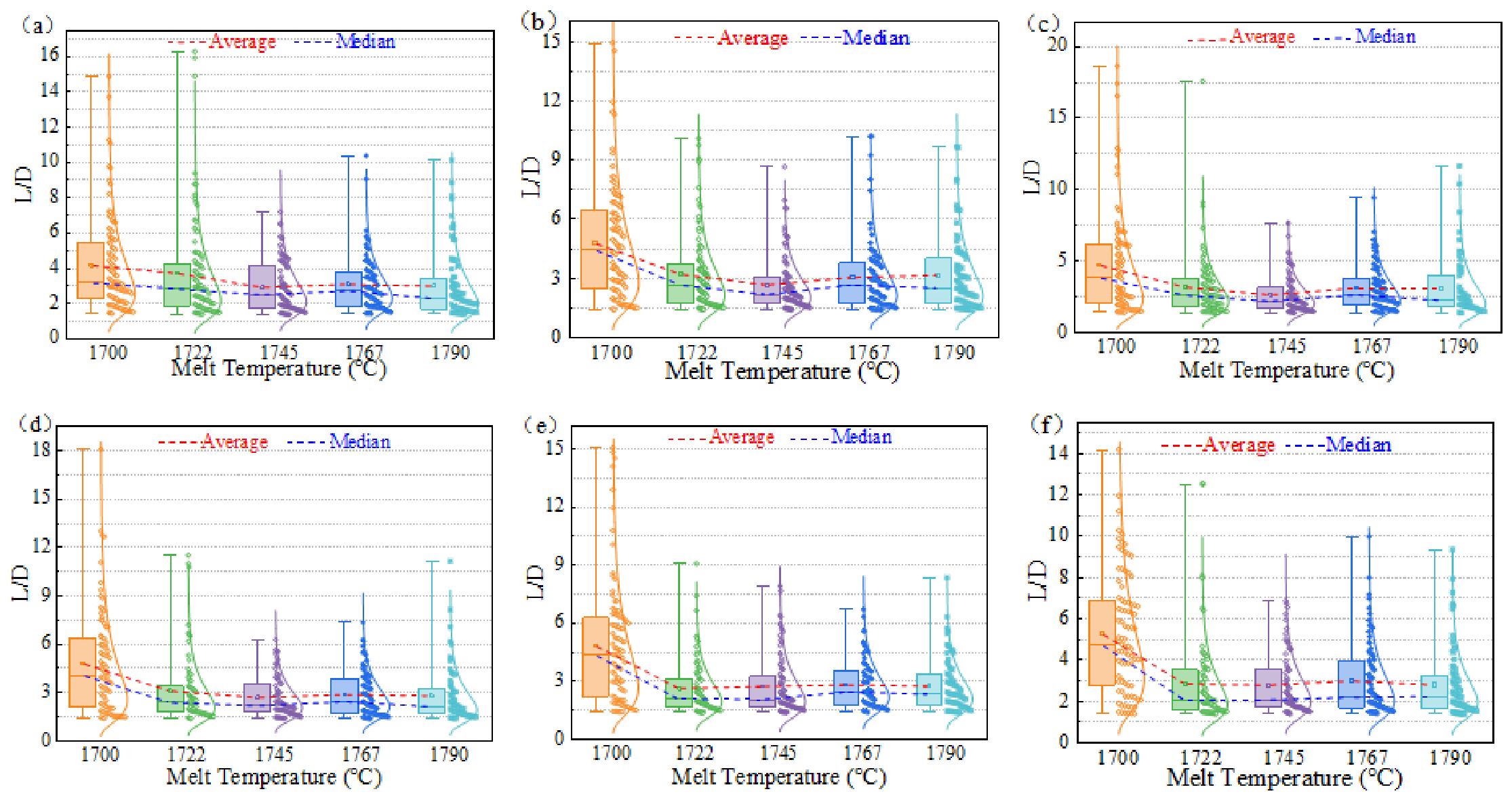
Figure 21 presents the statistical distributions of ligament aspect ratio under different low-wheel rotational speeds at various melt temperatures. As shown in Figure 21, the distribution of ligament aspect ratio follows a log-normal pattern, similar to that observed for the ligament length. For all low-wheel speeds, both the mean and median values of the ligament aspect ratio exhibit a trend of gradual decrease followed by stabilization with increasing melt temperature. At a melt temperature of T = 1700 °C, the ligaments are relatively long and thick, resulting in higher mean and median aspect ratios and the presence of ligaments with comparatively large aspect ratios. As the melt temperature increases to T = 1722–1745 °C, the ligament length decreases markedly while the ligament diameter remains nearly unchanged; consequently, the mean and median aspect ratios decrease only slowly, whereas the population of ligaments with large aspect ratios is substantially reduced.
When the melt temperature is further increased to T = 1767–1790 °C, both the mean and median values of the ligament aspect ratio become nearly stable, accompanied by a pronounced narrowing of the whisker ranges in the box plots. Meanwhile, the number of ligaments with large aspect ratios decreases further, resulting in a more concentrated overall aspect-ratio distribution. Such a distribution is favorable for producing fiber mats with a more uniform pore structure.
Overall, melt temperature influences ligament size characteristics primarily through its effects on melt viscosity and surface tension. As the melt temperature increases from the low-temperature regime to intermediate- and high-temperature regimes, both viscosity and surface tension decrease concurrently, promoting premature ligament breakup under the combined action of inertial forces and capillary contraction, which results in reduced ligament length and diameter. Although both ligament length and diameter decrease under intermediate- to high-temperature conditions, the ligaments can still maintain a reasonable aspect ratio with a more concentrated size distribution, which is beneficial for forming fiber mats with a more uniform pore structure. Therefore, in practical production, the melt temperature at the point of contact with the high wheel should be controlled at approximately T = 1745 °C. This condition ensures favorable fiberization performance, avoids non-uniform ligament size distributions associated with excessively low temperatures, and prevents unnecessary energy consumption caused by excessive heating.
Based on the preceding analysis, at identical melt temperature and melt jet velocity values, higher high-wheel rotational speeds result in a greater amount of melt being transferred to the low wheel. Accordingly, in the numerical simulations, the high-wheel rotational speed was varied to systematically investigate the relationship between inter-wheel melt transfer mass and ligament size characteristics.
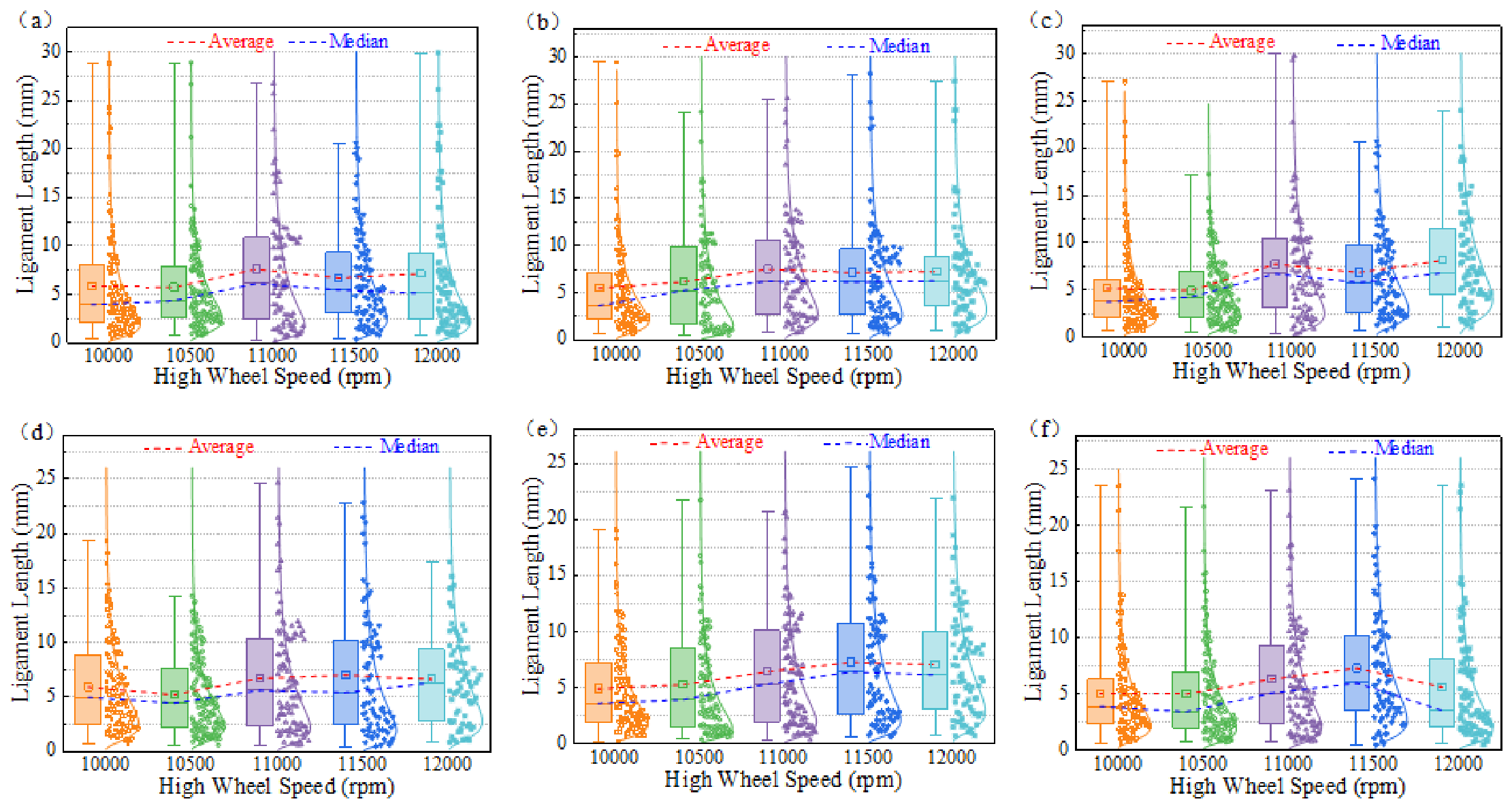
Figure 22 illustrates the influence of inter-wheel melt transfer mass on the ligament length distribution at a melt temperature of T = 1700 °C and a melt jet velocity of vj = 8.68 m/s under different low-wheel rotational speeds. As shown in Figure 22, for all low-wheel speeds, increasing the high-wheel rotational speed from 10,000 rpm to 11,500 rpm leads to a pronounced increase in both the mean and median ligament lengths, accompanied by an expansion of the interquartile range in the box plots. This behavior indicates that, within this speed range, a moderate increase in high-wheel speed, thereby enhancing the inter-wheel melt transfer mass, promotes the formation of longer ligaments. When the high-wheel speed is further increased to 12,000 rpm, however, the mean ligament length, under some conditions, tends to level off or even decrease slightly.
When the high-wheel rotational speed lies within the range of 10,000–11,500 rpm, increasing the speed markedly enhances the amount of melt transferred to the low wheel per unit time, thereby providing a more sufficient and stable melt supply for ligament formation on the low-wheel surface. Meanwhile, a higher high-wheel speed promotes effective pre-breakup and dispersion of the melt, enabling the transferred melt to more readily evolve from a wheel-surface melt film into ligament structures under inertial forces. However, when the high-wheel rotational speed is further increased to 12,000 rpm, although the inter-wheel melt transfer mass continues to improve, the excessively high rotational speed causes the melt to fragment into much finer droplets. As a result, a continuous and uniform melt film cannot be established on the low-wheel surface, which in turn prevents further elongation of the ligaments.
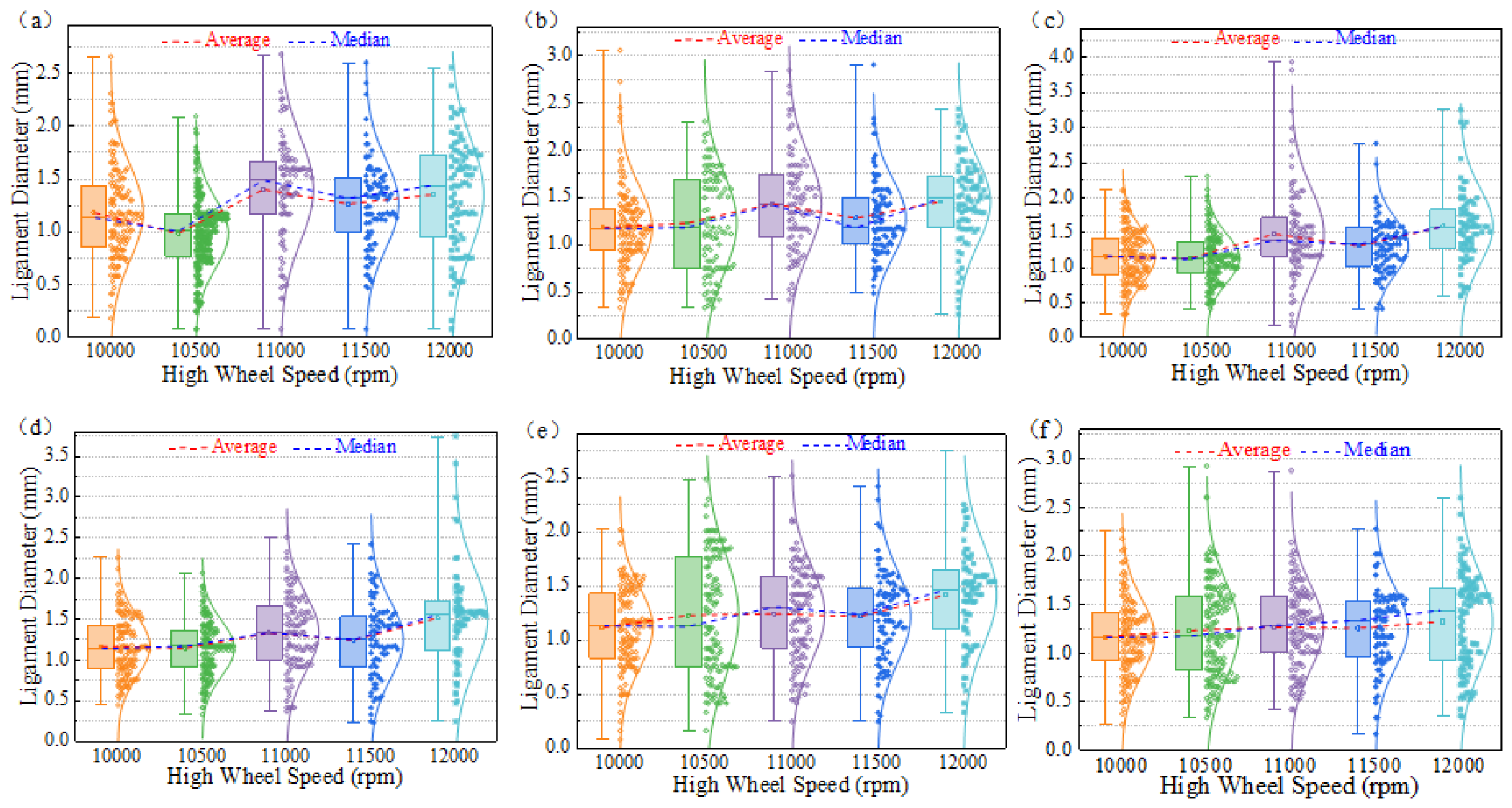
Figure 23 illustrates the influence of the inter-wheel melt transfer mass on the distribution of the ligament diameter under different low-wheel rotational speeds. As shown in Figure 23, for all low-wheel speeds, both the mean and median ligament diameters exhibit a gradual increasing trend with increasing high-wheel rotational speed. This behavior can be attributed to the fact that higher high-wheel speeds lead to a larger amount of melt accumulating on the low-wheel surface per unit time, resulting in a thicker melt film and consequently larger ligament diameters. Further considering the effect of high-wheel speed on ligament diameter, excessively high rotational speeds cause the melt to fragment into relatively fine droplets on the high wheel. As a result, during the transition of the melt film to ligament structures on the low wheel, premature breakup is more likely to occur, inhibiting effective ligament stretching and yielding ligaments with comparatively large diameters.
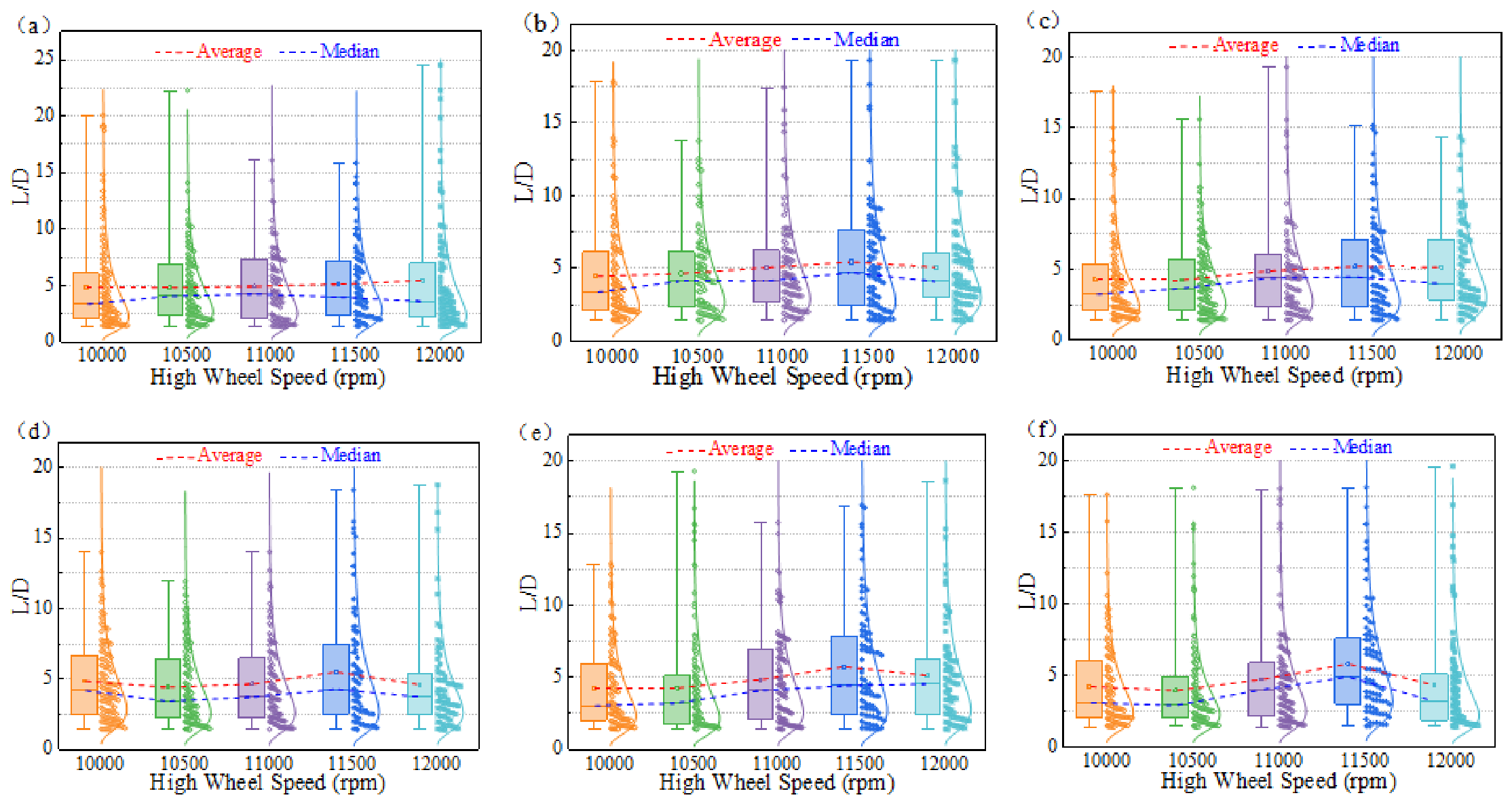
Figure 24 illustrates the effect of inter-wheel melt transfer mass on the distribution of ligament aspect ratio under different low-wheel rotational speeds. As shown in Figure 24, for all low-wheel speeds, increasing the high-wheel rotational speed from 10,000 rpm to 11,000–11,500 rpm results in a pronounced increase in both the mean and median ligament aspect ratios, accompanied by a substantial rise in the proportion of ligaments with large aspect ratios. This indicates that, within this speed range, the influence of high-wheel rotational speed on ligament elongation is significantly stronger than its effect on ligament thickening, thereby enabling more effective ligament stretching and elongational shaping.
When the high-wheel rotational speed is further increased to 12,000 rpm, the upward trend in ligament aspect ratio gradually levels off and even shows a slight decline under certain conditions, consistent with the variation in ligament length observed at excessively high-wheel speeds. This behavior arises because overly intense pre-breakup of the melt on the high wheel prevents the droplets transferred to the low wheel from forming a continuous and uniform melt film. Consequently, during the transition from melt film to ligament structures, breakup occurs before sufficient elongation can be achieved, leading to shorter ligaments with larger diameters and thus a reduced aspect ratio. These results indicate that excessively high high-wheel rotational speeds are detrimental to achieving large ligament aspect ratios.
Overall, a moderate increase in high-wheel rotational speed can simultaneously promote ligament elongation and enhance the ligament aspect ratio, thereby facilitating effective melt stretching and improving fiberization potential. However, excessively high high-wheel speeds lead to increased ligament diameters and enhanced dispersion in ligament size distribution, and may even cause a slight reduction in aspect ratio. Therefore, considering the combined effects of inter-wheel melt transfer mass on ligament length, diameter, and aspect ratio, it is recommended that the high-wheel rotational speed be controlled within the range of 10,000–10,500 rpm in practical production. This operating window enables the formation of ligaments with a more concentrated size distribution, which is beneficial for producing fibers with more uniform dimensions.
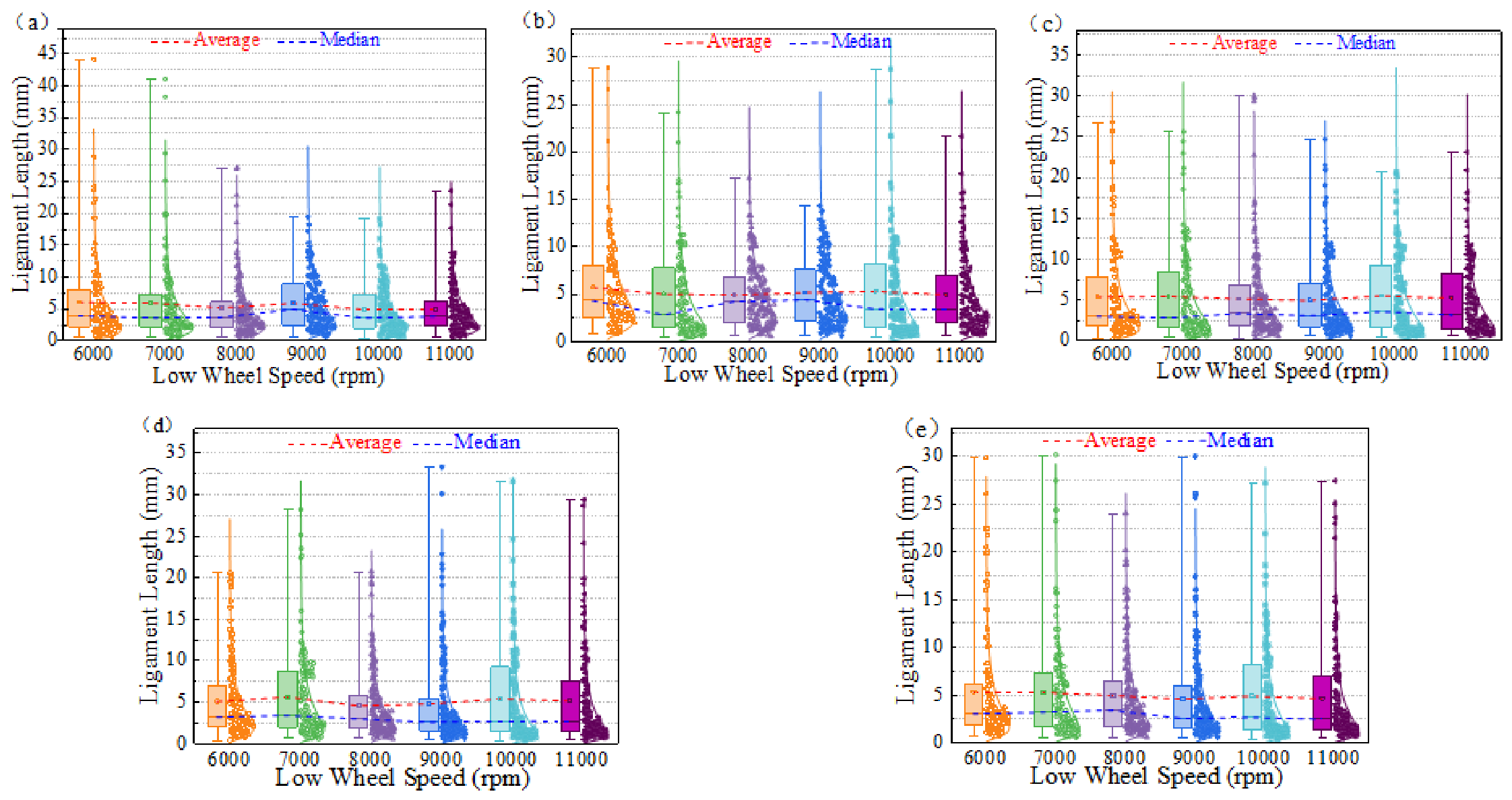
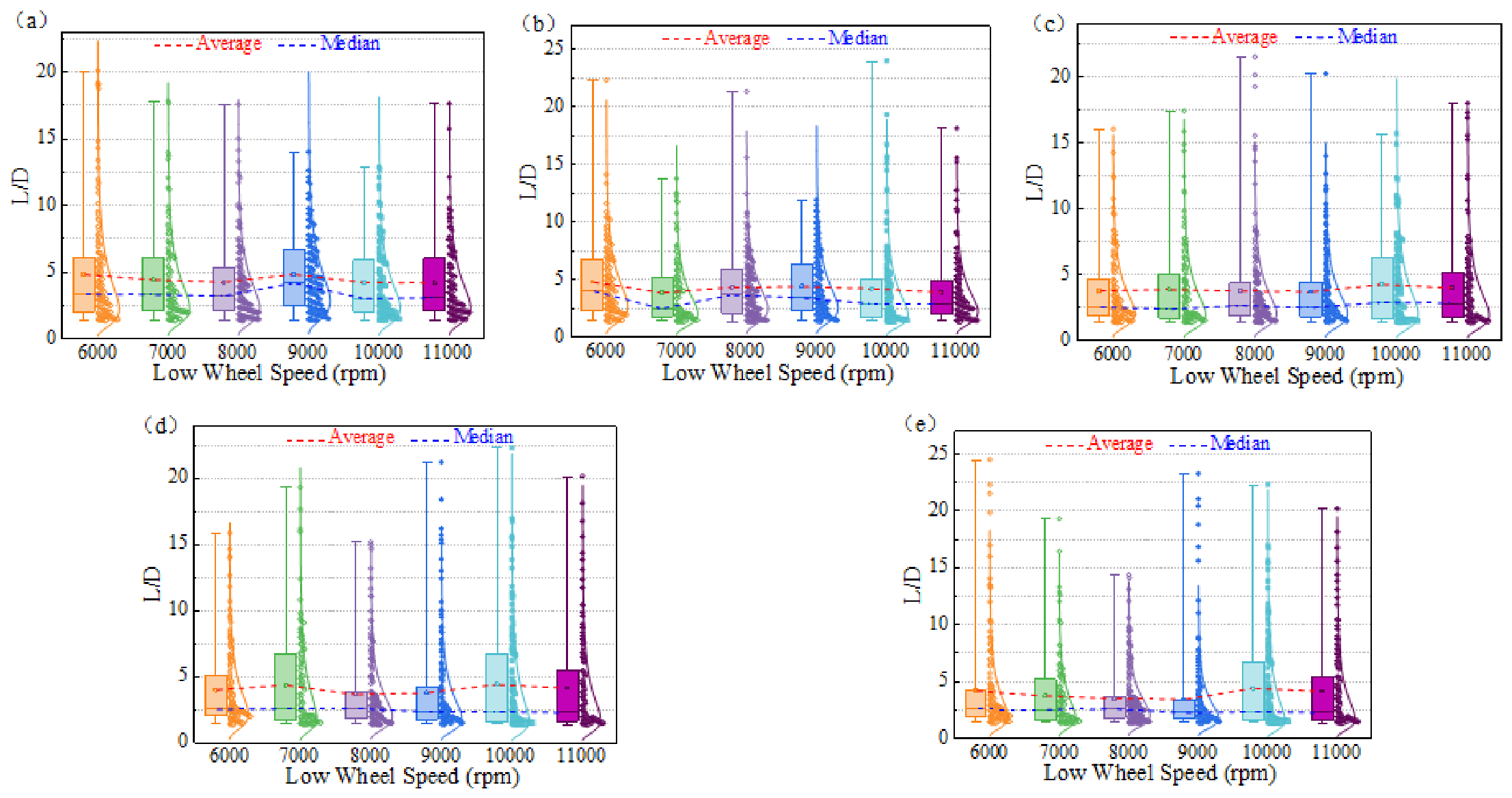
Figure 25 illustrates the effect of low-wheel rotational speed on ligament length distribution under different high-wheel rotational speeds. As shown in Figure 25, for all high-wheel speeds, most ligaments are concentrated in the length range of 1–10 mm, while a small fraction can reach lengths of 20–40 mm. As the low-wheel rotational speed increases from 6000 rpm to 11,000 rpm, the median ligament length remains essentially unchanged, whereas the upper quartile and the upper bound of the distribution exhibit a trend of initial decrease, followed by an increase and a subsequent decrease. Overall, the ligament length distribution becomes most concentrated at a low-wheel rotational speed of approximately 10,000 rpm.
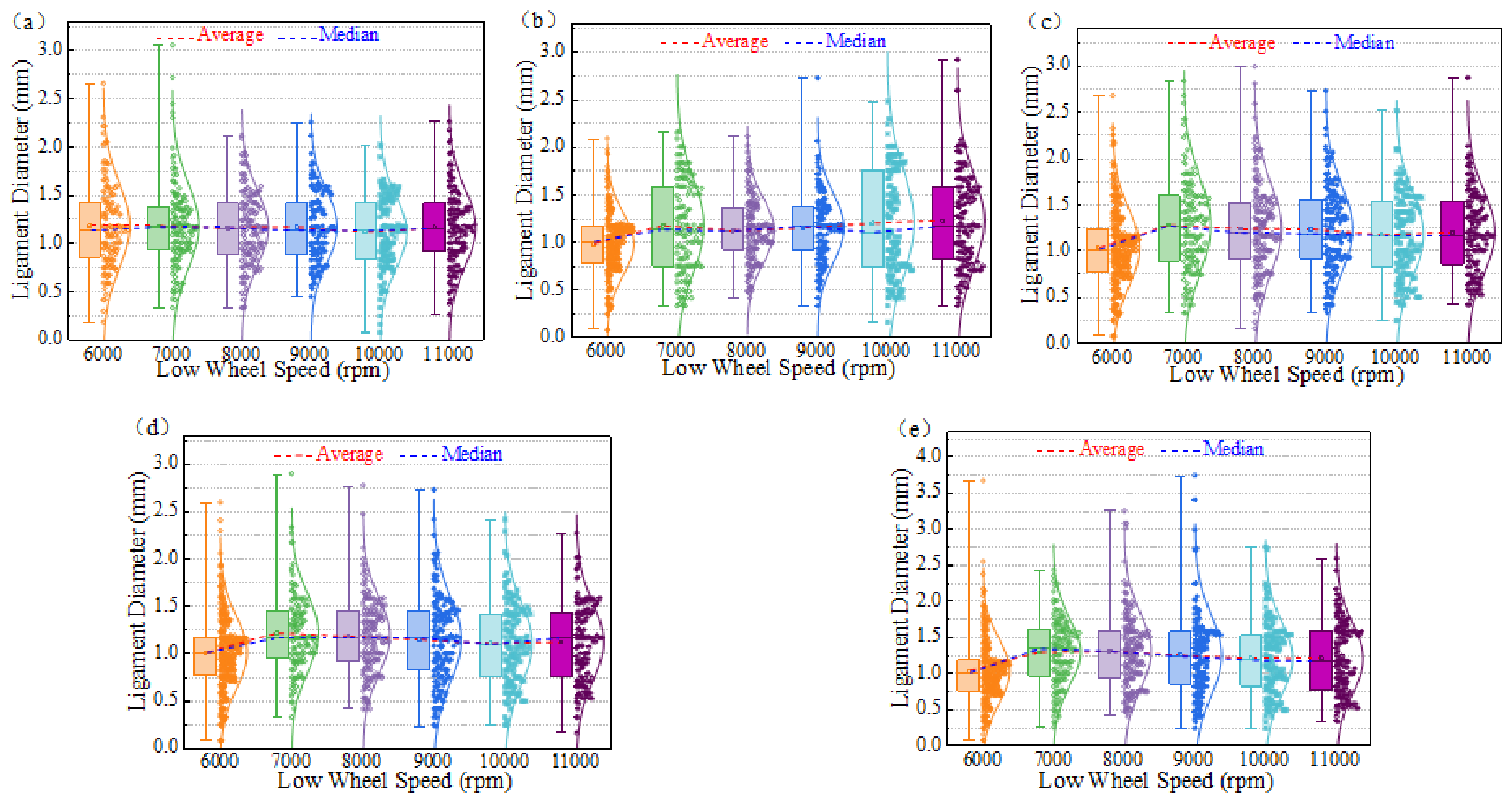
Figure 26 illustrates the influence of low-wheel rotational speed on ligament diameter distribution under different high-wheel rotational speeds. As shown in Figure 26, for all high-wheel speeds, most ligament diameters are concentrated in the range of 0.8–1.6 mm, with the mean and median values being very close. Overall, ligament diameter exhibits a weaker sensitivity to low-wheel rotational speed than ligament length. This observation indicates that ligament diameter is primarily governed by the size of the melt droplets generated after pre-breakup on the high wheel, while the low wheel mainly provides inertial forces to further stretch these pre-broken droplets. In addition, increasing the low-wheel rotational speed facilitates the rapid ejection of droplets that are unfavorable for ligament formation, thereby reducing the dispersion of the ligament diameter distribution.
Figure 27 shows the influence of low-wheel rotational speed on the distribution of ligament aspect ratio under different high-wheel rotational speeds. As illustrated in Figure 27, for all high-wheel speeds, the interquartile ranges of ligament aspect ratio are mainly concentrated between 2 and 7, while a small fraction of ligaments exhibit aspect ratios exceeding 15.
Across the investigated low-wheel speeds, both the mean and median aspect ratios fluctuate within the range of 2.5–5, without exhibiting a pronounced trend. These results further indicate that ligament size characteristics are primarily governed by the pre-breakup of the melt on the high wheel, whereas the low wheel mainly provides inertial forces to eject droplets unsuitable for fiberization and to promote the evolution of suitable droplets into ligament structures. Although the low-wheel rotational speed does not directly determine ligament size, it can be matched with the high-wheel speed to jointly regulate the dispersion of the ligament size distribution. Based on the preceding analysis of the effect of high-wheel rotational speed, a low-wheel rotational speed in the range of 9000–11,000 rpm is conducive to forming ligaments with appropriate sizes and a concentrated distribution, thereby enabling effective control of the subsequent fiber dimensions.
A systematic analysis of the effects of melt temperature, inter-wheel melt transfer mass, and low-wheel rotational speed on ligament size characteristics reveals that melt temperature primarily governs ligament dimensions by modulating melt viscosity and surface tension. High-wheel rotational speed, in contrast, plays a decisive role by controlling both the inter-wheel melt transfer mass and the extent of melt pre-breakup. The low-wheel rotational speed does not directly determine ligament length, diameter, or aspect ratio; instead, it provides inertial forces that promote the evolution of pre-broken droplets from the high wheel into ligament structures, while further regulating the dispersion of the ligament size distribution.
By jointly considering the requirements of energy conservation and emission reduction, fiber size distribution, and the porosity of fiber products, together with the above analysis, it can be concluded that optimal ligament structures with appropriate dimensions and a concentrated size distribution can be obtained when the melt temperature is maintained at T = 1745 °C, the high-wheel rotational speed is controlled within 10,000–10,500 rpm, and the low-wheel rotational speed is kept in the range of 9000–11,000 rpm.

3.3. Slag Ball Ratio

Slag balls refer to melt particles that solidify before fiber formation during the centrifugal fiberization process. They typically exhibit spherical, ellipsoidal, or irregular agglomerated morphologies and possess diameters substantially larger than those of fibers. As dense particles with low specific surface area, slag balls significantly deteriorate the structural uniformity of fiber products, thereby adversely affecting material looseness, forming stability, and refractory–thermal insulation performance.
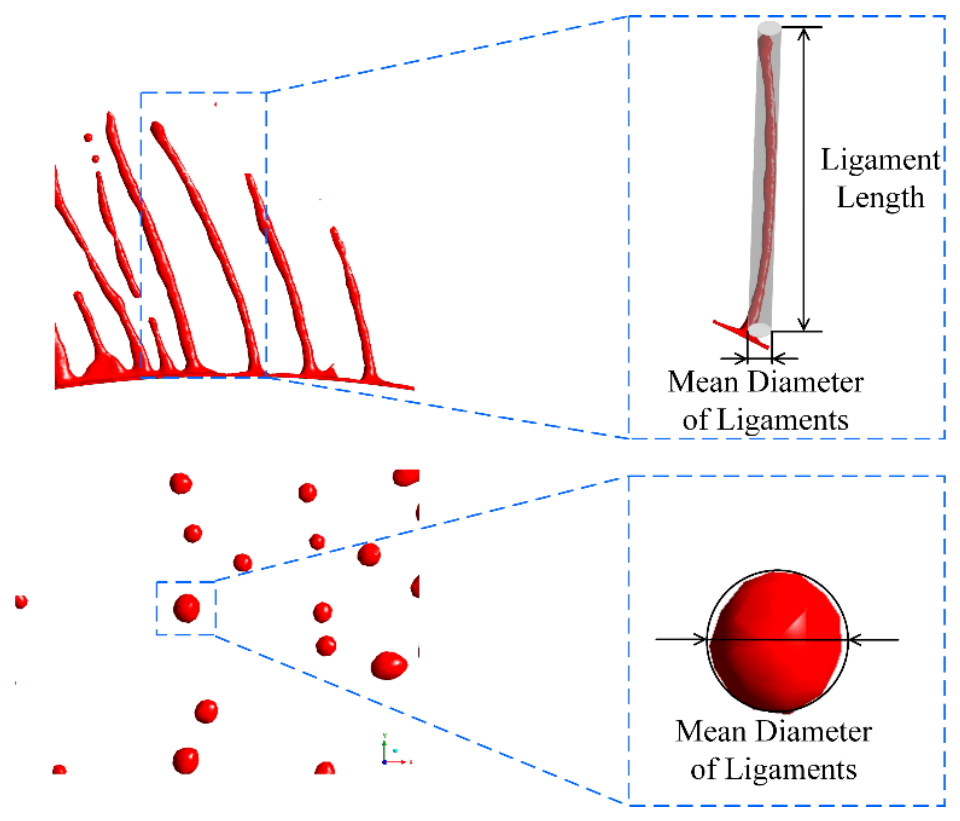
In this study, melt structures with an aspect ratio L/D < 1.4 are classified as slag balls. Figure 28 illustrates the schematic procedure for calculating the volumes of ligaments and slag balls. As shown, ligaments and slag balls are approximated as cylindrical and spherical volumes, respectively, and the slag-ball fraction is defined as the ratio of slag-ball volume to the total volume for quantitative analysis.
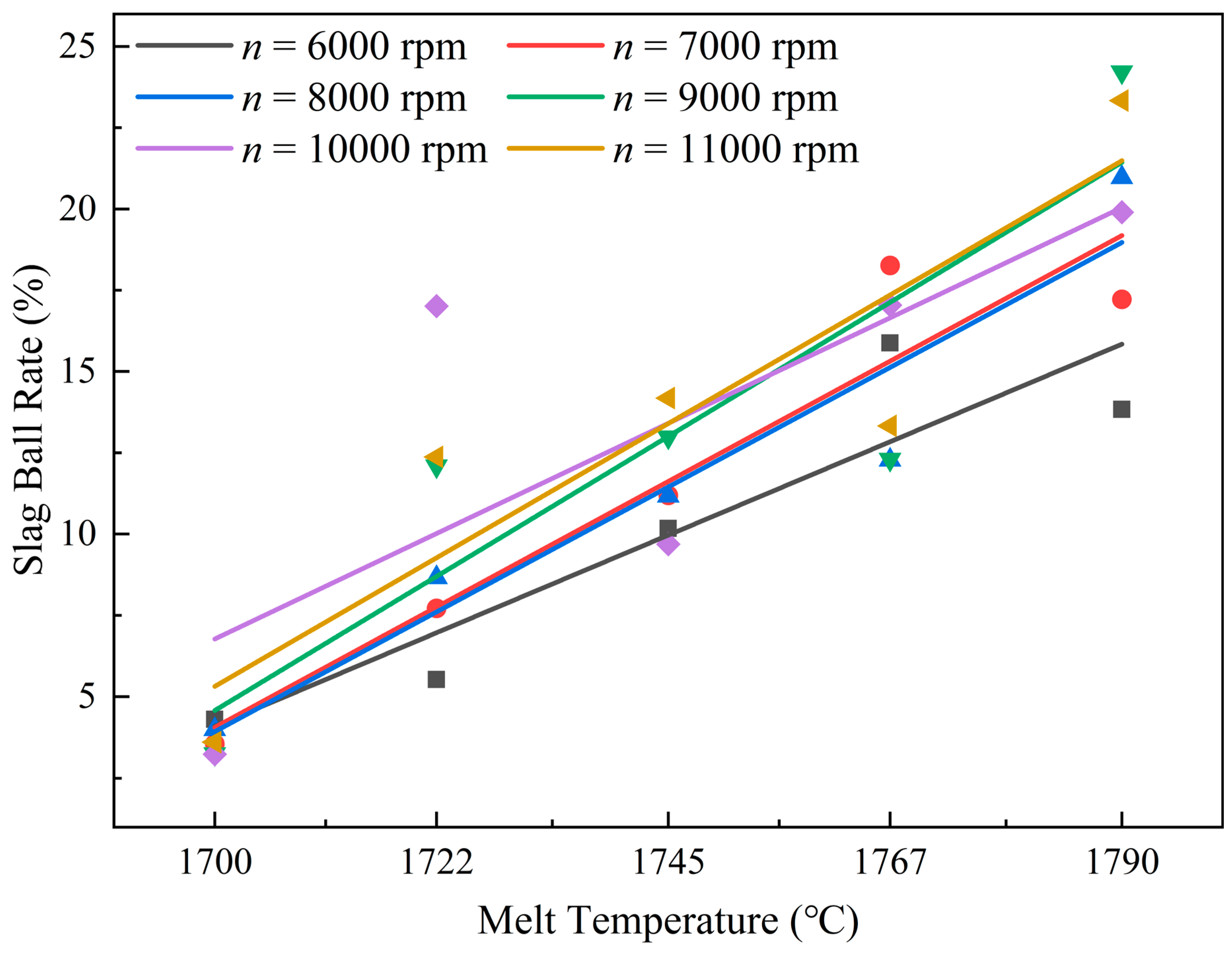
Figure 29 presents the linear fitting results between melt temperature and slag-ball fraction under different low-wheel rotational speeds. As shown, the coefficients of determination R2 range from 0.59 to 0.92 across all conditions, while the corresponding Pearson correlation coefficients exceed 0.77. These results indicate a high level of reliability and strong correlation for the fitted relationships.
As shown in Figure 29, for all low-wheel rotational speeds, the slag-ball fraction increases markedly with increasing melt temperature, indicating a positive correlation between slag-ball fraction and melt temperature. This behavior can be attributed to the significant reduction in melt viscosity and the accompanying enhancement in fluidity at elevated temperatures. Under identical rotational-speed conditions, high-temperature melts are, therefore, more prone to breakup or fragmentation under inertial forces. The resulting fine melt fragments subsequently contract into droplets driven by surface tension and rapidly solidify during cooling, ultimately forming slag balls.
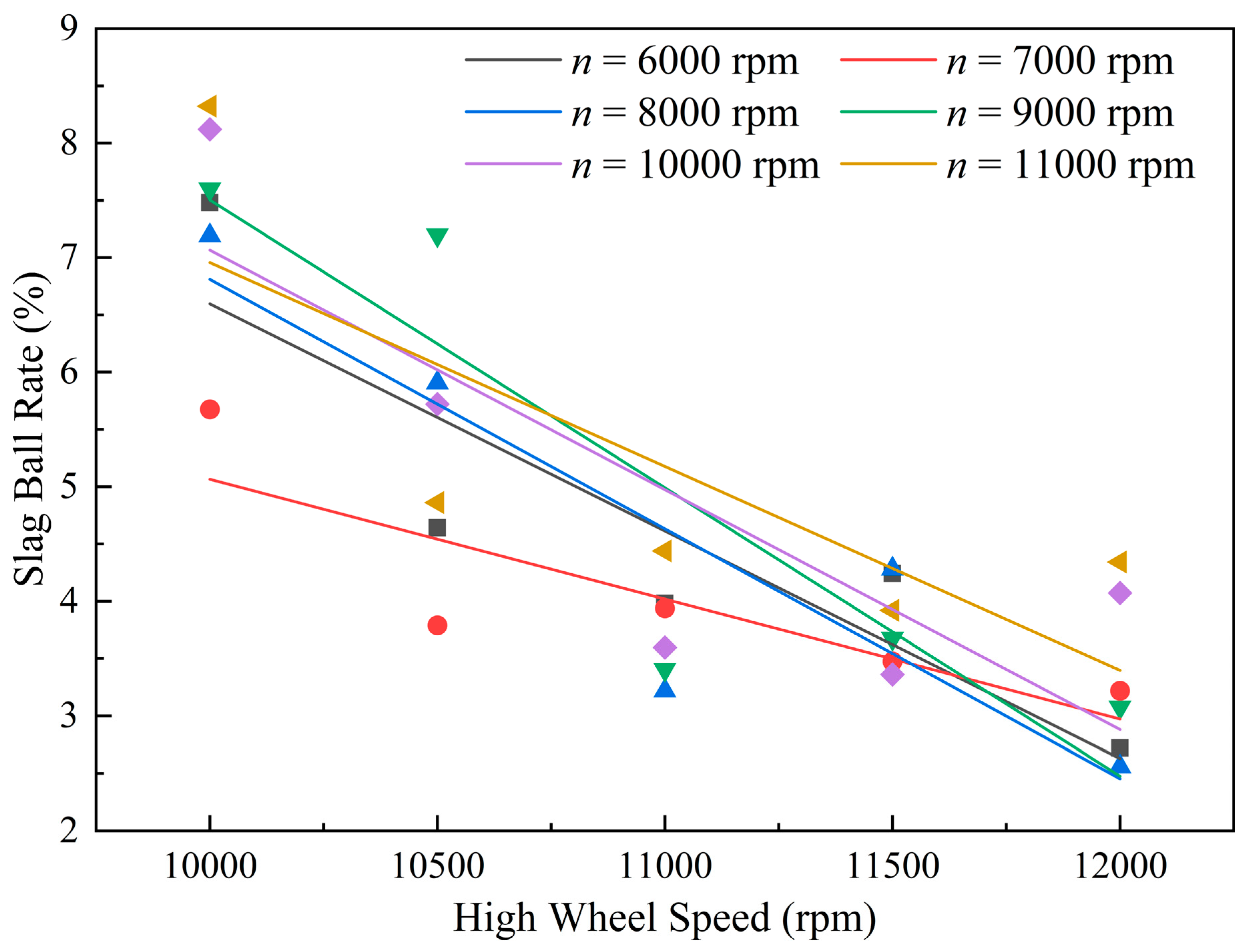
Figure 30 shows the linear fitting results between high-wheel rotational speed and slag-ball fraction under different low-wheel rotational speeds. As indicated, the coefficients of determination R2 range from 0.62 to 0.81 across all conditions, while the corresponding Pearson correlation coefficients exceed 0.79. These results demonstrate that the linear fits exhibit high reliability and strong correlations.
As shown in Figure 30, a clear negative correlation exists between high-wheel rotational speed and slag-ball fraction under all investigated low-wheel rotational speeds; that is, increasing the high-wheel speed leads to a reduction in slag-ball fraction. As discussed previously, the high wheel primarily functions to accomplish inter-wheel melt transfer and melt pre-breakup. With increasing high-wheel rotational speed, the inter-wheel melt transfer mass is significantly enhanced, and the droplets generated after pre-breakup become progressively smaller. After being transferred to the low wheel, these smaller droplets are more readily drawn into ligaments with shorter lengths and smaller diameters, thereby reducing the likelihood of ligament breakup induced by capillary contraction and the subsequent formation of slag balls. Consequently, a higher high-wheel rotational speed effectively suppresses slag-ball formation, resulting in a lower slag-ball fraction.
Meanwhile, as observed in Figure 29 and Figure 30, the data points under most low-wheel rotational speeds are relatively concentrated and do not exhibit a clear trend with variations in low-wheel speed. In conjunction with the ligament size-control mechanisms discussed in the preceding section, this behavior indicates that the primary function of the low wheel is to provide secondary drawing of the melt after pre-breakup on the high wheel, thereby facilitating the evolution from droplets to ligaments, rather than directly determining ligament dimensions. Consequently, based on the data distributions in Figure 29 and Figure 30, no direct correlation can be identified between low-wheel rotational speed and slag-ball fraction.
Overall, the slag-ball fraction exhibits a positive correlation with melt temperature and a negative correlation with high-wheel rotational speed, while no direct relationship is observed with low-wheel rotational speed. Under operating conditions of a melt temperature of T = 1745 °C, a high-wheel rotational speed of 10,000 rpm, and a low-wheel rotational speed of 10,000 rpm, a relatively uniform and well-concentrated ligament structure can be achieved, while the slag-ball fraction can be effectively controlled within the range of 8–13%.


4. Conclusions

(1)
Within the parameter range investigated (1680–1980 °C, 7.51–8.68 m/s, 5000–12,000 rpm), high-wheel speed is the dominant factor governing inter-wheel melt transfer mass. Melt jet velocity determines the baseline transfer level and its influence increases with wheel speed, while melt temperature has a relatively weak effect. Higher viscosity and surface tension at low temperatures enhance the synergy between jet velocity and wheel speed, whereas at high temperatures, melt breakup and splashing lead to deteriorated transfer mass.
(2)
The inter-wheel melt transfer mass ( Y ) as a function of melt temperature (A), melt jet velocity (B), and high-wheel rotational speed (C) can be predicted using the following quadratic regression equation: Y = −0.143406 + 0.000049A + 0.027669B − 3.29703 × 10⁻⁶C − 6.52707 × 10⁻⁶AB − 4.48596 × 10⁻⁶BC − 0.00115B2. This model incorporates linear terms, interaction terms, and a quadratic term to capture the coupled effects of operating parameters on inter-wheel melt transfer mass and has been independently verified to accurately reproduce all experimental results in Table 4.
(3)
Within the investigated temperature range, melt temperature affects ligament size by regulating viscosity and surface tension. It is recommended to control it around 1745 °C in practical production.
(4)
Within the high-wheel speed range of 5000–12,000 rpm investigated, high-wheel speed is the primary factor controlling ligament size. Moderate increase promotes elongation and aspect ratio, and ligaments with concentrated size distribution are obtained at 10,000–10,500 rpm.
(5)
Within the low-wheel speed range of 6000–11,000 rpm investigated, low-wheel speed has no significant direct effect on ligament size. It mainly provides inertial force to drive droplet evolution and regulates size distribution, with optimal performance at 9000–11,000 rpm.
(6)
Within the investigated parameter range, slag-ball fraction is positively correlated with melt temperature and negatively correlated with high-wheel speed, while low-wheel speed has no significant effect. The optimal conditions are 1745 °C and 10,000 rpm for both wheels, achieving concentrated ligament structure and slag-ball fraction of 8–13%.
In addition, the optimal operating temperature determined in this study is about 300 °C lower than the fiberization temperature of pure coal gangue raw material, which can significantly reduce the energy intensity of the production process and further improve the environmental benefits and economic competitiveness of the synergistic preparation of ceramic fibers from fly ash and coal gangue.

Author Contributions

Conceptualization, C.Z. and B.W.; Data curation, J.Y. and W.C.; Formal analysis, J.Y., W.C., and K.Z.; Funding acquisition, C.Z., W.C., and B.W.; Investigation, J.Y. and Y.C.; Project administration, C.Z.; Resources, B.W. and Y.W.; Software, Y.W.; Supervision, C.Z. and Y.W.; Validation, C.Z., Y.X., and K.Z.; Visualization, C.Z., B.W., K.Z., and Y.W.; Writing—original draft, J.Y. and Y.C.; Writing—review & editing, C.Z., W.C. and B.W. All authors have read and agreed to the published version of the manuscript.

Funding

This study was conducted at North China University of Science and Technology and was funded by the Central-Local Collaboration Project of the Hebei Provincial Science and Technology Department (Project No. 236Z3806G), Innovative Research Group Project of Natural Science Foundation of Hebei Province (E2022209093), and the Tangshan Science and Technology Plan Project (Project No. 23150218A), and the Yanzhao Iron and Steel Laboratory Funding Project (Project No. YZISL2024007).

Data Availability Statement

The original contributions presented in this study are included in the article. Further inquiries can be directed to the corresponding author.

Conflicts of Interest

Author Yongli Xiao was employed by the Central Research Institute, China Baowu Group. The remaining authors declare that the research was conducted in the absence of any commercial or financial relationships that could be construed as a potential conflict of interest.

References

  1. Zhang, L.; Zhu, D.; Marani, A.; Nehdi, M.L.; Wang, L.; Yang, G.; Zhang, J. Toward sustainable construction: Comprehensive utilization of coal gangue in building materials. Case Stud. Constr. Mater. 2025, 23, e04930. [Google Scholar] [CrossRef]
  2. Cheng, L.; Zhao, L.; Cheng, L.; Gao, Y.; Guo, H.; Che, Y.; Fu, H. Research Progress of Concrete Preparation Based on Solid Waste Properties of Coal Gangue. Sustainability 2025, 17, 2007. [Google Scholar] [CrossRef]
  3. Zou, J.; Liu, Z.; Guo, Q. Comprehensive utilisation of blast furnace slag. Can. Metall. Q. 2024, 63, 927–934. [Google Scholar] [CrossRef]
  4. Gao, W.; Zhou, W.; Lyu, X.; Liu, X.; Su, H.; Li, C.; Wang, H. Comprehensive utilization of steel slag: A review. Powder Technol. 2023, 422, 118449. [Google Scholar] [CrossRef]
  5. Feng, Y.-H.; Zhang, Z.; Gao, J.; Feng, G.-P.; Qiu, L.; Feng, D.-L.; Zhang, X.-X.; Zhu, X. Research status of centrifugal granulation, physical heat recovery and resource utilization of blast furnace slags. J. Anal. Appl. Pyrolysis 2021, 157, 105220. [Google Scholar] [CrossRef]
  6. Zhang, H.; Wang, H.; Zhu, X.; Qiu, Y.-J.; Li, K.; Chen, R.; Liao, Q. A review of waste heat recovery technologies towards molten slag in steel industry. Appl. Energy 2013, 112, 956–966. [Google Scholar] [CrossRef]
  7. Chang, Q.; Li, X.; Ni, H.; Zhu, W.; Pan, C.; Hu, S. Modeling on Dry Centrifugal Granulation Process of Molten Blast Furnace Slag. ISIJ Int. 2015, 55, 1361–1366. [Google Scholar] [CrossRef]
  8. Zhen, J.; Chen, W.; Zhen, C.; Zhao, K.; Wang, B. utilization status and development trend of industrial solid waste such as dust removal ash and fly ash. Hebei Met. 2023, 1–5. [Google Scholar] [CrossRef]
  9. Chen, W.; Yu, J.; Zhang, Y.; Xiao, Y.; Wang, B.; Zhao, K.; Zhen, C. Progress in preparation of inorganic fiber materials from typical bulk solid wastes in metallurgical processes. Iron Steel 2025, 60, 1–15. [Google Scholar] [CrossRef]
  10. Chen, W.; Fan, Y.; Zhao, K.; Wang, B.; Zhen, C.; Wang, W.; Chen, Y.; Xiao, Y. Characteristics of electrical heat transfer in AC resistance furnace and its effect on the formation and distribution of molten pools. Mater. Chem. Phys. 2025, 339, 130721. [Google Scholar] [CrossRef]
  11. Long, Y.; Du, P.; Zhang, L.; Li, Z.; Zhang, Y. Impact of various factors on property and fiber-forming effect of centrifugal blast furnace slag fibers. J. Iron Steel Res. 2017, 29, 530–535. [Google Scholar] [CrossRef]
  12. Širok, B.; Bizjan, B.; Orbanić, A.; Bajcar, T. Mineral wool melt fiberization on a spinner wheel. Chem. Eng. Res. Des. 2014, 92, 80–90. [Google Scholar] [CrossRef]
  13. Bizjan, B.; Širok, B.; Blagojevič, M. Free surface lubrication of rotating cylinders by impacting Newtonian liquid jet. Lubr. Sci. 2021, 33, 439–449. [Google Scholar] [CrossRef]
  14. Bizjan, B.; Širok, B.; Hočevar, M.; Orbanić, A. Ligament-type liquid disintegration by a spinning wheel. Chem. Eng. Sci. 2014, 116, 172–182. [Google Scholar] [CrossRef]
  15. Bizjan, B.; Širok, B.; Hočevar, M.; Orbanić, A. Liquid ligament formation dynamics on a spinning wheel. Chem. Eng. Sci. 2014, 119, 187–198. [Google Scholar] [CrossRef]
  16. Bizjan, B.; Širok, B.; Blagojevič, M. Analogue Experimental Study of Fiber Formation on Two-Wheel Spinner. SV-JME 2020, 66, 279–288. [Google Scholar] [CrossRef]
  17. Bizjan, B.; Širok, B.; Blagojevič, M. Experimental investigation of liquid disintegration by twin spinning wheel atomizer. Chem. Eng. Res. Des. 2021, 165, 230–241. [Google Scholar] [CrossRef]
  18. Bizjan, B.; Širok, B.; Govekar, E. Nonlinear Analysis of Mineral Wool Fiberization Process. J. Comput. Nonlinear Dyn. 2015, 10, 021005. [Google Scholar] [CrossRef]
  19. Bizjan, B.; Širok, B.; Drnovšek, J.; Pušnik, I. Temperature measurement of mineral melt by means of a high-speed camera. Appl. Opt. 2015, 54, 7978. [Google Scholar] [CrossRef] [PubMed]
  20. Chen, J.; Mrvar, P.; Širok, B.; Bizjan, B.; Ljubljana, U.O. Melt film adhesion dynamics on spinning wheels. Glass Tech. Eur. J. Glass Sci. Technol. A 2019, 60, 1–8. [Google Scholar] [CrossRef]
  21. Peternelj, M.; Bizjan, B.; Širok, B. The Influence of Airflow Characteristics and Accumulation Grid Velocity on the Formation of a Stone Wool Primary Layer. SV-JME 2017, 63, 405–414. [Google Scholar] [CrossRef][Green Version]
  22. Long, Y.; Du, P.; Li, Z.; Zhang, L.; Zhang, Y. Influences of acidity coefficient on physical and chemical properties of slag wool. Iron Steel 2016, 51, 81–87. [Google Scholar] [CrossRef]
  23. Li, Z.; Zhang, Y.; Long, Y.; Du, P.; Zhang, L. Experiment Study on Preparation of Slag Fiber by Using Quenched and Tempered Blast Furnace Slag. Chin. J. Process Eng. 2016, 16, 788–793. [Google Scholar] [CrossRef]
  24. Rajiwade, P.A.; Sinha, A. Effect of impinging jet angle and offset on the heat transfer characteristics of a liquid falling film on a rotating cylinder. Int. J. Heat Mass Transf. 2024, 223, 125261. [Google Scholar] [CrossRef]
  25. Zhen, J.; Wang, B.; Zhao, K.; Chen, W.; Zhen, C.; Tong, Y. Process optimization for dust removal ash and fly ash cold consolidation based on response surface methodology. China Metall. 2023, 33, 130–136. [Google Scholar] [CrossRef]
  26. Chen, W.; Yu, J.; Zhao, K.; Wang, B.; Zhen, C.; Wang, W.; Chen, Y. Numerical Simulation Study on the Thickness of Melt Film on the Surface of Spinning Wheel During Centrifugal Spinning of Metallurgical Solid Waste. J. Sustain. Metall. 2025, 11, 2355–2370. [Google Scholar] [CrossRef]
  27. Qiu, Y.; Zhu, X.; Wang, H.; Liao, Q. Three-dimensional simulation of solidification and heat transfer for air-cooling molten blast furnace slag droplet. CIESC J. 2014, 65, 340–345. [Google Scholar] [CrossRef]
  28. Feng, Y.; Gao, J.; Feng, D.; Zhang, X. Modeling of the molten blast furnace slag particle deposition on the wall including phase change and heat transfer. Appl. Energy 2019, 248, 288–298. [Google Scholar] [CrossRef]
  29. Askari, M.; Cameron, A.M. Surface Tensions of Some CaO–MgO–Al2O3–SiO2 Slags. Can. Metall. Q. 1991, 30, 207–212. [Google Scholar] [CrossRef]
  30. Ding, B.; Wang, H.; Zhu, X.; He, X.-Y.; Liao, Q.; Tan, Y. Crystallization Behaviors of Blast Furnace (BF) Slag in a Phase-Change Cooling Process. Energy Fuels 2016, 30, 3331–3339. [Google Scholar] [CrossRef]
  31. Gao, J.; Feng, Y.; Feng, D.; Zhang, X. The effects of interactions between multiple blast furnace slag particles on crystallization characteristics. Int. J. Heat Mass Transf. 2022, 185, 122374. [Google Scholar] [CrossRef]
  32. Gao, J.; Feng, Y.; Feng, D.; Zhang, Z.; Zhang, X. Solidification with crystallization behavior of molten blast furnace slag particle during the cooling process. Int. J. Heat Mass Transf. 2020, 146, 118888. [Google Scholar] [CrossRef]
Figure 1. Schematic diagram of production site and spinning wheel: (a) production site; (b) spinning wheel.
Processes 14 02062 g001
Figure 2. Geometric model: (a) single-wheel model; (b) dual-wheel model.
Processes 14 02062 g002
Figure 3. Geometric model grid generation: (a) mesh of the single-wheel model; (b) enlarged view of the single-wheel model; (c) mesh of the dual-wheel model; (d) enlarged view of the dual-wheel model.
Processes 14 02062 g003
Figure 4. Grid-independence verification: (a) grid-independence test for the single-wheel model; (b) grid-independence test for the dual-wheel model.
Processes 14 02062 g004
Figure 5. Comparison of the numerical simulation and physical experiment images [14].
Processes 14 02062 g005
Figure 6. Comparison of the ligament spacing (a); comparison of the ligament length (b).
Processes 14 02062 g006
Figure 7. Comparison of ceramic-fiber production images and numerical simulation results: (a) on-site image of ceramic-fiber production; (b) dual-wheel numerical simulation image.
Processes 14 02062 g007
Figure 8. Comparison chart of inorganic-fiber production and numerical simulation: (a) inorganic-fiber production image [20]; (b) numerical simulation image of dual wheels; (c) image of wheel surface liquid film fibrosis; (d) structural feature image of ligaments.
Processes 14 02062 g008
Figure 9. Fly ash and coal gangue before and after calcination.
Processes 14 02062 g009
Figure 10. Melt viscosity–temperature curve.
Processes 14 02062 g010
Figure 11. Thermal properties of melt: (a) melt thermal conductivity as a function of temperature; (b) melt surface tension as a function of temperature; (c) melt specific heat capacity as a function of temperature; (d) melt emissivity as a function of temperature.
Processes 14 02062 g011
Figure 12. Schematic diagram of low wheel position.
Processes 14 02062 g012
Figure 13. The relationship between the predicted value, actual value, and residual value of melt transfer mass: (a) relationship between predicted and actual values; (b) relationship between predicted values and residuals.
Processes 14 02062 g013
Figure 14. The influence of the melt temperature and flow rate on the transfer mass: (a) n = 9000 rpm; (b) n = 10,000 rpm; (c) n = 11,000 rpm; (d) n = 12,000 rpm.
Processes 14 02062 g014
Figure 15. The influence of the melt flow rate and high-wheel speed on the transfer mass: (a) T = 1680 °C; (b) T = 1780 °C; (c) T = 1880 °C; (d) T = 1980 °C.
Processes 14 02062 g015
Figure 16. The influence of melt temperature and high-wheel speed on transfer mass: (a) vj = 7.51 m/s; (b) vj = 8.09 m/s; (c) vj = 8.68 m/s.
Processes 14 02062 g016
Figure 17. Image of ligament on wheel surface. (a) Global image of ligaments; (b) Localized enlarged image.
Processes 14 02062 g017
Figure 18. MATLAB program for measuring and statistically analyzing images.
Processes 14 02062 g018
Figure 19. The influence of melt temperature on ligament length: (a) low-wheel rotational speed of 6000 rpm; (b) low-wheel rotational speed of 7000 rpm; (c) low-wheel rotational speed of 8000 rpm; (d) low-wheel rotational speed of 9000 rpm; (e) low-wheel rotational speed of 10,000 rpm; (f) low-wheel rotational speed of 11,000 rpm.
Processes 14 02062 g019
Figure 20. The influence of melt temperature on ligament diameter: (a) low-wheel rotational speed of 6000 rpm; (b) low-wheel rotational speed of 7000 rpm; (c) low-wheel rotational speed of 8000 rpm; (d) low-wheel rotational speed of 9000 rpm; (e) low-wheel rotational speed of 10,000 rpm; (f) low-wheel rotational speed of 11,000 rpm.
Processes 14 02062 g020
Figure 21. The influence of melt temperature on the aspect ratio of ligaments: (a) low-wheel rotational speed of 6000 rpm; (b) low-wheel rotational speed of 7000 rpm; (c) low-wheel rotational speed of 8000 rpm; (d) low-wheel rotational speed of 9000 rpm; (e) low-wheel rotational speed of 10,000 rpm; (f) low-wheel rotational speed of 11,000 rpm.
Processes 14 02062 g021
Figure 22. The influence of inter-wheel melt transfer mass on ligament length: (a) low-wheel rotational speed of 6000 rpm; (b) low-wheel rotational speed of 7000 rpm; (c) low-wheel rotational speed of 8000 rpm; (d) low-wheel rotational speed of 9000 rpm; (e) low-wheel rotational speed of 10,000 rpm; (f) low-wheel rotational speed of 11,000 rpm.
Processes 14 02062 g022
Figure 23. The influence of inter-wheel melt transfer mass on ligament diameter: (a) low-wheel rotational speed of 6000 rpm; (b) low-wheel rotational speed of 7000 rpm; (c) low-wheel rotational speed of 8000 rpm; (d) low-wheel rotational speed of 9000 rpm; (e) low-wheel rotational speed of 10,000 rpm; (f) low-wheel rotational speed of 11,000 rpm.
Processes 14 02062 g023
Figure 24. The influence of inter-wheel melt transfer mass on the aspect ratio of ligaments: (a) low-wheel rotational speed of 6000 rpm; (b) low-wheel rotational speed of 7000 rpm; (c) low-wheel rotational speed of 8000 rpm; (d) low-wheel rotational speed of 9000 rpm; (e) low-wheel rotational speed of 10,000 rpm; (f) low-wheel rotational speed of 11,000 rpm.
Processes 14 02062 g024
Figure 25. The impact of low-wheel speed on ligament length: (a) High-wheel rotational speed of 10,000 rpm; (b) high-wheel rotational speed of 10,500 rpm; (c) high-wheel rotational speed of 11,000 rpm; (d) high-wheel rotational speed of 11,500 rpm; (e) high-wheel rotational speed of 12,000 rpm.
Processes 14 02062 g025
Figure 26. The impact of low-wheel speed on ligament diameter: (a) High-wheel rotational speed of 10,000 rpm; (b) high-wheel rotational speed of 10,500 rpm; (c) high-wheel rotational speed of 11,000 rpm; (d) high-wheel rotational speed of 11,500 rpm; (e) high-wheel rotational speed of 12,000 rpm.
Processes 14 02062 g026
Figure 27. The impact of low-wheel speed on the aspect ratio of ligaments: (a) High-wheel rotational speed of 10,000 rpm; (b) high-wheel rotational speed of 10,500 rpm; (c) high-wheel rotational speed of 11,000 rpm; (d) high-wheel rotational speed of 11,500 rpm; (e) high-wheel rotational speed of 12,000 rpm.
Processes 14 02062 g027
Figure 28. Schematic diagram for calculating the volume of ligaments and slag spheres.
Processes 14 02062 g028
Figure 29. Linear fitting of melt temperature and slag ball rate at various low-wheel rotational speeds.
Processes 14 02062 g029
Figure 30. Linear fitting of high-wheel speed and shot ratio at various low-wheel speeds.
Processes 14 02062 g030
Table 1. Main chemical components of fly ash and coal gangue wt.%.
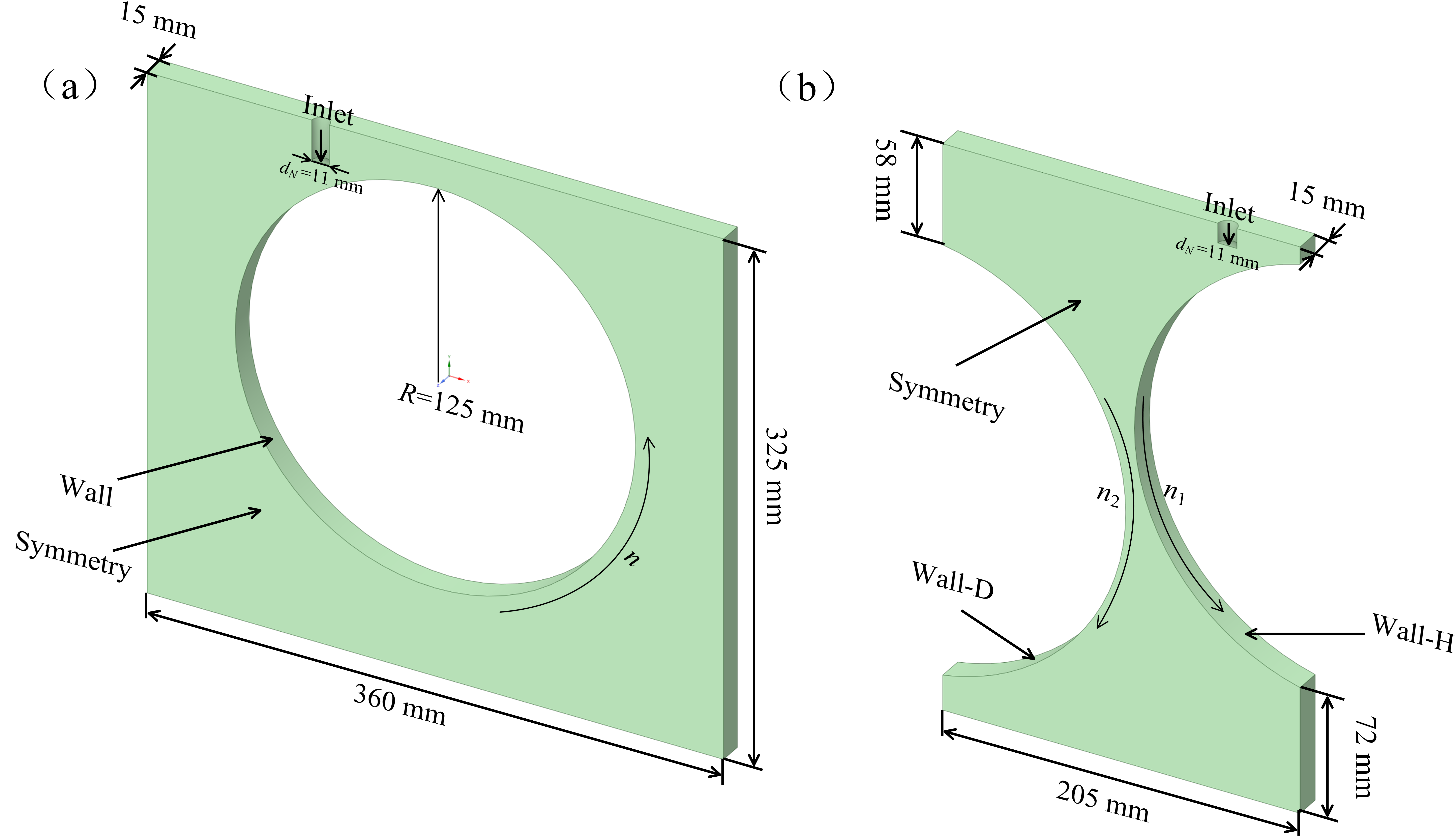
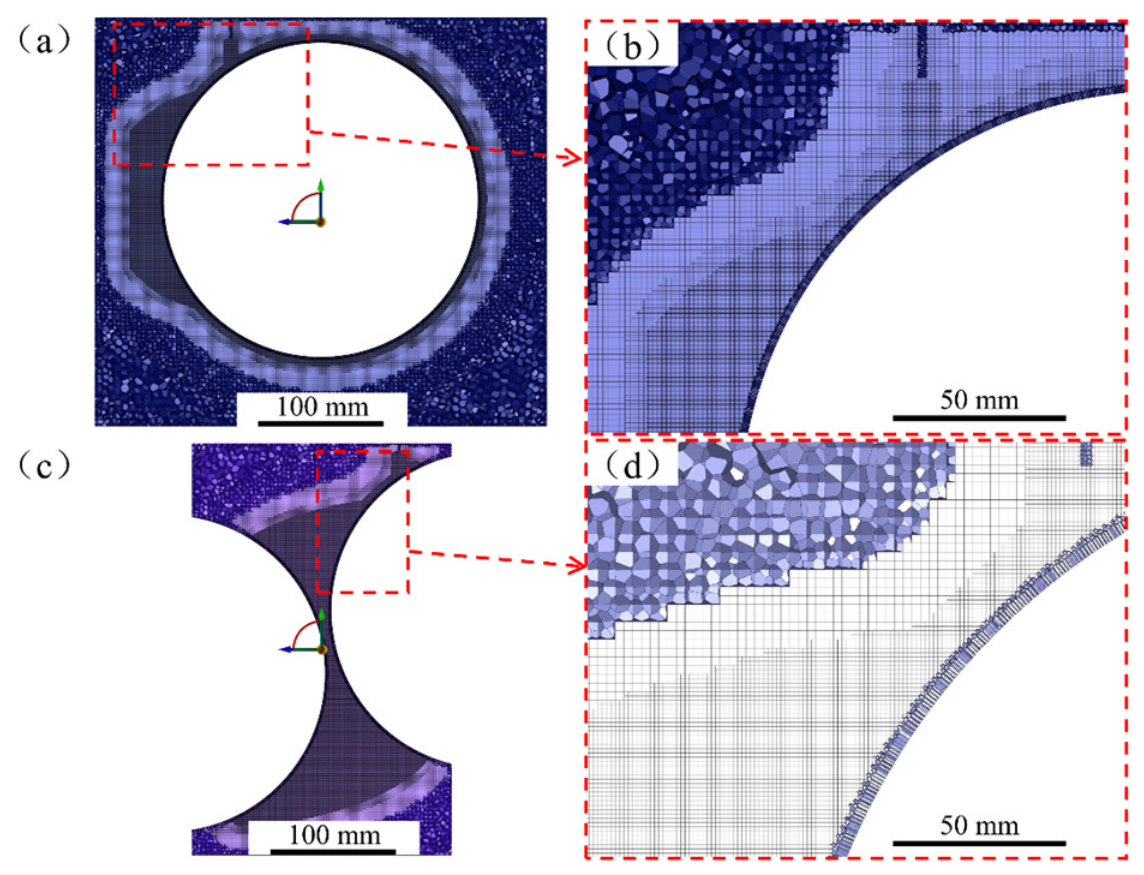
MaterialsAl2O3SiO2TiO2MgOK2ONa2OCSFe
Fly ash38.93453.9581.0793.4140.1040.0980.2050.1082.100
Coal gangue42.43753.9600.8941.4150.0880.0600.1430.0401.008
1:140.68653.9590.9642.4140.0960.0790.1740.0741.554
Table 2. Physical property parameters of the different materials.
MaterialDensity
ρ/(Kg/m3)
Viscosity
μ/(Pa·s)
Surface Tension
σ/(N/m)
Thermal Conductivity
λ/(W/(m·K))
Specific Heat
Cp/(J/(kg·K))
Slag2750Figure 10Equation (13)Equations (11) and (12)Equation (14)
Air1.2251.79 × 10−50.0720.02571006.4
Wall8030\\16.27502.5
Table 3. Box–Behnken design simulation factors and levels.
No.FactorsLowHighResponse
AMelt temperature (°C)16801980Transfer mass (kg)
BMelt jet velocity (m/s)7.518.68
CHigh-wheel rotational speed (rpm)500012,000
Table 4. Box–Behnken simulation design and calculation results.
OperationFactorsTransfer Mass (kg)
A (°C)B (m/s)C (rpm)
118308.09585000.00155
216807.5185000.00062
316808.6885000.00272
419808.6885000.000839
519807.5185000.00103
618308.09585000.00156
716808.09550000.00117
816808.09512,0000.00417
919808.09512,0000.00268
1019808.09550000
1118308.09585000.00154
1218307.5150000.000817
1318307.5112,0000.000821
1418308.6812,0000.00385
1518308.6850000.000172
1618308.09585000.00155
1718308.09585000.00155
Table 5. Quadratic model variance analysis.
Source of VariationSum of SquaresDegrees of FreedomMean SquareF-Valuep-Value
Model2.074 × 10−563.456 × 10−628.44<0.0001
A2.133 × 10−612.133 × 10−617.550.0019
B2.304 × 10−612.304 × 10−618.960.0014
C1.096 × 10−511.096 × 10−590.16<0.0001
AB1.312 × 10−611.312 × 10−610.800.0082
BC3.375 × 10−613.375 × 10−627.770.0004
B 26.561 × 10−716.561 × 10−75.400.0425
Residual1.215 × 10−6101.215 × 10−7--
Lack of fit1.215 × 10−662.025 × 10−74050.00-
Pure error2.000 × 10−1045.000 × 10−11--
Total sum of squares2.195 × 10−516---
Table 6. Fitting statistical results.
StatisticsValueStatisticsValue
Std.Dev.0.0003R20.9446
Mean0.0016R2adj0.9114
C.V.%22.25R2pre0.7923
Adeq Precision18.6753
Disclaimer/Publisher’s Note: The statements, opinions and data contained in all publications are solely those of the individual author(s) and contributor(s) and not of MDPI and/or the editor(s). MDPI and/or the editor(s) disclaim responsibility for any injury to people or property resulting from any ideas, methods, instructions or products referred to in the content.