1. Introduction
Aluminum hydroxides and oxides are widely used in the preparation of catalysts as stable supports for catalytic processes [
1,
2,
3], adsorbents [
3,
4,
5], gas and hydroprocessing purification systems, carbon oxide capture, low-temperature carbon monoxide (CO) oxidation [
5,
6], propane dehydrogenation [
7,
8], and the removal of organic dyes from aqueous media [
9]. Chemical surface modification further enhances adsorption efficiency by increasing the density of active sites and altering acid–base properties [
2,
3,
10,
11,
12,
13,
14,
15]. Surface hydroxyl groups play a key role by providing active centers for hydrogen bonding and surface complex formation [
16,
17,
18,
19].
It is well known that the phase transformation of Al(OH)
3 precursors (gibbsite, boehmite, and pseudoboehmite) into aluminum oxide critically determines the surface morphology, hydroxyl group density, and textural characteristics, and plays a decisive role in the formation of the final physicochemical properties of the material [
13,
14,
20,
21,
22,
23,
24,
25]. Controlled variation in precipitation and heat-treatment conditions makes it possible to regulate the specific surface area, pore-size distribution, and surface reactivity, which directly affects adsorption and catalytic properties [
13,
16,
17,
25].
Despite the substantial volume of research, several fundamental issues remain unresolved. In particular, the relationship between precursor synthesis conditions and the surface chemistry of transitional aluminum oxides remains insufficiently studied [
2,
5,
7,
8,
16]. In addition, the dual role of surface hydroxyl groups in adsorption and catalytic processes requires deeper mechanistic understanding [
4,
7,
10,
16,
18]. Synergistic effects between porous structure, surface chemistry, and catalytic activity have not yet been sufficiently investigated [
11,
12,
13,
26]. The development of multifunctional materials combining catalytic, sorption, and environmental functions also remains an important challenge [
3,
4], due to their broad potential applications in petrochemistry, environmental catalysis, water and gas purification, as well as energy storage and conversion processes.
There are highly contradictory viewpoints regarding the formation of various aluminum oxide phases during the dehydration of aluminum hydroxides, which is associated with the complexity of the sequential phase transformations of aluminum hydroxides and oxyhydroxides into metastable Al
2O
3 modifications [
20,
21,
22]. It should be noted that the aluminum oxide–water system is a metastable system whose properties strongly depend on the synthesis conditions and the genesis of the samples, while the formation of hydroxides from aluminum-based alloys remains insufficiently studied.
Since the properties, including catalytic activity, are closely related to the structure and morphology of the initial hydroxides and oxides, considerable attention has been devoted to investigating the possibility of forming various aluminum hydroxide phases during the interaction of activated aluminum alloys with water.
The aim of this work is to establish a comprehensive “structure–property” relationship between aluminum hydroxides and oxide materials obtained through the interaction of activated aluminum with water and aqueous salt solutions, with particular emphasis on surface hydroxyl groups, porous structure, and acid–base properties, as well as to identify their dual functionality as both catalysts and sorbents.
The novelty of the proposed approach lies in the use of direct hydrolysis of aluminum-based alloys in water as both the source of aluminum species and the driving force for the formation of aluminum oxyhydroxide/hydroxide precursors. In contrast to conventional sol–gel and precipitation methods [
27,
28,
29], which typically require aluminum salts (e.g., nitrates, chlorides, sulfates) or aluminum alkoxides, our approach employs the metallic alloy itself as the precursor.
Several important distinctions can be highlighted:
Elimination of chemical precursors. Traditional sol–gel synthesis commonly relies on aluminum alkoxides and requires controlled hydrolysis and peptization steps, while precipitation methods utilize soluble aluminum salts followed by the addition of precipitating agents. The proposed method avoids these reagents and directly converts the aluminum component of the alloy into aluminum oxyhydroxide/hydroxide products through reaction with water.
Simultaneous generation of hydrogen and solid products. During alloy hydrolysis, hydrogen is produced as a valuable by-product, whereas conventional sol–gel and precipitation routes are generally focused solely on the preparation of oxide precursors and do not provide energy-bearing products.
Reduced environmental impact. The process does not require large quantities of acids, alkalis, or organic alkoxide precursors and therefore minimizes the formation of nitrate-, chloride-, or sulfate-containing waste streams typically associated with precipitation routes.
Process simplification and lower material costs. The synthesis combines precursor formation and hydrolysis in a single step. In contrast, conventional sol–gel methods often involve multiple stages including precursor synthesis, hydrolysis, peptization, gelation, aging, drying, and calcination.
Unique microstructure formation. The growth of aluminum oxyhydroxide phases occurs directly on the reacting alloy surface under conditions of continuous hydrogen evolution and localized corrosion processes. Such reaction environments differ significantly from homogeneous precipitation or sol–gel systems and can lead to distinct morphologies and phase compositions of the hydrolysis products.
Therefore, the novelty of the present approach is not merely the synthesis of boehmite or alumina precursors, which are well known in the literature, but the utilization of activated aluminum alloys as reactive precursors enabling the simultaneous production of hydrogen and functional aluminum-containing materials through a simple water-based process.
In studying the dehydration of aluminum hydroxides and developing a new type of catalyst based on active aluminum oxide for various processes, it is necessary to consider particle size and the degree of hydroxide crystallinity, as well as the influence of multiple factors, including reaction temperature, the nature of activating metals, solution pH, and alloy-to-water ratio. The obtained results provide a basis for the rational design of multifunctional alumina-based systems for catalytic and environmental applications.
2. Materials and Methods
The object of the study was an aluminum alloy activated with gallium, indium, and tin, each in an amount of 5 wt.% (Rau-85 reagent). The detailed procedure for the preparation of activated aluminum alloys, as well as the conditions for conducting XPS (and (TPR)) studies, were published earlier [
30].
Distilled water was used as the oxidizing medium.
Thermal analysis of the products formed during the interaction of activated aluminum with water was carried out using differential thermal analysis (DTA) and thermogravimetric analysis (TGA) on a Q-1000/D derivatograph system developed by F. Paulik, J. Paulik, and L. Erdey (MOM, Budapest, Hungary).
The applied method is based on the instrumental registration of changes in the thermochemical and physical parameters of a substance occurring during heating. The thermochemical state of the sample is described by the following curves: T (temperature curve), DTA (differential thermal analysis curve), TG (thermogravimetric curve), and DTG (differential thermogravimetric curve), the latter being the derivative of the TG function.
The analysis was carried out in an air atmosphere over a temperature range of 20–1000 °C. The furnace heating regime was linear (dT/dt = 10 °C/min), and calcined Al2O3 was used as the reference material. To ensure consistency of measurement conditions, the sample weight was strictly maintained at 100 mg, with a balance sensitivity of 100 mg per measurement scale. The analysis was performed under the following instrumental settings: DTA = 250 μV, DTG = 500 μV, TG = 500 μV, and T = 500 μV.
The products formed during the interaction of activated aluminum with water were characterized using a combination of SEM–EDXS, XRD, DTA, and DTG techniques, providing comprehensive and reliable information on the composition and structure of the studied materials. Microstructural analysis and elemental composition determination were performed using a JSM-6490LV scanning electron microscope (JEOL, Munich, Germany) equipped with an INCA Energy 350 energy-dispersive X-ray spectroscopy (EDS) system (Oxford Instruments, Abingdon, UK).
According to the XRD data, the phase composition of the reaction products includes intermetallic compounds of various compositions: Indium Tin (In3Sn)0.5, Indium Tin In0.818Sn0.8182, and aluminum oxide hydroxide—AlO(OH).
Residual metallic aluminum was also detected in the reaction products. The X-ray diffraction patterns of the samples contain a mixture of crystalline and amorphous phases [
31].
The specific surface area was determined by gas chromatography using argon adsorption. The pore size distribution function and pore volume were determined by mercury porosimetry at a maximum pressure of 200 MPa.
Diffuse reflectance electronic spectra (DRES) of the samples were recorded using a Hitachi-330 spectrometer (Hitachi Ltd., Tokyo, Japan). X-ray photoelectron spectra were obtained using an ES-2402 electron spectrometer (Institute for Analytical Instrumentation, St. Petersburg, Russia) with Mg Kα radiation under a vacuum of 10−6 Torr.
3. Results
Mechanism of phase transformations of aluminum hydroxides under various temperatures, pH values, and aging conditions (holding time).
The phase composition of aluminum hydroxide precursors strongly depends on pH, temperature, and aging conditions. Du et al. [
20,
32,
33] investigated the effect of pH on the composition, structure, morphology, and phase transformations of aluminum hydroxides obtained by chemical precipitation. The authors demonstrated that the resulting hydroxides undergo different transformation pathways during calcination depending on the pH of precipitation.
Aluminum hydroxide precipitated at pH 5 and 6 was found to be amorphous and transformed into α-Al
2O
3 at 950 °C according to the sequence:
At pH 7, the precipitated phase was identified as boehmite, which transformed into α-Al
2O
3 at 950 °C through the pathway:
In contrast, aluminum hydroxide precipitated in the pH range of 8–11 consisted predominantly of bayerite and transformed into α-Al
2O
3 at 1000 °C via the sequence:
Furthermore, pH influences not only the phase composition but also the morphology of the precipitated particles. With increasing pH, the particle morphology evolves from ultrafine flakes to spherical particles approximately 50 nm in size and subsequently to irregular agglomerates with dimensions up to 150 nm. Consequently, pH significantly affects the microstructure and properties of the final alumina products obtained after thermal decomposition.
In addition, Zhang et al. [
20] demonstrated that elevated temperatures (80–100 °C) accelerate the transformation of gibbsite into boehmite. The transformation proceeds via a dissolution–reprecipitation mechanism, with pseudoboehmite acting as an intermediate phase. The authors also reported that the Al/OH
− ratio plays an important role in determining phase stability.
Aging time also substantially affects the crystallinity and phase evolution of the products. Egorova et al. [
33] investigated the gibbsite-to-boehmite transformation during hydrothermal treatment in aqueous suspension and under “dry steam” conditions at 180–210 °C and pressures of 1.0–1.9 MPa for 30–540 min. The authors observed a gradual transformation of gibbsite into boehmite accompanied by significant morphological evolution and pore formation. The process involves dissolution of the initial phase followed by nucleation and growth of new boehmite crystals, resulting in changes in particle morphology and porous structure. Notably, closed mesopores formed by crystal coalescence were identified in boehmite for the first time. These pores encapsulate water in amounts of up to 1.8 wt.%. The size distribution of the closed mesopores depends on the hydrothermal treatment conditions: pores smaller than 4 nm were observed in aqueous suspensions, whereas under dry-steam conditions mesopores with diameters of 4–6 nm and approximately 10–200 nm were formed. Owing to the presence of such closed mesopores, boehmite may serve as a promising material for encapsulation and transport of solutions containing active compounds. These findings demonstrate that the mechanism of subsequent phase transformations is strongly governed by the nature of the initial aluminum hydroxide phase and by the synthesis and aging conditions.
3.1. Effect of Reaction Temperature on the Phase Composition of Aluminum Hydroxides
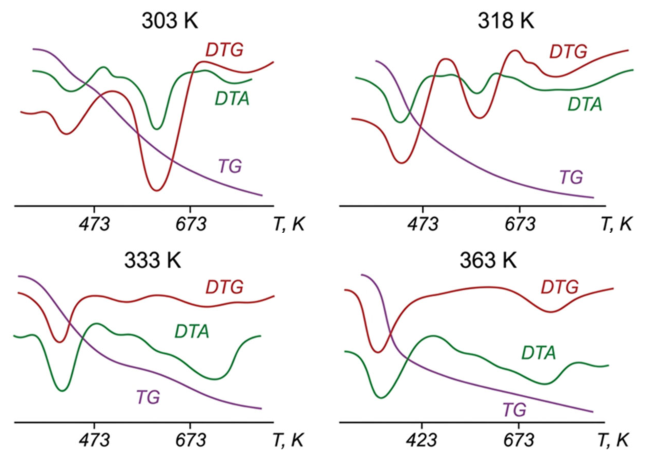
Typical DTA, DTG, and TG curves obtained during dynamic heating of hydroxide samples produced from an alloy containing 98% aluminum + 1% gallium + 1% indium are presented in
Figure 1.
The DTG curves exhibit two or, more frequently, three maxima of water loss at 393, 543, and 723 K, accompanied by endothermic effects. The peak at 393 K corresponds to the removal of non-structural water, the peak at 543 K is associated with the release of part of the structural water from bayerite Al2O3·3H2O, while the peak at 723 K corresponds to the decomposition of pseudoboehmite Al2O3·H2O.
Variation in the reaction temperature between activated aluminum and water leads to significant changes in the phase composition of aluminum hydroxides.
Thus, at 303 K the reaction products consist of 78% bayerite and 22% pseudoboehmite, whereas at 333 K less than 10 wt.% of bayerite is detected. Further increase in the reaction temperature results in the formation of pseudoboehmite being the sole phase.
3.2. Effect of Activating Metal Concentration on the Phase Composition of Formed Aluminum Hydroxides
Significant changes in the phase composition of aluminum hydroxides occur during the interaction of alloys containing different amounts of activating additives with water. With increasing additive concentration, a tendency toward a decrease in bayerite content and an increase in pseudoboehmite content in the hydroxides is observed.
The phase composition of the reaction products is also influenced by the nature of the activating metals present in the alloy.
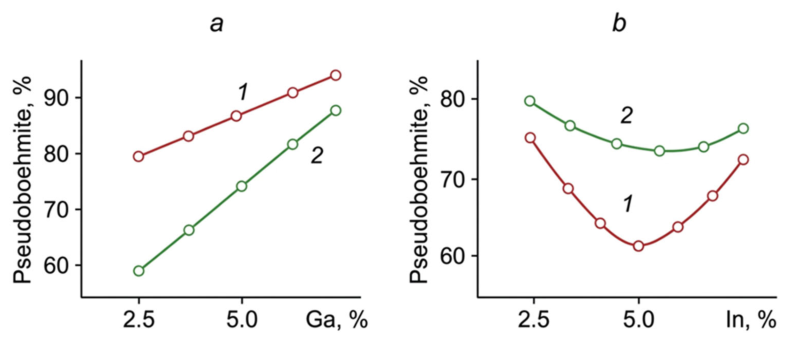
It can be seen from
Figure 2 that increasing the gallium concentration in the alloy leads to a more pronounced change in the phase composition. The dependence is linear in nature and promotes the formation of pseudoboehmite.
The introduction of indium into the alloy up to 5.0 wt.% shifts the phase composition toward the formation of bayerite. At a constant gallium concentration, increasing the indium content from 2.5 to 7.5 wt.% in the alloy results in a decrease in pseudoboehmite content in the reaction products.
Apparently, the changes in the phase composition of the reaction products are associated with the structure and phase composition of the initial ternary aluminum–indium–gallium alloy.
3.3. Dependence of the Phase Composition of Aluminum Hydroxides on Solution pH
Unlike alloy composition and temperature, which mainly influence the quantitative ratio of bayerite and pseudoboehmite in the reaction products, the pH value affects qualitative changes in the phase composition.
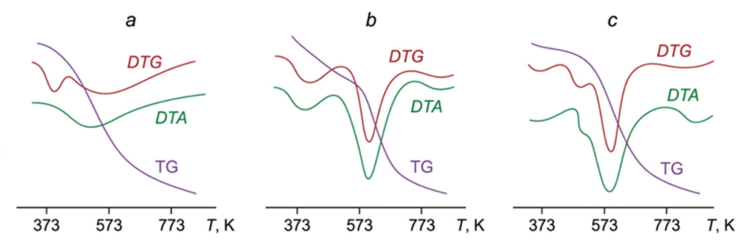
The reaction product obtained at high pH leads to the formation of a new phase, gibbsite, whose decomposition endothermic effect is observed at 503 K (
Figure 3).
In the presence of alkali metal ions, the gibbsite structure becomes stable, and at 303 K conditions are created for the transformation of part of the pseudoboehmite and bayerite into gibbsite. The peak at 793 K, which is absent in the other samples, is apparently associated with the decomposition of boehmite formed during thermal analysis under hydrothermal conditions, where gibbsite transforms into boehmite. According to the DTA and TG data, the amount of gibbsite present in the reaction products corresponds to the boehmite content.
Two effects are observed on the DTA and DTG curves at 393 and 523 K. The peak at 393 K is caused by the removal of adsorbed water. Since crystalline aluminum hydroxides decompose within a narrow temperature range, the peak at 523 K, extending over a broad temperature interval, is characteristic of the decomposition of amorphous phases. Amorphous aluminum hydroxide may form from initially produced pseudoboehmite during the reaction of the aluminum alloy with water.
Based on the presented experimental and literature data, a scheme for the interaction of activated aluminum with water is proposed, where the initial stage involves the formation of pseudoboehmite (1), followed by its transformation into other hydroxide forms (2):
3.4. Dependence of the Phase Composition of Aluminum Hydroxides on the Alloy-to-Water Ratio
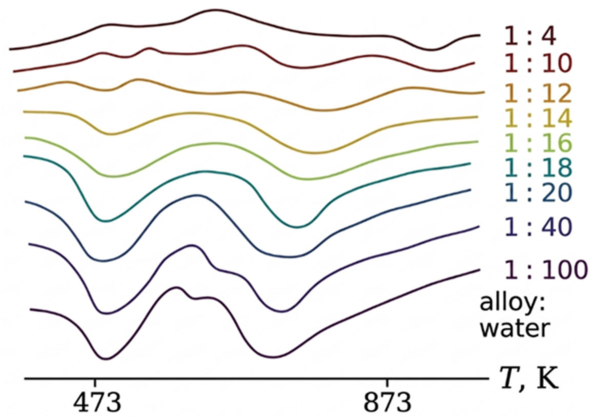
The DTA curves (
Figure 4) show that at a solid-to-liquid ratio of 1:14, an exothermic effect is observed in the initial stage up to 473 K, which is apparently associated with residual aluminum. During the removal of adsorbed water, which reacts with aluminum, a peak appears in the form of an exothermic effect. The presence of aluminum in the oxides is also confirmed by the appearance of small endothermic peaks on the DTA curves at 933 K, corresponding to the melting temperature of aluminum. With an increase in the solid-to-liquid ratio above 1:20, a peak appears on the DTA curves in the temperature region around 423 K, which is associated with an endothermic process corresponding to the removal of non-structural water. The peak corresponding to boehmite decomposition at 723 K gradually decreases with increasing excess water. At the stage of the low-temperature branch, a transition at 553 K is observed, corresponding to the transformation from the solid–liquid state to free water. As the solid-to-liquid ratio increases and the boehmite peak at 753 K decreases, a reduction in the adsorbed water peak is also observed, indicating a decrease in the density and dispersity of the hydroxides.
Analysis of the results presented in
Section 3.1,
Section 3.2,
Section 3.3 and
Section 3.4 indicates that, depending on the conditions of the reaction between activated aluminum and water (temperature, nature and content of activating metals, solution pH, and alloy-to-water ratio), different phase compositions can be obtained, including varying proportions of bayerite and pseudoboehmite.
3.5. Effect of Aging on the Morphology and Phase Composition of Pseudoboehmite Aluminum Hydroxide
It is well known that during the aging of aluminum hydroxide obtained by alumina reprecipitation, the morphology of the precipitate and even the formation of new phases may change depending on the conditions and aging time [
20]. In most cases, empirical methods are used for obtaining various forms of aluminum hydroxides, making it difficult to predict the formation of specific modifications. As a result, contradictory data regarding the influence of synthesis methods on aluminum hydroxides are frequently reported in the literature.
Special attention in the present work was devoted to the preparation of pseudoboehmite and bayerite aluminum hydroxides, which serve as precursors for the synthesis of active aluminum oxide [
13]. The interaction of an aluminum alloy containing 1.0–3.0 wt.% gallium and indium with water was carried out at 363 K, with an alloy-to-water ratio of 1:20, initial pH ≈ 6.0, and final pH ≈ 9.0–9.5. Aging of the obtained precipitates was performed in the mother liquor.
In a thermostatically controlled reactor, the pH of the solution was maintained within the range of 9.0–9.5 and remained practically unchanged during the aging process. The aluminum hydroxide samples were filtered in air for 24 h and subsequently dried at 393 K for 24 h.
Electron microscopy images of the obtained samples revealed individual fine needle-like particles measuring 10 × 108 Å, as well as a large number of irregular aggregates of fine needles characteristic of pseudoboehmite, which exhibited on X-ray diffraction patterns the diffraction features of poorly crystallized boehmite (pseudoboehmite).
Aging of this sample at 293 K for 96 h in the mother liquor resulted in the growth of pseudoboehmite needles to dimensions of 25 × 270 Å. The growth of needles during aging is likely associated with the coalescence of individual needles, whose length may reach up to 1000 Å. Holding the sample at 363 K for 1.5 h in the mother liquor led to further growth of pseudoboehmite needles up to 40 × 600 Å. Aging the sample in the mother liquor for 144 h at 293 K resulted in the oriented growth and ordering of pseudoboehmite particles, reaching lengths of 600 Å with transverse dimensions of 30–40 Å.
Thus, during the aging of pseudoboehmite obtained from activated aluminum at 293 K in the mother liquor, gradual oriented growth of needle-like particles occurs. The initially large aggregates of needles disintegrate during aging into separate fine needles, and after 96 h of aging no agglomerates are observed.
It is noteworthy that aging at 293 K in the mother liquor leads only to the oriented coalescence of pseudoboehmite particles into larger needles, while no phase transformations are detected. X-ray phase analysis confirms the presence of only the pseudoboehmite phase in these samples.
Particular attention should be paid to the fact that during the aging of pseudoboehmite at 293 K, obtained by dissolution of activated aluminum in water, the formation of bayerite was not observed even after 6 days.
It should be noted that the hydrolysis products may contain trace amounts of gallium and indium originating from the initial aluminum alloy. According to the literature [
34,
35,
36], during the hydrolysis of activated Al–Ga–In alloys, these elements do not form separate crystalline phases detectable by X-ray diffraction. Instead, they are mainly present as trace oxide/hydroxide species or may be isomorphically incorporated into the structure of aluminum oxyhydroxides due to the similarity of the chemical properties of Al
3+ and Ga
3+ ions.
In particular, Wenjing Fu et al. [
34] investigated the hydrolysis of aluminum activated with a Ga–In–Sn eutectic alloy and demonstrated that the resulting aluminum hydrates possessed very high purity, with a total impurity content below 450 ppm. This finding indicates that most of the gallium and indium are not incorporated into the formed aluminum hydroxides in significant amounts. At the same time, studies of aluminum hydrates produced by the hydrolysis of Al–Ga–In–Sn alloys suggested the possible formation of mixed aluminum–gallium oxyhydroxides [
35]. Furthermore, Susan M. Bradley and co-workers [
36] reported that the hydrolysis mechanisms of Ga
3+ and Al
3+ ions are very similar and lead to the formation of structurally related oxyhydroxide phases.
Considering the low concentrations of gallium and indium in the initial alloy and the absence of distinct gallium- or indium-containing phases in the XRD patterns, it can be concluded that these elements are present in the final products only in trace amounts, most likely as highly dispersed oxide/oxyhydroxide particles or as isomorphic impurities incorporated into the aluminum oxyhydroxide structure.
3.6. Kinetics of Dehydration of Aluminum Hydroxides
The kinetics of dehydration of aluminum hydroxides were studied by the thermogravimetric method under isothermal conditions. Bayerite was obtained by the interaction of an alloy containing 99.0% aluminum + 0.5% indium + 0.5% gallium with water (alloy-to-water ratio 1:100) at 303 K, while pseudoboehmite was obtained from an alloy containing 90% aluminum + 5.0% indium + 5.0% gallium at 363 K. Prior to analysis, the hydroxides were held at 397 K for two hours to remove non-structural water.
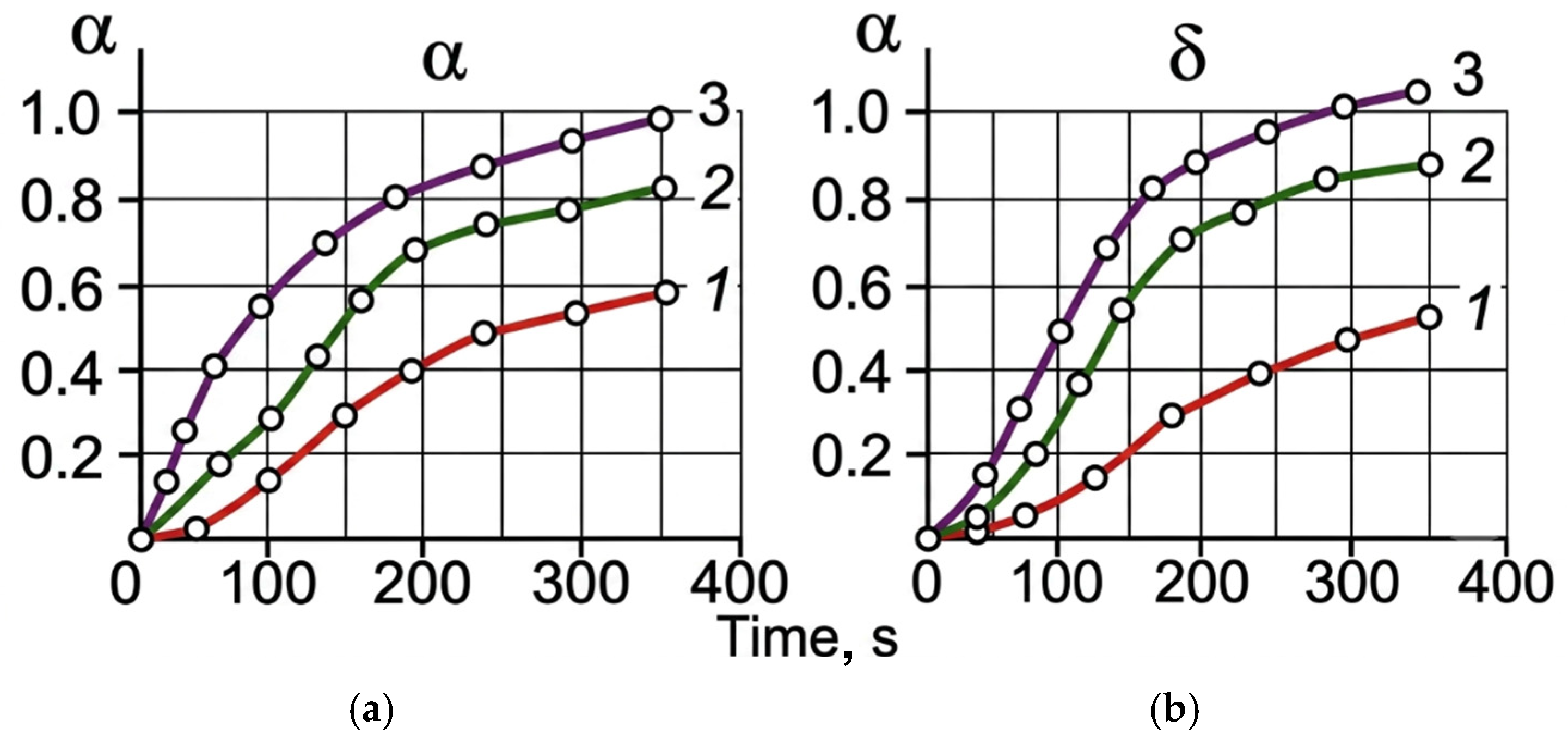
Figure 5 presents the results of dehydration experiments for pseudoboehmite (a) at temperatures of 593, 703, and 773 K, and for bayerite (b) at 523, 563, and 583 K. The dependence of the degree of conversion of aluminum hydroxides on time exhibits typical sigmoidal curves containing an induction period, acceleration region, and deceleration region.
With increasing calcination temperature, both the conversion degree and the dehydration reaction rate increase for both pseudoboehmite and bayerite. The dependence of the double logarithm ln [1/(1 − α)] is a function of the logarithm of time.
The first stage corresponds to the dehydration reaction of pseudoboehmite proceeding in the kinetic region (n1 = 1.61; 1.62; 1.38), whereas the second stage (n2 = 0.30; 0.43; 0.54) corresponds to the diffusion-controlled region at temperatures of 593, 703, and 773 K, respectively.
In the case of bayerite dehydration, n1 = 2.21; 2.25; 2.04 and n2 = 0.83; 1.22; 1.19 at temperatures of 523, 563, and 583 K, respectively. For bayerite, water release increases with temperature, and, importantly, the coefficient n becomes greater than 1. Apparently, at elevated temperatures more intensive water removal in the form of vapor occurs, leading to loosening of the structure and improved removal of reaction products.
The transition from the kinetic to the diffusion-controlled region is apparently associated with diffusion inhibition caused by the increasing thickness of the reaction product layer and the difficulty of removing released water from the reaction zone. Thus, the reaction rate becomes controlled by water diffusion through the pore system of the forming oxide.
3.7. Preparation of Active Aluminum Oxide
Active aluminum oxide predominantly represents the γ-modification and is widely used for the production of catalysts in petroleum refining and petrochemical processes.
Commercially produced aluminum oxide mainly contains γ-Al2O3 and, less frequently, η- and χ-Al2O3. This is a low-temperature aluminum oxide (Al2O3·nH2O, where 0 < n < 0.6) obtained at temperatures not exceeding 873 K. The resulting modifications are varieties of a defective spinel structure containing a small amount of water. The pores formed by primary crystallites measuring 30–80 Å possess slit-like or bottle-shaped morphology.
A significant increase in the dispersity of aluminum hydroxides during thermal decomposition leads to an increase in specific surface area.
Table 1 presents the dependence of the specific surface area of the samples on calcination temperature and phase composition of the hydroxides. The transformation of pseudoboehmite into γ-aluminum oxide within the temperature range of 523–673 K is accompanied by only a slight change in surface area (630–640 m
2/g).
With increasing temperature, the specific surface area decreases sharply—to 520 m2/g at 823 K and to 400 m2/g at 973 K—apparently due to sample sintering.
For samples containing pseudoboehmite, a clearly pronounced phase transition to γ-aluminum oxide is observed at 723 K. For the sample containing bayerite, a sharp increase in specific surface area up to 690 m2/g is observed at temperatures of 523–623 K, remaining practically constant up to 823 K. According to XRD and DTA results, bayerite obtained from an aluminum-based alloy transforms into η-aluminum oxide bypassing the monohydroxide stage.
The use of bayerite-structured hydroxide as a precursor makes it possible to obtain catalysts with highly developed surface area and high thermal stability.
During dehydration of the sample containing gibbsite, two new transitions are observed at 503 and 793 K. Since boehmite was not detected in the initial aluminum hydroxide, the following transformations are characteristic for gibbsite during dehydration in air:
Based on the obtained results, a general scheme for the preparation of active aluminum oxide from activated aluminum through interaction with water is proposed:
Thus, during the preparation of active aluminum oxide through the reaction of aluminum alloys containing indium and gallium with water, the main phases formed are γ- and η-Al2O3, possessing a specific surface area reaching up to 700 m2/g and high dispersity.
Such a highly developed surface is apparently associated with the fact that the structure of aluminum hydroxides contains a system of micropores formed by evolving hydrogen. As a result, the dehydration process is accelerated, while sintering and recrystallization processes are hindered.
The obtained total pore volume was 1.5–2.5 cm3/g, with a nearly equal ratio of micro- and macropores. According to electron diffraction studies, the obtained sample corresponds to γ-aluminum oxide.
The γ-modification of aluminum oxide exhibits a plate-like morphology and is homogeneous throughout the entire volume. The length-to-width ratio of the plates ranges from 1:4 to 1:6, with average plate lengths from 110 to 340 Å and widths from 28 to 56 Å. γ-Al2O3 particles with another morphology were also observed, where the length-to-width ratio reaches 1:20–1:30.
Phase analysis showed that despite changes in morphology, the phase composition remains unchanged. The average dimensions of γ-aluminum oxide needles are: length from 368 to 560 Å and width from 23 to 40–50 Å. The formation of plate-block structures consisting of needles fused along their lateral surfaces is noteworthy.
X-ray fluorescence studies revealed the presence of gallium in γ-aluminum oxide samples in the form of metallic inclusions with sizes ranging from 23 to 560 Å.
3.8. Fundamentals of Active Alumina Production Technology
At present, the quality of active aluminum oxide no longer satisfies the requirements imposed on impurity content (Cl
−, SO
42−, Na
+, K
+, etc.). The volume of washing water used ranges from 10 to 200 t per ton of active alumina produced. The need to create complex wastewater treatment systems to prevent environmental contamination significantly complicates the production process of active aluminum oxide [
37,
38].
The technology for active aluminum oxide production developed by us differs advantageously from existing methods due to its simplicity, reduced number of process stages, and simplified equipment design, and includes the following stages [
39]:
The high quality of the obtained oxide is ensured by the absence of washing and filtration stages, as well as by eliminating the need for purification of raw materials from impurities through the use of an alloy capable of reacting directly with water.
The developed technology makes it possible to:
- (a)
Obtain active aluminum oxide with exceptionally high surface area and high purity, as well as supported catalysts by unconventional methods involving the introduction of active components and modifiers in metallic form into the aluminum alloy followed by interaction of the alloy with water;
- (b)
Carry out alloy–water reactions in the presence of salts of the active component followed by drying and calcination of the final product;
- (c)
Introduce catalytically active components into the aqueous suspension of aluminum hydroxide during the shaping stage;
- (d)
Synthesize catalysts and supports with predetermined properties.
Thus, the present work establishes the scientific foundations for new methods of obtaining aluminum hydroxides and oxides with tailored physicochemical properties, representing a new class of efficient catalysts.
It should also be noted that, owing to their unique properties, activated aluminum and the reaction product—aluminum oxide—have found wide application in various oxidation–reduction processes. Their use in different fields of science and technology appears highly promising.
3.9. Preparation of Novel Catalysts from Activated Aluminum-Based Alloys
Investigation of the reaction products formed during the interaction of aluminum-based alloys containing indium and gallium additives with water, as well as the conditions of their formation, made it possible to develop a fundamentally new technology for the preparation of active aluminum oxide and the deposition of catalytically active metals onto its surface.
3.9.1. Investigation of the Properties of an Alumina–Platinum Catalyst Obtained from Activated Aluminum
Alumina–platinum catalysts are widely used in petroleum refining, petrochemistry, gas emission purification processes, hydrogen energy technologies, and related fields [
11,
40]. Hydrogen can be produced through the partial oxidation of hydrocarbons, while the synthesis gas formed in this reaction may subsequently be used for the production of various chemical products [
41].
Depending on the operating conditions and composition of the reaction mixture, the activity of different platinum species may vary during the reaction, and platinum oxides may form, influencing catalytic activity in different ways [
12]. Therefore, it is important to determine which platinum states are present in the catalyst and in what proportions.
It is well known that the activity and stability of platinum are largely determined by the acidic properties of the support [
4,
12]. The preparation method of the support affects its surface and bulk structure, as well as the degree of structural defects, ultimately influencing the amount of metal present in ionic form within the support structure.
Aluminum oxide is frequently used as a support for platinum catalysts, including catalysts for hydrocarbon partial oxidation processes [
2]. The unique acid–base properties of aluminum oxide phases are additionally utilized to achieve high dispersion of the deposited active component [
3]. Typically, the low-temperature γ-Al
2O
3 modification of the pseudoboehmite series is selected as the support because of its high specific surface area, developed porosity, and thermal stability [
6,
13,
17,
20,
21,
22,
23,
24,
25]. The second most commonly used support is α-Al
2O
3 [
5,
8].
Analysis of the literature indicates that aluminum oxides obtained from bayerite hydroxide, namely η- and θ-Al2O3, are used less frequently as catalyst supports, particularly for platinum catalysts.
It is known that when platinum is deposited onto γ-Al
2O
3, after impregnation and calcination stages it predominantly exists in electron-deficient states such as Ptδ
+, Pt
2+, and Pt
4+ due to strong metal–support interaction (MSI), caused by charge transfer between Pt atoms, coordinatively unsaturated Lewis acidic Al
3+ sites, and surface hydroxyl groups of the support [
26,
42,
43,
44,
45,
46,
47,
48].
Upon reduction, part of the platinum transforms into the metallic Pt
0 state; however, the electron-deficient character of platinum is partially retained due to the strong Pt–Al
2O
3 interaction. The relationship between the acidic centers of γ-Al
2O
3 and the electronic state of highly dispersed platinum has been discussed in detail in previous studies [
49,
50].
For other modifications of aluminum oxide, such data are practically absent. Therefore, investigation of platinum behavior upon deposition onto aluminum oxide synthesized by a new method is of considerable interest.
In the present work, alumina–platinum catalysts based on the products of interaction between aluminum alloys containing indium and gallium and water were developed for the cyclohexane dehydrogenation reaction. The method of support preparation and the technique used for deposition of the active component significantly influence the catalytic activity of the catalyst.
The conventional method for introducing the catalytically active component involves impregnation of the prepared oxide with platinum salts followed by reductive activation of the catalyst.
In this work, two new platinum deposition methods forming the basis of the proposed technology were developed:
Interaction of aluminum-based alloys with water in the presence of soluble platinum salts;
Introduction of platinum in metallic form into an aluminum alloy containing gallium and indium, followed by interaction of the resulting composition with water.
In the proposed methods, the catalyst does not require preliminary reduction. In the latter case, the catalyst also does not require washing from impurities (Cl−, NO3−, Na+, K+, etc.), since the starting materials are only the alloy and water.
Therefore, the main attention was focused on the investigation of alloys containing indium, gallium, and platinum, the products of their interaction with water, as well as the reaction conditions and subsequent thermal treatment.
3.9.2. State of Platinum in Alumina–Platinum Catalysts Obtained from Activated Aluminum
Based on X-ray phase analysis data, it was concluded that samples containing 0.5–2.0 wt.% platinum are predominantly hydroxide systems; however, they exhibit a different quantitative ratio of pseudoboehmite and bayerite phases compared to platinum-free samples. The introduction of platinum leads to an increase in bayerite content, while the amount of pseudoboehmite passes through a maximum at 0.5 wt.% platinum. Further increase in platinum content results in approximately equal amounts of pseudoboehmite and bayerite.
After calcination of the samples at 673 K, both hydroxide phases are still retained, whereas one of them, namely bayerite, disappears after heat treatment at 773 K. Samples calcined at 873 K still contain a certain amount of pseudoboehmite along with oxide phases γ-Al2O3, δ-Ga2O3, and θ-In2O3.
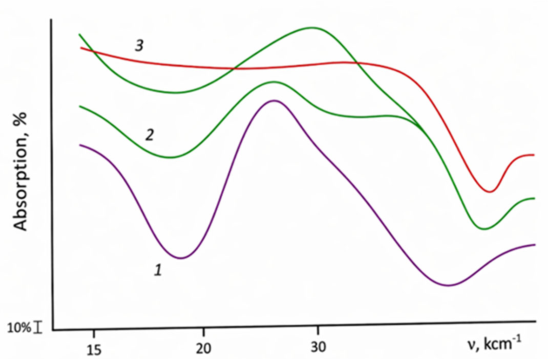
For the sample containing 1.0 wt.% platinum and calcined in air at 673 K, the diffuse reflectance electronic spectra (DRS) exhibit a distinct band with a maximum at 28,000 cm
−1, characteristic of platinum ions. Increasing the calcination temperature to 773–873 K leads to an increase in the intensity of the 28,000 cm
−1 band (
Figure 6), which is associated with the incorporation of platinum ions into the aluminum oxide lattice formed during dehydration of the hydroxide phases.
Apparently, the ionic state of platinum arises due to substitution of protons of hydroxyl groups in the hydroxides, followed by incorporation into the spinel structure containing platinum ions in octahedral vacancies and as cations replacing protons in surface OH groups. As a result, an increase in metal–support interaction and improved platinum dispersion compared to conventional platinum deposition methods onto preformed supports can be expected.
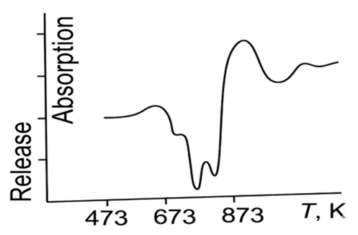
This assumption is confirmed by the temperature-programmed reduction (TPR) curves of the sample containing 1.0 wt.% platinum calcined at 673 K (
Figure 7). At 753–773 K, water evolution continues, and reduction proceeds stepwise, with the major portion of ionic platinum being reduced at 893 K.
A distinguishing feature of these alumina–platinum catalysts is the simultaneous presence of indium and gallium, which play a dual role: first, they promote the interaction of aluminum with water leading to hydroxide formation; second, they act as catalyst promoters.
3.9.3. Catalytic Activity of the Alumina–Platinum Catalyst in the Cyclohexane Dehydrogenation Reaction
The investigation was carried out in a reactor operating in pulse mode within the temperature range of 523–643 K. The samples were preliminarily calcined at 823 K for 2 h. The catalyst loading was 0.25 g, and the particle size ranged from 0.2 to 0.25 mm.
For catalysts containing 0.5–1.0 wt.% platinum, the dehydrogenation reaction begins at 523 K and reaches a benzene yield of 96–98%, while at 623 K the benzene yield reaches 99.9%. The process proceeds selectively without the formation of side products. Under the investigated conditions, the platinum-free sample exhibited no activity in the cyclohexane dehydrogenation reaction.
In a flow reactor with a catalyst volume of 10 cm3 at 593 K, the influence of catalyst specific surface area, particle size, and platinum content on catalytic activity in cyclohexane dehydrogenation was studied. The samples contained 0.5 wt.% platinum, with particle sizes of 0.6–1 mm, while the cyclohexane feed rate varied from 0.25 to 4.0 h−1.
The conversion degree remained high and decreased at high feed rates only in cases where the specific surface area changed. For a catalyst with a specific surface area of 312 m2/g, the conversion reached 89% at a feed rate of 1 h−1, whereas for a sample with a surface area of 590 m2/g the same conversion level was achieved at a feed rate of 2.5 h−1.
When the particle size was varied from 0.25 to 4.0 mm at a cyclohexane feed rate of 1 h−1 and a temperature of 593 K, diffusion limitations became noticeable for catalyst particles larger than 2.0 mm. At a particle size of 4.0 mm, the cyclohexane conversion decreased from 90% to 30%.
A proportional relationship between platinum content and catalyst selectivity was established up to 1.5 wt.% platinum. For samples prepared by conventional methods, increasing the platinum content above 0.7–0.9 wt.% does not lead to further enhancement of activity.
The reasons for the increased activity are apparently related to the fact that the samples possess a specific surface area more than twice as high as that of catalysts prepared by conventional methods. In our opinion, the high catalytic activity is associated with the high dispersion of platinum on the highly developed surface, as well as with the presence of gallium and indium acting as dehydrogenation promoters.
Thus, a new method for preparing platinum catalysts on a support has been developed through the introduction of platinum into an activated aluminum alloy followed by its interaction with water. It was established that, in addition to metallic platinum, platinum in ionic form is also present in the reaction products, being reduced at approximately 900 K. This suggests enhanced metal–support interaction and improved platinum distribution within the formed support.
High activity and selectivity in the cyclohexane dehydrogenation reaction were demonstrated by alumina–platinum catalysts obtained from aluminum alloys containing gallium and indium. Increasing the platinum content in the catalyst up to 1.5 wt.% resulted in a proportional increase in catalytic activity.
3.9.4. Relationship Between Porous Structure and Catalytic Properties
The catalytic performance of alumina-based materials is strongly influenced by their textural characteristics, including specific surface area, pore volume, and pore size distribution [
51,
52]. Porous alumina is widely used as both a catalyst and a catalyst support in the petrochemical industry owing to its high specific surface area, thermal stability, tunable acid–base properties, and controllable pore structure. The pore architecture, particularly the presence of mesopores and larger pores with diameters in the range of 10–50 nm, plays a crucial role in ensuring efficient diffusion and resistance to coke formation during catalytic reactions.
The structure of alumina, including its surface characteristics and porous network, is an important factor governing the catalytic activity and selectivity of γ-Al
2O
3. As reported in Ref. [
52], mesoporous alumina with pore diameters of 2–10 nm exhibits a high specific surface area and enhanced accessibility of active sites, making it an effective catalyst support. Key factors influencing the pore structure include the aluminum source, precursor phase composition, aging conditions, drying procedure, and calcination treatment.
A well-developed mesoporous structure, high specific surface area, and controlled pore size distribution are recognized as key parameters determining the effectiveness of alumina as both a catalyst and a catalyst support. Mesoporosity improves the accessibility of active sites to reactant molecules, facilitates mass transfer, and reduces diffusion limitations during catalytic processes [
52].
In contrast, materials dominated by microporosity may exhibit restricted diffusion of reactants despite possessing high specific surface areas. Nitrogen adsorption–desorption measurements showed that, after calcination, the obtained samples exhibit a mesoporous structure with pore sizes predominantly in the range of 3–20 nm. Such pore dimensions are generally considered favorable for heterogeneous catalytic processes because they provide an optimal balance between high surface area and efficient molecular transport.
Furthermore, the preservation of an interconnected porous structure during the transformation of boehmite and bayerite into γ-Al2O3 contributes to the development of a highly accessible surface area, which is a desirable characteristic for catalyst supports. Therefore, the observed evolution of the porous structure during calcination is expected to positively affect the catalytic performance of the material by increasing the accessibility of active sites and improving reactant diffusion.
In addition, Ref. [
53] investigated the diffusion properties of several alumina catalyst supports possessing similar overall porosity but different pore size distributions. The results demonstrated that mass transport under the investigated conditions occurs predominantly in the molecular diffusion regime. The tortuosity of each alumina support was determined from the slope of the Van Deemter equation. The measured tortuosity values differed significantly among the samples and were substantially higher than those predicted by theoretical models. This discrepancy was attributed to a hierarchical two-level organization of the pore network, the characteristics of which can be evaluated using conventional nitrogen adsorption isotherms.
The proposed methodology provides a simple approach for estimating mass-transfer properties in mesoporous alumina supports based on their textural characteristics. Such information is highly valuable for the design and optimization of catalytic materials and industrial catalytic processes, where diffusion phenomena play a critical role in determining overall catalyst performance.
3.9.5. Investigation of a Methanol Decomposition Catalyst
One of the promising methods for producing gaseous fuel containing up to 70 vol.% hydrogen is methanol reforming (conversion). This is associated with the wide raw material base for methanol production, the existence of industrial methanol synthesis plants based on natural gas, and the fact that methanol conversion proceeds over a catalyst at atmospheric pressure and relatively low temperatures, making it possible to utilize the heat of automobile exhaust gases.
However, the key factor is the increase in the calorific value of the reaction products due to changes in chemical bonding during methanol conversion. For each mole of converted methanol, 74.9 kJ/mol of heat is utilized, corresponding to approximately 11% of the calorific value of methanol.
A new catalyst preparation method based on the interaction of zinc–activated aluminum alloys with water was proposed, with zinc contents in the alloy of 30, 50, 70, and 80 wt.%.
X-ray phase analysis, DTA, and DTG studies of the reaction products formed during alloy interaction with water showed that the obtained samples contain finely dispersed zinc, bayerite, gibbsite, pseudoboehmite, and metallic indium and gallium.
Methanol conversion was carried out using a catalyst with particle sizes of 1.0–1.6 mm within the temperature range of 473–623 K. The methanol feed rate varied from 0.96 to 7.8 h−1.
Increasing the zinc content in the alloy from 30 to 70 wt.% led to an increase in methanol conversion degree. Increasing the methanol feed rate from 0.96 to 7.8 h−1 decreased the conversion degree from 100% to 60–70%.
At various methanol feed rates, the maximum methanol conversion was observed for catalysts calcined at 823 K. Calcination above 1073 K resulted in sintering and catalyst deactivation.
The methanol conversion degree reached 100% at 573 K and high feed rates. As a result, a methanol decomposition catalyst based on zinc–aluminum alloys and a new catalyst preparation method was developed for producing a hydrogen–carbon monoxide mixture intended for use in internal combustion engines.
Further studies yielded important and scientifically significant results. The possibility of forming various aluminum hydroxide phases possessing different physicochemical properties was demonstrated. These findings served as the basis for developing a broad group of highly efficient catalysts for various catalytic processes, including hydrogenation, dehydrogenation, alkylation, and related reactions.
As a result of an integrated approach to the use of activated aluminum in various chemical processes, active aluminum oxide and a new type of catalyst based on it were obtained. Physicochemical principles for the preparation of aluminum hydroxide with record-high specific surface area values of approximately 700 m2/g were developed.
It should be noted that, owing to their unique properties, activated aluminum and the reaction products—aluminum oxide—have also found broad application in other oxidation–reduction processes. Their use is promising in various fields of science and technology, as well as in the petroleum and agro-industrial sectors.
4. Conclusions
Scientific foundations for a new method of producing aluminum hydroxides and oxides with tailored physicochemical properties, as well as a new class of highly efficient catalysts, have been developed.
As a result of a comprehensive investigation of the reaction products formed during the interaction of aluminum-based alloys with water using X-ray phase analysis, thermal analysis, electron microscopy, diffuse reflectance electronic spectroscopy, temperature-programmed reduction, and specific surface area measurements, together with analysis of the conditions of their formation, the relationship between alloy composition, reaction products, and reaction conditions was established for the first time. This makes it possible to purposefully control the properties of the obtained hydroxides.
The specific surface area and pore size of the oxide were found to depend on the phase composition. The maximum specific surface area of aluminum oxide, reaching 700 m2/g, corresponds to samples containing bayerite.
A new method for preparing supported platinum catalysts was developed through the introduction of platinum into an activated aluminum alloy followed by its interaction with water. It was established that, in addition to metallic platinum, platinum in ionic form is present in the reaction products and is reduced at approximately 900 K. This suggests enhanced metal–support interaction and improved platinum distribution within the formed support.
Alumina–platinum catalysts obtained from aluminum alloys containing gallium and indium demonstrated high activity and selectivity in the cyclohexane dehydrogenation reaction. Increasing the platinum content in the catalyst up to 1.5 wt.% resulted in a proportional increase in catalytic activity.
Based on zinc–aluminum alloys and using the newly developed catalyst preparation method, a methanol decomposition catalyst was also developed for the production of hydrogen–carbon monoxide mixtures intended for use in internal combustion engines.




 ,
,