Article

Research on Mechanical Properties and Damage Evolution of Lignite Under Uniaxial Cyclic Loading and Unloading: Insights into Crack Propagation and Energy Dissipation


1
College of Energy and Mining Engineering, Shandong University of Science and Technology, Qingdao 266590, China
2
State Key Laboratory of Disaster Prevention and Ecology Protection in Open-Pit Coal Mines, Shandong University of Science and Technology, Qingdao 266590, China
3
Qinhuangdao Glass Industry Research & Design Institute Co., Ltd., Qinhuangdao 066000, China
*
Author to whom correspondence should be addressed.
Processes 2026, 14(12), 1931; https://doi.org/10.3390/pr14121931
Submission received: 22 May 2026 / Revised: 9 June 2026 / Accepted: 10 June 2026 / Published: 13 June 2026

Abstract

In lignite open-pit mines, the blasting mining method and large-scale mechanical shovelling processes induce substantial cyclic disturbances in coal seams at the terminal slope during lignite extraction, significantly increasing the risk of slope destabilisation and damage. Consequently, uniaxial cyclic loading and unloading experiments were conducted to evaluate the mechanical properties and energy evolution of lignite. Acoustic emission (AE) characteristics and macroscopic crack evolution of lignite under cyclic loading and unloading conditions were analysed using AE counts and b-values. The energy evolution of lignite was further examined to elucidate the mechanisms of crack propagation and instability failure. The results indicate that initial damage exists within the lignite, and cyclic loading weakens its mechanical properties. Specifically, the irrecoverable damage resulting from the continuous development of internal cracks leads to the continuous deterioration of the mechanical properties of lignite. During the process of damage accumulation, the energy evolution characteristics of the lignite shift from being dominated by plastic energy dissipation to being dominated by elastic energy storage, which triggers higher energy dissipation and release at the cumulative damage stage. Furthermore, as the stress level increases, the cracks in the lignite transition from tensile–shear composite cracks to predominantly tensile cracks. These findings provide critical insights into the mechanisms of instability and failure in open-pit slopes subjected to cyclic loading and unloading, contributing to the advancement of slope stability management in lignite mining operations.

1. Introduction

Lignite, which accounts for approximately 40% of the world’s coal resources and 13% of its distribution in China, is regarded as an important fuel for thermal power generation [1,2,3]. Lignite is usually mined by open-pit mining because of its shallow burial depth, and blasting and large-scale mechanical shovelling processes would induce significant cyclic disturbances in the coal seam of terminal slopes [4,5,6]. Existing studies have shown that rocks undergo mechanical deterioration owing to the accumulation of internal damage under cyclic loading. In lignite open-pit mines, the stability of the coal seam structure has a significant impact on the overall safety of terminal slopes; consequently, any instability may pose a major threat to geotechnical safety [7,8,9]. Lignite is disturbed by cyclic loading and unloading in open-pit mining, which has an important influence on slope stability. Therefore, studying the damage mechanism of lignite under cyclic loading and unloading is crucial for preventing slope failures and ensuring stability in open-pit mines.
Numerous researchers investigated the mechanical properties and damage mechanisms of rocks under such conditions [10,11,12,13,14]. Chen et al. [15] conducted an experimental study on the dynamic mechanical properties of coal under cyclic loading and unloading. Their aim was to quantify the degradation of coal’s mechanical properties resulting from blasting activities in open-pit mines. The study analysed the dynamic mechanical behaviour of coal in its initial damaged state, focusing on fracture mechanisms. Similarly, Wang et al. [16] and Liu et al. [17] performed cyclic loading and unloading experiments on jointed sandstone, varying the upper limit stress ratios. Their findings revealed the macroscopic mechanical variation patterns and damage mechanisms specific to jointed rocks. Pi et al. [18] explored the impact of different stress paths and loading–unloading rates on the elastic modulus of skarn, concluding that stress paths significantly influence the material’s elastic modulus. Zhao et al. [19] examined the progressive damage of coal rock at different stages by analysing AE ringing counts and energy count rates during loading. This study also determined critical damage thresholds for each stage. Guo et al. [20] and Lu et al. [21] analysed the energy evolution laws and deformation characteristics of rocks through uniaxial loading and unloading tests. Both studies demonstrated that the elastic modulus of rocks increases with internal damage accumulation. Zhang et al. [22] conducted cyclic loading and unloading tests on sandstone using various experimental schemes. Their research focused on the evolution of dissipated energy and internal cracks, combining microscopic and macroscopic analyses. Cheng et al. [23] investigated brittle hard rocks under cyclic loading and unloading at different rates. Their results indicated that these effects exert a controlling influence on peak strength. Gong et al. [24] extended such analyses to five rock types, showing that elastic and dissipative energies decrease with increasing input energy. Gao et al. [25] studied low-strength coal specimens and reported that their elastic modulus increases with the number of cycles. Li et al. [26] examined the microscopic damage evolution of limestone under three distinct conditions during cyclic loading and unloading. The study found that limestone porosity initially decreased but subsequently increased as the process progressed. Chen et al. [27] investigated the mechanical behaviour of various rocks, revealing a strengthening effect during the elastic phase under cyclic loading. Meng et al. [28] and Taheri et al. [29] analysed energy evolution and strength variations in sandstone under uniaxial cyclic compression. Their findings underscored the susceptibility of rocks to mechanical degradation, with damage accumulating under cyclic loading and unloading. Collectively, these studies highlight the heightened vulnerability of rocks to mechanical deterioration under cyclic loading. The accumulation of internal damage under such conditions frequently leads to instability. Although extensive research has been conducted on the mechanical behaviour of various rocks under uniaxial cyclic compression, specific studies on lignite remain relatively limited.
The investigation of rock performance under cyclic loading and unloading can be effectively achieved through the analysis of AE characteristics and energy evolution patterns. A substantial number of AE signals are released during the compression of rocks, enabling the monitoring of internal crack development and damage through AE monitoring equipment. This technology forms the foundation for exploring the mechanisms of rock damage and the characteristics of instability and failure [3,30]. Consequently, extensive research has been conducted on the AE characteristics and energy evolution of rocks under cyclic loading. Li et al. [31] investigated the residual deformation, deformation modulus, and internal energy evolution of white sandstone through uniaxial loading experiments, analysing failure modes from both microscopic and macroscopic perspectives. Liu et al. [32] performed triaxial compression tests to study the mechanical properties of slope rock materials under dynamic loads and the effects of cyclic loading on dissipated energy within rocks. Zhang et al. [33] examined the impact of confining pressure on the mechanical properties and energy dissipation of mudstone through cyclic loading and unloading experiments. Feng et al. [34] analysed AE parameters and failure modes of saturated red sandstone under true triaxial unloading-dynamic disturbance conditions, focusing on internal crack evolution and energy characteristics. Wang et al. [35] explored the mechanical and damage behaviour of porous coal under cyclic loading, while Vaneghi et al. [36] evaluated the fatigue life of various rock types, including sandstone and diorite, through uniaxial cyclic compression tests. Liu et al. [37] assessed the strength, deformation behaviour, and damage mechanisms of coal under high-stress cyclic loading, emphasising the influence of loading rate differences. Meng et al. [38] reported that AE amplitude increases with loading levels during cyclic loading and unloading, highlighting stress–strain and AE characteristics. Wang et al. [3] studied red sandstone deformation under cyclic loading combined with AE monitoring, revealing that dissipation energy increased in the late loading stages, whereas AE energy surged during the initial loading phases. Liu et al. [39] demonstrated that AE activity in sandstone predominantly occurred during the loading phase, with wave velocity decreasing when stress surpassed the threshold. Finally, Li et al. [40] employed uniaxial loading–unloading experiments on granite and marble to identify damage precursors using AE indices, finding that AE events were sparse at low-stress levels but increased substantially at high-stress levels.
To date, research on lignite has predominantly focused on its mechanical properties under uniaxial compression or its failure patterns. However, limited attention has been paid to its mechanical behaviour under cyclic loading and unloading conditions. Building on existing research methods, this study conducts cyclic loading and unloading experiments on lignite across various stress levels. The analysis focused on the effects of these stress levels and loading cycles on the mechanical properties of lignite. Additionally, by incorporating AE monitoring techniques, the present investigation systematically examined the internal crack development process and damage mechanisms of lignite. Furthermore, the energy evolution mechanisms of the lignite were elucidated by calculating dissipation characteristics under cyclic loading–unloading conditions.

2. Methodology

2.1. Specimens Preparation

Lignite was selected as the primary research material for this experiment. Specimens were collected from the site and prepared into standard cylindrical specimens measuring 100 mm in height and 50 mm in diameter. To guarantee the uniformity of the specimens, all specimens were extracted from the same batch of lignite. Meanwhile, with the aim of minimizing the discreteness of the specimens and averting significant experimental errors, visible specimens with obvious defects were initially removed prior to conducting the experiment. Subsequently, sound velocity measurement experiments were conducted to eliminate specimens with significant differences in wave velocity. Before testing, the atmospheric soaking method was employed to saturate the lignite specimens, with a soaking duration of no less than 48 h. The mass variation was monitored through periodic weighing until the mass increment rate fell below 0.01%, confirming that the final saturation state had been achieved. The average saturated water content of the lignite samples was determined to be 38.65% [41]. To prevent weathering and preserve the water content, each specimen was carefully wrapped in a preservative film ( Miaojie, Shanghai, China) immediately after soaking.

2.2. Test System and Experimental Procedure

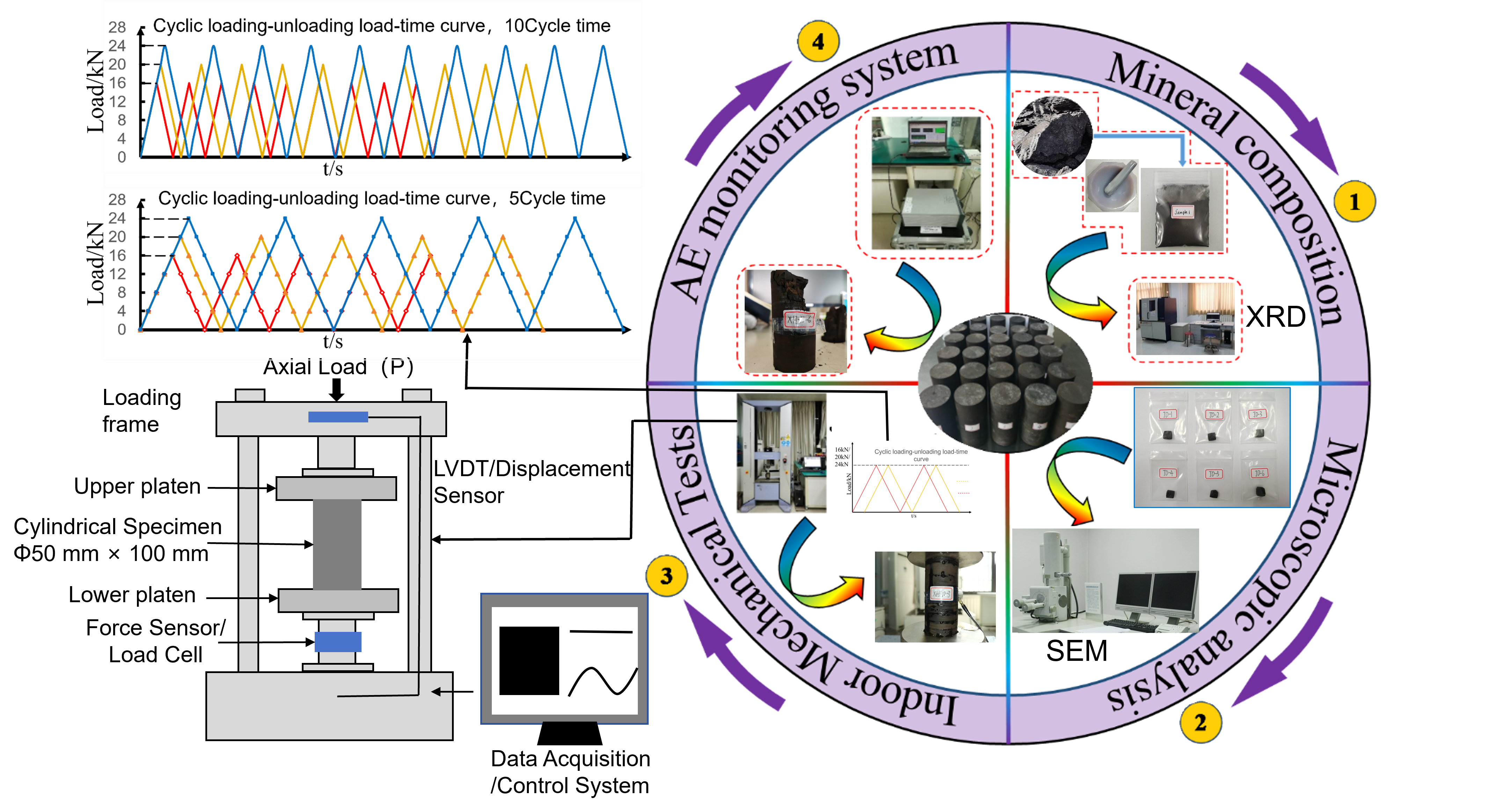
The compression tests were conducted using an AG-X250 electronic universal testing machine (Shimadzu, Kyoto, Japan) with a maximum loading capacity of 250 kN. AE monitoring was performed using the AMSY-6 AE system (Vallen System, Wolfratshausen, Germany). This system features a sampling frequency of 10 MHz, 16-bit A/D, a preamplifier gain adjustable from 20 to 60 dB, and a threshold value of 40 dB. Four AE probes were employed, evenly positioned on both sides of the lignite specimens. The macroscopic stress–strain data acquisition was strictly synchronized temporally with the AE monitoring system to ensure the accurate correlation of mechanical and acoustic responses. The loading–unloading paths, testing apparatus, and experimental procedures are illustrated in Figure 1, while the experimental schemes are detailed in Table 1 and Table 2.
Mining activities subject lignite to long-term cyclic dynamic loading of low-to-medium amplitude. Based on the uniaxial compressive strength of lignite and in situ monitoring data, the applied loads predominantly fall within the range of 16–24 kN. Within a single mining cycle, the number of effective load cycles sustained by the slope lignite typically ranges from several to over a dozen. Consequently, 5 and 10 cycles are considered to effectively simulate the field conditions of short-term and medium-term continuous disturbances, respectively [35,37,41].

3. Mechanical Characterisation

3.1. Microstructural Analysis

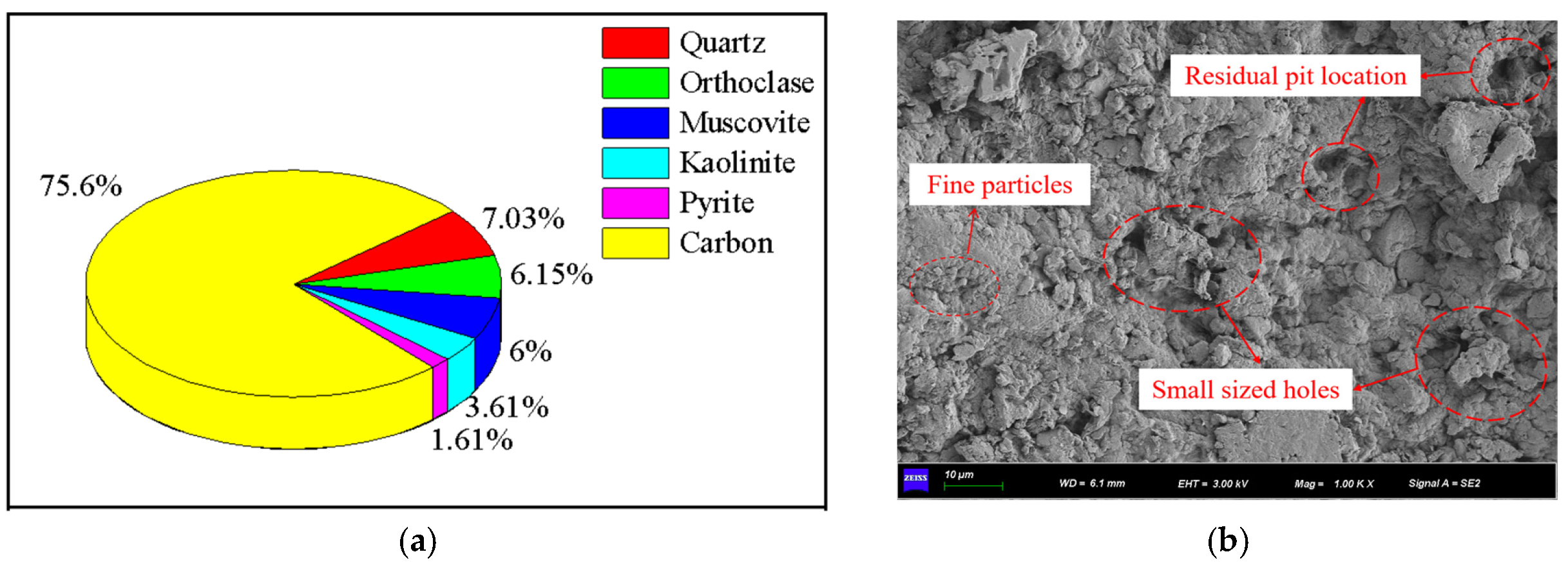
The inherent complexity of mineral particles within rocks significantly influences their mechanical properties. Moreover, the chemical composition and physical characteristics of rocks are intrinsically linked to their mineral constituents and microstructures [42,43]. Understanding the fine structure of lignite is crucial for analysing its mechanical behaviour and energy evolution under cyclic loading and unloading conditions. This study employed X-ray diffraction (XRD, Rigaku Corporation, Tokyo, Japan) and scanning electron microscopy (SEM, JEOL, Tokyo, Japa) to investigate the mineral composition and relative proportions of each mineral, thereby revealing the phase composition of the lignite.
As illustrated in Figure 2a, the major constituent of lignite is carbon, accounting for approximately 75%. The remaining 25% consists of various minerals, including quartz, orthoclase, muscovite, kaolinite, and pyrite. Notably, kaolinite constitutes approximately 3.6% of the total composition. Kaolinite is characterised by its loosely structured and highly absorbent nature, which imparts plasticity upon water absorption. Due to these properties, the lignite specimens exhibit resistance to argillisation following water absorption. Figure 2b provides a detailed microstructural image of lignite. The surface morphology is rough, displaying a muddy texture. Cementation between particles is visibly distinct, and numerous pores, as well as pits left by the detachment of lignite particles, are apparent [44].
These observations align with previous findings that lignite possesses numerous loose pores and a resistance to argillisation [45]. Given the unique characteristics of lignite, this study integrates microstructural analysis with macroscopic mechanical characterisation to systematically investigate the destabilisation and damage mechanisms of lignite under cyclic loading–unloading conditions. This combined approach provides a comprehensive understanding of the interplay between microstructural features and the mechanical behaviour of lignite.

3.2. Stress–Strain Curves

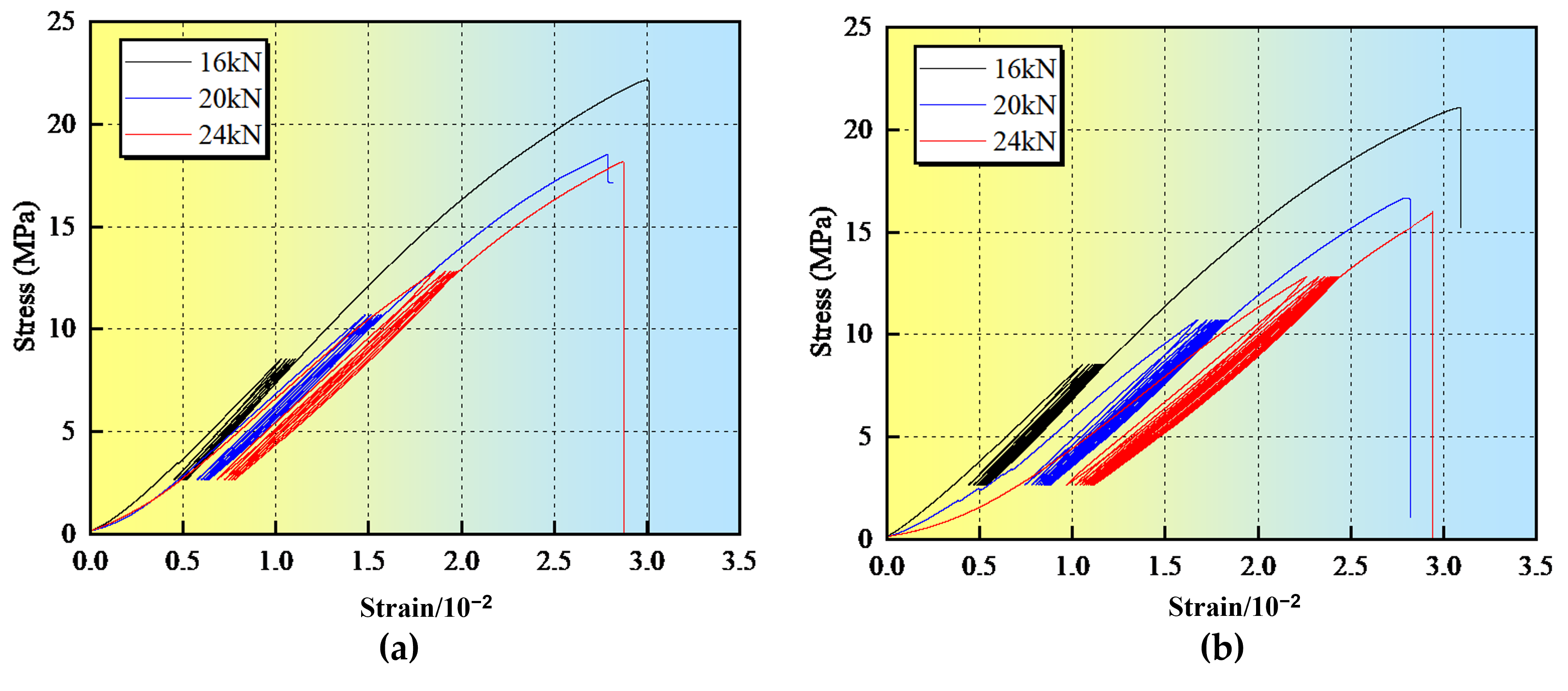
The cyclic loading and unloading stress–strain curves for lignite are depicted in Figure 3. Figure 3a,b illustrate the stress–strain responses of lignite subjected to load levels of 16, 20, and 24 kN for 5 and 10 cycles, respectively. These curves demonstrate that the cyclic stress–strain behaviour of lignite can be categorized into four distinct stages: the initial compaction, linear elastic, plastic, and post-peak failure stages. During cyclic loading and unloading, the hysteresis loop transitions from sparse to dense with increasing strain [46]. This trend indicates that the specimens experience plastic deformation upon unloading. Due to the relatively low cyclic stress and the low intrinsic strength of lignite, internal cracks within the specimens gradually compact as the number of cycles increases, leading to irreversible deformation and an overall increase in deformation magnitude. The peak strength of the specimens decreases progressively with increasing load levels for a given number of cycles. This observation suggests that as stress levels rise, the inherent defects in the specimens begin to close, and new cracks are initiated. With subsequent loading and unloading, previously closed cracks reopen, additional cracks form, and some cracks remain unclosed, leading to continued crack propagation. This cyclical process induces cumulative, irrecoverable damage within the specimens, ultimately reducing their peak strength.
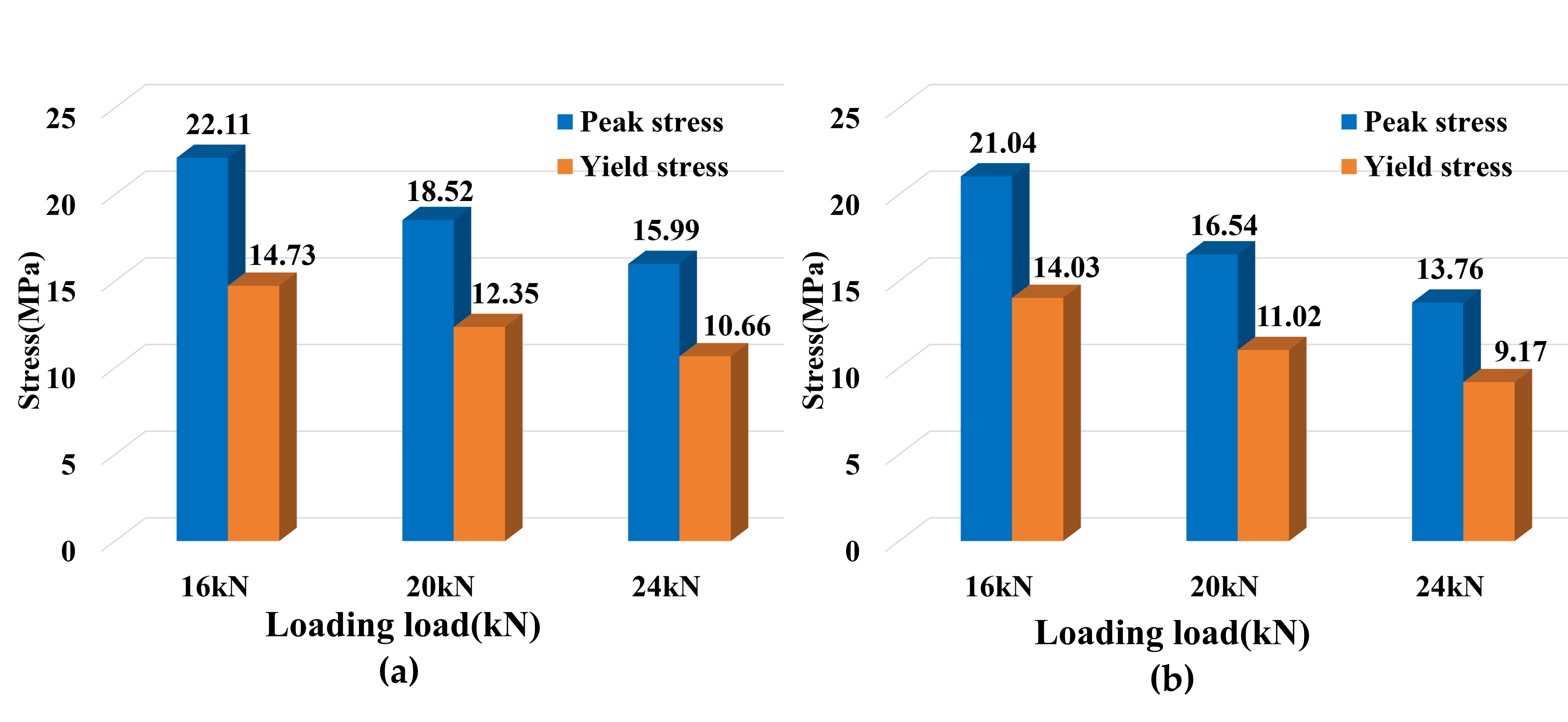
Figure 4 presents the peak stress curves for specimens subjected to varying stress levels and cycle counts. The peak stress of the XH-10 group is consistently lower than that of the XH-5 group under the same stress levels. Furthermore, the peak stress values of the specimens are inversely correlated with the number of cycles. Specimens subjected to lower stress levels exhibit significantly higher peak intensities compared to those under higher stress levels. These findings highlight that cyclic loading and unloading causes the internal cracks within lignite to undergo repeated expansion and closure [47,48,49]. Simultaneously, irreversible damage accumulates within the specimens, resulting in a deterioration of their mechanical properties. With an increasing number of cycles and higher stress levels, the bearing capacity and peak strength of lignite gradually decline.
The critical inflection point marking the transition from elastic to plastic deformation during loading is defined as the yield point. Based on the tangent modulus method, an observation of the stress–strain curve’s slope reveals that, at approximately 67% of the peak stress, the slope begins to exhibit a continuous and pronounced decrease. This inflection point, deviating from the linear segment, represents the yield stress and characterises the material’s ultimate capacity to resist plastic deformation [50]. When stress levels approach the yield stress, irreversible plastic deformation develops within the specimens, eventually culminating in complete structural failure. As depicted in Figure 3, the yield stress diminishes with an increasing number of cycles and higher stress levels. Concurrently, the elastic deformation of the specimens increases, whereas their plastic and irreversible deformations gradually decline. This shift ultimately predisposes the specimens towards elastic failure [51].

4. Energy Analysis

4.1. Plastic Hysteresis Loop

The loading and unloading stress–strain curves for lignite exhibit non-coincident paths that form closed loops, commonly referred to as plastic hysteresis loops [52]. This phenomenon indicates that lignite undergoes plastic deformation during cyclic loading and unloading.
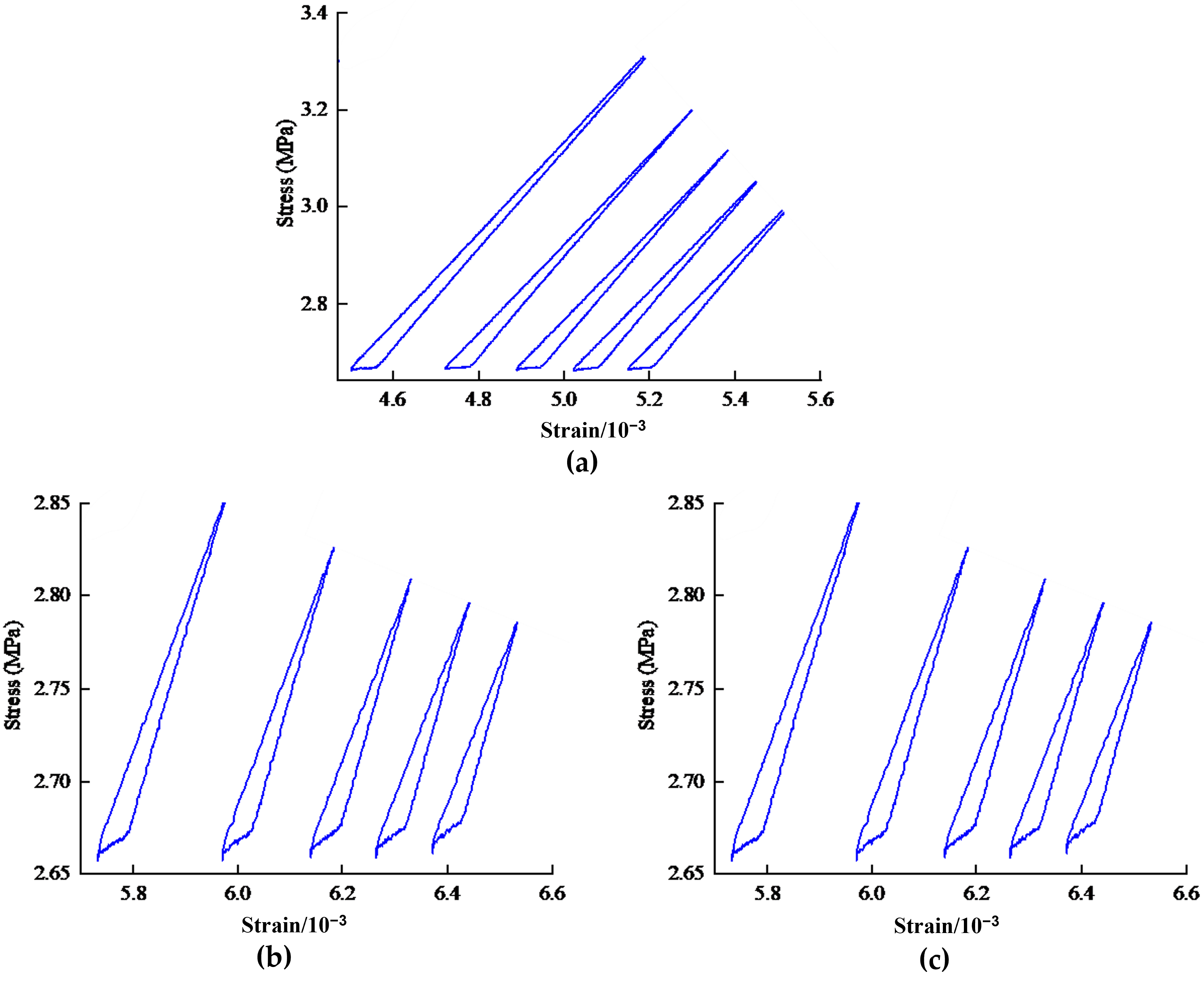
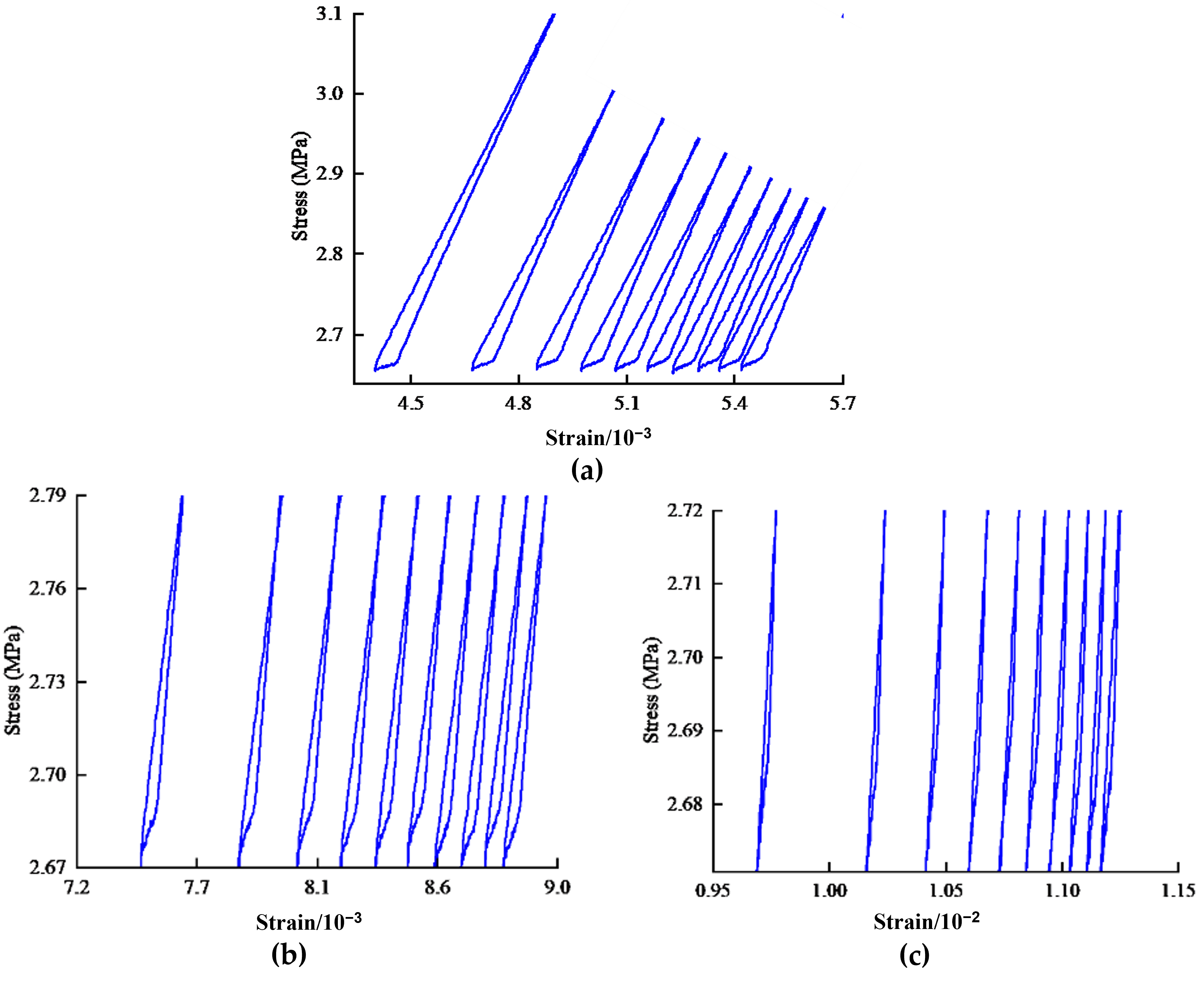
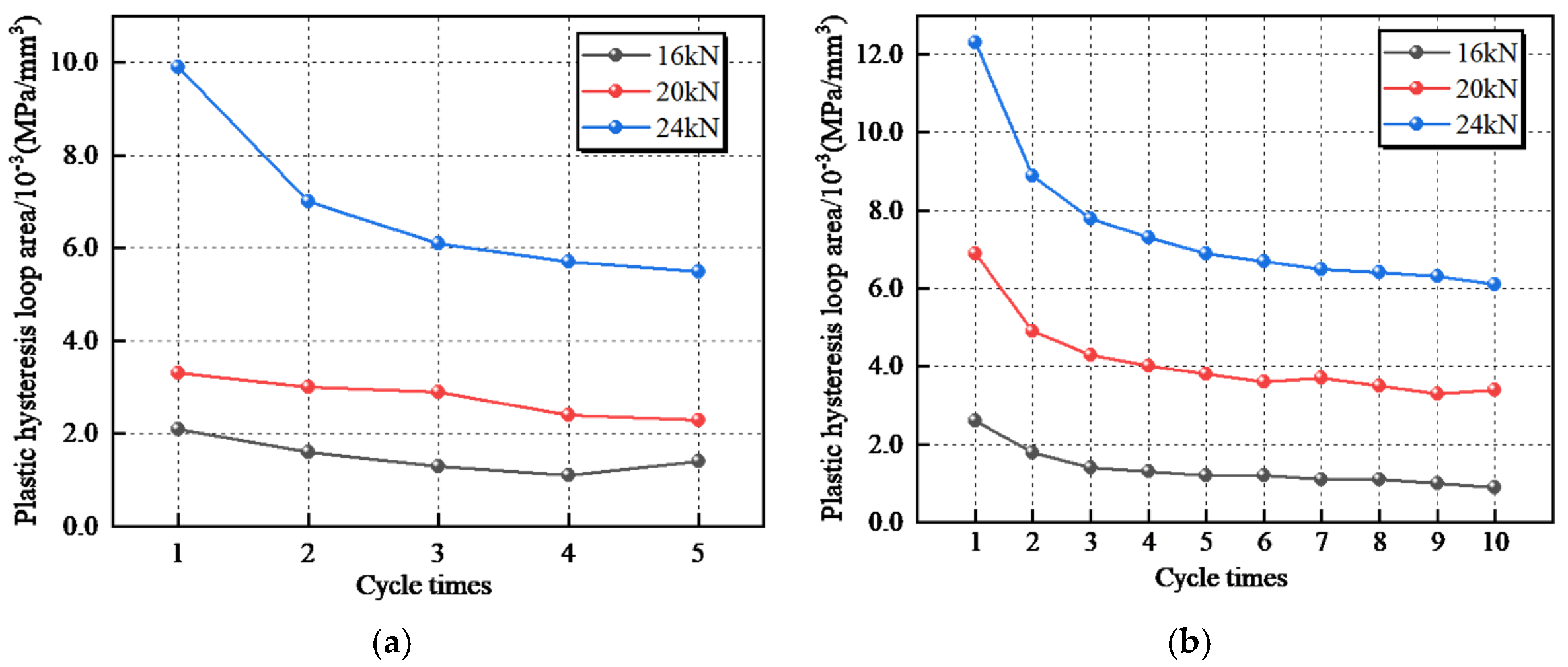
During each cycle, the energy expended during loading is not entirely released during unloading, with the unreleased energy corresponding to the area enclosed by the plastic hysteresis loop. Figure 5 and Figure 6 present schematic diagrams of variations in the hysteresis loop area under different cycles. Figure 7 illustrates the relationship between the plastic hysteresis loop area and cyclic loading and unloading conditions, with the loop area calculated using Equation (1):
W h   =   W l     W u
where W h is the plastic hysteresis loop area, in MPa; W l is the energy of the loading section in the subsequent cycle, in MPa; and W u is the energy of the unloading section of the cycle, in MPa.
As shown in Figure 5 and Figure 6, the strain amplitude of the hysteresis loops decreases as the number of stress cycles increases. In subsequent cycles, the spacing between the hysteresis loops narrows, and the loops tend to overlap more closely with one another. This is attributed to the fact that, at low stress levels, the high porosity and pronounced sensitivity of lignite render it susceptible to irreversible deformation [53].
Consequently, the hysteresis loop area is larger at lower stress levels. As the stress levels increase, the specimen transitions from a plastic-dominant response to an elastic-dominant one, accompanied by an enhancement in the elastic modulus. The specimens predominantly undergo elastic deformation, with an increase in the elastic modulus. Thus, the hysteresis loop area decreases, and the loops gradually become more perpendicular to the strain axis.
As illustrated in Figure 7, at a load level of 16 kN, the maximum plastic hysteresis loop area for the XH-5 group is 0.0021 MPa/mm3, while that for the XH-10 group is 0.0026 MPa/mm3. At a load level of 20 kN, the maximum plastic hysteresis loop areas for the XH-5 and XH-10 groups are 0.0033 MPa/mm3 and 0.0069 MPa/mm3, respectively. At a load level of 24 kN, the maximum plastic hysteresis loop areas for the XH-5 and XH-10 groups are 0.0099 MPa/mm3 and 0.0123 MPa/mm3, respectively. These results indicate that the hysteresis loop area increases with the number of cycles. At the same stress level, the internal damage to the specimens increases, along with the energy consumed by crack development. This reveals the development process of crack “closure–expansion–coalescence–instability” in lignite under cyclic loading and unloading. It is concluded that the energy generated by crack development in lignite is primarily released as elastic energy, with the dissipative energy being positively correlated with the area of the hysteresis loops.

4.2. Energy Evolution

During the compression of the specimens, the internal energy changes can be categorised into three stages: energy accumulation, dissipation, and release. The primary factor contributing to the destabilising damage of the specimens is the energy drive within them. Under the continuous application of external forces, the energy inside the specimens accumulates progressively until it reaches the energy storage limit, at which point it is rapidly released, leading to macroscopic damage [54]. The instability failure of the specimens during compression thus represents a process of continuous internal energy accumulation and dissipation. Notable internal energy alterations occur when the specimens are subjected to cyclic perturbations. Consequently, the fractures of the specimens are investigated by analysing the internal energy evolution of lignite to uncover the internal factors that contribute to the destabilisation of lignite under cyclic disturbance [55]. Previous studies showed that the rapid development of internal cracks and specimen failure under cyclic loading is primarily due to the sudden release of energy accumulated within the rock at the initial stage of failure.
The input, elastic, and dissipative energies during loading and unloading are calculated using Equations (2)–(6) [56]. Additionally, by analysing the variation in the elastic energy index, the change in the growth rate between the elastic and dissipative energies could be inferred. The elastic energy index is defined as the ratio of elastic energy to dissipative energy, with specific calculations detailed in Equations (2)–(6).
U   =   U d   +   U e
U   =   0 ε 2 f 1 ( ε ) d ε
U e   =   ε 1 ε 2 f 2 ( ε ) d ε
U d   =   U     U e = 0 ε 2 f 1 ( ε ) d ε     ε 1 ε 2 f 2 ( ε ) d ε
k   =   U e U d
where ε 1 is the rock strain after unloading; ε 2 is the rock strain during loading; f 1 ( ε ) is the rock stress–strain loading curve; f 2 ( ε ) is the rock stress–strain unloading curve; and k is the elastic energy index.
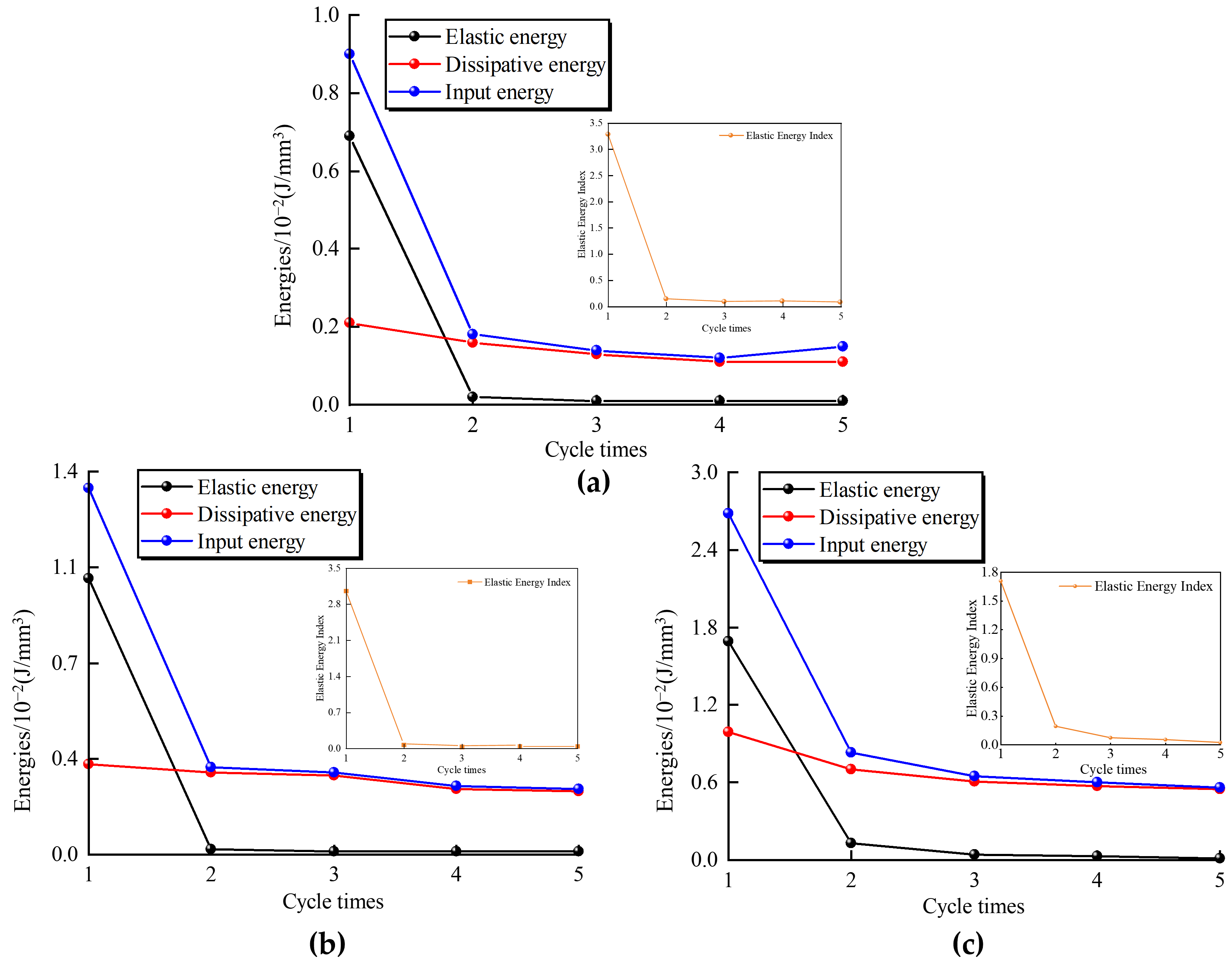
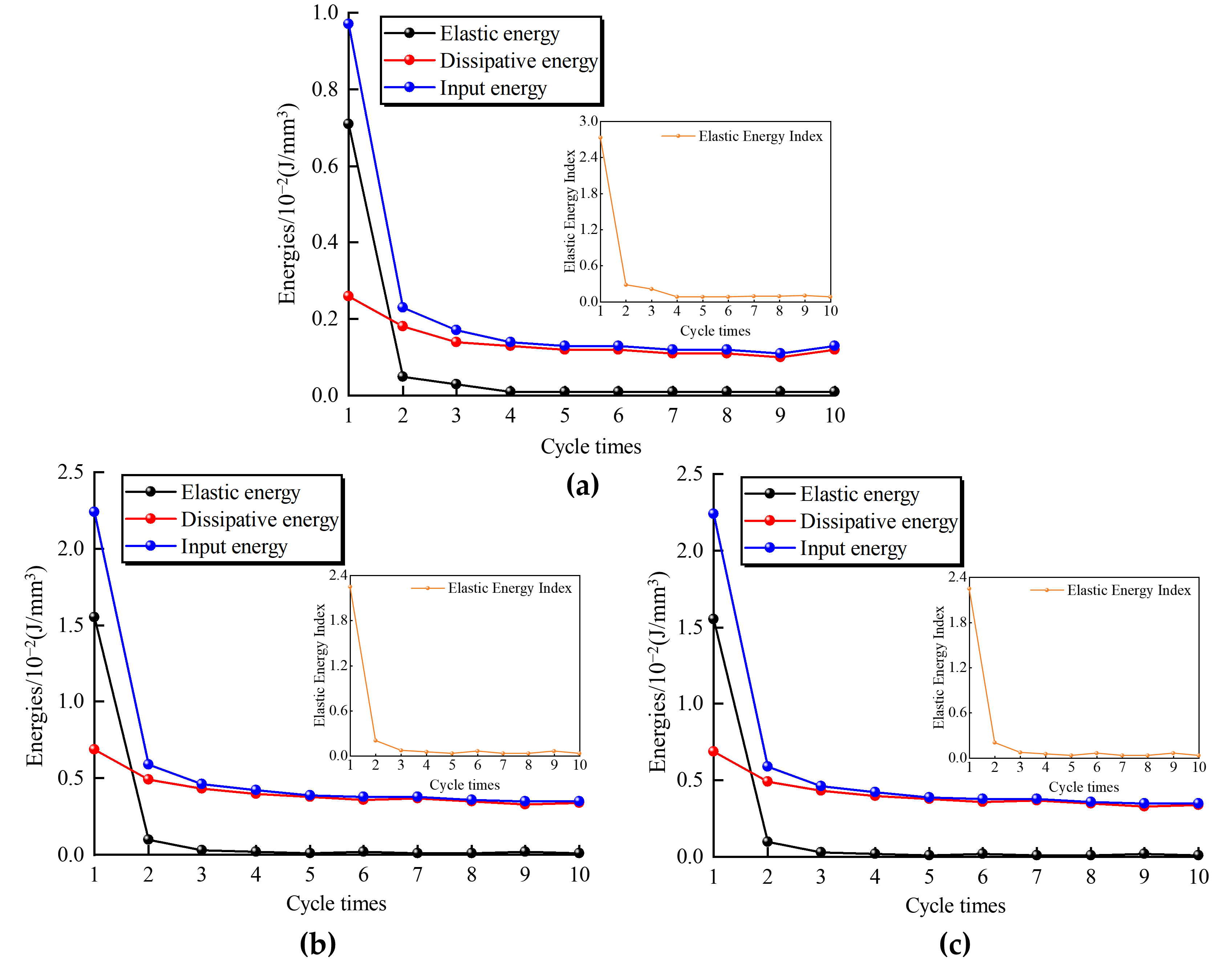
As shown in Figure 8 and Figure 9, the input energy of the specimens increases with the number of cycles at the same stress level, as a growing number of initial cracks and subsequent microcracks develop within the specimens throughout the cycling process. A substantial amount of energy is generated by the mutual friction and extrusion between these cracks. In contrast, the incremental dissipated and elastic energies per cycle gradually decrease as the number of cycles increases, indicating that cracks within the specimens continue to expand with increasing cycles, consuming a portion of the energy. As the specimens approach failure, a small portion of the elastic energy is rapidly released, leading to the formation of numerous fissures. Simultaneously, the elastic energy reaches a minimum value, and internal fissures rapidly develop until the specimens are damaged. The trend is confirmed by the elastic energy index.
In both experiments, the elastic energy index reaches its maximum value during the initial cycle and then shows a significant decline. This is due to the rapid decrease in elastic energy and the relatively minor change in dissipative energy. The elastic energy index subsequently exhibits a linear change, indicating that the lignite progressively undergoes substantial irreversible deformation as the number of cycles increases. Therefore, in the final cycle stages, when the lignite is approaching failure, the ratio of elastic energy to dissipative energy is at its lowest.
Within the same number of cycles, the input energy, elastic energy, and dissipative energy of lignite increase with the stress level. This suggests that, with a fixed number of cycles, an increase in stress level results in greater compressive deformation of the internal fissures, larger irrecoverable deformations, and higher energy consumption due to the development of internal cracks.

5. Acoustic Emission Characteristics

5.1. Ringing Count

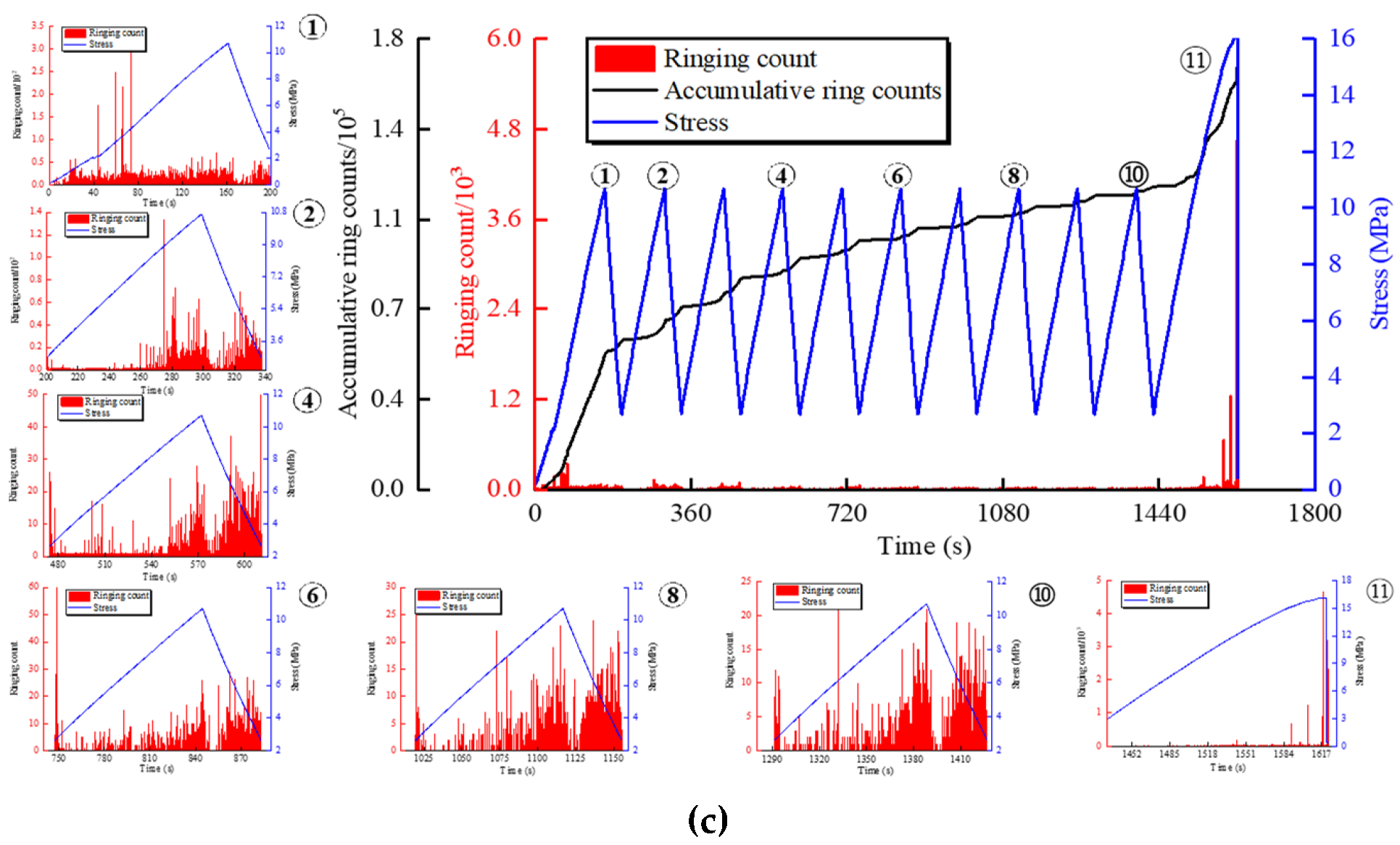
The AE ringing count is one of the primary characteristic parameters used to analyse AE. In the present study, the expansion of the internal micro-structure of the specimens was examined by evaluating the density, increase, and decrease in the ringing count [57,58]. Furthermore, the development of internal pores and cracks in lignite under cyclic loading and unloading was investigated by analysing the time-dependent variation in stress and ringing counts.
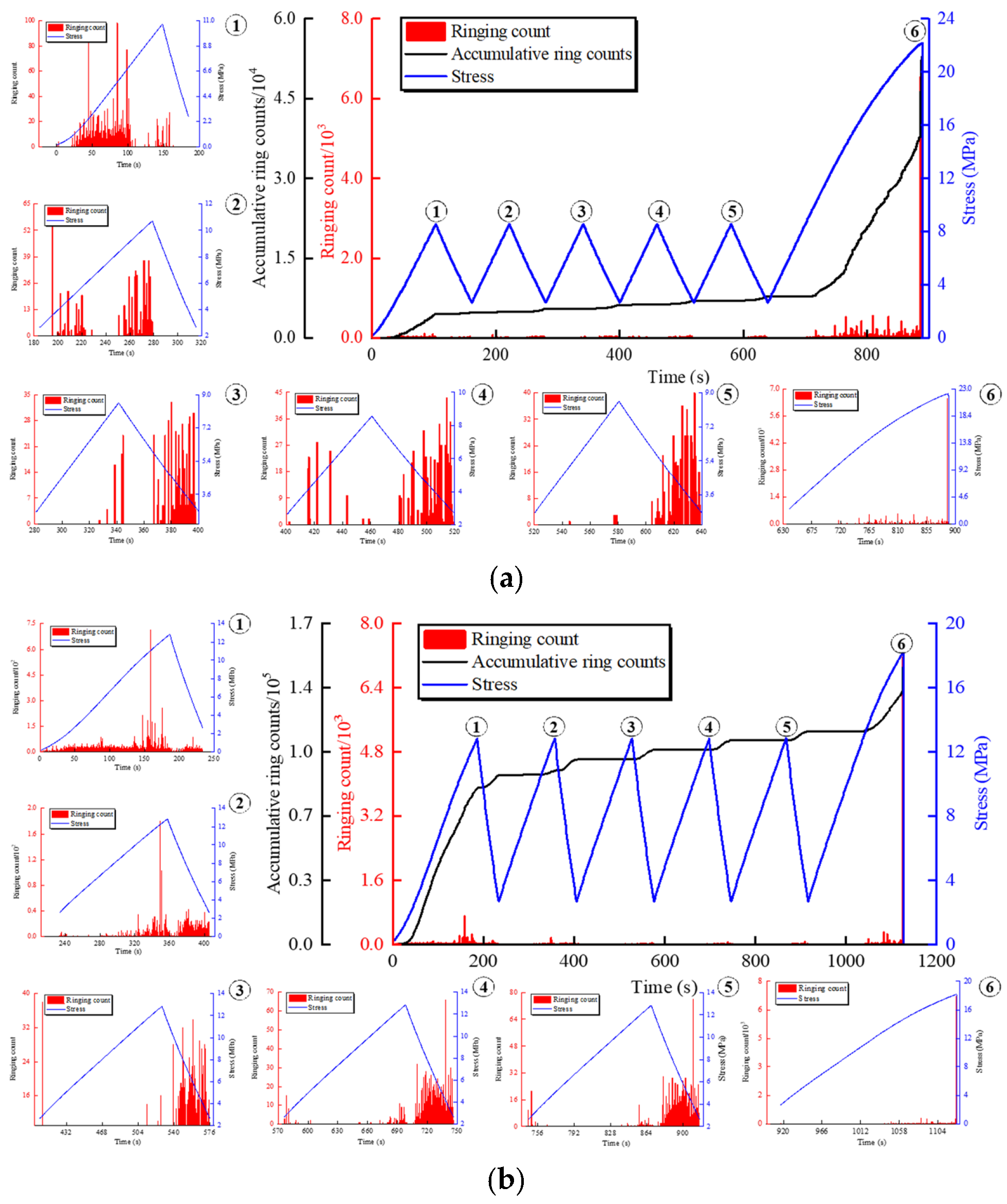
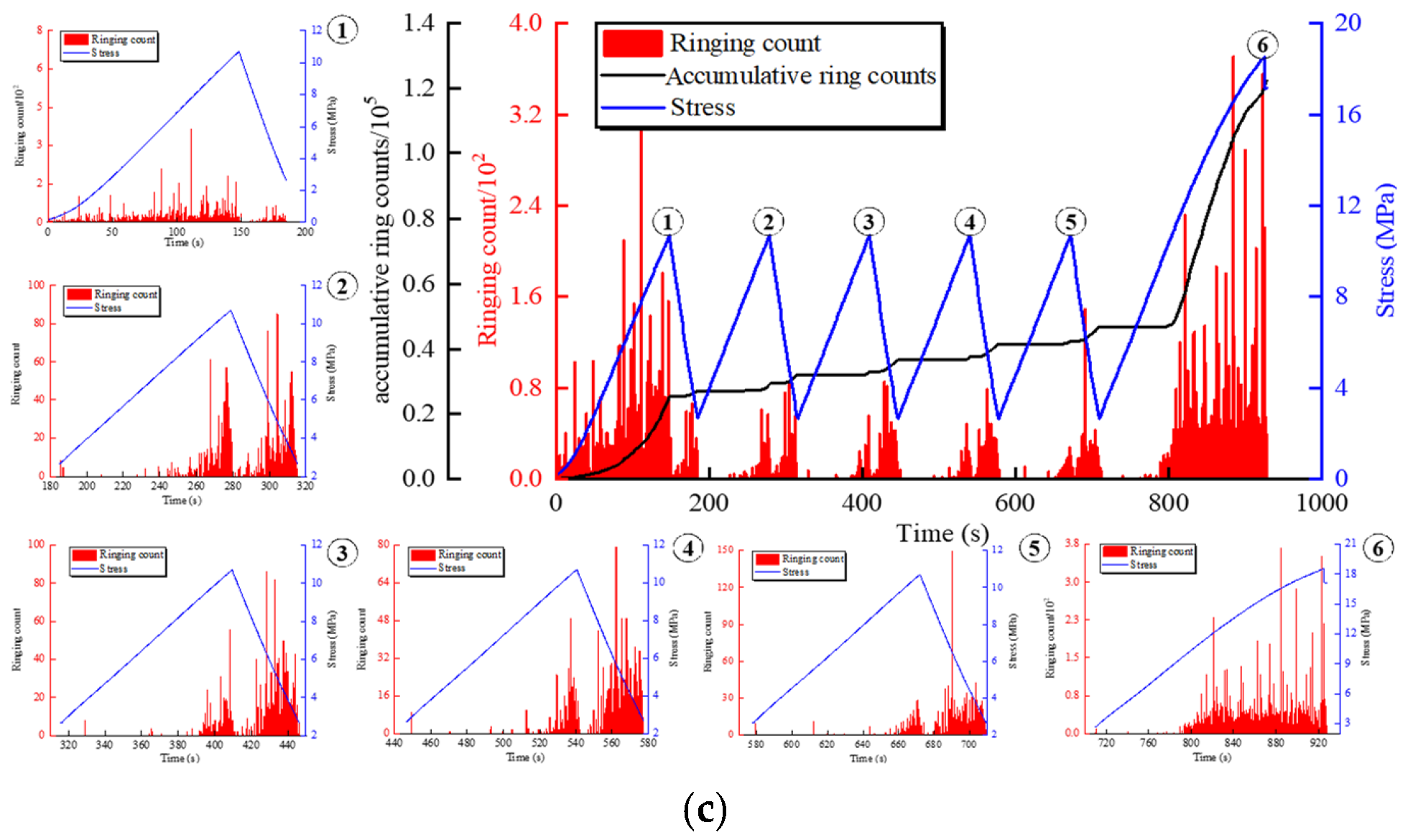
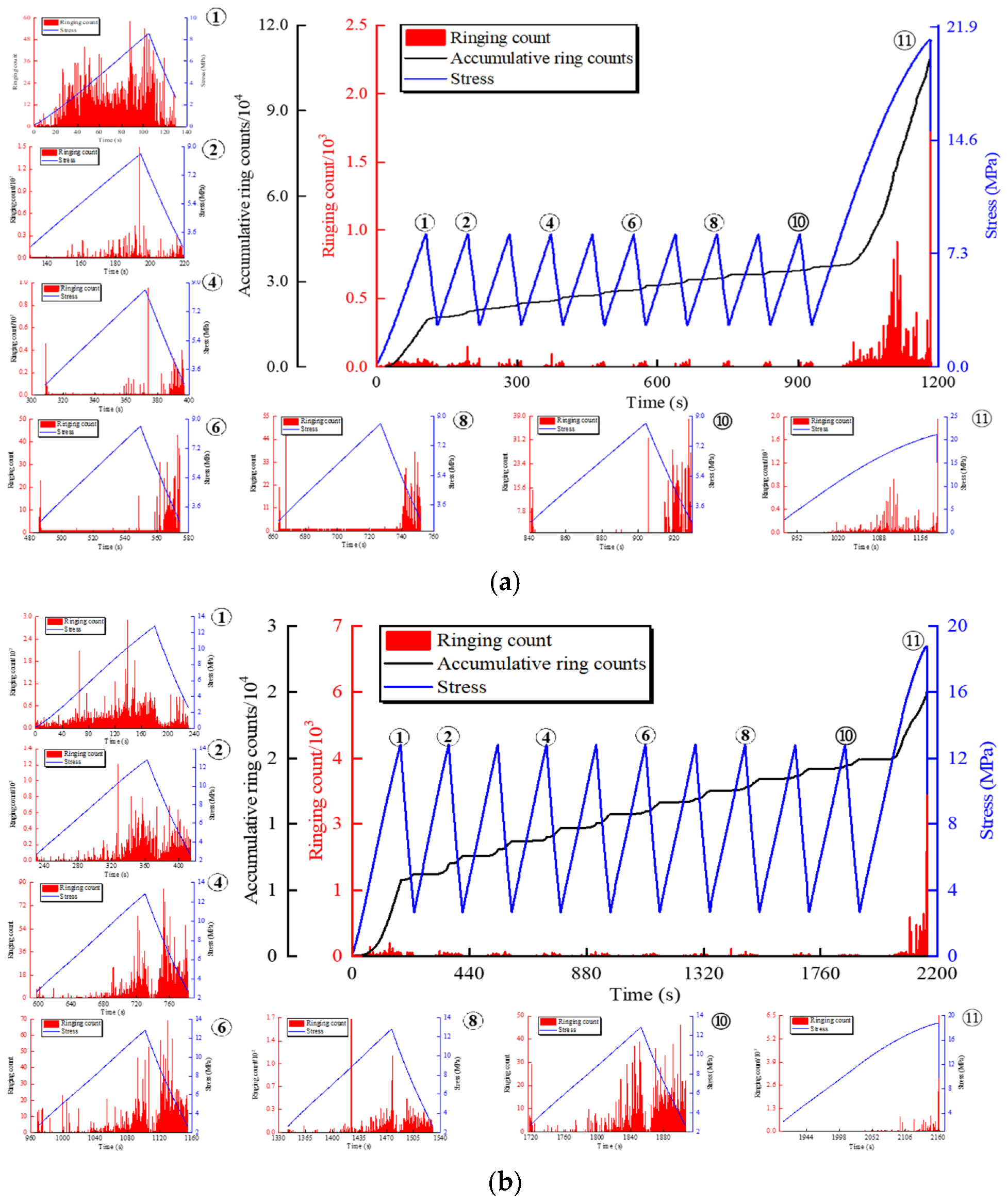
Figure 10 and Figure 11 illustrate the variation in the ringing counts with stress for the specimens in Groups XH-5 and XH-10 at different stress levels. Due to the large number of AE ringing counts recorded in each stage over ten cycles, several representative AE curves are selected for reference. Before entering the cyclic phase, the number of AE events increases slightly and fluctuates smoothly without any significant surge. However, as the number of cycles increases and the specimens enter the pre-crushing stage, internal damage accumulates rapidly due to the high porosity and low strength of lignite. The stored elastic energy begins to release rapidly, driving the unstable expansion of internal cracks and generating a substantial number of new cracks [59]. The increasing number of internal cracks ultimately leads to macroscopic failure.
A comparison of the stress–strain curves from the cyclic loading–unloading and uniaxial loading tests reveals that their deformation stages are fundamentally similar, both of which can be divided into the initial compaction, linear elastic, plastic, and post-peak failure stages. During the loading stages before the cyclic phase, the specimens are in the microcrack compaction stage (with stress levels below 32% of the peak stress), and the internal pores undergo irreversible compaction, accompanied by high AE ringing counts. At the beginning of each cycle, the specimens enter the elastic stage, during which elastic energy begins to accumulate. Upon unloading, a portion of the elastic strain energy is released to drive the gradual propagation of newly formed cracks. Because of the low stress level, the elastic strain energy is completely released upon the conclusion of the final cycle. This process triggers a peak in AE ringing counts, accelerates internal crack propagation, and culminates in macroscopic failure. At this stage, the AE ringing counts begin to increase significantly (reaching the number of 103–104). When the specimens enter the unloading stage, a sharp increase in AE events occur during the unloading stage. This phenomenon is attributed to the generation of numerous new cracks, alongside the repeated friction and inelastic recovery of pre-existing cracks during cyclic loading. This mechanism leads to constant changes in the cracks, causing the AE events to follow an increasing and then decreasing trend.
As shown in Figure 10 and Figure 11, at the same stress levels, the specimens in the XH-5 group exhibit a greater number of internal pores than those in the initial state, due to the relatively fewer cycles. Furthermore, the initial and nascent cracks do not close completely after expansion. In contrast, the XH-10 specimens display a higher degree of internal crack development. During the pre-failure phase, these cracks tend to close gradually. Consequently, the number of internal cracks is lower than in the initial state, and the number of AE events in the XH-5 group is significantly higher than that in the XH-10 group. Within the same cycle, AE events are predominantly concentrated during the unloading stage. Additionally, the ringing counts and cumulative counts gradually increase with the stress level. At low stress levels, the new cracks are smaller, and the initial cracks gradually close, resulting in relatively few AE signals. However, as the stress levels increase, the number of new cracks increases, and the initial cracks expand, leading to a gradual enhancement of AE signals [60].

5.2. Acoustic Emission b-Value Analysis

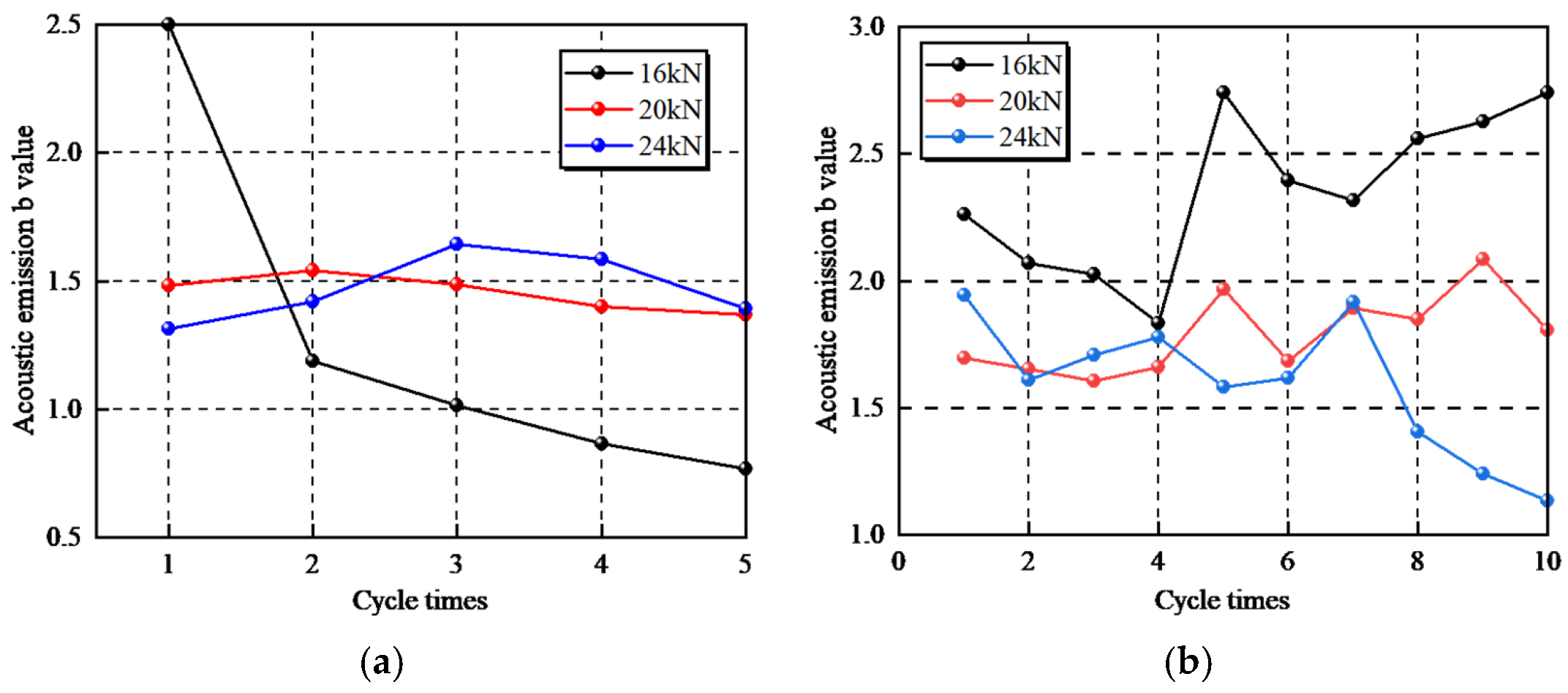
The b-value of AE was initially applied in seismic research, where the concept was introduced by Gutenberg and Richter. Then, several researchers considered AE events as a form of micro-seismic activity occurring during rock failure, studying the scale and rate of expansion of rock microfractures [49]. Some studies found that when the b-value increases, the specimens are primarily characterised by small-scale ruptures, with a higher proportion of AE small events. Conversely, when the b-value decreases, large-scale ruptures dominate the specimens, and the proportion of large AE events increases. By adopting the Gutenberg–Richter relationship from seismology and substituting the seismic magnitude with the AE amplitude, the AE b-value is calculated according to Equations (7) and (8) [59,61]:
lg N = a b M
M = A 20
where M is the earthquake magnitude, and N is the frequency of the magnitude in the range of ∆M. In the context of AE, M is the processed amplitude value; typically, the value of ∆M ranges between 0.1 and 0.5. While a smaller interval allows for a more refined capture of the subtle b-value fluctuations induced by crack coalescence, a larger interval enhances the stability of the linear fitting when the total number of recorded events is limited. To prevent spurious fluctuations in b-value calculations caused by insufficient sample sizes, each statistical window must contain at least 50 to 100 AE events. A is the maximum amplitude of the AE event, expressed in decibels (dB), and is calculated as A = 20 lg ( A max ) . A max denotes the maximum amplitude of the AE signal in microvolts.
The variation patterns of AE b-values for lignite under different loading schemes are shown in Figure 12. At the beginning of loading, the AE b-value of the XH-5 group specimens gradually decreases as the number of cycles increases. This indicates that the initial fractures in the specimens develop, and new fractures are continuously generated during the cyclic process. Collectively, these fractures contribute to the occurrence of large-scale fractures in the specimens. Throughout the entire cyclic loading process, the AE b-value of the specimens is highest in the initial cycle, as the AE signals primarily stem from the compaction of the initial cracks, with the damage caused by compression being relatively small. Consequently, the cumulative energy release is limited, and the amplitude remains relatively low. As the cycles progress, the b-values of the specimens decrease as the stress level increases, causing the initial and new cracks inside the lignite to gradually expand. Thus, the scale of cracks in the later stages of the cycle is larger than in the initial cycle, and the specimens become progressively dominated by large-scale cracks. Therefore, the b-value decreases during the cycling process.
Moreover, it can be observed that the b-value of the XH-5 group varies steadily after entering the second cycle, remaining within the range of 1.1 to 1.8. This suggests that the internal cleavage development in the lignite is stable, with limited variation during this stage. In contrast, the b-value of the XH-10 group fluctuates significantly. Despite this fluctuation, the trend of the b-value for both groups in the first five cycles is similar, with a decrease in the b-value as the number of cycles increases. This indicates that the internal nascent cracks in the lignite develop more rapidly after five cycles. Consequently, the scale of crack expansion and AE amplitude are larger, leading to a decrease in the AE b-value.
However, during the later stages of cyclic loading and unloading, the effect of energy accumulation in the early stage causes stress concentration at the tips of the large-scale cracks in the lignite. When energy is released, a significant number of microcracks are rapidly generated at the crack tips, resulting in a notable increase in the number of cracks at certain cyclic stages. Initially, the number of cracks is relatively low, but as the cycles progress, the lignite experiences greater internal damage, with the cracks entering a phase of instability. As the number of large-scale cracks increases, the AE b-value decreases. When the specimens near failure, the “loading–unloading–loading” process causes the internal cracks to continuously develop, expand, and eventually coalesce into large-scale cracks. Thus, the AE b-values of the XH-10 group specimens fluctuate significantly.

5.3. RA-AF Crack Classification Characteristics

The RA value in AE is defined as the ratio of the rise time to the amplitude, while the AF value represents the ratio of the ring count to the duration. These two values provide insights into the average frequency of the AE signal and the reciprocal of the slope of the waveform rising angle [62,63].
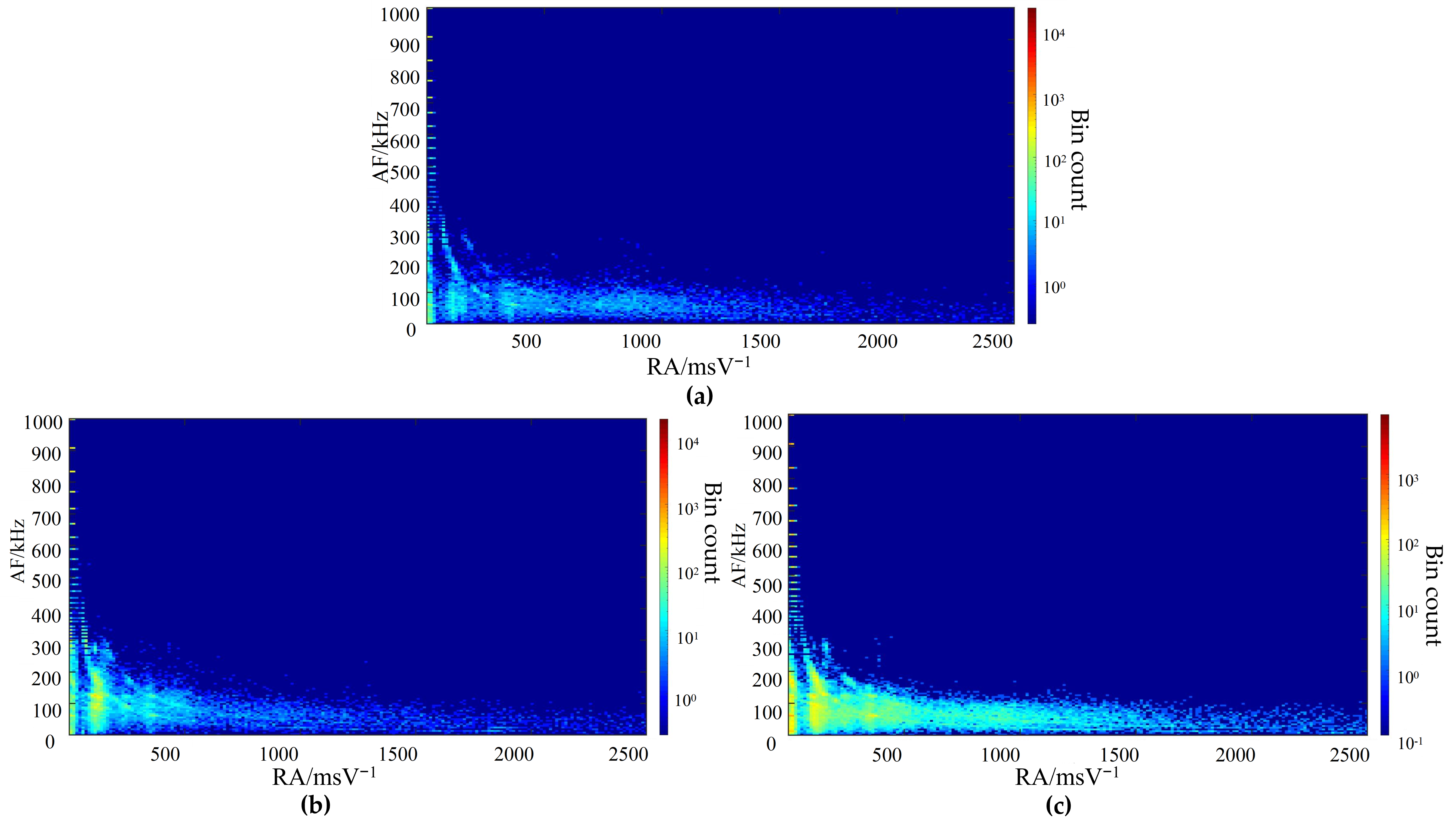
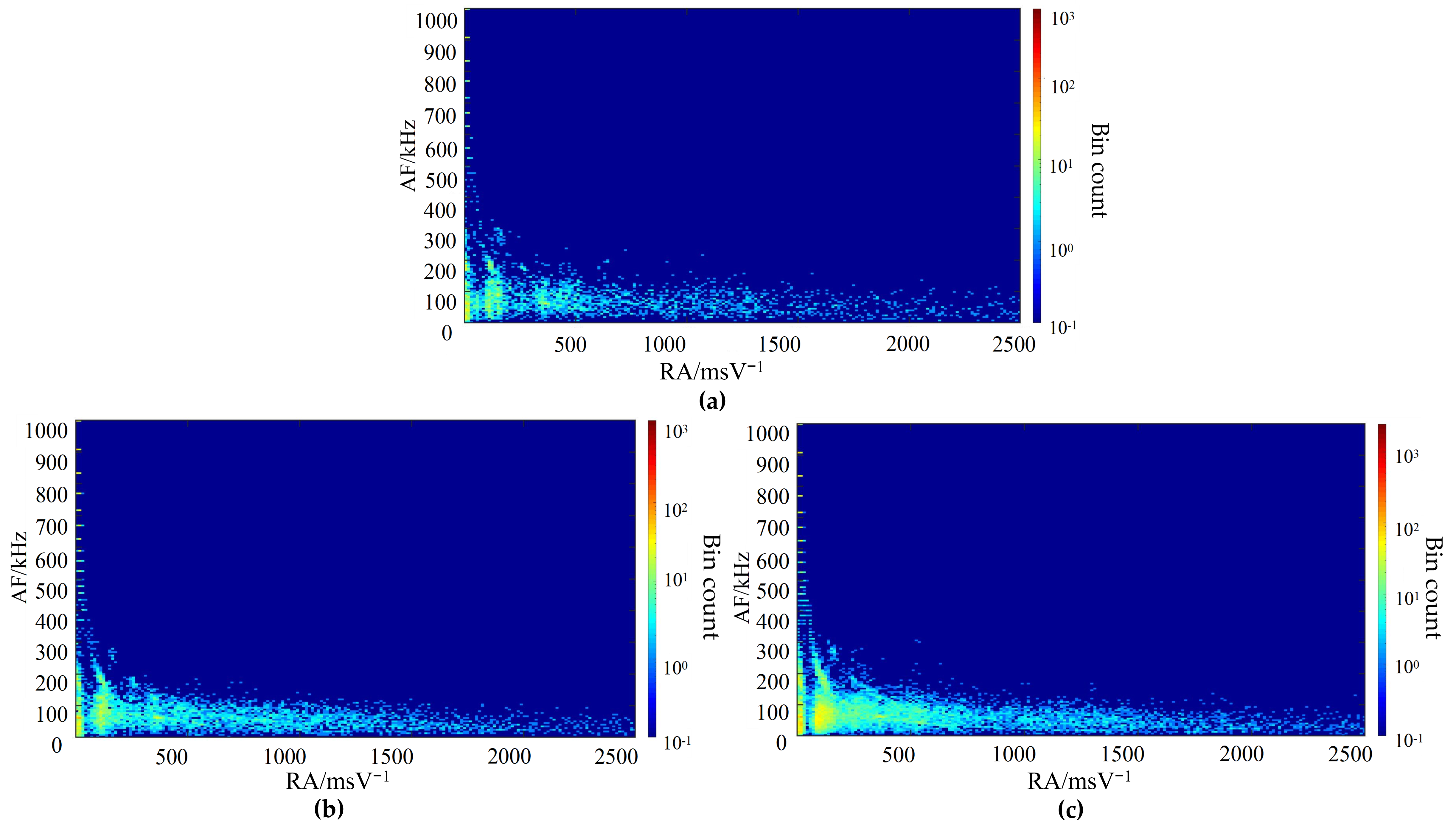
Researchers found that when the RA-AF points are closely aligned with the AF axis and exhibit a dense concentration, a large number of tensile cracks are generated [35,64]. Conversely, when the RA-AF points are close to the RA axis with a dense concentration, shear cracks are predominantly generated. Therefore, by observing the density concentration of the RA-AF scatter points under cyclic loading, the primary crack forms and the evolution of lignite can be identified.
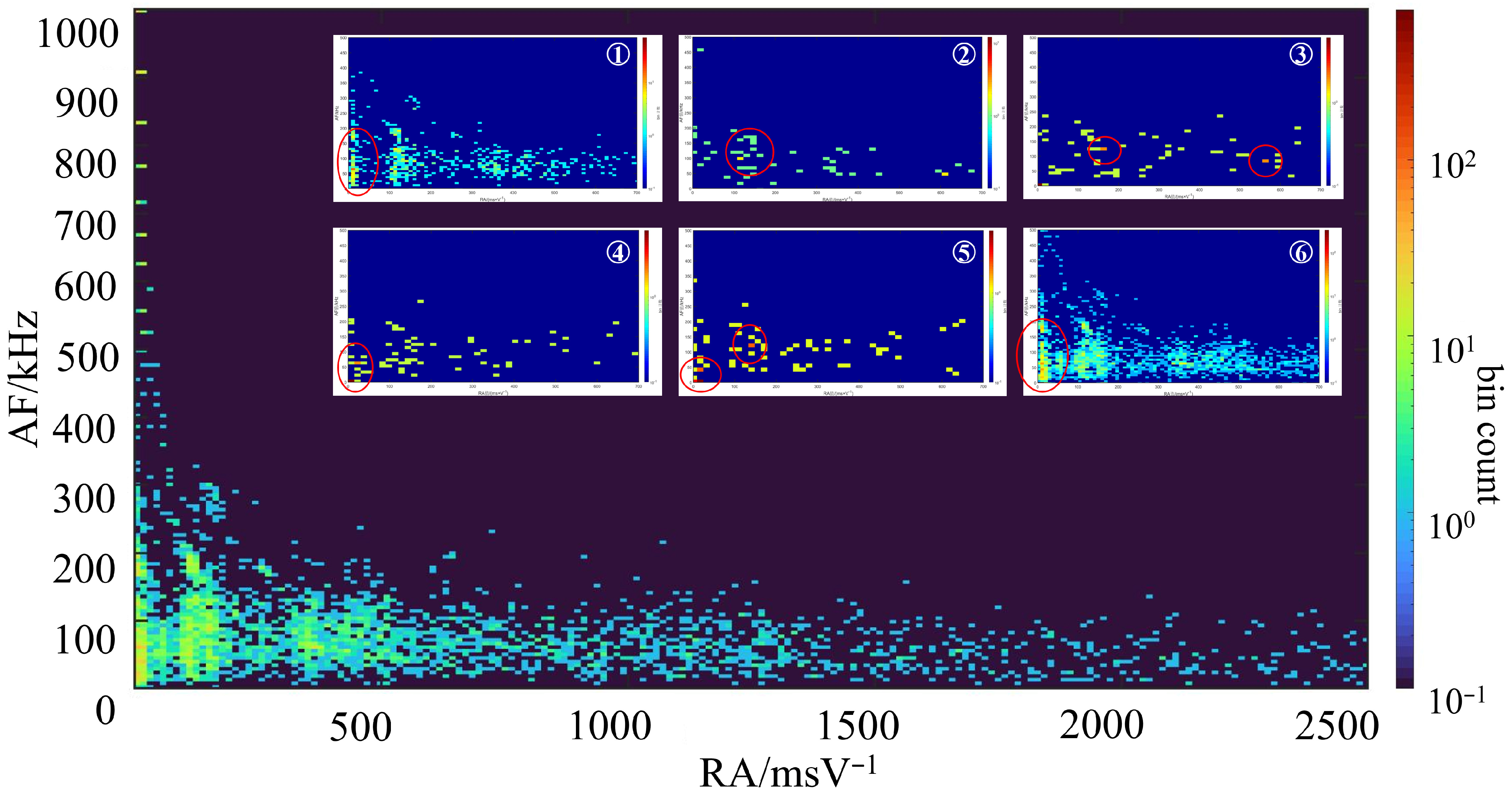
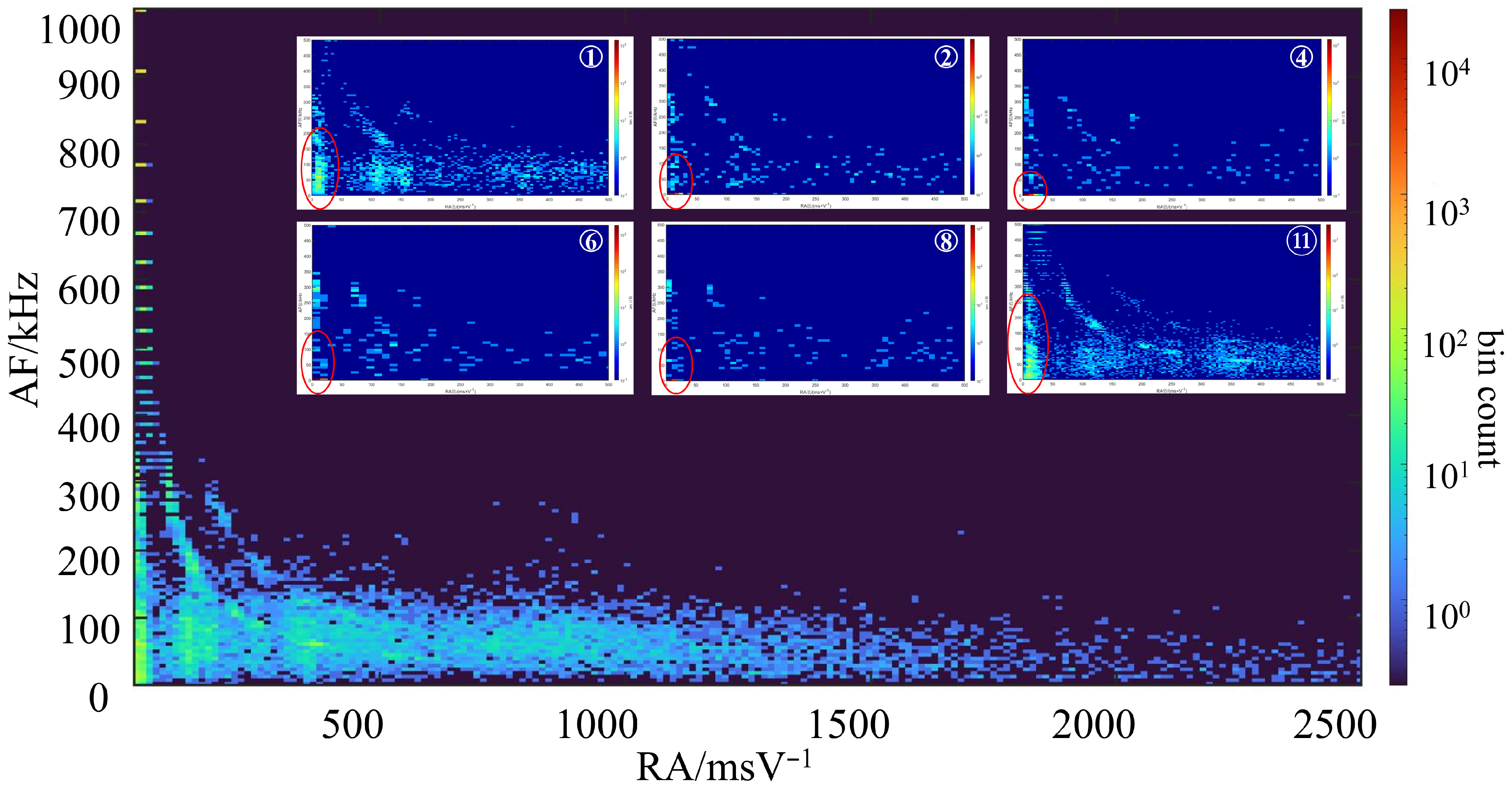
Figure 13 and Figure 14 present the density cloud plots of the RA-AF scatter distributions of AE data under different cycles. Figure 15 and Figure 16 show the density cloud plots of the RA-AF scatter distribution of the specimens during a single cycle at a stress level of 16 kN, with the area circled in red indicating high stress concentration of the RA-AF values. As shown in Figure 13 and Figure 14, high RA and low AF values suggest that both internal tensile cracks and shear cracks coexist under cyclic loading and unloading. At a stress level of 16 kN, the scattered distribution of the specimens does not display a high-density concentration, implying the simultaneous presence of tensile and shear cracks within the lignite. Consequently, the macroscopic damage form of the specimens is characterised as tensile–shear composite damage. During the initial loading, the RA-AF values of the specimens are primarily concentrated in the middle area, indicating that the internal cracks are predominantly tensile–shear composite cracks.
However, with the onset of cyclic loading–unloading, the internal cracks within the specimens gradually propagate. Furthermore, the distribution density of high AF–low RA data points increases, indicating a shift in the internal cracking mechanism from predominantly tensile–shear mixed cracks to tensile-dominated cracks. In actual in situ engineering, this phenomenon manifests as follows: with increasing cyclic loading and unloading, the slope rock mass may undergo tensile failure, thereby triggering instability phenomena such as landslides and collapses. As the load level increases to 20 kN and 24 kN, both the distribution range of the RA-AF values and the density of the distribution points gradually increase. Additionally, tensile–shear composite crack signals, initially concentrated near the origin, shift towards tensile crack signals near the AF axis. This trend indicates that the internal cracks are predominantly tensile in nature and that the form of damage is increasingly characterised by tensile damage at higher stress levels. In summary, with an increase in stress level, the internal crack patterns of the specimens evolve progressively towards tensile cracks, and the macroscopic damage form becomes primarily dominated by tensile damage.

6. Discussion

Fu et al. [65] investigated the constant-amplitude triaxial cyclic loading–unloading of marble, revealing that plastic deformation continuously accumulates and that the energy dissipated gradually increases with an increasing number of cycles. Similarly, Liu et al. [66] studied red sandstone subjected to stepwise-increasing cyclic loading–unloading following freeze–thaw damage; although the rock porosity increased post-treatment, the dissipated energy still progressively elevated with both the loading level and the number of cycles. Furthermore, Song et al. [67] examined the energy evolution of siltstone and coarse sandstone under cyclic loading–unloading, finding that the dissipated energy per unit volume for both rock types exhibited a quadratic growth trend, characterised by an initial decrease followed by a subsequent increase. In contrast, the present study finds different mechanical properties and failure modes in lignite: as the number of loading–unloading cycles increases, the dissipated energy, elastic strain energy, and the area of the plastic hysteresis loops consistently decrease. The underlying reason is that lignite possesses high porosity and low intrinsic strength; during the crack compaction stage, a substantial amount of plastic dissipated energy is generated due to pore compaction. Upon entering the linear elastic stage, its mechanical behavior becomes exceptionally sensitive to the surrounding rock environment and loading paths. This characteristic drives a transition in the failure mechanism of lignite, progressively evolving from a plastic energy dissipation-dominated failure to an elastic energy storage-dominated failure. Ultimately, these findings elucidate the instability and failure mechanisms of open-pit slopes under cyclic loading–unloading conditions, providing important theoretical support for slope stability prevention and control in lignite mining areas.
However, this study faces certain limitations. The number of cycles in the experiment was relatively limited, and the stress level applied was low. While changes in the internal cracks and damage evolution of lignite under cyclic loading and unloading are observed, the study is unable to fully explain the underlying mechanical mechanisms. Furthermore, actual mining operations are influenced by multiple factors, including geological conditions and mining equipment. The engineering environment at the site is highly complex, which may also trigger slope instability and failure. Therefore, further investigation is needed to better understand the factors influencing lignite damage and the instability of open-pit slopes.

7. Conclusions

This study investigates the damage characteristics and internal energy evolution of lignite through uniaxial cyclic loading and unloading experiments, providing a detailed analysis of the influence of cyclic loading–unloading on crack propagation and damage development in lignite. The specific conclusions are as follows:
(1)
As both the stress level and the number of cycles increase, the peak strength and yield stress of lignite gradually decrease, while the strain initially decreases before increasing. This indicates that initial damage exists within the lignite and that cyclic loading has a weakening effect on its mechanical properties.
(2)
The irrecoverable damage resulting from the continuous development of internal cracks was found to be the fundamental cause of destabilization. Through the analysis of AE values, it was found that as the cycles and stress levels increased, the initial cracks and newly formed cracks expanded and closed repeatedly, eventually forming large-scale macroscopic cracks. This process led to the deterioration of the mechanical properties of lignite as damage accumulated.
(3)
The dissipated energy, elastic energy, and plastic hysteresis loop area of lignite decrease continuously with increasing stress levels and cycles, which suggests that during the process of damage accumulation, the energy evolution characteristics of the lignite shift from being dominated by plastic energy dissipation to being dominated by elastic energy storage, which triggers higher energy dissipation and release at the cumulative damage stage.
(4)
During the same cycles, at low stress levels, macroscopic cracks in the lignite are primarily dominated by tensile–shear composite cracks. As the stress level increases, the AF/RA ratio gradually increases, while both the initial internal cracks and newly generated microcracks continue to develop. Consequently, the area of the local tensile crack surface expands, and the cracks progressively transition to being dominated by tensile cracks.

Author Contributions

Conceptualization, H.M., D.Y. and X.M.; methodology, Y.W., L.J. and J.Y.; validation, Y.W., K.C. and J.B.; formal analysis, Y.W. and H.M.; investigation, Y.W. and L.J.; resources, H.M.; data curation, Y.W. and H.M.; writing—original draft preparation, Y.W.; writing—review and editing, Y.W.; visualization, Y.W.; supervision, H.M.; funding acquisition, H.M. All authors have read and agreed to the published version of the manuscript.

Funding

This study was supported by the Key R&D Program of Shandong Province, China (2025CXPT205) and the National Natural Science Foundation of China (52404132).

Data Availability Statement

The original contributions presented in this study are included in the article. Further inquiries can be directed to the corresponding author.

Conflicts of Interest

Author Linlin Jin was employed by Qinhuangdao Glass Industry Research & Design Institute Co., Ltd. The remaining authors declare that the research was conducted in the absence of any commercial or financial relationships that could be construed as a potential conflict of interest.

References

  1. Du, F.; Ren, Z.; Deng, W.; Li, C.; Wang, X. Effect of Dry Dewatering on Physicochemical Structure and Hydro-Conversion Performance of Lignite. J. China Coal Soc. 2020, 45, 778–785. [Google Scholar] [CrossRef]
  2. Song, Y.; Xing, T.; Zhao, T.; Zhao, Z. Acoustic Emission Characteristics of Deformation Field Development of Rock Under Uniaxial Loading. Chin. J. Rock Mech. Eng. 2017, 36, 534–542. [Google Scholar] [CrossRef]
  3. Wang, T.; Wang, C.; Xue, F.; Wang, L. Acoustic Emission Characteristics and Energy Evolution of Red Sandstone Samples Under Cyclic Loading and Unloading. Chin. J. Rock Mech. Eng. 2021, 41, 2881–2891. [Google Scholar] [CrossRef]
  4. Gautam, P.K.; Dwivedi, R. Effect of Loading Rate on the Progressive Damage and Crack Classification of Granite Based on Acoustic Emission Technique. Arab. J. Sci. Eng. 2024, 49, 839–861. [Google Scholar] [CrossRef]
  5. Ma, Q.; Zhang, W.; Liu, X.; Xie, W.; Wang, R.; Zhao, J. Combined Active and Passive Support Technology and Its Application for Deformation Control in Large-Section Weakly Cemented Tunnel. Undergr. Space 2026, 27, 1–23. [Google Scholar] [CrossRef]
  6. Tan, Y.; Ma, Q.; Liu, X.; Liu, X.; Elsworth, D.; Qian, R.; Shang, J. Study on the Disaster Caused by the Linkage Failure of the Residual Coal Pillar and Rock Stratum during Multiple Coal Seam Mining: Mechanism of Progressive and Dynamic Failure. Int. J. Coal Sci. Technol. 2023, 10, 45. [Google Scholar] [CrossRef]
  7. Yuan, H.; Abi, E.; Zhang, J.; Cong, Y.; Liu, M.; Pu, Y.; Li, H. Experimental Study on Deformation and Failure Characteristics of Saturated Sandstone Under Graded Cyclic Loading and Unloading. Chin. J. Rock Mech. Eng. 2023, 42, 3943–3955. [Google Scholar] [CrossRef]
  8. Wang, Y.; Wang, S.; Cui, F.; Wang, W. Frequency Spectrum and Damage Characteristics of Saturated and Dry Red Sandstone Subject to Shear Test. Arab. J. Sci. Eng. 2023, 48, 4609–4618. [Google Scholar] [CrossRef]
  9. Ma, Q.; Liu, X.; Tan, Y.; Elsworth, D.; Shang, J.; Song, D.; Liu, X.; Yan, F. Numerical Study of Mechanical Properties and Microcrack Evolution of Double-Layer Composite Rock Specimens with Fissures under Uniaxial Compression. Eng. Fract. Mech. 2023, 289, 109403. [Google Scholar] [CrossRef]
  10. Ma, Q.; Liu, X.; Tan, Y.; Wang, R.; Xie, W.; Wang, E.; Liu, X.; Shang, J. Experimental Study of Loading System Stiffness Effects on Mechanical Characteristics and Kinetic Energy Calculation of Coal Specimens. Rock Mech. Rock Eng. 2024, 57, 9941–9957. [Google Scholar] [CrossRef]
  11. Ma, Q.; Liu, X.; Qian, R.; Tan, Y.; Li, B.Q.; Liu, X. Progressive Failure Processes and Mechanisms of Disasters Caused by Interrelated Failure of Residual Coal Pillars and Rock Strata. Sci. Total Environ. 2024, 954, 176181. [Google Scholar] [CrossRef]
  12. Ma, Q.; Tan, Y.; Liu, X.; Gu, Q.; Li, X. Effect of Coal Thicknesses on Energy Evolution Characteristics of Roof Rock-Coal-Floor Rock Sandwich Composite Structure and Its Damage Constitutive Model. Compos. Part B Eng. 2020, 198, 108086. [Google Scholar] [CrossRef]
  13. Xue, Y.; Wang, L.; Liu, Y.; Ranjith, P.G.; Cao, Z.; Shi, X.; Gao, F.; Kong, H. Brittleness Evaluation of Gas-Bearing Coal Based on Statistical Damage Constitution Model and Energy Evolution Mechanism. J. Cent. South Univ. 2025, 32, 566–581. [Google Scholar] [CrossRef]
  14. Li, G.; Zhang, H.; Li, M.; Shen, Z.; Tian, A.; Wang, L. Study on Coal Wall Spalling Mechanism of Large Mining Height Working Face Based on Folding Mutation Theory. Sci. Rep. 2026, 16, 15277. [Google Scholar] [CrossRef]
  15. Chen, Y.; Li, M.; Pu, H.; Ju, F.; Zhang, K.; Wu, Y. Experimental Study on Dynamic Mechanical Characteristics of Coal Specimens Considering Initial Damage Effect of Cyclic Loading. J. China Coal Soc. 2023, 48, 2123–2137. [Google Scholar] [CrossRef]
  16. Wang, R.; Wei, C.; Liu, J.; Li, Z.; Tan, Y. Macro and Micro Characteristics of Jointed Sandstone Under Cyclic Loading and Unloading. Chin. J. Rock Mech. Eng. 2023, 42, 810–820. [Google Scholar] [CrossRef]
  17. Liu, Z.; Dong, X.; Zhang, X. Experimental Study on Mechanical Properties of Bedding Coal and Rock Under Graded Cyclic Loading. Chin. J. Rock Mech. Eng. 2021, 40, 2593–2602. [Google Scholar] [CrossRef]
  18. Pi, Y. Study on Elastic Modulus of Skarn Under Uniaxial Cyclic Loading and Unloading. China Min. Mag. 2023, 32, 173–181. [Google Scholar] [CrossRef]
  19. Zhao, Y.; Lin, B.; Tang, X.; Gong, Y. Coal Acoustic Emission Characteristics and Damage Evolution Under Uniaxial Compression. J. Shandong Univ. Sci. Technol. (Nat. Sci. Ed.) 2013, 32, 1–7. [Google Scholar] [CrossRef]
  20. Guo, H.; Ji, M.; Zhang, Y.; Zhang, M. Study of Mechanical Property of Rock under Uniaxial Cyclic Loading and Unloading. Adv. Civ. Eng. 2018, 2018, 1670180. [Google Scholar] [CrossRef]
  21. Lu, X.; Qin, R.; Dong, C.; Fan, C. Damage Characteristics and Energy Evolution of Bituminous Sandstones under Different Cyclic Amplitudes. Appl. Sci. 2023, 13, 7340. [Google Scholar] [CrossRef]
  22. Zhang, H.; Wang, L.; Li, J.; Deng, H.; Xu, X. Study on the Mechanical Properties of Unloading Damaged Sandstone under Cyclic Loading and Unloading. Sci. Rep. 2023, 13, 7370. [Google Scholar] [CrossRef] [PubMed]
  23. Cheng, Y.; Song, Z.; Song, W.; Li, S.; Yang, T.; Zhang, Z.; Wang, T.; Wang, K. Strain Performance and Fracture Response Characteristics of Hard Rock under Cyclic Disturbance Loading. Geomech. Eng. 2021, 26, 551–563. [Google Scholar] [CrossRef]
  24. Gong, F.; Yan, J.; Luo, S.; Li, X. Investigation on the Linear Energy Storage and Dissipation Laws of Rock Materials Under Uniaxial Compression. Rock Mech. Rock Eng. 2019, 52, 4237–4255. [Google Scholar] [CrossRef]
  25. Gao, M.; Yan, H.; Duan, H.; Xiong, S. Experimental Study on Coal Specimens Subjected to Uniaxial Cyclic Loading and Unloading. Appl. Sci. 2022, 12, 11810. [Google Scholar] [CrossRef]
  26. Li, J.; Hong, L.; Zhou, K.; Xia, C.; Zhu, L. Mechanical Characteristics and Mesostructural Damage of Saturated Limestone under Different Load and Unload Paths. Adv. Civ. Eng. 2021, 2021, 8831247. [Google Scholar] [CrossRef]
  27. Chen, W.; Li, S.; Li, L.; Mingshen, S. Strengthening Effects of Cyclic Load on Rock and Concrete Based on Experimental Study. Int. J. Rock Mech. Min. Sci. 2020, 135, 104479. [Google Scholar] [CrossRef]
  28. Meng, Q.; Zhang, M.; Zhang, Z.; Han, L.; Pu, H. Experimental Research on Rock Energy Evolution under Uniaxial Cyclic Loading and Unloading Compression. Geotech. Test. J. 2018, 41, 717–729. [Google Scholar] [CrossRef]
  29. Taheri, A.; Yfantidis, N.; Olivares, C.L.; Connelly, B.J.; Bastian, T.J. Experimental Study on Degradation of Mechanical Properties of Sandstone Under Different Cyclic Loadings. Geotech. Test. J. 2016, 39, 673–687. [Google Scholar] [CrossRef]
  30. Zhao, K.; Xiong, L.; Kuang, Z.; Xu, Z.; Zeng, P. Uniaxial Compression Creep Characteristics and Acoustic Emission Characteristics of Two Different Kinds of Red Sandstone with Different Particle Sizes. Arab. J. Sci. Eng. 2021, 46, 11195–11206. [Google Scholar] [CrossRef]
  31. Li, X.; Yao, Z.; Huang, X.; Liu, Z.; Zhao, X.; Mu, K. Investigation of Deformation and Failure Characteristics and Energy Evolution of Sandstone Under Cyclic Loading and Unloading. Rock Soil Mech. 2021, 42, 1693–1704. [Google Scholar] [CrossRef]
  32. Liu, H.; Bie, P.; Li, X.; Wei, Y.; Wang, M. Mechanical Properties and Energy Dissipation Characteristics of Phyllite Under Triaxial Multi-Stage Cyclic Loading and Unloading Conditions. Rock Soil Mech. 2022, 43, 265–274,281. [Google Scholar] [CrossRef]
  33. Zhang, L.; Li, B.; Zhu, B. Loading and Unloading Mechanical Properties and Energy Evolution Mechanism of Red-Bed Mudstone. J. Southwest Jiaotong Univ. 2023, 58, 592–602,612. [Google Scholar] [CrossRef]
  34. Feng, F.; Chen, S.; Wang, Q.; Rostaimi, J.; Khoreshok, A.A.; Sheng, S.; Bian, Z.; Ding, Y. Experimental Study on Failure Characteristics of Natural and Saturated Sandstone Under True Triaxial Unloading and Dynamic Disturbance Condition. Chin. J. Rock Mech. Eng. 2022, 41, 2240–2253. [Google Scholar] [CrossRef]
  35. Wang, H.; Li, J. Mechanical Behavior Evolution and Damage Characterization of Coal under Different Cyclic Engineering Loading. Geofluids 2020, 2020, 8812188. [Google Scholar] [CrossRef]
  36. Geranmayeh Vaneghi, R.; Ferdosi, B.; Okoth, A.D.; Kuek, B. Strength Degradation of Sandstone and Granodiorite under Uniaxial Cyclic Loading. J. Rock Mech. Geotech. Eng. 2018, 10, 117–126. [Google Scholar] [CrossRef]
  37. Liu, B.; Zhao, Y.; Hua, X.; Ling, C.; Wang, X. Failure Characteristic and Acoustic Emission Spatio-temporal Evolution of Coal under Different Cyclic Loading Rates. Energy Sci. Eng. 2023, 11, 2039–2051. [Google Scholar] [CrossRef]
  38. Meng, Q.; Zhang, M.; Han, L.; Pu, H.; Nie, T. Effects of Acoustic Emission and Energy Evolution of Rock Specimens Under the Uniaxial Cyclic Loading and Unloading Compression. Rock Mech. Rock Eng. 2016, 49, 3873–3886. [Google Scholar] [CrossRef]
  39. Liu, D.; Jiang, S.; Tang, Y. Mechanical Properties of Metasandstone under Uniaxial Graded Cyclic Loading and Unloading. Appl. Sci. 2022, 12, 6310. [Google Scholar] [CrossRef]
  40. Li, D.; Enyuan, W.; Xiangguo, K.; Haishan, J.; Dongming, W.; Muhammad, A. Damage Precursor of Construction Rocks under Uniaxial Cyclic Loading Tests Analyzed by Acoustic Emission. Constr. Build. Mater. 2019, 206, 169–178. [Google Scholar] [CrossRef]
  41. Song, Y.; Ma, H.; Zheng, J. Preliminary Study on Deformation Characteristics of Lignite During Water Loss. J. Min. Sci. Technol. 2022, 7, 689–699. [Google Scholar] [CrossRef]
  42. Zhang, Y.; Li, G.; Wang, X. Microfabric Characteristics of Tight Sandstone of Xujiahe Formation in Western Sichuan After High Temperature and The Effect on Mechanical Properties. Chin. J. Rock Mech. Eng. 2021, 40, 2249–2259. [Google Scholar] [CrossRef]
  43. Zhang, R.; Sun, J.; Cheng, Z.; Xin, B.; Chen, H. Mechanical Behavior and Microstructural Characteristics of Ultradeep Tight Carbonate Rocks With Different Burial Depths. Front. Earth Sci. 2022, 10, 858899. [Google Scholar] [CrossRef]
  44. Wang, L.; Fu, J.; Haeri, H.; Labuz, J.F.; Liu, M. Numerical Investigation on Fracture Propagation Mechanism of Pre-Existing Symmetrical Cracks Emanating from the Circular Blast Holes. Strength Mater. 2023, 55, 1209–1214. [Google Scholar] [CrossRef]
  45. Ma, H.; Song, Y.; Yang, J.; Zheng, J.; Shen, F.; Shao, Z. Experimental Investigation on Acoustic Emission and Damage Characteristics of Dehydrated Lignite in Uniaxial Compression Test. Bull. Eng. Geol. Environ. 2023, 82, 292. [Google Scholar] [CrossRef]
  46. Wei, L.; Zhu, Z.; Meng, Q.; Jing, H.; Su, H.; He, M. Dynamic Characteristics of Marble Damaged by Cyclic Loading. Explos. Shock Waves 2019, 39, 083102. [Google Scholar] [CrossRef]
  47. Haeri, H. Crack Analysis of Pre-Cracked Brittle Specimens under Biaxial Compression. J. Min. Sci. 2015, 51, 1091–1100. [Google Scholar] [CrossRef]
  48. Haeri, H.; Sarfarazi, V.; Zhu, Z.; Marji, M.F. Experimental and Numerical Studies of the Pre-Existing Cracks and Pores Interaction in Concrete Specimens under Compression. Smart Struct. Syst. 2019, 23, 479–493. [Google Scholar] [CrossRef]
  49. Haeri, H. Experimental and Numerical Study on Crack Propagation in Pre-Cracked Beam Specimens under Three-Point Bending. J. Cent. South Univ. 2016, 23, 430–439. [Google Scholar] [CrossRef]
  50. Yang, K.; Zhang, Z.; Chi, X.; Lu, X.; Wei, Z.; Liu, W. Experimental Study on Crack Evolution and Damage Characteristics of Water Bearing Sandstone under Cyclic Loading. Rock Soil Mech. 2022, 43, 1791–1802. [Google Scholar] [CrossRef]
  51. Yang, Y.; Cheng, H.; Fu, J.; Haeri, H.; Hou, R. Numerical Investigation of Stress and Strain Analysis in Rock Breaking of TBM Disk Cutters. Strength Mater. 2024, 56, 209–221. [Google Scholar] [CrossRef]
  52. Li, T.; Ma, Y.; Liu, B.; Sheng, H.; He, P. Strength Characteristics and Elastic Modulus Evolution of Frozen Gray Sandstone Under Cyclic Loading. J. China Coal Soc. 2018, 43, 2438–2443. [Google Scholar] [CrossRef]
  53. Yankun, M.; Mingye, H.; Xi, Z. Experimental Study on Correlation Between Pore Structure Compressibility and Permeability of Loaded Lignite. Coal Sci. Technol. 2025, 53, 165–172. [Google Scholar]
  54. Yang, Z.; Guo, A. Study on Mechanical Properties and Energy Evolution Law of Coal Under Cyclic Load. China Coal 2023, 49, 42–47. [Google Scholar] [CrossRef]
  55. Yin, D.; Ding, Y.; Wang, F.; Jiang, N.; Liu, H.; Tan, Y. Experimental Study on Mechanical Properties of Coal Soaked in Pressurized Water Considering Initial Damage. J. China Coal Soc. 2023, 48, 4417–4432. [Google Scholar] [CrossRef]
  56. Song, Y.; Ma, H.; Liu, J.; Li, X.; Zheng, J.; Fu, H. Experimental Investigation on the Damage Characteristics of Freeze-Thaw Limestone By The Uniaxial Compression and Acoustic Emission Monitoring Tests. Chin. J. Rock Mech. Eng. 2021, 41, 2603–2614. [Google Scholar] [CrossRef]
  57. Liang, Y.; Yang, Q.; Zhu, L.; Jiang, T.; Gao, M. Study on the Acoustic Emission and Thermal Infrared Signal Characteristics of Granite with Freeze-Thaw Damage in Cycle Loading Process. Front. Earth Sci. 2022, 10, 1002888. [Google Scholar] [CrossRef]
  58. Jiang, B. Experimental Study on Acoustic Emission Characteristics of The Limestone and Sandstone Under Different Loading Rate. Mod. Min. 2020, 36, 138–140+159. [Google Scholar] [CrossRef]
  59. Liu, X.; Liu, Z.; Li, X.; Han, M. Acoustic Emission B-Values of Limestone Under Uniaxial Compression and Brazilian Splitting Loads. Rock Soil Mech. 2019, 40, 267–274. [Google Scholar] [CrossRef]
  60. Sun, L.; Fu, J.; Wang, D.; Haeri, H.; Guo, C.L.; Cheng, H. Investigating the Effect of Various Fibers on Plasticity and Compressive Strength of Concrete Samples. Strength Mater. 2024, 56, 200–208. [Google Scholar] [CrossRef]
  61. Xiao, X. Mechanical Properties and Acoustic Emission Evolution of Coal-Rock Combination Under Unidirectional Unloading Condition. Coal Sci. Technol. 2023, 51, 71–83. [Google Scholar] [CrossRef]
  62. Niu, Y.; Zhou, X.; Zhou, L. Fracture Damage Prediction in Fissured Red Sandstone under Uniaxial Compression: Acoustic Emission b-value Analysis. Fatigue Fract. Eng. Mater. Struct. 2020, 43, 175–190. [Google Scholar] [CrossRef]
  63. Su, G.; Gan, W.; Zhai, S.; Zhao, G. Acoustic Emission Precursors of Static and Dynamic Instability for Coarse-Grained Hard Rock. J. Cent. South Univ. 2020, 27, 2883–2898. [Google Scholar] [CrossRef]
  64. Yu, J.; Liu, X.; Hao, Q. Acoustic Emission Characteristics and Damage Evolution of Coal-Rock under Different Confining Pressures. J. Artic. 2020, 48, 128–136. [Google Scholar] [CrossRef]
  65. Fu, J.; Wang, Z.; Wang, J. Mechanical Response and Damage Evolution of Marble Under Triaxial Constraint and Cyclic Loading–Unloading. Rock Mech. Rock Eng. 2026. [Google Scholar] [CrossRef]
  66. Liu, D.; Xue, J.; Xu, H. Fatigue Characteristics and Energy Evolution of Red Sandstone under Freeze-Thaw Cycling and Staged Cyclic Loading-Unloading. Coal Eng. 2026, 58, 160–168. [Google Scholar]
  67. Song, Y. Investigation into Energy Evolution and Failure Characteristics of Sandstone under Cyclic Loading and Unloading. China Saf. Sci. J. 2025, 35, 158–165. [Google Scholar] [CrossRef]
Figure 1. Flowchart of the experiment.
Processes 14 01931 g001
Figure 2. Composition and micro-structure of lignite: (a) Percentage of major mineral content, (b) Fine structure.
Processes 14 01931 g002
Figure 3. Lignite stress–strain curves under cyclic loading and unloading at different stress levels: (a) XH-5 group, (b) XH-10 group.
Processes 14 01931 g003
Figure 4. Comparison of yield stress and peak strength of specimens under different cycles and stress levels: (a) XH-5 group, (b) XH-10 group.
Processes 14 01931 g004
Figure 5. The XH-5 group hysteresis loop schematic under different stress levels: (a) 16 kN stress, (b) 20 kN stress, (c) 24 kN stress.
Processes 14 01931 g005
Figure 6. The XH-10 group hysteresis loop schematic under different stress levels: (a) 16 kN stress, (b) 20 kN stress, (c) 24 kN stress.
Processes 14 01931 g006
Figure 7. Plastic hysteresis loop area variation under different cycles and stress levels: (a) XH-5 group, (b) XH-10 group.
Processes 14 01931 g007
Figure 8. Energy variation curves of XH-5 group specimens under different stress levels: (a) 16 kN stress, (b) 20 kN stress, (c) 24 kN stress.
Processes 14 01931 g008
Figure 9. Energy variation curves of XH-10 group specimens under different stress levels: (a) 16 kN stress, (b) 20 kN stress, (c) 24 kN stress.
Processes 14 01931 g009
Figure 10. Stress–ringing count curves of XH-5 group specimens under different stress levels: (a) 16 kN stress, (b) 20 kN stress, (c) 24 kN stress.
Processes 14 01931 g010aProcesses 14 01931 g010b
Figure 11. Stress–ringing count curves of XH-10 group specimens under different stress levels: (a) 16 kN stress, (b) 20 kN stress, (c) 24 kN stress.
Processes 14 01931 g011aProcesses 14 01931 g011b
Figure 12. Acoustic emission b-value of specimens under different cycles and stress levels: (a) XH-5 group, (b) XH-10 group.
Processes 14 01931 g012
Figure 13. RA-AF value of XH-5 group specimens under different stress levels: (a) 16 kN, (b) 20 kN, (c) 24 kN.
Processes 14 01931 g013
Figure 14. RA-AF value of XH-10 group specimens under different stress levels: (a) 16 kN stress, (b) 20 kN stress, (c) 24 kN stress.
Processes 14 01931 g014
Figure 15. The RA-AF distribution of XH-5 group specimens at the 16 kN stress level: subfigures present RA-AF distributions obtained after successive cycles: ① 1st cycle; ② 2nd cycle; ③ 3rd cycle; ④ 4th cycle; ⑤ 5th cycle; ⑥ shows the RA-AF distribution in the post-peak phase.
Processes 14 01931 g015
Figure 16. The RA-AF distribution of XH-10 group specimens at the 16 kN stress level: subfigures present RA-AF distributions obtained after successive cycles: ① 1st cycle; ② 2nd cycle; ④ 4th cycle; ⑥ 6th cycle; ⑧ 8th cycle; ⑪ shows the RA-AF distribution in the post-peak phase.
Processes 14 01931 g016
Table 1. Statistical summary of experimental parameters for the lignite specimens in the 5-cycle loading–unloading group.
NumberCycle
Time
Loading
Load/kN
Unloading Load/kNMass/gHeight
/mm
Diameter
/mm
Density
/kg × m−3
XH-5-15165236.53100.1048.841261.92
XH-5-2235.3899.7648.861259.03
XH-5-3235.42100.0548.851260.39
XH-5-420236.33100.0048.821263.15
XH-5-5237.72100.0248.841269.28
XH-5-6235.69100.1248.831262.38
XH-5-724237.01100.1448.821265.01
XH-5-8236.23100.0248.841261.33
XH-5-9236.4599.9848.841263.94
Table 2. Statistical summary of experimental parameters for the lignite specimens in the 10-cycle loading–unloading group.
NumberCycle
Time
Loading
Load/kN
Unloading Load/kNMass/gHeight
/mm
Diameter
/mm
Density
/kg × m−3
XH-10-110165235.9599.4848.841266.67
XH-10-2237.97100.0048.821271.91
XH-10-3236.65100.0548.831268.45
XH-10-420236.55100.1048.821263.06
XH-10-5235.3899.9648.741262.71
XH-10-6237.35100.0748.641261.14
XH-10-724235.99101.6048.841261.51
XH-10-8235.2199.7048.841259.91
XH-10-9236.1399.7548.831262.17
Disclaimer/Publisher’s Note: The statements, opinions and data contained in all publications are solely those of the individual author(s) and contributor(s) and not of MDPI and/or the editor(s). MDPI and/or the editor(s) disclaim responsibility for any injury to people or property resulting from any ideas, methods, instructions or products referred to in the content.