Article

Interfacial Tension Characteristics of Alkyl Carboxymethyl Betaine Surfactant Dispersed at the Crude Oil/Formation Water Interface

1
College of Petroleum Engineering, China University of Petroleum, Beijing 102249, China
2
Lanzhou Institute of Chemical Physics, Chinese Academy of Sciences, Lanzhou 730000, China
*
Author to whom correspondence should be addressed.
Processes 2026, 14(12), 1932; https://doi.org/10.3390/pr14121932 (registering DOI)
Submission received: 10 April 2026 / Revised: 3 June 2026 / Accepted: 10 June 2026 / Published: 13 June 2026
(This article belongs to the Section Chemical Processes and Systems)

Abstract

This work aims to investigate the interfacial tension characteristics of alkyl carboxymethyl betaines dispersed at the crude oil/formation water interface. Four alkyl dimethyl carboxymethyl betaines and one alkyl diethyl carboxymethyl betaine were synthesized, then the effects of surfactant molecular structure, crude oil component, and inorganic salt composition of formation water on interfacial tensions were studied systematically. The results show that the synthesized octadecyl diethyl carboxymethyl betaine has the highest interfacial activity and exhibits superior anti-dilution performance. In the presence of polyacrylamide, this betaine also displays good anti-adsorption capability. With respect to crude oil components, the resin component, especially the petroleum acid and alkali components, play important roles in tension reduction. For formation water, its alkaline inorganic salts are crucial to obtain an ultra-low interfacial tension by its saponification effect on petroleum acid. The octadecyl diethyl carboxymethyl betaine also exhibits good temperature and salt resistance, but poor tolerance toward divalent cations owing to the consumption of alkaline inorganic salts. Moreover, it is found that there exists synergism between octadecyl diethyl carboxymethyl betaine and dodecylbenzene sulfonate which can further reduce the interfacial tension. The above findings are conducive to the selection of betaine surfactants in chemical flooding.

1. Introduction

It is known that surfactants are widely used in tertiary oil recovery, as they are able to reduce the oil/water interfacial tension (IFT) effectively and mobilize the residual oil in reservoirs [1,2,3]. Thereinto, petroleum sulfonate is the most commonly used surfactant due to its low cost and favorable solubility in crude oil [4,5,6,7,8]. However, because of the complexity and instability of the raw material, petroleum sulfonate usually has a complex composition and not good performance stability without an alkali. In order to improve the surfactant flooding technique, different kinds of surfactants have been investigated, such as heavy alkyl benzene sulfonate [9,10], alkyl polyoxyethylene ether sulfonate [11], jatropha oil sulfonate [12], alkanolamide nonionic surfactant [13] and combined systems of anionic and nonionic surfactants [14,15]. However, the interfacial activity of anionic surfactants is susceptible to reservoir water salinity [16], and nonionic surfactants are not suitable for high temperature reservoirs due to the cloud point limitation [17]. In recent years, microbial surfactants have become research hotspots owing to their eco-friendly properties [18,19,20]. Nevertheless, their relatively high production cost and slow reaction rate in contrast with chemical surfactants restrict their large-scale application [21].
Betaine is a kind of zwitterionic surfactant and has also attracted wide attention due to its good interfacial activity [22,23,24,25], superior temperature and salt resistance [26], excellent foam performance [27,28], and simple composition. Fu et al. [29] reported three betaine surfactants including lauric, erucic and oleic acid amide betaines, and proved that the oleic acid amide betaine is able to produce an ultralow IFT against crude oil and the recovery rate can be enhanced by 20.4% in contrast with water flooding. Li et al. [30] investigated betaine surfactants with different hydrophilic groups, and showed that the cetyl dimethyl hydroxyl sulfobetaine has the highest efficiency to reduce the IFT against Gudao and Gudong crude oils, while the cetyl dimethyl carboxymethyl betaine is the best for Shengtuo crude oil. They pointed out that excellent interfacial activity can be produced by modulating the molecular structures of betaine surfactants. Moreover, betaines also exhibit synergistic effects with petroleum sulfonate [31], nonionic surfactant [26], and extended surfactant [32].
In this paper, we focus on the IFT characteristics of the alkyl carboxymethyl betaines (ACBs) against Changqing crude oils and provide valuable support for surfactant screening. At first, IFTs of four conventional alkyl dimethyl carboxymethyl betaines (ADmCBs) from C12 to C18 were measured, none of which achieved ultralow IFTs. To improve the interfacial activity, ACB with stronger lipophilicity should be designed. However, due to the expensive price of raw material, it was impractical to increase the main alkyl chain to C20. Therefore, we used diethyl groups to replace dimethyl groups, and a different octadecyl diethyl carboxymethyl betaine (ODeCB) was synthesized. Then, the IFTs of ODeCB against crude oils were measured, the effects of surfactant structure, crude oil component and inorganic salt composition of formation water on interfacial activity were analyzed, and the synergism with other surfactants was investigated as well.

2. Experiments

2.1. Materials

Diethylamine, octadecane bromide, dodecyl dimethyl amine, tetradecyl dimethyl amine, hexadecyl dimethyl amine and octadecyl dimethyl amine were chemically pure. Chloroacetic acid (ClCH2COOH), sodium hydroxide (NaOH), isopropanol and ethanol were of analytical grade, and water was deionized. These reagents were used to synthesize and purify the ACB surfactants including dodecyl dimethyl carboxymethyl betaine (DDmCB), tetradecyl dimethyl carboxymethyl betaine (TDmCB), hexadecyl dimethyl carboxymethyl betaine (HDmCB), octadecyl dimethyl carboxymethyl betaine (ODmCB) and ODeCB.
Crude oils including L-73-62, L-76-59, and P-193-98, together with their corresponding oil sands (80~100 meshes) and inorganic salt compositions of formation waters (Table 1), were supplied by Changqing Oilfield, China. Hexane, dichloromethane, methanol, ethanol, NaOH and HCl were of analytical purity and used to prepare the crude oil components. Polyacrylamide (PAM) with a molecular weight of 10 million and dodecylbenzene sulfonate (DBS) with chemical purity were utilized in the experiments.

2.2. Instruments

Mass spectrometer (Agilent 6545 LC/Q-TOF, Santa Clara, CA, USA), elemental analyzer (Elementar Vario EL III, Langenselbold, Germany) and Fourier transform infrared spectrometer (Bruker V70, Billerica, MA, USA) were adopted to characterize the molecular structures of the synthesized ACB surfactants. Surface tensiometer (Dataphysics DCAT 11, Filderstadt, Germany) and Spinning drop tensiometer (TX500C, Beijing Shengwei Technology Co., Ltd., Beijing, China) were employed to test surface tension and interfacial tension.

2.3. ACB Synthesis

First, octadecyl diethyl amine was synthesized in our lab: 0.1 mol octadecane bromide and 0.3 mol diethylamine were dissolved in 300 mL ethanol, and the mixture was heated under reflux for 12 h. The crude product was subjected to rotary evaporation to remove the excessive diethylamine and ethanol solvent. The residue was dissolved in an ethanol–water mixed solution (volume ratio 1:1) to eliminate unreacted octadecane bromide. The purified octadecyl diethyl amine was finally obtained after solvent evaporation.
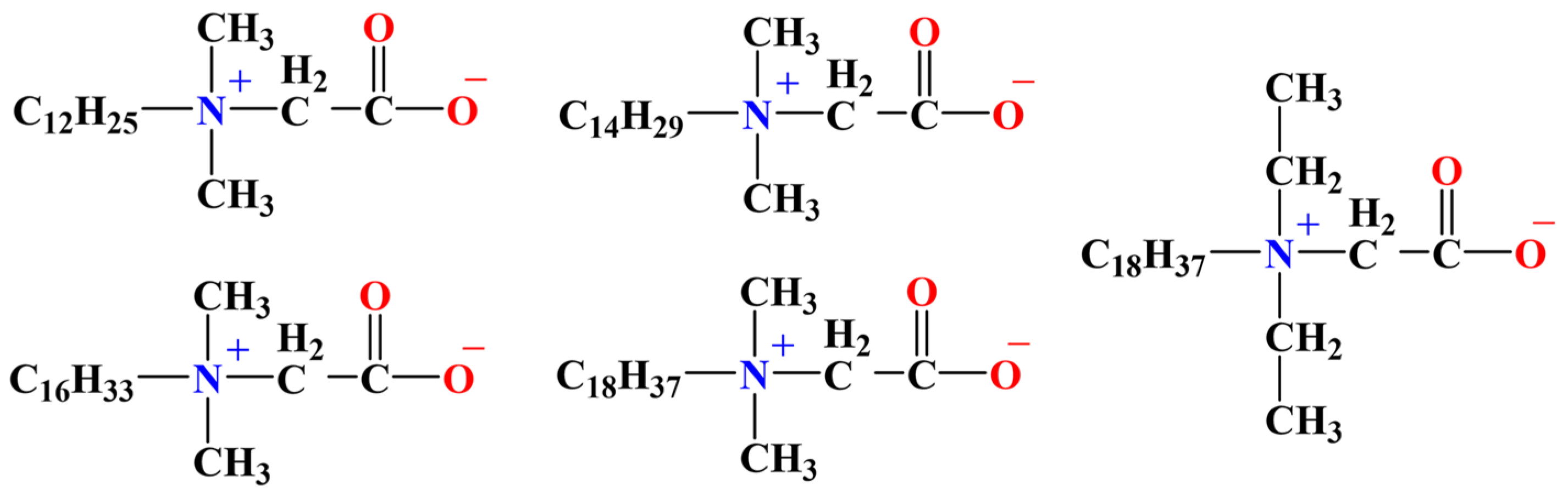
Second, five ACB surfactants were synthesized via the reported process [33,34]: 0.1 mol alkyl amine and 0.3 mol ClCH2COOH were dissolved in a binary solvent consisting of 250 mL deionized water and 250 mL isopropanol. The pH value of the mixture was adjusted to 8 by NaOH aqueous solution and the system was heated under reflux for 8 h to produce the crude ACB solution. Hexane was added to extract the unreacted alkyl amine; then, the ACB solution was dried by rotary evaporation. The dried ACB was dissolved in ethanol to remove inorganic salts. After solvent evaporation, the purified ACB product was obtained. The molecular structures of the five ACBs are given in Figure 1.

2.4. IFT Measurement

IFTs between ACB surfactant solutions and crude oils were measured. The volume ratio of aqueous phase to oil phase was approximately 200:1 and the rotational speed was 5000 r/min. Unless otherwise stated, the testing temperature was 55 °C, consistent with the reservoir temperature of the three crude oils. During testing, the IFT data were recorded at equilibrium that was unchanged within 30 min. All IFT results were averaged from three parallel measurements, and the statistical analysis showed that the relative standard deviations (RSDs) of all IFT data were less than 5%.

2.5. Adsorption Experiment

Adsorption experiment was conducted in accordance with China Petroleum Enterprise Standard of SY/T 17583-2018 [35]. The surfactant concentration was 2000 mg/kg and the oil sand specification was 80~100 mesh. The two substances were fully blended at a liquid–solid ratio of 9:1 under reservoir temperature for adsorption experiment. The detailed experimental procedures were as follows:
Measurements of 90 g of surfactant solution and 10 g of oil sands were added into a stoppered conical flask. The mixture was incubated in an oven at 55 °C and thoroughly shaken every hour for 12 h, then aged statically overnight. On the next day, the IFT of the upper surfactant solution was tested as the first adsorption result. Subsequently, 72 g of upper surfactant solution and 8 g of fresh oil sands were transferred to a new conical flask for the second adsorption. The adsorption experiments were repeated until the tension rose obviously, and the anti-adsorption capacity of surfactant was quantified based on the total number of effective cycles.

2.6. Separation of Crude Oil

The SARA components were prepared according to the reported method [36]. Thereinto, the asphaltene and de-asphaltene components were separated by hexane dissolution and deposition; then, the de-asphaltene component was separated into saturate, aromatic and resin components by chromatographic column.
The acidic component was extracted by alkaline ethanol aqueous solution from crude oil, the extractant was defined as petroleum acid and the remaining crude oil was called de-acid component. Likewise, the alkaline component was extracted by acidic ethanol aqueous solution from crude oil, the extractant was defined as petroleum alkali and the remaining crude oil was called de-alkali component. The detailed experimental procedures were as follows:
(1) Measurements of 500 mL distilled water, 500 mL ethanol and 10 g NaOH were mixed homogenously to prepare the alkaline ethanol aqueous solution. (2) A measurement of 50 g crude oil was dispersed in 200 mL alkaline solution under stirring, and the acidic component can be separated from crude oil. The extraction process was repeated several times until the alkaline solution had no color change. (3) The alkaline solution was collected and evaporated until its volume was reduced to 200 mL; then, 1.0 mol/L HCl was used to adjust its pH value to 2.0, in order to make the extractant return to acid form from sodium salt form. (4) A measuremnt of 400 mL dichloromethane was employed to extract the acidified solution several times until it had no color change. The dichloromethane was collected and evaporated, and petroleum acid was prepared. The extraction process of petroleum alkali was similar; differently, the acidic ethanol aqueous solution consisted of 500 mL distilled water, 500 mL ethanol and 20 mL concentrated HCl in step (1), and 10% NaOH aqueous solution was used to adjust the pH value of the acidic solution to 10 in step (3).
The component contents of L-73-62 crude oil are given in Table 2.

3. Results and Discussion

3.1. Characterization of ACBs

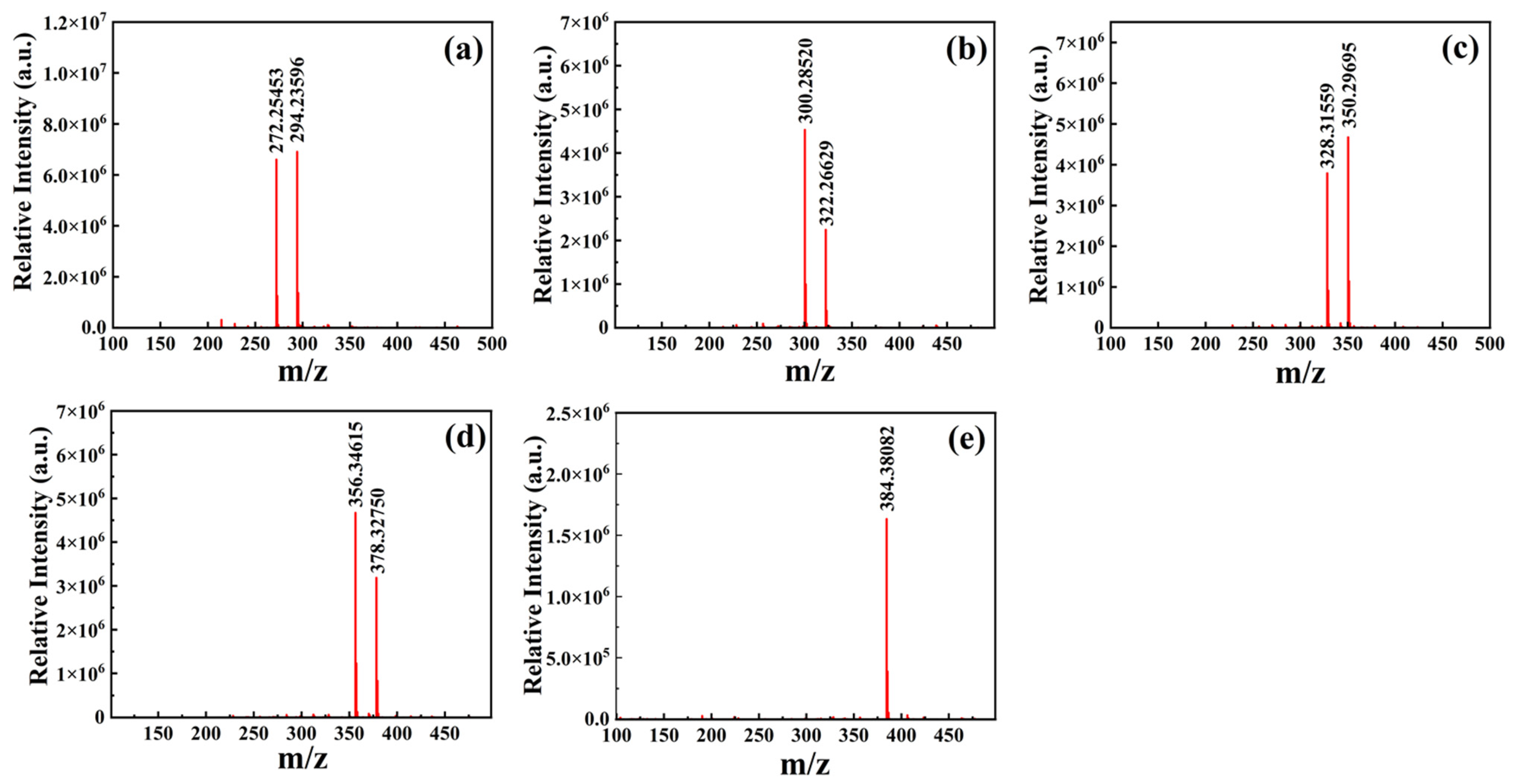
Figure 2 shows the mass spectra of the five ACBs. Based on the m/z ratio, the molecular weights are calculated to be 271, 299, 327, 355 and 383, respectively, which are listed in Table 3. The calculated values match the molecular formulas of the synthesized betaines. These results verify the successful synthesis of the five target betaines.
Since ODeCB differs from the conventional ADmCB, elemental analysis was performed to further confirm its successful synthesis. In Table 4, it can be observed that the measured values of C, H, N and O are basically consistent with the theoretical values, and the elemental molar ratios are calculated as C/N = 24.14, O/N = 2.05, and H/C = 2.04, which correspond to the molecular formula of C24H49NO2. These results also demonstrate that the synthesized ODeCB possesses high purity.
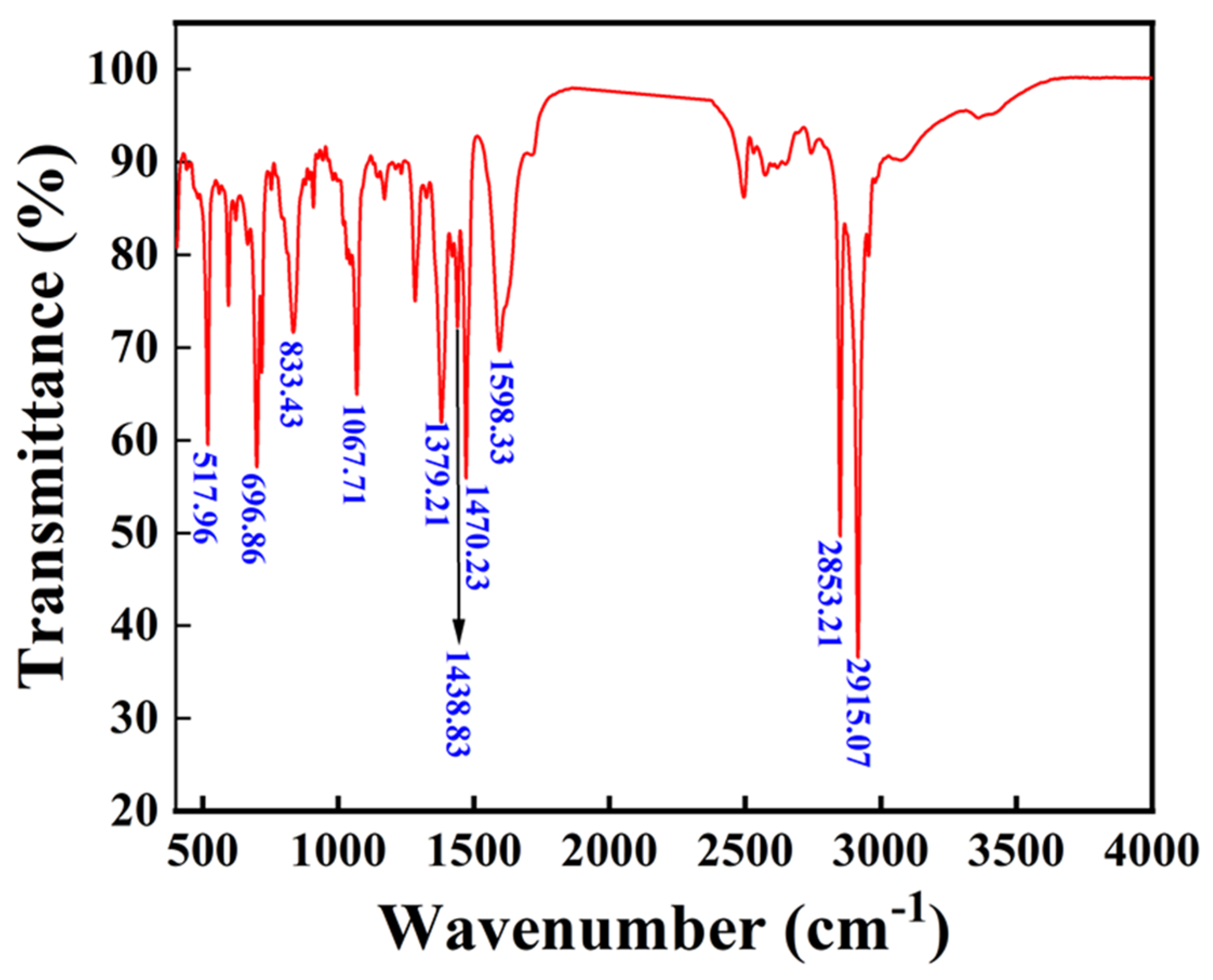
Figure 3 displays the FTIR spectrum of ODeCB [37]. The peaks at 2915.07 cm−1 and 2853.21 cm−1 are assigned to the stretching vibrations of C H 2 groups in the long alkyl chain, and 1598.33 cm−1 and 1438.83 cm−1 correspond to the asymmetric and symmetric stretching vibrations of C O O . The signals at 1470.23 cm−1 and 1379.21 cm−1 are attributed to the bending vibrations of methyl groups on N + ( C H 3 ) 2 . The peak at 1067.71 cm−1 belongs to the stretching vibrations of C-N bonds. These results verify that the structure of the synthesized ODeCB is consistent with the expected structure.
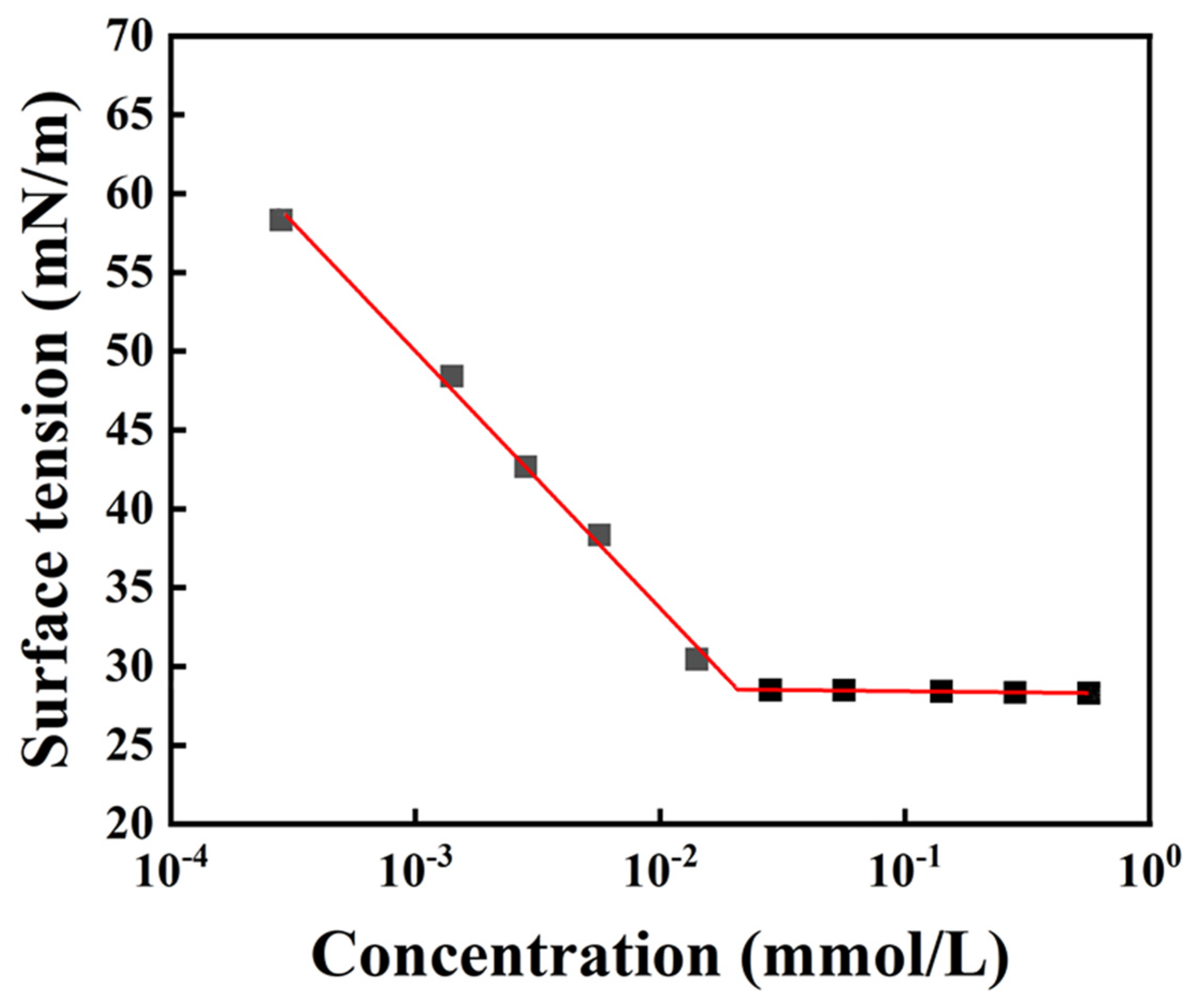
Surface tension is an important property of surfactants. A series of ODeCB solutions with different concentrations was prepared using deionized water, and their surface tensions were measured at 25 °C. The relationship curve between surface tension and concentration was plotted in Figure 4. By data fitting, the critical micelle concentration (CMC) of ODeCB was determined to be 2.10 × 10⁻⁵ mol/L, and the corresponding surface tension at CMC was 28.59 mN/m. The results show that ODeCB has a relatively low CMC and an excellent surface tension reduction capacity.
Figure 3. Infrared spectrum of ODeCB.
Processes 14 01932 g003
Figure 4. Surface tension of ODeCB at different concentrations.
Processes 14 01932 g004

3.2. IFT Characteristics of ACBs with Different Molecular Structures

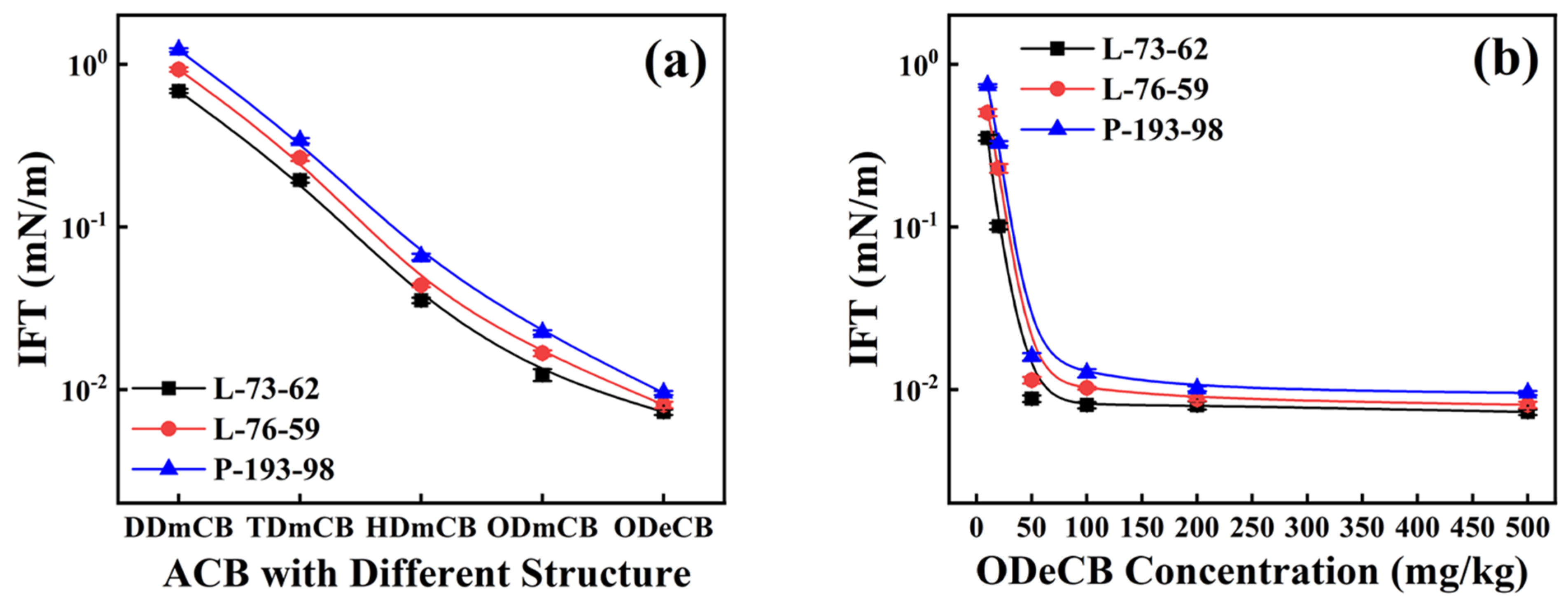
In this section, 0.05 g of ACBs with different structures were dissolved in 100 g of formation water to prepare surfactant solutions at a concentration of 500 mg/kg. Then, the IFTs between the as-prepared surfactant solutions and crude oils were measured. As shown in Figure 5a, the IFT decreases with the increase in the alkyl carbon number. ODeCB exhibits the lowest IFT values of 0.0073 mN/m, 0.0080 mN/m and 0.0095 mN/m respectively. ODmCB and HDmCB show the second-lowest IFTs on the order of 10 2 mN/m. The other two betaines of TDmCB and DDmCB have the highest IFTs and are above 0.1 mN/m.
The experimental results can be analyzed by the hydrophilic–lipophilic balance (HLB), a key factor determining IFT [38,39]. The HLB values of the five ACBs are calculated by the Davies fragment method [40] and are listed in Table 5. TDmCB and DDmCB have high HLB values above 10 because of their short alkyl chains. This indicates that the two surfactants are strongly hydrophilic and tend to remain in the aqueous phase; accordingly, their concentrations at the oil/water interface are low and high IFTs are obtained. As the alkyl carbon number increases, the HLB value decreases while the amphipathic property of surfactants is enhanced, consequently, their interfacial enrichment capability improves and the IFTs of HDmCB and ODmCB are reduced to the order of 10 2 mN/m. ODeCB possesses the largest alkyl carbon number and obtains an optimal HLB value of 7.58. This endows the surfactant with an excellent amphipathic property; as a result, the surfactant concentration at the oil/water interface is high and ultralow IFTs are obtained.
Figure 5b gives the IFTs of ODeCB at different concentrations. It shows that all the tensions are kept at a low level when the surfactant concentrations are not lower than 50 mg/kg. This result illustrates that ODeCB has good anti-dilution performance and is able to adsorb at the oil/water interface effectively even at the concentration as low as 50 mg/kg.
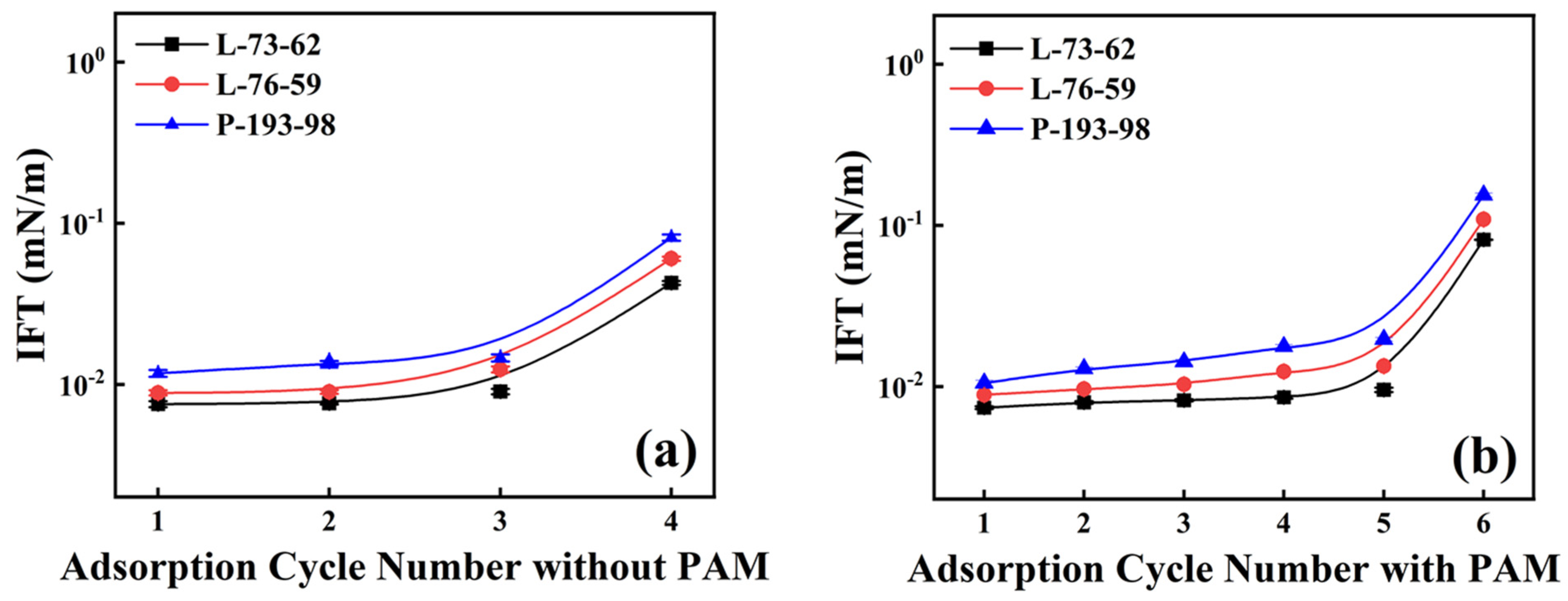
In order to evaluate the anti-adsorption capability, two kinds of ODeCB solutions were prepared. One did not include PAM: 0.2 g of ODeCB was dissolved in 100 g of formation water, and the surfactant concentration was 2000 mg/kg; the other one included PAM: 0.2 g of ODeCB and 0.16 g of PAM were dissolved in 100 g of formation water, the surfactant concentration was 2000 mg/kg and the PAM concentration was 1600 mg/kg. As shown in Figure 6, the pure ODeCB solution remains effective for three adsorption cycles, while its IFT rises obviously after the fourth cycle. By contrast, the solution containing PAM maintains performance for five adsorption cycles. The results indicate that ODeCB has good anti-adsorption capability when PAM is added. It is because PAM occupies the adsorption sites of oil sands, and the betaine adsorption is reduced.

3.3. Effects of Different Crude Oil Components on IFT of ODeCB

In this section, the IFTs between ODeCB solution and crude oil components were measured and the surfactant concentration was 500 mg/kg. Since the asphaltene, resin, acid and alkali components were solids, their IFTs could not be measured directly. In order to evaluate their interfacial activities, the mixture of saturate and aromatic (MSA) was prepared according to their original proportion in crude oil; then, the components of asphaltene, resin, acid and alkali were added into MSA at their native ratios in crude oil to measure their IFTs.
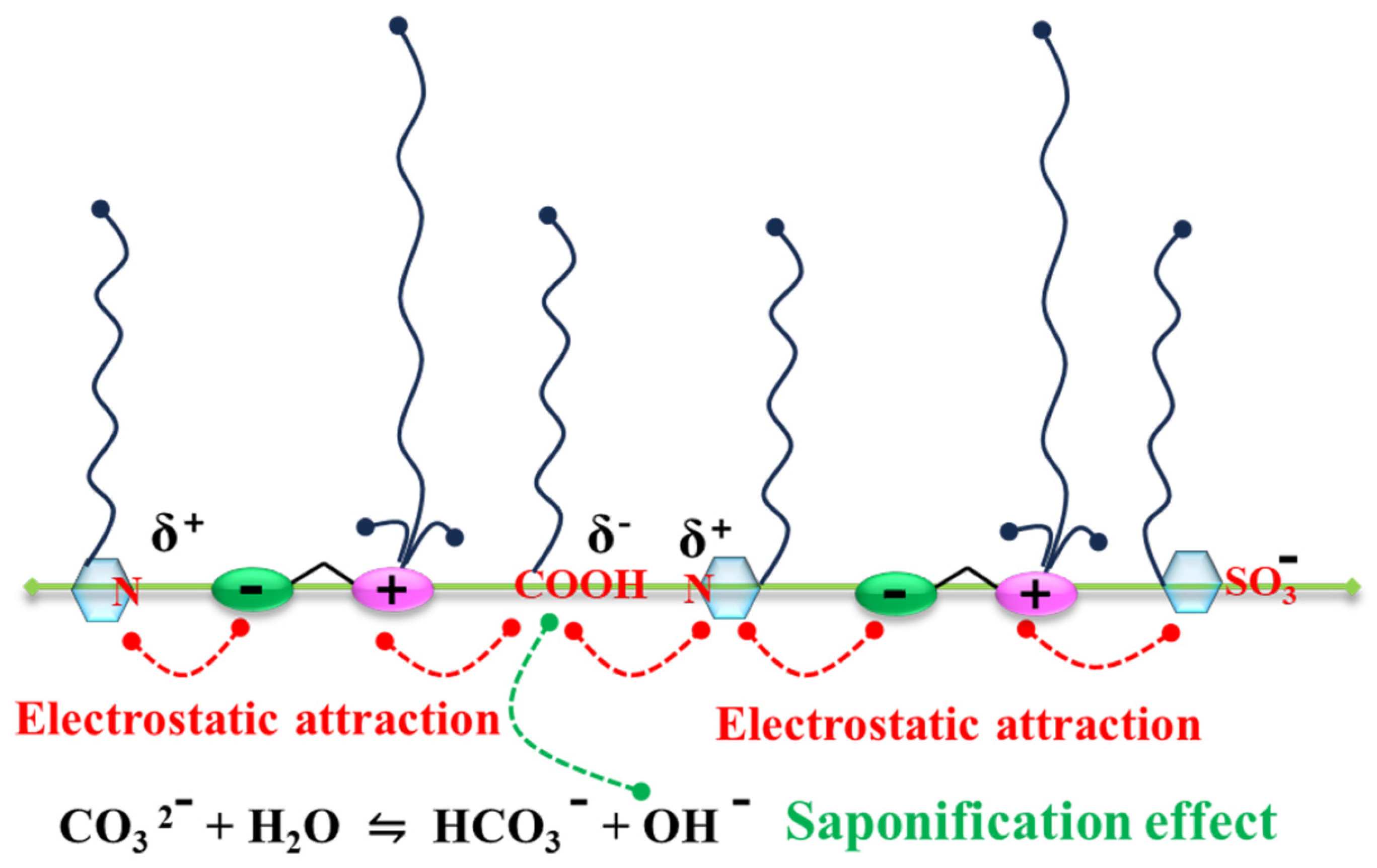
Table 6 lists the IFT values of ODeCB against different crude oil components. First, the IFTs of saturate, aromatic and MSA are high and are all above 1.6 mN/m, showing that the ODeCB molecule has little interaction with the saturate and aromatic molecules, and the IFTs cannot be lowered effectively. Second, the de-asphaltene component is able to achieve an ultralow IFT and the tension of the asphaltene/MSA mixture is as high as 1.77mN/m, indicating that the asphaltene component has little effect on lowering IFT. Third, the tension of the resin/MSA mixture is as low as 0.0081 mN/m, illustrating that the resin component has an obvious interaction with ODeCB and plays a crucial role in the generation of ultralow IFT. This is because the resin component contains the interface active substances such as petroleum acid and alkali. Last, the interfacial activities of the petroleum acid and alkali are investigated as well. When the acid component is extracted from crude oil, the tension of the de-acid component rises to 0.47 mN/m, and when the alkali component is extracted from crude oil, the tension of the de-alkali component rises to 0.035 mN/m. The results demonstrate that both the acid and alkali components contribute to the IFT reduction, and the acid component has a greater effect than the alkali component. The following data confirm this conclusion: when the acid is added to MSA, the tension is lowered to 0.022 mN/m; when the alkali is added to MSA, the tension is lowered to 0.096 mN/m; and when both the acid and alkali components are added to MSA, ultralow IFT is obtained. The possible reason is that the hydrophilic group of ODeCB contains both the positively charged ammonium cation and the negatively charged carboxylate anion, which are able to attract the negatively charged petroleum acid and the positively charged petroleum alkali onto the oil/water interface through the electrostatic interaction; consequently, the active substance concentration at the oil/water interface increases and the IFTs are reduced. Moreover, due to fact that the functional group of petroleum acid mainly exists in the form of a carboxyl group whose steric hindrance is low, while the functional group of petroleum alkali mainly exists in the form of heterocyclic aromatic hydrocarbon such as carbazole or pyridine [41], whose steric hindrance is high, the interaction between ODeCB and petroleum acid is stronger than that between ODeCB and petroleum alkali, and so petroleum acid has a greater effect than petroleum alkali on the IFT reduction. Figure 7 shows a schematic diagram of the electrostatic attraction interaction between ODeCB and different types of active substances at the oil/water interface.

3.4. Effects of Different Inorganic Salts in Formation Water on IFT of ODeCB

The effects of different inorganic salts in formation water on IFT of ODeCB were investigated and the surfactant concentration was also fixed at 500 mg/kg in this section. Take L-73-62 formation water as an example: its inorganic salts contain NaCl, Na2SO4, Na2CO3, NaHCO3, CaCl2, and MgCl2, their contents are 1.43%, 0.011%, 0.069%, 0.0085%, 0.06% and 0.02% respectively, and the total salinity is 1.60%.
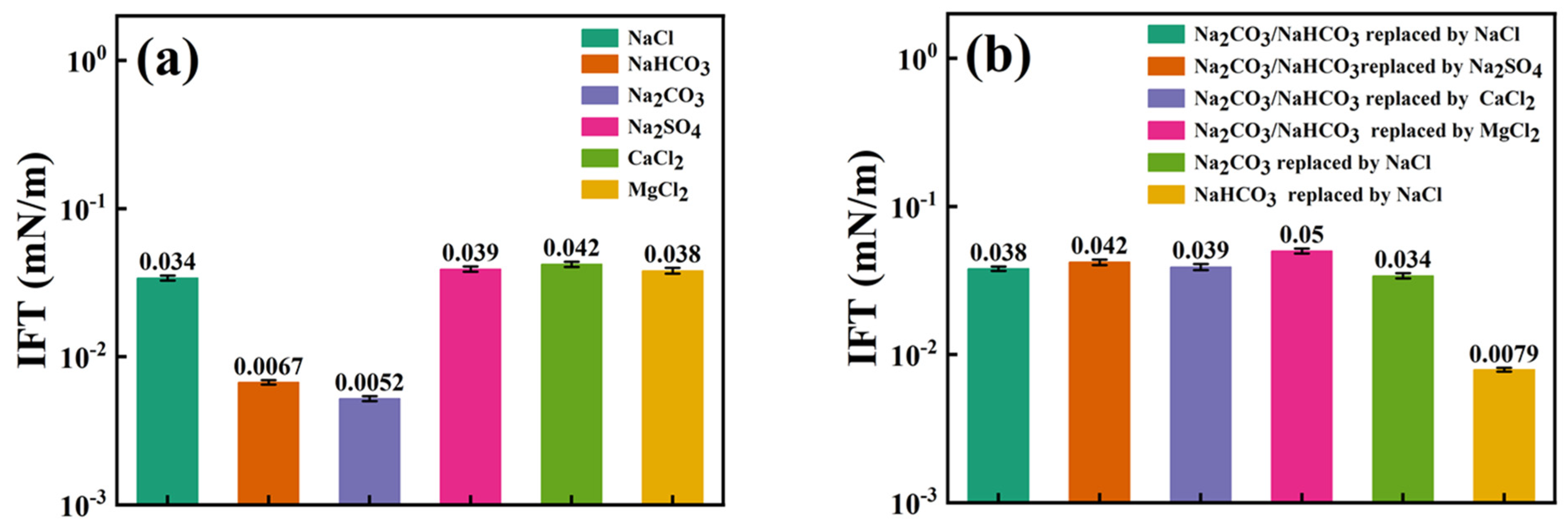
In order to study the effect of the individual inorganic salt, different single salt solutions with 1.60% salinities were prepared; that was, 1.60% NaCl solution, 1.60% NaHCO3 solution, 1.60% Na2CO3 solution, 1.60% Na2SO4 solution, 1.60% CaCl2 solution and 1.60% MgCl2 solution were prepared. The IFTs of ODeCB in the above single salt solutions against L-73-62 crude oil were measured and are listed in Figure 8a. It can be observed that the inorganic salts can be divided into two groups: one is the neutral inorganic salts including NaCl, Na2SO4, CaCl2 and MgCl2; the other is the alkaline inorganic salts including Na2CO3 and NaHCO3. In the neutral solutions, ODeCB has the tensions which are above 0.03 mN/m, while, in the alkaline solutions, ODeCB is able to produce the ultralow tensions. The results show that an alkaline environment is helpful for ODeCB to lower the IFT. The reason is that the alkaline inorganic salts of Na2CO3 and NaHCO3 can produce O H to saponify the petroleum acid [24] and enhance its electronegativity; correspondingly, the interaction between petroleum acid and ODeCB is strengthened, and, as a result, the density of the active substances dispersed at the oil–water interface increases, and the IFT is reduced.
To investigate the effects of the alkaline inorganic salts in depth, the total amount of 0.0775% of Na2CO3 and NaHCO3 was replaced by 0.0775% NaCl, 0.0775% Na2SO4, 0.0775% CaCl2, and 0.0775% MgCl2 respectively, and all the formation waters had no alkaline inorganic salts. Figure 8b gives the tensions of ODeCB in the above neutral salt solutions, which are all above 0.03 mN/m. The results further prove that the alkaline inorganic salts have crucial effects on achieving the ultralow IFT, and also illuminate that there is no synergism between the neutral inorganic salts. Figure 8b also gives the tensions of ODeCB in the formation waters so that 0.069% Na2CO3 is replaced by 0.069% NaCl and that 0.0085% NaHCO3 is replaced by 0.0085% NaCl. It can be seen that in the NaHCO3 replaced solution, the tension is still ultralow, which is because the content of NaHCO3 is too little to influence the IFT. Meanwhile, when Na2CO3 is replaced by NaCl, the content of the alkaline inorganic salt reduces significantly and the tension increases to 0.034 mN/m. These results illuminate that Na2CO3 is more important than NaHCO3 in the formation water due to its high content.
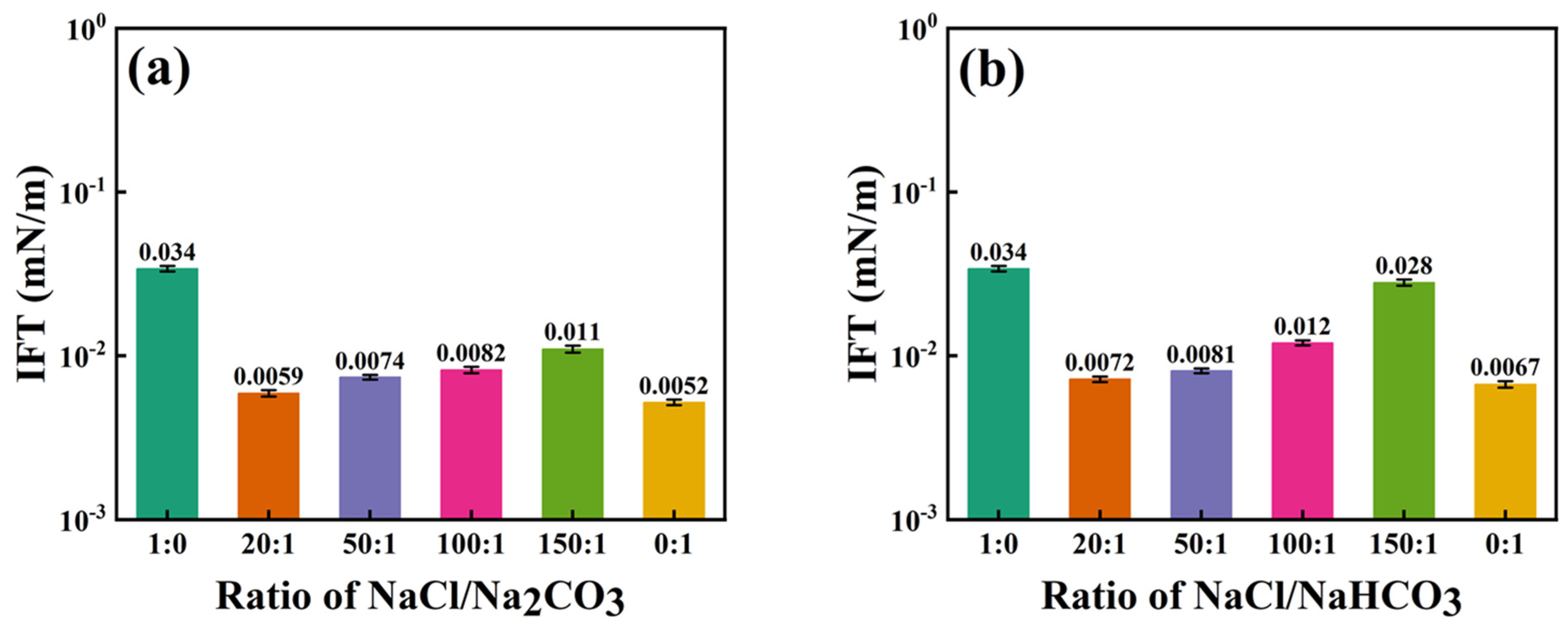
Solutions of NaCl and Na2CO3 and solutions of NaCl and NaHCO3 in different mixing ratios were prepared as well, and the total salinities were 1.6%. In Figure 9, it can be observed that ODeCB can get ultralow IFTs at the ratios of 20 and 50; when the ratio increases to 150, the tension rises to 10−2 mN/m. The results show that the IFT is determined by the content balance of neutral inorganic salt and alkaline inorganic salt when the total salinity is fixed.

3.5. Temperature and Salt Resistance of ODeCB

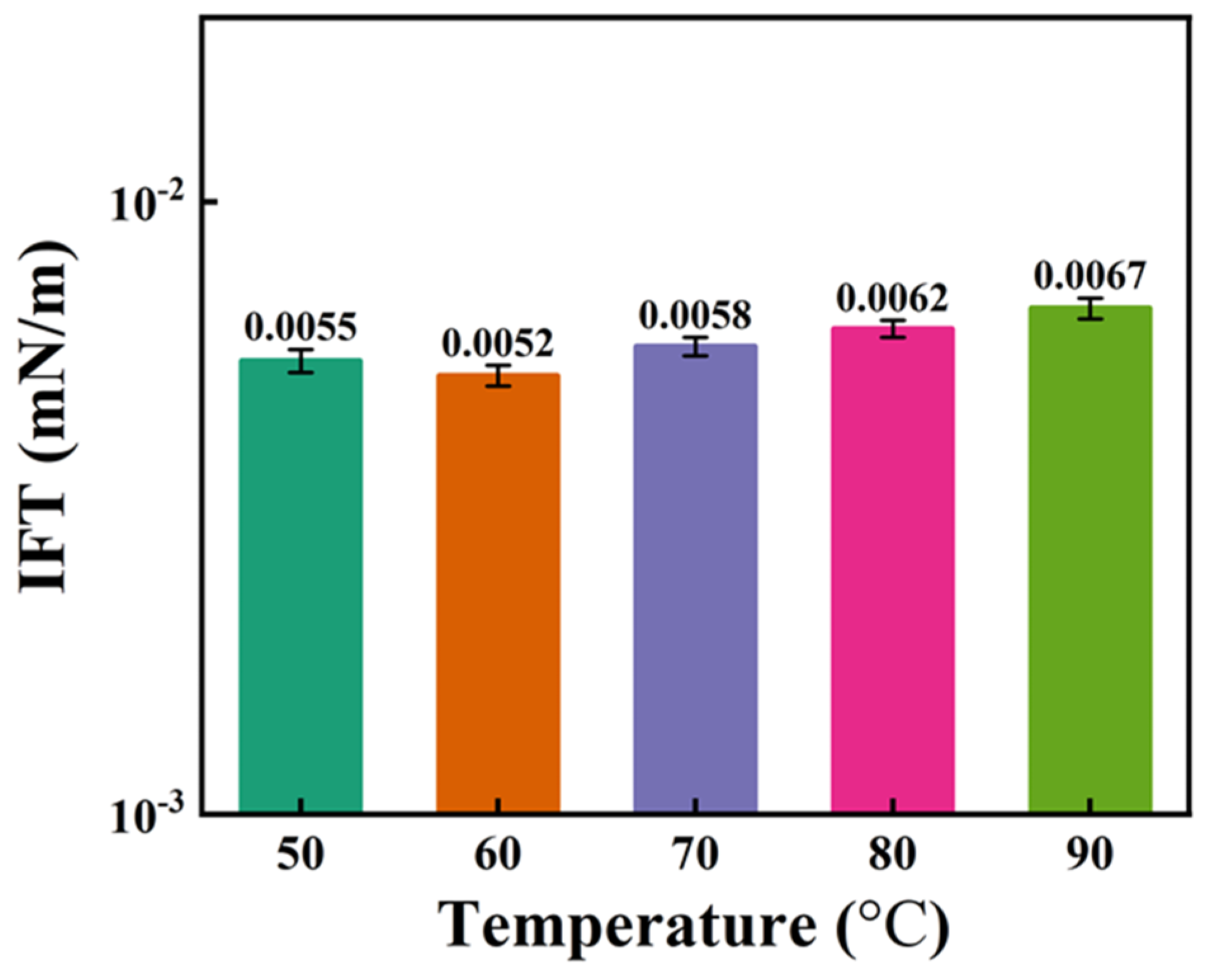
To assess the temperature and salt resistance, IFTs of ODeCB against L-73-62 crude oil were measured at different temperatures and salinities. First, inorganic salt solution containing 1.5% NaCl and 0.075% Na2CO3 (20:1) was prepared and ODeCB was dissolved in the saline water with a concentration of 500 mg/kg. The surfactant solution was kept static at temperatures from 50 °C to 90 °C for 5 days respectively. Subsequently, the IFTs were measured at the corresponding temperatures to evaluate the thermal resistance of ODeCB. As shown in Figure 10, although the IFT increases slightly at high temperatures, the overall variation was very little, indicating that ODeCB possesses good thermal resistance.
To assess the salt resistance of ODeCB, NaCl content was adjusted to 4%, 6%, 8% and 10% respectively, while Na2CO3 content was fixed at 0.075%, and the ODeCB concentration was 500 mg/kg. As presented in Table 7, the IFT values have little change under different NaCl contents, showing that ODeCB has superior salt resistance. In addition, on the basis of 1.5% NaCl and 0.075% Na2CO3, CaCl2 was added at contents of 0.16% and 0.32%, to evaluate the divalent cation tolerance of ODeCB. It can be seen that the IFT increases to the order of 10−2 mN/m after CaCl2 is added. This indicates that ODeCB has poor tolerance to divalent cations. The reason is that CaCl2 reacts with Na2CO3 to form precipitates, which consume the alkaline ions and lead to an increase in IFT.

3.6. Synergism Between ODeCB and DBS

In order to lower the IFT more effectively, ODeCB was compounded with other surfactants, and all the surfactant concentrations are 500 mg/kg. It was found that there exists synergism between ODeCB and DBS. As shown in Table 8, the single ODeCB has the tensions from 0.0073 mN/m to 0.0095 mN/m, and the single DBS has the tensions from 0.52 mN/m to 0.42 mN/m; when the two surfactants are mixed in the ratios from 10:1 to 15:1, the tensions are further reduced and kept at a lower level. The reason should be that the ammonium cationic group of ODeCB has an electrostatic attraction with the sulfonate anionic group of DBS [31,42]; consequently, the surfactant density dispersed at the oil/water interface increases and the IFT is reduced. The mixture of ODeCB and DBS may be a good option for surfactant flooding.

4. Conclusions

This work analyzes the IFT characteristics of ACB surfactants from the perspective of surfactant molecular structure, crude oil component and inorganic salt composition of formation water. (1) ODeCB with the largest lipophilic group has an optimal HLB value and shows the highest interfacial activity; its IFTs are able to achieve an ultralow level against different crude oils. The surfactant also has good anti-dilution performance; when its concentration is not lower than 50 mg/kg, the interfacial activity remains high. In addition, ODeCB exhibits good anti-adsorption capability and can resist five adsorption cycles when a polymer is added. (2) It is proven that the resin component, especially the acid and alkali components, are important for ultralow IFT, and the petroleum acid has a greater effect than petroleum alkali because of its less steric hindrance. (3) The alkaline inorganic salts in formation water, especially Na2CO3, are crucial for producing ultralow IFT by the saponification of petroleum acid. (4) ODeCB also exhibits excellent temperature and salt resistance; the IFT values have little change when the temperature rises from 50 °C to 90 °C and NaCl content increases from 2% to 10%, but it has poor tolerance toward divalent cations because the cations consume alkaline inorganic salts. (5) There exists synergism between ODeCB and DBS which can further reduce IFT. This study provides a useful reference for selecting surfactants in tertiary oil recovery.

Author Contributions

Conceptualization, Y.S. and L.W.; methodology, X.L.; validation, Y.S. and X.L.; investigation, Y.S.; data curation, Y.S. and L.W.; writing—original draft preparation, Y.S.; writing—review and editing, L.W.; super vision, Y.G.; project administration, Y.G. All authors have read and agreed to the published version of the manuscript.

Funding

This work was supported by the National Science & Technology Major Project of China (2025ZD1405400) and the Science & Technology Major Project of PetroChina Company Limited (2023ZZ17YJ04).

Data Availability Statement

The original contributions presented in this study are included in the article.

Acknowledgments

The authors greatly appreciate the financial support from funding bodies and are grateful to the reviewers for their valuable comments and suggestions to improve the quality of the paper.

Conflicts of Interest

All the authors declare that the research was conducted in the absence of any commercial or financial relationships that could be construed as potential conflicts of interest.

References

  1. Podoprigora, D.; Rogachev, M.; Byazrov, R. Surfactant-Polymer Formulation for Chemical Flooding in Oil Reservoirs. Energies 2025, 18, 1814. [Google Scholar] [CrossRef]
  2. Zhou, M.; Zhao, J.Z.; Wang, X.; Yang, Y. Research on Surfactant Flooding in High-temperature and High-salinity Reservoir for Enhanced Oil Recovery. Tenside Surfactants Deterg. 2013, 50, 175–181. [Google Scholar] [CrossRef]
  3. Rosen, M.J.; Wang, H.Z.; Shen, P.P.; Zhu, Y.Y. Ultralow Interfacial Tension for Enhanced Oil Recovery at Very Low Surfactant Concentrations. Langmuir 2005, 21, 3749–3756. [Google Scholar] [CrossRef]
  4. Ma, X.K.; Liu, B.; Ma, T.X.; Zou, H.K.; Chu, G.W.; Sun, B.C.; Zhang, L.L.; Luo, Y.; Chen, J.F. Characterization of Petroleum Sulfonate Synthesized via Gas-phase SO3 Sulfonation in Rotating Packed Bed and Its Application in Enhanced Oil Recovery. Chem. Eng. Sci. 2021, 230, 116216. [Google Scholar] [CrossRef]
  5. Luan, H.X.; Zhou, Z.H.; Xu, C.J.; Bai, L.; Wang, X.G.; Han, L.; Zhang, Q.; Li, G. Study on the Synergistic Effects Between Petroleum Sulfonate and a Nonionic-anionic Surfactant for Enhanced Oil Recovery. Energies 2022, 15, 1177. [Google Scholar] [CrossRef]
  6. Zhang, S.W.; Peng, B.; Liu, Q.; Liu, Z. The Effect of Sodium Carbonate on Reducing the Interfacial Tension of Petroleum Sulfonate. J. Pet. Sci. Eng. 2021, 200, 108255. [Google Scholar] [CrossRef]
  7. Zhang, S.W.; Peng, B.; Wang, W.J. Temperature-Responsive Hydrogel Carrier for Reducing Adsorption Loss of Petroleum Sulfonates. Langmuir 2021, 37, 9809–9816. [Google Scholar] [CrossRef]
  8. Wang, S.; Luan, H.X.; Liang, X.J.; Wang, L.C.; Guo, Y. Recognition and Characterization of Active Fractions from Petroleum Sulfonate. J. Pet. Sci. Eng. 2020, 187, 106797. [Google Scholar] [CrossRef]
  9. Wang, H.; Zhang, D.; Su, Y.; Gang, H.; Yang, S.; Ye, R.; Mu, B. The Composition and Interfacial Activity of Alkyl Benzene Sulfonates Used in Oil Recovery. Pet. Sci. Technol. 2015, 33, 287–293. [Google Scholar] [CrossRef]
  10. Liu, B.X.; Hou, J.R.; Tang, H.J.; Xu, H.X.; Zheng, Z.G. Experimental Study of the Effect of Strong Alkali on Lowering the Interfacial Tension of Oil/Heavy Alkylbenzene Sulfonates System. Chin. J. Chem. 2012, 29, 2315–2319. [Google Scholar] [CrossRef]
  11. Pu, W.F.; Du, D.J.; Tang, Y.L.; Wang, S. Synthesis of an Alkyl Polyoxyethylene Ether Sulfonate Surfactant and Its Application in Surfactant Flooding. J. Surfactants Deterg. 2018, 21, 687–697. [Google Scholar] [CrossRef]
  12. Kumar, S.; Kumar, A.; Mandal, A. Characterizations of Surfactant Synthesized from Jatropha Oil and Its Application in Enhanced Oil Recovery. Aiche J. 2017, 63, 2731–2741. [Google Scholar] [CrossRef]
  13. Saw, R.K.; Rane, P.M.; Joshi, D.; Prakash, S.; Jangid, L.; Mandal, A. Enhanced Oil Recovery Using a Novel Non-Ionic Surfactant Synthesized from Olive Oil: Performance and Synergistic Effects. J. Mol. Liq. 2023, 392, 123452. [Google Scholar] [CrossRef]
  14. Aziz, U.A.; Adnan, N.; Sohri, M.Z.R.; Mohshim, D.F.; Idris, A.K.; Azman, M.A. Characterization of Anionic-Nonionic Surfactant Mixtures for Enhanced Oil Recovery. J. Solut. Chem. 2019, 48, 1617–1637. [Google Scholar] [CrossRef]
  15. Li, Y.; Duan, Y.Z.; Zhang, K. Effect of Alkanolamide on Interfacial Tension and Loss of Petroleum Sulfonates for Enhanced Oil Recovery. J. Dispers. Sci. Technol. 2010, 31, 722–726. [Google Scholar] [CrossRef]
  16. Li, W.H.; Zhang, Y.Q.; Wang, L.C.; Guo, Y. Synthesis and Interfacial Activity of Petroleum Sulfonate. Pet. Sci. Technol. 2016, 34, 517–522. [Google Scholar] [CrossRef]
  17. Si, Y.W.; Zhu, Y.W.; Liu, T.; Xu, X.R.; Yang, J.Y. Synthesis of a Novel Borate Ester Anion-Nonionic Surfactant and Its Application in Viscosity Reduction and Emulsification of Heavy Crude Oil. Fuel 2023, 333, 126453. [Google Scholar] [CrossRef]
  18. Cai, J.T.; Chen, X.R.; Chen, B.; Wu, D.; Yang, S.C. A Review on Approach for Biosurfactants Enhance Oil Recovery Technology. Geomicrobiol. J. 2024, 41, 910–920. [Google Scholar] [CrossRef]
  19. Li, G.; Chen, L.F.; Ruan, Y.; Guo, Q.; Liao, X.G.; Zhang, B.W. Alkyl Polyglycoside: A Green and Efficient Surfactant for Enhancing Heavy Oil Recovery at High-temperature and High-salinity Condition. J. Pet. Explor. Prod. Technol. 2019, 9, 2671–2680. [Google Scholar] [CrossRef]
  20. Al-Ghamdi, A.; Haq, B.; Al-Shehri, D.; Muhammed, N.S.; Mahmoud, M. Surfactant Formulation for Green Enhanced Oil Recovery. Energy Rep. 2022, 8, 7800–7813. [Google Scholar] [CrossRef]
  21. Ahluwalia, O.; Patel, N.; Narmeta, N.; Sanchez, S.G.; Rosado, A.S. Prospects and Challenges Regarding Biosurfactants in Advancing the Petroleum Industry. Front. Bioeng. Biotechnol. 2026, 13, 1697361. [Google Scholar] [CrossRef]
  22. Chen, T.; Zhang, G.; Ge, J.; Jiang, P.; Fu, X.; Jin, L. Hydroxysulfobetaine/Hydrolyzed Polyacrylamide Complex Systems for Gudao Heavy Oil Recovery: A Dynamic Interfacial Tension Study. Pet. Sci. Technol. 2012, 30, 1433–1440. [Google Scholar] [CrossRef]
  23. Zhou, Z.H.; Zhang, Q.; Liu, Y.; Wang, H.Z.; Cai, H.Y.; Zhang, F.; Tian, M.Z.; Zhang, L.; Zhang, L. Effect of Crude Oil Fractions on Interfacial Tensions of Novel Sulfobetaine Solutions. J. Dispers. Sci. Technol. 2016, 37, 1178–1185. [Google Scholar] [CrossRef]
  24. Bian, S.W.; Liu, P.; Mao, Z.Q.; Huang, W.H.; Zhu, Y.W.; Zhang, L.; Hou, Y.; Zhang, L. Studying the Factors Determining the Ultralow Interfacial Tensions of Betaine Solutions against Crude Oil. Colloids Surf. A Physicochem. Eng. Asp. 2024, 686, 133453. [Google Scholar] [CrossRef]
  25. Sun, Q.; Zhou, Z.H.; Xiao, C.M.; Gao, M.; Han, L.; Liu, Q.C.; Zhang, L.; Zhang, Q.; Zhang, L. The Synergism of Improving Interfacial Properties between Betaine and Crude Oil for Enhanced Oil Recovery. J. Mol. Liq. 2023, 383, 122046. [Google Scholar] [CrossRef]
  26. Li, G.Q.; Zhao, J.Y.; Han, L.; Wu, Q.B.; Zhang, Q.; Zhang, B.; Yue, R.S.; Yan, F.; Zhou, Z.H.; Ding, W. The High Interfacial Activity of Betaine Surfactants Triggered by Nonionic Surfactant: The Vacancy Size Matching Mechanism of Hydrophobic Groups. Molecules 2025, 30, 2413. [Google Scholar] [CrossRef]
  27. Sun, L.; Chen, D.Q.; Zhang, Y.C.; Sun, X.H.; Pu, W.F.; Wei, B.; Tang, J.Y.; Sun, X.D. Probing High-Salinity-Enhanced Stability of Betaine Foam for Foam Application in Harsh Reservoirs. Fuel 2022, 327, 125144. [Google Scholar] [CrossRef]
  28. Zhang, T.C.; Ge, J.J.; Guo, H.B.; Li, L.J.; Huang, L.; Wang, J.H.; Su, Z.W. The Development of Heat-resistant and Salt-tolerant Foam with Betaine Surfactants. J. Surfactants Deterg. 2023, 26, 61–72. [Google Scholar] [CrossRef]
  29. Fu, L.P.; Liao, K.L.; Pei, H.H.; Zhang, G.C.; Ge, J.J.; Jiang, P. Research on Oleic Acid Amide Betaine Used in Surfactant-Polymer Compound Flooding for Ordinary Heavy Oil. J. Surfactants Deterg. 2019, 22, 1343–1355. [Google Scholar] [CrossRef]
  30. Li, N.; Zhang, G.C.; Ge, J.J.; Zhang, L.; Liu, X.L.; Wang, J. Ultra-Low Interfacial Tension between Heavy Oil and Betaine-Type Amphoteric Surfactants. J. Dispers. Sci. Technol. 2012, 33, 258–264. [Google Scholar] [CrossRef]
  31. Sun, Q.; Zhou, Z.H.; Zhang, Q.; Zhang, F.; Ma, G.Y.; Zhang, L.; Zhang, L. Effect of Electrolyte on Synergism for Reducing Interfacial Tension between Betaine and Petroleum Sulfonate. Energy Fuels 2020, 34, 3188–3198. [Google Scholar] [CrossRef]
  32. Zhang, Q.; Han, L.; Luan, H.X.; Ren, J.; Xu, C.J.; Li, G.; Xiao, H.Y.; Zhou, Z.H.; Zhang, L. Synergism for Lowering Interfacial Tensions Between Betaines and Extended Surfactants: The Role of Self-regulating Molecular Size. J. Mol. Liq. 2023, 378, 121605. [Google Scholar] [CrossRef]
  33. Gao, S.F.; Song, Z.Z.; Lan, F.; Li, P.; Zhang, A.H.; Hu, J.J.; Jiang, Q.Z. Studies on Physicochemical Properties and Aggregation Behavior of Two Pairs of Betaine Surfactants. Ind. Eng. Chem. Res. 2019, 58, 22260–22272. [Google Scholar] [CrossRef]
  34. Zhang, J.F. Synthesis of Long-Chain Carboxybetaine Surfactants and Research on Self-Regulating Flooding in Low-Permeability Reservoirs. Master’s Thesis, Southwest Petroleum University, Chengdu, China, 2022. [Google Scholar]
  35. SY/T 17583-2018; Specifications of Surfactants Used in SP Binary Combination Flooding. China National Petroleum Corporation: Beijing, China, 2018.
  36. Xie, J.Y.; Chu, Y.J.; Shi, Y.; Han, X.C.; Li, X.; Wang, L.C.; Guo, Y. Studies of Chromatographic Separation and Self-emulsification of Crude Oil. Pet. Sci. Technol. 2019, 37, 220–225. [Google Scholar] [CrossRef]
  37. Chen, P.; Chai, X.J.; Tian, M.J.; Chen, W.; Wan, S.; Meng, Q.B.; Zhai, J.H.; Gao, Y.D. The Performance and Adsorption Mechanism of a Novel Collector, Dodecyl Dimethyl Betaine (BS-12), for the Flotation Separation of Ilmenite and Titanaugite. Minerals 2020, 10, 116. [Google Scholar] [CrossRef]
  38. Zhao, R.H.; Zhang, L.; Zhang, L.; Zhao, S.; Yu, J.Y. Effect of the Hydrophilic-Lipophilic Ability on Dynamic Interfacial Tensions of Alkylbenzene Sulfonates. Energy Fuels 2010, 24, 5048–5052. [Google Scholar] [CrossRef]
  39. Zhang, X.J.; Zhou, Z.H.; Han, L.; Zhang, Y.Q.; Zhang, Q.; Ma, D.S.; Ma, W.J.; Zhang, L.; Zhang, L. Mechanism Responsible for the Reduction of Interfacial Tension by Extended Surfactants. Colloids Surf. A Physicochem. Eng. Asp. 2022, 634, 128013. [Google Scholar] [CrossRef]
  40. Li, Y.X. Calculation and Application of Hydrophile-Lipophile Balance for Ionic Surfactants by Configuration-fragment Method. Master’s Thesis, Xiangtan University, Xiangtan, China, 2008. [Google Scholar]
  41. Gong, Y.N.; Song, Y.; Feng, T.; Guo, Y.; Wang, X.S. In Situ Combustion Characteristics of Heavy Oil in the Liaohe Oilfield at Different Temperatures. Processes 2024, 12, 1320. [Google Scholar] [CrossRef]
  42. Li, P.H.; Wu, J.H.; Cao, S.T.; Mao, Y.F.; Huo, Y.Q.; Liu, X.C. Synergistic Interaction of α-olefin Sodium Sulfonate/Cocamidopropyl Betaine Surfactant Mixtures and Preparation of Wormlike Micelles. J. Dispers. Sci. Technol. 2024, 45, 642–650. [Google Scholar] [CrossRef]
Figure 1. Molecular structural formulas of five ACB surfactants.
Processes 14 01932 g001
Figure 2. Mass spectra of DDmCB (a), TDmCB (b), HDmCB (c), ODmCB (d) and ODeCB (e).
Processes 14 01932 g002
Figure 5. IFTs of five ACB solutions against three crude oils (a) and IFTs of ODeCB solutions at different concentrations against three crude oils (b).
Processes 14 01932 g005
Figure 6. IFTs of ODeCB solutions against three crude oils after different adsorption cycles without polymer (a) and with polymer (b).
Processes 14 01932 g006
Figure 7. Schematic diagram of electrostatic attraction between ODeCB and different types of active substances at oil/water interface.
Processes 14 01932 g007
Figure 8. IFTs of ODeCB in different single salt solutions (a) and in different Na2CO3/NaHCO3 replaced solutions (b) against L-73-62 crude oil.
Processes 14 01932 g008
Figure 9. IFTs of ODeCB in NaCl/Na2CO3 solutions with different mixing ratios (a) and in NaCl/NaHCO3 solutions with different mixing ratios (b) against L-73-62 crude oil.
Processes 14 01932 g009
Figure 10. IFTs of ODeCB in NaCl/Na2CO3 solutions at different temperatures.
Processes 14 01932 g010
Table 1. Inorganic salt contents of formation waters from Changqing Oilfield.
Salt Content (%)NaClNa2SO4Na2CO3NaHCO3CaCl2MgCl2
L-73-621.430.0110.0690.00850.060.02
L-76-591.430.0110.0690.00850.060.02
P-193-983.250.00620.00180.0320.080.03
Table 2. Component contents of L-73-62 crude oil.
ComponentSaturateAromaticResinAsphalteneAcidAlkali
Content (%)69.2220.348.202.240.720.46
Table 3. M/z ratio, molecular weight and molecular formula of ACB.
M + H + M + N a + MMolecular Formula
DDmCB272294271C16H33NO2
TDmCB300322299C18H37NO2
HDmCB328350327C20H41NO2
ODmCB356378355C22H45NO2
ODeCB384/383C24H49NO2
Table 4. Elemental analysis results of ODeCB.
Elemental Content (%)
Measured ValueTheoretical Value
C75.12%75.20%
H12.76%12.79%
N3.63%3.66%
O8.49%8.35%
Table 5. HLB values of ACBs calculated by Davies fragment method.
DDmCBTDmCBHDmCBODmCBODeCB
HLB11.3810.429.488.527.58
Note: HLB = 7 + 9.4 + 2.1 − 0.475n; 7 is a constant, 9.4 corresponds to N + hydrophilic contribution value, 2.1 corresponds to C O O hydrophilic contribution value, 0.475 corresponds to C H 2 or C H 3 lipophilic contribution value, and n stands for the number of C H 2 and C H 3 .
Table 6. IFTs of ODeCB against different L-73-62 crude oil components with RSDs.
ComponentSaturateAromaticMSADe-Asphaltene
IFT (mM/m)1.65 ± 2.88%2.62 ± 4.021.69 ± 3.29%0.0077 ± 1.57%
ComponentAsphaltene/MSAResin/MSADe-acidDe-alkali
IFT (mM/m)1.77 ± 3.44%0.0081 ± 2.47%0.47 ± 2.66%0.035 ± 2.98%
ComponentAcid/MSAAlkali/MSAAcid/Alkali/MSACrude oil
IFT (mM/m)0.022 ± 1.98%0.096 ± 1.82%0.0085 ± 3.11%0.0073 ± 1.99%
Table 7. IFTs of ODeCB in NaCl/Na2CO3 solutions under different salinity conditions with RSDs.
Inorganic Salt CompositionIFT (mN/m)
4% NaCl + 0.075% Na2CO30.0050 ± 2.64%
6% NaCl + 0.075% Na2CO30.0060 ± 2.21%
8% NaCl + 0.075% Na2CO30.0066 ± 3.37%
10% NaCl + 0.075% Na2CO30.0074 ± 2.44%
1.5% NaCl + 0.075% Na2CO3 + 0.016 CaCl20.010 ± 4.35%
1.5% NaCl + 0.075% Na2CO3 + 0.032 CaCl20.028 ± 3.61%
Table 8. IFTs of ODeCB and DBS at different mixing ratios against three crude oils with RSDs.
ODeCB:DBS at Different Mixing Ratios
IFT (mN/m)1:05:110:115:120:10:1
L-73-620.0073 ± 1.99%0.13 ± 4.62%0.0040 ± 4.33%0.0046 ± 1.99%0.0079 ± 1.54%0.52 ± 3.24%
L-76-590.0080 ± 2.61%0.18 ± 3.09%0.0048 ± 1.91%0.0060 ± 4.41%0.0087 ± 2.04%0.56 ± 2.70%
P-193-980.0095 ± 4.52%0.26 ± 3.71%0.0067 ± 2.40%0.0073 ± 1.43%0.0088 ± 2.36%0.42 ± 2.57%
Disclaimer/Publisher’s Note: The statements, opinions and data contained in all publications are solely those of the individual author(s) and contributor(s) and not of MDPI and/or the editor(s). MDPI and/or the editor(s) disclaim responsibility for any injury to people or property resulting from any ideas, methods, instructions or products referred to in the content.