1. Introduction
Coal remains a major component of China’s energy supply system, and the safe and efficient extraction of coal resources is therefore crucial to maintaining energy security [
1]. With increasing mining depth and accelerated panel turnover, the conventional wide-pillar roadway protection method can maintain roadway stability to some extent, but at the cost of substantial coal loss and reduced resource recovery. Under these conditions, gob-side entry driving with narrow coal pillars has become an effective approach for improving resource utilization and maintaining mining continuity, and its deformation mechanism and control technology have attracted increasing attention [
2,
3,
4]. However, the surrounding rock of gob-side entries is subjected to the combined effects of lateral abutment pressure from the adjacent gob, overburden load transfer, excavation-induced unloading, and subsequent mining disturbance from the active face. If the retained pillar width is inappropriate, through-going plastic failure within the pillar, asymmetric rib deformation, roof separation, and support instability may occur. Accordingly, rational determination of narrow coal-pillar width and development of a compatible support scheme remain key issues in gob-side entry control.
Previous studies on coal-pillar-width determination for gob-side entry driving have mainly been conducted from the perspectives of limit-equilibrium analysis, numerical simulation, and field measurement. Shang et al. determined a reasonably narrow coal-pillar width for gob-side entry driving in thick coal seams and analyzed the associated deformation and failure characteristics of the surrounding rock [
5]. Tong et al. proposed a rational small-pillar width for gob-side entry driving in fully mechanized top-coal caving faces in extra-thick coal seams [
6]. Zheng et al. investigated the stress distribution of small coal pillars throughout the excavation and mining process and revealed the stage-dependent evolution of coal pillar loading [
7]. Sun et al. analyzed the optimization and engineering application of narrow coal-pillar width in thick-seam gob-side entry driving from the perspective of stress-transfer evolution and plastic-zone morphology [
8]. Zhang et al. examined narrow coal-pillar width and surrounding-rock control under soft and fractured composite roof conditions [
9], whereas Xu et al. focused on coal-pillar width optimization in gently inclined thick seams [
10]. Wang et al. carried out an experimental study on rational coal pillar width for gob-side entry driving in deep thick coal seams [
11]. These studies provide an important basis for pillar-width design. Nevertheless, under thick-seam gob-side entry driving conditions, the coordinated relationship between mining-induced load transfer and the formation of a stable load-bearing core within a narrow pillar still requires further clarification. In addition, the engineering trade-off between continued deformation reduction and increasing coal loss with increasing pillar width has not yet been sufficiently discussed.
With respect to surrounding-rock support, narrow coal pillars in gob-side entry driving are strongly influenced by lateral abutment pressure on the gob side, and the loading and deformation of the two ribs are therefore typically asymmetric. Conventional symmetric support systems, or support focused on a single structural level, cannot adequately accommodate the differentiated deformation demands of the roof, pillar rib, and solid-coal rib. Duan showed that asymmetric support can reduce roof bending moments and mitigate deformation of the roof, floor, and ribs [
12]. Wang et al. proposed a surrounding-rock control technology that combines joint support of adjacent roadways with asymmetric control under high-stress soft-rock gob-side entry driving conditions [
13]. Meng et al. demonstrated that a stable gob can bear part of the overburden load and promote transfer of high stress into deeper rock masses in deep, inclined, extra-thick coal seams [
14]. Dong proposed a zonal control concept for surrounding rock around narrow coal pillars in fully mechanized top-coal caving faces and verified the feasibility of support under narrow-pillar conditions [
15]. Chen et al. examined the factors governing surrounding-rock deformation and asymmetric support technology and pointed out that coal-pillar width, coal strength, and support pattern significantly affect roadway response [
16]. Gao et al. proposed the principle of multi-level support and argued that the layered arrangement of bolts, short cables, and long cables is conducive to the formation of a stepped three-dimensional load-bearing structure [
17]. Zhou et al. applied staged three-dimensional support to large-section roadways in fractured rock and achieved favorable control performance [
18]. Although asymmetric surrounding-rock control has been widely discussed, the coordinated support relationship among the fractured zone on the pillar rib, the roof-separation zone, and the deeper stable rock mass in thick-seam gob-side entry driving still requires targeted optimization under specific engineering conditions.
Although the above studies have provided valuable references for gob-side entry driving, several issues remain to be further addressed for thick-seam roadways under medium-to-deep burial conditions. First, the relationship between the empirical theoretical pillar-width range, the formation of the internal load-bearing core, and coal recovery has not been sufficiently quantified. Second, the support design for thick-seam gob-side entries should consider the differentiated deformation characteristics of the roof, solid-coal rib, and pillar rib, rather than relying only on a uniform support level. Third, field verification is still needed to examine whether the optimized pillar width and support scheme can maintain roadway deformation within a controllable range during both excavation and mining disturbance.
Based on these considerations, this study takes the 4904 return airway of the No. 9 coal seam at Zhongshui Coal Mine as the engineering background and combines limit-equilibrium analysis, FLAC3D numerical simulation, and field monitoring to investigate narrow coal-pillar optimization and hierarchical synergistic support. The main contributions of this study are as follows: (1) the theoretical pillar-width range is calculated and further examined by sensitivity analysis to clarify the influence of empirical and mechanical parameters; (2) the rationality of the 7 m pillar is evaluated by integrating load-bearing core formation, stress distribution, surrounding-rock deformation, and coal recovery; and (3) a hierarchical synergistic support scheme with long–short roof cables and pillar-rib reinforcement is proposed and verified through comparative simulation and field monitoring. The results provide a reference for pillar-width design and surrounding-rock control in similar thick-seam gob-side entry driving conditions.
2. Engineering Background
The 4904 working face, located in the western lower mining district of the No. 9 coal seam at Zhongshui Coal Mine, was selected as the engineering background for this study. The No. 9 coal seam is located in the middle part of the lower first member of the Lower Permian Shanxi Formation (P1s). According to borehole data from the western lower mining district, the thickness of the No. 9 coal seam ranges from 4.30 m to 7.03 m. Considering the mining conditions and mining method of the 4904 working face, a mining height of 4.14 m was adopted as the basic parameter for the subsequent theoretical calculation and numerical simulation. The burial depth of this district is approximately 480–640 m, and an average burial depth of about 560 m was used in the subsequent theoretical calculation and numerical simulation.
The 4904 working face has a strike length of 670 m, a dip length of 200 m, and a seam dip ranging from 2° to 9°, indicating a nearly horizontal thick coal seam. Its northern side is adjacent to the gob of the already mined 4902 working face. During gob-side entry driving, the roadway is subjected to the combined effects of lateral abutment pressure from the gob, excavation-induced unloading, and the limited load-bearing space available within the narrow coal pillar. Therefore, the surrounding rock of the roadway is prone to asymmetric deformation, and the stability control of the narrow coal pillar and roadway surrounding rock is relatively difficult.
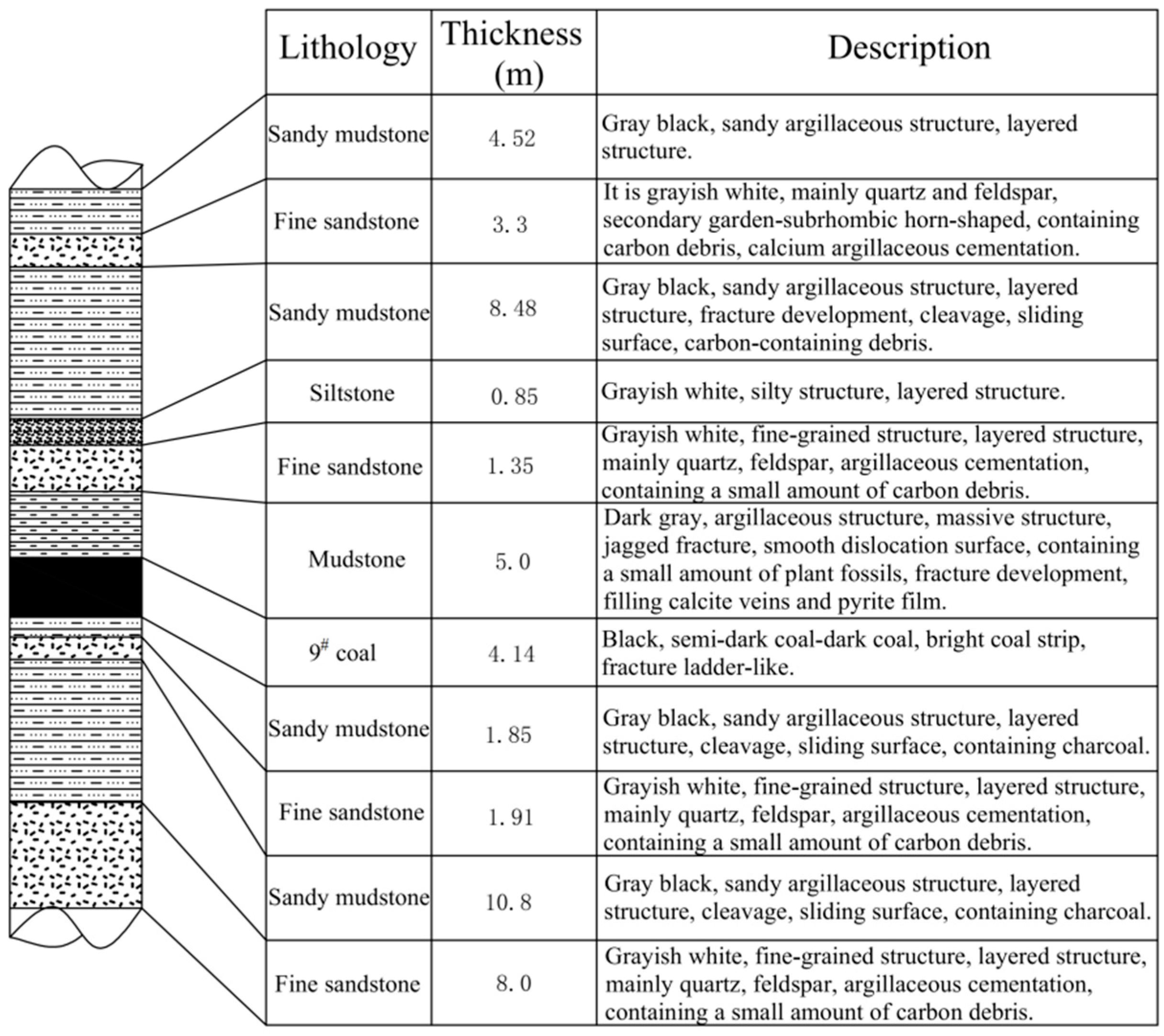
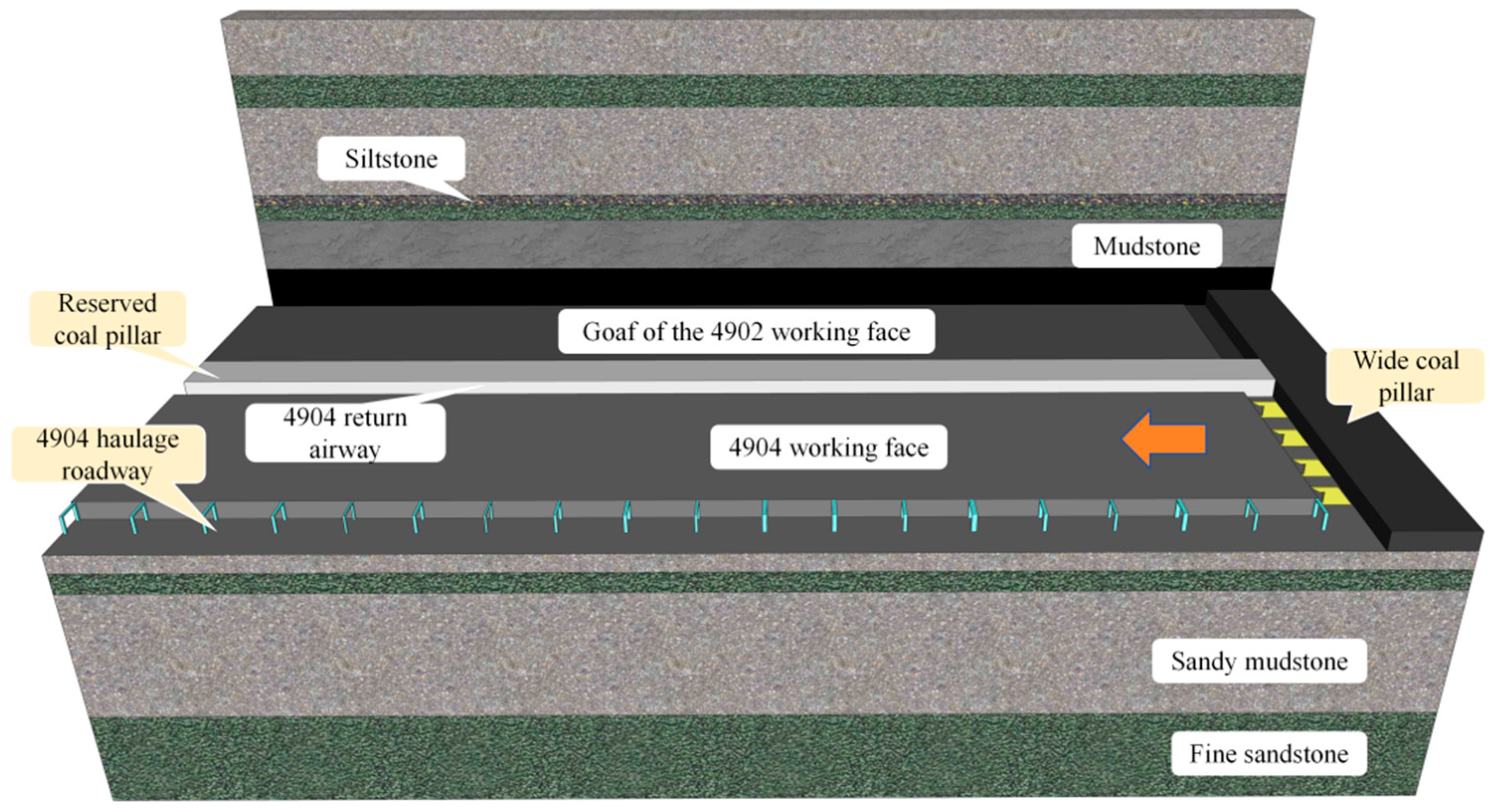
The 4904 return airway was arranged along the roof of the No. 9 coal seam and driven adjacent to the gob side of the 4902 working face. The roadway section is rectangular, with a width of 5.0 m and a height of 4.2 m. The roof and floor strata of the No. 9 coal seam are mainly composed of mudstone, sandy mudstone, and fine sandstone. In the studied roadway section, the immediate roof is dominated by mudstone with a thickness of approximately 5.0 m, and the basic roof is mainly sandy mudstone. Because the roof lithology is relatively weak and layered, roof separation and local damage may readily develop under excavation unloading and mining disturbance. The floor and both ribs are also susceptible to deformation under the combined influence of roadway excavation and adjacent gob loading. The distributions of the roof and floor strata and the layout of the 4904 working face are shown in
Figure 1 and
Figure 2.
To improve coal recovery while maintaining roadway stability, the protective pillar width for gob-side entry driving must be determined rationally. In similar working faces, relatively wide section pillars have often been retained to ensure roadway stability, but this practice results in substantial coal losses. In contrast, if the pillar width is too small, the plastic zones inside the pillar can readily become interconnected, thereby increasing the difficulty of roadway maintenance. It is therefore necessary to determine a rational pillar width for the 4904 working face through combined theoretical calculation and numerical simulation, and subsequently to propose a surrounding-rock control scheme suitable for narrow coal-pillar conditions.
Therefore, the engineering background of this study represents a nearly horizontal thick-seam gob-side entry under medium-to-deep burial conditions, with the roadway arranged adjacent to a previously mined gob. The obtained pillar-width range and support parameters are mainly intended for mining conditions similar to those of the 4904 return airway, rather than as universal parameters for all thick-seam roadways.
3. Determination of Rational Coal-Pillar Width for Gob-Side Entry Driving
To reduce coal loss in the section pillar while ensuring roadway stability, the plastic-zone widths on the gob side and roadway side of the narrow coal pillar were calculated using limit-equilibrium theory based on the geological and mining conditions of the 4904 working face. The calculation provides an initial theoretical basis for determining the rational pillar-width range.
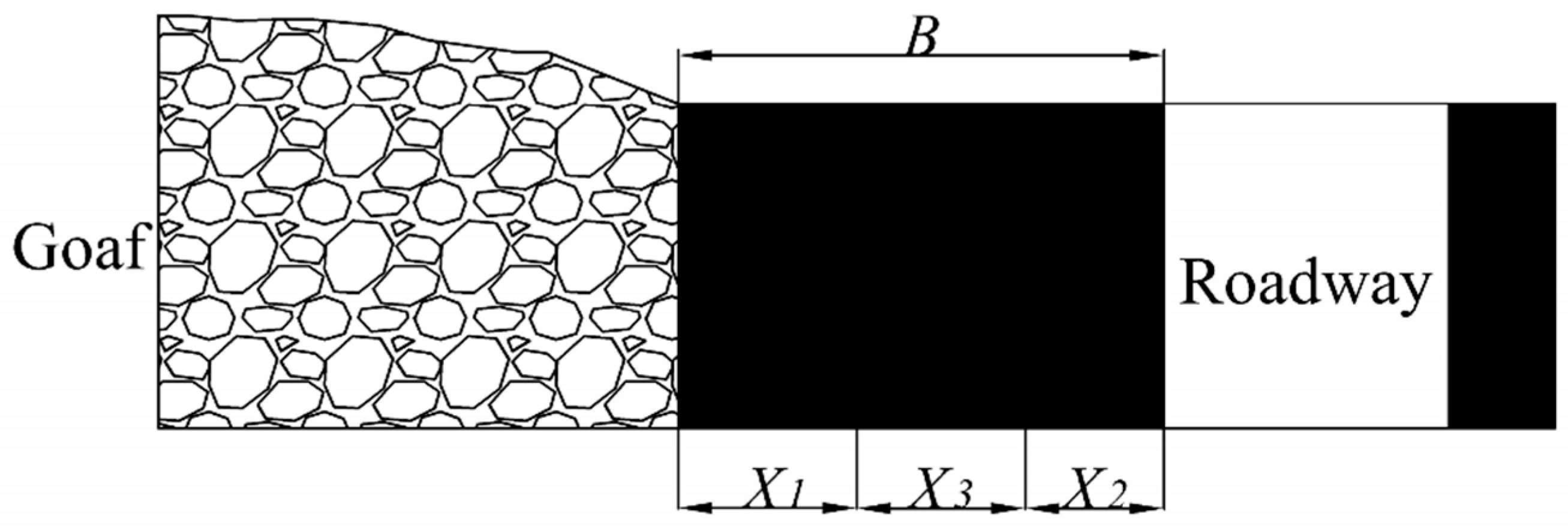
After panel extraction and roadway excavation, the original stress equilibrium within the coal–rock mass is disturbed, and the coal wall may develop a broken zone, a plastic zone, and an elastic zone from shallow to deep positions. According to the loading and failure characteristics of the narrow coal pillar, the protective pillar width was divided into three components: the width of the plastic zone on the gob side, the width of the plastic zone on the roadway side, and the width of the stable load-bearing core in the middle, as shown in
Figure 3. This relationship can be expressed by Equation (1).
Here, B denotes the rational width of the narrow coal pillar (m); X
1 is the width of the plastic zone on the gob side (m); X
2 is the width of the plastic zone on the roadway side (m); and X
3 is the width of the stable load-bearing core in the middle of the pillar, which is expressed as X
3 = α(X
1 + X
2). According to previous studies on narrow coal-pillar stability, α is generally taken as 0.15–0.35 [
19,
20].
The calculation parameters were as follows: mining height M = 4.14 m, roadway height h = 4.2 m, lateral pressure coefficient A = 0.27, internal friction angle of coal φ0 = 28°, stress concentration coefficient K = 3.1, average unit weight of the overlying strata γ = 26.0 kN/m3, burial depth H = 560 m, coal cohesion C0 = 1.3 MPa, and support resistance on the coal rib Px = 0.15 MPa.
Substituting these parameters into the limit-equilibrium expressions yielded a gob-side plastic-zone width of X1 = 2.90 m and a roadway-side plastic-zone width of X2 = 2.95 m. Taking α = 0.15–0.35, the width of the central stable load-bearing core is X3 = 0.88–2.05 m. Accordingly, Equation (1) gives a theoretically narrow coal-pillar width of B = 6.73–7.90 m.
Sensitivity Analysis of Theoretical Calculation Parameters
To further clarify the influence of empirical and mechanical parameters on the theoretical pillar-width calculation, a sensitivity analysis was carried out using the single-factor interval perturbation method. In this analysis, only one parameter was varied within a reasonable range each time, whereas the other parameters were kept unchanged. The analyzed parameters included the stable-core coefficient α, stress concentration coefficient K, lateral pressure coefficient A, coal cohesion C0, internal friction angle φ0, and coal-rib support resistance Px.
Because the width of the stable load-bearing core is expressed as X
3 = α(X
1 + X
2), the value of α directly affects the theoretical pillar width. The calculated results for different α values are listed in
Table 1.
As shown in
Table 1, when α increases from 0.15 to 0.35, the calculated stable-core width increases from 0.88 m to 2.05 m, and the corresponding theoretical pillar width increases from 6.73 m to 7.90 m. The selected 7 m coal pillar corresponds to an α value of approximately 0.20, which lies within the empirical coefficient range. This indicates that the 7 m pillar width is not determined by a single assumed value of α, but falls within the reasonable interval obtained from the sensitivity analysis.
In addition, considering the uncertainty of the stress environment, coal mechanical parameters, and support resistance, a sensitivity analysis was further conducted for K, A, C
0, φ
0, and P
x. The results are shown in
Table 2.
In
Table 2, X
3 and B were calculated using the full empirical range of α = 0.15–0.35. The results indicate that the theoretical pillar width is most sensitive to the lateral pressure coefficient A. This is because A affects both the coefficient outside the logarithmic term and the support-resistance term inside the logarithmic expression. Variations in K, C
0, and φ
0 also influence the calculated width, whereas the influence of P
x is relatively limited within the selected range. Overall, the 7 m pillar width remains within the calculated theoretical ranges under different parameter perturbations. Combined with the subsequent numerical simulation results, in which a relatively complete load-bearing core begins to form at a pillar width of 7 m and the deformation reduction becomes limited when the width further increases, the selection of a 7 m pillar is considered reasonable for the 4904 return airway.
Overall, although the theoretical calculation results are affected by the stress environment, coal mechanical parameters, and rib support resistance, the 7 m pillar width remains within the calculated theoretical ranges under different parameter perturbations. Therefore, the theoretical calculation provides a reasonable preliminary range for narrow coal-pillar width selection. Considering the simplified assumptions of the limit-equilibrium method, numerical simulations with different pillar widths were further conducted to verify the rationality of the 7 m pillar from the perspectives of plastic-zone development, stress distribution, surrounding-rock deformation, and coal recovery.
4. Response of Surrounding Rock Under Different Coal-Pillar Widths
4.1. Numerical Model
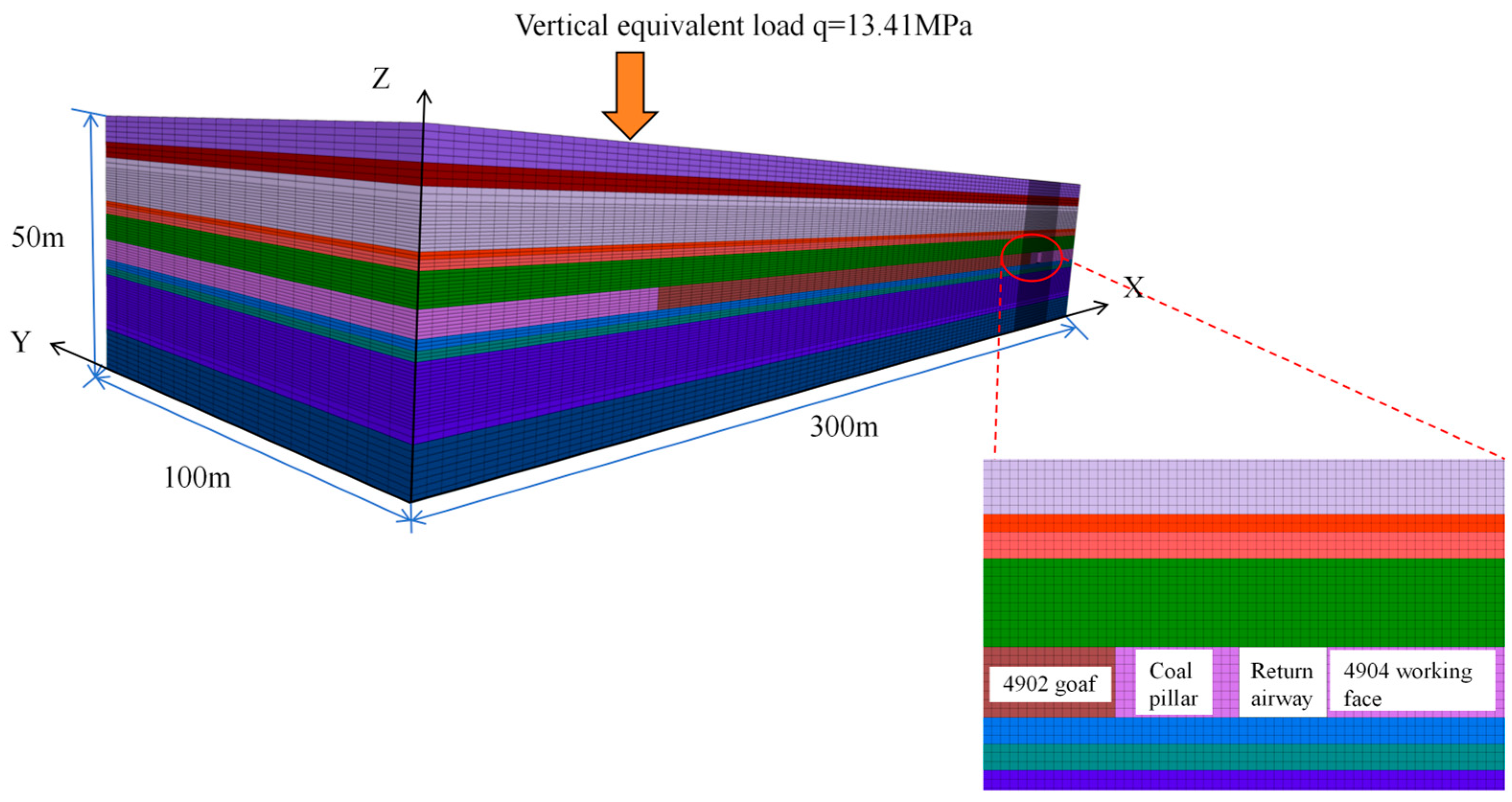
To further verify the theoretical results and analyze the stress, plastic zone, and displacement responses of the surrounding rock under different coal-pillar widths, a three-dimensional FLAC3D numerical model was established according to the geological conditions of the 4904 working face. Coal-pillar widths of 3 m, 5 m, 7 m, 9 m, and 11 m were compared. The model dimensions were 300 m × 100 m × 50 m. Boundary protection zones of 50 m were reserved on both sides, displacement constraints were applied to the four lateral boundaries and the bottom, and a vertical equivalent load q of 13.41 MPa was applied at the top boundary to simulate the self-weight of the overlying strata that were not explicitly modeled. The load was calculated as q = γHe, where γ is the average unit weight of the overlying strata, and He is the equivalent thickness of the strata above the model boundary. With γ = 26.0 kN/m
3 and He = 515.8 m, q = 26.0 × 515.8 kN/m
2 = 13.41 MPa. The roadway cross-section was 5.0 m × 4.2 m, and the coal–rock mass was represented using the Mohr–Coulomb constitutive model. The numerical model is shown in
Figure 4.
The physical and mechanical parameters of the roof and floor strata of the No. 9 coal seam are listed in
Table 3. These parameters were assigned to the corresponding coal and rock strata in the numerical model.
Because compacted caved gangue in the gob still retains a certain load-bearing capacity, the gob was not simplified as an empty excavation zone. Instead, it was represented as an equivalent compacted medium with residual load-bearing capacity. The gob was simulated using a double-yield model to characterize the influence of gangue compaction on overburden load transfer and on lateral loading of the narrow coal pillar [
21].
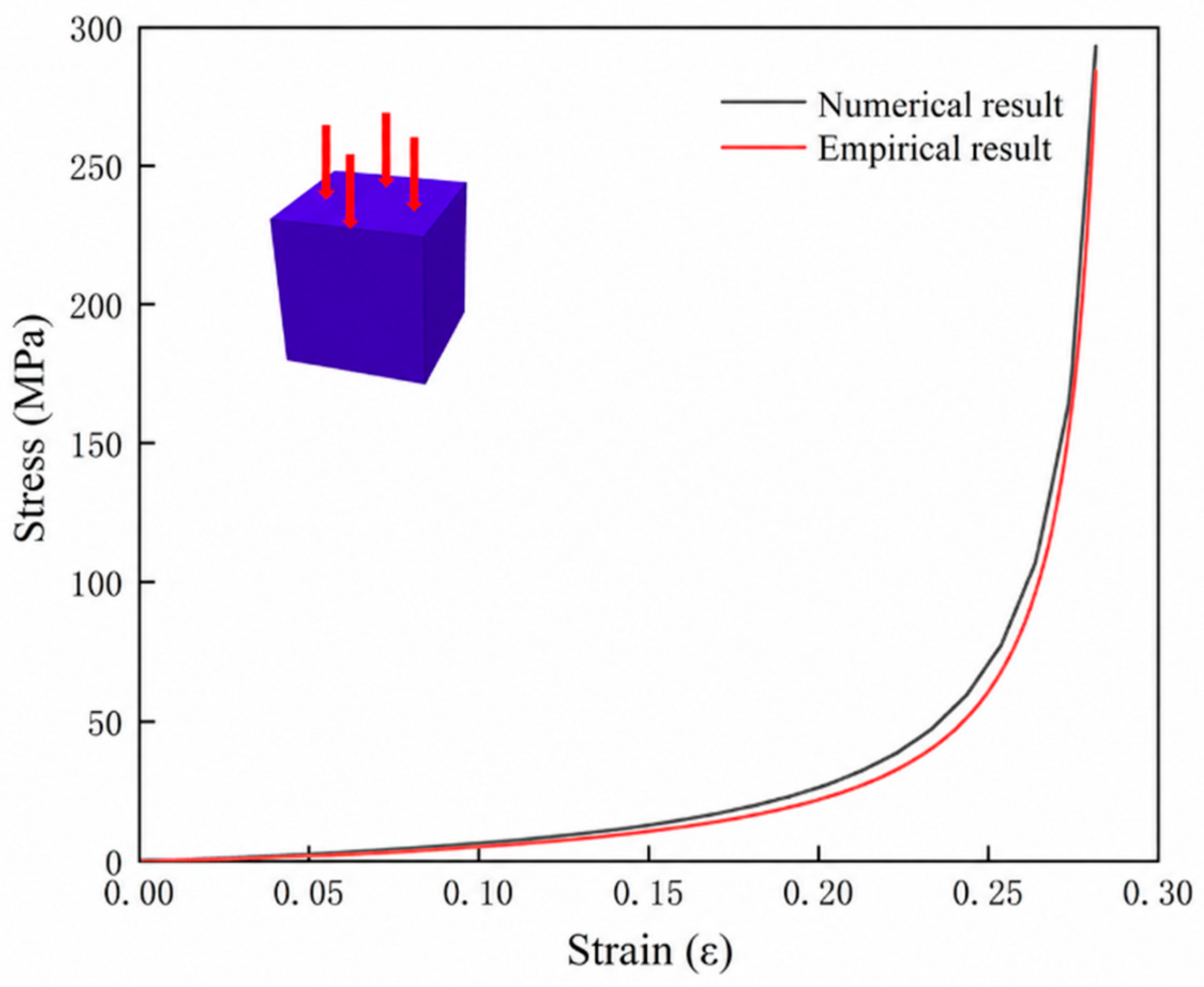
To determine the equivalent material parameters of the gob, the stress–strain relationship during gangue compaction was first calculated using the empirical formula proposed by Salamon. Then, the parameters of the double-yield gob material were calibrated using a standard numerical uniaxial compression model measuring 1 m × 1 m × 1 m. During the calibration process, the input parameters were adjusted until the simulated compaction response was generally consistent with the target stress–strain relationship of the compacted gob. The comparison between the numerical compression curve and the empirical curve is shown in
Figure 5.
As shown in
Figure 5, the numerical compression curve is generally consistent with the empirical curve, indicating that the calibrated double-yield parameters can reasonably reproduce the nonlinear compaction behavior of caved gangue. The calibrated parameters of the double-yield gob material are listed in
Table 4.
It should be emphasized that the bulk modulus, shear modulus, dilation angle, and friction angle listed for the gob material in
Table 4 are equivalent input parameters for the double-yield model after calibration, rather than intrinsic mechanical parameters of intact coal or rock. These parameters were used to reproduce the compaction behavior of caved gangue and the load-bearing effect of the gob. When the simulated stress–strain response is properly matched, different parameter combinations may produce similar gob compression behavior [
21]. Therefore, the gob parameters listed in
Table 4 should be understood as calibrated equivalent parameters for the double-yield model.
Because this study focuses on the relative differences in surrounding-rock response under different pillar widths, all schemes were analyzed using the same gob parameters, boundary conditions, constitutive parameters, and excavation procedures. This ensures the comparability of the numerical results among different pillar-width schemes. The numerical model was mainly used to compare the relative responses of different schemes, rather than to provide an independent absolute prediction of gob compaction or long-term creep deformation.
4.2. Stress Evolution and Failure Characteristics of the Surrounding Rock
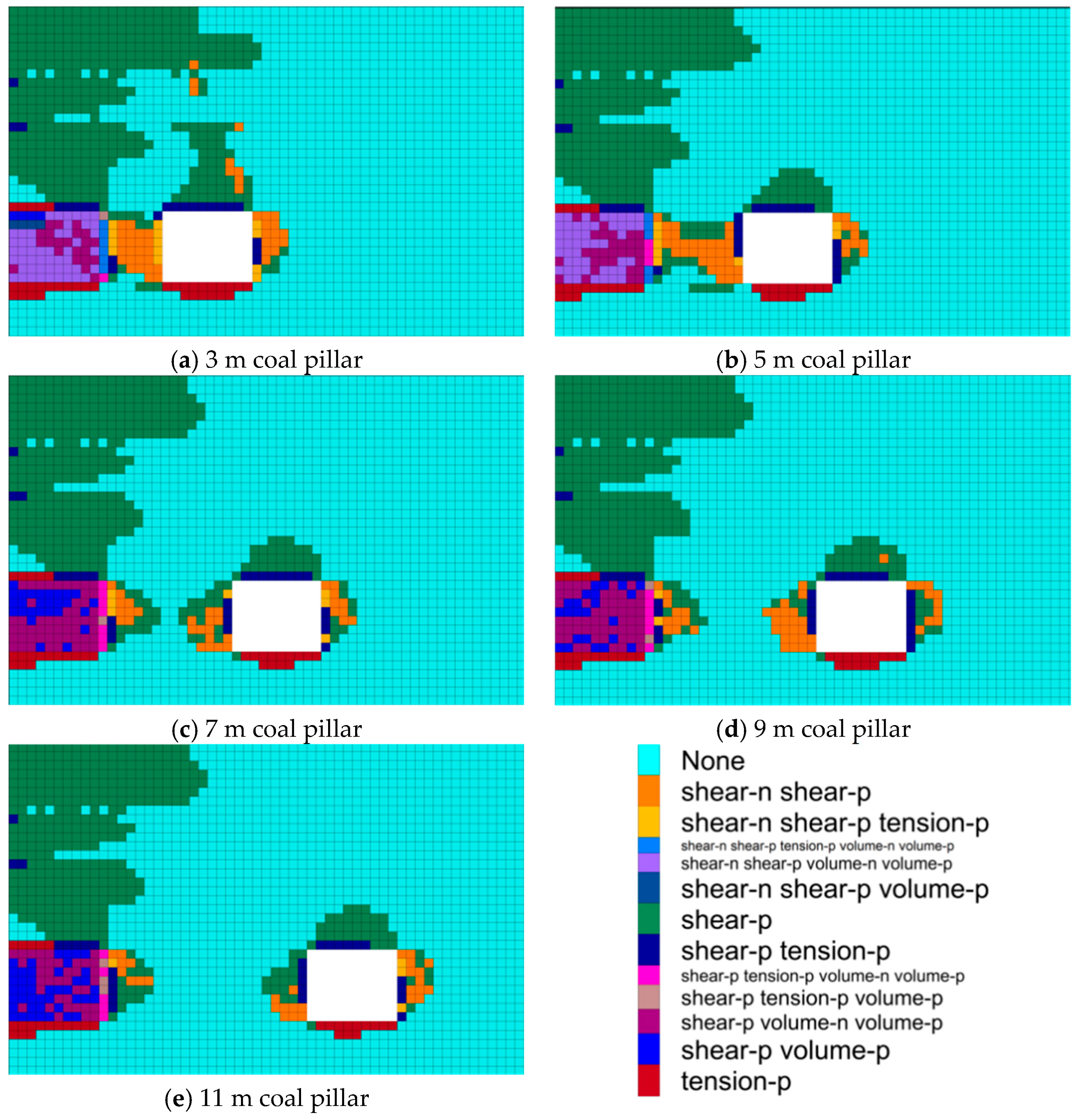
The pillar width has a direct effect on the plastic failure characteristics of the surrounding rock in gob-side entry driving [
22,
23], as shown in
Figure 6. For the 3 m and 5 m pillar schemes, the plastic zone occupies a large proportion of the pillar, reaching 91.67% and 80.00% of the pillar volume, respectively. In these cases, the pillar is dominated by plastic damage, and the shallow and middle parts of the pillar tend to develop into a connected failure zone. Therefore, such narrow pillars are unable to form a continuous internal load-bearing structure. When the pillar width increases to 7 m, the plastic-zone proportion decreases to 59.82%, and an elastic core begins to appear in the middle of the pillar, suggesting that the bearing integrity of the pillar is significantly improved. With further increases in pillar width to 9 m and 11 m, the plastic-zone proportion continues to decline, but the improvement relative to the 7 m scheme becomes less critical for maintaining the basic load-bearing structure.
As shown in
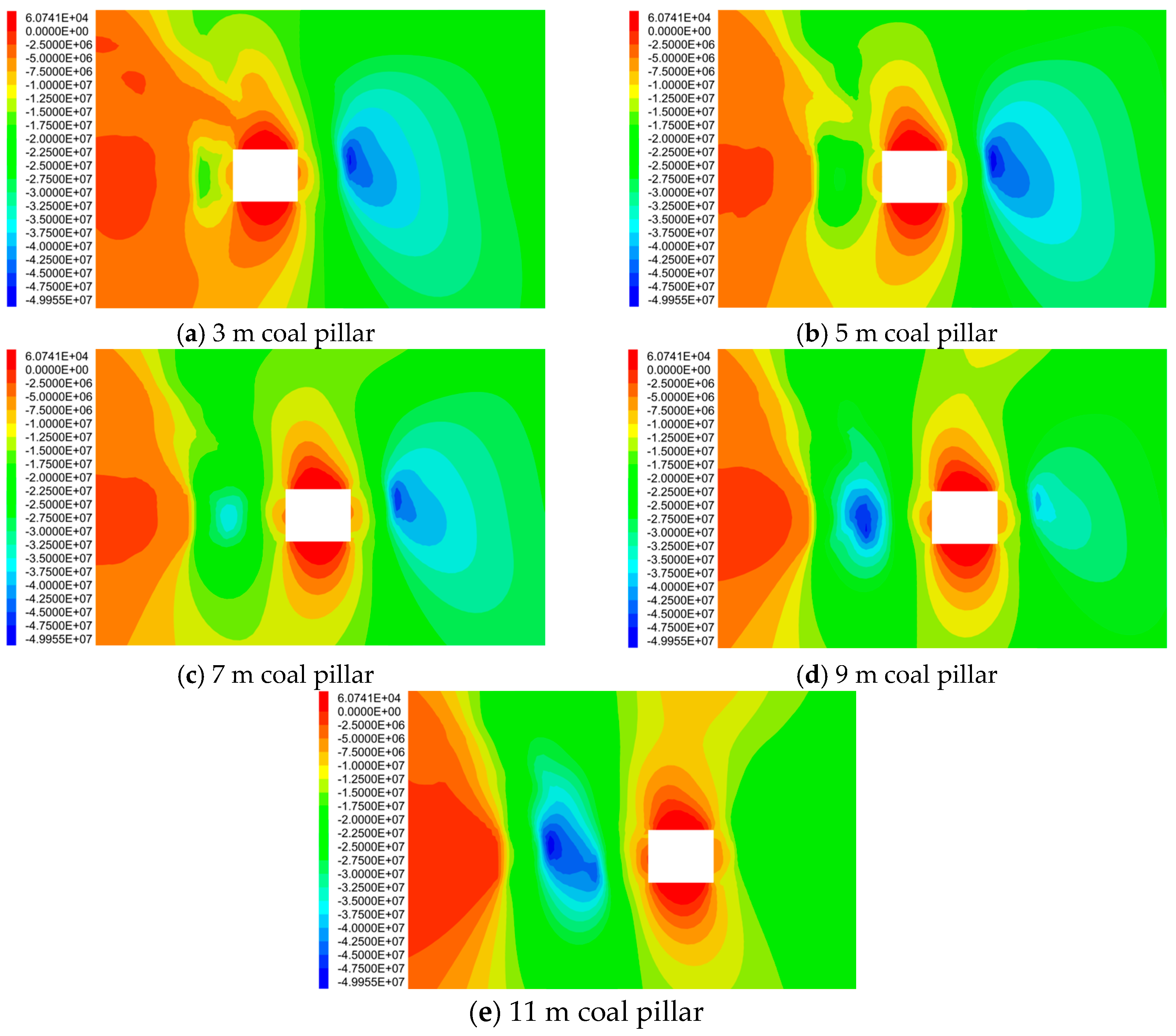
Figure 7, the vertical stress distribution of the surrounding rock changes significantly with coal-pillar width. When the coal-pillar width is 3 m or 5 m, local stress concentration occurs inside the pillar, but the stress peak is mainly located in the shallow part of the pillar and close to the roadway side. Under these conditions, the internal bearing structure of the pillar has not yet been fully developed, and the pillar is easily affected by the interaction between the gob-side plastic zone and the roadway-side plastic zone. Therefore, excessively narrow pillars cannot provide a stable and continuous load-bearing zone for roadway protection. When the coal-pillar width increases to 7 m, the peak vertical stress inside the pillar reaches approximately 41 MPa, and the peak position shifts inward toward the central part of the pillar. This distribution corresponds well to the formation position of the central load-bearing core, indicating that the pillar begins to develop a relatively coordinated bearing state. When the pillar width further increases to 9 m and 11 m, the stress concentration zone continues to expand, and the high-vertical-stress influence range becomes wider. Although wider pillars can improve pillar integrity to some extent, they also enlarge the stress concentration range and increase coal loss. Therefore, considering the formation of the central load-bearing core, the stress-peak position, the stress concentration range, and the requirement of resource recovery, the 7 m coal-pillar width provides a more reasonable balance for the 4904 return airway.
4.3. Deformation Law of the Surrounding Rock
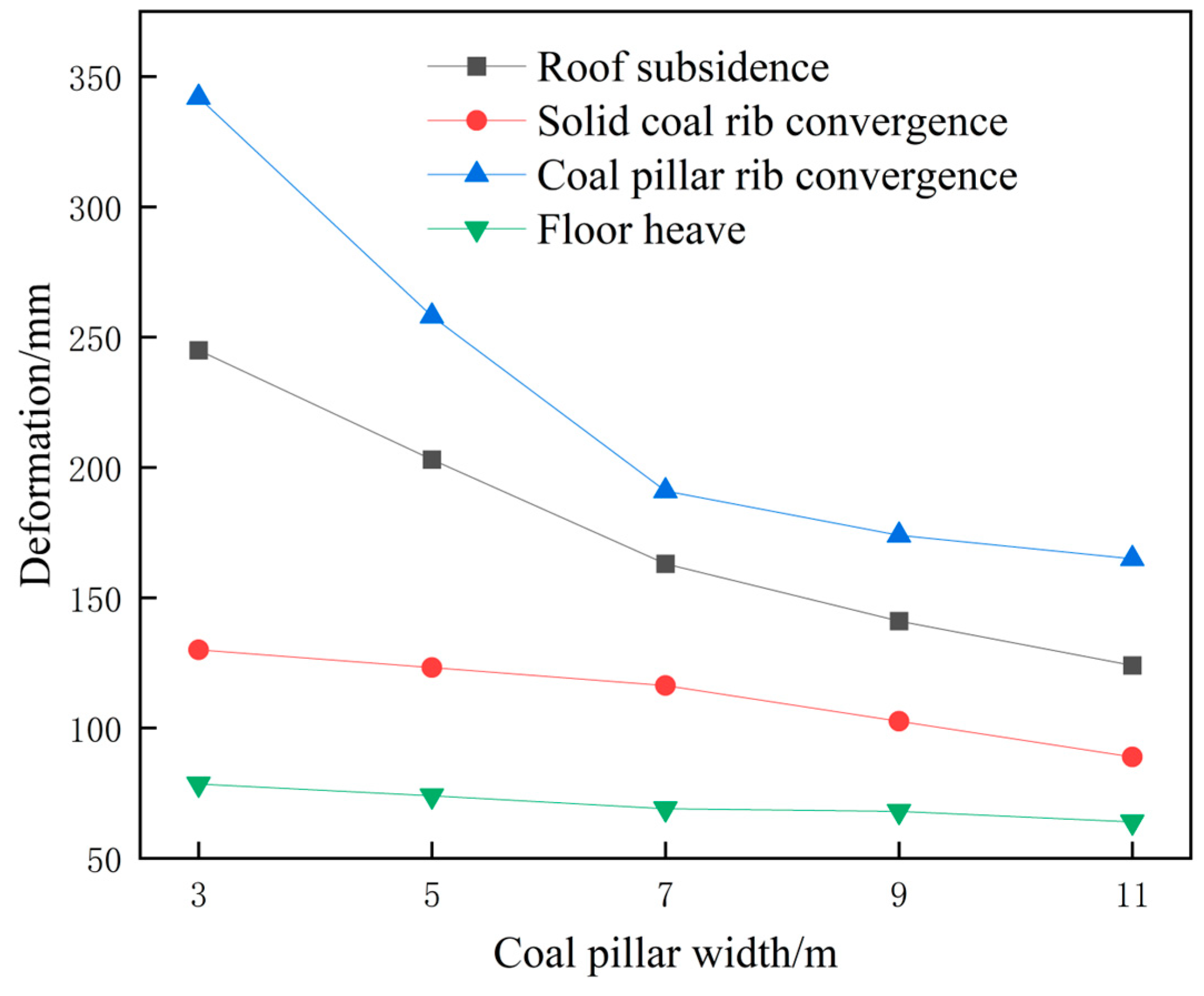
The curves of maximum surrounding-rock deformation under different coal-pillar widths are shown in
Figure 8. As the pillar width increases, roof subsidence, floor heave, solid-coal-rib convergence, and pillar-rib convergence all decrease overall, although the magnitude of reduction differs among the various components. Pillar-rib convergence is the most sensitive to changes in pillar width, followed by roof subsidence, whereas solid-coal-rib convergence and floor heave are relatively smaller. These results indicate that the pillar rib and the roof are the key positions requiring control in gob-side entry driving and are the most directly affected by changes in pillar width.
4.4. Coal Recovery Analysis Under Different Pillar Widths
To further quantify the coal recovery benefit of the selected pillar width, the additional coal loss caused by increasing the pillar width was estimated. Taking the 7 m pillar as the reference scheme, the additional coal loss for wider pillars can be calculated as follows:
where
Q is the additional coal loss compared with the 7 m pillar, t; Δ
B is the increased pillar width compared with 7 m, m;
L is the strike length of the working face, taken as 670 m;
M is the average coal seam thickness, taken as 4.14 m; and
ρ is the coal density, taken as 1639 kg/m
3. The calculated results are listed in
Table 5.
When the coal-pillar width increases from 3 m to 7 m, the deformation indices of the roadway surrounding rock decrease markedly, with pillar-rib convergence and roof subsidence reduced by 44.15% and 33.47%, respectively. As the pillar width further increases from 7 m to 9 m and 11 m, the deformation indices continue to decrease, but the rate of reduction becomes much gentler. This indicates that the improvement in deformation control tends to level off after the pillar width exceeds 7 m.
As shown in
Table 5, compared with the 7 m pillar scheme, the 9 m and 11 m pillar schemes would cause additional coal losses of approximately 9.09 × 10
3 t and 1.82 × 10
4 t, respectively, under the studied working-face conditions. Although increasing the pillar width can further reduce roadway deformation to some extent, the displacement reduction becomes less pronounced after the pillar width exceeds 7 m, while the additional coal loss increases with pillar width. Therefore, considering the formation of the stable load-bearing core, surrounding-rock deformation control, stress concentration characteristics, and coal recovery, the 7 m coal pillar provides a more reasonable balance between roadway stability and resource recovery.
5. Numerical Analysis of Support for Gob-Side Entry Driving
The numerical simulation results show that a 7 m coal pillar can form a relatively complete load-bearing structure. However, owing to lateral abutment pressure from the gob and excavation-induced disturbance, the surrounding rock still exhibits plastic failure and asymmetric deformation. Therefore, comparative simulations of different support schemes were conducted under the 7 m pillar condition to evaluate the control effect of hierarchical synergistic support on plastic-zone development and surrounding-rock displacement, and to provide a basis for field support design.
5.1. Mechanism of Hierarchical Support and Design of Scheme Parameters
Under the combined influence of a thick roof and strong mining disturbance, the shallow surrounding rock of the roadway is susceptible to fracturing; the deeper roof strata may experience separation; and the pillar rib tends to exhibit asymmetric deformation. A support system with only one anchorage level is generally insufficient to simultaneously restrain shallow fractured rock and anchor the support structure into deeper stable strata. Gao et al. indicated that the layered arrangement of bolts, short cables, and long cables can promote the formation of a stepped three-dimensional support structure in the roof [
17], while Zhou et al. demonstrated the applicability of staged three-dimensional support in large-section roadways with fractured surrounding rock [
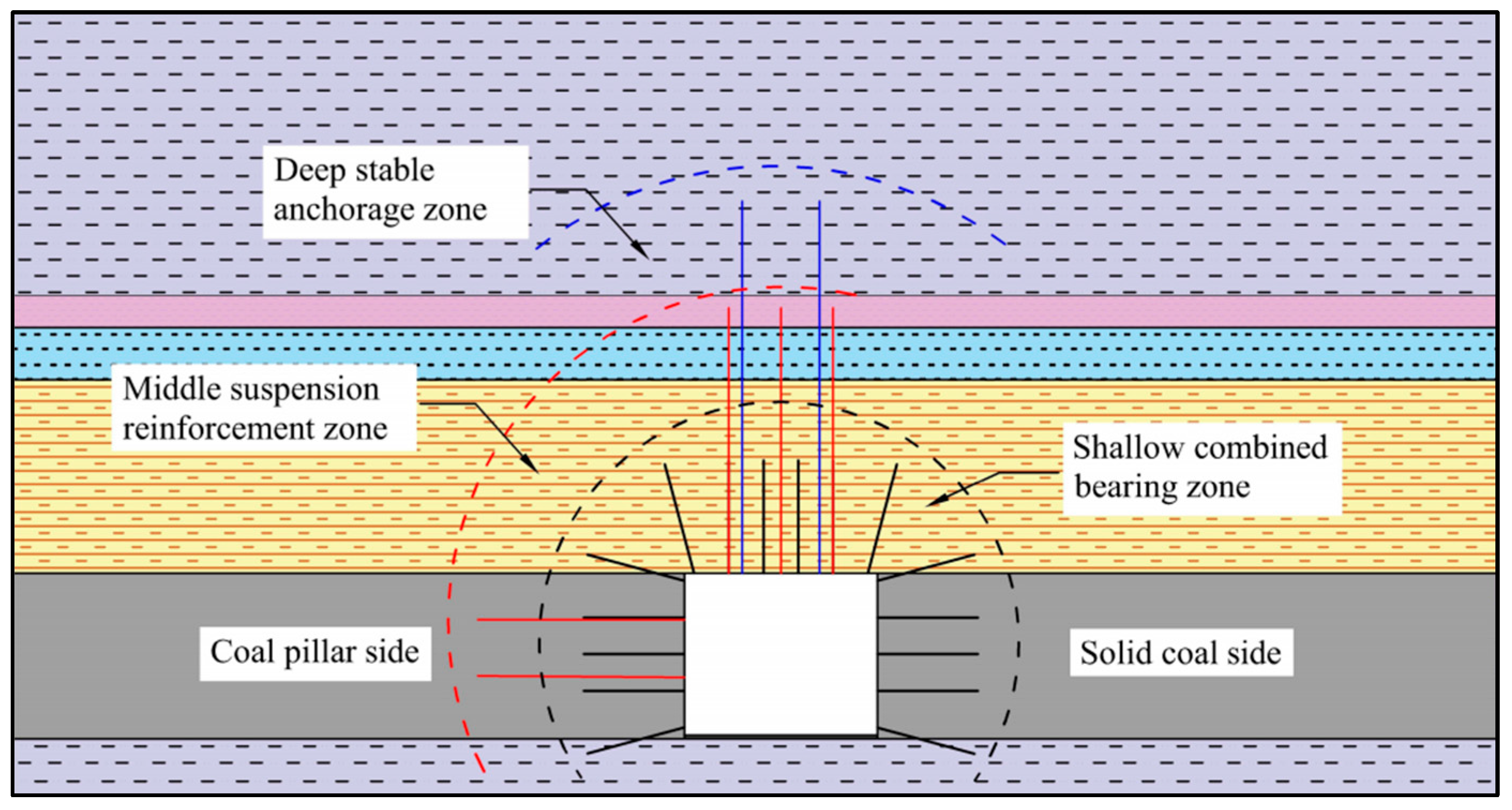
18]. Considering the roof-separation behavior and fractured deformation of the pillar rib in the 4904 return airway, a layered collaborative control concept was adopted in the roof support design. Accordingly, a three-level hierarchical support mode was formed, consisting of a shallow combined load-bearing zone, a middle suspension-and-reinforcement zone, and a deep stable anchorage zone, as shown in
Figure 9.
To provide a practical baseline for evaluating the proposed hierarchical roof-cable arrangement, an equal-length roof-cable-plus-bolt scheme was selected as a conventional pre-optimization engineering comparator. This scheme represents a single-level roof-cable anchorage arrangement, in which all roof cables have the same anchorage length. It was not treated as a universal industry standard but was used as a baseline scheme to examine whether changing the roof-cable arrangement from uniform-depth anchorage to hierarchical long–short anchorage could improve surrounding-rock control under the same basic engineering conditions.
Based on the support mechanism shown in
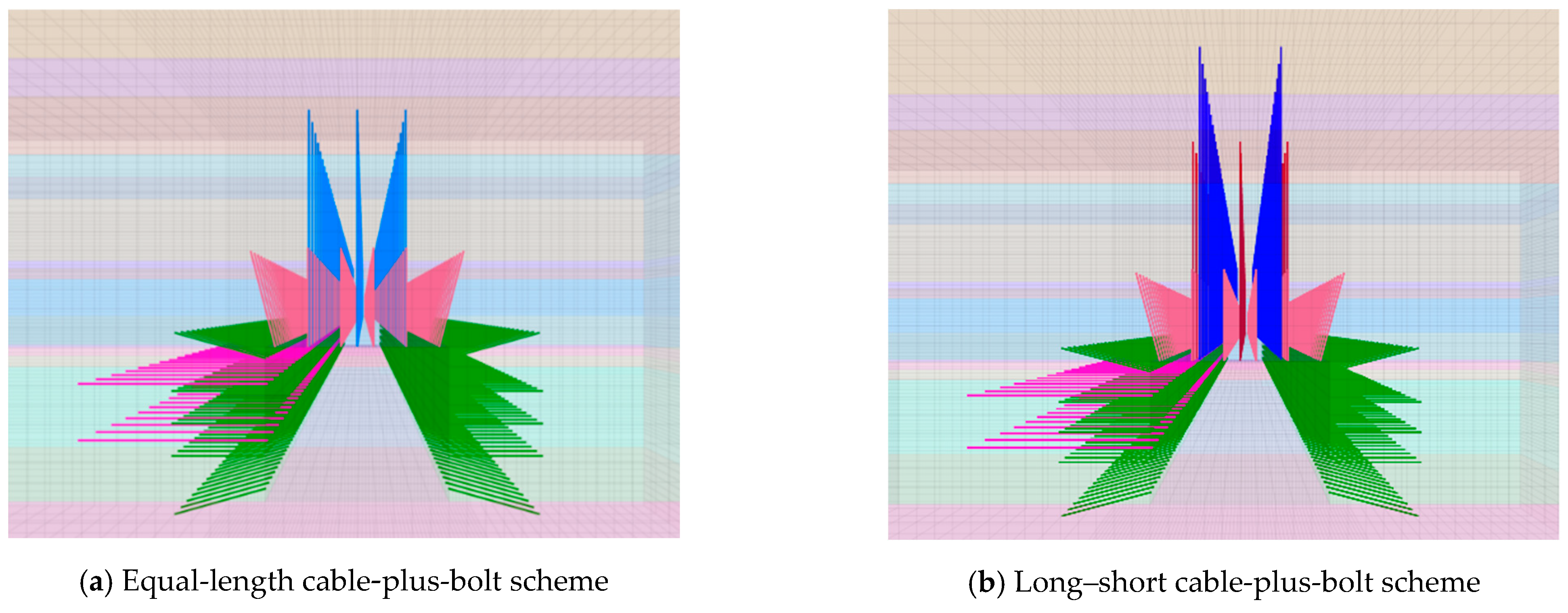
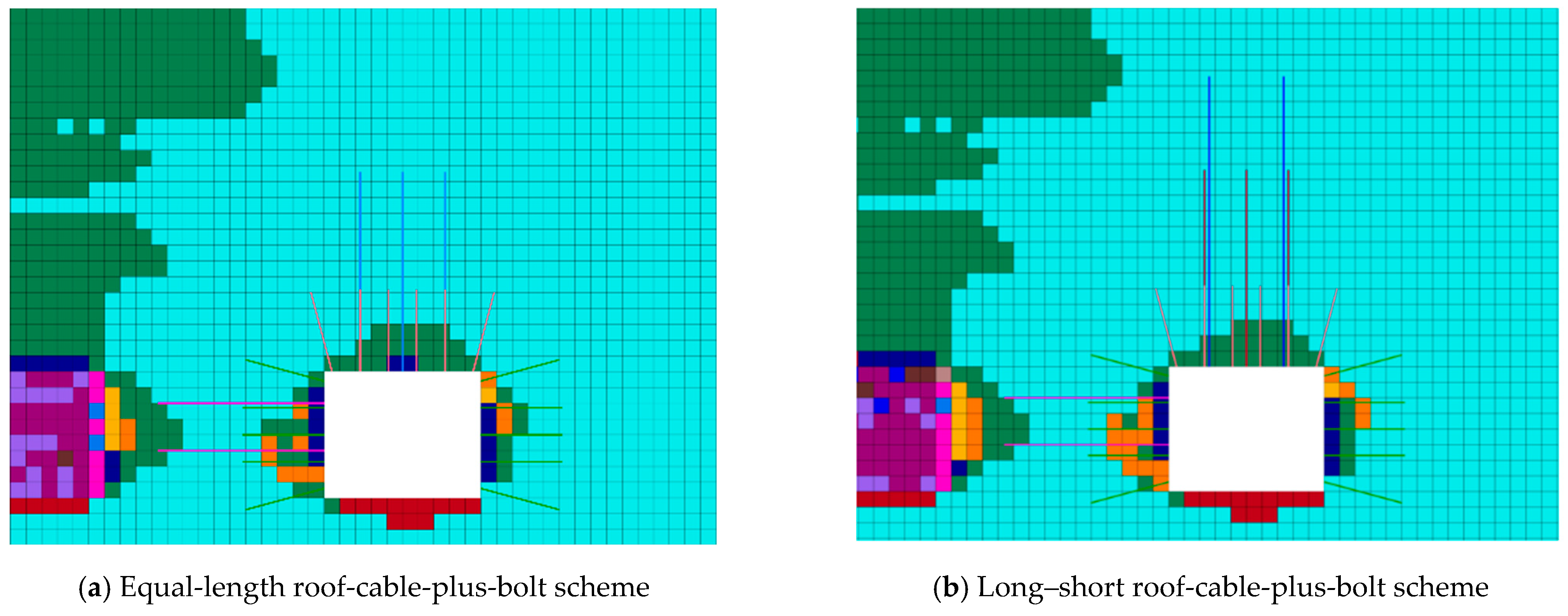
Figure 9, two numerical schemes were established to evaluate the influence of the roof-cable configuration on the control effect of the roadway surrounding rock. To ensure the comparability of the two schemes, the roadway geometry, coal-pillar width, boundary conditions, excavation sequence, bolt parameters, and reinforcement cables on the coal-pillar side were kept identical. The main difference between the two schemes was the roof-cable arrangement. In the equal-length roof-cable-plus-bolt scheme, three roof cables with the same length of 6.3 m were adopted. In the long–short roof-cable-plus-bolt scheme, one 9.3 m long cable and two 6.3 m short cables were adopted to form a hierarchical reinforcement structure in the roof. Therefore, the comparative simulation was designed to evaluate the influence of the roof-cable length arrangement under the same basic bolt and coal-pillar-rib reinforcement conditions. The layout of the support members is shown in
Figure 10, and the main parameters are listed in
Table 6.
In the numerical simulation, cable elements were used to represent both bolts and cables, and the calculation followed the sequence of “excavation–equilibrium–support–re-equilibrium”. The roof bolts, rib bolts, and coal-pillar-side reinforcement cables were assigned the same parameters in both schemes. Structural components such as steel straps, beams, and mesh were not modeled separately; their reinforcing effects were represented by the combined constraint provided by the bolts and cables. By keeping the rib reinforcement unchanged, the comparison was designed to isolate the effect of the roof-cable configuration on roof deformation, pillar-rib convergence, and the overall stability of the surrounding rock.
5.2. Comparison of Control Effects Under Different Support Schemes
Figure 11 compares the plastic-zone distributions of the roadway surrounding rock under different support schemes. Under the equal-length cable-plus-bolt condition, local plastic zones in the roof and along the pillar-rib side remain relatively developed, and the damaged area above the coal pillar shows a tendency toward interconnection, indicating that the equal-length cable arrangement is insufficiently adaptable to the deformation differences between shallow and deep surrounding rock. Under the long–short cable-plus-bolt condition, the long roof cables connect the shallow loosened rock with the deeper relatively stable strata; the short cables mainly restrain deformation of the shallow-to-middle surrounding rock, and the reinforcement cables on the pillar-rib side provide additional confinement to the fractured rock mass. As a result, the plastic zone is clearly reduced, and the tendency toward interconnected local damage in the roof and on the pillar-rib side is effectively suppressed.
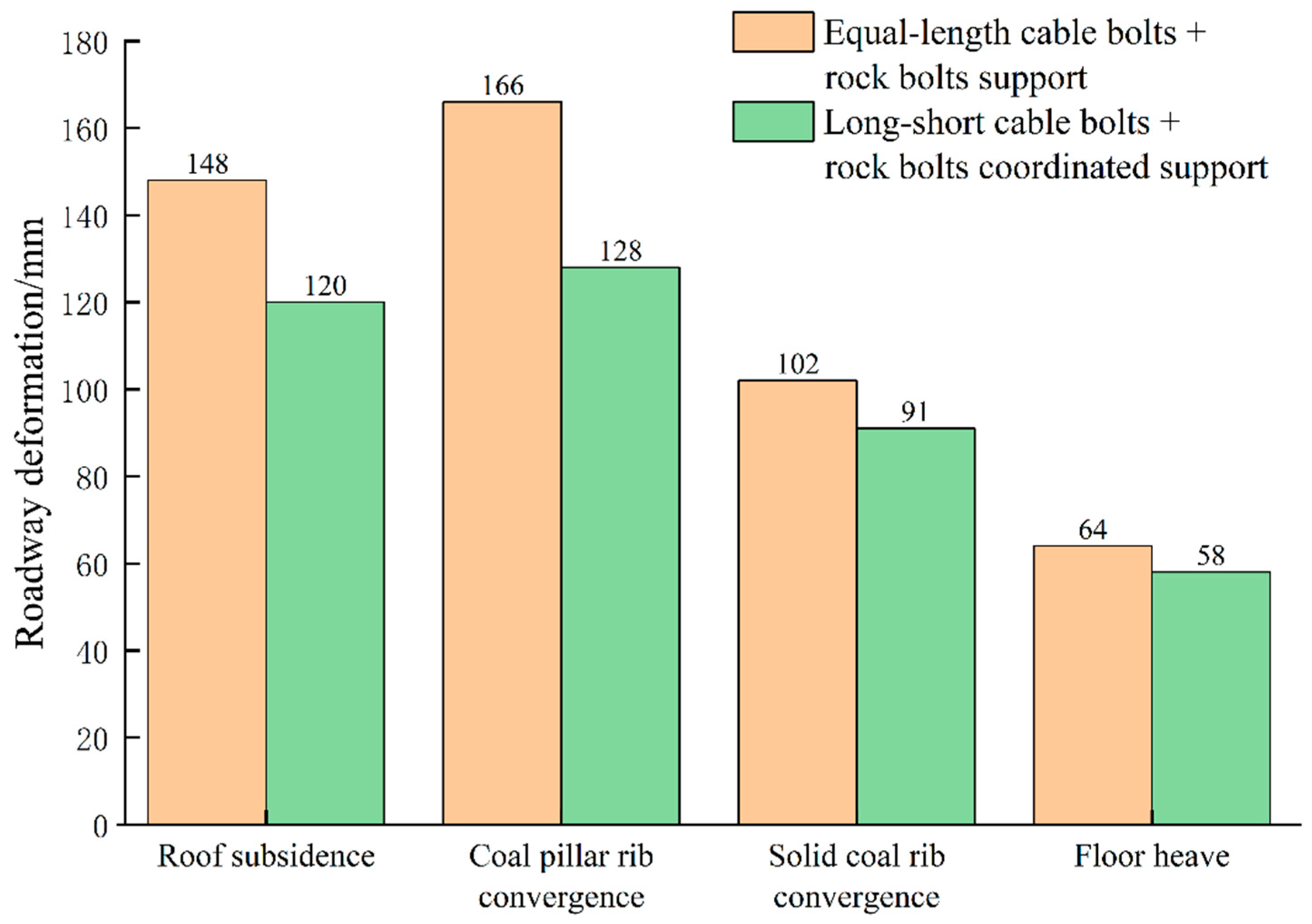
The maximum displacements of the roadway surrounding rock under different support schemes are summarized in
Figure 12. Compared with the equal-length cable-plus-bolt scheme, the long–short cable-plus-bolt scheme reduced roof subsidence from 148 mm to 120 mm, solid-coal-rib convergence from 102 mm to 91 mm, pillar-rib convergence from 166 mm to 128 mm, and floor heave from 64 mm to 58 mm, corresponding to decreases of 18.9%, 10.8%, 22.9%, and 9.4%, respectively. The reduction was more pronounced in pillar-rib convergence and roof subsidence, indicating that the optimized support configuration was more effective in controlling deformation of the gob-side rib and the roof.
As indicated by
Figure 11 and
Figure 12, under the same bolt and coal-pillar-side reinforcement conditions, the long–short roof-cable-plus-bolt scheme showed better control of plastic-zone development and roadway deformation than the equal-length roof-cable-plus-bolt scheme. The bolts mainly restrained the shallow fractured surrounding rock, the short cables reinforced the shallow-to-middle roof, and the long cable connected the shallow-to-middle load-bearing structure with deeper stable strata. Since the coal-pillar-side reinforcement cables were kept unchanged in the two schemes, the improved control effect mainly reflects the advantage of the hierarchical long–short roof-cable arrangement. These results indicate that the long–short roof-cable-plus-bolt scheme is more suitable for controlling roof deformation and gob-side rib instability under the 7 m narrow coal-pillar condition of the 4904 return airway.
6. Engineering Application and Field Monitoring
According to the theoretical calculation of pillar width, the numerical comparison of different pillar-width schemes, and the evaluation of the support schemes, the 7 m narrow coal pillar and the hierarchical synergistic support mode were finally implemented in the 4904 return airway. In order to evaluate the field applicability and deformation-control performance of the proposed scheme, continuous monitoring of roadway surface displacement was carried out after support installation. The field monitoring results were then combined with the observed roadway stability to assess whether the surrounding-rock deformation could be effectively controlled under the adopted support conditions. The detailed field support layout is shown in
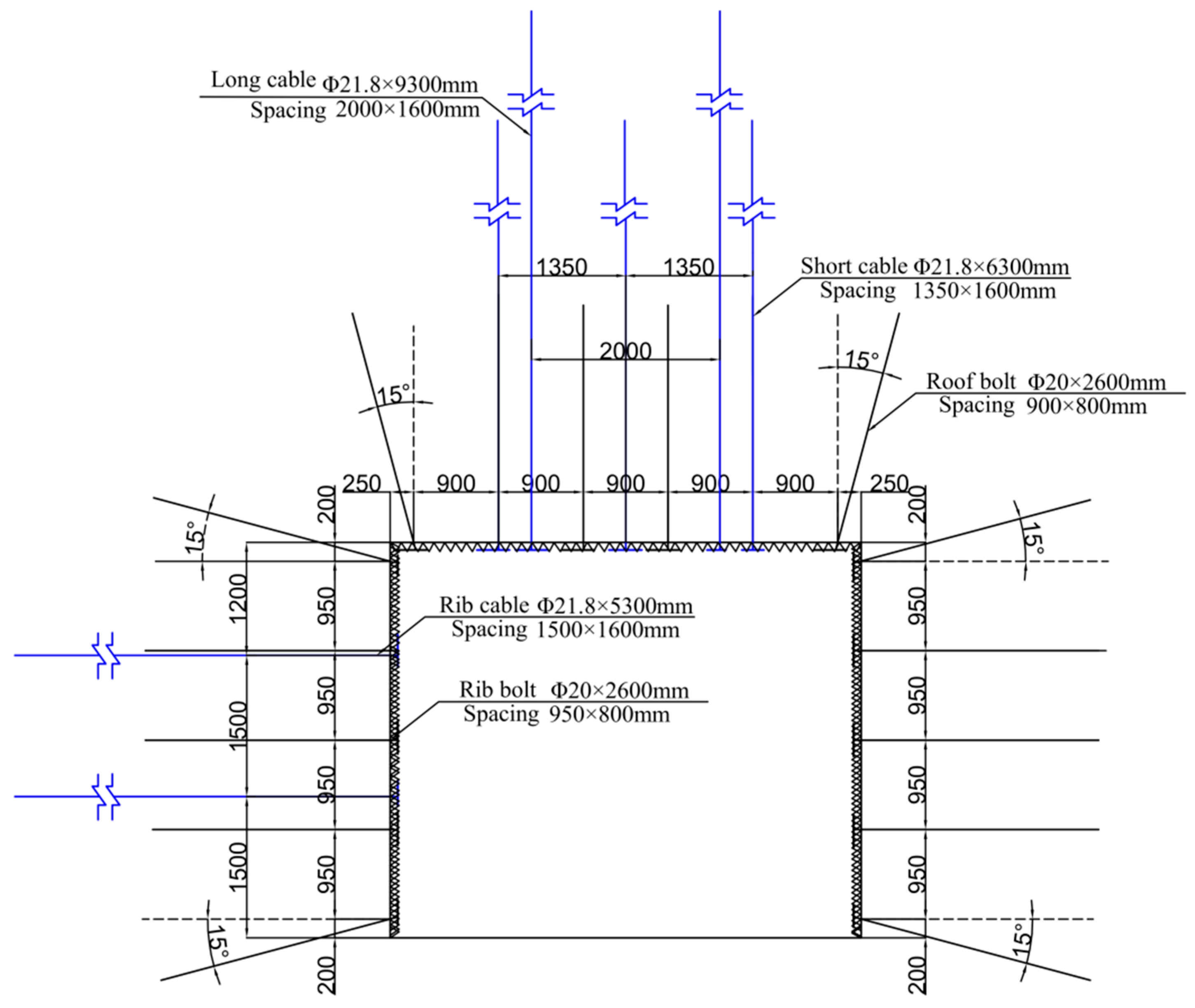
Figure 13.
For the roof, a combined support system composed of high-strength bolts, welded steel mesh, steel beams, and long–short roof cables was adopted. The roof bolts had a specification of Φ20 mm × 2600 mm, with a spacing of 900 mm × 800 mm, and six bolts were arranged in each row. Among them, the two bolts adjacent to the roadway ribs were placed 250 mm from the ribs and installed at an inclination of 15° relative to the normal direction of the roof, while the other bolts were installed vertically to the roof. Welded steel mesh was laid on the roof, with a bar diameter of Φ6 mm, a mesh size of 100 mm × 100 mm, and a single sheet size of 2500 mm × 1000 mm. Steel beams with a size of 4800 mm × 80 mm were also installed to connect the roof support members and enhance the integrity of the shallow roof support structure. To improve the reinforcement effect in the middle and deep roof strata, long and short cables were arranged in combination. The short roof cables were Φ21.8 mm × 6300 mm, with a spacing of 1350 mm × 1600 mm, whereas the long roof cables were Φ21.8 mm × 9300 mm, with a spacing of 2000 mm × 1600 mm. Both the long and short cables were installed perpendicular to the roof, forming an overall “3-2-3” arrangement, which was intended to strengthen the coordinated control of the shallow, middle, and deep roof strata.
For the roadway ribs, high-strength rib bolts, diamond mesh, and steel beams were used as the basic support components on both sides. The rib bolts were Φ20 mm × 2600 mm, with a spacing of 950 mm × 800 mm. The lowest anchorage position was arranged 200 mm above the floor, and five bolts were installed in each row on each rib. The two bolts near the roof and floor were installed at an inclination of 15° relative to the normal direction of the rib, whereas the remaining bolts were installed perpendicular to the rib surface. Diamond mesh with a bar diameter of Φ4 mm, a mesh size of 30 mm × 30 mm, and a single sheet size of 2500 mm × 1000 mm was installed on both ribs, together with steel beams measuring 4000 mm × 80 mm. Considering the stronger deformation tendency of the pillar-rib side under the influence of the adjacent gob, reinforcement cables were additionally arranged on the pillar-rib side on the basis of the bolt–mesh–beam support. These pillar-rib reinforcement cables were Φ21.8 mm × 3500 mm, with a spacing of 1500 mm × 1600 mm.
Field monitoring was conducted in two stages to evaluate the engineering applicability of the 7 m narrow coal pillar and the proposed hierarchical synergistic support scheme. Roadway surface displacement was monitored by the cross-section convergence method. Measuring points were arranged at the roof, floor, solid-coal rib, and coal-pillar rib of the roadway section, and the relative displacement between opposite measuring points was recorded to characterize roof subsidence, floor heave, solid-coal-rib convergence, and coal-pillar-rib convergence.
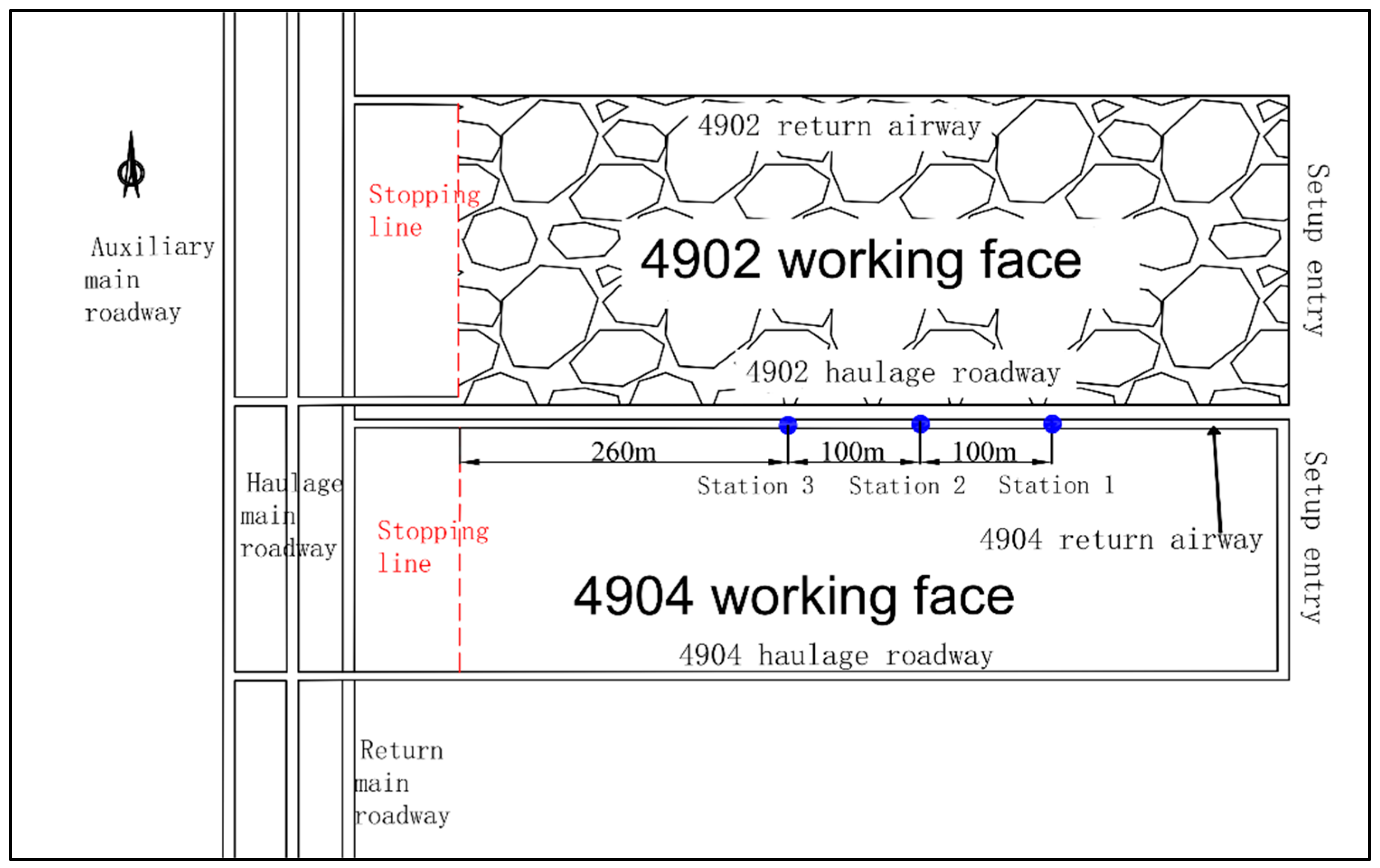
During the excavation and early stabilization stage, a representative monitoring section was selected in a roadway segment with relatively stable geological conditions and consistent support parameters. This section was used to record the early deformation evolution of the roadway after excavation and support installation. During the subsequent mining stage, three monitoring stations were arranged along the 4904 return airway to further evaluate the roadway deformation response as the working face approached, as shown in
Figure 14. Station 3 was located 260 m from the stopping line, and Stations 2 and 1 were arranged successively at intervals of 100 m. The three stations were used to reflect the spatial variation in roadway deformation along the monitored section rather than to represent a single isolated measurement point.
The monitoring data were recorded periodically during the field observation process. For the mining-stage monitoring, the relative distance between the working face and each monitoring station was also recorded, so that the deformation response could be analyzed in relation to the approaching working face. The plotted monitoring curves were obtained by connecting the measured data points in chronological order or according to the face-to-station distance; no mathematical smoothing or curve fitting was applied.
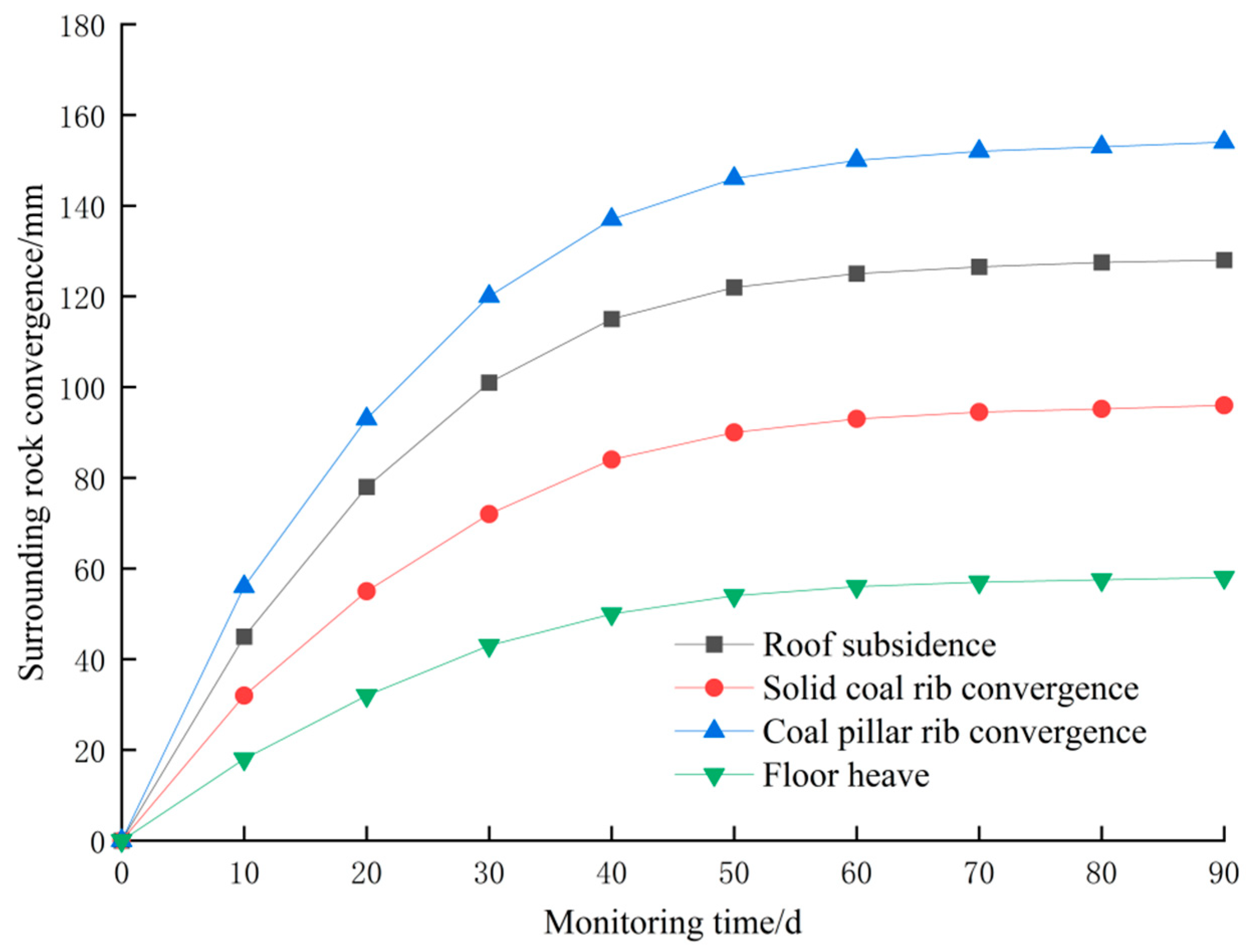
The excavation-stage monitoring results of the representative section are shown in
Figure 15.
During the initial monitoring stage after roadway excavation and support installation, the displacement of the surrounding rock increased relatively rapidly. As the support structure gradually took effect, the displacement growth rate at each monitoring point progressively decreased. After approximately 50 days of monitoring, the deformation curves of the roof, floor, solid-coal rib, and coal-pillar rib tended to level off, indicating that the roadway surrounding rock gradually entered a stable stage after excavation. At 90 d, roof subsidence, solid-coal-rib convergence, coal-pillar-rib convergence, and floor heave were approximately 128 mm, 96 mm, 155 mm, and 58 mm, respectively. The coal-pillar-rib convergence was larger than the solid-coal-rib convergence, indicating an asymmetric deformation pattern in the gob-side entry. This excavation-stage monitoring result was used as representative field evidence for evaluating the early-stage support performance after roadway excavation.
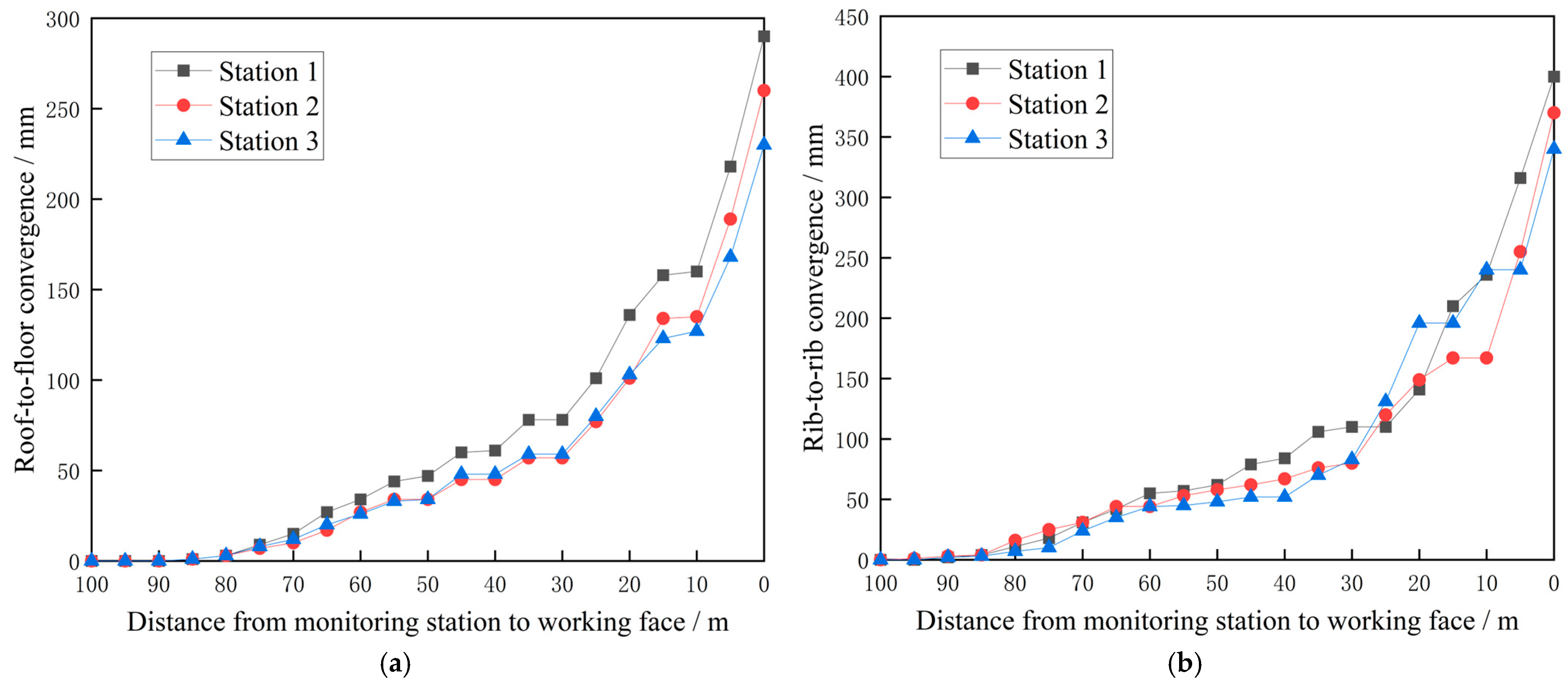
As shown in
Figure 16, the deformation of the roadway surrounding rock increased gradually as the working face approached the monitoring stations. When the face-to-station distance was greater than approximately 80 m, roof-to-floor convergence and rib-to-rib convergence increased slowly, indicating a relatively weak mining influence. As the distance decreased to 80–50 m, the deformation growth rate increased, and when the working face approached within 50 m, both convergence values increased rapidly, indicating that the roadway entered a strong mining-disturbance stage. The three monitoring stations showed generally consistent deformation trends, suggesting that the proposed support scheme maintained a relatively stable control effect along the monitored section. Because the stations were arranged at different roadway positions, the monitoring curves were used to examine spatial consistency rather than being treated as repeated samples for statistical averaging. In addition, rib-to-rib convergence was larger than roof-to-floor convergence, indicating that rib deformation was the dominant deformation mode during mining.
Overall, the excavation-stage monitoring showed that roadway deformation gradually stabilized after support installation, while the mining-stage monitoring showed a significant increase in deformation when the working face approached within 50 m of the monitoring stations. No abnormal or continuously uncontrolled deformation was observed during the monitoring period, indicating that the 7 m narrow coal pillar and the hierarchical synergistic support scheme could maintain the deformation of the 4904 return airway within a controllable range under the monitored conditions. However, the field monitoring was mainly based on roadway surface displacement, and internal stress, roof separation, and bolt–cable load evolution were not continuously monitored. Therefore, the results of this study are mainly applicable to nearly horizontal thick coal seams with medium-to-deep burial depth, weak immediate roof, adjacent gob influence, and roadway sections similar to those of the 4904 return airway. For significantly different geological and mining conditions, the pillar width and support parameters should be recalculated and verified.
7. Conclusions
- (1)
Based on limit-equilibrium theory, the narrow coal-pillar width was divided into the plastic-zone width on the gob side, the plastic-zone width on the roadway side, and the stable load-bearing core width in the middle. The theoretical width of the narrow coal pillar for gob-side entry driving in the 4904 working face was calculated as 6.73–7.90 m. Sensitivity analysis showed that the calculated pillar width was mainly affected by the lateral pressure coefficient, while the selected 7 m pillar remained within the reasonable theoretical range under different parameter perturbations. Therefore, the theoretical calculation and sensitivity analysis provided a preliminary basis for selecting a 7 m narrow coal pillar.
- (2)
Numerical simulation showed that when the coal-pillar width was 7 m, a relatively complete central load-bearing core began to form inside the pillar, and the stress peak shifted toward the central part of the pillar. Further increasing the pillar width could reduce roadway deformation to some extent, but the reduction became less pronounced after the width exceeded 7 m. In addition, compared with the 7 m pillar scheme, the 9 m and 11 m pillar schemes would cause additional coal losses of approximately 9.09 × 10³ t and 1.82 × 10⁴ t, respectively. Considering load-bearing core formation, stress concentration, surrounding-rock deformation, and coal recovery, the 7 m pillar width provides a more reasonable balance between roadway stability and resource recovery under the studied engineering conditions.
- (3)
Under the 7 m coal-pillar condition, roadway deformation was mainly characterized by roof subsidence and pillar-rib convergence, indicating an obvious asymmetric deformation pattern. To address this deformation characteristic, a hierarchical synergistic support scheme composed of high-strength bolts, long and short roof cables, and pillar-rib reinforcement cables was proposed. Compared with the equal-length roof-cable-plus-bolt scheme, the long–short roof-cable-plus-bolt scheme provided better control of roof subsidence and rib convergence, especially for pillar-rib deformation. This indicates that the hierarchical roof-cable arrangement and pillar-rib reinforcement are more suitable for the surrounding-rock control requirements of the 4904 return airway.
- (4)
Field monitoring showed that roadway deformation increased rapidly during the early stage after excavation and support installation, and then the deformation growth rate gradually decreased. During the mining stage, deformation increased significantly when the working face approached within 50 m of the monitoring stations, but no abnormal or continuously uncontrolled deformation was observed during the monitoring period. The monitoring results indicate that the 7 m narrow coal pillar and hierarchical synergistic support scheme can maintain the deformation of the 4904 return airway within a controllable range under the monitored engineering conditions. The conclusions are mainly applicable to similar nearly horizontal thick-seam gob-side entry conditions with medium-to-deep burial depth and adjacent gob influence.