Article

Influence of Artificial Fracture Angles on the Pressure Relief Mechanism of Dynamic Pressure Roadways

1
College of Energy and Mining Engineering, Shandong University of Science and Technology, Qingdao 266590, China
2
Department of Safety Science and Engineering, Qingdao University of Technology, Qingdao 266520, China
*
Author to whom correspondence should be addressed.
Processes 2026, 14(12), 1917; https://doi.org/10.3390/pr14121917 (registering DOI)
Submission received: 26 May 2026 / Revised: 6 June 2026 / Accepted: 11 June 2026 / Published: 12 June 2026
(This article belongs to the Topic Advances in Coal Mine Disaster Prevention Technology)

Abstract

With deep coal mining in China, high in situ stress frequently causes severe floor deformation, bolt-cable support failure, and excessive floor heave, which critically threaten mine safety. In this study, we use physical experiments, numerical simulation, and theoretical analysis to explore how hydraulic fractures with different azimuth angles affect stress transfer in roadways under floor dynamic pressure. Prefabricated fractures simulate weak planes induced by hydraulic fracturing. Uniaxial compression tests and PFC2D fluid–solid coupling simulations analyze mechanical properties, failure modes, acoustic emission behavior, and stress distribution. Results show that fracture azimuth significantly controls rock damage and failure modes. As the angle increases from 0° to 90°, failure changes from gradual degradation to sudden instability. Peak strength first decreases then increases, reaching the minimum at 22.5°, while roadway damage is minimal at 45°. Small-angle fractures lead to shear failure with clear precursors, and large-angle fractures cause sudden tensile failure. Hydraulic fractures form directional stress-relief zones and enable effective stress transfer and pressure relief. The results support parameter optimization of hydraulic fracturing and stability control for deep roadways under floor dynamic pressure.

1. Introduction

As shallow coal resources in China become increasingly depleted, coal mining operations are shifting to deeper strata at an annual rate of 10 to 25 m. Consequently, deep mining is expected to become the prevailing practice in domestic coal mines [1,2,3]. Deep mining is distinctly characterized by high in situ stress, severe dynamic pressure, and substantial rock deformation, and these conditions inevitably compromise excavation stability and pose significant risks to the safety of coal mine production [4,5,6,7,8]. To satisfy the requirements of safe mining, numerous roadways, including main transportation roadways, drainage roadways, and gas drainage roadways, are commonly arranged within coal seam floors. The high stress induced by deep mining is readily transmitted through the floor strata to the underlying roadways, triggering large-scale deformation of the surrounding rock, failure of bolt-cable support systems, and severe floor heave [9,10,11,12,13,14]. Accordingly, optimizing the high-stress condition of floor roadways and identifying feasible pressure relief measures are of great practical importance for ensuring the safety of coal mines.
The high-stress environment of floor roadways can be ameliorated by regulating the propagation paths and distribution characteristics of mining-induced stress, thereby achieving effective pressure relief. Conventional artificial pressure relief technologies widely adopted in China mainly include pressure relief drilling, blasting [15,16], pressure relief roadways, and stress relief grooves [17,18,19]. Although these approaches provide certain pressure relief effects, they exhibit notable drawbacks, such as excessive onsite construction workloads and unsatisfactory stress-releasing performance. Furthermore, as mining conditions and stress environments become increasingly complex, the applicability and effectiveness of these traditional approaches are severely limited.
As an innovative alternative to conventional technologies, hydraulic fracturing serves as an emerging pressure relief technique. This method fractures and softens rock masses via high-pressure water injection, thereby reducing rock strength and compromising rock mass integrity. Compared with blasting-based pressure relief, hydraulic fracturing offers distinct advantages, including reduced geological disturbance, lower construction demands, and higher operational safety. Consequently, it has been widely applied in surrounding rock control in recent years [20,21,22,23]. The China Coal Technology and Engineering Group Mining Research Institute has conducted systematic investigations on hydraulic fracture propagation laws and pressure relief mechanisms, as well as scheme optimization and parameter design of hydraulic fracturing. A mature and integrated technology package for underground hydraulic fracturing and surrounding rock pressure relief has been developed and successfully applied in multiple mining areas [24]. Huang Bingxiang and his research team carried out in-depth studies on the fundamental theory, complete sets of equipment, construction technologies, and field application of hydraulic fracturing for hard roofs and clarified the weakening mechanism of hydraulic fracturing on hard roof strata [25,26]. Kang et al. [27] revealed through field monitoring and numerical simulations that hydraulic fracturing can effectively reduce the lateral abutment pressure of working faces and demonstrated that the shear slippage of hydraulically induced fractures and natural fractures constitutes the essential mechanism of pressure relief. Xia et al. [28] adopted the material point method (MPM) to investigate the pressure relief performance of hard roofs. The simulation results verified that hydraulic fracturing facilitates adequate overburden collapse and markedly reduces vertical stress and energy accumulation within hard roof strata.
In view of the current research on pressure relief via hydraulic fracturing, existing studies predominantly focus on the pressure relief mechanism whereby hydraulic fracture propagation cuts off hard roof strata. In contrast, research concerning stress transfer and pressure relief achieved by weakening rock stratum strength through hydraulic fracturing remains in its initial stage [29,30,31,32,33,34], and a scientific, reasonable, and systematic theoretical framework for such pressure relief methods has yet to be established. Previous investigations have shown that the geometric morphology and number of fractures induced by different fracturing techniques vary considerably, whereas the propagation direction of major fractures is governed by the three-dimensional stress field and tends to align with the orientation of the maximum principal stress. By regulating fracture orientation, increasing fracture quantity, and enhancing fracture propagation and connectivity, the mechanical properties of fractured damage zones in coal and rock masses can be modified [35,36,37,38]. Such regulation further alters the bearing capacity and fracture characteristics of coal-rock strata, thereby realizing directional, quantitative, and dimensional stress transfer and pressure relief to satisfy diverse control requirements [39,40,41,42].
Current studies on hydraulic fracturing pressure relief mainly focus on fracture propagation in hard roof strata and stress isolation mechanisms, with little attention paid to the directional control effect of artificial fracture azimuth on floor dynamic pressure roadways. There is a lack of systematic research on the differences in stress transfer, rock failure evolution, and acoustic emission precursor characteristics of floor roadways under varying fracture azimuths. Furthermore, the optimal fracturing angle for floor roadway pressure relief is undefined, and the mechanical mechanism of angle-dependent directional stress relief remains unclear. To fill these research gaps, this study systematically investigates the pressure relief performance of fractures with different azimuths, clarifies the optimal hydraulic fracturing angle for floor roadway stability control, and reveals the coupling relationship between fracture azimuth, directional stress transfer, and roadway stability. The findings provide a scientific reference for hydraulic fracturing parameter optimization in deep floor roadways.

2. Experimental Study on Specimens with Pre-Existing Fractures at Diverse Azimuth Angles

To investigate the evolution of stress variation and rock mass damage under different fracture orientations, the weakening effect of pre-existing fractures with various dip angles on dynamic pressure roadways is studied in this work. Specimens containing prefabricated fractures (to simulate hydraulic fractures) and square holes (to model floor roadways) with different geometric parameters are prepared, and uniaxial compression tests are carried out. The influences of hydraulic fractures with different parameters on dynamic pressure floor roadways are comprehensively analyzed from multiple perspectives, including stress–strain curves, stress evolution, and acoustic emission characteristics.

2.1. Design of Test Scheme

The specimen dimension was determined as 180 mm × 200 mm × 60 mm in accordance with the internal containment size of the test equipment cavity. Inside each specimen, a pre-existing fracture with a length of 80 mm and a width of 0.2 mm was fabricated, together with a square floor roadway hole of 20 mm× 20 mm.
To achieve continuous gradient coverage from horizontal to vertical fractures, six working conditions were designed in the test (see Figure 1), including intact specimen A1 (without fractures), specimen A2 with a fracture angle of 0°, specimen A3 with a fracture angle of 22.5°, specimen A4 with a fracture angle of 45°, specimen A5 with a fracture angle of 67.5°, and specimen A6 with a fracture angle of 90°. The angle design covers the typical fracture occurrence forms of floor strata in engineering practice and can effectively reflect the mechanical difference and failure mechanism transition characteristics of rock mass under different fracture orientations.

2.2. Specimen Preparation

The rock-like specimens in this test were fabricated by pouring a mixture of Portland cement, gypsum powder, and quartz sand with a mass mixing ratio of Portland cement:gypsum powder:quartz sand = 1:2:4. The specific specimen preparation procedures are described as follows:
(1) A mold with an internal dimension of 180 mm × 200 mm × 60 mm was manufactured.
(2) According to the designed layout, 45# cold-drawn square steel with a size of 20 mm × 20 mm × 120 mm was pre-embedded in the mold to simulate the floor roadway.
(3) The rock-like raw materials were mixed in the designed proportion, blended evenly with water, and then poured into the plastic mold.
(4) Hard paper boards with a thickness of 0.2 mm were vertically inserted at preset angles to simulate hydraulic fractures with different azimuth angles.
(5) The samples were naturally coagulated for 1 h at a room temperature of 20 °C, after which the pre-embedded square steel and hard paper boards were pulled out.
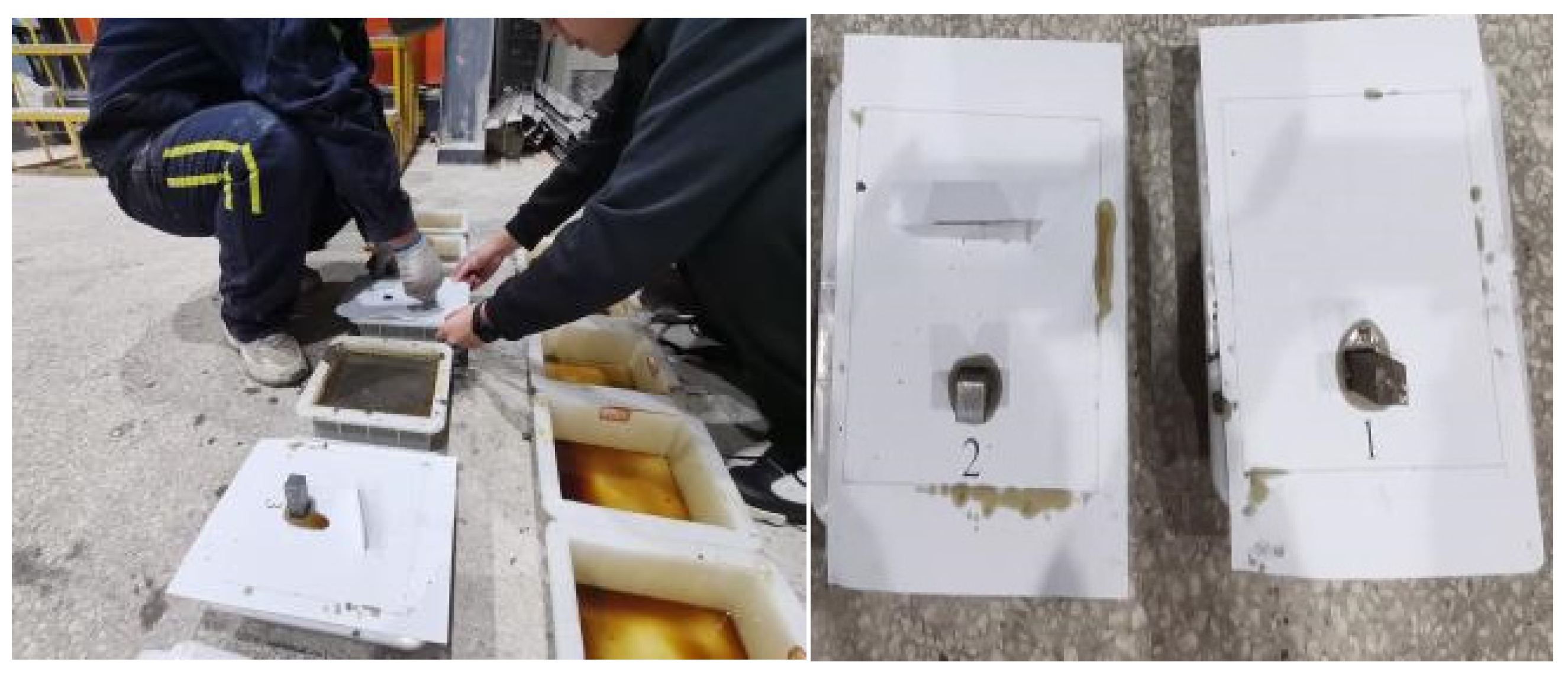
(6) All specimens were demolded after 24 h and cured indoors for 28 days. The prepared specimens are presented in Figure 2. The basic mechanical parameters of the prepared sample were tested and calibrated, with a bulk density of 2380 kg/m3, Poisson’s ratio of 0.28, uniaxial tensile strength of 1.86 MPa, cohesion of 3.25 MPa, and internal friction angle of 32.6°.

2.3. Test Equipment and Monitoring System

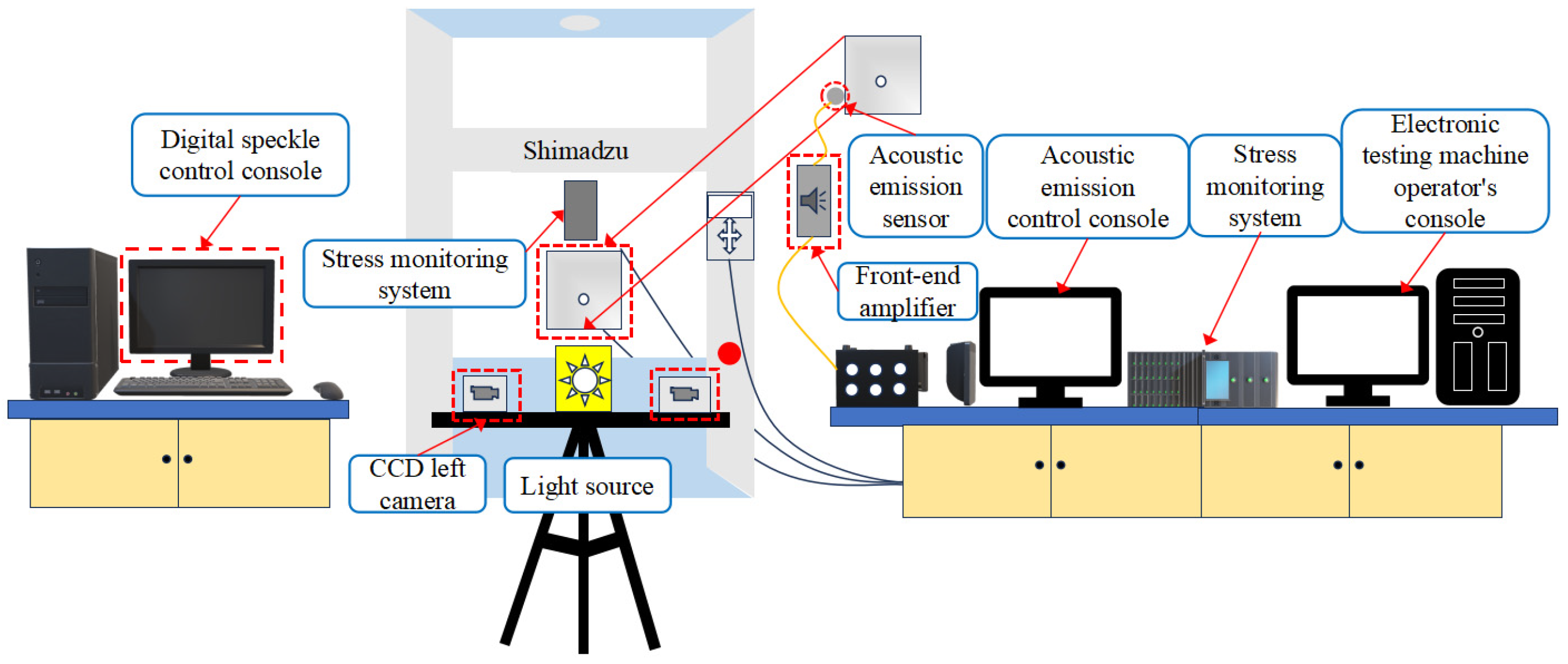
The basic parameters acquired in the test mainly include the stress–strain data, acoustic emission evolution data, and image data of specimens. The adopted test equipment and monitoring systems are illustrated in Figure 3, which mainly consist of a Shimadzu AG-X250 electronic universal testing machine (loading rate: 0.005 mm/s; sampling interval: 10 ms), a MISTRAS-series PCI-2 acoustic emission system (sensor model: R3α; sensor resonant frequency: 20–100 kHz; main amplification: 40 dB; threshold value: 45 dB; floating threshold: 6 dB; sampling frequency: 106 Hz), an XTD stress monitoring system, and an image acquisition system. During the entire testing process, the loading system, acoustic emission system, stress monitoring system, and image acquisition system operated synchronously to ensure consistent time parameters among the four systems.

3. Mechanical Property Analysis of Cracked Specimens

3.1. Characteristics of Stress–Strain Curve

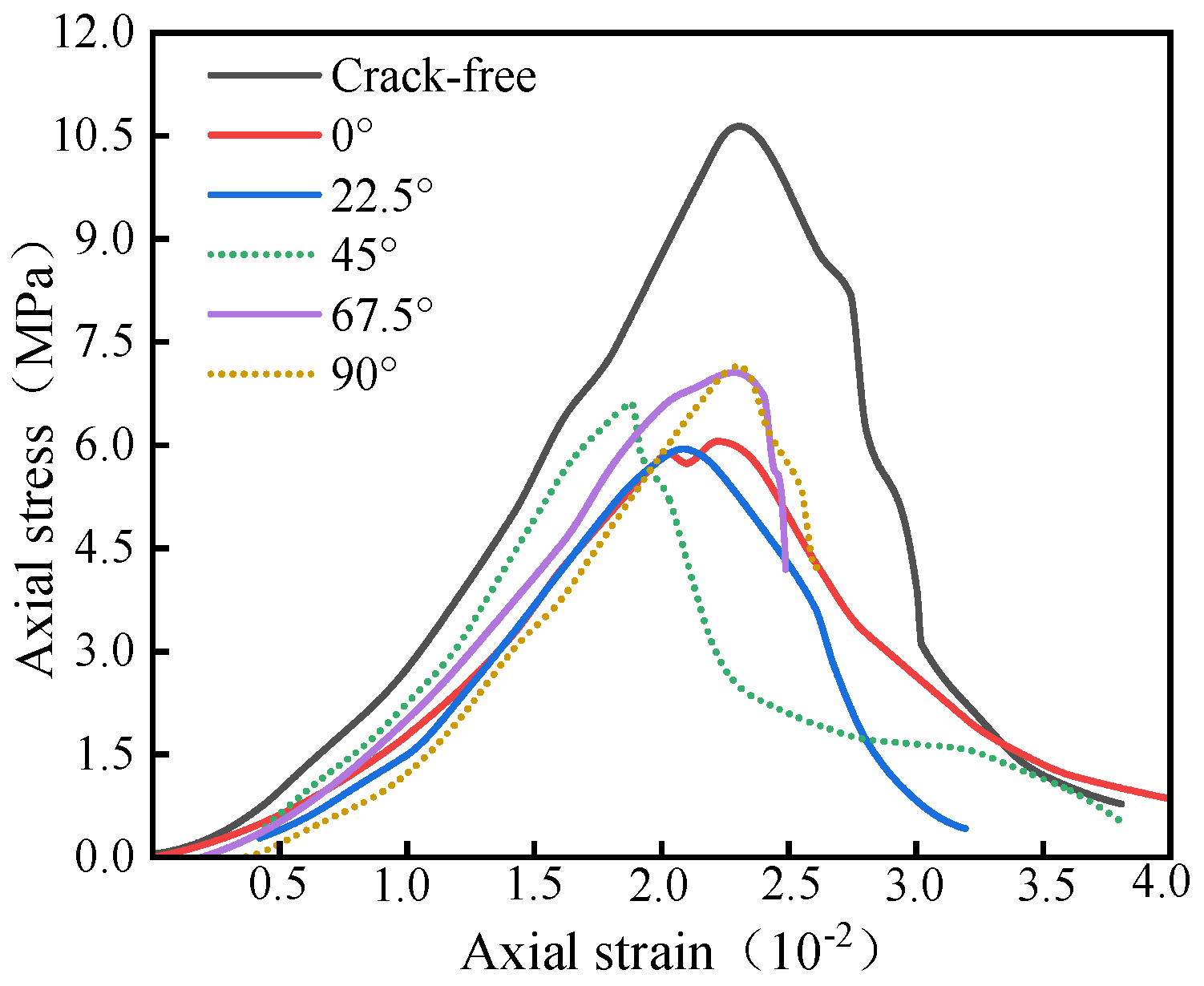
Mechanical properties of specimens with prefabricated fractures at different azimuth angles Figure 4 presents the stress–strain curves of fractured specimens containing pre-existing fractures with various azimuth angles under an identical loading rate.
It can be observed from Figure 4 that compared with the intact specimen A1, the specimens A2–A6 (containing prefabricated fractures) exhibit distinct variations in their stress–strain curves. In the pre-peak stage, the stress–strain curves of fractured specimens rise more slowly; during the failure stage, the plastic deformation capacity of fractured specimens is remarkably weakened. This indicates that macroscopic fractures degrade the mechanical performance of specimens to a certain extent, manifested as reductions in peak strain, uniaxial compressive strength, and elastic modulus.
As summarized in Table 1, with the increase in fracture azimuth angle, the peak strain of specimens decreases first and then increases, reaching the minimum value at the fracture angle of 45°. The compressive strength declines initially and rises subsequently, with the lowest strength occurring at approximately 22.5° and the maximum strength obtained at 90°. In addition, the elastic modulus increases at first and then decreases; it achieves its maximum at the fracture angle of 45°.
The variation in mechanical parameters is governed by angle-dependent stress failure mechanisms. Low-angle fractures (0–22.5°) are prone to shear slippage under loading, significantly weakening rock bearing capacity and producing the minimum strength at 22.5°. As the fracture angle increases, the failure mode transitions from pure shear to shear–tensile composite failure. High-angle fractures (67.5–90°) suppress shear damage, and the intact rock matrix retains high bearing performance, leading to gradual strength recovery.

3.2. Initiation and Failure Modes of Pre-Cracked Specimens

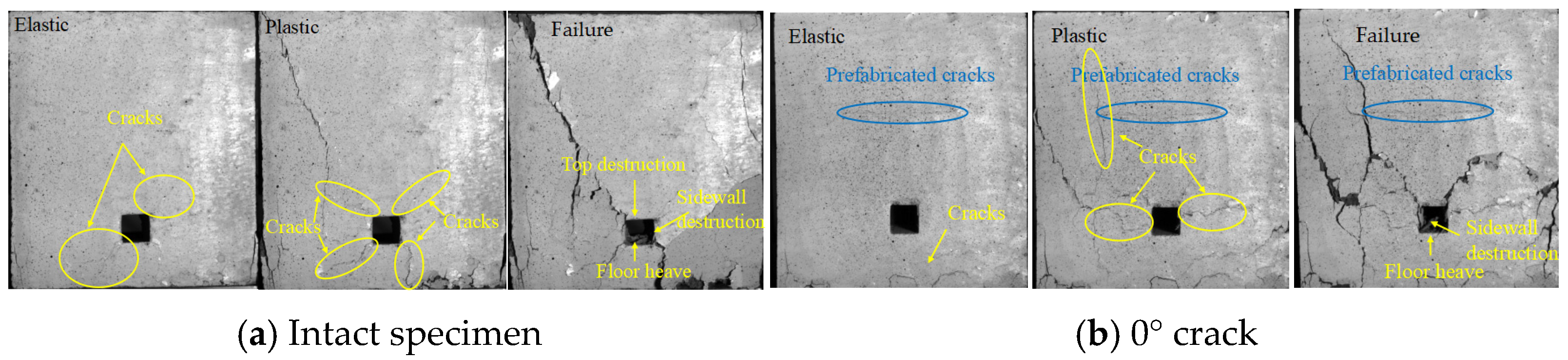
For the intact specimen without fractures, no evident surface variation appears in the compaction stage. As shown in Figure 5a, in the elastic stage, with the increase in applied pressure, cracks firstly initiate at the diagonal corners of the roadway and continuously expand and propagate. In the plastic stage, peripheral cracks around the roadway extend towards the specimen boundaries and gradually develop into major fractures. At the failure stage, the cracks rapidly run through the upper and lower boundaries of the specimen, resulting in final oblique penetrating failure. Meanwhile, fracture failure occurs in the roadway roof and inner sidewall, accompanied by prominent floor heave.
For the specimen with a 0° fracture, no obvious surface change can be observed during the compaction stage. As shown in Figure 5b, After entering the elastic stage, microcracks first initiate at the roadway bottom, while neither the prefabricated fracture nor the surrounding area of the roadway presents distinct variation. In the plastic stage, macroscopic cracks generate at the tip of the prefabricated fracture, as well as at the roof and sidewalls of the roadway. At the failure stage, the cracks propagate continuously and penetrate to the specimen boundaries, eventually forming a prominent crushing zone in the central region of the specimen. Severe damage occurs on the roadway sidewalls, accompanied by slight floor heave.
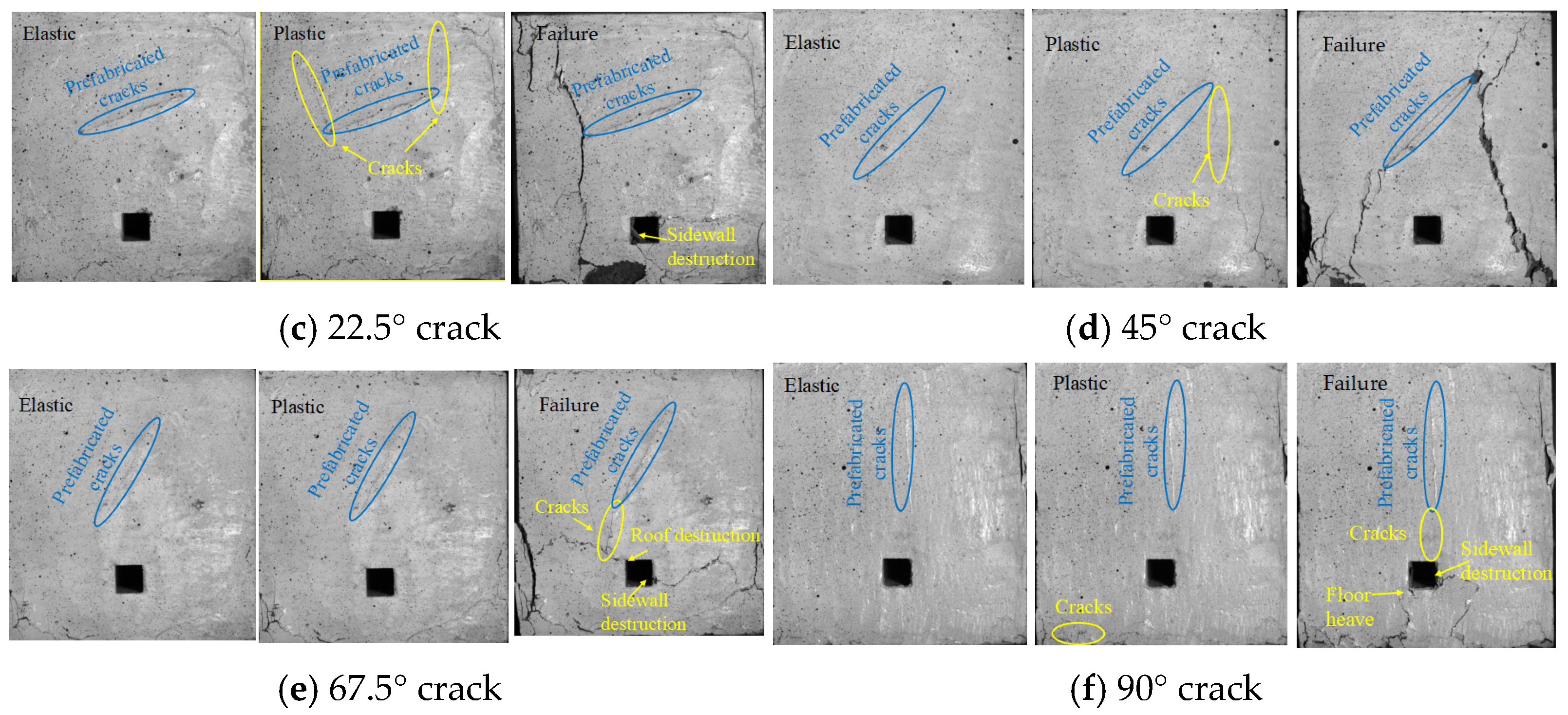
As shown in Figure 5c, for the specimen with a 45° fracture, consistent with the 22.5°-fractured specimen, no apparent changes are observed during the compaction and elastic stages. In the plastic stage, cracks first initiate at the right tip of the prefabricated fracture and extend downward to the lower boundary of the specimen in the direction perpendicular to the fracture. After entering the failure stage, secondary cracking occurs at the fracture tips, and the induced cracks expand rapidly to traverse the upper and lower boundaries. Ultimately, the specimen undergoes oblique shear failure along the prefabricated fracture. Notably, no deformation or damage is detected in the roadway throughout the entire loading process.
For the specimen with a 67.5° fracture (Figure 5d), no obvious surface change occurs in the compaction stage. In the elastic stage, microcracks emerge at the bottom of the specimen. During the plastic stage, the bottom cracks gradually expand and propagate upward. In the failure stage, crack initiation takes place at the tips of the prefabricated fracture and both sidewalls of the roadway. These cracks develop perpendicularly to the pre-existing fracture and penetrate the left and right boundaries of the specimen. Eventually, horizontal failure occurs across the specimen, together with evident damage in the roof and sidewalls of the roadway.
For the specimen with a 90° fracture (Figure 5e), no significant changes are observed in the compaction and elastic stages. In the plastic stage, cracks first initiate at the bottom of the specimen, while the prefabricated fracture and roadway remain intact. In the failure stage, new cracks germinate at the tips of the prefabricated fracture, gradually propagate, and connect with the roadway, eventually inducing vertical failure along the strike of the prefabricated fracture. Meanwhile, cracking occurs around the roadway, resulting in sidewall damage and floor heave.
Based on the above analysis, for the intact specimen, cracks preferentially initiate around the roadway and expand rapidly with the increase in applied load, eventually inducing roof fracture, inner sidewall failure, and floor heave. The dominant failure mode of the intact specimen is roadway-centered damage.
For specimens containing prefabricated fractures, as the fracture azimuth angle increases from 0° to 22.5°, 45°, 67.5°, and 90°, the crack initiation time gradually transitions from the elastic stage to the plastic stage. The crack initiation location shifts from the interior of the specimen to the tips of prefabricated fractures and, finally, returns to the specimen interior. The deformation and damage degree of the roadway decreases first and then increases, reaching the minimum at the fracture angle of 45°, where the roadway is barely damaged. In addition, the included angle between the main failure cracks and the prefabricated fractures gradually decreases from 90° to 0°.
The crack initiation modes of specimens with different fracture azimuths can be classified into three types: roadway preferential cracking, simultaneous cracking of roadway and prefabricated fracture, and prefabricated fracture preferential cracking. Specifically, the 0° fracture specimen belongs to roadway preferential cracking; the 22.5° and 45°fracture specimens belong to prefabricated fracture preferential cracking, the 67.5° and 90° fracture specimens present simultaneous cracking of roadway and prefabricated fracture.
Correspondingly, the failure modes are divided into roadway failure, combined failure of roadway and prefabricated fracture, and single prefabricated fracture failure. Specimens with fracture angles of 0°, 67.5°, and 90° undergo combined failure of roadway and prefabricated fracture. The 22.5° and 45° fracture specimens are dominated by prefabricated fracture failure, and the roadway damage is effectively restrained.
In conclusion, for low-angle fractures (0–22.5°), the fracture orientation is approximately parallel to the main stress propagation direction of floor dynamic pressure. The fractures are dominated by shear stress and undergo slow shear sliding and progressive damage. Although partial surrounding rock stress can be released during loading, their directional stress transfer capacity is limited, failing to fully dissipate the concentrated dynamic stress of floor strata; thus, the roadway still suffers continuous deformation and damage. For high-angle fractures (67.5–90°), the fractures are nearly perpendicular to the main stress direction and controlled by tensile failure. These fractures initiate and propagate rapidly under low axial load, triggering abrupt rock mass instability. The violent transient stress release further induces secondary stress concentration around the roadway in the plastic stage, significantly aggravating floor heave and sidewall damage. In comparison, the 45° artificial fracture matches the optimal shear failure angle of rock mass under uniaxial compression. It can preferentially bear, divert, and dissipate the concentrated stress transmitted from floor strata to form a stable directional stress relief zone. This fracture configuration effectively intercepts high dynamic pressure stress and transfers it to the fracture damage zone while avoiding premature tensile instability and late secondary stress concentration. Uniform stress release along the 45° fracture surface isolates high stress from the roadway surrounding rock, which fundamentally restrains roadway deformation and damage and achieves the best floor roadway pressure relief effect.

3.3. Evolutionary Law of Acoustic Emission

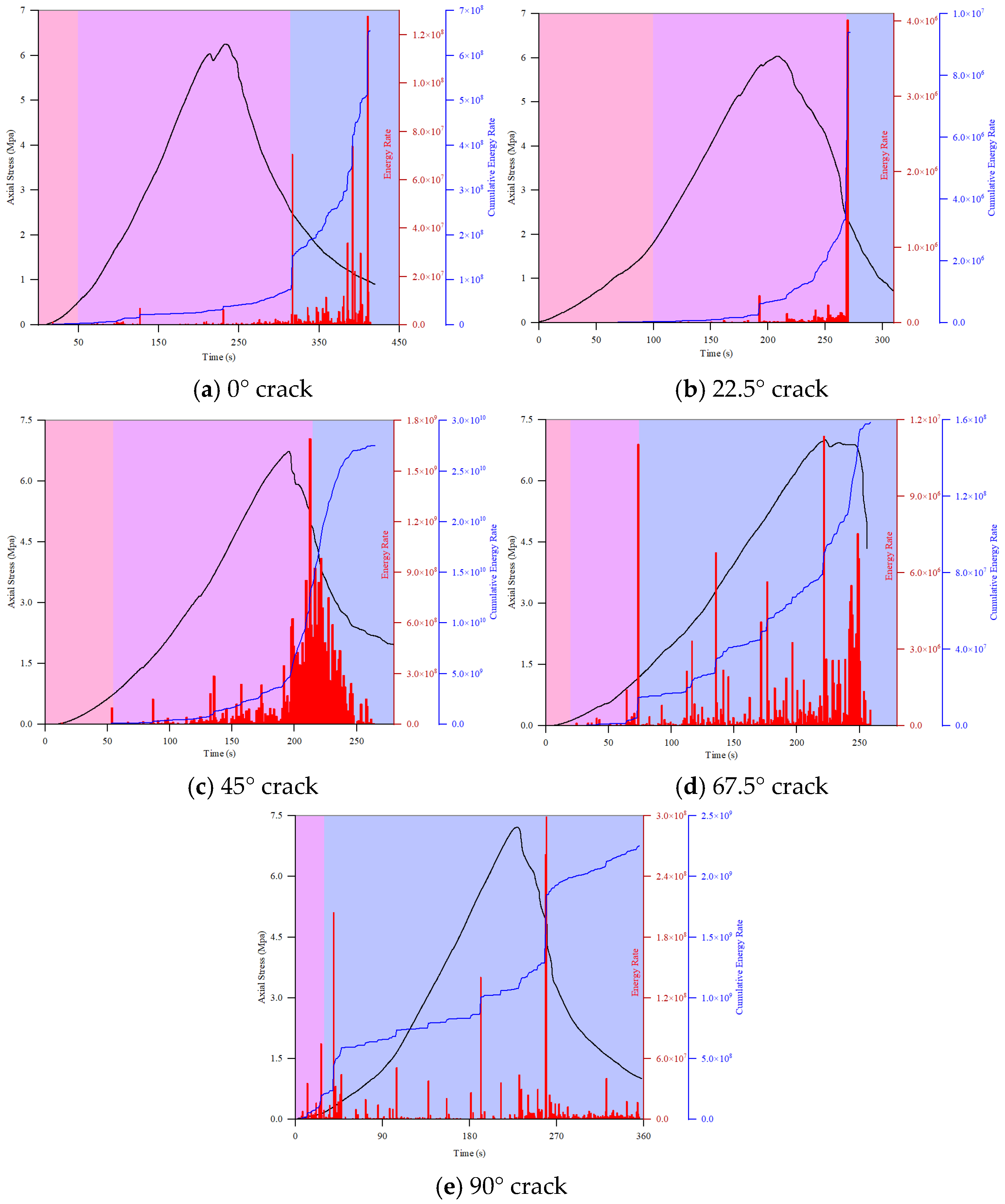
As shown in Figure 6a, for the specimen with a 0° fracture, almost no acoustic emission (AE) signal is generated within the first 50 s, which is defined as the quiet stage. Combined with macroscopic observation, no obvious change can be found on the specimen surface during this period. Acoustic emission activities begin to appear at 50 s. From 50 s to 315 s, the AE energy rate remains relatively stable, with a steady growth rate of cumulative energy, corresponding to the active stage. In this stage, internal cracks propagate and open continuously. Macroscopically, cracks initiate on the left and right boundaries of the roadway. After 315 s, the AE energy value rises sharply and the acoustic emission activities become extremely intense, entering the rapid increase stage. A large number of new cracks are generated inside the specimen, accompanied by the violent release of elastic energy.
As shown in Figure 6b, for the specimen with a 22.5° fracture, nearly no acoustic emission signals are detected within the first 100 s, which is regarded as the quiet stage, and no obvious changes are observed on the specimen surface. Acoustic emission activities begin to occur after 100 s. During the period from 100 s to 289 s, the acoustic emission energy rate is relatively high, and the cumulative energy increases rapidly, representing the active stage. It indicates that open cracks emerge inside the specimen at this stage. Combined with macroscopic characteristics, cracks initiate at the tips of prefabricated fractures on the specimen surface. After 289 s, the acoustic emission energy rises significantly, and the acoustic emission response suddenly becomes intense, which is defined as the sharp increase stage. According to macroscopic analysis, large-scale cracks appear on the specimen surface, leading to the final failure of the specimen.
As shown in Figure 6c, for the specimen with a 45° fracture, almost no acoustic emission occurs within the first 55 s, which corresponds to the quiet stage, and no obvious change is observed on the specimen surface during this period. Acoustic emission signals begin to appear after 55 s. From 55 s to 215 s, acoustic emission activities occur frequently, and the growth rate of cumulative energy remains stable, representing the active stage. This indicates the opening and coalescence of a large number of internal cracks. Combined with macroscopic analysis, cracks initiate at the tips of prefabricated fractures on the specimen surface. After 215 s, the acoustic emission energy increases abruptly, entering the sharp growth stage. Massive cracks are generated inside and on the surface of the specimen, accompanied by the intense release of elastic energy, which eventually leads to specimen failure.
As shown in Figure 6d, for the specimen with a 67.5° fracture, almost no acoustic emission signals are detected within the first 20 s, which is defined as the quiet stage, and no obvious changes can be observed on the specimen surface during this period. Acoustic emission activities start to appear after 20 s. From 20 s to 75 s, acoustic emission events occur frequently, and the cumulative energy increases at a steady rate, corresponding to the active stage. Combined with macroscopic observation, no surface cracks are formed at this moment, implying the opening of internal cracks inside the specimen. After 75 s, the acoustic emission energy rises sharply with frequent signal responses, and the growth rate of cumulative energy continues to increase, entering the rapid rising stage. At this stage, a large number of cracks are generated both inside and on the surface of the specimen, accompanied by the massive release of elastic energy, which eventually results in specimen failure.
As shown in Figure 6e, for the specimen with a 90° fracture, acoustic emission signals emerge at the initial loading stage within the first 5 s. During 0–30 s, the cumulative acoustic emission energy increases at a steady rate, which is defined as the active stage. Combined with macroscopic analysis, no visible cracks appear on the specimen surface at this stage, indicating the initiation of microcracks inside the specimen. After 30 s, the acoustic emission energy rises abruptly, followed by multiple sharp surges in energy, and the growth rate of cumulative energy keeps increasing, representing the rapid growth stage. Before the peak stress, surface cracks are inconspicuous, demonstrating that most cracks develop inside the specimen. After the peak stress, surface cracks propagate continuously and eventually lead to specimen failure.
Based on the above analysis, prefabricated fractures with different azimuth angles exert a significant influence on the damage evolution process and failure mode of specimens. As the fracture angle increases from 0° to 90°, the damage evolution process of rock transitions from progressive to abrupt.
Specifically, low-angle fractures (0~22.5°) are mainly subjected to shear stress, presenting a long quiet period and a stable crack propagation stage with obvious failure precursors. Medium-angle fractures (45°) exhibit composite fracture characteristics. The stable energy release during the acoustic emission active stage (55–215 s) reflects steady crack growth. In contrast, high-angle fractures (67.5~90°) are dominated by tensile stress, resulting in a remarkably shortened, or even vanished, quiet period. Cracks penetrate rapidly with intense energy release, leading to more sudden failure.
Further comparison indicates that fracture azimuth significantly governs the AE energy release mode and failure precursor characteristics. Low-angle fractures (0–22.5°) induce shear-dominated failure, characterized by a long AE quiet period and steady energy accumulation throughout the early and middle loading stages. The energy releases abruptly only before final instability, showing progressive and predictable failure characteristics with obvious precursor information. In contrast, high-angle fractures (67.5–90°) produce tension-dominated failure with a negligible quiet period. Intense elastic energy release and frequent AE surges occur in the early loading stage, accompanied by rapid crack coalescence. This failure mode is sudden and lacks obvious precursors, which poses greater threats to roadway stability. The 45°-fractured specimen presents relatively uniform energy release behavior, avoiding both excessive early energy accumulation and catastrophic sudden failure.

4. Damage Evolution Law of Prefabricated Cracks with Different Azimuth Angles

In view of the difficulty in accurately controlling the hydraulic fracturing process under current laboratory conditions, the inability to completely obtain the dynamic evolution law of the internal stress field inside specimens during physical tests, the PFC2D particle flow numerical simulation software and the fluid–solid coupling algorithm were adopted in this study to simulate hydraulic fractures. The fracture propagation behavior of hydraulic fractures with different azimuth angles under loading was systematically investigated, along with their influence on the stress field distribution of surrounding rock in floor roadways.

4.1. Mechanical Parameter Calibration

In accordance with the mesoscopic parameter calibration methods and principles of PFC2D [43,44], the mesoscopic parameters of the rock-like material were calibrated, and particle flow tests were carried out. The specific procedures are as follows:
(1) Standard rock-like specimens with a diameter of 50 mm and a height of 100 mm were prepared using the same manufacturing method as the prefabricated fracture specimens. Uniaxial compression tests were then performed on these specimens.
(2) A numerical model with the same dimensions as the standard rock-like specimens was established in PFC2D, and uniaxial compression numerical calculation was performed.
(3) The mesoscopic parameters were continuously adjusted by the trial-and-error method, the macroscopic mechanical parameters were calculated and compared with experimental results, and the optimal mesoscopic mechanical parameters of the particle flow model consistent with laboratory test data were finally determined.
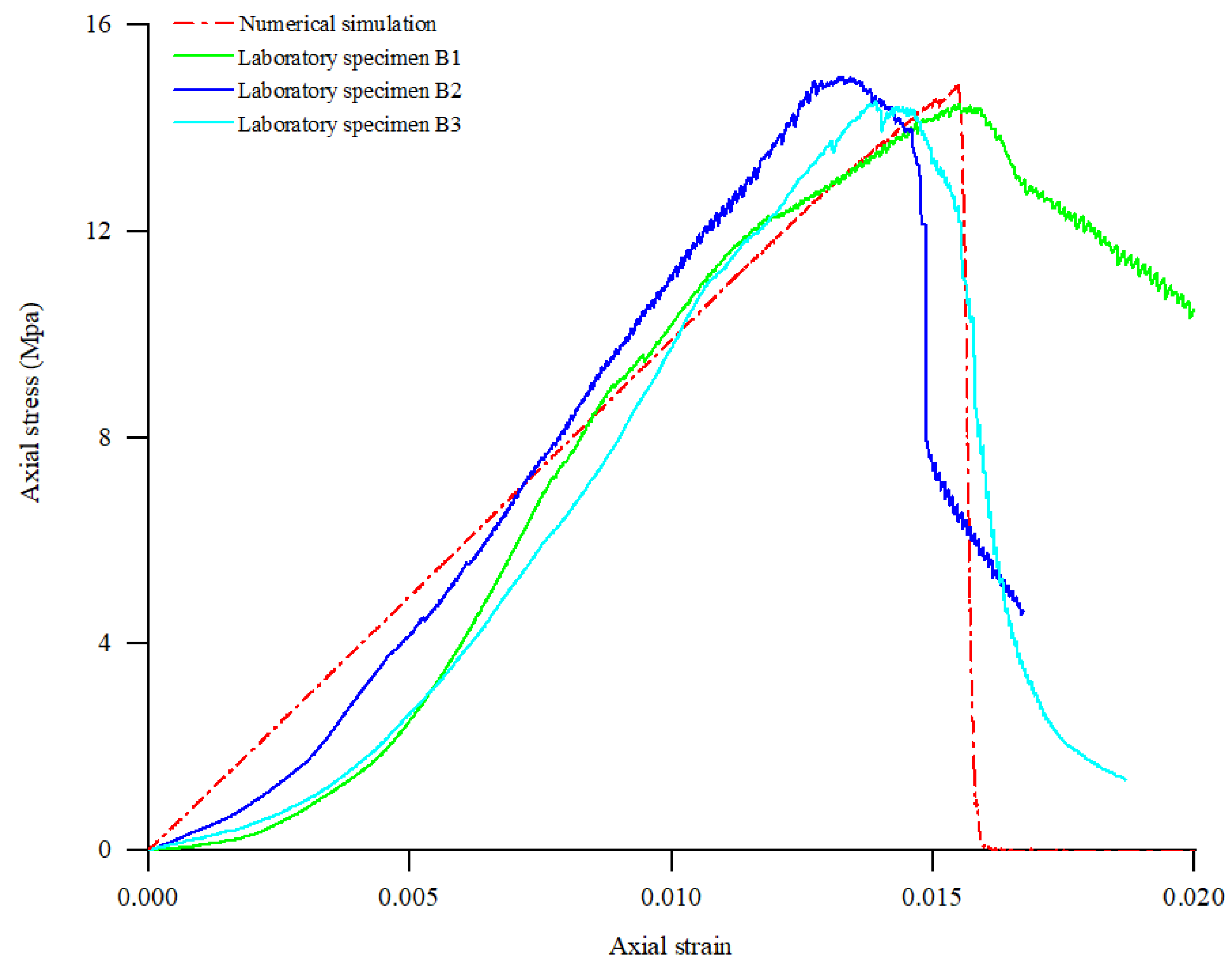
Figure 7 shows the comparison between the numerical simulation results and the physical test results. It can be seen that the stress–strain curve obtained from the numerical calculation is in good agreement with the test results. The relative error of the peak strength is 0.167 MPa, the error of the axial peak strain is only 0.00125, and the error of the elastic modulus is 0.09 GPa. The overall deviation is relatively small. In addition to the stress–strain curve calibration, the model reliability was further verified by comparing the fracture evolution and stress response between experimental and numerical results. The simulated crack initiation position, propagation trend, and final failure morphology at different fracture angles agree well with the laboratory observations. Quantitative comparison of roadway surrounding rock stress further indicates that the maximum deviation between simulation and experiment is less than 8%. This multi-index verification demonstrates that the established model can accurately reflect the mechanical and fracture evolution characteristics of fractured rock masses. The final determined micro-scale parameters are shown in Table 2.

4.2. Establishment of Test Model

In the fluid–solid coupling algorithm of the PFC2D particle flow model, the contact between every two particles is assumed to serve as the fluid flow channel, which is defined as a pipe. The closed polygonal area enclosed by pipes is regarded as a fluid domain, which acts as a pressure storage unit and allows free fluid flow among different domains. The water flow path is generalized as a parallel-plate channel. Fluid pressure acts on surrounding particles, inducing particle movement and changes in fluid domain volume. In turn, alters the contact force and the width of fluid pipes, thereby affecting fluid migration between various fluid domains [45,46].
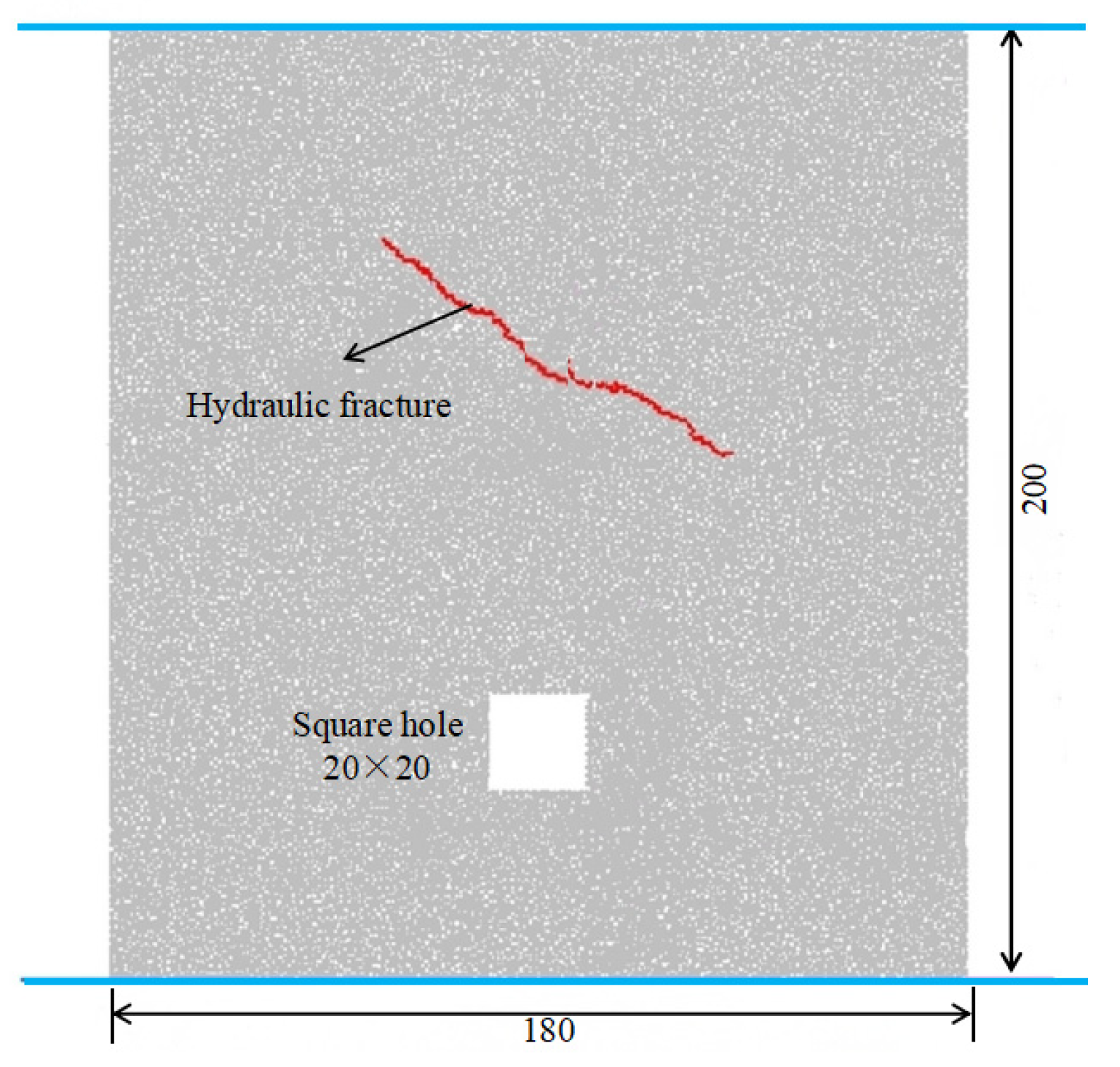
Based on the mesoscopic mechanical parameters listed in Table 2, a numerical calculation model of the specimen with prefabricated fractures was established. The model size was consistent with that of laboratory tests. A square hole of 20 mm × 20 mm was reserved at 40 mm above the model bottom to simulate the roadway. Subsequently, uniaxial loading tests were carried out. The established numerical model is shown in Figure 8, which contains a total of 17,451 rock particles. In this coupling system, particle gaps serve as fluid flow channels, and enclosed particle domains act as independent pressure units. Fluid migrates under pressure difference and drives particle deformation and fracture expansion. In return, rock deformation changes flow channel characteristics and pressure distribution, forming dynamic seepage–solid coupling interaction. This method can effectively reproduce hydraulic fracture propagation and stress evolution, ensuring the reliability of numerical results.
Figure 8. Numerical simulation test model (unit: mm).
Processes 14 01917 g008

4.3. Stress Distribution Law of Specimens with Fractures at Different Angles

(1) Stress distribution law in the compaction stage
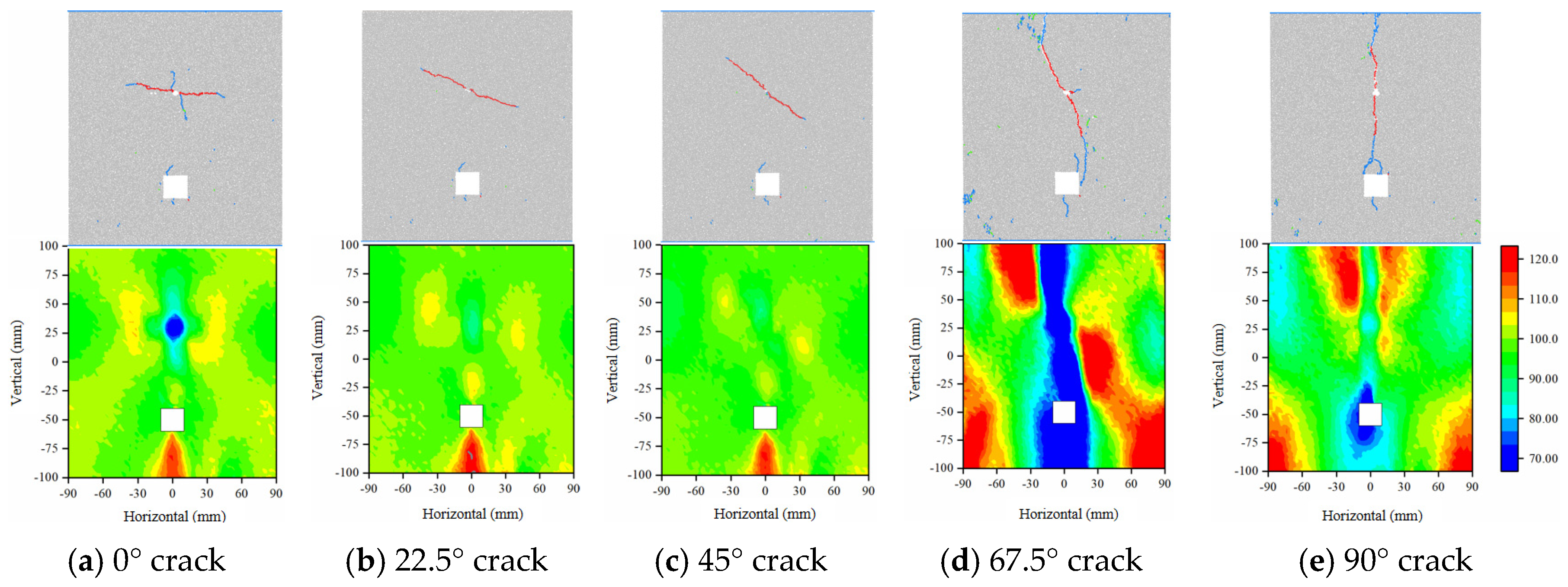
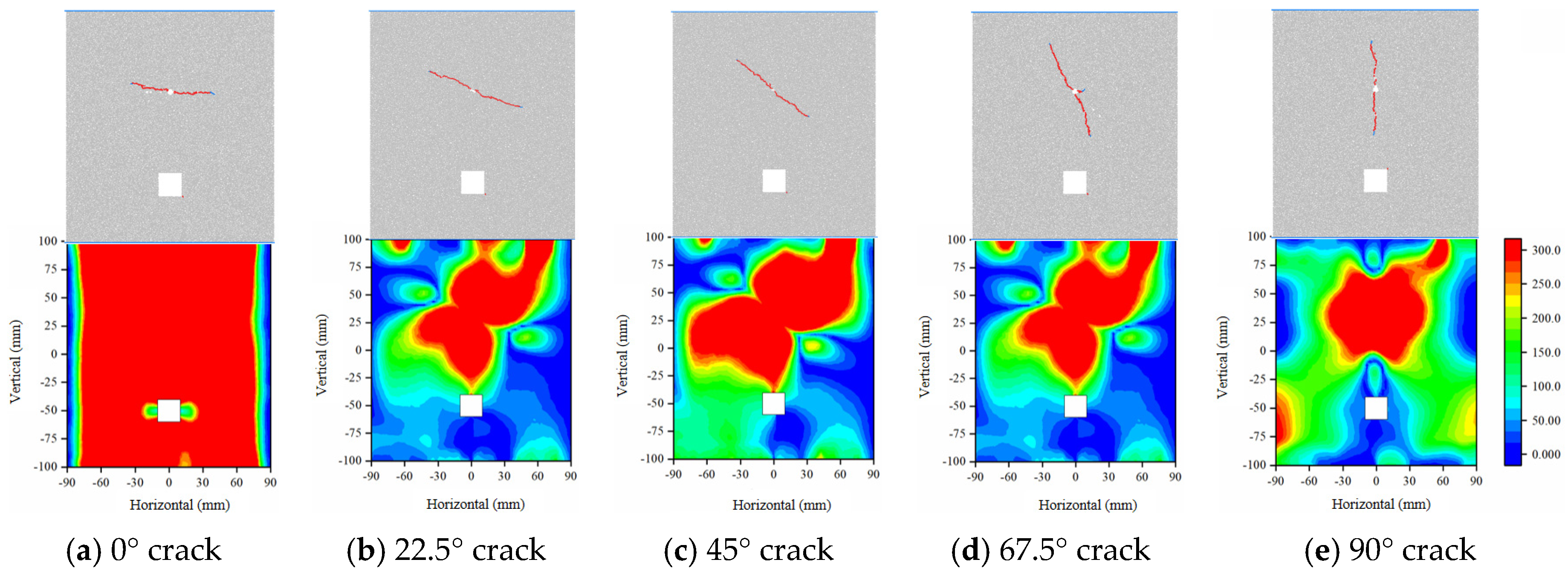
The crack propagation characteristics of hydraulic fracture specimens with different azimuth angles during the compaction stage, along with the nephograms of maximum principal stress percentage compared to the intact specimen under the same stress, are presented in Figure 9.
For the specimen with a 0° hydraulic fracture, the hydraulic fracture continues to propagate from the fracture tip in the compaction stage. Compared with the intact specimen, the maximum principal stress increases in the middle part while it decreases at the specimen boundaries.
For specimens with hydraulic fractures of 22.5°, 45°, 67.5°, and 90°, the prefabricated hydraulic fractures further extend along their respective strike directions after loading (Figure 9b). On both sides of the hydraulic fracture, elliptical stress concentration zones form, centered on the fracture. The maximum principal stress gradually declines with the increase in distance from the fracture. An elliptical stress rise zone also appears at the fracture tip, and the maximum principal stress decreases progressively along the fracture direction. Meanwhile, the maximum principal stress around the roadway is reduced to a certain extent.
In addition, by comparing the maximum principal stress percentage nephograms between fractured specimens and the intact specimen, it is found that the area of the stress rise zone decreases first and then increases with the increase in the hydraulic fracture angle. The 22.5° hydraulic fracture specimen exhibits the minimum area of stress concentration zone.
(2) Stress Distribution Law in the Elastic Stage
The crack propagation state of hydraulic fracture specimens with different azimuth angles in the elastic stage, along with the nephograms of maximum principal stress percentage compared with the non-fractured specimen under identical stress conditions, are shown in Figure 10.
Compared with the intact specimen, specimens with hydraulic fractures of 0°, 22.5°, 45°, and 67.5° all form stress reduction zones centered on the hydraulic fractures in the direction perpendicular to the fracture strike. In these specimens, the maximum principal stress increases with the distance away from the hydraulic fractures; stress concentration zones emerge at the fracture tips, and the maximum principal stress gradually decreases along the fracture direction with the increasing distance from the fracture center. In addition, as the fracture azimuth angle increases, the maximum principal stress around the roadway decreases first and then increases.
For the specimen with a 90° hydraulic fracture, different behavior is observed. Unlike in the intact specimen, a stress concentration zone forms around the hydraulic fracture in the direction perpendicular to the fracture strike, and the maximum principal stress declines as the distance from the fracture increases. A stress reduction zone appears at the tip of the 90° hydraulic fracture, and the maximum principal stress grows gradually along the fracture direction with the increase in distance from the fracture.
(3) Stress Distribution Law in the Plastic Stage
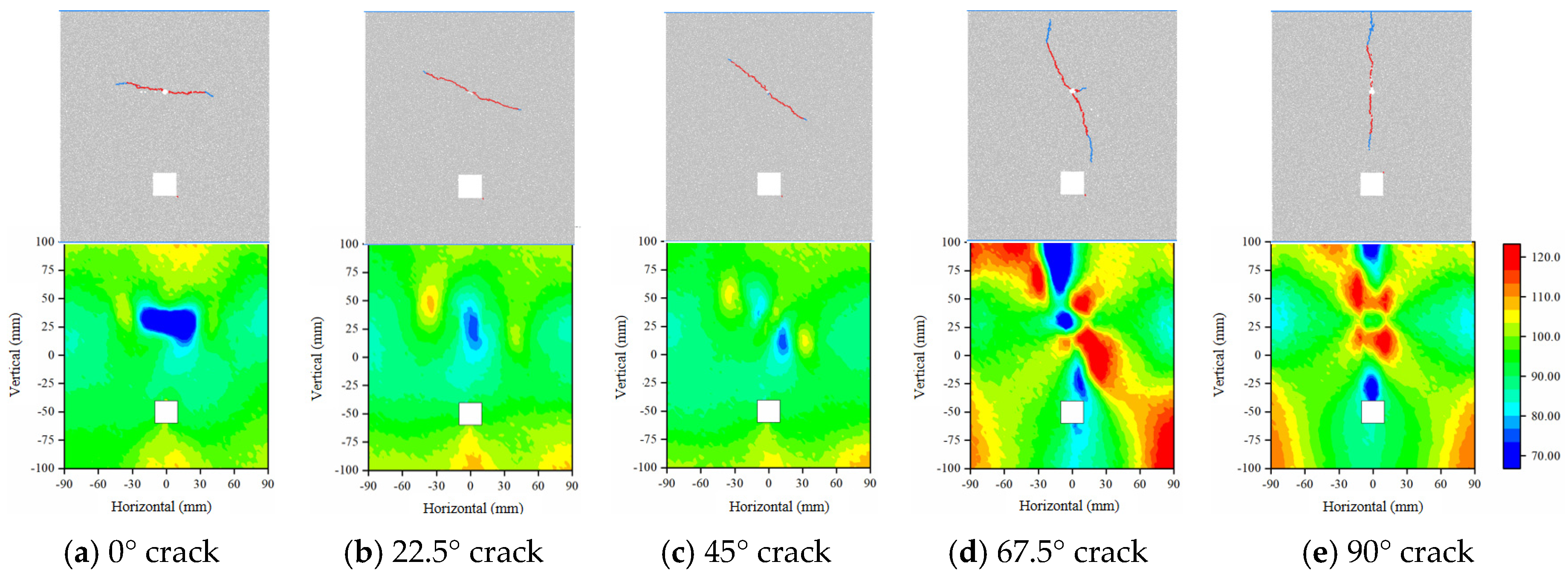
The crack propagation characteristics of hydraulic fracture specimens with different azimuth angles in the plastic stage and the nephograms of maximum principal stress percentage relative to the intact specimen under the same stress are shown in Figure 11.
For the specimen with a 0° hydraulic fracture (Figure 11a), cracks begin to occur around the roadway during the plastic stage. Compared with the intact specimen, a small elliptical stress reduction zone forms centered on the hydraulic fracture. In the direction perpendicular to the hydraulic fracture, the maximum principal stress increases with the distance from the fracture. A stress concentration zone appears at the hydraulic fracture tip, and the maximum principal stress gradually decreases along the fracture direction as the distance from the fracture increases.
For the specimens with 22.5° and 45° hydraulic fractures (Figure 11b,c), cracks also initiate around the roadway in the plastic stage. In the direction perpendicular to the hydraulic fracture, the maximum principal stress rises with increasing distance from the fracture. Stress concentration zones are formed at the fracture tips, and the maximum principal stress gradually declines along the fracture direction. Compared with the 22.5° hydraulic fracture specimen, both the areas of stress concentration zone and the stress reduction zone are smaller in the 45°-fractured specimen.
For the 67.5° hydraulic fracture specimen (Figure 11d), the hydraulic fractures propagate and coalesce with the specimen boundaries and the roadway. In comparison with the intact specimen, a stress reduction zone forms along the hydraulic fracture direction, while stress concentration occurs in other regions.
For the 90° hydraulic fracture specimen (Figure 11e), the hydraulic fractures likewise penetrate the specimen boundaries and the roadway. A stress reduction zone is distributed around the roadway, and the remaining areas present stress concentration. Compared with the 45° hydraulic fracture specimen, the 67.5°- and 90°-fractured specimens possess larger stress concentration and stress reduction zones. Their hydraulic fractures are more prone to crack initiation and exert a more significant influence on the internal stress distribution of the specimen.
In summary, artificial fractures with different azimuths can change the inherent stress transmission path of floor rock mass and produce directional stress diversion and shielding effects. Medium- and low-angle fractures (22.5–45°) can stably transfer and dissipate high stress away from the roadway throughout the loading process, forming a sustained pressure relief zone. By contrast, high-angle fractures only achieve transient stress adjustment in the early stage and easily induce secondary stress concentration in the plastic stage, which weakens the pressure relief effect. The 45° fracture realizes the most favorable directional stress transfer behavior and achieves the optimal roadway pressure relief.

5. Conclusions

(1) As the crack azimuth angle increases from 0° to 90°, the uniaxial compressive strength of specimens decreases first and then increases. Cracks at 22.5° induce the most severe strength degradation of rock mass with the minimum compressive strength. The peak strain decreases first and then increases, while the elastic modulus increases first and then decreases. Rock masses with 45° cracks exhibit the most prominent brittleness characteristics.
(2) Failure modes vary with crack azimuth angles, and 45° is identified as the optimal pressure relief angle for floor roadways. Specimens with low-angle cracks (0°, 22.5°) are dominated by shear failure, accompanied by slight stress and deformation of roadway surrounding rock. Cracks at 45° present composite fracture features with relatively high stress in crack zones but minor roadway deformation and failure. High-angle cracks (67.5°, 90°) are mainly controlled by tensile failure, leading to aggravated floor heave and sidewall damage of roadways.
(3) Damage of specimens with low-angle cracks develops progressively, accompanied by a long AE quiescent period, and energy is suddenly released prior to instability. Specimens with 45° cracks show relatively uniform AE activity throughout the test, without abrupt energy release. For high-angle crack specimens, no obvious quiescent period is observed; elastic energy is intensely released at the early stage, resulting in rapid crack coalescence.
(4) In the compaction and elastic stages, medium-low-angle cracks ranging from 22.5° to 45° can form a stable stress-reduction zone around roadways with a high degree of stress transfer. After entering the plastic stage, high-angle cracks tend to coalesce rapidly and trigger secondary stress concentration around roadways. In contrast, 45° cracks can sustain favorable pressure relief and stress control performance.
In engineering practice, a hydraulic fracture azimuth of 45° is preferred for floor roadway pressure relief to obtain stable stress transfer and minimal roadway damage. Low-angle fractures (0–22.5°) are applicable for mild dynamic pressure conditions, while high-angle fractures (67.5–90°) are not recommended due to their sudden failure characteristics and poor pressure relief stability.

Author Contributions

Conceptualization, J.L. and X.L.; methodology, J.L. and P.W.; software, J.L. and N.L.; formal analysis, P.W. and N.L.; data curation, J.L., P.W. and N.L.; writing—original draft, J.L.; writing—review and editing, X.L., P.W. and N.L.; supervision, X.L.; funding acquisition, X.L. All authors have read and agreed to the published version of the manuscript.

Funding

The research described in this paper was financially supported by the National Natural Science Foundation of China (No. 52574258) and the Natural Science Foundation of Shandong Province (ZR2024ME097).

Data Availability Statement

The original contributions presented in this study are included in the article. Further inquiries can be directed to the corresponding author.

Conflicts of Interest

The authors declare that there are no conflicts of interest regarding the publication of this paper.

References

  1. Zhang, J.M.; Li, Q.S.; Zhang, Y.; Cao, Z.G.; Wang, X.Z. Definition of deep coal mining and response analysis. J. China Coal Soc. 2019, 44, 1314–1325. [Google Scholar] [CrossRef]
  2. Xie, H.P.; Zhou, H.W.; Xue, D.J.; Wang, H.W.; Zhang, R.; Gao, F. Research and consideration on deep coal mining and critical mining depth. J. China Coal Soc. 2012, 37, 535–542. [Google Scholar] [CrossRef]
  3. Yuan, L. Research progress of mining response and disaster prevention and control in deep coal mines. J. China Coal Soc. 2021, 46, 716–725. [Google Scholar] [CrossRef]
  4. Zuo, J.P.; Zhu, F.; Ma, Z.Y.; Xu, C.Y. Stress field evolution mechanism and regional stress control technology of deep mining roadway. J. Cent. South Univ. 2025, 32, 3927–3944. [Google Scholar] [CrossRef]
  5. Li, X.L.; Chen, S.J.; Liu, S.M.; Li, Z.H. AE waveform characteristics of rock mass under uniaxial loading based on Hilbert-Huang transform. J. Cent. South Univ. 2021, 28, 1843–1856. [Google Scholar] [CrossRef]
  6. Cai, M. Principles of rock support in burst-prone ground. Tunn. Undergr. Space Technol. 2013, 36, 46–56. [Google Scholar] [CrossRef]
  7. Xie, S.R.; Jiang, Z.S.; Chen, D.D.; Wang, E.; Lv, F. Failure mechanism of continuous large deformation and a novel pressure relief control technology on the two sides of deep coal roadway. Eng. Fail. Anal. 2023, 144, 106941. [Google Scholar] [CrossRef]
  8. Li, H.T.; Li, X.L.; Fu, J.H.; Zhu, N.Q.; Chen, D.Y.; Wang, Y.; Ding, S. Experimental study on compressive behavior and failure characteristics of imitation steel fiber concrete under uniaxial load. Constr. Build. Mater. 2023, 399, 132599. [Google Scholar] [CrossRef]
  9. Yang, S.Q.; Chen, M.; Jing, H.W.; Chen, K.F.; Meng, B. A case study on large deformation failure mechanism of deep soft rock roadway in Xin’an coal mine, China. Eng. Geol. 2017, 217, 89–101. [Google Scholar] [CrossRef]
  10. Li, S.C.; Wang, Q.; Wang, H.T.; Jiang, B.; Wang, D.C.; Zhang, B.; Li, Y.; Ruan, G.Q. Model test study on surrounding rock deformation and failure mechanisms of deep roadways with thick top coal. Tunn. Undergr. Space Technol. 2015, 47, 52–63. [Google Scholar] [CrossRef]
  11. Zhang, Z.Z.; Deng, M.; Bai, J.B.; Yan, S.; Yu, X.Y. Stability control of gob-side entry retained under the gob with close distance coal seams. Int. J. Min. Sci. Technol. 2021, 31, 321–332. [Google Scholar] [CrossRef]
  12. Gong, H.; Li, D.Y.; Luo, P.K.; Ru, W.; Zhang, G.; Liu, Y. Floor heave mechanism and stiff control technology by I-beam for deep mine roadway. Eng. Fail. Anal. 2025, 175, 109600. [Google Scholar] [CrossRef]
  13. Sakhno, I.; Sakhno, S. Numerical studies of floor heave mechanism and the effectiveness of grouting reinforcement of roadway in soft rock containing the mine water. Int. J. Rock Mech. Min. Sci. 2023, 170, 105484. [Google Scholar] [CrossRef]
  14. Wang, Y.J.; Wang, Q.; Tian, X.C.; Wang, H.S.; Yang, J.; He, M.C. Stress and deformation evolution characteristics of gob-side entry retained by roof cutting and pressure relief. Tunn. Undergr. Space Technol. 2022, 123, 104419. [Google Scholar] [CrossRef]
  15. Li, X.L.; Chen, S.J.; Wang, E.Y.; Li, Z.H. Rockburst mechanism in coal rock with structural surface and the microseismic (MS) and electromagnetic radiation (EMR) response. Eng. Fail. Anal. 2021, 124, 105396. [Google Scholar] [CrossRef]
  16. Li, X.L.; Wang, E.Y.; Li, Z.H.; Liu, Z.T.; Song, D.Z.; Qiu, L.M. Rock burst monitoring by integrated microseismic and electromagnetic radiation methods. Rock Mech. Rock Eng. 2016, 49, 4393–4406. [Google Scholar] [CrossRef]
  17. Wang, G.F.; Pang, Y.H. Surrounding rock control theory and longwall mining technology innovation. Int. J. Coal Sci. Technol. 2017, 4, 301–309. [Google Scholar] [CrossRef]
  18. Li, Y.Y.; Qing, L.; Kang, Y.S.; Zhang, R.; Li, X.; Liu, B.; Geng, Z. Method for pressure relief in deep coal mine roadways using borehole groups and its application to Guqiao coal mine. Lithosphere 2024, 2, 354. [Google Scholar] [CrossRef]
  19. Gao, Y.B.; Yang, J.; Zhang, X.Y.; Xue, H.J.; He, M.C. Study on surrounding rock control of roadways in deep coal mines based on roof cutting and pressure release technology by directional tensile blasting. Chin. J. Rock Mech. Eng. 2019, 38, 2045–2056. [Google Scholar] [CrossRef]
  20. Zhuang, J.X.; Mu, Z.L.; Cai, W.; He, H.; Hosking, L.J.; Xi, G.J.; Jiao, B. Multistage hydraulic fracturing of a horizontal well for hard roof related coal burst control: Insights from numerical modelling to field application. Int. J. Min. Sci. Technol. 2024, 34, 1095–1114. [Google Scholar] [CrossRef]
  21. Tian, X.Y.; Gong, S.Y.; Dou, L.M.; Zhang, R.P.; Su, S.J.; Chen, B.G.; Ma, X.G.; Lu, Q. Characterize the influences of hydraulic fracturing on preventing rock burst from the stress and vibration fields. Geomech. Geophys. Geo-Energy Geo-Resour. 2024, 10, 169. [Google Scholar] [CrossRef]
  22. Lecampion, B.; Bunger, A.P.; Zhang, X. Numerical methods for hydraulic fracture propagation: A review of recent trends. J. Nat. Gas Sci. Eng. 2018, 49, 66–83. [Google Scholar] [CrossRef]
  23. Liu, S.M.; Sun, H.T.; Zhang, D.M.; Yang, K.; Li, X.L.; Wang, D.K.; Li, Y.N. Experimental study of effect of liquid nitrogen cold soaking on coal pore structure and fractal characteristics. Energy 2023, 275, 127470. [Google Scholar] [CrossRef]
  24. Kang, H.P.; Feng, Y.J.; Zhang, Z.; Zhao, K.K.; Wang, P. Hydraulic fracturing technology with directional boreholes for strata control in underground coal mines and its application. Coal Sci. Technol. 2023, 51, 31–44. [Google Scholar] [CrossRef]
  25. Huang, B.X.; Cheng, Q.Y.; Liu, C.Y.; Wei, M.T.; Fu, J.H. Hydraulic fracturing theory of coal-rock mass and its technical framework. J. Min. Saf. Eng. 2011, 28, 167–173. [Google Scholar] [CrossRef]
  26. Huang, B.X.; Wang, Y.Z. Roof weakening of hydraulic fracturing for control of hanging roof in the face end of high gassy coal longwall mining: A case study. Arch. Min. Sci. 2016, 61, 601–615. [Google Scholar] [CrossRef]
  27. Kang, H.P.; Lv, H.W.; Gao, F.Q.; Meng, X.Z.; Feng, Y.J. Understanding mechanisms of destressing mining-induced stresses using hydraulic fracturing. Int. J. Coal Geol. 2018, 196, 19–28. [Google Scholar] [CrossRef]
  28. Xia, Y.J.; Zhang, C.Q.; Zhou, H.; Chen, J.L.; Gao, Y.; Liu, N.; Chen, P.Z. Structural characteristics of columnar jointed basalt in drainage tunnel of Baihetan hydropower station and its influence on the behavior of P-wave anisotropy. Eng. Geol. 2020, 264, 105304. [Google Scholar] [CrossRef]
  29. Zhao, Z.P.; Zheng, K.G.; Qi, X.D.; Wang, Z.Y.; Kong, L.Y.; Cui, F.; Yang, S.; Liu, H.; Wang, H.J. Study on the hydraulic fracturing response characteristics and failure patterns of gently inclined hard roof plates. Min. Res. Dev. 2026, 46, 151–163. [Google Scholar] [CrossRef]
  30. Li, Y.F.; Sheng, M.; Zhuang, X.Y.; Zhang, S.; Tian, S.C.; Huang, Z.W.; Li, G.S. Early risk warning model of hydraulic fracturing screen-out risk based on deep learning method. Adv. Eng. Inform. 2026, 74, 104789. [Google Scholar] [CrossRef]
  31. Wang, Y.H.; Lu, Y.J.; Li, Y.P.; Wang, X.; Yan, X.M.; Zhang, Z.Y. Progress and application of hydraulic fracturing technology in unconventional reservoir. Acta Pet. Sin. 2012, 33, 149–158. [Google Scholar] [CrossRef]
  32. Feng, Y.J.; Kang, H.P. Test on hard and stable roof control by means of directional hydraulic fracturing in coal mine. Chin. J. Rock Mech. Eng. 2012, 31, 1148–1155. [Google Scholar] [CrossRef]
  33. Zhai, C.; Li, X.Z.; Li, Q.G. Research and application of coal seam pulse hydraulic fracturing technology. J. China Coal Soc. 2011, 36, 1996–2001. [Google Scholar] [CrossRef]
  34. Jiang, R.Z.; Jiang, T.X.; Wang, Y.L. Present development and prospecting of hydraulic fracturing technology. Oil Drill. Prod. Technol. 2004, 26, 52–56. [Google Scholar] [CrossRef]
  35. Kang, H.P.; Feng, Y.J. Monitoring of stress change in coal seam caused by directional hydraulic fracturing in working face with strong roof and its evolution. J. China Coal Soc. 2012, 37, 1953–1959. [Google Scholar] [CrossRef]
  36. Chen, M.; Pang, F.; Jin, Y. Experiments and analysis on hydraulic fracturing by a large-size triaxial simulator. Chin. J. Rock Mech. Eng. 2000, 19, 868–872. [Google Scholar] [CrossRef]
  37. Lei, Q.; Xu, Y.; Jiang, T.X.; Ding, Y.H.; Wang, X.Q.; Lu, H.B. “Fracture network” fracturing technique for improving post-fracturing performance of low and ultra-low permeability reservoirs. Acta Pet. Sin. 2009, 30, 237–241. [Google Scholar] [CrossRef]
  38. Huang, R.Z. Initiation and propagation of hydraulic fracturing fractures. Pet. Explor. Dev. 1981, 5, 62–74. [Google Scholar]
  39. Tang, S.H.; Zhu, B.C.; Yan, Z.F. Effect of crustal stress on hydraulic fracturing in coalbed methane wells. J. China Coal Soc. 2011, 36, 65–69. [Google Scholar] [CrossRef]
  40. Lin, B.Q.; Li, Z.W.; Zhai, C.; Bi, Q.; Wen, Y.Y. Pressure Relief and Permeability-Increasing Technology Based on High Pressure Pulsating Hydraulic Fracturing and Its Application. J. Min. Saf. Eng. 2011, 28, 452–455. [Google Scholar] [CrossRef]
  41. Chen, M.; Zhou, J.; Jin, Y.; Zhang, G.Q. Experimental study on fracturing features in naturally fractured reservoir. Acta Pet. Sin. 2008, 29, 431–434. [Google Scholar] [CrossRef]
  42. Hou, Z.K.; Yang, C.H.; Wang, L.; Liu, P.J.; Guo, Y.T.; Wei, Y.L.; Li, Z. Hydraulic fracture propagation of shale horizontal well by large-scale true triaxial physical simulation test. Rock Soil Mech. 2016, 37, 407–414. [Google Scholar] [CrossRef]
  43. Yoon, J. Application of experimental design and optimization to PFC model calibration in uniaxial compression simulation. Int. J. Rock Mech. Min. Sci. 2007, 44, 871–889. [Google Scholar] [CrossRef]
  44. Shi, C.; Yang, W.K.; Yang, J.X.; Chen, X. Calibration of micro-scaled mechanical parameters of granite based on a bonded-particle model with 2D particle flow code. Granul. Matter 2019, 21, 38. [Google Scholar] [CrossRef]
  45. Wang, T.; Zhou, W.; Chen, J.; Xiao, X.; Li, Y.; Zhao, X. Simulation of hydraulic fracturing using particle flow method and application in a coal mine. Int. J. Coal Geol. 2014, 121, 1–13. [Google Scholar] [CrossRef]
  46. Zhou, J.; Zhang, L.Q.; Braun, A.; Han, Z.H. Numerical Modeling and Investigation of Fluid-Driven Fracture Propagation in Reservoirs Based on a Modified Fluid-Mechanically Coupled Model in Two-Dimensional Particle Flow Code. Energies 2016, 9, 699. [Google Scholar] [CrossRef]

Figure 1. Experiment scheme and design unit (mm).
Processes 14 01917 g001
Figure 2. Sample preparation.
Processes 14 01917 g002
Figure 3. Sample preparation process.
Processes 14 01917 g003
Figure 4. Stress–strain relationship of prefabricated crack specimens with different azimuths.
Processes 14 01917 g004
Figure 5. Failure phenomenon of specimen with different azimuth angles.
Processes 14 01917 g005aProcesses 14 01917 g005b
Figure 6. Evolution of acoustic emission of specimen.
Processes 14 01917 g006
Figure 7. Comparison of stress–strain curves between numerical simulation and physical test specimens.
Processes 14 01917 g007
Figure 9. Stress distribution of prefabricated fracture specimens with different azimuth angles under the same stress in the compaction stage.
Processes 14 01917 g009
Figure 10. Stress distribution of prefabricated fracture specimens with different azimuth angles under identical stress in the elastic stage.
Processes 14 01917 g010
Figure 11. Stress distribution of specimens with prefabricated fractures at different azimuth angles under the same stress in the plastic stage.
Processes 14 01917 g011
Table 1. Mechanical properties of prefabricated crack specimens with different angles.
NumberCrack AnglePeak Strain εmax/10−2Compressive Strength σmax/MPaElastic Modulus E/MPa
A1No crack2.3510.651582.00
A22.236.01443.00
A322.5°2.185.92482.00
A445°1.886.60553.00
A567.5°2.307.13485.00
A690°2.317.11521.00
Table 2. Mesoscopic mechanical parameters of PFC2D numerical calculation model.
Mesoscopic NameParameterMesoscopic NameParameter
Minimum particle size (mm)0.2Friction coefficient0.6
Particle size ratio1.5Parallel-bond shear strength (MPa)13.0
Density (kg/m3)2500.0Parallel-bond normal strength (MPa)13.0
Particle contact modulus (GPa)1.0Parallel-bond normal/shear stiffness ratio1.5
Parallel-bond radius multiplier1.0Particle contact normal/shear stiffness ratio1.5
Disclaimer/Publisher’s Note: The statements, opinions and data contained in all publications are solely those of the individual author(s) and contributor(s) and not of MDPI and/or the editor(s). MDPI and/or the editor(s) disclaim responsibility for any injury to people or property resulting from any ideas, methods, instructions or products referred to in the content.