1. Introduction
Electromagnetic railguns are often studied as demanding high-current electromagnetic acceleration platforms because of their ability to accelerate payloads to very high speeds through direct electromagnetic force [
1,
2]. The same class of pulsed-power and current–transfer problems is relevant to broader civilian applications, including hypervelocity material-strength testing, extreme impact-loading studies, engineering rock breaking, and other high-load electromechanical acceleration systems. Within such systems, the pulsed power supply is not a peripheral component but rather the functional core: the choice of circuit topology and the associated parameter settings jointly govern how quickly current builds up in the barrel, how effectively the stored energy reaches the load, and what voltage burdens the key switching devices must withstand.
A substantial body of published work has examined parameter selection and launch-scenario modeling for railgun systems [
3,
4], alongside engineering demonstrations conducted at both experimental and system scales [
5,
6]. In terms of energy storage, capacitor banks represent the historically dominant approach and continue to see deployment in practical pulsed-power installations [
7,
8]. Inductive storage, by contrast, offers a different set of trade-offs: the inductor-based supply is inherently better suited to sustaining high current into a low-impedance load, and it affords greater flexibility in shaping the output pulse [
9,
10]. As shown in
Figure 1, the two approaches differ at a fundamental circuit level in both the primary storage element and the manner in which that energy is routed to the load.
The broader context of inductive electromagnetic launch has also been explored from launch-system and pulsed-power-system perspectives [
11,
12], and several overviews confirm that inductive pulsed power continues to attract interest as a high-performance launch architecture [
13,
14]. More recent assessments reinforce this view, pointing to the ongoing engineering relevance of advanced pulsed-power circuit concepts for electromagnetic acceleration applications, including material testing and other high-load industrial scenarios [
15,
16].
Within the inductive pulsed power family, XRAM occupies a distinctive position by exploiting series charging and parallel discharging of energy-storage inductors simultaneously [
17,
18].
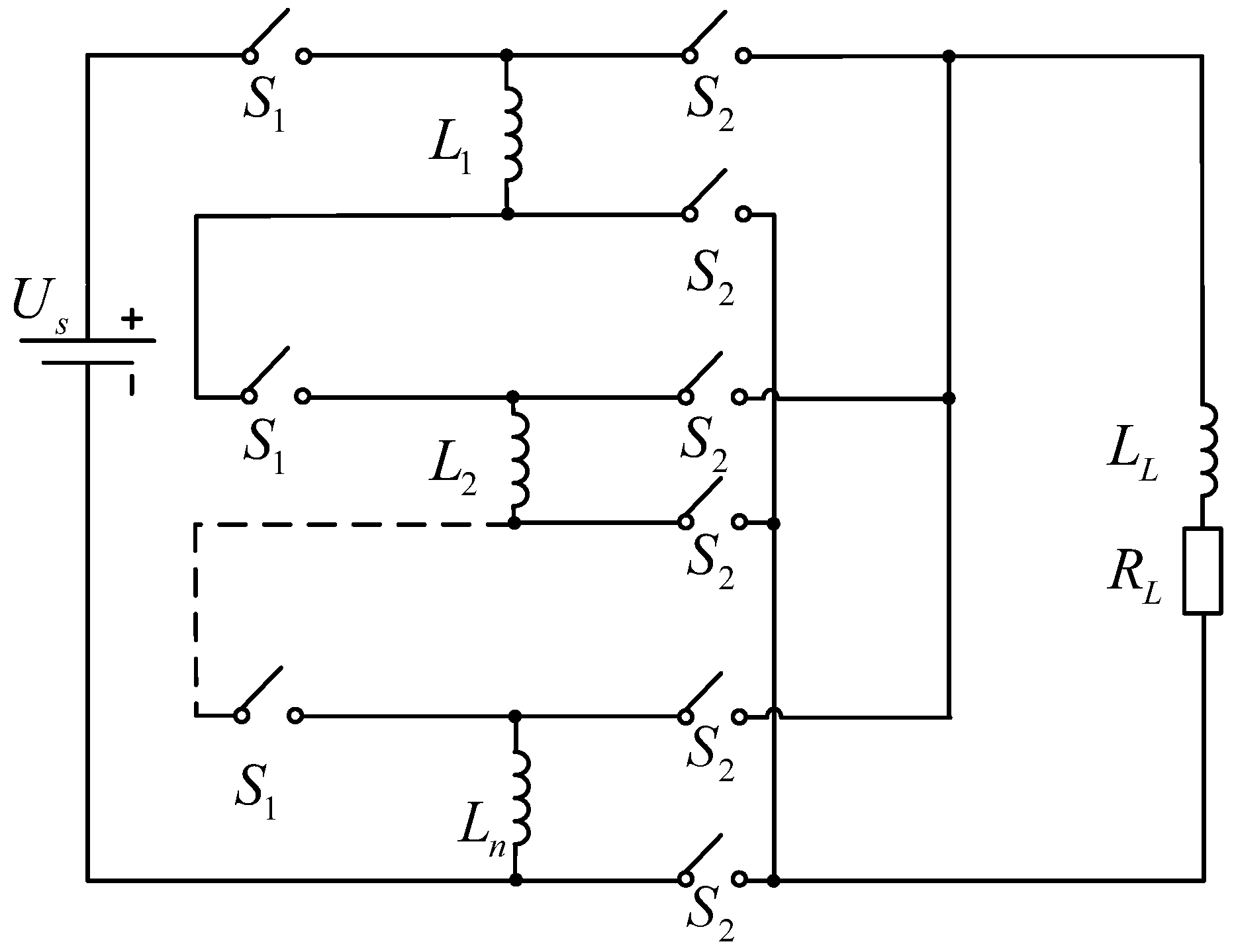
Figure 2 first summarizes the complete XRAM topology used for conceptual explanation, while the representative equivalent current-flow schematics in
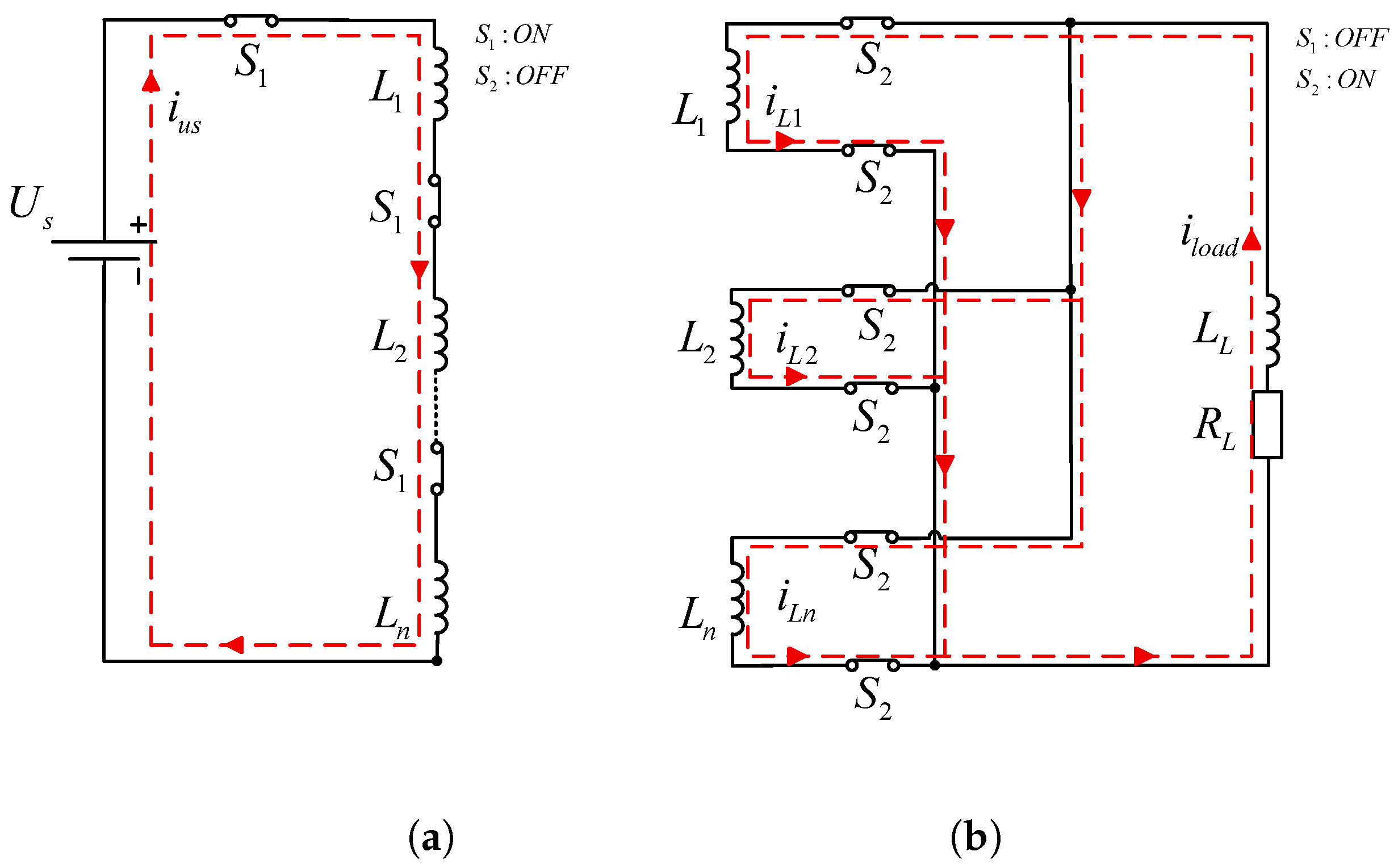
Figure 3 isolate the two basic switching states. In the left panel of
Figure 3, the charging switches are closed and the discharge switches remain open; so, the branch inductors accumulate magnetic energy while the load path is effectively inactive. In the right panel, the charging switches are opened and the discharge switches are closed; so, the branch currents are redirected and summed at the load. The key technical challenge is therefore commutation: the charging current must be interrupted and the stored inductor energy must be redirected toward the load. To accomplish this with high-current semiconductor devices, inverse current commutation with semiconductor (ICCOS) has been introduced into XRAM generators [
18]. Under high-energy-output conditions, however, the conventional all-parallel XRAM arrangement remains vulnerable to two coupled problems: excessive blocking-voltage concentration on the total output switch, and less favorable establishment of the load-driving path, both of which reduce how effectively the stored inductor current reaches the railgun load.
To address these two issues simultaneously, this paper proposes a three-module grouped XRAM topology. While the conventional directly paralleled 12-module structure treats all modules equivalently, the proposed design partitions them into three structurally symmetric submodule groups. This reorganization preserves the high-current-output characteristic that makes XRAM attractive for electromagnetic acceleration applications while introducing group-level control over the energy-release rhythm and commutation sequence, thereby providing a structural route to redistribute output-switch stress and advance the formation of the main load pulse. The topology’s performance, however, does not follow from structure alone; it depends on the coupled interaction of the main-storage precharge voltage, the reverse-capacitor precharge voltages, and the commutation triggering threshold. Characterizing these interactions therefore requires more than a handful of operating-point simulations.
The railgun load used in the present study should therefore be understood as a representative and highly demanding electromagnetic launch load through which the pulsed-power topology can be assessed. The circuit-level conclusions pursued here concern how grouped XRAM architecture affects current transfer, device stress redistribution, and load-access timing, and these issues remain relevant to broader electromagnetic launch and acceleration applications even beyond the specific railgun context.
Most existing studies on multistage pulsed power supplies have emphasized output enhancement and device-voltage balancing [
10,
16]. More recent work has extended this line of research to parameter optimization [
19,
20]. What remains less clear is how topology choice and parameter optimization interact. In particular, once the over-voltage limit is relaxed and each topology is allowed to optimize its own triggering threshold, it is still necessary to ask whether a new topology retains a genuine structural advantage.
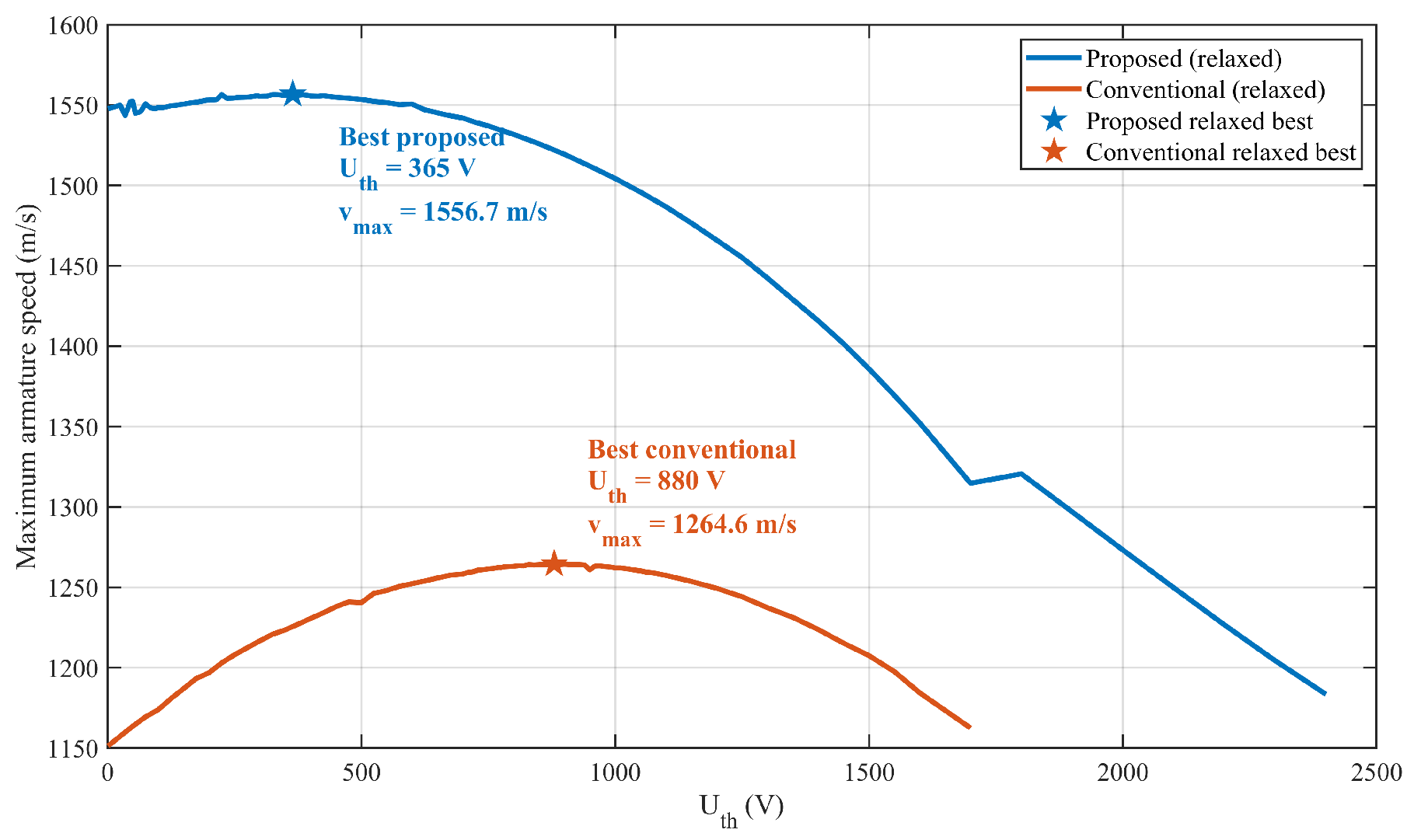
This question is central to the grouped topology proposed here. We therefore examine three issues in sequence: whether its timing and stress advantages remain when the two topologies are compared under equal initial stored energy and comparable voltage levels, which parameters set the performance ceiling and which mainly serve as commutation-matching variables, and whether the remaining advantage after relaxing the over-voltage boundary comes from a higher current peak or from a more favorable commutation and current–transfer process.
The contribution of this work is threefold. First, it introduces a three-module grouped XRAM topology and compares it systematically with the conventional 12-module all-parallel topology under equal initial stored energy and comparable voltage levels. Second, it formulates an optimization problem with maximum armature speed as the main objective and with device over-voltage and thyristor turn-off feasibility as constraints, and then uses one-dimensional sweeps, two-dimensional coupling maps, and local four-dimensional refinement to identify the dominant parameter effects and the feasible high-performance region. Third, it employs a trigger-threshold-optimized comparison to show that the performance gain of the grouped topology is structural rather than incidental, and that it is linked mainly to earlier commutation establishment and more effective transfer of internal storage current to the load.
To position the proposed topology more explicitly with respect to representative modular XRAM structures reported in the literature,
Table 1 summarizes the main architectural and analytical differences. Existing XRAM studies have demonstrated single-level multistage structures with different stage counts and semiconductor commutation arrangements [
16,
17,
18]. By contrast, the present work introduces an explicit group-level partition within a fixed 12-module XRAM system, and combines this structural modification with stress-redistribution analysis, threshold-optimized comparison, and a dedicated scalability discussion.
The rest of this paper is organized as follows:
Section 2 introduces the modeling framework, the ICCOS operating principle, and the evaluation indices.
Section 3 presents the baseline comparison, system-level loss estimation, parameter-optimization results, and the group-count scalability discussion.
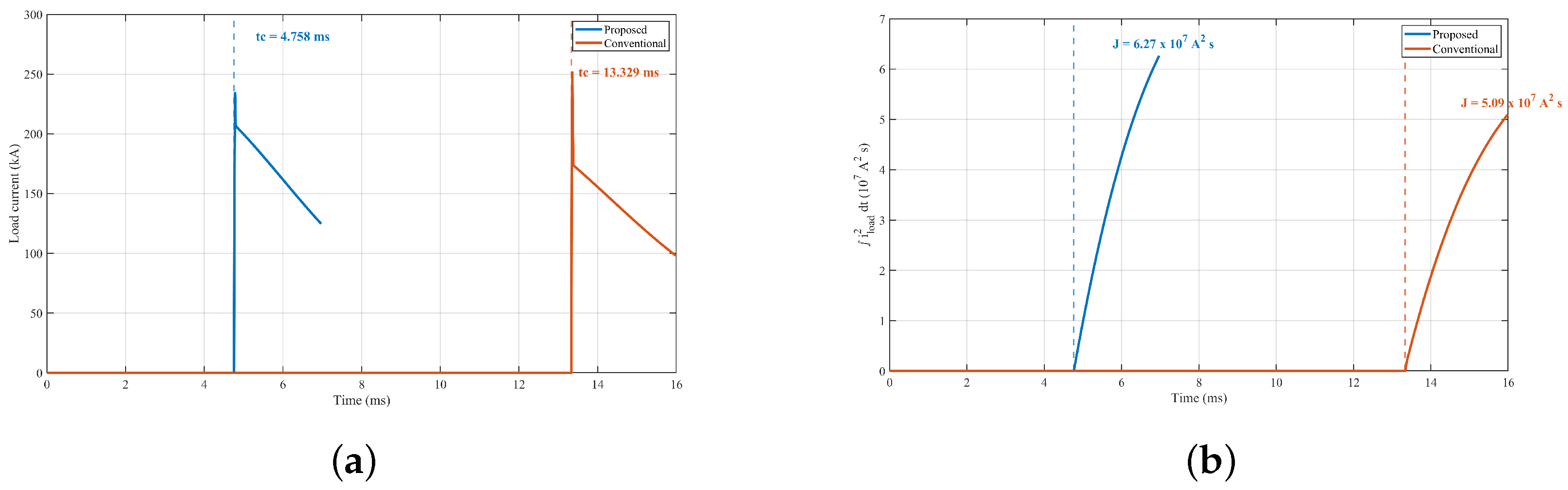
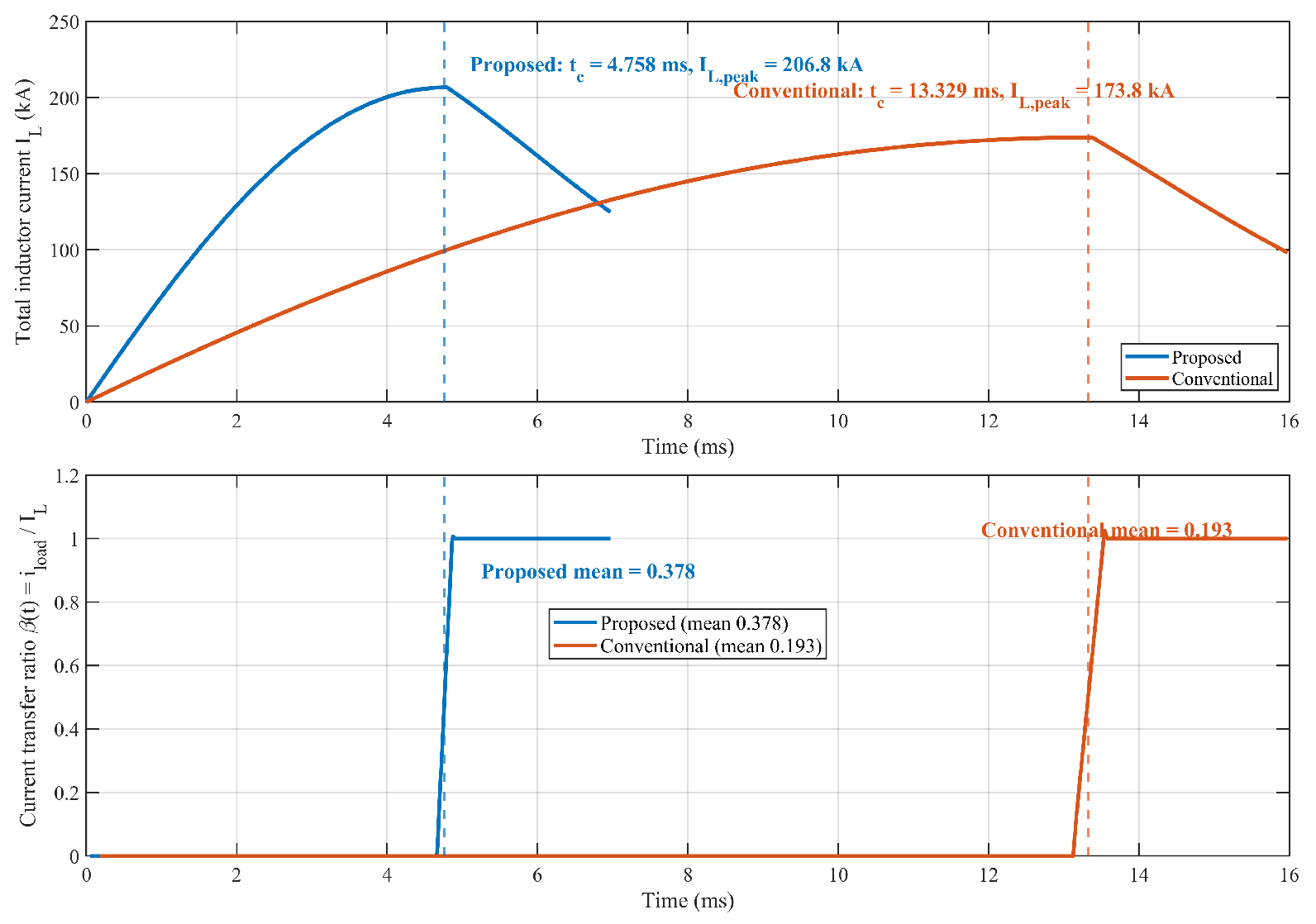
Section 4 uses the trigger-threshold-optimized comparison together with current-integral and transfer-ratio metrics to interpret the origin of the performance gap.
Section 5 concludes this paper.
2. Materials and Methods
This section introduces the modeling framework and evaluation basis used throughout this paper.
Section 2.1 describes the grouped-topology structure and the parameter reduction strategy.
Section 2.2 presents the railgun load model.
Section 2.3 explains the operating principle of the ICCOS module and the triggering criterion.
Section 2.4 summarizes the simulation model and the comparison principles.
Section 2.5 defines the optimization objective and constraints, and
Section 2.6 introduces the performance indices used in the subsequent results and discussion.
2.1. Topology Description and Parameter Reduction
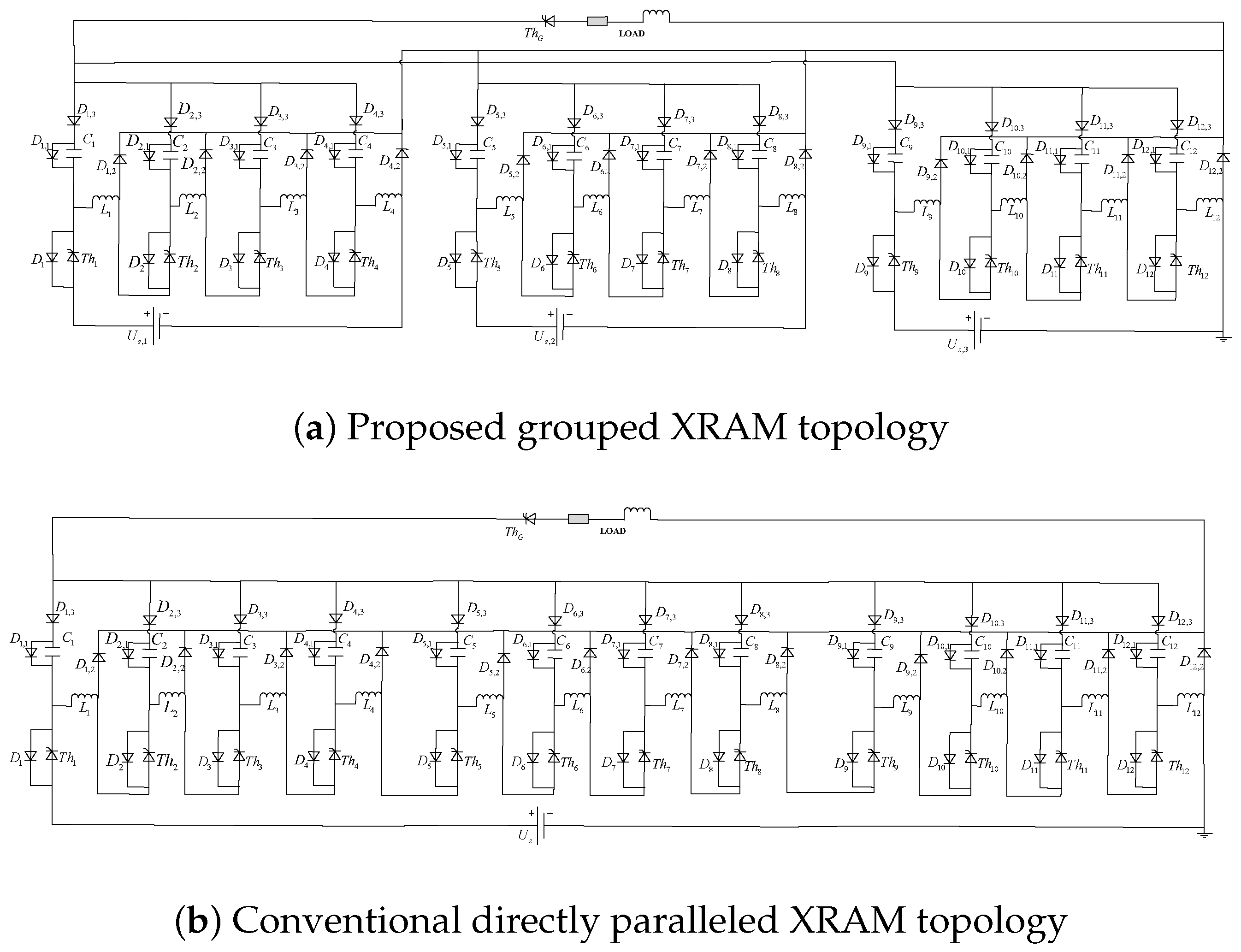
The topology under investigation partitions twelve XRAM modules into three structurally identical submodule groups. Within each group, a main energy-storage branch, a reverse-commutation branch, a set of multistage inductors, and a thyristor switching network work in concert to build and redirect the stored current. All three groups feed into the railgun load through a shared total output switch, with the actual energy delivery occurring during the commutation phase. For comparison purposes, a conventional directly paralleled 12-module XRAM topology is considered alongside the proposed design; it retains the same total stage count but foregoes any group-level partitioning.
Figure 4 contrasts the two circuit arrangements: the proposed design organizes its modules into groups, whereas the conventional topology simply places all twelve modules in parallel with no intermediate hierarchy. The single-stage ICCOS commutation unit discussed later represents one embedded branch-level ICCOS cell from
Figure 4a, and it is this structural difference that ultimately drives the distinctions in commutation timing, stress distribution, and load-driving behavior observed later.
The three-fold group symmetry of the proposed topology makes it natural to impose a group-constrained parameterization, which reduces the dimensionality of the optimization problem without discarding the physically meaningful differences between branches. Concretely, the three main-storage voltages are tied together as so that a single variable characterizes the energy level of all three groups simultaneously.
A finer distinction is drawn for the reverse-commutation capacitors, because the leading branch within each group carries a disproportionate share of the initial blocking duty and plays a more active role in establishing commutation. Accordingly, the precharge voltages of the three leading-branch capacitors are collected into a single variable , while those of the remaining nine branches are represented by : and . This two-tier grouping honors the functional asymmetry between leading and non-leading branches while compressing the parameter space to four optimization variables: , , , and .
2.2. Railgun Load Modeling
To describe the dynamic coupling between the pulsed power supply and the electromagnetic railgun load, a system-level electrical–mechanical equivalent model is adopted [
21,
22]. Related dynamic and inductance-gradient modeling approaches have also been reported in [
23,
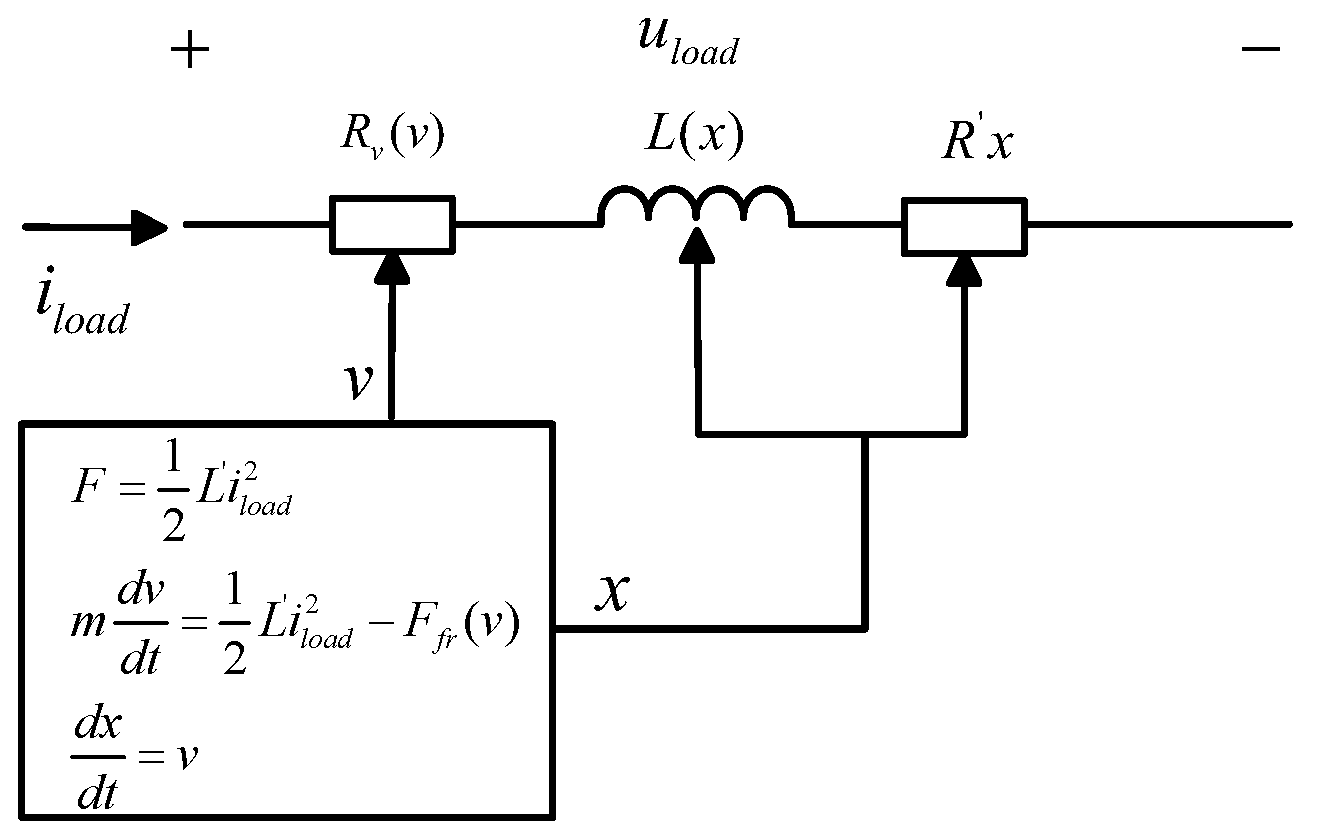
24]. In the present work, the railgun load is represented through a position-dependent inductive-resistive branch together with a simplified armature-motion model so that the dominant current–transfer and acceleration effects can be retained without introducing a full field-circuit co-simulation framework. The corresponding equivalent structure is summarized in
Figure 5.
Accordingly, the load-side voltage of the railgun is expressed as follows:
Here,
denotes the position-dependent rail resistance,
is an additional velocity-dependent dynamic resistance term,
is the equivalent rail inductance varying with the armature position
x,
is the rail inductance gradient, and
v is the armature velocity. In
Figure 5, the velocity-dependent and position-dependent parameter couplings are indicated explicitly, whereas the motion-induced term
is retained in Equation (
1) as the compact system-level representation of the corresponding electromechanical coupling. In this form, the model does not explicitly resolve the electromagnetic-field redistribution associated with the velocity skin effect, nor does it explicitly track the detailed evolution of the armature–rail contact interface. Instead, these higher-order effects are implicitly accounted for through the equivalent resistance terms retained in the load model.
The electromagnetic thrust acting on the armature is given by:
To reflect the main mechanical dissipation at system level, a simplified velocity-dependent friction term is included in the armature dynamics. The motion equation is therefore written as follows:
Here, m is the armature mass and is a smoothed velocity-dependent friction term. The resulting railgun load model is an electrically driven and position-coupled system in which the load current, armature motion, and dynamic load voltage evolve in a mutually dependent manner. This treatment preserves the dominant coupling among current build-up, armature acceleration, and load-voltage evolution while avoiding unnecessary numerical stiffness in the full XRAM topology model.
For reference, if the mechanical dissipation term is neglected, the armature speed can be approximated as follows:
This expression shows that the armature speed is not governed by the current peak at a single instant, but mainly by the time integral of the load-current square. Therefore, the maximum armature speed is taken as the primary performance index in this work, and the load-current-square integral is further employed as an auxiliary indicator of effective acceleration capability under different topologies and parameter combinations. In terms of scope, the adopted railgun model is intended for topology-level comparison, commutation-timing analysis, parameter optimization, and current–transfer mechanism evaluation. It is not intended as a detailed local model for contact-interface physics, full velocity-skin-effect resolution, or electrothermal stress prediction at the rail–armature interface.
2.3. ICCOS Module and Trigger Criterion
To enable controllable commutation in the XRAM topology, an ICCOS scheme is incorporated into each branch. Its function is twofold: interrupting the charging current at a well-defined instant and redirecting the stored inductor energy toward the railgun load.
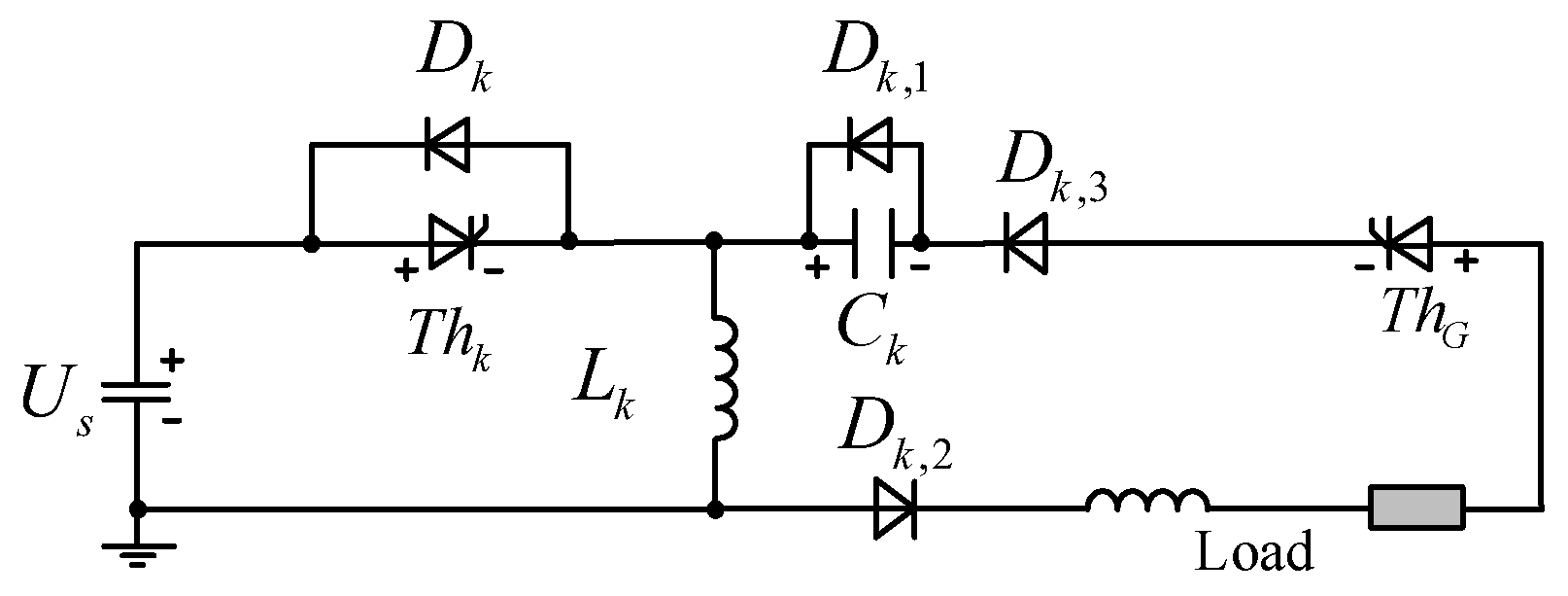
Figure 6 first summarizes the complete single-stage ICCOS commutation unit embedded in each branch, while
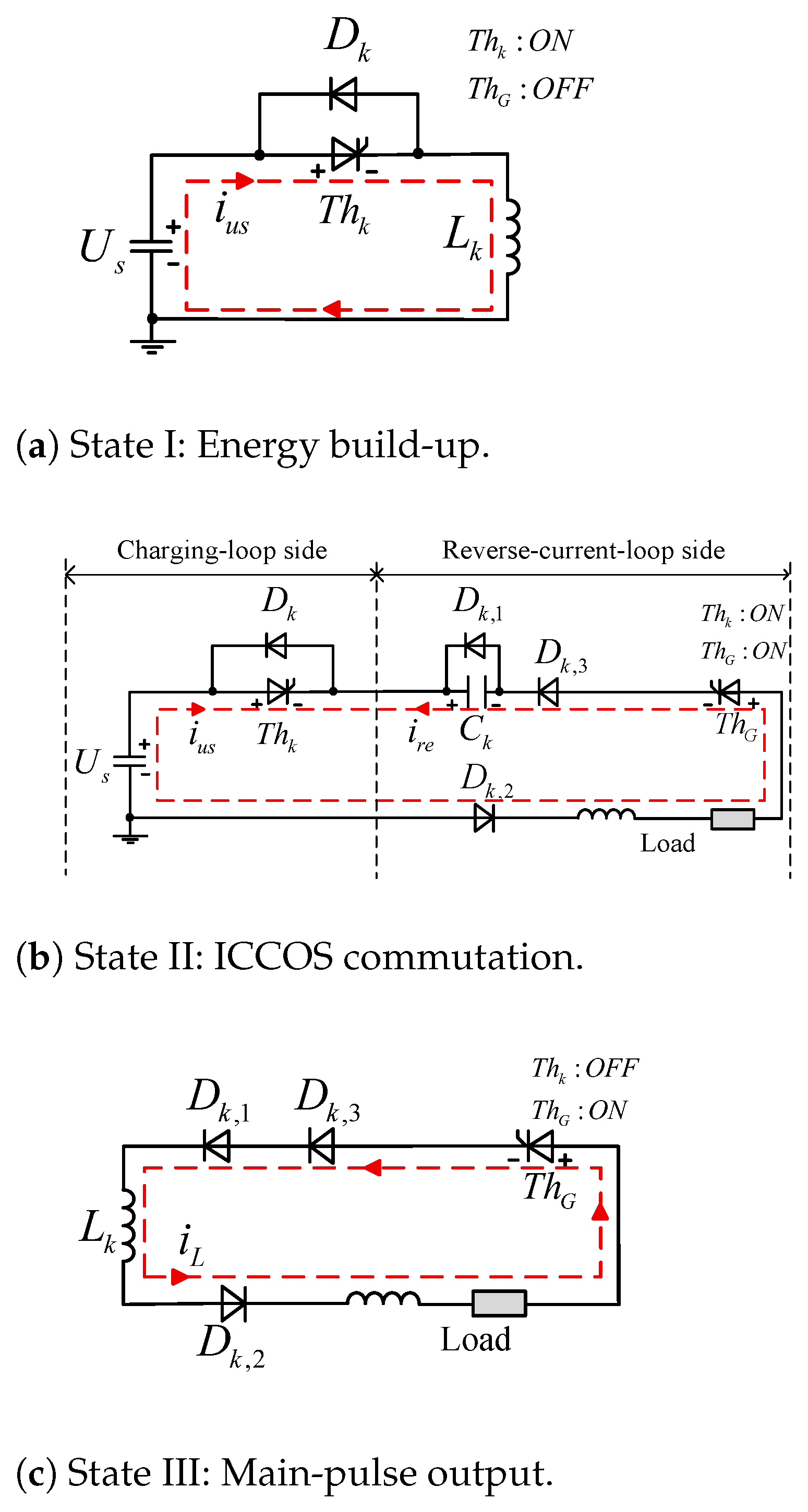
Figure 7 isolates the three representative switching intervals used to explain the commutation sequence. The commutation unit for the
kth branch comprises the precharged capacitor
, the charging thyristor
, the branch diode
, three commutation diodes,
through
, and the shared output switch
.
Figure 7a shows State I, in which the branch current is still carried by
while
remains precharged and
is open. After
is triggered, as shown in
Figure 7b, the capacitor discharges through the commutation loop and establishes a reverse current through the charging branch. As this reverse current grows to match the forward charging current, the net thyristor current drops below the holding threshold and
turns off naturally.
Figure 7c then shows State III, where the stored inductor current is redirected to the load path and the residual capacitor voltage sustains the required reverse-bias interval across
. What makes ICCOS particularly valuable here is not merely its ability to interrupt current, but its capacity to do so in a controlled, repeatable fashion that makes high-current thyristor operation in XRAM circuits practical.
Rather than treating the firing instant of the total output switch as a free control variable, a threshold-based triggering strategy is adopted in which the commutation is initiated when the residual voltage of the first-group main storage decays to a preset level. Let
denote the residual voltage of the first-group main storage. The commutation-triggering instant
satisfies:
Here, is the initial main-storage voltage and is the ICCOS triggering threshold.
During the initial phase of energy release, current accumulates predominantly within the internal storage branches, and the load path remains effectively open. When the decaying main-storage voltage reaches , the ICCOS module fires, the commutation branch closes, and the system transitions into the current–transfer phase in which inductor energy begins flowing into the railgun load. From this point onward, the load current climbs steeply and armature acceleration becomes significant. The timing of this transition therefore shapes not only the commutation instant itself but also the width and magnitude of the main acceleration pulse and the overall speed output.
In this light, operates as a timing knob for the entire energy-release rhythm. Setting it too low fires the ICCOS module prematurely, before the internal storage branches have accumulated sufficient current to sustain effective commutation. Setting it too high delays the transition, causing the load branch to miss the most energetically favorable window for current transfer. Selecting correctly is therefore central to matching commutation timing to the energy-release dynamics, and it receives dedicated attention in the parameter optimization that follows.
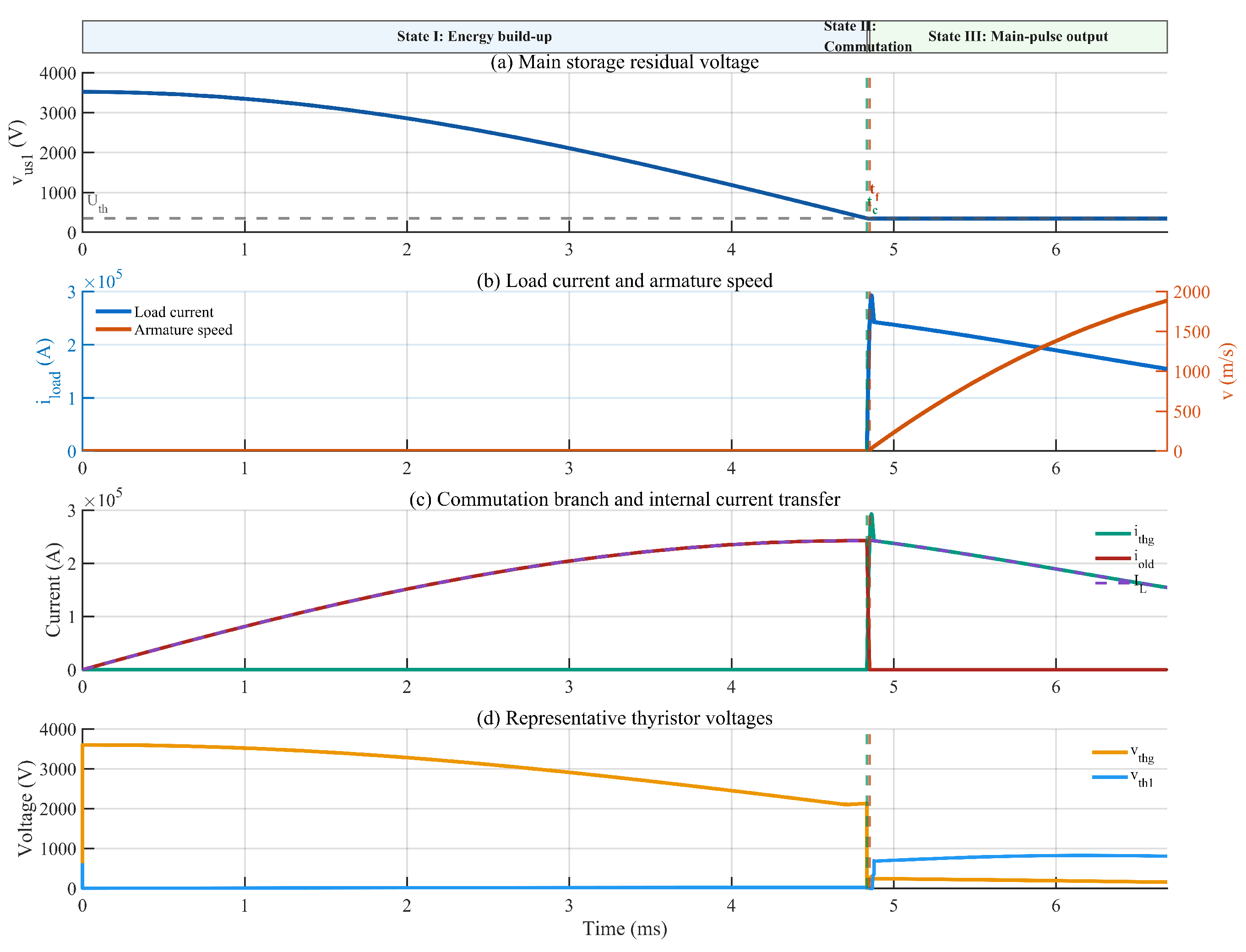
The typical working process of the proposed topology is illustrated in
Figure 8. The characteristic stages from energy build-up to main-pulse output provide the physical basis for the later analysis of output characteristics, parameter sensitivity, and current–transfer mechanism, and their state correspondence can be read together with the representative ICCOS configurations shown in
Figure 7. Unless otherwise noted, the interval interpretation adopted in the subsequent waveform figures follows the same State I/II/III definitions introduced in
Figure 7 and
Figure 8.
2.4. Simulation Model and Comparison Principles
System-level simulation models of both topologies are constructed in Simulink. Each model includes the main-storage capacitors, reverse-commutation capacitors, multistage inductors, thyristors, diodes, and the coupled electromechanical railgun load. Device conduction and blocking, commutation establishment, and armature acceleration are captured in a unified framework, consistent with modeling approaches reported in [
23,
25].
The electronic-device representation adopted in this work is intentionally kept at the system level. Thyristors and diodes are modeled through their switching functionality and conduction/blocking states so that topology-level output timing, current transfer, and voltage stress can be compared on a consistent basis. Detailed electrothermal coupling, junction-capacitance dynamics, and fully distributed parasitic networks are therefore not explicitly resolved in the present study. Accordingly, the reported results should be interpreted as topology-level performance trends under lumped-parameter modeling assumptions rather than as a complete device-design study.
The baseline comparison is conducted on equal terms: the total number of stages, load parameters, major device ratings, and triggering strategy are held fixed across both topologies, while the total initial stored energy is kept equal and the working-voltage levels are kept comparable. To achieve this, the proposed topology draws on three independent main capacitors, whereas the conventional topology uses a single equivalent capacitor whose initial energy equals the combined energy of those three. The working voltage of this equivalent capacitor is set at the same order of magnitude as that of one group in the proposed topology so that neither design is artificially penalized or favored by an unrealistic voltage mismatch.
A second level of comparison, referred to throughout as the trigger-threshold-optimized comparison, is introduced specifically to test whether any observed performance gap is structural or merely a product of a suboptimal threshold setting. Here, the over-voltage constraint is lifted, the turn-off constraint is retained, and each topology independently sweeps to locate its own best operating point under the same baseline electrical parameters. If the proposed topology still outperforms the conventional one under these conditions, the advantage must be attributed to an intrinsic difference in circuit behavior rather than to a favorable but arbitrary trigger choice.
2.5. Optimization Objectives and Constraints
The parameter optimization of the proposed three-module grouped XRAM pulsed power supply aims to maximize the output performance of the electromagnetic railgun while ensuring safe and feasible operation. Since the maximum armature speed directly reflects the energy-release capability of the pulsed power supply at the load, it is adopted as the primary optimization objective. In addition, the over-voltage and thyristor turn-off constraints are evaluated according to the device-stress and commutation considerations discussed in [
17,
18]. The optimization objective can be expressed as follows:
The first constraint is the device over-voltage constraint. Let
denote the maximum peak voltage among all thyristors, and let
denote the allowed device peak voltage. Then:
In this work, is set to 3600 V, corresponding to an 80% usage margin of a 4.5 kV-class device.
The second constraint is the turn-off feasibility constraint. All thyristors involved in commutation must be normally turned off, and no turn-off failure is allowed, i.e.:
Here, denotes the number of devices experiencing a turn-off failure. This constraint guarantees the physical realizability of the commutation process.
Consequently, the optimization problem studied in this paper is to identify the parameter combination that maximizes the armature speed subject to the over-voltage and turn-off-feasibility constraints. Therefore, the final recommended parameters are not merely mathematical extrema, but engineering compromise optima obtained within the safe operating boundary.
2.6. Evaluation Metrics
To quantitatively evaluate the output capability and the energy-transfer mechanism of the two topologies, several metrics are employed. The maximum armature speed is used to characterize the final output performance, and the peak voltage is used to characterize the voltage stress of key devices. The remaining indices are introduced to explain how current–transfer timing and waveform shape contribute to the observed output differences.
In the mechanism analysis, the load-current-square integral is defined as follows:
According to the railgun dynamics, J is directly related to the armature speed increase and can therefore be used as an effective index for comparing acceleration capability.
To avoid using only the current peak to describe the main pulse, the equivalent pulse width is defined as follows:
Here, is the peak value of the load current. This metric represents the duration required for an equivalent rectangular pulse with the same peak current to produce the same acceleration contribution as the actual waveform.
To describe the overall transfer of the internal inductor current to the load branch, the total inductor current is defined as follows:
The instantaneous current–transfer ratio is defined as follows:
Thus, , and the load-current-square integral can be rewritten as .
This expression indicates that the acceleration capability depends not only on the magnitude of the internal inductor current but also on the effective proportion transferred to the load.
To further characterize the overall transfer capability, the average current–transfer ratio is defined as follows:
This definition is equivalent to a weighted average of using as the weighting function, thereby emphasizing the critical stages in which the total inductor current is large and contributes most to the acceleration process. It can also be interpreted as the least-squares equivalent coefficient when approximating by . Therefore, is used to characterize the overall effectiveness with which the internal storage current is transferred to the load branch during commutation.
Based on the above topology description, load model, trigger criterion, constraints, and evaluation metrics, the subsequent sections first compare the two topologies under identical baseline parameters and then identify the parameter dependence and performance-advantage mechanism of the proposed topology.
3. Results
3.1. Output Characteristics Under Identical Baseline Parameters
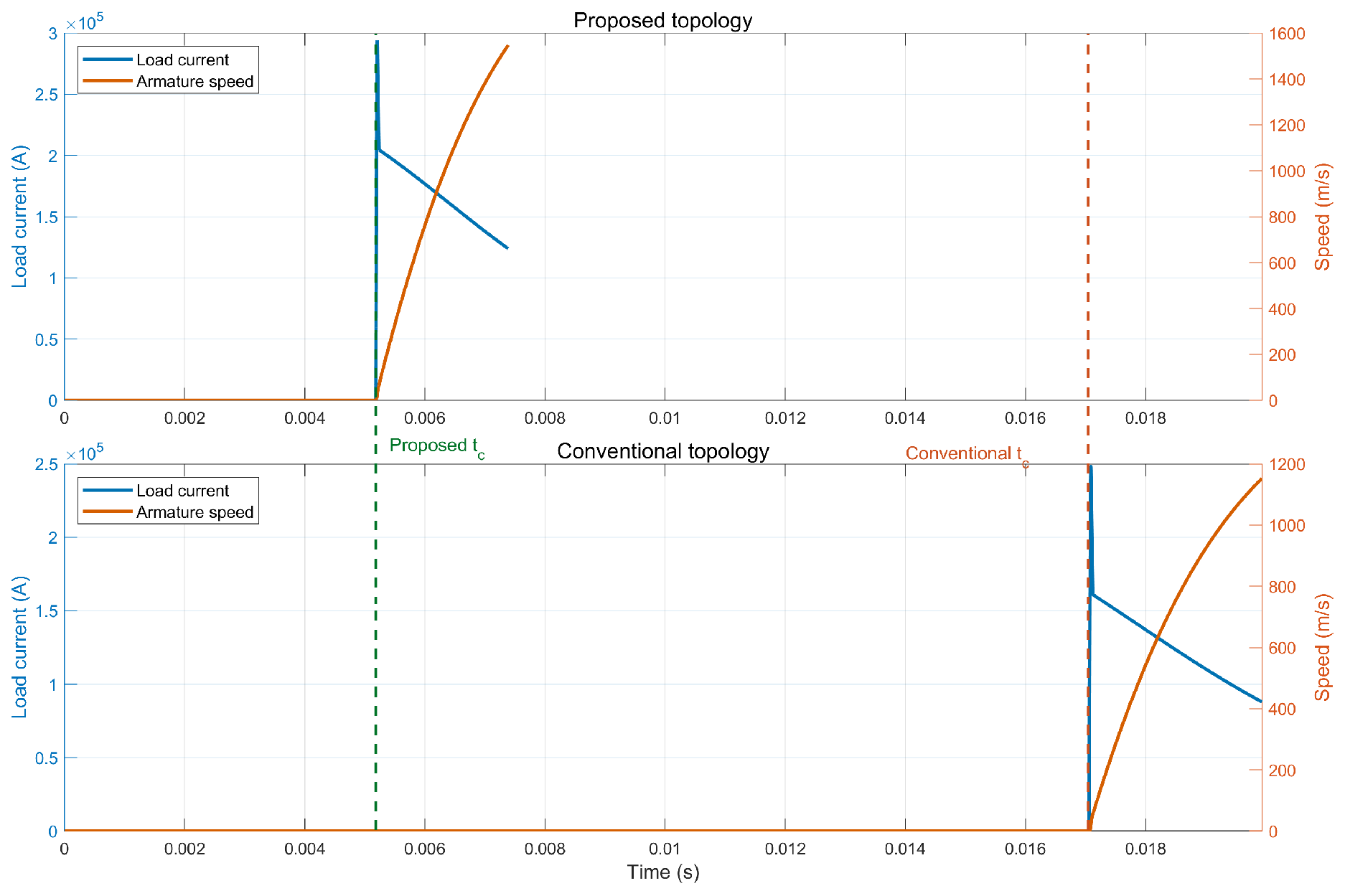
With stage count, device ratings, load parameters, triggering strategy, total initial stored energy, and voltage level made comparable across both designs, the baseline comparison isolates the effect of topology structure on output behavior. The most immediate difference is temporal: the grouped topology opens a conducting path to the railgun load well before the conventional all-parallel arrangement does, indicating that the group-level partitioning accelerates the handover of stored energy to the load.
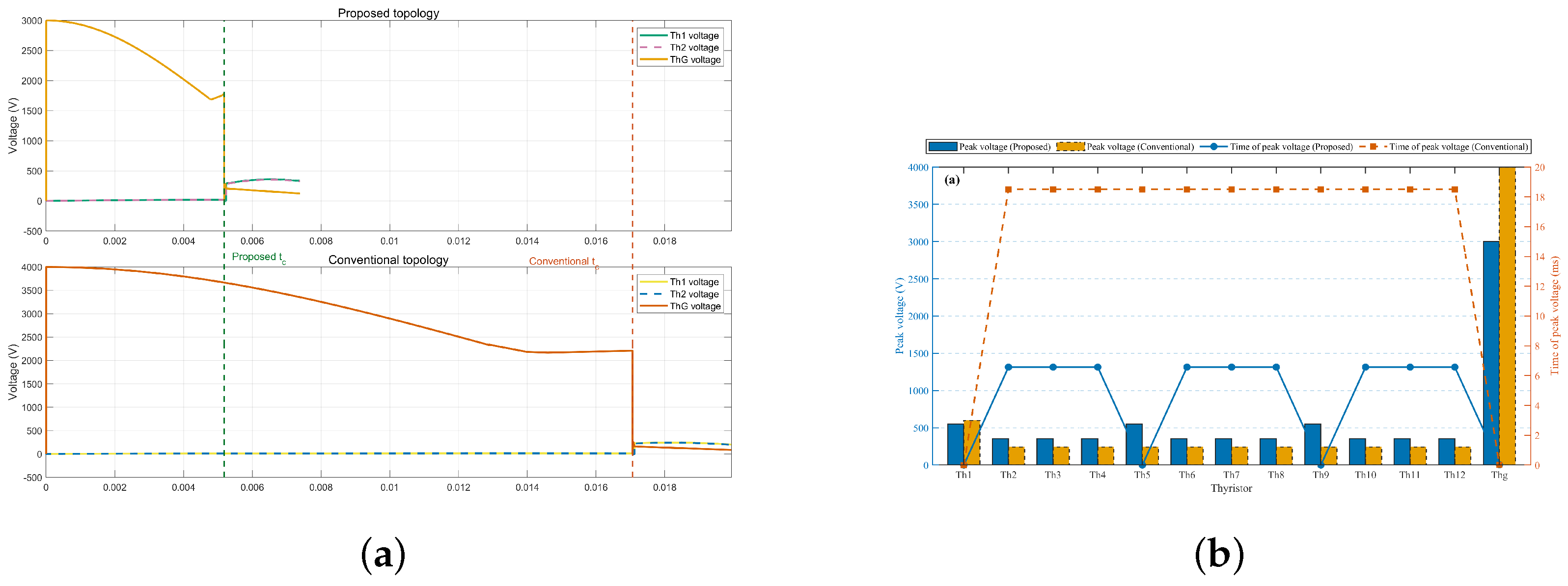
Figure 9 makes this timing difference concrete. The dashed markers identify the commutation-establishment instant for each design, and the grouped topology reaches this milestone appreciably earlier. The downstream effect is visible in the armature-speed trace: acceleration begins sooner and proceeds at a steeper rate, reflecting a more favorably timed output pulse rather than a simply larger one.
The voltage-stress picture in
Figure 10 adds a second dimension to the comparison. In the conventional topology, the total output switch carries a disproportionately large and sustained blocking-voltage burden. The grouped architecture partially redistributes this initial duty to the leading device within each submodule group, as
Figure 10a shows for representative branch thyristors and the output switch;
Figure 10b then quantifies the peak magnitudes and their occurrence times. The advantage is therefore not a uniform reduction in device stress across the board, but a structural redistribution that spreads the burden more evenly while simultaneously advancing the moment at which the load comes online.
3.2. System-Level Loss Estimation and Parasitic-Parameter Considerations Under the Baseline Condition
To complement the voltage-stress and turn-off analysis, a system-level loss estimation was performed at the baseline operating points. The estimate includes the equivalent load-side resistive dissipation, thyristor conduction loss, and diode conduction loss, while detailed switching loss and temperature-dependent parameter drift are not explicitly modeled. In
Table 2,
denotes the cumulative resistive dissipation in the equivalent load-side resistance,
denotes the cumulative thyristor conduction loss,
denotes the cumulative diode conduction loss,
is the sum of the preceding dissipative terms, and
is the final armature kinetic energy. The table therefore includes both internal conduction loss and load-side resistive dissipation, because both terms shape the system-level energy partition retained in the present model.
The grouped topology shows a larger total dissipative term in this system-level estimate, but it also delivers a substantially larger final armature kinetic energy. This behavior is physically consistent with the earlier load access and the stronger load-current response already identified in the waveform analysis: once more energy is transferred to the load branch at the appropriate time, both the useful output and the load-side resistive dissipation can increase simultaneously. For this reason, the system-level loss estimate should not be interpreted as contradicting the main conclusion of this paper; instead, it indicates that the grouped topology converts a larger portion of the stored energy into effective armature acceleration despite the stronger overall discharge process. The purpose of
Table 2 is therefore not to provide a complete electrothermal evaluation, but to offer a compact comparison of the main dissipative channels retained in the present system-level model.
Parasitic effects were also assessed through a lumped-equivalent representation. In practice, the most relevant non-idealities of the ICCOS commutation loop are the lumped stray inductance and the equivalent series resistance of the commutation capacitor branch. Their influence can be approximated by an additional transient voltage contribution and an additional resistive drop , respectively. These terms primarily affect local transient stress and commutation margin by increasing voltage overshoot and weakening reverse-current support. Accordingly, they primarily modify absolute device-stress margins rather than the comparative ranking between the two topologies. In other words, practical parasitic parameters are expected to modify local safety margins, whereas the reported performance advantage of the grouped topology still originates primarily from earlier load access and more effective current transfer.
3.3. Parameter Optimization of the Proposed Topology
Parameter optimization of the proposed topology proceeds in three stages: single-factor sweeps to establish individual sensitivities, two-dimensional coupling maps to expose interaction effects and feasibility constraints, and a local four-dimensional refinement to identify the recommended operating point. The variables examined are , , , and .
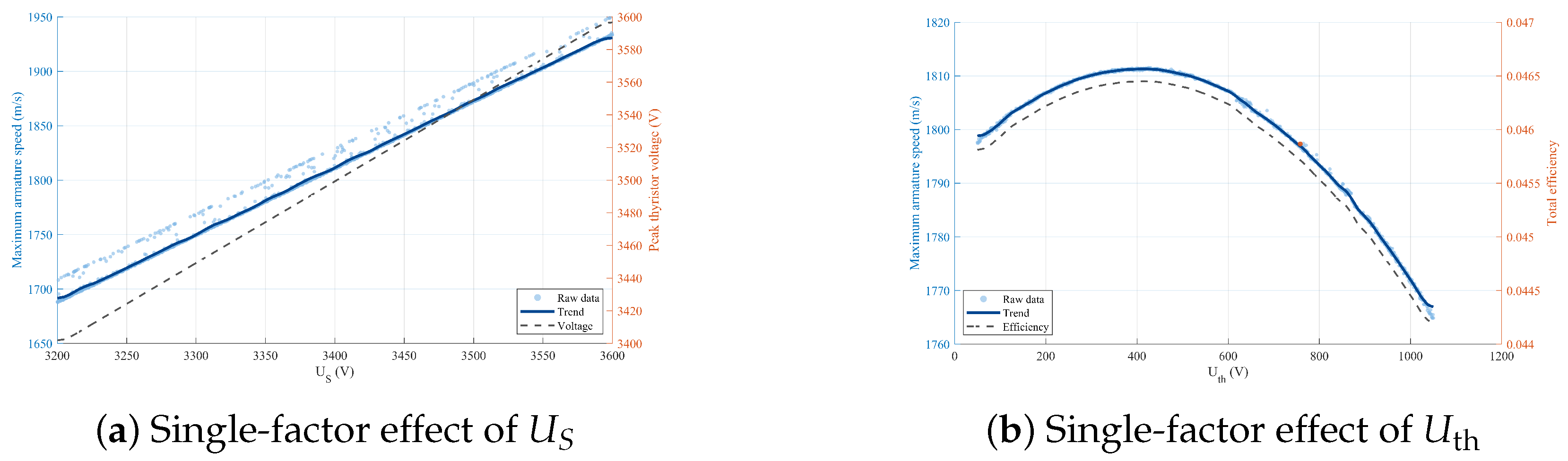
The single-factor results in
Figure 11 draw a clear distinction between the roles of
and
. Increasing
raises the overall energy level of the system and directly lifts the achievable speed ceiling; it is the dominant performance driver.
, by contrast, leaves the stored energy unchanged and instead shifts the commutation instant, functioning as a fine-tuning lever for matching the output pulse to the acceleration window.
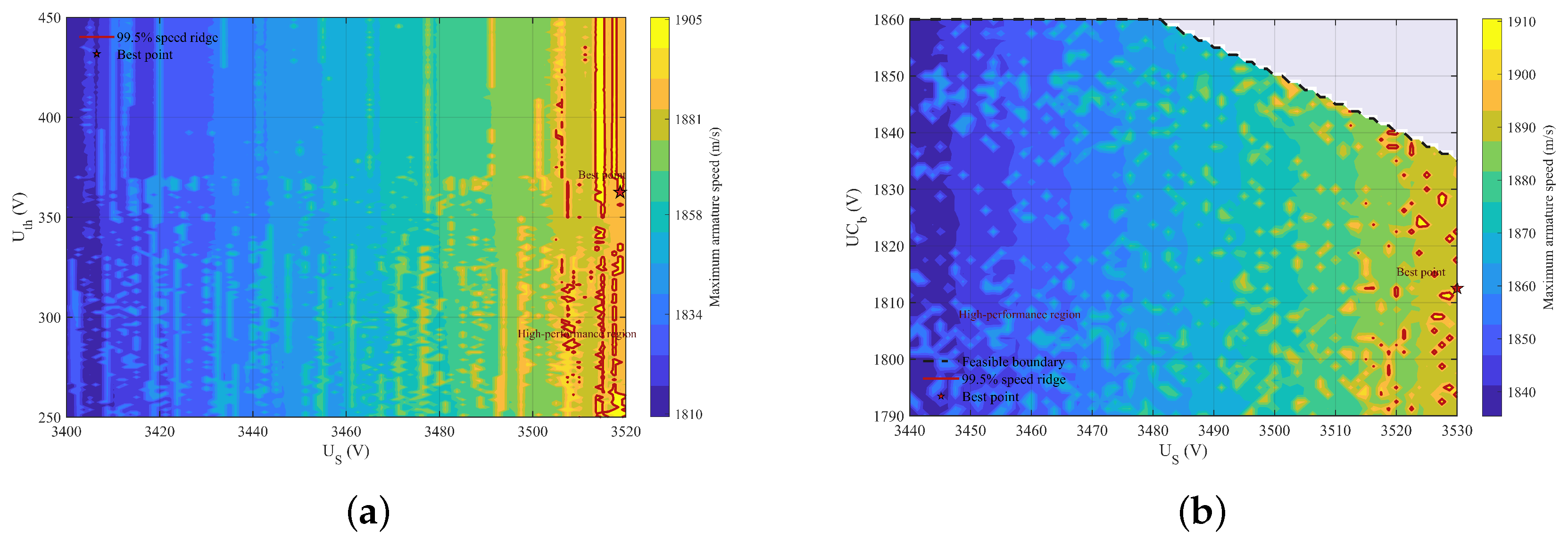
The two-dimensional parameter maps show that the feasible operating region is bounded by different physical constraints on different sides. In the
-
plane,
Figure 12a reveals a well-defined speed ridge that confirms commutation timing is the critical variable along that axis. In the
-
plane,
Figure 12b shows that the high-parameter boundary is set by the device over-voltage limit—pushing
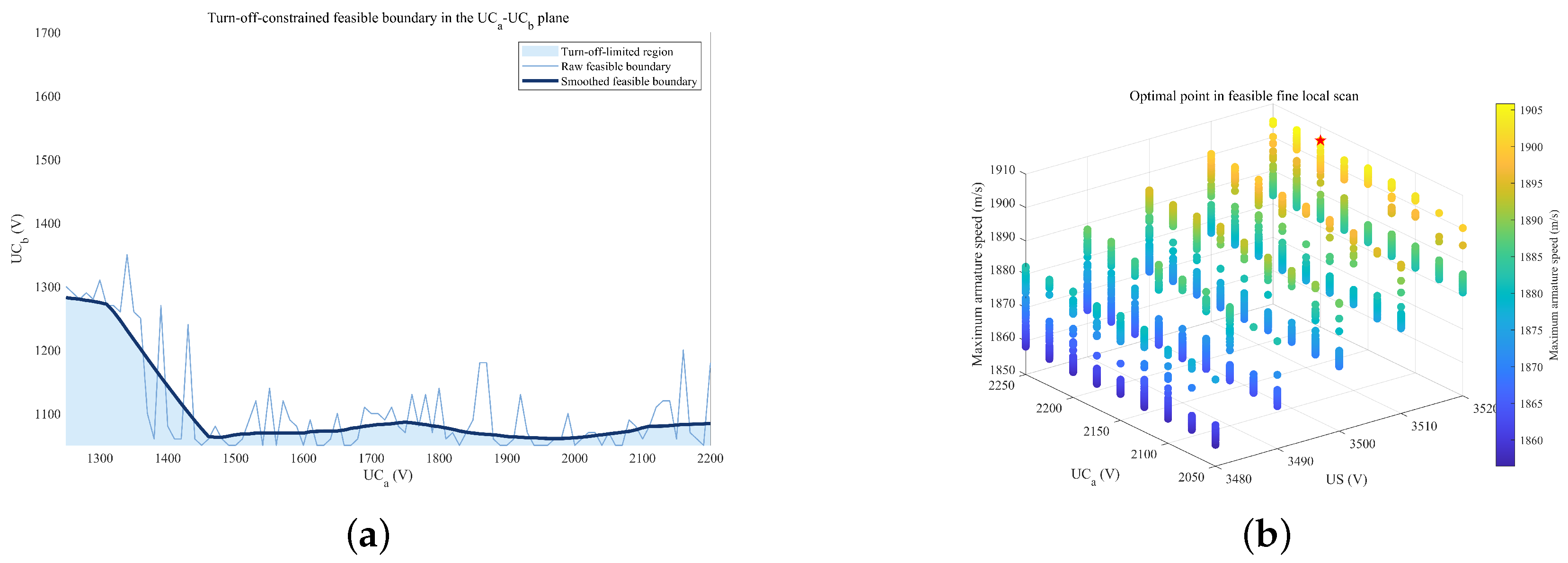
too far eventually violates the voltage rating. At the opposite extreme,
Figure 13a demonstrates that the low-parameter boundary is governed by turn-off feasibility: insufficient reverse-commutation support leads to thyristor turn-off failures that contract the usable domain from below.
Zooming into the high-performance region through the four-dimensional local refinement,
Figure 13b shows that the optimum is not a sharp, numerically sensitive peak but a broad plateau over which performance remains high across a range of parameter combinations. Rechecking this region against the stable model yields the recommended parameter set listed in
Table 3, where the peak device voltage stays within the 80% usage margin. The existence of this plateau carries practical significance: the topology can be operated near its performance ceiling without requiring impractically tight parameter tolerances.
3.4. Scalability with Respect to Group Count
The grouped topology proposed in this paper is realized as a three-group, 12-module system, but the same design idea can be extended to other group counts. To clarify this point, the existing group-comparison results were further summarized under a constrained-comparison criterion that simultaneously accounts for usable commutation, output-switch stress, and reverse-voltage margin.
Table 4 reports the best constrained operating point and the constrained-feasible rate for representative group counts. Here, the constrained-feasible rate denotes the proportion of scanned operating points that satisfy the combined engineering constraints used in the comparison.
The scalability trend is therefore not monotonic. Increasing the number of groups continuously improves commutation timing and suppresses the peak voltage stress at the best point, but the usable operating region does not remain equally broad as the partition becomes more aggressive. In particular, the six-group case delivers the highest speed ceiling, yet its constrained-feasible rate drops to 46.1%, which indicates a substantial contraction of the robust design space. Accordingly, the three-group arrangement is not presented as the unique mathematical optimum for every possible design objective. Instead, it is selected as a practical compromise for the 12-module system, because it already captures most of the structural benefit of grouping while retaining a broad feasible operating region and a comparatively moderate device-stress level.
5. Conclusions
This study examined a three-module grouped XRAM topology for electromagnetic railgun drive, with emphasis on its output behavior, parameter sensitivity, and commutation mechanism.
When the two topologies are compared under equal initial stored energy and comparable voltage levels, the grouped topology connects to the railgun load earlier than the conventional all-parallel topology. This earlier load access leads to a faster rise in armature speed and reduces the blocking-voltage burden on the total output switch by redistributing part of the initial stress to the leading devices of each group.
The parameter study also clarifies the roles of the key design variables. The main-storage voltage determines the overall energy level and the achievable speed ceiling, whereas the triggering threshold mainly adjusts the commutation timing. The reverse-capacitor voltages define the feasible operating boundaries associated with over-voltage and turn-off constraints.
The trigger-threshold-optimized comparison further shows that the advantage of the grouped topology is structural. Even when each topology is allowed to optimize its own threshold, the grouped design still delivers a higher armature speed despite a slightly lower peak current. The reason is that it establishes commutation earlier and channels internal storage current into the railgun load more effectively.
Overall, the grouped XRAM topology provides a more effective way to deliver stored energy to the railgun load than the conventional parallel arrangement. Future work will focus on experimental validation, the inclusion of additional device non-idealities, and adaptation of the topology to different energy levels.




 ,
,