





Super-Twisting-Based Online Learning in High-Order Neural Networks for Robust Backstepping Control of DC Motors Under Uncertainty
 , , ,
, , ,  ,
,  and
and 
Abstract
1. Introduction
2. Literature Review
3. Mathematical Background
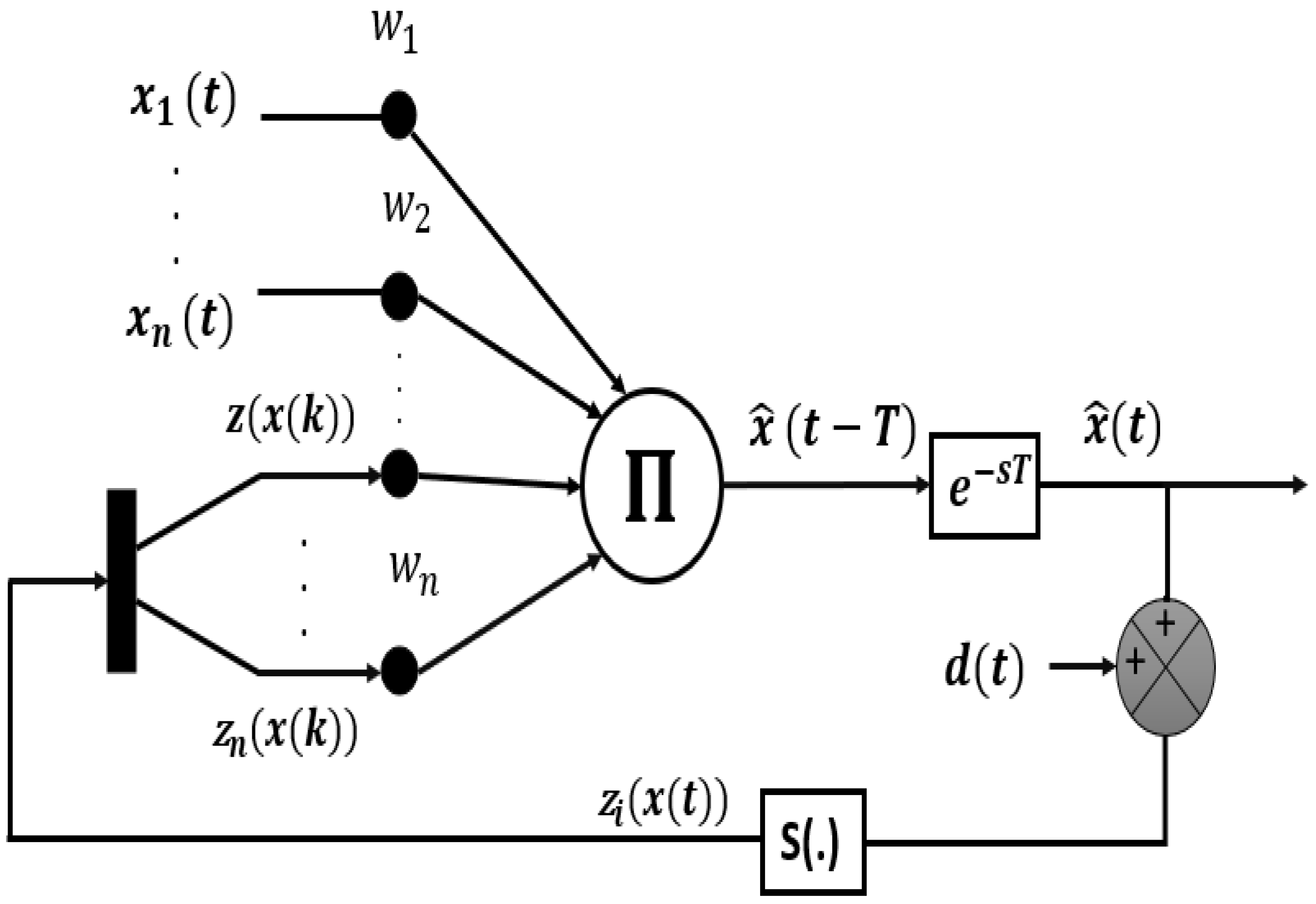
3.1. RHONN Model
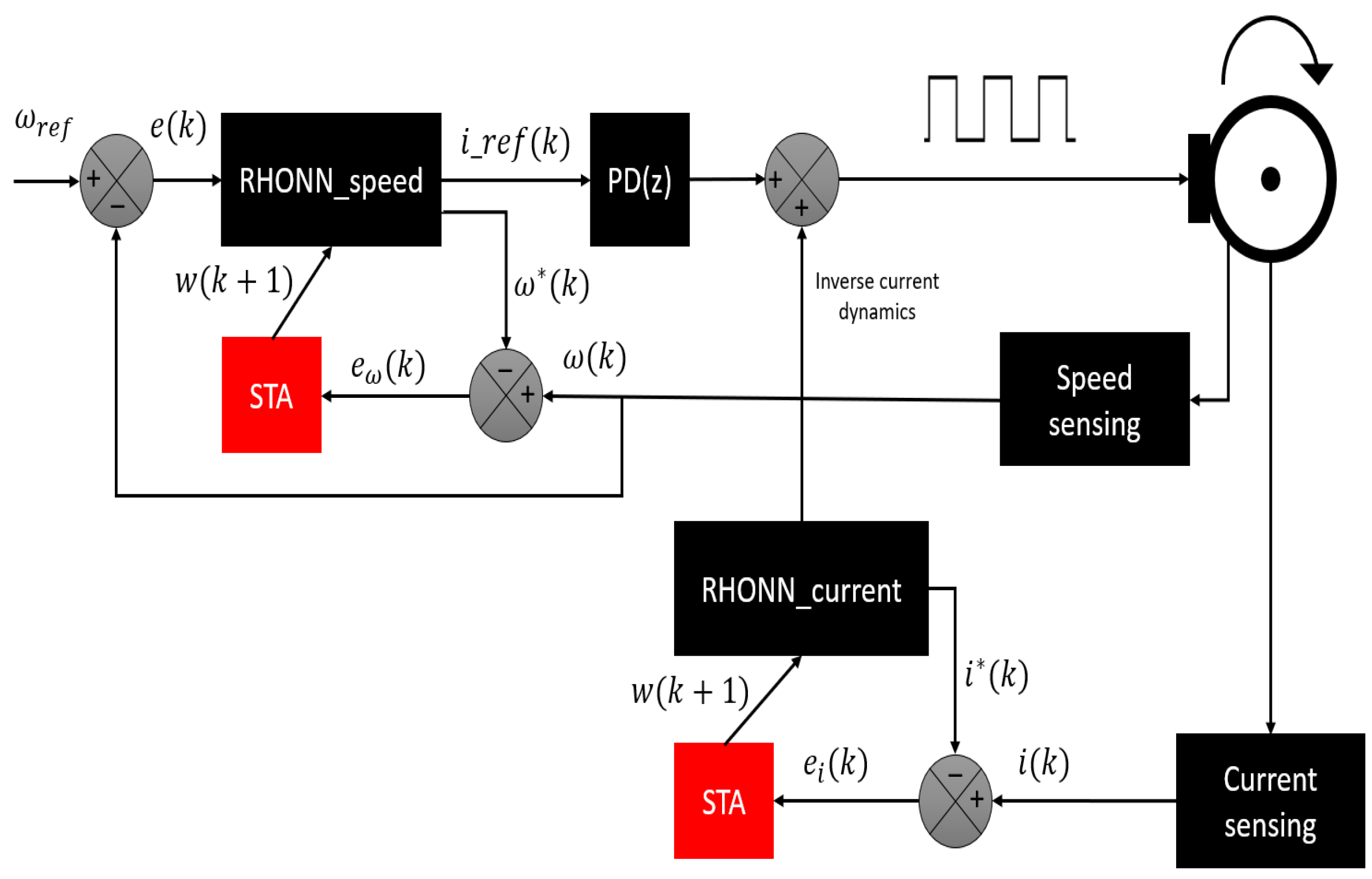
3.2. Neural Back-Stepping Controller Design
3.3. Super-Twisting Learning Algorithm
3.3.1. Weight Update and Implementation
3.3.2. RHONN Predictor and Identification Error Dynamics
3.4. Finite-Time Property of the STA Subsystem
- Step 1: Unperturbed finite-time convergence. Consider first the ideal case . The system (27) is homogeneous with respect to the dilation:of negative degree. Therefore, the origin is finite-time stable. In particular, there exists a continuous, positive definite Lyapunov function and constants such that, along solutions of (27) with :which implies finite-time convergence of to the origin; hence, in finite time.
- Step 2: Practical finite-time convergence under bounded . When is nonzero but bounded, the same Lyapunov function yields an estimate of the following form:Hence, for all , we have . Therefore, all trajectories enter the compact set in finite time:Since V is positive definite and radially unbounded, there exist (depending on ) such that:Returning to original variables, and , which proves that reaches in finite time a compact set of the claimed form.
- Step 3: Gain selection. The constants depend on . Increasing increases the decay rate and reduces the steady neighborhood size; thus, one can choose such that the resulting meet a prescribed practical bound.
3.5. Boundedness and Practical Convergence of the Learning Loop
- 1.
- The adaptive weights are uniformly bounded for all .
- 2.
- The identification error is ultimately bounded and reaches a compact setwhere depends on , the gains , and .
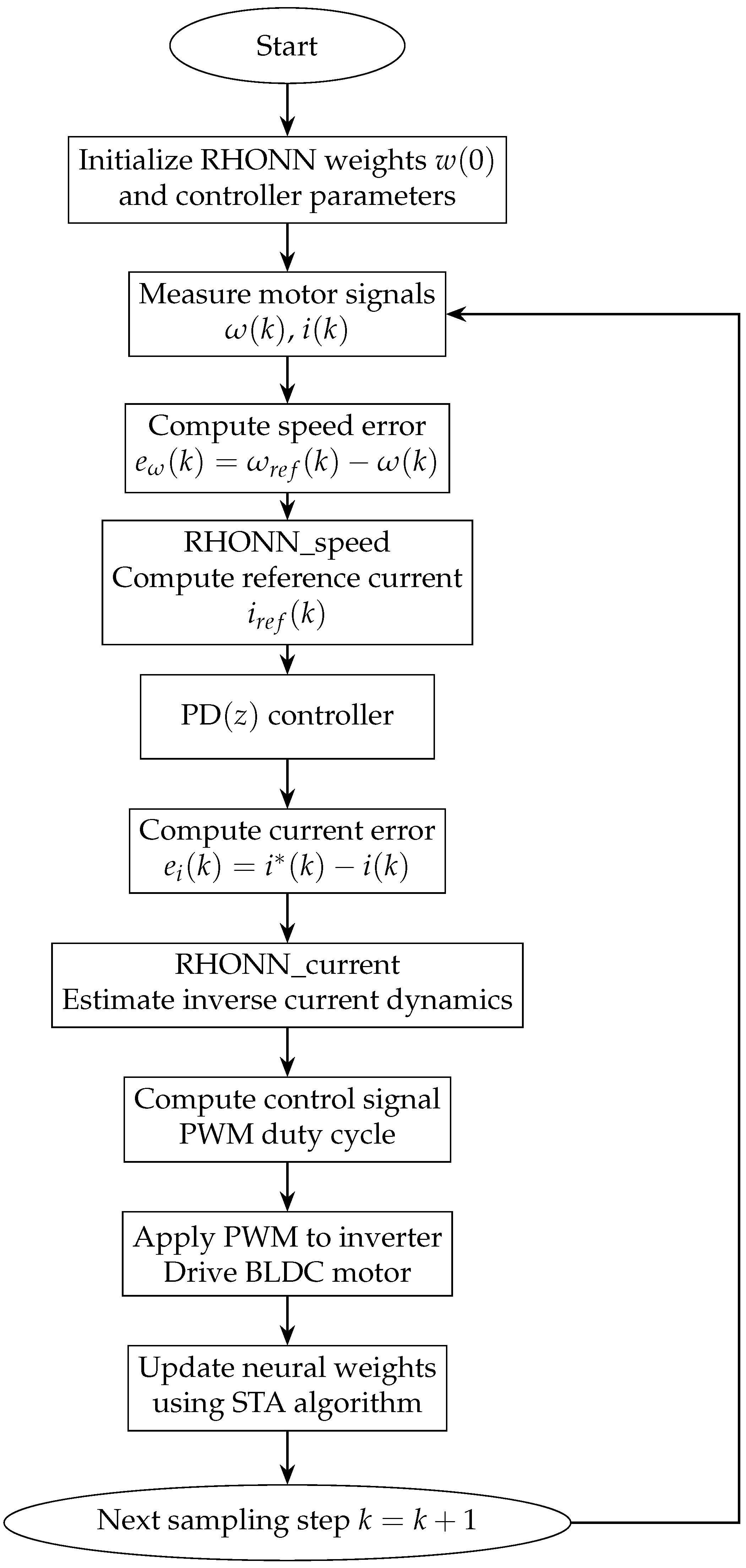
3.6. Discrete-Time Implementation (Embedded Real-Time)
3.7. Standing Assumptions (Outer-Loop Analysis)
3.8. Outer-Loop Controller and Error Dynamics
3.8.1. Auxiliary Coercivity Lemma
3.8.2. ISS/UUB of the Tracking Errors
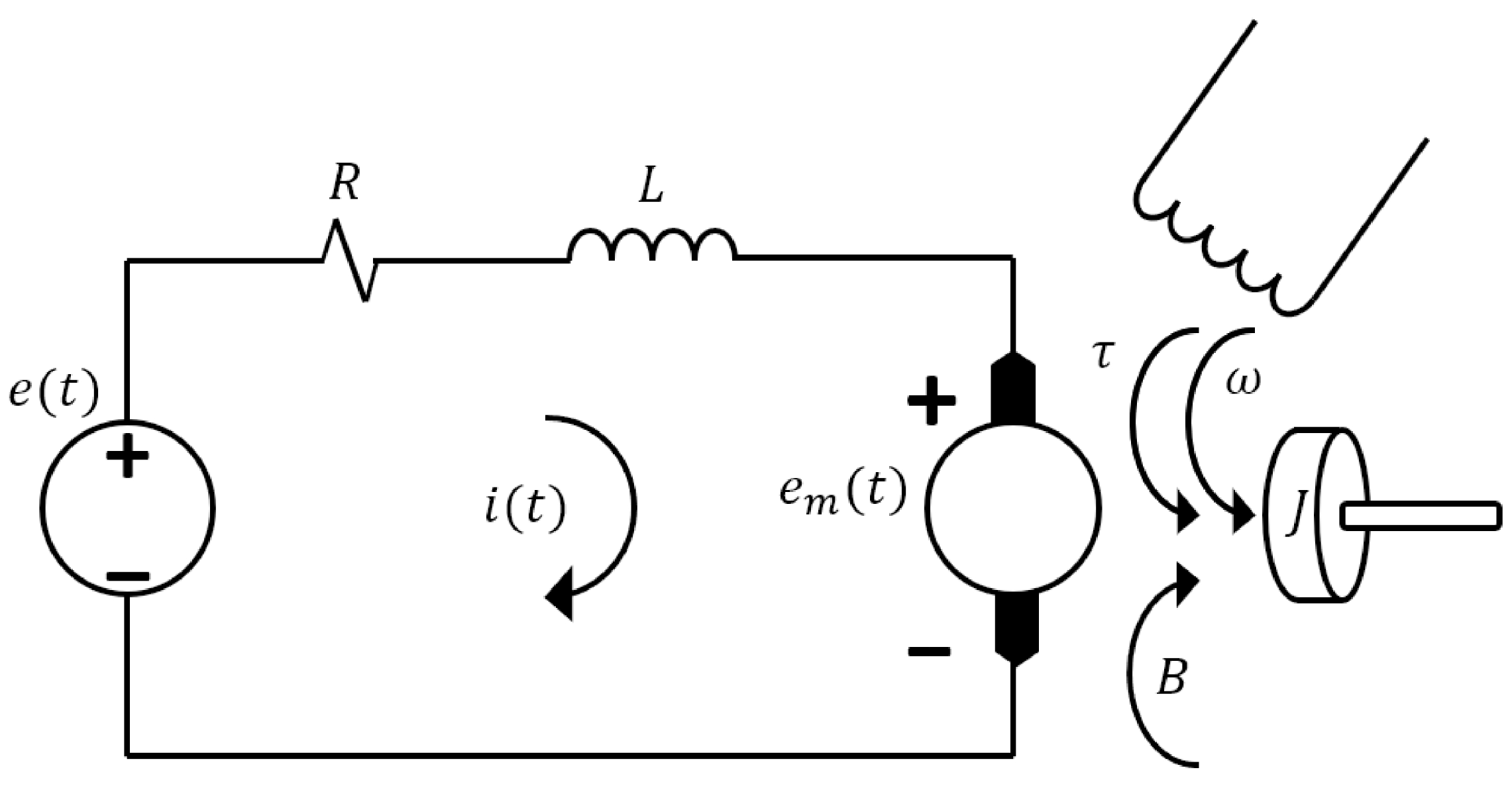
3.9. Model of Permanent Magnet Direct Current Motor
3.10. DC Drive Controller Design
- ,
- ,
- denotes the synaptic weights of the first neuron.
- ,
- ,
- denotes the synaptic weights of the second neuron.
4. Materials and Methods
4.1. Simulation Environment
4.2. Real-Time Implementation Setup
5. Results
5.1. Simulation
5.2. Real Time
6. Discussion
6.1. Performance Analysis vs. Conventional and Optimal Strategies
6.2. The Role of Super-Twisting Learning
6.3. Real-Time Feasibility and Hardware Constraints
6.4. Limitations
7. Conclusions and Future Work
Author Contributions
Funding
Data Availability Statement
Acknowledgments
Conflicts of Interest
Abbreviations
| DC | Direct Current |
| PMDC | Permanent Magnet Direct Current |
| BLDC | Brushless Direct Current |
| PMSM | Permanent Magnet Synchronous Motor |
| PID | Proportional–Integral–Derivative |
| SMC | Sliding Mode Control |
| ST | Super-Twisting |
| STA | Super-Twisting Algorithm |
| RHONN | Recurrent High-Order Neural Network |
| NN | Neural Network |
| EKF | Extended Kalman Filter |
| ISS | Input-to-State Stability |
| UUB | Uniformly Ultimately Bounded |
| HIL | Hardware-in-the-Loop |
| LQR | Linear Quadratic Regulator |
| MPC | Model Predictive Control |
| MLP | Multi-Layer Perceptron |
| ITAE | Integral of Time-weighted Absolute Error |
| ITSE | Integral of Time-weighted Squared Error |
| IAE | Integral of Absolute Error |
| ISE | Integral of Squared Error |
| IMSE | Integral of Mean Squared Error |
References
- Shao, L.; Hartavi, A.; Tavernini, D.; Sorniotti, A.; Cheng, M. Design Approaches and Control Strategies for Energy-Efficient Electric Machines for Electric Vehicles—A Review. IEEE Access 2020, 8, 116900–116913. [Google Scholar] [CrossRef]
- Şen, M.; Mutluer, M. A Review of BLDC Motors: Types, Application, Failure Modes and Detection. Energies 2025, 18, 6402. [Google Scholar] [CrossRef]
- Megrini, M.; Gaga, A.; Mehdaoui, Y. Review of electric vehicle traction motors, control systems, and various implementation cards. J. Oper. Autom. Power Eng. 2025, 13, 238–247. [Google Scholar]
- Alfaro, V.; Vilanova, R. PID control: Resilience with respect to controller implementation. Front. Control Eng. 2022, 3, 1061830. [Google Scholar] [CrossRef]
- Afifa, R.; Ali, S.; Pervaiz, M.; Iqbal, J. Adaptive backstepping integral sliding mode control of a mimo separately excited DC motor. Robotics 2023, 12, 105. [Google Scholar] [CrossRef]
- Murtaza, G.; Bhatti, A. Control of DC motors using sliding mode. In Proceedings of the 9th International Bhurban Conference on Applied Sciences & Technology (IBCAST); IEEE: New York, NY, USA, 2012; pp. 37–42. [Google Scholar] [CrossRef]
- Mohammed, A.; Al-Shamaa, N.; Al-Dujaili, A.Q. Super-Twisting sliding mode control of permanent magnet DC motor. In Proceedings of the 18th International Colloquium on Signal Processing & Applications (CSPA); IEEE: New York, NY, USA, 2022; pp. 347–352. [Google Scholar] [CrossRef]
- Alejandro-Sanjines, U.; Maisincho-Jivaja, A.; Asanza, V.; Lorente-Leyva, L.; Peluffo-Ordóñez, D. Adaptive PI controller based on a reinforcement learning algorithm for speed control of a DC motor. Biomimetics 2023, 8, 434. [Google Scholar] [CrossRef]
- Zhang, S.; Wallscheid, O.; Porrmann, M. Machine learning for the control and monitoring of electric machine drives: Advances and trends. IEEE Open J. Ind. Appl. 2023, 4, 188–214. [Google Scholar] [CrossRef]
- Salzmann, T.; Kaufmann, E.; Arrizabalaga, J.; Pavone, M.; Scaramuzza, D.; Ryll, M. Real-time neural MPC: Deep learning model predictive control for quadrotors and agile robotic platforms. IEEE Robot. Autom. Lett. 2023, 8, 2397–2404. [Google Scholar] [CrossRef]
- Quintero-Manríquez, E.; Sanchez, E.; Antonio-Toledo, M.; Muñoz, F. Neural control of an induction motor with regenerative braking as electric vehicle architecture. Eng. Appl. Artif. Intell. 2021, 104, 104275. [Google Scholar] [CrossRef]
- Chen, H.; Zhang, J.; Lv, C. RHONN Modelling-Enabled Nonlinear Predictive Control for Lateral Dynamics Stabilization of an In-Wheel Motor Driven Vehicle. IEEE Trans. Veh. Technol. 2022, 71, 8296–8308. [Google Scholar] [CrossRef]
- El-Sousy, F.; Amin, M.; Mohammed, O. Robust Adaptive Neural Network Tracking Control With Optimized Super-Twisting Sliding-Mode Technique for Induction Motor Drive System. IEEE Trans. Ind. Appl. 2022, 58, 4134–4157. [Google Scholar] [CrossRef]
- Sanchez, E.; Alanís, A.; Loukianov, A. Discrete-Time High Order Neural Control: Trained with Kalman Filtering. In Studies in Computational Intelligence; Springer: Berlin/Heidelberg, Germany, 2008; Volume 144, pp. 1–206. [Google Scholar] [CrossRef]
- Shtessel, Y.; Edwards, C.; Fridman, L.; Levant, A. Sliding Mode Control and Observation; Control Engineering; Springer: New York, NY, USA, 2014. [Google Scholar] [CrossRef]
- Djilali, L.; Badillo-Olvera, A.; Yuliana Rios, Y.; López-Beltrán, H.; Saihi, L. Neural High Order Sliding Mode Control for Doubly Fed Induction Generator based Wind Turbines. IEEE Lat. Am. Trans. 2022, 20, 223–232. [Google Scholar] [CrossRef]
- Attah, I.; Hussien, S.; Agboola, O.; Inumoh, L.; Ibrahim, H.; Chukwu, M. Neuro-Super Twisting Sliding Mode Control of a Direct Current Motor. In Proceedings of the International Conference on Electrical, Computer and Energy Technologies (ICECET); IEEE: New York, NY, USA, 2021; pp. 1–6. [Google Scholar] [CrossRef]
- Kim, H.; Kee, S. Neural Network Approach Super-Twisting Sliding Mode Control for Path-Tracking of Autonomous Vehicles. Electronics 2023, 12, 3635. [Google Scholar] [CrossRef]
- Sami, I.; Ullah, S.; Amin, S.; Al-Durra, A.; Ullah, N.; Ro, J. Convergence Enhancement of Super-Twisting Sliding Mode Control Using Artificial Neural Network for DFIG-Based Wind Energy Conversion Systems. IEEE Access 2022, 10, 97625–97641. [Google Scholar] [CrossRef]
- Chen, D.; Li, S.; Wu, Q. A Novel Supertwisting Zeroing Neural Network With Application to Mobile Robot Manipulators. IEEE Trans. Neural Netw. Learn. Syst. 2021, 32, 1776–1787. [Google Scholar] [CrossRef]
- Rios, J.; Alanis, A.; Arana, N.; Lopez, C. Realtime neural observerbased controller for unknown nonlinear discrete delayed systems. Int. J. Robust Nonlinear Control 2020, 30, 8402–8429. [Google Scholar] [CrossRef]
- Charoosaei, F.; Noohi, M.; Sadrossadat, S.; Mirvakili, A.; Na, W.; Feng, F. High-Order Deep Recurrent Neural Network With Hybrid Layers for Modeling Dynamic Behavior of Nonlinear High-Frequency Circuits. IEEE Trans. Microw. Theory Tech. 2022, 70, 5340–5358. [Google Scholar] [CrossRef]
- Ramirez, L.; Pech, M.; Anzurez, J.; Tapia, R.; Ríos, J.; Alanís, A. PID Control of a PMDC Motor Identified with RHONN and EKF for Performance Improvement. In Proceedings of the IEEE International Autumn Meeting on Power, Electronics and Computing (ROPEC); IEEE: New York, NY, USA, 2024; pp. 1–7. [Google Scholar] [CrossRef]
- Rios-Huerta, D.; Alanis, A.; Rios, J.; Arana-Daniel, N. Neural Identifier using Super-Twisting Differentiator Training Algorithm. In Americas Conference on Information Systems; Association for Information Systems (AIS): Atlanta, GA, USA, 2019. [Google Scholar]
- Rodriguez-Castellanos, D.; Blas-Valdez, M.; Solis-Perales, G.; Perez-Cisneros, M. Neural Robust Control for a Mobile Agent Leader–Follower System. Appl. Sci. 2024, 14, 5374. [Google Scholar] [CrossRef]
- Smith, L.; Topin, N. Super-convergence: Very fast training of neural networks using large learning rates. In Proceedings of the Artificial Intelligence and Machine Learning for Multi-Domain Operations Applications; SPIE: Bellingham, WA, USA, 2019; Volume 11006, pp. 369–386. [Google Scholar] [CrossRef]
- Vega, J.; Sanchez, E.; Djilali, L.; Loukianov, A. Neural inverse optimal control of single-phase induction motors. In Proceedings of the 8th International Conference on Control, Decision and Information Technologies (CoDIT); IEEE: New York, NY, USA, 2022; Volume 1, pp. 268–273. [Google Scholar] [CrossRef]
- Alanis, A. Exploring Kalman Filtering Applications for Enhancing Artificial Neural Network Learning. Algorithms 2025, 18, 587. [Google Scholar] [CrossRef]
- Ruz-Hernandez, J.; Garcia-Hernandez, R.; Ruz Canul, M.; Guerra, J.; Rullan-Lara, J.; Vior-Franco, J. Neural sliding mode control of a buck-boost converter applied to a regenerative braking system for electric vehicles. World Electr. Veh. J. 2024, 15, 48. [Google Scholar] [CrossRef]
- Djilali, L.; Suarez, O.; Sanchez, E.; Alanis, A.; Pardo, A. Real-time neural backstepping control for a helicopter prototype. In Proceedings of the IEEE Latin American Conference on Computational Intelligence (LA-CCI); IEEE: New York, NY, USA, 2017; pp. 1–6. [Google Scholar] [CrossRef]
- Fazdi, M.; Hsueh, P. Parameters Identification of a Permanent Magnet DC Motor: A Review. Electronics 2023, 12, 2559. [Google Scholar] [CrossRef]
- Urbina, I.; Medrano, J.; Rodríguez, A.; López-Estrada, F.; Djilali, L.; Badillo-Olvera, A. Adaptive Real-Time Neural Control of Permanent Magnet DC Motors Under Uncertainty. In Proceedings of the 22nd International Conference on Electrical Engineering, Computing Science and Automatic Control (CCE); IEEE: New York, NY, USA, 2025; pp. 1–6. [Google Scholar] [CrossRef]
- Wang, J.; Zhang, Y.; Ren, S.; Wang, H. Parameter Optimization Design of MPC Controller in AUV Motion Control Based on Improved Black-Winged Kite Algorithm. J. Mar. Sci. Eng. 2025, 13, 2018. [Google Scholar] [CrossRef]
- Dhanasekaran, B.; Kaliannan, J.; Baskaran, A.; Dey, N.; Tavares, J. Load Frequency Control Assessment of a PSO-PID Controller for a Standalone Multi-Source Power System. Technologies 2023, 11, 22. [Google Scholar] [CrossRef]
- Gutiérrez-Urquídez, R.; Valencia-Palomo, G.; Rodríguez-Elias, O.M.; Trujillo, L. Systematic selection of tuning parameters for efficient predictive controllers using a multiobjective evolutionary algorithm. Appl. Soft Comput. 2015, 31, 326–338. [Google Scholar] [CrossRef]

| Symbol | Description | Unit |
|---|---|---|
| R | Armature resistance | |
| L | Armature inductance | H |
| Torque constant | N·m/A | |
| Back EMF constant | V·s/rad | |
| J | Rotor inertia | kg·m2 |
| B | Viscous friction coefficient | N·m·s/rad |
| Armature current | A | |
| Angular speed | rad/s |
| Symbol | Description | Value |
|---|---|---|
| Armature resistance | ||
| Armature inductance | ||
| Back-EMF constant | ||
| J | Rotor inertia | |
| Rated armature current |
| Symbol | Description | Value |
|---|---|---|
| Viscous friction coefficient | ||
| Coulomb friction torque | ||
| Non-linear friction torque | ||
| k | Smoothing gain |
| Component | Description | Details (Manufacturer/Version/Reference) |
|---|---|---|
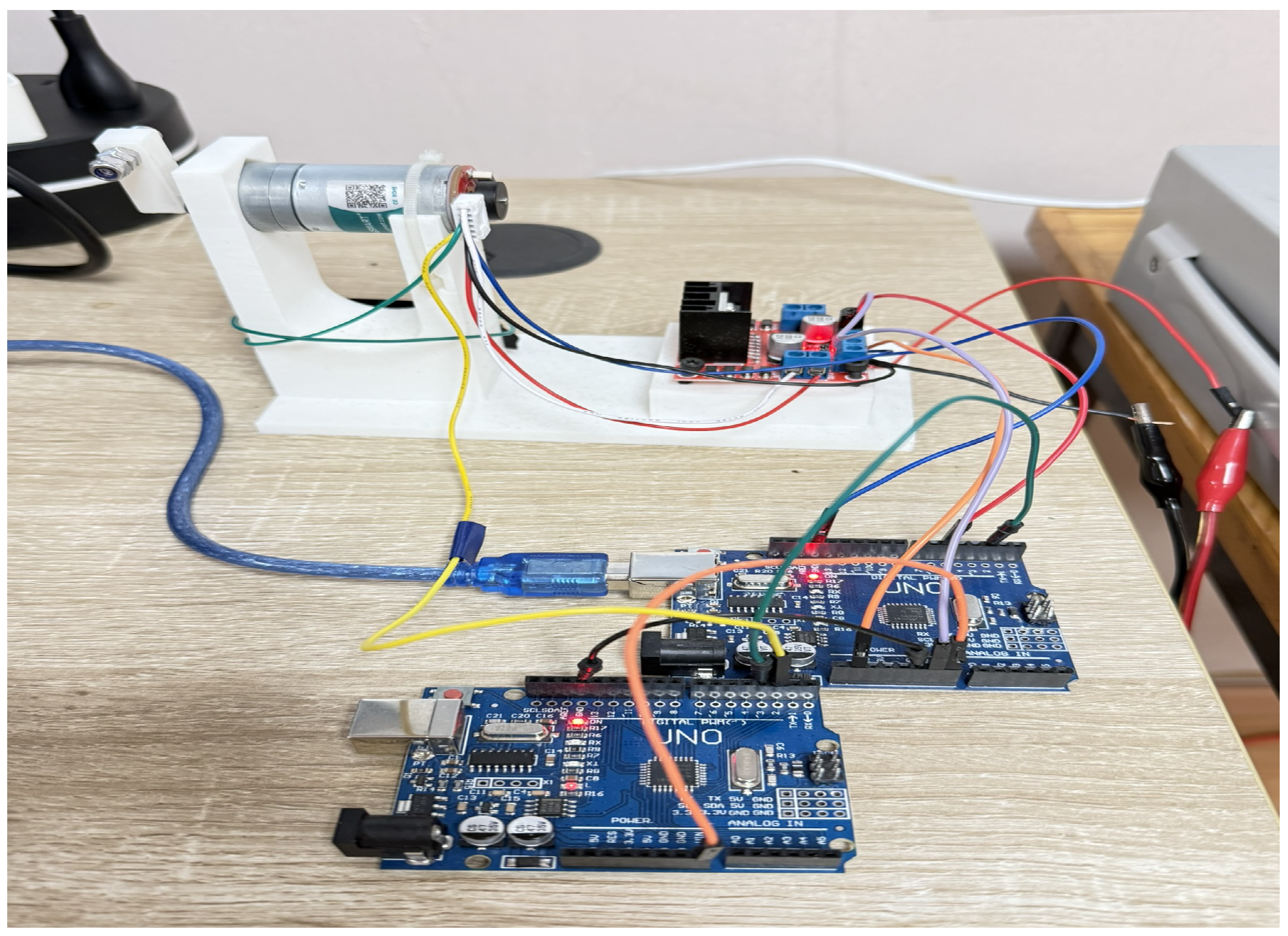
| Microcontroller | Arduino Uno (ATmega328P, 16 MHz) | Arduino SA, Ivrea, Italy |
| Motor Driver | L298N dual H-bridge driver | STMicroelectronics, Geneva, Switzerland |
| DC Motor | 12 V brushed DC motor, 0.8 A nominal current | Generic manufacturer |
| Speed Sensor | Incremental encoder mounted on motor shaft | Generic manufacturer |
| Control Signal | PWM generated by Arduino Uno | Firmware via Arduino IDE (2.3.7) |
| Communication | Serial communication between Arduino and PC | USB serial protocol |
| Data Processing Software | MATLAB for signal acquisition and visualization | MathWorks, Natick, MA, USA; Version R2021A |
| Controller | Description | Value |
|---|---|---|
| MLP | A one-hidden-layer feedforward neural network with online adaptation (backpropagation-like update using the sign of the plant gradient and normalization for stability). The network output was scaled and saturated within the range . Additionally, the training process was carried out in MATLAB using its optimization algorithms to facilitate parameter adjustment of the model. | Hidden neurons: Activation: Learning rate: Output scaling: , saturates to Weight init: Normalization factor in updates: |
| MPC | A finite-horizon predictive controller based on an online-identified scalar model (Self-Tuning Regulator) was employed. The parameters a and b were estimated using the Recursive Least Squares (RLS) algorithm, while a Riccati recursion was used to compute the control gain over the prediction horizon. Additionally, the parameter identification and training procedures were carried out in Matlab using its optimization algorithms to facilitate parameter adjustment. | Prediction horizon: Cost weights: , RLS forgetting factor: Control limits: , |
| LQR | Adaptive discrete LQR (Self-Tuning Regulator). The system dynamics were identified online using the Recursive Least Squares (RLS) algorithm through the scalar model . Based on these estimated parameters, an iterative solution of the algebraic Riccati equation was employed to compute the LQR gain, approximating the infinite-horizon optimal control law. Additionally, the parameter identification and training procedures were carried out in Matlab using its optimization algorithms to facilitate parameter adjustment. | Model form: Cost weights: , RLS forgetting factor: Riccati iterations: |
| PD | The control action was computed using proportional and derivative terms to regulate the system’s response and reduce the tracking error. Additionally, the controller parameters were tuned and validated using Matlab and its optimization tools. | Proportional gain: Derivative gain: |
| Controller | ITAE | ITSE | IAE | ISE | IMSE | |||||
|---|---|---|---|---|---|---|---|---|---|---|
| Val | Red. | Val | Red. | Val | Red. | Val | Red. | Val | Red. | |
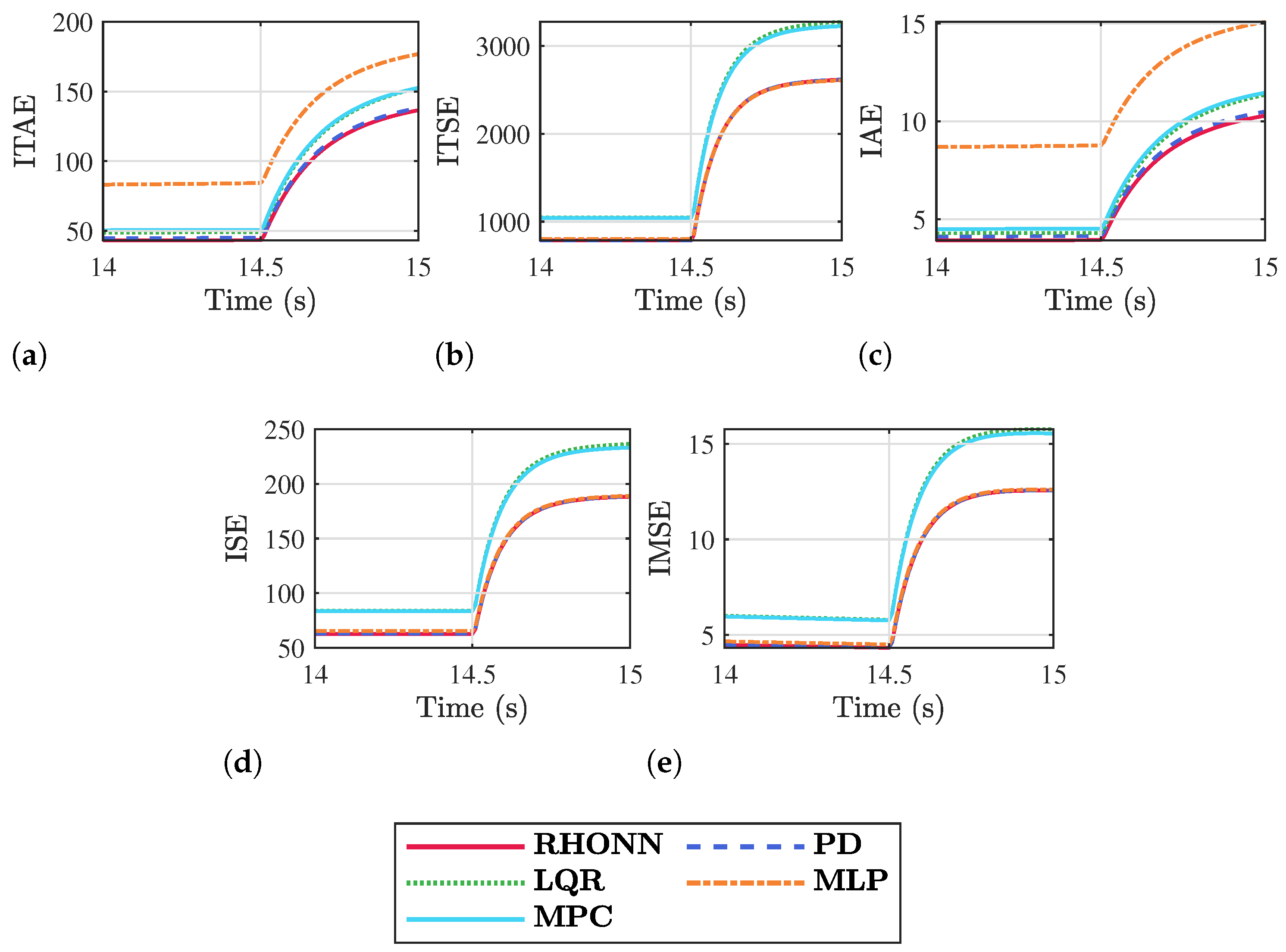
| RHONN | 136.60 | – | 2615 | – | 10.29 | – | 188.20 | – | 12.55 | – |
| PD | 138.20 | −1.17% | 2616 | −0.04% | 10.50 | −2.04% | 188.40 | −0.11% | 12.56 | −0.08% |
| LQR | 152.50 | −11.64% | 3273 | −25.16% | 11.36 | −10.40% | 236.50 | −25.66% | 15.76 | −25.58% |
| MPC | 152.60 | −11.71% | 3225 | −23.33% | 11.47 | −11.47% | 233.10 | −23.86% | 15.54 | −23.82% |
| MLP | 174.60 | −27.82% | 2695 | −3.06% | 15.68 | −52.38% | 195.90 | −4.09% | 13.06 | −4.06% |
Disclaimer/Publisher’s Note: The statements, opinions and data contained in all publications are solely those of the individual author(s) and contributor(s) and not of MDPI and/or the editor(s). MDPI and/or the editor(s) disclaim responsibility for any injury to people or property resulting from any ideas, methods, instructions or products referred to in the content. |
© 2026 by the authors. Licensee MDPI, Basel, Switzerland. This article is an open access article distributed under the terms and conditions of the Creative Commons Attribution (CC BY) license.
Share and Cite
Urbina Leos, I.R.; Medrano Hermosillo, J.A.; Rodriguez Mata, A.E.; Lopez-Estrada, F.R.; Suarez, O.J.; Luna-Gómez, A.A. Super-Twisting-Based Online Learning in High-Order Neural Networks for Robust Backstepping Control of DC Motors Under Uncertainty. Processes 2026, 14, 1019. https://doi.org/10.3390/pr14061019
Urbina Leos IR, Medrano Hermosillo JA, Rodriguez Mata AE, Lopez-Estrada FR, Suarez OJ, Luna-Gómez AA. Super-Twisting-Based Online Learning in High-Order Neural Networks for Robust Backstepping Control of DC Motors Under Uncertainty. Processes. 2026; 14(6):1019. https://doi.org/10.3390/pr14061019
Chicago/Turabian StyleUrbina Leos, Ivan R., Jesus A. Medrano Hermosillo, Abraham E. Rodriguez Mata, Francisco R. Lopez-Estrada, Oscar J. Suarez, and Alma Alejandra Luna-Gómez. 2026. "Super-Twisting-Based Online Learning in High-Order Neural Networks for Robust Backstepping Control of DC Motors Under Uncertainty" Processes 14, no. 6: 1019. https://doi.org/10.3390/pr14061019
APA StyleUrbina Leos, I. R., Medrano Hermosillo, J. A., Rodriguez Mata, A. E., Lopez-Estrada, F. R., Suarez, O. J., & Luna-Gómez, A. A. (2026). Super-Twisting-Based Online Learning in High-Order Neural Networks for Robust Backstepping Control of DC Motors Under Uncertainty. Processes, 14(6), 1019. https://doi.org/10.3390/pr14061019

