Interlayer Interference Mechanisms and Key Controlling Factors in Low-Permeability Porous Carbonate Gas Reservoirs
Abstract
1. Introduction
2. Overview of the Research Area
3. Methodology
3.1. Interlayer Interference Physical Simulation Experiment
3.1.1. Experimental Sample
3.1.2. Experimental Setup and Conditions
3.1.3. Experimental Plan Design
- Experimental plan;
- 2.
- Experimental parameters;
- 3.
- Experimental procedures.
3.2. Numerical Simulation and Orthogonal Scheme Design
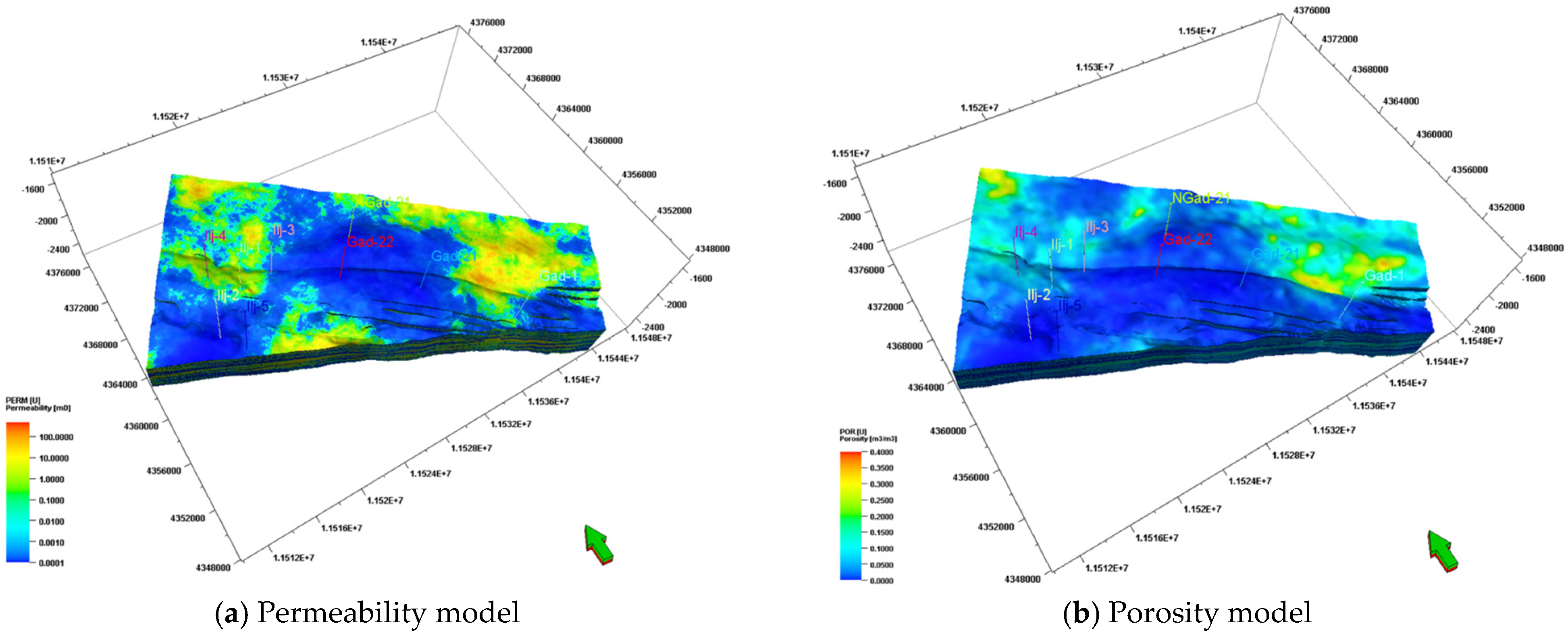
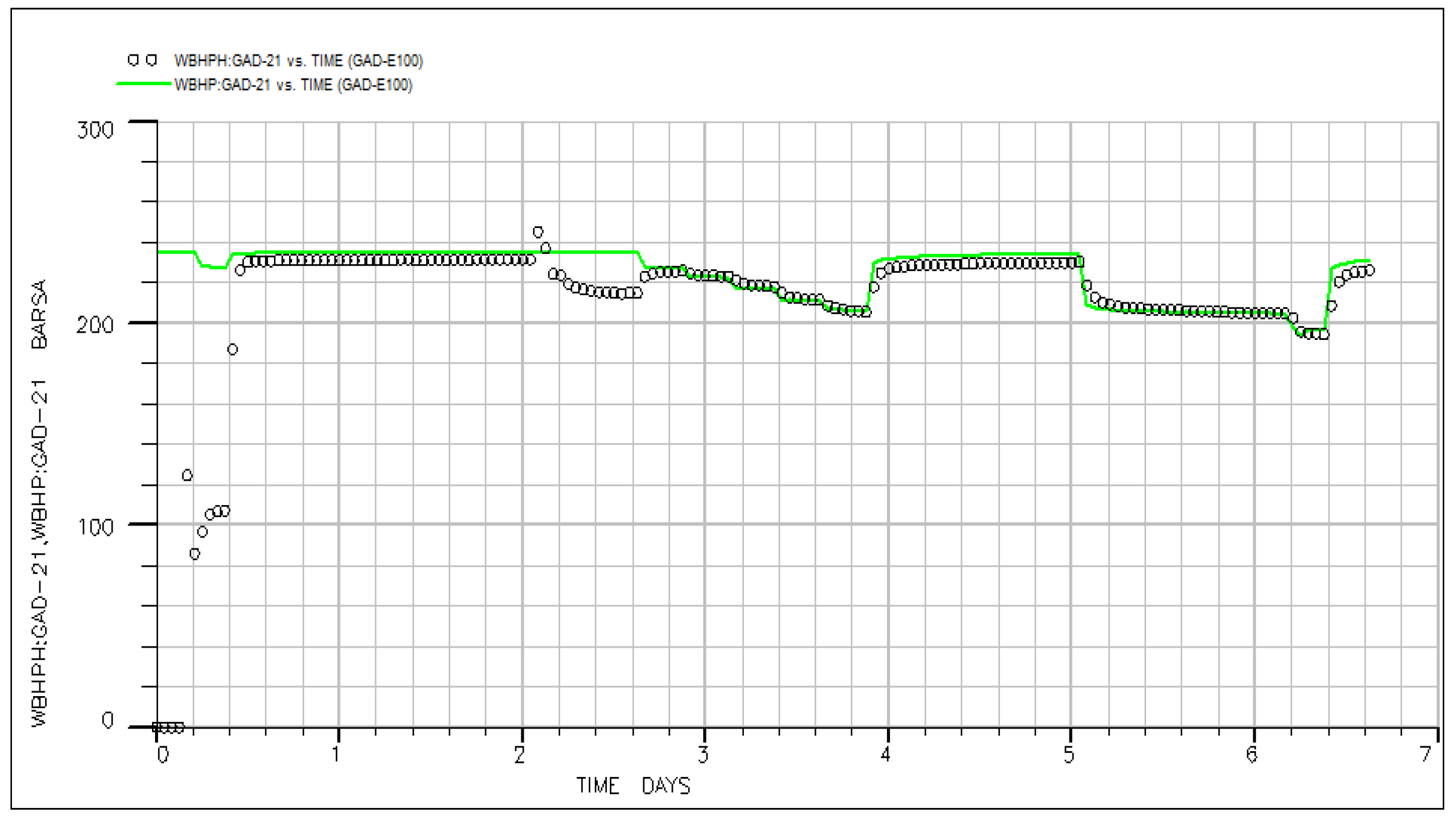
3.2.1. Model Establishment and Historical Fitting
3.2.2. Orthogonal Experimental Design Scheme
4. Results and Discussion
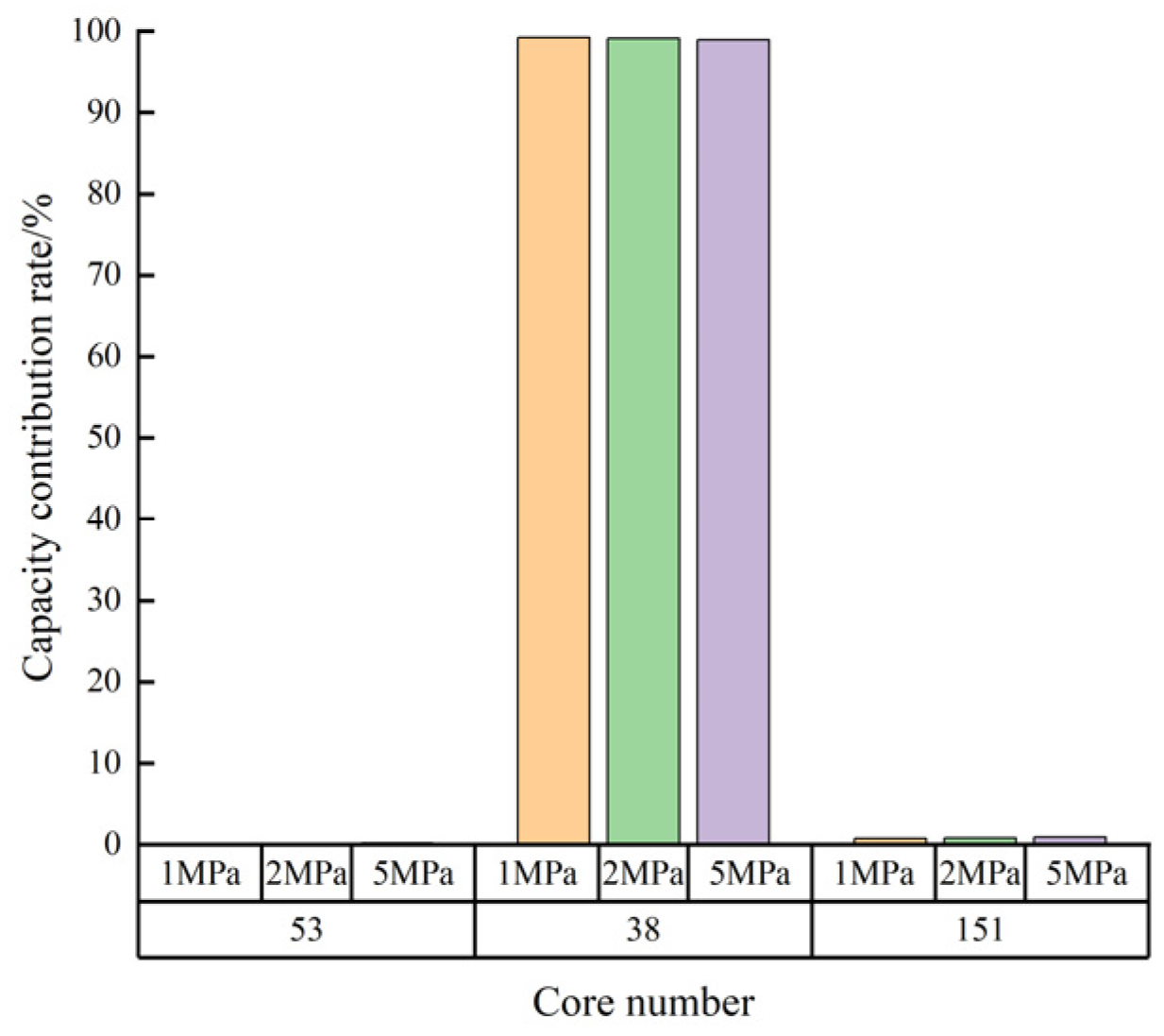
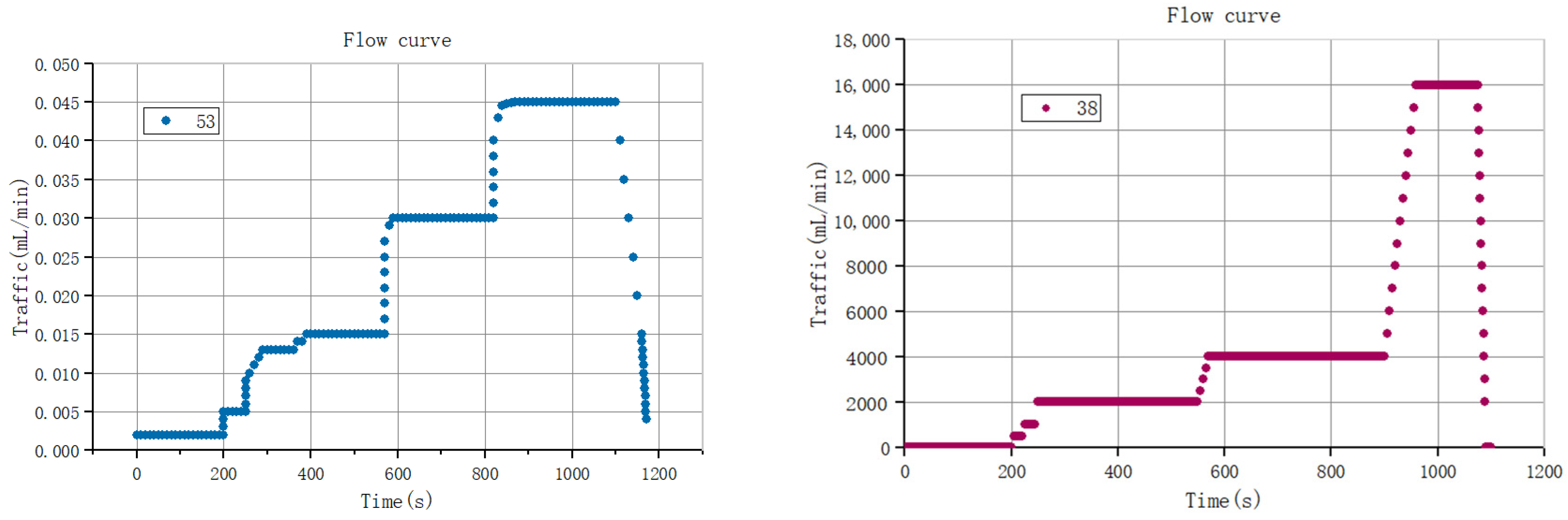
4.1. Analysis of Factors Affecting Interlayer Interference
4.2. Sensitivity Analysis of the Main Control Factors
4.3. Field Validation with PLT Data
5. Suggestions for Multi-Layer Commingling Production in Porous Carbonate Rock Gas Reservoirs
- Optimize well placement. Owing to interlayer heterogeneity, wells should be deployed in zones where the reservoir is well developed, and multilayer commingled production should be implemented in appropriately selected intervals. This approach can improve reserve control and help maintain higher gas production during the initial development stage. In addition, a combination of reasonable layer division and progressive commingled production is essential for improving gas recovery.
- Optimize the combination of commingled layers. For wells under multilayer commingled production, greater permeability contrast between layers leads to stronger interlayer interference and poorer development performance of low-permeability layers. Therefore, an excessive interlayer permeability contrast should be avoided as much as possible. Moreover, as the number of commingled layers increases, interlayer flow competition becomes more complex, the system becomes more sensitive to the production differential, and productivity loss in medium- and low-permeability layers becomes more pronounced. Accordingly, the combination of producing layers should be carefully optimized.
- Control production differential. Based on the results of physical simulation experiments and reservoir numerical simulation, a reasonable production differential should be determined to avoid the amplification of interlayer interference caused by excessive pressure drawdown and to limit the excessive dominance of high-permeability layers in gas supply.
- Select the optimal timing for commingled production. The initial production stage is the most favorable period for implementing commingled production. A well-designed production schedule can improve early-stage performance, while supplementary development or infill measures for low-permeability layers can be considered at later stages to support stable production during the middle and late development periods.
6. Conclusions
- This study integrated physical simulation experiments, orthogonal numerical simulation, and PLT field data to investigate the interlayer interference behavior in multilayer low-permeability porous carbonate gas reservoirs. The results demonstrate that interlayer interference is fundamentally controlled by reservoir heterogeneity, while the production differential acts as a key factor that amplifies productivity imbalance during commingled production. A strong permeability contrast causes long-term dominance of high-permeability layers and suppresses the effective utilization of medium- and low-permeability intervals, especially in multilayer commingled systems with increasing production complexity.
- The combined experimental, numerical, and field-production analyses reveal that production allocation among layers evolves dynamically during reservoir depletion. High-permeability layers contribute predominantly during the early production stage, whereas medium- and low-permeability layers gradually participate in gas supply during later development stages. This dynamic succession behavior indicates that balanced reserve utilization cannot be achieved solely through commingled production and requires coordinated production management.
- Sensitivity analysis further indicates that the production differential and permeability ratio are the most critical factors affecting interlayer interference, while the thickness ratio and gas viscosity exert comparatively weaker influences. Therefore, development strategies for multilayer carbonate gas reservoirs should prioritize dynamic optimization of the production differential and rational layer combination design in order to mitigate excessive depletion of dominant layers and improve the contribution of less favorable intervals.
- The study provides important guidance for multilayer carbonate gas reservoir development, particularly in terms of zonal production allocation, commingled-layer combination optimization, production-pressure management, and stable production control. The proposed understanding of interlayer interference mechanisms and production evolution characteristics can support more efficient reserve utilization and long-term stable development of similar low-permeability carbonate gas reservoirs.
Author Contributions
Funding
Data Availability Statement
Acknowledgments
Conflicts of Interest
Abbreviations
| PLT | Production logging test |
References
- Al-Hussainy, R.; Ramey, H.J.; Crawford, P.B. The flow of real gases through porous media. J. Pet. Technol. 1966, 18, 624–636. [Google Scholar] [CrossRef]
- Ehlig-Economides, C.; Joseph, J. A new test for determination of individual layer properties in commingled multilayered reservoirs. SPE Form. Eval. 1987, 2, 261–283. [Google Scholar] [CrossRef]
- Ozkaya, S.I. Multilayer reservoir behavior in commingled production systems. SPE Reserv. Eng. 1988, 3, 1313–1320. [Google Scholar]
- Zhu, H.; Hu, Y.; Li, J.; Zhong, S.; Zhang, L.; He, Y. Physical simulation of multi-layer gas reservoir production in the Shebei area of the Qaidam Basin. Acta Pet. Sin. 2013, 34, 136–142. [Google Scholar]
- Tan, Y.; Guo, J.; Zheng, F.; Xu, W. Flow characteristics and successive production simulation of multi-layered production in gas wells. Pet. Nat. Gas Geol. 2015, 36, 1009–1015. [Google Scholar]
- Gu, D.; Ding, D.; Liu, J.; Men, C.; Yan, N.; Huang, W. Research on the production variation law of multi-layer commingled production in layered heterogeneous tight gas reservoirs. Sci. Technol. Eng. 2015, 15, 53–59. [Google Scholar]
- Ma, Y.; Chai, X.; Lian, Y.; Gu, D.; Yu, X. Seepage mechanism and development simulation of multi-layered gas reservoirs: A case study of the Shebei gas field in the Qaidam Basin. Xinjiang Pet. Geol. 2019, 40, 570–574. [Google Scholar]
- Xiong, Y.; Feng, X.; Yang, Y.; Hu, S. Dynamic characteristics and development effect analysis of multi-layer combined gas production wells. Nat. Gas Explor. Dev. 2005, 21–24+3. [Google Scholar] [CrossRef]
- Dietz, D.N. Determination of average reservoir pressure from buildup surveys. J. Pet. Technol. 1965, 17, 955–959. [Google Scholar] [CrossRef]
- Bourdet, D.; Ayoub, J.A.; Pirard, Y.M. Use of pressure derivative in well-test interpretation. SPE Form. Eval. 1989, 4, 293–302. [Google Scholar] [CrossRef]
- Kuchuk, F.J.; Onur, M.; Hollaender, F. Pressure Transient Formation and Well Testing: Convolution, Deconvolution, and Nonlinear Estimation; Elsevier: Amsterdam, The Netherlands, 2010. [Google Scholar]
- Fetkovich, M.J. Decline curve analysis using type curves. J. Pet. Technol. 1980, 32, 1065–1077. [Google Scholar] [CrossRef]
- Liu, G.; Meng, Z.; Luo, D.; Wang, J.; Gu, D.; Yang, D. Experimental evaluation of interlayer interference during commingled production in a tight sandstone gas reservoir with multi-pressure systems. Fuel 2020, 262, 116557. [Google Scholar] [CrossRef]
- Lin, R.Y.; Jia, Y.; Sun, L. Experimental study on the seepage characteristics of multilayer commingled production and influencing factors of the development effect in low-permeability tight sandstone gas reservoirs. ACS Omega 2022, 7, 34080–34088. [Google Scholar] [CrossRef]
- Li, Y. Influencing factors of interlayer interference in gas-well completions in tight high-salinity gas reservoirs of the Dongsheng gas field. Nat. Gas Technol. Econ. 2024, 18, 14–19. [Google Scholar]
- Dai, J.; Ren, X.; Lu, L.; Mu, Z.; Liu, Y.; Dai, H.; Wang, Y.; Zhang, Z. Research on interlayer utilization differences of multi-layered gas reservoirs and their main controlling factors. J. Hebei Univ. Eng. (Nat. Sci. Ed.) 2018, 35, 86–89. [Google Scholar]
- Xu, X.; Wang, Y.; Lin, J.; Liu, X.; Gan, Y. Characteristics of multi-pressure-system commingled production in tight gas reservoirs and optimization experiment of development methods. Daqing Pet. Geol. Dev. 2020, 39, 153–161. [Google Scholar] [CrossRef]
- Hu, Y.; Zhu, H.; Chen, J.; Li, J.; Xie, Z.Y.; Liu, R.E. Physical simulation study on the gas supply mechanism of high- and low-permeability “series” gas layers. Nat. Gas Geosci. 2007, 469–472. [Google Scholar] [CrossRef]
- Li, Q.; Gao, S.; Liu, H.; Ye, L.; An, W.; Liu, G. Simulation experiment on interacting flow of gas and water in multi-layered production of tight sandstone gas reservoirs. Nat. Gas Ind. 2022, 42, 133–145. [Google Scholar]
- Hu, Y.; Li, X.; Wan, Y.; Zhu, H.; Wang, S. Characteristics of gas production from dual high- and low-pressure gas layers in multilayer commingled production. Nat. Gas Ind. 2009, 29, 89–91+142. [Google Scholar]
- Hu, Y.; Li, X.; Jiang, L.; Jiang, L.J.; Wan, Y.J.; Guo, C.M.; Jiao, C.Y.; Chai, X.Y.; Jing, W.; Xu, X.; et al. Experimental study on the production of multi-layer edge-water-saturated sandy gas reservoirs in the Qaidam Basin. Nat. Gas Geosci. 2022, 33, 1499–1508. [Google Scholar]
- Wang, L.; Yang, S.; Liu, Y.; Xu, W.; Deng, H.; Meng, Z.; Han, W.; Qian, K. Experimental study on gas supply capacity of multi-layer commingled production in fractured carbonate gas reservoirs. Pet. Explor. Dev. 2017, 44, 779–787. [Google Scholar]
- Feng, Y.; Wei, P.; Duan, J.; Wu, J. Evaluation of production changes in two-layer commingled production of tight sandstone gas in the Linxing area through indoor quantitative experiments. Unconv. Oil Gas 2017, 4, 40–44. [Google Scholar]
- Liu, H.X.; Gao, S.S.; Fang, F.F.; Li, X.; Li, Q.; Zhu, W.; Jiao, C.; Ye, L.; An, W.; Zhu, W. Model of cross-flow interference index and application for multi-layer commingled production in the Sulige tight sandstone gas reservoir, Ordos Basin, China. J. Nat. Gas Geosci. 2023, 8, 389–401. [Google Scholar]
- Tao, X.; Okere, C.J.; Su, G. Experimental and theoretical evaluation of interlayer interference in multi-layer commingled gas production of tight gas reservoirs. J. Pet. Sci. Eng. 2022, 208, 109731. [Google Scholar] [CrossRef]
- Liu, H.; Gao, S.; Li, X.; Li, Q.; Zhu, W.; Jiao, C.; Ye, L.; An, W.; Zhu, W. Multi-layer commingled production interference index model and its application in the Sulige tight sandstone gas field of the Ordos Basin. Nat. Gas Geosci. 2023, 34, 950–962. [Google Scholar]
- Xin, C.; Zhou, W.; Zhang, L.; Qiao, X.; Wang, Y.; Xiao, Y. Calculation model of drainage radius of single-layer/multi-layer commingled gas production wells in a closed constant-volume gas reservoir and its application. Appl. Sci. 2024, 14, 1873. [Google Scholar] [CrossRef]
- Xu, X.; Zhu, H.; Xu, T.; Guo, H.; Yan, Y. Stratified reservoir utilization characteristics and determination methods of multi-layered gas reservoirs. Spec. Oil Gas Reserv. 2015, 22, 111–114+156. [Google Scholar]
- Xin, C.; Zhou, W.; Du, Y.; Zhang, L.; Wang, K. Physical simulation of multi-layer commingled production in the Yan’an gas field of the Ordos Basin. Sci. Technol. Eng. 2026, 26, 2370–2377. [Google Scholar]
- Sun, T.; Chen, W.; Huang, S.; Zhao, J.Z.; Zhang, L.H.; Liu, J.Y. Multi-layer commingled production simulation of carbonate reservoirs based on the lattice Boltzmann method. Block Oil Gas Field 2022, 29, 848–853. [Google Scholar]
- Hu, Y.; Jia, Y.; He, D.; Wang, J.; Li, Z.; Zhou, M.; Wei, K.; Jiang, L.; Xu, X.; Jiao, C.; et al. Characterization methods of reservoir heterogeneity in gas reservoirs and physical simulation experiments for exploitation. Nat. Gas Geosci. 2022, 33, 297–302. [Google Scholar]
- Aziz, K.; Settari, A. Petroleum Reservoir Simulation; Applied Science Publishers: London, UK, 1979. [Google Scholar]
- Lake, L.W. Enhanced Oil Recovery; Prentice Hall: Englewood Cliffs, NJ, USA, 1989. [Google Scholar]
- Thomas, L.K.; Dixon, T.N.; Pierson, R.G. Fractured reservoir simulation. SPE J. 1983, 23, 42–54. [Google Scholar] [CrossRef]
- Choquette, P.W.; Pray, L.C. Geologic Nomenclature and Classification of Porosity in Sedimentary Carbonates. AAPG Bull. 1970, 54, 207–250. [Google Scholar] [CrossRef]
- Lucia, F.J. Rock-Fabric/Petrophysical Classification of Carbonate Pore Space for Reservoir Characterization. AAPG Bull. 1995, 79, 1275–1300. [Google Scholar] [CrossRef]
- Camacho-Velázquez, R.; Vásquez-Cruz, M.A.; Castrejón-Aivar, R.; Arana-Ortiz, V. Pressure-Transient and Decline-Curve Behavior in Naturally Fractured Vuggy Carbonate Reservoirs. SPE Reserv. Eval. Eng. 2005, 8, 95–112. [Google Scholar] [CrossRef]
- Bourbiaux, B. Fractured Reservoir Simulation: A Challenging and Rewarding Issue. Oil Gas Sci. Technol.—Rev. IFP 2010, 65, 227–238. [Google Scholar] [CrossRef]
- Mohammed, I.; Olayiwola, T.O.; Alkathim, M.; Awotunde, A.A.; Alafnan, S.F. A Review of Pressure Transient Analysis in Reservoirs with Natural Fractures, Vugs and/or Caves. Pet. Sci. 2021, 18, 154–172. [Google Scholar] [CrossRef]

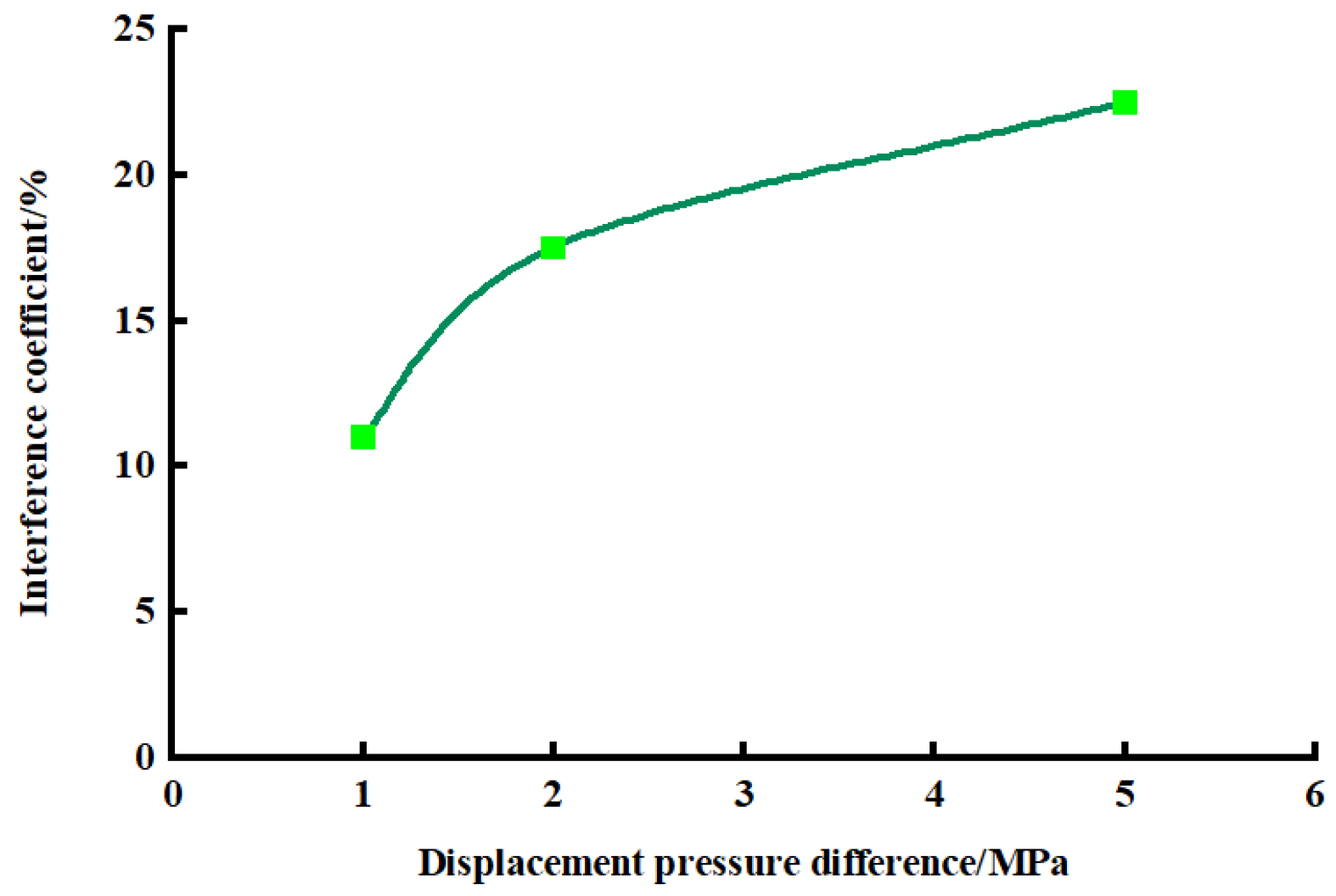
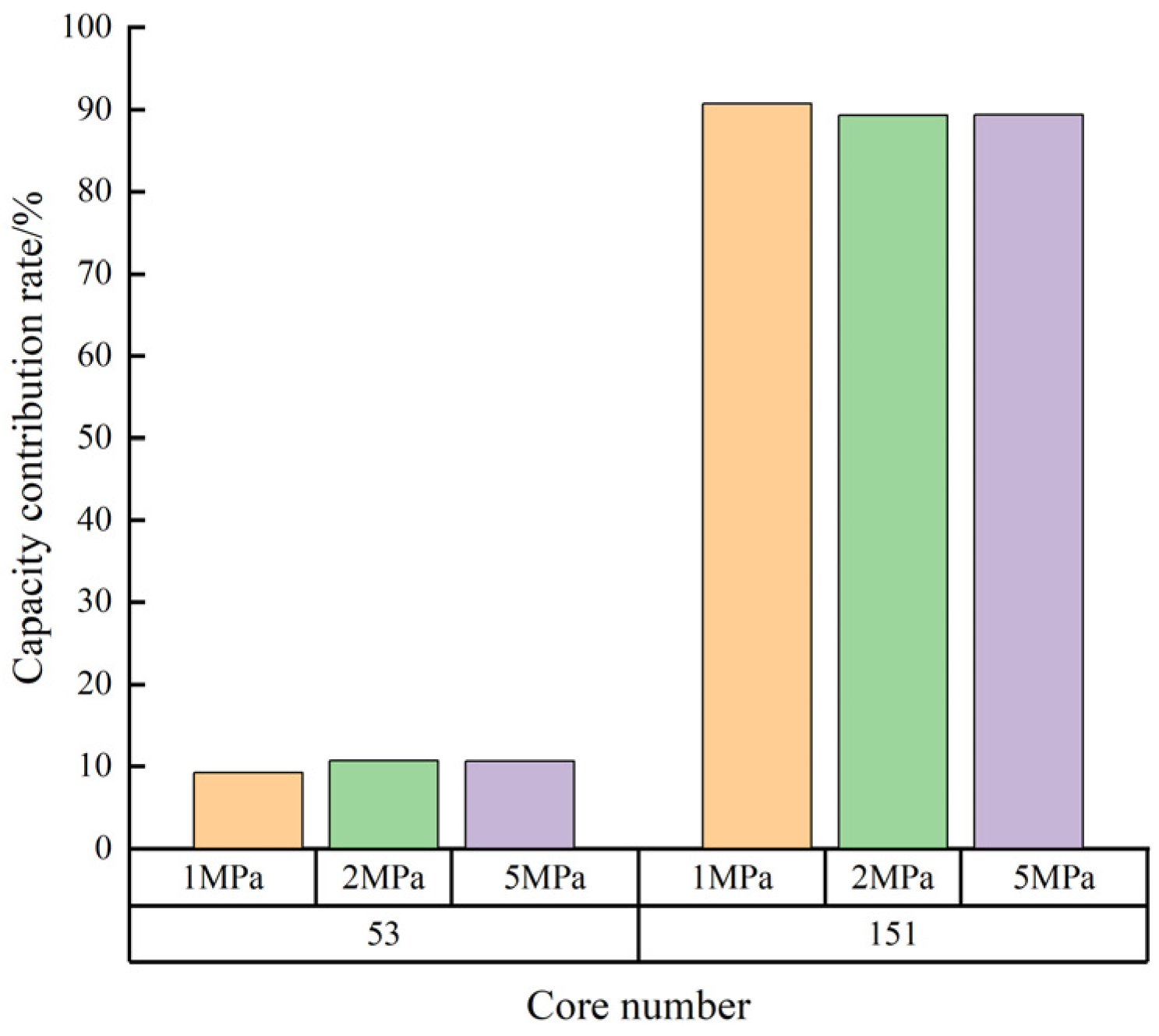
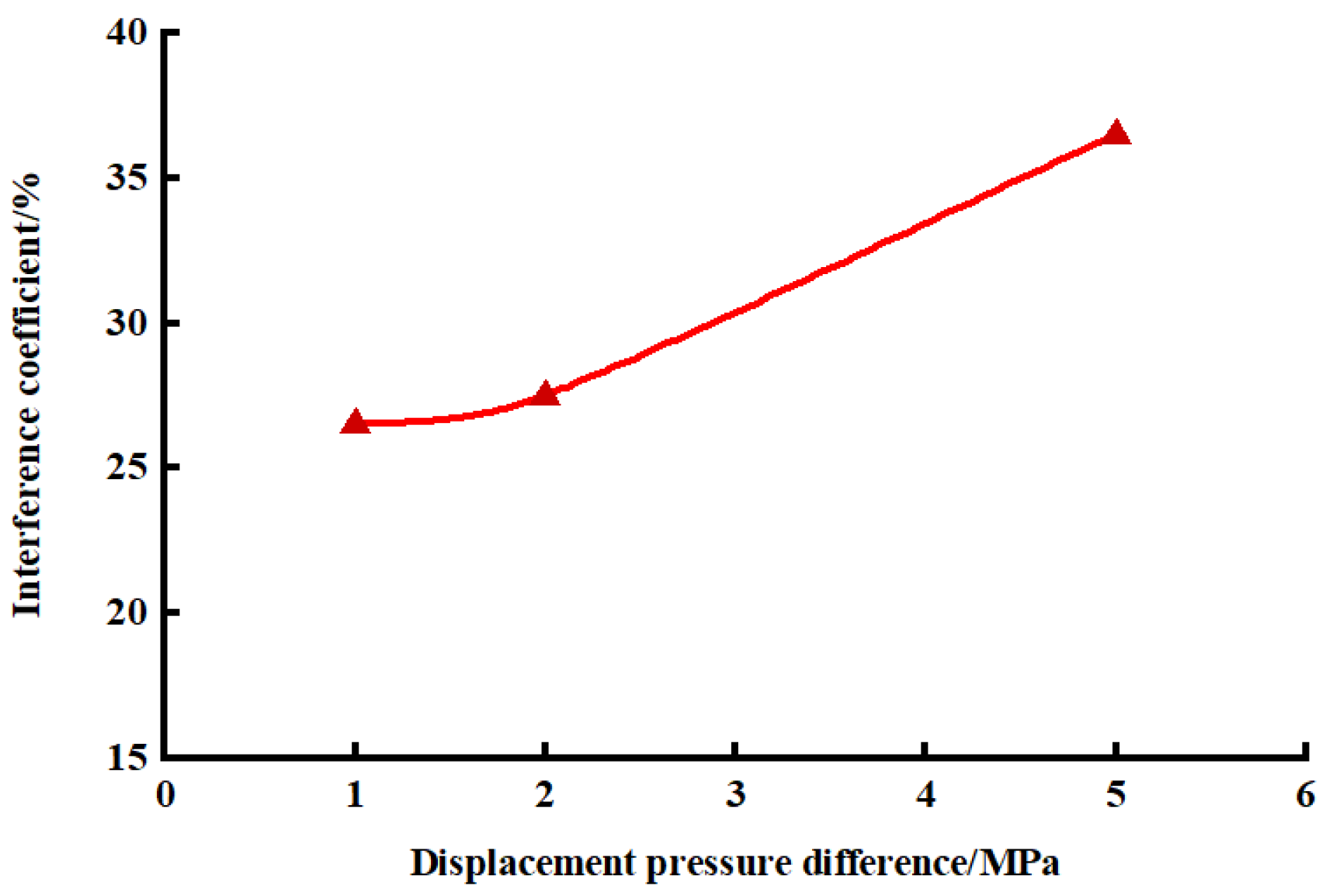
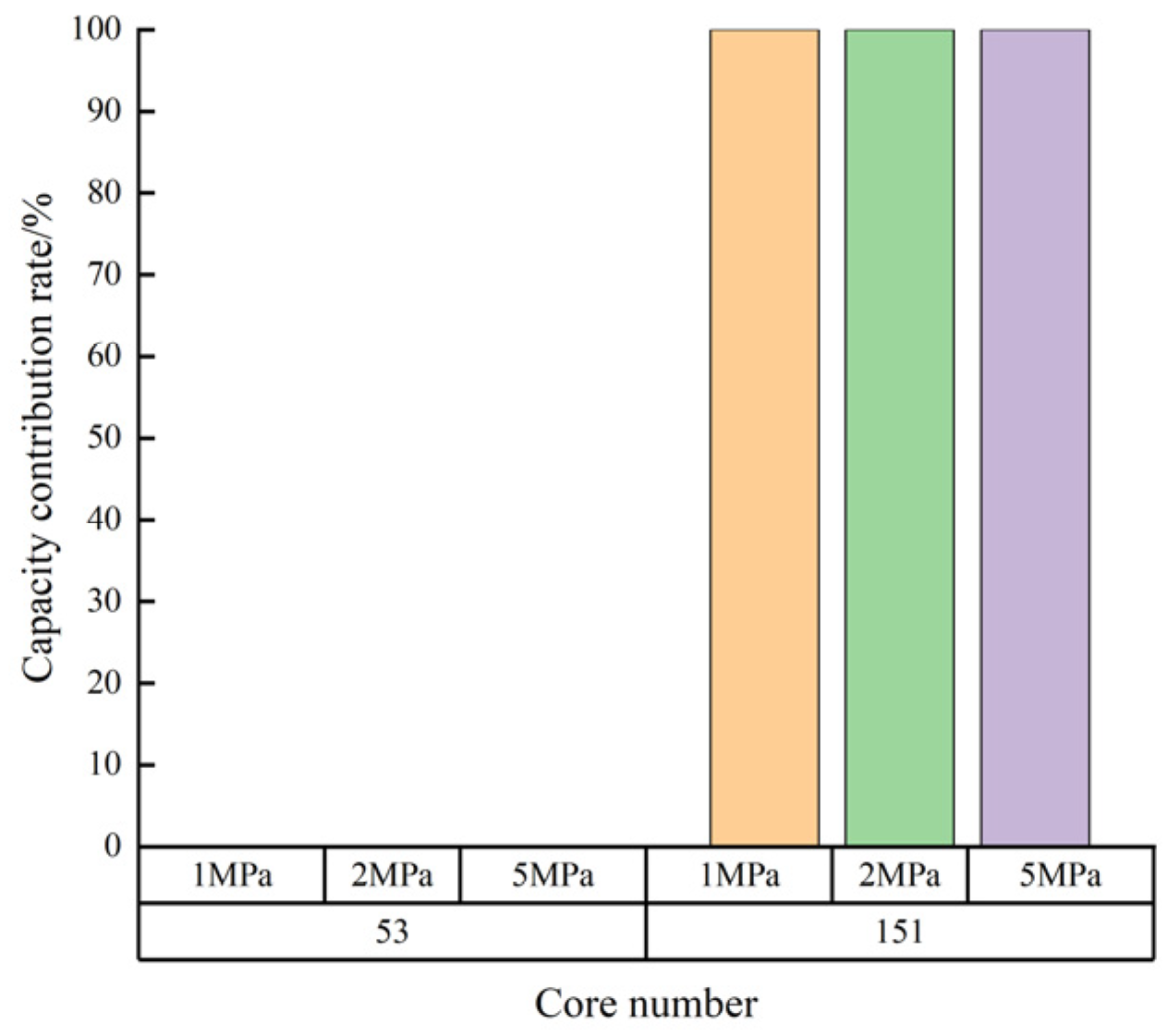
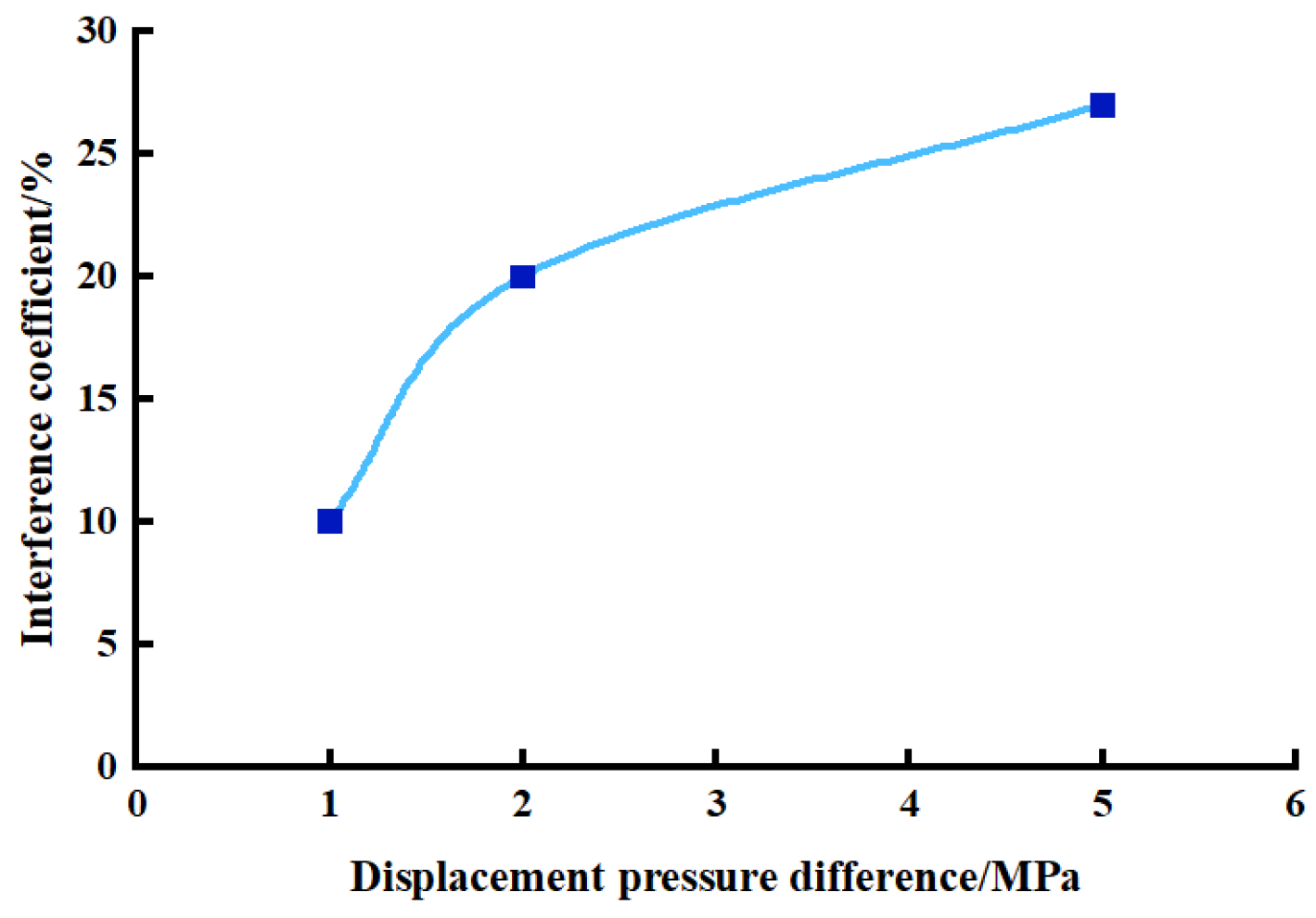

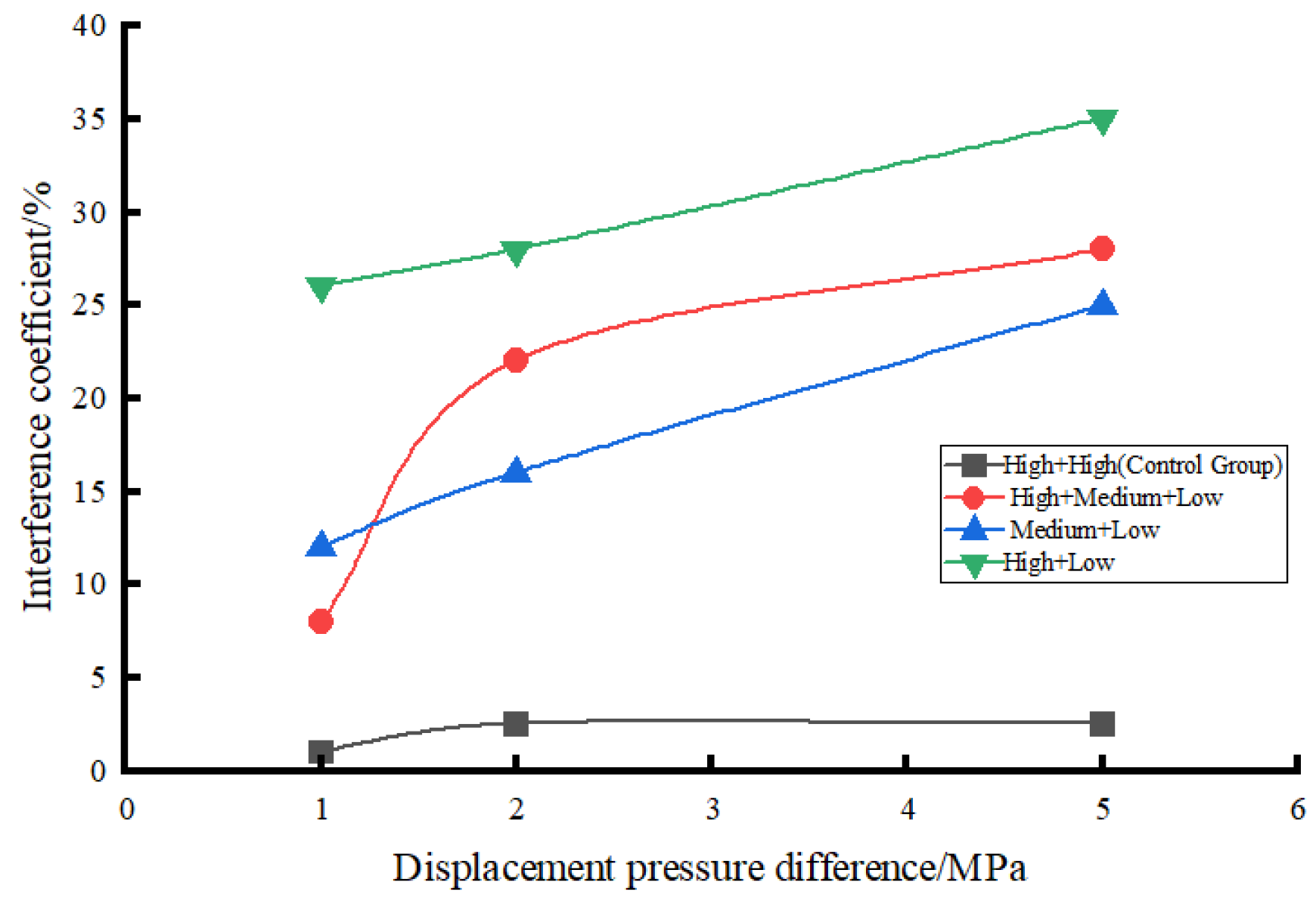
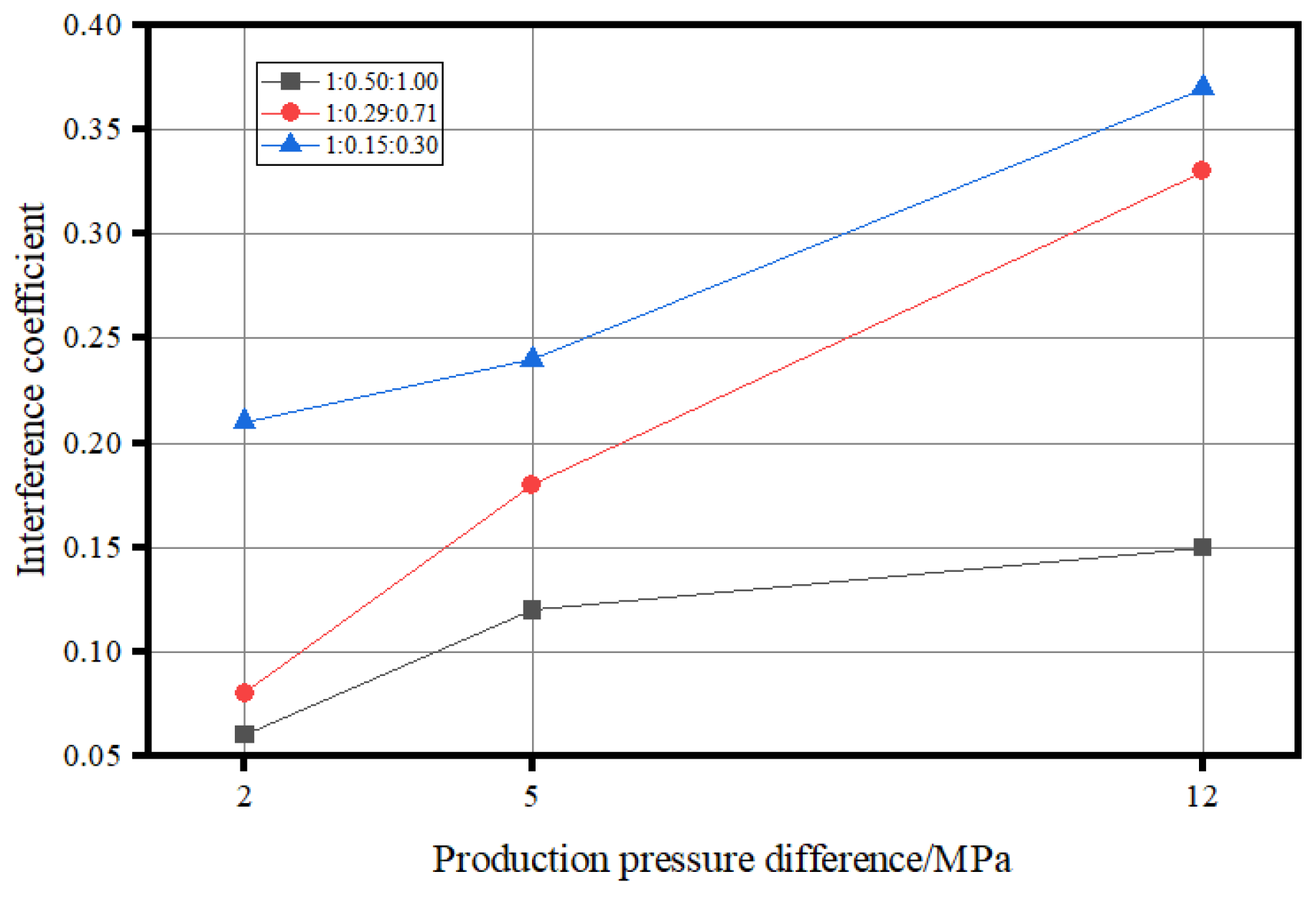
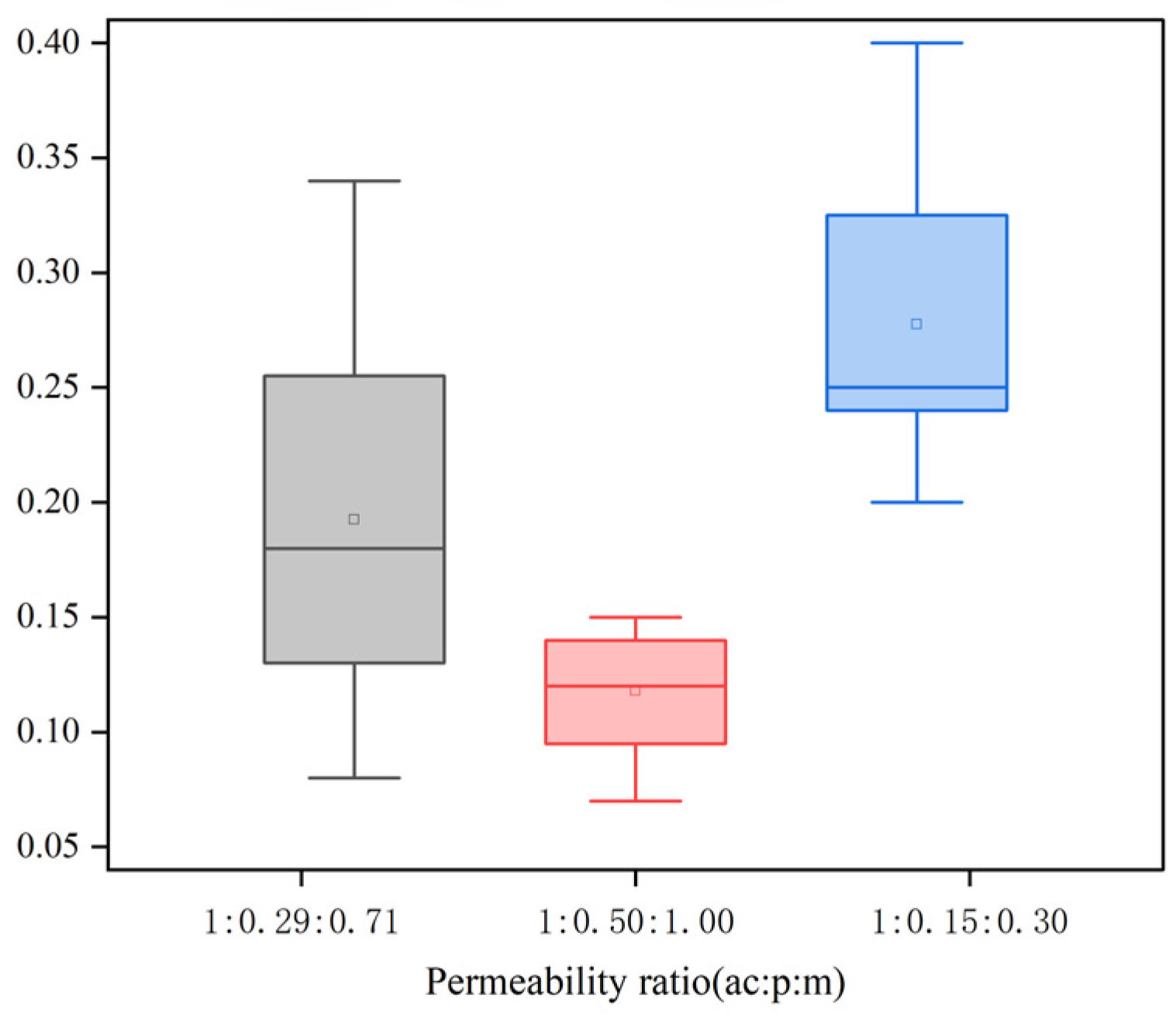

| Serial Number | Length (cm) | Diameter (cm) | Gas Measurement Permeability (mD) | Porosity (%) | Note |
|---|---|---|---|---|---|
| 8 | 3.285 | 2.489 | 4.1686 | 17.62 | Control group |
| 18 | 4.509 | 2.472 | 0.0122 | 1.44 | |
| 38 | 2.996 | 2.488 | 5.9895 | 18.57 | (Control group)Khigh |
| 50 | 4.209 | 2.465 | 0.0135 | 2.57 | |
| 53 | 4.245 | 2.496 | 0.0153 | 4.31 | Klow |
| 151 | 3.741 | 2.496 | 0.0898 | 8.03 | Kmiddle |
| Parameters | Value | |
|---|---|---|
| Model | Plane: Corner point grid; Vertical: 29 layers | |
| Physical properties | Reservoir thickness(m) | 115 |
| porosity(%) | 10.43 | |
| Permeability(mD) | 3.94 | |
| Water body multiplicity | 2.0 | |
| Factors | Level 1 | Level 2 | Level 3 |
|---|---|---|---|
| Permeability ratio K(ac:p:m) | 2.20:0.63:1.57 | 2.20:1.26:1.57 | 2.20:0.31:0.79 |
| Thickness ratio h(ac:p:m) | 18.4:15.7:17.7 | 27.6:15.7:17.7 | 9.2:15.7:17.7 |
| Production differential (MPa) | 2 | 5 | 12 |
| Gas viscosity (mPa·s) | 0.015 | 0.0203 | 0.025 |
| Production Differential (MPa) | Core Number | Length (cm) | Diameter (cm) | Volume (mL) | Time (s) | Interference Factor (%) |
|---|---|---|---|---|---|---|
| 1 | 8 | 2.996 | 2.488 | 2524.55 | 60.00 | 2.44 |
| 38 | 3.285 | 2.489 | 3486.77 | 60.00 | ||
| 2 | 8 | 2.996 | 2.488 | 6851.17 | 60.00 | 3.67 |
| 38 | 3.285 | 2.489 | 8842.54 | 60.00 | ||
| 5 | 8 | 2.996 | 2.488 | 35,780.04 | 60.00 | 3.51 |
| 38 | 3.285 | 2.489 | 45,215.21 | 60.00 |
| Scheme Number | Parameter Level | Output Contribution Rate (%) | Interference Coefficient | |||||
|---|---|---|---|---|---|---|---|---|
| K (ac:p:m) | h (ac:p:m) | Production Differential (MPa) | Gas Viscosity (mPa·s) | XVac | XVp | XVm | ||
| 1 | 2.20:0.63:1.57 | 18.4:15.7:17.7 | 2 | 0.015 | 55.2 | 18.5 | 26.3 | 0.08 |
| 2 | 2.20:0.63:1.57 | 18.4:22.1:26.6 | 5 | 0.0203 | 72.3 | 10.5 | 17.2 | 0.18 |
| 3 | 2.20:0.63:1.57 | 18.4:11.0:14.2 | 12 | 0.025 | 68.9 | 9.8 | 21.3 | 0.33 |
| 4 | 2.20:1.10:2.20 | 18.4:15.7:17.7 | 5 | 0.025 | 55.7 | 19.7 | 24.6 | 0.12 |
| 5 | 2.20:1.10:2.20 | 18.4:22.1:26.6 | 12 | 0.015 | 61.2 | 20.6 | 18.2 | 0.15 |
| 6 | 2.20:1.10:2.20 | 18.4:11.0:14.2 | 2 | 0.0203 | 56.1 | 20.1 | 23.8 | 0.06 |
| 7 | 2.20:0.33:0.66 | 18.4:15.7:17.7 | 12 | 0.0203 | 79.4 | 8.7 | 11.9 | 0.37 |
| 8 | 2.20:0.33:0.66 | 18.4:22.1:26.6 | 2 | 0.025 | 76.3 | 11.4 | 12.3 | 0.21 |
| 9 | 2.20:0.33:0.66 | 18.4:11.0:14.2 | 5 | 0.015 | 69.4 | 13.3 | 17.3 | 0.24 |
| Factors | Level | Average Interference Coefficient | Range | Order of Sensitivity |
|---|---|---|---|---|
| Production differential (MPa) | 2 | 0.11 | 0.23 | 1 |
| 5 | 0.18 | |||
| 12 | 0.34 | |||
| Permeability ratio | 1:0.15:0.30 | 0.28 | 0.22 | 2 |
| 1:0.29:0.71 | 0.20 | |||
| 1:0.50:1.00 | 0.06 | |||
| Thickness ratio | 1:0.60:0.80 | 0.16 | 0.12 | 3 |
| 1:0.85:0.96 | 0.23 | |||
| 1:1.20:1.50 | 0.28 | |||
| Gas viscosity (mPa·s) | 0.015 | 0.21 | 0.07 | 4 |
| 0.0203 | 0.20 | |||
| 0.025 | 0.19 |
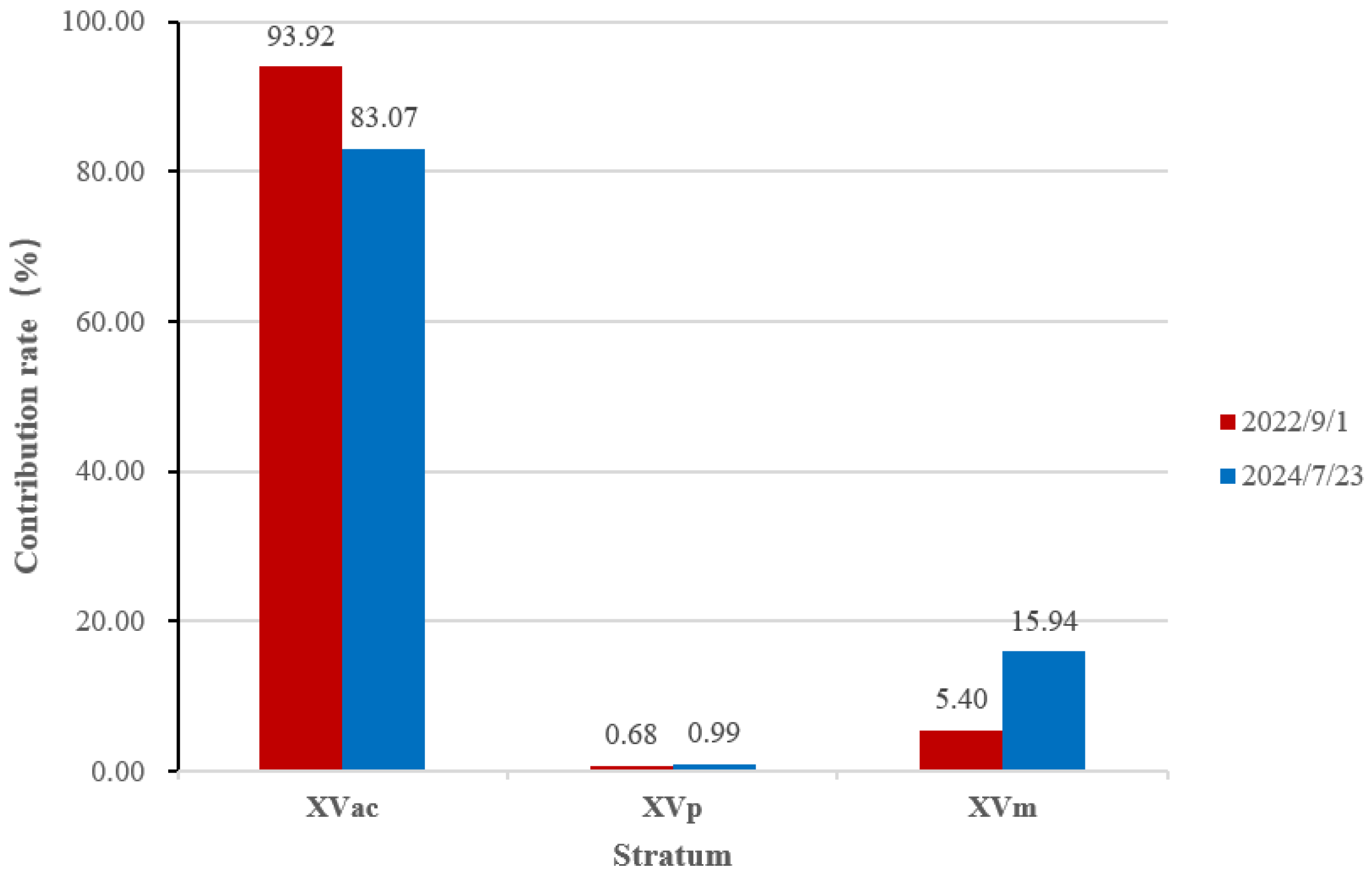
| Number | Formation Name | Stratigraphic Section (m) | 1 September 2022 | 23 July 2024 | ||
|---|---|---|---|---|---|---|
| Output (103 m3/d) | Contribution Ratio (%) | Output (103 m3/d) | Contribution Ratio (%) | |||
| 1 | XVac | 2110.7–2161.5 | 160.69 | 93.92 | 129.75 | 83.07 |
| 2 | XVp | 2161.5–2185.4 | 1.16 | 0.68 | 1.55 | 0.99 |
| 3 | XVm | 2185.4–2239.5 | 9.24 | 5.40 | 24.90 | 15.94 |
Disclaimer/Publisher’s Note: The statements, opinions and data contained in all publications are solely those of the individual author(s) and contributor(s) and not of MDPI and/or the editor(s). MDPI and/or the editor(s) disclaim responsibility for any injury to people or property resulting from any ideas, methods, instructions or products referred to in the content. |
© 2026 by the authors. Licensee MDPI, Basel, Switzerland. This article is an open access article distributed under the terms and conditions of the Creative Commons Attribution (CC BY) license.
Share and Cite
Bai, X.; Guo, C.; Chen, P.; Cheng, Y.; Liang, L. Interlayer Interference Mechanisms and Key Controlling Factors in Low-Permeability Porous Carbonate Gas Reservoirs. Processes 2026, 14, 1898. https://doi.org/10.3390/pr14121898
Bai X, Guo C, Chen P, Cheng Y, Liang L. Interlayer Interference Mechanisms and Key Controlling Factors in Low-Permeability Porous Carbonate Gas Reservoirs. Processes. 2026; 14(12):1898. https://doi.org/10.3390/pr14121898
Chicago/Turabian StyleBai, Xinyu, Chunqiu Guo, Pengyu Chen, Youyou Cheng, and Liang Liang. 2026. "Interlayer Interference Mechanisms and Key Controlling Factors in Low-Permeability Porous Carbonate Gas Reservoirs" Processes 14, no. 12: 1898. https://doi.org/10.3390/pr14121898
APA StyleBai, X., Guo, C., Chen, P., Cheng, Y., & Liang, L. (2026). Interlayer Interference Mechanisms and Key Controlling Factors in Low-Permeability Porous Carbonate Gas Reservoirs. Processes, 14(12), 1898. https://doi.org/10.3390/pr14121898