Article

Digital Twin Technology for TIDES Process Development and Manufacturing

Institute for Separation and Process Technology, Clausthal University of Technology, Leibnizstr. 15, 38678 Clausthal-Zellerfeld, Germany
*
Author to whom correspondence should be addressed.
Processes 2026, 14(12), 1873; https://doi.org/10.3390/pr14121873 (registering DOI)
Submission received: 24 April 2026 / Revised: 22 May 2026 / Accepted: 4 June 2026 / Published: 9 June 2026
(This article belongs to the Section Process Control, Modeling and Optimization)

Abstract

TIDEs (therapeutic peptides, oligonucleotides, and related molecules) represent a rapidly expanding market that has gained significant momentum due to the recent success of Glucagon-like peptide-1 (GLP-1) receptor agonists for the treatment of obesity, diabetes and as cardiovascular and kidney diseases. Chemical synthesis remains the dominant manufacturing route for candidates containing approximately 10–40 amino acids and includes non-proteinogenic amino acids. Consequently, various combinations of solid-phase peptide synthesis (SPPS), liquid-phase peptide synthesis (LPPS), hybrid approaches, or tag-assisted peptide synthesis (TAPS) can be applied to achieve full-sequence assembly. However, identifying the most eco-efficient pathway through experimental trials alone is impractical because of the vast number of possible process combinations and the growing variety of green solvent alternatives. Therefore, process simulation studies—widely established in chemical engineering—must be adapted to the specific physicochemical characteristics of these large, multi-component molecules. This paper provides an overview of the current state of research and illustrates potential process improvements enabled by digital twin technologies as exemplified for the first manufacturing steps of tirzepatide.

1. Introduction

Peptide-based and oligonucleotide-based active pharmaceutical ingredients (API) have a long history in the pharmaceutical industry [1,2,3]. Both recombinant peptides, such as insulin, and synthetically produced peptides, such as semaglutide and tirzepatide, are among the top-selling products of recent years. GLP-1 receptor agonists in particular have come into sharp focus due to strong growth in demand in recent years. Sales of Ozempic® and Mounjaro® have reached $22.3 + 24.8 billion in 2025 [4,5]. These will continue to play a major role in the market in the future. The oral drug orforglipron from the manufacturer Eli Lilly has been successful through clinical phases I-III [6,7]. Thanks to a much simpler chemical synthesis, it will be cheaper to produce and thus have a competitive advantage on the market [7,8]. A typical US self-pay ranges from $349 to $499 for tirzepatide, whereas orforglipron ranges from $149 to $399 [9,10]. To counter this, the economic competitiveness of existing active ingredients must be improved. This can be achieved by optimizing the manufacturing process for the active ingredient.
The decisions made in early process synthesis have a significant impact on the cost of goods (CoGs) and sustainability of the product [11,12]. In the conceptual process design, serious decisions about the trajectory of the process are made with little information. This requires a balance sheet calculation of the materials and equipment required. A model-based approach can be advantageous here. Model-based decisions make it possible to virtually compare different process routes, operating conditions, and equipment configurations before experimental data is available. By using simplified models, feasibility, energy and material efficiency, and potential bottlenecks can be evaluated at an early stage. In this way, the search space can be efficiently narrowed down and development costs reduced. In the further process synthesis, a Quality by Design (QbD) approach is then used, which ensures product quality already during development through systematic identification and control of critical process parameters (CPPs) and critical quality attributes (CQAs) [13]. By integrating experimental data and model-based methods, correlations between process conditions and product yield can be quantified. This enables targeted optimization of the process in terms of efficiency, cost-effectiveness, and environmental sustainability. The QbD approach thus forms the basis for a robust, scalable, and regulatory-compliant process design [14,15,16].
A large amount of organic solvents is used in peptide synthesis [17]. This has a negative impact on the global warming potential (GWP) in equivalent CO2 amount of the API and thus on the sustainability of the product. In many processes, optimizing economic efficiency also leads to improved sustainability [18,19]. Another factor that is often considered in life cycle assessments is environmental compatibility and the potential risk to human health. Most of the organic solvents used in classic solid-phase synthesis are classified as hazardous to health [20,21]. This results in high costs that must be incurred to ensure the health and safety of employees.
Synthetic peptides are in most cases produced by solid-phase synthesis, according to Merrifield. Alternatives include liquid-phase synthesis and tag-assisted peptide synthesis (TAPS or molecular hiving™) [22,23]. Oligonucleotides can be produced in a similar manner [24,25,26,27,28].
Alternatives to synthesis by SPPS have already been published. One approach to optimization is SPPS using more environmentally friendly and less harmful solvents [29,30,31]. Another approach is water-based SPPS, which largely avoids the use of organic solvents [32]. Instead of producing the entire peptide in SPPS, SPPS can be used to synthesize fragments, which are then assembled in LPPS. This hybrid approach shows a promising overall process yield [33].
The aim of this work is to demonstrate model-based process decision-making in conceptual process design based on the literature data. As a metric, CoGs and GWPs are used with tirzepatide as an example of synthetic peptides. A hybrid SPPS and LPPS process, an SPPS with less environmentally harmful solvents, a water-based SPPS process, and TAPS are compared. Based on this, the foundations for a mechanistic process model are laid. Subsequently, a process model for the most promising alternative is calibrated and validated as accurately as possible according to a published workflow using experimental data. This will lead into further research and development of a working digital twin including bidirectional interface with the process for peptide synthesis.

2. State of the Art

2.1. Solid-Phase Peptide Synthesis

SPPS was developed by Merrifield in 1963 [34]. In this process, a solid carrier material serves as the starting point for the successive coupling of amino acids. Polymers such as polystyrene are typically used [35]. An important factor for the reaction process efficiency is the swelling capacity of the resin, as this facilitates the diffusion of the reagents and thus improves the transport of material within the particles [31,36].
Due to the solid phase in the reactor, SPPS is usually carried out in a discontinuous stirred tank reactor (STR). The synthesis process follows a recurring cycle [20].
After the initial swelling of the resin, the first, temporarily protected amino acid is coupled to the resin. The basic steps of SPPS are then repeated [37]: First, removal of the N-terminal protecting group of the coupled amino acid; second, washing; third, activation and coupling of the next protected amino acid; fourth, washing again.
9-Fluorenylmethyloxycarbonyl (Fmoc) protective groups are typically removed using piperidine (PIPe) or piperazine (PIPa) solutions, while the side chains remain protected by orthogonal protective groups. These are only removed in the final cleavage step to avoid side reactions. Complete removal of the piperidine solution after deprotection is essential, as residual amounts could lead to unwanted deprotection of newly added amino acids.
Subsequent activation and coupling is usually carried out using DIC (diisopropylcarbodiimide) or EDC·HCl (1-ethyl-3-(3-dimethylaminopropyl)carbodiimide hydrochloride) in combination with Oxyma Pure (hydroxyiminocyanacetic acid ethyl ester) [38,39]. The rate-determining step is the activation of the carboxyl group by DIC or EDC·HCl. Oxyma Pure serves as an additive that reduces the formation of by-products such as racemates by forming a more stable intermediate product [39].
The cycle described is repeated until the desired peptide length is achieved. The peptide is then cleaved from the resin. Trifluoroacetic acid (TFA) is usually used for this purpose [40].
SPPS is characterized by a wide range of industrial applications and high automation potential. However, its main disadvantages are the high excess of reagents and the considerable consumption of solvents. In addition, yield and product purity decrease with increasing chain length, as it is a sequential process [17,37,41].

2.2. Liquid-Phase Peptide Synthesis

LPPS is an alternative method for the chemical synthesis of peptides from amino acids. In contrast to SPPS, the coupling of amino acids takes place entirely in solution, without binding to a solid carrier material. Due to the homogeneous reaction phase, LPPS offers the possibility of using continuous reactor concepts such as plug flow reactors (PFR) instead of a discontinuous STR.
LPPS can be used both for the sequential coupling of individual amino acids and for the linking of prefabricated peptide fragments.
The principle of LPPS can also be applied to the coupling of previously produced peptide fragments. In this case, both reaction partners must be completely protected at their side chains to avoid side reactions. In addition, the N-terminal end of a fragment must be blocked by a temporary protective group to ensure a selective reaction only at the desired binding site. Coupling is performed analogously to sequential LPPS with the same activation reagents.
If further fragment linkage is to follow, the N-terminal protective group is selectively removed after the reaction. One advantage of this method is the possibility of intermediate purification after each coupling, for example, again by diafiltration [33]. After completion of all necessary coupling steps, the peptide can be precipitated by adding an aqueous salt solution and then processed by further steps, such as the removal of the side chain protective groups.

2.3. Hybrid Process

The hybrid approach combines the key advantages of SPPS and LPPS and forms the basis of the reference process considered here. By combining both methods, peptides with a length of more than 30 amino acids can be synthesized with high purity while at the same time achieving an increase in space-time yield compared to the individual methods [33].
In the present hybrid process, four fragments of the active ingredient tirzepatide, each with 7 to 14 amino acids, are first produced using SPPS and then linked via LPPS to form a complete molecule [33].

2.4. Alternative Greener Solvents for Solid-Phase-Peptide-Synthesis

Alternative processes can basically be divided into two categories: (1) processes using more environmentally friendly organic solvents (alternative process 1) and (2) water-based processes (alternative process 2).
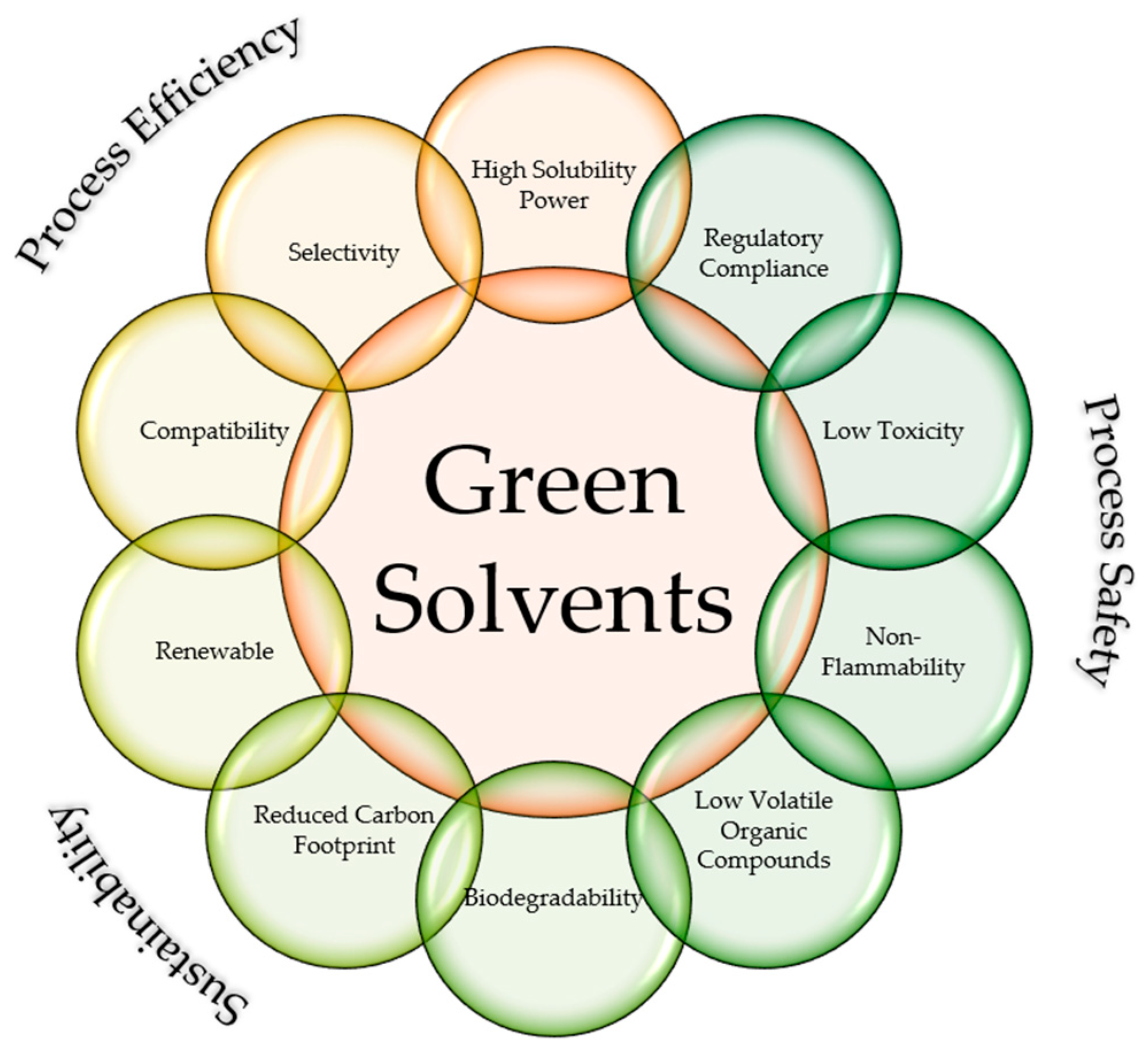
The motivation for developing greener organic alternative processes stems from the high use of environmentally harmful solvents such as Dimethylformamide (DMF), N-methyl-2-pyrrolidone (NMP) and Piperidine in conventional SPPS [42]. Toxic and poorly degradable solvents such as DMF and Methyl-tert-butyl ether (MTBE) are also used in the subsequent LPPS process. In addition, the replacement of fluorinated reagents such as TFA should be pursued. The Solvent Selection Guide of the ACS Green Chemistry Consortium, which numerous pharmaceutical manufacturers (e.g., GSK, Pfizer, Sanofi, AstraZeneca) have joined, is used to assess the environmental compatibility of solvents [43]. The most important criteria for green solvents are shown in Figure 1.
A solvent is considered “greener” if it has lower toxicity, a lower carbon footprint, or better biodegradability while offering comparable effectiveness. In addition to environmental and safety aspects, the effectiveness of the solvent—particularly in terms of solubility, selectivity, and system compatibility—plays a decisive role. In practice, insufficient solubility leads to increased solvent consumption and thus reduces the ecological advantage, often alongside crucial economic disadvantages, regarding higher volume handling and less efficient purification steps [44]. Thus, conceptual process design evaluation of different routes is a multi-parameter optimization task that could only be efficiently solved by non-alone experiments but with the aid of process simulation studies, due to state-of-the-art [45].
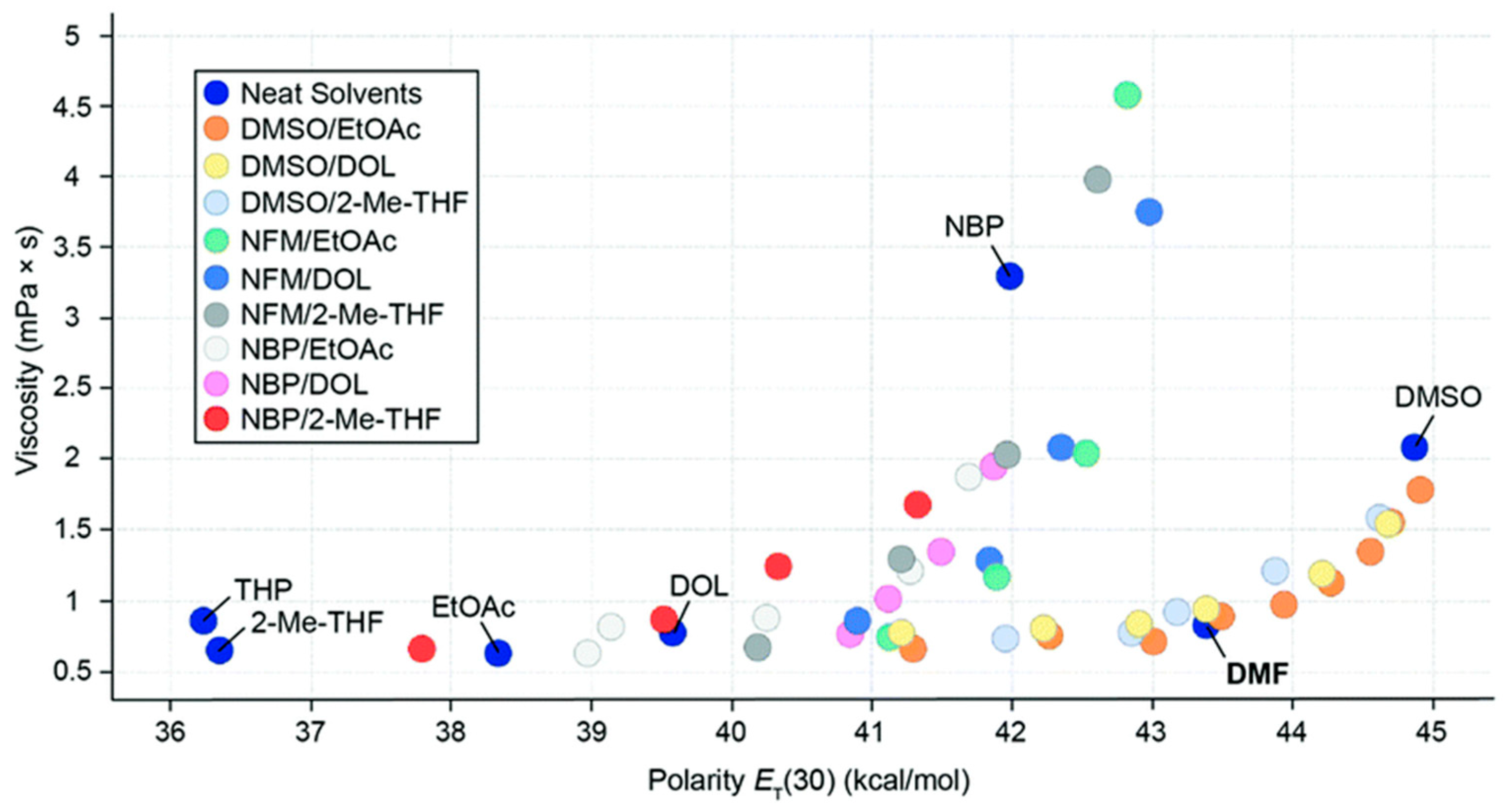
A binary solvent mixture is often used for organic alternatives. A mixture of N-butyl-2-pyrrolidone (NBP) and 2-methyl-tetrahydrofuran (2-Me-THF) has proven suitable for replacing DMF and NMP in SPPS and DMF in LPPS. Fmoc deprotection is favored by polar, aprotic solvents, while the subsequent amino acid coupling is more efficient in nonpolar, aprotic solvents. Accordingly, the combination of NBP (polar, polarity = 0.323) and 2-Me-THF (nonpolar, polarity = 0.187) offers a favorable balance of properties (shown in Figure 2) [46].
All relevant reagents are highly soluble in the NBP/2-Me-THF mixture, with NBP DMF even surpassing the solubility of the by-product diisopropyl urea (DIU). Since DIU is produced in the coupling step and must be removed in the washing phase, sufficient solubility is crucial. A disadvantage of NBP is its increased viscosity (4 mPa·s), which is why the addition of low-viscosity 2-Me-THF is particularly useful during deprotection. In the coupling phase, NBP improves the solubility of DIU [46]. There are currently no more environmentally friendly alternatives with comparable efficiency to the solvents Dimethyl sulfoxide (DMSO) and Acetonitrile (ACN) used in LPPS. Polarity and viscosity of the in chemicals evaluated [20,36] are shown in Figure 2.

2.5. Water-Based Solid-Phase Peptide Synthesis

A water-based alternative process has been researched to a much lesser extent. However, Knauer’s working group describes a water-based SPPS in which all process steps are carried out in an aqueous phase. The resin is soaked and washed in pure water, and deprotection is carried out using aqueous piperidine or piperazine solutions. Coupling is carried out in saturated sodium hydrogen carbonate solution using EDC · HCl as the coupling reagent, while resin separation continues to be carried out with a TFA solution [38]. The conversion of the coupling reaction is 90.7% after 25 min and continues to increase up to 45 min [38]. A prerequisite for water-based SPPS is a suitable, water-swellable resin, as conventional resins do not swell sufficiently in water. One example is ChemMatrix® resin with a swelling capacity of 7.8 mL/g [36,41]. There are currently no convincing alternatives for water-based LPPS, as longer peptide fragments are only soluble in water to a limited extent due to sterically demanding protective groups.
In addition to solvents, environmentally critical reagents should also be replaced. TFA in particular, as a fluorinated reagent from the per- and polyfluoroalkyl substances (PFAS) group, should be avoided. [47] investigated MSA (methanesulfonic acid) as a TFA substitute and achieved a conversion of 98% after 1 h with a solution mixture of MSA: Triisopropylsilane (TIPS): Dimethyl carbonate (DMC) = 4:20:76. MSA is therefore a suitable alternative for the Fmoc/tBu strategy [47]. Similarly, piperidine can be replaced by the less toxic piperazine for Fmoc deprotection, although deprotection requires about three times the reaction time [48]. For the final precipitation after the cleavage of the side chain protecting groups, the environmentally harmful MTBE can be replaced by cyclopentyl methyl ether (CPME) [49].

2.6. Tag-Assisted Peptide Synthesis

Another method for synthesizing peptides is two-phase liquid-phase peptide synthesis, in which the reaction is carried out in much a similar way as conventional LPPS. This technology is known as tag-assisted peptide synthesis.
The principle was developed only two years after SPPS by Merrifield [34,50]. This was developed by [51] and then further investigated for multiple peptides by Chiba and collaborators [52,53,54,55,56]. It is applicable to the tirzepatide studied here [57] as well as oligonucleotides [24].
In this process, soluble anchor groups (tags) are used in the organic phase to serve as reversible carriers for the growing peptide chain. The protective groups are first removed at the active sites of these anchor groups before the first amino acid of the sequence is added. This binds to the anchor group via its carboxyl group, while the N-terminal end remains blocked by a protective group to prevent unwanted side reactions. After coupling, the N-terminal protective group is specifically removed. The resulting by-products—including the separated protective groups and excess amino acids—are then removed from the reaction mixture by aqueous extraction. This step significantly reduces the use of organic solvents, thereby improving the ecological balance of the process [17].
After purification, the next activated amino acid is added, whereupon the cycle of coupling, deprotection, and extraction/purification is repeated. In this way, the desired peptide chain is gradually formed. Once the sequence is complete, the product is cleaved from the anchor group in the same way as in SPPS and sent for further processing [37,53].
By combining soluble carrier technology and phase-selective purification, TAPS combines the chemical control of LPPS with the process-economic advantages of SPPS. The main advantage lies in the fact that only one volume of organic solvent is used in the process, whereas in SPPS multiple washing steps with organics are required each elongation cycle.
In particular, the two-phase system opens up new possibilities for model-based process development, as the clearly defined phase transitions (organic ↔ aqueous) allow precise balancing of material flows and mathematical description of mass transfer and reaction kinetics. TAPS thus represents a promising approach to increasing efficiency and improving sustainability in peptide synthesis.

3. Materials and Methods

3.1. Process Models

3.1.1. Stirred Reactor

Both a volume and material balance are established for the STR; in this case, the energy balance can be omitted since all reactions take place at room temperature and minimal temperature changes during the process are negligible. The change in volume of each component i over time is therefore derived from Equation (1).
d V i d t = V ˙ i , i n V ˙ i , o u t
Here, V ˙ i , i n is the volume flow of component i at the reactor inlet and V ˙ i , o u t is the respective volume flow at the reactor outlet. These flows are also taken into account in the material balance, whereby the balance for the continuously operated stirred tank reactor is used here [58]. This enables a complete check of the model for plausibility and closure condition of the mass balance. For the temporal change in the amount of substance n of component i, Equation (2) follows.
d n i d t = c i n , i V ˙ i n , i c o u t , i V ˙ o u t , i + V R ν i , j r j
Here, V R represents the reactor volume, c i represents the concentration of component i, ν i , j represents the stoichiometric coefficient of component i in reaction j, and r j represents the reaction rate of reaction j. The general concept of the stirred tank reactor model implemented, including the corresponding experimental model parameter determination and model validation procedure, have already been described in detail [59,60,61].
In addition, consideration of the reaction kinetics for the individual sub-steps in the synthesis of tirzepatide plays an important role and must be taken into account in the modeling. The research group led by [39], which has been working in detail on classical Fmoc-SPPS in recent years, specifies first-order kinetics for each reactant for the deprotection and activation or coupling steps. Meanwhile, all possible side reactions during activation and coupling are broken down in great detail. The reaction itself requires activation with DIC; this intermediate product can then be activated and converted by Oxyma Pure. Activation with DIC is the rate-determining step and proceeds significantly slower than activation with Oxyma Pure and the subsequent coupling with another amino acid [39]. Therefore, activation and coupling are combined in one step, and only the kinetic activation is modeled. The products formed in the various side reactions are taken into account in the unreacted reactants.
Furthermore, for partial reactions that proceed with a high excess of one component, second-order kinetics can be assumed with regard to the reaction-limiting component [62].
The conversion rates of the individual process steps in the SPPS and LPPS parts are taken from the literature and estimated downwards [33,40].
The precipitation of the product after the last LPPS and the final removal of the side chain protecting groups does not occur kinetically but is modeled as displacement precipitation. For this purpose, the given conversion rates for the entire process step according to [33] are used to specify the molar amount of the intermediate or final product that must be present after precipitation. It is then assumed that the entire amount of the desired precipitation product is present in solution before precipitation and that the added amount of the displacer reduces the solubility in the overall mixture. Therefore, the total amount of the displacer added is documented, and the precipitated portion is calculated from the proportion of the amount of displacer added and a factor resulting from the residual solubility of the product in the final solvent mixture. The addition of the displacer at different rates, for example, to avoid excessive agglomeration, can also be taken into account with this approach.

3.1.2. Plug Flow Reactor

The basics of modeling a tubular reactor are described below. This is represented using two models, a feed tank with a pump and a tubular reactor. The quantities of the various solvents and reacting components are specified in the feed tank. From there, they are transferred to the tubular reactor by means of a pump. A fixed rate is maintained to ensure the specified residence time in the reactor. The relationship between the average residence time τ ¯ , the volume flow through the reactor V ˙ , and the reactor volume V R is described in the following Equation (3) [62].
τ ¯ = V R V ˙
In the reactor itself, the axial dispersion equation applies, which describes the remixing of the reaction phase parallel to the reactor axis as shown in the following Equation (4) [63].
c i t = u c i x + D a x 2 c i x 2 + ν i r
Here, x is the spatial coordinate, u is the average flow velocity, and D a x is the axial dispersion coefficient.
In order to calculate the temporal and spatial distribution of concentrations across the reactor with reasonable effort, the spatial parameter for the tubular reactor, i.e., the reactor length, is often divided into discrete segments [64]. Boundary conditions are required to solve the differential equation shown above. Those, according to DANCKWERTS are used here. These prescribe a DIRICHLET boundary condition for the inlet (the first discrete element) and a NEUMANN boundary condition for the outlet (the last discrete element) [62]. The general concept of the plug flow reactor model implemented, including the corresponding experimental model parameter determination and model validation procedure has already been described in detail [59,60,65].
For the reaction rate r, kinetics of different orders can be assumed, which are adapted to the specific substance system to be modeled [62]. When two components with similarly high concentrations are coupled, first-order kinetics are used for both reaction partners, as shown in Equation (5) below.
r = k c A c B
Here, c A and c B are the concentrations of the individual components and k is the reaction rate constant. Here too, k is calculated using the given variables of conversion and reaction time; the reaction rate constants are assumed to be constant over the temperature and time range under consideration.

3.1.3. Diafiltration

The modeling of diafiltration is also based on two models: a feed tank for the diafiltration volume with a pump and the diafiltration system itself. Filtration is based on Darcy’s equation, which determines the transmembrane flow J as a function of the membrane area A m e m , the viscosity η, the membrane resistance R 0 , and the transmembrane pressure TMP, as shown in Equation (6) [66].
J = T M P A m e m η R 0
The slide volumes are added from the upstream tank, whose contents are transferred to the filtration system when a minimum volume (=maximum concentration) is reached. The number of additions is controlled by a counting parameter.
The solvent exchange is already simulated by the stepwise addition and continuous filtration. Purification is achieved by the limited permeability of the membrane surface. Depending on the composition of the mixture, the target component is located on the retentate or permeate side of the filtration after filtration. For the quantities of substance passing through to the permeate side, the following relationship (7) applies between the change in the quantity of substance on the retentate side d n r e t d t , the transmembrane flow J, and the concentration of the component on the retentate side c r e t .
d n r e t d t = J c r e t
The amounts of material remaining on the retentate side due to their size remain constant over time. Filtration ends after the desired number of additions and concentration to the desired target concentration. The general concept of the diafiltration model implemented, including the corresponding experimental model parameter determination and model validation procedure, has already been described in detail [59,61].

3.1.4. Liquid–Liquid Extraction

A liquid–liquid extraction (LLE) model was applied for the acidic extraction in the TAPS process with the aim of extracting impurities before the next elongation steps. LLE was modeled using concentration distribution in equilibrium and a lump kinetic approach shown in Equations (8) and (9).
K i = c i , o r g * c i , a q   *
d n i d t = k i , l ( c i c i * )
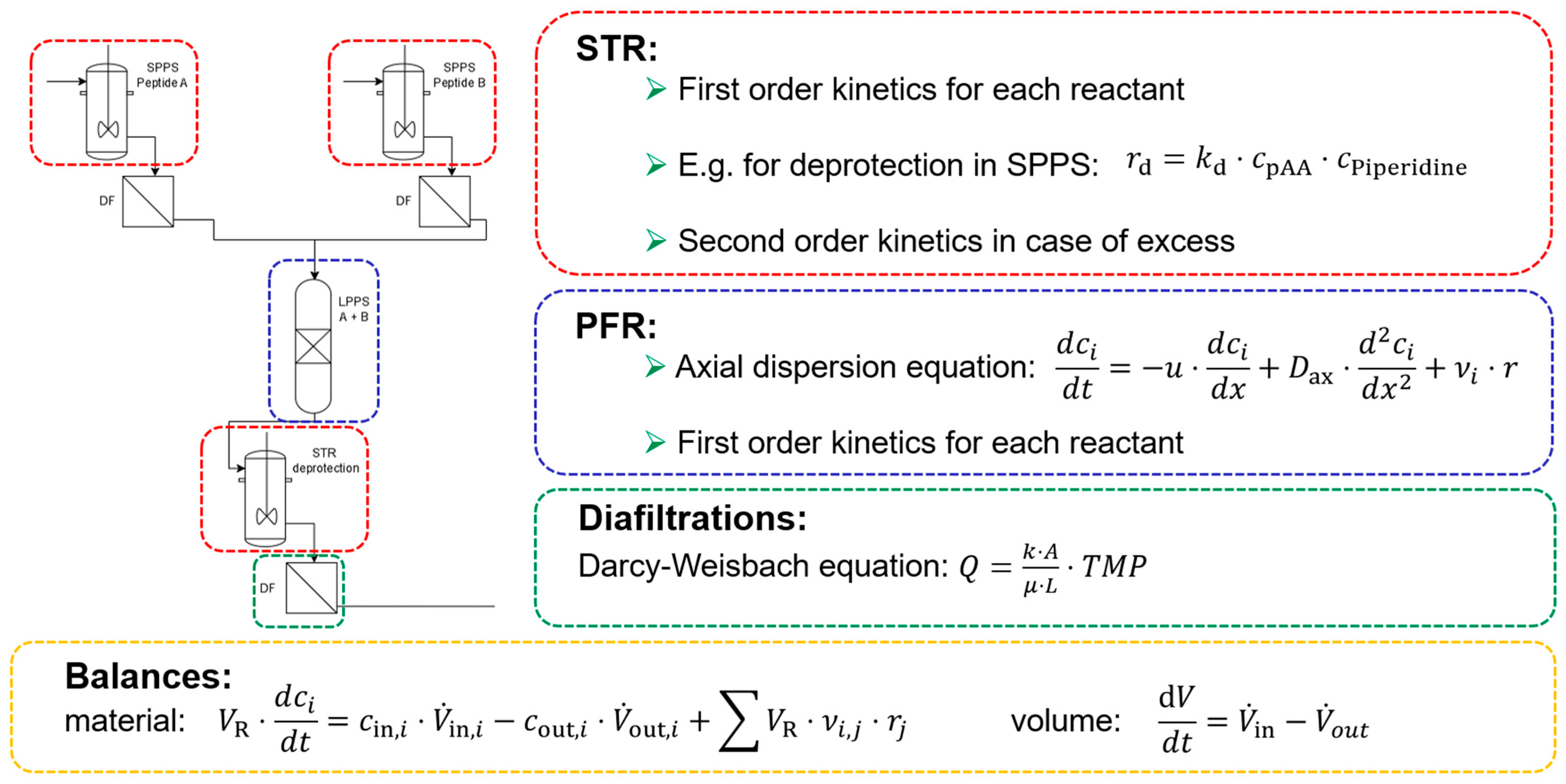
with K i as the equilibrium coefficient, the subscript org/aq for the aqueous and organic phase, * as the superscript of the equilibrium concentration, and k i , l as the kinetic coefficient of the mass transfer from one phase to another. The model equations for the reference process are summarized in Figure 3.
The general concept of the LLE equipment models implemented, including the corresponding experimental model parameter determination and model validation procedure has already been described in detail [59,61,67,68,69].

3.2. Techno-Economical and Ecological Analysis

The following section presents an economic analysis, which consists of the capital expenditures (CAPEX) for the plant on the one hand and the operational expenditures (OPEX) on the other. To this end, a suitable method for estimating the capital expenditures for the plant is selected and applied on the basis of the known information about the process. For the operating costs, the prices of the chemicals required for the synthesis are estimated. The general concept of this eco-efficiency analysis has already been described in detail [70,71].

3.2.1. Capital Expenditure

The plant costs are calculated below using a Class IV estimate. A Class IV estimate has a tolerable deviation of approximately +35%/−20% from the actual price. The Class IV estimate is chosen because more accurate data is not available, and therefore a more precise method is not feasible. In a Class IV estimate (see Equation (10)), the plant costs are generally estimated using the main equipment costs H and a long-term factor Z, plus the cost index for the respective year KI [72].
K = H Z K I ( 2024 ) K I ( 2003 )
The cost index for 2003 is selected because the main equipment costs are calculated using the correlation values from Woods (data from 2003) [72]. The cost index for 2024 is 824 and for 2003 it is 402 [73].
The first step is to calculate the main equipment costs. The costs of the individual pieces of equipment are calculated using Equation (11).
H = H 0 ( L + M * ) A C F ( S S 0 ) a
Here, H 0 stands for the base costs, the factor ( L + M * ) for the measurement, control, and regulation technology, the factor ACF is the material cost factor, the quotient ( S S 0 ) denotes the ratio of the actual to the specified correlation value, and a stands for the construction-specific exponent.

3.2.2. Operational Expenditure

The operating costs of the three different processes are approximated based on the prices of the substances required to manufacture the product. Due to the high quantities used, it is assumed that the actual costs of the reactants are only 1/10 of the small quantity price available online. In combination with the quantities, the operational expenditure (OPEX) of the respective process step can be determined. For this purpose, the LPPS part is divided into a coupling and an isolation part. Precipitation and lateral deprotection are assigned to the isolation. Furthermore, the use of water for injection (WFI) is taken into account in the cost calculation for alternative process 2. In addition, the costs are calculated for the case that the resin can be reused for up to 20 batch productions. It is assumed that this does not affect the yield and purity of the product [74]. In addition to the costs of producing a batch of 8.71 kg of tirzepatide, the costs of producing a 20 mg dose are also determined. The retail price for this is around $318, so that the percentage share of the manufacturing costs for one dose can be calculated [75]. In addition, the total manufacturing costs per kilogram of tirzepatide are determined, with the equipment being depreciated over a period of 10 years. Furthermore, the maximum possible number of batches per year, which depends on the production time, is taken into account. For this purpose, an equipment availability of 90% is assumed.

3.2.3. Ecological Analysis

The ecological assessment of a process can be evaluated using various key figures. One widely used key figure is process mass intensity (PMI), which has been used in the pharmaceutical industry for over 18 years [76]. Equation (12) shows the basis for calculating PMI.
P M I = m i ( r a w   m a t e r i a l ) m ( p r o d u c t )
The PMI offers a quick way to compare processes, as it compares the ratio of raw materials used to the mass of products. For synthetic peptides obtained using an SPPS-based process, the typical range is between 3035 kg/kg and 7023 kg/kg, with an average of 4299 kg/kg. A weakness of the PMI is that the mass of harmful solvents such as DMF is weighted in the same way as the mass of harmless substances such as water [17,76].
The GWP offers another, more differentiated option for comparison. This extends the PMI by a weighted factor for the respective substance, so DMF has a GWP value of 4 compared to water with a significantly lower value of 0.01 [77]. The GWP is calculated using Equation (13) [78,79].
G W P = m i ( r a w   m a t e r i a l ) G W P i m ( p r o d u c t )
The GWP therefore has an advantage over the PMI when it comes to comparing processes in terms of their environmental impact. Nevertheless, the PMI should also be considered, as it is widely used and well known for many processes.

3.3. Experimental Setup

3.3.1. Chemicals

The chemicals used for the synthesis of the hydrophobic tag, hydrophobized peptide and the kinetic experiments were purchased from BLDPharm (Reinbek, Germany), Merck (Darmstadt, Germany), Fluorochem (Hadfield, UK), Thermo Scientific (Waltham, MA, USA), TCI (Tokyo, Japan) and Apollo Scientific (Manchester, UK).

3.3.2. Synthesis

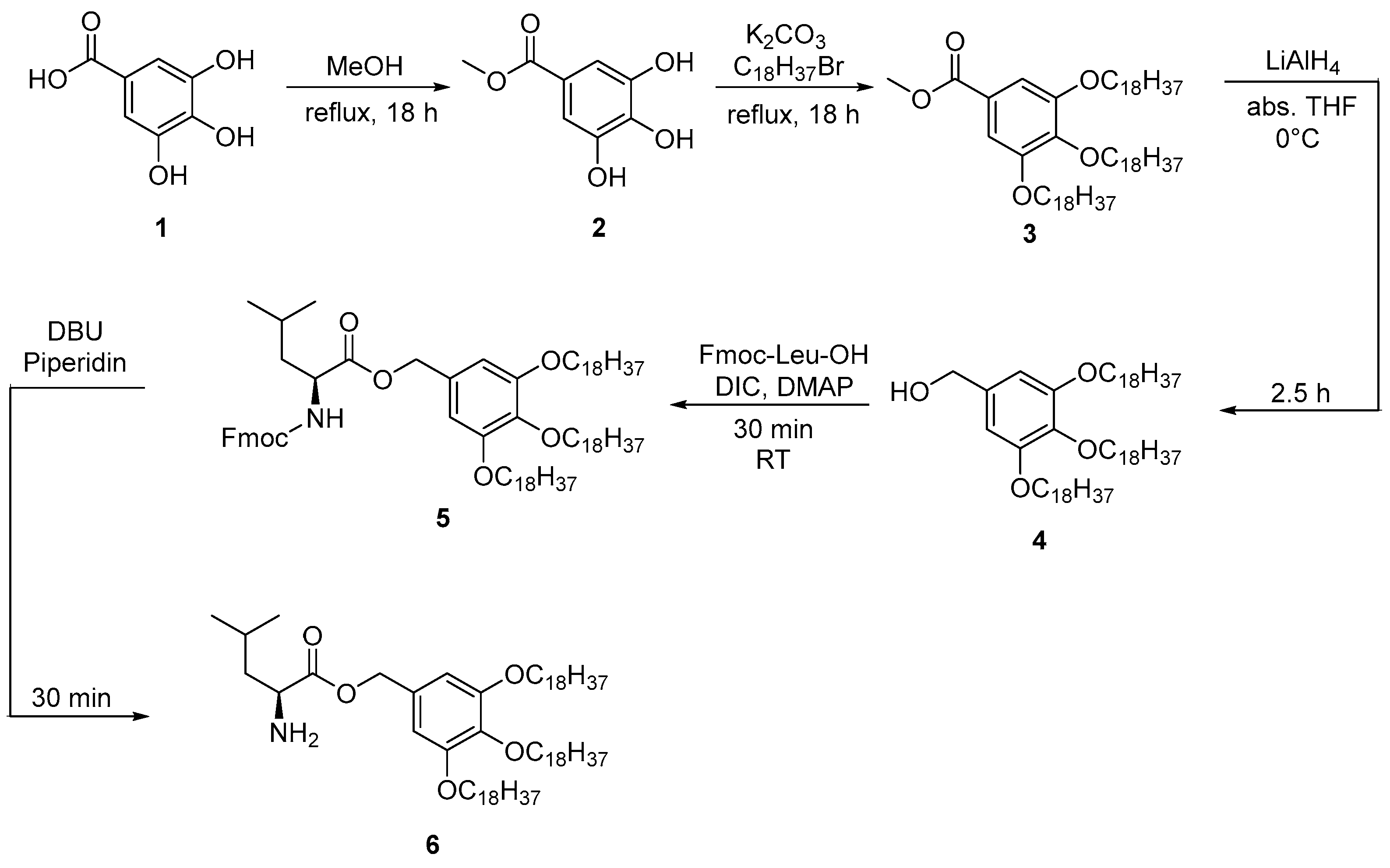
Synthesis of the hydrophobized leucine 6 was performed according to the literature procedures [52,80,81,82]. The synthetic pathway is described in Figure 4. Starting with gallic acid 1 (Fluorochem), a Fischer esterification with methanol was performed to obtain methyl gallate 2. A triple Williamson ether synthesis with octadecyl bromide (Fluorochem) was performed to obtain methyl 3,4,5-tris(octadecyloxy)benzoate 3. After reduction with lithium aluminum hydride (Thermo Scientific, >95%), the hydrophobic tag 3,4,5-tris(octadecyloxy)benzyl alcohol 4 was obtained. The coupling of Fmoc-protected leucine (BLDpharm, 99.73%) to the hydrophobic tag was achieved with DIC as an activating agent, resulting in Fmoc-protected hydrophobized leucine 5. After deprotection with 1,8-Diazabicyclo [5.4.0]undec-7-ene (DBU; Apollo Scientific, >97%) and piperidine (Merck >98%), hydrophobized leucine 6 was obtained.
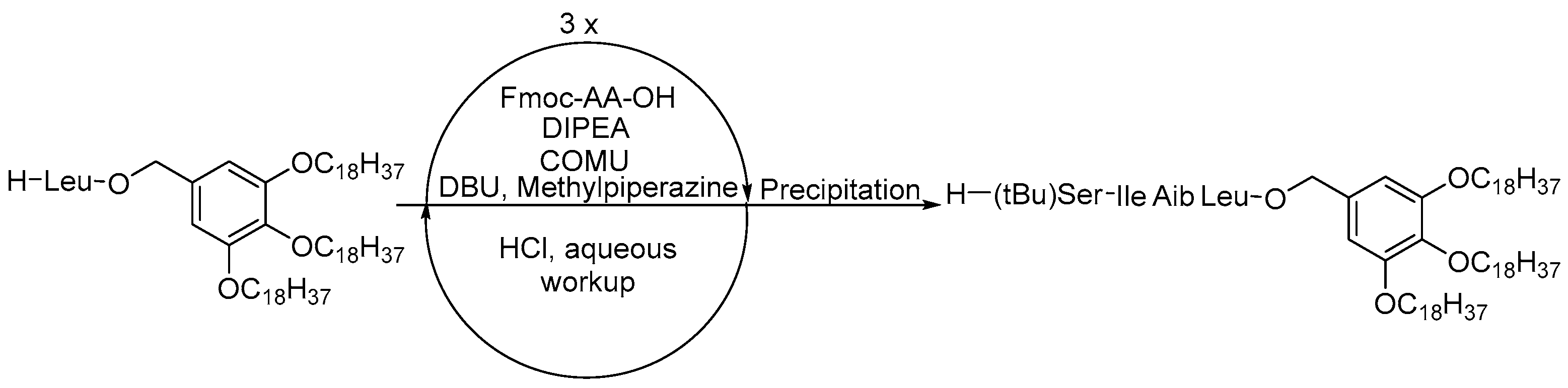
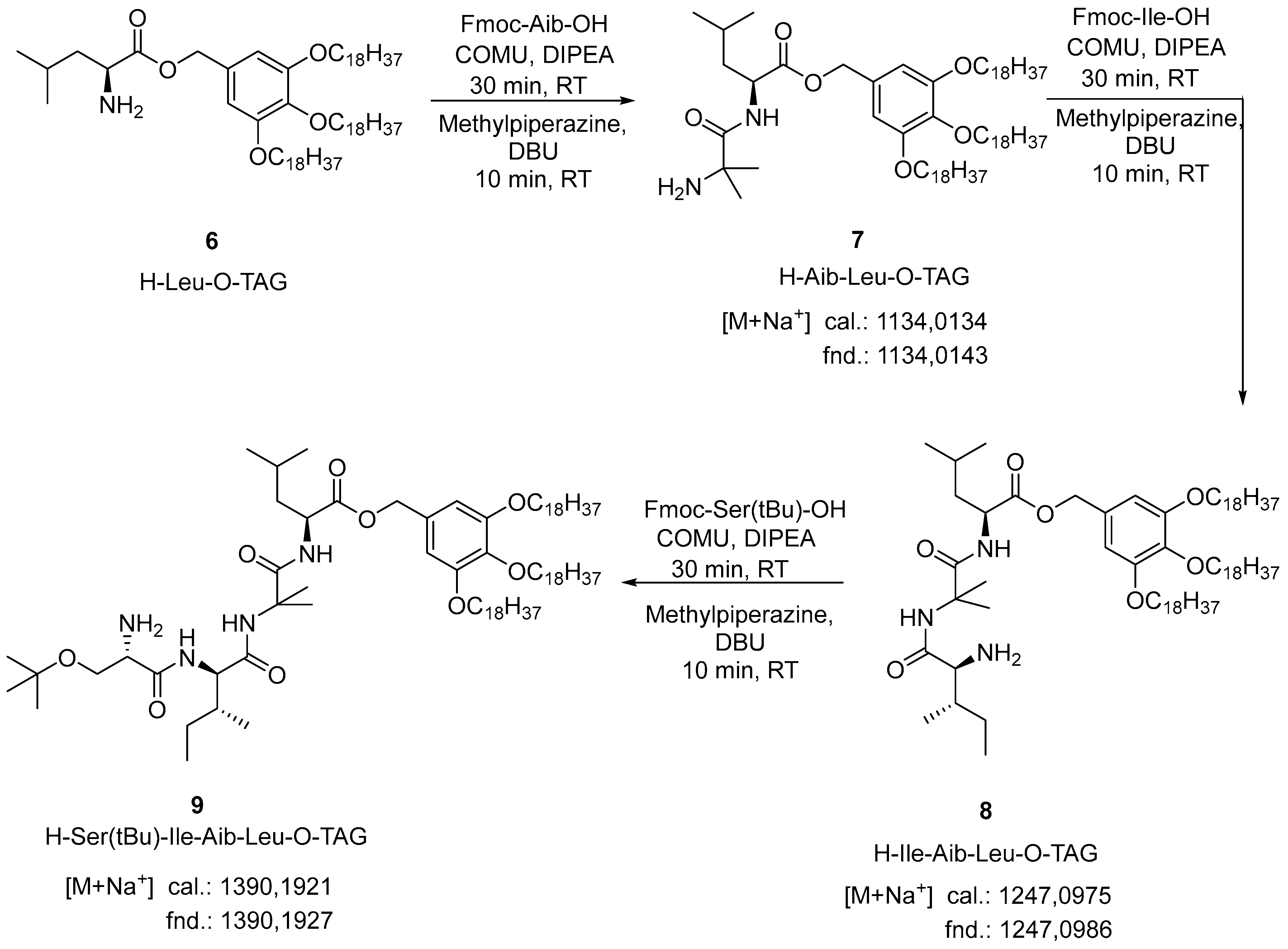
The one-pot synthesis of hydrophobized tetrapeptide was performed according to a literature procedure [83]. The simplified schematic synthetic pathway, using Fmoc-protected amino acids (BLDpharm: Fmoc-IsoLeu 99.92%, Fmoc-Leu: 99.73%, Fmoc-Aib: 99.85%), Diisopropylethylamine (DIPEA) as a base (Alfa Aesar 99%) and 1-[1-(Cyano-2-ethoxy-2-oxoethylideneaminooxy)-dimethylamino-morpholino]-uronium hexafluorophosphate (COMU, BLDpharm 98%) as an activating reagent, as well as DBU and N-Methylpiperazine (TCI, >98%) as deprotecting agents, is depicted in Figure 5.
For reaction monitoring purposes, an aliquot of the reaction mixture of ca. 1 mL was collected and precipitated quantitatively with acetonitrile after every coupling–deprotection cycle. The samples were washed with acetonitrile. After solvent removal over fine vacuum, crude proton and carbon nuclear magnetic resonance (NMR) as well as mass spectra were measured in order to confirm the formation of the elongated hydrophobized peptide.

3.3.3. Experimental Determination of Kinetic Parameter

The kinetic experiments of the coupling and deprotection reactions were performed under the reaction conditions described in [83]. The reaction equations of the reactions in question are depicted in Figure 6.
In order to monitor the reaction progress, aliquots of 0.5 mL were taken from the reaction mixtures at regular time intervals of 30 s and immediately quenched in 10 mL of methanol by means of quantitative precipitation. The precipitates were centrifuged, and the solvent was decanted. The precipitates were suspended in 10 mL acetonitrile, centrifuged, and decanted again. After removal of the solvent under fine vacuum, proton NMR spectra of the samples were measured in order to determine the time-dependent reaction conversion of the coupling and deprotection reactions based on the integrals of the characteristic proton signals of the starting materials and reaction products.

3.3.4. Analytics

NMR spectra were measured with the spectrometers AVANCE NEO 400 and AVANCE III 600 MHz (Bruker Corporation, Billerica, MA, USA). Mass spectra were measured with the mass spectrometer BRUKER IMPACT II (Bruker Corporation). Raman spectroscopy was conducted with a Kaiser Analyzer RXN2 (Rxn 785 HPG Multichannel) from Kaiser Optical Systems (Endress + Hauser Group Services AG, Reinach, Switzerland). FT-IR was measured with a ReactIR 702L spectrometer from Mettler Toledo (Greifensee, Switzerland).
FT-IR was measured using a probe in the reaction vessel, while Raman was measured using a flow cell to shield the probe from external light. The flow cell was fed with a HPLC-Pump K-501 pump (Knauer GmbH; Berlin, Germany).

4. Results

4.1. Process Model Implementation

This paper focuses on the protected and unprotected amino acid, the intermediate in the coupling reaction, and finally the product after separation from the resin in order to generate a model for conceptual process design with a focus on the main component and corresponding main impurities. For the reference process, the hybrid SPPS and LPPS process published by [33] is chosen. The kinetic coefficients for the reactions are estimated through the process time given in the literature data. The yield in each reaction is assumed with the literature reference to be 99% [40].

4.1.1. Reference Process

In the deprotection process, the reaction rate depends on the concentration of the protected amino acid and the concentration of the deprotection reagent, in the case of the reference process, i.e., the piperidine solution. The time limit of 1.5 h and a conversion of 99% for this process result in a value for the rate constant of k d , S P P S = 0.02415 L m o l m i n . In the subsequent washing with DMF, the loss during rinsing of the solvent for the intermediate product is 1%, so that shortly before the end of the step, the concentration of the deprotected amino acid drops slightly. Subsequently, in addition to this concentration, the concentration of the DIC and the new protected amino acid also enters into the reaction rate of the coupling. In the reference process, this step achieved a 99% conversion after 5 h, resulting in a constant of k a + c , S P P S = 0.296 L 2 m o l 2 m i n . The concentration of the intermediate then drops again by 1%, after which the final separation from the resin takes place. Here, the reaction rate r depends on both the concentration of the intermediate product and the concentration of the TFA solution. With 99% conversion and a reaction time of 4.5 h, the rate constant can be calculated as k c l , S P P S = 0.0152 L m o l m i n .
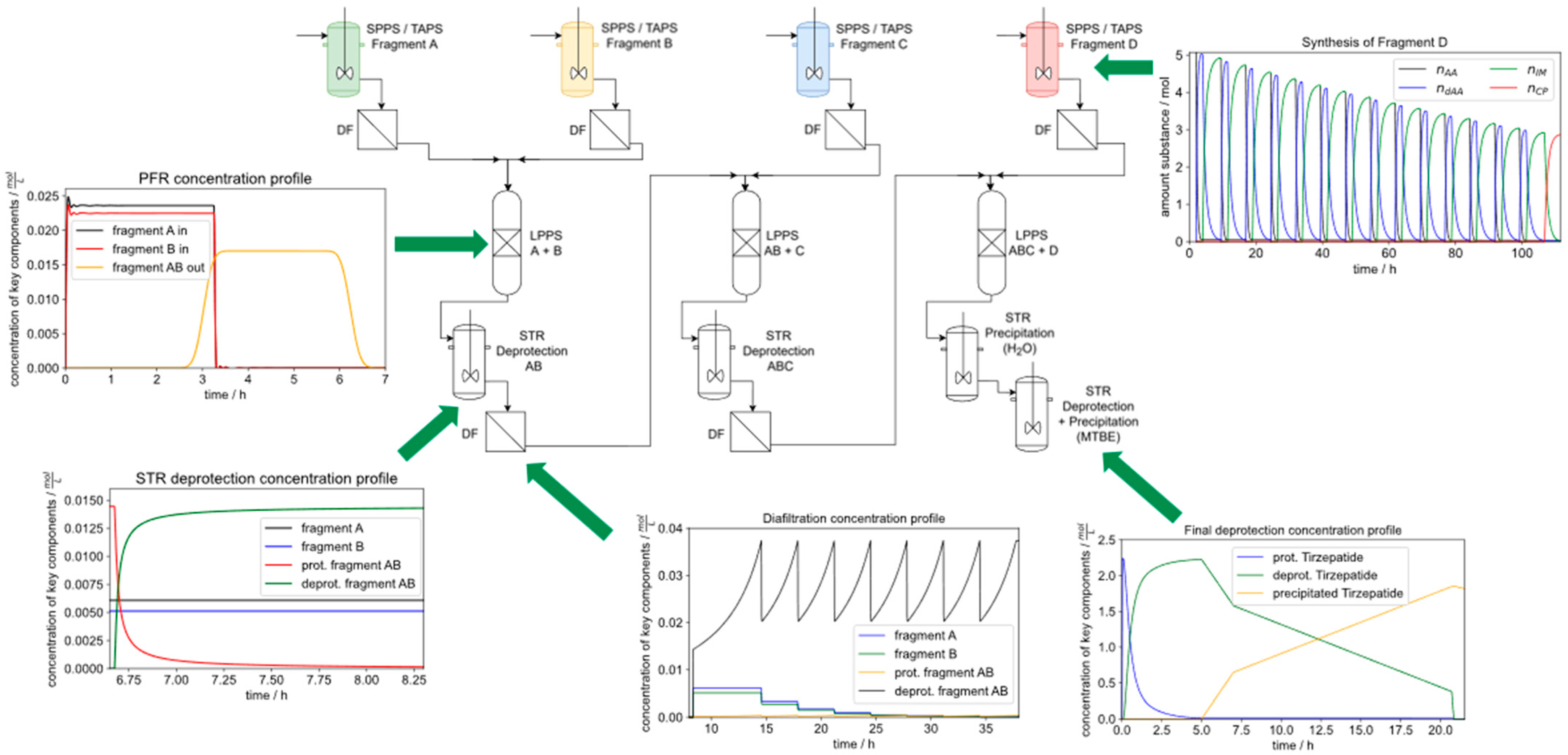
Before the last SPPS cycle for the production of fragment D can run, a two-hour swelling process and an additional 13 coupling cycles take place in succession. This results in a total duration of 111.5 h.
During the process, the initial concentration of the protected amino acid decreases at the beginning of each cycle, which generally also leads to a reduction in the rate constants. Therefore, these must be adjusted separately for each cycle. The change in concentration of the protected amino acid during deprotection and that of the intermediate product during resin separation are very small compared to the concentrations of the solvents PIPe/NMP and TFA/NMP, respectively. For this reason, the changes in k d , S P P S and k c l , S P P S for the deprotection and separation steps are negligible. In contrast, during coupling, the new protected amino acid and DIC are added only in a slight excess. This means that the values for the rate constant can vary greatly over the cycles, which is why only the change in the values for k a + c , S P P S is taken into account in the modeling. For this purpose, a linear decrease in the rate constants is assumed.
No significant changes have arisen in the modeling of the LPPS and the precipitation and deacidification steps at the end of the process with the development of the alternative processes, which is why the modeling is described here in a single step and only the differences between the processes are addressed selectively.
The assumptions mentioned in Section 3.1.2 are used to model the coupling reaction in the tubular reactor. In particular, second-order kinetics are assumed here, as only the two peptide fragments to be coupled are present in similar concentrations. The coupling reagents are not taken into account here. This results in the kinetics shown in Formula (14) as an example for the first coupling between fragment A and fragment B.
r = k c c f r a g A c f r a g B
This reaction rate is calculated in each discrete step over the length and ensures that the reactants are converted depending on their concentration.
The reaction rate constant for the coupling k c is determined based on the given conversion and the residence time. An iterative method is used for this purpose, which varies the reaction rate constant and compares the achieved conversion with the specified conversion degree.
Following the coupling of the fragments in the tubular reactor, the protective group is removed in the stirred tank reactor, which is modeled similarly to the one described above.
The removal of the protective group is followed by purification by diafiltration, the modeling of which will be described below. The same modeling approaches also apply to those diafiltrations that serve as a transfer between SPPS and LPPS. The principles described in Section 3.1.3 above apply. In this application, seven diafiltration volumes are used to purify the reaction mixture and replace the solvent. However, a concentration phase to the specified minimum volume takes place first before diafiltration begins.
The addition of the reaction mixture from the stirred tank reactor and the subsequent concentration before the seven diafiltrations begin are clearly visible. In the case of diafiltration between SPPS and LPPS, the previously formed fragments are retained on the retentate side, while the solvent mixture used in the SPPS and any incorrectly formed amino acid chains pass through the membrane to the permeate side. Diafiltration after the LPPS retains the coupled fragments in a protected or unprotected state on the retentate side, while the uncoupled fragments pass to the permeate side and are thus removed from the reaction mixture. The total process simulation results with the are shown in Figure 7.

4.1.2. Alternative Processes

For alternative process 1, data from the [40] is used for SPPS, with the binary solvent mixture of NBP and 2-Me-THF serving as a substitute for DMF and NMP [40]. The only deviation is in resin separation, where MSA is a suitable substitute for fluorinated TFA [47].
A major advantage is that the large quantities of DMF and NMP solvents are replaced by NBP and 2-Me-THF. Due to the high swelling capacity of NBP and 2-Me-THF, the time required is reduced from two hours in the reference process to one hour in alternative process 1. In contrast, the time required for deprotection and coupling is doubled, i.e., from 90 min to 180 min for deprotection and from five hours to ten hours for coupling. This greatly increases the time required for the synthesis of a batch, as deprotection and coupling generally take up the largest share of the time [40].
In alternative process 2, the SPPS steps, with the exception of resin separation, are water-based, thus saving large quantities of organic solvents. Table 1 lists the reagents used in comparison to the reference process.
Pure water is now used for both the washing steps and the swelling of the resin, so a water-swellable resin (e.g., ChemMatrix®) must be used. It is assumed that the swelling of the resin takes the same amount of time as in the reference process. For deprotection, an aqueous solution of the more environmentally friendly piperazine is used instead of piperidine, which increases the time required from 90 min to 270 min [48]. Instead of DIC in NMP, an aqueous, saturated sodium hydrogen carbonate solution with EDC is used as the coupling reagent, reducing the coupling time by about half (from 300 min to 135 min). The time is based on the information provided by Knauer’s group, which describes that a conversion of 90.7% is achieved after 25 min and that the conversion has increased up to 45 min. Assuming first-order kinetics with regard to the deprotected amino acid, the added amino acid, and EDC, extrapolation of the time from 25 min to 45 min resulted in a maximum achievable conversion of approximately 98%, which is lower than the reference process with a conversion rate of 99%. In addition, based on the extrapolation, a safety factor of 3 is assumed with regard to time, resulting in a total time of 135 min. The slightly lower conversion is also due to an increased presence of side reactions [38]. The used chemicals are shown in Table 1.
In the LPPS, similar approaches to those used in the SPPS can be adopted for the development of alternative processes.
The DMSO/ACN solvent mixture used for the coupling between fragments A and B and the subsequent coupling of fragment AB to C will also be retained in the development of alternative processes, as there is no more environmentally friendly but similarly effective option available. The third coupling in the tubular reactor between fragments A, B, C and D is carried out in a mixture of NBP and 2-Me-THF instead of DMF, analogous to SPPS. To remove the terminal protecting group of the amino acid sequence, piperidine is used in the first alternative process and piperazine in the second alternative process instead of Diethylamine (DEA) as in the SPPS [48].
A significant difference comes into play in the removal of the side protecting groups at the end of the process: Instead of the mixture of TFA, Dichloromethane (DCM), Dithiothreitol (DTT), TIPS, and water, a mixture of MSA, TIPS, and DMC is used for both alternative processes. This offers the advantage of eliminating fluorinated chemicals such as TFA and shortening the deprotection process from 4.75 h to 1 h [47]. In the final precipitation step, CPME is used in the alternative processes instead of MTBE. CPME has similar properties and therefore offers no advantages in terms of quantity or time, but it is less toxic and therefore preferable [49].

4.1.3. Tag-Assisted Peptide Synthesis

A simulation has also been set up for the TAPS process. For comparability purposes, the basic structure of the reference process has been adopted; this has also been adopted in the literature [57]. The decisive difference again lies in the synthesis of the peptide fragments. Here, deprotection and extension take place in the liquid phase. It is therefore not necessary to swell a resin. Process times are determined in accordance with patent [83]. Deprotection is carried out with DBU and methylpiperazine, and the peptide chain is extended by adding the Fmoc-protected amino acid and the coupling reagents COMU and DIPEA. Here, too, a yield of 99% per process step is assumed. The reaction kinetic parameters are determined using these values. For the acidic extraction, the equilibrium parameters are selected so that the reactants are completely transferred to the aqueous phase. The mass transfer coefficients are again adjusted to the specified process time. The reagents are present in excess compared to the existing peptide chain, so that first-order reaction kinetics are again assumed.

4.1.4. Comparison of Fragment Elongation

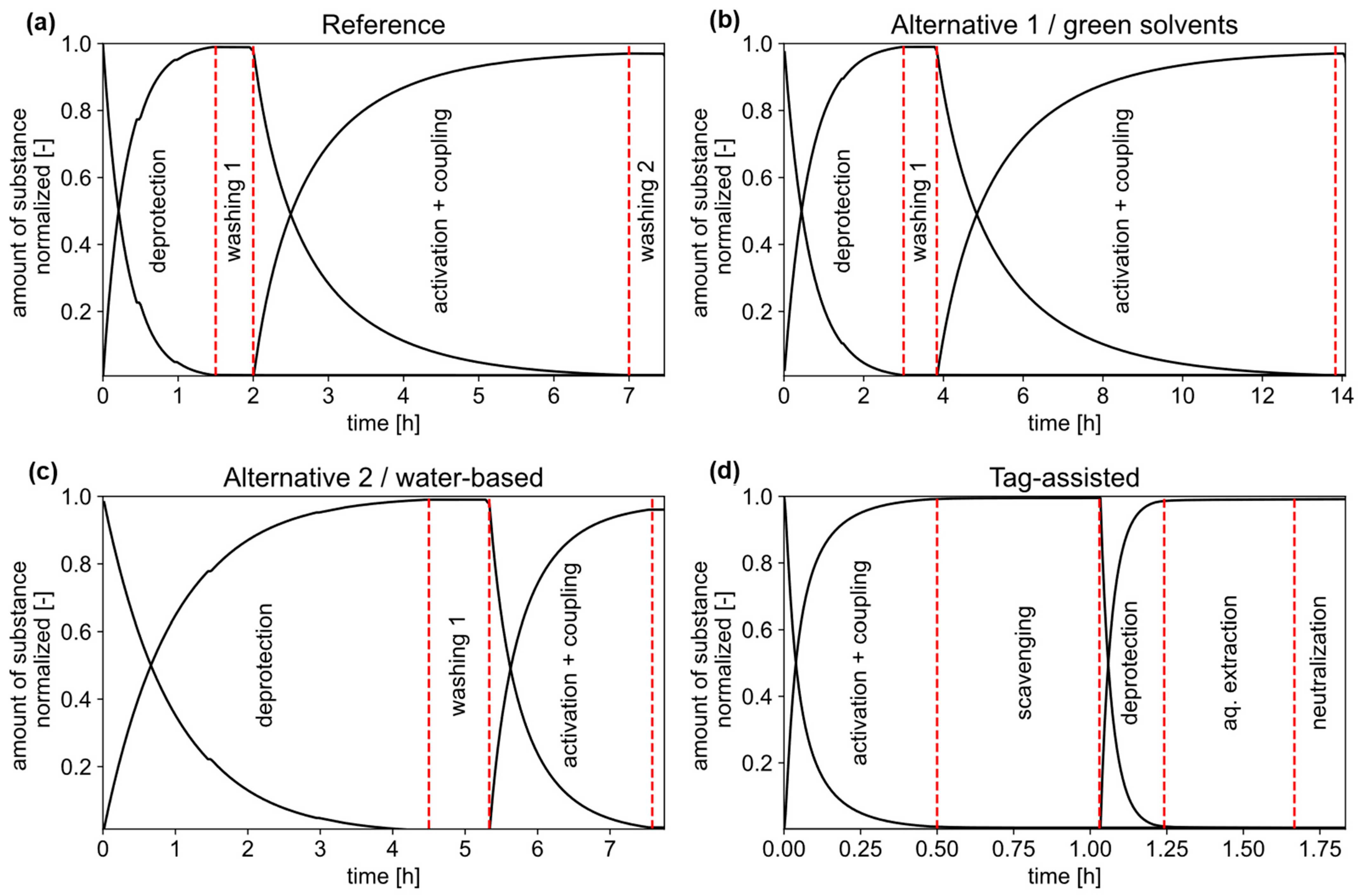
Based on the implemented process models for the four considered peptide synthesis processes, the main difference is the fragment synthesis. Figure 8 shows simulation results for one fragment elongation for each of the processes calibrated with the literature data. The figure excludes swelling, which is a factor in particular for the water-based SPPS. As shown, the total process time differs strongly between the shortest of 1.8 h for TAPS and the longest for the alternative 1 process with 14 h.

4.2. Techno-Ecological and Economical Analysis

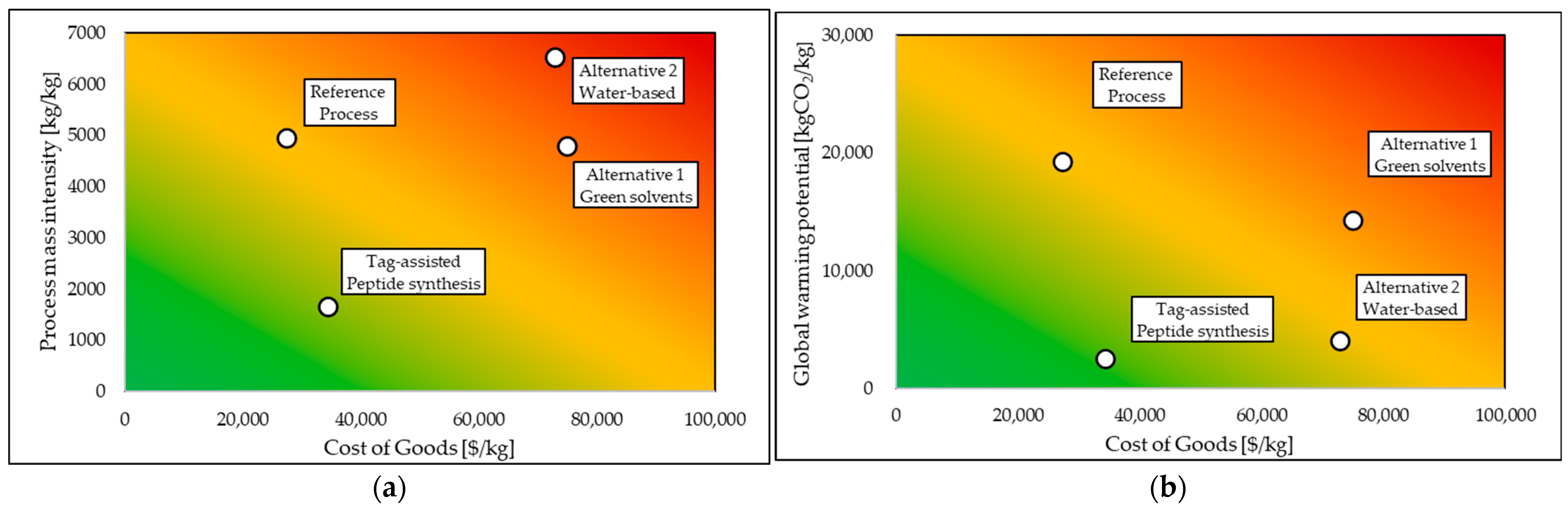
Based on the results of the total process simulation studies, an economic and ecological analysis can be performed according to the procedures described in Section 3. The processes are compared in terms of PMI, GWP, CoGs, and productivity. Significant differences can be seen in the fragment synthesis, which is why the space-time yield (STY) is shown separately. The results are presented in Table 2.
It is clear that the reference process with the established SPPS has a low PMI and the lowest CoGs. In terms of CoGs, the modifications to the SPPS through the use of green solvents or a water-based SPPS are significantly worse, with an increase in costs of approximately a factor of three. In the first alternative process, this is due to the OPEX for 2-Me-THF/NBP, which accounts for approximately 80% of the OPEX. In the water-based process, the high costs are mainly due to the resin, which accounts for 75% of the OPEX. Since CAPEX is very low in all processes compared to OPEX, the selection of reagents in the CoGs is very significant. At $34,400/kg, the TAPS process has a comparable CoGs to the reference process. However, it has an STY that is approximately three times higher at approximately 13,960 g/(L*d).
It should be noted, however, that OPEX is calculated based on currently available prices. Market developments such as increased demand can lead to higher production of chemicals. This can trigger an economy of scale effect, which can lower prices. For example, the relatively uncomplicated production of the tag for TAPS can reduce CoGs to $25,750/kg.
From an ecological perspective, it is clear that the alternative 1 process has a similar PMI to the reference process due to the use of greener solvents, but a significantly lower PMI. This effect is even more pronounced in the water-based process. Here, the PMI increases, but the GWP is almost five times lower. The TAPS process has both a lower PMI and GWP. It reduces the PMI by a factor of 3 and the GWP by a factor of almost 8 compared to the reference process.
Since the TAPS process is by far the most ecological and is also comparable to the reference process in terms of CoGs, it is selected for the experimental determination of the model parameters in order to exemplify the approach from theoretical feasibility based on the literature data to experimental feasibility by experimental model parameter determination in laboratory scale and final model validation.

4.3. Experimental Model Parameter Determination

The synthesis of hydrophobized Leucine 6 was performed following known literature procedures [52,80,81,82,84]. Using gallic acid as a starting material, hydrophobized leucine 6 was synthesized over six steps. Formation of the product was confirmed by means of NMR spectroscopy.
In order to confirm the suitability of the hydrophobic tag 4 for use in the peptide synthesis, the tetrapeptide 9 was synthesized according to the one-pot synthesis literature procedure [83]. Starting from hydrophobized Leucine 6, three coupling–deprotection cycles were performed. Crude proton and carbon NMR measurements, as well as mass spectra after every coupling–deprotection cycle, confirmed the formation of the desired elongated peptides. Figure 9 summarizes the reaction pathway of the tetrapeptide 9, with the corresponding measured molecular masses.
The measured molecular masses after every coupling–deprotection cycle match the calculated m/z values for the corresponding elongated peptides.
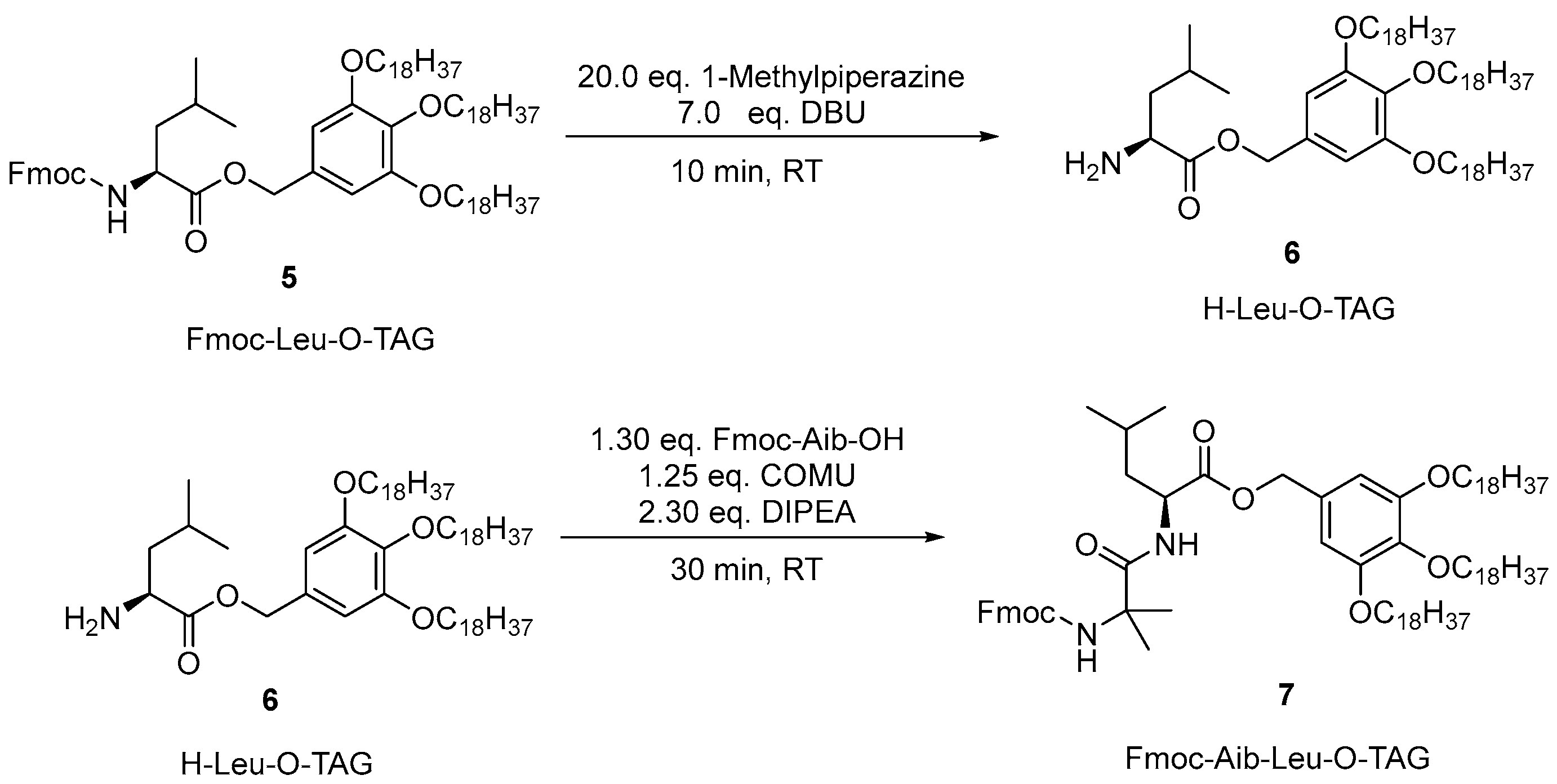
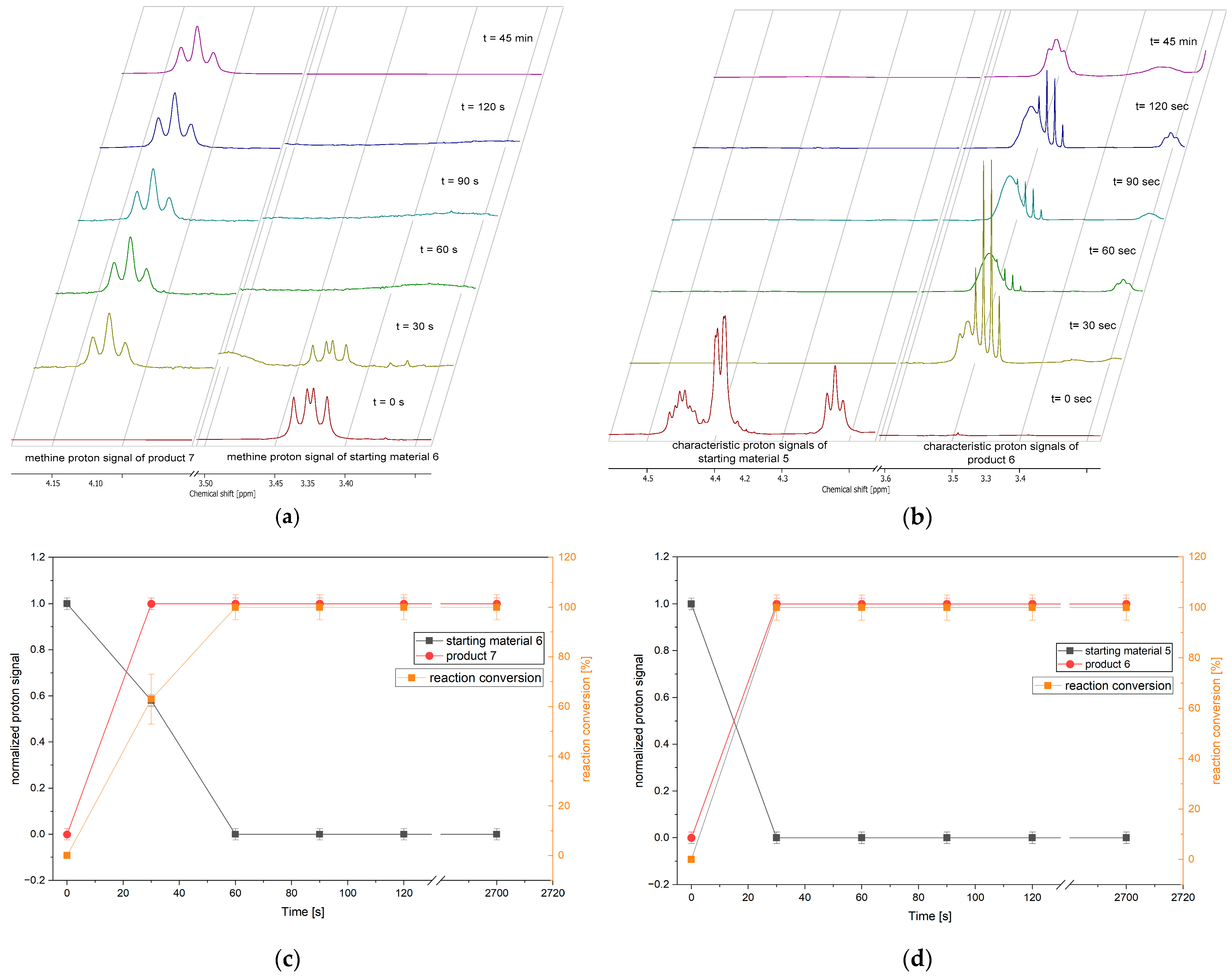
In order to investigate the reaction kinetics of the coupling–deprotection reactions, NMR studies were performed. For this purpose, proton NMR spectra of starting material 6 and coupling product 7 were measured in deuterated tetrachloroethane. The proton signal at 3.42 ppm corresponds to the methine proton adjacent to the amino group in starting material 6. The same methine group undergoes a downfield shift to 4.12 ppm after the coupling reaction. Thus, the integral ratio of the signals at the chemical shifts 3.42 and 4.12 ppm corresponds to the concentration ratio between starting material 6 and coupling product 7 at the time of aliquotation. The relevant sections of the NMR spectra containing the characteristic proton signals at different reaction times are shown in Figure 10.
The NMR measurements suggest a very rapid reaction rate. As shown in Figure 10, as early as 30 s after the reaction start, already 63% of the reaction completion was measured. After 60 s the methine proton signal of the starting material disappeared completely, suggesting full reaction conversion within less than one minute.
The kinetic studies regarding the deprotection reaction were performed analogously to the coupling reaction. Proton NMR spectra of protected, hydrophobized leucine 5 and its deprotected counterpart 6 were measured in deuterated chloroform. The proton signal of the methine group at 4.44 ppm for the starting material and 3.50 ppm for the deprotected product were selected as the characteristic signals for the calculation of the reaction conversion.
Similar to the coupling reaction, the NMR data suggest very fast reaction kinetics for the deprotection reaction. Although the characteristic signal of the deprotected product shows an overlap with some impurities, the complete disappearance of the proton signals of the protected starting material is clearly visible, suggesting a complete deprotection after less than 30 s.
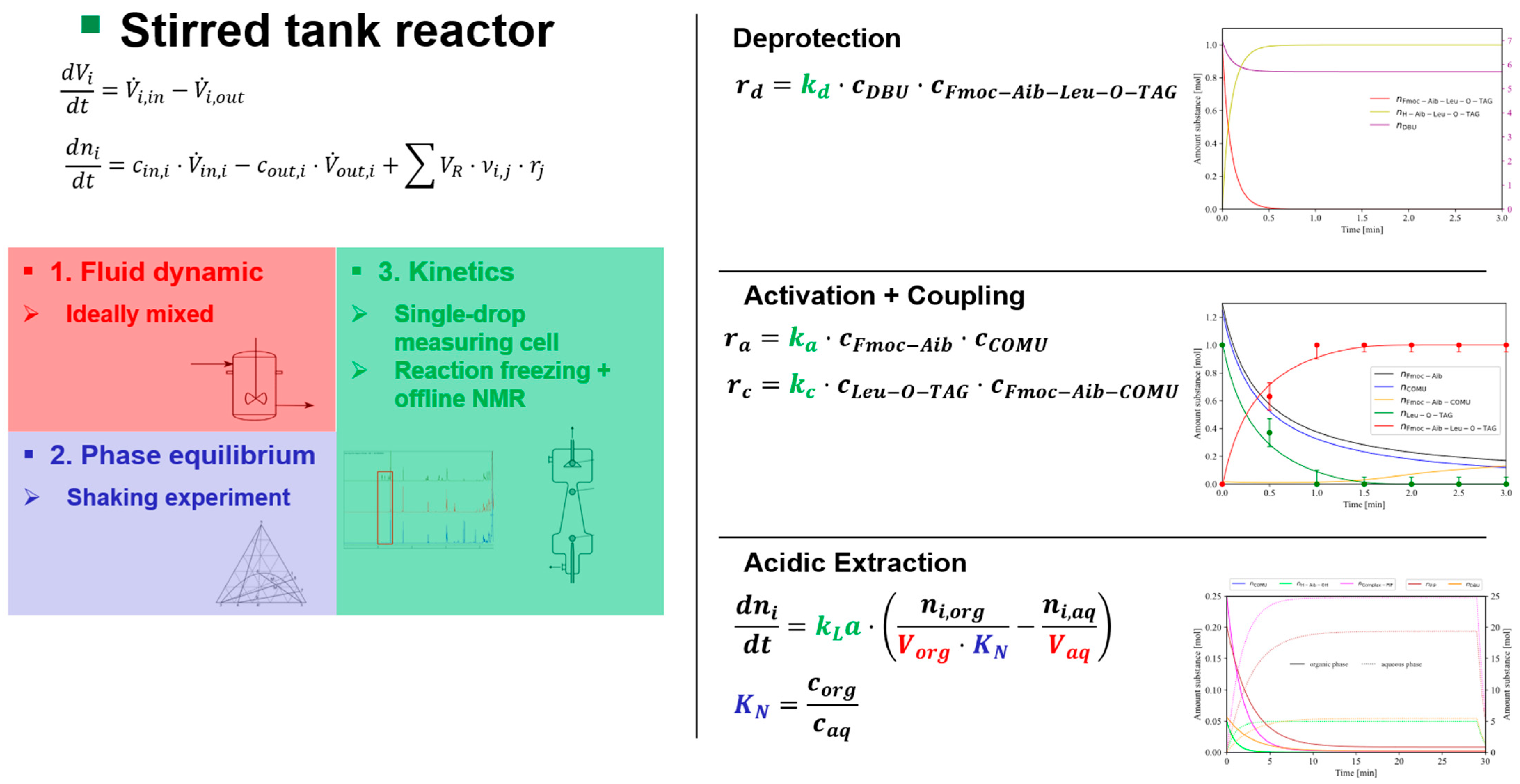
For model parameter determination, the aim is to develop a concept for the individual determination of fluid dynamic, equilibrium, and kinetic model parameters. This has the advantage for scaling the process; only the fluid dynamic model parameters need to be adjusted. The equilibrium and kinetic parameters are scale-independent [85,86].
For fluid dynamics, ideal homogeneous mixing is assumed on a laboratory scale; for scale-up, a residence time distribution can be assumed for an STR or plug flow for a continuously operated PFR. The equilibrium parameters of liquid–liquid extraction can be determined by shaking tests and determination of the phase equilibrium. For the kinetic parameters of LLE, drop measurement cells [87] or Nitsch cells [88,89] can be measured. As shown above, the reaction parameters are determined by time-resolved NMR analysis. The kinetic model parameters for deprotection, activation, and coupling can now be calibrated using the data recorded from the NMR. This is done as described in Section 3.3.3. The entire model parameter determination concept is summarized with the calibrated model in Figure 11.
In general, only the fluid dynamics of equipment are related to scale; phase equilibrium and mass transfer kinetics are independent of scale, and such could be determined in a small laboratory scale for any large-scale manufacturing, if the small-scale fluid dynamics in know and, with the aid of process simulations that know large-scale fluid dynamics, are validly predicted. The model is completed in general, additively generated stepwise in the order of first fluid dynamics, if needed including flow-dependent pressure drop and, if needed, energy balance, then second equilibrium, and finally kinetics [60,70,90,91].

4.4. Process Analytical Technologies

The reaction rate in SPPS depends heavily on the peptide length and the amino acid used [92]. For sterically bulky amino acids such as Aib, individual coupling steps can take up to 8 h. Offline analysis in SPPS is only possible through manual sampling of the solid phase, followed by cleavage of the peptide from the resin and HPLC analysis—a time-consuming and technically complex process [93].
Stager et al. describe an alternative approach to process monitoring via the liquid phase: The Fmoc protecting group of the amino acid used is monitored based on its characteristic Raman band at 1612 cm−1. As soon as no further consumption of the reactant is detectable, the reaction is considered complete and the next process step is initiated—a so-called steady-state approach. The same logic applies to deprotection: Here, too, the Fmoc band at 1612 cm−1 is used, this time as an indicator of increasing concentration in the supernatant. When no further increase is observed, deprotection is considered complete. A complete mass balance is not established in this approach, as only a single phase [94] is considered [92].
A second application of Raman-PAT involves the washing steps following coupling in SPPS. The Fmoc concentration is measured in the flow stream to monitor the complete elution of the excess amino acid from the reaction solution. After deprotection, however, piperidine is detected based on the Raman band at 819 cm−1. The washing step is considered complete once a concentration of less than 1000 ppm is reached. Through this demand-driven control of the washing steps, a 51% reduction in solvent consumption was achieved [92]. Similar approaches using refractive index measurement were described by de la Torre et al. [95]. Comparable functionality in SPPS is also demonstrated by low-field 1H-NMR monitoring according to Henkel et al. [93], which can identify species such as dibenzofulvenes, piperidine, Fmoc-amino acids, DIC, oxime, and diisopropyl urea in the supernatant. Due to the inherently low time resolution of 4–15 min per spectrum, this approach is well-suited for SPPS but is only of limited use for a faster liquid-phase process such as TAPS.
Applying these PAT concepts to the TAPS process is conceptually straightforward, but significantly more complex in practice. In the homogeneous liquid phase, the natural separation between resin and supernatant is eliminated. The growing peptide chain is not bound to a carrier via adsorption, which means that characteristic signals such as the Fmoc band do not diminish due to selective binding. Instead, only new bonds form between amino acids in a complex reaction environment consisting of TAG peptide, coupling reagents, scavengers, and solvent, which can lead to significant signal overlap. This applies particularly to the coupling reaction for longer peptide chains, but similarly also to deprotection.
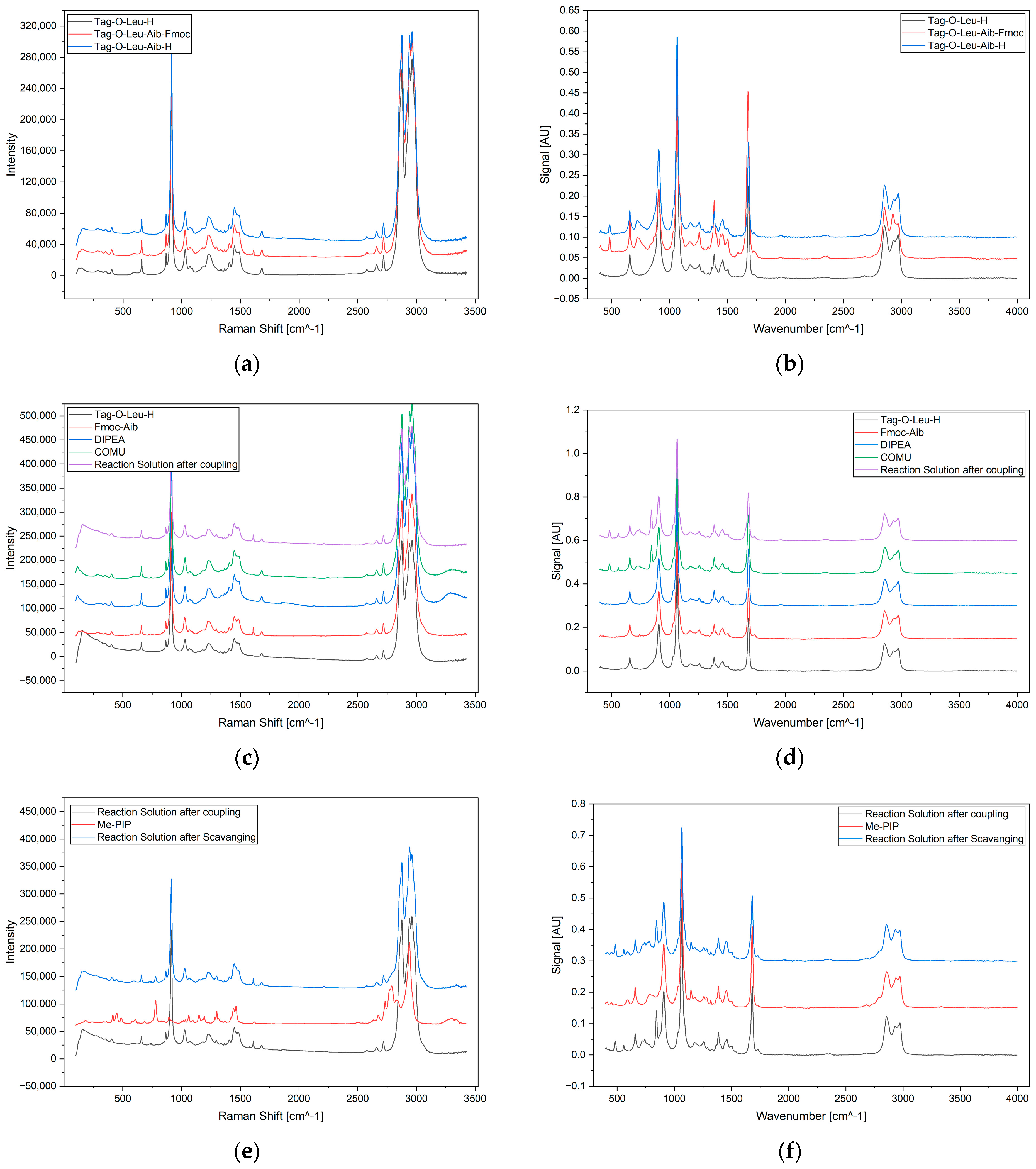
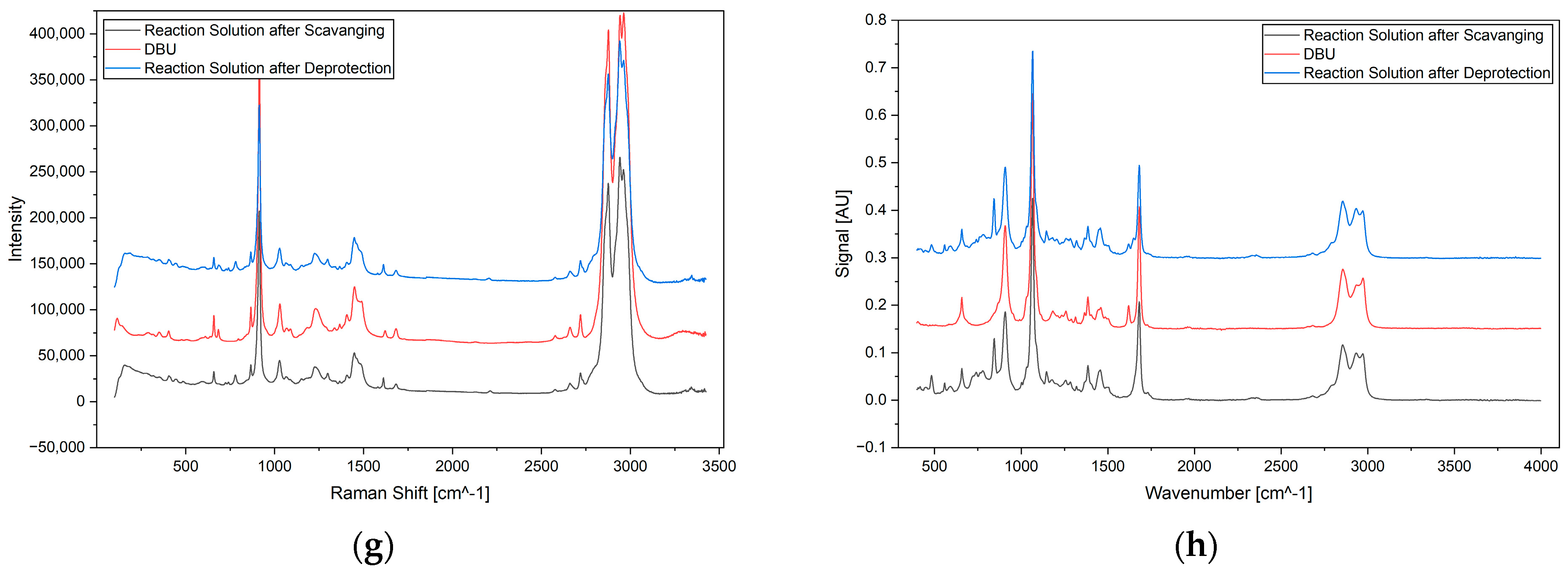
In this study, the first coupling step in the TAPS process was monitored using both Raman and FT-IR spectroscopy. To this end, all relevant process solutions were first analyzed individually at their process concentrations (Figure 12). This allowed for the reliable identification and quantification of the reagents used. Furthermore, peaks were identified in the spectrum of the reaction mixture that cannot be explained by a linear combination of the starting material spectra and thus indicate the formation of new species during the reaction. However, it was not possible to unambiguously assign these peaks to characteristic signals of the pure products or known intermediates. In addition to other changes, a peak shift from 2250 cm−1 to 2203 cm−1 is observable in the Raman spectrum, which indicates the cleavage of COMU and the associated change in the C≡N stretching vibration.
Mine et al. have shown, that an inline Raman system is able to differentiate between the amino acid Gly and the peptide Gly-Gly in different ratios quantitatively [94]. With the spectra shown in Figure 12a,b a differentiation between product and Fmoc-protected intermediate as well as educt and intermediate is visible in the Raman with a Raman shift of 1612 cm−1. Furthermore, the additional amino acid bond is observable in the ft-ir at a wavelength of about 500 cm−1. Therefore, a qualitative and quantitatively differentiation like in [94] is also possible.
Overall, the experiments conducted provide little reliable evidence for robust online process control of the coupling reaction. It should be noted that coupling and deprotection in the TAPS process proceed considerably faster than in SPPS [96], and are further accelerated by the use of COMU [97,98,99]. This reduces reaction times from hours to minutes, thereby diminishing the process advantage of complete reaction monitoring compared to simple endpoint determination. At-line HPLC methods offer a possible alternative [84,100]. However, for model-predictive process control using a digital twin, a bidirectional interface between the process and the model is indispensable. Thus, the development of suitable PAT methods remains imperative for TAPS processes as well.
The second PAT application can, however, be directly applied to the TAPS process. After coupling and deprotection, the organic phases are washed with water to remove excess reagents. Residual coupling reagents or amino acid residues from deprotection can lead to unwanted double hits. Similarly, residues of the deprotection reagent can cause an incomplete reaction in the subsequent coupling. Furthermore, any remaining scavenging molecules may compete with the activated amino acid during coupling, thereby preventing complete conversion, which leads to missequences in the peptide. Since a clear phase separation occurs between the organic and aqueous phases during extraction, the same measurement principles as in SPPS can, in principle, be applied here. The present experiments have already shown that the relevant reagents can be reliably identified and quantified using FT-IR and Raman spectroscopy. PAT support for the washing steps is therefore realistic and offers immediate process-related benefits in efficiency and product quality.

5. Discussion and Conclusions

Following a techno-economic and ecological analysis of the four peptide synthesis processes presented, the TAPS process is considered the most promising process for peptide synthesis, as shown in Figure 13.
Therefore, in this work, a framework for modeling a TAPS process was developed. For this purpose, the models were implemented, and a model parameter determination concept was developed. The model parameters for the chemical reactions were determined, and the model was calibrated successfully. The following bullet points can be discussed as a conclusion regarding the results of this work:
  • The rapid kinetics of deprotection, activation, and coupling in the liquid phase observed in Section 4.3, combined with the techno-economic and ecological analysis performed in Section 4.2, indicate that the TAPS process is significantly more productive than previously assumed regarding the literature found. From experimental data, an improvement of factor 13 is achievable in the elongation reaction and deprotection. Therefore, high reactor utilization result in very high output on a small production footprint. Therefore, more flexible production is possible. Furthermore, continuous production should be stronger considered, which would bring additional cost advantages [61]. This is even more feasible with a pure liquid-phase reaction than with heterogeneous SPPS. Here, a high STY can be achieved in a short tubular reactor. In coupling with process intensification for LLE in a continuous mixer-separator or even centrifugal extractor will be associated with significant further increases in STY [67].
  • For the ecological analysis, a key weakness in the evaluation of chemical processes with PMI can also be shown in Figure 13. Via PMI, a water-based SPPS is worse by a factor of 1.3 to the reference process, whereas by comparing the processes on the basis of GWP, it shows an improvement of nearly a factor of 5; this also improves upon the SPPS based on greener solvents. An analysis based on GWP is therefore to be preferred to PMI when assessing water-based processes [101,102,103].
  • The kinetics in this paper are included, exemplifying the modeling method for deprotection, activation, and coupling steps. Slower reaction kinetics may occur for the deprotection, activation, and coupling of amino acids at any longer peptide chain. Increased viscosities, solution aggregations, and steric hindrances can have a negative process effect. In addition, it has already been shown in SPPS that the identity of the final amino acid and the one to be coupled has an influence on the effectiveness of the coupling [104]. The exemplified modeling approach is, in general, feasible to be applied for longer chains as well, especially since established inline PAT is more feasible and of higher value at slower process steps.
  • For conceptual process design, either a typical safety factor is required or model parameters must be determined for all coupling steps. This is demonstrated in this work and involves little experimental effort but somewhat more analytical effort, logically.
  • In this work, the conceptual process development of the relevant process steps were observed using spectroscopic methods. Changes in the spectra are visible. For the expansion to a dedicated PAT model, further experiments with different concentrations of reactants need to be carried out. In addition, the rapid reaction kinetics make it difficult to track the progress of the reaction using spectroscopic methods in general. Furthermore, the reactions take place homogeneously in the liquid phase—not two phases which could be balanced with the aid of separate analytics. As a result, the expected differences in the spectra are very small, since there is no adsorption of molecules compared to SPPS. For SPPS, Raman or UV can be used for online tracking of the reaction progress [92,105]. However, with fast kinetics, the benefit of a PAT system is generally lower, as it has not been a critical process step, and focuses on slower processes, e.g., larger peptide chains is recommended.
  • Having the theoretical feasibility shown and the experimental feasibility exemplified, further process development studies are intended: For a complete validated process model of the TAPS process, the full experimental determination of the LLE parameters is necessary, in detail and dedicated [67,68]. In addition, important steps for validating the model should be taken according to the published and, for 10 years, manyfold successfully applied workflow by [106]. For this purpose, the accuracy and precision of the model will be compared with mini-plant data according to the specific experimental plan derived by process modeling. If the model successfully completes these steps, it can be considered distinctly valid [106] and can then be used for QbD-based process development and optimization. Applications for process control as a digital shadow or digital twin are also at hand [67,68]. Digital twin-enabled advanced process control has shown to reduce batch failures and ensure a high product quality within specifications, thereby reducing CoGs, GWP and waste [70,107]. These, process optimizations and efficiency improvements in process conceptual design can further reduce CoGs and GWPs by typically about 30% to factor of 5 due to an increased throughput [70].
This paper provides an overview of the current state of manufacturing and their advantages in terms of GWP, PMI and CoGs. Further, an illustration of the potential process improvements enabled by digital twin technologies as exemplified for the first manufacturing steps of tirzepatide have been shown.

Author Contributions

Conceptualization, J.S.; methodology, M.B. and T.O.J.S.; validation, A.U. and A.S.; formal analysis, A.M.M.; investigation, M.B., T.O.J.S. and A.M.M.; writing—original draft preparation, A.U., M.B., T.O.J.S. and A.M.M.; writing—review and editing, A.S. and J.S.; visualization, A.U., M.B., T.O.J.S. and A.M.M.; supervision, A.S. and J.S. All authors have read and agreed to the published version of the manuscript.

Funding

This research received no external funding.

Data Availability Statement

Data is contained within the article.

Acknowledgments

The authors would like to thank the student working group including Matti Sören Jänicke. As well as the laboratory team at the Institute of Process and Separation Technology as well as the organic chemistry department. Special gratitude is expressed by Atzin Mendoza for MS and NMR support and infrastructure provision to Jan Namyslo and Andreas Schmidt of Clausthal University of Technology. We acknowledge support by Open Access Publishing Fund of Clausthal University of Technology.

Conflicts of Interest

The authors declare no conflicts of interest.

Abbreviations

The following abbreviations are used in this manuscript:
2-Me-THF2-Methyltetrahydrofuran
APIActive pharmaceutical ingredients
ACNAcetonitrile
CAPEXCapital expenditures
CoGsCost of goods
COMU1-[1-(Cyano-2-ethoxy-2-oxoethylideneaminooxy)-dimethylamino-morpholino]-uronium hexafluorophosphate
CPMECyclopentyl methyl ether
CPPsCritical process parameters
CQAsCritical quality attributes
DBU1,8-Diazabicyclo[5.4.0]undec-7-ene
DCMDichloromethane
DEADiethylamine
DICDiisopropylcarbodiimide
DIPEADiisopropylethylamine
DIUDiisopropyl urea
DMCDimethyl carbonate
DMFDimethylformamide
DMSODimethyl sulfoxide
DTTDithiothreitol
EDC HCl1-Ethyl-3-(3-dimethylaminopropyl)carbodiimide hydrochloride
Fmoc9-Fluorenylmethyloxycarbonyl
FT-IRFourier-transform infrared spectroscopy
GLPGlucagon-like peptide
GWPGlobal warming potential
HPLCHigh-performance liquid chromatography
LLELiquid–liquid extraction
LPPSLiquid-phase peptide synthesis
MSAMethanesulfonic acid
MTBEMethyl tert-butyl ether
NBPN-butyl-2-pyrrolidone
NMPN-methyl-2-pyrrolidone
NMRNuclear magnetic resonance
OPEXOperational expenditures
Oxyma PureHydroxyiminocyanacetic acid ethyl ester
PATProcess analytical technology
PFASPer- and polyfluoroalkyl substances
PFRPlug flow reactor
PMIProcess mass intensity
PIPaPiperazine
PIPePiperidine
QdDQuality by design
SPPSSolid-phase peptide synthesis
STRDiscontinuous stirred tank reactor
STYSpace-time yield
TAPSTag-assisted peptide synthesis
TFATrifluoroacetic acid
TIDESTherapeutic peptides and oligonucleotides
TIPSTriisopropylsilane
TMPTransmembrane pressure
WFIWater for injection

References

  1. Al Musaimi, O.; AlShaer, D.; De La Torre, B.G.; Albericio, F. 2024 FDA TIDES (Peptides and Oligonucleotides) Harvest. Pharmaceuticals 2025, 18, 291. [Google Scholar] [CrossRef]
  2. Al Shaer, D.; Al Musaimi, O.; Albericio, F.; De La Torre, B.G. 2023 FDA TIDES (Peptides and Oligonucleotides) Harvest. Pharmaceuticals 2024, 17, 243. [Google Scholar] [CrossRef] [PubMed]
  3. Al Musaimi, O.; Al Shaer, D.; Albericio, F.; De La Torre, B.G. 2022 FDA TIDES (Peptides and Oligonucleotides) Harvest. Pharmaceuticals 2023, 16, 336. [Google Scholar] [CrossRef]
  4. Ozempic Market Analysis—Size, Share, and Forecast Outlook 2025 to 2035. Available online: https://www.futuremarketinsights.com/reports/ozempic-market (accessed on 4 April 2026).
  5. Thompson, E.J. Eli Lilly’s Tirzepatide Sales Reach $24.8 Billion, Bright Outlook Ahead 2026. Available online: https://intellectia.ai/news/stock/eli-lillys-tirzepatide-sales-reach-248-billion-bright-outlook-ahead (accessed on 28 January 2026).
  6. Lilly’s Oral GLP-1, Orforglipron, Is Successful in Third Phase 3 Trial, Triggering Global Regulatory Submissions This Year for the Treatment of Obesity. 2025. Available online: https://investor.lilly.com/news-releases/news-release-details/lillys-oral-glp-1-orforglipron-successful-third-phase-3-trial (accessed on 26 August 2025).
  7. Șeremet, O.C.; Pușcașu, C.; Andrei, C.; Nițulescu, G.; Zbârcea, C.E.; Olaru, O.T. Small-Molecule GLP-1 Receptor Agonists: A Promising Pharmacological Approach. Medicina 2025, 61, 1902. [Google Scholar] [CrossRef] [PubMed]
  8. Allian, A.D.; Berglud, K.D.; Cole, K.P.; Davis, A.J.; Hess, M.; Jemison, A.; Kerr, M.S.; Mack, A.G.; Ortiz-Medina, X.A.; Remick, D.M.; et al. Process to Make GLP1 RA and Intermediates Therefor. U.S. Patent 12,365,682, 22 July 2025. [Google Scholar]
  9. Sison, G. How Much Does Tirzepatide Cost? Available online: https://policylab.us/tirzepatide/cost/ (accessed on 26 August 2025).
  10. Eli Lilly and Company What to Know About Orforglipron: An Investigational Oral GLP-1 2025. Available online: https://investor.lilly.com/news-releases/news-release-details/fda-approves-lillys-foundayotm-orforglipron-only-glp-1-pill (accessed on 3 June 2026).
  11. Josch, J.P.; Strube, J. Characterization of Feed Properties for Conceptual Process Design Involving Complex Mixtures. Chem. Ing. Tech. 2012, 84, 918–931. [Google Scholar] [CrossRef]
  12. Häussling Löwgren, B.; Hoffmann, C.; Vijver, M.G.; Steubing, B.; Cardellini, G. Towards Sustainable Chemical Process Design: Revisiting the Integration of Life Cycle Assessment. J. Clean. Prod. 2025, 491, 144831. [Google Scholar] [CrossRef]
  13. ICH. Guideline Q8 (R2) on Pharmaceutical Development: EMA/CHMP/ICH/167068/2004; European Medicines Agency: London, UK, 2006. [Google Scholar]
  14. Uhlenbrock, L. Quality-by-Design Zur Systematischen Entwicklung von Wertschöpfungsprozessen Pflanzlicher Rohstoffe. Ph.D. Thesis, Technische Universität Clausthal, Clausthal-Zellerfeld, Germany, 2021. [Google Scholar]
  15. Marchetti, P.; Butté, A.; Livingston, A.G. Quality by Design for Peptide Nanofiltration: Fundamental Understanding and Process Selection. Chem. Eng. Sci. 2013, 101, 200–212. [Google Scholar] [CrossRef]
  16. Yu, L.X.; Amidon, G.; Khan, M.A.; Hoag, S.W.; Polli, J.; Raju, G.K.; Woodcock, J. Understanding Pharmaceutical Quality by Design. AAPS J. 2014, 16, 771–783. [Google Scholar] [CrossRef]
  17. Kekessie, I.; Wegner, K.; Martinez, I.; Kopach, M.E.; White, T.D.; Tom, J.K.; Kenworthy, M.N.; Gallou, F.; Lopez, J.; Koenig, S.G.; et al. Process Mass Intensity (PMI): A Holistic Analysis of Current Peptide Manufacturing Processes Informs Sustainability in Peptide Synthesis. J. Org. Chem. 2024, 89, 4261–4282. [Google Scholar] [CrossRef] [PubMed]
  18. Schmidt, A.; Uhlenbrock, L.; Strube, J. Technical Potential for Energy and GWP Reduction in Chemical–Pharmaceutical Industry in Germany and EU—Focused on Biologics and Botanicals Manufacturing. Processes 2020, 8, 818. [Google Scholar] [CrossRef]
  19. Uhl, A.; Schmidt, A.; Jensch, C.; Köster, D.; Strube, J. Development of Concepts for a Climate-Neutral Chemical–Pharmaceutical Industry in 2045. Processes 2022, 10, 1289. [Google Scholar] [CrossRef]
  20. Wegner, K.; Barnes, D.; Manzor, K.; Jardine, A.; Moran, D. Evaluation of Greener Solvents for Solid-Phase Peptide Synthesis. Green Chem. Lett. Rev. 2021, 14, 153–164. [Google Scholar] [CrossRef]
  21. Varnava, K.G.; Sarojini, V. Making Solid-Phase Peptide Synthesis Greener: A Review of the Literature. Chem. Asian J. 2019, 14, 1088–1097. [Google Scholar] [CrossRef] [PubMed]
  22. Sharma, A.; Kumar, A.; De La Torre, B.G.; Albericio, F. Liquid-Phase Peptide Synthesis (LPPS): A Third Wave for the Preparation of Peptides. Chem. Rev. 2022, 122, 13516–13546. [Google Scholar] [CrossRef]
  23. Østergaard, S. Advancing Obesity Treatments through Innovations in the Design and Manufacturing of Therapeutic Peptides. Expert Opin. Drug Discov. 2026, 21, 49–72. [Google Scholar] [CrossRef] [PubMed]
  24. Akahane, S.; Takahashi, Y.; Morikawa, E.; Sugai, M.; Umemoto, H.; Onaka, T.; Ito, S.; Taki, N.; Yoshida, Y.; Toichi, Y.; et al. Tag-Assisted Liquid-Phase Oligonucleotide Synthesis: Toward a Convergent Approach. Chem. Eur. J. 2025, 31, e202500616. [Google Scholar] [CrossRef] [PubMed]
  25. Ferrazzano, L.; Corbisiero, D.; Tolomelli, A.; Cabri, W. From Green Innovations in Oligopeptide to Oligonucleotide Sustainable Synthesis: Differences and Synergies in TIDES Chemistry. Green Chem. 2023, 25, 1217–1236. [Google Scholar] [CrossRef]
  26. Virta, P. From Liquid-Phase Synthesis to Chemical Ligation: Preparation of Oligonucleotides and Their Backbone Analogs in Solution. Nucleic Acids Res. 2025, 53, gkaf1084. [Google Scholar] [CrossRef]
  27. Brown, T., Sr.; Brown, T., Jr. Solid Phase Oligonucleotide Synthesis. Available online: https://www.biotage.com/hubfs/bynder/Document/PPS676-biotage-solid-phase-oligonucleotide-synthesis-white-paper.pdf (accessed on 29 January 2026).
  28. Solid-Phase Oligonucleotide Synthesis; ATDBio: Southhampton, UK, 2022; Available online: https://data.biotage.co.jp/pdf/atdbio/pps676_biotage-solid-phase-oligonucleotide-synthesis-white-paper.pdf (accessed on 3 June 2026).
  29. Jad, Y.E.; Govender, T.; Kruger, H.G.; El-Faham, A.; De La Torre, B.G.; Albericio, F. Green Solid-Phase Peptide Synthesis (GSPPS) 3. Green Solvents for Fmoc Removal in Peptide Chemistry. Org. Process Res. Dev. 2017, 21, 365–369. [Google Scholar] [CrossRef]
  30. Kent, S.B.H. Fundamental Aspects of SPPS and Green Chemical Peptide Synthesis. J. Pept. Sci. 2025, 31, e70013. [Google Scholar] [CrossRef] [PubMed]
  31. Öhlander, A. Greening Peptide Chemistry by Using NBP as Solvent for SPPS. Master’s Thesis, Lund University, Lund, Sweden, 2022. [Google Scholar]
  32. Jaradat, D.M.M.; Al Musaimi, O.; Albericio, F. Advances in Solid-Phase Peptide Synthesis in Aqueous Media (ASPPS). Green Chem. 2022, 24, 6360–6372. [Google Scholar] [CrossRef]
  33. Frederick, M.O.; Boyse, R.A.; Braden, T.M.; Calvin, J.R.; Campbell, B.M.; Changi, S.M.; Coffin, S.R.; Condon, C.; Gowran, O.; McClary Groh, J.; et al. Kilogram-Scale GMP Manufacture of Tirzepatide Using a Hybrid SPPS/LPPS Approach with Continuous Manufacturing. Org. Process Res. Dev. 2021, 25, 1628–1636. [Google Scholar] [CrossRef]
  34. Merrifield, R.B. Solid Phase Peptide Synthesis. I. The Synthesis of a Tetrapeptide. J. Am. Chem. Soc. 1963, 85, 2149–2154. [Google Scholar] [CrossRef]
  35. Musaimi, O.A.; Tomkins, J.; Barry, S.M.; Basso, A.; Kou, X.; Zhang, C.; Serban, S. Towards Green, Scalable Peptide Synthesis: Leveraging DEG-Crosslinked Polystyrene Resins to Overcome Hydrophobicity Challenges. RSC Adv. 2024, 14, 40255–40266. [Google Scholar] [CrossRef]
  36. Martin, V.; Jadhav, S.; Egelund, P.H.G.; Liffert, R.; Johansson Castro, H.; Krüger, T.; Haselmann, K.F.; Thordal Le Quement, S.; Albericio, F.; Dettner, F.; et al. Harnessing Polarity and Viscosity to Identify Green Binary Solvent Mixtures as Viable Alternatives to DMF in Solid-Phase Peptide Synthesis. Green Chem. 2021, 23, 3295–3311. [Google Scholar] [CrossRef]
  37. Uzoma Introduction to Peptide Synthesis Methods. Bachem. 2025. Available online: https://www.bachem.com/knowledge-center/peptide-guide/introduction-to-peptide-synthesis-methods/ (accessed on 22 January 2026).
  38. Knauer, S.; Koch, N.; Uth, C.; Meusinger, R.; Avrutina, O.; Kolmar, H. Sustainable Peptide Synthesis Enabled by a Transient Protecting Group. Angew. Chem. Int. Ed. 2020, 59, 12984–12990. [Google Scholar] [CrossRef]
  39. Wang, J.; Agrawal, P.; Berglund, M.R.; Groh, J.M.; Kopach, M.E.; Seibert, K.D.; Viswanath, S.K. Quality by Design of Solid-phase Peptide/Protein Coupling Reaction via Mechanistic Reaction Kinetics Modeling Approach. AIChE J. 2024, 70, e18453. [Google Scholar] [CrossRef]
  40. Johnson, M.D.; Kopach, M.E.; Webster, L.P. Three Resin Reactors in Series Peptide Synthesizer. U.S. Patent 12,485,402, 2 December 2021. [Google Scholar]
  41. Martin, V.; Egelund, P.H.G.; Johansson, H.; Thordal Le Quement, S.; Wojcik, F.; Sejer Pedersen, D. Greening the Synthesis of Peptide Therapeutics: An Industrial Perspective. RSC Adv. 2020, 10, 42457–42492. [Google Scholar] [CrossRef]
  42. Lawrenson, S.B. Greener Solvents for Solid-Phase Organic Synthesis. Pure Appl. Chem. 2018, 90, 157–165. [Google Scholar] [CrossRef]
  43. Prat, D.; Wells, A.; Hayler, J.; Sneddon, H.; McElroy, C.R.; Abou-Shehada, S.; Dunn, P.J. CHEM21 selection guide of classical- and less classical-solvents. Green Chem. 2016, 18, 288–296. [Google Scholar] [CrossRef]
  44. Usman, M.; Cheng, S.; Boonyubol, S.; Cross, J.S. Evaluating Green Solvents for Bio-Oil Extraction: Advancements, Challenges, and Future Perspectives. Energies 2023, 16, 5852. [Google Scholar] [CrossRef]
  45. Schuler, H.; Wiley InterScience (Online Service) (Eds.) Prozesssimulation; VCH: Weinheim, Germany; New York, NY, USA, 1995; ISBN 978-3-527-28635-5. [Google Scholar]
  46. Lopez, J.; Pletscher, S.; Aemissegger, A.; Bucher, C.; Gallou, F. N-Butylpyrrolidinone as Alternative Solvent for Solid-Phase Peptide Synthesis. Org. Process Res. Dev. 2018, 22, 494–503. [Google Scholar] [CrossRef]
  47. Vivenzio, G.; Noki, S.; Chakraborty, A.; Lopez, J.; De La Torre, B.G.; Albericio, F. Scope and Limitations of the Use of Methanesulfonic Acid (MSA) as a Green Acid for Global Deprotection in Solid-Phase Peptide Synthesis. ChemSusChem 2025, 18, e202402752. [Google Scholar] [CrossRef]
  48. Ralhan, K.; KrishnaKumar, V.G.; Gupta, S. Piperazine and DBU: A Safer Alternative for Rapid and Efficient Fmoc Deprotection in Solid Phase Peptide Synthesis. RSC Adv. 2015, 5, 104417–104425. [Google Scholar] [CrossRef]
  49. Al Musaimi, O.; Jad, Y.E.; Kumar, A.; Collins, J.M.; Basso, A.; De La Torre, B.G.; Albericio, F. Investigating Green Ethers for the Precipitation of Peptides after Global Deprotection in Solid-Phase Peptide Synthesis. Curr. Opin. Green Sustain. Chem. 2018, 11, 99–103. [Google Scholar] [CrossRef]
  50. Shemyakin, M.M.; Ovchinnikov, Y.A.; Kinyushkin, A.A.; Kozhevnikova, I.V. Synthesis of Peptides in Solution on a Polymeric Support I. Synthesis of Glycylglycyl-l-Leucylglycine. Tetrahedron Lett. 1965, 6, 2323–2327. [Google Scholar] [CrossRef]
  51. Tamiaki, H.; Obata, T.; Azefu, Y.; Toma, K. A Novel Protecting Group for Constructing Combinatorial Peptide Libraries. Bull. Chem. Soc. Jpn. 2001, 74, 733–738. [Google Scholar] [CrossRef]
  52. Okada, Y.; Hosoya, S.; Suzuki, H.; Chiba, K. Total Synthesis of Elastin Peptide Using High Pressure–Liquid Phase Synthesis Assisted by a Soluble Tag Strategy. Org. Lett. 2014, 16, 6448–6451. [Google Scholar] [CrossRef] [PubMed]
  53. Chiba, K.; Shokaku Kim, K.; Yusuke Kono, K. Carrier for Separation, Method for Separation of Compound, and Method for Synthesis of Peptide Using the Carrier. U.S. Patent 8,633,298, 21 January 2014. [Google Scholar]
  54. Okada, Y.; Suzuki, H.; Nakae, T.; Fujita, S.; Abe, H.; Nagano, K.; Yamada, T.; Ebata, N.; Kim, S.; Chiba, K. Tag-Assisted Liquid-Phase Peptide Synthesis Using Hydrophobic Benzyl Alcohols as Supports. J. Org. Chem. 2013, 78, 320–327. [Google Scholar] [CrossRef]
  55. Kitada, S.; Fujita, S.; Okada, Y.; Kim, S.; Chiba, K. Hydrophobic Tag-Assisted Liquid-Phase Synthesis of a Growth Hormone-Inhibiting Peptide Somatostatin. Bioorg. Med. Chem. Lett. 2011, 21, 4476–4479. [Google Scholar] [CrossRef]
  56. Fujita, Y.; Fujita, S.; Okada, Y.; Chiba, K. Soluble Tag-Assisted Peptide Head-to-Tail Cyclization: Total Synthesis of Mahafacyclin B. Org. Lett. 2013, 15, 1155–1157. [Google Scholar] [CrossRef] [PubMed]
  57. Pang, Z.-J.; Mao, C.-Y.; Feng, T.-T.; Dong, L. Hydrophobic Tag-Assisted Liquid-Phase Synthesis of Tirzepatide. Org. Lett. 2025, 27, 10442–10446. [Google Scholar] [CrossRef]
  58. Emig, G.; Klemm, E. Chemische Reaktionstechnik; Springer-Lehrbuch; Springer: Berlin/Heidelberg, Germany, 2017; ISBN 978-3-662-49267-3. [Google Scholar]
  59. Zobel-Roos, S.; Schmidt, A.; Mestmäcker, F.; Mouellef, M.; Huter, M.; Uhlenbrock, L.; Kornecki, M.; Lohmann, L.; Ditz, R.; Strube, J. Accelerating Biologics Manufacturing by Modeling or: Is Approval under the QbD and PAT Approaches Demanded by Authorities Acceptable Without a Digital-Twin? Processes 2019, 7, 94. [Google Scholar] [CrossRef]
  60. Schmidt, A.; Zobel-Roos, S.; Helgers, H.; Lohmann, L.; Vetter, F.; Jensch, C.; Juckers, A.; Strube, J. Digital Twins for Continuous Biologics Manufacturing. In Process Control, Intensification, and Digitalisation in Continuous Biomanufacturing; Subramanian, G., Ed.; Wiley: Hoboken, NJ, USA, 2022; pp. 265–350. ISBN 978-3-527-34769-8. [Google Scholar]
  61. Schmidt, A.; Hengelbrock, A.; Strube, J. Continuous Biomanufacturing in Upstream and Downstream Processing. Phys. Sci. Rev. 2024, 9, 3167–3222. [Google Scholar] [CrossRef]
  62. Levenspiel, O. Chemical Reaction Engineering, 3rd ed.; Wiley: New York, NY, USA, 1999; ISBN 978-0-471-25424-9. [Google Scholar]
  63. Danckwerts, P.V. Continuous Flow Systems. Chem. Eng. Sci. 1953, 2, 1–13. [Google Scholar] [CrossRef]
  64. Alopaeus, V.; Laavi, H.; Aittamaa, J. A Dynamic Model for Plug Flow Reactor State Profiles. Comput. Chem. Eng. 2008, 32, 1494–1506. [Google Scholar] [CrossRef]
  65. Hengelbrock, A.; Schmidt, A.; Strube, J. Digital Twin Fundamentals of mRNA In Vitro Transcription in Variable Scale Toward Autonomous Operation. ACS Omega 2024, 9, 8204–8220. [Google Scholar] [CrossRef]
  66. Haindl, S.; Stark, J.; Dippel, J.; Handt, S.; Reiche, A. Scale-up of Microfiltration Processes. Chem. Ing. Tech. 2020, 92, 746–758. [Google Scholar] [CrossRef]
  67. Uhl, A.; Schmidt, A.; Strube, J. Digital Twin for Centrifugal Extractors Exemplified for pDNA Clarification Process after Lysis. ACS Omega 2024, 9, 31120–31127. [Google Scholar] [CrossRef]
  68. Uhl, A.; Schmidt, A.; Hlawitschka, M.W.; Strube, J. Autonomous Liquid–Liquid Extraction Operation in Biologics Manufacturing with Aid of a Digital Twin Including Process Analytical Technology. Processes 2023, 11, 553. [Google Scholar] [CrossRef]
  69. Kirk, R.E.; Othmer, D.F. (Eds.) Kirk-Othmer Encyclopedia of Chemical Technology; Wiley online library; Wiley: New York, NY, USA, 2013; ISBN 978-0-471-23896-6. [Google Scholar]
  70. Schmidt, A.; Lütge, J.; Uhl, A.; Köster, D.; Strube, J. Business Cases for Digital Twins in Biopharmaceutical Manufacturing—Market Overview, Stakeholders, Technologies in 2025 and Beyond. Processes 2025, 13, 1498. [Google Scholar] [CrossRef]
  71. Uhl, A.; Knierim, L.; Tegtmeier, M.; Schmidt, A.; Strube, J. Is Regulatory Approval without Autonomous Operation for Natural Extract Manufacturing under Economic Competitiveness and Climate-Neutrality Demands Still Permissible? Processes 2023, 11, 1790. [Google Scholar] [CrossRef]
  72. Woods, D.R. Rules of Thumb in Engineering Practice; John Wiley [Distributor]: Chichester, UK, 2007; ISBN 978-3-527-31220-7. [Google Scholar]
  73. The Chemical Engineering Plant Cost Index. Available online: https://www.chemengonline.com/pci-home/ (accessed on 3 June 2026).
  74. Parisis, V.; Da Gama Ferreira, R.; Misailidis, N.; Petrides, D. Semaglutide (Ozempic and Wegovy) Manufacturing—Process Modeling and Techno-Economic Assessment (TEA) Using SuperPro Designer; Intelligen, Inc.: Freehold, NJ, USA, 2025. [Google Scholar] [CrossRef]
  75. DocMorris. Available online: https://www.docmorris.de/search?query=mounjaro (accessed on 8 July 2025).
  76. Benison, C.H.; Payne, P.R. Manufacturing Mass Intensity: 15 Years of Process Mass Intensity and Development of the Metric into Plant Cleaning and Beyond. Curr. Res. Green Sustain. Chem. 2022, 5, 100229. [Google Scholar] [CrossRef]
  77. Pastore, B.M.; Savelski, M.J.; Slater, C.S.; Richetti, F.A. Life Cycle Assessment of N-Methyl-2-Pyrrolidone Reduction Strategies in the Manufacture of Resin Precursors. Clean. Technol. Environ. Policy 2016, 18, 2635–2647. [Google Scholar] [CrossRef]
  78. Becks, H.; Gelbke, H. Die Ökoeffizienz-Analyse nach BASF. TATuP 2001, 10, 34–39. [Google Scholar] [CrossRef]
  79. Burger, J.; Asprion, N.; Blagov, S.; Böttcher, R.; Nowak, U.; Bortz, M.; Welke, R.; Küfer, K.; Hasse, H. Multi-Objective Optimization and Decision Support in Process Engineering—Implementation and Application. Chem. Ing. Tech. 2014, 86, 1065–1072. [Google Scholar] [CrossRef]
  80. Fukuda, T.; Matsumoto, E.; Onogi, S.; Miura, Y. Aggregation of Alzheimer Amyloid β Peptide (1−42) on the Multivalent Sulfonated Sugar Interface. Bioconjugate Chem. 2010, 21, 1079–1086. [Google Scholar] [CrossRef]
  81. Kim, S.; Matsumoto, M.; Chiba, K. Liquid-Phase RNA Synthesis by Using Alkyl-Chain-Soluble Support. Chem. Eur. J. 2013, 19, 8615–8620. [Google Scholar] [CrossRef]
  82. Hirose, T.; Kasai, T.; Akimoto, T.; Endo, A.; Sugawara, A.; Nagasawa, K.; Shiomi, K.; Ōmura, S.; Sunazuka, T. Solution-Phase Total Synthesis of the Hydrophilic Natural Product Argifin Using 3,4,5-Tris(Octadecyloxy)Benzyl Tag. Tetrahedron 2011, 67, 6633–6643. [Google Scholar] [CrossRef]
  83. Suzuki, H.; Muto, S.; Fujita, S.; Kubo, D. Peptide Synthesis Method. US Patent WO 2019/198833, 17 October 2019. [Google Scholar]
  84. Okada, Y.; Takasawa, R.; Kubo, D.; Iwanaga, N.; Fujita, S.; Suzuki, K.; Suzuki, H.; Kamiya, H.; Chiba, K. Improved Tag-Assisted Liquid-Phase Peptide Synthesis: Application to the Synthesis of the Bradykinin Receptor Antagonist Icatibant Acetate. Org. Process Res. Dev. 2019, 23, 2576–2581. [Google Scholar] [CrossRef]
  85. Uhlenbrock, L.; Jensch, C.; Tegtmeier, M.; Strube, J. Digital Twin for Extraction Process Design and Operation. Processes 2020, 8, 866. [Google Scholar] [CrossRef]
  86. Sixt, M.; Schmidt, A.; Mestmäcker, F.; Huter, M.; Uhlenbrock, L.; Strube, J. Systematic and Model-Assisted Process Design for the Extraction and Purification of Artemisinin from Artemisia annua L.—Part I: Conceptual Process Design and Cost Estimation. Processes 2018, 6, 161. [Google Scholar] [CrossRef]
  87. Pfennig, A.; Müller, E.; Berger, R.; Blass, E.; Sluyts, D. Liquid–Liquid Extraction. In Ullmann’s Encyclopedia of Industrial Chemistry; Wiley: Hoboken, NJ, USA, 2024; pp. 1–65. ISBN 978-3-527-30385-4. [Google Scholar]
  88. Heller, F.D.; Casella, A.J.; Lumetta, G.J.; Nash, K.L.; Sinkov, S.I.; Bryan, S.A. Incorporating Spectroscopic On-Line Monitoring as a Method of Detection for a Lewis Cell Setup. Analyst 2017, 142, 2426–2433. [Google Scholar] [CrossRef] [PubMed]
  89. Lewis, J.B. The Mechanism of Mass Transfer of Solutes across Liquid-Liquid Interfaces. Chem. Eng. Sci. 1954, 3, 260–278. [Google Scholar] [CrossRef]
  90. Altenhöner, U.; Meurer, M.; Strube, J.; Schmidt-Traub, H. Parameter Estimation for the Simulation of Liquid Chromatography. J. Chromatogr. A 1997, 769, 59–69. [Google Scholar] [CrossRef]
  91. Lütge, J.; Schmidt, A.; Köster, D.; Strube, J. Piloting for Scale-Up—An Ancient Technology Only for Non-Chemical Engineering Trained Investors. Processes 2025, 13, 2925. [Google Scholar] [CrossRef]
  92. Stager, M.A.; Peroza, C.; Villaumie, J.; Bilham, C.; Desmond, C.; Harris, M.; Sambasivan, R.; Rowe, G.; Chen, L.; Tucker, C. Optimizing Industrial Solid-Phase Peptide Synthesis: Integration of Raman Spectroscopy as Process Analytical Technology. Org. Process Res. Dev. 2024, 28, 4501–4512. [Google Scholar] [CrossRef]
  93. Henkel, B.; Emeröz, C.; Egger, N. Low-Field NMR for the Online-Monitoring of Solid-Phase Peptide Synthesis—A First Evaluation. ChemRxiv 2026. [Google Scholar] [CrossRef]
  94. Mine, S.; Ochiai, H.; Tamura, K.; Iijima, S.; Suzuki, S.; Akao, K. In-Situ Raman Monitoring for Flow Synthesis of Peptide Drugs Poster presented at: RSC-JAIMA Symposium on Analytical Chemistry 2024, September 2024, Chiba. Available online: https://www.jasco-global.com/solutions/in-situ-raman-monitoring-for-flow-synthesis-of-peptide-drugs/ (accessed on 3 June 2026).
  95. De La Torre, B.G.; Ramkisson, S.; Albericio, F.; Lopez, J. Refractive Index: The Ultimate Tool for Real-Time Monitoring of Solid-Phase Peptide Synthesis. Greening the Process. Org. Process Res. Dev. 2021, 25, 1047–1053. [Google Scholar] [CrossRef]
  96. Ayoub, M. Tag-Assisted Peptide Synthesis (TAPS)—Development of an Efficient, Sustainable and Cost-Effective Continuous Liquid-Phase Process. In Proceedings of the Tides US, San Diego, CA, USA, 19–22 May 2025. [Google Scholar]
  97. El-Faham, A.; Albericio, F. COMU: A Third Generation of Uronium-type Coupling Reagents. J. Pept. Sci. 2010, 16, 6–9. [Google Scholar] [CrossRef]
  98. BenchChem Technical Support Team. A Comparative Analysis of Oxyma and COMU Coupling Reagents in Peptide Synthesis. 2026. Available online: https://pdf.benchchem.com/123/A_Comparative_Analysis_of_Oxyma_and_COMU_Coupling_Reagents_in_Peptide_Synthesis.pdf (accessed on 1 April 2026).
  99. BenchChem Technical Support Team. The Next Generation of Peptide Synthesis: An In-Depth Technical Guide to the COMU Coupling Reagent. 2026. Available online: https://pdf.benchchem.com/8018/The_Next_Generation_of_Peptide_Synthesis_An_In_depth_Technical_Guide_to_the_COMU_Coupling_Reagent.pdf (accessed on 1 April 2026).
  100. Schiefelbein, K.; Hartrampf, N. Flow-Based Methods in Chemical Peptide and Protein Synthesis. Chimia 2021, 75, 480. [Google Scholar] [CrossRef]
  101. Monteith, E.R.; Mampuys, P.; Summerton, L.; Clark, J.H.; Maes, B.U.W.; McElroy, C.R. Why We Might Be Misusing Process Mass Intensity (PMI) and a Methodology to Apply It Effectively as a Discovery Level Metric. Green Chem. 2020, 22, 123–135. [Google Scholar] [CrossRef]
  102. Eichwald, S.; Ostovari, H.; Minten, H.; Meyer-Waßewitz, J.; Förtsch, D.; Von Der Assen, N. Assessing Mass Intensity as a Green Chemistry Metric: Why Expanding System Boundaries Is Not Enough. Green Chem. 2025, 27, 10153–10168. [Google Scholar] [CrossRef]
  103. Jimenez-Gonzalez, C.; Ponder, C.S.; Broxterman, Q.B.; Manley, J.B. Using the Right Green Yardstick: Why Process Mass Intensity Is Used in the Pharmaceutical Industry To Drive More Sustainable Processes. Org. Process Res. Dev. 2011, 15, 912–917. [Google Scholar] [CrossRef]
  104. Boutin, J.A.; Gesson, I.; Henlin, J.-M.; Bertin, S.; Lambert, P.-H.; Volland, J.-P.; Fauchere, J.-L. Limitations of the Coupling of Amino Acid Mixtures for the Preparation of Equimolar Peptide Libraries. Mol. Divers. 1997, 3, 43–60. [Google Scholar] [CrossRef]
  105. Menakuru, M.S.; Hensley, R.W.; Blais, J.B.E. On-Line Monitoring of Deprotection Reaction in Peptide Automated Synthesizer Comprising UV Detector. U.S. Patent 8,535,947, 17 September 2013. [Google Scholar]
  106. Sixt, M.; Uhlenbrock, L.; Strube, J. Toward a Distinct and Quantitative Validation Method for Predictive Process Modelling—On the Example of Solid-Liquid Extraction Processes of Complex Plant Extracts. Processes 2018, 6, 66. [Google Scholar] [CrossRef]
  107. Hengelbrock, A.; Probst, F.; Baukmann, S.; Uhl, A.; Tschorn, N.; Stitz, J.; Schmidt, A.; Strube, J. Digital Twin for Continuous Production of Virus-like Particles toward Autonomous Operation. ACS Omega 2024, 9, 34990–35013. [Google Scholar] [CrossRef]
Figure 1. Overview of criteria for green solvents.
Processes 14 01873 g001
Figure 2. Polarity and viscosity of evaluated green alternatives for SPPS, reprinted with permission [36].
Processes 14 01873 g002
Figure 3. Summary of the implemented models for the reference process [39,62].
Processes 14 01873 g003
Figure 4. Schematic representation of the synthetic pathway of hydrophobized leucine 6.
Processes 14 01873 g004
Figure 5. Schematic representation of the one-pot synthesis method of a hydrophobized tetrapeptide.
Processes 14 01873 g005
Figure 6. Deprotection and coupling reactions considered for the presented kinetic studies.
Processes 14 01873 g006
Figure 7. Total process simulation results reference process according to Reference [33].
Processes 14 01873 g007
Figure 8. Comparison of one peptide fragment elongation step for the reference process (a), alternative 1/green solvents SPPS (b), alternative 2/water-based SPPS (c) and TAPS (d).
Processes 14 01873 g008
Figure 9. Reaction pathway of hydrophobized tetrapeptide 9 with corresponding calculated and measured molecular masses of the elongated peptides.
Processes 14 01873 g009
Figure 10. NMR spectra of the activation and coupling samples (a) and deprotection samples (b) with the resulting normalized proton signals and conversion of the activation and coupling samples (c) and deprotection samples (d).
Processes 14 01873 g010
Figure 11. Summary of the developed model parameter determination concept.
Processes 14 01873 g011
Figure 12. Raman and FT-IR spectra of the pure reaction products (a,b); reaction solutions and reactants of the coupling step (c,d), scavenging (e,f), and deprotecting (g,h).
Processes 14 01873 g012aProcesses 14 01873 g012b
Figure 13. Schematic summary of economic and ecological analysis for PMI vs. CoGs (a) and GWP vs. CoGs (b).
Processes 14 01873 g013
Table 1. Substituted chemicals from reference SPPS to the alternative processes and the relative time factor of the synthesis steps.
StepReferenceAlternative 1
(Green Solvents)
Time FactorAlternative 2
(Water-Based)
Time Factor
SwellingDMF2-Me-THF/NBP0.5Water1
DeprotectionPIPe/NMPPIPe/2-Me-THF/NBP2PIPa/Water3
WashDMF2-Me-THF/NBP~1Water~1
CouplingDIC/NMPDIC/2-Me-THF/NBP2EDC/NaHCO3~0.5
SeparationTFAMSA1MSA1
Table 2. Summary of PMI, GWP, STY and CoGs of all considered processes.
Reference
Process
Alternative 1
(Green Solvents)
Alternative 2
(Water-Based)
TAPS
PMI [kg/kg]4940479065101660
GWP [ k g C O 2 /kg]19,19014,24040102490
STY in Fragment Synthesis [g/(L d)]4.3402.3904.17013.960
STY overall [g/(L d)]0.3250.2560.3250.362
Cost of Goods [$/kg]27,40075,00072,90034,400
Disclaimer/Publisher’s Note: The statements, opinions and data contained in all publications are solely those of the individual author(s) and contributor(s) and not of MDPI and/or the editor(s). MDPI and/or the editor(s) disclaim responsibility for any injury to people or property resulting from any ideas, methods, instructions or products referred to in the content.